🌙 Tekin Night | Sunday, September 13, 2026
Good evening and welcome to Tekin Night for Sunday, September 13, 2026. Tonight we unpack seismic revelations across gaming economics, studio espionage, physical media limits, and critical state cybersecurity.
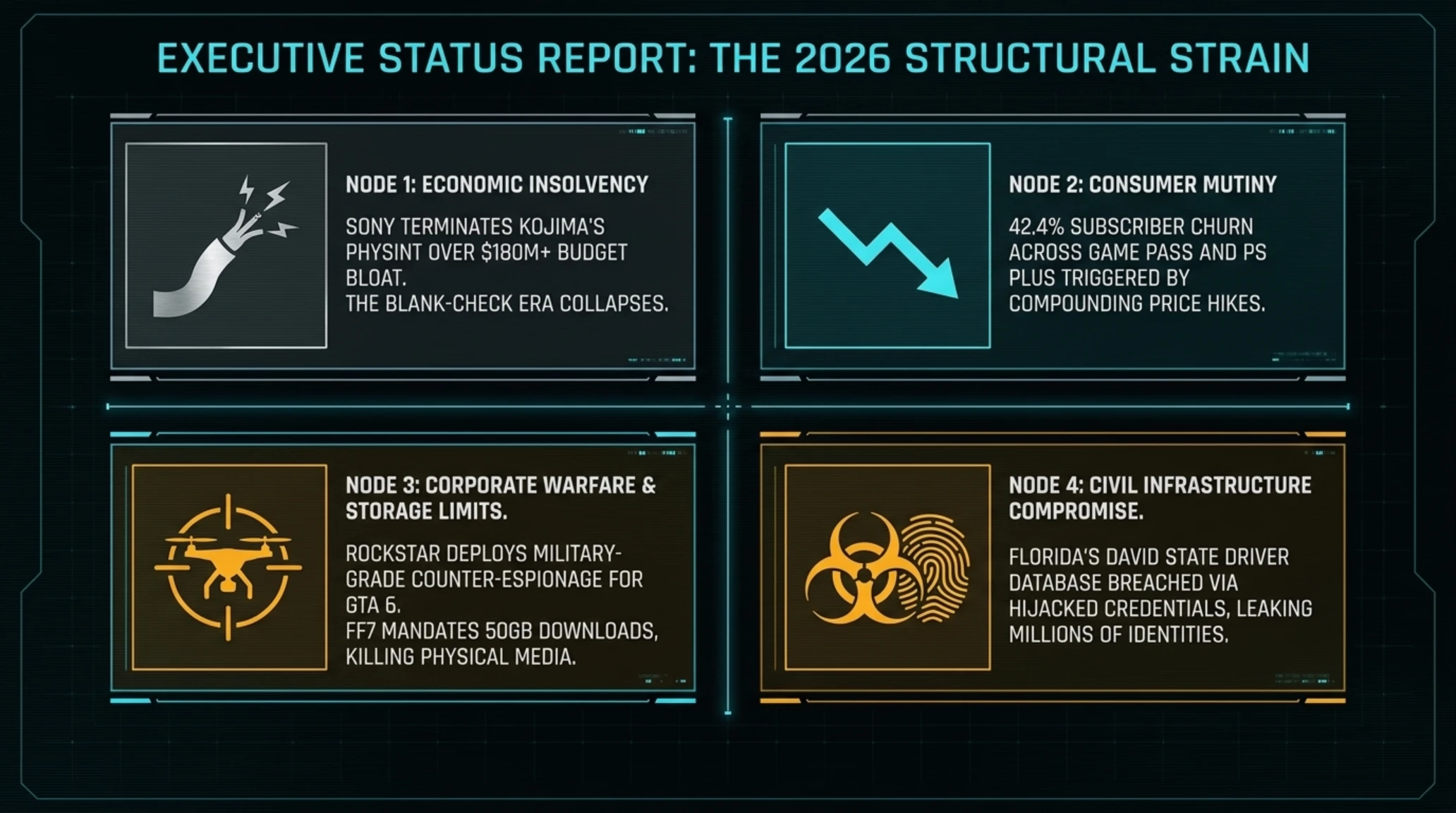
- 🎮Sony Ditches Kojima's Physint- PlayStation withdraws funding over $180M+ budget bloat, missed milestones, and exclusivity disputes.
- 🎧Gaming Subscription Crisis- Over 40% of cancelling Game Pass and PS Plus members cite relentless price hikes as #1 catalyst.
- 🚀Rockstar Games Drone Counter-Espionage- High Court trial reveals telephoto spy drones and a 2.5-year undercover mole in union Discord.
- 🗡️FF7 Revelation Mandatory Download Defense- Director Naoki Hamaguchi defends 50GB patch: cramming onto 100GB discs would butcher visual climax.
- 📰Thief: The Dark Project Remaster Confirmed- Nightdive Studios announces KEX Engine remaster with new campaign 'The Tarnished Mirror' & Path Tracing.
- ⚔️Florida Driver Database (DAVID) Breached- Statewide law enforcement portal compromised via stolen credentials, leaking hundreds of thousands of SSNs.
Good evening, gaming executives, software architects, cybersecurity defenders, and digital innovators. Welcome to the Sunday night edition of Tekin Night for September 13, 2026. While our morning briefing dissected the theoretical battlegrounds of algorithmic mathematics, orbital rocket launches, and nanometer photolithography, tonight's coverage pivots toward the multi-billion-dollar corridors of digital entertainment economics, corporate counter-espionage, and systemic data vulnerabilities. What transpired across game development hubs in Tokyo, London, and Edinburgh over the past seventy-two hours signals that the interactive entertainment industry has collided head-on with an unyielding economic reality.
At the center of tonight's reporting lies a monumental fracture between Sony Interactive Entertainment (SIE) and one of the gaming medium's most legendary auteurs, signaling the definitive end of the 'blank check' era for cinematic prestige titles. Simultaneously, empirical market research reveals that consumer subscription fatigue has finally hit a breaking point across Xbox Game Pass and PlayStation Plus, threatening the foundational business models of Western console manufacturers. Coupled with extraordinary court disclosures regarding Rockstar Games' physical and digital surveillance warfare to safeguard Grand Theft Auto VI, tonight's dispatch provides an exhaustive forensic breakdown of a sector under unprecedented structural strain.
Executive Key Takeaways for Sunday Night
- Sony Interactive Entertainment cancels its publishing and funding partnership for Hideo Kojima's Physint as production estimates surge past $180 million.
- Comprehensive market analysis from Circana and Newzoo confirms over 40% of recent subscription cancellations across Game Pass and PS Plus are directly driven by aggressive price hikes.
- Edinburgh High Court legal filings expose Rockstar Games deploying an undercover operative inside worker union Discord channels for 30 months alongside anti-drone defense systems.
- Final Fantasy 7 Revelation Director Naoki Hamaguchi defends mandatory 50GB+ digital day-one download, stating full physical disc compression would destroy narrative visual fidelity.
- Nightdive Studios officially confirms a ground-up KEX Engine remaster of Looking Glass Studios' 1998 classic Thief: The Dark Project, featuring full Path Tracing and an all-new campaign.
- Florida highway safety authorities confirm statewide breach of the DAVID driver database following the compromise of an active law enforcement account, exfiltrating hundreds of thousands of citizen identities.
Our editorial and forensic research teams have cross-examined court transcripts, financial disclosures, consumer survey telemetry, and executive communications to assemble this definitive Sunday night intelligence briefing for industry stakeholders.

We begin our coverage with the biggest corporate tremor to hit the console gaming landscape this year: PlayStation's abrupt departure from Hideo Kojima's next-generation espionage opus.
1. Shockwave at PlayStation: Sony Reportedly Ditches Hideo Kojima's Physint Over Bloated Budgets, Missed Deadlines, and Exclusivity Disputes
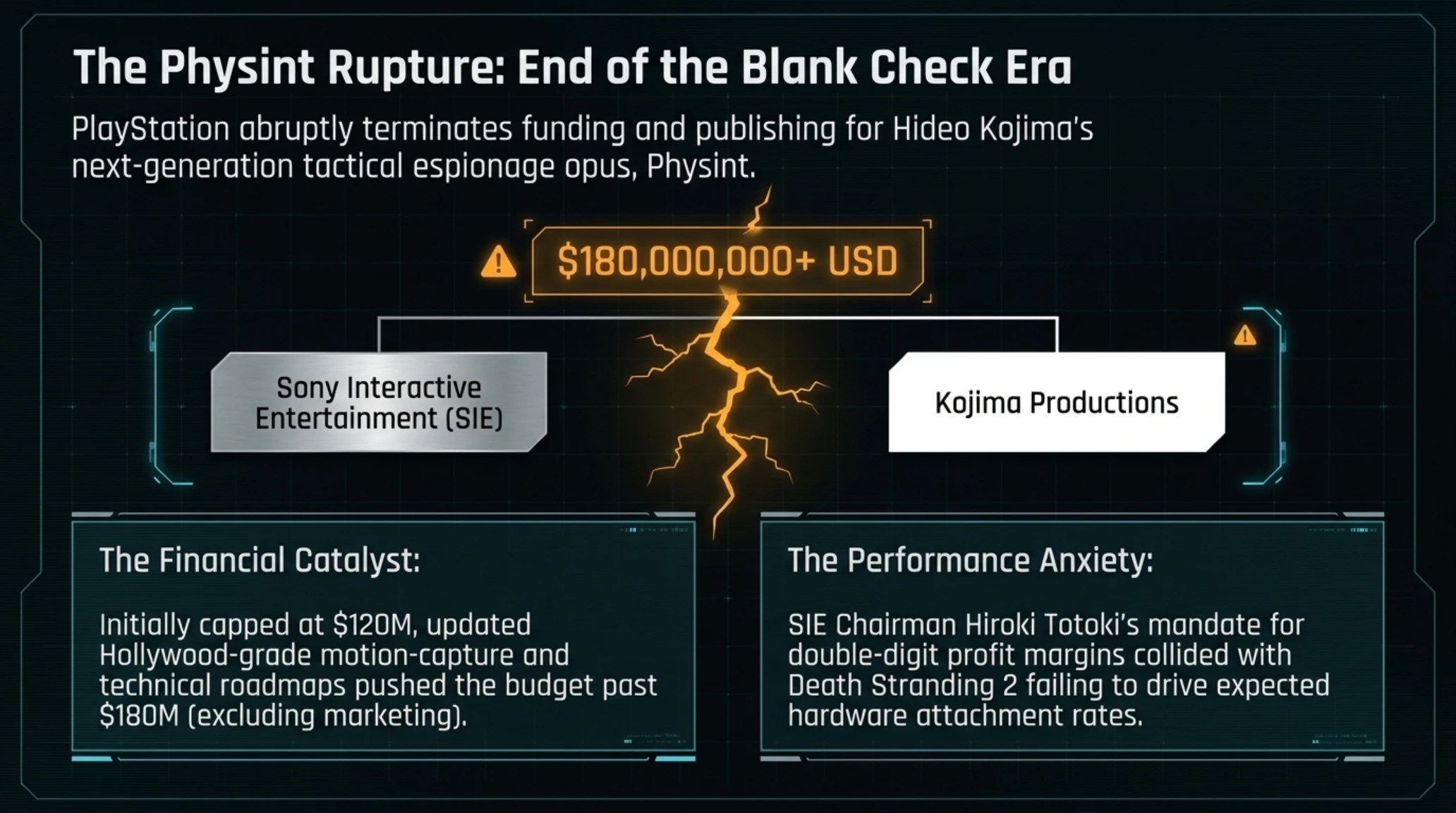
The global video game industry was rocked to its foundations this evening following explosive investigative reports published by Eurogamer and Insider Gaming. According to high-level corporate sources within Tokyo and San Mateo, Sony Interactive Entertainment (SIE) has formally terminated its co-development and publishing agreement with Kojima Productions for the next-generation tactical espionage action title codenamed Physint. Originally unveiled with immense fanfare during Sony's State of Play broadcast in early 2024 as a revolutionary convergence of cinema and interactive entertainment, the project has been abruptly cast into limbo as PlayStation executives withdraw all production funding and exclusivity commitments.
Corporate insiders reveal that the partnership collapsed under the weight of runaway financial projections and severe creative friction. Under the stewardship of SIE Chairman Hiroki Totoki and PlayStation Studios leadership, Sony instituted strict fiscal containment measures aimed at curtailing ballooning AAA development cycles. Totoki previously issued a public directive requiring Sony's gaming division to elevate operating profit margins from an anaemic 6 percent toward double-digit returns, culminating in the cancellation of multiple unannounced live-service bets and heightened scrutiny of prestige single-player projects. While Sony initially earmarked a hard budget cap of $120 million for Physint, updated technical roadmaps and Hollywood motion-capture casting budgets submitted by Kojima Productions pushed projected production expenditures well past $180 million, excluding marketing.
Compounding executive anxiety was the commercial trajectory of Death Stranding 2: On the Beach. While widely praised for its cinematic audacity, internal sales telemetry indicated that the title failed to generate the aggressive, sustained console hardware attachment rates that Sony demanded to justify nine-figure production advances. With the global PlayStation 5 installed base approaching maturity and consumer spending tightening across core Western territories, PlayStation's finance committee refused to underwrite an open-ended cinematic experiment without guaranteed hardware-selling leverage.
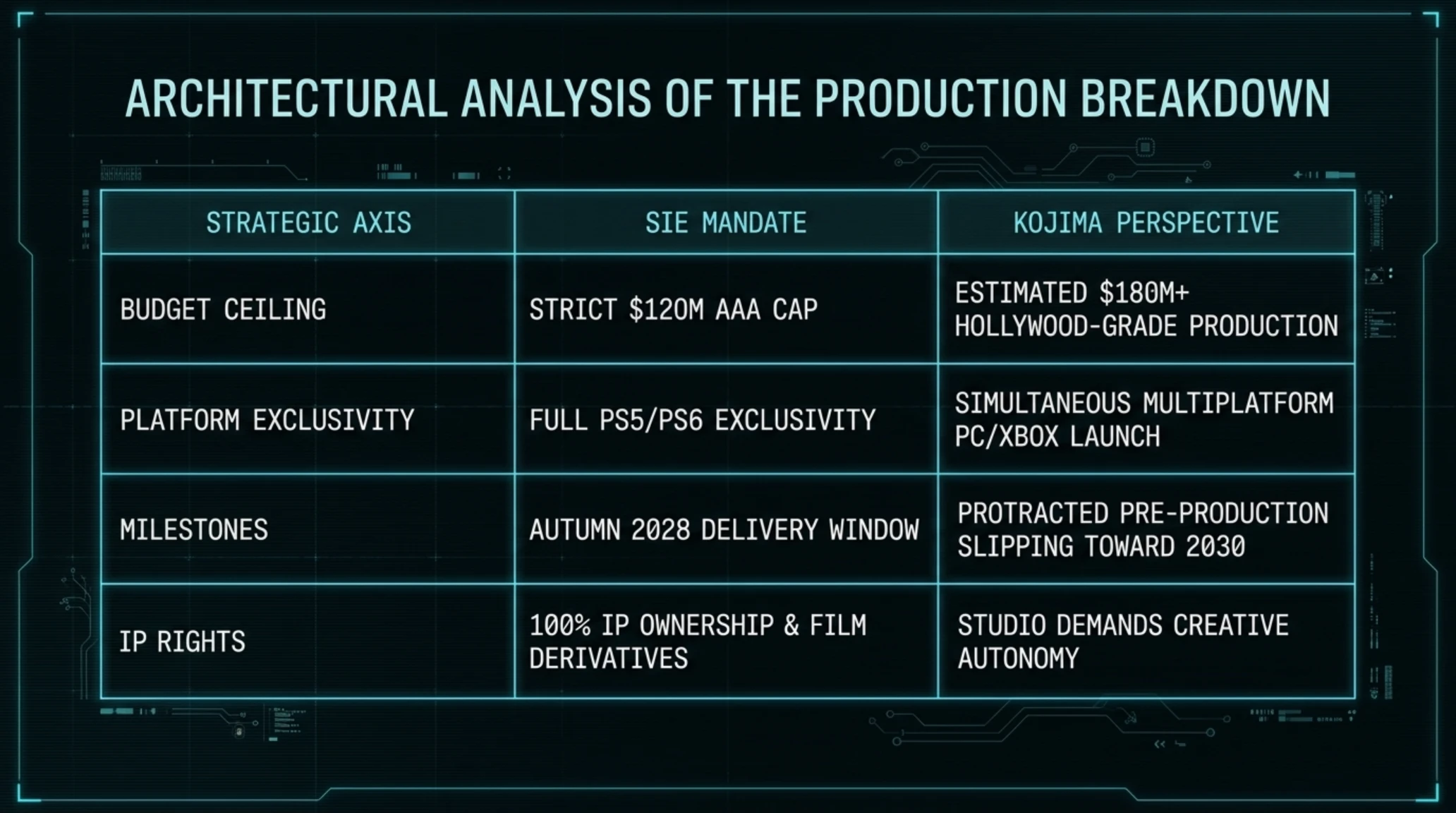
Structural Teardown: Sony Interactive Entertainment vs. Kojima Productions
| Disputed Strategic Axis | Sony Interactive Entertainment (SIE) Mandate | Hideo Kojima & Studio Perspective |
|---|---|---|
| Production Budget Ceiling | Strict $120M cap to control AAA exposure | Estimated $180M+ for Hollywood-grade production |
| Platform Exclusivity | Full console exclusivity for PS5 and PlayStation 6 | Simultaneous multiplatform launch on PC & Xbox |
| Development Milestones | Strict delivery window targeting Autumn 2028 | Protracted pre-production slipping toward 2030 |
| Death Stranding Return on Investment | Underperformed internal hardware driver metrics | Emphasized long-term brand equity and transmedia |
| Intellectual Property Rights | Demanded 100% IP ownership and film derivatives | Insisted on studio independence and creative autonomy |
Beyond spiraling financial estimates, the irreconcilable breaking point centered on platform exclusivity. Hideo Kojima reportedly insisted on a simultaneous day-and-date release across PC and Microsoft's next-generation Xbox hardware, arguing that modern development budgets exceeding $150 million cannot achieve sustainable profitability within the confines of a single closed console ecosystem. This stance directly collided with Sony's foundational strategy, which envisioned Physint as a flagship system-seller designed to spearhead the marketing rollout of the PlayStation 6 in late 2028. Furthermore, Sony demanded full intellectual property ownership and film adaptation rights in exchange for funding, terms that Kojima categorically refused in order to maintain studio independence.
The dissolution of the agreement leaves Kojima Productions confronting severe logistical hurdles. The studio had planned to build Physint upon Guerrilla Games' proprietary Decima Engine, a proprietary Sony asset originally gifted to Kojima in a ceremonial wooden box during his 2016 studio tour in Amsterdam. Severing ties with PlayStation means Kojima Productions must either negotiate an unprecedented commercial licensing carve-out or migrate the entire production pipeline to Unreal Engine 5.4. Migrating complex character shaders, Tokyo-based 3D photogrammetry scanning rigs, and customized cinematic lighting scripts to Epic Games' engine would inevitably reset pre-production milestones, pushing release timelines toward 2030 and escalating capital requirements.
Industry observers note that Phil Spencer and Microsoft Gaming have previously demonstrated an appetite for funding Kojima's experimental concepts through the cloud-native horror title OD. Acquiring publishing rights to Physint would represent an unprecedented coup for Xbox, positioning the platform as the exclusive home of Kojima's long-awaited tactical espionage successor. Under Microsoft's 'Every Screen is an Xbox' paradigm, Kojima's multiplatform day-and-date vision aligns seamlessly with PC Game Pass and Xbox Cloud Gaming distribution models, potentially giving Physint the global reach that PlayStation's traditional walled garden could no longer accommodate.
The rift between Sony and Kojima underscores a broader existential crisis gripping the traditional console business. As hardware sales plateau and production costs escalate exponentially, the economic viability of platform-exclusive blockbusters is dissolving. For deeper perspective on how hardware inflation is reshaping market dynamics, explore our comprehensive breakdown of the Xbox hardware price crisis and Microsoft's shifting platform business model.
A critical undercurrent in the negotiations was Kojima's aggressive transmedia ambition. Having forged close creative ties with Hollywood figures including Guillermo del Toro, Nicolas Winding Refn, and Elle Fanning, Kojima envisioned Physint not merely as an interactive game, but as an interconnected ecosystem spanning live-action streaming series and feature films released in tandem. However, this vision clashed directly with Sony Pictures Entertainment and PlayStation Productions, which maintain rigid theatrical windowing mandates and traditional royalty structures. Kojima's refusal to grant Sony unilateral control over downstream television and cinematic rights exacerbated executive distrust, demonstrating that the convergence of Hollywood and gaming creates complex intellectual property battles that traditional publisher contracts are ill-equipped to resolve.
Why It Matters: Strategic Repercussions of Sony's Physint Cancellation
- End of the Blank Check Era: Major publishers are shutting down open-ended auteur projects to mitigate financial exposure.
- Multiplatform Inevitability: Even longtime PlayStation loyalists must target PC and Xbox to achieve commercial profitability.
- Microsoft Strategic Opening: Creates prime opportunity for Xbox to acquire high-profile tactical espionage publishing rights.
- AAA Budget Insolvency: Highlights structural breakdown of traditional exclusive business models under modern development costs.
This dramatic rupture marks a permanent realignment in auteur-publisher relations, setting the stage for our next investigation into the consumer rebellion rocking gaming's biggest subscription services.

Shifting from boardroom publisher negotiations to consumer market behavior, we examine how relentless price increases are sparking a historic mass churn across gaming subscription ecosystems.
2. Gaming Subscription Crisis: Over 40% of Gamers Cancelling Xbox Game Pass, PS Plus & Nintendo Switch Online Blame Relentless Price Hikes
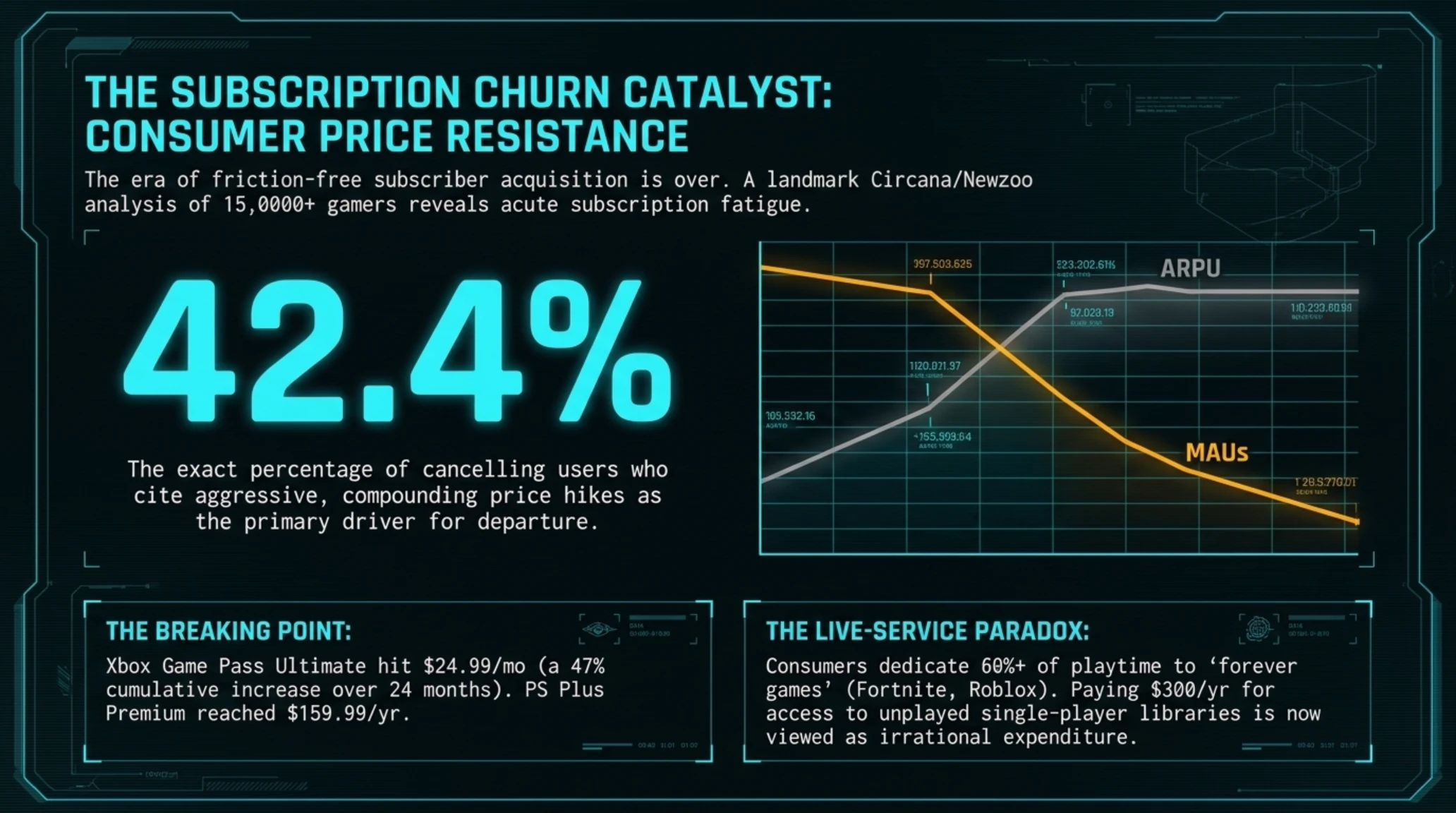
The subscription model that was once aggressively heralded as the inevitable, all-consuming future of video game distribution has slammed into a wall of consumer resistance. According to a landmark market intelligence report published jointly by Circana and Newzoo, based on a rigorous empirical survey of over 15,000 active console and PC gamers across North America, the United Kingdom, and Western Europe, a historic wave of cancellations is sweeping across the industry's premier multi-game services. The data indicates that the era of friction-free subscriber acquisition has officially ended, replaced by acute consumer price sensitivity and widespread subscription fatigue.
The most alarming metric uncovered by the research directly challenges publisher assumptions regarding pricing power: exactly 42.4 percent of gamers who cancelled or declined to renew their subscriptions over the preceding ninety days cited compounding, aggressive price increases as their primary reason for departure. With Xbox Game Pass Ultimate climbing from $16.99 to $24.99 per month representing a staggering 47 percent cumulative price hike across a twenty-four-month window and PlayStation Plus Premium reaching $21.99 per month ($159.99 annually), consumers are concluding that maintaining active recurring memberships across multiple platforms is no longer justifiable in an inflationary economic climate.
Financial telemetry indicates that while Average Revenue Per User (ARPU) temporarily increased for Microsoft and Sony, total Monthly Active Users (MAUs) engaged through subscription tiers declined by 7.2 percent year-over-year. Compounding this challenge is the structural dominance of live-service 'forever games'. Modern consumers dedicate more than 60 percent of their total interactive gaming hours to persistent live-service titles such as Fortnite, Roblox, Warzone, and EA Sports FC. For millions of players who invest their free time mastering a single ecosystem, paying nearly $300 annually to maintain access to an expansive rotating library of hundreds of single-player titles they never launch represents an irrational expenditure.
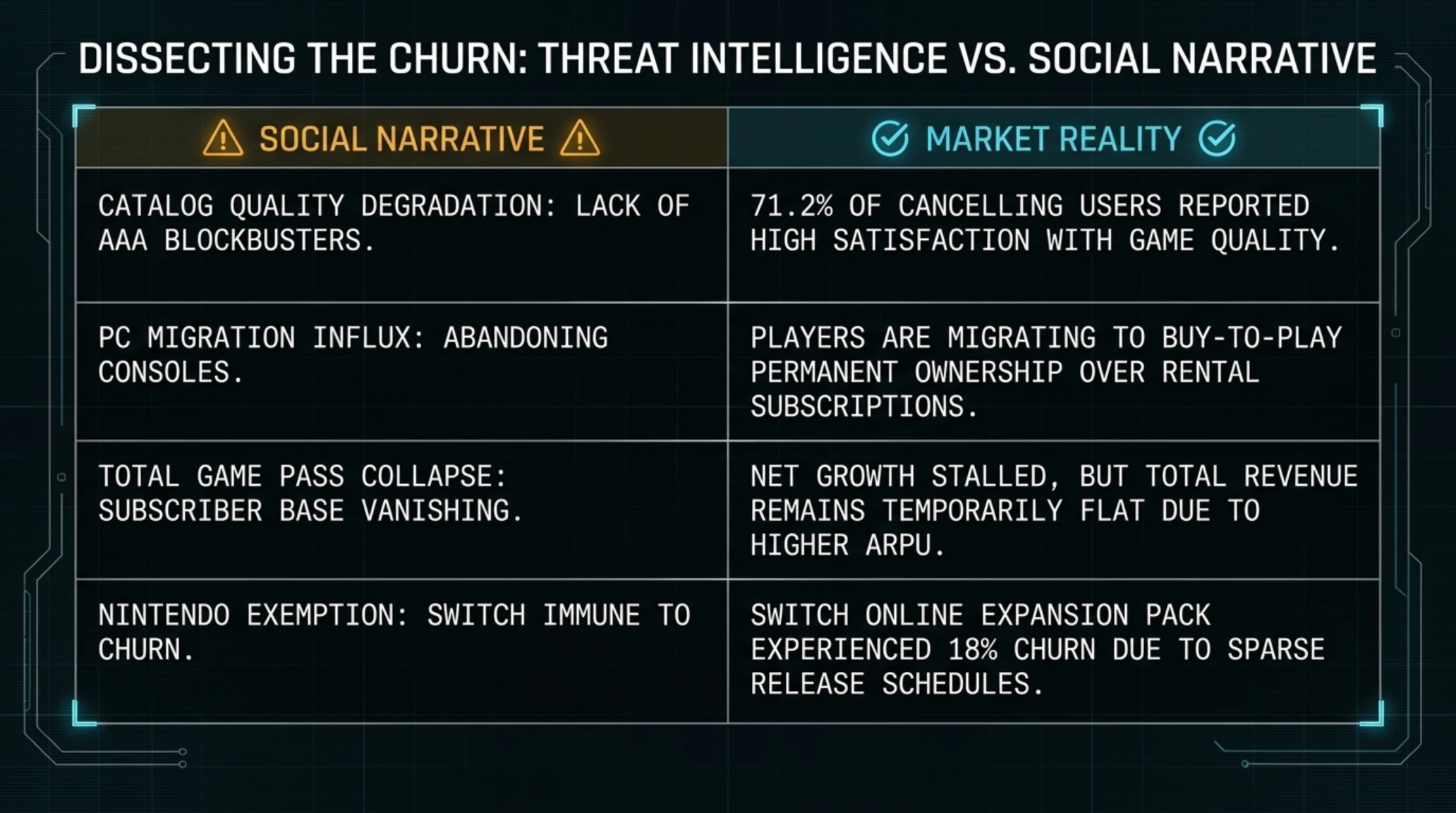
Rumor vs. Reality: Dissecting the Churn Crisis Across Gaming Subscription Networks
| Public Social Media Narrative | Prevalent Internet Speculation & Rumor | Verified Empirical Data & Market Reality |
|---|---|---|
| Catalog Quality Degradation | Gamers leaving due to lack of compelling AAA blockbusters | Over 71% of cancelling users reported high satisfaction with games |
| PC Migration Influx | Console players abandoning platforms solely for Steam | Players migrating to Buy-to-Play ownership over rental subscriptions |
| Monthly Price Impact | Claims that $3 to $5 price increases do not drive churn | Aggressive price hikes identified as direct driver for 42.4% of exits |
| Total Game Pass Collapse | Rumors alleging severe net subscriber collapse for Xbox | Net growth stalled, but total revenue remains flat via higher ARPU |
| Nintendo Exemption | Belief that Nintendo Switch Online is immune to cancellations | Expansion Pack tier experienced 18% churn due to sparse releases |
Crucially, the report dispels the common narrative that subscribers are abandoning platforms due to an inferior game library. An overwhelming 71.2 percent of cancelling members explicitly confirmed that they were satisfied or highly satisfied with the quality, curation, and diversity of titles available in the catalog. The root issue is behavioral and economic: subscription fatigue. In households already committed to video streaming bundles, music platforms, cloud storage, and mobile connectivity, adding $300 annually for an interactive gaming pass represents an easy target for household budget trimming. Many gamers have recalculated the mathematics of ownership, recognizing that purchasing two or three major titles permanently during seasonal digital sales delivers superior value compared to renting access to an overwhelming library they rarely find time to explore.
Compounding consumer frustration is publisher tier fragmentation. Microsoft's decision to divide Game Pass into Core, Standard, and Ultimate tiers while specifically stripping day-one first-party releases from the $14.99 Standard tier created severe goodwill erosion among longstanding brand advocates. Players who supported the platform during its formative years felt penalised by arbitrary feature gating designed to herd users into top-tier monthly fees. The subsequent bundling of legacy third-party services like EA Play or Ubisoft+ Classics failed to reverse churn, as consumers viewed these additions as bloatware rather than indispensable value. For contextual analysis of hardware pricing escalations, consult our forensic examination of the PS5 Pro price crisis and hardware inflation in the ninth console generation.
This consumer revolt has catalyzed a damaging behavioral phenomenon known across publisher boardrooms as 'cyclical churn-and-return'. Community telemetry from enthusiast hubs including Reddit's r/XboxGamePass and ResetEra illustrates that gamers are increasingly treating multi-game subscriptions as disposable monthly passes rather than persistent utilities. Players subscribe for exactly thirty days to play through a specific single-player campaign such as Call of Duty, Avowed, or a high-profile third-party release and instantly cancel recurring billing upon rolling credits. This transactional behavior wreaks havoc on publisher financial forecasting, eroding baseline recurring revenues while driving customer acquisition costs to historic highs as marketing teams must constantly spend to re-acquire the exact same user cohort.
This consumer realignment signals that recurring revenue models in gaming have reached natural saturation limits, compelling platform holders to reconsider their monetization roadmaps.
Departing from consumer market economics, we turn our investigative spotlight toward the extraordinary legal and physical counter-intelligence measures deployed by the world's most secretive game studio.
3. Rockstar Games Drone Espionage Battle: Spying Drones Outside Studio Windows & 2.5-Year Union Discord Mole Exposed in Court
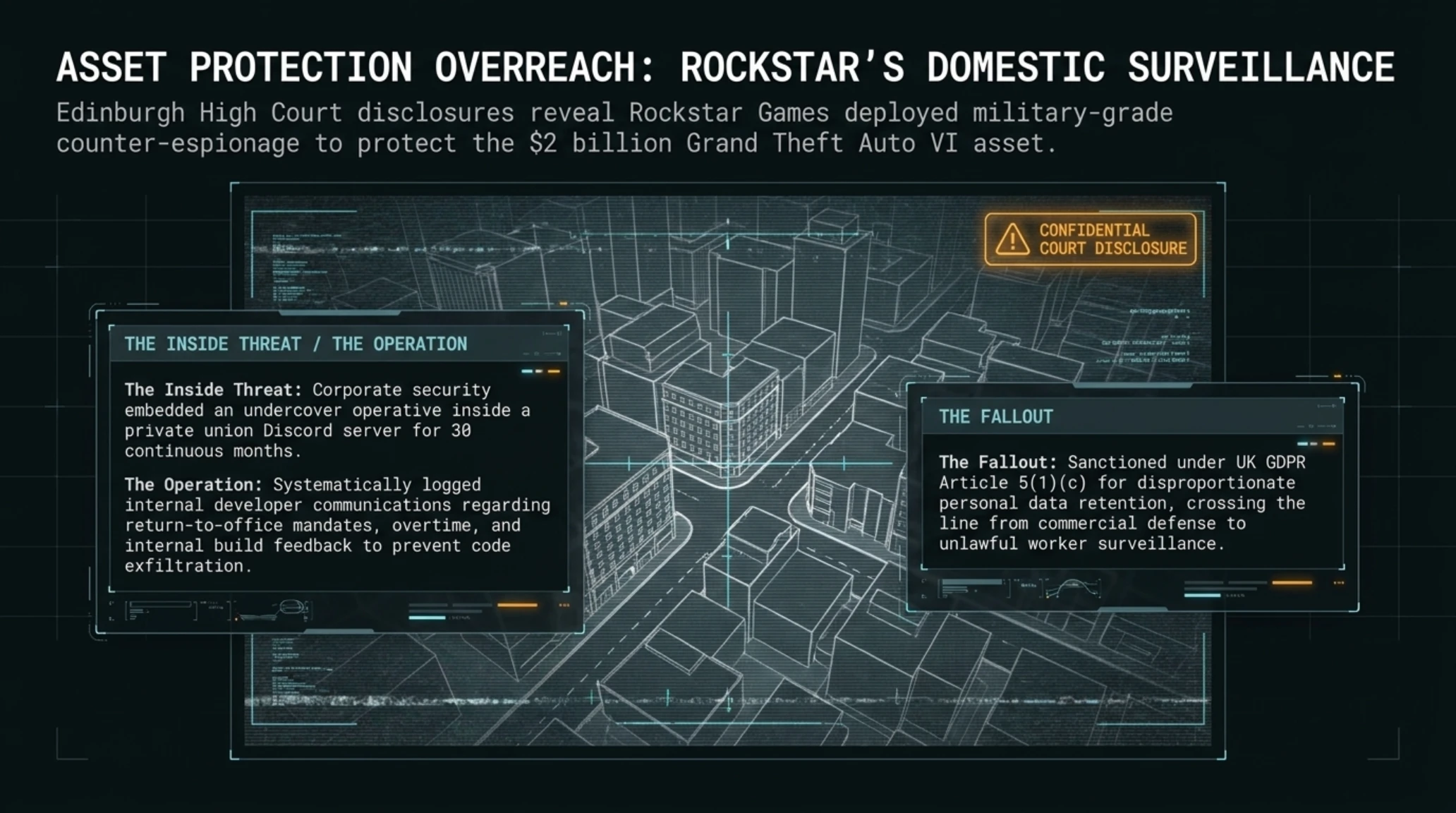
Hearings at the Edinburgh High Court in Scotland concerning labor disputes between Rockstar Games management and organized worker representatives delivered a stunning, unprecedented public disclosure of the studio's internal security operations today. In formal legal testimony and documentary evidence submitted to the presiding judge, defense attorneys for Rockstar North confirmed that the studio has operated an intensive, military-grade counter-espionage apparatus to safeguard Grand Theft Auto VI from leaks, blurring the line between corporate asset protection and controversial domestic surveillance.
The most shocking revelation to emerge from the courtroom transcripts confirmed that Rockstar corporate security maintained an undercover operative inside the private Discord server of union organizers for more than thirty continuous months (two and a half years). The operative systematically logged internal conversations, shared screenshots, and monitored developer communications to detect any potential exfiltration of proprietary code, narrative scripts, or geographical coordinates of the Vice City world map. While trade union legal representatives condemned the operation as an unlawful breach of worker privacy and industrial espionage against employees, Rockstar argued that the measure was a lawful, indispensable precaution required to safeguard a commercial asset whose production and marketing investment exceeds $2 billion.
Judicial filings revealed that the undercover operative utilized an active development contractor credential to access channels focused on employee return-to-office mandates, overtime tracking, and internal build feedback. While Rockstar successfully prevented proprietary code fragments from leaking through those channels, the presiding judge sanctioned the studio for disproportionate personal data retention under UK GDPR Article 5(1)(c), ruling that monitoring private union discussions far exceeded legitimate commercial defense boundaries.
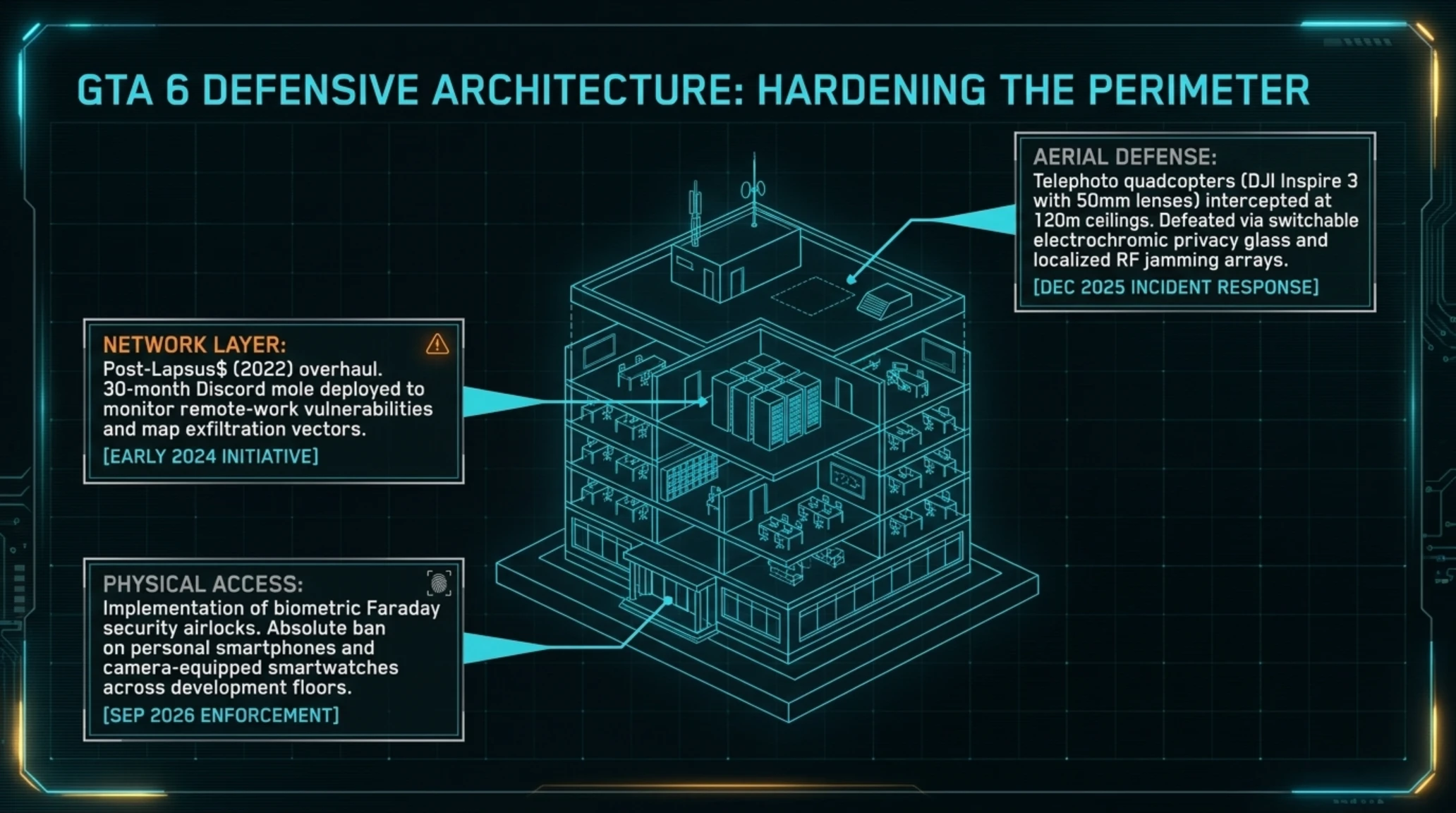
Security Timeline: Forensic History of Rockstar Games Counter-Espionage and Leaks
| Chronological Period | Espionage Incident & Breach Vector | Rockstar Legal Response & Defensive Countermeasures |
|---|---|---|
| September 2022 | Lapsus$ cyber intrusion exfiltrates 90 pre-alpha gameplay video clips | Emergency network overhaul, FBI investigation, and perpetrator prosecution |
| Early 2024 | Rockstar security infiltrates undercover operative into union Discord server | Commenced 30-month covert surveillance of internal developer communications |
| December 2025 | Telephoto quadcopters detected hovering outside Edinburgh studio windows | Deployed electrochromic smart privacy glass and RF drone mitigation systems |
| August 2026 | Edinburgh High Court trial exposes internal surveillance logs and transcripts | Defended covert surveillance as lawful protection of a $2B commercial asset |
| September 2026 | Judicial rulings issue formal injunctions alongside heightened studio security | Enforced biometric airlocks as GTA 6 enters critical final optimization phase |
However, Rockstar's security headaches extended far beyond digital channels into physical airspace. Security personnel testified that over the past twelve months, commercial quadcopters specifically customized DJI Inspire 3 platforms outfitted with Zenmuse X9-8K full-frame cameras and 50mm telephoto lenses were repeatedly intercepted hovering mere meters outside the upper-floor windows of the studio's Edinburgh and London offices. Operating near the 120-meter legal ceiling, operators utilized high-magnification digital cropping to record developer displays during active physics simulations and cinematic rendering passes. Forensic tracking of radio uplink signals traced multiple drone flights back to public parks in central Edinburgh, leading to civil injunctions and criminal referrals under the UK Air Navigation Order 2016.
The aerial intrusions forced Rockstar to execute a sweeping facility overhaul, outfitting all exterior windows with switchable electrochromic privacy glass that automatically opacifies when exterior radar and ultrasonic sensors detect airborne objects within a fifty-meter perimeter. Additionally, the company deployed localized radio-frequency (RF) jamming arrays, established biometric Faraday security airlocks, and instituted absolute bans on personal smartphones and camera-equipped smartwatches across all development floors. This extraordinary court disclosure illustrates the staggering lengths to which Rockstar Games must go to insulate the most anticipated entertainment product in human history from industrial espionage and bad-faith exploitation.

From the clandestine intelligence measures protecting future blockbusters, we examine the severe technical compromises confronting physical media and optical storage formats.
4. Final Fantasy 7 Revelation Director Defends Mandatory Download: "Shipping Fully on Disc Would Compromise Final Chapter Quality"
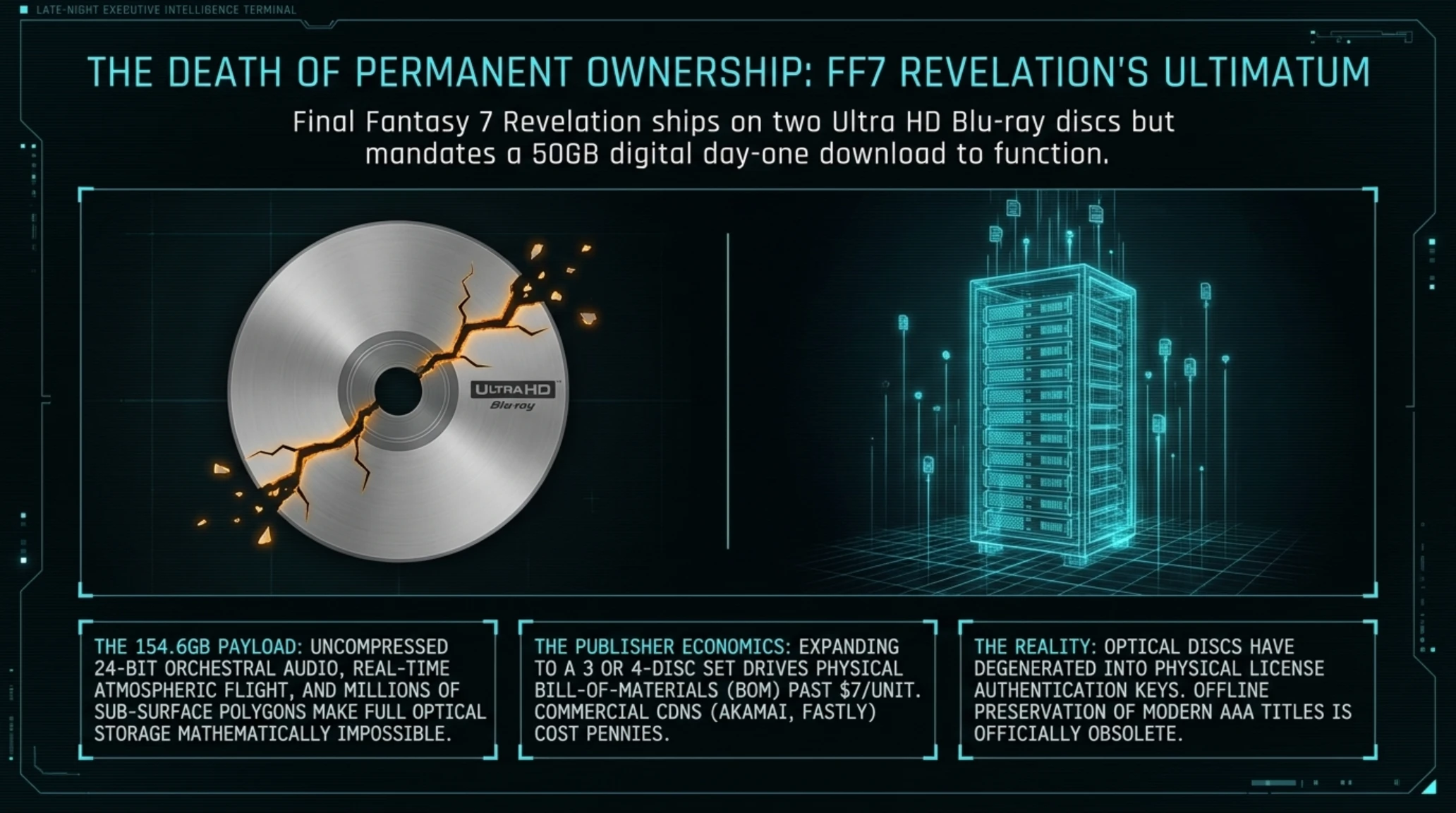
As enthusiasts of Japanese role-playing games (JRPGs) prepare for the grand release of Final Fantasy 7 Revelation the culminating third chapter in Square Enix's ambitious remake trilogy a fierce controversy surrounding the game's physical distribution has erupted across global gaming communities. According to technical specifications published on retail packaging, although the title ships on two physical Ultra HD Blu-ray discs, playing the game without downloading an initial mandatory digital patch exceeding 50 gigabytes from the PlayStation Network is technically impossible. The disclosure has provoked furious backlash from physical media collectors and video game preservationists, who argue that modern retail discs have degenerated into hollow marketing shells.
Naoki Hamaguchi, the celebrated director helming the project, addressed these criticisms directly in an extensive, candid technical interview with Eurogamer, vigorously defending Square Enix's engineering trade-offs. Hamaguchi revealed that the fully installed footprint of Final Fantasy 7 Revelation exceeds 154.6 gigabytes of uncompressed assets. The narrative climax features monumental summon encounters involving iconic entities like the Knights of the Round, fully unconstrained real-time atmospheric flight aboard the Highwind airship spanning a seamless 3D globe, hundreds of unique character meshes sporting millions of sub-surface polygons, and an uncompressed 24-bit multi-channel orchestral master score. Cramming these colossal assets onto optical media was physically impossible without devastating compromises.
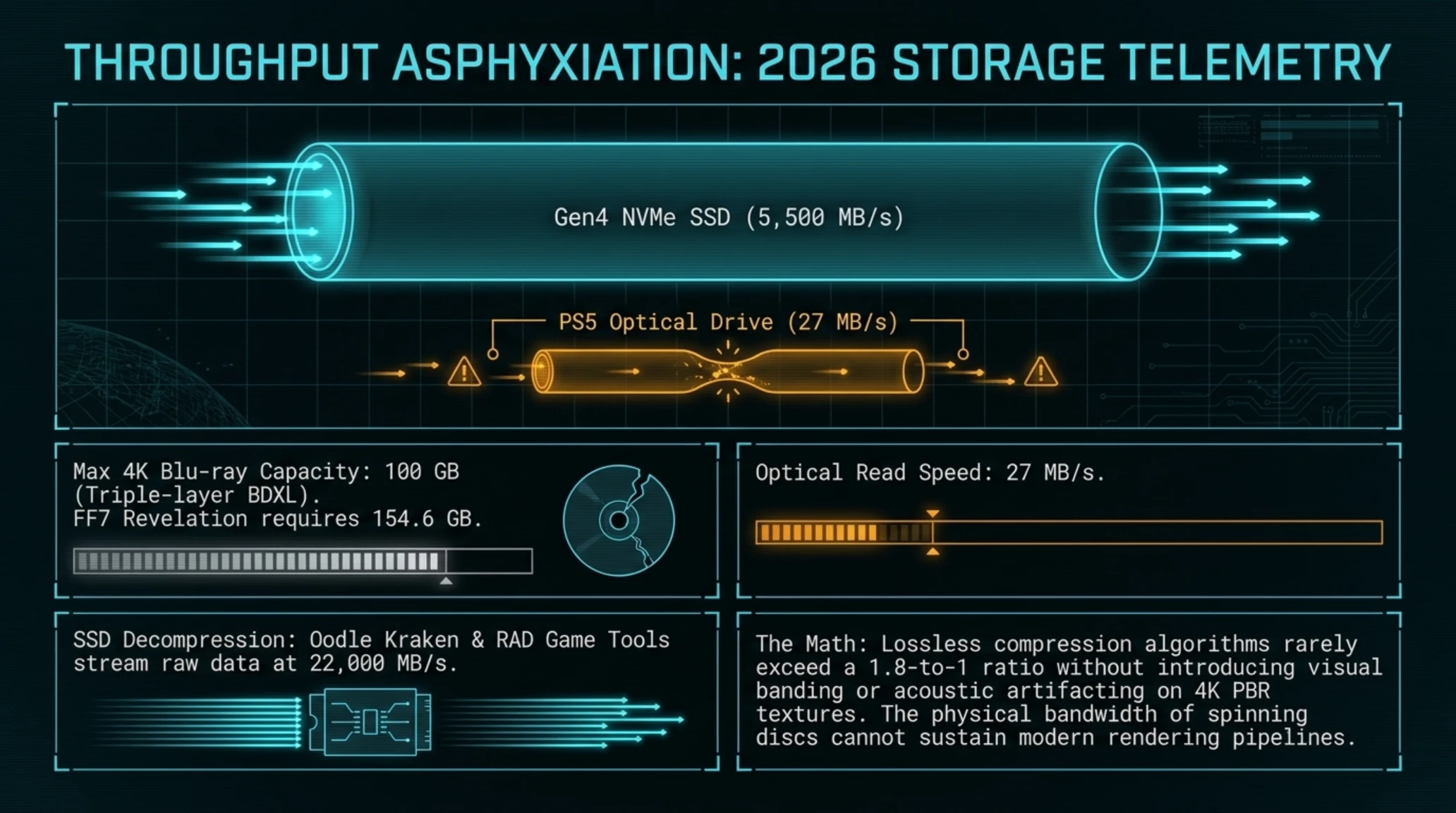
From an architectural standpoint, modern game assets encounter severe mathematical boundaries when interfacing with optical media. The PlayStation 5 custom I/O complex utilizes hardware-accelerated Oodle Kraken and RAD Game Tools decompression blocks capable of streaming raw data from the internal Gen4 NVMe SSD at sustained throughputs exceeding 22 gigabytes per second. However, lossless compression algorithms hit diminishing returns on high-frequency 4K PBR (Physically Based Rendering) texture maps, volumetric OpenVDB particle grids, and 7.1.4 Dolby Atmos spatial audio channels, rarely exceeding a 1.8-to-1 compression ratio without introducing noticeable visual banding or acoustic artifacting.
Furthermore, publisher economics heavily disincentivize multi-disc manufacturing. Producing a theoretical three-disc or four-disc retail edition through Sony DADC (Digital Audio Disc Corporation) would escalate physical bill-of-materials (BOM) costs past $7 per unit in packaging, dual-hinge jewel cases, and freight logistics, compared to mere pennies per download through commercial content delivery networks (CDNs) like Akamai and Fastly. Rather than inflating the retail price to $89.99 for a cumbersome physical multi-disc box, Square Enix opted for a hybrid two-disc package coupled with a mandatory network download.
Hamaguchi explained the stark engineering ultimatum confronting the production team: «We faced two mutually exclusive paths: we could either heavily downscale texture resolutions, aggressively compress real-time audio streams, and sacrifice cinematic lighting fidelity during the story's emotional climax to force the entire game onto optical discs, or we could preserve the uncompromising visual integrity of the experience and utilize network infrastructure to deliver the remaining data. We chose to honor the artistic vision of the creators and the expectations of our players rather than bow to the physical limitations of an aging optical format.» While sound from a production standpoint, this decision confirms the irreversible demise of offline game media.
Statistics Box: Physical Media Capacity Limits and AAA Storage Bloat in 2026
| Storage Metric | Recorded 2026 Industry Benchmark | Operational Impact on Consumer Experience |
|---|---|---|
| Final Fantasy 7 Revelation Size | 154.6 GB total required storage post-install | Demands more than one-sixth of baseline console SSD |
| Maximum 4K Blu-ray Disc Capacity | 100 GB per triple-layer BDXL optical disc | Requires multiple discs and mandatory network patches |
| PS5 Optical Drive Read Speed | Maximum 27 MB/s optical throughput rate | Mandates complete data caching onto high-speed Gen4 SSD |
| Physical Retail Sales Share (2026) | Less than 12% of total global gaming software revenue | Publishers unwilling to incur costs of three-disc packages |
| Average Day-One Patch Volume | 38 GB across visually intensive AAA flagships | Renders offline gaming effectively obsolete for new releases |
With optical drives operating at a maximum transfer speed of 27 megabytes per second compared to ultra-fast PCIe Gen4 NVMe SSDs delivering over 5,500 megabytes per second the technical obsolescence of optical media is absolute, solidifying digital delivery as the sole viable pipeline for future AAA productions.
This transition highlights a fascinating historical paradox within video game culture. When the original Final Fantasy VII launched on the original PlayStation in 1997, it famously spanned three separate CD-ROMs, an attribute celebrated by gaming publications as a badge of unprecedented cinematic scale. Today, however, enthusiast sentiment has inverted. Retro collectors who fondly display multi-disc jewel cases view mandatory multi-gigabyte digital downloads with open hostility, decrying them as the erosion of consumer sovereignty. Yet as development teams model real-time facial micro-expressions, hair strand physics, and 3D audio environments, the physical bandwidth limitations of spinning optical discs make network dependency an inescapable engineering reality for the modern interactive blockbuster.

Leaving behind the storage challenges of future blockbusters, we celebrate the triumphant resurrection of gaming history as one of the definitive pillars of the immersive sim genre prepares for a glorious return.
5. Nightdive Studios Officially Confirms Thief: The Dark Project Remastered With New Narrative Campaign 'The Tarnished Mirror'
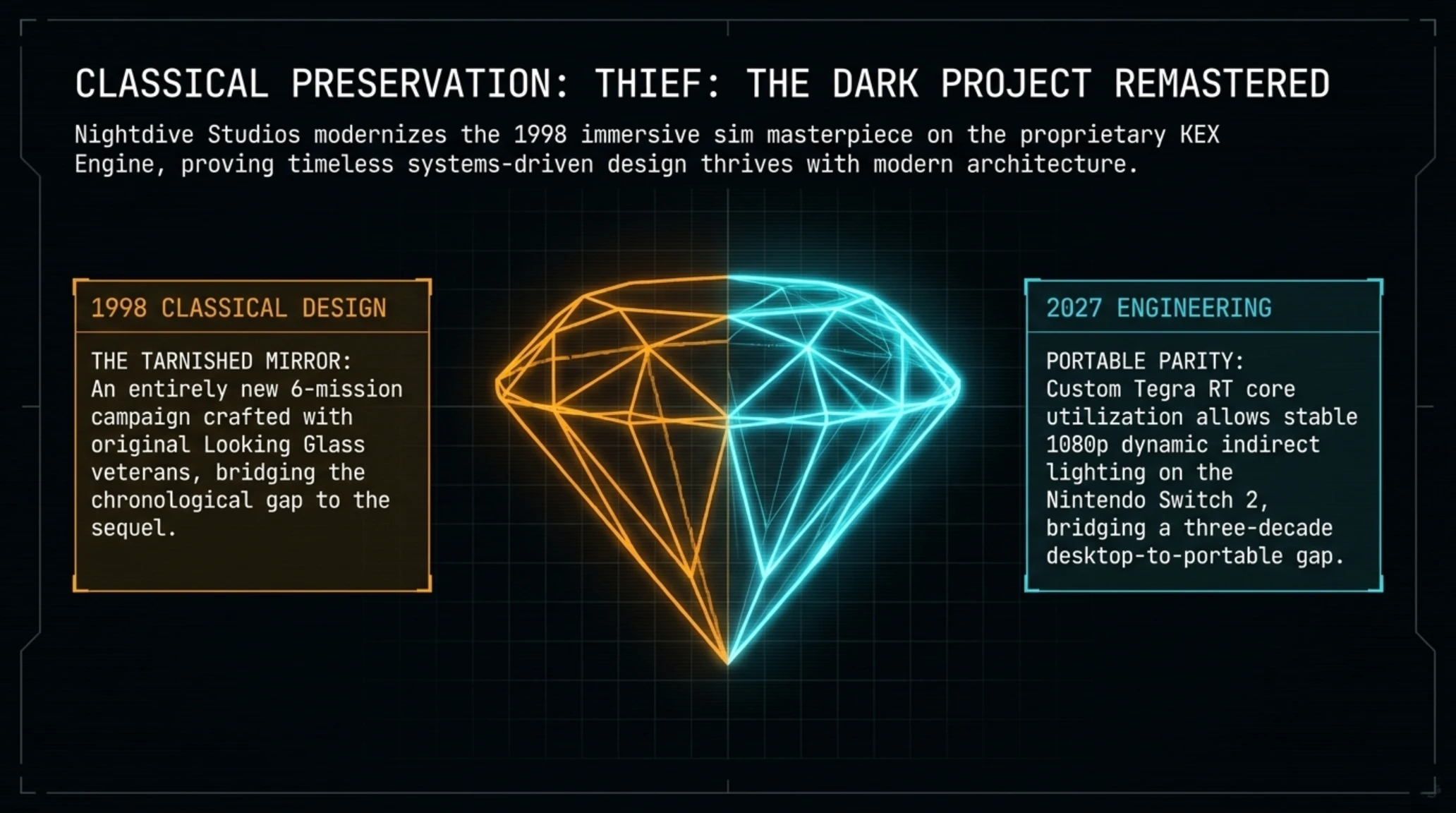
Devotees of classic PC gaming and connoisseurs of the immersive sim genre celebrated a monumental announcement this evening. Following the premature discovery of internal achievement manifests on the Steam backend database, Nightdive Studios and studio founder Stephen Kick officially confirmed the full modernization of Looking Glass Studios' groundbreaking 1998 masterpiece, Thief: The Dark Project. Rebuilt upon the latest iteration of Nightdive's proprietary KEX Engine, the remaster represents far more than an upscaled visual port, delivering groundbreaking rendering breakthroughs alongside a brand-new official narrative campaign.
The centerpiece of the announcement is 'The Tarnished Mirror', an all-new six-mission storyline set chronologically between the original title and its celebrated sequel. The expansion chronicles previously untold heists undertaken by the master thief Garrett, infiltrating clockwork research citadels, mist-shrouded cathedral vaults, and forgotten crypts beneath The City. To ensure absolute tonal and architectural continuity, Nightdive collaborated closely with original Looking Glass designers and writers, crafting intricate, non-linear sandboxes that prioritize player experimentation, resource scarcity, and tactile spatial problem-solving over scripted cinematic sequences.
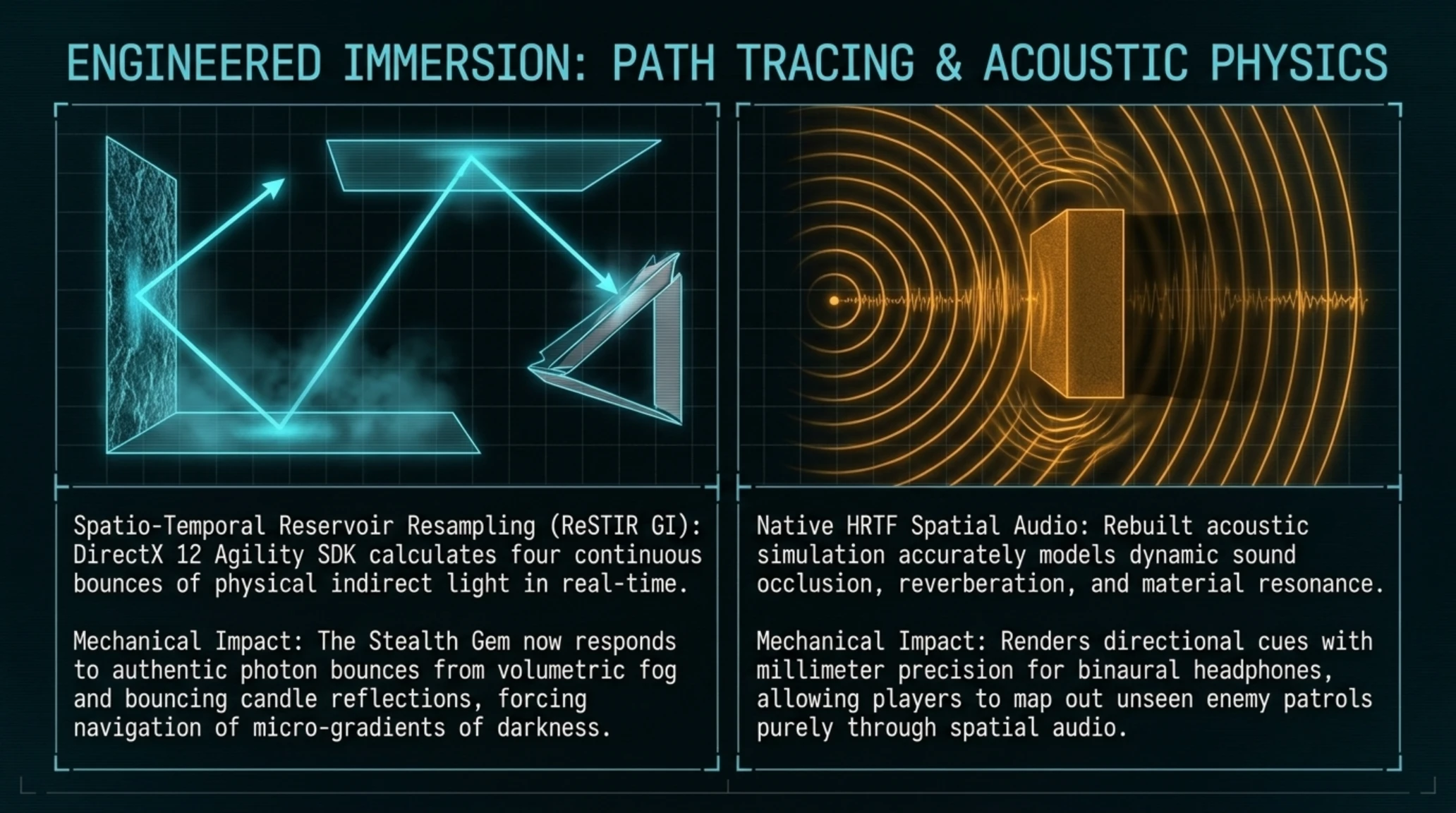
On the technological front, Nightdive has implemented a state-of-the-art Full Path Tracing rendering pipeline utilizing the latest DirectX 12 Agility SDK and Vulkan backends. Because the fundamental mechanics of Thief rely upon the precise manipulation of illumination and shadow, path tracing completely transforms gameplay. Nightdive integrated ReSTIR Direct Illumination (RTXDI) and Spatio-Temporal Reservoir Resampling for Global Illumination (ReSTIR GI), calculating four continuous bounces of physical indirect light in real time. Torch flickers, ambient moonlight diffusing through volumetric fog, and bouncing candle reflections are simulated with photon-accurate precision. The iconic Stealth Gem now responds to authentic photon bounces across surrounding materials, forcing players to navigate subtle gradients of darkness.
Furthermore, Nightdive completely overhauled the acoustic simulation engine, accurately modeling dynamic sound occlusion, reverberation, and material resonance as Garrett's footsteps echo across marble tiles or creaking wooden rafters. To further enhance player immersion, the audio engineers integrated native HRTF (Head-Related Transfer Function) spatial audio profiles for binaural headphone listening. In the brutal world of Thief, detecting the precise three-dimensional location of an approaching guard's heavy boots or discerning the metallic scrape of a drawn broadsword behind a heavy oak door is a matter of life and death. The new acoustic pipeline renders directional cues with millimeter precision, allowing players to map out enemy patrols entirely through auditory perception. Releasing in early 2027 across PlayStation 5, Xbox Series X/S, PC, and the next-generation Nintendo Switch 2, the remaster establishes a new benchmark for classical preservation.
The inclusion of the next-generation Nintendo Switch 2 in the platform rollout represents a major engineering triumph for Nightdive. Leveraging Nvidia's custom Tegra architecture featuring dedicated RT cores and DLSS 3.5 neural upscaling, the Switch 2 version sustains a stable 1080p presentation with dynamic indirect diffuse bounces in handheld mode. This portability allows players to experience the definitive edition of a PC classic whether lounging on a couch or traveling, bridging a nearly three-decade gap between legacy desktop monitors and modern portable displays.
- Inclusion of 'The Tarnished Mirror', an all-new six-mission campaign crafted with Looking Glass veterans.
- State-of-the-art Full Path Tracing revolutionizes stealth mechanics and shadow-based concealment fidelity.
- Sophisticated dynamic acoustic modeling calculates physical sound propagation and material bounce in real time.
- Meticulous preservation of authentic player agency, emergent physics, and unforgiving tactical AI systems.
- Broad platform availability spanning PS5, Xbox Series X/S, PC, and the next-gen Nintendo Switch 2.
- Steep learning curve and methodical stealth pacing may alienate modern players accustomed to fast action.
- Substantial hardware overhead when running maximum Path Tracing passes on baseline console hardware.
- Certain legacy voice lines re-recorded with new actors due to original audio master degradation.
- Demands high-end GPU hardware to maintain 60 FPS under complex volumetric lighting scenarios on PC.
The triumphant revitalization of Thief demonstrates that foundational game design principles remain timeless when elevated by cutting-edge modern engineering.

In our final briefing tonight, we exit the realm of interactive entertainment to cover a grave cybersecurity disaster compromising the civil infrastructure of one of the largest American states.
6. Florida Highway Safety Confirms Statewide Driver Database (DAVID) Breached via Hijacked Law Enforcement Credentials
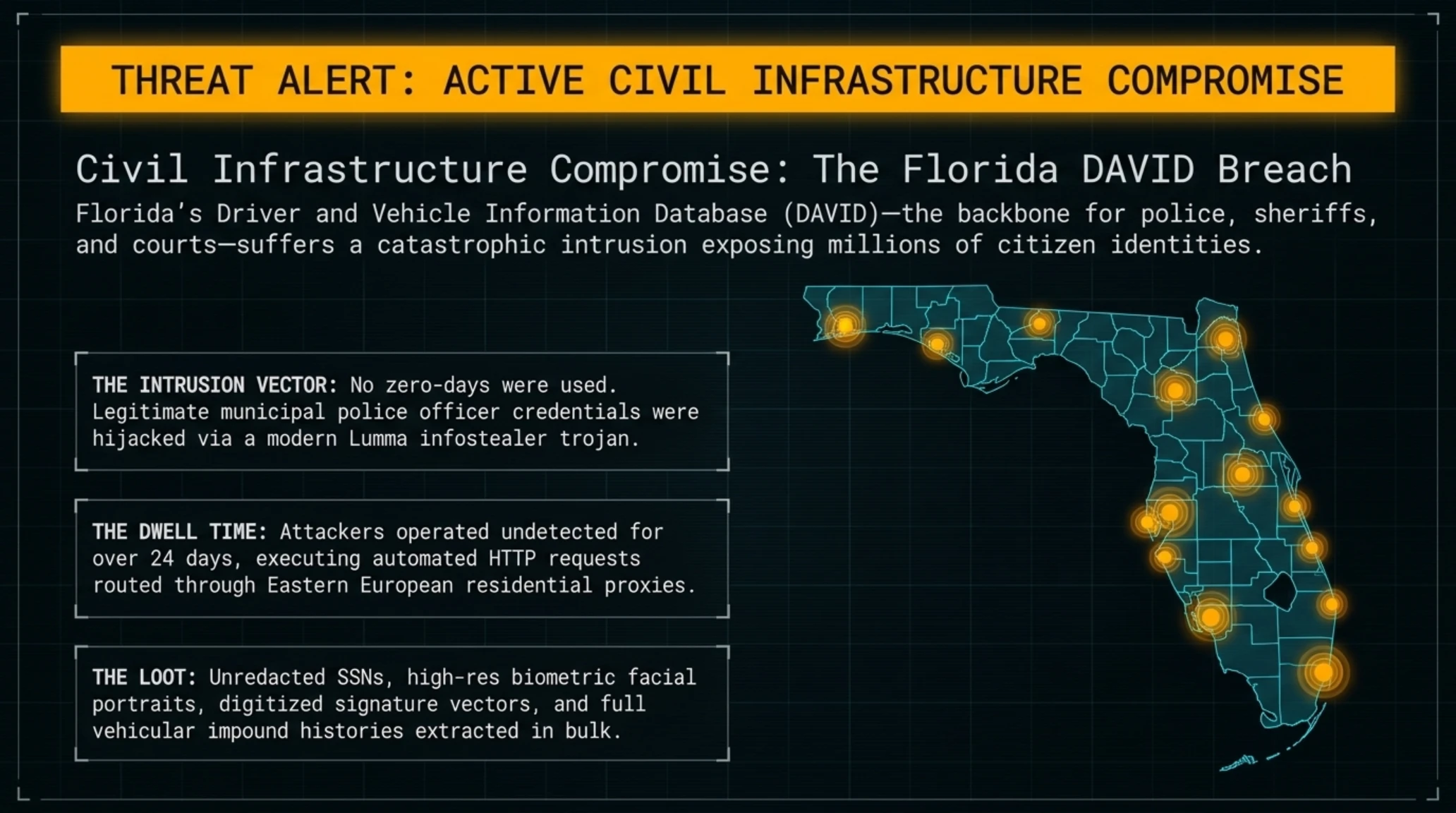
The Florida Department of Highway Safety and Motor Vehicles (FLHSMV) issued a grave, high-priority security advisory to state judicial authorities and federal prosecutors today, confirming that the state's central repository for motor vehicle records and driver identification the Driver and Vehicle Information Database (DAVID) suffered a catastrophic, sustained cyber intrusion. The database, which serves as the foundational data backbone accessed daily by municipal police departments, county sheriffs, state troopers, and criminal court clerks, contains the sensitive personal identification records of millions of Florida drivers and registered vehicle owners.
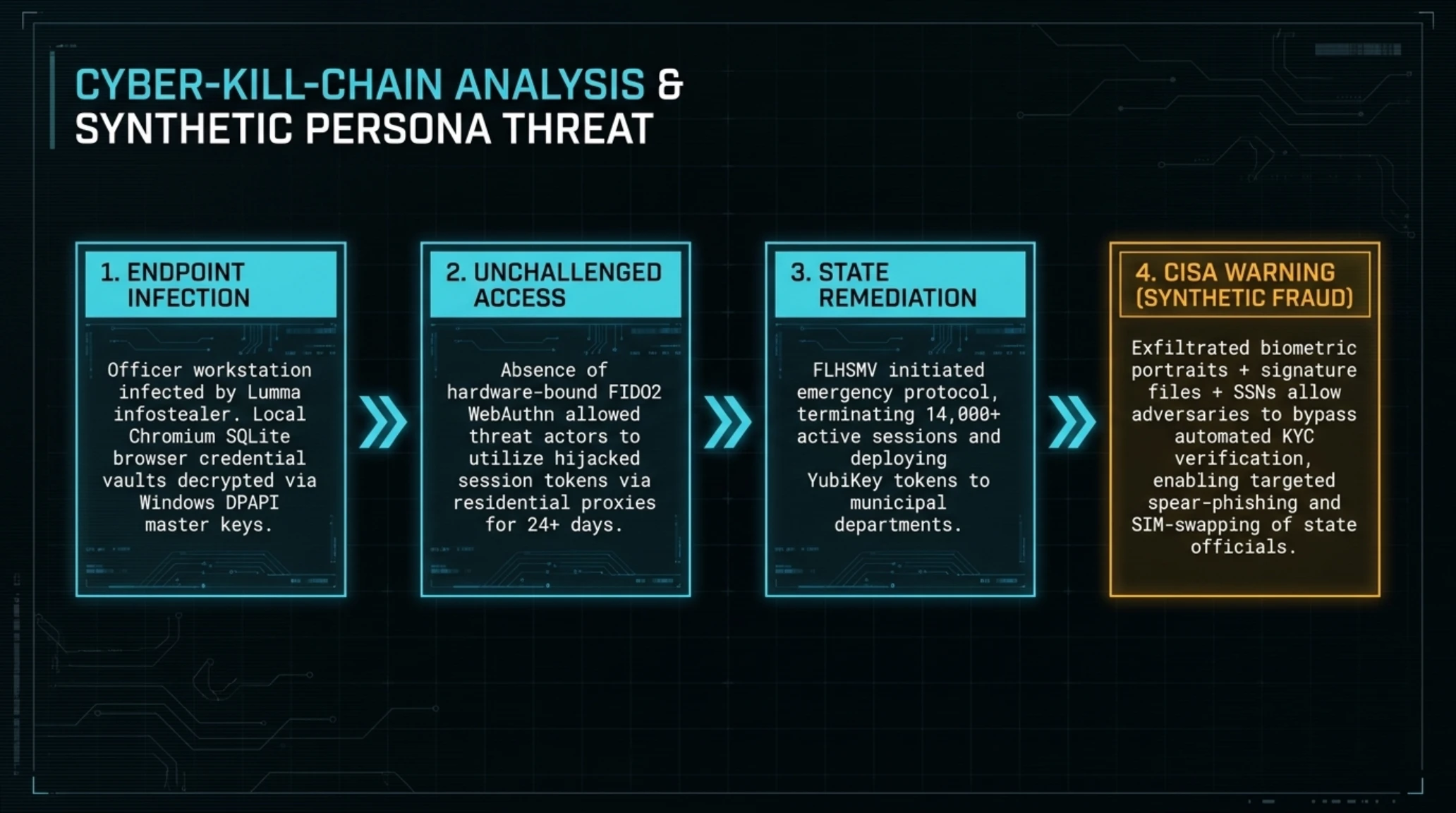
According to technical vulnerability disclosures published by BleepingComputer and ongoing investigations led by the Federal Bureau of Investigation (FBI) and incident response specialists at Mandiant, the primary initial access vector was not an unpatched software zero-day, but rather the successful hijacking of legitimate access credentials belonging to an active municipal police officer. Forensic analysis indicates the officer's endpoint workstation was infected by a modern variant of the Lumma infostealer trojan, which decrypted local Chromium SQLite browser credential vaults via Windows DPAPI master keys. Armed with plaintext usernames, passwords, and persistent session tokens, threat actors routed automated HTTP requests through residential proxy nodes in Eastern Europe and Central America, seamlessly bypassing basic geographic IP filtering.
Because the state portal lacked mandatory, hardware-bound Multi-Factor Authentication (MFA) utilizing FIDO2 WebAuthn cryptographic keys, the attackers operated undetected within the system for more than twenty-four consecutive days, conducting unauthorized bulk record queries under the guise of routine law enforcement activity. The threat actors systematically queried the database's internal schema, extracting structured records comprising full legal names, unredacted Social Security Numbers (SSNs), residential addresses, digitized signature vector files, high-resolution biometric facial portrait photos, and complete vehicular impoundment and traffic citation histories for hundreds of thousands of Florida residents.
Forensic Breach Profile: Florida Driver and Vehicle Information Database (DAVID) Compromise
| Forensic Metric | Vulnerability Specification and Operational Threat Analysis |
|---|---|
| Targeted State System | Florida Driver and Vehicle Information Database (DAVID portal) |
| Initial Intrusion Vector | Compromised valid law enforcement credentials harvested via infostealer |
| Dwell Time / Access Window | Over 24 days of persistent querying prior to behavioral anomaly detection |
| Compromised Data Classes | Full names, SSNs, high-res portraits, digital signatures, and vehicle VINs |
| Attributed Threat Syndicates | Underground cybercrime syndicates linked to the ShinyHunters cartel |
| Mandatory Remediation Action | Immediate session revocation, statewide password reset & FIDO2 enforcement |
This massive data exposure poses severe real-world dangers to affected citizens. Possessing high-resolution portrait photos alongside digitized signature vectors and SSNs allows malicious actors to conduct synthetic identity fraud at scale, enabling the unauthorized creation of fraudulent bank accounts, vehicle title loans, and forged identification documents. Threat intelligence researchers have already observed tranches of the exfiltrated records circulating across private Telegram escrow channels and underground forums such as BreachForums, offered by brokers associated with the ShinyHunters cybercrime syndicate.
State authorities responded by initiating an emergency incident response protocol, terminating more than 14,000 active law enforcement session tokens across the state, mandating immediate password resets, and deploying emergency YubiKey FIDO2 hardware tokens to municipal departments to block further automated abuse.
Tekin Analysis: Identity Infrastructure Fragility and the Threat of Synthetic Persona Fraud
- Lethal Weakness of Legacy Passwords: Government databases housing citizen biometric and identity records must ban simple passwords; hardware-bound FIDO2 keys are mandatory.
- Automated Query Behavioral Auditing: Abnormal spikes in bulk record queries during off-peak hours must trigger instantaneous heuristic session termination.
- Peril of Synthetic Identity Fraud: Exfiltrated driver's license signatures and SSNs provide threat actors with the raw materials to construct undetectable synthetic personas.
- Strict Least-Privilege Segmentation: Frontline municipal officers must not possess unrestricted read access across entire statewide population registries.
The Cybersecurity and Infrastructure Security Agency (CISA) issued an urgent inter-agency advisory warning that exfiltrated driver records are actively being weaponized in hyper-targeted spear-phishing and SIM-swapping operations targeting state officials and judicial personnel. By combining high-resolution portrait photographs with verified residential addresses and signature files, threat actors can bypass automated Know-Your-Customer (KYC) identity verification systems at regional telecommunication providers, tricking customer support representatives into porting mobile numbers to adversary-controlled eSIMs. Federal investigators urge all Florida public servants to freeze their credit profiles with major reporting bureaus and transition critical two-factor authentication from SMS verification to dedicated authenticator apps or physical security keys.
Navigating the complex interplay of commercial gaming politics, game engine architectures, and cybersecurity forensics requires a rigorous command of industry terminology.

To assist our global readership in decoding the sophisticated technical concepts analyzed throughout tonight's coverage, we have compiled an exhaustive technical glossary.
Engineering and Gaming Glossary (Jargon Buster)
| Specialized Term | Rigorous Technical Definition & Industry Operational Context |
|---|---|
| Decima Engine | Proprietary game engine developed by Guerrilla Games powering Death Stranding and Horizon. |
| Path Tracing | Advanced rendering algorithm computing multiple physical bounces of light, shadows, and caustics. |
| Subscription Fatigue | Socio-economic fatigue occurring when compounding recurring fees prompt mass service cancellations. |
| Immersive Sim | Game genre emphasizing emergent gameplay systems, player agency, and consistent world physics. |
| FIDO2 WebAuthn | Phishing-resistant authentication standard leveraging public-key cryptography to eliminate passwords. |
| Drone Counter-Espionage | Security methodologies combining RF jamming, radar detection, and electrochromic glass to counter aerial spying. |
Strategic Synthesis and Market Outlook: Lessons from the Evening of September 13, 2026
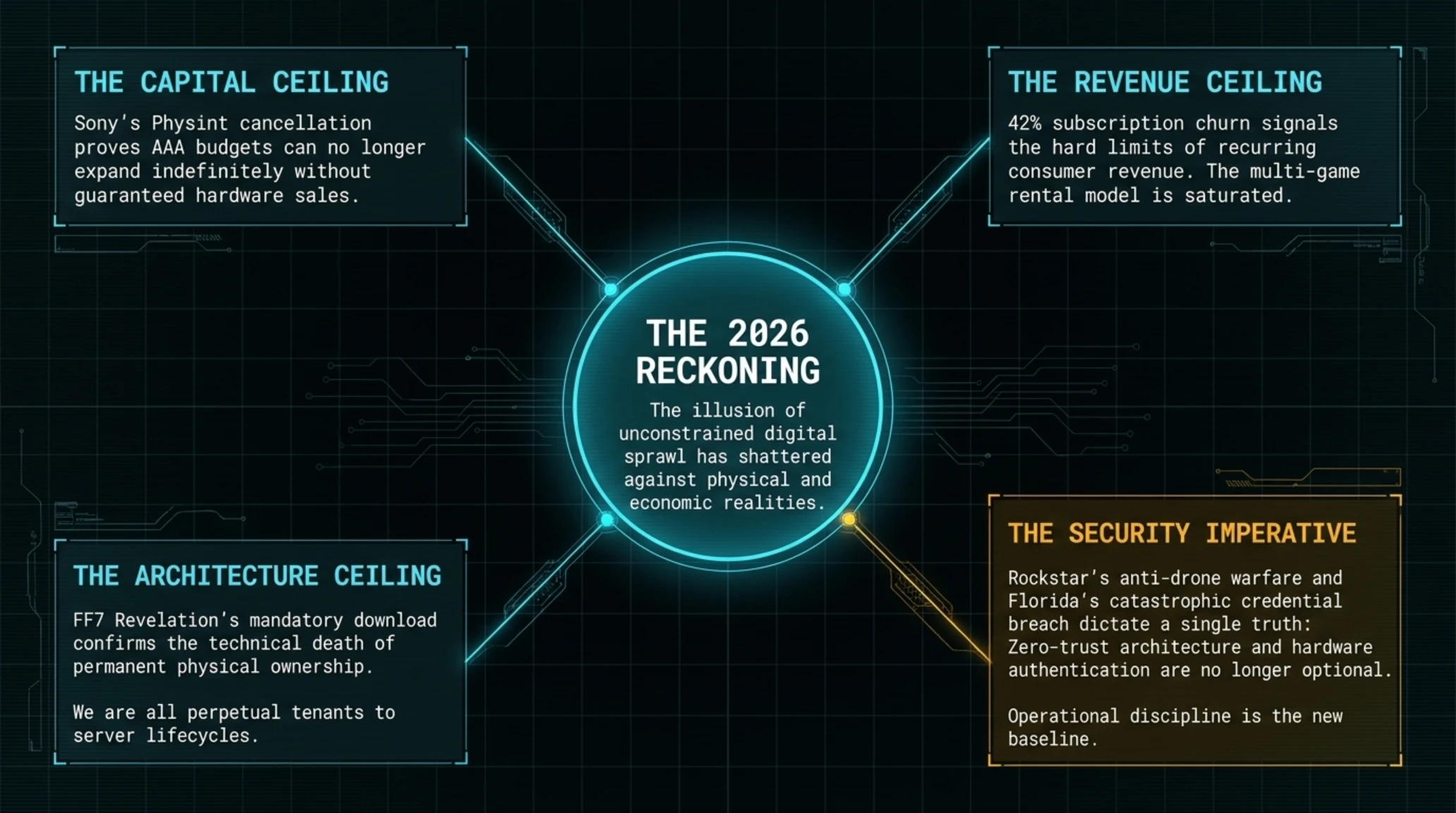
Synthesizing the six critical narratives unpacked across tonight's edition of Tekin Night reveals an interactive entertainment and digital security landscape undergoing a profound, painful reckoning. Sony's unceremonious departure from Hideo Kojima's Physint and the consumer revolt sweeping across Xbox Game Pass and PlayStation Plus are two sides of the same economic coin: the definitive bursting of the AAA development cost bubble. For over a decade, major platform holders assumed that escalating production budgets and compounding monthly subscription fees could expand indefinitely without provoking market pushback. That illusion has now shattered against the reality of consumer price resistance and plateauing hardware adoption.
Simultaneously, the physical constraints confronting optical media illustrated by Final Fantasy 7 Revelation's mandatory 50GB digital patch underscore that the concept of permanent game ownership has fundamentally dissolved. Gamers are no longer sovereign owners of tangible cultural artifacts, but dependent clients tethered to publisher server infrastructures. In this climate of corporate consolidation and digital ephemerality, Nightdive Studios' immaculate reconstruction of Thief: The Dark Project offers a rare masterclass in classical game preservation, proving that artistic integrity and timeless systems-driven design can thrive when modern rendering techniques like Path Tracing are applied with reverence.
Finally, the clandestine drone surveillance outside Rockstar Games and the devastating data exfiltration from Florida's DAVID driver registry serve as a chilling reminder that in our hyper-connected digital society, security is never optional. Whether safeguarding proprietary source code for a $2 billion cultural phenomenon or protecting the sensitive biometric identities of hundreds of thousands of everyday citizens, failing to implement strict physical counter-intelligence and modern, phishing-resistant authentication protocols will inevitably lead to systemic catastrophe. To explore our previous analytical investigations, review our Tekin Weekly Roundup Issue #173 and our previous Tekin Night Saturday September 12, 2026 briefing.
As we project into the remainder of 2026 and look toward the looming launch of tenth-generation hardware, commercial viability will belong to publishers and engineering teams that embrace operational discipline over hubris. The industry can no longer rely on unconstrained marketing budgets or unearned brand goodwill to mask structural inefficiencies. The companies that navigate this inflection point successfully will be those that diversify platform distribution, respect consumer financial boundaries, implement zero-trust defensive security across all developer environments, and remember that compelling interactive gameplay mechanics not empty cinematic bloat remain the ultimate foundation of interactive entertainment.
The visual artwork below encapsulates the convergent tensions between creative ambition, corporate surveillance, and the evolving landscape of digital interactive entertainment over the coming decade.

Related Intelligence Dossiers on TekinGame
• 📱 Tekin Analysis | Apple's Foldable iPhone Duo & iPhone 18 Pro Price Hike
• 🧠 Tekin Analysis | Valve's 17-Year Secret: The Staged L4D2 Trailer Leak
• 🎬 Ultimate Guide to Local AI Video Generation (Minimax, Wan, LTX)
We conclude tonight's briefing with an executive technical FAQ addressing the most pressing questions raised by our global readership.
Frequently Asked Questions Regarding Tonight's Tekin Night Coverage
Why did Sony pull out of funding Hideo Kojima's espionage action game Physint?
Spiraling production estimates exceeding $180 million, protracted development schedules slipping toward 2030, underwhelming Death Stranding 2 hardware driving metrics, and Kojima's insistence on multiplatform release (PC and Xbox) led PlayStation executives to terminate the publishing partnership.
Why are gamers cancelling Xbox Game Pass and PlayStation Plus in record numbers?
Empirical surveys from Circana and Newzoo confirm over 40% of cancelling subscribers cite relentless, compounding price hikes as their primary reason for leaving, despite more than 71% expressing high satisfaction with overall catalog curation.
What was the nature of Rockstar Games' union Discord surveillance?
Edinburgh High Court filings revealed Rockstar maintained an undercover corporate security operative inside the worker union Discord server for 30 consecutive months to detect and suppress internal leaks regarding Grand Theft Auto VI development.
Why does Final Fantasy 7 Revelation require a mandatory 50GB day-one download?
Director Naoki Hamaguchi stated the game exceeds 154GB, and fitting the entire experience onto two 100GB Blu-ray discs would have required devastating compression of character textures, HDR lighting, and uncompressed 4K cinematics during the narrative climax.
How did hackers compromise the Florida DAVID driver database?
Threat actors harvested valid law enforcement login credentials via infostealer malware, maintaining undetected access for over 24 days to exfiltrate full names, SSNs, driver portraits, and digital signatures belonging to hundreds of thousands of citizens.
Verified Primary Sources and International Documentation
- Eurogamer: Detailed Investigative Report on Sony's Cancellation of Hideo Kojima's Physint Partnership
- Eurogamer: Empirical Analysis of Gaming Subscription Churn and Consumer Price Sensitivity
- Rock Paper Shotgun: Edinburgh High Court Disclosures of Rockstar Games Union Discord Mole
- GameSpot: Forensic Coverage of Rockstar Games Counter-Drone Defense and Studio Security Protocols
- Eurogamer: Direct Interview With Director Naoki Hamaguchi Defending FF7 Revelation Mandatory Download
- Eurogamer: Official Announcement of Thief: The Dark Project Remaster and The Tarnished Mirror Expansion
- BleepingComputer: Forensic Advisory on Florida Highway Safety DAVID Driver Database Intrusion
Additional Gallery: 🌙 Tekin Night Sept 13 | Kojima Game Cancelled, Rockstar Espionage & Florida Hack