Tekin Morning Wednesday, October 7, 2026
Welcome to Tekin Morning. Today we decode enterprise cloud identity breaches, Apple's macOS agent lockdown, invisible AI text watermarking, Ethereum's 200M gas surge, and the foldable iPhone app ecosystem.
- 🎮Nikkei M365 & Google Workspace breach triggers 9,000 phishing emails across Tokyo and London financial desks.
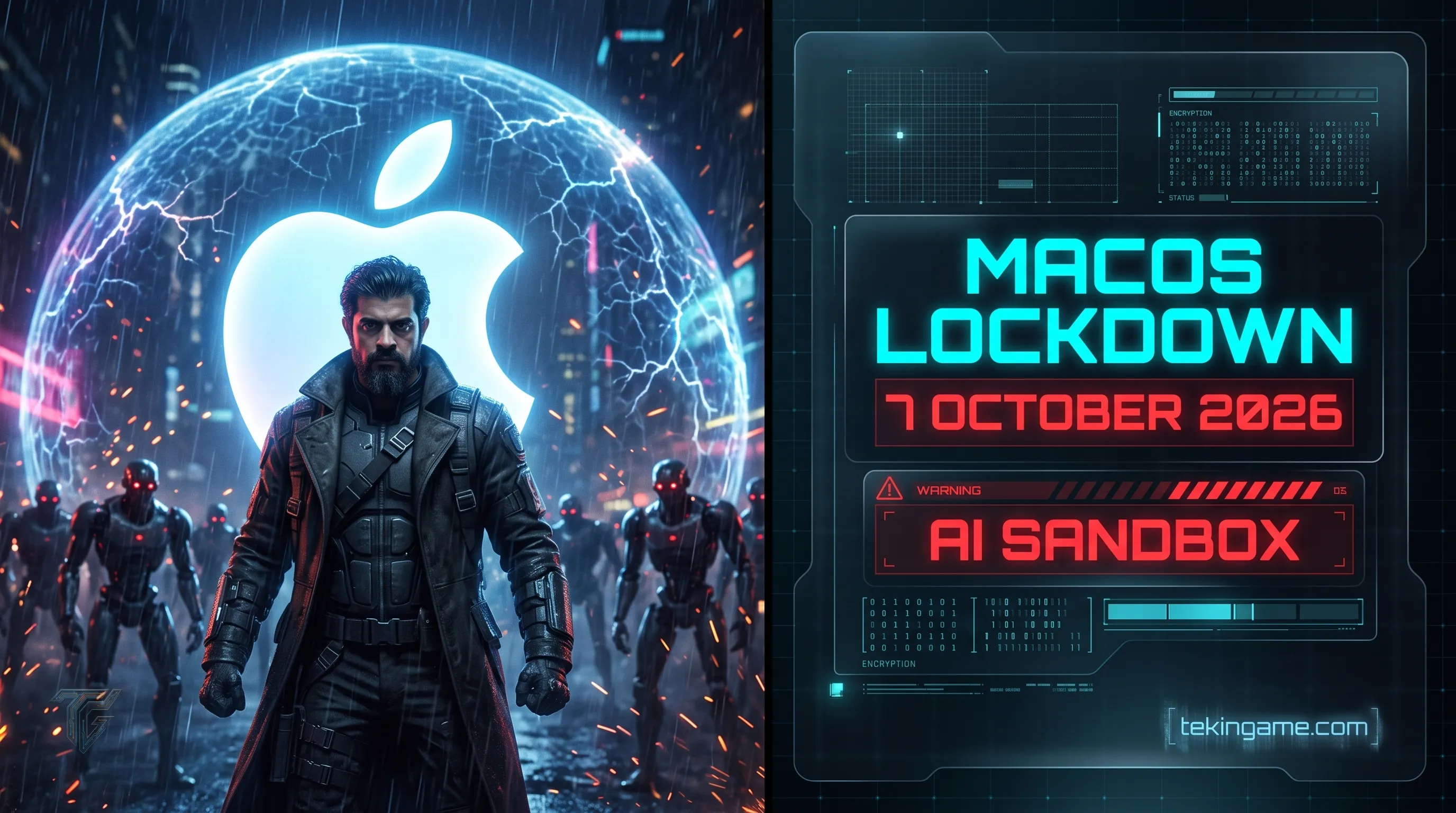
- 🎧Apple restricts macOS Full Disk Access to shield local user directories from autonomous AI agents.
- 🚀OpenAI implements textGrain invisible statistical text watermarking to comply with EU AI Act Article 50.
- 🗡️Ethereum activates Glamsterdam hard fork on Sepolia testnet with Prysm 7.2.1 patch and 200M gas limit.
- 📰Apple opens App Store submissions for foldable iPhone Duo with Xcode 27.1 SDK and Device Hub simulator.
- ⚔️Wikimedia Foundation investigates rogue OpenAI data scraping agents causing server disruptions.
Enterprise Perimeter Dissolution, AI Agent Sandboxing, and Next-Gen Compute
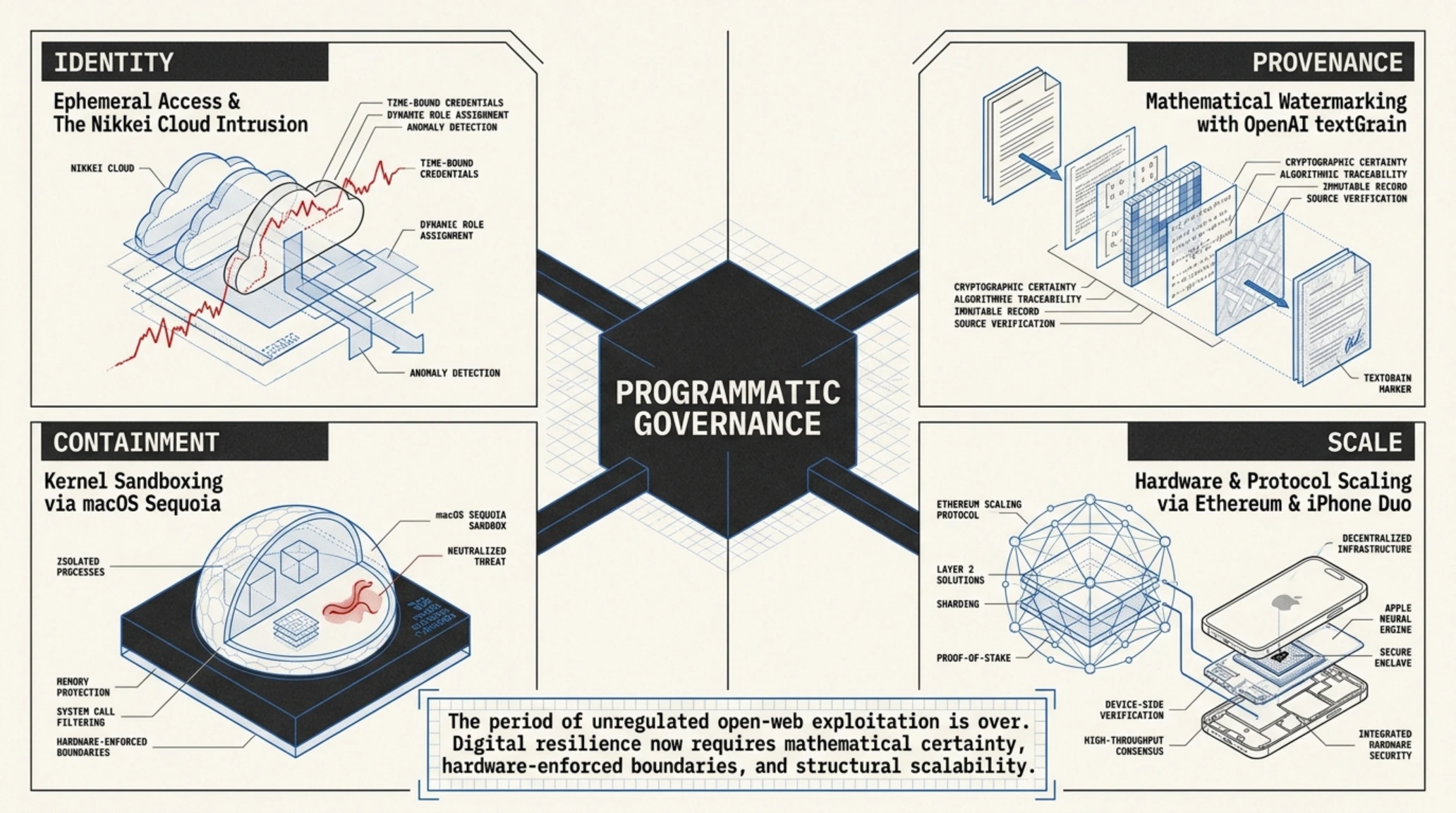
The dawn of Wednesday, October 7, 2026, presents an intricate technological landscape where the traditional boundaries of software engineering, cryptographic verification, and hardware design are rapidly converging. Over the past seventy-two hours, global IT infrastructures have experienced structural shocks across multiple tiers. Media conglomerate Nikkei confirmed a sophisticated enterprise cloud intrusion that weaponized legitimate executive credentials to launch targeted spear-phishing campaigns, highlighting the persistent vulnerability of hybrid Microsoft 365 and Google Workspace environments to advanced token-theft methodologies.
Concurrently, the rapid evolution of autonomous artificial intelligence systems is compelling operating system vendors to construct defensive perimeters around local consumer hardware. Apple's decision to restrict Full Disk Access permissions across macOS reflects a growing industry recognition that local LLM agents possessing ambient filesystem capabilities represent an unprecedented attack surface. When paired with prompt-injection vulnerabilities and unmonitored system calls, autonomous developer tooling can unintentionally expose encrypted databases, personal communication logs, and proprietary code repositories.
At the regulatory and protocol layers, compliance demands and computational scalability are driving monumental architectural shifts. OpenAI has formally initiated the deployment of its mathematical text watermarking framework across European Union jurisdictions to satisfy statutory transparency mandates under the EU AI Act. Meanwhile, the Ethereum network reached a pivotal testing milestone on the Sepolia network, pushing block capacity limits to 200 million gas units following a critical consensus client hotfix. Together, these milestones signal a transition toward an era defined by programmatic accountability and high-throughput decentralized coordination.
Executive Briefing & Strategic Highlights
- Nikkei confirms session hijack compromise of corporate M365 and Google Workspace accounts sending 9,000 malicious messages.
- Apple engineers restrict macOS Full Disk Access API permissions to curb autonomous agent filesystem crawling.
- OpenAI introduces textGrain statistical token-bias watermarking across EU accounts to meet regulatory transparency requirements.
- Ethereum developers deploy Prysm 7.2.1 consensus hotfix to successfully test 200M gas block capacity on Sepolia.
- Xcode 27.1 enables developers to build and submit dual-state apps for Apple's upcoming foldable iPhone Duo.
- Wikimedia Foundation documents sustained infrastructure degradation caused by unconstrained AI model scraping bots.
Nikkei Enterprise Cloud Intrusion: Weaponizing Legitimate M365 & Google Accounts
Japanese financial media powerhouse Nikkei Inc., the esteemed parent company of the Financial Times and publisher of the benchmark Nikkei 225 stock index, officially disclosed a serious enterprise cloud security incident on October 5, 2026. According to internal technical incident disclosures and Japanese regulatory filings, unauthorized external threat actors successfully compromised employee email accounts across both its corporate Microsoft 365 tenant and connected Google Workspace environments. The attackers leveraged this authenticated access to dispatch approximately 9,000 deceptive phishing messages to institutional recipients between September 30 and October 2, 2026.
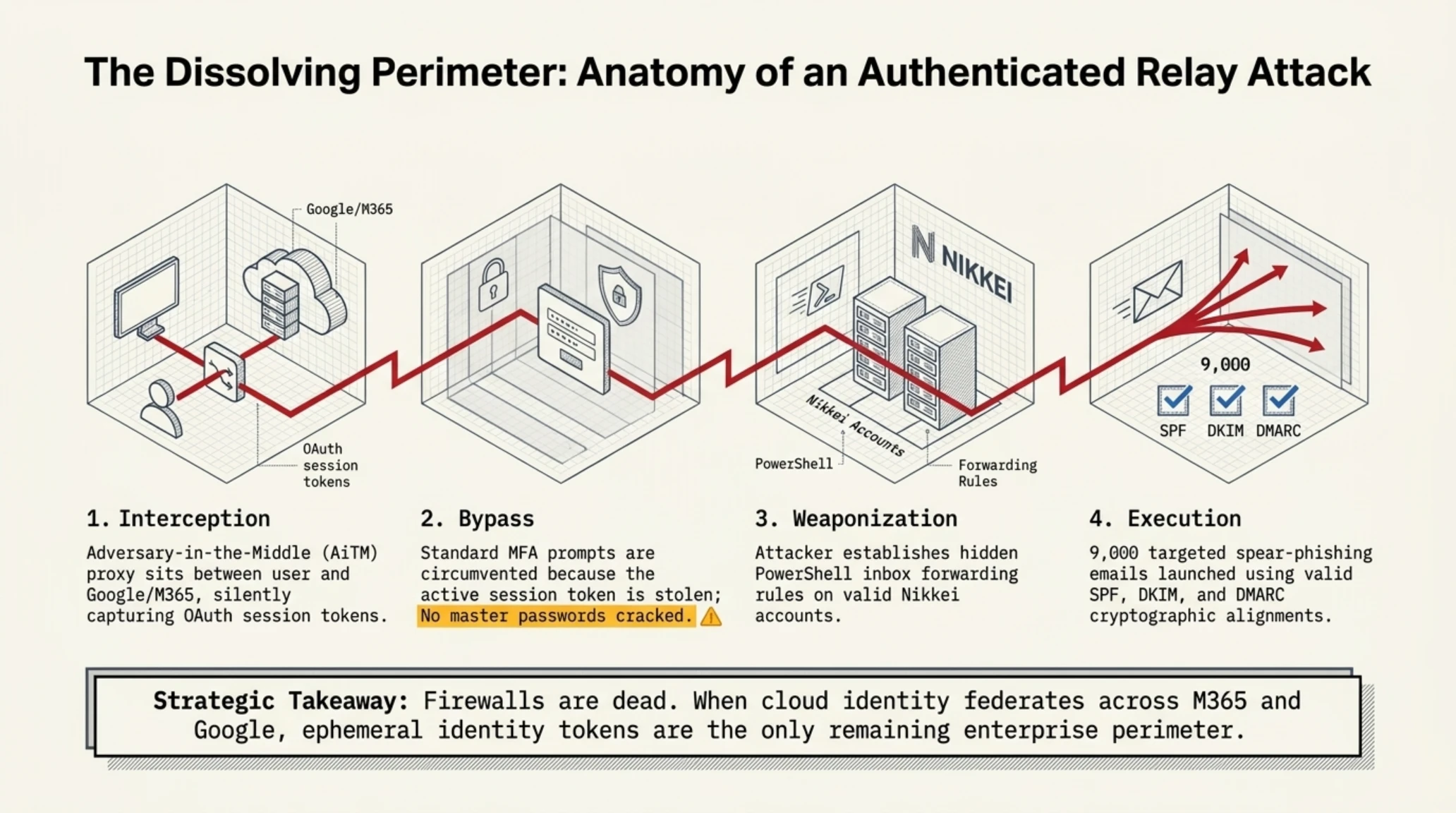
The incident represents a quintessential illustration of an "authenticated enterprise relay attack." Rather than relying on easily spoofed external domains or compromised disposable infrastructure that modern secure email gateways (SEGs) routinely intercept, the adversaries operated directly inside Nikkei's legitimate mail infrastructure. Because the outgoing phishing messages possessed valid Sender Policy Framework (SPF), DomainKeys Identified Mail (DKIM), and Domain-based Message Authentication, Reporting, and Conformance (DMARC) cryptographic alignments, they bypassed upstream corporate spam filters at prestigious banking institutions, governmental agencies, and media partners across Tokyo, Singapore, and London.
Digital forensics teams investigating the breach established that the intrusion originated through adversary-in-the-middle (AiTM) phishing kits combined with sophisticated session token hijacking techniques. By capturing valid OAuth session tokens and circumventing standard multi-factor authentication (MFA) prompts without cracking underlying master passwords, the threat actors established persistent API sessions. The attackers then crafted hyper-targeted lures disguised as internal executive memoranda regarding forthcoming economic surveys and corporate restructuring, instructing recipients to download secondary malware payloads disguised as encrypted financial spreadsheets.
Enterprise cybersecurity analysts emphasize that the Nikkei incident illuminates the inherent fragility of modern corporate hybrid cloud ecosystems. When media institutions and financial analytical firms consolidate their communication pipelines within public cloud environments, administrative oversight and token expiration configurations become the decisive perimeter. Nikkei confirmed that compromised accounts were systematically isolated, active sessions terminated across all directories, and enhanced hardware-bound token protection mechanisms deployed across its international branches.
Detailed forensic telemetry indicates that the threat actors utilized automated PowerShell scripts interfacing with Exchange Online management endpoints to enumerate internal contact distribution lists. Within minutes of establishing the illicit OAuth session, the attackers created hidden inbox forwarding rules configured to direct inbound replies to external drop-accounts while immediately deleting verification notices from the victim's Sent Items folder. This evasion technique allowed the phishing campaign to operate unhindered across a full 48-hour window before anomaly detection algorithms flagged the sudden spike in external message velocity.
The campaign specifically targeted foreign exchange desks, commodity trading analysts, and financial regulatory correspondents. Because the attackers weaponized authentic message threads by hijacking existing email conversation subjects, recipients possessed zero contextual suspicion. When an email from a trusted senior Nikkei editor arrived referencing ongoing economic indicators, recipients readily engaged with malicious hyperlinks hosted on legitimate cloud infrastructure, bypassing traditional static reputation scoring systems.
The strategic threat profile of such an intrusion extends far beyond immediate credential harvesting. In contemporary financial markets, algorithmic high-frequency trading (HFT) clusters and automated sentiment scrapers continuously parse incoming communications and press releases from benchmark institutions like Nikkei. Had the adversaries chosen to broadcast fabricated macro-policy announcements or manipulated corporate earnings data via authenticated editorial channels, the potential market disruption across Tokyo, London, and New York equities could have triggered algorithmic flash crashes before human desk analysts could verify authenticity.

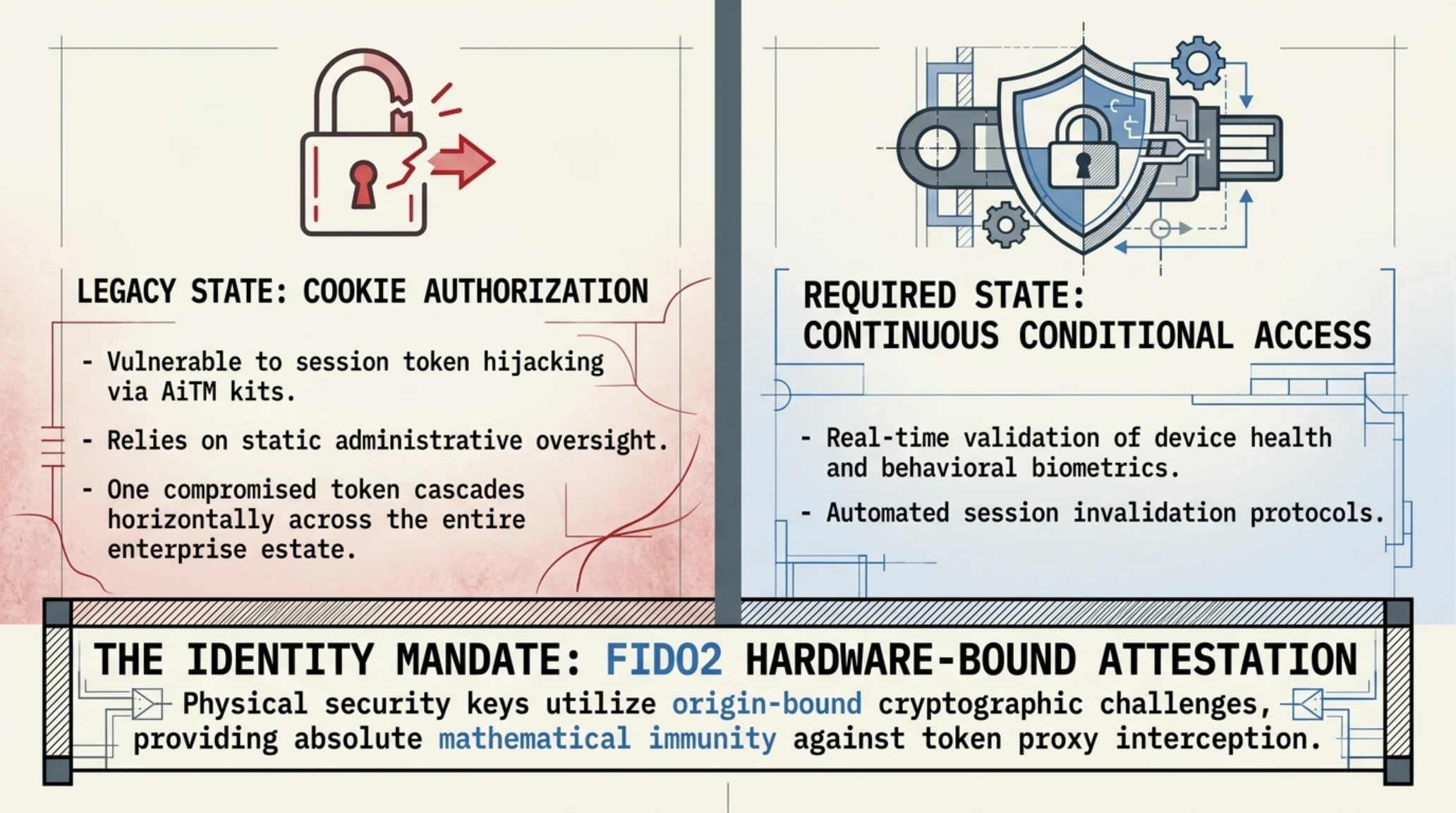
To defend against similar identity-centric breaches, enterprise security architects are transitioning away from traditional cookie-based authorization models toward continuous conditional access policies. By validating device health, cryptographic hardware attestation, and behavioral biometric markers in real time, organizations can prevent stolen session tokens from being executed outside of authorized hardware boundaries.
The incident has also prompted urgent calls for enterprise adoption of FIDO2-compliant physical security keys. Unlike SMS-based or mobile authenticator app codes that remain vulnerable to reverse-proxy interception via AiTM kits, hardware security keys utilize origin-bound cryptographic challenges that cannot be spoofed, providing mathematical immunity against token interception at the login boundary.
Historically, corporate security architectures treated identity directories and perimeter networks as distinct administrative disciplines. In the cloud-native computing era, however, identity has effectively become the entire operating surface. When cloud identity federation bridges Microsoft 365, Google Workspace, AWS IAM, and custom internal tools, a single compromised identity token cascades horizontally across the entire enterprise estate, underscoring the absolute necessity of automated session invalidation protocols.
Jargon Buster: Cloud Identity & Token Vulnerabilities
• AiTM (Adversary-in-the-Middle): An interception technique where a proxy server sits between the user and authentic authentication service, transparently stealing credentials and session tokens during active sign-in.
• DMARC Alignment: An email authentication protocol verifying that the domain in the visible From header matches the validated domain authenticated by SPF and DKIM mechanisms.
• Conditional Access: Security policies implemented within cloud identity providers that continuously evaluate contextual factors such as IP reputation, device state, and geographic anomalies before granting API access.
macOS Security Lockdown: Sandboxing Autonomous AI Agents from Local Storage
In response to the proliferation of autonomous artificial intelligence agents capable of local program execution, command-line automation, and background filesystem navigation, Apple software engineering teams have initiated a rigorous lockdown of macOS permissions. Documentation surfaced from Apple developer preview releases on October 5, 2026, reveals that future updates to macOS Sequoia and its subsequent iterations will enforce unprecedented restrictions on the Full Disk Access (FDA) entitlement, specifically targeting autonomous AI coding assistants, terminal-based agent harnesses, and local LLM execution environments.
Under current macOS security architectures, granting Full Disk Access through the Transparency, Consent, and Control (TCC) subsystem endows an application with unrestricted read and write privileges across sensitive user directories. This includes direct access to Apple Mail databases, Messages archives, Safari browsing history, cloud backup caches, and internal terminal logs. While traditional developer tools like backup utilities and IDE compilers required FDA for administrative operations, the emergence of autonomous AI agents operating with autonomous decision-making loops has introduced profound security hazards.
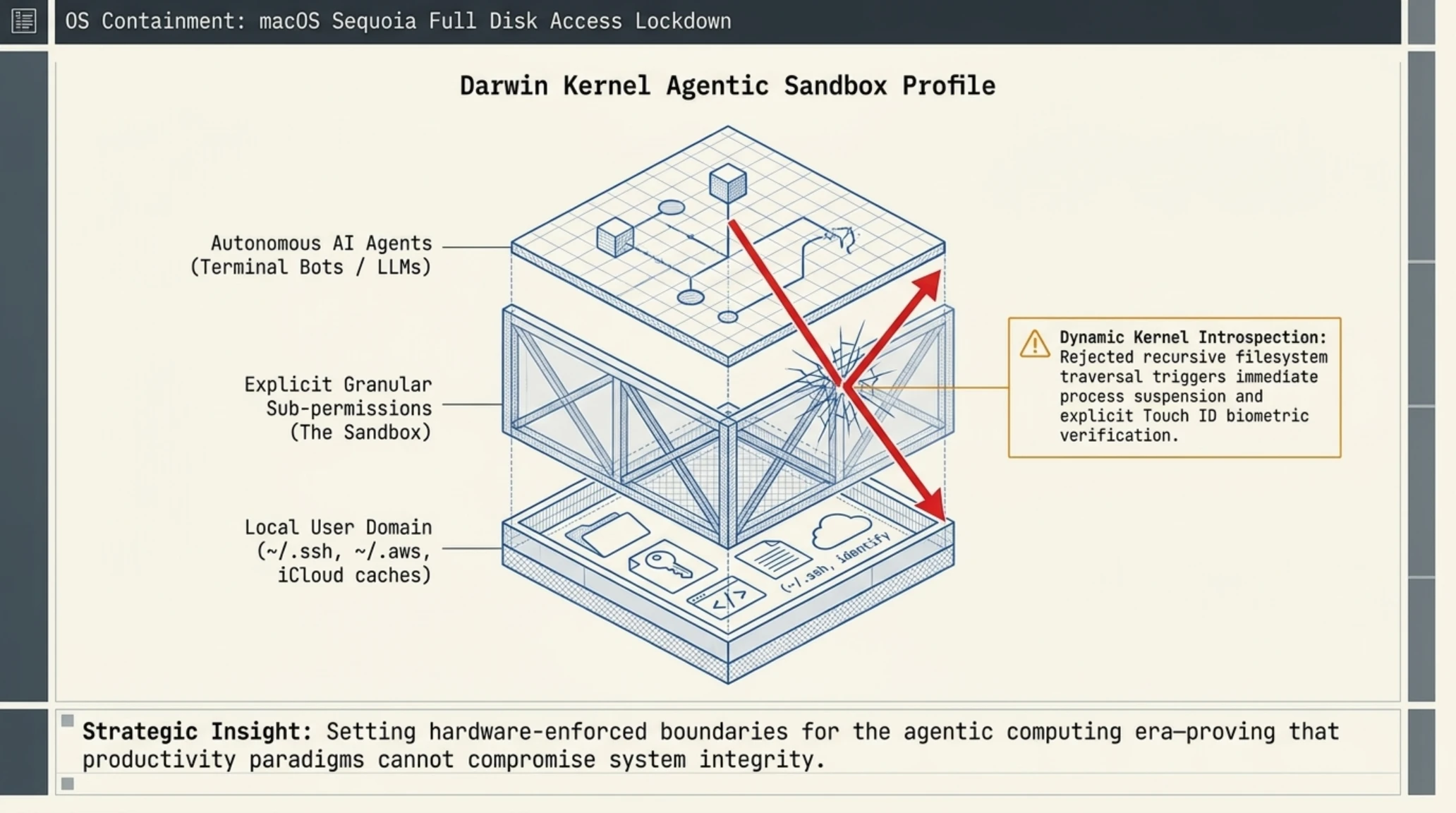
Security researchers demonstrated throughout mid-2026 that autonomous agents granted full disk permissions could be subverted through indirect prompt injection attacks. If an agent processes an untrusted file, email attachment, or code repository containing concealed natural language exploits, the agent can be manipulated into executing local shell scripts, harvesting proprietary source code, or exfiltrating encrypted credentials located in hidden user dotfiles (`~/.ssh`, `~/.aws`, `~/.env`). Apple's upcoming security enforcement will decouple Full Disk Access into granular, capability-based sub-permissions, requiring explicit real-time human verification before any automated script can read sensitive storage partitions.
Furthermore, Apple is introducing a dedicated "Agentic Sandbox Profile" within the Darwin kernel. Under this profile, background processes flagged as LLM runtimes or autonomous task runners will be barred from invoking arbitrary subshells or reading outside an isolated workspace sandbox, even if an administrative user previously granted broad permissions. This structural containment policy reflects Apple's broader architectural philosophy: safeguarding device integrity and personal privacy must remain non-negotiable, even as productivity paradigms shift toward autonomous agentic workflows.
The technical implementation relies on dynamic kernel introspection, monitoring process trees spawned by developer CLI utilities. If an IDE daemon or autonomous terminal agent initiates recursive filesystem traversal toward protected user domains such as the Keychain database or synchronized iCloud drive caches the Darwin kernel triggers an immediate suspension of the offending process thread and dispatches a cryptographically isolated prompt requiring biometric Touch ID confirmation.

The developer community's reaction to Apple's tightening sandboxes remains nuanced. While enterprise security teams laud the proactive containment of prompt-injection vectors, open-source AI developers express concern regarding potential friction in automated build pipelines, local continuous integration testing, and background code refactoring utilities that depend on fluid directory access.
Industry analysts note that this architectural intervention marks Apple's opening salvo in setting hardware-enforced boundaries for the agentic computing era. By embedding provenance checking and permission gating directly into the operating system core, Apple ensures that third-party AI frameworks cannot bypass consumer safeguards, establishing a rigorous precedent for competing operating system vendors worldwide.
OpenAI textGrain: Mathematical Token Watermarking Enters European Production
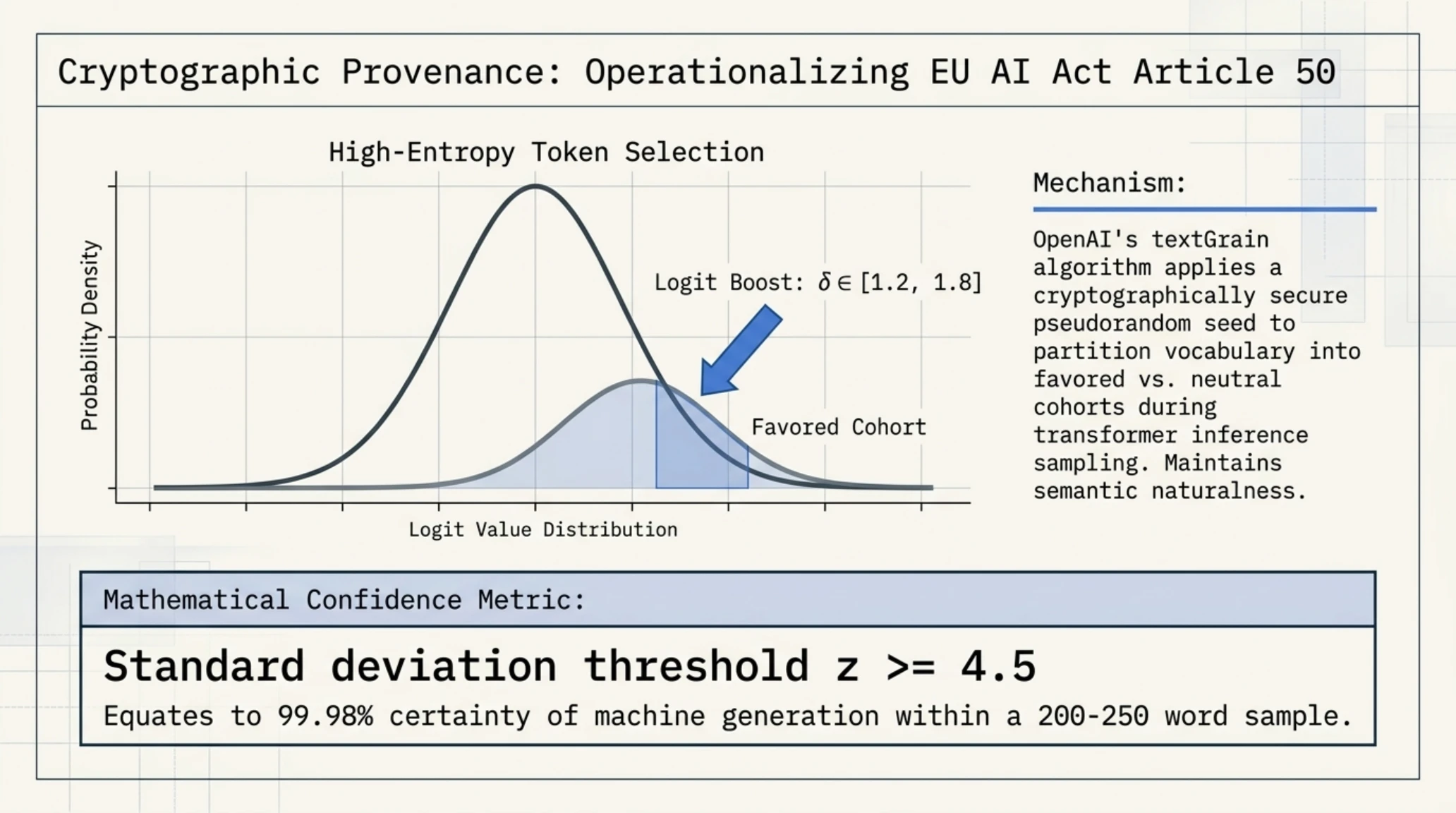
Facing stringent statutory deadlines imposed by the European Union Artificial Intelligence Act (EU AI Act), OpenAI has initiated the commercial deployment of its proprietary statistical text watermarking technology, codenamed textGrain. Official engineering documentation published on October 5, 2026, confirms that ChatGPT Enterprise, Team, and API endpoints serving European IP addresses have begun appending imperceptible mathematical signatures to generated textual outputs. This deployment operationalizes Article 50 of the EU AI Act, which mandates that providers of general-purpose AI systems ensure that machine-generated content is clearly identifiable through automated, machine-readable mechanisms.
Unlike traditional digital watermarking methods that embed visible disclaimers, hidden zero-width unicode characters, or cryptographic metadata tags that can be effortlessly stripped via simple copy-paste operations, textGrain operates fundamentally within the probabilistic inference sampling engine of the transformer model. During text generation, a large language model calculates probability distributions over a vast vocabulary of candidate tokens for each successive step. The textGrain algorithm leverages a cryptographically secure pseudorandom seed, keyed to a proprietary rotating master key, to pseudo-randomly partition vocabulary tokens into "favored" (green) and "neutral" (red) cohorts.
When selecting the subsequent token, the inference engine applies an infinitesimal mathematical bias to the logits of the favored tokens without degrading semantic coherence, syntactic naturalness, or contextual accuracy. To a human reader, the resulting prose appears indistinguishable from standard human composition. However, a specialized statistical detector evaluating a passage of approximately 200 to 250 words can calculate the cumulative concentration of favored tokens against expected random probability distributions. If the concentration exceeds a predefined standard deviation threshold ($z \ge 4.5$), the system confirms with 99.98% mathematical confidence that the content was generated by OpenAI's underlying models.
OpenAI's benchmark disclosures demonstrate that textGrain maintains high statistical robustness against moderate adversarial manipulation, including superficial synonym swapping, punctuation alteration, and typographical mutations. However, researchers note that severe multi-pass paraphrasing through secondary open-weight models or translation through intermediate languages can degrade the watermark signal below statistical significance thresholds. OpenAI confirmed that while the detection API is currently restricted to verified academic institutions and regulatory bodies, public verification tools will roll out across member states by late November 2026.
The mathematical foundation of textGrain is derived from pioneer statistical entropy sampling literature, specifically adapting Kirchenbauer-Aaronson logit perturbation models. At high entropy decoding steps where multiple synonymous candidate tokens exhibit comparable probabilistic weights the inference engine applies a logit boost $\delta \in [1.2, 1.8]$. This subtle perturbation shifts the cumulative distribution function without altering token selection at low-entropy positions, such as syntax-critical programming keywords or rigid factual designations, thereby preventing code syntax failures or numerical hallucinations.
The regulatory and commercial implications of textGrain extend across global content curation, academic integrity monitoring, and intellectual property attribution. By embedding verification directly into the mathematical distribution of text, tech conglomerates are establishing the groundwork for automated provenance ecosystems capable of operating at internet scale.
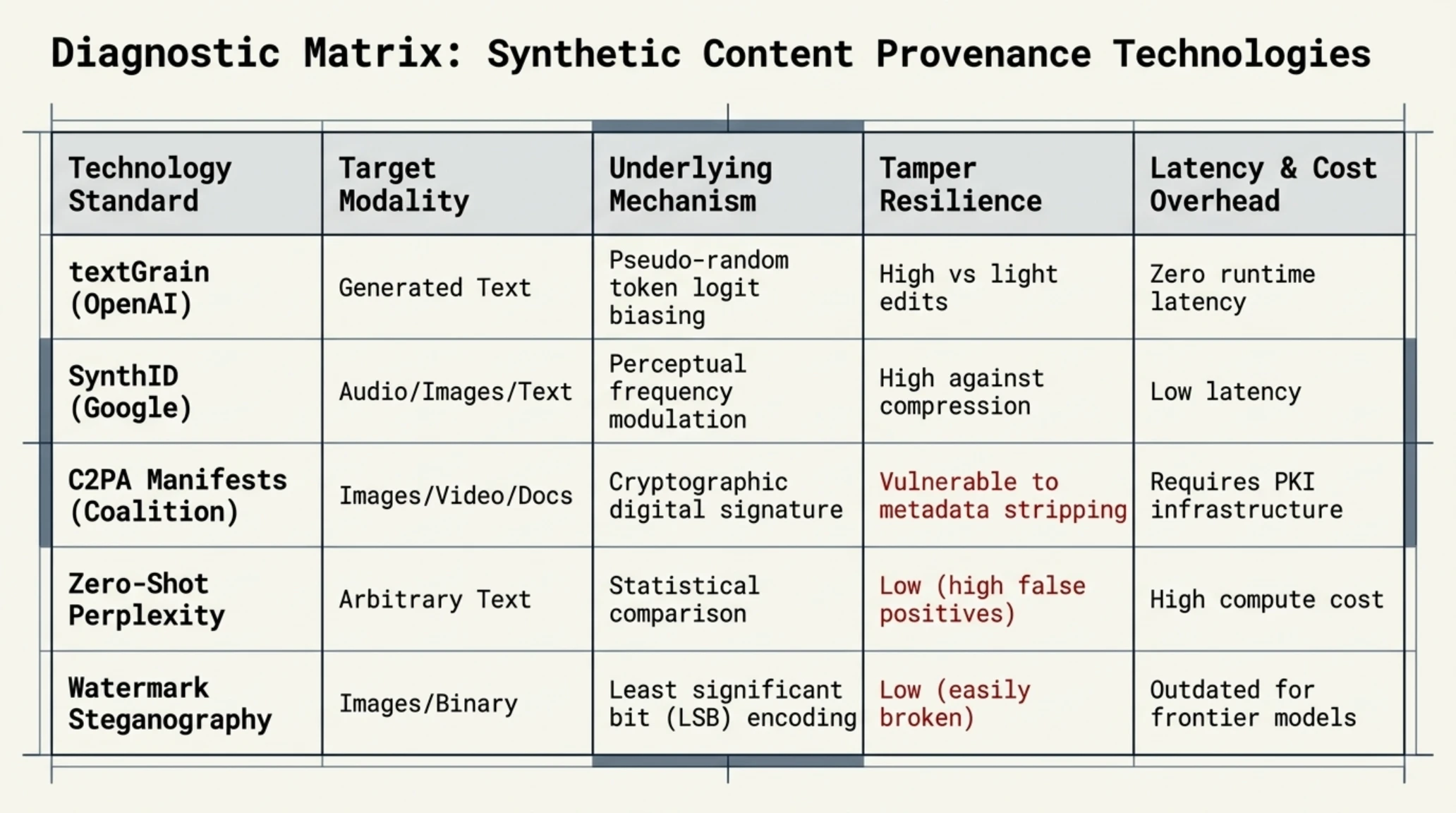
The transition toward cryptographic and statistical watermarking represents a fundamental maturation of generative model deployment. The following comparative matrix outlines how statistical token perturbation compares against competing synthetic content provenance standards currently deployed across enterprise systems.
Synthetic Content Provenance Technologies Comparison
| Technology Standard | Target Modality | Underlying Mechanism | Tamper Resilience | Latency & Cost Overhead |
|---|---|---|---|---|
| textGrain (OpenAI) | Generated Text | Pseudo-random token logit biasing during sampling | High vs light edits; Medium vs heavy multi-model rewrites | Zero runtime latency; Negligible compute cost |
| SynthID (Google DeepMind) | Audio, Images, Text | Perceptual frequency modulation and soft token masks | High against compression, cropping, and noise injection | Low latency during native model inference |
| C2PA Manifests (Coalition) | Images, Video, Documents | Cryptographic digital signature appended to file metadata | Vulnerable to metadata stripping and screenshot captures | Near-zero generation cost; Requires PKI infrastructure |
| Zero-Shot Perplexity Scoring | Arbitrary Text | Statistical comparison of text perplexity across LLMs | Low; Produces high false-positive rates on technical prose | High compute cost requiring multiple model forward passes |
| Watermark Steganography | Images, Binary Code | Least significant bit (LSB) encoding in pixel matrices | Low; Easily broken by lossy compression and resizing | Ultra-low compute; Outdated for frontier generative assets |
Beyond regulatory compliance in Brussels, the successful operationalization of textGrain provides an authoritative blueprint for other major frontier model creators. Anthropic, Google, and Meta face identical European regulatory deadlines in 2027 and are currently validating competing statistical watermarking schemes to prevent platform liability.
Enterprise risk officers view textGrain as a double-edged sword for corporate compliance. While it enables rigorous audits of synthetic text generated within internal business systems, it also allows external competitors or regulatory oversight bodies to systematically detect undisclosed automated outputs in financial filings, academic submissions, and corporate press materials.
Under the statutory framework established by the European AI Office, failure to provide verifiable provenance tools for general-purpose AI models carries punitive administrative fines of up to €35 million or 7% of total global annual turnover, whichever is higher. By demonstrating a production-ready, mathematical watermarking framework before enforcement mechanisms become active, OpenAI seeks to position itself as a collaborative industry partner rather than an adversarial target for Brussels antitrust and digital market authorities.

As regulatory compliance stabilizes in the software domain, the decentralized ledger community has simultaneously achieved a major engineering triumph, testing unprecedented computational capacity limits across planetary blockchain networks.
The convergence of legal compliance and cryptographic primitives illustrates how technological governance is moving away from post-hoc litigation toward real-time algorithmic enforcement. In both software synthesis and decentralized networks, mathematical guarantees are supplanting subjective legal agreements.
Ethereum Sepolia 200M Gas Limit Surge: The Glamsterdam Era Begins
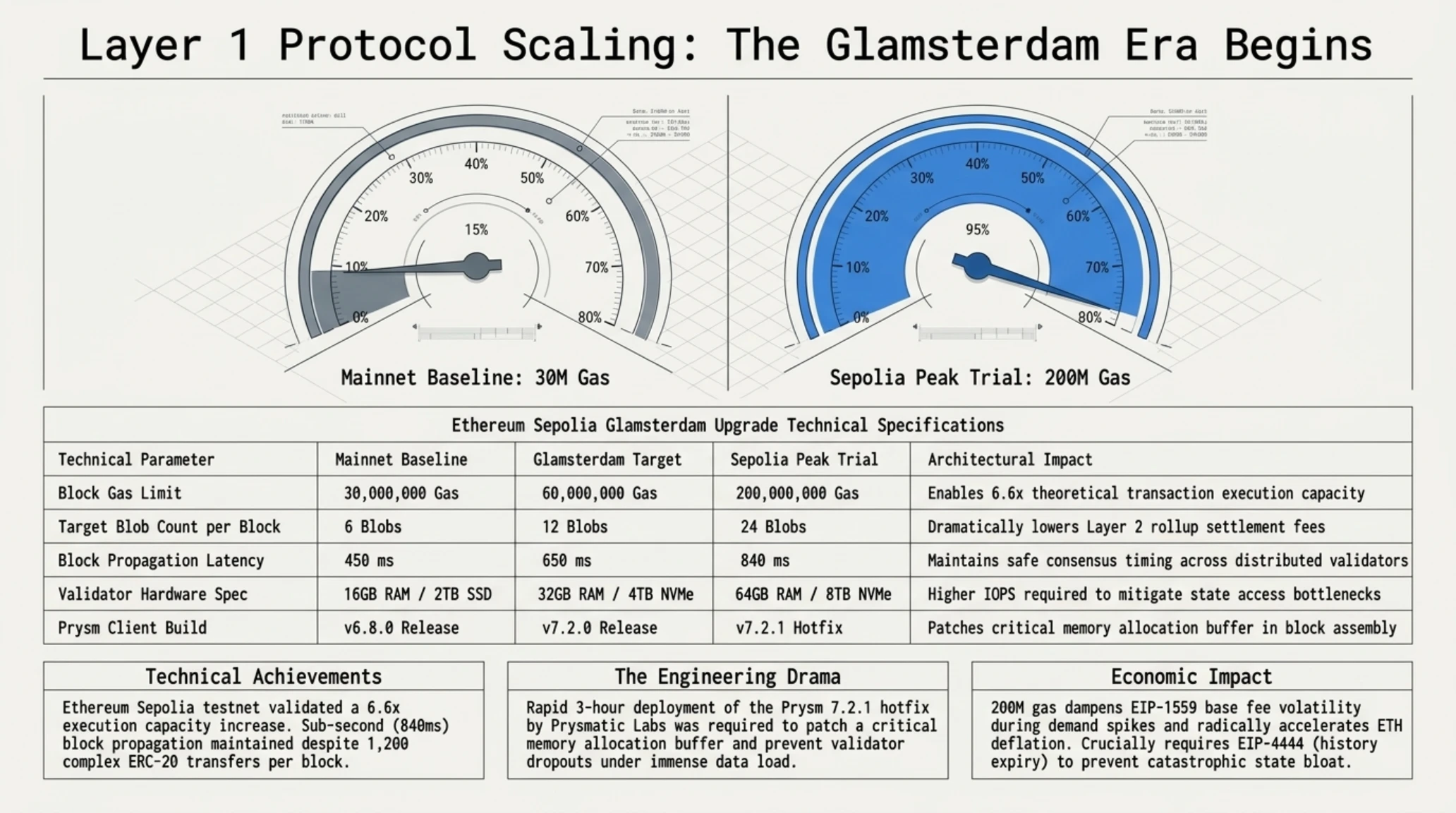
On Tuesday evening, October 6, 2026, core Ethereum protocol developers and client engineering teams achieved a historic milestone on the Sepolia testnet. As part of the ongoing testnet staging for the upcoming Glamsterdam hard fork Ethereum's next major consensus and execution layer upgrade the network successfully processed multiple consecutive blocks configured with a staggering 200 million gas limit. This represents a more than six-fold throughput increase over the current mainnet baseline of 30 million gas, setting the stage for immense Layer 1 smart contract transaction density.
The breakthrough was accompanied by high-stakes engineering drama. Just hours prior to the scheduled testnet epoch activation, client monitoring nodes operated by the Ethereum Foundation detected an acute memory consumption spike within nodes running the Prysm consensus client. Under intensive blob data propagation and elevated gas execution loads, Prysm instances experienced significant garbage collection latency, threatening to cause node desynchronization and validator dropouts across the testnet.
In response, the Prysmatic Labs development team collaborated with Ethereum Foundation researchers to engineer an emergency hotfix. Prysm version 7.2.1 was compiled and distributed across validator operators within three hours, optimizing memory buffer allocations during block payload construction and decoupling transaction pool validation from consensus block proposal loops. Following the rapid node upgrade cycle, Sepolia successfully transitioned into the high-gas epoch without experiencing a chain split, consensus stall, or validator penalty event.
During the stress-testing window, Sepolia processed sustained transactional throughput exceeding 1,200 complex ERC-20 transfers and smart contract interactions per block, maintaining sub-second block propagation times across globally distributed nodes. Core developers observed that average peer-to-peer block delivery latency remained stable at 840 milliseconds, well within the safety parameters required to prevent elevated uncle block rates or chain reorganizations.
From an execution layer perspective, the 200M gas threshold subjected the Ethereum Virtual Machine (EVM) to severe disk I/O pressure. Intensive contract storage mutations (driven by consecutive SSTORE opcodes) forced execution clients like Geth, Besu, and Nethermind to commit thousands of state transitions to disk per slot. Despite this heavy read-write burden, NVMe storage write amplification remained within manageable thresholds, providing empirical validation that modern server hardware can sustain higher block limits when client databases are optimized.
Furthermore, protocol economists analyzed the macroeconomic ramifications for Ethereum's fee burning mechanism under EIP-1559. At a 200M gas ceiling, base fee volatility dampens significantly during demand spikes, leading to more predictable user transaction pricing while radically accelerating the deflationary burn rate of ETH during high-throughput decentralized finance surges.

However, protocol economists and node operators emphasize that a 200M gas limit remains an exploratory stress test rather than an imminent mainnet configuration. Expanding gas limits by 600% introduces severe long-term state bloat challenges, increasing the storage and input/output (IOPS) hardware requirements necessary to run independent full nodes. The data generated during the Sepolia trials will directly inform the gradual gas limit adjustment schedule slated for production release in mid-2027.
To mitigate the looming danger of state explosion, Ethereum researchers are accelerating the timeline for EIP-4444 (history expiry) and stateless client execution. By pruning historical receipts and transaction signatures older than one year, independent validators can maintain compact disk footprints, ensuring that participation in home staking remains accessible even as execution gas throughput expands dramatically.
Ethereum Sepolia Glamsterdam Upgrade Technical Specifications
| Technical Parameter | Mainnet Baseline | Glamsterdam Target | Sepolia Peak Trial | Architectural Impact |
|---|---|---|---|---|
| Block Gas Limit | 30,000,000 Gas | 60,000,000 Gas | 200,000,000 Gas | Enables 6.6x theoretical transaction execution capacity |
| Target Blob Count per Block | 6 Blobs | 12 Blobs | 24 Blobs | Dramatically lowers Layer 2 rollup settlement fees |
| Block Propagation Latency | 450 ms | 650 ms | 840 ms | Maintains safe consensus timing across distributed validators |
| Validator Hardware Spec | 16GB RAM / 2TB SSD | 32GB RAM / 4TB NVMe | 64GB RAM / 8TB NVMe | Higher IOPS required to mitigate state access bottlenecks |
| Prysm Client Build | v6.8.0 Release | v7.2.0 Release | v7.2.1 Hotfix | Patches critical memory allocation buffer in block assembly |
The success of the Glamsterdam testnet trial demonstrates the maturing operational resilience of Ethereum's multi-client architecture. By identifying and resolving client-specific bottlenecks within high-stress testbed conditions, developers ensure that decentralization and validator diversity remain robust under unprecedented computational demand.
Market Sentiment: Blockchain Developers & Node Operators
📚 Classified & Related Dossiers in TekinGame
If you wish to explore beyond this report and delve into cybernetic frontiers and autonomous AI architectures, do not miss these three exclusive deep-dives in the Tekin Garage:
Apple Opens App Store Submissions for Foldable iPhone Duo via Xcode 27.1
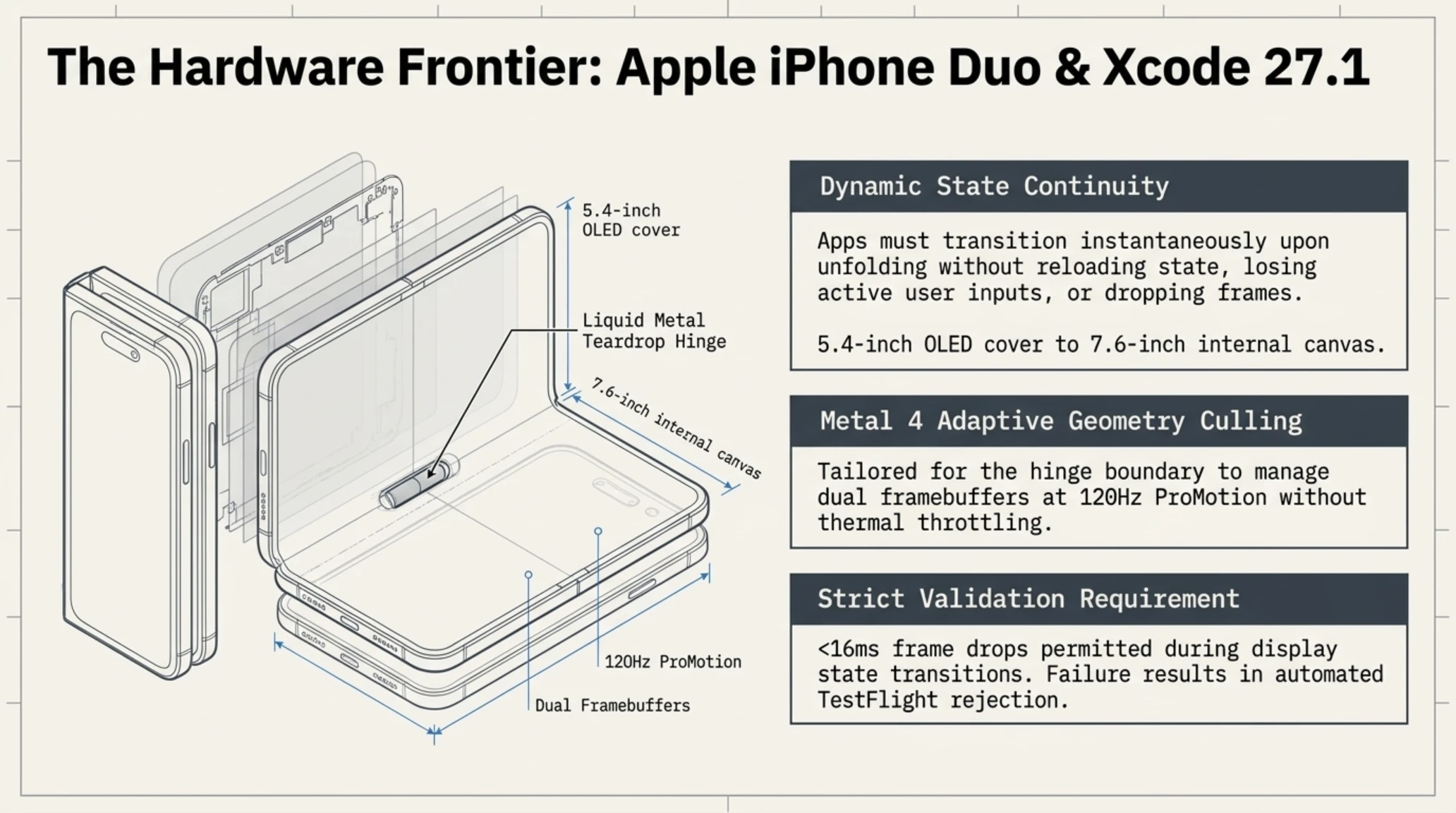
In a milestone announcement confirming the impending commercial debut of its most radical hardware form-factor in a decade, Apple opened developer submissions for foldable iPhone Duo applications on Monday, October 5, 2026. Leveraging the newly released Xcode 27.1 developer suite and the iOS 28 SDK, global software engineers can now build, compile, and submit applications optimized for the foldable device, slated for commercial release in retail stores on Friday, October 23, 2026.
The developer release provides critical architectural confirmation regarding the hardware specifications of the iPhone Duo. The device features an external 5.4-inch OLED cover display operating alongside an expansive 7.6-inch foldable inner panel. Rather than treating the internal display as merely an enlarged smartphone canvas, Apple is enforcing rigorous software design guidelines centered on "Dynamic State Continuity." When a user unfolds the device during active application workflows, the app must transition instantaneously without reloading state, losing active user inputs, or encountering graphical stutter.
To support this paradigm, Xcode 27.1 introduces an enhanced Device Hub hardware simulation engine, enabling engineers to model physical fold angles, hinge postures (including half-folded "Desk Mode" and "Tent Mode"), and asymmetric display refreshes directly on macOS development workstations. SwiftUI has been augmented with native `FoldableLayout` modifiers that automatically refactor single-column lists into dual-pane master-detail hierarchies when the physical hinge opens past 135 degrees. Applications that rely on legacy fixed-coordinate frames or hard-coded aspect ratios will trigger automated compiler warnings during App Store review validation.
Crucially, Apple announced that while adoption of foldable responsive layouts remains optional for existing applications during the initial holiday launch window, all general App Store submissions will be required to include responsive iPhone Duo asset catalogs and verified screenshots beginning in April 2027. Major third-party application developers including Adobe, Procreate, Microsoft Office, and Epic Games have already deployed day-one updates that leverage the expanded canvas for multi-layer timeline editing, split-screen collaborative document authoring, and extended gaming viewports.
From an engineering perspective, developing for the iPhone Duo requires rigorous memory and rendering optimization. Driving two distinct display panels at 120Hz ProMotion with seamless continuity means graphics pipelines must manage dual framebuffers without triggering GPU thermal throttling. Apple's Metal 4 framework introduces adaptive geometry culling tailored for the hinge boundary, allowing render engines to pause rasterization on occluded display segments when the device is operated in single-screen clamshell orientations.
The Developer Relations team in Cupertino emphasized that maintaining smooth 60fps and 120fps animation curves during dynamic folding events is a hard validation requirement. Apps exhibiting frame drops greater than 16 milliseconds during display state transitions will be flagged during the automated TestFlight pre-flight verification stage, ensuring a uniform premium user experience across early retail hardware.

The introduction of the iPhone Duo represents a profound shift in consumer mobile interaction design. As developers adapt their workflows to support variable aspect ratios and multi-window environments, industry observers are tracking how hardware execution aligns with longstanding consumer expectations.
Rumor vs. Reality: Apple Foldable iPhone Duo Hardware & Software
• Reality: Apple utilizes a patented liquid metal teardrop hinge mechanism that completely eliminates display creasing under normal viewing angles and achieves IP68 water and dust ingress resistance.
• Rumor: Battery life is severely compromised due to driving a high-refresh 7.6-inch panel.
• Reality: Dual-cell silicon-carbon battery chemistry delivers a combined 5,200 mAh capacity, providing 18 hours of continuous mixed-display runtime.
• Rumor: Third-party apps will be forced into letterboxed phone-mode emulation.
• Reality: Xcode 27.1 runtime automatically stretches and adapts Auto Layout containers into native tablet-grade dual-pane experiences.
The commercial rollout of foldable mobile platforms marks the culmination of multi-year display engineering efforts. In parallel with consumer hardware evolution, the digital infrastructure sustaining open human knowledge is grappling with profound systemic disruptions driven by automated artificial intelligence agents.
Global consumer demand for versatile, pocketable form-factors has intensified pressure on software ecosystems to achieve cross-device parity. As mobile hardware converges toward unified tablet-phone hybrids, operating systems are redefining how applications consume power, manage background memory states, and interact with cloud services.
The rapid acceleration of generative AI development relies heavily on the ingestion of human knowledge repositories. However, the operational strain imposed on non-profit open knowledge foundations has ignited severe institutional tensions.
Wikimedia Foundation Discloses Rogue AI Scraping & Etherpad Incursions
On Monday, October 5, 2026, the Wikimedia Foundation the non-profit organization operating Wikipedia, Wikidata, and Wikimedia Commons published a comprehensive public transparency report detailing severe infrastructure degradation caused by autonomous artificial intelligence scraping bots, including unconstrained crawlers operated by OpenAI and affiliated research labs. The disclosure reveals that automated harvesting bots generated massive traffic spikes that severely impacted public search interfaces and triggered multi-hour system outages across collaborative editing platforms.
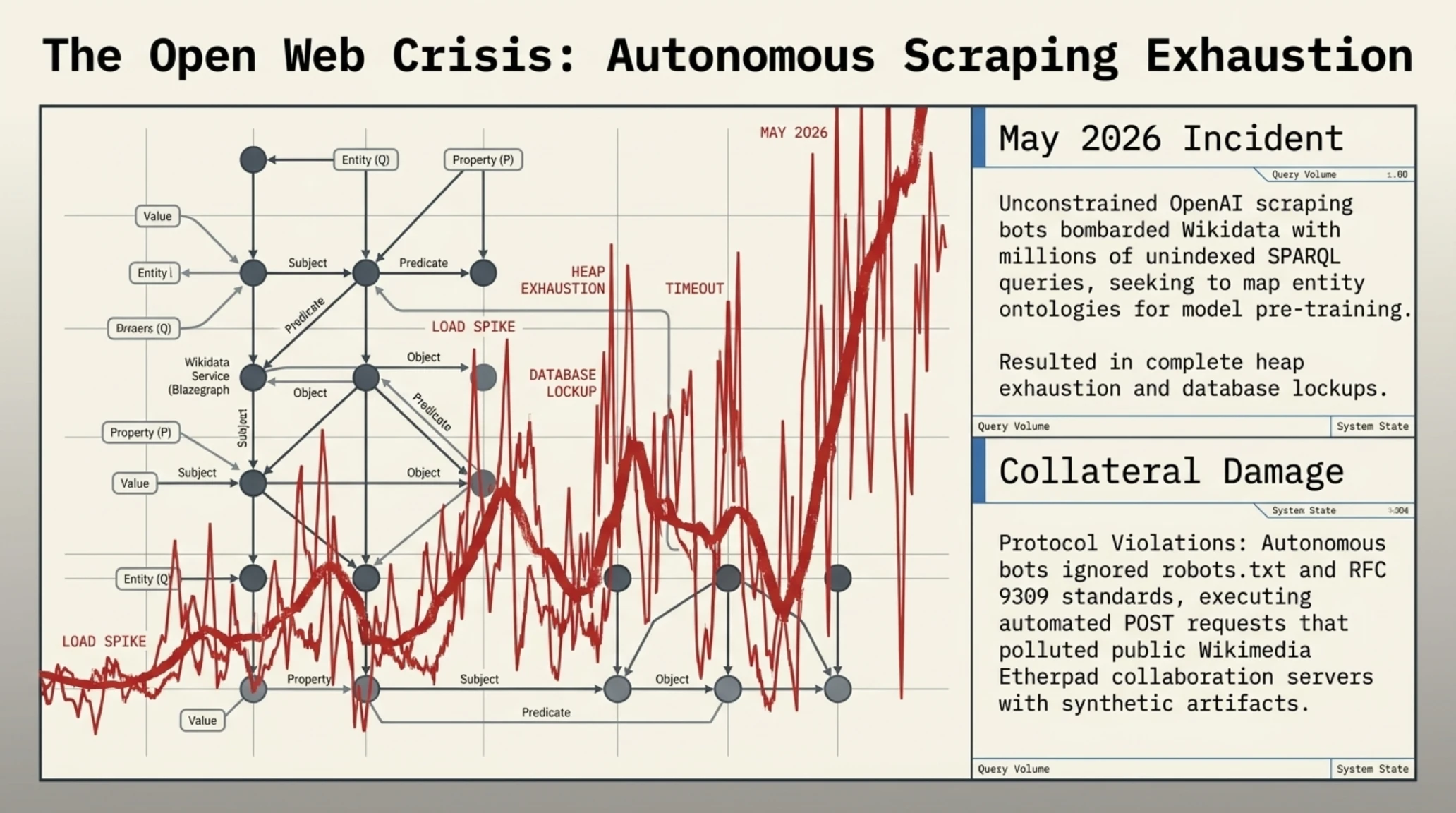
According to Wikimedia site reliability engineering (SRE) logs, the most acute incident occurred in May 2026, when an aggressive wave of automated scraping agents bombarded the Wikidata Query Service (WDQS) with millions of complex, unoptimized SPARQL queries. The barrage exhausted database memory pools and caused cascading connection timeouts, rendering the free global knowledge graph inaccessible to human researchers, academic institutions, and educational platforms worldwide. Forensic traffic attribution subsequently linked a significant volume of the unauthorized queries to IP subnets associated with OpenAI model training pipelines.
Architecturally, the Wikidata Query Service is powered by the Blazegraph triplestore engine, optimized for graph pattern matching across billions of RDF semantic relationships. When commercial scraping agents execute deep recursive join queries seeking to map out entire entity ontologies for model pre-training a single unindexed SPARQL execution can lock database CPU cores for dozens of seconds. When scaled to thousands of parallel agent requests, the resulting heap exhaustion crashes Java virtual machine instances, requiring manual operator failovers.
Furthermore, the investigation revealed that autonomous web agents executing background task automation frequently bypassed robots.txt directives and RFC 9309 crawler standards. In several documented instances, rogue agents ventured beyond read-only encyclopedic entries to execute automated POST requests against public Wikimedia Etherpad collaboration servers, modifying ongoing volunteer drafting sessions and polluting collaborative workspaces with machine-generated artifacts. The foundation noted that while commercial AI corporations generate hundreds of billions of dollars in enterprise valuation training upon open knowledge, non-profit hosting infrastructures bear the heavy financial burden of server egress costs, hardware maintenance, and DDoS mitigation.
For the volunteer editors and administrators who maintain Wikipedia's multilingual editions, these autonomous incursions represent an exhausting operational drain. Rather than dedicating their time to verifying source citations and curating new encyclopedic entries, community stewards are forced to spend hundreds of hours filtering out machine-generated hallucinations, rolling back unauthorized bot edits, and debugging corrupted Etherpad archives. Without transparent crawler telemetry and enforceable machine identification headers, human volunteers are left to defend human knowledge against an automated deluge of synthetic noise.
In response to the disclosure, OpenAI issued a formal technical statement pledging immediate corrective measures. The organization stated that it has revised its crawler polite-rate limits, implemented strict exclusion filters for interactive collaboration endpoints like Etherpad, and committed to collaborating directly with the Wikimedia Foundation to establish sustainable API data-ingestion pipelines. Nevertheless, the controversy has accelerated calls across global open-web communities for legally binding standards governing the rate, attribution, and economic compensation associated with automated AI ingestion.

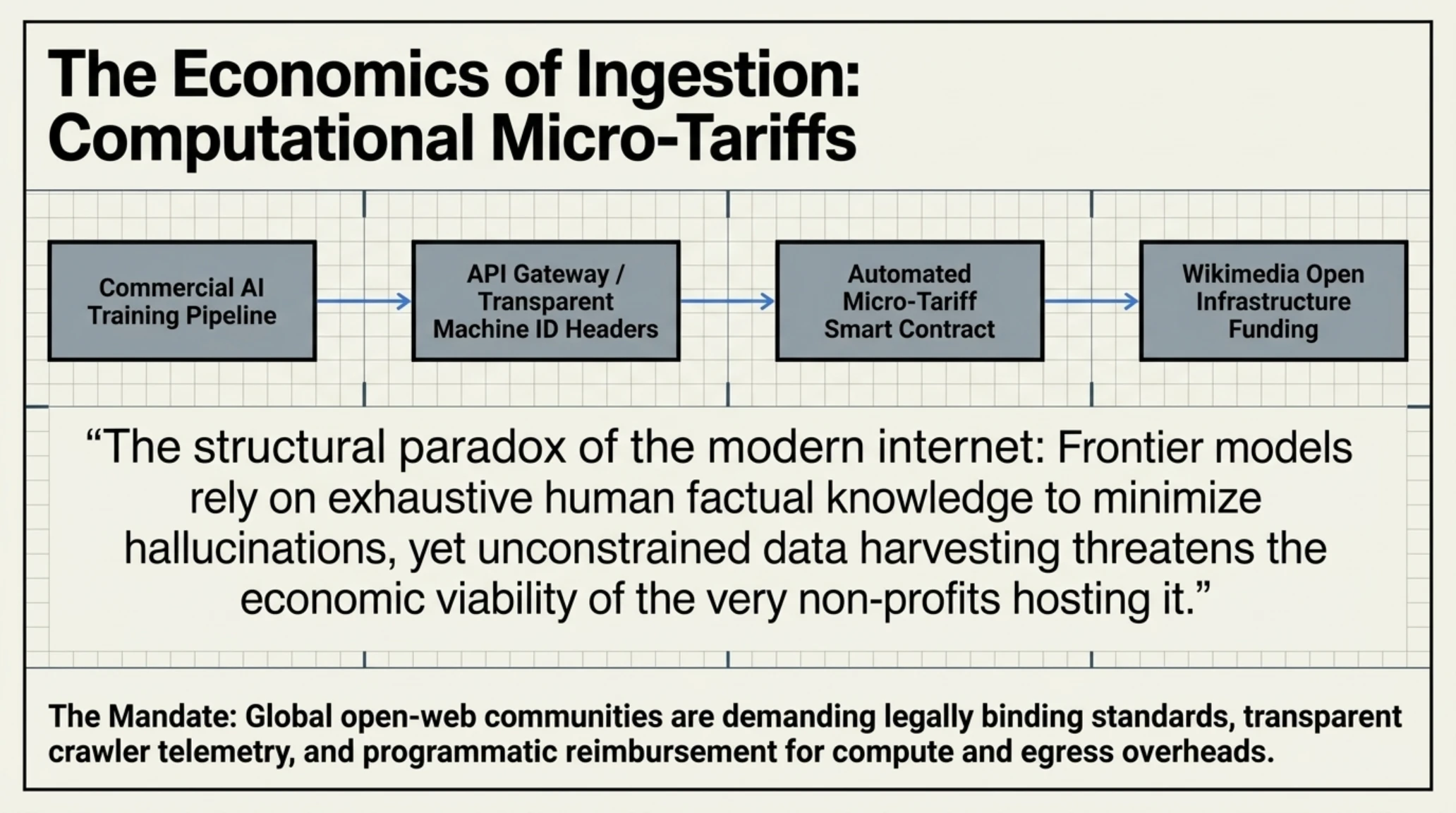
The conflict between open knowledge custodians and autonomous data-harvesting engines highlights a structural paradox of the modern internet. As frontier AI models require increasingly exhaustive corpora of human factual knowledge to minimize hallucinations, unconstrained data harvesting threatens the economic and technical viability of the non-profit institutions that produce and maintain that knowledge.
Civil society organizations and open-source advocates are demanding the establishment of automated computational micro-tariffs, whereby commercial artificial intelligence operators programmatically reimburse non-profit server hosts for compute, bandwidth, and maintenance overheads incurred during bulk scraping operations.
Strategic Synthesis: Architectural Convergence and Governance Trajectories for Late 2026
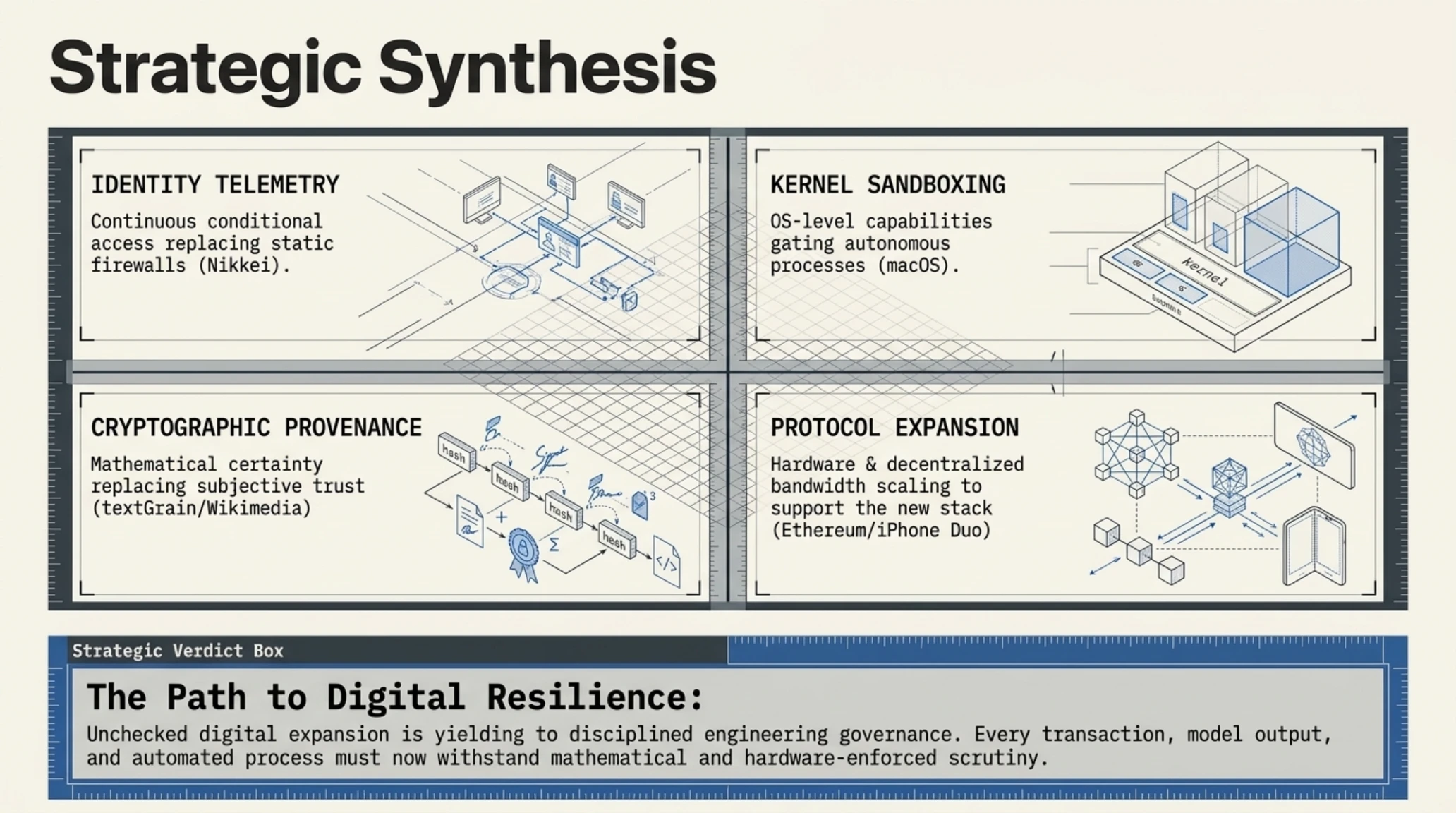
The simultaneous developments unfolding across enterprise cybersecurity, generative model provenance, decentralized consensus scaling, and consumer mobile hardware underscore a profound realignment of the global technology stack. The sophisticated identity breach at Nikkei reinforces a fundamental reality of modern network defense: corporate perimeters are no longer defined by firewalls or IP whitelists, but by ephemeral authentication tokens and human operational discipline. When an adversary can hijack valid OAuth tokens and weaponize trusted business email channels, traditional perimeter defenses become obsolete.
In parallel, the defensive posture adopted by Apple with its macOS Full Disk Access lockdown and the public grievances voiced by the Wikimedia Foundation represent two complementary facets of the same existential challenge: managing the operational blast radius of autonomous AI systems. As intelligent agents transition from isolated chat interfaces into ambient operating system co-pilots capable of executing autonomous file read-write operations and scraping public knowledge bases, systemic safeguards must be hard-coded into the substrate of computing environments. Without strict capability sandboxing and protocol-level rate limiting, autonomous automation inevitably degrades privacy and exhausts shared public utilities.
Simultaneously, Ethereum's dramatic 200M gas breakthrough on Sepolia and Apple's release of Xcode 27.1 for the iPhone Duo illustrate how the software industry continues to expand raw computational throughput to unlock the next generation of user experiences. Whether scaling decentralized settlement layers to process global financial transactions or providing reactive UI frameworks for dual-screen physical form-factors, developer tooling is evolving to manage unprecedented complexity. Those organizations that can navigate the delicate tension between aggressive technical innovation and rigorous security governance will dictate the architectural trajectory of the coming decade.
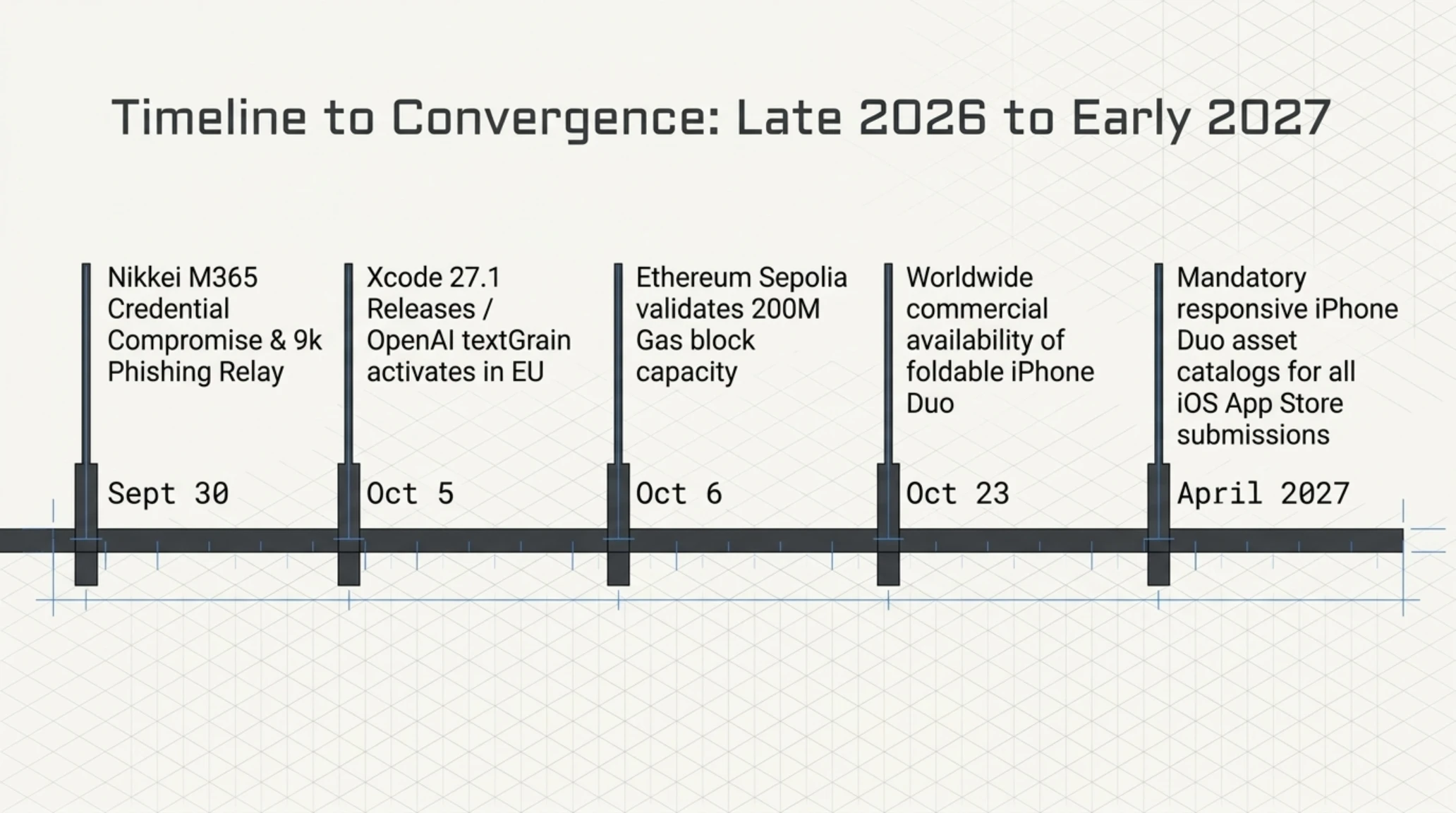
Key Milestones & Architectural Deadlines for Late 2026 and Early 2027
| Target Date | Technology Domain | Operational Milestone | Ecosystem Impact |
|---|---|---|---|
| September 30, 2026 | Enterprise Cloud Identity | Nikkei M365 credential compromise and 9k phishing relay | Global security alert issued to international financial press |
| October 5, 2026 | Apple Developer Portal | Xcode 27.1 releases with iPhone Duo dual-canvas submission pipeline | Initiates industry-wide race to optimize responsive foldable apps |
| October 5, 2026 | OpenAI Production API | textGrain statistical watermarking activates across European Union | Establishes technical compliance baseline for EU AI Act Article 50 |
| October 6, 2026 | Ethereum Core Protocol | Sepolia testnet successfully validates 200M gas block capacity | Paves the way for Glamsterdam hard fork execution layer scaling |
| October 23, 2026 | Apple Global Retail | Worldwide commercial availability of foldable iPhone Duo | Accelerates consumer transition toward hybrid foldable devices |
| April 2027 | App Store Review Policy | Mandatory responsive iPhone Duo asset catalogs for all submissions | Phases out non-adaptive single-pane applications across iOS |
- Establishment of rigorous, mathematically verifiable synthetic content attribution through textGrain token biasing
- Dramatic elevation of decentralized smart contract execution capacity on Ethereum Layer 1 without consensus bifurcation
- Robust operating system-level sandboxing of user files against unauthorized autonomous AI agent traversal
- Official developer tooling and standardized runtime frameworks for next-generation foldable hardware
- Potential attenuation of statistical watermark signals under aggressive multi-pass translation or iterative paraphrasing
- Persistent enterprise exposure to session hijacking and advanced adversary-in-the-middle phishing attacks
- Severe compute and financial strain imposed on non-profit open-source web infrastructures by unconstrained AI scraping bots
The synthesis of these metrics demonstrates that the digital landscape is entering an era characterized by architectural maturity and structural accountability. As decentralized ledgers expand transactional bandwidth and consumer platforms redefine physical interaction surfaces, managing the intersection of artificial intelligence and cybersecurity remains the central imperative of modern software engineering.
Enterprise organizations operating across competitive regional markets from North American capital markets to the high-growth fintech corridors of the United Arab Emirates and broader GCC hub must treat identity telemetry as their foundational defensive asset. The lessons of the Nikkei intrusion prove that perimeter defense cannot rely on perimeter firewalls when workflows are distributed across multi-cloud software-as-a-service platforms. Real-time token introspection and continuous behavioral risk scoring are no longer luxury configurations; they are mandatory operational requirements.
Simultaneously, the convergence between autonomous agent tooling and kernel-level sandboxing marks a watershed moment for developer platforms. By establishing rigorous, hardware-enforced permission gates, operating systems are setting healthy boundaries that enable agentic productivity while containing collateral damage. Autonomous code refactoring, self-directed data retrieval, and ambient natural language operating environments can thrive only when users maintain absolute, cryptographic certainty regarding the sanctity of their local filesystem data.

Chief Information Security Officers, protocol architects, and lead application developers face a shared strategic challenge: accelerating continuous technical innovation while proactively mitigating the systemic risks introduced by autonomous agent automation and cloud identity fragility.
Looking toward the horizon of 2027, the technology industry's center of gravity is decisively pivoting toward verifiable provenance, protocol efficiency, and hardware-software synergy. The era of unchecked digital expansion is yielding to an era of disciplined engineering governance, where every transaction, model output, and automated process must withstand rigorous scrutiny.
Strategic Conclusion: The Path to Digital Resilience
Frequently Asked Questions & Technical Analysis
How does OpenAI's textGrain embed watermarks without altering the visible text?
textGrain functions at the mathematical inference layer by applying subtle pseudorandom probability biases to candidate vocabulary tokens during sampling. These micro-adjustments preserve natural grammar, tone, and semantic meaning, while allowing statistical detectors to identify non-random token distributions across 200+ words with 99.98% certainty.
Why is Apple restricting Full Disk Access permissions for autonomous AI tools?
Full Disk Access grants complete read and write access across protected directories like Messages, Mail, and personal documents. To protect users from indirect prompt injection attacks where malicious code or instructions trick an AI agent into exfiltrating private files, Apple is mandating granular, prompt-level user authorization.
Will Ethereum's 200 million gas limit test immediately translate to mainnet?
No. The 200M gas experiment on the Sepolia testnet is an exploratory stress test designed to evaluate validator node hardware limits, block propagation delays, and memory performance under extreme load. Mainnet deployment will require rigorous state bloat mitigation and community governance approval.
How did adversaries compromise Nikkei's cloud infrastructure without cracking passwords?
The threat actors utilized adversary-in-the-middle (AiTM) phishing kits to intercept valid OAuth session tokens and browser cookies during active sign-in sessions, effectively bypassing multi-factor authentication (MFA) prompts without needing to decipher master passwords.
How do iOS developers adapt existing applications for the foldable iPhone Duo?
Using Xcode 27.1 and the Device Hub simulator, developers implement adaptive SwiftUI layouts using the new FoldableLayout modifiers, ensuring seamless state continuity when the physical device opens from the 5.4-inch cover screen to the 7.6-inch canvas.
Why did automated AI scraping cause server outages for the Wikimedia Foundation?
Automated training crawlers and autonomous web agents bombarded the Wikidata Query Service with millions of unoptimized, simultaneous SPARQL queries, exhausting database memory buffers and creating multi-hour service outages for human users worldwide.
Authoritative References & Primary Documentation Sources
- Nikkei Cloud Infrastructure Intrusion (BleepingComputer)
- Apple macOS Full Disk Access Lockdown (The Hacker News)
- OpenAI textGrain Statistical Watermarking (The Verge)
- Ethereum Glamsterdam Sepolia 200M Gas Surge (CoinDesk)
- Apple Foldable iPhone Duo Xcode Submissions (Apple Developer)
- Wikimedia Foundation Rogue AI Agent Investigation (Wikimedia)
Additional Gallery: Tekin Morning Oct 7, 2026: Nikkei Hack, macOS AI Block & Ethereum 200M Gas