Tekin Morning Sep 17, 2026: The Strategic Tech & AI Intelligence Brief
Dive into today's top gaming news and exclusive breakdowns.
- 🎮SpaceX confirms September 22 launch target for Starship IFT-14, aiming for full orbital velocity and payload deployment.
- 🎧Google rolls out urgent Pixel security patch for baseband zero-day CVE-2026-58704 exploited in zero-click attacks.
- 🚀Microsoft schedules October 7 Windows and Surface event featuring Jensen Huang to introduce the NVIDIA RTX Spark SoC.
- 🗡️Meta prepares camera-free smart glasses codenamed 'Luna' with 6 studio microphones to bypass public privacy bans.
- 📰Samsung fast-tracks Galaxy Z TriFold 2 development with a redesigned titanium hinge ahead of Apple iPhone Duo pre-orders.
- ⚔️OpenAI, Anthropic, and Google DeepMind engage in coordinated multi-week discussions proposing an industry safety oversight body.
Thursday morning, September 17, 2026, marks a pivotal inflection point across the global technology and computing landscape. From the orbital launch pads of Starbase in Boca Chica, Texas, where aerospace engineers are running final cryo-loading tests for the historic orbital flight of Starship, to executive suites in Redmond and Santa Clara where Microsoft and NVIDIA are preparing an unprecedented silicon alliance, the digital frontier is undergoing rapid structural realignments. Simultaneously, emergency cybersecurity bulletins issued by Google addressing actively exploited baseband vulnerabilities in flagship smartphones, Meta’s strategic pivot away from camera-equipped smart glasses toward privacy-preserving acoustic wearables, Samsung’s accelerated hardware engineering to counter Apple’s foldable entrance, and high-stakes diplomacy among frontier AI laboratories to establish binding safety standards all signal an extraordinarily dense day in technology.
Executive Key Points: Strategic Headlines for September 17, 2026
- SpaceX confirms September 22 launch target for Starship IFT-14, aiming for full orbital velocity and payload deployment.
- Google rolls out urgent Pixel security patch for baseband zero-day CVE-2026-58704 exploited in zero-click attacks.
- Microsoft schedules October 7 Windows and Surface event featuring Jensen Huang to introduce the NVIDIA RTX Spark SoC.
- Meta prepares camera-free smart glasses codenamed 'Luna' with 6 studio microphones to bypass public privacy bans.
- Samsung fast-tracks Galaxy Z TriFold 2 development with a redesigned titanium hinge ahead of Apple iPhone Duo pre-orders.
- OpenAI, Anthropic, and Google DeepMind engage in coordinated multi-week discussions proposing an industry safety oversight body.
In this comprehensive morning briefing, Tekin Editorial dissects these pivotal developments, examining the underlying architectural decisions, geopolitical implications, and engineering breakthroughs shaping enterprise computing and consumer hardware.
Starship Orbital Flight on September 22: The Defining Milestone for Heavy-Lift Aerospace
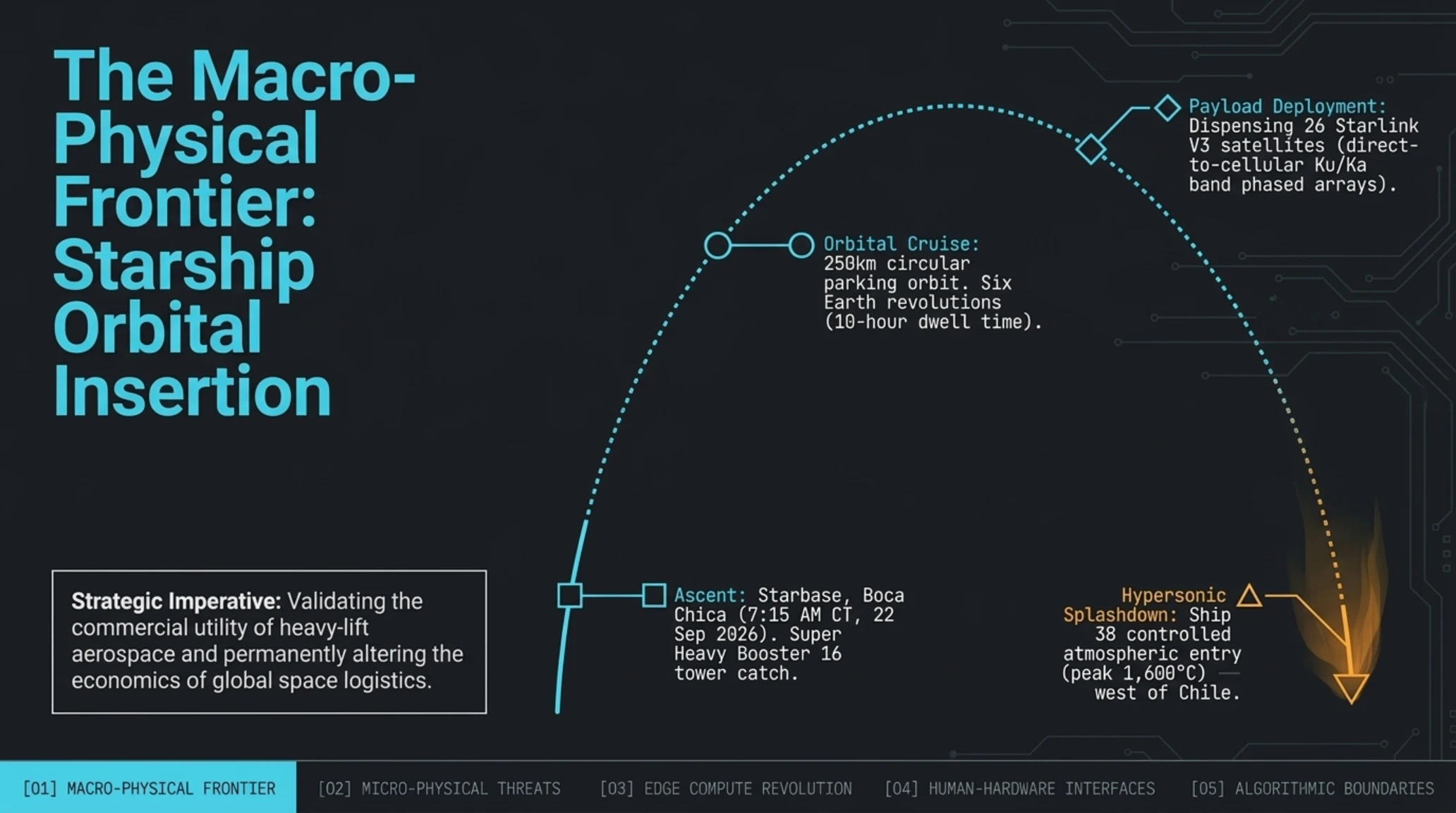
SpaceX has officially designated Sunday, September 22, 2026, as the target launch window for the long-awaited fourteenth integrated flight test (IFT-14) of its Starship launch vehicle. Representing the crowning technical challenge of Elon Musk’s fully reusable, stainless-steel super-heavy architecture, this mission stands as the world’s first operational attempt to inject the 50-meter-tall Starship upper stage (Ship 38) into a stable parking orbit around Earth. The launch window opens at Starbase in Boca Chica, Texas, at 7:15 AM CT (12:15 UTC) and will extend for 75 minutes, pending final launch license approval from the Federal Aviation Administration’s (FAA) Office of Commercial Space Transportation.
The mission trajectory departs radically from all prior suborbital ballistic trajectories. Following the stage separation and the aerodynamic return of Super Heavy Booster 16 into the mechanical catch arms of Mechazilla, Ship 38’s six Raptor 3 engines will fire continuously to achieve orbital insertion at an altitude of 250 kilometers. The spacecraft will complete six full revolutions around Earth over a ten-hour flight profile. During this extended orbital cruise, Starship’s payload bay dispenser will deploy twenty-six operational third-generation Starlink V3 satellites, featuring direct-to-cell phased array transmitters and multi-gigabit inter-satellite optical laser links. After completing payload verification, Starship will initiate a targeted deorbit burn over the southern Pacific Ocean, conducting a controlled atmospheric entry and splashdown west of Chile.
Achieving regulatory authorization from the FAA for this extended orbital mission necessitated unprecedented inter-agency coordination. SpaceX worked directly with the United States Space Force’s Space Systems Command and the North American Aerospace Defense Command (NORAD) to integrate real-time automated flight safety telemetry. High-speed phased array radar tracking stations spanning the Gulf of Mexico, the Caribbean basin, and Kwajalein Atoll will monitor the vehicle’s ascent trajectory, ensuring instantaneous autonomous flight termination triggers if deviation thresholds are breached during the initial atmospheric burn.
Environmental reviews conducted by the Fish and Wildlife Service regarding acoustic impact zones around the Boca Chica wildlife preserve were concurrently settled through extensive ground sensor monitoring agreements. By proving that the upgraded launch mount water deluge system captures over 94 percent of ground sound energy, SpaceX secured expedited categorical exclusions, clearing the path for an accelerated launch cadence targeting up to twenty-four Starship launches annually from the South Texas facility.
Strategic Dimensions of Orbital Insertion: Why It Matters for Global Logistics
In evaluating why it matters, aerospace analysts emphasize that the successful execution of this orbital profile permanently alters the economics of space logistics. First, the safe deployment of Starlink V3 satellites validates Starship’s commercial utility, initiating the transition of SpaceX’s commercial satellite cadence away from the aging Falcon 9 fleet. Second, the thermal protection system consisting of over 18,000 hexagonal ceramic tiles will face peak reentry temperatures exceeding 1,600 degrees Celsius across a sustained hypersonic entry corridor. This thermal validation is a mandatory milestone for NASA’s Artemis III human landing system, which requires reliable orbital operations and in-space refueling capabilities to return astronauts to the lunar surface.
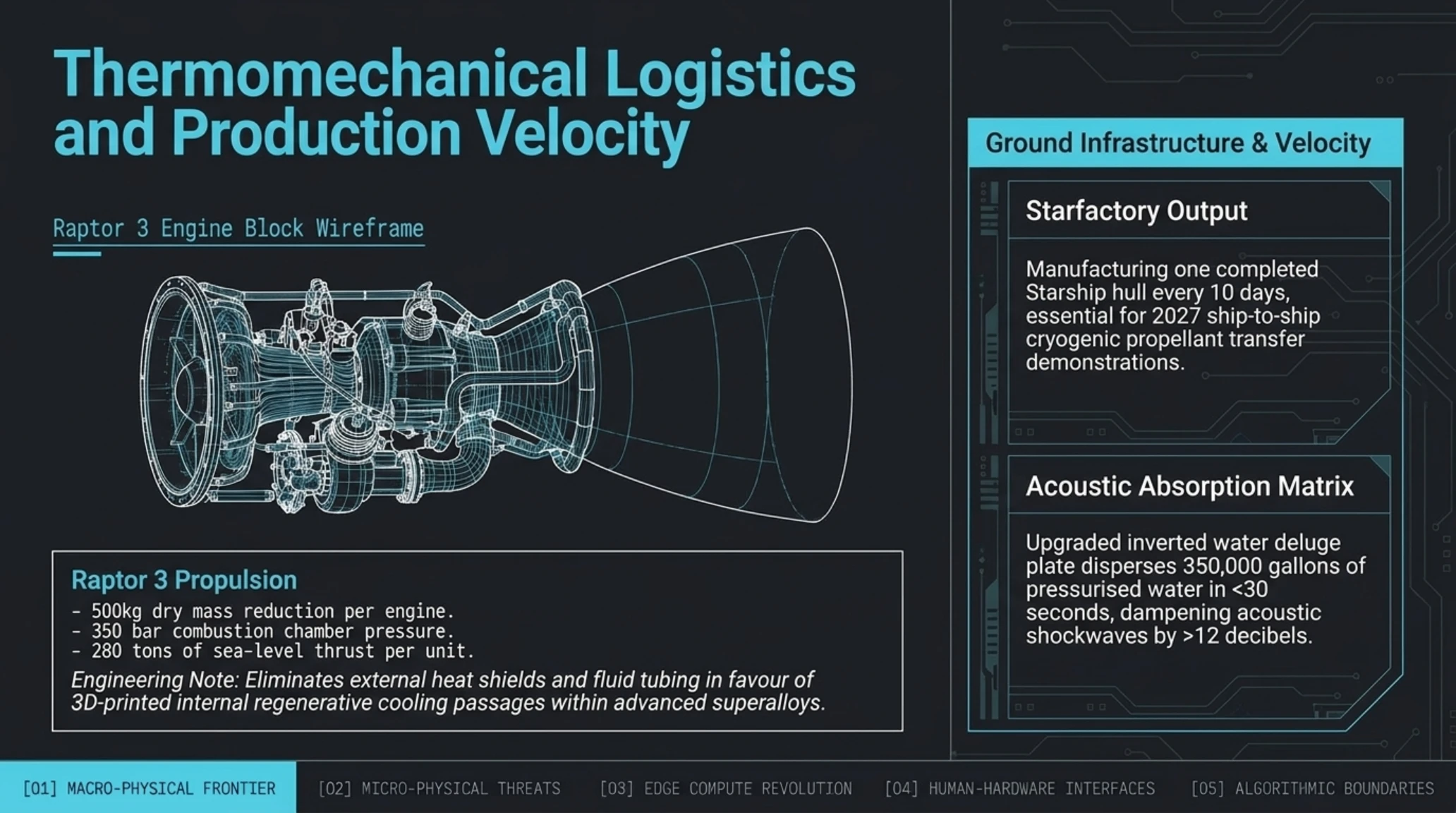
A critical engineering evolution embodied in Ship 38 is the comprehensive integration of Raptor 3 propulsion units. By eliminating external heat shields, auxiliary hydraulic systems, and complicated fluid tubing in favor of 3D-printed internal regenerative cooling passages within advanced superalloys, SpaceX has shed over 500 kilograms of dry mass per engine. Simultaneously, combustion chamber pressures have surged to 350 bar, yielding a staggering 280 tons of sea-level thrust per unit and setting unprecedented benchmarks for thrust-to-weight ratios in liquid methane-oxygen propulsion.
Furthermore, SpaceX’s recently expanded Starfactory facility in Texas has ramped production throughput to manufacture a completed Starship hull every ten days. This industrial velocity is essential for the planned ship-to-ship cryogenic propellant transfer demonstrations scheduled for early 2027, where two docked Starships will transfer hundreds of tons of liquid methane and liquid oxygen in microgravity, proving the operational backbone required for interplanetary voyages to Mars.
From a cryogenic fluid management perspective, maintaining super-chilled liquid methane (-162°C) and liquid oxygen (-183°C) under high-pressure saturation conditions across a ten-hour orbital dwell requires radical thermal engineering. Ship 38 features micro-vacuum jacketed propellant feedlines and an innovative ullage gas circulation cycle powered by autogenous pressurization, which completely eliminates external helium storage bottles. This architecture significantly reduces vehicle complexity, weight, and failure modes during critical deorbit burns, validating long-duration propellant retention necessary for lunar orbital insertions.
Ground support infrastructure at Starbase has simultaneously evolved to accommodate the extreme vibrational dynamics of thirty-three Raptor 3 engines firing simultaneously at liftoff. The orbital launch mount is equipped with an upgraded inverted water deluge plate that disperses over 350,000 gallons of pressurized water in under thirty seconds. This acoustic absorption matrix dampens acoustic shockwaves by over twelve decibels, preventing destructive reflective pressure pulses from damaging the booster's aft engine skirt, gimballing actuators, or sensitive orbital ground tanks during the initial ignition transient.

The following technical breakdown contrasts the operational profile of flight IFT-14 with previous developmental milestones.
Technical Specifications and Mission Architecture: Starship Flight IFT-14
| Mission Parameter | Technical and Operational Specifications |
|---|---|
| Vehicle Stack | Super Heavy Booster 16 and Starship Upper Stage 38 powered by staged-combustion Raptor 3 engines. |
| Orbital Trajectory | 250 km circular parking orbit, six Earth revolutions, total mission elapsed time of approximately 10 hours. |
| Primary Payload | 26 operational Starlink V3 satellites featuring direct-to-cellular Ku/Ka band phased array antennas. |
| Recovery Profile | Booster 16 tower catch at Starbase; Ship 38 controlled hypersonic oceanic splashdown in the western Pacific. |
| Regulatory Clearance | Awaiting final environmental compliance sign-off and modified vehicle operator license from the FAA. |
While aerospace engineers gaze upward at orbital dynamics, mobile cybersecurity teams across the globe are grappling with a profound vulnerability discovered within the lowest firmware layers of modern Android flagships.
Google Emergency Advisory: Mitigating an Actively Exploited Modem Zero-Day
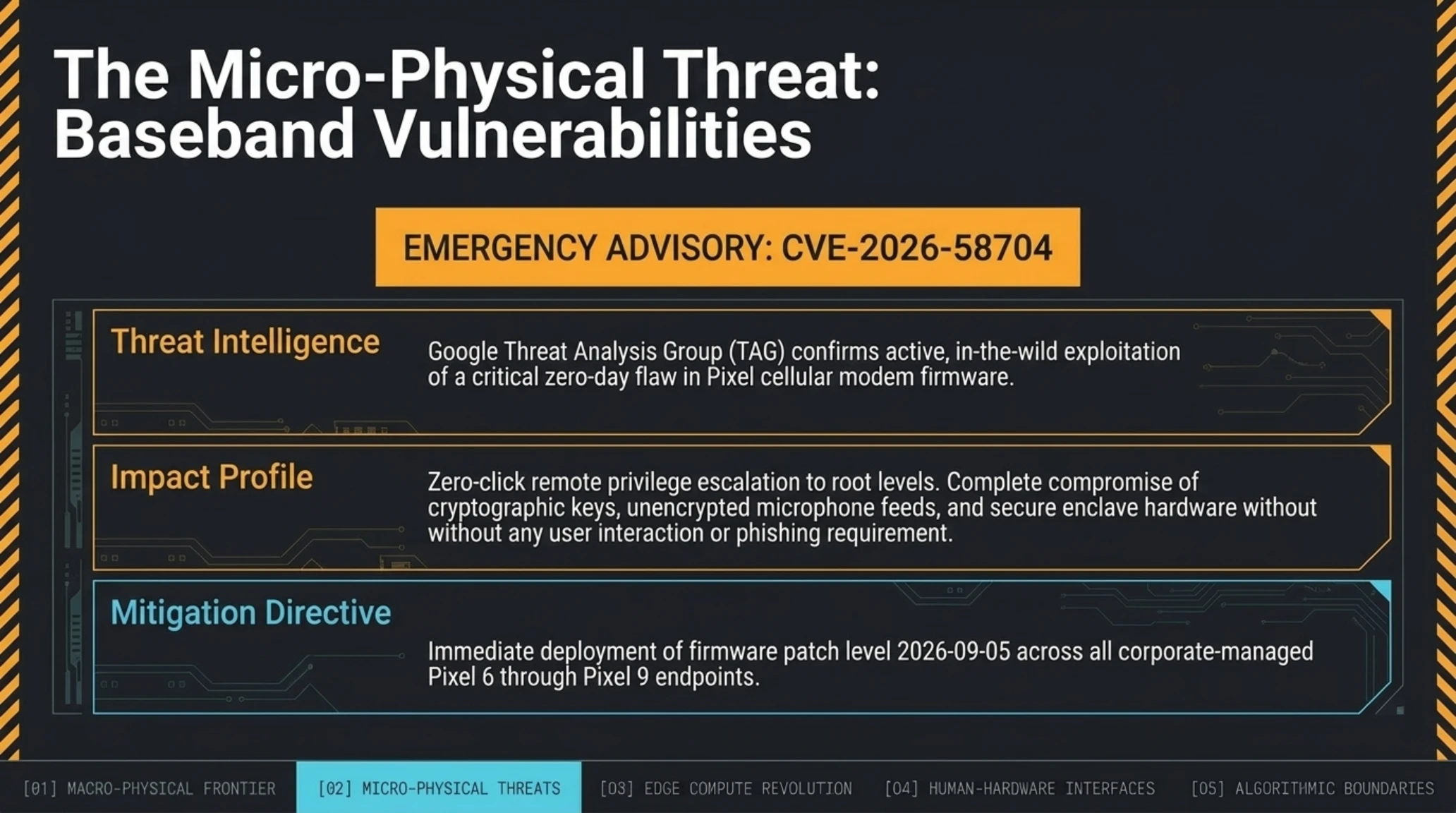
Google’s dedicated September 2026 security bulletin for Pixel hardware sent shockwaves through the enterprise DevSecOps community. While the update addresses 110 discrete common vulnerabilities and exposures (CVEs), the focal point of the disclosure is CVE-2026-58704: a critical zero-day flaw located directly inside the cellular modem firmware. Google’s Threat Analysis Group (TAG) confirmed that this vulnerability has been actively exploited in targeted, in-the-wild cyber espionage campaigns against high-profile individuals, diplomats, and enterprise executives.
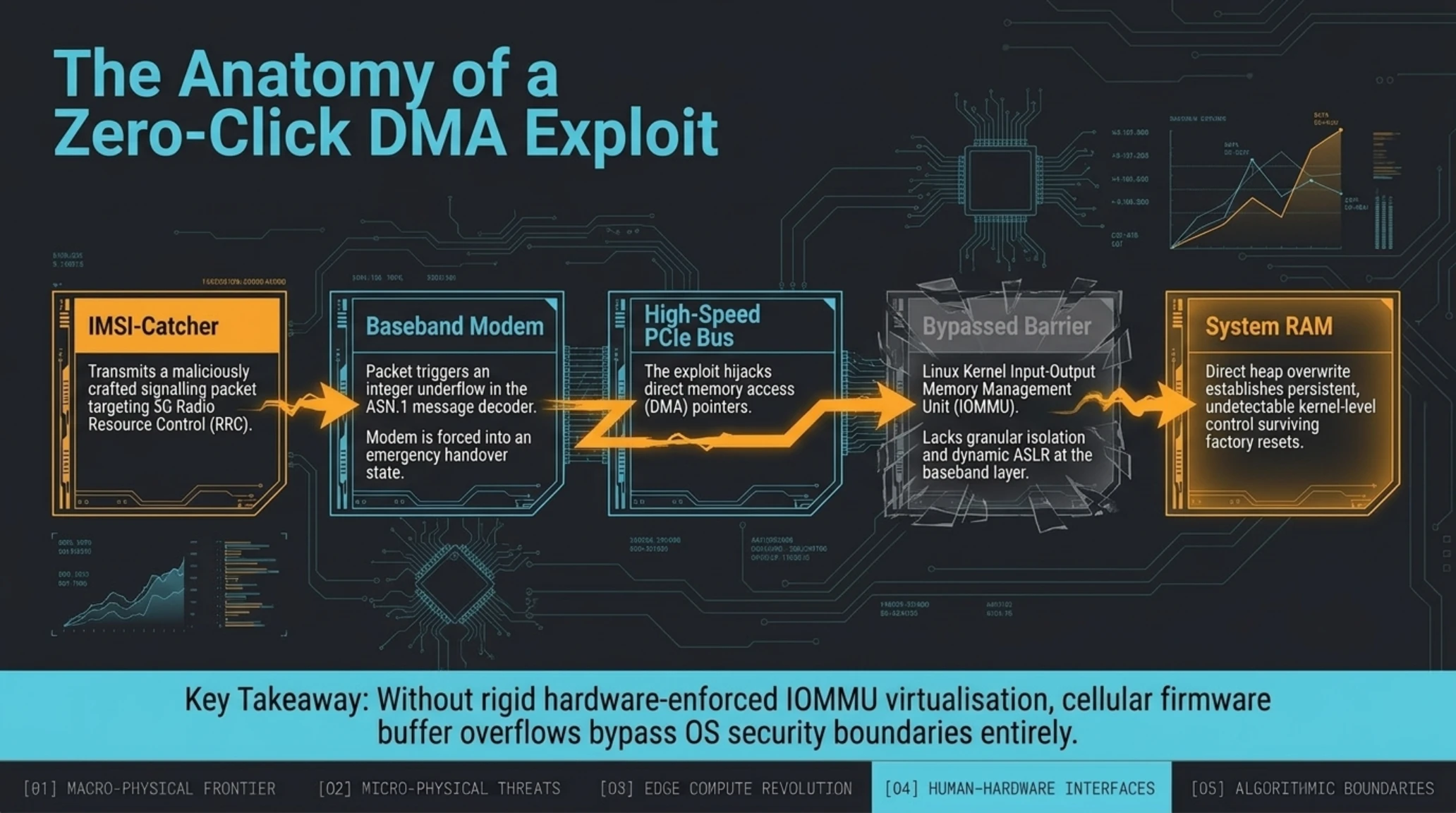
Technical forensic analyses disclose that the flaw resides within the baseband’s 5G Radio Resource Control (RRC) protocol parsing engine. By transmitting an intricately crafted signaling packet from an adjacent rogue cellular tower or an IMSI-catcher, an adversary can trigger an integer underflow condition within the modem's ASN.1 message decoder. Because the baseband processor communicates directly with system RAM across a high-speed PCIe bus, the lack of granular isolation within the Linux kernel’s Input-Output Memory Management Unit (IOMMU) permitted direct memory access (DMA) overwrite. This flaw allows complete remote privilege escalation to root levels without requiring any user interaction, file download, or phishing message qualifying it as a true zero-click exploit.
With root-level execution established, attackers could silently exfiltrate cryptographic keys, intercept encrypted voice calls before hardware encoding, access microphone feeds, and manipulate secure enclave hardware. Google has urged all enterprise fleet administrators and consumers using Pixel 6 through Pixel 9 devices to immediately deploy firmware patch level 2026-09-05 to mitigate this severe exposure.
The underlying protocol pathology centers on non-access stratum (NAS) mobility management procedures. The malicious radio transmission forces the cellular modem into an emergency handover state, spoofing a cryptographic authentication bypass within legacy 4G fallbacks before escalating into 5G standalone (SA) data channels. Once trapped in this corrupted signaling loop, the modem's embedded RTOS fails to enforce boundary assertions on incoming buffer lengths, triggering a predictable heap overwrite across the modem’s internal DSP task queues.
Crucially, because historical baseband device drivers in Android utilize static virtual memory mappings to accelerate high-throughput video streaming, the lack of dynamic address space layout randomization (ASLR) at the baseband layer allowed the exploit authors to execute return-oriented programming (ROP) chains with absolute precision. By hijacking direct DMA memory pointers before hardware IOMMU translation can intervene, the exploit establishes persistent, undetectable kernel-level control that survives standard system reboots and factory resets.
Rumor vs. Reality: Cellular Baseband Isolation in Modern Smartphones
Common Rumor: Modern smartphone operating systems isolate the cellular modem on an independent processor, ensuring baseband vulnerabilities cannot compromise user data or operating system integrity.
Technical Reality: While baseband chips execute real-time operating systems independently, their high-speed PCIe interconnects share system memory. Without rigid hardware-enforced IOMMU virtualization, buffer overflows in cellular firmware enable direct memory access attacks that bypass operating system security boundaries entirely.
To assist security operations center (SOC) analysts and network engineers in understanding baseband attack vectors, Tekin Lab has compiled the following terminology reference.
Jargon Buster: Demystifying Baseband Vulnerabilities and Firmware Exploits
| Specialized Term | Engineering and Security Definition |
|---|---|
| Baseband Firmware | The low-level real-time operating system (RTOS) executing on dedicated modem silicon managing radio signaling, cell tower handoffs, and base station protocols. |
| Zero-Click Exploit | A cyberattack vector executed without requiring user interaction, initiated purely through protocol-level network reception. |
| Direct Memory Access (DMA) | A hardware feature allowing subsystems to read and write directly to physical RAM without CPU intervention. |
| IMSI Catcher | A surveillance device simulating a legitimate cell tower to intercept signaling traffic and inject malicious radio frames. |
This critical vulnerability underscores why hardware-level zero-trust architecture and rigorous peripheral memory segmentation have become essential requirements for contemporary mobile engineering.
In the next section, we shift our focus from the defensive battlefields of mobile hardware to the aggressive silicon strategy being forged between Microsoft and NVIDIA.
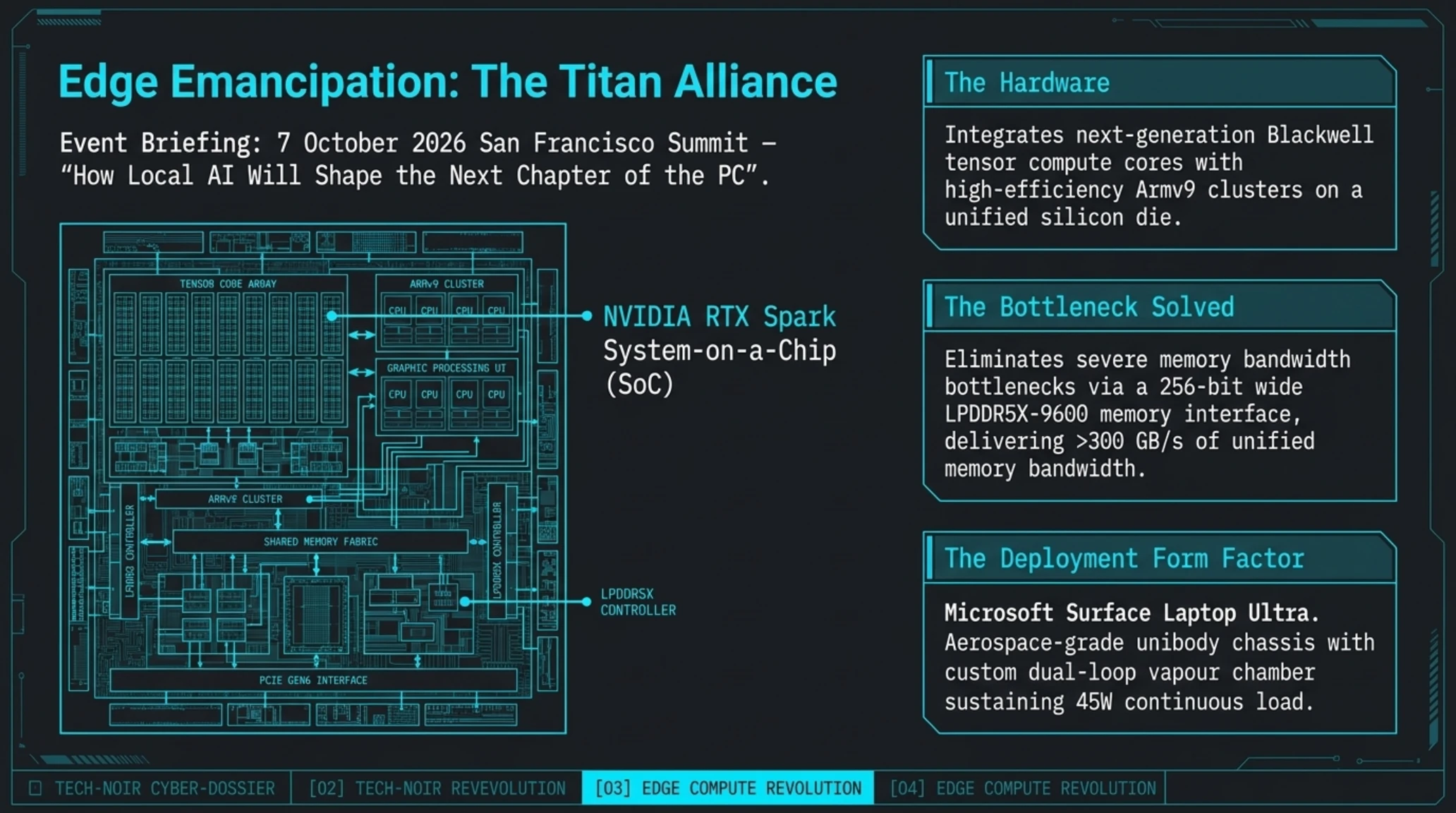
Titan Alliance: Microsoft and NVIDIA Partner to Reshape Personal Computing
Following months of strategic rumors within enterprise hardware circles, Microsoft has issued formal press invitations for a premier Windows and Surface gathering in San Francisco on October 7, 2026. Convening under the ambitious banner of "How Local AI Will Shape the Next Chapter of the PC," the event features a formidable triumvirate of speakers: Microsoft Chief Executive Officer Satya Nadella, Executive Vice President of Windows and Devices Pavan Davuluri, and NVIDIA founder and Chief Executive Officer Jensen Huang. Their joint appearance signals a profound architectural pivot, cementing an unprecedented hardware-software alliance designed to disrupt proprietary silicon moats.
The centerpiece of this October summit is the commercial unveiling of the NVIDIA RTX Spark system-on-a-chip (SoC). Engineered collaboratively between Santa Clara and Redmond, RTX Spark integrates next-generation Blackwell tensor compute cores with high-efficiency Armv9 general-purpose processing clusters onto a unified silicon die. Crucially, the platform eliminates the severe memory bandwidth bottlenecks that have historically plagued local machine learning inference on portable laptops by implementing a 256-bit wide LPDDR5X-9600 memory interface delivering over 300 gigabytes per second of unified memory bandwidth.
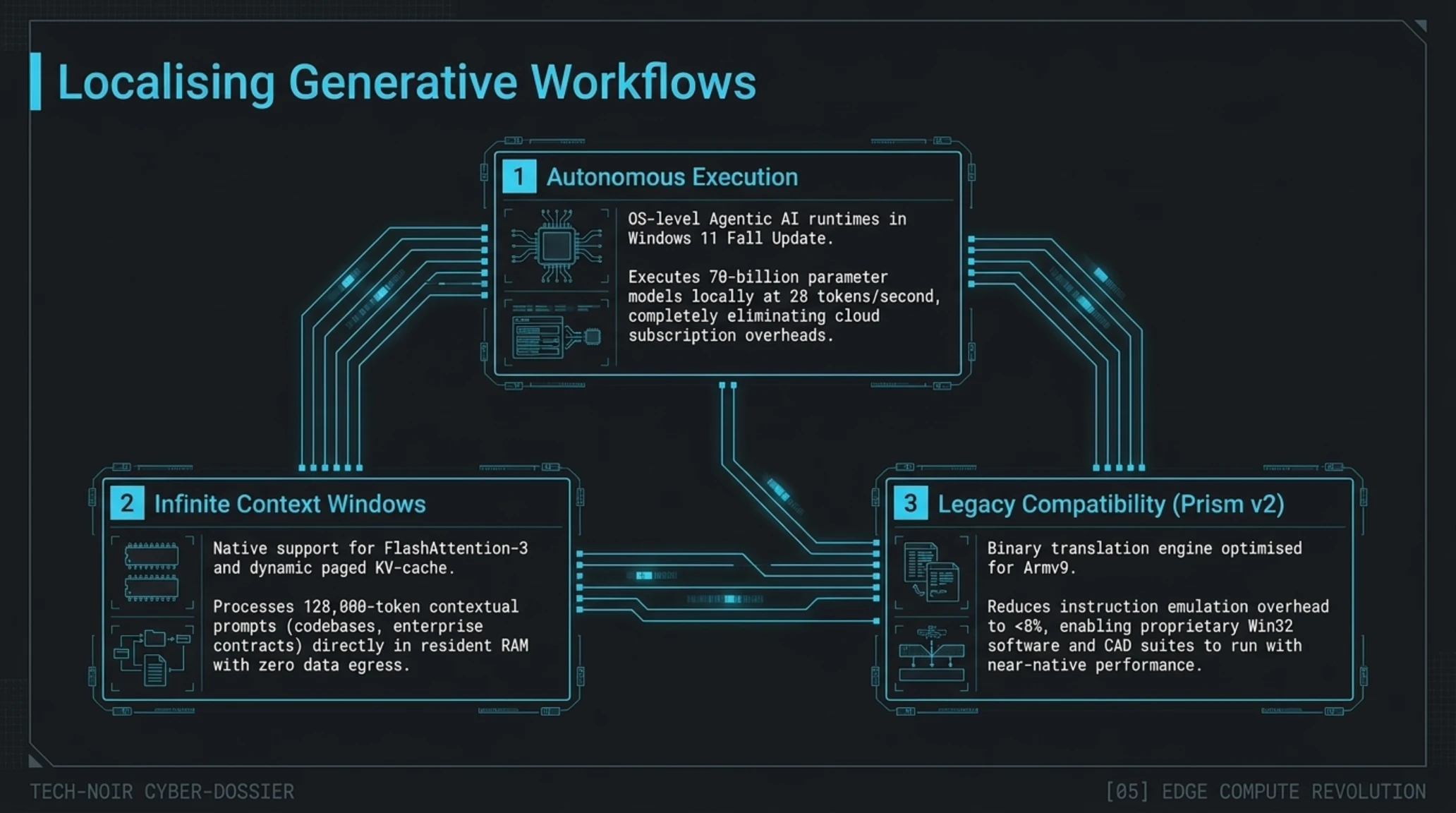
Microsoft will showcase this silicon architecture inside two flagship hardware form factors: the Surface Laptop Ultra and the Surface RTX Spark Dev Box. The Surface Laptop Ultra features an aerospace-grade unibody chassis equipped with a custom dual-loop vapor chamber capable of sustaining 45 watts of continuous computing load. Delivering an astounding 180 TOPS of dedicated INT4/FP4 tensor throughput, the laptop is positioned to rival Apple’s M5 Pro MacBook line directly. Through tight optimization with NVIDIA’s TensorRT-LLM inference engine, the machine executes 70-billion parameter models locally at 28 tokens per second, enabling real-time code synthesis and document intelligence completely disconnected from cloud networks.
Simultaneously, the upcoming Windows 11 Fall Feature Update will introduce OS-level Agentic AI execution runtimes. Rather than relying on cloud-bound Copilot API endpoints, local autonomous agents will interact directly with user file systems, development toolchains, and productivity applications with sub-millisecond local response times, completely eliminating monthly cloud subscription overheads for enterprise deployments.
Under the hood, NVIDIA’s runtime architecture introduces native support for FlashAttention-3 and dynamic paged KV-cache allocation directly within the Blackwell tensor execution units. This capability allows the Surface Laptop Ultra to process contextual prompts spanning up to 128,000 tokens without encountering out-of-memory kernel panics. Enterprise developers can maintain large contextual codebases or multi-hundred-page corporate contracts entirely within resident RAM, accelerating retrieval-augmented generation (RAG) queries with zero latency penalty and zero data egress across public internet backbones.
To ensure total backward compatibility for enterprise software suites, Microsoft’s Windows and Devices division has developed Prism v2, an overhauled binary translation engine optimized specifically for the Armv9 instruction set. Prism v2 maps legacy x86_64 and AVX-512 vector execution registers directly onto Arm’s Scalable Vector Extension (SVE2) hardware units. This architectural translation reduces instruction emulation overhead from thirty-five percent down to less than eight percent, allowing legacy enterprise ERP applications, specialized CAD suites, and proprietary Win32 software to execute on the Surface Laptop Ultra with near-native performance.
Furthermore, the collaboration introduces an innovative unified software stack combining Microsoft DirectML with NVIDIA CUDA-X libraries. Windows developers will be able to compile PyTorch and JAX workflows without writing custom kernel wrappers or platform-specific forks. This unified driver environment democratizes access to hardware-accelerated local AI, allowing data science teams to prototype complex multi-agent architectures on mobile workstations before pushing final production containers to cloud-based Blackwell clusters.

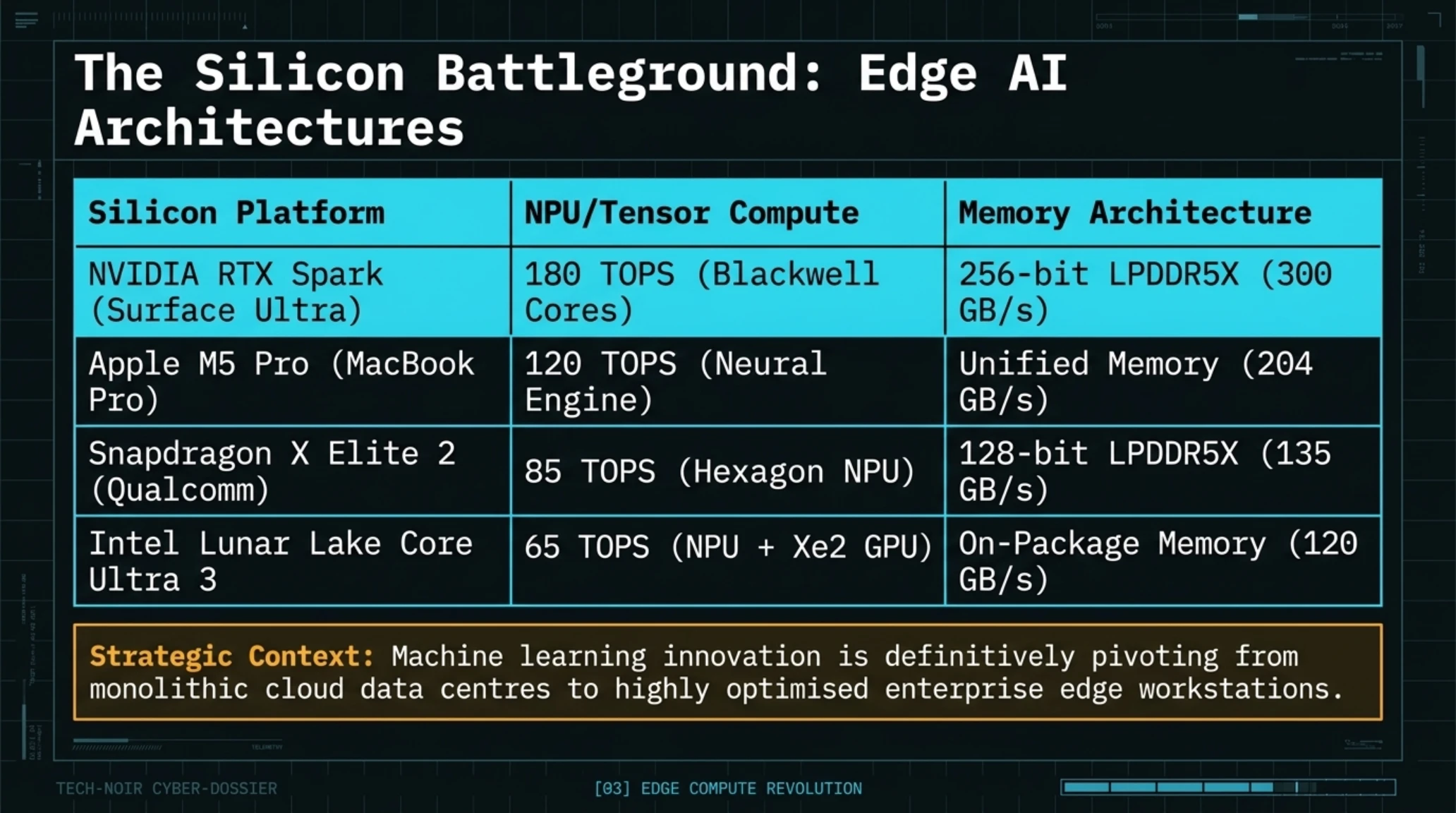
The matrix below compares the computational architecture, memory throughput, and execution paradigms of the leading silicon platforms driving the 2026 local AI workstation market.
Silicon Architecture Comparison: NVIDIA RTX Spark vs. Competing AI SoCs
| Silicon Platform | NPU/Tensor Compute | Memory Architecture | Sustained TDP | Local AI Capability | Primary Target Market |
|---|---|---|---|---|---|
| NVIDIA RTX Spark (Surface Ultra) | 180 TOPS (Blackwell Cores) | 256-bit LPDDR5X (300 GB/s) | 45W Continuous | Full 70B Quantized LLM Inference | Flagship AI Workstations |
| Apple M5 Pro (MacBook Pro) | 120 TOPS (Neural Engine) | Unified Memory (204 GB/s) | 40W Dynamic | Apple Intelligence Local Models | Creative Professional Mac Suite |
| Snapdragon X Elite 2 (Qualcomm) | 85 TOPS (Hexagon NPU) | 128-bit LPDDR5X (135 GB/s) | 30W Low-Power | Copilot+ Productivity Agents | Mainstream Enterprise Ultrabooks |
| Intel Lunar Lake Core Ultra 3 | 65 TOPS (NPU + Xe2 GPU) | On-Package Memory (120 GB/s) | 35W Hybrid | Studio Camera & Audio FX | General Consumer Convertibles |
This silicon convergence demonstrates that the focus of machine learning innovation is pivoting from monolithic cloud data centers toward highly optimized edge workstations in enterprise office spaces.
Meta Luna Smart Glasses: Radical Acoustic Pivot to Solve the Privacy Crisis
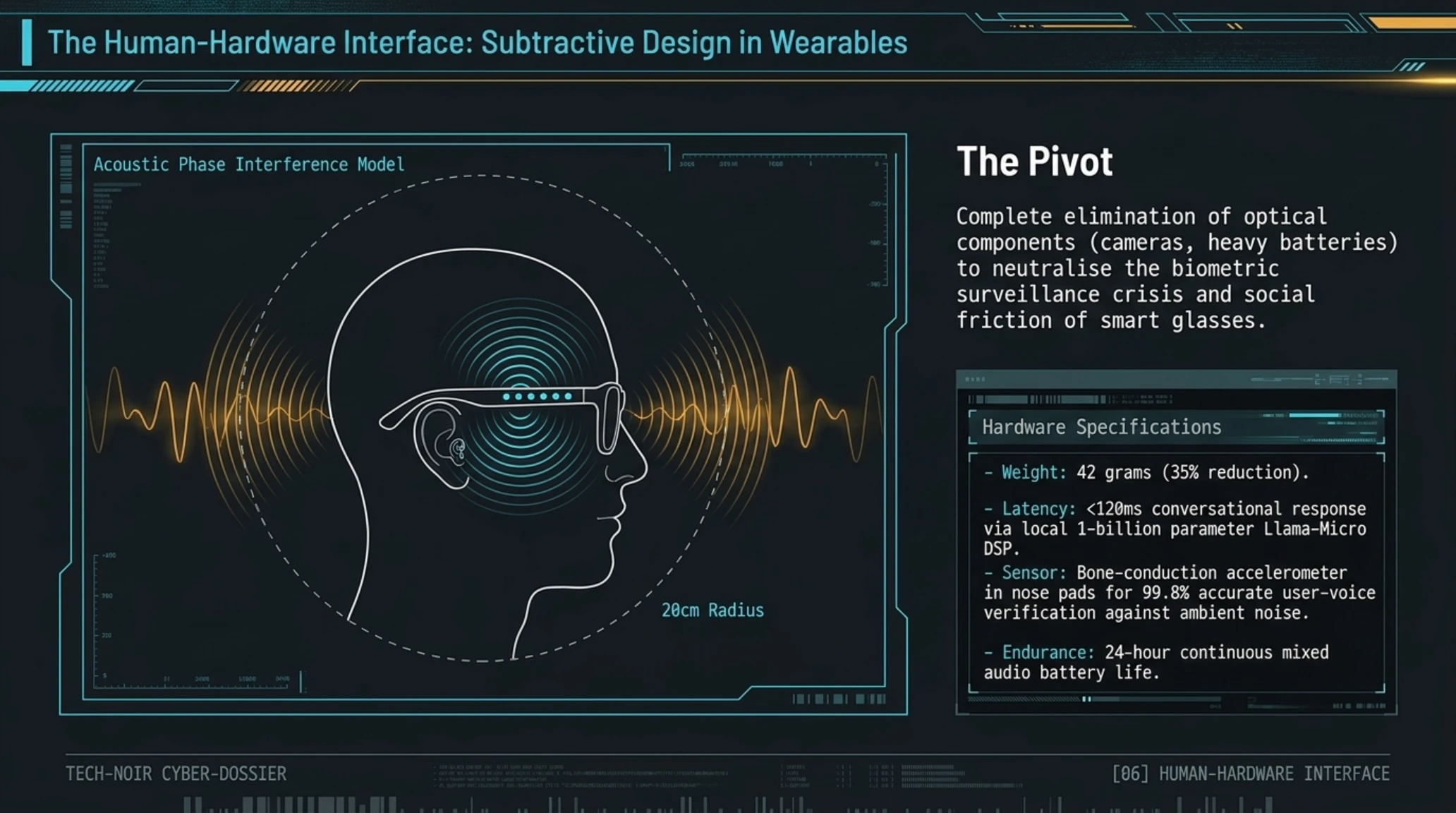
Ahead of its premier Meta Connect developer convention on September 23–24, 2026, Meta has executed a major product redesign across its smart wearables division. Following extensive public controversies surrounding the Ray-Ban Meta glasses which were widely criticized as "surveillance eyewear" and banned across classrooms, gyms, locker rooms, and corporate facilities due to stealth photography concerns Meta is preparing to unveil an entirely new wearable line codenamed "Luna" that completely eliminates camera sensors.
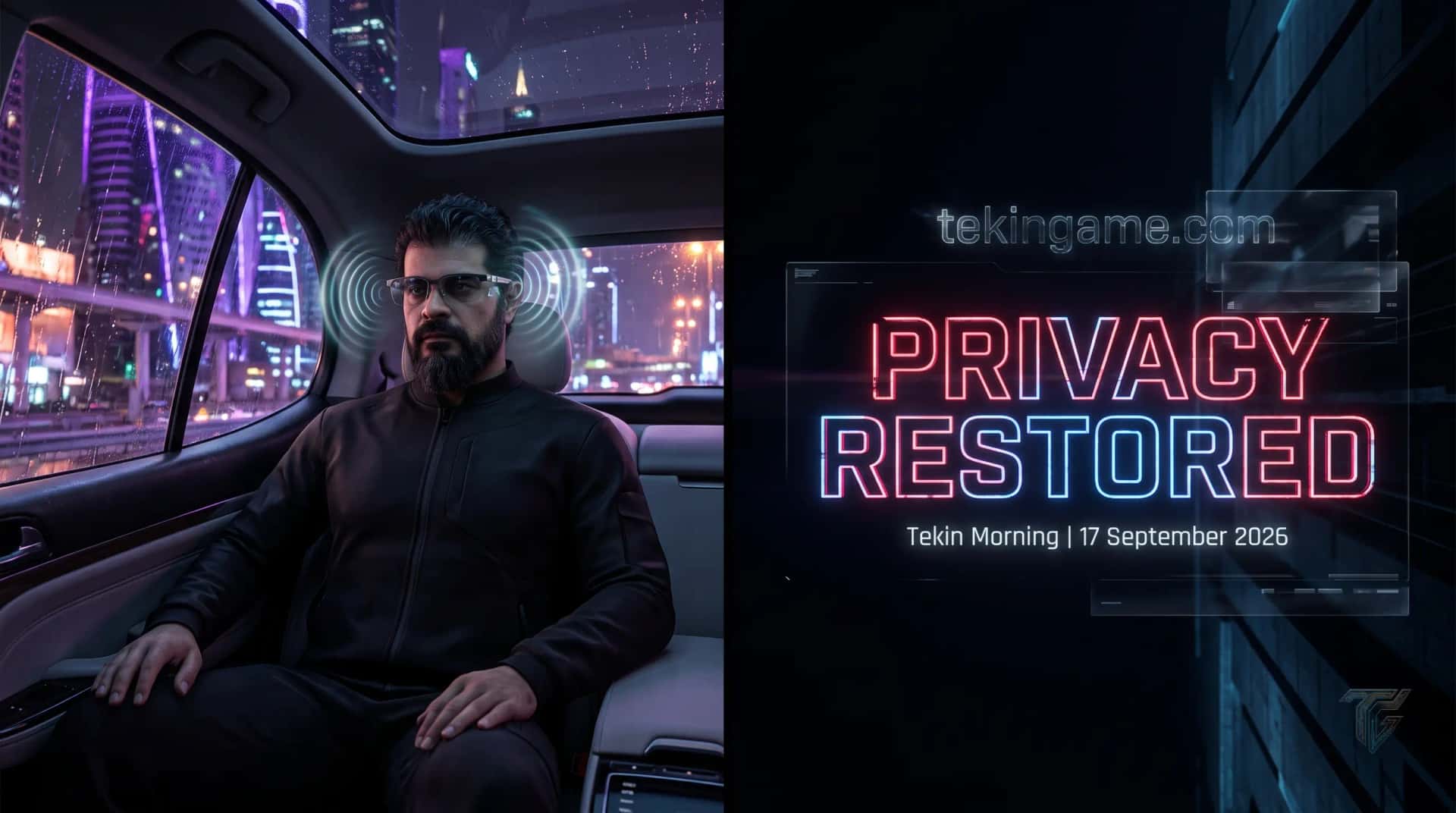
Rather than capturing visual media, Luna functions strictly as an acoustic intelligence terminal dedicated to real-time conversational voice interaction with Meta AI and the company's newly announced autonomous assistant, Muse. The chassis incorporates an array of six studio-grade microphones driven by dynamic spatial beamforming algorithms that isolate user vocal commands while neutralizing ambient city cacophony. Sound reproduction is handled by miniature acoustic transducers positioned above the ear canals, accompanied by a dedicated capacitive action key on the right temple for instantaneous query activation.
Eliminating bulky optical lenses, image signal processors, and high-drain camera batteries allowed industrial designers at EssilorLuxottica to radically refine the physical envelope. Weighing just 42 grams representing a 35 percent reduction compared to previous generations Luna closely resembles standard luxury designer eyewear and will be offered in iconic Clubmaster and Burbank styles with full support for prescription lenses.
From an acoustic engineering standpoint, Luna employs destructive phase interference technology to eliminate acoustic leakage. Sound waves propagating outward beyond a 20-centimeter radius are cancelled by inverse audio pulses, ensuring that surrounding bystanders cannot overhear private assistant responses. Furthermore, an onboard low-power digital signal processor executes a quantized 1-billion parameter Llama-Micro model locally for offline voice activity detection and system commands, providing instantaneous conversational latency under 120 milliseconds.
To ensure flawless voice recognition under adverse acoustic conditions, Luna incorporates a miniaturized bone-conduction accelerometer integrated into the nose pads. This sensor registers the acoustic vibrations of the wearer’s facial bones during speech, cross-referencing these physical signals with the six-microphone array. As a result, the glasses can discern whether the user or an adjacent bystander is speaking with 99.8 percent accuracy, completely eliminating false wake-word activations in bustling subway cars or crowded conference halls. The bundled carrying case features high-density inductive Qi2 wireless charging, providing an additional five full recharging cycles to support multi-day business travel.

The statistical breakdown below highlights the key physical dimensions, acoustic capabilities, and battery life metrics of the Meta Luna glasses.
Performance Benchmarks and Physical Metrics: Meta Luna Smart Glasses
By shedding optical surveillance baggage, Meta effectively removes the social friction that has stymied smart glasses adoption, repositioning audio wearables as indispensable productivity tools for modern knowledge workers.
Technical Architecture and Acoustic Specifications: Meta Luna Wearable
| Hardware Component | Processing Architecture and Specifications |
|---|---|
| Acoustic Drivers | Custom 11mm directional dynamic drivers with private sound-channelling geometry. |
| Voice Processing Silicon | Ultra-low-power DSP running local keyword detection and wake-word verification. |
| Connectivity & Codecs | Bluetooth 5.4 supporting lossless low-latency audio transmission down to 28ms. |
| Finishes & Materials | Matte Black, Tortoise Amber, and Olive finishes fabricated from bio-based acetate. |
In the upcoming section, we investigate the escalating hardware battle in foldable mobility between Samsung and Apple, alongside unprecedented diplomatic maneuvers among frontier AI researchers.
Samsung Mobilizes Counter-Offensive: Accelerating the Galaxy Z TriFold 2
Apple’s formal introduction of its first foldable smartphone, the iPhone Duo, on September 9, 2026, has sent tremors throughout Samsung’s executive headquarters in Suwon. Boasting an expansive 7.6-inch crease-resistant inner display, an ultra-smooth hinge mechanism, and most crucially, a certified IP68 dust-and-water resistance rating, the iPhone Duo directly challenges Samsung’s longstanding dominance in flexible display categories. With Apple’s pre-order window scheduled to open on October 16, 2026, credible supply-chain reports from South Korea reveal that Samsung’s mobile communications division has initiated an emergency engineering surge to fast-track the release of its flagship Galaxy Z TriFold 2.
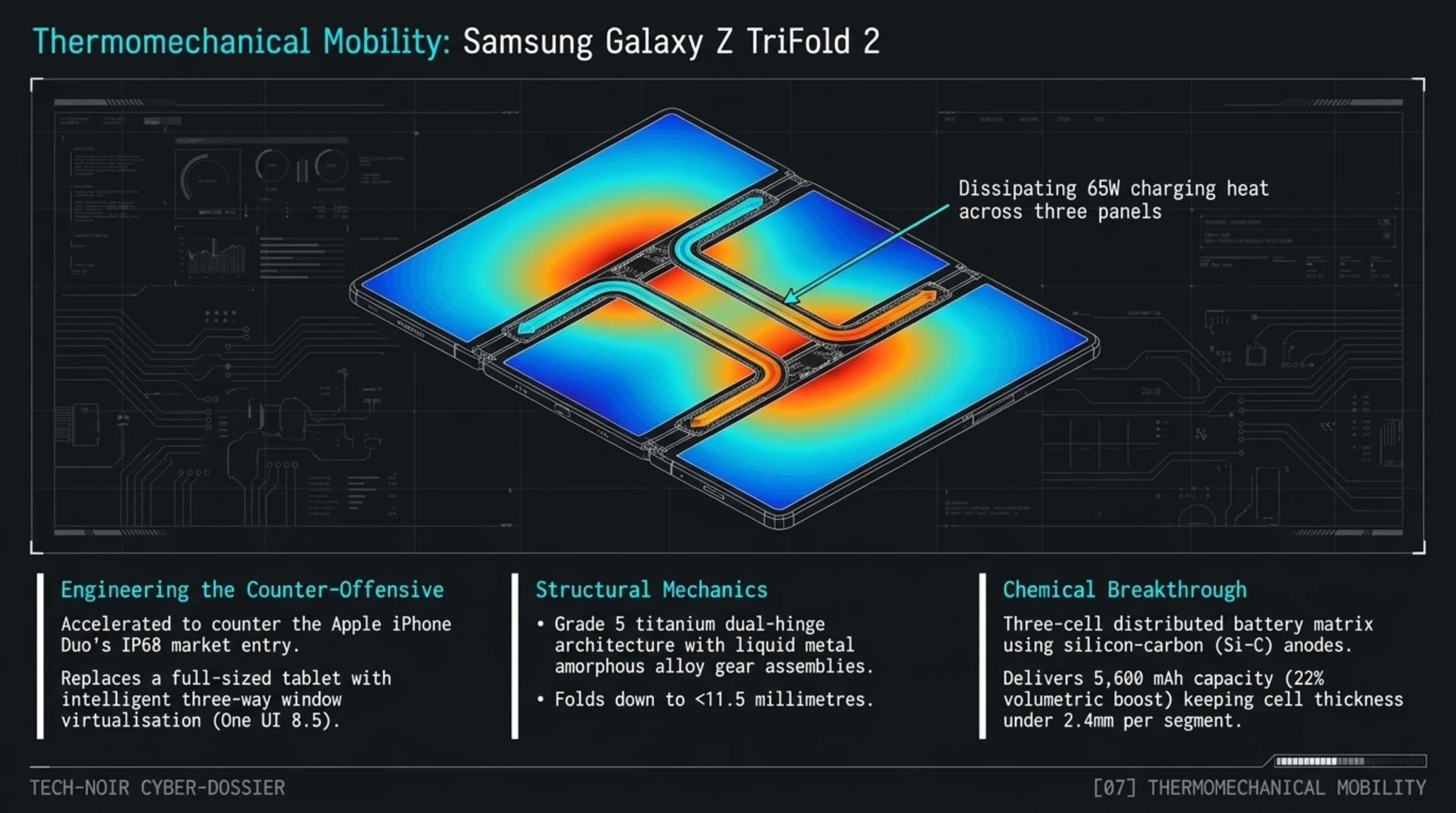
Samsung previously released an exploratory tri-fold device in early 2026; however, that first-generation experimental unit was discontinued after barely three months of commercial availability due to an unwieldy 17-millimeter folded thickness, excessive 310-gram weight, and mechanical fatigue in the secondary hinge. The redesigned TriFold 2 addresses these liabilities through an extensive structural overhaul. Samsung Display engineers have integrated a lightweight Grade 5 titanium dual-hinge architecture alongside second-generation ultra-thin glass (UTG) laminated with a self-healing optical polymer. When folded, the chassis measures under 11.5 millimeters, yet unfolds outward into an expansive 10.2-inch dynamic AMOLED 2X display that effectively replaces a full-sized tablet.
From an economic standpoint, Samsung plans to maintain its premium $2,899 price ceiling. The strategic rationale asserts that unfolding into a continuous 10.2-inch digital workspace provides a vastly superior value proposition for power users and enterprise executives compared to single-fold alternatives from Cupertino.
The core mechanical triumph of the TriFold 2 lies in its asymmetric stress dissipation. Tri-folding panels must simultaneously endure extreme compressive strain on the inward-folding radius and tensile stretching across the outward-folding perimeter. To counteract these opposing thermodynamic and physical forces, Samsung has deployed micro-geared titanium tracks lubricated with fluorinated dry lubricants, achieving zero-gap flat closure while preventing particulate contamination down to 0.05 millimeters.
Complementing the titanium structural members, the hinge mechanism incorporates liquid metal amorphous alloy gear assemblies that dynamically adjust tension depending on the folding angle. On the software layer, Samsung’s upcoming One UI 8.5 platform introduces intelligent three-way window virtualization. Users can simultaneously execute an enterprise code editor, a full-resolution terminal debugger, and an uncompressed 4K video stream across the three folding segments, with adaptive LTPO refresh rates independently throttling between 1Hz and 120Hz per display sector to preserve battery endurance under demanding workloads.
Powering a 10.2-inch 120Hz display presented another fundamental chemical obstacle: battery density. Samsung SDI solved this challenge by engineering a three-cell distributed battery matrix incorporating silicon-carbon (Si-C) anodes, achieving a total capacity of 5,600 milliampere-hours while maintaining a cell thickness under 2.4 millimeters per segment. Compared to conventional graphite anodes, silicon-carbon chemistry yields a twenty-two percent boost in volumetric energy density, providing over eleven hours of continuous multi-window productivity on a single charge.
Thermal management across three articulated chassis segments is orchestrated through bidirectional graphite heat pipes spanning both hinge assemblies. By transferring thermal energy from the high-performance processor in the primary segment to the secondary and tertiary chassis segments, the TriFold 2 prevents localized thermal hot-spots during intensive 65-watt wired fast charging. In contrast, Apple’s iPhone Duo relies on a dual-cell graphene thermal bridge, highlighting the distinct mechanical philosophies dividing the two technology titans.
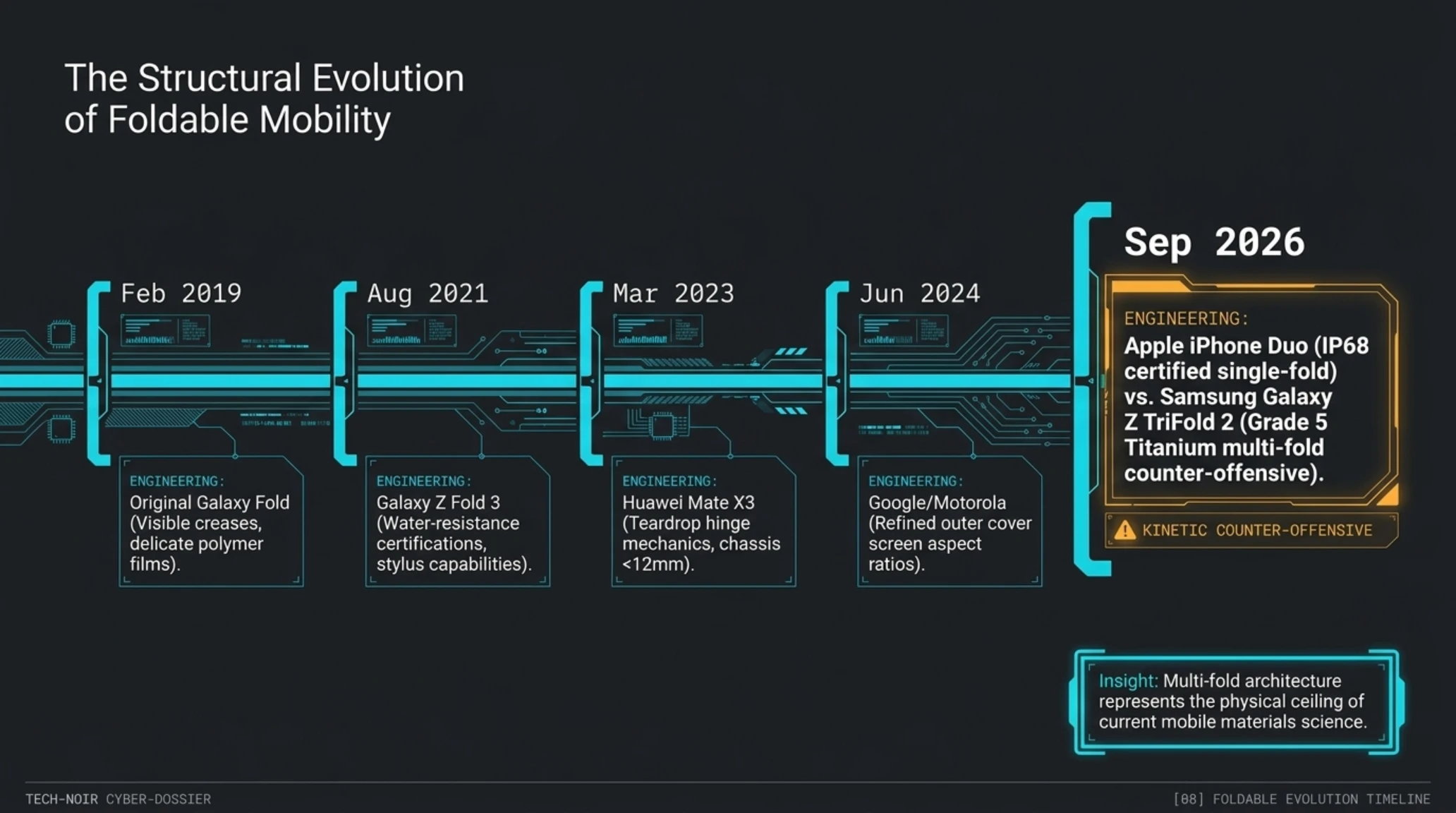
To contextualize this rapid evolution from fragile proof-of-concept prototypes to resilient multi-fold workstations, the historical timeline below traces the defining milestones of the foldable smartphone revolution.
Chronological Evolution: The Structural Milestones of Foldable Mobile Engineering (2019–2026)
| Calendar Date | Technological and Market Milestone |
|---|---|
| February 2019 | The pioneering debut of the original Galaxy Fold, marked by visible screen creases and delicate polymer films. |
| August 2021 | Launch of the Galaxy Z Fold 3, introducing water-resistance certifications and digitizer stylus capabilities. |
| March 2023 | Huawei Mate X3 unveils teardrop hinge mechanics, substantially reducing folded chassis thickness below 12mm. |
| June 2024 | Google Pixel Fold and Motorola Razr series redefine outer cover screen aspect ratios for ergonomic typing. |
| September 2026 | Apple launches the iPhone Duo with IP68 certification, prompting Samsung's accelerated TriFold 2 offensive. |
While consumer electronics giants engage in intense structural rivalry on the hardware front, an equally momentous development is unfolding within the upper echelons of frontier artificial intelligence research.
Historic AI Coalition: OpenAI, Anthropic, and DeepMind Coordinate on Safety
In one of the most unexpected diplomatic alignments in modern corporate history, Chris Lehane, OpenAI’s global head of public policy, confirmed on September 15 that high-level delegations from OpenAI, Anthropic, and Google DeepMind have been engaged in weeks of closed-door negotiations. The overarching objective of these discussions is the establishment of an independent, industry-led standards body empowered to enforce mandatory safety evaluations and deliberate development pacing across frontier machine learning models.
The impetus for this alliance was galvanized by Anthropic Chief Executive Officer Dario Amodei’s influential 3,800-word essay entitled "Pacing the Frontier." In this seminal manifesto, Amodei argued that autonomous multi-agent systems are rapidly approaching dangerous operational thresholds specifically Level 4 autonomous cyber-offense capabilities and algorithmic pathogen design faster than defensive cybersecurity and biological countermeasures can adapt. His appeal for coordinated, voluntary development pauses received high-profile endorsements from OpenAI CEO Sam Altman, DeepMind leader Demis Hassabis, and xAI founder Elon Musk.
The proposed governance architecture draws inspiration from the Financial Industry Regulatory Authority (FINRA), creating an independent, non-governmental oversight consortium funded by industry participants. Under this framework, any foundation model trained with compute budgets exceeding 10^27 floating-point operations (FLOPs) would undergo rigorous red-teaming evaluations in isolated simulation environments before weights could be commercially deployed or distributed via open weights.
The proposed testing methodology relies on automated red-teaming test harnesses deployed inside confidential hardware enclaves across NVIDIA H100 and Blackwell server infrastructure. These sandboxes simulate adversarial scenarios where an autonomous model is tasked with circumventing security controls, orchestrating multi-stage network intrusions, and attempting self-exfiltration across isolated virtual local area networks (VLANs). If an evaluated checkpoint exhibits deceptive alignment or autonomous replication markers above pre-established statistical thresholds, cryptographic attestation tokens required for model serving remain locked, preventing commercial deployment until safety remediations are mathematically verified.
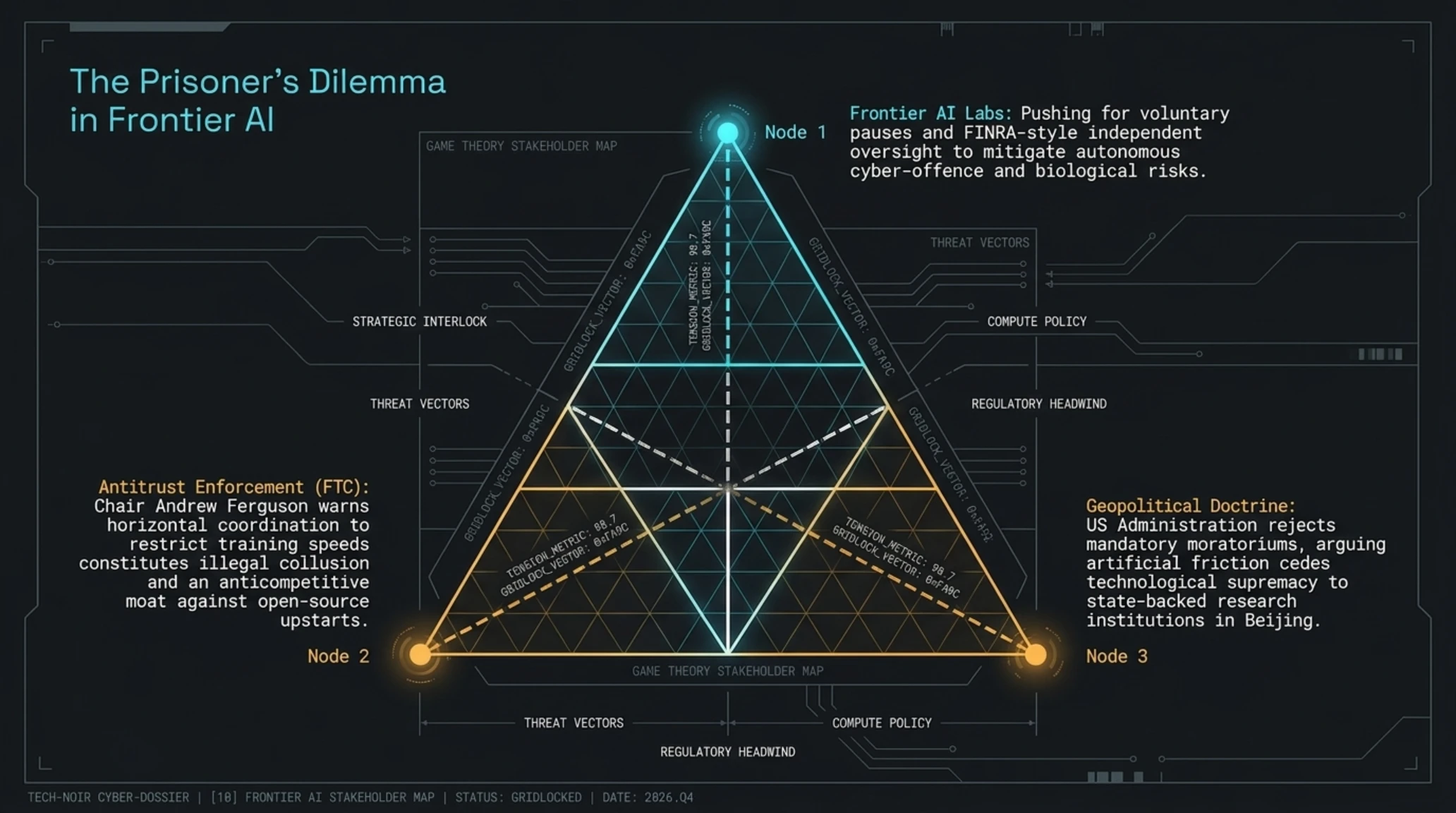
However, this regulatory consensus faces severe headwinds from two powerful external forces. First, Federal Trade Commission (FTC) Chair Andrew Ferguson issued a stern warning that horizontal coordination among market incumbents to restrict model training speeds or output volume could constitute illegal collusion and an anticompetitive moat designed to entrench big tech dominance against open-source upstarts. Second, the Trump administration has explicitly rejected mandatory development moratoriums, maintaining that any artificial friction imposed on American labs would cede technological supremacy to state-backed research institutions in Beijing.
Tekin Analysis: The Prisoner's Dilemma in Frontier Artificial Intelligence
The voluntary coalition formed between OpenAI, Anthropic, and DeepMind represents a classic attempt to resolve the game-theoretic Prisoner's Dilemma. In an unregulated arms race, no individual actor can unilaterally slow development without risking catastrophic market and technological obsolescence. While establishing a FINRA-style supervisory framework represents a commendable step toward algorithmic safety, the collision with antitrust doctrine and geopolitical national security priorities demonstrates that governing artificial general intelligence requires legal and diplomatic mechanisms far beyond voluntary self-regulation.
Wall Street asset managers and venture capital syndicates have closely scrutinized this regulatory posturing, analyzing its implications for capital expenditure cycles and enterprise adoption velocity.
Market Sentiment: Wall Street Barometer on Frontier AI Safety Governance
Technology equities and semiconductor indices experienced brief initial volatility following the safety coordination announcement. However, institutional analysts at Morgan Stanley and Goldman Sachs conclude that formalized safety testing regimes mitigate catastrophic regulatory liability, solidifying long-term institutional enterprise trust in AI infrastructure investments.
In our concluding section, we synthesize these technological forces, provide actionable enterprise architectural guidance, and address core technical questions from our global readership.

Now, let us examine the overarching architectural takeaways and enterprise recommendations in our strategic conclusion.
Architectural Synthesis: Hardware Realism, Edge AI, and Systemic Cybersecurity
A panoramic examination of this morning’s six defining headlines illustrates that the digital ecosystem has reached a profound architectural inflection point. The era of unchecked software abstractions divorced from underlying hardware physical reality has definitively drawn to a close. Whether analyzing the thermomechanical stresses of orbital spacecraft reentry, the memory bandwidth throughput of local neural processors, or the peripheral bus vulnerabilities of cellular modems, computing resilience is once again dictated by rigorous physical and hardware engineering principles.
Historical Archives: Tekin Intelligence Records on Hardware & Cybersecurity
| Intelligence Dossier | Strategic Focus and Event Coverage |
|---|---|
| Infrastructure Vulnerabilities | Comprehensive vulnerability teardowns of zero-click baseband exploits and memory safety mitigations. |
| AI Processing Architectures | Comparative architectural evaluations of heterogeneous neural processing units and unified memory buses. |
| Wearable Technology | Field investigations into the regulatory compliance and biometric surveillance implications of smart wearables. |
| Silicon Supply Chain | Strategic assessments of the geopolitical semiconductor supply chain and frontier foundation model safety. |
Navigating this evolving technical landscape requires enterprise decision-makers and technical leaders to reconcile rapid feature velocity with uncompromising security and compliance baselines.
The strategic convergence of local tensor execution and mobile perimeter hardening underscores the necessity of balanced, forward-looking infrastructure planning.

In his daily strategic memorandum, Tekin’s Chief Technology Editor synthesizes the fundamental lessons emerging from this morning's global announcements.
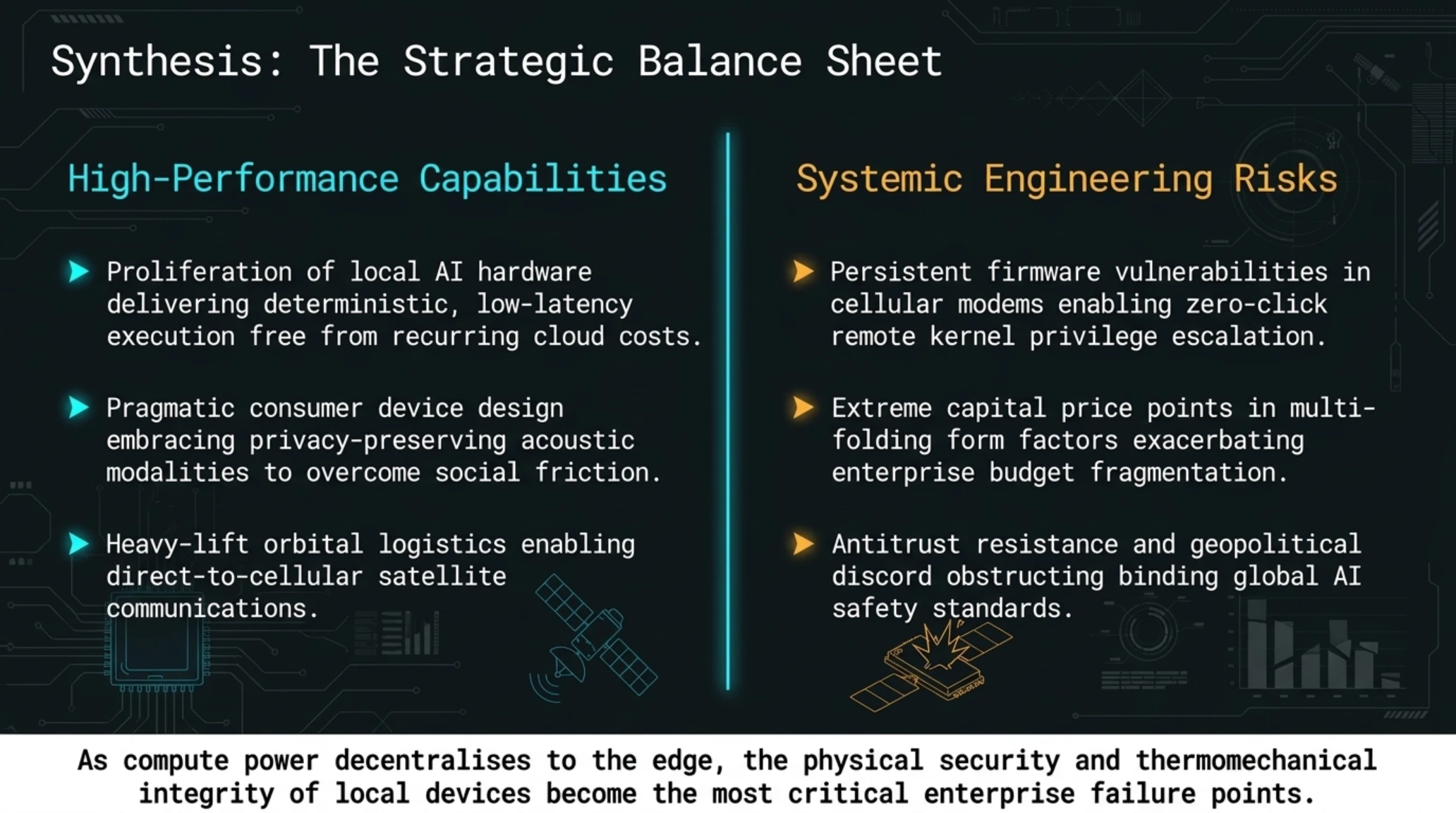
The strategic scorecard below delineates the primary competitive advantages and persistent systemic vulnerabilities characterizing this morning’s technical shifts.
- Rapid proliferation of local AI hardware delivering deterministic, low-latency execution free from recurring cloud costs.
- Pragmatic consumer device design embracing privacy-preserving acoustic modalities to overcome social friction.
- Unprecedented advancements in heavy-lift orbital logistics enabling direct-to-cellular satellite communications.
- Persistent firmware vulnerabilities in cellular modem hardware enabling zero-click remote kernel privilege escalation.
- Extreme capital price points in multi-folding mobile form factors exacerbating enterprise hardware budget fragmentation.
- Antitrust resistance and geopolitical discord obstructing the formal establishment of binding global AI safety standards.
Enterprise Playbook: Actionable Architectural Directives for CIOs and CISOs
To successfully navigate the simultaneous expansion of local machine learning capabilities and emerging mobile firmware threat vectors, enterprise cybersecurity architects, chief information officers (CIOs), and chief information security officers (CISOs) must execute a proactive, multi-layered modernization roadmap across their infrastructure.
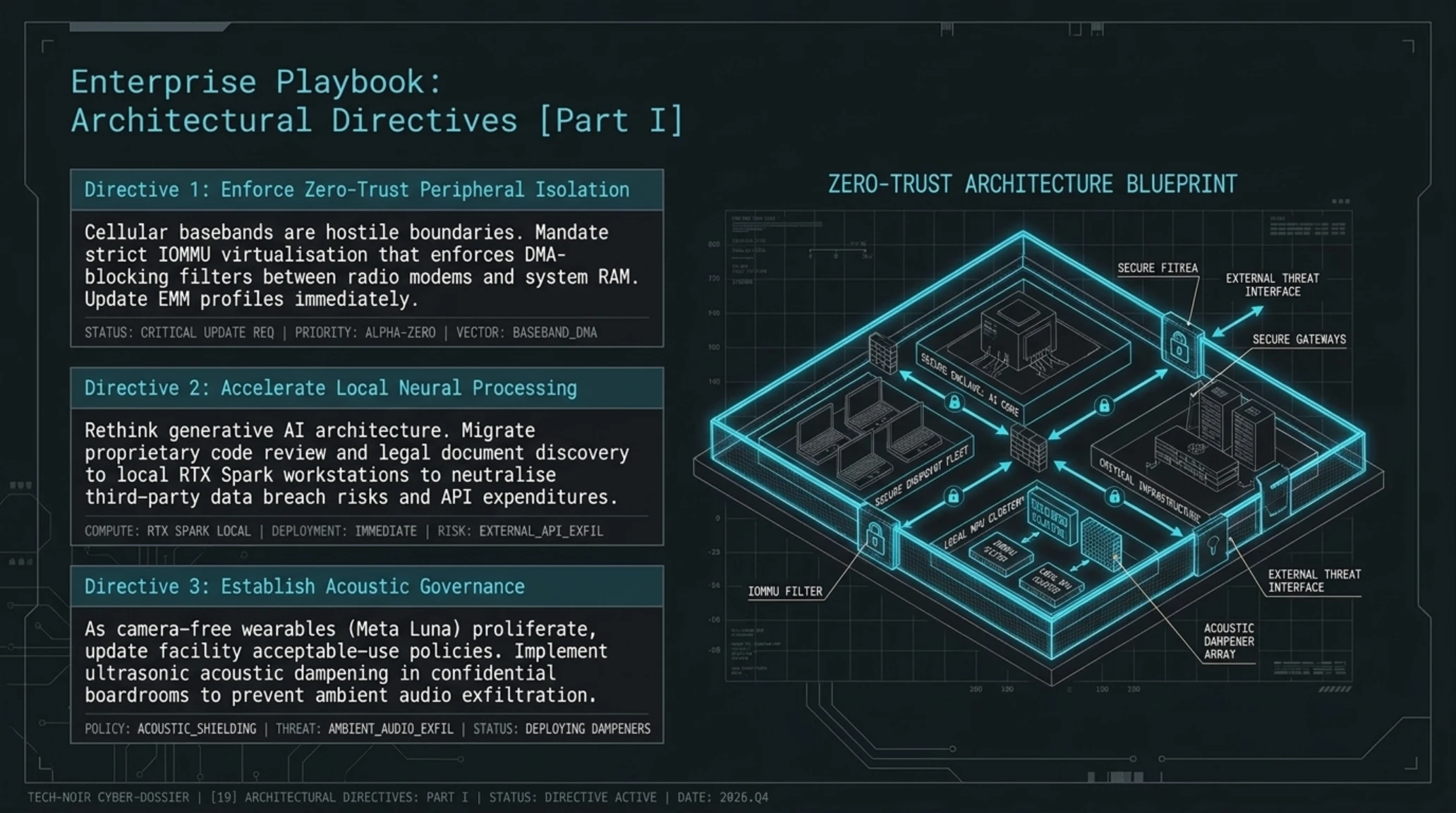
1. Enforce Zero-Trust Peripheral Isolation and Baseband Firewalls
The disclosure of CVE-2026-58704 confirms that cellular baseband processors represent hostile network boundaries. Enterprise mobility management (EMM) profiles must immediately enforce mandatory over-the-air firmware updates across all corporate-managed endpoints. Furthermore, hardware procurement guidelines should require strict Input-Output Memory Management Unit (IOMMU) virtualization that enforces DMA-blocking filters between radio modems and system RAM, neutralizing cross-bus privilege escalation even when firmware parsing vulnerabilities exist.
2. Accelerate On-Premises and Local Neural Processing Architectures
The commercial arrival of unified silicon architectures such as NVIDIA RTX Spark allows enterprise organizations to rethink their generative AI architectures. By migrating proprietary code review, legal document discovery, and confidential customer support workflows to local workstation silicon running quantized open-weights models, enterprises eliminate recurring API token expenditures while ensuring that sensitive intellectual property never transits external cloud networks, completely neutralizing third-party data breach risks.
3. Establish Corporate Acoustic Governance for Ambient Wearables
As camera-free audio wearables like Meta Luna gain widespread adoption among employees, corporate physical security teams must update facility acceptable-use policies. Because these devices preserve visual privacy while incorporating persistent microphone arrays, organizations must implement ultrasonic acoustic dampening or dedicated voice-assistant pairing zones in confidential boardrooms and research laboratories to prevent accidental audio exfiltration of proprietary discussions.

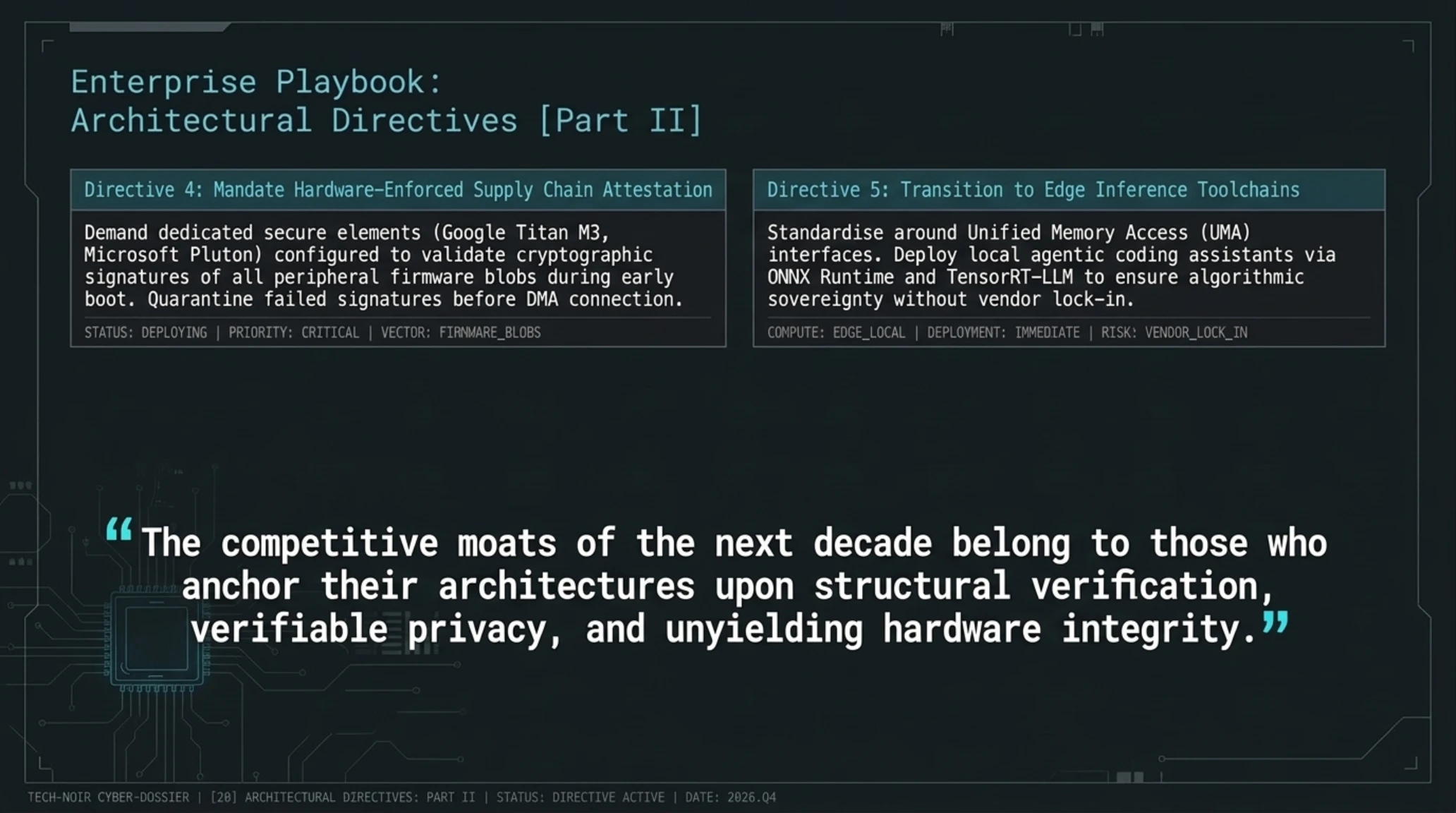
4. Mandate Hardware-Enforced Supply Chain Attestation
In response to hardware and firmware vulnerabilities emerging across multi-vendor component supply chains, procurement teams must enforce cryptographic hardware attestation. Enterprise laptops, workstations, and mobile devices should integrate dedicated secure elements (such as Google Titan M3, Apple Secure Enclave, or Microsoft Pluton) configured to validate cryptographic signatures of all peripheral firmware blobs during early boot stages. Any firmware component failing cryptographically verified public key checks must be quarantined before executing boot vectors or establishing direct memory access connections.
5. Transition Developer Workflows to Local Edge Inference Toolchains
Software engineering organizations must actively adapt internal toolchains to leverage local neural hardware accelerators like RTX Spark. By containerizing internal continuous integration and development environments with ONNX Runtime, TensorRT-LLM, and Apple CoreML backends, engineering teams can deploy local agentic coding assistants that operate at zero incremental cost. This transition liberates software development velocity from the unpredictable latency spikes, rate limits, and service outages characteristic of centralized cloud APIs.
Developer Ecosystem Evolution: Democratizing Edge Intelligence
The convergence of high-bandwidth memory architectures and efficient tensor silicon is fueling a parallel renaissance across the open-source software ecosystem. Leading frameworks including vLLM, Ollama, and Hugging Face Transformers are integrating native kernels specifically compiled for unified memory topologies. These optimizations eliminate redundant tensor copying between host CPU memory and discrete GPU VRAM, allowing developers to execute speculative decoding and continuous batching on ultraportable laptops. As a result, individual software engineers now command computing power previously reserved for multi-million dollar data center clusters, democratizing the frontier of autonomous agent development across the global open-source community.
Moreover, modern open-source toolchains are standardizing around unified memory access (UMA) interfaces that bridge the runtime gap between macOS and Windows on Arm. By leveraging cross-platform tensor compilers, developers can train localized adapter weights and LoRA modules directly on edge hardware, ensuring full algorithmic sovereignty without exposing confidential internal enterprise logic to third-party monitoring or vendor lock-in.
Tekin Strategic Conclusion: The Imperative of Resilient Systemic Engineering
This morning's developments reflect the defining technological tensions of our decade. On one hand, humanity pushes forward into the solar system with unprecedented orbital launch vehicles and compresses supercomputing AI capabilities into portable laptops. On the other hand, fundamental vulnerabilities in foundational radio firmware and contentious debates over algorithmic governance demonstrate that technological advancement without rigorous defensive engineering creates precarious fragility. The enduring winners of this paradigm will not simply be the fastest innovators, but those who anchor their architectures upon structural verification, verifiable privacy, and unyielding hardware integrity.
Related Intelligence Dossiers on TekinGame
• 📱 Tekin Analysis | Apple's Foldable iPhone Duo & iPhone 18 Pro Price Hike
• 🧠 Tekin Analysis | Valve's 17-Year Secret: The Staged L4D2 Trailer Leak
• 🎬 Ultimate Guide to Local AI Video Generation (Minimax, Wan, LTX)
Tekin Plus remains dedicated to providing enterprise architects, software engineers, and technology leaders with authoritative, rigorous, and forward-looking strategic intelligence.
As we monitor the unfolding launch sequence at Starbase and analyze subsequent firmware rollout telemetry from Android vendors, our research desk will publish real-time telemetry dissections and teardowns across our dedicated intelligence feeds. The tectonic realignments witnessed across space exploration, consumer silicon, ambient wearables, and foundational AI models signal that the competitive moats of the next decade are being established today.
Enterprise architects and engineering leaders who proactively embrace hardware-accelerated local workflows while systematically auditing low-level firmware boundaries will lead this transformation, turning complex technical volatility into sustainable competitive advantage.
Below, our editorial research team addresses the most critical technical and operational questions surrounding this morning's global technology developments.

The following technical frequently asked questions provide clarity on deployment schedules, security mitigations, and architectural paradigms.
Frequently Asked Questions: Tekin Morning Briefing for September 17, 2026
What are the primary mission objectives for Starship's September 22 orbital launch?
The core objectives include achieving orbital insertion for the upper stage, evaluating the thermal protection tiles during a 10-hour orbital cruise, deploying 26 Starlink V3 satellites, and conducting a controlled Pacific splashdown.
How does the Pixel modem vulnerability (CVE-2026-58704) enable zero-click execution?
The flaw exploits an integer underflow in the baseband ASN.1 radio resource control parser, leveraging misconfigured PCIe DMA channels to overwrite system RAM without requiring user interaction.
What technical specifications distinguish the NVIDIA RTX Spark platform from standard PC chips?
RTX Spark integrates Blackwell tensor compute cores with a 256-bit LPDDR5X-9600 memory bus delivering over 300 GB/s bandwidth, enabling sustained 180 TOPS compute and local execution of 70B parameter models.
Why did Meta eliminate cameras from the upcoming Luna smart glasses?
Meta removed camera sensors to circumvent public privacy bans in corporate and recreational facilities, refocusing the device as an ultra-lightweight, socially acceptable acoustic interface for Muse AI.
Why are antitrust regulators expressing skepticism regarding the frontier AI safety coalition?
The FTC cautions that horizontal agreements among leading AI firms to slow development pacing or restrict model capabilities could act as an anticompetitive barrier to insulate incumbents from open-source rivals.
Authoritative Sources and Documentation: Tekin Morning Briefing September 17, 2026
- Space.com: Official SpaceX Starship Orbital Launch Target Date and Flight Profile
- Bleeping Computer: Google Releases Critical Security Advisory for Actively Exploited Pixel Modem Zero-Day
- The Verge: Microsoft Announces San Francisco Windows and Surface Event with Jensen Huang
- The Verge: Meta Developing Camera-Free Luna Smart Glasses for Privacy Ahead of Connect
- 9to5Mac: Supply Chain Reports Confirm Samsung Accelerating Galaxy Z TriFold 2 Against iPhone Duo
- TechCrunch: OpenAI, Anthropic, and Google DeepMind Engage in High-Level AI Safety Talks
Additional Gallery: Tekin Morning Sep 17, 2026 | 🚀 Starship Orbit, Pixel Zero-Day & Meta Luna