Tekin Morning: Sept 7
- 🎮Silent Hill Renaissance- Konami's annual release roadmap and No Code's analog horror mechanics
- 🎧Valve's Historic Confession- Developer admits to intentionally leaking the L4D2 trailer to bypass ESRB
- 🚀European Orbital Autonomy- Isar Aerospace conducts Europe's first 100% commercial orbital launch
- 🗡️NASA's 70-Meter Dish- Deep Space Network commissions giant antenna for live 4K Artemis links
- 📰Publishers Sue OpenAI- Seattle Times and Newsday file copyright lawsuits over generative scraping
- ⚔️Satoshi Whale Awakens- Vintage 2010 Bitcoin miner transfers 600 BTC ($48.6M) to Taproot addresses
Monday, September 7, 2026, opens an extraordinarily electrifying week across the global high-technology ecosystem, interactive entertainment industry, aerospace engineering sectors, and decentralized digital finance markets. The close of summer has converged into a crescendo of monumental developments: explosive developer panels at PAX West 2026 in Seattle, historic maiden flights from orbital spaceports inside the Arctic Circle, multi-hundred-million-dollar federal copyright battles challenging Silicon Valley's artificial intelligence infrastructure, and unprecedented on-chain movements originating from the earliest Satoshi-era ledger blocks. In this comprehensive morning dossier, TekinGame conducts an exhaustive forensic and strategic breakdown of the six core macro shifts reshaping tomorrow's digital economy.
As institutional capital, engineering talent, and creative studios recalibrate their fourth-quarter roadmaps, the technological frontier is witnessing an intense fusion of legacy disciplines and next-generation architectures. From the reimagining of psychological survival horror through cathode-ray analog electronics, to the complete overhaul of deep-space microwave and optical telemetry for lunar colonization, today's briefings illustrate how foundational principles are being repurposed to conquer modern bottlenecks. Our analysis provides decision-makers, engineers, and passionate gamers with the rigorous technical context necessary to navigate these accelerating industry pivots.
The dawn of this new publishing cycle highlights the critical importance of agility and technical sovereignty. Whether examining the decentralization of Japanese game development pipelines, European access to space, or the cryptographic modernization of multi-million-dollar vintage blockchain treasuries, strategic autonomy has emerged as the defining competitive advantage of 2026. Across each sector analyzed below, organizations that embrace bold engineering and transparent architecture are decisively outpacing incumbents burdened by legacy bureaucracy.
Executive Summary | Strategic Vectors for September 7
- Konami solidifies an annual release cadence for the Silent Hill franchise while No Code establishes 1980s analog audio-visual mechanics for Silent Hill: Townfall.
- Valve veteran Chet Faliszek discloses Gabe Newell's legendary guerrilla marketing maneuver that bypassed ESRB Adults-Only censorship through an anonymous leak.
- German aerospace pioneer Isar Aerospace successfully executes Europe's first-ever fully commercial orbital mission from Andøya, Norway.
- NASA Jet Propulsion Laboratory commissions the massive 70-meter DSS-14B dish at Goldstone to support gigabit-tier lunar and Martian communications.
- The Seattle Times and Newsday file joint federal copyright litigation against OpenAI and Microsoft over generative scraping and AI search overviews.
- A vintage 2010 Bitcoin mining whale wakes up after 16 years of absolute dormancy to migrate 600 BTC ($48.6M) to modern Taproot addresses.
Konami Unveils Annual Silent Hill Release Roadmap; Deep-Dive into No Code's Analog Horror Mechanics in Silent Hill: Townfall
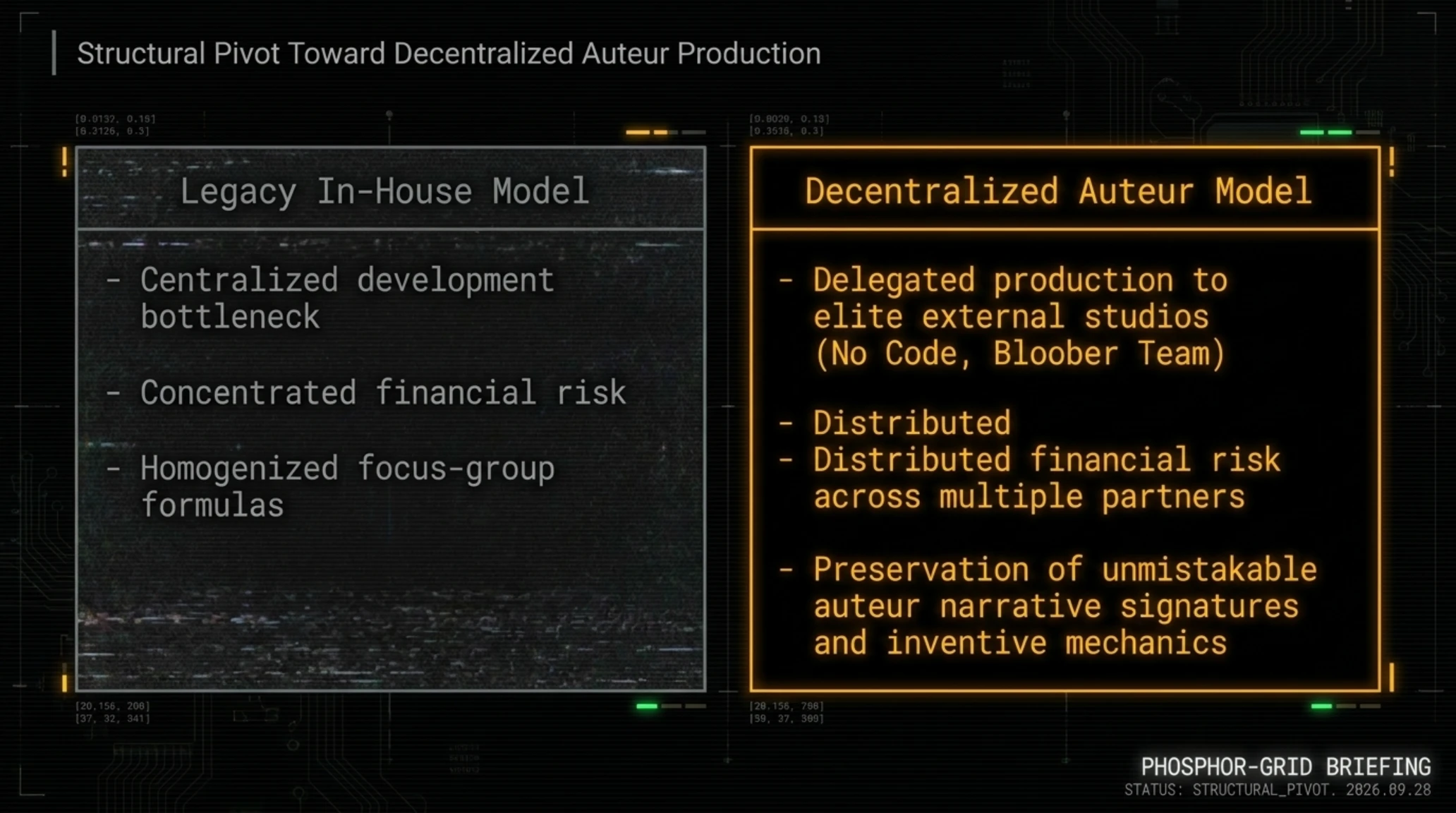
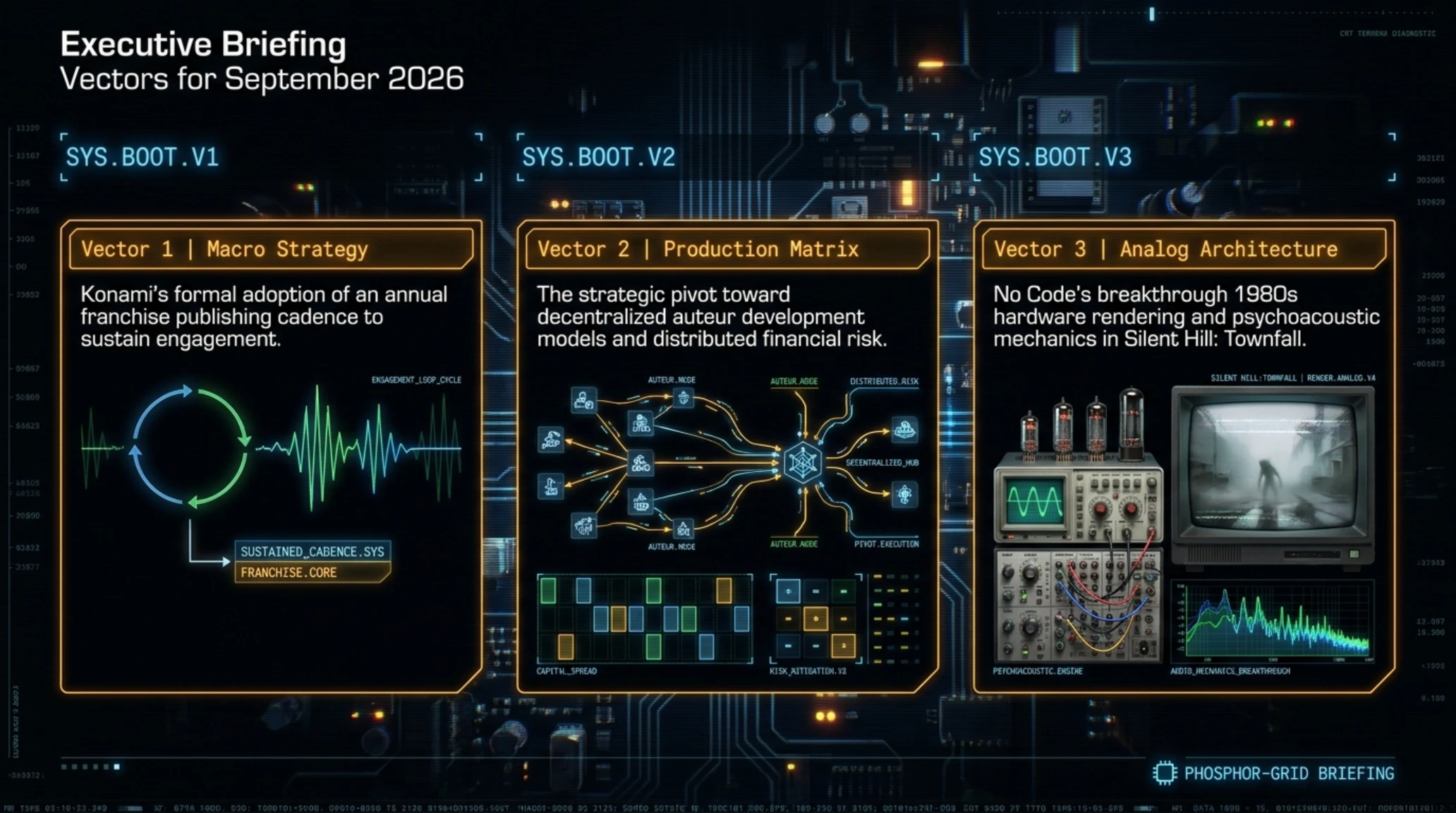
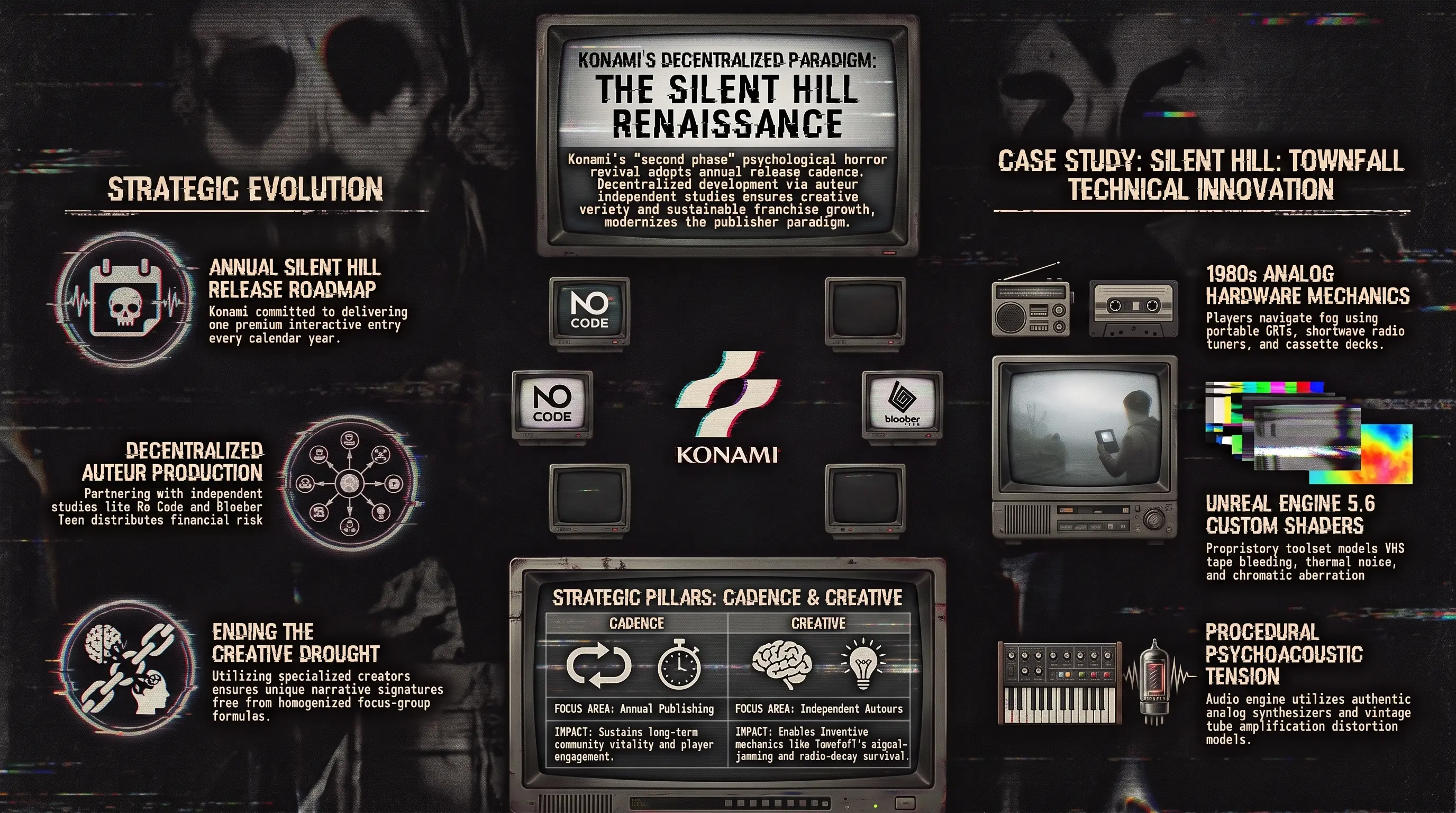
Following years of cautious corporate restructuring and tentative experimental steps, Konami officially declared the arrival of the second phase of its psychological horror renaissance during an exclusive mainstage panel at PAX West 2026 in Seattle. Motoi Okamoto, Senior Producer and chief architect of the franchise's modern revival, presented an extensive strategic retrospective on the global commercial and critical reception of recent remakes. Okamoto revealed that Konami has formally adopted an annual publishing schedule, committing to delivering at least one premium interactive entry within the Silent Hill universe every single calendar year to sustain long-term player engagement and community vitality.
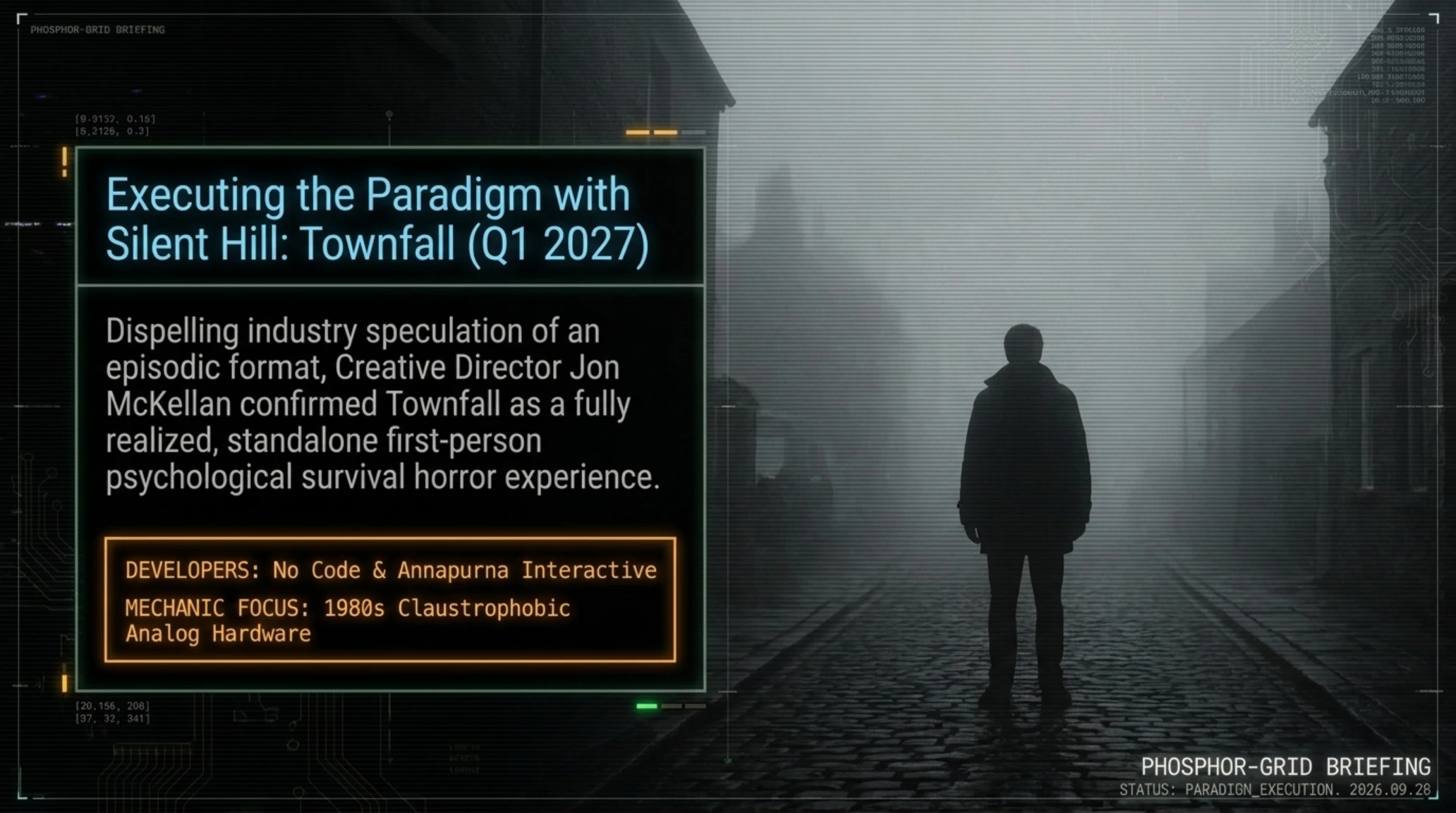
The undisputed centerpiece of the showcase was the joint stage appearance of Scottish independent studio No Code (internationally acclaimed for atmospheric masterpieces Stories Untold and Observation) alongside boutique publisher Annapurna Interactive. Dispelling long-standing industry speculation that the title would serve merely as an episodic vignette, Creative Director Jon McKellan confirmed that Silent Hill: Townfall is a fully realized, standalone first-person psychological survival horror experience designed to channel the melancholic, claustrophobic dread of the foggy town through the mechanical lens of 1980s analog hardware.
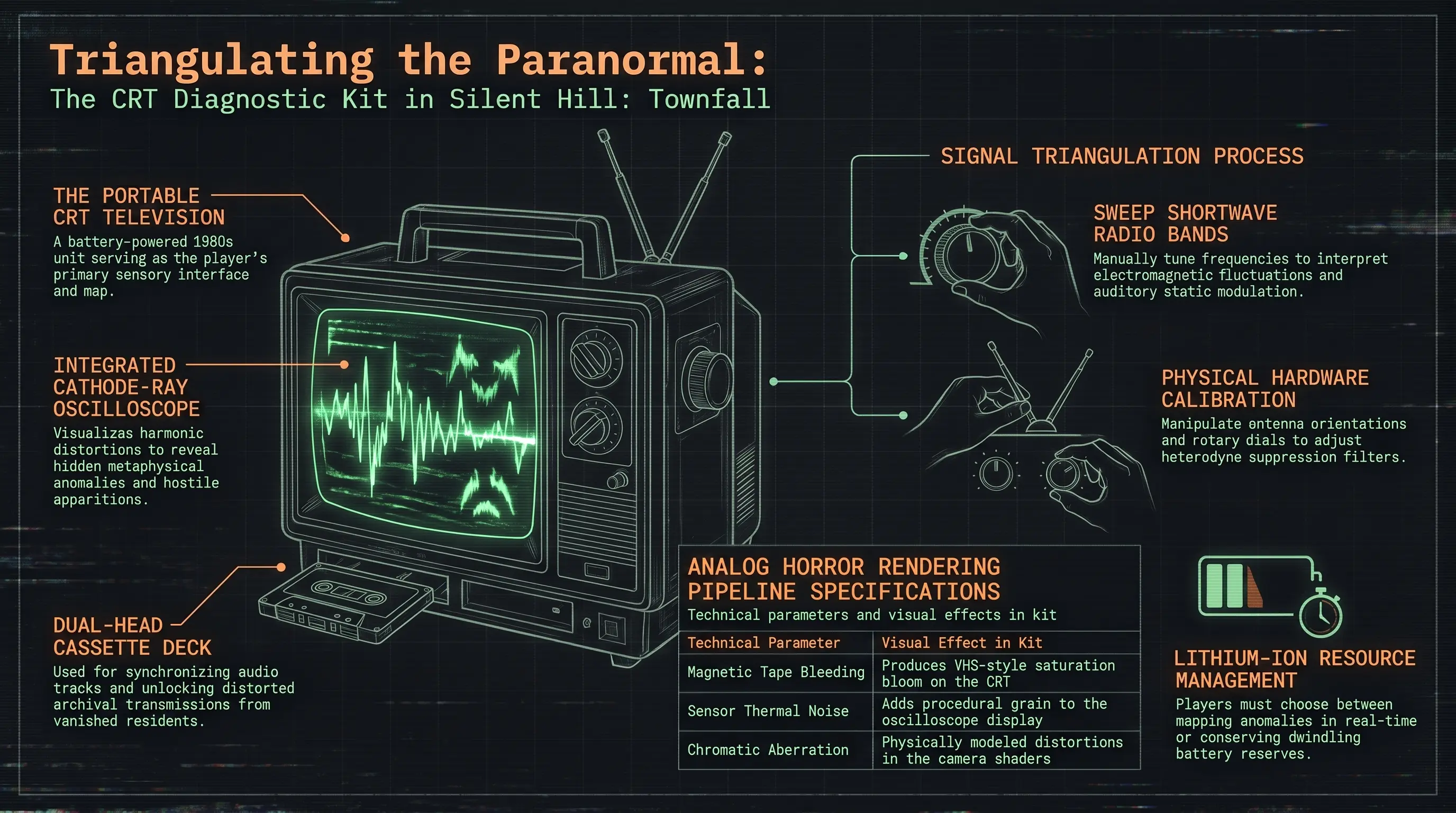
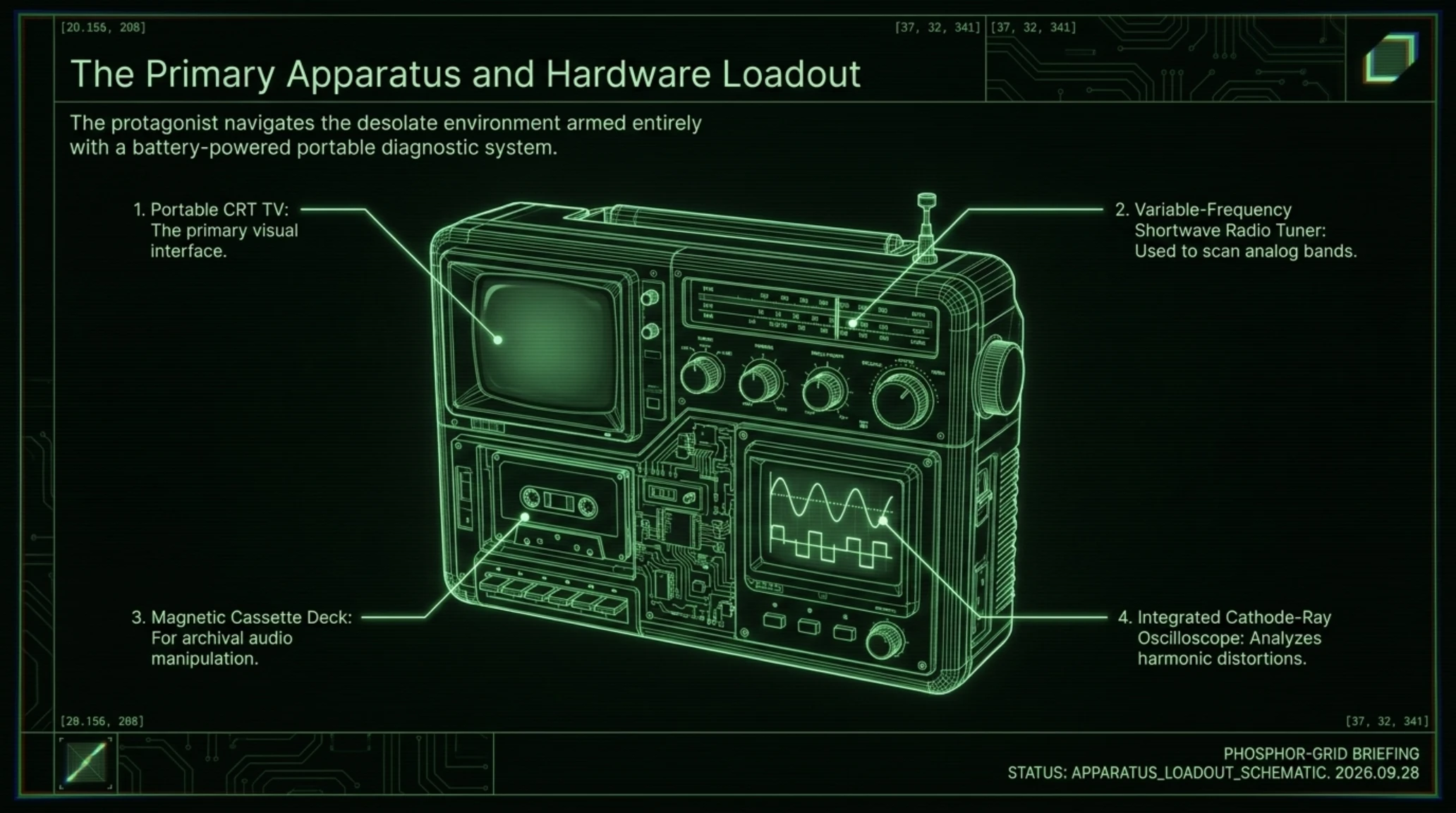
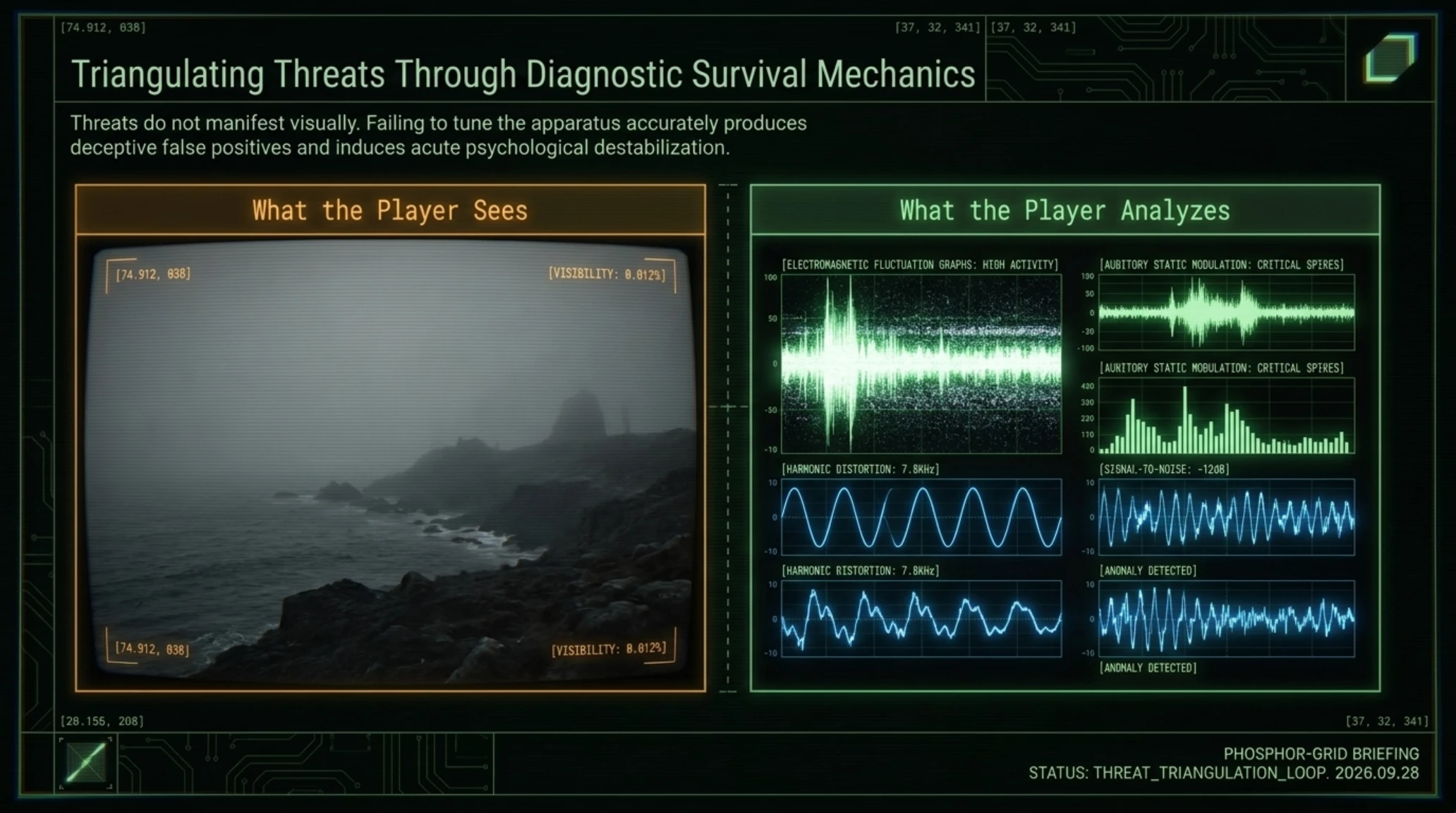
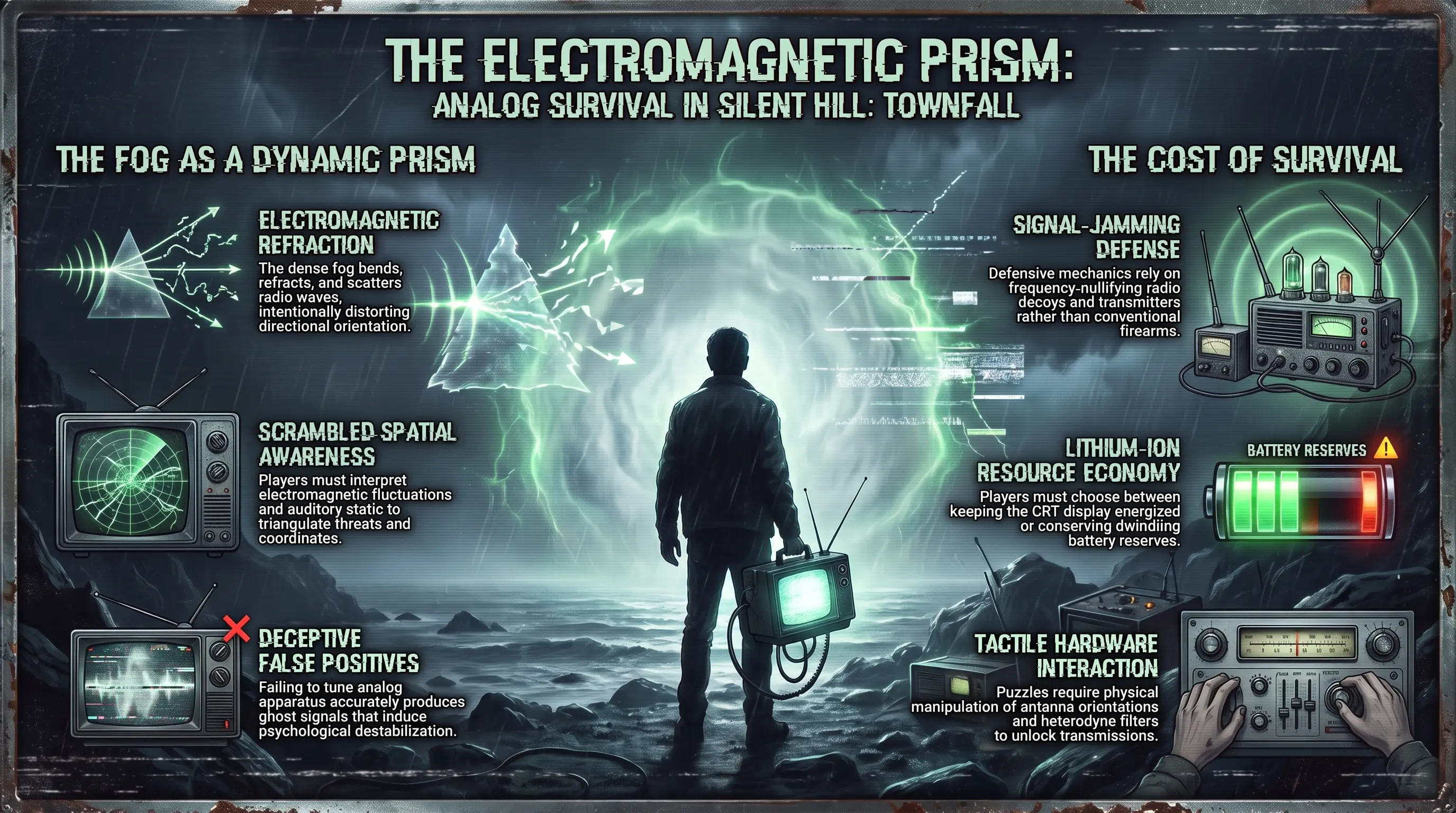
In the extended behind-closed-doors gameplay demonstration presented to industry analysts, the player navigates an isolated, desolate British seaside village enveloped in impenetrable fog. Armed not with conventional heavy ordnance, but with a battery-powered portable CRT television incorporating a variable-frequency shortwave radio tuner, a magnetic cassette deck, and an integrated cathode-ray oscilloscope, the protagonist must decipher the environment. Hostile apparitions and metaphysical anomalies do not manifest through conventional visual cues; instead, players must constantly scan analog radio bands, interpreting electromagnetic fluctuations, auditory static modulation, and oscilloscope harmonic distortions to triangulate threats. Failing to tune the apparatus accurately produces deceptive false positives while inducing acute psychological destabilization in the character's perception.
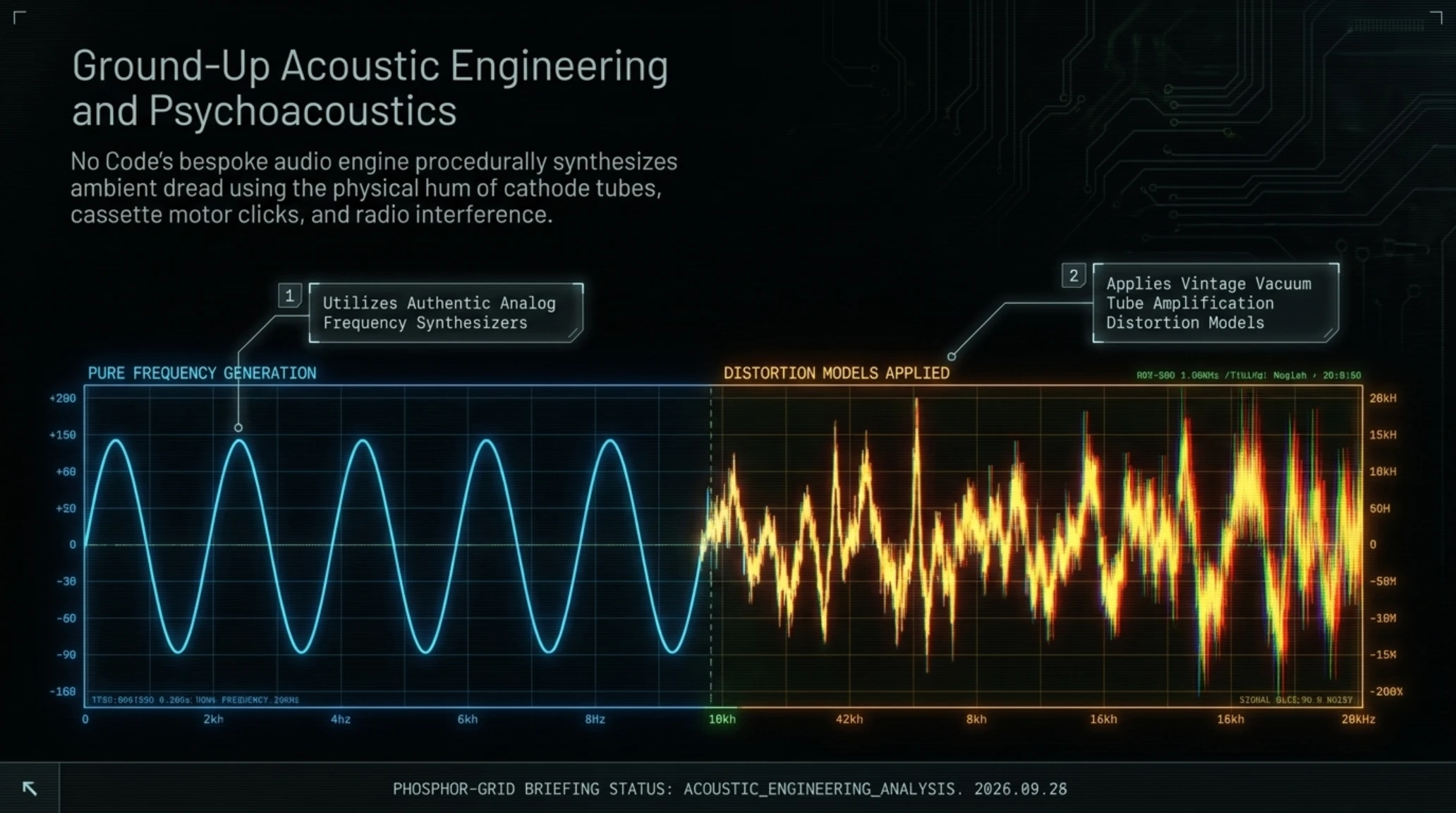
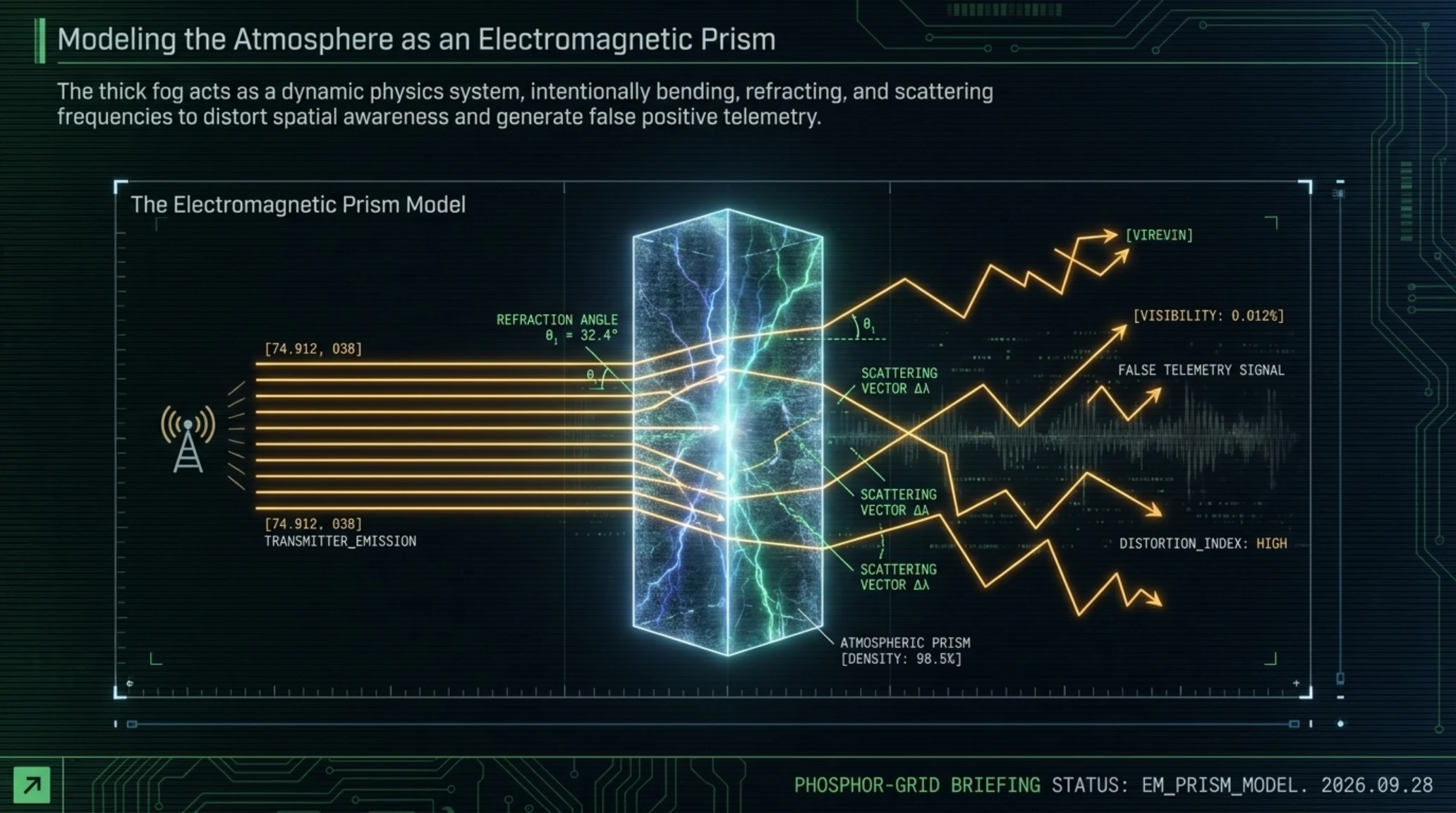
Acoustic engineering in Townfall has been constructed from the ground up utilizing authentic analog frequency synthesizers and vintage tube amplification distortion models. Ambient environmental audio is procedurally synthesized so that the audible hum of cathode tubes, the mechanical clicking of cassette drive motors, and the abrasive hiss of radio interference generate relentless psychoacoustic tension. McKellan elaborated that within Townfall's design philosophy, the thick fog operates not merely as a graphical occluder, but as a dynamic electromagnetic prism that bends, refracts, and scatters radio frequencies, intentionally distorting the player's spatial awareness and directional orientation.
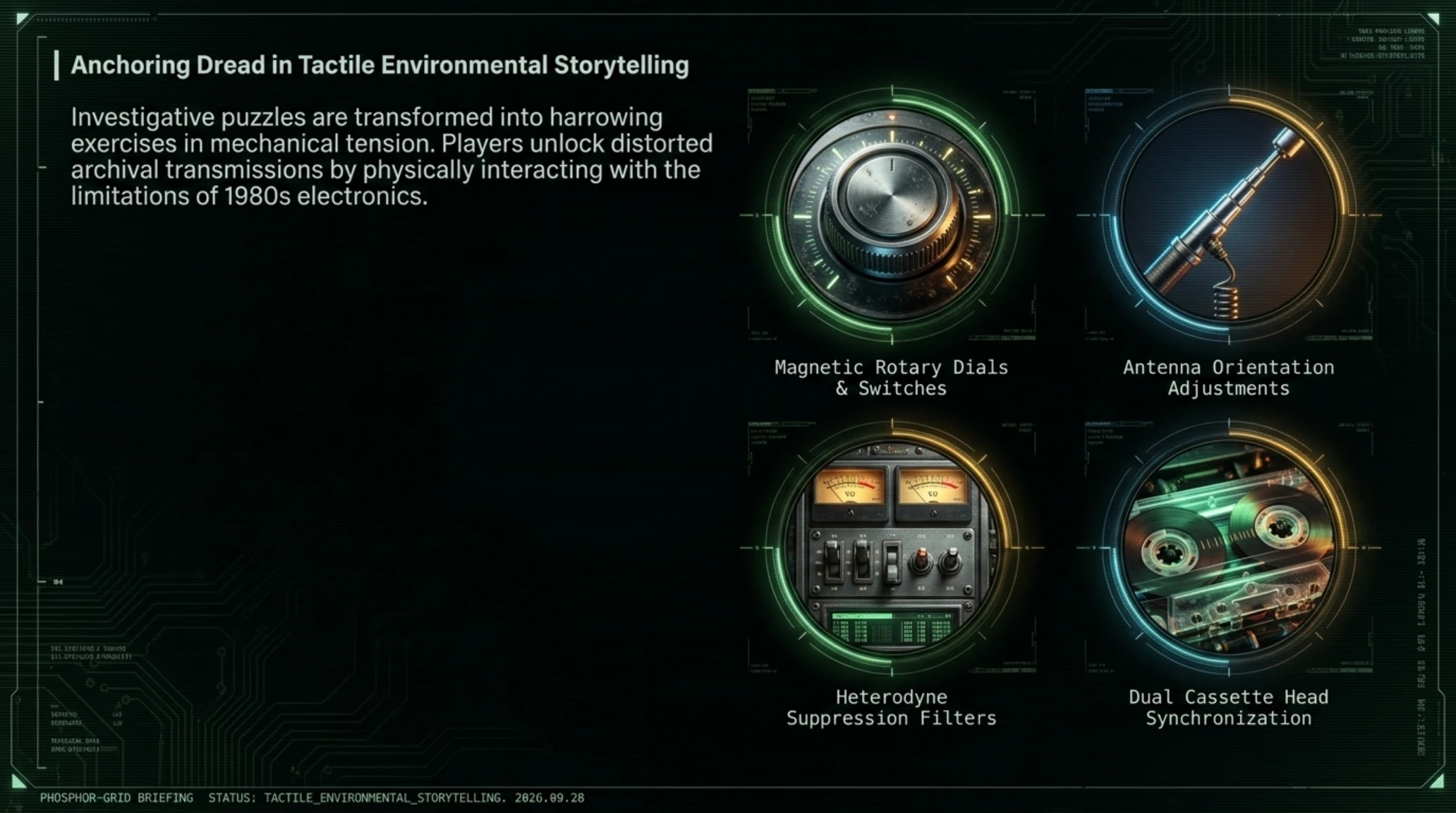
Furthermore, the environmental storytelling leverages tactile interaction with physical hardware switches, magnetic rotary dials, and cassette tape splicing. Players must physically manipulate antenna orientations, adjust heterodyne suppression filters, and synchronize audio tracks across dual cassette heads to unlock distorted archival transmissions from the town's vanished residents. This tactile immersion transforms routine investigative puzzles into harrowing exercises in sensory deprivation and mechanical tension, anchoring the horror deeply within the limitations of physical electronics.
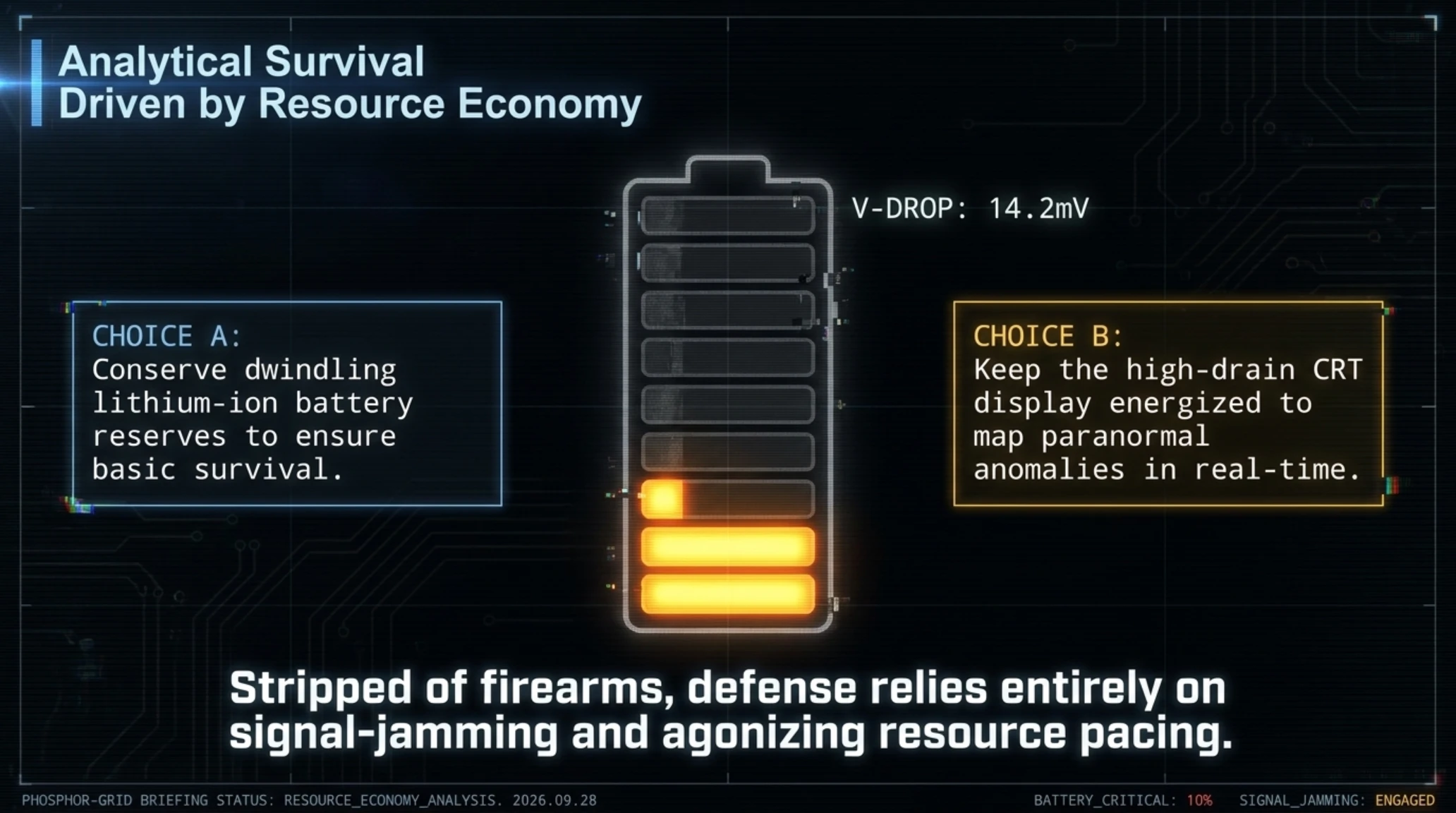
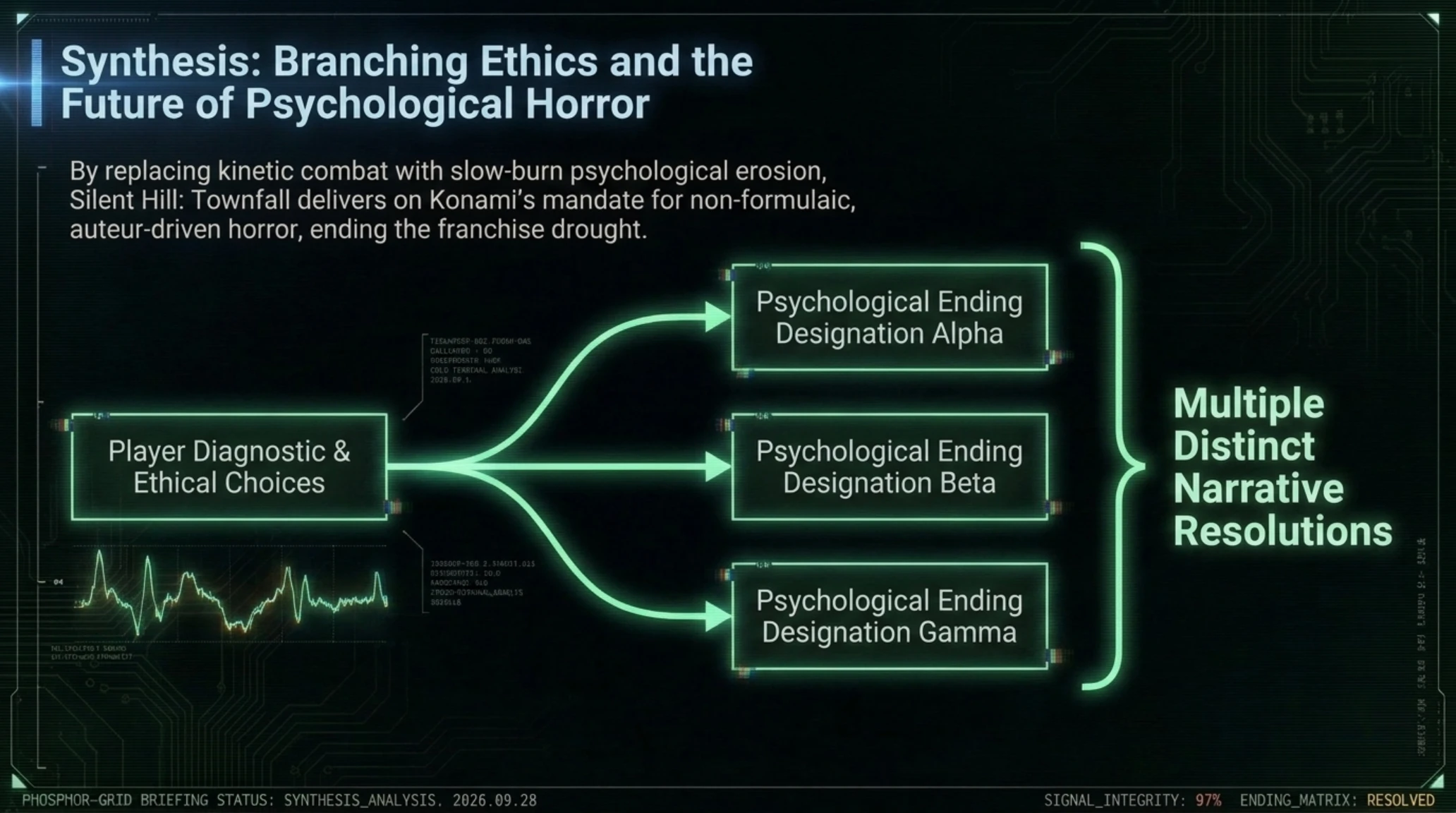
No Code's narrative design emphasizes slow-burn psychological erosion over kinetic combat. By stripping the protagonist of conventional firearms and replacing defensive mechanics with signal-jamming transmitters and frequency-nullifying radio decoys, the game forces players to engage in analytical survival. The player must choose between conserving dwindling lithium-ion battery reserves or keeping the CRT display energized to map paranormal anomalies in real time. This resource economy creates suffocating pacing, reinforcing the player's vulnerability in an indifferent, haunted landscape.
Why It Matters | Industry & Gamer Strategic Perspective
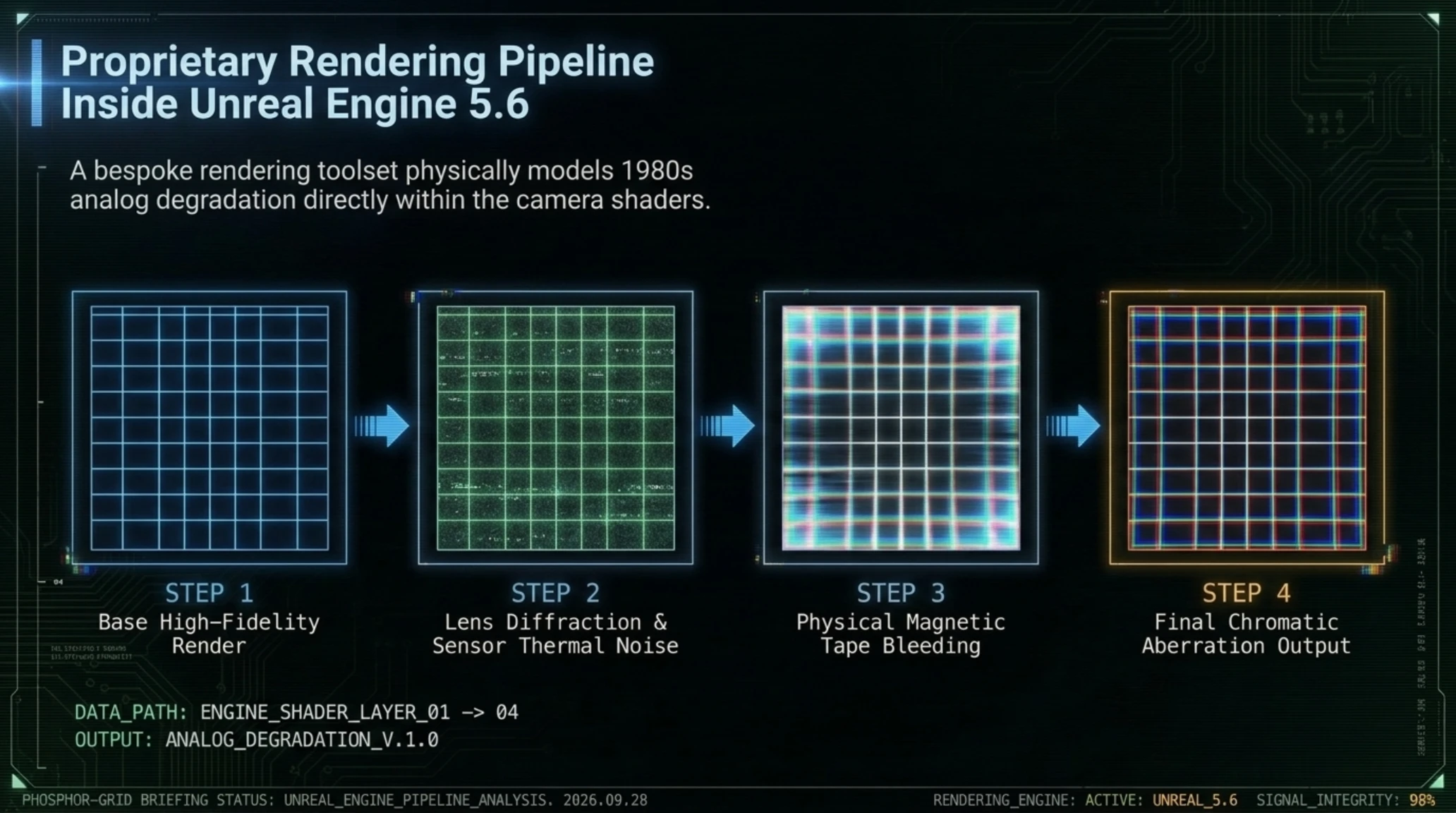
No Code has paired its bespoke audio engine with a heavily customized rendering pipeline operating inside Unreal Engine 5.6. This proprietary toolset physically models chromatic aberration, magnetic tape bleeding (VHS saturation bloom), lens diffraction, and sensor thermal noise directly within the camera shaders. Konami and Annapurna confirmed a targeted release window for the first quarter of 2027, promising a branching narrative structure with multiple distinct psychological endings dictated by the player's diagnostic and ethical choices throughout the ordeal.
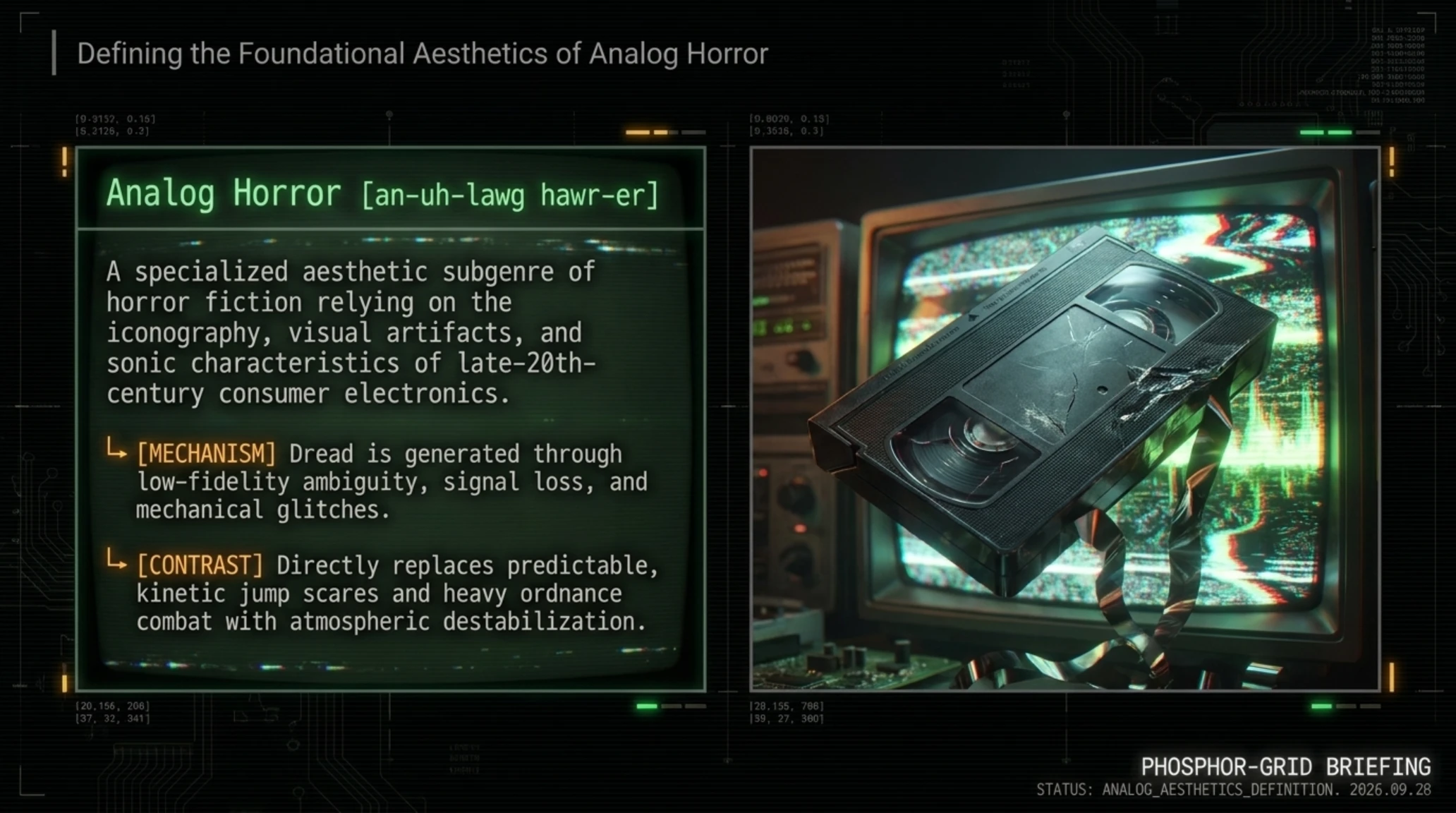
Jargon Buster | Analog Horror & Cathode Audio Design
Chet Faliszek's PAX West Confession: Valve Deliberately Leaked the Left 4 Dead 2 Cinematic Trailer to Evade ESRB Censorship
During the milestone 15th-anniversary celebration panel for Valve's iconic cooperative zombie shooter Left 4 Dead 2 at PAX West, legendary writer and game designer Chet Faliszek dropped a historic bombshell that stunned attendees and industry historians alike. Faliszek, who co-penned legendary narratives across the Half-Life, Portal, and Left 4 Dead franchises, revealed for the first time that the hyper-violent, blood-soaked debut cinematic trailer in the summer of 2009 which vividly depicted brutal melee dismemberment with fireaxes, chainsaws, and cricket bats was the result of a meticulously orchestrated "guerrilla inside leak" executed directly by Valve's executive leadership.
According to Faliszek's detailed account, the Entertainment Software Rating Board (ESRB) had reviewed the uncut promotional reel and formally warned Valve that public broadcast of the trailer would force an immediate "Adults Only" (AO 18+) rating upon the entire retail game. In 2009, an AO rating was an inescapable commercial death sentence; brick-and-mortar retail giants across North America, including Walmart, Target, and Best Buy, maintained strict corporate policies prohibiting the stocking and distribution of Adults Only interactive software. Faced with the devastating choice between sterilizing their artistic vision or suffering retail annihilation, Valve engineered an unprecedented counter-strategy.
Valve's calculated gamble paid monumental dividends. Rather than provoking regulatory sanctions, the illicit, unrated video spread organically across file-sharing networks, peer-to-peer trackers, and burgeoning video platforms, sparking unprecedented grassroots excitement. Players scrambled to mirror the high-definition footage, driving Steam and retail pre-orders up by an astonishing 400% within 48 hours. When the ESRB inevitably contacted Valve demanding explanations, company attorneys calmly pointed out that the promotional reel had not been officially distributed through corporate marketing channels, shielding the final retail SKU from the punitive AO designation.
Faliszek pointedly observed that such audacious, anti-establishment maneuvers have become virtually extinct in today's highly corporatized, risk-averse environment dominated by publicly traded conglomerates, Wall Street quarterly audits, and layers of corporate brand safety compliance. Valve's unique private ownership structure and Gabe Newell's sovereign autonomy allowed the studio to treat marketing not as sanitized corporate communications, but as a disruptive cultural event that directly energized its hardcore player base.
The tactical success of the Left 4 Dead 2 leak established a foundational blueprint for modern viral video game marketing. By turning regulatory resistance into an anti-authoritarian narrative, Valve transformed ordinary gamers into passionate evangelists who felt they were participating in an underground cultural movement rather than consuming a corporate advertisement. This historical precedent continues to be studied in contemporary entertainment marketing as the gold standard of organic player mobilization.
Rumor vs. Reality Meter | Strategic Dissection of Guerrilla Marketing Leaks
| Diagnostic Metric | Uncontrolled Hostile Breach | Engineered Guerrilla Marketing Leak |
|---|---|---|
| Underlying Strategic Objective | Financial extortion, ransomware, competitive sabotage | Bypassing regulatory bottlenecks, testing organic audience sentiment |
| Media Asset Polish & Fidelity | Fragmented source code, unoptimized builds, audio glitches | Pristine, master-rendered promotional video with full audio-visual polish |
| Corporate Legal Response | Immediate emergency DMCA takedowns, subpoenas, criminal referrals | Deliberate corporate silence, strategic ambiguity, encouraging viral discourse |
| Commercial Market Impact | Demoralized engineering teams, volatile investor panic | Exponential surge in organic pre-orders and sustained viral social media engagement |
| Regulatory Liability Exposure | Strict disclosure mandates and compliance investigations | Plausible deniability insulating commercial retail SKUs from punitive ratings |
Isar Aerospace's Spectrum Rocket Achieves Historic Orbital Flight; Europe Secures Commercial Launch Autonomy
At dawn today, the newly commissioned Andøya Spaceport, situated along the rugged Arctic coastline of northern Norway above the 69th parallel north, served as the launchpad for a watershed moment in international aerospace engineering. German commercial space pioneer Isar Aerospace successfully launched its two-stage Spectrum launch vehicle into Sun-Synchronous Orbit (SSO), claiming the historic title of the first fully privately developed and operated commercial orbital rocket in European history. This flawless orbital insertion dramatically alters the geopolitical landscape of space exploration, terminating years of total European dependence on American SpaceX Falcon 9 boosters following the protracted retirement crisis of Ariane 5 and structural delays in Ariane 6.
The Spectrum launch vehicle is powered by proprietary next-generation Aquila rocket engines. Every critical subsystem including high-pressure turbopumps, regenerative cooling jackets, and injector manifolds is fabricated entirely out of advanced Inconel superalloys using industrial-grade metal 3D printing (Selective Laser Melting). Furthermore, Isar Aerospace pioneered the operational deployment of high-purity Liquid Propane (C3H8) paired with sub-cooled Liquid Oxygen (LOX). This thermodynamic cycle boosts Specific Impulse (Isp) by 15% relative to legacy RP-1 kerosene while virtually eliminating soot deposition and coking inside the combustion chambers.
Engineering Specifications | Isar Aerospace Spectrum Orbital Rocket
| Engineering Parameter | Spectrum Vehicle Technical Metrics | Operational Advantage & Market Impact |
|---|---|---|
| Dimensions & Architecture | 28 meters height / 2.0 meters diameter carbon-composite fuselage | Standard transportability across European road and rail networks without specialized oversized permits |
| Propulsion Cluster | 9 Aquila engines (Stage 1) / 1 Vacuum-optimized Aquila (Stage 2) | Fully 3D-printed in under 72 hours; 90% reduction in individual mechanical moving parts |
| Payload Capacity | 1,000 kg to Low Earth Orbit (LEO) / 700 kg to Sun-Synchronous Orbit (SSO) | Optimized for dedicated small-satellite mega-constellations, Earth observation, and CubeSat deployments |
| Propellant Chemistry | Clean Liquid Propane (C3H8) + Sub-cooled Liquid Oxygen (LOX) | 70% reduction in pad fueling costs, superior high-density cryogenic stability in Arctic conditions |
| Orbital Injection Precision | Autonomous GPS/INS closed-loop guidance with cold-gas RCS | Sub-kilometer orbital insertion accuracy tailored for dedicated multi-payload rideshares |
Speaking at the post-launch press conference overlooking the Norwegian Sea, Daniel Metzler, CEO and Co-Founder of Isar Aerospace, confirmed that Spectrum has achieved a commercial launch pricing benchmark of under €9,000 per kilogram to Low Earth Orbit. This unprecedented cost reduction empowers European Union member states, commercial satellite operators, and academic research institutions to deploy sovereign reconnaissance, telecommunications, and climate-monitoring assets directly from continental European soil without navigating congested American launch queues or geopolitical export controls.
The success of the Andøya launch also establishes a crucial technological proving ground for European orbital infrastructure. By validating liquid propane as an efficient, low-corrosion propellant in sub-zero Arctic conditions, Isar Aerospace has demonstrated that regional launch complexes can operate with minimal ground-support infrastructure, radically shortening launch preparation timelines from months to days. European aerospace strategists view this operational agility as vital for rapid-response satellite replenishment during geopolitical crises.
NASA Expands Deep Space Network with 70-Meter Giant Dish in California Desert; Gigabit Telemetry Highway for Artemis & Mars
NASA's Jet Propulsion Laboratory (JPL) at the Goldstone Deep Space Communications Complex in California's arid Mojave Desert officially announced the full operational commissioning of its colossal, newly constructed 70-meter parabolic aperture antenna. Designated as Deep Space Station 14B (DSS-14B), this monumental feat of radio and RF engineering represents the centerpiece of NASA's inter-agency infrastructure modernization initiative, engineered specifically to resolve severe spectral congestion across deep space communication networks supporting dozens of concurrent missions exploring the Moon, Mars, Jupiter's icy moons, and the outer solar system.
The state-of-the-art DSS-14B reflector is integrated with liquid-helium cryogenic maser receivers chilled to near absolute zero (-269°C / 4 Kelvin) to completely suppress thermal Johnson-Nyquist noise, alongside ultra-high-power Ka-band microwave transmitters operating across the 26 to 40 GHz spectrum. Furthermore, the facility incorporates a cutting-edge hybrid optical/laser transceiver terminal. This revolutionary hybrid architecture elevates sustained lunar orbital data transmission throughput beyond 100 Mbps while expanding direct-to-Earth video and high-resolution hyperspectral sensor bandwidth from Martian rovers by more than tenfold compared to legacy X-band deep-space telemetry links.
📚 Classified & Related Dossiers in TekinGame
If you wish to explore beyond this report and delve into cybernetic frontiers and autonomous AI architectures, do not miss these three exclusive deep-dives in the Tekin Garage:
Technical Metrics & Infrastructure | NASA Deep Space Network 70-Meter DSS-14B
| Engineering & RF Parameter | Metric & Performance Value | Deep Space Mission Application |
|---|---|---|
| Main Reflector Aperture | 70 Meters (Parabolic Dish) | Massive signal surface area for weak cosmic signal reception |
| Microwave Uplink Power | 40 Kilowatts (Ka-Band Output) | High-penetration command transmission to distant spacecraft |
| Martian Telemetry Capacity | 10x Bandwidth Expansion | Rapid downlink of hyperspectral cubes and 3D terrain models |
| Lunar Direct Downlink | 100+ Mbps Sustained Rate | Uninterrupted live 4K broadcast for Artemis lunar outposts |
Senior flight directors for NASA's Artemis lunar campaign emphasized that continuous, uncompressed 4K Ultra-HD broadcast streaming of crewed surface landings at the lunar South Pole, real-time autonomous navigation of heavy robotic regolith mining platforms, uninterrupted multi-channel audio communications with the Lunar Gateway orbital habitat, and the high-speed downlink of complex genomic and astrophysical scientific datasets were fundamentally impossible without this infrastructure expansion. Operating in seamless tripartite synchronization with twin deep-space complexes in Madrid, Spain, and Canberra, Australia, NASA has cemented 360-degree, zero-blindspot planetary communications coverage for humanity's permanent return to deep space.
Beyond lunar operations, the DSS-14B facility acts as a mission-critical bridge for interplanetary exploration. The antenna's hybrid optical communications subsystem utilizes sub-nanoradian pointing precision to lock onto near-infrared laser beams transmitted across hundreds of millions of kilometers of interplanetary void. This capability will enable the upcoming Europa Clipper and Mars Sample Return missions to stream raw hyperspectral image cubes and 3D terrain topography maps directly to Earth-based science teams in minutes rather than weeks of agonizing trickle downlinks.
In addition to active interplanetary communications, the DSS-14B system serves as an ultra-sensitive planetary radar for planetary defense initiatives. By transmitting high-power microwave pulses toward near-Earth asteroids (NEOs) and measuring Doppler shifts in the reflected radar echoes, NASA can calculate asteroid trajectories and orbital eccentricities with sub-meter precision decades in advance, providing essential warning windows against potential collision hazards.
The Seattle Times and Newsday Sue OpenAI and Microsoft in Federal Court; AI Copyright Battle Reaches Boiling Point
Two of the most venerable and Pulitzer Prize-winning institutions in American journalism The Seattle Times and Long Island's Newsday have jointly filed a comprehensive federal copyright infringement lawsuit in the U.S. District Court for the Southern District of New York against OpenAI and Microsoft Corporation. The meticulously documented 68-page complaint alleges that the defendants systematically and illegally scraped millions of copyrighted investigative exposés, proprietary local reporting archives, and exclusive editorial analyses without obtaining commercial licenses, seeking legal consent, or providing financial compensation, using the stolen intellectual property to train foundation models including GPT-5 and power interactive Copilot services.
The lawsuit details how generative search features such as SearchGPT and Bing Copilot AI Overviews actively synthesize full-text answers directly from the plaintiffs' hard-hitting journalism. By presenting synthesized summaries, key findings, and analytical conclusions within the conversational interface, the AI systems disincentivize users from clicking through to source websites, directly starving regional newspapers of essential digital advertising revenue, affiliate impressions, and paid subscription conversions. As previously analyzed in our investigative dossier on the AI infrastructure pricing crisis and subscription dynamics, this parasitic synthesis threatens the foundational financial viability of independent journalism.
The complaint includes striking forensic evidence comparing side-by-side prompt responses where ChatGPT reproduced word-for-word paragraphs from investigative reports on regional aerospace safety and municipal corruption. Legal counsel for the publishers argued that this constitutes commercial misappropriation and market substitution under Title 17 of the United States Code, directly destroying the commercial value of investigative journalism assets that required decades of capital investment and journalistic labor to create.
Legal scholars tracking the litigation note that the consolidation of regional publishers creates substantial precedent risks for Big Tech. Unlike previous settlements where OpenAI negotiated bilateral licensing agreements with a handful of international media conglomerates, regional publishers are pushing for class-wide statutory damages and court-mandated audits of pre-training dataset provenance. If the Southern District of New York rejects Microsoft's Fair Use defense, frontier model creators could be compelled to excise entire training corpuses or submit to mandatory copyright clearinghouse royalty frameworks.
Tekin Editorial Analysis | The End of Free Scraping & The Impending AI Token Tax
Satoshi-Era Bitcoin Whale Awakens After 16-Year Dormancy; 600 Vintage 2010 Bitcoins Transferred ($48.6M)
Automated blockchain intelligence systems and on-chain forensic analysts at Whale Alert and Arkham Intelligence flagged an extraordinarily rare and historic layer-one Bitcoin network event earlier today. Twelve ancient, completely untouched wallet addresses dating back to the earliest genesis era of Satoshi Nakamoto's active network participation specifically holding block mining rewards (Coinbase Rewards) from blocks 70,000 through 72,500 mined in August and September of 2010 initiated their first-ever outgoing transactions after more than 16 years of absolute cryptographic dormancy.
In total, 600 pristine, unspent transaction outputs (Virgin UTXOs) worth a combined total of less than $50 when originally mined on personal desktop CPUs in late 2010 were systematically consolidated and routed into newly generated Pay-to-Taproot (P2TR / bc1p) addresses. The total market valuation of these transferred assets stood at $48.6 million at the time of execution. Prominent on-chain security researchers emphasize that this strategic migration was primarily driven by the imperative to modernize key cryptographic security schemes against future post-quantum decryption vectors threatening legacy Pay-to-Public-Key (P2PK) scripts, as well as institutional preparation for discreet off-market over-the-counter (OTC) block settlements.
Cryptographic analysis reveals that legacy 2010 coinbase transactions exposed uncompressed public keys directly on the ledger. Migrating these vintage coins to Taproot addresses utilizing Schnorr signatures (BIP 340/341/342) significantly enhances on-chain privacy, reduces transaction byte overhead, and eliminates public-key exposure prior to spending. On-chain cluster mapping further indicates that the recipient wallets utilize multi-signature threshold schemes (MuSig2), suggesting that the holder may be integrating with regulated institutional custodial frameworks or estate planning trusts.
Macroeconomists specializing in digital asset liquidity note that vintage coin awakenings provide profound empirical insights into early adopter demographics. Rather than dumping onto speculative order books, the discipline exhibited by decade-long holders reinforces Bitcoin's structural narrative as institutional-grade pristine collateral. The methodical re-encryption of vintage UTXOs demonstrates a high degree of technical sophistication, pointing toward sovereign wealth allocation or intergenerational wealth transfer rather than distressed retail liquidation.
On-Chain Financial Ledger | 2010 Satoshi-Era Bitcoin Whale Migration
| On-Chain Analytical Parameter | Genesis Era State (September 2010) | Current Migration State (September 2026) |
|---|---|---|
| Total Token Volume Moved | 600 Vintage Bitcoins (12x 50 BTC Block Rewards) | 600 Pristine, Unspent UTXO Tokens |
| Total Aggregate USD Valuation | Approximately $36.00 USD | $48,600,000.00 USD |
| Source vs. Destination Scripts | Legacy Uncompressed P2PK (Pay-to-Public-Key) | Modern Schnorr-based Taproot (P2TR / bc1p) |
| Capital Appreciation Multiplier | Price Per Unit: $0.06 USD | Price Per Unit: $81,000 USD (+135,000,000%) |
| Primary Strategic Settlement Path | Solo CPU hobbyist mining on home desktops | Institutional multi-sig cold custody and dark-pool OTC desks |
| On-Chain Cryptographic Overhead | High byte weight / exposed raw ECDSA pubkeys | Aggregated Schnorr signatures / post-quantum resistance |
This unprecedented on-chain awakening has reignited intense institutional scrutiny surrounding the massive reserve of dormant Satoshi-era supply. According to latest macro data from Glassnode, over 1.8 million Bitcoins mined between 2009 and 2011 remain strictly unmoved in their original generation addresses, with at least 1.1 million coins attributed directly to the cryptographic signatures of Satoshi Nakamoto and the earliest pioneering cypherpunk contributors.
Digital Asset Market Sentiment Thermometer
- Sustainable revitalization of the Silent Hill franchise through analog psychological horror rather than generic action formulas
- Breakthrough commercial orbital launch autonomy for Europe, slashing launch costs below €9,000/kg
- Dramatic 10x bandwidth expansion for NASA deep space infrastructure supporting permanent lunar outposts
- Escalating legal risks for foundational AI developers potentially inflating API subscription pricing
- Transient market volatility driven by unpredictable awakenings of multi-million-dollar vintage Bitcoin whale reserves
Related Tech Intelligence on Tekin Game
• 🌙 Tekin Night | Call of Duty, Nintendo & Vision Pro Digest
• 🎭 Tekin Analysis | Apple AI Teardown & July 2026 Digest
• 🌙 Tekin Night | NVIDIA $500B Deal & iPhone 18 Leak
Morning Executive Summary & Closing Perspectives | September 7, 2026
Frequently Asked Questions | Morning Executive Briefing
How does Silent Hill: Townfall fundamentally differ from recent franchise remakes?
Silent Hill: Townfall is being developed by Scottish studio No Code as an original first-person psychological survival horror title centered on 1980s analog CRT hardware, oscilloscope wave mechanics, and radio-frequency diagnostics, contrasting with the third-person over-the-shoulder action-horror orientation of the Silent Hill 2 remake.
Why is Isar Aerospace's Spectrum launch considered a historic geopolitical turning point for Europe?
Spectrum is the first 100% privately funded and operated commercial orbital rocket launched directly from European territory (Andøya, Norway), establishing independent satellite deployment capabilities and ending Europe's total reliance on American launch providers like SpaceX.
What is the strategic significance of the 600 vintage 2010 Bitcoins migrating to Taproot addresses?
These coins originate from mining rewards generated during Satoshi Nakamoto's active leadership era in 2010. Moving them after 16 years to Pay-to-Taproot (P2TR) scripts upgrades their cryptographic defenses against quantum decryption while organizing liquidity for secure off-market OTC execution.
What are The Seattle Times and Newsday seeking in their federal lawsuit against OpenAI and Microsoft?
The publishers seek statutory damages, fair compensation for unlicensed archival scraping used in training models like GPT-5, and an injunction against AI search engines synthesizing generative summaries that bypass newspaper websites and cannibalize subscription and advertising revenues.
Official Intelligence Sources & Verified Repositories
Additional Gallery: ☀️ Tekin Morning Sept 7, 2026 | Silent Hill Roadmap, L4D2 Leak & NASA Dish