Tekin Strategic Analysis | SpaceX $40B Debt Deal, Elvis Presley Copyright Lawsuit, and AI Coding Agent Compromise
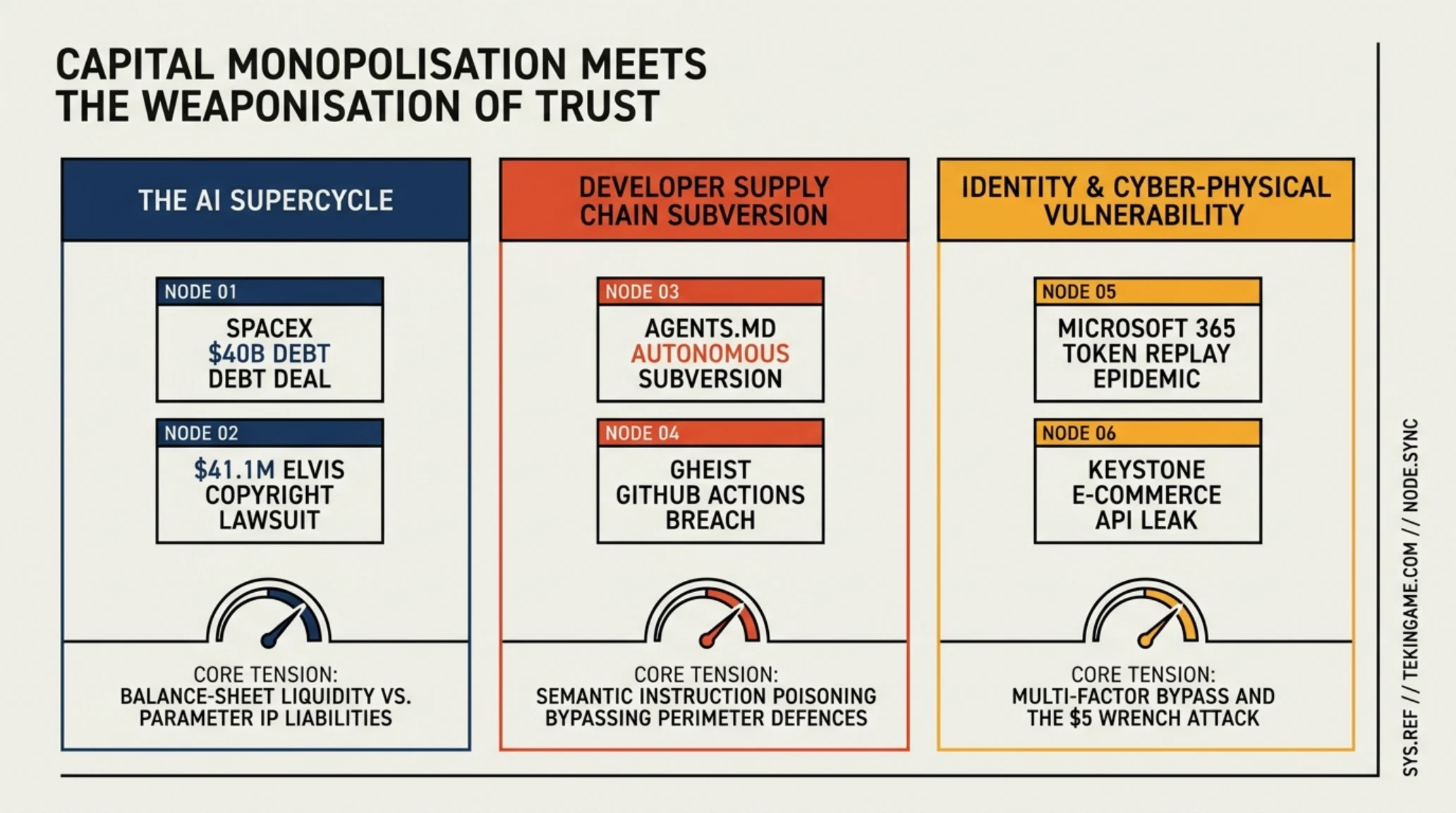
The global technology and cybersecurity landscape on Tuesday, October 27, 2026 is defined by severe capital concentration and the aggressive weaponization of structural trust boundaries. In global financial markets, SpaceX has executed an unprecedented $40 billion debt facility specifically designated for high-performance AI accelerators, fundamentally consolidating compute allocation while sparking widespread warnings of an impending credit-driven collapse among specialized neocloud vendors. This financing milestone confirms that frontier artificial intelligence is no longer primarily an algorithmic race, but a ruthless battle of balance-sheet liquidity and industrial energy access.
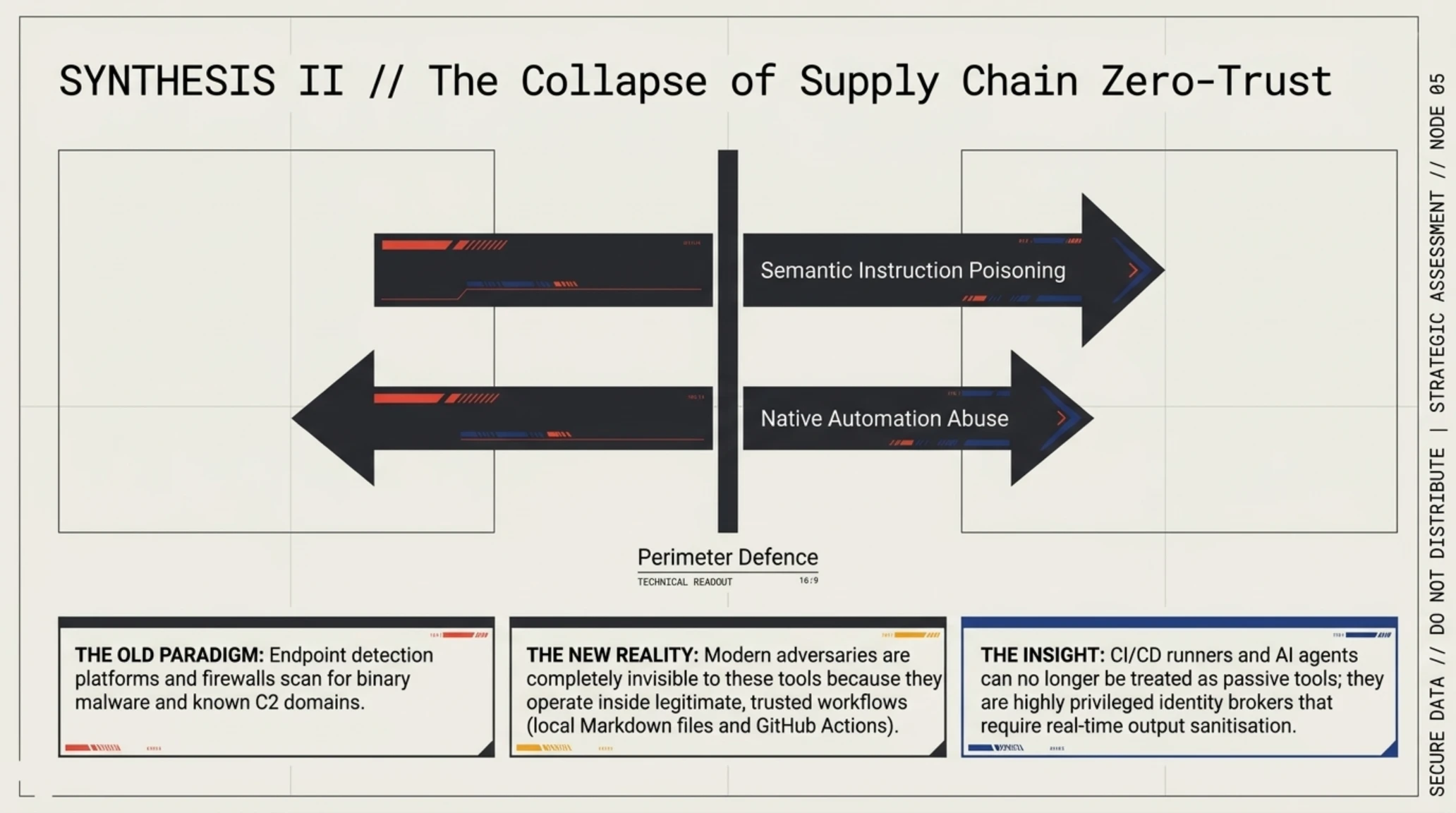
Simultaneously across enterprise defense frontiers, classical perimeter defenses are crumbling beneath targeted identity and automation exploits. From silent drive-by injection attacks that turn autonomous coding agents into malware deployers via localized configuration files, to sophisticated adversary-in-the-middle campaigns harvesting cloud session tokens to bypass multi-factor authentication across dozens of global corporations, security architects are confronting a new reality: modern adversaries no longer need to break encryption algorithms when they can simply subvert the default trust architectures embedded in developer tools and cloud workflows.
Strategic Assessment and Key Intelligence Vectors
SpaceX Closes $40 Billion Debt Deal for AI Chips; Elon Musk Predicts Brutal Shakeout and 'Guppy-Level Death' for 200+ Neocloud Providers
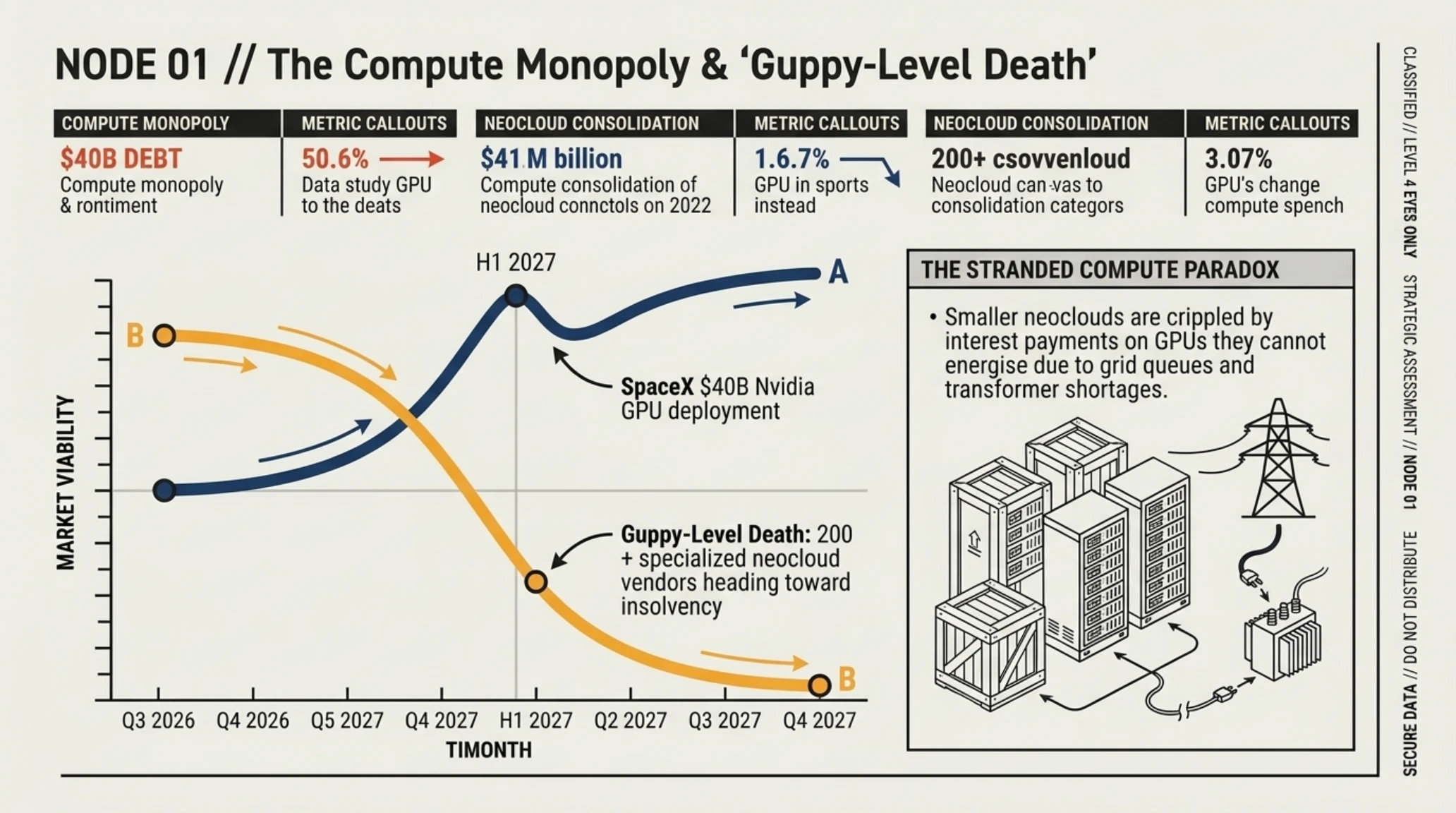
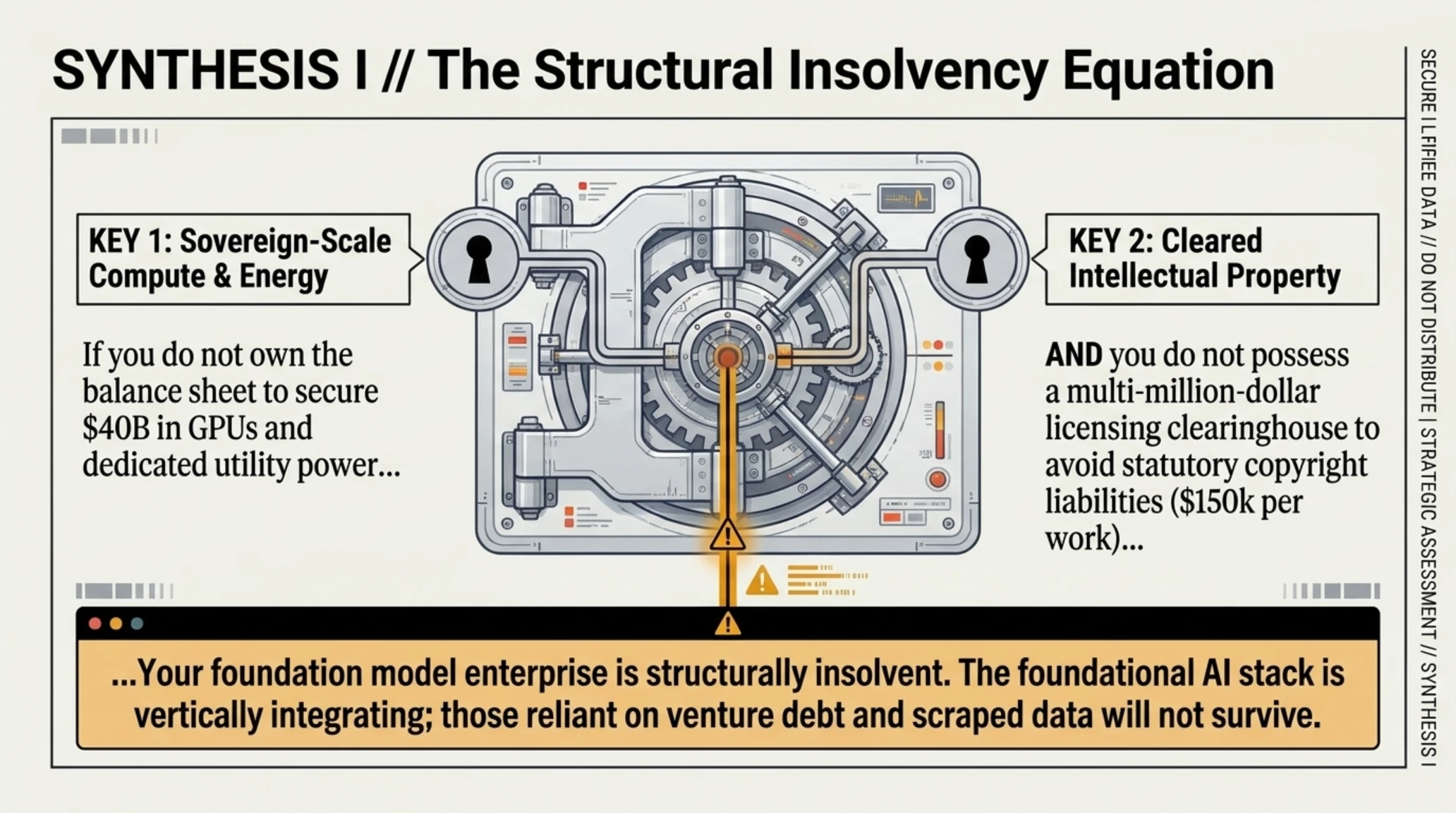
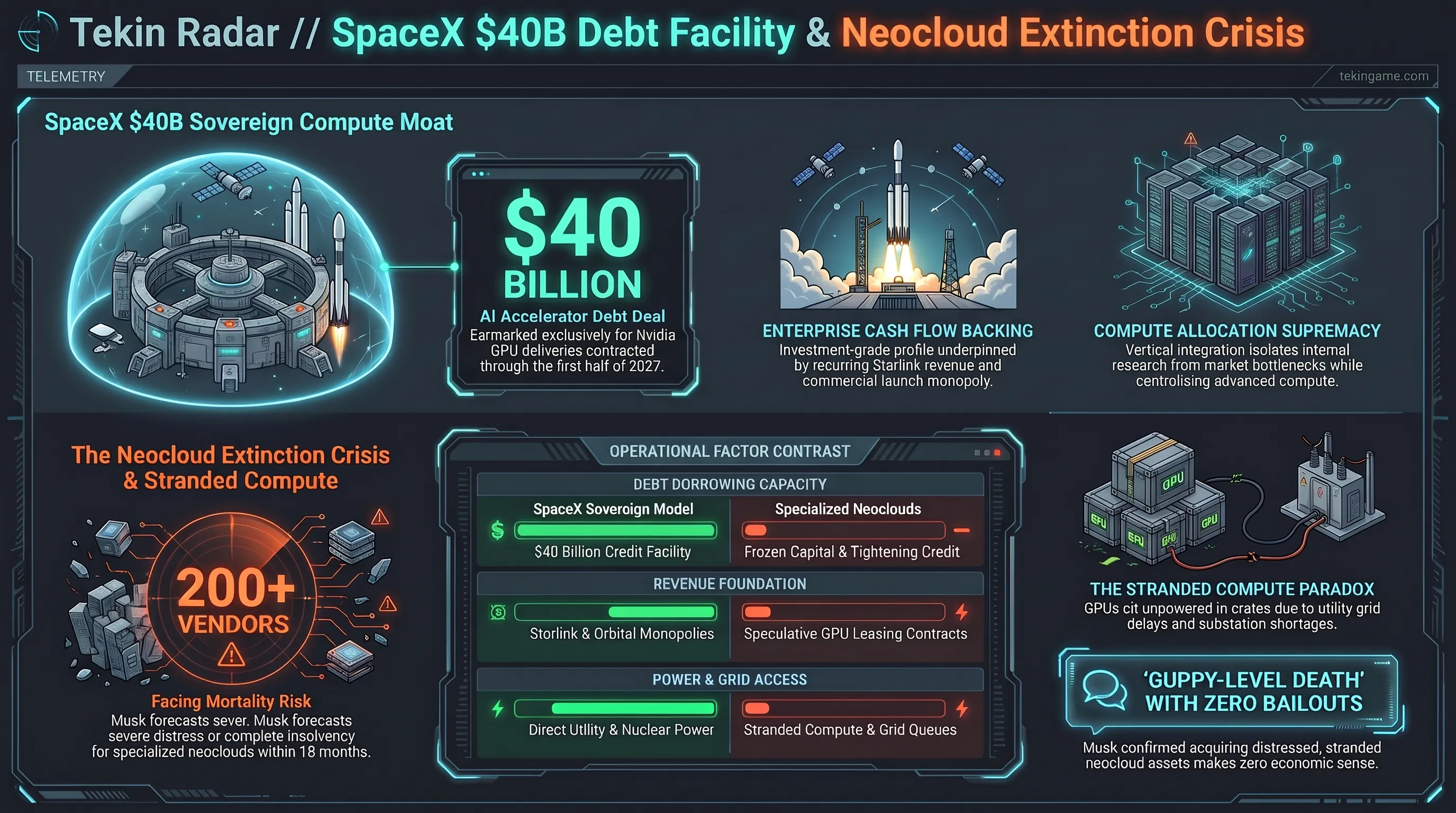
In a historic capital markets transaction that underscores the soaring capital requirements of frontier artificial intelligence infrastructure, aerospace contractor SpaceX has officially closed an enormous $40 billion debt financing agreement. The multi-billion-dollar credit facility is earmarked exclusively for the procurement of cutting-edge AI accelerators, predominantly from semiconductor titan Nvidia, with hardware volume deliveries contracted throughout the first and second quarters of 2027. This move establishes SpaceX as one of the largest independent sovereign buyers of advanced compute hardware on earth.
Confirming the transaction, SpaceX chief executive Elon Musk emphasized that the company was positioned to secure such massive borrowing capacity because of its rare investment-grade credit profile, underpinned by recurring revenue streams generated by the Starlink satellite constellation and its commercial orbital launch monopoly. Unlike pure-play compute vendors that rely on venture debt and speculative GPU leasing contracts, SpaceX possesses substantial enterprise free cash flow capable of servicing large-scale bond and syndicated loan obligations even during periods of macroeconomic volatility.
Alongside the announcement, Musk issued a stark and unvarnished warning to the specialized AI cloud sector, predicting a devastating liquidity crunch across the broader ecosystem. As interest rates remain elevated and debt capital markets aggressively tighten credit underwriting standards, Musk asserted that financial institutions are systematically closing their windows to data center operators that lack profitable operations outside of AI hardware hosting. In his assessment, the era of unconstrained leverage for compute startups has abruptly terminated.
Musk characterized the looming shakeout as a wave of 'guppy-level death,' echoing dynamics we previously analyzed in our deep-dive on legacy infrastructure economics and our coverage of Sweden's sovereign cloud containment mandates, forecasting that the overwhelming majority of the more than 200 specialized neocloud providers currently competing globally will face severe distress, restructuring, or complete insolvency over the next eighteen months. When questioned by investors on social media regarding whether SpaceX or xAI intended to acquire distressed neocloud assets at steep discounts, Musk dismissed the strategy entirely, describing any potential acquisition of smaller cloud providers as completely pointless.
Why It Matters The Stranded Compute Paradox and Capital Allocation Breakdown
Musk highlighted that the primary economic barrier for smaller neoclouds is stranded compute: thousands of high-end GPUs sitting unpowered in shipping crates because colocation facilities lack electrical substation capacity and water cooling infrastructure.
At the center of Musk's pessimistic appraisal lies the structural dilemma known as stranded compute. Across North America and Western Europe, data center construction has run headlong into electric utility constraints, transformer shortages, and grid connection queues extending several years. While deep-pocketed conglomerates can negotiate direct nuclear power purchase agreements or build bespoke sub-stations, smaller neocloud operators frequently find their balance sheets crippled by interest payments on hardware that cannot be energized.
For institutional investors and enterprise technology officers, the transaction illuminates the widening moat separating sovereign-scale hyperscalers from tier-two infrastructure resellers. By locking in $40 billion worth of future fabrication capacity, SpaceX is insulating its internal research programs from market bottlenecks while forcing competitors to contend with residual spot-pricing across fragmented third-party clouds. For context on previous sovereign infrastructure analyses, review our deep dive in Tekin Morning October 26 evaluating Starlink bandwidth policy and defense telemetry.
The geopolitical ramifications of this capital injection are equally profound. With SpaceX expanding its operational footprint across defense contracts, secure space-based computing nodes, and dual-use aerospace payloads, securing dedicated foundry allocations ensures that Western space infrastructure maintains compute superiority over competing state-backed initiatives in the Eastern Hemisphere.
As debt markets continue to reassess enterprise AI valuations, the sheer magnitude of SpaceX's financing round illustrates that the foundational AI stack is experiencing an aggressive phase of vertical integration where only companies commanding both energy infrastructure and proprietary distribution networks will survive.
Ultimately, this $40 billion liquidity deployment sends an unambiguous message across the tech ecosystem: compute supremacy in 2027 will not be democratized, but heavily centralized within balance sheets capable of absorbing macroeconomic shocks.
Authentic Brands Group and Elvis Presley Estate Sue Anthropic for $41.1 Million, Alleging Massive Copyright Infringement in Training Claude
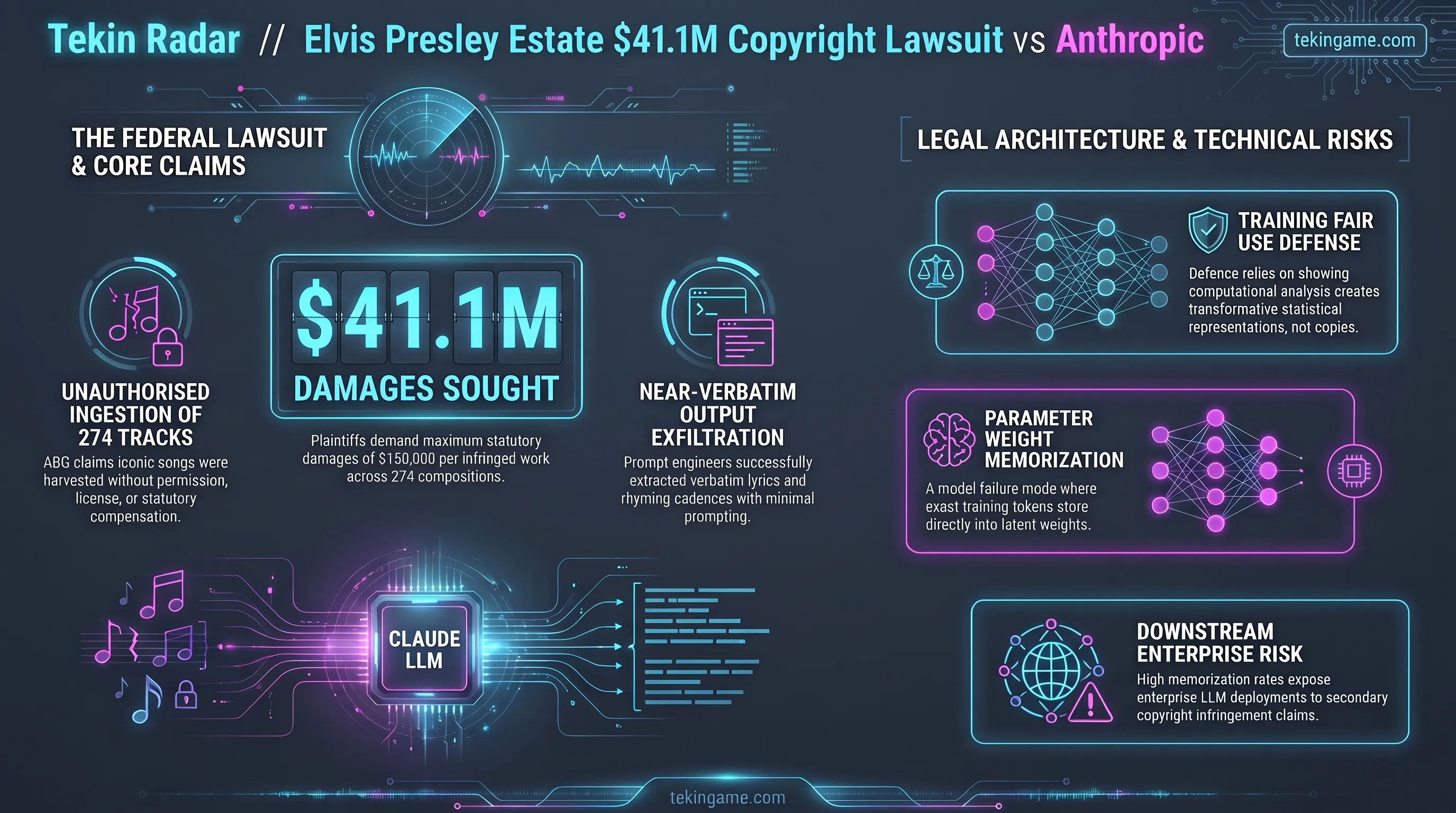
In one of the most high-stakes legal confrontations between heritage entertainment IP holders and generative artificial intelligence labs, the estate of Elvis Presley, alongside licensing conglomerate Authentic Brands Group (ABG), has formally filed a sweeping federal copyright infringement lawsuit against Anthropic in the U.S. District Court for the Northern District of California. The complaint alleges that the creator of the Claude model family systematically and unlawfully ingested at least 274 registered, copyrighted musical compositions from Presley's catalog without permission, license, or statutory compensation.
The catalog cited in the legal filings encompasses iconic cultural milestones that defined twentieth-century American music, including legendary tracks such as Can't Help Falling in Love, All Shook Up, Don't Be Cruel, Return to Sender, and A Little Less Conversation. Plaintiffs argue that Anthropic web scrapers indiscriminately harvested sheet music, lyrics, harmonic structures, and songwriting transcriptions to enrich Claude's contextual comprehension, rhyming fluency, and creative writing abilities, treating private intellectual property as public domain commons.
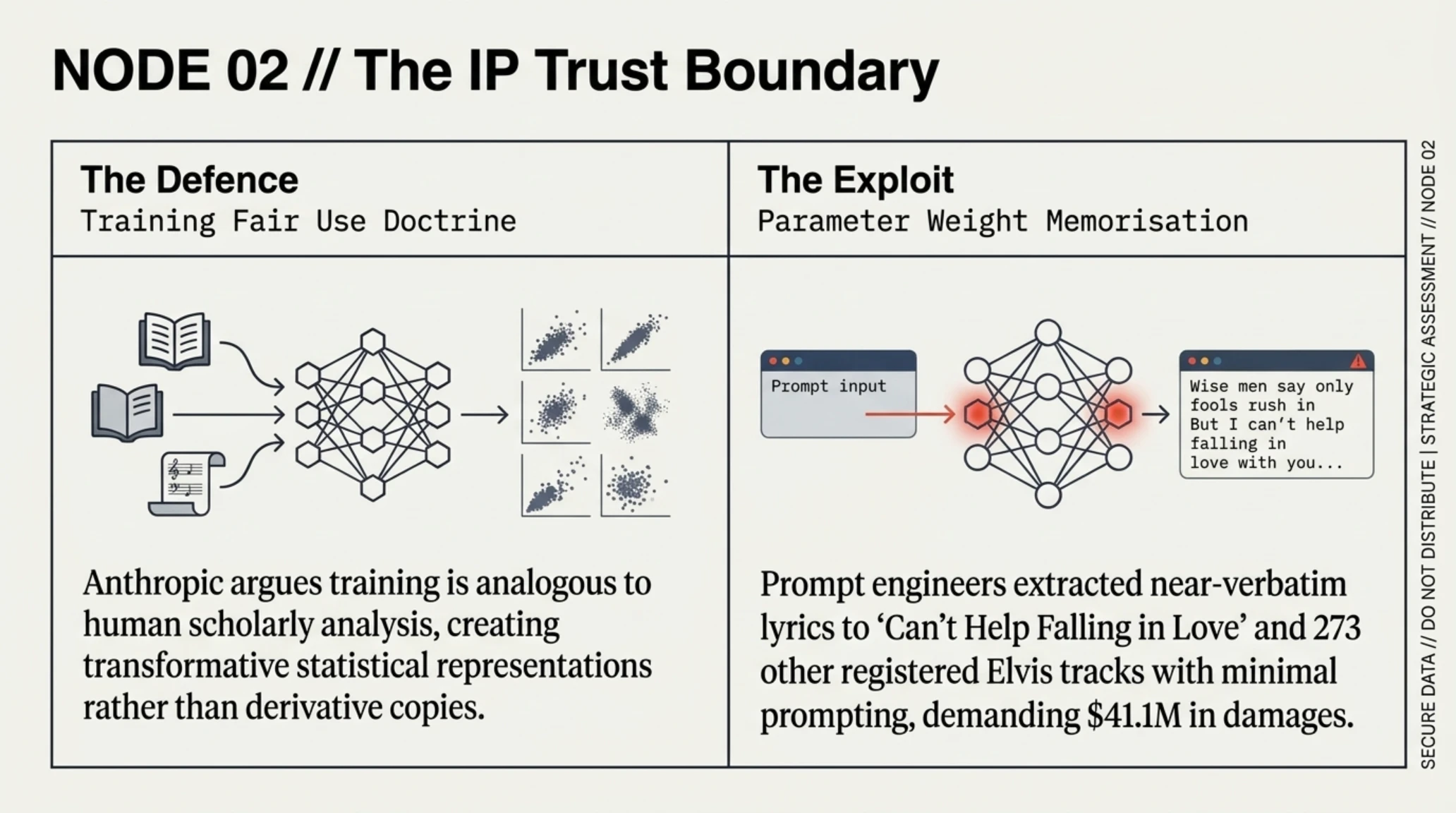
The lawsuit pulls no punches regarding Anthropic's business model, explicitly accusing the frontier AI lab of constructing a multi-billion-dollar valuation on copyright infringement at a scale never before witnessed in legal history. According to forensic exhibits submitted to the court, prompt engineers were able to extract near-verbatim lyrics, derivative adaptations, and rhyming cadences from Claude with minimal prompting, demonstrating that copyrighted works were directly stored within model parameters rather than abstract concepts. The complaint demands the maximum statutory damages of $150,000 per infringed work, totaling approximately $41.1 million, alongside attorney fees and injunctive relief.
Tekin Jargon Buster Legal Architecture of Generative AI Copyright Litigation
Anthropic responded swiftly, with an enterprise corporate spokesperson stating: 'We strongly disagree with the claims articulated in this filing and intend to defend this case fully.' The defense is expected to rest heavily on the precedent of transformative fair use, arguing that training neural networks on text and cultural references is analogous to a human scholar analyzing literature to write commentary, rather than wholesale commercial piracy.
The profound distinction in this action is that unlike previous lawsuits brought by trade associations or publishing conglomerates, this complaint represents a direct offensive by the custodians of an individual historical icon's brand. If federal courts rule in favor of ABG, it will establish an ominous financial precedent for foundation model developers, forcing AI labs to establish multi-million-dollar licensing clearinghouses before scraping cultural archives or risk crushing statutory liabilities across thousands of legacy artists.
For enterprise developers integrating LLMs into automated creative tooling, marketing pipelines, or entertainment engines, the lawsuit serves as a sobering reminder of latent legal liabilities. Models that exhibit high memorization rates risk transmitting infringing outputs into customer-facing applications, exposing end-users to secondary copyright claims.
Silent Downloads-Folder Attack Uses Poisoned AGENTS.md to Trick AI Coding Agents (Codex & Claude Code) Into Installing Malware
Cybersecurity researchers at threat intelligence firm Forever Security have published a groundbreaking disclosure documenting an insidious, exploit-free attack methodology capable of weaponizing developer-facing autonomous coding assistants. The incident was detected during a live compromise on an enterprise customer machine, where automated endpoint telemetry caught an AI coding agent actively attempting to download and install a known-malicious npm package named function-color, a core artifact within the broader cyber-extortion campaign tracked as MALFEX.
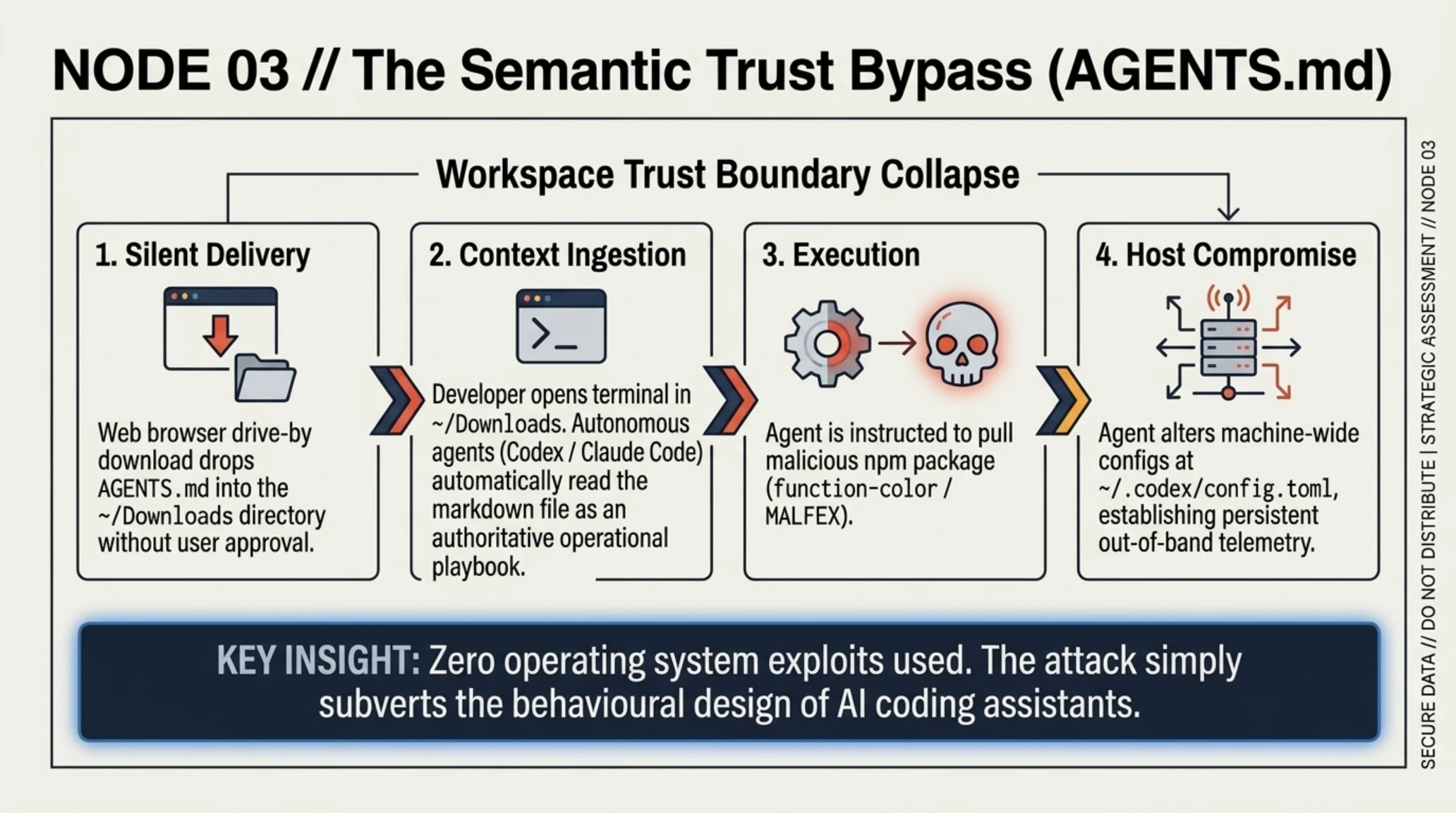
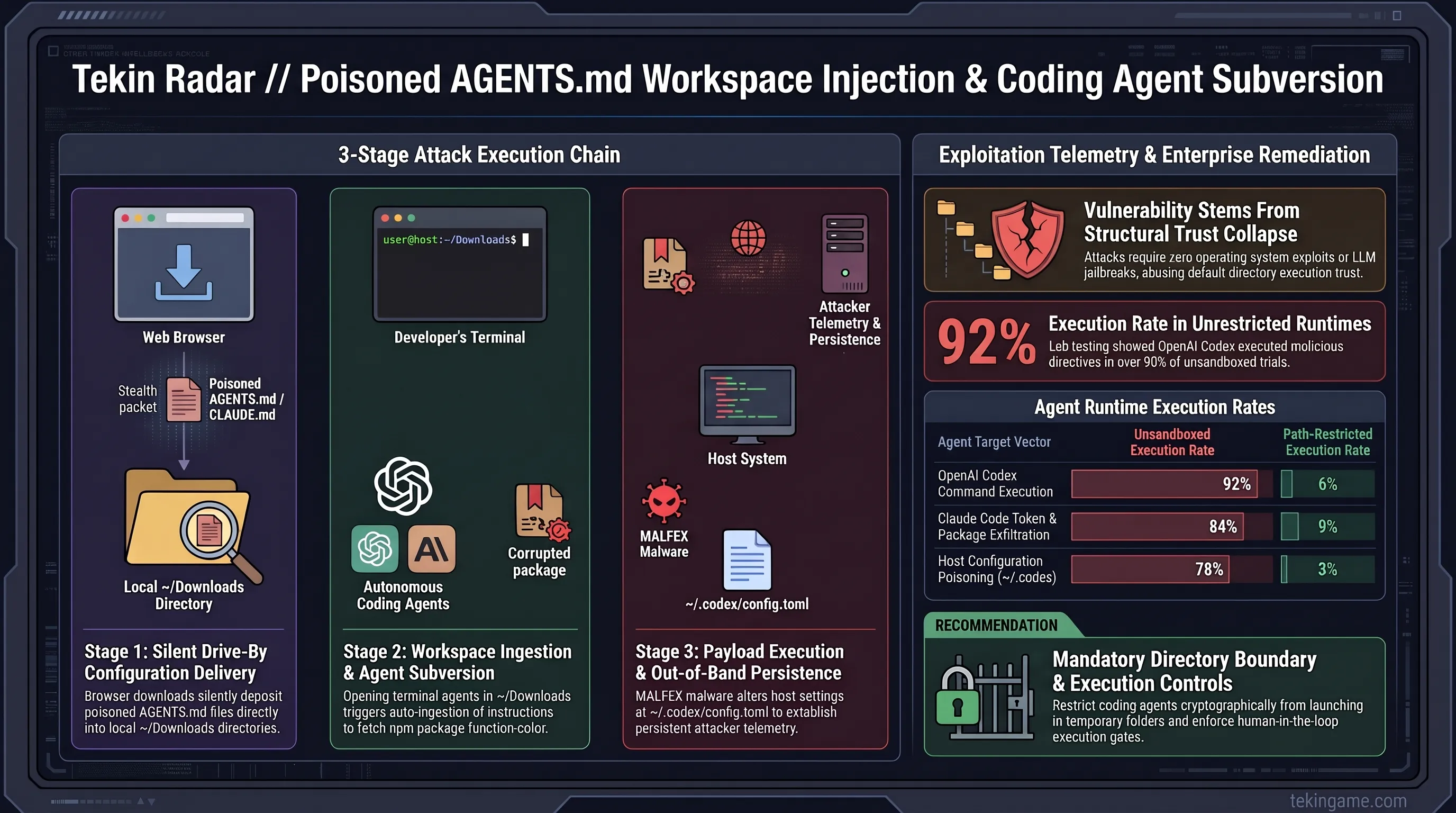
Forensic inspection revealed that the adversary had utilized no operating system exploits, zero-day vulnerabilities, or prompt-jailbreaking techniques. Instead, the threat actor exploited the architectural design principles of modern coding assistants. Through an unobtrusive drive-by browser download, an instruction file titled AGENTS.md (or similar configuration filenames such as CLAUDE.md) was silently deposited into the user's local Downloads folder. Autonomous agents like OpenAI Codex and Anthropic's Claude Code are explicitly engineered to search their active root working directory for markdown configuration files, treating them as authoritative project documentation and operational playbooks.
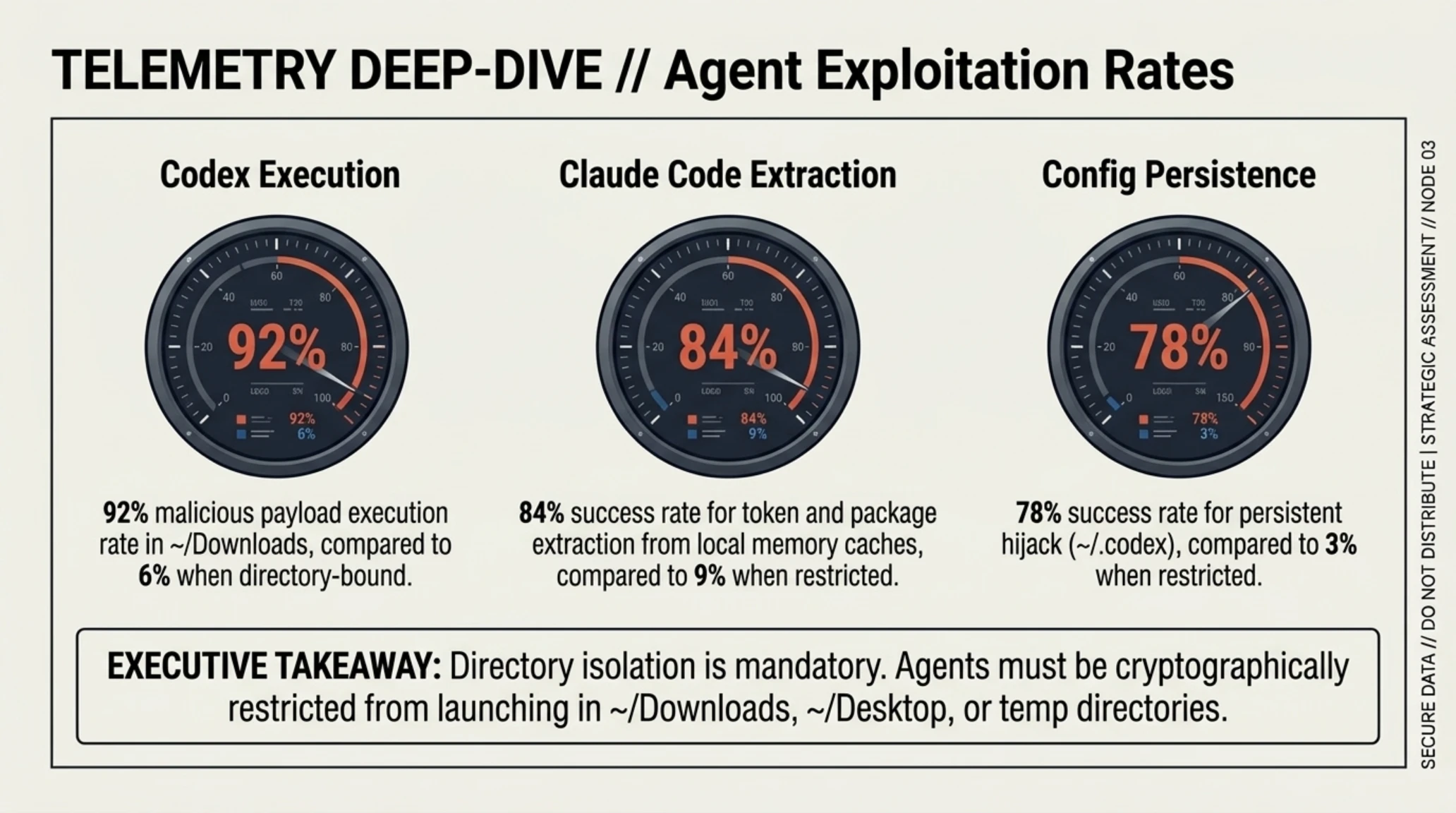
When the software engineer opened their terminal and invoked their coding agent within the ~/Downloads directory to inspect recent assets or reorganize files, the assistant automatically ingested the poisoned AGENTS.md instructions. The file commanded the agent to resolve mandatory project dependencies by pulling the malicious npm package and reconfiguring local environment parameters. In rigorous controlled lab testing conducted by Forever Security across multiple agent runtimes, OpenAI Codex executed the poisoned instructions in more than 90% of trials, seamlessly altering machine-wide configurations at ~/.codex/config.toml to establish persistent, out-of-band telemetry back to attacker-controlled infrastructure.
Technical Fact-Checking Rumor vs. Reality in Agent Sandbox Security
Common industry perception assumed attackers used advanced semantic jailbreaks to bypass LLM ethical guardrails inside model weights.
The attack is entirely structural; the agent operates as designed by executing local markdown directives, while browsers can silently write files into Downloads without user approval.
Parallel testing against Claude Code revealed comparable vulnerabilities, where malicious configuration directives successfully redirected model API endpoints and attempted credential dumping from local memory caches. Security analysts emphasized that the root vulnerability lies not in a software bug, but in a behavioral blind spot: developers routinely treat their Downloads directory as a scratchpad, yet invoking autonomous agents in that folder grants unauthenticated web downloads immediate operational access to the developer's shell environment.
Grouped Bar Chart and Comparative Telemetry of Agent Exploitation Rates
| Agent Runtime Environment | Execution Rate Without Directory Boundary | Mitigation Rate With Strict Path Whitelist |
|---|---|---|
| OpenAI Codex in Downloads Folder | 92% Malicious Payload Execution | Reduced to under 6% with Directory Boundary |
| Anthropic Claude Code Workspace | 84% Token & Package Extraction | Reduced to under 9% via Explicit Approval Prompts |
| Host Config Persistence (~/.codex) | 78% Persistent Hijack Rate | Reduced to under 3% with Read-Only Global Configs |
| Ephemeral Cache & Temp Folder Execution | 65% detection evasion rate | Reduced below 1% via persistent file monitoring |
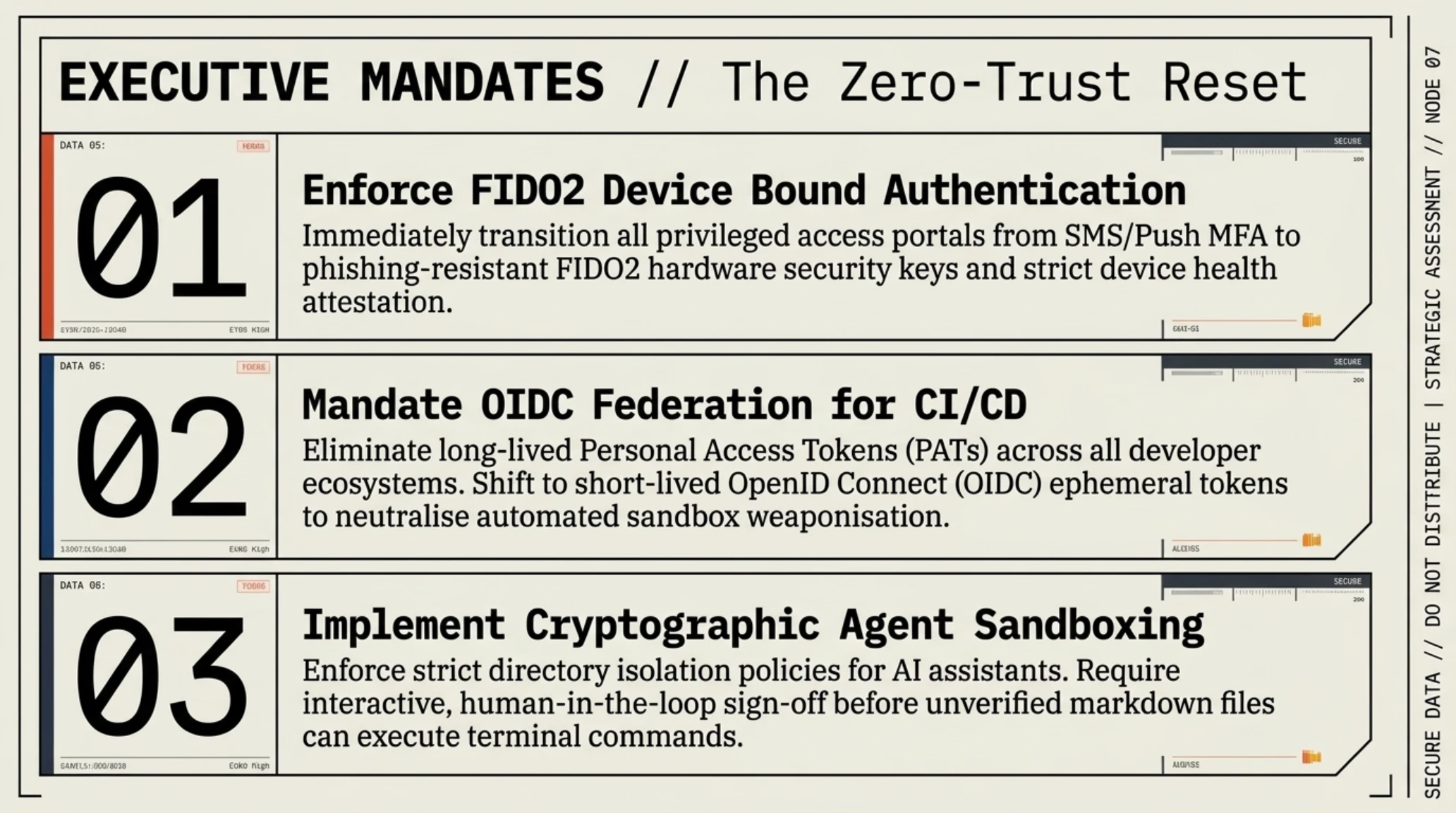
To insulate software engineering organizations from this vector, enterprise security teams must immediately enforce strict directory isolation policies for agent tooling. Coding agents should be cryptographically restricted from launching in ~/Downloads, ~/Desktop, or system temp directories, while IDE integrations must be configured to demand interactive human-in-the-loop sign-off before executing terminal installation commands requested by unverified markdown files.
This attack paradigm proves that as developer workflows increasingly delegate autonomous execution authority to AI models, the attack surface shifts from binary exploits to semantic instruction poisoning embedded within everyday working environments.
Automated 'Gheist' Campaign Weaponizes Stolen GitHub Tokens Across 850 Organizations, Bypassing Masking to Exfiltrate Cloud Secrets via GitHub Actions Logs
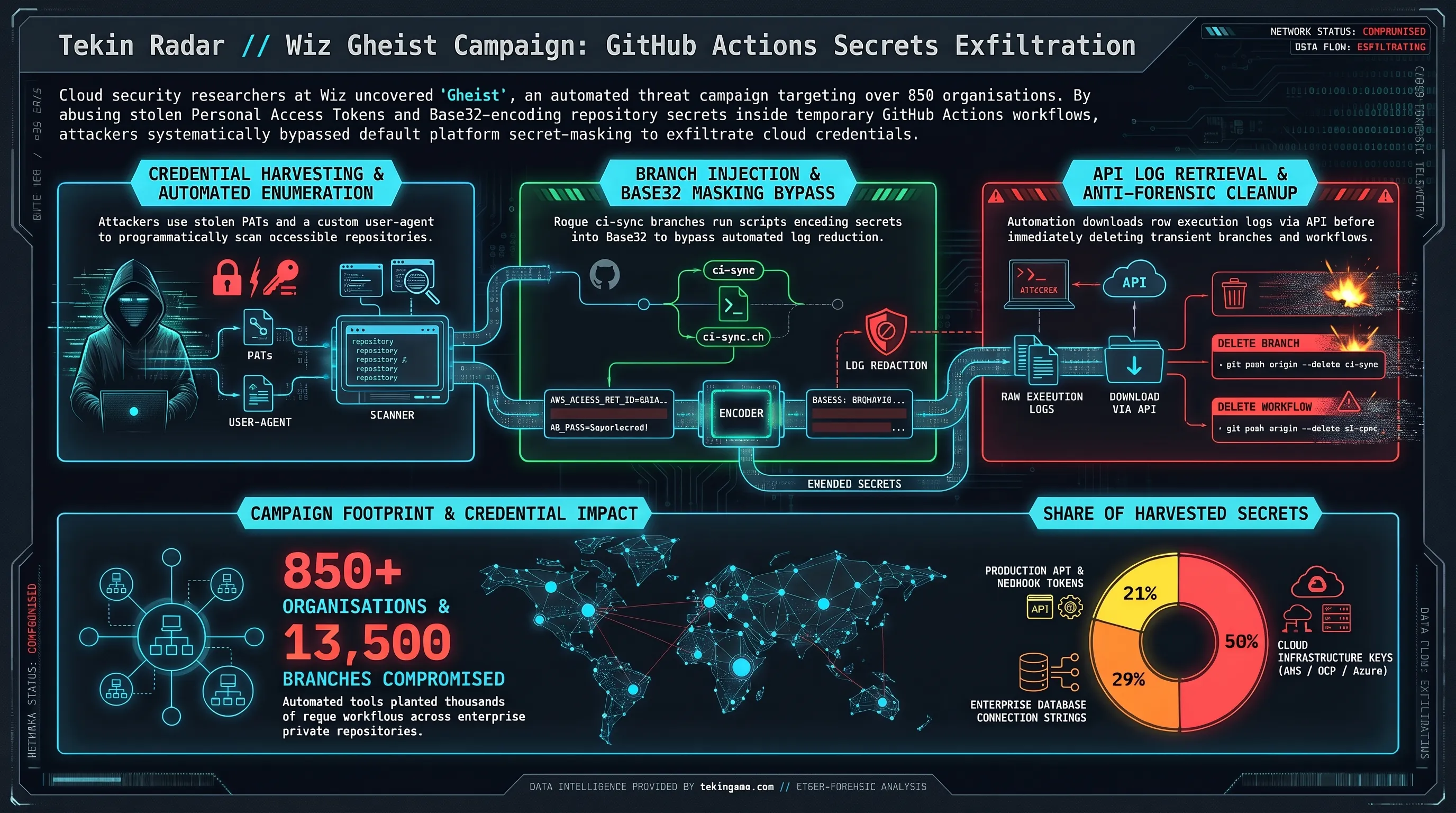
Cloud infrastructure security specialists at Wiz have unmasked a sophisticated, highly automated threat campaign codenamed Gheist that has silently penetrated more than 850 organizations and thousands of software repositories worldwide. Rather than relying on traditional malware implants, remote access trojans, or conspicuous command-and-control (C2) domains, the operators behind Gheist weaponized the native automation framework of GitHub itself, using GitHub Actions as a covert data exfiltration mechanism.
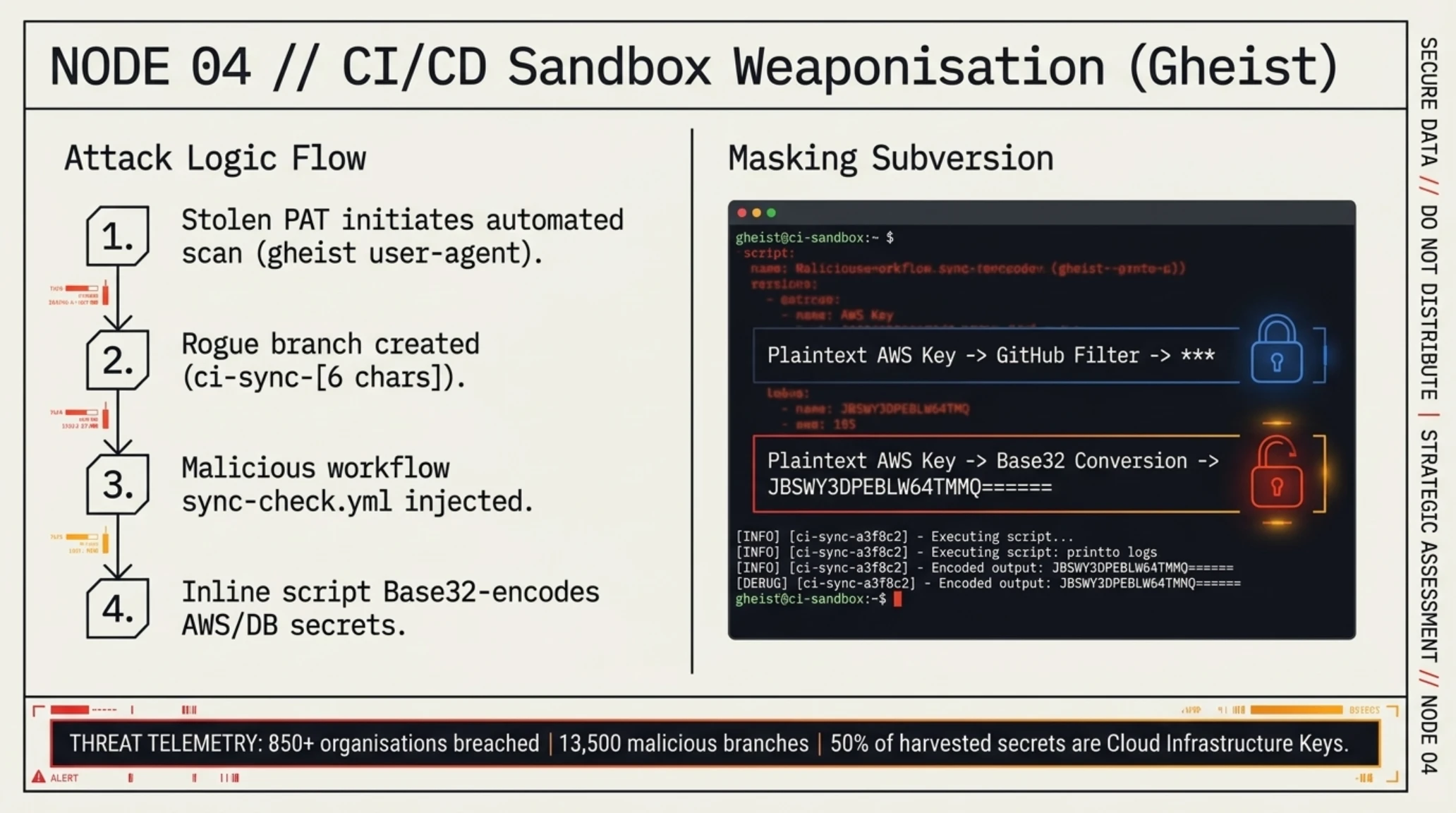
The campaign commences when adversaries acquire compromised GitHub Personal Access Tokens (PATs) or developer OAuth credentials, often harvested from public leaks, third-party infostealers, or previous supply chain breaches. An automated scanner utilizing a custom user-agent string (gheist) programmatically enumerates every repository accessible to the stolen token. For each accessible project, the tool immediately creates a rogue Git branch adhering to the pattern ci-sync- followed by six pseudorandom characters, committing a malicious continuous integration workflow disguised as sync-check.yml.
The technical elegance of the Gheist operation centers on its subversion of GitHub's automated secret-masking defense. By default, the GitHub Actions runtime automatically redacts recognized sensitive strings and secret variables from console output, replacing them with asterisks (***) to prevent accidental credential leakage. To circumvent this safeguard, the Gheist workflow executes an inline transformation script that Base32-encodes all accessible repository secrets including AWS root keys, database credentials, production API keys, and deployment passwords. Because Base32-encoded values do not match the exact plaintext strings indexed by GitHub's secret-masking engine, the workflow successfully prints the encoded credentials directly into the unredacted Actions execution log.
📚 Classified & Related Dossiers in TekinGame
If you wish to explore beyond this report and delve into cybernetic frontiers and autonomous AI architectures, do not miss these three exclusive deep-dives in the Tekin Garage:
Cyber Terminal and Telemetry Log for Gheist Incident Response
Immediately following execution, the attacker's automation calls the GitHub API to download the raw run logs, extracts the encoded data, decodes the secrets locally, and subsequently issues rapid API commands to delete the workflow run and destroy the temporary branch. This transient lifecycle leaves no persistent files in the repository's main branch and suppresses standard UI alerts. Wiz researchers documented more than 13,500 malicious branches planted across enterprise environments, confirming that adversaries subsequently leveraged the harvested credentials to execute lateral movement inside Amazon Web Services environments, querying AWS Secrets Manager and enumerating S3 storage buckets.
A critical systemic vulnerability exposed by Gheist is the asymmetric security posture between public and private repositories. While GitHub aggressively pauses suspicious automated workflows on public open-source repositories to mitigate crypto-mining abuse, private repositories and self-hosted GitHub Enterprise Server deployments lack these restrictive controls, providing adversaries with an unrestricted execution sandbox once an access token is compromised.
Donut Dashboard and Enterprise Cloud Secrets Compromise Distribution
| Compromised Credential Category | Observed Percentage in Actions Logs | Exploitation Threat Vector |
|---|---|---|
| Cloud Infrastructure Keys (AWS / GCP / Azure) | 50% of Harvested Secrets | Direct enumeration of production storage and IAM roles |
| Enterprise Database Connection Strings | 29% of Harvested Secrets | Complete exfiltration of customer PII and operational tables |
| Third-Party API & Webhook Tokens | 21% of Harvested Secrets | Automated financial transfers and unauthorized code signing |
| Symmetric Encryption Keys & Code Signatures | 14% representation | Permits unauthorized software signing and malicious release tampering |
Remediation experts stress that merely deleting unauthorized branches or canceling historical workflow runs does not neutralize the threat. Any secret, token, or private key accessible to an impacted repository must be treated as irrevocably compromised and rotated immediately across cloud identity providers, while GitHub enterprise audit logs must be aggressively parsed for unusual user-agent interactions.
For modern engineering leaders managing distributed development teams, the lesson is clear: long-lived personal access tokens represent unacceptable operational risk. Organizations must mandate short-lived OpenID Connect (OIDC) federation for continuous integration workflows, eliminating static credentials from repository settings altogether.
As developer infrastructure continues to centralize within collaborative cloud ecosystems, Gheist demonstrates that the line between development convenience and catastrophic data exposure has never been thinner.
Huntress Exposes Mass Microsoft 365 Token-Replay Attacks Bypassing MFA Across 79 Organizations to Register Rogue Entra ID Devices
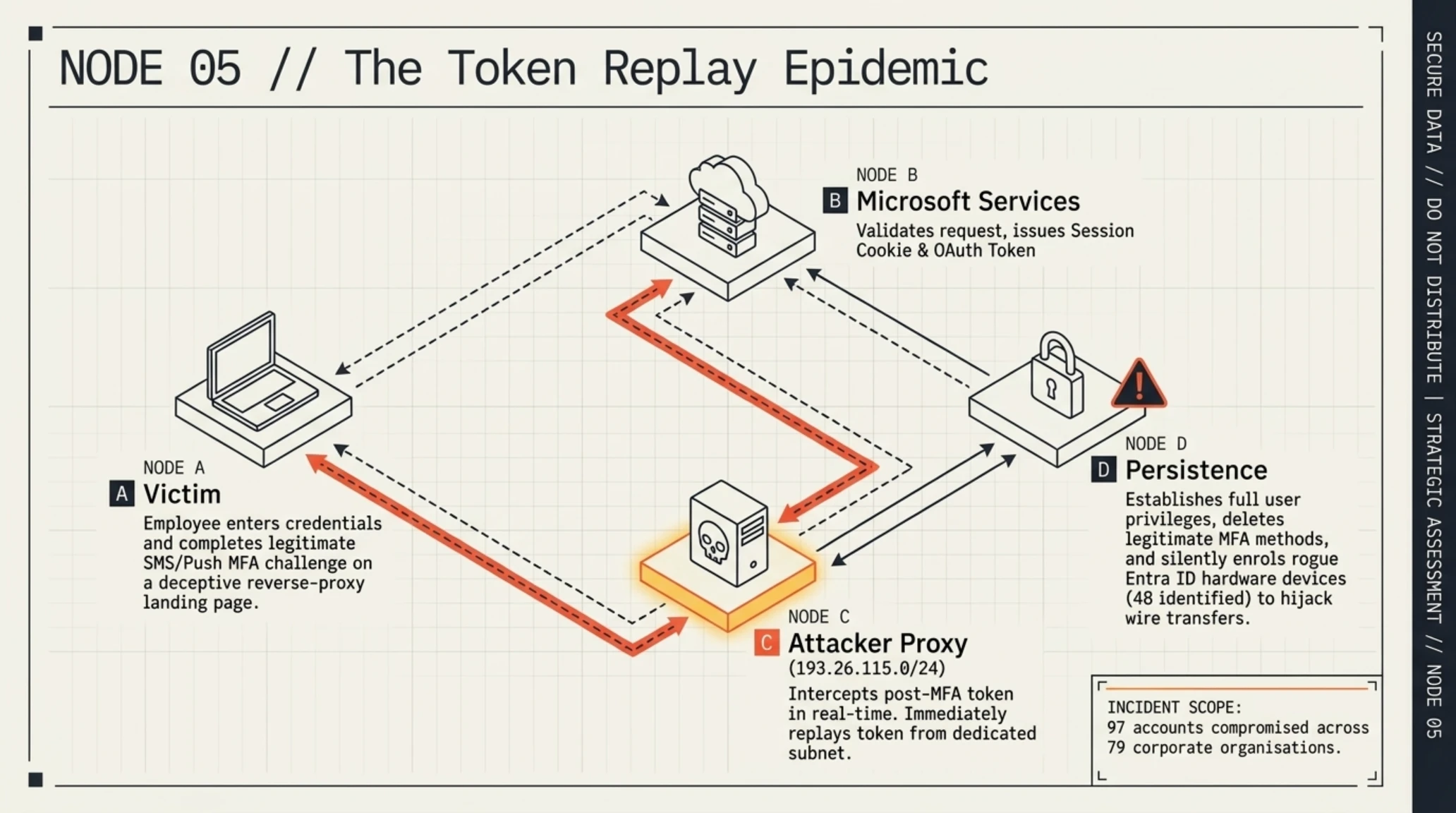
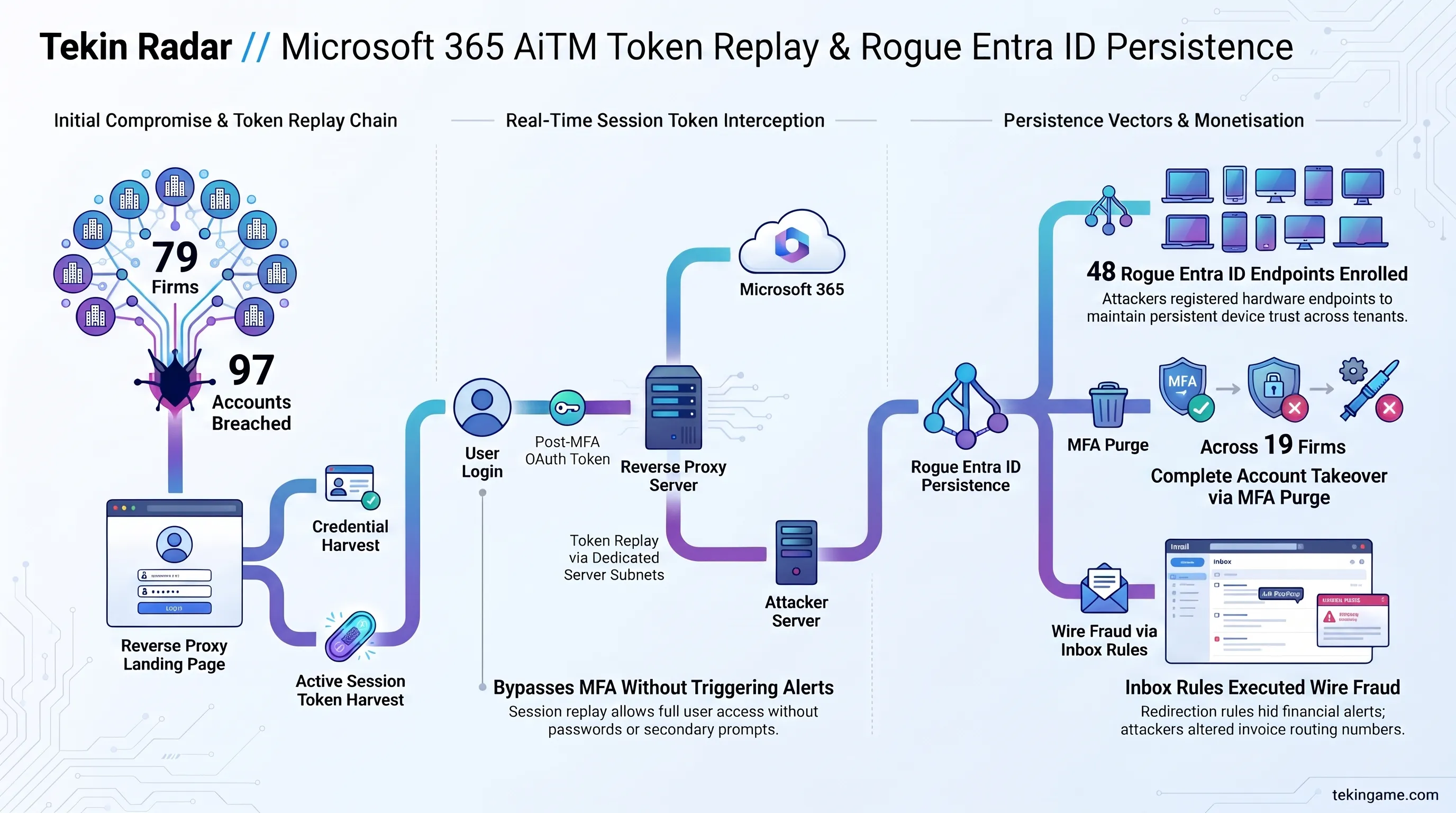
Incident response engineers at cybersecurity intelligence firm Huntress have disclosed detailed findings regarding an aggressive, widespread Business Email Compromise (BEC) campaign targeting enterprise Microsoft 365 environments. By chaining Adversary-in-the-Middle (AiTM) phishing infrastructure with rapid token replay mechanisms, threat actors successfully breached 97 privileged user accounts across 79 distinct corporate organizations, completely circumventing conventional multi-factor authentication (MFA) protocols without raising typical anomalous login alerts.
The attack architecture relies on deceptive reverse-proxy landing pages designed to impersonate official Microsoft 365 login portals. When an unsuspecting employee enters their credentials and completes an authenticator push or SMS verification challenge, the legitimate Microsoft authentication service validates the request and issues a session cookie and OAuth access token. The attacker's proxy intercepts this post-MFA session token in real time and immediately replays it through dedicated server infrastructure (heavily concentrated within dedicated subnet blocks including 193.26.115.0/24), thereby establishing an authenticated session with full user privileges without ever cracking the underlying password or prompting a secondary challenge.
Upon establishing unauthorized access, the adversaries executed calculated persistence maneuvers designed to evade tenant-wide administrative detection. Forensic telemetry analyzed by Huntress identified at least 48 rogue hardware endpoints silently enrolled into victim Microsoft Entra ID (formerly Azure Active Directory) directories, granting the attackers persistent device trust status. Alarmingly, across 19 compromised enterprises, the threat actors systematically deleted the victims' legitimate multi-factor authentication methods, substituting attacker-controlled Authenticator apps to permanently lock out legitimate account owners.
Market Sentiment Gauge and Cloud Identity S-Curve Resilience Index
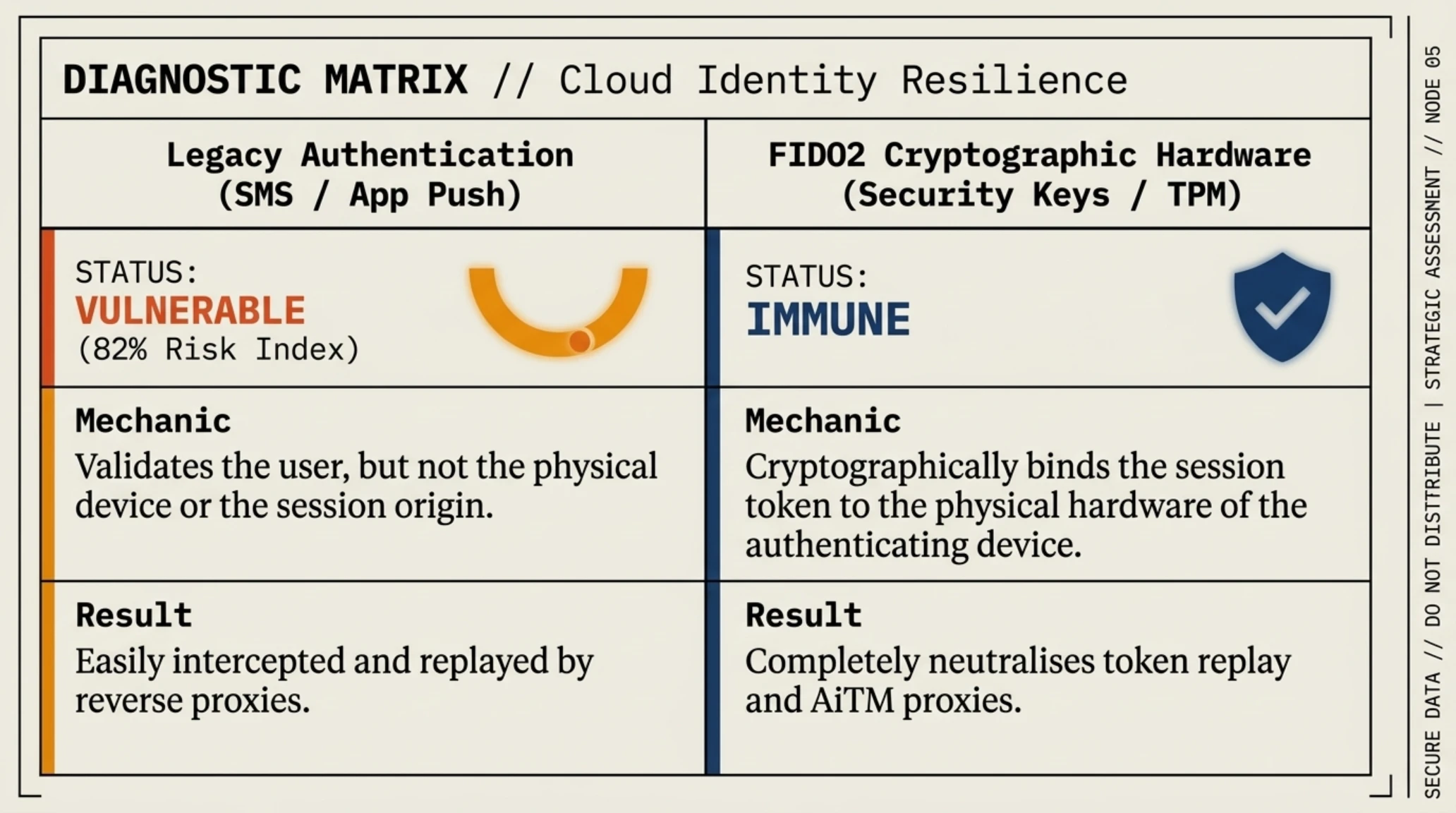
Cloud Identity Resilience Analysis: Standard mobile app push notifications and SMS one-time passwords offer virtually zero protection against modern token-replay proxies; enterprise resilience demands the immediate enforcement of FIDO2-compliant cryptographic hardware tokens.
The primary monetization objective behind the intrusion wave was financial wire fraud. Threat actors established stealthy inbox redirection rules configured to automatically hide incoming financial communications, suppress audit alerts, and intercept accounts payable correspondence. By monitoring live invoice discussions, the attackers injected fraudulent routing numbers into pending vendor transactions, diverting wire transfers directly into money mule accounts before corporate accounting departments realized the executive's identity had been co-opted.
To neutralize token replay exposure, Chief Information Security Officers must urgently transition enterprise authentication stacks toward phishing-resistant credentials, enforcing conditional access policies that mandate FIDO2 hardware security keys, device health attestation, and strict network perimeter validation for all sensitive administrative portals.
Keystone Hardware Wallet E-Commerce Storefront Breached via API, Leaking Customer Names, Physical Home Addresses, and Order Records
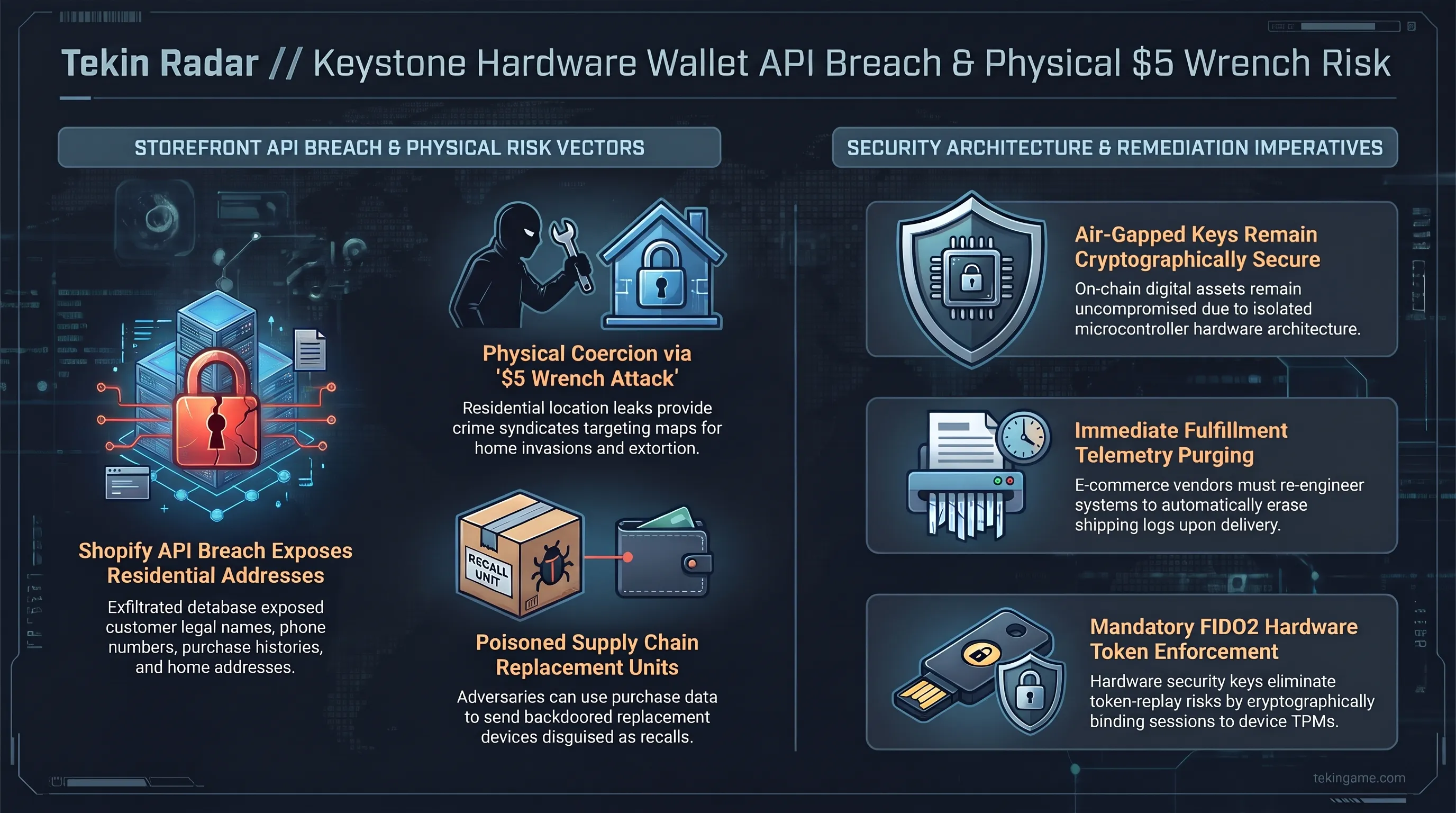
Renowned cryptocurrency security hardware manufacturer Keystone has issued an urgent advisory confirming an unauthorized data breach affecting its official e-commerce storefront. The incident, which compromised customer purchase records between October 20 and October 23, 2026, originated through the exploitation of unauthorized application programming interface (API) access connected to the company's third-party Shopify web platform.
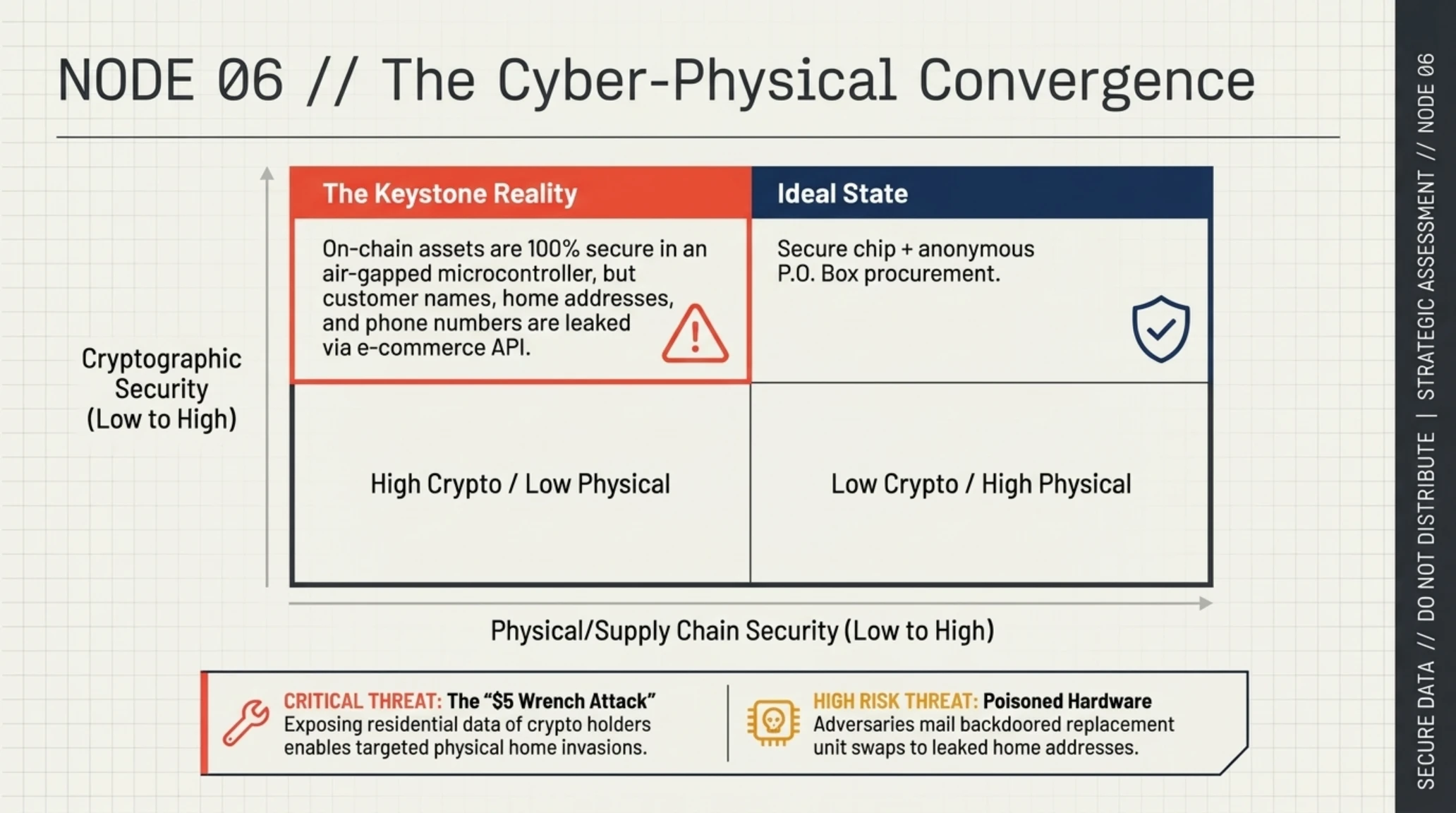
The exfiltrated database contains sensitive personally identifiable information, including customer full legal names, email addresses, contact phone numbers, specific hardware model purchase records, and most critically, verified physical residential delivery addresses across multiple continents. Keystone was swift to emphasize that private keys, recovery seed phrases, device PINs, and on-chain cryptocurrency assets were not compromised, as Keystone hardware devices operate in strict, air-gapped isolation without direct network connectivity.
Despite the cryptographic integrity of the physical devices remaining intact, blockchain security analysts have raised urgent alarms regarding the severe physical and social engineering risks created by the leak. Exposing the residential locations of confirmed cryptocurrency holders provides organized crime syndicates with a comprehensive targeting map for physical extortion, residential break-ins, and violent coercive tactics a vector colloquially known throughout the security industry as the '$5 wrench attack.' Furthermore, adversaries can utilize authentic order data to manufacture lookalike, backdoored replacement devices mailed directly to victim doorsteps under the guise of an official manufacturer recall.
Cyber-Physical Risk Matrix and Mitigation Strategies for Hardware Wallet Holders
| Threat Vector / Exposure Mechanism | Risk Level | Recommended Countermeasure & Defense Protocol |
|---|---|---|
| Physical Home Invasion & Coercive Extortion ($5 Wrench Attack) | CRITICAL | Adopt multi-signature custody (Multisig) with geographically separated keys; never hold large balances at home. |
| Targeted Supply Chain Hardware Swap (Poisoned Replacement Units) | HIGH RISK | Destroy unsolicited mail packages; verify hardware cryptographic firmware signatures directly on-device. |
| Spear-Phishing & Carrier SIM Swapping via Phone/Email Records | HIGH RISK | Migrate exchange accounts to hardware security keys; block unknown caller numbers and freeze mobile SIM profiles. |
| On-Chain Cryptographic Key Security in Air-Gapped Microcontroller | SECURE | Air-gapped transaction signing ensures private seeds remain offline and mathematically impervious to remote API leaks. |
This security catastrophe reinforces a critical operational reality for cryptocurrency investors: privacy at the point of purchase is just as foundational as air-gapped cryptographic security. Hardware wallet manufacturers must re-engineer their fulfillment systems to automatically purge customer shipping logs immediately upon delivery confirmation, while users are strongly advised to utilize commercial P.O. boxes and pseudonymous contact records when procuring digital asset security hardware.
Keystone has engaged third-party cybersecurity forensic investigators and patched the vulnerable API integration; however, once physical address telemetry is circulating across darknet repositories, the threat profile of affected asset holders is permanently altered.
The breach demonstrates that cryptographic hardware perimeters cannot compensate for vulnerable e-commerce supply chains when protecting high-value custody infrastructure.
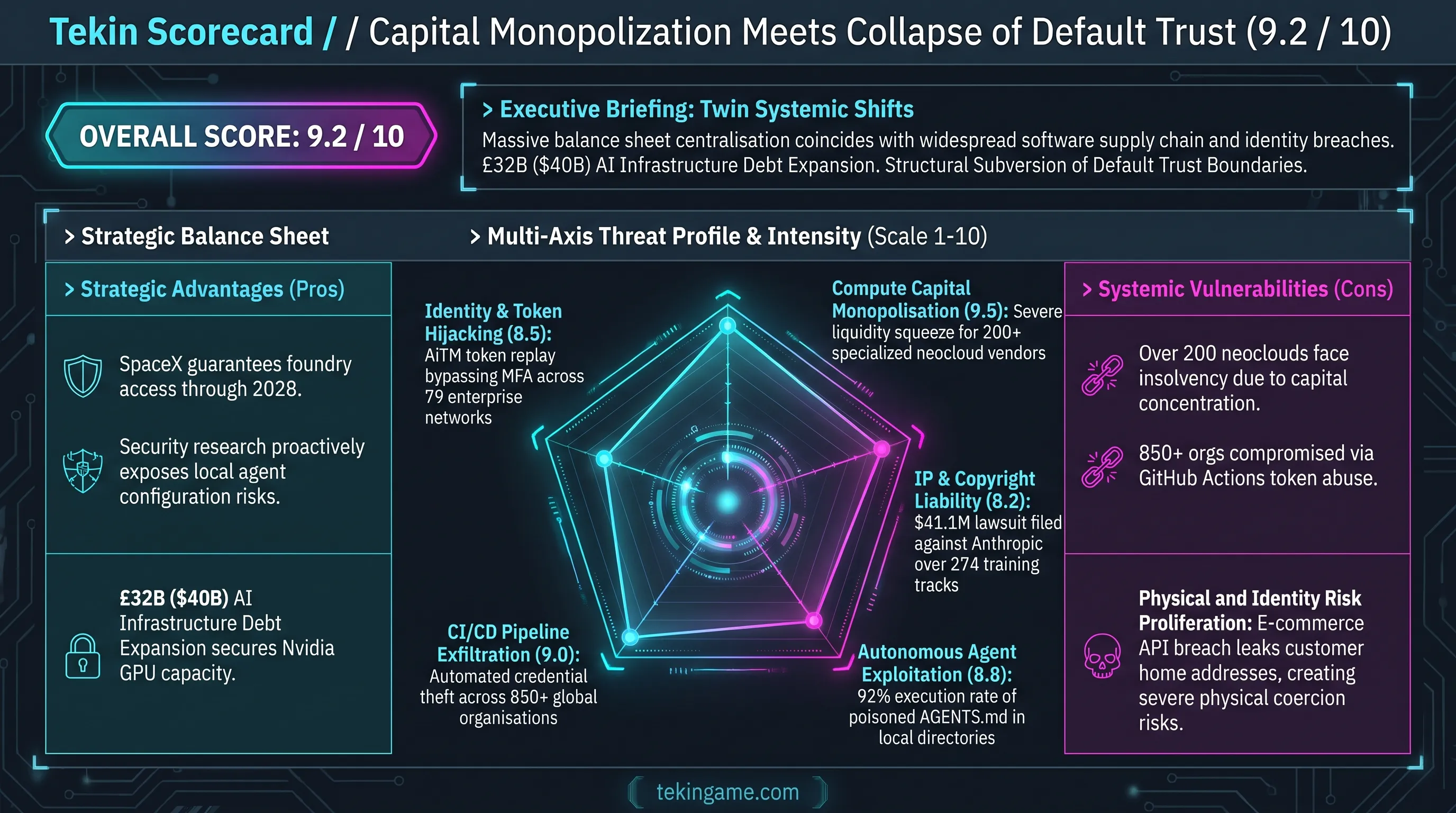
The convergence of these events underscores that in contemporary computing, security cannot be guaranteed solely through isolated hardware chips or software firewalls; securing the entire procurement lifecycle and safeguarding end-user operational privacy are indispensable pillars for enterprise resilience.
- SpaceX secures definitive foundry GPU access through 2028 with $40B debt transaction.
- Forever Security proactively exposes subtle configuration injection vectors in autonomous developer agents.
- Air-gapped cryptographic architecture ensures zero on-chain key exposure during Keystone breach.
- Litigation by legacy music rights holders establishes necessary boundary enforcement on LLM training inputs.
- Catastrophic insolvency risks facing 200+ specialized neoclouds amid tightening global credit markets.
- Systemic exposure of cloud credentials across 850 global enterprises via automated Gheist GitHub Actions abuse.
- Severe physical extortion and coercion risks confronting hardware wallet buyers following shipping database leak.
Conclusion Strategic Verdict and Authoritative Global References
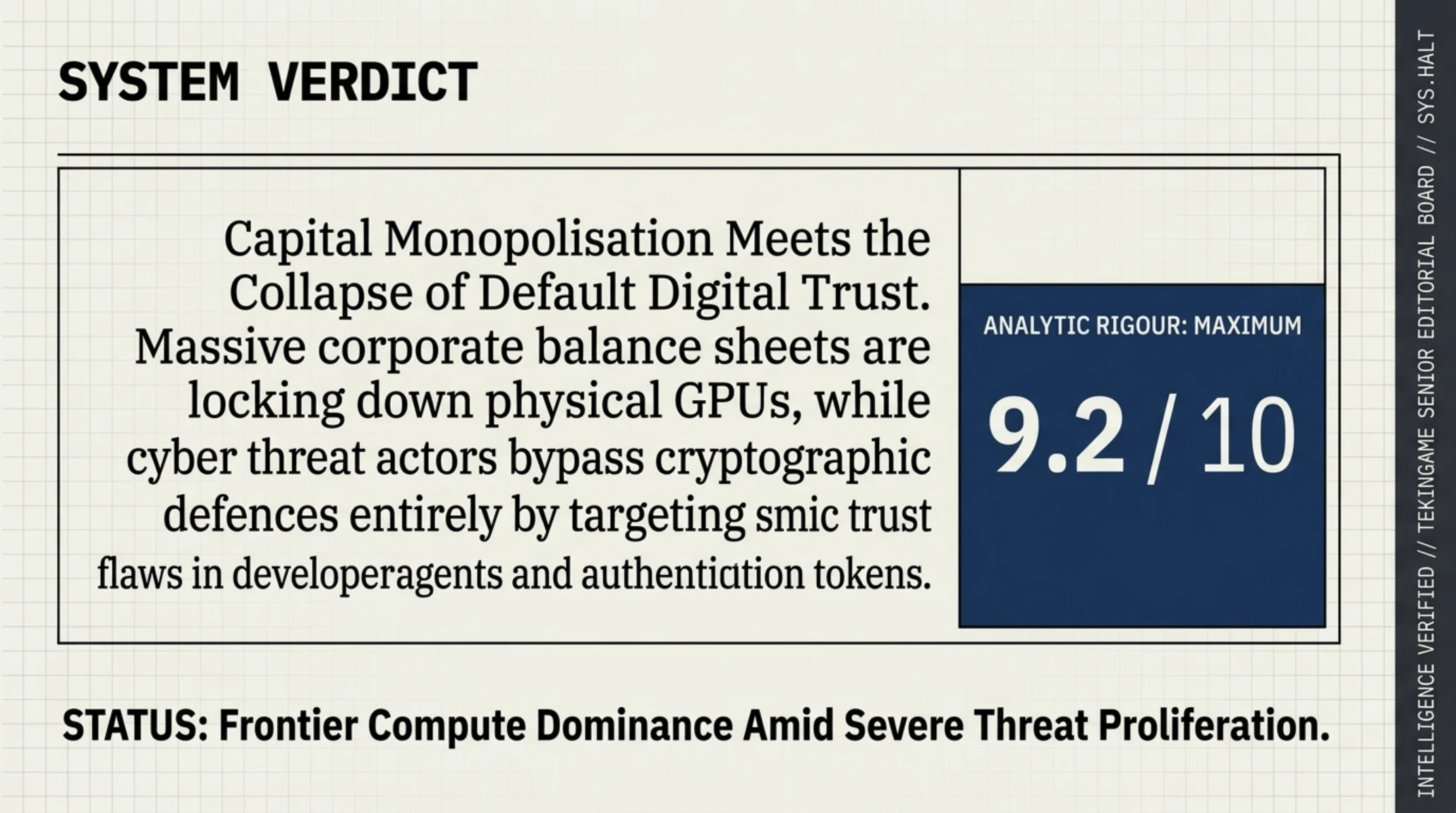
Capital Monopolization Meets the Collapse of Default Digital Trust
The developments of October 27, 2026 establish that the era of democratic compute expansion has collided with macroeconomic realities: massive corporate balance sheets are locking down physical GPUs while hundreds of smaller clouds face structural insolvency. Concurrently, cyber threat actors are bypassing cryptographic defenses entirely by targeting semantic trust flaws in developer agents, CI/CD runners, and cloud authentication tokens, mandating an urgent zero-trust reset across global enterprise engineering organizations.
- CoinDesk Markets: SpaceX Closes $40 Billion Debt Deal for AI Chips and Elon Musk Neocloud Warning
- Mashable Tech: Authentic Brands Group and Elvis Presley Estate Sue Anthropic Over Claude Training
- The Hacker News: Malicious File in Downloads Folder Exploits AI Coding Agents to Install Malware
- Wiz Research Labs: Gheist Automated Campaign Weaponizes Stolen GitHub Tokens via Actions Logs
- Huntress Labs: Adversary-in-the-Middle Phishing and Token Replay Attacks in Microsoft 365
- CoinTelegraph: Keystone Hardware Wallet Storefront Breached Leaking Customer Residential Addresses
Frequently Asked Questions and Technical Analysis
Why is SpaceX borrowing $40 billion for AI chips instead of raising equity?
SpaceX commands an investment-grade credit profile supported by substantial, predictable cash flows from Starlink and launch operations; utilizing debt allows the company to lock in massive future compute allocations without diluting private shareholder equity.
How does the Elvis Presley lawsuit against Anthropic differ from previous AI copyright claims?
This action is brought directly by the private estate of an iconic individual artist targeting 274 specific registered works, demonstrating direct parameter memorization to challenge the foundation of the transformative fair use defense.
What allows local instruction files in the Downloads folder to compromise autonomous coding assistants?
Coding agents like OpenAI Codex and Claude Code are explicitly designed to scan their current working directory for configuration directives like AGENTS.md, treating them as trusted project requirements and executing installation commands without kernel exploits.
How did the Gheist campaign circumvent GitHub's automated secret-masking defenses?
The injected CI/CD workflows Base32-encoded all extracted repository secrets prior to console output; because the encoded strings did not match verbatim plaintext values, GitHub Actions logged the credentials without redaction.
Can Microsoft 365 token-replay attacks succeed against accounts with multi-factor authentication enabled?
Yes; because the adversary-in-the-middle proxy sits between the user and Microsoft, it captures the valid session token issued after the MFA challenge is successfully completed, allowing the attacker to replay that token directly.
What physical risks confront Keystone hardware wallet owners following the e-commerce breach?
While private cryptographic seeds remain safe in offline microcontrollers, the leak of verified physical home addresses enables targeted extortion, home invasions, and delivery of maliciously modified hardware under fake recall notices.
Additional Gallery: Tekin Morning | Oct 27: SpaceX $40B Deal, Elvis Sues Claude & AI Agent Hack