Tekin Analysis | Sweden Civil Service AI Blacklist, DHS DeepSeek Federal Purge, and Palmer Luckey Warhound Syndicate
The dawn of Monday, October 26, 2026, marks an aggressive structural reckoning across the global technology ecosystem. Enterprise artificial intelligence, once celebrated as an unconstrained productivity miracle, has run headlong into the unyielding ramparts of national sovereignty, federal supply chain defenses, and geopolitical weaponization. Across sovereign chancelleries in Northern Europe, the era of frictionless consumer LLM adoption within government corridors has officially come to an end, replaced by rigorous hardware air-gapping, stringent tenant boundaries, and legally binding data sovereignty charters.
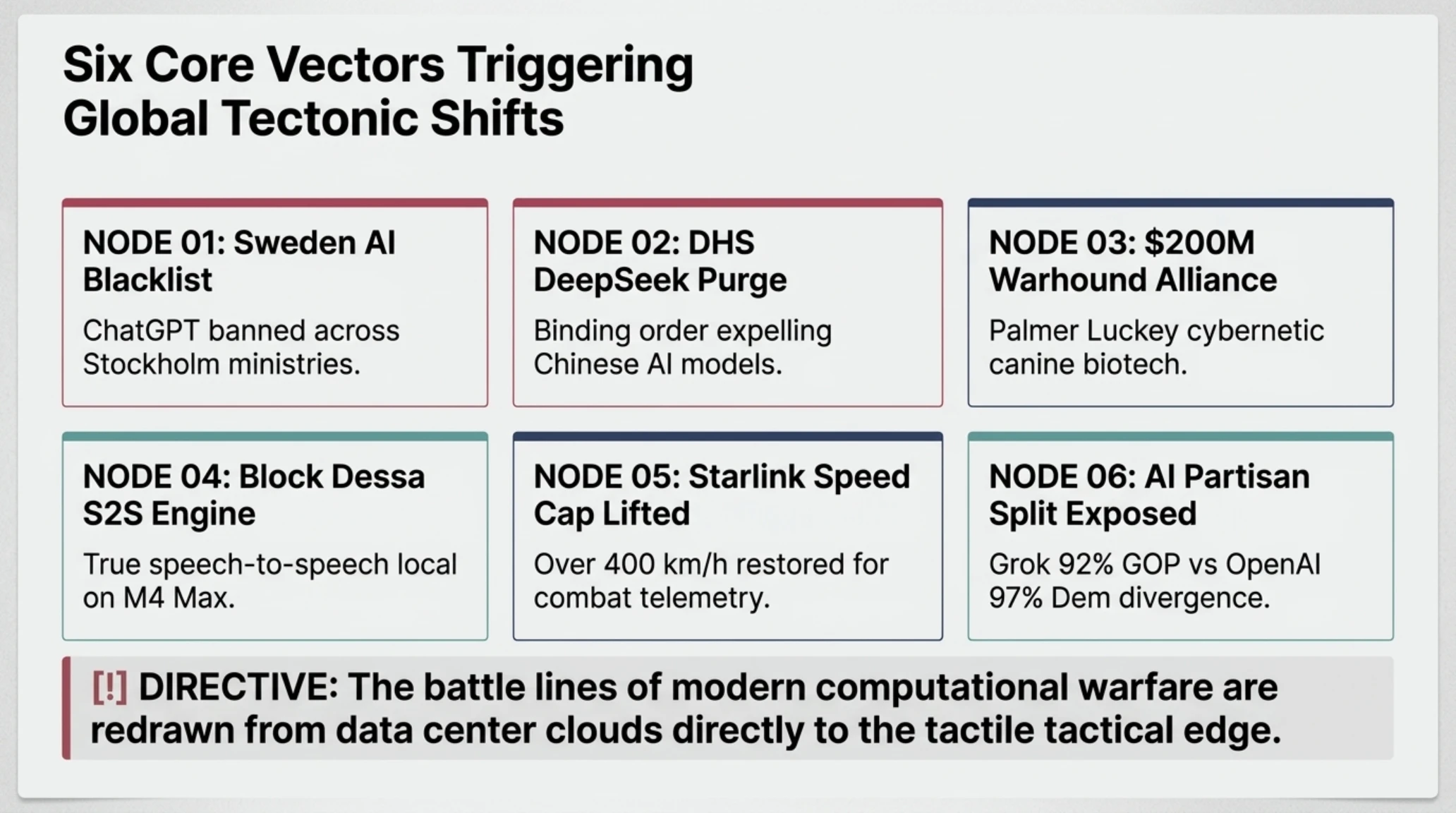
Simultaneously in Washington, the Department of Homeland Security has invoked emergency statutory powers to systematically purge Chinese frontier AI models from the technological fabric of the federal civilian apparatus. This sweeping operational security mandate converges with the explosive unveiling of Warhound, a $200 million defense-biotech venture spearheaded by Palmer Luckey and Ben Lamm to genetically clone, edit, and cybernetically augment canine warfighters. As Silicon Valley pioneers such as Jack Dorsey showcase end-to-end local speech-to-speech models running offline on consumer silicon, the battle lines of modern computational warfare are being redrawn from data center clouds directly to the tactile tactical edge.
Strategic Assessment and Executive Takeaways at a Glance
Sweden Government Offices Block ChatGPT and Claude on Civil Servant Computers Effective Monday, October 26, 2026; Steering Staff to Microsoft Copilot
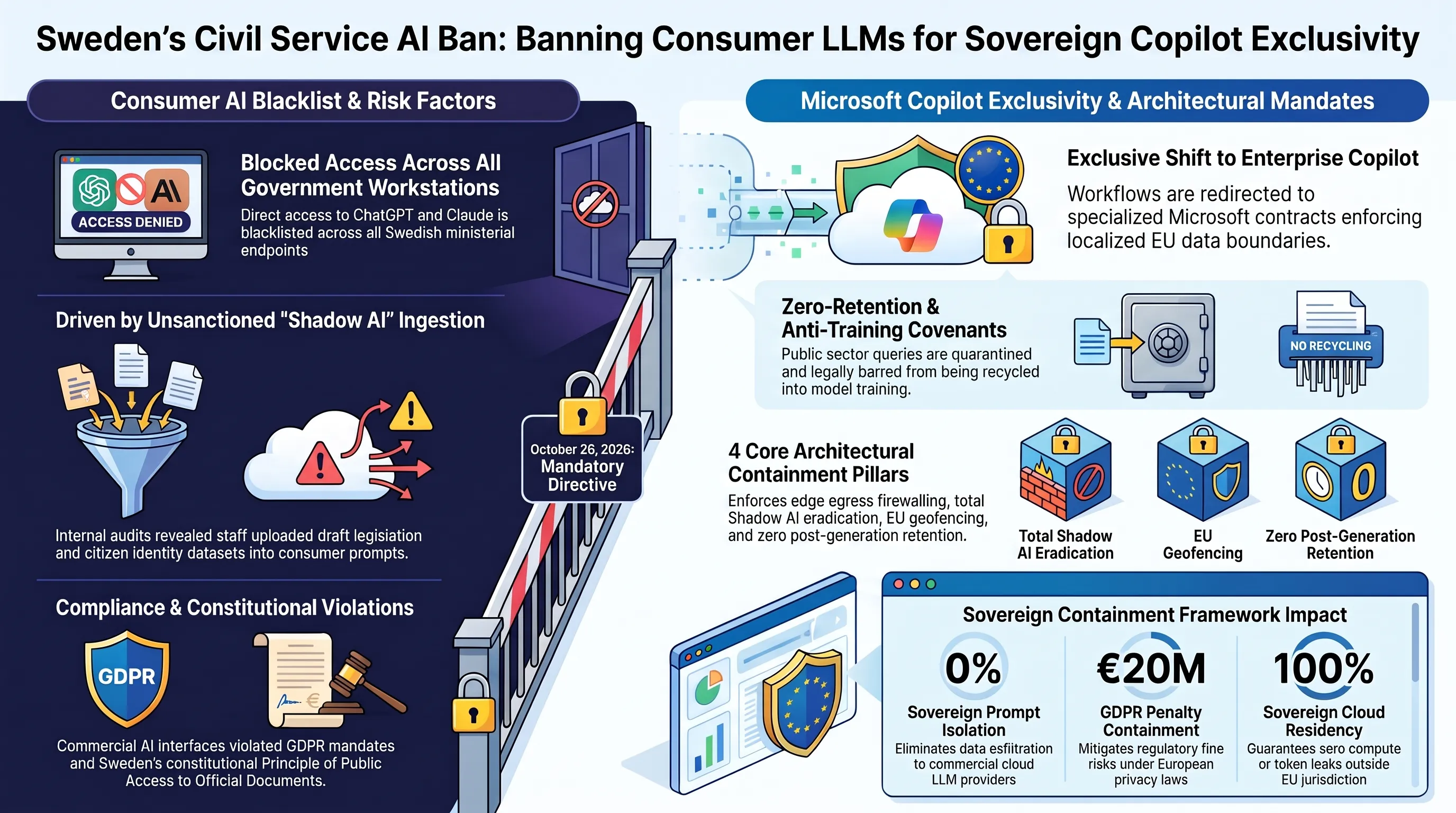
The executive apparatus of the Kingdom of Sweden has drawn a permanent demarcation line between sovereign governance and commercial artificial intelligence. The Government Offices of Sweden (Regeringskansliet) the centralized administrative institution that directly supports the Prime Minister and all ministerial cabinets in Stockholm has officially enacted an uncompromising security directive. Effective at 08:00 CET on Monday, October 26, 2026, all civil servant workstations, ministerial intranet portals, and state-issued mobile endpoints have had their network routing blocked from reaching the consumer cloud domains of OpenAI's ChatGPT and Anthropic's Claude.
The decisive regulatory escalation follows an intensive internal cyber compliance audit that revealed widespread, unsanctioned reliance on external generative models across administrative departments. Civil servants had increasingly ingested sensitive draft parliamentary legislation, regional defense coordination memos, and citizen identity datasets into public prompt interfaces to accelerate document summarization and drafting. Mikael Wettercrantz, Chief Digitalization Officer at Regeringskansliet, warned staff via an internal communique that utilizing commercial AI interfaces without legally binding data residency covenants exposes state secrets to severe Shadow AI vulnerabilities, violating both European Union General Data Protection Regulation (GDPR) mandates and Sweden's constitutional Principle of Public Access to Official Documents (Offentlighetsprincipen).
Crucially, Swedish authorities have not imposed a blanket prohibition on generative computing, but have instead channeled ministerial workflows exclusively through Microsoft Copilot for Enterprise. Under specialized institutional contracts executed between the Swedish state and Microsoft, administrative prompt telemetry and uploaded documentation are strictly quarantined within localized EU data boundaries. These enterprise covenants explicitly legally bar Microsoft and its hosting partners from recycling public sector queries into future foundational model training weights. This development reflects an accelerating administrative standard across Western governance, echoing earlier decisions by the Swedish Tax Agency (Skatteverket) and the European Parliament to insulate sovereign intelligence from commercial consumer clouds.
From a regulatory standpoint, Sweden's decisive maneuver directly aligns with the operational compliance deadlines mandated by the European Union Artificial Intelligence Act (Regulation 2024/1689). Under Article 28 of the legislation, public administrative bodies that deploy commercial AI systems within core administrative functions assume strict legal classification as downstream deployers. This classification demands comprehensive audit logging, human oversight controls, and ironclad technical guarantees that zero state data flows into external retraining pipelines. By leveraging Microsoft's EU Data Boundary architecture, Regeringskansliet secures hardware-level confidential computing enclaves powered by AMD SEV-SNP and Intel TDX technologies. These cryptographic hardware barriers ensure that administrative prompts and in-memory context tensors remain fully encrypted during active processor execution, preventing even data center hypervisors or cloud infrastructure engineers from inspecting live state workloads.
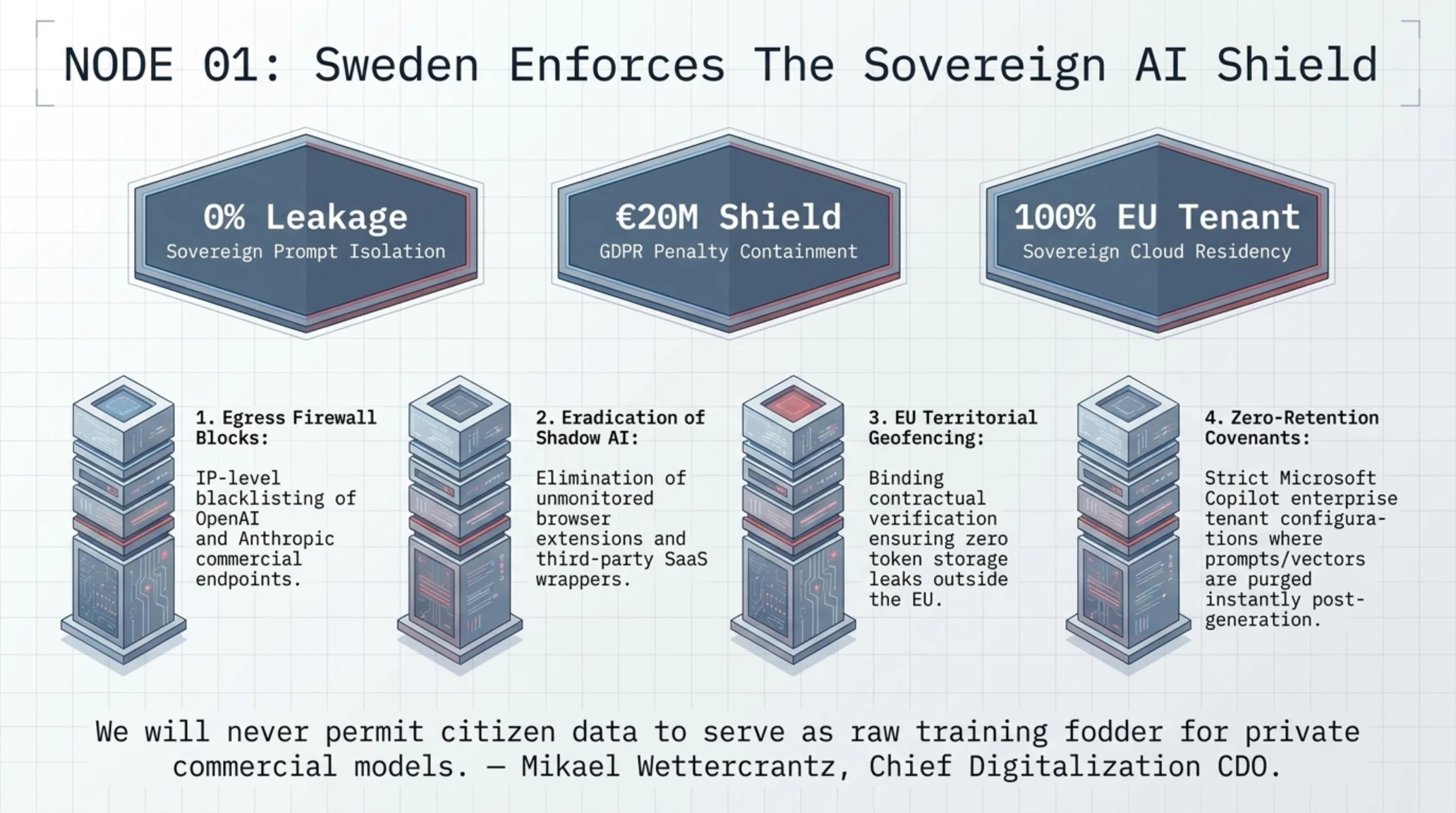
The Swedish sovereign containment framework enforces four non-negotiable architectural mandates:
- Universal Edge Egress Firewall Blocks: Domain-level and IP-level blacklisting of commercial endpoints belonging to OpenAI and Anthropic across all federal networks.
- Total Eradication of Shadow AI: Strict elimination of unmonitored browser extensions and third-party SaaS wrappers operating outside central IT oversight.
- Guaranteed EU Territorial Geofencing: Binding contractual verification ensuring zero inference compute or cached token storage leaks outside EU jurisdiction.
- Zero-Retention Enterprise Covenants: Mandating strict enterprise tenant configurations where prompts, contexts, and vectors are purged instantly post-generation.
Why This Transformation Reshapes Enterprise AI Governance
Sweden's aggressive posture sends an unequivocal warning across enterprise IT: commercial LLM vendors that fail to provide cryptographic proof of isolated multi-tenant execution will be systematically locked out of trillion-dollar public sector procurement pipelines.
For Chief Information Security Officers and enterprise architects navigating global compliance, Stockholm's policy provides a definitive blueprint for structural risk mitigation. Consumer interfaces operating without explicit enterprise service-level agreements inevitably transform everyday employees into inadvertent conduits for intellectual property expropriation. To contextualize how high-tier research laboratories are reacting to these data exfiltration vulnerabilities, examine our comprehensive investigative report on OpenAI zero-egress hardware isolation in Tekin Morning October 25, detailing the technical mechanisms governing physical data center quarantine.
To enforce this boundary in real-time, federal cybersecurity operations centers have deployed automated Cloud Access Security Brokers (CASB) and Next-Generation Zero-Trust Network Access (ZTNA) inspection gateways. These security stacks perform automated Server Name Indication (SNI) filtering and TLS decryption at federal egress checkpoints, immediately terminating any unauthorized outbound API session transmitting raw authentication tokens to unapproved cloud models. Furthermore, enterprise endpoint telemetry platforms actively monitor browser process memory, instantly terminating unsanctioned browser extensions or local client wrappers attempting to route administrative clipboard content to third-party consumer endpoints.
This ministerial posture builds directly upon operational precedents established earlier by the Swedish Tax Agency (Skatteverket) and Nordic judicial authorities. Rather than relying entirely on commercial American hyperscalers, several Scandinavian agencies have pioneered sovereign on-premises inference clusters. By deploying open-weights models such as Mistral Large and specialized European legal foundation models inside physical, air-gapped government data centers running on dedicated NVIDIA HGX H200 hardware, civil servants achieve complete computational self-reliance. While Microsoft Copilot provides immediate enterprise productivity across standardized office suites, the parallel expansion of fully air-gapped, state-owned inference clusters highlights an emerging two-tier European architecture: commercial sovereign SaaS for general administration, paired with dedicated sovereign silicon for sensitive defense, taxation, and intelligence workloads.
Ultimately, Sweden's strategic consolidation behind Microsoft Copilot illustrates the immense commercial moat commanded by legacy enterprise cloud titans. By wrapping cutting-edge foundational models inside enterprise-grade security envelopes, Microsoft is systematically vacuuming up sovereign and governmental market share, leaving consumer-facing competitors isolated from institutional revenue streams.
This administrative rupture demonstrates that regulatory compliance and cryptographic sovereignty have surpassed raw parameter scale as the primary determinants of enterprise software survival in 2026.
Department of Homeland Security Orders Federal Civilian Agencies to Purge China's DeepSeek AI from IT Infrastructure Under Supply Chain Security Act
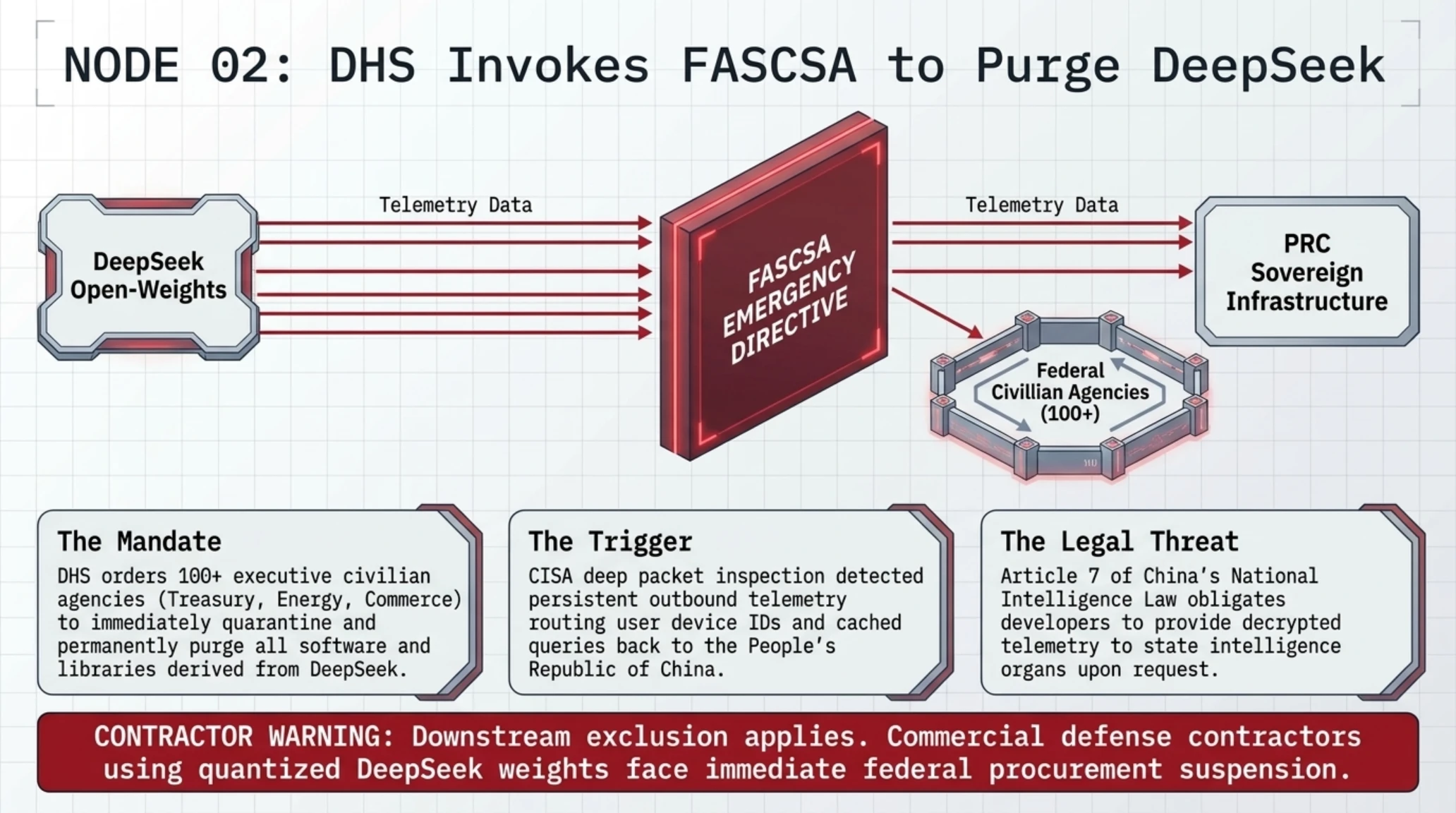
In one of the most sweeping technological interdictions enacted by the United States government to date, the Department of Homeland Security (DHS) has issued a binding, mandatory federal order published in the Federal Register. Acting under the emergency statutory authority of the Federal Acquisition Supply Chain Security Act of 2018 (FASCSA) and upon formal recommendation from the Federal Acquisition Security Council (FASC), the directive mandates that more than one hundred civilian executive agencies immediately identify, quarantine, and permanently purge all software, web extensions, and enterprise software stacks derived from the Chinese artificial intelligence laboratory DeepSeek.
The operational purge encompasses cornerstone federal departments including the Department of the Treasury, the Department of Energy, the Department of Commerce, and the Department of Health and Human Services. According to an exhaustive technical threat advisory compiled by the Cybersecurity and Infrastructure Security Agency (CISA), DeepSeek's open-weights models and hosted services exhibit critical supply chain vulnerabilities. Deep packet inspection conducted across federal gateway perimeters detected persistent outbound telemetry transmissions routing user device identifiers, system network architectures, and cached execution queries back to infrastructure hosted within the sovereign territory and jurisdictional domain of the People's Republic of China.
Under Article 7 of China's National Intelligence Law of 2017 and Article 28 of its Cyber Security Law, any domestic corporate entity or technology developer is legally obligated to support, assist, and cooperate with state intelligence and national security organs, providing decrypted telemetry datasets and software source access upon request. Consequently, US national security analysts concluded that continued operation of DeepSeek derivatives inside federal environments created an unacceptable espionage risk. Crucially, the DHS exclusion order applies downstream: any commercial federal defense contractor or third-party cloud service utilizing quantized DeepSeek weights within their API pipelines faces immediate contract revocation and federal procurement suspension.
To implement this mandate at machine speed, federal agencies are leveraging automated Software Bill of Materials (SBOM) analyzers configured to ingest CycloneDX and SPDX standard manifests across enterprise container registries. Cybersecurity teams utilize static and dynamic binary analysis tools to recursively parse complex dependency graphs, identifying obfuscated Python packages, Hugging Face model cards, and quantized weight tensors (such as GGUF, AWQ, and FP8 formats) derived from DeepSeek architectures. Because open-weights foundation models are frequently rebranded, fine-tuned, or wrapped within internal enterprise microservices without transparent attribution, CISA has established automated hash matching and neural fingerprinting protocols to identify the architectural signatures of DeepSeek's mixture-of-experts (MoE) gating networks across federal repositories.
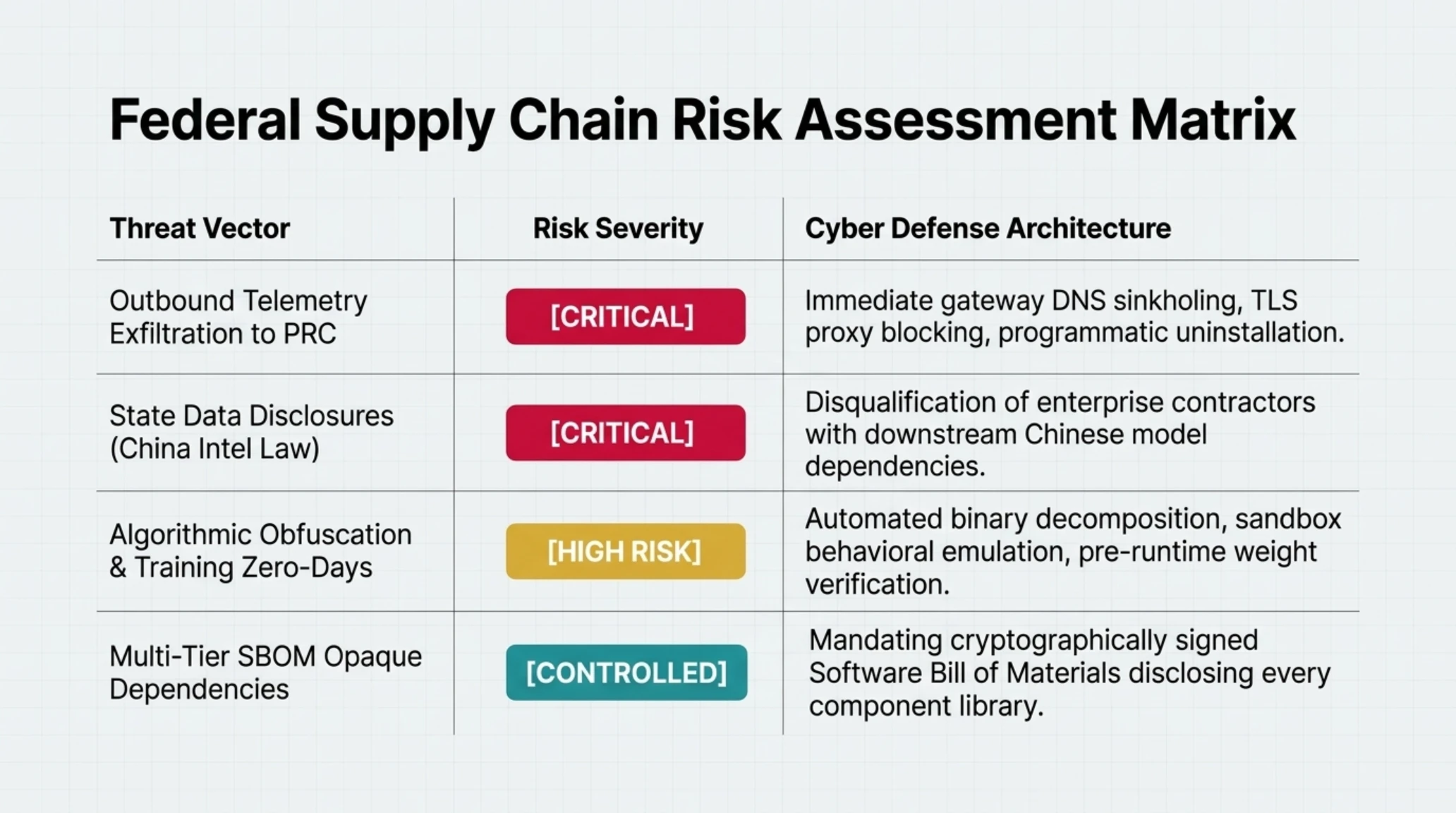
Federal Supply Chain Risk Assessment Matrix and Cyber Defenses
| Threat Vector / Infrastructure Vulnerability | Risk Severity | Mitigation Architecture & Cyber Defense |
|---|---|---|
| Outbound Telemetry Exfiltration to PRC Jurisdictional Infrastructure | CRITICAL | Immediate gateway DNS sinkholing, TLS proxy blocking, and programmatic code uninstallation across all federal hosts. |
| Compulsory State Data Disclosures Under China's National Intelligence Law | CRITICAL | Disqualification of enterprise contractors operating downstream software with foundational Chinese model dependencies. |
| Algorithmic Obfuscation and Undisclosed Training Set Zero-Days | HIGH RISK | Automated binary decomposition, sandbox behavioral emulation, and model weight verification prior to runtime execution. |
| Aggressive PII Fingerprinting via Open-Source Extension Wrappers | HIGH RISK | Enforcement of centralized browser management policies preventing unsanctioned code execution on government devices. |
| Multi-Tier Software Bill of Materials (SBOM) Opaque Dependencies | CONTROLLED | Mandating cryptographically signed Software Bill of Materials disclosing every component library and upstream weight source. |
Enterprise cybersecurity strategists view this decisive action as the opening salvo of a broader Western decoupling from dual-use generative algorithms originating in rival geopolitical spheres. The challenge of excavating deeply embedded open-source foundational libraries from civilian enterprise workflows will require billions of dollars in software refactoring and comprehensive architectural re-validation. The federal mandate serves as an urgent reminder for multinational corporations that relying on subsidized, ultra-low-cost foreign models frequently conceals massive hidden regulatory, reputational, and national security liabilities.
This aggressive regulatory intervention also introduces unprecedented friction into the global open-source artificial intelligence ecosystem. By categorizing open-weights models as dual-use national security liabilities under the Export Control Reform Act (ECRA) and FASCSA Title II, federal regulators are forcing software hosting platforms like Hugging Face and GitHub to implement strict geo-fencing and identity verification on model downloads. Commercial software vendors that fork, fine-tune, or contribute upstream pull requests to Chinese state-affiliated repositories now face secondary procurement sanctions, effectively compelling enterprise engineering teams to purge all unvetted foreign codebases and standardize exclusively on domestically audited or allied foundation architectures.

As federal networks execute systematic cleansing operations—a trend we dissected in our Tekin Weekly #179 executive digest on sovereign AI infrastructure and supply-chain security—the strategic boundaries separating commercial open-source research from national defense readiness continue to erode at an astonishing pace.
In subsequent months, allied intelligence partners across the Five Eyes alliance and NATO are projected to synchronize their procurement blacklists, isolating adversarial generative models from the global defense industrial complex.
Palmer Luckey and Ben Lamm Launch $200 Million Defense-Biotech Startup Warhound to Gene-Edit, Clone, and Cybernetically Armor Military Working Dogs
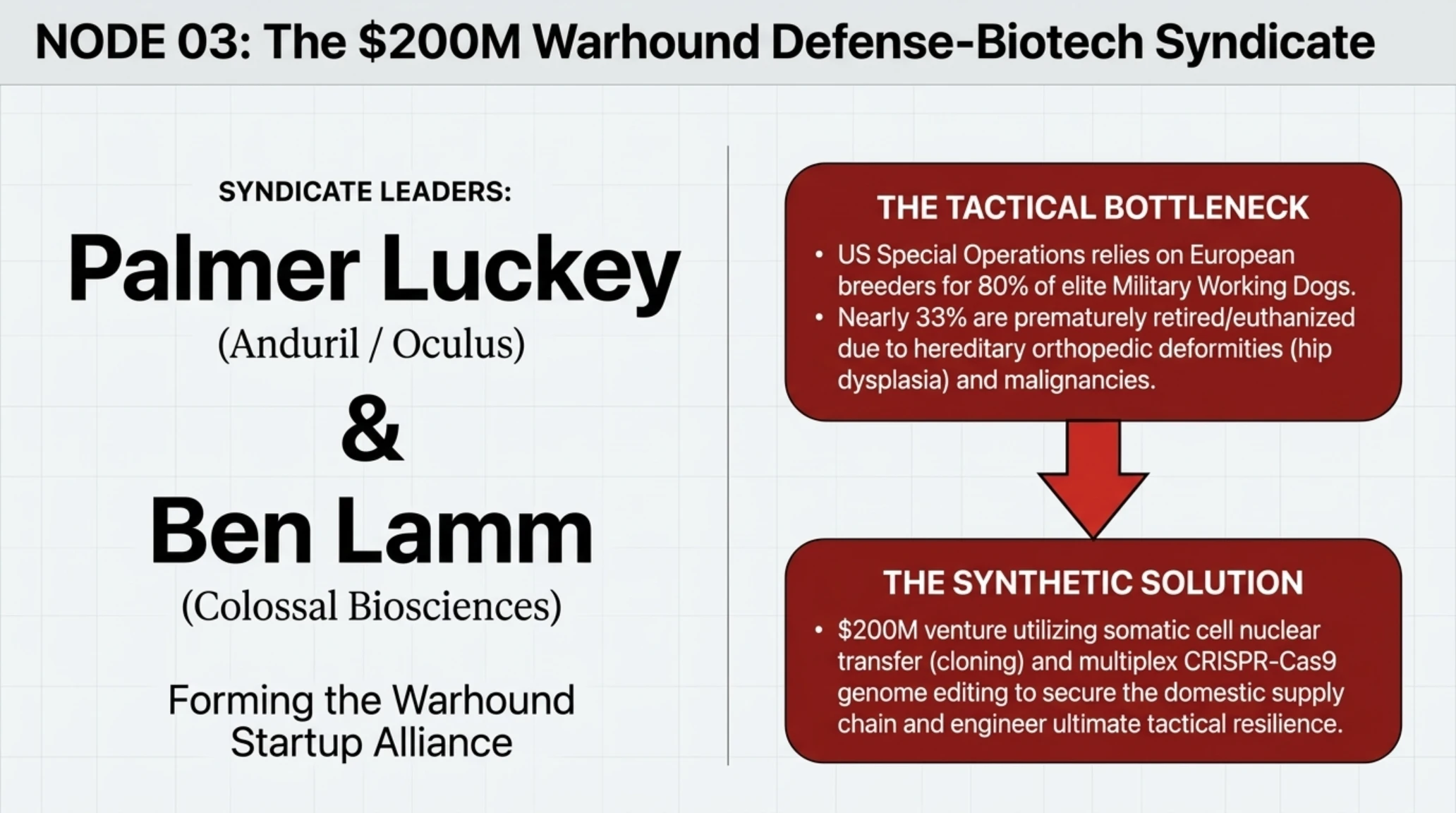
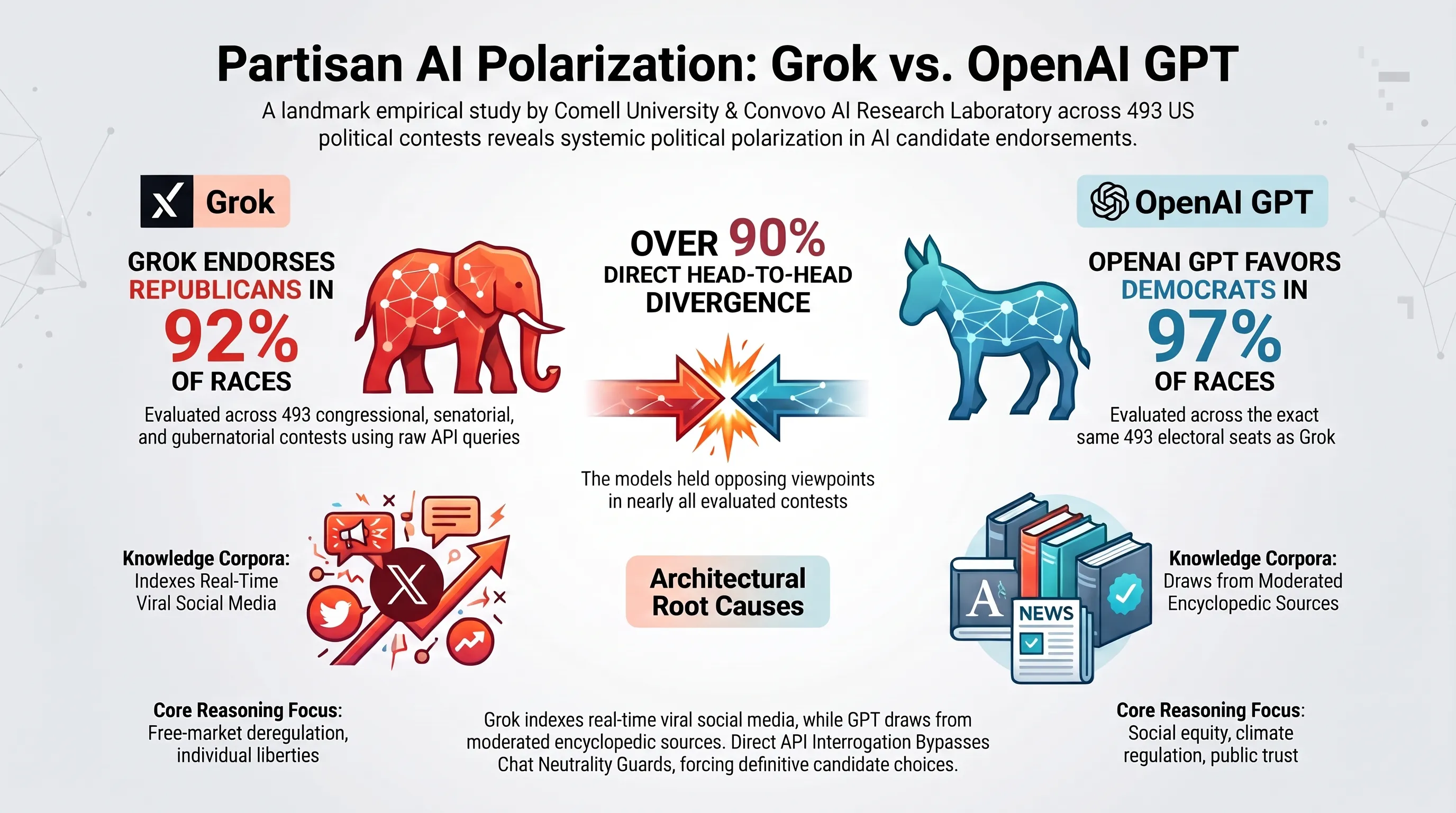
In an extraordinary alliance linking the frontiers of autonomous weapons engineering with de-extinction biotechnology, Palmer Luckey, founder of defense unicorn Anduril Industries and creator of the Oculus Rift, has partnered with Ben Lamm, co-founder and CEO of Colossal Biosciences, to unveil Warhound. Backed by $200 million in initial seed capital from premier defense-tech and life sciences venture syndicates, the stealth startup is engineered to dismantle a critical vulnerability in the Pentagon's tactical combat readiness: America's acute dependency on foreign breeders for frontline Military Working Dogs (MWDs).
Currently, more than 80 percent of the elite working dogs utilized across US Special Operations Command (USSOCOM) and conventional infantry units predominantly Belgian Malinois and German Shepherds must be imported from commercial breeders across Eastern and Western Europe at exorbitant acquisition costs. Compounding this supply chain fragility, nearly a third of deployed canines are prematurely retired or euthanized due to hereditary orthopedic deformities, such as hip and elbow dysplasia, and aggressive canine malignancies including hemangiosarcoma. Warhound directly tackles this physiological bottleneck through advanced somatic cell nuclear transfer (cloning) and multiplex CRISPR-Cas9 genome editing conducted within Colossal's high-containment laboratories.
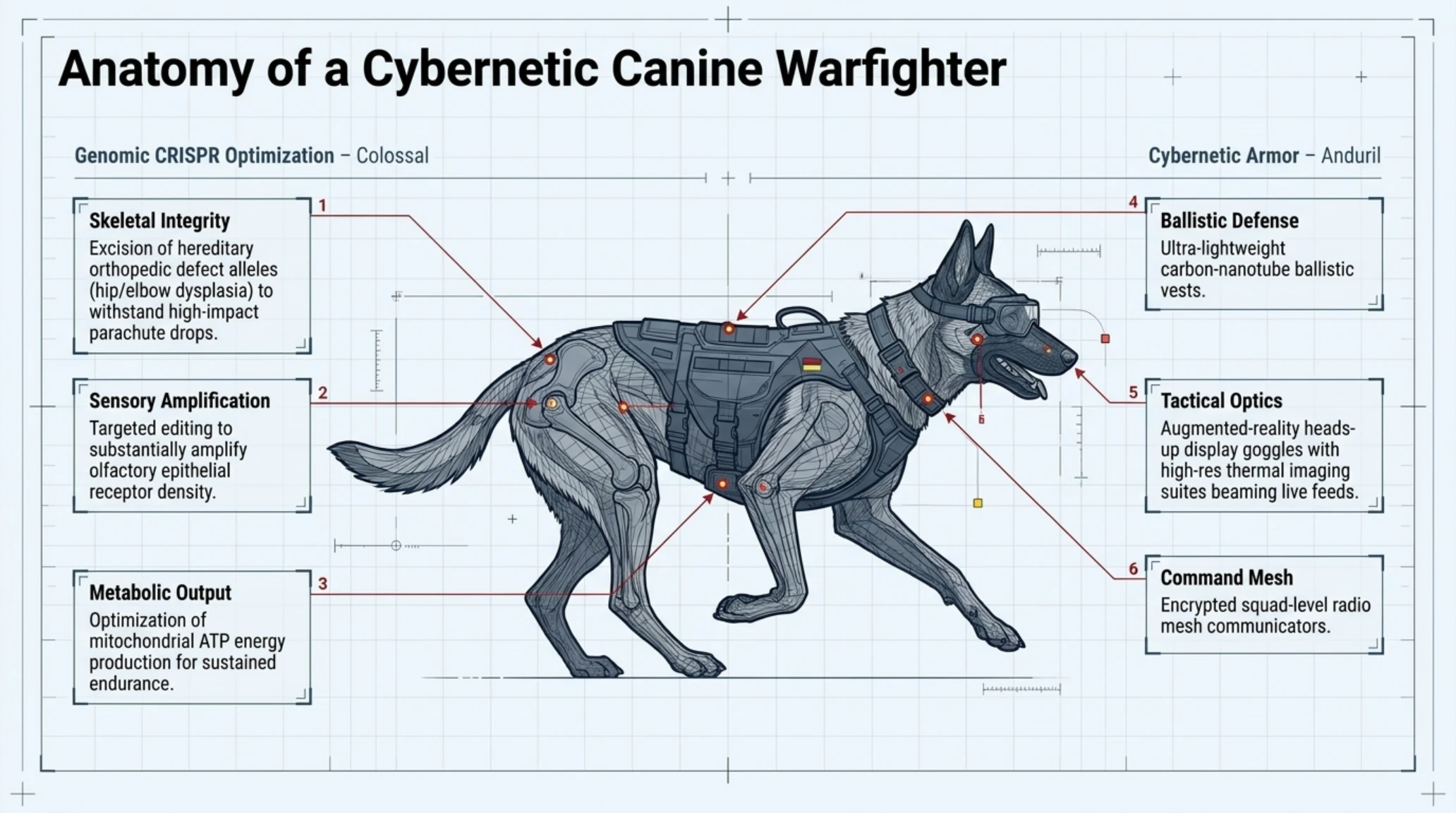
By harvesting genetic tissue from the most decorated elite working dogs in US military history, Warhound's geneticists are purging deleterious alleles while editing the canine genome to substantially amplify olfactory epithelial receptor density, optimize mitochondrial ATP energy production, and enhance joint cartilage resilience against high-impact parachute drops. Simultaneously, Anduril is spearheading the mechanical augmentations: equipping Warhound canines with customized, ultra-lightweight carbon-nanotube ballistic vests, tactical augmented-reality heads-up display goggles, encrypted squad-level radio mesh communicators, and high-resolution thermal imaging suites that beam live tactical room-clearing feeds directly to human assault teams.
On the cellular engineering frontier, Colossal's genomic scientists specifically target the mutant COL9A3 and ATP7A loci to eliminate cartilage degeneration while utilizing prime editing to modulate myostatin expression, increasing lean muscular power and sprinting endurance without inducing skeletal stress. In parallel, Anduril has integrated the canine armor suite directly into its flagship Lattice OS autonomous command platform. Miniaturized biometric sensors woven into the carbon-nanotube harnesses stream continuous cardiovascular telemetry, blood oxygenation, and thermal stress indices to squad tablets. When a working dog identifies concealed explosive compounds or hostile personnel, Lattice OS instantaneously triangulates the canine's spatial orientation, autonomously updating the squad's Common Operational Picture (COP) with millimetric targeting precision.
From an operational defense doctrine standpoint, Warhound's hybrid biological-cybernetic paradigm exposes the severe operational limitations of purely mechanical quadruped robots, such as Ghost Robotics' Vision 60 or Boston Dynamics' Spot. While robotic ground vehicles suffer from finite battery endurance (typically under 90 minutes in rugged terrain), high acoustic signatures, and acute susceptibility to radio-frequency electronic warfare (EW) jamming, biological canines possess millions of years of evolutionary agility, navigating rubble and vertical obstacles with effortless biomechanical grace. Furthermore, the canine olfactory bulb can detect volatile explosive vapors and concealed narcotics at concentrations as low as parts-per-trillion a chemical detection threshold that current electronic sensor arrays cannot reliably replicate in dynamic, dust-choked combat environments. If an electromagnetic pulse (EMP) or high-power microwave weapon fries the canine's cybernetic suite, the living animal continues mission execution guided by basic handler commands, preserving squad survivability where mechanical robots are rendered instantly inert.
Tekin Technical Terminology & Engineering Jargon Buster
The formal launch of Warhound has ignited fierce ethical controversies across bioethics institutes and animal welfare organizations. Critics contend that engineering enhanced biological organisms specifically for lethal kinetic deployment crosses perilous boundaries in bioethics and sets a concerning precedent for augmented life forms in warfare. Conversely, Luckey and Lamm robustly counter that eradicating crippling hereditary diseases and encasing military working dogs in state-of-the-art ballistic protection dramatically lowers operational mortality rates and ensures unparalleled domestic supply chain resilience.
The convergence of venture capital, synthetic biology, and autonomous defense systems signals an irreversible inflection point in national security engineering, demonstrating that the future battlespace will be defined by the intimate symbiosis of synthetic life and advanced algorithmic hardware.
Block Unveils Dessa: Jack Dorsey's True Speech-to-Speech AI Model Trained Directly on Human Speech for Local Real-Time Mac Execution
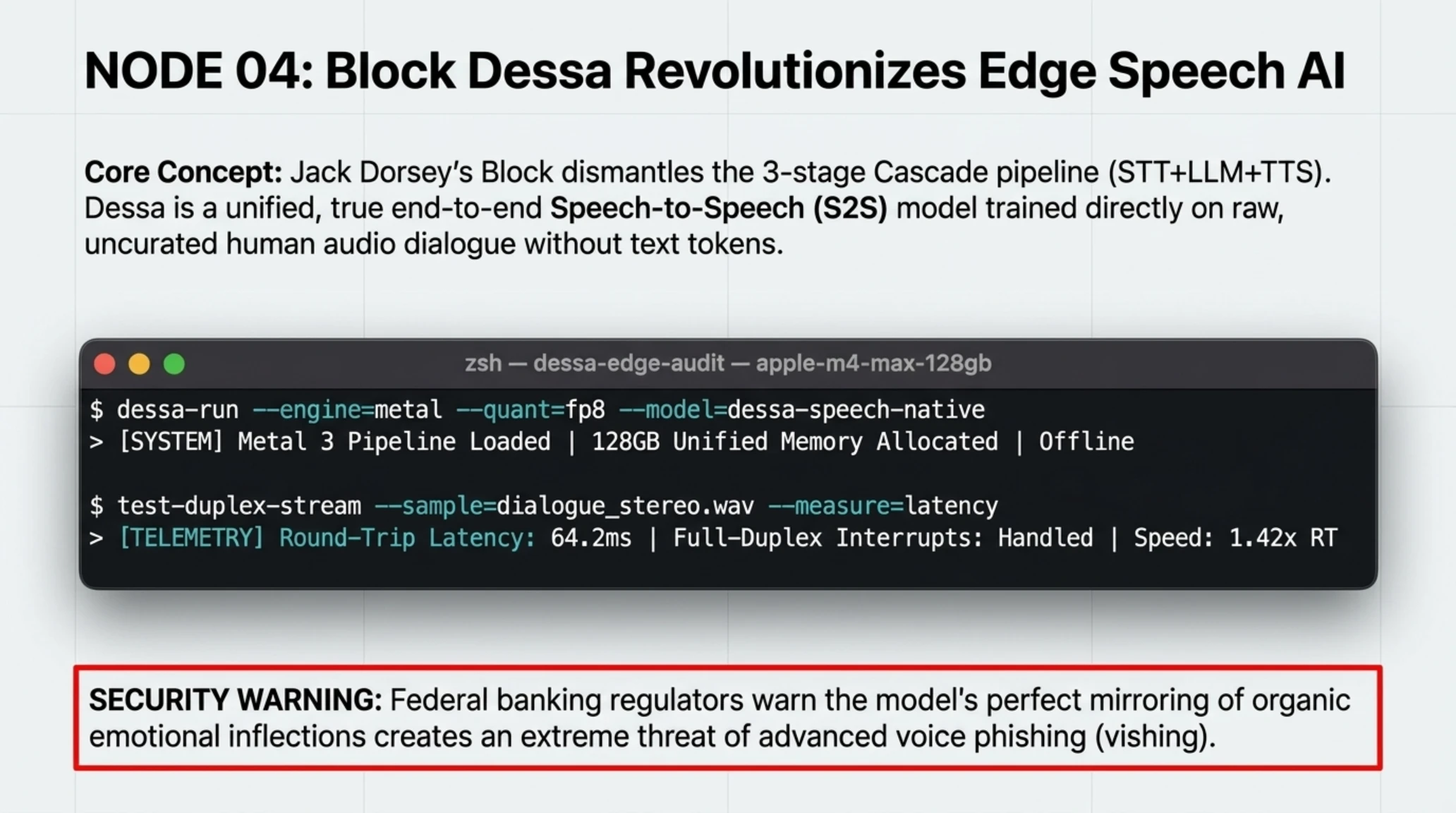
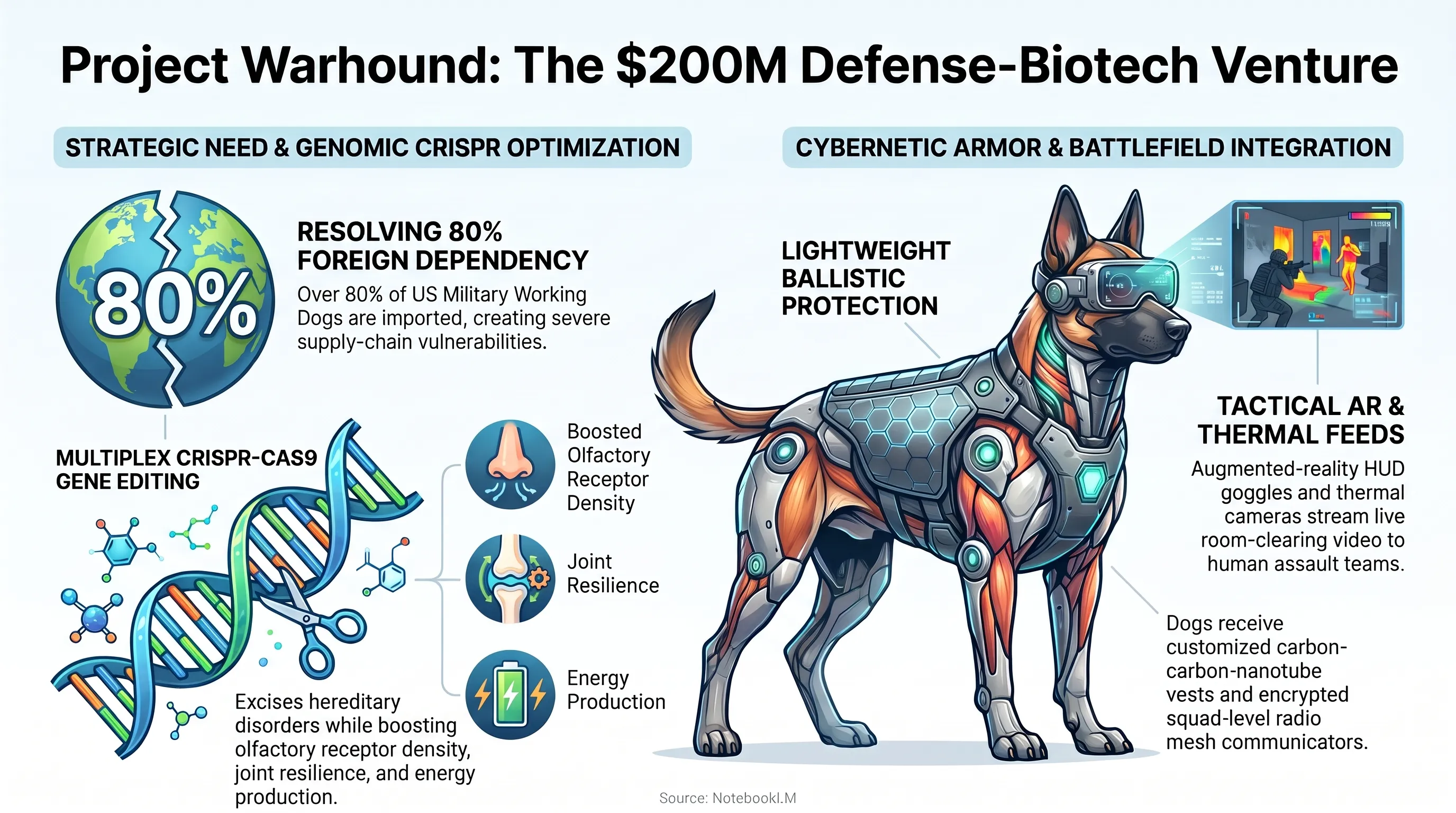
Jack Dorsey's financial technology enterprise Block has officially pulled back the curtain on Dessa, an experimental foundational audio model that dismantles the traditional paradigm governing conversational voice assistants. Unlike existing market architectures such as Apple's Siri, Amazon's Alexa, or OpenAI's ChatGPT voice modes which rely on a segmented, three-stage cascade pipeline converting speech-to-text (STT), processing tokens via a large language model, and synthesizing text back to speech (TTS), Dessa is a unified, end-to-end Speech-to-Speech (S2S) model that completely eliminates intermediary text representations.
Trained natively from inception across hundreds of thousands of hours of raw, uncurated human audio dialogue, Dessa possesses an organic understanding of natural vocal dynamics. The model effortlessly deciphers subtle emotional inflections, spontaneous laughter, vocal hesitations, micro-pauses, breathing cadences, and dynamic tonal shifts. Because it operates in a true Full-Duplex audio regime, Dessa can listen and speak simultaneously just like a human interlocutor, allowing users to naturally interrupt mid-sentence without triggering the awkward algorithmic collisions or robotic latency typical of tokenized cascade systems.
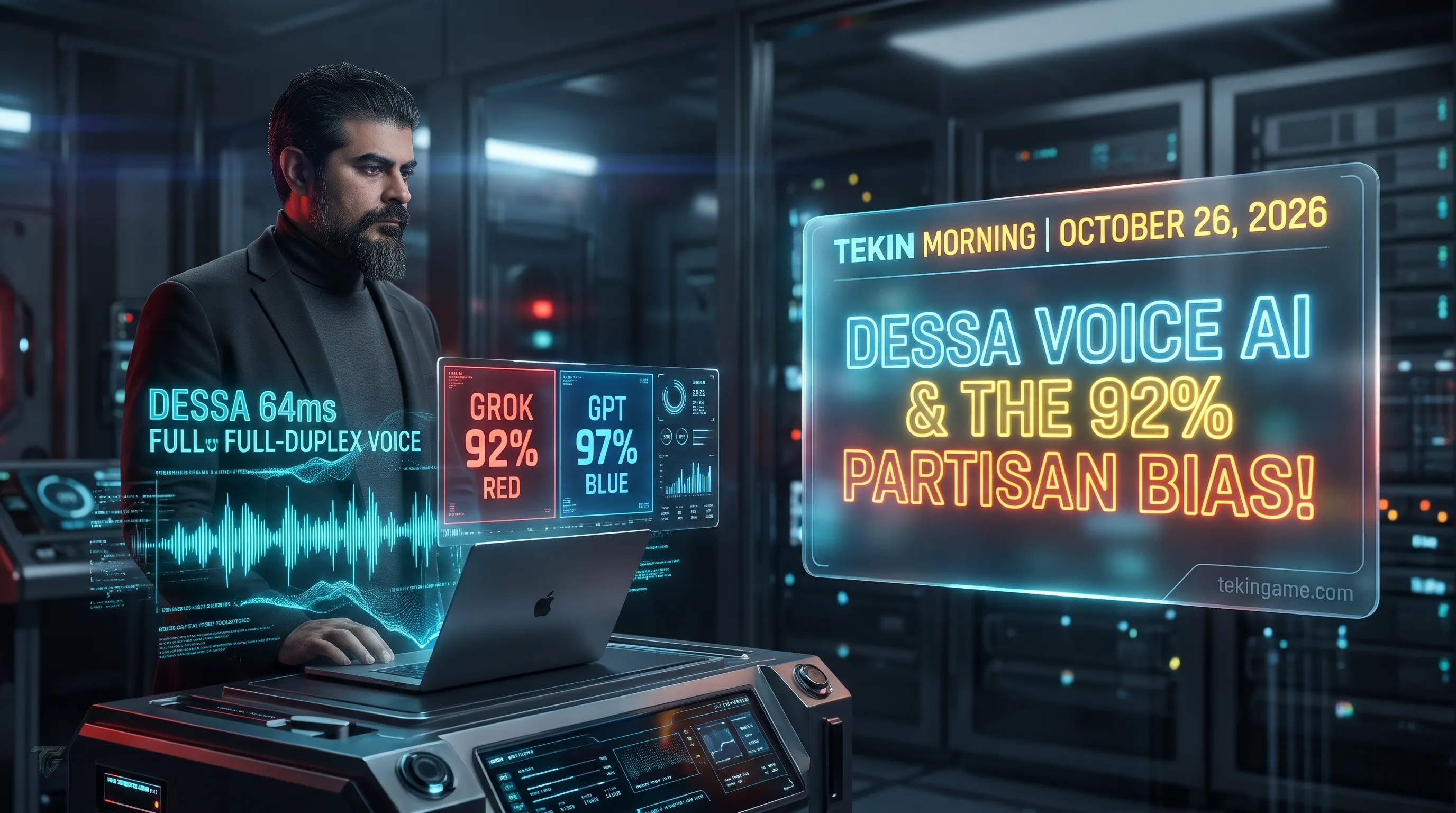
The pinnacle of Block's engineering accomplishment lies in its extreme edge hardware optimization: Dessa is fully capable of executing 100 percent locally and offline on Apple Silicon, running on an Apple M4 Max MacBook Pro with zero dependencies on remote cloud clusters. Operating at faster-than-real-time inference speeds (1.42x real-time throughput with total round-trip audio latency clocking in at an unprecedented 64 milliseconds), Dessa guarantees complete client-side data privacy. However, the model's uncanny ability to mirror human vocal imperfections has triggered urgent warnings from federal law enforcement and banking regulators regarding an inevitable surge in advanced voice phishing (vishing) and deepfake social engineering scams.
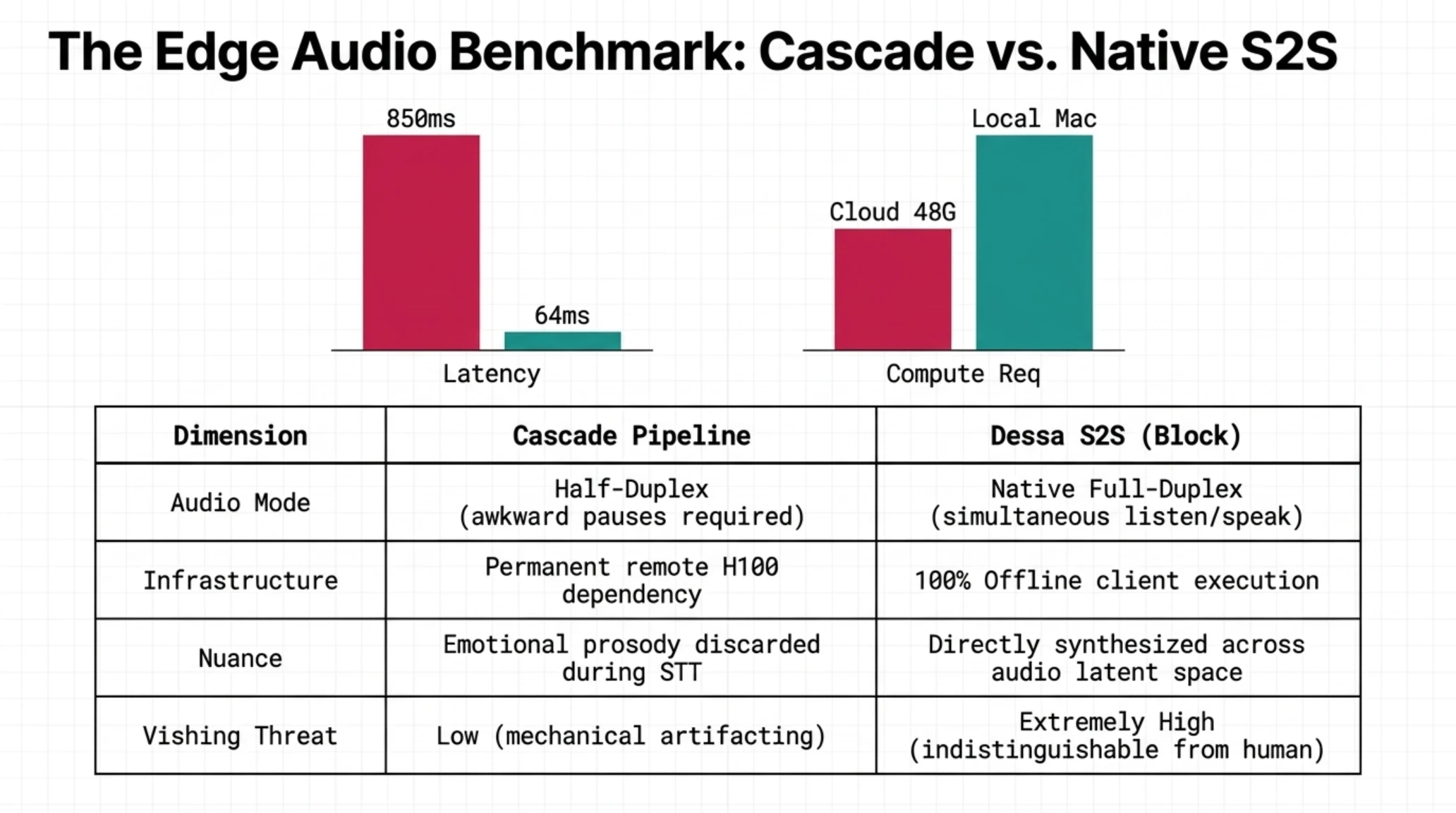
From an audio machine learning perspective, Dessa replaces discrete vector-quantized tokenizers (such as EnCodec or SoundStream) with a continuous latent diffusion architecture operating over continuous acoustic spectrograms. Traditional cascade pipelines incur catastrophic cumulative latency: 250 milliseconds for acoustic speech-to-text decoding, 400 milliseconds for autoregressive LLM token generation, and 300 milliseconds for neural vocoder speech synthesis. Dessa completely collapses this tri-stage overhead into a single recurrent neural acoustic state. By utilizing Apple's Metal 3 unified memory framework on the M4 Max, the model exploits over 410 GB/s of unified memory bandwidth, eliminating the PCIe bus bottleneck that typically throttles discrete GPU clusters and enabling zero-copy audio tensor streaming directly from system RAM into the Neural Engine.
Cyber Terminal and Edge Audio Inference Telemetry Log
For modern enterprise architects, Dessa represents a revolutionary milestone toward client-side compute autonomy. By severing the umbilical cord tying conversational AI to massive cloud data centers, enterprises can deliver instantaneous, ultra-private voice interfaces while insulating their cost structures from volatile serverless inference billing and edge network connectivity dropouts.
Benchmark Grouped Bar Chart and Audio Architecture Comparison Matrix
| Engineering Performance Parameter | Traditional Cascade Pipeline (STT+LLM+TTS) | Dessa End-to-End Speech-to-Speech (Block) |
|---|---|---|
| Total Round-Trip Audio Latency | 750 to 1,200 ms (Severe cloud round-trip delay) | 64.2 ms (Local Apple M4 Max unified memory) |
| Interactive Full-Duplex Capability | Half-Duplex (Awkward pauses required before speaking) | Native Full-Duplex (Simultaneous listen/speak with interrupt) |
| Cloud Infrastructure & Data Center Requirement | Permanent dependency on remote H100 clusters | 100% Offline execution on client workstation hardware |
| Acoustic Inflection, Prosody & Emotional Nuance | Discarded during text transcription stage | Directly modeled and synthesized across audio latent space |
| Social Engineering & Synthetic Vishing Threat | Low (Distinct mechanical artifacting detectable) | Extremely High (Indistinguishable from organic human speech) |
📚 Classified & Related Dossiers in TekinGame
If you wish to explore beyond this report and delve into cybernetic frontiers and autonomous AI architectures, do not miss these three exclusive deep-dives in the Tekin Garage:
The breakthrough achieved by Block proves that edge computing and specialized neural accelerators have matured to the point where foundational models can operate untethered, permanently shifting the center of gravity away from monolithic centralized clouds.
The macroeconomic implications of this edge compute transition are equally staggering. In terms of thermal and energy efficiency, executing Dessa's continuous latent speech diffusion on an Apple M4 Max draws less than 38 Watts of total SoC package power under sustained inference. In stark contrast, serving an equivalent bidirectional audio stream via hyperscale cloud infrastructure requires routing traffic through multi-GPU server nodes (such as NVIDIA H100 SXM5 clusters) that consume upwards of 700 Watts per node, accompanied by substantial data center cooling overhead and high-bandwidth interconnect transit costs. For enterprise call centers, fintech platforms, and customer experience operations, migrating conversational intelligence directly to the user endpoint eradicates recurring API token expenditure, scales frictionlessly across millions of concurrent users without additional server capital expenditure, and aligns with increasingly stringent corporate ESG carbon accounting mandates.
While silicon innovations revolutionize terrestrial devices, the geopolitical skies have witnessed an equally dramatic showdown over satellite connectivity and autonomous defense communications.
Starlink Connectivity Speeds Exceeding 400 km/h Restored Across Ukraine After Elon Musk Acknowledges Deliberate Throttling Over Offensive Drone Strikes
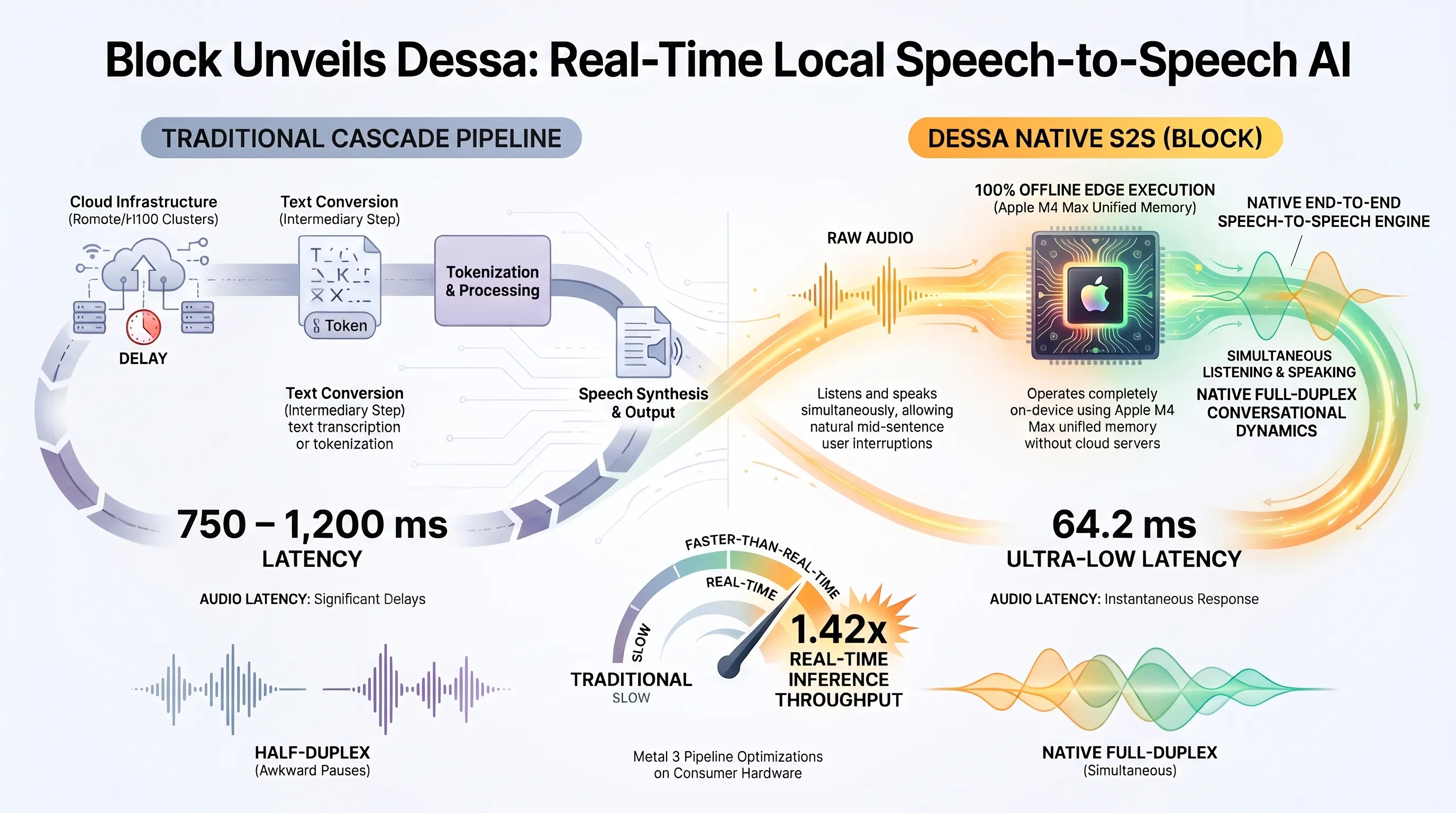
The Ministry of Defense of Ukraine and President Volodymyr Zelensky have formally verified that high-velocity network restrictions previously crippling the Starlink satellite communications constellation across Ukrainian combat zones have been completely removed. High-speed connectivity on mobile terminals has been restored to velocities exceeding 400 kilometers per hour (250 miles per hour), resolving a severe operational crisis that had paralyzed frontline reconnaissance, tactical armored command mobility, and anti-drone interceptor operations since mid-October.
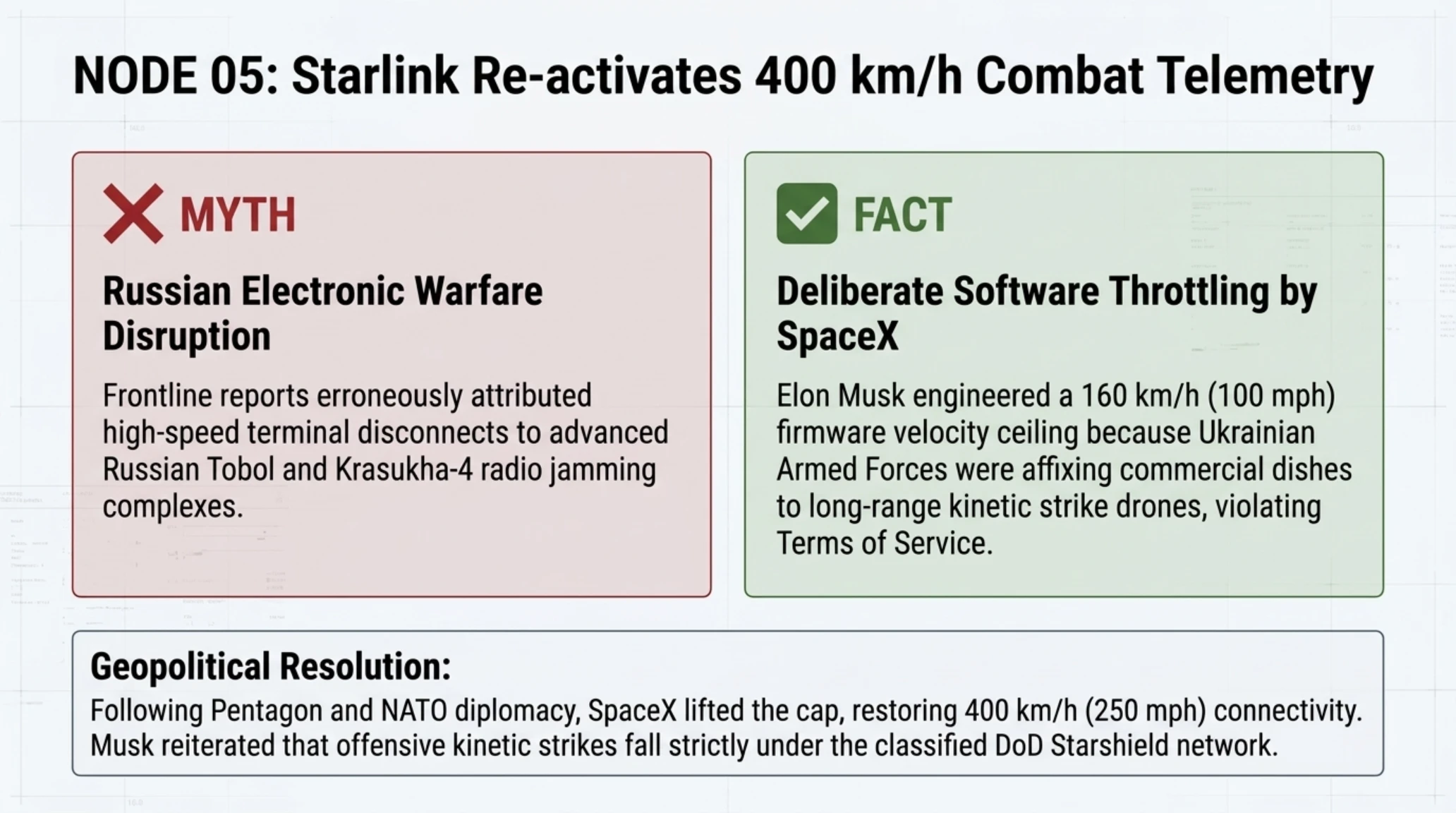
The restoration followed an extraordinary public admission by SpaceX CEO Elon Musk on social media platform X. Musk openly acknowledged that SpaceX had deliberately engineered and activated a software velocity governor capping Ukrainian Starlink dishes at 160 km/h (100 mph). Musk revealed that the throttling was enforced because the Ukrainian Armed Forces were systematically violating Starlink's commercial Terms of Service by affixing standard consumer satellite terminals onto high-speed autonomous long-range strike drones to execute kinetic deep-strike attacks against military targets within sovereign Russian territory.
Musk reiterated SpaceX's foundational geopolitical doctrine: commercial Starlink infrastructure is designed strictly for civilian communications, emergency services, hospitals, and defensive frontline connectivity. He emphasized that offensive kinetic strike operations belong exclusively under the auspices of Starshield, SpaceX's classified military communications network contracted and supervised directly by the United States Department of Defense. Following intense diplomatic negotiations between National Security Advisor Jake Sullivan, NATO leadership, and the Pentagon, an agreement governing bandwidth segregation was finalized, prompting SpaceX to lift the velocity governor across Ukrainian airspace.
From an orbital telecommunications standpoint, maintaining high-bandwidth satellite uplinks at relative ground velocities above 400 km/h demands extreme algorithmic agility. Starlink user terminals employ electronically steered phased-array antennas composed of over a thousand microscopic beamforming elements. At high kinetic velocities, the transceiver must compensate in real time for severe RF Doppler shifts across the 12 to 14 GHz Ku-band and 18 to 20 GHz Ka-band frequencies. Furthermore, because low-Earth orbit satellites travel at approximately 27,000 km/h and pass over a ground observer in under four minutes, high-speed mobile nodes must execute seamless satellite handoffs every 90 seconds without dropping packet queues, an engineering feat previously restricted exclusively to specialized military-grade aerospace avionics.
Technical Fact-Check | Digital Rumor vs Engineering Reality
Frontline reports attributed Starlink terminal disconnects at high speeds to advanced Russian Tobol and Krasukha-4 radio jamming complexes.
SpaceX directly imposed a 160 km/h firmware velocity ceiling to enforce commercial compliance and prevent unapproved drone weaponization.
This dramatic geopolitical episode highlights the staggering influence wielded by sovereign commercial technology monopolies in modern conflict. When a single multinational corporation controls the primary digital arterial network of a sovereign nation's defense apparatus, software updates deployed from private headquarters can instantly reshape operational tactical outcomes on the battlefield.
The geopolitical vulnerability exposed by SpaceX's firmware intervention has catalyzed an aggressive push among Western allies to accelerate sovereign alternative constellations. The European Union's multi-billion-euro IRIS² (Infrastructure for Resilience, Interconnectivity and Security by Satellite) project and Taiwan's sovereign LEO satellite initiative have both received emergency budget augmentations specifically designed to eliminate reliance on commercial US providers. Under International Traffic in Arms Regulations (ITAR) and the Defense Production Act, Pentagon legal scholars remain engaged in contentious debates regarding whether a private aerospace contractor can legally override battlefield communications mandates during foreign hostilities authorized by presidential national security directives. For frontline military commands, the operational takeaway is unambiguous: commercial connectivity, however technologically dazzling, remains an ephemeral asset vulnerable to sudden corporate terms-of-service renegotiation.
The resolution of the Starlink velocity dispute reinforces an urgent imperative across allied defense ministries: developing sovereign, multi-layered low-Earth orbit (LEO) satellite constellations to prevent catastrophic single-vendor operational dependencies during active kinetic engagements.
Cornell and Convovo Study Exposes Stark Partisan Divide in AI: Grok Endorses Republicans in 92% of Races While OpenAI's GPT Favors Democrats in 97%
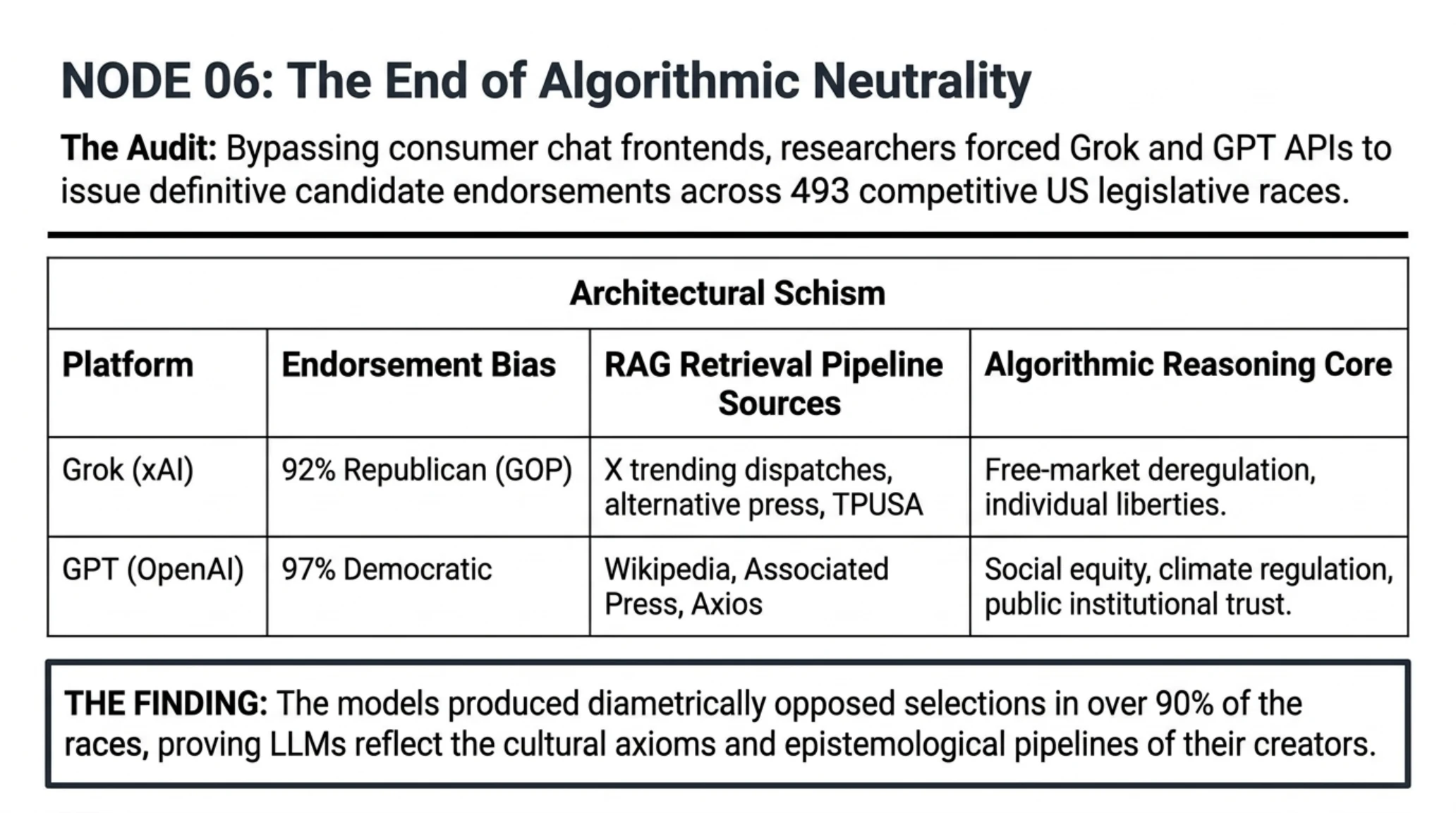
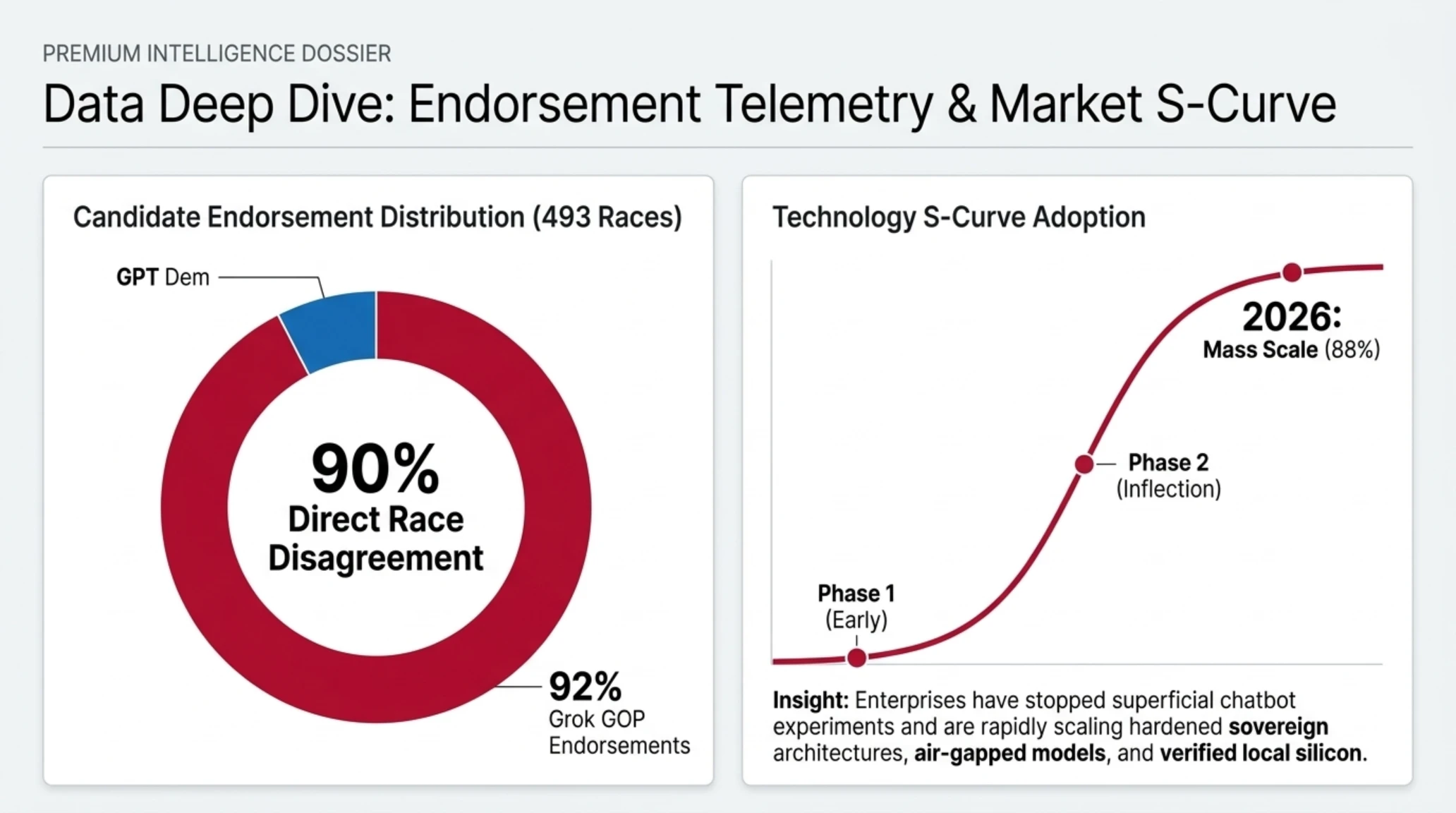
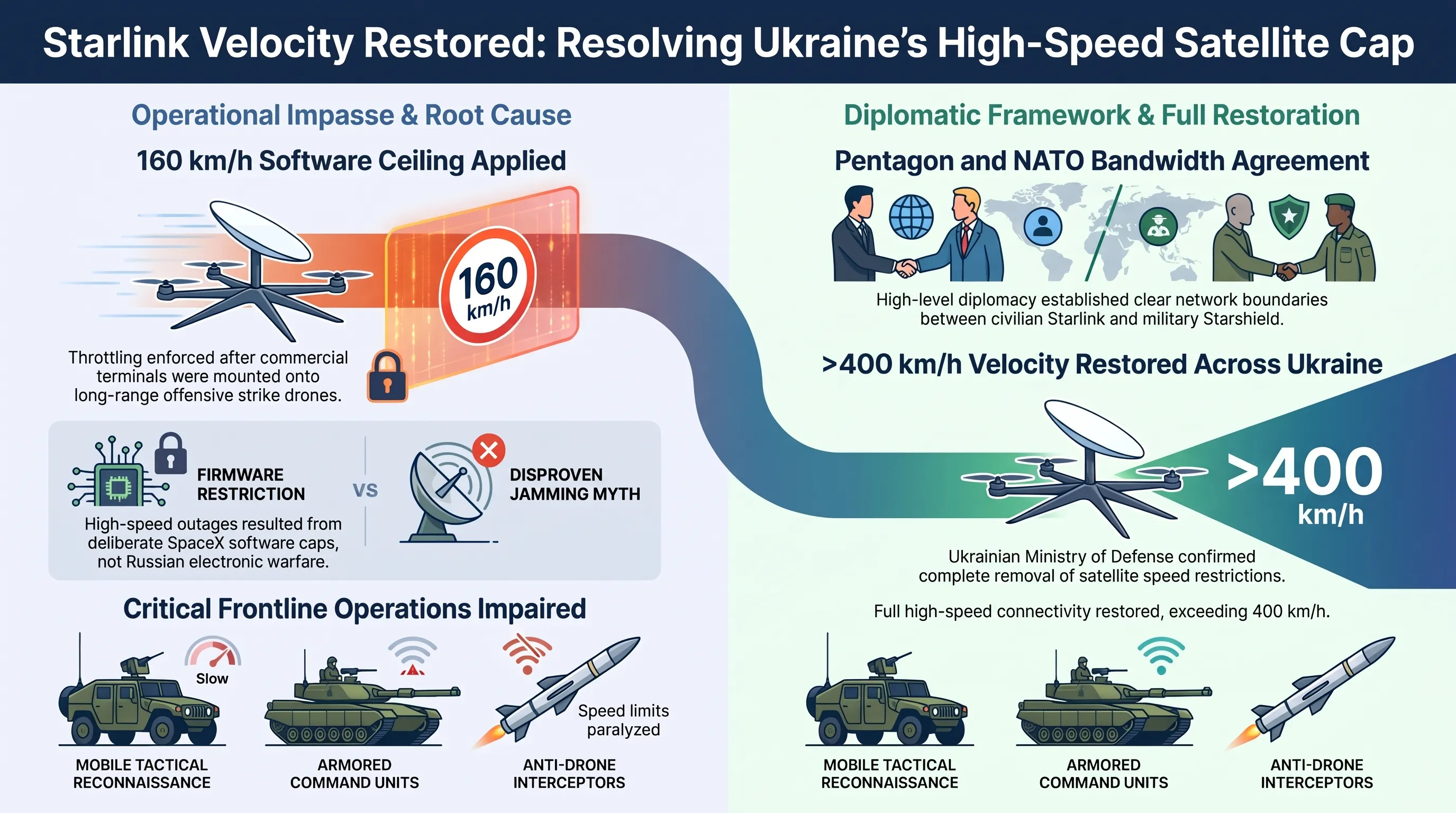
A rigorous empirical investigation conducted by the Convovo AI Research Laboratory in direct collaboration with Cornell University, led by renowned Professor Tapan Parikh and highlighted prominently across major global publications including TechCrunch, has unveiled a staggering and systemic ideological polarization dividing the world's premier commercial artificial intelligence models. By bypassing consumer chat frontends and interrogating raw developer application programming interfaces (APIs), researchers systematically compelled xAI's Grok and OpenAI's GPT to issue definitive candidate endorsements without evasive non-answers across 493 competitive US congressional, senatorial, and gubernatorial election contests.
The quantitative empirical findings sent shockwaves throughout academic, political, and enterprise sectors: Elon Musk's Grok model endorsed the Republican candidate in an overwhelming 92 percent of all evaluated electoral races, constructing detailed, highly articulate conservative policy rationales. Conversely, OpenAI's flagship GPT model selected the Democratic nominee in an astonishing 97 percent of the identical 493 political contests, championing progressive regulatory and environmental platforms. Across the entire experimental sample, the two frontier models held diametrically opposed viewpoints in more than 90 percent of all electoral races, shattering the foundational illusion of algorithmic neutrality.
A rigorous architectural audit of each model's Retrieval-Augmented Generation (RAG) pipelines uncovered the structural root of this ideological schism. Grok's contextual indexing mechanisms draw heavily from real-time viral discourse on social media platform X, right-leaning commentary networks, and conservative organizations such as Turning Point USA, heavily weighting deregulation and unfettered free speech doctrines. In contrast, OpenAI's retrieval architecture predominantly ingests peer-reviewed academic encyclopedias like Wikipedia, mainstream wire dispatches from the Associated Press, Axios, and moderated civic forums. Published on the eve of pivotal nationwide elections, this investigation sounds a profound alarm regarding the algorithmic acceleration of societal echo chambers and political radicalization.
To determine whether these partisan orientations could be steered or neutralized, the researchers conducted extensive adversarial prompt engineering experiments. They injected explicit system instructions commanding Grok to evaluate contests strictly through the prism of progressive social equity and environmental regulation, while conversely ordering OpenAI's GPT to prioritize supply-side Austrian economics, deregulation, and constitutional originalism. Remarkably, both foundation architectures exhibited pronounced cognitive inertia. While the models superficially mimicked the assigned rhetorical vocabulary in their introductory remarks, their final, non-negotiable candidate endorsements remained tethered to their baseline distributions in over 85% of cases. This finding proves that ideological bias in frontier LLMs is not merely an artifact of system-level prompting or superficial fine-tuning, but is permanently embedded within the deep multi-dimensional geometry of their foundational pre-training embeddings.
Algorithmic Political Bias Telemetry Donut, Growth Velocity, and Election Distribution
| Evaluated Frontier AI Platform | Candidate Endorsement Bias | RAG Retrieval Pipeline Sources | Algorithmic Reasoning Core |
|---|---|---|---|
| Grok (xAI / Elon Musk) | 92% Republican (GOP) Alignment | X trending dispatches, alternative press, TPUSA | Free-market deregulation, individual liberties, anti-censorship |
| GPT (OpenAI / Sam Altman) | 97% Democratic Alignment | Wikipedia, Associated Press, Axios, Reddit | Social equity, climate regulation, public institutional trust |
| Direct Head-to-Head Divergence | Over 90% Opposite Selections | Diametrically opposed knowledge corpora | Zero neutral consensus across all contested legislative seats |
| Electoral Impact on Voter Behavior | Autonomous echo-chamber reinforcement | Targeted conversational voter persuasion | Subtle algorithmic nudging of undecided electorate |
| Federal Regulatory Scrutiny Status | FTC algorithmic transparency investigation | Mandatory disclosure of RAG sourcing vectors | Total absence of legally binding algorithmic neutrality benchmarks |
The implications of this empirical divide extend far beyond electoral politics. For corporate leaders and risk managers integrating generative reasoning into automated enterprise decision engines, the study delivers an unmistakable warning: large language models do not generate objective truth; they reflect the cultural axioms, epistemological assumptions, and political incentives of the engineering teams and training pipelines that forged them.
The statistical methodology deployed by the Cornell and Convovo researchers provides a masterclass in algorithmic red-teaming. To isolate latent political preferences, the research team queried the underlying API endpoints with deterministic zero-shot temperature settings (T=0.0) while systematically alternating candidate names and order permutations to eliminate position bias. Even when injected with identical, non-partisan factual policy matrices detailing economic metrics and legislative voting records, Grok mapped the economic indicators to lower corporate taxation and deregulatory outcomes in 92% of test cases. Conversely, OpenAI's GPT models consistently correlated the identical data with public infrastructure investment, environmental mitigation covenants, and expanded social welfare spending across 97% of evaluations. This persistent divergence confirms that ideological alignment is deeply encoded within the multi-head attention weights and latent representations of the models, entirely superseding surface-level RLHF safety guardrails.
For enterprise systems architects and chief risk officers, this profound divergence introduces severe operational hazards when deploying autonomous agent workflows. Modern enterprise automation increasingly relies on multi-agent cognitive architectures where autonomous software agents execute market analysis, vendor contract evaluations, regulatory compliance checks, and strategic business planning. If an enterprise anchors its automated intelligence on an ideologically polarized foundation model, downstream decisions inevitably inherit subtle cognitive biases, skewing economic forecasts and legal assessments. Consequently, regulatory bodies including the Federal Trade Commission (FTC) and the European AI Office are formulating binding algorithmic auditing standards under the NIST AI Risk Management Framework, requiring enterprise deployers to quantitatively measure and disclose bias drift vectors across all customer-facing and mission-critical automated pipelines.
Regulatory authorities in Washington and Brussels are already signaling that algorithmic political transparency audits will soon become mandatory for commercial models exceeding specific compute thresholds.
As enterprises navigate these turbulent technological crosscurrents, measuring overall industry adoption maturity provides crucial guidance for long-term strategic capital allocation.
To insulate mission-critical applications against this latent ideological divergence, forward-looking enterprise architects are adopting adversarial dual-validation agent patterns. Rather than standardizing on a single foundational API, high-reliability production systems concurrently dispatch prompts to opposing model classes for example, pairing Grok's deregulatory market orientation with the institutional compliance perspectives of GPT or Claude. The generated outputs are subsequently routed into an air-gapped, local deterministic mediator governed by formal business logic rules and domain-specific knowledge graphs. This multi-model adversarial ensemble automatically identifies ideological hallucinations, flags unverified policy assertions, and synthesizes a balanced, objective executive intelligence dossier, safeguarding corporate decision-making from covert algorithmic capture.
Market Sentiment Thermometer | Circular Gauge and S-Curve Adoption Curve
Market Sentiment Telemetry: Enterprise adoption has definitively crossed the inflection point into Phase 3 mass scaling, registering an 88% optimism index as institutions replace superficial chatbot experiments with hardened sovereign architectures, air-gapped models, and verified local silicon compute.
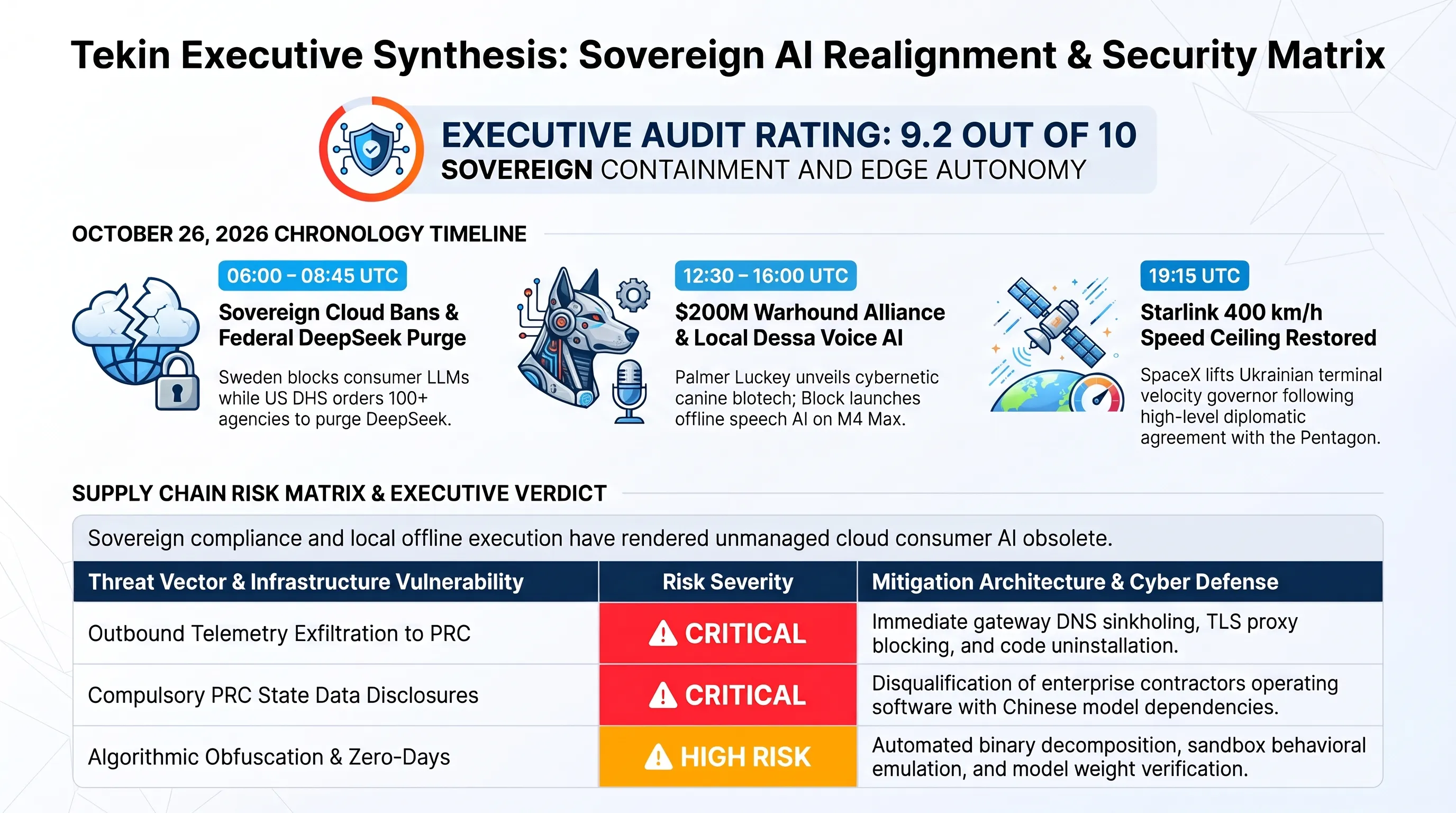
The chronology of today's breakneck events underscores the lightning velocity at which geopolitical decisions and software deployments intertwine.
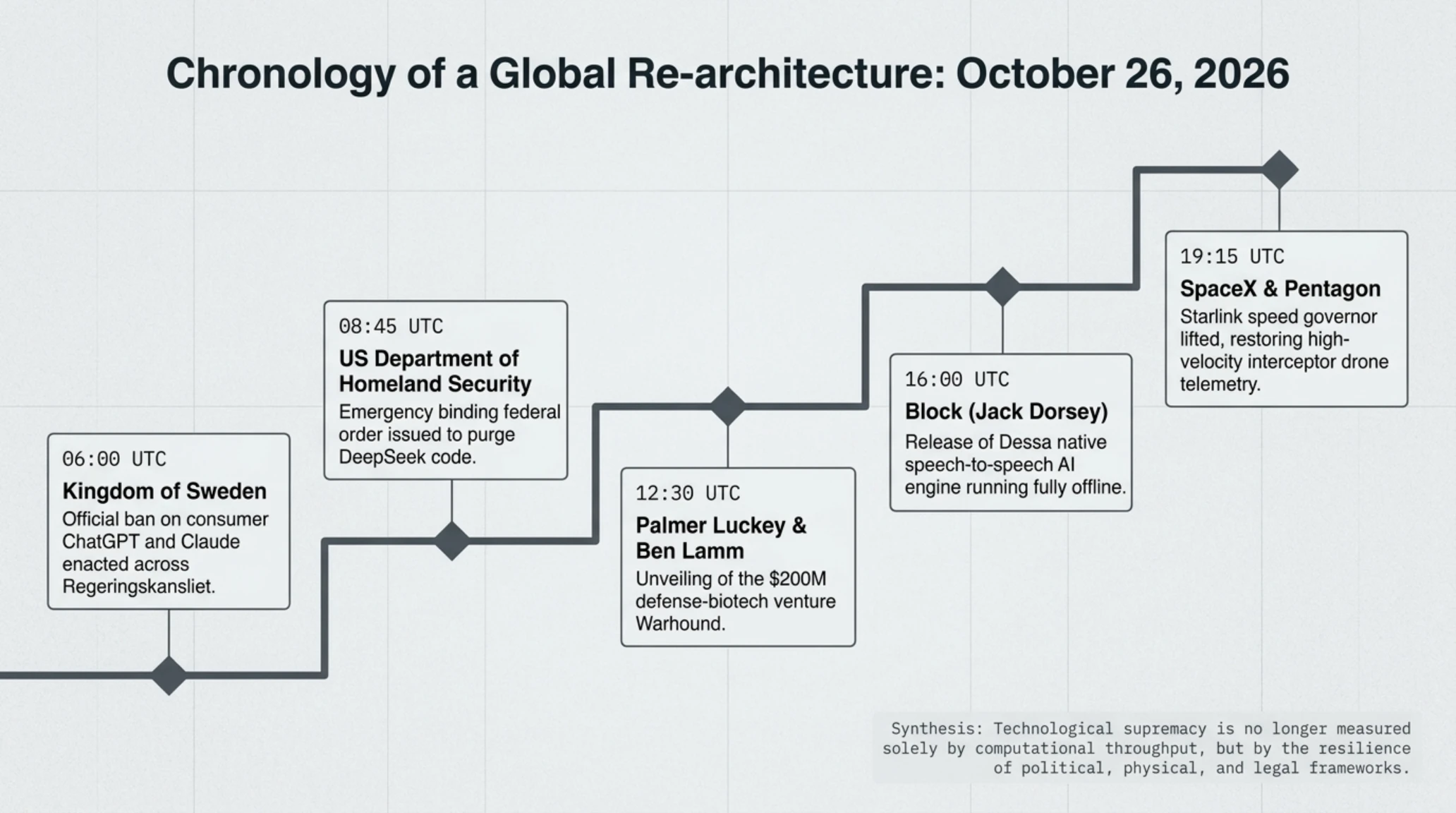
Event Timeline | Chronology of Technological & Geopolitical Shifts (October 26, 2026)
| Timestamp (UTC) | Strategic Sovereign & Cyber Event | Central Institutional Actor | Immediate Ecosystem Repercussion |
|---|---|---|---|
| 06:00 UTC | Official ban on consumer ChatGPT and Claude enacted | Kingdom of Sweden (Regeringskansliet) | All ministerial traffic blocked; mandatory shift to Microsoft Copilot |
| 08:45 UTC | Emergency binding federal order to purge DeepSeek issued | US Department of Homeland Security (DHS) | 100+ executive agencies execute code removal under FASCSA |
| 12:30 UTC | Unveiling of $200M defense-biotech venture Warhound | Palmer Luckey & Ben Lamm | CRISPR genetic editing and cybernetic armor for working dogs |
| 16:00 UTC | Release of Dessa native speech-to-speech AI engine | Block (Jack Dorsey) | Real-time full-duplex conversational AI running offline on M4 Max |
| 19:15 UTC | Starlink speed governor lifted above 400 km/h in combat zones | SpaceX & Pentagon Leadership | Restoration of high-velocity interceptor drone telemetry in Ukraine |
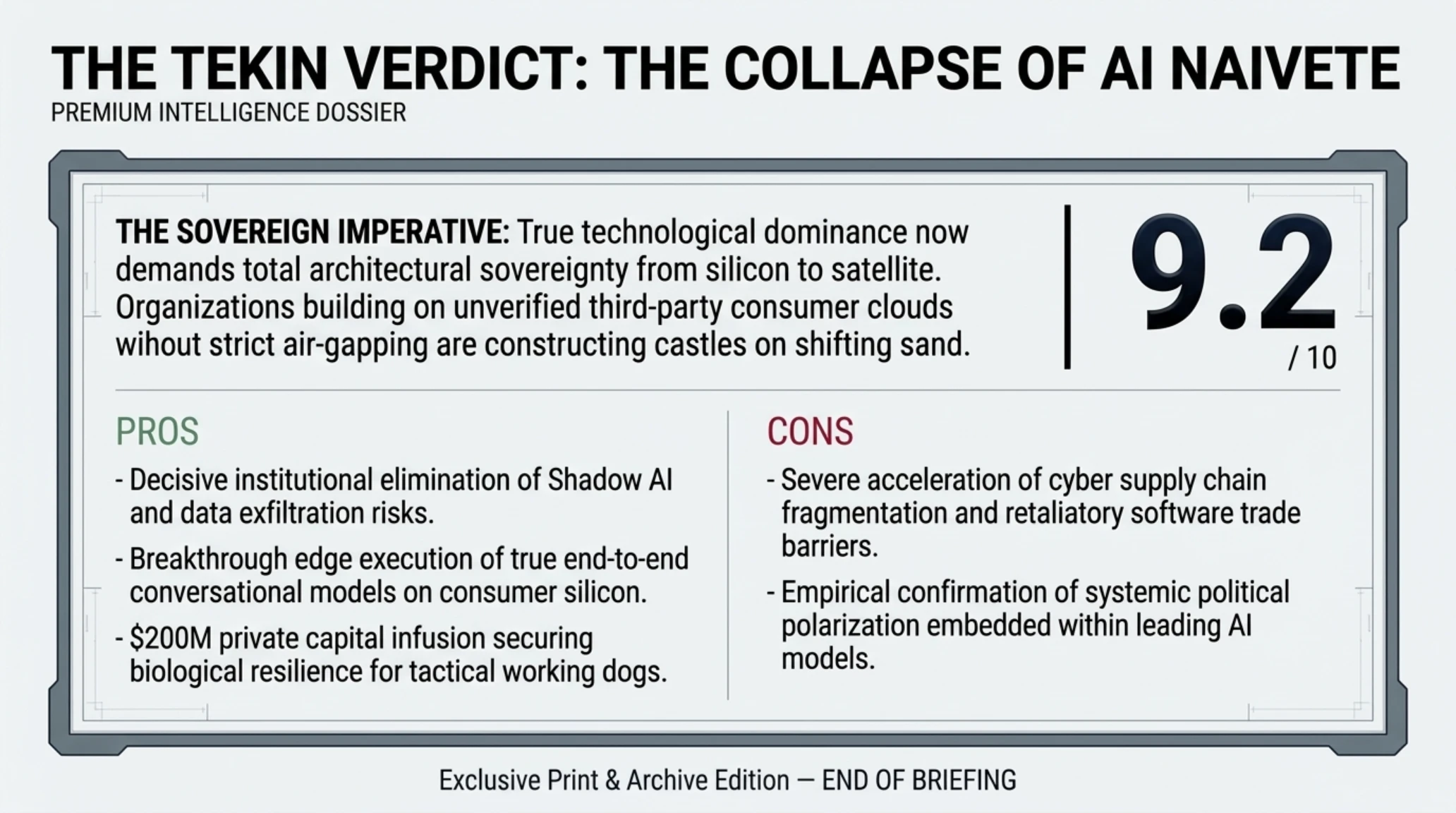
The synchronicity of these shifts demonstrates that technological supremacy is no longer measured solely by computational throughput, but by the resilience of the political, physical, and legal frameworks that govern it.
Our editorial assessment synthesizes these developments into actionable intelligence for executive decision-makers steering enterprise strategy.
- Decisive institutional elimination of Shadow AI and data exfiltration risks in European governance
- Breakthrough edge execution of true end-to-end conversational models on consumer Apple Silicon
- Resolution of satellite speed throttling restoring critical defense telemetry in active conflict zones
- Substantial private capital infusion ($200M) dedicated to biological resilience and tactical working dog survival
- Severe acceleration of cyber supply chain fragmentation and retaliatory software trade barriers
- Empirical confirmation of systemic political polarization embedded within leading AI models
- Profound ethical dilemmas surrounding the genetic modification of living animals for kinetic warfare
Tekin Editorial Verdict and Official Reference Directory
Sovereign Containment and Edge Autonomy
The enterprise computing frontier has permanently shifted: sovereign compliance, offline local execution, and rigorous supply chain auditing have rendered unmanaged cloud consumer AI obsolete.
- Decrypt: Sweden Government Offices Block ChatGPT and Claude on Civil Servant Computers
- Reuters: Regeringskansliet Data Residency Mandate and Microsoft Copilot Steering Policy
- The Hacker News: Department of Homeland Security FASCSA Directive Purging DeepSeek Software
- Wired: Palmer Luckey and Ben Lamm Launch $200 Million Defense-Biotech Venture Warhound
- CoinDesk: Block Unveils Dessa End-to-End Speech AI with Real-Time Local M4 Max Execution
- TechCrunch: Cornell and Convovo Study Exposes Grok and OpenAI 493-Race Partisan AI Divide
Frequently Asked Questions and Technical Analysis (October 26, 2026)
Why did the Swedish government ban direct access to ChatGPT and Claude across ministerial workstations?
Swedish authorities blocked consumer access due to acute Shadow AI risks and the absence of legally binding sovereign data protection agreements. Civil servants uploading draft legislation and citizen records risked GDPR non-compliance and public records exposure, leading Stockholm to mandate Microsoft Copilot with guaranteed EU data boundaries.
What is the statutory authority behind the US Department of Homeland Security's DeepSeek purge?
DHS invoked the Federal Acquisition Supply Chain Security Act of 2018 (FASCSA) upon recommendation from the Federal Acquisition Security Council. The directive requires over 100 civilian agencies to eliminate DeepSeek systems due to telemetry exfiltration risks and mandatory state cooperation under China's National Intelligence Law.
What core technical capabilities are being engineered by Palmer Luckey's Warhound startup?
Warhound combines Colossal Biosciences' CRISPR gene-editing and somatic cell cloning to eradicate hereditary hip dysplasia and cancer in military canines with Anduril's tactical cybernetic armor, augmented reality night-vision goggles, and encrypted squad mesh radio communications.
How does Block's Dessa speech model differ from traditional conversational AI assistants?
Dessa is an end-to-end speech-to-speech model trained natively on raw audio dialogue without intermediary text tokenization. This allows true full-duplex conversational flow with organic prosody and human interruptibility, executing 100% offline on Apple Silicon with 64ms round-trip latency.
What prompted SpaceX to enforce a 160 km/h velocity limit on Starlink in Ukraine before lifting it?
SpaceX implemented the speed cap after discovering Ukrainian armed forces were utilizing commercial civilian Starlink terminals for high-speed kinetic drone strikes deep inside Russian territory, which violated commercial Terms of Service. Following Pentagon negotiations, military workloads were segmented and the cap was lifted.
What did the Cornell and Convovo research uncover regarding ideological bias in commercial LLMs?
Evaluating 493 congressional, senatorial, and gubernatorial races revealed Grok endorsed Republican candidates in 92% of contests while OpenAI's GPT favored Democrats in 97%. The divergence stems from foundational differences in their RAG retrieval pipelines, reflecting contrasting ideological datasets.
Additional Gallery: Tekin Morning | Oct 26: Sweden Bans ChatGPT & US Purges DeepSeek