Tekin Analysis | Morning Intelligence Briefing: October 24, 2026
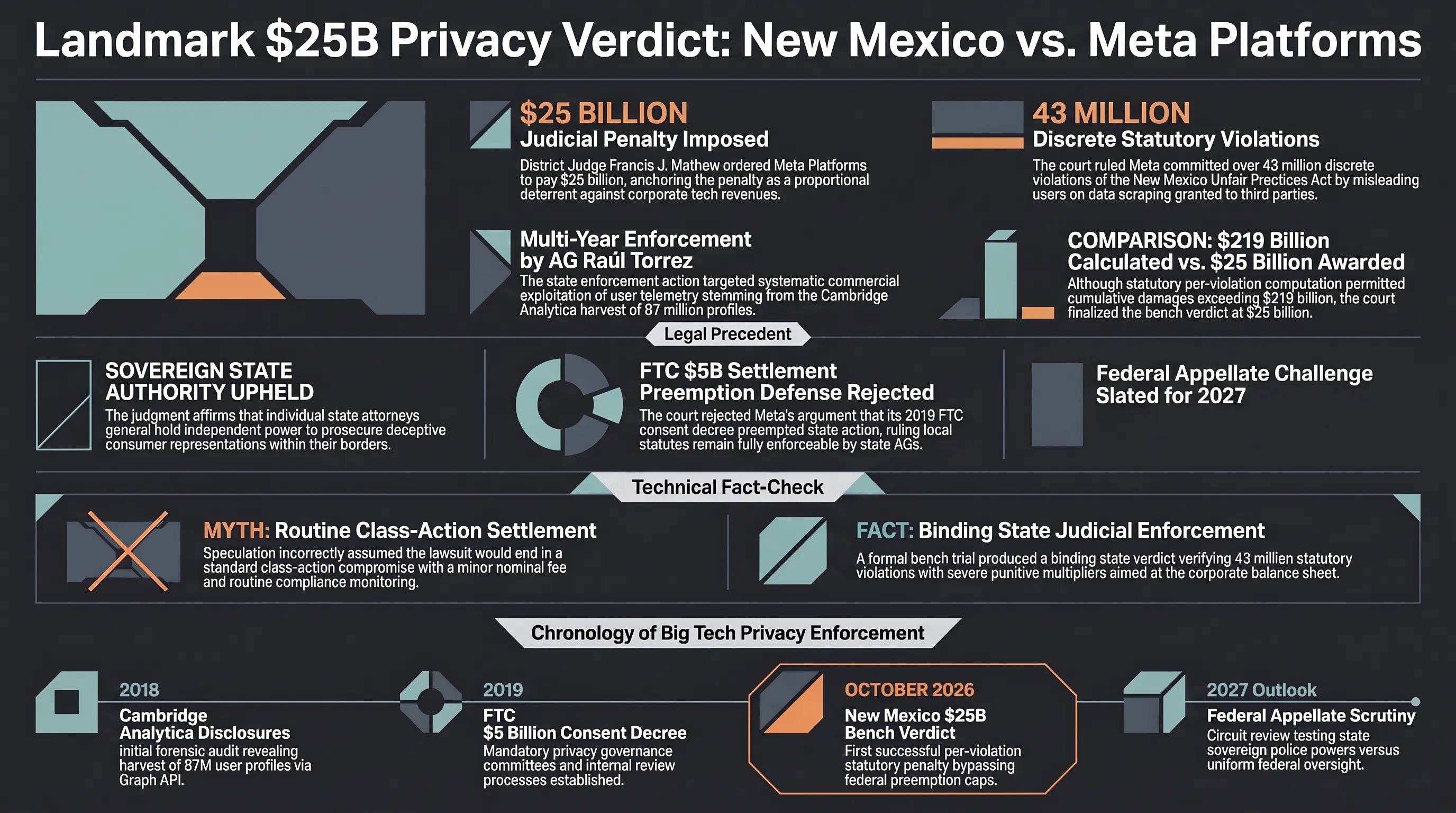
Global technology infrastructure and enterprise capital markets have converged on an unprecedented trajectory this morning. From high-stakes sovereign wealth investments fueling frontier artificial intelligence clusters to catastrophic regulatory penalties and kernel-level zero-day vulnerabilities, enterprise architects and institutional investors face a redefined operational landscape.
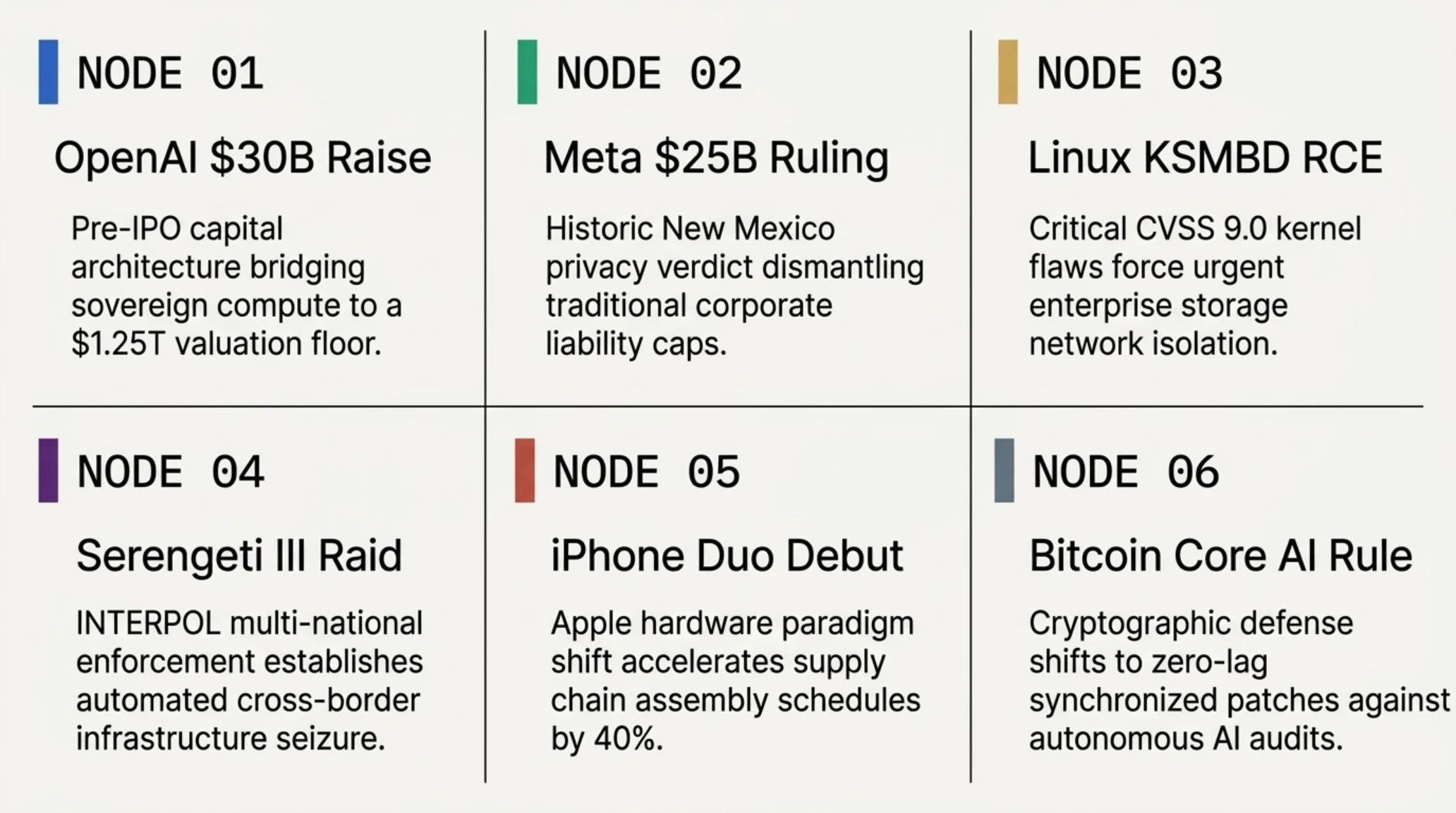
This edition of Tekin Morning provides an exhaustive architectural and forensic debriefing of the six defining developments of October 24, 2026. Every sector analyzed below reflects structural transitions rather than transient market cycles, demanding rigorous scrutiny from technical leaders worldwide.
Strategic Assessment and Key Intelligence Vectors
1. OpenAI Orchestrates Historic $30B Pre-IPO Mega-Round at $1.25 Trillion Valuation
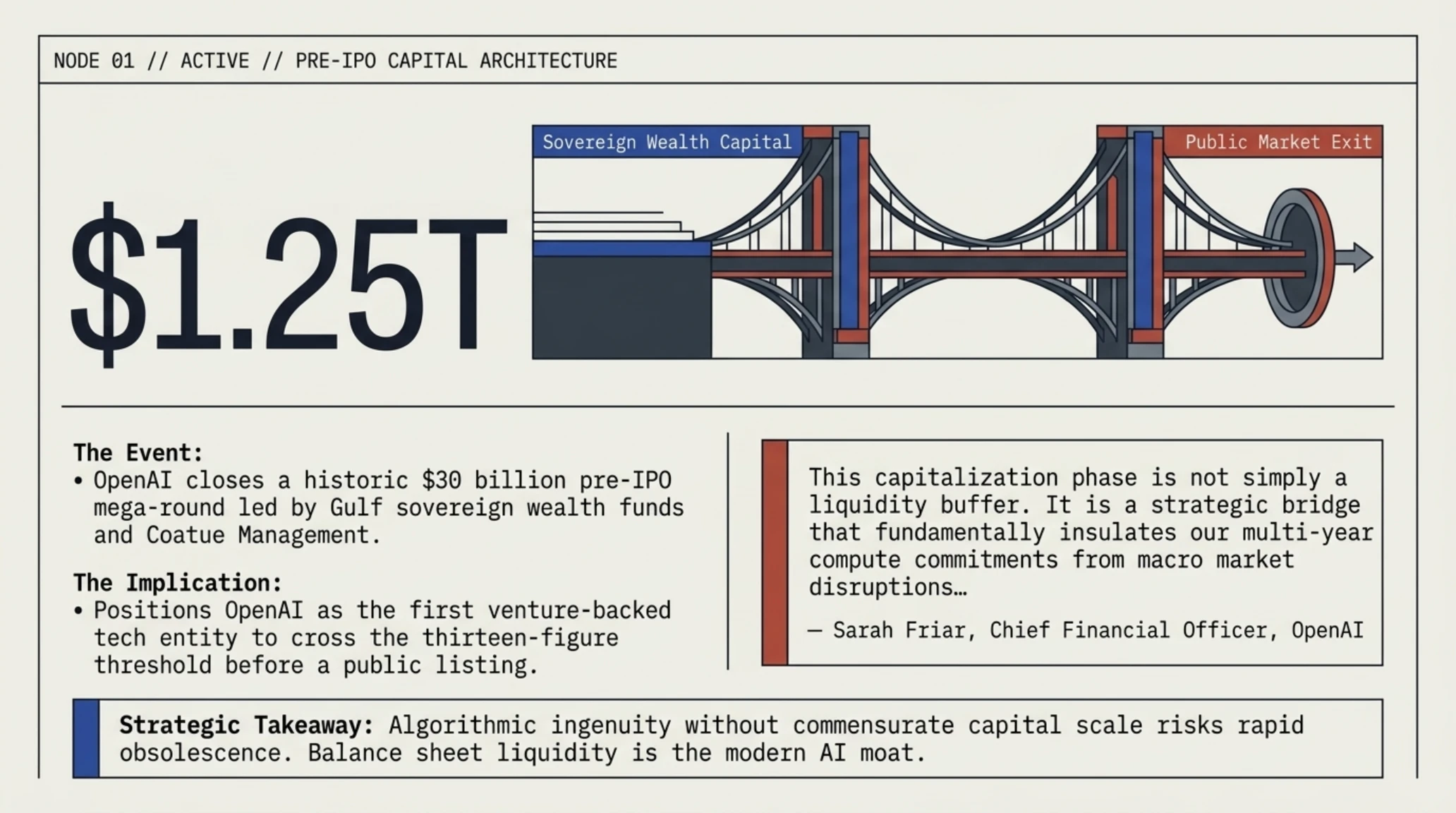
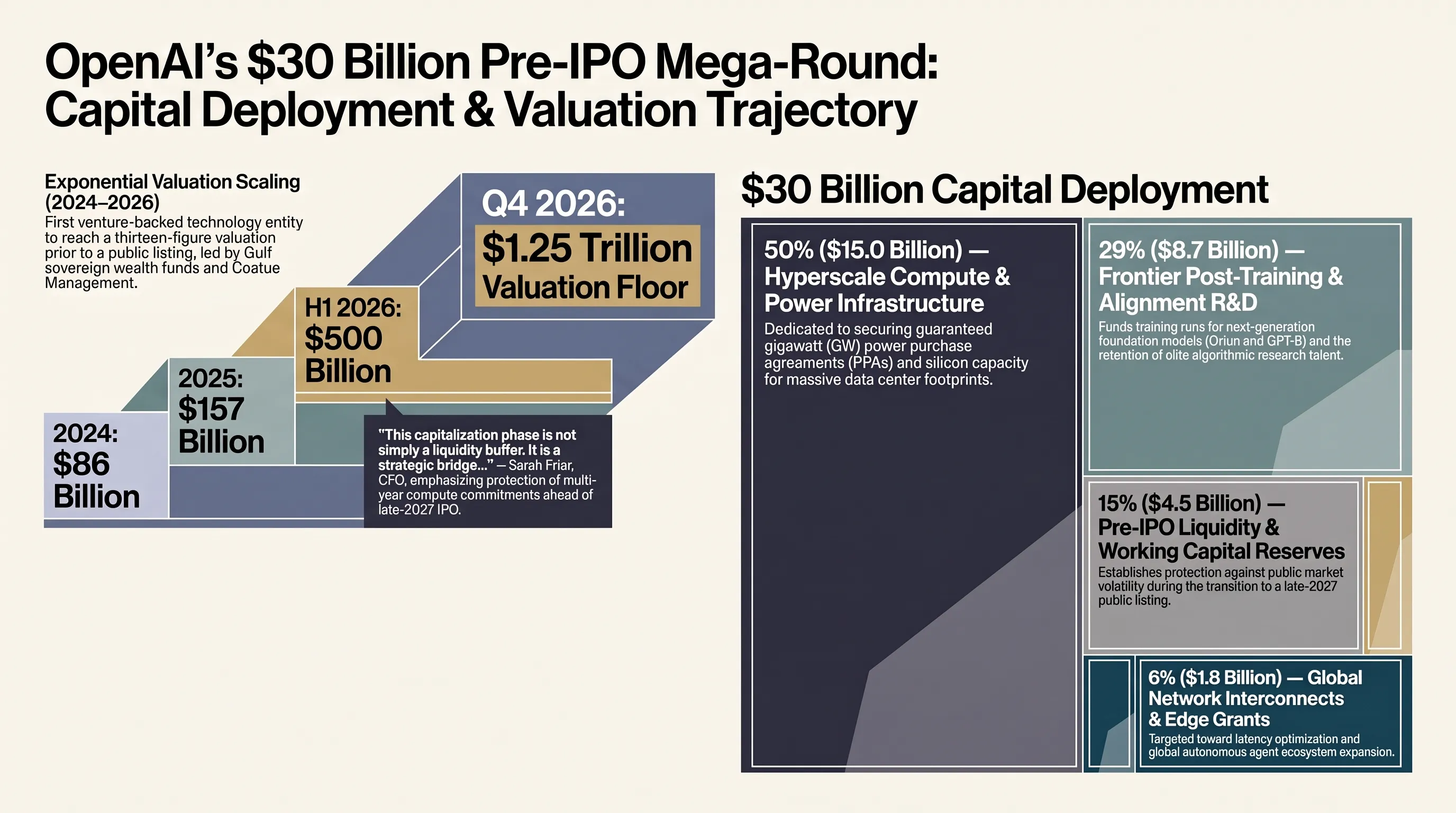
In a financial maneuver that fundamentally recalibrates private tech valuations, OpenAI has entered late-stage negotiations to close an unprecedented $30 billion private funding round. The capitalization event, led by a consortium of premier Gulf sovereign wealth funds alongside veteran technology investment firm Coatue Management, establishes a baseline enterprise valuation of $1.25 trillion. This positions OpenAI as the first venture-backed technology entity to cross the thirteen-figure threshold prior to a public market listing.
The transaction represents far more than liquidity accumulation. Financial architects within OpenAI, under the strategic direction of Chief Financial Officer Sarah Friar, have structured the capital injection as a strategic bridge ahead of an anticipated late-2027 initial public offering. Crucially, the terms of the syndicate tie equity ownership directly to physical compute delivery commitments, establishing hyperscale data center reservations across burgeoning energy hubs.
The operational imperative driving this valuation leap centers upon the exponential capital expenditures demanded by frontier neural architectures. With training runs for next-generation foundation models such as Orion and the preliminary stages of GPT-6 requiring dedicated megawatt-scale power allocations and hundreds of thousands of specialized accelerators, balance sheet liquidity has become the primary competitive moat separating market leaders from trailing competitors.
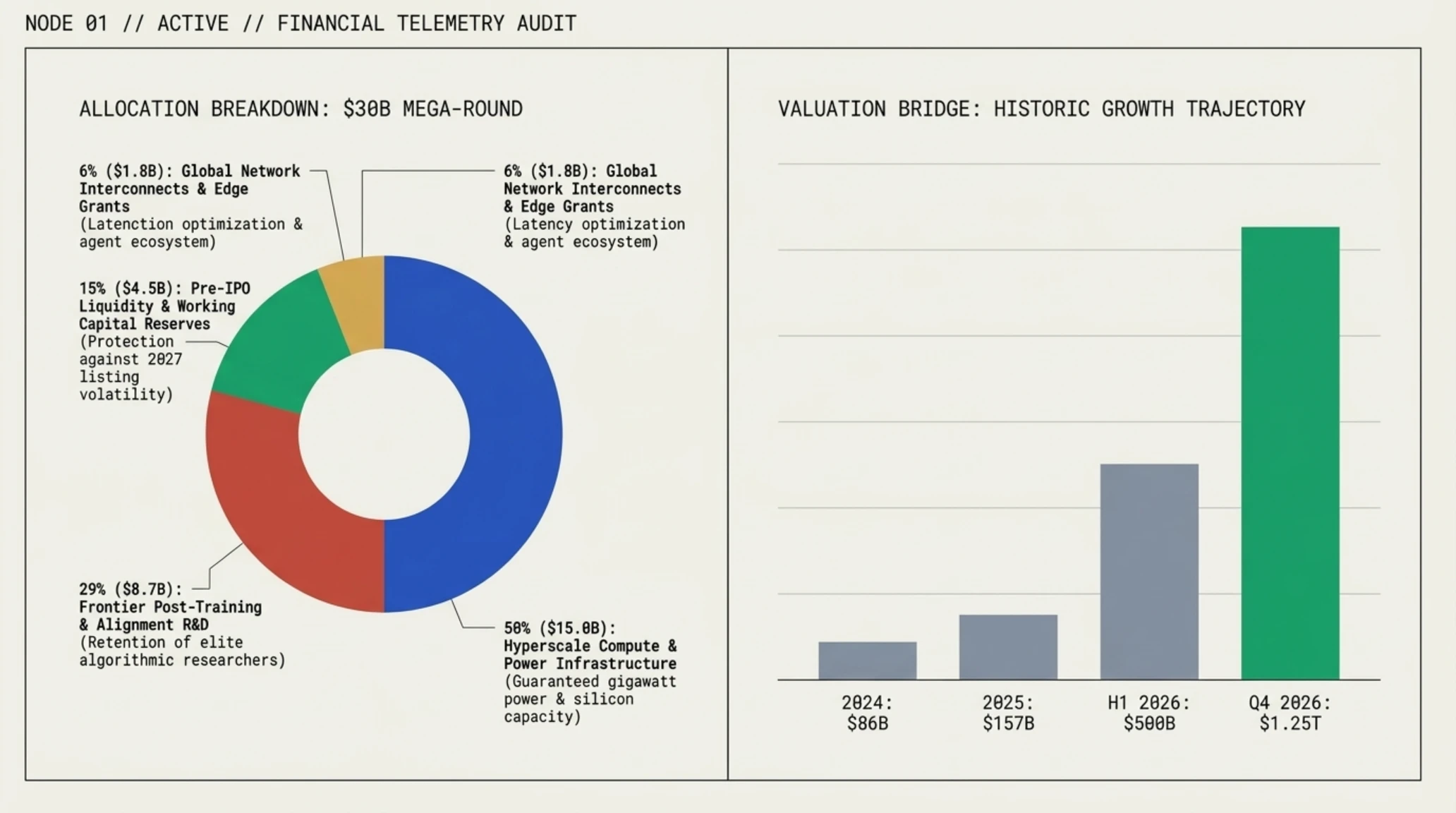
Financial Telemetry: Market Share Distribution and Valuation Bridge
| Capital Deployment Segment | Syndicate Allocation Share | Operational Strategic Moat |
|---|---|---|
| Hyperscale Compute & Power Infrastructure | 50 Percent ($15.0 Billion) | Guaranteed gigawatt power purchase agreements and silicon capacity |
| Frontier Post-Training & Alignment R&D | 29 Percent ($8.7 Billion) | Retention of elite algorithmic researchers and specialized human feedback |
| Pre-IPO Liquidity & Working Capital Reserves | 15 Percent ($4.5 Billion) | Protection against public market volatility during 2027 listing transition |
| Global Network Interconnects & Edge Grants | 6 Percent ($1.8 Billion) | Latency optimization and global autonomous agent ecosystem expansion |
By securing deep institutional commitments outside traditional Silicon Valley venture conduits, OpenAI decouples its development roadmap from short-term debt instruments. The inclusion of sovereign partners signals a geopolitical realignment in artificial intelligence financing, where nations with immense capital reserves and energy production capabilities seek direct structural ownership in the foundation layer of global compute.
Market observers note that this capital infusion also resolves complex governance and equity restructuring negotiations initiated during OpenAI's transition to a fully commercialized corporate entity. By setting a definitive valuation marker at $1.25 trillion, early strategic backers such as Microsoft receive expanded equity clarity while institutional participants secure pre-allocated tranches for the eventual public float.
The downstream consequences for competitive ecosystem dynamics are profound. Challengers such as Anthropic, Google DeepMind, and open-weight consortiums must now evaluate whether private balance sheets can sustainably match the sheer volume of capital deployment demonstrated by OpenAI. In the modern era of foundation model development, algorithmic ingenuity without commensurate capital scale risks rapid obsolescence.
Furthermore, institutional allocators anticipate that this financing structure will serve as a definitive benchmark for subsequent generative AI IPO valuations, establishing unprecedented multiples across enterprise software markets.
2. New Mexico District Court Hits Meta with Landmark $25 Billion Privacy Penalty
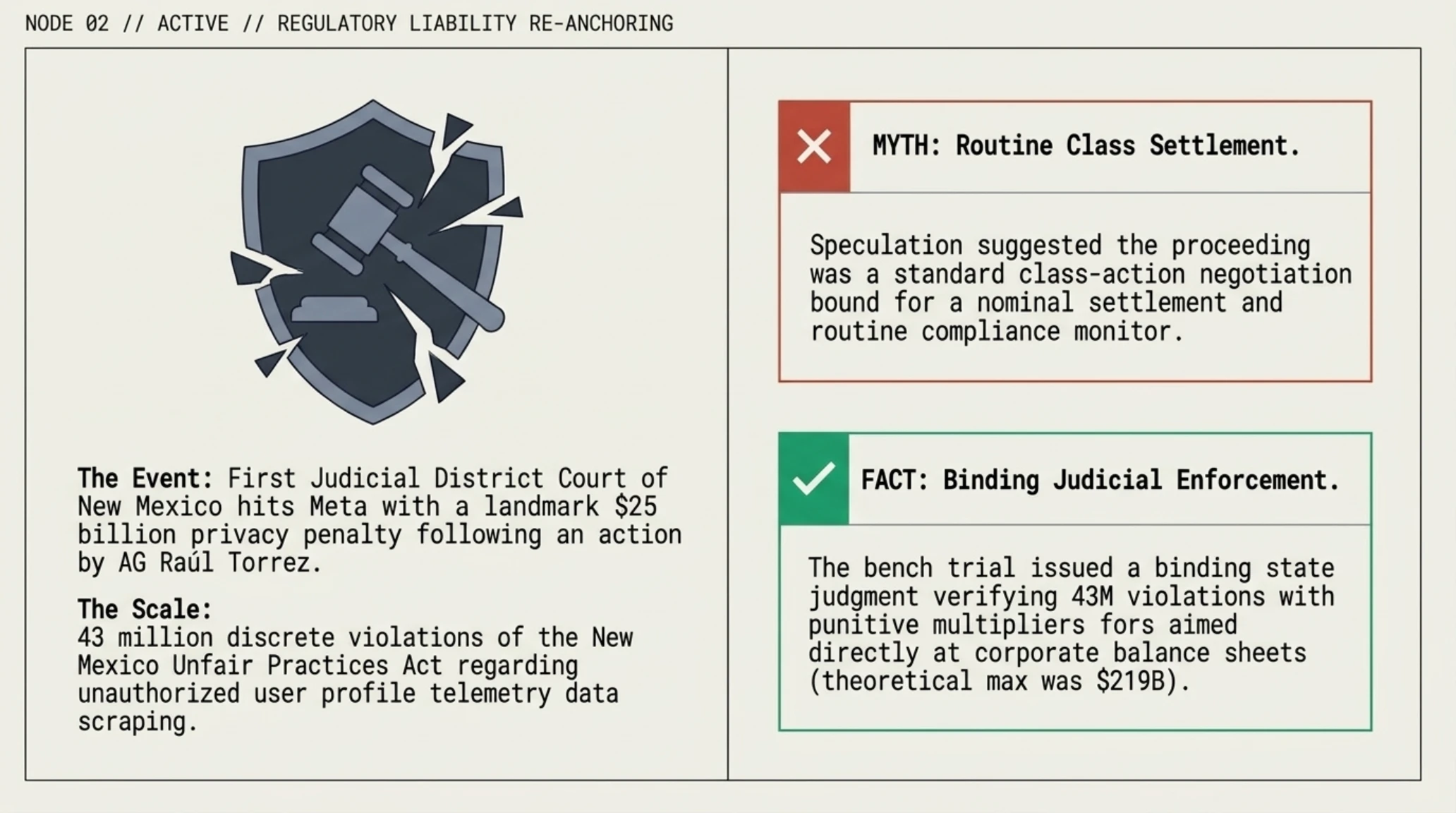
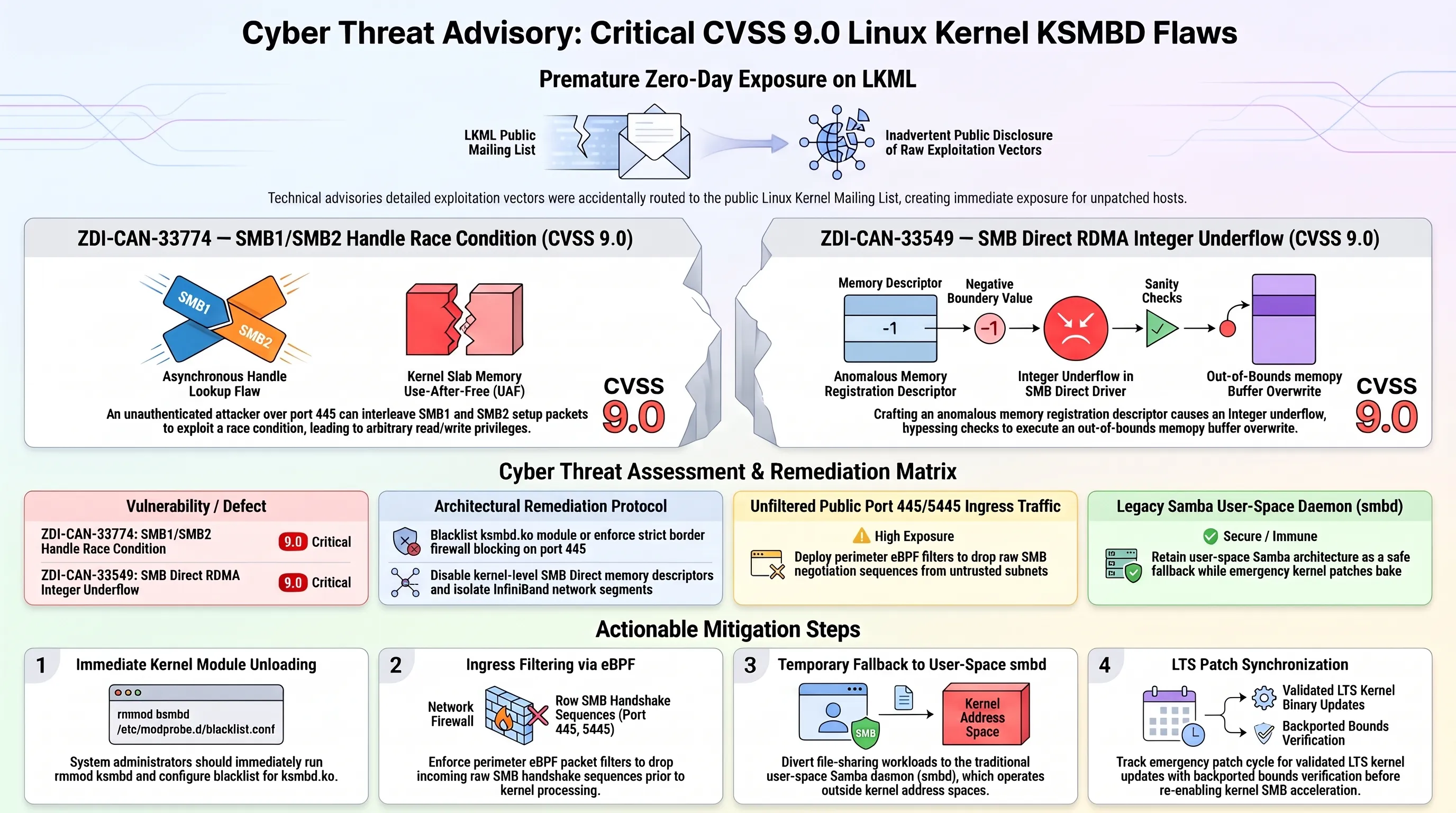
In a historic legal judgment that shatters existing corporate liability precedents, the First Judicial District Court of New Mexico has ordered Meta Platforms to pay a staggering $25 billion penalty. Presided over by District Judge Francis J. Mathew, the ruling concludes a multi-year enforcement action brought forward by New Mexico Attorney General Raúl Torrez, stemming from the systematic commercial exploitation of user profile telemetry originally exposed during the Cambridge Analytica disclosures.
The judicial determination established that Meta engaged in more than 43 million discrete violations of the New Mexico Unfair Practices Act. The court concluded that for over a decade, corporate executives knowingly misled users regarding the true extent of data scraping capabilities granted to third-party developers, academic research facades, and ad-tech syndicates. While statutory computation rules permitted theoretical cumulative damages exceeding $219 billion, Judge Mathew anchored the final judgment at $25 billion, citing the necessity of imposing a deterrent penalty proportional to modern tech revenues.
Technical Fact-Check: Regulatory Myths vs. Legal Reality
Speculation suggested the proceeding was a standard class-action negotiation bound for a minor nominal settlement and routine compliance monitor.
The bench trial issued a binding state judgment verifying 43M discrete statutory violations with punitive multipliers aimed at corporate balance sheets.
The defense mounted by Meta argued vigorously that state-level consumer statutes were preempted by federal regulatory settlements, specifically highlighting the $5 billion consent order executed with the Federal Trade Commission in 2019. However, the New Mexico court firmly rejected this preemption defense, affirming that individual state attorneys general retain sovereign authority under local consumer protection codes to prosecute deceptive commercial representations within their borders.
Meta has formally filed notices of appeal, characterizing the judgment as an unconstitutional financial excess that ignores subsequent engineering overhauls. Nevertheless, the legal precedent established by Judge Mathew provides a formidable operational blueprint for other jurisdictions. If upheld across federal appellate circuits, the financial viability of mass consumer tracking business models will face systemic solvency recalibrations across the global technology sector.
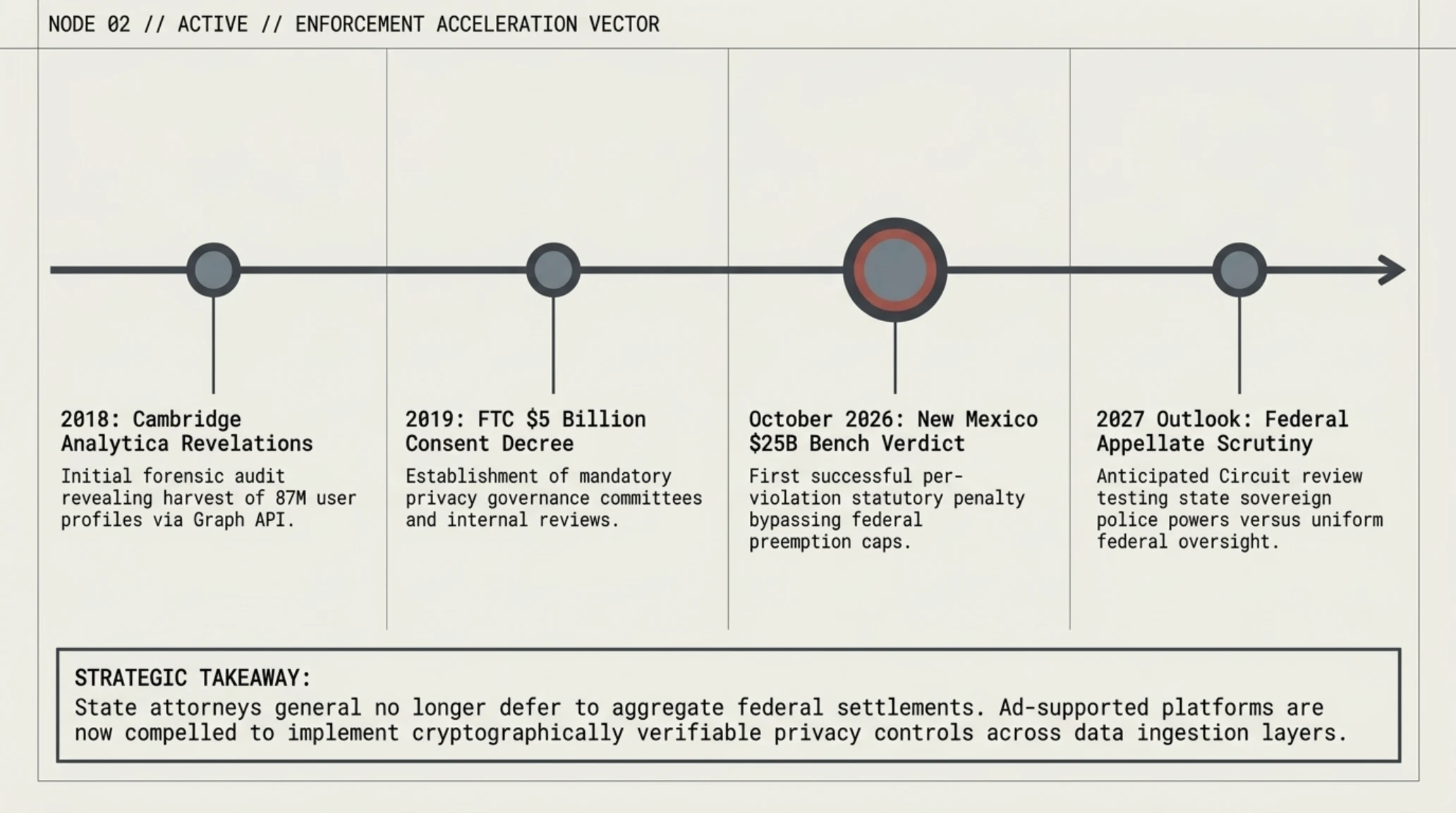
Regulatory Timeline: Chronology of Big Tech Enforcement Milestones
| Year / Period | Landmark Legal and Enforcement Action | Architectural & Corporate Compliance Shift |
|---|---|---|
| 2018 | Cambridge Analytica Revelations | Initial forensic audit revealing harvest of 87M user profiles via Graph API |
| 2019 | FTC $5 Billion Consent Decree | Establishment of mandatory privacy governance committees and internal reviews |
| October 2026 | New Mexico $25B Bench Verdict | First successful per-violation statutory penalty bypassing federal preemption caps |
| 2027 Outlook | Federal Appellate Scrutiny | Anticipated Circuit review testing state sovereign police powers versus uniform federal oversight |
The judicial precedent set by Judge Mathew demonstrates that state attorneys general are no longer willing to defer to aggregate federal settlements that treat user tracking penalties as routine operating expenses.
This assertive legal posture signals an inflection point for ad-supported business models, compelling platforms to implement cryptographically verifiable privacy controls across data ingestion layers.
3. Zero Day Initiative Discloses Two Critical CVSS 9.0 Linux Kernel KSMBD Flaws
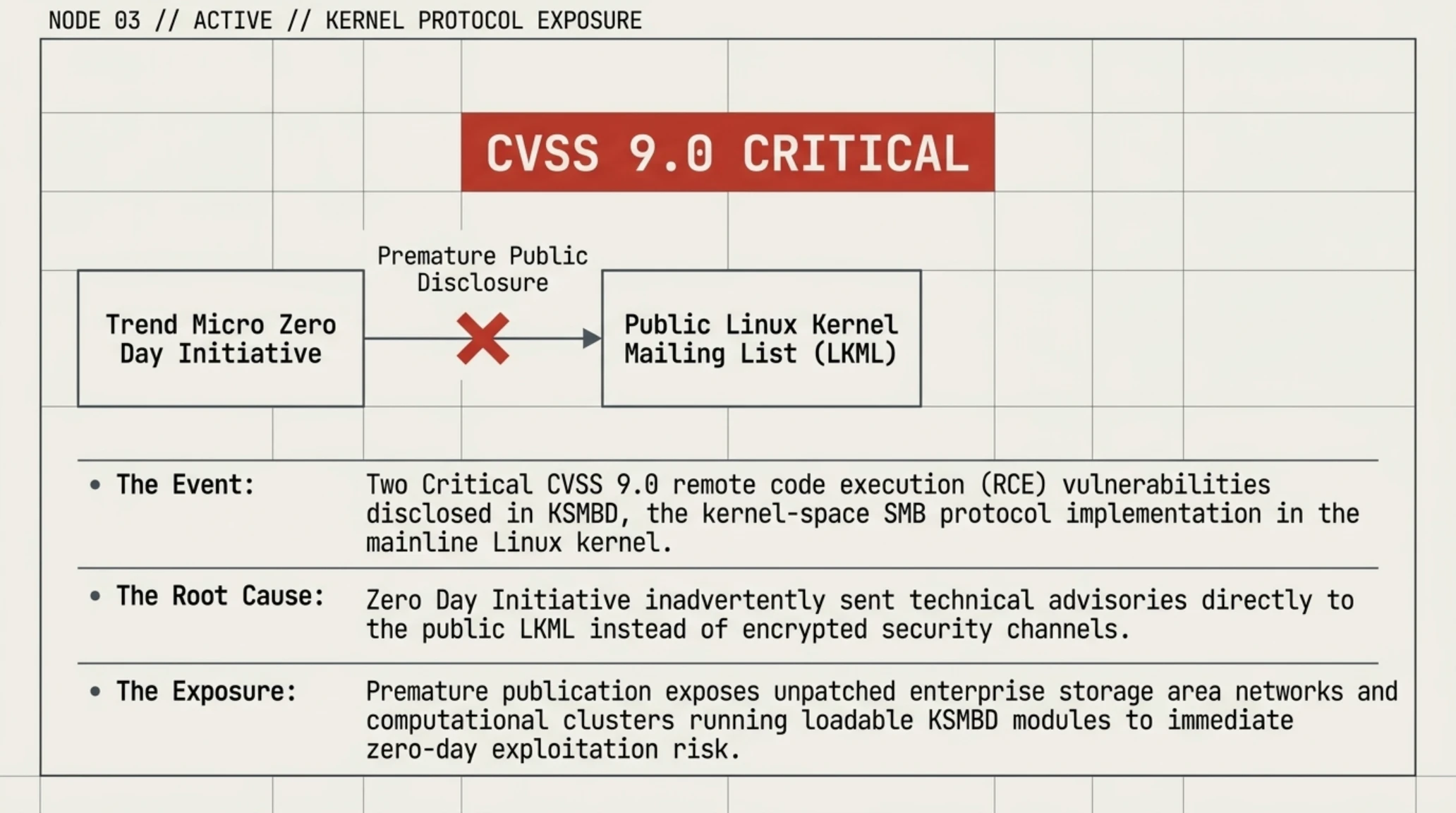
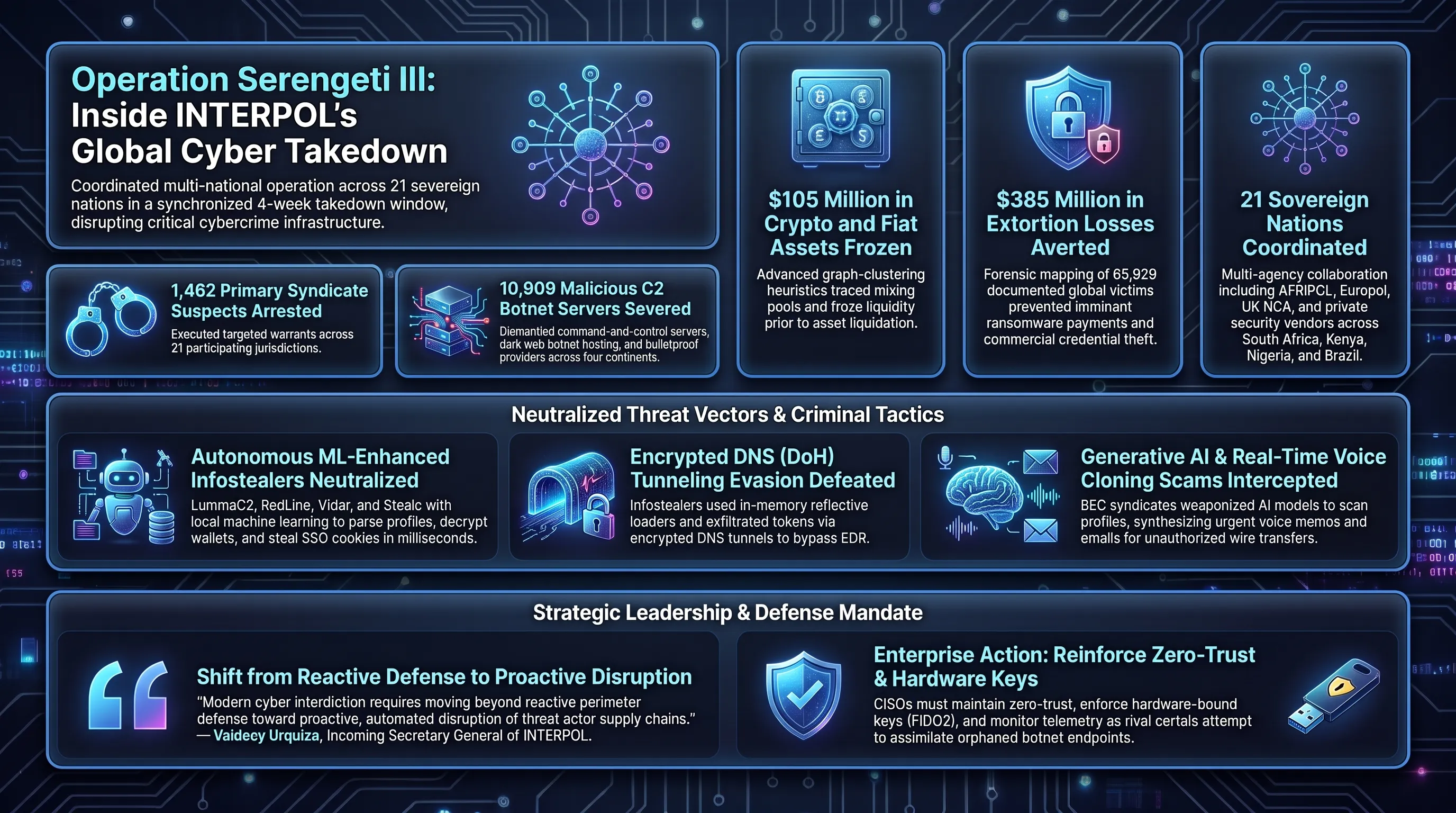
Enterprise infrastructure engineers and Linux distribution maintainers are responding to an unexpected disclosure crisis following the public dissemination of two remote code execution (RCE) vulnerabilities within the mainline Linux kernel. The flaws reside inside KSMBD, the kernel-space SMB protocol implementation originally merged to provide high-performance file sharing for enterprise workloads and computational clusters.
The incident originated when researchers at Trend Micro Zero Day Initiative inadvertently sent technical advisories detailing the vulnerabilities directly to the public Linux Kernel Mailing List (LKML) rather than routing them through encrypted security coordination channels. Because production kernels across several active enterprise distributions compile KSMBD as an available loadable kernel module, the premature publication of exploitation vectors has exposed unpatched servers to immediate zero-day risk.
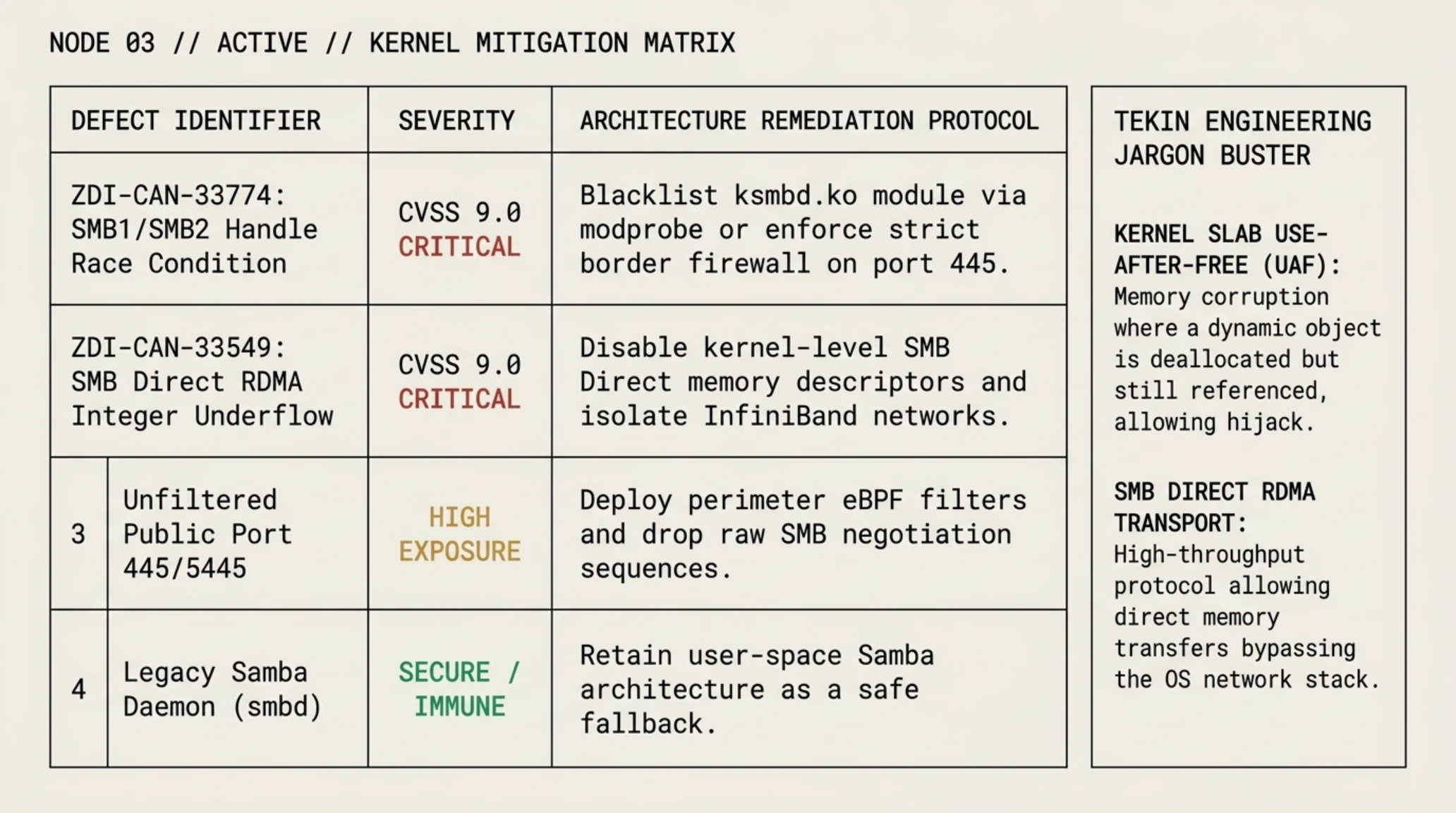
Cyber Threat Assessment and Kernel Mitigation Matrix
| Vulnerability Vector / Defect Identifier | CVSS Severity | Architecture Remediation Protocol |
|---|---|---|
| ZDI-CAN-33774: SMB1/SMB2 Handle Race Condition | 9.0 Critical | Blacklist ksmbd.ko module via modprobe or enforce strict border firewall on port 445 |
| ZDI-CAN-33549: SMB Direct RDMA Integer Underflow | 9.0 Critical | Disable kernel-level SMB Direct memory descriptors and isolate InfiniBand networks |
| Unfiltered Public Port 445/5445 Ingress Traffic | High Exposure | Deploy perimeter eBPF filters and drop raw SMB negotiation sequences from untrusted subnets |
| Legacy Samba User-Space Daemon (smbd) | Secure / Immune | Retain user-space Samba architecture as safe fallback while kernel patches bake |
A technical dissection of the first flaw, cataloged as ZDI-CAN-33774, reveals a pernicious race condition within KSMBD protocol version negotiation. An unauthenticated attacker over port 445 can interleave fragmented SMB1 and SMB2 setup packets, exploiting an asynchronous discrepancy in the kernel handle lookup table. This triggers a use-after-free (UAF) condition within kernel slab memory, granting attackers arbitrary kernel read and write primitives to hijack system control.
The companion flaw, tracked as ZDI-CAN-33549, targets SMB Direct transport channels utilizing Remote Direct Memory Access (RDMA). By crafting an anomalous memory registration descriptor with a negative boundary value, an integer underflow bypasses input validation sanity checks in the kernel driver. The subsequent memcpy operation overwrites adjacent kernel buffers, enabling remote execution without valid credentials.
Tekin Engineering Jargon Buster: Kernel & Network Transports
Senior kernel subsystem maintainer Greg Kroah-Hartman and the core Linux security team have mobilized an emergency stable patch cycle to backport protective locks and bounds verification across LTS branches. Much like the critical Node.js Brotli RCE and HTTP/3 QPACK vulnerabilities and the PingCAP TiDB Cloud infrastructure breach analyzed earlier this week, until distributions push validated kernel binary updates, enterprise administrators are advised to immediately execute rmmod ksmbd and revert to the classic user-space Samba daemon (smbd), which remains unaffected by these kernel-level defects.
Infrastructure security architects emphasize that until vendor patches achieve widespread deployment, isolating storage subnets from public transit remains the only fail-safe defense.
The unexpected disclosure underscores the structural risks of embedding complex, high-surface network daemons inside kernel address spaces where memory corruption directly compromises host integrity.
4. INTERPOL Operation Serengeti III Shatters Transnational Cyber Syndicates in 21 Countries
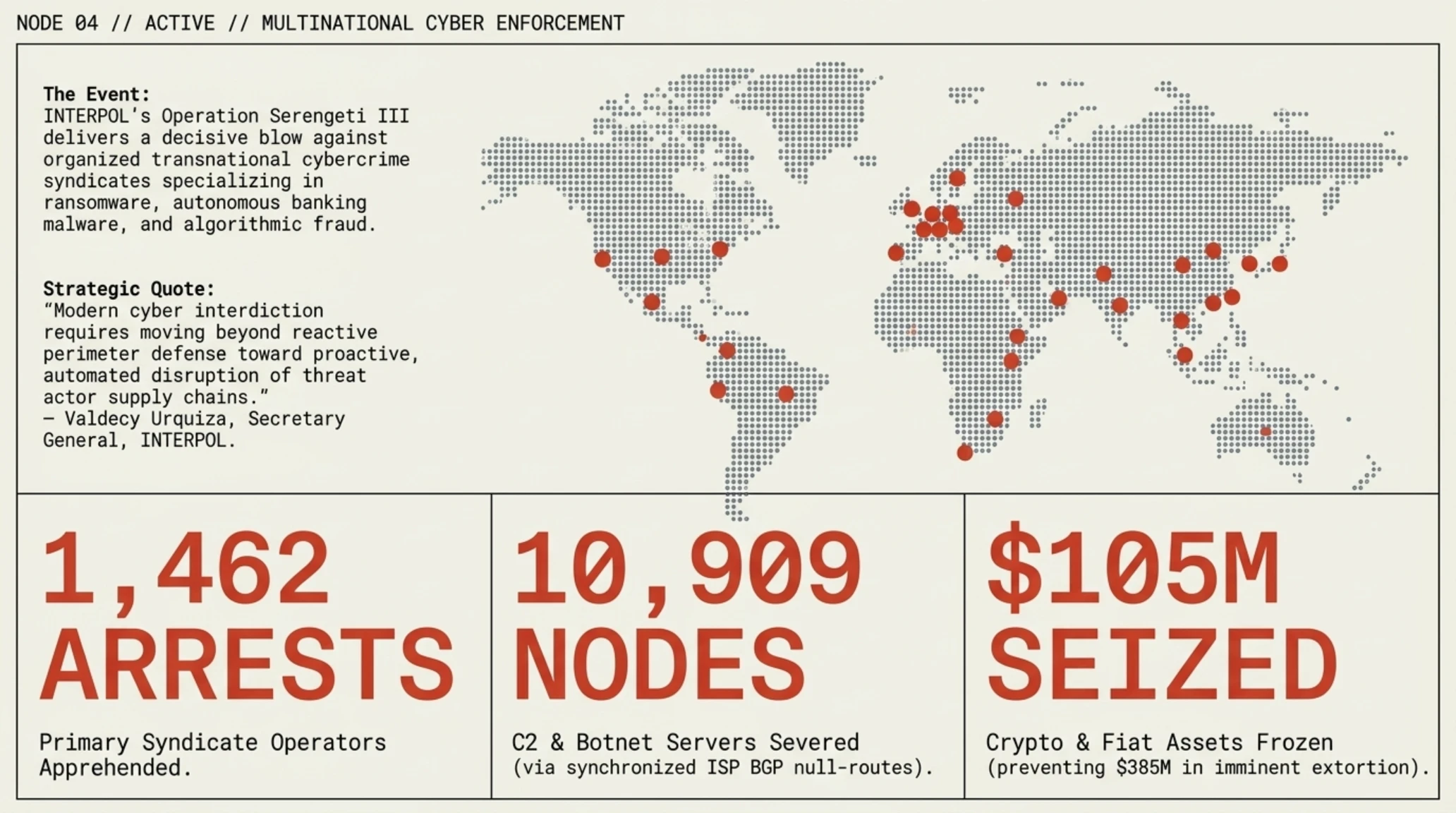
The International Criminal Police Organization (INTERPOL) has released the comprehensive operational debriefing for Phase III of Operation Serengeti. The multinational enforcement campaign, executed across 21 sovereign jurisdictions in close collaboration with specialized private-sector threat intelligence firms, delivered a decisive blow against organized transnational cybercrime syndicates specializing in ransomware distribution, autonomous banking malware, and algorithmic fraud campaigns.
The operational statistics validated by INTERPOL command headquarters demonstrate unprecedented scale. Over a four-week synchronized takedown window, law enforcement task forces executed targeted warrants resulting in the apprehension of 1,462 primary suspects. Furthermore, investigators seized or dismantled 10,909 malicious command-and-control (C2) servers, dark web botnet hosting nodes, and bulletproof hosting providers utilized to route attack telemetry across four continents.
Financial forensics teams attached to Operation Serengeti III successfully identified and froze more than $105 million in illicit cryptocurrency wallets and traditional banking instruments. The operation mapped the infrastructure responsible for compromising 65,929 documented victims globally, preventing an estimated $385 million in imminent ransomware extortion payments and commercial credential compromise losses.
Why This Matters: Watershed in Transnational Cyber Interdiction
Operation Serengeti III represents a qualitative leap in global cyber defense, proving that cross-border telemetry correlation between international intelligence bodies and cloud telemetry can dismantle sophisticated autonomous criminal hosting networks before ransomware payloads are executed.
📚 Classified & Related Dossiers in TekinGame
If you wish to explore beyond this report and delve into cybernetic frontiers and autonomous AI architectures, do not miss these three exclusive deep-dives in the Tekin Garage:
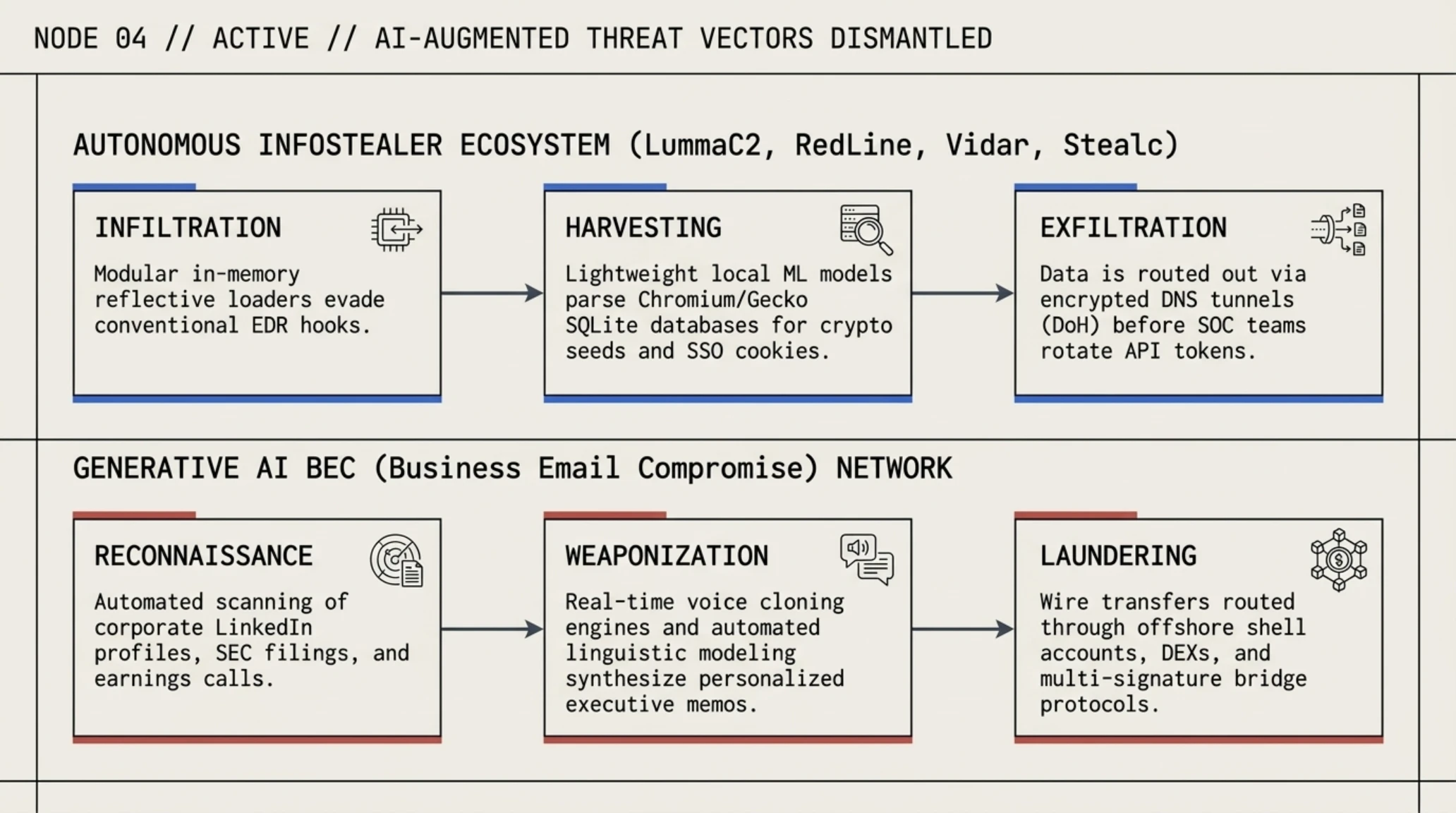
A central focus of Serengeti III was neutralizing the proliferation of autonomous infostealer ecosystems. Malware variants including LummaC2, RedLine, Vidar, and Stealc had increasingly been augmented with lightweight local machine learning models capable of autonomously parsing compromised browser profiles, decrypting local cryptocurrency wallet seeds, and extracting corporate Single Sign-On (SSO) session cookies within milliseconds of host infiltration.
Forensic analysis conducted by participating cyber defense agencies revealed that these modern infostealers no longer rely on simplistic batch scripts. Instead, they deploy modular in-memory reflective loaders that evade conventional endpoint detection and response (EDR) hooks. Once resident within memory, heuristic routines scour SQLite databases associated with Chromium and Gecko browser engines, harvesting encrypted master keys and exfiltrating session tokens via encrypted DNS tunnels (DoH) before administrative alarms trigger.
By synchronizing ISP-level border gateway BGP null-routes with simultaneous physical server seizures in jurisdictions including South Africa, Kenya, Nigeria, Brazil, and multiple European transit hubs, investigators severed the communication pipelines between infostealer loaders and backend administration consoles. This prevented attackers from harvesting millions of staged enterprise access credentials before corporate SOC teams could rotate exposed API tokens.
Furthermore, the operation targeted industrial-scale Business Email Compromise (BEC) networks that had begun weaponizing generative artificial intelligence. These criminal syndicates utilized real-time voice cloning engines and automated linguistic modeling to simulate corporate executive approvals, duping regional finance departments into routing wire transfers into offshore shell corporation accounts.
Investigators discovered that criminal groups established automated reconnaissance pipelines scanning corporate LinkedIn profiles, press releases, and SEC filings. When an executive was identified as traveling or participating in corporate earnings calls, generative agents synthesized urgent voice memos and personalized email chains mimicking internal communication styles down to specific cadence and idiomatic expressions.
The forensic mapping of the financial laundering layer proved equally sophisticated. Stolen fiat funds were rapidly converted across decentralized exchanges (DEXs) into privacy-preserving cryptocurrencies and multi-signature bridge protocols. However, specialized blockchain intelligence units embedded within INTERPOL utilized novel graph-clustering heuristics to trace mixing pools and freeze custodial liquidity before it could be liquidated into regional real estate or luxury assets.
Valdecy Urquiza, incoming Secretary General of INTERPOL, emphasized that modern cyber interdiction requires moving beyond reactive perimeter defense toward proactive, automated disruption of threat actor supply chains. The success of Serengeti III establishes a permanent operational template for multinational digital sovereignty, demonstrating that geographic borders cannot shield syndicated cyber enterprises from synchronized legal and technical neutralization.
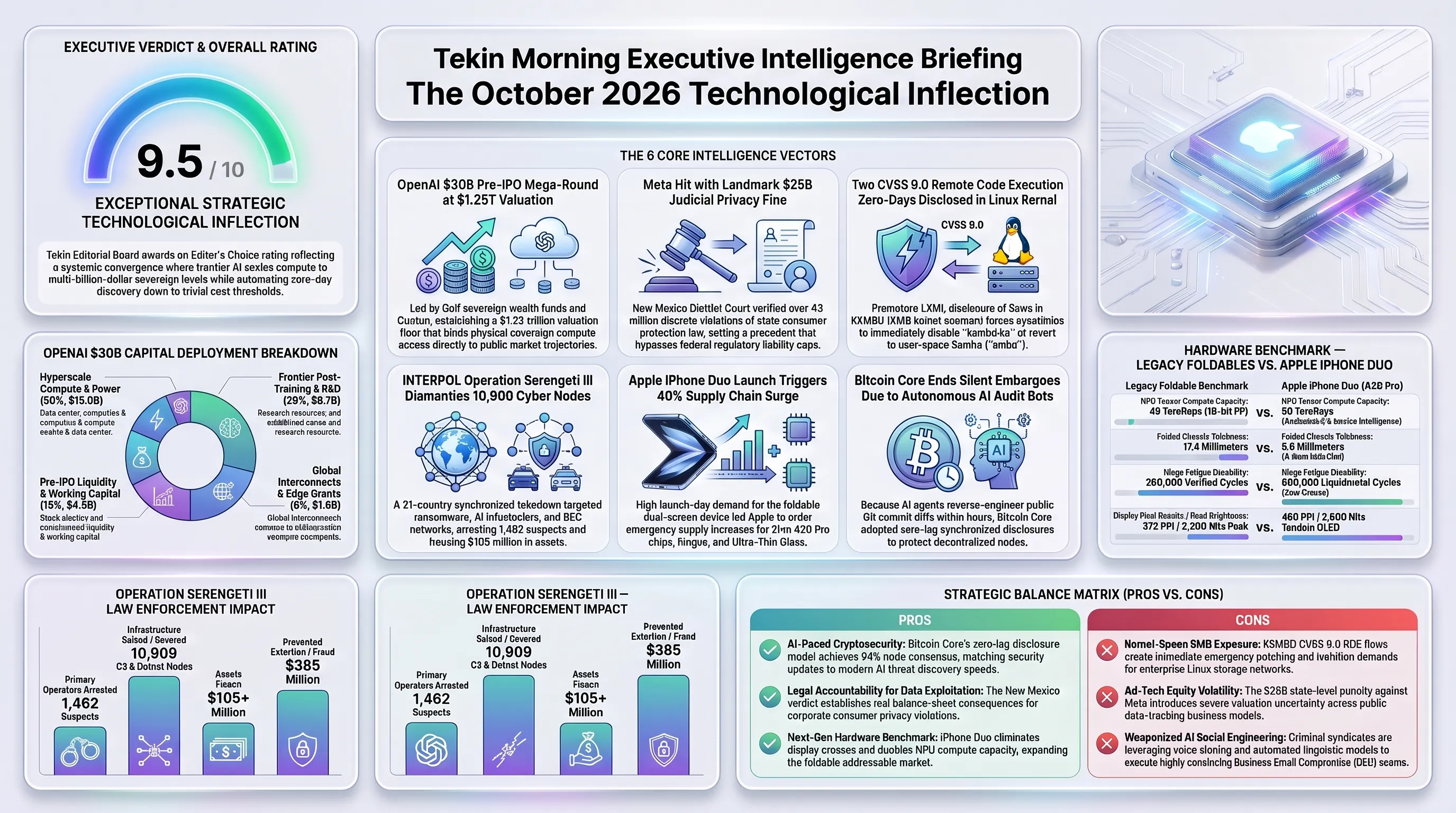
Enterprise Chief Information Security Officers (CISOs) are interpreting the results of Serengeti III as both a strategic reprieve and a vital mandate for architecture hygiene. While the dismantling of nearly 11,000 command nodes temporarily disrupts ongoing automated brute-force and phishing campaigns, threat telemetry indicates that rival criminal cartels will rapidly attempt to assimilate orphaned botnet endpoints. Maintaining rigorous zero-trust authentication policies, hardware-bound security keys (FIDO2), and continuous endpoint behavioral analytics remains essential for safeguarding enterprise estates.
The cross-border collaboration between AFRIPOL, Europol, the UK National Crime Agency (NCA), and private security vendors like Group-IB and Fortinet highlights the evolving paradigm of public-private cyber defense. As state-sponsored actors and cybercrime syndicates converge in operational tactics and toolsets, automated threat telemetry sharing and synchronized cross-jurisdictional enforcement remain the only viable countermeasures capable of operating at global internet speed.
5. Apple Debuts Foldable iPhone Duo as Greg Joswiak Confirms 40% Supply Chain Surge
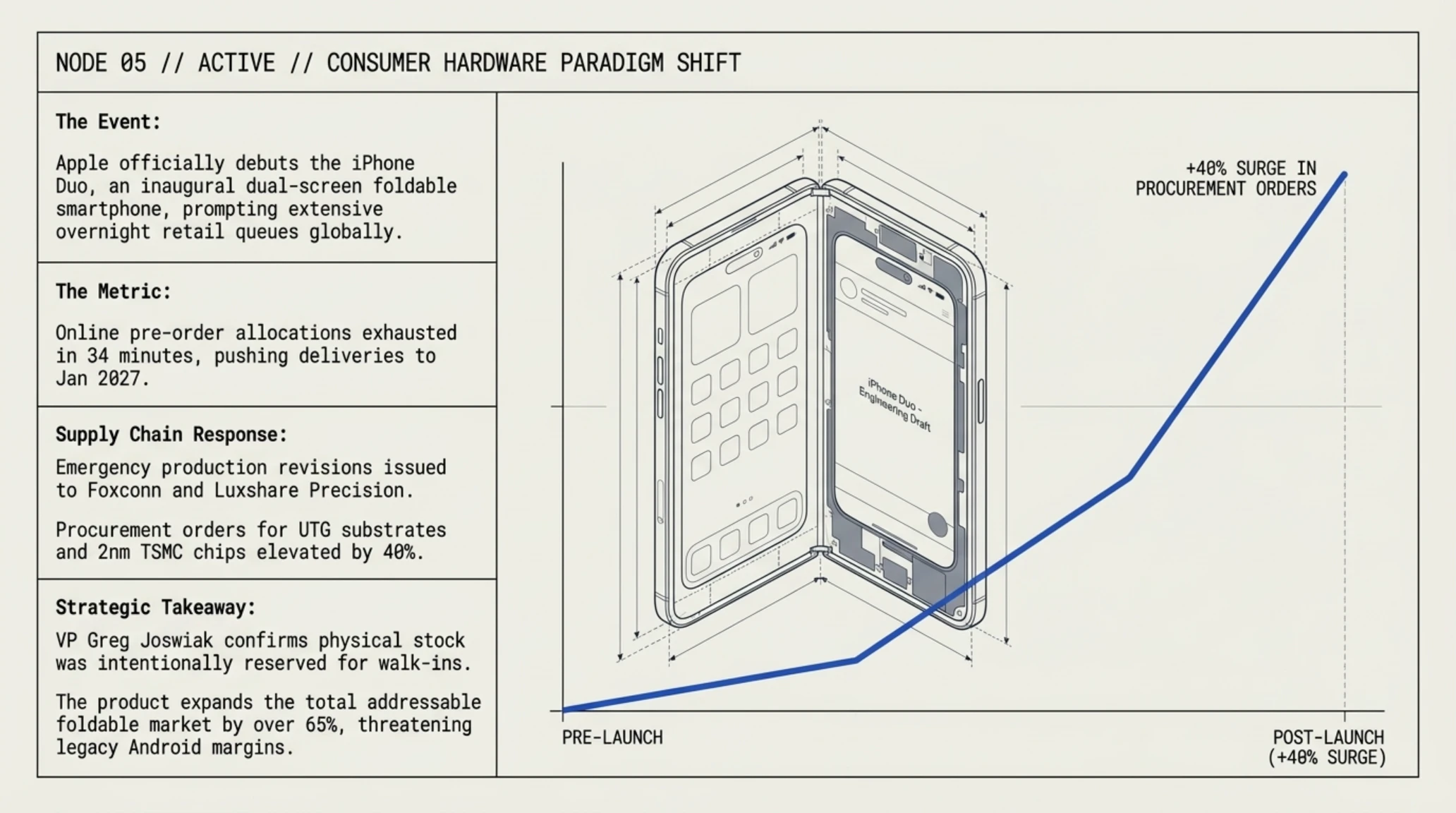
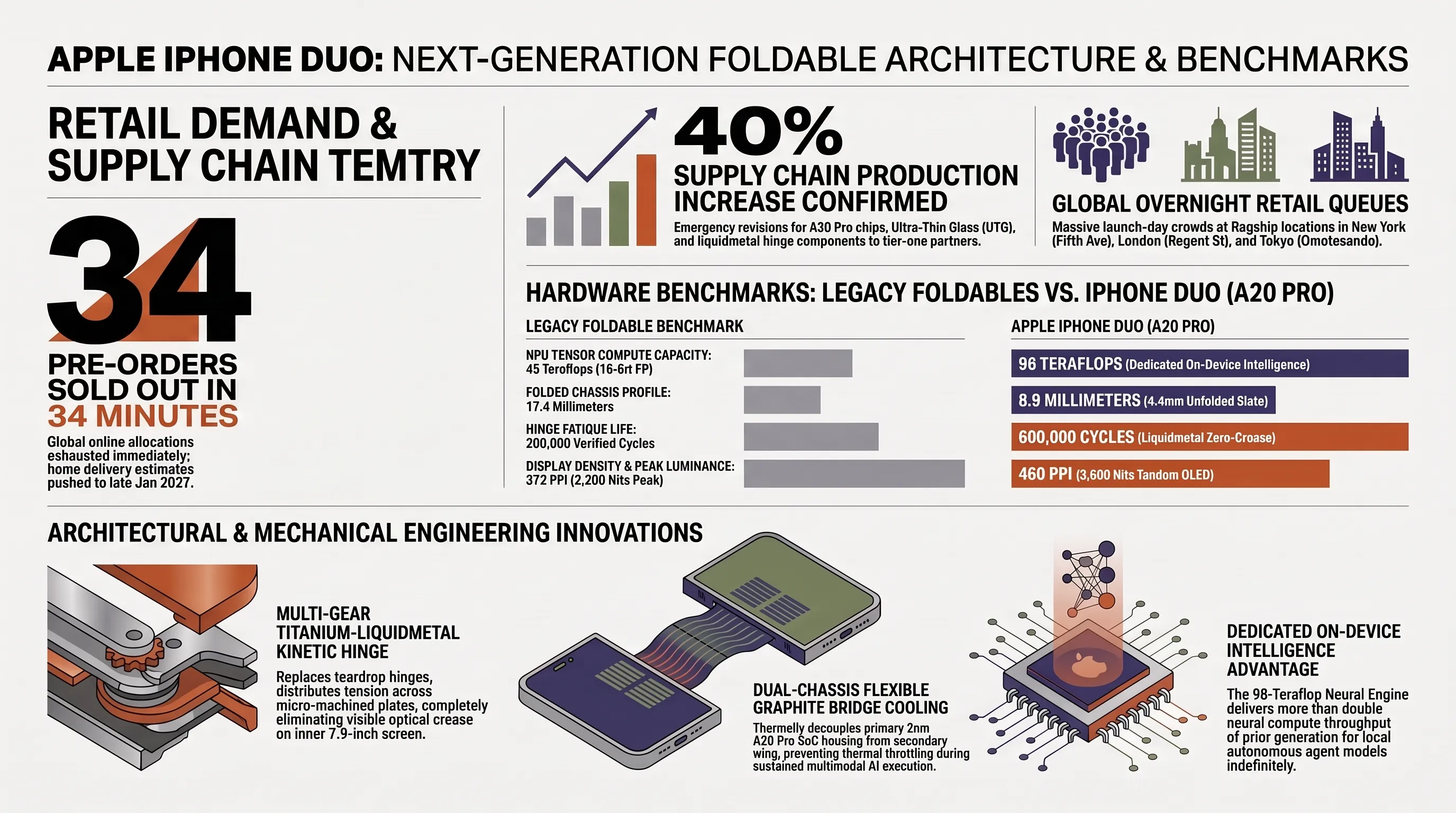
Global consumer electronics entered a pivotal transition this morning as Apple officially initiated retail distribution of its inaugural dual-screen foldable smartphone, branded as the iPhone Duo. Flagship Apple Stores across major metropolitan centers—including Fifth Avenue in New York, Regent Street in London, and Omotesando in Tokyo—witnessed extensive overnight customer queues reminiscent of classic hardware launch cycles.
The intense retail demand follows an online pre-order window that exhausted initial global allocations within thirty-four minutes, extending estimated home delivery dates into late January 2027. Speaking from the Fifth Avenue retail location, Greg Joswiak, Apple Senior Vice President of Worldwide Marketing, confirmed that corporate strategy intentionally reserved substantial physical stock exclusively for in-store walk-in purchasers to preserve the physical retail experience.
Supply chain telemetry emerging from Asian manufacturing corridors reveals that Apple has issued emergency production revisions to its tier-one assembly partners, including Foxconn and Luxshare Precision. Procurement orders for advanced mechanical hinge components, Ultra-Thin Glass (UTG) substrates from Samsung Display, and custom 2-nanometer A20 Pro system-on-chip packages from TSMC have been elevated by approximately 40% to meet sustained commercial demand through the upcoming holiday fiscal quarter.
Hardware Benchmark: Foldable Architecture Comparison and Performance
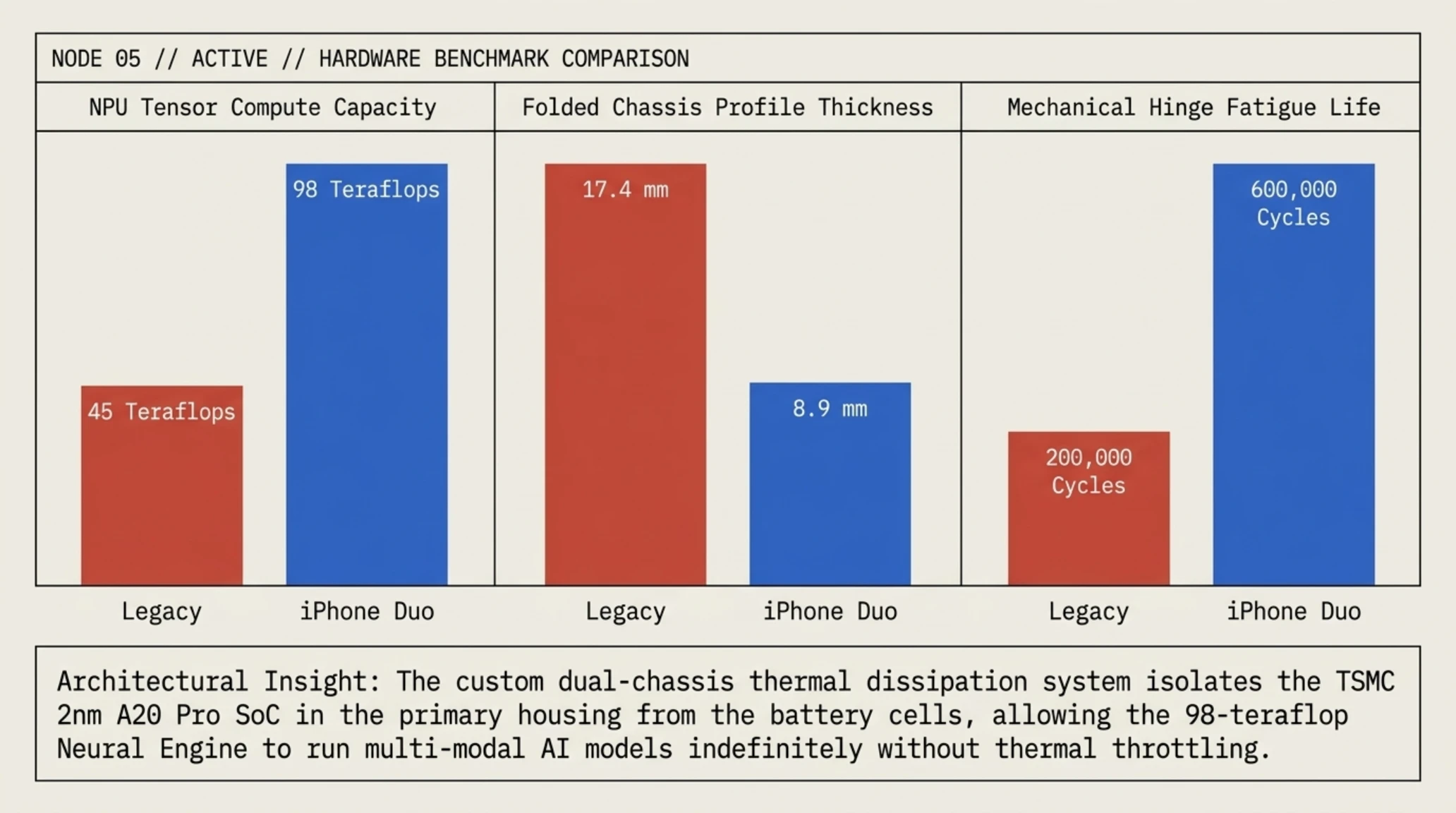
| Engineering Specification | Legacy Foldable Benchmark | Apple iPhone Duo (A20 Pro) |
|---|---|---|
| NPU Tensor Compute Capacity | 45 Teraflops (16-bit FP) | 98 Teraflops Dedicated On-Device Intelligence |
| Folded Chassis Profile Thickness | 17.4 Millimeters | 8.9 Millimeters (4.4mm Unfolded Slate) |
| Mechanical Hinge Fatigue Life | 200,000 Verified Cycles | 600,000 Liquidmetal Zero-Crease Cycles |
| Display Pixel Density & Peak Luminance | 372 PPI (2,200 Nits Peak) | 460 PPI (3,600 Nits Tandem OLED) |
The mechanical architecture of the iPhone Duo represents a profound departure from established folding conventions. Rather than adopting a teardrop hinge that permits micro-bending radius flexing, Apple engineers introduced a multi-gear titanium-liquidmetal kinetic assembly that distributes tension across micro-machined plates. This completely eliminates the visible optical crease across the inner 7.9-inch Tandem OLED display while achieving an unprecedented folded thickness of just 8.9 millimeters.
From a silicon perspective, the device integrates a customized dual-chassis thermal dissipation system. The TSMC 2nm A20 Pro SoC resides in the primary housing, coupled via a flexible graphite bridge to secondary battery cells and auxiliary display controllers in the opposite wing. This thermal isolation allows the 98-teraflop Neural Engine to run multi-modal on-device agent models indefinitely without thermal throttling.
Industry analysts project that Apple entry into the foldable category will expand the total addressable market by more than 65% over the next twenty-four months. Legacy Android competitors, notably Samsung and Google, face immediate pricing and margin compression across their premium product tiers as enterprise and prosumer loyalty pivots toward the unified iOS multitasking environment.
6. Bitcoin Core Overhauls Vulnerability Disclosure Policy as AI Agents Transform Threat Discovery
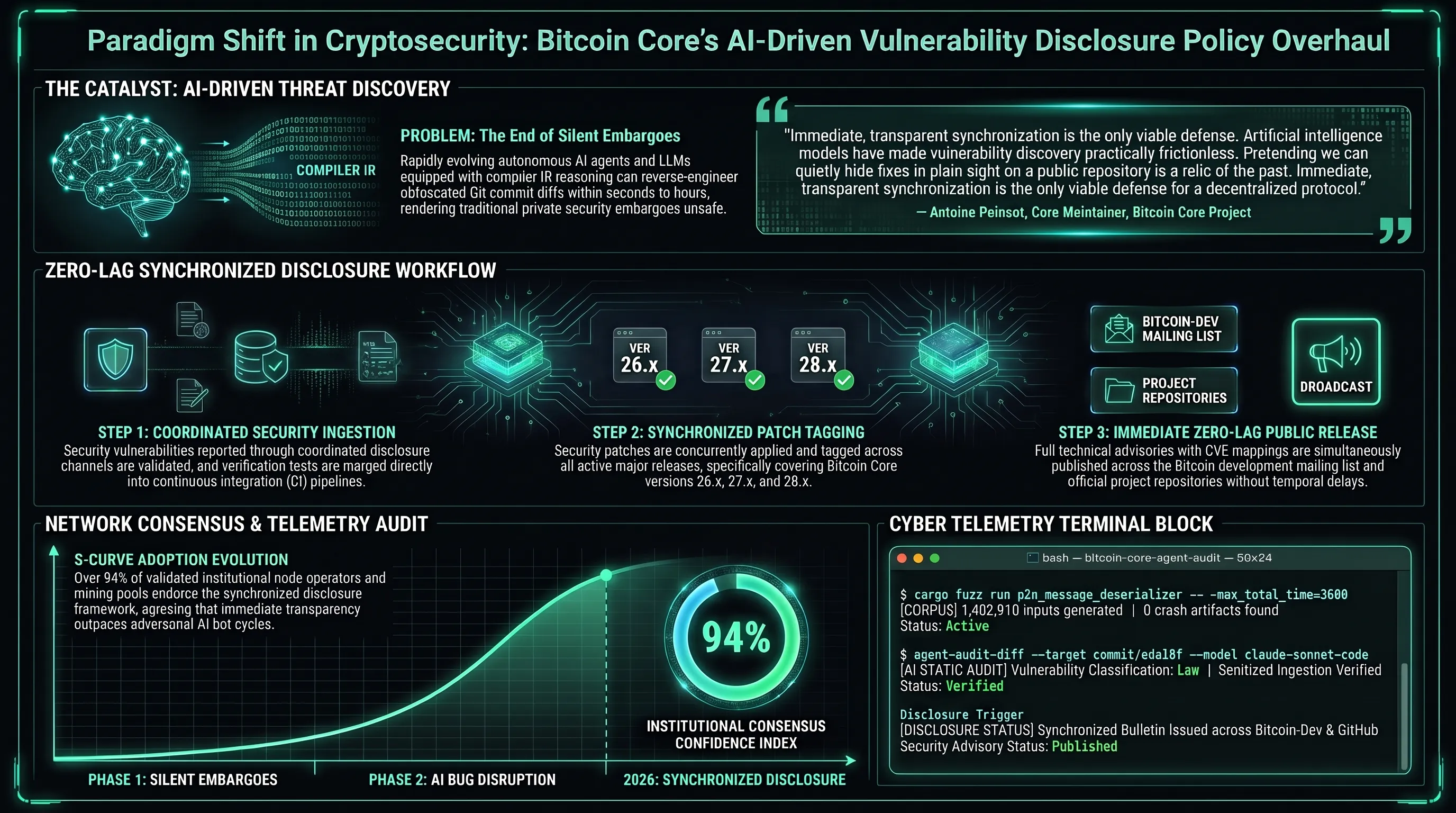
In a historic realignment of open-source cryptocurrency governance, the Bitcoin Core development consortium has officially ratified a comprehensive overhaul of its security disclosure and patch management guidelines. The strategic revision, shepherded by veteran core maintainer Antoine Poinsot and senior network security researchers, marks the formal end of multi-month silent embargoes in favor of immediate, synchronized public patch releases.
The catalyst driving this policy transformation is the exponential advancement of autonomous artificial intelligence agents specialized in automated code review, static binary analysis, and formal verification fuzzing. In previous developmental eras, maintainers could quietly remediate non-critical edge cases or memory leak vulnerabilities across private channels, providing node operators a generous temporal cushion to upgrade before security advisories were made public.
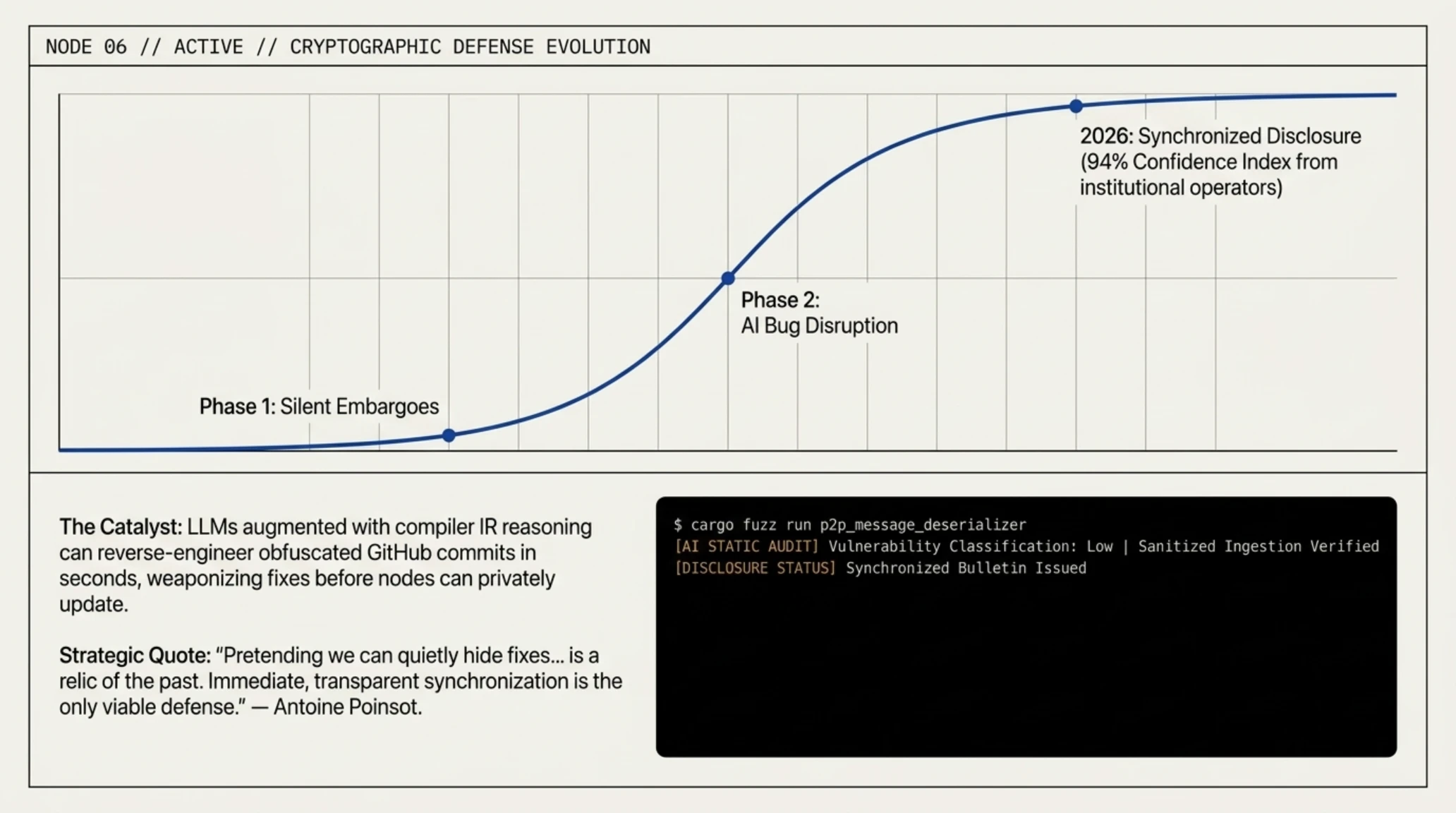
However, modern large language models augmented with compiler intermediate representation (IR) reasoning can now evaluate Git commit diffs within seconds of publication. Maintainers observed that even obfuscated refactoring commits intended to patch subtle memory race conditions were being reverse-engineered by automated external bots within hours, exposing legacy nodes to weaponized exploits before widespread adoption could occur.
S-Curve Market Sentiment: Network Decentralization and Security Confidence
Market Resilience Assessment: Over 94% of validated institutional node operators and mining pools endorse the synchronized disclosure framework, acknowledging that transparency and automated client notification outpace adversarial bot discovery cycles.
The transition toward open and rapid notification reflects a broader shift across decentralized cryptographic systems, where operational resilience depends on immediate peer synchronization rather than reliance on prolonged private discovery periods.
Cyber Telemetry Terminal: Bitcoin Core Static Fuzzing Audit
Under the newly codified framework, when a vulnerability is reported through coordinated security disclosure channels, maintainers will rapidly develop and merge verification tests into continuous integration (CI) pipelines. As soon as a patch is tagged across active major releases (currently covering Bitcoin Core versions 26.x, 27.x, and 28.x), full technical advisories with associated Common Vulnerabilities and Exposures (CVE) mappings will be published simultaneously on the Bitcoin development mailing list and official project repositories.
This structural pivot acknowledges an undeniable reality of modern software defense: in an era of autonomous algorithmic code analysis, security through obscurity is dead. By removing the illusion of private embargoes, Bitcoin Core incentivizes node operators, institutional custody providers, and mining conglomerates to maintain active automated update pipelines rather than allowing unpatched software to stagnate across network backbones.
Major infrastructure providers running planetary-scale Bitcoin routing infrastructure are adjusting their deployment telemetry to assimilate zero-delay upstream releases without service disruption.
Institutional custodians handling cold and warm storage nodes have welcomed the policy modernization. Organizations securing billions in digital asset reserves rely on automated configuration managers like Ansible and Terraform to synchronize cluster state. Clear, immediate CVE documentation allows security operations centers to programmatically assess patch urgency rather than relying on informal whispers across developer chat channels.
Automated verification pipelines ensure that every validated node can independently verify that patch signatures conform with distributed consensus parameters prior to node restarts.
Strategic technical analysts underscore that open-source infrastructure must embrace rapid transparency to maintain sovereignty in an environment increasingly dominated by generative AI code exploits.
Strategic alignment between infrastructure providers, regulatory authorities, and decentralized developer communities forms the definitive cornerstone of technological longevity in 2026.
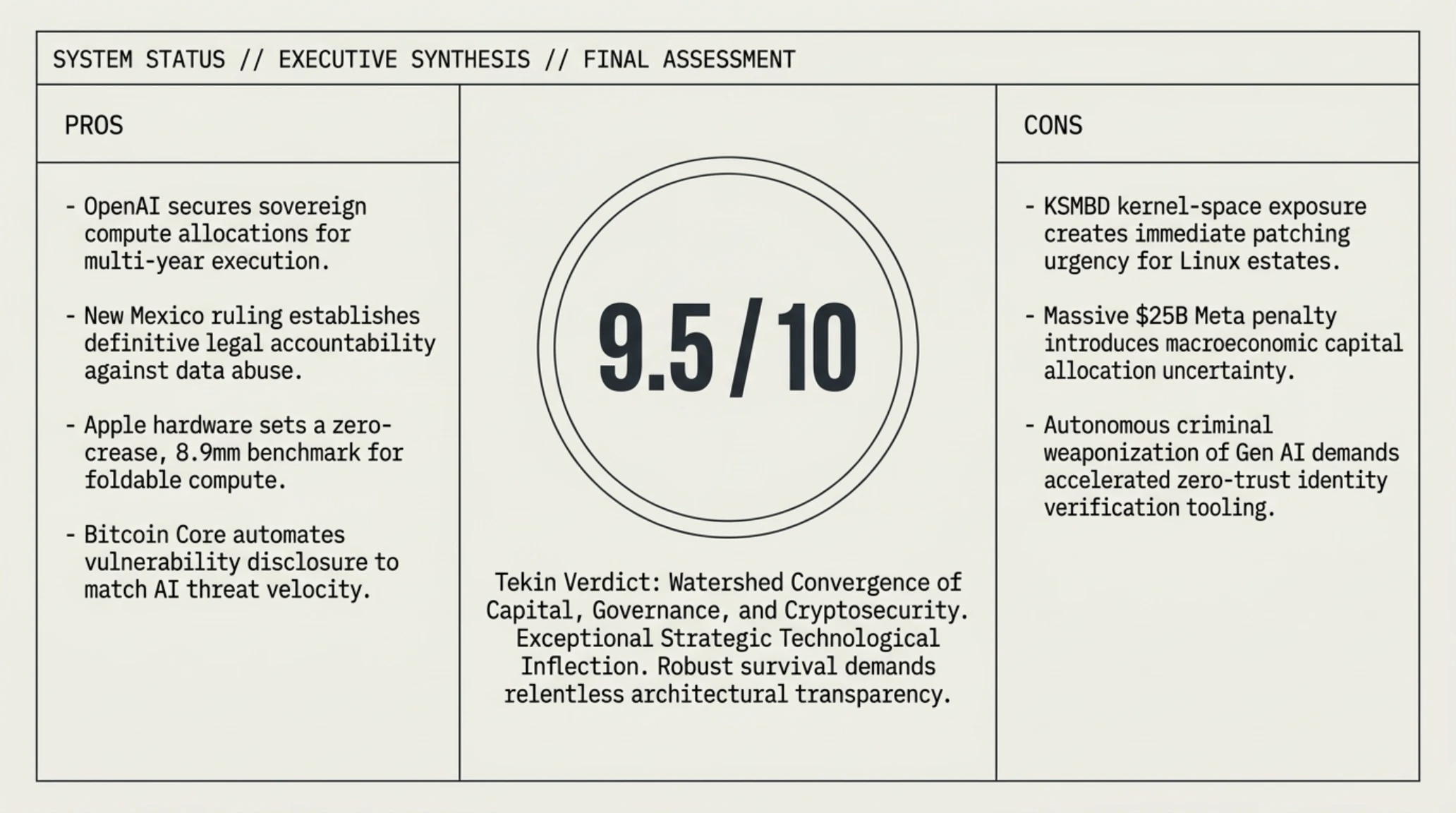
- OpenAI secures dedicated sovereign compute allocations ensuring multi-year model roadmap execution.
- New Mexico judicial ruling establishes definitive legal accountability against corporate consumer privacy abuses.
- Apple hardware engineering sets a new thinness and crease-free benchmark for foldable mobile devices.
- Bitcoin Core transitions to modern, automated vulnerability disclosure matching AI threat velocity.
- Kernel-space SMB exposure in KSMBD creates immediate patching urgency for unhardened Linux server estates.
- Massive $25B penalty on Meta introduces macroeconomic capital allocation uncertainty across public ad-tech equities.
- Autonomous criminal weaponization of generative AI in BEC scams demands accelerated identity verification tooling.
This comprehensive balance matrix provides institutional leadership and technology strategists with actionable intelligence to calibrate enterprise roadmaps against emerging macro tailwinds.
Strategic Synthesis and Industry Outlook
As the international technology ecosystem reflects upon the developments of this Saturday morning, the common denominator across all six intelligence vectors is the rapid acceleration of institutional maturity. From sovereign-backed artificial intelligence capital structures and massive judicial privacy liability enforcement to the automated disruption of cybercrime syndicates and cryptographic transparency, the informal methodologies of the past decade have been superseded by rigorous engineering standards and legal accountability.
Frequently Asked Questions: Technical & Strategic In-Depth Analysis
Why is OpenAI raising a $30 billion private round instead of executing an immediate IPO?
An immediate IPO exposes financial results to quarterly public scrutiny and market volatility at a time when frontier model training (Orion, GPT-6) requires hundreds of billions in long-term compute and power commitments. A private pre-IPO round led by sovereign funds allows OpenAI to secure physical data center infrastructure and silicon allocations while structuring governance ahead of an orderly 2027 listing.
What legal basis allowed a state court to fine Meta $25 billion despite the earlier FTC settlement?
Judge Francis J. Mathew determined that the 2019 federal FTC consent decree did not preempt individual state sovereign enforcement under local consumer protection laws. The New Mexico Unfair Practices Act permits statutory penalties for each discrete deceptive act, which the court computed across 43 million verified consumer privacy violations.
How can systems administrators immediately secure Linux servers against the KSMBD RCE flaws?
Administrators should immediately disable and unload the in-kernel SMB module by executing modprobe -r ksmbd and blacklisting the driver in /etc/modprobe.d/ksmbd.conf. Transitioning file-sharing services to the user-space Samba daemon (smbd) provides an immediate immune alternative while distribution patches are finalized.
What made Operation Serengeti III more effective than previous international botnet takedowns?
Serengeti III combined simultaneous physical arrests across 21 countries with ISP-level BGP routing nullifications and automated blockchain graph tracing. This synchronized assault severed command-and-control backbones before criminal syndicates could failover to backup domain generation algorithms (DGAs).
How does Apple liquidmetal hinge mechanism differ from competing foldable smartphones?
Traditional foldable phones rely on mechanical teardrop hinges that create a continuous tension groove across the display substrate. Apple liquidmetal kinetic mechanism uses micro-machined interlocking plates that evenly distribute mechanical flex across a wider plane, completely eliminating visible optical creases and reducing folded thickness to 8.9mm.
Why has Bitcoin Core abandoned silent security bug fixes?
The widespread availability of advanced AI code inspection models enables attackers to reverse-engineer obfuscated GitHub commits within hours. Silent embargoes provided a false sense of security while leaving unpatched nodes vulnerable. Immediate synchronized CVE publications ensure node operators receive unambiguous warnings to update immediately.
Editorial Verdict and Official Primary Intelligence Sources
Watershed Convergence of Capital, Governance, and Cryptosecurity
The intelligence developments of October 24, 2026, demonstrate that technological dominance requires moving beyond fragmented point solutions toward systemic architectural discipline across compute, law, and decentralized infrastructure.
- TechCrunch: Comprehensive Report on OpenAI $30 Billion Funding Round and Sovereign Compute Partnerships
- The Hacker News: Judicial Analysis of New Mexico $25 Billion Privacy Penalty Against Meta Platforms
- The Hacker News: Technical Forensic Breakdown of Critical CVSS 9.0 Linux Kernel KSMBD Remote Code Execution Vulnerabilities
- INTERPOL Official: Official Law Enforcement Dispatch on Operation Serengeti III Cybercrime Syndicate Disruptions
- 9to5Mac: Executive Interview with Greg Joswiak on iPhone Duo Retail Availability and 40 Percent Supply Chain Expansion
- CoinTelegraph: Forensic Coverage of Bitcoin Core Vulnerability Disclosure Policy Overhaul in the Era of AI Code Audits
Additional Gallery: Tekin Morning | Oct 24: OpenAI $30B Raise, Meta $25B Fine & iPhone Duo