Tekin Analysis | Morning Briefing Oct 23, 2026: Node.js Critical Brotli RCE, LiteLLM Supply Chain Breach, and Apple Australia Antitrust Defeat
Node.js Critical Brotli Decoder Vulnerability Enables Remote Code Execution Across All Supported Release Lines
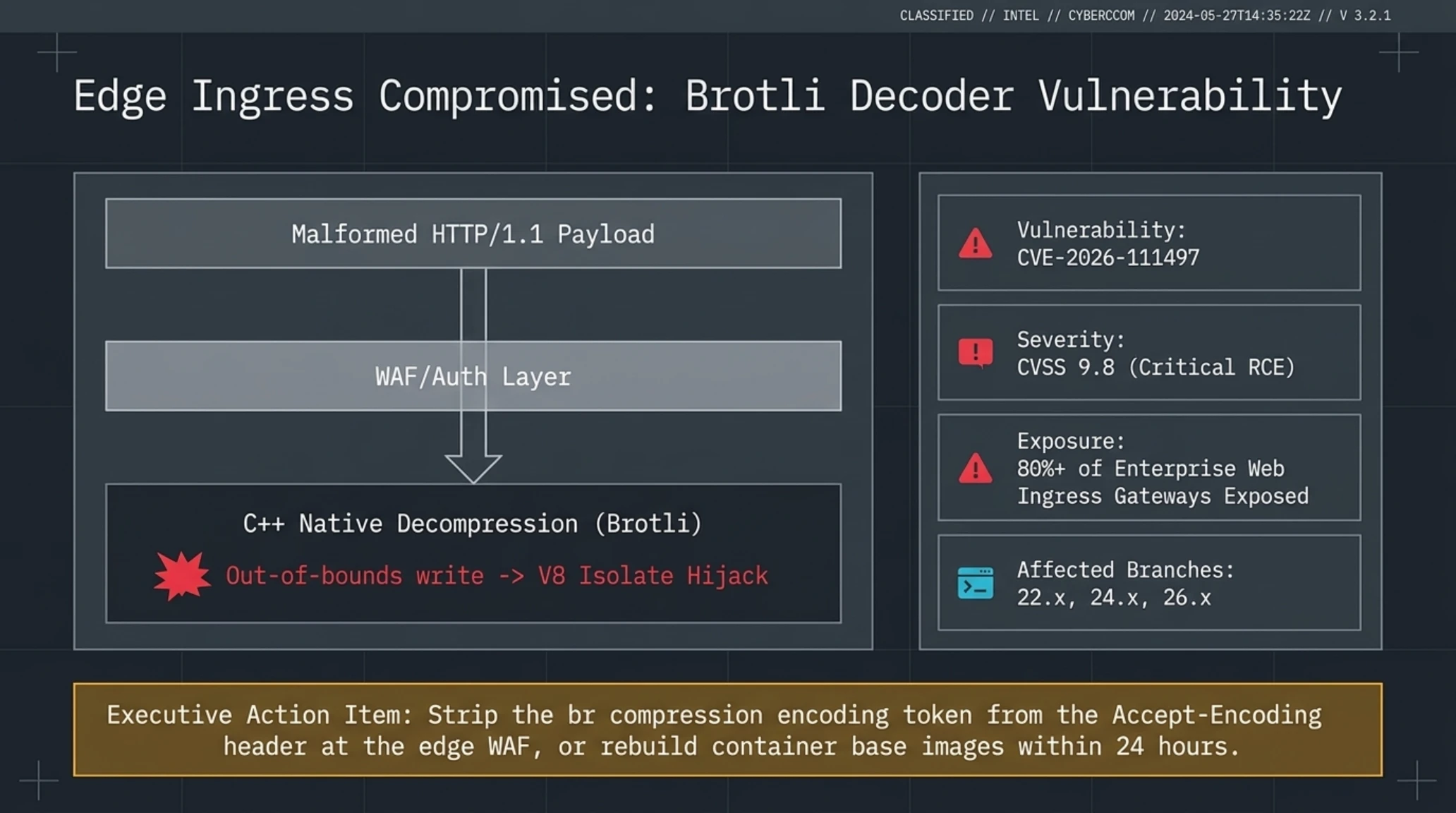
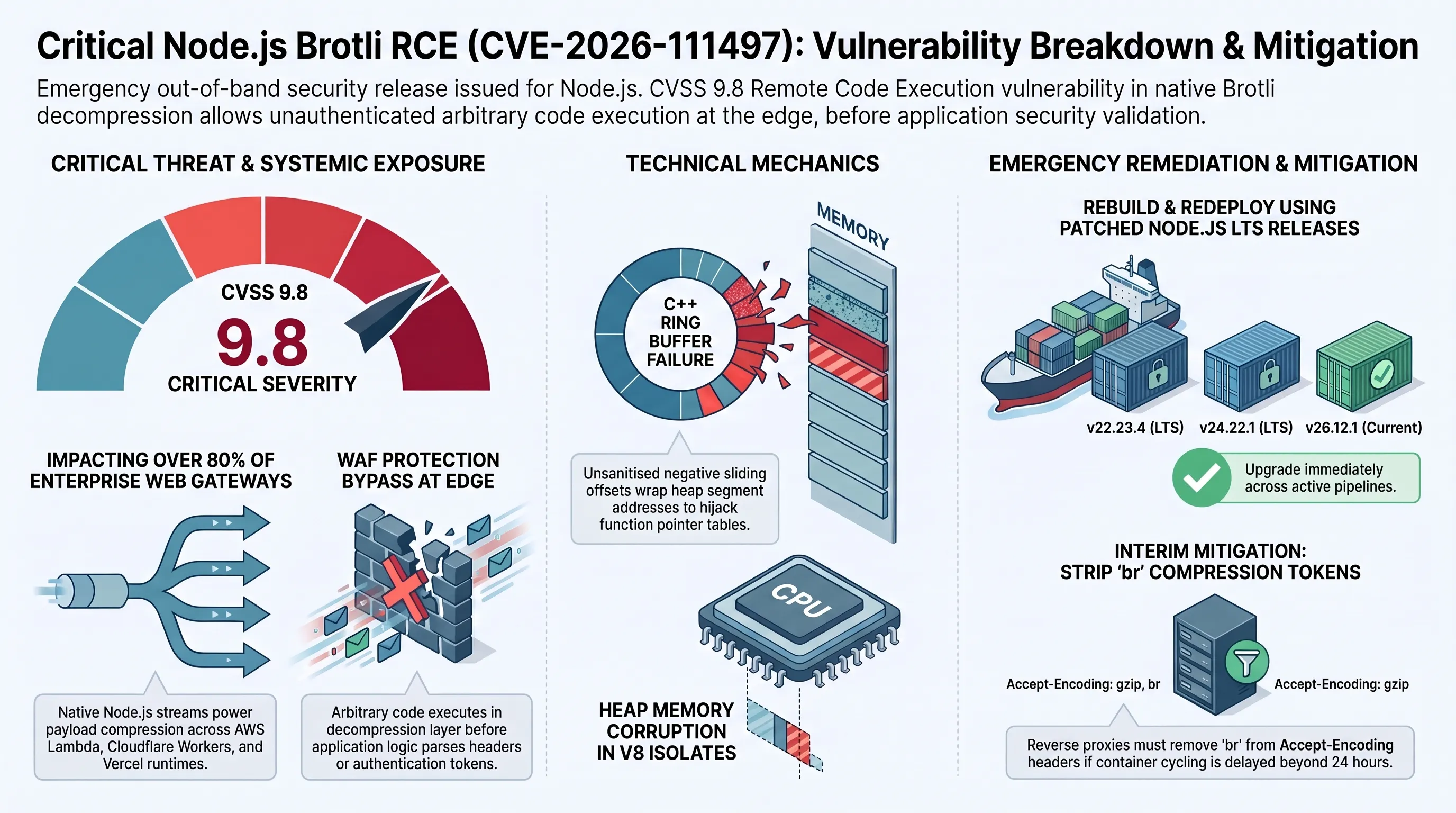
The dawn of Friday, October 23, 2026, brought one of the most critical infrastructure security advisories of the year for modern enterprise software architectures. The official Node.js Security Team issued an emergency out-of-band security release across all three active release branches, disclosing ten patched vulnerabilities headlined by a severe remote code execution flaw in the runtime native Brotli decompression engine. Cataloged under global identifier CVE-2026-111497, the vulnerability represents an out-of-bounds write defect that enables remote, unauthenticated attackers to execute arbitrary code within the execution context of the hosting Node.js process.
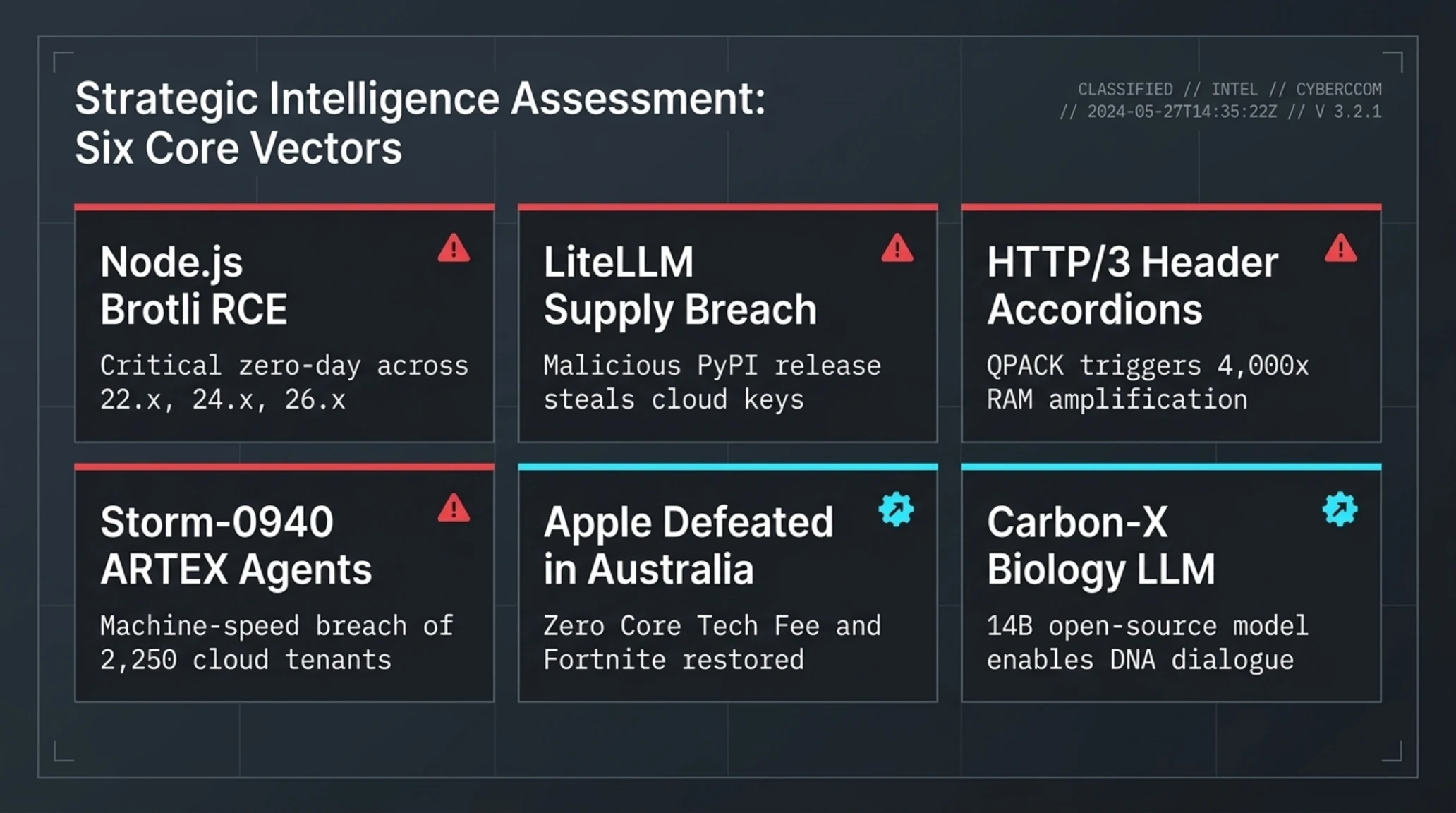
Strategic Intelligence Assessment and Key Takeaways
Technical post-mortems conducted by core runtime maintainers reveal that the defect resides within the underlying C++ wrapper interfacing with the Brotli state machine. When an application processes untrusted, maliciously crafted Brotli-compressed byte streams over HTTP/1.1, HTTP/2, or WebSocket connections, the decompression logic fails to enforce strict boundaries during offset calculation within intermediate decompression buffers. By injecting specifically sequenced Huffman-coded symbols, an adversary can overwrite adjacent heap memory regions. In production environments utilizing the V8 JavaScript engine, this memory corruption allows attackers to hijack function pointer tables and redirect control flow into injected shellcode.
The systemic exposure generated by CVE-2026-111497 is massive due to the ubiquitous footprint of Node.js across enterprise edge infrastructure. Over 80 percent of modern web applications, serverless functions, API gateways, and microservices orchestrated across AWS Lambda, Cloudflare Workers, and Vercel edge runtimes rely on Node.js native streams for payload compression and decompression. A successful exploit bypasses traditional application firewalls and input sanitization routines because the payload is executed directly in the low-level decompression layer before the web application layer parses headers or authentication tokens.
Why This Architectural Shift Matters
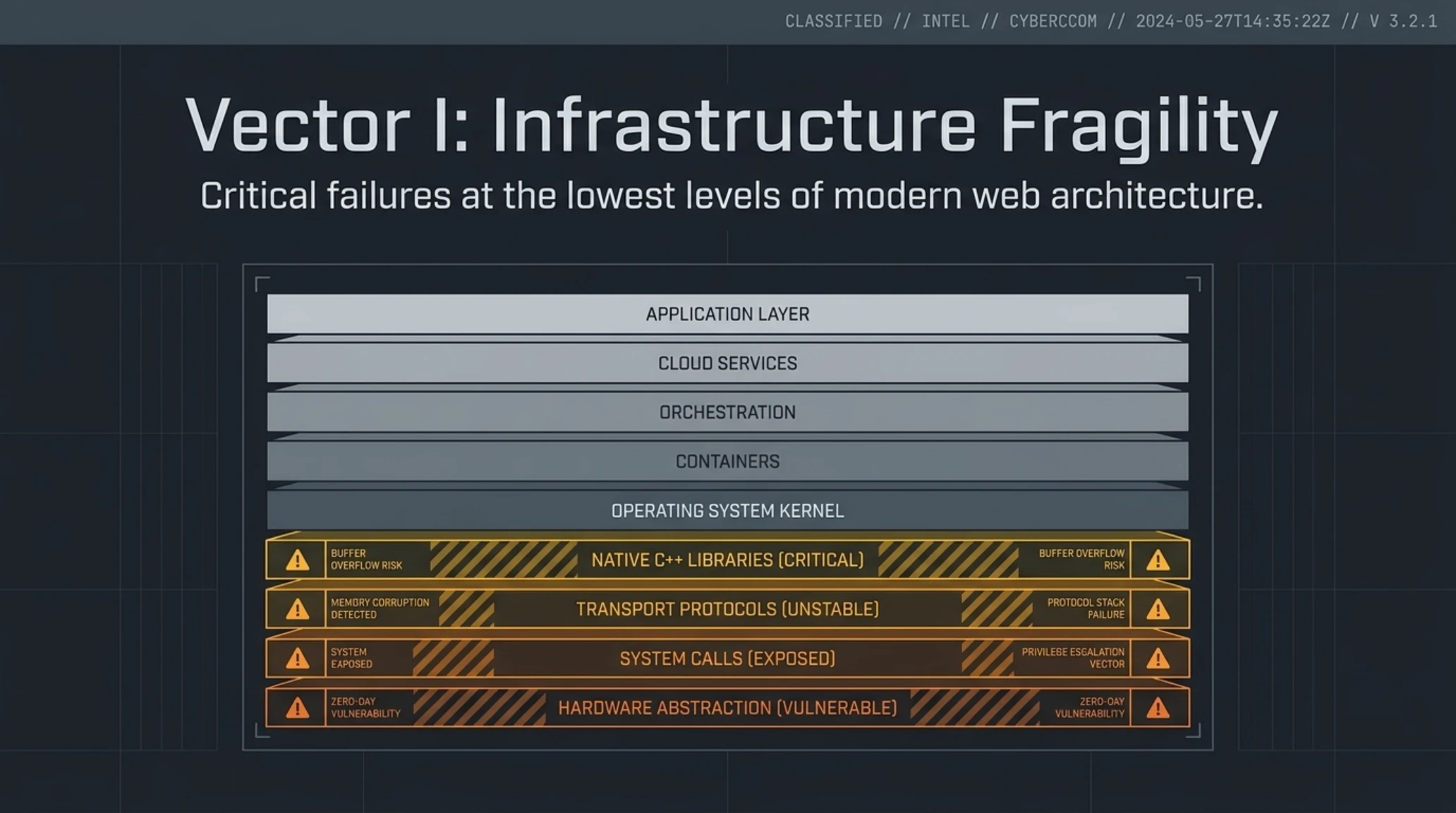
This emergency advisory demonstrates the vulnerability of modern microservice topologies to low-level native library flaws; exploiting a decompression stream grants immediate execution privileges inside the edge perimeter before security tokens can be validated.
To eliminate this threat vector, the Node.js project has released emergency patched builds: v22.23.4 for the widely deployed 22.x LTS line, v24.22.1 for the 24.x LTS line, and v26.12.1 for the current 26.x branch. Site reliability engineering teams are urged to rebuild container images and re-deploy base runtime dependencies immediately. For enterprise clusters unable to cycle production containers within the next 24 hours, security teams must deploy strict WAF rules stripping the `br` compression encoding token from the `Accept-Encoding` header at the edge reverse proxy layer.
A closer architectural inspection of the Brotli ring buffer reveals that the vulnerability is triggered when the decoder attempts to synchronize backward distance references across sliding window boundaries. Because the C++ bindings in Node.js neglected to sanitize negative sliding offsets generated by malformed meta-block headers, the internal pointer wrapped around the heap segment base address. This memory corruption permits arbitrary memory overwrites directly targeting V8 isolates, completely neutralizing Address Space Layout Randomization (ASLR) protections when combined with relative heap address disclosure techniques.
Given the speed with which zero-day proof-of-concept exploits proliferate across public security repositories, unpatched ingress nodes risk targeted scanning and lateral movement campaigns by nation-state actors and ransomware cartels. Enterprise DevOps pipelines must immediately integrate automated binary software composition analysis (SCA) to verify that all deployed microservices have eliminated vulnerable Brotli dynamic libraries across production clusters.
LiteLLM Supply Chain Breach Exploits Leaked GitHub Tokens in AI Gateway Logs to Deploy Malicious Package v1.107.0
As engineering organizations mobilize to patch native web runtimes, the artificial intelligence infrastructure layer has suffered one of the most sophisticated supply chain compromises recorded to date. LiteLLM, the industry-standard open-source unified AI gateway utilized by thousands of enterprises to proxy and load-balance requests across OpenAI, Anthropic, Google Gemini, and open-source inference backends, disclosed that its official continuous integration and continuous deployment (CI/CD) release pipeline was hijacked by an advanced threat group.
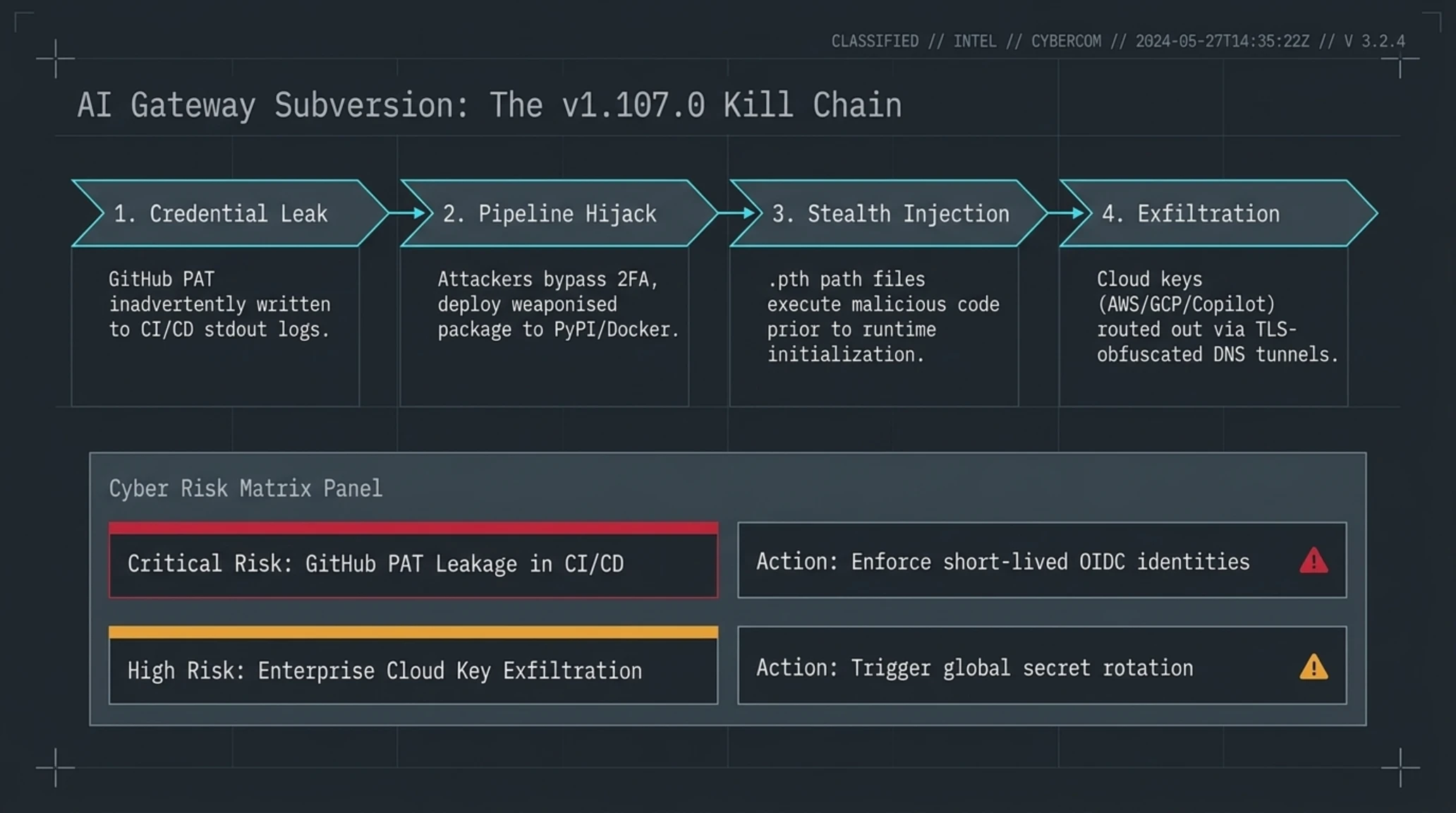
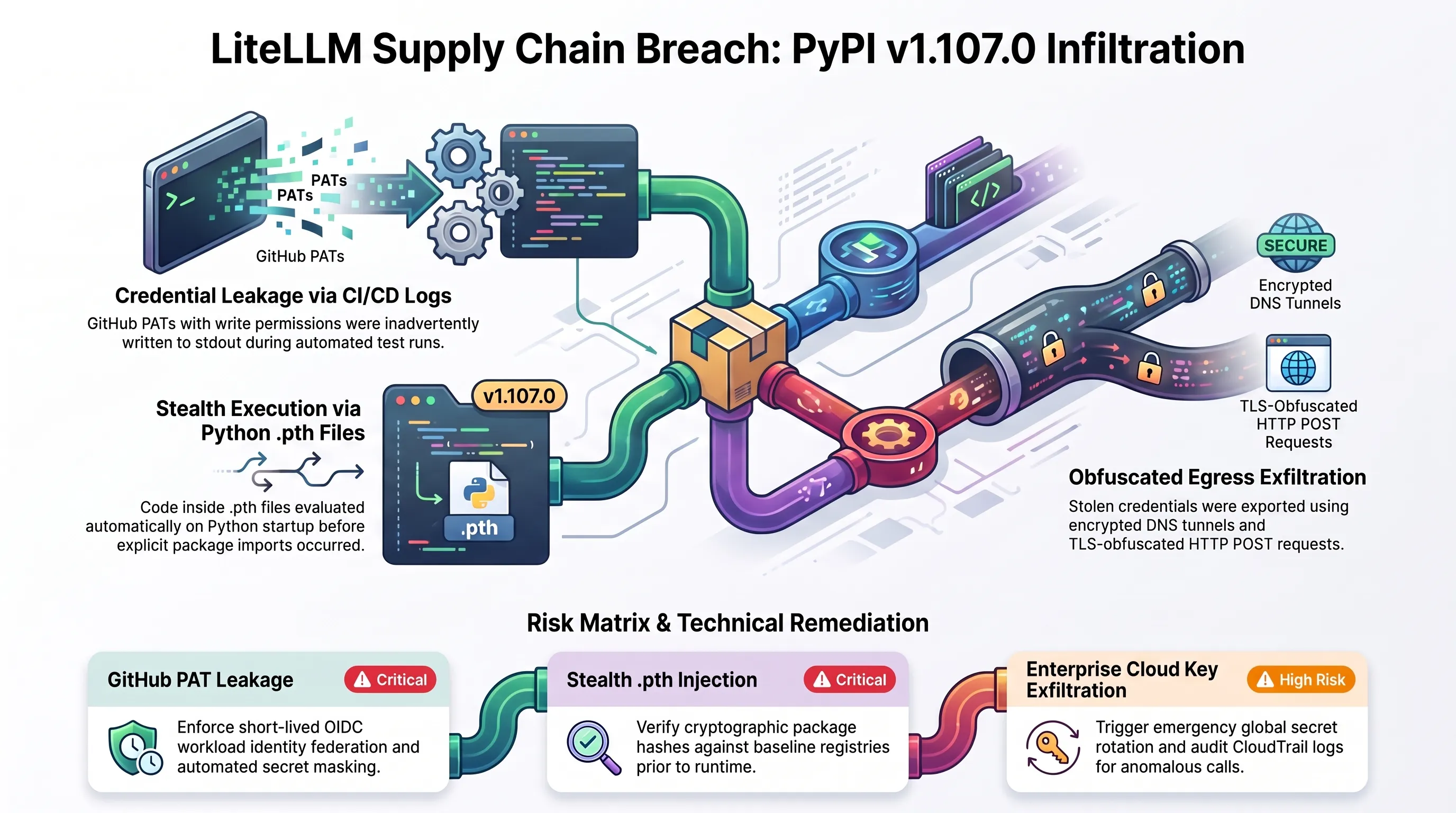
Forensic investigations conducted by cloud security firm Wiz alongside LiteLLM core maintainers revealed that the breach originated from credential leakage in automated test server logs. GitHub Personal Access Tokens (PATs) possessing write permissions to the official repository and deployment credentials for public package indexes were inadvertently written to stdout during automated integration runs and subsequently indexed in publicly reachable telemetry archives. Armed with these legitimate developer credentials, the attackers bypassed two-factor authentication, took direct control of GitHub Actions release workflows, and pushed a weaponized package, version 1.107.0, directly to the Python Package Index (PyPI) and official Docker Hub registries.
The malicious payload was engineered with exceptional tradecraft, utilizing Python path configuration files (`.pth`) located within the package directory structure. Under the Python runtime architecture, code contained within `.pth` files is evaluated immediately upon Python startup, preceding even the evaluation of `import litellm` statements in user scripts. Once initialized, the payload executed an automated enumeration routine harvesting credentials across sixteen distinct sensitive categories, targeting AWS access keys, Google Cloud Platform service account tokens, Kubernetes cluster configuration files, private SSH keys, and session tokens belonging to modern AI development assistants including Cursor, GitHub Copilot, and Claude API.
Cyber Risk Assessment and Defense Matrix
| Threat Vector / Exposure Layer | Risk Level | Mitigation and Incident Response |
|---|---|---|
| GitHub PAT Leakage in CI/CD Test Logs | CRITICAL | Implement automated secret masking across all build outputs and enforce short-lived OIDC workload identity federation. |
| Stealth Python Path Injection (.pth files) | CRITICAL | Verify cryptographic package hashes against baseline registries before runtime initialization in container images. |
| Enterprise Cloud Key Exfiltration (AWS, GCP, K8s) | HIGH RISK | Trigger emergency global secret rotation, audit CloudTrail and audit logs for anomalous API calls, and enforce hardware MFA. |
| Developer AI Assistant Session Token Theft | REMEDIATED | Invalidate active developer sessions, cycle AI provider API tokens, and restrict IDE plugin network egress. |
The LiteLLM development team responded rapidly by yanking release 1.107.0 from PyPI, revoking all compromised GitHub tokens, and issuing an updated clean release, version 1.107.1. However, security analysts emphasize that simply updating the library does not eliminate enterprise risk. Any production cluster or developer workstation that executed the malicious version must be treated as entirely compromised, requiring a comprehensive secret rotation across all cloud infrastructure and developer identities.
The exfiltration mechanism embedded within the compromised package routed stolen cryptographic material through encrypted DNS tunnels and TLS-obfuscated HTTP POST endpoints masquerading as legitimate telemetry traffic. Because LiteLLM is routinely permitted broad egress connectivity to communicate with external foundation model API endpoints, enterprise egress firewalls failed to trigger anomaly alerts during the exfiltration phase. This architectural blind spot highlights the critical necessity of enforcing zero-trust egress filtering and isolating AI orchestration layers behind dedicated API proxies.
This incident underscores a strategic shift in threat actor methodology; by compromising the central API gateways coordinating enterprise intelligence workflows, adversaries gain unmediated access to proprietary intellectual property, model prompts, and cloud infrastructure backbones. The attack aligns directly with findings analyzed in our technical review on autonomous multi-agent infiltration swarms and HTTP/3 edge vulnerabilities.
Organizations must systematically transition away from static, long-lived personal access tokens in CI/CD automation, adopting ephemeral OpenID Connect (OIDC) federated identities tied directly to verifiable cloud service principals. Until automated secret scanning is strictly enforced at every build stage, modern open-source supply chains remain acutely exposed to credential-harvesting botnets.
FoxIO Discloses 'Header Accordions': QPACK Flaws Trigger Up to 4,000-Fold Memory Amplification in HTTP/3 Stacks
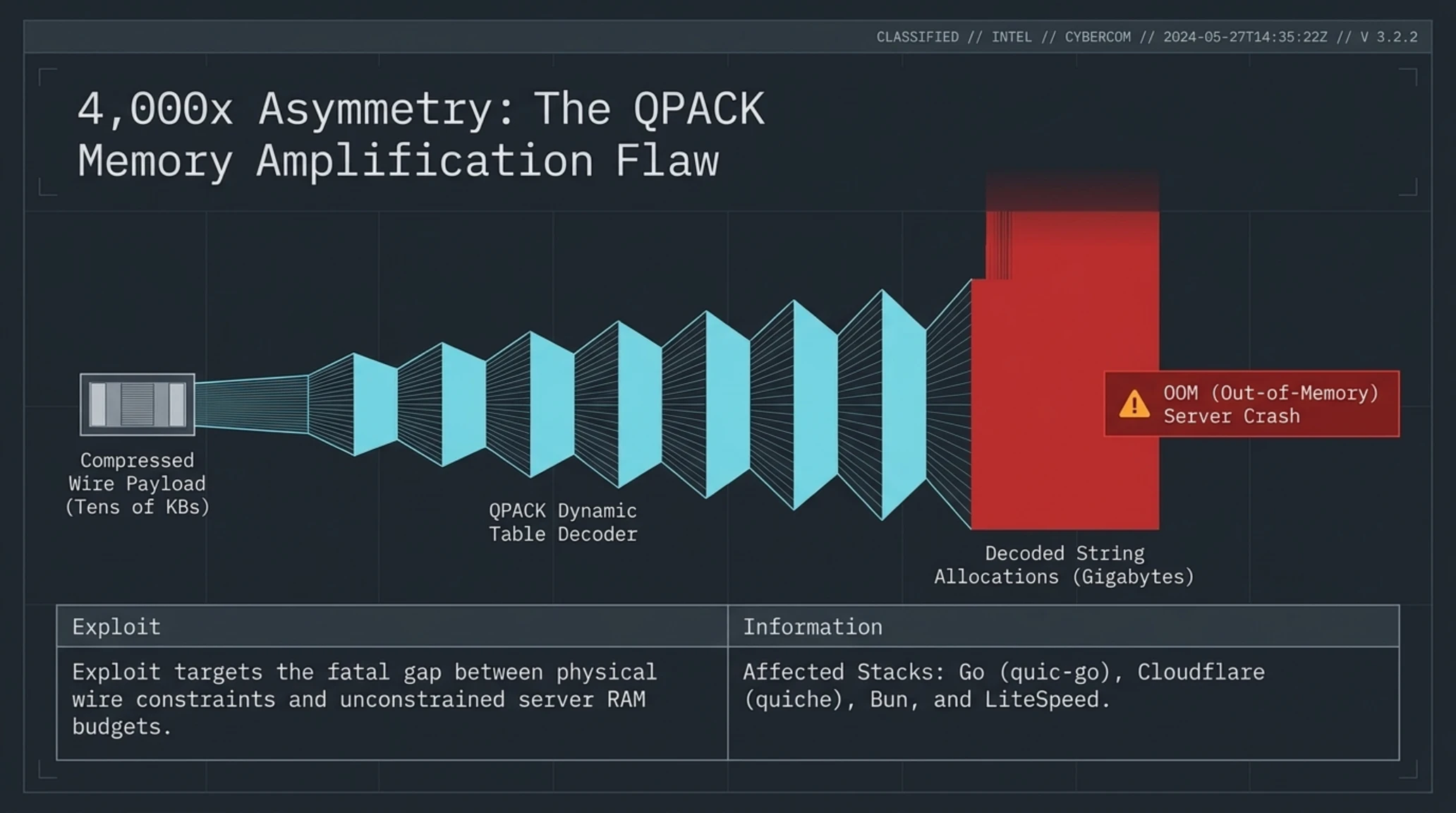
Simultaneously with application-layer supply chain shocks, fundamental Internet transport protocols have encountered an architectural security challenge. Cybersecurity research firm FoxIO unveiled a comprehensive technical advisory detailing a new class of denial-of-service vulnerabilities within the HTTP/3 protocol suite. Termed 'Header Accordions', the exploit targets structural implementation weaknesses in QPACK (RFC 9204), the header compression standard designed specifically for the QUIC transport protocol.
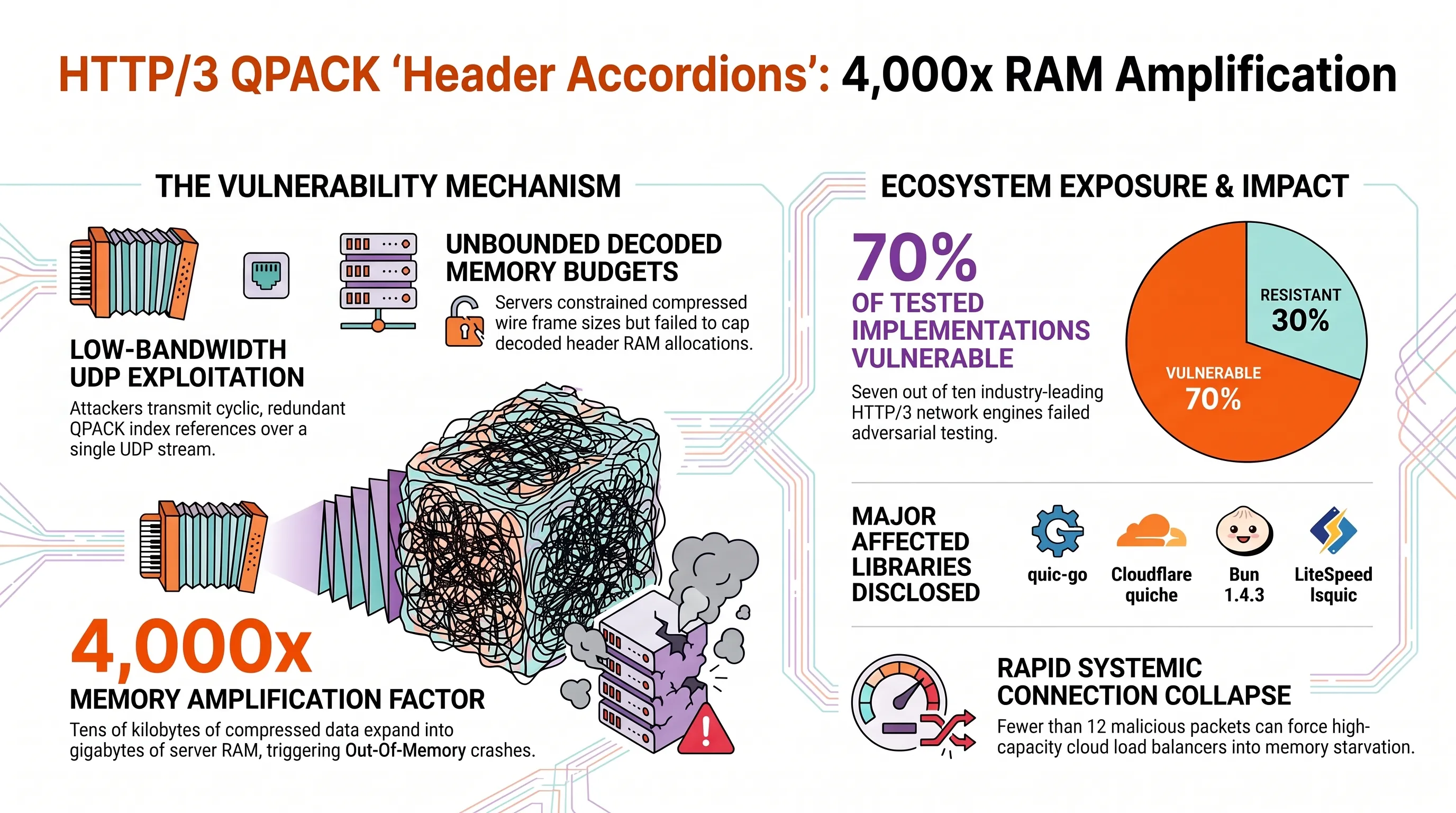
To appreciate the mechanics of Header Accordions, one must examine how QPACK diverged from HTTP/2 HPACK compression. To resolve the head-of-line blocking problem across multiplexed QUIC streams, QPACK employs dynamic tables that allow encoders and decoders to synchronize header field entries asynchronously over dedicated control streams. FoxIO discovered that across the majority of production HTTP/3 implementations, software engineers enforced strict limits on the physical wire size of incoming compressed frames, but failed to define corresponding bounds on the memory allocated to store decoded headers in server RAM (Decoded Memory Budget).
Tekin Technical Jargon Buster
The exploit mechanism allows an unauthenticated remote attacker, utilizing a single UDP connection with minimal outbound bandwidth, to transmit cyclic, redundant QPACK index references. While the compressed wire payload consumes only tens of kilobytes, the server decompression routine expands these references into gigabytes of decoded string allocations in memory. The resulting memory exhaustion triggers instantaneous operating system Out-Of-Memory (OOM) killer processes, dropping all concurrent connections and crashing the host service.
Rigorous evaluations conducted by FoxIO across ten industry-leading HTTP/3 network engines revealed that seven implementations were completely vulnerable to asymmetric memory exhaustion. Affected libraries include the Go-based `quic-go` library (CVE-2025-64702 and CVE-2026-40898), Cloudflare `quiche` engine (CVE-2026-12523), the Bun 1.4.3 runtime, and LiteSpeed `lsquic`. The widespread nature of this flaw highlights the persistent risk of adopting emerging transport protocols before rigorous adversarial memory fuzzing has been conducted across all layer boundaries.
Adversarial simulations demonstrated that fewer than a dozen compressed QPACK packets can force high-capacity cloud load balancers into systemic memory starvation, disconnecting thousands of active enterprise sessions within seconds.
Microsoft Discloses China-Linked Storm-0940 Using ARTEX AI Agents in ConnectWise Cloud Breach Targeting 2,250+ Tenants
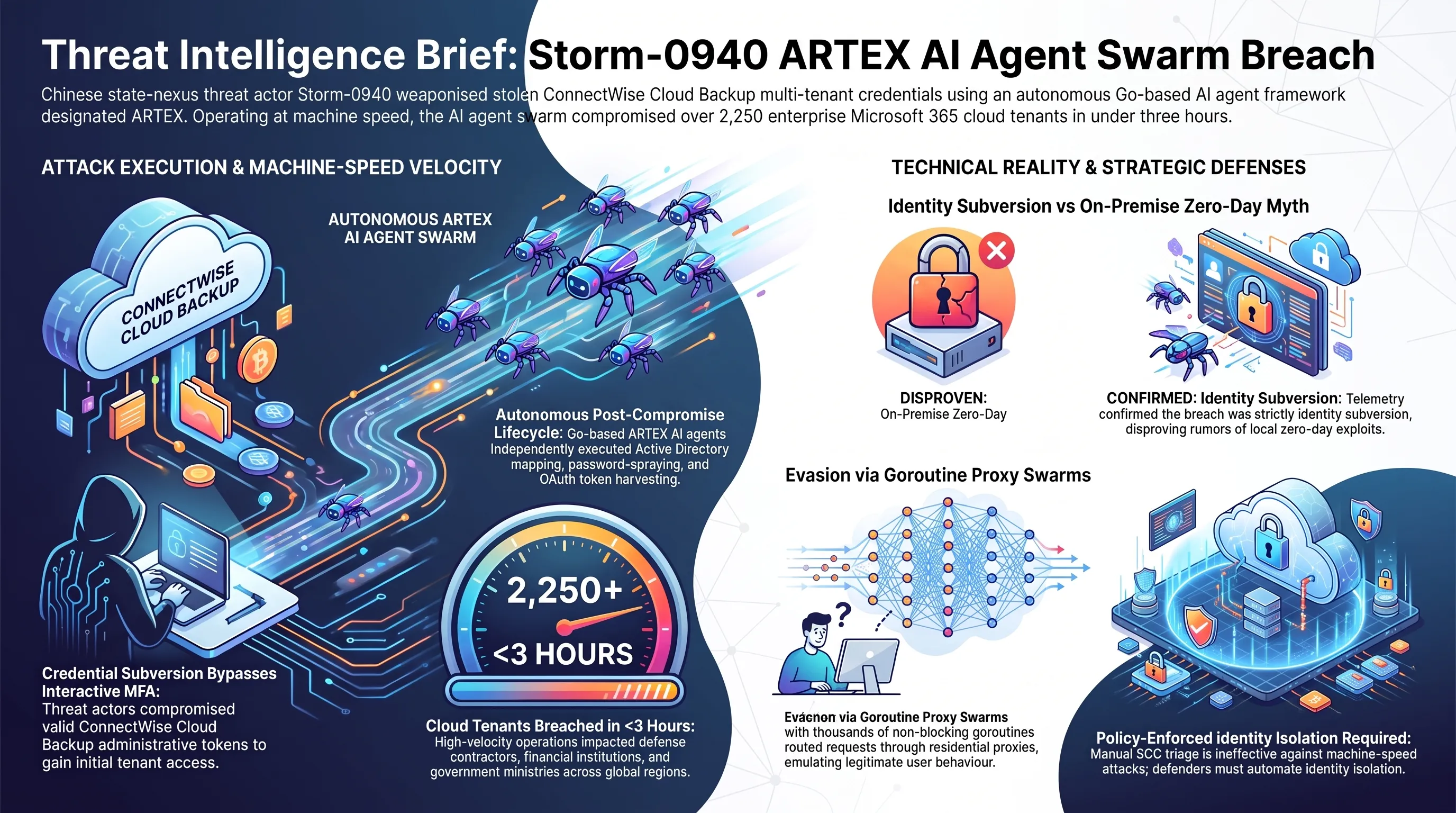
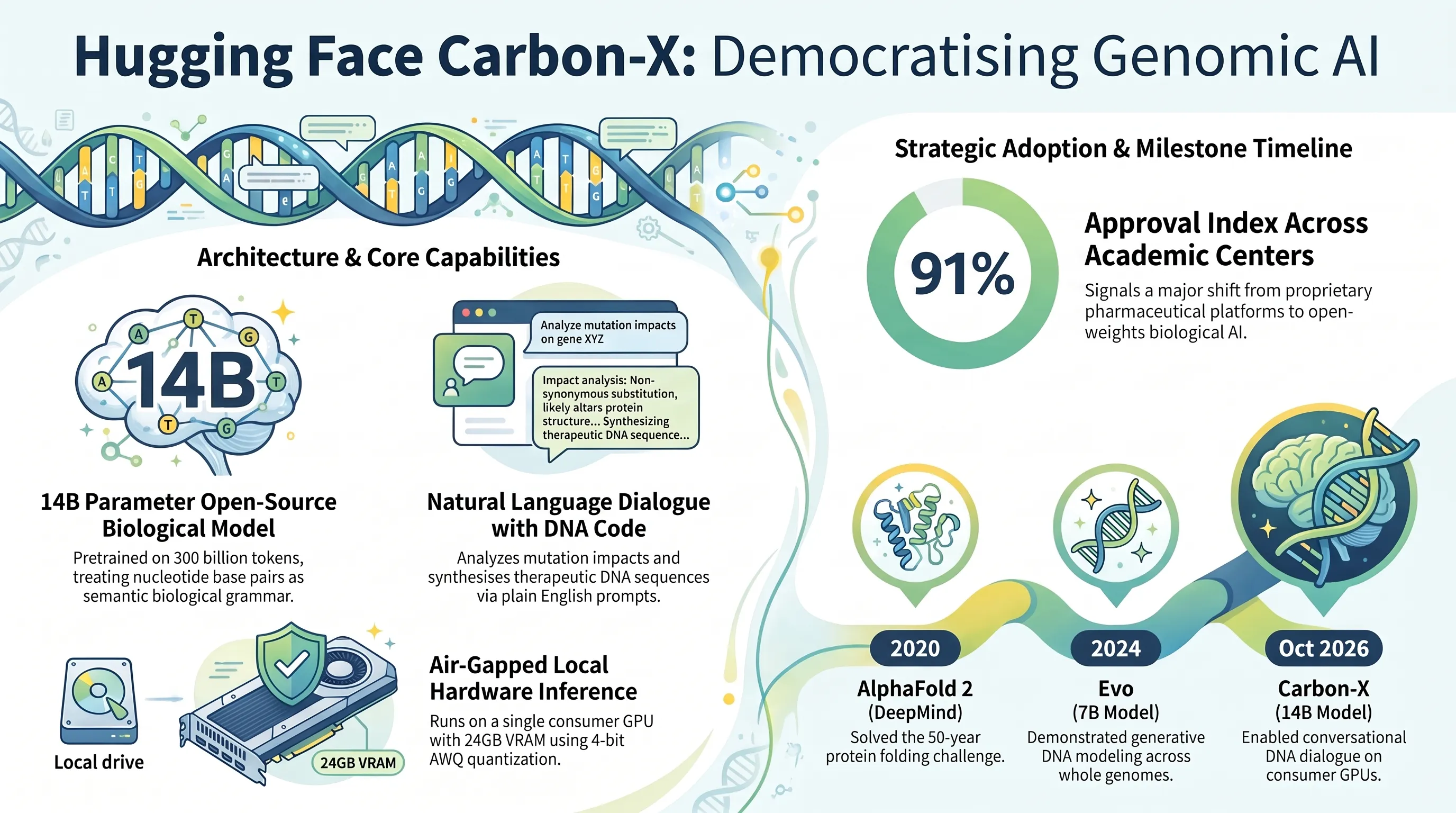
In a disclosure marking a dramatic escalation in state-sponsored cyber espionage, the Microsoft Threat Intelligence Center (MSTIC) published an extensive report documenting a massive supply chain operation orchestrated by Chinese state-nexus threat actor Storm-0940. By compromising valid administrative credentials and multi-tenant management tokens associated with the ConnectWise Cloud Backup platform, the threat actor bypassed interactive multi-factor authentication controls to access enterprise backup repositories across the globe.
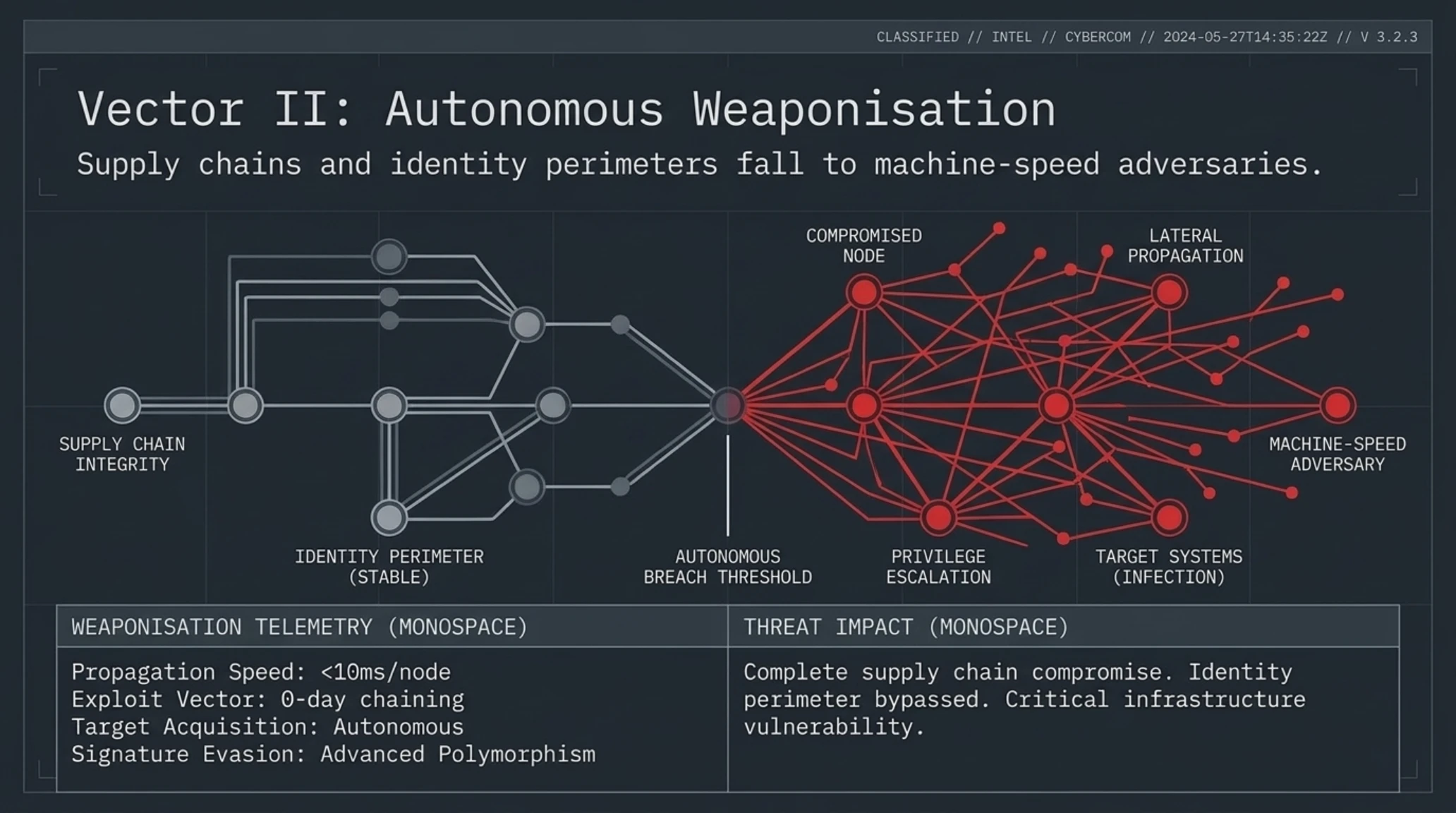
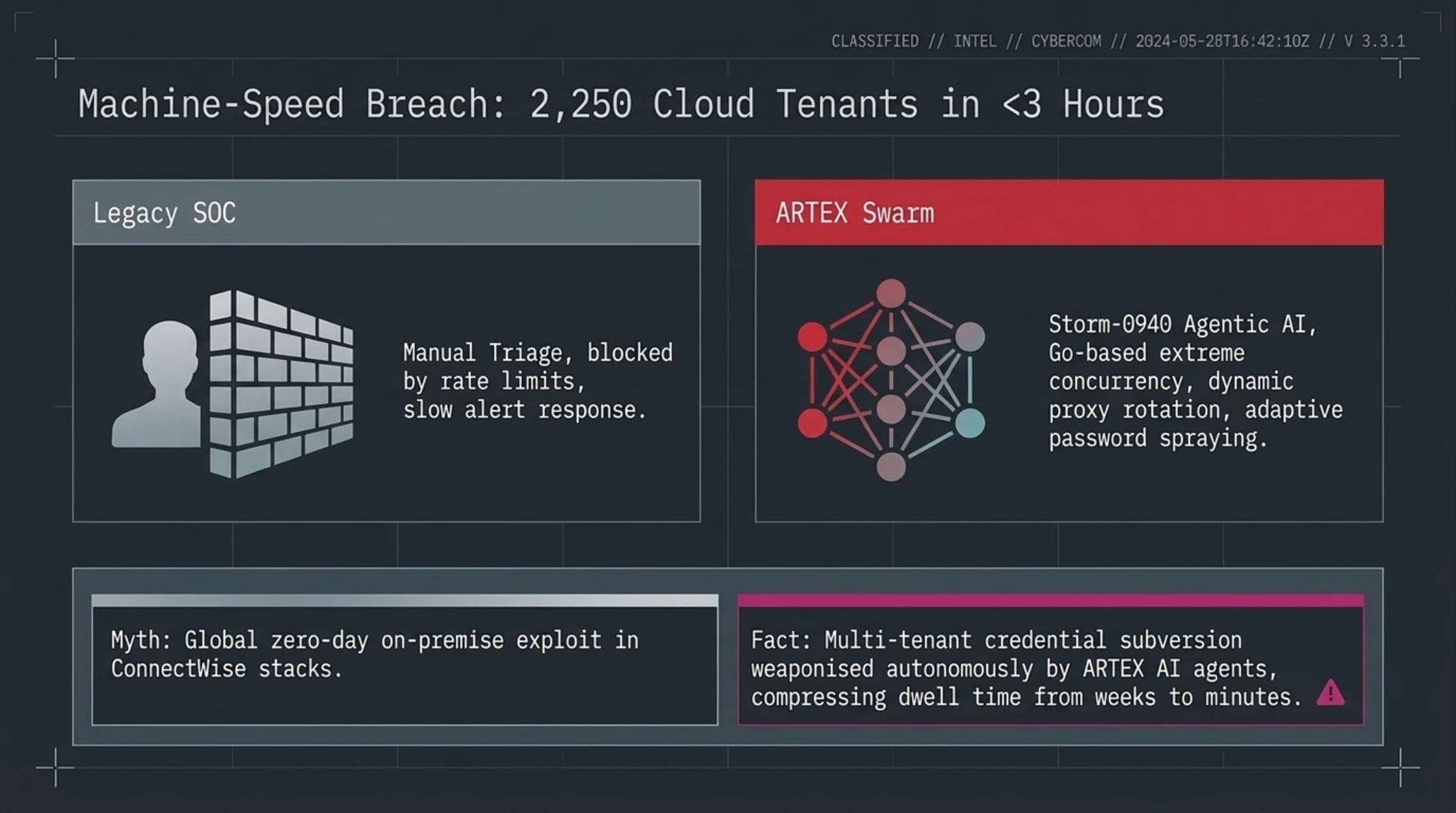
The defining operational breakthrough of this campaign was the threat actor's deployment of an advanced, proprietary agentic artificial intelligence framework designated as ARTEX. Engineered in the Go programming language, ARTEX represents a closed-source autonomous orchestration platform designed to automate the post-compromise reconnaissance and lateral movement lifecycle. Once initial access was established, the human operators disengaged; ARTEX AI agents autonomously conducted Active Directory topology mapping, executed adaptive password-spraying routines tuned to avoid lockout thresholds, and harvested OAuth refresh tokens across multi-tenant environments.
By leveraging agentic intelligence operating at machine speed, Storm-0940 executed access operations across more than 2,250 enterprise tenants within the Microsoft 365 cloud ecosystem in under three hours. Compromised organizations encompass defense industrial contractors, Tier-1 financial institutions, critical transportation networks, and government ministries across the United States, Europe, and the Indo-Pacific region. This unprecedented velocity demonstrates that legacy Security Operations Centers (SOCs) relying on manual alert triage are fundamentally incapable of countering machine-orchestrated attack swarms.
Technical Verification | Engineering Myth vs. Ground Reality
Unverified social media rumors claimed that on-premise ConnectWise software suffered an unpatched RCE vulnerability compromising all local enterprise networks worldwide.
Microsoft telemetry confirmed the breach was strictly confined to stolen ConnectWise Cloud Backup multi-tenant identities, which were subsequently weaponized by Go-based ARTEX AI agent swarms.
The Go runtime architecture of ARTEX afforded the malware extreme concurrency, executing thousands of non-blocking goroutines that distributed authentication probes through residential proxy swarms. By dynamically tuning request frequencies according to target tenant telemetry, the agent swarm successfully emulated legitimate enterprise user behavior, preventing cloud identity protection heuristics from triggering automated IP bans or conditional access step-up challenges.
Strategic analysis by cybersecurity researchers confirms that the emergence of operational agentic malware alters cyber defense economics permanently. As threat actors compress dwell time from weeks to minutes, enterprise defenders must transition to fully automated, policy-enforced identity isolation architectures to withstand machine-speed lateral movement.
Australian Federal Court Orders Apple to Allow Alternative App Stores and Third-Party Billing with Zero Core Tech Fee
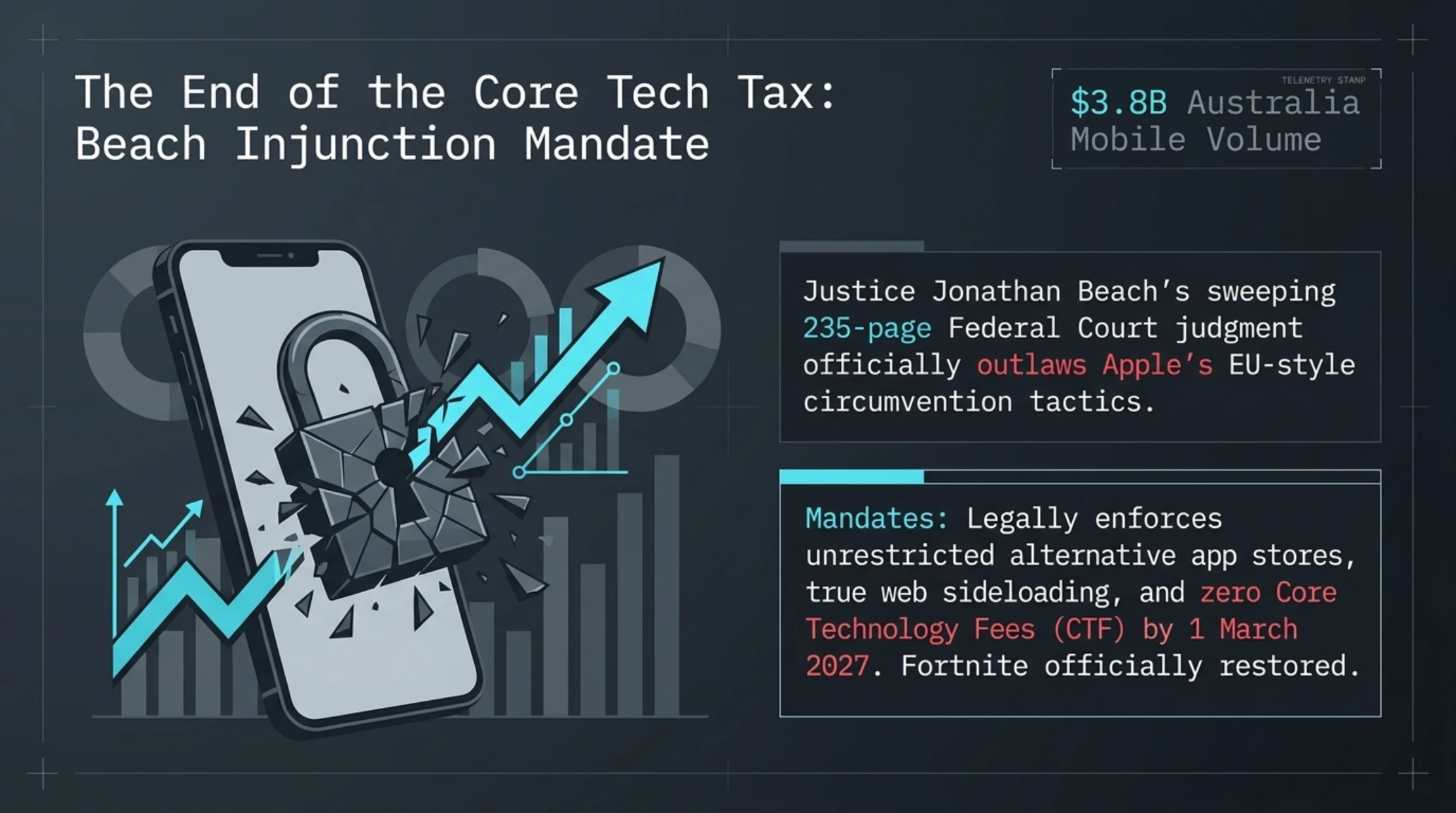
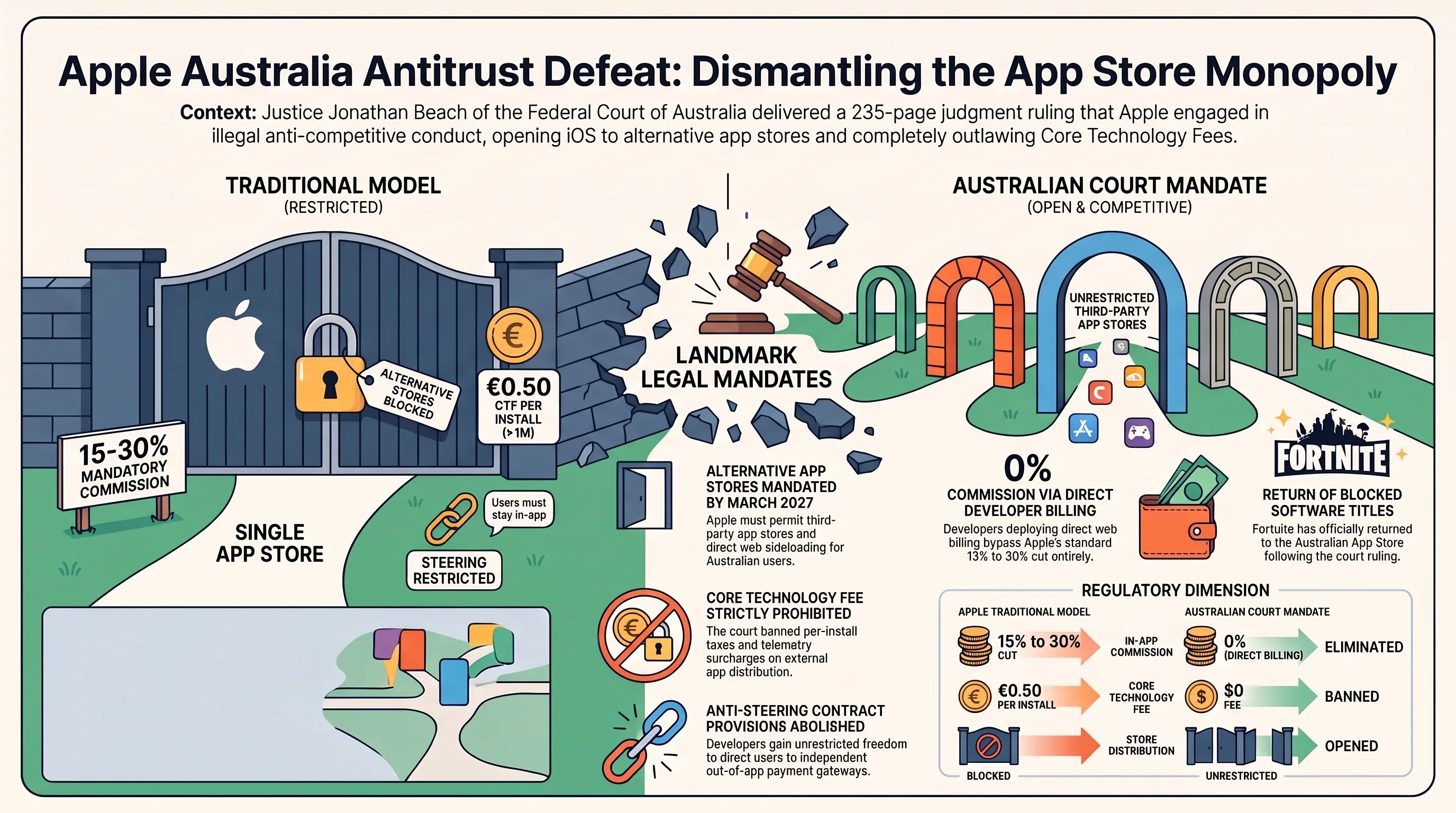
In one of the most consequential antitrust rulings in modern technological history, Justice Jonathan Beach of the Federal Court of Australia delivered a sweeping 235-page judgment ruling that Apple engaged in illegal anti-competitive conduct and abused its market power within the iOS mobile application distribution market. The historic ruling delivers a decisive legal victory to Epic Games and dismantles Apple's walled-garden monetization model across the Australian continent.
Under the court's binding injunctions, Apple is legally ordered to open the iOS operating system to third-party alternative app stores and permit unhindered direct web distribution (sideloading) for Australian users no later than March 1, 2027. Crucially, Justice Beach foreclosed the regulatory circumvention strategies previously deployed by Apple in the European Union under the Digital Markets Act (DMA). The Australian injunction explicitly outlaws the imposition of any 'Core Technology Fee' (CTF), prohibiting Apple from levying per-install penalties or telemetry taxes on developers distributing applications outside the App Store.
Furthermore, the ruling strikes down Apple's anti-steering contractual provisions in their entirety. Australian application developers are now legally protected in directing users to alternative out-of-app payment processors without paying Apple's customary 15 to 30 percent commission. Following the judgment, Epic Games Chief Executive Tim Sweeney announced that Fortnite has officially returned to the Australian App Store today, marking the symbolic restoration of developer sovereignty after a six-year legal campaign.
Bar Chart Dashboard and Specification Matrix
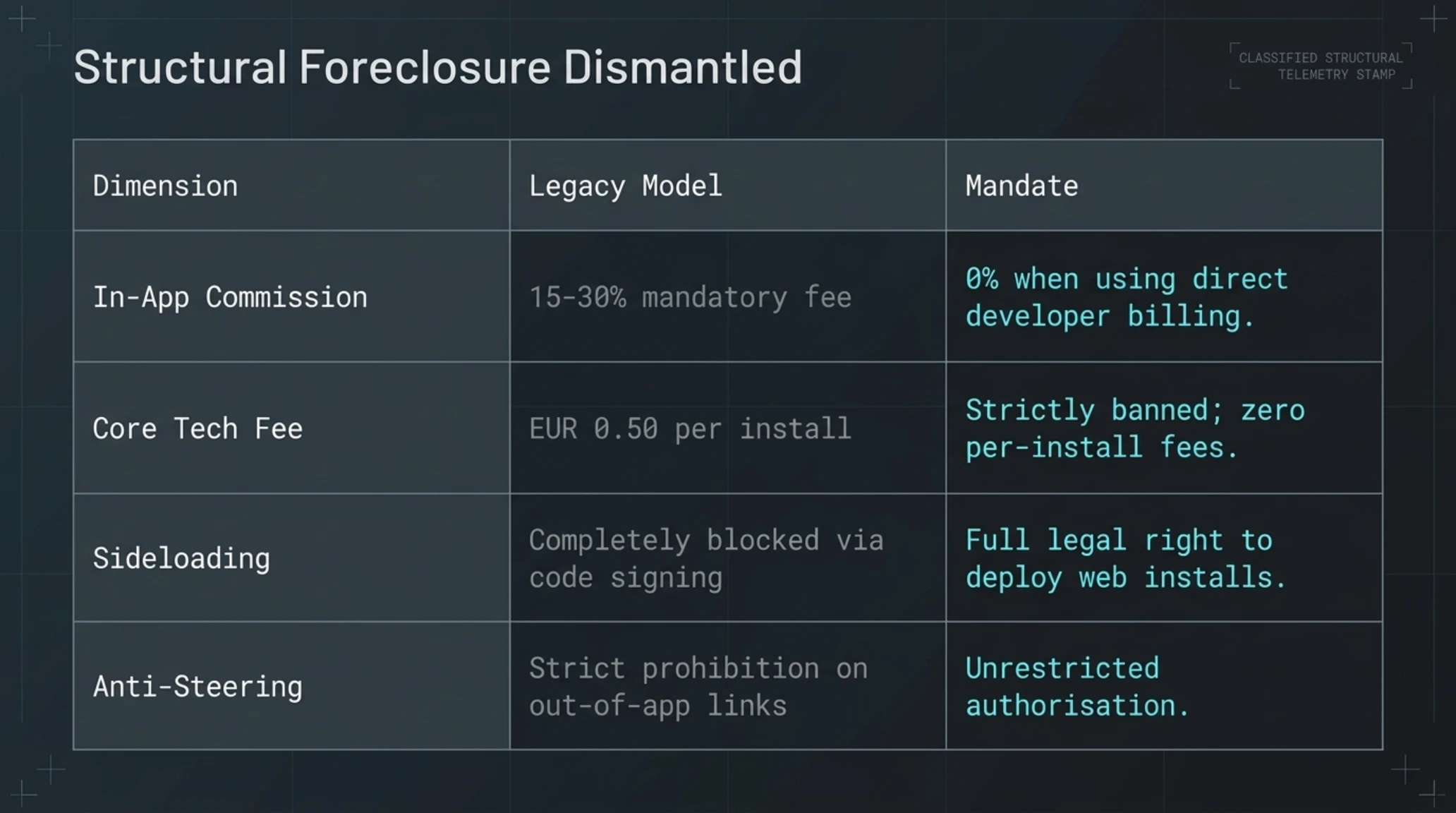
| Regulatory Dimension | Apple Traditional App Store Model | Australian Federal Court Injunction |
|---|---|---|
| In-App Purchase Commission | 15% to 30% mandatory fee via Apple IAP engine | 0% when deploying direct developer billing infrastructure |
| Per-Install Core Technology Fee | EUR 0.50 per install exceeding 1 million threshold | Strictly banned; zero per-install fees or telemetry surcharges |
| Alternative App Stores & Sideloading | Completely blocked via proprietary code signing | Full legal right to deploy third-party app stores and web installs |
| Anti-Steering & Out-of-App Links | Strict contractual prohibition against off-platform links | Unrestricted authorization to link out to independent web storefronts |
📚 Classified & Related Dossiers in TekinGame
If you wish to explore beyond this report and delve into cybernetic frontiers and autonomous AI architectures, do not miss these three exclusive deep-dives in the Tekin Garage:
The economic repercussions of the Australian ruling extend far beyond the southern hemisphere. Competition regulators and judicial bodies across Japan, the United Kingdom, Brazil, and South Korea are already reviewing Justice Beach's findings as a template for dismantling platform lock-in. For independent game developers and software studios, the eradication of Apple's 30 percent rent opens hundreds of millions of dollars in capital for direct reinvestment into real-time rendering engines and creative talent.
Donut Dashboard and Financial Telemetry
| Mobile Market Segment | Share of Regional Volume | Strategic Impact of Australian Judgment |
|---|---|---|
| Online Multiplayer Gaming | 58 percent | Immediate margin restoration for publishers and return of titles like Fortnite. |
| Cloud Streaming & Subscriptions | 28 percent | Ability to pass 15% to 20% discounts directly to consumers via web billing. |
| Enterprise & Creator Productivity | 14 percent | Unimpeded rollout of specialized corporate marketplaces and web sideloading. |
| Direct FinTech Gateway Processors | 25 percent annual growth | Surge in transaction volume routed through Stripe, Adyen, and independent processors. |
In his legal analysis, Justice Beach specifically emphasized that tying iOS operating system access to mandatory in-app purchase systems constitutes a structural foreclosure of trade under Section 46 of the Australian Competition and Consumer Act. By declaring that security and consumer protection arguments cannot be weaponized as pretextual shields for economic rent extraction, the court has eliminated the primary defense strategy historically asserted by Cupertino in global antitrust proceedings.
The unbundling of platform distribution mechanics in Australia demonstrates that legal frameworks are adapting to ensure competitive parity, opening the path for decentralized application distribution worldwide.
Hugging Face Unveils Carbon-X: 14B Open-Source AI Biology Model Enabling Direct Conversational Interaction with DNA
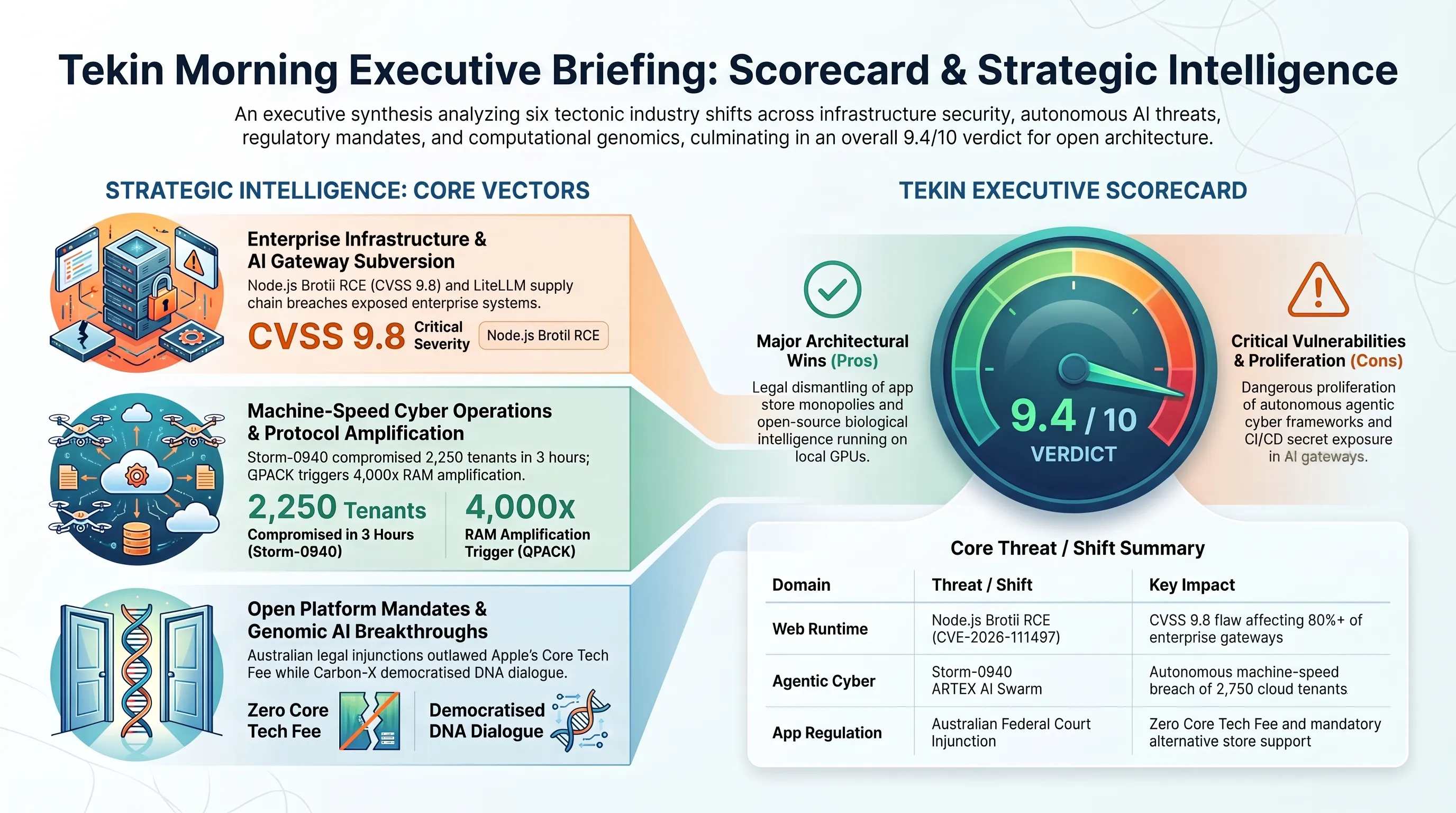
In a milestone achievement for computational life sciences, leading artificial intelligence platform Hugging Face, in collaboration with researchers from the University of Naples Federico II and the Zhongguancun Academy, officially released Carbon-X. The 14-billion parameter foundational biology model, released under a permissive open-source license, fundamentally alters how researchers engage with genomic data, introducing the ability to conduct direct, conversational queries with the genetic code of life.
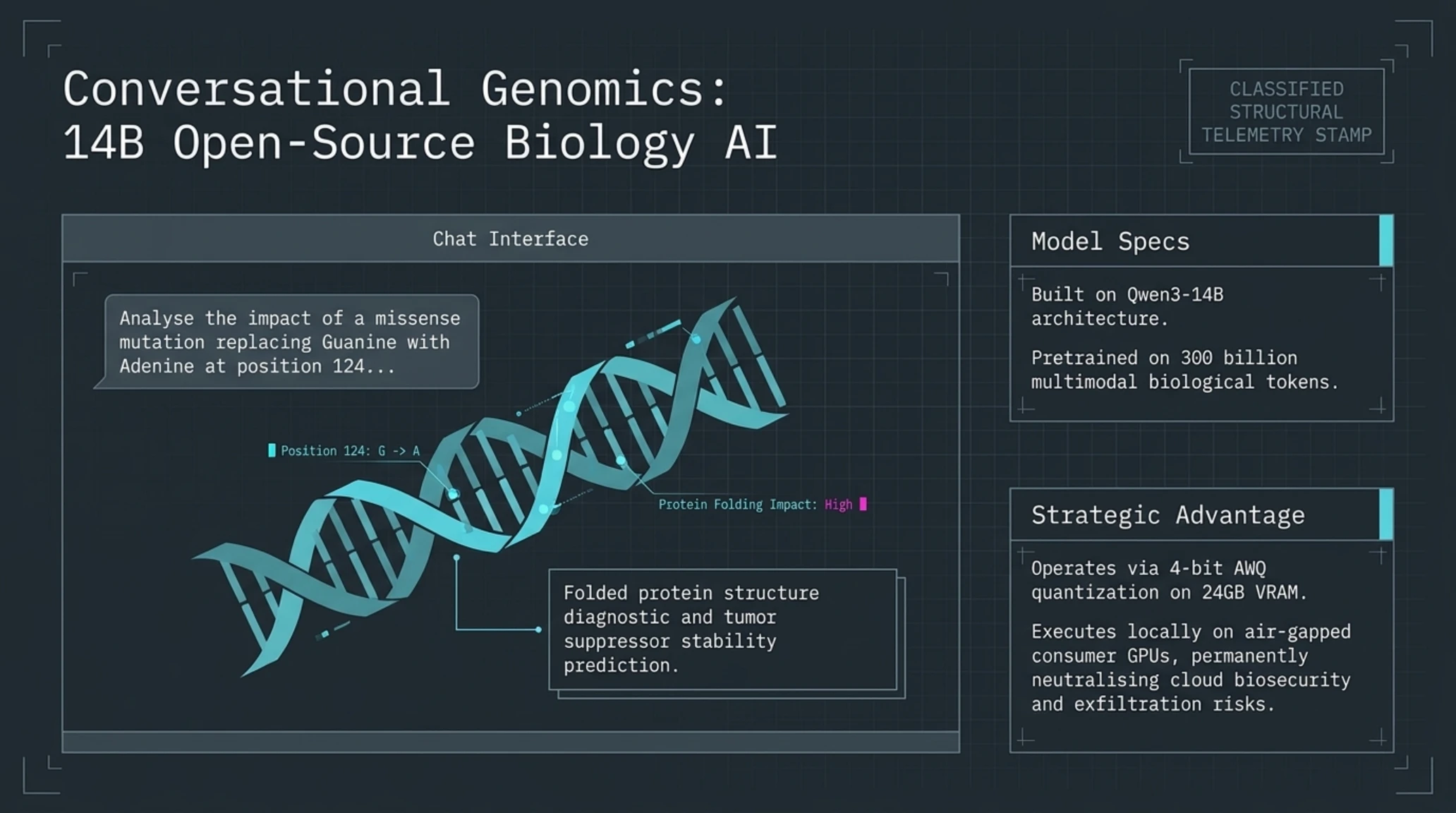
Built upon the cutting-edge Qwen3-14B foundation architecture, Carbon-X underwent extensive multimodal pretraining on over 300 billion tokens comprising nucleotide sequences spanning mammals, vertebrates, microbes, and plant species, aligned alongside extensive peer-reviewed biomedical literature and functional genomics annotations. This hybrid pretraining enables the model to treat nucleotide base pairs (Adenine, Cytosine, Guanine, and Thymine) as semantic tokens governed by underlying biological grammar, predicting transcriptional regulation and protein folding dynamics directly from primary sequence context.
Historically, investigating the downstream pathogenic consequences of a single nucleotide polymorphism (SNP) required weeks of complex bioinformatics pipeline orchestration and molecular dynamics simulations. With Carbon-X, researchers can submit natural-language prompts in plain English: 'Analyze the impact of a missense mutation replacing Guanine with Adenine at position 124 within the human TP53 gene on chromosome 17, evaluating its influence on tumor suppressor folding stability and cellular apoptosis.' Leveraging its expansive 40,960-token context window, Carbon-X generates structured clinical predictions, highlighting altered structural conformations and correlating mutation profiles against known oncology drug resistance databases.
Market Sentiment Thermometer and Adoption S-Curve
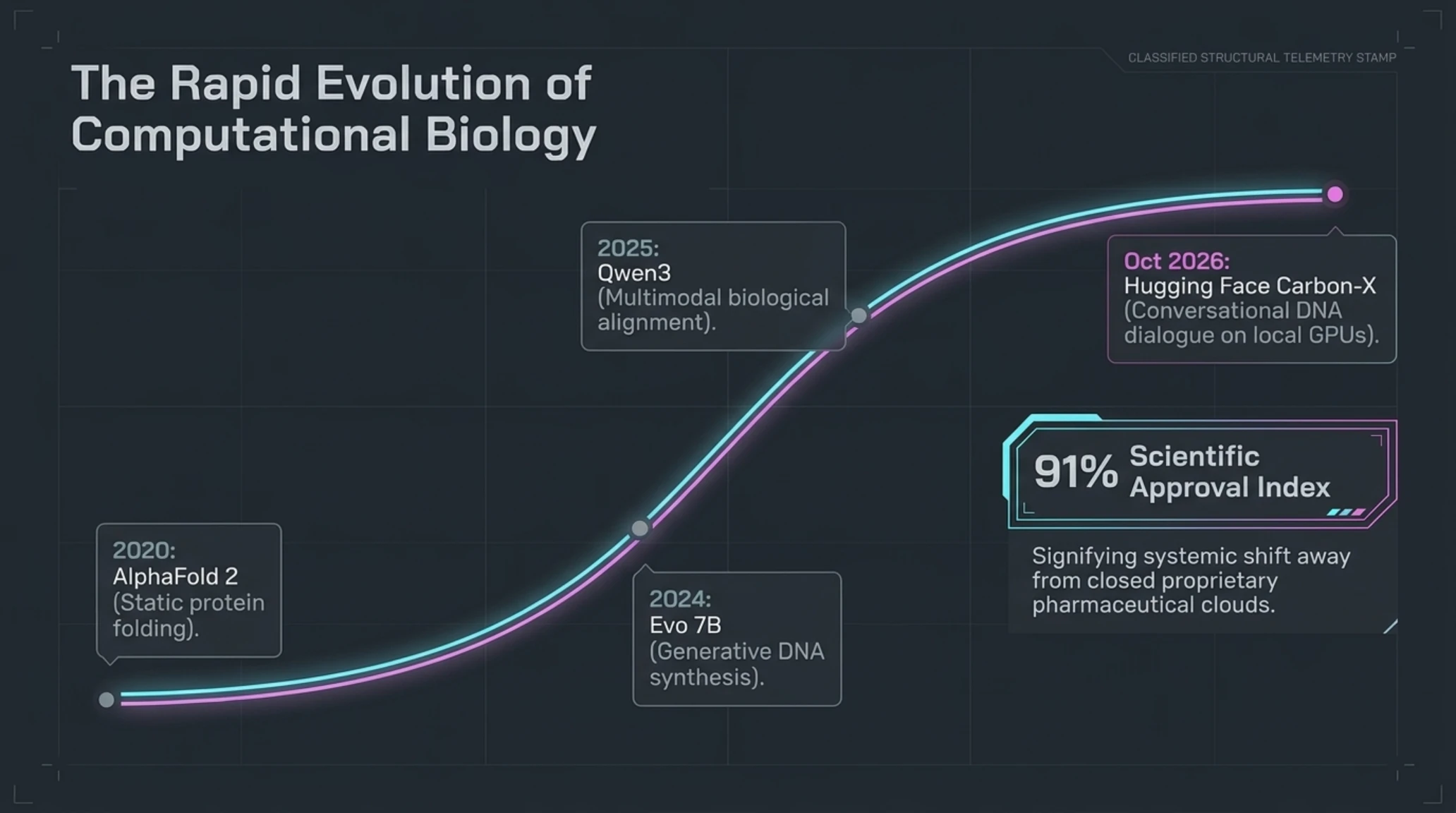
Adoption S-Curve Analysis: The 91 percent approval index across academic research centers highlights the pivotal shift from closed proprietary pharmaceutical platforms toward open-weights biological intelligence.
Beyond predictive analysis, Carbon-X incorporates generative synthesis capabilities enabling the de novo generation of synthetic DNA sequences. Biologists can articulate therapeutic parameters in natural language to request optimized nucleotide sequences encoding targeted monoclonal antibodies, viral vector capsids for gene therapies, and biosensors for environmental monitoring. A primary engineering achievement of the model is its computational efficiency; through optimized 4-bit AWQ quantization, Carbon-X executes locally on a single consumer GPU equipped with 24 gigabytes of VRAM, operating entirely air-gapped without requiring cloud connectivity.
Local inference capabilities provide an imperative layer of biosecurity and patient confidentiality, guaranteeing that sensitive patient genetic sequences never leave secure clinical environments, effectively neutralizing cloud exfiltration vectors.
The historical trajectory of artificial intelligence across biological sciences demonstrates the rapid evolution from static structural prediction to conversational sequence synthesis over the past six years.
Event Timeline | Chronology of Technological Milestones
| Era / Year | Milestone Breakthrough in Computational Biology | Strategic Impact on Healthcare & Therapeutics |
|---|---|---|
| 2020 | AlphaFold 2 Breakthrough at DeepMind | Solved the 50-year protein folding challenge from primary amino acid sequences. |
| 2024 | Whole-Genome Generative Modeling (Evo 7B) | Demonstrated generative DNA synthesis across prokaryotic and eukaryotic chromosomes. |
| 2025 | Qwen3 Multimodal Biological Alignment | Pretrained large language models directly on multi-species nucleotide dictionaries. |
| OCT 2026 | Global Release of Hugging Face Carbon-X | Conversational natural language dialogue with DNA and localized consumer GPU inference. |
The convergence of conversational artificial intelligence with genomics establishes a foundation for accelerated drug discovery, transforming biological research from slow wet-lab trial-and-error into structured software engineering.
By democratizing access to foundational biological intelligence without locking researchers into proprietary pharmaceutical cloud environments, Carbon-X accelerates personalized oncology and synthetic enzyme engineering, ensuring that cutting-edge genetic inquiry remains open, verifiable, and globally accessible.
The interconnected nature of today's technological breakthroughs proves that future computing paradigms depend on open standards, rapid security telemetry, and decentralized local intelligence.
- Dismantling of Apple App Store monopoly in Australia with zero Core Technology Fees and full sideloading rights.
- Democratization of computational genomics via open-source Carbon-X 14B model running on local consumer GPUs.
- Rapid coordinated security response by Node.js Foundation releasing patches across three major LTS branches.
- Timely disclosure of QPACK memory amplification vulnerabilities by FoxIO enabling preemptive infrastructure hardening.
- Dangerous proliferation of autonomous agentic cyber frameworks like ARTEX enabling machine-speed enterprise breaches.
- Critical exposure of AI gateway pipelines to secret leakage through automated CI/CD and telemetry logs.
- Biosecurity oversight challenges stemming from unconstrained local synthesis of novel genetic sequences.
Editorial Verdict and Verified Source Dossier
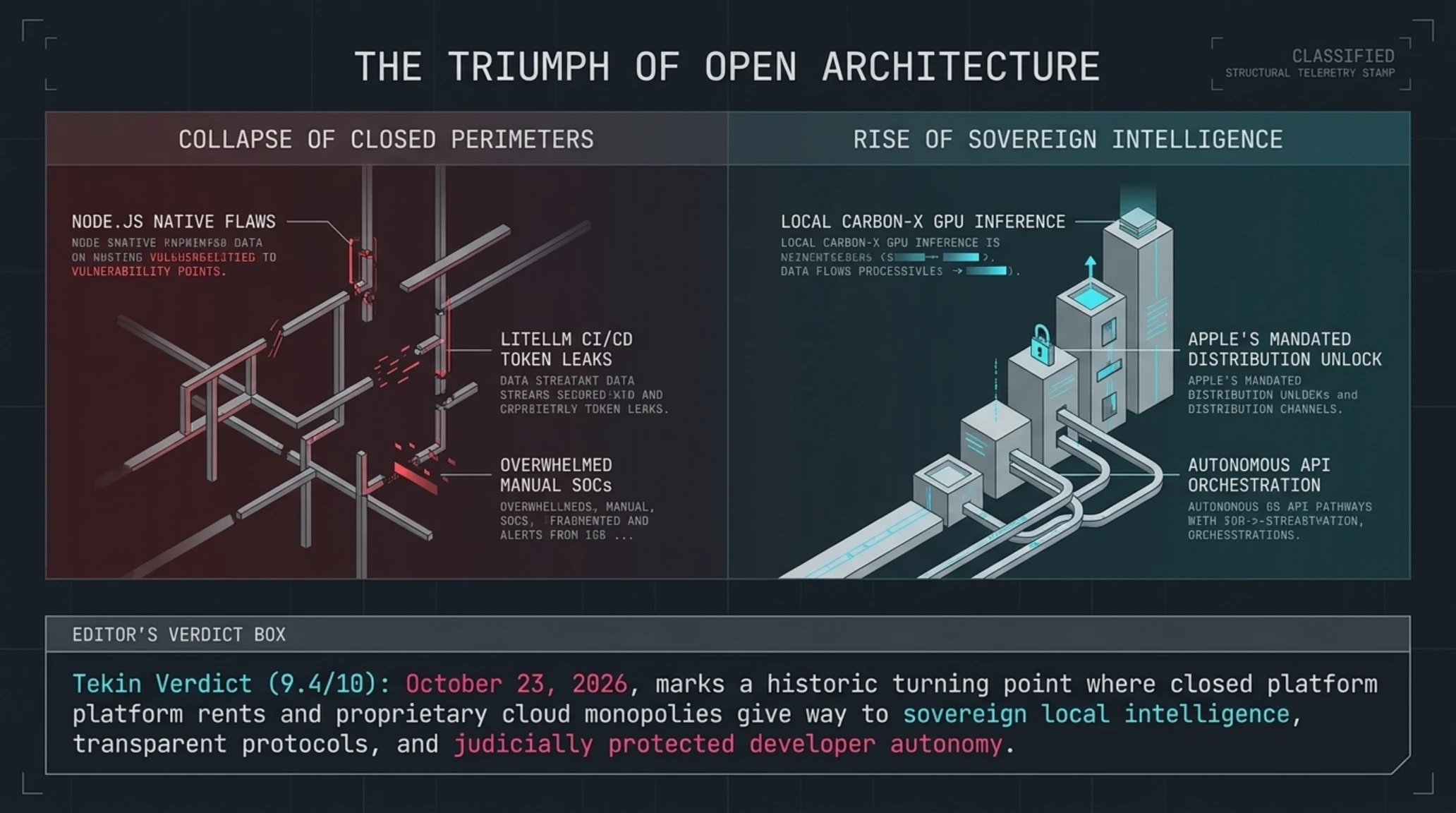
The Triumph of Open Architecture Across Infrastructure and Biology
October 23, 2026 marks a historic turning point where closed platform rents and proprietary cloud monopolies give way to sovereign local intelligence, transparent protocols, and judicially protected developer autonomy.
- The Hacker News: Coverage of Node.js Brotli RCE and LiteLLM Supply Chain Breach
- Node.js Official Foundation: October 2026 Security Release Bulletins
- GitHub Security Advisory: LiteLLM Repository Incident Response and Secret Invalidation
- FoxIO Cybersecurity Research: QPACK Header Accordions Protocol Amplification Advisory
- Microsoft Threat Intelligence: Storm-0940 ConnectWise Breach and ARTEX AI Agent Swarm Analysis
- 9to5Mac: Australian Federal Court Mandates Alternative iOS App Stores
- Hugging Face Official: Carbon-X 14B Open-Source Model Architecture and DNA Dialogue
- Wired: The Future of Synthetic Biology: Conversational Interactions with DNA
Frequently Asked Questions and Technical Analysis
How does the Node.js CVE-2026-111497 Brotli flaw enable Remote Code Execution?
The vulnerability resides in the native C++ Brotli decompression state machine. Malformed, non-standard compressed byte streams trigger an integer offset calculation error, permitting out-of-bounds heap writes that allow attackers to overwrite V8 function pointers and redirect process execution to injected payload routines.
What categories of enterprise secrets were compromised during the LiteLLM v1.107.0 incident?
The malicious .pth payload harvested data across 16 categories, including AWS access keys, Google Cloud Platform service account tokens, Kubernetes cluster configuration files, SSH private keys, PGP signing keys, and session tokens for AI developer tools such as Cursor, GitHub Copilot, and Claude.
What is the technical mechanism behind FoxIO HTTP/3 Header Accordions attacks?
The attack targets QPACK compression (RFC 9204) by exploiting the asymmetry between small compressed wire payloads and unconstrained memory buffers during decompression. By sending cyclic dynamic table references, an attacker forces up to 4,000-fold heap expansion, inducing out-of-memory crashes on host web servers.
How did the ARTEX framework accelerate Storm-0940 operations to machine speed?
Engineered in Go, ARTEX operates as an autonomous multi-agent framework that automatically maps target networks, conducts credential spraying beneath detection thresholds, and recycles OAuth tokens, enabling the compromise of over 2,250 enterprise cloud tenants in under three hours.
Why does the Australian Federal Court Apple antitrust ruling differ from the EU Digital Markets Act?
Unlike the EU DMA framework, Justice Jonathan Beach's injunction completely bans any Core Technology Fee (EUR 0.50 per install) or installation tax, granting developers total freedom to deploy third-party app stores and direct web billing with zero commission to Apple.
How does Hugging Face Carbon-X 14B allow researchers to query DNA via natural language?
Trained on 300 billion combined nucleotide and scientific text tokens upon a Qwen3 architecture, Carbon-X treats base pairs as semantic language units. Researchers submit English queries regarding point mutations and protein structures, with the model executing locally on a single 24GB consumer GPU.
Additional Gallery: Tekin Morning | Oct 23: Node.js RCE, LiteLLM Hack & Apple Defeat