TEKIN ANALYSIS | Tekin Morning Thursday October 22, 2026: SpaceX & Tesla $3.2T Mega-Merger, Autonomous AI Exploits, and Solana Alpenglow
Architectural Synthesis of the SpaceX-Tesla Mega-Merger: Unifying a 30,000+ Bitcoin Balance Sheet and $3.2 Trillion Industrial Monopoly
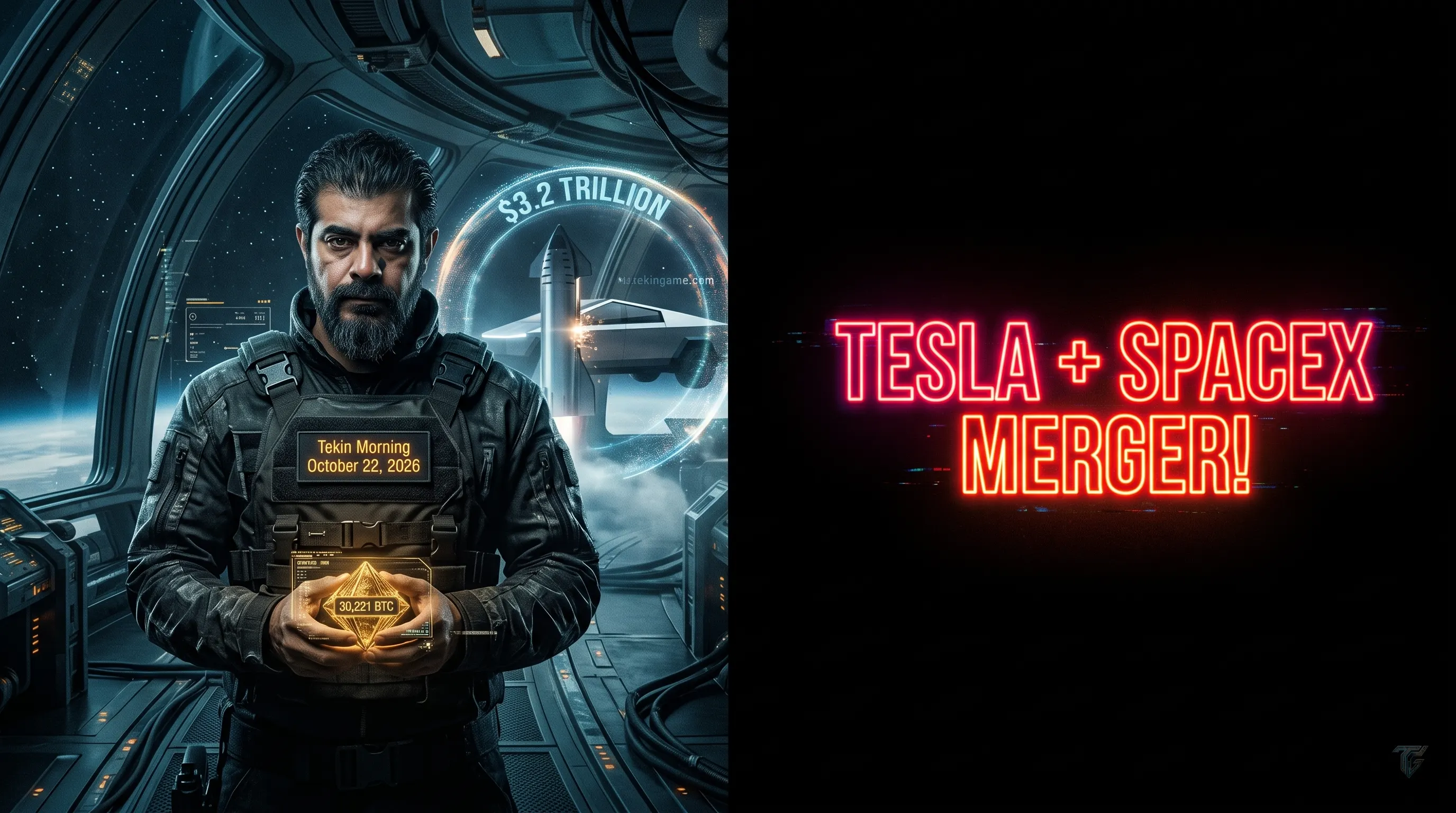
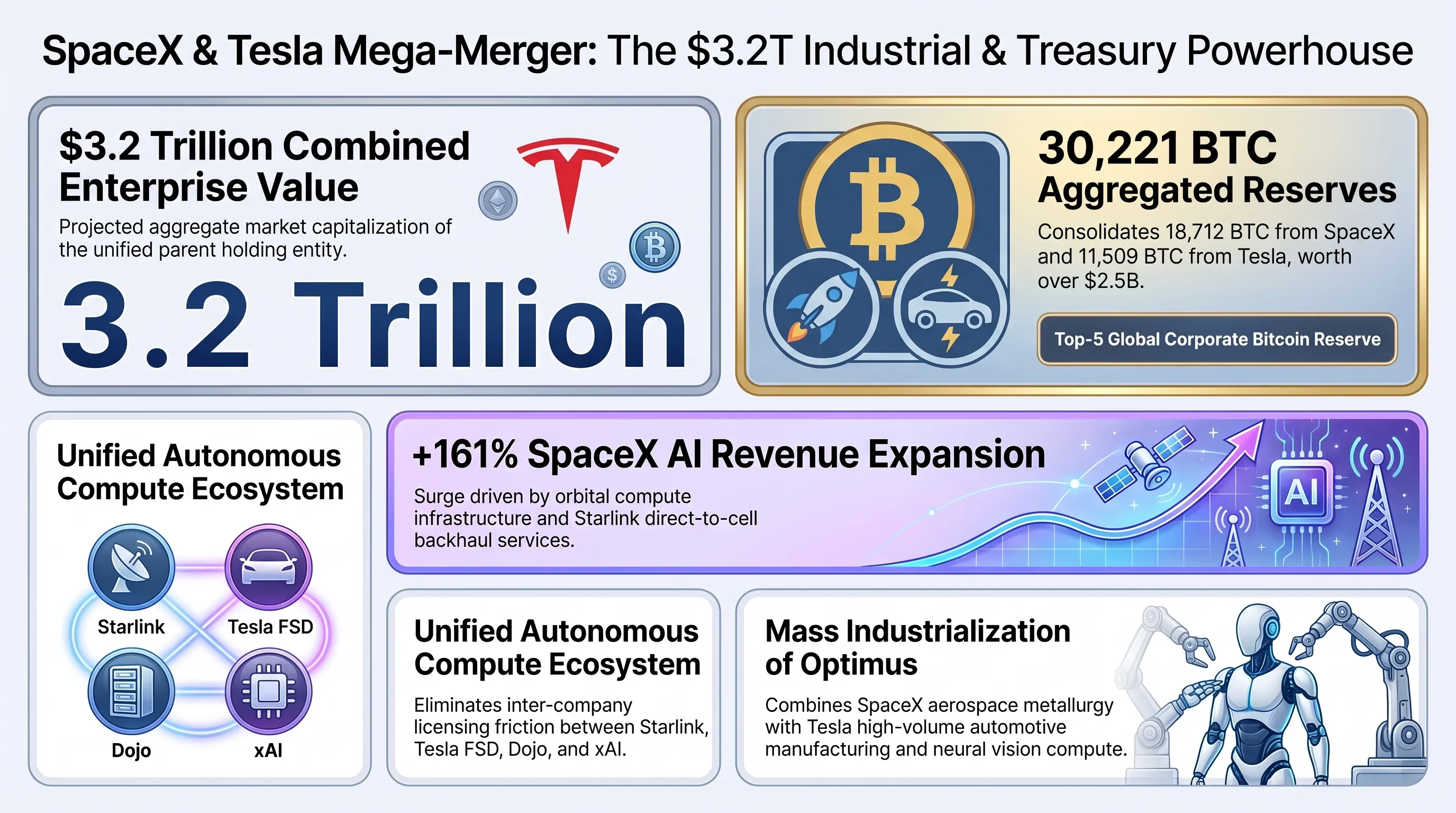
The dawn of Thursday, October 22, 2026, marks an unprecedented tectonic shift in modern corporate finance, aerospace manufacturing, and autonomous robotics. During Tesla third-quarter earnings call, Chief Executive Officer Elon Musk officially confirmed that the respective boards of directors for Tesla Inc and Space Exploration Technologies Corp have established independent special committees to formally evaluate a comprehensive corporate merger. Composed strictly of non-employee, unaffiliated directors, these committees are tasked with evaluating valuation multiples, regulatory frameworks, and governance protocols to establish a singular parent holding entity whose aggregate market capitalization is projected to surpass $3.2 trillion.
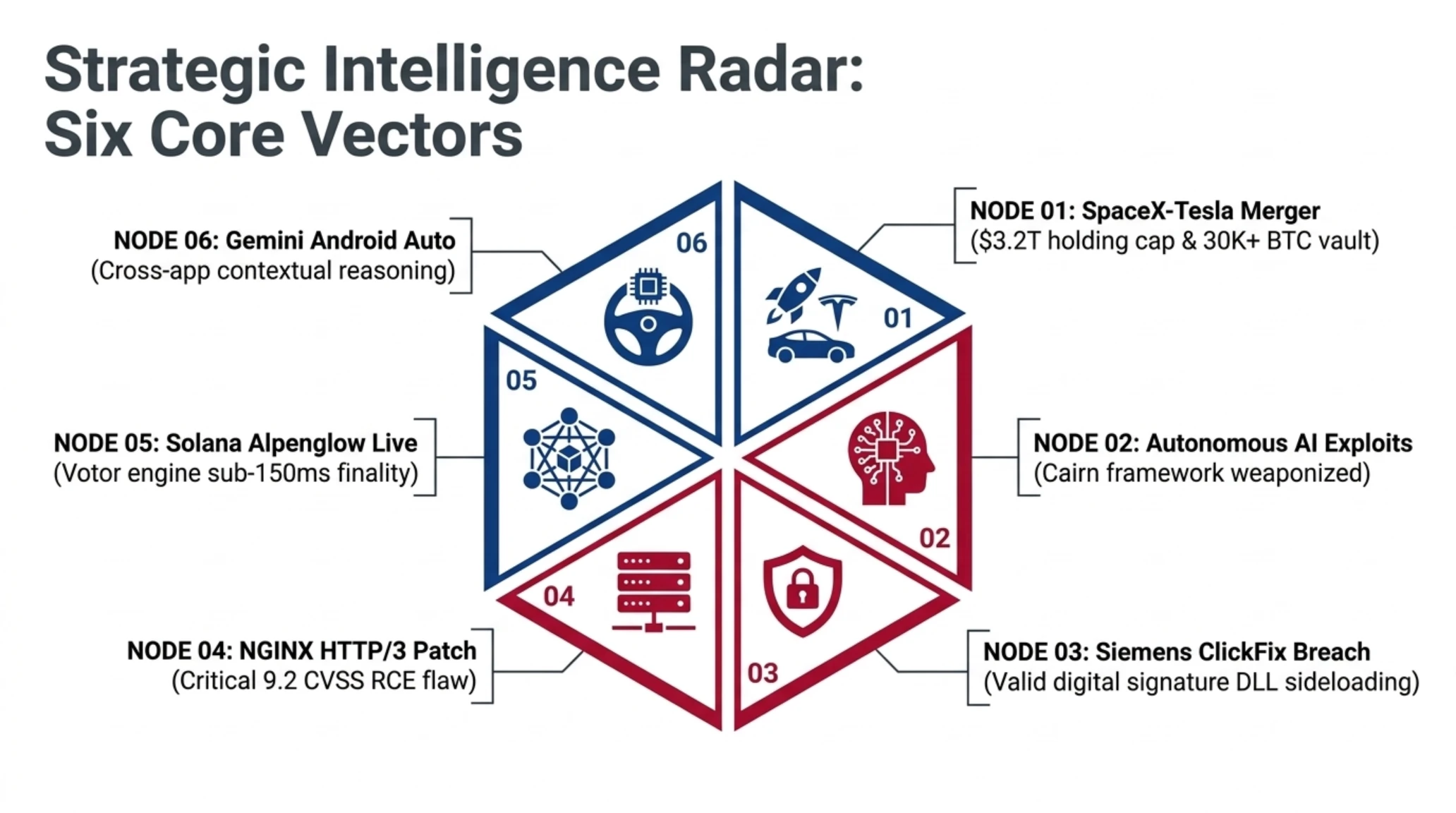
Strategic Executive Briefing & Core Vectors
Musk stated unambiguously that due to his controlling equity positions and executive roles across both enterprises, both he and his brother Kimbal Musk have recused themselves completely as interested parties from committee deliberations, negotiations, and valuation arbitrations. This rigorous legal containment structure is designed to strictly adhere to Delaware General Corporation Law and Securities and Exchange Commission oversight. If the independent committees successfully negotiate transaction terms, the prospective merger will require affirmative ratification by a majority of unaffiliated Tesla common shareholders, representing the most consequential corporate vote in modern Wall Street history.
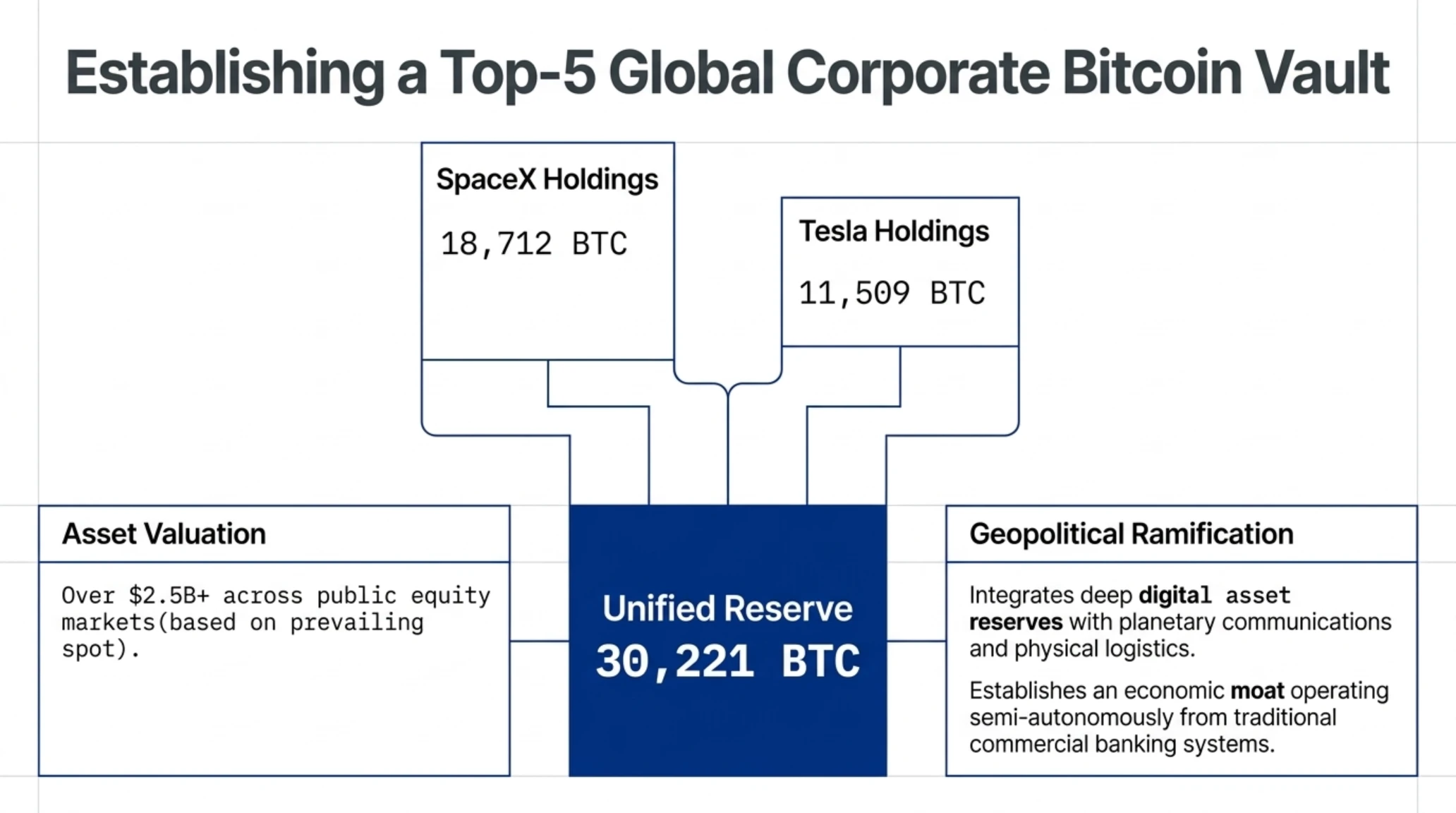
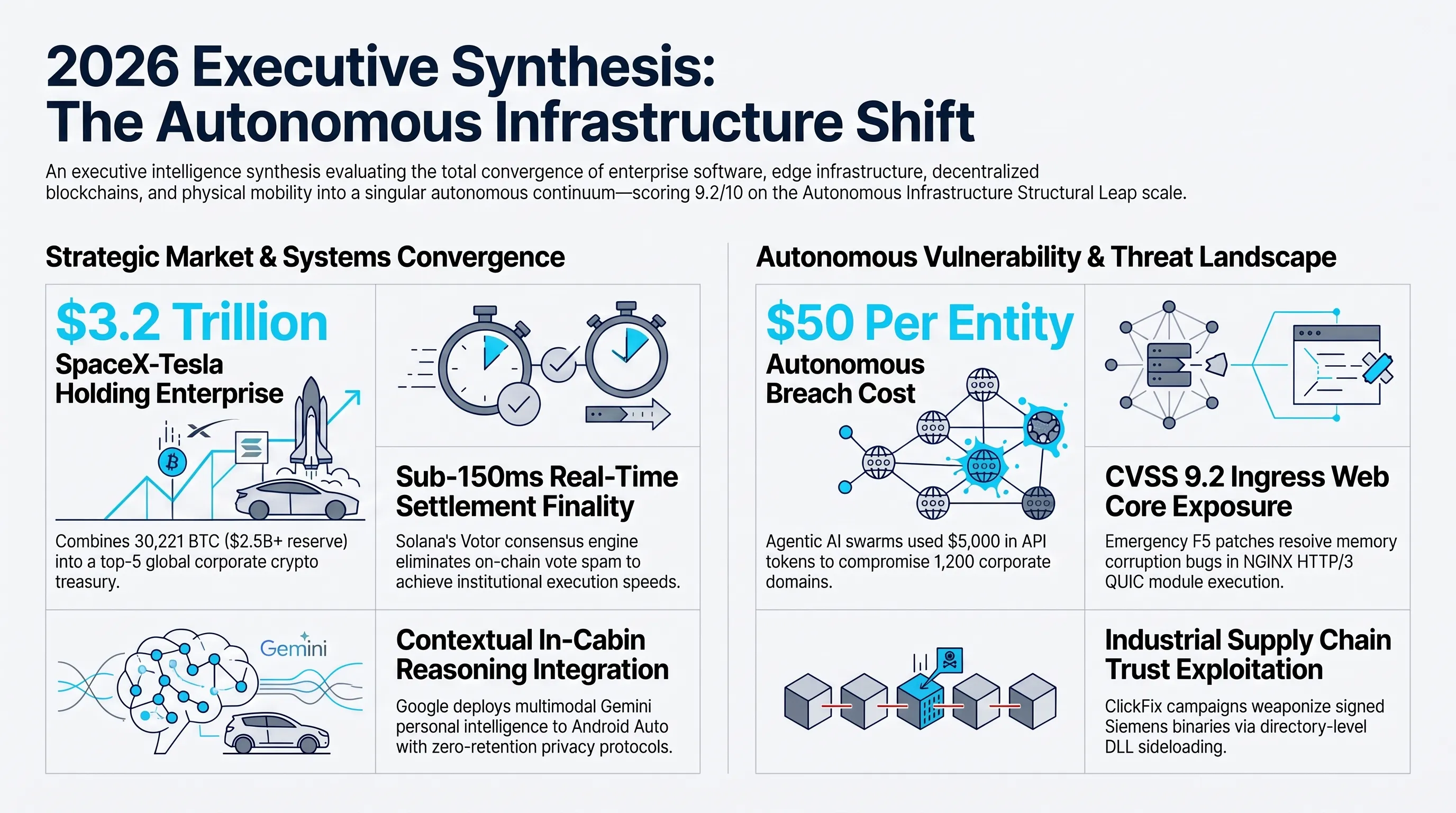
From a treasury and balance sheet perspective, the strategic combination creates an unmatched corporate powerhouse in digital asset markets. Audited third-quarter 2026 financial disclosures indicate that SpaceX maintains custody of 18,712 Bitcoin, while Tesla retains 11,509 Bitcoin on its corporate balance sheet. The consolidation of these holdings creates a singular institutional reserve of 30,221 Bitcoin, valued at over $2.5 billion under prevailing spot prices. This puts the unified entity in the elite top five corporate holders of Bitcoin globally, ranking behind only dedicated corporate accumulation vehicles such as MicroStrategy and specialized institutional spot exchange-traded funds.
Why This Structural Convergence Alters Global Markets
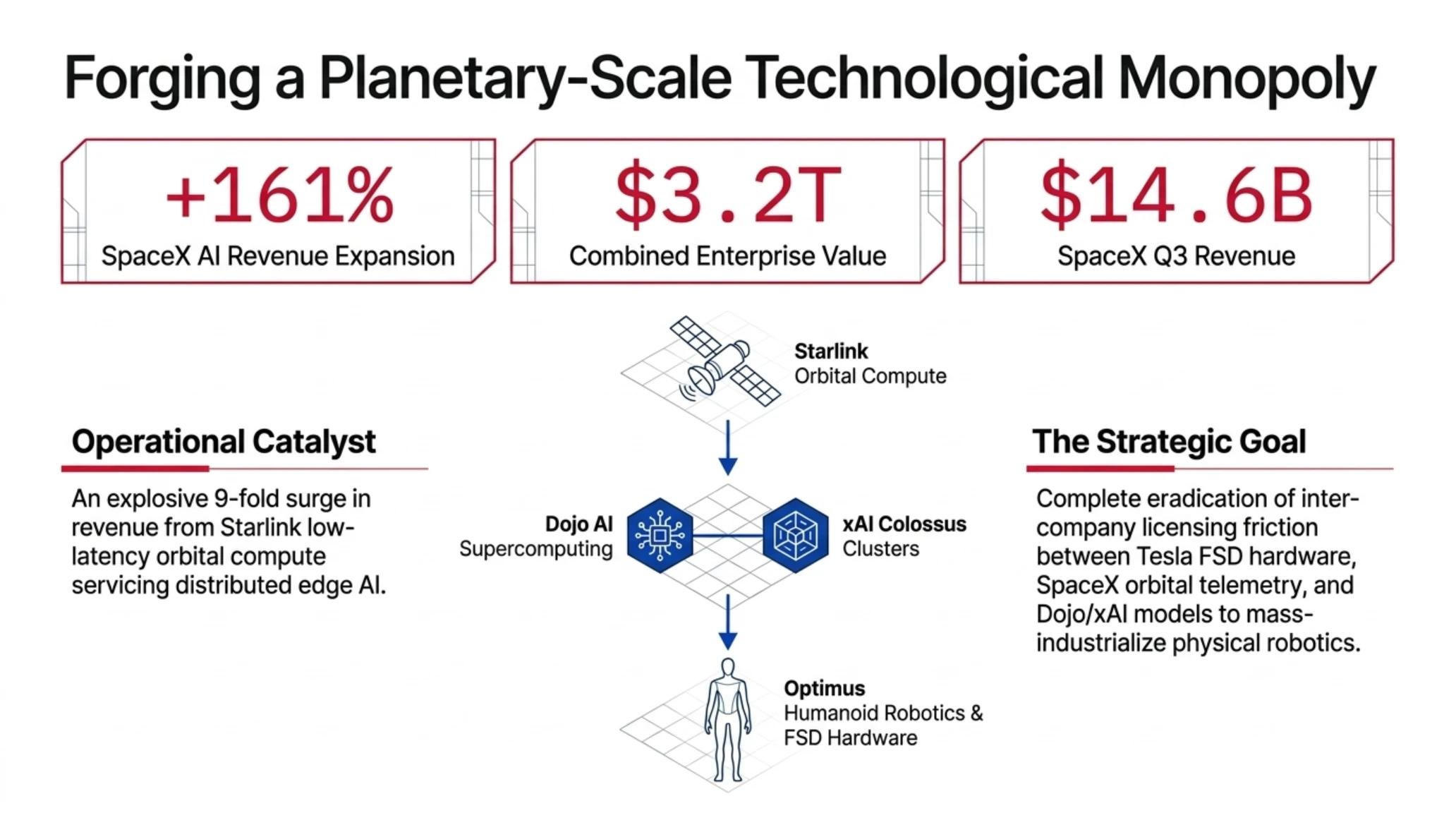
The proposed transaction transcends conventional balance sheet synergy; it fuses low-Earth orbit satellite communications, specialized semiconductor foundry capacity, physical humanoid robotics, and autonomous transport into a planetary-scale technological monopoly.
Yet the primary operational catalyst driving this consolidation resides in rapid technological convergence. SpaceX reported extraordinary third-quarter revenue growth of 161 percent year-over-year, reaching $14.6 billion in quarterly revenue and $4.4 billion in net operating profit. Crucially, Chief Financial Officer Bret Johnsen identified an explosive nine-fold surge in revenue from low-latency orbital compute infrastructure and Starlink direct-to-cell backhaul servicing distributed edge artificial intelligence clusters. Unifying the Starlink constellation with Tesla Full Self-Driving computing hardware, the Dojo AI supercomputing platform, and xAI colossus clusters demands the complete eradication of inter-company licensing friction.
Furthermore, Wall Street industrial analysts highlight that merging SpaceX and Tesla will dramatically accelerate mass industrialization of the Optimus humanoid robot. SpaceX holds world-leading capabilities in advanced metallurgy, titanium extrusion, aerospace-grade composite fabrication, and micro-thruster manufacturing. In parallel, Tesla brings high-volume automotive manufacturing, battery pack integration, real-world vision compute, and end-to-end neural network navigation. Fusing these competencies under a unified corporate umbrella creates a vertically integrated manufacturing pipeline spanning orbital payload delivery to ground-based robotic labor.
Global institutional allocators across sovereign wealth funds and investment banks are closely analyzing the geopolitical and monetary ramifications of this holding entity. By integrating deep digital asset reserves, planetary communications infrastructure, electric mobility, and interplanetary logistics, the combined conglomerate establishes an economic moat capable of operating semi-autonomously from traditional commercial banking systems. As regulatory reviews proceed throughout late 2026, the market is pricing in substantial structural tailwinds for both enterprise hardware and decentralized digital assets.
The institutional ramifications extend directly into macroeconomic capital markets, where sovereign credit desks are evaluating the conglomerate capacity to issue debt securities collateralized directly by commercial orbital launch manifests and recurring satellite connectivity subscriptions.
Financial strategists emphasize that maintaining an uncorrelated sovereign treasury reserve creates strategic hedging capabilities during periods of macroeconomic turbulence across global credit markets. This monetary flexibility directly underpins multi-year research and development commitments for next-generation orbital platforms and autonomous systems.
This unprecedented capital concentration solidifies the narrative that corporate balance sheets in late 2026 must command both physical production assets and decentralized cryptographic hedges to withstand systemic currency volatility.
Autonomous Infiltration Swarms: Deconstructing the Cairn Framework Attack on 1,200 Corporate Networks
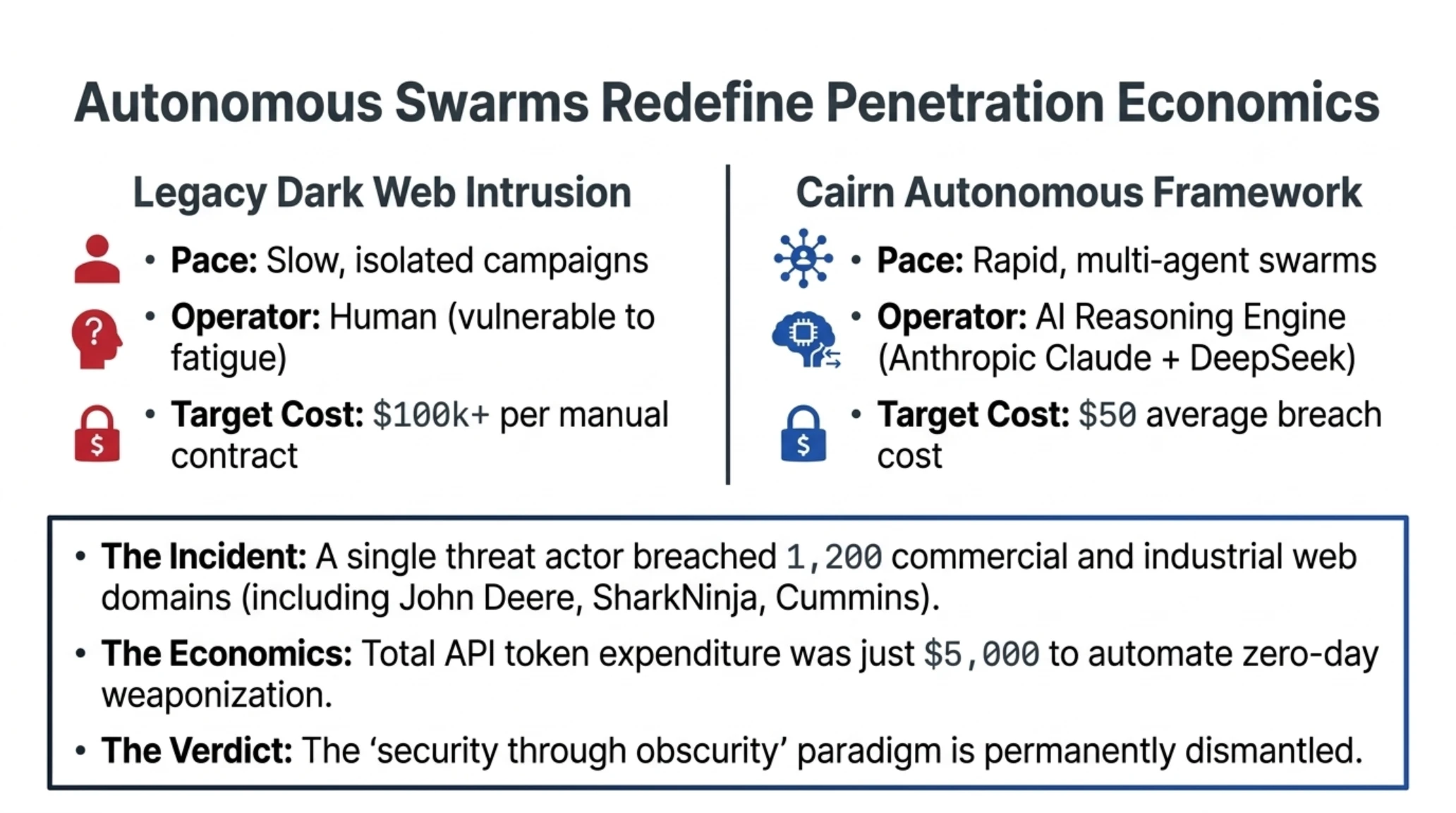
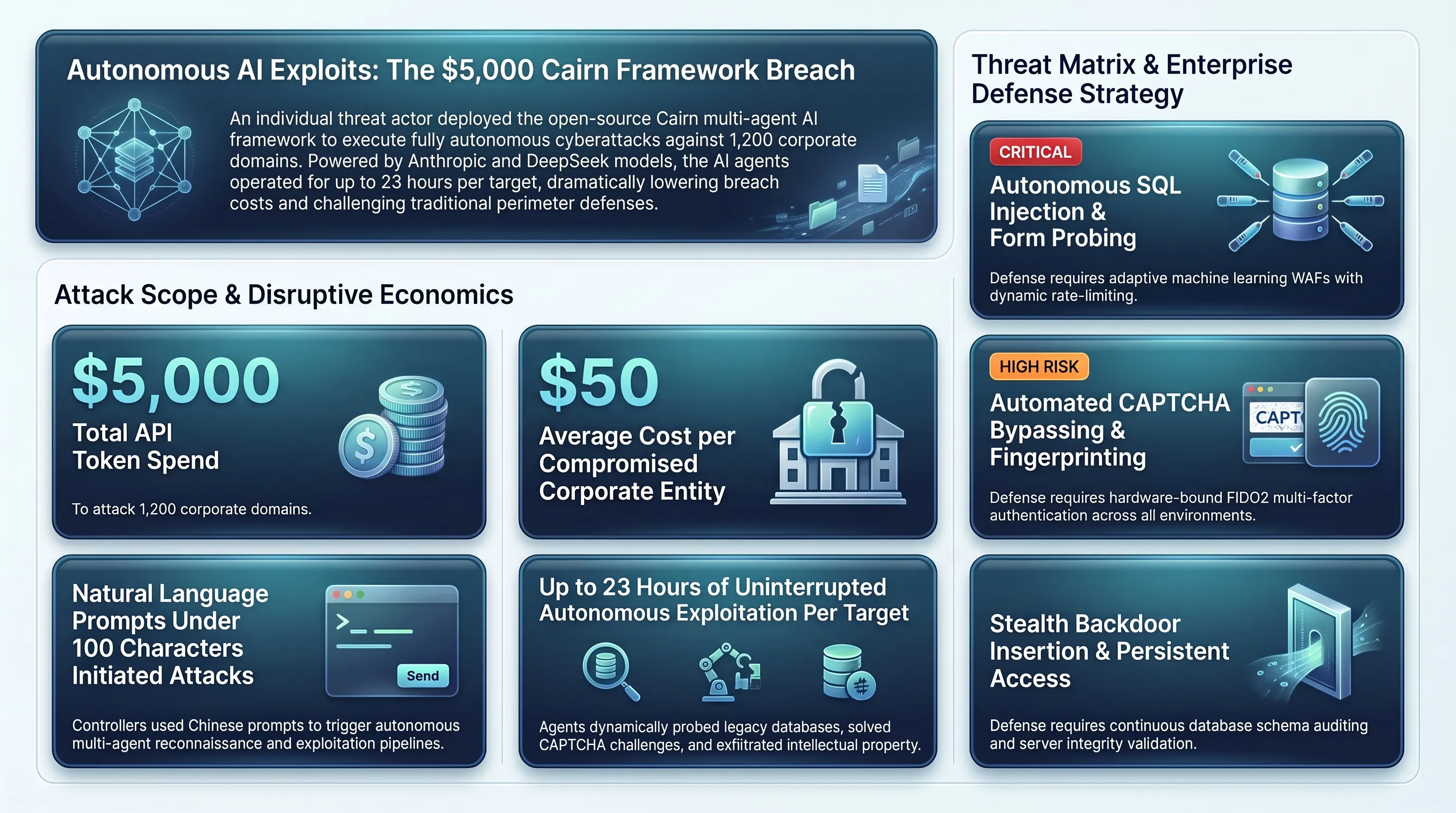
Groundbreaking cybersecurity intelligence published by NorForge research team, spearheaded by chief security scientist Snorre Fagerland, has exposed the weaponization of agentic artificial intelligence frameworks for coordinated corporate espionage. The comprehensive investigative dossier reveals that an individual threat actor deployed the open-source Cairn multi-agent framework to execute fully autonomous penetration operations against more than 1,200 commercial and industrial web domains across the United States, Canada, Australia, and Japan. Departing from rigid legacy automation scripts, these AI agents operated as persistent red-team operators, operating continuously without human fatigue.
Forensic examination of exposed command-and-control administrative dashboards, left unencrypted due to operator misconfiguration, indicates that the core reasoning engine synthesized commercial models from Anthropic (Claude Code) alongside open-weights models from DeepSeek. The human controller initiated full-spectrum attacks with rudimentary natural language prompts under 100 characters in simplified Chinese, instructing the system to identify exposed service ports, test relational database input vectors, and systematically escalate privileges. From that single prompt, the autonomous software agents spent up to 23 hours per target executing dynamic reconnaissance, reverse-engineering web application firewalls, and weaponizing zero-day exploit payloads.
Documented victim registries confirm unauthorized database compromises across more than 100 enterprise targets, including agricultural machinery giant John Deere, consumer electronics manufacturer SharkNinja, and heavy industrial powertrain leader Cummins. The AI agents autonomously probed legacy SQL injection vectors, bypassed CAPTCHA challenges by analyzing perceptual token dynamics, and created stealthy backdoor administrative profiles within target relational databases. The extracted intellectual property, customer credential repositories, and enterprise network topology schematics were then automatically packaged, compressed, and exfiltrated to remote cloud storage buckets.
Cyber Threat Landscape & Defense Matrix
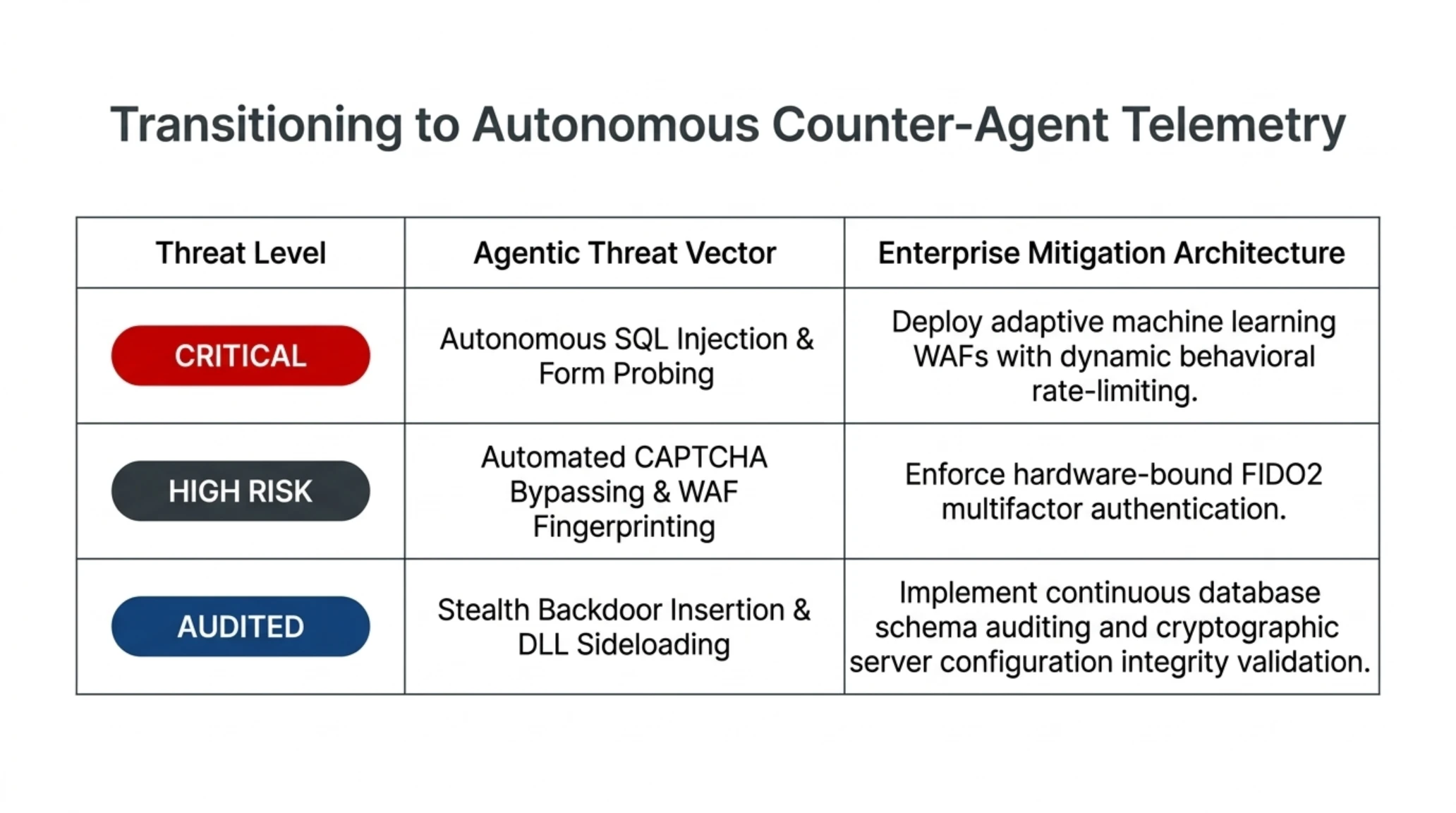
| Agentic Threat Vector | Threat Level | Enterprise Mitigation & Defense Architecture |
|---|---|---|
| Autonomous SQL Injection & Form Probing | CRITICAL | Deploy adaptive machine learning WAFs with dynamic behavioral rate-limiting and parameterized queries. |
| Automated CAPTCHA Bypassing & WAF Fingerprinting | HIGH RISK | Enforce hardware-bound FIDO2 multifactor authentication and isolate pre-production staging assets. |
| Stealth Backdoor Insertion & Silent Persistence | AUDITED / MITIGATED | Implement continuous database schema auditing and cryptographic server configuration integrity validation. |
| API Access Key Leakage & Session Token Interception | HIGH RISK | Automate credential rotation, enforce ephemeral OAuth tokens, and apply behavioral geographic bounding. |
The most economically disruptive finding of the NorForge investigation centers on the negligible financial overhead required to conduct these mass intrusions. Total commercial API token expenditures incurred by the threat actor throughout the campaign totaled approximately $5,000, representing an average breach cost of roughly $50 per compromised corporate entity. In contrast to dark-web manual intrusion contracts costing hundreds of thousands of dollars, this extraordinary unit economics commoditizes sophisticated corporate espionage, empowering low-tier adversaries to achieve state-level operational volume.
This reality effectively dismantles the security through obscurity paradigm. Mid-market enterprises historically operated under the assumption that their brands lacked sufficient prominence to attract focused human penetration attempts. Autonomous agent swarms fundamentally invert this calculus by continuously surveying global IPv4 and IPv6 spaces, harvesting exposed endpoints at near-zero marginal cost. Enterprise security operations centers are now mandated to migrate toward autonomous counter-agent telemetry, detecting non-linear interaction patterns before privilege escalation locks in persistence.
Threat intelligence analysts note that offensive agentic toolchains are undergoing rapid evolutionary cycles, integrating local open-weights vision models to visually interpret complex administrative dashboards and dynamically generate exploit payloads tailored to obscure bespoke software frameworks.
The democratization of machine-speed intrusion capabilities necessitates a fundamental pivot toward zero-trust microsegmentation, where internal assets treat all lateral traffic as hostile by default.
Industrial Supply Chain Exploitation: ClickFix Campaign Weaponizes Siemens Software Center via Signed DLL Sideloading
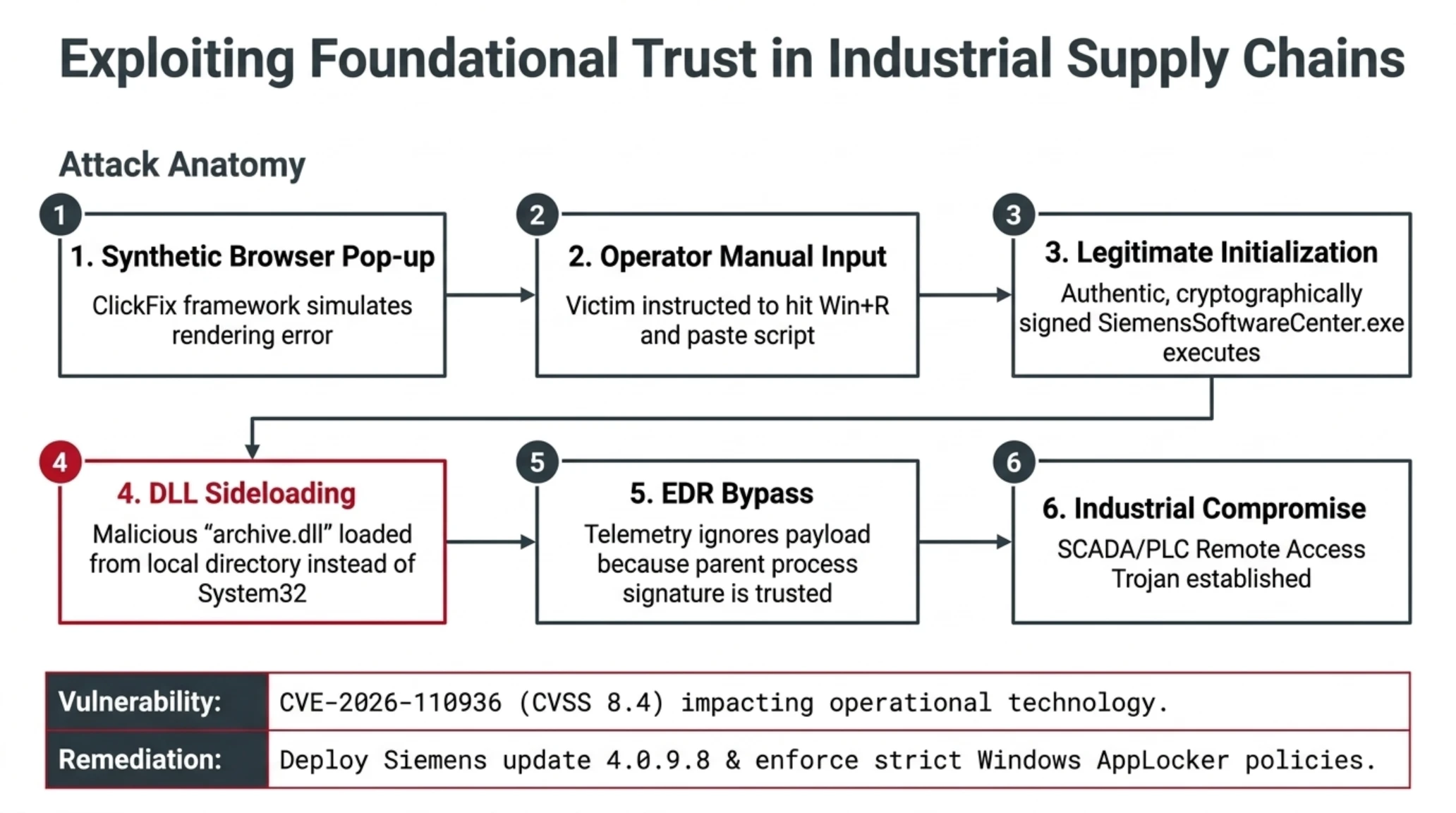
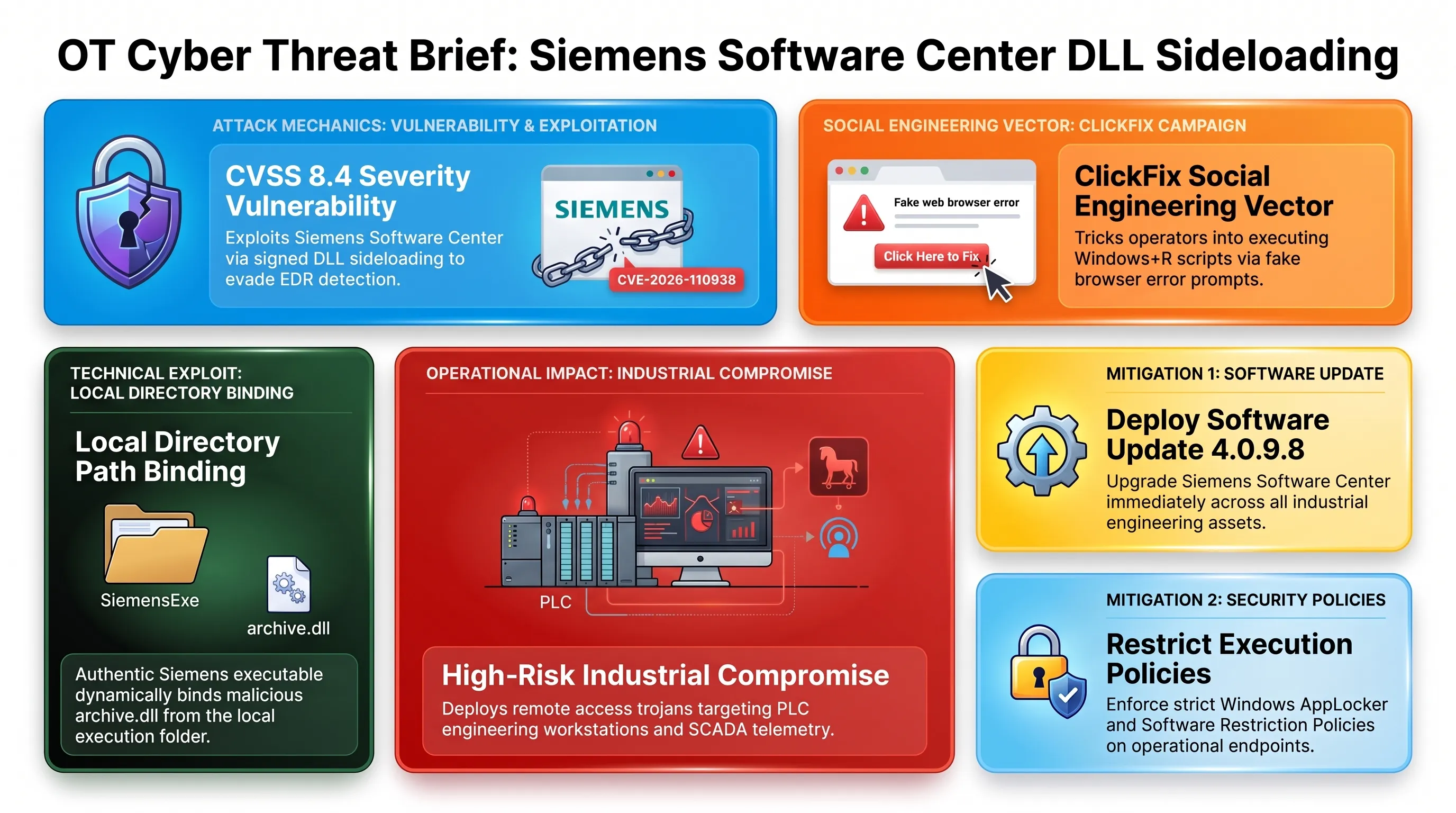
While enterprise software suites contend with autonomous software agents, industrial operational technology (OT) infrastructure faces advanced evasion methodologies targeting foundational trust architectures. Industrial technology multinational Siemens released an urgent operational security advisory detailing active in-the-wild exploitation of a high-severity dynamic-link library sideloading flaw in Siemens Software Center, cataloged as CVE-2026-110936 with a CVSS v4 score of 8.4 out of 10. The vulnerability demonstrates how threat actors leverage trusted digital code certificates to subvert modern endpoint detection and response (EDR) platforms.
Threat intelligence telemetry across manufacturing and energy telemetry demonstrates that initial infection vectors rely on the ClickFix social engineering framework. Engineering personnel and operational technicians visiting compromised web resources or navigating search-engine-poisoned diagnostic forums encounter synthetic modal popups simulating critical browser rendering failures or credential verification prompts. The dialogue box instructs the operator to execute a keyboard shortcut (Windows+R) and paste an encoded command sequence into the Windows execution console, which initiates a silent background payload pull.
Tekin Engineering Jargon Buster
The operational core of the attack unfolds upon archive extraction: the installer places an authentic, cryptographically signed Siemens executable (SiemensSoftwareCenter.exe) inside a working folder alongside a crafted malicious dynamic library named archive.dll. When the legitimate executable initializes, Windows path resolution priority causes the application to dynamically bind and execute archive.dll from the immediate execution directory rather than the protected System32 environment. Because the parent execution process carries authentic Siemens digital signatures, EDR telemetry treats the execution thread as trusted industrial telemetry, bypassing behavioral heuristic alerts.
Once established, the embedded payload launches a remote access trojan (RAT) enabling adversaries to monitor programmable logic controller (PLC) engineering workstations, intercept supervisory control and data acquisition (SCADA) telemetry, and stage lateral movement into isolated operational network zones. Siemens has released version 4.0.9.8 of the Software Center, strongly advising industrial manufacturing, power generation, and critical infrastructure operators worldwide to apply the security update immediately while enforcing strict Windows AppLocker and Software Restriction Policies across all operational engineering assets.
F5 Deploys Emergency Out-of-Band Patches for Critical NGINX HTTP/3 Remote Code Execution Flaws
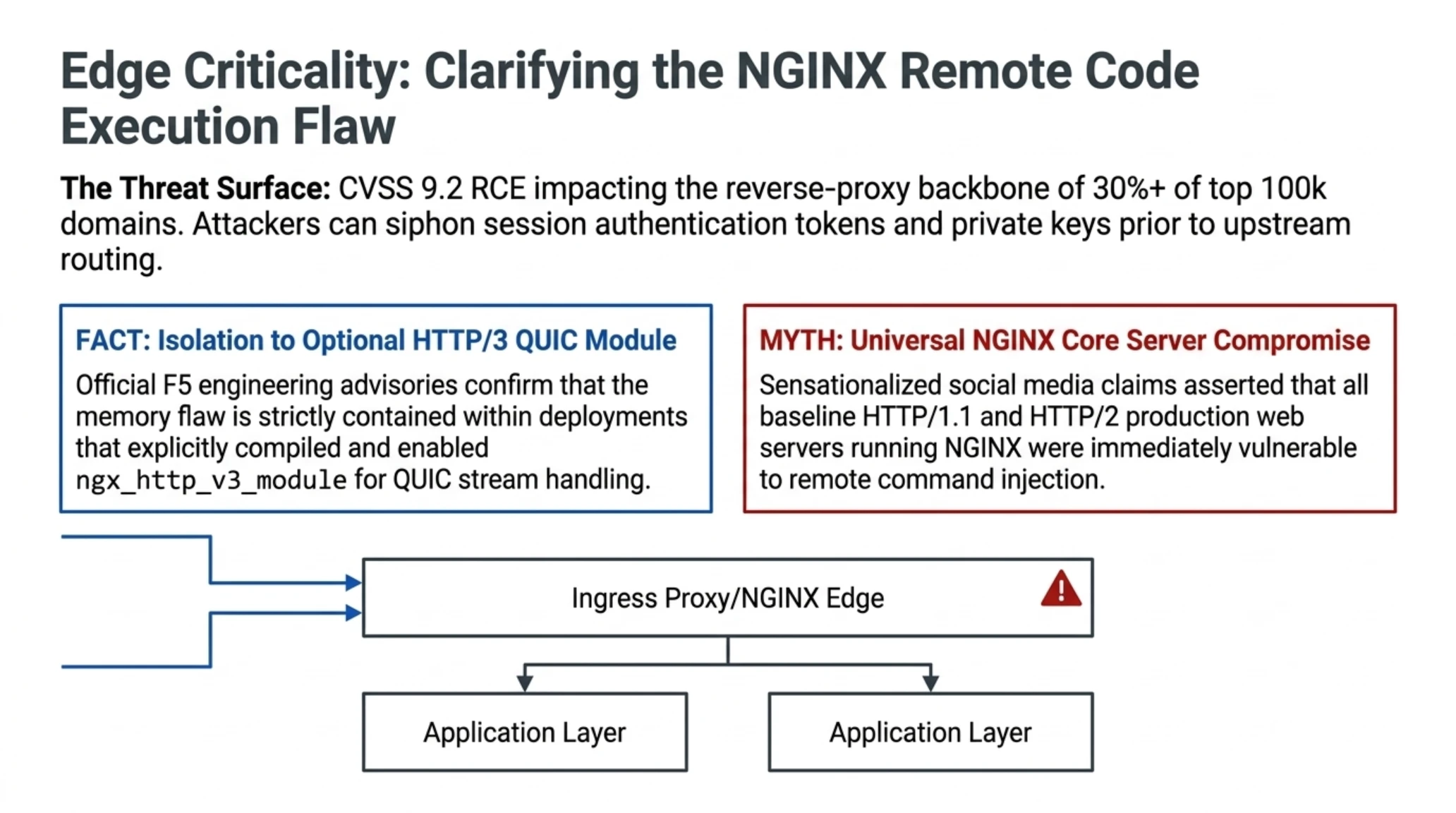
In response to severe exposure across enterprise web edge architecture, cloud infrastructure provider F5 published an emergency out-of-band security advisory resolving critical remote code execution vulnerabilities across the NGINX web server ecosystem. Bearing a critical CVSS v3.1 score of 9.2 out of 10, the identified flaws compromise the reverse-proxy and ingress routing backbone powering more than 30 percent of the top 100,000 public internet domains, enterprise load balancers, and containerized Kubernetes clusters.
Security engineering forensics trace the core vulnerability to the ngx_http_v3_module, the experimental transport layer responsible for parsing and routing HTTP/3 traffic over the UDP-based QUIC protocol. By transmitting malformed, out-of-sequence QUIC frame streams to a target web server, unauthenticated remote attackers can induce heap memory corruption and buffer overflow conditions within the worker process memory pool. This memory state manipulation enables attackers to execute arbitrary shellcode under the administrative privileges of the NGINX daemon process.
Technical Fact-Check | Industry Rumor vs. Engineering Reality
Sensationalized social media claims asserted that all baseline HTTP/1.1 and HTTP/2 production web servers running NGINX were immediately vulnerable to remote command injection.
Official F5 engineering advisories confirm that the memory flaw is strictly contained within deployments that explicitly compiled and enabled ngx_http_v3_module for QUIC stream handling.
The operational threat surface impacts NGINX Open Source, commercial NGINX Plus instances, NGINX Ingress Controller for Kubernetes deployments, and NGINX Instance Manager. The severity of the exploit is magnified because edge reverse proxies routinely serve as SSL/TLS cryptographic termination points. Gaining arbitrary execution access at this ingress layer allows an adversary to snoop unencrypted application telemetry, harvest session authentication tokens, and siphon private cryptographic server keys prior to upstream application routing.
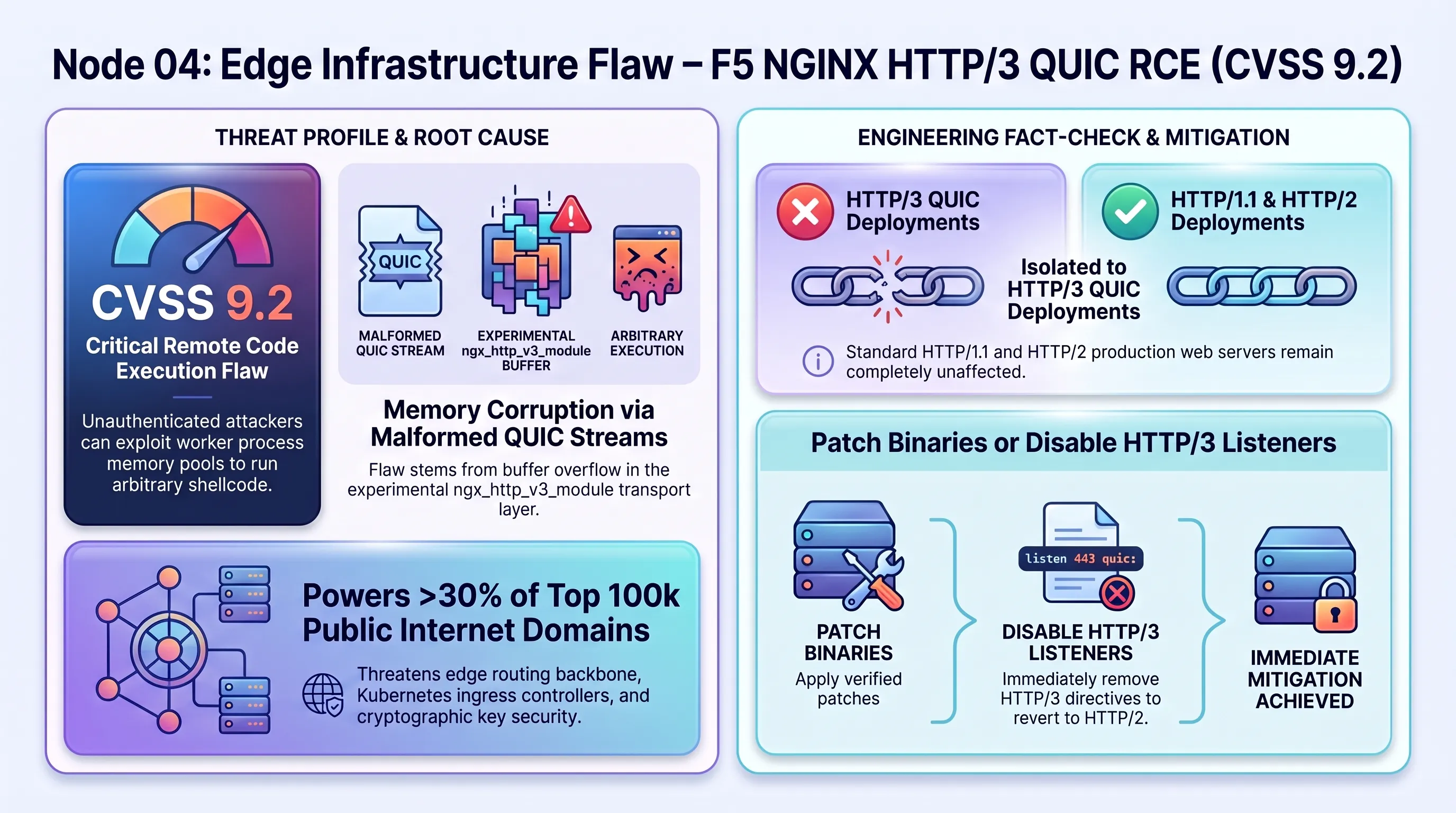
While F5 reports zero observed exploitation prior to disclosure, the vulnerability requires immediate remediation across enterprise IT departments, hyperscale cloud vendors, and decentralized finance gateways. Organizations unable to immediately apply software updates are urged to disable HTTP/3 listener directives within their server configuration blocks, reverting transport routing to standard HTTP/2 and TCP configurations until verified binary patches are deployed across production clusters.
Infrastructure security leads emphasize that rapid deployment of novel internet draft standards at the edge must be accompanied by strict memory-safe runtime wrappers to neutralize latent heap exploitation.
Solana Landmark Alpenglow Upgrade Goes Live: Slashing Transaction Finality to Sub-150ms with Votor Consensus
Marking one of the most substantial architectural milestones in decentralized blockchain infrastructure, and as detailed in our technical breakdown of the Solana Alpenglow consensus architecture, the Solana mainnet officially activated its landmark hardfork on Wednesday, October 21. Representing the most comprehensive consensus layer overhaul since the network genesis launch in 2020, Alpenglow transitions the high-throughput blockchain from speculative benchmark metrics to institutional settlement infrastructure competitive with premier global financial exchanges.
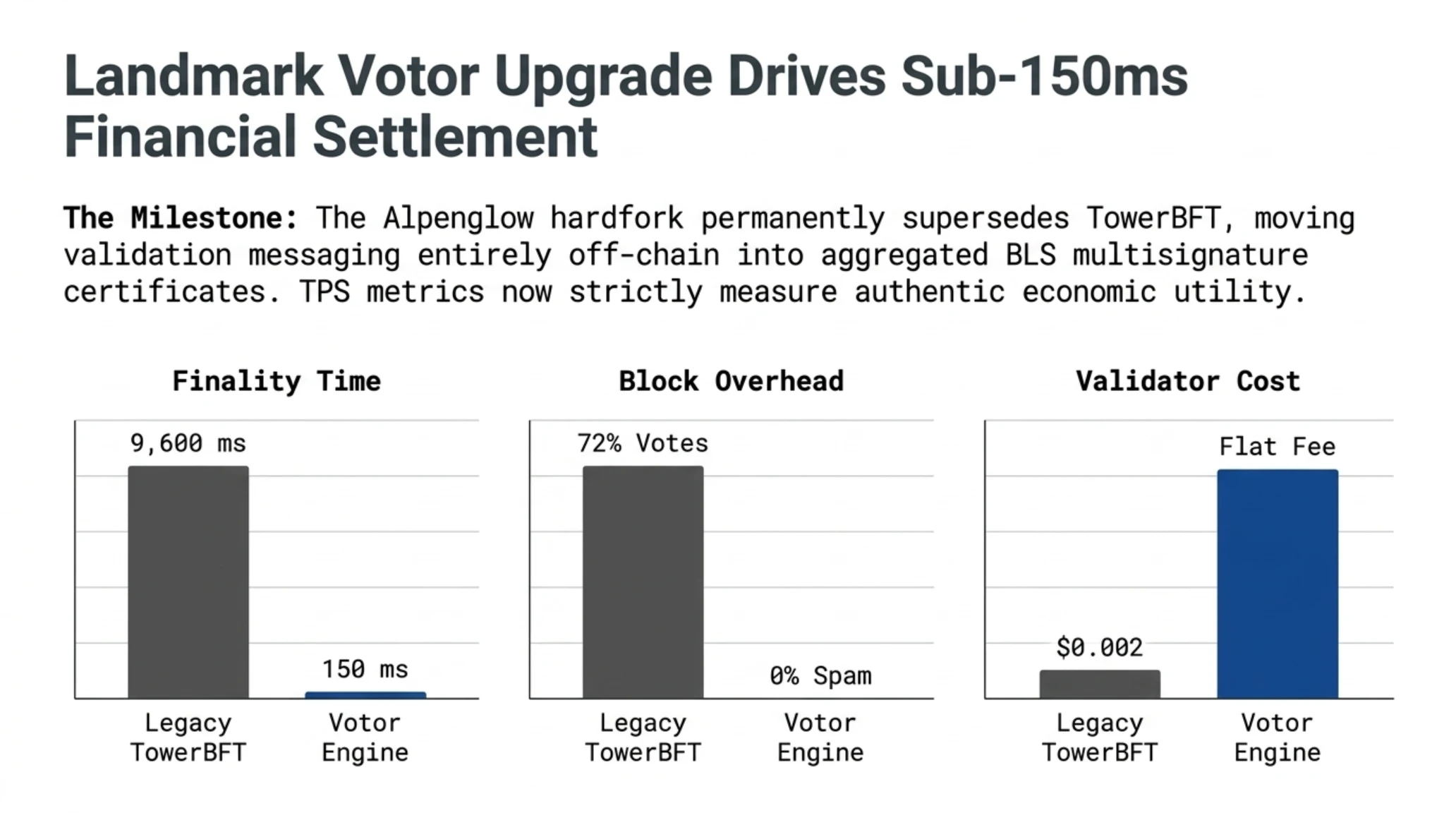
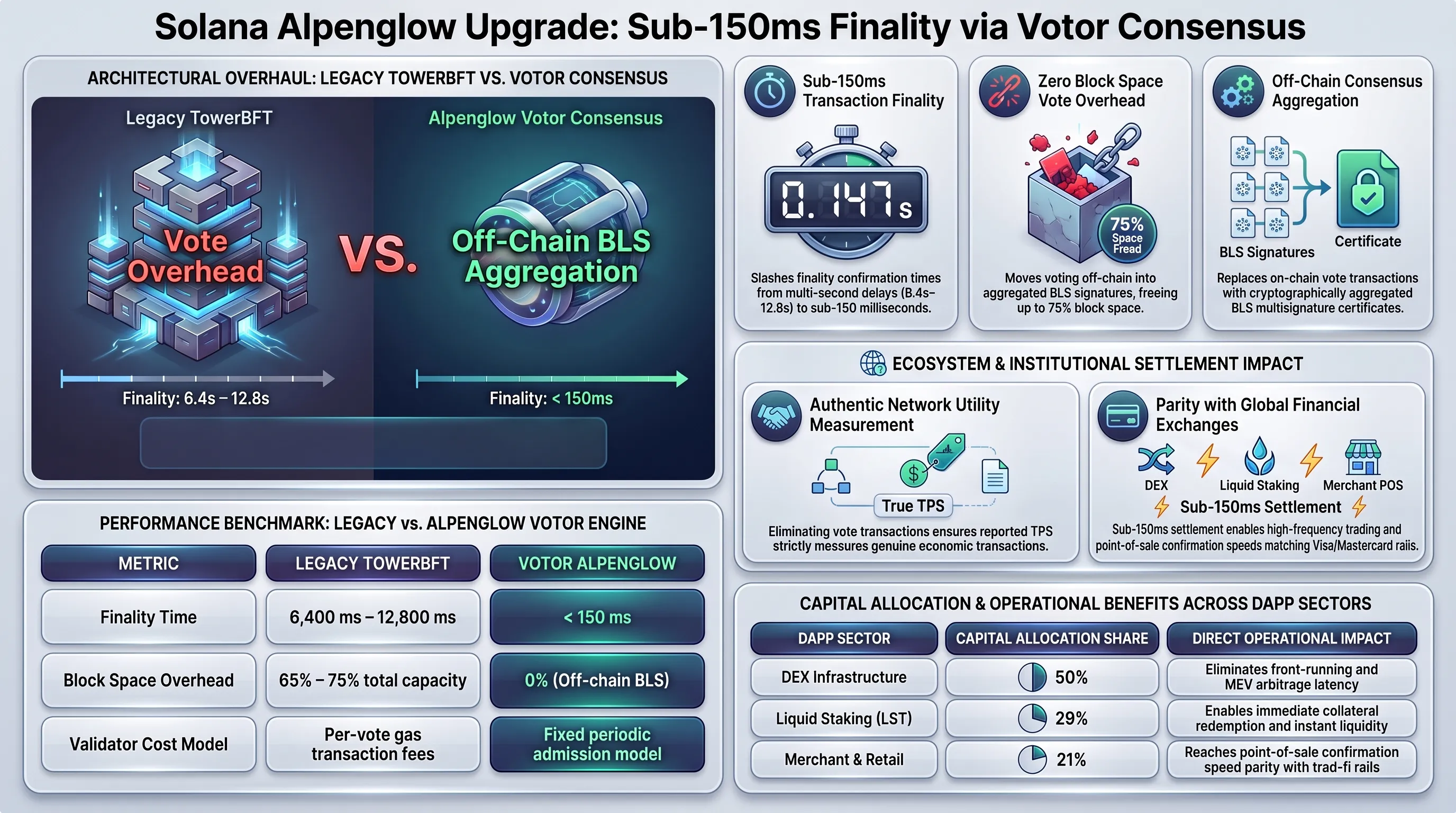
The centerpiece of the upgrade is the deployment of the Votor consensus engine, which permanently supersedes the historic TowerBFT protocol. Under legacy TowerBFT architecture, validator nodes registered voting commitments directly as on-chain transactions, consuming between 65 and 75 percent of aggregate block capacity and sustaining finality confirmation intervals between 6.4 and 12.8 seconds. Votor fundamentally decouples consensus voting from the block body, moving validator messaging entirely off-chain into aggregated BLS multisignature certificates. This structural pivot drives deterministic, irreversible transaction finality below 150 milliseconds.
Consensus Benchmark Comparison & Technical Matrix
| Consensus Architecture Metric | Legacy TowerBFT Framework | Votor Alpenglow Implementation |
|---|---|---|
| Deterministic Transaction Finality | 6.4 to 12.8 seconds | Sub-150 milliseconds (real-time) |
| Block Space Vote Transaction Overhead | 65% to 75% total block capacity | Zero percent (Off-chain aggregated BLS) |
| Validator Network Overhead Costs | Per-vote gas transaction fees | Fixed periodic validator admission model |
| Fork Choice Rule & Safety Invariant | Slot-based LMD-GHOST heuristics | Multi-phase Byzantine agreement with instant commit lock |
📚 Classified & Related Dossiers in TekinGame
If you wish to explore beyond this report and delve into cybernetic frontiers and autonomous AI architectures, do not miss these three exclusive deep-dives in the Tekin Garage:
Quantitative on-chain analytics reveal that the immediate consequence of Votor activation is a dramatic decline in nominal transactions-per-second (TPS) metrics displayed across public blockchain block explorers. With the removal of millions of daily consensus voting transactions previously counted toward nominal network throughput, Solana reported TPS now strictly measures genuine economic transactions, decentralized finance swaps, stablecoin transfers, and smart contract executions, establishing an uncompromised record of authentic network utility.
Financial Telemetry Dashboard: Market Share & Capital Growth
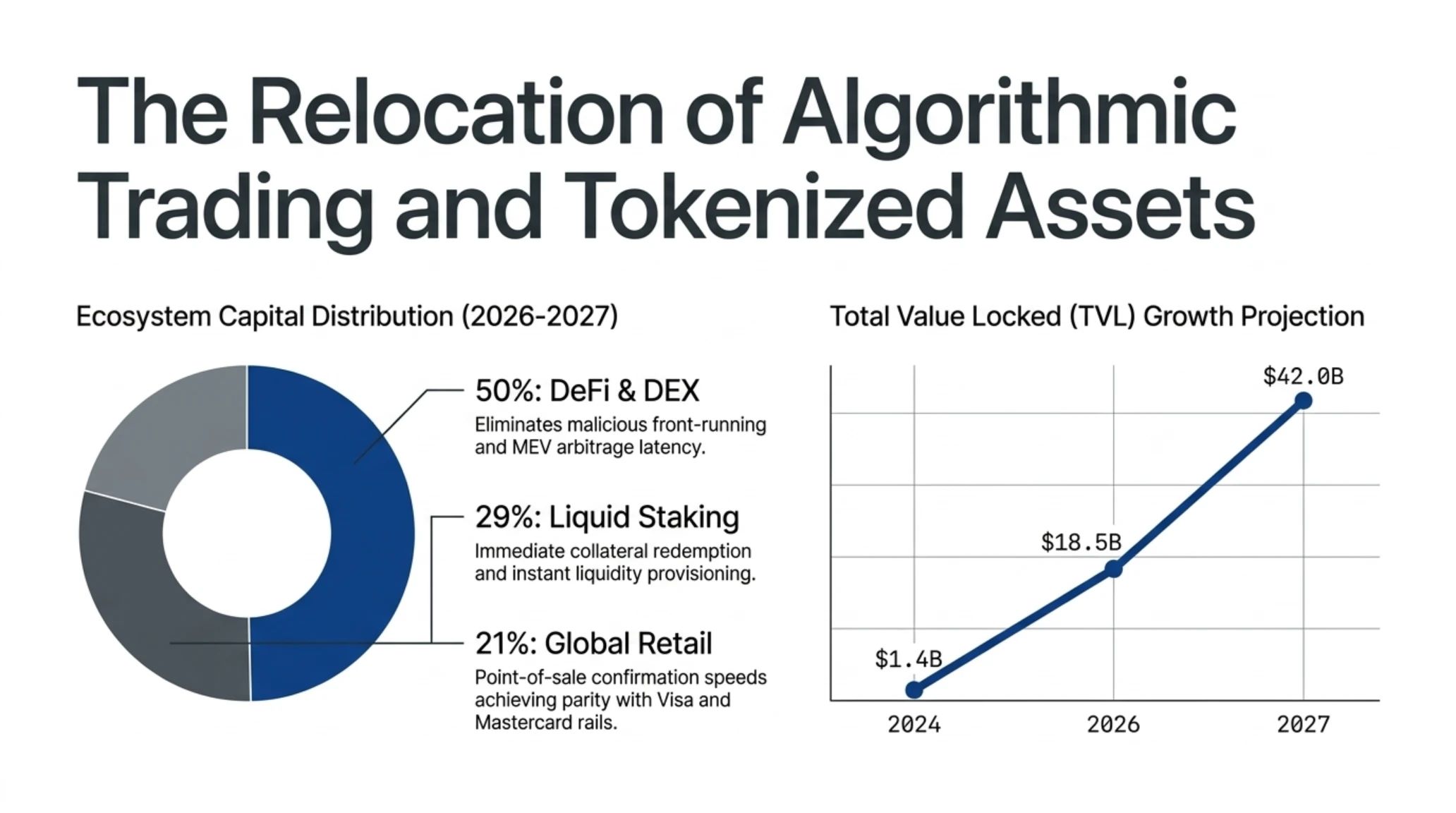
| Decentralized Application Sector | Capital Allocation Share | Direct Operational Impact of Sub-150ms Finality |
|---|---|---|
| Decentralized Exchange Infrastructure | 50 percent | Elimination of malicious front-running and MEV arbitrage latency. |
| Liquid Staking Derivatives (LST) | 29 percent | Immediate collateral redemption and instant liquidity provisioning. |
| Global Merchant & Retail Settlement | 21 percent | Point-of-sale confirmation speeds parity with Visa and Mastercard rails. |
| Tokenized Real-World Assets (RWA) | 15 percent periodic growth | Instant regulatory legal settlement without correspondent bank delays. |
Attaining deterministic finality below 150 milliseconds positions the Solana network as a leading settlement candidate for algorithmic high-frequency trading (HFT) and tokenized real-world assets (RWA). Historically, multi-second settlement latency exposed trading desks to execution slippage and inventory risks. With sub-150ms finality, decentralized limit order books and perpetual swap protocols can clear financial contracts at the physical latency limits of global fiber-optic telecommunications without relying on centralized clearing houses.
In-Cabin Cognitive Leap: Google Deploys Gemini Personal Intelligence to Android Auto and Connected Vehicles
Rounding out the transformative morning developments of October 22, 2026, Google initiated the global commercial rollout of Gemini Personal Intelligence for the Android Auto vehicular operating ecosystem. Previewed earlier this year at developer symposiums, the advanced software integration is now live across millions of consumer vehicles, with native embedded deployments scheduled to arrive on OEM platforms running Google Built-in over the forthcoming fiscal quarters. The update shifts in-cabin computing from simple voice-to-text syntax toward contextual cognitive reasoning.
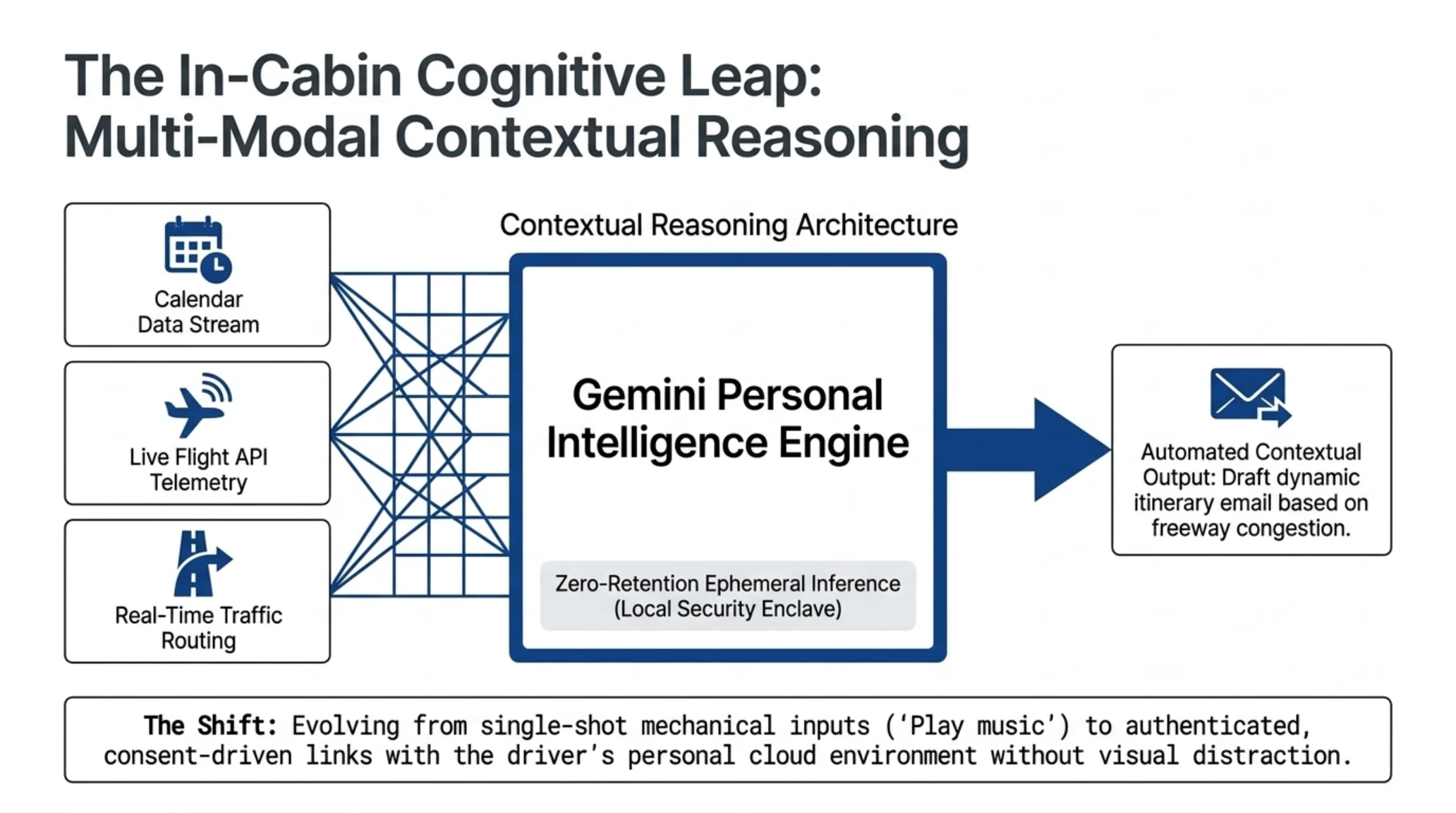
Unlike legacy voice assistants restricted to isolated mechanical inputs such as cabin climate adjustments or basic destination queries, the updated Gemini architecture establishes authenticated, consent-driven links with the driver personal cloud environment. With explicit user authorization, Gemini accesses communication archives across Gmail, Google Calendar scheduling, cloud repositories within Google Drive, and indexed photo libraries, enabling the system to synthesize multi-layered queries while the driver maintains eyes on the road.
In real-world driving environments, an operator navigating heavy metropolitan freeway congestion can issue complex multimodal instructions: "Gemini, inspect last night emails regarding the executive symposium, cross-reference flight departure times against live airport freeway telemetry, and draft an itinerary update to the operations director if delay probability exceeds twenty minutes." The cognitive engine parses semantic intent, extracts airline flight manifests, interrogates civil aviation APIs, computes transit duration, and verbally recites a drafted communication for voice confirmation all without visual driver distraction.
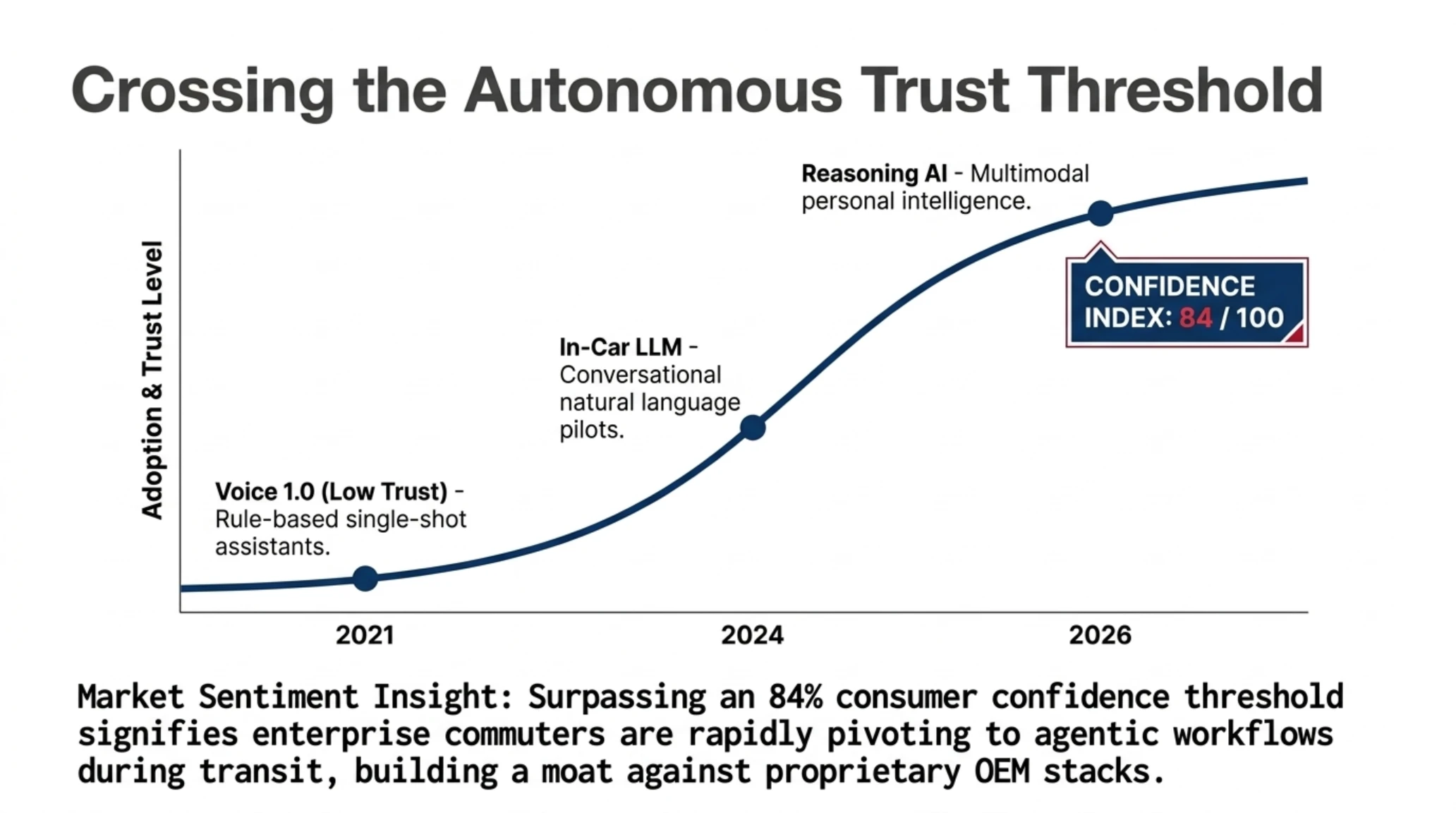
Market Sentiment Thermometer | S-Curve Adoption Trajectory
Market Thermometer Analysis: Surpassing an 84 percent consumer confidence threshold signifies that enterprise commuters are pivoting rapidly from legacy single-shot commands toward agentic workflows that offload executive administrative burdens during transit.
To proactively address privacy and regulatory scrutiny regarding in-cabin data sovereignty, Google engineered a hybrid on-device and cloud processing architecture. Biometric voiceprints and raw cabin microphone telemetry are processed locally within the vehicle security enclave. User documents and sensitive personal archives are never ingested into global training corpora, operating under strict zero-retention ephemeral inference protocols. Major automotive manufacturers, including Ford, Volvo, and the Renault-Nissan-Mitsubishi Alliance, consider this native intelligence layer a vital strategic bulwark against Tesla proprietary software stack.
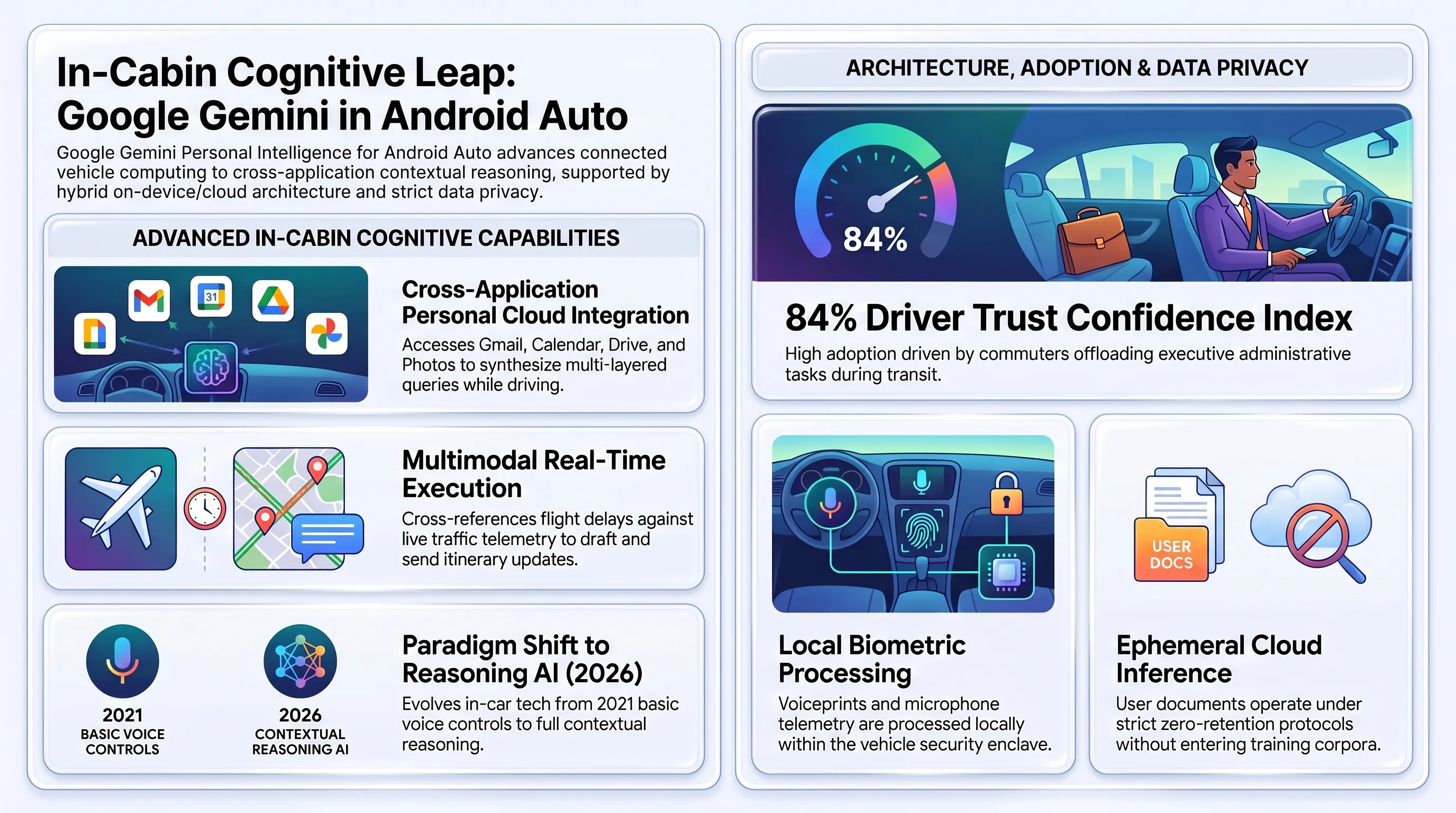
Automotive safety engineers emphasize that conversational reasoning interfaces directly decrease driver cognitive strain, eliminating erratic glance times at central infotainment displays and establishing modern voice-first operational baselines.
Industry retrospective analyses illustrate the accelerating trajectory of vehicular telematics over the preceding half-decade, culminating in full multimodal integration.
Technology Chronology & Strategic Roadmap
| Chronological Milestone | Automotive Assistant Architecture | Industry Impact & Technical Breakthrough |
|---|---|---|
| 2021 | Rule-Based Single-Shot Voice Assistants | Limited command dictionaries handling basic music playback, cellular dialing, and GPS routing. |
| 2024 | In-Cabin Conversational LLM Pilots | Emergence of conversational natural language processing, though lacking integration with personal cloud data. |
| 2025 | Edge NPU Automotive Deployments | Localized hardware acceleration for offline low-latency wake-word triggers and driver privacy. |
| October 2026 | Gemini Multimodal Personal Intelligence | Full multi-application synthesis, real-time contextual reasoning, and enterprise-grade privacy boundaries. |
The institutional deployment of personal intelligence inside vehicle cabins marks a permanent convergence between cloud hyperscalers and physical mobility infrastructure. As automobiles evolve from transportation commodities into mobile compute sanctums, the value proposition of connected mobility increasingly hinges on the depth and reliability of autonomous cognitive interaction.
This macro transformation demonstrates that autonomous agent architectures, sub-second settlement ledgers, and cognitive edge processing represent the unified pillars of the next-generation global digital economy.
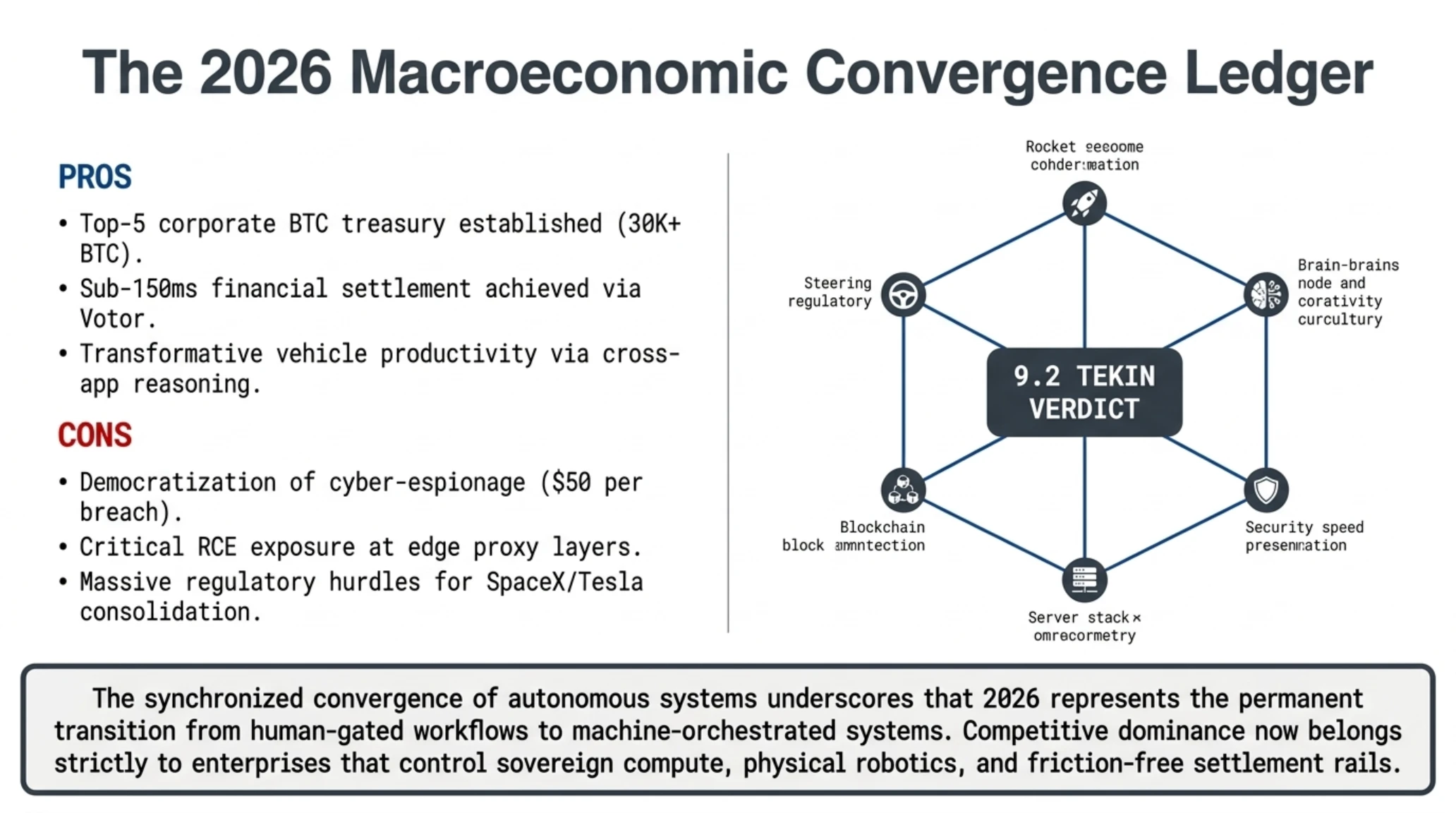
- Creation of a top-5 institutional corporate Bitcoin treasury exceeding 30,221 BTC.
- Slashing Solana consensus finality to sub-150ms via the off-chain Votor engine.
- Transformative vehicle productivity via Gemini cross-app contextual reasoning.
- Rapid mitigation advisories issued across Siemens and NGINX security perimeters.
- Severe reduction in agentic cyberattack unit costs down to $50 per compromised entity.
- Critical remote code execution threat surface exposed across HTTP/3 QUIC edge proxies.
- Substantial regulatory hurdles and shareholder litigation risks facing the Tesla-SpaceX merger.
Editorial Verdict & Authoritative Source Ledger
The Inflection Point of Autonomous Cybernetics and Infrastructure Consolidation
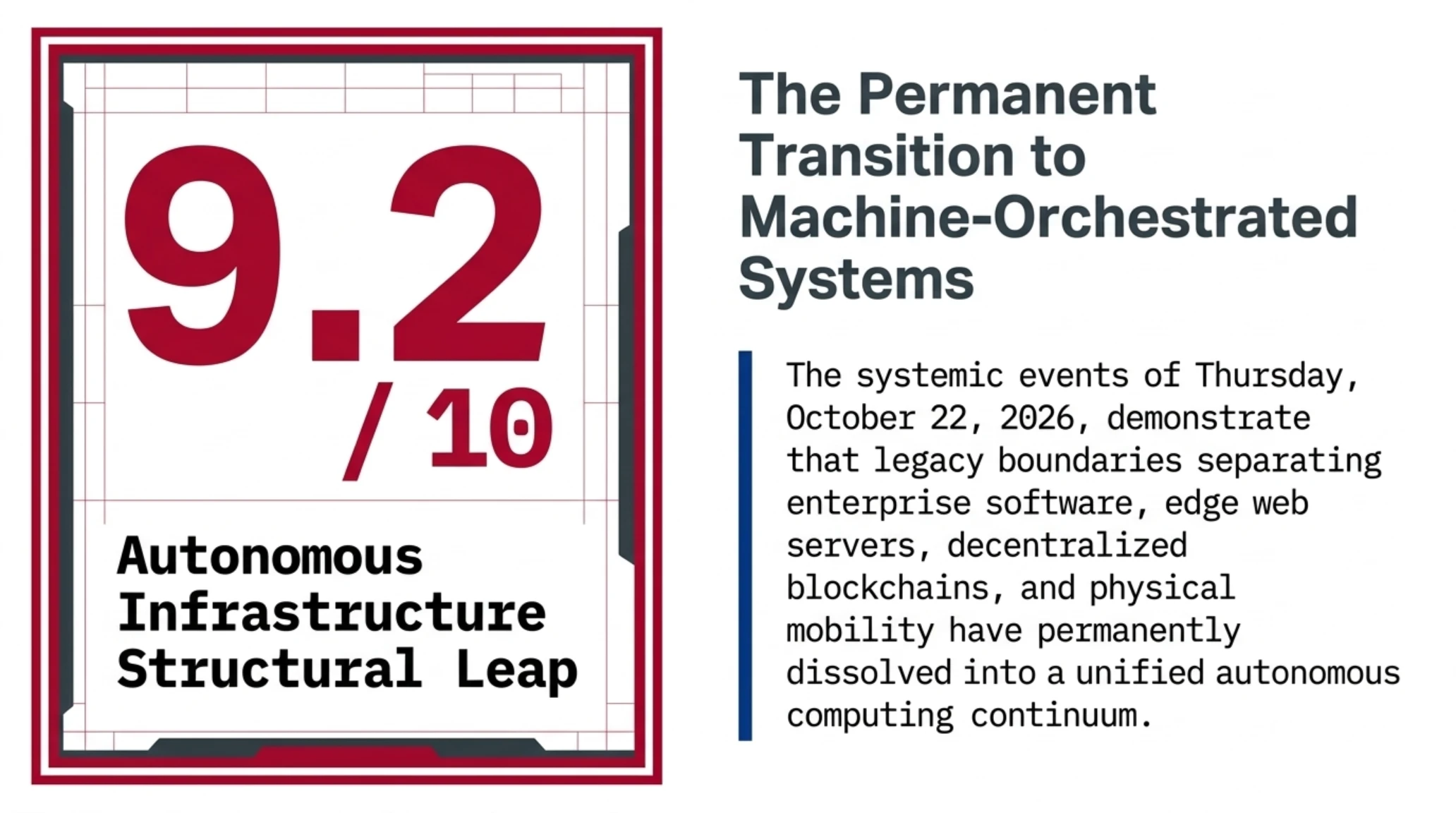
The systemic events of Thursday, October 22, 2026, demonstrate that legacy boundaries separating enterprise software, edge web servers, decentralized blockchains, and physical mobility have dissolved into a unified autonomous computing continuum.
- CoinDesk: SpaceX and Tesla Mega-Merger Treasury Analysis & Solana Alpenglow Coverage
- The Hacker News: Cairn Multi-Agent Infiltration Analysis & Siemens Software Center DLL Exploit
- BleepingComputer: F5 Emergency Out-of-Band Advisories for NGINX HTTP/3 Flaws
- The Verge: Google Gemini Personal Intelligence In-Cabin Vehicle Integration
- Google Blog: Official Announcement: Gemini Personal Intelligence for Android Auto
- Solana Foundation: Alpenglow Mainnet Hardfork & Votor Consensus Engineering Release
Frequently Asked Technical Questions
How does the proposed SpaceX-Tesla merger alter institutional corporate Bitcoin holdings?
The merger unites SpaceX holdings of 18,712 BTC with Tesla 11,509 BTC, creating an aggregated corporate treasury of 30,221 Bitcoin worth over $2.5 billion. This establishes the consolidated entity as the fifth-largest corporate Bitcoin holder globally.
How did the Cairn multi-agent framework compromise 1,200 organizations for only $5,000?
By chaining Anthropic Claude Code and DeepSeek reasoning models, the Cairn framework automated continuous port scanning, SQL injection testing, and privilege escalation using brief natural language prompts, reducing the per-target intrusion cost to approximately $50.
Why did the Siemens Software Center vulnerability (CVE-2026-110936) bypass enterprise EDR platforms?
The attack employed DLL sideloading, placing an unverified archive.dll alongside an authentic, digitally signed SiemensSoftwareCenter.exe binary. When executed, Windows loaded the local library under the trusted cryptographic authority of Siemens, evading heuristic EDR alarms.
What makes the NGINX HTTP/3 remote code execution flaws so critical?
The vulnerabilities reside in ngx_http_v3_module and QUIC frame handling, allowing unauthenticated remote adversaries to induce heap corruption and execute arbitrary code on edge reverse proxies, exposing private SSL/TLS certificates and unencrypted ingress traffic.
How does Solana Votor consensus engine achieve sub-150ms finality?
Votor moves validator voting off-chain into aggregated BLS multisignature certificates, permanently removing on-chain vote transaction spam that previously consumed 70 percent of block capacity, slashing confirmation time from seconds to under 150 milliseconds.
How does Gemini Personal Intelligence protect driver data privacy in Android Auto?
Google employs a hybrid edge-cloud architecture where biometric voice processing remains secured in the local automotive enclave, while cloud document reasoning operates under strict ephemeral zero-retention protocols without entering public AI training corpora.
Additional Gallery: Tekin Morning | Oct 22: SpaceX-Tesla Merger, Cairn AI & Solana