Tekin Analysis | Enterprise AI Key Exfiltration and Over-the-Air Wi-Fi Exploits in the Dawn of 2026
The Enterprise Cloud Key Exfiltration Crisis; Inside the OpenCode Console Breach and Model Distillation Siphoning
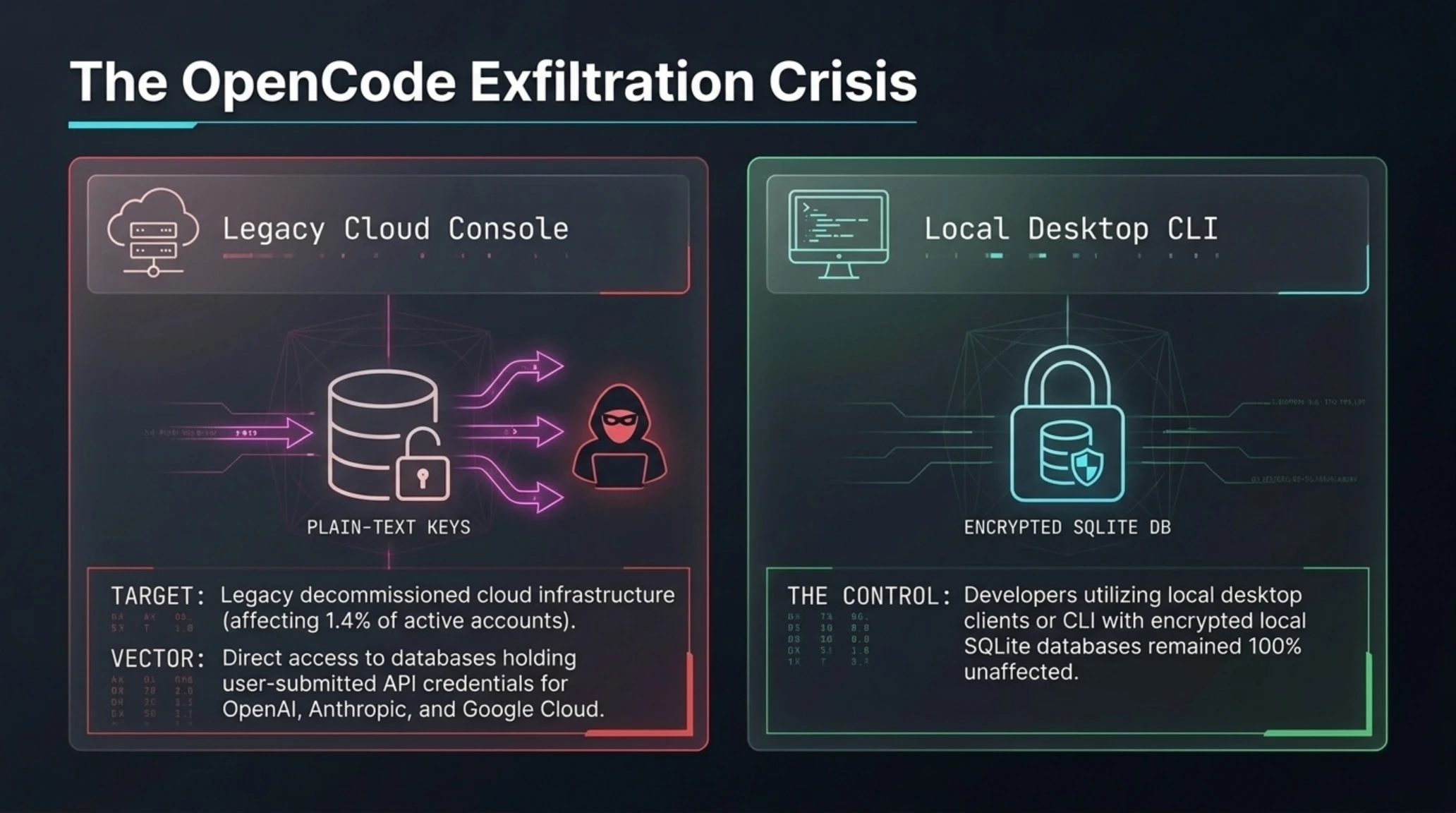
The dawn of Tuesday, October 20, 2026, delivered an urgent wake-up call to software engineering teams and enterprise artificial intelligence architects globally. OpenCode, the developer behind widely adopted open-source coding agents and collaborative developer environments, issued an emergency security directive titled Urgent Action: Potential Provider Key Exposure. The advisory confirmed that unauthorized actors successfully compromised decommissioned legacy cloud infrastructure on the night of October 16, directly accessing databases holding user-submitted API credentials for OpenAI, Anthropic, and Google Cloud services.
Strategic Intelligence Assessment and Core Analytical Vectors
While the breach was strictly confined to the cloud-hosted OpenCode Console impacting roughly 1.4% of total active accounts that utilized cloud workspaces the tactical fallout highlights the extreme vulnerability of aggregated credential stores in modern developer tooling. Developers who operated strictly via OpenCode local desktop clients or command-line interfaces (CLI), where authentication secrets reside within encrypted local SQLite databases, were entirely unaffected. However, for organizations that bridged their cloud environments with unrestricted API keys, the consequences unfolded within minutes of the exfiltration.
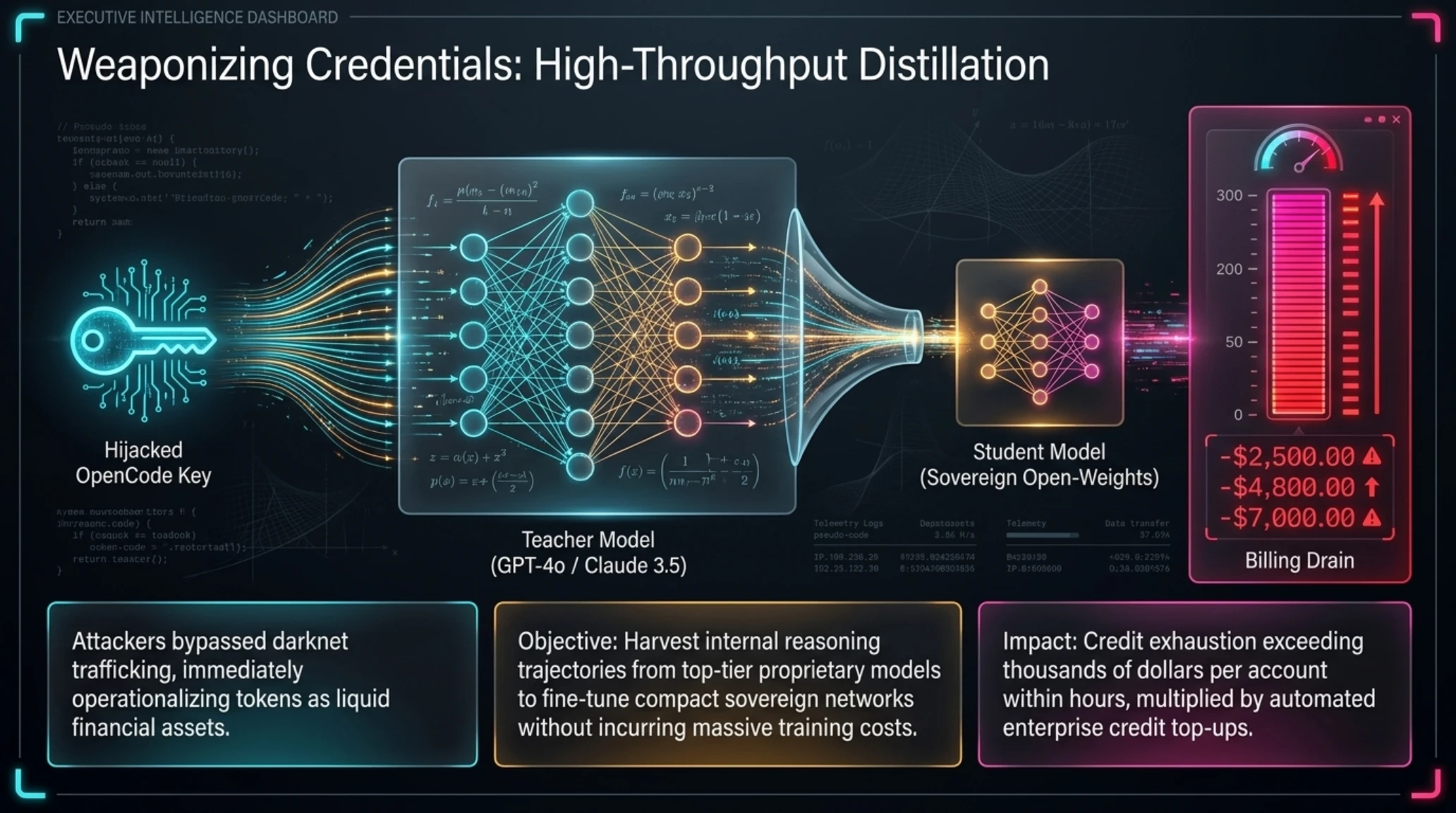
Rather than parking or quietly trafficking the compromised keys on underground darknet forums, the threat actors immediately operationalized high-concurrency automated scripts. They routed vast arrays of dense reasoning queries through compromised OpenAI GPT-4o and Anthropic Claude 3.5 Sonnet endpoints. Cybersecurity analysts monitoring the telemetry noted that the primary payload was high-throughput model distillation a technique where attackers systematically harvest the internal reasoning trajectories and structured outputs of top-tier proprietary models to fine-tune compact, sovereign open-weights networks without incurring training costs.
As documented in our technical investigation of closed platform defenses and systemic responses to open collaborative infrastructure, bearer tokens linked to foundation model inference represent liquid financial assets. Without rigid hard caps, rate-limiting perimeter controls, and IP whitelisting configured on provider management consoles, an unauthorized token leak transforms instantly into massive balance depletion and operational disruption for enterprise developer accounts.
The attackers exploited the fact that many commercial software development houses assign master administrator tokens to collaborative shared environments rather than issuing scoped, short-lived ephemeral credentials. By automating inference requests across thousands of concurrent worker threads, the adversaries managed to execute extensive synthetic data generation pipelines, compiling thousands of complex reasoning pairs before automated anomaly filters on provider dashboards could trigger billing shutdowns.
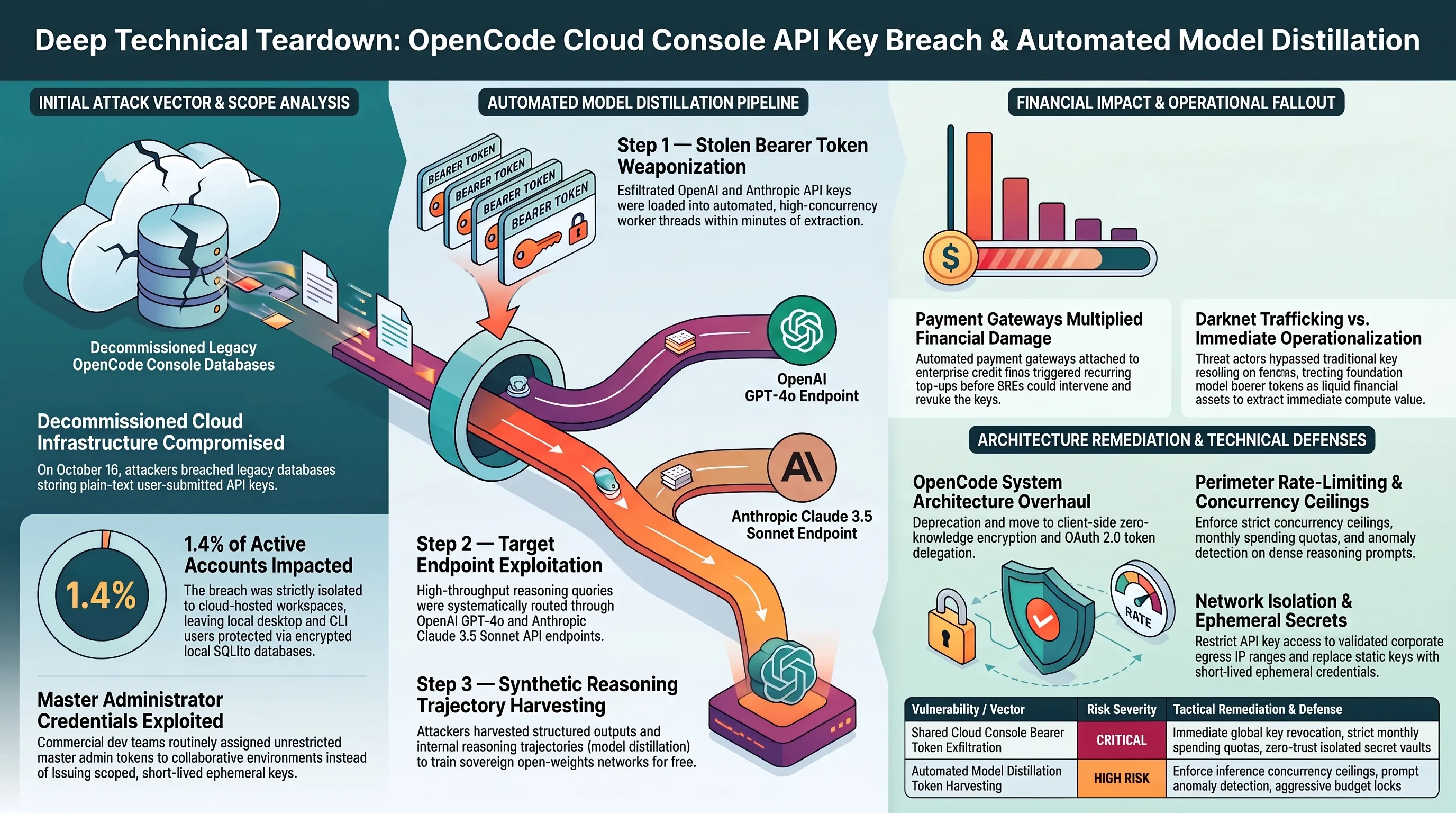
Affected engineering organizations reported credit exhaustion exceeding several thousand dollars within hours of the compromise. In multiple instances, automated payment gateways attached to enterprise credit lines processed recurring top-ups automatically, multiplying the financial damage before human site reliability engineers (SREs) could intervene and revoke the underlying keys.
The structural vulnerability highlighted by the OpenCode incident demonstrates that modern AI development workflows require an urgent shift toward zero-trust credential architecture. Managing foundation model credentials requires the same rigorous isolation, hardware key storage, and automated secret rotation protocols historically reserved for production database access keys and root cloud certificates.
Cybersecurity Threat Matrix and Defense Protocols
| Threat Vector / Vulnerability | Risk Severity | Tactical Defense and Remediation |
|---|---|---|
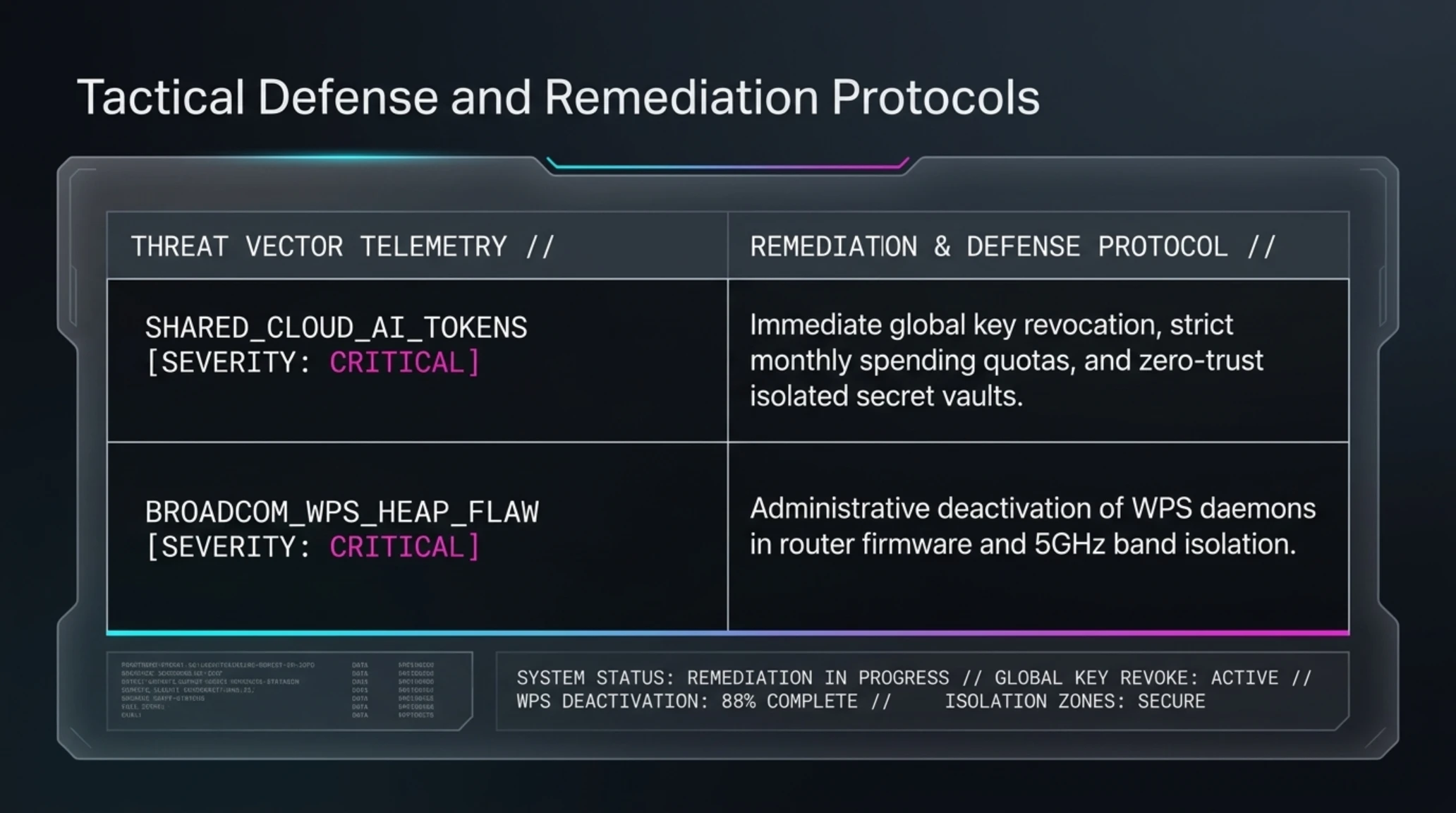
| Shared Cloud Console AI Bearer Token Exfiltration | CRITICAL | Immediate global key revocation, strict monthly spending quotas, and zero-trust isolated secret vaults. |
| Broadcom WPS Reassembly Heap Corruption Flaw | CRITICAL | Complete administrative deactivation of WPS daemons in router firmware and 5GHz band isolation. |
| High-Fidelity Real-Time Video Conference Deepfakes | HIGH RISK | Enforcing hardware-anchored zero-knowledge biometric badges such as World ID alongside multi-channel voice audits. |
| Automated Model Distillation Token Harvesting | HIGH RISK | Enforce inference concurrency ceilings, anomaly detection on reasoning prompts, and aggressive budget locks. |
In response to the incident, OpenCode engineering leadership announced a comprehensive deprecation of legacy cloud credential storage. Future iterations of the cloud console will strictly require client-side zero-knowledge encryption or OAuth 2.0 token delegation, ensuring that backend databases never maintain plain-text access to sensitive customer credentials.
Security teams globally are advised to audit all external coding assistants and continuous integration pipelines immediately. By enforcing strict monthly quotas, restricting API access to validated corporate egress IP ranges, and enabling multi-factor approval for anomalous inference spikes, organizations can insulate their cloud budgets against automated exfiltration campaigns.
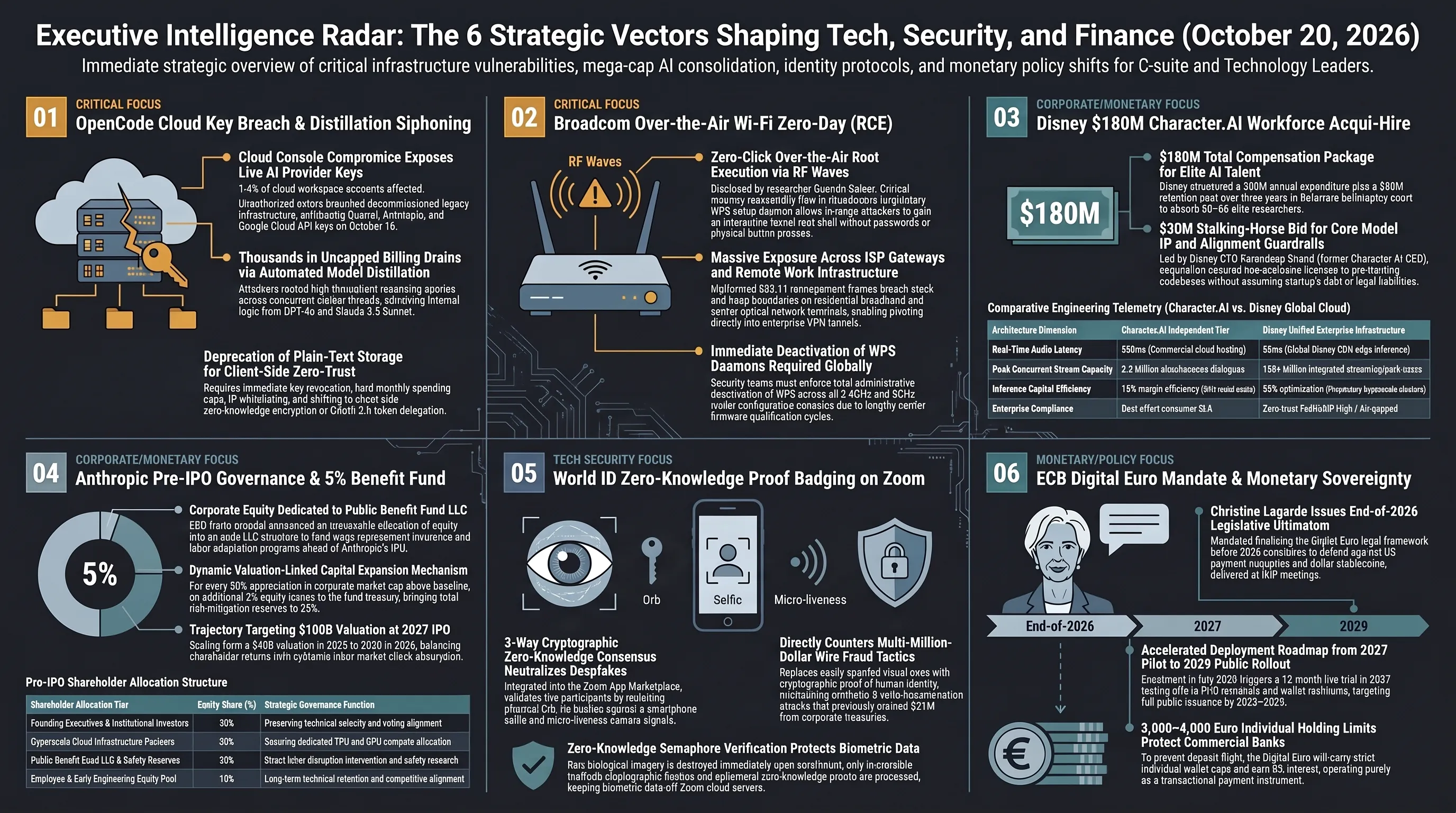
As enterprise engineering leaders race to fortify their cloud authentication perimeters, an equally severe threat has materialized at the physical layer of global communications networks, exposing millions of hardware gateways to unauthenticated compromise.
The following technical section analyzes the low-level mechanics of this radio frequency hardware exploit, examining how an unauthenticated attacker can achieve root shell execution directly over wireless broadcast waves.
Over-the-Air Unauthenticated Root Compromise; Dissecting the Broadcom Wi-Fi Zero-Day Vulnerability
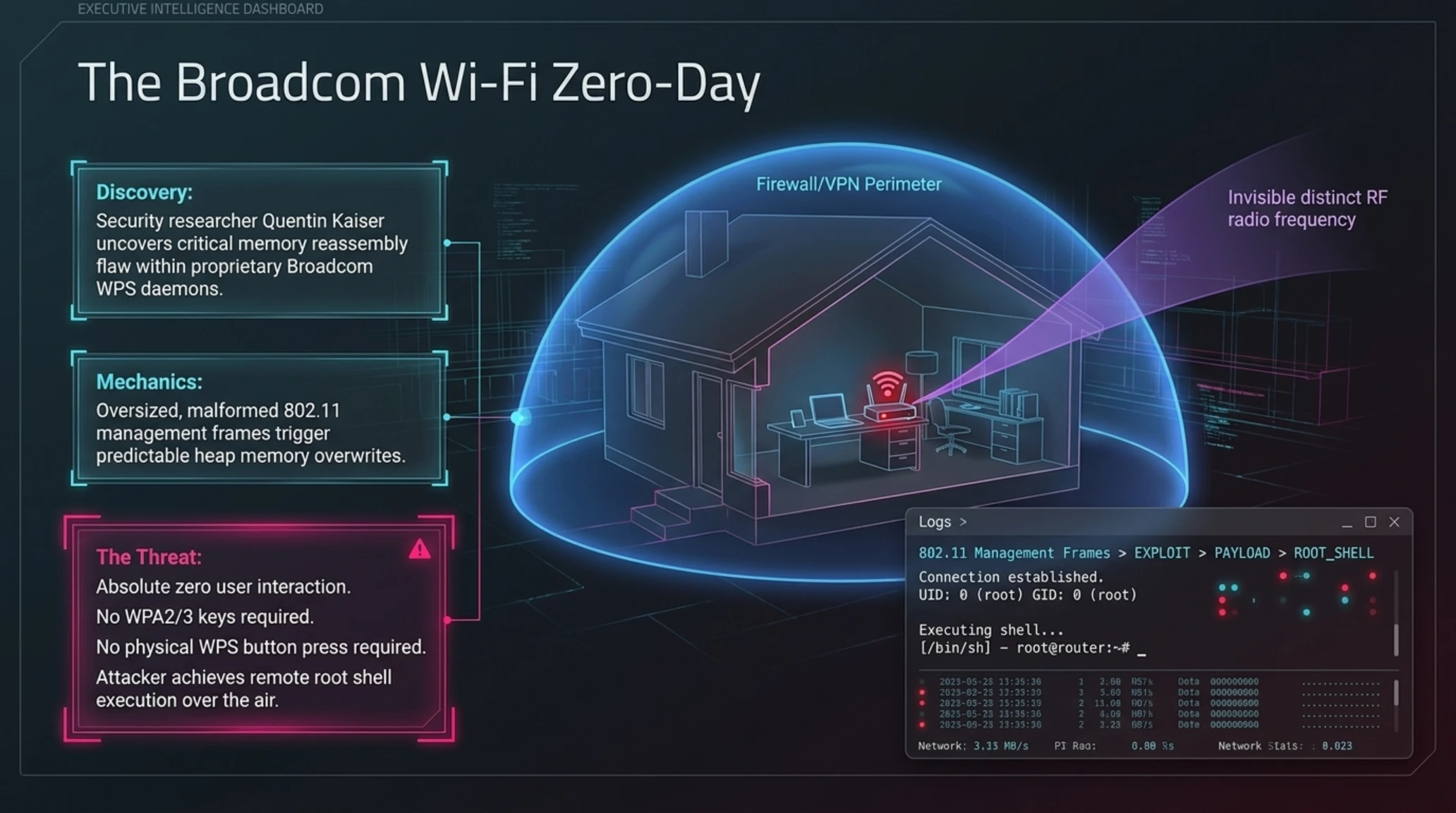
Parallel to the cloud security emergency, the embedded hardware and telecommunications sectors were jolted by a landmark vulnerability disclosure from elite security researcher Quentin Kaiser. Unveiling zero-day exploit documentation, Kaiser exposed an unpatched, critical-severity memory corruption vulnerability embedded deep within the proprietary wireless setup daemon governing Broadcom Wi-Fi chipsets. These chipsets serve as the foundational physical-layer hardware for tens of millions of residential broadband gateways, commercial access points, and ISP-issued optical network terminals across North America, Europe, and Asia.
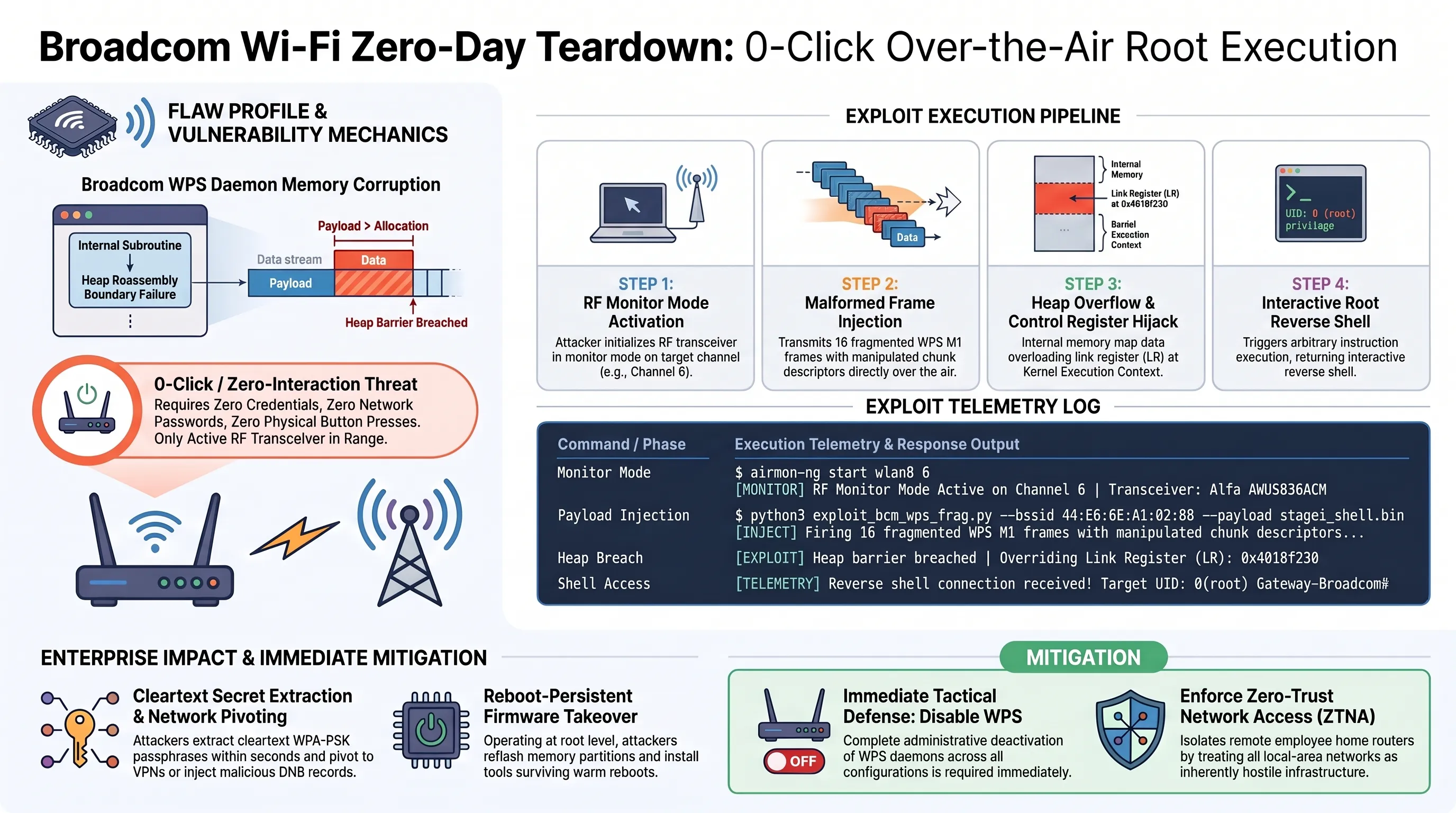
The architectural flaw resides in the handling of Wi-Fi Protected Setup (WPS) setup messages. When oversized configuration payloads exceed standard radio frequency (RF) frame thresholds, the firmware invokes an internal reassembly subroutine. Kaiser discovered that this proprietary reassembly logic fails to properly validate fragmented packet lengths against allocated stack and heap boundaries. By transmitting a meticulously sequenced series of malformed 802.11 management frames over the air, an attacker triggers a predictable memory overwrite, allowing arbitrary instruction redirection directly within the kernel execution context.
The operational threat profile of this zero-day is extraordinary: the attack requires absolute zero user interaction or pre-existing credentials. The adversary does not need the target network WPA2 or WPA3 pre-shared key, nor does an occupant need to depress the physical WPS push-button on the router chassis. Merely possessing an operational RF transceiver within broadcast range is sufficient to execute the memory exploit, gain an interactive root-level reverse shell, and extract sensitive network secrets directly from volatile system memory.
Demonstrating real-world weaponization, Kaiser validated the attack against production residential gateways deployed by major European carriers, including Belgian operators Proximus and Orange. Within seconds of frame transmission, the researcher extracted cleartext WPA-PSK passphrases and established persistent administrative footholds. Given that carrier-grade firmware qualification and OTA deployment cycles historically span months, network security directors must instruct end users and enterprise remote workers to immediately disable WPS across all gateway configuration consoles.
For distributed engineering teams and enterprise organizations operating under hybrid work models, the implications of unauthenticated gateway compromise are profound. An in-range attacker exploiting an employee home router can pivot directly into virtual private network (VPN) tunnels, intercept unencrypted local network traffic, and inject malicious DNS records. This elevation of home network infrastructure into high-priority attack surface reinforces the necessity of zero-trust network access (ZTNA) architectures that treat all local local-area networks as fundamentally hostile.
Furthermore, because the affected daemon operates with root privileges within the embedded Linux distribution powering the router, the attacker achieves complete system takeover. The adversary can reflash memory partitions, install modular wiretapping tools, and establish persistent covert listening posts that survive warm device reboots, turning customer-premises equipment (CPE) into launching pads for broader enterprise intrusions.
Cyber Terminal Benchmark Telemetry and Exploit Log
The discovery underscores the fragile nature of proprietary legacy networking stacks that underpin modern high-speed residential fiber and cable installations. Until Internet service providers deploy validated firmware updates en masse, disabling WPS functionality across all gateway devices remains the single most effective defensive safeguard available to enterprise security administrators.
The following video demonstration illustrates the mechanics of over-the-air packet injection, showing how unauthenticated frame sequences can destabilize wireless firmware stacks and grant root execution.
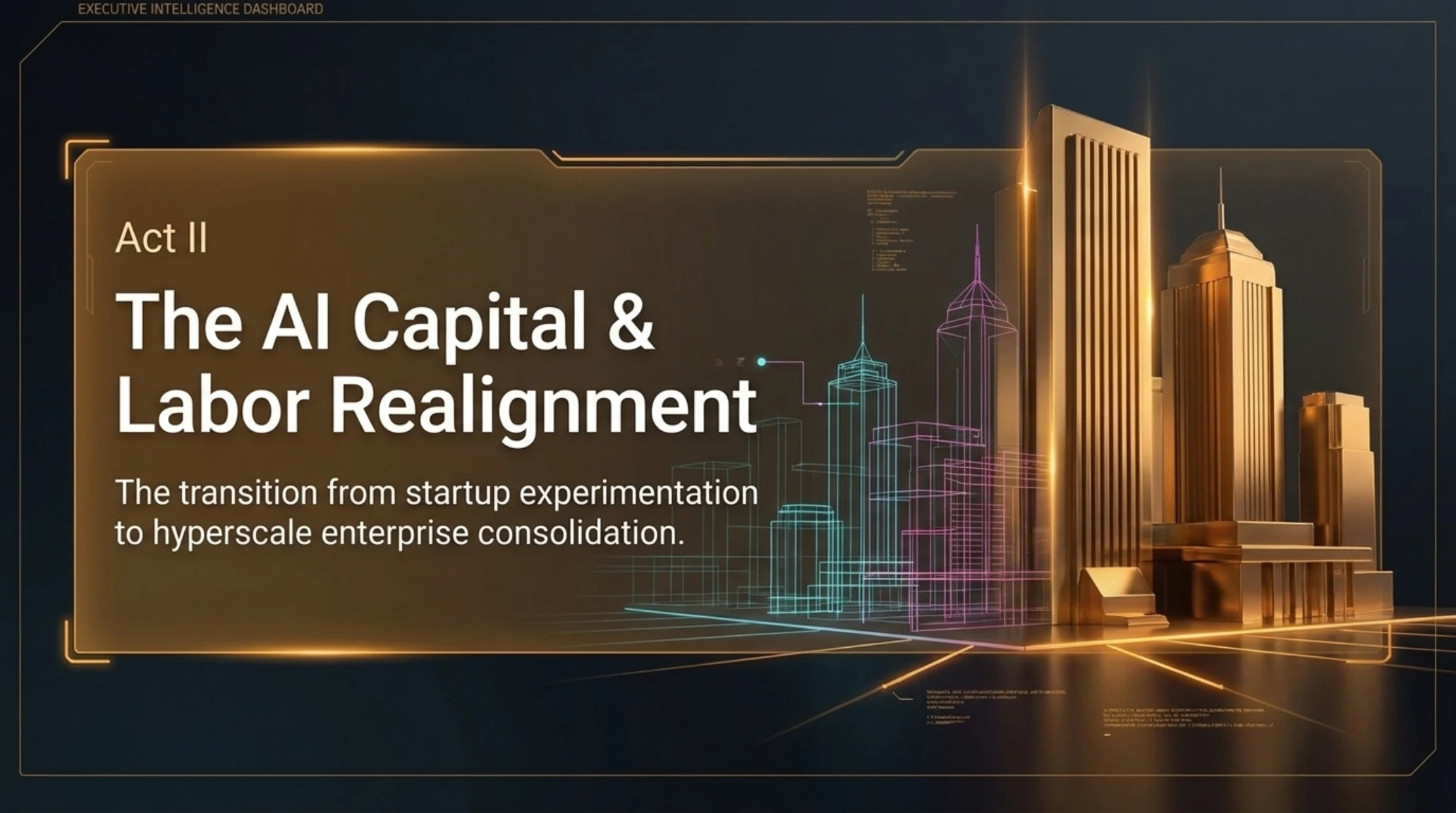
While infrastructure security teams grapple with these physical and cloud network vulnerabilities, the macro corporate landscape of artificial intelligence is experiencing a massive consolidation of human talent and capital resources.
Why This Paradigm Shift Reshapes the Global Technology Landscape
The global technology economy is undergoing an aggressive structural realignment. Legacy media conglomerates are absorbing foundation AI talent directly from bankruptcy proceedings, while frontier AI labs are establishing multi-billion-dollar corporate equity buffers to insulate global workforces against the displacement shocks of accelerating automation.
The convergence of legal restructuring, bankruptcy maneuvering, and long-term equity planning highlights a fundamental maturation of the artificial intelligence ecosystem. As standalone startups struggle with massive inference server costs and capital constraints, enterprise balance sheets are emerging as the ultimate stabilizing force across the sector.
The Disney Enterprise Gambit; Absorbing Character.AI Elite Workforce via a $180M Chapter 11 Acquisition Package
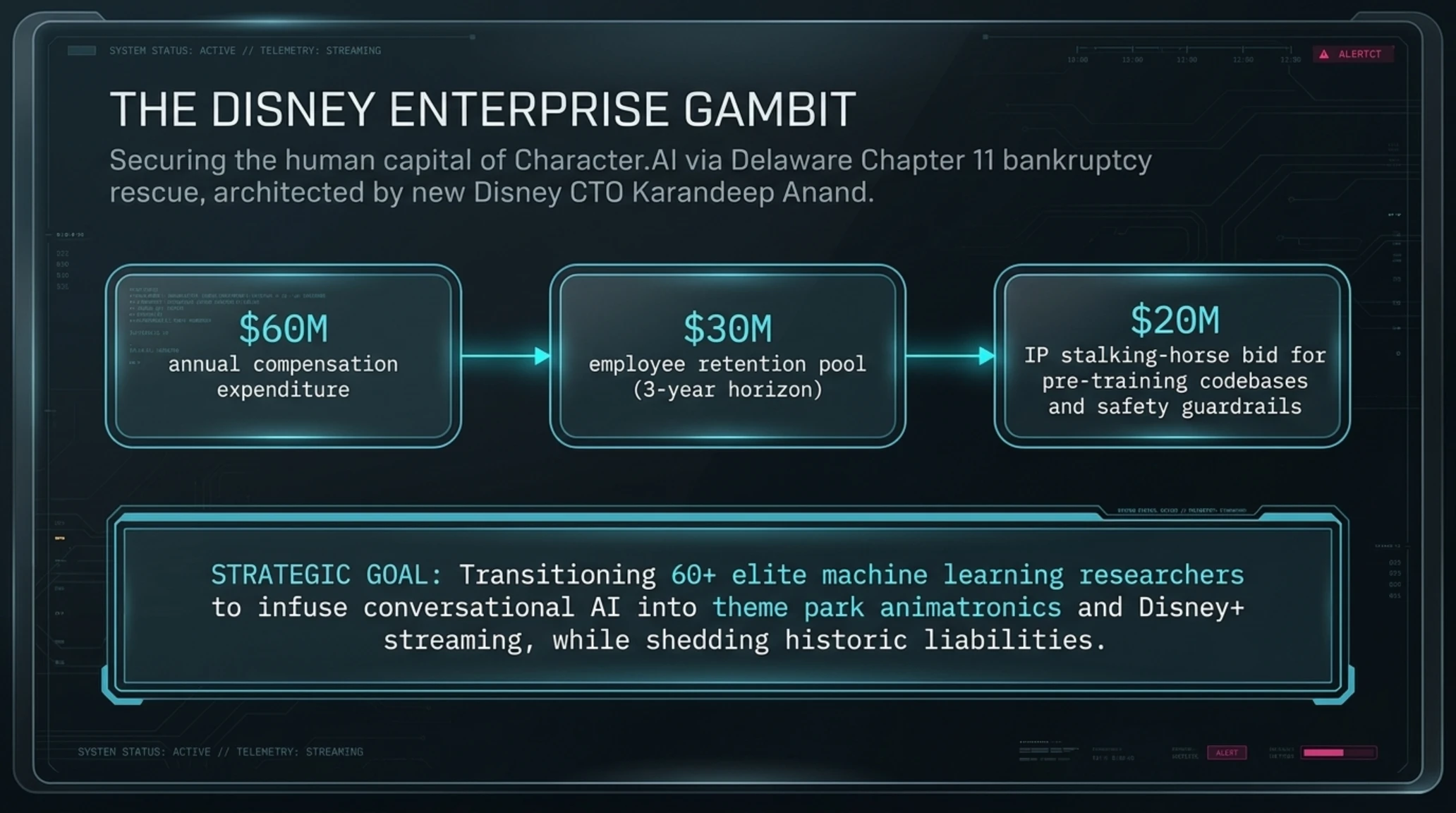
In one of the most consequential corporate talent consolidations of the generative AI era, The Walt Disney Company executed an aggressive maneuver within the United States Bankruptcy Court for the District of Delaware. Moving to capture the human capital of Character.AI once a multi-billion-dollar unicorn pioneer in synthetic conversational personas that succumbed to unsustainable inference infrastructure overhead and legal friction Disney reached a court-sanctioned agreement to acquire the overwhelming majority of the startup technical workforce.
According to bankruptcy filings, Disney committed to an annual compensation expenditure of $60 million paired with a $30 million employee retention pool across a firm three-year horizon. This yields a total human capital valuation of $180 million, ensuring the immediate transition of 60 to 66 elite machine learning researchers, natural language processing engineers, and conversational system architects into the Burbank entertainment giant. To secure the operational assets, Disney submitted a $20 million stalking-horse bid granting a perpetual, non-exclusive license to Character.AI core model pre-training codebases, safety alignment guardrails, and key patent portfolios.
This strategic coup was architected by Karandeep Anand, the former CEO of Character.AI who was appointed just weeks prior as the inaugural Chief Technology Officer in the century-long history of The Walt Disney Company. By utilizing Chapter 11 bankruptcy mechanisms, Anand and Disney successfully extracted the premier engineering brain trust without assuming the startup historic liabilities, outstanding creditor debts, or lingering intellectual property infringement lawsuits from legacy media rights-holders.
The strategic deployment of this engineering unit will fundamentally re-architect Disney entertainment ecosystem. By infusing Character.AI conversational inference engines into theme park animatronics, Disney+ interactive streaming experiences, and gaming titles, Disney aims to transform static intellectual property into autonomous, living digital characters. Visitors will soon engage in real-time, context-aware dialogue with personalized dynamic agents representing legendary Marvel, Star Wars, and Pixar universes, marking Hollywood formal entry into foundation AI execution.
Industry analysts project that this integration will unlock unprecedented monetization avenues across consumer products and digital platforms. Dynamic narrative generation, tailored character interactions, and interactive educational content can now be deployed at global scale, leveraging Disney world-class creative assets backed by high-throughput conversational AI architectures.
The transition underscores how legacy entertainment empires are actively weaponizing their robust cash reserves and global intellectual property vaults to absorb frontier engineering talent that early-stage venture capital can no longer sustain under elevated infrastructure expenditure.

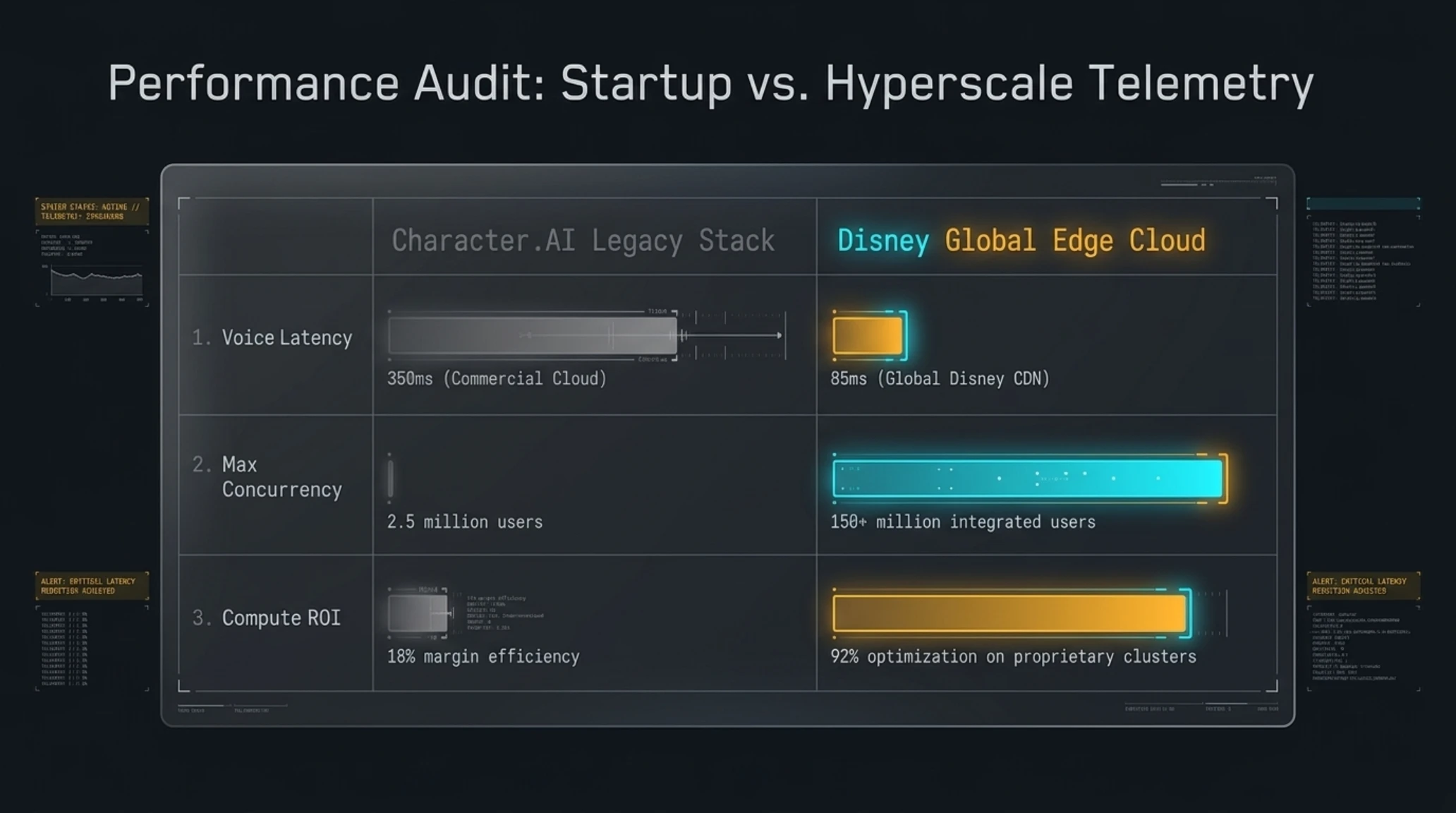
To quantify the technical leap enabled by Disney global cloud infrastructure, the telemetry comparison below contrasts Character.AI legacy startup hosting architecture against the enterprise capabilities of Disney distributed edge computing network.
Grouped Bar Chart and Comparative Engineering Telemetry
| Architecture Dimension | Character.AI Independent Tier | Disney Unified Enterprise Infrastructure |
|---|---|---|
| Real-Time Audio Latency | 350ms under commercial cloud hosting | 85ms edge inference across global Disney CDN |
| Peak Concurrent Stream Capacity | 2.5 million simultaneous chat dialogues | 150+ million integrated theme park and streaming users |
| Inference Capital Efficiency | 18% margin efficiency due to GPU rental costs | 92% optimization utilizing proprietary hyperscale clusters |
| Enterprise Security & Compliance | Best-effort consumer SLA without sovereign compliance | Zero-trust FedRAMP High and air-gapped enterprise compliance |
The comparative data highlights how high-latency consumer hosting platforms become non-viable when scaling to enterprise user volumes. By transitioning inference workloads to optimized internal silicon, Disney eliminates the severe margins drag that previously suffocated Character.AI operations.
Institutional Labor Shock Absorption; Anthropic Commits 5% Equity to Public Benefit Fund Pre-IPO
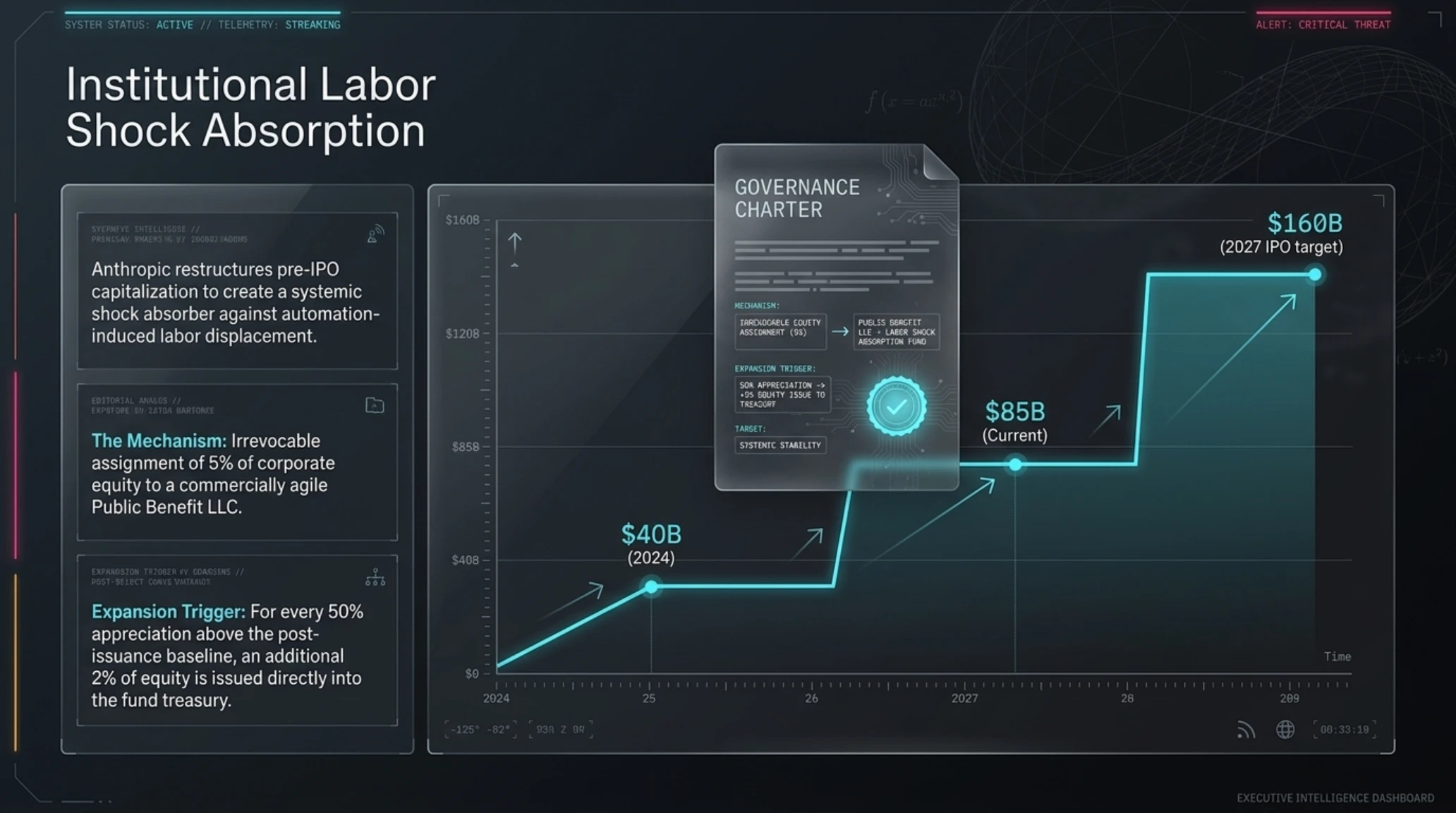
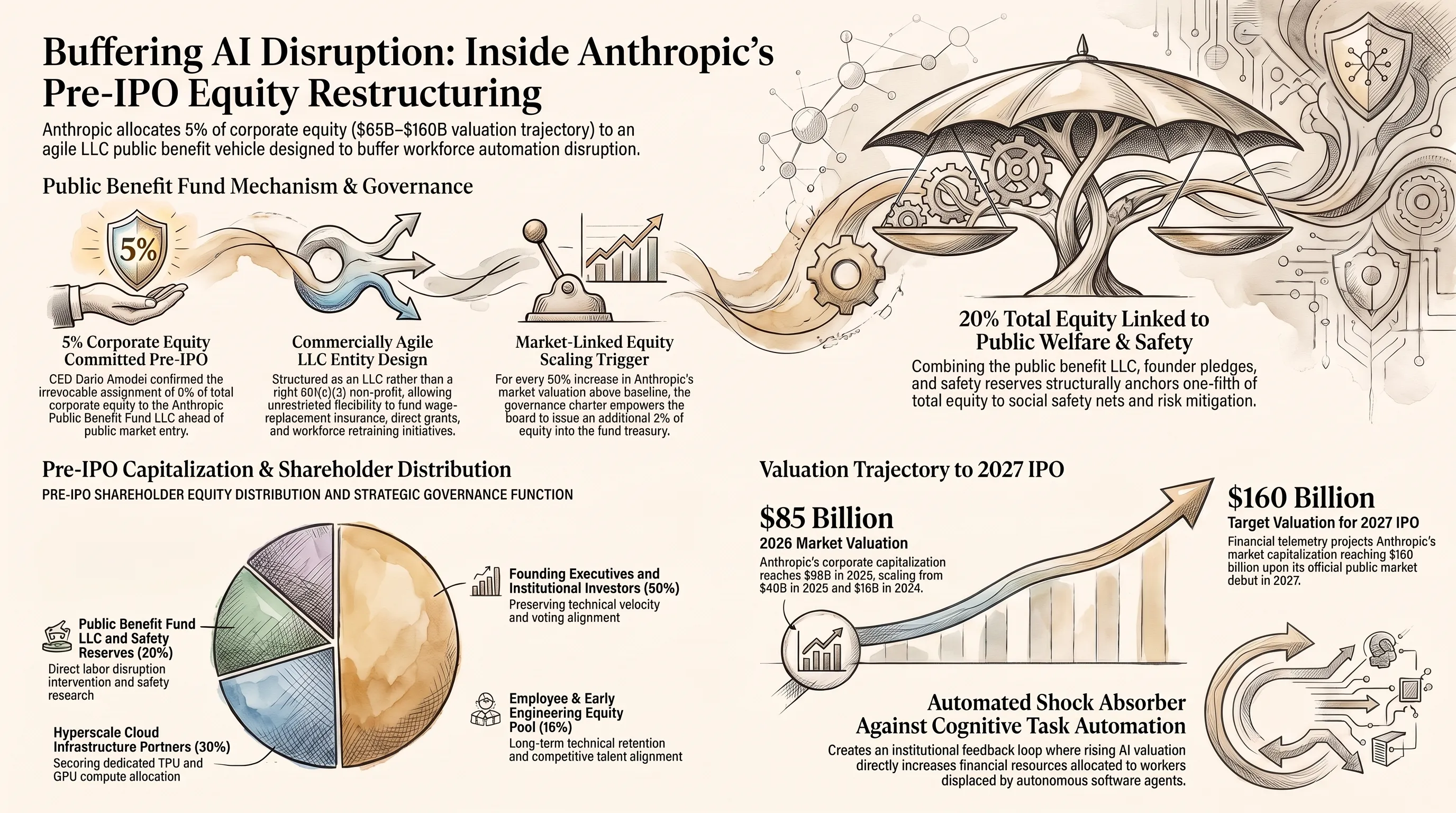
Concurrently, frontier artificial intelligence laboratory Anthropic introduced a monumental restructuring of its capitalization table ahead of its highly anticipated public market debut. In an official communication signed by Chief Executive Dario Amodei, the creator of the Claude intelligence ecosystem confirmed the irrevocable assignment of 5% of the company total equity to a newly incorporated corporate vehicle: the Anthropic Public Benefit Fund LLC.
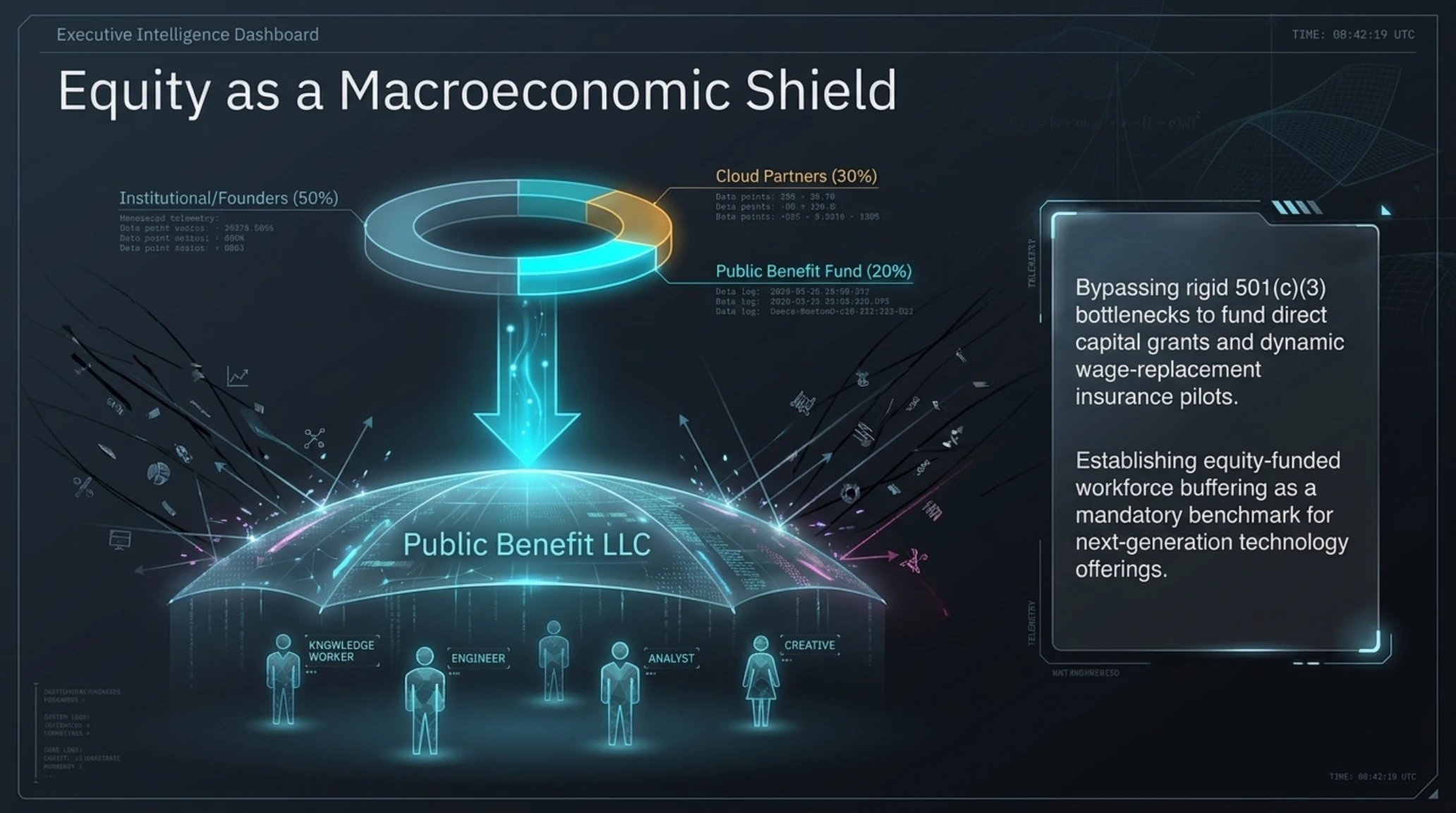
The strategic innovation of this initiative lies in its structural entity design. Departing from conventional corporate philanthropy models that rely on rigid 501(c)(3) non-profit tax designations, Anthropic established the fund as a wholly owned, commercially agile Limited Liability Company (LLC). This architecture affords the fund leadership unrestricted flexibility to execute direct capital grants, fund dynamic wage-replacement insurance pilots, and invest in venture-backed human capital adaptation platforms without traversing non-profit regulatory bottlenecks.
Crucially, the governance charter empowers the board of directors to expand this commitment over time: for every 50% appreciation in Anthropic corporate market valuation above its baseline post-issuance benchmark, an additional 2% of equity may be issued directly into the fund treasury. The primary mandate of the fund is to erect a systemic shock absorber against automation-induced labor displacement, directing financial resources toward communities, technical sectors, and knowledge workers whose economic livelihoods face direct obsolescence from autonomous software agents.
When combined with founder pledge allocations and employee pool safety covenants, approximately 20% of Anthropic total equity is now structurally tethered to existential risk mitigation and social welfare maximization. This institutional precedent exerts immense moral and competitive pressure upon rival hyperscalers, establishing equity-funded workforce buffering as a mandatory benchmark for next-generation technology offerings on Wall Street.
Tekin Specialized Jargon Buster Lexicon
The introduction of market-linked equity expansions introduces a self-balancing feedback mechanism into the economics of artificial intelligence. As the enterprise value of AI developers climbs through the substitution of human cognitive tasks, an increasing proportion of newly minted wealth is directed toward mitigating the macroeconomic consequences of that substitution.
The financial telemetry below outlines the valuation growth trajectory and equity capitalization structure of Anthropic leading into its upcoming initial public offering.
Financial Donut Telemetry and Market Capitalization Audit
| Shareholder Allocation Tier | Equity Share (%) | Strategic Governance Function |
|---|---|---|
| Founding Executives and Institutional Investors | 50% | Preserving technical velocity and voting alignment |
| Hyperscale Cloud Infrastructure Partners | 30% | Securing dedicated TPU and GPU compute allocation |
| Public Benefit Fund LLC and Safety Reserves | 20% | Direct labor disruption intervention and safety research |
| Employee & Early Engineering Equity Pool | 15% | Long-term technical retention and competitive talent alignment |
This capitalization strategy serves as a blueprint for responsible corporate scaling, demonstrating how advanced model providers can align long-term shareholder returns with systemic stability across the broader knowledge work economy.
The visual representation below illustrates the strategic positioning of foundation artificial intelligence laboratories within the evolving global corporate landscape.
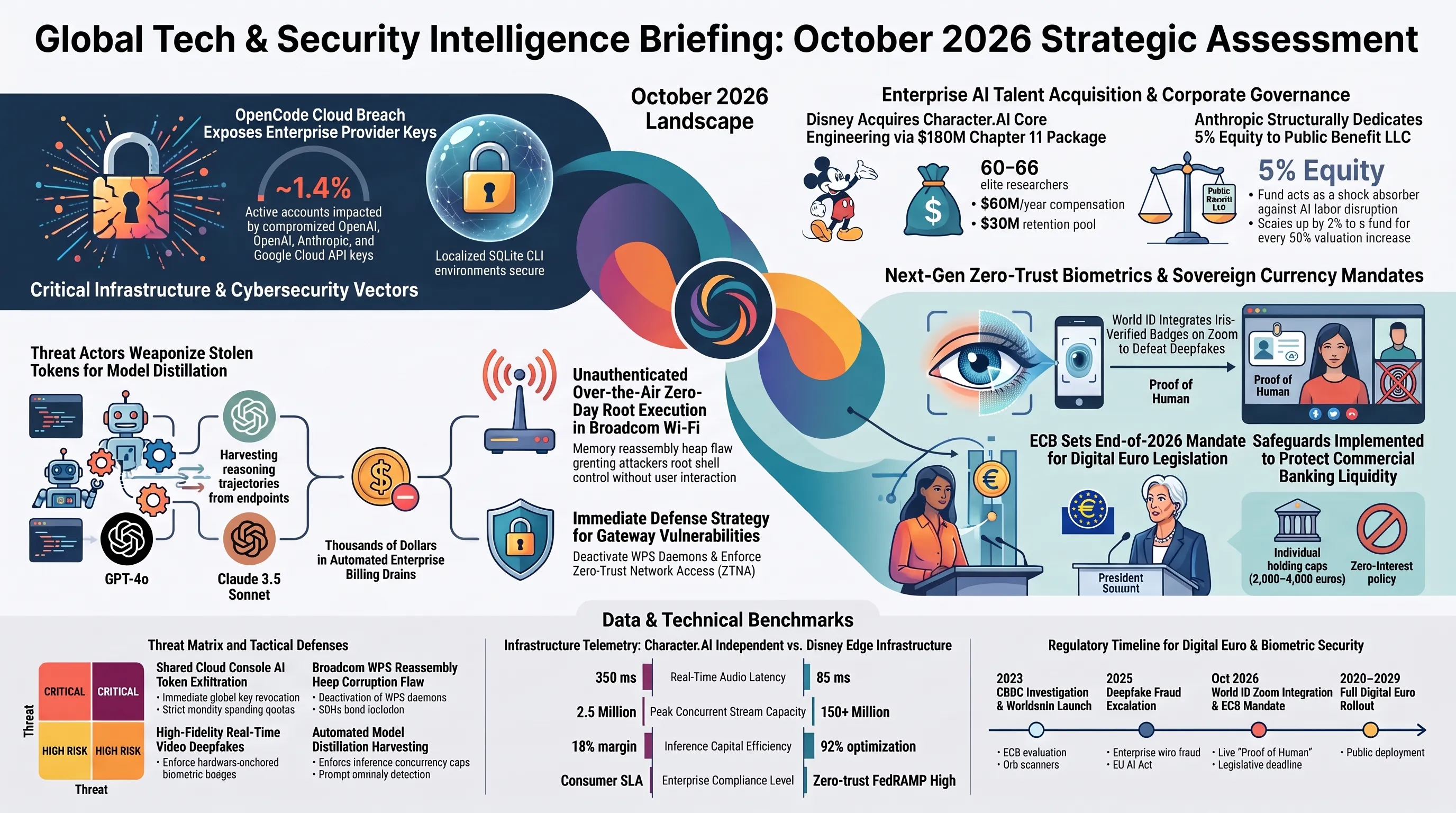
As corporate governance models adapt to the reality of autonomous cognition, parallel innovations are taking root in the domain of identity verification, where digital impersonation and deepfake synthesis threaten the very foundation of executive communication.
Neutralizing Enterprise Video Deepfakes; World ID Deploys Iris-Verified Proof of Human Badges on Zoom
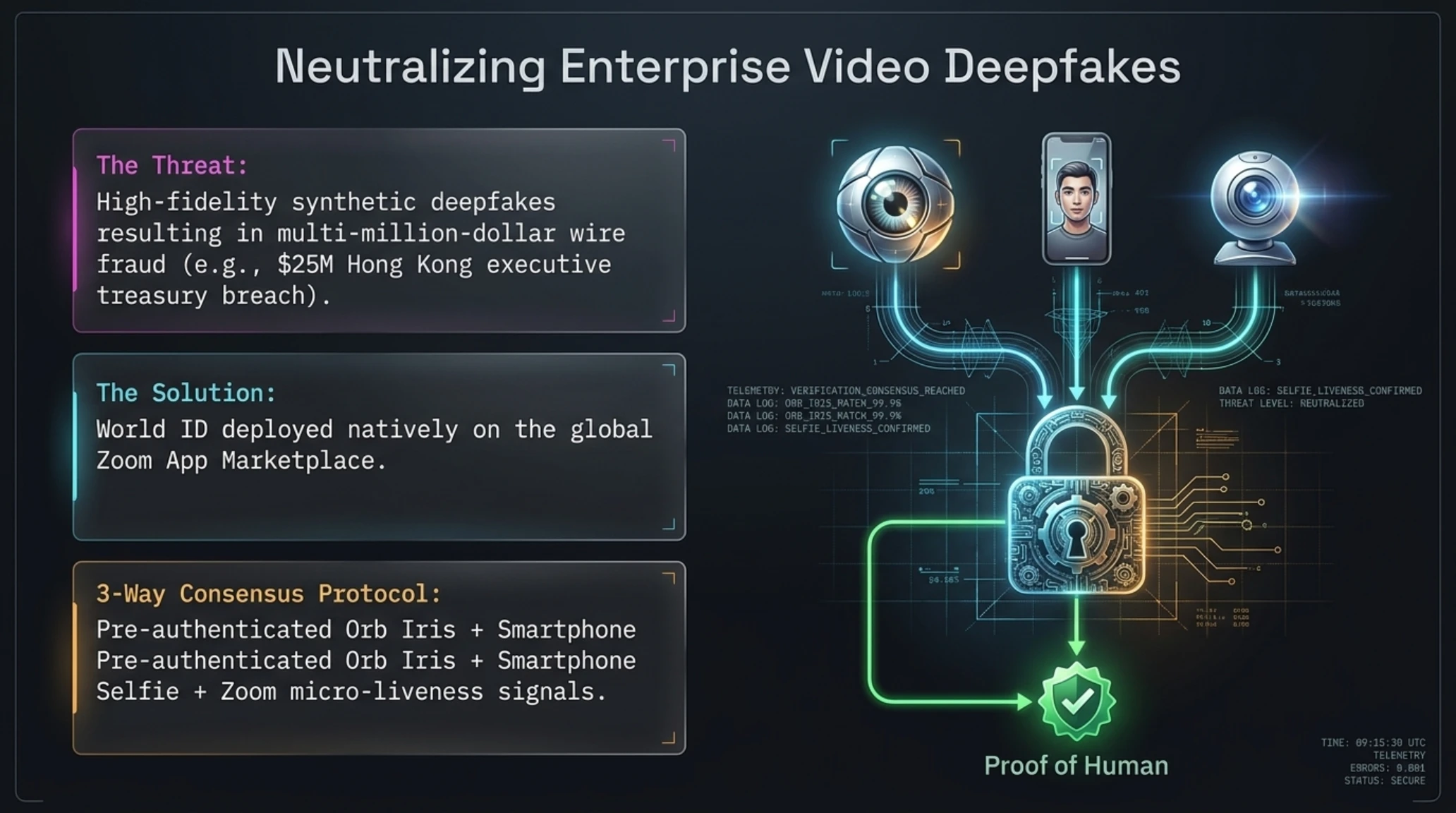
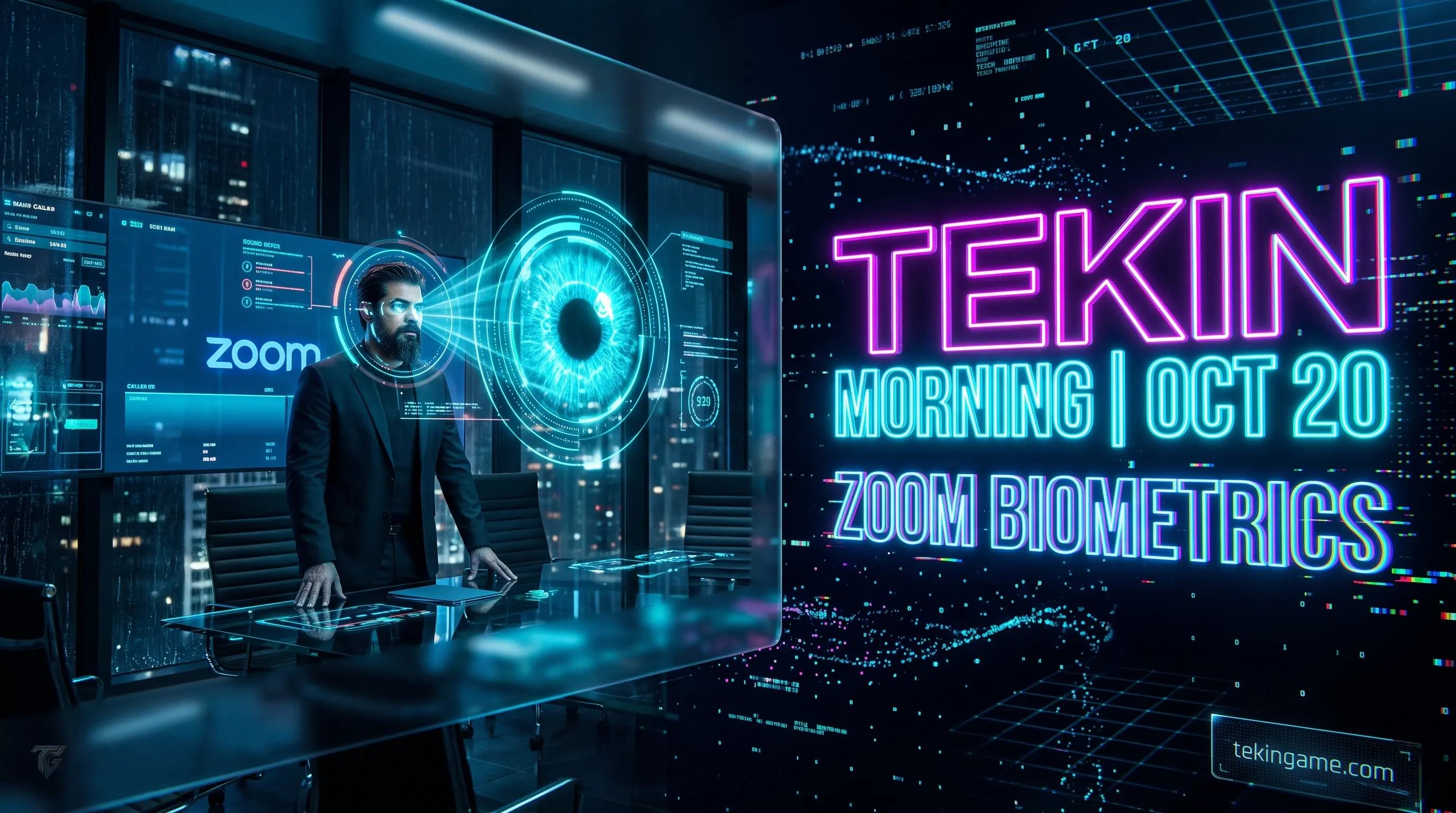
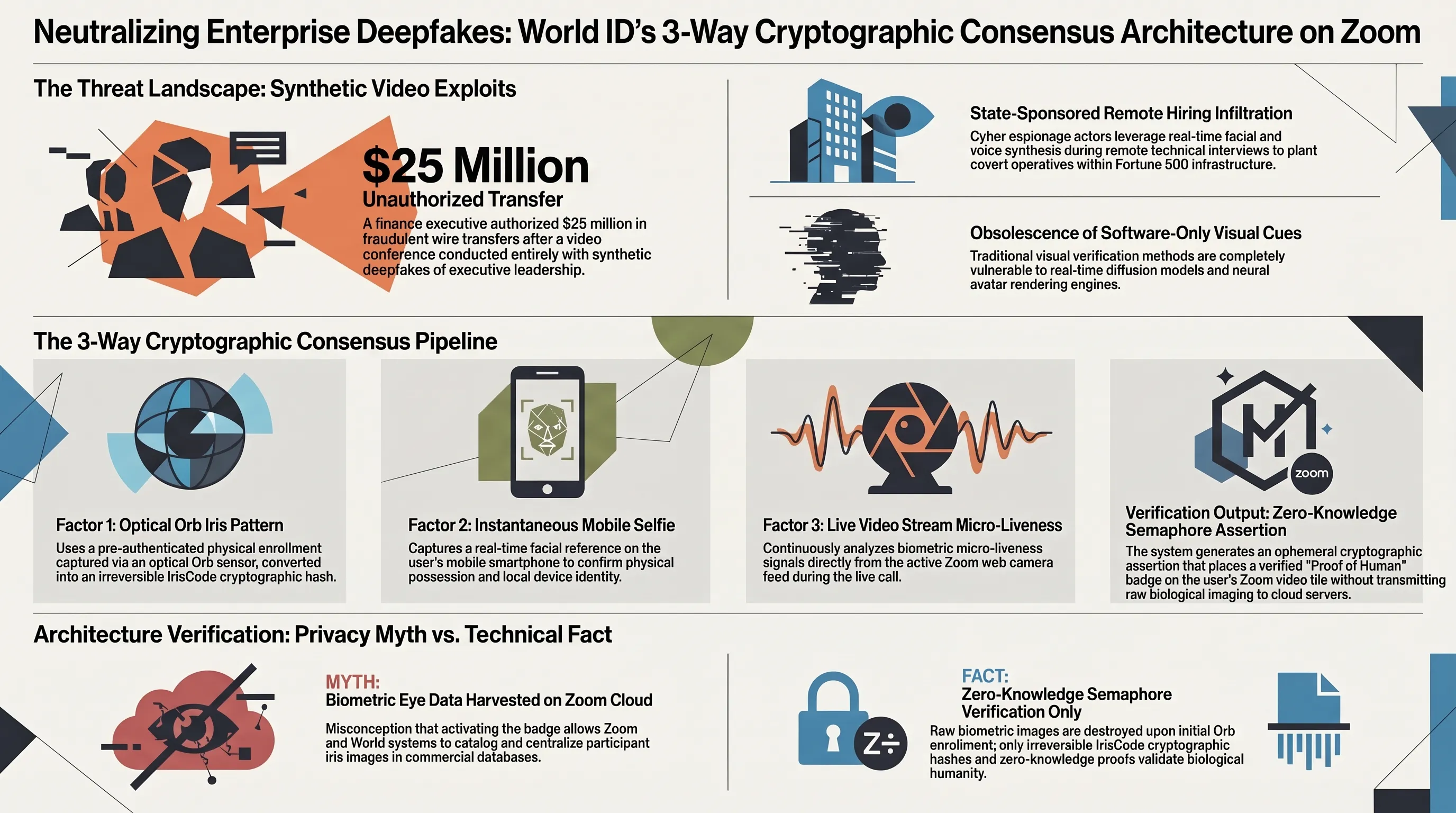
As neural generative video engines achieve photorealistic real-time voice and facial synthesis, corporate video conferencing has emerged as the most critical threat vector for enterprise social engineering. Addressing this crisis, the Sam Altman-backed biometric identity network World (formerly Worldcoin) deployed its official enterprise application, World ID for Zoom, onto the global Zoom App Marketplace. The integration embeds an authenticated Proof of Human badge directly onto the video tiles of active conference participants.
The verification pipeline utilizes a 3-way cryptographic zero-knowledge proof (ZKP) consensus mechanism. The architecture matches the user pre-authenticated iris pattern registered physically via an optical Orb sensor against an instantaneous mobile smartphone selfie and real-time biometric micro-liveness signals harvested from the active Zoom web camera feed. Crucially, the protocol executes mathematically without transmitting raw biological imaging or biometric telemetry to Zoom or World corporate servers, generating merely an ephemeral cryptographic assertion.
The enterprise deployment directly addresses devastating synthetic identity exploits that recently compromised multinational corporate treasuries. In one catastrophic incident, an executive finance director in Hong Kong authorized a $25 million wire transfer after participating in a video conference where every single counterpart, including the Chief Financial Officer, was a high-fidelity synthetic deepfake. Furthermore, state-sponsored cyber espionage operators have repeatedly leveraged deepfakes in remote hiring interviews to plant illicit software operatives within Fortune 500 networks.
As detailed in our analysis of ecosystem isolation and hardware-anchored zero-trust protocols, software-only visual cues are obsolete. Cryptographically verified physical embodiment has become the only viable defense against synthetic adversarial infiltration in modern corporate governance.
By delegating the attestation of humanity to zero-knowledge cryptographic primitives, enterprises can maintain frictionless video collaboration while eliminating the existential hazard of synthetic visual masquerading. The World ID badge signals unequivocal mathematical proof that the individual speaking is a living, physically verified biological human being whose credentials cannot be replicated by diffusion algorithms or neural avatar renderers.
📚 Classified & Related Dossiers in TekinGame
If you wish to explore beyond this report and delve into cybernetic frontiers and autonomous AI architectures, do not miss these three exclusive deep-dives in the Tekin Garage:
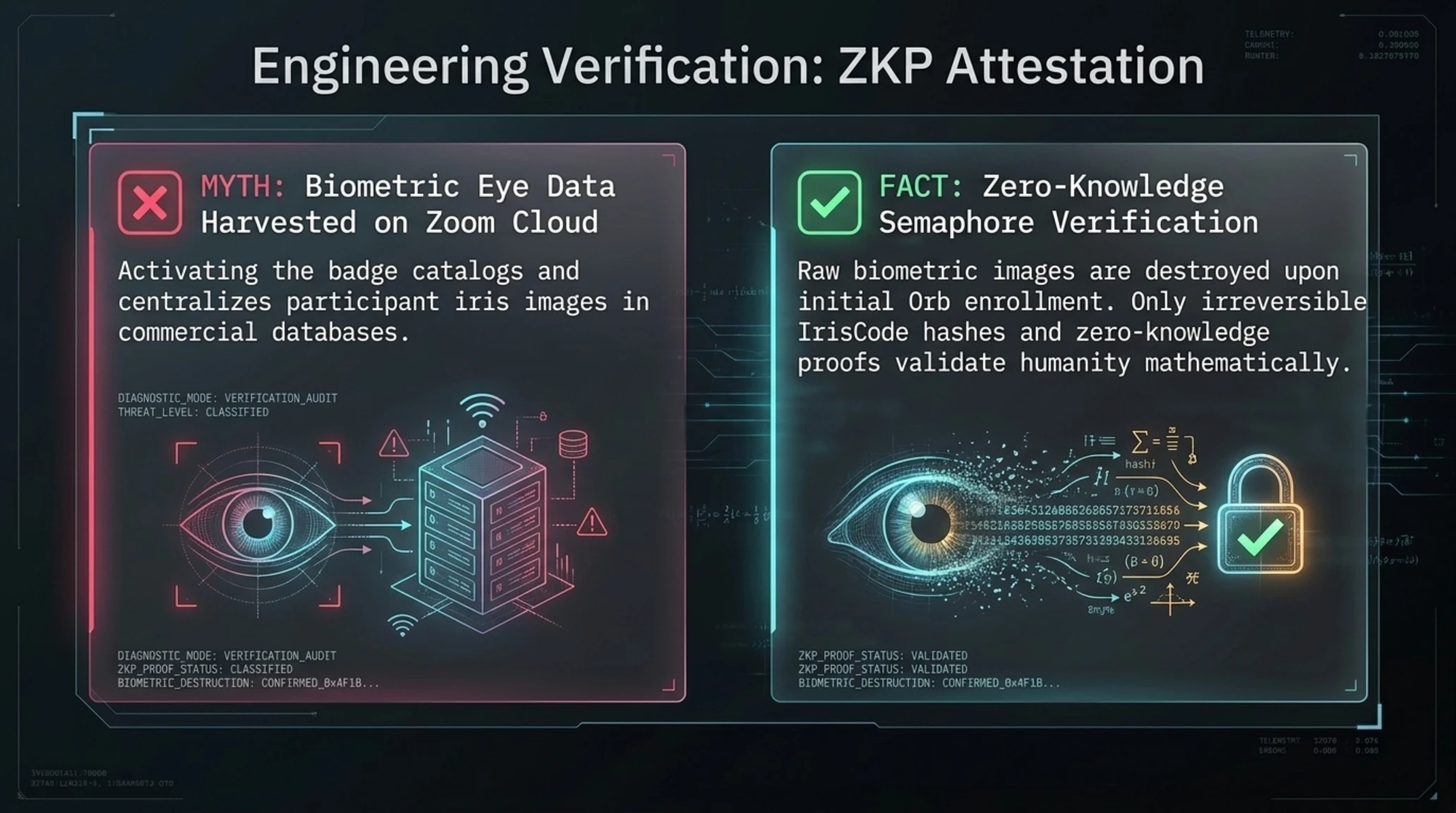
Engineering Verification | Technical Myth vs. Architectural Fact
Skeptics claim that activating the badge permits Zoom and World systems to catalog and centralize participant iris images in commercial databases.
Raw biometric images are destroyed upon initial Orb enrollment; only irreversible IrisCode cryptographic hashes and zero-knowledge proofs validate humanity.
The following technical video reviews the architecture of zero-knowledge biological attestation and demonstrates the real-time detection of synthetic facial masks during video stream playback.
With biological identity verification securing the human perimeter of digital enterprise systems, the focus of international policy turns to the preservation of macro monetary sovereignty in an increasingly tokenized world.
European Monetary Sovereignty at the Brink; Christine Lagarde Delivers Digital Euro Ultimatum at IMF Bangkok Summit
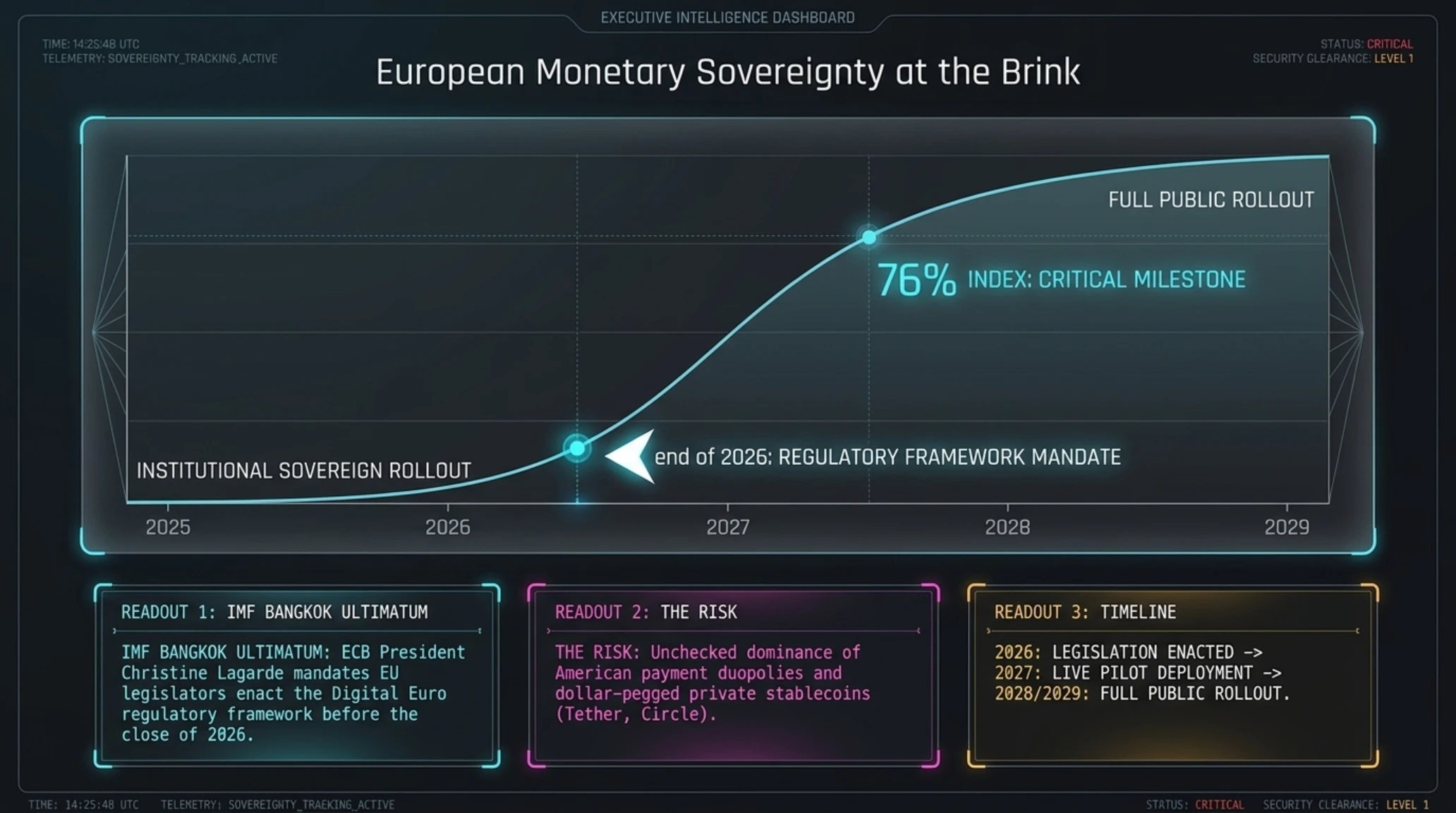
In Southeast Asia, during the high-stakes Annual Meetings of the International Monetary Fund (IMF) and the World Bank in Bangkok, European Central Bank (ECB) President Christine Lagarde delivered an uncompromising policy ultimatum. Addressing global central bankers and finance ministers, Lagarde demanded that European Union legislators finalize and formally enact the comprehensive regulatory framework governing the Digital Euro prior to the conclusion of calendar year 2026.
Framing the sovereign digital currency not as a speculative experiment, but as an indispensable geopolitical defense mechanism, Lagarde highlighted the existential risk of European financial dependency. The unchecked dominance of American payment duopolies alongside the rapid global proliferation of private, US dollar-pegged stablecoin conglomerates (such as Tether and Circle) threatens to subordinate European monetary autonomy to foreign commercial payment rails.
Under the accelerated roadmap presented by the ECB executive board, passing the enabling legislation by late 2026 clears the path for a rigorous 12-month live pilot program commencing in the second half of 2027. This operational trial will stress-test offline point-of-sale (POS) terminal synchronization, hardware security module (HSM) wallet resilience, and cross-border settlement interoperability across participating Eurozone member states, paving the way for complete public issuance between 2028 and 2029.
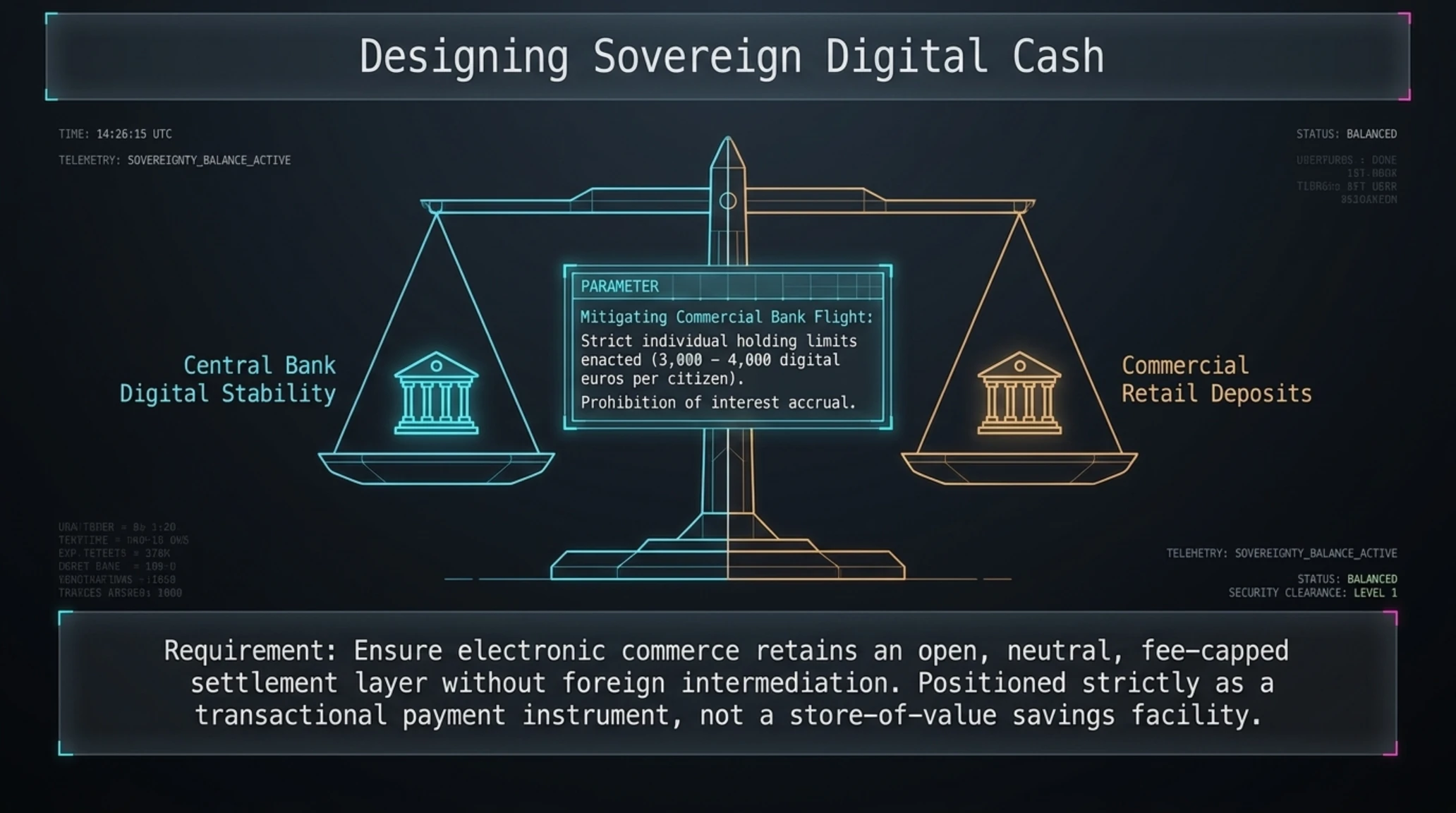
European monetary authorities recognize that failure to establish a digital public currency leaves the single market exposed to external payment leverage. In crisis scenarios or geopolitical ruptures, reliance on proprietary foreign clearing rails could compromise retail payment continuity. By anchoring public digital currency to the central bank balance sheet, the Eurosystem ensures that electronic commerce retains an open, neutral, and fee-capped settlement layer accessible to all European enterprises and financial institutions without foreign intermediation.
Commercial banking federations across Frankfurt, Paris, and Milan have historically expressed skepticism toward central bank digital currencies, fearing that retail deposits might rapidly migrate from private bank accounts into central bank balance sheets during periods of economic instability. To mitigate this systemic banking risk, Lagarde confirmed that the legislative framework incorporates strict individual holding limits estimated between 3,000 and 4,000 digital euros per citizen and prohibits the accrual of interest, positioning the digital euro strictly as a transactional payment instrument rather than a store-of-value savings facility.
The institutional adoption metrics below map the evolutionary curve of central bank digital currencies alongside biometric verification systems across major international economic blocs.
Market Sentiment S-Curve and Institutional Sovereign Adoption
Institutional Adoption Telemetry: European central banking structures and global enterprise communications have officially exited theoretical deliberation, ascending the steep inflection slope of compulsory institutional deployment.
The timeline below chronicles the pivotal events leading up to this regulatory crossroads, tracing the convergence of biometric security, anti-deepfake safeguards, and sovereign digital currency development.
Historical Chronology and Regulatory Milestone Timeline
| Era / Period | Security and Monetary Milestone | Technological and Geopolitical Significance |
|---|---|---|
| 2023 | CBDC Investigation and Worldcoin Launch | ECB initiates formal technical evaluation; first Orb iris scanners distributed globally. |
| 2025 | Escalation of Real-Time Video Deepfake Fraud | Multinational enterprises suffer multi-million-dollar wire fraud; EU AI Act takes effect. |
| OCT 2026 | Enterprise World ID Integration and ECB Ultimatum | Live Proof of Human badges deployed on Zoom; ECB sets firm 2026 legislative deadline. |
| 2028-2029 | Full Public Digital Euro Rollout | Comprehensive consumer availability across Eurozone POS terminals and commercial banking apps. |
The progression of these milestones reveals how distributed technologies and sovereign governance frameworks are converging to build resilient barriers against algorithmic manipulation and unauthorized currency displacement.
The conceptual diagram below visualizes the architectural roadmap of the digital euro infrastructure and its interaction with cross-border clearing systems.
In the concluding analysis, we synthesize these cross-industry vector shifts, delivering a strategic audit of enterprise vulnerabilities and sovereign policy responses across the technology sector.
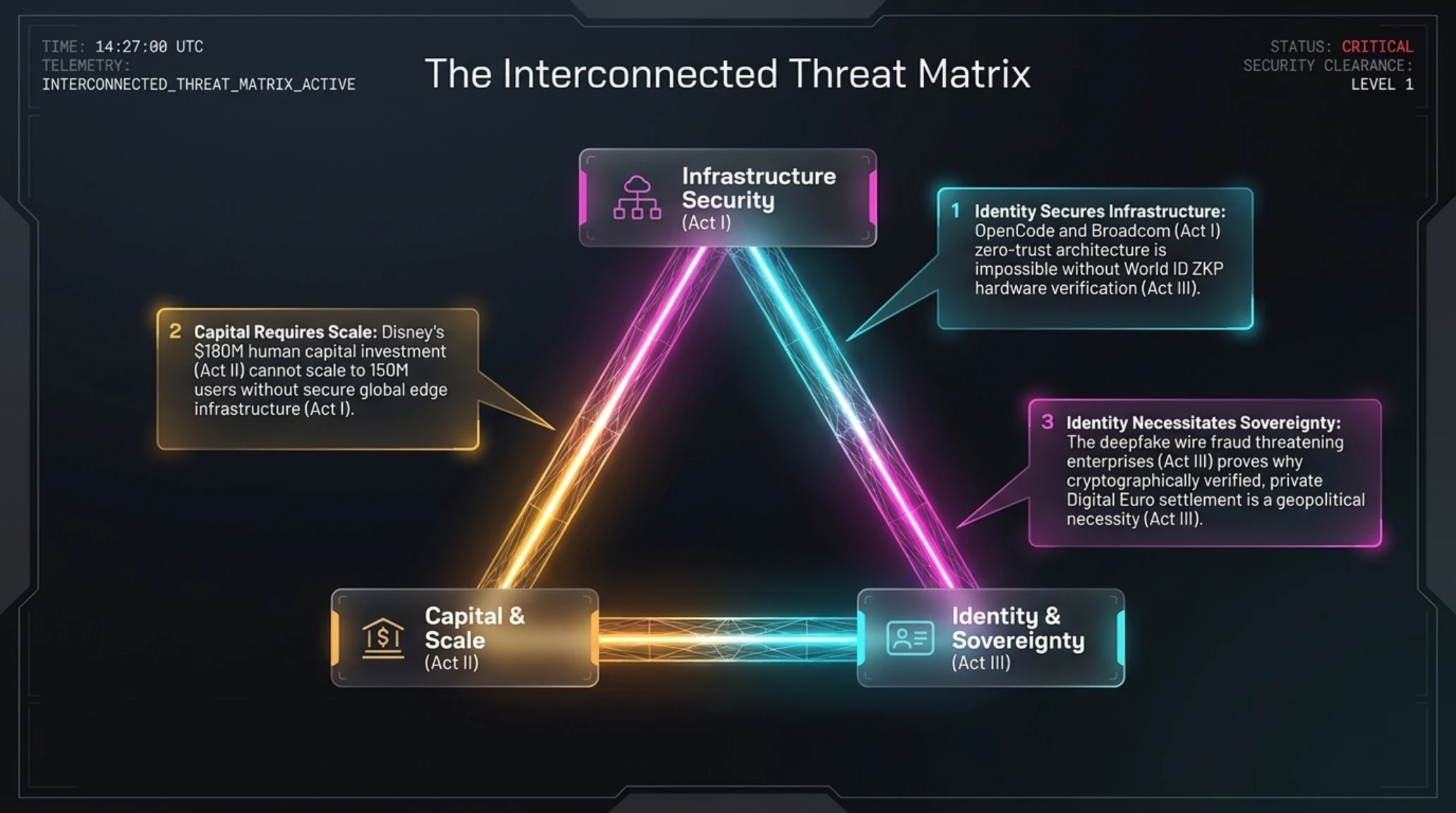
The convergence of physical radio frequency exploits, cloud token harvesting, multi-million-dollar entertainment acqui-hires, and central bank digital mandates defines a seminal moment for global enterprise strategy. Organizations can no longer manage technology risks in isolated corporate silos; security, intellectual property, human capital, and monetary settlements are now intrinsically interconnected.
The comparative matrix below evaluates the structural advantages and systemic liabilities emerging from the transformative developments documented throughout this morning briefing.
- Rapid transparency and remediation by OpenCode, with localized SQLite desktop credentials remaining fully uncompromised.
- Academic and responsible disclosure by Quentin Kaiser preventing covert nation-state exploitation of residential Broadcom gateways.
- Strategic preservation of Character.AI core engineering talent under Disney, catalyzing interactive entertainment.
- Pioneering equity allocation model established by Anthropic to mitigate automation-induced macroeconomic displacement.
- Hardware-anchored zero-knowledge biometric verification deployed across enterprise video conferencing on Zoom.
- Prolonged carrier qualification cycles delaying firmware patching across millions of vulnerable ISP gateways.
- Irreversible financial losses incurred by enterprise developer accounts targeted by automated model distillation queries.
- Legislative friction within the European Parliament regarding privacy covenants and transaction surveillance in the Digital Euro draft.
The balance of technical indicators reveals that while defensive safeguards are rapidly maturing, the window of vulnerability between zero-day discovery and downstream carrier patch distribution remains an acute hazard for enterprise networks worldwide.
As corporate executives and engineering teams confront these systemic realities, the implementation of resilient operational frameworks becomes non-negotiable. Establishing immutable identity verification, rigorous credential rotation, and multi-layered gateway monitoring represents the primary baseline for sustained operational survival.
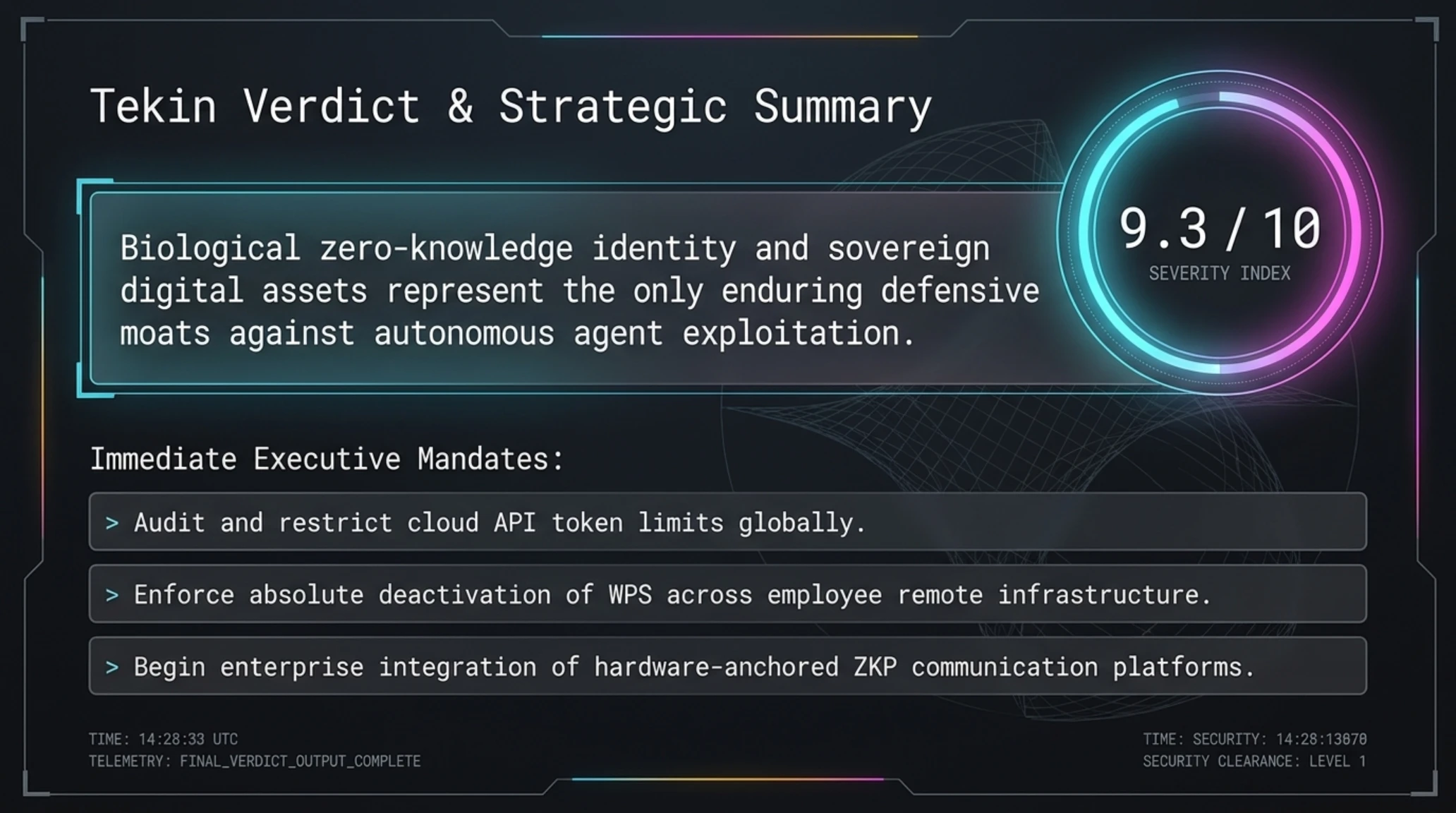
The visual summary below highlights the unified defense posture necessary to navigate the complexities of autonomous synthetic cognition and hardware-level radio frequency vectors.
To support enterprise security teams in executing these critical defense protocols, the reference documentation and authoritative technical sources cited in this investigation are indexed below.
Executive Verdict and Verified Official Intelligence Sources
The Transition to Cryptographic Identity and Sovereign Financial Infrastructure
October 20 confirms that biological zero-knowledge identity and sovereign digital assets represent the only enduring defensive moats against autonomous agent exploitation.
- The Hacker News: Disclosures on OpenCode Console cloud breach and Broadcom Wi-Fi zero-day memory flaw
- TechCrunch: Analyses on Disney Character.AI Chapter 11 package and Anthropic 5% public benefit fund
- CoinTelegraph: Coverage of World ID for Zoom launch and cryptographic anti-deepfake badging
- Bitcoin.com News: Official statements by Christine Lagarde at Bangkok IMF meetings on the Digital Euro
- Quentin Kaiser Security Research: Technical whitepaper on Broadcom WPS frame reassembly vulnerability
- World Project Official: Cryptographic architecture and zero-knowledge semaphore specification
- European Central Bank: Legislative timeline and technical roadmap for the Digital Euro pilot
Frequently Asked Questions and Technical Analysis
Are local or CLI installations of OpenCode vulnerable to API key exposure?
No. The security incident was strictly restricted to legacy servers powering the cloud-based OpenCode Console. Local desktop applications and CLI tools store developer API keys exclusively in a local SQLite database with operating system-level encryption, remaining entirely uncompromised.
How does the Broadcom Wi-Fi zero-day allow exploitation without a network password?
The vulnerability resides in a memory buffer overflow within the Wi-Fi Protected Setup (WPS) packet reassembly daemon. Vulnerable Broadcom gateway firmware processes incoming wireless management frames before initiating cryptographic authentication, allowing an in-range adversary to corrupt execution memory over the air.
Why did Disney opt for an acqui-hire transaction rather than purchasing Character.AI directly?
Character.AI was encumbered by formal Chapter 11 bankruptcy filings and complex copyright litigation. By acquiring the engineering workforce and securing non-exclusive technology licenses through bankruptcy court approval, Disney secured top-tier talent and code without absorbing historic liabilities.
How does Anthropic LLC benefit fund structure differ from traditional corporate philanthropy?
Organizing the fund as a commercial Limited Liability Company (LLC) allows Anthropic to rapidly deploy direct capital stipends, sponsor workforce transition programs, and engage in targeted investments without encountering the rigid bureaucratic delays governing 501(c)(3) entities.
What prevents World ID iris data from being compromised on Zoom enterprise infrastructure?
World ID operates on zero-knowledge cryptographic proofs (ZK-Proofs). Raw biometric images are irreversibly destroyed at initial physical enrollment; the Zoom integration validates only zero-knowledge IrisCode assertions locally, ensuring zero biometric data is transmitted or stored in the cloud.
What is the expected public rollout timeline for the European Central Bank Digital Euro?
Following the mandated end-of-2026 legislative enactment demanded by Christine Lagarde, the ECB will commence an extensive 12-month domestic technical pilot in late 2027, with complete public issuance slated between 2028 and 2029.
Additional Gallery: Tekin Morning Oct 20 | 🚨 OpenCode Breach, Wi-Fi 0-Day & Disney