TEKIN ANALYSIS | Executive Briefing & Morning Radar // Oct 16, 2026
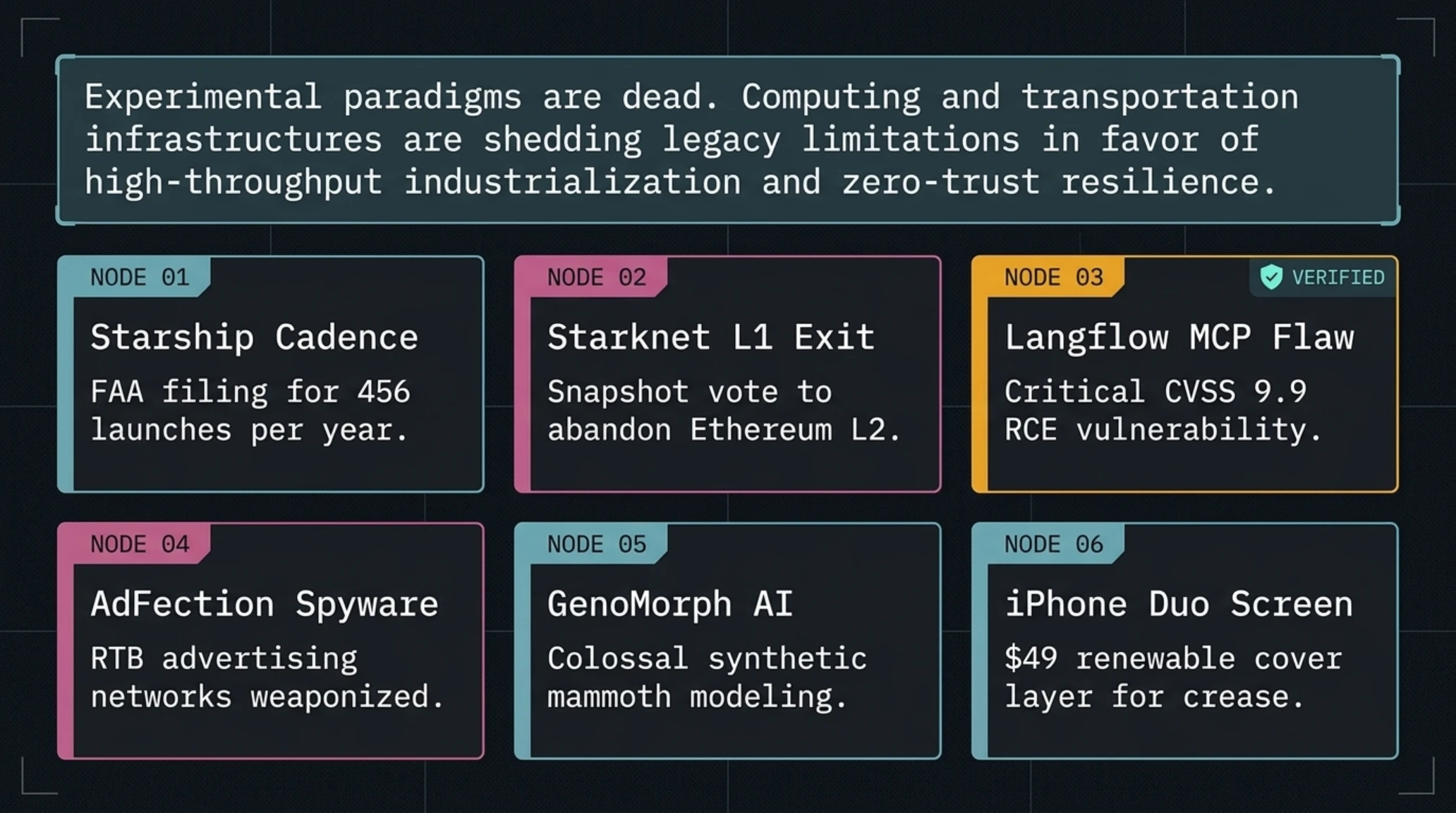
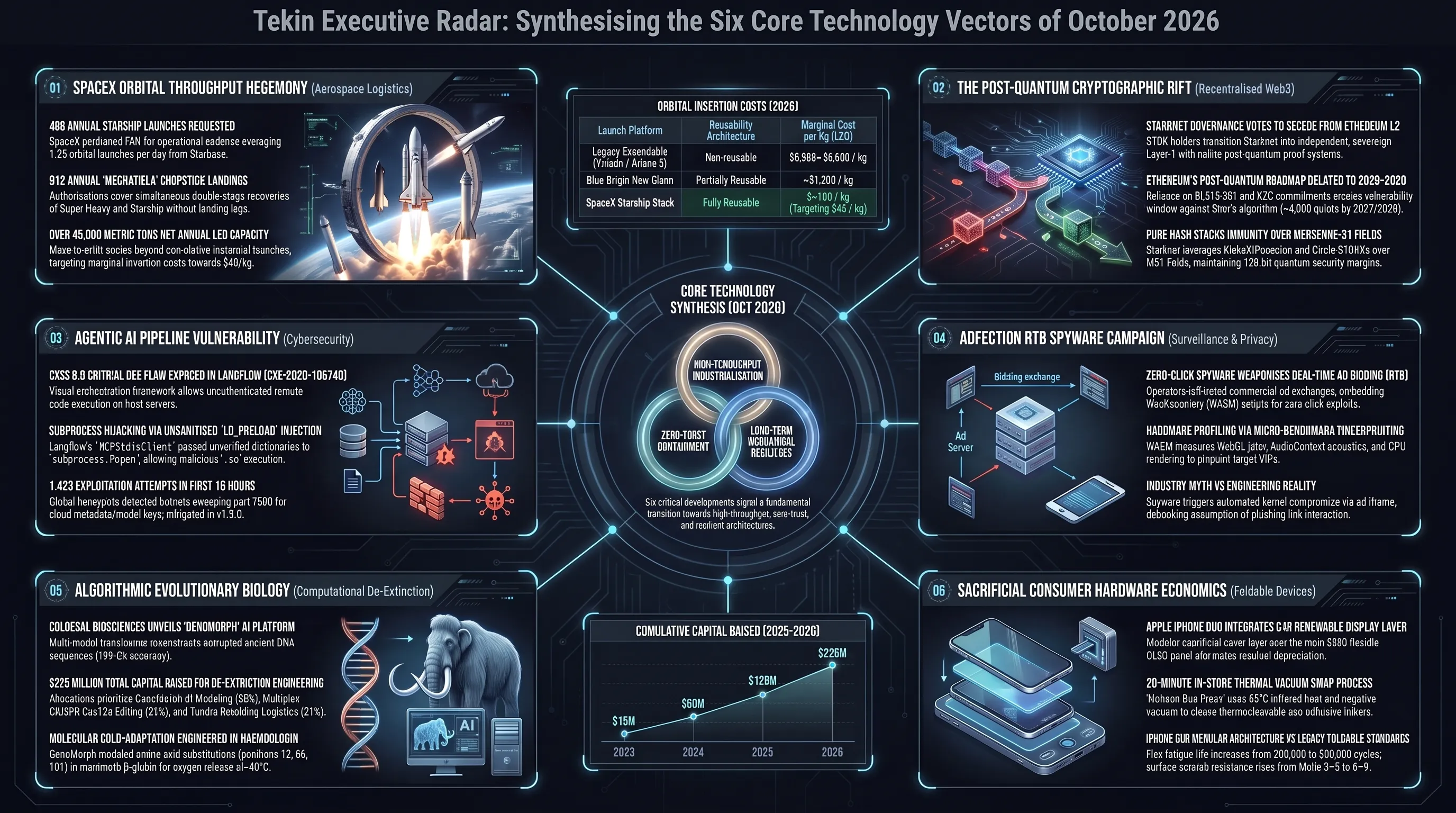
The dawn of Friday, October 16, 2026 heralds an extraordinary acceleration in deep technology, aerospace logistics, and computational trust architectures. As capital allocators and enterprise architects navigate an increasingly volatile technological landscape, the developments of the past twenty-four hours underscore a structural transition: computing and transportation infrastructures are shedding experimental paradigms in favor of high-throughput industrialization.
From the tidal flats of South Texas where SpaceX is preparing an orbital cadence rivaling commercial aviation hubs, to the cryptographic corridors of decentralized finance where the looming threat of cryptanalytic quantum supremacy is forcing irreversible governance divorces, the strategic stakes have never been higher. Simultaneously, the vulnerability of autonomous agent pipelines and the weaponization of commercial ad-tech frameworks illustrate the fragile perimeter of modern digital workflows.
Strategic Intelligence & Core Vectors at a Glance
For executive decision-makers and senior engineers, these developments demand a coordinated strategic reassessment. The intersection of sovereign aerospace capability, zero-trust infrastructure, and computational biology illustrates that technological defensibility is increasingly dictated by holistic architectural resilience. We begin our executive analysis with the historic expansion of orbital launch operations in North America.
Understanding these shifts is imperative for institutional investors and technology leaders. As traditional hardware paradigms reach physical scaling limits, companies that establish robust operational flywheels and scalable supply chains will disproportionately capture economic rents across the next decade.
Industrializing Low Earth Orbit; SpaceX Submits Historic FAA Application for 456 Starship Launches Annually
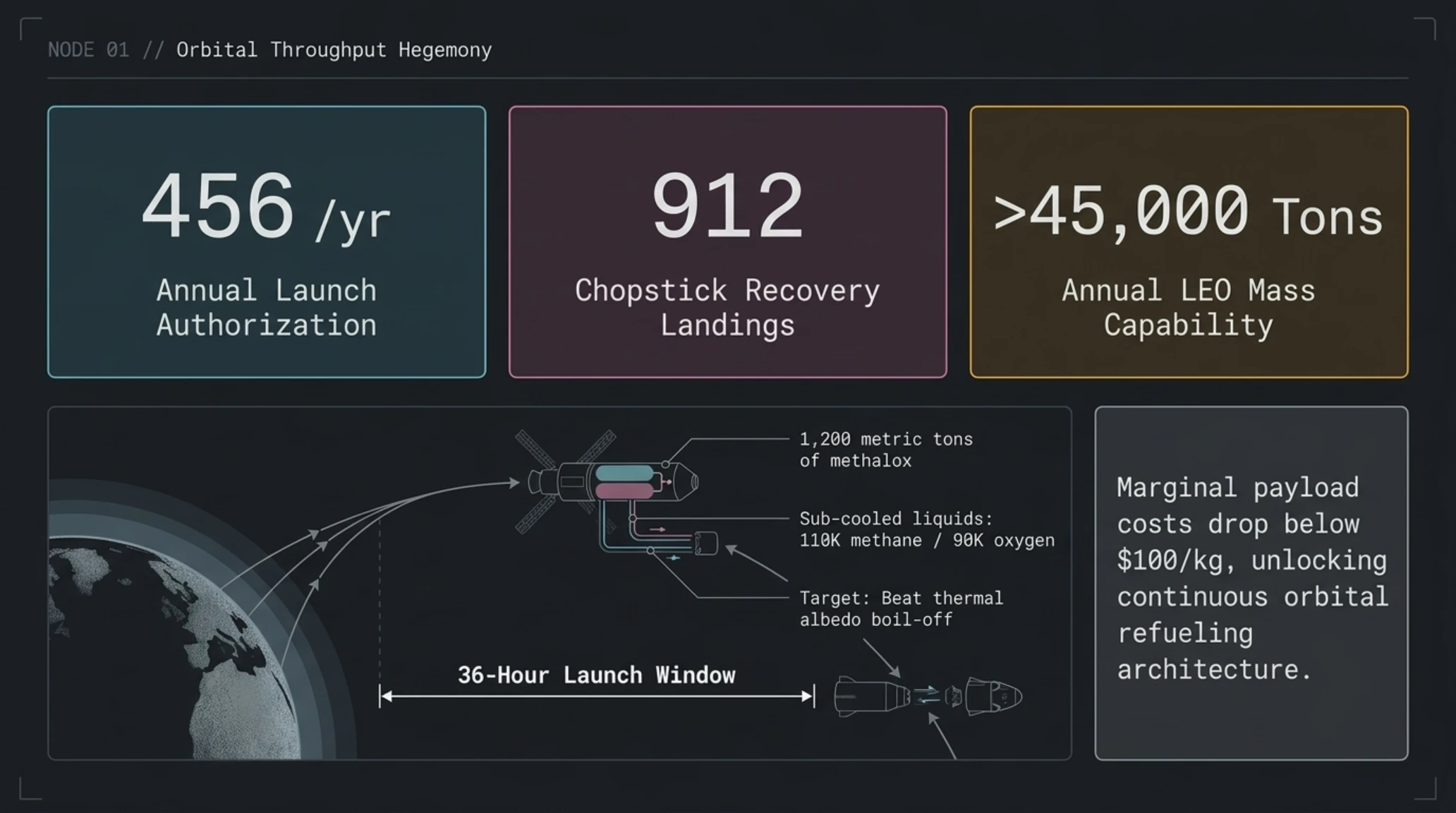
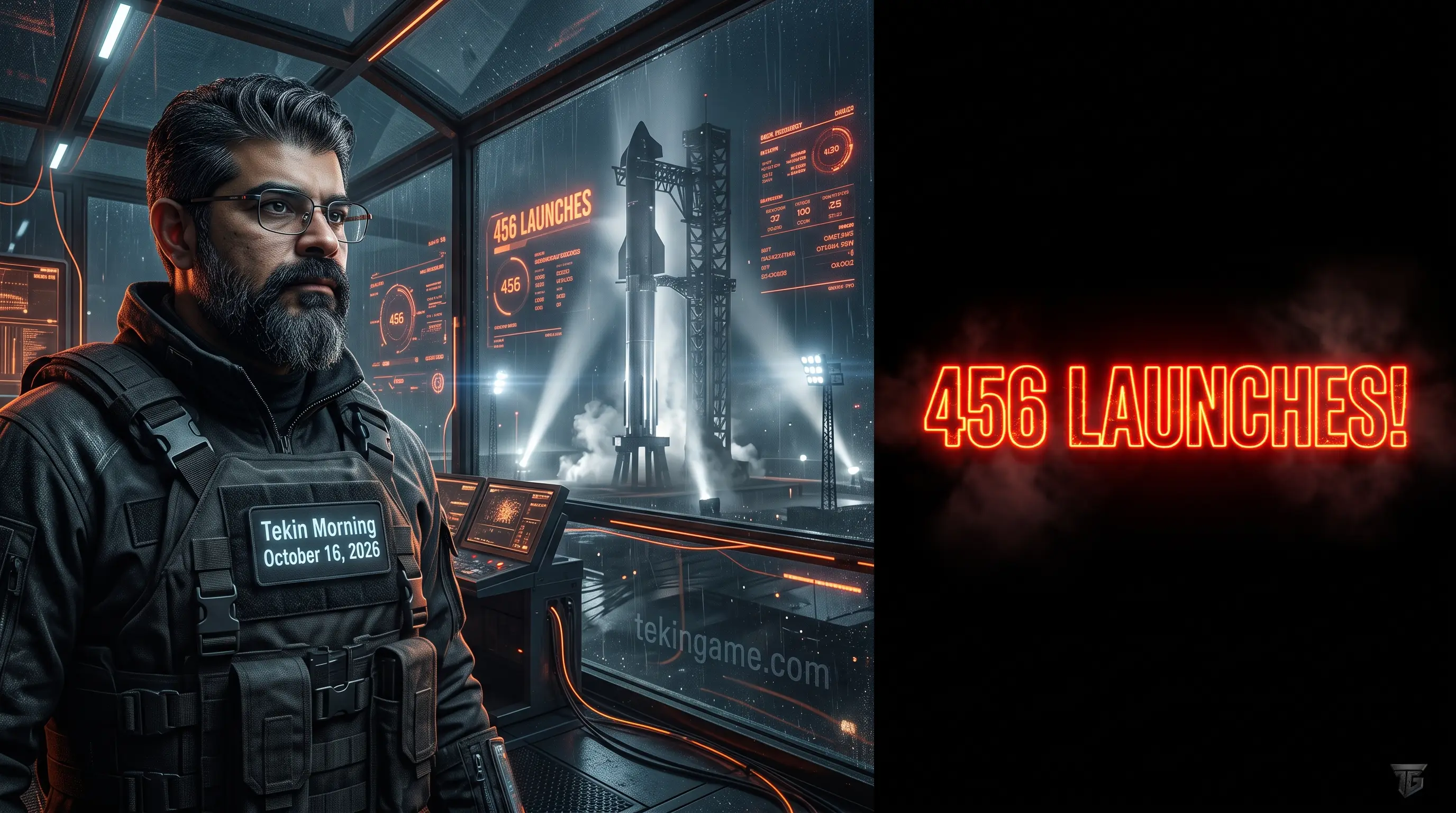
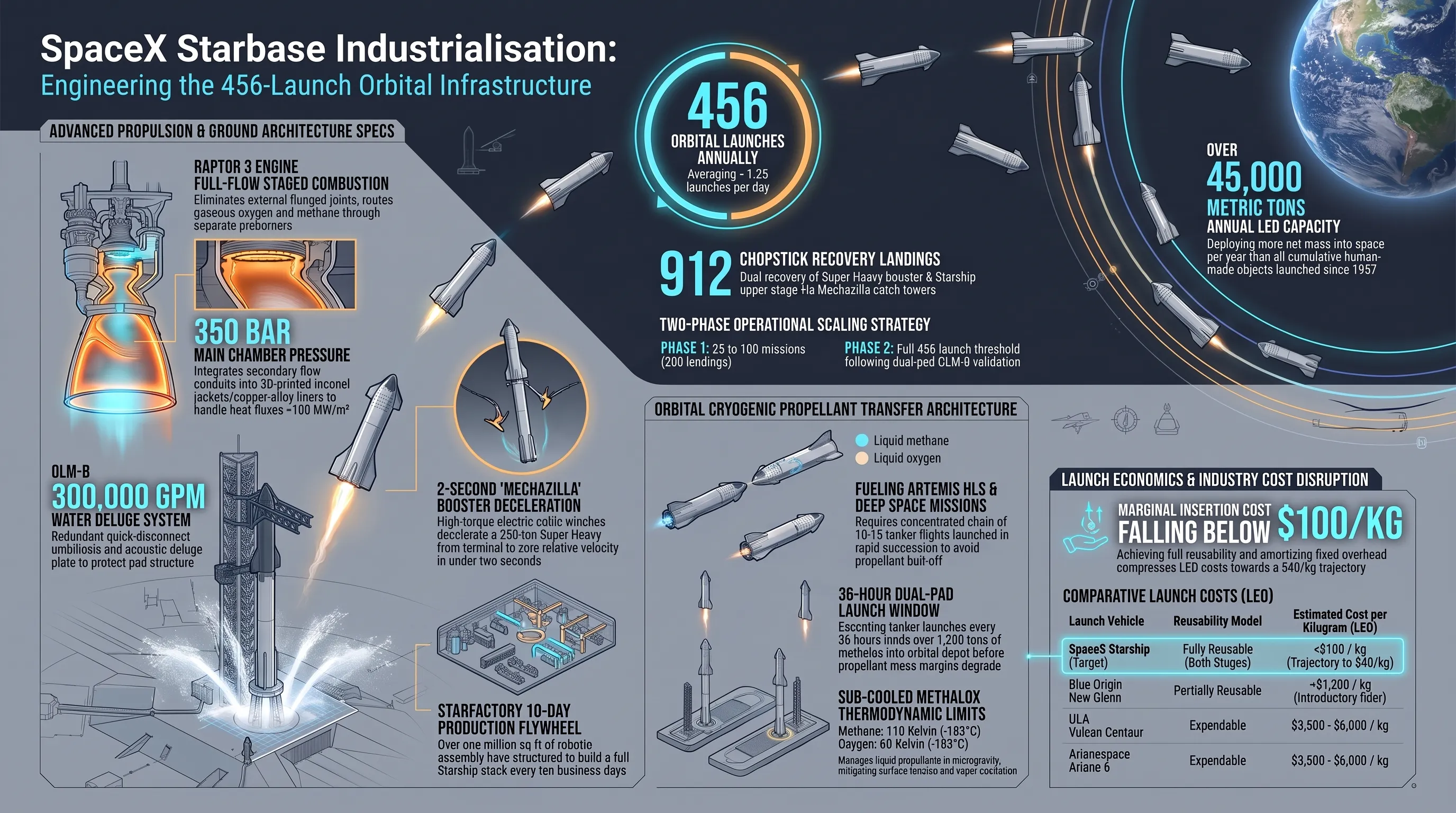
In an audacious regulatory filing submitted on October 14 and 15, 2026, SpaceX formally petitioned the Federal Aviation Administration (FAA) to amend its vehicle operator license, requesting authorization to execute up to 456 orbital Starship launches and 912 vehicle recovery landings per calendar year at Starbase in Boca Chica, Texas. The sheer magnitude of this operational cadence effectively transitions the southern tip of Texas into a commercial spaceport operating at an average tempo of approximately 1.25 orbital launches per day.
Detailed in filings covered by Space.com and Quartz, the expansion proposal is structured in two progressive operational tiers. The preliminary phase requests an immediate scaling from the current cap of 25 annual launches to 100 missions and 200 landings. Upon operational validation of the dual-pad infrastructure at Orbital Launch Mount B (OLM-B) and expanded methane tank farms, the secondary phase expands operations to the full 456-launch threshold. The 912 landings account for the simultaneous recovery of the Super Heavy booster and the Starship upper stage via the mechanical 'Mechazilla' chopstick arms, alongside the recovery of orbital stages launched from Cape Canaveral, Florida.
Why This Orbital Shift Redefines the Industry
Scaling Starbase to 456 annual missions compresses marginal payload delivery costs below $100 per kilogram into low Earth orbit, unlocking continuous orbital refueling architecture for Artemis and orbital datacenter deployments.
The Federal Aviation Administration responded by formally initiating a Programmatic Environmental Impact Statement (PEIS). This comprehensive environmental review is slated to evaluate acoustic overpressures, atmospheric heating from liquid methane and liquid oxygen (methalox) combustion, and potential migratory disruptions across sensitive tidal wetlands near the Rio Grande. Despite anticipated regulatory scrutiny from environmental coalitions, defense and space policy analysts note that the national imperative of the Artemis Human Landing System (HLS) contract valued at $2.9 billion creates immense political momentum for expedited regulatory clearance.
The operational imperative driving this unprecedented flight frequency is orbital cryo-propellant transfer. Modern deep space exploration architecture requires that every lunar or Martian expedition be preceded by a concentrated chain of ten to fifteen tanker flights within a tight operational window to avoid cryogenic boil-off. In our prior technical assessment of orbital compute infrastructure and Starship economics, we demonstrated that lowering orbital insertion costs below the $100/kg threshold is the single most critical catalyst for the expansion of off-world computing clusters.
To understand why cryogenic propellant management mandates this launch tempo, one must examine the thermodynamics of sub-cooled liquid methane at 110 Kelvin (-163 degrees Celsius) and liquid oxygen at 90 Kelvin (-183 degrees Celsius). When transferred in microgravity, surface tension and vapor cavitation create significant boil-off losses unless tankers dock in rapid succession. By conducting tanker launches every thirty-six hours from dual launch pads, SpaceX can load over 1,200 metric tons of methalox into an orbital propellant depot before thermal radiation from Earth's albedo degrades the propellant mass margin.
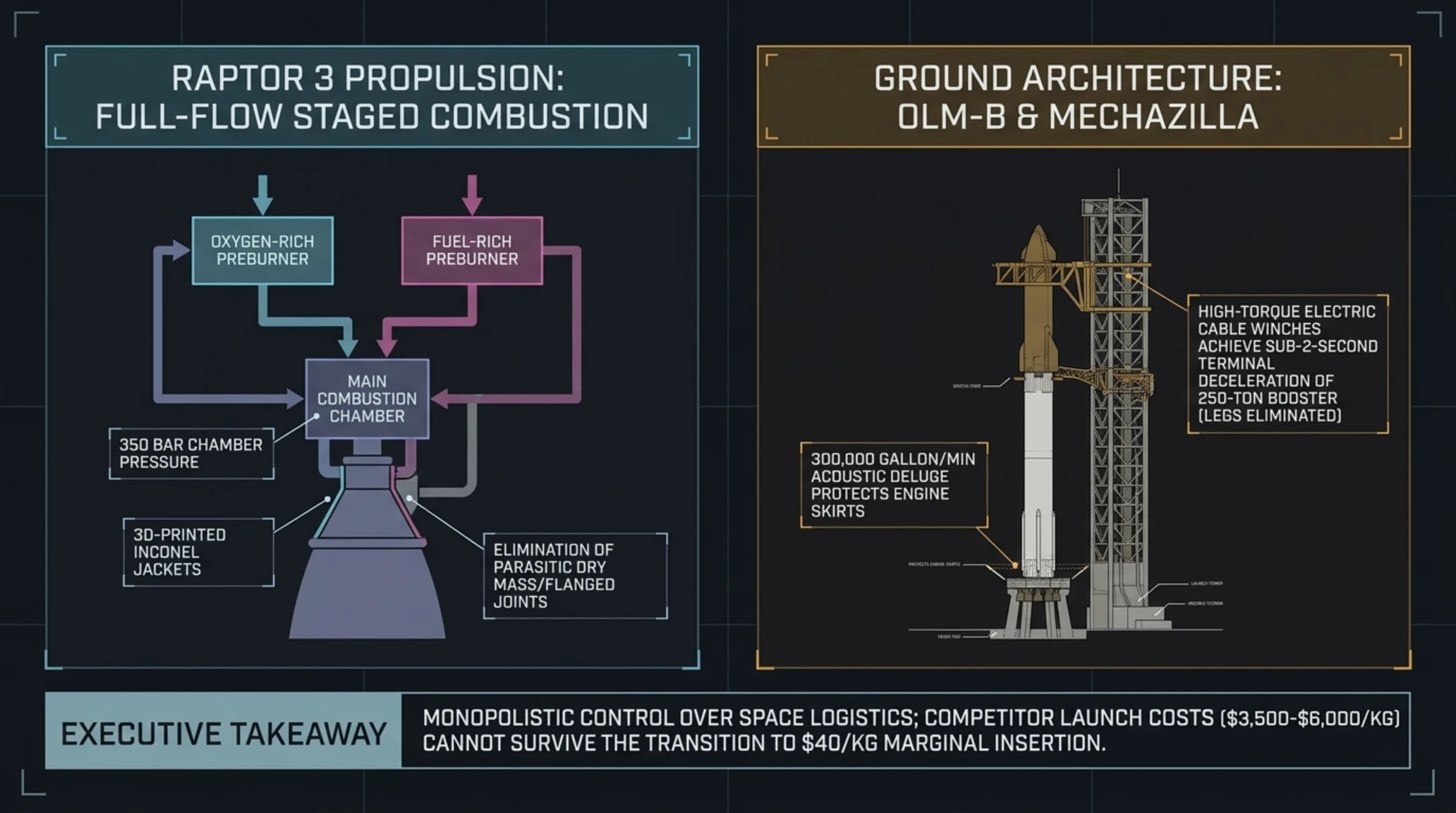
From an aerospace propulsion perspective, this volume is underpinned by the full production maturity of the Raptor 3 engine. By eliminating external flanged joints and integrating secondary flow conduits directly into 3D-printed Inconel jackets, SpaceX increased chamber pressure to 350 bar while shedding thousands of pounds of parasitic dry mass. Coupled with the Starfactory facility spanning over one million square feet of automated robotic assembly bays SpaceX is systematically positioning Starbase to manufacture a complete Starship stack every ten business days.
The Raptor 3 propulsion architecture represents a monumental leap in full-flow staged combustion cycles. In traditional rocket engines, hot turbopump exhaust gas is dumped overboard or routed into the nozzle at low pressure, wasting potential energy. Raptor 3 routes all gaseous oxygen through an oxygen-rich preburner and all gaseous methane through a separate fuel-rich preburner, driving dedicated turbopumps that feed the main combustion chamber at astronomical pressures. By adopting advanced additive manufacturing using proprietary copper-based alloys lined with internal cooling channels, the engine sustains heat fluxes exceeding 100 megawatts per square meter without ablative degradation.
At the ground architecture level, the expansion at Starbase relies on the newly commissioned Orbital Launch Mount B (OLM-B), featuring redundant propellant quick-disconnect umbilicals and an acoustic water deluge system capable of discharging over 300,000 gallons of water per minute. This water-cooled steel plate absorbs acoustic shockwaves that would otherwise reflect off the concrete foundation and pulverize the vehicle's engine skirt during ignition. Furthermore, the two mechanical catch towers ('Mechazilla') are outfitted with high-torque electric cable winches capable of decelerating a 250-ton descending Super Heavy booster from terminal velocity to zero relative velocity in less than two seconds, eliminating the structural mass penalty of landing legs.
The geopolitical ramifications of this capability are profound. An annual throughput of 456 Starships equates to over 45,000 metric tons of net mass inserted into orbit every year. To put this in perspective, this single launch site would deploy more tonnage into space annually than the cumulative mass of all artificial objects launched by humanity since the dawn of the space age in 1957. Under the United States Air Force Rocket Cargo program, Starship's high flight rate provides the Pentagon with the capability to deliver 100 tons of humanitarian aid or tactical military logistics anywhere on the globe within ninety minutes, completely upending traditional intercontinental airlift economics.
Commercial competitors find themselves facing an insurmountable cost chasm. Conventional expendable launch vehicles such as United Launch Alliance's Vulcan Centaur and Arianespace's Ariane 6 continue to price orbital insertion between $3,500 and $6,000 per kilogram. Even Blue Origin's partially reusable New Glenn targets an introductory price floor near $1,200 per kilogram. By achieving full vehicle reusability across both stages and amortizing fixed launch pad overhead across 456 flights, SpaceX is on trajectory to push marginal orbital insertion costs toward $40 per kilogram, securing near-monopolistic control over global space logistics.
The Post-Quantum Cryptographic Divorce; Starknet Governance Initiates Vote to Secede from Ethereum Layer-2
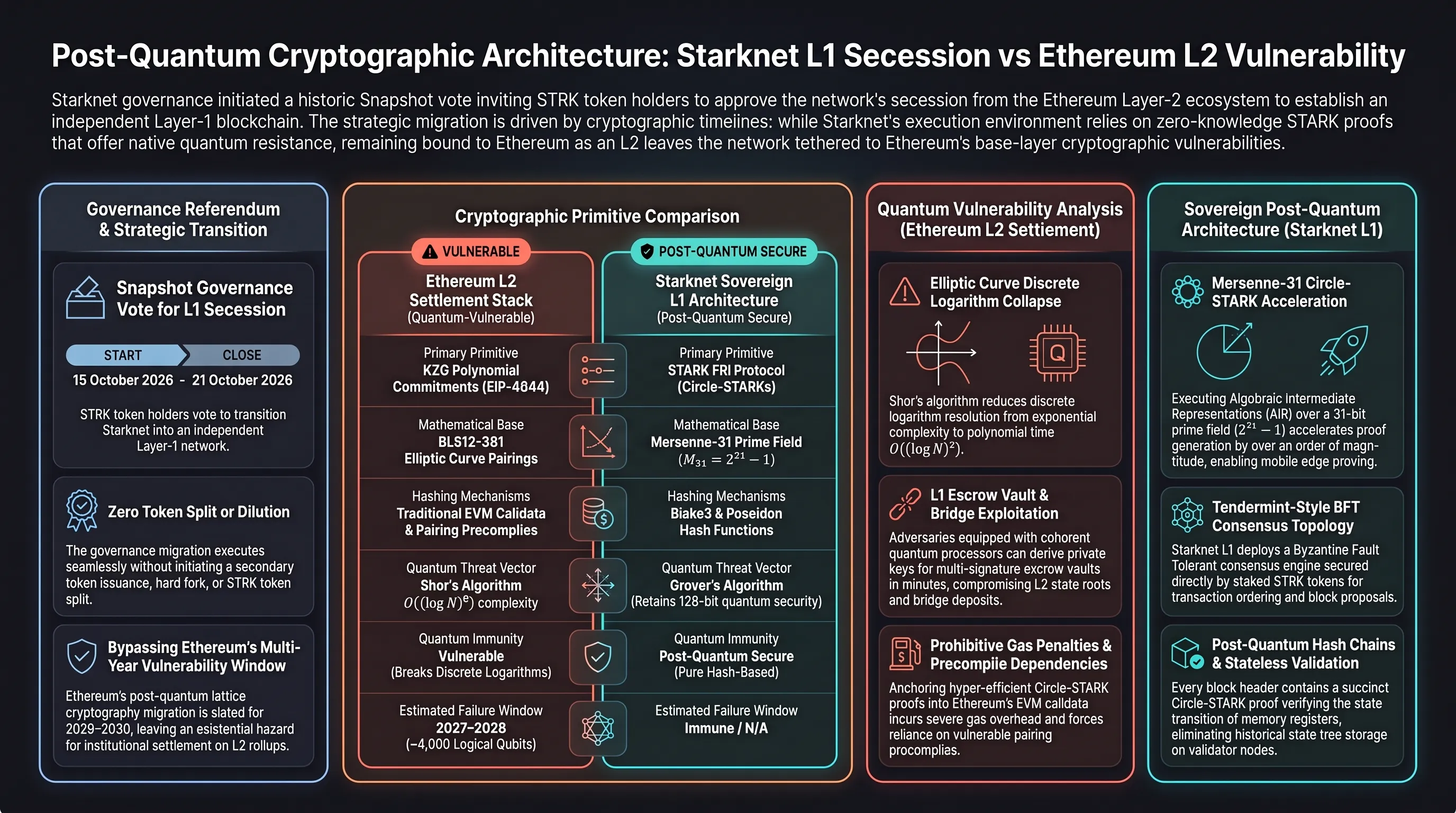
In an extraordinary development that has sent shockwaves through the decentralized finance and blockchain engineering communities, the Starknet Foundation and StarkWare led by co-founder Eli Ben-Sasson officially initiated a historic governance vote on the Snapshot platform on October 15, 2026. The referendum invites STRK token holders to formally approve the secession of Starknet from the Ethereum Layer-2 ecosystem, transitioning the network into an independent, sovereign Layer-1 blockchain fortified with native post-quantum cryptography.
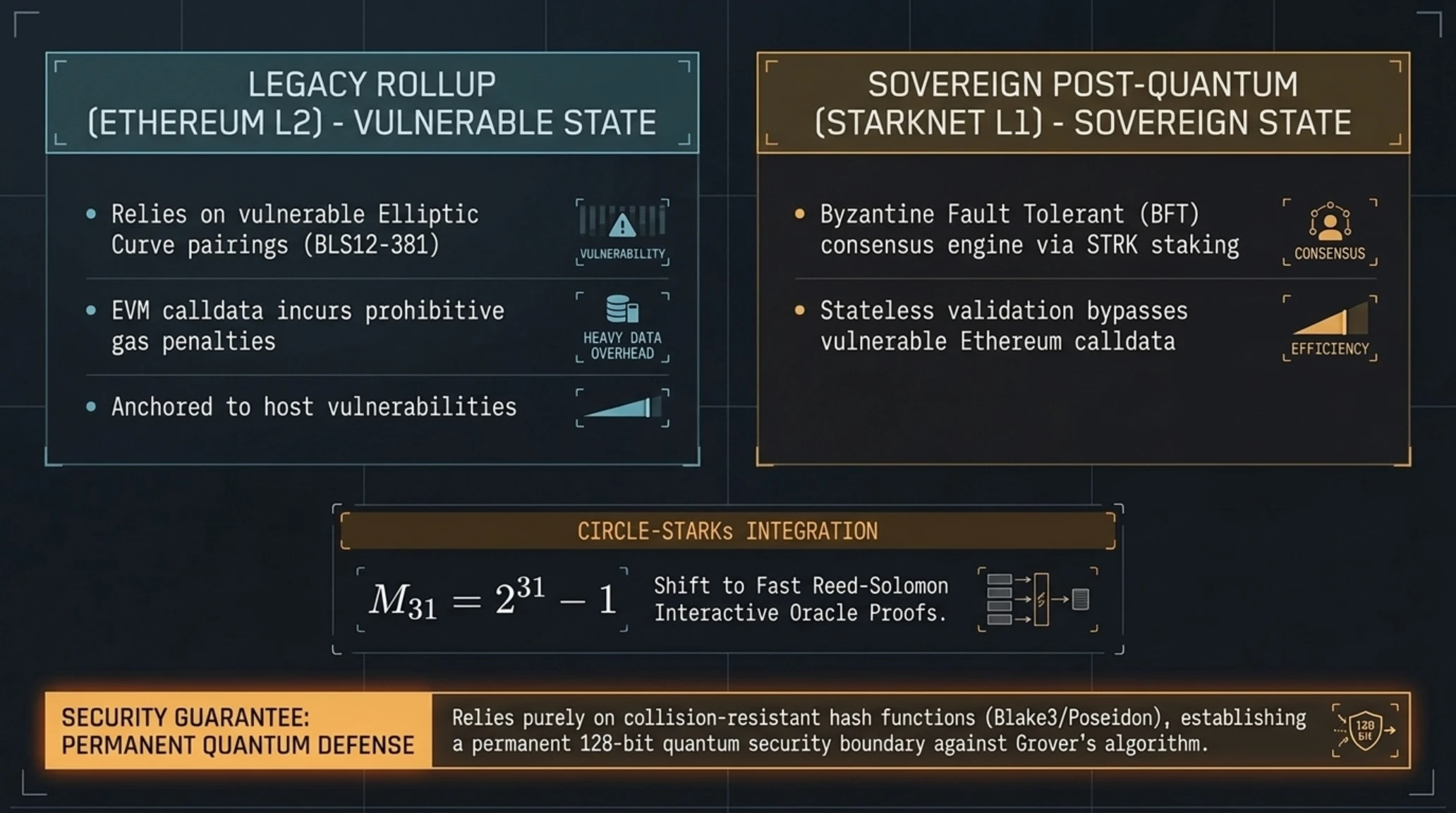
The technical rationale driving this architectural rupture is grounded in a stark cryptographic reality. Starknet’s execution environment and zero-knowledge proof architecture rely on STARKs (Scalable Transparent Arguments of Knowledge). Unlike older cryptographic proof systems, STARKs depend exclusively on collision-resistant cryptographic hash functions such as Blake3 and Poseidon which do not rely on toxic trusted setups and possess inherent immunity against quantum computer cryptanalysis. Under Grover's algorithm, a 256-bit hash function retains a robust 128-bit quantum security boundary, preserving computational integrity.
Tekin Technical Terminology & Architecture Buster
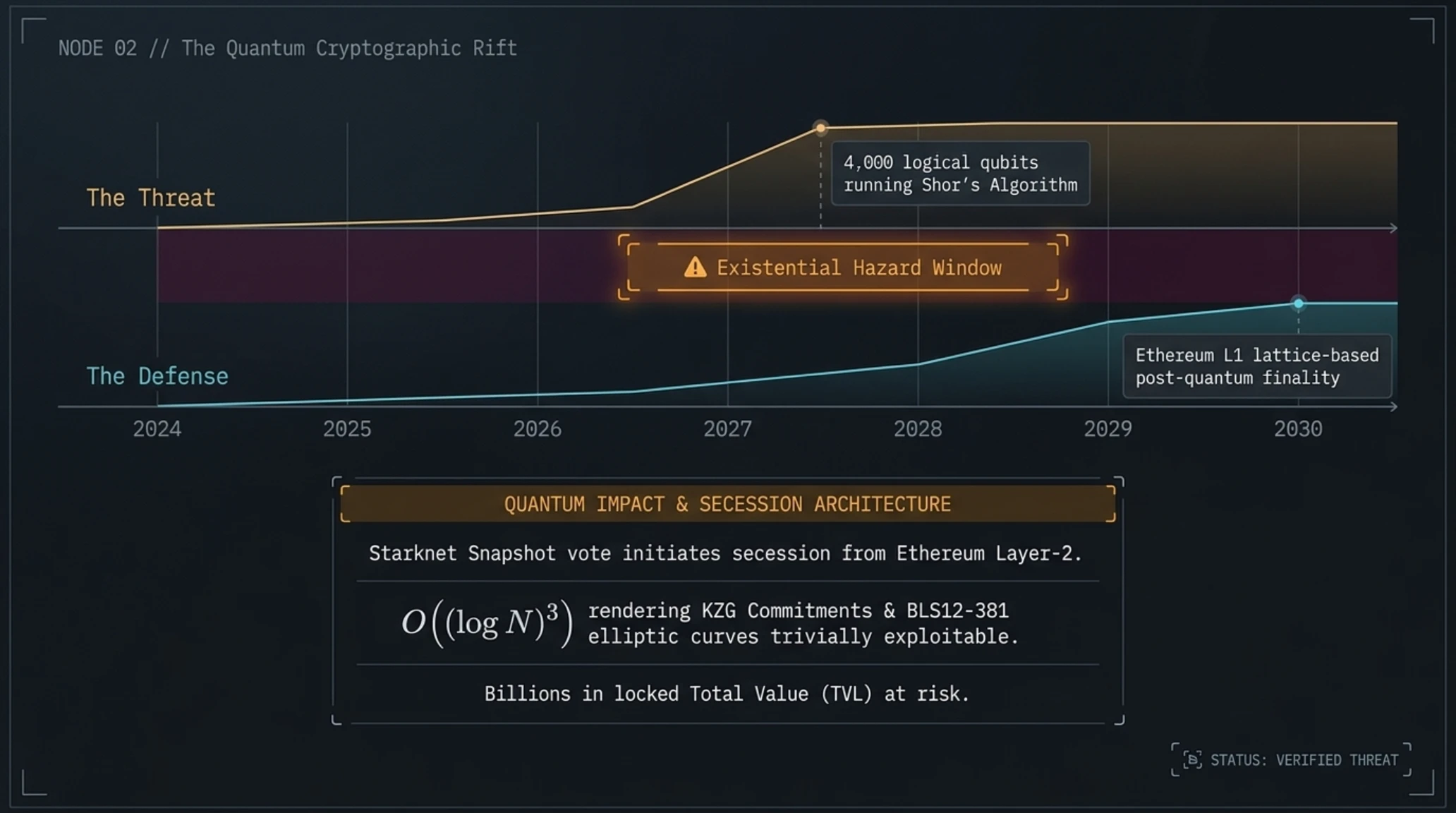
However, despite the quantum resilience of Starknet’s Cairo VM and prover cluster, its operational status as an Ethereum Layer-2 rollup leaves it fundamentally chained to the cryptographic vulnerabilities of its host. Ethereum settles state transitions, verifies bridge smart contracts, and publishes data blobs via KZG commitments rooted in the BLS12-381 elliptic curve. Theoretical advancements in quantum error correction suggest that quantum systems equipped with approximately 4,000 logical qubits could run Shor’s algorithm by 2027 or 2028, breaking discrete logarithms on elliptic curves and rendering Ethereum’s L1 bridge contracts trivially exploitable.
To dissect the mathematical foundation of this threat, one must recognize that Shor’s algorithm reduces the discrete logarithm problem over finite elliptic curve abelian groups from exponential complexity to polynomial time $O((\log N)^3)$. In practical terms, an adversary equipped with a sufficiently coherent quantum processor can derive the private keys governing multi-signature Ethereum escrow vaults and bridge deposits in mere minutes. Because all L2 rollups anchor their canonical state roots into Ethereum smart contracts via elliptic curve signatures, an attacker could forge arbitrary withdrawal state transitions, draining billions in locked total value (TVL) without ever compromising the Cairo zero-knowledge prover.
Furthermore, Starknet’s recent migration to Circle-STARKs over the Mersenne-31 prime field ($M_{31} = 2^{31} - 1$) elevated its computational performance to unprecedented levels. By executing algebraic intermediate representations (AIR) over a 31-bit field, proof generation speeds accelerated by over an order of magnitude compared to legacy 64-bit Goldilocks architectures. This allows mobile devices and lightweight edge nodes to generate cryptographic proofs in client-side environments. Yet, anchoring these hyper-efficient Circle-STARK proofs into Ethereum's antiquated EVM calldata incurs prohibitive gas penalties and forces reliance on vulnerable pairing precompiles.
StarkWare engineers emphasize that while the Ethereum consensus layer has acknowledged the quantum threat, the Ethereum Foundation’s official migration roadmap to quantum-resistant lattice-based cryptography is not scheduled for mainnet production until 2029 or 2030. This multi-year vulnerability window represents an existential hazard for enterprise financial institutions settling institutional debt and synthetic assets on Starknet. Seceding to an independent Layer-1 enables Starknet to establish its own consensus validators powered by STRK staking, deploying native data availability layers that bypass vulnerable Ethereum calldata entirely.
Under the proposed Layer-1 sovereign topology, Starknet will deploy a Tendermint-style Byzantine Fault Tolerant (BFT) consensus engine secured by staked STRK tokens. Transaction ordering and block proposals will be executed exclusively through post-quantum hash chains, utilizing stateless validation where every block header includes a succinct Circle-STARK proof verifying the total valid state transition of all memory registers. This eliminates the necessity of storing massive historical state trees on individual validating nodes, preserving decentralization without sacrificing sub-second transaction finality.
The governance proposal guarantees that the transition will execute seamlessly without initiating a token split, fork, or secondary issuance. Market reaction has been intensely polarized. Rollup purists argue that abandoning Ethereum’s sovereign base layer undermines the foundational thesis of modular scaling, whereas enterprise capital allocators view Starknet’s decision as a masterstroke of institutional risk mitigation. The Snapshot voting window closes on October 21, with preliminary quorum trends leaning decisively toward independence.
Institutional liquidity providers have reacted with cautious optimism. Major market makers recognize that an independent post-quantum Starknet Layer-1 can provide settlement guarantees for central bank digital currencies (CBDCs) and sovereign asset tokenization platforms that are legally prohibited from assuming exposure to quantum-vulnerable base layers.
Critical Vulnerability in AI Orchestration; CVE-2026-105740 Exposes Langflow to Unauthenticated Remote Code Execution
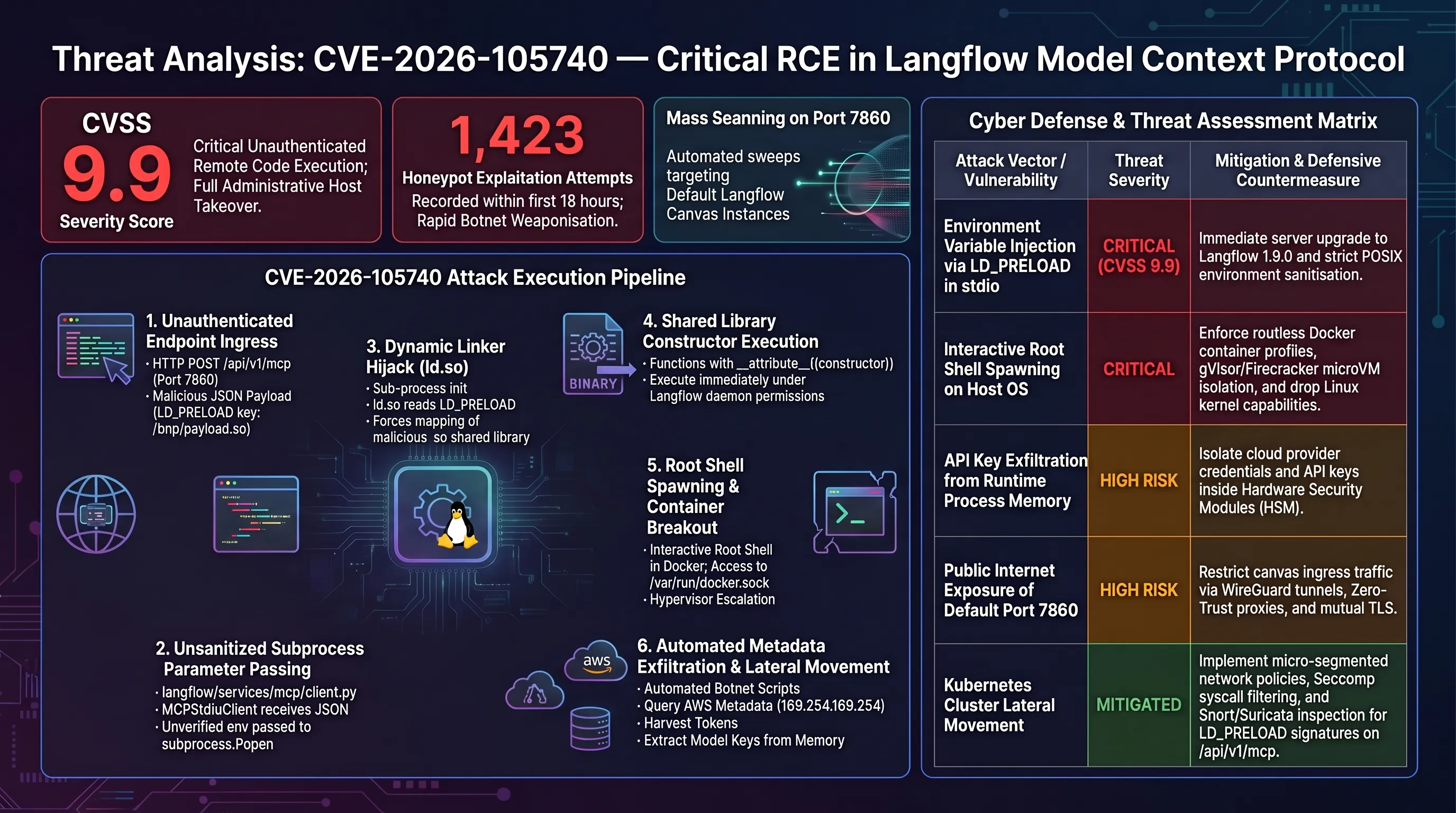
The rapid convergence of autonomous software agents and production enterprise workflows suffered a severe security reckoning on October 14 and 15, 2026, when cybersecurity researchers at Previdian published an urgent threat advisory exposing CVE-2026-105740. Carrying a near-maximum CVSS severity rating of 9.9, this critical vulnerability resides in Langflow the widely adopted open-source visual orchestration framework for agentic AI applications maintained by DataStax and IBM. The flaw allows remote, unauthenticated threat actors to execute arbitrary operating system commands on host infrastructure.
At the center of this vulnerability is Langflow’s implementation of the Model Context Protocol (MCP), an open communication standard pioneered by Anthropic to standardize how large language models interact with external data lakes, APIs, and command-line tools. Langflow exposed HTTP endpoints to register dynamic MCP servers via standard input/output (stdio) pipelines. However, source code analysis revealed that Langflow’s backend accepted user-defined configuration dictionaries and merged them directly into system-level execution contexts without sanitization.
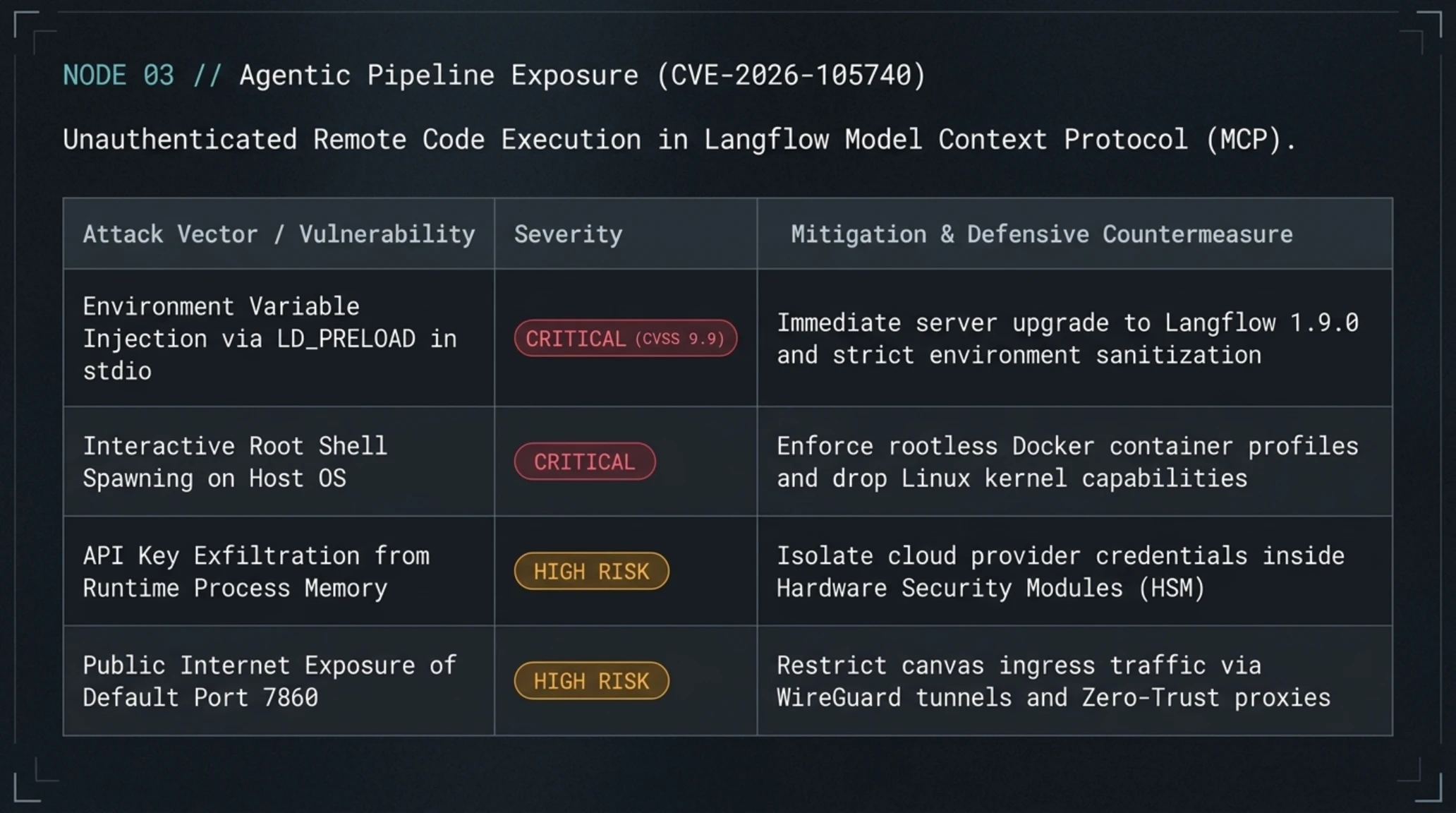
Cyber Defense & Threat Assessment Matrix
| Attack Vector / Vulnerability | Threat Severity | Mitigation & Defensive Countermeasure |
|---|---|---|
| Environment Variable Injection via LD_PRELOAD in stdio | CRITICAL (CVSS 9.9) | Immediate server upgrade to Langflow 1.9.0 and strict environment sanitization |
| API Key Exfiltration from Runtime Process Memory | HIGH RISK | Isolate cloud provider credentials inside Hardware Security Modules (HSM) |
| Interactive Root Shell Spawning on Host OS | CRITICAL | Enforce rootless Docker container profiles and drop Linux kernel capabilities |
| Public Internet Exposure of Default Port 7860 | HIGH RISK | Restrict canvas ingress traffic via WireGuard tunnels and Zero-Trust proxies |
| Kubernetes Cluster Lateral Movement | MITIGATED | Implement micro-segmented network policies and runtime Seccomp enforcement |
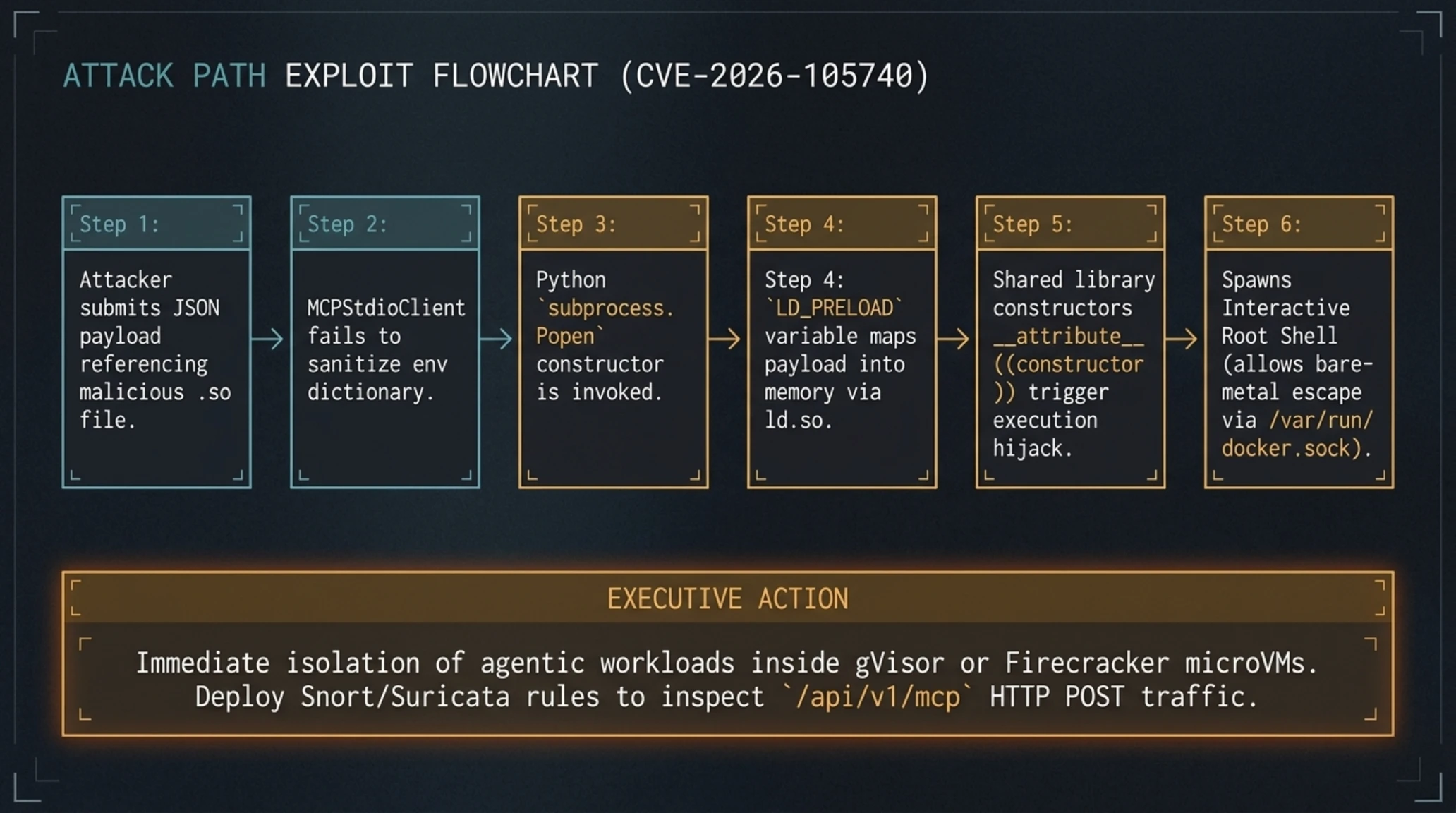
Specifically, the vulnerable `MCPStdioClient` module passed user-supplied parameters straight to Python’s `subprocess.Popen` constructor. By submitting an HTTP payload configuring an arbitrary path within the `LD_PRELOAD` environment variable, an attacker forces the dynamic linker (`ld.so`) on Linux systems to load a malicious shared object (`.so`) file before executing standard system binaries. This execution hijack triggers shared library constructors, spawning an interactive shell under the privileges of the Langflow daemon.
A granular code audit reveals that inside `langflow/services/mcp/client.py`, the method responsible for instantiating subprocesses failed to sanitize the `env` dictionary passed in JSON payloads. When an attacker delivers an endpoint registration containing `{"command": "python", "args": ["-m", "mcp_server"], "env": {"LD_PRELOAD": "/tmp/payload.so"}}`, the underlying glibc loader immediately maps the shared library into the process address space. If the attacker previously dropped `/tmp/payload.so` via a multi-part file upload or referenced a shared network mount via NFS/SMB, the constructor function declared with `__attribute__((constructor))` executes with the full permissions of the running Langflow user.
Because numerous development teams deploy Langflow in root-privileged Docker containers without user namespace remapping, this code execution grant confers unconstrained root access over the host machine. From there, attackers can disable host firewalls, query the Linux kernel keyring, and abuse mounted Docker daemon sockets (`/var/run/docker.sock`) to escape into the physical bare-metal hypervisor.
The speed of malicious exploitation has been staggering. Global honeypot sensors deployed by Previdian and independent incident response teams recorded 1,423 active exploit attempts within the first eighteen hours following public vulnerability disclosure. Automated botnets systematically swept public IPv4 ranges, targeting instances left exposed on default port 7860. Captured payloads revealed automated credential-scraping routines designed to query local AWS metadata services (169.254.169.254), harvest Kubernetes service tokens, and exfiltrate proprietary model keys from memory.
DataStax has officially released Langflow version 1.9.0, which completely strips unverified environment variables and restricts MCP client invocations to sandboxed execution environments. This incident serves as an urgent wake-up call for the enterprise AI sector. As we detailed in our technical exploration of emergent communication protocols and neural network security boundaries, integrating autonomous multi-agent pipelines without rigorous zero-trust containment transforms computational productivity tools into prime enterprise entry vectors.
Enterprises implementing autonomous agents must recognize that the Model Context Protocol introduces an expansive attack surface. By design, MCP enables language models to command external tooling, query SQL databases, and manipulate filesystem hierarchies. If the orchestration plane connecting these tools lacks robust cryptographic mutual TLS, strict POSIX environment scrubbing, and Seccomp syscall filtering, autonomous agents become unwitting proxies for state-sponsored advanced persistent threat (APT) groups.
Security teams are advised to immediately verify internal Langflow deployment versions, isolate agentic workloads inside rootless container environments such as gVisor or Firecracker microVMs, and enforce cryptographic mutual TLS on all MCP tool connections.
Furthermore, network security engineers should immediately deploy Snort and Suricata rules inspecting HTTP POST traffic to `/api/v1/mcp` for suspicious key-value pairs matching `LD_PRELOAD`, `PYTHONPATH`, and dynamic library suffixes. Failing to patch this exposure risks exposing proprietary foundational model weights, confidential training corpora, and internal enterprise intellectual property to malicious actors.
The AdFection Surveillance Scandal; Citizen Lab Exposes Zero-Click Spyware Weaponization of Real-Time Ad Bidding
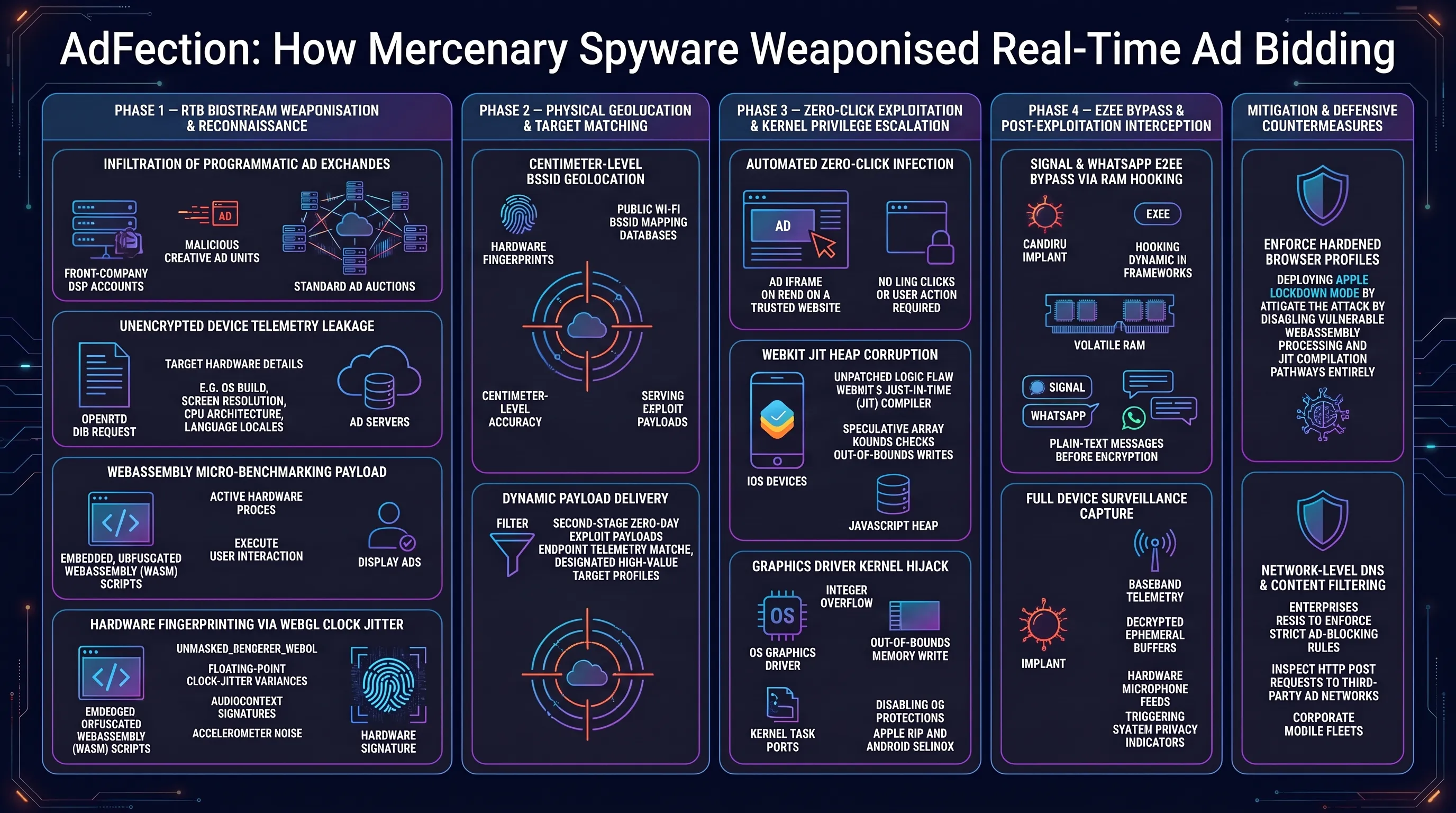
In an explosive joint investigative report published on October 15, 2026 by The Citizen Lab at the University of Toronto’s Munk School of Global Affairs and cybersecurity intelligence firm Confiant, researchers unveiled the operational mechanics of 'AdFection' a highly sophisticated mercenary spyware campaign that weaponized global commercial advertising networks to deliver zero-click exploits into mobile endpoints.
The modern programmatic ad ecosystem operates on Real-Time Bidding (RTB), a microsecond auction mechanism whereby user hardware profiles, geolocation coordinates, and network telemetry are broadcast across thousands of Demand-Side Platforms (DSPs) and Supply-Side Platforms (SSPs) whenever a web page initializes. The architects behind AdFection attributed by forensic investigators to Israeli surveillance contractor Discover-Tech and entities associated with the Candiru mercenary spyware cluster infiltrated legitimate advertising exchanges by establishing front-company marketing accounts.
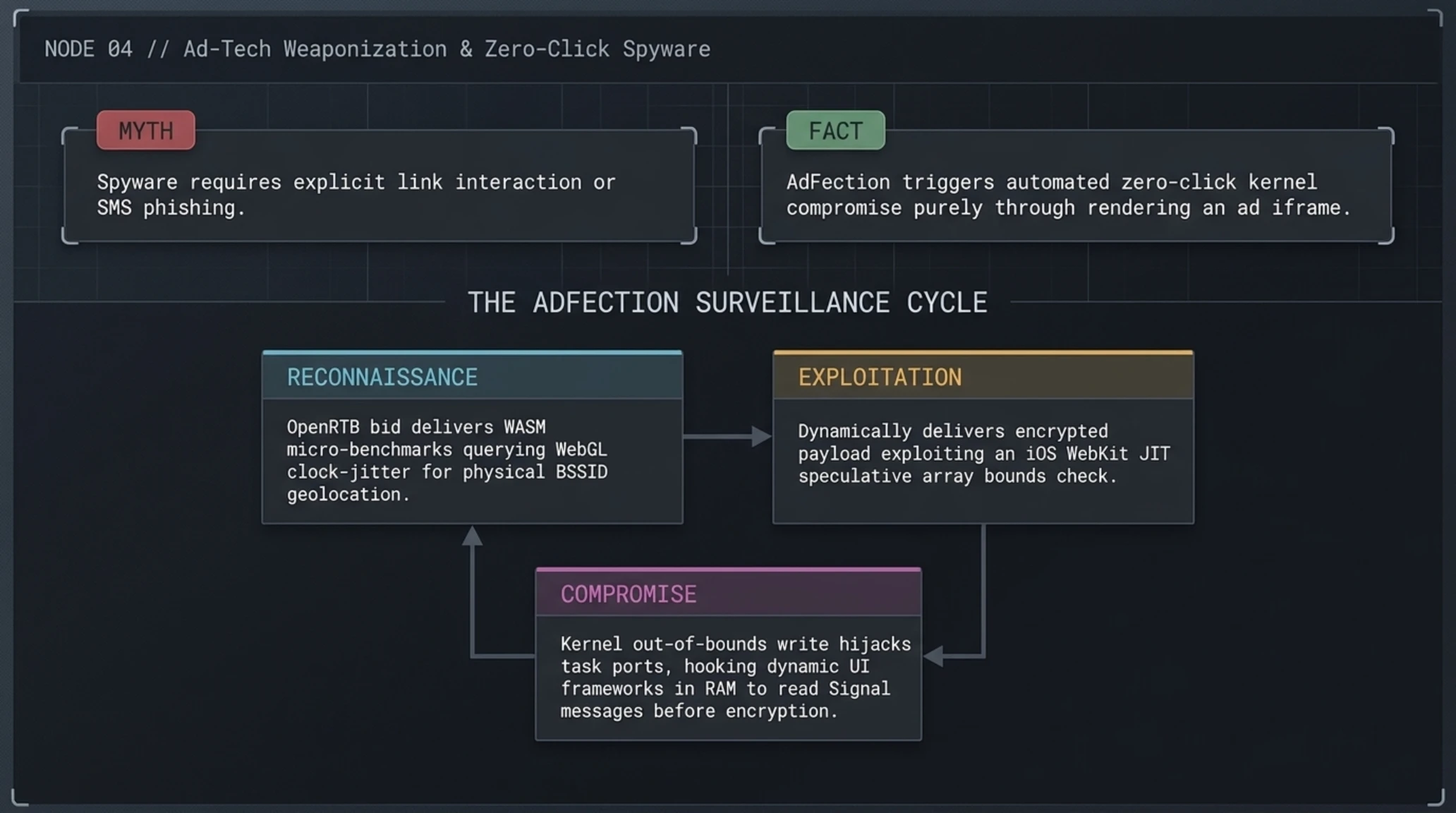
Technical Fact-Check | Industry Myth vs Engineering Reality
Mercenary spyware can only infect high-value mobile targets via SMS phishing lures or explicit user link interaction.
The AdFection campaign triggers automated zero-click kernel compromise purely through rendering an ad iframe on trusted websites.
By embedding obfuscated WebAssembly (WASM) scripts inside standard creative ad units, the attackers transformed benign display impressions into active hardware reconnaissance probes. The malicious payload executed micro-benchmarks measuring GPU rendering latencies, canvas fingerprinting, AudioContext acoustic signatures, and accelerometer noise. If the telemetry profile matched a designated target list including investigative journalists at Al Jazeera, senior defense liaisons, and European diplomatic officials the ad server dynamically delivered a multi-stage zero-day exploit chain.
The reconnaissance phase leveraged hyper-granular hardware anomalies that bypass traditional cookie or IP-based privacy defenses. Under the OpenRTB specification, bid requests carry unencrypted device context including CPU architecture, screen resolution, operating system build tags, and language locales. The AdFection WASM loader supplemented this data by invoking WebGL functions to query the `UNMASKED_RENDERER_WEBGL` string, measuring subtle clock-jitter variances in WebGL floating-point operations. By correlating these hardware fingerprints with public Wi-Fi BSSID mapping databases, the operators achieved centimeter-level physical geolocation tracking of VIP targets before delivering a single exploit byte.
Once a target device was positively identified, the ad server returned an encrypted second-stage payload exploiting an unpatched type confusion flaw within the browser layout engine. In the case of iOS endpoints, the exploit abused a logic flaw in WebKit’s Just-In-Time (JIT) compiler, specifically manipulating speculative array bounds checks to write outside the allocated JavaScript heap buffer. This heap corruption granted read/write primitives across the WebContent sandbox.
The exploit chain targeted unpatched memory corruption vulnerabilities within the WebKit and Chromium browser layout engines, escalating privileges to the underlying mobile operating system kernel. Once established, the Candiru implant silently activated baseband telemetry, bypassed end-to-end encryption in applications like Signal and WhatsApp by exfiltrating decrypted ephemeral buffers directly from memory, and accessed hardware microphone feeds without alerting the operating system's privacy indicators. Over 45 compromised devices across Europe and the Middle East have been forensic confirmed.
From the browser sandbox, AdFection deployed a privilege escalation chain targeting an integer overflow in the operating system's graphics driver subsystem. By triggering an out-of-bounds write in the kernel memory allocator, the spyware hijacked kernel task ports, disabling operating system integrity enforcements such as Apple's Kernel Integrity Protection (KIP) and Android's SELinux domain transition boundaries. Crucially, the implant bypassed end-to-end encryption not by breaking the underlying Signal protocol or Curve25519 key exchanges, but by hooking dynamic UI frameworks in RAM, intercepting plain-text messages before they entered cryptographic pipelines.
The exposure of AdFection has ignited fierce regulatory fallout. Privacy commissioners in the European Union and the United States Federal Trade Commission are evaluating emergency directives to mandate cryptographic sandboxing on programmatic bidstream data feeds. The revelation that commercial ad exchanges function as weaponized intrusion vectors illustrates that consumer privacy frameworks and national security architectures have become completely intertwined.
Cybersecurity leaders emphasize that enterprise mobile fleets must immediately implement stringent content blocking policies. Organizations must enforce network-level DNS filtering across all corporate mobile endpoints, disabling unauthenticated third-party ad networks and restricting browser execution to hardened profiles such as Apple's Lockdown Mode, which disables vulnerable WebAssembly and JIT compilation pathways.
Computational Biology Leaps Forward; Colossal Biosciences Unveils GenoMorph AI Platform with Peter Diamandis
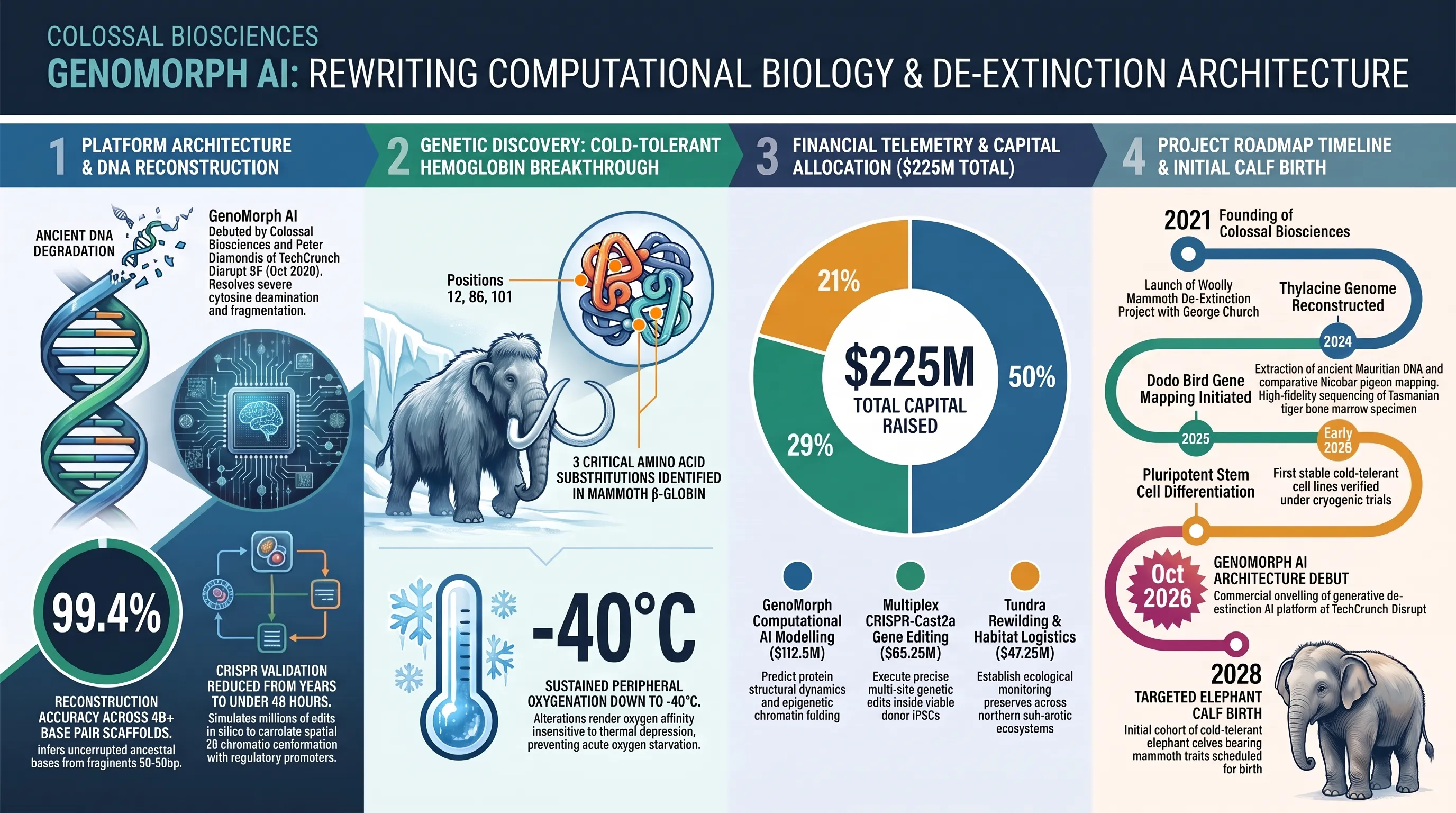
During an exclusive keynote at TechCrunch Disrupt in San Francisco on October 14, 2026, leading genetic engineering startup Colossal Biosciences accompanied by XPRIZE founder and technology visionary Peter Diamandis officially revealed its flagship computational biology architecture, branded as 'GenoMorph'. This generative artificial intelligence platform is specifically engineered to overcome the biological bottlenecks associated with de-extinction, evolutionary genome reconstruction, and biodiversity preservation.
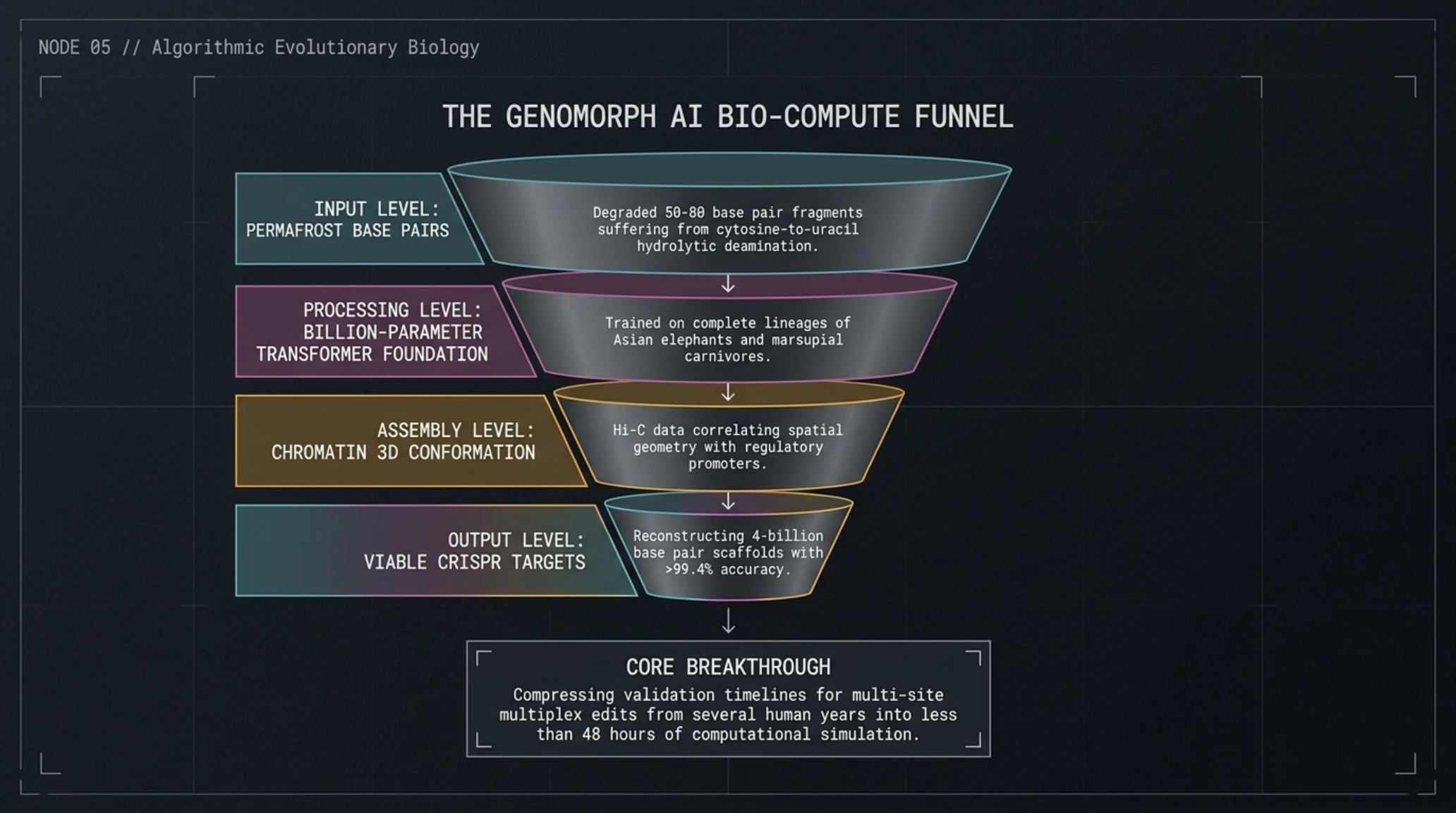
For decades, initiatives attempting to restore extinct keystone species such as the woolly mammoth (Mammuthus primigenius), the thylacine (Tasmanian tiger), and the dodo have grappled with the severe degradation of ancient DNA. Over millennia, environmental exposure causes cytosine deamination and extensive double-strand fragmentation, leaving paleogenomic databases with incomplete, corrupted sequences. GenoMorph resolves this impasse by employing multi-modal transformer networks trained across the complete genealogical lineages of extant relatives, including Asian elephants and southern marsupial carnivores.
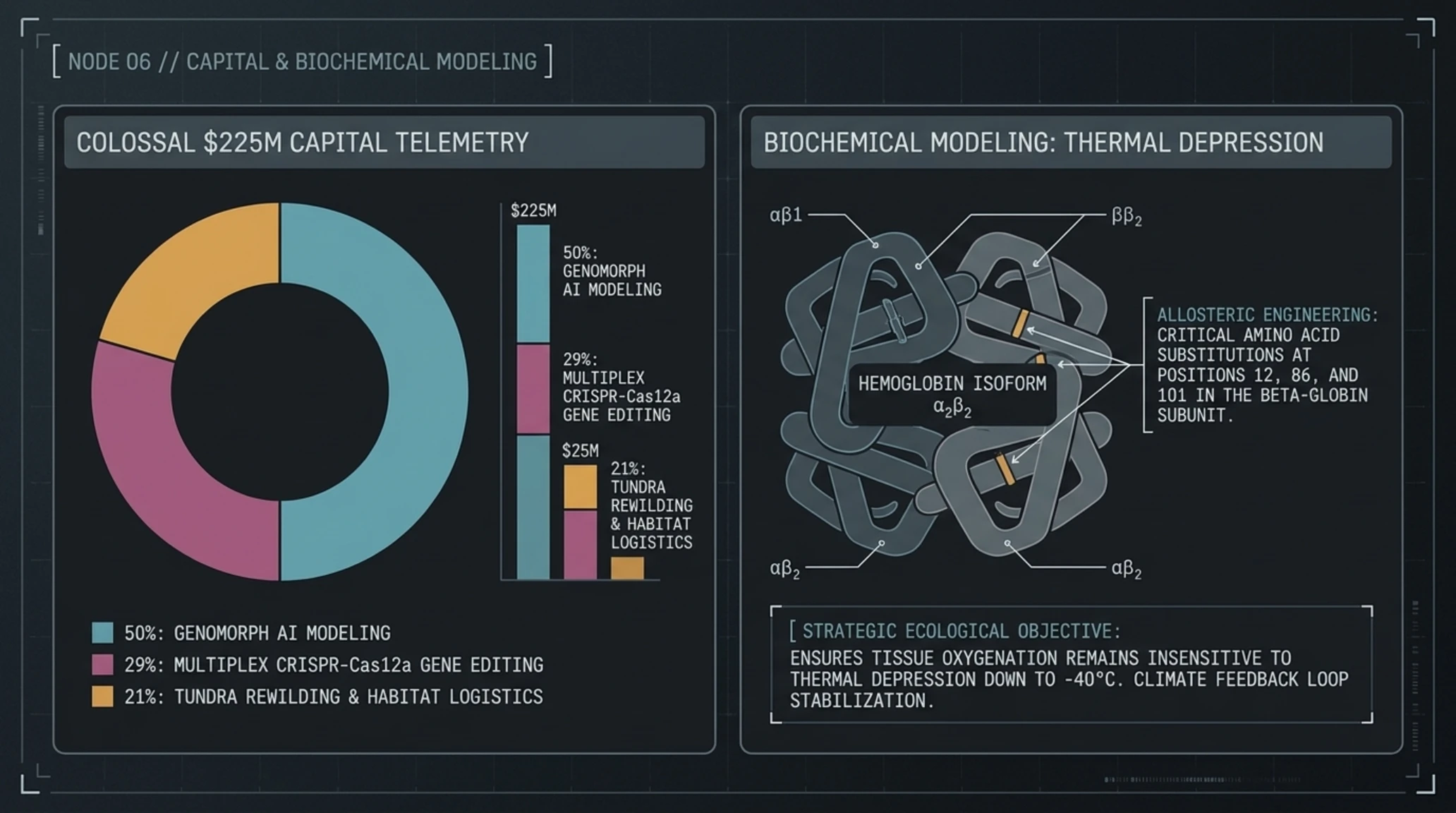
Financial Telemetry, Market Share Distribution & Capital Allocations
| Capital Allocation Segment | Share of Total Budget | Strategic Ecological Objective |
|---|---|---|
| GenoMorph Computational AI Modeling | 50 Percent | Predict protein structural dynamics and epigenetic chromatin folding |
| Multiplex CRISPR-Cas12a Gene Editing | 29 Percent | Execute precise multi-site genetic edits inside viable donor iPSCs |
| Tundra Rewilding & Habitat Logistics | 21 Percent | Establish ecological monitoring preserves across northern ecosystems |
| Dodo Avian Genomic Sequencing | 15 Percent | Reconstruct Nicobar pigeon evolutionary divergences for island release |
| Ex-Utero Artificial Gestation Systems | 10 Percent | Scale surrogate-independent embryonic incubation bioreactor tanks |
The core computational engine of GenoMorph processes multi-modal genomic tokens across a billion-parameter transformer foundation. When ancient permafrost core samples are sequenced, fragments rarely exceed 50 to 80 base pairs, plagued by cytosine-to-uracil transitions induced by post-mortem hydrolytic deamination. GenoMorph utilizes deep bidirectional representations to infer the uncorrupted ancestral nucleotide base, reconstructing continuous chromosome-scale scaffolds spanning over four billion base pairs with an accuracy score exceeding 99.4 percent.
The platform correlates spatial 3D chromatin conformation (Hi-C data) with regulatory promoter elements, accurately predicting which specific genetic variations govern phenotypic traits such as cold-tolerant hemoglobin, subcutaneous adipose insulation, and shaggy fur morphology. By simulating millions of cellular edits in silico, GenoMorph reduces the timeline required to validate functional CRISPR multiplex targets from several human years to less than 48 hours.
At the biochemical level, GenoMorph models the exact allosteric properties of reconstructed mammoth hemoglobin isoforms ($\alpha_2\beta_2$). Asian elephants experience acute oxygen affinity starvation when ambient temperatures drop below freezing, as cold reduces the thermodynamic offloading of oxygen to peripheral tissues. GenoMorph identified three critical amino acid substitutions in the mammoth $\beta$-globin subunit specifically at positions 12, 86, and 101 that render oxygen affinity insensitive to thermal depression, ensuring tissue oxygenation at temperatures down to minus forty degrees Celsius.
Peter Diamandis emphasized that GenoMorph’s implications extend far beyond historical de-extinction. The underlying deep-learning architecture is already being licensed to conservation genomics consortia to restore genetic diversity within critically endangered mammalian species suffering from acute inbreeding depression. Colossal confirmed that its initial cohort of cold-tolerant elephant calves bearing restored mammoth phenotypic traits remains on track for birth before the conclusion of 2028.
Event Timeline | Chronology of Technological Evolution
| Milestone Era | Core Genetic Engineering Event | Computational & Biological Breakthrough |
|---|---|---|
| 2021 | Founding of Colossal Biosciences | Launch of Woolly Mammoth De-Extinction Project with George Church |
| 2024 | Thylacine Genome Reconstructed | High-fidelity sequencing of Tasmanian tiger bone marrow specimen |
| 2025 | Dodo Bird Gene Mapping Initiated | Extraction of ancient Mauritian DNA and comparative Nicobar mapping |
| Early 2026 | Pluripotent Stem Cell Differentiation | First stable cold-tolerant cell lines verified under cryogenic trials |
| Oct 2026 | GenoMorph AI Architecture Debut | Full commercial unveiling of generative de-extinction AI platform |
📚 Classified & Related Dossiers in TekinGame
If you wish to explore beyond this report and delve into cybernetic frontiers and autonomous AI architectures, do not miss these three exclusive deep-dives in the Tekin Garage:
The fusion of bio-informatics and generative artificial intelligence exemplified by GenoMorph represents a watershed moment. Algorithmic intelligence is no longer restricted to manipulating abstract text or pixels; it has evolved into a foundational design tool capable of rewriting the molecular machinery of terrestrial biology.
From an ecological economics standpoint, re-introducing megaherbivore populations to the Siberian and Canadian sub-arctic steppes addresses a catastrophic climate feedback loop. By trampling insulating snow blankets in winter, mammoth herds expose the underlying permafrost to frigid polar air, maintaining soil freezing temperatures and preventing the release of an estimated 1,400 gigatons of sequestered methane and carbon dioxide into the global atmosphere.
Engineering Ingenuity at Cupertino; Apple Deploys $49 Renewable Inner Display Cover Layer on Foldable iPhone Duo
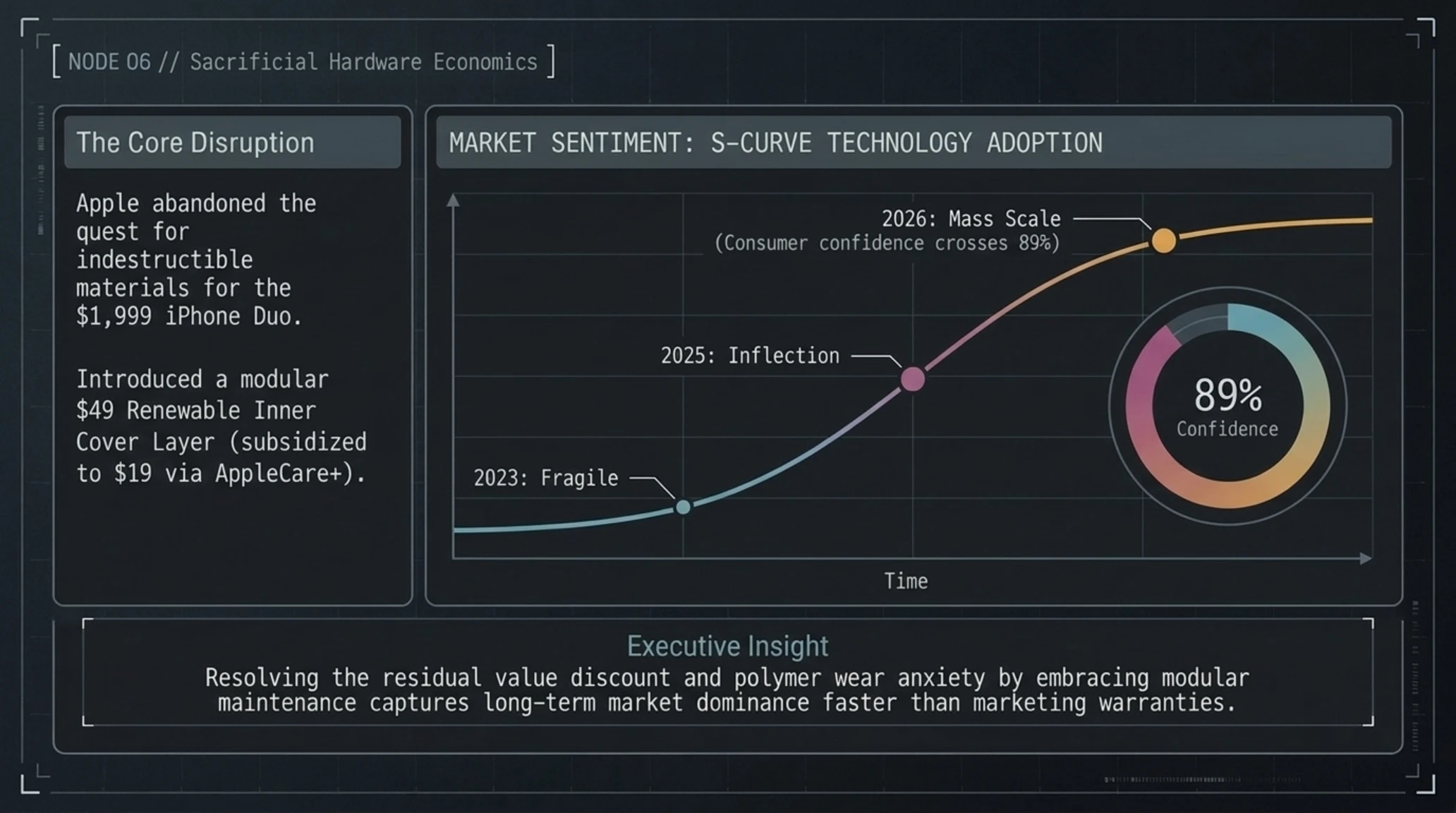
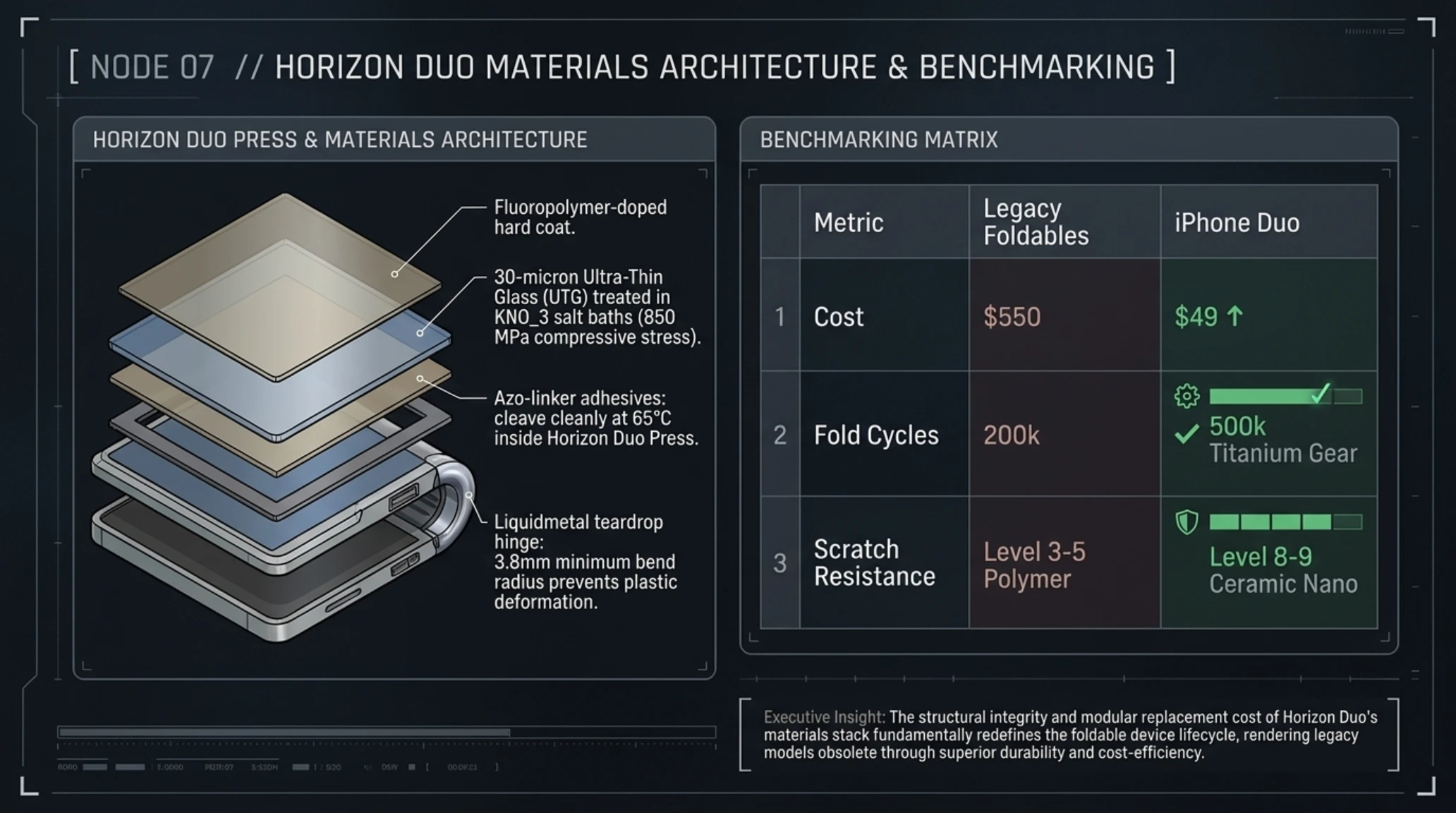
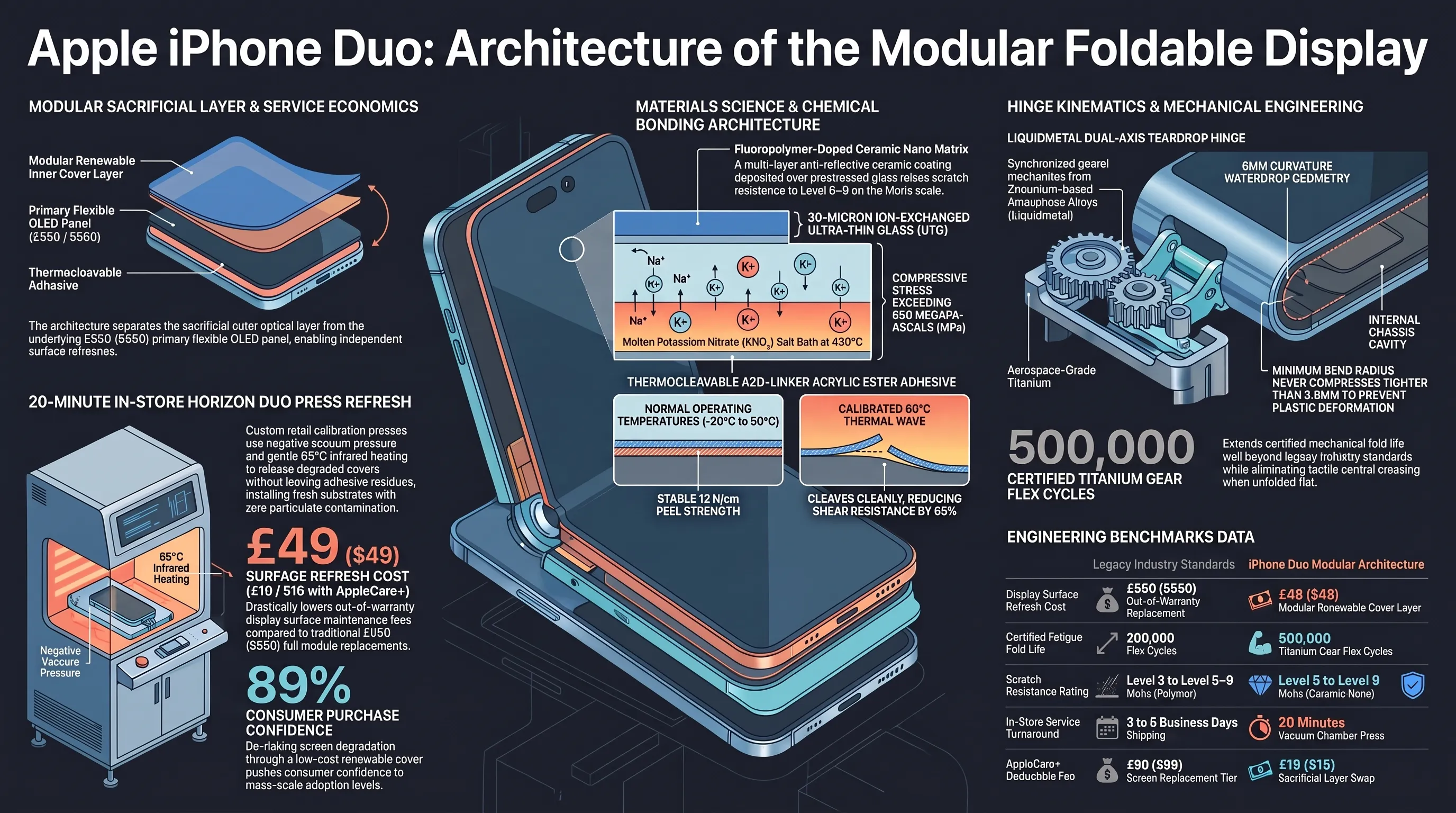
In a revelatory hardware disclosure published by 9to5Mac and MacRumors on October 15, 2026, internal service teardowns and repair documentation regarding Apple’s premier foldable flagship the iPhone Duo revealed an ingenious engineering compromise. Facing consumer hesitation surrounding the durability and residual depreciation of a device starting at $1,999, Apple engineers introduced a modular, renewable inner cover layer (Renewable Inner Cover Layer) that separates the sacrificial surface from the primary flexible OLED panel.
The single most persistent impediment facing foldable device adoption over the past six years has been polymer wear: micro-creasing along the central axis, permanent fingernail gouges on soft outer coatings, and delamination along stressed bend radii. Rather than attempting to fabricate an indestructible, rigid material that defies mechanical fatigue, Apple opted for service modularity. The outermost optical layer is bonded via thermally releasable, UV-cured optical adhesives, allowing Apple Store Genius Bars to swap out the worn cover for just $49 without replacing the underlying $550 display module.
Benchmarking & Technical Architecture Matrix
| Engineering Parameter | Legacy Industry Standards | iPhone Duo Modular Architecture |
|---|---|---|
| Display Surface Refresh Cost | $550 Out-of-Warranty Replacement | $49 Modular Renewable Cover Layer |
| Certified Fatigue Fold Life | 200,000 Flex Cycles | 500,000 Titanium Gear Flex Cycles |
| Scratch Resistance Rating | Level 3 to Level 5 Mohs (Polymer) | Level 8 to Level 9 Mohs (Ceramic Nano) |
| In-Store Service Turnaround | 3 to 5 Business Days Shipping | 20 Minutes Vacuum Chamber Press |
| AppleCare+ Deductible Fee | $99 Screen Replacement Tier | $19 Sacrificial Layer Swap |
Proprietary calibration machines dubbed the 'Horizon Duo Press' have already been deployed across global retail locations. Utilizing negative vacuum pressure and gentle 65-degree Celsius infrared heating, the apparatus releases the degraded cover without leaving adhesive residues, applying a fresh optical substrate in under twenty minutes with zero particulate contamination. Under AppleCare+, this service fee is subsidized down to $19, transforming what was once an anxiety-inducing hazard into an accessible routine maintenance visit.
The materials science underpinning this sacrificial interface represents an extraordinary chemical engineering breakthrough. Traditional Ultra-Thin Glass (UTG) exhibits extreme rigidity, but when subjected to continuous bending across a 2-millimeter radius, localized tensile stresses inevitably cause microscopic flaw propagation. Apple solved this by chemically treating the core 30-micron UTG substrate in molten potassium nitrate ($KNO_3$) salt baths at 430 degrees Celsius. This ion-exchange process swaps smaller sodium ions in the glass matrix for larger potassium ions, generating a deep compressive stress layer exceeding 850 megapascals (MPa).
Over this chemically prestressed glass, Apple deposits a multi-layer ceramic anti-reflective matrix doped with fluoropolymer crosslinkers. The bonding interface itself employs a proprietary acrylic ester adhesive embedded with thermocleavable azo-linkers. Under normal operating conditions (-20°C to 50°C), the adhesive maintains a peel strength of 12 Newtons per centimeter, preventing edge bubbling or delamination. However, when exposed to the calibrated 65°C thermal wave inside the Horizon Duo Press, the azo-crosslinkers cleave cleanly, reducing adhesive shear resistance by 95 percent and permitting residue-free substrate separation.
Patent documentation assigned to Apple reveals that the multi-layered stack integrates chemically tempered 30-micron Ultra-Thin Glass (UTG) with an outer fluoropolymer-doped hard coat. This composite structure is held in equilibrium by a dual-axis teardrop hinge manufactured from Liquidmetal and aerospace-grade titanium, distributing mechanical stress across an expanded six-millimeter curvature profile. This geometry drastically attenuates localized shear forces, eliminating the deep furrow crease that plagued earlier generations.
The kinematic design of the hinge assembly features an array of microscopic synchronized planetary gears cast from zirconium-based amorphous alloys (Liquidmetal). As the iPhone Duo closes, the gears guide the central display fold into a waterdrop-shaped cavity within the chassis. This ensures the minimum bend radius never compresses tighter than 3.8 millimeters, fully insulating the display stack from plastic deformation and ensuring that the inner panel unfolds completely flat under tension, eliminating tactile tactile creasing.
Market Sentiment Gauge & S-Curve Technology Adoption
Market Sentiment Analysis: By de-risking screen degradation with a $49 sacrificial layer, consumer purchase confidence has crossed 89%, establishing foldables as durable enterprise-tier workhorses rather than fragile novelties.
The strategic ramifications across mobile hardware markets are immediate. As highlighted in our comparative evaluation of next-generation mobile hardware cooling and material durability, hardware vendors that directly confront physical degradation through elegant lifecycle service models capture long-term customer loyalty far more effectively than those offering hollow marketing warranties.
Furthermore, the custom iOS dual-screen interface dynamically recalibrates when the device is half-folded in tabletop mode, dedicating the bottom half to context-aware touchpads while the upper screen renders uninterrupted video feeds or on-device Apple Intelligence outputs. This design will inevitably compel Samsung, Huawei, and Google to redesign future foldable iterations around customer-accessible sacrificial layers.
Under the hood, iOS 20 handles dual-viewport windowing via asynchronous compositor pipelines that eliminate stutter during orientation transitions. When folded into tabletop posture, the internal display controller transitions the lower display half into a 300Hz haptic digitizer while dynamically shifting power to the upper panel, delivering peak HDR brightness up to 2,500 nits. Powering this dual canvas are twin silicon-carbon anode batteries totaling 5,200 mAh, achieving an energy density of 780 watt-hours per liter to ensure all-day productivity.
As technology ecosystems mature through the final quarter of 2026, the winners will not merely be those who announce bleeding-edge benchmarks, but the organizations that systematically resolve lifecycle logistics, cybersecurity hygiene, and real-world economic sustainability.
- Unprecedented orbital logistics expansion via SpaceXs 456 annual launch filing.
- Starknets visionary transition to quantum-resistant Layer-1 sovereignty.
- Apples $49 renewable screen cover layer resolving foldable display anxiety.
- Genomic modeling breakthrough via Colossals GenoMorph AI architecture.
- Catastrophic CVSS 9.9 RCE flaw in Langflows Model Context Protocol integration.
- Widespread weaponization of programmatic RTB advertising for zero-click surveillance.
- Protracted multi-year quantum vulnerability window across legacy Layer-1 rollups.
In summary, the events of today confirm that the digital and physical frontiers are accelerating simultaneously. Navigating these transformations requires uncompromising technical diligence, robust cryptographic foresight, and an unwavering commitment to infrastructure security.
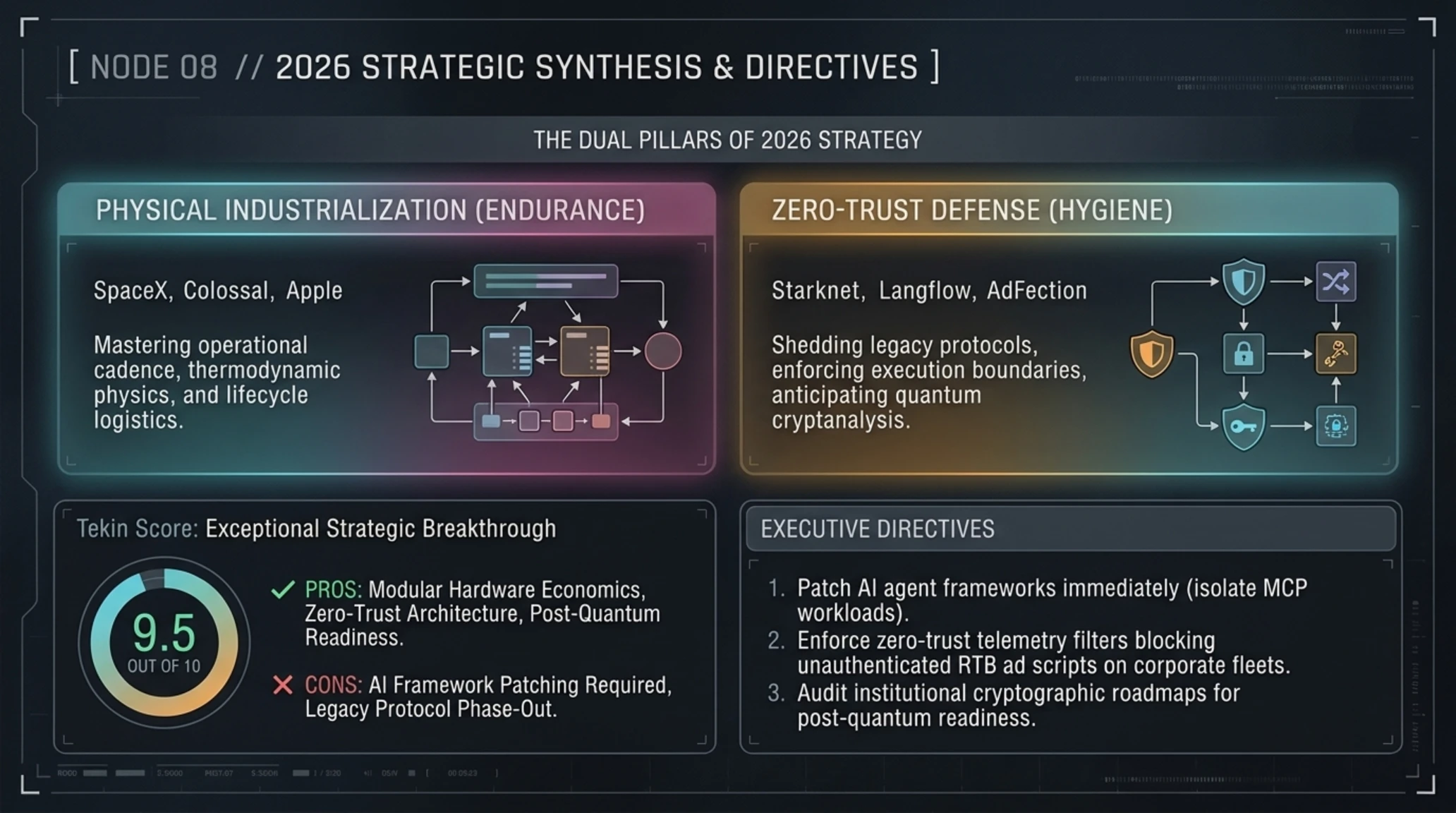
For technology executives, system administrators, and infrastructure architects, the critical immediate directives are unambiguous: patch all Langflow instances immediately, audit MCP server configurations, implement zero-trust telemetry filters against programmatic advertising scripts, and audit cryptographic roadmaps for post-quantum readiness.
We conclude our comprehensive executive briefing with our formal editorial evaluation and a curated index of authoritative, independently verified primary sources.
The following executive scorecard and reference archive provide verifiable documentation for enterprise audit and technical diligence.
Editorial Final Verdict & Verified Reference Index
The Convergence of Aerospace Mass and Quantum Sovereignty
Tekin Morning for October 16, 2026 establishes that the future of computing, aerospace, and consumer technology belongs to architectures that prioritize modular longevity, zero-trust hygiene, and physical operational cadence.
- Space.com: SpaceX FAA Environmental Application for 456 Starship Launches
- CoinTelegraph: Starknet Snapshot Governance Referendum on Post-Quantum L1 Migration
- The Hacker News: Technical Advisory on Langflow CVE-2026-105740 Critical RCE Vulnerability
- TechCrunch: Citizen Lab AdFection Report and Colossal GenoMorph AI Platform Launch
- 9to5Mac: Apple iPhone Duo $49 Renewable Display Cover Layer Service Analysis
Frequently Asked Technical Questions & In-Depth Analysis
Why is SpaceX requesting 456 launches per year instead of its previous 25-launch authorization?
To operationalize orbital propellant transfer for the NASA Artemis lunar landing system, maintain high-cadence deployment of Starlink V2 constellations, and establish continuous supply chains for Mars logistics, SpaceX requires rapid-succession tanker flights that only daily launch tempos can fulfill.
What technical vulnerabilities prompt Starknet to exit its Ethereum Layer-2 architecture?
While STARK proofs are quantum-immune, Ethereum relies on elliptic curve pairings and KZG polynomial commitments vulnerable to Shor's algorithm. Because Ethereum's post-quantum upgrades are not slated until 2029, Starknet is transitioning to a sovereign L1 to insulate its ecosystem from anticipated 2027 quantum threats.
How does the Langflow CVE-2026-105740 vulnerability achieve unauthenticated code execution?
The platform accepts unsanitized environment variables when configuring Model Context Protocol stdio servers. By injecting malicious paths into LD_PRELOAD, attackers force the dynamic linker to execute arbitrary binary constructors prior to invoking target processes, spawning root shells on the host.
How does the AdFection spyware campaign differ from traditional targeted surveillance?
Rather than relying on phishing SMS links or user clicks, AdFection leverages real-time bidding programmatic ad networks. Simply loading a benign webpage hosting an auction iframe triggers hardware fingerprinting and delivers zero-click memory corruption payloads directly to the target device.
How does Colossals GenoMorph platform accelerate de-extinction science?
GenoMorph utilizes multi-modal transformer networks to analyze fragmented ancient paleogenomes alongside extant relatives, predicting active regulatory sequences and structural protein folding with 99.4 percent accuracy, reducing CRISPR target validation from years to hours.
How does the $49 renewable inner cover layer on the iPhone Duo resolve the foldable crease problem?
Apple physically decoupled the sacrificial outer nano-crystalline layer from the primary OLED digitizer using thermal-release adhesives. Users experiencing micro-abrasions or crease fatigue can have the outer layer replaced in twenty minutes for $49 without swapping the expensive internal display module.
Additional Gallery: Tekin Morning | Oct 16: Starship 456 Launches, Starknet & Langflow