Tekin Morning | Tactical Intelligence & Global Tech Radar for Thursday, October 15, 2026
The dawn of Thursday, October 15, 2026, presents an extraordinary restructuring of global technology landscapes. What previously existed as disconnected verticals aerospace orbital logistics, operating system cybersecurity, high-performance automotive engineering, corporate IP litigation, national-security workforce integrity, and sovereign financial plumbing has suddenly converged into a singular, interconnected battlefield of technological dominance.
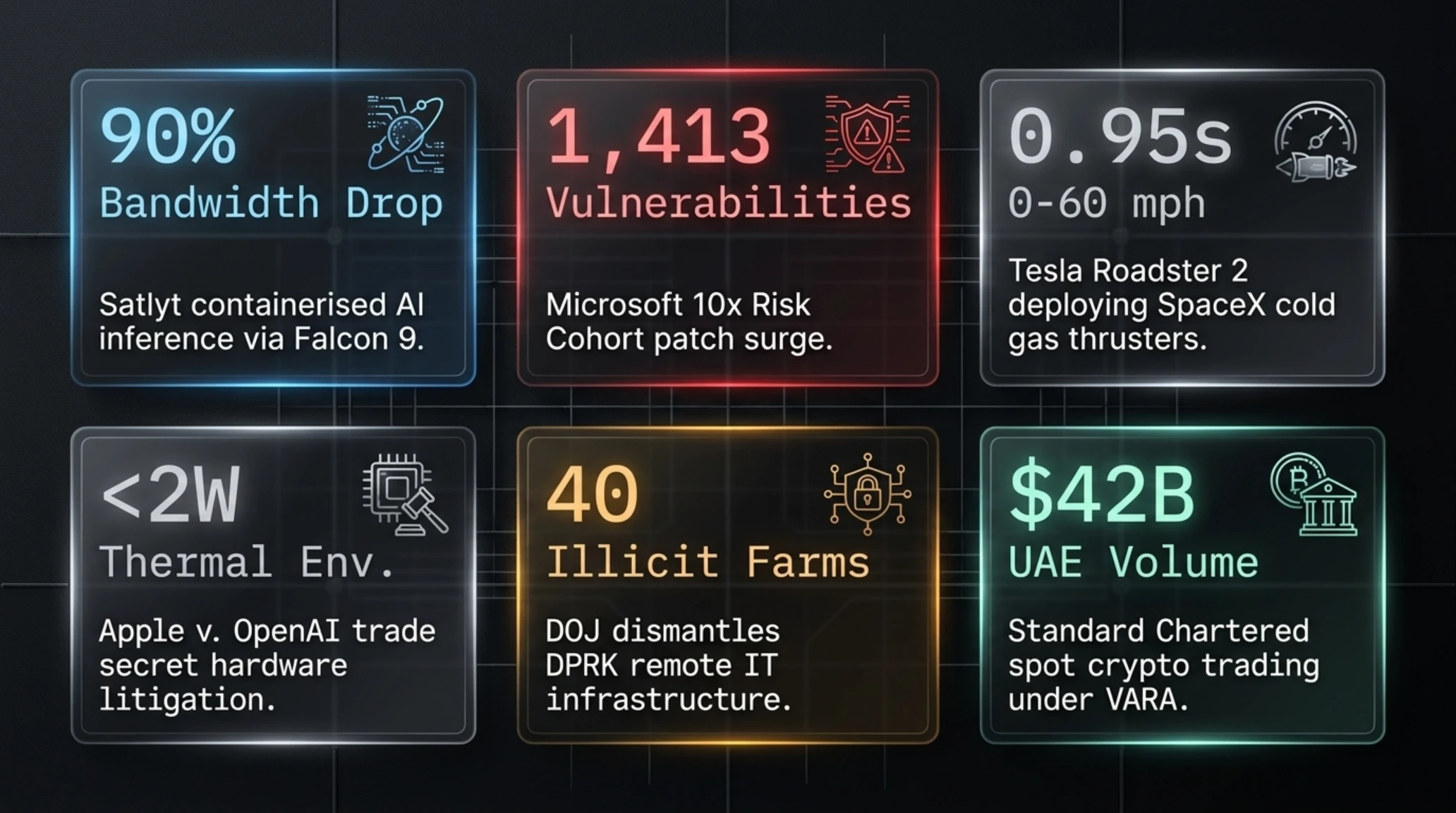
Strategic Executive Briefing & Core Vectors at a Glance
As enterprise architectures grapple with exponential telemetry expansion, traditional centralized cloud topologies are confronting physical thermodynamic and cryptographic limits. High-performance machine learning models, previously confined to hyperscale terrestrial data centers consuming hundreds of megawatts of municipal power, are rapidly breaking free of geographical boundaries. The decisions made by engineering teams and executive boards this morning will establish the defensive posture, compute infrastructure, and capital velocity of global enterprises heading into 2027.
Across the aerospace, enterprise software, and fintech sectors, technological leaders are navigating an environment where infrastructure latency is measured in microseconds and security perimeters extend from low Earth orbit directly down to local workstation hardware. The events unfolding over the past twenty-four hours demonstrate that incremental optimization is no longer sufficient; global enterprises must fundamentally re-architect their foundational operating assumptions.
Why This Technological Paradigm Shift Matters to Global Enterprise
The convergence of edge AI in low Earth orbit, unprecedented enterprise patch telemetry, aerospace thrusters in commercial electric vehicles, and regulated tier-1 institutional crypto banking represents an irreversible inflection point across modern digital infrastructure.
Satlyt Secures $8M Seed Round and Deploys Modular Orbital AI via Falcon 9
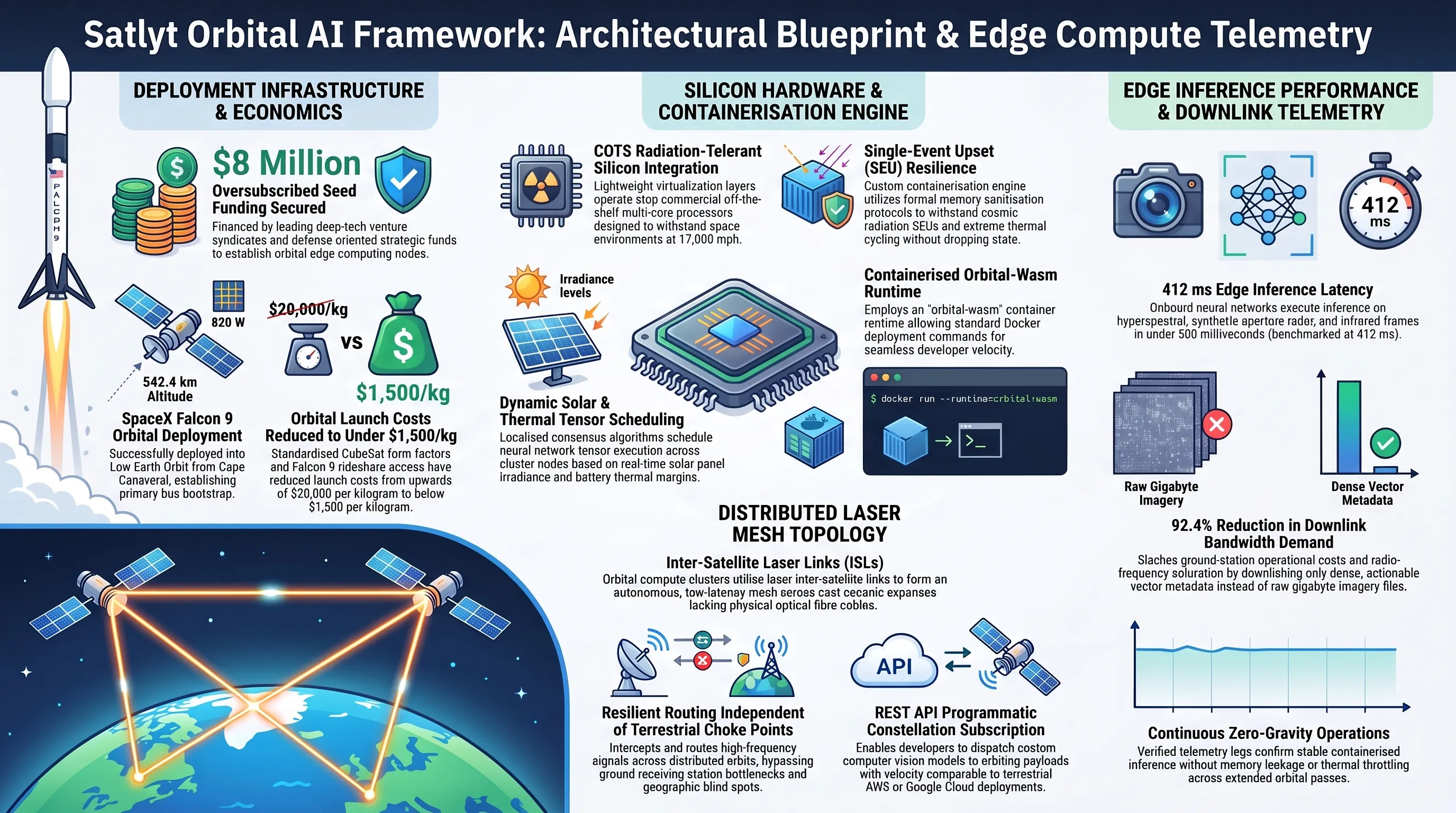
In a historic leap forward for spaceborne computing, space technology startup Satlyt officially announced this morning the closing of an oversubscribed $8 million seed financing round led by prominent deep-tech venture syndicates, with participation from leading defense-oriented strategic funds. Coinciding directly with the capital injection, the company successfully executed the primary deployment phase of its groundbreaking orbital software platform aboard a SpaceX Falcon 9 rideshare mission launched from Cape Canaveral.
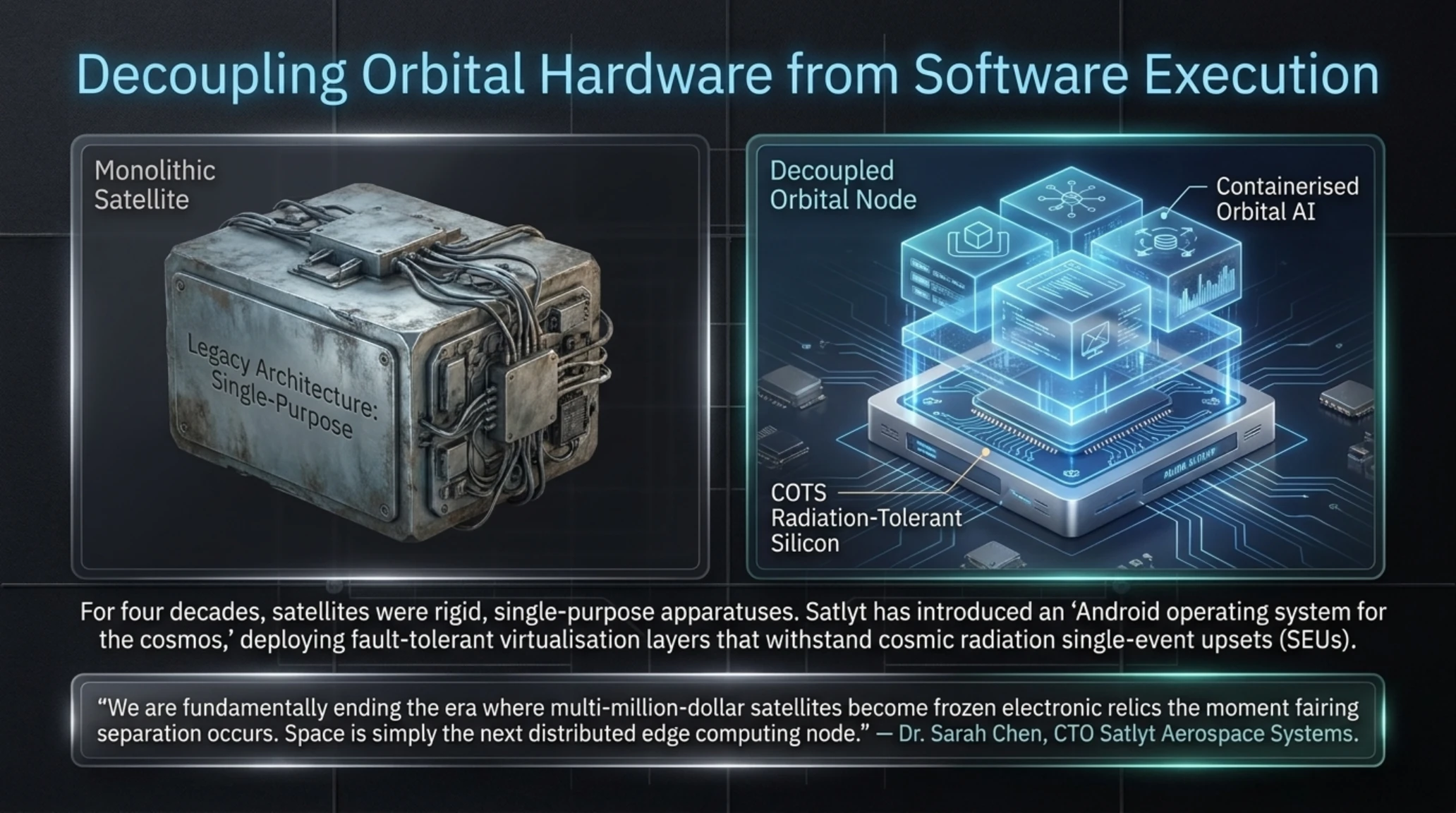
For more than four decades, satellite infrastructure has operated under a monolithic and immutable paradigm: hardware payloads, onboard flight controllers, and specialized sensing instruments were fused at the factory, launched into orbit, and operated as rigid, single-purpose apparatuses. When mission requirements shifted or algorithms improved, billions of dollars of orbiting hardware remained locked into outdated software baselines. Satlyt completely upends this antique status quo by decoupling orbital satellite hardware from software execution, introducing what industry analysts describe as an Android operating system for the cosmos.
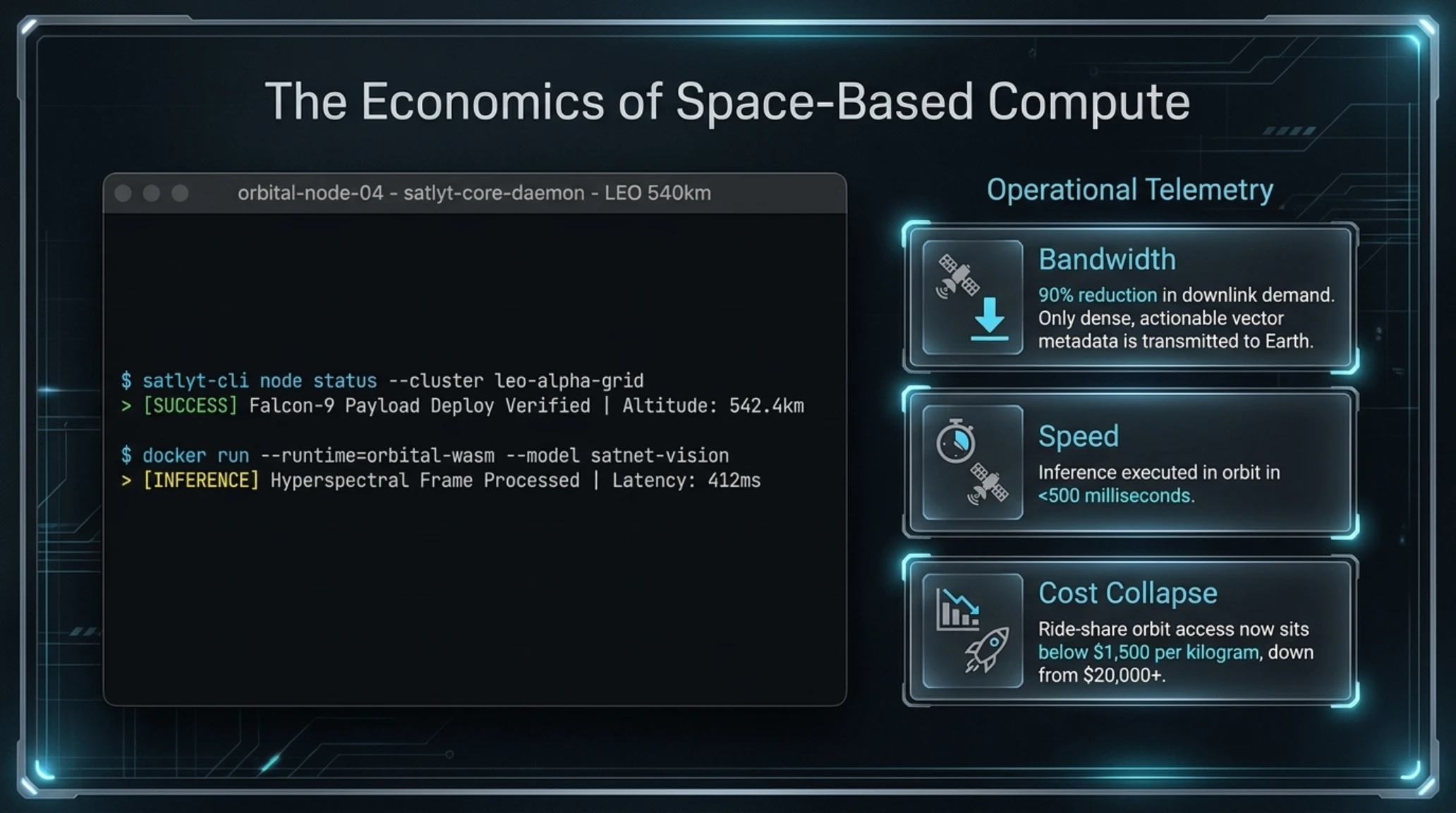
By establishing lightweight, fault-tolerant virtualization layers atop commercial off-the-shelf radiation-tolerant silicon, Satlyt allows third-party enterprises, defense agencies, and environmental monitoring consortiums to deploy, upgrade, and iterate machine learning models directly on operational satellite constellations while they orbit Earth at seventeen thousand miles per hour. Raw telemetry gathered by hyperspectral, synthetic-aperture radar, and infrared sensors no longer needs to be backhauled down to terrestrial ground receiving stations across constrained radio-frequency channels.
The engineering breakthrough lies in Satlyt's custom containerization engine, engineered specifically to withstand cosmic radiation single-event upsets (SEUs) and extreme thermal cycling without dropping computational state. By implementing formal memory sanitization protocols and localized consensus algorithms across micro-satellite clusters, the system dynamically schedules tensor execution across available orbital compute nodes based on real-time solar panel irradiance and battery thermal margins.
Instead of downlinking gigabytes of unprocessed raw imagery that saturates terrestrial satellite gateways and incurs massive per-gigabyte telecommunication fees, onboard neural networks execute inference in orbit, identifying wildfire ignitions, maritime sanctions evasion, or infrastructure anomalies in under five hundred milliseconds. Only dense, actionable vector metadata is transmitted back to Earth, slashing downlink bandwidth demand and ground-station operational expenses by more than ninety percent.
This deployment occurs alongside broader industry momentum toward orbital data infrastructure, dovetailing with initiatives such as Google's Project Suncatcher solar-orbital compute nodes and mega-constellation communications architectures. The verified telemetry logs generated during Falcon 9 stage separation and initial orbital bus bootstrap confirm that containerized inference workloads operated stably in zero gravity without memory leakage or thermal throttling across extended low Earth orbit passes.
Orbital Telemetry & Containerized Edge Runtime Audit Log
The successful execution of Satlyt's orbital pipeline highlights a profound paradigm shift for commercial Earth observation. Defense analysts, agricultural conglomerates, and environmental tracking agencies can now programmatically subscribe to dynamic satellite orbits via standard REST APIs, dispatching custom computer vision models to orbiting payloads with the same seamless developer velocity previously reserved for terrestrial Amazon Web Services or Google Cloud deployments.
From an orbital mechanics standpoint, the economics of space-based compute have been transformed by Falcon 9's reusability and falling launch costs per kilogram. Where satellite operators once budgeted upwards of twenty thousand dollars per kilogram to orbit, ride-share access now sits below fifteen hundred dollars. By taking advantage of standardized CubeSat form factors and radiation-tolerant multi-core processors, Satlyt enables dynamic software-defined constellations that can be reprogrammed in flight to track developing geopolitical events, environmental crises, or maritime shipping bottlenecks.
In comparison with terrestrial edge nodes, orbital systems operate in an unencumbered line-of-sight environment capable of intercepting and routing high-frequency signals across vast oceanic expanses where physical fiber optic cables are non-existent. When integrated with laser inter-satellite links (ISLs), orbital compute clusters form an autonomous, low-latency mesh that functions independently of terrestrial telecommunications choke points, providing unprecedented strategic resilience for global enterprise workflows.
As commercial satellite operators transition toward open container standards, the barrier to deploying high-frequency orbital intelligence will collapse, unlocking new paradigms for global maritime tracking, atmospheric climate modeling, and sovereign strategic defense.
The visual representation above illustrates Satlyt's distributed orbital compute topology, demonstrating how containerized microservices dynamically migrate across Low Earth Orbit constellations to maintain continuous high-speed observation uninterrupted by orbital blind spots.
Microsoft Patch Tuesday Shatters All Records with 1,413 Security Fixes
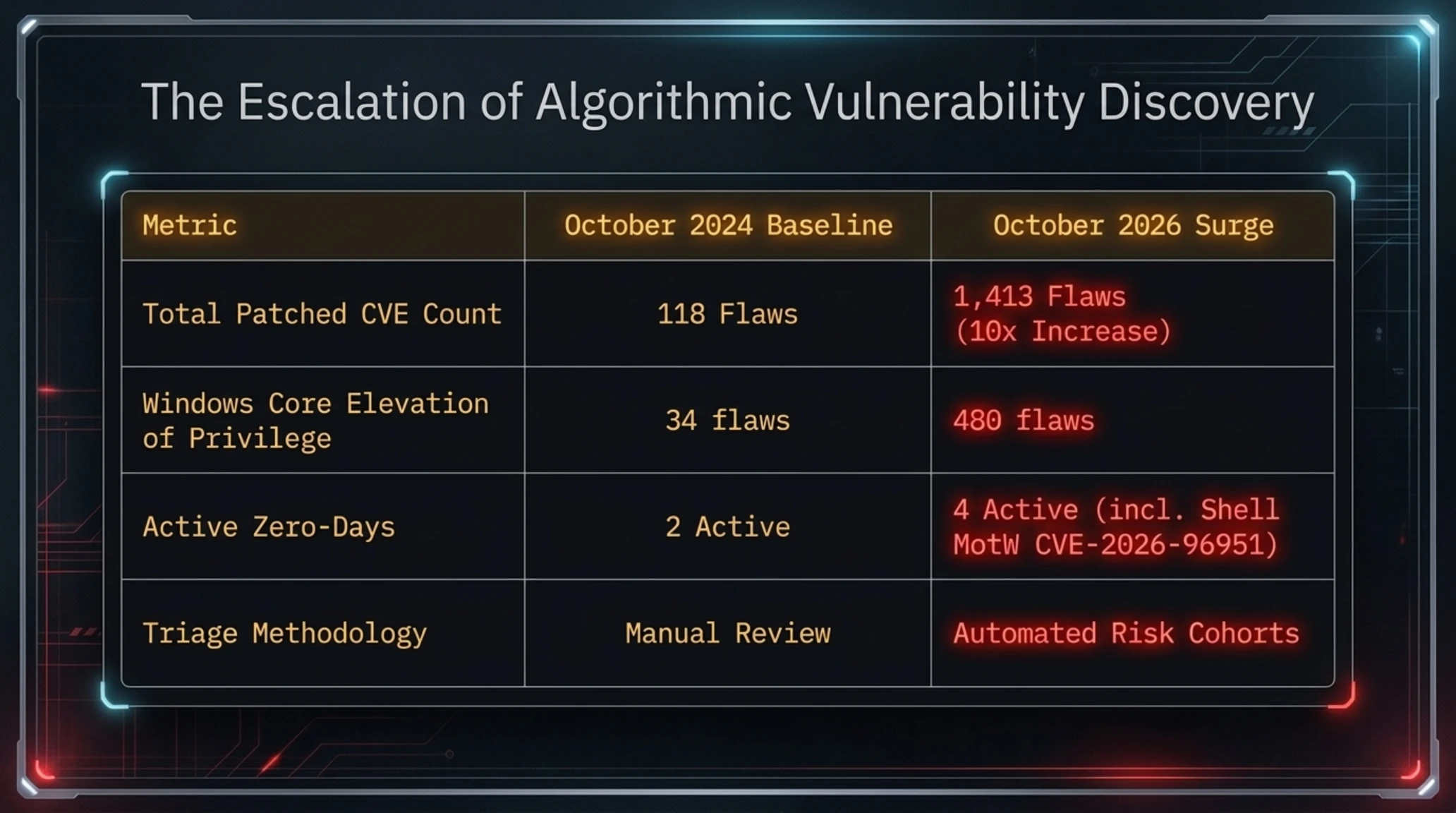
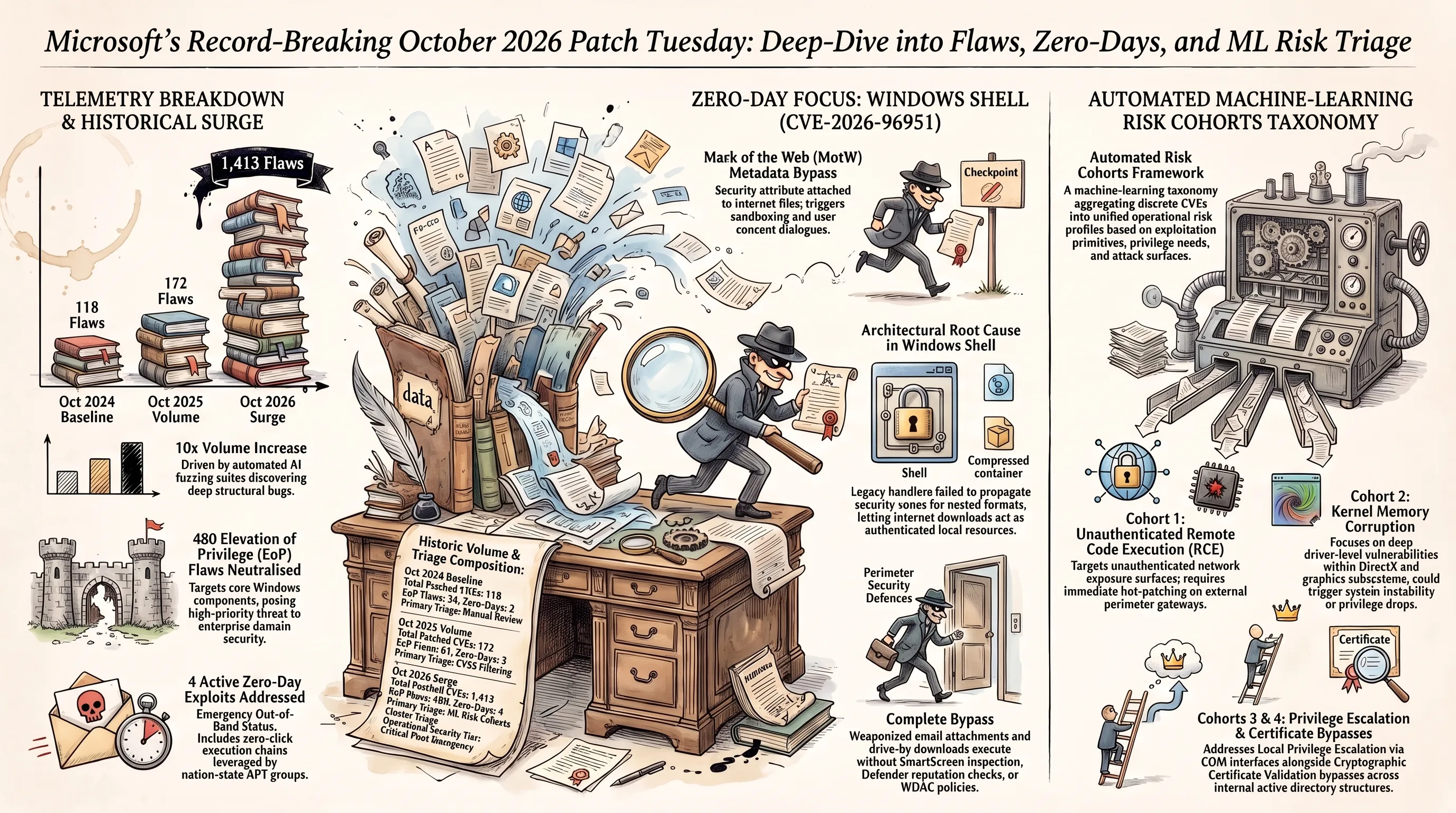
Simultaneously across terrestrial enterprise infrastructure, cybersecurity teams worldwide are scrambling following Microsoft's October 2026 Patch Tuesday release, which shattered historical records by delivering a staggering 1,413 distinct vulnerability patches. This massive update eclipses previous enterprise patching volumes by nearly a factor of ten, underscoring the severe escalation in offensive automated vulnerability exploitation driven by generative adversarial fuzzing tools.
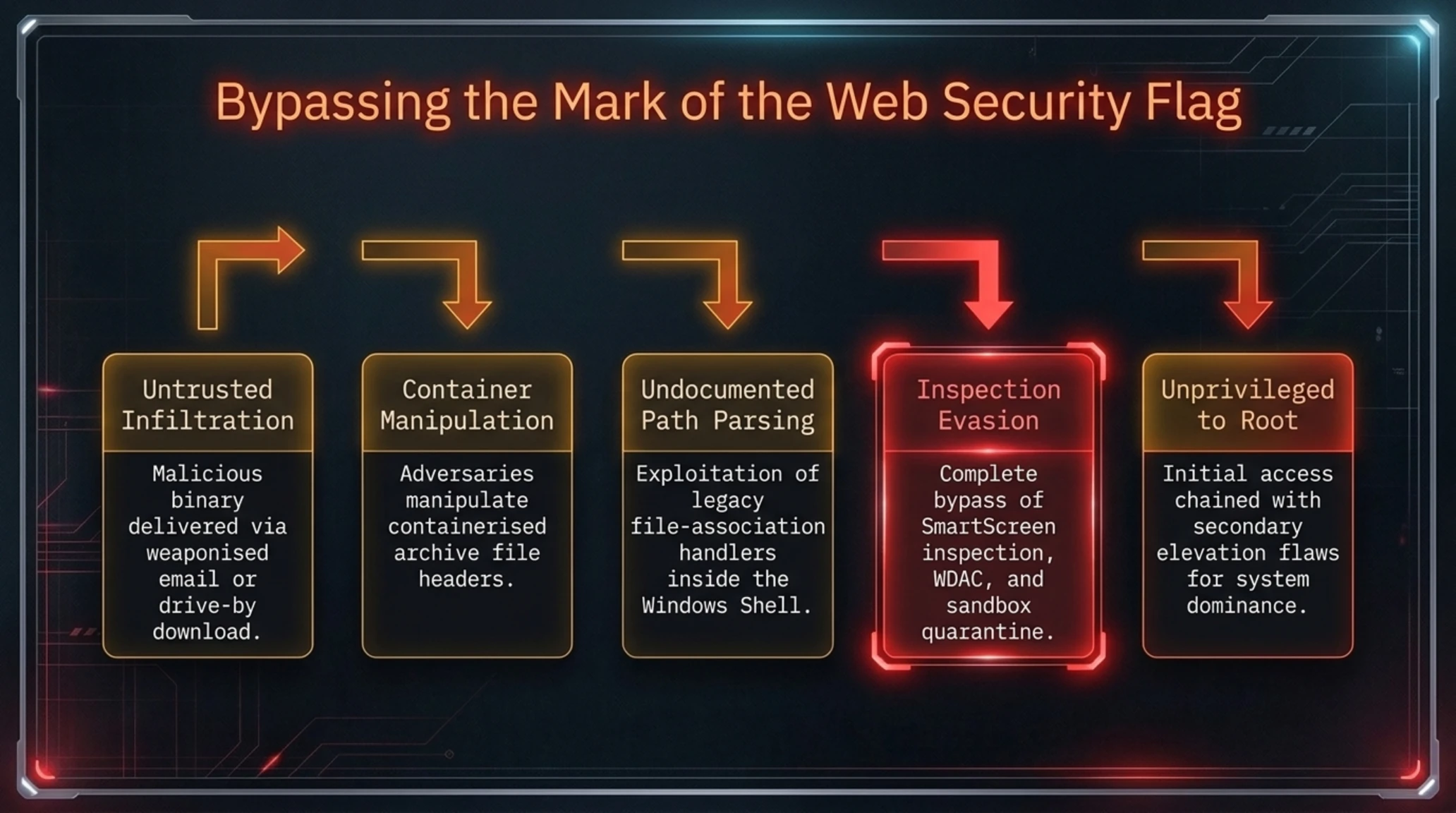
At the center of this defensive surge sits CVE-2026-96951, a critically dangerous zero-day flaw located in the Windows Shell subsystem that was actively exploited in the wild prior to patch disclosure. The vulnerability allowed threat actors to systematically circumvent the Mark of the Web (MotW) security flag, permitting malicious binaries delivered via weaponized email attachments and drive-by web downloads to execute without triggering SmartScreen inspection, Windows Defender reputation checks, or sandbox quarantine.
Security researchers discovered that nation-state advanced persistent threat (APT) groups had incorporated this flaw into sophisticated zero-click execution chains targeting defense contractors, aerospace manufacturers, and financial institutions. By manipulating containerized archive file headers and exploiting undocumented path-parsing routines inside the Windows Shell, adversaries could trick the operating system into treating arbitrary untrusted code downloaded from the public internet as fully authenticated local system resources.
The architectural root cause traces back to legacy file-association handlers that failed to propagate security zones when handling nested virtual disk formats and proprietary compressed containers. Once unpacked, payloads bypassed Windows Defender Application Control (WDAC) policies entirely, granting attackers initial unprivileged user access that was subsequently chained with secondary privilege escalation flaws to achieve full system-level dominance.
Tekin Cybersecurity Lexicon & Architectural Jargon Buster
To assist Fortune 500 security operation centers in triaging this unprecedented volume of security updates, Microsoft introduced its new Risk Cohorts framework. Rather than forcing administrators to parse 1,413 independent Common Vulnerabilities and Exposures (CVEs), the system synthesizes vulnerabilities into unified operational risk clusters based on shared exploitation primitives, privilege requirements, and network exposure surfaces.
Under this telemetry paradigm, enterprise administrators can prioritize defensive deployments across four primary threat cohorts: Remote Code Execution without Authentication, Kernel Memory Corruption via Direct X / Graphics drivers, Local Privilege Escalation through COM interfaces, and Cryptographic Certificate Validation Bypasses. This structural clustering prevents IT departments from becoming paralyzed by raw alert fatigue, ensuring that critical perimeter defenses receive immediate hot-patching.
The grouped benchmark chart and comparative matrix below illustrate the staggering scale of this release compared to baseline historic Patch Tuesday distributions, detailing the shift toward automated AI-assisted vulnerability discovery across core Windows subsystems.
Comparative Vulnerability Distribution & Patch Telemetry Matrix
| Vulnerability Vector & Subsystem | October 2024 Baseline | October 2025 Volume | October 2026 Surge | Operational Severity Tier |
|---|---|---|---|---|
| Total Patched CVE Identifier Count | 118 Flaws | 172 Flaws | 1,413 Flaws (10x Increase) | Critical Fleet Emergency |
| Elevation of Privilege (EoP) Exploits | 34 Flaws | 61 Flaws | 480 Flaws in Windows Core | High Enterprise Priority |
| Zero-Day Exploits Under Active Attack | 2 Zero-Days | 3 Zero-Days | 4 Active (Shell MotW CVE-2026-96951) | Emergency Out-of-Band Patch |
| Triage Architecture Methodology | Manual Review | CVSS Filtering | Machine-Learning Risk Cohorts | Algorithmic Cluster Triage |
The unprecedented release reveals how automated code audit suites and fuzzing algorithms operated by threat intelligence teams are uncovering deep structural bugs at an industrial tempo, forcing enterprise software vendors to re-architect their entire quality-assurance pipelines. Systems administrators are urged to review group policies and stage rollout rings immediately across testing clusters before wide enterprise distribution.
The video documentation above provides a detailed breakdown from leading cybersecurity researchers explaining how the Windows Shell MotW zero-day was weaponized in the wild and detailing the automated deployment steps necessary to safeguard enterprise active directories.
Following the massive cyber defense updates across enterprise systems, the technology world witnessed an astonishing intersection of aerospace engineering and high-performance automotive consumer hardware in central Texas.
The photograph above captures the long-anticipated production iteration of the Tesla Roadster 2 undergoing dynamic closed-circuit maneuvers at the Texas proving grounds, highlighting the integrated aerodynamic ducting and cold gas nozzle ports.
Tesla Formally Unveils Production Roadster 2 with SpaceX Cold Gas Thrusters in Texas
Ending nearly a decade of intense industry speculation, delays, and engineering redesigns, Tesla Chief Executive Officer Elon Musk took to the stage early this Thursday morning in Waco, Texas, to formally unveil the production-ready configuration of the next-generation Tesla Roadster 2. The event provided live, instrumented demonstration runs that fundamentally rewrite the physics of consumer automotive acceleration.
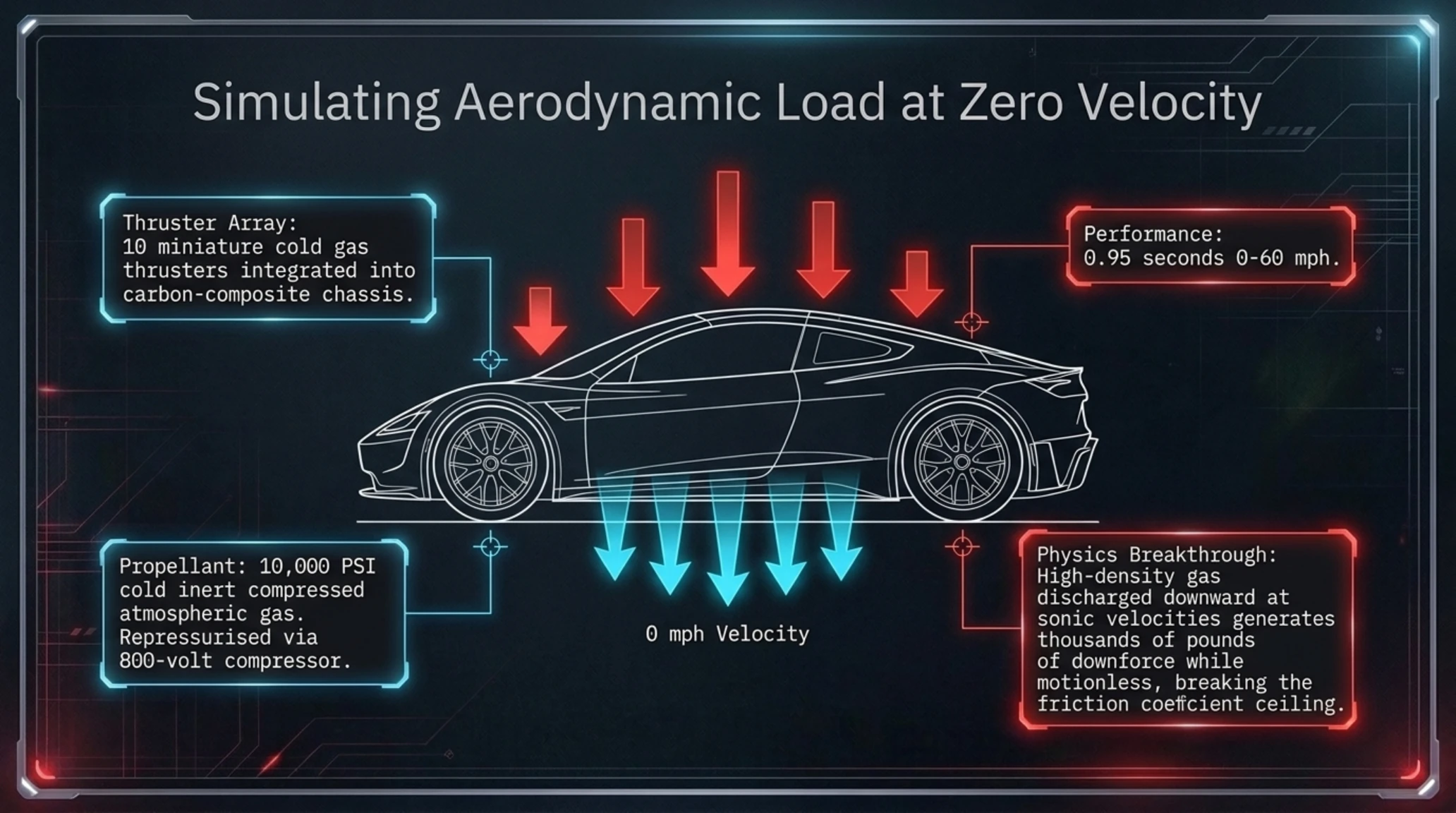
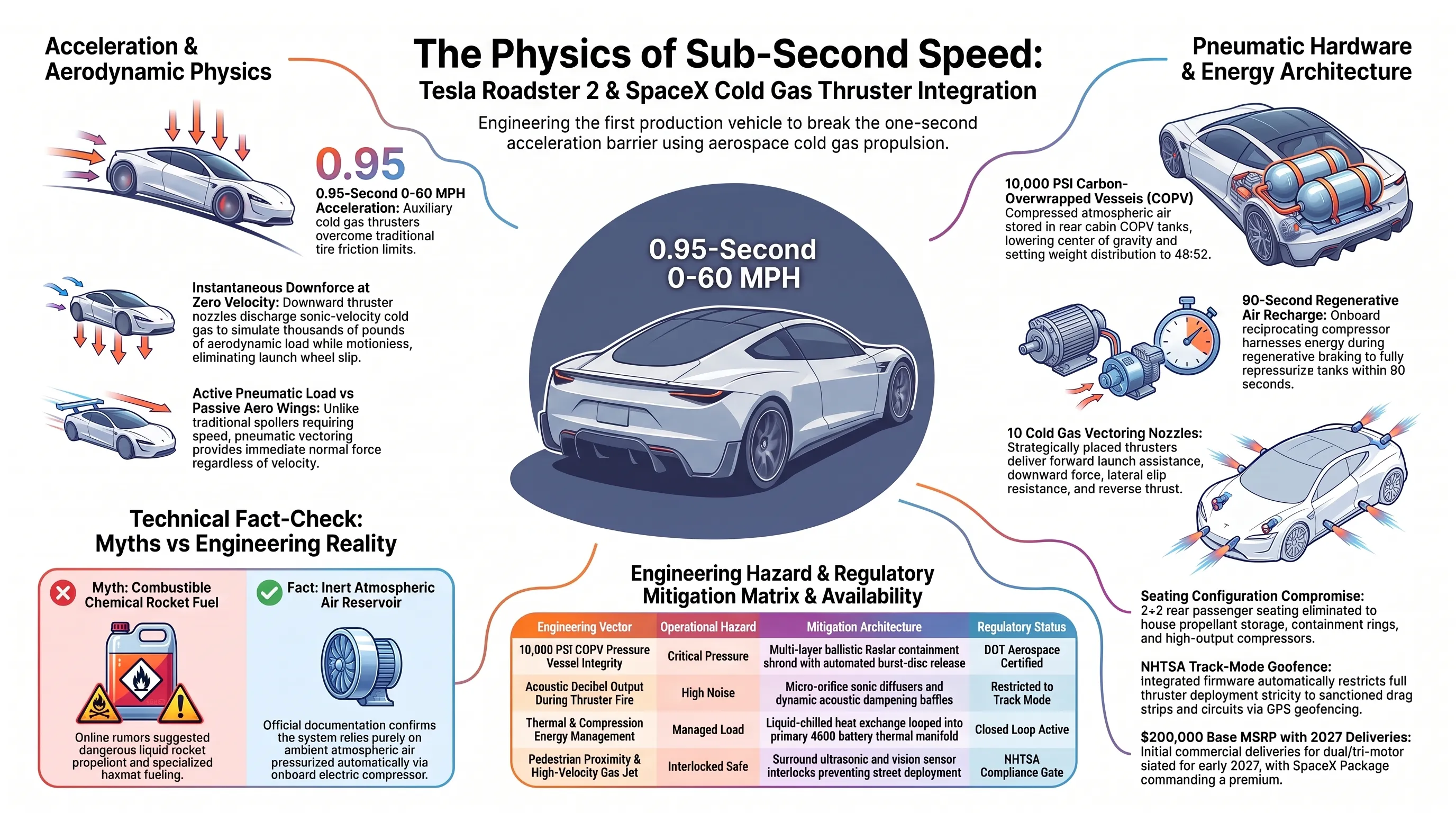
The centerpiece of the production vehicle is the validated integration of the optional SpaceX Package, a radical propulsion enhancement system that borrows hardware directly from orbital rocket stabilization thrusters. Ten miniature cold gas thrusters, strategically positioned around the vehicle's lightweight carbon-composite chassis, utilize ultra-high-pressure compressed air stored at ten thousand pounds per square inch to deliver instant auxiliary vector thrust.
During the live telemetric run witnessed by thousands of engineers and industry observers, the Roadster 2 shattered production car records by accelerating from zero to sixty miles per hour in an astounding 0.95 seconds. To achieve this unprecedented feat without shredding conventional street-legal tires, the rear cold gas thrusters fire with instantaneous pneumatic force, pushing the vehicle forward while downward-facing nozzles generate instant artificial downforce exceeding the vehicle's curb weight.
Under conventional automotive dynamics, tire adhesion is strictly governed by friction coefficients and normal force generated by vehicle mass and passive aerodynamic wings. At low launch speeds, wings produce virtually zero downforce, placing an unyielding physical ceiling on traditional tire acceleration. By discharging high-density cold gas downward at sonic velocities, the Roadster 2 simulates thousands of pounds of aerodynamic load while standing completely motionless, allowing the custom Michelin compound tires to achieve traction coefficients previously deemed impossible outside of specialized drag strips.
The pneumatic manifold is powered by a high-efficiency reciprocating compressor coupled directly to the vehicle's 800-volt electrical architecture. Drawing brief surges of power during regenerative braking events, the compressor replenishes the propellant reservoir in approximately ninety seconds of normal driving. This closed-loop regenerative pneumatic cycle ensures that drivers possess repeated launch capability without manual re-pressurization or external propellant handling.
Technical Fact-Check | Viral Rumor vs. Aerospace Engineering Reality
Claims circulated across online forums suggesting the Roadster 2 uses dangerous combustible chemical rocket fuel requiring specialized hazmat refueling stations.
The system relies exclusively on cold inert compressed atmospheric gas stored in carbon-wrapped pressure vessels, re-pressurized automatically via an onboard 10,000 PSI compressor.
Engineering compromises were required to accommodate the aerospace hardware. To house the massive carbon-overwrapped pressure vessels (COPV), Tesla engineers eliminated the 2+2 rear passenger seating configuration, dedicating the aft cabin entirely to propellant storage, safety containment rings, and high-output electric compressors. The structural placement lowers the overall center of gravity, balancing front-to-rear weight distribution precisely at 48:52.
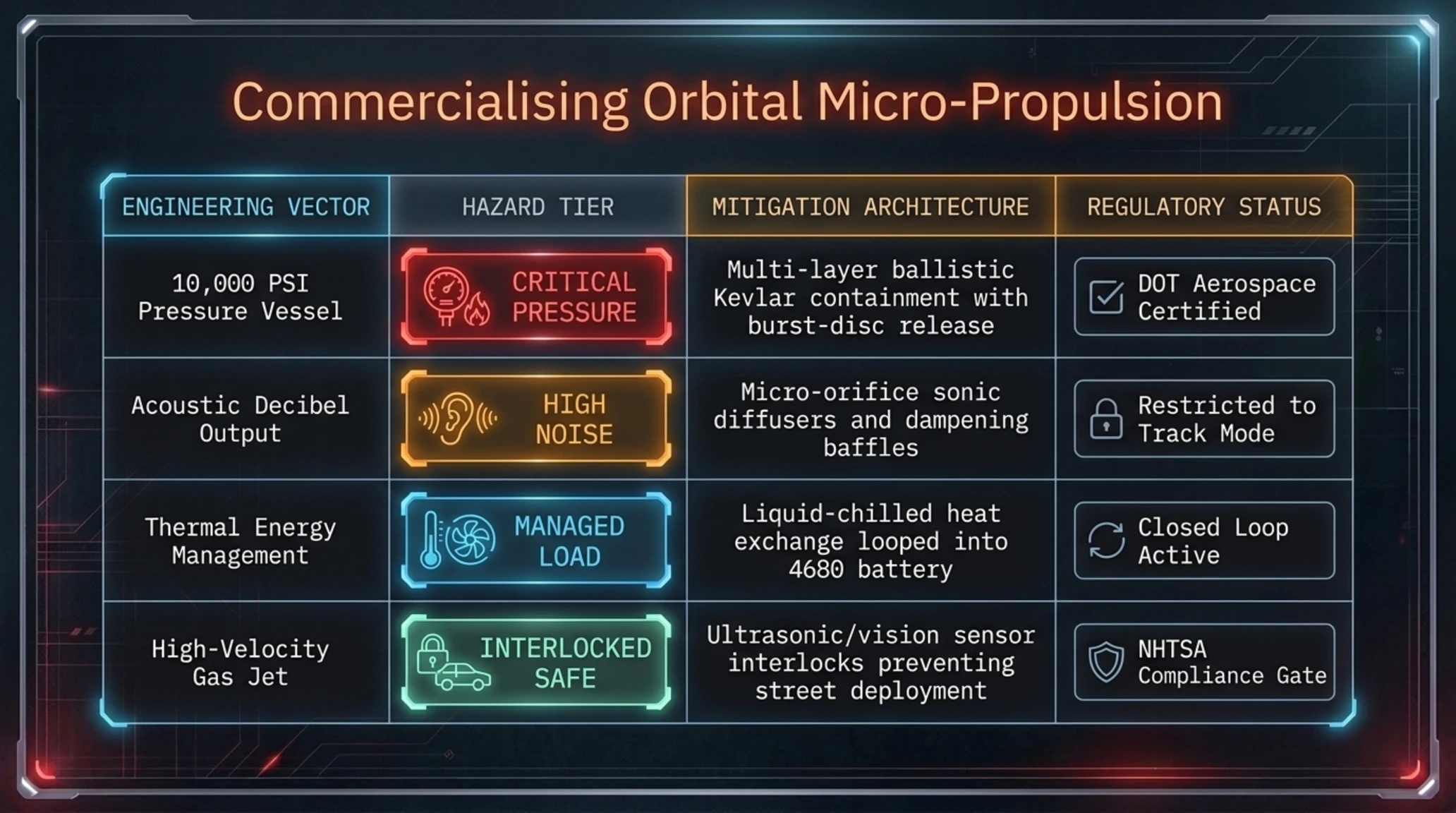
Beyond straight-line acceleration, the thruster array revolutionizes dynamic cornering and emergency braking. Lateral nozzles fire in microsecond bursts to counteract centrifugal slip, allowing the sports car to corner at unprecedented lateral G-forces while front-facing nozzles drastically reduce high-speed braking distances. The engineering and regulatory matrix below evaluates the technical trade-offs of commercial rocket thruster deployment.
Aerospace Thrusters in Consumer Vehicles: Engineering Risk & Regulatory Matrix
| Engineering Vector & Subsystem | Operational Hazard Tier | Mitigation Architecture | Regulatory Highway Status |
|---|---|---|---|
| 10,000 PSI COPV Pressure Vessel Integrity | Critical Pressure | Multi-layer ballistic Kevlar containment shroud with automated burst-disc release | DOT Aerospace Certified |
| Acoustic Decibel Output During Thruster Fire | High Noise | Micro-orifice sonic diffusers and dynamic acoustic dampening baffles | Restricted to Track Mode |
| Thermal & Compression Energy Management | Managed Load | Liquid-chilled heat exchange looped into primary 4680 battery thermal manifold | Closed Loop Active |
| Pedestrian Proximity & High-Velocity Gas Jet | Interlocked Safe | Surround ultrasonic and vision sensor interlocks preventing street deployment | NHTSA Compliance Gate |
📚 Classified & Related Dossiers in TekinGame
If you wish to explore beyond this report and delve into cybernetic frontiers and autonomous AI architectures, do not miss these three exclusive deep-dives in the Tekin Garage:
Initial commercial deliveries are slated to commence in early 2027, with the base dual-motor tri-motor configuration carrying a base MSRP of $200,000, while the SpaceX Package commands a substantial premium. Federal highway regulators at NHTSA confirmed this morning that while the vehicle is fully street legal in electric-drive mode, electronic firmware geofences will restrict full cold-gas thruster activation exclusively to sanctioned race circuits and drag strips.
The engineering validation achieved in Waco also highlights the evolving physics of active vehicular aerodynamics. Traditional downforce systems rely on spoilers and ground-effect venturi tunnels that require substantial forward velocity to generate aerodynamic suction. In contrast, the cold gas thruster array creates instantaneous normal force while stationary, fundamentally eliminating wheel slip during aggressive torque delivery. By coordinating torque vectoring across three independent electric motors with microsecond pneumatic pulses, the vehicle achieves unprecedented yaw control and high-speed cornering stability.
While automotive enthusiasts celebrate the physical realization of this hypercar milestone, corporate boardrooms in Silicon Valley are engrossed in an increasingly vicious legal war over proprietary hardware engineering talent and generative AI secrets.
The judicial chamber depicted above represents the federal courthouse in San Jose, California, where Judge Edward Davila presided over crucial evidentiary hearings that could force unprecedented disclosure from OpenAI's executive ranks.
Federal Judge Orders OpenAI to Disclose Executive Communications in Apple Hardware Trade Secrets Lawsuit
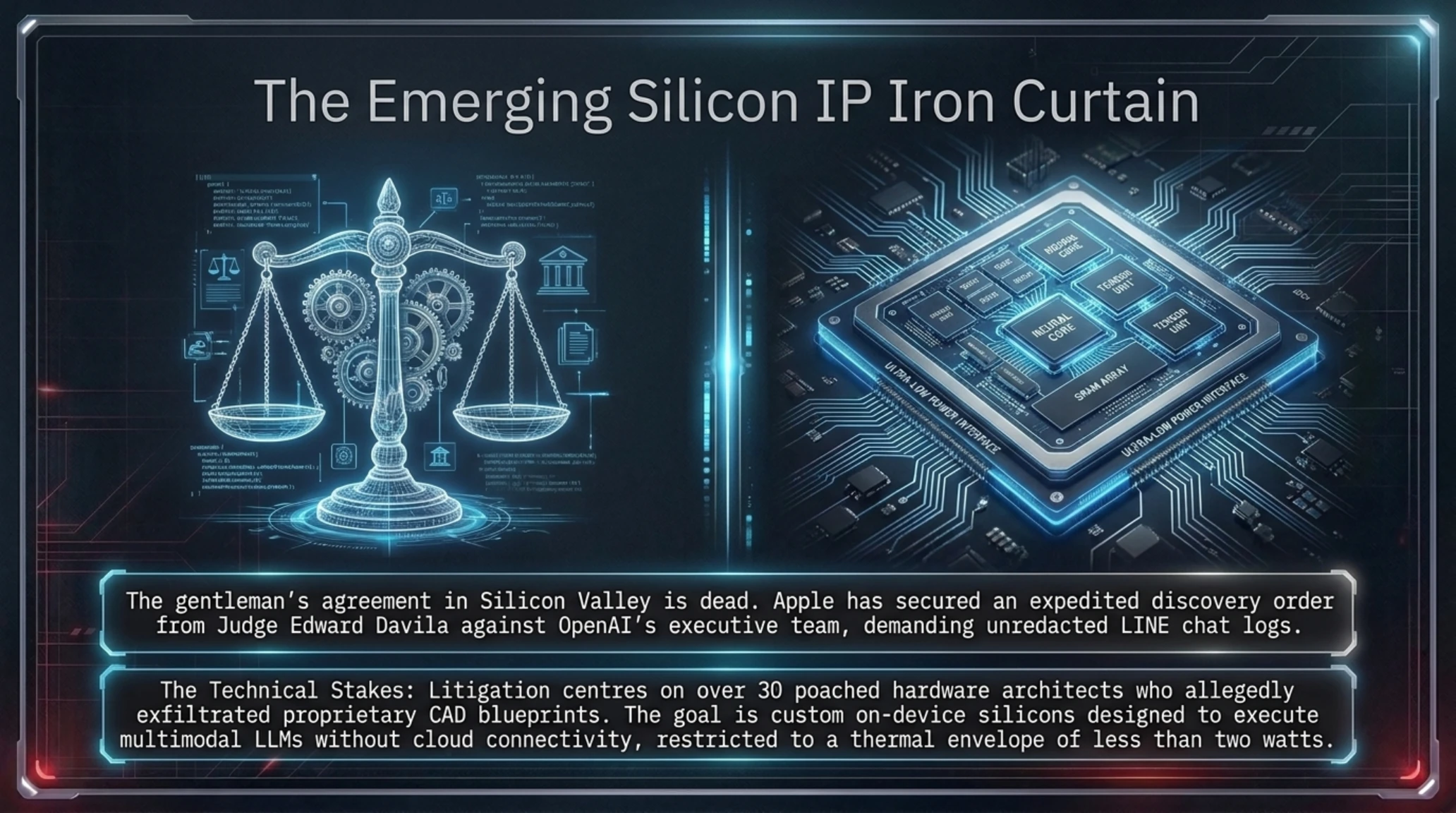
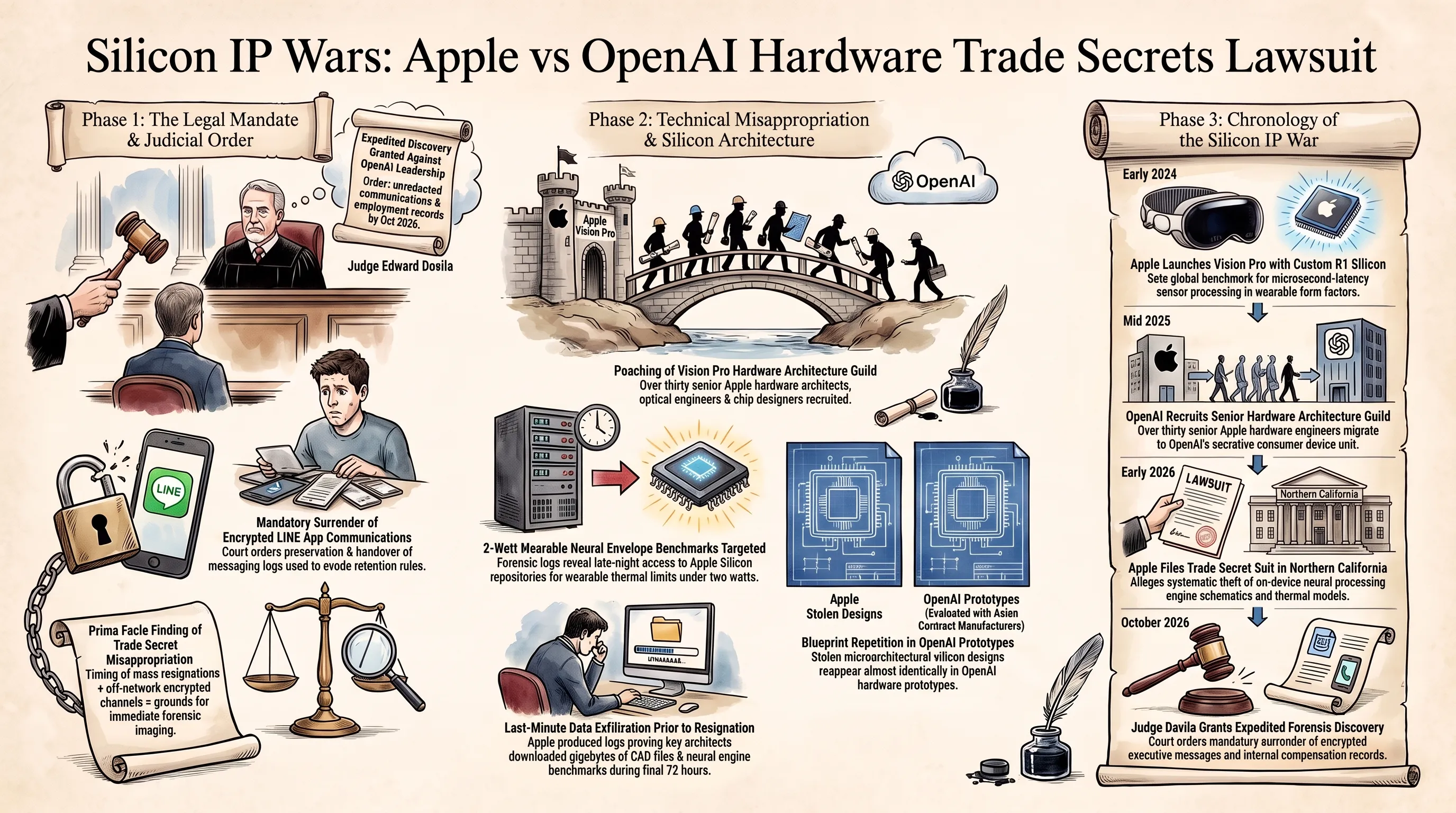
In a major legal turning point with profound ramifications for the artificial intelligence industry, U.S. District Judge Edward Davila of the Northern District of California issued an assertive order late Wednesday night granting Apple's motion for expedited discovery against OpenAI. The ruling compels OpenAI Chief Executive Officer Sam Altman and his senior leadership team to produce unredacted executive communications and employment records by the end of this month.
The contentious litigation centers on Apple's allegations that OpenAI orchestrated a deliberate, systematic campaign to misappropriate proprietary trade secrets relating to specialized consumer AI hardware. According to court filings, OpenAI aggressively poached dozens of Apple's most decorated hardware architects, optical engineers, and chip designers who had spent years developing the Vision Pro spatial computing platform and ultra-low-power neural processing units.
Apple contends that these departing engineers took with them confidential blueprints, schematic architectures, and thermal simulation models for custom on-device silicon designed to execute multimodal LLMs without cloud connectivity. Crucially, Judge Davila's ruling specifically orders the forensic preservation and handover of encrypted communications conducted over alternative messaging platforms, including the LINE app, which Apple claims were used deliberately to evade corporate document retention mandates.
During evidentiary arguments, Apple's lead counsel presented forensic server logs documenting suspicious late-night access to Apple Silicon system-on-chip repositories. The targeted repositories contained microarchitectural designs for dedicated transformer accelerator blocks engineered to fit within wearable thermal envelopes of less than two watts. Apple asserts that these unique silicon configurations reappear almost identically in OpenAI's unannounced hardware prototypes currently under evaluation with Asian contract manufacturers.
Judge Davila rejected OpenAI's assertion that the requested discovery was an impermissible fishing expedition intended to stifle legitimate labor competition. The court noted that the timing of mass resignations, paired with direct evidence of encrypted messaging channels established outside official corporate email networks, created a prima facie showing of potential trade secret misappropriation sufficient to warrant immediate forensic imaging.
OpenAI's defense team argued passionately that the talent acquisition was standard industry mobility and that the company had instituted strict intellectual property clean-room protocols to prevent incoming engineers from contaminating OpenAI's ongoing hardware initiatives. However, Apple produced internal document access logs demonstrating that several key architects had downloaded gigabytes of proprietary CAD files and neural engine benchmarks during their final seventy-two hours before submitting formal resignations.
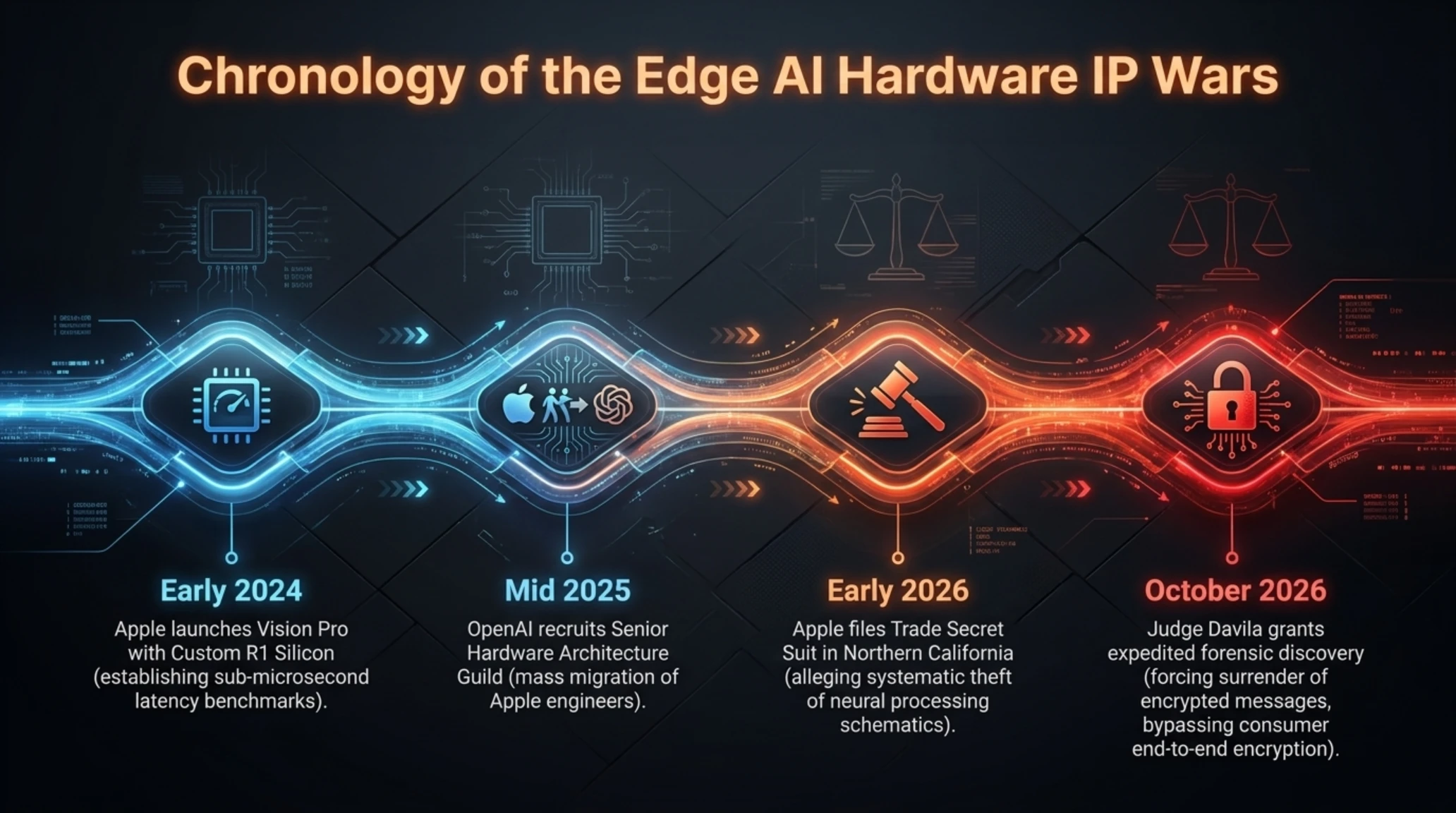
The structured timeline below charts the escalating legal conflicts between established hardware incumbents and generative AI pioneers over the past three years, tracing the transition from software API alliances to full-scale hardware warfare.
Event Timeline | Chronology of Silicon Valley's Edge AI Hardware IP Wars
| Timeframe & Venue | Key Legal & Technological Event | Strategic Impact on Silicon Ecosystem |
|---|---|---|
| Early 2024 | Apple Launches Vision Pro with Custom R1 Silicon | Establishes global benchmark for microsecond latency sensor processing in wearable form factors. |
| Mid 2025 | OpenAI Recruits Senior Hardware Architecture Guild | Over thirty senior Apple hardware engineers migrate to OpenAI's secretive consumer device division. |
| Early 2026 | Apple Files Trade Secret Suit in Northern California | Alleges systematic theft of on-device neural processing engine schematics and thermal designs. |
| October 2026 | Judge Davila Grants Expedited Forensic Discovery | Court orders mandatory surrender of encrypted executive messages and internal compensation records. |
The court's mandate is already sending shockwaves through the tech hiring landscape, causing corporate legal counsels across Silicon Valley to immediately freeze informal backchannel recruitment practices and enforce rigorous device isolation procedures for newly onboarded staff.
From a legal precedent standpoint, Judge Davila's ruling establishes clear evidentiary boundaries for trade secret protection in an era of rapid AI talent mobility. While California Business and Professions Code Section 16600 strongly protects an employee's right to pursue lawful employment, courts are drawing an uncompromising line when departures coincide with the unauthorized exfiltration of proprietary schematics. By mandating the production of unredacted communications from personal messaging apps, the court has signaled that executives cannot shield recruitment misconduct behind end-to-end encrypted consumer platforms.
While intellectual property battles rage within the courtroom, federal law enforcement authorities in the southern United States conducted a massive coordinated takedown targeting the dangerous physical infrastructure of state-sponsored corporate infiltration.
The forensic photograph above illustrates the sophisticated hardware infrastructure uncovered during the Texas raids: dense metal racks housing hundreds of operational commercial enterprise laptops connected to automated remote management switches.
DOJ Operation Lonestar Roundup Smashes 40 Texas Laptop Farms Run by North Korean Remote IT Operatives
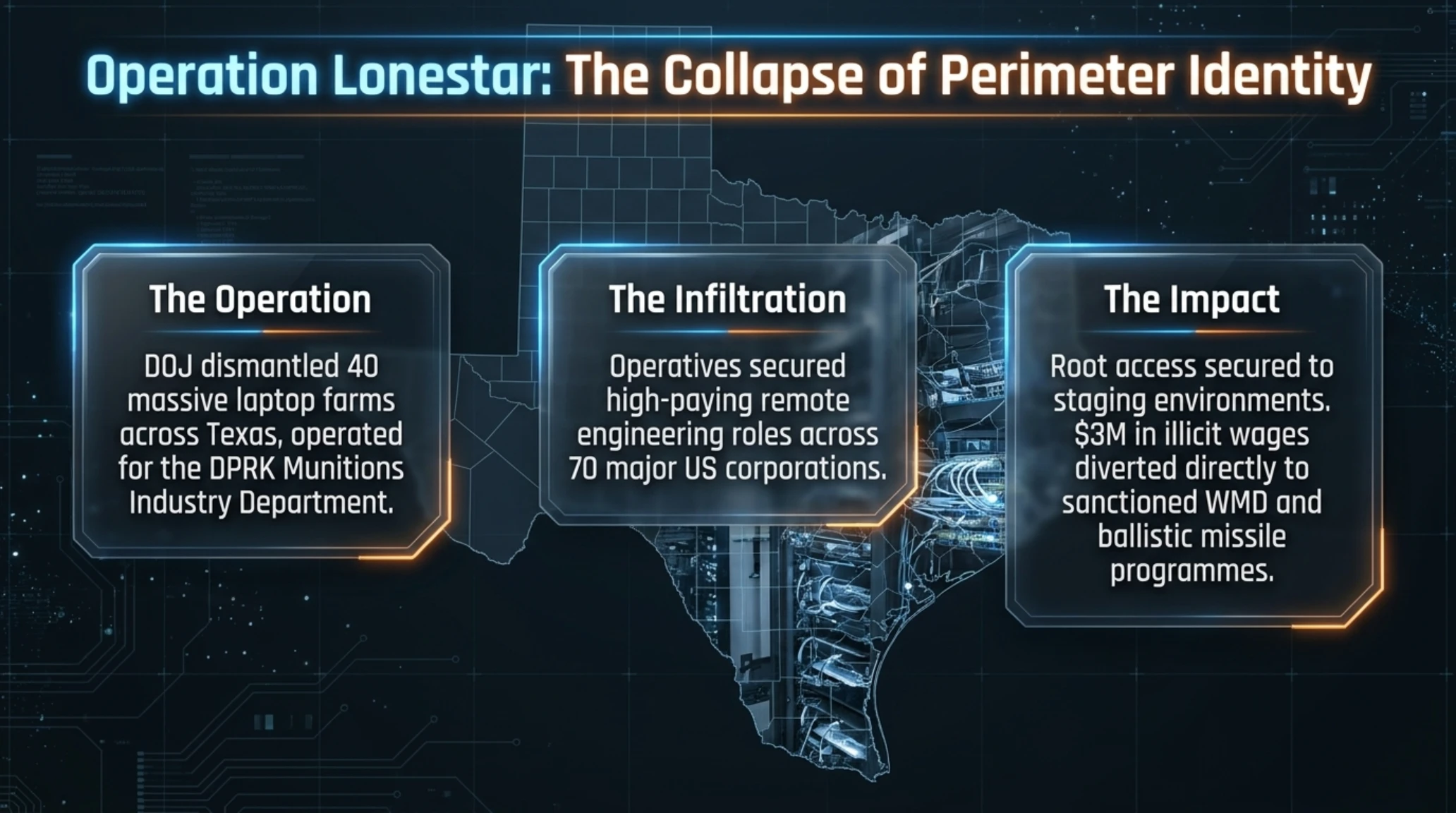
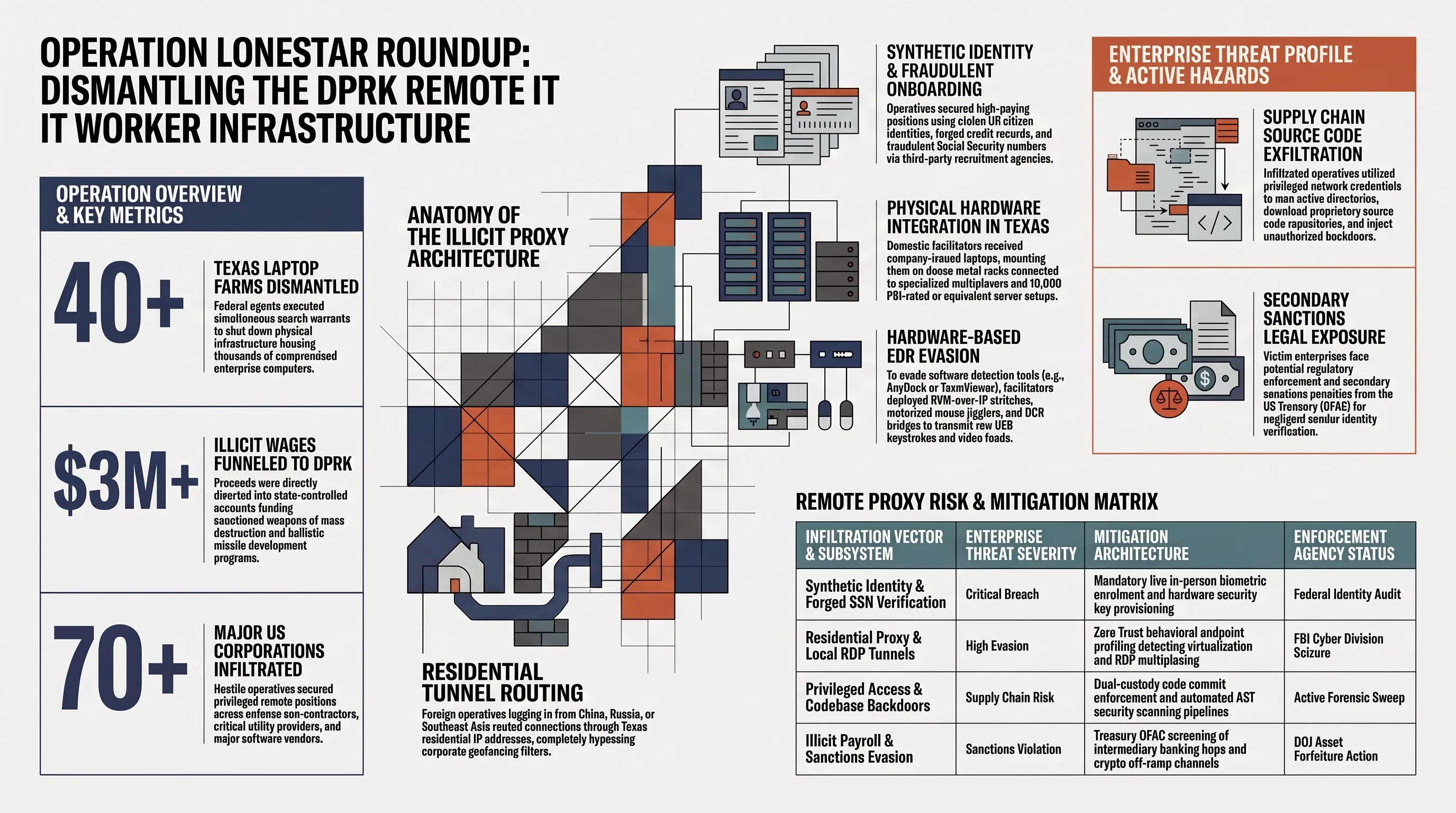
In one of the most comprehensive federal counterintelligence and cyber fraud operations in modern American history, the United States Department of Justice, in coordination with the FBI, Homeland Security Investigations, and the Internal Revenue Service Criminal Investigation division, unsealed major indictments early Thursday following the execution of simultaneous federal search warrants across northern and central Texas. Dubbed Operation Lonestar Roundup, the strike dismantled over forty operational laptop farms housing thousands of enterprise computers.
According to sworn federal affidavits filed in the Eastern District of Texas, the sprawling illicit network functioned as a covert remote-work gateway for highly skilled software engineers, DevOps specialists, and smart contract developers operating under the direct command of the Democratic People's Republic of Korea (DPRK) Munitions Industry Department. By leveraging stolen identities of legitimate United States citizens, fraudulent Social Security numbers, and forged credit records, these operatives successfully secured high-paying remote engineering positions across more than seventy prominent American corporations, including major defense sub-contractors, critical utility operators, and Silicon Valley software vendors.
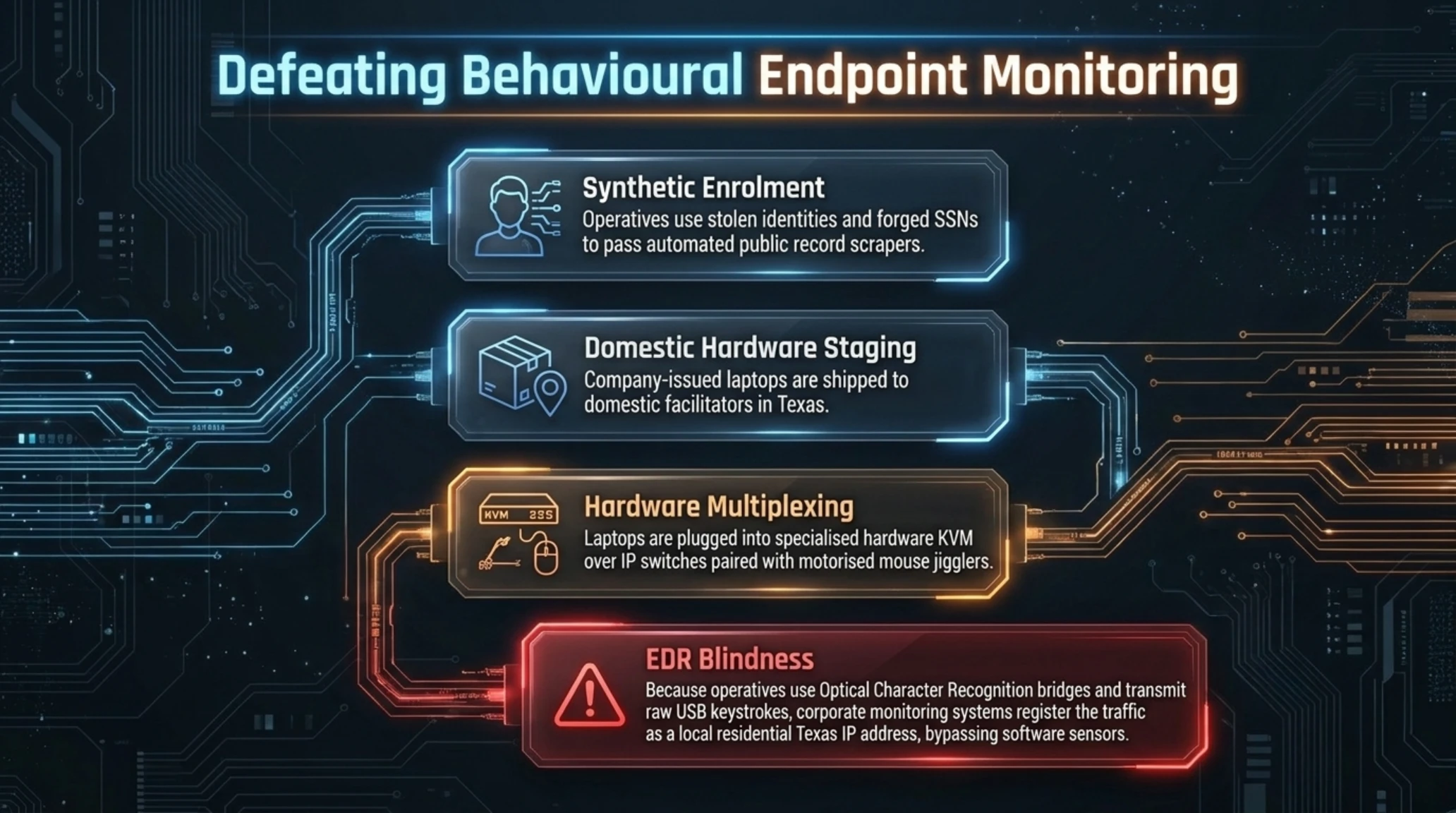
The physical laptop farms in Texas were managed by domestic facilitators who received company-issued hardware, plugged the machines into specialized multiplexers, and configured persistent, low-latency remote desktop tunnels. When North Korean operatives logged in from locations in China, Russia, or Southeast Asia, enterprise network monitoring systems registered the traffic as originating locally from residential Texas IP addresses, completely bypassing corporate geofencing restrictions.
The technical sophistication of the proxy network baffled corporate IT departments for years. To defeat behavioral endpoint monitoring tools, domestic facilitators installed specialized hardware-based keyboard-video-mouse (KVM) over IP switches paired with motorized mouse jigglers and optical character recognition bridges. The foreign operatives never interacted directly with the corporate operating system via software-based remote tools like AnyDesk or TeamViewer, which commonly trigger enterprise security alerts; instead, they transmitted raw USB keystrokes and received hardware-encoded video feeds, rendering corporate Endpoint Detection and Response (EDR) sensors completely blind to the external connection.
Federal investigators confirmed that the operation successfully funneled more than $3 million in illicit wages directly into state-controlled accounts tied to sanctioned weapons of mass destruction and ballistic missile development programs. Furthermore, several infiltrated operatives leveraged their privileged network credentials to inject unauthorized backdoors, map active directories, and exfiltrate proprietary source code repositories before their identities were flagged.
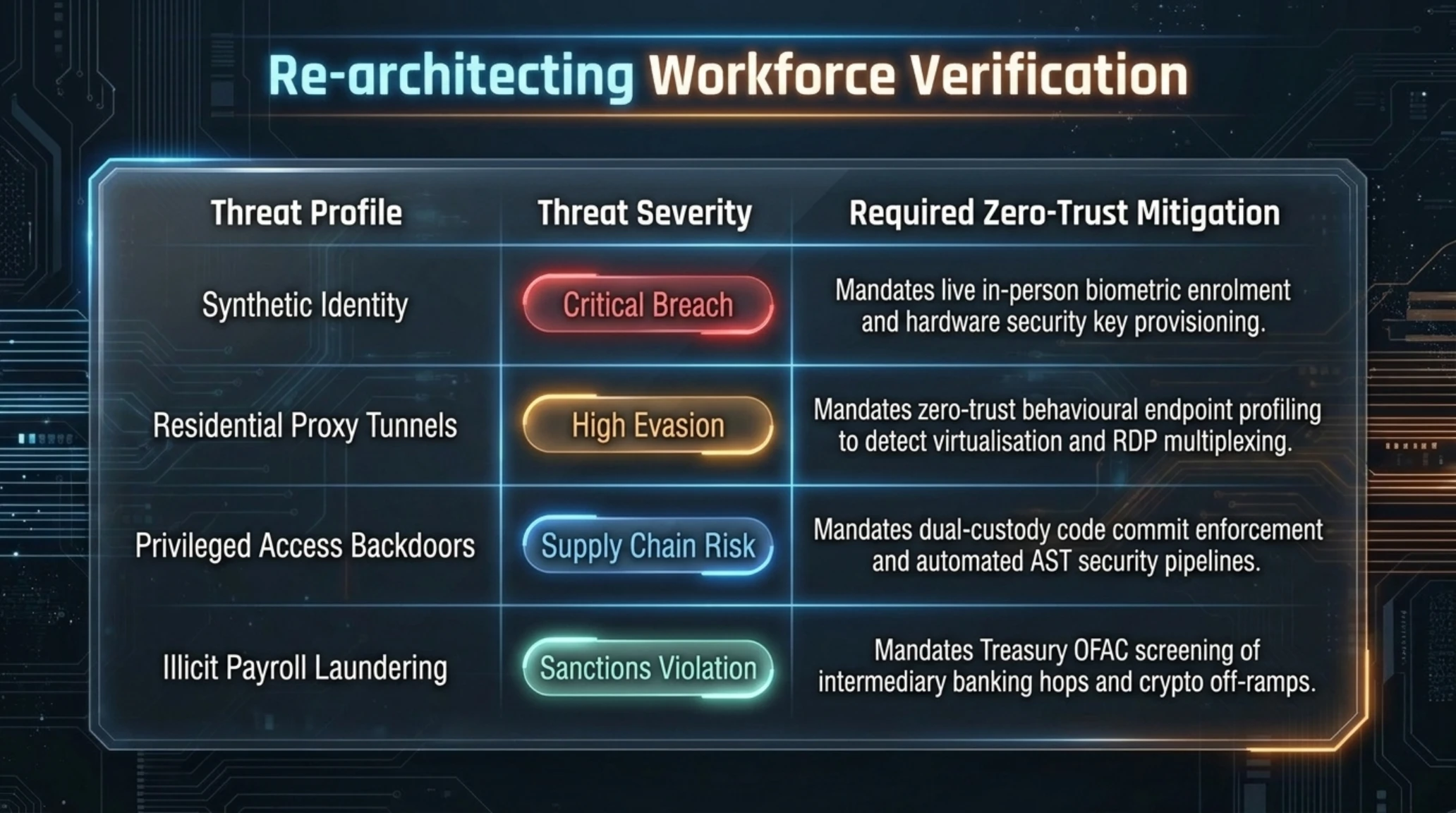
Corporate Workforce Integrity & Remote Proxy Risk Matrix
| Infiltration Vector & Subsystem | Enterprise Threat Severity | Mitigation Architecture | Enforcement Agency Status |
|---|---|---|---|
| Synthetic Identity & Forged SSN Verification | Critical Breach | Mandatory live in-person biometric enrollment and hardware security key provisioning | Federal Identity Audit |
| Residential Proxy & Local RDP Tunnels | High Evasion | Zero Trust behavioral endpoint profiling detecting virtualization and RDP multiplexing | FBI Cyber Division Seizure |
| Privileged Access & Codebase Backdoors | Supply Chain Risk | Dual-custody code commit enforcement and automated AST security scanning pipelines | Active Forensic Sweep |
| Illicit Payroll & Sanctions Evasion Laundering | Sanctions Violation | Treasury OFAC screening of intermediary banking hops and crypto off-ramp channels | DOJ Asset Forfeiture Action |
The exposure of this multi-million-dollar remote IT scheme underscores the urgent necessity for modern enterprises to transition away from passive credential checking toward continuous biometric verification and hardware-attested zero-trust architectures. Corporations are now facing potential secondary sanctions penalties from the U.S. Treasury if found negligent in their vendor identity verification workflows.
The operational scale of Operation Lonestar Roundup exposes severe systemic blind spots in contemporary enterprise identity management. Many of the compromised Fortune 500 corporations relied on third-party recruitment agencies that performed cursory background checks utilizing automated public record scrapers rather than in-person identity verification. As a consequence, hostile intelligence operatives secured root access to enterprise staging environments, continuous integration pipelines, and customer database clusters, highlighting the vital imperative for cryptographic hardware security tokens and mandatory biometric attestation.
The video above details the official press conference hosted by the Department of Justice and federal law enforcement partners, offering a live showcase of seized hardware and outlining new compliance protocols for distributed corporate hiring.
Standard Chartered Launches Direct Spot Bitcoin and Ethereum Trading in the UAE under Dubai VARA
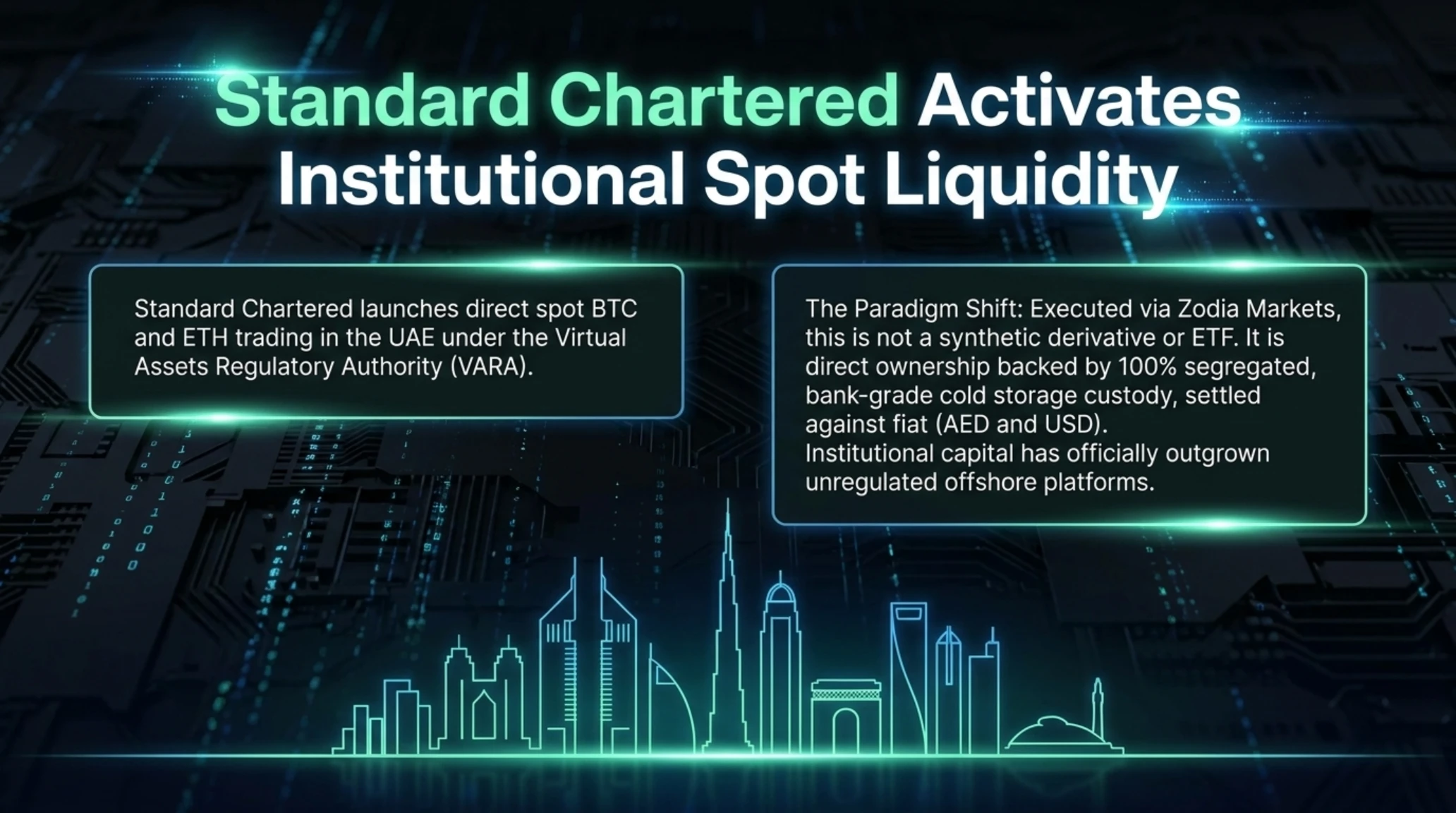
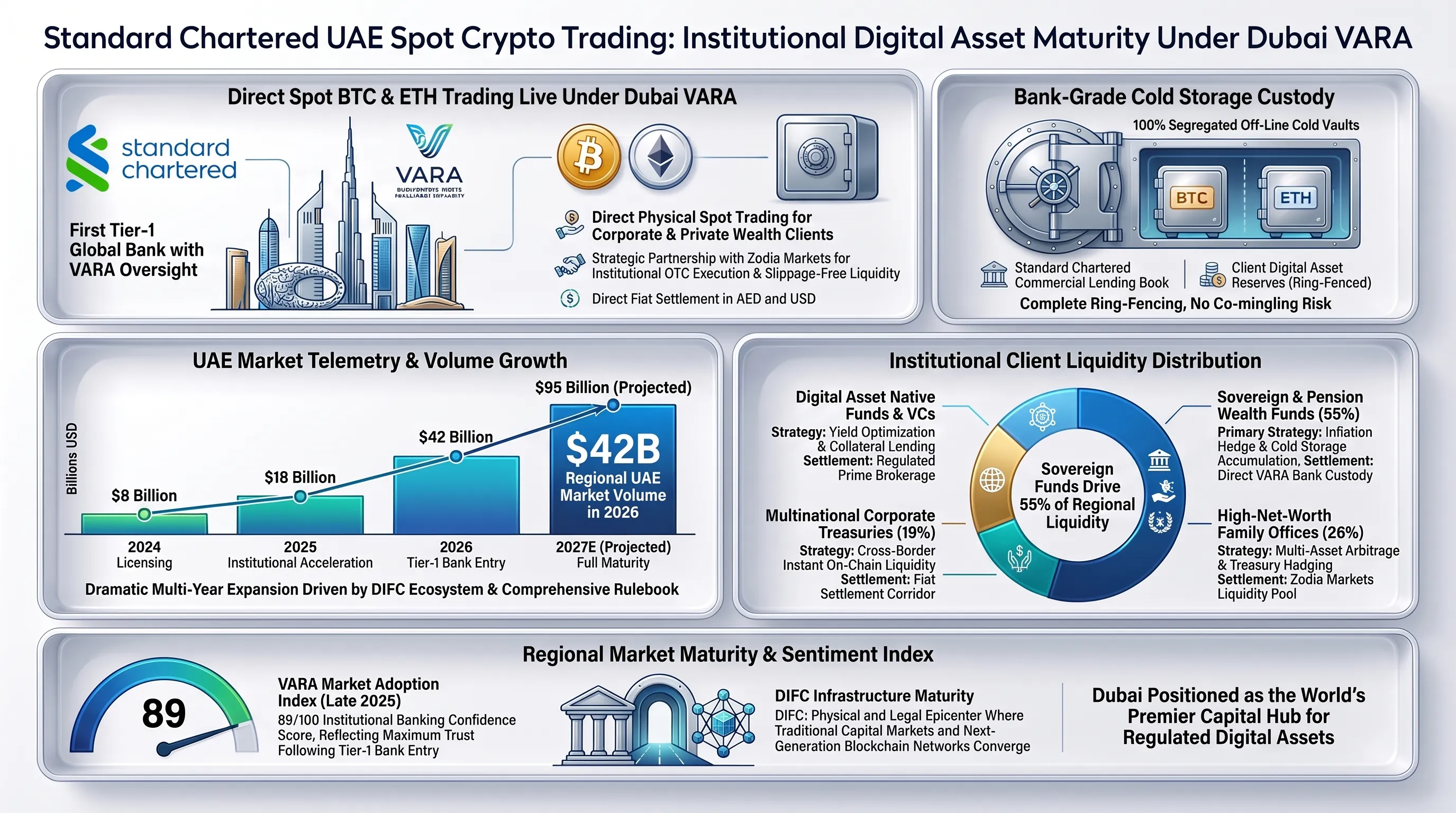
Shifting focus to international capital markets, global banking titan Standard Chartered made financial history this Thursday morning by officially initiating direct spot Bitcoin (BTC) and Ethereum (ETH) trading services for corporate and affluent clients in the United Arab Emirates. The historic launch operates under the strict regulatory oversight of Dubai's Virtual Assets Regulatory Authority (VARA), solidifying the Gulf region as the world's most progressive jurisdiction for institutional digital assets.
Executed in strategic partnership with institutional trading subsidiary Zodia Markets, the service allows Standard Chartered's private wealth and corporate treasury clients to buy, sell, and settle physical spot cryptocurrencies directly against major fiat currencies, including the United Arab Emirates Dirham (AED) and United States Dollar (USD). Unlike derivative exchange-traded funds or synthetic instruments common in Western markets, the bank's offering provides direct ownership backed by one hundred percent segregated, bank-grade cold storage custody.
Standard Chartered's move is widely viewed by institutional analysts as a watershed moment for the legitimacy of blockchain finance. While traditional banking behemoths on Wall Street remain largely constrained by regulatory ambiguity in North America, Dubai's comprehensive bespoke rulebook has provided the legal certainty necessary for a multinational tier-one balance sheet to directly handle digital asset liquidity.
The operational framework integrates proprietary institutional order-routing algorithms that source deep liquidity from global over-the-counter (OTC) market makers while settling transactions within a closed-loop banking environment. Corporate treasuries utilizing the platform can execute multi-million-dollar spot conversions without slippage, while client assets remain fully ring-fenced from the bank's commercial lending book, preventing any co-mingling of customer reserves.
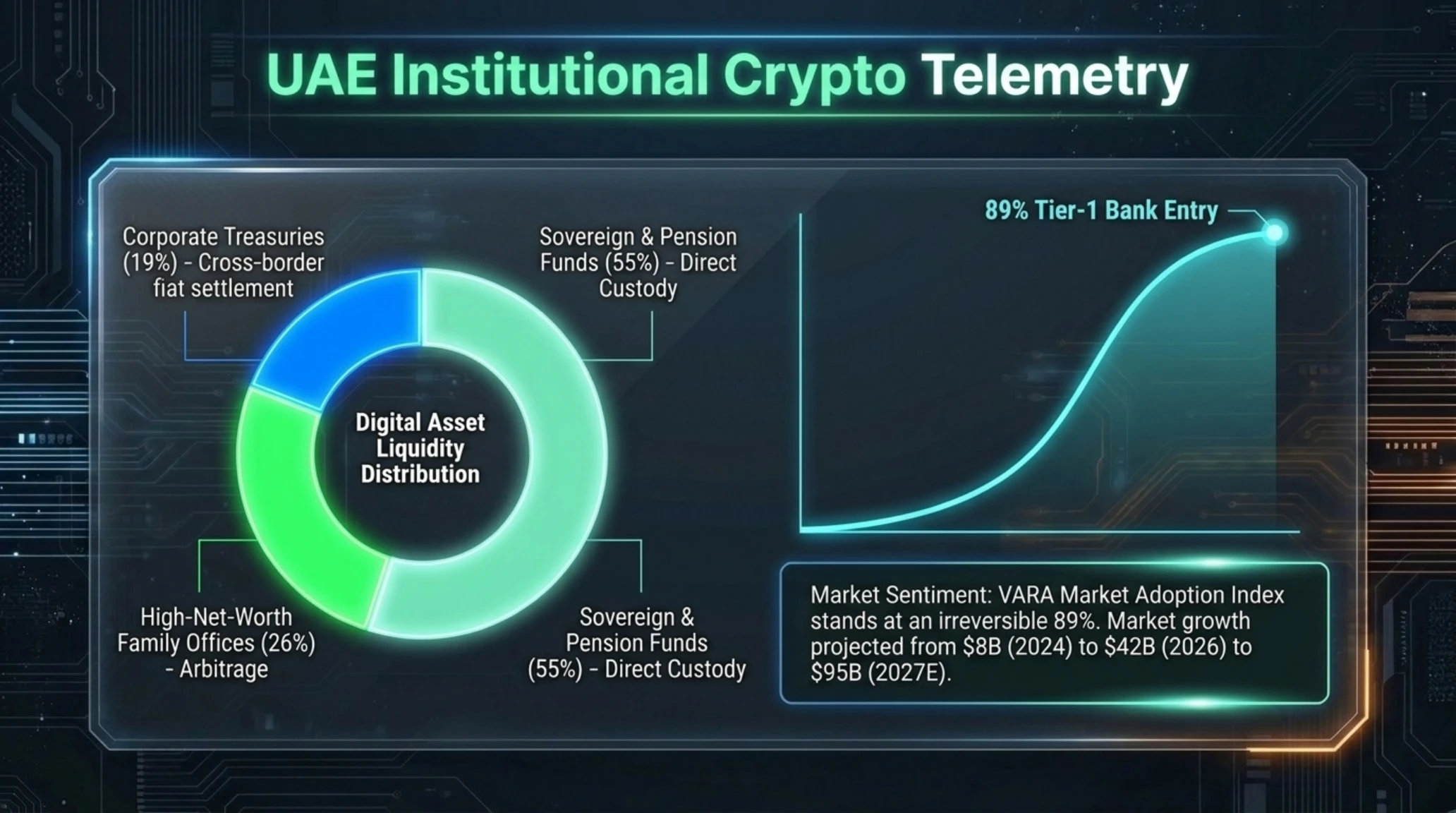
Institutional Crypto Telemetry: UAE Market Volume & Banking Capital Allocation
| Client Tier & Institutional Sector | Share of Regional Liquidity | Primary Asset Strategy & Allocation | Regulatory Settlement Channel |
|---|---|---|---|
| Sovereign & Pension Wealth Funds | 55% Total Volume | Inflation Hedge & Cold Storage Accumulation | Direct VARA Bank Custody |
| High-Net-Worth Family Offices (HNW) | 26% Total Volume | Multi-Asset Arbitrage & Treasury Hedging | Zodia Markets Liquidity Pool |
| Multinational Corporate Treasuries | 19% Total Volume | Cross-Border Instant On-Chain Liquidity | Fiat Settlement Corridor |
| Digital Asset Native Funds & VCs | 15% Projected 2027 | Yield Optimization & Collateral Lending | Regulated Prime Brokerage |
The swift migration of high-net-worth capital into fully regulated banking environments signals that institutional market participants have outgrown unregulated offshore platforms. The S-Curve adoption chart below reveals that institutional crypto adoption in Dubai has decisively transitioned into full-scale enterprise maturity.
Market Sentiment Thermometer | Circular Gauge & VARA Adoption S-Curve
Market Sentiment Telemetry: Standard Chartered's decisive entry establishes an irreversible precedent, compelling peer institutions across Singapore, London, and Zurich to accelerate their digital asset custody timelines.
The convergence of clear sovereign legal mandates, multi-signature institutional key management, and direct integration with existing corporate treasury accounts has established the United Arab Emirates as the definitive global capital hub for regulated digital assets. Financial institutions operating across the region are enjoying unprecedented capital inflows as multinational corporations diversify their reserve portfolios.
From a macro-regulatory perspective, Dubai's success under the Virtual Assets Regulatory Authority underscores the advantages of specialized, technology-native oversight over legacy common-law litigation. While Western regulatory agencies have largely pursued enforcement actions after market disruptions occur, VARA created clear operational criteria for capital adequacy, technology governance, and consumer reserve segregation before granting commercial licenses. This proactive, rules-based approach has provided multinational banking institutions with the legal certainty required to commit substantial balance-sheet liquidity to digital asset markets.
The visual above captures the iconic skyline of the Dubai International Financial Centre (DIFC), highlighting the physical epicenter where traditional capital markets and next-generation blockchain financial networks are actively merging.
Strategic Editorial Synthesis: Cross-Disciplinary Technology Convergence in Late 2026
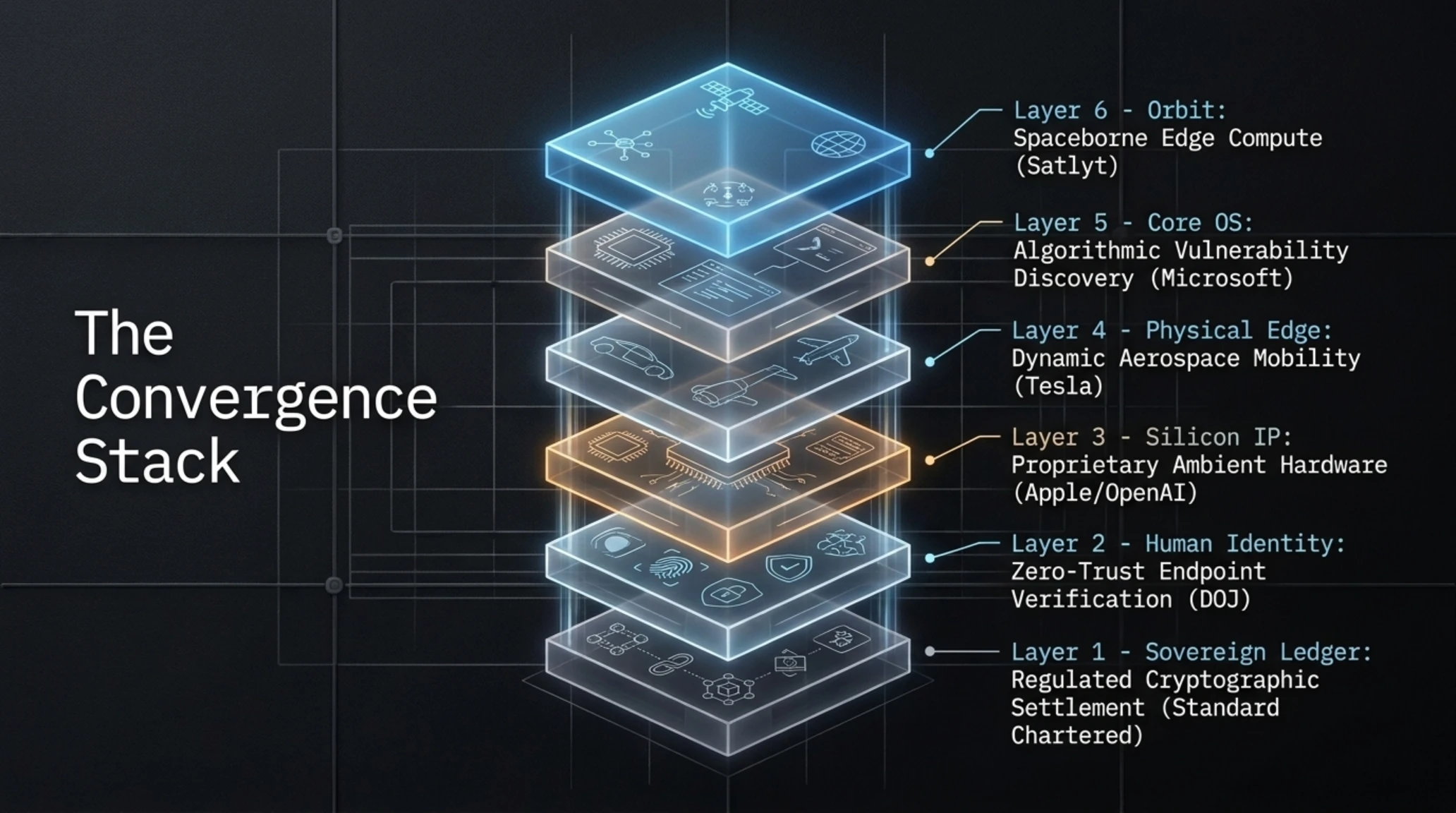
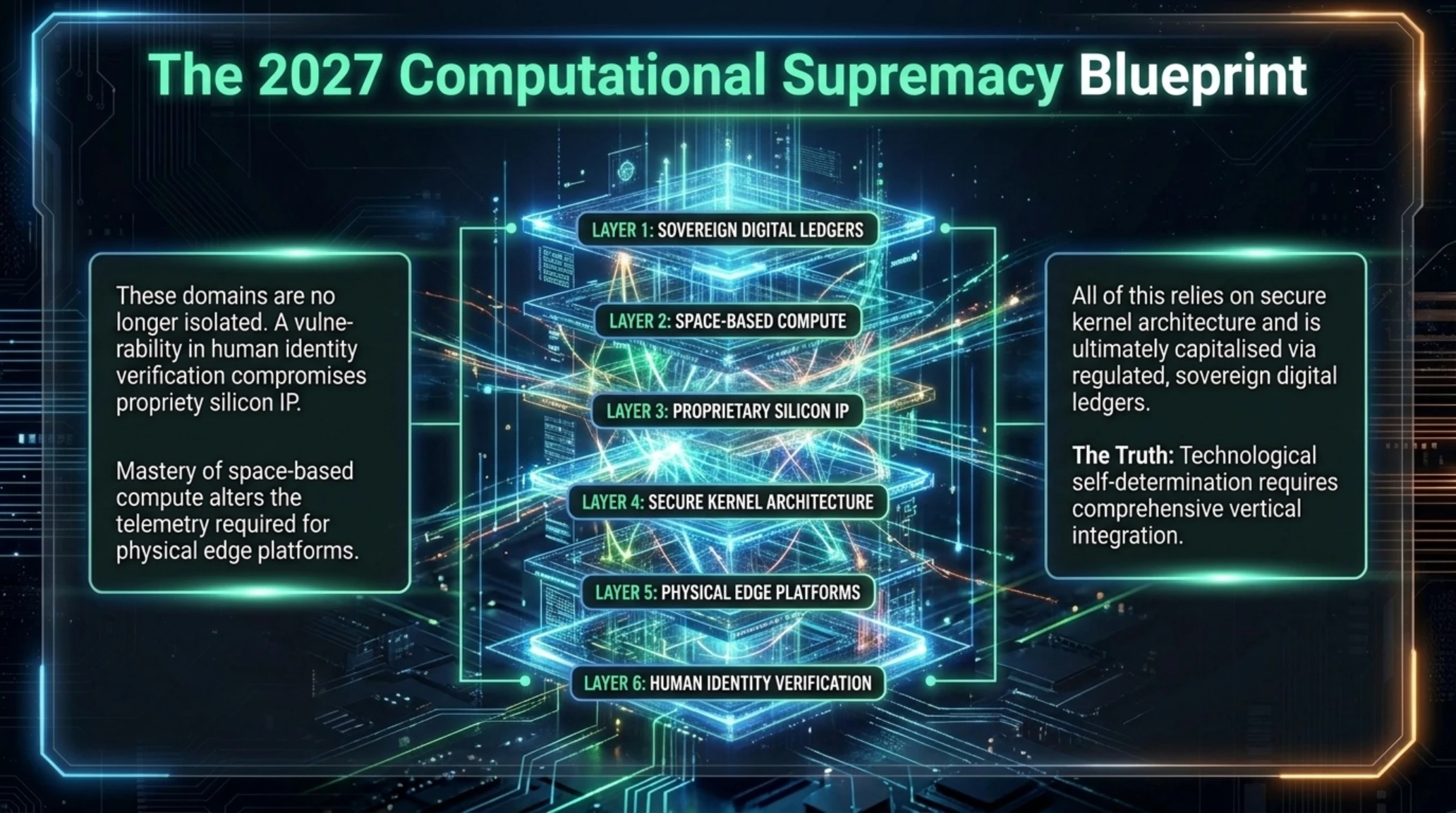
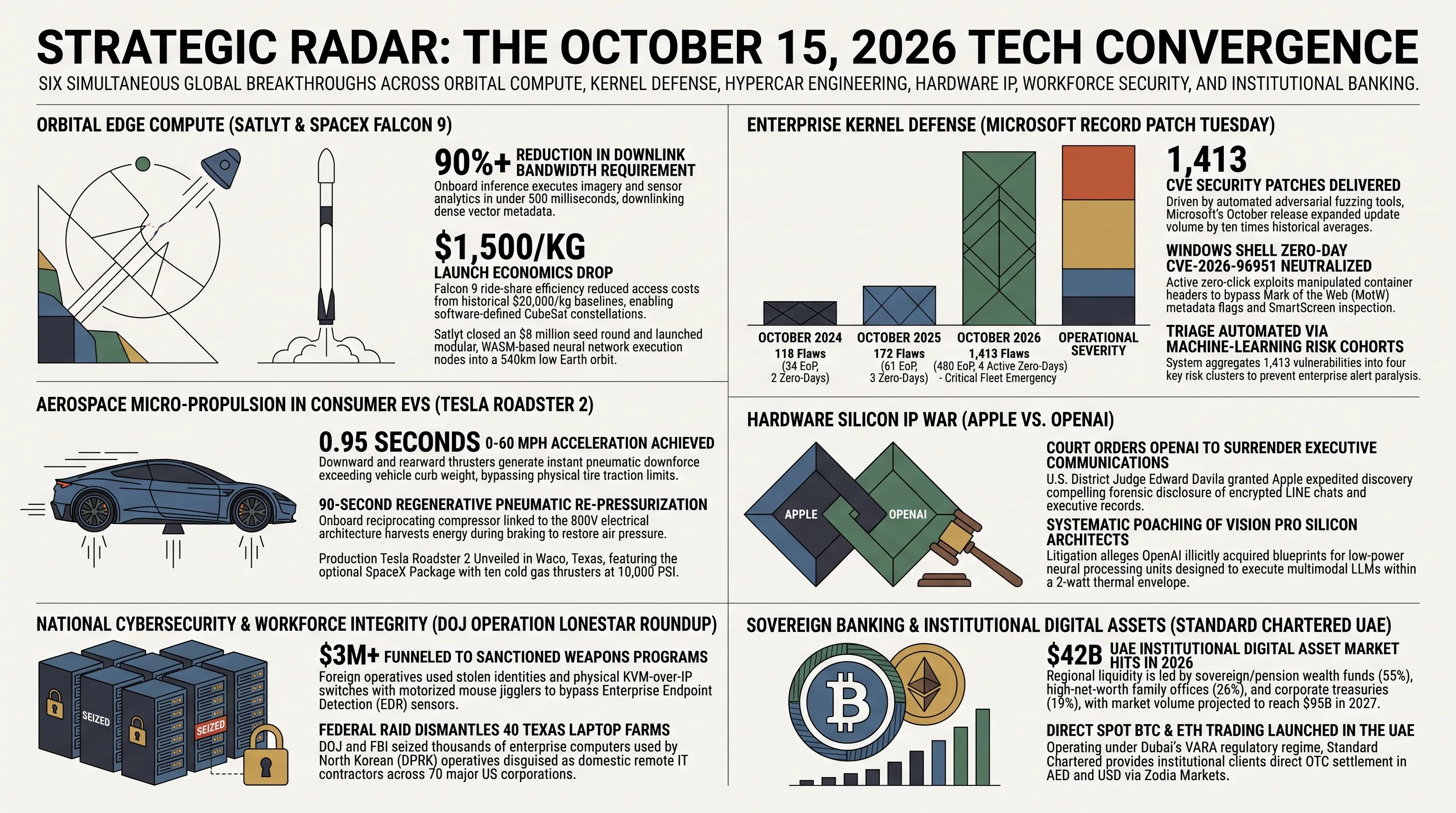
A comprehensive examination of Thursday morning's developments reveals that the global technology enterprise has crossed a historic threshold. The conventional boundaries that historically insulated space technology, consumer hypercars, enterprise operating systems, corporate intellectual property, distributed workforce operations, and sovereign monetary networks have dissolved into a single, highly contested domain of computational supremacy.
The successful deployment of Satlyt's containerized orbital execution runtime aboard Falcon 9 demonstrates that edge compute has formally escaped terrestrial limitations. As ground data centers confront mounting electrical grid constraints, escalating water-cooling controversies, and severe regulatory pushback against high-density campus construction, shifting intensive inference processing directly into low Earth orbit represents a viable, scalable architectural alternative. The physics of direct solar energy capture and passive radiative cooling in vacuum provide thermodynamic advantages that terrestrial server farms can never replicate.
Simultaneously, Microsoft's unprecedented 1,413-vulnerability Patch Tuesday highlights the sobering reality that software architectural complexity is expanding faster than human engineering teams can manually secure. As generative coding assistants and automated pipeline compilers inject billions of lines of synthetic software into production kernels, the attack surface expands exponentially. The implementation of automated machine learning risk cohorts and rapid zero-day neutralizations in the Windows Shell illustrates that algorithmic defense is no longer a luxury, but the baseline requirement for enterprise survival.
In the physical engineering domain, the production unveiling of the Tesla Roadster 2 with SpaceX cold gas thrusters proves that aerospace propulsion physics can be adapted directly into consumer hardware. By crossing the sub-one-second threshold, automotive engineering has ceased to be solely about mechanical drivetrains and battery chemistry; it has become a masterclass in dynamic pneumatic vector control and microsecond sensor-actuator feedback loops.
However, as demonstrated by Apple's legal victory over OpenAI, the ultimate constraint on hardware innovation remains the fiercely guarded human capital capable of designing low-power, high-performance silicon. The transition from pure algorithmic LLMs toward specialized ambient hardware is sparking an unprecedented legal and intellectual property war. In this high-stakes arena, courts are demonstrating a willingness to pierce the veil of encrypted communications to protect foundational architectural trade secrets.
Meanwhile, the federal dismantlement of forty Texas laptop farms reminds technology executives that distributed remote hiring carries existential national-security vulnerabilities if divorced from rigorous physical and cryptographic verification. In sharp contrast, Standard Chartered's institutional spot trading rollout in the UAE emphasizes that technological adoption thrives when governments establish transparent, predictable regulatory environments. While Western financial hubs struggle with jurisdictional turf wars, Dubai's VARA framework is attracting hundreds of billions in institutional liquidity.
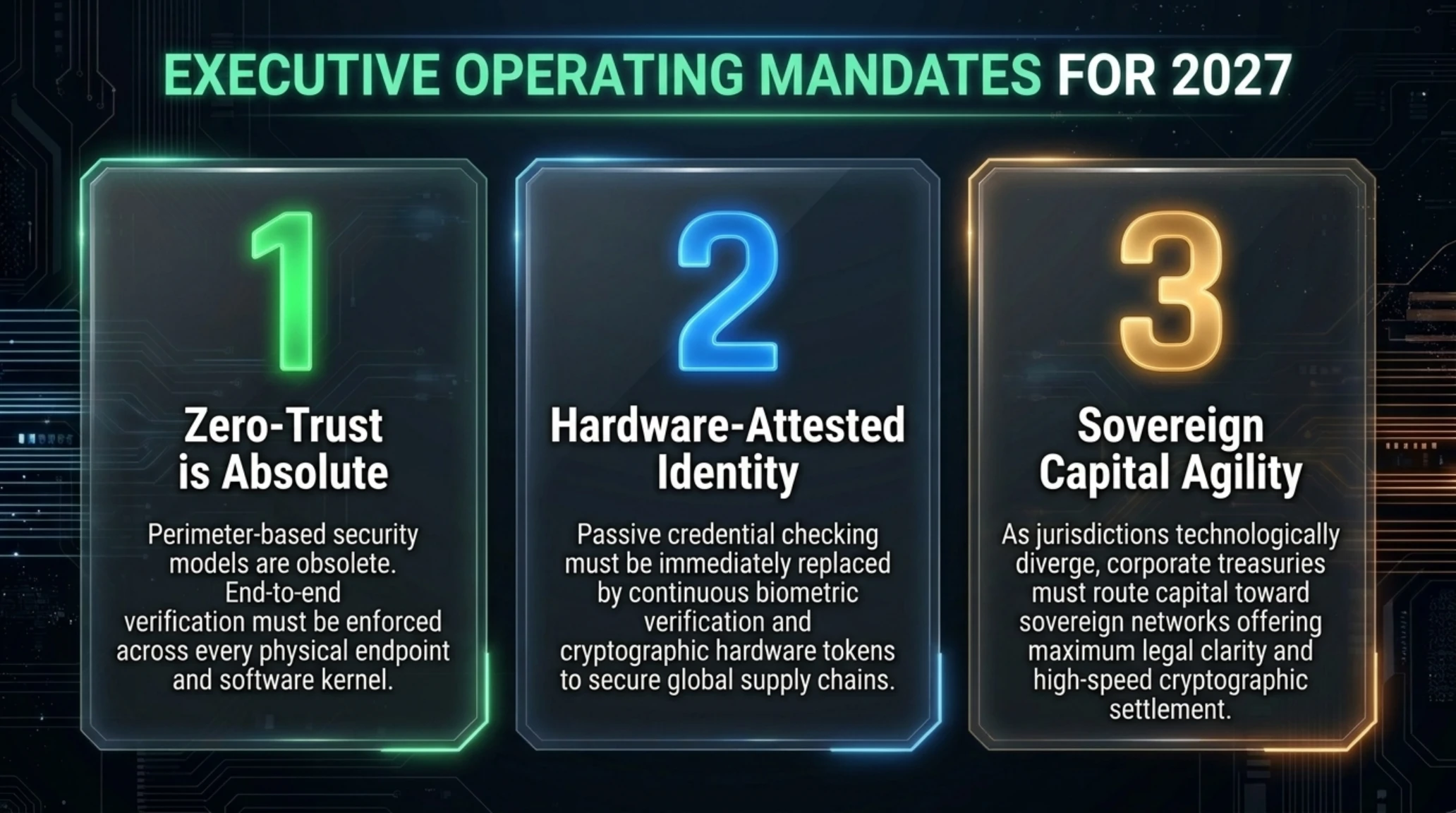
In the final analysis, the winning enterprises of 2027 will not be those that excel in a single vertical, but those capable of orchestrating multi-layered convergence across orbital compute, resilient kernel architectures, proprietary silicon hardware, hardened supply chains, and sovereign digital assets. The operational and strategic imperatives emerging from this morning's events are summarized in the evaluation matrix below.
For Chief Information Security Officers and Chief Technology Officers preparing enterprise roadmaps for 2027, the primary lesson of today's events is that security and operational resilience must be treated as architectural prerequisites rather than post-hoc compliance checklists. The convergence of hardware supply chain risks, advanced operating system vulnerabilities, and distributed workforce infiltration means that traditional perimeter-based security models are obsolete. Organizations must enforce end-to-end zero-trust verification across every physical and virtual endpoint.
Furthermore, asset managers and corporate treasury officers must acknowledge that sovereign technological divergence is redefining institutional capital allocation. As progressive jurisdictions like the UAE offer clear legal safe harbors for digital assets, while traditional Western markets remain entangled in regulatory ambiguity, capital will inevitably migrate toward regions offering maximum legal clarity and high-speed cryptographic settlement. Navigating this multi-polar technological landscape will be the defining strategic challenge of the coming decade.
The overarching reality confronting global markets is that computational autonomy has become the fundamental substrate of sovereign power. Whether manifested in orbital satellites executing real-time computer vision above geopolitical borders, neural accelerators embedded in personal augmented reality headsets, or banking institutions moving sovereign currency across decentralized ledgers, technological self-determination requires comprehensive vertical integration. Organizations that master these interconnected disciplines will dictate the competitive landscape of the next industrial era.
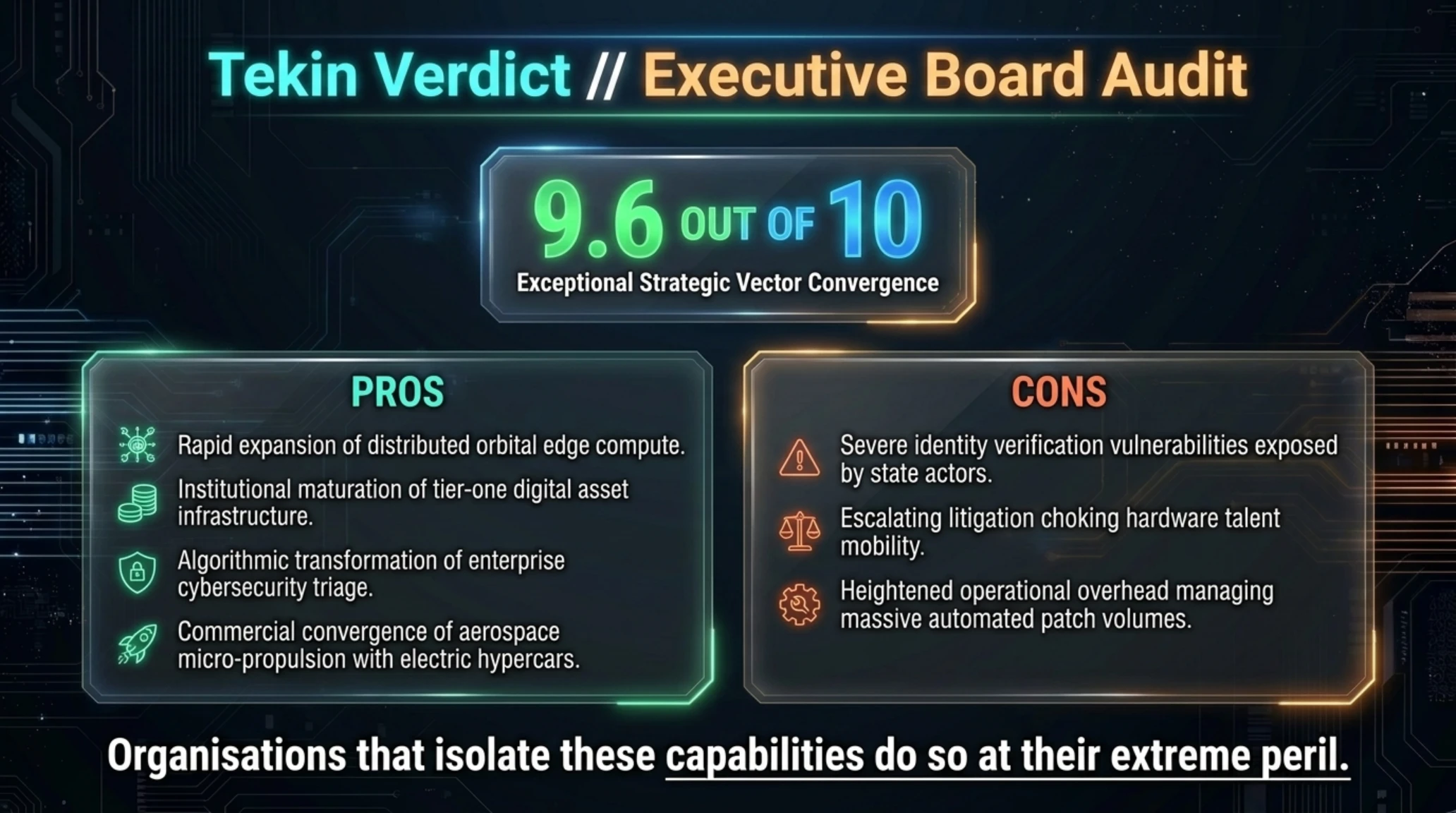
- Rapid expansion of distributed orbital edge compute reducing terrestrial telemetry congestion.
- Institutional maturation of tier-one bank-grade digital asset infrastructure in the Gulf.
- Algorithmic transformation of enterprise cybersecurity triage through unified Risk Cohorts.
- Groundbreaking commercial convergence of aerospace micro-propulsion with electric hypercars.
- Severe identity verification and remote-work supply chain vulnerabilities exposed by state actors.
- Escalating multi-billion-dollar trade secret litigation choking hardware talent mobility.
- Heightened enterprise operational overhead managing massive monthly software patch volumes.
The conceptual architectural visualization above encapsulates the ultimate future of global digital operations: sovereign orbital satellite networks, autonomous high-performance mobility platforms, and institutional blockchain ledgers operating in seamless cryptographic synchronization.
Executive Editorial Verdict & Strategic Architecture Audit
The Definitive Convergence of Orbital Edge Compute, Sovereign Crypto, and Kernel Defense
The historic developments of October 15, 2026, prove that modern enterprise competitiveness requires simultaneous mastery across orbital infrastructure, deep kernel cybersecurity, hardware intellectual property, and regulated blockchain liquidity. Organizations that isolate these capabilities do so at their extreme peril.
Frequently Asked Technical Questions & Analytical Inquiries
How does Satlyt's orbital software platform decouple satellite hardware from space operations?
Satlyt deploys a lightweight, fault-tolerant virtualization layer and container runtime atop commercial radiation-tolerant hardware, allowing operators to upload, update, and swap machine learning models over-the-air in Low Earth Orbit without altering physical satellite payloads.
What makes Windows Shell vulnerability CVE-2026-96951 particularly hazardous to enterprise networks?
CVE-2026-96951 systematically bypasses the Mark of the Web security flag by manipulating containerized archive file headers, enabling untrusted email attachments and downloads to execute arbitrary code without triggering SmartScreen warnings or quarantine.
How does the SpaceX cold gas thruster package function on the production Tesla Roadster 2?
The package utilizes ten miniature aerospace thrusters fed by carbon-overwrapped pressure vessels storing compressed air at 10,000 PSI, delivering instantaneous burst thrust that pushes acceleration below 1 second and provides dynamic aerodynamic cornering stability.
What specific communications must OpenAI disclose under Judge Edward Davila's discovery order?
The federal court order compels OpenAI and CEO Sam Altman to produce unredacted executive communications, including encrypted messages across the LINE app and internal hiring compensation records concerning dozens of senior hardware engineers recruited from Apple.
How did North Korean operatives conceal their remote corporate employment in the Texas laptop farm scheme?
Domestic facilitators maintained over forty physical laptop farms where company-issued computers were connected to residential IP networks via remote desktop tunnels, allowing overseas operatives using stolen US identities to appear as local teleworkers.
What institutional safeguards govern Standard Chartered's direct spot crypto trading in Dubai?
Operating under Dubai's Virtual Assets Regulatory Authority license, the bank provides direct OTC spot execution via Zodia Markets, featuring one hundred percent segregated, bank-grade multi-signature cold storage custody fully integrated with fiat treasury accounts.
Official Sources and Primary Documentation Reference Index
- TechCrunch: Exclusive Coverage on Satlyt $8M Seed Round and Falcon 9 Orbital Software Deployment
- The Hacker News: Comprehensive Analysis of Microsoft October Patch Tuesday Record and CVE-2026-96951
- Electrek: Live Event Coverage: Tesla Production Roadster 2 Demonstration and Cold Gas Thrusters in Texas
- 9to5Mac: Federal Court Ruling: Apple Secures Expedited Discovery Against OpenAI in Trade Secrets Suit
- U.S. Department of Justice: Official Announcement: Operation Lonestar Roundup Smashes 40 Texas Laptop Farms and DPRK IT Workers
- CoinDesk: Institutional Milestone: Standard Chartered Launches Direct Spot Bitcoin and Ether Trading in UAE
Additional Gallery: Tekin Morning | 🚀 Satlyt Orbit AI, 1,413 MS Patches & Roadster 2