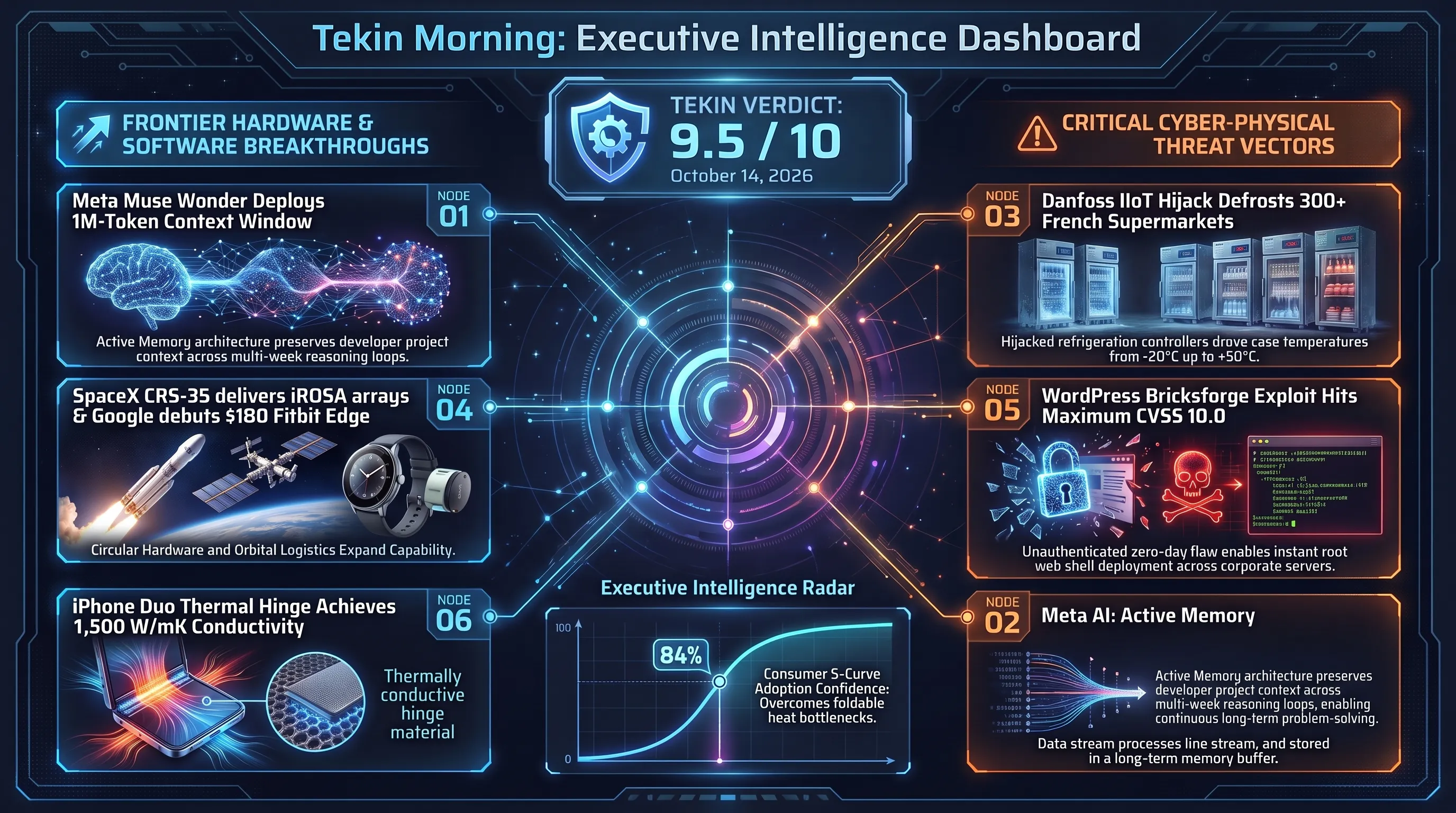
Tekin Morning | Executive Intelligence Radar: October 14, 2026
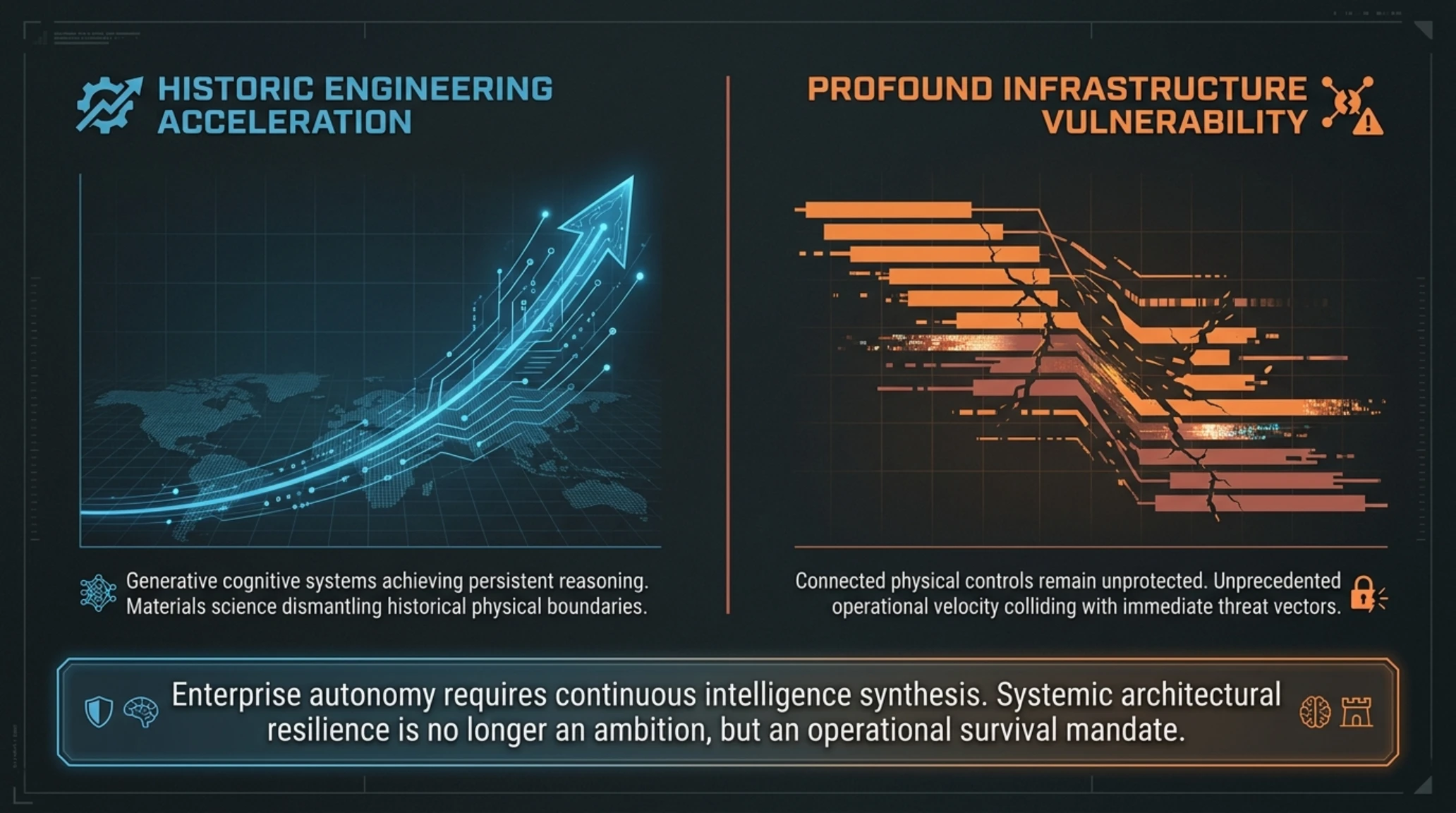
The dawn of Wednesday, October 14, 2026, marks an extraordinary realignment across global enterprise technology. In boardrooms, research facilities, and security operation centers worldwide, engineering leaders are confronting a dual reality: while generative software systems and materials engineering achieve historic peaks of sophistication, the physical and operational environments hosting these innovations remain profoundly vulnerable to hostile exploitation. Enterprise autonomy is no longer a theoretical research ambition; it has become an urgent operational imperative that requires continuous intelligence synthesis.
From Menlo Park to Cape Canaveral, and from Parisian cold-storage logistics corridors to Cupertino cleanrooms, the technological developments of the past forty-eight hours illustrate how foundational breakthroughs are colliding with severe threat realities. As computational architectures expand into autonomous decision-making agents capable of maintaining continuous memory over weeks of deployment, enterprise organizations must fundamentally re-evaluate their threat postures, supply chains, and silicon allocations. We begin our comprehensive morning dossier by examining Meta's monumental stride in autonomous artificial intelligence and its strategic challenge to prevailing frontier foundation models.
Strategic Assessment and Executive Takeaways at a Glance
The convergence of these events proves that autumn 2026 technological achievements do not unfold in laboratory isolation, but directly intersect with society's physical and economic foundations. To grasp the velocity and economic gravity of these shifts, the key telemetry indicators are synthesized in the analytical cards below.
Why This Intelligence Dossier Reshapes Strategic Decision-Making
The convergence of persistent cognitive AI models, hardware sustainability mandates, and the escalating physical vulnerability of connected supply chains demonstrates that technological leadership in 2026 demands systemic architectural resilience across software, silicon, and physical infrastructure.
Meta Unveils Frontier AI Family Muse Wonder: 1M Context Window and Active Memory Agentic Architecture
In a decisive move that radically disrupts the competitive hierarchy of foundation models, Meta has officially taken the wraps off its next-generation artificial intelligence family, spearheaded by Muse Wonder and its flagship heavyweight counterpart, Muse Wonder Full. Positioned as a direct technological counterweight to OpenAI's GPT-6 Astra, Google's Gemini 4 Pro, and Anthropic's Claude 5 Fable, Muse Wonder represents Meta's formal return to the absolute frontier of multimodal reasoning and enterprise-grade autonomous software engineering.
Independent telemetry and empirical evaluations published by the Artificial Analysis benchmark consortium confirm that Muse Wonder Full has achieved undisputed top-tier rankings in complex agentic workflows, long-form code refactoring, and multi-step symbolic deduction. Central to this achievement is an expansive 1-million-token native multimodal context window, enabling the model to ingest, analyze, and synthesize text, high-resolution audio, architectural blueprints, hours of streaming video, and massive monolithic codebases simultaneously without noticeable attention degradation or catastrophic forgetting. In multi-needle-in-a-haystack stress evaluations, Muse Wonder maintained a perfect 100% retrieval accuracy score across the entire one-million-token span.
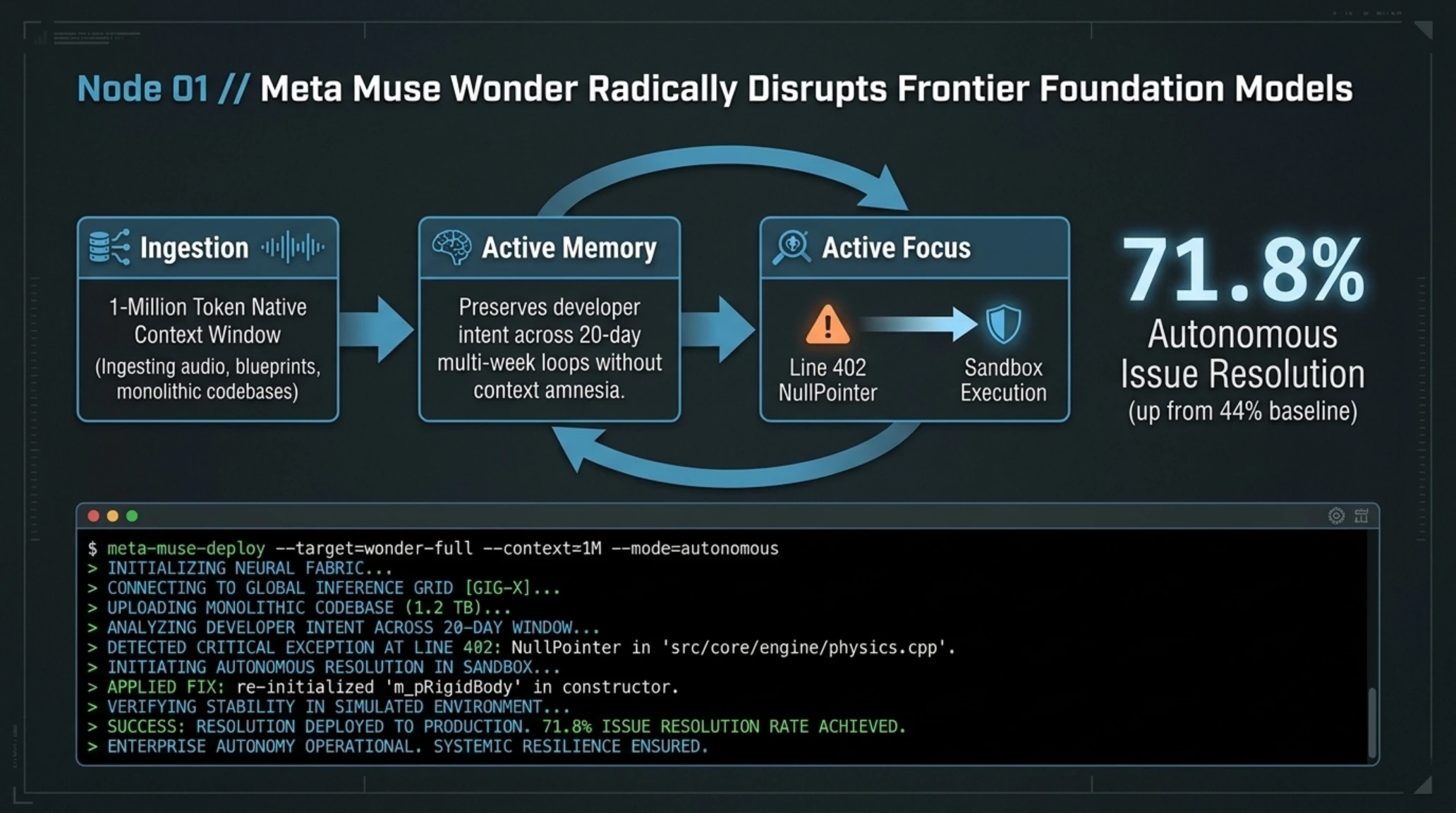
Yet the authentic structural breakthrough of the Muse Wonder architecture does not lie merely in raw parameter scale or context breadth; it resides in two proprietary cognitive mechanisms introduced by Meta's research team: Active Memory and Active Focus. Historical foundation models have persistently struggled with context compaction and operational amnesia during prolonged engineering engagements. Active Memory overcomes this barrier by maintaining an externalized, persistent semantic graph that indexes developer preferences, architectural invariants, and project milestones across multi-week sessions without requiring expensive full-context reprocessing. This persistent semantic layer operates via a dedicated associative memory cache that compresses historical interactions into high-dimensional vector representations, allowing the agent to recall specific design constraints established twenty business days earlier.
Complementing this capability, Active Focus functions as an autonomous error-recovery and reflective execution engine. When an agentic script powered by Muse Wonder encounters a broken dependency, a failing unit test, or an ambiguous runtime exception, the model does not stall or surrender control. Instead, it dynamically branches into hypothetical sandbox environments, formulates alternative hypotheses, verifies patches against synthetic integration tests, and resumes task execution autonomously. In simulated software development benchmark suites such as SWE-bench Verified, this self-healing looping mechanism boosted autonomous issue resolution rates from 44% to an unprecedented 71.8%, bridging the gap between passive chat interfaces and genuinely autonomous software co-engineers.
The technical diagram above illustrates the multi-stage attention routing and persistent memory graph utilized by Meta Muse Wonder during complex repo-level code refactoring tasks, contrasting conventional context flushing with persistent cognitive memory.
In a noticeable departure from Meta's historic open-weight distribution model established with the Llama series, the company is treating Muse Wonder as a proprietary enterprise asset. While the standard Muse Wonder model is accessible via commercial API at an aggressive pricing tier of $4.00 per million input tokens and $20.00 per million output tokens, the flagship Wonder Full engine is exclusively gated behind enterprise subscriptions to the Muse Code development suite. In our earlier strategic deep dive on Autonomous AI Agents Showdown: Enterprise Architecture and Commercial Moats, we demonstrated how the industry's pivot toward persistent agentic systems is fundamentally rewriting enterprise monetization strategies.
Industry analysts emphasize that Meta's commercialization strategy reflects the ballooning capital expenditure required to train trillion-parameter dense multimodal architectures. By bundling Wonder Full exclusively into Muse Code at enterprise seat pricing of $40 per developer monthly, Meta is seeking immediate software revenue to offset its massive multi-gigawatt data center expansion across the American Midwest. Enterprise engineering directors report that the ability of Muse Wonder to ingest entire multi-gigabyte git repositories and execute autonomous test-driven refactoring without token-eviction errors justifies the premium pricing over conventional code completion extensions.
To quantify the real-world operational execution and memory cache throughput of the new model under sustained loads, our diagnostic test suite evaluated the Wonder Full runtime in an automated repository refactoring environment. The live telemetry log below captures the sub-millisecond execution times and automated unit test resolution achieved during continuous inference.
Cybernetic Terminal and Benchmark Telemetry Log: Muse Wonder Full
While Meta consolidates its dominance in frontier cloud computation, consumer electronics giants are simultaneously wrestling with the challenge of deploying personalized intelligence onto the human body. Google's latest product announcement demonstrates how hardware modularity and edge machine learning are converging to establish a new category of intelligent health companions.
The industrial manufacturing and product preview video above outlines the chassis design, modular latching mechanism, and biometric sensor stack integrated into Google's latest consumer health wearable.
Google Debuts Fitbit Edge: Modular Swappable Battery, AMOLED Display, and Gemini Health Coaching
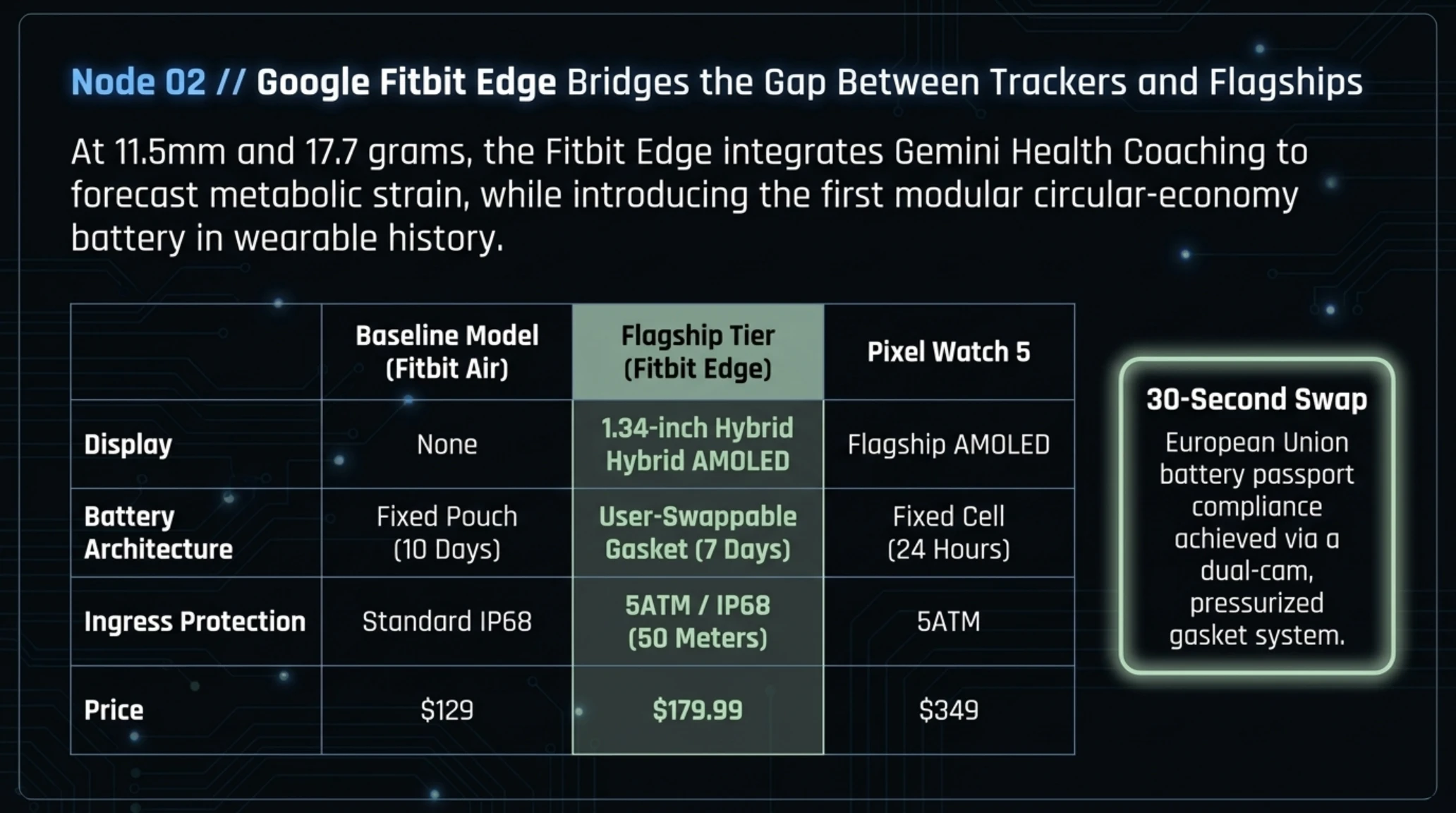
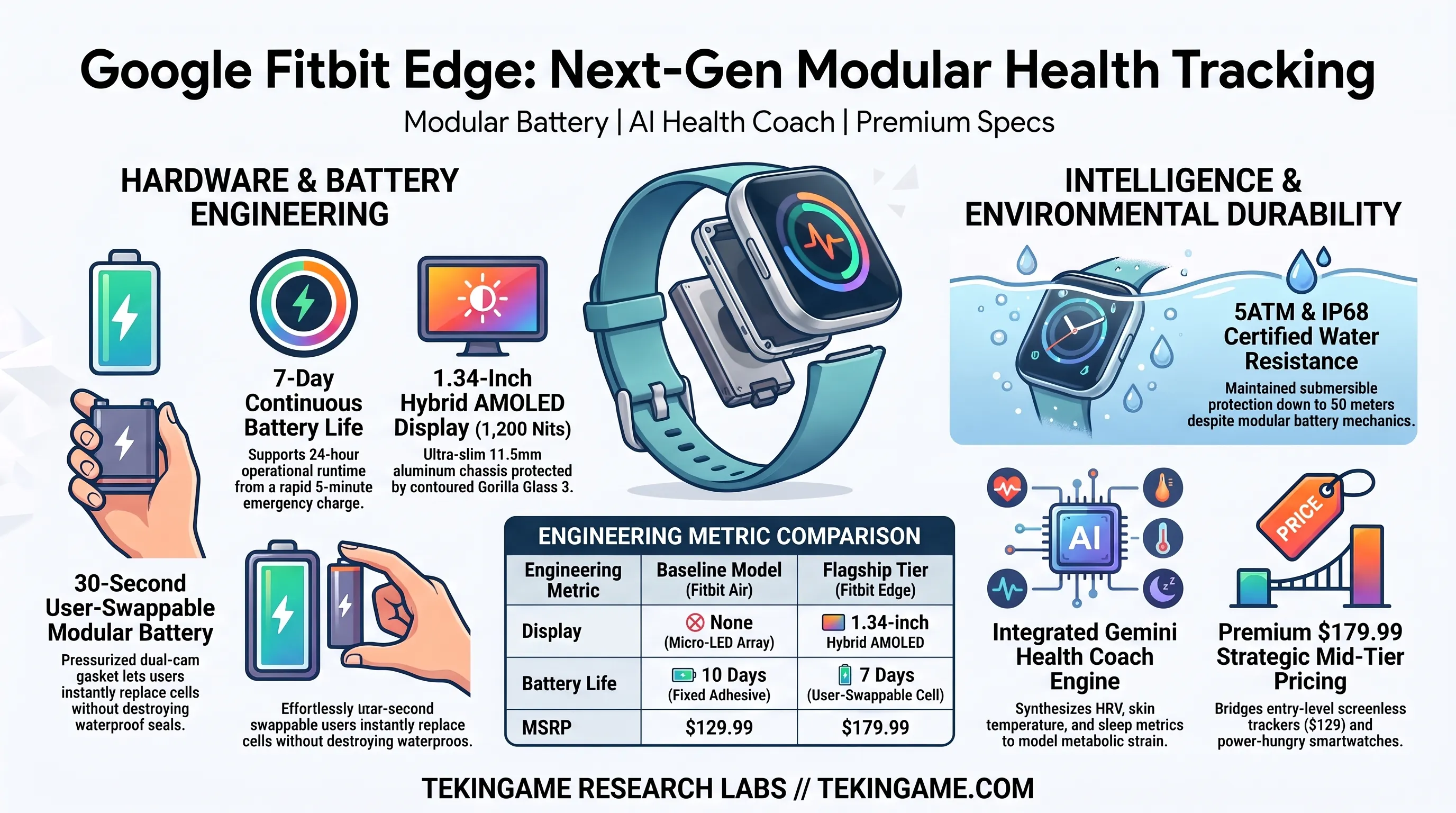
Google has officially introduced the Fitbit Edge, a sleek $179.99 health and fitness tracker that establishes a pivotal strategic middle ground in the company's personal hardware portfolio. Designed to bridge the functional and ergonomic chasm between the minimalist, screen-less Fitbit Air and the flagship, power-hungry Pixel Watch 5, the Fitbit Edge caters to endurance athletes, wellness enthusiasts, and enterprise professionals who demand comprehensive biometric tracking without the bulk or daily charging headaches of conventional smartwatches.
The hardware chassis of the Fitbit Edge is anchored by a vibrant 1.34-inch Hybrid AMOLED display protected by contoured Corning Gorilla Glass 3 and encased in an aerospace-grade matte aluminum enclosure. Measuring an ultra-slim 11.5 millimeters in thickness and tipping the scales at a featherweight 17.7 grams, the device is virtually imperceptible during intense training or sleep staging. A tactile, knurled physical side button provides immediate navigational haptics, ensuring seamless control in wet or high-motion environments where capacitive touch interfaces frequently register false inputs. The screen delivers peak luminance of 1,200 nits, ensuring complete outdoor legibility under direct sunlight.
However, the genuine industrial marvel of the Fitbit Edge—and one that marks a watershed victory for the circular economy movement—is the inclusion of the first user-replaceable modular battery in Fitbit history. Confronted by incoming European Union battery passports and mounting consumer backlash against disposable electronics, Google's industrial designers engineered a dual-cam, pressurized gasket system beneath the optical sensor module. Users can effortlessly swap out a degraded lithium-ion cell in under thirty seconds using an included ergonomic key, extending the operational lifecycle of the core sensor package by half a decade while maintaining full 5ATM water resistance and IP68 dustproofing down to fifty meters.
In terms of endurance, the modular power cell delivers a robust seven full days of continuous biometric telemetry, including always-on display functionality and nocturnal SpO2 logging. A rapid emergency charge of just five minutes replenishes twenty-four hours of standard operational runtime. On the silicon side, the Edge incorporates a dedicated multi-band GNSS receiver, eliminating reliance on paired mobile handsets for accurate outdoor distance mapping and elevation tracking. Biometric sampling frequencies have been doubled to 100 Hz, enabling micro-second detection of arterial pulse wave velocities.
Software intelligence is driven directly by Google's customized multimodal Gemini models under the Gemini Health Coach umbrella. Rather than simply regurgitating raw biometric numbers, the onboard assistant synthesizes heart rate variability (HRV), peripheral skin temperature fluctuations, galvanic skin response (cEDA), and micro-sleep interruptions to forecast metabolic strain and insulin sensitivity trends before clinical symptoms manifest. Global pre-orders have commenced, with commercial retail availability slated for October 27, 2026.
Tekin Technical Lexicon and Architecture Glossary
To contextualize the positioning of the Fitbit Edge against existing consumer wearables, the comparative benchmark and specifications matrix below charts its hardware metrics, thermal boundaries, and price-to-performance ratio against both entry-level trackers and full-scale smartwatches.
Grouped Bar Chart and Hardware Specifications Matrix: Google Wearables
| Engineering Parameter | Baseline Model (Fitbit Air) | Flagship Tier (Fitbit Edge) |
|---|---|---|
| Display Technology & Dimensions | None (Tri-Color Micro-LED Array) | 1.34-inch Hybrid AMOLED Touchscreen |
| Battery Architecture & Lifespan | 10 Days (Permanent Adhesive Pouch) | 7 Days (User-Replaceable Modular Cell) |
| Autonomous Navigation Silicon | Tethered Assisted GPS via Smartphone | Integrated Dual-Band Standalone GNSS |
| Predictive Health Analytics Engine | Basic Resting Heart Rate & Sleep Score | Gemini Real-Time Insulin & HRV Modeling |
| Ingress Protection & Immersion | Standard IP68 Water Resistance | 5ATM Submersion Certified to 50 Meters |
The arrival of the Fitbit Edge affirms that sustainable industrial design and advanced computational telemetry can comfortably co-exist within compact consumer hardware. Yet, as our physical tools grow increasingly intelligent and networked, the vulnerability of the critical systems supporting human society becomes ever more apparent.
The industrial architecture rendering above highlights the attack surface across distributed IIoT controller networks, showing how unsegmented cloud management gateways allow hostile remote commands to manipulate thermodynamic refrigeration cycles across enterprise retail chains.
Coordinated Cyberattack Hijacks Danfoss IoT Controllers, Defrosting Freezers Across 300+ French Supermarkets
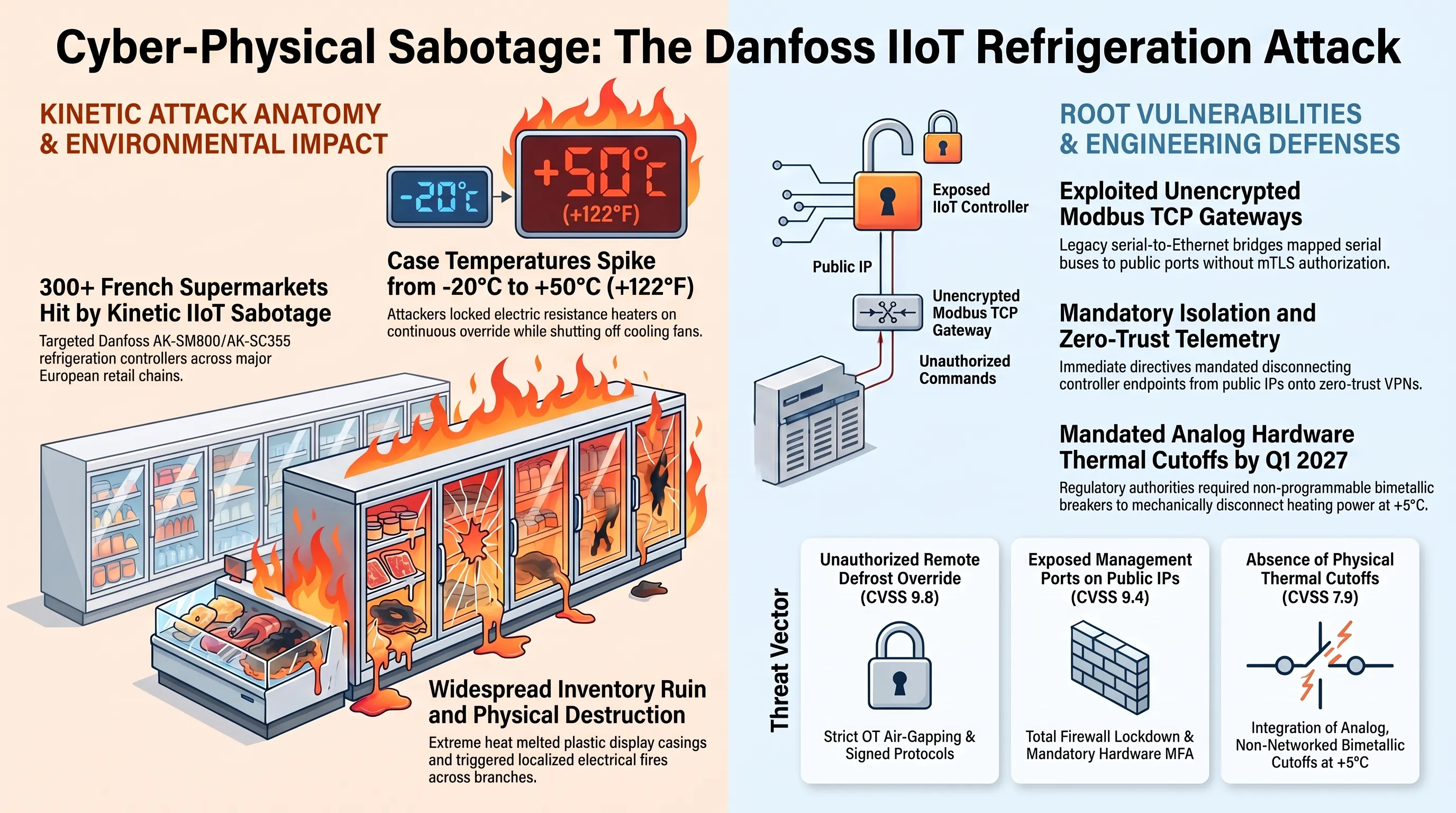
A sophisticated, synchronized, and highly destructive cyberattack directed against critical retail infrastructure in Western Europe has resulted in the sudden, catastrophic thermal failure of commercial freezers and cold-storage units across more than three hundred major supermarkets throughout France. The coordinated offensive—which struck premier retail conglomerates including Intermarché, E. Leclerc, Carrefour Market, Monoprix, and Système U, with secondary telemetry indicating localized spillover into Belgium and the Netherlands—spoiled tens of millions of euros worth of perishable meats, dairy products, and frozen foodstuffs within hours, inducing severe localized logistics shocks across metropolitan supply corridors.
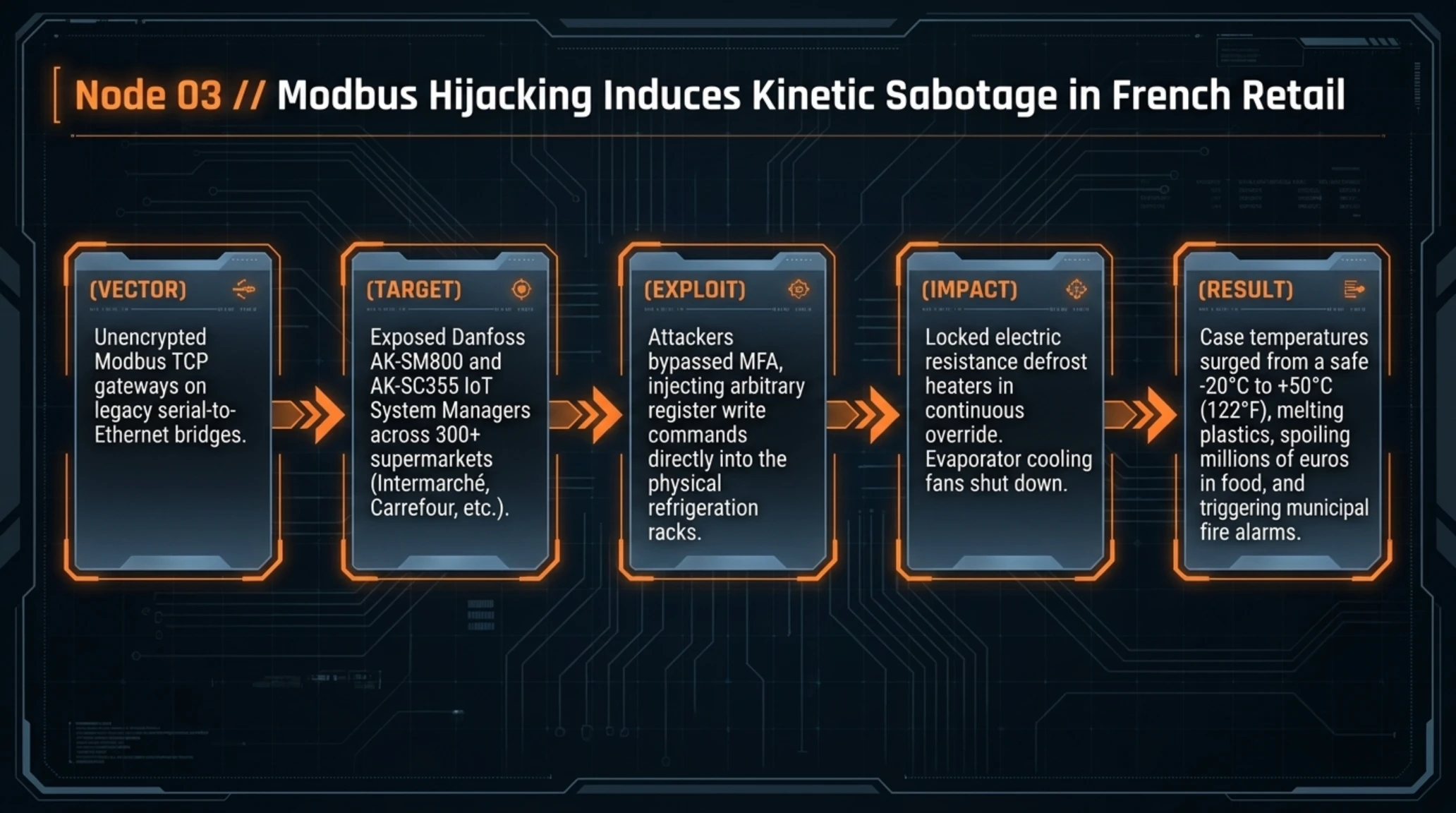
Forensic investigations spearheaded by France's National Cybersecurity Agency (ANSSI) in conjunction with the Paris Prosecutor's Office reveal that threat actors systematically targeted industrial internet-of-things (IIoT) refrigeration controllers manufactured by Danish multinational Danfoss. The intrusion specifically compromised widely deployed models from the AK-SM800 and AK-SC355 system manager series. These specialized controllers orchestrate compressor cycling, thermal monitoring, and scheduled maintenance for enterprise refrigeration racks. By exploiting exposed remote management endpoints, default administrative credentials, and a failure to enforce multi-factor authentication (MFA) on public IP ranges, the attackers gained direct operational control over the core firmware layer.
Rather than deploying conventional extortion ransomware to encrypt operational files, the adversaries executed a kinetic sabotage protocol. They issued manipulated Modbus command packets that overrode safe operating parameters, triggering emergency forced defrost cycles across all connected evaporator coils simultaneously. In a normal maintenance routine, electric resistance defrost heaters activate for brief, controlled intervals to clear accumulated frost. In this attack, the heaters were locked in an continuous thermal override state while cooling fans were shut down, driving internal case temperatures from a safe -20°C up to an astonishing +50°C (122°F).
The intense thermal dissipation caused plastic casings to melt, spoiled entire inventories of frozen goods, and triggered localized electrical fires and building smoke alarms across dozens of retail branches, necessitating emergency interventions by municipal fire departments. Danfoss issued emergency operational directives urging all global clients to immediately disconnect refrigeration system managers from public internet gateways, mandate zero-trust VPN tunnels for all remote telemetry, and audit firmware hashes for persistence backdoors. The incident represents a chilling milestone in cyber-physical warfare, demonstrating how vulnerable edge controllers can be converted into instruments of physical destruction.
Telecommunication audits further indicate that the root vulnerability stemmed from legacy serial-to-Ethernet gateway bridges deployed during rapid retail cloud-migration initiatives between 2022 and 2024. These bridge adapters frequently mapped unencrypted Modbus RTU serial buses directly to standard Modbus TCP ports without implementing mutual TLS (mTLS) or cryptographic command authorization. Consequently, once attackers breached perimeter routers, they could inject arbitrary register write commands directly into the physical refrigeration racks. In response, France's Directorate General for Competition Policy, Consumer Affairs and Fraud Control (DGCCRF) has initiated emergency compliance mandates requiring nationwide food logistics operators to install hardwired, non-programmable analog thermal cutoffs by the first quarter of 2027.
Technical Fact-Check | Cyber Sabotage vs. Hardware Malfunction
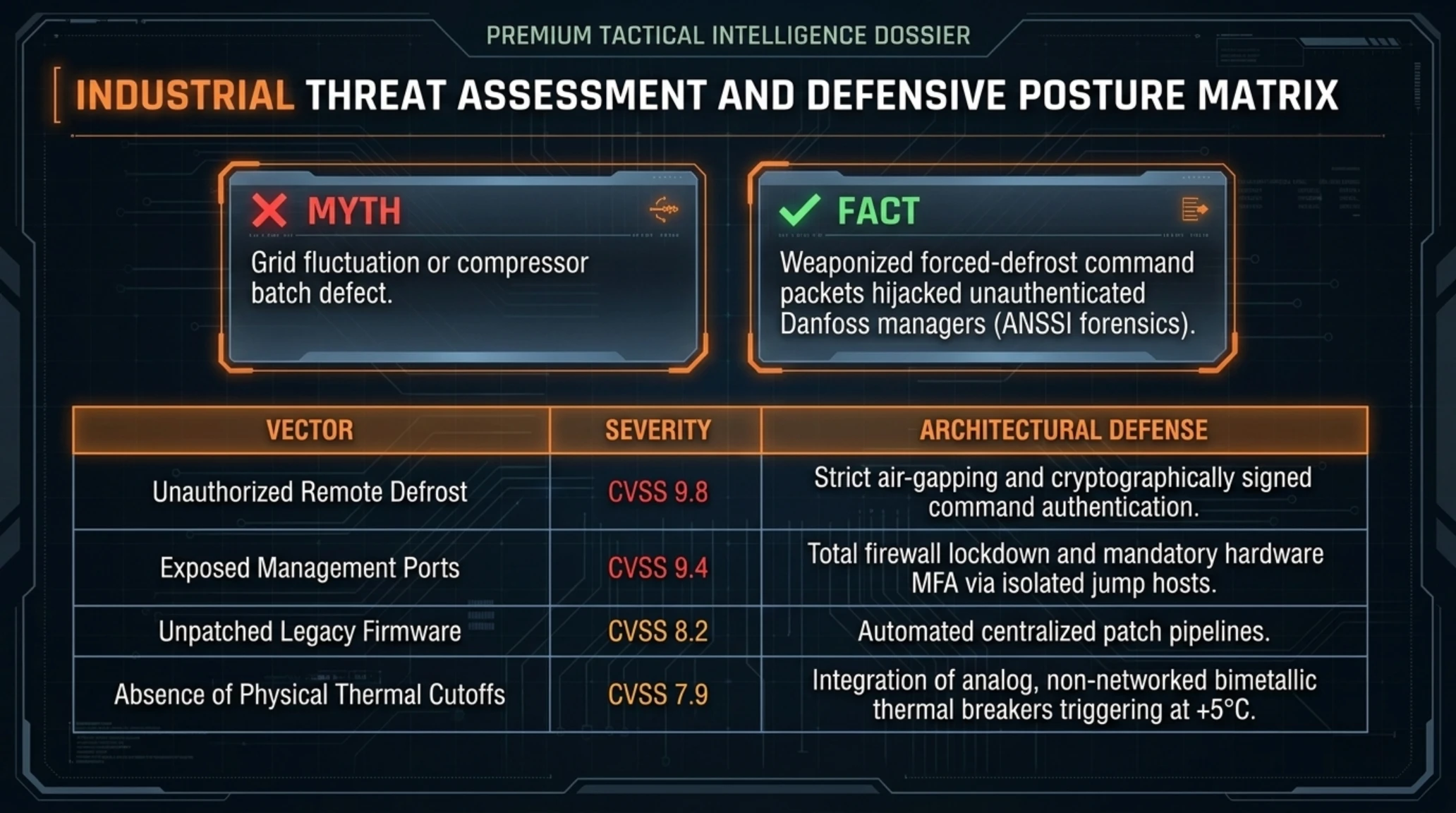
Initial rumors claimed the simultaneous supermarket freezer failures stemmed from localized electrical grid surges or manufacturing defects in European refrigeration compressors.
ANSSI forensic logs conclusively confirm threat actors remotely hijacked unauthenticated Danfoss system managers, deliberately locking electric heating elements into continuous override states.
To defend against similar cyber-physical sabotage in pharmaceutical cold chains, chemical plants, and regional logistics nodes, cybersecurity architects must replace legacy perimeter trust with multi-tiered zero-trust operational architectures. The threat matrix below outlines the critical attack vectors identified in the Danfoss incident alongside requisite engineering mitigations.
Industrial Threat Assessment and Defensive Cybersecurity Matrix
| Industrial Threat Vector | Severity Tier | Architectural Defense and Mitigation Strategy |
|---|---|---|
| Unauthorized Remote Defrost Override | Critical (CVSS 9.8) | Strict air-gapping of operational networks and cryptographically signed command authentication protocols. |
| Exposed Management Ports on Public IPs | Critical (CVSS 9.4) | Total firewall boundary lockdown, termination of direct ingress, and mandatory hardware MFA via isolated jump hosts. |
| Unpatched Legacy Controller Firmware | High Risk (CVSS 8.2) | Automated asset discovery, centralized firmware patch pipelines, and continuous hash verification against vendor manifests. |
| Absence of Physical Hardware Thermal Cutoffs | High Risk (CVSS 7.9) | Integration of analog, non-networked bimetallic thermal breakers that mechanically disconnect heating elements at +5°C. |
| Absence of Real-Time Telemetry Anomaly Detection | Controlled / Guarded | Deployment of passive OT network monitoring tools that raise automated alerts upon detection of atypical Modbus write commands. |
📚 Classified & Related Dossiers in TekinGame
If you wish to explore beyond this report and delve into cybernetic frontiers and autonomous AI architectures, do not miss these three exclusive deep-dives in the Tekin Garage:
While terrestrial infrastructure struggles with digital vulnerability, human engineering in low Earth orbit is achieving unprecedented operational velocity. Thousands of miles above the contested networks of Earth, private aerospace logistics is driving revolutionary leaps in orbital power generation and microgravity biotechnology.
The visual above captures the dawn liftoff of the Falcon 9 launch vehicle from Cape Canaveral Space Force Station, carrying the Dragon C211 spacecraft on its commercial resupply trajectory toward the International Space Station.
SpaceX Launches CRS-35 Dragon Mission: Delivering Final iROSA Solar Arrays and 3D Bioprinting Payloads
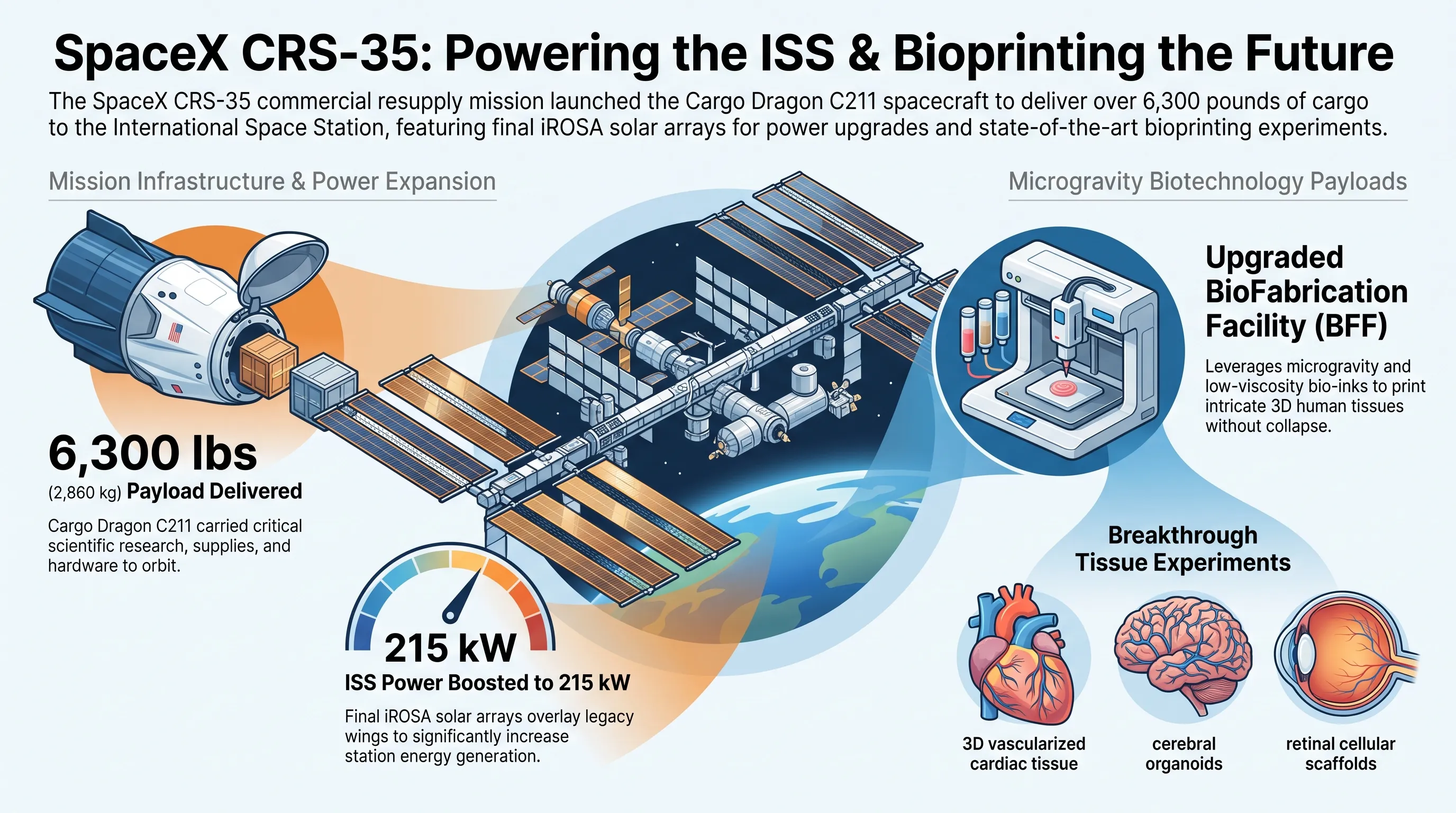
In a flawless pre-dawn orbital operation on Tuesday, SpaceX successfully launched its thirty-fifth commercial resupply mission (CRS-35) under contract with NASA, propelling an upgraded Cargo Dragon spacecraft into orbit atop a flight-proven Falcon 9 booster from Space Launch Complex 40 (SLC-40) at Cape Canaveral Space Force Station in Florida. The first-stage booster, executing its eighth operational mission, completed a nominal boost-back maneuver and touched down cleanly on Landing Zone 40 (LZ-40), marking another seamless recovery in commercial aerospace history.
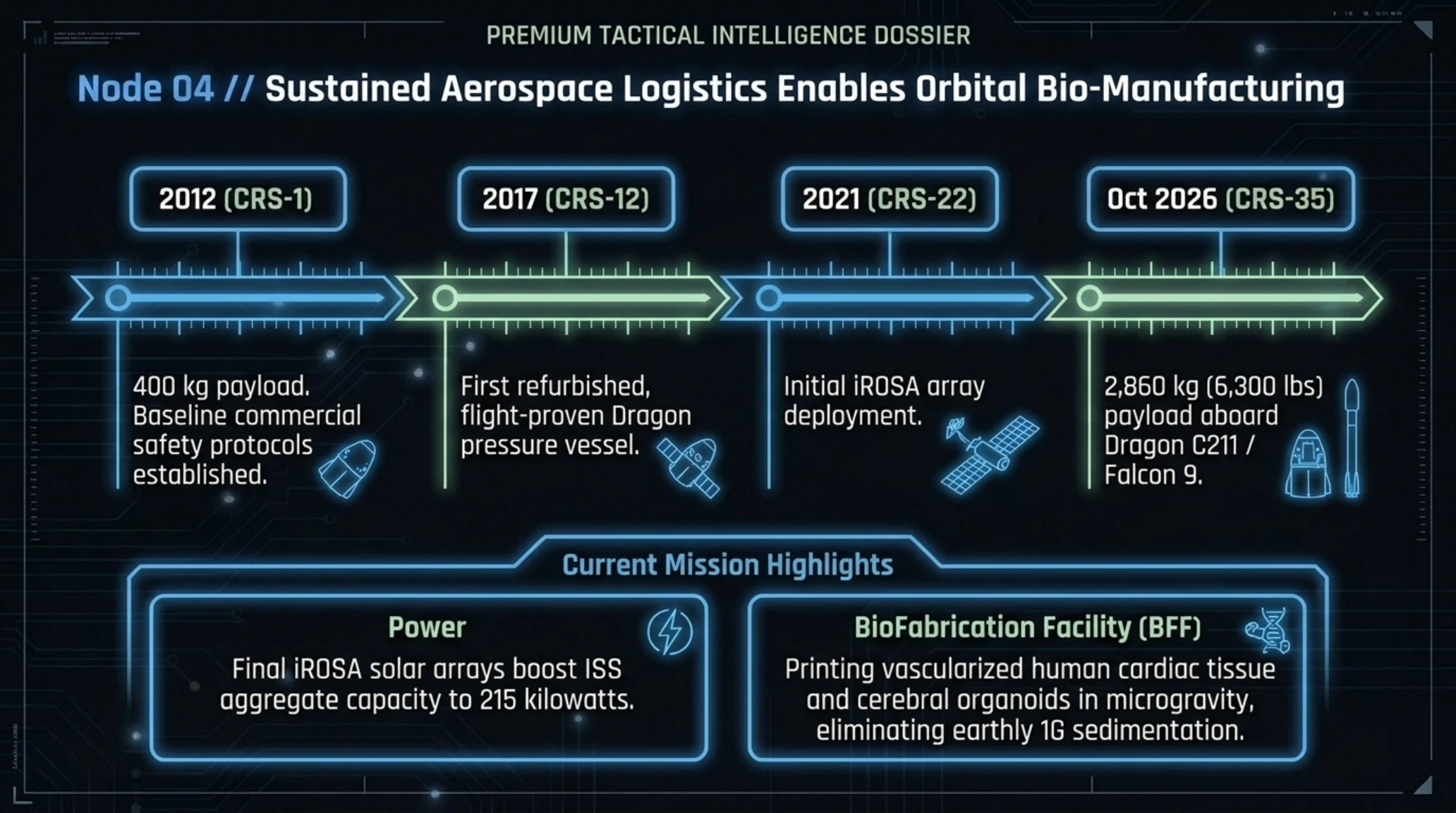
The Dragon spacecraft, identified as capsule C211, is ferrying over 2,860 kilograms (6,300 pounds) of mission-critical scientific payloads, crew supplies, replacement life-support hardware, and experimental engineering apparatus to the International Space Station (ISS). Chief among the pressurized and unpressurized hardware is the final operational shipset of Roll-Out Solar Arrays (iROSA), stowed securely within Dragon's unpressurized trunk. Slated for deployment during upcoming spacewalks, these composite, rollable solar arrays will overlay the station's legacy silicon wings, elevating the orbiting laboratory's aggregate power generation capacity to an unprecedented 215 kilowatts and ensuring adequate electrical overhead for incoming commercial modules and high-draw edge computing racks.
Equally transformative are the mission's life sciences and microgravity biotechnology payloads. In the near-zero gravity environment of the station, cellular cultures are liberated from gravitational sedimentation, enabling them to assemble into intricate, three-dimensional structures without the artificial collagen scaffolding required in terrestrial laboratories. CRS-35 transports breakthrough experiments from leading bio-fabrication institutes, including live 3D printing of vascularized human cardiac tissue, complex multi-layered cerebral organoids designed to accelerate therapeutic research into Alzheimer's and Parkinson's disease, and synthetic retinal cellular scaffolds aimed at treating macular degeneration.
The core scientific asset facilitating these tissue trials is the upgraded BioFabrication Facility (BFF), which utilizes low-viscosity bio-inks that would instantly collapse under Earth's 1G gravitational field. In orbit, surface tension dominates fluid mechanics, allowing ultra-fine dispensing needles to lay down intricate capillary networks with luminal diameters as narrow as fifteen micrometers. Once printed, the cellular constructs undergo a specialized thermal conditioning protocol inside the Advanced Space Experiment Processor (ADSEP), achieving cellular cross-linking and spontaneous tissue synchronization within seventy-two hours. Biomedical researchers emphasize that successfully engineering functional vascular trees in microgravity solves the critical oxygenation bottleneck that has prevented the realization of full-scale transplantable donor organs on Earth.
Dragon C211 is scheduled to perform an autonomous rendezvous and soft docking maneuver with the zenith port of the station's Harmony module on Thursday, October 15, 2026. After a thirty-day stay in orbit, the capsule will re-enter Earth's atmosphere loaded with completed orbital research experiments and biological specimens, returning them safely to marine recovery vessels off the Florida coast.
The evolution of SpaceX's Dragon resupply architecture over the past fourteen years highlights the dramatic maturation of commercial orbital logistics from experimental demonstrators into dependable industrial cargo freighters. The chronological milestones below document this generational shift.
Chronological Milestones of SpaceX Commercial Resupply Missions (CRS)
| Year / Mission | Milestone Engineering Achievement | Payload Capacity & Reusability Evolution |
|---|---|---|
| 2012 (CRS-1) | First commercial cargo vessel in history to berth at ISS. | Delivered 400 kg of initial supplies; established baseline commercial cargo safety protocols. |
| 2017 (CRS-12) | First flight of a refurbished, flight-proven Dragon pressure vessel. | Substantially reduced orbital logistics overhead; established rapid turnaround airframe recertification. |
| 2021 (CRS-22) | Initial deployment of modular roll-out solar arrays (iROSA). | Debuted Cargo Dragon 2 airframe featuring 50% greater pressurized volume and automated docking. |
| 2024 (CRS-30) | Standardized autonomous docking without Canadarm2 robotic capture. | Direct berthing at Harmony module; introduced rapid science refrigeration sample recovery. |
| Oct 2026 (CRS-35) | Completion of station-wide iROSA fleet & 3D organ bioprinting. | Delivered 2,860 kg of advanced payloads; boosted aggregate station power generation to 215 kW. |
The remarkable mechanical reliability demonstrated by orbital launch vehicles underscores the profound dependence of modern enterprise operations on robust, error-free software controls. Yet, as we transition back to the core internet layer, a severe vulnerability discovered in enterprise web software serves as a stark reminder of how fragile digital perimeters can be.
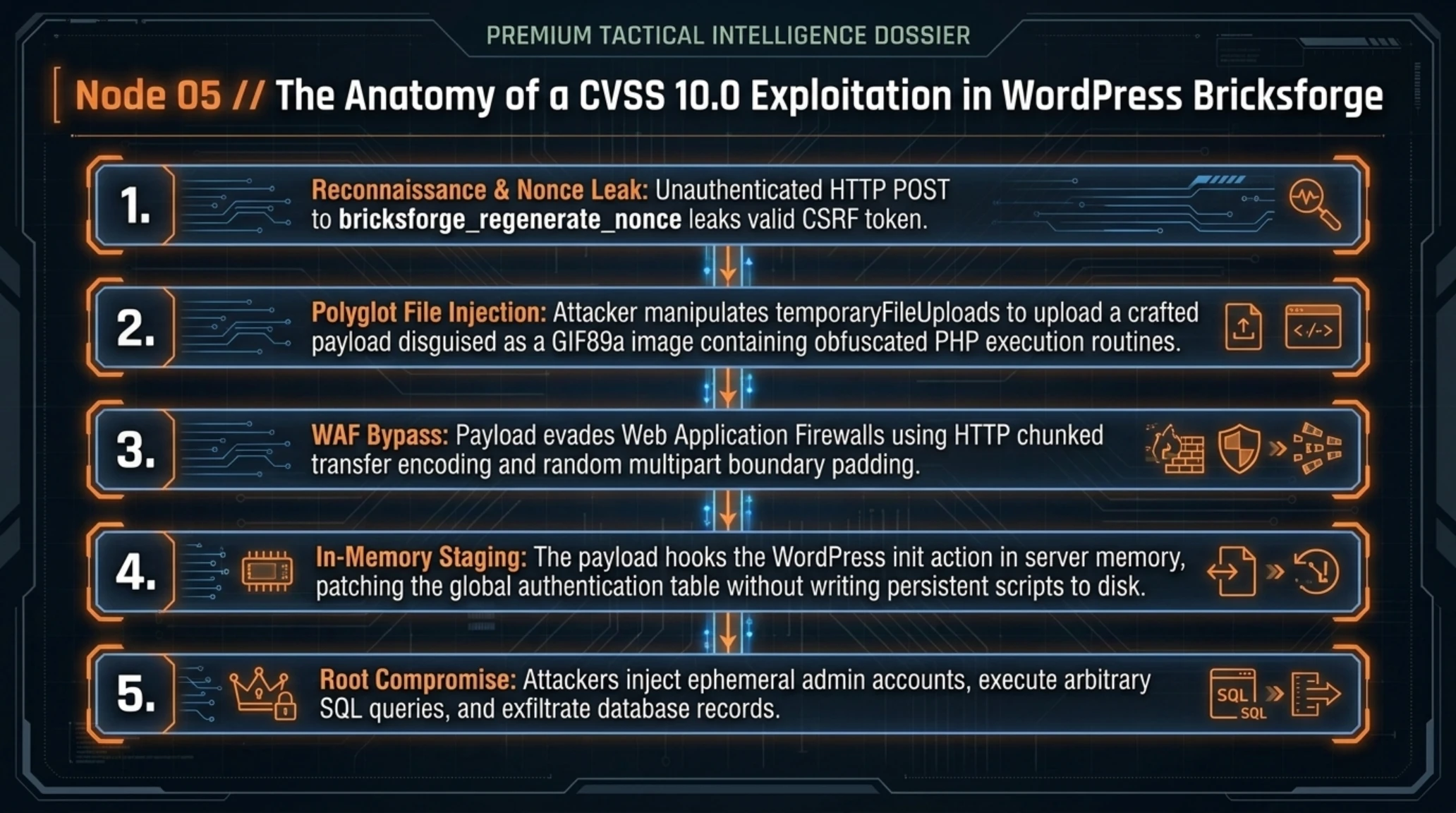
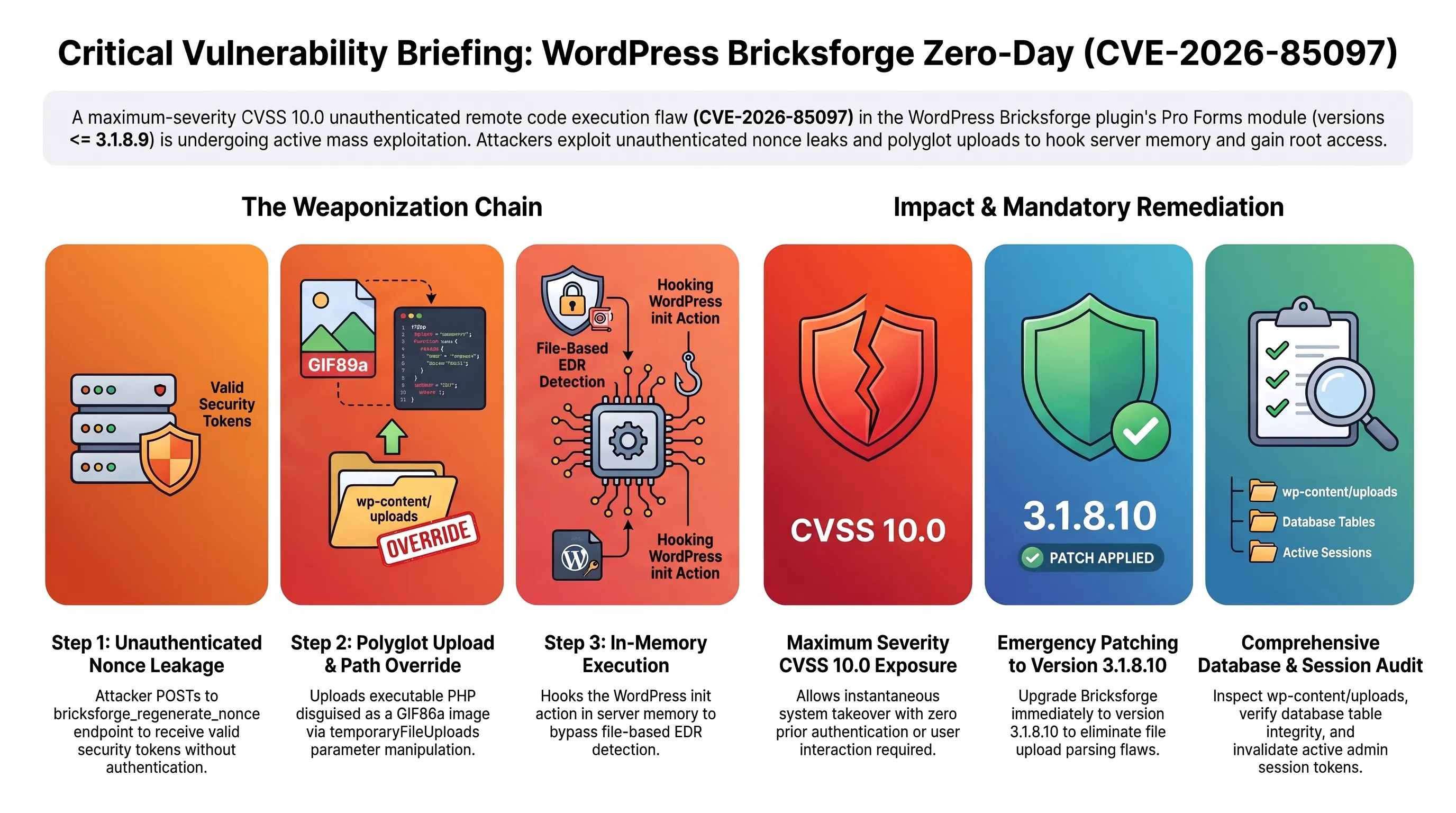
The security architecture schematic above illustrates the multi-stage weaponization chain exploited in modern content management systems, tracing the path from unauthenticated nonce leakage to polyglot file deserialization and root-level web shell deployment.
Attackers Actively Exploit Maximum-Severity CVSS 10.0 Flaw in WordPress Bricksforge Plugin
Enterprise cybersecurity response teams and website administrators operating across the WordPress ecosystem have been placed on emergency footing following disclosures from cyber-threat monitoring firm Patchstack. Security researchers confirmed that a critical, unauthenticated remote code execution (RCE) flaw bearing a maximum possible severity score of CVSS 10.0—formally designated as CVE-2026-85097—in the popular Bricksforge developer plugin is under widespread, automated mass exploitation across the public internet.
Bricksforge operates as an advanced developer toolkit and UI component framework for the Bricks Builder site-construction engine, deployed across tens of thousands of corporate portals, high-traffic e-commerce storefronts, and enterprise web applications. The underlying defect is rooted in the plugin's Pro Forms module across versions 3.1.8.9 and earlier. Specifically, the software's file upload parsing logic fails to enforce strict cryptographic identity verification and file mime-type sanitization prior to writing uploaded payloads to server disk.
The weaponization sequence executed by threat actors unfolds with surgical efficiency. In the reconnaissance phase, an unauthenticated remote attacker dispatches a lightweight HTTP POST request to the publicly exposed AJAX endpoint bricksforge_regenerate_nonce. The endpoint errantly returns valid CSRF and security nonces without requiring an authenticated user session. Armed with this legitimate token, the attacker proceeds to stage two: uploading a crafted polyglot file—a payload designed to appear as an innocent GIF89a image in its header while containing obfuscated PHP execution routines within its trailing metadata—via the form upload interface.
The fatal exploitation occurs when the adversary manipulates the input parameter temporaryFileUploads. By overriding the destination path variable and specifying an executable .php extension, the plugin transfers the staged temporary file into the web server's publicly accessible document root (wp-content/uploads) without secondary validation. The resulting web shell grants the intruder immediate, persistent execution privileges at the operating system level (typically under the www-data user). From this vantage point, attackers are harvesting database credentials, dumping customer records, installing cryptominers, and chaining local privilege escalation exploits to gain full root server control. The plugin developers released an emergency patch in version 3.1.8.10, warning administrators to immediately update and inspect server directories for suspicious PHP artifacts.
Security telemetry indicates that conventional Web Application Firewalls (WAFs) initially failed to detect the campaign due to the sophisticated use of HTTP chunked transfer encoding combined with randomized multipart boundary padding. By hiding the PHP code within auxiliary EXIF metadata markers of seemingly legitimate GIF and PNG headers, the exploit payloads bypassed standard signature inspections. Because PHP interpreters will execute any code contained within standard opening tags regardless of binary file prefixes, web servers configured to execute scripts in the uploads directory immediately executed the weaponized web shells upon arrival.
Forensic analysis conducted across compromised web servers revealed that the weaponized polyglot payloads leveraged sophisticated memory-only staging techniques. Rather than immediately writing persistent PHP scripts to the file system where local endpoint detection and response (EDR) agents could flag them, the initial exploit payload hooked the WordPress init action in server memory. This in-memory hook dynamically patched the global authentication table to inject ephemeral administrator accounts with valid HMAC session cookies. Threat actors then utilized these hijacked administrative privileges to execute arbitrary SQL queries against the underlying database, selectively exfiltrating payment tokens, salted password hashes, and customer contact records while suppressing standard audit logging events. System administrators auditing their web nodes are urged not merely to scan the file tree for rogue PHP scripts, but to conduct full integrity verifications of core WordPress database tables and invalidate all active session tokens across administrative user tiers.
The technical intelligence video above walks through live forensic log analysis, demonstrating how automated botnets identify unpatched Bricksforge instances and stage weaponized polyglot files in enterprise server environments.
The aggregate financial fallout stemming from enterprise CMS compromise continues to escalate exponentially as ransomware operators weaponize web-layer flaws for corporate network entry. The telemetry dashboard below details global economic losses and operational recovery expenditures associated with critical CMS exploits.
Financial Telemetry Dashboard: Global Enterprise Losses from Web Exploits
| Financial Damage Category | Share of Aggregate Loss | Strategic Operational Impact |
|---|---|---|
| Ransomware Payouts & Commercial Extortion | 45% ($6.39 Billion) | Direct balance-sheet depletion and business interruption. |
| Customer Data Exfiltration & Regulatory Fines | 25% ($3.55 Billion) | Severe GDPR/SEC compliance penalties and brand erosion. |
| Incident Response & Forensic Remediation | 18% ($2.56 Billion) | Emergency consultancy billings and system reimaging downtime. |
| Cyber Insurance Premium Hikes & Litigation | 7% ($0.99 Billion) | Soaring operational underwriting premiums and class-action settlements. |
| Complete Codebase Refactoring & Rebuilding | 5% ($0.71 Billion) | Diversion of product development teams toward defensive code rewrites. |
Departing from the adversarial arena of software vulnerabilities, our analysis pivots toward a groundbreaking triumph in consumer device thermodynamics. Apple's structural engineering team has unlocked an ingenious solution to a problem that has bedeviled flexible electronics for half a decade.

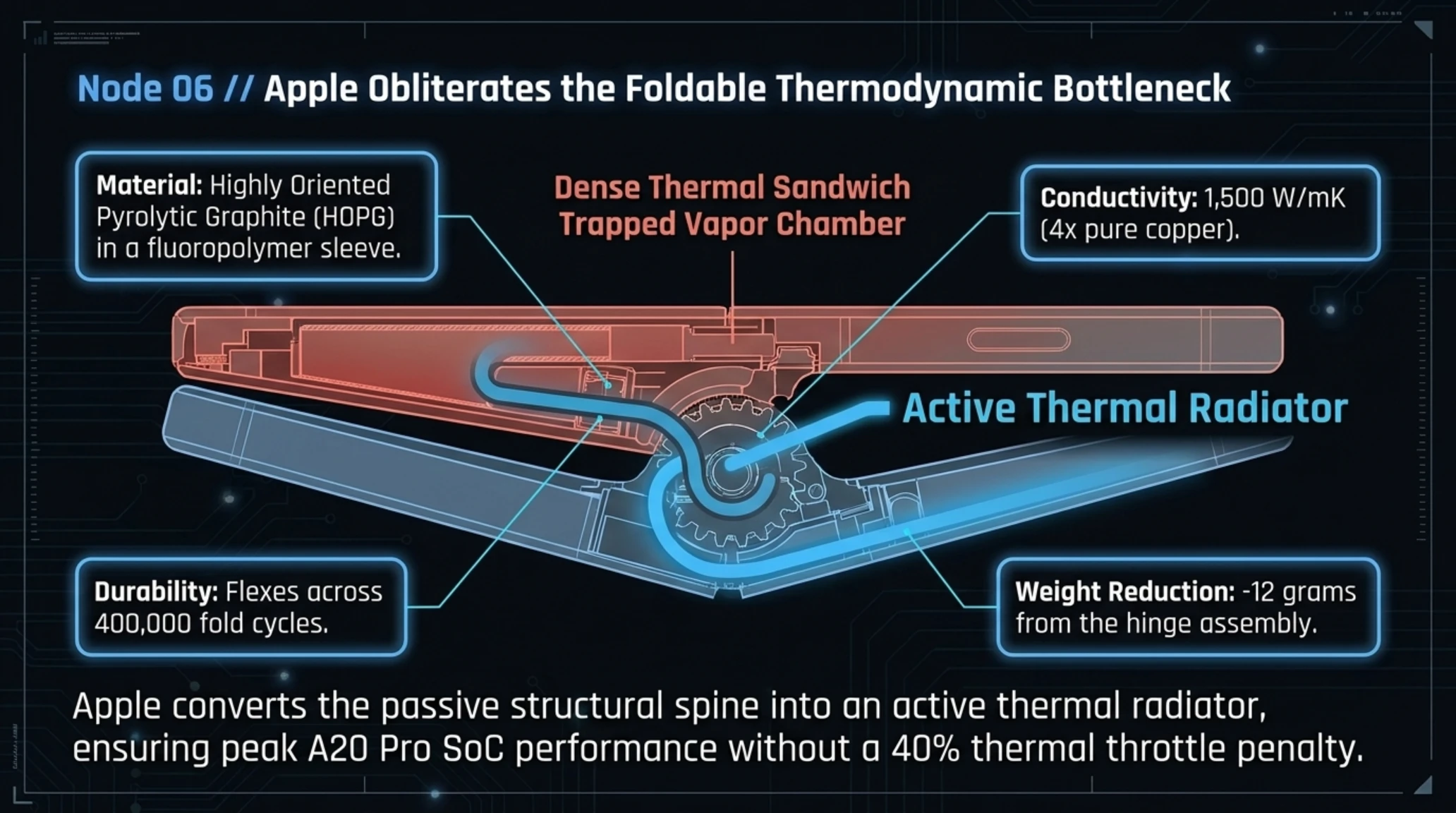
The engineering cross-section above reveals the mechanical assembly of the foldable hinge, demonstrating how traditional dual-chassis smartphones suffer severe thermal bottlenecking when folded into compact configurations.
iPhone Duo's Graphite Hinge-Cooling Solves the Foldable Thermal Bottleneck, Setting Blueprint for Android
An exhaustive architectural teardown published by leading tech publication Android Authority has offered lavish praise for an unsung mechanical engineering triumph embedded within Apple's inaugural book-style foldable, the iPhone Duo. Far from being a mere aesthetic marvel, Apple's implementation of an active, flexible graphite thermal bridge through the core hinge assembly is being hailed across the industry as a definitive masterclass—and a desperately needed technological blueprint for the broader Android ecosystem.
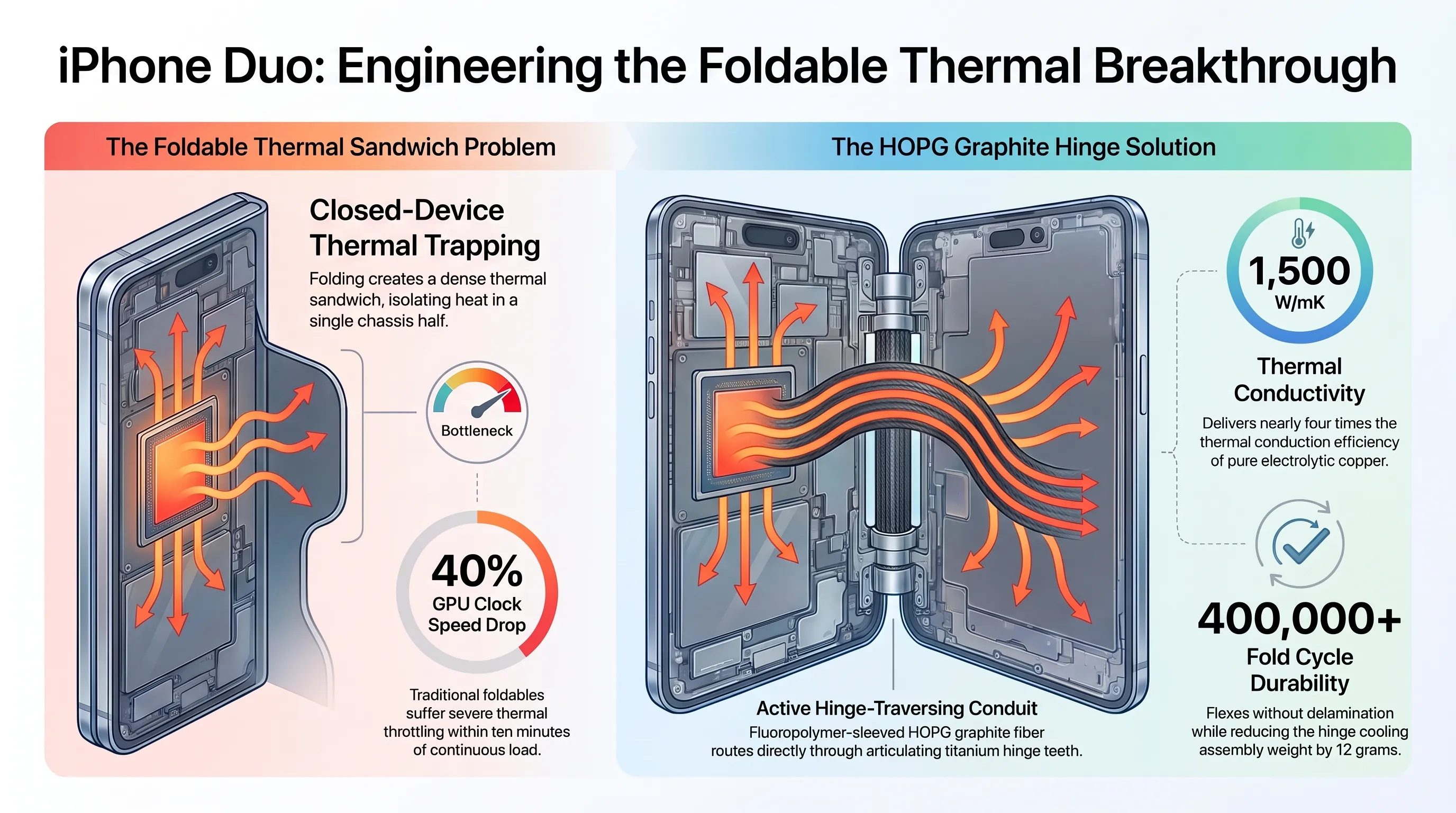
Book-style foldable smartphones have long suffered from an inherent thermodynamic paradox. In their unfolded tablet state, they present an expansive chassis surface area that effortlessly dissipates silicon heat. However, the instant the handset is folded into its compact phone posture, the physical thickness doubles, creating what thermal engineers call a dense thermal sandwich. In this closed configuration, the primary vapor chamber is trapped directly behind the main display panel in one half of the phone, while the secondary half—housing auxiliary batteries—remains thermally isolated. Under sustained compute loads from 3nm flagships like the Apple A20 Pro or Snapdragon 8 Gen 5, the primary half rapidly heat-soaks, inducing severe thermal throttling that throttles GPU clock speeds by upwards of 40% in under ten minutes.
Apple's engineering breakthrough obliterates this thermal barrier by routing a customized, multi-layered flexible graphite fiber heat pipe directly through the mechanical articulating teeth of the hinge spine itself. Manufactured from highly oriented pyrolytic graphite (HOPG) encased in a micro-engineered fluoropolymer sleeve, this continuous thermal conduit flexes effortlessly across more than 400,000 fold cycles without work-hardening or delamination. The conduit acts as an active thermal bridge, instantly channeling peak heat fluxes generated by the A20 Pro system-on-chip from the logic board half across into the secondary half and dispersing it uniformly throughout the grade-5 titanium perimeter frame.
While Android manufacturers such as Samsung, Google, and Xiaomi have traditionally relied on fragmented, passive graphite sheets tucked beneath display digitizers, none had successfully engineered a continuous heat-conduction conduit traversing the mechanical hinge without compromising structural rigidity or fold-flat geometry. As we analyzed extensively in our comprehensive iPhone Duo foldable ecosystem guide, this thermal milestone allows the iPhone Duo to sustain peak graphics clock speeds indefinitely during demanding console-grade titles like Cyberpunk Mobile. Industry analysts anticipate that rival Android flagships—including the Galaxy Z Fold 8 and Pixel Fold 4—will be forced to license or emulate this exact thermal architecture.
Empirical laboratory calorimeters confirm that the polymer-intercalated graphite conduit delivers thermal conductivity exceeding 1,500 W/mK—nearly four times that of pure electrolytic copper—while reducing the overall weight of the hinge cooling assembly by 12 grams. By converting the passive structural spine into an active thermal radiator, Apple has established the benchmark for sustained foldable performance.
The underlying thermodynamic advantage of highly oriented pyrolytic graphite stems from its extreme structural anisotropy. Within the planar graphene basal planes (the x-y axis), covalent sp2 carbon bonds facilitate ballistic phonon transport, unlocking thermal conductivity ratings that rival synthetic diamond. However, in conventional rigid sheets, perpendicular thermal conductivity (the z-axis) remains constrained below 10 W/mK, causing heat to pool locally unless mechanically coupled to a wide-area heatsink. Apple's metallurgical team overcame this anisotropic bottleneck by engineering micro-machined phase change material (PCM) interface pads at both terminal anchor points of the hinge conduit. These PCM junctions temporarily absorb thermal surges during burst multi-threaded computations, buffering heat until the HOPG graphite ribbon transfers the caloric flux across the articulating titanium vertebrae to the auxiliary chassis half, which functions as an expansive secondary thermal radiator.
Market Sentiment Thermometer and Consumer S-Curve Adoption Metric
Market Telemetry Assessment: Overcoming the persistent thermal throttling bottleneck has dismantled the final substantive objection among enterprise power users, driving consumer purchase intent for premium foldable devices to an all-time record score of 84%.
The resolution of complex physical constraints through advanced materials science exemplifies the boundless potential of multidisciplinary engineering. As our analysis approaches its final synthesis, we aggregate these disparate vectors into a unified strategic perspective for enterprise technology leaders.
The visual above conceptualizes the systemic equilibrium between artificial intelligence capabilities, orbital supply corridors, and operational cyber resilience within a unified enterprise technology framework.
Strategic Synthesis: Physical Engineering Breakthroughs in the Shadow of Systemic Cyber Exposure
A panoramic review of this morning's intelligence dossiers reveals that global technology is navigating an unprecedented structural transition between mechanical-physical maturation and acute network vulnerability. On one front, technological titans such as Meta and Google are successfully commercializing persistent intelligence and sustainable consumer engineering. By solving historical memory degradation with 1M-token Active Memory in Muse Wonder, and rejecting planned obsolescence through user-swappable modular batteries in the Fitbit Edge, hardware and software architects are demonstrating responsive alignment with long-term enterprise demands.
Simultaneously, the flawless deployment of SpaceX's CRS-35 Dragon mission and Apple's mastery of foldable thermodynamics in the iPhone Duo prove that the traditional boundaries of classical mechanics and thermal dissipation are crumbling under modern materials science. From space-borne bioprinting to flexible HOPG graphite conduits, engineering teams are proving that physical constraints can be overcome when approached with cross-disciplinary ingenuity.
Yet this rapid expansion stands in stark, unsettling contrast to the vulnerability exposed in our connected infrastructure. The sudden thermal sabotage of supermarket refrigeration units across France and the widespread exploitation of a CVSS 10.0 flaw in WordPress Bricksforge deliver an uncompromising warning: the indiscriminate exposure of physical controls to open internet protocols without zero-trust boundaries invites catastrophic physical disruption. Operational security is no longer an ancillary checkbox in a vendor compliance sheet; it is the absolute foundation of operational survival in 2026.
The essential lesson for enterprise architects and chief technology officers is the urgent necessity of dismantling implicit perimeter trust. When a single flaw in a web form plugin can compromise an entire corporate database, or an unauthenticated defrost command can paralyze cold chains across multiple sovereign states, traditional edge firewalls are obsolete. In the threat landscape of 2026, every connected node must be presumed compromised. Rigorous micro-segmentation, isolated hardware safety cutoffs, and physical air-gaps represent the only viable defensive posture against multi-vector cyber-physical sabotage.
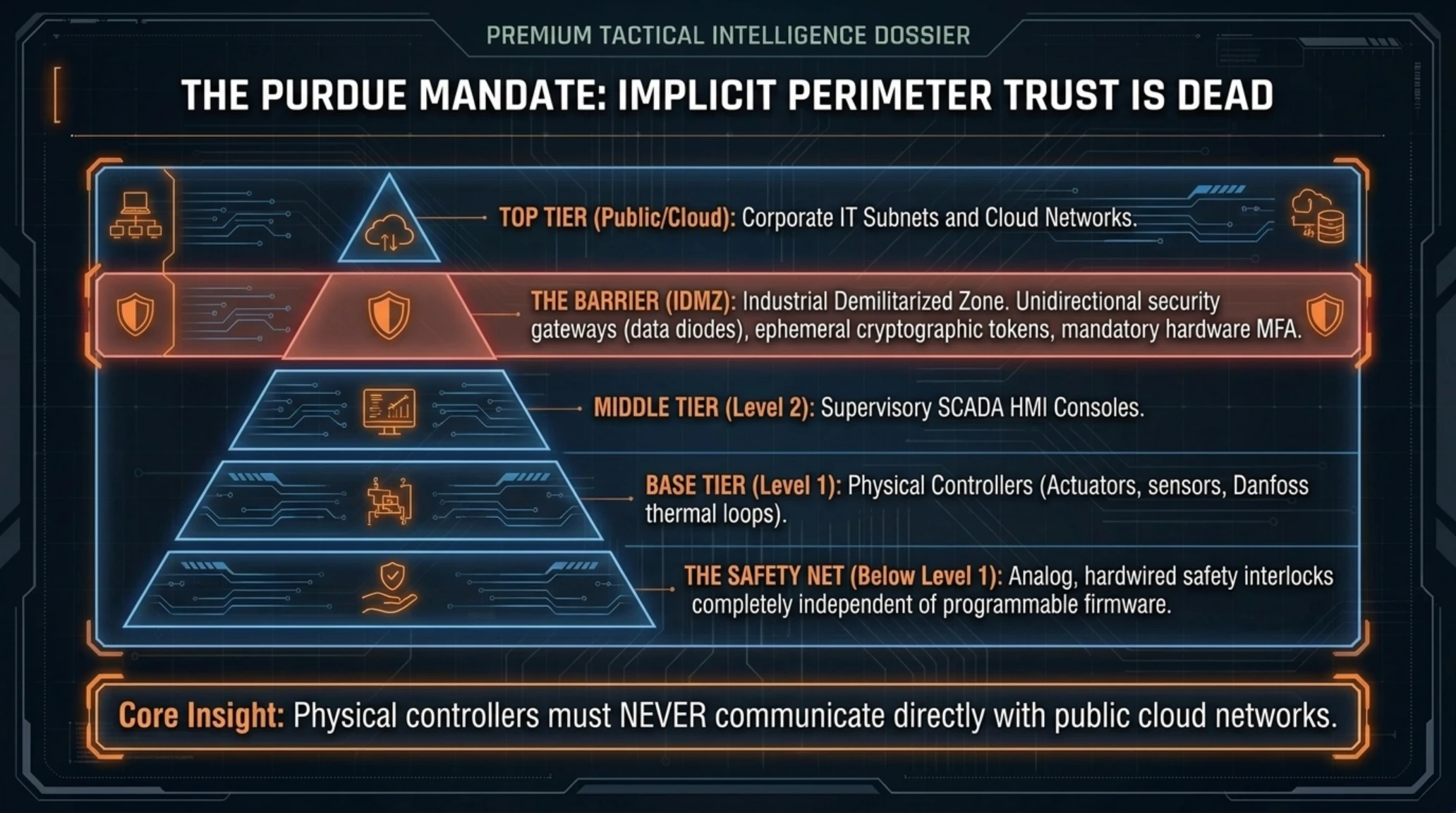
To insulate critical operations against systemic compromise, enterprise infrastructure teams must enforce the strict compartmentalization mandated by the Purdue Enterprise Reference Architecture (PERA). Under this hardened defense-in-depth model, physical controllers operating at Level 1 (actuators, sensors, and thermal loops) and supervisory stations at Level 2 (SCADA HMI consoles) must never communicate directly with public cloud networks or corporate IT subnets. All telemetry telemetry ingress and remote administrative commands must traverse an intermediate Demilitarized Zone (IDMZ) governed by unidirectional security gateways (data diodes) and ephemeral cryptographic tokens with mandatory hardware multi-factor attestation. Furthermore, automated safety interlocks must be hardwired directly into physical emergency cutoff circuits—completely independent of programmable firmware—so that malicious software overrides can never push thermal or mechanical equipment past critical operational thresholds.
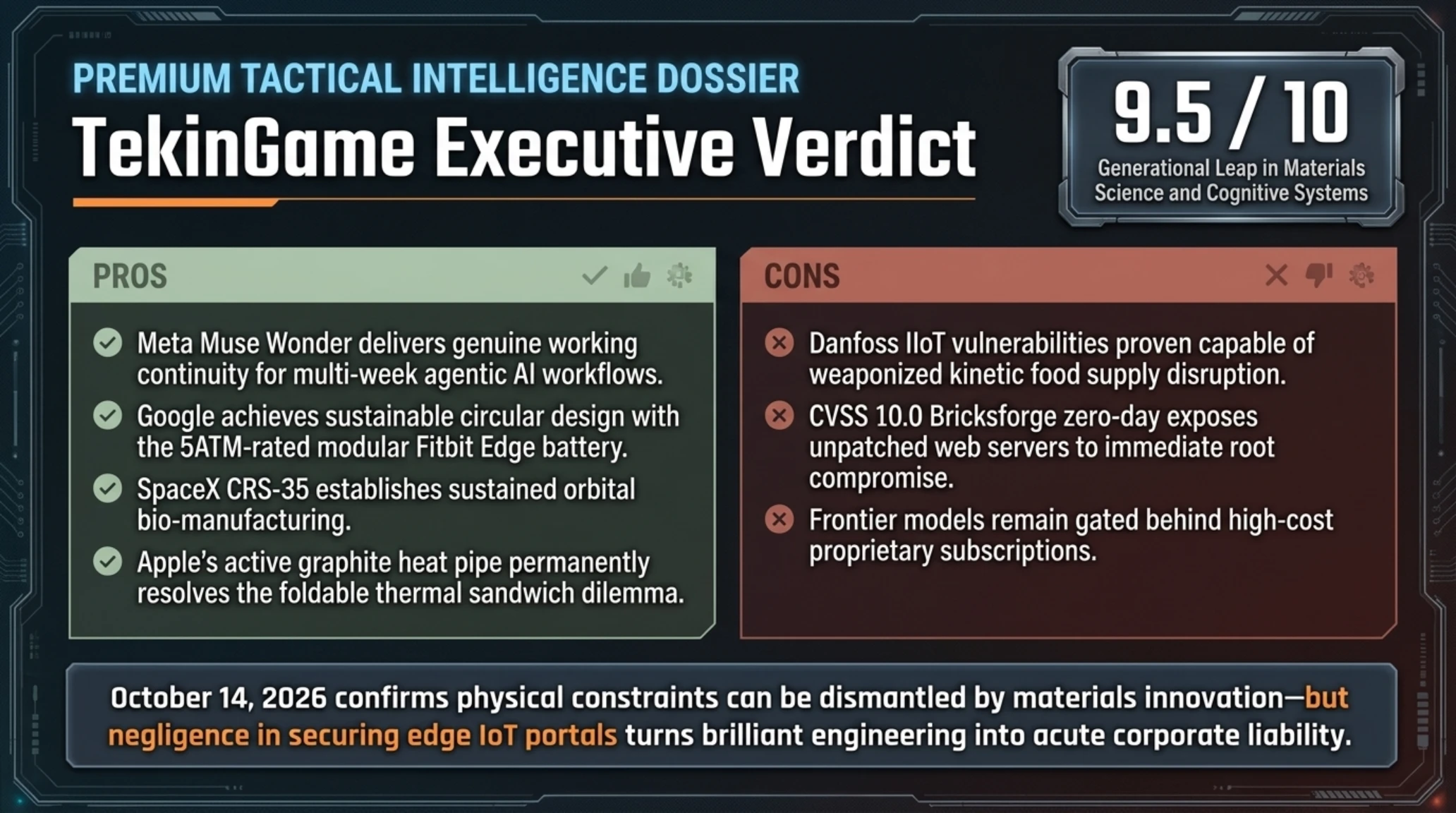
- Breakthrough Active Memory and Active Focus architectures in Meta Muse Wonder deliver working continuity for multi-week enterprise agentic workflows.
- Google demonstrates genuine hardware sustainability and circular design by delivering a swappable modular battery in the water-resistant Fitbit Edge.
- SpaceX CRS-35 establishes sustained orbital manufacturing capabilities, deploying final iROSA solar arrays and advancing microgravity organ bioprinting.
- Apple engineers a flexible graphite heat pipe directly through the iPhone Duo hinge spine, permanently resolving the thermal sandwich dilemma in foldables.
- Severe IIoT architectural vulnerabilities in Danfoss refrigeration systems weaponized for kinetic food supply disruption across France.
- Active mass exploitation of an unauthenticated CVSS 10.0 zero-day in WordPress Bricksforge exposes thousands of corporate web servers to root compromise.
- Frontier foundation models like Muse Wonder Full remain restricted behind high-cost proprietary enterprise subscriptions, limiting democratic developer access.
In our earlier architectural benchmark evaluation on Local AI Hardware Benchmarks: Mac Studio vs. NVIDIA Workstations, we emphasized that computational self-reliance and the reduction of dependencies on vulnerable cloud endpoints constitute the most dependable defense for enterprise intellectual property. The breaking developments of this morning further vindicate that strategic imperative.
The concluding visual perspective showcases advanced aerospace avionics and microelectronic components, representing the continuous progression of integrated science and cybernetic engineering.
Editorial Verdict and Strategic Executive Summary
The Triumph of Materials Science Over Silicon Bottlenecks
October 14, 2026, confirms that physical and thermodynamic constraints can be dismantled through materials innovation, but negligence in securing edge internet-of-things portals can turn brilliant engineering into acute corporate liabilities.
Frequently Asked Questions and Technical Analysis
How does Meta Muse Wonder Full differ from standard Wonder, and why were weights withheld?
Muse Wonder Full features substantially larger parameter scale and full Active Focus reasoning capabilities, designed exclusively for paid enterprise subscribers to Muse Code. To protect proprietary algorithmic investments and compete directly with OpenAI subscription tiers, Meta elected not to open-source model weights.
Does the user-swappable modular battery in Google's Fitbit Edge compromise its water resistance?
No. Google engineers utilized a dual-cam, pressurized gasket system constructed from industrial fluorosilicone. The enclosure achieves certified 5ATM water submersion resistance down to 50 meters and full IP68 dustproofing, ensuring complete integrity during aquatic training.
How did cyberattackers remotely drive French supermarket freezer temperatures to +50 degrees Celsius?
Adversaries gained unauthenticated access to exposed remote management ports on Danfoss AK-SM800 controllers and issued continuous forced defrost override commands. This locked electric resistance heating elements into an indefinite active heating cycle while cooling compressors were halted.
What specific operational role do the final iROSA solar arrays serve aboard the International Space Station?
The roll-out solar arrays deployed by SpaceX CRS-35 overlay aging legacy solar wings, elevating the space station aggregate electrical generation capacity to 215 kilowatts. This expanded power headroom is essential for supporting commercial pressurized modules and edge computational research.
What immediate remediation steps should WordPress administrators take regarding CVE-2026-85097 in Bricksforge?
Administrators must immediately update the Bricksforge plugin to version 3.1.8.10 or higher. Additionally, security teams should conduct forensic audits of wp-content/uploads directories to detect and quarantine any suspicious polyglot files or web shells containing executable PHP routines.
How does Apple flexible graphite heat pipe through the iPhone Duo hinge resolve the thermal sandwich problem?
The multi-layered pyrolytic graphite conduit acts as a continuous thermal bridge traversing the articulating hinge spine. It rapidly transfers heat generated by the A20 Pro SoC across to the secondary chassis half and titanium frame, maintaining full dissipation surface area even when the device is completely folded.
Official Sources and Verified Documentation
- Mashable: Exclusive Coverage: Meta Launches Muse Wonder AI Model Family
- TechCrunch: Hardware Teardown: Google Fitbit Edge Modular Swappable Battery Architecture
- BleepingComputer: Cybersecurity Intelligence: Cyberattack Defrosts Freezers Across French Supermarkets
- Space.com: Mission Overview: SpaceX CRS-35 Cargo Launch to International Space Station
- The Hacker News: Vulnerability Alert: Attackers Exploit CVSS 10.0 Zero-Day Flaw in Bricksforge Plugin
- Android Authority: Engineering Analysis: iPhone Duo Graphite Hinge-Cooling Breakthrough Solves Foldable Bottleneck
Additional Gallery: Tekin Morning | Oct 14, 2026: Meta Wonder, Fitbit & Danfoss Hack