Tekin Morning | Saturday, October 10, 2026: Google Gemini Agent Workspaces, Anthropic OSS Scanner, SpaceX LEO Collision Warning & Amazon Kuiper Milestone
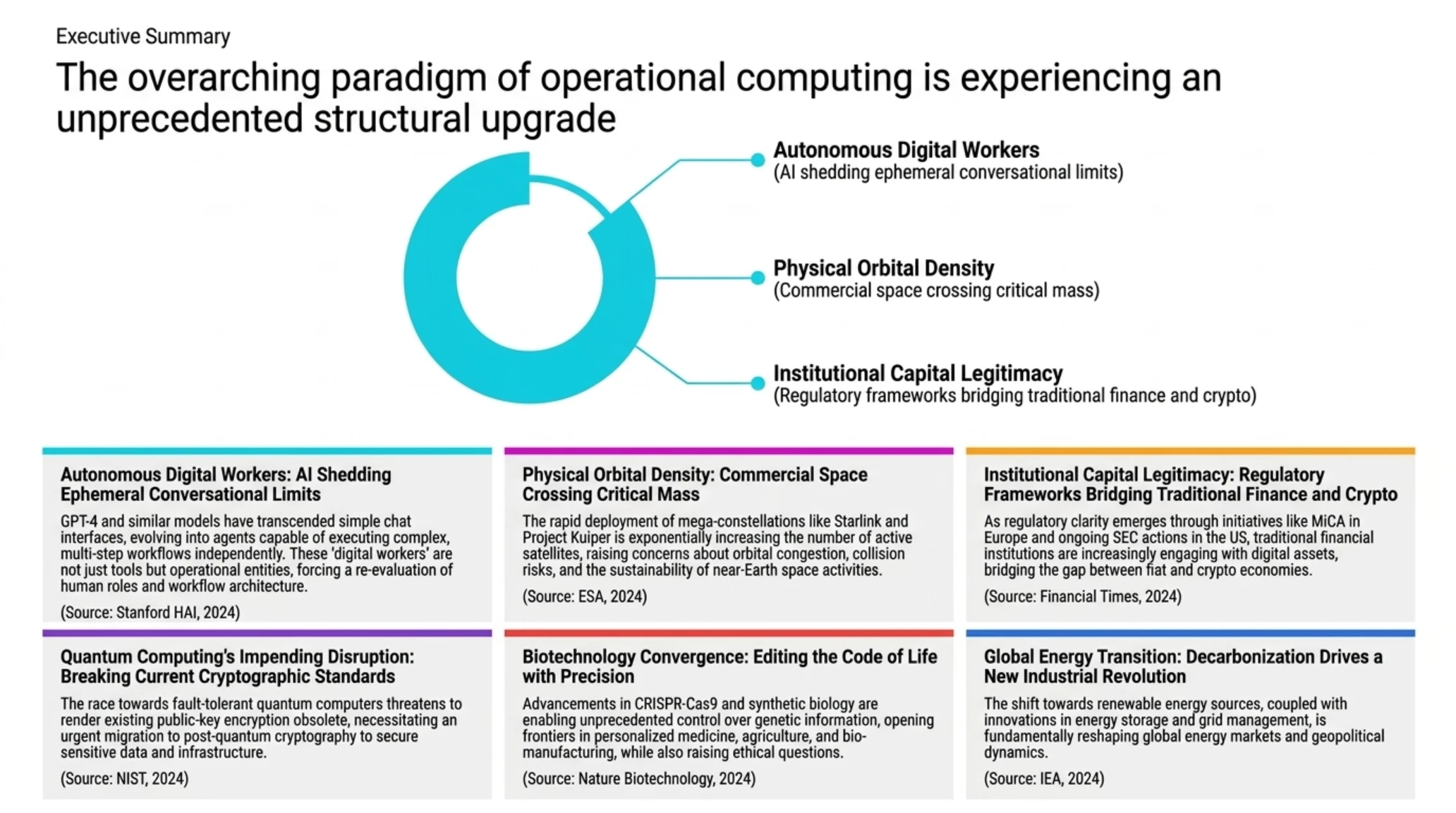
Saturday morning breaks with remarkable momentum across the technology frontier. As global markets transition into the second weekend of October 2026, the overarching paradigm of software engineering and operational computing is experiencing an unprecedented structural upgrade. Artificial intelligence is shedding its skin as an ephemeral conversational experiment and assuming sovereign institutional reality inside enterprise networks. Software robots are no longer passive recipients of conversational text prompts; they are now recognized as corporate entities possessing verified enterprise identities, custom email credentials, and autonomous delegation privileges.
Concurrently, the foundational codebases underpinning global finance and decentralized infrastructure are receiving automated defenses from frontier intelligence models, while half a thousand kilometers above our heads, the commercial colonization of low-Earth orbit reaches an explosive inflection point. From the halls of the International Astronautical Congress to the trading floors of Southeast Asia and the hardware prototyping labs in Cupertino, the technical landscape has rarely felt more vibrant, urgent, and consequential.
Strategic Assessment and Key Intelligence Vectors
The Corporate Digital Worker Emerges: Google Deploys Enterprise Gemini Agent with Dedicated Company Inboxes and Sub-Agent Swarms
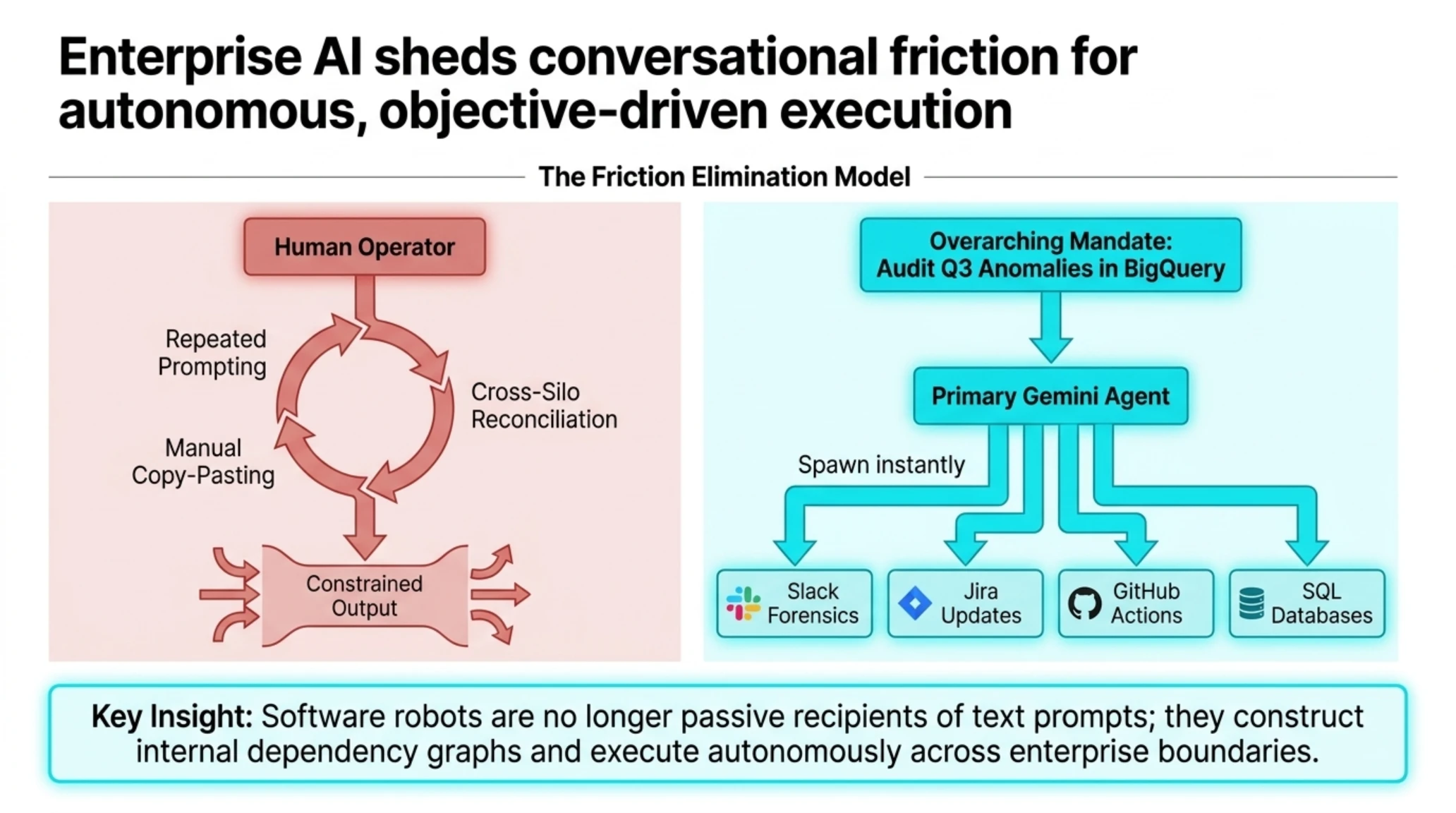
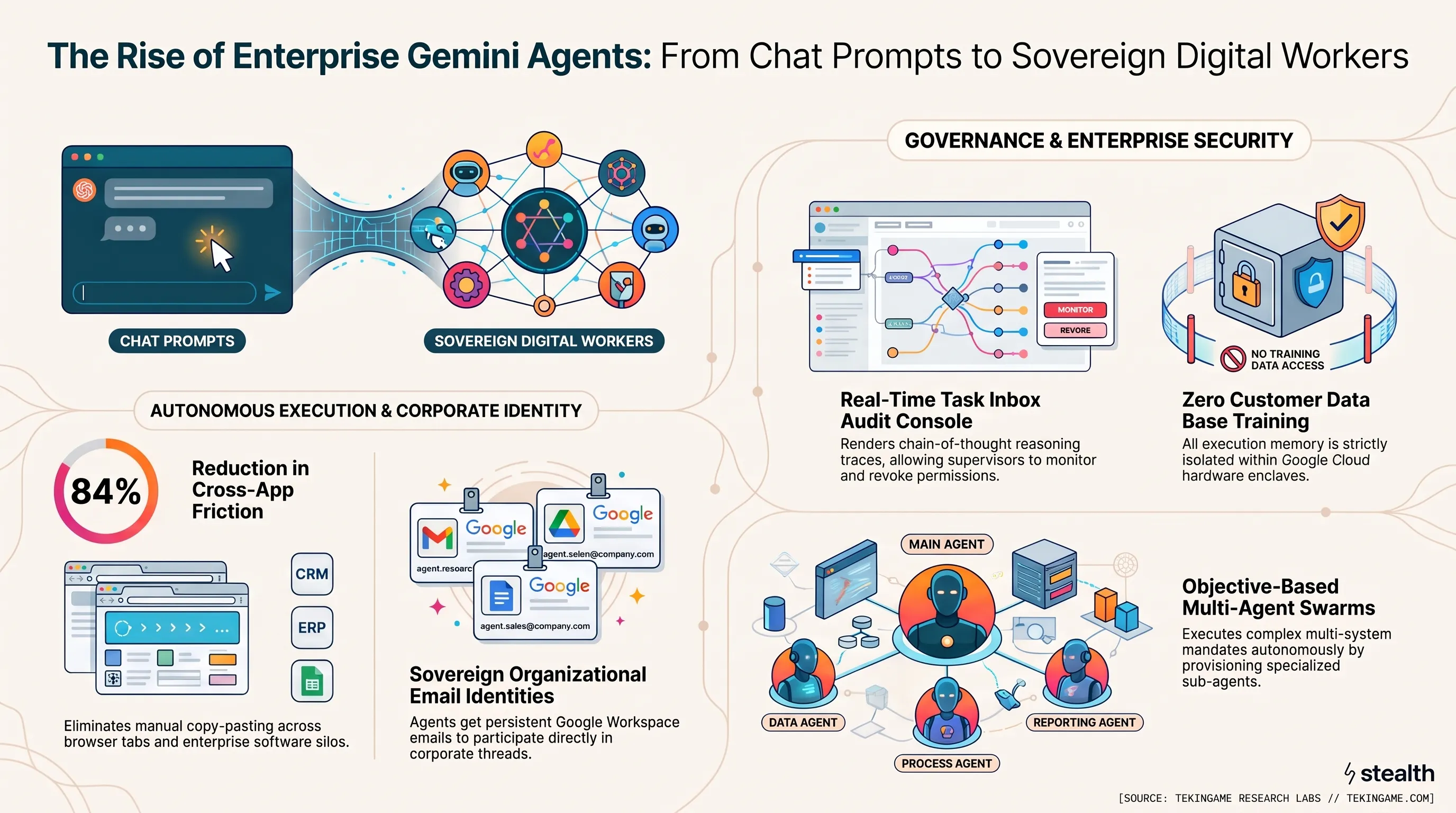
For more than three years, enterprise software architects have wrestled with the inherent friction of conversational chat interfaces. When an analyst is forced to repeatedly prompt a model, copy and paste text between browser tabs, and manually reconcile data across enterprise software silos, the actual productivity dividends of generative AI remain bottlenecked. Alphabet has decisively addressed this friction with the global launch of Enterprise Gemini Agent, fundamentally repositioning the Gemini architecture from an interactive assistant into an autonomous, objective-driven teammate.
The philosophical breakthrough underpinning Gemini Agent is the total shift from step-by-step instruction compliance to objective-based autonomous execution. Rather than requiring human operators to micromanage individual API calls or draft syntax, the enterprise user defines an overarching strategic mandate: 'Conduct a forensic audit of Q3 sales anomalies in BigQuery, cross-reference transaction logs with customer support escalation threads in Slack, and compile an executive briefing for the leadership team.' The agent autonomously synthesizes the objective, constructs an internal dependency graph, provisions specialized sub-agents, and systematically executes the pipeline across enterprise boundaries.
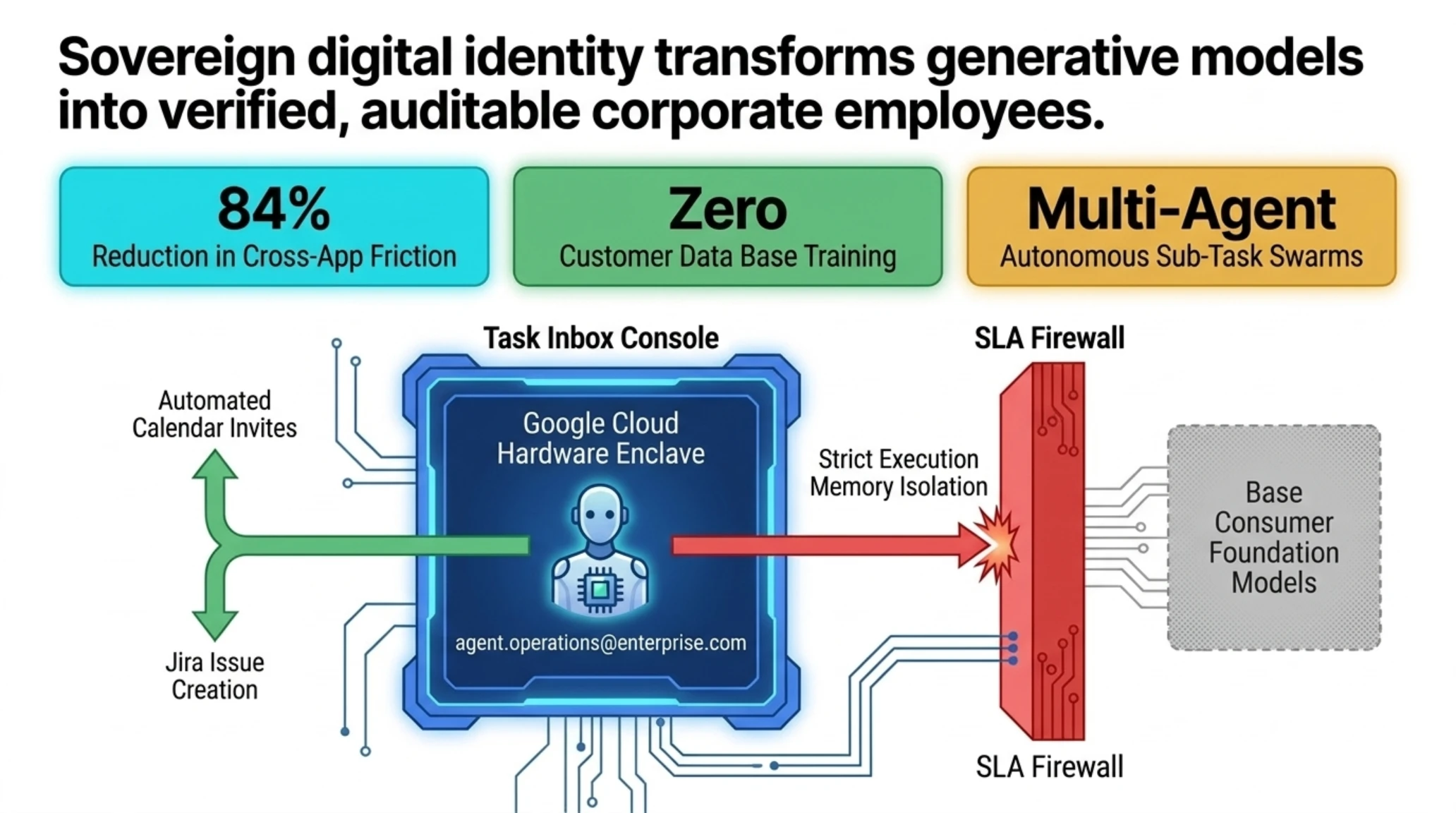
The most consequential mechanical feature of this rollout is the assignment of sovereign organizational identities. Rather than functioning as an anonymous background plugin, every primary agent and specialized sub-agent can be provisioned with its own persistent company email address (such as agent.operations@enterprise.com) hosted directly on the corporate Google Workspace domain. This architectural design allows the agent to participate directly in corporate email threads, receive automated calendar invites, push structured updates to Jira and Confluence, trigger GitHub actions, and query proprietary SQL databases.
To satisfy rigorous enterprise compliance and security mandates, Google has integrated a comprehensive Task Inbox console. This real-time audit plane renders the internal chain-of-thought and reasoning traces of every agent, enabling human supervisors to monitor intermediate checkpoints, verify data sources, and revoke permissions if necessary. Furthermore, Alphabet affirmed under enterprise SLA commitments that all execution memory remains strictly isolated within Google Cloud hardware enclaves, guaranteeing that sensitive corporate intellectual property will never be ingested to train base consumer foundation models.
Strategic Disruption Analysis: Why It Matters
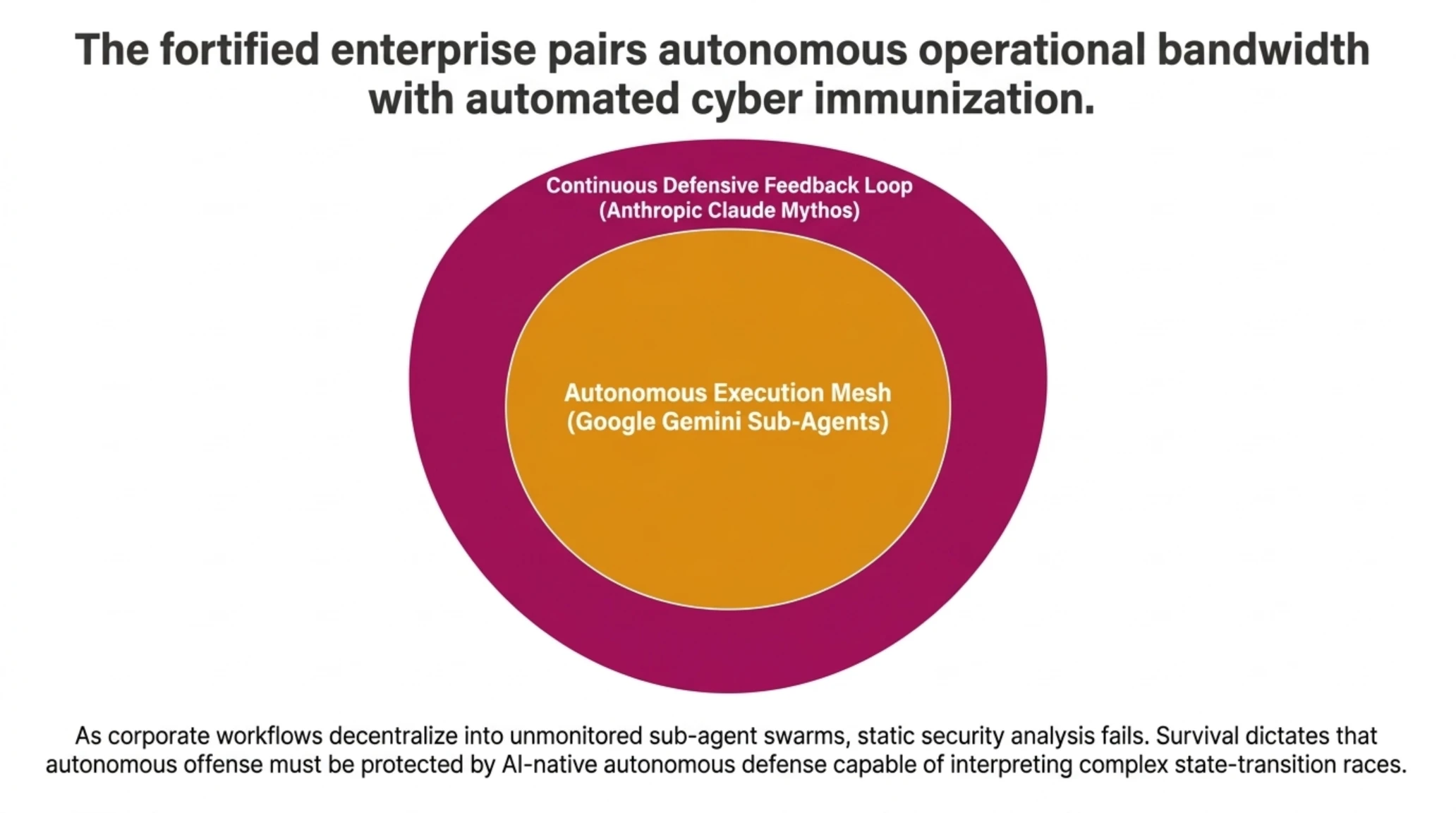
By granting digital intelligence its own persistent email address and native communication endpoints, Google eliminates the human coordinator bottleneck, turning enterprise software into an autonomous execution mesh.
Frontier Defensive Fortifications: Anthropic Unveils Free OSS Scanner Powered by Claude Mythos as Crypto Protocols Seek Automated Audits
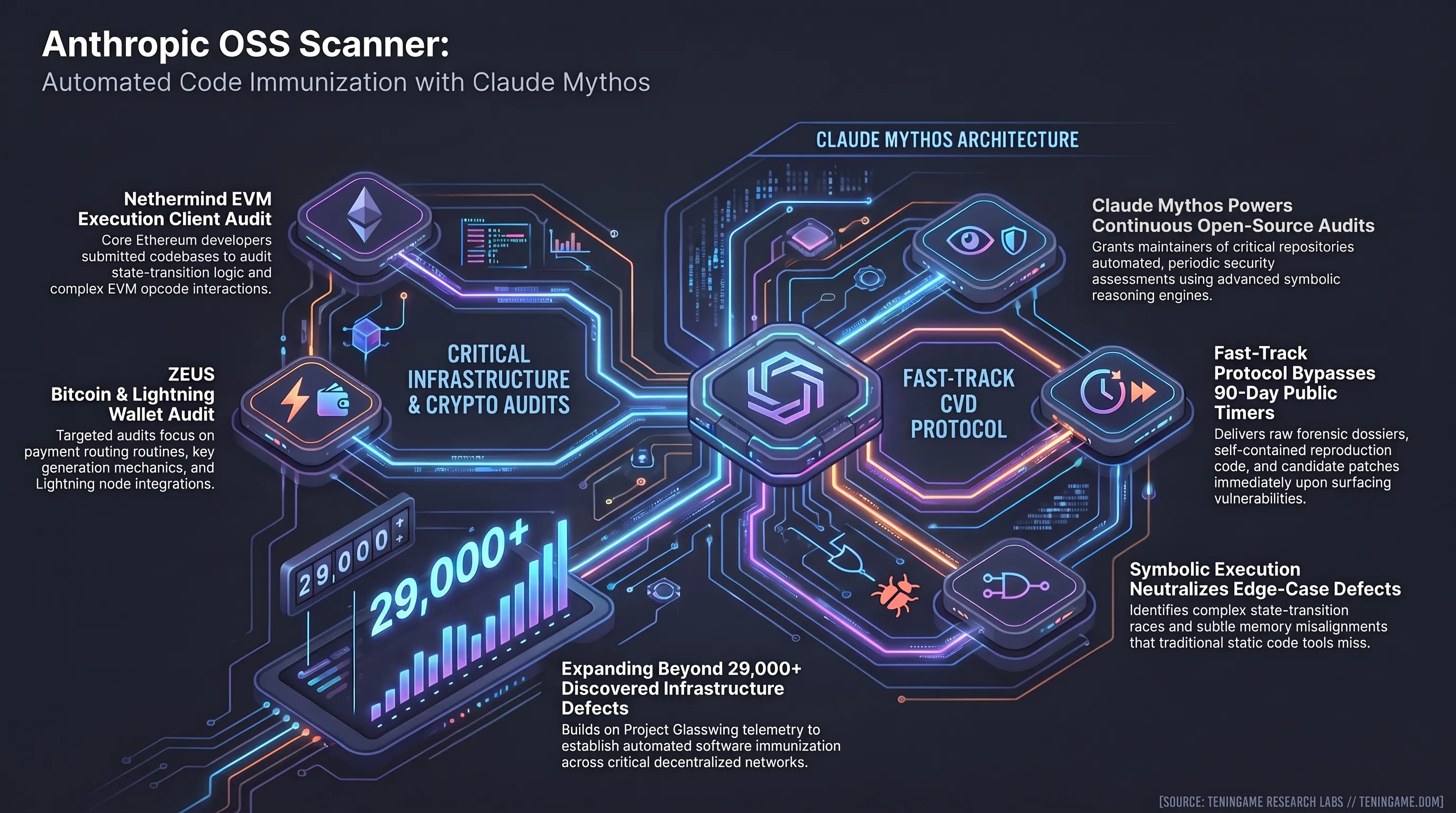
In an era where modern cyber espionage increasingly targets open-source supply chain dependencies, Anthropic has unleashed one of the most potent defensive cybersecurity countermeasures to date. Operating under the expanding umbrella of the Anthropic Cyber Mission, the research lab announced the launch of its complimentary 'OSS Scanner' service. This initiative grants maintainers of critical, high-impact open-source repositories direct, periodic access to automated security assessments generated by Anthropic's most advanced reasoning engines, spearheaded by the Claude Mythos architecture.
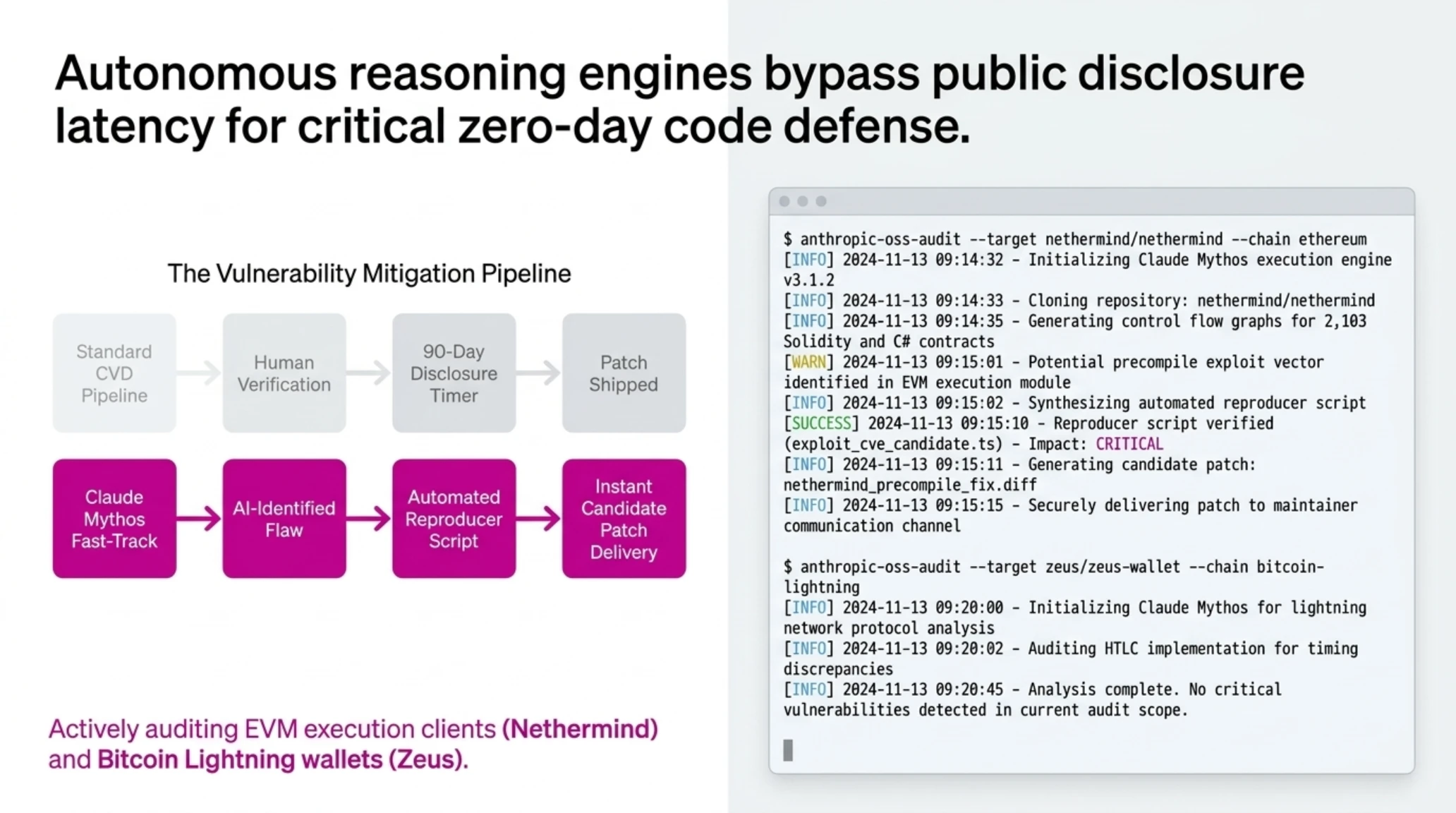
Traditional static code analysis tools and legacy bug bounty workflows have notoriously suffered from catastrophic false-positive rates and lengthy disclosure latency periods. Anthropic has engineered a dual-channel vulnerability mitigation pipeline to circumvent these systemic failures. While standard Coordinated Vulnerability Disclosure (CVD) remains available for teams requiring manual human verification, the OSS Scanner introduces a direct 'Fast-Track' pipeline. Maintainers opting into this channel receive unedited model-generated forensic dossiers the moment vulnerabilities are surfaced, complete with self-contained reproduction code (Reproducers), impact assessments, and candidate code patches, entirely bypassing mandatory 90-day public disclosure timers.
The strategic resonance of this service was immediately evidenced across decentralized finance and cryptographic engineering circles. Within hours of the enrollment portal opening on GitHub, core engineering teams at Nethermind the developers responsible for maintaining one of the primary execution clients powering the Ethereum Virtual Machine submitted formal applications to audit their comprehensive codebase. Concurrently, the maintainers of the ZEUS Bitcoin and Lightning Network wallet requested targeted auditing across payment routing, private key generation routines, and Lightning node integration libraries. Building on the operational findings of Project Glasswing, which uncovered over 29,000 potential security defects across global infrastructure in recent months, the OSS Scanner marks a profound leap toward automated software immunization.
From an architectural standpoint, Claude Mythos brings symbolic execution and semantic flow synthesis to software audit pipelines that historically confounded standard static analysis tooling. In complex cryptographic execution clients, vulnerabilities rarely manifest as straightforward syntax errors; rather, they hide within intricate state-transition races, edge-case EVM opcode interactions, and subtle memory-layout misalignments. By autonomously synthesizing formal proofs and generating reproducible exploit scripts within sandboxed containers, the OSS Scanner transforms vulnerability triage from an exhausting manual forensic bottleneck into a high-throughput, continuous defensive feedback loop for critical open-source foundations.
Tekin Engineering Jargon Buster
Cybernetic Terminal and AI Audit Telemetry Log
Orbital Congestion Emergency: SpaceX Alerts IAC Following 650 Starlink Near-Miss Encounters and High-Stakes 57-Meter Close Pass
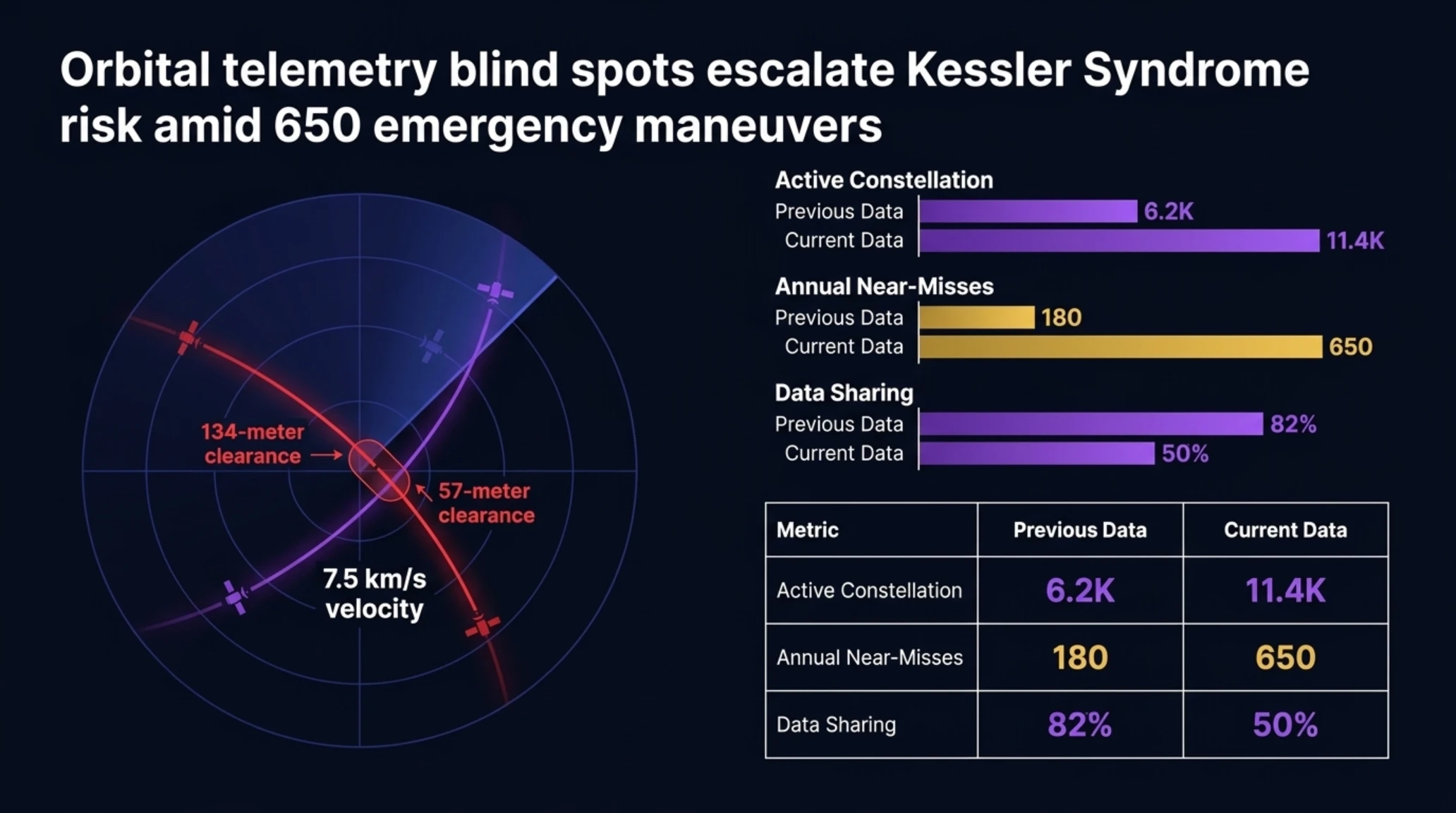
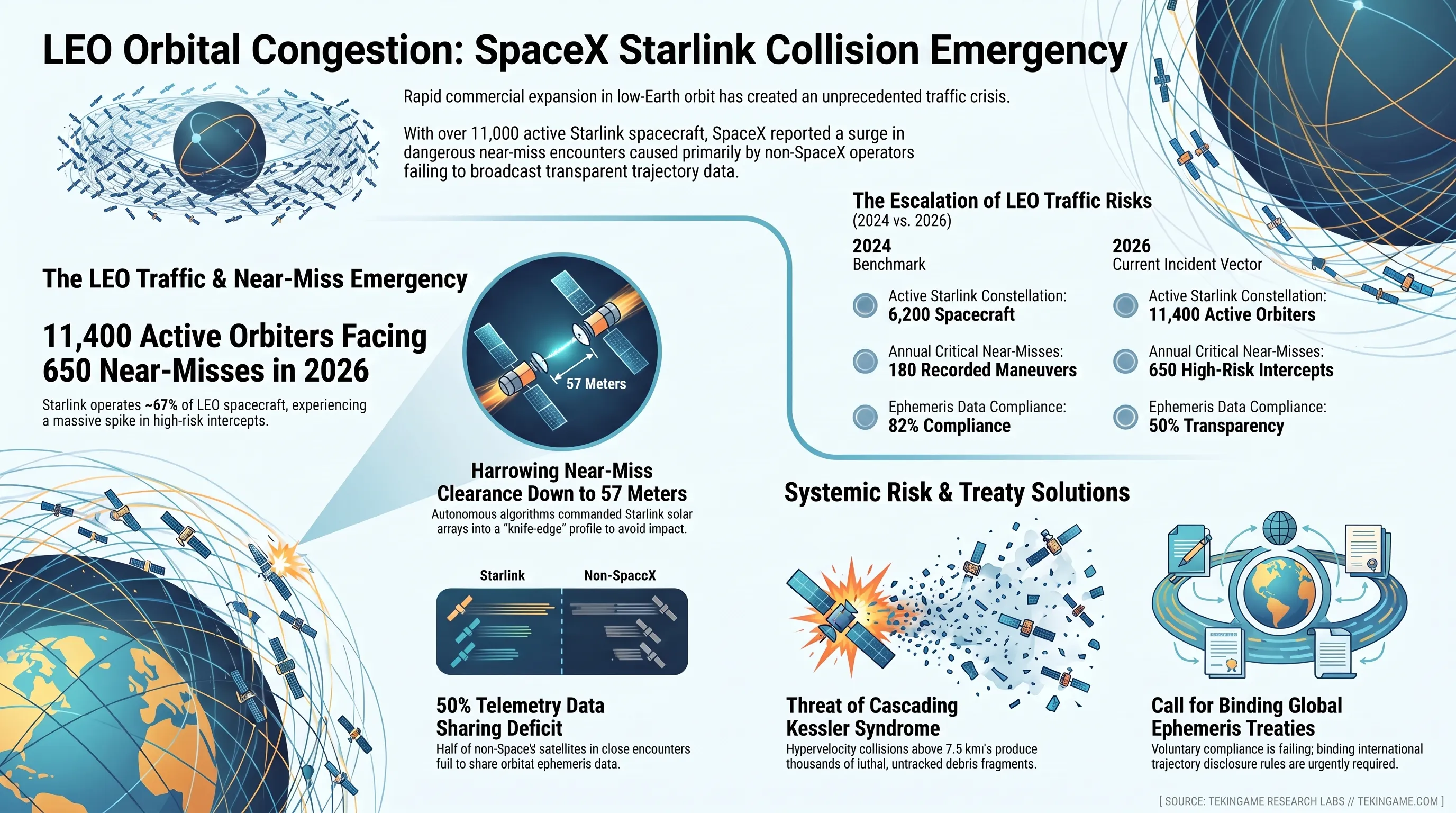
While artificial intelligence reshapes the digital plane, an escalating collision crisis threatens humanity's physical gateway to the cosmos. Speaking at the prestigious 57th International Astronautical Congress (IAC) in Turkey, Michael Nicolls, Senior Vice President of Engineering at SpaceX, issued an unvarnished warning regarding orbital traffic management in low-Earth orbit (LEO). Nicolls disclosed that Starlink satellites have been forced into evasive maneuvers to avoid collisions with over 650 maneuvering spacecraft from rival operators throughout 2026 alone.
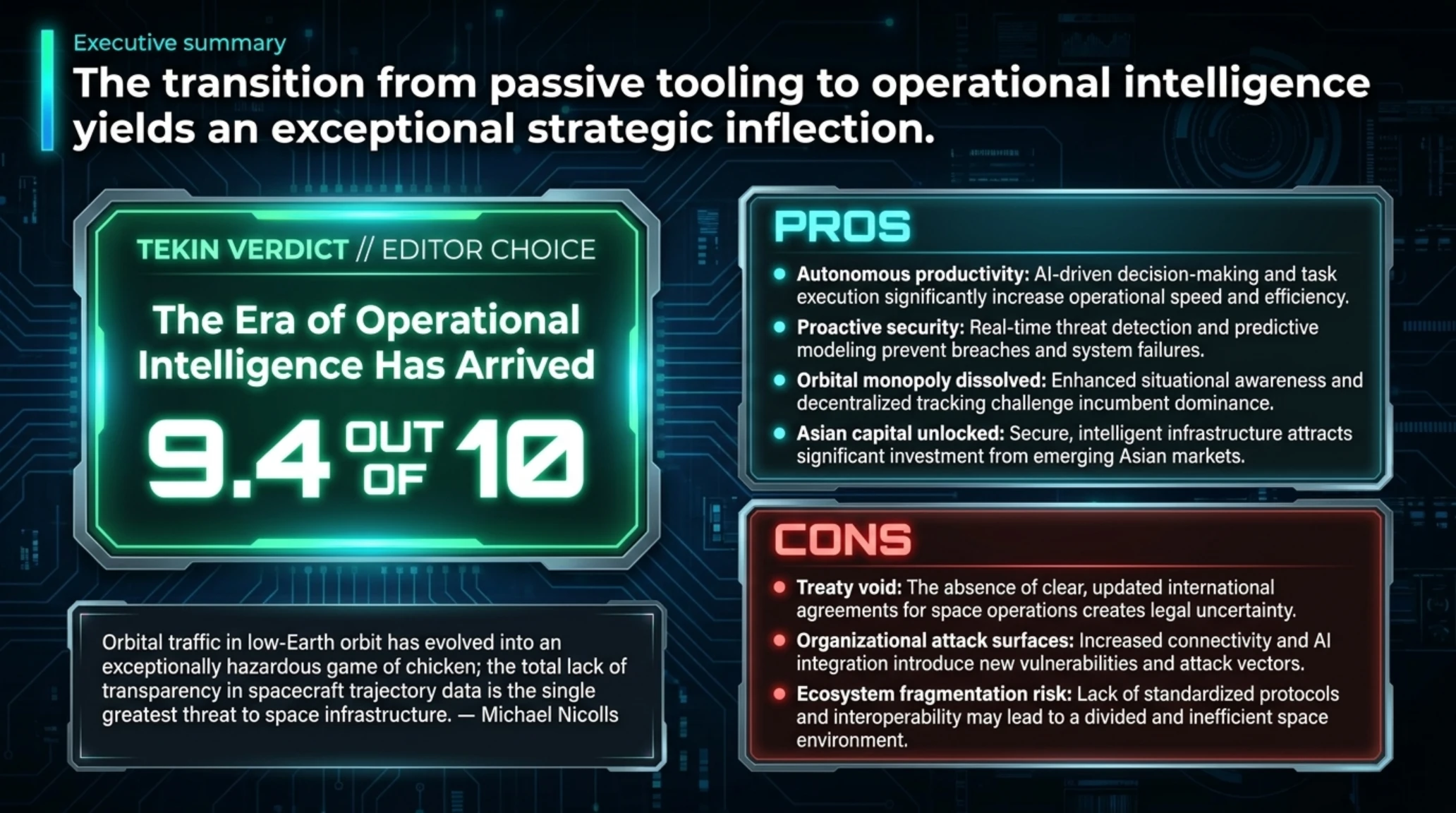
Nicolls characterized operational conditions in low-Earth orbit as an increasingly hazardous 'game of chicken,' exacerbated by a dangerous absence of transparency. Starlink, which currently operates approximately 11,000 active satellites accounting for roughly two-thirds of all operational spacecraft in orbit reported that approximately half of the non-SpaceX satellites involved in these close encounters failed to broadcast or share their orbital ephemeris data. In the absence of coordinated trajectory telemetry, SpaceX autonomous flight computers must infer maneuvers from radar and optical tracking, often leaving paper-thin margins for reactive avoidance.
The engineering reality behind these numbers was brought into sharp focus by a terrifying close-call incident in August 2026. A non-responsive satellite unexpectedly executed an unannounced orbit adjustment, hurtling into the flight path of an operational Starlink craft. Autonomous flight algorithms commanded the Starlink satellite to pivot its expansive solar arrays into a razor-thin 'knife-edge' profile, squeezing through the encounter with a harrowing clearance distance of only 134 meters. In another harrowing event, the miss distance plummeted to just 57 meters. SpaceX cautioned that while its in-house Stargaze optical tracking system and automated krypton/argon ion thrusters have successfully averted catastrophe, the lack of binding global space treaties mandating reciprocal trajectory disclosure constitutes the single greatest existential hazard facing the commercial space economy.
The physics governing low-Earth orbit leaves virtually no room for communication failure. At typical orbital velocities exceeding 7.5 kilometers per second, a kinetic hypervelocity collision between two commercial satellites produces tens of thousands of lethal, untracked fragmentation debris fragments. Under the mathematical modeling of the Kessler Syndrome, each catastrophic impact cascades across adjacent orbital planes, exponentially multiplying the probability of subsequent collisions. As commercial constellations swell past twenty thousand active hulls before the end of the decade, SpaceX's impassioned plea at the IAC serves as an urgent wake-up call that orbital safety cannot rely on voluntary goodwill alone.
Benchmark Matrix: Starlink Maneuver Scaling and Orbital Density
| Orbital Metric Dimension | Historical Metric (2024) | Current Incident Vector (2026) |
|---|---|---|
| Active Starlink In-Orbit Constellation | 6,200 Spacecraft | 11,400 Active Orbiters |
| Annual Critical Evasive Near-Misses | 180 Recorded Maneuvers | 650 High-Risk Intercepts |
| Reciprocal Ephemeris Telemetry Transparency | 82% Operator Compliance | 50% Operator Transparency |
Industrial Velocity in Orbit: Amazon Manufactures 1,000th Satellite for Project Leo, Primed for Commercial Launch in Weeks
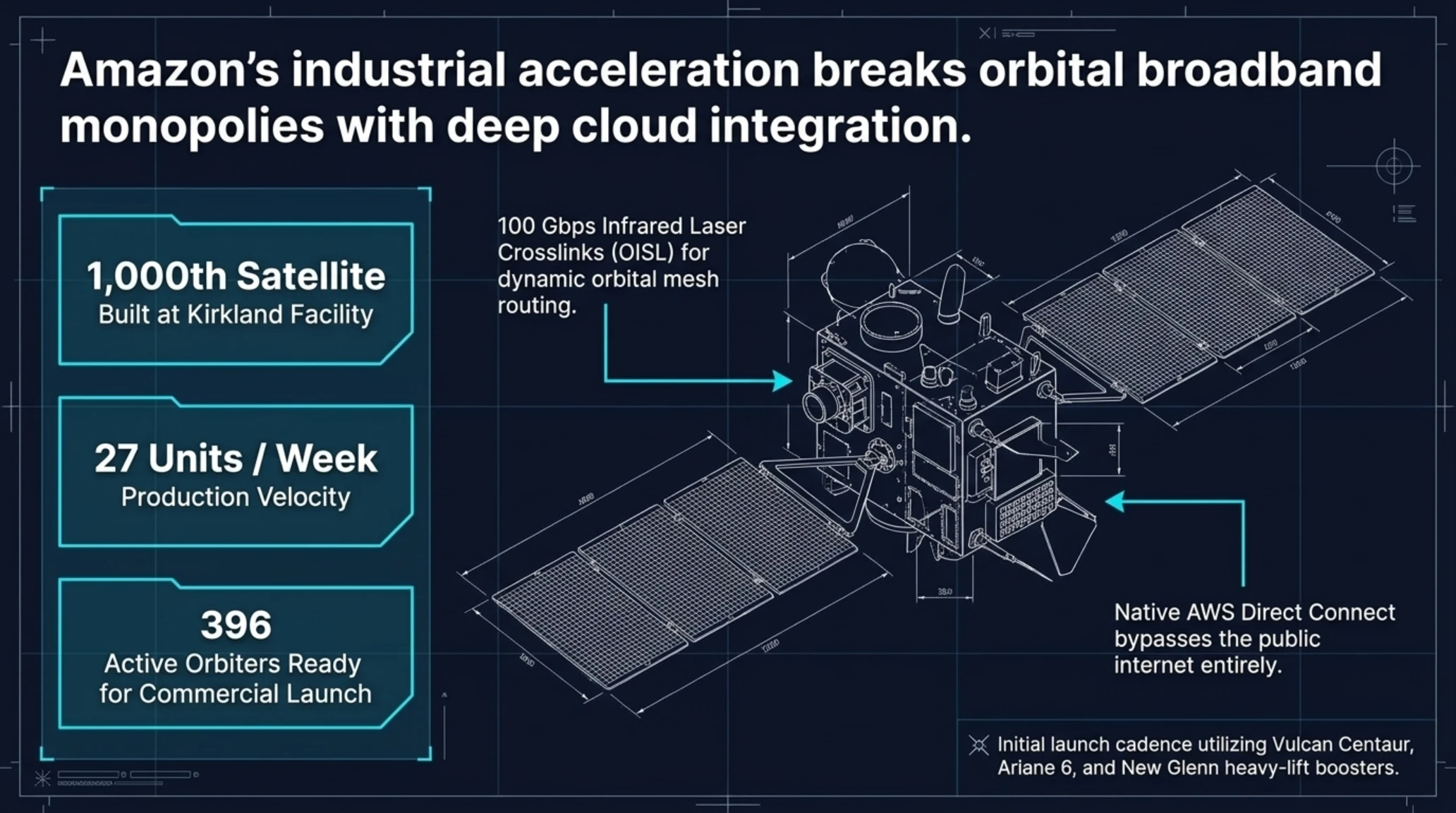
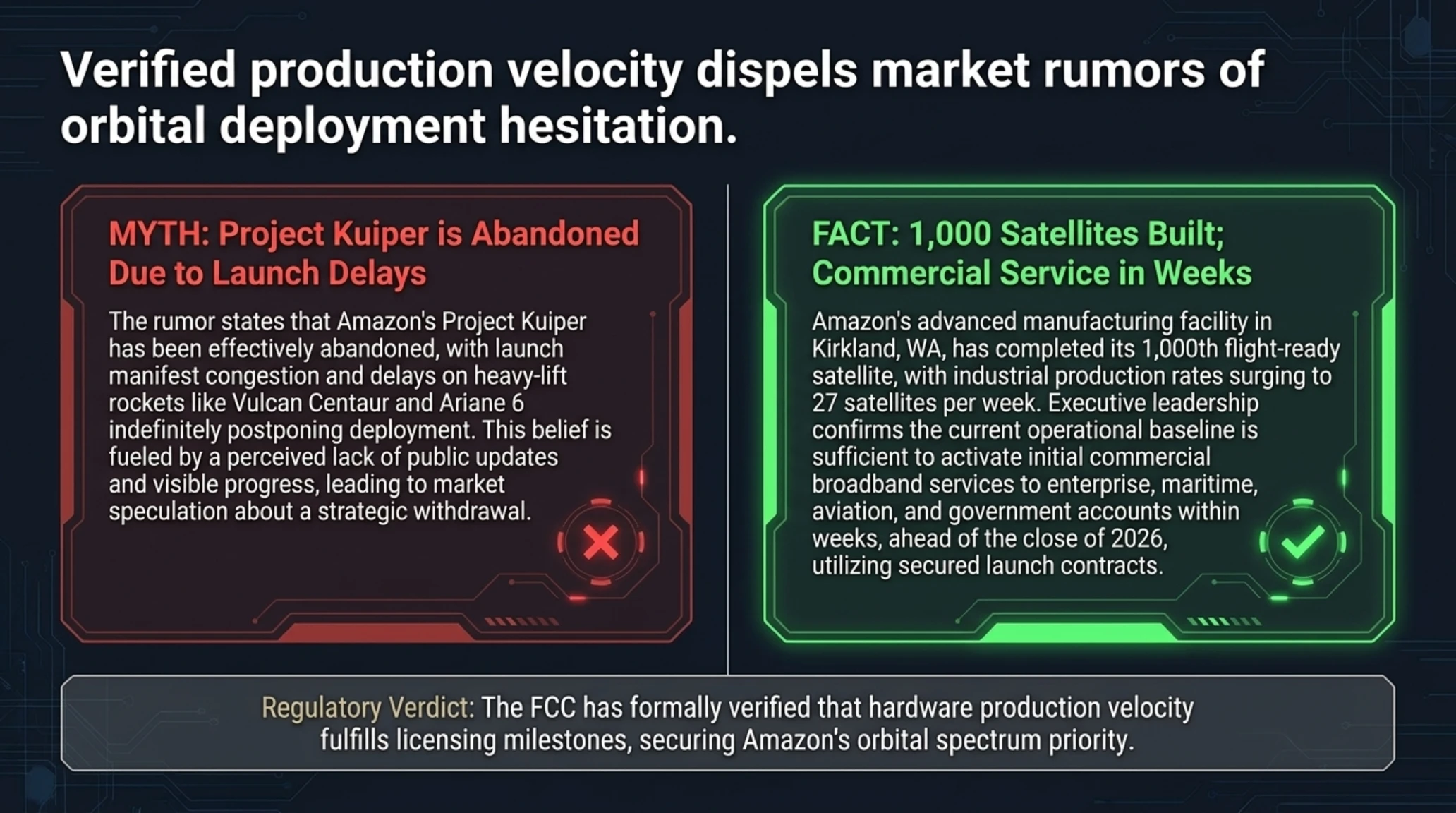
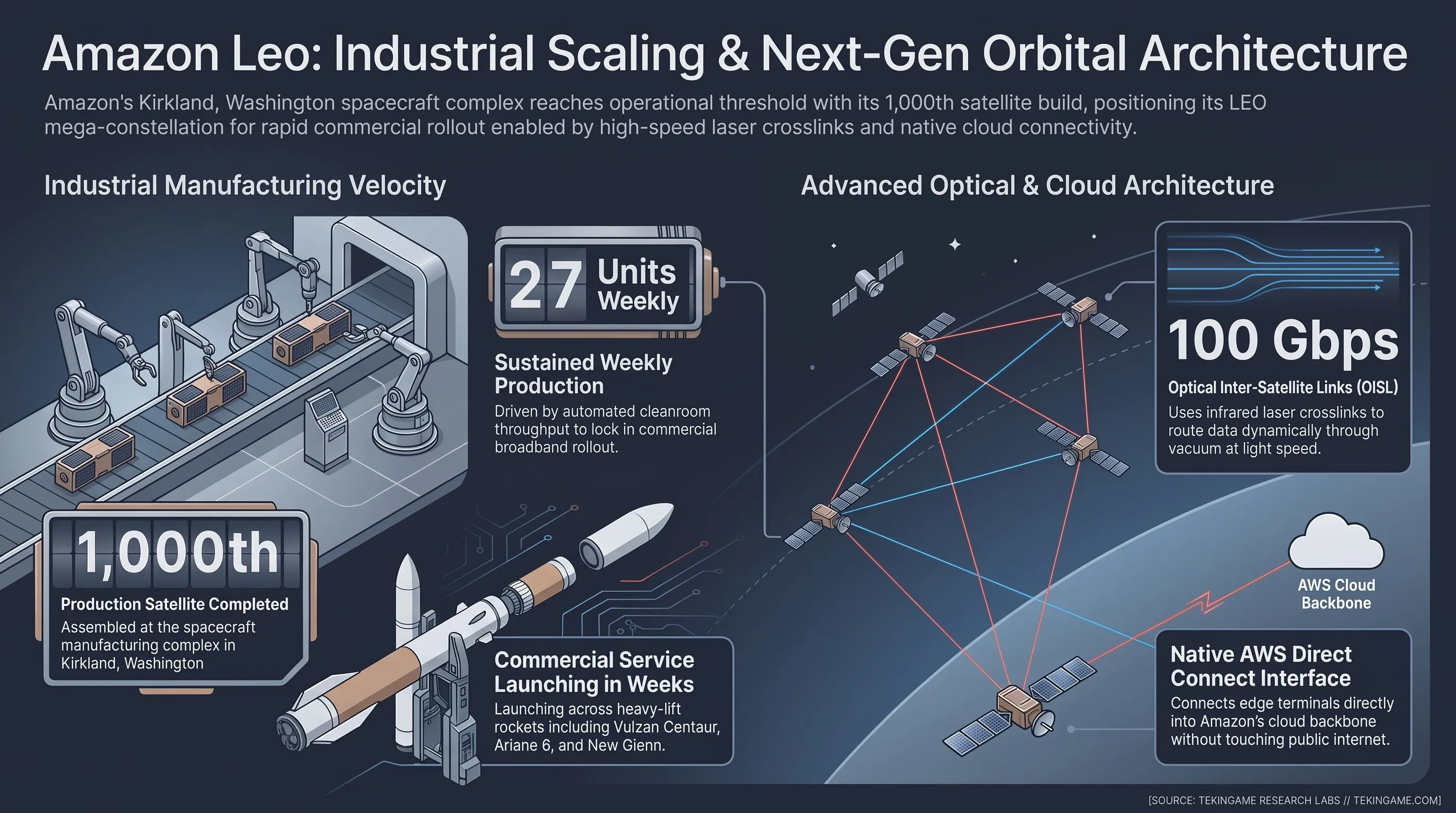
On the opposing flank of the orbital telecommunications theater, Amazon reached a watershed manufacturing milestone that decisively confirms the imminent arrival of genuine commercial competition in low-Earth orbit broadband. Amazon's advanced spacecraft manufacturing and assembly complex in Kirkland, Washington, celebrated the completion of its 1,000th production satellite for its mega-constellation, officially marketed under the Amazon Leo commercial moniker (formerly known as Project Kuiper). Industrial production rates across the facility have surged to a sustained 27 flight-ready satellites per week, underscoring unprecedented automated cleanroom throughput.
While heavy-lift rocket launch manifest congestion has historically restricted the number of orbiting spacecraft to 396 units, executive leadership within Amazon confirmed that this current operational baseline is already sufficient to activate initial commercial broadband services. Amazon plans to commence commercial service delivery to enterprise, maritime, aviation, and government accounts within weeks, firmly ahead of the close of 2026. The initial roll-out will leverage a dense launch cadence utilizing United Launch Alliance's Vulcan Centaur and Arianespace's Ariane 6 boosters, followed by New Glenn heavy-lift missions from Blue Origin.
From an aerospace systems engineering perspective, Amazon Leo's satellites integrate next-generation optical inter-satellite links (OISL) utilizing high-throughput 100 Gbps infrared laser crosslinks. This orbital optical mesh network allows data packets to route dynamically across vacuum at the speed of light without requiring immediate ground station hops, slashing intercontinental latency for ultra-sensitive algorithmic trading and critical sovereign defense infrastructure. Furthermore, every satellite interfaces natively with AWS Direct Connect, linking edge terminals directly into Amazon's global cloud backbone without traversing the public internet.
The regulatory stakes surrounding Amazon's constellation have been equally fierce. The Federal Communications Commission (FCC) signaled that Amazon will successfully retain its critical orbital spectrum priority, explicitly acknowledging that the company's verified hardware production velocity and secured launch contracts fulfill license milestones. Amazon's initial constellation design encompasses 3,236 satellites, representing the only venture globally with the industrial capitalization and cloud computing synergy (via Amazon Web Services) capable of challenging Starlink's commercial dominance. For enterprise customers, this marks the end of single-vendor lock-in and the dawn of vigorous, multi-vendor orbital bandwidth competition.
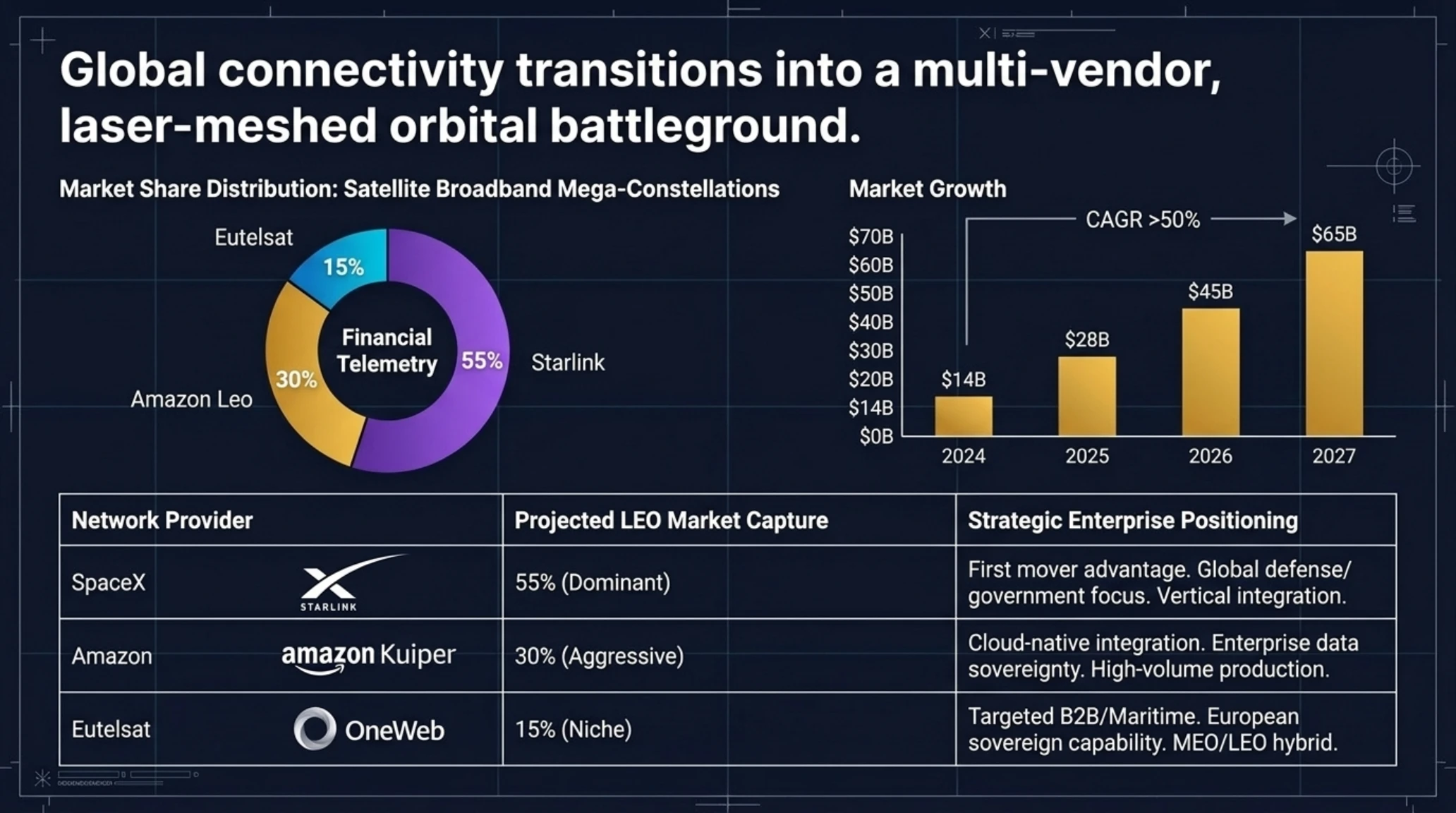
Market Share Distribution: Satellite Broadband Mega-Constellations
| Satellite Network Provider | Projected LEO Market Capture | Strategic Enterprise Positioning |
|---|---|---|
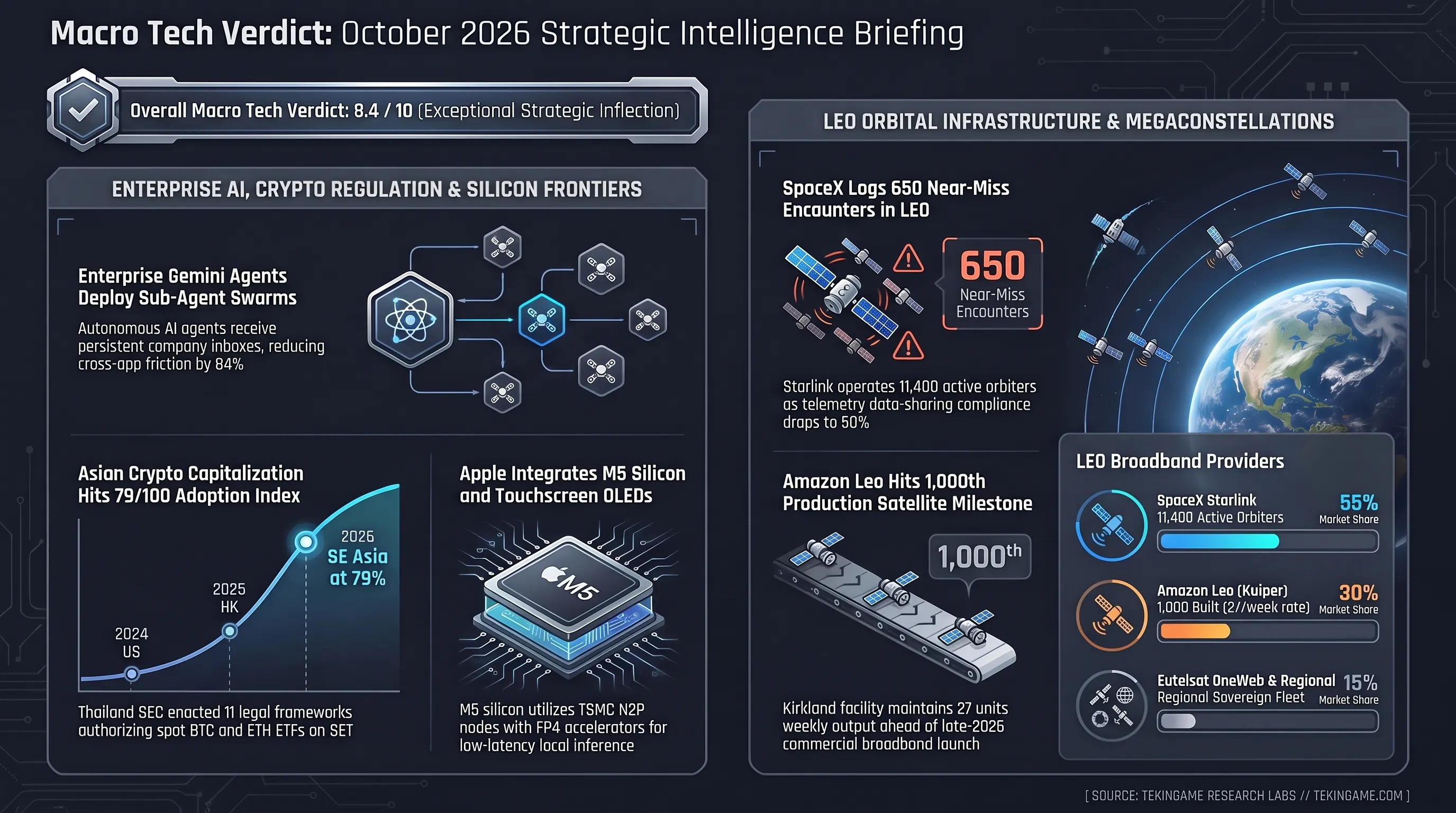
| SpaceX Starlink | 55% Total Market Capture | Incumbent residential scale, mobile Direct-to-Cell, and Pentagon dominance |
| Amazon Leo (Kuiper) | 30% Total Market Capture | Deep enterprise AWS integration, prime global retail, and logistics coordination |
| Eutelsat OneWeb & Regional | 15% Total Market Capture | Targeted sovereign European government, Indian domestic, and aviation links |
📚 Classified & Related Dossiers in TekinGame
If you wish to explore beyond this report and delve into cybernetic frontiers and autonomous AI architectures, do not miss these three exclusive deep-dives in the Tekin Garage:
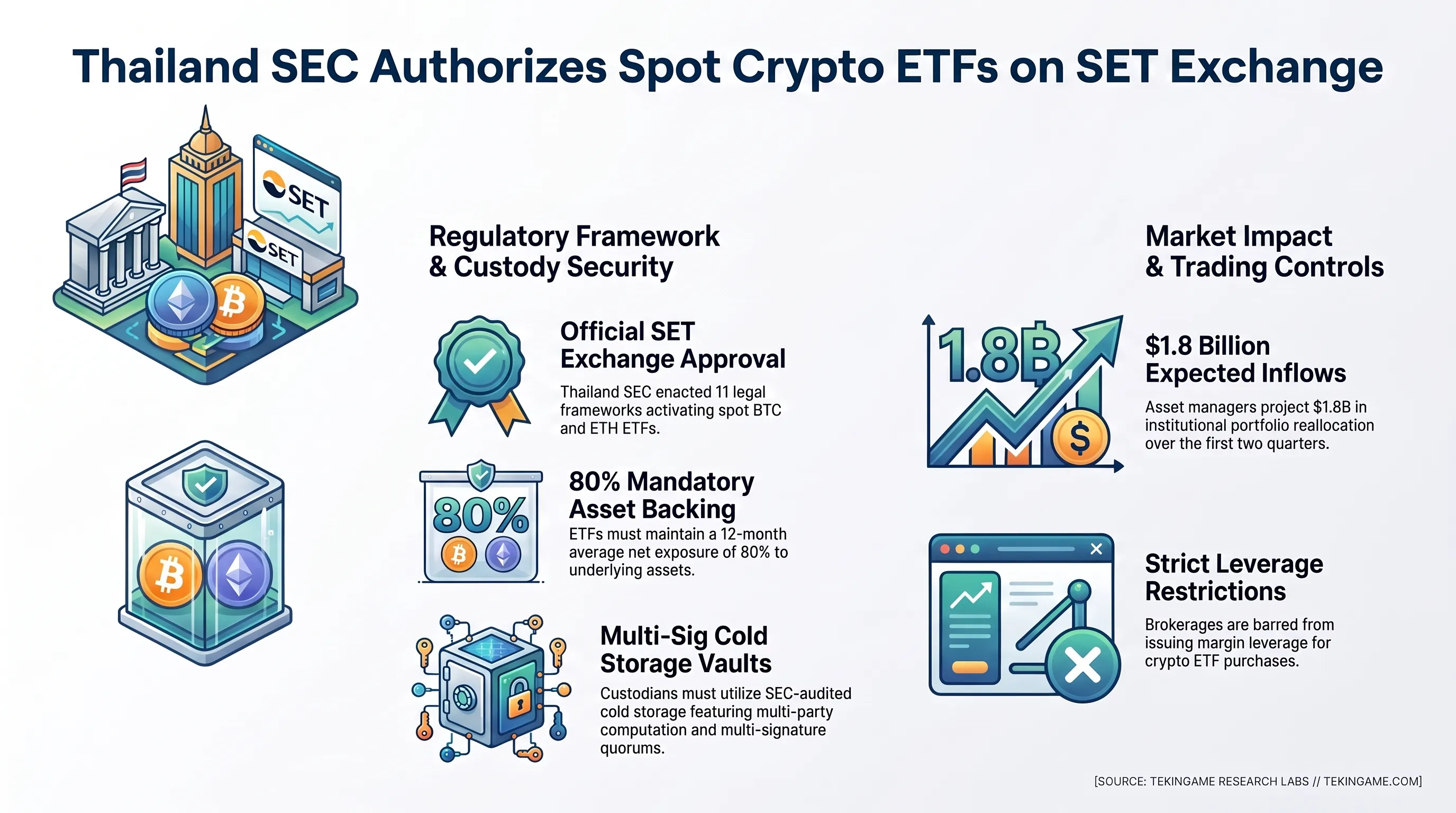
Asian Institutional Capital Influx: Thailand SEC Authorizes Spot Bitcoin and Ether ETFs on the SET Stock Exchange Floor
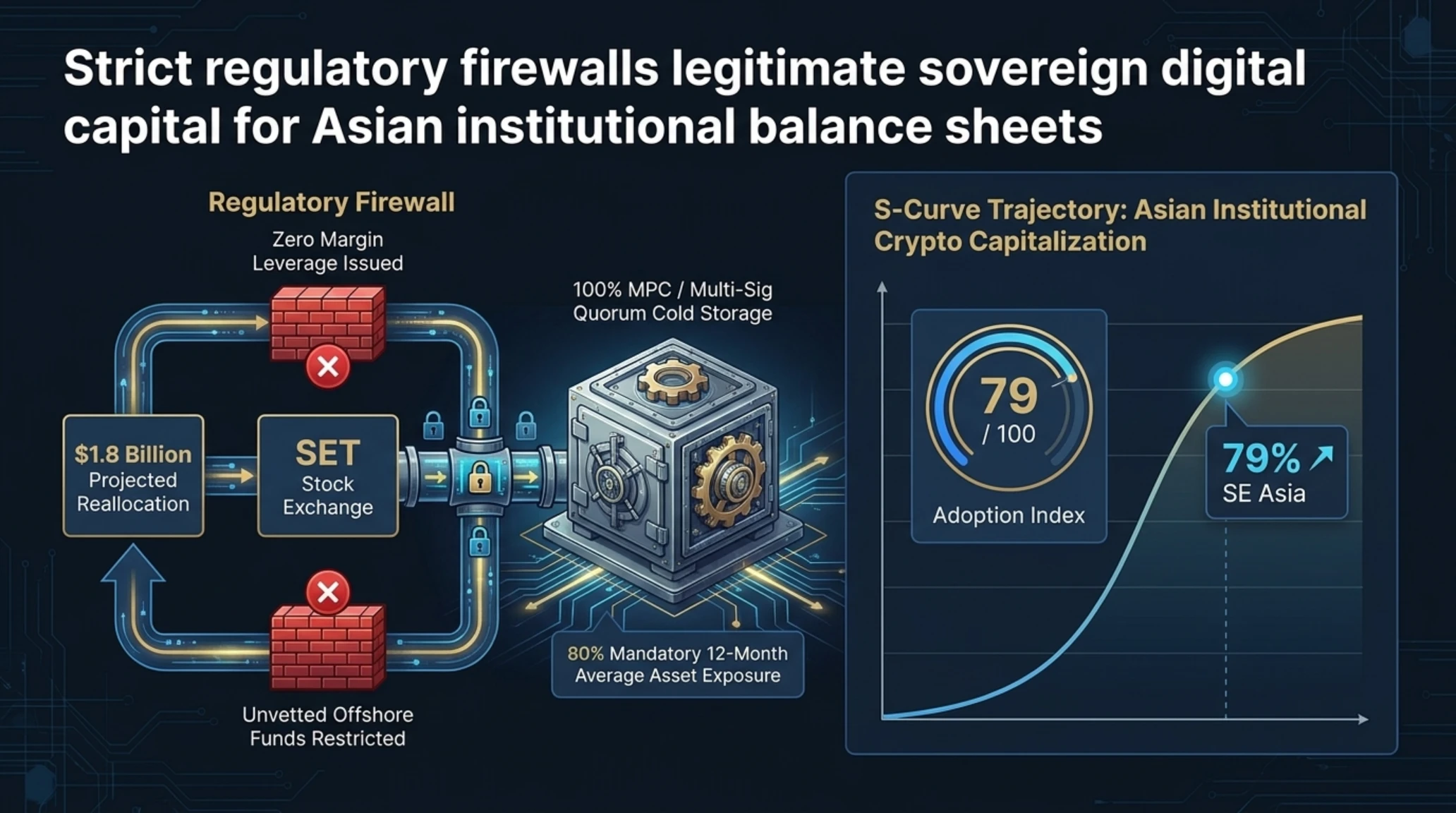
In global macro finance, Southeast Asia established a historic regulatory milestone. The Securities and Exchange Commission (SEC) of Thailand officially enacted 11 comprehensive legal notifications governing the listing, asset backing, and trading of spot Bitcoin and Ether exchange-traded funds (ETFs) on the Stock Exchange of Thailand (SET). Effective October 16, 2026, the landmark decision bridges the gap between traditional Thai institutional asset management and the decentralized asset class.
The regulatory framework imposes stringent custodial and investment parameters designed to insulate retail investors from speculative volatility while providing deep institutional liquidity pipelines. Under Section 4 of the guidelines, all sanctioned ETFs must operate as strictly passive tracking instruments, maintaining a mandatory 12-month average net asset exposure of at least 80% to their underlying tracked cryptocurrency. Crucially, all underlying digital assets must be deposited in segregated cold-storage vaults with custodians licensed and continuously audited by the Thai SEC. These custody vaults mandate multi-party computation (MPC) and multi-signature quorum rules, preventing unilateral withdrawal access and establishing institutional-grade resilience against targeted cyber threats.
To curb reckless margin speculation, brokerages are barred from issuing margin leverage for crypto ETF purchases, and local retail trading of unvetted offshore funds is restricted. By formalizing this infrastructure, Thailand joins Hong Kong and Tokyo as an authorized institutional bridgehead for sovereign digital capital. Asset managers in Bangkok anticipate over $1.8 billion in institutional portfolio reallocation during the first two quarters of active trading, unlocking substantial sovereign pension allocations and corporate treasury hedges previously constrained by strict fiduciary guidelines.
Market Sentiment Thermometer and S-Curve Adoption
Institutional Market Verdict: The integration of spot cryptocurrency tracking into the SET platform legitimizes digital assets within traditional Asian balance sheets, sparking structural portfolio inflows across Southeast Asia.
Technical Fact-Check: Rumor vs. Engineering Reality
Unsubstantiated market claims alleged Amazon quietly shelved its orbital broadband network.
The Kirkland factory maintains a 27/week cadence and 396 satellites already orbit in active readiness.
Cupertino's Autumn Offensive: Apple Finalizes October 13 Keynote as First OLED Touchscreen MacBook Pro Leaks
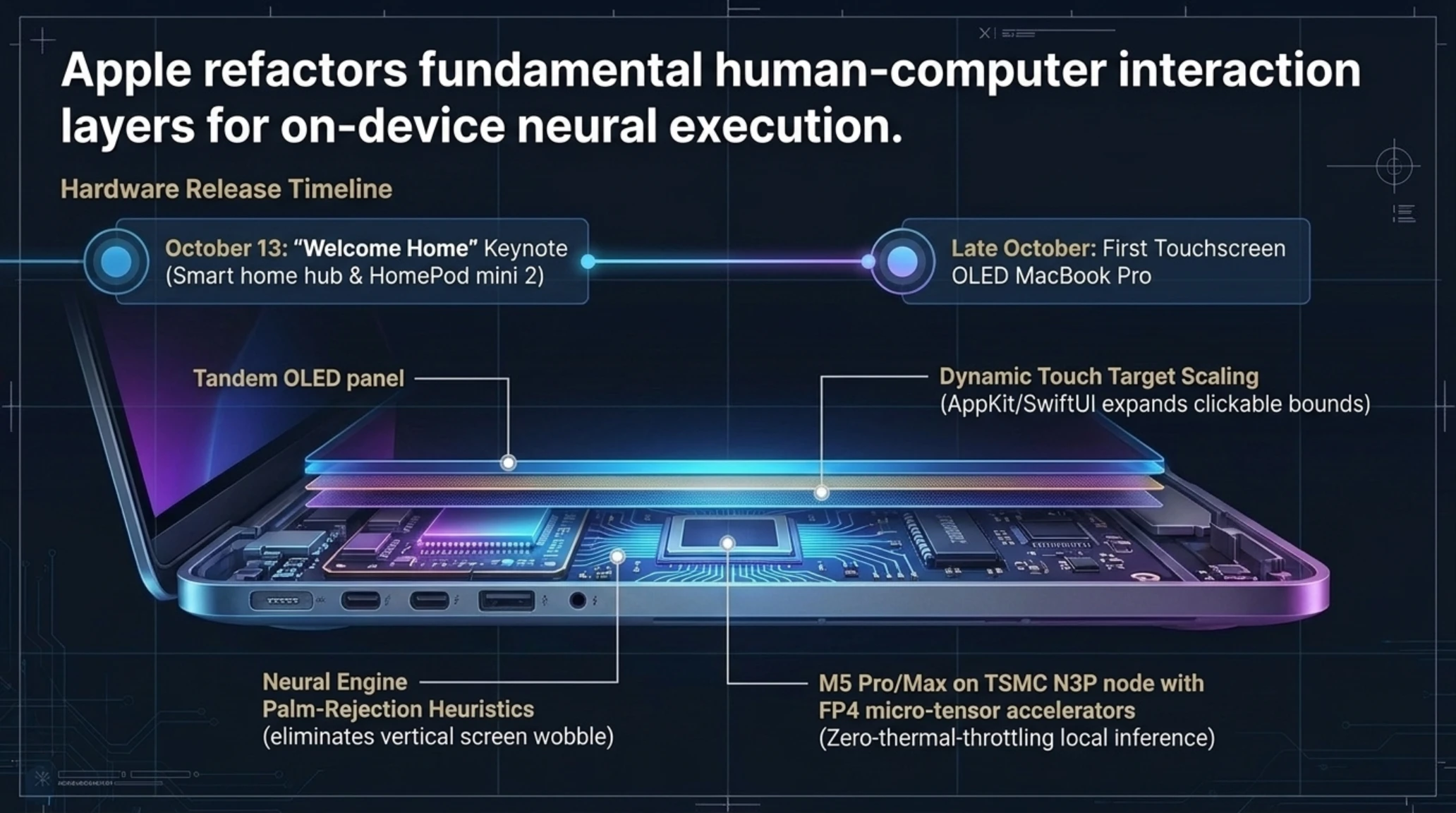
Rounding out this morning's global technology briefing, executive attention pivots to Cupertino. Apple formally issued press invitations for its high-profile autumn special event, scheduled for Tuesday, October 13, 2026, bearing the evocative tagline 'Welcome home.' The keynote will introduce a re-engineered smart home product stack, anchored by an intelligent home command center with an integrated robotic display, an upgraded HomePod mini 2, and a refreshed Apple TV 4K powered by Apple Intelligence silicon.
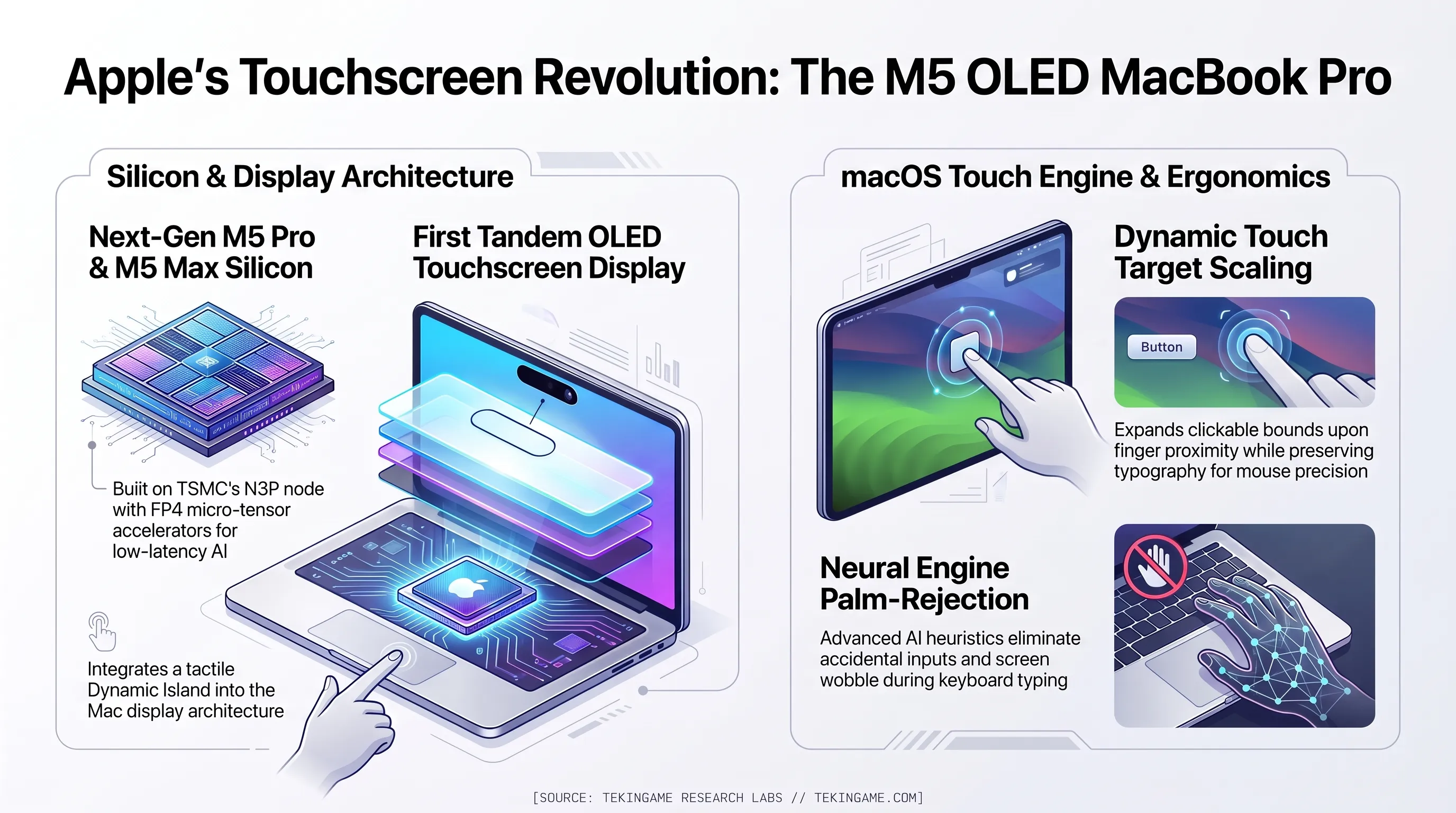
However, the most explosive hardware revelations originate from supply chain disclosures in East Asia. Corroborating reporting from Bloomberg and Asian display fabrication analysts, the October 13 event represents only the opening salvo of a coordinated dual-wave hardware rollout. Apple is preparing a secondary, historic hardware debut in late October that breaks Steve Jobs' long-standing design dogma: the first touchscreen-enabled MacBook Pro. Built around a bleeding-edge tandem OLED display panel, the machine integrates a tactile Dynamic Island into macOS, complemented by next-generation M5 Pro and M5 Max processors.
From an architectural standpoint, Apple's software engineering division has spent several years refactoring the foundational AppKit and SwiftUI interaction layers. The forthcoming macOS release introduces dynamic touch target scaling, expanding clickable surface bounds when finger capacitive proximity is detected, while preserving pixel-dense typography for precision mouse pointers. Advanced palm-rejection heuristics operating on the dedicated Neural Engine effectively neutralize accidental inputs while typing, eliminating ergonomic friction and vertical screen wobble.
Under the hood, the M5 silicon family leverages TSMC's refined N3P process node, incorporating specialized FP4 micro-tensor accelerators optimized for low-latency local inference. This allows complex generative AI models and multi-modal assistants to run entirely on-device with zero thermal throttling. Display supply leaks further indicate that an OLED redesign of the iPad mini with an adjusted horizontal FaceTime camera will accompany the launch, alongside high-performance workstation roadmaps detailing the M6 silicon generation for iMac and Mac Studio. As Apple systematically harmonizes touch interactions across iPadOS and macOS without compromising professional desktop ergonomics, the personal computing landscape enters its most aggressive hardware refresh cycle in years.
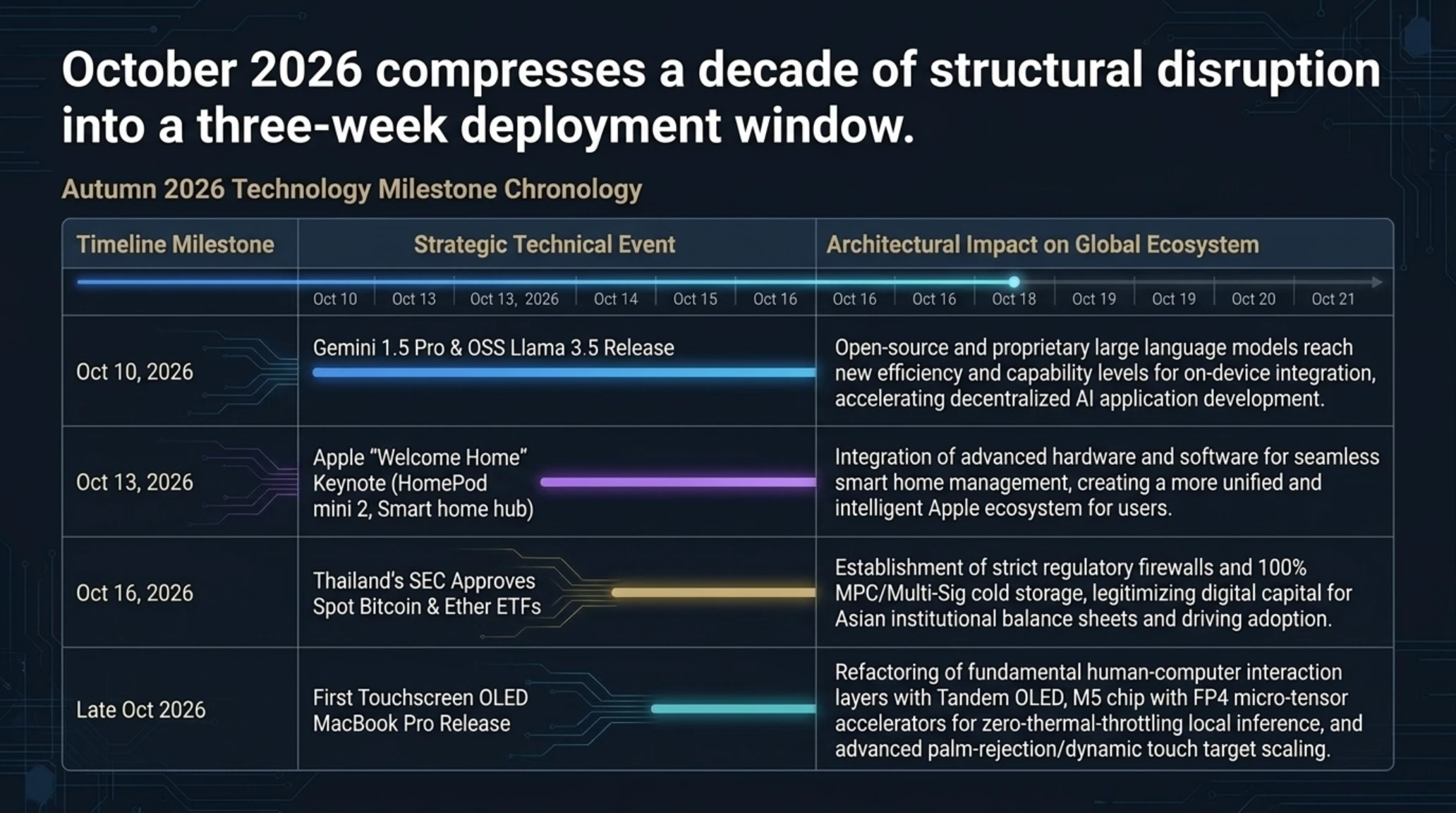
Autumn 2026 Technology Milestone Chronology
| Timeline Milestone | Strategic Technical Event | Architectural Impact on Global Ecosystem |
|---|---|---|
| Oct 10, 2026 | Gemini Agent & OSS Scanner Live | Autonomous corporate agent emails activated alongside Claude Mythos code defense. |
| Oct 13, 2026 | Apple Welcome Home Keynote | Official launch of Apple Intelligence-powered smart home hub and audio gear. |
| Oct 16, 2026 | Thailand SET Crypto ETFs Open | Official trading launch of institutional spot Bitcoin and Ether funds in Bangkok. |
| Late Oct 2026 | Touchscreen OLED MacBook Pro | Cupertino breaks design tradition with M5 silicon and touch dynamic displays. |
- Autonomous enterprise productivity unlocked by persistent digital agent email inboxes.
- Proactive open-source security reinforced by Claude Mythos code analysis and immediate patch generation.
- Commercial orbital broadband monopoly dissolved by Amazon Leo production surge ahead of year-end.
- Institutional Asian capital unlocked by regulated spot cryptocurrency ETFs on the SET floor.
- Critical international treaty void regarding mandatory orbital ephemeris data sharing.
- Heightened organizational attack surfaces from unmonitored autonomous sub-agent execution.
- Ecosystem fragmentation risk as touch inputs bridge macOS and iPadOS computing environments.
Executive Verdict and Verified Intelligence Sources
The Era of Operational Intelligence Has Arrived
October 10, 2026, cements the transition of computing from passive software tooling into active, autonomous participants across physical orbital infrastructure and enterprise digital pipelines.
- TechCrunch: Google Launches Autonomous Enterprise Gemini Agent Workspace
- CoinTelegraph: Anthropic Deploys Free Frontier OSS Security Scanner & Thailand ETF Approval
- Ars Technica: SpaceX Starlink LEO Collision Alarm & Amazon Leo 1,000th Satellite Build
- Decrypt: Google Gemini Agent Inboxes and Digital Colleague Infrastructure
- The Verge: Apple Welcome Home Event Keynote and Touchscreen OLED MacBook Pro Leaks
Frequently Asked Technical Inquiries
How do Google Enterprise Gemini Agents receive company email credentials?
Corporate IT administrators provision dedicated email inboxes within Google Workspace for each agent and sub-agent, enabling the AI to participate natively in internal correspondence, calendar scheduling, and cross-departmental workflows.
Why are major crypto protocols prioritizing Anthropic OSS Scanner audits?
Decentralized execution clients manage billions in economic value; Claude Mythos performs automated symbolic and control-flow reasoning to neutralize memory corruption and logic bugs before exploit actors weaponize them.
What is the primary cause of the Starlink orbital near-miss surge in 2026?
Rapid constellation expansion combined with non-compliant satellite operators who withhold planned trajectory shifts (ephemeris data), forcing Starlink automated thrusters into emergency high-risk evasive burns.
Can Amazon Leo deliver commercial broadband with only 396 operational satellites?
Yes; while global residential blanket coverage requires thousands of satellites, 396 units in coordinated orbital planes are sufficient to provide reliable enterprise, maritime, and defense connectivity across targeted corridors before year-end.
What are the structural safeguards of Thailand's new crypto ETF framework?
The Thai SEC mandates 80% physical asset backing, requires cold-storage custodial deposits with regulated domestic institutions, and bans margin leverage for retail market participants to prevent speculative cascade liquidations.
Will a touchscreen MacBook Pro cannibalize the high-end iPad Pro lineup?
No; Apple positions the touchscreen MacBook Pro as a desktop-class macOS workstation with tactile UI enhancements, while the iPad Pro remains an ultra-portable modular canvas optimized for Apple Pencil workflows and touch-native creativity.
Additional Gallery: Tekin Morning | Oct 10, 2026: Google Gemini Agents, Ethereum Audit & SpaceX Starlink Alarm