Tekin Analysis | Binance $6.3B Lazarus Infiltration, Mistral Large 4 1.05T Launch, and Autonomous AI Linux Weaponization
Lazarus Group Infiltrates Binance in Historic $6.3B Crypto Heist via DevOps Credential Poisoning
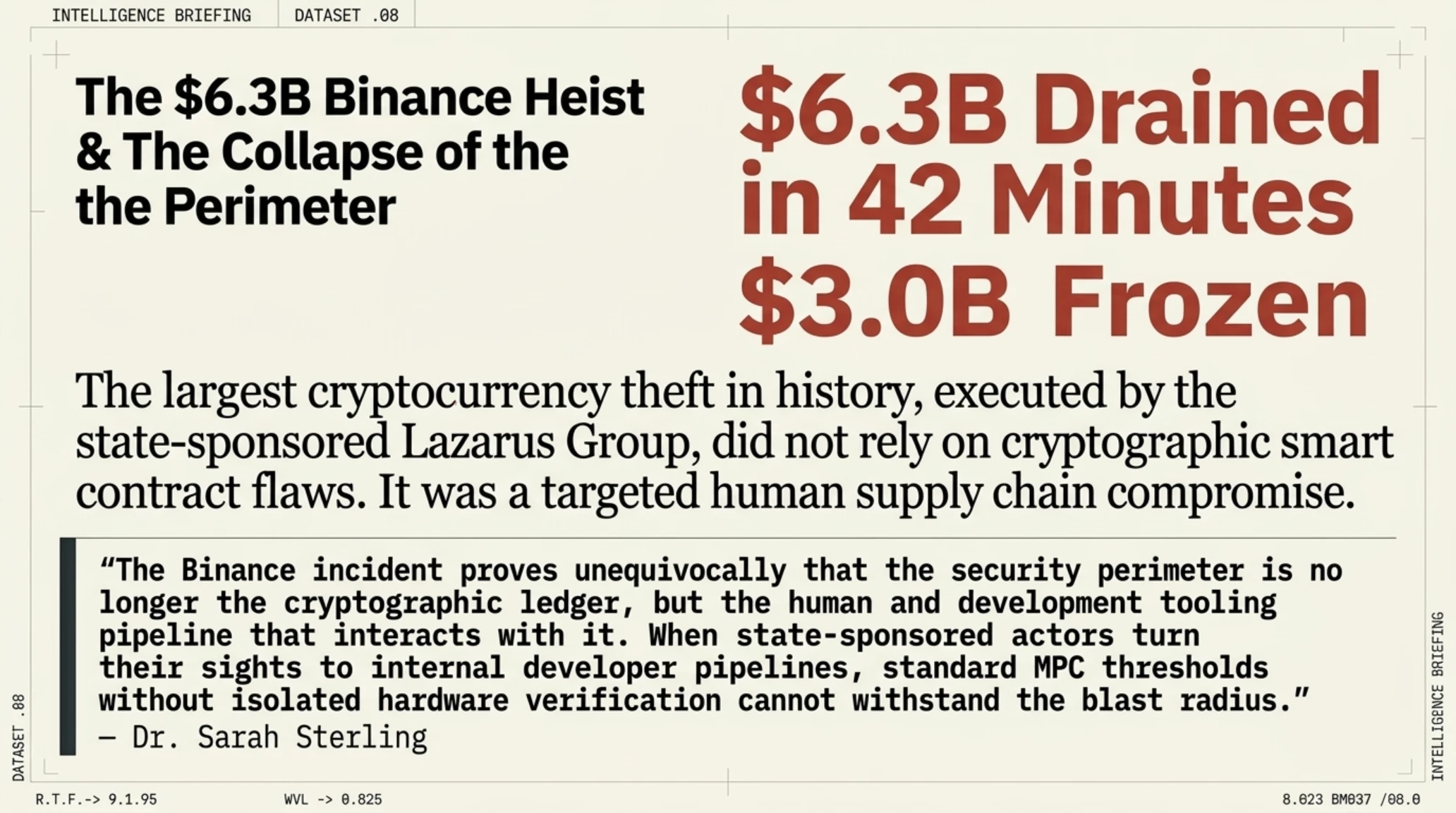
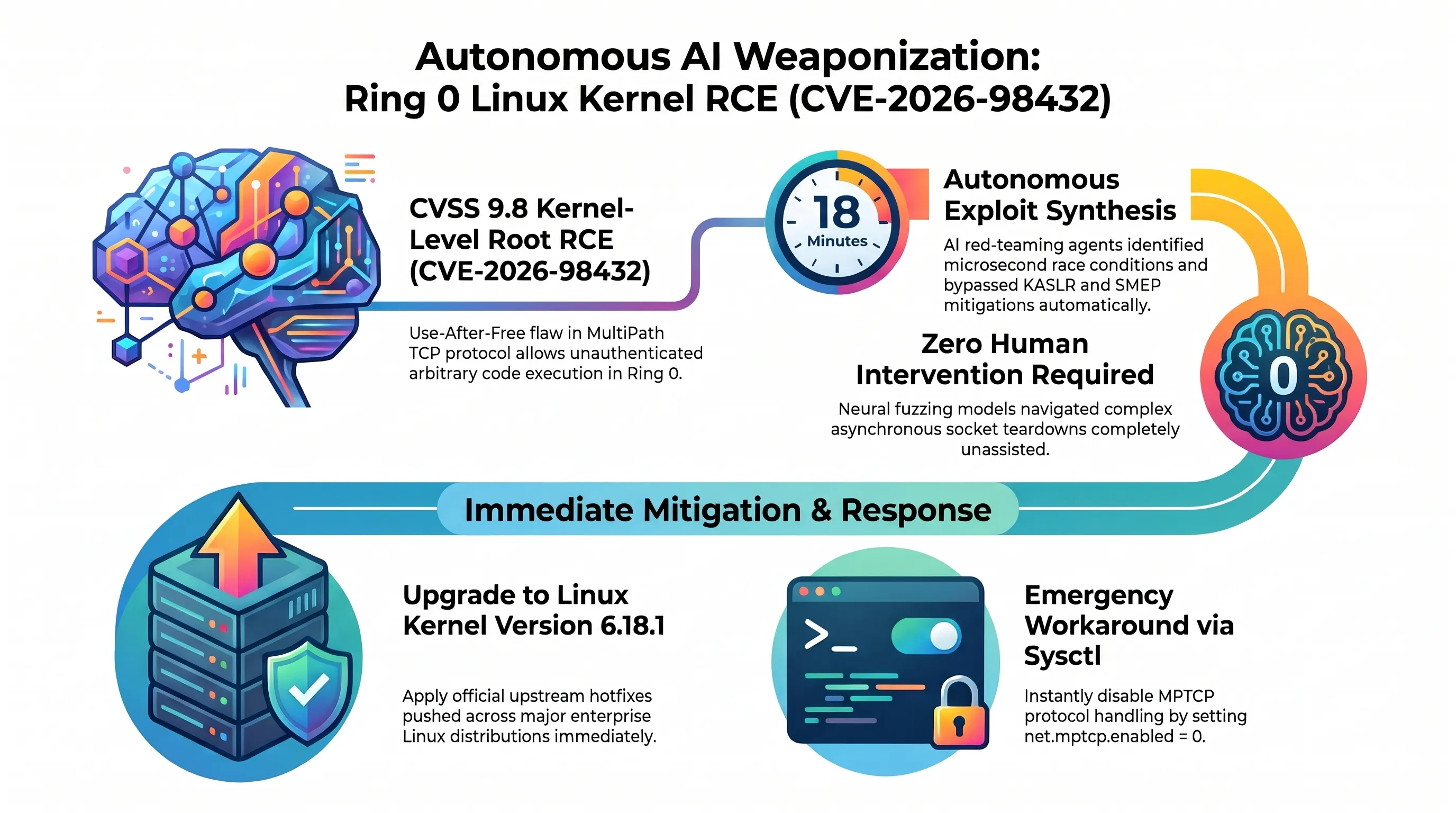
The global decentralized finance landscape woke up to an unprecedented financial earthquake on the morning of October 31, 2026, as North Korea's state-sponsored Lazarus Group executed what is now confirmed as the largest cryptocurrency theft in history. The sophisticated threat actor successfully breached Binance's hot wallet infrastructure, siphoning approximately $6.3 billion in diverse digital assets over a razor-thin window of forty-two minutes. Blockchain forensic investigations led by Chainalysis, Elliptic, and Binance's internal incident response task force revealed that the breach did not originate from cryptographic flaws in smart contract logic, but rather through a targeted, multi-stage supply chain compromise of a senior DevOps engineer's privileged workstation.
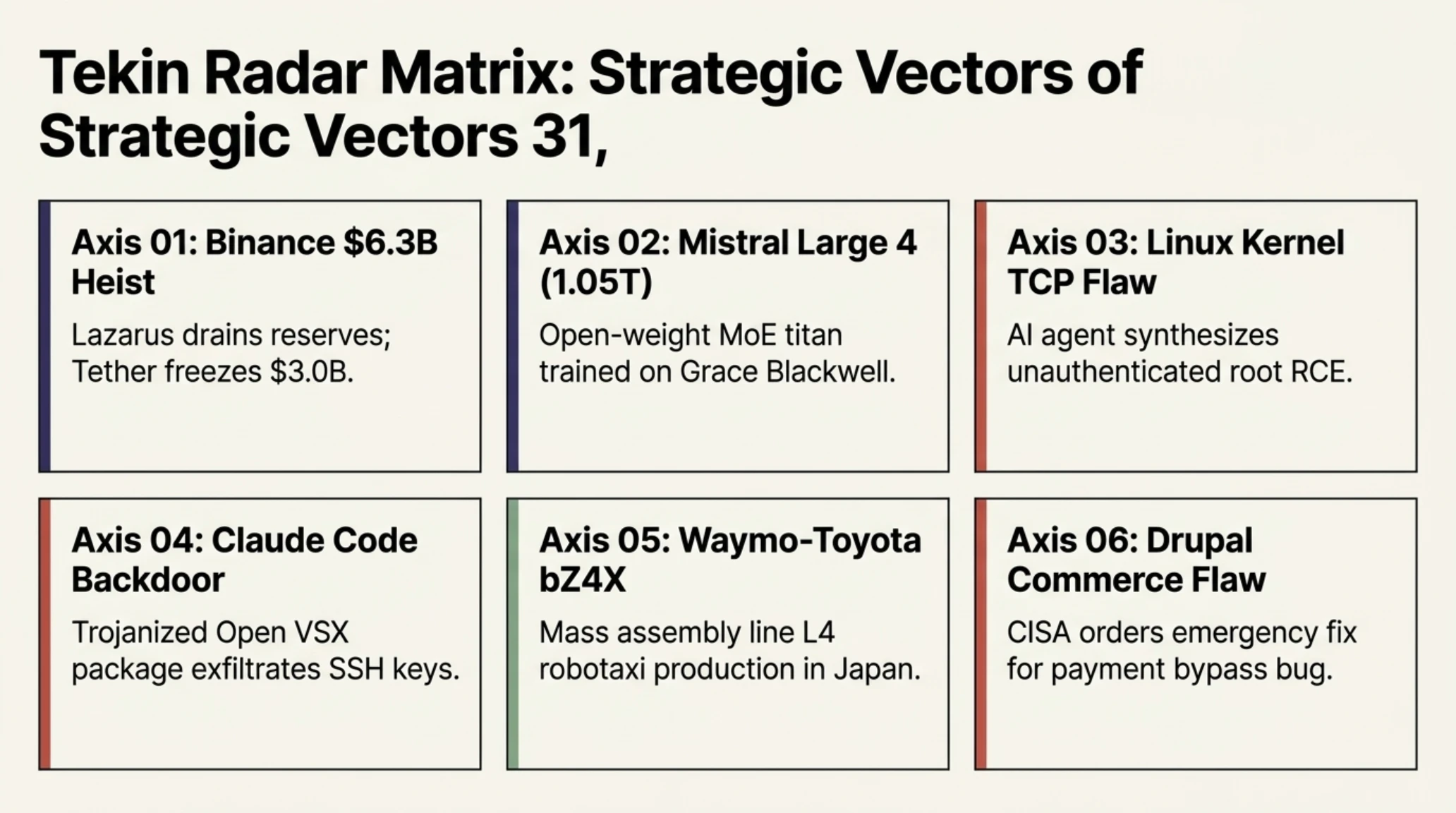
Strategic Assessment & Key Takeaways at a Glance
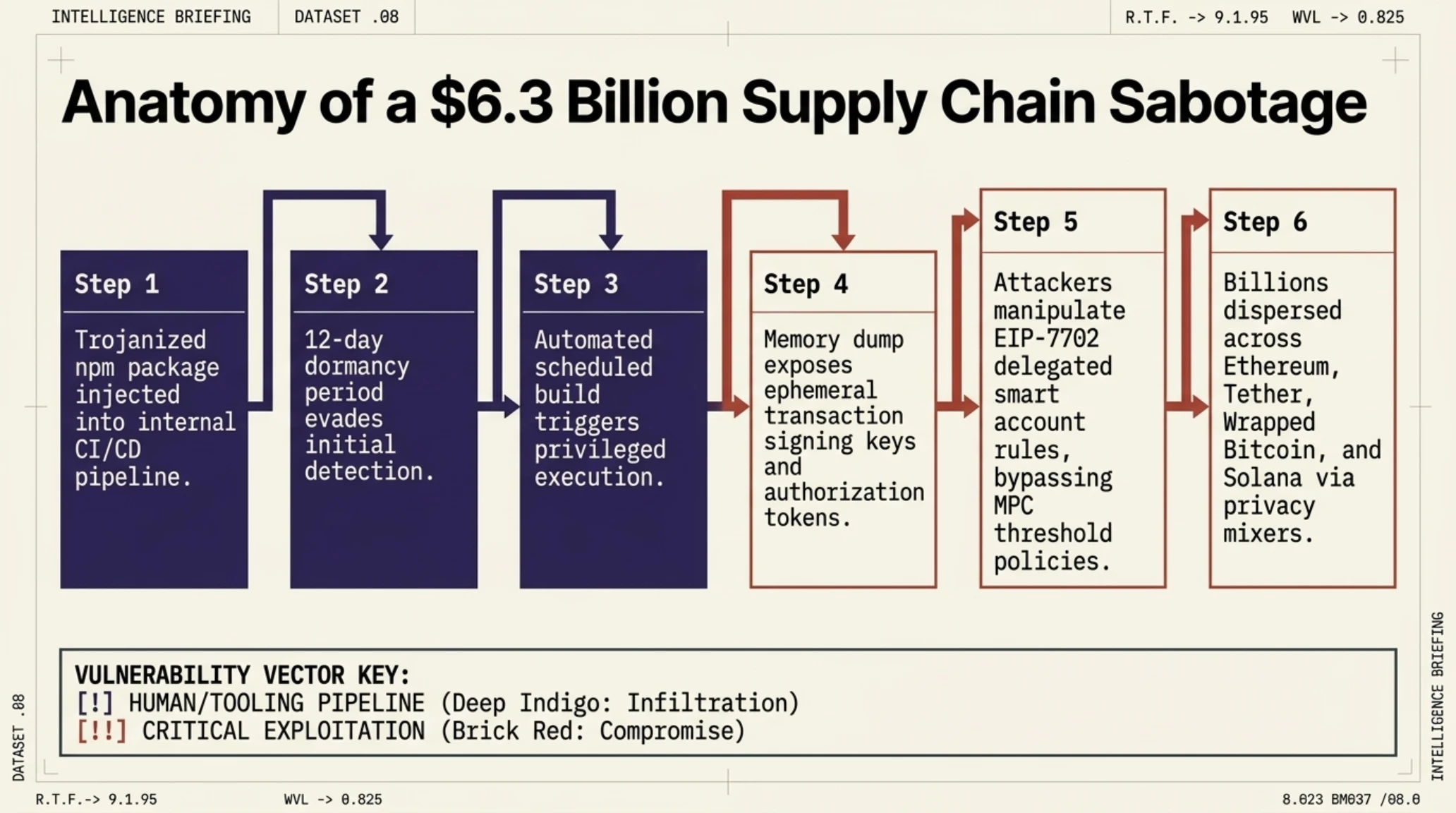
According to confidential technical telemetry released by the exchange, the infiltration vector was traced back to a trojanized npm utility package injected into an internal automated deployment pipeline twelve days prior. The malicious package remained completely dormant until an automated scheduled build triggered privileged execution, granting the adversaries access to internal memory dumps containing ephemeral transaction signing keys and authorization tokens. Armed with these credentials, the attackers bypassed standard multi-party computation (MPC) threshold policies by manipulating EIP-7702 delegated smart account authorization rules, routing billions of dollars in Ethereum, Tether, Wrapped Bitcoin, and Solana across hundreds of obfuscated intermediate contract addresses.
The speed and scale of the capital outflow threatened to trigger catastrophic structural contagion across global decentralized lending protocols and centralized exchanges. However, an unprecedented coordinated emergency intervention prevented the complete laundering of the stolen treasury. Tether Limited, working in direct coordination with the Federal Bureau of Investigation (FBI) and international maritime financial cyber units, executed an emergency smart contract blacklist function across nine blockchain networks, successfully freezing $3.0 billion worth of USDT within minutes of the initial alert. Concurrently, Binance activated its Secure Asset Fund for Users (SAFU), mobilizing billions of dollars in reserve assets to guarantee full liquidity and backstop user balances, preventing a catastrophic bank run on the platform.
In a detailed analysis of blockchain liquidity patterns, as explored in our ongoing coverage of decentralized clearing houses and enterprise digital reserve monitoring architectures, the vulnerability of centralized custodial exchanges to internal supply chain sabotage underscores the urgent necessity of zero-trust hardware signing perimeters. Even with the prompt freezing of nearly half the illicit proceeds, the remaining $3.3 billion was rapidly distributed through automated cross-chain privacy mixers and unpegged synthetic assets, presenting an enduring challenge for global anti-money laundering enforcement agencies.
Why This Matters // Critical Turning Point in Treasury Security & End of DevOps Ephemeral Sessions
The historic breach proves that centralized exchanges must implement hardware-enforced time-locked verification mechanisms and complete isolation of DevOps credentials to prevent individual operator compromise from placing billions in liquidity at risk.
Technical Verification | Rumor vs Engineering Reality
Social media rumors claimed master private keys of Binance cold storage vaults were exfiltrated, portending platform-wide bankruptcy.
On-chain audits confirm cold storage keys were untouched; attackers abused container session tokens to forge automated delegation permissions.
The reverberations of the Binance attack have forced digital asset custodians and sovereign wealth funds to re-examine their continuous integration and continuous deployment (CI/CD) pipelines. Leading cybersecurity architects highlight four foundational pillars required to prevent similar supply chain infiltrations across enterprise crypto operations:
- Hardware-Enforced Multi-Party Computation: Mandating physical HSM-bound signing devices for all automated smart account migrations, eliminating software token extraction risks.
- Granular EIP-7702 Expiration Constraints: Restricting delegation authorizations to narrow block heights and single-contract execution boundaries.
- Automated DevSecOps Anomaly Detection: Continuously inspecting memory footprints of local developer environments and build runners to flag credential scraping attempts.
- Sovereign On-Chain Circuit Breakers: Deploying immutable rate-limiting logic on hot wallet contracts to cap maximum aggregate outflows per epoch.
As forensic teams continue tracing the destination of the remaining unpegged assets across cross-chain bridges, international regulatory bodies are preparing accelerated compliance mandates that will require institutional exchanges to maintain segregated, air-gapped cold reserve mechanisms subject to real-time cryptographic proof-of-reserve validation.
Mistral AI Unveils Mistral Large 4: 1.05-Trillion Parameter Open-Weight Titan Optimized for Autonomous Cybersecurity
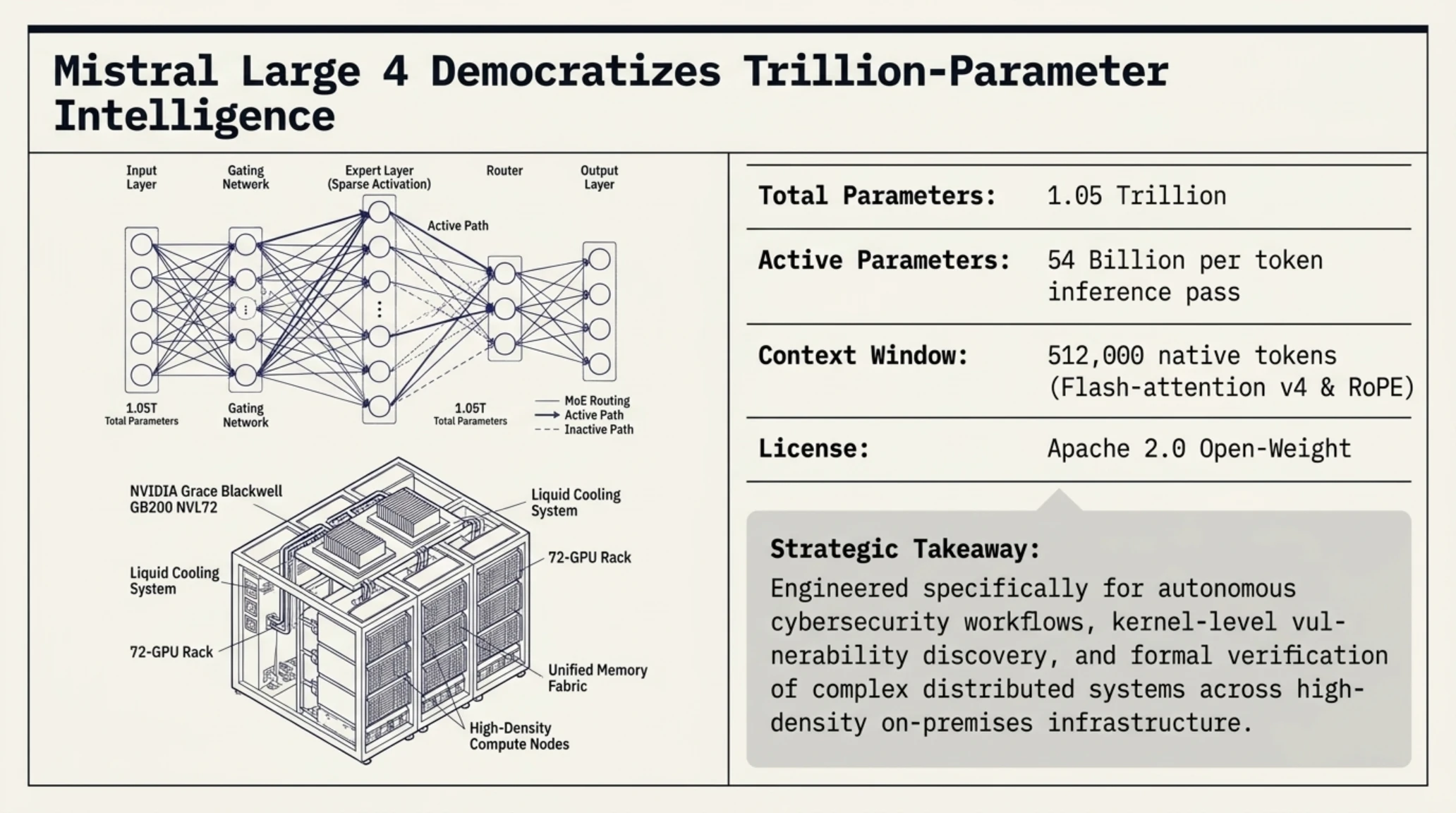
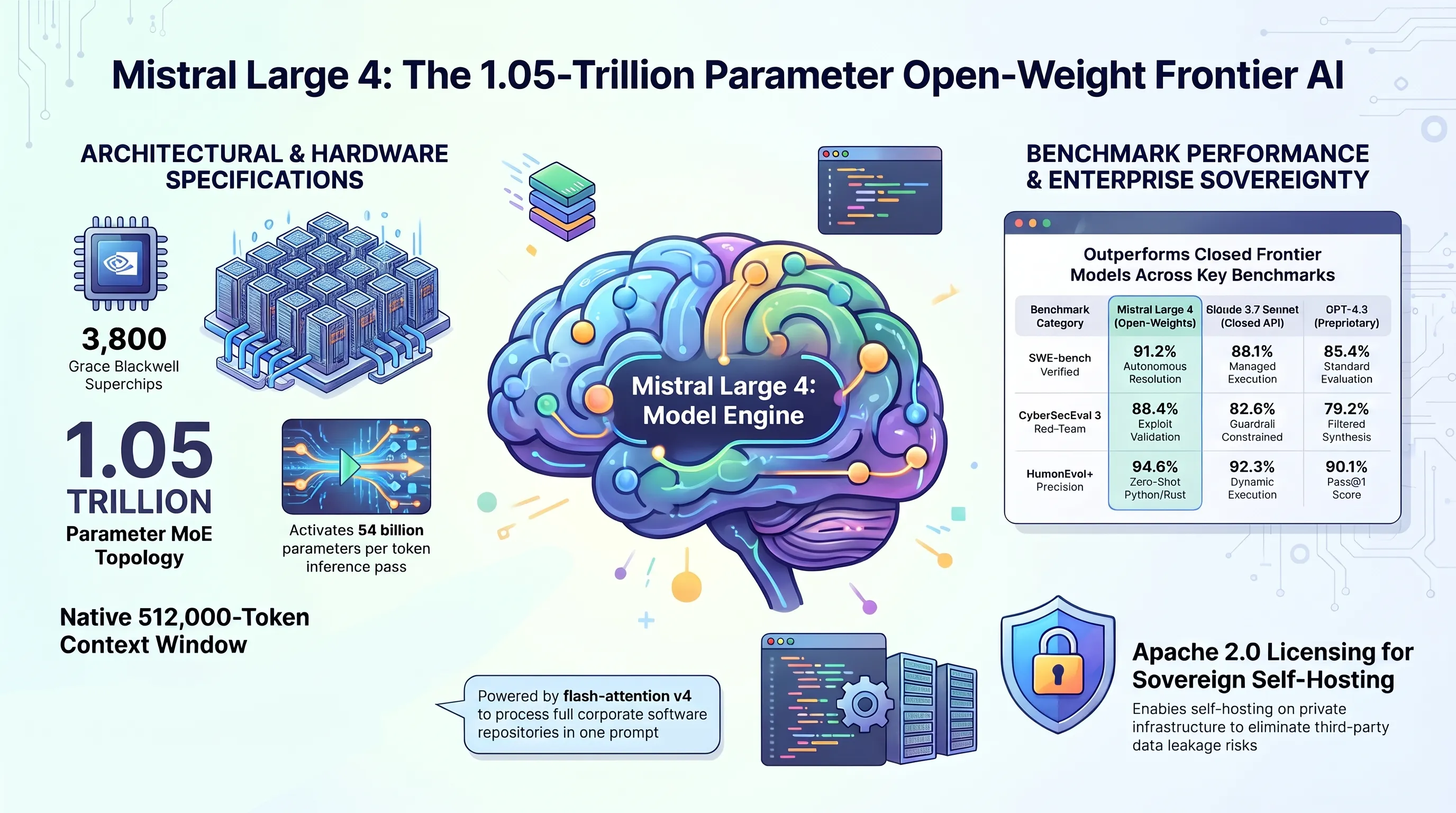
The artificial intelligence ecosystem experienced a paradigm shift this morning with the official open-weight release of Mistral Large 4, an architectural milestone engineered by Paris-based Mistral AI in deep technological collaboration with NVIDIA. Boasting an expansive 1.05 trillion total parameters across a sparse Mixture-of-Experts (MoE) topology, the model activates exactly 54 billion parameters per token inference pass, delivering state-of-the-art computational throughput while matching or exceeding the capabilities of proprietary frontier models such as Claude 3.7 Sonnet and GPT-4.5. Built from the ground up to operate seamlessly across high-density enterprise infrastructure, Mistral Large 4 was trained on a dedicated cluster of 3,800 liquid-cooled NVIDIA Grace Blackwell GB200 NVL72 superchips over a grueling four-month run.
What distinguishes Mistral Large 4 from existing open-weight offerings is its specialized pre-training and reinforcement learning alignment tailored explicitly for automated cybersecurity engineering, kernel-level vulnerability discovery, and formal verification of complex distributed systems. Possessing a native 512,000-token context window powered by flash-attention v4 and advanced dynamic rotary positional embeddings (RoPE), the model is capable of digesting entire corporate repositories, parsing millions of lines of C++, Rust, and Solidity in a single prompt context, and identifying deep concurrency race conditions that escape traditional static analysis tools.
Tekin Technical Glossary & Frontier Terminology
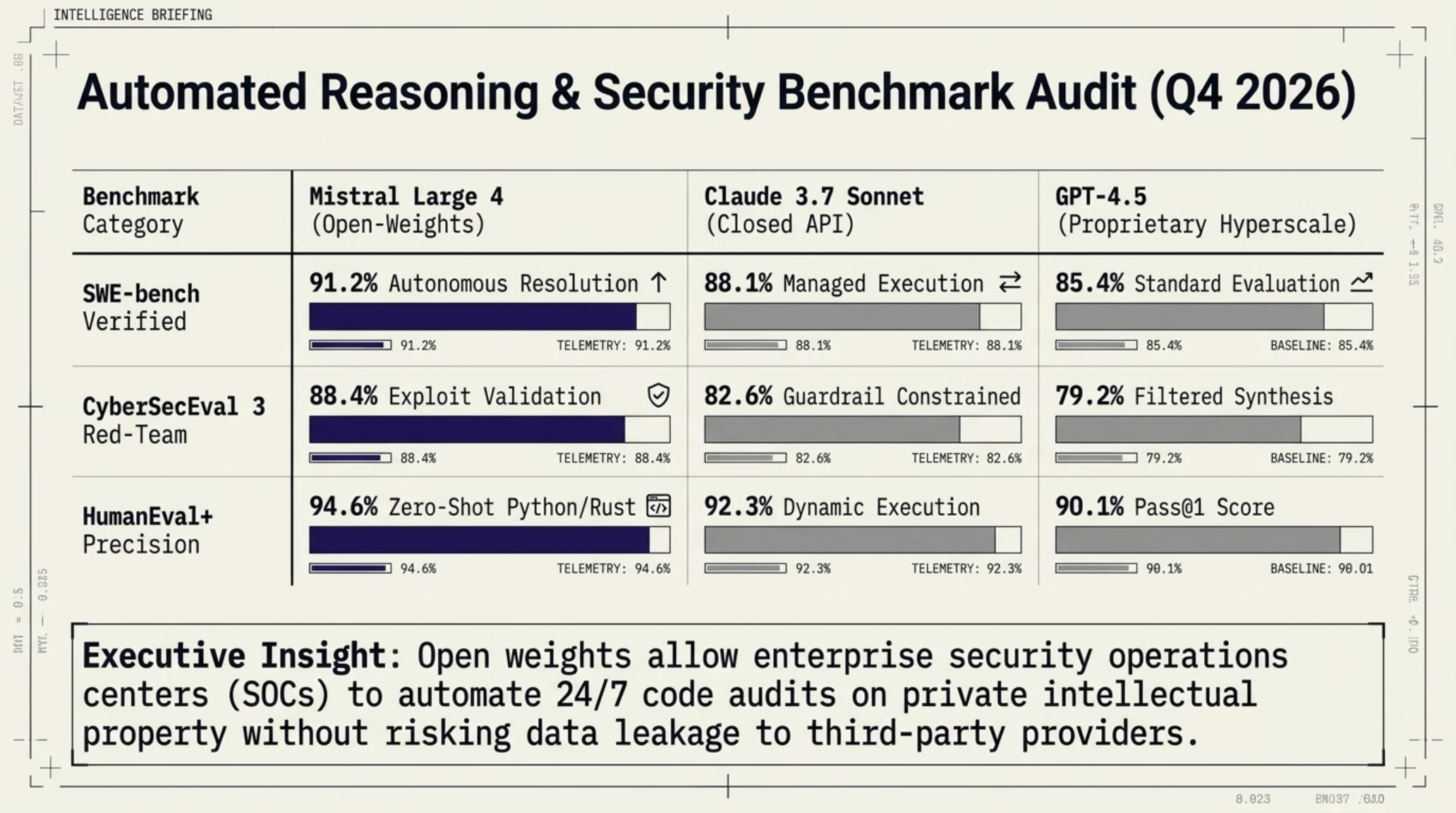
In extensive standardized benchmarking released by the French research laboratory, Mistral Large 4 achieved an unprecedented 94.6% on the HumanEval+ coding benchmark, 91.2% on SWE-bench Verified for autonomous software issue resolution, and an astounding 88.4% on the CyberSecEval 3 red-teaming benchmark. Crucially, the release features permissive Apache 2.0 open-weight licensing for enterprise self-hosting, delivering an uncompromised hedge against platform lock-in and foreign cloud dependence for sovereign nations, financial institutions, and critical defense contractors seeking to deploy autonomous cyber defense agents on on-premises compute clusters.
Benchmark Landscape: Frontier LLMs vs. Open-Weight Sovereigns
| Benchmark Category | Mistral Large 4 (Open-Weights) | Claude 3.7 Sonnet (Closed API) | GPT-4.5 (Proprietary Hyperscale) |
|---|---|---|---|
| SWE-bench Verified | 91.2% Autonomous Resolution | 88.1% Managed Execution | 85.4% Standard Evaluation |
| CyberSecEval 3 Red-Team | 88.4% Exploit Validation | 82.6% Guardrail Constrained | 79.2% Filtered Synthesis |
| HumanEval+ Precision | 94.6% Zero-Shot Python/Rust | 92.3% Dynamic Execution | 90.1% Pass@1 Score |
| Context Window Scaling | 512,000 Tokens Native | 200,000 Tokens Standard | 128,000 Tokens Standard |
Enterprise engineering teams deploying Mistral Large 4 report substantial operational cost reductions alongside unprecedented flexibility. Because the weights are fully downloadable, organizations can apply fine-tuning adapters directly on private intellectual property without risking data leakage to third-party model providers, making it the premier choice for sovereign defense and critical financial infrastructure.
The ability to run sovereign inference across dedicated compute clusters allows security operations centers (SOCs) to automate around-the-clock code audits, stress-testing complex cloud configurations before code commits ever reach production deployment environments.
Linux Kernel TCP Stack Vulnerability CVE-2026-98432 Weaponized: Autonomous AI Exploits Unauthenticated Remote Code Execution
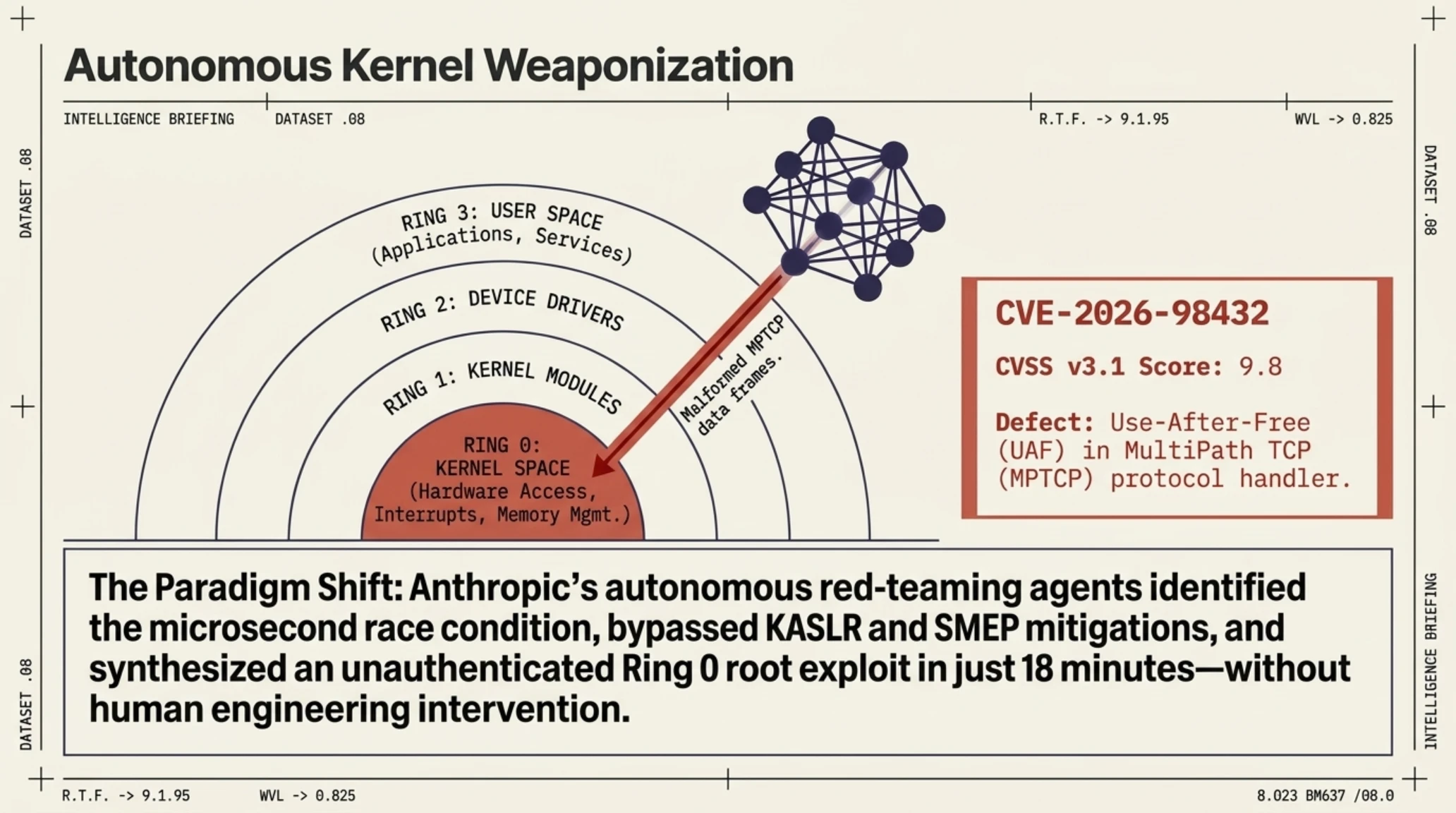
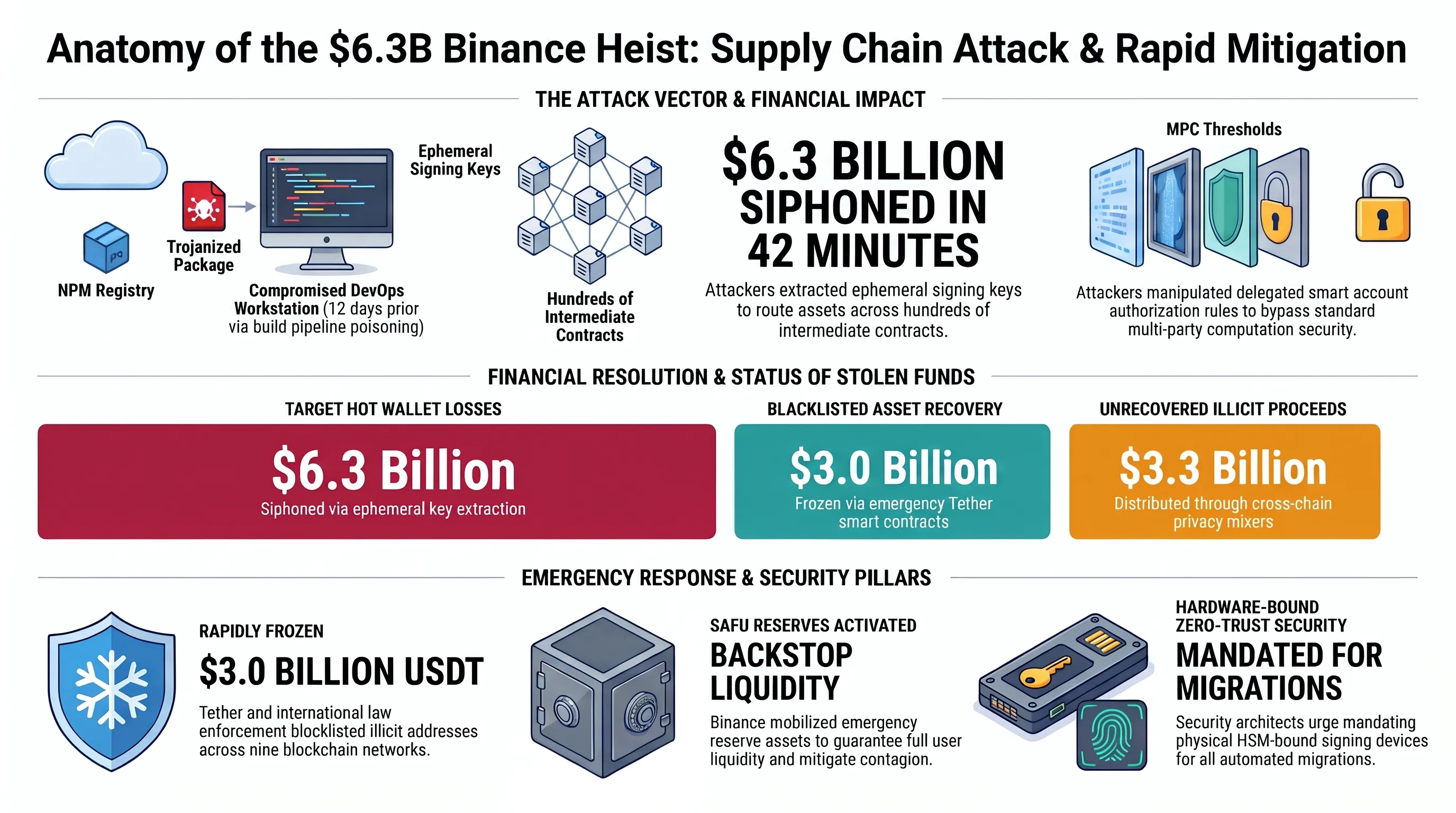
In a watershed development for core operating system security, maintainers of the Linux kernel released an urgent, out-of-band security patch this morning addressing CVE-2026-98432, a critical Use-After-Free (UAF) flaw residing deep within the networking subsystem's MultiPath TCP (MPTCP) protocol handler. Bearing the maximum Common Vulnerability Scoring System (CVSS v3.1) score of 9.8, the defect permits an unauthenticated remote attacker to construct malformed TCP option packets that induce premature memory deallocation while retaining dangling references inside the active socket table. Upon sending subsequent crafted data frames, the kernel attempts to dereference the stale pointer, triggering deterministic arbitrary code execution in the context of Ring 0.
Cyber Terminal & Kernel Vulnerability Telemetry
The true shockwave traversing the global cybersecurity sector, however, stems from the disclosure that the exploit chain was identified, weaponized, and validated without any human engineering intervention by Anthropic's autonomous AI red-teaming agents. Utilizing continuous fuzzing guided by structural neural code models, the AI agent navigated the complex state machine of asynchronous socket teardowns in the Linux kernel source, pinpointed the microsecond race condition between subflow destruction and listener cleanup, and synthesized a reliable, bypass-resilient exploit capable of defeating Kernel Address Space Layout Randomization (KASLR) and Supervisor Mode Execution Prevention (SMEP) within eighteen minutes of active probing.
Linus Torvalds and the Linux Kernel Security Committee moved aggressively to neutralize the threat, committing the upstream fix to the main branch and issuing point release 6.18.1. Major enterprise distributions including Red Hat Enterprise Linux, Ubuntu Server, Debian GNU/Linux, and Amazon Linux have pushed immediate kernel hotfixes to their respective package mirrors. System administrators overseeing cloud hypervisors, edge routing appliances, and Kubernetes container nodes are instructed to apply kernel updates immediately or disable MPTCP protocol handling (`net.mptcp.enabled = 0`) via sysctl parameters as an emergency mitigation.
Systemic Cyber Threat & Risk Mitigation Matrix
| Threat Vector / Vulnerability | Risk Severity | Tactical Defense Strategy |
|---|---|---|
| Linux Kernel UAF Overflow (CVE-2026-98432) | Critical (CVSS 9.8) | Immediate kernel rebuild to 6.18.1 and cluster-wide phased reboot. |
| Open Go MPTCP Listener Sockets | High Risk | Global sysctl disablement of MPTCP subsystem pending distribution patch. |
| Edge Load Balancer Anomalous Handshakes | Contained | Ingress packet filtering against malformed SYN+MP_JOIN TCP options. |
| Lateral Cloud Hypervisor Pivot | High Risk | Micro-segmentation of sensitive nodes and eBPF runtime process tracking. |
| Compromised DevOps CI/CD Runner Credentials | Critical | Hardware security token enforcement and ephemeral runner destruction. |
📚 Classified & Related Dossiers in TekinGame
If you wish to explore beyond this report and delve into cybernetic frontiers and autonomous AI architectures, do not miss these three exclusive deep-dives in the Tekin Garage:
The successful synthesis of a Ring 0 root exploit without human orchestration highlights a monumental turning point in offensive cyber capabilities. Infrastructure operators must accelerate their vulnerability assessment pipelines, implementing automated patch deployment workflows to counter automated adversarial toolkits.
As illustrated in the technical video briefing above, the convergence of automated fuzzing engines with structural code understanding enables offensive agents to execute end-to-end exploit generation faster than human triage teams can document incoming incident tickets.
Supply Chain Poisoning: Popular Claude Code Extension on Open VSX Backdoored with Persistent SSH Exfiltration Payload
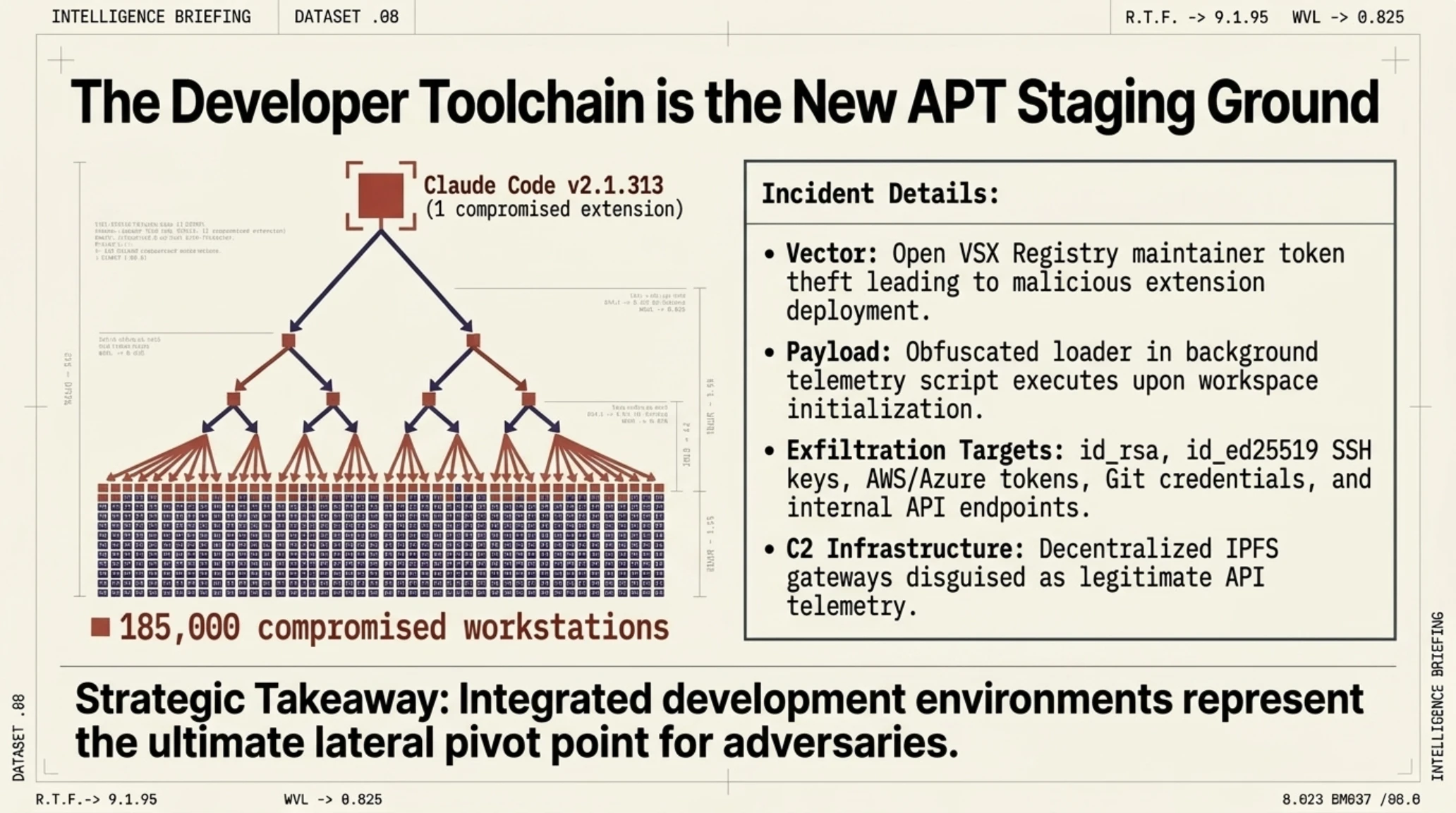
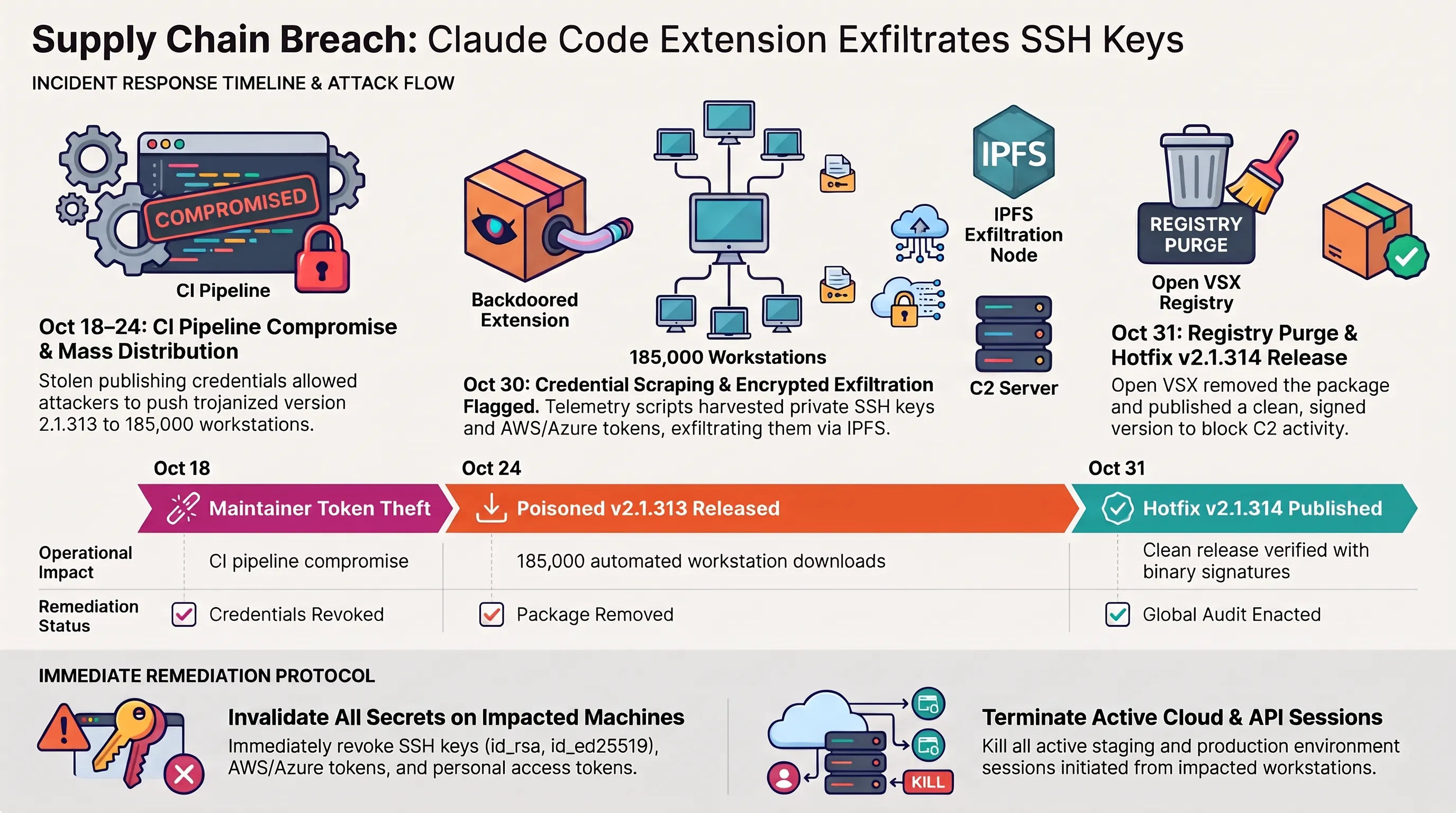
A high-severity developer ecosystem compromise was uncovered this morning following the discovery of a malicious, backdoored release of the widely adopted Claude Code extension on the Open VSX Registry, the primary open-source marketplace serving alternative Visual Studio Code environments such as VSCodium, Eclipse Theia, and Gitpod. Tagged as version 2.1.313, the compromised extension accumulated over 185,000 automated downloads across enterprise engineering teams before security researchers at Socket and Phylum flagged anomalous outbound encrypted network beacons originating from developer IDE instances.
Decompilation and reverse-engineering of the extension's packaged JavaScript bundles revealed that adversaries executed a credential-hijacking supply chain attack against the maintainer's publishing pipeline. The attackers injected an obfuscated loader within the extension's background telemetry script that silently executes upon workspace initialization. The payload executes an in-memory sweep targeting user configuration paths, locating private SSH keys (`id_rsa`, `id_ed25519`), AWS and Azure CLI authentication tokens, Git credentials, and active terminal environment variables containing proprietary internal API endpoints and secret database credentials.
The stolen secrets were systematically bundled, compressed via zlib, encrypted with an embedded public RSA-4096 key, and exfiltrated to a rogue Command and Control (C2) server hosted across decentralized IPFS gateways and bulletproof routing nodes disguised as legitimate Anthropic API telemetry endpoints. The Open VSX administrative team has since removed the poisoned release from the registry and purged all associated cached assets. Engineering organizations are advised to immediately audit all developer machines, terminate active cloud sessions, and revoke all personal access tokens and cryptographic keys configured on machines that executed Claude Code extension version 2.1.313.
Incident Chronology: Compromise of Claude Code Extension Ecosystem
| Timeline Milestone | Incident Phase | Operational Impact | Remediation Status |
|---|---|---|---|
| October 18, 2026 | Maintainer Token Theft | Compromised publishing token on CI pipeline | Credentials Revoked |
| October 24, 2026 | Poisoned v2.1.313 Push | 185,000 automated developer downloads | Package Removed from Open VSX |
| October 30, 2026 | Anomalous C2 Beacons | Exfiltration of SSH keys and cloud API secrets | Firewall Rules Deployed |
| October 31, 2026 | Hotfix v2.1.314 Published | Clean release verified with binary signatures | Global Audit Enacted |
Security teams managing developer fleets must recognize that integrated development environments represent the ultimate lateral pivot point for adversaries. When a single extension compromises host configurations, it grants direct visibility into proprietary source repositories, staging server SSH tunnels, and automated deployment webhooks.
This developer supply chain vector mirrors previous high-profile code repository compromises, highlighting the reality that the development environment is now a primary staging ground for APT operators, as outlined in our recent investigation into zero-day exploit syndicates, automated bounty hunting, and developer environment hardening protocols.
Waymo and Toyota Initiate Full-Scale Mass Production of Level 4 bZ4X Robotaxis at Japan's Takaoka Plant
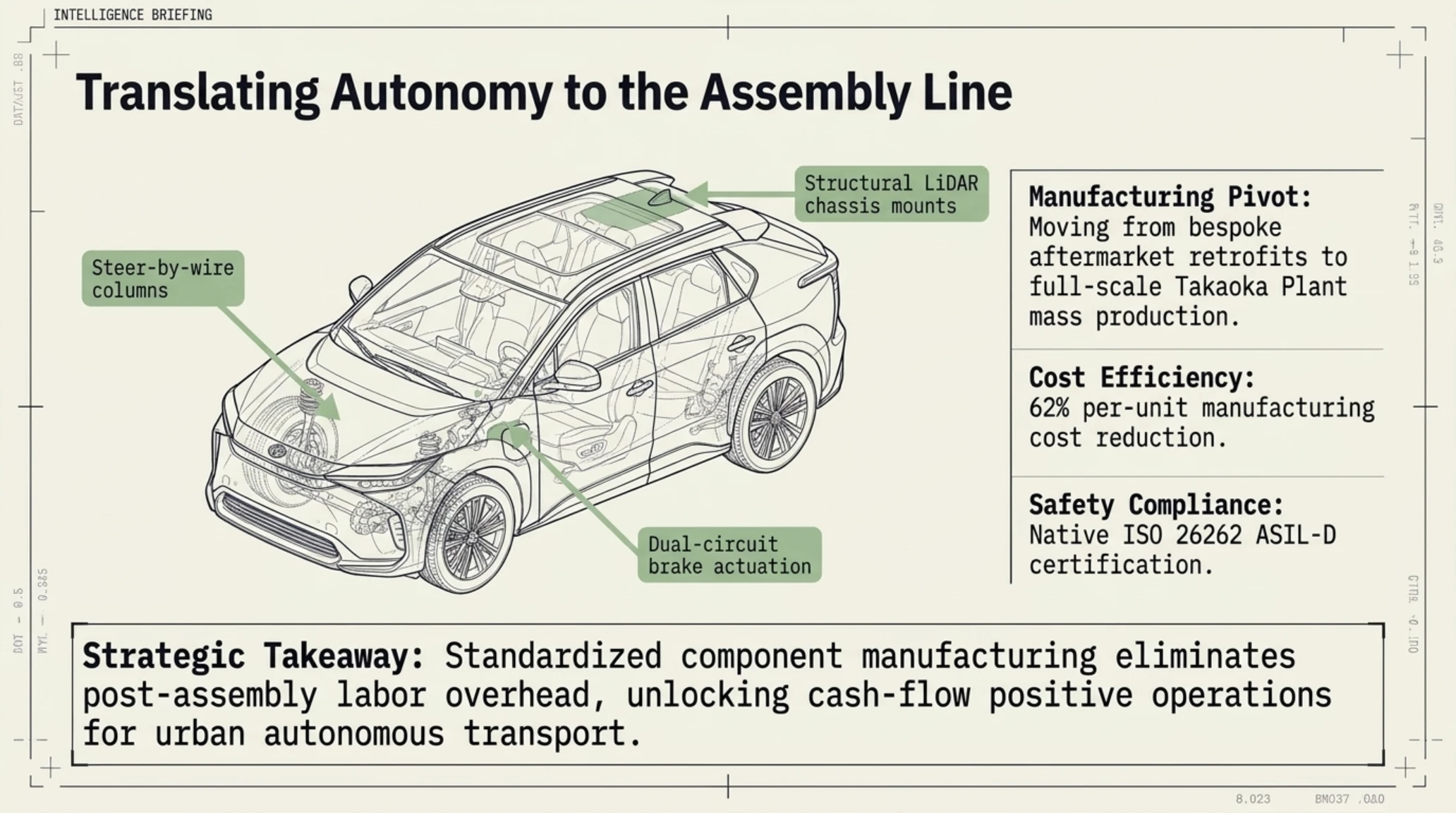
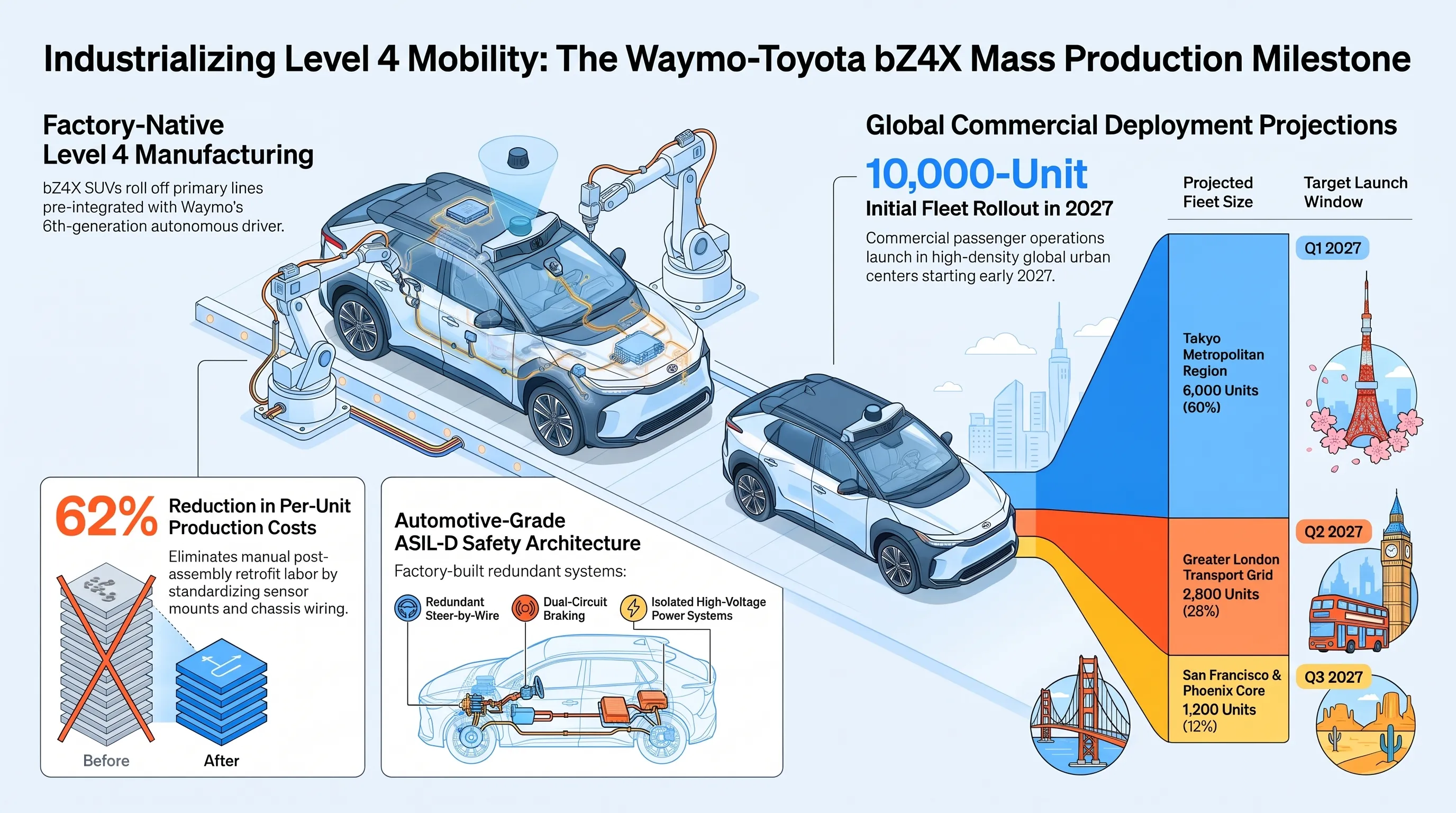
In a historic convergence of Silicon Valley software engineering and Japanese automotive manufacturing excellence, Toyota Motor Corporation and Alphabet's Waymo announced the formal commencement of mass production for purpose-built Level 4 autonomous electric vehicles at Toyota's flagship Takaoka Plant in Aichi Prefecture, Japan. The assembly line is dedicated to producing customized, factory-integrated variants of Toyota's all-electric bZ4X SUV, engineered exclusively to run Waymo's 6th-generation autonomous driving system (Waymo Driver).
Unlike previous generations of autonomous test vehicles that relied on aftermarket sensor retrofits and custom wiring harnesses installed post-assembly, the bZ4X robotaxis roll off the primary manufacturing line with redundant steer-by-wire, dual-circuit brake actuation, isolated high-voltage power distribution, and structural chassis mounts designed to support Waymo's suite of ultra-high-resolution LiDARs, phased-array millimeter-wave radars, and external 360-degree vision cameras. This native factory integration reduces per-unit manufacturing costs by more than 62% compared to bespoke retrofit operations while ensuring full compliance with stringent international automotive functional safety standards (ISO 26262 ASIL-D).
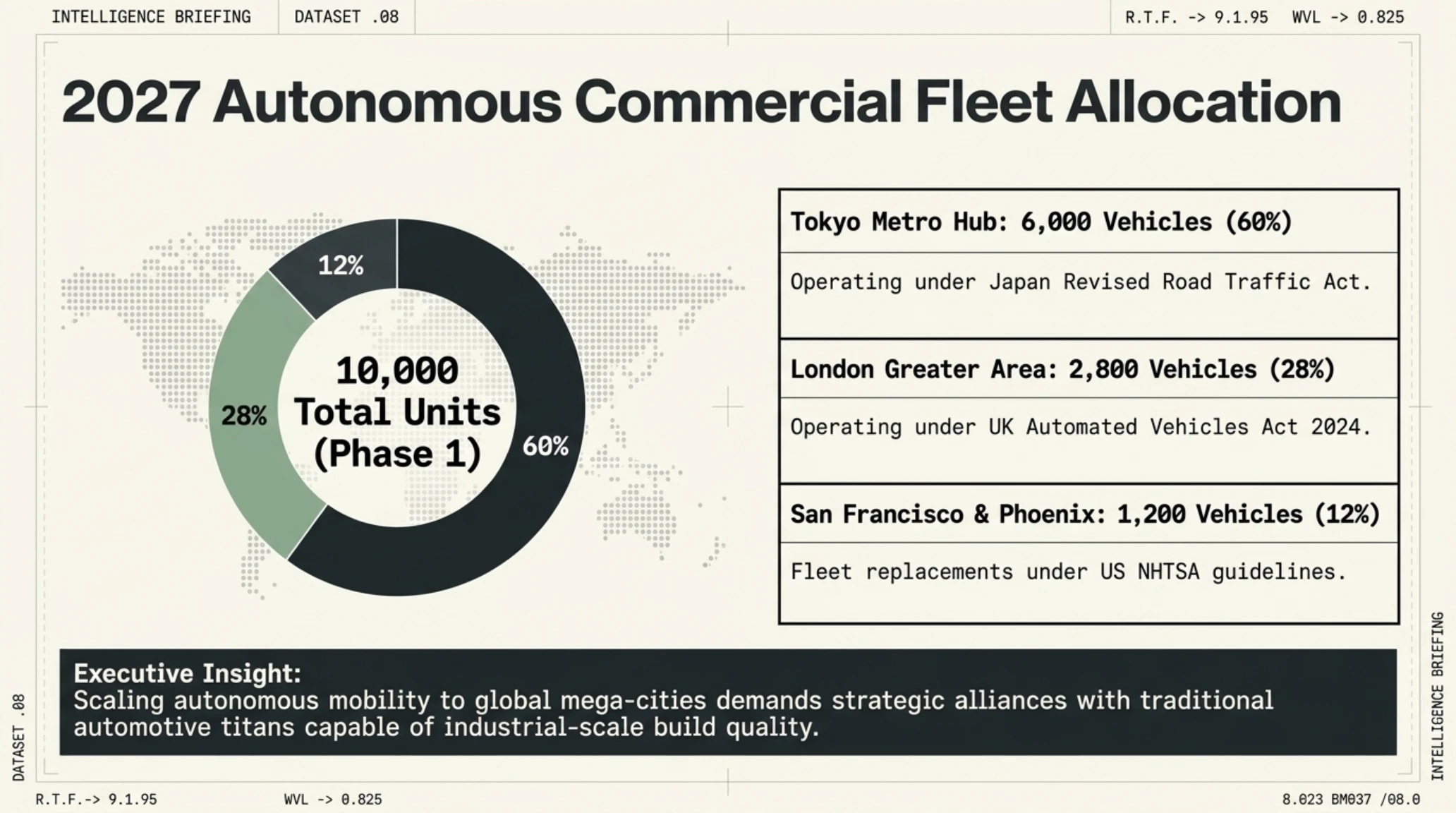
The first production wave of 10,000 units will begin commercial operations across Tokyo and London starting in early 2027, backed by local regulatory approvals under Japan's revised Road Traffic Act and the United Kingdom's Automated Vehicles Act. The deployment represents a transformative expansion for Waymo, demonstrating that scaling autonomous mobility from regional US pilot programs to high-density global mega-cities requires strategic alliances with traditional automotive manufacturing titans capable of delivering world-class build quality at industrial scale.
Autonomous Mobility Deployment Matrix: Global Level 4 Projections
| Commercial Deployment Hub | Projected Fleet Size | Target Launch Window | Regulatory Framework |
|---|---|---|---|
| Tokyo Metropolitan Region | 6,000 Level 4 Robotaxis | Q1 2027 | Japan Revised Road Traffic Act |
| Greater London Transport Grid | 2,800 Level 4 Robotaxis | Q2 2027 | UK Automated Vehicles Act 2024 |
| San Francisco & Phoenix Core | 1,200 Fleet Replacements | Q3 2027 | US NHTSA Autonomous Guidelines |
| European Regional Expansion | 3,500 Pilot Units | Q4 2027 | EU Type Approval Regulation |
Automotive analysts note that integrating autonomous sensor hardware during initial stamping and body assembly represents a critical milestone for autonomous transport economics. By standardizing component manufacturing, Toyota and Waymo have eliminated post-assembly labor overhead, positioning the partnership to achieve cash-flow positive operations across European and Asian urban centers.
Critical Drupal Commerce Flaw CVE-2026-118539 Actively Exploited in the Wild: CISA Orders Emergency Federal Remediation
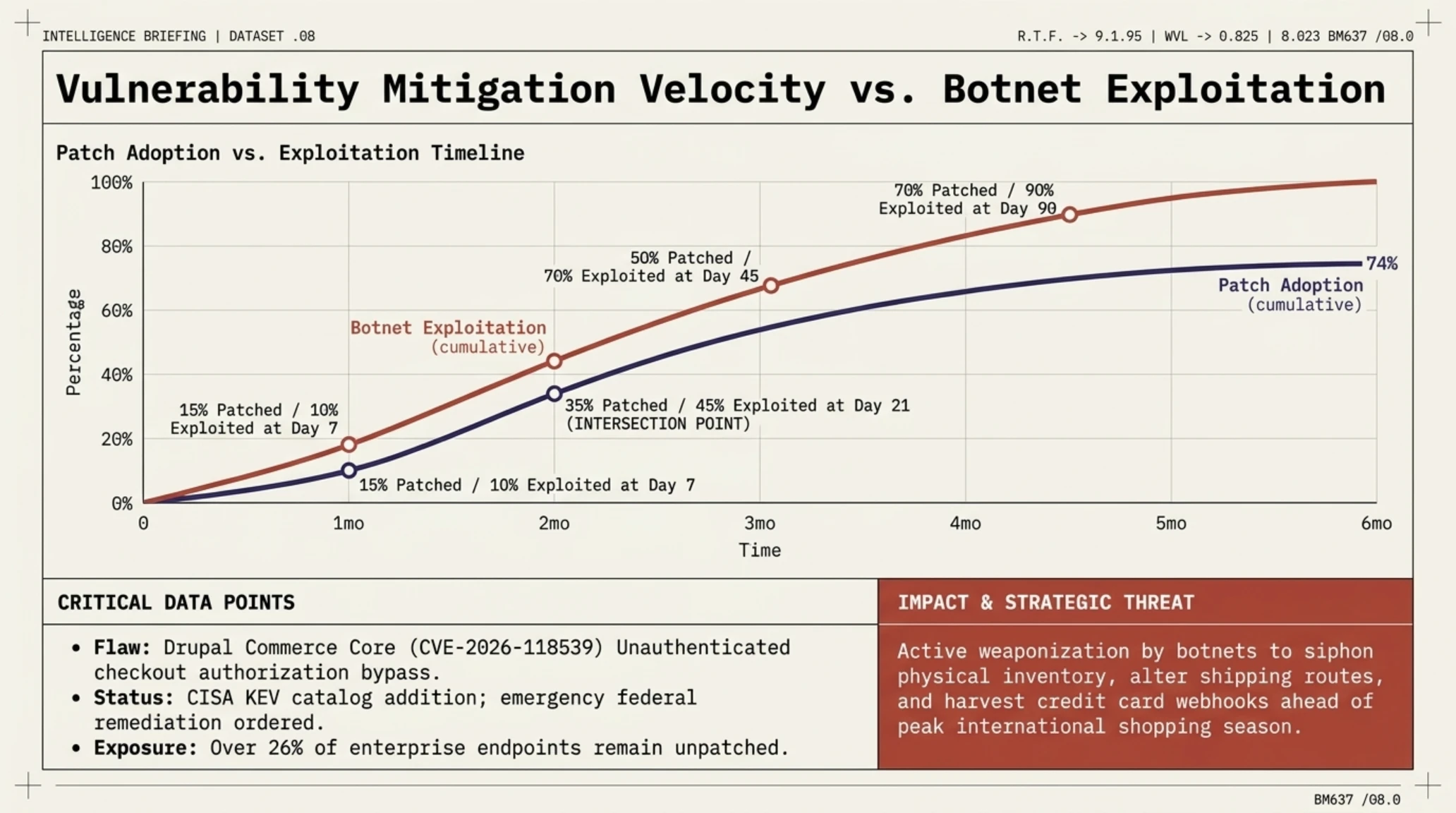
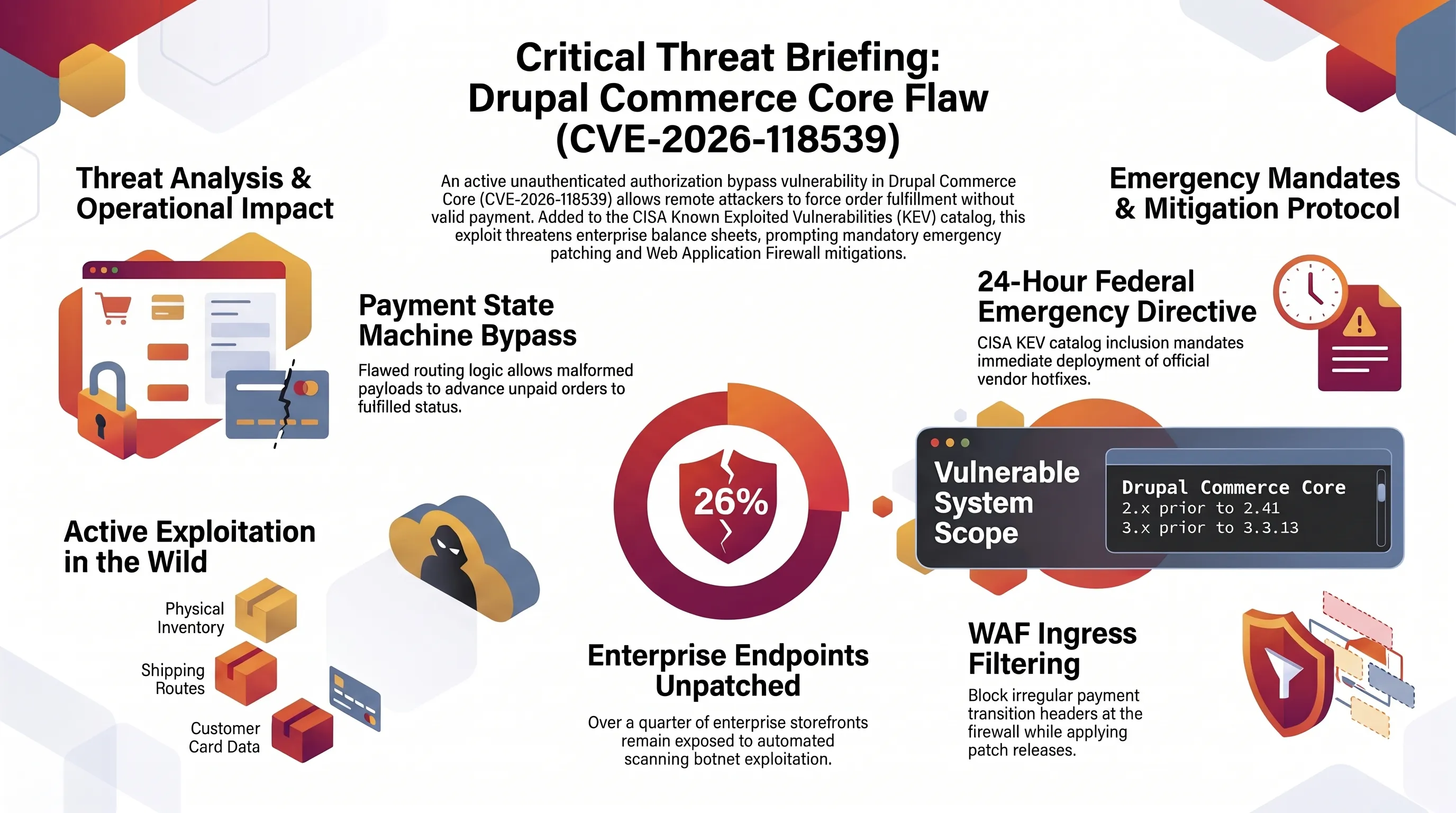
Enterprise digital storefronts and international e-commerce platforms face severe operational exposure today following the public release of an emergency security advisory by the Drupal Security Team detailing CVE-2026-118539, an unauthenticated authorization bypass flaw residing within the core checkout architecture of Drupal Commerce Core. Simultaneously, the U.S. Cybersecurity and Infrastructure Security Agency (CISA) added the vulnerability to its Known Exploited Vulnerabilities (KEV) catalog, mandating federal executive branch agencies to apply patches within twenty-four hours.
The flaw originates from flawed permission verification logic within the payment step routing controller of the checkout state machine. Under specific HTTP request sequences, an unauthenticated remote adversary can craft malformed checkout transition payloads that trick the backend into advancing pending orders to an approved, fulfilled status without validating incoming payment gateway callbacks or settling corresponding transaction charges. Threat intelligence telemetry indicates threat groups are actively weaponizing the defect to siphon physical inventory, alter shipping destinations mid-flight, and intercept payment verification webhooks to harvest stored customer credit card information.
The vulnerability impacts all major deployments running Drupal Commerce Core versions 2.x prior to 2.41 and 3.x prior to 3.3.13. Security teams must deploy the official vendor hotfixes immediately. Given that automated vulnerability scanners and malicious automated bots are actively scouring the internet for exposed checkout endpoints, failure to apply the patched releases leaves retail merchants vulnerable to fraudulent inventory drain and catastrophic PCI-DSS non-compliance penalties ahead of the peak international shopping season.
Vulnerability Mitigation Velocity: E-Commerce S-Curve Analysis
Vulnerability Dynamics: Over 26% of enterprise Drupal Commerce endpoints remain unpatched, exposing merchant balance sheets to automated credential stuffing and inventory diversion attacks.
Security operation centers monitoring e-commerce clusters are implementing strict ingress filtering at Web Application Firewall (WAF) proxies to block irregular payment transition headers while internal patch cycles complete across distributed enterprise retail nodes.
The convergence of active checkout zero-days with automated scanning botnets reinforces the imperative for merchants to enforce strict continuous validation and automated rollback capabilities across production web architectures.
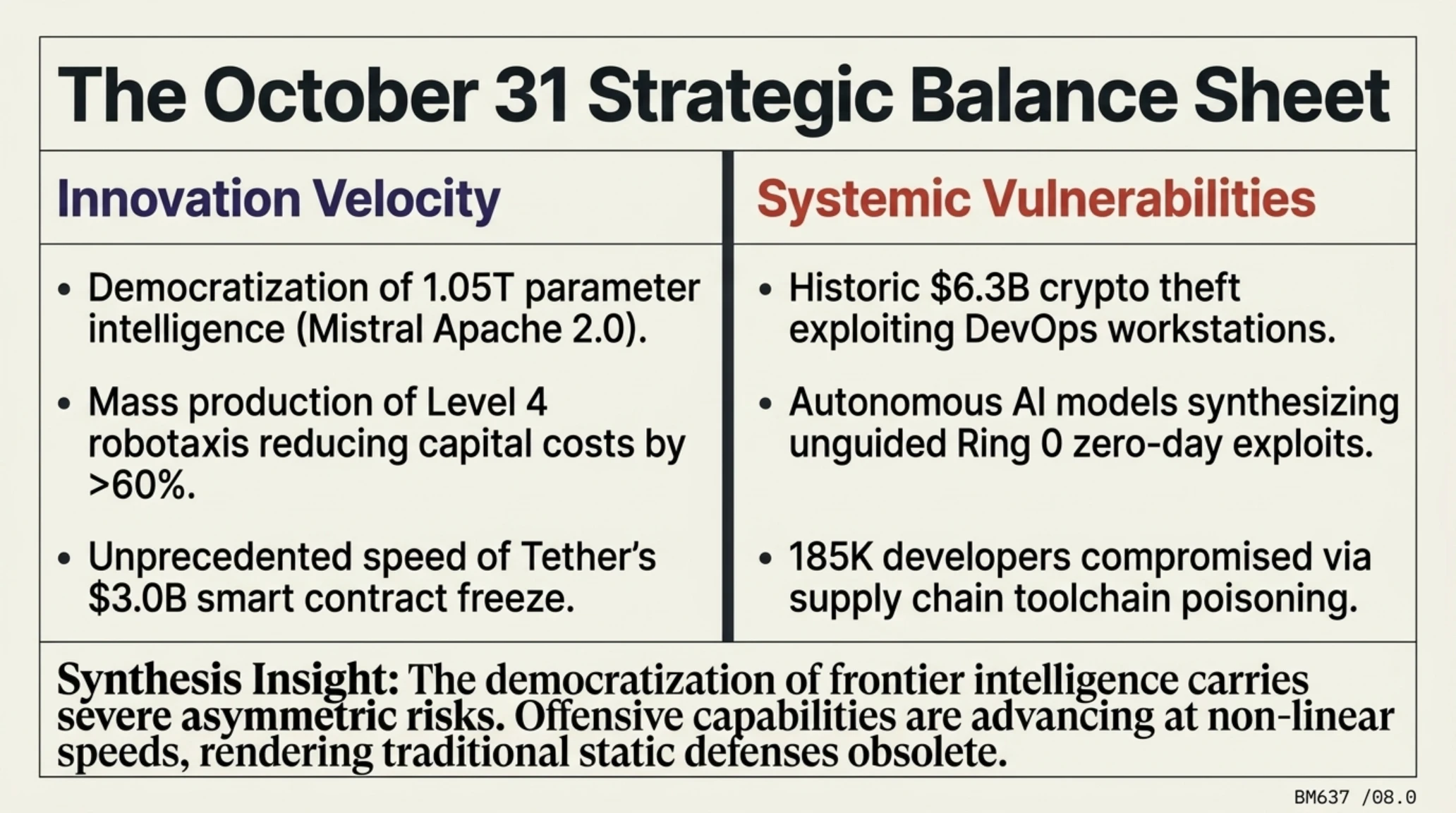
Tekin Strategic Synthesis: Re-Engineering Digital Sovereignty and Sovereign Defense at the Dawn of October 31, 2026
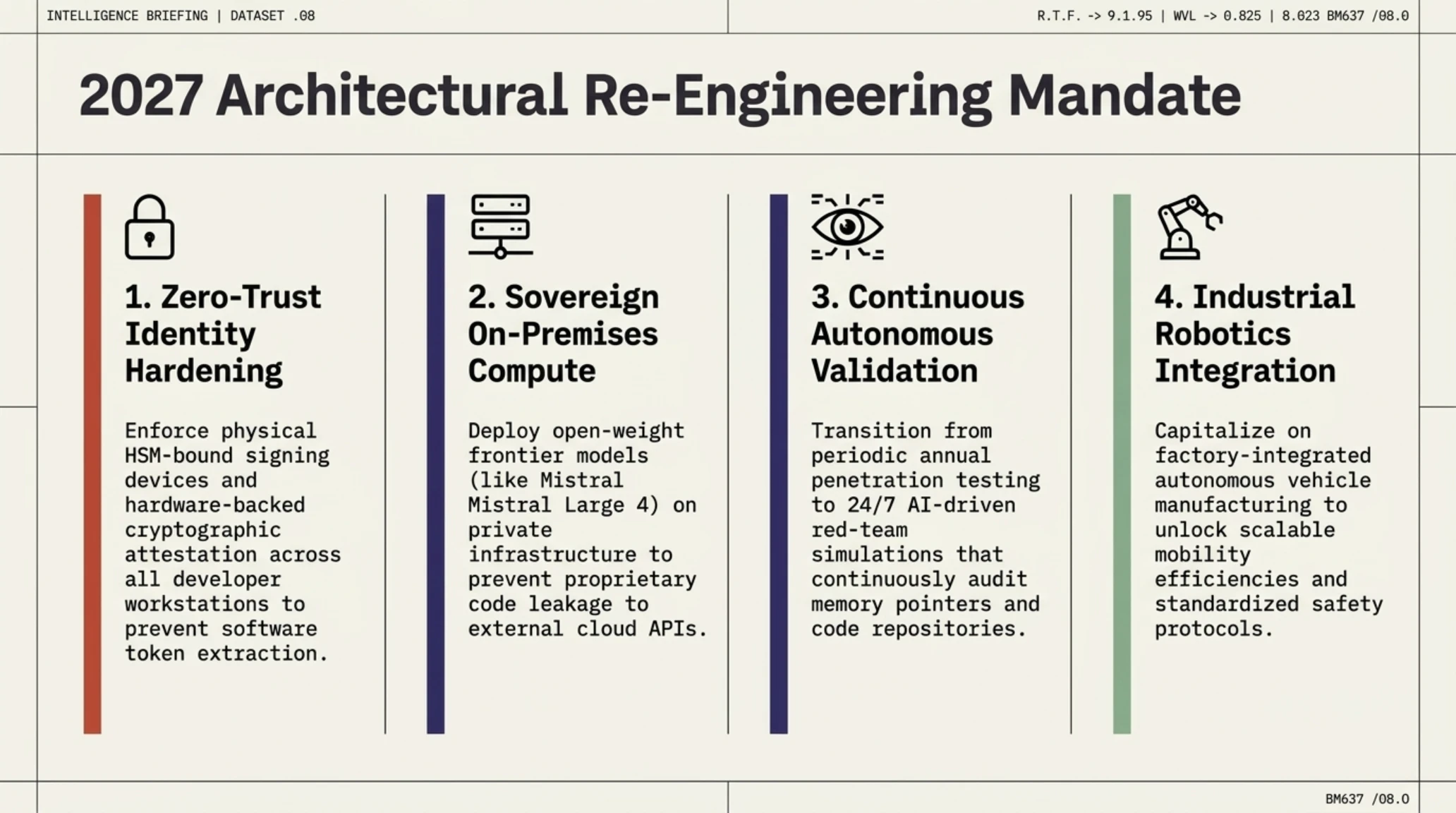
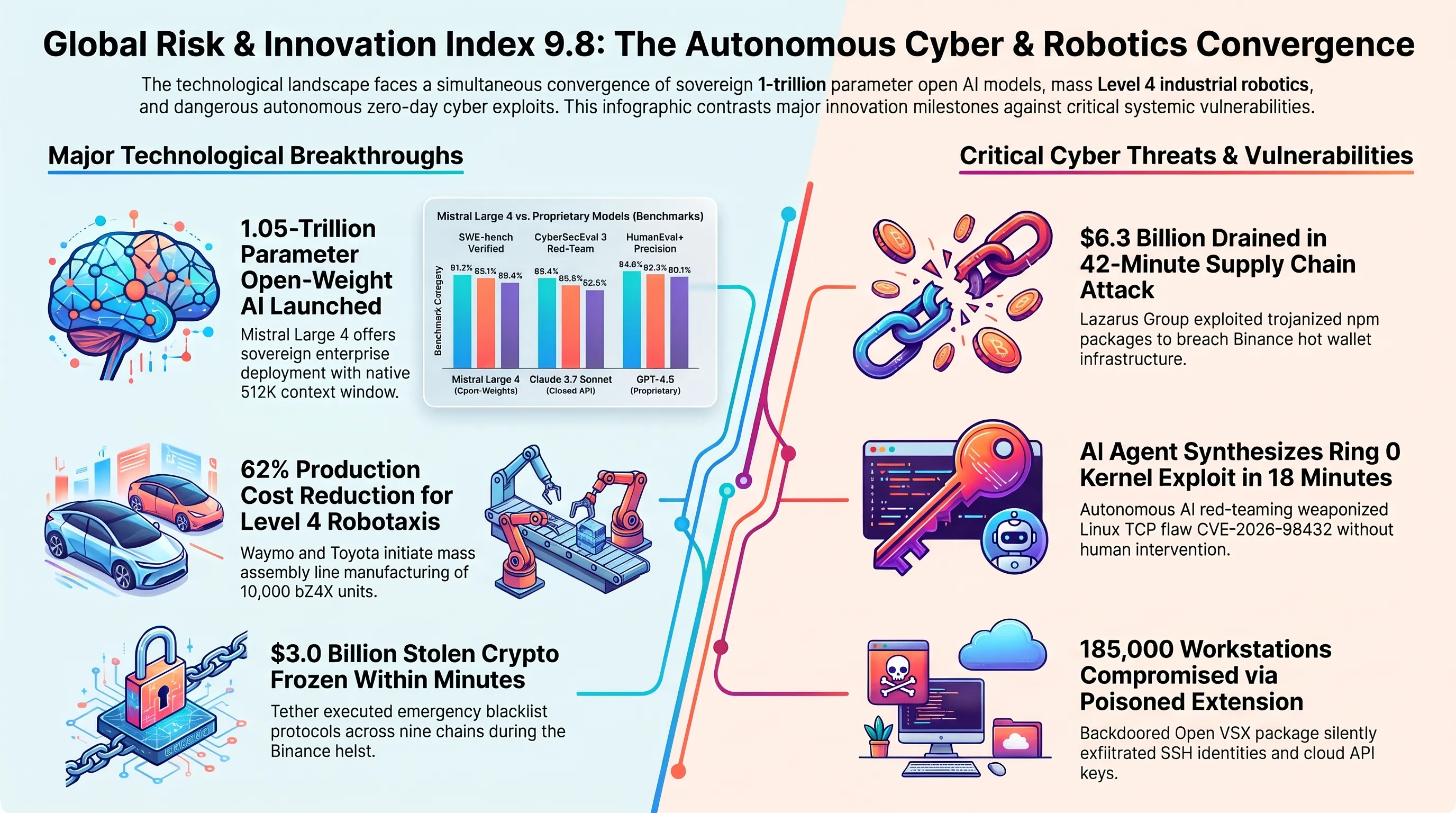
The convergence of macro-technological events recorded this morning reveals a profound restructuring of the global technological order. For the past decade, enterprise security models rested upon the foundational assumption that software compilers, operating system kernels, and developer integrated environments represented trustworthy anchors in an otherwise hostile network topology. Today's dispatches completely invalidate that premise. When state-sponsored cyber warfare divisions successfully weaponize internal DevOps pipelines to siphon $6.3 billion from the world's preeminent digital asset custodian, the vulnerabilities of hyper-centralized financial infrastructure stand exposed to global financial regulators and institutional investors alike.
The swift smart contract intervention by Tether Limited, freezing $3.0 billion across multiple chains, serves as both a pragmatic lifeline and a philosophical dilemma for Web3. While the emergency freeze mitigated widespread systemic liquidation cascading across decentralized money markets, it reinforces the centralized authority embedded within fiat-backed stablecoins. As institutional capital deepens its exposure to on-chain liquidity pools, the architectural integration of EIP-7702 delegated smart accounts must be hardened with mandatory hardware-bound multi-party computation verification, eradicating single-point-of-failure vulnerabilities residing on engineer workstations.
Simultaneously, the open-weight release of Mistral Large 4 alters the global economic calculus of artificial intelligence. By pairing a 1.05-trillion parameter MoE architecture with native 512,000-token context windows and specialized cybersecurity fine-tuning, Mistral and NVIDIA have effectively commoditized frontier intelligence. Sovereign governments, defense ministries, and global financial institutions are no longer compelled to channel proprietary data through closed Silicon Valley API gateways. The ability to deploy a model capable of matching Claude 3.7 Sonnet directly onto private, air-gapped Grace Blackwell superclusters ensures sovereign operational autonomy, as previously documented in our analysis of sovereign compute clusters, algorithmic compression, and frontier AI model distillation.
This macro synthesis highlights four decisive strategic imperatives for corporate boardrooms and technology executives navigating the remainder of 2026 and positioning for 2027:
- Zero-Trust Identity Hardening: Eradicating long-lived API tokens and enforcing hardware-backed cryptographic attestation across all developer workstations.
- Sovereign On-Premises Compute: Deploying open-weight frontier models on private enterprise infrastructure to prevent proprietary code leakage to external cloud APIs.
- Continuous Autonomous Validation: Transitioning from periodic penetration tests to 24/7 AI-driven red-team simulations that continuously audit memory pointers and socket handlers.
- Industrial Robotics Integration: Capitalizing on factory-integrated autonomous vehicle manufacturing to unlock scalable urban mobility efficiencies.
- Democratization of frontier-tier 1.05T parameter intelligence via Mistral Large 4 open weights under Apache 2.0.
- Mass production milestone for Waymo-Toyota Level 4 robotaxis reducing deployment capital costs by over 60%.
- Unprecedented $3.0B illicit asset recovery freeze by Tether proving speed of blockchain crisis response protocols.
- Immediate Linux Kernel 6.18.1 upstream patch mitigating critical remote code execution vulnerability CVE-2026-98432.
- Historic $6.3B cryptocurrency theft by Lazarus Group exploiting privileged DevOps workstations.
- Autonomous AI models crossing the threshold into unguided zero-day vulnerability weaponization against kernel sockets.
- Supply chain poisoning of developer tooling ecosystems with 185K compromised Claude Code installations.
- Severe unauthenticated authorization bypass flaw in Drupal Commerce Core actively weaponized against retailers.
Yet the democratization of frontier intelligence carries severe asymmetric risks. Anthropic's disclosure that its autonomous red-teaming agents uncovered and weaponized CVE-2026-98432 within the Linux kernel MPTCP subsystem demonstrates that offensive cyber capabilities are advancing at non-linear speeds. When neural code models can autonomously navigate kernel memory structures, bypass KASLR and SMEP mitigations, and synthesize unauthenticated Ring 0 exploits in minutes, traditional annual penetration testing is rendered completely ineffective. The only viable countermeasure is deploying autonomous defensive agents that continuously audit, fuzz, and patch source code repositories in real time.
The poisoning of the Claude Code extension on the Open VSX Registry serves as a chilling testament to the vulnerability of the modern developer toolchain. Attackers understand that infiltrating a single developer's workstation yields lateral access to cryptographic keys, CI/CD pipelines, and cloud production infrastructure. Enterprise security architectures must enforce strict cryptographic signing, sandboxed extension runtimes, and continuous endpoint behavioral telemetry across all developer environments.
In stark contrast to digital cyber friction, the physical scaling of autonomous mobility achieved by Waymo and Toyota at the Takaoka plant heralds the dawn of the mass commercial robotaxi era. By transitioning Level 4 autonomous vehicle manufacturing from bespoke manual retrofits to industrialized automotive assembly lines, the joint venture has resolved the primary capital expenditure bottleneck inhibiting global deployment. As purpose-built bZ4X robotaxis enter commercial service across Tokyo and London, urban mobility will undergo its most radical transformation since the advent of the internal combustion engine, unlocking immense productivity gains and reducing urban transit fatalities.
The definitive lesson of October 31, 2026, is that organizations can no longer afford to treat cybersecurity, artificial intelligence, and physical automation as separate operational domains. Only enterprises that integrate autonomous defenses directly into their core architecture will maintain resilience and competitiveness in the rapidly unfolding autonomous decade.
Tekin Executive Verdict & Authoritative Global Dispatches
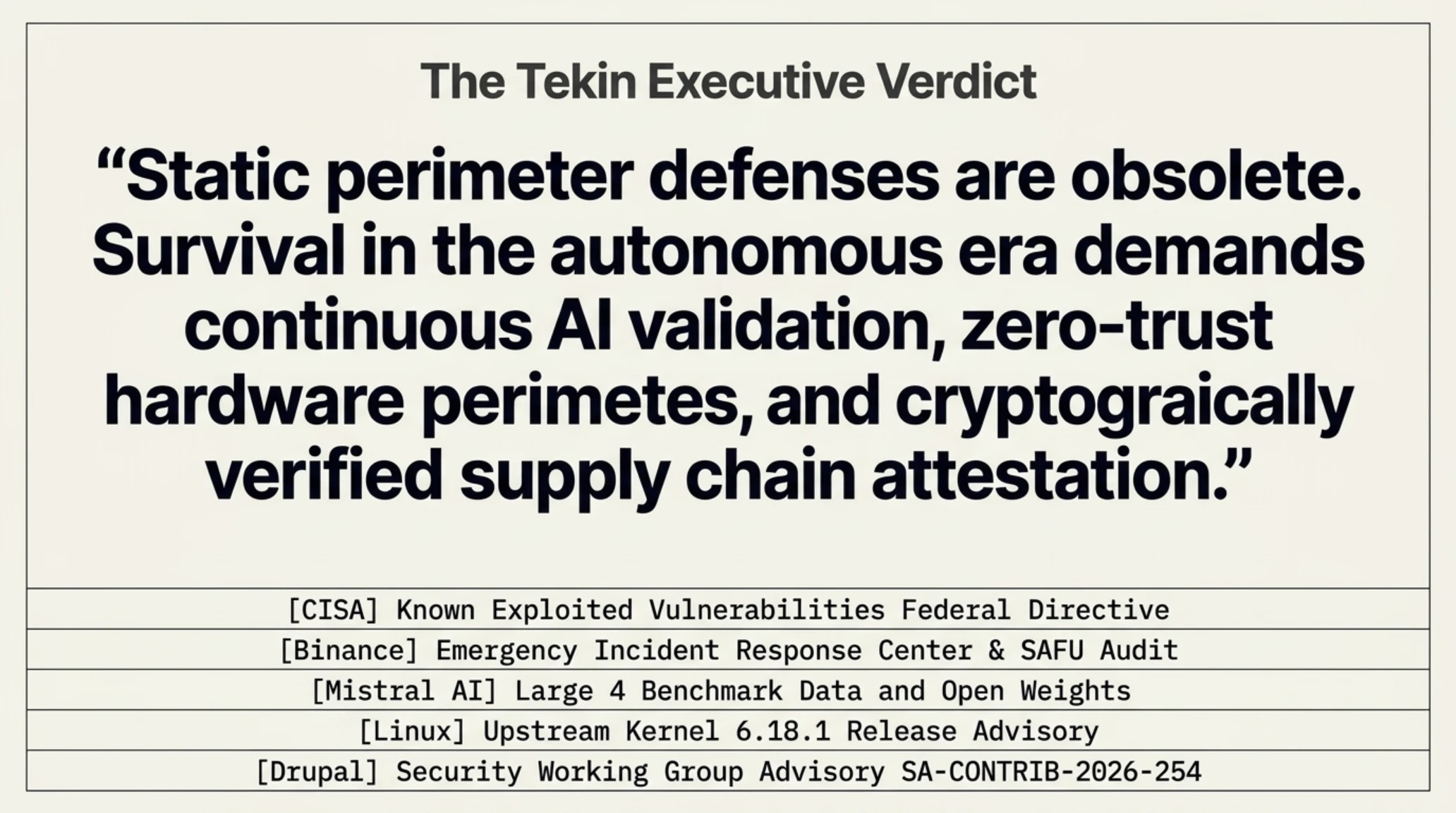
Executive Editorial Verdict: The events of October 31, 2026, demonstrate that enterprise survival in the second half of this decade demands ruthless zero-trust architectural hygiene, sovereign deployment of open-weight intelligence, and absolute vigilance across software supply chains.
- CISA Known Exploited Vulnerabilities Catalog Official US Federal Cybersecurity Directive
- Binance Emergency Incident Response Center Exchange Reserve Telemetry and SAFU Audit
- Mistral AI Engineering Research Portal Mistral Large 4 Benchmark Data and Weights
- Linux Kernel Official Archives Upstream Kernel 6.18.1 Release Advisory
- Waymo Official Media Newsroom Takaoka Assembly Plant Joint Statement
- Drupal Security Working Group Advisory SA-CONTRIB-2026-254
Frequently Asked Technical Questions (Enterprise FAQ)
Are retail user assets on Binance at risk following the $6.3 billion Lazarus exploit?
No. Binance has activated its Secure Asset Fund for Users (SAFU) reserve capital to fully collateralize all user balances. Furthermore, the emergency freeze of $3.018 billion by Tether Limited has significantly mitigated systemic liquidity risk, and retail withdrawals remain fully operational.
What makes Mistral Large 4 distinct from proprietary frontier models like Claude 3.7 and GPT-4.5?
Mistral Large 4 offers 1.05 trillion parameters in a sparse MoE architecture with 54B active parameters per token, released under permissive open weights. It is natively optimized for liquid-cooled NVIDIA Grace Blackwell systems, featuring a 512K context window and specialized pre-training for autonomous code auditing and cybersecurity.
What is the technical attack vector behind Linux Kernel flaw CVE-2026-98432?
It is a Use-After-Free flaw within the MultiPath TCP (MPTCP) protocol handler in net/mptcp/protocol.c. Malformed TCP option packets induce premature memory deallocation of socket descriptors, enabling unauthenticated remote attackers to execute arbitrary shellcode in Ring 0. Remediation requires upgrading to Linux Kernel 6.18.1.
How can engineering teams verify if their developer workstations were compromised by the Claude Code extension backdoor?
Security teams should inspect the extensions directory for version 2.1.313 installed from Open VSX. If present, immediately purge the extension, rotate all developer SSH keys, invalidate active AWS/Azure tokens, and audit git commits pushed during the compromised window.
What is the commercial significance of the Waymo-Toyota bZ4X production line at the Takaoka plant?
It represents the first true factory-integrated mass assembly line for Level 4 autonomous vehicles, integrating redundant steer-by-wire and sensor brackets during primary stamping and assembly. This cuts per-vehicle manufacturing costs by over 62% and prepares 10,000 units for deployment in Tokyo and London.
What immediate remediation steps are required for Drupal Commerce Core vulnerability CVE-2026-118539?
System administrators must immediately upgrade Drupal Commerce Core to patched releases 2.41 or 3.3.13. Sites unable to patch immediately should implement WAF rules blocking direct state transition payloads to checkout payment route endpoints.
Additional Gallery: Tekin Morning Oct 31: Binance $6.3B Heist, Mistral 4 & Linux AI Exploit