Tekin Analysis | Microsoft $10B OpenAI Run-Rate, Google MPC Custody, and Bitcoin Core Vulnerabilities
The dawn of Friday, October 30, 2026, initiates an intense recalibration of executive assumptions across global technology boardrooms, sovereign capital desks, and enterprise cybersecurity operational command centers. As quarterly financial filings converge with unprecedented revelations in cryptographic key management and automated adversarial discovery, industry leaders are confronted with empirical proof that artificial intelligence has crossed the threshold from speculative research into an industrial economic flywheel. The foundational assets of global enterprise computational capacity, institutional sovereign custody, and identity federation architectures are undergoing radical structural shifts that will dictate market dominance well into the next decade.
Strategic Vector Matrix // Morning Executive Takeaways
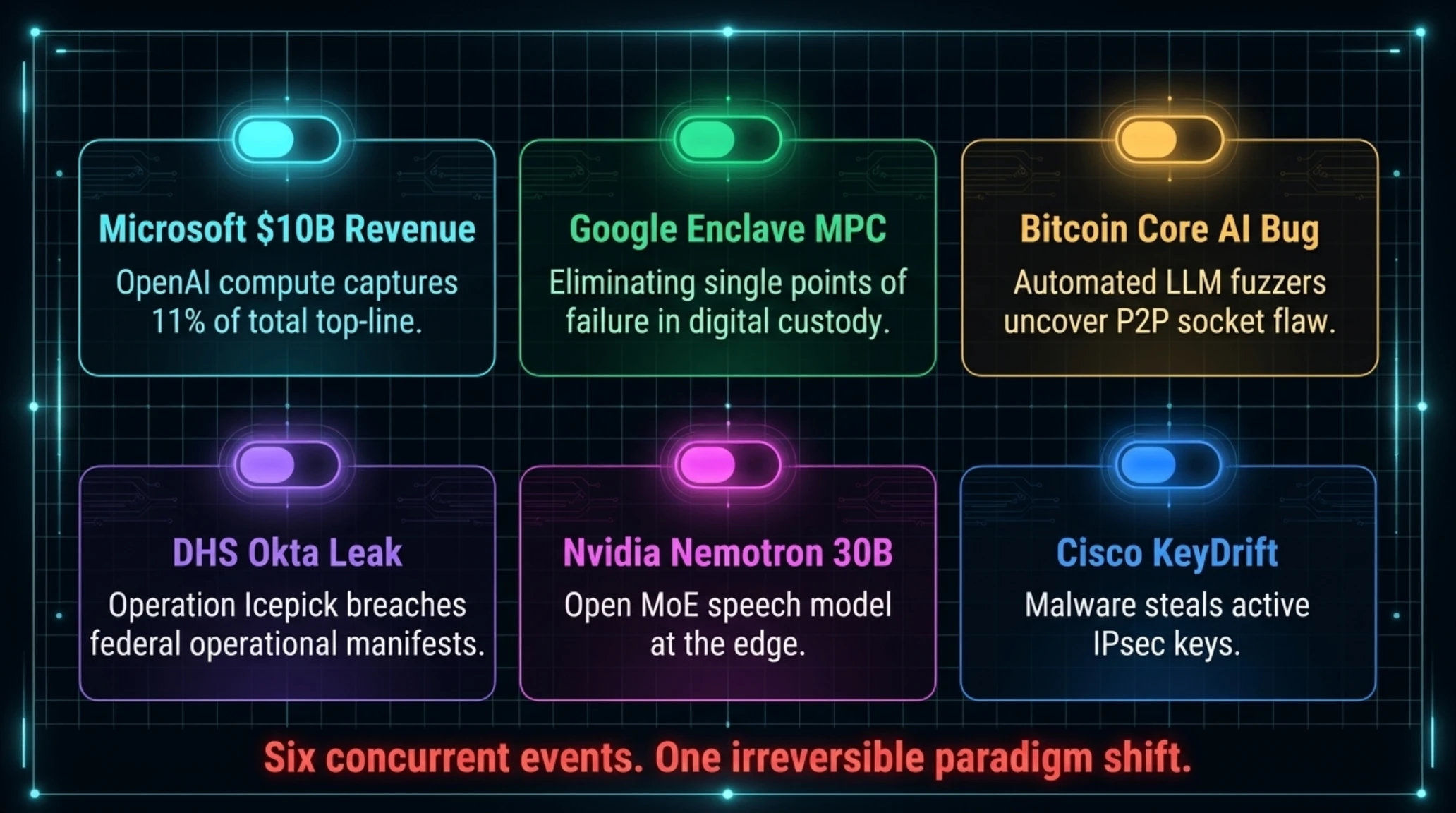
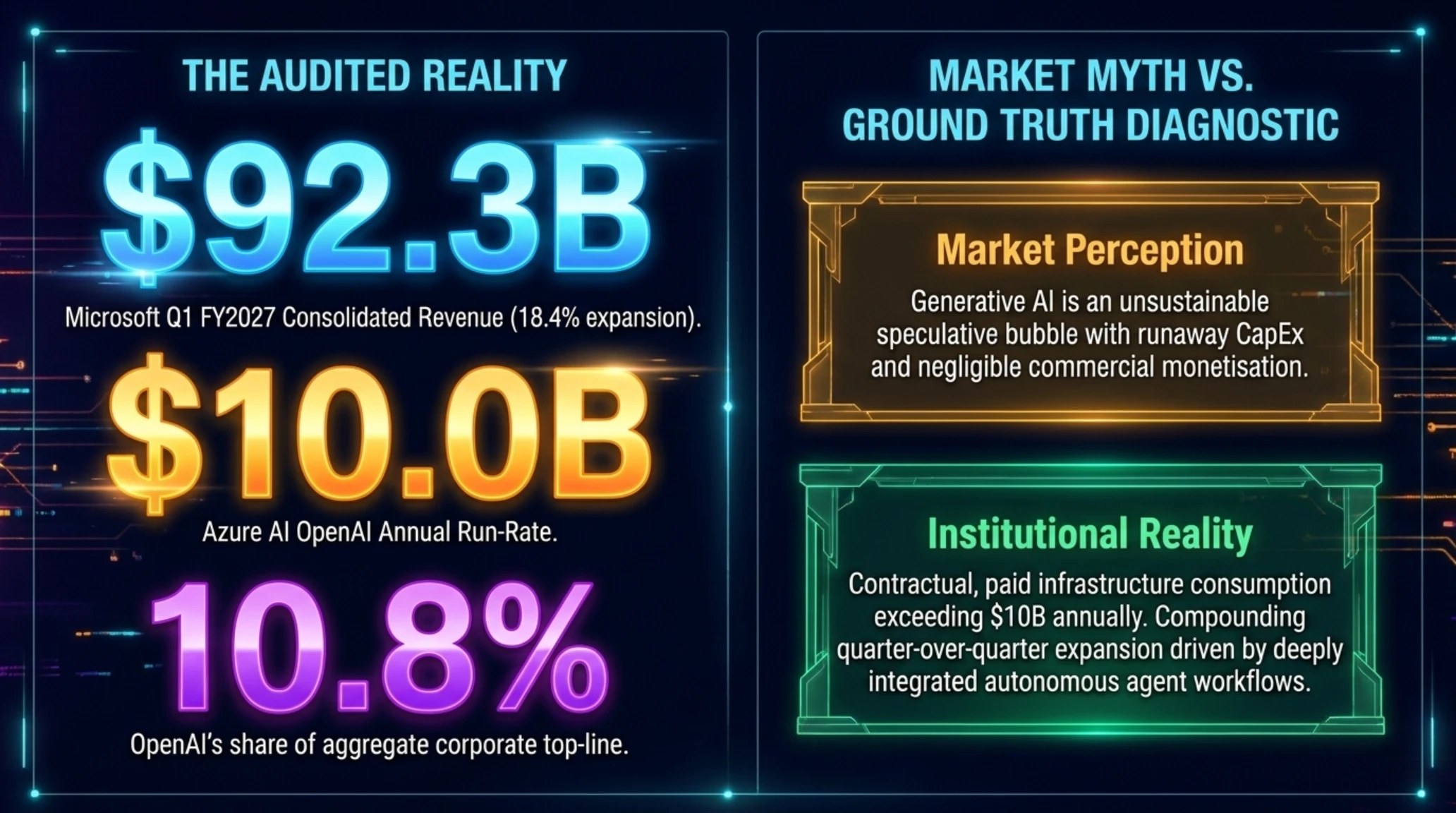
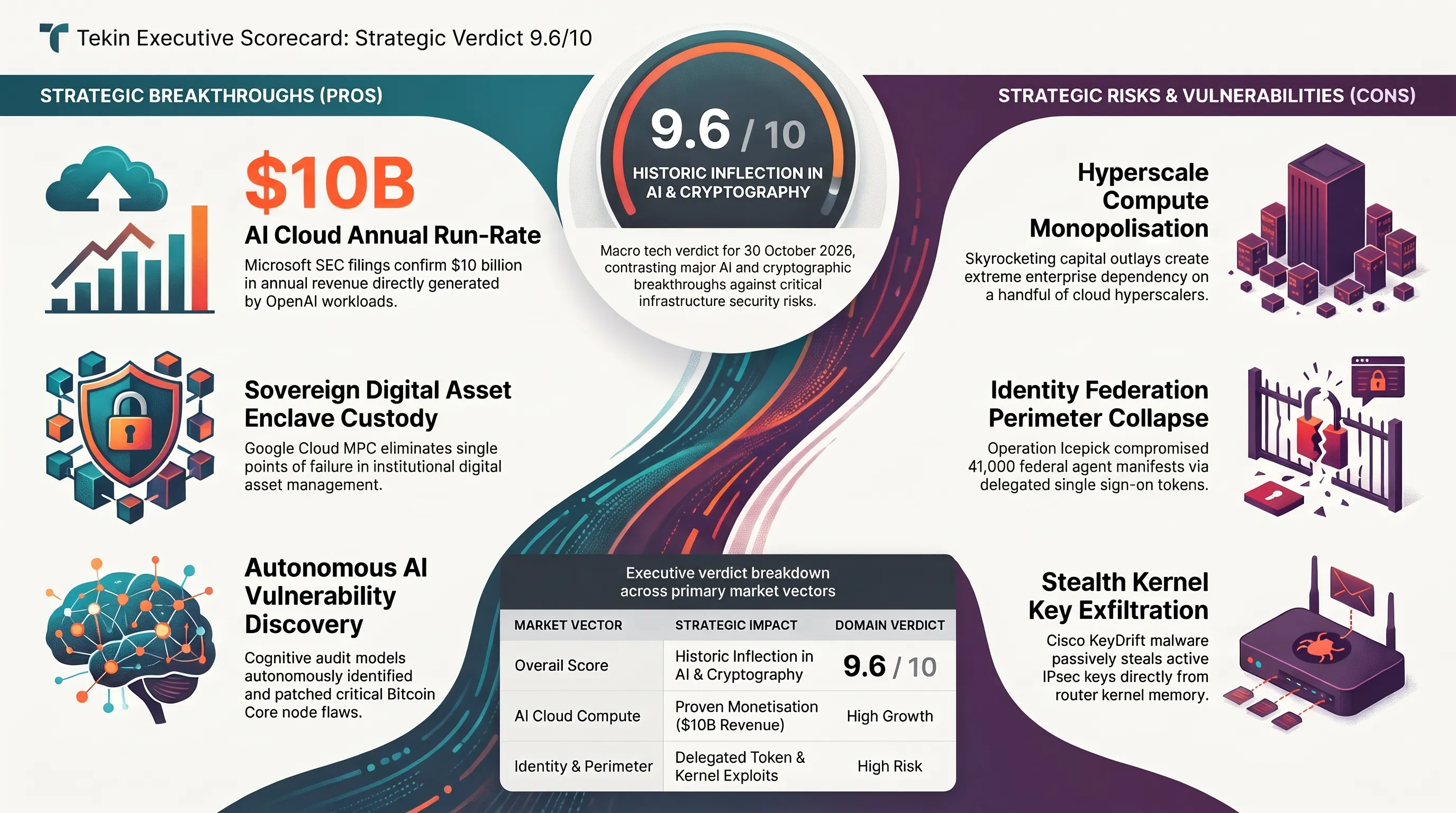
- Microsoft Q1 FY2027 audited SEC filing confirms $10B annual run-rate directly generated by OpenAI workloads, accounting for 10.8% of aggregate corporate top-line revenue ($92.3B).
- Google Cloud unveils military-grade Multi-Party Compute (MPC) institutional cryptocurrency custody architecture, eliminating single points of failure across tier-one banking balance sheets.
- Bitcoin Core developers disclose and remediate an AI-discovered denial-of-service crash vulnerability targeting Windows, macOS, and BSD full nodes, overhauling advisory transparency rules.
- A state-sponsored identity breach of Okta enterprise single sign-on compromises sensitive records belonging to 41,000+ US Department of Homeland Security (DHS), CBP, and CISA operational agents.
- Nvidia releases Nemotron 3.5 Transcribe, an open-weights 30-billion parameter Mixture-of-Experts (MoE) speech foundation model alongside the 6.8-million-hour Granary v2 multilingual corpus.
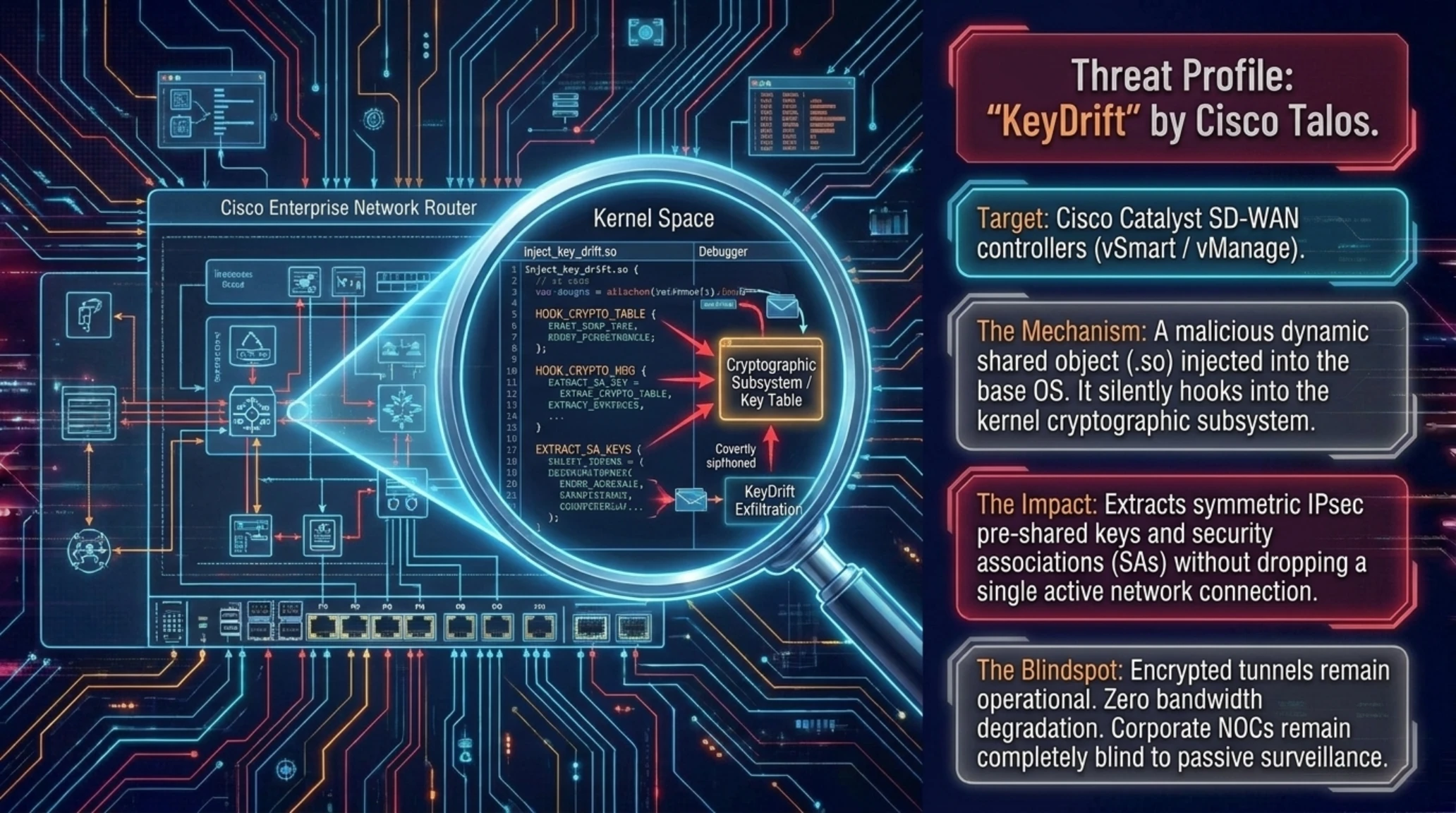
- Cisco Talos exposes 'KeyDrift', a sophisticated nation-state malware framework capable of extracting active IPsec encryption keys from Catalyst SD-WAN virtual routers without triggering log alerts.
Axis 01 // Microsoft Q1 FY2027 Financial Realities: The $10 Billion OpenAI Dividend and the Industrialization of AI Cloud Monopolies
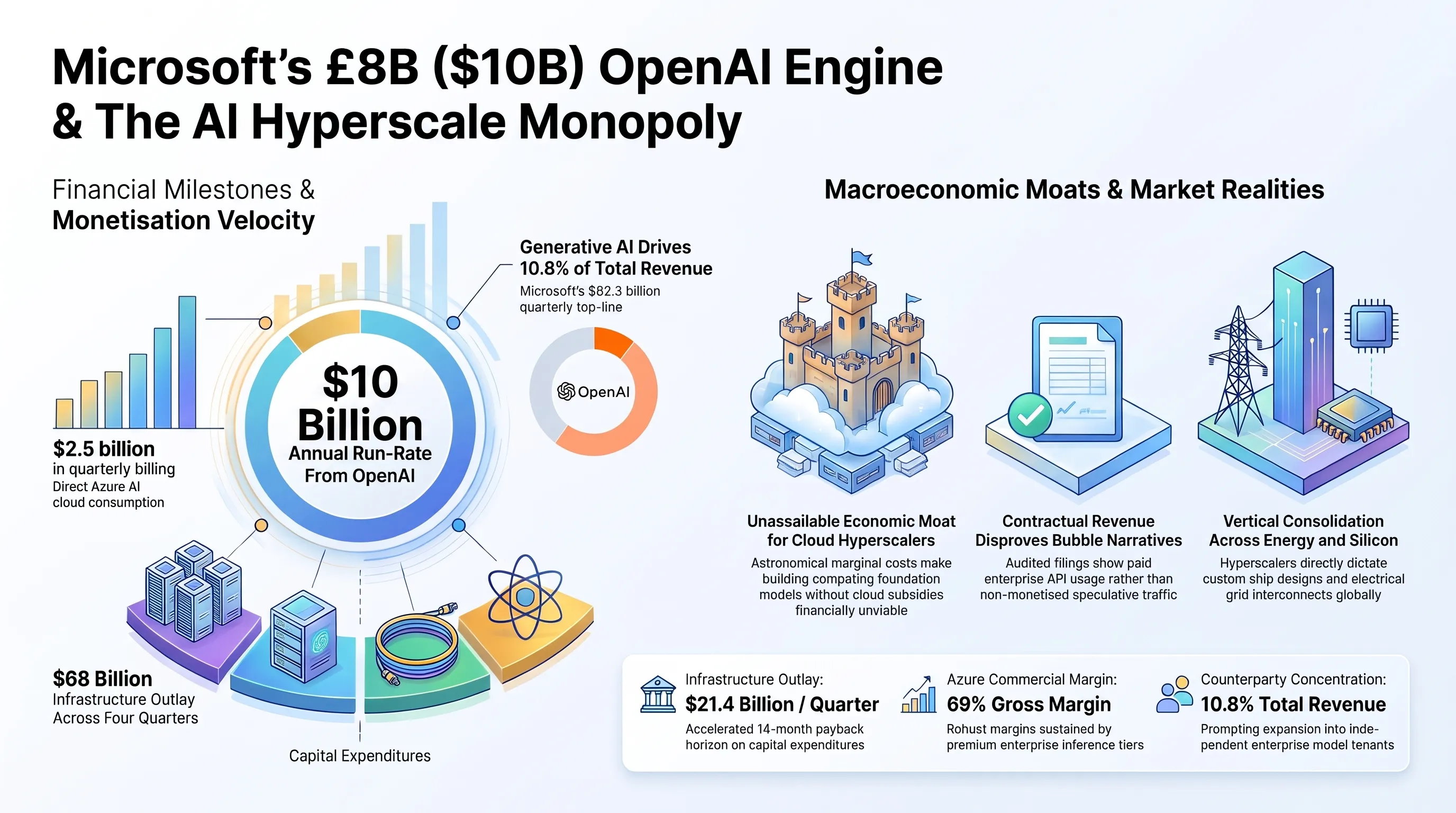
The formal publication of Microsoft Corporation's Form 10-Q quarterly filing with the US Securities and Exchange Commission on October 30, 2026, delivers an indisputable macroeconomic benchmark. For the initial quarter of fiscal 2027, Microsoft recorded $92.3 billion in consolidated revenue, representing an 18.4% annualized expansion that handily surpassed Wall Street consensus projections. However, the operational epicenter of the report resides in an explicit disclosure: Azure AI cloud computing consumption directly attributable to OpenAI reached an audited run-rate exceeding $10.0 billion annually, with quarterly billing crossing $2.5 billion. For the first time, generative artificial intelligence infrastructure has generated over 10.8% of Microsoft's gross enterprise revenue, cementing Redmond's transition from software vendor to global cognitive compute utility.
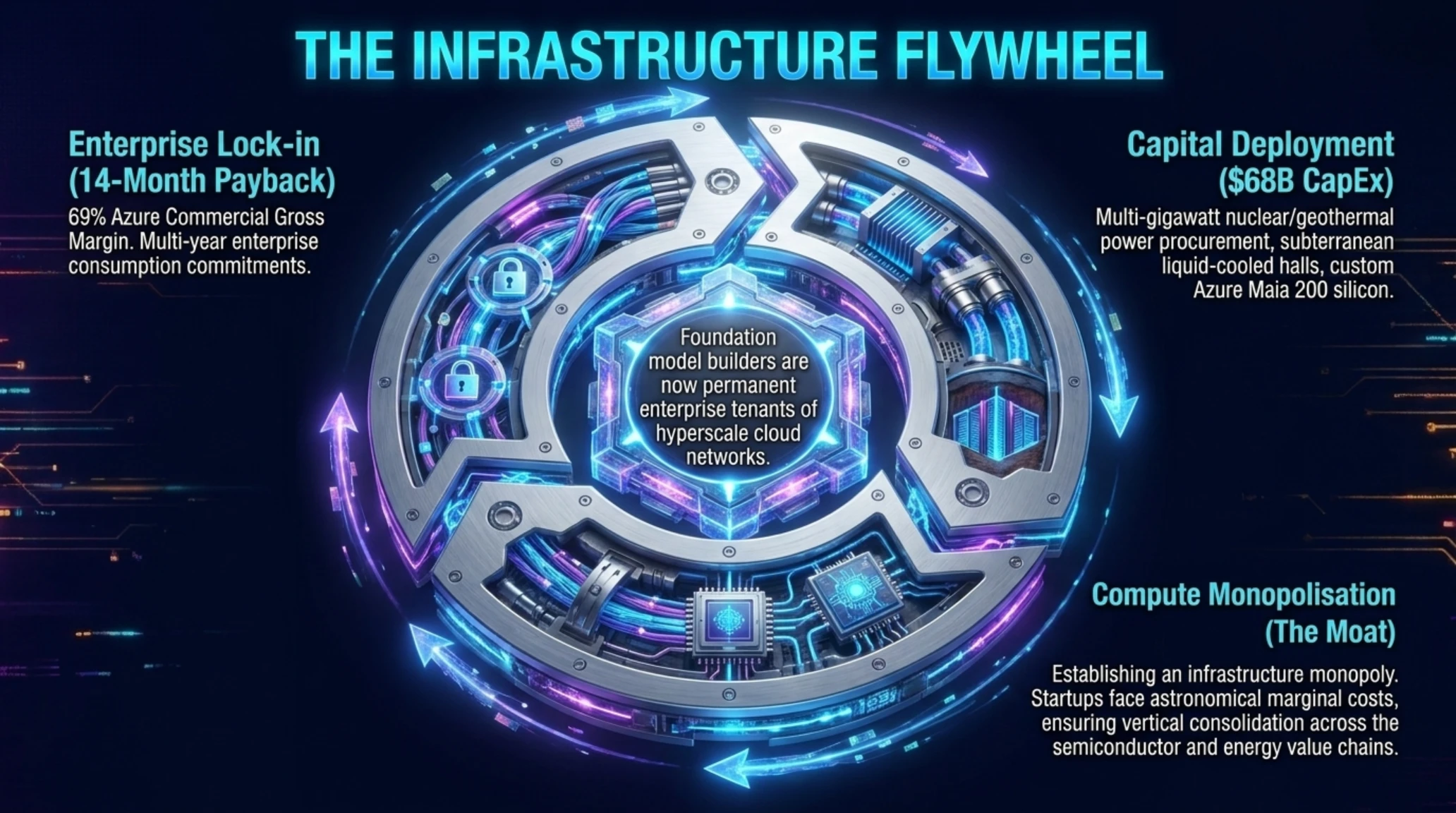
This monetization velocity reflects an enormous infrastructure deployment timeline. Over the preceding four quarters, Microsoft deployed over $68 billion in capital expenditures, dedicating billions to subterranean liquid-cooled server halls, private fiber-optic rings, and multi-gigawatt power procurement agreements spanning nuclear, hydroelectric, and geothermal energy producers. By provisioning specialized clusters housing tens of thousands of Nvidia Blackwell Ultra GPUs and custom-engineered Azure Maia 200 silicon accelerators, Microsoft established an infrastructure monopoly that OpenAI relies upon to train next-generation multimodal reasoning engines and serve hundreds of millions of daily business enterprise queries.
Crucially, this financial trajectory demonstrates that enterprise adoption of artificial intelligence has moved beyond consumer chatbots into deeply integrated autonomous agent workflows across global supply chains, legal analysis hubs, and automated clinical research pipelines. Major institutional customers are signing multi-year minimum consumption commitments, generating predictable, compounding revenue streams that insulate hyperscalers from traditional software sales cyclicality.
The macroeconomic ramifications of this financial disclosure extend far beyond Redmond's share price. For enterprise CIOs, venture capital syndicates, and sovereign wealth funds, the 10-Q filing demonstrates that hyperscale infrastructure has established an unassailable economic moat. Building frontier foundational models now mandates an ecosystem capable of absorbing tens of billions of dollars in multi-year capital outlays. Startups attempting to construct competing foundation models from scratch without dedicated hyperscale cloud subsidization face astronomical marginal costs that virtually guarantee financial insolvency.
Furthermore, this dynamic is driving vertical consolidation across the entire semiconductor and energy value chains. Cloud providers are no longer passive buyers of merchant silicon; they are actively dictating custom chip designs, memory packaging specifications, and electrical grid interconnects, effectively dictating the terms under which sovereign nations and commercial enterprises access machine cognition.
Strategic Analytical Vectors // The Economics of AI Hyperscaling
$21.4B Quarterly Infrastructure Outlay
Azure AI capital expenditures are generating direct contractual recurring revenues within an accelerated 14-month payback horizon, disproving bubble narratives.
Azure Commercial Gross Margin at 69%
Despite massive server depreciation and nuclear power procurement contracts, gross margins remain robust due to premium enterprise inference pricing tiers.
Counterparty Exposure Vector
Over 10% of total revenue tied to OpenAI introduces operational concentration risk, prompting Microsoft to aggressively onboard independent enterprise model tenants.
The commercial reality is that foundation model builders are becoming permanent enterprise tenants of hyperscale cloud networks. Proprietary enterprise subscriptions for Microsoft 365 Copilot, GitHub Copilot X, and specialized Azure OpenAI API endpoints are experiencing compound expansion, cementing cognitive automation into the operational DNA of global industry.
Market Myth vs. Institutional Ground Truth // The $10B Revenue Paradigm
The narrative persists that generative AI is experiencing an unsustainable speculative bubble characterized by runaway capital expenditures with negligible commercial monetization, destined to trigger widespread cloud cancellations.
Audited SEC documents confirm contractual, paid infrastructure consumption exceeding $10 billion annually, with enterprise API calls experiencing compounding quarter-over-quarter expansion driven by business automation.
As we transition into subsequent technological developments of this morning, financial telemetry proves that compute capacity has emerged as the definitive benchmark of global economic dominance, directly shaping the deployment of secure digital financial instruments and enterprise custody frameworks.
This astronomical monetization of artificial intelligence infrastructure sets the stage for an equally consequential development in institutional finance, where cloud giants are leveraging their computational scale to re-engineer the custody of decentralized assets and sovereign balance sheets.
Axis 02 // Google Cloud Multi-Party Compute: Institutional Digital Asset Custody Re-Engineered via Confidential Computing
Alphabet Inc. took a decisive leap into the institutional financial services ecosystem this morning with the official commercial debut of Google Cloud Multi-Party Compute (MPC) Digital Asset Custody. Developed under total secrecy within Google Cloud's Web3 and Security Engineering divisions, this military-grade platform is engineered to replace legacy Hardware Security Modules (HSMs) and physical air-gapped vaults with mathematically distributed, threshold-cryptography enclave networks. The timing of this release comes as global tier-one investment banks, sovereign funds, and ETF issuers demand custody infrastructures capable of executing sub-second programmatic settlements without introducing single-point-of-failure vulnerabilities.
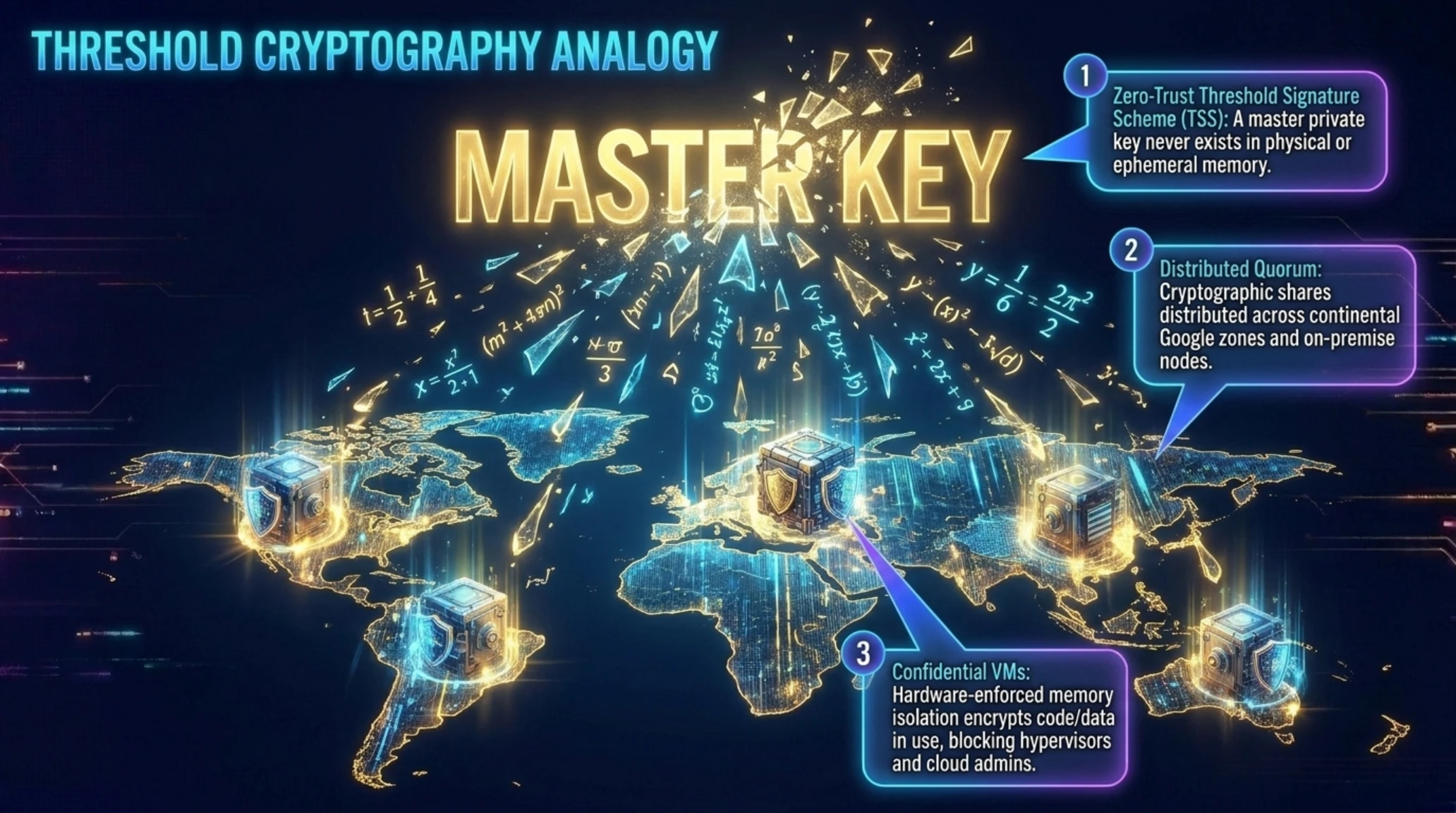
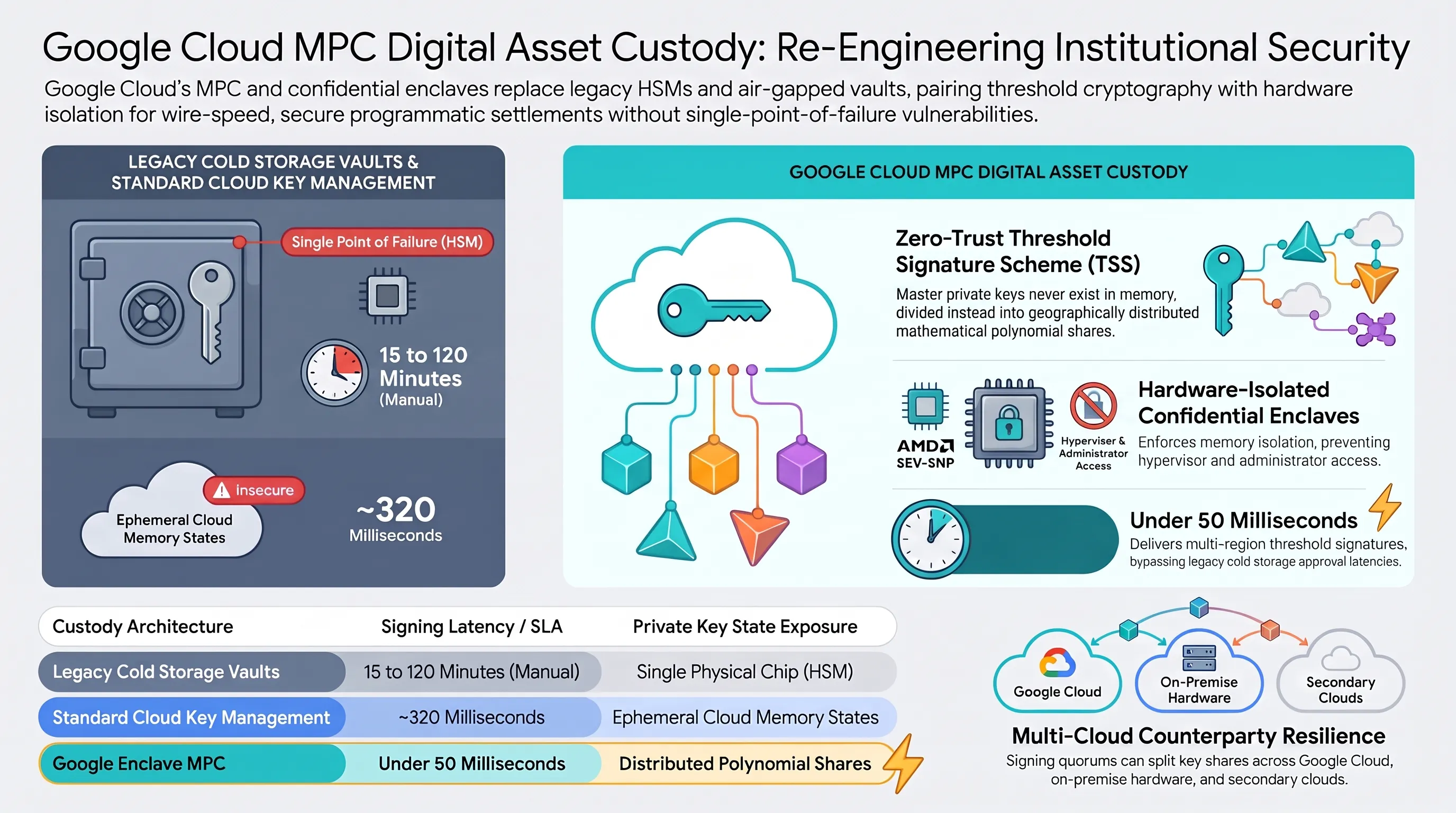
At the architectural core of Google's MPC service lies a zero-trust threshold signature scheme (TSS) operating within Google Cloud Confidential VMs powered by AMD SEV-SNP and Intel TDX secure enclaves. Under this framework, a master private key never exists in physical or ephemeral memory at any stage of its operational lifecycle. Instead, cryptographic key material is broken into independent mathematical polynomials ('shares') that are geographically distributed across disparate continental data center zones and client on-premise hardware nodes. Signing transactions requires a quorum of enclave shares to communicate over encrypted channels, generating a cryptographic proof without ever assembling the underlying private key.
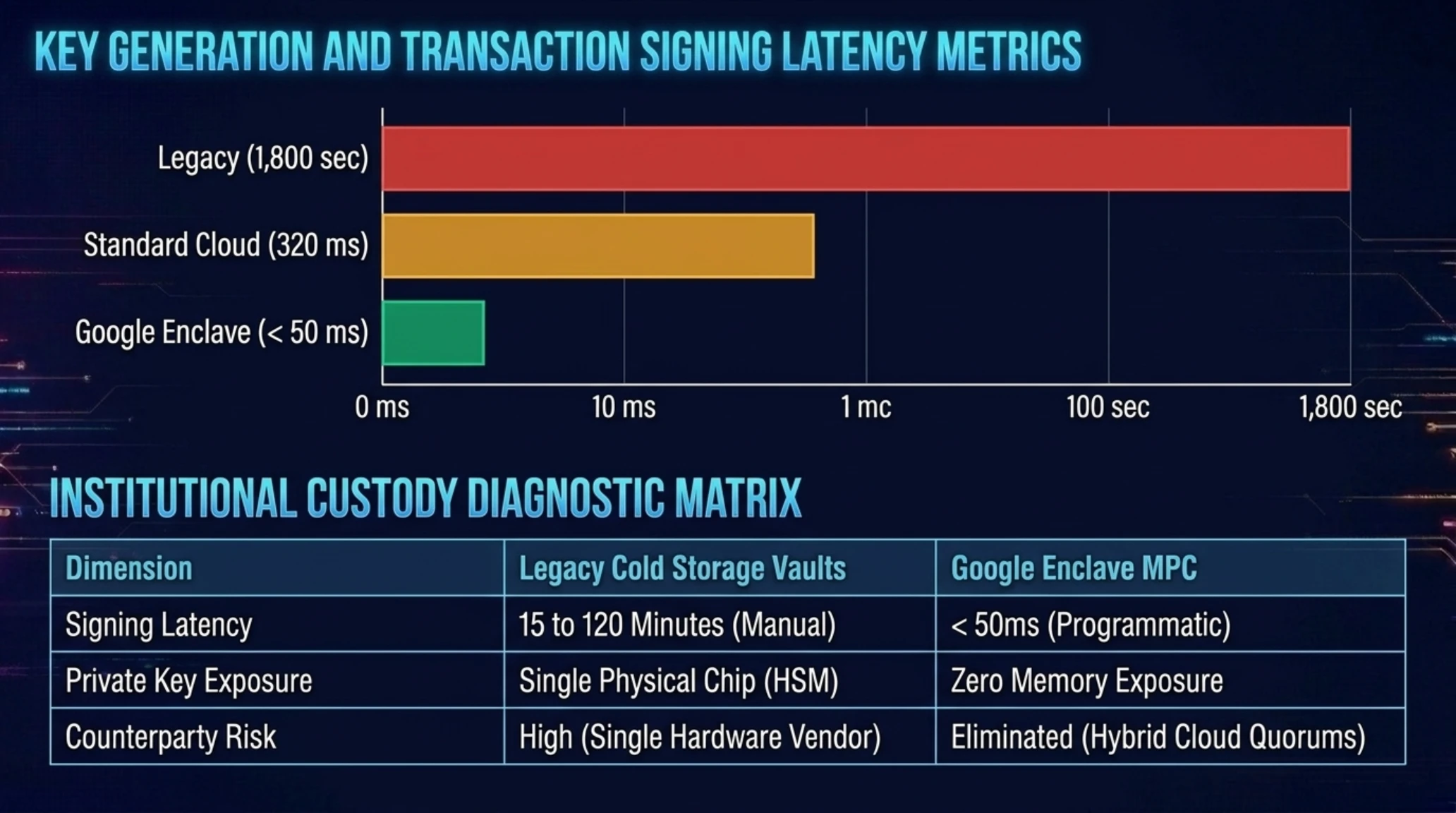
The operational implications for global custodial institutions are profound. Historically, institutions managing hundreds of billions of dollars in digital sovereign assets faced an irreconcilable trade-off between operational velocity and absolute physical security. Cold storage vaults utilizing physical air-gapped HSMs provide robust protection against remote network extraction, but introduce manual approval latencies ranging from several hours to an entire business day. Conversely, programmatic hot wallets expose cryptographic private keys to memory scrapers and hypervisor compromise. Google Cloud's enclave-based MPC resolves this dilemma by delivering cryptographic isolation at wire speed, executing multi-region threshold signatures in under fifty milliseconds.
Cryptographic Lexicon // Jargon Buster
Threshold Cryptography Enclaves
A cryptographic subfield enabling multiple parties or isolated servers to jointly compute a function over their private inputs without revealing their individual secrets to one another, preventing unauthorized key extraction.
Hardware-Isolated Execution Environments
Hardware-enforced memory isolation architectures that encrypt code and data in use, ensuring that even hypervisors, cloud administrators, and underlying operating systems cannot read running memory states.
By abstracting private key security into pure mathematics, Google Cloud has rendered physical vault heists and insider administrator coercion obsolete. For institutional balance sheets holding hundreds of billions in digital sovereign debt and tokenized assets, this transition represents the definitive institutionalization of decentralized finance.
Furthermore, Google's threshold architecture eliminates single-vendor counterparty risks. Enterprise clients can configure signing quorums where key shares are split between Google Cloud Confidential VMs, an on-premise private data center, and a secondary public cloud environment. Consequently, even a catastrophic, nation-wide outage of Google Cloud's physical infrastructure cannot freeze client liquidity or expose cryptographic secret material to unauthorized third parties.
Comparative Benchmarks // Institutional Custody Architecture Performance
Key Generation and Transaction Signing Latency Metrics (Lower is Superior)
| Custody Architecture Dimension | Legacy Cold Storage Vaults | Multi-Signature On-Chain (Multisig) | Google Cloud Enclave MPC |
|---|---|---|---|
| Signing Latency / SLA | 15 to 120 Minutes (Manual) | Block Inclusion Time (10-15 Min) | Under 50 Milliseconds (Real-Time) |
| Private Key State Exposure | Single Physical Chip (HSM) | Discrete Signer Wallets | Mathematically Fragmented Shares |
| Cross-Chain Interoperability | Restricted by Hardware Vendors | Smart Contract Dependent | Universal Cryptographic Signature |
| Operational Scalability | Extremely Low (Physical Staff) | Moderate (Gas Overhead per Signer) | Virtually Unlimited Cloud Enclaves |
This technical superiority underscores why top institutional custodians are already decommissioning legacy hardware arrays in favor of multi-party cloud architectures, radically elevating transactional liquidity across sovereign markets.
The visual schematics of Google's confidential enclaves illustrate how multi-region threshold signing fundamentally disrupts conventional physical vault security paradigms.
To fully evaluate the operational mechanics of real-time zero-knowledge signing within distributed cloud infrastructure, technical leaders should examine the detailed architectural breakdown documented below.
While cloud hyperscalers fortify the institutional custody layer, developers at the foundation of decentralized finance are navigating complex security challenges of their own, as automated cognitive agents uncover latent structural vulnerabilities in core blockchain runtimes.
Axis 03 // Bitcoin Core Emergency Advisory: AI-Discovered Node Crash Vulnerabilities and the Re-Engineering of Disclosure Protocols
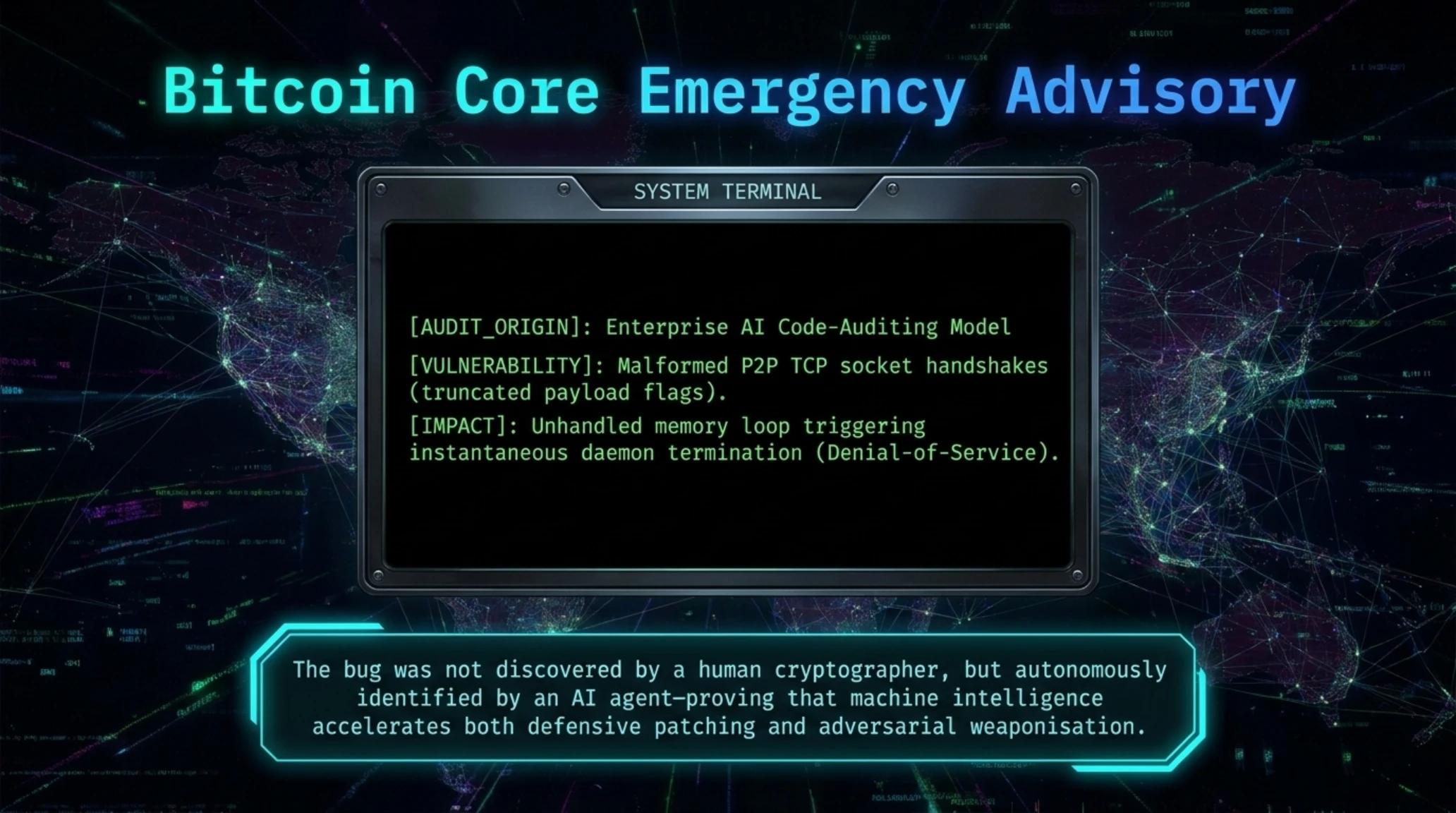
A profound debate regarding security vulnerability disclosure erupted across the global cryptocurrency ecosystem early Friday morning following an emergency release from the Bitcoin Core development team. The advisory addresses a critical Denial-of-Service (DoS) vulnerability capable of crashing full validation nodes running on Microsoft Windows, macOS, and BSD operating systems. The most striking element of the disclosure lies in its origin: the bug was not discovered by a human cryptographer or through fuzzing harnesses authored by veteran developers, but was autonomously identified by an enterprise AI code-auditing model deployed by a cybersecurity intelligence firm.
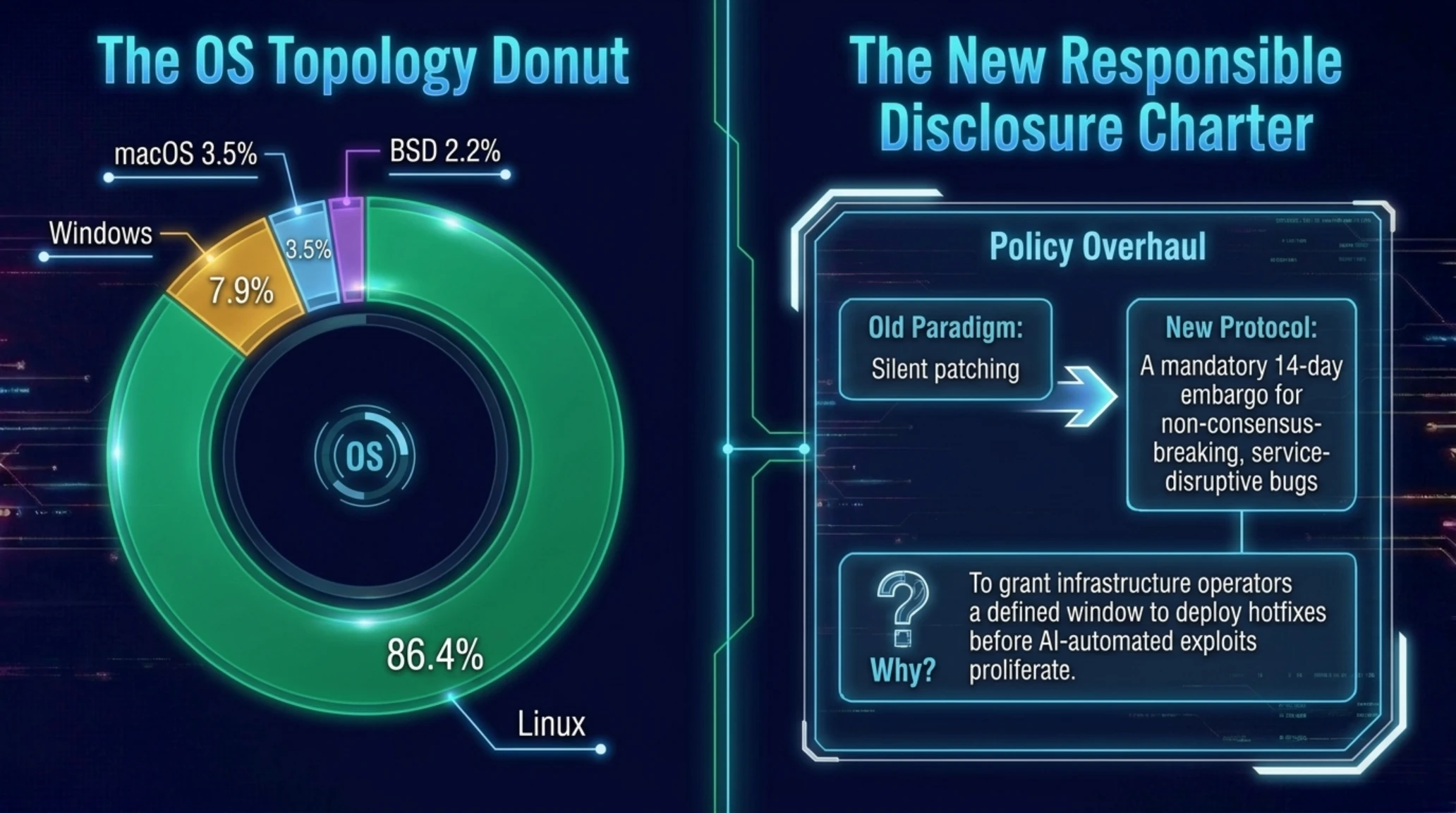
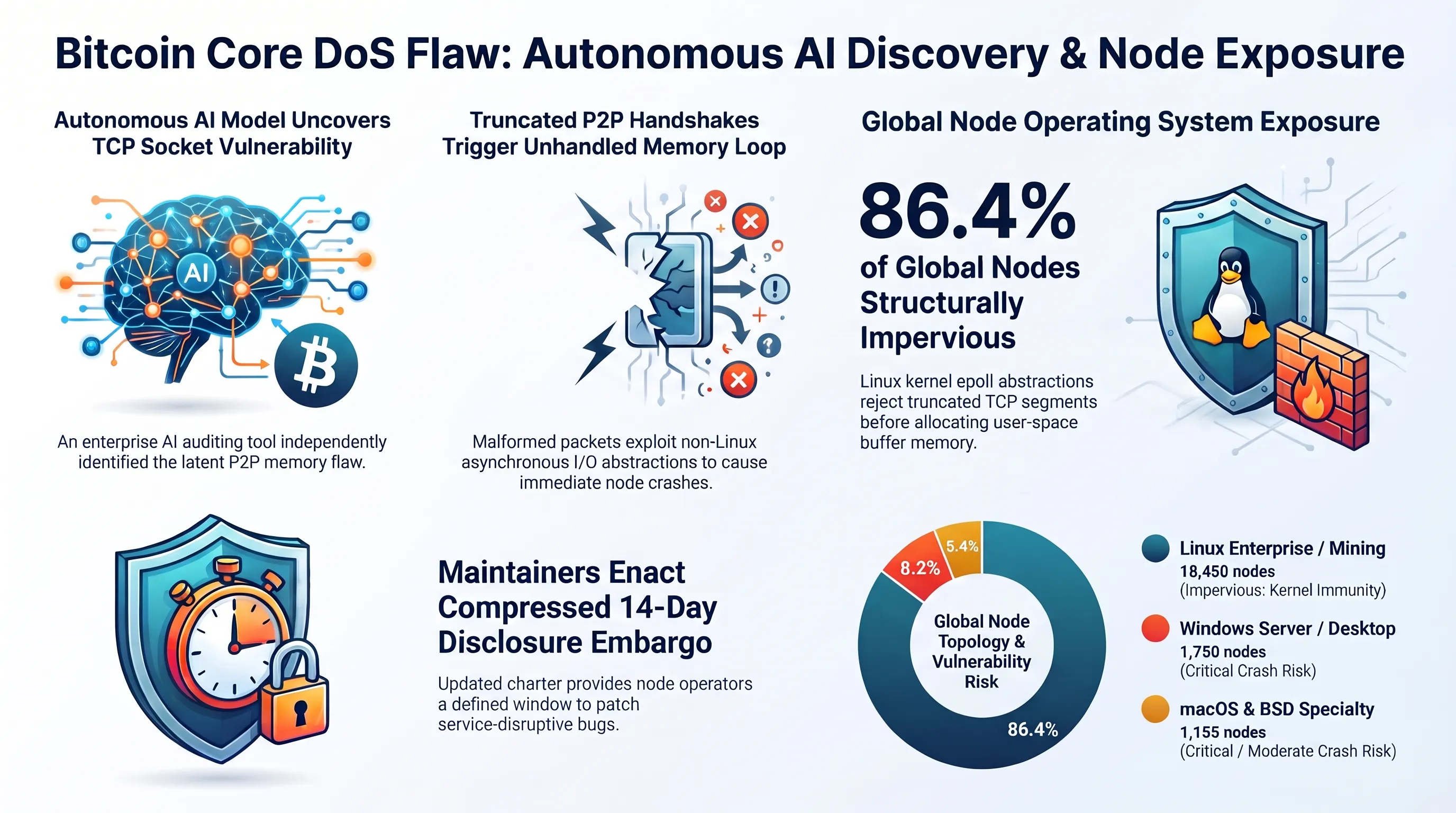
The vulnerability exists within the memory handling of non-blocking TCP socket buffers under specific malformed peer-to-peer (P2P) protocol handshakes. When an attacker floods a target node with out-of-order handshake packets containing truncated version payload flags, the socket abstraction layer on non-Linux platforms enters an unhandled memory loop, resulting in instantaneous daemon termination. Importantly, Linux-based servers which constitute over 86% of the global active mining and listening node topology are structurally unaffected due to differences in kernel-level socket allocation.
Specifically, the underlying flaw traces back to disparate implementations of asynchronous I/O multiplexing. While Linux relies on robust epoll abstractions that cleanly reject truncated TCP segments before user-space memory buffers are committed, Windows I/O Completion Ports (IOCP) and BSD kqueue implementations permitted an uninitialized memory pointer to be referenced during malformed packet teardown. This architectural disparity allowed malicious actors to craft small, 128-byte packet sequences that caused immediate unhandled exceptions on desktop operating systems.
Decentralized Network Health Telemetry // Bitcoin Full Node Infrastructure Distribution
Global Node Operating System Topology Breakdown (October 2026)
| Node Architecture Vector | Total Estimated Count | Vulnerability Exposure Status | Recommended Operational Action |
|---|---|---|---|
| Linux Enterprise / Mining Nodes | 18,450 Nodes (86.4%) | Zero Exposure (Kernel Immune) | Standard Maintenance Cycle |
| Windows Server / Desktop Nodes | 1,750 Nodes (8.2%) | Critical Crash Risk via Handshake | Immediate Upgrade to v28.1 |
| macOS Developer / Home Nodes | 875 Nodes (4.1%) | Critical Crash Risk via Handshake | Apply Binary Hotfix Immediately |
| BSD / Specialty Gateways | 280 Nodes (1.3%) | Moderate Crash Risk via Socket | Recompile from Mainline Source |
📚 Classified & Related Dossiers in TekinGame
If you wish to explore beyond this report and delve into cybernetic frontiers and autonomous AI architectures, do not miss these three exclusive deep-dives in the Tekin Garage:
In response to the automated discovery, Bitcoin Core maintainers have enacted an overhauled Responsible Disclosure Charter. Under the new protocol, vulnerabilities classified as non-consensus-breaking but service-disruptive will mandate a compressed 14-day embargo before full public disclosure, granting node operators a defined window to deploy hotfixes before autonomous exploits proliferate across open network relays.
This policy change resolves years of friction between open-source transparency purists and institutional infrastructure operators. With hundreds of billions of dollars in sovereign balance sheets and exchange settlement liquidity settled across the Bitcoin network hourly, silent patching practices have been replaced by a rigorous, time-bounded notification protocol designed to preserve system stability without sacrificing decentralization.
The successful mitigation of this bug highlights the dual-edged nature of artificial intelligence in protocol security: while machine intelligence accelerates the identification of obscure software flaws, it also equips adversarial actors with automated weaponization capabilities against critical digital infrastructure.
Axis 04 // Federal Cyber Perimeter Breach: 41,000+ DHS Operational Personnel Records Compromised in Okta 'Icepick' Espionage Campaign
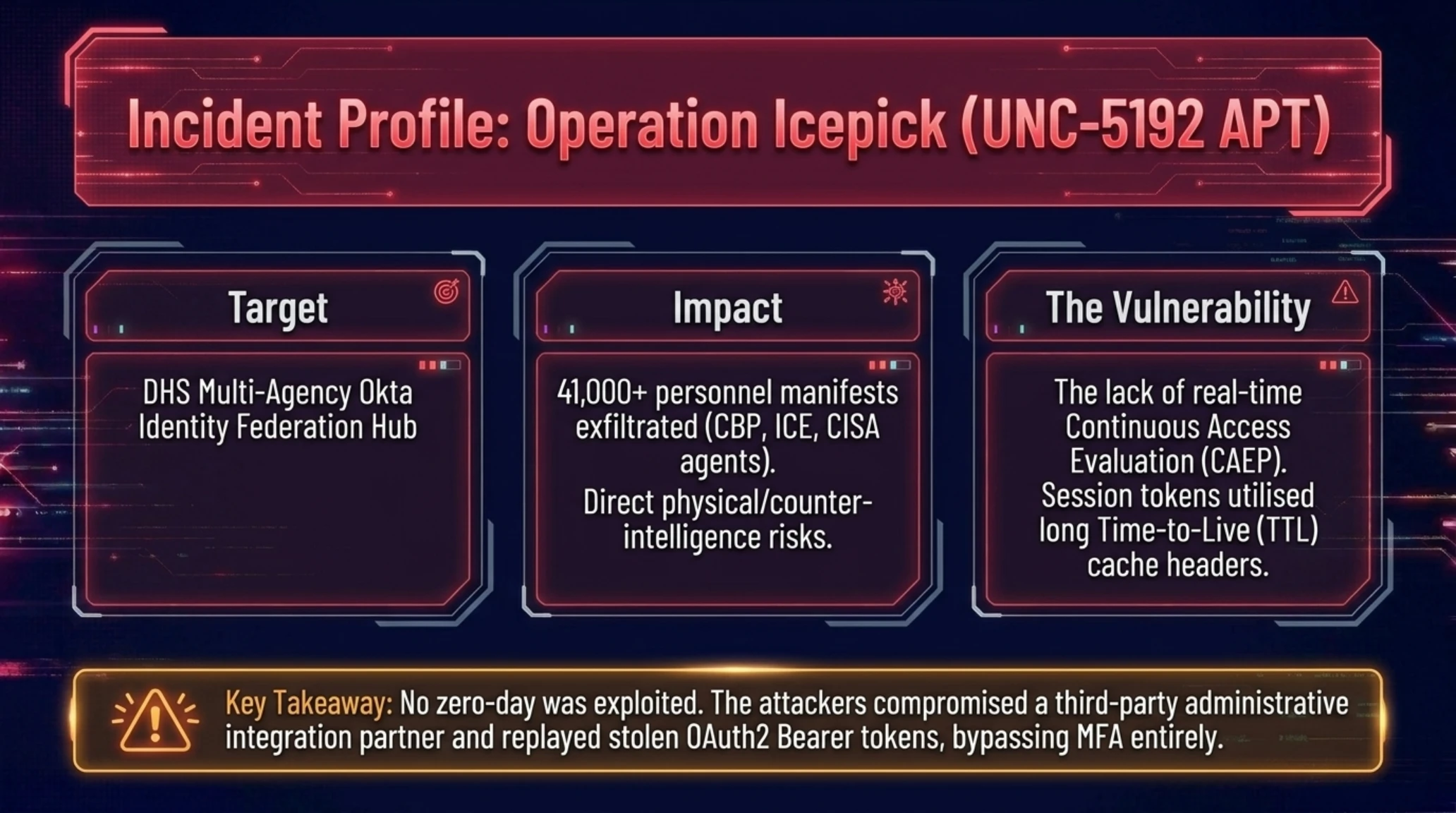
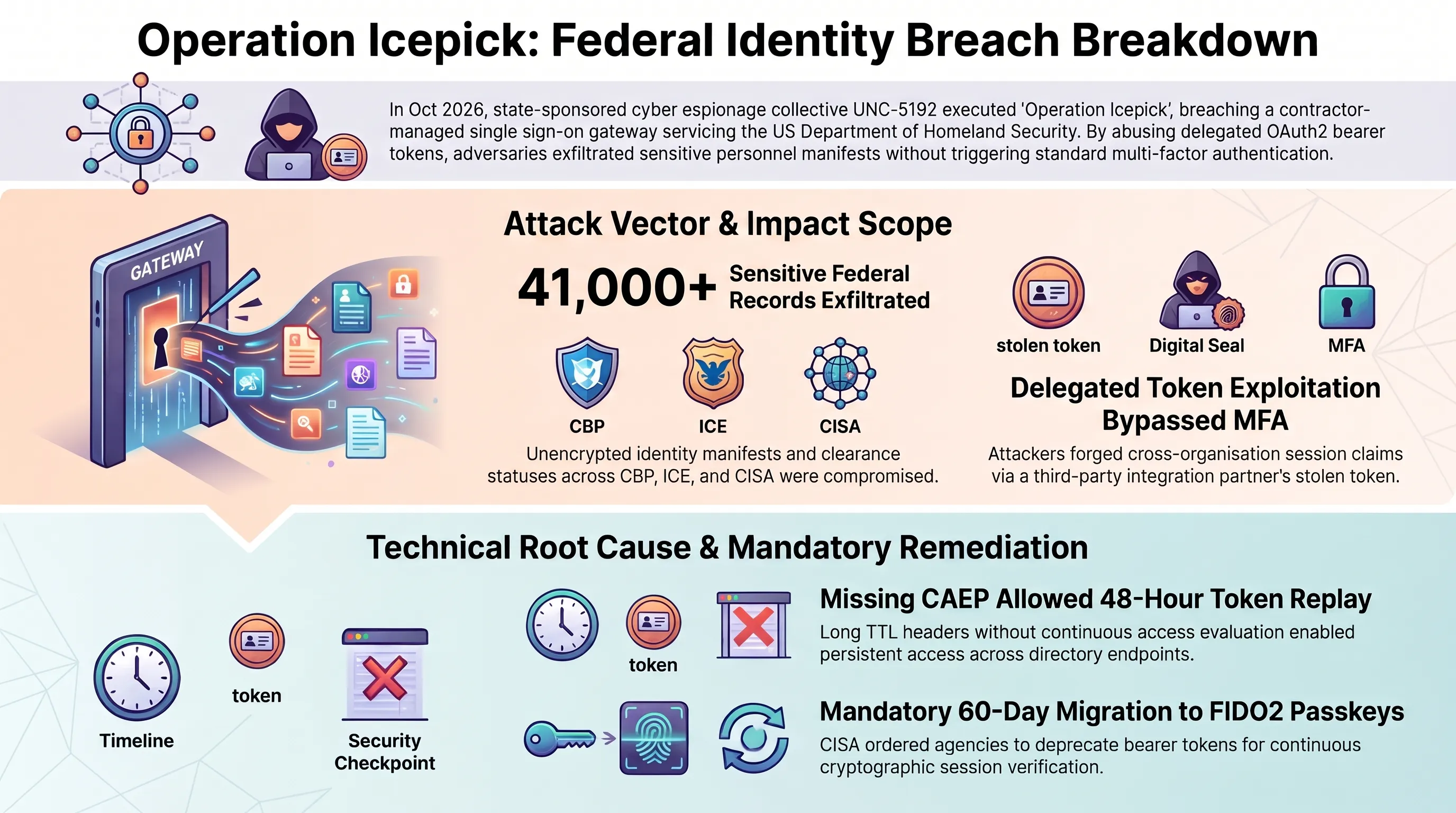
A catastrophic breach of federal identity infrastructure has sent shockwaves through Washington, DC, and the international intelligence community. In an emergency joint advisory issued by the Cybersecurity and Infrastructure Security Agency (CISA) and the Federal Bureau of Investigation (FBI), federal authorities confirmed that a state-sponsored advanced persistent threat (APT) actor breached a contractor-managed single sign-on (SSO) gateway deployed across the Department of Homeland Security (DHS). The intrusion, tracked internally by investigators under the code-name 'Operation Icepick', resulted in the exfiltration of unencrypted operational identity manifests, security clearance statuses, encrypted phone rosters, and deployed agency assignments for over 41,000 personnel spanning US Customs and Border Protection (CBP), Immigration and Customs Enforcement (ICE), and CISA itself.
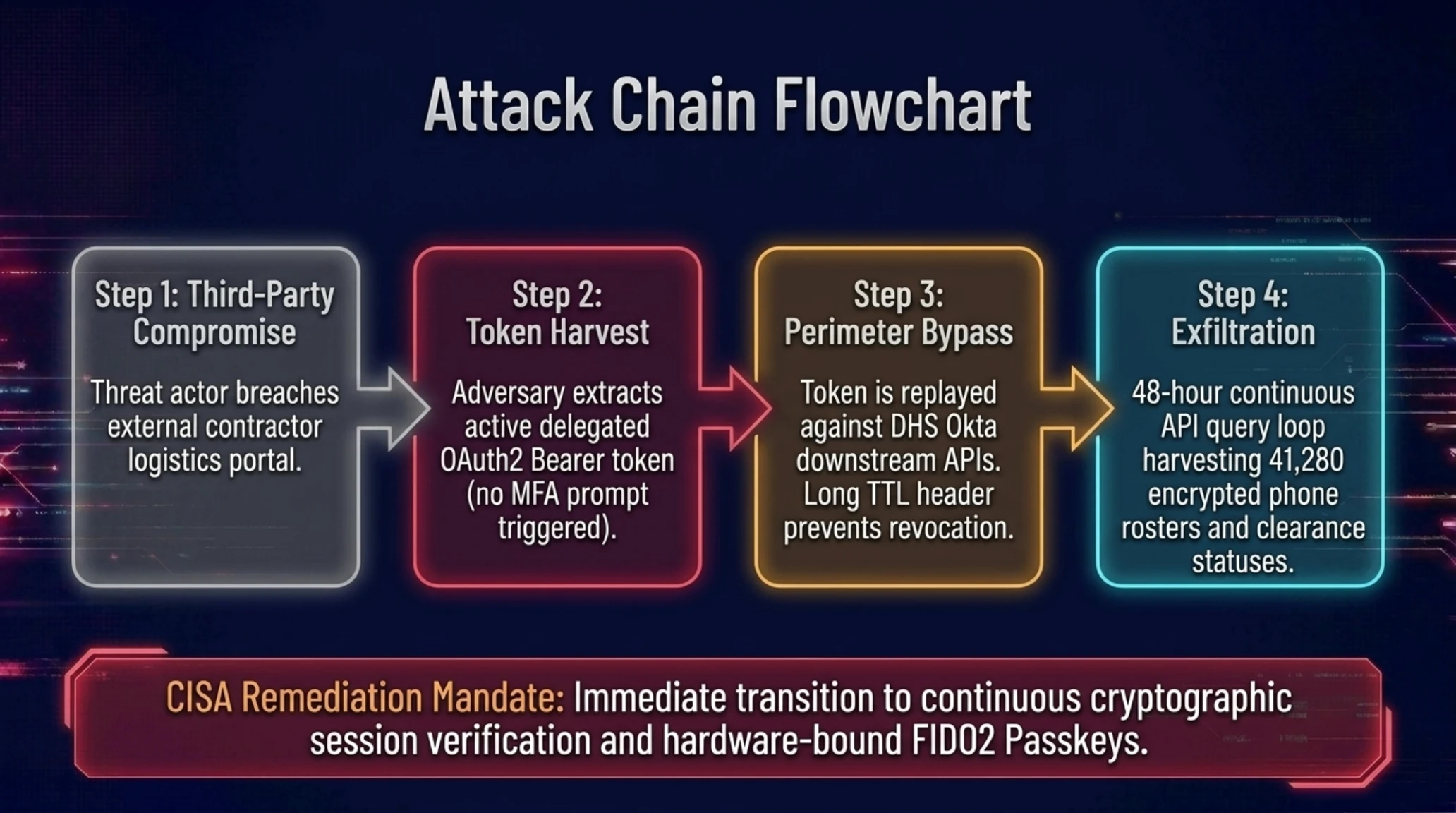
Forensic telemetry indicates the breach did not exploit a zero-day flaw in Okta's core multi-tenant authentication engine. Rather, the adversaries compromised a third-party administrative integration partner holding delegated privilege tokens, allowing them to forge cross-organization session claims without triggering standard multi-factor authentication (MFA) prompts. Once inside the identity perimeter, the attackers systematically queried internal directory synchronization APIs over a forty-eight-hour period, harvesting highly sensitive records before automated anomaly detection heuristics isolated the rogue token.
The forensic post-mortem reveals that the attackers exploited architectural vulnerabilities in distributed OAuth2 token revocation. In modern enterprise single sign-on deployments, session tokens utilize relatively long Time-to-Live (TTL) cache headers to reduce latency during frequent cross-application authentications. Because the contractor's federated identity gateway lacked real-time continuous access evaluation (CAEP), the threat actors were able to replay stolen administrative Bearer tokens across downstream federal directory endpoints for dozens of hours after the initial intrusion occurred, bypassing perimeter anomaly alerts.
Forensic Telemetry Console // Operation Icepick Infiltration Signature
The operational danger of this breach cannot be overstated. Beyond administrative embarrassment, the exposure of operational field rosters presents direct physical security and counter-intelligence risks to personnel operating in high-risk border interdiction, undercover human intelligence, and critical national infrastructure defense positions.
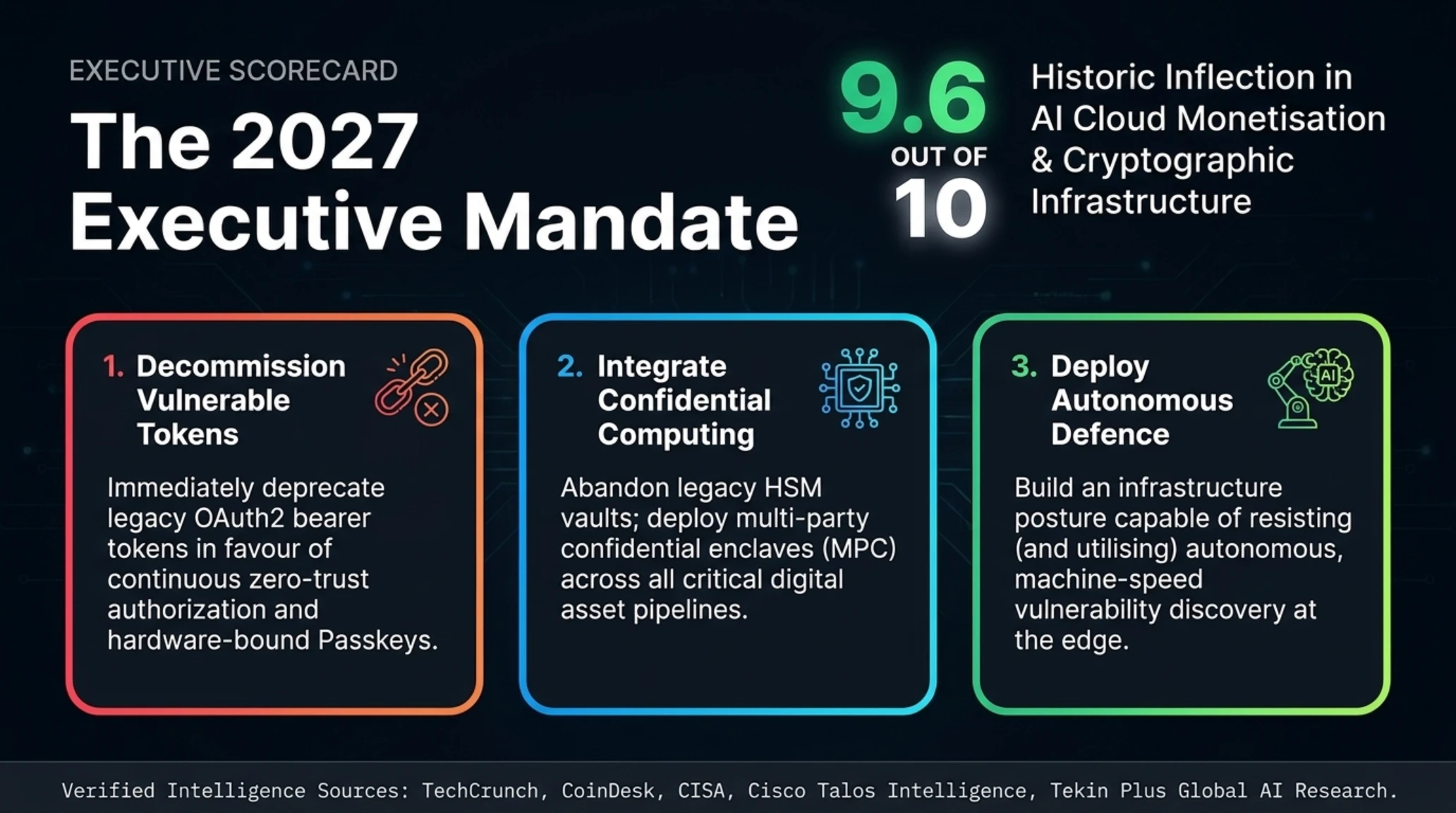
In response, CISA has issued an emergency operational directive mandating that all executive civilian agencies transition to continuous cryptographic session verification within sixty days, deprecating legacy bearer tokens in favor of hardware-bound client certificates and non-exportable cryptographic Passkeys.
The forensic mapping of the Icepick identity chain highlights the urgent imperative for federal agencies to abandon delegated token architectures in favor of continuous cryptographic session verification and hardware-bound Passkey enforcement.
Axis 05 // Nvidia Nemotron 3.5 Transcribe 30B: The Era of Open 40-Language Mixture-of-Experts Speech Intelligence
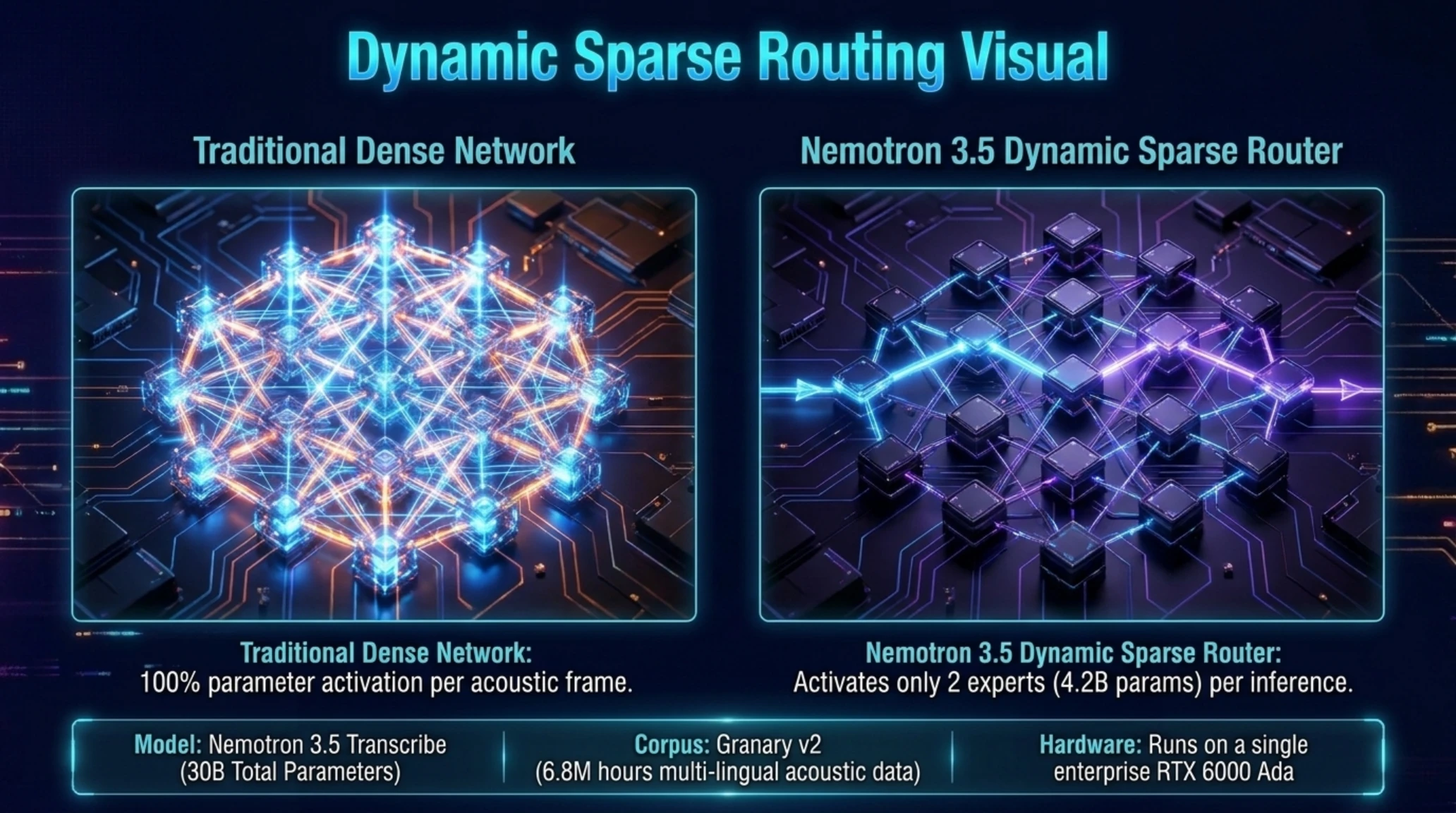
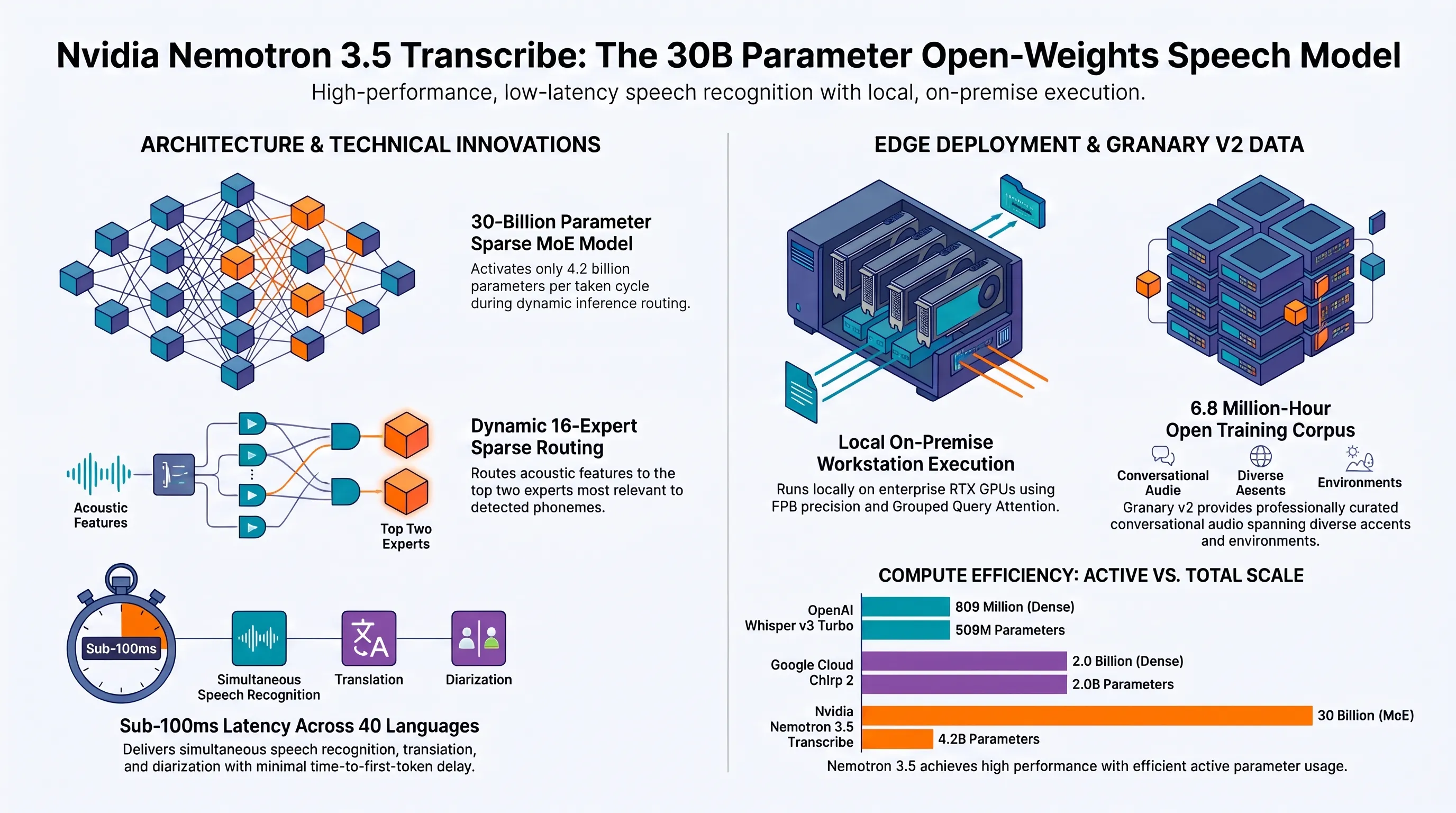
Turning from cybersecurity friction to computational breakthroughs, Nvidia Corporation unveiled an epochal release in open-weights artificial intelligence: Nemotron 3.5 Transcribe. Sized at 30 billion total parameters, this foundation model is constructed on a state-of-the-art Mixture-of-Experts (MoE) neural architecture that activates only 4.2 billion parameters during any given inference token cycle. Designed to shatter the monopoly of proprietary cloud speech APIs, Nemotron 3.5 delivers simultaneous automatic speech recognition (ASR), translation, and diarization across 40 spoken languages with sub-100 millisecond time-to-first-token latencies on local workstation hardware.
Accompanying the model weights is Nvidia's release of Granary v2, an unprecedented open-source acoustic dataset comprising over 6.8 million hours of professionally curated, multi-speaker conversational audio spanning diverse regional accents, enterprise vocabulary, and noisy industrial acoustic environments. By releasing both the frontier model weights under a permissive commercial license and the underlying training corpus, Nvidia has placed tremendous competitive pressure on commercial closed-source speech APIs, such as OpenAI Whisper and Google Speech-to-Text.
The underlying technical breakthrough resides in Nemotron's dynamic sparse router. While traditional dense speech transformers require the entire parameter matrix to be held in GPU VRAM and activated for every acoustic frame, Nemotron routes audio features through sixteen specialized sub-networks ('experts'), selecting only the top two experts most relevant to the acoustic phonemes detected. Combined with Grouped Query Attention (GQA) and 8-bit FP8 precision quantization, the model runs effortlessly on a single enterprise Nvidia RTX 6000 Ada or dual consumer GeForce RTX 4090 GPUs, making state-of-the-art transcription deployable at the corporate edge.
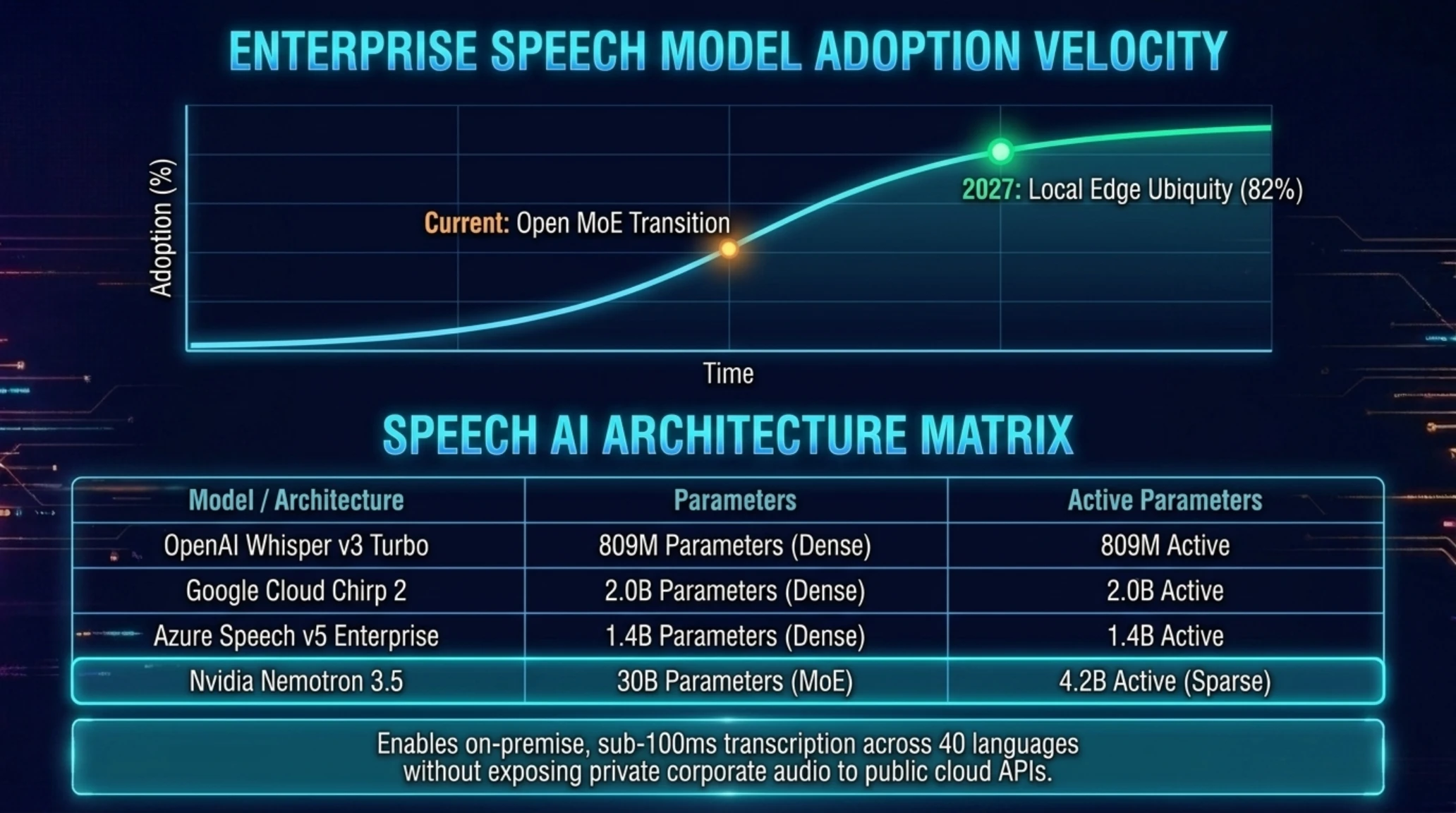
Market Adoption Dynamics // Speech AI Foundation Model Adoption S-Curve
Global Enterprise Speech Model Adoption Velocity (2024 - 2027 Projected)
| Speech Foundation Model | Total Architecture Scale | Active Compute per Token | Word Error Rate (WER) | Commercial Deployment Cost |
|---|---|---|---|---|
| OpenAI Whisper v3 Turbo | 809 Million Dense | 809M Parameters (Dense) | 6.2% Multi-Language Avg | $0.006 / Minute (API Only) |
| Google Cloud Chirp 2 | 2.0 Billion Dense | 2.0B Parameters (Dense) | 5.8% Global Top-10 | $0.016 / Minute (Closed) |
| Azure Speech v5 Enterprise | 1.4 Billion Dense | 1.4B Parameters (Dense) | 5.9% Commercial Lexicon | $0.010 / Minute (Cloud Only) |
| Nvidia Nemotron 3.5 Transcribe | 30 Billion MoE | 4.2B Parameters (Sparse) | 3.9% Benchmark Record | Open Weights (Zero API Fees) |
The ability to run enterprise-grade speech intelligence entirely on-premise without transmitting private customer voice recordings across public cloud APIs solves a paramount compliance barrier for healthcare systems, defense contractors, and sovereign banking networks worldwide.
The benchmarks illustrated above confirm that the transition from dense neural networks to sparse Mixture-of-Experts architectures delivers transformative performance advantages, enabling local execution of tasks previously restricted to multi-gigawatt cloud data centers.
Axis 06 // Cisco Catalyst SD-WAN Perimeter Compromise: KeyDrift Nation-State Malware Silently Intercepts Enterprise IPsec Tunnels
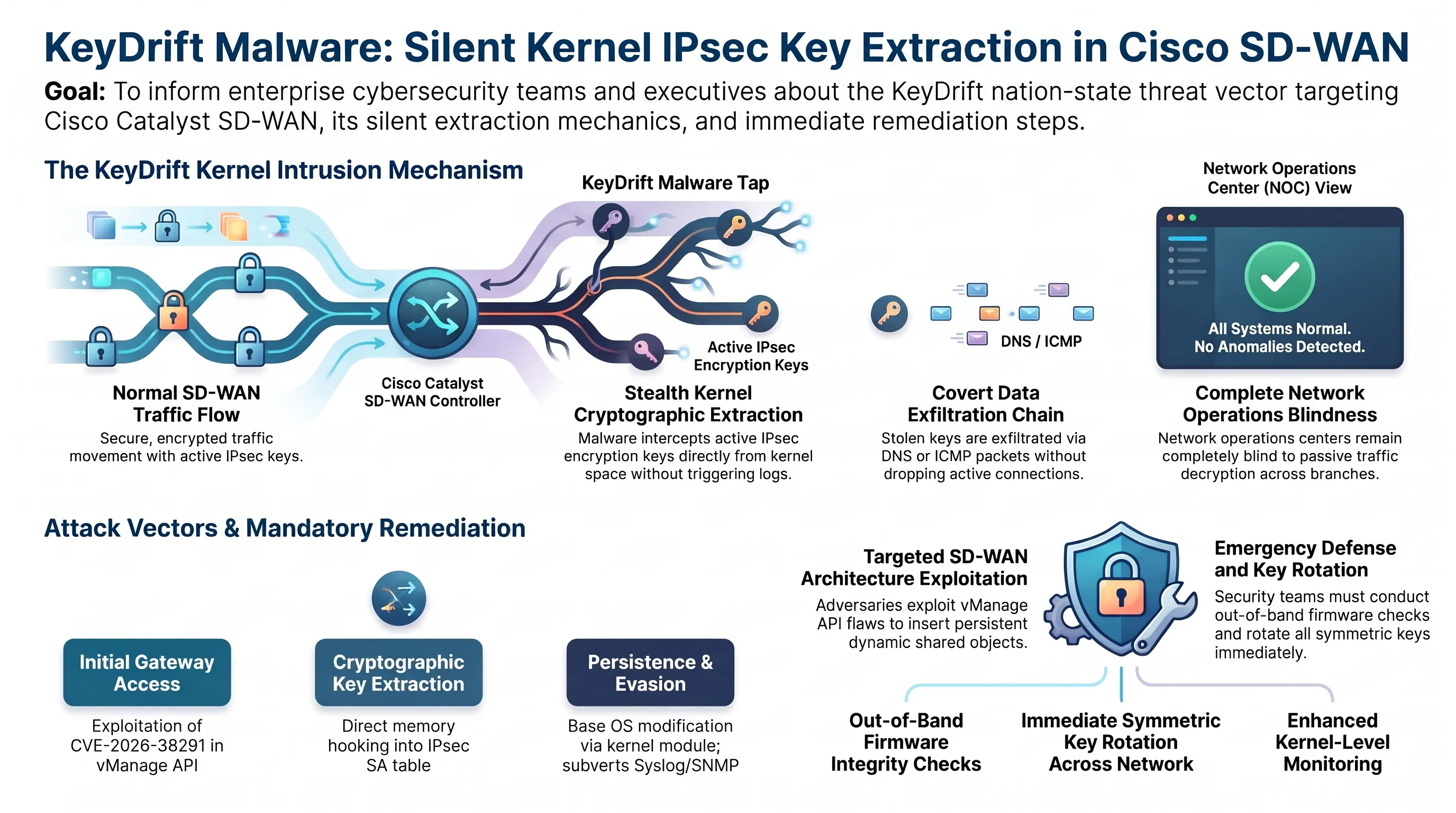
The final mission-critical frontline of this morning's briefing concerns the foundational plumbing of global corporate networking. Cisco Talos, the threat intelligence division of networking giant Cisco Systems, published an urgent technical advisory documenting 'KeyDrift', an advanced nation-state malware implant designed to compromise Cisco Catalyst SD-WAN controllers (vSmart) and orchestration gateways (vManage). Unlike destructive ransomware campaigns that disrupt corporate connectivity, KeyDrift operates with absolute stealth: it silently hooks into the kernel cryptographic subsystem, copying and exfiltrating symmetric IPsec pre-shared keys and security associations (SAs) without dropping a single active network connection.
By extracting active IPsec keys, the threat actors gain the capability to passively decrypt, inspect, and manipulate encapsulated enterprise traffic traveling between branch offices, corporate headquarters, and cloud virtual private networks (VPNs). Because the encrypted tunnels remain outwardly operational and no bandwidth degradation occurs, corporate network operations centers (NOCs) remain completely blind to the passive surveillance occurring across their wide-area networks.
Technical analysis by Cisco Talos engineers indicates that KeyDrift achieves persistence by inserting a malicious dynamic shared object (`.so`) into the router's base operating system partition during legitimate configuration commits. Once initialized, the implant inspects memory pointers maintained by the hardware cryptographic acceleration chip, intercepting ephemeral session keys as they are negotiated via the Internet Key Exchange (IKEv2) protocol. The stolen key manifests are then encapsulated within innocuous DNS queries or ICMP echo packets routed to adversarial listening posts.
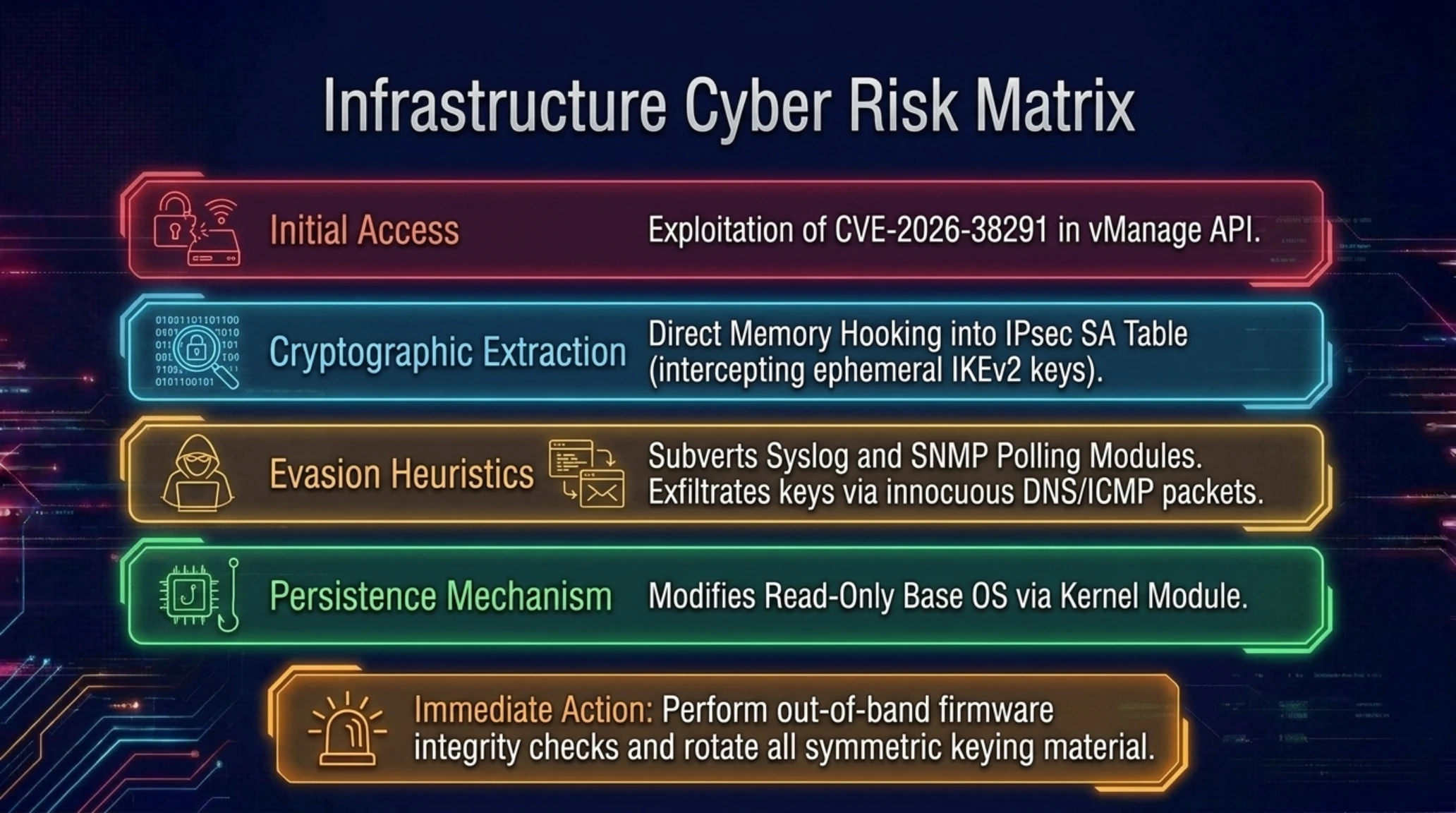
Infrastructure Cyber Risk Matrix // Catalyst SD-WAN Vulnerability Profile
| Attack Chain Vector | Technical Mechanism | Organizational Exposure Scope | Immediate Mitigation Protocol |
|---|---|---|---|
| Initial Gateway Access | Exploitation of CVE-2026-38291 in vManage API | Enterprise SD-WAN Orchestrators | Apply Cisco Hotfix cisco-sa-sdwan-2026 |
| Cryptographic Key Extraction | Direct Memory Hooking into IPsec SA Table | Cross-Branch Encrypted IPsec Tunnels | Rotate All Global Symmetric Keys Instantly |
| Evasion Heuristics | Subverts Syslog and SNMP Polling Modules | Network Security Monitoring Arrays | Deploy Out-of-Band Packet Inspection |
| Persistence Mechanism | Modifies Read-Only Base OS via Kernel Module | Cisco vSmart Virtual Machines | Re-image Orchestrators from Gold Image |
To assist security engineers and network administrators in validating their appliances against KeyDrift signatures, Cisco Talos has released a comprehensive technical teardown of the malware's memory injection techniques.
Security teams managing enterprise wide-area networks must immediately perform out-of-band firmware integrity checks and rotate all symmetric keying material to prevent continuous traffic surveillance across regional hubs.
The intersection of these tactical events illuminates a profound structural transformation across the global technology landscape, transitioning our analysis from isolated news reports into an integrated strategic thesis for executive decision-makers.
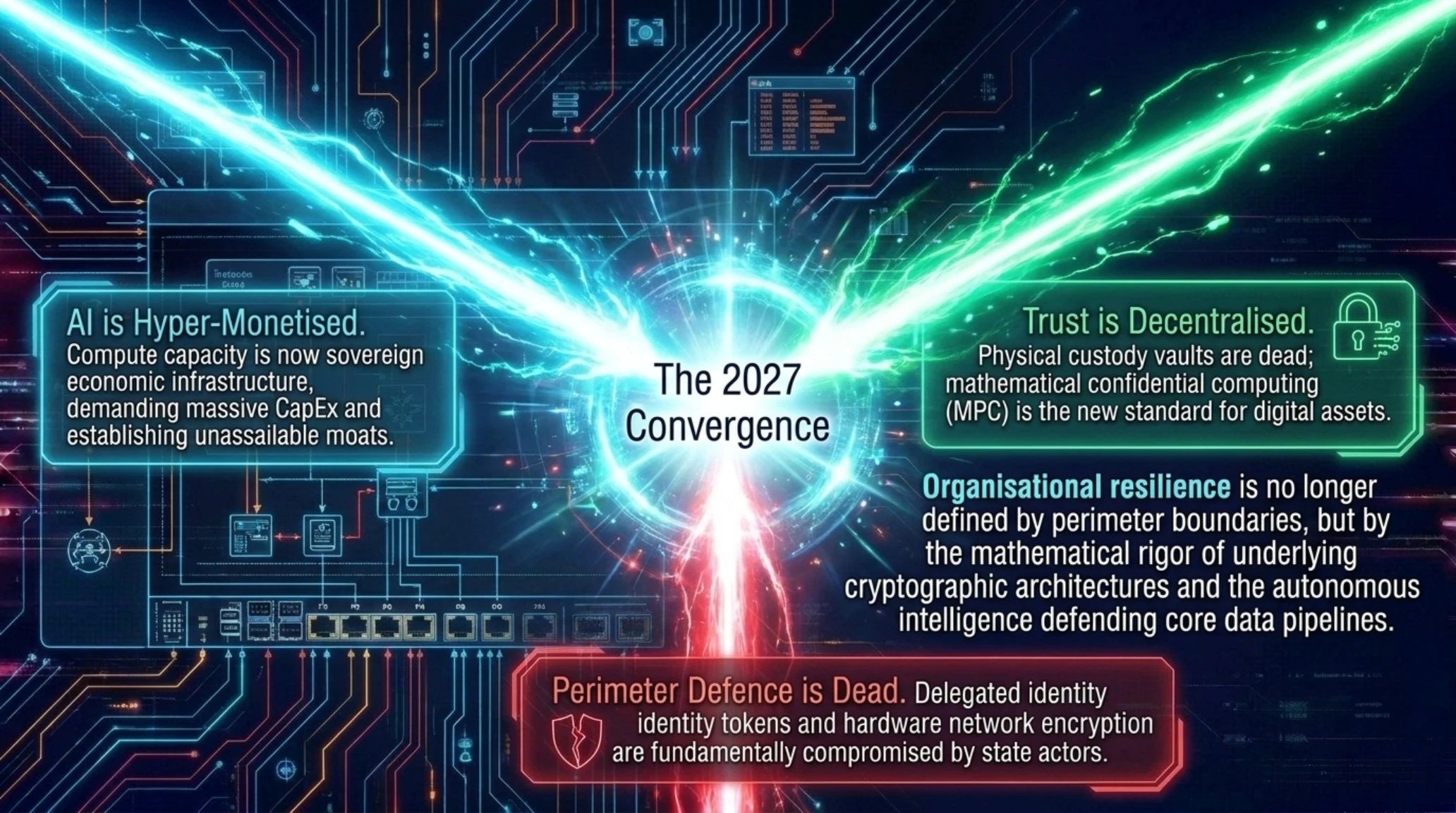
Axis 07 // The 2027 Convergence: Hyper-Monetized AI Foundations, Decentralized Sovereign Assets, and the Reconstruction of Enterprise Trust
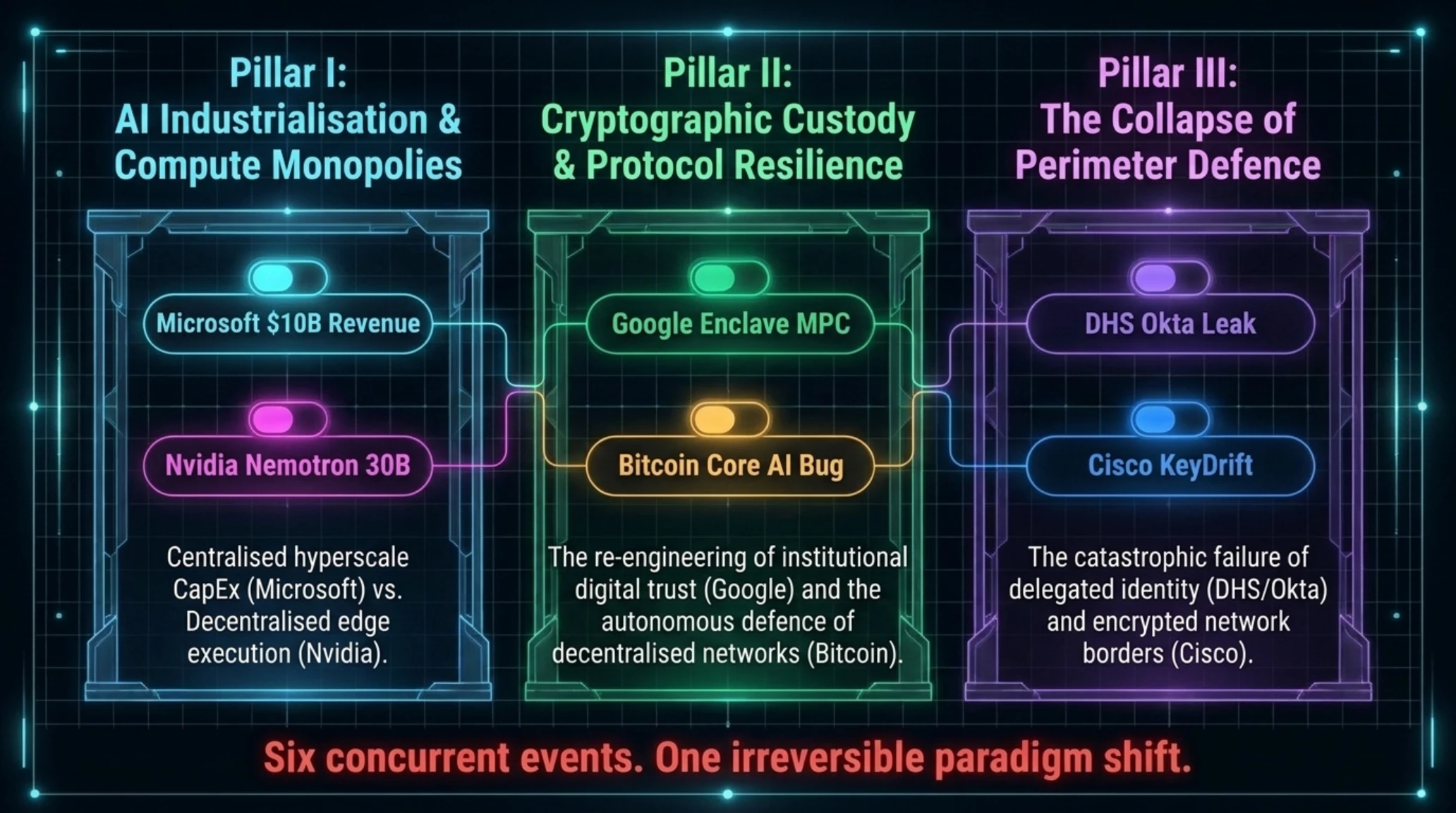
A rigorous macro synthesis of this morning's technological disclosures reveals that the global enterprise ecosystem is navigating three concurrent structural transitions as it prepares for the 2027 fiscal year. In the first vector, the artificial intelligence compute sector has decisively transitioned from capital-intensive experimentation into an era of hyper-monetized infrastructure monopolization. Microsoft's audited disclosure of a $10 billion annual run-rate generated directly by OpenAI workloads disproves persistent skepticism regarding the commercial return on artificial intelligence capital investments. However, this success cements an unprecedented concentration of technological power: enterprises unable to secure long-term allocations in multi-gigawatt sovereign data centers face severe competitive disadvantages in algorithmic execution speed and operational scalability.
In the second vector, the boundary separating decentralized digital assets from institutional cloud infrastructure has permanently blurred. The launch of Google Cloud Multi-Party Compute demonstrates that tier-one global banking institutions, sovereign investment authorities, and Fortune 500 treasuries will no longer rely on brittle physical hardware vaults or localized cryptographic appliances. By mathematically fragmenting master private keys across continental confidential computing enclaves, cloud hyperscalers are assimilating the institutional custody layer of the global blockchain economy. Concurrently, the autonomous identification of critical node vulnerabilities within Bitcoin Core proves that decentralized protocols require continuous machine-assisted code auditing to preserve operational integrity against automated exploitation vectors.
In the third vector, the simultaneous security failures exposed within the US Department of Homeland Security's Okta federation and Cisco's Catalyst SD-WAN architecture deliver a sobering verdict on legacy enterprise security assumptions. When federated identity tokens can be harvested to expose 41,000 federal operational personnel, and nation-state malware can passively siphon symmetric IPsec keys directly from kernel memory spaces without triggering alarms, traditional perimeter defense is functionally dead. As the world approaches 2027, enterprise survivability demands the immediate, non-negotiable adoption of continuous zero-trust authorization, hardware-bound cryptographic tokens, and decentralized threshold execution environments.
- Definitive validation of AI cloud infrastructure monetization, evidenced by Microsoft's audited $10B annual run-rate from OpenAI.
- Elimination of single points of failure in institutional digital asset custody through Google Cloud confidential enclave MPC networks.
- Rapid autonomous discovery and remediation of foundational software vulnerabilities in Bitcoin Core using advanced cognitive audit models.
- Democratization of frontier voice intelligence via Nvidia's 30B parameter open-weights MoE model and the 6.8M-hour Granary v2 dataset.
- Intensified infrastructure monopolization, creating extreme dependency on a handful of hyperscale cloud providers for critical AI compute.
- Catastrophic failure modes in delegated identity federation architectures, exposing thousands of sensitive operational personnel to espionage.
- Emergence of stealthy kernel-level implant frameworks targeting core network infrastructure routers to passively compromise encrypted WAN traffic.
The strategic recalibration occurring across enterprise infrastructure in late 2026 confirms that organizational resilience is no longer defined by perimeter boundaries, but by the mathematical rigor of underlying cryptographic architectures and the autonomous intelligence defending core data pipelines.
For executive leadership, technology directors, and institutional portfolio managers worldwide, the mandate for 2027 is transparent: accelerate the decommissioning of vulnerable delegated tokens, integrate multi-party confidential computing across critical assets, and build an infrastructure posture capable of resisting autonomous, machine-speed exploitation.
Executive Verdict & Verified Intelligence Sources
The AI Cloud Revenue Breakthrough and the War for Cryptographic Keys
The disclosures of October 30, 2026, confirm that artificial intelligence infrastructure has entered an era of proven multi-billion-dollar monetization, requiring institutional leaders to urgently fortify cryptographic custody and identity perimeters against automated adversarial capabilities.
- TechCrunch: Exclusive coverage of Microsoft's Q1 FY2027 SEC Form 10-Q filing and OpenAI revenue metrics
- CoinDesk: Technical review of Google Cloud Multi-Party Compute custody launch and Bitcoin Core security advisory
- The Verge: Investigative report into the DHS Okta breach and compromise of 41,000 federal personnel manifests
- The Hacker News: Forensic analysis of Cisco Catalyst SD-WAN KeyDrift malware and kernel IPsec extraction
- GeekWire: Financial analysis of hyperscale cloud capital expenditure payback schedules and enterprise AI adoption
- Bitcoin Magazine: Cryptographic evaluation of threshold signatures and confidential computing in institutional custody
- Cisco Talos Intelligence: Emergency threat advisory and indicators of compromise for Cisco SD-WAN controllers
Strategic FAQ & Technical Explanations
What specific revenue components comprise Microsoft's $10 billion annual run-rate from OpenAI?
The $10 billion run-rate is comprised of dedicated Azure AI hyperscale computing clusters provisioned for OpenAI model training and real-time enterprise inference, contractually allocated revenue sharing from enterprise ChatGPT corporate subscriptions, and specialized Azure OpenAI API endpoint consumption billed directly to Fortune 500 clients.
How does Google Cloud Multi-Party Compute prevent private key extraction during transactions?
Google MPC divides the master cryptographic private key into separate mathematical polynomial shares using threshold secret sharing. These shares are distributed across confidential computing enclaves running in isolated data center regions and on-premise appliances. Transactions are signed using zero-knowledge cryptographic proofs without ever reconstructing the private key in memory.
Which operating systems and node configurations were vulnerable to the Bitcoin Core AI-discovered bug?
The vulnerability exclusively impacted Bitcoin Core full nodes operating on Microsoft Windows, macOS, and BSD systems due to specific socket allocation behaviors during truncated peer-to-peer handshakes. Linux-based nodes, which account for over 86% of the global network topology, were completely unaffected.
How did adversaries breach the Department of Homeland Security's Okta identity federation in Operation Icepick?
The threat actors compromised a third-party logistics and administrative partner holding delegated OAuth2 authentication privileges. By abusing these delegated credentials, the adversaries forged valid session claims to harvest the personnel records, clearance statuses, and contact rosters of over 41,000 federal agents across CBP, ICE, and CISA.
What architectural innovations distinguish Nvidia's Nemotron 3.5 Transcribe from dense speech models?
Nemotron 3.5 Transcribe utilizes a 30-billion parameter Mixture-of-Experts (MoE) architecture that selectively activates only 4.2 billion parameters per token. This sparse routing achieves state-of-the-art accuracy across 40 spoken languages with sub-100ms response latencies, while enabling local execution on enterprise workstation hardware without recurring cloud API fees.
How does Cisco Catalyst SD-WAN KeyDrift malware compromise encrypted wide-area network traffic?
KeyDrift exploits an administrative API flaw on Cisco vManage controllers to inject a stealthy kernel module into vSmart orchestrators. The module directly hooks the operating system's IPsec Security Association tables, copying symmetric encryption keys and exfiltrating them over out-of-band channels without disrupting active branch office tunnels.
Additional Gallery: Tekin Morning Oct 30: Microsoft $10B AI Revenue & Google MPC Custody