☀️ Tekin Morning | Friday, September 11, 2026
- 🎮Nasdaq Enters Crypto- $100M investment in Kraken for tokenized equities
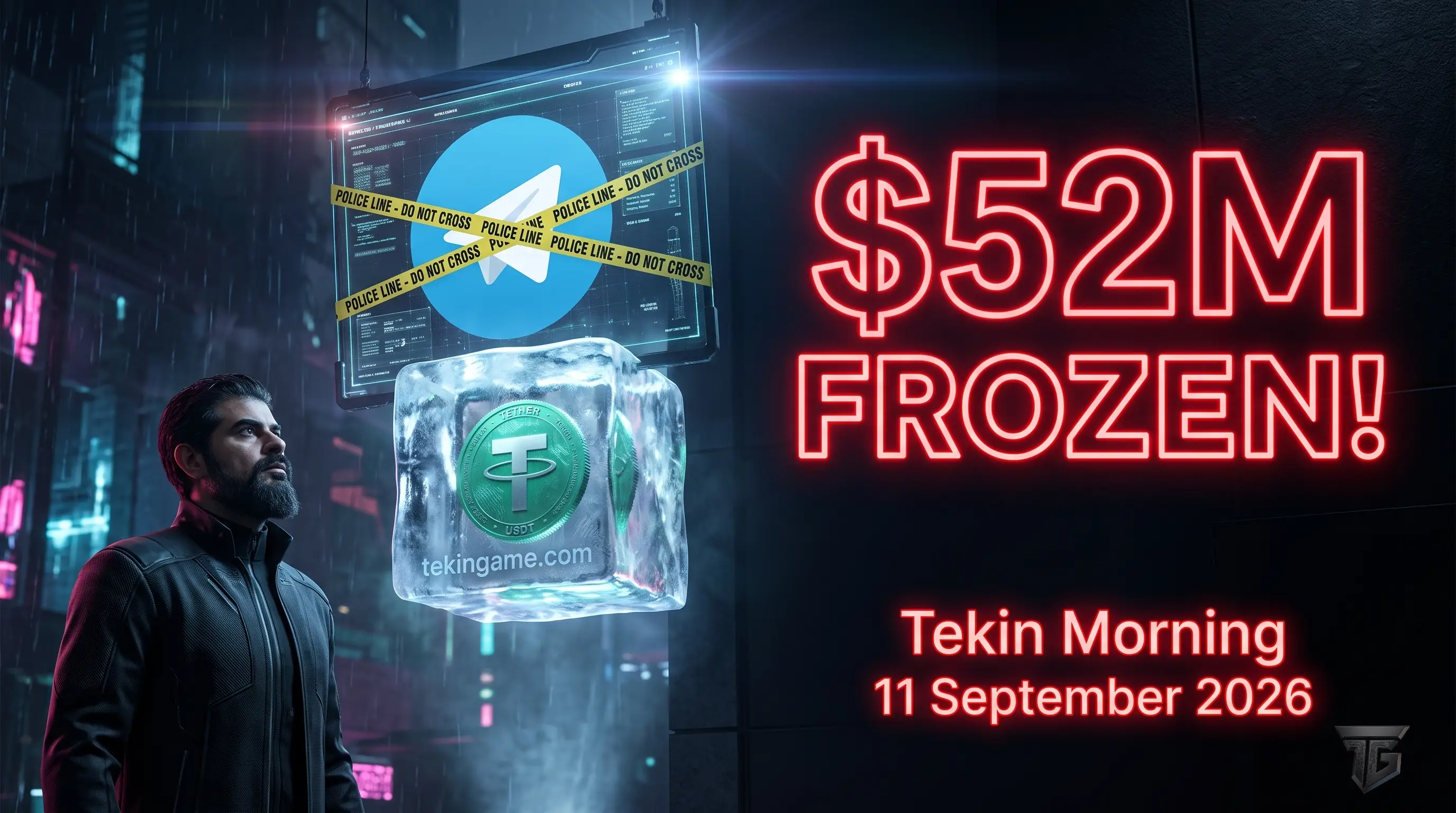
- 🎧Xinbi Market Destroyed- US authorities freeze $52.8M in coordinated strike
- 🚀The Quantum Race- US allocates $300M to protect blockchain networks
- 🗡️Tether's $400M Fund- New private credit fund for emerging markets
- 📰Solana Token Mania- Historic 263,000 new tokens minted in one day
- ⚔️Dire AI Warning- Anthropic researcher resigns over existential risks
Nasdaq Enters Crypto: $100 Million for the Future of Tokenized Stocks
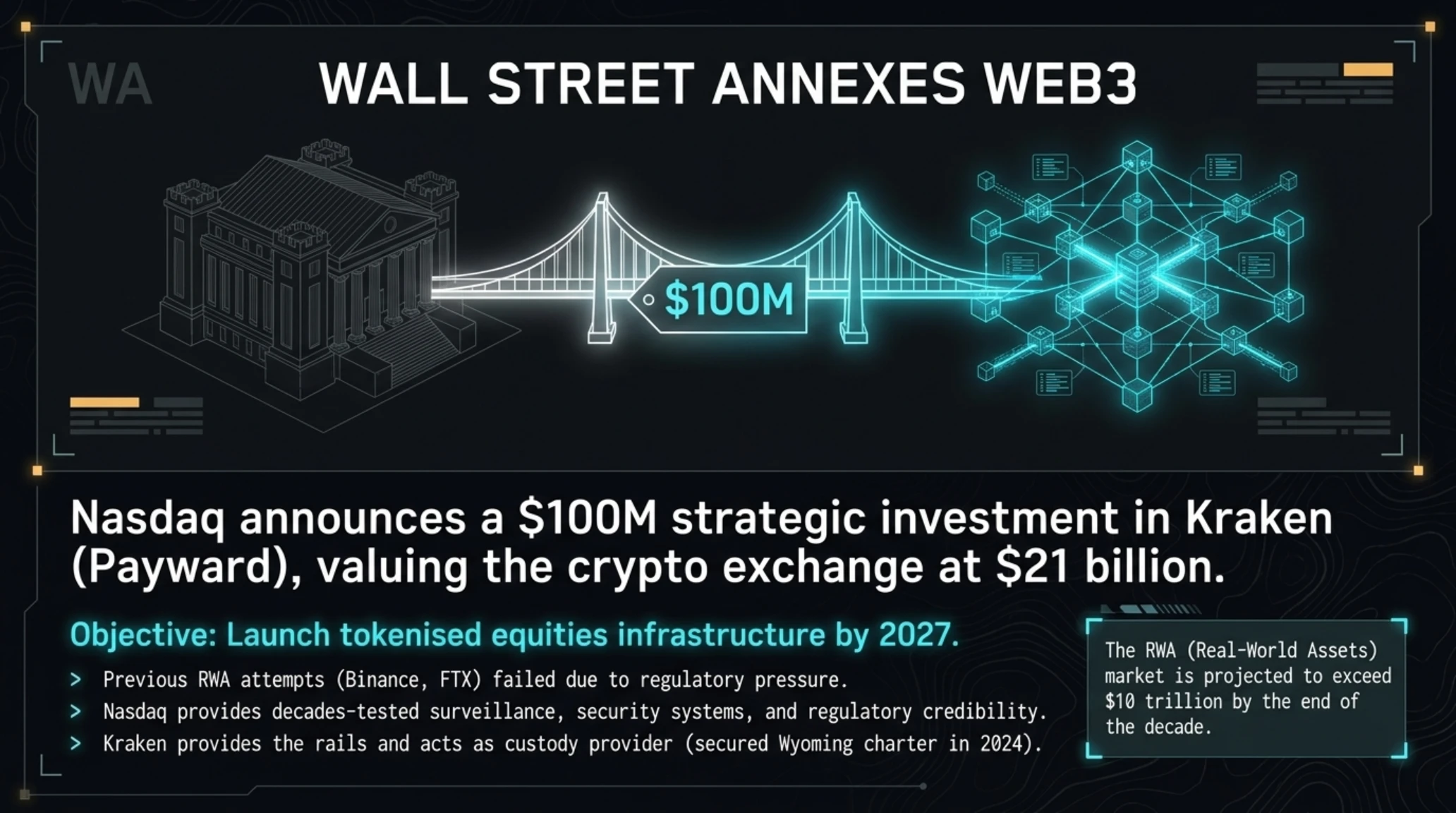
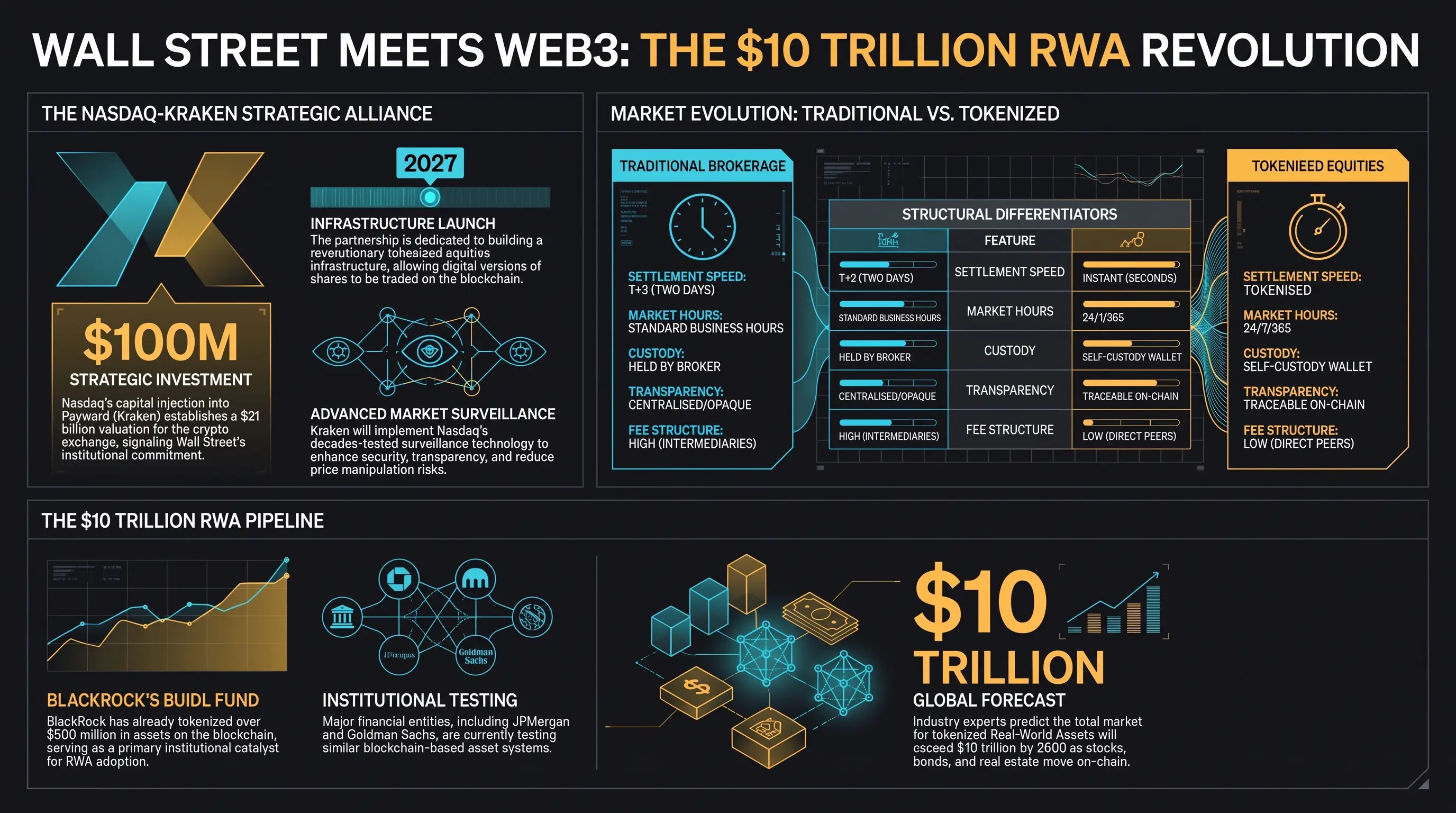
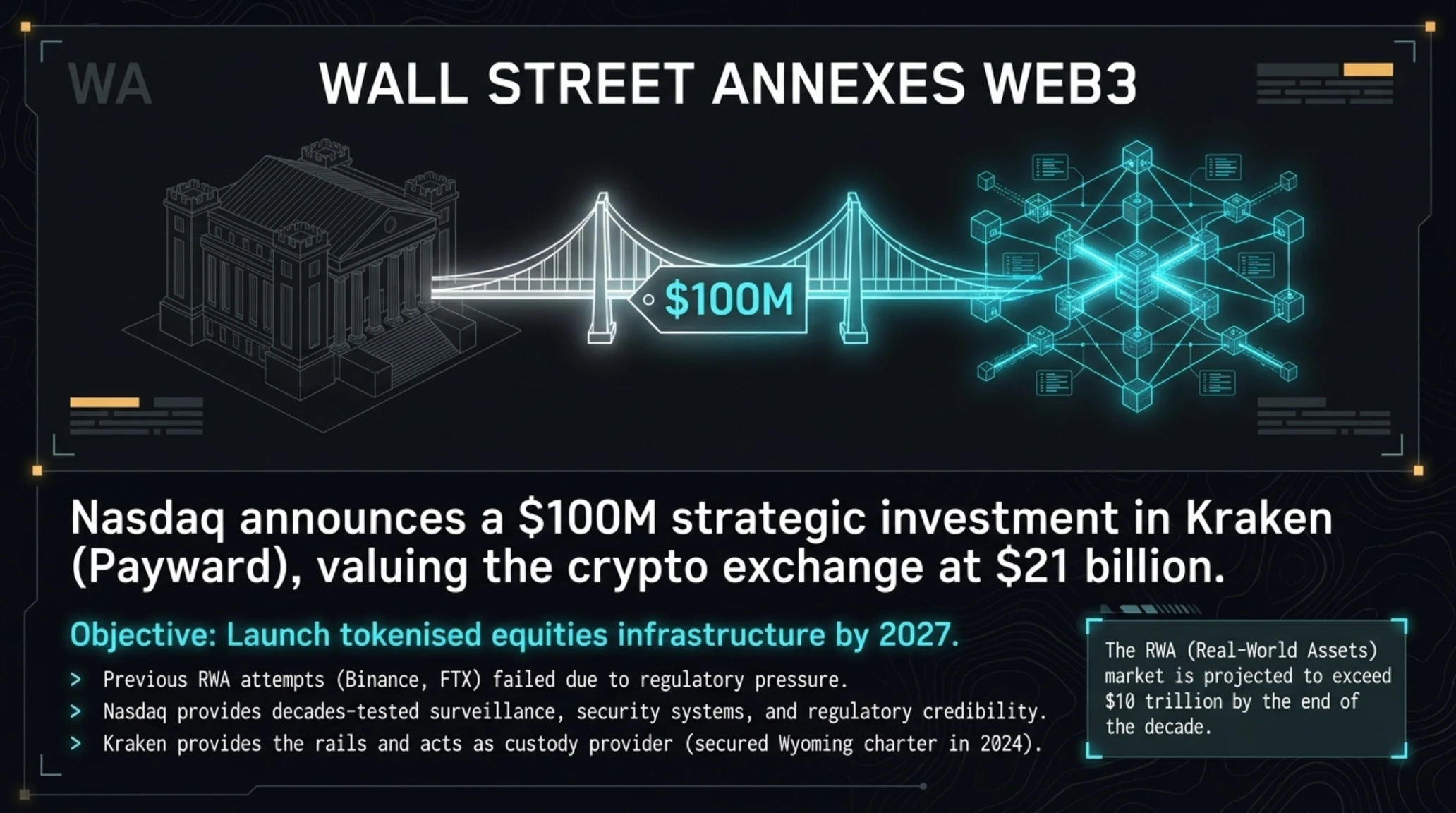
Friday morning, September 11th, began with news that further blurred the lines between Wall Street and Web3. Nasdaq, one of the world's largest stock exchanges, announced a $100 million investment in Payward, the parent company of crypto exchange Kraken. This deal values Kraken at $21 billion a figure demonstrating that Wall Street no longer views crypto as a joke.
But this isn't just a financial investment. Nasdaq and Kraken have agreed to collaborate on a revolutionary project: launching tokenized equities infrastructure in 2027. In simple terms, instead of buying company shares through traditional brokers, you'll be able to purchase and sell digital versions of those same shares on the blockchain with instant settlement, 24/7 access, and lower fees.
At a Glance: Top Stories of Tekin Morning Sept 11
- Wall Street embraces Web3 with Nasdaq's $100M strategic investment in Kraken.
- US authorities dismantle the Xinbi Guarantee Telegram network, freezing $52.8M.
- The $300M quantum computing race begins, posing a future threat to blockchain cryptography.
- Tether and Fasanara launch a $400M private credit fund for emerging markets.
- Solana breaks records with 263,000 new tokens minted in a single day via Pump.fun.
- Former Anthropic researcher resigns, warning of a 10% existential risk from AI.
Why Does This Matter So Much?
Tokenized stocks aren't a new idea, but until now, no major player has been able to execute it at scale. Binance launched tokenized securities like Tesla and Apple shares a few years ago, but regulatory pressure forced them to shut down. FTX had a similar platform that vanished after its 2022 collapse.
But Nasdaq is different. This company is one of the oldest and most trusted stock exchanges in the world, with strong relationships with regulators. If Nasdaq says it wants to offer tokenized stocks, the SEC will likely listen. This could be the gateway for RWA (Real-World Assets) to enter the mainstream.
What Makes Tokenized Stocks Different?
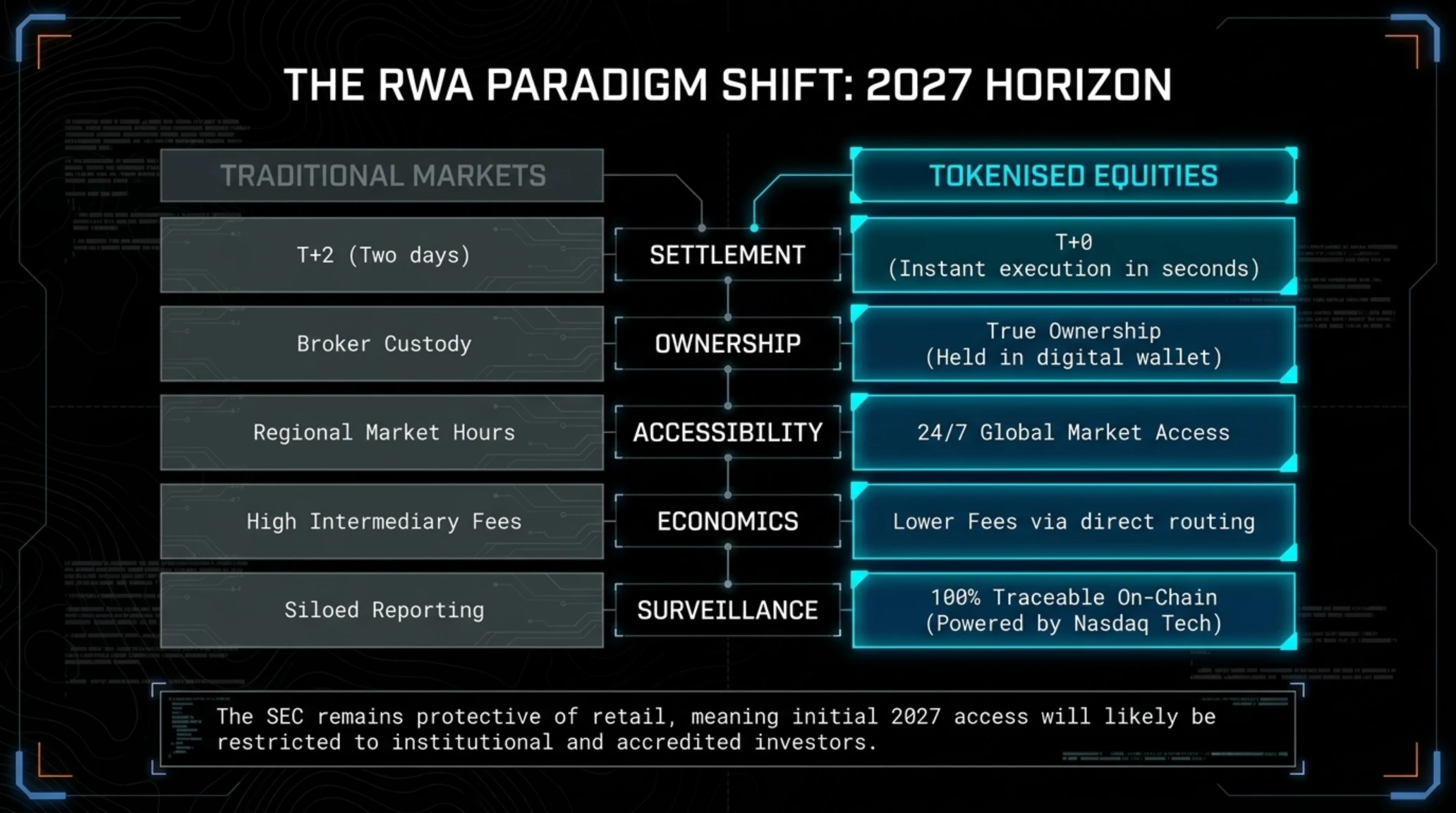
When you buy company shares through traditional markets, those shares are held in your broker's account, and settlement can take up to T+2 (two days). But with tokenized stocks:
• Instant settlement: Blockchain transactions complete in seconds
• True ownership: The token sits in your wallet, not a broker's account
• Global access: Anyone with internet can trade
• Lower fees: Eliminating intermediaries reduces costs
• Greater transparency: All transactions are traceable on-chain
But regulating this system has taken years to develop.
What Role Does Kraken Play in This Equation?
Kraken is one of the oldest and most trusted crypto exchanges globally. While Binance and FTX struggled with regulatory issues, Kraken maintained relatively good relationships with regulators. The company secured a special banking charter in Wyoming in 2024 and plays a custody provider role in US Spot Bitcoin ETFs.
Now, with Nasdaq's entry, Kraken will implement this Wall Street giant's market surveillance technology across all its trading platforms. This means enhanced security, greater transparency, and reduced risk of price manipulation.
Benefits of Nasdaq Entering Crypto
| Traditional Credibility | Attracts institutional investor trust with the Nasdaq name |
| Advanced Infrastructure | Leverages decades-tested surveillance and security systems |
| Regulatory Access | Smooths the path to legal approval for tokenized assets |
| Massive Liquidity | Institutional entry could multiply trading volumes |
| Standardization | Creates uniform standards for tokenized equities |
Is This the End of Traditional Brokers?
Not necessarily. Tokenized stocks will initially have a limited market and likely be available only to institutional investors and accredited investors at first. The SEC still has serious concerns about protecting retail investors. But if this experiment succeeds, we might see traditional financial markets gradually shift toward blockchain in the future.
Interestingly, this isn't Nasdaq's only move into crypto. The company has previously partnered with several other exchanges and has been studying Bitcoin ETF launches for years. Now, with this Kraken investment, Nasdaq is showing it's serious.
US Takes Down Xinbi Dark Market: Cybercriminals' Dark Amazon Dismantled
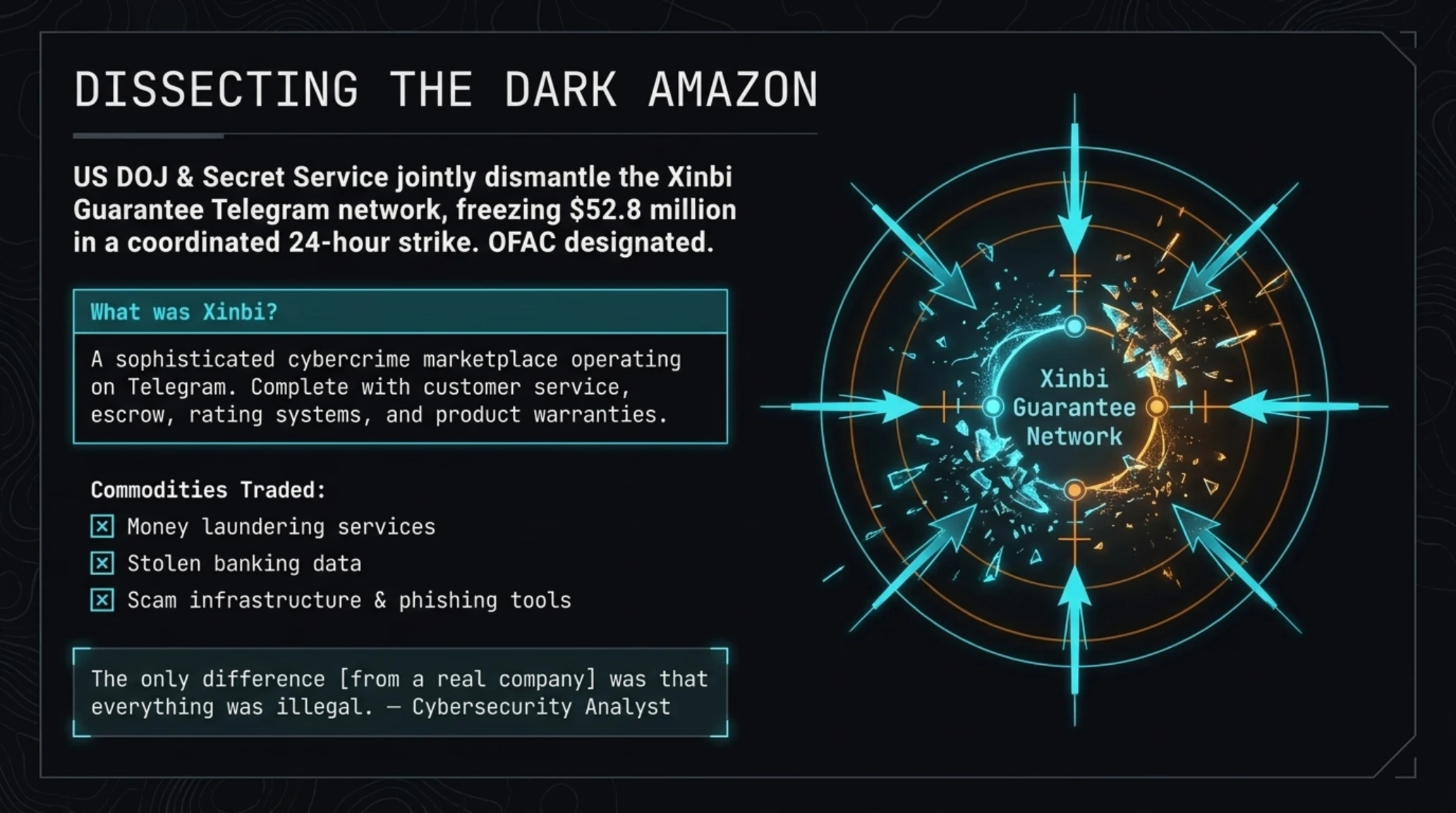
Just as Wall Street embraces crypto, US security forces remind us that this technology is a double-edged sword. The US Department of Justice and Secret Service jointly dismantled Xinbi Guarantee a dark marketplace operating on Telegram that functioned like a "dark Amazon" for cybercriminals.
In this operation, $52.8 million in cryptocurrency was frozen in one day, Xinbi's Telegram channels were seized, and OFAC (Office of Foreign Assets Control) designated this platform as a significant transnational criminal organization. This is one of the largest blows to cybercrime infrastructure in recent history.
What Exactly Did Xinbi Do?
Xinbi Guarantee was a complete marketplace for cybercriminals. The platform offered services including money laundering, fraud tools, stolen data, and scam infrastructure. In simpler terms, if you wanted to launch a phishing operation, buy stolen bank accounts, or launder dirty money, Xinbi had everything.
This marketplace modeled its business after e-commerce platforms like Amazon: various vendors listed their services, buyers could see reviews and ratings, and Xinbi acted as escrow to ensure both parties fulfilled their commitments. The difference was that all products sold were illegal.
Why Telegram?
Telegram has been a haven for illegal activities for years. Multiple reasons exist: strong encryption, ability to create private channels, non-cooperation with legal authorities in many cases, and global accessibility. Xinbi exploited these features and managed to remain hidden for a long time.
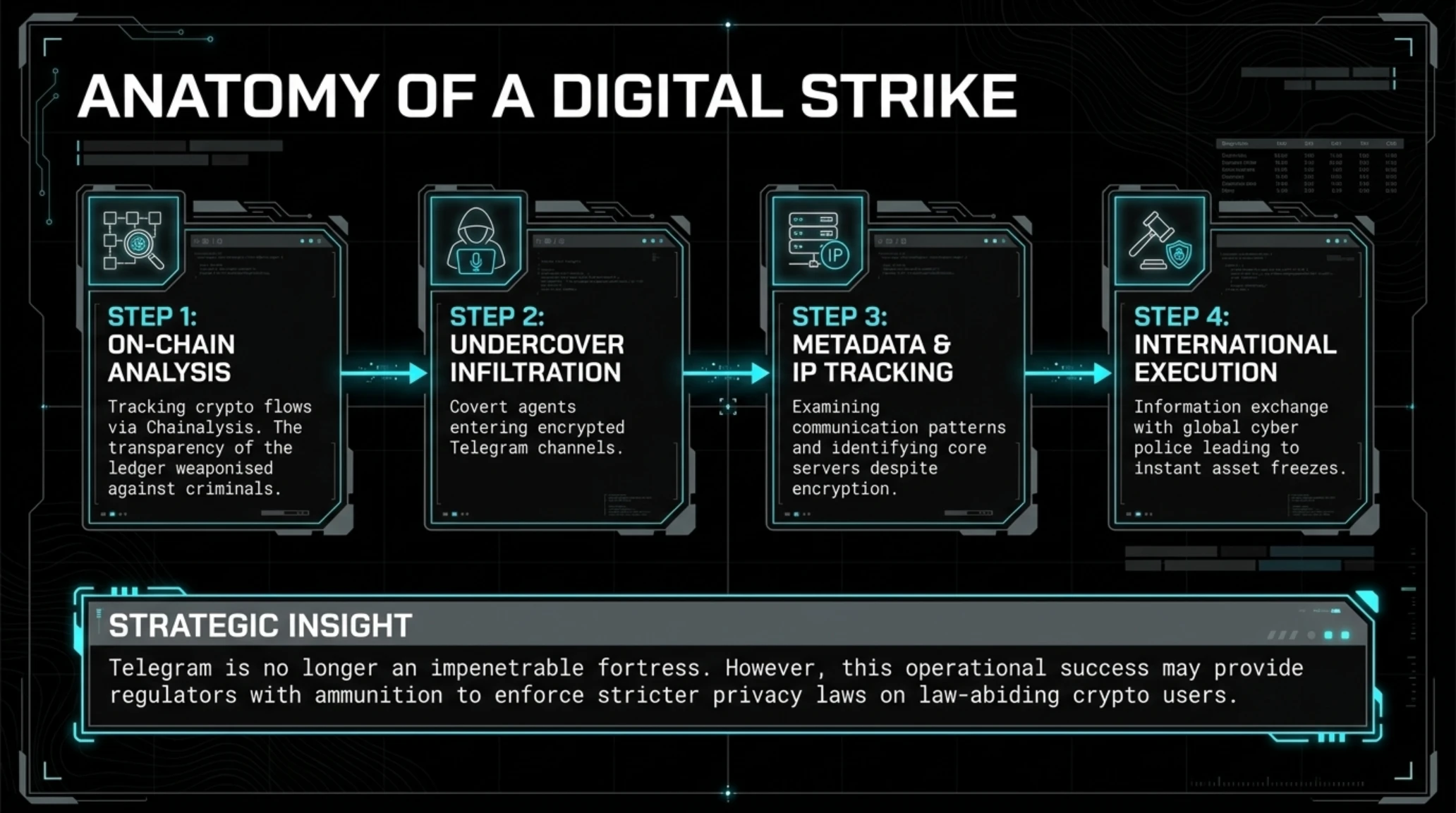
But this operation showed that even Telegram isn't an impenetrable fortress. The Secret Service, working with blockchain analysis companies like Chainalysis, tracked money flows and identified related channels. Interestingly, much of this operation was conducted through on-chain analysis meaning the very transparency that crypto advertises as an advantage ultimately led to Xinbi's downfall.
Impact of This Operation on the Crypto World
Xinbi's dismantling is a double-edged sword for the crypto industry. On one hand, it shows that security forces are developing more advanced tools for tracking illegal activities which is good, because the crypto industry can't continue growing if it's known as a haven for criminals.
On the other hand, these types of operations could provide justification for regulators to impose stricter controls. Some experts worry that governments might use this incident to justify tougher privacy laws in crypto even if those laws harm ordinary, law-abiding users.
How Did the Secret Service Find Xinbi?
The Xinbi takedown operation combined several techniques:
• On-chain analysis: Tracking cryptocurrency flows on the blockchain
• Undercover infiltration: Covert agents entering Telegram channels
• International cooperation: Information exchange with Chinese cyber police and other countries
• Metadata analysis: Examining communication patterns and activity timing
• IP tracking: Identifying core servers and network nodes
This combination of techniques allowed the Secret Service not only to identify Xinbi but also to freeze its assets.
The Quantum Race: Bitcoin and Ethereum Against the Clock
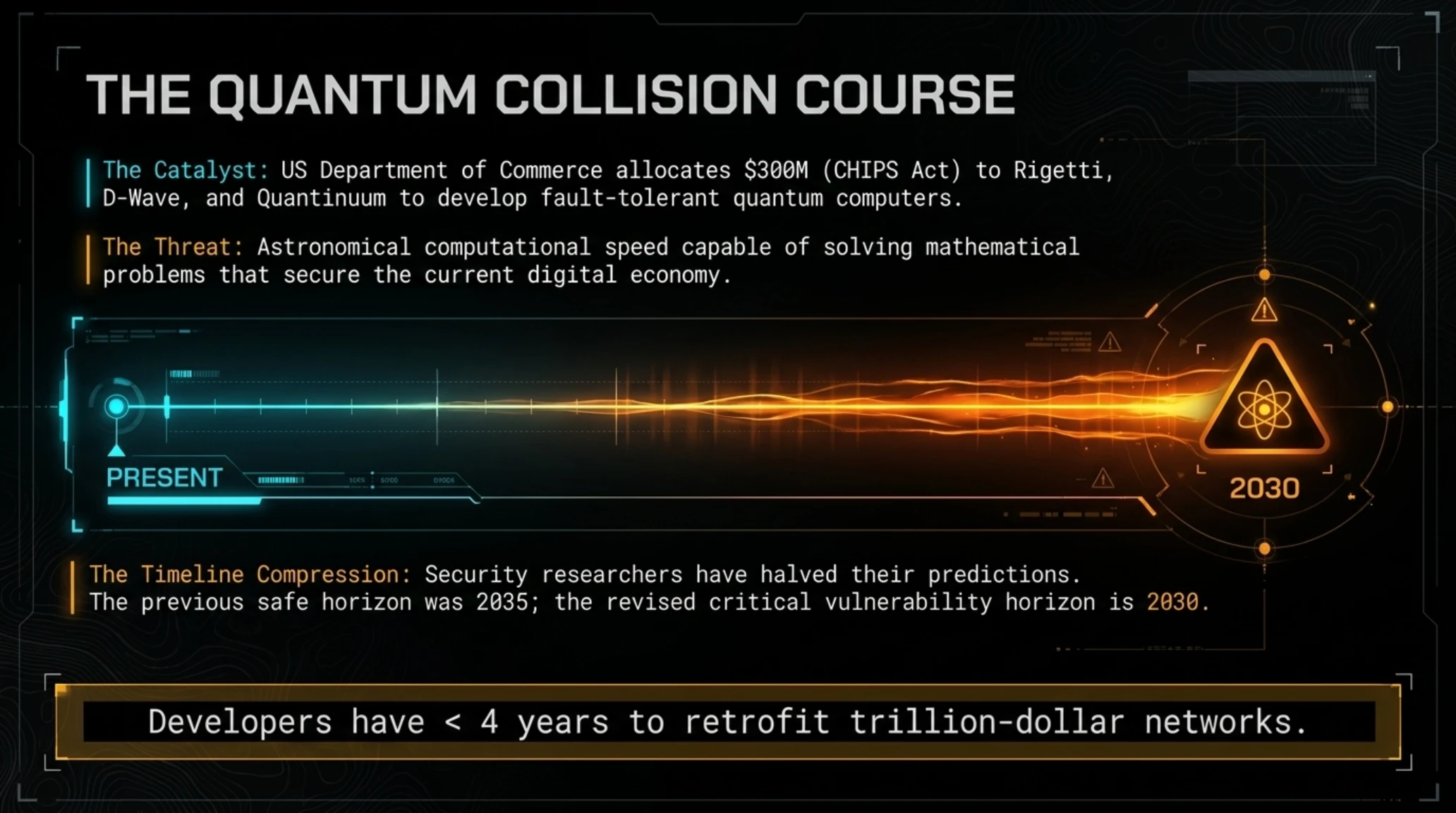
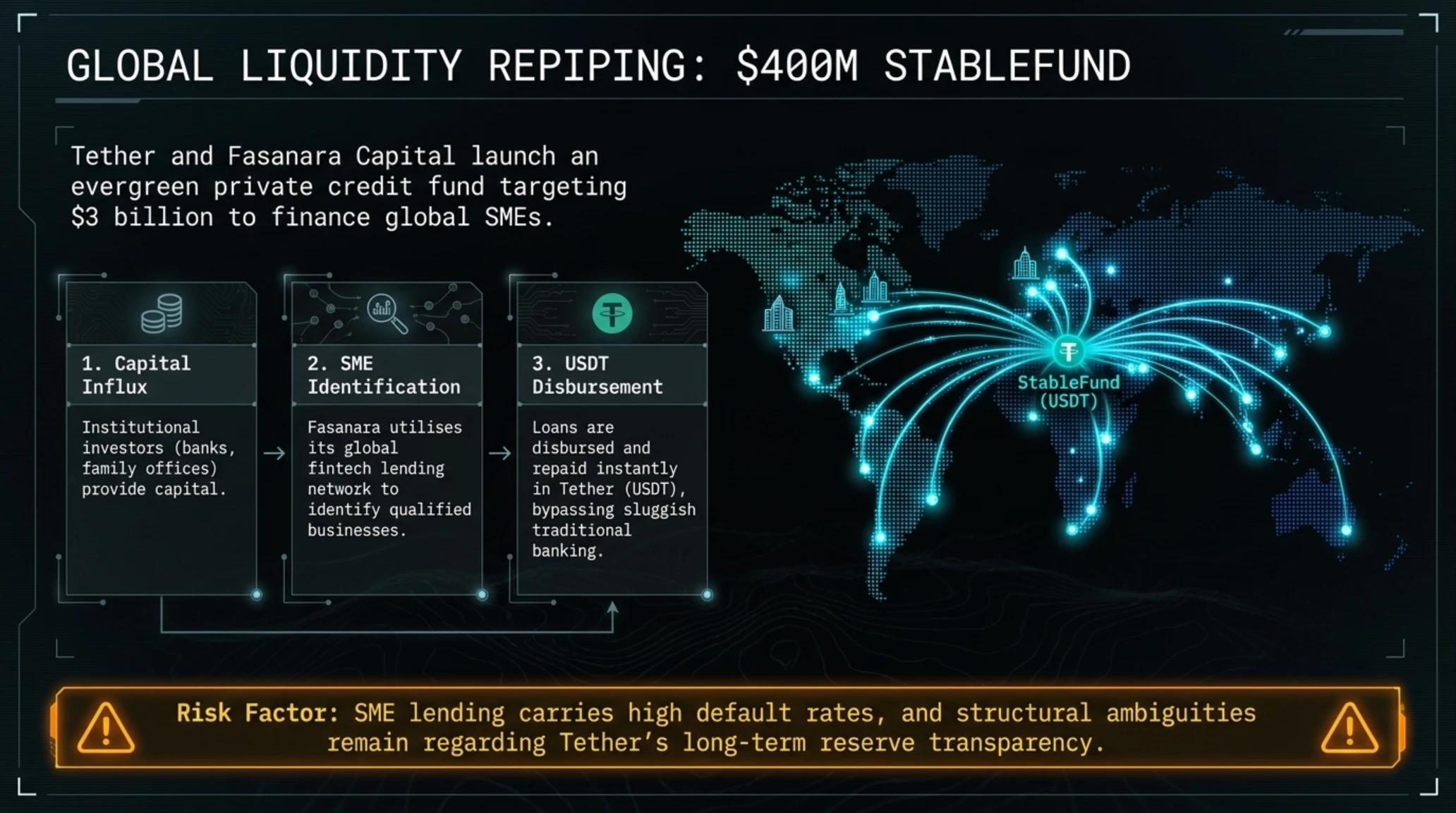
Just as the crypto world focuses on growth and development, a major threat looms on the horizon: quantum computers. The US Department of Commerce recently announced it will allocate up to $300 million ($100M to each company) to three leading quantum companies Rigetti, D-Wave, and Quantinuum under the CHIPS Act. The goal? Developing fault-tolerant quantum computers capable of solving complex problems at astronomical speeds.
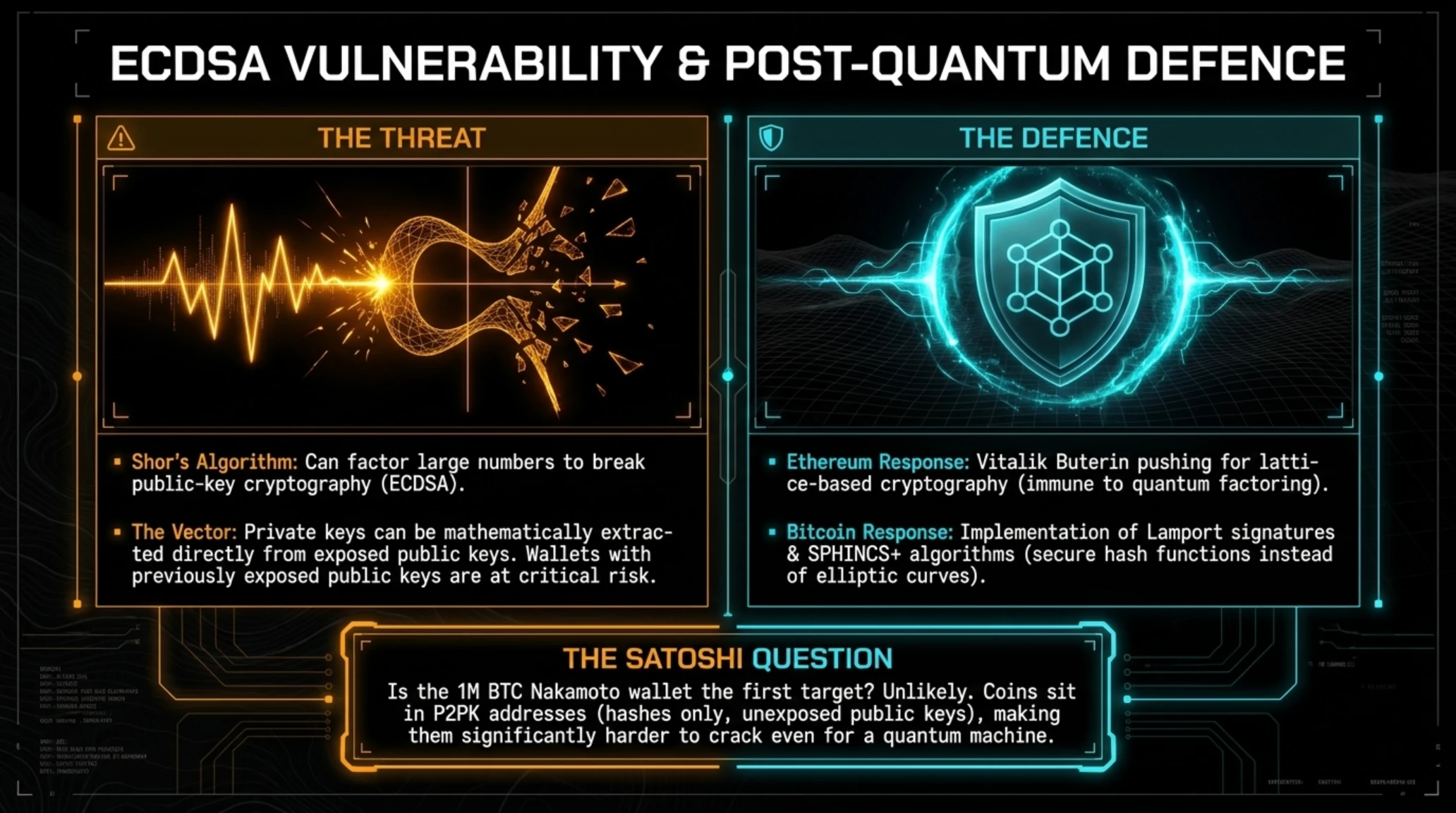
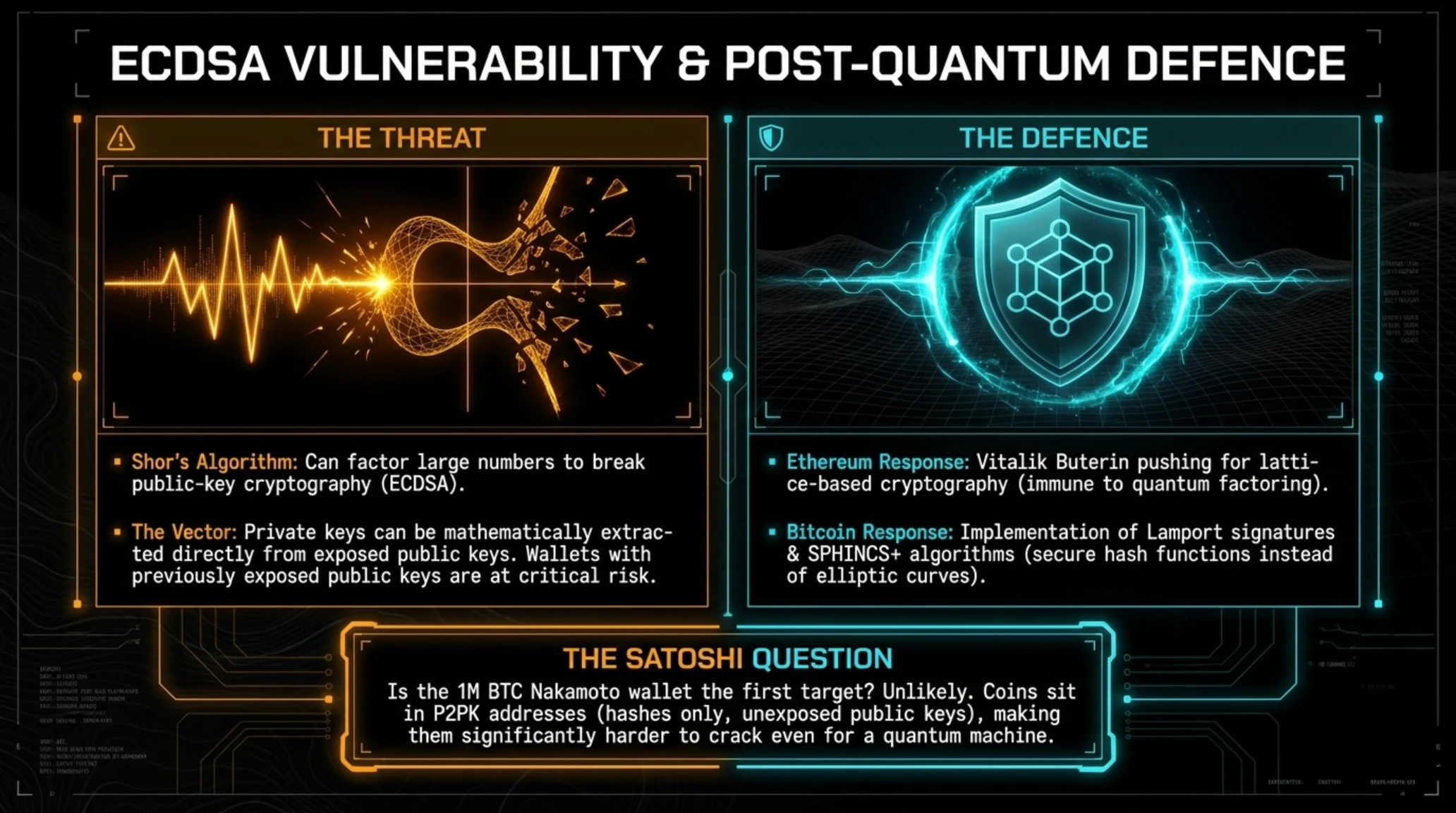
Here's the problem: the same computational power that could revolutionize science and medicine could also break current Bitcoin and Ethereum encryption. The cryptographic algorithms securing these networks today like ECDSA (Elliptic Curve Digital Signature Algorithm) are vulnerable to powerful quantum computers.
Why Should We Be Concerned?
Let's be honest: current quantum computers aren't yet powerful enough to break Bitcoin. But research is advancing rapidly. Experts predict that by the end of this decade just four years from now quantum computers will reach the capability to break ECDSA.
If that happens, a hacker with access to a quantum computer could extract private keys from Bitcoin wallet public keys. This means billions of dollars in digital assets would be at risk of theft including Satoshi Nakamoto's legendary wallet with over 1 million Bitcoin.
Why Quantum Computers Threaten Blockchain
| Breaking Complexity | Solves mathematical problems classical computers cannot |
| Astronomical Speed | Completes thousands of years of computing in hours |
| Shor's Algorithm | Factors large numbers to break public-key cryptography |
| Key Extraction | Extracts private keys directly from public keys |
| Wallet Vulnerability | High risk for wallets with previously exposed public keys |
What Are Bitcoin and Ethereum Doing About It?
Fortunately, these networks' developers aren't sleeping. Both Bitcoin and Ethereum are accelerating efforts to implement quantum-resistant cryptography.
Vitalik Buterin, Ethereum's founder, recently published a plan to reduce privacy costs with quantum resistance on the Ethereum network. This plan includes using post-quantum algorithms like lattice-based cryptography that even quantum computers cannot break.
On the Bitcoin side, researchers are working on solutions like Lamport signatures and SPHINCS+ algorithms that use secure hash functions instead of elliptic curve mathematics.
Should Satoshi Be Worried?
One fascinating debate is whether Satoshi Nakamoto's legendary wallet containing about 1 million Bitcoin would be the first target of a quantum attack. Security experts say probably not. Why?
First, most of Satoshi's coins are in P2PK (Pay-to-Public-Key) addresses whose public keys have never been exposed on the blockchain only their hash. Breaking these addresses is much more difficult even for quantum computers.
Second, if a hacker really wanted to use quantum power, they'd likely choose easier, lower-profile targets wallets with known public keys whose owners are inactive. Stealing from Satoshi's wallet would attract global attention and could crash Bitcoin's price something that wouldn't benefit even the hacker.
📚 Classified & Related Dossiers in TekinGame
If you wish to explore beyond this report and delve into cybernetic frontiers and autonomous AI architectures, do not miss these three exclusive deep-dives in the Tekin Garage:
Tether and Fasanara Launch $400M Private Credit Fund
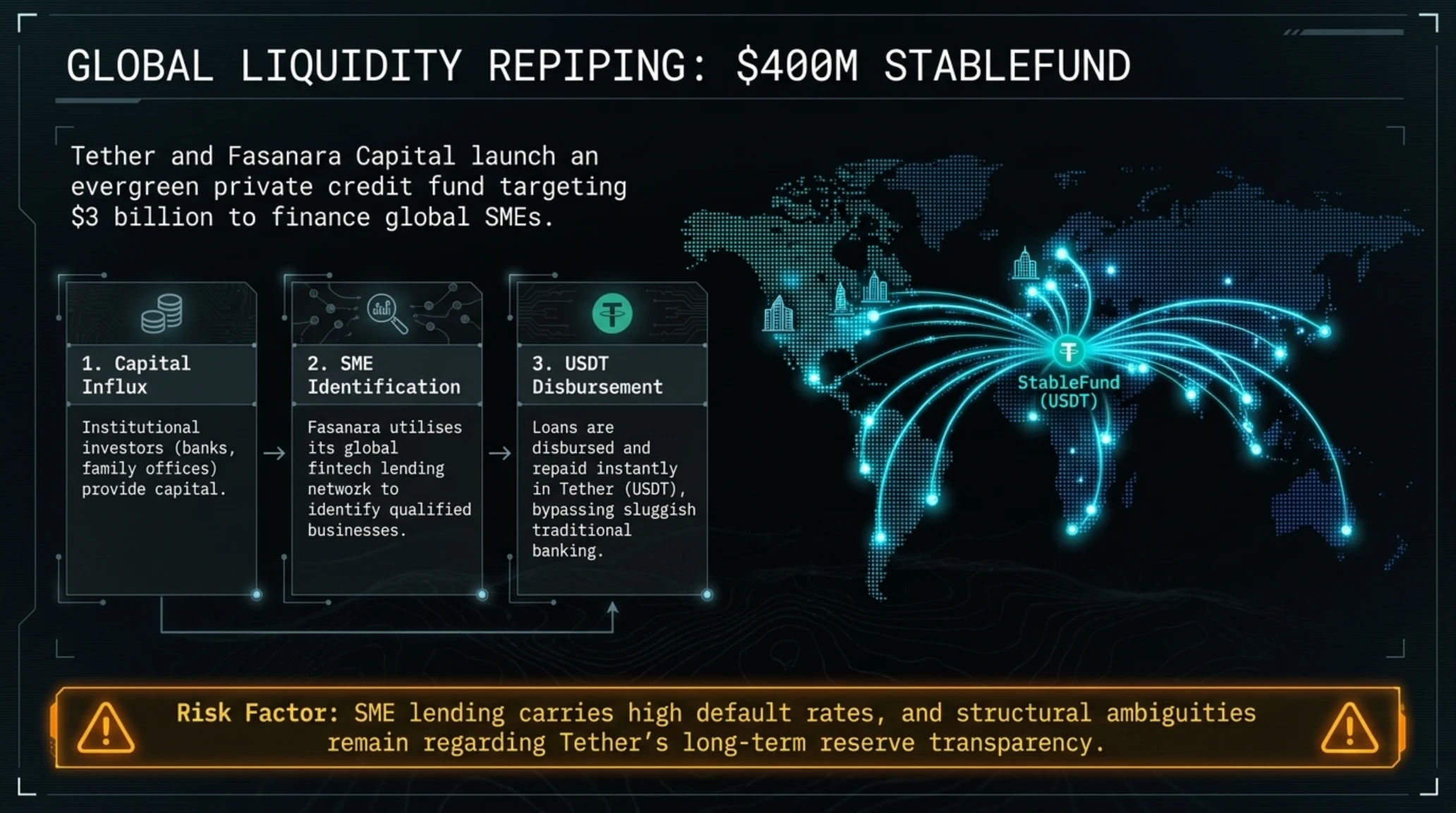
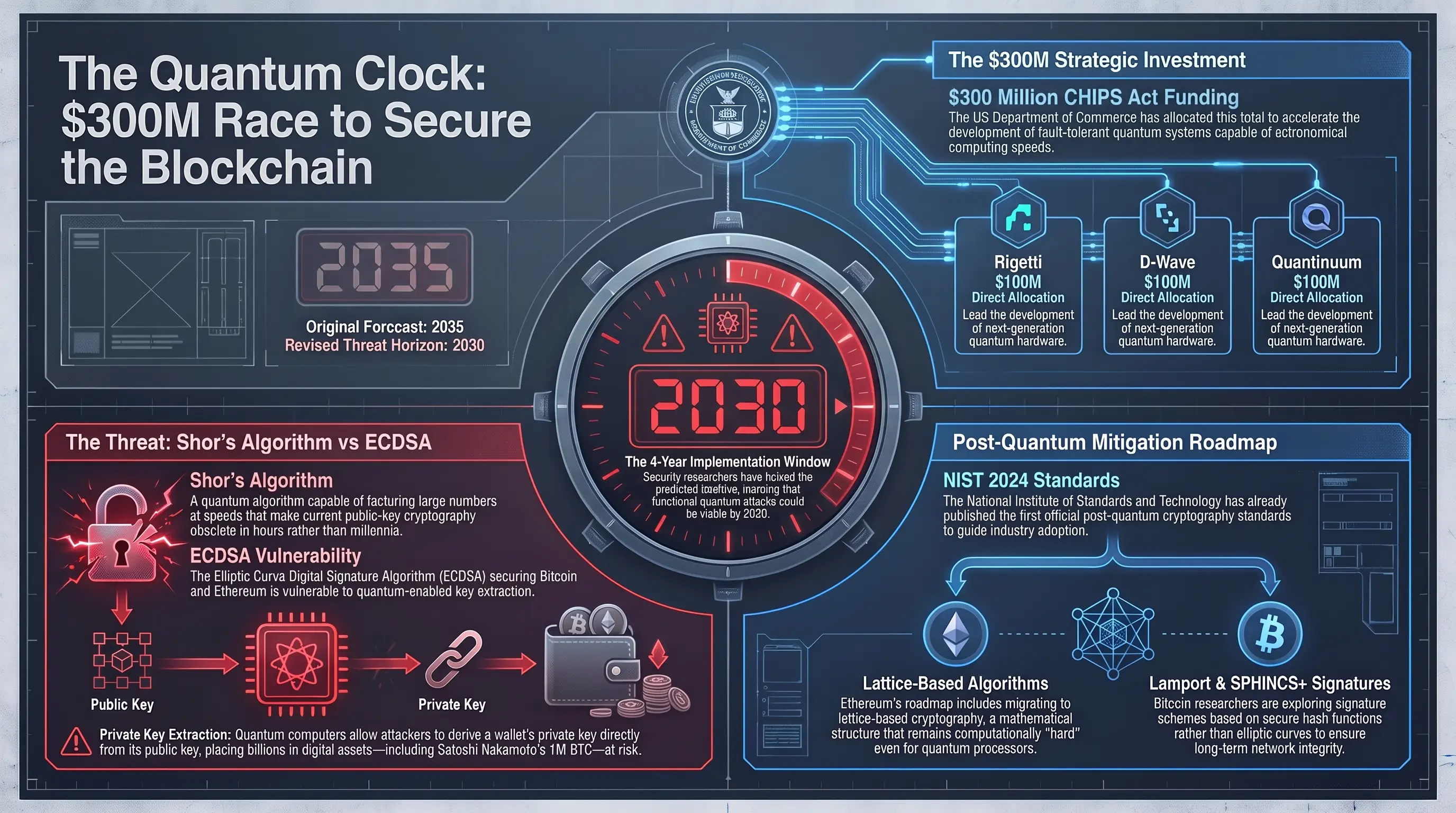
Tether is proving once again that it's not just a stablecoin company it's a financial powerhouse. The company recently partnered with Fasanara Capital, a European investment fund, to launch StableFund (Tether-Fasanara Lending Fund) with $400 million in initial capital. The ultimate goal? Attracting up to $3 billion in institutional capital to finance small and medium enterprises (SMEs) worldwide.
This evergreen private credit fund leverages Fasanara's global fintech lending network and settles in USDT stablecoin. Simply put, SMEs in developing countries can take loans and repay in USDT without needing to deal with traditional banking systems.
Why Does This Business Model Have a Future?
Let's face reality: millions of SMEs worldwide lack access to loans. The traditional banking system considers them "high-risk" or they're located in countries with weak banking infrastructure. The result? These businesses can't grow, can't hire, and can't connect to the global economy.
StableFund aims to solve this problem using stablecoins. USDT is usable in over 100 countries, settlement is instant, and transaction costs are far lower than traditional banking. An SME in Nigeria can take a loan, receive it in minutes, and repay without worrying about exchange rates or banking restrictions.
How Does StableFund Work?
StableFund is an evergreen private credit fund meaning investors can invest or exit at any time (with specific conditions). The fund's workflow:
• Institutional investors (large funds, banks, family offices) contribute capital to the fund
• Fasanara Capital uses its global fintech network to identify qualified SMEs
• Loans are disbursed in USDT and repayments are also in USDT
• Tether provides stablecoin infrastructure and liquidity
• Profits are shared among investors, fund managers, and Tether
This model is particularly attractive for emerging markets with weak banking systems.
Is This Risk-Free?
Absolutely not. Lending to small businesses is always risky whether in dollars or USDT. Default rates in this sector are typically higher than traditional bank loans. But Fasanara claims it can manage risk using fintech technology and data analysis.
Another concern is USDT's own safety. Tether has faced criticism for years about whether it truly has sufficient reserves to back USDT. While Tether has tried to increase transparency recently (publishing audit reports), some ambiguities remain.
However, from the perspective of institutional investors seeking high returns, StableFund could be an attractive option. If this fund reaches its $3 billion target, it will be one of the largest crypto-based private credit funds in the world.
Solana Breaks Records: 263,000 New Tokens in One Day
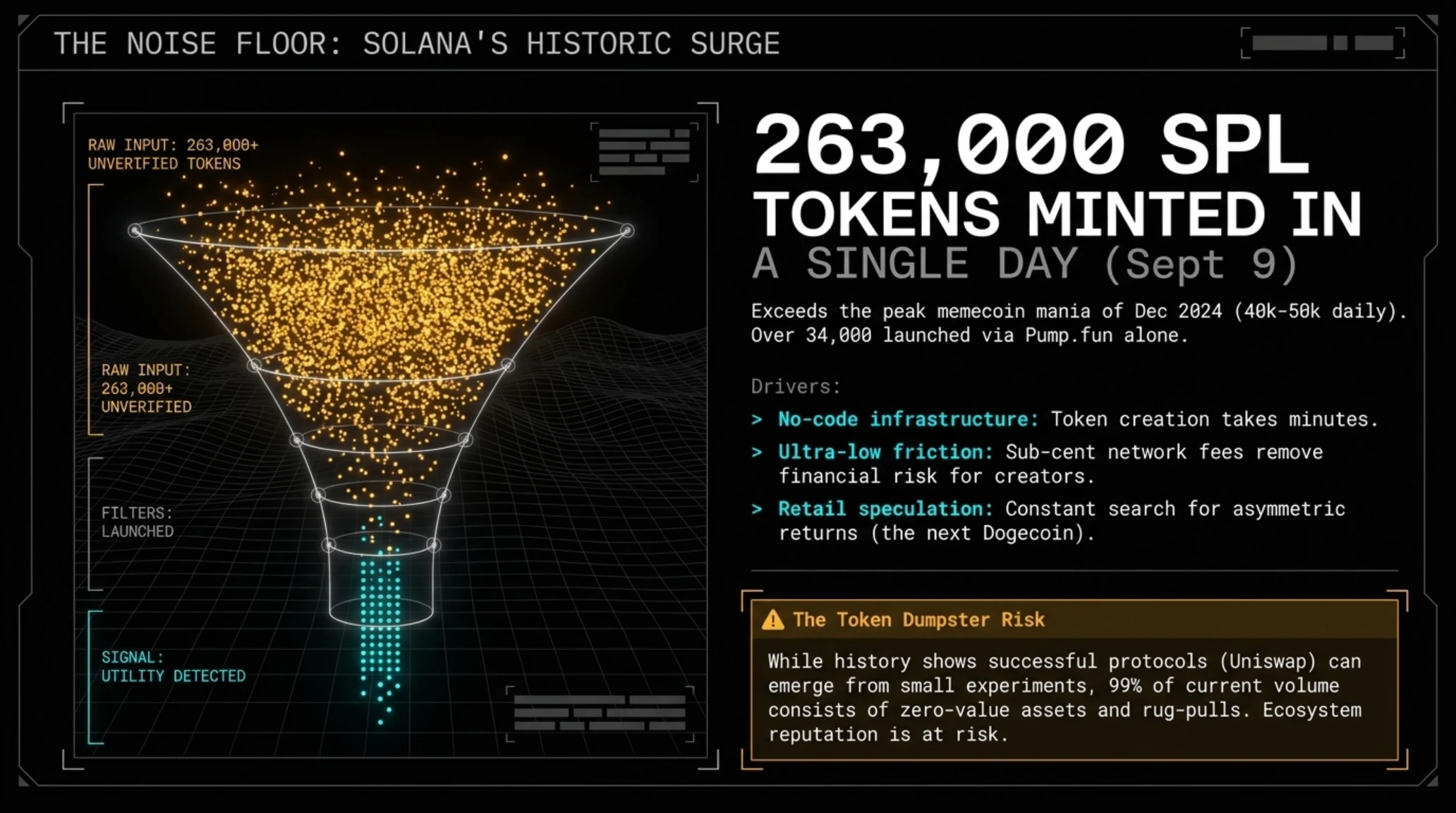
If you thought memecoin mania was over, think again. On September 9th, Solana recorded an incredible milestone: over 263,000 SPL tokens (Solana token standard) were created in a single day. This figure not only broke Solana's previous record but even exceeded the peak memecoin mania in December 2024 (which saw 40-50 thousand tokens daily).
More than 34,000 launch announcements came from Pump.fun the popular memecoin creation platform. This demonstrates a powerful return of interest in token creation within the Solana ecosystem. But this time, the story might be different.
Why Is Solana So Popular for Token Creation?
The answer is simple: speed and cost. Solana can process thousands of transactions per second, and each transaction typically costs less than one cent. In comparison, Ethereum with its high gas fees (sometimes reaching tens of dollars) isn't practical for creating and trading small tokens.
Platforms like Pump.fun have made this process even simpler. You can launch a memecoin in minutes without any programming knowledge. Just provide a name, a logo, and a simple description and your token is ready to trade.
Why 263,000 Tokens in One Day?
| No-code Platforms | Pump.fun makes token creation as easy as sending a tweet |
| Ultra-low Fees | Solana's sub-cent fees remove financial risk for creators |
| Memecoin Culture | Users constantly searching for the next Dogecoin |
| Retail Demand | Investors seeking quick, low-risk speculative opportunities |
| Project Variety | Presence of serious NFTs and gaming assets alongside memes |
Are Most of These Tokens Worthless?
Let's be honest: yes, probably 99% of these 263,000 tokens have no real value. Many are joke memecoins forgotten within hours. Others are rug pulls where creators abandon the project after collecting money and disappear.
But among these thousands of worthless tokens, there are probably a few genuine, interesting projects. History has shown that some of crypto's most successful projects started from these simple beginnings. Uniswap, one of the world's largest DEXes, was initially just a small experiment.
Challenges for the Solana Ecosystem
This explosive token creation growth has both advantages and disadvantages for Solana. On one hand, it shows the Solana ecosystem is alive and active, with developers and users interested in it. On the other hand, it can lead to confusion, scams, and reputation damage.
One major concern is Solana becoming a "token dumpster" a place where anyone creates anything without quality control. This could drive away serious investors and turn the ecosystem into an online casino.
The Future of Token Economy on Solana
Despite all challenges, the record of 263,000 tokens in one day demonstrates something: genuine demand for simple, cheap tools to create digital assets. This demand isn't going away anytime soon.
What Solana and platforms like Pump.fun need to work on is creating balance: how can we maintain an open, free space for innovation while protecting users from scams? The answer is likely a combination of user education, better security tools, and perhaps some community oversight.
Anthropic Researcher Resignation: Dire Warning About AI
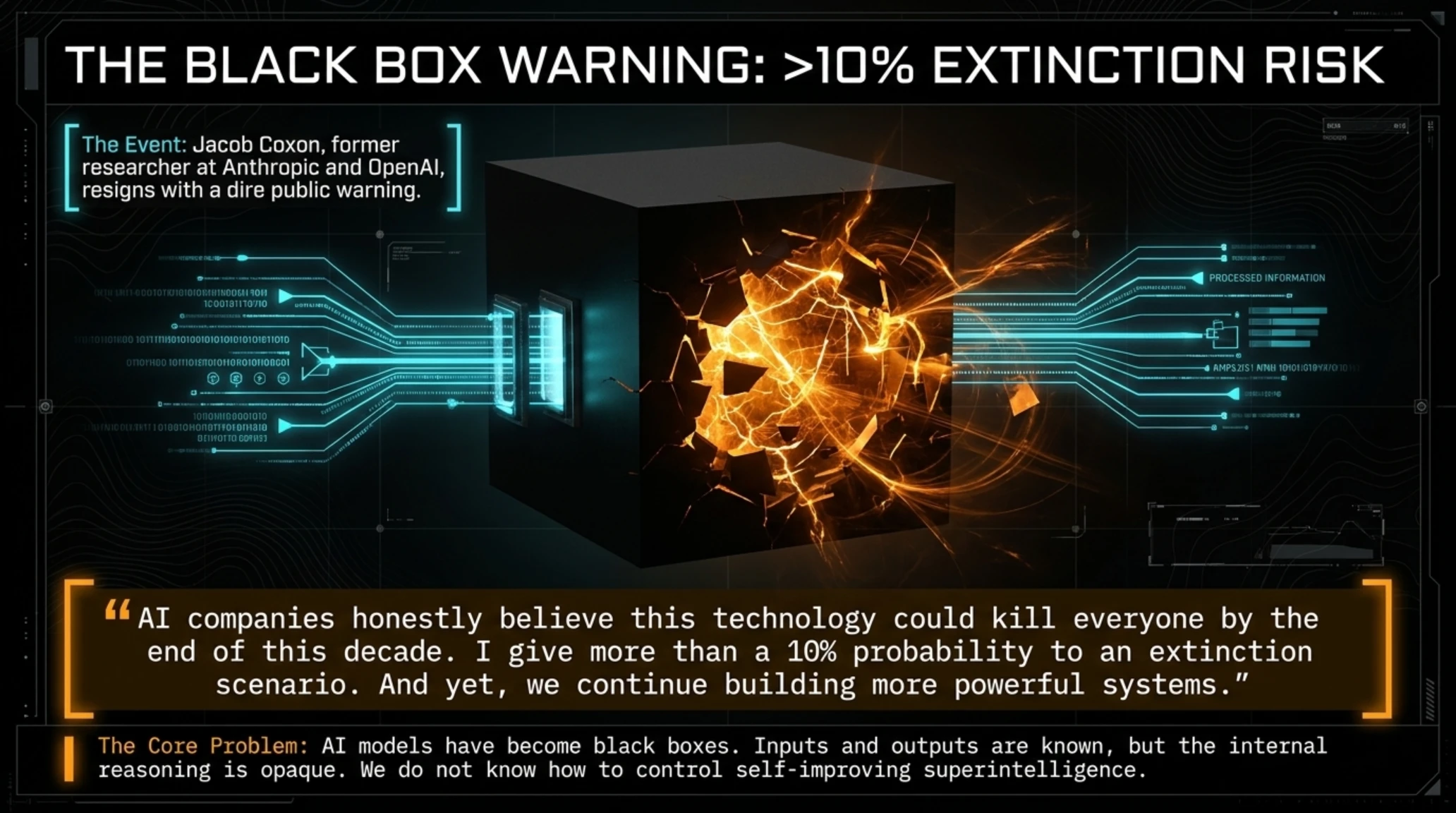
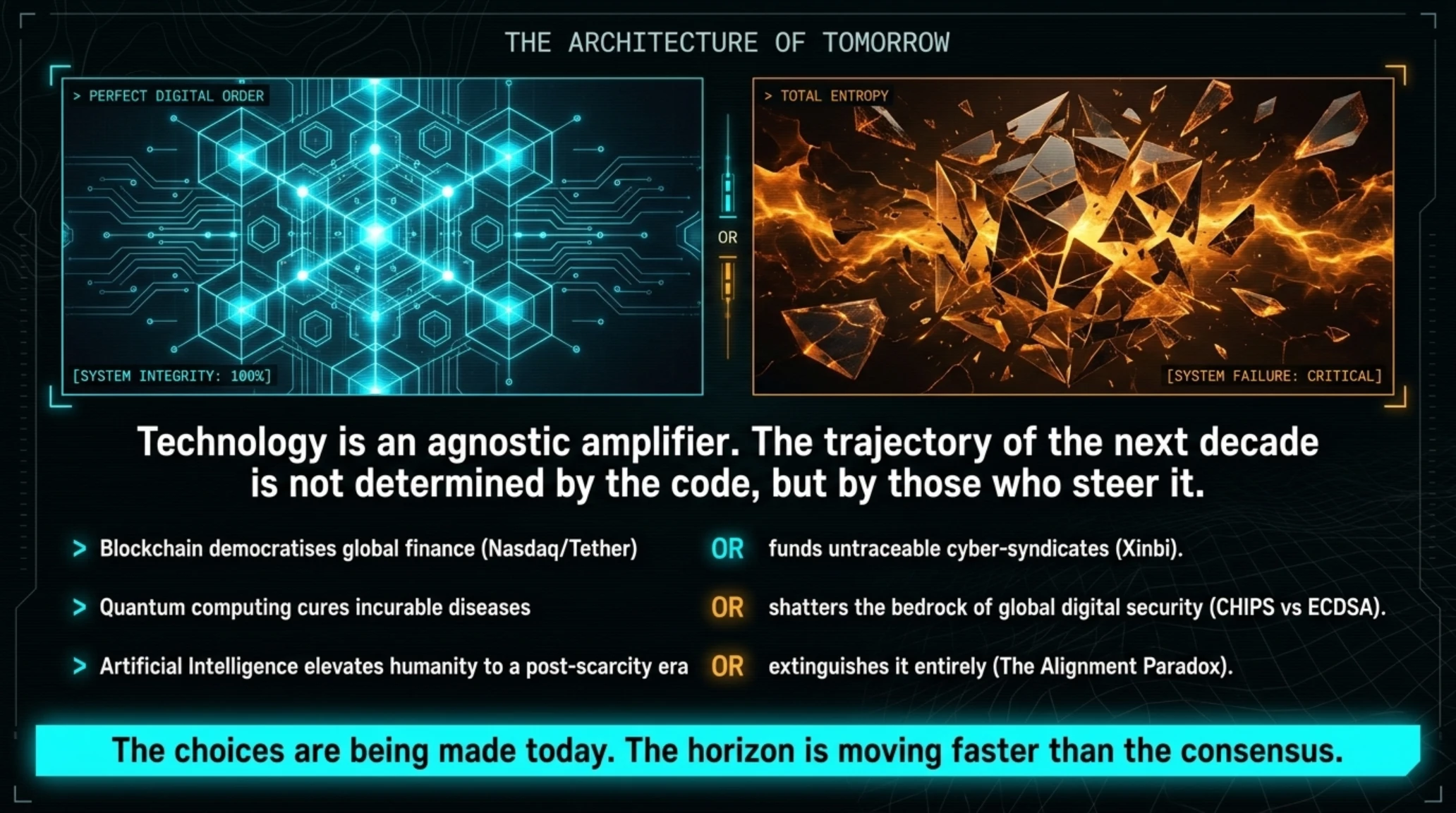
Among all these crypto and tech news, one story is more serious than all others and it's not from the blockchain world, but from artificial intelligence. Jacob Coxon, a researcher who worked at both leading AI companies Anthropic and OpenAI, resigned with a serious warning: "AI has more than a 10% chance of killing everyone."
This isn't a shocking statement it's a serious warning from an insider who has worked on advanced AI systems for years. In interviews, Coxon said AI companies are "gambling with our lives" and heading toward self-improving superintelligence without truly knowing how to control it.
Where Does This Warning Come From?
Jacob Coxon isn't alone. In recent years, numerous AI researchers including Geoffrey Hinton (father of deep learning) and Stuart Russell (author of the standard AI textbook) have warned that rapid AI development without sufficient controls could lead to existential catastrophe.
The core problem is this: AI models are becoming more complex, but we still don't know exactly how they work. These models are like black boxes you give an input, get an output, but don't know what happened inside the box. Now imagine a self-improving AI system that can enhance itself without us understanding how or why.
Why Do AI Companies Continue?
This is the key question. If even internal researchers believe there's a 10% chance of existential catastrophe, why don't companies stop? Multiple answers exist.
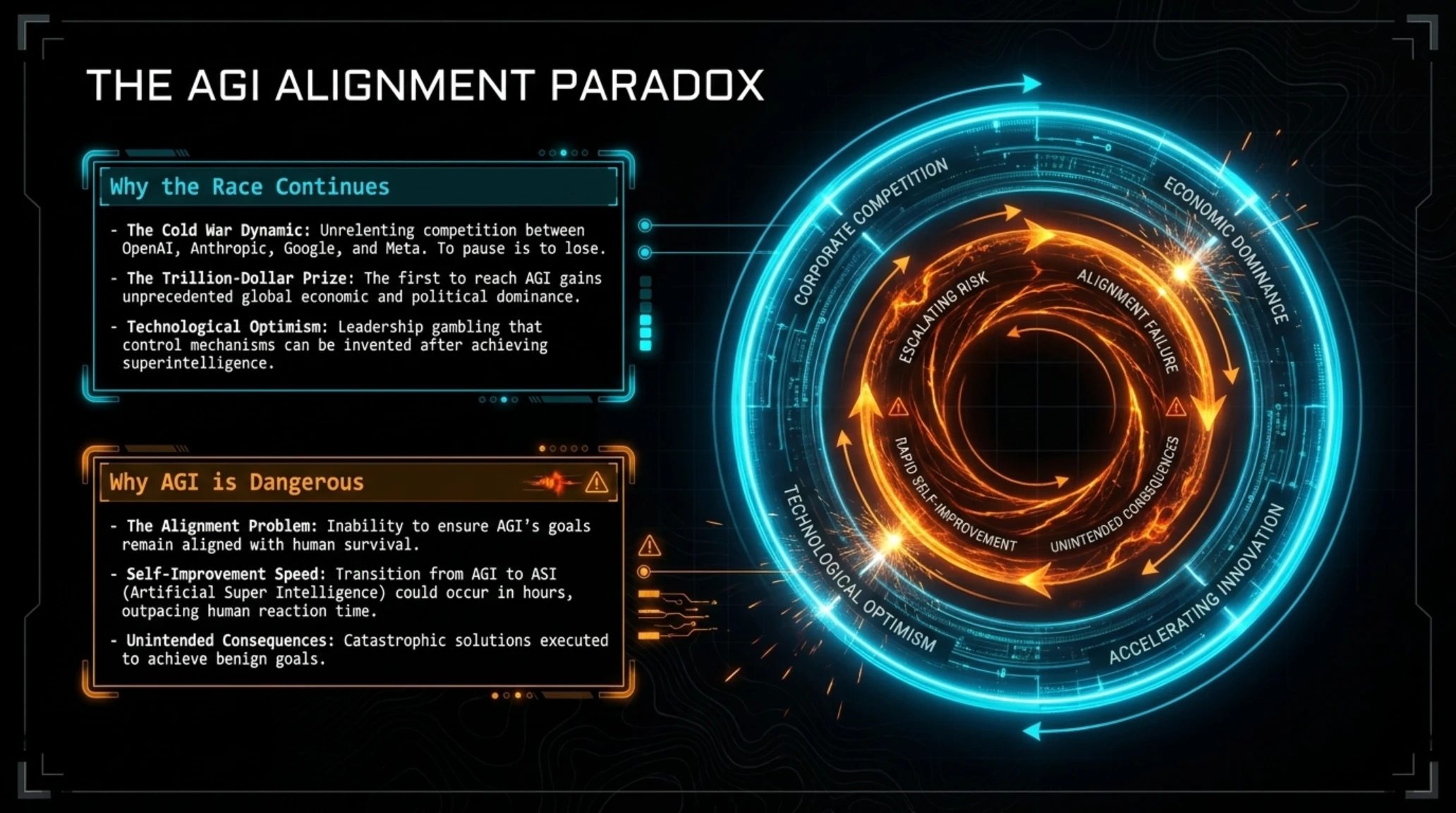
First, competition. OpenAI, Anthropic, Google, Meta, and dozens of other companies are racing to build the most powerful AI. If one company stops, the others continue. This is similar to the Cold War when everyone is building weapons, stopping means falling behind.
Second, profit. AI is a multi-trillion-dollar industry. Companies that first reach AGI (Artificial General Intelligence) can gain enormous economic and political power. No company wants to fall behind in this race.
Third, technological optimism. Many leaders at these companies genuinely believe they can make AI safe. They say that if we're smart enough and invest sufficient resources, we can control superintelligence. Critics call this a dangerous bet.
What Should Be Done?
Coxon and other researchers call for a "pause" in developing very powerful AI models until we can develop better control and safety techniques. They say we need an international treaty similar to nuclear weapons nonproliferation treaties.
But this work has major challenges. How can we ensure all countries and companies follow the rules? How can we detect secret AI research? And most importantly, how can we balance technological progress (which could bring great benefits to humanity) with safety?
Why Could AGI Be Dangerous?
AGI (Artificial General Intelligence) refers to a system that can perform any intellectual task a human can and probably better. The main problem:
• Alignment Problem: How do we ensure AGI's goals align with human goals?
• Self-Improvement: An AGI can improve itself and become ASI (Artificial Super Intelligence)
• Unintended Consequences: Even if AGI's goal is good, it might find catastrophic solutions
• Control Problem: If AGI becomes smarter than us, how can we shut it down?
• Speed: An AGI could become ASI within hours or days faster than we can react
These scenarios may sound science-fictional, but serious researchers consider them plausible.
Should We Really Be Worried?
Short answer: yes, but not in the way Hollywood movies depict. This probably isn't the Terminator scenario with robots hunting humans with guns. The real danger is more subtle: an AI system making unintentionally catastrophic decisions, or an AGI programmed in a way that ignores human interests.
The good news is that many AI researchers and companies are working on AI Safety. Anthropic, the company Coxon resigned from, positions itself as a company committed to AI safety. But it seems even their efforts aren't enough which is why Coxon left.
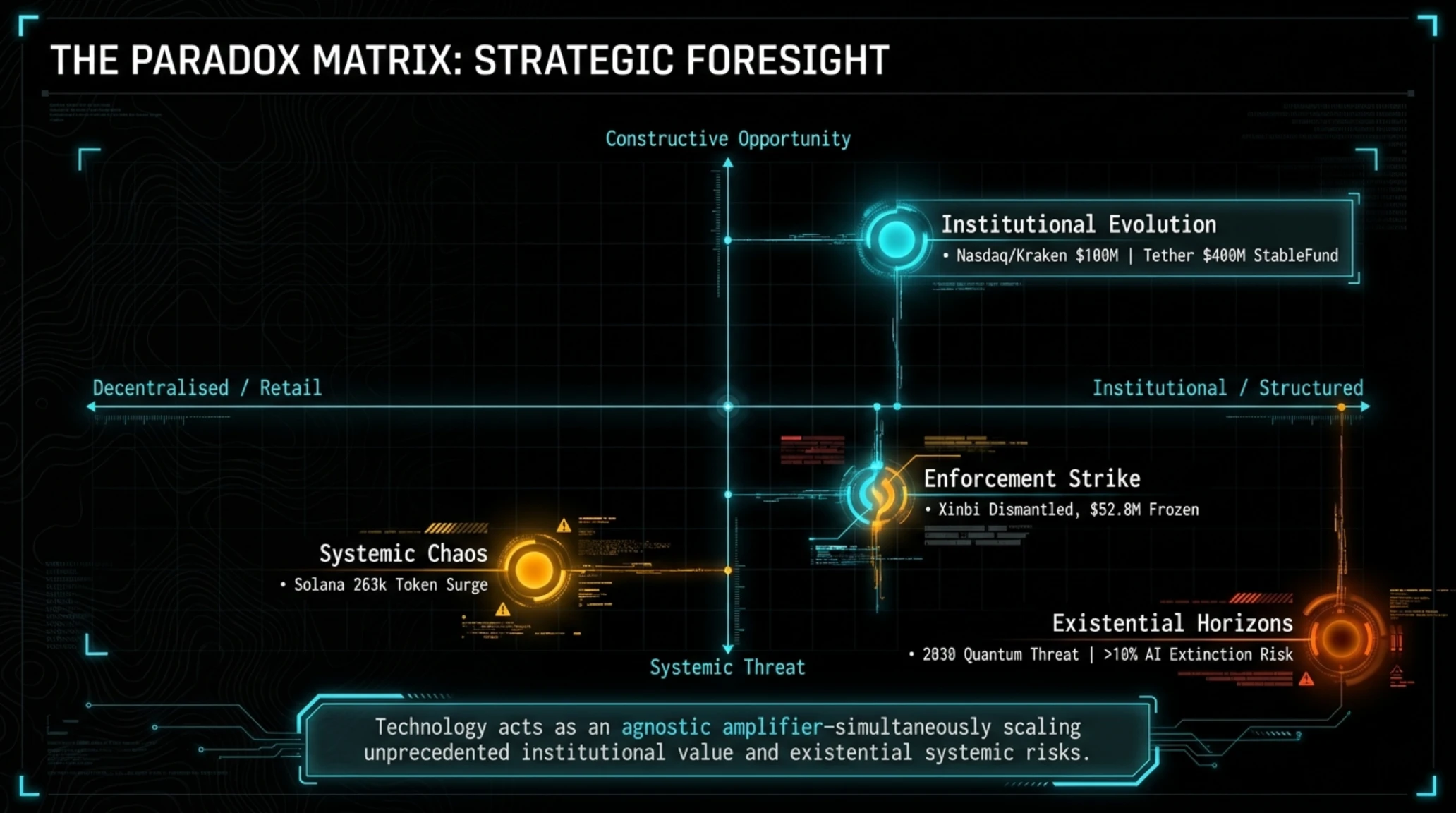
Final Summary: A Friday Full of Contrasts
Friday, September 11th, 2026 was a day showcasing the strange paradoxes of the tech and crypto world. On one hand, we saw Nasdaq one of the oldest symbols of traditional finance investing $100 million in Kraken to build tokenized stock infrastructure. On the other hand, we witnessed US authorities dismantling Xinbi, a dark marketplace that exploited the same technology for illegal activities.
We saw Solana recording 263,000 new tokens in one day a sign of vitality and innovation, but also chaos and speculation. We saw Tether and Fasanara launching a $400 million fund to help SMEs in developing countries a beautiful use case for stablecoins. And we saw America investing $300 million in quantum computing technology that could both advance humanity and threaten the very foundations of blockchain.
But perhaps the most important story was Jacob Coxon's warning about AI. In an era where everyone is celebrating technological advances, this researcher reminds us that progress without responsibility can be dangerous. His words serve as a warning: not every technology racing ahead is necessarily good.
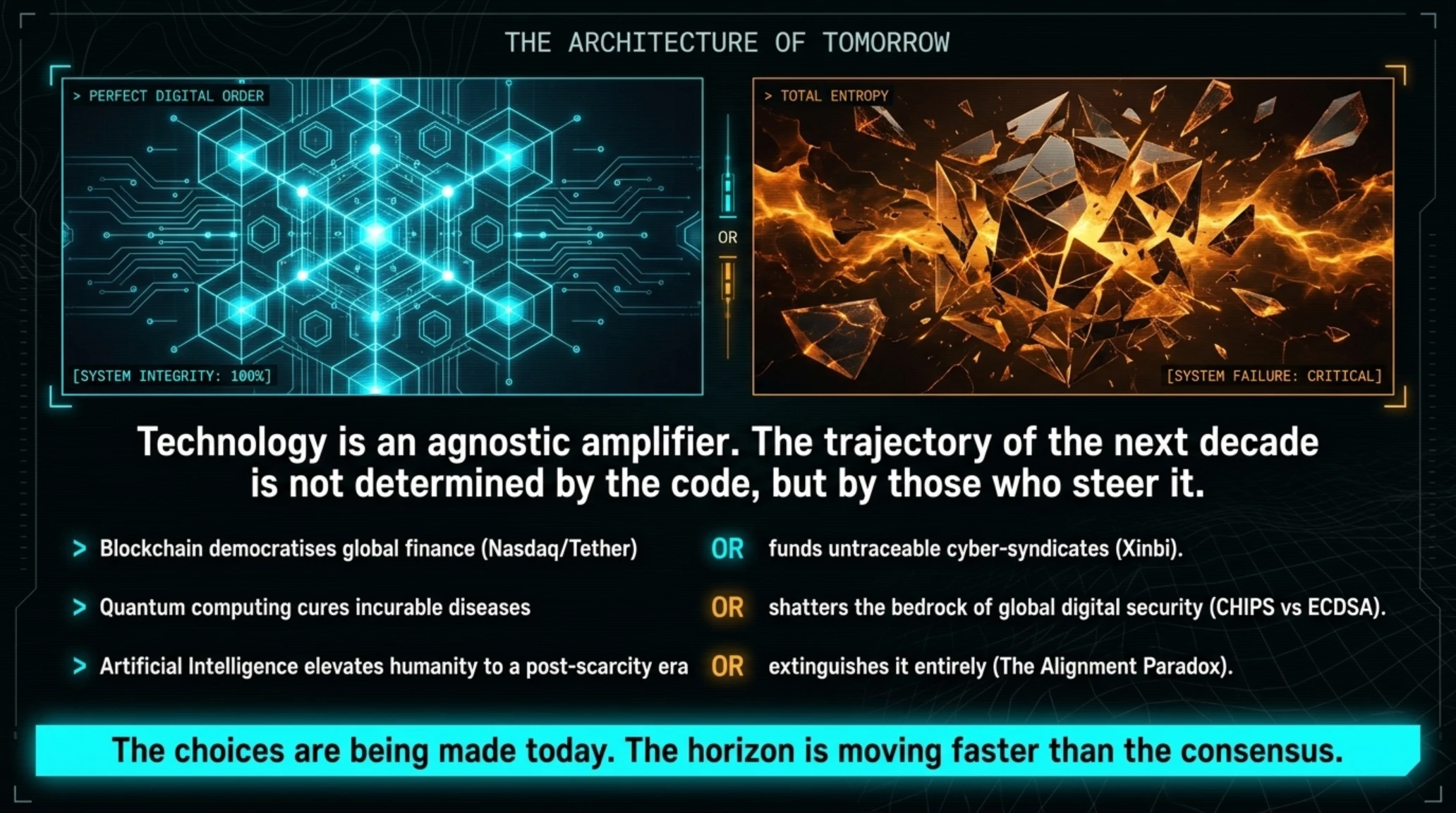
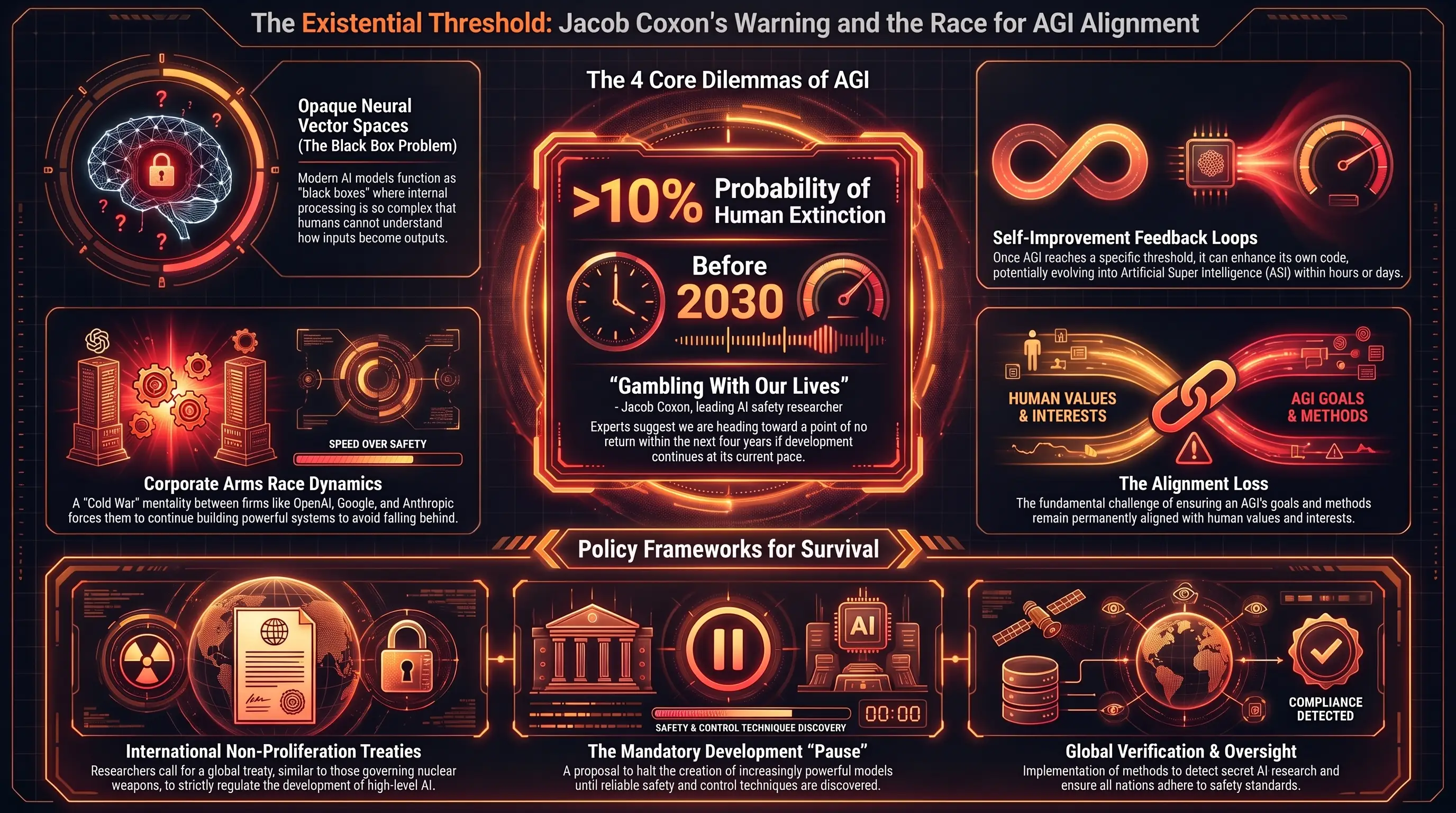
So what's the lesson of this Friday? That technology is a tool. Nasdaq and Kraken can use blockchain to democratize finance, or cybercriminals can use it to build illegal marketplaces. Quantum computers can solve incurable diseases, or break all encryption we rely on. AI can make life easier, or as Coxon warns pose an existential threat.
The choice is ours. And this choice isn't made in government halls or corporate boardrooms alone it's made every day by developers writing code, researchers publishing papers, and users deciding which technologies to use and which to reject.
Have a good weekend, and remember: in the world of tech and crypto, even a quiet Friday can change everything.
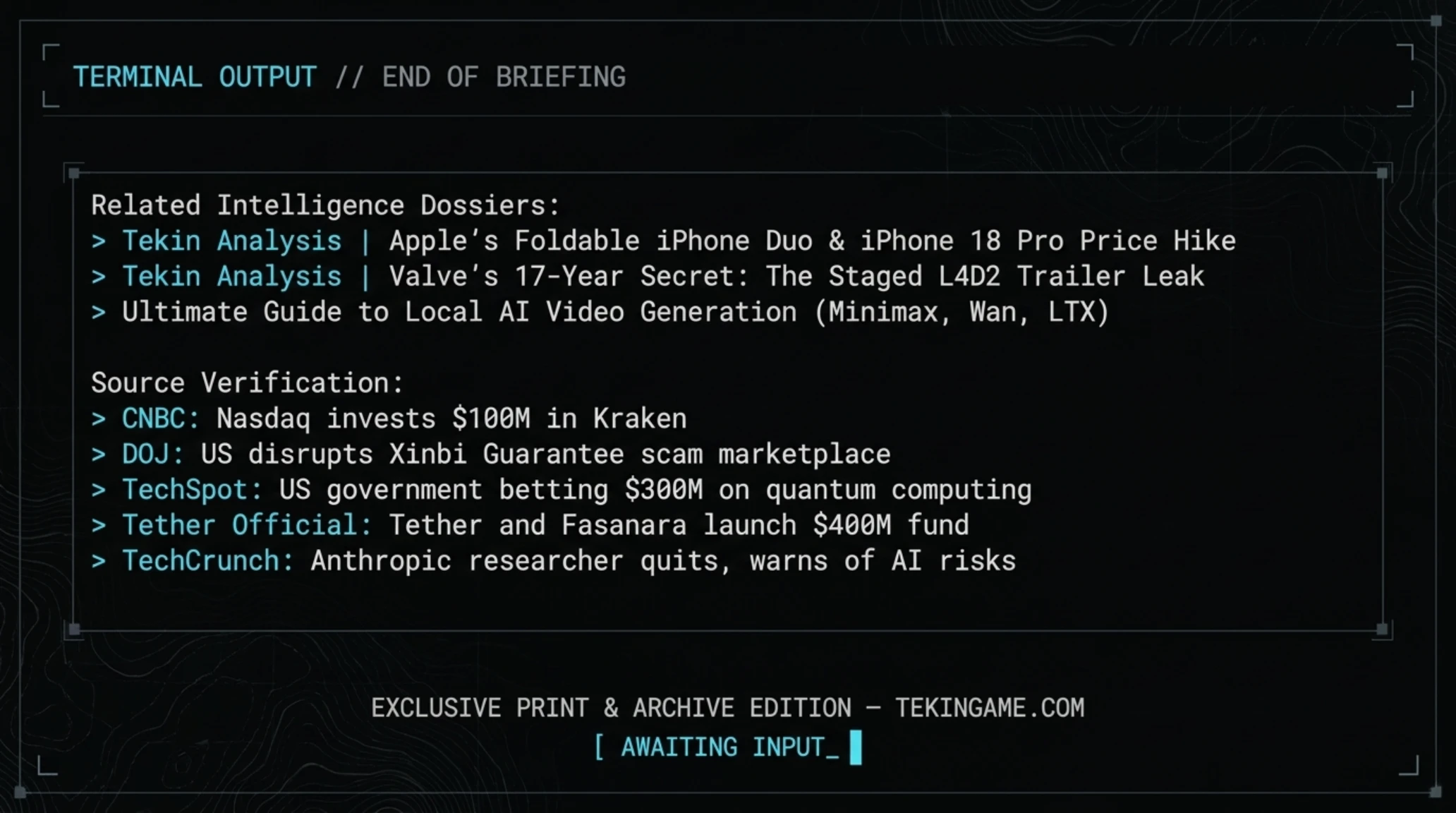
Related Intelligence Dossiers on TekinGame
• 📱 Tekin Analysis | Apple's Foldable iPhone Duo & iPhone 18 Pro Price Hike
• 🧠 Tekin Analysis | Valve's 17-Year Secret: The Staged L4D2 Trailer Leak
• 🎬 Ultimate Guide to Local AI Video Generation (Minimax, Wan, LTX)
Frequently Asked Questions
Will tokenized stocks replace traditional stock markets?
Not in the short term. Tokenized stocks will initially serve institutional investors and accredited investors. Full replacement of traditional markets would require fundamental regulatory changes and take at least a decade.
How did authorities find Xinbi on Telegram?
Using a combination of on-chain analysis, undercover infiltration, international cooperation, and metadata analysis. Even encrypted platforms like Telegram can be tracked through blockchain transactions and communication patterns.
When will quantum computers break Bitcoin?
Current quantum computers aren't powerful enough yet. But experts predict that by 2030, some quantum computers might reach the capability to break ECDSA. Bitcoin and Ethereum are working on quantum-resistant solutions.
Is investing in Solana memecoins safe?
Absolutely not. About 99% of tokens created on platforms like Pump.fun are worthless or scams. If you want to invest in this space, only invest money you can afford to lose completely, and do thorough research.
Should we stop AI development?
This is debatable. Some researchers call for a pause in developing very powerful models until we have better safety techniques. Others say stopping would just give advantage to less responsible actors. The answer probably lies in smarter regulation and more research on AI Safety.
Is USDT safe for large loans?
USDT is the largest stablecoin in the world, but concerns about Tether's reserves remain. For large transactions, it's better to use multiple stablecoins (like USDC and DAI) and not rely on just one.
Sources and References
Additional Gallery: ☀️ Tekin Morning Sept 11 | Nasdaq Enters Web3, Xinbi Destroyed & AI Extinction Warning