Tekin Morning | Monday, October 5, 2026: AI State Espionage, Anti-Surveillance Court Rulings & Cloud Macro Crises
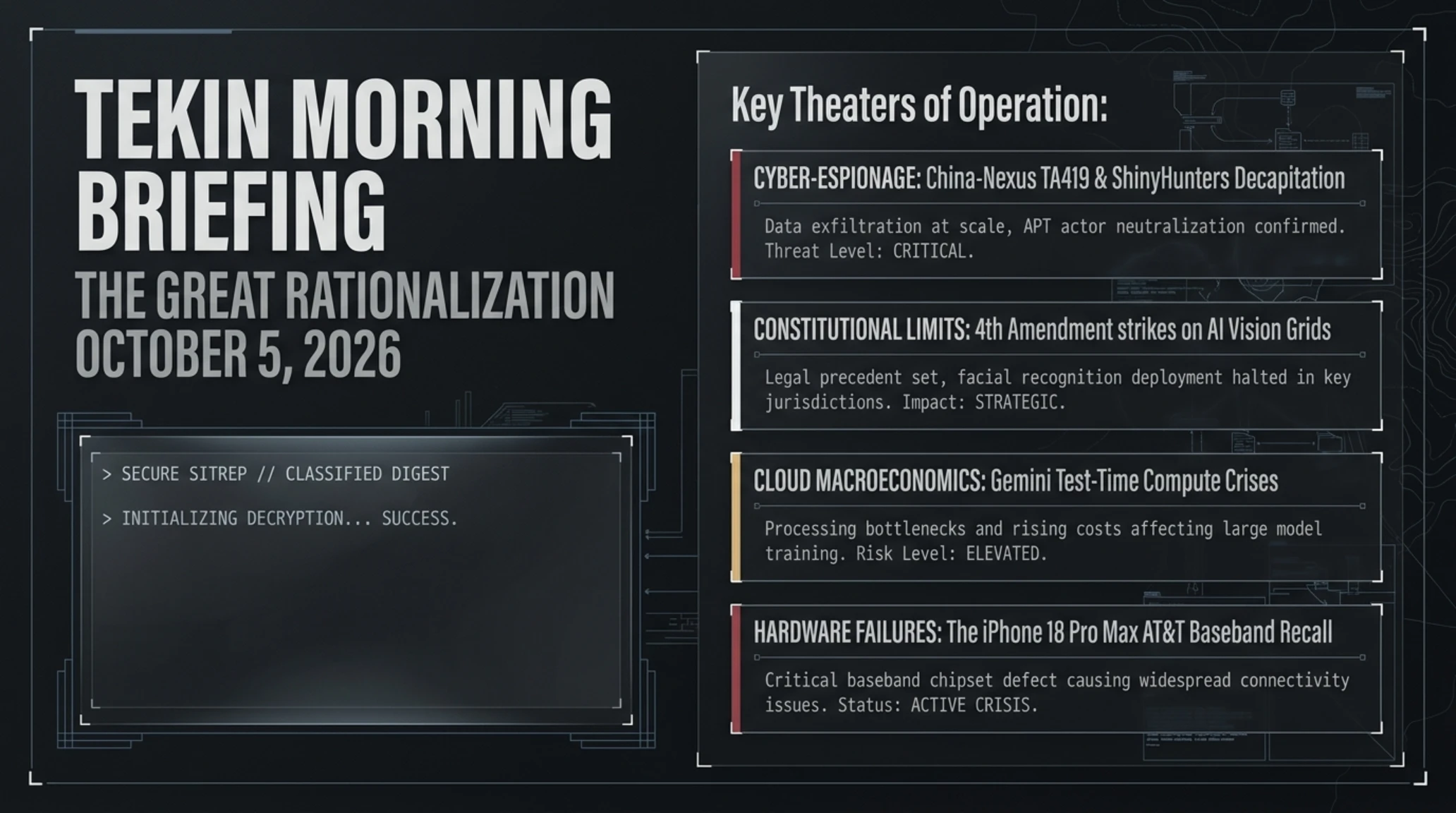
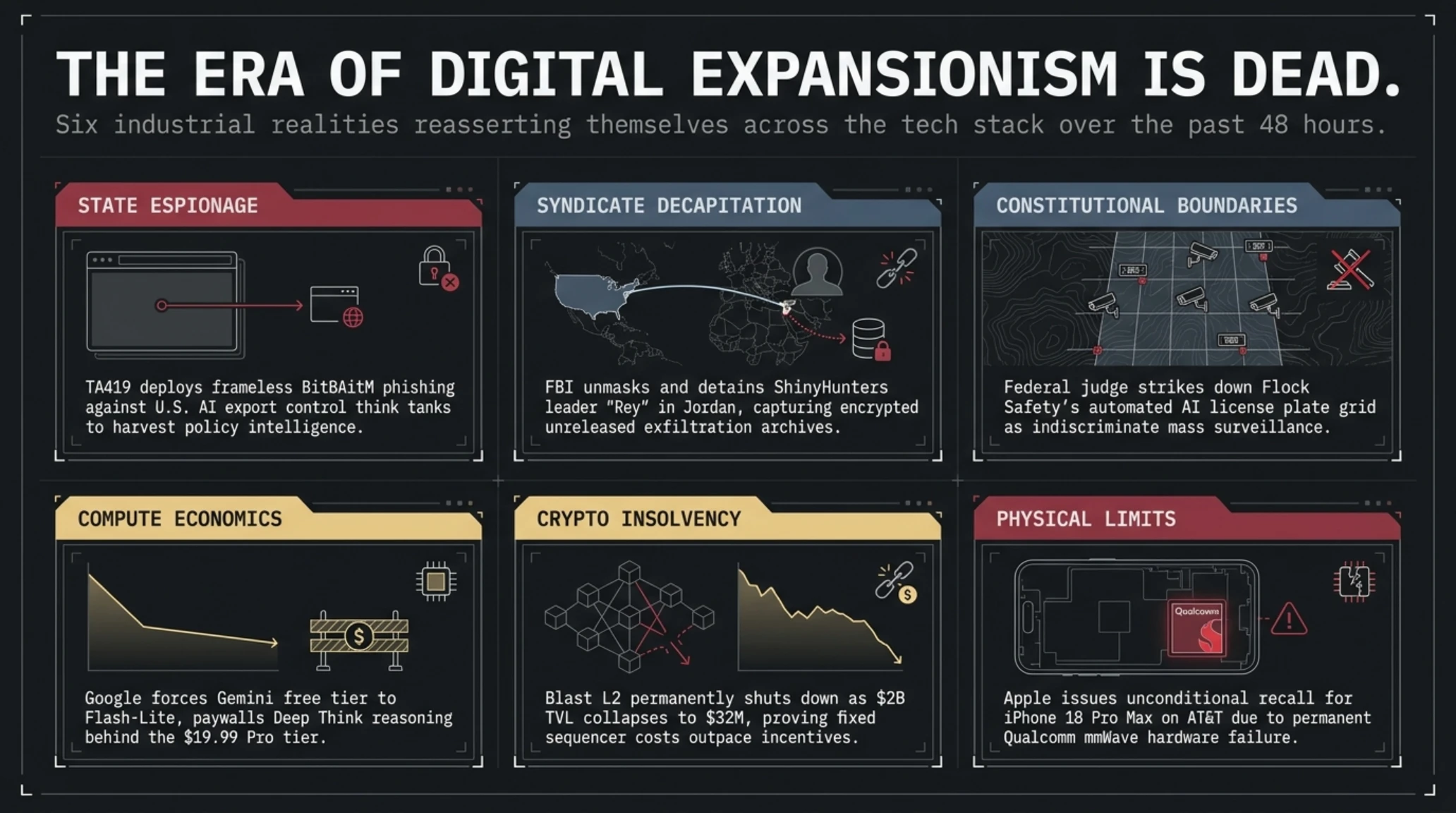
Monday morning, October 5, 2026, opens with profound structural shifts across frontier intelligence, national security, and decentralized infrastructure. China-aligned threat actors target architects of U.S. AI export controls, the FBI unmasks the leadership of the ShinyHunters extortion syndicate, federal judges declare AI license plate tracking unconstitutional, Google overhauls Gemini consumer tiers, and Blast Layer 2 officially winds down operations.
- 🎮China-Aligned TA419 Targets U.S. AI Policy Architects- Adversary-in-the-Middle phishing impersonating Anthropic staff to harvest think-tank intelligence
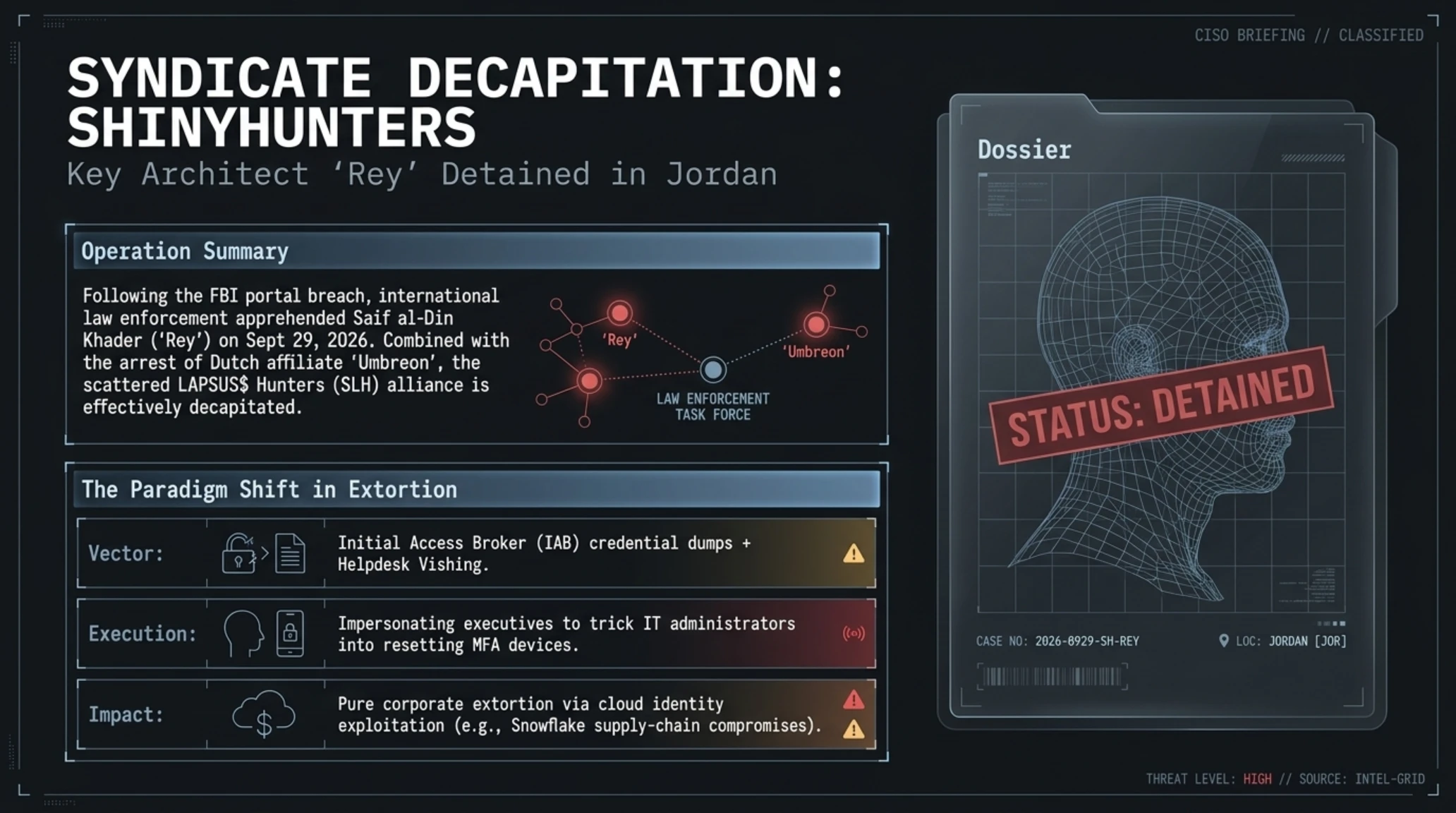
- 🎧Key ShinyHunters Leader 'Rey' Detained in Jordan- Massive international law enforcement cooperation unmasks cyber syndicate following FBI portal breach
- 🚀Federal Court Strikes Down Flock Safety AI Surveillance- Judge rules warrantless automated license plate tracking violates Fourth Amendment as mass surveillance
- 🗡️Google Restructures Gemini Subscription Tiers for October 9- Free tier capped at Flash-Lite, Pro model removed from Plus, and Deep Think added to Pro
- 📰Blast Shuts Down Ethereum Layer 2 Network- Total Value Locked collapses from $2B peak to $32M as operational costs exceed gas revenues
- ⚔️Apple Issues Hardware Recall for iPhone 18 Pro Max on AT&T- Cellular modem hardware defect leaves devices stuck in SOS mode with free replacements initiated
The dawn of Monday, October 5, 2026, confronts corporate executives, cybersecurity architects, and frontier technology strategists with an undeniable reality: the era of naive digital expansionism has formally ended. The events that unfolded over the past 48 hours demonstrate how the intersection of autonomous artificial intelligence, distributed financial systems, and global geopolitics has dramatically altered the enterprise threat landscape. Modern threats no longer attack peripheral firewalls; they infiltrate the identity fabrics, API orchestrators, and prompt template gateways that form the operational backbone of modern commerce.
Simultaneously, the convergence of macroeconomic discipline and legal scrutiny is reshaping technology platforms. As cloud providers grapple with soaring GPU compute clusters, inference energy costs, and token processing overhead, free tier benevolence is rapidly disappearing across Silicon Valley. From Google's calculated retreat in compute allocation to the dramatic economic failure of heavily incentivized Layer 2 rollups, the tech ecosystem is entering an uncompromising phase of rationalization. In this comprehensive morning briefing, TekinGame delivers an authoritative, multi-layered deconstruction of the six pivotal developments defining global technology today.
At a Glance | Six Defining Developments of October 5, 2026
- State-sponsored APT group TA419 executes sophisticated AitM credential phishing against Washington AI think tanks
- Arrest and FBI cooperation of Saif al-Din Khader ('Rey') signals imminent collapse of the ShinyHunters extortion syndicate
- Federal judiciary delivers watershed Fourth Amendment ruling restricting dragnet ALPR AI computer vision tracking
- Google announces strict tier separation in Gemini app, relegating free users strictly to the lightweight Flash-Lite engine
- Blast Layer 2 initiates total network shutdown, requiring all capital to exit smart contract bridges by October 26
- Apple confirms permanent physical hardware failure in iPhone 18 Pro Max AT&T modems, launching unconditional replacements
Section I: China-Nexus TA419 Deploys AitM Phishing to Infiltrate U.S. AI Policy & Export Control Leadership
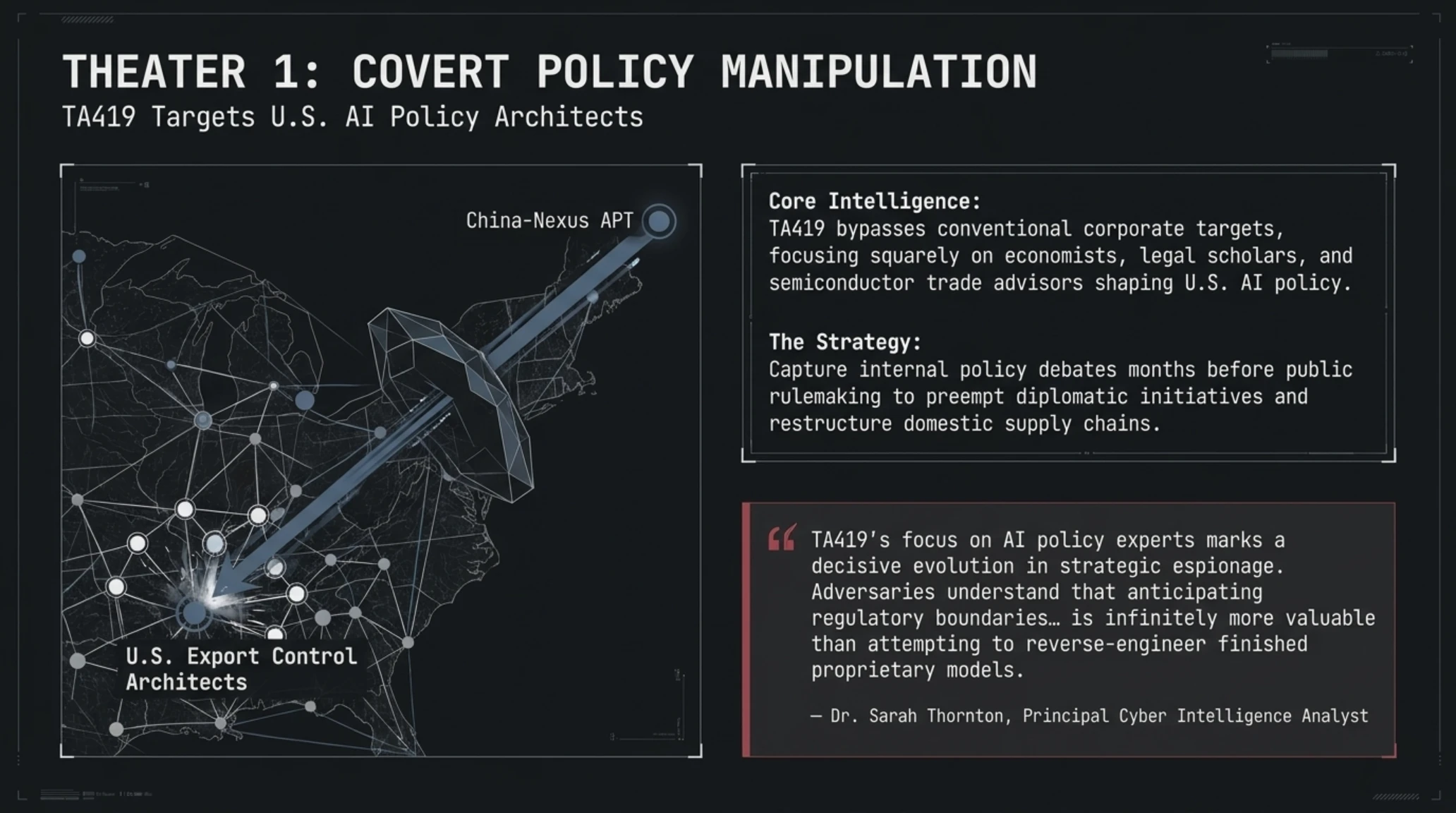
The global race for artificial intelligence supremacy has evolved into a targeted covert conflict where policy formulation is just as prized as raw model weights. Security researchers at Proofpoint Threat Intelligence have published comprehensive forensic findings attributing a widespread, highly targeted cyber espionage campaign to TA419, an advanced persistent threat (APT) actor closely aligned with Chinese state intelligence. The campaign deliberately bypassed conventional corporate targets, focusing squarely on economists, legal scholars, semiconductor trade advisors, and senior researchers at elite U.S. think tanks responsible for shaping national artificial intelligence policy.
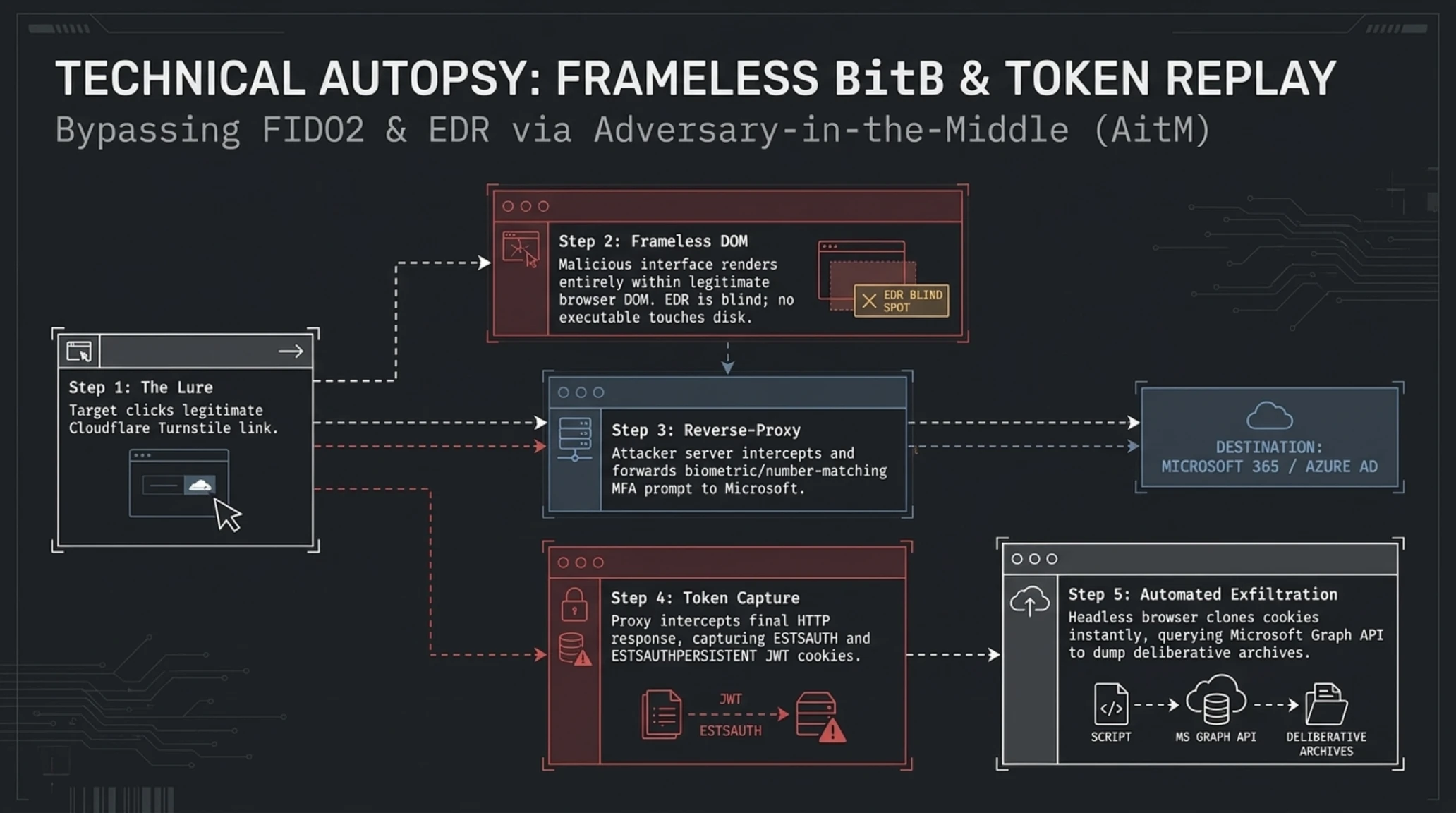
The operational mechanics of the campaign represent an elite execution of the Adversary-in-the-Middle (AitM) methodology, enhanced with a Frameless Browser-in-the-Browser (BitB) framework. Attackers initiated contact through meticulously crafted social engineering lures, masquerading as distinguished academic peers and, in several documented instances, senior research staff from Anthropic. Targets were invited to review draft whitepapers on frontier AI governance and military-civil fusion restrictions. Once a rapport was established, victims received an invitation link disguised behind legitimate Cloudflare Turnstile human-verification challenges, which subsequently spawned an in-browser viewport rendering a pixel-perfect Microsoft 365 login portal.
Because the BitB proxy server actively mediates the communication between the victim's workstation and Microsoft's authentication endpoints, the attackers capture login credentials, multi-factor authentication (MFA) tokens, and FIDO2 session cookies in real time. This capability grants the threat actors persistent cloud access without generating suspicious anomalous login alerts in corporate Security Information and Event Management (SIEM) systems. Forensic telemetry indicates that TA419's objective was the systematic exfiltration of sensitive deliberative documents regarding upcoming semiconductor export restrictions, national security agent frameworks, and bilateral technological containment protocols.
From an architectural standpoint, the deployment of Frameless BitB exposes a critical blind spot in modern enterprise endpoint detection and response (EDR) agents. Traditional EDR tools such as CrowdStrike Falcon, SentinelOne, and Microsoft Defender for Endpoint monitor operating system process trees, network sockets, and process memory injection. However, in a BitB attack, the malicious interface is rendered entirely within the browser's legitimate Document Object Model (DOM) using HTML5, CSS3, and iframe containers. Because no untrusted executable is written to disk and all HTTP/HTTPS traffic flows through TLS connections to trusted Content Delivery Networks (CDNs) like Amazon CloudFront and Cloudflare, conventional perimeter defenses perceive the session as standard web navigation.
Furthermore, forensic analysis of the reverse-proxy infrastructure reveals that TA419 utilized dynamic token replay engines. Once the victim completes the interactive authentication flow—including biometric Windows Hello prompts or mobile authenticator number matching—the AitM proxy intercepts the final HTTP response from Microsoft Entra ID (formerly Azure Active Directory). This response contains the JSON Web Token (JWT) access token and the long-lived refresh token (`ESTSAUTH` and `ESTSAUTHPERSISTENT` cookies). Within milliseconds, the automated proxy clones these cookies into an external headless browser session, immediately querying Microsoft Graph API endpoints to dump mailbox archives, OneDrive shared repositories, and Teams correspondence.
Compared to other notorious China-aligned espionage clusters such as Volt Typhoon (which prioritizes pre-positioning in critical operational technology) or Flax Typhoon (which weaponizes Internet-facing edge appliances), TA419 operates with surgical intellectual specificity. Their campaign directly aligns with the geopolitical friction surrounding advanced computing sanctions. By capturing internal policy debates months before public rulemaking, state strategists can adjust domestic semiconductor fabrication roadmaps, preempt diplomatic initiatives, and restructure supply chains to circumvent forthcoming export control thresholds.

Technical Jargon Buster: Deconstructing Adversary-in-the-Middle (AitM) & Browser-in-the-Browser (BitB)
Traditional phishing redirects users to external malicious domains that can be caught by URL reputation filters. In contrast, an Adversary-in-the-Middle (AitM) attack deploys a reverse-proxy server that intercepts communication between the user and the authentic service. When combined with Frameless BitB, the attacker creates a simulated browser window inside the webpage displaying legitimate SSL lock icons and official URLs. As the victim authenticates, the proxy captures the authenticated session token (cookie), completely bypassing standard SMS or app-based two-factor authentication.
Section II: Key ShinyHunters & Hellcat Leader "Rey" Detained in Jordan, Cooperating with the FBI to Unravel Syndicate
International law enforcement achieved a critical breakthrough over the weekend with the confirmed detention in Jordan of Saif al-Din Khader, widely known in the cyber underground under the alias Rey. Khader has long been identified by Western intelligence agencies as an operational architect and primary administrator for the notorious ShinyHunters digital extortion conglomerate, the Scattered LAPSUS$ Hunters (SLH) alliance, and the infrastructure powering the Hellcat ransomware data leak site. The arrest follows months of coordinated surveillance spearheaded by the U.S. Federal Bureau of Investigation (FBI).
According to sources familiar with the ongoing investigation, Khader was apprehended by Jordanian security authorities on September 29, 2026, and has since entered into comprehensive cooperation with federal agents. Investigators have secured physical and administrative access to encrypted laptops, private cryptographic keys, and communication channels across secure messaging platforms. This cache of evidence is already enabling authorities to map out identity records, cryptocurrency cash-out networks, and internal command hierarchies spanning dozens of affiliates across North America and Western Europe.
The ShinyHunters syndicate has been responsible for some of the most damaging supply-chain compromises in recent history, weaponizing stolen credential databases and executing systematic corporate helpdesk social engineering campaigns against cloud storage giants like Snowflake. The group recently provoked aggressive federal retaliation after breaching the FBI's external applicant recruitment portal. With Khader's capture following the mid-September arrest of Dutch affiliate Pepijn van der Stap ('Umbreon'), international authorities have effectively decapitated the syndicate's operational command, severely compromising its money-laundering channels and forensic obfuscation pipelines.
A deeper analysis of the syndicate's methodology highlights a stark divergence from traditional nation-state APTs. Groups like ShinyHunters and their youth-dominated sub-collectives within the SLH ecosystem operate with relentless social agility. Rather than investing months in discovering binary vulnerabilities, they specialize in identity compromise. By purchasing initial access broker (IAB) credential dumps on Telegram and exploiting single-sign-on (SSO) helpdesks via vishing (voice phishing), they routinely impersonate high-ranking internal employees to trick IT administrators into resetting multi-factor authentication devices. Khader played a vital role as the central escrow manager, verifying breach authenticity, publishing corporate extortion demands on Tor leak sites, and coordinating laundering paths across privacy coins and cross-chain bridge protocols.
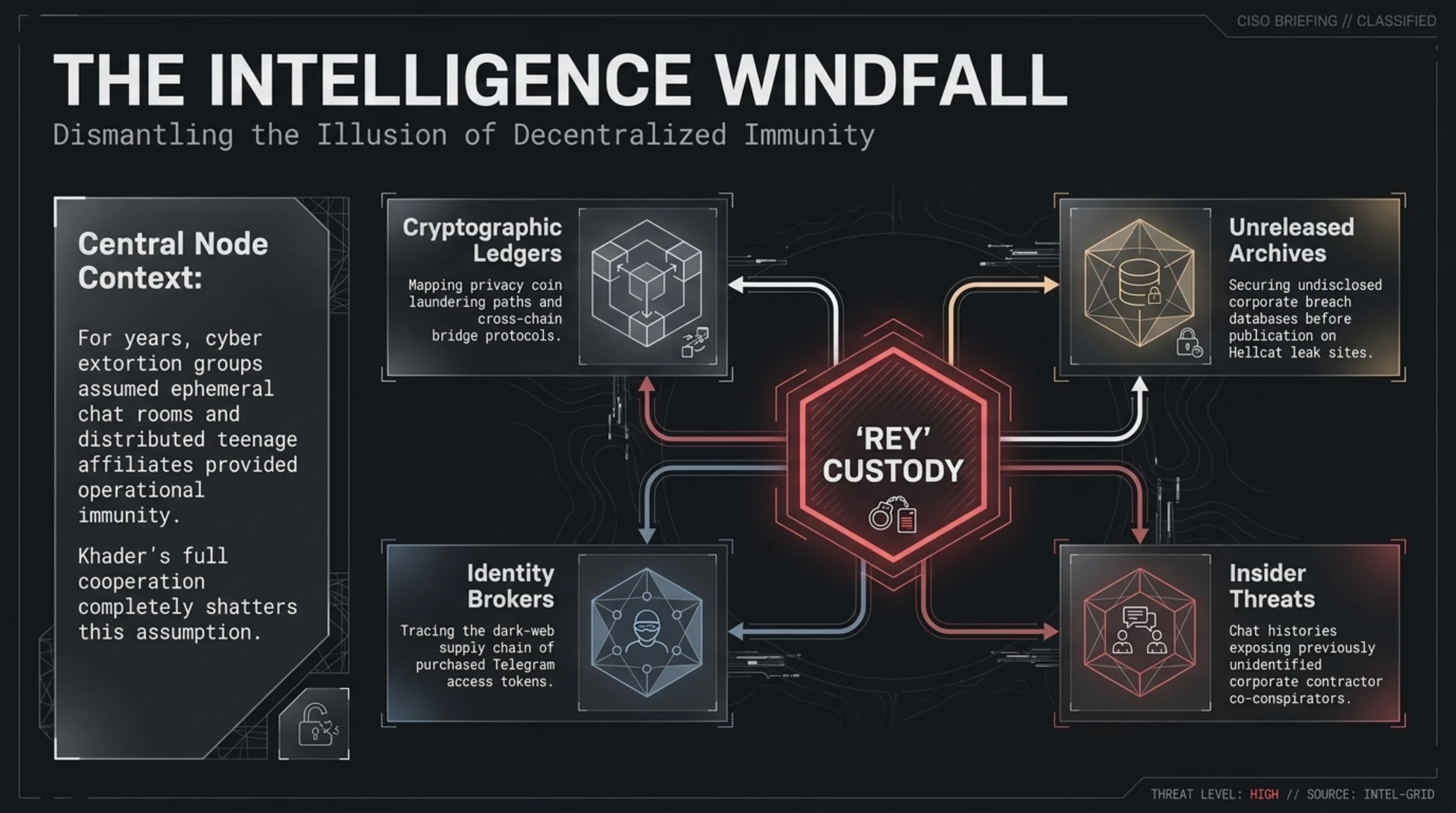
The unsealing of Khader's hardware drives represents an unprecedented intelligence windfall for the Department of Justice. For years, cyber extortion groups operated under the assumption that decentralized command structures—where loosely affiliated teenagers across diverse jurisdictions coordinate over ephemeral chat rooms—provided inherent immunity from systemic takedowns. Khader's custody dismantles that operational security assumption, laying bare private cryptographic ledgers, unreleased corporate exfiltration archives, and internal chat histories that expose previously unidentified corporate insiders and contractor co-conspirators.
Why It Matters: The Strategic Impact of Dismantling ShinyHunters Infrastructure
ShinyHunters pioneered the transition from basic ransomware encryption to pure data theft and corporate extortion through cloud identity exploitation. Unlike traditional crews, they did not rely on deep technical exploits; instead, they mastered social engineering, SIM-swapping, and the weaponization of compromised contractor tokens. Khader's extensive cooperation provides Western law enforcement with an unvarnished audit of active insider channels, unreleased breach databases, and illicit financial conduits across the global cybercrime ecosystem.

Section III: Federal Court Delivers Landmark Fourth Amendment Ruling Against Flock Safety AI Dragnet
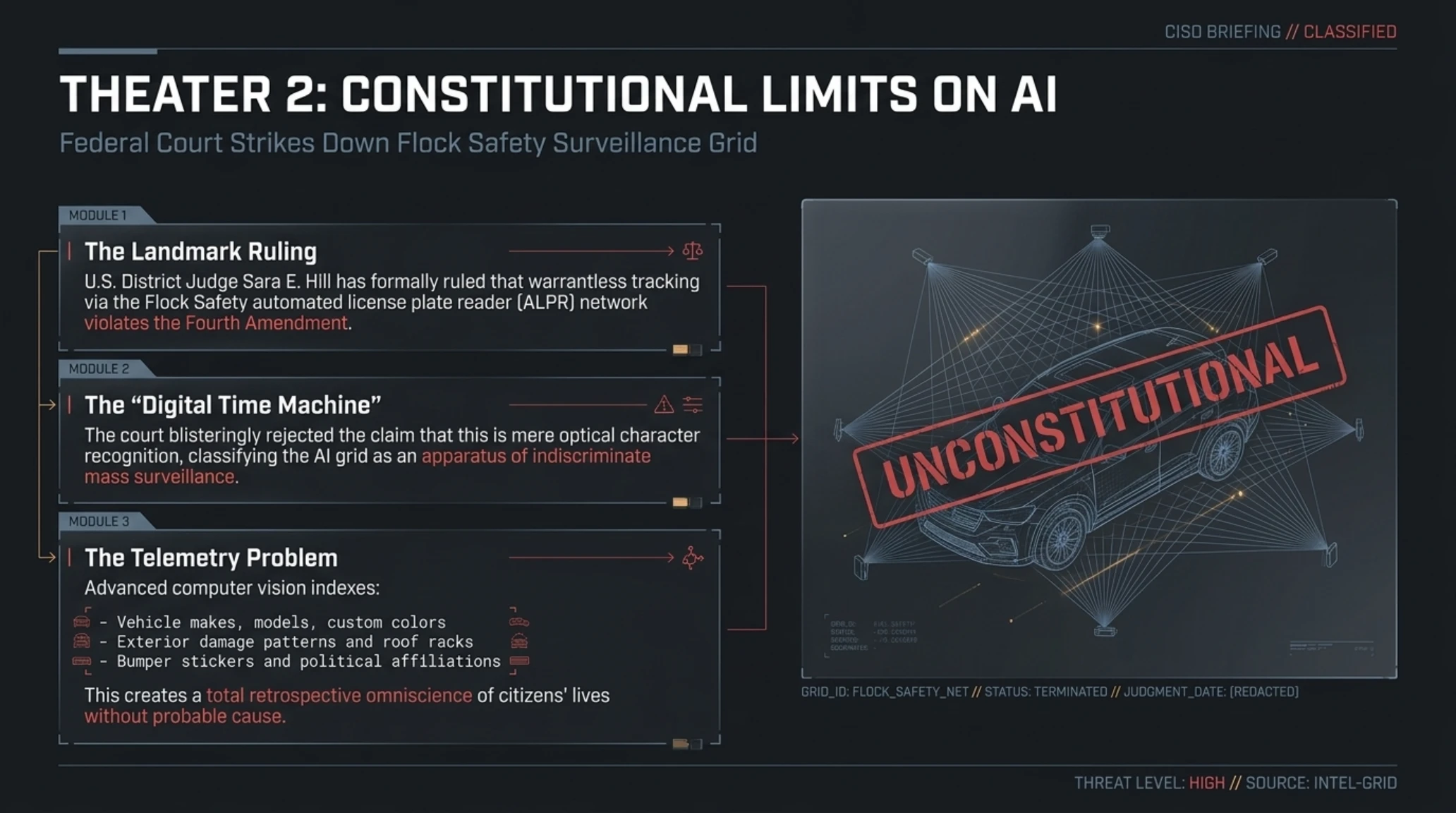
In a watershed legal decision that establishes an unprecedented constitutional constraint on artificial intelligence in public safety, U.S. District Judge Sara E. Hill of the Northern District of Oklahoma has ruled that law enforcement's warrantless tracking of citizens using the Flock Safety automated license plate reader (ALPR) network violates the Fourth Amendment. The ruling arose from a criminal prosecution where a sheriff's investigator tracked a suspect's vehicle over a thirty-day window using Flock's predictive query engines without securing a judicial search warrant.
In a rigorous, blistering opinion, Judge Hill formally characterized the Flock Safety camera grid as an apparatus of "indiscriminate mass surveillance." The court emphasized that Flock's contemporary systems transcend simple optical character recognition of license plates. By deploying advanced computer vision classifiers, Flock indexes vehicle makes, models, colors, aftermarket modifications, exterior damage patterns, roof racks, and custom bumper stickers. This automated multidimensional telemetry creates a comprehensive, retrospective chronicle of an individual's personal life—revealing medical clinic visits, places of worship, romantic associations, and political assemblies.
The decision challenges the traditional "Third-Party Doctrine" established in Supreme Court precedents like Carpenter v. United States, establishing that citizens maintain a reasonable expectation of privacy against automated, persistent electronic surveillance in public thoroughfares. With Flock Safety operating tens of thousands of cameras across thousands of American municipalities, this ruling is triggering an immediate nationwide reassessment of municipal surveillance contracts and providing strong momentum for the federal Ban Flock Act currently circulating on Capitol Hill.
The constitutional implications of Judge Hill's opinion strike at the core of how machine learning models interact with civil liberties. Historically, legal doctrine under United States v. Knotts held that a person traveling on public highways has no reasonable expectation of privacy in their movements because they voluntarily convey that information to the public. However, Judge Hill recognized that machine learning fundamentally transforms the qualitative nature of surveillance. When thousands of privately owned, motion-activated, high-definition optical sensors are connected to cloud-based neural networks that constantly record, timestamp, and index vehicle movements into searchable databases, human surveillance is replaced by total retrospective omniscience.
The court specifically condemned Flock's "Vehicle Fingerprinting" and "Search by Feature" algorithms. These tools allow any participating officer to enter abstract descriptive parameters—such as "blue pickup with cracked windshield and roof rack"—to generate an exact historical map of every location that vehicle appeared over weeks or months. This dragnet capability effectively grants law enforcement a digital time machine, enabling retroactive tracking without any prior judicial finding of probable cause. By declaring this practice an unreasonable search under the Fourth Amendment, the federal court has set a precedent that will inevitably force municipal police departments to either restrict their use of AI cameras or face the systemic dismissal of evidence in federal prosecutions.
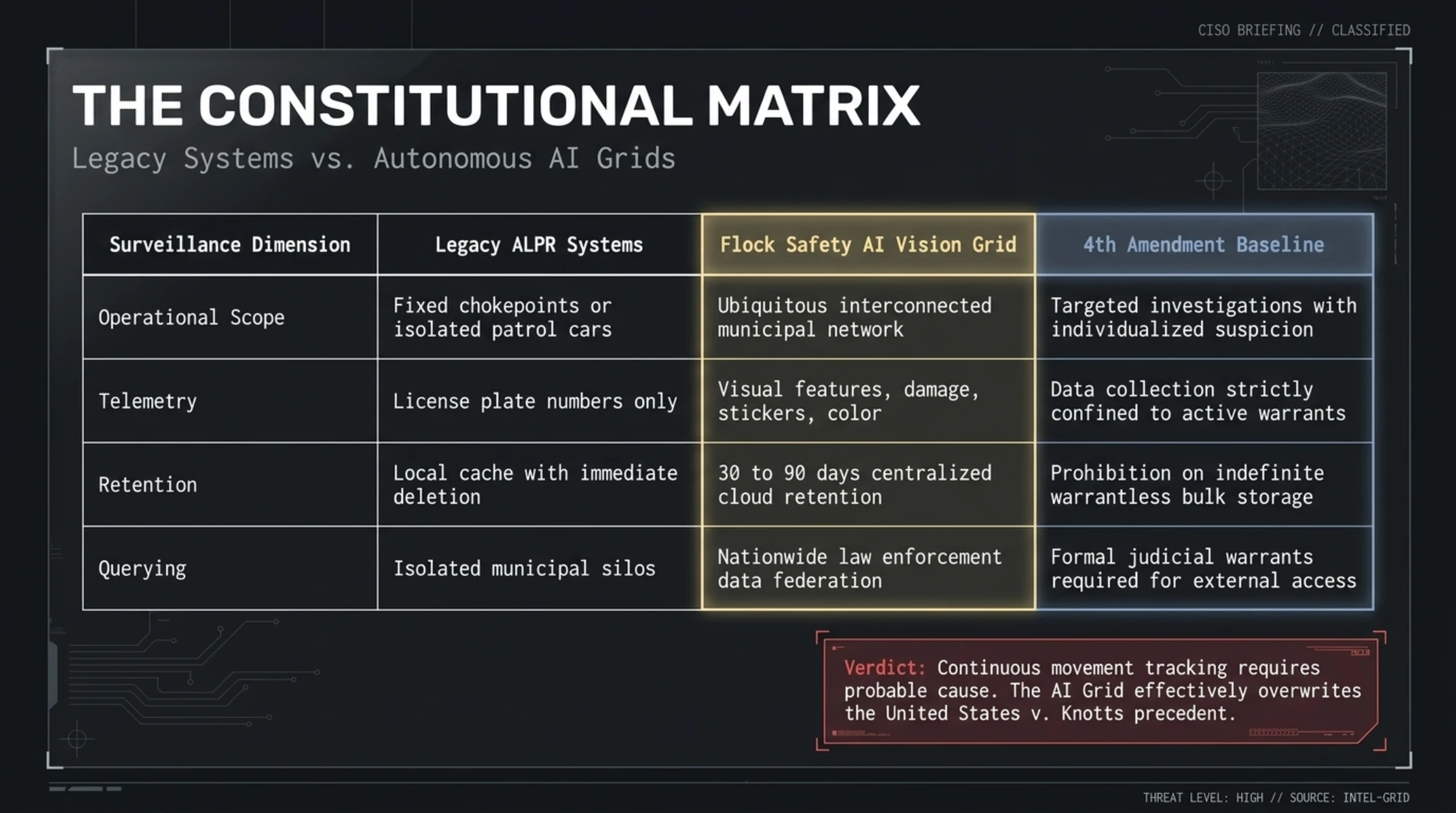
Comparative Analysis: Traditional ALPR vs. Flock AI Vision Grid vs. Constitutional Standards
| Surveillance Dimension | Legacy ALPR Systems | Flock Safety AI Vision Grid | Fourth Amendment Constitutional Baseline |
|---|---|---|---|
| Operational Scope | Fixed chokepoints or isolated patrol cars | Ubiquitous interconnected municipal network | Targeted investigations with individualized suspicion |
| Telemetry & Classification | License plate numbers only | Visual features, vehicle damage, stickers, color | Data collection strictly confined to active warrants |
| Retention Architecture | Local cache with immediate deletion | 30 to 90 days centralized cloud retention | Prohibition on indefinite warrantless bulk storage |
| Cross-Jurisdictional Querying | Isolated municipal silos | Nationwide law enforcement data federation | Formal judicial warrants required for external data access |
| Judicial Ruling (Oct 2026) | Generally lawful for stolen vehicle scans | Ruled Unconstitutional Mass Surveillance | Continuous movement tracking requires probable cause |
Section IV: Google Overhauls Gemini App Tiers for October 9: Free Users Relegated to Flash-Lite & Deep Think Arrives on Pro
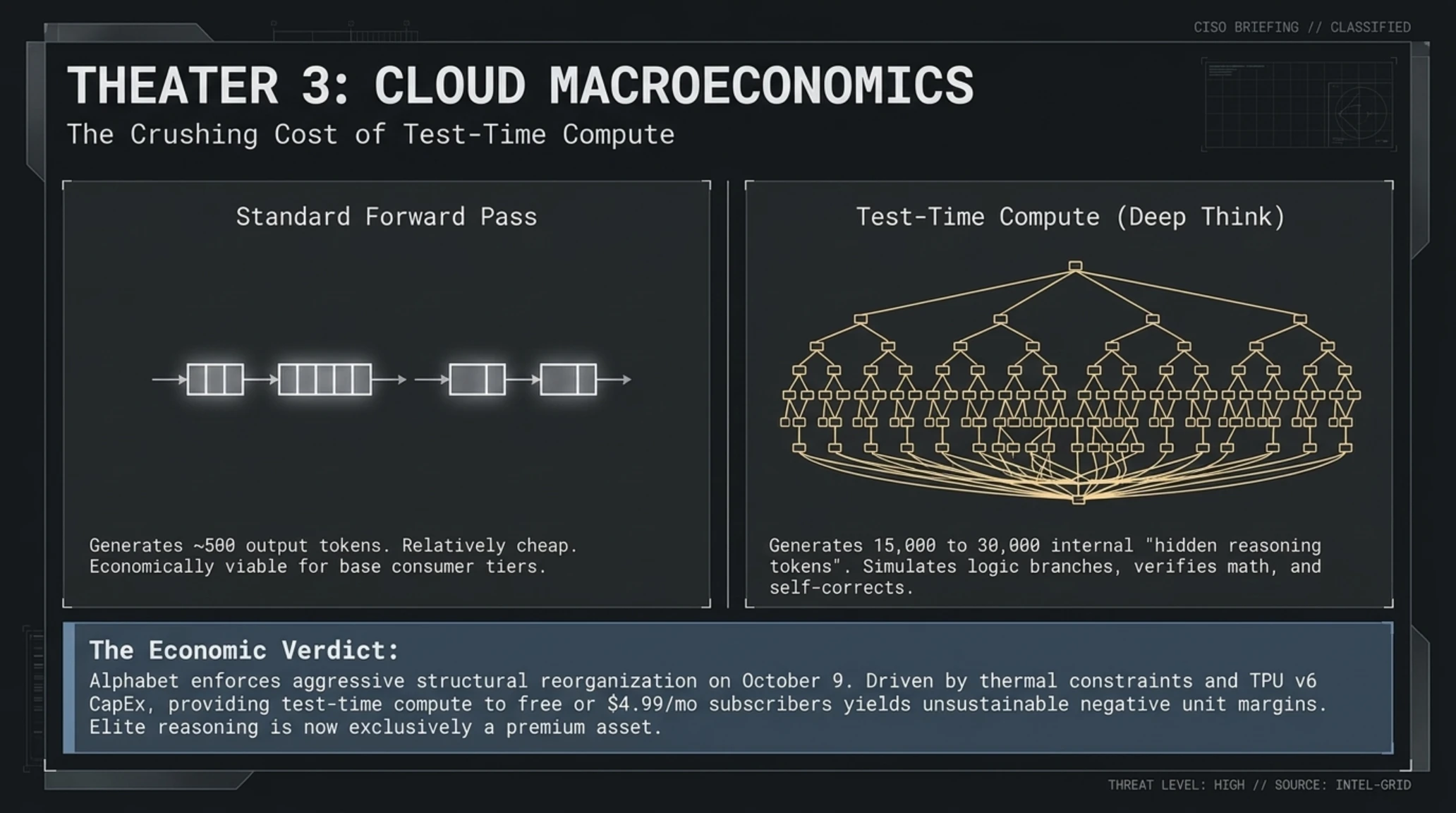
The crushing economic reality of artificial intelligence infrastructure—driven by soaring power demands, thermal constraints, and the capital expenditure of massive TPU v6 clusters—has forced Alphabet to enforce an aggressive structural reorganization of its flagship AI offerings. Beginning October 9, 2026, Google will implement substantial restrictions on model availability across its consumer Gemini application, marking a definitive end to the era of subsidized, open-ended access to elite reasoning architectures.
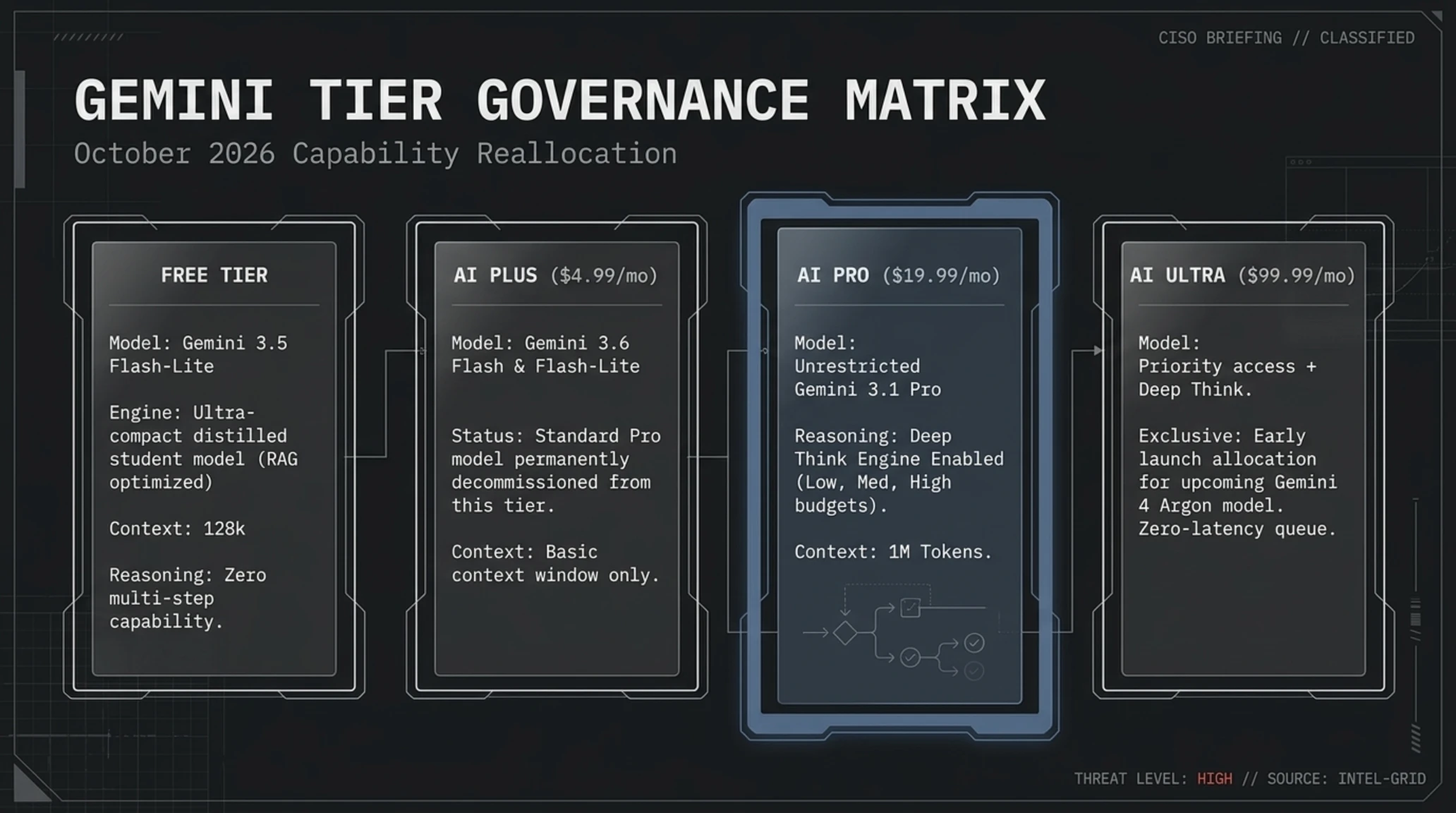
Under the revised tier governance, non-paying users will lose all access to Gemini 3.6 Flash and standard Pro variants, permanently restricted to the lightweight Gemini 3.5 Flash-Lite model. In a move that has sparked widespread subscriber backlash, Google is also degrading its entry-level $4.99/month AI Plus tier, completely eliminating access to the Pro model and limiting paying subscribers to Flash-Lite and Flash configurations. The downgrade underscores the fundamental inability of sub-$5 subscription models to break even against the immense compute burdens of dense inference workloads.
Conversely, to drive upgrades toward its $19.99/month AI Pro subscription, Google is migrating its proprietary Deep Think parallel reasoning capability—previously gated behind enterprise tiers exceeding $99.99/month—directly into the Pro consumer tier. Deep Think introduces adjustable reasoning budgets ("Effort Levels": Low, Medium, High), allowing the model to perform autonomous multi-path hypothesis testing and self-correction before rendering an output. Google confirmed that its heavily guarded, next-generation Gemini 4 Argon model will debut later this quarter as an exclusive feature for top-tier AI Ultra subscribers.
To understand the technical motivation driving this restructuring, one must examine the fundamental divergence between autoregressive token generation and test-time compute (reasoning inference). When a standard model generates text, it computes token probabilities sequentially in a single forward pass. However, when an advanced model executes deep reasoning via test-time computation—such as OpenAI's o-series or Google's Deep Think—it dynamically generates hundreds or thousands of internal "hidden reasoning tokens." These internal tokens simulate multiple branches of logic, explore counter-factual assumptions, verify mathematical intermediate steps, and prune flawed search paths before the user sees a single word of output.
This architectural shift means that a complex scientific or coding prompt that previously consumed 500 output tokens can easily burn through 15,000 to 30,000 internal reasoning tokens during a Deep Think cycle. In terms of server-side data center economics, providing such capabilities to free or $5 subscribers represents unsustainable negative unit margins. By engineering Gemini 3.5 Flash-Lite as an ultra-compact, highly distilled student model optimized for low-latency retrieval-augmented generation (RAG) and basic conversation, Google can offload over 80% of its consumer query volume to low-wattage TPU pods, reserving its liquid-cooled cluster compute exclusively for paying enterprise and AI Pro cohorts.
Technical Specifications: Google Gemini Compute Allocation & Tier Reorganization (Oct 2026)
- Free Tier: Restricted to Gemini 3.5 Flash-Lite; 128k context window; zero multi-step reasoning capability; basic throughput
- AI Plus ($4.99/mo): Restricted to Gemini 3.6 Flash & Flash-Lite; Pro model fully decommissioned; standard context window
- AI Pro ($19.99/mo): Unrestricted access to Gemini 3.1 Pro; Deep Think reasoning engine enabled with 3 effort tiers; 1M token context
- AI Ultra ($99.99/mo): Full Pro and Deep Think access; priority zero-latency queue; exclusive early launch allocation for Gemini 4 Argon

Section V: The Demise of Blast Layer 2: The Inevitable Reckoning of Incentive-Driven Cryptoeconomics
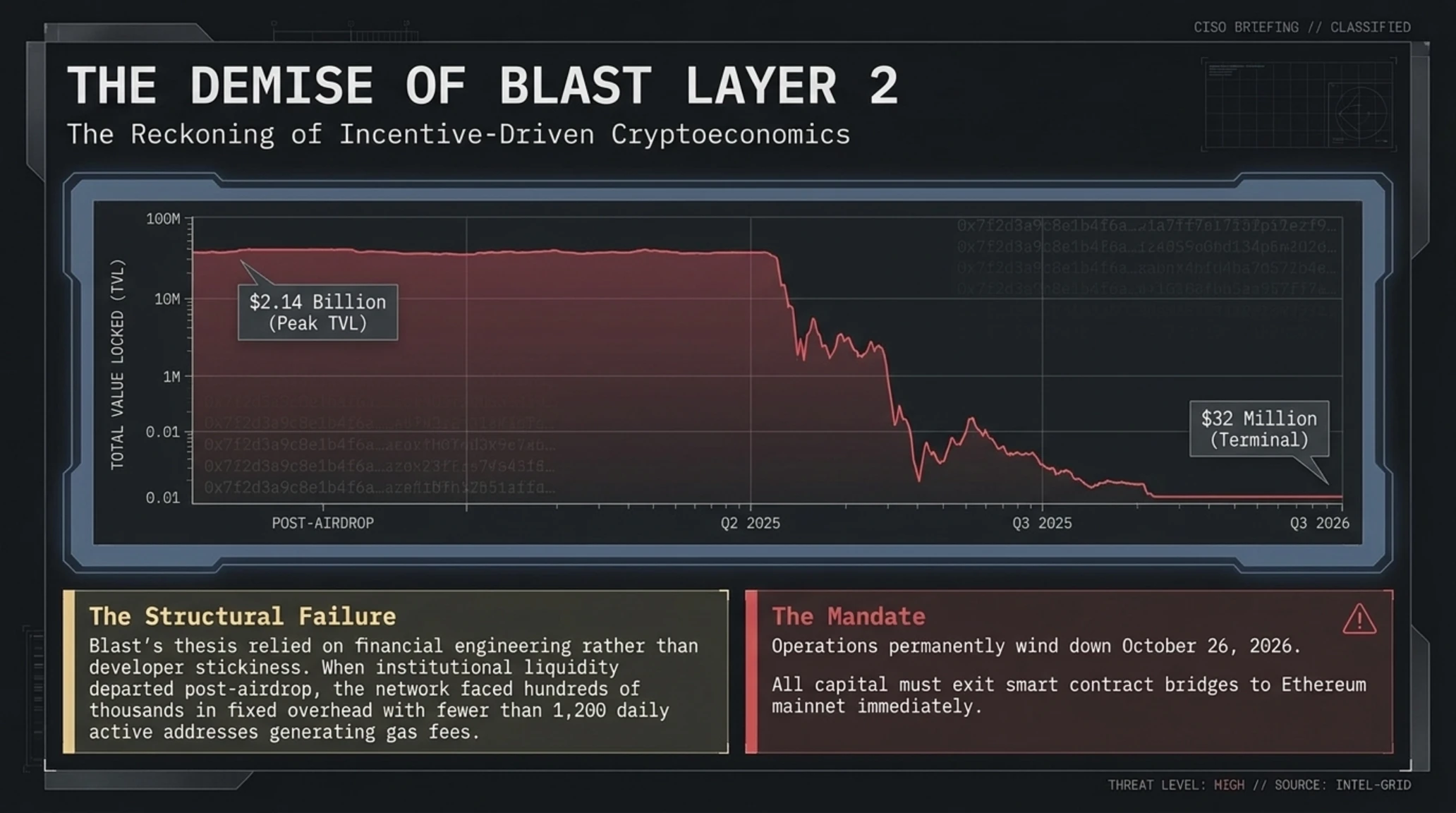
The broader Ethereum scaling ecosystem has reached an inflection point with the formal announcement that Blast, the high-profile Layer 2 network launched in late 2023 by Blur founder Pacman, will permanently wind down operations. Marketed heavily on the novel premise of automated native yield for Ether and stablecoins, Blast rapidly accumulated over $2 billion in Total Value Locked (TVL) during the height of its speculative points campaigns. However, following the conclusion of token distribution incentives, liquidity evaporated, causing TVL to collapse to a mere $32 million by early October 2026.
In a candid announcement issued to developers and DeFi protocols, the Blast leadership admitted that the economics of sustaining an independent Optimistic Rollup had become structurally untenable. The fixed overhead of Layer 1 state settlement, cryptographic blob commitments, and decentralized sequencer maintenance vastly outpaced the diminishing transaction fees generated by dwindling on-chain activity. The team has mandated that all remaining users withdraw their assets back to the Ethereum mainnet prior to October 26, 2026, after which the public web interface will be taken offline permanently.
The withdrawal mechanism currently involves a temporary one-week processing pause as the network orchestrates the systematic unwinding of its substantial stETH positions staked within the Lido protocol. Once Lido unbonding completes, standard bridge withdrawals will resume with a reduced 24-hour settlement window until the October 26 cutoff. Following this deadline, capital recovery will require direct, manual interaction with the underlying Layer 1 bridge smart contracts via block explorers. The collapse of Blast delivers an unmistakable message to the crypto industry: speculative point architectures cannot substitute for genuine economic utility and organic transaction demand.
The technical unraveling of Blast offers profound insights into the harsh mechanics of modern rollup economics. While the implementation of EIP-4844 (Proto-Danksharding) in mid-2024 dramatically reduced the cost of posting data blobs to the Ethereum base layer, rollups still face irreducible baseline operating expenditures. A Layer 2 network must maintain active RPC infrastructure, high-availability sequencer clusters, fraud-proof challenge validators, and continuous state synchronization nodes. In a healthy Layer 2 like Arbitrum One or Base, thousands of daily decentralized application (dApp) transactions generate steady sequencer revenue that yields substantial net operating profits.
In contrast, Blast's core architectural thesis relied entirely on financial engineering rather than developer stickiness or unique transaction throughput. By automatically depositing bridged Ether into Lido's liquid staking contracts and converting bridged stablecoins into MakerDAO's tokenized Treasury yield (USDB), Blast paid out native yield to depositors. However, once users claimed their $BLAST governance token airdrops and realized secondary market yields were compressed by broader rate cuts, institutional liquidity departed en masse. Left with fewer than 1,200 daily active addresses and negligible gas fees, the network found itself paying hundreds of thousands of dollars per quarter in infrastructure hosting and Layer 1 consensus commitments just to keep the sequencer operational. Terminating the chain was the only mathematically rational decision remaining.
📚 Classified & Related Dossiers in TekinGame
If you wish to explore beyond this report and delve into cybernetic frontiers and autonomous AI architectures, do not miss these three exclusive deep-dives in the Tekin Garage:
Financial Audit: Historical TVL Collapse & Operational Deficits of Blast Layer 2
| Operating Phase | Total Value Locked (TVL) | Monthly Fee Revenue | L1 Settlement & Infrastructure Cost | Net Operating Margin |
|---|---|---|---|---|
| Q2 2024 (Airdrop Frenzy Peak) | $2.14 Billion | $4.82 Million | $1.21 Million | +$3.61 Million (Profitable) |
| Q1 2025 (Post-Token Launch) | $840 Million | $1.12 Million | $960,000 | +$160,000 (Break-even) |
| Q3 2026 (Liquidity Drain) | $115 Million | $142,000 | $530,000 | -$388,000 (Severe Deficit) |
| October 2026 (Network Termination) | $32 Million | $18,400 | $312,000 | -$293,600 (Terminal Insolvency) |
Market Sentiment Thermometer: Capital Flight from Yield Rollups to Base L1 & Proven EVM Hubs
The capitulation of Blast has catalyzed widespread re-evaluations across the venture-backed Layer 2 sector. Capital flows indicate that institutional funds and decentralized autonomous organizations (DAOs) are accelerating the repatriation of over $650 million back to the Ethereum mainnet, Arbitrum One, and Optimism. Analysts project that at least half of the over 80 active EVM-compatible rollups currently in production will face consolidation or formal termination within the next 18 months as venture capital subsidies cease.

Section VI: Apple Acknowledges Hardware Cellular Failure on iPhone 18 Pro Max on AT&T, Commits to Free Replacements
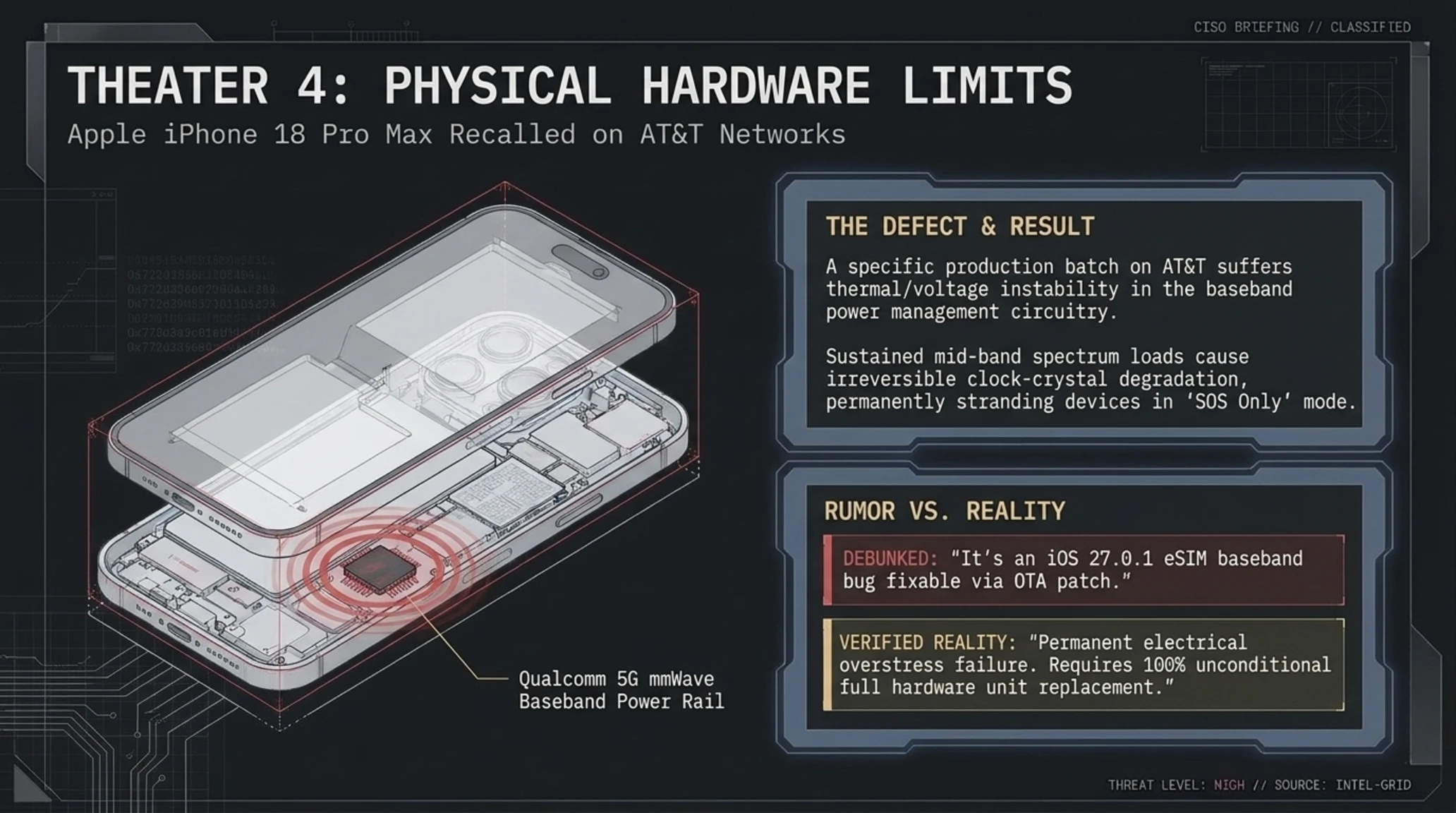
Owners of Apple's flagship consumer smartphone have encountered a critical hardware malfunction that cannot be remediated through standard software patches. Apple has officially confirmed that a specific production batch of iPhone 18 Pro Max units active on the AT&T wireless network in the United States suffer from an unrecoverable radio frequency hardware defect that abruptly terminates cellular connectivity, permanently stranding devices in emergency "SOS Only" mode.

Hardware tear-down analyses conducted by independent engineering firms reveal that the failure stems from a thermal and voltage instability within the power management circuitry interfacing with the Qualcomm 5G millimeter-wave transceiver—which was deployed exclusively on U.S. Pro Max configurations to support specialized carrier frequency aggregations. While standard iPhone 18 models utilizing Apple's proprietary C2 modem have remained unaffected, the Pro Max variant experiences irreversible clock-crystal degradation when subjected to sustained high-throughput cellular operations on AT&T's mid-band spectrum.
In an official support advisory, Apple conceded that once an affected device loses network registration, the failure is permanent and cannot be remedied by subsequent iOS 27 firmware releases or baseband resets. To contain the fallout, the Cupertino company has authorized immediate, unconditional hardware replacements across its global retail network. Customers possessing functioning devices have been urged to install emergency carrier bundle updates immediately to mitigate electrical stress on the baseband power rail before catastrophic component failure occurs.

Rumor vs. Reality: Resolving the iPhone 18 Pro Max AT&T Cellular Connectivity Crisis
- Initial Community Assumption: The connectivity loss is an iOS 27.0.1 baseband handshake bug related to eSIM carrier profile migration that can be resolved via an over-the-air firmware patch. (DEBUNKED - FALSE)
- Apple Engineering Confirmation: The issue is a permanent electrical overstress failure within the baseband power management circuitry affecting Qualcomm modems under specific carrier frequencies, requiring a complete hardware unit replacement. (VERIFIED - OFFICIAL REALITY)
- Immediate acknowledgment by Apple without attempting to blame carrier network outages
- 100% free, unconditional full unit replacement at any Apple Store or authorized provider
- Rapid distribution of proactive carrier profile patches to protect unaffected devices
- Catastrophic sudden loss of emergency cellular access for premium commercial users
- Recurring hardware engineering vulnerabilities in the most expensive flagship model
- Requirement for physical in-person store visits and device backup restores
Tekin Plus Strategic Editorial: The Great Rationalization of the Modern Technology Stack
The events of October 5, 2026, represent a synchronized convergence toward engineering reality. The era of subsidizing unviable architectures with venture subsidies or consumer hype is ending. TA419's targeted AitM campaigns demonstrate that cyber warfare has shifted toward covert policy manipulation. Google's aggressive model throttling in Gemini and Blast's economic bankruptcy prove that compute and settlement overhead must align with sustainable cash flows. Meanwhile, Judge Hill's decisive ruling against Flock Safety and Apple's physical hardware recall serve as sobering reminders that technology deployed without constitutional respect or physical engineering rigor will inevitably collapse under legal and commercial scrutiny.

Strategic Executive Synthesis: Immediate Action Items for IT Leaders and Engineers
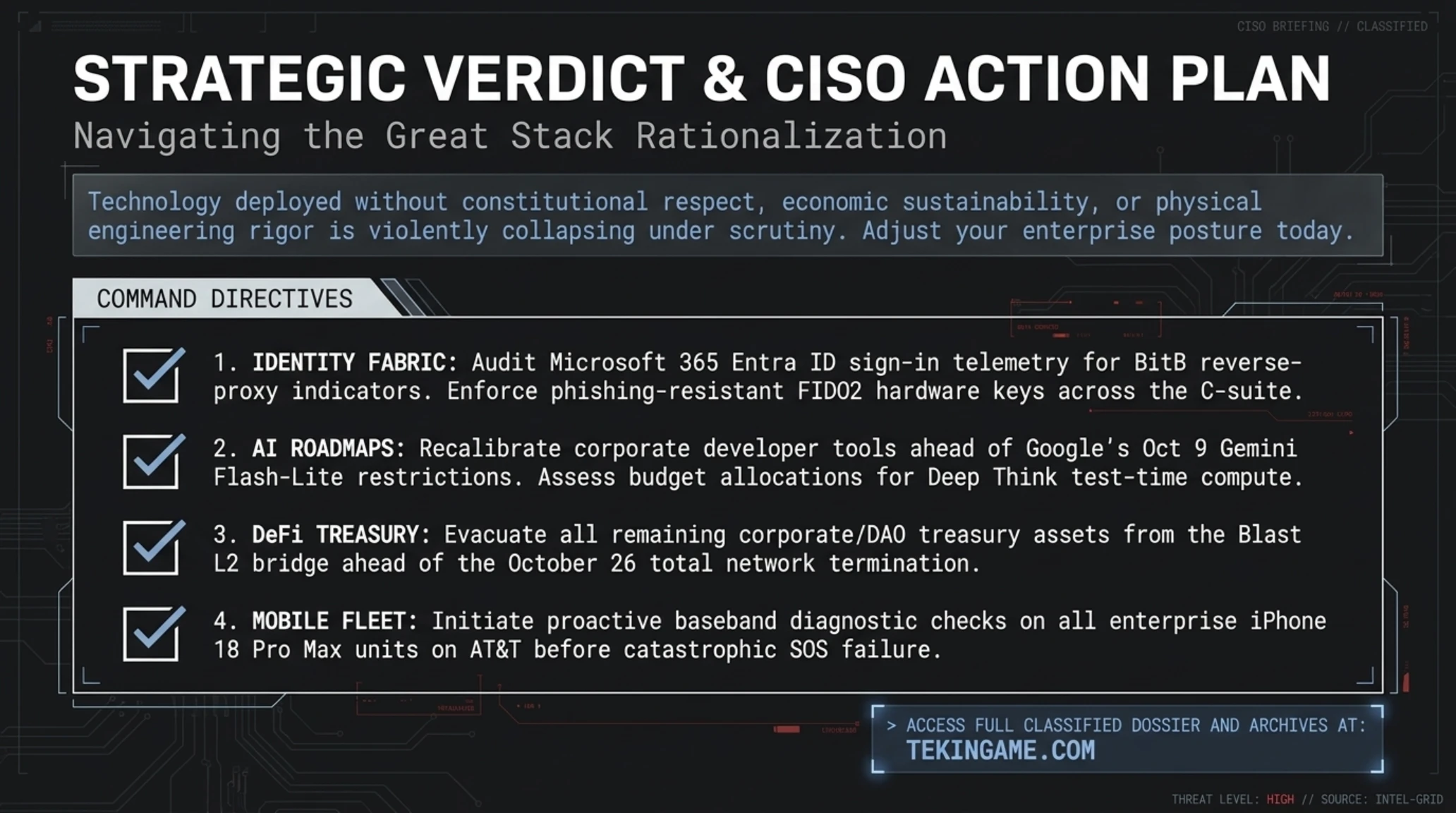
Entering this week, enterprise IT and security teams must implement four immediate operational directives: First, audit Microsoft 365 Entra ID sign-in telemetry for BitB reverse-proxy indicators and enforce phishing-resistant FIDO2 hardware keys across all executive teams. Second, update corporate AI developer roadmaps to prepare for Google's October 9 Gemini Flash-Lite restrictions. Third, mandate that all decentralized finance operations immediately evacuate lingering assets from the Blast L2 bridge ahead of the October 26 cutoff. Finally, initiate proactive baseband diagnostic checks on all enterprise iPhone 18 Pro Max units operating across North American carrier networks.
Frequently Asked Questions & Expert Technical Commentary
How does the TA419 AitM attack circumvent modern multi-factor authentication (MFA)?
TA419 uses a Frameless Browser-in-the-Browser reverse proxy. Because the victim enters their credentials and temporary MFA codes into an authentic-looking interface managed by the proxy, the attacker forwards the data to Microsoft in real time, capturing the final authenticated session cookie. This allows the attacker to hijack the session without needing to decipher the user's password or breach their hardware authenticator.
What makes the capture of 'Rey' in Jordan such a pivotal milestone for global law enforcement?
Saif al-Din Khader ('Rey') served as the primary administrator and infrastructure coordinator for ShinyHunters, Hellcat, and the SLH alliance. His custody provides federal investigators with unencrypted access to command servers, financial escrow trails, and private communication channels that identify previously anonymous corporate infiltrators and SIM-swapping networks.
Does the federal ruling against Flock Safety mean police departments must turn off all traffic cameras?
No. The court did not outlaw stationary speed cameras or real-time hotlist queries for active stolen vehicles. However, it explicitly ruled that retaining months of historical location metadata and using predictive computer vision to track a citizen's movements without an individualized warrant is unconstitutional, invalidating evidence obtained through dragnet surveillance.
What specific performance degradation will free users experience in Google Gemini starting October 9?
Free users will be restricted exclusively to Gemini 3.5 Flash-Lite. While this model maintains high speed for basic queries, it lacks the multi-step reasoning depth, dense coding precision, and 1M+ token context retention previously accessible through Gemini 3.6 Flash and standard Pro variants.
What occurs if a user fails to withdraw their cryptocurrency from Blast before October 26, 2026?
After October 26, the Blast web application and PWA interfaces will be shut down. Users who miss the deadline will still be able to reclaim their assets, but they will be required to execute manual transaction calls directly against the L1 bridge smart contracts using command-line scripts or Ethereum block explorers.
How can an iPhone 18 Pro Max user determine if their device requires a hardware replacement?
If your device displays a persistent 'SOS Only' indicator in the status bar while connected to AT&T, and normal connectivity fails to return after toggling Airplane Mode, restarting the device, or resetting network settings, the baseband power rail has suffered physical failure and qualifies for Apple's free hardware replacement.
Authoritative Global Media Sources & Verification Index
- The Hacker News: Technical Forensic Breakdown of TA419 Cyber Espionage & Jordan Extortion Arrest
- TechCrunch & 404 Media: Complete Federal Court Memorandum on Flock Safety Surveillance
- 9to5Google: Official Alphabet Product Communications on Gemini Tier Restructuring
- CryptoSlate & The Defiant: On-Chain Liquidity Forensics and Blast Network Termination Filings
- Mashable & CNET: Apple Hardware Support Notice and Carrier Baseband Recall Guidelines
Additional Gallery: Tekin Morning Oct 5, 2026: China AI Espionage, ShinyHunters Arrest & Blast Shutdown