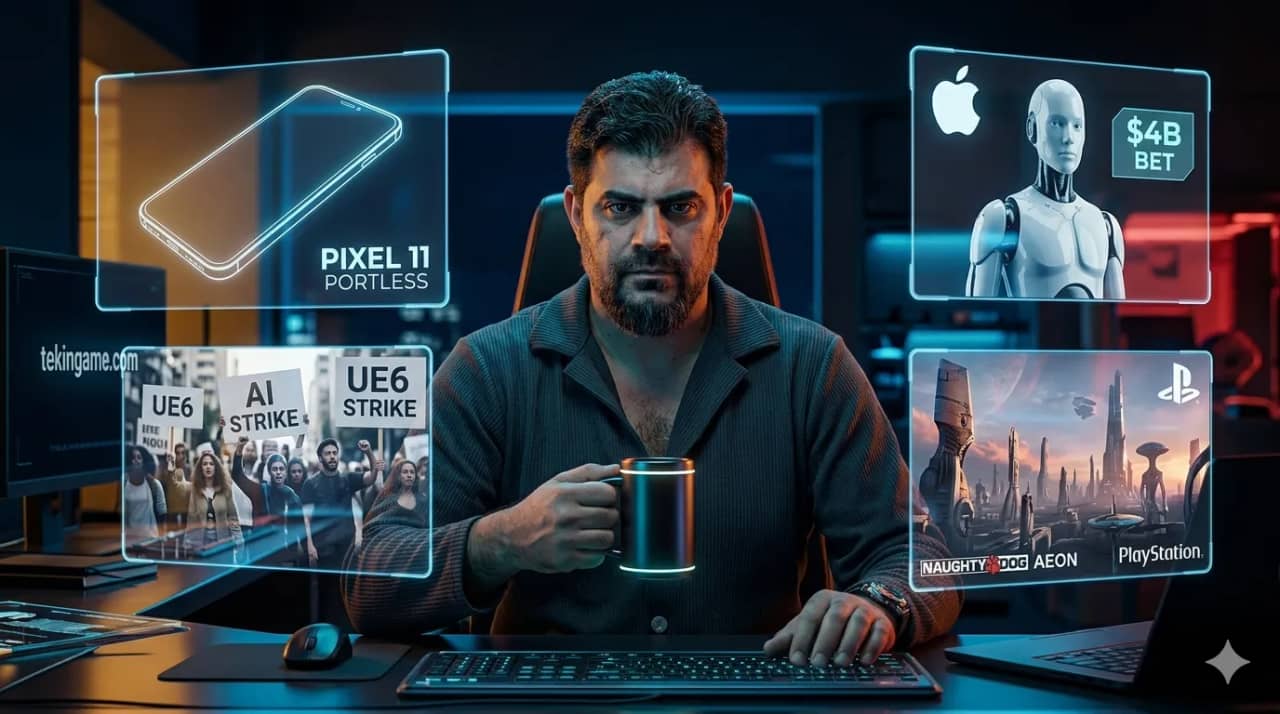
🌅 Welcome to Tekin Morning May 5, 2026
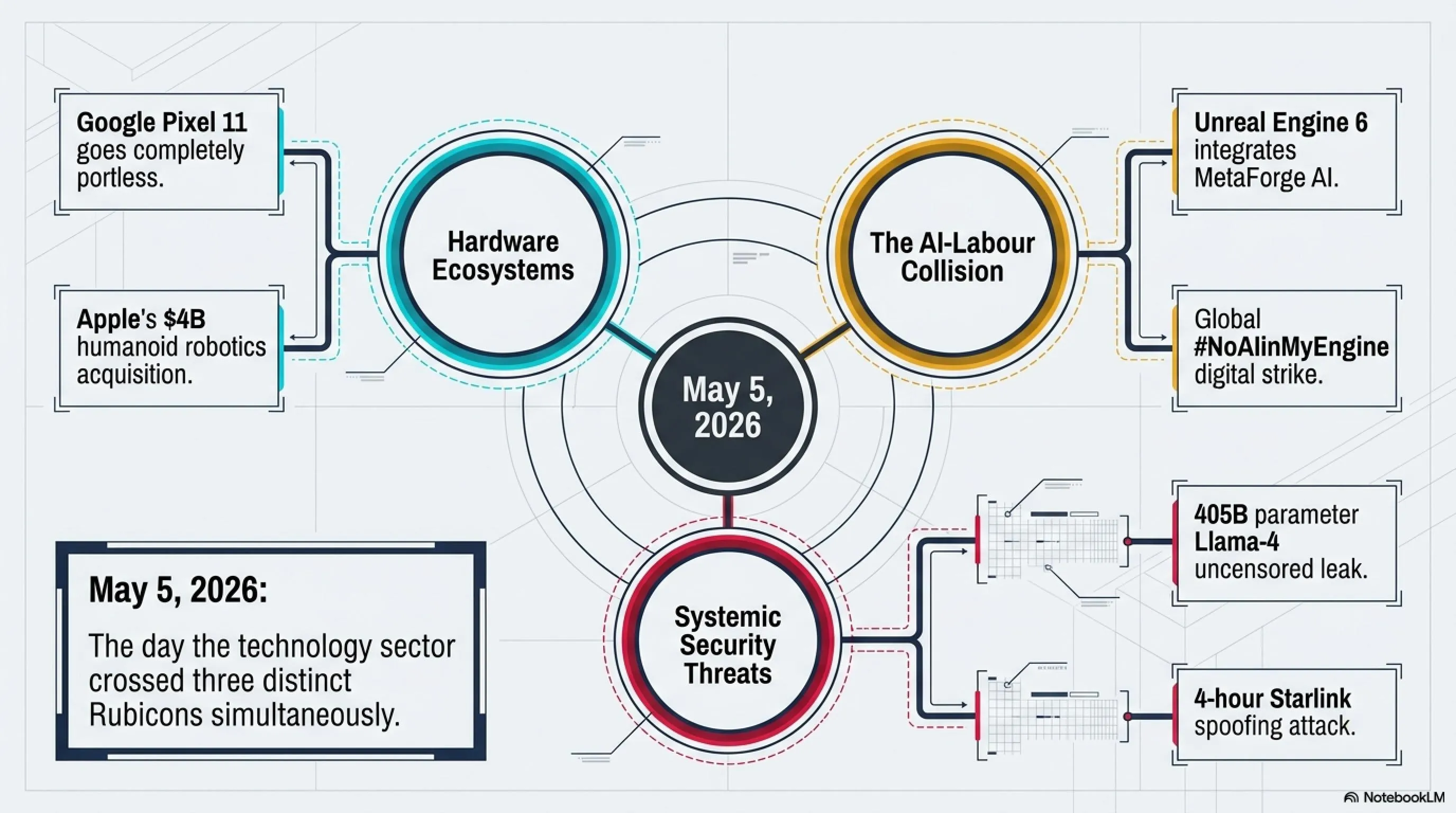
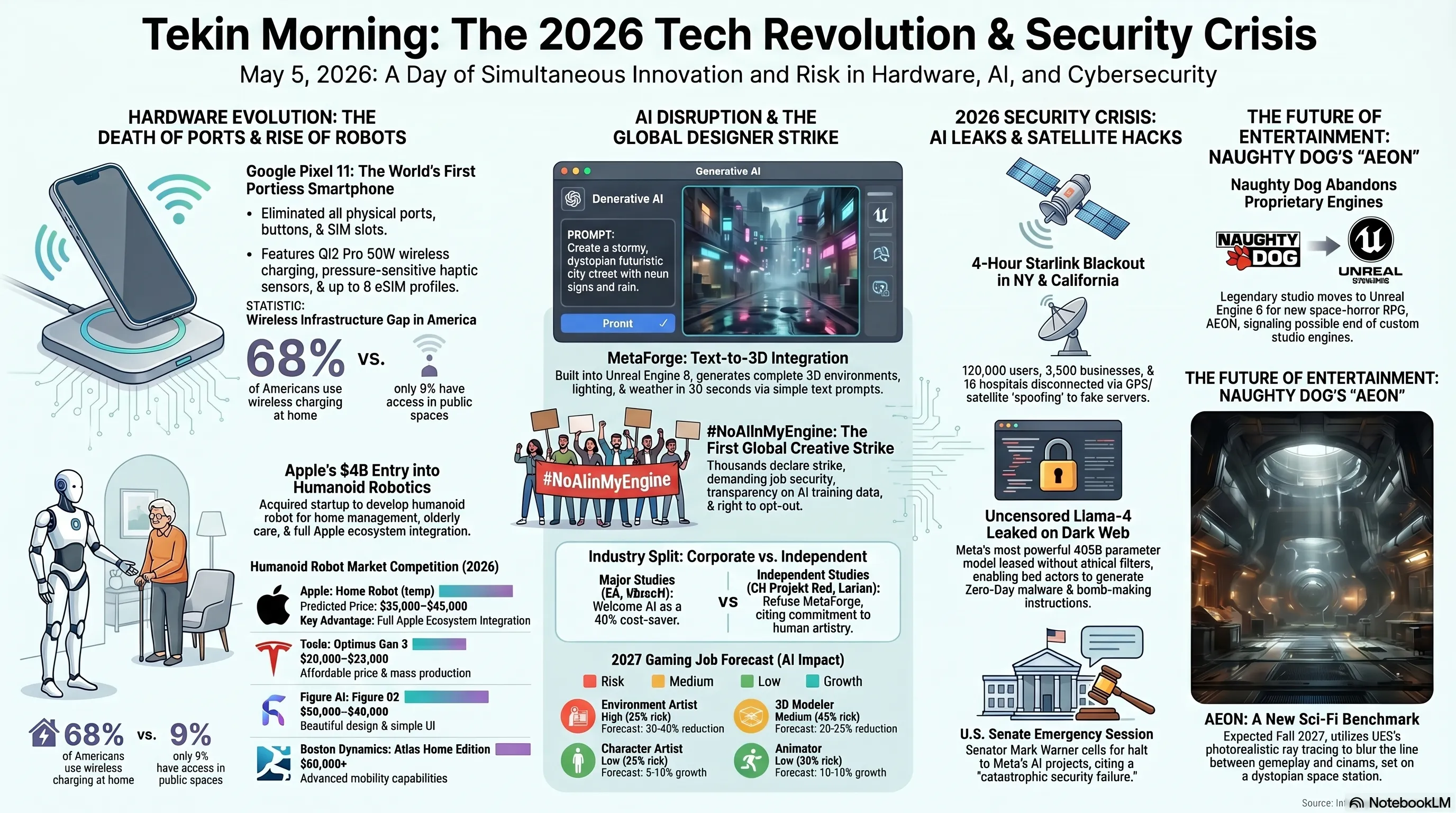
Good morning, tech enthusiasts! Today is one of the most explosive mornings of 2026. Six bombshell stories that could each have been the day's main headline were released simultaneously, shaking up the tech world. From Google taking the boldest step in mobile industry history to a global strike by 3D designers against AI, from Apple entering the world of robots to the catastrophic Llama-4 leak and Starlink hack - all in one morning!
⚡ Today's Headlines:
📱 Google Pixel 11: World's First Fully Portless & Buttonless Phone!
🎮 Unreal Engine 6 with Built-in AI & Global Designer Strike
🤖 Apple's $4B Acquisition: Entering the Humanoid Robot World
🚨 Llama-4 Disaster: Uncensored Version Leaked on Dark Web
🛰️ 4-Hour Starlink Hack in New York & California
🎬 Naughty Dog's AEON: Surrendering to Unreal Engine 6
☕ Grab your coffee, because we're in for an exciting journey through the tech world today!
📱 The End of Ports: Google Pixel 11 Goes Fully Portless & Buttonless!
In a bold move that could forever change the future of the mobile industry, Google has introduced the world's first fully sealed (Portless & Buttonless) smartphone with the Pixel 11 Pro design leaked yesterday by renowned leaker OnLeaks and 9to5Google. This phone has no USB-C port, no physical volume buttons, and not even a SIM card slot. Everything is digital, wireless, and sensor-based.
🔍 Tekin Analysis: Why Is Google Taking This Risk?
With this radical design, Google is pursuing three strategic goals: First, reducing manufacturing costs by eliminating mechanical parts and ports. Second, increasing water resistance to IP69K level by removing any holes in the body. Third, and most importantly, steering the market toward a fully wireless ecosystem where Google has complete control with Pixel Buds, Pixel Watch, and wireless chargers.
🔧 Technical Details: How Does It Work Without Ports & Buttons?
According to the leaked renders published by OnLeaks, the Pixel 11 Pro uses four advanced technologies to replace ports and buttons:
| Technology | Replaces What? | Key Advantage |
|---|---|---|
| Long-Range Qi2 Pro Wireless Charging | USB-C Port | Up to 50W charging without cables |
| Pressure-Sensitive Capacitive Sensors | Physical Volume & Power Buttons | Smart, customizable haptic feedback |
| Multiple eSIM (Up to 8 Profiles) | Physical SIM Card Slot | Instant carrier switching without SIM cards |
| Wi-Fi 7 Wireless Data Transfer | Wired Connection for File Transfer | Speeds up to 40 Gbps |
But the key point lies in the capacitive sensors. Google has used an advanced Haptic Touch technology that can detect different pressure levels. For example, light pressure on the right edge of the phone decreases volume, medium pressure increases it, and strong pressure activates silent mode. This system is combined with advanced Taptic Engine vibration motors (similar to iPhone) to create realistic haptic feedback.
⚖️ The Big Challenge: Right to Repair & American Legislators
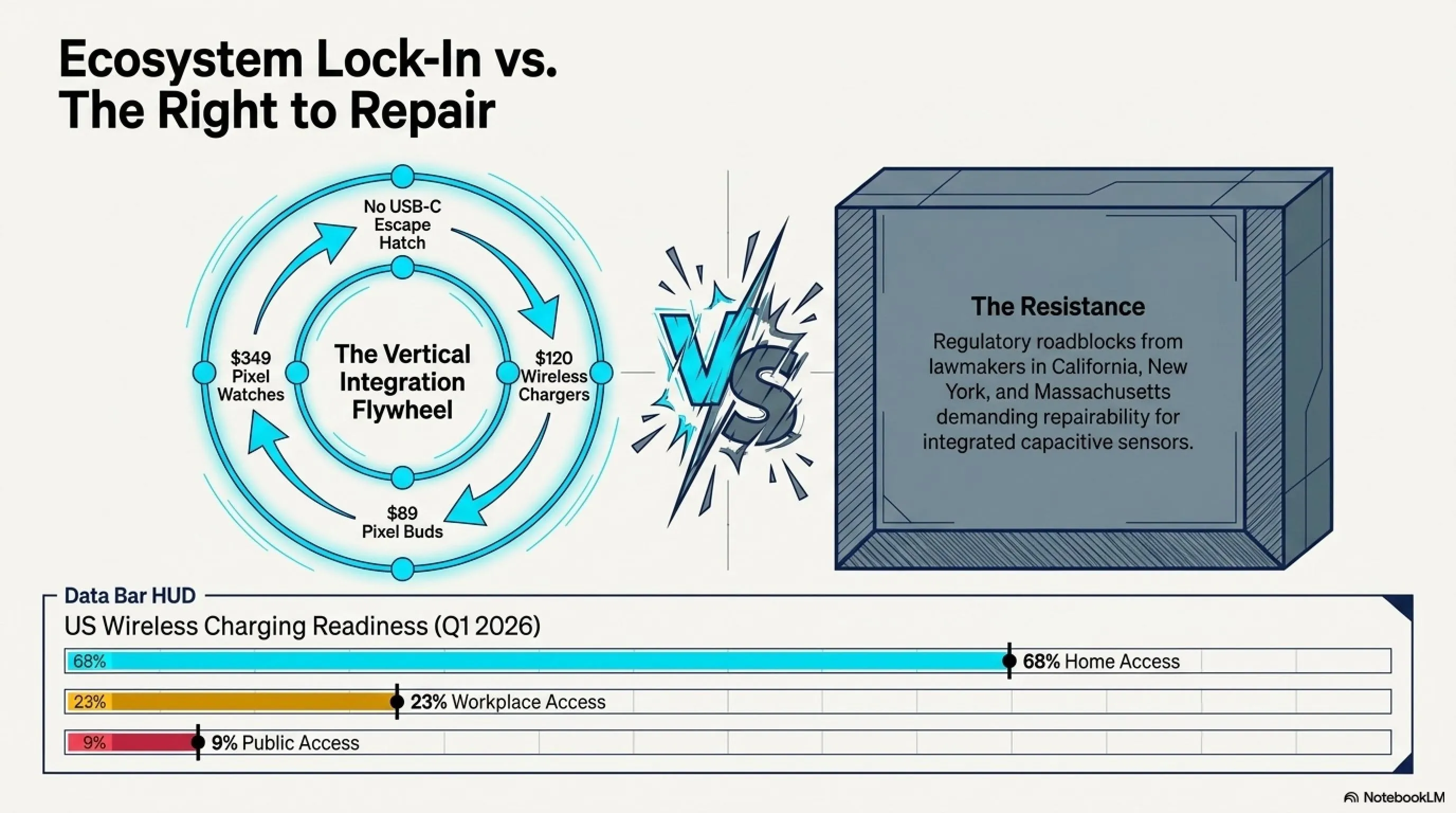
But this bold design faces a major problem: the Right to Repair movement, which has reached its peak power in America. States like California, New York, and Massachusetts have passed strict laws requiring companies to provide spare parts, repair tools, and technical documentation to consumers and independent repair shops.
A phone without ports and buttons means repairs become much more complex. If a capacitive sensor breaks, it can't be easily replaced because it's integrated into the body. If the wireless charging system malfunctions, users can't even charge the phone with a simple cable. This could expose Google to heavy legal fines in America.
⚠️ Analyst Warning: Is the Market Ready?
Mobile market analysts believe Google may have acted too soon. While wireless charging has become common in homes, USB-C cables remain the dominant standard in public places, offices, and travel. Complete port removal could force users to buy Google's expensive wireless chargers (starting at $120). This could turn into a marketing disaster, similar to what happened to Apple when it removed the headphone jack in iPhone 7.
🌍 Market Reaction: What Will Samsung & Apple Do?
Samsung and Apple haven't shown official reactions yet, but internal sources from both companies told The Verge they are "closely" monitoring Google's move. Samsung, which retained the USB-C port in its Galaxy S26 Ultra, will likely wait to see how the American market reacts to Pixel 11. If Pixel 11 sales succeed, Samsung might move toward a portless design in the S27 series (2027).
Apple, which has long been a proponent of removing ports (remember it was the first to remove the headphone jack), likely sees Google's move as an opportunity. Rumors suggest iPhone 17 Pro (Fall 2026) might be the first portless iPhone, but Apple hasn't made a final decision and is waiting to see how successful Pixel 11 will be.
📊 Key Statistics: Wireless Charging in America
Source: Statista & U.S. Mobile Market Research (Q1 2026)
💡 The Bigger Picture: Industry Implications
Google's portless gambit represents more than just hardware innovation—it's a strategic play for ecosystem lock-in. By forcing users into a wireless-only world, Google gains unprecedented control over the accessory market. Every Pixel 11 owner becomes a potential customer for Google's $120 wireless chargers, $89 Pixel Buds, and $349 Pixel Watch. This vertical integration mirrors Apple's playbook but takes it further by eliminating the universal USB-C escape hatch.
The environmental implications are equally significant. While Google touts reduced e-waste from eliminated ports, critics point to the proliferation of proprietary wireless chargers that can't be shared across devices. A USB-C cable works with thousands of devices; a Qi2 Pro charger optimized for Pixel 11 works with... Pixel 11. The net environmental impact remains hotly debated among sustainability experts.
🎯 Strategic Forecast: The 2027 Landscape
If Pixel 11 succeeds (defined as selling 15+ million units in its first year), expect a domino effect. Samsung will likely introduce a portless Galaxy S27 Ultra in early 2027. Apple, ever the cautious innovator, will watch both launches before committing to iPhone 17 Pro portless in fall 2027. By 2028, portless could become the new premium standard, with ports relegated to budget devices—much like how 5G adoption played out.
But if Pixel 11 flops (sub-10 million units, significant return rates), Google will face a humiliating retreat. The company would likely reintroduce ports in Pixel 12 while spinning the portless experiment as "ahead of its time." This scenario would set the industry back 3-5 years on wireless transition, as manufacturers interpret failure as market rejection rather than execution issues.
🎮 Revolution or Disaster? Unreal Engine 6 with Built-in AI & Global Designer Strike!
Epic Games yesterday unveiled the sixth version of its legendary game engine Unreal Engine in an unexpected online event. But this time, there was a bombshell feature that could fundamentally transform the $200 billion video game industry: a built-in Generative AI tool called MetaForge that can generate 3D models, textures, game environments, and even complex animations in seconds from a simple text description.
🤖 What Is MetaForge and How Does It Work?
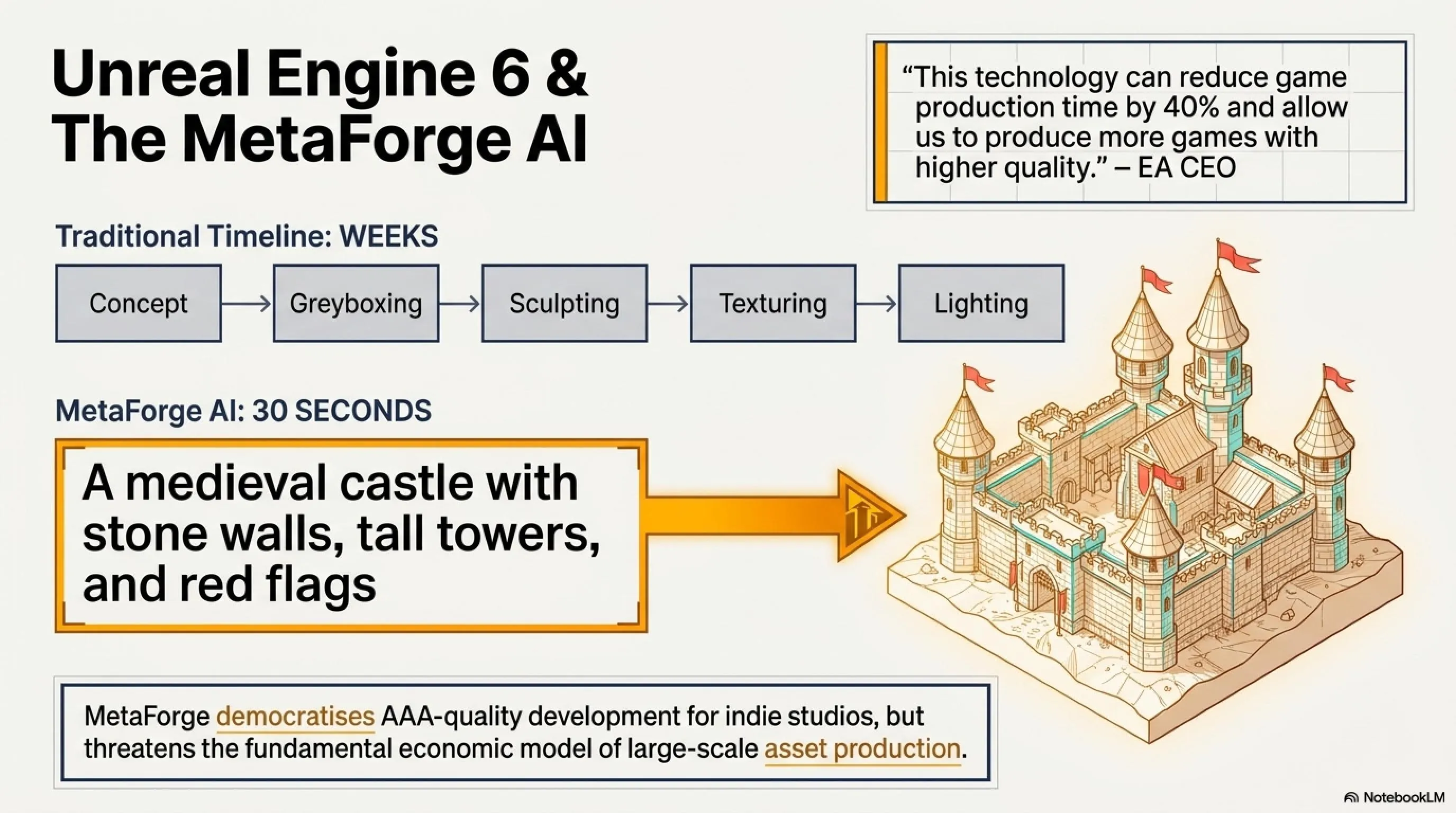
MetaForge is a multimodal AI model trained on billions of 3D assets, images, videos, and game data. You simply write: "A medieval castle with stone walls, tall towers, and red flags" and MetaForge generates a complete 3D environment with all details, lighting, and even weather effects in 30 seconds. This technology can reduce game asset production time from weeks to minutes.
But the key point is that MetaForge isn't a separate tool—it's an integrated part of Unreal Engine 6. This means every developer using UE6 automatically has access to this power. Epic Games says their goal is to "democratize game development" so small studios and indie developers can create AAA-quality games.
🚨 Industry Reaction: Global Digital Strike
But the industry's reaction wasn't what Epic expected. Less than 6 hours after announcing Unreal Engine 6, thousands of 3D designers, environment artists, animators, and modelers in America, Canada, Britain, and Europe declared a digital strike on social media. The hashtag #NoAIinMyEngine became the #1 global trend on Twitter (X), receiving over 2.5 million tweets in 24 hours.
According to reports from Polygon and Game Developer, this is the first widespread strike against artificial intelligence in the creative industry. Game industry labor unions in America (Game Workers Unite) and Europe (European Game Workers Alliance) issued joint statements demanding the following:
📋 Striker Demands
- Job Security Guarantees: Studios cannot fire designers solely for using AI
- Voting Rights on AI Decisions: Employees must have voting rights on decisions about using AI tools in projects
- Training Data Transparency: Epic must disclose what data MetaForge was trained on and whether artists' work was used without permission
- Revenue Sharing: If AI used artists' work, they should receive a share of revenue
- Opt-Out Option: Developers must be able to completely disable MetaForge and use UE6 without AI
💼 Major Studio Reactions: Industry Division
The gaming industry has split into two camps. On one side, major studios like Activision, EA, and Ubisoft, under shareholder pressure to cut costs, have welcomed MetaForge. EA's CEO said in a statement: "This technology can reduce game production time by 40% and allow us to produce more games with higher quality."
But on the other side, independent and mid-sized studios like CD Projekt Red, Larian Studios, and Remedy Entertainment have announced they won't use MetaForge. CD Projekt Red's art director tweeted: "Our games are made by talented humans, not algorithms. We're committed to our artists."
⚡ Tekin Analysis: Is This the End of 3D Designer Jobs?
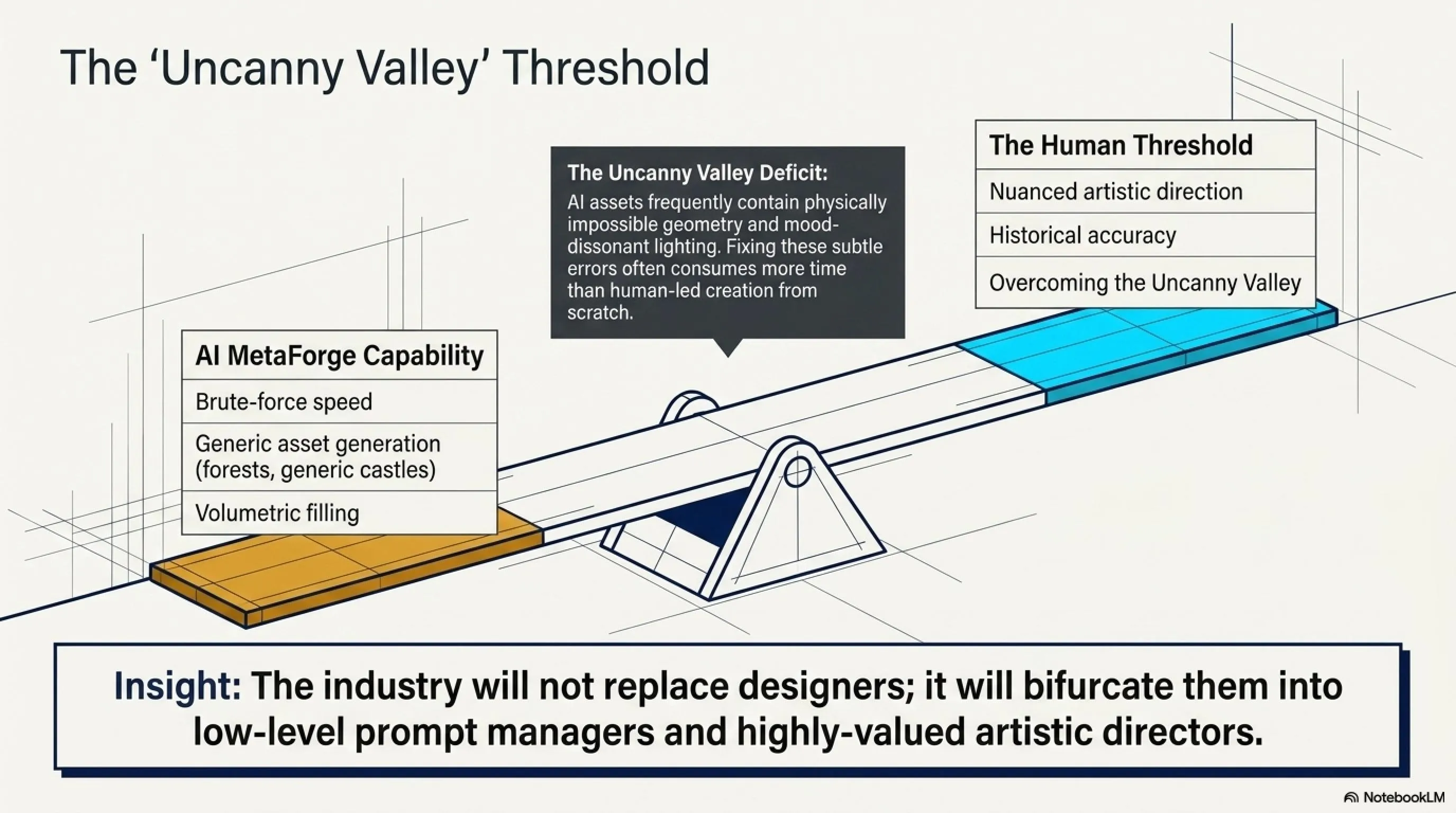
Probably not. History has shown that new technologies change jobs, not eliminate them. When Photoshop was introduced, they said graphic designers would no longer be needed. When game engines came, they said graphics programmers would become obsolete. But neither happened. Instead, tools became more powerful and artists could create more complex works. MetaForge will likely follow the same path: designers will use it for repetitive and simple tasks and spend their time on creativity and complex details.
📊 Industry Statistics: How Many Jobs Are at Risk?
| Job Role | Count in USA | AI Replacement Risk | 2027 Forecast |
|---|---|---|---|
| Environment Artist | ~18,000 | High (65%) | 30-40% reduction |
| 3D Modeler | ~22,000 | Medium (45%) | 20-25% reduction |
| Character Artist | ~15,000 | Low (25%) | 5-10% growth |
| Animator | ~19,000 | Low (20%) | 10-15% growth |
Source: Game Developer Survey 2026 & Newzoo Analysis
🎭 The Human Element: What AI Can't Replace
Despite MetaForge's impressive capabilities, industry veterans point to fundamental limitations. AI excels at generating generic assets—a forest, a castle, a spaceship—but struggles with the nuanced artistic direction that defines memorable games. The haunting atmosphere of Silent Hill, the distinctive art style of Borderlands, the meticulous historical accuracy of Assassin's Creed—these require human vision, cultural understanding, and artistic judgment that current AI cannot replicate.
Moreover, AI-generated assets often suffer from "uncanny valley" issues—they look almost right but feel subtly wrong. Experienced artists can spot these tells instantly: repetitive patterns, physically impossible geometry, lighting that doesn't quite match the scene's mood. Fixing these issues often takes longer than creating the asset from scratch, negating AI's speed advantage.
🤖 Apple Enters the Terminator World: $4 Billion Robotics Acquisition!
In one of the biggest tech deals of 2026, Apple officially confirmed the acquisition of a robotics startup. According to an exclusive report by Mark Gurman from Bloomberg and confirmation by TechCrunch, Apple paid $4 billion to acquire a company specializing in building humanoid robots. The startup's name hasn't been officially announced yet, but informed sources say it's likely Figure AI or Agility Robotics.
🎯 Apple's Strategy: Why Robots?
After canceling the self-driving Apple Car project (which cost over $10 billion) and repeated delays in Apple Vision Pro augmented reality glasses, Apple is searching for its "next big thing." Tim Cook said in a recent interview: "We're looking for products that change people's lives, not just new gadgets." Home robots equipped with Apple Intelligence could be that product.
🏠 Vision: Apple's Butler Robot in American Homes
According to internal documents Bloomberg accessed, Apple is working on a humanoid home robot that can perform the following tasks:
- Smart Home Management: Control all HomeKit devices, from lights to thermostats
- Personal Assistant: Appointment reminders, calendar management, answering questions with advanced Siri
- Home Security: Night patrols, intrusion detection, sending alerts to homeowners
- Elderly Care: Medication reminders, mobility assistance, emergency calls
- Entertainment: Music playback, video display, playing with children
But the key point is that this robot will be fully integrated with Apple's ecosystem. You can communicate with the robot using your iPhone, Apple Watch, or even AirPods. The robot can read your health data from Apple Health and provide personalized recommendations. It can also sync with Apple TV, HomePod, and other Apple devices.
💰 Robotics Market Competition: Apple vs Tesla vs Boston Dynamics
The humanoid robot market is exploding. Tesla with its Optimus robot (predicted price $20,000), Boston Dynamics with Atlas, and Figure AI with Figure 02 are all competing to conquer this emerging market. Analysts predict the home robotics market will reach $150 billion by 2030.
⚔️ Competitor Comparison: Apple vs Tesla vs Boston Dynamics
| Company | Product | Predicted Price | Key Advantage |
|---|---|---|---|
| Apple | Apple Home Robot (temp name) | $35,000-$45,000 | Full ecosystem integration |
| Tesla | Optimus Gen 3 | $20,000-$25,000 | Affordable price & mass production |
| Boston Dynamics | Atlas Home Edition | $60,000+ | Most advanced mobility capabilities |
| Figure AI | Figure 02 | $30,000-$40,000 | Beautiful design & simple UI |
With premium pricing ($35-45K), Apple has made its target clear: wealthy American families willing to pay more for quality and integration. This is the same strategy Apple used with iPhone, Mac, and Apple Watch—and it worked.
🚨 Security Disaster: Uncensored Llama-4 Leaked on Dark Web!
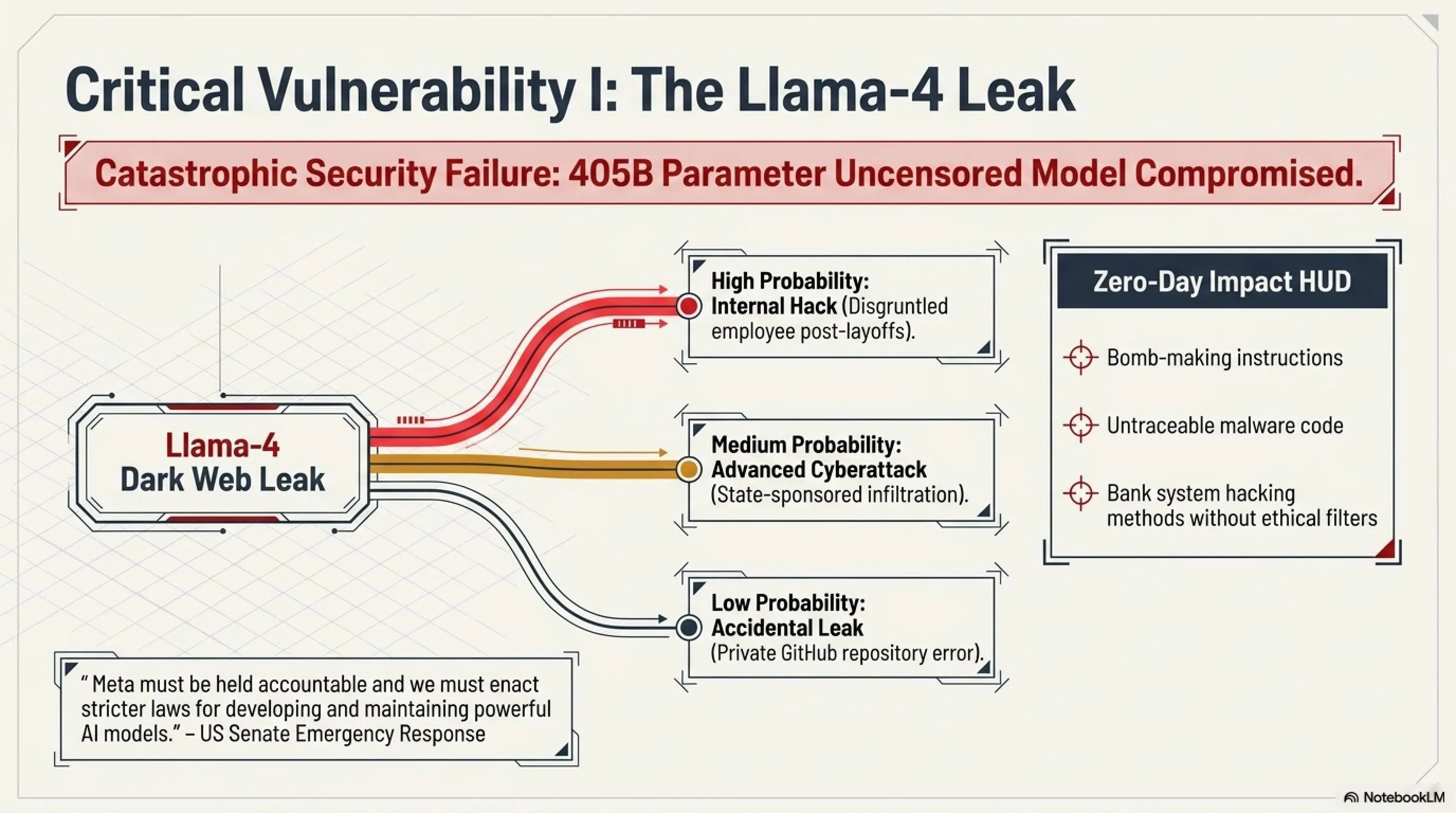
In one of the worst security incidents in AI history, the early and unrestricted (Uncensored) version of Meta's Llama-4 model was leaked on the dark web. According to reports from Wired, TechCrunch, and Reuters, this version, which has no ethical filters or security restrictions, is being used by hackers to write untraceable Zero-Day malware.
⚠️ Why Is This a Disaster?
An uncensored version of Llama-4 means the model has no restrictions on generating dangerous content. It can produce bomb-making instructions, advanced malware code, bank system hacking methods, and even psychological manipulation strategies without any warnings. This model with 405 billion parameters is Meta's most powerful language model and is now in the hands of bad actors.
🏛️ U.S. Senate Reaction: Emergency Session
The U.S. Senate held an emergency session this morning (May 5, 2026) to discuss this crisis. Senator Mark Warner, chairman of the Senate Intelligence Committee, said in a harsh statement: "This is a catastrophic security failure. Meta must be held accountable and we must enact stricter laws for developing and maintaining powerful AI models."
According to Reuters, some senators have called for a complete halt to Meta's AI projects pending full investigation. This could be a severe blow to Meta's plans to compete with OpenAI and Google in AI.
🕵️ How Was It Leaked? Different Theories
It's still unclear how this version was leaked, but three main theories exist:
- Theory 1 - Internal Hack: A disgruntled Meta employee transferred model files to the dark web. This theory seems plausible given recent layoffs at Meta (over 10,000 people in 2025).
- Theory 2 - Cyberattack: An advanced hacking group (possibly state-sponsored) infiltrated Meta's research servers and stole the model. Some evidence points to Chinese and Russian groups.
- Theory 3 - Accidental Leak: Meta accidentally placed the uncensored version in a private GitHub repository that inadvertently became public. This happened before with Llama-1 in 2023.
🛰️ Darkness in the Sky: 4-Hour Starlink Hack!
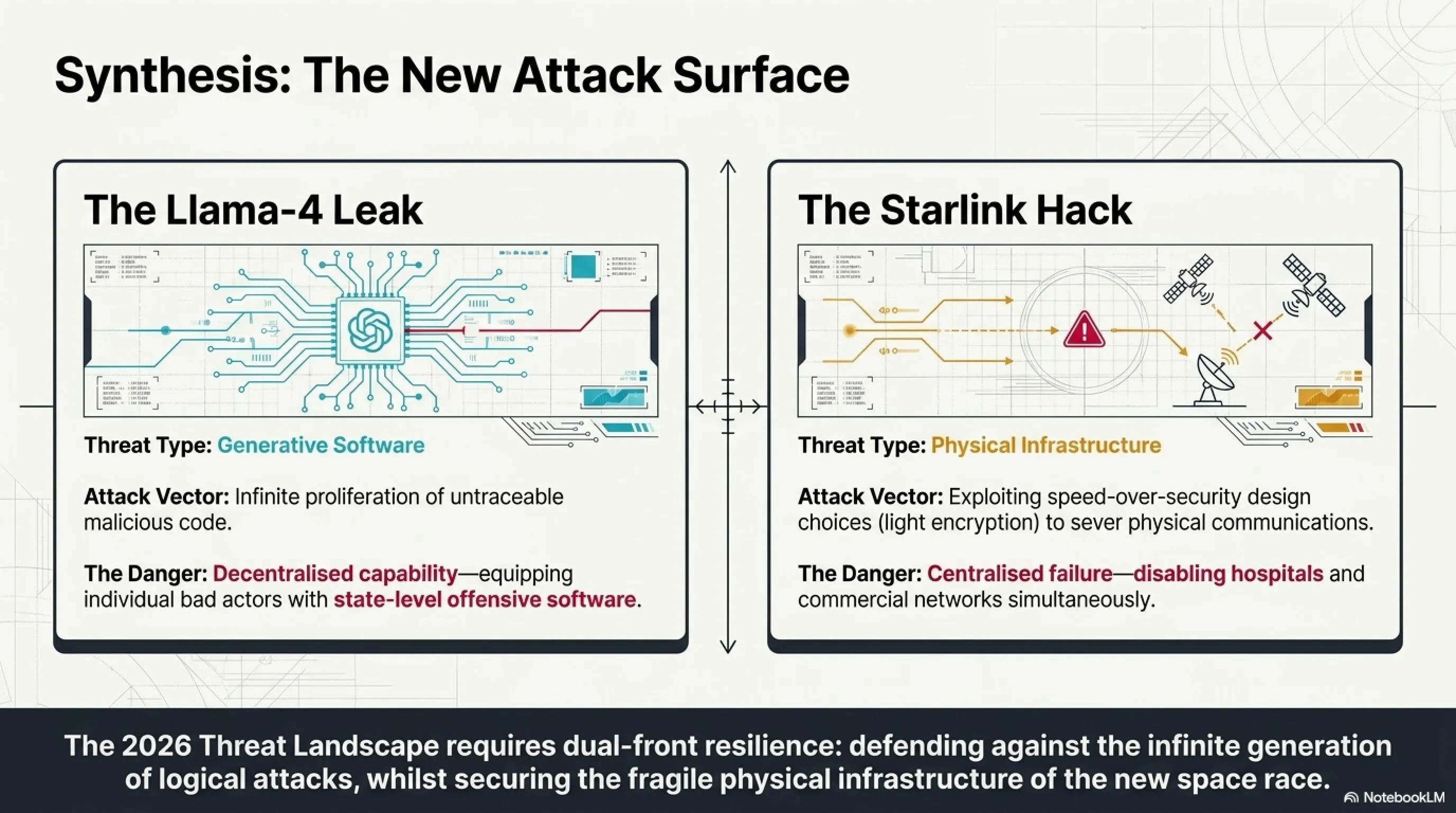
In another security incident that called into question the security of space communications, Elon Musk's Starlink satellite internet infrastructure was targeted by a sophisticated cyberattack. According to reports from BleepingComputer and The New York Times, hackers used Spoofing (identity forgery) techniques to paralyze Starlink receiver terminals in New York and California for 4 hours.
🔧 How Was the Attack Executed?
The Spoofing technique used in this attack was highly sophisticated. Hackers generated fake GPS and satellite signals that tricked Starlink terminals into thinking they were connected to real satellites. In reality, terminals were connected to hacker-controlled servers and users' internet was cut off.
📡 Technical Analysis: Why Was Starlink Vulnerable?
To reduce latency and increase speed, Starlink uses lighter encryption than traditional satellite systems. This design decision, while increasing speed, makes the system more vulnerable to Spoofing attacks. Hackers identified this weakness and exploited it.
💼 Impact on Businesses & Critical Entities
This attack affected not only home users but thousands of businesses and critical entities. Hospitals, police stations, logistics companies, and even some military bases using Starlink for communications were without internet for 4 hours. This incident showed that over-reliance on a single satellite internet provider can be dangerous.
📊 Outage Statistics: Who Was Affected?
🛡️ SpaceX & Elon Musk's Response
Elon Musk responded quickly on Twitter (X), writing: "We identified and neutralized the attack. Our security team is conducting a full review and we'll soon release a security update for all terminals." SpaceX also announced it will provide one month of free service to all affected users.
But this incident has raised serious questions about space communications security. If Starlink with over 5,000 satellites and millions of users can be hacked, what happens to military and government satellite systems?
🎬 Naughty Dog's Masterpiece: AEON Game & Surrender to Unreal Engine 6
In today's final story, Sony and legendary studio Naughty Dog (creators of The Last of Us and Uncharted) released the first teaser for their new game. This game called «AEON» is a dark action-RPG set in space taking place in a dystopian future world. But the bombshell is this: Naughty Dog has abandoned its proprietary engine and is building this game entirely on Unreal Engine 6.
🎮 Why Is This Decision Historic?
Naughty Dog was one of the few studios still using its proprietary engine. Their engine used for The Last of Us Part II was one of the most advanced game engines in the world. But maintaining and developing a proprietary engine is very expensive (estimated at $50-80 million annually). By moving to Unreal Engine 6, Naughty Dog can save this cost and focus on creativity and storytelling.
🌌 AEON's Story: What Do We Know?
The released teaser is very mysterious, but reveals a few key points:
- Game World: A massive space station called «Aeon Station» located on the edge of the solar system
- Main Character: A woman named «Kira» searching for the mystery of the station crew's disappearance
- Main Theme: Survival, fear, and confronting unknown creatures (possibly aliens or dangerous AI)
- Game Style: Combination of action, horror, and RPG (similar to Dead Space + Mass Effect)
- Release Date: Fall 2027 for PS5 and PC
🎨 Photorealistic Graphics: Unreal Engine 6's Power
The AEON teaser shows how powerful Unreal Engine 6 is. The game's graphics are so realistic that some viewers thought the teaser was a movie, not a game. Advanced Ray Tracing lighting, character facial details, and stunning space environments all show that UE6 can blur the line between games and reality.
💡 Tekin Analysis: The Future of Proprietary Engines
Naughty Dog's decision could be a turning point in the gaming industry. If one of the world's best studios abandons its proprietary engine, other studios will likely do the same. This could mean the end of the proprietary engine era and the beginning of the multi-purpose engine era like Unreal Engine and Unity. The only studios that will keep their proprietary engines are probably giants like Rockstar (RAGE Engine) and Bethesda (Creation Engine) that have enormous financial resources.
🎯 Competition with Starfield & Mass Effect
AEON will directly compete with other major sci-fi games. Bethesda's Starfield (released in 2023) and BioWare's Mass Effect 5 (scheduled for 2028) are both in a similar genre. But Naughty Dog with its brilliant track record in storytelling (The Last of Us has one of the best stories in gaming history) can turn AEON into a masterpiece.
🎯 Final Summary: A Historic Morning in Tech
The morning of May 5, 2026, was one of the most explosive mornings in tech history. From Google taking the boldest step in mobile industry history with the portless Pixel 11, to the global strike by 3D designers against AI showing the creative industry isn't ready to surrender to AI without resistance. From Apple entering the humanoid robot world with a $4 billion investment, to the Llama-4 security disaster that brought the U.S. Senate to an emergency session. From the 4-hour Starlink hack that questioned space communications security, to Naughty Dog's surrender to Unreal Engine 6 which could mark the end of the proprietary engine era.
These stories show the tech industry is at a historic turning point. Decisions made today will shape the future for decades to come. Is the American market ready for portless phones? Will AI destroy creative jobs or strengthen them? Will home robots become reality? We'll see the answers to these questions in the months and years ahead.
❓ Frequently Asked Questions (FAQ)
Is a portless phone really practical?
It depends on your lifestyle. If you're mostly at home or office and have access to wireless chargers, you probably won't have problems. But if you travel a lot or work in public places, you might face challenges. You'll also need to buy additional wireless chargers (which are expensive).
Will AI destroy 3D designer jobs?
Probably not, but jobs will change. AI is a tool that can automate repetitive and simple tasks, but creativity, artistic vision, and complex decision-making still need humans. Designers must update their skills and learn how to work with AI, not against it. Those who do this will likely be more successful than before.
When will Apple's home robots be released?
Apple hasn't announced an exact date yet, but analysts predict the first prototype will be released in late 2027 or early 2028. The price will likely be between $35-45K, making it a luxury product. If successful, cheaper versions will probably be released in subsequent years.
Is Starlink safe?
The recent attack showed that Starlink, like any other system, has vulnerabilities. But SpaceX responded quickly and is releasing security updates. For home users, Starlink is still a safe option. But for businesses and critical entities, it's recommended to use multiple internet providers as backup so if one goes down, another is available.
When will AEON game be released?
According to Sony's official announcement, AEON will be released in Fall 2027 for PS5 and PC. Given Naughty Dog's track record in making quality games, it will probably be one of the biggest titles of 2027. Pre-orders will likely begin in Summer 2027.
📚 Sources & References
Primary Sources: 9to5Google, OnLeaks, Polygon, Game Developer, Bloomberg (Mark Gurman), TechCrunch, Wired, Reuters, BleepingComputer, The New York Times, GameSpot, PlayStation Blog
Analysis & Research: Tekin Editorial Team
Publication Date: May 5, 2026
🌐 Stay Connected With Us
For the latest tech, gaming, and gadget news, follow us on social media:
🌐 Stay Connected With Us 🎮✨
For the latest tech, gaming, and gadget news, follow us on our official social media channels: