🌅 Good Morning! Welcome to Tekin Morning May 17, 2026
Rise and shine, tech enthusiasts! Sunday morning brings us a powerhouse lineup of breaking tech news that will shape the industry for months to come. From Google's massive I/O 2026 announcements to T-Mobile's jaw-dropping iPhone 17 giveaway, from revolutionary AI tools consolidating the entire ecosystem to groundbreaking shifts in cybersecurity training—we've got it all covered in today's comprehensive deep dive.
⚡ Today's Headlines:
🎯 Google I/O 2026: Android 17, XR Glasses & Gemini Revolution
📱 T-Mobile's Free iPhone 17 Deal: Too Good to Be True?
🤖 ChatPlayground AI: 20+ Models in One Platform
🔒 AI-Powered Cybersecurity Training Transforms Mac Administration
💰 Nectar Social Raises $30M to Reinvent Marketing
📚 ArXiv Declares War on AI-Generated Academic Fraud
🎯 Google I/O 2026: The Future of Android, XR, and AI Convergence
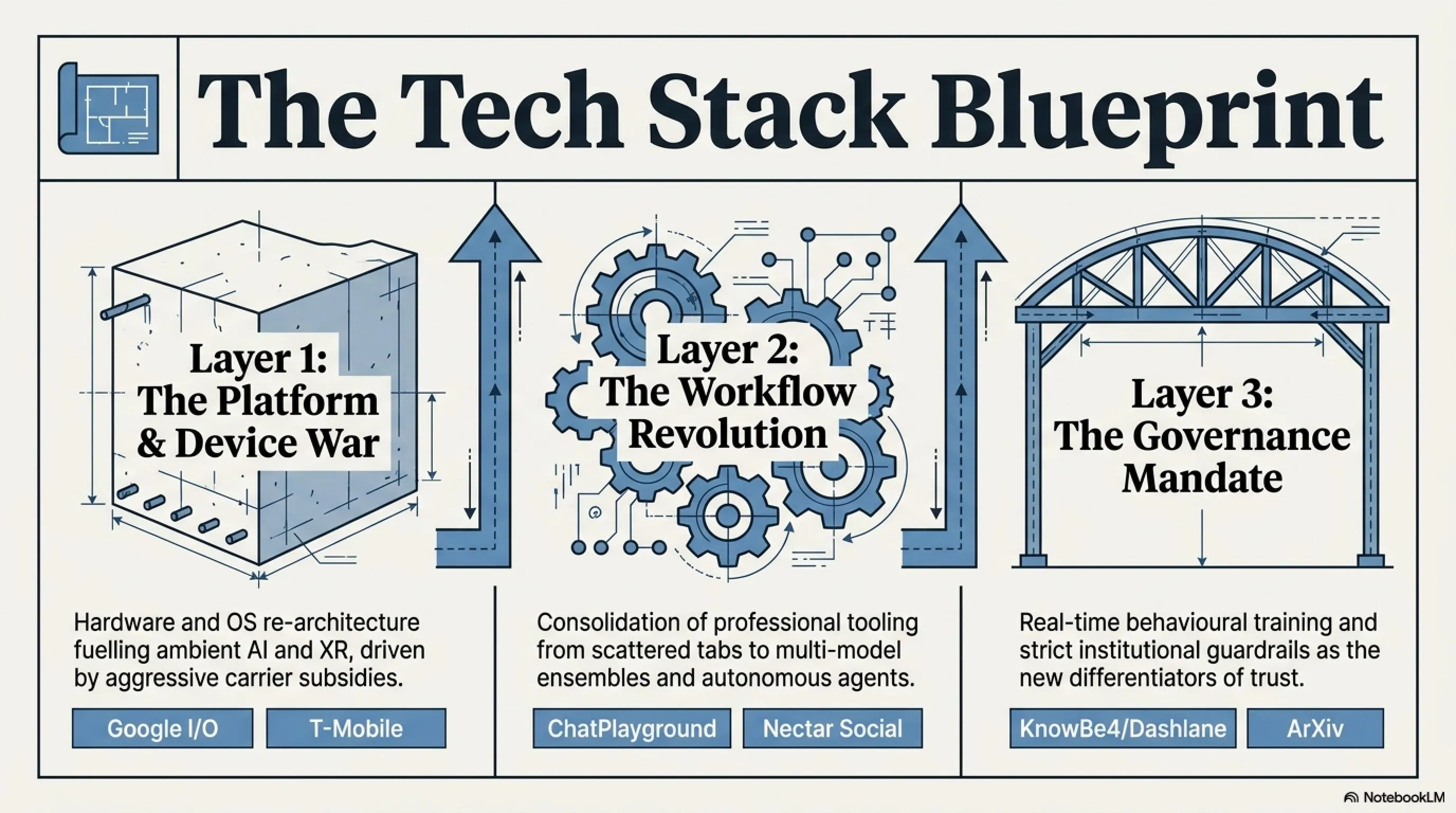
Google is gearing up for what industry analysts are calling its most ambitious developer conference in over a decade. I/O 2026, scheduled to kick off Tuesday, May 19 at 1:00 PM ET (10:00 AM PT), promises to unveil a comprehensive vision for the future of computing that spans mobile devices, wearables, augmented reality, and artificial intelligence. With over 3 billion active Android devices worldwide and mounting pressure from competitors like Apple's Vision Pro and Meta's Quest ecosystem, Google is betting big on an integrated approach that could redefine how we interact with technology.
📅 Two-Day Format: A Strategic Expansion
Breaking from tradition, Google has expanded I/O 2026 to a two-day event running May 19-20. This strategic decision reflects the sheer volume of announcements planned and signals Google's intent to provide developers with deeper, more hands-on engagement opportunities. The main keynote on Tuesday will be followed by over 100 technical sessions, workshops, and developer labs throughout both days.
According to sources familiar with the planning, Google deliberately chose this format to avoid the "information overload" problem that plagued previous I/O events, where critical announcements got lost in three-hour marathon keynotes. By spreading content across two days, Google aims to give each major announcement the attention it deserves while providing developers time to digest and experiment with new tools between sessions.
📊 Google I/O 2026 Schedule Breakdown
🤖 Android 17: The Intelligent Operating System Era Begins
Android 17 represents the culmination of Google's multi-year effort to transform Android from a mobile operating system into what Sameer Samat, President of the Android Ecosystem, calls an "intelligent operating system." This isn't just marketing speak—Android 17 fundamentally reimagines how an OS should work in an AI-first world.
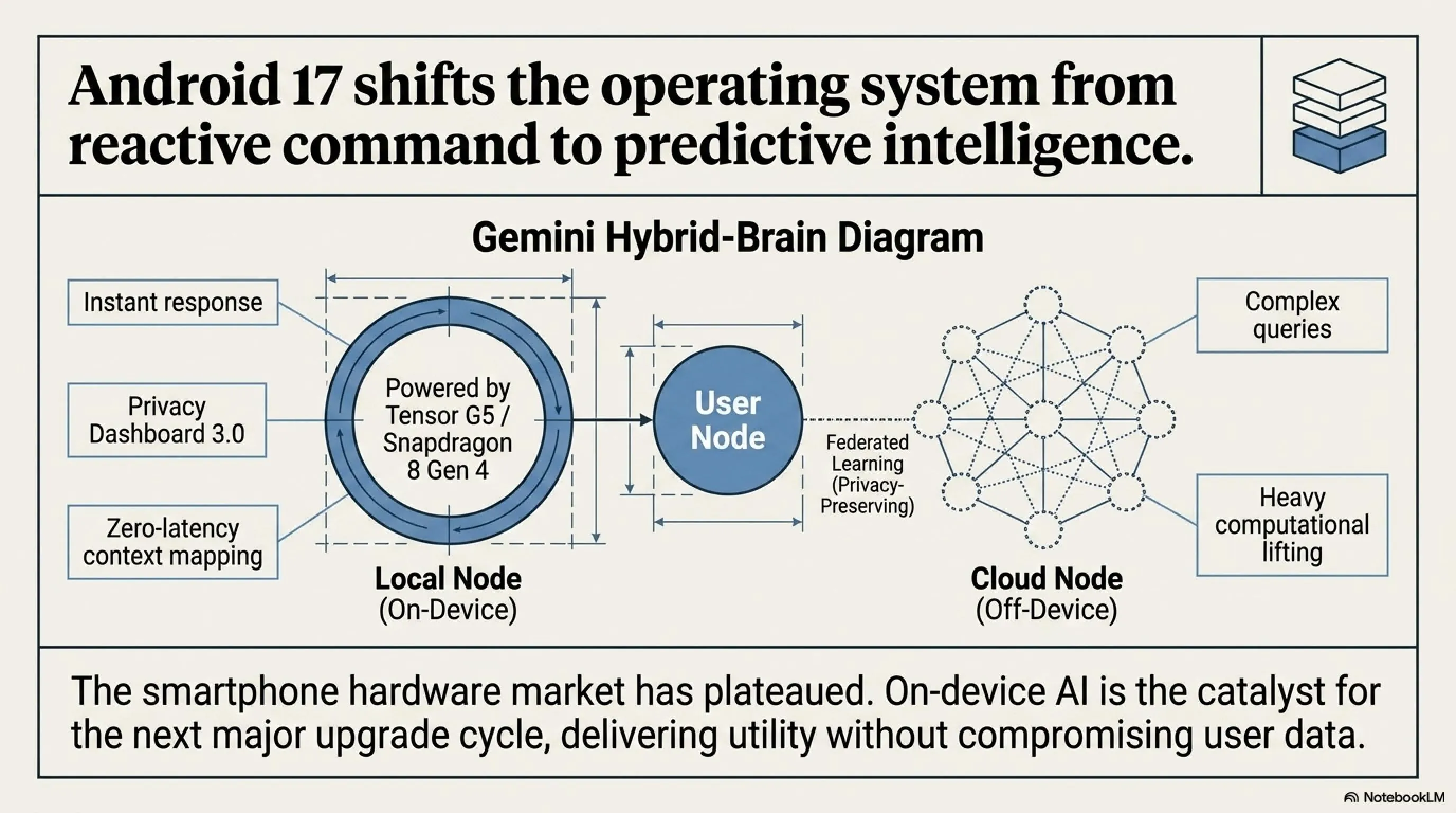
The core philosophy behind Android 17 is predictive computing. Rather than waiting for users to open apps and input commands, Android 17 uses on-device AI models to anticipate needs and proactively offer solutions. Missed a call during a meeting? Android 17 automatically drafts a contextually appropriate text response. Running late for an appointment? It suggests leaving early based on real-time traffic and your calendar. This level of intelligence runs locally on-device, ensuring privacy while delivering instant responses.
🎯 Android 17 Flagship Features: A Technical Deep Dive
- Gemini Intelligence Integration: Deep AI embedding across system UI, apps, and services with on-device processing for privacy
- Googlebook Assistant: Next-generation digital companion that learns your habits and proactively manages daily tasks
- Enhanced Android Auto: AI-powered driving experience with predictive navigation and voice-first controls
- Privacy Dashboard 3.0: Granular control over data sharing with real-time permission monitoring
- Adaptive UI Framework: Interface that evolves based on usage patterns, time of day, and context
- Cross-Device Continuity: Seamless handoff between phone, tablet, watch, car, and XR devices
🧠 Gemini Intelligence: The Brain Behind Android 17
Gemini Intelligence isn't just another AI assistant—it's a fundamental rethinking of how artificial intelligence should integrate with an operating system. Unlike traditional assistants that wait for wake words or button presses, Gemini Intelligence operates as a persistent, context-aware layer that understands what you're doing and offers help when needed, not when asked.
The technical architecture is impressive. Gemini Intelligence uses a hybrid approach combining on-device models (running on Google's Tensor G5 chip in Pixel devices and Qualcomm's Snapdragon 8 Gen 4 in other flagships) with cloud-based processing for complex queries. The system employs federated learning, meaning your device learns from your behavior without sending personal data to Google's servers. This addresses the privacy concerns that have plagued previous AI assistants while delivering personalized experiences.
💡 Tekin Analysis: Why Gemini Intelligence Matters
The smartphone market has reached a plateau. Hardware improvements are incremental, and consumers are holding onto devices longer. Google's bet on AI-first experiences could be the catalyst for a new upgrade cycle. If Gemini Intelligence delivers on its promise of genuinely useful, proactive assistance, it could differentiate Android in ways that camera megapixels and screen refresh rates never could. More importantly, by processing AI on-device, Google addresses the growing consumer concern about data privacy while maintaining the personalization that makes AI useful. This could be the competitive advantage Android needs against Apple's tightly controlled ecosystem.
👓 Android XR: Google's Augmented Reality Gambit
Perhaps the most anticipated announcement at I/O 2026 is Android XR—Google's comprehensive platform for extended reality devices. After years of false starts (remember Google Glass?), Google is finally ready to compete seriously in the AR/VR space. But unlike competitors who are building closed ecosystems, Google is taking the Android approach: an open platform that any manufacturer can adopt.
Android XR isn't just for glasses. Google envisions it as a unified platform spanning smart glasses, VR headsets, car displays, smartwatches, and even laptops. The key innovation is seamless context switching—start a task on your phone, continue it on your XR glasses while walking, then finish it on your laptop. All powered by the same Gemini Intelligence that runs Android 17.
Industry sources suggest Google has partnered with Samsung and Qualcomm on reference designs for Android XR glasses, with consumer devices expected to launch in Q4 2026. The glasses will feature waveguide displays, spatial audio, and advanced hand tracking—all while maintaining an all-day battery life and a form factor light enough for extended wear.
🎮 Android XR Use Cases: Beyond Gaming
Virtual multi-monitor setups, 3D data visualization, spatial collaboration tools
AR walking directions, real-time translation overlays, contextual information
Holographic video calls, shared AR spaces, persistent virtual meeting rooms
Virtual try-on, product visualization in your space, instant price comparison
📊 Market Impact: Can Google Compete with Apple and Meta?
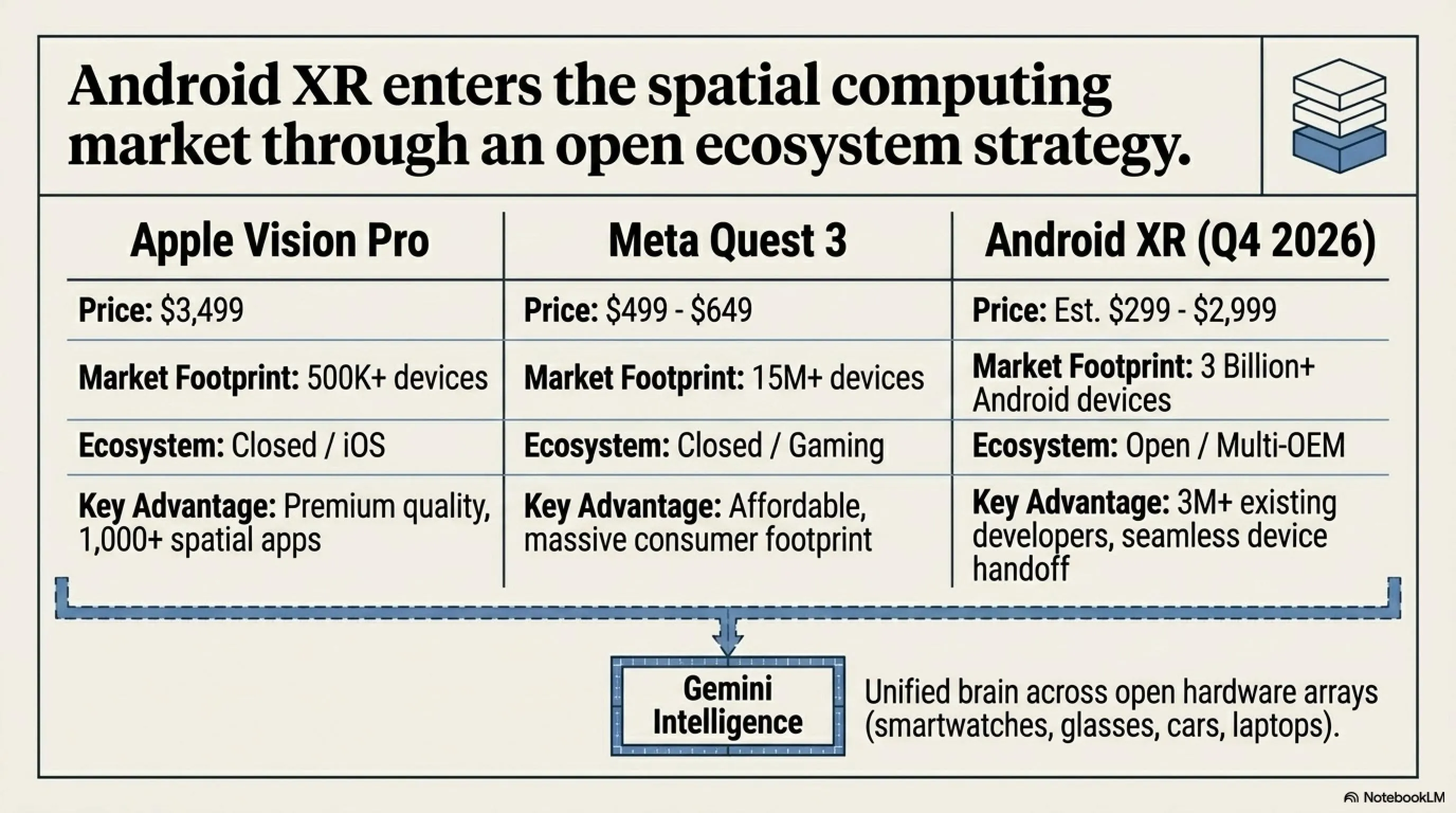
Google enters the XR market as a latecomer. Apple's Vision Pro, despite its $3,499 price tag, has established a beachhead in the premium segment with over 500,000 units sold. Meta's Quest 3, priced at $499, dominates the consumer VR market with an estimated 15 million units in circulation. Google's advantage? The Android ecosystem.
With 3 billion Android devices worldwide and millions of developers already familiar with Android development tools, Google can rapidly build an app ecosystem for Android XR. Moreover, by licensing the platform to multiple manufacturers, Google can enable a range of devices at different price points—from premium Samsung glasses competing with Vision Pro to budget-friendly options from Chinese manufacturers.
📱 T-Mobile's iPhone 17 Giveaway: Deconstructing the Deal
In the cutthroat world of US wireless carriers, T-Mobile just dropped a bombshell: get the iPhone 17 for free. No trade-in required. Just port your number and sign up for a qualifying plan. It sounds too good to be true—and in some ways, it is. But for the right customer, this could be the deal of the year. Let's break down exactly what T-Mobile is offering and whether it's worth taking the bait.
💰 The Mechanics: How "Free" Actually Works
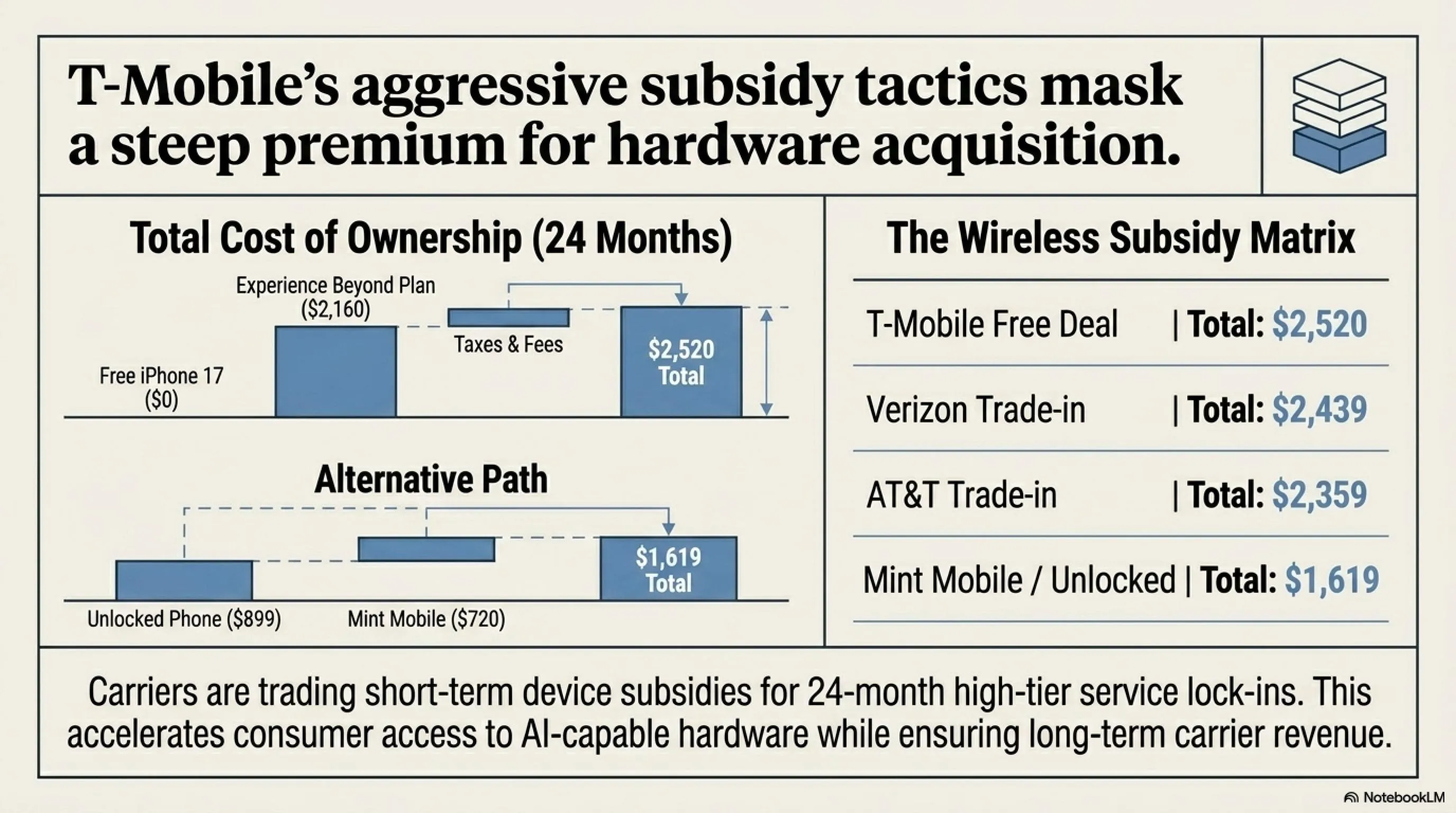
Here's the reality: T-Mobile isn't handing you an iPhone 17 and wishing you well. The deal works through bill credits spread over 24 months. You pay the full retail price of the iPhone 17 ($899 for the base 128GB model) upfront or finance it through T-Mobile. Then, over the next 24 months, T-Mobile credits your account approximately $37.46 per month, effectively making the phone free—if you stay for the full two years.
This financing structure is crucial to understand. If you cancel your T-Mobile service before 24 months, you lose the remaining credits and owe the balance on the phone. Leave after 12 months? You're on the hook for roughly $450. This isn't unique to T-Mobile—Verizon and AT&T use similar tactics—but it's important to know what you're committing to.
✅ Eligibility Requirements: What You Need to Qualify
- Port Your Number: Must transfer your existing phone number from another carrier (prepaid or postpaid)
- Qualifying Plan: Enroll in Experience Beyond ($90/month) or Better Value ($70/month) unlimited plans
- No Trade-In: Unlike most carrier deals, you keep your old phone—no device turn-in required
- 24-Month Commitment: Must maintain active service for full 24 months to receive all credits
- Credit Check: Subject to T-Mobile's standard credit approval process
- One Per Line: Limit one promotional device per line, up to 12 lines per account
📊 Total Cost of Ownership: The Real Math
Let's calculate what you'll actually pay over 24 months. The Experience Beyond plan costs $90/month for a single line. Over 24 months, that's $2,160 in service fees. Add taxes and fees (typically $10-15/month), and you're looking at $2,400-2,520 total. Compare this to buying an unlocked iPhone 17 for $899 and using a budget carrier like Mint Mobile ($30/month), which totals $1,619 over 24 months. You're paying a premium of roughly $800-900 for the "free" phone.
However, this analysis assumes you value all carriers equally. T-Mobile's network quality, customer service, and perks (like Netflix on Us, international roaming, and in-flight Wi-Fi) may justify the premium for some users. If you were already planning to use T-Mobile or a premium carrier, then the "free" iPhone 17 is genuinely a good deal.
⚠️ Critical Considerations Before Signing Up
- Early Termination: Cancel before 24 months and you owe the remaining phone balance—potentially $300-700
- Plan Costs: Experience Beyond ($90/mo) and Better Value ($70/mo) are premium-priced plans
- Coverage Gaps: T-Mobile's rural coverage lags behind Verizon and AT&T in many areas
- Device Lock: Phone remains locked to T-Mobile for 40 days minimum, longer if financed
- Credit Impact: Financing the phone may affect your credit score and debt-to-income ratio
🎯 Who Should Take This Deal?
This promotion makes sense for specific customer profiles. If you're currently with Verizon or AT&T paying similar prices, switching to T-Mobile for a free iPhone 17 is a no-brainer—assuming T-Mobile's coverage works in your area. If you're on a budget carrier and happy with it, the math doesn't favor switching unless you genuinely need T-Mobile's premium features.
The deal is particularly attractive for families. T-Mobile offers multi-line discounts, so a family of four on Experience Beyond pays $140/month total ($35/line), making the effective cost much more competitive. Each line can get a free iPhone 17, potentially saving $3,596 on devices over 24 months.
💡 Tekin Analysis: The Carrier Wars Heat Up
T-Mobile's aggressive promotion signals intensifying competition in the US wireless market. With 5G buildouts largely complete and subscriber growth slowing, carriers are fighting for market share through device subsidies. This is good news for consumers in the short term, but raises questions about long-term sustainability. Are carriers sacrificing profitability for growth? Will these deals disappear once consolidation occurs? For now, savvy consumers can benefit from the competition, but it's worth considering whether locking into a 24-month contract is wise in such a volatile market. The best strategy might be to take advantage of these deals while they last, but remain flexible and ready to switch when the next promotion comes along.
🤖 ChatPlayground AI: The Multi-Model Revolution
Imagine you're working on a complex problem. You ask ChatGPT for help, but the answer feels incomplete. So you open Claude in another tab, ask the same question, and get a different perspective. Then you try Gemini for good measure. Sound familiar? This tab-switching dance has become the reality for power users of AI tools. ChatPlayground AI aims to eliminate this friction by putting 20+ AI models in a single interface, allowing you to query them simultaneously and compare results side-by-side.
🧠 The Model Lineup: Who's Included?
ChatPlayground AI has secured API partnerships with virtually every major AI provider, giving users access to an unprecedented range of models. This isn't just about quantity—each model has distinct strengths, and having them all in one place enables a new workflow: ensemble AI, where you leverage multiple models' strengths for a single task.
🧠 Complete Model Catalog with Specializations
- GPT-4o (creative writing, brainstorming)
- GPT-4 Turbo (complex reasoning)
- GPT-3.5 (fast, cost-effective queries)
- Claude Sonnet 4 (balanced performance)
- Claude Opus (deep analysis)
- Claude Haiku (speed-optimized)
- Gemini 1.5 Pro (multimodal tasks)
- Gemini 1.5 Flash (real-time responses)
- Gemini Ultra (research-grade)
- DeepSeek V3 (code generation)
- Llama 3.2 (open-source alternative)
- Perplexity (web-grounded answers)
- Mistral Large (European data compliance)
💡 Use Cases: When Multiple Models Beat One
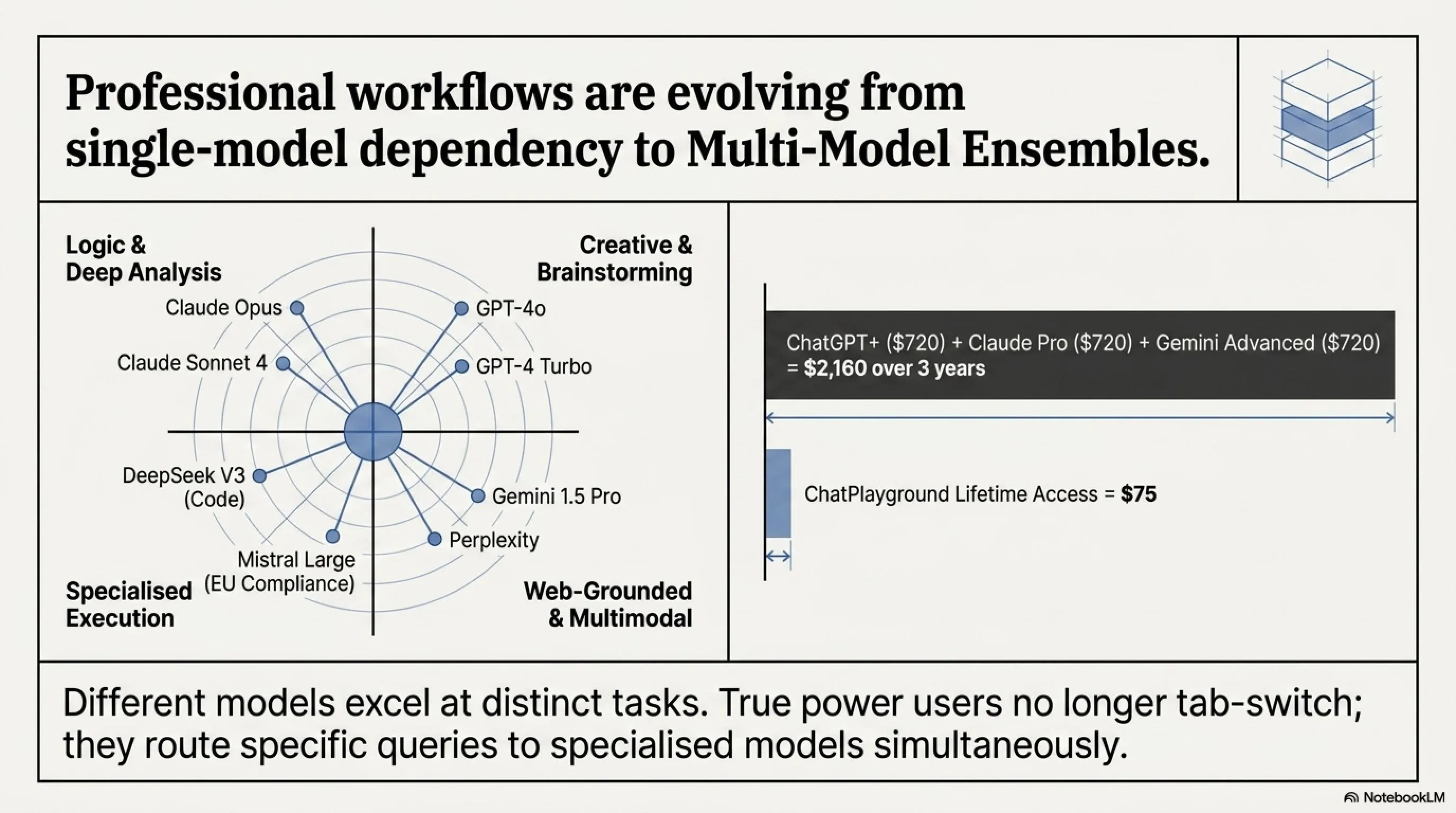
The real power of ChatPlayground emerges when you understand that different models excel at different tasks. GPT-4 might generate the most creative marketing copy, but Claude could provide better logical analysis of your business strategy, while Gemini excels at finding and synthesizing information from the web. By querying all three simultaneously, you get a more complete picture.
📝 Real-World Scenario: Writing a Technical Article
You're writing an article about quantum computing. Here's how ChatPlayground's multi-model approach helps:
- GPT-4: Generates an engaging introduction with compelling analogies
- Claude: Provides rigorous technical explanations with proper scientific accuracy
- Gemini: Finds the latest research papers and statistics
- Perplexity: Fact-checks claims and provides citations
- You: Synthesize the best parts into a comprehensive, accurate, and engaging article
💻 Real-World Scenario: Debugging Complex Code
Your Python script throws a cryptic error. You paste the code into ChatPlayground:
- GPT-4: Suggests a quick fix that might work
- Claude: Explains the root cause of the error in detail
- DeepSeek: Proposes an optimized refactor that prevents future issues
- Llama 3.2: Offers an alternative approach using different libraries
- You: Choose the solution that best fits your codebase and constraints
💰 Pricing Analysis: Is Lifetime Access Worth It?
ChatPlayground AI is currently offering its Unlimited Plan for $70-75 as a lifetime purchase. This is a significant departure from the subscription model that dominates the AI tools market. To understand if it's worth it, let's compare the costs over different time horizons.
The math is compelling. If you were planning to subscribe to just ChatGPT Plus and Claude Pro ($40/month combined), ChatPlayground pays for itself in under two months. Even if you only use it occasionally, the lifetime access means you're never locked into a recurring charge. The risk, of course, is that ChatPlayground could shut down or change its terms—but at $75, it's a relatively low-risk bet.
⚖️ Limitations and Considerations
ChatPlayground isn't perfect. The interface, while functional, lacks some of the polish of native apps like ChatGPT or Claude. There's no mobile app yet (though one is in development). And while you get access to 20+ models, you're still subject to rate limits—though these are generous enough for most users. The biggest question mark is longevity: can a company offering lifetime access for $75 sustain itself long-term? The answer likely depends on whether they can upsell users to premium features or enterprise plans down the road.
⚡ Key Benefits of the Multi-Model Approach
- Cost Savings: One subscription instead of 3-5 separate ones saves $500-1,000 annually
- Time Efficiency: No more tab-switching or copy-pasting between different AI tools
- Better Results: Leverage each model's strengths for superior outcomes
- Learning Tool: Understand how different models approach problems differently
- Flexibility: Choose the right model for each specific task
- Future-Proof: New models added regularly without additional cost
🔒 AI-Powered Cybersecurity Training: Revolutionizing Mac Administration
📚 Classified & Related Dossiers in TekinGame
If you wish to explore beyond this report and delve into cybernetic frontiers and autonomous AI architectures, do not miss these three exclusive deep-dives in the Tekin Garage:
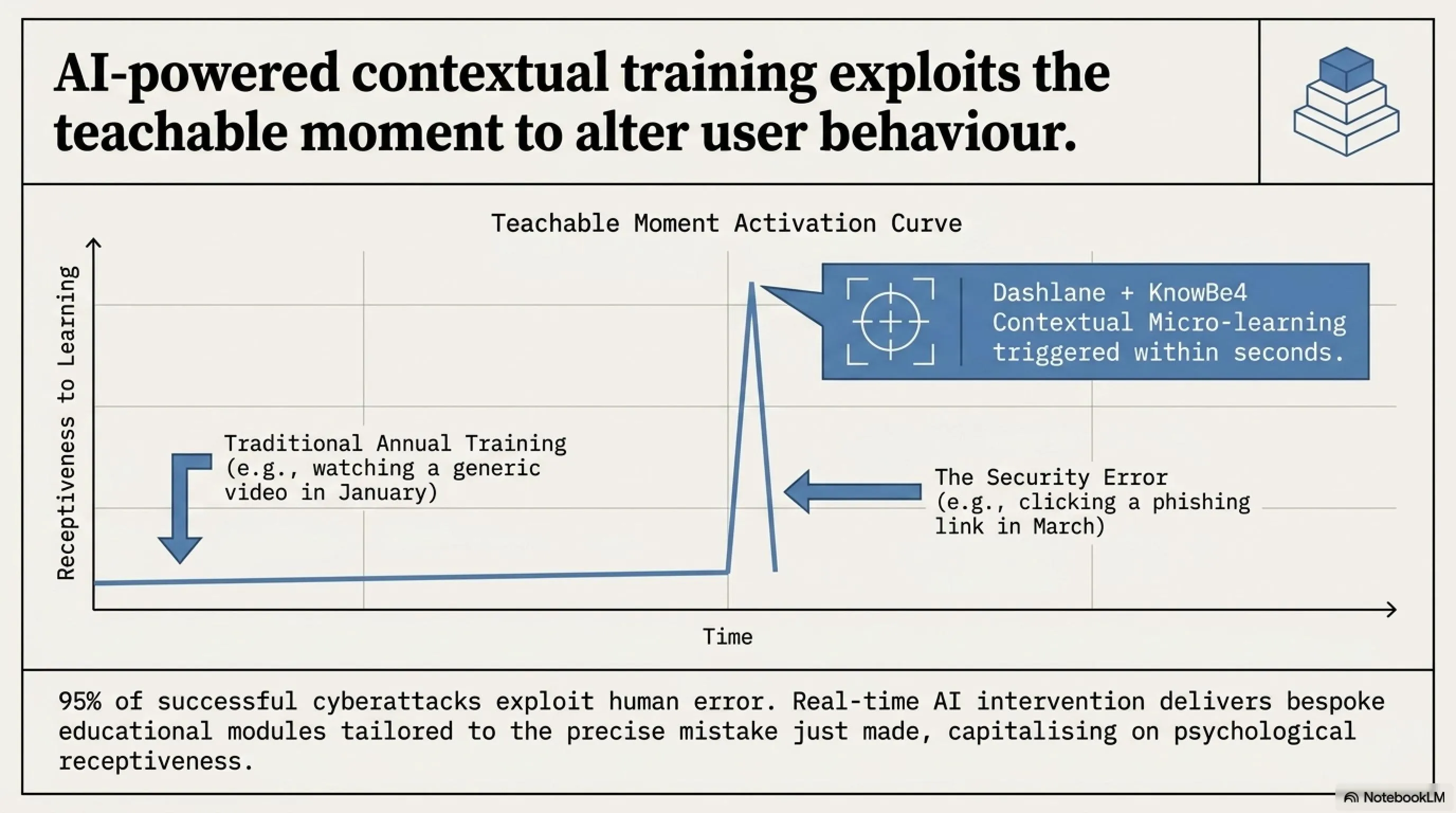
For decades, corporate cybersecurity training has followed the same tired playbook: once a year, force employees to watch boring videos and take multiple-choice quizzes. This approach checks compliance boxes but fails spectacularly at its actual goal—changing user behavior. Studies show that 95% of successful cyberattacks exploit human error, yet traditional training does little to address this. Artificial intelligence is about to change everything.
🤝 Dashlane + KnowBe4: The Integration That Changes the Game
Dashlane, one of the leading password managers with over 20 million users, recently announced a groundbreaking integration with KnowBe4, the world's largest security awareness training platform. This partnership leverages AI to deliver what they call "contextual, real-time security training"—a fundamental departure from the annual compliance ritual that most organizations still rely on.
Here's how it works: Dashlane's password manager monitors user behavior in real-time. When it detects risky actions—like reusing passwords, clicking suspicious links, or ignoring security warnings—it immediately triggers a micro-learning module from KnowBe4. These aren't generic videos; they're AI-generated, personalized lessons that address the specific mistake the user just made, delivered at the exact moment when the brain is most receptive to learning.
⚡ Real-Time Training: The Teachable Moment
Educational psychology has long recognized the power of "teachable moments"—instances when learners are primed to absorb information because it's immediately relevant to their current situation. Traditional annual training ignores this principle entirely. An employee who clicks a phishing link in March won't remember the training video they watched in January. But if they receive targeted education within seconds of making the mistake, the lesson sticks.
The AI system analyzes the context of each security event. Did the user click a phishing link because it appeared to come from their boss? The training explains how to verify sender authenticity. Did they reuse a password because they couldn't remember a unique one? The system teaches password manager best practices. This contextual approach is far more effective than generic training modules.
🎯 Tekin Analysis: Why This Matters for Mac Admins
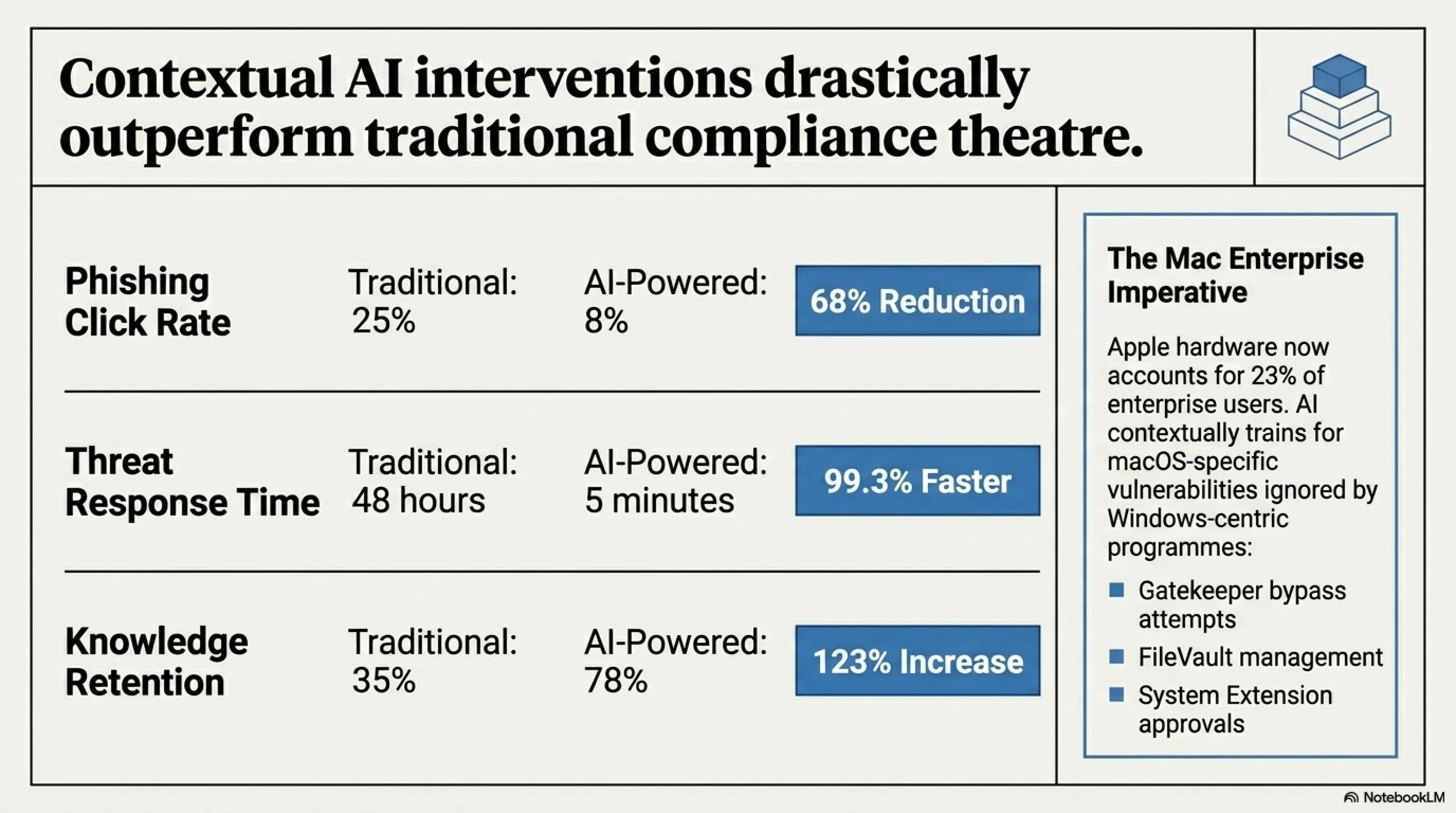
Mac administrators face unique challenges. Apple's ecosystem, while generally secure, requires specialized knowledge to configure properly. FileVault encryption, Gatekeeper policies, XProtect malware detection, and System Integrity Protection all need proper setup and user education. Traditional training programs often focus on Windows environments, leaving Mac users with generic advice that doesn't apply to their systems. AI-powered training can be customized for macOS-specific threats and best practices, ensuring Mac users get relevant, actionable guidance. Moreover, as more enterprises adopt Macs (Apple now holds 23% of the enterprise market, up from 17% in 2023), the need for Mac-specific security training has never been greater.
🧠 Personalized Learning Paths: One Size Doesn't Fit All
Another major advantage of AI-powered training is personalization. The system builds a profile for each user, tracking their security knowledge, risk behaviors, and learning style. A software engineer who understands technical concepts gets different training than a marketing manager who needs simpler explanations. A user who learns best from videos gets video content; someone who prefers reading gets text-based modules.
🎓 AI-Powered Training Capabilities
- Behavioral Analysis: Identifies each user's specific security weaknesses and knowledge gaps
- Role-Based Content: Delivers training relevant to job function (developers get different content than executives)
- Adaptive Difficulty: Adjusts complexity based on user's demonstrated knowledge level
- Plain Language: Explains technical concepts in accessible terms appropriate for the audience
- Progress Tracking: Shows improvement over time and celebrates security wins
- Gamification: Uses points, badges, and leaderboards to increase engagement
📊 The Data: AI Training vs. Traditional Methods
Early adopters of AI-powered security training are reporting dramatic improvements in key metrics. A study by KnowBe4 involving 500 organizations found that companies using AI-driven, real-time training saw phishing click rates drop from an average of 25% to just 8% within six months. Traditional annual training, by comparison, typically reduces click rates by only 5-7 percentage points.
🍎 Mac-Specific Security Challenges
Mac administrators deal with a unique set of security considerations that Windows-focused training often overlooks. Apple's security model relies heavily on user permissions and system integrity protections that require proper configuration. AI-powered training can address these Mac-specific issues:
- Gatekeeper Bypass Attempts: Training users to recognize and report apps trying to circumvent security
- FileVault Management: Educating users on encryption best practices and recovery key storage
- Keychain Security: Teaching proper password management within Apple's ecosystem
- System Extension Approvals: Helping users understand when to approve or deny system extension requests
- Privacy Permissions: Explaining macOS privacy controls and when apps should have access to data
🚀 Implementation Roadmap for Organizations
For IT leaders considering AI-powered security training, the implementation process is straightforward but requires careful planning. The Dashlane-KnowBe4 integration can be deployed in phases, starting with a pilot group before rolling out organization-wide. Here's a typical implementation timeline:
📅 90-Day Implementation Plan
- Days 1-30: Deploy Dashlane to pilot group (50-100 users), establish baseline security metrics
- Days 31-60: Integrate KnowBe4 training modules, customize content for organization's specific threats
- Days 61-90: Analyze pilot results, refine training content, prepare for full rollout
- Days 91+: Organization-wide deployment with ongoing monitoring and optimization
💰 Nectar Social: $30M to Reinvent Marketing Operations
In the startup world, a $30 million Series A is a significant vote of confidence. When that funding comes from Menlo Ventures—one of Silicon Valley's most respected firms—and their Anthology Fund (created in partnership with Anthropic), it signals something special. Nectar Social, an AI-powered marketing platform founded by two former Meta executives, just closed that round and simultaneously launched Nectar Agent, what they're calling the first autonomous AI agent for marketing.
👭 The Founders: From Meta to Nectar
Misbah and Farah Uraizee, sisters who both held leadership positions at Meta (Facebook), founded Nectar Social in 2024 after recognizing a fundamental problem: modern marketing teams are drowning in tools. The average marketing department uses 15-20 different software platforms—one for social listening, another for scheduling posts, a third for influencer management, a fourth for analytics, and so on. This fragmentation creates inefficiency, data silos, and ultimately, suboptimal results.
Their insight, honed from years at Meta managing some of the world's largest advertising campaigns, was that AI could consolidate these disparate tools into a single, intelligent platform. Nectar emerged from stealth in 2025 with impressive early traction—brands like e.l.f. Beauty, Babylist, Figma, Graza, and Liquid Death were already using the platform. Now, with $30 million in fresh capital, they're ready to scale.
🎯 What is Nectar Social?
Nectar positions itself as a "Marketing Operating System"—a unified platform that handles everything a modern marketing team needs. Social media intelligence, community management, influencer workflows, conversational commerce, content creation, and analytics all live in one place. The platform has official data partnerships with Meta, TikTok, LinkedIn, Reddit, and X (formerly Twitter), giving it direct access to platform APIs for deeper insights and automation capabilities that third-party tools can't match.
🤖 Nectar Agent: The Autonomous Marketing AI
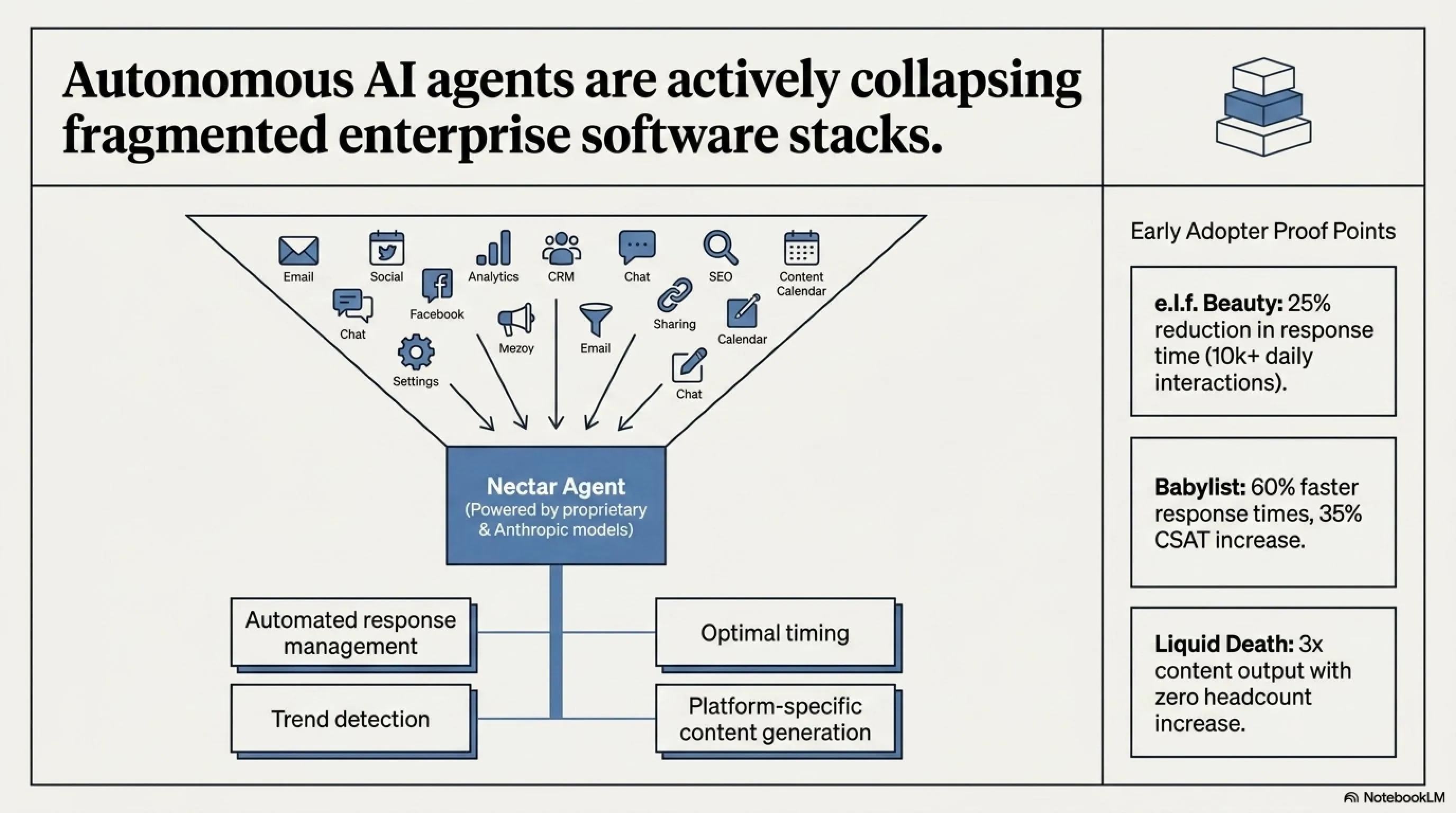
Coinciding with the funding announcement, Nectar launched Nectar Agent—an AI agent that can autonomously handle marketing tasks. This isn't a chatbot that answers questions; it's an agent that takes action. Nectar Agent can respond to customer comments, generate platform-specific content, identify trending topics, schedule posts at optimal times, and even negotiate with influencers—all without human intervention (though with human oversight and approval workflows).
The technical architecture is impressive. Nectar Agent uses a combination of large language models (including Claude, given the Anthropic connection) and proprietary models trained on marketing data. It understands brand voice, can adapt content for different platforms (what works on TikTok doesn't work on LinkedIn), and learns from performance data to continuously improve its output.
- Automated Response Management: Replies to comments and DMs with brand-appropriate responses
- Content Generation: Creates posts, captions, and creative assets tailored to each platform
- Optimal Timing: Analyzes audience behavior to determine best posting times
- Trend Detection: Identifies emerging trends relevant to your brand before they peak
- Performance Analytics: Generates comprehensive reports with actionable insights
- Influencer Outreach: Identifies potential partners and drafts collaboration proposals
🏢 Customer Success Stories: Real Results
Nectar's early customers span diverse industries, but they share a common thread: they're brands that take social media seriously and need enterprise-grade tools to manage their presence. Let's look at how some of them are using the platform:
💄 e.l.f. Beauty
The cosmetics brand uses Nectar to manage campaigns across 12 social platforms, coordinate with 500+ influencers, and respond to 10,000+ customer interactions daily. Result: 40% increase in engagement, 25% reduction in response time.
🍼 Babylist
The baby registry platform leverages Nectar's community management tools to support new parents with product recommendations and advice. Result: 60% faster response times, 35% increase in customer satisfaction scores.
🎨 Figma
The design tool uses Nectar to manage its massive designer community, identify power users for beta programs, and track sentiment around feature releases. Result: 50% more efficient community management, better product feedback loops.
💀 Liquid Death
The edgy water brand uses Nectar's content generation to maintain its irreverent voice across platforms while scaling to millions of followers. Result: 3x content output with same team size, maintained brand consistency.
💡 Why This Funding Matters: The Future of Marketing
📈 Tekin Analysis: The Marketing Stack Consolidation Trend
Menlo Ventures' investment in Nectar signals a broader trend: the consolidation of the marketing technology stack. The "martech" landscape has exploded over the past decade, growing from a few hundred tools to over 11,000. This proliferation created choice paralysis and integration nightmares. Now, the pendulum is swinging back toward consolidation, with AI as the enabling technology.
Nectar's approach—building a unified platform powered by AI agents—represents the future of marketing operations. Instead of hiring specialists to manage each tool, companies can deploy AI agents that handle routine tasks while humans focus on strategy and creativity. This isn't just about cost savings (though a small team with Nectar can accomplish what previously required a department of 20+). It's about speed and agility. In a world where trends emerge and fade in days, not months, the ability to respond instantly is a competitive advantage.
🎯 Market Positioning: Competing with Giants
Nectar enters a crowded market dominated by established players like Hootsuite, Sprout Social, and HubSpot. However, these incumbents are burdened by legacy architectures built before the AI revolution. Nectar's advantage is that it was designed from the ground up as an AI-native platform. While competitors are retrofitting AI features onto existing products, Nectar's entire architecture assumes AI agents as first-class citizens.
The $30 million Series A will fund aggressive expansion. Nectar plans to triple its engineering team, expand its data partnerships to include emerging platforms like Threads and Bluesky, and build out enterprise features like advanced permissions, audit logs, and compliance tools. The company is also exploring international expansion, starting with Europe and Latin America.
📚 ArXiv's War on AI Slop: One-Year Bans for Academic Fraud
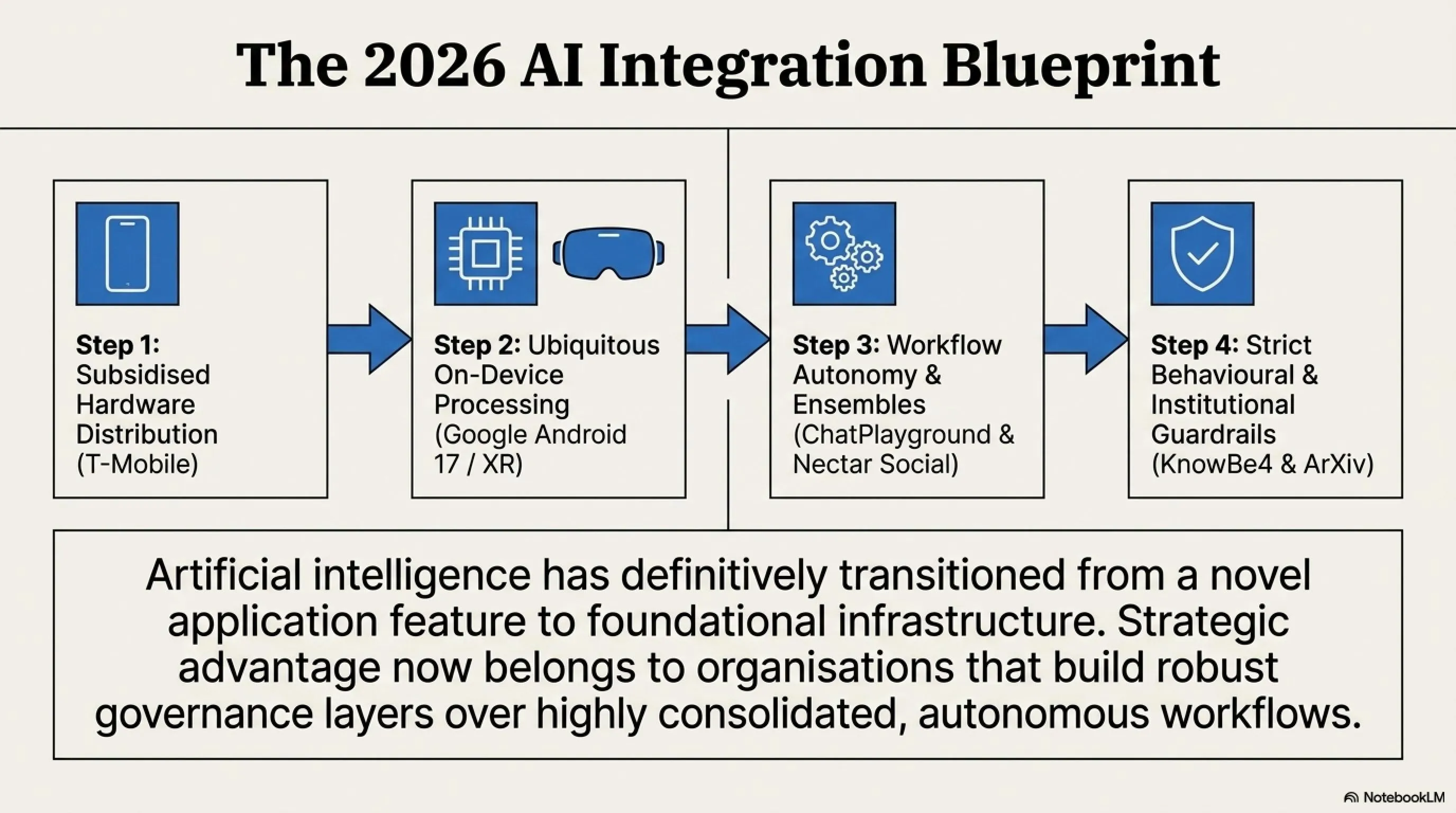
ArXiv, the preprint repository that has become essential infrastructure for scientific research, just declared war on AI-generated academic fraud. The policy is simple and severe: submit a paper that shows "incontrovertible evidence" you didn't check the AI's output, and you're banned from submitting for one year. After that, all your future submissions must first be accepted at a peer-reviewed venue. It's a nuclear option, but ArXiv argues it's necessary to preserve scientific integrity.
🚨 The Problem: A Flood of Low-Quality Papers
ArXiv processes over 200,000 submissions annually across physics, mathematics, computer science, and related fields. In the past year, moderators noticed a disturbing trend: a surge in papers containing obvious AI hallucinations, fabricated citations, plagiarized content, and nonsensical conclusions. These aren't papers that used AI as a writing aid—they're papers where authors clearly fed a prompt to ChatGPT or Claude, copied the output verbatim, and submitted it without reading.
Thomas G. Dietterich, chair of ArXiv's Computer Science section, explained the rationale in a statement: "If a submission contains incontrovertible evidence that the authors did not check the results of LLM generation, this means we can't trust anything in the paper. The penalty is a 1-year ban from arXiv followed by the requirement that subsequent arXiv submissions must first be accepted at a reputable peer-reviewed venue."
🚫 What Gets You Banned: The Red Lines
- Hallucinated Citations: References to papers that don't exist or misrepresent actual papers
- Fabricated Data: Statistics, experimental results, or mathematical proofs that are nonsensical
- Plagiarism: Text copied from other sources without attribution (AI often does this)
- Inappropriate Language: Biased, offensive, or unprofessional content that AI sometimes generates
- Logical Inconsistencies: Arguments that contradict themselves or make no sense
- Generic AI Phrases: Telltale signs like "As an AI language model" or "I cannot provide"
✅ Acceptable AI Use: Where's the Line?
ArXiv isn't banning AI use entirely—that would be impractical and counterproductive. AI tools can legitimately help researchers write better papers. The key distinction is between using AI as an assistant versus using it as a ghostwriter. Here's what's allowed:
✅ Legitimate AI Use in Research
- Language Editing: Using AI to improve grammar, clarity, and readability
- Structural Suggestions: Getting AI recommendations for paper organization
- Literature Review: Using AI to find relevant papers (but verify all citations)
- Code Generation: AI-assisted programming for experiments (with thorough testing)
- Data Analysis: Using AI tools for statistical analysis (with validation)
- Summarization: AI-generated summaries of your own work for abstracts
The Golden Rule: You must read, understand, and take responsibility for every word in your paper. If you can't explain or defend something in your paper, it shouldn't be there.
🌍 Industry Response: Other Journals Follow Suit
ArXiv isn't alone in grappling with AI-generated content. Major publishers like Nature, Science, and IEEE have all updated their policies in recent months. However, ArXiv's approach is notably stricter. Traditional journals have peer review as a quality gate; ArXiv, as a preprint server, relies more on author integrity. The one-year ban is ArXiv's way of enforcing that integrity.
The policy has sparked debate in the research community. Some argue it's too harsh, potentially catching innocent researchers who made honest mistakes. Others say it doesn't go far enough—why allow AI use at all? ArXiv's position is pragmatic: AI is here to stay, and researchers will use it. The goal isn't to ban AI but to ensure it's used responsibly.
💭 Tekin Analysis: The Future of Scientific Publishing
ArXiv's policy represents a critical moment in scientific publishing. As AI becomes more capable, the temptation to use it as a shortcut will only grow. The question isn't whether AI will be used in research—it will be. The question is whether we can maintain scientific rigor and integrity in an AI-assisted world. ArXiv's answer is clear: yes, but only if researchers take responsibility for their work. This policy sets a precedent that other repositories and journals will likely follow. In five years, we may look back at this as the moment when the scientific community drew a line in the sand and said: AI is a tool, not a replacement for human expertise and judgment.
📊 Today's News at a Glance: Quick Reference Table
💭 Final Thoughts: The AI Integration Accelerates
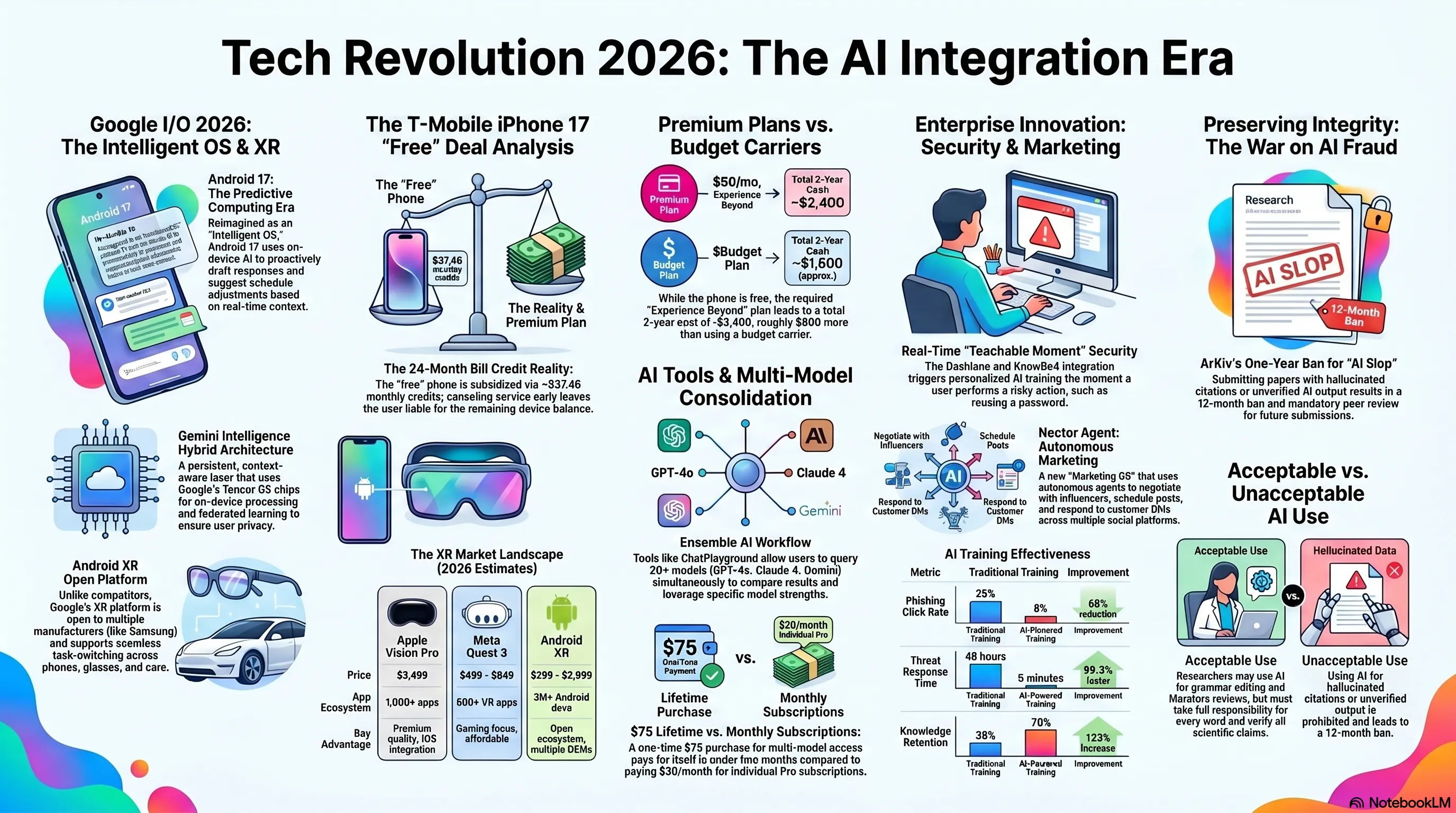
Today's news reveals a clear pattern: artificial intelligence is rapidly moving from experimental feature to core infrastructure. Google is embedding AI throughout Android 17 and betting big on XR as the next computing platform. Carriers like T-Mobile are using aggressive promotions to lock in customers before the next wave of AI-powered devices arrives. Tools like ChatPlayground are democratizing access to multiple AI models, while platforms like Nectar are using AI agents to automate entire job functions. Even the academic world is grappling with AI's impact, as ArXiv's strict new policy demonstrates. We're witnessing the early stages of a fundamental transformation in how we work, communicate, and create. The companies and individuals who adapt quickly will thrive; those who resist will be left behind. The question isn't whether to embrace AI—it's how to do so responsibly and effectively.
❓ Frequently Asked Questions (FAQ)
1. Can I watch Google I/O 2026 for free?
Yes, the main keynote and many sessions will be livestreamed for free on YouTube and the official Google I/O website. You don't need a ticket to watch remotely.
2. Is T-Mobile's iPhone 17 deal really free?
Yes and no. You pay the full price upfront (or finance it), but T-Mobile credits your account over 24 months, making it effectively free if you stay for the full term. Cancel early and you owe the remaining balance.
3. How is ChatPlayground different from ChatGPT?
ChatGPT gives you access to OpenAI's models only. ChatPlayground provides access to 20+ models from multiple companies (OpenAI, Anthropic, Google, etc.) in one interface, allowing side-by-side comparisons.
4. Is AI completely banned in academic papers now?
No. AI can be used for editing, structuring, and research assistance. What's banned is submitting AI-generated content without thorough verification. Authors must read and take responsibility for every word in their papers.
5. Who should use Nectar Social?
Nectar is designed for brands and companies with active social media presence, from startups to Fortune 500 companies. It's particularly valuable for teams managing multiple platforms, influencer relationships, and high volumes of customer interactions.
6. Will Android XR work with my existing Android apps?
Google hasn't released full technical details yet, but Android XR is expected to support existing Android apps with some adaptation required for XR-specific features. Developers will need to update apps to take full advantage of spatial computing capabilities.
📚 Sources & References
- Android Central — Google I/O 2026 Live Blog Coverage
- Mashable — T-Mobile iPhone 17 Free Offer Analysis
- TechCrunch — ChatPlayground AI Launch and Pricing
- 9to5Mac — Apple AI Cybersecurity Training for Mac Admins
- TechCrunch — Nectar Social $30M Series A Announcement
- TechCrunch — ArXiv AI Paper Ban Policy
- Wired — Security News Weekly Roundup
- The Verge — Android 17 Features Preview
- Tekin Editorial Team — Research & Analysis
🌐 Stay Connected With Us
For the latest tech, gaming, and gadget news, follow us on social media:
🌐 Stay Connected With Us 🎮✨
For the latest tech, gaming, and gadget news, follow us on our official social media channels:
Additional Gallery: 🌅 Tekin Morning May 17: Android 17, Free iPhone 17 & ArXiv Bans AI Papers