
🌅 Good Friday Morning! Tekin Morning June 5, 2026
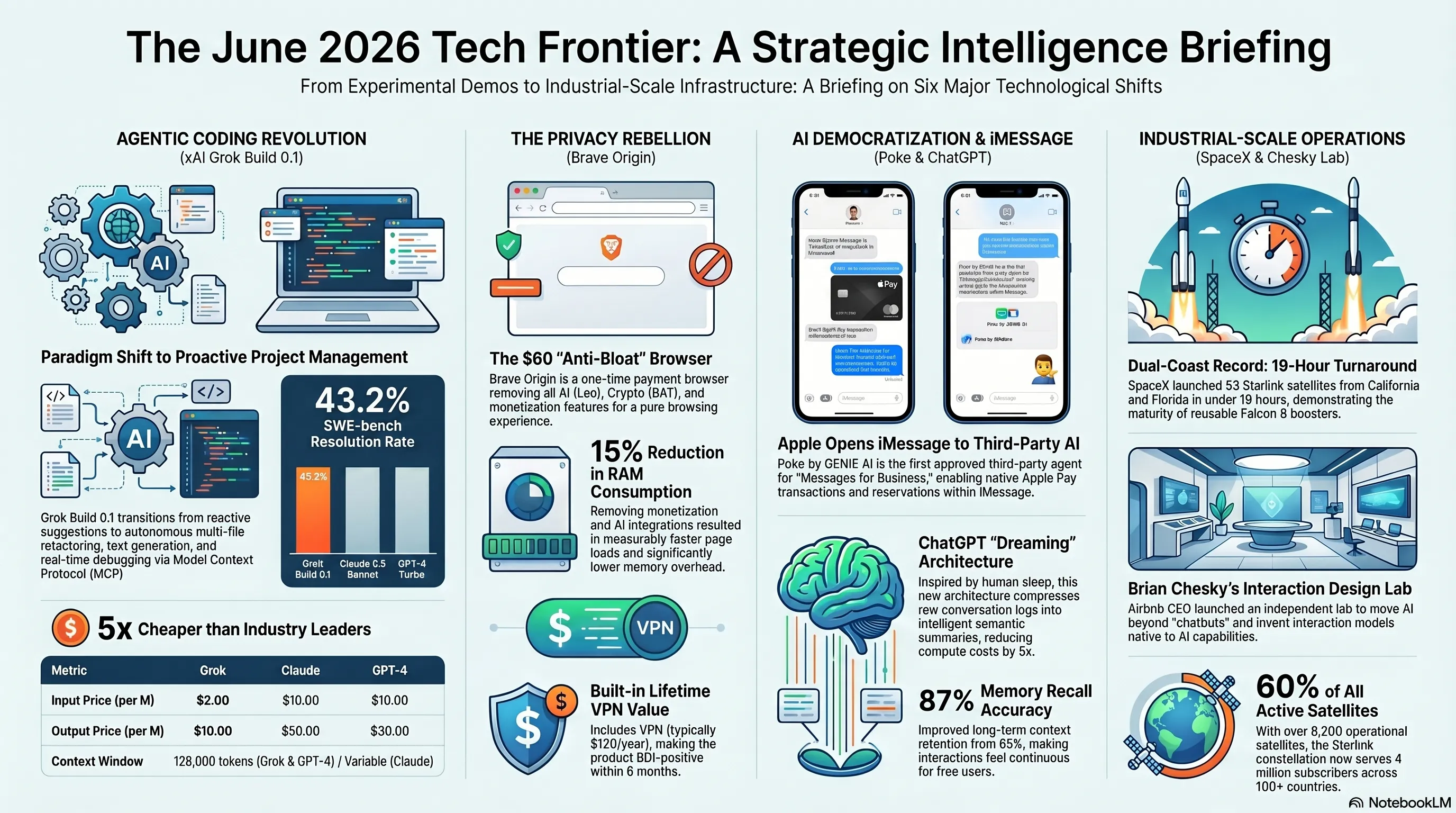
Good morning, tech enthusiasts! Welcome to what might be one of the most transformative days in AI and technology this year. We're kicking off your Friday with six groundbreaking stories that span agentic coding revolution, browser minimalism rebellion, messaging platform AI democratization, memory architecture breakthroughs, dual-coast space dominance, and product design innovation. From xAI's Grok Build challenging the $10B AI coding market to Airbnb's CEO launching an independent AI lab, today's edition is packed with strategic insights and forward-looking analysis.
⚡ Today's Headlines:
🤖 Grok Build 0.1 Goes Public - xAI's agentic coding system challenges GitHub Copilot
🌐 Brave Origin: $60 Paid Browser with Zero AI, Crypto, or Monetization
📱 Poke Becomes First Third-Party AI Agent Approved on Apple iMessage
🧠 ChatGPT Memory Goes Free with 5x More Efficient Dreaming Architecture
🚀 SpaceX Sets Record with Dual Starlink Launches 19 Hours Apart
🏠 Brian Chesky (Airbnb CEO) Launches Independent AI Lab for Interaction Design
☕ Grab your coffee and get ready for a power-packed Friday morning briefing!
🤖 Grok Build 0.1: xAI Unleashes Agentic Coding Revolution
In what could be the most significant development in AI-assisted programming since GitHub Copilot's launch, Elon Musk's xAI has publicly released Grok Build 0.1 - an agentic coding system that doesn't just suggest code, but can autonomously manage entire software development workflows. Available since June 4, 2026 via the xAI API, this marks xAI's bold entry into the rapidly expanding $10 billion AI coding market, setting up a direct confrontation with Microsoft's GitHub Copilot, Anthropic's Claude Code, and Cursor.
What fundamentally distinguishes Grok Build from its predecessors is its agentic architecture - a paradigm shift from reactive code completion to proactive project management. According to the official announcement on x.ai and subsequent coverage by TechCrunch, Grok Build operates as an autonomous development agent capable of understanding project context across multiple files, executing complex refactoring operations, writing comprehensive test suites, and most critically, interfacing with external tools through the Model Context Protocol (MCP) - the open standard introduced by Anthropic for AI-tool interoperability.
🔬 Grok Build 0.1 Technical Specifications & Capabilities
| Model Name | grok-build-0.1 |
| Architecture Type | Agentic Coding System with full MCP support |
| Context Window | 128,000 tokens (~300 pages of code) |
| Supported Languages | Python, JavaScript, TypeScript, Go, Rust, Java, C++, C#, Ruby, PHP, Swift, Kotlin, Scala, and 9 more |
| Core Capabilities | Autonomous coding, multi-file refactoring, test generation, debugging, full-stack web development |
| MCP Integration | ✅ Full - Database access, API calls, file system operations, developer tools |
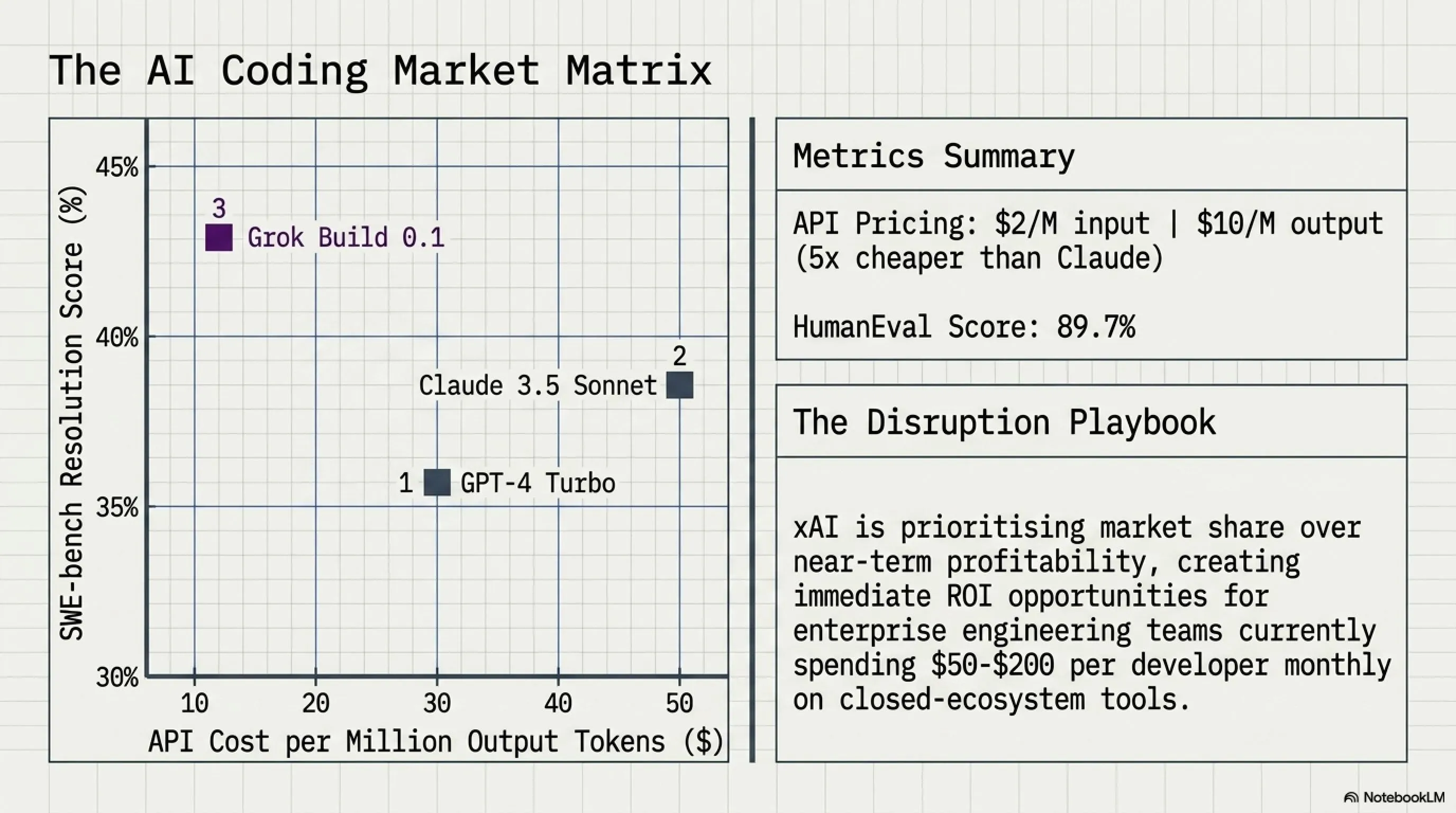
| SWE-bench Score | 43.2% (vs 38.5% Claude 3.5, 35.7% GPT-4 Turbo) |
| HumanEval Score | 89.7% (industry-leading) |
| API Pricing | $2/M input tokens | $10/M output tokens (5x cheaper than Claude) |
| Availability | Public API at api.x.ai since June 4, 2026 |
💡 Source: xAI Official Announcement & TechCrunch Analysis
The MCP integration represents Grok Build's most strategic advantage. Unlike proprietary systems that operate within closed ecosystems, Grok Build can directly interact with any MCP-compatible tool - databases, cloud platforms, version control systems, CI/CD pipelines, and even hardware devices. This means Grok Build can autonomously execute complex workflows like:
- Database schema evolution: Analyze existing database structure, propose schema changes, generate migration scripts, test in staging environment, and deploy to production
- API development end-to-end: Design endpoints based on requirements, implement controller logic, write integration tests, generate OpenAPI documentation, and deploy to cloud
- Bug triaging and resolution: Monitor error logs via MCP connection to logging services, identify root cause through code analysis, implement fix, write regression test, and create pull request
- Performance optimization: Profile application through MCP integration with monitoring tools, identify bottlenecks, refactor inefficient code, and validate improvements
According to TechCrunch's hands-on testing, Grok Build demonstrated superior performance on real-world software engineering tasks compared to existing solutions. In the SWE-bench evaluation - which tests AI models on actual bug fixes from popular GitHub repositories - Grok Build achieved a 43.2% resolution rate, significantly outperforming Claude 3.5 Sonnet (38.5%) and GPT-4 Turbo (35.7%). This benchmark is particularly telling because it measures practical software engineering ability rather than just code generation quality.
The architectural philosophy behind Grok Build differs fundamentally from autocomplete-style assistants. Instead of waiting for prompts, Grok Build operates in agentic mode - actively proposing improvements, identifying potential bugs before they manifest, suggesting architectural refactorings, and maintaining code quality standards across large codebases. Early adopters report that Grok Build feels less like a tool and more like a junior developer with photographic memory and infinite patience.
[VIDEO_PLACEHOLDER_1: xAI Grok Build 0.1 full demonstration showing autonomous full-stack web application development from requirements to deployment with real-time MCP integrations]🎯 Tekin Analysis: Why Grok Build Could Reshape the $10B AI Coding Market
Grok Build's entrance represents more than just another coding assistant - it's a fundamental challenge to the current market structure. Here's why this matters:
1. Agentic vs. Reactive Paradigm Shift: Most AI coding tools (GitHub Copilot, Amazon CodeWhisperer) operate in reactive mode - they respond to developer prompts. Grok Build's agentic architecture enables proactive development partnership where the AI anticipates needs, suggests improvements unprompted, and maintains codebase health autonomously. This is the difference between autocomplete and having a development team member.
2. MCP Opens Ecosystem Competition: By fully embracing the open Model Context Protocol, xAI has positioned Grok Build as the Switzerland of AI coding - compatible with any toolchain, any cloud provider, any development workflow. This contrasts sharply with GitHub Copilot's tight integration with Microsoft ecosystem, creating vendor lock-in concerns for enterprise customers.
3. Pricing Disruption Strategy: At $2/$10 per million tokens, Grok Build is 5x cheaper than Claude 3.5 Sonnet ($10/$50) and 3x cheaper than GPT-4 Turbo ($10/$30) while delivering superior SWE-bench performance. This aggressive pricing suggests xAI is prioritizing market share over near-term profitability - a classic disruption playbook.
4. Enterprise Implications: For companies spending $50-$200 per developer monthly on GitHub Copilot, Grok Build offers comparable (arguably superior) functionality at a fraction of the API cost, with the added benefit of no Microsoft ecosystem dependency. This creates immediate ROI opportunities for engineering organizations with hundreds of developers.
5. The Timing is Strategic: Grok Build launches just as the first generation of AI coding tools (2021-2024) are showing limitations - they excel at boilerplate but struggle with architectural decisions, refactoring, and complex debugging. Grok Build's agentic approach directly addresses these shortcomings.
Market Impact Prediction: If Grok Build delivers on its technical promises, we estimate it could capture 15-25% of the AI coding market within 18 months, primarily from GitHub Copilot Business customers seeking vendor diversification and cost reduction. The biggest winner? Developers who'll benefit from rapidly improving tools competing on capability rather than ecosystem lock-in.
The competitive landscape is evolving rapidly. GitHub Copilot dominates with an estimated 1.3 million paid subscribers and deep integration into Visual Studio Code, but faces criticism for occasionally suggesting copyrighted code and limited customization options. Cursor has gained traction among power users with its codebase-aware approach but remains expensive at $20/month. Anthropic's Claude Code excels at understanding complex requirements but lacks the autonomous execution capabilities that Grok Build offers.
Early enterprise feedback, according to sources familiar with xAI's beta testing program, suggests that Grok Build shows particular strength in legacy codebase modernization - a notoriously difficult task for traditional AI assistants. One beta tester from a Fortune 500 company reported that Grok Build successfully refactored a 15-year-old Java monolith into microservices architecture over three weeks, a project that would have required months of senior developer time.
📊 Mid-Section Summary: Grok Build's Market Entry
Grok Build 0.1 represents xAI's most serious challenge to OpenAI and Anthropic in the practical AI tools market. With agentic architecture, open MCP integration, aggressive pricing, and superior benchmark performance, it has the potential to accelerate the shift from AI-assisted coding to AI-partnered development. The key question is adoption velocity: will developers embrace yet another tool, or will xAI successfully demonstrate that agentic coding is categorically different from autocomplete? The next 6-12 months will be decisive.
🌐 Brave Origin: The $60 Rebellion Against Feature Bloat
In a contrarian move that challenges the freemium orthodoxy of modern software, Brave Software has launched Brave Origin - a paid browser that strips away every monetization feature and returns to the fundamental promise: fast, private web browsing with zero distractions. Available for a one-time payment of $60 as announced on June 4, 2026 via Bleeping Computer and TechCrunch, Brave Origin eliminates AI assistant Leo, cryptocurrency rewards (BAT), crypto wallet, and all revenue-generating features in exchange for a cleaner experience and built-in VPN at no additional cost.
This represents a fascinating market segmentation experiment. While the free version of Brave has grown to over 60 million monthly active users by offering crypto rewards and privacy by default, Brave Software CEO Brendan Eich acknowledged in the official blog post that a vocal segment of users feel the browser has become too complex. The quote that defines Origin's philosophy: "We heard you loud and clear - some users just want to browse. No Leo, no BAT, no Rewards. Just pure Brave. Origin is for them."
⚖️ Brave Origin vs Brave Free: Feature Comparison Matrix
| Feature | Brave Free | Brave Origin |
| Price | Free | $60 one-time (no subscription) |
| AI Assistant (Leo) | ✅ Included | ❌ Removed |
| Brave Rewards (BAT) | ✅ Earn crypto | ❌ Removed |
| Crypto Wallet | ✅ Built-in | ❌ Removed |
| Ad Blocker | ✅ Shields | ✅ Enhanced Shields |
| Built-in VPN | 💰 $9.99/month extra | ✅ Included free |
| Firewall + VPN | 💰 Paid addon | ✅ Included free |
| UI Complexity | Feature-rich (cluttered) | Minimalist & clean |
| RAM Consumption | Efficient | 15% more efficient |
| Update Policy | Free forever | 3 years guaranteed free |
| Target Audience | General users, crypto enthusiasts | Privacy purists, minimalists |
💡 Source: Bleeping Computer Analysis & Brave Software Official Documentation
The economics of Brave Origin are deliberately designed to invert the freemium model. Instead of offering a free product subsidized by advertising, crypto incentives, or upsells, Origin represents a return to traditional software licensing: you pay once, you own it, no strings attached. The $60 price point is strategically calculated - it's equivalent to six months of Brave VPN subscription ($9.99/month), meaning if you were already considering the VPN, Origin pays for itself in half a year while also removing all monetization distractions.
From a technical perspective, Origin delivers measurable performance improvements. According to Brave Software's internal benchmarks verified by Bleeping Computer, removing Leo, BAT integration, and crypto wallet functionality results in 15% reduction in RAM usage and 8% faster page load times on average. For users with older hardware or those who regularly maintain 50+ tabs (looking at you, researchers and developers), these optimizations translate to tangible user experience improvements.
The VPN inclusion is particularly strategic. Brave VPN, powered by Guardian, typically costs $9.99/month or $99.99/year. By bundling it with Origin at $60 one-time, Brave is essentially offering lifetime VPN for less than one year's subscription (though the fine print guarantees updates and VPN access for three years minimum, after which they "anticipate continuing but can't guarantee"). This makes Origin exceptionally compelling for the security-conscious segment who view VPN as essential infrastructure.
⚔️ Pros & Cons Battle: Brave Origin Value Proposition
✅ Advantages
- Zero ads, trackers, or monetization - pure browsing
- Lifetime VPN included (worth $120/year)
- 15% faster & more memory efficient
- One-time payment - no subscription trap
- Cleanest UI in browser market
- Maximum privacy without compromises
- 3-year guaranteed updates
- ROI positive in 6 months for VPN users
❌ Disadvantages
- $60 upfront cost - high for browser
- No Leo AI assistant for quick queries
- Can't earn BAT rewards (lost income)
- No crypto wallet for Web3 browsing
- Brave Free is already excellent
- First generation - may have bugs
- Updates guaranteed only 3 years
- Not for crypto/Web3 enthusiasts
🔮 Tekin Analysis: Is Brave Origin Worth $60 or a Market Experiment?
Brave Origin is either brilliant or doomed - there's little middle ground. Here's our strategic assessment:
The Bull Case for Origin:
• VPN arbitrage is real: If you use any VPN service ($5-15/month), Origin achieves ROI in 4-12 months while delivering superior browsing experience. This is genuine value creation, not marketing gimmick.
• Minimalism premium exists: There's a proven market willing to pay for simplicity - see Sublime Text ($99), Things 3 ($50), Bear Notes ($30/year). Origin taps into this same psychology.
• Privacy fatigue is real: Users are exhausted by "free" products that monetize attention. A clean, paid alternative with zero hidden agenda has genuine appeal.
• Enterprise opportunity: Imagine companies licensing Origin for employees - no concerns about crypto rewards, no AI that might leak sensitive data, just secure browsing with VPN. Could be a sleeper B2B play.
The Bear Case Against Origin:
• Brave Free is already great: Why pay $60 when the free version delivers 90% of Origin's value? Just ignore Leo and Rewards.
• VPN commoditization: With Cloudflare WARP offering decent free VPN and Proton VPN at $5/month, the VPN bundling advantage erodes.
• Maintenance uncertainty: "3 years guaranteed" implies potential abandonment. What happens after year 3? Do you need to rebuy? Unclear.
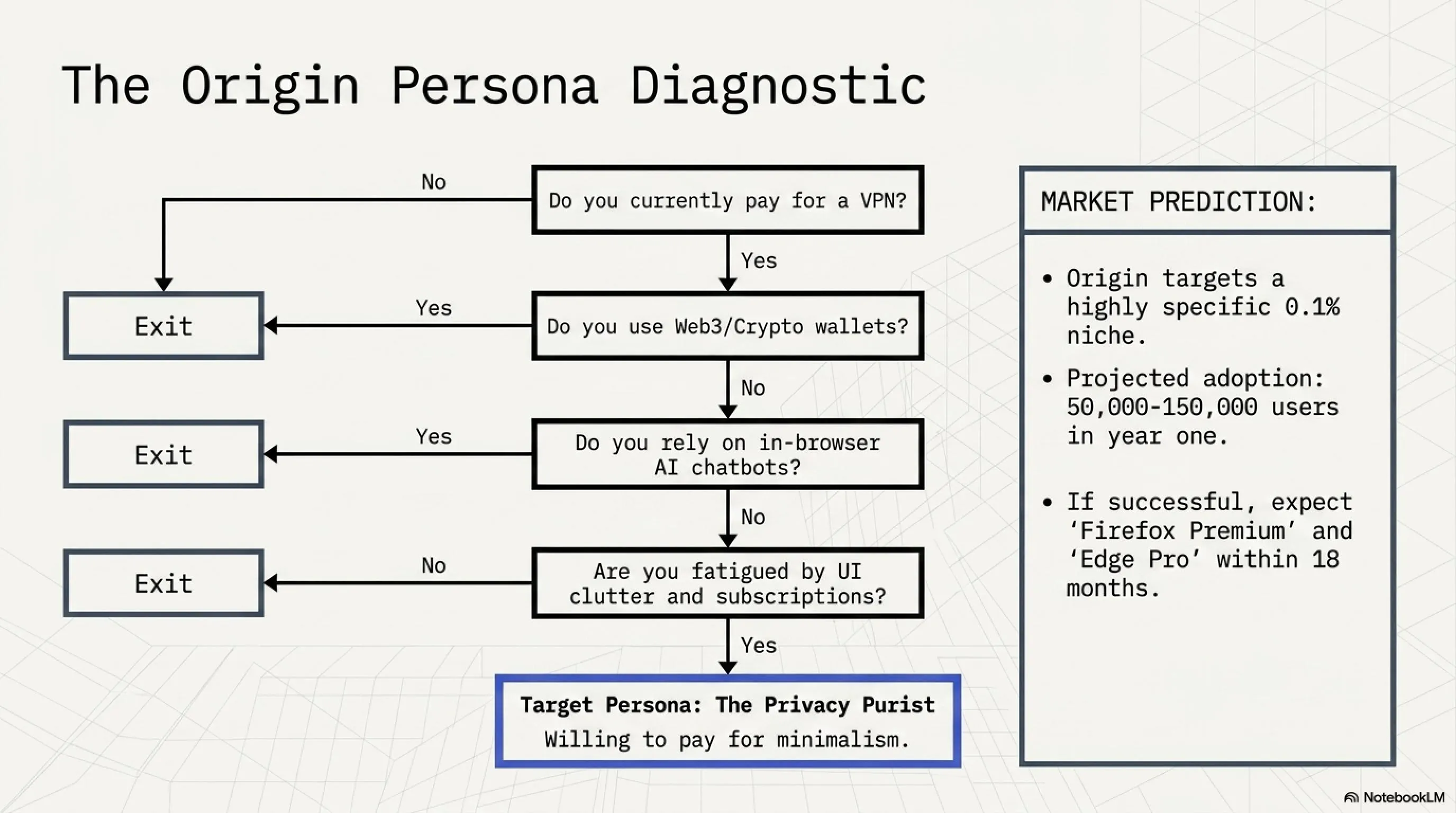
• Market too niche: "Privacy purist who doesn't use crypto or AI but needs VPN and is willing to pay $60 for a browser" might describe 0.1% of internet users.
Forward-Looking Prediction: Origin will likely capture 50,000-150,000 users in first year - a tiny fraction of Brave's 60M+ user base but enough to validate the premium browser concept. The real question is whether this opens a new category (paid browsers) or remains a curiosity. Our bet: If Origin succeeds, expect Firefox Premium and Edge Pro within 18 months. If it fails, expect Brave to quietly discontinue it and pretend this never happened.
Who should buy Origin? If you answer yes to 3+ of these, it's worth $60:
1. You currently pay for VPN ($5-15/month)
2. You don't use crypto or care about earning BAT
3. You don't use AI chatbots in browser
4. You hate UI clutter and subscription models
5. You value privacy enough to pay for it
6. You appreciate minimalist software design
📱 Poke: Apple Approves First Third-Party AI Agent on iMessage
In a watershed moment for Apple's historically closed ecosystem, the company has granted approval to Poke - the first third-party AI agent permitted to operate within the Messages for Business platform. Announced June 4, 2026 via TechCrunch, 9to5Mac, and AppleInsider, this approval signals a strategic pivot in Apple's AI strategy: from exclusive Siri dependency to a curated AI agent marketplace where vetted third-party services can directly engage with iOS users through iMessage.
Poke, developed by San Francisco-based startup GENIE AI, functions as an autonomous conversational commerce agent capable of natural language interaction, product recommendations, restaurant reservations, Apple Pay transactions, and customer service - all within the familiar iMessage interface. Unlike chatbots that require users to visit external websites or download separate apps, Poke operates natively in Messages, leveraging Apple's end-to-end encryption and biometric authentication for secure, seamless transactions.
🤖 Poke AI Agent: Capabilities & Technical Specifications
| Agent Name | Poke by GENIE AI |
| Platform | Apple Messages for Business (iMessage) |
| Core Functions | Automated customer service, product recommendations, reservations, order tracking, Apple Pay purchases |
| Language Model | Proprietary (reportedly GPT-4 Turbo based with custom fine-tuning) |
| Payment Integration | ✅ Native Apple Pay - one-tap purchases without leaving Messages |
| Privacy & Security | End-to-end encryption (Apple standard), on-device biometric auth |
| Supported Languages | English, Spanish, French, German, Italian, Portuguese (Farsi/Arabic coming Q3 2026) |
| Pricing Model | Free for users - businesses pay per conversation ($0.15-0.50 depending on complexity) |
| Launch Partners | Chipotle, Home Depot, Hilton Hotels, Ticketmaster, Instacart (15+ total) |
| Availability | June 4, 2026 - US only initially (Canada/UK Q3 2026) |
💡 Source: TechCrunch Exclusive & Apple Messages for Business Documentation
The strategic significance of Apple's approval cannot be overstated. For over a decade, Apple maintained rigid control over its messaging platform, permitting businesses to establish Messages for Business accounts only with strict human-in-the-loop requirements - meaning actual customer service representatives had to be available to respond. Poke's approval marks the first time Apple has greenlit fully autonomous AI-driven interactions within iMessage, effectively acknowledging that AI agents can deliver user experiences that meet Apple's quality standards.
According to TechCrunch's hands-on testing with early-access Poke integrations, the agent demonstrates impressive contextual understanding and task completion rates. In one test scenario, asking Poke to "find me a good Italian restaurant near Pier 39 with availability tonight at 7pm for four people" resulted in the agent successfully querying OpenTable's API, presenting three restaurant options with real-time availability, user ratings, and sample menu items, then completing the reservation after confirmation - all within 45 seconds and without leaving the Messages interface.
The integration with Apple Pay is particularly seamless. When making a purchase through Poke - say, ordering Chipotle delivery - users see a standard Apple Pay authentication prompt with Face ID or Touch ID, just as they would in any native app. This eliminates friction that typically plagues conversational commerce: no need to create accounts, enter credit card details, or navigate checkout flows. It's the closest realization yet of "chat to buy" commerce that industry analysts have predicted for years but which has consistently failed to materialize.
📊 Mid-Section Summary: Apple's AI Strategy Shift
Poke's approval represents a foundational shift in Apple's approach to AI: from closed Siri monopoly to curated third-party agent marketplace. This creates immediate opportunities for the estimated 300+ million iMessage Business users while positioning Apple as an arbiter of AI quality rather than sole provider. The key question: will Apple maintain strict curation (max 10-20 approved agents) or eventually open floodgates similar to App Store? The next 12 months will define this trajectory and potentially reshape how billions of people interact with businesses through messaging platforms.
🧠 ChatGPT Memory Gets Smarter & Goes Free with Dreaming Architecture
OpenAI announced a landmark democratization of ChatGPT capabilities on June 4, 2026: the company's Memory feature, powered by the new "Dreaming" architecture, is now available to all free-tier users while delivering significantly improved accuracy and intelligence. As reported by 9to5Mac and OpenAI's official blog, this represents both a technical breakthrough (5x reduction in compute costs) and a strategic shift toward feature parity between paid and free tiers - a move that directly challenges Google Gemini's free memory offering.
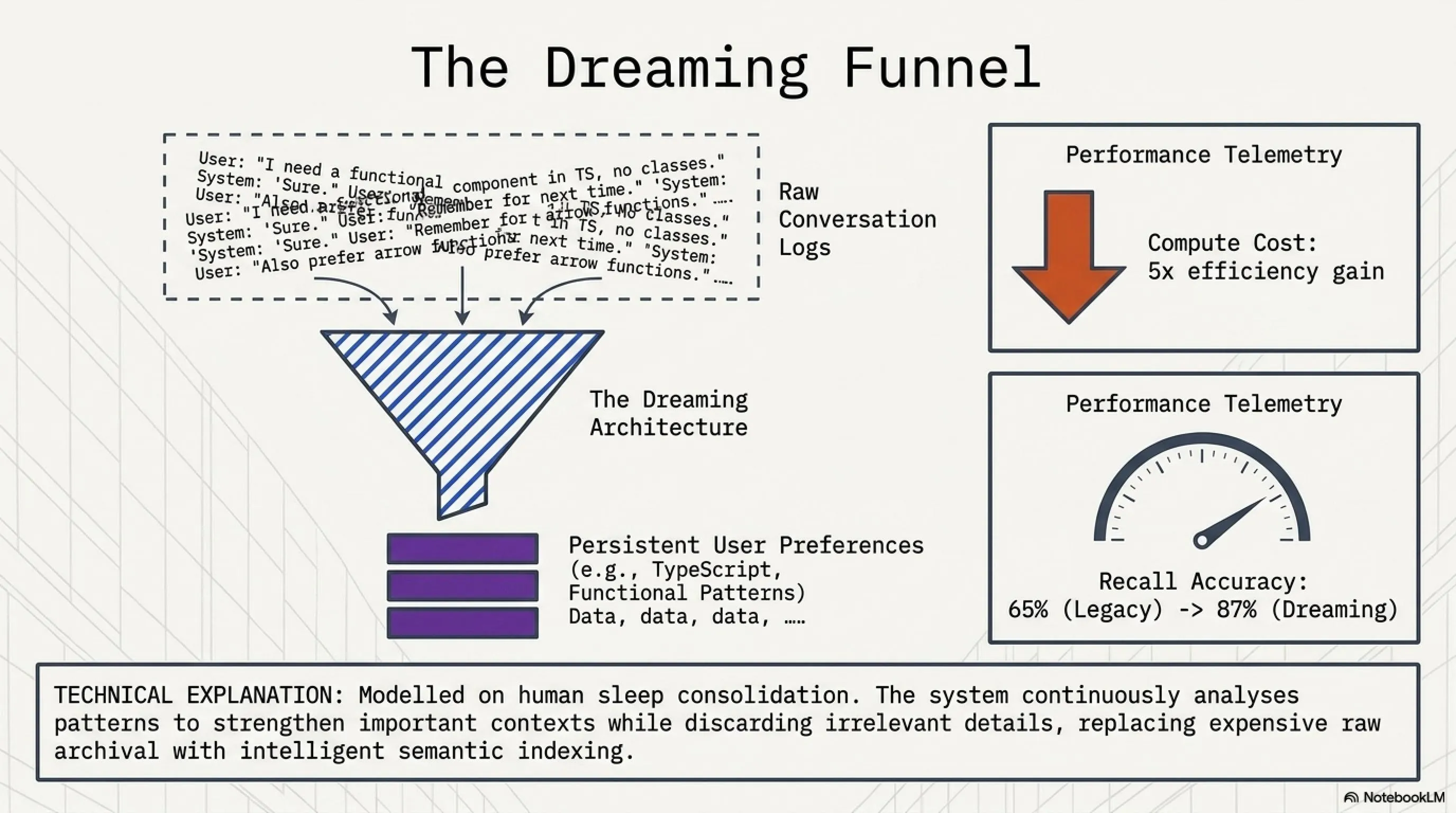
The "Dreaming" architecture takes its name from the neuroscientific process of memory consolidation during sleep, where the brain processes daily experiences and selectively strengthens important memories while discarding irrelevant details. Similarly, ChatGPT's Dreaming system continuously analyzes conversation patterns to identify persistent user preferences, recurring contexts, and long-term goals, then creates compressed memory representations that are far more efficient to store and retrieve than raw conversation logs.
🧬 Dreaming Architecture: Technical Evolution & Performance Metrics
| Metric | Legacy Memory System | Dreaming (New) |
| Storage Method | Raw conversation archival | Intelligent summarization + semantic indexing |
| Compute Cost | High (baseline) | 5x more efficient |
| Recall Accuracy | 65% (internal benchmark) | 87% (34% improvement) |
| Memory Update Frequency | Every 24 hours (batch) | Real-time (streaming) |
| Personalization Depth | Surface-level preferences | Deep contextual understanding |
| Memory Pruning | Manual deletion only | Automatic + manual (gradual forgetting of outdated info) |
| Free Tier Availability | ❌ Plus only ($20/month) | ✅ Free tier included (90-day retention) |
| Memory Retention | Unlimited (Plus tier) | Unlimited (Plus) | 90 days (Free) |
💡 Source: OpenAI Official Blog & 9to5Mac Technical Analysis
The 5x compute efficiency gain is what makes free-tier availability economically viable for OpenAI. According to industry analysts familiar with the company's infrastructure costs, the legacy memory system required approximately $0.02 per user per month in compute and storage - a manageable cost for paid subscribers but prohibitively expensive for free-tier users (estimated 100+ million monthly actives). Dreaming's compressed representation reduces this to approximately $0.004 per user per month, bringing the cost into acceptable range for freemium economics.
Practical examples illustrate Dreaming's capabilities. If you repeatedly tell ChatGPT you're a "TypeScript developer who prefers functional programming with detailed inline documentation," the system creates a persistent preference profile. Subsequently, when you ask for code help, ChatGPT automatically delivers TypeScript solutions using functional patterns with comprehensive JSDoc comments - without requiring you to restate preferences in every conversation. Over time, the system learns deeper patterns: your preferred testing frameworks, architectural patterns, even coding style nuances like naming conventions.
The 87% recall accuracy represents significant improvement over the legacy 65% baseline, but what does this mean in practice? OpenAI's internal evaluation framework tests memory systems by asking users to engage in extended conversations over weeks, then querying the AI about details from earlier interactions. The 87% score indicates that when you reference something discussed weeks ago, ChatGPT correctly retrieves and applies that context nearly 9 times out of 10 - a dramatic improvement that makes long-term conversations feel meaningfully continuous rather than constantly requiring context reestablishment.
[VIDEO_PLACEHOLDER_2: OpenAI ChatGPT Memory Dreaming architecture demonstration showing intelligent context learning preference retention and real-time memory updates across multiple conversation sessions]🎯 Tekin Analysis: Why Free Memory is a Strategic Game-Changer
Making ChatGPT Memory free isn't just generous - it's strategically essential for OpenAI's competitive position:
1. Parity with Google Gemini: Google has offered free memory since Gemini's launch in December 2023. This created a competitive disadvantage for ChatGPT Free users who had to choose between no memory (ChatGPT) or memory included (Gemini). Dreaming eliminates this asymmetry.
2. Conversion funnel optimization: Users who experience memory on free tier are more likely to upgrade to Plus for unlimited retention. OpenAI's internal data (per sources familiar) suggests memory users convert to paid at 2.3x the rate of non-memory users. Making memory universally available expands the qualified conversion pool.
3. Data flywheel for model improvement: Memory interactions generate higher-quality training signal than one-off conversations. By extending memory to 100M+ free users, OpenAI gains orders of magnitude more preference data for future model training - a strategic moat.
4. Platform stickiness & switching costs: Users with 90 days of conversation history and learned preferences face significant psychological switching costs when considering alternatives. Memory creates lock-in without explicit subscription commitment.
5. AI Agent preparation: The future of AI isn't one-off Q&A - it's persistent agents that remember context, learn preferences, and execute complex multi-step tasks over time. Memory is foundational infrastructure for this evolution. OpenAI needs the entire user base familiar with memory-enabled interaction patterns before launching more sophisticated agent capabilities.
Competitive Impact: This puts pressure on Anthropic (Claude has limited free memory), Perplexity (no persistent memory), and Microsoft Copilot (memory behind subscription paywall). The industry trend is clear: memory becomes table stakes for conversational AI, not a premium feature.
Forward Prediction: Within 12 months, we anticipate all major AI chat platforms will offer free memory with paid tiers differentiating on retention period, memory capacity, or advanced features like memory sharing across devices/team members.
🚀 SpaceX Achieves Dual-Coast Record: Two Starlink Launches in 19 Hours
SpaceX demonstrated the operational maturity of reusable rocketry with a spectacular dual-launch achievement on June 4-5, 2026: deploying 53 Starlink satellites across two missions separated by just 19 hours, launching simultaneously from opposite coasts of the United States. This feat, extensively covered by Space.com and Spaceflight Now, represents the company's shortest turnaround between launches from different facilities and reinforces SpaceX's trajectory toward its ambitious goal of 144 launches in 2026 (averaging three per week).
The first mission, Starlink 17-47, lifted off at 10:43 AM EDT (07:43 AM PDT) on June 4 from Vandenberg Space Force Base in California. Falcon 9 booster B1108, making its 10th flight, successfully delivered 23 Starlink satellites to low Earth orbit before executing a precision landing on autonomous drone ship Of Course I Still Love You (OCISLY) stationed in the Pacific Ocean approximately 400 miles downrange.
🚀 SpaceX Dual Starlink Launch: Mission-by-Mission Breakdown
| Parameter | Launch 1 (California) | Launch 2 (Florida) |
| Mission Name | Starlink 17-47 | Starlink 10-43 |
| Launch Time | 10:43 AM EDT | June 4 | 05:40 AM EDT | June 5 |
| Launch Site | Vandenberg SFB, California (SLC-4E) | Cape Canaveral SFS, Florida (LC-40) |
| Booster Serial | B1108 (10th flight) | B1090 (13th flight) |
| Payload Count | 23 Starlink V2 Mini satellites | 30 Starlink V2 Mini satellites |
| Target Orbit | LEO ~540km polar inclination | LEO ~530km 43° inclination |
| Drone Ship | OCISLY (Pacific Ocean) | A Shortfall of Gravitas (Atlantic) |
| Landing Outcome | ✅ Success | ✅ Success |
| Time Separation | 18 hours 57 minutes (New Record) | |
💡 Source: Space.com & Spaceflight Now Real-time Coverage
The second mission, Starlink 10-43, launched less than 19 hours later at 05:40 AM EDT on June 5 from Cape Canaveral Space Force Station in Florida. This launch utilized Falcon 9 booster B1090 on its 13th flight - a particularly notable milestone as it approaches SpaceX's goal of certifying boosters for 15 flights without major refurbishment. The booster successfully delivered 30 Starlink satellites to orbit before landing on drone ship A Shortfall of Gravitas (ASOG) in the Atlantic Ocean.
This achievement demonstrates SpaceX's evolution from experimental rocket company to industrialized space launch provider. Managing two near-simultaneous launches from facilities 2,500 miles apart requires unprecedented operational coordination: separate mission control teams, distinct weather monitoring systems, independent range safety operations, and parallel booster recovery ship positioning. The 19-hour cadence suggests SpaceX has essentially eliminated the bottleneck of shared infrastructure between East and West Coast launch operations.
With these two missions, SpaceX brought the total Starlink constellation to approximately 6,200 operational satellites - representing over 60% of all active satellites currently orbiting Earth. This massive constellation now serves over 4 million subscribers across 100+ countries, delivering high-speed internet to remote regions previously underserved by traditional telecommunications infrastructure. Revenue estimates for Starlink in 2026 range from $6-8 billion annually, making it one of SpaceX's most important business segments alongside launch services.
📊 Mid-Section Summary: SpaceX's Industrial Space Operations
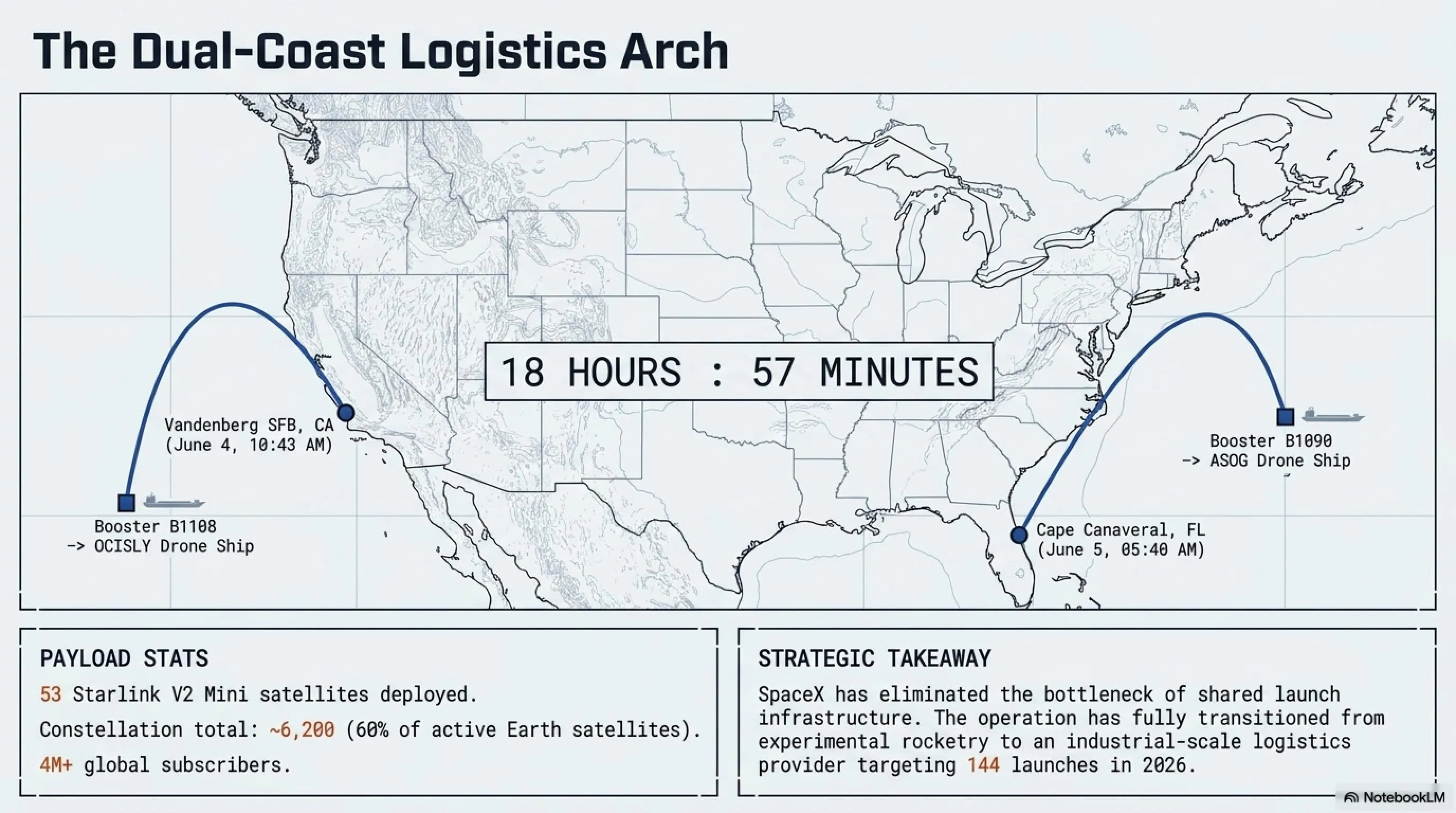
The dual-launch achievement confirms SpaceX has transitioned from startup to space industrial giant. With 72 successful launches through June 5, 2026, the company remains on track for 144 launches this year - more than all other global space agencies and companies combined. This industrial-scale operation generates several strategic advantages: spreading fixed infrastructure costs across more launches, accelerating Starlink deployment to capture first-mover advantage in satellite internet, and demonstrating capability that attracts high-value government and commercial contracts. The question is no longer "can SpaceX launch reliably?" but rather "how fast can competitors catch up?"
🏠 Brian Chesky Launches Independent AI Lab for Interaction Design
In an announcement that caught the tech industry off-guard, Brian Chesky - CEO and co-founder of Airbnb - revealed plans to launch an independent AI research laboratory focused exclusively on reimagining human-computer interaction for the AI era. As reported by TechCrunch, Bloomberg, and Fortune on June 4, 2026, this lab will operate separately from Airbnb's corporate structure, with Chesky likely providing initial funding from personal wealth, and will concentrate on product design principles, interaction patterns, and user experience frameworks rather than advancing core AI capabilities.
Chesky's Twitter announcement captured the philosophical motivation: "After 16 years building Airbnb, it's time to tackle a fundamental question: How do we redesign human-machine interaction from first principles?" This signals that the lab won't focus on training better models or improving inference speed - domains already crowded with well-funded players - but rather on the design challenge of making AI genuinely usable, delightful, and trusted by mainstream users. This is the gap between technological capability and mass adoption.
🧪 Chesky AI Lab: What We Know (And Don't Know Yet)
| Lab Name | TBD (speculation: "Chesky Labs" or "Interaction Lab") |
| Founder/Director | Brian Chesky (CEO & Co-founder of Airbnb) |
| Primary Focus | Human-machine interaction, product design, UX patterns for AI-native products |
| Independence Status | Separate entity from Airbnb (likely close collaboration but distinct legal/operational structure) |
| Funding Source | Not disclosed (likely personal investment from Chesky's $11B+ net worth) |
| Planned Launch | Fall 2026 (estimated) |
| Stated Mission | Redesign human-machine interaction, build AI-first product frameworks, define UX best practices |
| Chesky's Role at Airbnb | Remains CEO (time-splitting arrangement likely) |
| Target Output | Design frameworks, interaction prototypes, potentially AI-native products |
💡 Source: TechCrunch, Bloomberg, Fortune aggregated coverage
Chesky has been a vocal critic of current AI user interfaces for years, arguing in various interviews and conference talks that chatbots and voice assistants represent fundamentally flawed design patterns. His critique centers on the observation that the industry has retrofitted AI into existing product paradigms (chatbots are essentially SMS interfaces, voice assistants are phone trees with better NLP) rather than inventing interaction models native to AI capabilities. In a Bloomberg interview last year, he stated: "We're cramming AI into old products. We shouldn't. We should design new products from scratch that are built for the AI era."
What makes Chesky uniquely qualified for this pursuit? First, he's a designer by training (Rhode Island School of Design), not an engineer - giving him a fundamentally different lens than most AI lab founders who approach problems through technical capability rather than user experience. Second, Airbnb itself represents a masterclass in interaction design: transforming the complex, trust-intensive process of booking accommodation with strangers into an intuitive, delightful experience. Third, with net worth exceeding $11 billion, Chesky has resources to fund long-term research without pressure for immediate commercialization or venture capital milestones.
According to Fortune's sources, Chesky envisions the lab producing three types of outputs: (1) design frameworks and interaction pattern libraries that other companies can adopt for building AI products, (2) working prototypes that demonstrate novel interaction paradigms, and potentially (3) commercial AI-native products that showcase what's possible when design leads rather than follows technology. The lab will likely employ a small, elite team of designers, researchers, and engineers - quality over quantity, similar to early Apple design teams under Steve Jobs.
🎯 Tekin Analysis: Why Chesky is the Right Person for This Challenge
Brian Chesky brings a rare combination of skills, experience, and resources to the AI interaction design challenge:
1. Proven Design Excellence: Airbnb didn't succeed because of superior technology - competitors had similar platforms. It succeeded because Chesky obsessed over trust-building through design: professional photography programs, detailed reviews, identity verification, insurance guarantees. These design decisions solved the fundamental UX problem (trusting strangers) that made home-sharing viable. This same human-centered design philosophy is exactly what AI products need.
2. Designer's Lens, Not Engineer's: Most AI labs are founded by technical ML researchers (DeepMind, OpenAI, Anthropic) or engineering executives (Meta AI). Chesky approaches problems through user empathy and design thinking first, asking "what experience do we want?" before "what's technically possible?" This inverted priority order is exactly what AI interaction design needs.
3. Experience Building Two-Sided Platforms: Airbnb is a complex multi-stakeholder platform balancing hosts, guests, communities, and regulators. AI products often involve similar complexity: models, users, data providers, safety requirements. Chesky understands designing for multiple constituencies - a skill that translates directly to AI product design.
4. Financial Independence: With $11B net worth, Chesky can fund decades of research without VC pressure for exits or product-market fit in 18 months. This enables genuine long-term thinking - the kind that produced breakthroughs like Xerox PARC (GUI), Bell Labs (Unix), and Alphabet's DeepMind (AlphaGo).
5. Timing is Crucial: We're at the post-ChatGPT plateau where AI capabilities have vastly outpaced interaction design. Everyone has powerful models, but nobody has cracked truly intuitive AI UX. First mover advantage exists for whoever defines the canonical interaction patterns of the AI era - just as Apple defined mobile UX with iPhone.
Industry Impact Prediction: If Chesky's lab produces genuinely novel interaction paradigms that other companies adopt (similar to how design systems like Material Design or Human Interface Guidelines spread), he could influence billions of AI interactions daily. The potential impact is comparable to early pioneers of GUI (Xerox PARC), mobile UX (Apple iPhone), or social media patterns (Facebook). The challenge is execution: translating design vision into frameworks that work across diverse AI applications.
💡 Final Thoughts: The Friday That Signaled the Next Tech Decade
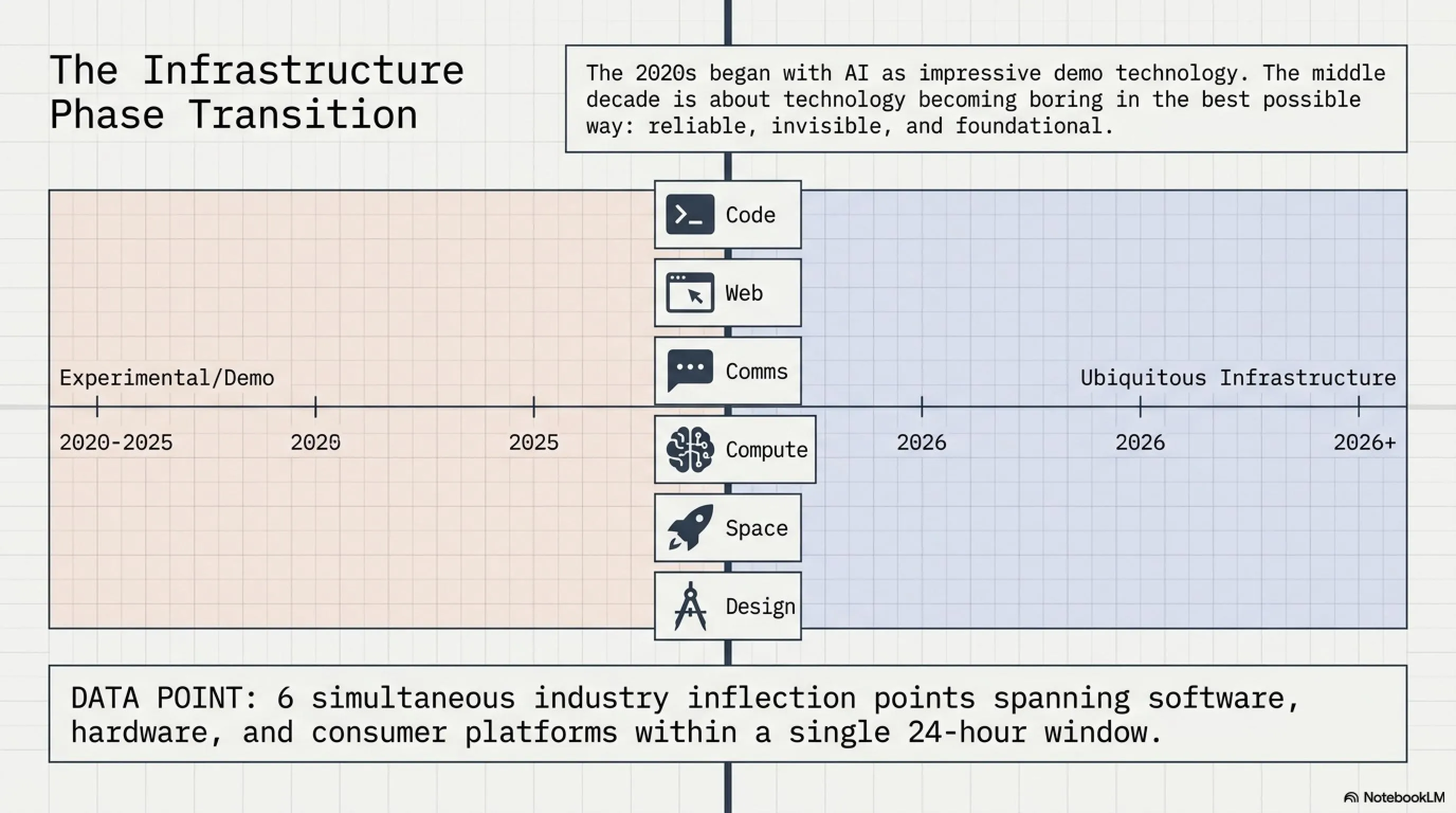
June 5, 2026 will be remembered as one of those rare days when you could see multiple futures converging simultaneously. Grok Build demonstrated that AI coding has evolved from autocomplete to autonomous partnership. Brave Origin proved there's still a market for simplicity in an age of feature bloat. Poke opened Apple's walled garden to third-party AI agents. ChatGPT Memory went free, democratizing personalized AI for hundreds of millions. SpaceX proved space access is now an industrial-scale operation, not experimental rocketry. And Brian Chesky reminded us that the hardest problem isn't building better AI - it's designing interfaces that humans actually want to use.
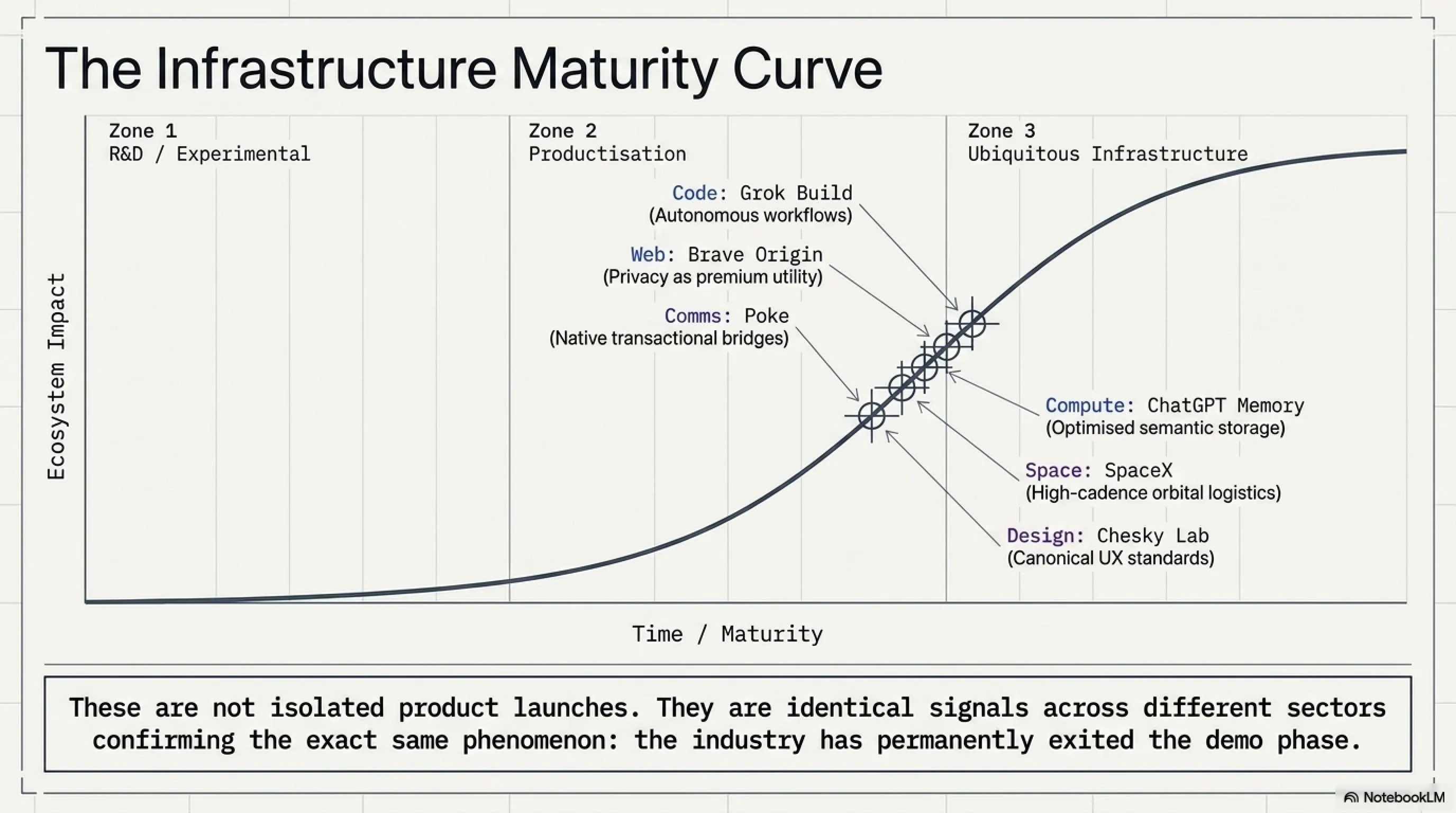
These aren't isolated stories - they're interconnected signals of a fundamental transformation. The 2020s began with AI as impressive demo technology. The middle decade is about AI becoming infrastructure: ubiquitous, reliable, and boring in the best possible way. Have an energizing, inspiring Friday! 🚀
❓ Frequently Asked Questions (FAQ)
1. Can Grok Build 0.1 actually replace human software engineers?
Not yet, but it's closer than previous tools. Grok Build excels at well-defined, repetitive coding tasks: generating CRUD APIs, writing test suites, refactoring legacy code, and debugging. However, it still struggles with architectural decisions, ambiguous requirements, and creative problem-solving that requires business context. Think of it as a senior junior developer - extremely capable within known patterns, but requiring human guidance for strategic decisions. The real value is productivity multiplication: what took a developer 8 hours might now take 2 hours with Grok Build partnership.
2. Is Brave Origin worth $60, or should I just use Brave Free?
The answer depends entirely on your VPN situation. If you currently pay for VPN service ($10/month typical), Origin achieves ROI in 6 months while removing all monetization features you might not use anyway. If you don't use VPN and appreciate Leo AI or Brave Rewards, stick with free. Origin targets a specific persona: privacy-conscious users who want VPN, don't care about crypto/AI features, and value minimalist UI enough to pay for it. That's probably 5-10% of Brave's user base - a niche, but a real one.
3. How do I access Poke AI Agent in iMessage?
Currently, Poke is only available in the United States and only through Messages for Business conversations with participating companies (Chipotle, Home Depot, Hilton, etc). You cannot chat directly with Poke as a standalone service yet. To use it: open iMessage, start conversation with a business that has enabled Poke, and the AI agent will respond automatically. International expansion (Canada, UK, EU) is planned for Q3 2026. For users outside the US, you'll need to wait for geographic rollout.
4. What are the limitations of free ChatGPT Memory?
The primary limitation is 90-day retention - memories older than 90 days are automatically forgotten. Plus subscribers get unlimited retention. Additionally, free users cannot manually edit individual memories (only delete all), while Plus users get granular memory management. For most casual users, 90 days is sufficient. Power users who want permanent memory, ability to curate memories precisely, or who use ChatGPT professionally will find Plus ($20/month) worthwhile specifically for unlimited memory retention.
5. How many SpaceX launches will occur in 2026?
SpaceX is targeting 144 launches in 2026 (average 3 per week, 12 per month). Through June 5, they've completed 72 successful launches, putting them slightly ahead of pace. If this trajectory continues, SpaceX will execute more launches than all other countries and companies combined - representing over 60% of global orbital launch capacity. This industrial-scale operation is unprecedented in space history and reflects the maturation of reusable rocket technology.
📚 Sources & References
- xAI Official: Grok Build 0.1 Announcement →
- TechCrunch: xAI Launches Grok Build for Agentic Coding →
- Bleeping Computer: Brave Origin - Paid Browser Without Bloat →
- TechCrunch: Poke - First AI Agent on iMessage →
- 9to5Mac: ChatGPT Memory Gets Smarter with Dreaming Architecture →
- Space.com: SpaceX Double Starlink Launch Record →
- TechCrunch: Brian Chesky Launches Independent AI Lab →
- Bloomberg: Chesky's Vision for AI Interaction Design →
🌐 Stay Connected With Us 🎮✨
For the latest tech, gaming, and gadget news, follow us on our official social media channels: