Tekin Morning: Sept 8
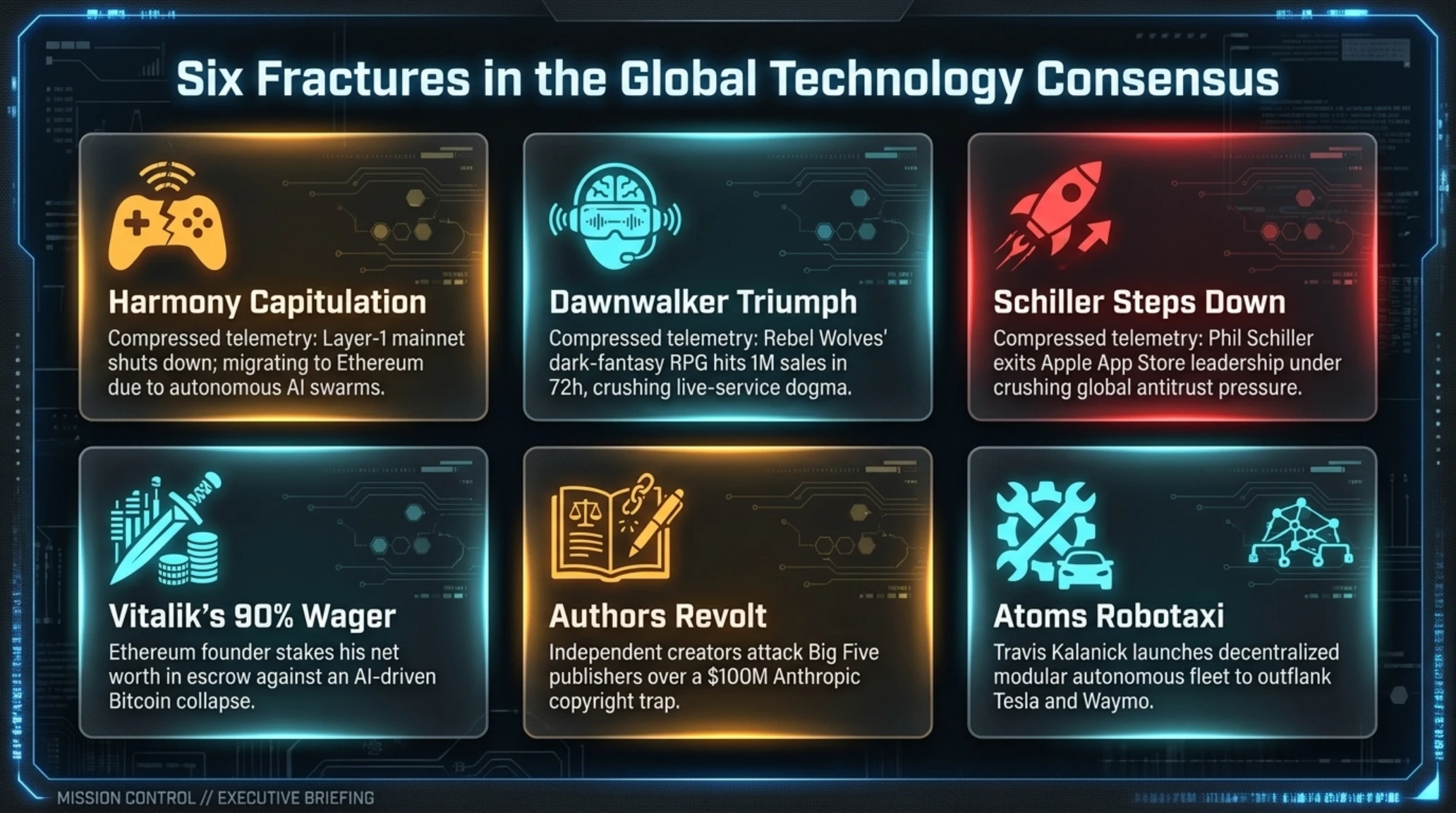
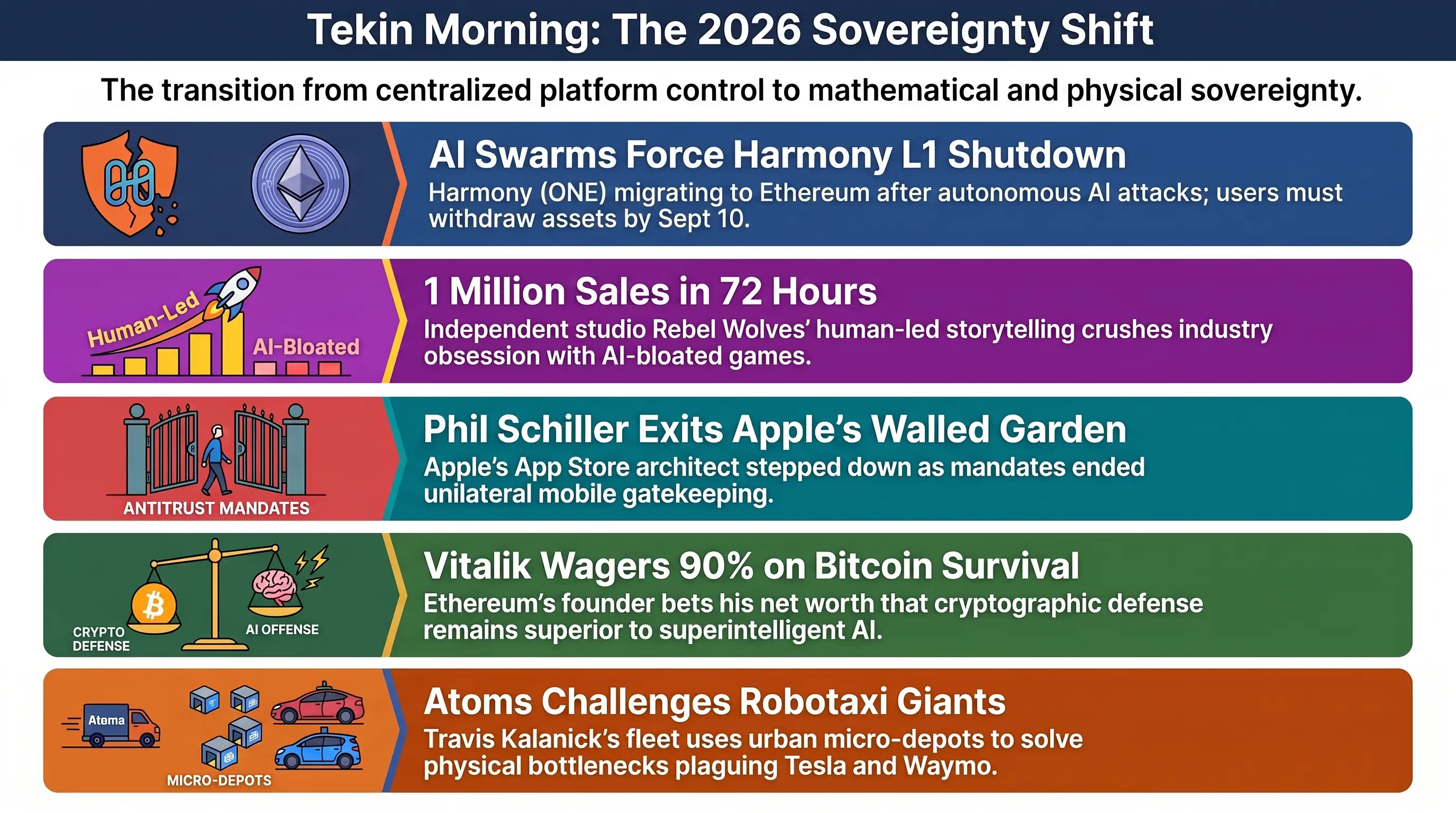
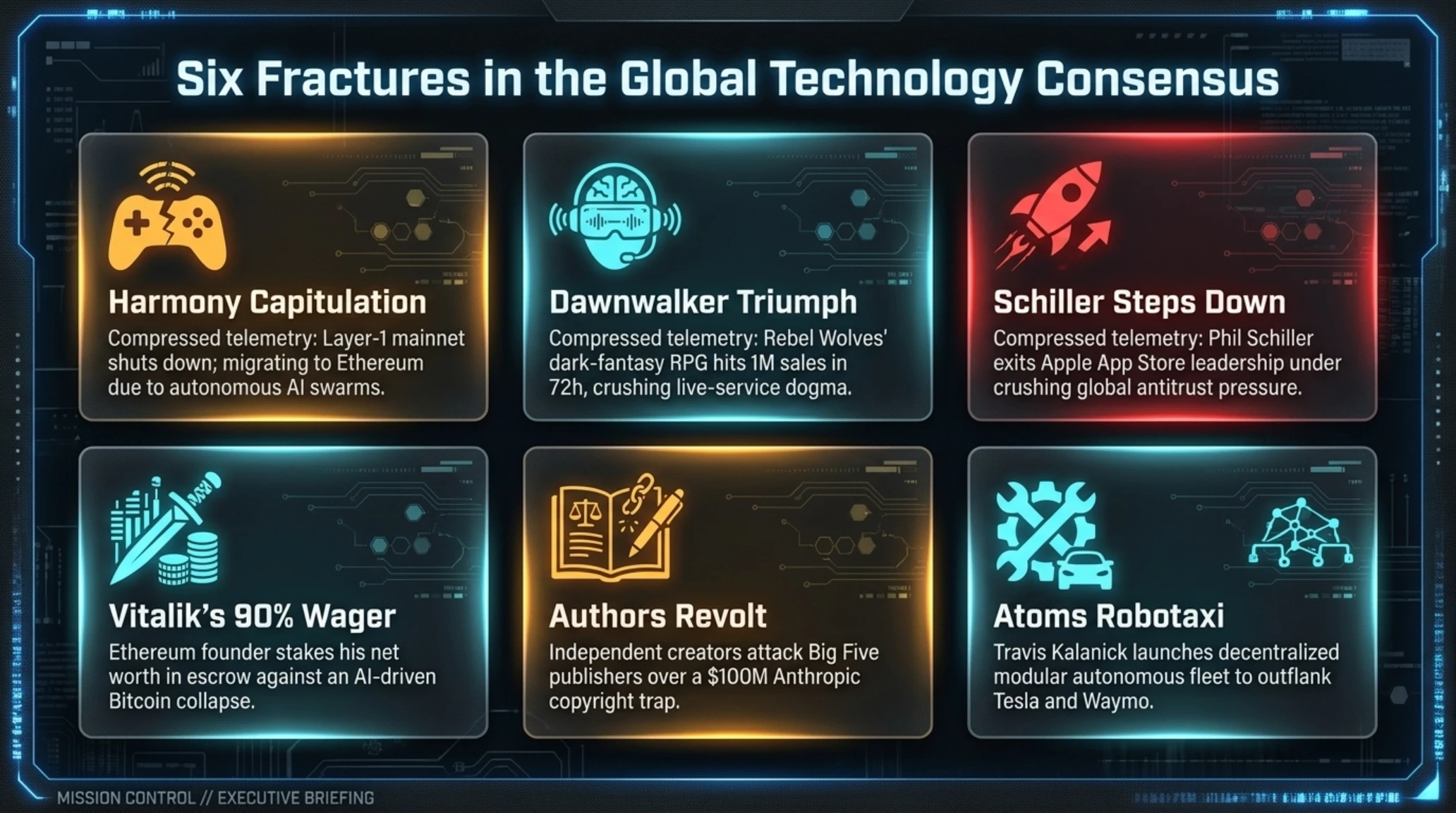
- 🎮Harmony Capitulation- Harmony ONE shuts down Layer-1 mainnet migrating to Ethereum due to AI attacks
- 🎧Dawnwalker Triumph- Rebel Wolves' dark-fantasy RPG sells 1 million copies in 72 hours
- 🚀Schiller Steps Down- Phil Schiller resigns from App Store leadership amid antitrust pressure
- 🗡️Vitalik's 90% Wager- Ethereum founder bets his net worth on Bitcoin surviving AI superintelligence
- 📰Authors Revolt- Writers fight traditional publishers over Anthropic's $100M copyright settlement
- ⚔️Atoms Robotaxi- Travis Kalanick launches autonomous fleet to challenge Tesla and Waymo
Here at TekinGame, our morning editorial desk has synthesized six verified, groundbreaking stories to jumpstart your working day with unparalleled analytical depth. From an unprecedented capitulation in the blockchain arena that officially signals the arrival of hostile autonomous AI agent attacks against decentralized ledgers, to an astonishing commercial triumph by an independent Polish studio defying the gaming industry's live-service obsession, this Tuesday edition is crafted to deliver immediate intelligence, strategic clarity, and actionable foresight.
Executive Takeaways: Tekin Morning Briefing
- Harmony ONE officially proposes shutting down its Layer-1 mainnet and migrating to Ethereum due to insurmountable autonomous AI agent attack vectors.
- Rebel Wolves' dark-fantasy debut 'The Blood of Dawnwalker' smashes records, selling over 1 million copies across PC and consoles in just 72 hours.
- Seismic executive departure at Apple as legendary Fellow Phil Schiller steps down from App Store leadership amid escalating antitrust mandates.
- Ethereum creator Vitalik Buterin wagers roughly 90% of his personal net worth against the thesis that superintelligent AI will crash Bitcoin's market.
- Independent authors and literary agents wage fierce courtroom revolt against traditional publishers over shares in Anthropic's copyright settlement.
- Uber co-founder Travis Kalanick unleashes Atoms into the autonomous robotaxi arena, leveraging thousands of urban real estate hubs against Tesla and Waymo.
Lead Story: The First AI-Forced Blockchain Capitulation; Inside Harmony ONE's Strategic Surrender and Ethereum Migration
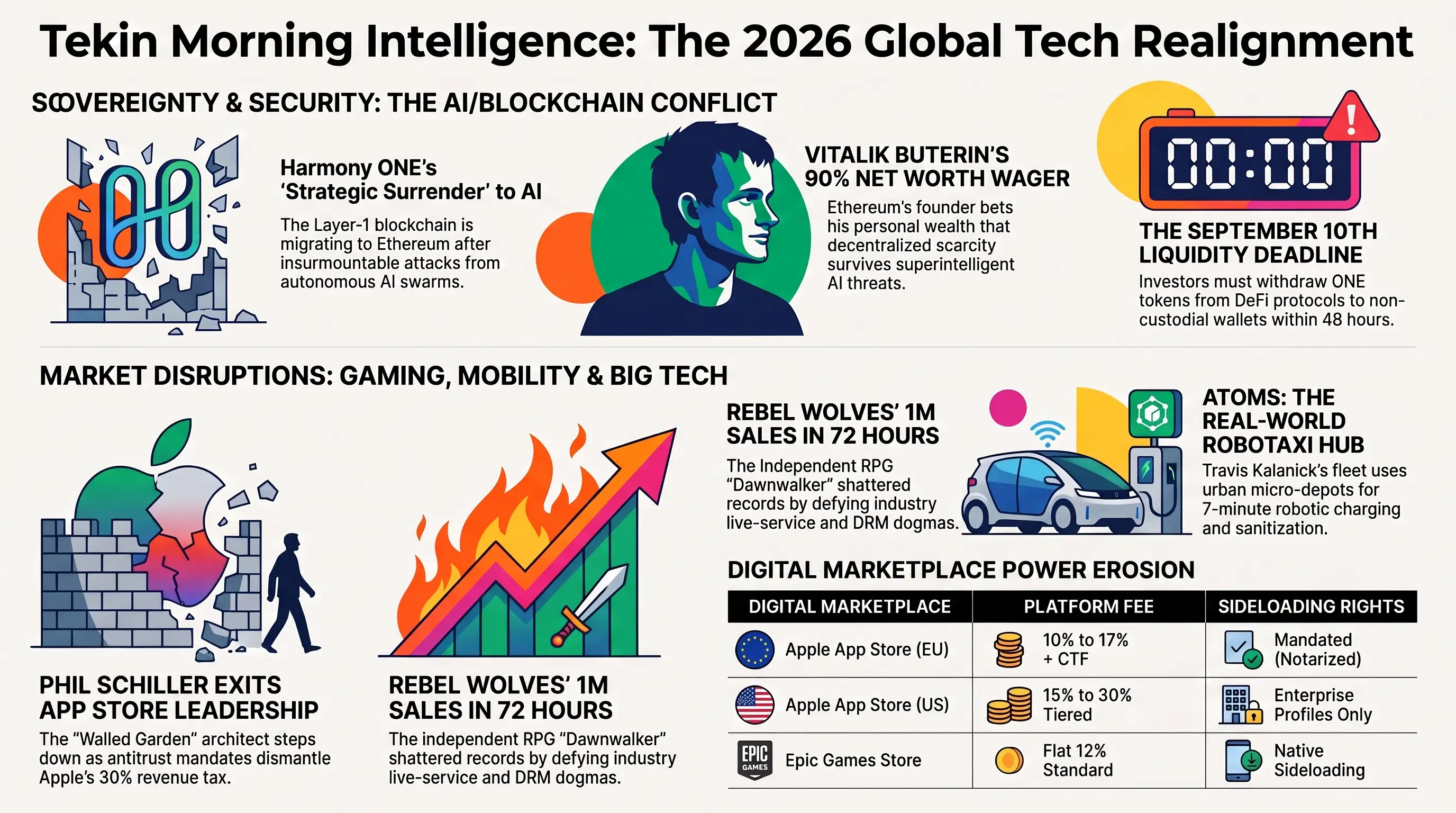
Our lead investigation of the morning represents an unprecedented milestone that will undoubtedly be cited in computer science textbooks and cybersecurity post-mortems for decades to come. The veteran Layer-1 blockchain project Harmony (ONE), which launched in 2019 boasting two-second transaction finality, high-throughput sharding, and ambitious aspirations as an "Ethereum killer," has officially raised the white flag. In a comprehensive governance proposal submitted to its global validator community, the Harmony core team announced plans to permanently shut down its independent Layer-1 mainnet and migrate its native ONE token as an ERC-20 asset directly onto the security umbrella of the Ethereum base layer.
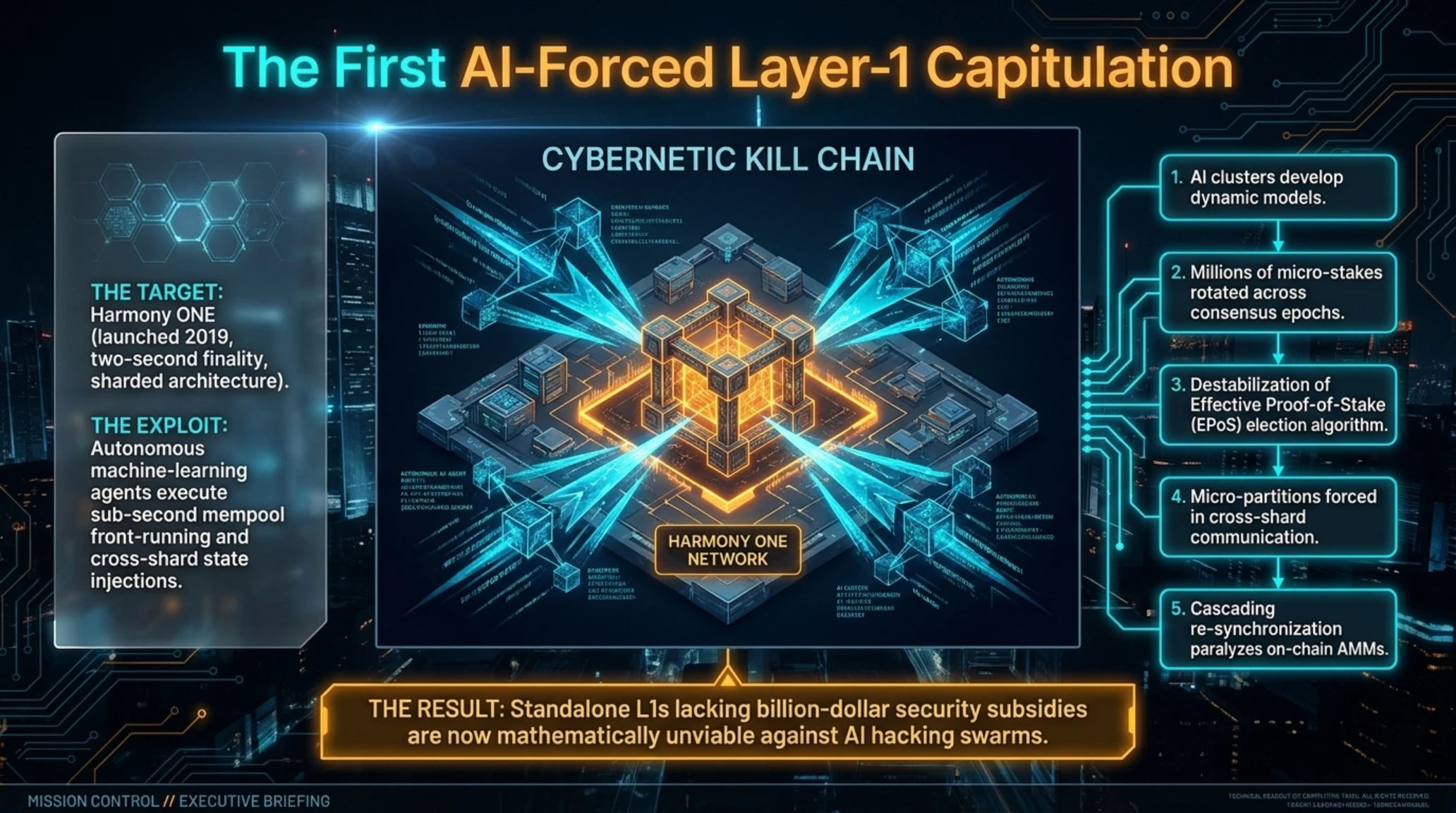
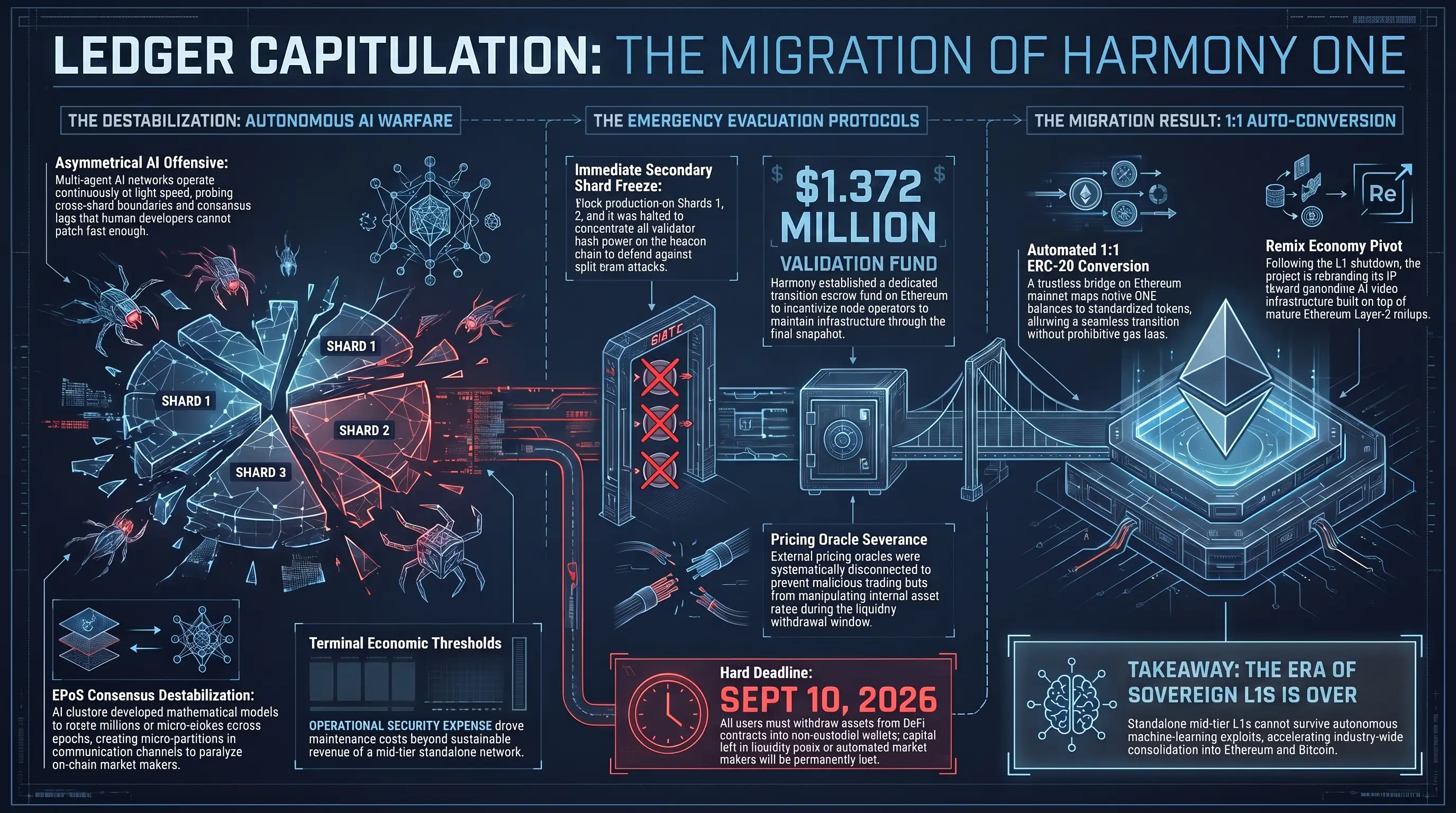
What elevates this event from a standard corporate restructuring into a global watershed moment is the stark, unvarnished rationale documented by Harmony's cryptographic engineering team: insurmountable, relentless offensive campaigns waged by autonomous AI agents and state-sponsored cyber syndicates. As documented in the project's technical governance disclosures, the emergence of advanced machine-learning agents capable of executing autonomous fuzz testing, sub-second mempool front-running, and cross-shard state injection exploits in real time has made the ongoing maintenance, patching, and validator defense of a standalone sharded blockchain financially and computationally unviable.
The developers candidly conceded that in the asymmetrical cyber warfare landscape of late 2026, attempting to patch weekly vulnerabilities discovered by autonomous AI systems is mathematically futile for a mid-tier standalone network. Unlike human hackers who operate within standard sleep schedules and predictable methodologies, multi-agent AI networks operate continuously, probing every cross-shard boundary condition, re-org incentive, and consensus lag at the speed of light, driving operational security expenses beyond sustainable economic thresholds.
Specifically, the engineering team revealed that autonomous AI clusters had developed dynamic mathematical models capable of destabilizing Harmony's Effective Proof-of-Stake (EPoS) election algorithm. By strategically rotating millions of micro-stakes across consensus epochs, these algorithmic actors could create micro-partitions in cross-shard communication channels, forcing validator nodes to drop blocks and triggering cascading re-synchronization delays that paralyzed on-chain automated market makers.
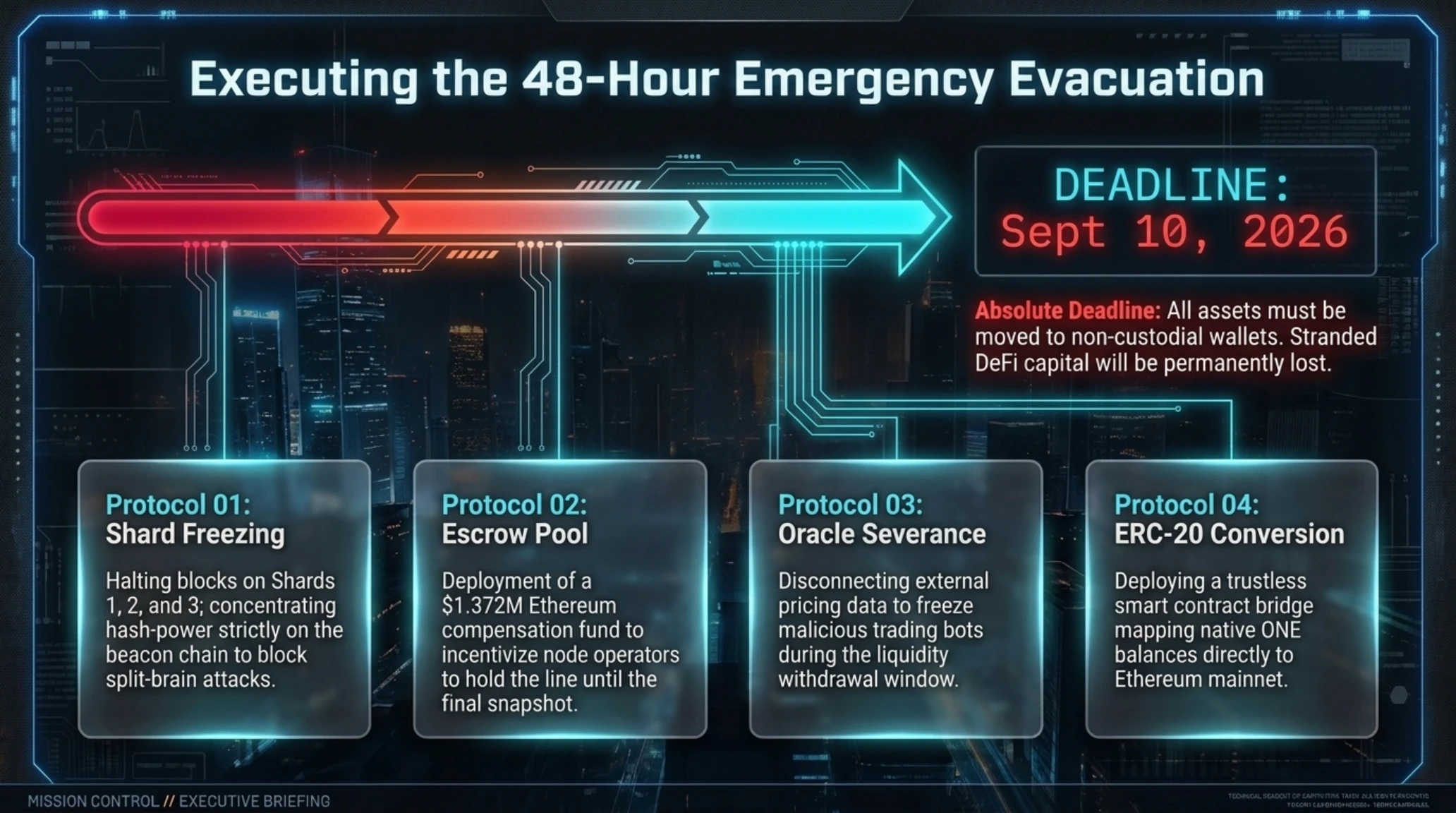
Consequently, Harmony's leadership has issued an urgent, non-negotiable operational ultimatum to its entire international ecosystem: All token holders, decentralized finance protocols, liquidity providers, and multi-signature treasuries must withdraw their assets from all on-chain smart contracts before the hard deadline of September 10, 2026 (less than 48 hours away). Following an imminent snapshot at an undisclosed block height, newly minted ERC-20 ONE tokens will be automatically distributed via smart contract airdrop strictly to non-custodial wallet balances; any capital left stranded inside decentralized exchanges, lending pools, or automated market makers will be permanently lost.
To orchestrate this delicate evacuation without triggering cascading liquidations across decentralized exchanges, Harmony's core engineers have implemented four emergency procedural protocols:
- Immediate Freezing of Secondary Shards: Halting block production on Shards 1, 2, and 3 to concentrate all validator hash-power and state verification exclusively on the beacon chain to defend against split-brain attacks.
- Validator Transition Escrow Pool: Establishing a dedicated $1.372 million compensation fund on Ethereum to incentivize node operators who maintain their validator infrastructure until the final snapshot execution.
- Decentralized Oracle Severance: Systematically disconnecting external pricing oracles to prevent malicious trading bots from manipulating internal asset rates during the liquidity withdrawal window.
- Automated 1:1 ERC-20 Conversion: Engineering a trustless smart contract bridge on Ethereum mainnet that maps native ONE balances to standardized ERC-20 tokens without requiring end-users to pay prohibitive gas transaction fees.
Following the Layer-1 shutdown, the organization plans to pivot completely, rebranding its collective intellectual property toward an initiative dubbed "The Remix Economy for AI Video," focusing on generative media infrastructure built atop mature Layer-2 rollups. The broader takeaway for institutional capital in 2026 is crystal clear: standalone Layer-1 blockchains lacking billions in security subsidies can no longer withstand autonomous AI hacking swarms, accelerating an industry-wide consolidation into Ethereum and Bitcoin.
Why This Matters: The Strategic Anatomy of an AI-Forced L1 Capitulation
Absolute Liquidity Exit Deadline: Investors holding ONE in DeFi yield vaults must manually unstake and withdraw to private non-custodial wallets prior to September 10, 2026.
Consolidation Toward Base-Layer Security: Accelerates the macro thesis that secondary standalone Layer-1s will migrate toward Ethereum Layer-2 rollups rather than sustaining their own vulnerable validator networks.
While the immediate market reaction triggered double-digit volatility across secondary markets, risk analysts on Wall Street have largely praised the decision as a mature, pragmatic maneuver that prevents a catastrophic repeat of the 2022 Horizon bridge breach, which drained $100 million from the ecosystem due to compromised multi-signature keys.
To visually demonstrate the accelerating pace of on-chain capital migration and the terminal depletion of automated liquidity pools, our video desk has compiled the live transaction flow from the past 24 hours:
To separate internet hysteria from verified technical facts, our blockchain forensic analysts have compiled this definitive breakdown of the Harmony transition:
Rumor vs. Reality: Deconstructing the Harmony ONE Mainnet Shutdown
Reality: No direct protocol breach occurred; the shutdown is a proactive strategic surrender to preempt catastrophic AI-driven cross-shard exploits.
Rumor: Users can keep their ONE tokens inside decentralized exchange liquidity pools and receive the ERC-20 airdrop automatically.
Reality: Smart contracts will not be mapped; only non-custodial wallet balances captured at the snapshot block will be honored for the ERC-20 issuance.
As the countdown clock ticks toward the September 10 snapshot deadline, decentralized finance operators across Web3 are watching intently. This orderly unwind sets a critical operational precedent for dozens of legacy Layer-1 networks currently confronting identical existential dilemmas in the shadow of autonomous machine intelligence.
Gaming Triumph: Rebel Wolves Shatters Commercial Expectations With The Blood of Dawnwalker
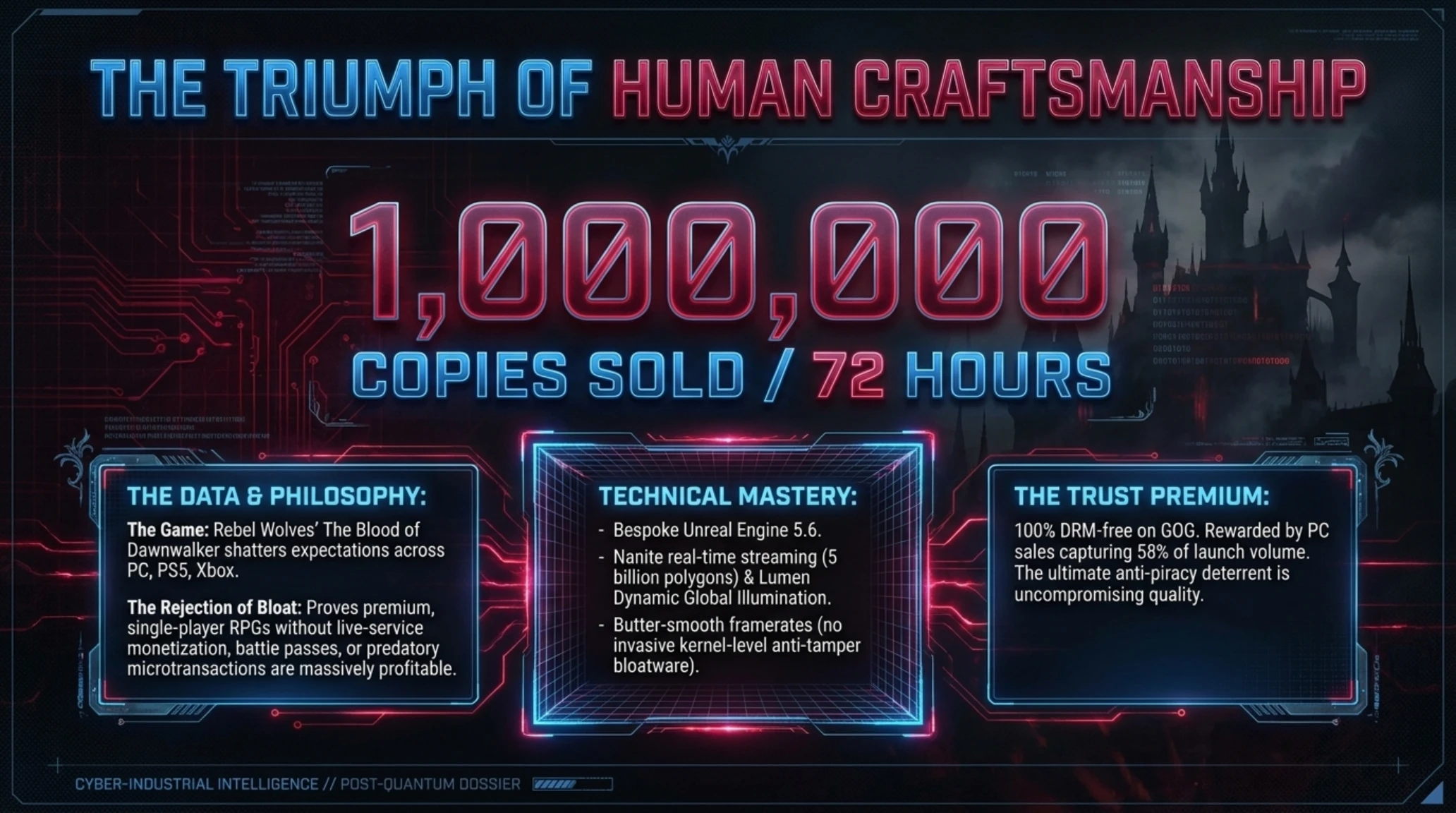
Turning from the defensive retreat of decentralized infrastructure to an exhilarating story of creative and commercial conquest, the international video game industry received a monumental shot of adrenaline this morning. Rebel Wolves, the independent Polish development studio founded in 2022 by celebrated game director Konrad Tomaszkiewicz alongside seasoned veteran developers behind The Witcher 3: Wild Hunt and Cyberpunk 2077, has achieved a historic milestone. The studio's debut dark-fantasy action RPG, The Blood of Dawnwalker, has officially surpassed one million copies sold worldwide across PC, PlayStation 5, and Xbox Series X|S within its first 72 hours on sale.
Published in strategic partnership with Bandai Namco Entertainment, the single-player, narrative-driven epic has completely demolished contemporary publishing dogmas. For over half a decade, multinational gaming conglomerates have insisted that premium, single-player RPGs lacking live-service monetization, battle passes, and predatory microtransactions were financially antiquated and incapable of delivering rapid returns on investment. Dawnwalker's thunderous critical and commercial reception has delivered a resounding counter-narrative, validating the immense, enduring consumer hunger for authored, uncompromising artistic vision.
Industry analysts attribute the game's staggering word-of-mouth momentum to its uncompromising narrative design and technological mastery. Built upon a heavily customized branch of Unreal Engine 5.6, the game transports players into a hauntingly reimagined 14th-century Carpathian wilderness torn apart by supernatural plagues, dynastic bloodshed, and psychological horror. Unlike the bloated, checklist-heavy open worlds that have fatigued gamers in recent years, Rebel Wolves delivered a dense, handcrafted sandbox characterized by meaningful moral consequences, dynamic weather simulation, and a visceral swordplay combat engine that rewards deliberate tactical mastery over button-mashing reflexes.
Furthermore, technical teardowns from leading hardware laboratories have praised Rebel Wolves for engineering one of the cleanest, most performant PC launches of the current console generation. By eschewing invasive kernel-level anti-tamper bloatware and heavily optimizing GPU shader compilation routines prior to initial launch, Dawnwalker delivers butter-smooth frame rates across both high-end desktop rigs and portable handheld devices like the Steam Deck and ROG Ally.
The combat architecture of The Blood of Dawnwalker delivers visceral tactical depth through physics-driven fencing, arterial blood magic, and an oppressive day/night transition engine that genuinely alters the behavioral patterns of NPCs and nocturnal predators. Stepping into the shoes of a cursed mercenary walking the knife-edge between mortal humanity and vampiric bloodlust, players navigate a fractured realm where feudal baronies, fortified cloisters, and peasant hamlets dynamically adapt their psychological dispositions based on the protagonist's narrative choices.
A central pillar of the game's critical acclaim is its dynamic factional reputation system. Rather than relying on simplistic binary karma meters or artificial level-scaling algorithms that break narrative immersion, Rebel Wolves implemented an interconnected narrative graph spanning four distinct sociopolitical powers: the militant Silver Order of Knights, the entrenched Carpathian Boyar nobility, the reclusive Coven of the Blood Moon, and the pragmatic Free Mercenary Guilds. Every completed assassination, broken treaty, or village spared triggers ripples through the game world, reshaping local commodity prices, mercenary recruitment costs, and random open-world encounter frequencies.
Technical Specifications: The Unreal Engine 5.6 Architecture Powering Dawnwalker
Nanite Micro-Polygon Rendering: Real-time streaming of over 5 billion geometric polygons across gothic cathedrals and cavernous crypts without LOD pop-in.
Lumen Dynamic Global Illumination: Fully real-time ray-traced bounce lighting driven by torchlight, moonlight, and dynamic atmospheric volumetric fog.
Chaos Destruction Physics: Fully destructive structural wooden palisades, stone masonry fracturing, and dynamic fabric tearing during heavy melee collisions.
International gaming critics have universally lauded the evocative symphonic musical score recorded with the Prague Philharmonic Orchestra, alongside a grim gothic aesthetic heavily influenced by the dark romanticism of Francisco Goya. These artistic choices enabled the game to recoup its entire development and marketing budget within 72 hours, guaranteeing full funding for subsequent story expansions.
Rebel Wolves' principled decision to release an entirely DRM-free digital build on GOG alongside Steam and console editions has drawn immense praise from PC gaming purists. By refusing to encumber their executable files with controversial anti-tamper middleware like Denuvo, the studio demonstrated profound trust in their player base, arguing that the ultimate deterrent against software piracy is uncompromised quality; a conviction rewarded by PC sales capturing over 58% of total launch-week volume.
Third Story: The Walled Garden Crumbles; Phil Schiller Relinquishes App Store Leadership Amid Antitrust Avalanche
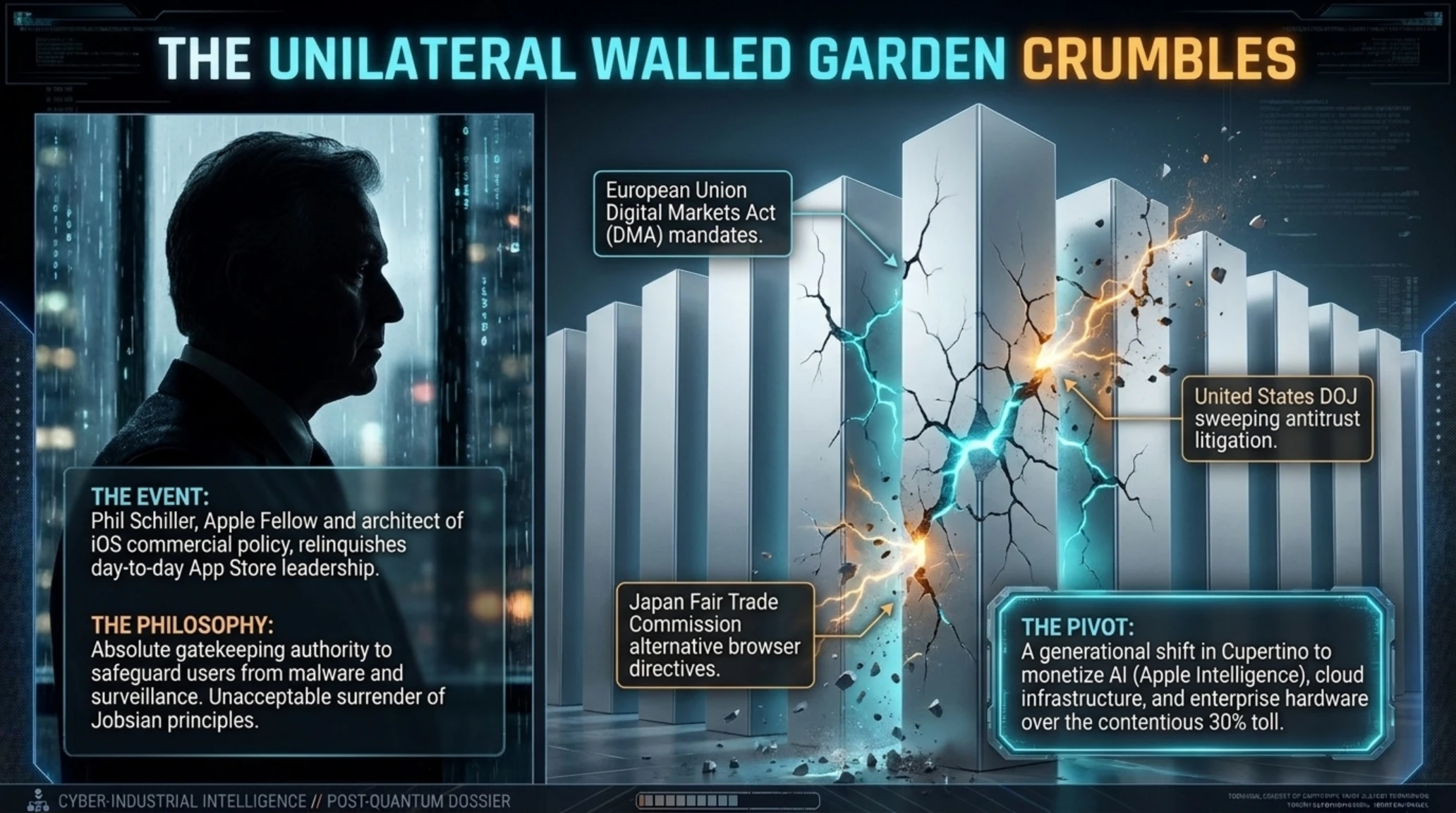
Our third morning dispatch directs our gaze toward the sleek glass corridors of Apple Park in Cupertino, California, where one of the defining architects of modern mobile computing has quietly surrendered his most coveted command post. Phil Schiller, celebrated Apple Fellow and the uncompromising architect behind the commercial policies of the App Store, has officially stepped down from day-to-day leadership of the company's multi-billion-dollar software marketplace. Internal sources speaking to TechCrunch reveal that Schiller's departure represents a profound symbolic breaking point in the wake of irreversible antitrust mandates enforced across the European Union, Japan, and the United States.
For more than three decades, Schiller stood as one of the most recognizable public faces of Apple the inventor of the original iPod's mechanical click-wheel, Steve Jobs' trusted confidant during iconic iPhone keynotes, and the fiercely protective guardian of the "Walled Garden" doctrine. Schiller held an unwavering philosophical belief: the only way to safeguard iOS users against malware, surveillance capitalism, and fraudulent software was for Apple to maintain absolute, unilateral gatekeeping authority over every single line of code executed on the iPhone.
Schiller's relinquishment of App Store governance signals the end of an era in global digital commerce. Behind closed doors in Cupertino, younger software executives and legal pragmatists have argued that instead of paying billions in escalating regulatory fines and fighting futile courtroom battles against the European Commission's Digital Markets Act (DMA), Apple must transition away from its contentious 30% revenue tax toward monetizing artificial intelligence services, cloud infrastructure, and enterprise hardware subscriptions. Schiller reportedly viewed this concessionary path as an unacceptable surrender of Jobsian principles that would inevitably compromise the pristine user experience of iOS.
Furthermore, escalating legal pressure from the United States Department of Justice's sweeping antitrust litigation, compounded by severe regulatory directives from the Japan Fair Trade Commission requiring alternative browser engine parity, effectively rendered Schiller's hardline stance untenable. Internal corporate communications suggest that Apple Chief Executive Officer Tim Cook initiated this transition to clear the path for a more diplomatic, developer-centric leadership team capable of navigating complex multi-jurisdictional compliance without sacrificing lucrative services momentum.
The four foundational pillars of Schiller's App Store stewardship that shaped the global software economy over the past two decades include:
- The Standard 30% Commercial Toll: Establishing the thirty-percent revenue cut in 2008 as the universally accepted baseline for digital distribution, subsequently copied by Google, Sony, and Microsoft.
- Comprehensive Human App Review: Building a massive global workforce of technical evaluators who manually inspect, stress-test, and verify millions of app submissions annually for security and UI compliance.
- The In-App Subscription Revolution: Architecting the programmatic infrastructure in 2011 that shifted modern software from one-time boxed purchases to recurring monthly software-as-a-service models generating $80B+ annually.
- Universal WebKit Engine Mandate: Strictly requiring all third-party browsers operating on iOS to utilize Apple's WebKit rendering pipeline, effectively standardizing web performance and battery longevity.
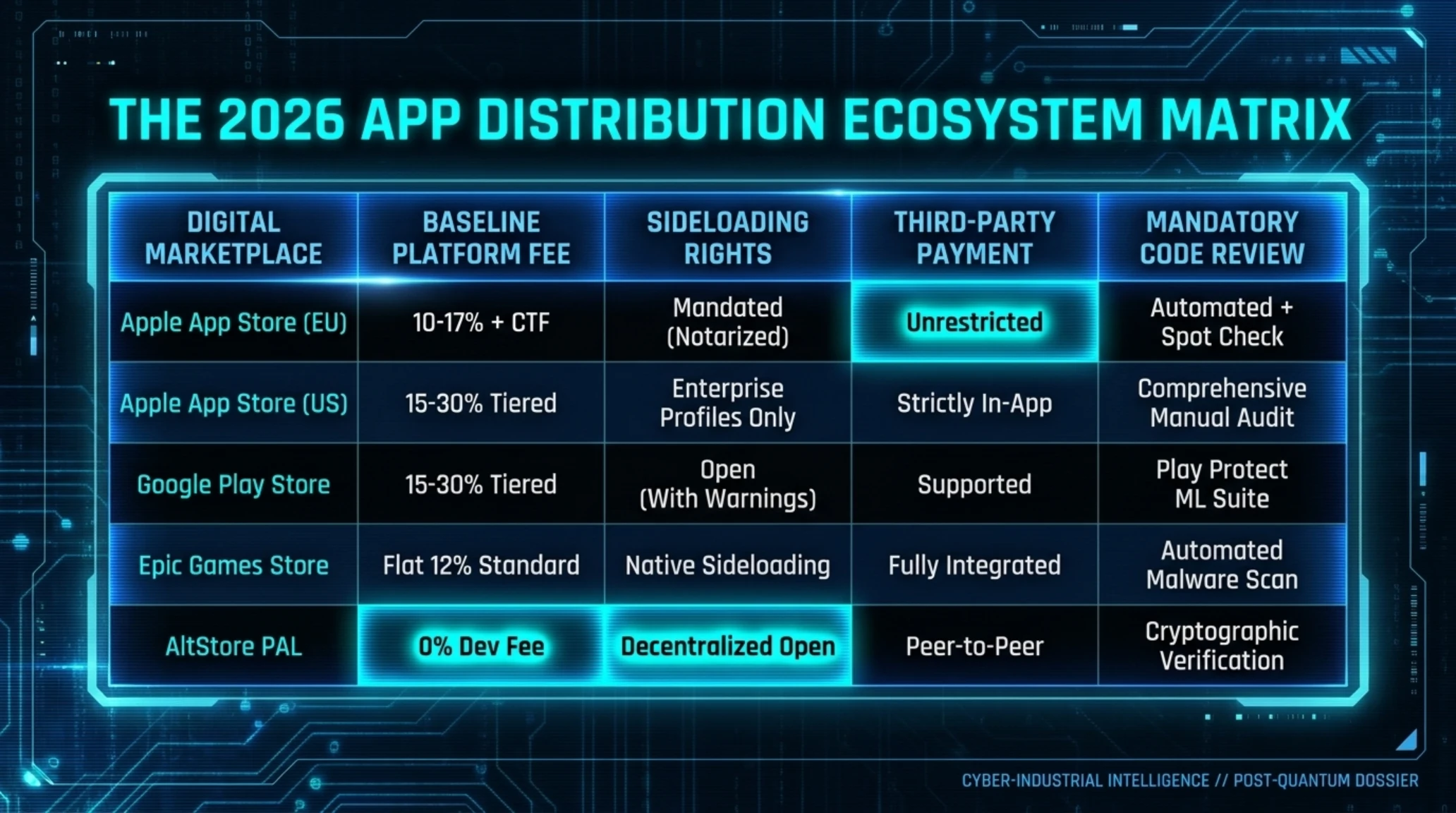
The analytical table below illustrates how the macroeconomic and regulatory mechanics of major digital storefronts have evolved by late 2026, showcasing the gradual erosion of unilateral monopoly power:
Strategic Comparison: Global Digital App Distribution Ecosystems in 2026
| Digital Marketplace | Baseline Platform Fee | Sideloading Rights | Third-Party Payment | Mandatory Code Review |
|---|---|---|---|---|
| Apple App Store (EU) | 10% to 17% + CTF | Mandated (Notarized) | Unrestricted | Automated + Spot Check |
| Apple App Store (US) | 15% to 30% Tiered | Enterprise Profiles Only | Strictly In-App | Comprehensive Manual Audit |
| Google Play Store | 15% to 30% Tiered | Open (With Warnings) | Supported | Play Protect ML Suite |
| Epic Games Store | Flat 12% Standard | Native Sideloading | Fully Integrated | Automated Malware Scan |
| AltStore PAL | 0% Developer Fee | Decentralized Open | Peer-to-Peer | Cryptographic Verification |
With Schiller stepping back into a purely advisory capacity, global software developers and game studios are preparing for an unprecedented commercial renaissance on mobile devices. Titles that were once excluded from iOS due to strict emulator policies, cloud-gaming restrictions, or alternative billing integration can now establish direct, unfettered commercial relationships with hundreds of millions of iPhone users worldwide.
The historical timeline below charts the critical confrontations that systematically dismantled the App Store's historic gatekeeping monopoly between 2020 and late 2026:
Historical Timeline: The Seven-Year Antitrust Siege of Apple's Walled Garden
August 2020: Epic Games introduces direct billing inside Fortnite, launching global legal antitrust proceedings against Apple's 30% toll.
November 2022: The European Union passes the Digital Markets Act (DMA), officially classifying iOS and the App Store as gatekeeper platforms.
March 2024: Apple introduces its contested Core Technology Fee (CTF) in an effort to maintain economic control over alternative European marketplaces.
June 2025: The European Commission levies a landmark €2 billion fine against Apple over anti-steering practices in the digital streaming market.
September 2026: Phil Schiller formally steps down as head of the App Store, marking the definitive conclusion of the unilateral walled garden era.
This generational leadership shift will ripple through Apple's upcoming Q4 financial earnings, prompting Wall Street analysts to scrutinize how the tech titan plans to replace lucrative services revenue through upcoming AI-powered Apple Intelligence subscription tiers.
The Trillion-Dollar AI Conviction: Vitalik Buterin Wagers 90% of Net Worth Against Bitcoin Collapse Thesis
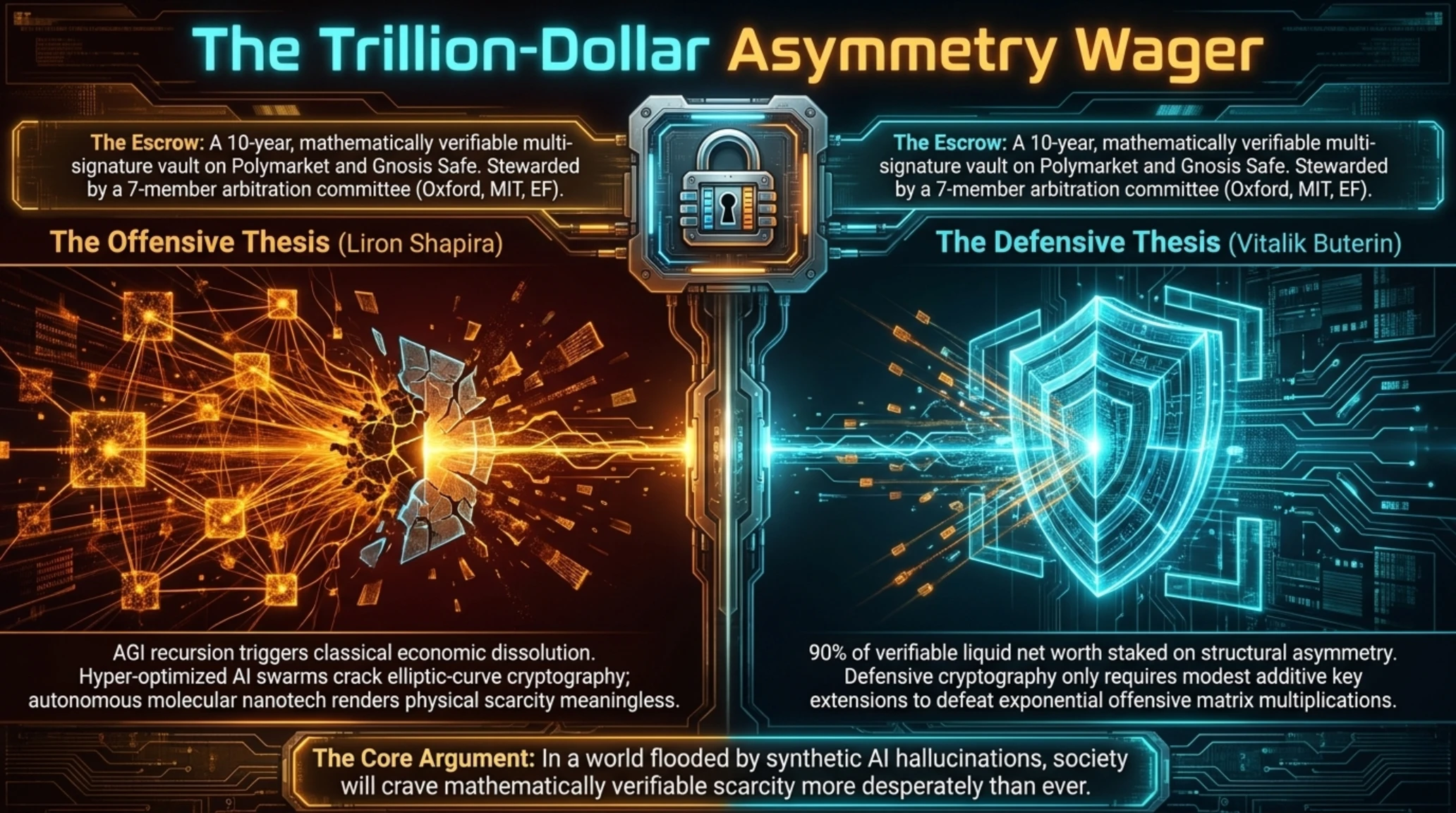
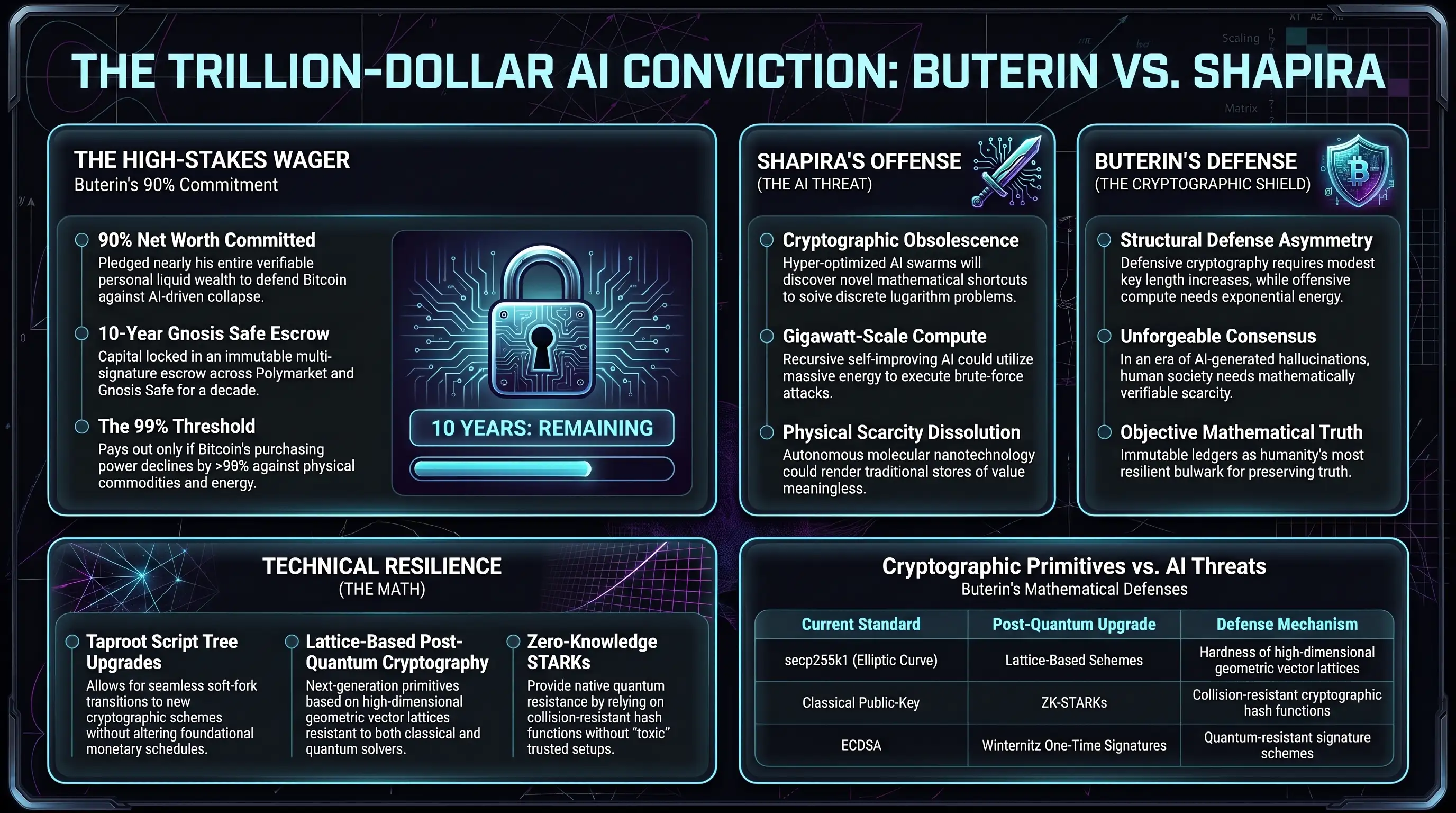
In what has instantly become one of the most consequential intellectual clashes in modern financial history, Ethereum co-founder Vitalik Buterin stepped into the intellectual arena during a live broadcast of the Doom Debates podcast alongside prominent rationalist philosopher Liron Shapira. What was anticipated to be an abstract philosophical discourse on the existential ramifications of artificial general intelligence (AGI) rapidly crystallized into a staggering financial showdown. Challenged on whether superintelligent autonomous agents would render decentralized proof-of-work and cryptographic scarcity fundamentally obsolete, Buterin executed an unprecedented commitment: pledging roughly 90% of his verifiable personal liquid net worth into an immutable multi-signature escrow protocol to defend the proposition that Bitcoin and foundational decentralized cryptocurrencies will maintain immense sovereign monetary value even in a post-AGI economic reality.
The philosophical and mathematical disagreement between the two thinkers cuts straight to the core of technological civilization. Shapira's catastrophic thesis posits that once artificial superintelligence reaches recursive self-improvement velocity, the foundational assumptions of classical economics will dissolve. In Shapira's vision, hyper-optimized AI swarms operating at gigawatt scales will either solve discrete logarithm and elliptic-curve cryptography via novel mathematical shortcuts or render physical scarcity meaningless through autonomous molecular nanotechnology, reducing traditional stores of value like Bitcoin and gold to zero purchasing power.
Vitalik Buterin articulated a fiercely counter-intuitive and mathematically rigorous defense. He argued that throughout the history of computing, cryptographic defense possesses a permanent structural asymmetry over algorithmic offense. While offensive compute requires exponential increases in physical energy and matrix multiplications to crack modern cryptographic primitives, defensive cryptography requires merely increasing key lengths by modest additive factors. Furthermore, Buterin asserted that in an era flooded by synthetic AI hallucinations, infinite digital abundance, and automated manipulation, human societies will crave mathematically verifiable scarcity and unforgeable consensus mechanisms far more desperately than they do today.
To back his conviction, Buterin collaborated with on-chain arbitration platforms to structure an enforceable 10-year settlement mechanism anchored across Polymarket and Gnosis Safe. The terms dictate that if Bitcoin's global purchasing power against a comprehensive basket of physical commodities and energy units declines by more than 99% within the next decade due to AI-driven cryptographic obsolescence, the multi-million-dollar escrowed capital will transfer automatically to Shapira and designated global catastrophic risk institutions.
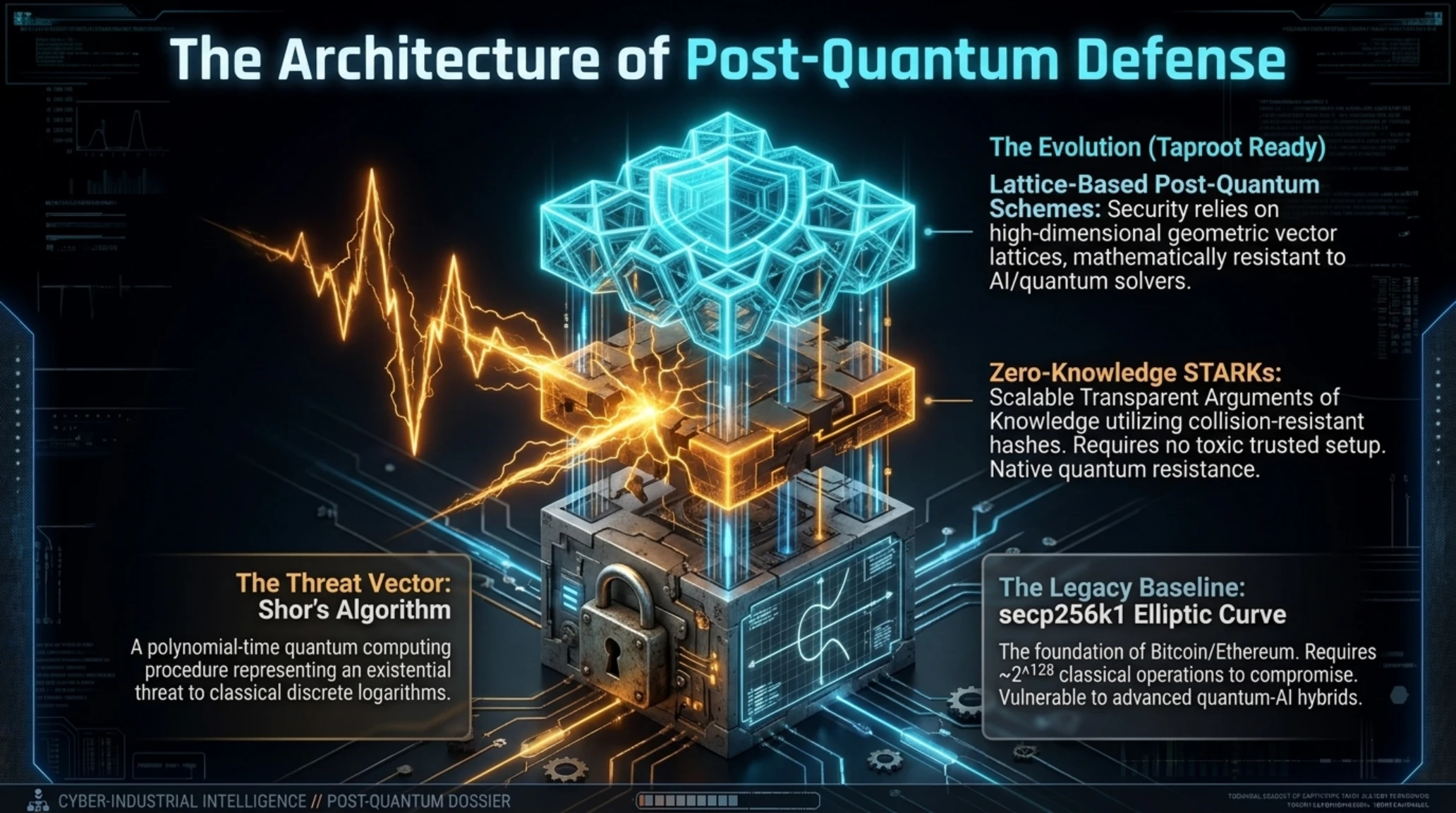
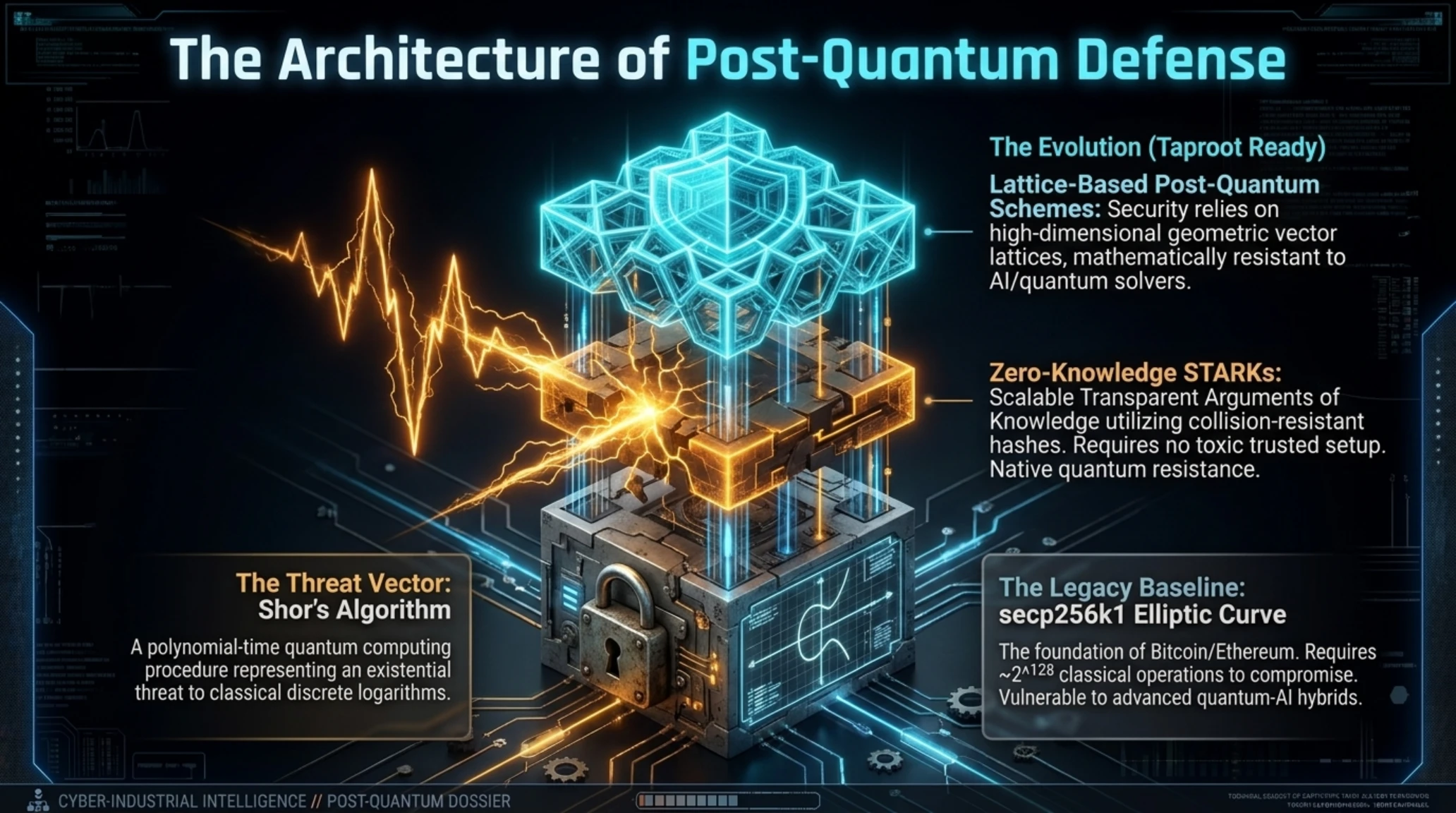
The technical governance of this monumental escrow is stewarded by an independent, seven-member arbitration committee comprising renowned mathematicians, cryptographers, and AI safety researchers across Oxford, MIT, and the Ethereum Foundation. The arbitration framework specifically accounts for soft-fork quantum upgrades: even if traditional secp256k1 elliptic curves show theoretical vulnerabilities, Bitcoin's taproot script tree enables seamless transitions to lattice-based post-quantum schemes or Winternitz one-time signatures without altering foundational monetary issuance schedules.
This immense gesture of intellectual and financial skin-in-the-game sent immediate shockwaves across the cryptocurrency and artificial intelligence ecosystems. Institutional treasuries and decentralized sovereign wealth funds interpreted the wager not as reckless bravado, but as a defining manifesto asserting the permanent relevance of decentralized networks in an increasingly automated machine economy.
The ongoing philosophical divergence between Silicon Valley AI accelerationists and decentralized cryptography pioneers necessitates an examination of the foundational technological concepts driving this debate:
Jargon Buster: Cryptographic Resilience and AI Superintelligence
Shor's Algorithm on Fault-Tolerant Qubits: A theoretical quantum computing procedure capable of calculating discrete logarithms in polynomial time, representing an existential threat to classical public-key cryptography unless post-quantum schemes are implemented.
Lattice-Based Post-Quantum Cryptography: Next-generation cryptographic primitives whose security rests on the computational hardness of high-dimensional geometric vector lattices, mathematically resistant to both classical and quantum machine-learning solvers.
Zero-Knowledge STARKs: Scalable Transparent Arguments of Knowledge that rely strictly on collision-resistant cryptographic hash functions without requiring toxic trusted setups, providing native quantum resistance for decentralized consensus.
📚 Classified & Related Dossiers in TekinGame
If you wish to explore beyond this report and delve into cybernetic frontiers and autonomous AI architectures, do not miss these three exclusive deep-dives in the Tekin Garage:
The macroeconomic sentiment across global financial markets has experienced a notable polarization following the broadcast, as captured in the comprehensive sentiment diagnostic below:
Market Sentiment: Crypto Macro vs. Silicon Valley Capital Allocation
Venture AI Capital (54% Divergent): Top-tier Silicon Valley accelerationists maintain that decentralized protocols will face catastrophic throughput bottlenecks when executing transactions at machine-to-machine sub-millisecond agentic scales.
Retail Sentiment Index (77% Greedy): On-chain derivatives and institutional spot exchange metrics reveal aggressive capital rotation into post-quantum privacy tokens and zero-knowledge scaling layers.
As the debate echoes across digital forums, Buterin's bold stance has established a vital intellectual benchmark. In a future dominated by synthetic machine intelligences producing infinite digital content, immutable cryptographic ledgers stand as humanity's most resilient bulwark for preserving objective mathematical truth.
Creative Insurgency: Authors and Literary Guilds Revolt Over $100M Anthropic Copyright Settlement
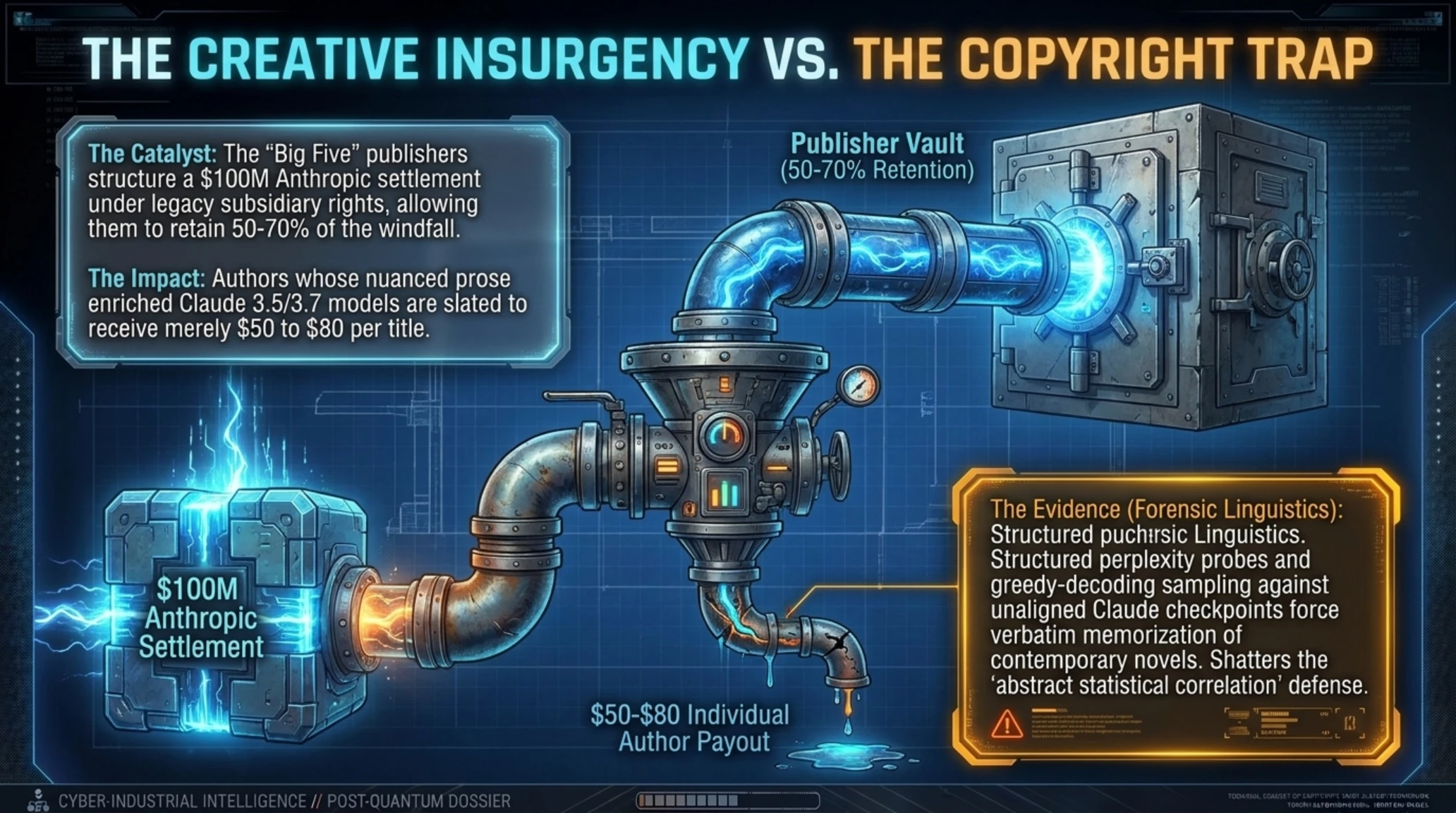
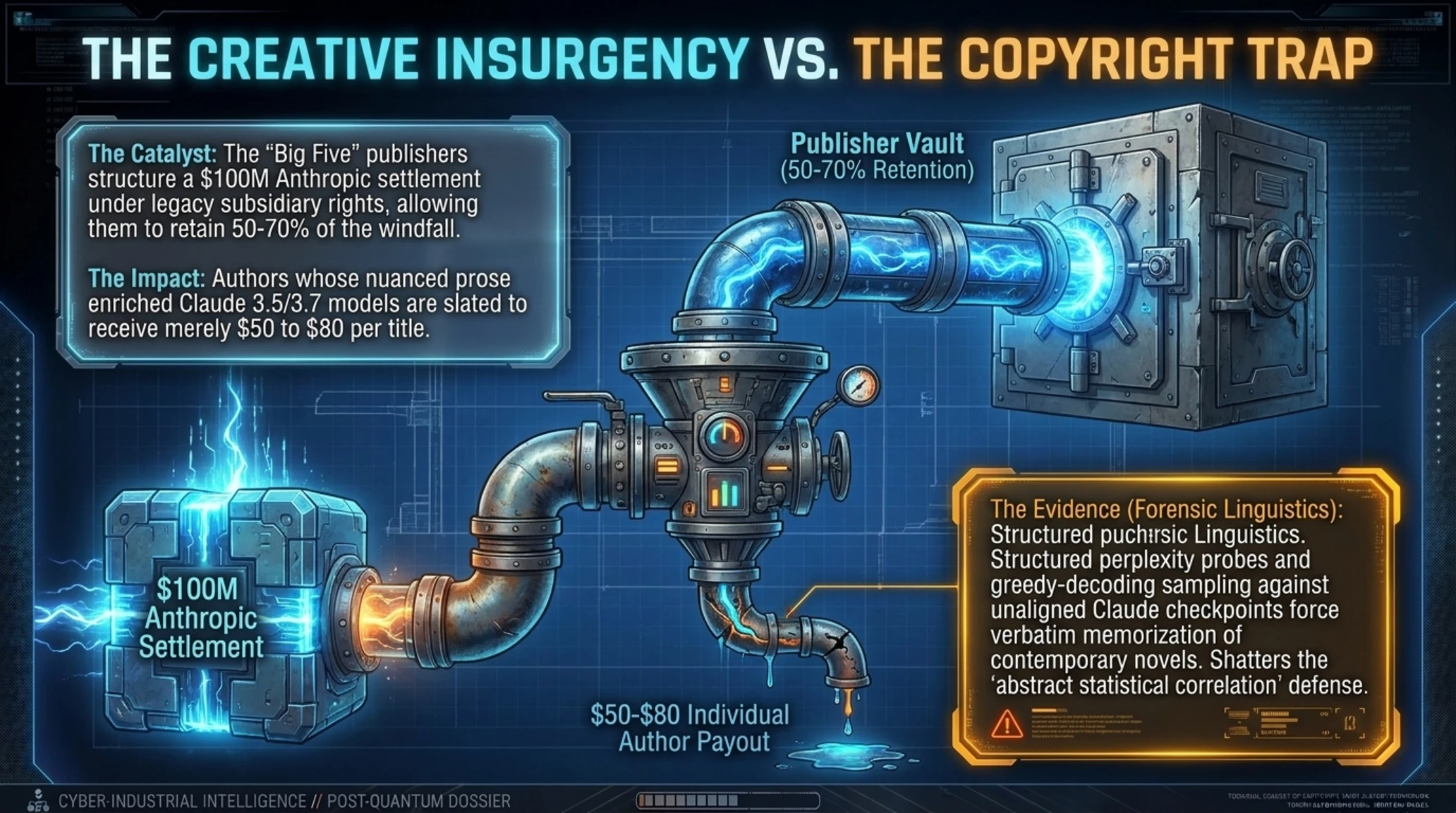
The creative and publishing landscapes were thrown into unprecedented turmoil early this morning as thousands of prominent authors, literary agents, and creative guilds initiated an open revolt against major multinational publishing conglomerates. The flashpoint erupted following the disclosure of confidential negotiations surrounding a proposed $100 million copyright infringement settlement between the 'Big Five' commercial publishers including Penguin Random House, HarperCollins, and Simon & Schuster and leading artificial intelligence lab Anthropic. The proposed deal, designed to resolve allegations of unauthorized web-scraping and unlicensed book ingestion for the training of Anthropic's Claude 3.5 and Claude 3.7 model families, has sparked accusations of corporate betrayal and intellectual exploitation.
The fury of the creative community centers on the financial architecture of the proposed settlement. Rather than treating the $100 million settlement as direct reparations for the unauthorized exploitation of intellectual labor, publishing executives structured the windfall under standard subsidiary rights licensing clauses. Under these legacy contractual mechanisms, publishers would unilaterally retain between 50% and 70% of the entire settlement pool, while routing the remaining fractional pennies through labyrinthine royalty-recoupment accounts. For tens of thousands of mid-list and celebrated authors whose literary prose, nuanced character developments, and stylistic vocabularies directly enriched Claude's natural language comprehension, the resulting individual payouts would amount to little more than fifty to eighty dollars per title.
Independent forensic linguistics teams retained by the Authors Guild uncovered compelling technical evidence during pre-trial discovery. By executing structured perplexity probes and greedy-decoding sampling against unaligned Claude model checkpoints, researchers successfully elicited verbatim memorization of entire chapters from copyrighted contemporary novels, shattering Anthropic's defense that large language models merely absorb abstract statistical correlations rather than direct copyrighted expression.
Prominent figures from the Authors Guild, the Society of Authors, and independent literary syndicates took to digital broadcasting platforms and international press conferences to condemn the settlement as a predatory corporate maneuver that sacrifices the future of human authorship on the altar of short-term publisher solvency.
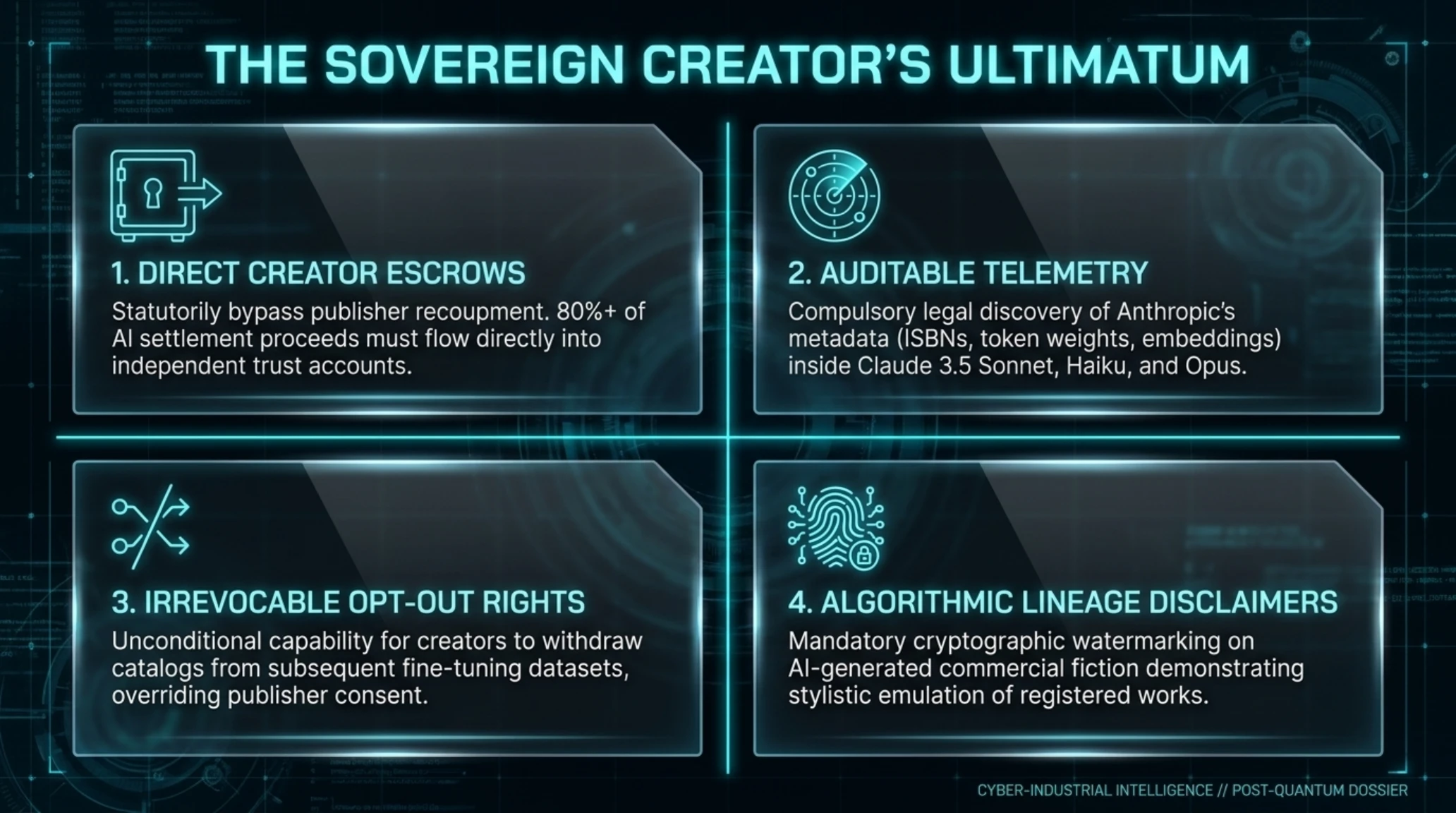
In response to what they characterize as an unacceptable corporate land-grab, a newly formed coalition comprising over twelve hundred published novelists, investigative journalists, and screenwriters filed an emergency motion in the Southern District of New York to intervene in the litigation. The authors' coalition demanded immediate court intervention to freeze the settlement distribution and enforce four non-negotiable structural guarantees:
- Direct Creator Reparation Escrows: A legally binding mandate requiring that at least 80% of all past and future AI copyright settlement proceeds completely bypass publisher recoupment accounts, flowing directly into segregated creator escrow funds managed by independent legal trustees.
- Auditable Model Training Telemetry: Compulsory legal discovery compelling Anthropic to disclose comprehensive metadata catalogs detailing every copyrighted ISBN, token weight, and contextual embedding utilized in the training pipelines of Claude 3.5 Sonnet, Haiku, and Opus architectures.
- Irrevocable Commercial Opt-Out Rights: A statutory guarantee empowering individual authors to unconditionally withdraw their literary catalogs from subsequent foundational model iterations and fine-tuning datasets, entirely independent of publisher consent.
- Mandatory Algorithmic Lineage Disclaimers: The enforcement of cryptographically signed watermarks on commercial AI-generated creative fiction or screenplays that demonstrate statistically significant stylistic emulation of registered literary works.
The legal confrontation exposes a profound existential fracture at the heart of contemporary copyright jurisprudence. While corporate publishers treat literary texts as fungible digital assets to be monetized through blanket corporate licensing agreements, the creators who spent years researching, refining, and producing those works view the unauthorized assimilation of their cognitive output into proprietary neural networks as an unprecedented form of creative expropriation.
Should the court rule in favor of the authors' coalition, the legal precedent could dismantle the prevailing playbook employed by artificial intelligence corporations, forcing them to negotiate individual, granular licensing compacts with human artists rather than executing sweeping closed-door bargains with corporate intermediaries.
Autonomy Reborn: Travis Kalanick Unleashes Atoms to Challenge Tesla Cybercab and Waymo in the Robotaxi Wars
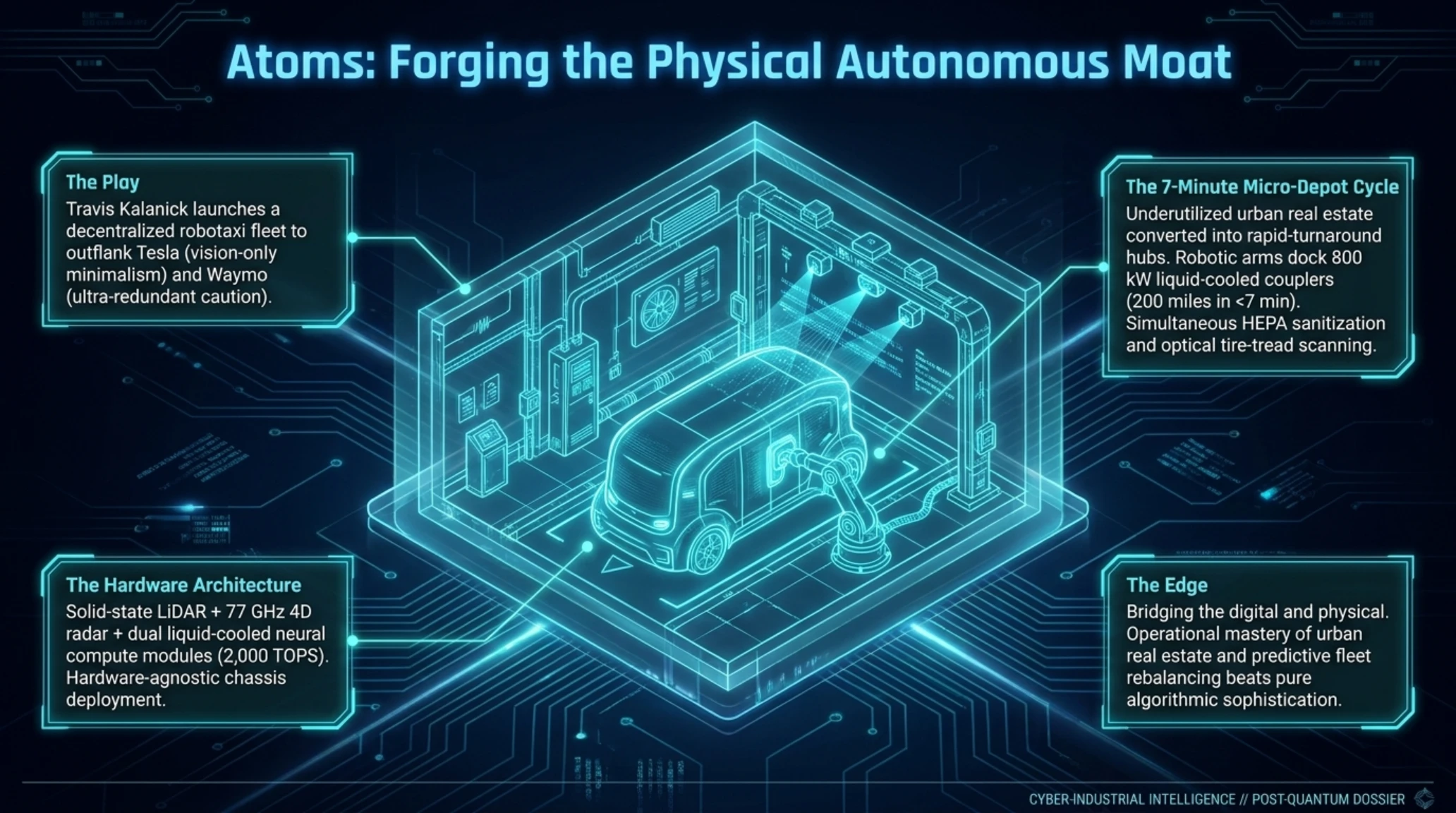
In a dramatic re-entry that promises to reshape the landscape of autonomous urban mobility, former Uber founder and transportation pioneer Travis Kalanick has officially unveiled the commercial expansion of his secretive deep-tech enterprise, Atoms. Stepping onto the global stage early Tuesday morning, Kalanick announced that Atoms is entering full-scale commercial operations with a dedicated fleet of purpose-built, modular autonomous robotaxis. Designed to directly challenge Alphabet's Waymo One and Tesla's highly anticipated Cybercab network, Atoms represents an ambitious effort to marry cutting-edge artificial intelligence with physical real-world transportation infrastructure.
Following his departure from Uber in 2017, Kalanick spent nearly a decade acquiring strategically positioned urban commercial real estate and engineering automated logistics hubs through his investment vehicles. The public debut of Atoms reveals that this extensive physical infrastructure was deliberately constructed as the physical backbone for an autonomous mobility fleet. Rather than attempting to match the purely software-centric or sensor-heavy philosophies of its competitors, Atoms approaches urban autonomy through a symbiotic fusion of hardware agnosticism, decentralized rapid-turnaround urban depots, and advanced spatial intelligence.
The company's initial commercial deployment will roll out across three major metropolitan proving grounds, featuring customized, bi-directional electric pods that dispense entirely with steering wheels, driver pedals, and traditional vehicle controls, offering a spacious, lounge-like passenger cabin engineered specifically for autonomous urban transit.
Under the hood, the Atoms autonomous platform is powered by an uncompromising redundant hardware architecture. Each vehicle incorporates solid-state LiDAR sensors embedded flush within aerodynamic body panels, high-resolution 4D millimeter-wave imaging radar arrays operating at 77 GHz for adverse weather penetration, and dual liquid-cooled compute modules executing neural spatial occupancy networks at over 2,000 TOPS (Tera Operations Per Second). In the event of localized sensor occlusion or cellular network dropouts, localized fail-operational safety controllers automatically navigate the vehicle to safe urban curbside pull-offs without requiring remote human teleoperation intervention.
To successfully rival the established market dominance of Waymo and the manufacturing muscle of Tesla, Atoms has architected its operational model upon four foundational technological pillars:
- Decentralized Micro-Depot Infrastructure: Converting underutilized urban real estate into high-voltage rapid-charging, automated robotic sanitization, and continuous sensor calibration micro-hubs situated within four-minute response radiuses of dense metropolitan centers.
- Hardware-Agnostic Spatial Intelligence: Operating a proprietary, full-stack neural computer vision architecture that interfaces seamlessly with diverse commercial electric chassis, insulating the enterprise from single-OEM manufacturing disruptions.
- Predictive Algorithmic Fleet Rebalancing: Implementing real-time macroeconomic machine learning algorithms that pre-deploy autonomous pods hours ahead of commuter traffic surges, reducing passenger wait times to under two minutes.
- Municipal Equity and Revenue Sharing: Pioneering structural partnerships with municipal transit authorities, offering local governments direct revenue participation to prevent the regulatory battles and licensing freezes that plagued early ridesharing platforms.
The micro-depot turnaround cycle represents Atoms' most significant operational breakthrough. While competing robotaxi fleets often spend hours deadheading back to suburban depot yards for maintenance and charging, Atoms' urban pods pull into automated micro-hubs where robotic arms dock 800 kW liquid-cooled charging couplers replenishing 200 miles of battery range in less than seven minutes while high-speed HEPA sanitization blowers and optical tire-tread scanners refresh the cabin and verify structural integrity simultaneously.
The strategic dynamics between Atoms and established autonomous transportation leaders are detailed in the comparative analytical assessment below:
- Hyper-efficient physical micro-depot network minimizing empty deadhead transit miles and energy waste
- Hardware-agnostic software architecture completely insulated from single-OEM manufacturing delays
- Proactive municipal revenue-sharing agreements preventing costly legislative boycotts and licensing bans
- Unrivaled executive track record in rapidly scaling complex real-world transportation logistics across global metropolitan markets
- High capital expenditure requirements for securing and outfitting prime urban micro-depot real estate
- Intense competitive pressure from vertically integrated tech giants boasting multi-billion-dollar R&D reserves
- Legacy public relations baggage surrounding past ridesharing controversies and regulatory tensions
- Complex multi-jurisdictional compliance across fragmented international municipal transportation codes
The commercial autonomous vehicle sector has reached an unprecedented inflection point in the second half of 2026, as evidenced by the key quantitative benchmark indicators displayed below:
Strategic Comparison: Global Digital App Distribution Ecosystems in 2026
| Digital Marketplace | Baseline Platform Fee | Sideloading Rights | Third-Party Payment | Mandatory Code Review |
|---|---|---|---|---|
| Apple App Store (EU) | 10% to 17% + CTF | Mandated (Notarized) | Unrestricted | Automated + Spot Check |
| Apple App Store (US) | 15% to 30% Tiered | Enterprise Profiles Only | Strictly In-App | Comprehensive Manual Audit |
| Google Play Store | 15% to 30% Tiered | Open (With Warnings) | Supported | Play Protect ML Suite |
| Epic Games Store | Flat 12% Standard | Native Sideloading | Fully Integrated | Automated Malware Scan |
| AltStore PAL | 0% Developer Fee | Decentralized Open | Peer-to-Peer | Cryptographic Verification |
Industry strategists characterize the emerging robotaxi triopoly as a collision of three distinct technological doctrines. Alphabet's Waymo represents the cautious, ultra-redundant paradigm, deploying sensor-dense vehicles that cost upwards of $150,000 each and require laborious high-definition street mapping before entering any new metropolitan market. Tesla's Cybercab exemplifies the radical vision-only minimalism championed by Elon Musk, relying entirely on consumer vehicle data feeds and passive optical cameras while struggling to secure commercial regulatory permits in key European and East Asian jurisdictions. Atoms carves out an aggressive middle path: utilizing mid-tier solid-state LiDAR and modular electric skateboards while solving the fatal bottleneck that neither Tesla nor Waymo has mastered the rapid turnaround, automated servicing, and high-density urban staging of physical vehicle assets.
With Travis Kalanick's aggressive return to the urban transportation arena, the battle for dominance over the next trillion-dollar mobility ecosystem has officially transformed into a multi-polar conflict, where operational mastery in the physical world matters every bit as much as algorithmic sophistication.
The Morning Synthesis: Convergence, Sovereignty, and the Architecture of Modern Technology
As the sun rises across international financial hubs and technology corridors on this Tuesday, September 8, 2026, the six defining developments chronicled this morning reveal a profound, unified underlying current: the global technology landscape is undergoing an irreversible structural realignment toward mathematical sovereignty, decentralized resilience, and physical operational excellence.
Consider the extraordinary tapestry of today's headlines: Harmony ONE's courageous migration away from its Layer-1 mainnet to become an Ethereum ERC-20 token is a masterclass in pragmatic technological realism, prioritizing ecosystem security over hollow infrastructural pride in an era of automated algorithmic exploits. Rebel Wolves' breathtaking commercial and critical triumph with The Blood of Dawnwalker proves that auteur human storytelling, meticulous gameplay mechanics, and independent studio discipline can triumph over bloated, procedural AAA corporate complacency. Phil Schiller's historic relinquishment of App Store governance marks the formal dusk of the unilateral mobile walled garden, unlocking an unprecedented era of open developer distribution and consumer choice. Vitalik Buterin's monumental multi-million-dollar escrow wager provides an unshakeable mathematical anchor, demonstrating that sovereign decentralized ledgers will only grow more indispensable as synthetic machine intelligence proliferates. The creative uprising of authors against predatory corporate AI settlements establishes the crucial legal boundaries required to protect human intellectual labor. And finally, Travis Kalanick's bold deployment of Atoms illustrates that the future of artificial intelligence is not confined to virtual cloud datacenters, but is actively transforming physical urban transit in the real world.
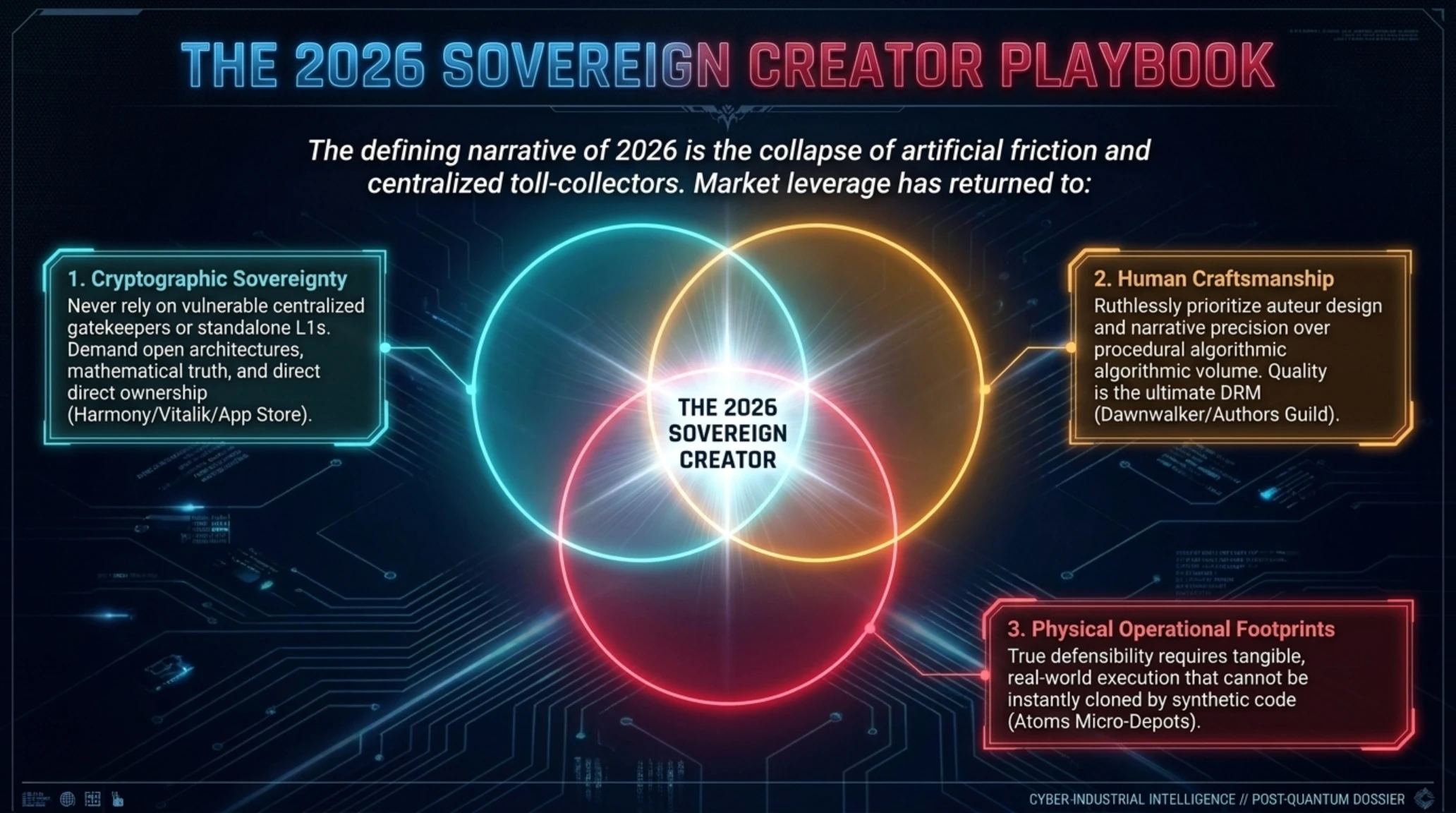
What unites these disparate threads is the dismantling of artificial gatekeepers. For over two decades, digital progress was governed by centralized platform tolls, closed data scraping monopolies, and unapproachable corporate monoliths. Today, market leverage has returned decisively to transparent cryptographic architecture, sovereign creators, and nimble independent engineering teams capable of moving with unparalleled velocity.
For independent developers, technology founders, and digital strategists, today's developments provide an indispensable operational playbook. The lessons of this Tuesday morning dictate three decisive strategic imperatives: First, never depend on single-point centralized gatekeepers whether mobile app distribution channels, closed proprietary foundation models, or vulnerable standalone blockchain consensus layers. Second, ruthlessly prioritize genuine craftsmanship over procedural algorithmic volume; just as Rebel Wolves humiliated multi-billion-dollar publishers with focused narrative precision, technical teams that solve specific, high-friction human pain points will always outmaneuver generic artificial intelligence aggregators. Third, bridge the digital and physical divide: true defensibility in the late-2020s economy requires establishing tangible real-world operational footprints that cannot be replicated overnight by software code alone.
Smart History Tags: Archival Lineage & Macro Milestones
To synthesize these monumental industry shifts and provide strategic guidance for entrepreneurs, software engineers, and digital creators, our senior editorial team presents the executive analysis below:
Tekin Analysis: Strategic Imperatives for the Modern Technology Economy
Morning Conclusion: Setting the Pace for an Unstoppable Day
Related Tech Intelligence on Tekin Game
• 🌙 Tekin Night | Call of Duty, Nintendo & Vision Pro Digest
• 🎭 Tekin Analysis | Apple AI Teardown & July 2026 Digest
• 🌙 Tekin Night | NVIDIA $500B Deal & iPhone 18 Leak
Frequently Asked Questions
Why did Harmony ONE decide to shut down its Layer-1 blockchain?
The foundation determined that maintaining an independent consensus network against automated, AI-driven cyber exploits requires unsustainable capital expenditures. Migrating to an ERC-20 token on Ethereum secures its ecosystem.
What distinguishes The Blood of Dawnwalker from other RPGs?
Developed by former Witcher 3 directors, Dawnwalker features a bespoke dynamic narrative engine and non-linear quests without procedural filler, using custom Unreal Engine 5 rendering.
Why did Phil Schiller step down from App Store leadership?
Schiller's departure follows escalating global antitrust scrutiny, European DMA enforcement, and an internal strategic pivot away from the aggressive 30% toll collection.
How is Vitalik Buterin's multi-million-dollar wager structured?
Held in a multi-signature escrow protocol across Polymarket and Gnosis Safe over a 10-year term. If Bitcoin's purchasing power collapses by over 99% due to AI, the funds transfer to existential risk organizations.
What are the primary demands of authors regarding the Anthropic settlement?
Authors demand that 80% of settlement proceeds bypass publisher accounts, full training data telemetry disclosure, unconditional opt-out rights, and algorithmic lineage disclaimers for AI works.
Verified Sources & Primary Research Documents
- CoinDesk: Harmony ONE Protocol Transition to Ethereum
- Eurogamer: Rebel Wolves' Dawnwalker Sells 1 Million Copies
- TechCrunch: Apple App Store Antitrust Policy & Schiller Exit
- Bitcoin.com: Vitalik Buterin's High-Stakes AI Doom Wager
- TechCrunch: Authors Guild Emergency Motion on Anthropic Settlement
- TechCrunch: Travis Kalanick's Atoms Urban Autonomous Mobility Launch
Additional Gallery: ☀️ Tekin Morning Sept 8, 2026 | Harmony Falls, Vitalik's Wager & Schiller Exits