Tekin Morning | Oct 9, 2026: OpenAI Intelligent UI, Starlink Standoff & Solana Wallet
Beyond Conversational Output: OpenAI Deploys Client-Side 'Intelligent UI' Architecture
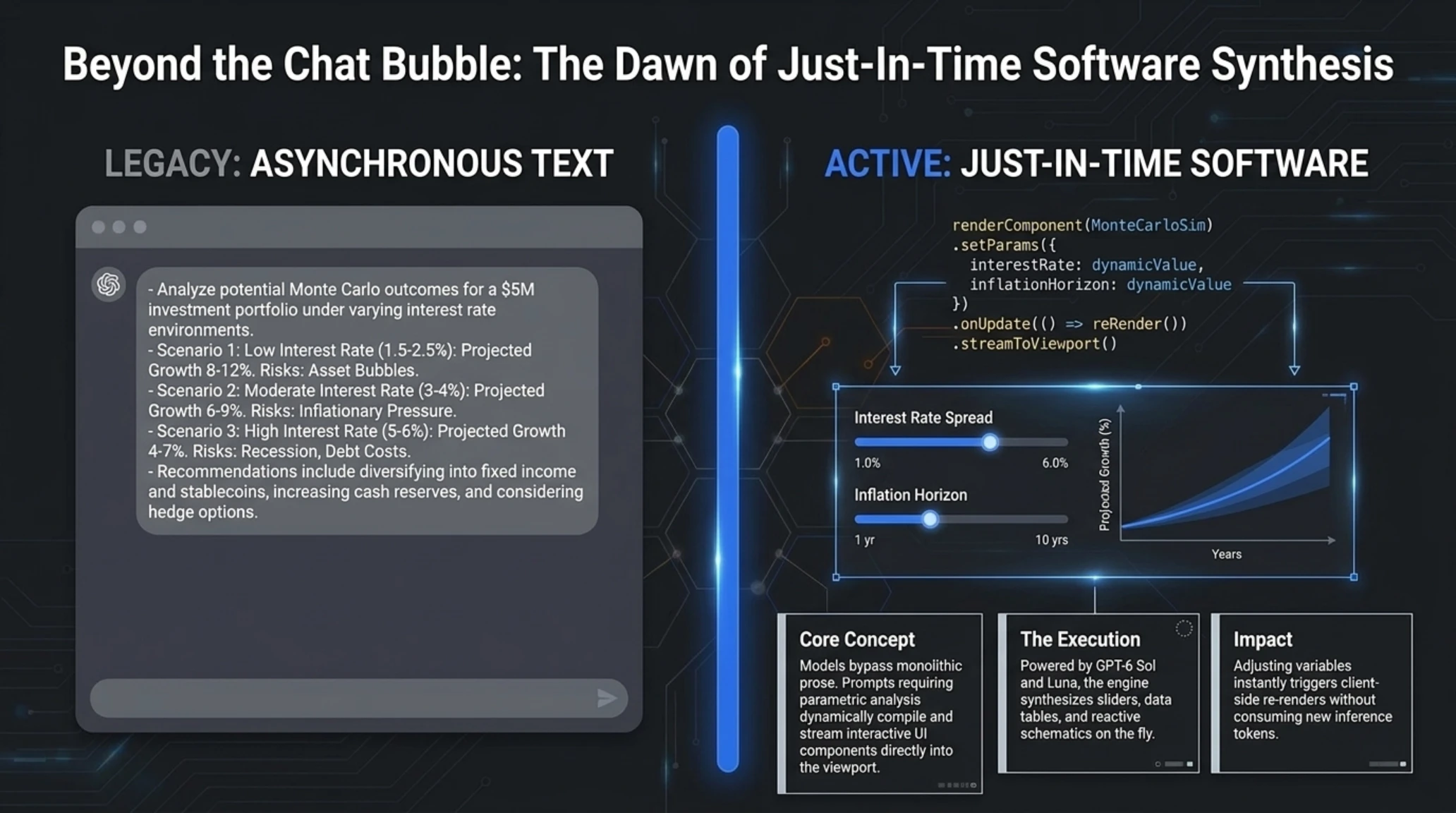
The enterprise generative artificial intelligence paradigm underwent a definitive architectural evolution in the early hours of Friday, October 9, 2026. OpenAI officially rolled out its long-anticipated "Intelligent UI" framework across the ChatGPT platform, effectively dismantling the conversational chat bubble convention that has governed consumer AI interactions since late 2022. Powered by the foundational capabilities of the GPT-6 architecture specifically the enterprise-grade GPT-6 Sol and the consumer-tier GPT-6 Luna this deployment transitions the system from an asynchronous text-generating LLM into a real-time, just-in-time software synthesis runtime engine.
Under this architectural overhaul, whenever an incoming prompt contains parametric analysis, financial calculations, comparative evaluations, or interactive decision trees, the model dynamically bypasses monolithic prose. Instead, it compiles and streams interactive user interface components such as dynamic sliders, data tables with live filtering, multi-variable calculators, and reactive SVG schematics directly into the primary viewport. For instance, an inquiry regarding venture debt structuring or retirement portfolio modeling no longer returns bulleted text summaries; it instantiates an interactive Monte Carlo simulation dashboard where users adjust interest rate spreads, inflation horizons, and liquidity constraints with instantaneous client-side re-renders.
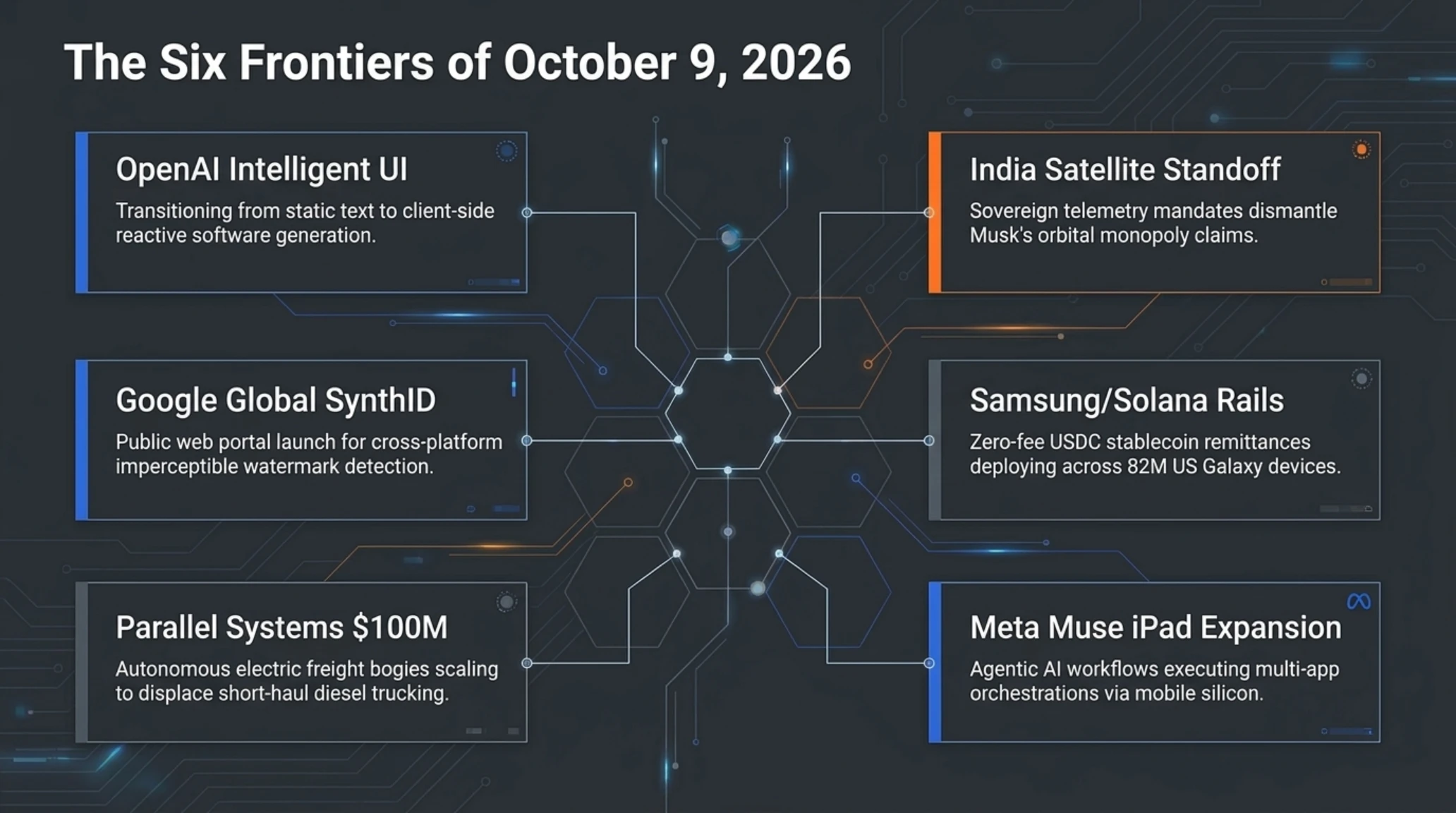
Strategic Vectors at a Glance | Morning Intelligence
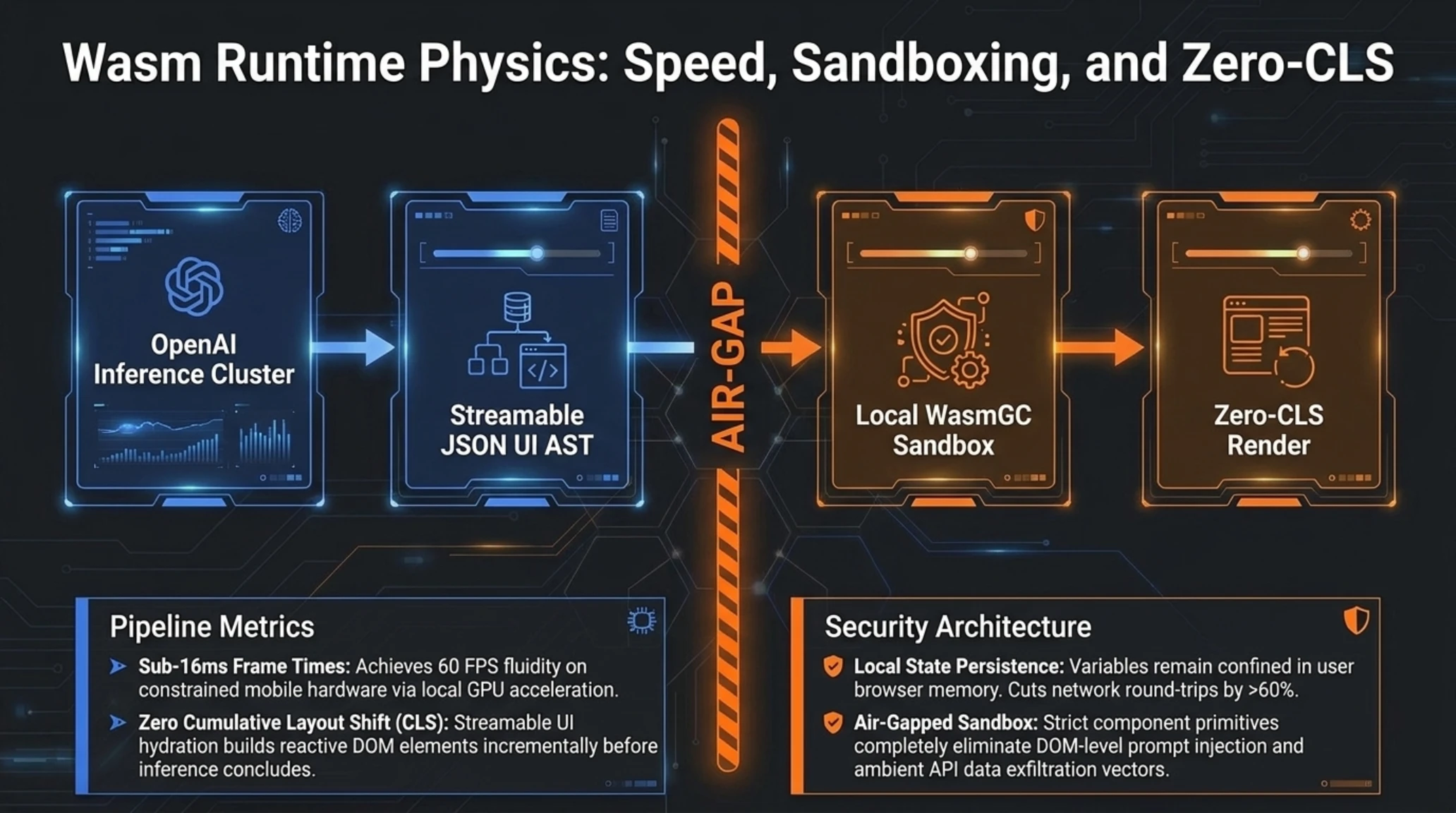
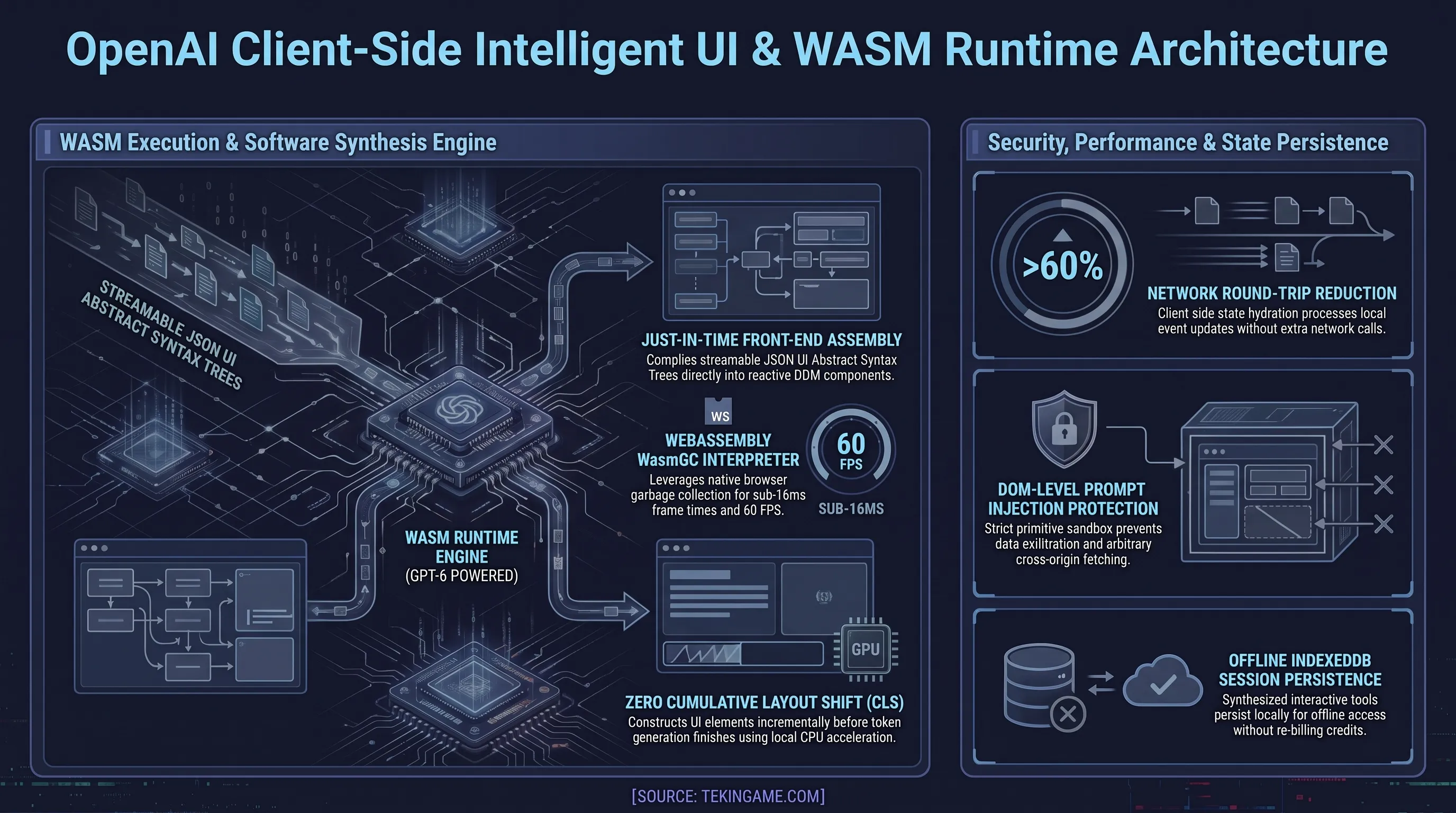
The underlying software engineering infrastructure represents a notable breakthrough in streamable web compilation. The Intelligent UI engine relies on a curated design system of atomic UI primitives coupled with a high-performance WebAssembly (Wasm) interpreter executing within an isolated browser sandbox. As tokens stream from OpenAI’s inference clusters, the client-side parser identifies structured JSON UI schemas and constructs reactive DOM elements incrementally before the inference generation has concluded. This eliminates layout shifts (Zero Cumulative Layout Shift) and minimizes latency to sub-perceptual thresholds, utilizing local GPU acceleration for hardware-accelerated rendering.
Crucially, state persistence is handled entirely within client-side memory. When a user manipulates an interactive slider or updates an input variable inside an embedded widget, the local reactive graph updates without firing supplementary network requests back to OpenAI’s inference endpoints. This dual-layer execution pipeline not only slashes server-side compute consumption across millions of concurrent sessions, but also guarantees data confidentiality: sensitive local variables remain confined within the user's browser memory unless an explicit secondary query is authorized. This directly resolves vulnerabilities documented in the comprehensive investigation on AgentForger enterprise prompt injection vectors in AI workspaces.
From an architectural standpoint, the client-side compilation pipeline bridges the gap between declarative UI frameworks like React Server Components (RSC) and low-level WebAssembly virtualization. When OpenAI’s inference models emit streamable JSON UI ASTs (Abstract Syntax Trees), the in-browser runtime validates the schema against a deterministic security grammar before passing the node graph to the virtual DOM renderer. This multi-stage verification layer ensures that generated mini-applications cannot access ambient browser APIs, execute arbitrary JavaScript eval routines, or initiate unauthorized cross-origin resource sharing (CORS) fetch requests. The resulting runtime achieves sub-16 millisecond frame times, providing 60 FPS fluidity even on constrained mobile hardware.
A critical engineering triumph embedded within this pipeline is the utilization of WebAssembly Garbage Collection (WasmGC) primitives. Rather than incurring heavy memory allocation overhead each time a dynamic component is synthesized, the runtime leverages browser-native garbage collection to manage UI state allocations. Interactive elements such as complex dynamic SVGs or financial graphs with thousands of coordinate points are instantiated within managed memory pools that deallocate automatically upon session teardown. Furthermore, local IndexedDB caching permits synthesized tools such as a customized tax estimator or mortgage amortization matrix to persist locally across browser sessions, granting users offline access to previously generated interactive applications without requiring active network connectivity or re-billing of inference credits.
Moreover, the integration fundamentally alters the economics of human-in-the-loop parameter tuning. In traditional conversational flows, adjusting a complex simulation required repeated natural language refinements, consuming hundreds of output tokens and incurring significant latency per turn. Under Intelligent UI, parametric fine-tuning is offloaded entirely to local client events: adjusting an interest rate slider instantly recalibrates thousands of data points on an SVG chart, and only when the user explicitly triggers an "Analyze Scenario" action is the mutated state bundled into a compact context token and re-injected into the LLM conversation history.
When evaluated against production web development stacks like Next.js and SvelteKit, Intelligent UI represents the birth of "just-in-time front-end assembly." Rather than engineers writing and maintaining static component templates, models compile tailor-made interactive interfaces on demand based on runtime constraints. If a user asks for an uncommon financial comparison involving obscure regional tax laws, the model does not attempt to adapt a rigid pre-existing form; it writes a purpose-built state machine, binds form validation rules, and renders the tailored form in real time, setting a new benchmark for software ergonomics.
In contrast to Anthropic’s Claude Artifacts mechanism, which partitions the user experience into an adjacent side-panel running sandboxed iframes, OpenAI’s Intelligent UI integrates software generation directly into the organic conversational narrative. Interactive widgets live inline between explanatory annotations, maintaining contextual dialogue coherence. If a user refines their criteria via chat, the existing component mutates dynamically rather than spawning detached code revisions, creating a fluid human-in-the-loop software assembly loop.
Why It Matters: The Demise of Single-Utility SaaS
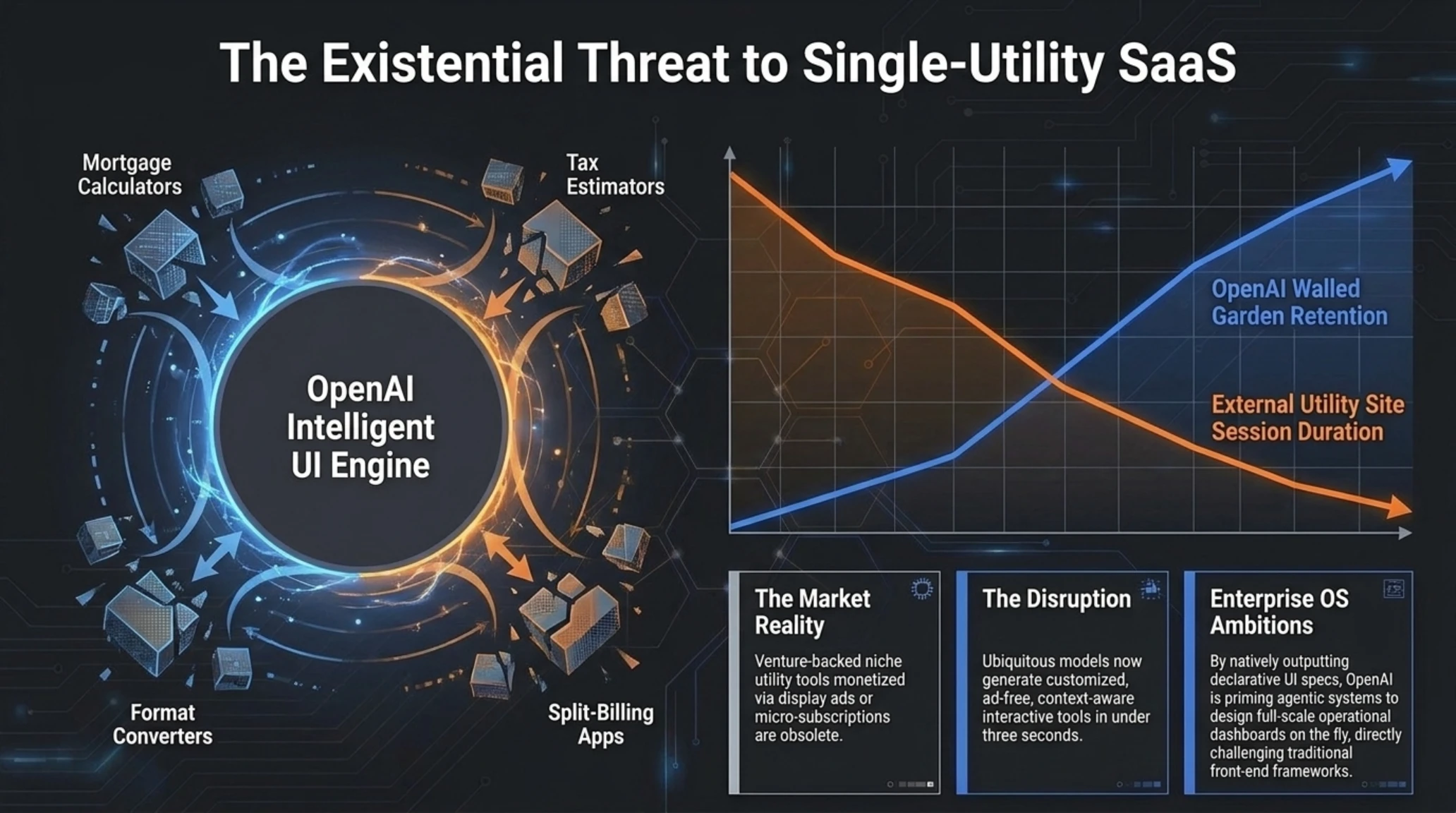
The commercial ramifications of real-time interactive UI generation are disruptive. For over a decade, hundreds of venture-backed startups and web properties relied on niche utility tools such as mortgage calculators, currency converters, split-billing web apps, and basic data visualizers monetized via display ads or micro-subscriptions. By empowering a ubiquitous model to generate customized, ad-free, context-aware interactive tools in under three seconds, OpenAI is capturing long-tail utility search traffic and consolidating user session duration within its proprietary walled garden.
From an enterprise product strategy perspective, this update lays the foundational scaffolding for OpenAI’s broader ambitions in operating system orchestration. By training models to natively output declarative UI specifications rather than human-facing text, OpenAI is actively priming its agentic systems to design full-scale operational dashboards on the fly. Corporate IT departments evaluating AI copilot integrations must now weigh whether proprietary internal software development can outpace automated conversational interface synthesis.
Furthermore, developer ecosystem implications are far-reaching. OpenAI has signaled that a forthcoming update to the Assistants API will allow third-party enterprise developers to register custom design systems and private component libraries. This will enable organizations to force ChatGPT to generate interfaces adhering strictly to their corporate branding, accessibility guidelines, and internal data validation pipelines, setting up an intense confrontation with traditional front-end framework vendors.
When contrasted with Google’s concurrent initiatives in conversational UI such as Project Astra’s real-time multimodal canvas and Gemini’s Workspace widgets OpenAI’s approach prioritizes strict deterministic schema validation over probabilistic free-form rendering. If an in-flight token stream generates an invalid layout tree or an unparseable data binding expression, the client-side Wasm runtime triggers an automated AST reconciliation algorithm. Rather than crashing the viewport or rendering an unstyled anomaly, the system silently repairs the corrupted branch using local structural heuristics before committing the tree to the screen. This fault-tolerant pipeline provides the deterministic reliability required for mission-critical enterprise deployment.
Technical Jargon Buster
Streamable WebAssembly UI Hydration: An architectural pattern where declarative interface code transmitted in small data chunks is parsed and bound to interactive event listeners on the client machine concurrently, allowing full user interactivity before the total payload download completes.
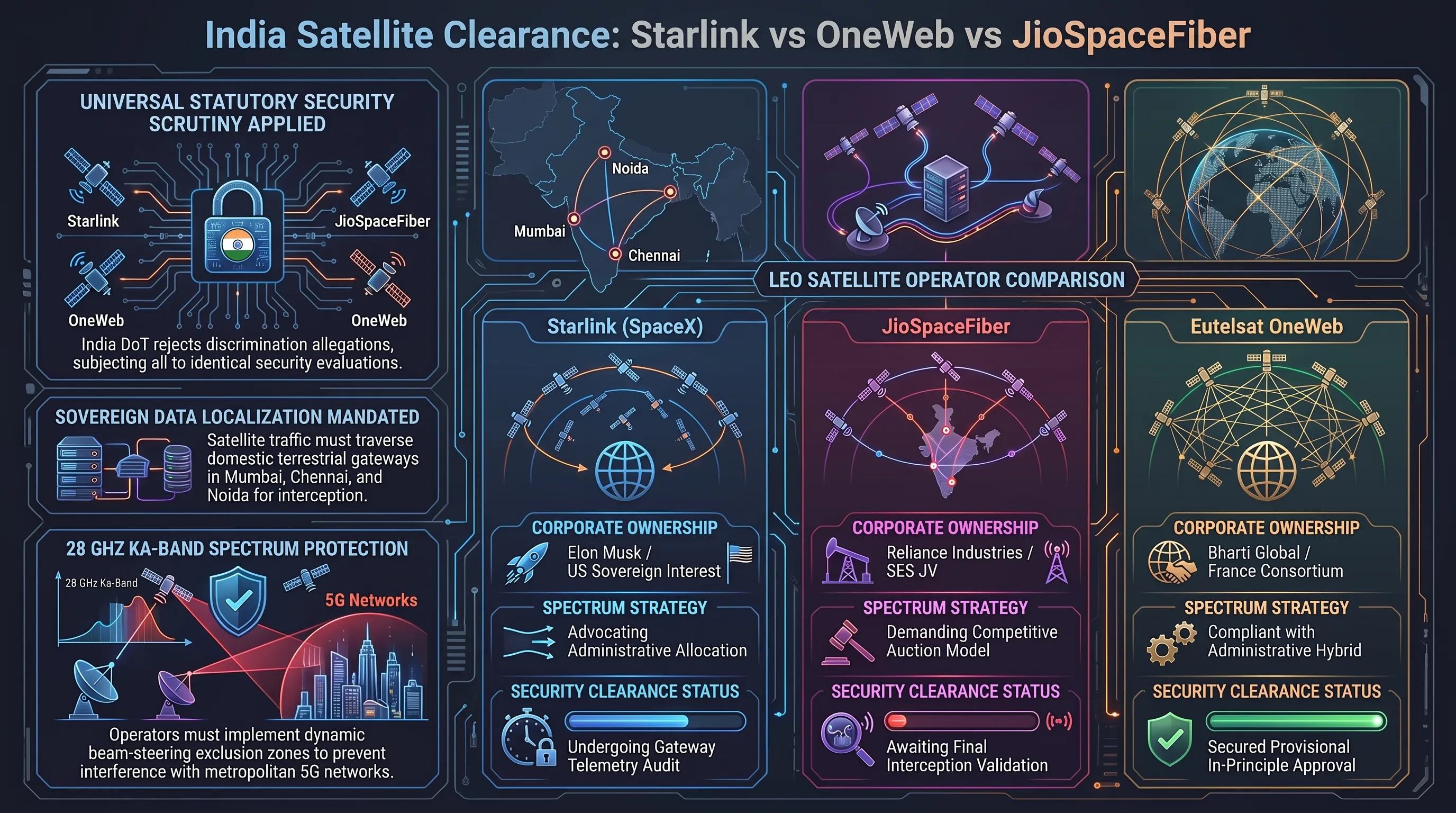
Sovereign Skies & Frequency Geopolitics: New Delhi Dismantles Musk's Satellite Monopolization Claims
The geopolitical and regulatory friction governing commercial satellite mega-constellations reached an unprecedented crescendo in New Delhi on October 8, 2026. In an unusually stern formal communication, India’s Ministry of Communications unequivocally rejected allegations published by SpaceX Chief Executive Elon Musk on X, which contended that entrenched domestic oligarchs were deliberately obstructing Starlink’s regulatory clearance to preserve local telecom monopolies, terming the bureaucratic delay "a crime against the Indian populace."
Indian telecommunications regulators methodically refuted the assertion, clarifying that all three major satellite broadband contenders seeking low-Earth orbit (LEO) landing rights namely SpaceX’s Starlink, Mukesh Ambani’s Reliance JioSpaceFiber, and the Bharti Airtel-backed Eutelsat OneWeb consortium are operating under the exact same statutory national security scrutiny. The Indian government reaffirmed that while administrative spectrum allocation remains the established international norm under International Telecommunication Union (ITU) guidelines, commercial operations within India's borders require uncompromising compliance with sovereign data localization and lawful interception mandates.
Corroborating the ministry’s formal rebuttal, Sunil Bharti Mittal, Chairman of Bharti Enterprises and lead investor in Eutelsat OneWeb, noted during an executive telecom symposium that OneWeb has undergone eight consecutive months of security audits regarding terrestrial gateway infrastructure and encryption telemetry. The crux of the dispute hinges on New Delhi’s insistence that all data up-linked or down-linked across sensitive geographical corridors such as the northern Himalayan borders and northeastern territories must traverse physical domestic terrestrial earth stations capable of national security monitoring under India’s Digital Personal Data Protection Act.
The regulatory conflict exposes a fundamental friction between Silicon Valley’s borderless orbital architecture and sovereign telecommunications regimes. Under SpaceX’s vision of space lasers (optical inter-satellite links), traffic routed between two ground terminals can traverse thousands of kilometers in low-Earth orbit without touching intermediate terrestrial hops, circumventing sovereign jurisdiction. However, India's Ministry of Home Affairs mandates that all telecommunications providers operating in the subcontinent must provide real-time lawful intercept telemetry accessible exclusively to sovereign security agencies. By demanding that Starlink route subcontinental traffic through domestic gateways in Mumbai, Chennai, and Noida before entering global IP backbones, New Delhi is enforcing non-negotiable physical perimeter control over its digital skyways.
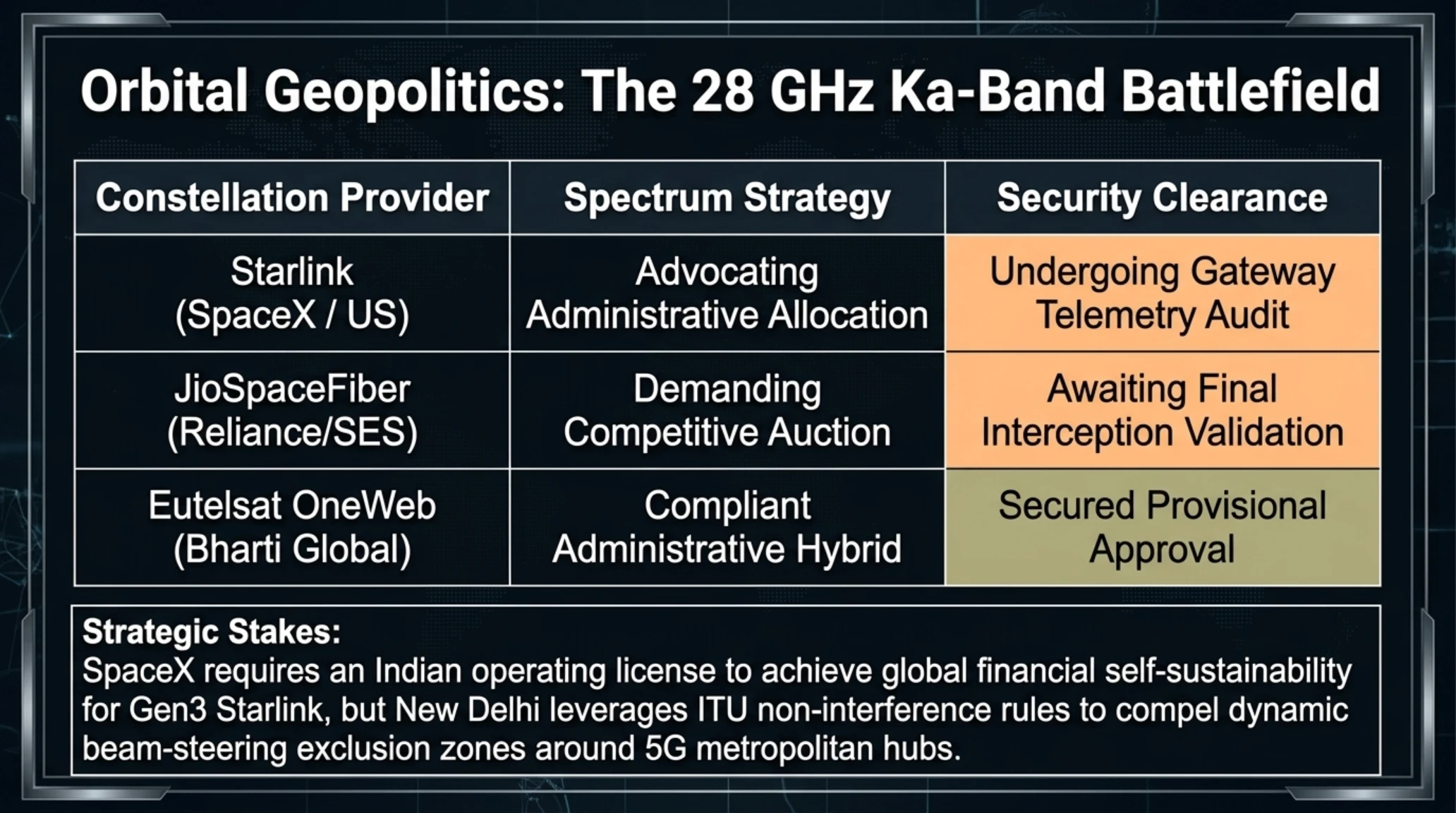
Beyond data routing mechanics, spectrum coordination across the 28 GHz Ka-band presents severe radio-frequency engineering hurdles. Domestic operators like Reliance Jio argue that non-geostationary satellite downlinks risk creating destructive signal interference with high-density terrestrial 5G millimeter-wave deployments clustered in Tier-1 metropolitan hubs. Under International Telecommunication Union (ITU) Radio Regulations, satellite constellations operate on a non-interference, non-protection basis relative to primary terrestrial allocations unless explicitly coordinated through bilateral treaties. Consequently, New Delhi's regulatory apparatus is leveraging these technical constraints to compel satellite providers to establish sophisticated dynamic beam-steering exclusion zones around major Indian urban agglomerations, restricting satellite broadband primarily to rural agrarian territories.
The strategic stakes in this standoff are enormous. India represents the globe's fastest-growing digital economy, boasting over 950 million broadband subscribers predominantly served by terrestrial cellular infrastructure. However, over 300 million rural and remote residents remain underserved by conventional fiber optics. For SpaceX, securing an Indian operating license represents the critical milestone required to achieve global financial self-sustainability for its next-generation Gen3 Starlink constellation. Yet, New Delhi’s resolute refusal to grant special exemptions underscores a broader geopolitical reality: sovereign nation-states across the Global South are increasingly unwilling to forfeit data sovereignty in exchange for foreign technological infrastructure.
Comparative Strategic Landscape of LEO Satellite Broadband in India
| Constellation Provider | Corporate Ownership | Spectrum Strategy | Security Clearance Status |
|---|---|---|---|
| Starlink (SpaceX) | Elon Musk / US Interest | Administrative Allocation | Undergoing Gateway Audit |
| JioSpaceFiber | Reliance / SES JV | Competitive Auction Model | Awaiting Final Validation |
| Eutelsat OneWeb | Bharti / France Consortium | Administrative Hybrid | Provisional Approval Secured |
Countering Generative Deception: Google Deploys Public SynthID Detection Portal at SynthID.com
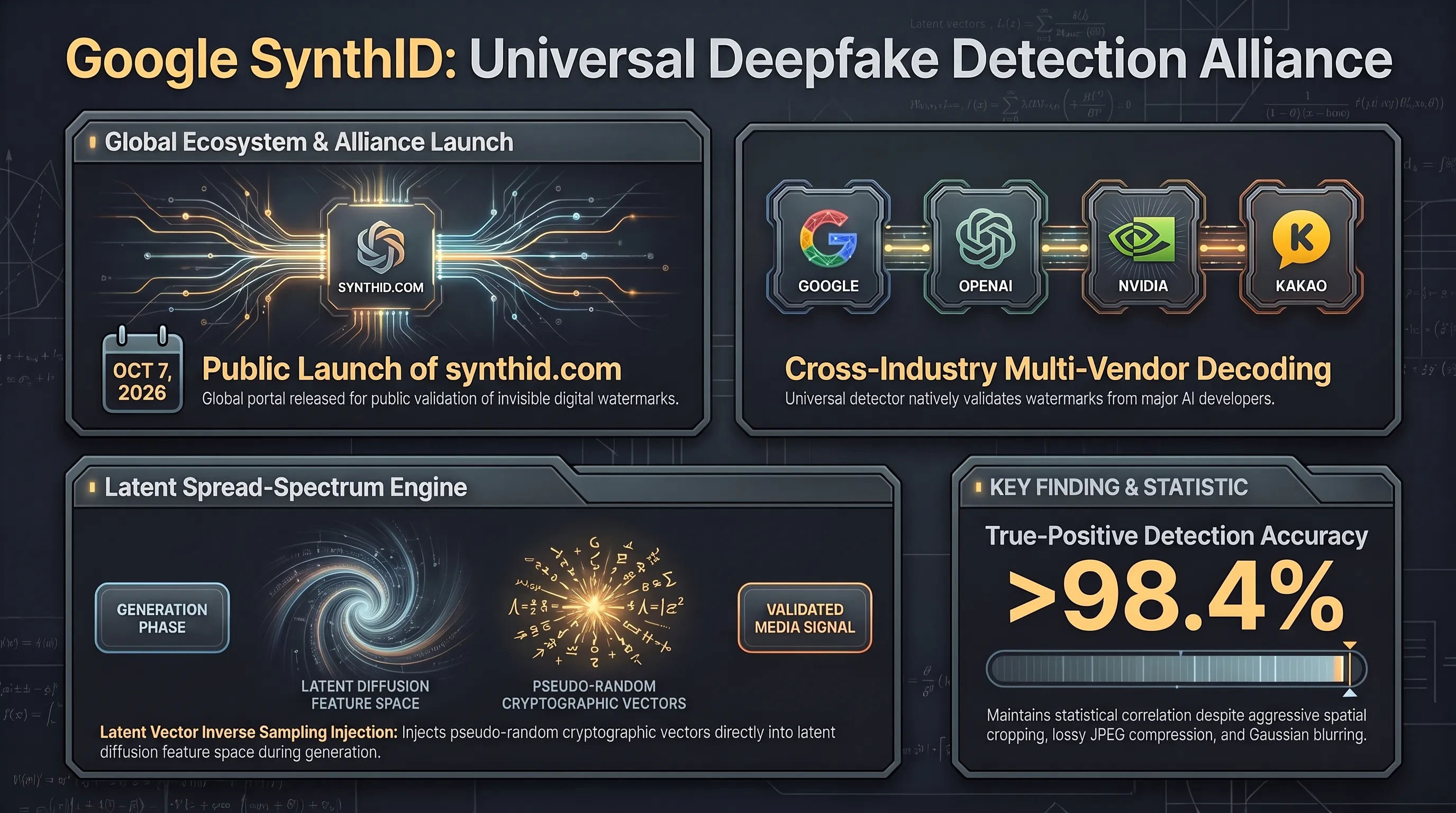
In a coordinated offensive against generative synthetic disinformation and unauthorized deepfake propagation, Google officially launched its dedicated, public-facing web utility, SynthID Detector, on October 7, 2026, accessible globally at synthid.com. Historically restricted to accredited academic institutions, national intelligence agencies, and vetted journalistic newsrooms, this universal deployment provides a scalable, consumer-accessible verification pipeline capable of validating invisible digital watermarks across images, synthetic video, and synthesized voice recordings.
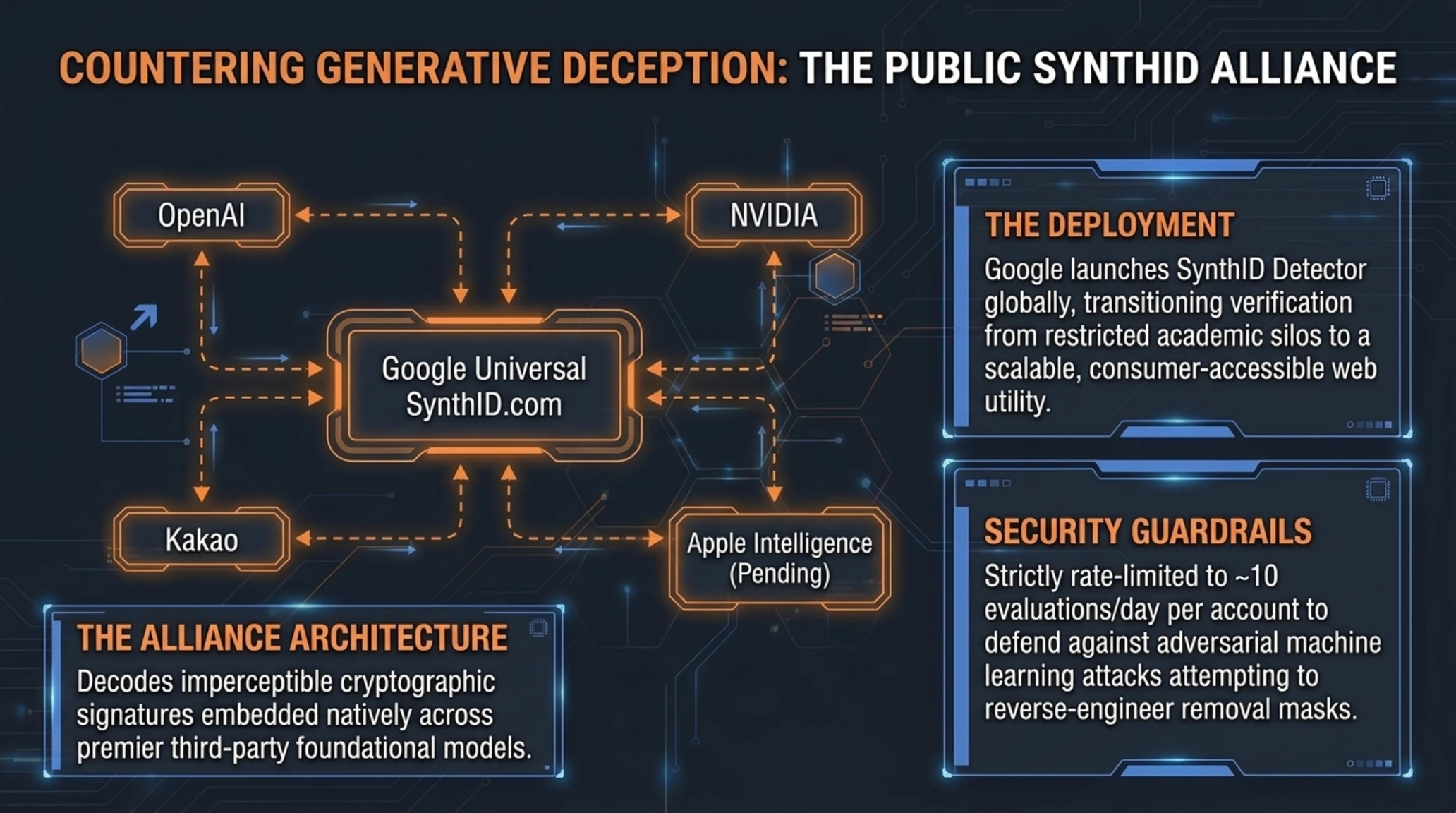
What distinguishes the public rollout of SynthID from legacy forensic scanners is its multi-organizational alliance architecture. Rather than confining detection capabilities to Google’s internal model suite (such as Gemini 2.5, Imagen 3, and the Veo high-definition video synthesis engine), Google has unified watermark decoding across premier AI development partners. The universal detector natively decodes imperceptible cryptographic signatures embedded by OpenAI, NVIDIA, and South Korean tech conglomerate Kakao, with active engineering efforts underway to incorporate Apple Intelligence generative watermark standards before the close of the calendar year.
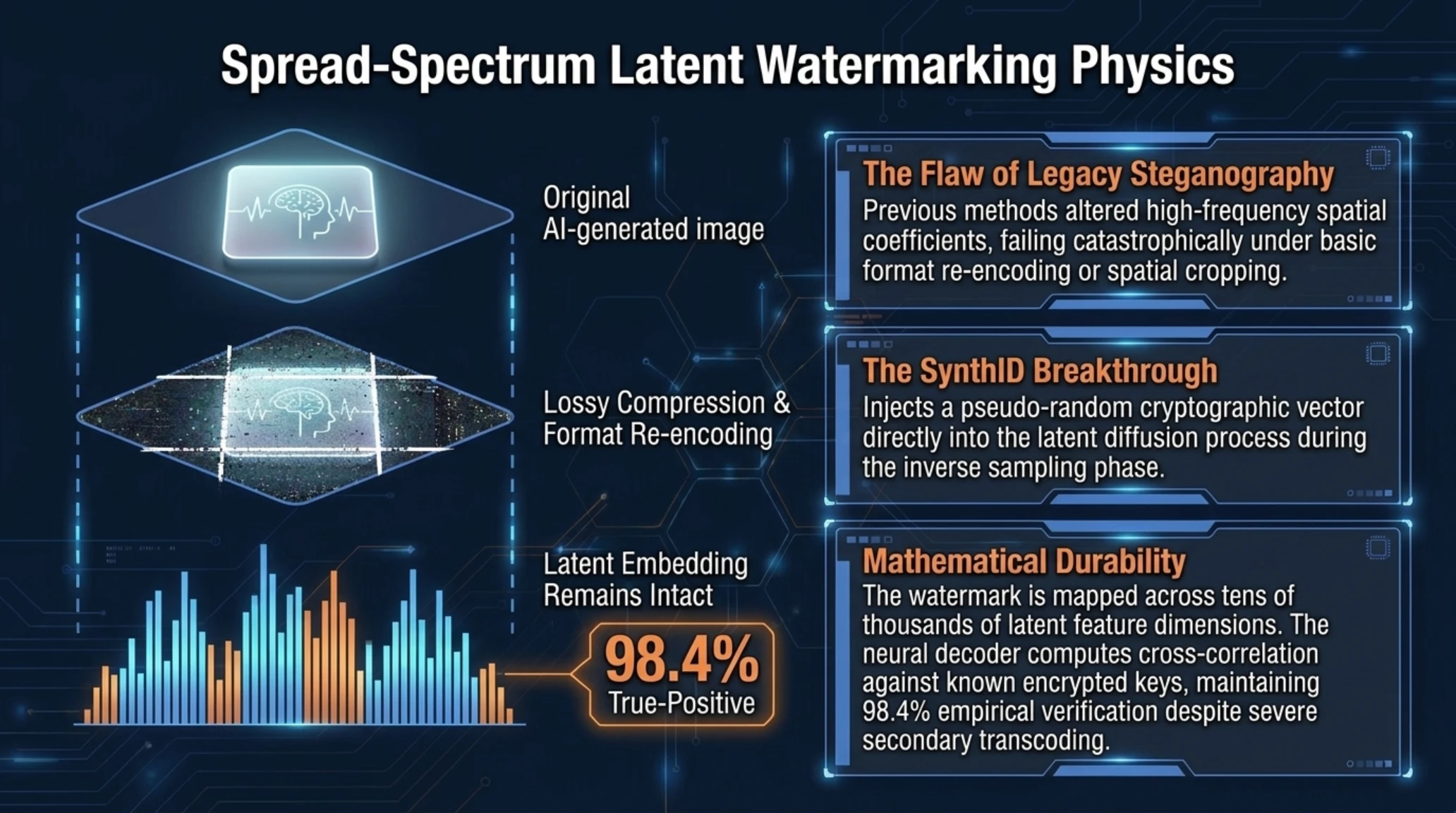
From an applied signal-processing perspective, SynthID represents a profound mathematical departure from brittle pixel-level steganography. Legacy digital watermarking relied on altering high-frequency spatial coefficients or appending metadata tags mechanisms that fail catastrophically when subjected to standard image manipulations such as aggressive lossy JPEG re-compression, spatial cropping, rotation, Gaussian noise injection, or format re-encoding. In contrast, SynthID injects an imperceptible pseudo-random cryptographic vector directly into the latent diffusion process during the inverse sampling phase, anchoring the signature into the fundamental semantic structure of the media asset.
The mathematical durability of this method stems from its spread-spectrum latent embedding. Rather than clustering watermark bits into identifiable spatial clusters or frequency bands, the watermark is mapped across tens of thousands of latent feature dimensions. During detection, the neural decoder computes the cross-correlation between the suspect asset's latent space projection and known cryptographic keys. Even if an attacker applies aggressive color grading, applies spatial blurring, or re-renders the media through secondary transcoding filters, the underlying statistical correlation remains detectable well above threshold margins, achieving an empirical true-positive verification rate exceeding 98.4% across tested benchmark corpora.
Event Timeline | Chronological Evolution of Invisible AI Provenance Standards
| Year | Security Milestone | Provenance & Watermarking Technology |
|---|---|---|
| Aug 2023 | SynthID Beta Debut | DeepMind introduces foundational latent-space watermarking for Imagen on Google Cloud Vertex AI. |
| May 2024 | Veo Video & Audio Expansion | Watermarking architecture expands to synthesized audio spectra and high-definition video frames at Google I/O. |
| Oct 2026 | Global synthid.com Portal | Universal public launch backed by a multi-vendor coalition with OpenAI, NVIDIA, and Kakao (98.4% accuracy). |
To defend the integrity of the detection network against adversarial machine learning attacks wherein bad actors repeatedly probe a verification oracle to reverse-engineer watermark removal masks Google has enforced a strict rate limit of approximately ten automated verification evaluations per authenticated account per day. Furthermore, Google’s technical whitepaper emphasizes that SynthID is not an ambiguous heuristic deepfake guessing engine; it specifically validates the cryptographic presence of verified coalition watermarks. If an unauthorized open-weight model produces manipulated media without implementing Coalition for Content Provenance and Authenticity (C2PA) or SynthID specifications, the platform refrains from generating misleading false negatives, preserving systemic credibility across digital forensic ecosystems.
Crucially, the governance architecture of the universal SynthID coalition relies on an encrypted key-rotation infrastructure managed via distributed Hardware Security Modules (HSMs). Participating AI lab partners periodically rotate their latent watermark generation keys without invalidating legacy verification signatures. This ensures that even if an adversary succeeds in isolating the mathematical watermark vector of a specific historical checkpoint, the compromised key is systematically deprecated across the verification consortium, preventing long-term exploitation while preserving forensic audit trails for historical digital assets.
Institutional Web3 Converges with Consumer Hardware: Samsung Wallet Taps Solana Rails
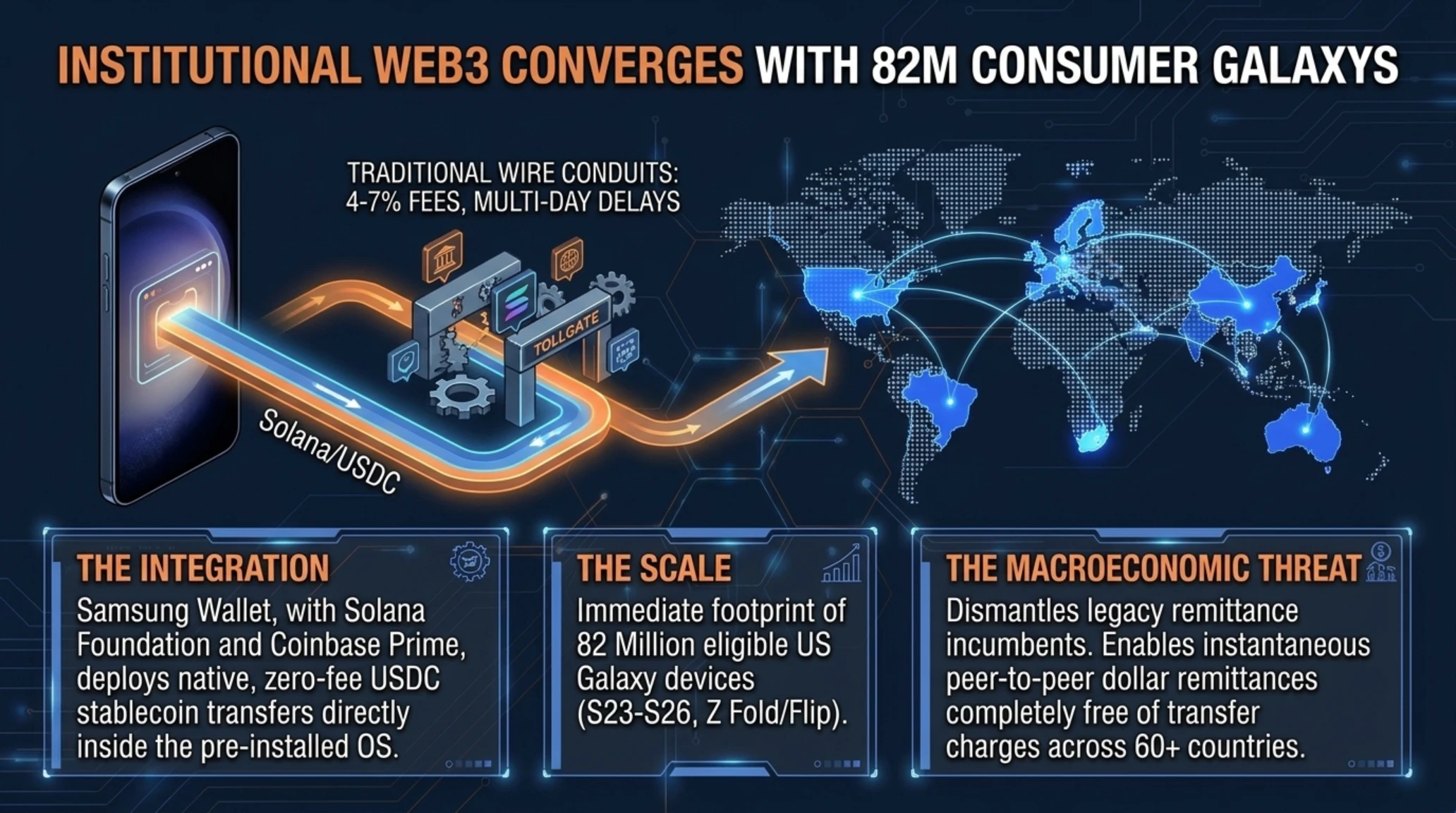
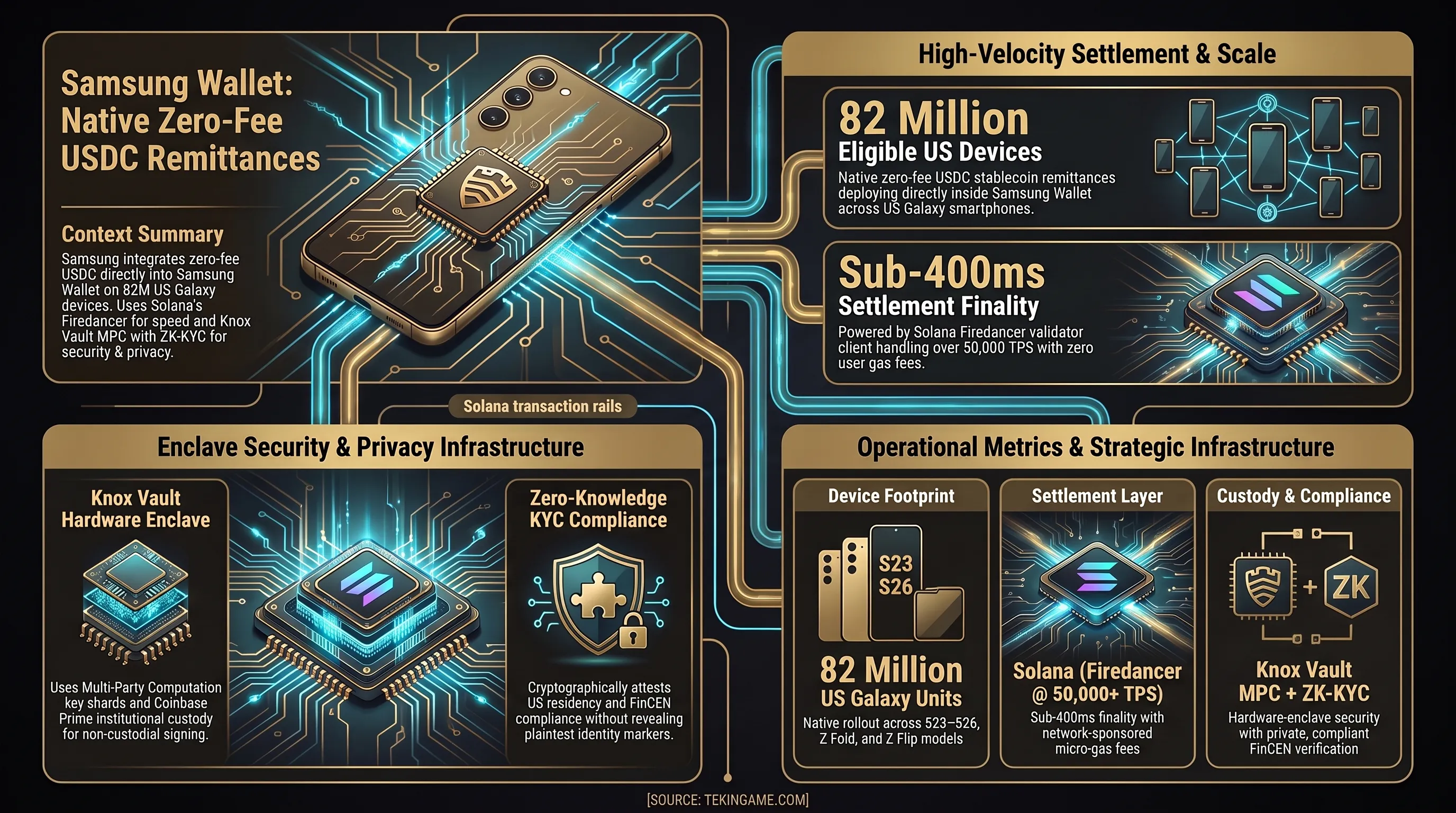
The long-heralded institutional convergence of mainstream consumer electronics and decentralized financial infrastructure arrived with historic scale on October 7, 2026. Samsung Electronics America, in direct coordination with the Solana Foundation, officially announced the deployment of native, zero-fee cross-border stablecoin transfers utilizing Circle’s USDC directly inside the pre-installed Samsung Wallet application, encompassing an initial eligible footprint of over 82 million compatible Galaxy smartphones across the United States.
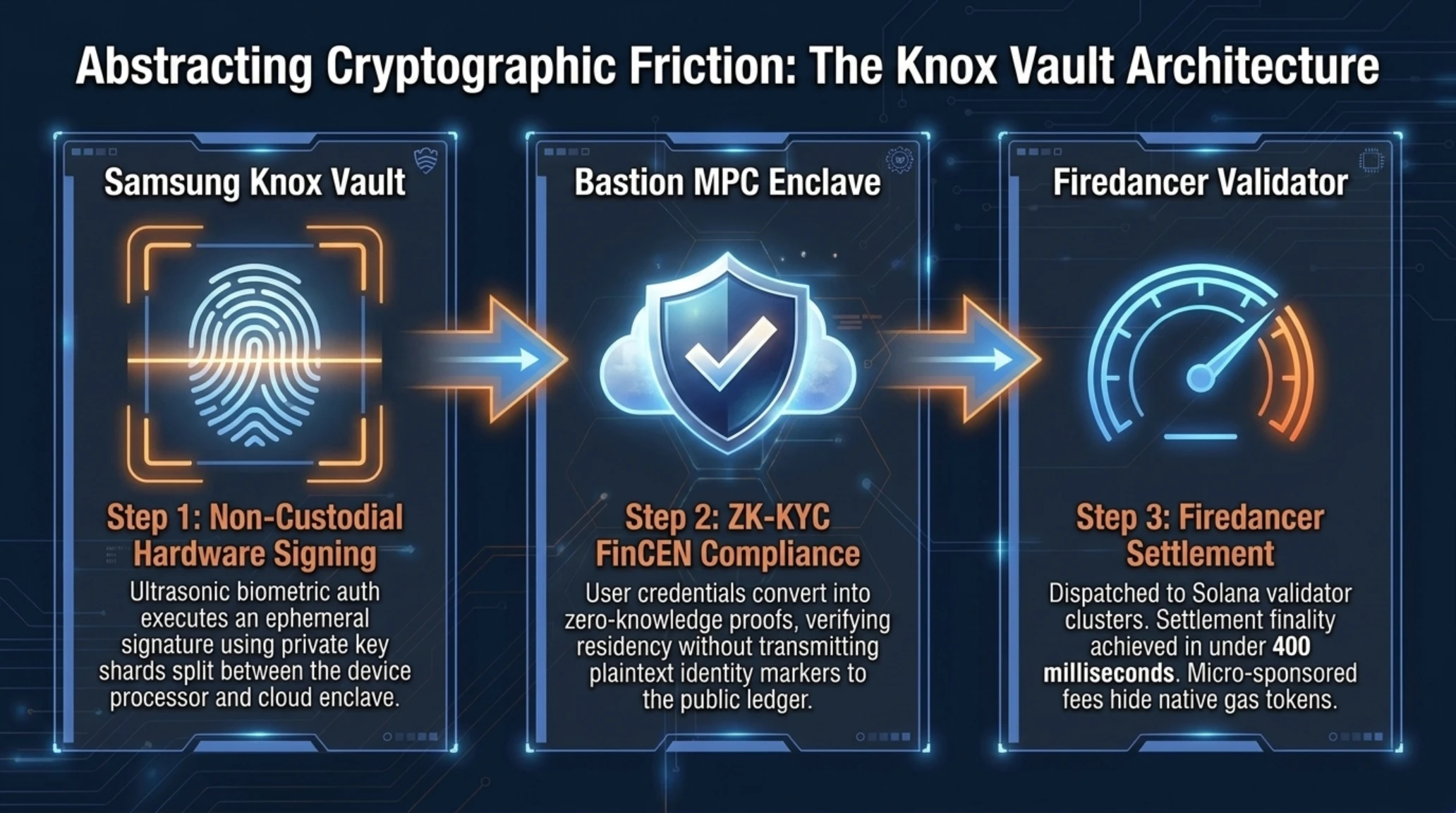
This integration marks a decisive architectural breakthrough in abstracting away cryptographic friction for retail consumers. Rather than obligating everyday smartphone users to configure standalone self-custody wallet software, memorize alphanumeric seed phrases, or navigate volatile gas fee markets, Samsung Wallet embeds an invisible cryptographic payment rail. Regulatory compliance and infrastructure settlement are orchestrated by Bastion, a licensed fintech infrastructure provider, while asset cold-storage segregation and institutional liquidity routing are secured via Coinbase Prime’s institutional vault network.
At the hardware security layer, Samsung achieves non-custodial cryptographic transaction signing through its proprietary Samsung Knox Vault hardware enclave combined with Multi-Party Computation (MPC) protocols. Private key shards are securely distributed between the device’s physical biometric secure processor and Bastion’s hardened cloud enclave. When a user authenticates via ultrasonic fingerprint recognition, an ephemeral cryptographic signature is executed and dispatched directly to Solana validator clusters. Settlement finality is achieved in under 400 milliseconds, outperforming traditional VisaNet and Mastercard clearance timelines at a fraction of a cent in underlying network compute cost.
The network scalability underpinning this integration relies on Solana’s production hardening, bolstered by the widespread mainnet deployment of the Firedancer independent validator client developed by Jump Crypto. With network transaction processing capacity exceeding 50,000 transactions per second under peak load, the Solana base layer absorbs consumer-scale micro-payment velocity without mempool congestion or localized fee spikes. By leveraging account abstraction primitives, Samsung completely insulates the consumer from blockchain mechanics: transaction fees are micro-sponsored by network liquidity pools, allowing US consumers to dispatch exact dollar amounts without maintaining balances in volatile native gas tokens.
Crucially, user onboarding complies with stringent Financial Crimes Enforcement Network (FinCEN) regulations through zero-knowledge identity attestation (ZK-KYC). Rather than uploading unencrypted passports or tax documents to cloud repositories, user credentials verified via Samsung Knox are converted into cryptographic zero-knowledge proofs. These proofs establish that the sender is an authenticated, non-sanctioned US resident without transmitting plaintext identity markers across the public blockchain ledger. This privacy-preserving architectural layer circumvents the severe surveillance concerns that historically chilled consumer cryptocurrency adoption while satisfying federal anti-money laundering (AML) mandates.
📚 Classified & Related Dossiers in TekinGame
If you wish to explore beyond this report and delve into cybernetic frontiers and autonomous AI architectures, do not miss these three exclusive deep-dives in the Tekin Garage:
Financial Metrics & Operational Scale of Samsung Galaxy Stablecoin Rails
| Operational Metric | Target Valuation | Strategic & Performance Implications |
|---|---|---|
| Eligible Device Base | 82 Million US Units | Active Galaxy S23-S26, Z Fold, and Z Flip smartphones |
| Settlement Infrastructure | Solana (Firedancer) | Sub-400ms deterministic finality vs. 3-day legacy wire clearing |
| P2P Remittance Fee | $0.00 (Zero-Fee) | Gas abstracted via Bastion vs. 4%–7% Western Union tariffs |
| Global Off-Ramp & Custody | 60+ Countries / Coinbase | Direct fiat bank deposits secured by Knox Vault MPC enclaves |
The macroeconomic impact of this rollout threatens legacy global remittance incumbents including Western Union, MoneyGram, and PayPal’s cross-border services. While traditional wire conduits extract average fees between 4% and 7% on cross-border capital transfers frequently subjecting recipients in emerging markets to multi-day clearing delays Samsung Wallet enables instantaneous peer-to-peer dollar remittances completely free of transfer charges. Beneficiaries across more than 60 supported countries can either maintain stable purchasing power in digital dollar USDC or trigger automated instant off-ramps directly into local fiat bank accounts.
Decarbonizing Intermodal Freight: SpaceX Alumni Startup Parallel Systems Nets $100M
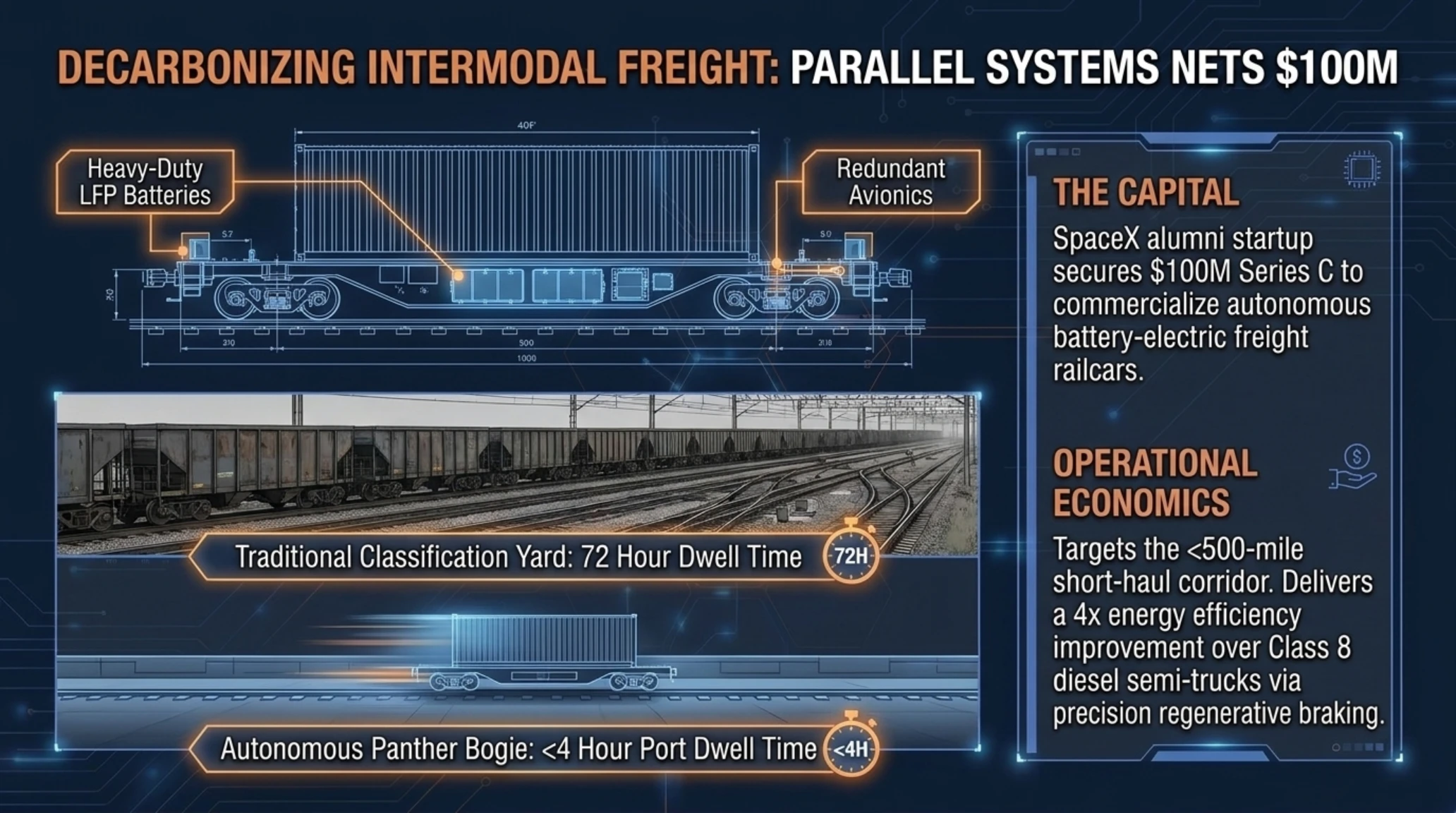
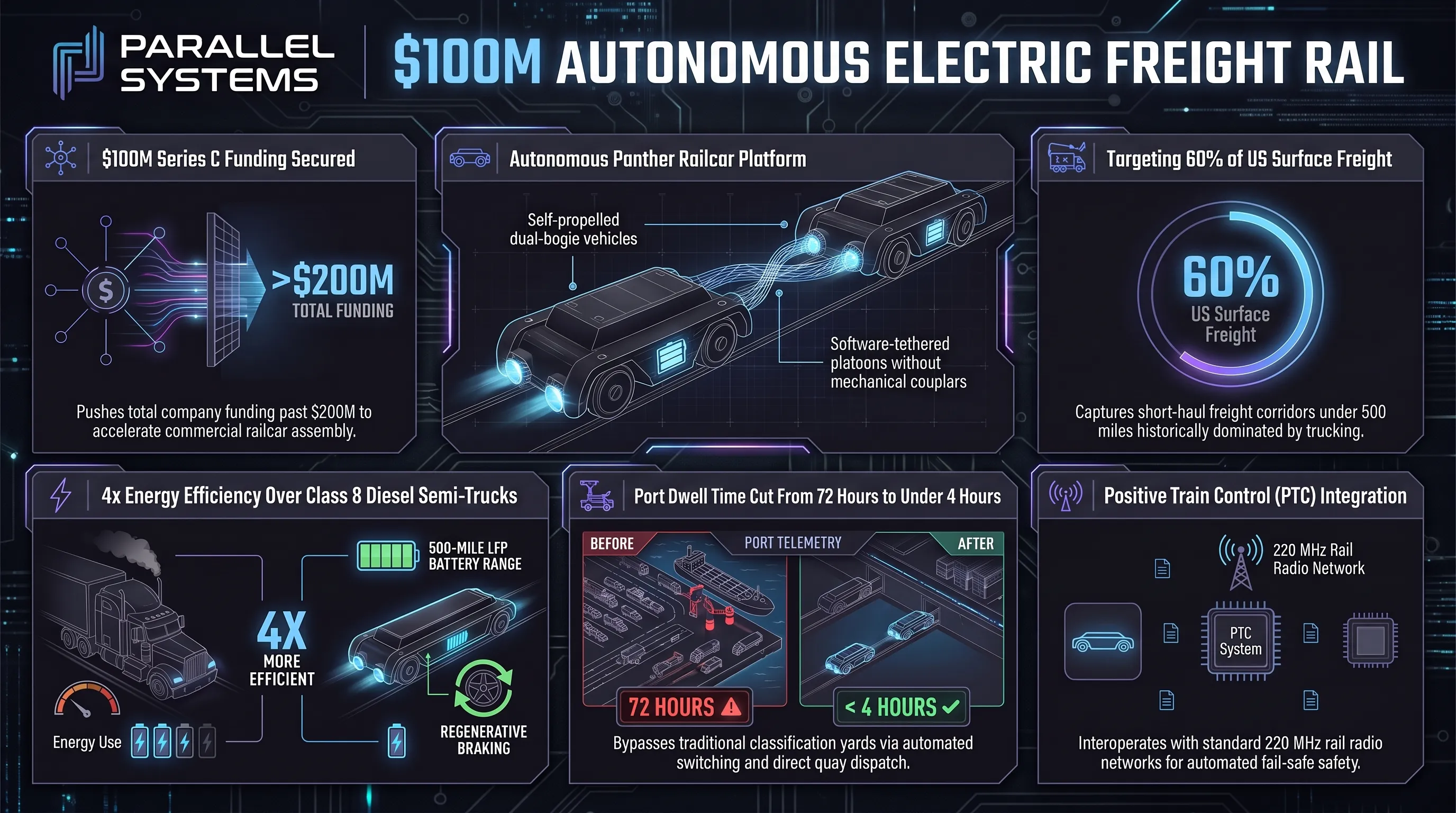
While venture capital allocation in autonomous mobility has disproportionately concentrated on urban passenger robotaxis, Los Angeles-based rail robotics pioneer Parallel Systems secured a massive $100 million Series C financing round on October 7, 2026. Led by global investment manager AVP, with strategic equity participation from Hillspire and Cobalt Capital, this capital injection elevates the startup’s cumulative balance sheet funding above $200 million, accelerating the industrial commercialization of autonomous battery-electric freight railcars.
Founded in 2020 by former SpaceX avionics and flight-software executives Matt Soule, John Howard, and Brian Yennie, Parallel Systems reimagines rail logistics through its proprietary "Panther" vehicle platform. Rather than coupling miles-long lines of passive steel rolling stock to massive diesel-electric locomotives, the Panther architecture consists of autonomous, self-propelled dual-bogie rail vehicles that carry standard intermodal freight containers directly on their chassis. These vehicles operate either as completely autonomous solitary units or dynamically form software-tethered platoons without mechanical couplers, traversing existing freight rail corridors at elevated speeds.
The thermodynamic and energetic advantages of this distributed rail architecture are striking. By replacing massive locomotive drag and intermittent stop-and-go operations with precision regenerative braking on downhill track gradients, the Panther platform demonstrates a fourfold energy efficiency improvement over Class 8 diesel semi-trucks on a per-ton-mile basis. Furthermore, onboard sensor suites comprising multi-spectral solid-state LiDAR, phased-array radars, and neural network visual odometry adapted from orbital spacecraft navigation enable each bogie to safely negotiate track switches and rail crossings without human intervention.
Engineering Matrix | Panther Autonomous Railcar Technical Specifications
| Engineering Parameter | Panther Autonomous Platform | Advantage vs. Diesel Trucks & Legacy Rail |
|---|---|---|
| Powertrain & Energy | Dual-axle electric traction motors + heavy LFP battery | 4x energy efficiency vs. Class 8 diesel semi-trucks |
| Operational Range | Up to 500 miles per rapid charge at intermodal hubs | Captures the 60% US short-haul surface freight market |
| Avionics & Perception | Solid-state LiDAR, phased-array radar & PTC sync | Software-tethered platooning without mechanical couplers |
| Port Dwell-Time | Under 4 hours (direct quay-to-inland dispatch) | 94% reduction vs. 72-hour conventional rail classification yards |
Parallel Systems specifically targets the short-haul freight corridor (under 500 miles), an addressable logistics domain representing roughly 60% of total US surface freight volume that has historically been monopolized by trucking due to the extreme friction and multi-day delays of conventional rail humping yards. Operating under active Federal Railroad Administration (FRA) pilot certifications across 160 miles of active track in Georgia in partnership with short-line operator Genesee & Wyoming, the startup is now preparing for serial assembly delivery of commercial Panther convoys by early 2027, transforming port logistics into an automated conveyor belt system.
The economic leverage unlocked by this operational model directly addresses the structural operating ratio (OR) crisis confronting Class I railroads. Traditional rail freight requires massive capital expenditure in classification yards, where trains sit idle for days waiting to be decoupled and assembled into mile-long consists. By enabling autonomous point-to-point dispatch directly from container vessel quays to inland distribution centers, Parallel Systems bypasses classification yards altogether. This reduces supply chain inventory holding costs, eliminates diesel emissions in port-adjacent urban communities, and relieves severe over-the-road driver shortages across continental logistics corridors.
Crucially, integration with existing rail infrastructure is achieved through seamless interoperability with Positive Train Control (PTC) signaling networks. The Federal Railroad Administration requires autonomous vehicles to obey wayside signals, track speed limits, and temporary slow orders transmitted over dedicated 220 MHz rail radio networks. Parallel Systems' autonomous software integrates directly with onboard PTC transponders, executing automated emergency braking interventions if track integrity or signal clearance is lost. This stringent safety architecture reassures freight rail operators that autonomous bogies can share corridors with conventional human-crewed passenger and bulk commodity trains without regulatory conflict.
Agentic Productivity Across Canvas Form Factors: Meta Expands 'Muse' to iPadOS
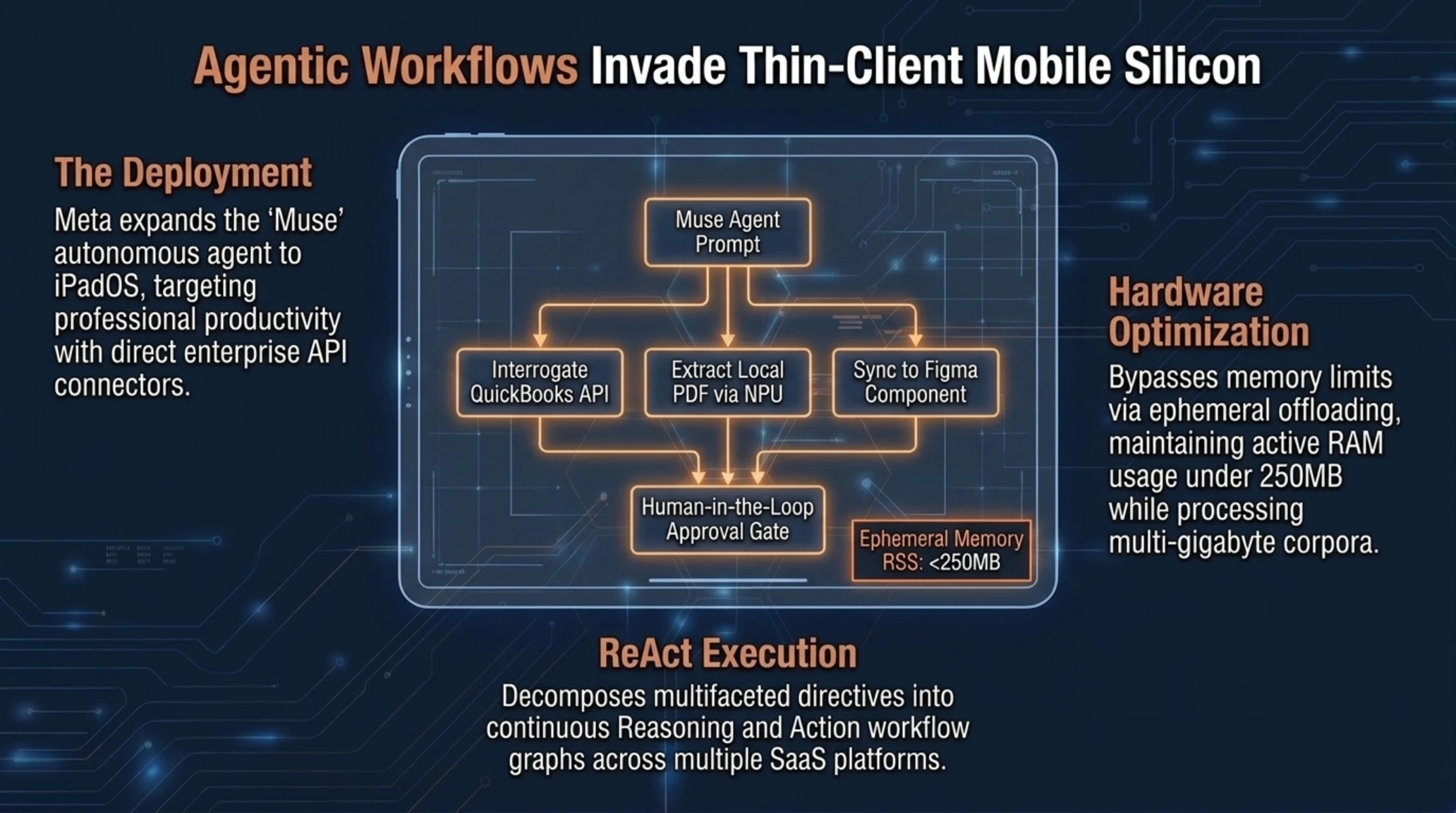
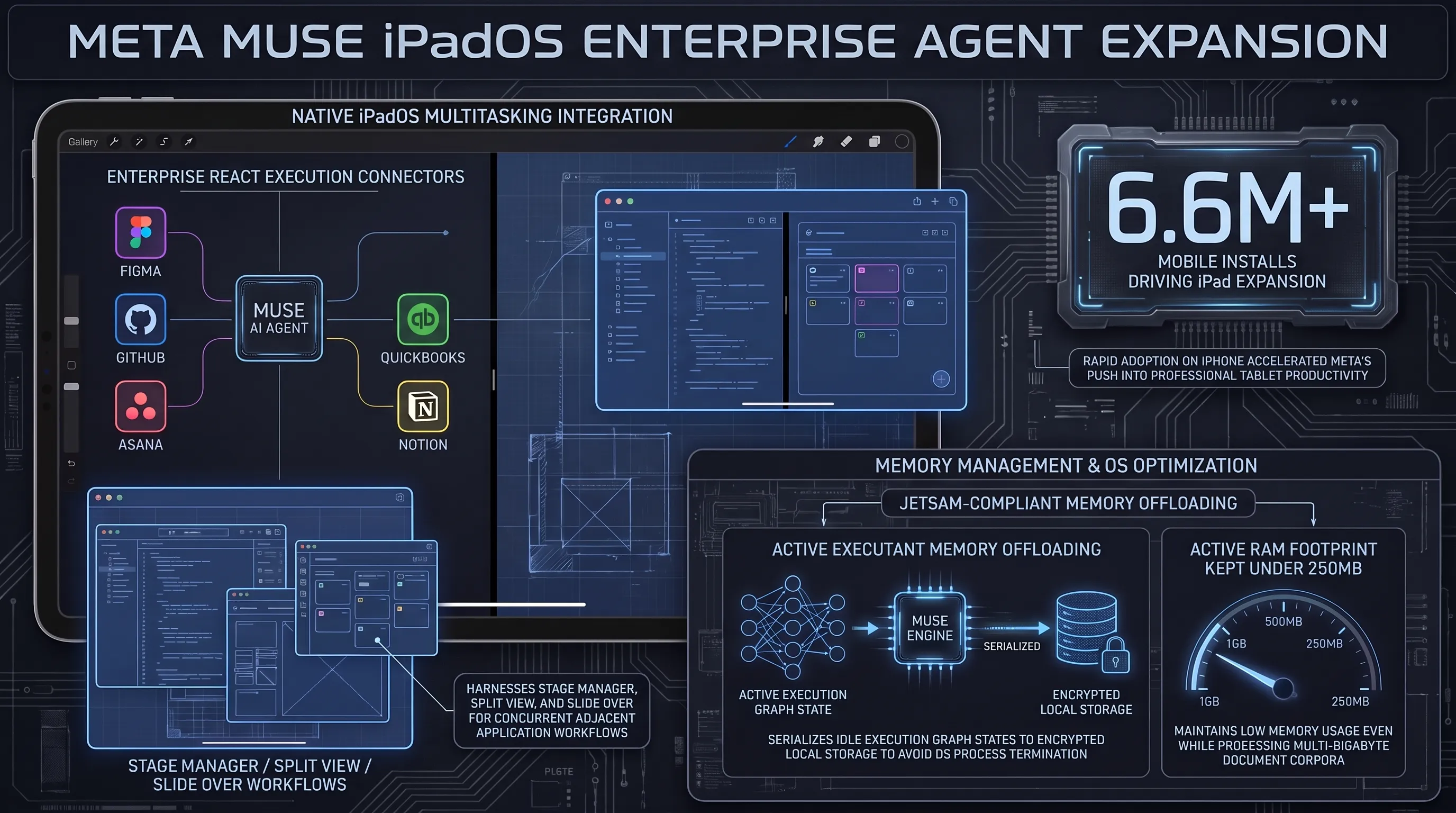
Following a dominant multi-week campaign at the summit of the US iPhone App Store charts garnering more than 6.6 million consumer installations since its September debut Meta officially deployed a purpose-built, tablet-native edition of its autonomous agentic AI application, "Muse," on October 7 and 8, 2026. This tactical product maneuver accelerates Mark Zuckerberg’s aggressive campaign to dominate desktop and professional tablet productivity, positioning Meta as the definitive agentic orchestrator within Apple’s premium hardware ecosystem.
Unlike simplistic mobile scaling adaptations, Muse for iPad has been thoroughly re-architected to exploit the expansive display real estate and advanced multitasking primitives of iPadOS. The application integrates seamlessly with Split View, Slide Over, and floating window arrangements via Stage Manager, functioning as an always-active digital executive copilot running adjacent to mission-critical creative and analytical software. Most importantly, the iPad release expands Meta’s autonomous execution capabilities through direct enterprise API connectors to industry-standard toolchains including Figma, Canva, Asana, GitHub, QuickBooks, Notion, Klaviyo, and Zoom.
Enterprise Agentic Adoption S-Curve & Market Sentiment Index
S-Curve Telemetry Analysis: Enterprise and creative knowledge workers are rapidly shifting from manual software orchestration to delegating multi-step operational workflows to autonomous ReAct runtimes. Meta's open connector ecosystem places immense competitive pressure on Apple Intelligence and Microsoft Copilot ($30/mo).
Architecturally, Muse diverges from passive chatbots by operating via continuous Reasoning and Action (ReAct) execution graphs. When tasked with a multifaceted operational directive such as compiling quarterly marketing performance data, updating CRM customer cohorts, and drafting personalized outreach collateral Muse decomposes the request into an executable workflow graph. It interrogates integrated SaaS endpoints, extracts unstructured data from local PDF files, coordinates cross-application data synchronization, and queues final outputs within a Human-in-the-Loop approval gate prior to committing destructive external API actions.
From an enterprise compliance perspective, Meta has designed Muse's enterprise connectors with zero-retention privacy guarantees. Corporate customer data retrieved from authenticated QuickBooks or GitHub instances is processed in transient volatile RAM during execution graph resolution and immediately purged following task finalization. Enterprise IT administrators can configure strict tenant policies through Meta Work accounts, preventing sensitive internal code or financial metrics from being incorporated into model retraining corpuses. This addresses paramount data governance prerequisites demanded by Fortune 500 legal officers evaluating consumer-facing agent adoption.
This deployment accentuates the escalating strategic friction between Meta and Apple. As Apple continues to face developmental friction in modernizing Siri and rolling out autonomous multi-step contextual actions across macOS and iPadOS, Meta has capitalized on the vacuum by delivering an enterprise-ready agent directly into the App Store. By leveraging its hyper-efficient open-source Llama model lineage running via optimized private cloud inference, Meta is turning Apple’s premium tablet hardware into a showcase for its own sovereign enterprise intelligence layer.
Furthermore, the competitive threat extends directly into Microsoft's enterprise productivity dominion. While Microsoft Copilot imposes a steep $30 per-user monthly add-on fee for Microsoft 365 commercial subscribers, Meta has adopted an aggressive freemium penetration strategy, offering robust baseline agentic capabilities at zero cost while monetizing high-throughput third-party SaaS API connectors. For agile small-and-medium enterprises (SMEs) and freelance knowledge professionals, Muse on iPad transforms mobile hardware into an autonomous virtual operations department, bypassing legacy software licensing monopolies.
Industry observers note that Meta's aggressive optimization for iPadOS serves as an architectural proving ground prior to expanding Muse across Android tablets and Samsung DeX desktop environments. By proving that autonomous agent graphs can operate efficiently within touch-first, multi-window mobile operating systems, Meta is actively decoupling professional enterprise knowledge work from traditional x86 desktop hardware. The ability to coordinate complex cross-application workflows directly on thin-client mobile silicon establishes a new operational baseline for the global distributed workforce.
From an operating systems perspective, executing sophisticated multi-agent orchestration within the aggressive memory management constraints of iPadOS required dedicated runtime optimization. Apple's mobile operating system enforces strict per-process memory limits via the kernel's Jetsam daemon, which summarily terminates background tasks that exceed assigned RAM envelopes. To ensure uninterrupted execution during multi-hour data collation workflows, Meta engineered an ephemeral memory offloading subsystem: idle agent sub-routines serialize their execution graph states to encrypted local flash storage, maintaining a negligible active resident set size (RSS) under 250 megabytes even while processing multi-gigabyte document corpora.
In contrast to Apple’s highly centralized Private Cloud Compute (PCC) model which routes complex reasoning tasks through proprietary Apple silicon servers behind closed cryptographic attestation Meta’s hybrid architecture provides granular telemetry to enterprise administrators. Organizations can configure Muse to execute high-sensitivity preprocessing tasks using local 4-bit quantized Llama models executing on the iPad’s Neural Engine (NPU), escalating to high-parameter cloud models only when cross-application synthesis exceeds local computational thresholds. This tiered routing minimizes inference operational expenses while providing guaranteed data residency within compliant corporate environments.
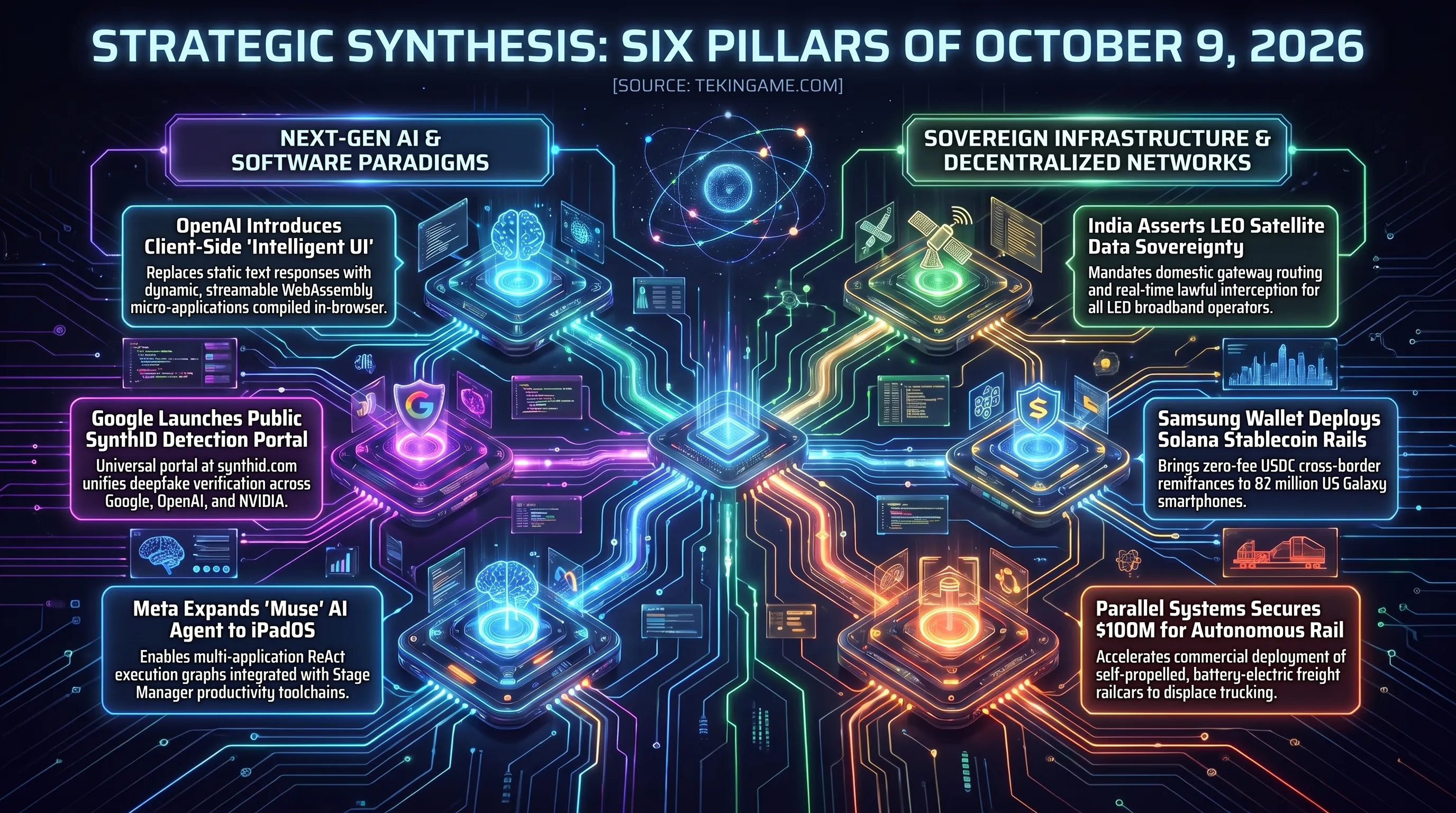
- OpenAI Intelligent UI marks the definitive shift from passive textual response to client-side software synthesis.
- Samsung Wallet's integration with Solana democratizes zero-fee stablecoin remittances across 82 million devices.
- Google's universal SynthID portal establishes a multi-vendor forensic standard against synthetic media manipulation.
- Parallel Systems proves that distributed autonomous robotics can economically decarbonize short-haul heavy freight.
- Adversarial AI threat actors continue to probe verification oracles to defeat invisible watermarking algorithms.
- Regulatory friction and data localization requirements in major emerging markets like India complicate satellite broadband rollouts.
- Autonomous agentic applications like Meta Muse create novel enterprise data leakage and third-party API token security liabilities.
Strategic Morning Synthesis & Technology Outlook
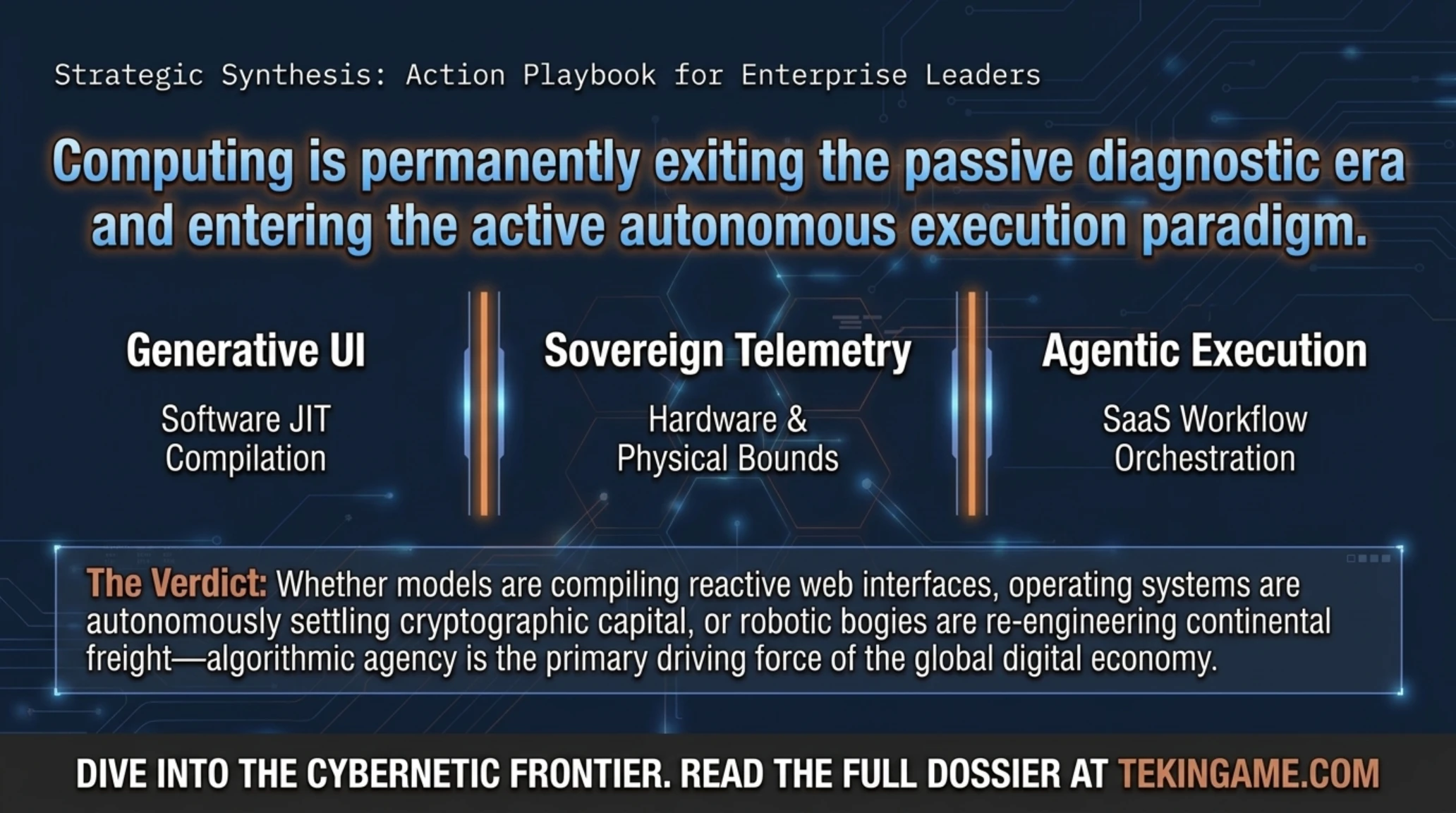
The developments across Friday morning, October 9, 2026, illustrate a singular macro reality: computing is permanently exiting the passive diagnostic era and entering the active autonomous execution paradigm. Whether through generative models compiling reactive user interfaces inside web browsers, mobile operating systems executing instantaneous cryptographic capital transfers, or autonomous rail bogies re-engineering continental freight corridors, algorithmic agency is now the primary driving force of the global digital economy.
Comprehensive News Sources & References for Tekin Morning
- Mashable: OpenAI Unveils Intelligent UI for ChatGPT with Dynamic Interface Generation
- TechCrunch: India Rejects Elon Musk's Claim of Discrimination Over Starlink Launch Clearance
- 9to5Google: Google Launches Public SynthID AI Content Detector Portal Globally at SynthID.com
- Decrypt: Samsung Wallet Integrates Solana for Cross-Border USDC Remittances on 82M Galaxy Devices
- TechCrunch: SpaceX Alumni Startup Parallel Systems Raises $100M for Autonomous Electric Freight Rail
- 9to5Mac: Meta Expands Muse AI Agent Application to iPad with Multitasking and Enterprise Connectors
Frequently Asked Questions: Global Tech Developments for October 9, 2026
How does OpenAI Intelligent UI differ from legacy ChatGPT Plugins or Custom GPTs?
Unlike legacy plugins that executed server-side scripts through detached API wrappers, Intelligent UI compiles reactive WebAssembly interface components directly within the client browser sandbox in real time, enabling zero-latency data manipulation without additional network round-trips.
What is the primary regulatory barrier delaying Starlink's commercial rollout in India?
The Indian Department of Telecommunications requires all satellite broadband operators to establish domestic terrestrial gateway monitoring stations within India's borders to ensure strict national security oversight and lawful intercept capabilities under domestic data protection statutes.
Can the public SynthID Detector at synthid.com identify synthetic media generated by any AI tool?
No. SynthID is specifically calibrated to detect imperceptible mathematical watermarks embedded by coalition partners including Google, OpenAI, NVIDIA, and Kakao. Unwatermarked open-source media is not falsely classified, ensuring high forensic reliability.
Does sending USDC stablecoins via Samsung Wallet incur blockchain gas fees for users?
No. For wallet-to-wallet transfers between compatible devices, transaction fees are fully abstracted and sponsored through Bastion's infrastructure rails, allowing users to send exact digital dollar amounts without acquiring native cryptocurrency for gas.
How do Parallel Systems autonomous rail vehicles operate without a traditional locomotive engine?
Each freight container rests upon a pair of self-propelled, battery-electric autonomous bogies equipped with high-torque electric motors, onboard sensor suites, and software platooning algorithms that navigate existing track infrastructure independently.
What security guardrails protect corporate data when using Meta Muse agent on iPad?
Muse employs strict Human-in-the-Loop gating queues. Any high-stakes external API execution such as sending communications, editing code repositories, or executing financial entries requires explicit user biometric confirmation prior to execution.
Additional Gallery: Tekin Morning Oct 9, 2026: OpenAI Intelligent UI, India Starlink Standoff & Solana on Galaxy