☀️ Tekin Morning | Tuesday August 18, 2026
From Gezine's Nintendo Switch 2 userland exploit and PSN 2FA support bypasses to Valve's CEVA logistics data breach and a 24-billion password leak.
- 🎮Switch 2 Userland Exploit- Gezine achieves ARM64 ROP execution
- 🎧PSN Support 2FA Bypass- Social engineering compromises accounts
- 🚀Valve CEVA Logistics Leak- Steam hardware customer data exposed
- 🗡️24-Billion Password Leak- Massive credential database discovered
- 📰Arista CVSS 10.0 Flaw- Critical SD-WAN command injection
- ⚔️N-able Zero-Day Attacks- MSP infrastructure under siege
Welcome to this high-stakes morning edition of Tekin Morning for Tuesday, August 18, 2026. As the international cybersecurity and interactive gaming ecosystems enter mid-week operations, an extraordinary sequence of hardware vulnerability disclosures, enterprise supply chain breaches, and authentication flaws has gripped global headlines. From the first verified userland exploit on Nintendo Switch 2 to severe social engineering vulnerabilities in Sony's PlayStation Network support and the exposure of a 24-billion credential database, today's intelligence is of paramount importance.
In this comprehensive technical briefing, the Tekin Game editorial board examines the six defining cybersecurity earthquakes of the morning, providing detailed technical breakdowns and actionable mitigation blueprints.
Core Takeaways of Tekin Morning August 18, 2026
- Renowned security researcher Gezine demonstrating the first native ARM64 ROP userland exploit on retail Nintendo Switch 2 hardware
- Social engineering vulnerabilities in Sony PlayStation Network customer support enabling complete 2FA account takeovers
- Valve issuing urgent warnings to European Steam Deck and hardware customers following a severe cyber breach at CEVA Logistics
- Cybersecurity researchers uncovering an unauthenticated cloud database containing 24 billion aggregated plaintext credentials
- CISA issuing emergency operational directives regarding a CVSS 10.0 unauthenticated remote command injection flaw in Arista VeloCloud SD-WAN
- Critical zero-day vulnerabilities in N-able N-central threatening managed service providers (MSPs) with widespread remote code execution
Earthquake in Nintendo's Camp: Gezine Unveils the First Switch 2 Userland Exploit
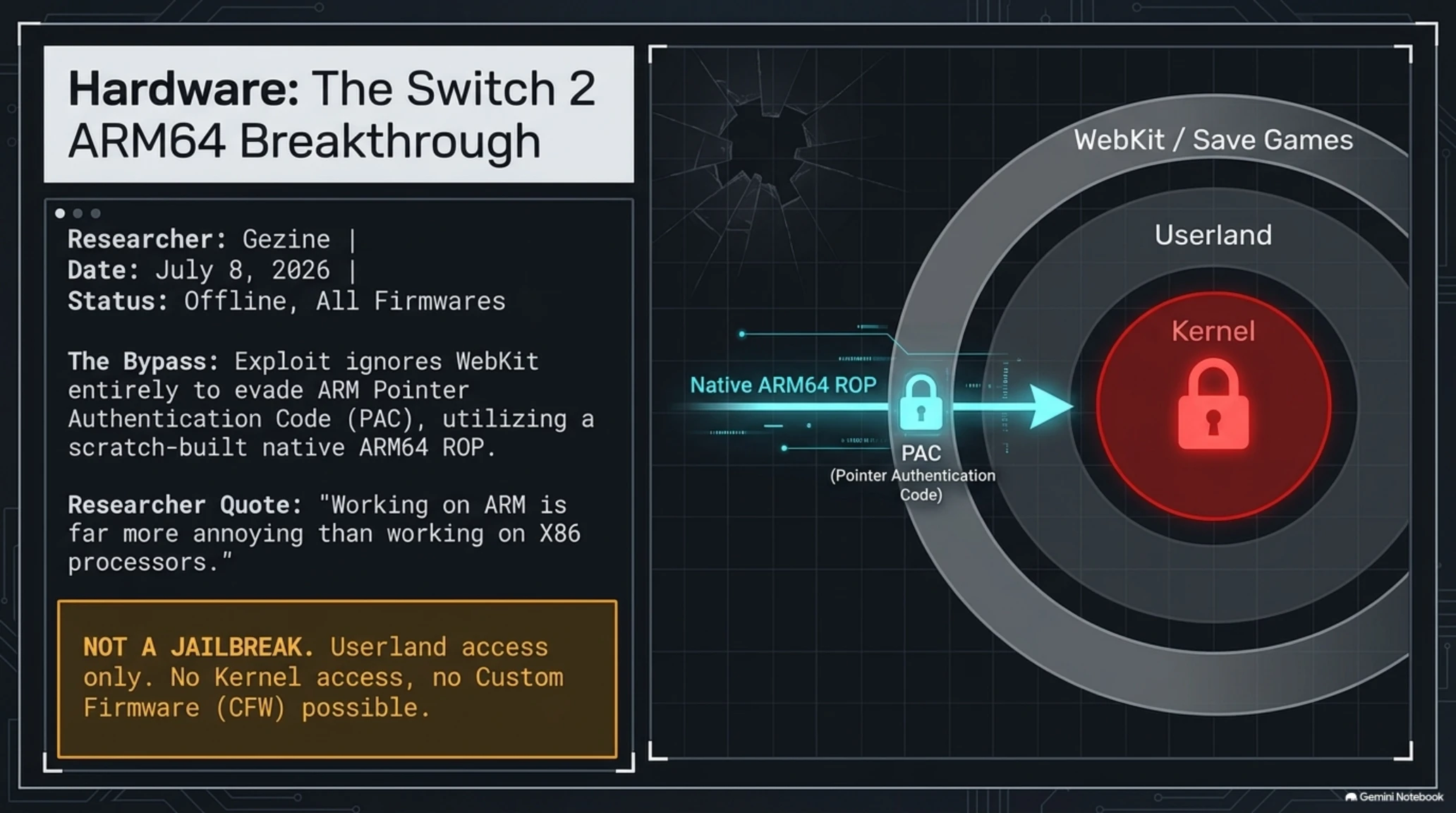
The console security and hardware reverse-engineering landscape experienced a historic milestone early this morning. Renowned PlayStation security researcher Gezine (widely acclaimed for foundational exploits on PlayStation 4 and PlayStation 5) published proof of concept and technical documentation confirming the first userland exploit running natively on Nintendo Switch 2. This represents the first time a premier PlayStation security researcher has successfully breached the defensive perimeters of Nintendo's latest hardware.
According to technical analysis by Eurogamer, Nintendo implemented hardware-enforced Pointer Authentication Code (PAC) mechanisms across the Switch 2's custom Nvidia silicon to neutralize traditional WebKit browser Return-Oriented Programming (ROP) attack chains. However, Gezine engineered a custom, fully offline ARM64 ROP implementation that operates independently of WebKit, executing arbitrary userland instructions across all current commercial firmware versions.
Pivotal technical insights and architectural ramifications include:
- Complete independence from Nintendo Switch Online cloud sync services, requiring zero network connectivity or modified save files
- Flawless offline execution of the ROP payload chain, displaying confirmation strings on genuine retail Switch 2 hardware
- Exploit execution remains strictly confined to userland privilege rings, with zero kernel read/write access or custom firmware (CFW) capabilities
- Validating the robust defensive capabilities of Nvidia's custom silicon against legacy browser-based execution vectors
- Igniting an intense international race among security teams to uncover kernel-level privilege escalation flaws over the next 6 to 12 months
While this disclosure represents only the initial phase of a broader exploit pipeline, the speed of userland entry has stunned industry observers.
Independent security analysts advise consumers against falling for fraudulent online claims promising pirated software execution on Switch 2.

Hardware vulnerability telemetry highlights the formidable multi-layered security architecture protecting Nintendo's next-gen kernel.

The comparative table below examines hardware architectures, initial vulnerability vectors, and patching lifecycles across Nintendo console generations.
Comparative Analysis of Nintendo Console Security Architectures & Initial Exploits
| Console Generation & Release Year | SoC Silicon & Security Core Architecture | First Discovered Vulnerability Vector | Manufacturer Remediation & Ultimate Jailbreak Status |
|---|---|---|---|
| Nintendo Switch 2 (2026) | Custom Nvidia ARM64 Silicon with PAC | Gezine Independent ARM64 ROP Userland | Firmware Patch Incoming (Kernel Layer Remains Secure) |
| Nintendo Switch Original (2017) | Nvidia Tegra X1 Mobile Processor | Fusée Gelée BootROM Hardware Bug | Unpatchable via Software (Permanent Hardware Exploit) |
| Nintendo Wii U Console (2012) | Custom IBM Tri-Core Espresso Processor | WebKit Memory Corruption & Save Flaws | Iterative Browser Patches (Defeated After 4 Years) |
| Nintendo 3DS Handheld (2011) | Dual-Core ARM11 CPU Core Complex | Ninjhax Cubic Ninja Save Game Exploit | Evolved into Arm9LoaderHax Permanent Bootloader |
| Nintendo Wii Platform (2006) | IBM Broadway PowerPC Core | Twilight Hack String Overflow in Zelda | Complete Trampoline Defeat & Homebrew Channel Launch |
Tekin Game will track all subsequent architectural disclosures surrounding Nintendo Switch 2 security throughout the year.
PlayStation Network Under Siege: Social Engineering Flaws in Sony Support Bypass 2FA
In one of the most alarming account security developments of the year, widespread reports across gaming forums and Reddit confirmed that PlayStation Network (PSN) user accounts are falling victim to a critical social engineering exploit vector. Attackers are bypassing hardware passkeys and two-factor authentication (2FA) mechanisms entirely by calling Sony customer support and supplying minimal historical account telemetry—such as a registered email address and a single transaction date or purchase receipt amount.
According to investigative reporting by BleepingComputer, support agents facing high ticket volumes frequently accept these basic purchase data points as definitive proof of account ownership, immediately overriding registered email credentials and locking out the genuine account owner within minutes.
Essential mitigation steps for PlayStation account holders include:
- Refraining from sharing digital purchase receipts, transaction IDs, or order confirmation emails on public streams or social channels
- Registering PSN accounts using dedicated, unpublicized email addresses isolated from standard online activities
- Enabling Passkey authentication alongside securely archiving the 10-character backup recovery codes inside an offline password manager
- Immediately removing saved credit card records and billing instruments from console profiles following digital purchases
- Contacting Sony PlayStation Support and financial institutions immediately upon receiving unauthorized email change notifications
This vulnerability highlights that robust algorithmic authentication layers can be rendered completely ineffective by vulnerabilities in human operational processes.

The excerpted perspective below from security researcher Gezine details the technical complexities of targeting modern ARM hardware.
The comparative table below evaluates attack vectors, human vulnerability factors, and mitigation protocols across major gaming account networks.
Comparative Analysis of Account Hijacking Vectors Across Gaming Networks
| Gaming Network & Operator | Primary Account Takeover Vector | Human Support Vulnerability Factor | Mandatory Preventative User Action |
|---|---|---|---|
| PlayStation Network (Sony) | Social Engineering via Support Phone Lines | High (Support Overrides 2FA via Legacy Receipts) | Isolate Email & Conceal Transaction Logs |
| Xbox Live (Microsoft) | Brute-Force & Credential Stuffing Attacks | Low (Mandatory Passwordless Authenticator App) | Enforce FIDO2 Hardware Security Keys |
| Steam Community (Valve) | API Key Phishing & Fake Trade URLs | Moderate (Automated SMS & Mobile Guard Reset) | Enable Steam Guard Mobile Authenticator |
| Nintendo Account (Nintendo) | Credential Reuse from Third-Party Leaks | Low (Instant Multi-Device Login Push Alerts) | Deploy Unique Master Passwords with 2FA |
| Epic Games Store (Epic) | Browser Session Stealing via Infostealers | Moderate (Ticket-Based Support Restorations) | Implement App-Based Authenticator Tokens |
Below is Tekin Game's visual breakdown and technical video coverage demonstrating support social engineering mechanics and console userland debugging.
To assist security engineers and gamers in understanding specialized vulnerability terminology, the definitions box below details core concepts.
Technical Jargon Buster & Core Concepts
| Term / Concept | Definition & Industry Impact |
|---|---|
| ARM64 ROP & Pointer Authentication | Advanced memory corruption exploit chaining executable return addresses to defeat hardware-enforced pointer cryptography. |
| Social Engineering Support Hijacking | Deceiving human customer support representatives using fragmentary public data to obtain unauthorized account access. |
| Credential Stuffing & COMB Leaks | Automated botnet attacks spraying billions of compromised username-password pairs across online services. |
| Why this matters | Evaluating Rumor vs. Reality regarding Nintendo Switch 2 jailbreak claims and Steam hardware customer safety on Tekin Game. |
Valve Warns European Steam Customers Over CEVA Logistics Data Breach as 24-Billion Password Compilation Leaks
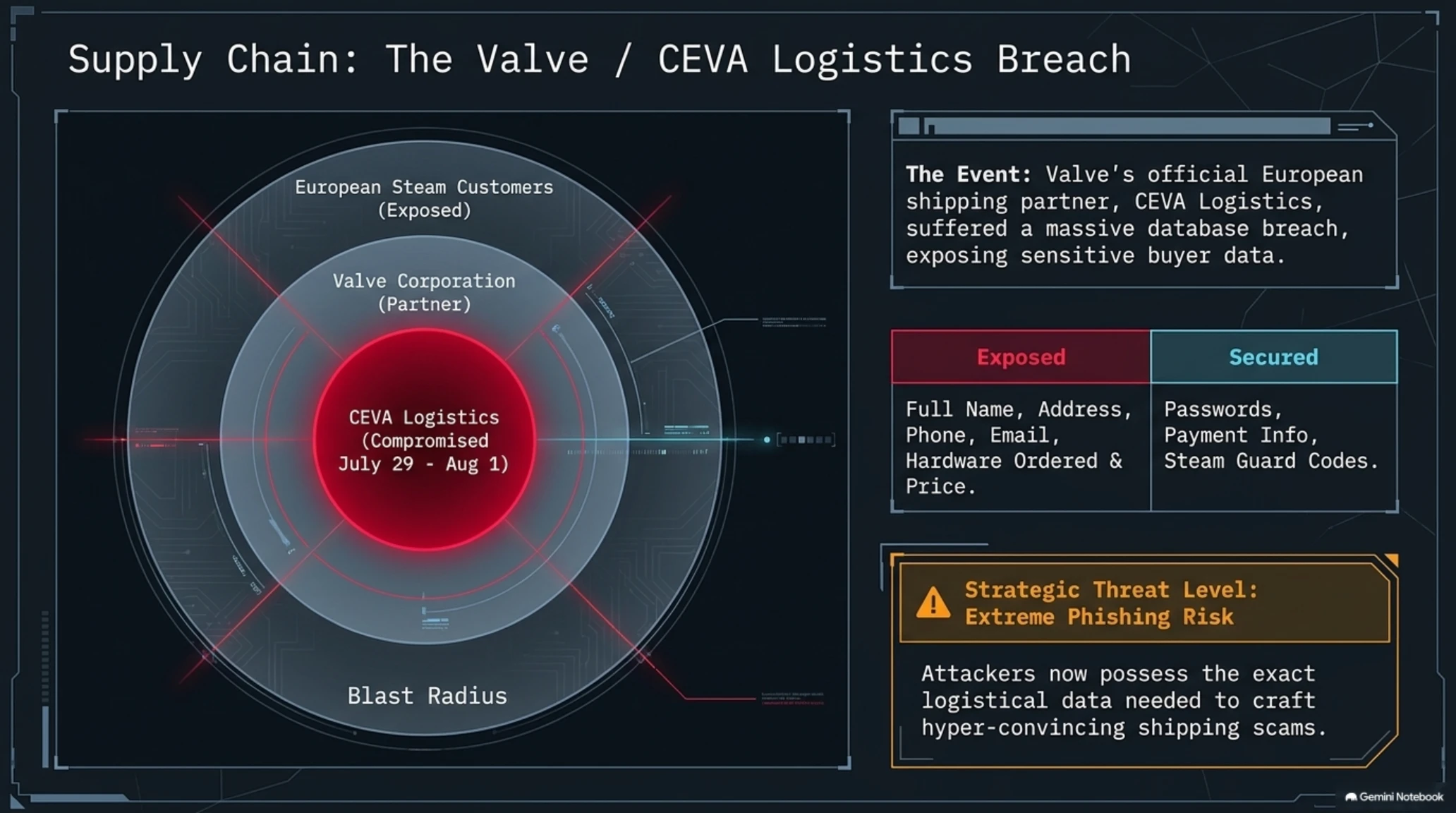
In digital supply chain security, Valve Corporation issued formal notifications to European customers confirming that its primary logistics partner, CEVA Logistics, suffered a severe network intrusion. Threat actors successfully exfiltrated sensitive delivery manifests and personal shipping data belonging to buyers of Steam Deck consoles, Steam Controllers, and Valve Index VR headsets, exposing full customer names, residential delivery addresses, and phone numbers.
Simultaneously in the broader cybersecurity landscape, threat intelligence researchers identified an exposed, unprotected cloud database housing 24 billion aggregated plaintext credentials (COMB). Harvested from across 36 illicit Telegram cybercrime channels and darknet marketplaces, this unprecedented credential hoard provides automated botnets with massive attack surface to launch credential stuffing campaigns for the foreseeable future.
Downstream security consequences of these concurrent breaches include:
- Sharp escalations in targeted SMS phishing scams masquerading as legitimate courier notifications from DHL, DPD, and Royal Mail
- Automated credential testing against major cryptocurrency exchanges, banking portals, and social media platforms
- Urgent necessity for global internet users to immediately purge shared, legacy passwords and enforce unique credentials across all services
- Adopting modern password management vaults such as Bitwarden or 1Password utilizing high-entropy, 16+ character strings
- Valve confirming that core internal Steam servers, financial databases, and credit card processing nodes remain completely uncompromised
These developments emphasize that third-party supplier vulnerabilities represent the most fragile operational link in digital commerce.

The comparative table below itemizes landmark supply chain cyber breaches alongside massive historical credential aggregation events.
Comparative Analysis of Milestone Supply Chain Breaches & Mega-Credential Leaks
| Breach Incident & Impacted Organization | Exposed Records & Affected Volume | Specific Categories of Exfiltrated Data | Root Infiltration Vector & Causal Exploit |
|---|---|---|---|
| Compilation of Many Breaches COMB (2026) | 24 Billion Aggregated Records | Plaintext Usernames, Emails & Password Pairs | Unprotected Cloud Elasticsearch Database |
| CEVA Logistics & Valve Supply Chain | Hundreds of Thousands of Hardware Orders | Customer Names, Residential Addresses & Telemetry | Targeted Intrusion into Courier Tracking Systems |
| RockYou2024 Compilation Release | Nearly 10 Billion Passwords | Aggregated Plaintext Password Wordlists | Darknet Forum Leak Aggregation Pipelines |
| Yahoo Historical Network Breaches | 3 Billion User Accounts | Hashed Passwords, Names & Security Questions | State-Sponsored Spear-Phishing & Forged Cookies |
| MOVEit Transfer Global Supply Exploit | 60 Million+ Enterprise Records | Enterprise File Transfers & Corporate Payrolls | SQL Injection Vulnerability in Web Interfaces |
📚 Classified & Related Dossiers in TekinGame
If you wish to explore beyond this report and delve into cybernetic frontiers and autonomous AI architectures, do not miss these three exclusive deep-dives in the Tekin Garage:
Why Immediate Password Remediation Is an Urgent Operational Priority
Automated botnets utilize high-speed credential stuffing frameworks to test billions of leaked passwords across sensitive corporate portals in seconds.
Tekin Game advocates the universal adoption of unique passwords and passkeys across all personal and enterprise accounts.
Critical CVSS 10.0 Remote Command Injection in Arista VeloCloud SD-WAN and N-able Zero-Day Exploits
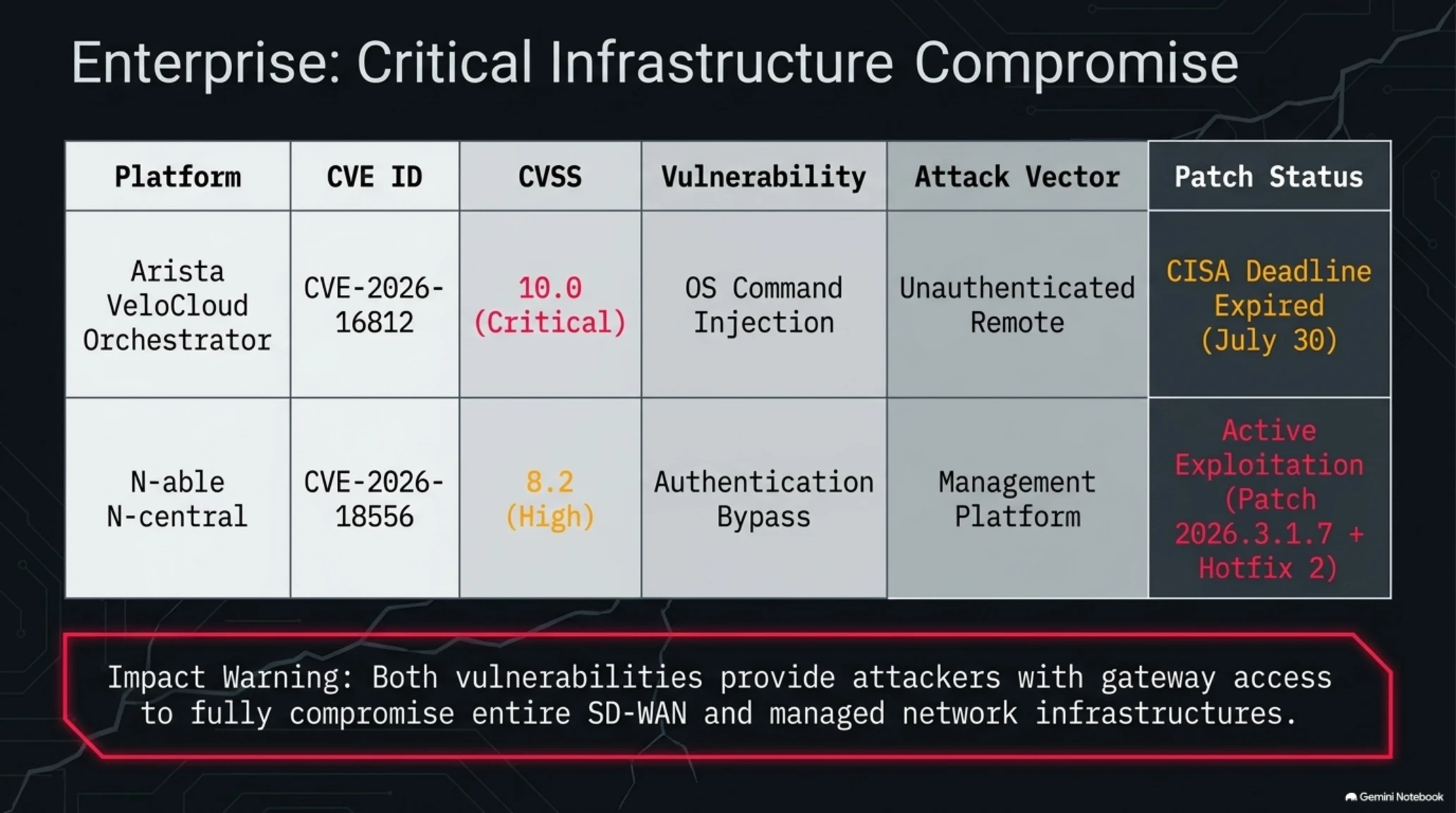
In enterprise network infrastructure and IT administration, the US Cybersecurity and Infrastructure Security Agency (CISA) issued an urgent emergency directive regarding a maximum-severity flaw designated CVE-2026-16812 (CVSS 10.0). Discovered within Arista VeloCloud SD-WAN enterprise routers, the unauthenticated command injection vulnerability enables remote threat actors to execute arbitrary operating system instructions with full root-level administrative privileges across corporate network backbones.
Concurrently in managed service infrastructure, remote monitoring platform N-able N-central—relied upon by thousands of Managed Service Providers (MSPs) worldwide to oversee client IT architectures—was struck by two critical zero-day vulnerabilities designated CVE-2026-18555 and CVE-2026-18577. These flaws allow unauthenticated attackers to bypass administrative web portal logins and deploy ransomware payloads directly across interconnected client networks.
Mandatory remediation protocols for systems engineers and enterprise IT administrators include:
- Immediately applying Arista's emergency hotfix firmware releases to all edge and gateway VeloCloud SD-WAN appliances
- Completely restricting public internet access to administrative web interfaces on N-able N-central server deployments
- Isolating SD-WAN management traffic within segmented, dedicated Out-of-Band (OOB) administrative virtual networks
- Enabling rigorous continuous behavioral logging to detect unauthorized bash scripts or cron daemon modifications on Linux endpoints
- Conducting comprehensive security audits of third-party administrative service provider accounts and API access tokens
These severe flaws underscore that enterprise remote management platforms represent prime strategic targets for advanced threat actors.

The comparative table below analyzes severity ratings, exploit mechanics, and architectural exposure across critical enterprise infrastructure vulnerabilities.
Comparative Analysis of Critical Enterprise Infrastructure & SD-WAN Vulnerabilities
| Vulnerability ID & Target Architecture | CVSS Severity Rating | Core Flaw Mechanism & Attack Vector | Attacker Privilege Level Post-Exploit |
|---|---|---|---|
| CVE-2026-16812 (Arista VeloCloud SD-WAN) | CVSS 10.0 (Maximum Criticality) | Unauthenticated Remote Command Injection | Full Root Privilege over Enterprise Network Routing |
| CVE-2026-18555 (N-able N-central MSP) | CVSS 9.8 (High-Critical Severity) | Authentication Bypass on Web Administrative Portal | Remote Administrative Control over Managed MSP Fleets |
| CVE-2026-18577 (N-able N-central Daemon) | CVSS 8.8 (High Severity Tier) | Local Privilege Escalation within Server Subsystems | Arbitrary Code Execution in Datacenter OS Kernels |
| Log4Shell Legacy Vulnerability (Apache) | CVSS 10.0 (Maximum Criticality) | JNDI Remote Code Execution in Java Logging Core | Unrestricted Arbitrary Execution on Enterprise Web Servers |
| Microsoft Exchange ProxyLogon Flaw | CVSS 9.8 (High-Critical Severity) | Pre-Auth Cookie Forgery in Webmail Interfaces | Direct Access to Classified Corporate Email Databases |
Below is Tekin Game's technical video analysis evaluating VeloCloud SD-WAN exploit mechanics and zero-day containment strategies.
Strategic Synthesis: The Big Picture of August 2026 Security and Five Immediate Defensive Actions
The concurrent cybersecurity crises unveiled across this morning's intelligence briefing paint a vivid picture of modern attack surfaces in 2026. From consumer living rooms and next-generation consoles to e-commerce delivery logistics and enterprise hypervisors, adversaries exploit both mathematical reverse-engineering breakthroughs and human cognitive biases to execute widespread unauthorized intrusions.
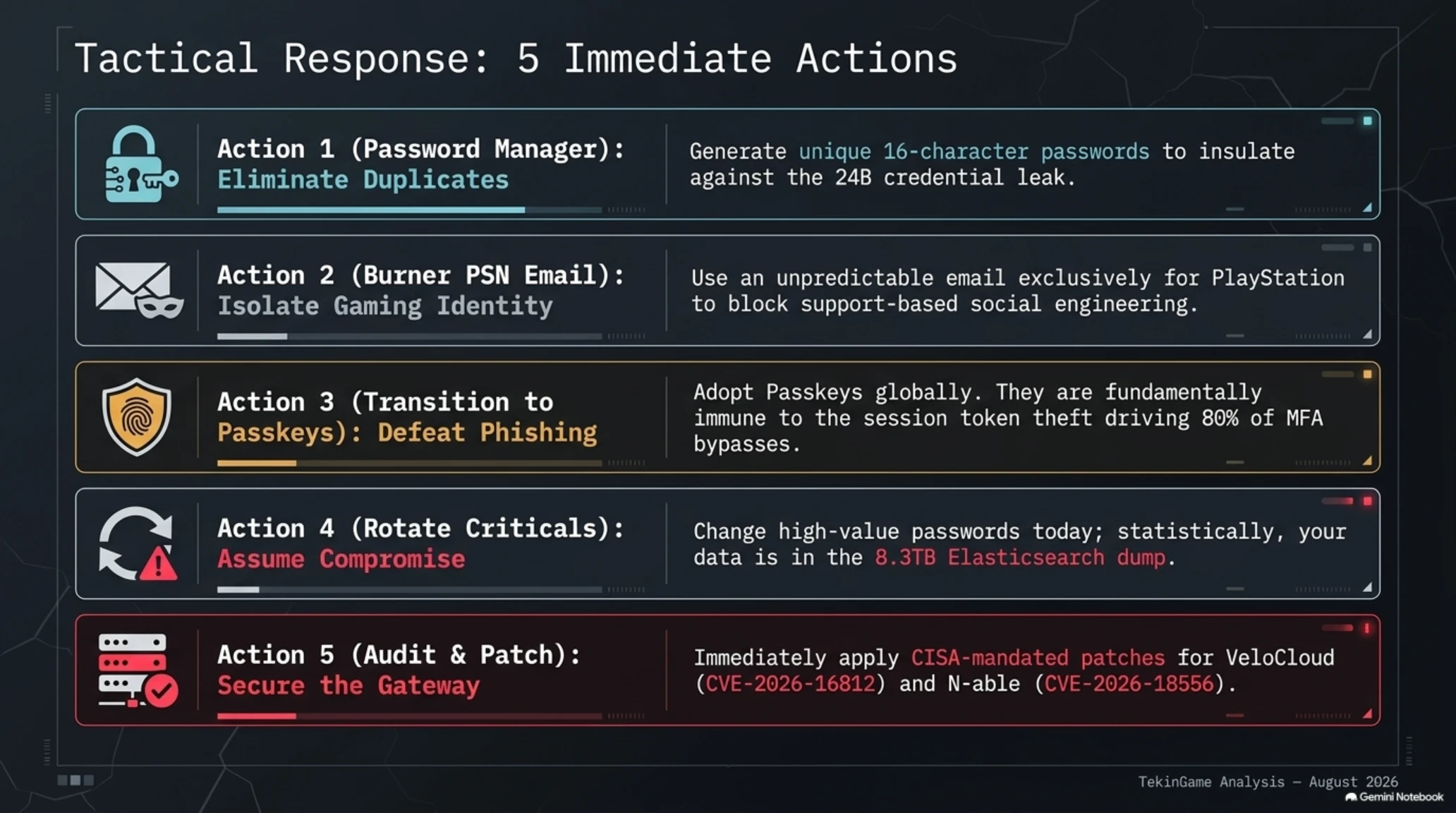
To establish comprehensive defensive resilience against these vectors, all digital citizens and systems administrators must implement five immediate defensive actions:
- Action 1: Immediately rotate legacy passwords across all primary accounts and generate high-entropy 16+ character strings using trusted password vaults.
- Action 2: Transition critical financial, email, and social accounts to hardware-backed Passkeys or physical FIDO2 authentication keys.
- Action 3: Isolate gaming platform login emails and strictly withhold public sharing of digital order receipts and transaction dates.
- Action 4: Exercise heightened vigilance against unsolicited courier communications and avoid clicking tracking links in unexpected SMS messages.
- Action 5: Restrict public internet exposure of enterprise remote management interfaces and immediately apply vendor out-of-band security patches.
Tuesday, August 18 proves that digital security is an active, continuous discipline rather than a static destination.

The official position of the Tekin Editorial Board regarding this morning's intelligence is detailed below.
The strategic risk assessment matrix below summarizes key market vectors, threats, and opportunities across this morning's defining developments.
Strategic Industry Risk & Conclusion Matrix
| Morning Development Vector | Strategic Risk / Opportunity Level | Tekin Advisory Outlook |
|---|---|---|
| Switch 2 Gezine Userland Exploit | Hardware Security Research Catalyst | Drives proactive firmware hardening from Nintendo prior to full production scaling |
| PlayStation Network 2FA Bypass | Severe Account Takeover Threat | Mandates Sony enforce hardware-based on-console verification for account restorations |
| Valve CEVA Logistics Data Breach | Targeted Phishing Exposure | Necessitates end-to-end data minimization across third-party shipping fulfillment hubs |
| 24-Billion Password Database Leak | Mass Credential Stuffing Hazard | Accelerates enterprise adoption of passwordless WebAuthn and Passkey infrastructures |
| Arista & N-able Enterprise Flaws | Catastrophic Network Compromise | Requires emergency patching and immediate lockdown of internet-facing MSP portals |
Tekin Game will continue monitoring patch deployment cycles and vendor response telemetry throughout the day.
Conclusion: Setting the Standard for Resilient Digital Defense and Analytical Vigilance
The Tekin Morning intelligence digest for August 18, 2026 highlights that the accelerating complexity of the digital landscape demands continuous, proactive defense. From console architecture breakthroughs and gaming support process flaws to enterprise SD-WAN remote command exploits and massive credential exposures, the events of this morning serve as an unmistakable wake-up call across the tech spectrum.
We hope this definitive morning briefing equips you with sharp analytical foresight and actionable security strategies as you navigate a productive and safe business day.

Join the conversation at Tekin Game and share your perspectives on the Switch 2 userland exploit and PlayStation account security in the comments section below.
- Significant technical milestone by security researchers in understanding Nintendo Switch 2 hardware architecture
- Valve taking proactive measures to rapidly alert European customers regarding logistics supply chain risks
- CISA taking decisive regulatory action to enforce emergency patching timelines for enterprise routers
- Accelerating the global transition toward passwordless Passkeys and hardware-bound FIDO2 authentication
- Social engineering vulnerabilities in PlayStation customer support allowing complete 2FA account takeovers
- Exposing physical shipping addresses and phone numbers of thousands of Steam hardware owners via CEVA Logistics
- Unprotected cloud database leaking 24 billion plaintext credentials, dramatically elevating credential stuffing risks
Related Industry Features on Tekin Game
• 🔓 Tekin Analysis | PlayStation, Switch & Xbox Console Jailbreak & Security Status
• 🌙 Tekin Night July 5, 2026 | PS5 Digital Edition Evolution & Midjourney AI Expansion
• 🎮 Tekin Night July 1, 2026 | Gaming Industry Shakeup & Next-Gen Console Engineering
Frequently Asked Questions About Tuesday August 18, 2026 Morning Intelligence
Does Gezine's exploit represent a complete jailbreak of the Nintendo Switch 2?
No, it is strictly a userland exploit without kernel access, meaning custom firmware (CFW) and game backups are impossible.
How are attackers bypassing two-factor authentication on PlayStation Network accounts?
By calling Sony customer support and socially engineering agents using email addresses and legacy purchase receipt data.
What specific customer information was exposed in the Valve and CEVA Logistics breach?
Customer full names, residential shipping addresses, phone numbers, and hardware tracking metadata for Steam Deck buyers.
What threat does the 24-billion password database leak (COMB) pose to everyday users?
It enables automated credential stuffing botnets to rapidly compromise accounts that reuse identical passwords across sites.
Why was the Arista VeloCloud vulnerability assigned a maximum CVSS 10.0 score?
Because it allows unauthenticated remote attackers to execute arbitrary system commands with complete root privileges.
What are the most effective immediate actions to protect against these threats?
Enable Passkeys, deploy random password generators via password vaults, and keep digital purchase receipts confidential.
Sources and Citations
Additional Gallery: ☀️ Tekin Morning | Tuesday, August 18, 2026: 6 Security Earthquakes