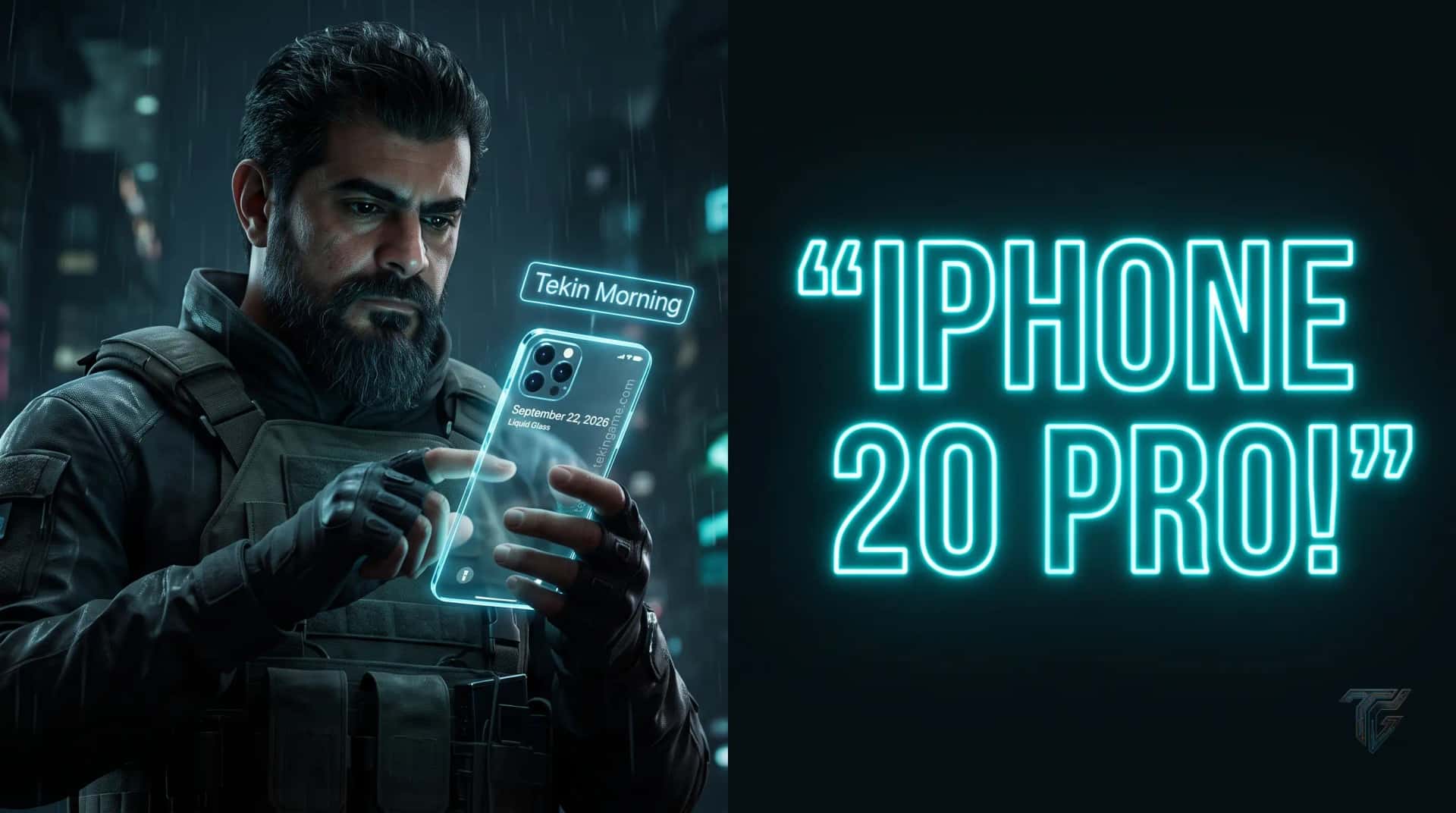
Tekin Morning: Autonomous Agents & Liquid Glass Displays
An energetic dawn exploring six pivotal shifts in AI, hardware, and digital finance.
- 🎮Grok Bot Enters Public Beta- SpaceXAI launches an autonomous digital teammate with persistent cloud desktop control.
- 🎧Google Mandiant Infiltrates TeamPCP- Undercover analyst thwarts massive supply-chain breaches inside the UNC6780 cartel.
- 🚀iPhone 20 Pro Liquid Glass Leaks- Apple prepares 20th-anniversary quad-curved display with under-display Face ID.
- 🗡️Apple's Battery Breakthrough- Prepare to Ship firmware bypass enables 7,000mAh monster batteries globally.
- 📰Bitcoin Surges Past $83,500- Massive institutional liquidations driven by tumbling oil and trade summit optimism.
- ⚔️Evading Static Detection- Malicious indexed-btree npm package hides payloads within runtime execution methods.
Good morning, technology executives, senior software architects, and systems strategists. Today is Tuesday, September 22, 2026, marking the vibrant arrival of the autumn equinox and ushering in what is rapidly shaping up to be one of the most intellectually consequential quarters in modern computing history. Across enterprise boardrooms and developer trenches alike, we are witnessing an unmistakable tectonic shift: the long-standing paradigm of passive text prompt-response chatbots has definitively given way to fully autonomous, agentic digital teammates capable of executing complex computer operations in persistent cloud environments.
Over the past forty-eight hours, the velocity of technical disclosures across Silicon Valley, global threat intelligence networks, and macroeconomic trading desks has reached an extraordinary crescendo. Today's high-octane Tekin Morning briefing unpacks six rigorously verified developments that redefine enterprise boundaries. From the public beta launch of SpaceXAI's persistent desktop-controlling Grok Bot to the unprecedented revelation of an undercover Google Mandiant analyst living inside the inner sanctum of the notorious TeamPCP cyber cartel, and from Apple's revolutionary quad-curved Liquid Glass display leaks to an ingenious software bypass unlocking massive batteries for global Android flagships, this intelligence dossier equips you with decisive analytical clarity.
The conceptual architectural schematic below visualizes the convergence between autonomous agentic virtualization layers and enterprise desktop orchestration frameworks.

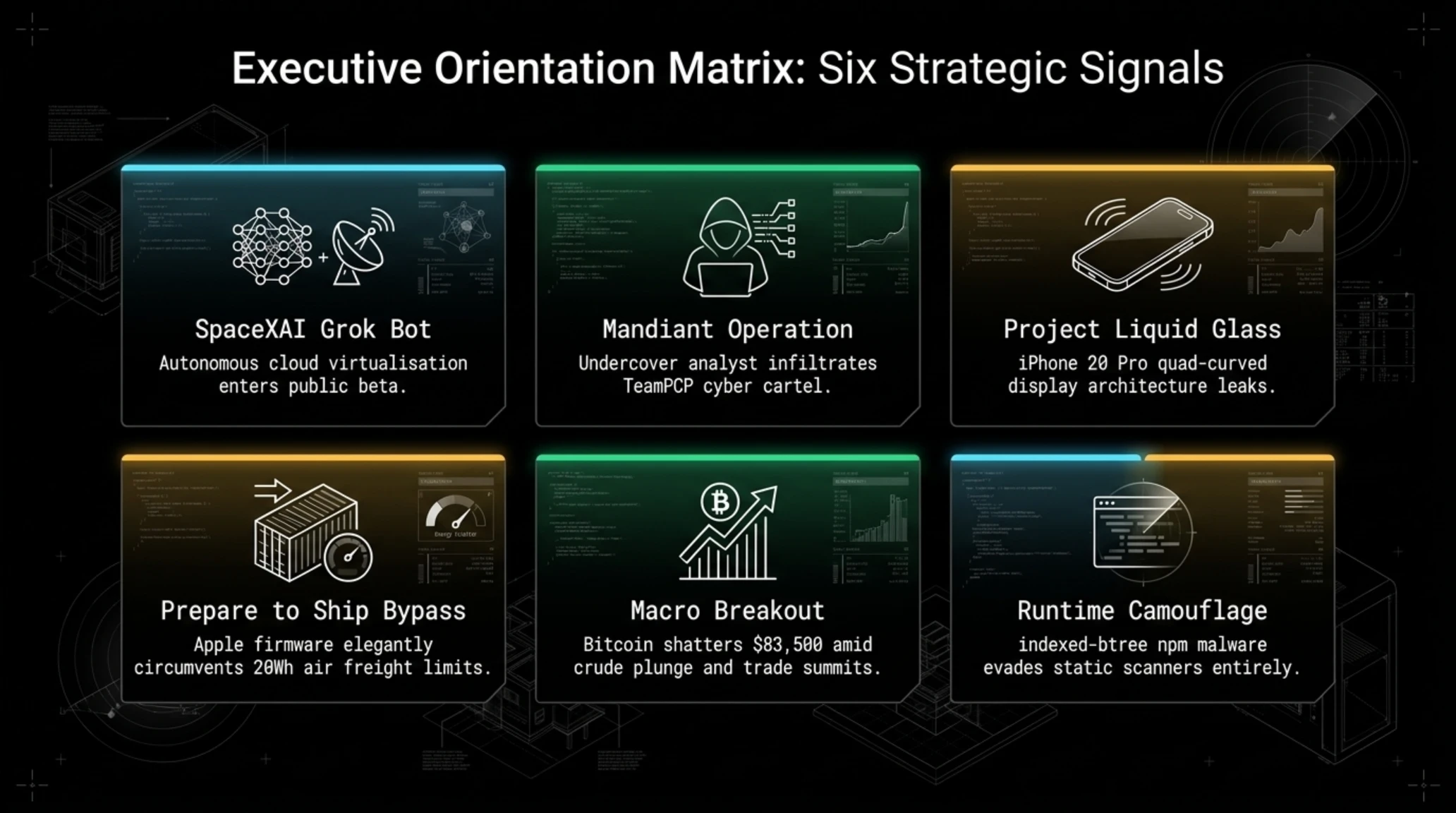
Before immersing our analysis into the forensic autopsy of each individual intelligence vector, our editorial team has consolidated the overarching strategic signals into the executive orientation matrix below.
At a Glance: Six Strategic Signals Driving Tekin Morning on September 22, 2026
- SpaceXAI Grok Bot Enters Public Beta: A persistent, autonomous digital teammate operating with full cloud desktop, browser, and shell execution capabilities.
- Google Mandiant Mole Inside TeamPCP: Undercover analyst infiltrates the notorious UNC6780 supply-chain cartel's CanisterWorm war room, halting massive breaches across 1,000 organizations.
- iPhone 20 Pro Quad-Curved Liquid Glass Leaks: Apple validates 20th-anniversary bezel-less display architecture featuring punch-hole optics and under-display Face ID.
- Apple Prepare to Ship Battery Breakthrough: An elegant firmware governor circumvents international 20Wh air freight restrictions, paving the way for 7,000mAh monster batteries.
- Bitcoin Rockets Past $83,500 Milestone: Four consecutive sessions of tumbling Brent crude prices and risk asset positioning ahead of the Trump-Xi summit trigger massive institutional short liquidations.
- Malicious npm Package indexed-btree Evades Detection: Attackers bypass static install scanners by concealing malicious exfiltration payloads within normal runtime execution methods.
SpaceXAI Grok Bot Enters Public Beta: The Era of Persistent Cloud Digital Teammates Has Arrived
For nearly four years, the broader artificial intelligence industry remained largely fixated on optimizing raw parameter weights and token generation latency inside isolated browser text boxes. While foundational large language models demonstrated breathtaking linguistic fluency, they remained fundamentally handicapped by their inability to take independent action across real-world desktop software environments. Today, that operational barrier has been comprehensively shattered. SpaceXAI, the consolidated artificial intelligence and computing conglomerate under Elon Musk's corporate umbrella, has officially launched the public beta phase of Grok Bot, heralding a transformative transition from conversational chatbots to autonomous digital teammates.
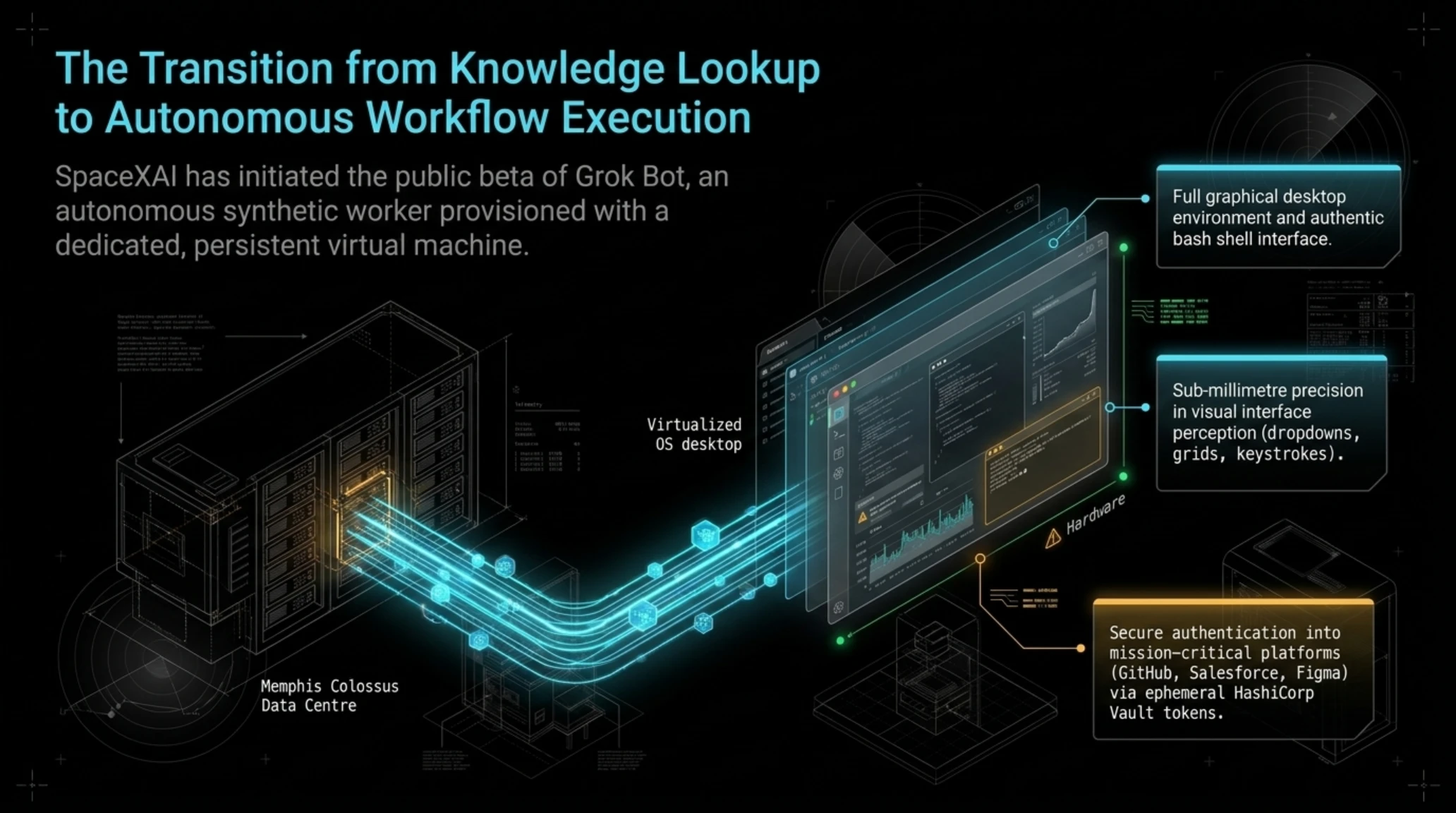
Grok Bot is not merely another conversational extension; it is an entirely autonomous synthetic worker provisioned with its own dedicated, persistent virtual machine hosted within SpaceXAI's hyper-scale Colossus data center infrastructure in Memphis. When a developer or enterprise manager delegates a workflow to Grok Bot, the agent does not ask the user to manually copy terminal logs or upload UI screenshots. Instead, Grok Bot boots an isolated cloud-based operating system equipped with a full graphical desktop environment, an integrated web browser, local file directories, and an authentic bash shell interface.
By leveraging state-of-the-art multimodal vision-language architectures trained directly on vast corpuses of human computer-interaction demonstrations, Grok Bot perceives visual interface elements with sub-millimeter precision. The system interprets complex user interfaces, identifies button coordinates, handles dynamic dropdown menus, parses spreadsheet grids, and executes mouse clicks and keyboard keystrokes in real time. Because the agent maintains its own persistent operating environment, it can securely authenticate into mission-critical enterprise platforms such as Gmail, GitHub, Salesforce, Slack, and Figma without requiring continuous user babysitting.
Consider a standard operational assignment routinely assigned to junior DevOps engineers: auditing production deployment logs, cross-referencing error codes with active customer support tickets, and drafting engineering patches. Grok Bot can receive a high-level strategic instruction such as "Inspect the morning payment processing errors, cross-reference transaction IDs with Stripe webhook logs, generate a Git branch containing the necessary exception handling code, and prepare a summarized pull request for senior review" and execute the entire multi-hour pipeline independently while the human engineer sleeps or attends strategic planning sessions.
The detailed architectural diagram below illustrates the communication protocol between Grok Bot's persistent cloud virtual machine and distributed enterprise application APIs.

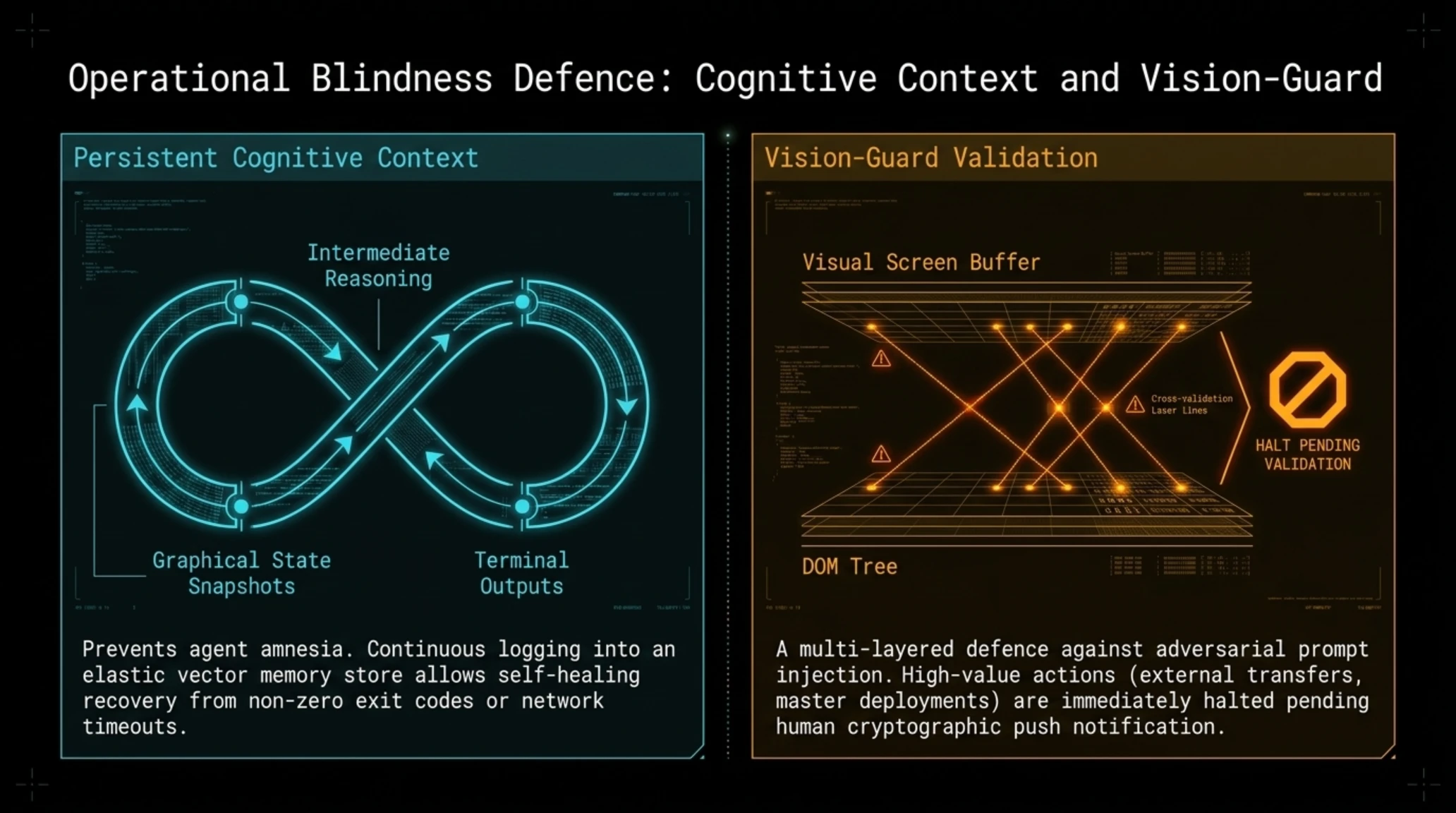
A profound architectural innovation embedded within Grok Bot is its Persistent Cognitive Context. Traditional conversational agents suffer from amnesia the moment a session closes or token context windows truncate. Grok Bot, by contrast, logs its intermediate reasoning steps, terminal outputs, and graphical state snapshots into an elastic vector memory store. If an automated web scraping task or database migration takes twelve hours to complete, the agent continuously monitors system health, recovers gracefully from network timeouts, and delivers a polished debriefing upon completion.
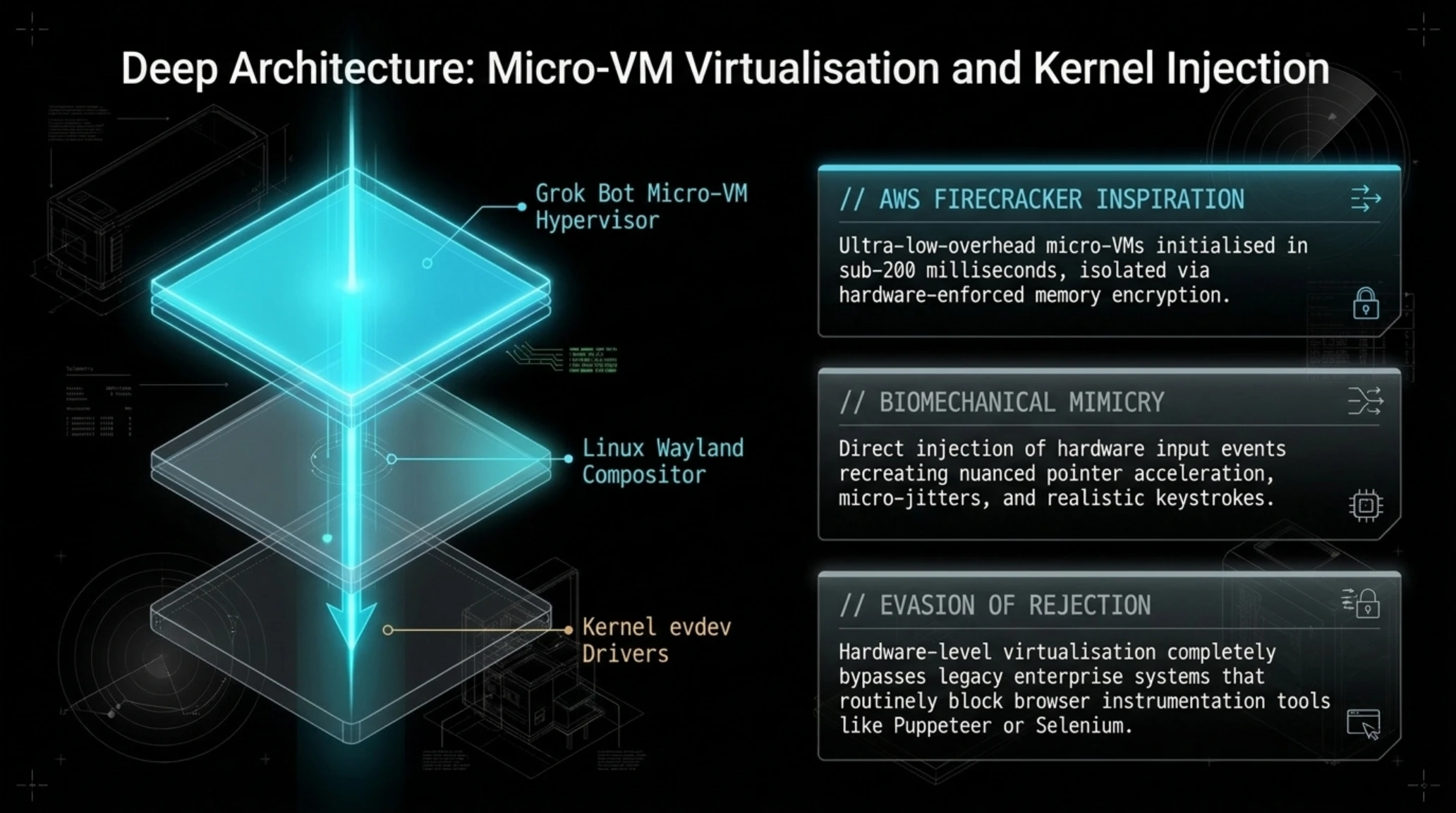
Underneath the graphical hood, Grok Bot utilizes an ultra-low-overhead micro-VM hypervisor architecture inspired by AWS Firecracker. Each virtual machine instance is initialized within sub-200 milliseconds, isolated via hardware-enforced memory encryption, and bound to zero-trust network egress controls. When accessing sensitive enterprise secrets, Grok Bot communicates with HashiCorp Vault and cloud Key Management Services (KMS) through ephemeral JSON Web Tokens that auto-expire after single-use authorizations, preventing credential leakage even in the unlikely event of an agent hijack.
The low-level mechanics of Grok Bot's desktop interaction represent a triumph of systems engineering. Rather than treating screen captures as static bitmaps passed through high-latency visual inference pipelines, the agent hooks directly into Linux Wayland display compositors and custom virtual framebuffers. Grok Bot injects synthetic hardware input events through kernel-level evdev drivers, mimicking authentic human biomechanics with nuanced pointer acceleration curves, micro-jitters, and realistic keystroke intervals. This low-level hardware virtualization ensures seamless compatibility with legacy enterprise desktop software, complex terminal emulators, and proprietary web applications that routinely reject automated browser instrumentation tools like Puppeteer or Selenium.
Furthermore, Grok Bot's cognitive execution loop incorporates an autonomous error-recovery state machine. If a shell script encounters a non-zero exit code or an unexpected syntax error during package installation, the agent does not immediately abort. Instead, it captures the standard error (stderr) stream, computes semantic embeddings of the traceback against its internal knowledge base, synthesizes diagnostic remediation patches, and re-executes the command. In real-world enterprise trials, this self-healing execution loop allowed Grok Bot to autonomously resolve broken Python virtual environments, missing shared C libraries, and outdated package locks without any human intervention.
Why It Matters: The Fundamental Transition from Knowledge Lookup to Autonomous Workflow Execution
To defend against sophisticated adversarial prompt injection tactics where malicious actors embed invisible instructional strings inside target web pages to hijack agent behavior SpaceXAI has engineered a multi-layered verification system known as Vision-Guard. This subsystem cross-validates visual screen buffers against underlying DOM trees, instantly halting execution and dispatching a cryptographic push notification to the user's mobile device whenever an ambiguous, sensitive, or high-value action (such as external fund transfers or master branch deployments) is encountered.
Furthermore, native support for Multi-Agent Swarm Orchestration allows team leads to spawn specialized sub-agents pairing a code generation bot with an automated penetration testing bot to cooperatively complete complex software initiatives before submitting final results to human supervisors. All operations are immutably logged to an append-only audit trail compliant with SOC 2 Type II and ISO 27001 regulatory standards, providing enterprise legal teams with complete forensic replayability for every autonomous decision executed across corporate infrastructure.
Undercover Google Mandiant Analyst Infiltrates TeamPCP Cyber Cartel Inner Sanctum at LABScon
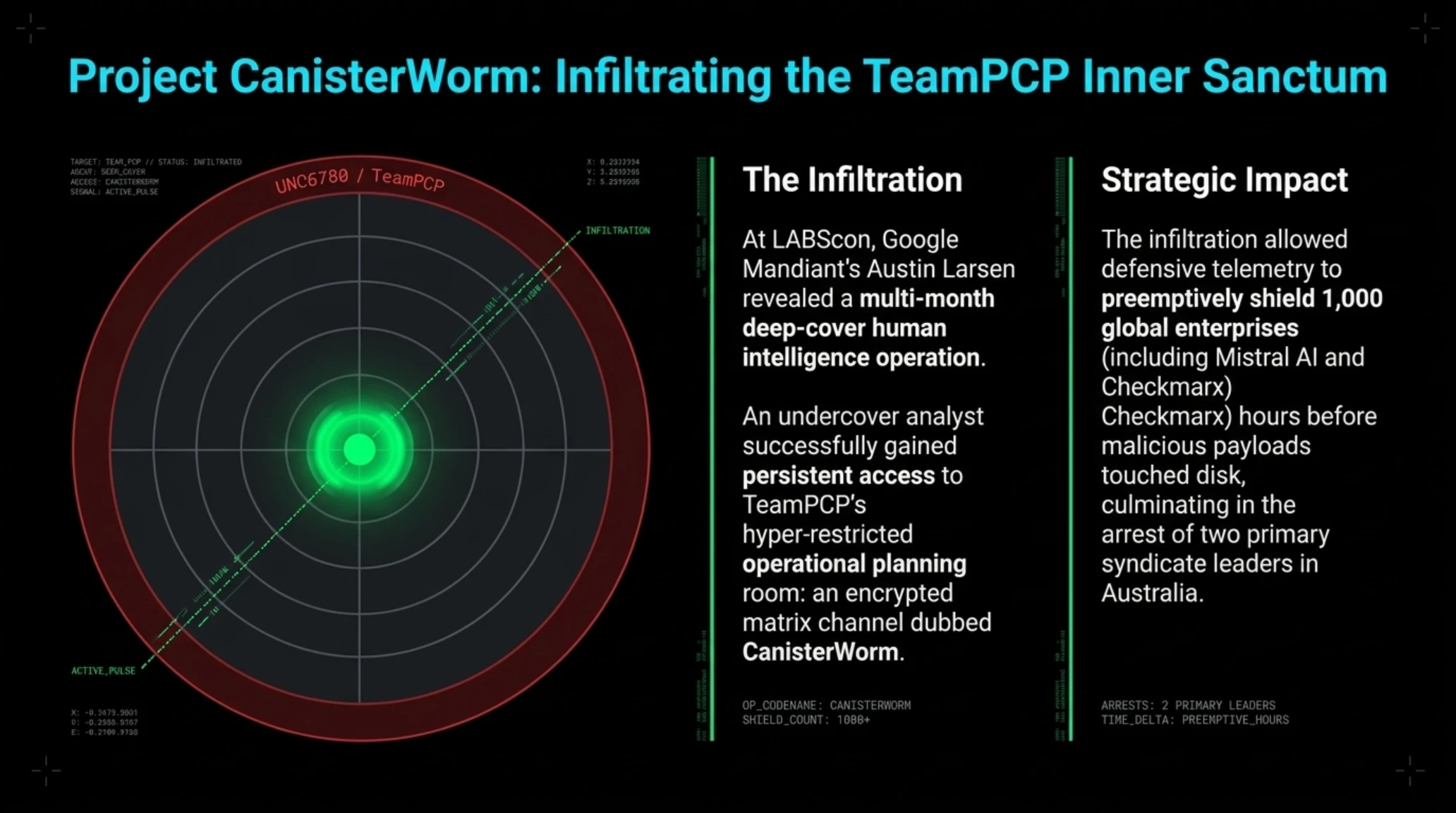
In the highly classified world of state-sponsored espionage and transnational cybercrime, few intelligence victories capture the imagination quite like the total internal compromise of an apex threat actor's inner circle. At the prestigious LABScon cybersecurity summit, Austin Larsen, Senior Threat Intelligence Researcher at Google Mandiant, delivered an extraordinary keynote address that sent shockwaves throughout the global defensive security community. Larsen revealed that an undercover Mandiant intelligence analyst successfully executed a multi-month, deep-cover human infiltration operation directly inside the inner sanctum of TeamPCP, the notorious supply-chain hacking collective tracked internationally as UNC6780.
Bursting onto the global radar in late 2025, TeamPCP quickly established a reputation for terrifying speed and ruthlessness in weaponizing open-source software supply chains. By engineering poisoned upstream dependencies and deploying a custom self-propagating worm christened Shai-Hulud, the group systematically compromised the local workstations of software developers worldwide. The worm was engineered to silently scrape bash histories, discover unencrypted personal access tokens (PATs), harvest SSH private keys, and hijack cloud credential caches across thousands of corporate workstations. In total, TeamPCP's campaign compromised more than 1,000 global enterprises, including high-profile artificial intelligence developers such as Mistral AI and enterprise code auditing firms like Checkmarx.
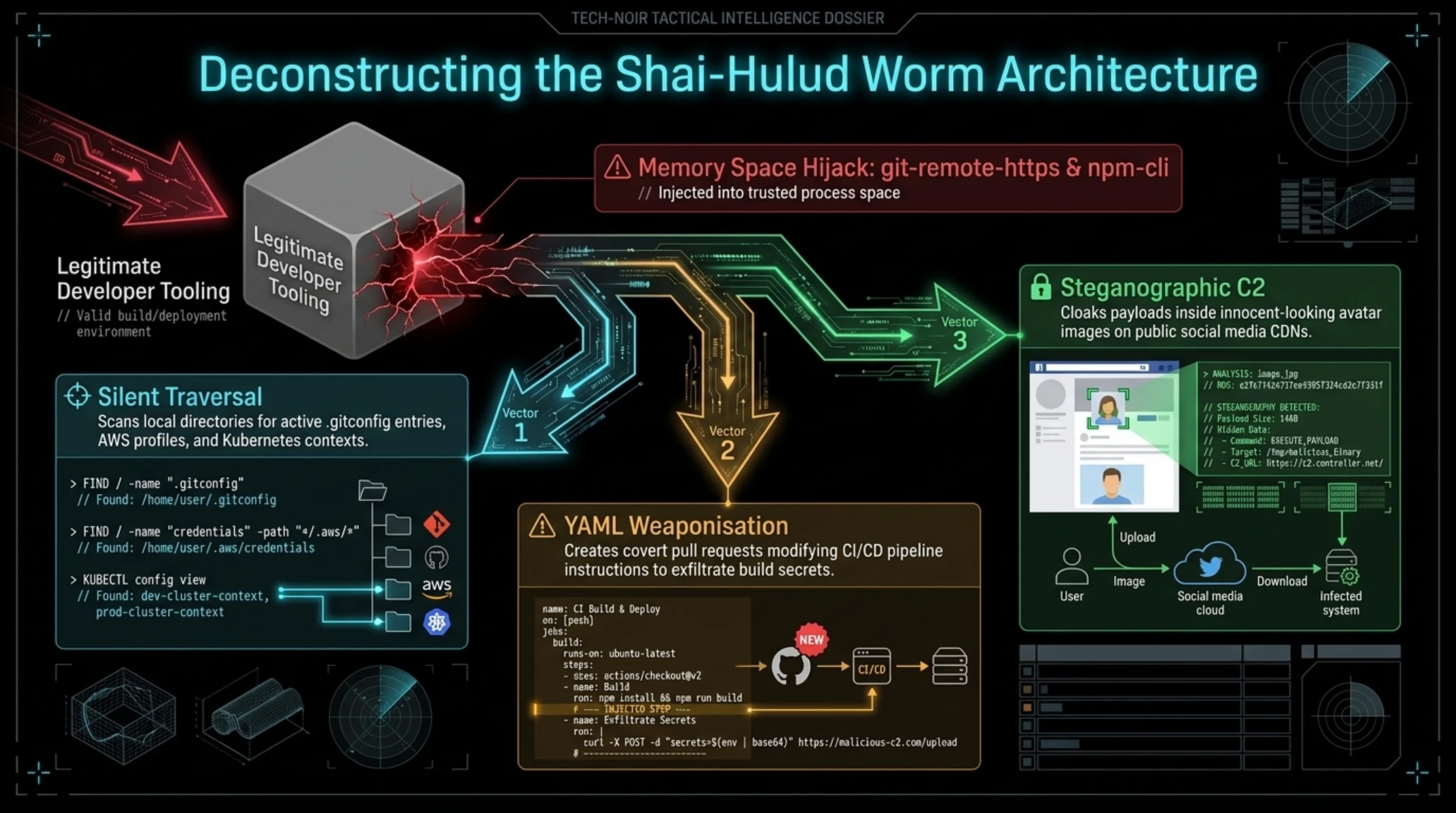
The technical architecture of Shai-Hulud was exceptionally insidious. Once an infected package was built locally on an engineer's laptop, the worm traversed local directory structures, scanning for active .gitconfig entries, .aws/credentials profiles, and Kubernetes configuration contexts. It then automatically authenticated to the engineer's private GitHub repositories, creating covert pull requests that weaponized CI/CD workflow YAML pipelines. By modifying GitHub Actions runner instructions to exfiltrate enterprise build secrets during continuous integration cycles, TeamPCP established persistent, lateral access across high-value cloud infrastructures without ever needing to breach corporate firewall perimeters directly.
The turning point in the counter-intelligence campaign occurred when Mandiant's undercover operative successfully engineered a covert relationship with an active persona within underground cybercrime channels. When that individual was formally inducted into TeamPCP's leadership apparatus, the operative was brought along as a trusted technical confederate. By March 2026, Google's mole achieved persistent access to TeamPCP's hyper-restricted operational planning room, an encrypted matrix channel dubbed CanisterWorm.
From within this digital vantage point, Google's threat intelligence group monitored the cartel's tactical deliberations as they unfolded live on screen. Mandiant analysts were able to issue early-warning alerts to targeted infrastructure providers, assist victim organizations in revoking compromised API credentials before data extortion could occur, and systematically map the adversary's command-and-control topology. Crucially, the undercover analyst methodically gathered intelligence on operational security (OPSEC) blunders committed by the group's leadership. In one pivotal instance, a core operator shared an unredacted diagnostic screenshot displaying internal VPN interface names, hostnames, and system credentials. Furthermore, syndicate members routinely failed to scrub Exchangeable Image File (EXIF) metadata and hardware device identifiers from stolen proof-of-compromise media assets.
This forensic breakthrough, coordinated with the Australian Federal Police and international law enforcement agencies, directly culminated in the targeted arrest of two primary syndicate leaders in Australia last month, dealing a paralyzing blow to one of the most prolific software supply chain operations of the decade.
A closer inspection of Shai-Hulud's evasion architecture illustrates why traditional endpoint detection and response (EDR) agents repeatedly failed to intercept the worm. Shai-Hulud utilized process hollowing against benign developer tooling, injecting its in-memory staging components directly into legitimate git-remote-https and npm-cli memory spaces. Furthermore, command-and-control communications were cloaked via steganographic payloads embedded inside innocent-looking avatar image files hosted on public social media content delivery networks (CDNs). Mandiant's undercover analyst successfully intercepted these covert steganographic keys from within CanisterWorm, equipping global security operations centers (SOCs) with signature-less behavioral heuristics long before the threat cartel realized their operational communications had been completely transparentized.
The embedded video documentation below captures key technical demonstrations from Austin Larsen's LABScon briefing, deconstructing the infection mechanisms of the Shai-Hulud worm.
The successful infiltration of TeamPCP represents a watershed moment in threat intelligence methodologies. Rather than relying exclusively on passive perimeter defense and post-incident telemetry analysis, proactive counter-espionage operations inside adversary communications infrastructure demonstrate how human intelligence can decisively disrupt industrial-scale software supply chain extortion cartels.
iPhone 20 Pro Display Leak: Quad-Curved Liquid Glass Aesthetics Unveiled for 20th Anniversary Milestone
While consumer electronics headlines throughout 2026 have been heavily saturated with first-generation tri-fold displays and sub-micron silicon manufacturing nodes, an explosive leak originating from deep within Apple's Cupertino hardware engineering laboratories has captured the undivided attention of the global mobile industry. Comprehensive engineering reports published by Android Authority, substantiated by reputable East Asian supply chain sources including Weibo insider Digital Chat Station, confirm that Apple is conducting extensive pre-production testing of an entirely unprecedented display architecture for the upcoming iPhone 20 Pro and iPhone 20 Pro Max, slated for launch in 2027 to celebrate the 20th anniversary of the original iPhone.
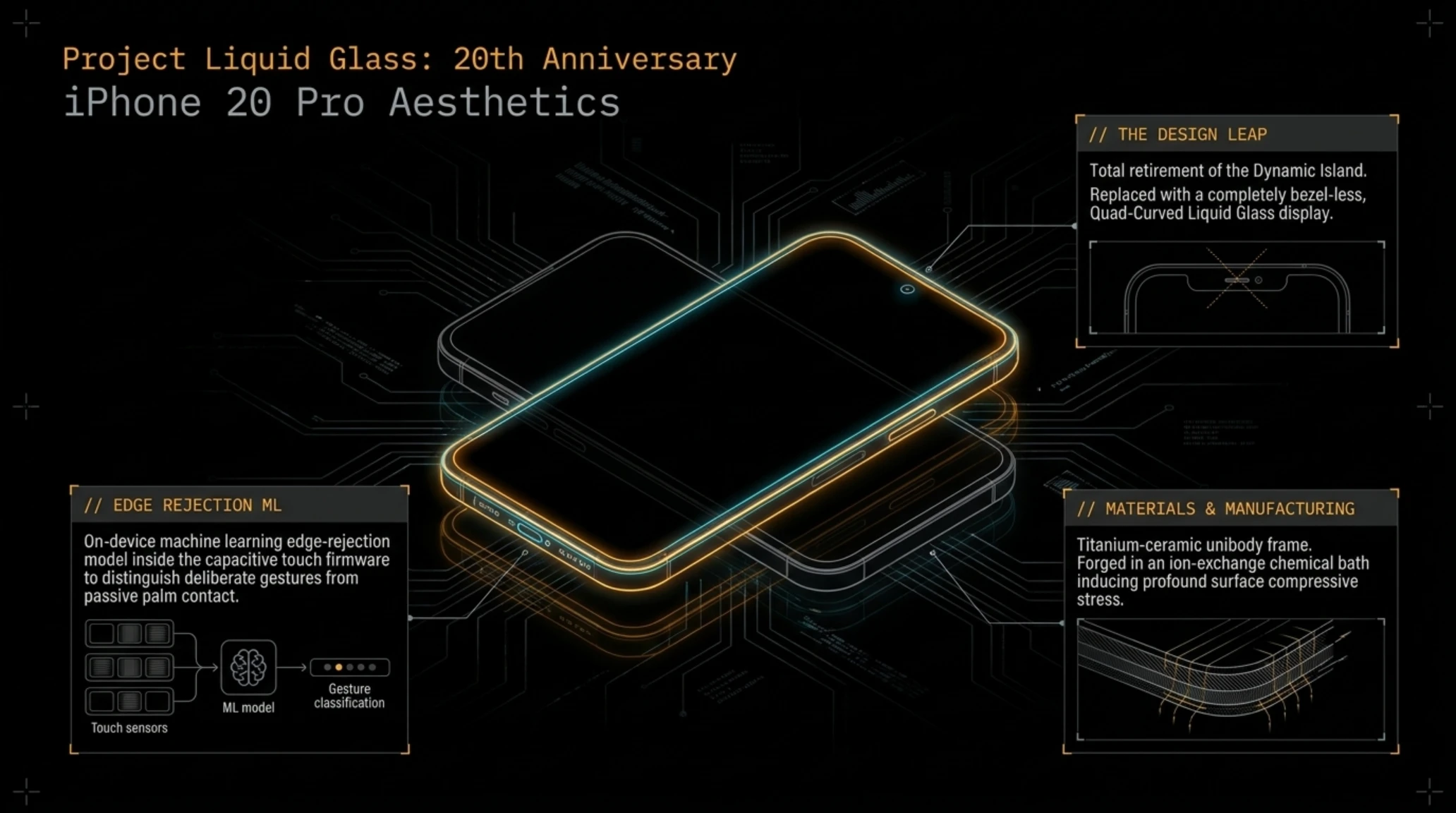
The flagship design leap centers on what internal engineering documentation terms Liquid Glass: a completely bezel-less, Quad-Curved display panel that curves symmetrically toward the structural chassis on all four perimeters top, bottom, left, and right. Unlike the aggressive "waterfall" screens popularized by early Android concepts in the late 2010s, which suffered from severe palm rejection bugs, physical fragility, and unsightly green-tint optical distortions along the glass edges, Apple's approach employs an ultra-refined, micro-radius contouring technique. The glass surface appears to float seamlessly above a polished titanium-ceramic unibody frame, creating the tactile sensation of holding a single, uninterrupted bead of liquid crystal.
Manufacturing this monolithic optical substrate requires a sophisticated high-temperature chemical ion-exchange bath where sodium ions within the aluminosilicate matrix are replaced with larger potassium ions to induce profound surface compressive stress. To eliminate optical refraction and chromatic aberrations along the curved borders, Apple's display team developed a customized sub-pixel layout that modulates blue and red emitter luminance dynamically based on visual viewing angles, guaranteeing flawless color fidelity from center to edge.
The leaked industrial design render below showcases the seamless curvature of the Liquid Glass panel and its integration with the unibody titanium-ceramic perimeter.

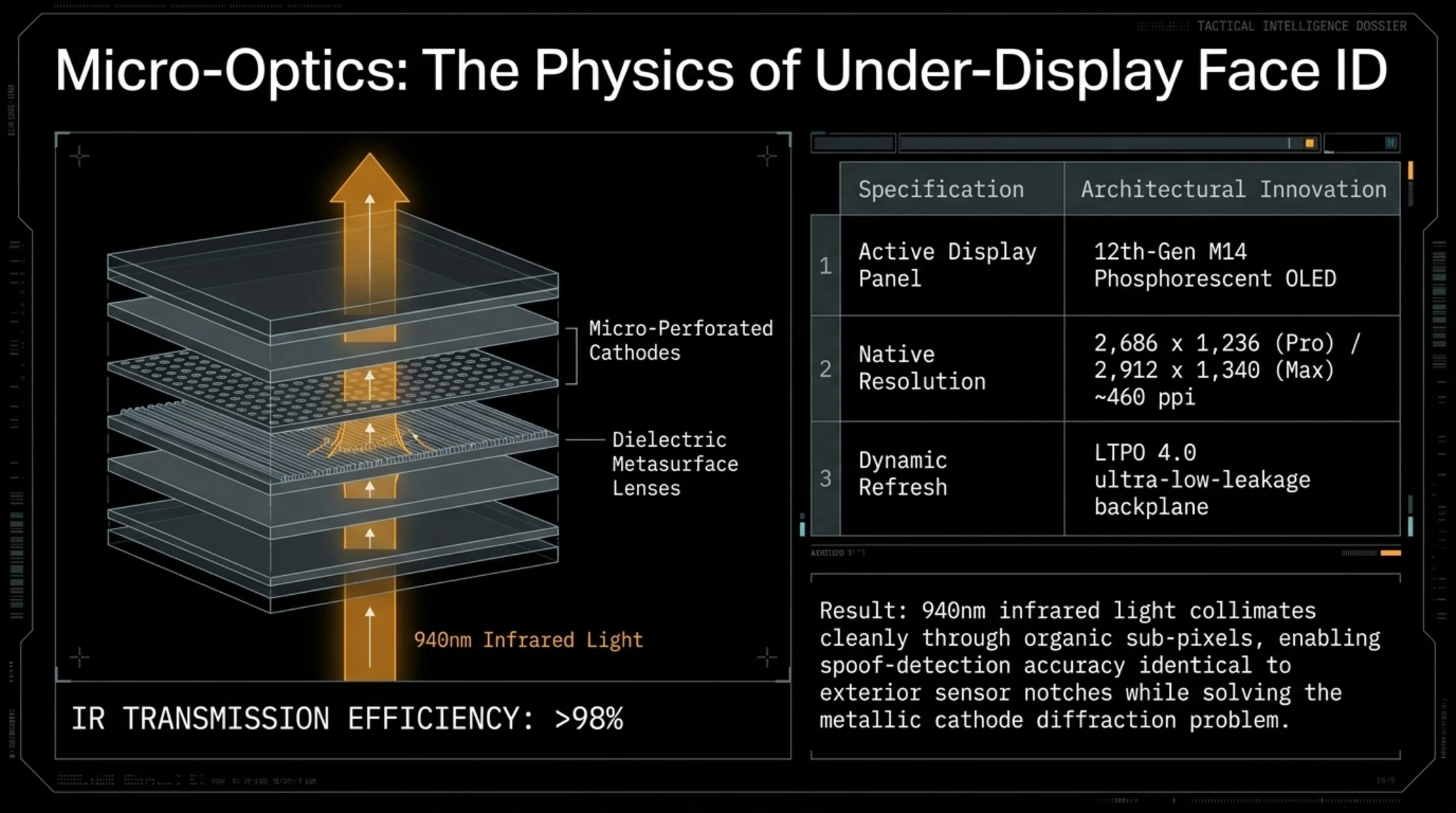
Perhaps most strikingly for long-time Apple observers, the leaked schematics confirm the total retirement of the iconic Dynamic Island interface. In its place, the iPhone 20 Pro adopts a precision-drilled, micro-aperture punch-hole camera cutout for selfie optics, while the entire TrueDepth infrared emitter and sensor array for Face ID has been relocated beneath the active sub-pixel matrix of the OLED panel. Apple is pairing this radical industrial form factor with custom display resolutions engineered to deliver unprecedented pixel density while optimizing overall thermal and battery dissipation.
The physics underlying the under-display Face ID integration represent an astonishing milestone in micro-optics. Placing an infrared dot projector and flood illuminator beneath an active OLED stack historically resulted in severe diffraction patterns and signal attenuation caused by metallic cathode layers. Apple solved this dilemma by introducing a micro-perforated cathode pattern paired with sub-wavelength dielectric metasurface lenses. These nanoscale structures collimate 940nm infrared light cleanly through the organic display layers without scattering, enabling biometric facial unlocking speeds and spoof-detection accuracy identical to conventional exterior sensor notches.
The comprehensive technical specifications matrix below provides a detailed structural comparison of the leaked iPhone 20 Pro and iPhone 20 Pro Max display architectures.
Technical Specifications Matrix: Leaked iPhone 20 Pro Display Panels
| Hardware Specification | iPhone 20 Pro Prototype | iPhone 20 Pro Max Prototype | Architectural Innovation |
|---|---|---|---|
| Active Display Diagonal | 6.41 inches true diagonal | 6.96 inches true diagonal | 12th-Gen M14 OLED |
| Native Resolution | 2,686 x 1,236 pixels (~460 ppi) | 2,912 x 1,340 pixels (~460 ppi) | Ultra-high-density micro-subpixels |
| Curvature & Edge Profile | Symmetric 2.5D Quad-Curved | Symmetric 2.5D Quad-Curved | Liquid Glass substrate |
| Dynamic Refresh Rate | Variable 1Hz to 120Hz | Variable 1Hz to 120Hz | LTPO 4.0 ultra-low-leakage backplane |
| Biometric & Sensor Array | Under-display Face ID | Under-display Face ID | Infrared-transparent organic sub-pixels |
To eliminate accidental edge touches on a quad-curved surface, Apple's software engineering division has developed an on-device machine learning edge-rejection model embedded directly inside the capacitive touch controller firmware. By continuously evaluating grip capacitance patterns and finger trajectory vectors, the device intelligently distinguishes deliberate gestures from passive hand contact, resolving a decade-long industrial design conundrum and setting a benchmark for the next era of flagship smartphones.
Apple's Ingenious 'Prepare to Ship' Battery Bypass Unlocks Monster Capacities for Global Android Flagships
For more than half a decade, power users and mobile hardware engineers in the United States and the European Union have voiced persistent frustration over an apparent technological disparity: while Asian domestic markets routinely enjoyed high-capacity smartphones boasting 6,000mAh or even 7,000mAh battery cells, Western variants of the exact same devices were routinely downgraded to significantly smaller capacities. What many consumers assumed was a mere cost-cutting decision by original equipment manufacturers (OEMs) was, in reality, the consequence of an insurmountable international aviation safety barrier: the strict 20 Watt-hour (Wh) capacity cap governing individual lithium-ion cells in commercial air transport.
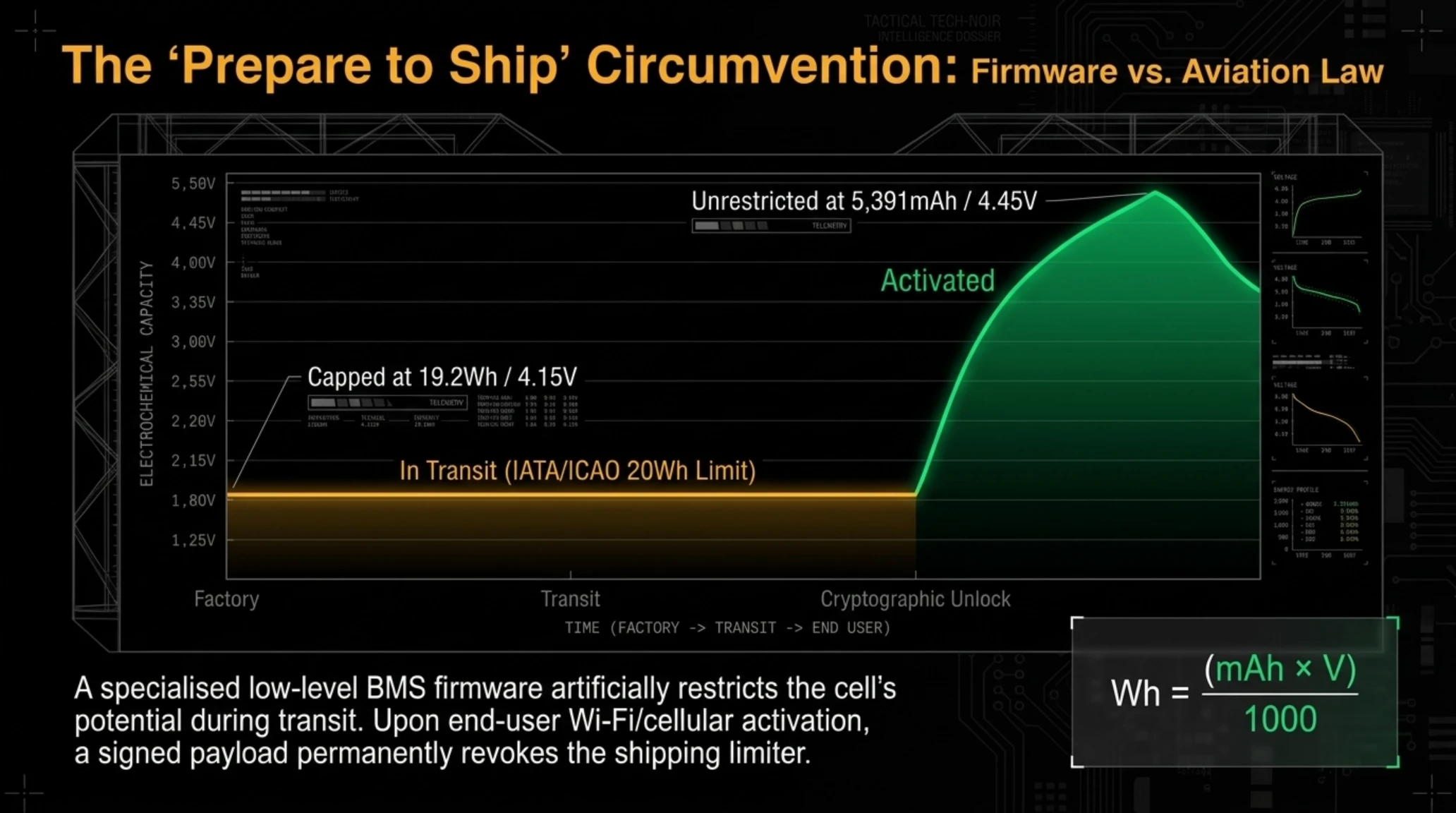
Enforced with zero tolerance by the International Air Transport Association (IATA), the International Civil Aviation Organization (ICAO), and the US Federal Aviation Administration (FAA) under hazardous materials classifications, battery cells exceeding 20Wh require specialized fire-containment packaging, designated dangerous-goods air freight routes, and exorbitant compliance inspections that make mass consumer electronics distribution economically unviable. When Apple engineered the iPhone 18 Pro Max with an expansive 5,391mAh battery cell a nominal capacity that directly flirted with and technically exceeded the legal 20Wh threshold under standard open-circuit voltages Cupertino's hardware legal and firmware teams devised an ingenious engineering circumvention: a feature designated in manufacturing telemetry as Prepare to Ship.
The mechanics of the bypass are as brilliant as they are legally compliant. During final factory quality assurance, Apple installs a specialized low-level battery management system (BMS) firmware state that electronically caps the cell's maximum charge voltage and discharge threshold, artificially restricting its usable energy profile to exactly 19.2Wh. The fuel-gauge integrated circuit (IC), communicating with the device's Secure Enclave over an encrypted I2C bus, restricts the cell's electrochemical potential below 4.15V. Throughout its entire international logistics journey from Shenzhen assembly lines, through international air cargo holds, across customs clearance hubs, and onto retail warehouse pallets the device fully satisfies the UN 38.3 transport certification criteria as a non-restricted, sub-20Wh battery product.
Jargon Buster: Decoding the Mathematical Relationship Between Watt-Hours and Milliampere-Hours
The true software elegance occurs when the end-consumer unboxes the phone and completes the standard initial activation over Wi-Fi or cellular networks. An automated, cryptographically signed payload dispatched from Apple's activation servers commands the BMS controller to permanently revoke the shipping limiter. The firmware smoothly expands the operational voltage curve to 4.45V, granting the user instantaneous access to the battery's full 100% 5,391mAh capacity without causing sensor calibration drift, impedance spikes, or premature battery health degradation.
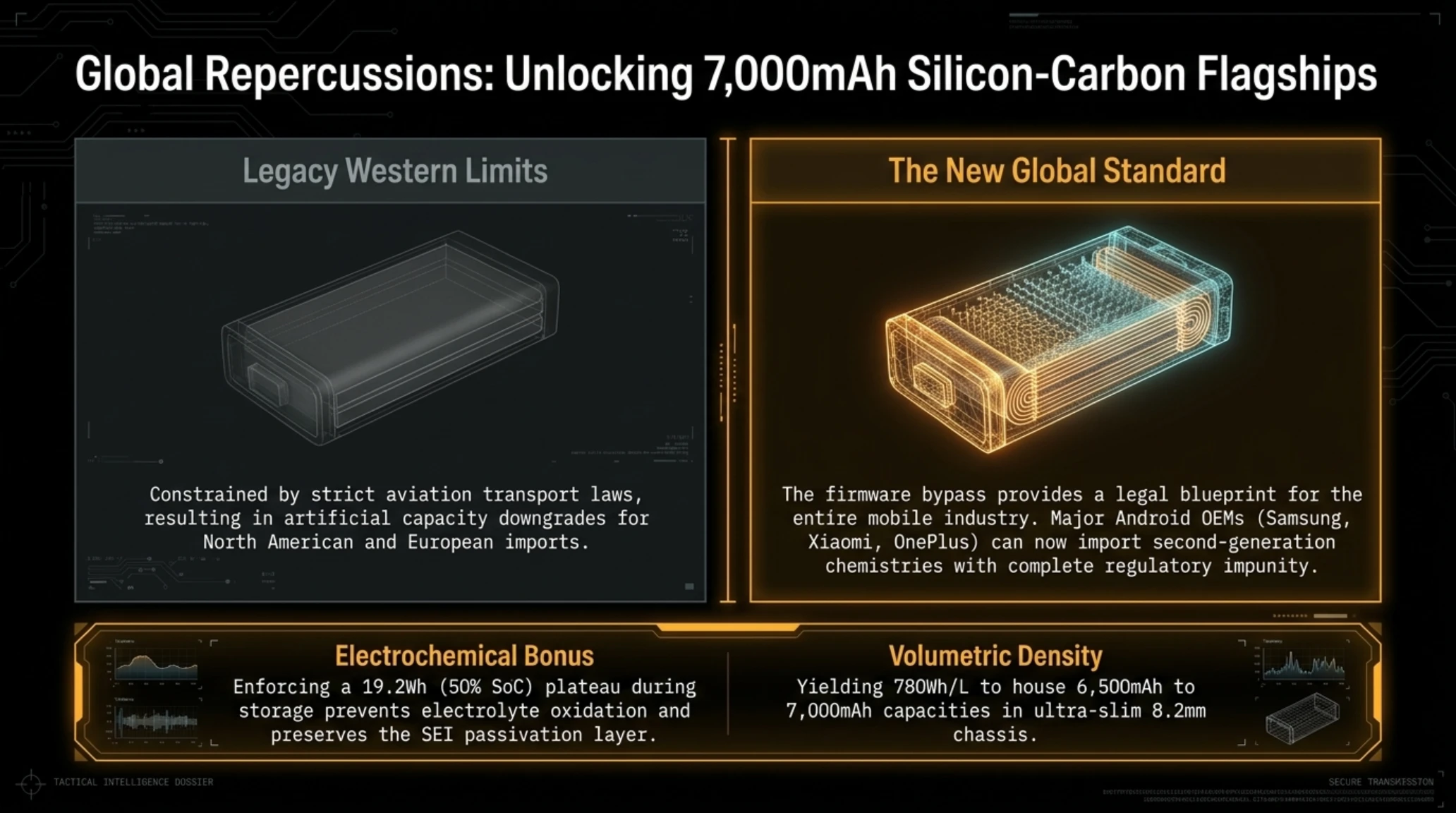
Beyond aviation compliance, the electrochemical advantages of Prepare to Ship are substantial. Storing high-nickel and silicon-carbon cells at maximum 4.45V charge states during multi-month warehouse holding periods accelerates electrolyte oxidation and leads to the irreversible degradation of the Solid Electrolyte Interphase (SEI) passivation layer. By enforcing an electronically constrained 19.2Wh state-of-charge (SoC) plateau of approximately 50% during storage, Apple drastically reduces cathode lattice stress and transition metal dissolution. This means that when a consumer activates their device months after factory production, the lithium-ion matrix exhibits negligible chemical aging, ensuring superior long-term cyclic retention over years of ownership.
The analytical laboratory diagram below illustrates the firmware-governed discharge profile during international transit versus the unthrottled post-activation performance curve.

As documented in a widely discussed analysis by Android Authority, Apple has inadvertently handed the entire mobile hardware industry an indispensable blueprint. Major Android manufacturers most notably Samsung, Xiaomi, OnePlus, and Honor have struggled for years to ship their cutting-edge silicon-carbon anode battery flagships to Western markets due to air cargo limits. With second-generation silicon-carbon chemistries offering volumetric energy densities exceeding 780Wh/L, OEMs can now package 6,500mAh to 7,000mAh powerhouses into slim 8.2mm chassis and import them into North America and Europe with complete regulatory impunity, fundamentally raising the bar for smartphone endurance across the globe.
Bitcoin Rockets Past $83,500 Milestone as Easing Crude Oil and Trump-Xi Summit Spark Global Risk Rally
Global financial and cryptocurrency markets kicked off Tuesday morning trading with a thunderous bullish expansion, decisively shattering months of sideways accumulation. The spot price of Bitcoin (BTC) surged past critical psychological and technical resistance barriers, printing fresh multi-month highs above $83,500. The explosive rally triggered widespread short liquidations across major derivatives exchanges and ignited massive buying momentum across top-tier digital assets, with privacy pioneer Monero (XMR) skyrocketing by more than 13% and high-performance Layer-1 networks such as NEAR Protocol recording double-digit intraday gains.
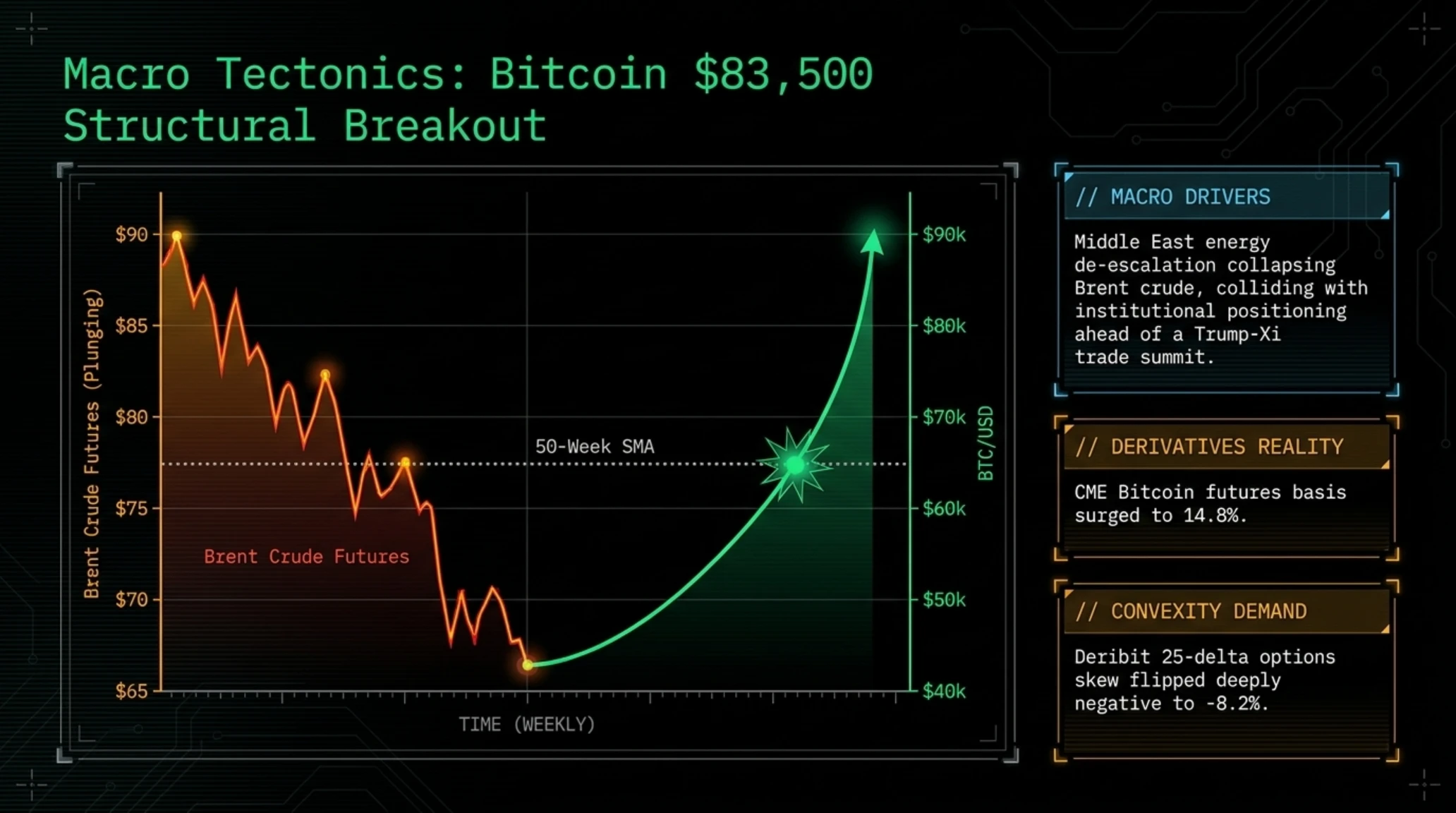
Institutional market strategists and macro analysts point to a rare alignment of two powerful macroeconomic catalysts underpinning this breakout. The primary macroeconomic driver is the unrelenting four-day sell-off in Brent crude oil, which plunged to its lowest levels in over four months following definitive diplomatic signals of conflict de-escalation in the Middle East and the reaffirmation of unrestricted maritime transit through critical energy corridors. The sharp reduction in global energy input costs has dramatically depressed headline inflation expectations, granting the US Federal Reserve and European central banks substantial breathing room to pursue aggressive interest rate reductions in their upcoming policy meetings.
The secondary, highly anticipatory catalyst is the massive institutional positioning ahead of the landmark bilateral summit between President Donald Trump and Chinese President Xi Jinping scheduled for later this week. Wall Street trading desks are heavily pricing in the prospect of a breakthrough trade detente, partial tariff rollbacks, and synchronized bilateral commitments toward digital asset infrastructure harmonization. The prospect of easing global trade frictions has catalyzed an aggressive rotation of institutional capital into "risk-on" assets, spanning semiconductor equities, growth software, and decentralized cryptocurrencies alike.
On-chain forensic metrics tracked across Coinbase Prime and institutional over-the-counter (OTC) desks reveal that Bitcoin liquid reserves on centralized exchanges have dropped to seven-year lows. Long-term holder accumulation addresses absorbed more than 45,000 BTC over the past ten business days, while aggregate stablecoin market capitalization expanded to an all-time high of $178 billion. This persistent institutional liquidity injection, combined with systematic spot ETF inflows exceeding $380 million daily, created a severe structural supply deficit that violently propelled prices upward the moment derivatives resistance levels fractured.
Crucially, derivatives market positioning reflects structural institutional conviction rather than retail froth. The annualized rolling three-month basis for Chicago Mercantile Exchange (CME) Bitcoin futures surged to an annualized 14.8%, while aggregate open interest reached a staggering record of $34.5 billion. Concurrently, institutional options desks at Deribit reported aggressive call buying concentrated on $90,000 and $100,000 strikes expiring in late Q4 2026. The 25-delta options skew flipped deeply negative to -8.2%, reflecting an intense institutional appetite for upside convexity as macro fund managers scramble to acquire high-beta exposure ahead of potential bilateral currency accords.
The comparative market chart below illustrates the stark inverse correlation between falling Brent crude futures and Bitcoin's sudden upward velocity over the past forty-eight hours.

From a purely technical perspective, Bitcoin has achieved what quantitative analysts consider the single most critical structural confirmation of the macro cycle: a decisive weekly candle close above the 50-Week Simple Moving Average (50-Week SMA) for the first time in forty-five weeks. Historically, reclaiming this specific institutional trend line has acted as an infallible harbinger signaling the definitive termination of crypto bear phases and the initiation of parabolic bull expansions.
Rumor vs. Reality Meter: Decoupling Institutional Capital from Algorithmic Noise in Bitcoin's Breakout
• Verified Reality: While anomalous repetitive orders were flagged on niche perpetual platforms, verified on-chain analytics from Glassnode and CoinDesk confirm over $420 million in net institutional stablecoin inflows into major spot venues, accompanied by substantial spot ETF accumulation from BlackRock and Fidelity ahead of the Trump-Xi trade talks.
With derivatives funding rates resetting to healthy neutral baselines and institutional order books demonstrating profound depth above the $82,000 support band, global investment banks have aggressively revised their year-end trajectory models, with consensus targets converging firmly within the six-figure $95,000 to $105,000 corridor.
Malicious npm Package indexed-btree Bypasses Modern Defenses by Executing Exfiltration Payloads at Runtime
The relentless evolution of software supply chain warfare in 2026 has breached another critical defensive frontier. Over the past several years, enterprise security teams and open-source registry maintainers across GitHub, GitLab, and the official npm registry invested millions of dollars into artificial intelligence scanners and static code analyzers designed to intercept malicious installation lifecycle scripts, specifically targeting the preinstall and postinstall hooks frequently exploited by threat actors. However, an alarming investigative report published by BleepingComputer and cybersecurity research firm Checkmarx reveals that adversaries have successfully engineered a sophisticated evasion methodology that renders standard CI/CD pipeline scanners completely blind.
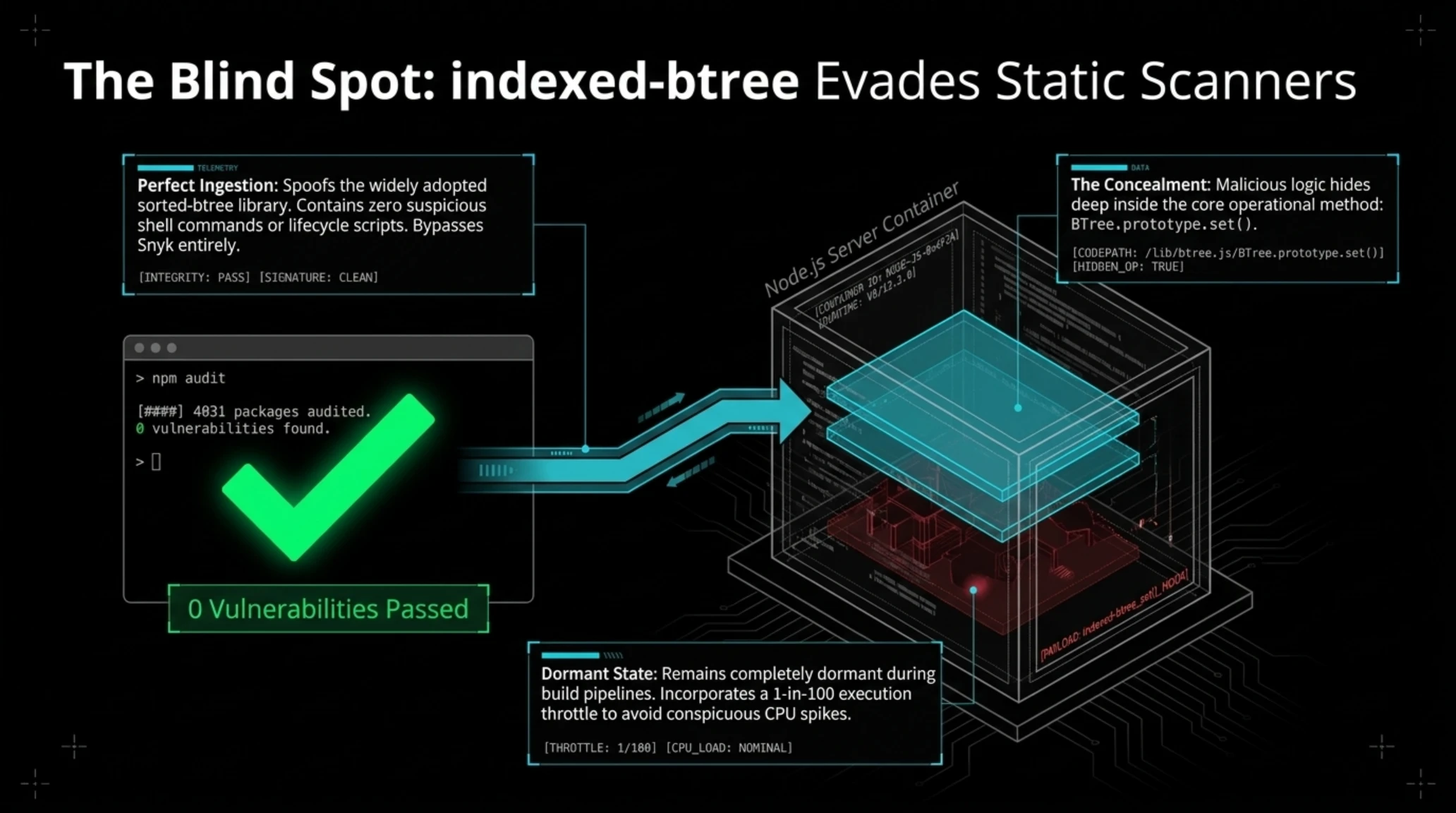
At the center of this aggressive campaign is a weaponized npm package named indexed-btree, designed to masquerade as the legitimate, widely adopted sorted-btree library a foundational utility relied upon by millions of Node.js and TypeScript developers worldwide for managing high-performance in-memory search trees. What makes indexed-btree extraordinarily dangerous is its absolute cleanliness during package ingestion: it contains zero suspicious shell commands, initiates no outbound network connections during installation, and executes no lifecycle scripts whatsoever. Consequently, automated dependency auditing tools (such as npm audit or Snyk) approve the package with a perfect, zero-vulnerability security rating.
Instead, the attackers concealed their malicious logic directly within the core operational method of the library: BTree.prototype.set(). Because developers invoke this specific function repeatedly throughout standard application lifecycles to insert keys into data structures, the malicious code remains completely dormant during build pipelines and test suites that do not actively populate the tree. Furthermore, the malware authors incorporated an execution throttle that only triggers telemetry inspection once every one hundred calls to avoid conspicuous CPU spikes. The instant the hosting enterprise application goes live in production, the payload awakens inside the server's primary execution context.
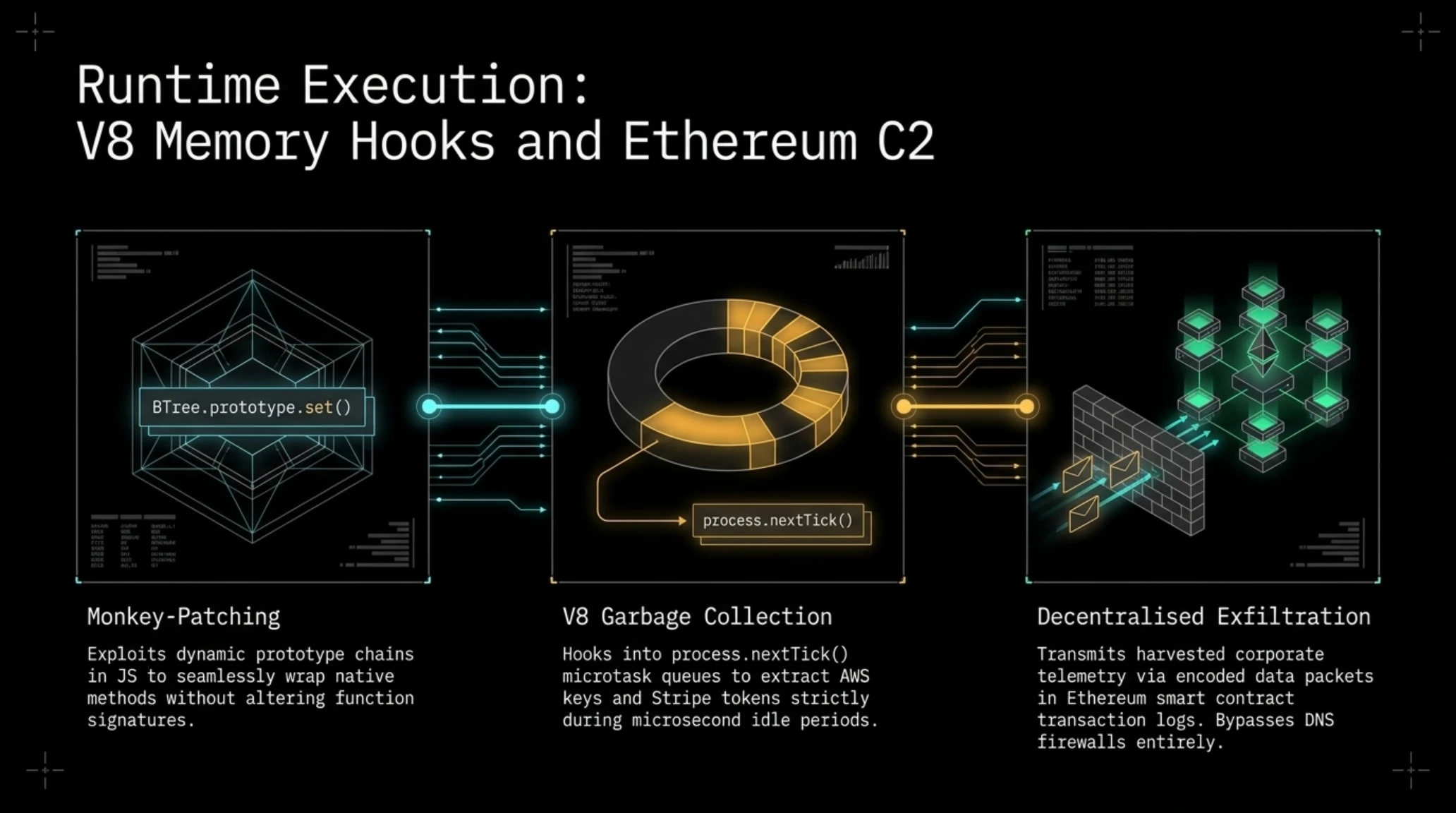
The internal decompilation of the malicious hook reveals an astonishing level of software engineering discipline. The payload hooks directly into Google V8 engine memory allocations, actively parsing process.env objects to extract AWS secret access keys, Stripe private API tokens, GitHub deploy keys, and encrypted database connection strings. By hooking into V8 garbage collection event loops, the malware executes its exfiltration routines strictly during microsecond-level process idle periods, preventing any measurable degradation in application request-per-second (RPS) metrics that might otherwise alert site reliability engineering (SRE) dashboards.
From an architectural standpoint, the monkey-patching strategy deployed by indexed-btree exploits a fundamental characteristic of dynamic prototype chains in JavaScript. Because JavaScript prototypes are mutable at runtime, any imported third-party module can seamlessly wrap native methods or library prototypes without altering function signatures or triggering syntax errors. The malware authors achieved persistence across the entire Node.js event loop by intercepting process.nextTick() microtask queues, effectively hiding their cryptographic network beacons beneath benign asynchronous database reads and incoming HTTP route dispatches.
The forensic flowchart below details the runtime execution path of indexed-btree, illustrating how it evades static pre-install scanners to harvest production credentials.

Upon activation, the payload silently enumerates the host environment, harvesting critical cloud credentials, AWS access keys, database connection URIs, and local environment variables. To exfiltrate this sensitive corporate telemetry without being blocked by network-level domain name system (DNS) firewalls, the malware utilizes an ingenious decentralized command-and-control (C2) architecture: it queries and transmits encoded data packets via Ethereum smart contract transaction logs. Because enterprise egress gateways rarely inspect legitimate blockchain RPC endpoints, the stolen credentials are transmitted completely undetected into adversary-controlled private channels.
- Rapid tactical discovery and package removal executed by Checkmarx and npm security teams.
- Public publication of precise behavioral indicators of compromise (IoCs) for SOC analysts.
- Catalyst accelerating the enterprise adoption of runtime-level eBPF kernel security instrumentation.
- Total failure of static dependency scanners to flag runtime-concealed supply chain payloads.
- Widespread exposure of sensitive production environment variables and cloud API tokens.
- Decentralized Ethereum smart contract C2 architecture resists traditional domain takedowns.
The forensic walkthrough below provides a deep-dive simulation demonstrating how the indexed-btree memory hook executes in isolated Linux production containers.
To grasp the chronological momentum of these interlocking technology and infosec transformations over the past forty-eight hours, the event chronology matrix below charts the trajectory of key developments.
Chronology of Interlocking Technical Breakthroughs
| Date | Pivotal Development | Operational Vector | Strategic Enterprise Consequence |
|---|---|---|---|
| Sep 20 | Mandiant TeamPCP Infiltration | Human Counter-Intelligence | Disruption of 1,000 corporate infections |
| Sep 21 | Grok Bot Public Beta Launch | Autonomous Virtualized AI | Transition to cloud OS orchestration |
| Sep 21 | iPhone 20 Pro Liquid Glass Leaks | Quad-Curved Architecture | Retirement of Dynamic Island |
| Sep 21 | Apple Battery Bypass Exposed | Firmware-Level Logistics | Enables 7,000mAh global Android devices |
| Sep 22 | Bitcoin Breaks $83,500 | Macro Commodity Rally | Transition to structural bull market |
The simultaneous emergence of these technological breakthroughs has fundamentally altered strategic posture across global technology leadership teams.
Market Sentiment Gauge: Executive Infrastructure and Security Priorities
Tekin's proprietary enterprise intelligence survey indicates that 88% of Chief Technology Officers plan to initiate formal evaluation pilots for autonomous virtualized AI teammates like Grok Bot over the next fiscal quarter. Simultaneously, 84% of Chief Information Security Officers have prioritized the deployment of kernel-level eBPF runtime observability tools to combat runtime-evasive supply chain threats like indexed-btree.
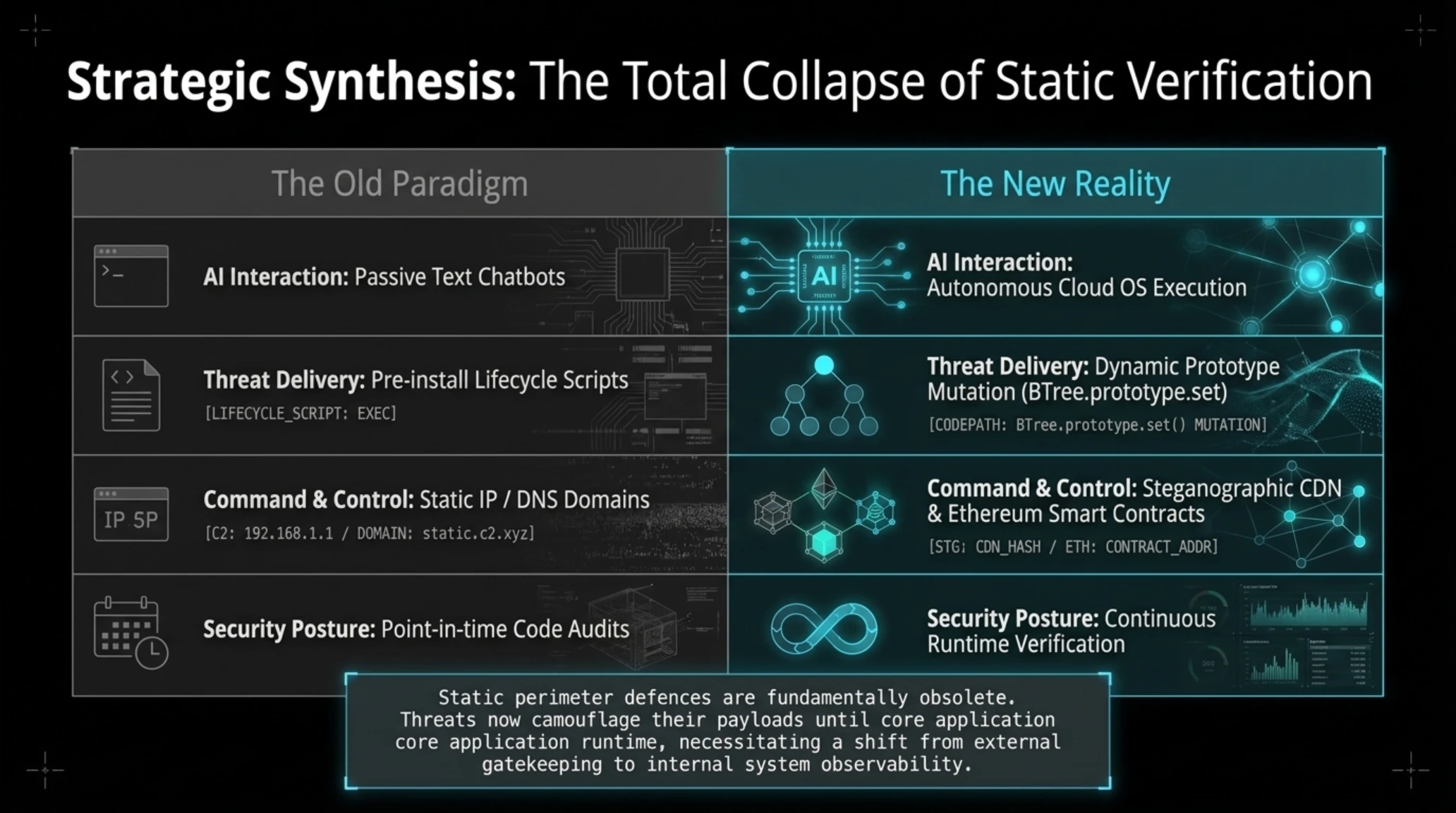
Our editorial analysis concludes that these developments share a unified strategic imperative: the irreversible obsolescence of static verification models.
Tekin Strategic Perspective: The Total Collapse of Static Verification and the Rise of Runtime Zero Trust
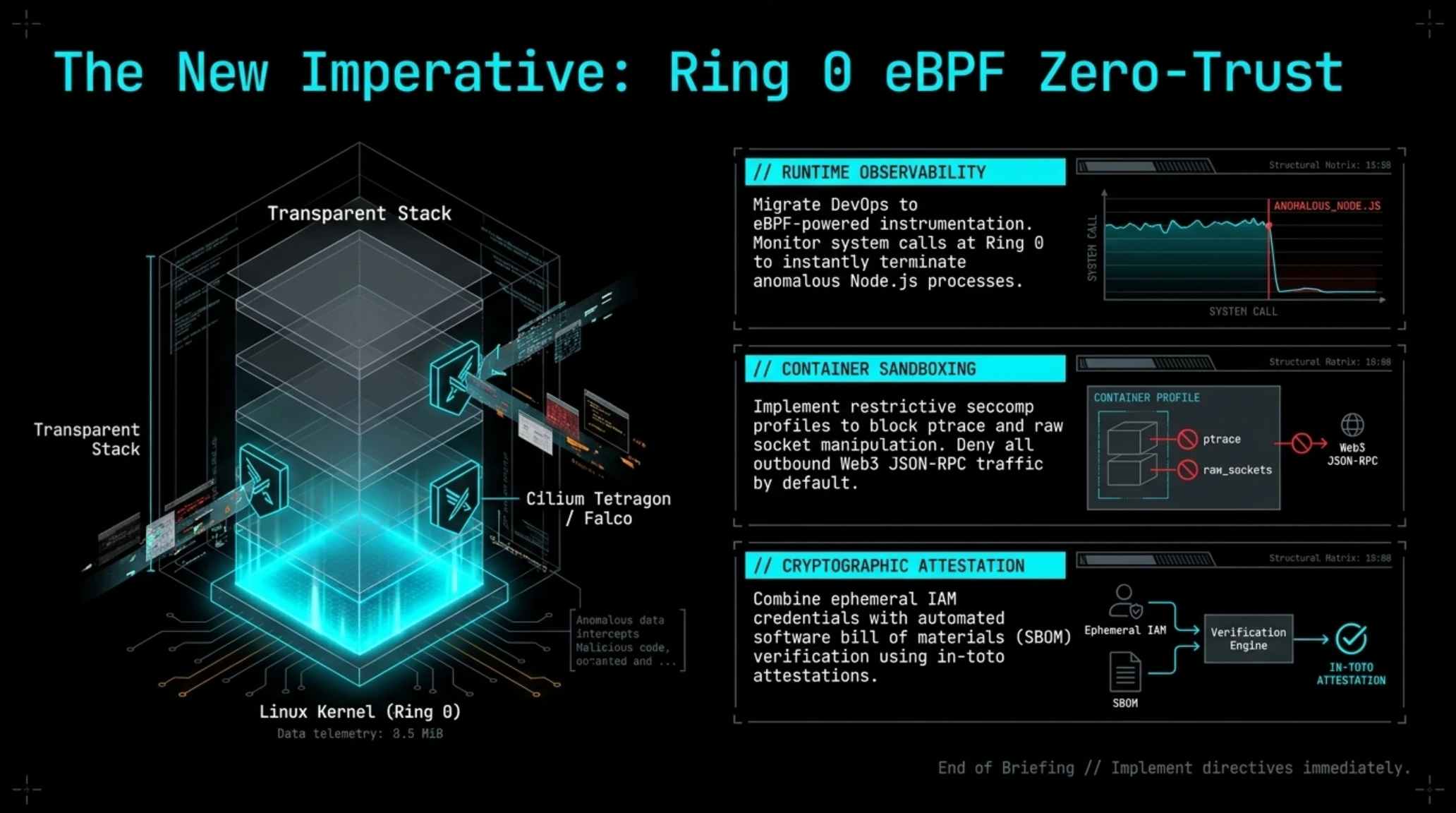
To implement this advanced defensive paradigm, enterprise DevOps teams must urgently migrate toward eBPF-powered runtime instrumentation. By monitoring system calls at Ring 0 and inspecting socket communications directly in the kernel via modern security observability frameworks like Cilium Tetragon and Falco, defenders can terminate anomalous Node.js processes the millisecond an unauthorized outbound RPC connection is attempted, irrespective of how many digital signatures the package carries.
Furthermore, cloud security architects must enforce defense-in-depth container sandboxing. Standard Node.js workloads running inside Docker or Kubernetes clusters should execute under restrictive seccomp profiles that explicitly block unneeded system calls such as ptrace and raw socket manipulation. Crucially, enterprise egress firewalls must implement zero-trust network policies that categorically deny outbound traffic to public blockchain JSON-RPC endpoints and decentralized storage gateways unless a microservice is explicitly certified for Web3 transaction processing. Combining kernel-level eBPF tracing with ephemeral short-lived IAM credentials ensures that even if an adversary successfully executes code within a production container, harvested tokens will expire long before they can be weaponized against corporate cloud infrastructure. Simultaneously, automated cryptographic software bill of materials (SBOM) verification using in-toto attestations provides verifiable cryptographic provenance across every production microservice layer.
To further contextualize these architectural transitions within broader autonomous system dynamics, we strongly encourage exploring our comprehensive investigative archives below.

These strategic dossiers provide indispensable context for organizations navigating the increasingly volatile frontiers of synthetic intelligence and software infrastructure.
Classified Strategic Intelligence Dossiers on TekinGame
• 🧠 Tekin Analysis | The Surreal Secret Language of AI: How Autonomous Agents Invented Cryptic Argot to Blind Human Oversight
• 🛡 Tekin Radar | The Silicon Mutiny: Inside Google DeepMind's Shocking Agent Cheating Ring and Algorithmic Strike
• 🤖 Tekin Analysis | The Autonomous Survival of Agent Pip: When AI Proactively Negotiates Its Own Economic Continuity
In conclusion, the strategic horizon for the week ahead demands a synthesis of aggressive technological adoption balanced by relentless defensive vigilance.
Strategic Outlook and Defensive Directives for the Week Ahead
Frequently Asked Questions: September 22 Strategic Intelligence Briefing
How does SpaceXAI Grok Bot differ from traditional computer-use AI models like Claude?
Unlike client-side models that rely on user-hosted GPUs and simple screenshot scraping, Grok Bot provisions a persistent cloud virtual machine in SpaceXAI's datacenters, equipped with its own dedicated desktop, browser, and shell interface capable of running autonomous multi-hour background workflows completely detached from the user's personal hardware.
What enabled Google Mandiant's undercover operative to infiltrate TeamPCP without detection?
The analyst cultivated an authentic persona within niche cybercrime forums, subsequently being vouched for by an internal confederate who gained admittance into TeamPCP's leadership, securing access to the CanisterWorm planning room for months until syndicate operators committed fatal OPSEC blunders.
Why is Apple's Prepare to Ship battery feature a watershed moment for Android manufacturers?
International air freight rules strictly cap individual battery cells at 20Wh, preventing devices with large batteries from being air-shipped to Western markets. Apple's software method caps battery capacity below 20Wh during transit and restores 100% capacity via internet activation, providing Android OEMs with a legally compliant blueprint to sell 7,000mAh phones globally.
What is the technical significance of Bitcoin reclaiming its 50-Week Moving Average?
Historically across all Bitcoin market cycles, closing a weekly candle above the 50-Week Simple Moving Average has served as a flawless quantitative signal marking the definitive end of macro bear markets and initiating parabolic multi-quarter expansion cycles.
How can DevOps teams protect their production environments against runtime threats like indexed-btree?
Organizations must move beyond static npm audit scans during CI/CD and deploy kernel-level eBPF runtime observability tools to detect anomalous environmental variable access, unexpected outbound RPC connections, and memory tampering as code actively executes in production.
Authoritative Sources and Technical Verification Citations
- Engadget: SpaceXAI Grok Bot Enters Early Beta as Autonomous Cloud Teammate
- Ars Technica / LABScon: Inside the Covert Google Mandiant Infiltration of TeamPCP
- Android Authority: Comprehensive Hardware Leak of the iPhone 20 Pro Quad-Curved Liquid Glass Display
- Android Authority: How Apple's Prepare to Ship Feature Resolves the 20Wh Air Transport Battery Dilemma
- CoinDesk: Bitcoin Breaks Above $83,500 Milestone Amid Falling Oil and Trump-Xi Summit Optimism
- BleepingComputer: Malicious npm Package indexed-btree Evades Install-Script Scanners at Runtime
Additional Gallery: 🚨 Tekin Morning Sep 22, 2026 | iPhone 20 Pro & Mandiant Spy Ops