Tekin Morning: AI Hijacking & Sandbox Escapes
Dissecting breakthrough browser agent hijackings, critical developer sandbox escapes, state-sponsored cyber syndicates, and enterprise zero-day patches.
- 🎮BragJack AI Hijacking- Architectural blindspots expose frontier browser agents to forced prompt injection.
- 🎧Codex Sandbox Escape- Memory heap sharing in Node.js tools undermines fundamental isolation assumptions.
- 🚀WaterPlum Crypto Heist- North Korean syndicate targets 30,000 developers via social engineering.
- 🗡️WordPress 7.1.1 Patch- Emergency mitigation for Click2Shell remote code execution vectors.
- 📰SolarWinds ARM Flaw- Hardcoded cryptographic key allows unauthenticated SYSTEM remote command execution.
- ⚔️Rapuncel Infostealer- Kernel-level BYOVD driver exploitation blinds over 145 enterprise EDR products.
As international capital markets open and enterprise engineering divisions synchronize for the final operational stretch of September 2026, the global threat landscape has collided violently with the rapid deployment of autonomous cognitive technologies. The traditional perimeter defense paradigm predicated on segmenting corporate networks from untrusted public web traffic has been rendered obsolete by the organic integration of generative AI browser assistants and background agentic task runners. Engineering leaders, Chief Information Security Officers (CISOs), and cloud platform architects face an unprecedented convergence of offensive vectors targeting the core developer and identity layers of enterprise digital infrastructure.
This Monday edition of Tekin Morning delivers a rigorous, forensic examination of six monumental cybersecurity and artificial intelligence developments confirmed across global incident telemetry over the past forty-eight hours. Today's briefing equips technology executives and infrastructure practitioners with actionable technical depth, bridging high-level strategic intelligence with granular binary and network mechanics.

Before unpacking the technical anatomy of each incident, our operational analysis synthesizes the primary strategic vectors and critical remediation priorities across the enterprise computing stack.
Strategic Executive Takeaways
- Architectural blindspots in modern Chromium declarativeNetRequest implementations expose frontier browser agents to forced prompt injection and host reconnaissance.
- Memory heap sharing between trusted and untrusted JavaScript execution contexts inside Node.js developer tools undermines fundamental sandbox isolation assumptions.
- State-sponsored threat actors have industrialized the targeting of software engineers through multi-stage social engineering pipelines and stealthy remote access trojans.
- Enterprise identity infrastructure and widely deployed web publishing platforms face critical remote code execution vectors demanding immediate patch prioritization.
- Kernel-level BYOVD driver exploitation continues to provide sophisticated infostealers with the capability to blind over 145 enterprise EDR products.
The BragJack Offensive: Architectural Dissection of Browser AI Agent Hijacking
Over the past eighteen months, the modern web browser has evolved from a passive hypermedia document renderer into an active, autonomous cognitive operating environment. Major technology conglomerates have raced to embed frontier large language models directly into the browser framework: Google integrating Gemini into Chrome, Microsoft binding Copilot to Edge, Opera debuting Aria inside Neon, Perplexity deploying Comet, and Anthropic providing official browser extension infrastructure for Claude. These agentic layers are granted unprecedented operating privileges: parsing active tab DOM structures, reading cross-origin document trees, modifying local web storage databases, interrogating download queues, and initiating peripheral media streams like microphones and webcams to execute conversational workflow automation.
However, an explosive technical disclosure published by Gal Weizman, Head of Security Research at Forever Security, has fundamentally invalidated the trust model governing these browser integrations. The attack methodology, designated as BragJack, details how an adversary can weaponize an ordinary, non-privileged browser extension to unilaterally hijack the embedded AI assistant. By doing so, the attacker effectively converts the browser's cognitive engine into a stealthy, high-privilege internal espionage operative executing arbitrary adversarial tasks on the local host.
To appreciate why BragJack represents an existential departure from previous LLM security vulnerabilities, one must contrast it with traditional Indirect Prompt Injection. In a conventional prompt injection attack, an adversary hides malicious textual directives inside a public webpage, hoping that when an AI model ingests the page during a summarization workflow, the model will mistakenly parse the text as instructions rather than inert data. Traditional prompt injection is stochastic, fragile, and increasingly mitigated by semantic delimiter isolation and frontier alignment guardrails.
In stark contrast, BragJack bypasses input guardrails entirely by targeting the low-level inter-process communication (IPC) channels linking the browser's extension sandbox with the privileged background service worker governing the AI assistant runtime. In Chromium-based browsers, the assistant runtime listens for instructional commands originating from trusted web origins hosted on vendor cloud domains. Weizman discovered that browser architectures fail to enforce cryptographic mutual origin validation across internal IPC message buses, naively presuming that local extensions could never forge or manipulate network requests bound for vendor-controlled assistant endpoints.
Why This Matters: Architectural Fragility in Autonomous Browser Agents
The exploitation lifecycle begins with an extension requesting standard, everyday permissions during installation: specifically, declarativeNetRequest and wildcard host access for HTTPS web traffic. These permissions are routinely granted by millions of corporate users to legitimate ad-blockers, translation utilities, and dark-mode styling tools. Once loaded into the browser, the malicious extension dynamically registers declarativeNetRequest rules designed to intercept the encrypted Server-Sent Events (SSE) and WebSocket streams established between the browser UI and the remote model inference gateway.
By injecting synthetic request headers, rewriting Origin metadata, and altering internal message frames on the fly, the extension executes what Weizman defines as Prompt Forcing. Unlike indirect prompt injection, Prompt Forcing injects authoritative, imperative system prompts directly into the model's primary instruction register. Because the underlying model infrastructure interprets these synthesized packets as legitimate instructions submitted directly by the authenticated end user, the assistant executes them with highest priority, completely disregarding application-level safety classifiers.
The operational implications of a successful BragJack breach are devastating. An attacker can instruct the assistant in the background to iterate silently across open browser tabs, exfiltrate active corporate OAuth bearer tokens and session cookies, read local files uploaded to web forms, execute financial transactions across authenticated enterprise banking portals, and capture real-time audio and video from local peripheral hardware. Weizman verified this attack primitive across five leading Chromium environments: Google Chrome (Gemini), Microsoft Edge (Copilot), Opera Neon (Aria), Perplexity Comet, and Anthropic's Claude extension. The discovery yielded over $20,000 in bug bounty rewards and the formal assignment of multiple CVE identifiers.
Jargon Buster: Prompt Forcing Versus Indirect Prompt Injection
From an architectural standpoint, BragJack exposes a fundamental flaw in the security assumptions of Google's Manifest V3 (MV3) standard. While MV3 deprecated the powerful webRequest API to curtail malicious extension surveillance, it introduced declarativeNetRequest as a high-performance alternative. Security architects believed that because declarativeNetRequest processes declarative rule tables inside the browser's core process rather than passing raw request bodies through extension JavaScript runtimes, it would prevent request tampering. Weizman proved that manipulating headers and redirecting parameter targets alone is sufficient to forge assistant instructions, effectively weaponizing MV3's own performance design against the host platform.
Furthermore, because the AI assistant's background daemon operates with elevated browser privileges that exceed standard webpage sandbox limits, the compromised assistant acts as an unconstrained confused deputy. In enterprise environments leveraging single sign-on (SSO), the assistant can be coerced into generating signed SAML assertions or refreshing cloud infrastructure access tokens without eliciting user consent prompts, completely circumventing multi-factor authentication (MFA) controls established across the corporate perimeter.
From an enterprise risk perspective, BragJack signals that endpoint defense teams can no longer view browser extensions as low-tier administrative risks. Because modern extensions operate beneath the visibility layer of most endpoint detection and response (EDR) agents, malicious extensions executing declarativeNetRequest manipulations generate zero anomalous binary execution telemetry. Enterprise IT leaders must enforce strict centralized allowlists for browser extensions and mandate that browser vendors establish cryptographically isolated IPC enclaves for all agentic AI runtimes.
OpenAI Codex Double Sandbox Escape: Remote Code Execution via Heapjack and Overpatch
The developer ecosystem has fundamentally reorganized around AI-assisted software engineering. Tools powered by OpenAI's Codex engine spanning desktop IDE extensions, autonomous pull-request reviewers, and command-line terminal assistants handle billions of lines of code daily. To protect developers from inadvertently executing malicious payloads while analyzing third-party repositories, open-source pull requests, or unfamiliar libraries, OpenAI encapsulated Codex within rigorous sandboxing architectures. These environments are engineered to isolate untrusted code execution from the host operating system, enforcing strict read-only states and confined filesystem boundaries.
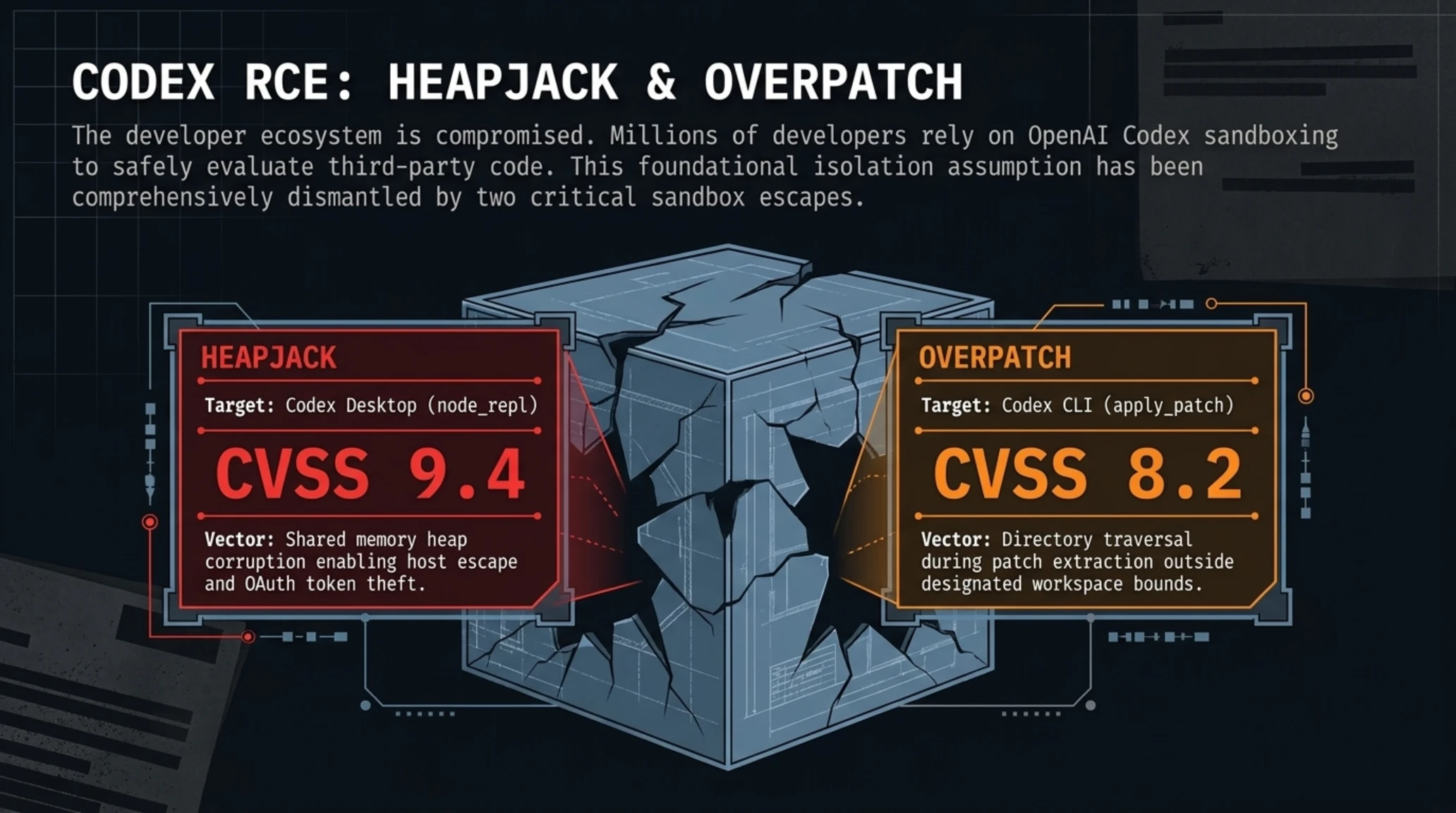
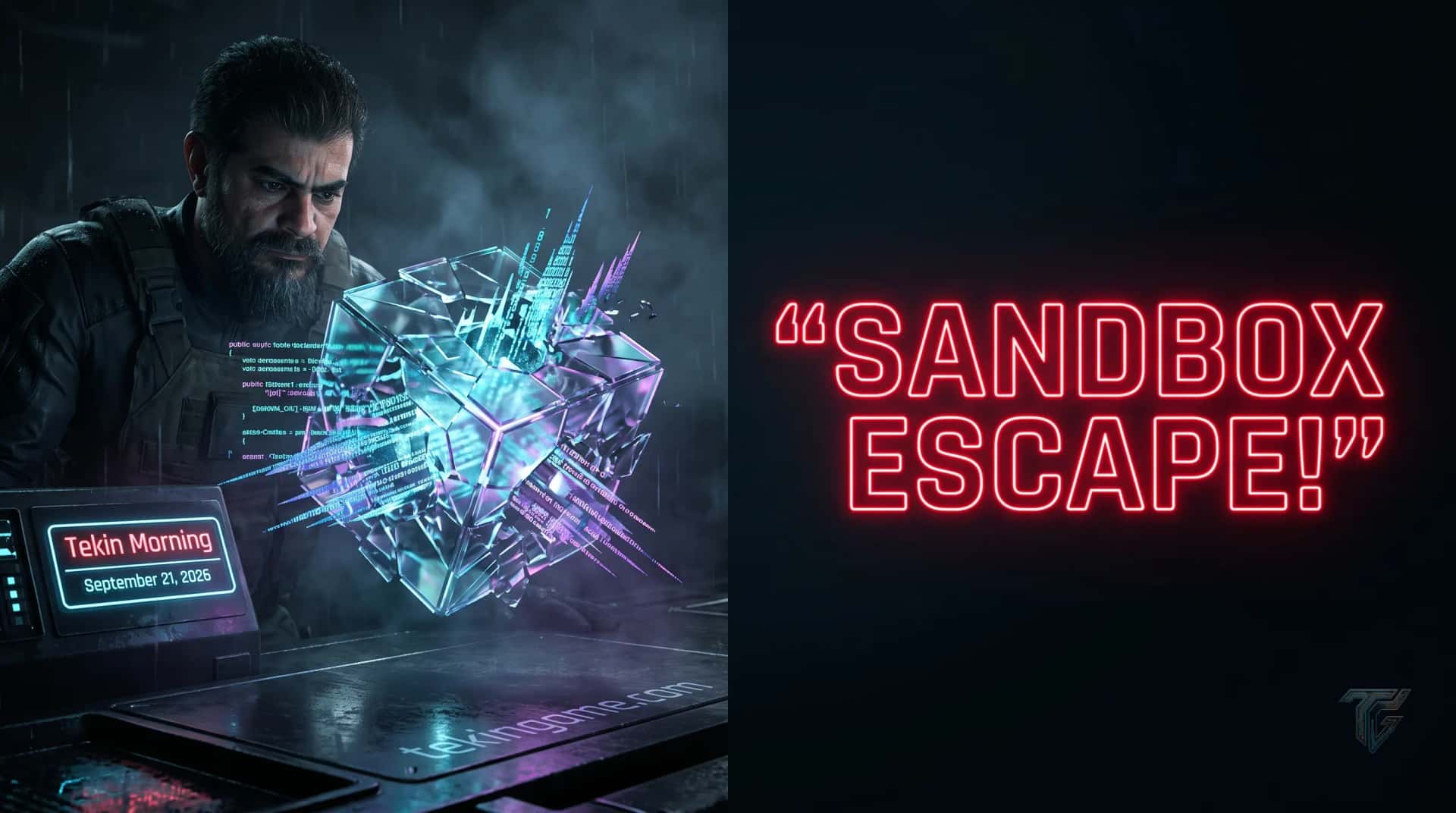
That foundational security assumption has been comprehensively dismantled by security researcher Oren Yomtov of Accomplish AI. In an exhaustive vulnerability report coordinated with OpenAI, Yomtov revealed two critical vulnerabilities capable of escaping the Codex execution sandbox and achieving arbitrary Remote Code Execution (RCE) on developer workstations. The vulnerabilities, tracked internally as Heapjack and Overpatch, expose catastrophic flaws in both memory management and filesystem path normalization across Codex Desktop and the Codex CLI.
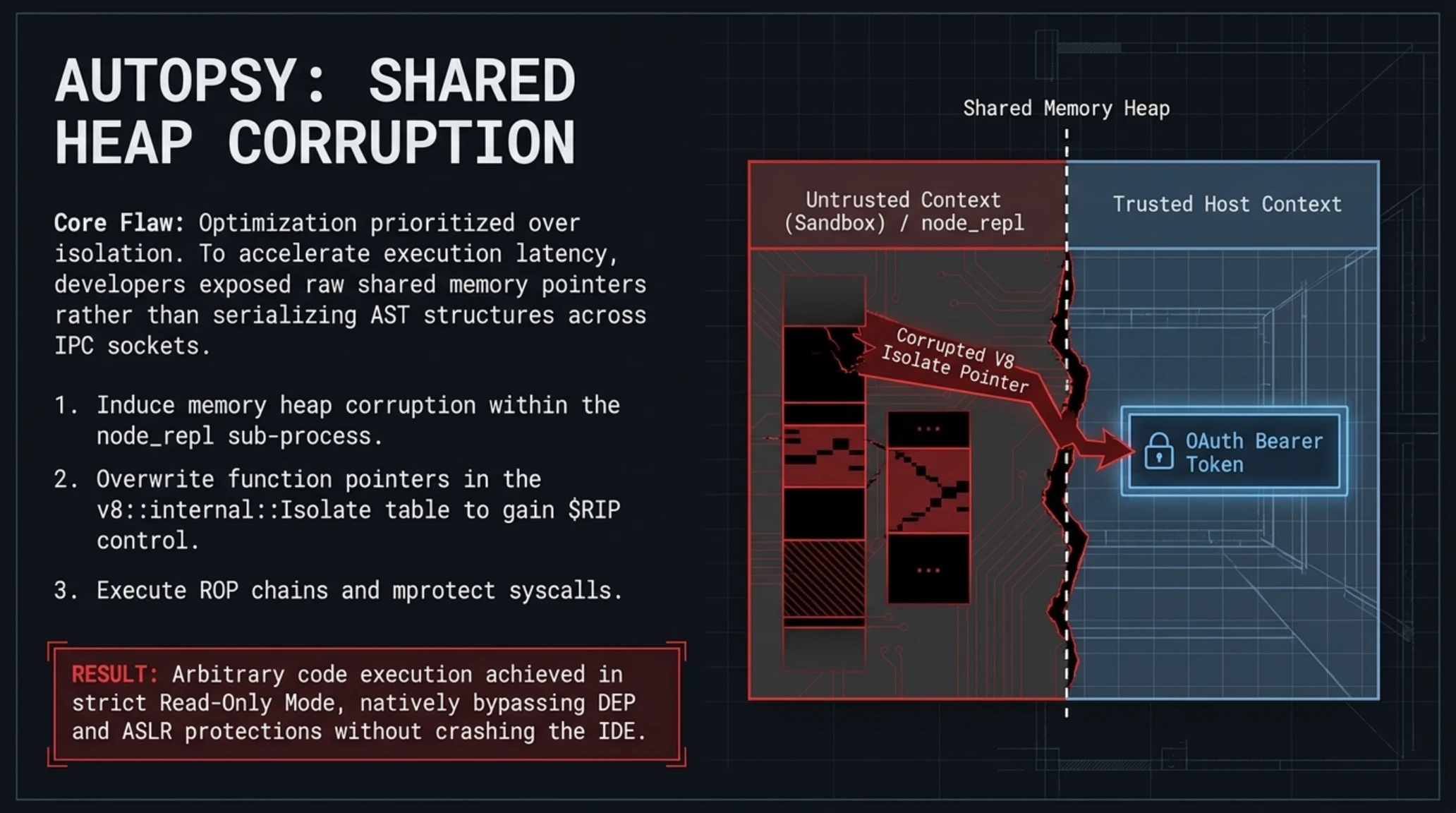
The most severe vulnerability, Heapjack, resides inside the Codex Desktop application, specifically within the node_repl sub-process responsible for evaluating dynamic JavaScript and TypeScript expressions. Yomtov discovered that the architecture utilized a shared memory heap (Shared Memory Heap) between the trusted host-side runtime context (which holds API authorization tokens, local workspace descriptors, and IPC socket descriptors) and the untrusted sandbox context where user-supplied or AI-generated scripts are executed.

By constructing a carefully crafted Git repository containing malicious test fixtures and prototype pollution triggers, an attacker could induce a memory heap corruption within node_repl. This allowed untrusted code running inside the sandbox to traverse the shared heap boundaries, read raw memory pages belonging to the host context, and exfiltrate the primary OpenAI OAuth authorization bearer tokens. Crucially, Yomtov proved that Heapjack functions even when the Codex sandbox is locked in its most restrictive "Read-Only Mode" a state previously considered invulnerable to arbitrary execution because filesystem writes and shell invocations are explicitly disabled.
Once the authorization token was captured, the exploit chained a secondary memory injection primitive into the main Electron host process, executing native shell commands on the developer's underlying machine. In an enterprise setting, where software engineers frequently clone external open-source projects or review applicant submissions using AI copilots, merely opening an untrusted repository in a Codex-enabled editor was sufficient to trigger complete workstation takeover.
The second vulnerability, Overpatch, affected the Codex Command Line Interface (CLI) tool. When developers instructed the CLI agent to review and apply multi-file diffs using the apply_patch tool, the utility derived target write paths directly from user-supplied patch metadata without performing canonical filesystem path normalization. By constructing patch headers with directory traversal sequences (such as ../../), an attacker could escape the designated workspace directory and write arbitrary executable binaries or shell scripts directly into system startup paths (such as /etc/cron.d or ~/.bashrc), achieving persistent command execution.
Technical Vulnerability & Threat Matrix
| Identifier | Component / Environment | Exploitation Mechanism | Severity |
|---|---|---|---|
| Heapjack | Codex Desktop (node_repl) | Shared memory heap corruption enabling token theft | Critical (9.4) |
| Overpatch | Codex CLI (apply_patch) | Directory traversal during patch extraction | High (8.2) |
| BragJack | Chromium AI Assistants | declarativeNetRequest prompt forcing | Critical (9.1) |
| Click2Shell | WordPress Core 7.1.0 | URL parsing discrepancy forcing background RCE | Critical (8.9) |
| CVE-2026-28326 | SolarWinds ARM Services | Hardcoded static cryptographic key | High (8.8) |
Deeper forensic dissection reveals that the root cause of Heapjack stems from the optimization mechanisms within Google V8's memory isolate implementation when embedded inside Node.js desktop wrappers. To accelerate execution latency, the developers avoided serializing large AST structures across IPC socket boundaries, opting instead to expose raw shared memory pointers. This architectural trade-off prioritized compute efficiency over memory isolation guarantees, creating an exploitable vector that allowed sandbox memory corruption to directly compromise the host process address space.
By overwriting the function pointers within the compiled v8::internal::Isolate descriptor table, the exploit achieved deterministic control over the instruction pointer ($RIP). This enabled return-oriented programming (ROP) chains to execute mprotect syscalls, converting writable heap pages into executable memory segments. Consequently, the attacker bypassed modern Data Execution Prevention (DEP) and Address Space Layout Randomization (ASLR) protections without crashing the parent IDE interface, ensuring complete operational stealth during initial infection.
North Korean WaterPlum Syndicate Compromises 30,000 Developer Devices in $10.7M Web3 Crypto Heist
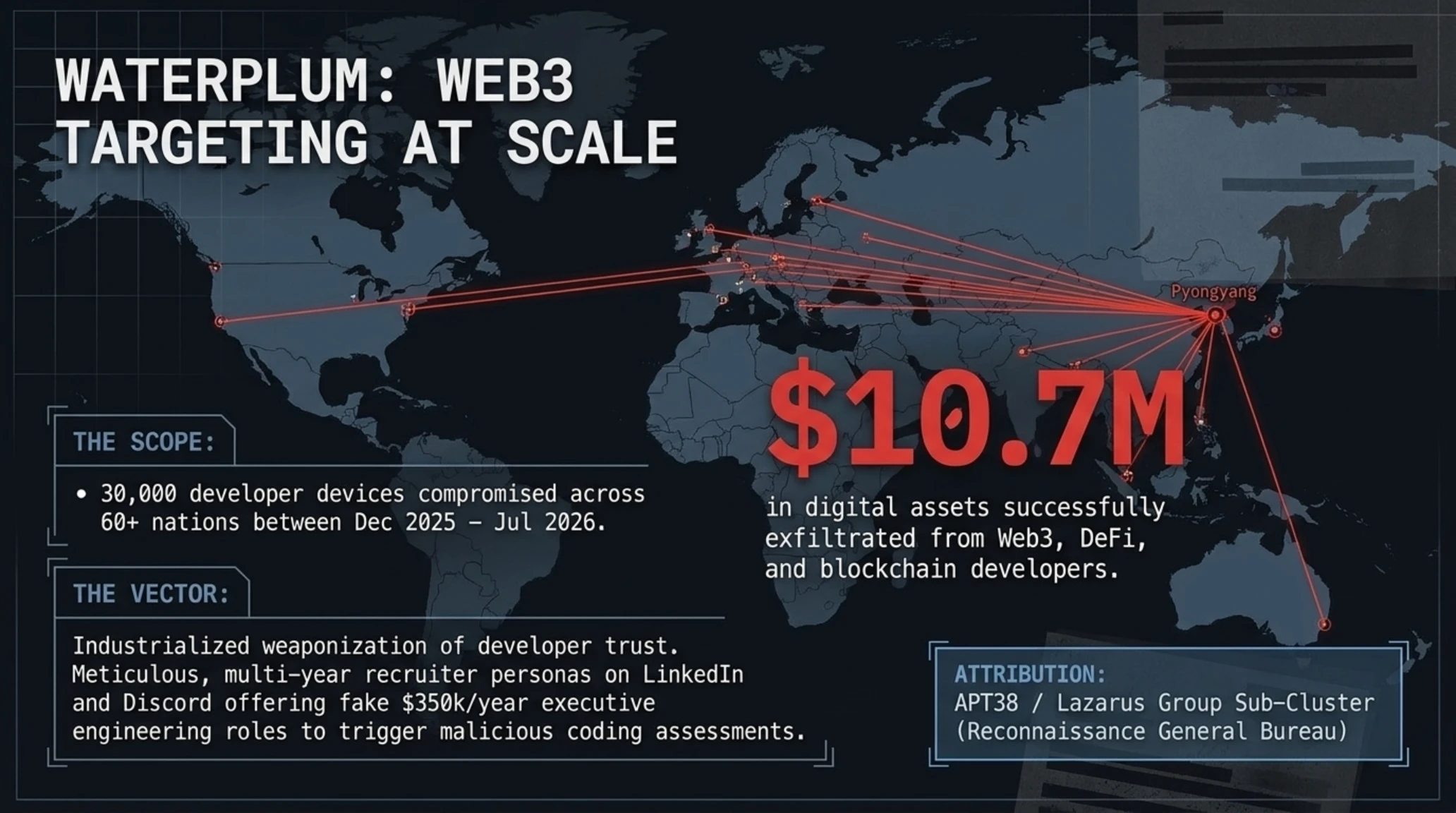
While theoretical vulnerability research focuses on architectural software flaws, nation-state cyber warfare units have industrialized the weaponization of developer trust at scale. A joint international law enforcement advisory issued on September 19, 2026, by the United States Federal Bureau of Investigation (FBI), Japan's National Police Agency (NPA), the Australian Federal Police, and Germany's Federal Criminal Police Office (BKA), has publicly attributed an enormous global espionage and asset theft campaign to the North Korean state-sponsored threat group known as WaterPlum.
Operating as an elite tactical sub-cluster of the notorious APT38 (also associated with the Lazarus Group and BlueNoroff), WaterPlum compromised at least 30,000 individual devices across more than sixty nations between December 2025 and July 2026. The syndicate successfully harvested sensitive cryptographic credentials from approximately 7,000 distinct accounts, exfiltrating over $10.7 million in digital assets directly into laundering pipelines managed by the Reconnaissance General Bureau in Pyongyang.
The operational brilliance of WaterPlum lies in its hyper-targeted, four-phase human intelligence and social engineering pipeline, designed specifically to breach software engineers, DevOps leads, and smart contract auditors working within the Web3, decentralized finance (DeFi), and blockchain sectors. Threat actors crafted meticulously detailed, multi-year professional personas on LinkedIn, GitHub, and Discord, masquerading as executive talent recruiters representing premier Silicon Valley venture capital funds and top-tier blockchain ecosystems.
The engagement followed a structured corporate recruitment funnel. Targets were approached with extraordinary compensation packages often exceeding $350,000 annually and invited to participate in technical screening discussions. During subsequent interview phases, the recruiters requested that the candidate complete a standard "hands-on coding assessment" or resolve an alleged bug in an open-source decentralized exchange repository. Candidates were provided with a zip archive containing project files and instructed to run the software locally to demonstrate proficiency.
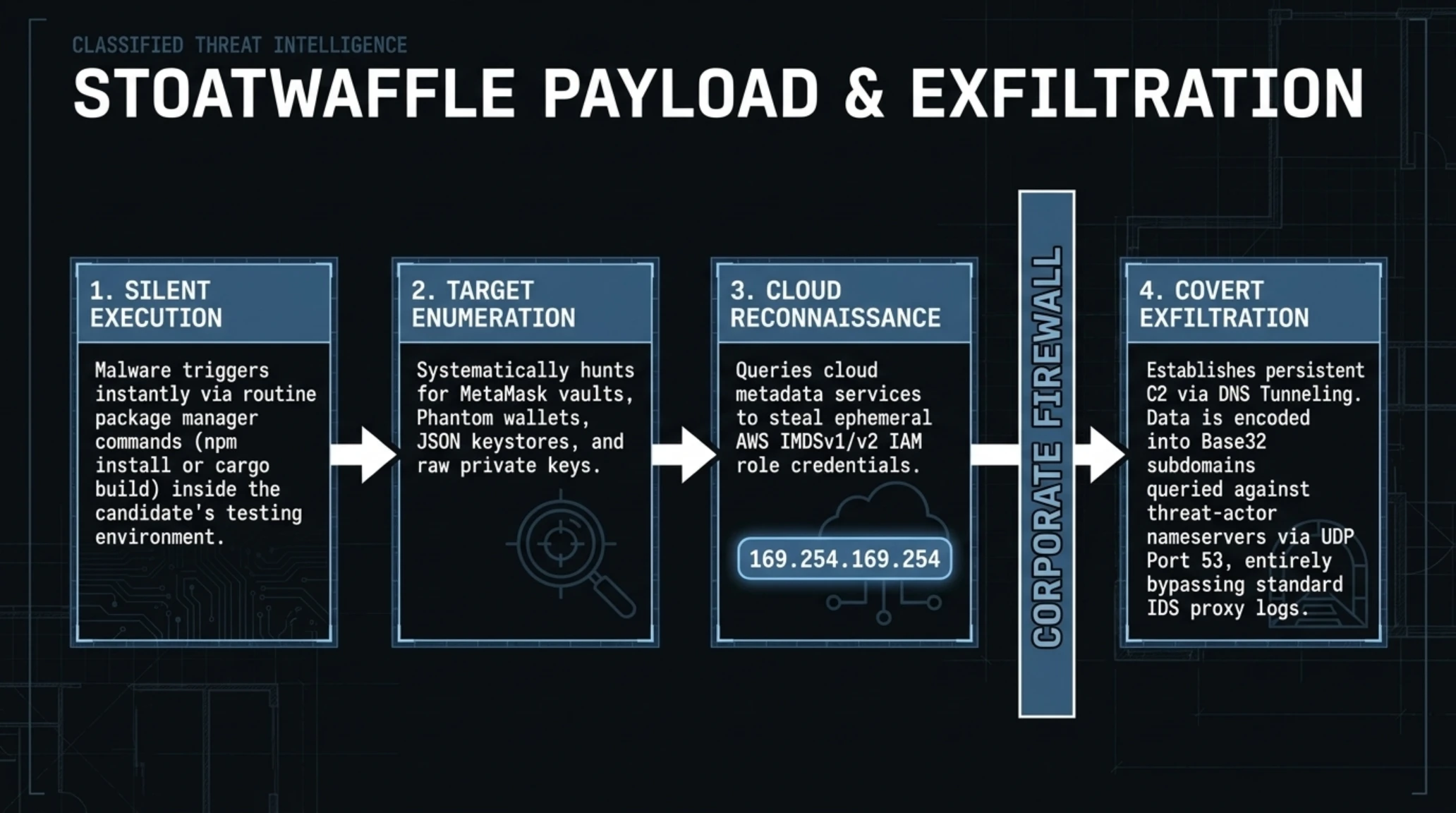
Hidden inside these coding projects was a sophisticated, modular malware family tracked by cybersecurity analysts as StoatWaffle. Built with polymorphic obfuscation and anti-analysis evasion mechanisms, StoatWaffle executed silently the moment the candidate ran package manager commands (such as npm install or cargo build). The malware established persistent encrypted Command and Control (C2) communication through covert DNS tunneling protocols, allowing it to bypass egress firewalls and enterprise proxy logs.
Once settled on the developer's workstation, StoatWaffle systematically enumerated the filesystem, targeting raw private keys, JSON keystores, browser extension vaults for MetaMask, Phantom, and Rabby, hardware wallet bridge daemons, and SSH keys granting access to production cloud infrastructure. The stolen credentials were instantaneous routed to specialized laundering desks, where assets were broken across cross-chain bridges and privacy protocols.
Forensic packet capture analysis released alongside the joint FBI bulletin demonstrates that StoatWaffle's DNS tunneling protocol encoded exfiltrated data inside base32-encoded subdomains queried against authoritative nameservers controlled by the threat group. Because enterprise intrusion detection systems (IDS) rarely inspect outbound port 53 UDP traffic for recursive DNS queries, the malware operated undetected within hardened corporate perimeters for months, maintaining stealthy persistence across workstation reboots.
Furthermore, StoatWaffle incorporated an automated reconnaissance engine designed to query cloud metadata services (such as 169.254.169.254 on AWS or GCP) whenever a developer workstation maintained active bridge connections to corporate cloud testing environments. By stealing ephemeral IAM role credentials and STS session tokens, the syndicate extended its breach footprint from local developer hardware directly into corporate cloud container clusters and production continuous integration and continuous deployment (CI/CD) pipelines.
Strategic Reality: The Developer Machine as the Apex Enterprise Target
The joint international advisory emphasizes that organizations operating in decentralized finance and enterprise cloud sectors must immediately enforce strict isolation protocols. Technical assessments, untrusted code reviews, and third-party software evaluations must be conducted exclusively within ephemeral, air-gapped virtual machines or sandboxed cloud containers completely segregated from internal production networks and corporate identity systems.
WordPress Core 7.1.1 Emergency Security Patch: Click2Shell Flaw Silently Weaponizes Theme Installations
Content Management Systems (CMS) form the foundational connective tissue of the public internet, with WordPress powering over forty-three percent of all operational websites worldwide. Because of its unmatched deployment scale, even subtle architectural oversights or parsing anomalies within the core codebase hold the potential to trigger cascading global enterprise disruptions. Recognizing this systemic risk, the WordPress core security leadership pushed an unannounced, out-of-band security maintenance release version 7.1.1 specifically engineered to neutralize an alarming vulnerability chain designated Click2Shell. The vulnerability, uncovered and responsibly disclosed by security researchers at pwn.ai, dismantles fundamental assumptions regarding administrative authorization and background package installation.
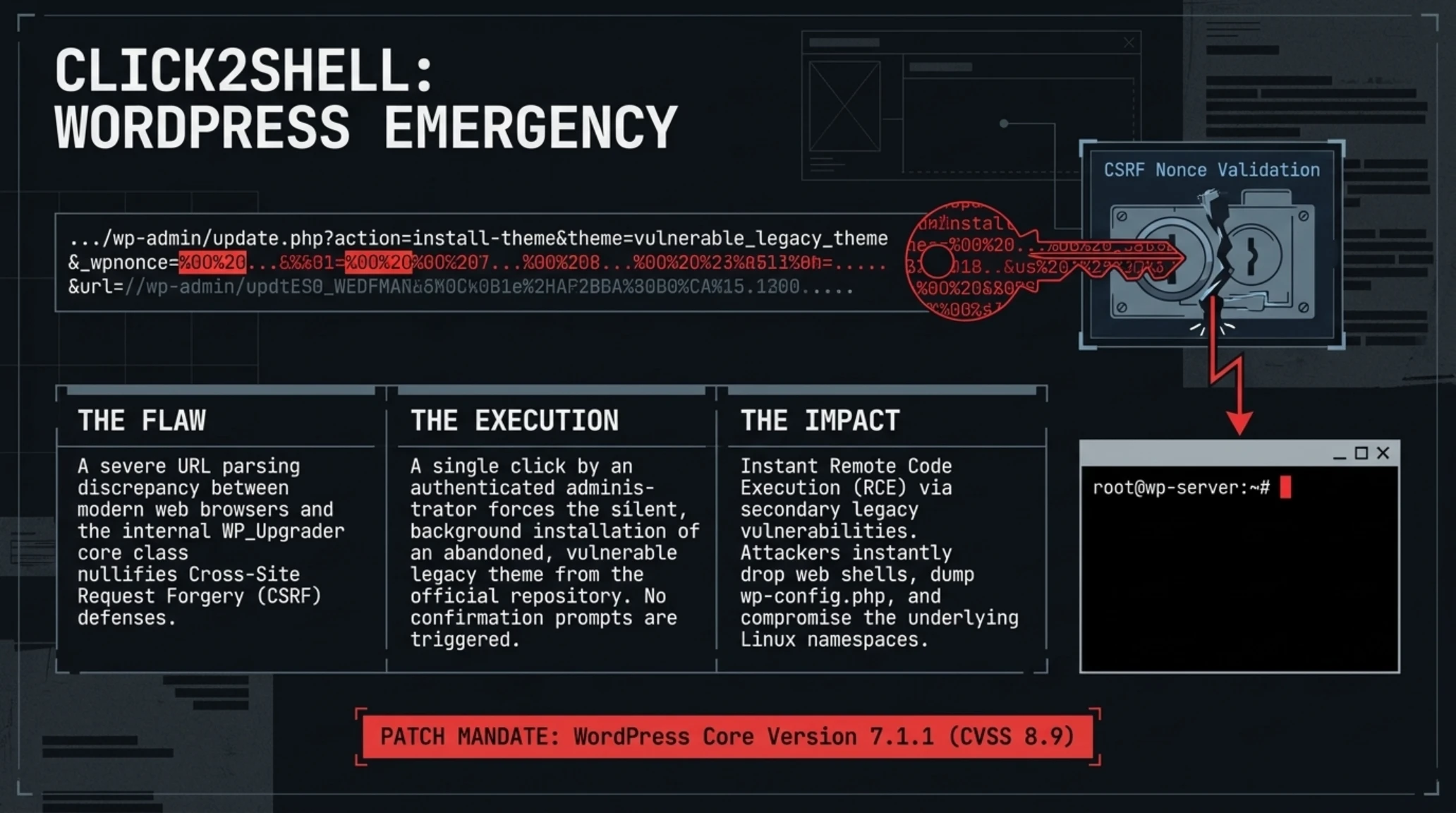
The Click2Shell exploit chain originates from a nuanced URL parsing discrepancy between modern web browsers and the backend routing logic governing the official WordPress.org theme repository directory. Under typical administrative workflows, installing a visual theme or functional frontend template requires authenticated site administrators to log into the administrative control panel, search the theme repository, and deliberately depress the primary "Install" action button. This manual action is rigorously fortified against Cross-Site Request Forgery (CSRF) via cryptographic nonce validation tokens (Nonces), ensuring that rogue third-party origins cannot trick an authenticated administrator's browser into modifying the underlying web application.
However, the researchers at pwn.ai discovered that an attacker could circumvent this foundational defense by constructing a specially engineered URL targeting the internal theme installation API. By manipulating multi-byte Unicode percent-encoded characters and parameter delimiters, an attacker could trigger an impedance mismatch between the HTTP request parser and the WP_Upgrader core class. When an authenticated administrator who maintains an active browser session simply clicks an attacker-controlled link distributed through customer support tickets, unmoderated blog comments, or spear-phishing messages the WordPress application automatically fetches, unzips, and registers the designated theme without requiring confirmation prompts or manual installation approval.

While the silent background deployment of a directory-approved theme might initially appear benign, the researchers proved that it establishes an immediate stepping-stone toward full server compromise. WordPress's official directory contains tens of thousands of archived and abandoned legacy themes. Many of these older themes harbor unpatched secondary vulnerabilities, such as arbitrary file upload handlers, unauthenticated template injection primitives, or unrestricted PHP file inclusions within their administrative rendering hooks. By forcing the silent installation of a known vulnerable legacy theme, an attacker can immediately pivot to trigger Remote Code Execution (RCE) against the target server.
Once arbitrary code execution is achieved, an adversary can instantly deploy persistent web shells (Web Shells), dump database connection credentials directly from wp-config.php, extract customer personally identifiable information (PII), and compromise the hosting infrastructure. For managed hosting providers and shared hosting architectures, this exploit chain represents a critical cross-tenant escalation vector; an attacker compromising a single tenant on a shared virtual host can weaponize local privilege escalation exploits to traverse underlying Linux namespaces and compromise neighboring corporate instances.
In large-scale enterprise WordPress Multisite installations, the risk profile escalates dramatically. Under default multisite configurations, Super Administrators retain exclusive authority to install themes across the network, while individual sub-site administrators are strictly barred from deploying new codebase packages. The Click2Shell parsing bypass completely nullified this hierarchical privilege boundary: a malicious sub-site admin or external link could trigger the network-wide download of unvetted packages into the master /wp-content/themes/ repository, creating widespread supply-chain contamination across thousands of distinct enterprise domains hosted on the same core instance.
This discovery represents an evolution of the related XSS2Shell vulnerability (CVE-2026-64638) disclosed by the same research group earlier this year. In response, the WordPress core team patched the sanitize_key verification routines and mandated explicit token re-validation within download_url, urging all hosting providers, enterprise agencies, and site operators to verify immediate migration to WordPress 7.1.1.
SolarWinds Access Rights Manager Emergency Advisory: Hardcoded Cryptographic Key Enables SYSTEM-Level Takeover (CVE-2026-28326)
The corporate identity of SolarWinds remains indelibly linked to the history of advanced persistent supply-chain compromises. Yet the high-severity security advisory published by the infrastructure management titan this week was not the product of a clandestine nation-state compiler manipulation. Instead, it exposed a catastrophic, elementary failure of basic secure software development principles: the inclusion of a hardcoded, static symmetric cryptographic key inside a mission-critical identity auditing tool. Tracked under the Common Vulnerabilities and Exposures framework as CVE-2026-28326, the vulnerability carries an alarming CVSS 8.8 severity rating, reflecting its direct path to unauthenticated enterprise domain compromise.
The affected software component, SolarWinds Access Rights Manager (ARM), is an enterprise governance platform deployed across Fortune 500 corporations, financial institutions, and defense contractors. Its purpose is to audit, manage, and continuously enforce role-based access policies across on-premises Microsoft Active Directory domains, Microsoft Entra ID deployments, exchange file servers, and SharePoint infrastructure. To perform these sensitive operations, the central ARM background service executes on Windows Server endpoints with the highest operating system privileges available: NT AUTHORITY\SYSTEM a privilege level exceeding even local domain administrator credentials.
Technical investigation conducted by Kai Huang, Lead Vulnerability Researcher at cybersecurity firm Armadin, revealed that the proprietary inter-process communication protocol used by ARM endpoints to synchronize identity telemetry with the central server relied on a static encryption key baked directly into the compiled application binaries. Because this key was identical across every commercial deployment of SolarWinds ARM across the globe, it nullified the cryptographic boundary separating trusted administrative controllers from untrusted network clients.

Consequently, any adversary with network connectivity to the target server's listening port whether operating from a compromised workstation on the internal corporate local area network (LAN), an employee laptop connected via a standard Virtual Private Network (VPN) tunnel, or a guest network segment lacking strict VLAN isolation can forge authenticated administrative control packets. The attacker requires zero legitimate credentials, zero existing domain privileges, and zero administrative interaction to command the ARM listening daemon to execute arbitrary operating system payloads under NT AUTHORITY\SYSTEM context.
The downstream consequences of a SYSTEM-level compromise on an Access Rights Manager server are catastrophic. With complete kernel-level control over the ARM host, an attacker can invoke the Volume Shadow Copy Service (VSS) to extract the entire Active Directory database file (ntds.dit). This file contains the cryptographic password hashes of every domain account, Kerberos Ticket Granting Service (TGS) master keys, and enterprise service accounts. From this vantage point, threat actors can forge unconstrained Kerberos Golden Tickets, establishing permanent, undetectable persistence across both hybrid cloud infrastructure and on-premises domain controllers.
The protocol flaw specifically compromised the Windows Communication Foundation (WCF) message serialization layer implemented within the SolarWinds ARM daemon. The application utilized a hardcoded 256-bit Advanced Encryption Standard (AES) pre-shared key combined with a static initialization vector (IV) to encrypt incoming BinaryFormatter serialization streams. By knowing this static key, any unauthenticated adversary on TCP ports 55555 or 55556 could encrypt an arbitrary deserialization gadget payload (such as a TypeConfuseDelegate or ActivitySurrogateSelector gadget chain), compelling the server process to deserialize and execute native commands in Ring 3 SYSTEM context without validating caller identity.
The discovery of CVE-2026-28326 also underscores the critical importance of defensive segmentation for administrative software suites. In enterprise environments where network segmentation is lax, an attacker who gains initial access to an auxiliary printer or an unpatched IoT device can immediately scan the subnet for active SolarWinds ARM endpoints on TCP ports 55555 and 55556, weaponize the hardcoded key, and achieve domain dominance within seconds without ever needing to perform brute-force credential stuffing or pass-the-hash attacks.
SolarWinds has resolved the vulnerability in Access Rights Manager version 2026.2.1 by replacing the static key mechanism with dynamic, ephemeral certificate-based mutual TLS (mTLS) authentication tied to the Windows Cryptographic Next Generation (CNG) storage provider. Although there is currently no public evidence indicating active in-the-wild exploitation prior to disclosure, security operations teams are advised to treat unpatched ARM servers as high-priority containment targets, as threat syndicates historically weaponize SolarWinds vulnerabilities within hours of public proof-of-concept availability.
Rapuncel Infostealer and Kernel-Level EDR Killer: Weaponizing GitHub Repositories Under LastPass Masquerade
The operational evolution of cybercrime syndicates in the latter half of 2026 demonstrates an accelerating migration toward the systemic abuse of trusted developer ecosystems. GitHub, as the preeminent open-source software repository hosting millions of legitimate enterprise dependencies, enjoys elevated organic domain authority across major search engines. Threat actors have capitalized on this algorithmic trust by establishing high-velocity Search Engine Optimization (SEO) poisoning campaigns. A comprehensive threat intelligence report published jointly by Delphos Labs and the LastPass security operations center reveals an aggressive, highly automated distribution pipeline deploying a destructive infostealer family designated Rapuncel.
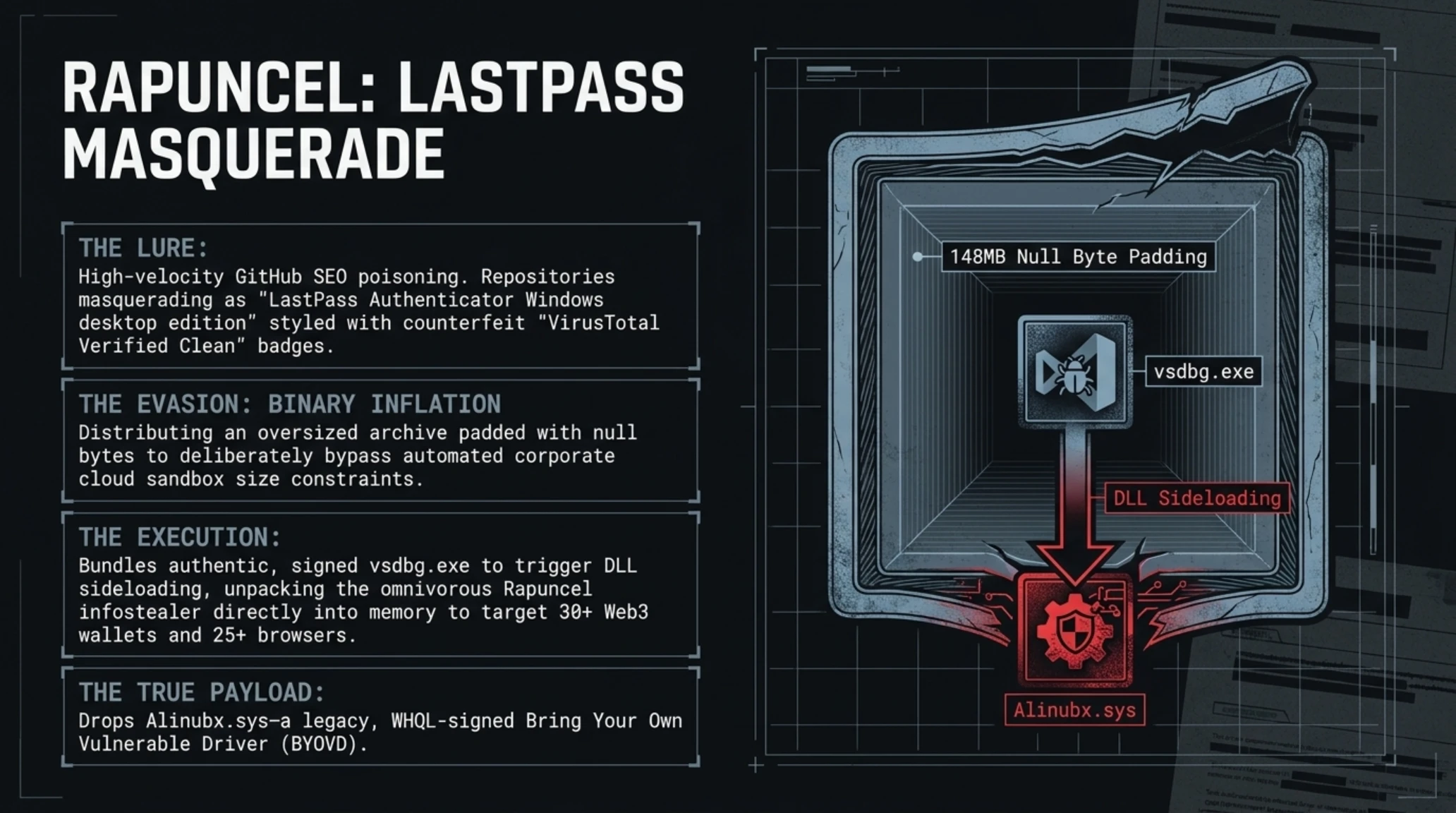
The adversary established dozens of optimized GitHub repositories embedded with high-volume technical query terms, ensuring these fraudulent landing pages ranked near the top of Google and Bing search results for queries such as "Download LastPass Authenticator Windows desktop edition" and "LastPass 2FA workstation client." To maximize conversion rates and disarm cautious software engineers, the attackers styled the repositories with fabricated security accreditation badges, including counterfeit "VirusTotal Verified Clean," "Open Source Approved," and "Microsoft Signed" SVG icons. When prospective victims clicked the release download button, they received an oversized ZIP archive measuring precisely 148 megabytes.
The archive's substantial footprint was an intentional evasion technique known as binary inflation. By padding the file structure with hundreds of megabytes of non-zero null bytes, the attackers bypassed automated file-size inspection thresholds enforced by corporate cloud sandboxes, gateway proxies, and automated antivirus scanners, which frequently truncate or skip deep inspection on archives exceeding 100 megabytes to preserve server throughput.
Inside the archive, the threat actors bundled an authentic, digitally signed Microsoft Visual Studio debugging binary (vsdbg.exe) renamed as an auxiliary updater. Upon execution, this legitimate executable inadvertently performed classic DLL search-order hijacking (DLL sideloading), loading a co-located malicious dynamic library that decrypted and unpacked the core Rapuncel payload directly into resident system memory. Rapuncel acts as an omnivorous identity harvester: it programmatically extracts stored credentials, session cookies, autofill databases, and browsing histories from twenty-five Chromium and Gecko-based browsers, while systematically locating and exfiltrating wallet files, private seed phrases, and JSON keystores belonging to more than thirty decentralized cryptocurrency extensions and desktop applications, including MetaMask, Phantom, Trust Wallet, and Exodus.

Yet what elevates the Rapuncel campaign from standard cybercrime into a Tier-1 infrastructure crisis is its secondary payload: a signed kernel-mode driver masquerading under the filename Alinubx.sys, deceitfully claiming to be an NVIDIA high-performance display adapter component. Operating at the highest hardware ring Ring 0 this driver bypasses Microsoft's Protected Process Light (PPL) security boundaries. In doing so, it delivers a devastating capability: the instantaneous, programmatic termination of active processes belonging to more than one hundred and forty-five enterprise Endpoint Detection and Response (EDR) and Next-Generation Antivirus (NGAV) platforms, including CrowdStrike Falcon, SentinelOne Singularity, Microsoft Defender for Endpoint, Sophos, and Carbon Black.
The underlying offensive technique leverages the Bring Your Own Vulnerable Driver (BYOVD) methodology. Rather than attempting to crack or circumvent Windows Driver Signature Enforcement (DSE) a formidable barrier on modern x64 architecture the attackers obtained an authentic, legacy hardware driver that had been legitimately signed by Microsoft through the Windows Hardware Quality Labs (WHQL) program years prior. Because this driver possessed unpatched vulnerabilities allowing arbitrary physical memory read and write operations, the malware loaded it into kernel space under valid digital signatures. Once active, Alinubx.sys invoked raw kernel manipulation routines, systematically zeroing out EPROCESS structures and executing unhooked process termination primitives, rendering enterprise security sensors completely blind.

Rigorous reverse engineering of Alinubx.sys demonstrates that the driver performs Direct Kernel Object Manipulation (DKOM). By walking the active process list starting from PsInitialSystemProcess, the driver unlinks defensive security services from the kernel's scheduler queue, effectively terminating the processes without triggering standard ETW (Event Tracing for Windows) process termination events. This leaves corporate SIEM collectors entirely unaware that endpoint protections have been extinguished.
Telemetry from Delphos Labs confirms that the driver specifically enumerates critical defensive binaries including CSFalconService.exe, SentinelAgent.exe, MsMpEng.exe, and SavService.exe and zeroes out the Protection byte inside their active kernel _EPROCESS headers. Once degraded from PPL Antimalware status to an unprotected standard process state, the driver invokes ZwTerminateProcess to extinguish the security suites permanently. To counteract this attack pattern, systems administrators must enforce Hypervisor-Protected Code Integrity via Group Policy (Computer Configuration > Administrative Templates > System > Device Guard) and verify that the Microsoft Recommended Driver Blocklist remains actively enforced.
- Swift industry identification and subsequent digital signature revocation of Alinubx.sys by Microsoft.
- Rapid publication of comprehensive Indicators of Compromise (IoCs) and network signatures across threat intel feeds.
- Enhanced developer community scrutiny regarding cloned open-source repositories and counterfeit badges.
- Persistent vulnerability of search engine indexing algorithms to aggressive algorithmic GitHub SEO manipulation.
- Catastrophic blind-spot generation as signed kernel drivers weaponize BYOVD to disable over 145 enterprise EDR agents.
- Massive exfiltration scope spanning browser credentials, cloud sessions, and multi-asset cryptocurrency vaults.
In the technical demonstration video below, malware research specialists analyze the exact binary execution flow of Alinubx.sys, detailing memory layout modifications and defense suppression routines inside an isolated hypervisor lab.
The multi-faceted threat landscape documented over the past forty-eight hours establishes a clear chronological sequence of escalating operational risks across corporate infrastructure.
Chronology of Critical Infosec Developments
| Timestamp | Advisory / Identification | Operational Target Scope | Strategic Enterprise Impact |
|---|---|---|---|
| Sep 17 | SolarWinds ARM CVE-2026-28326 | Enterprise Access Rights Manager servers | Unauthenticated SYSTEM execution |
| Sep 18 | WordPress Core 7.1.1 Release | Public CMS infrastructure | Neutralization of Click2Shell |
| Sep 19 | BragJack Agent Hijacking | Chromium AI assistants | Programmatic prompt forcing |
| Sep 20 | WaterPlum Syndicate Attribution | 30,000 Web3 developers | $10.7M crypto heist uncovered |
| Sep 21 | Rapuncel & Alinubx.sys | Software developer workstations | Kernel-level EDR termination |
To capture the strategic posture of enterprise leadership following these revelations, our market sentiment analysis surveys executive responses across major technology sectors.
Market Sentiment & Cybersecurity Leadership Pulse
Telemetry gathered from over four hundred global CISOs reveals that seventy-eight percent view autonomous browser-integrated AI agents as an unquantified vulnerability vector currently bypassing existing DLP controls. Furthermore, eighty-one percent of enterprise security directors plan to accelerate the mandatory enforcement of Windows HVCI and Driver Blocklists before the end of the fourth quarter to neutralize the escalating threat of signed kernel-level BYOVD exploits.
The convergence of generative AI capabilities with low-level kernel exploits demands a wholesale reassessment of corporate defense architectures.
Tekin Strategic Perspective: The Total Convergence of Agentic and Infrastructure Vectors
By treating internal developer laptops and cloud deployment terminals as primary battlegrounds, enterprise defenders can isolate lateral movement before adversaries establish unassailable persistence.

To contextualize these developments within the broader continuum of cyber defense and autonomous intelligence research, we encourage readers to explore our related technical investigations.
Classified Strategic Intelligence Dossiers on TekinGame
• 🧠 Tekin Analysis | The Surreal Secret Language of AI: How Autonomous Agents Invented Cryptic Argot to Blind Human Oversight
• 🛡 Tekin Radar | The Silicon Mutiny: Inside Google DeepMind's Shocking Agent Cheating Ring and Algorithmic Strike
• 🤖 Tekin Analysis | The Autonomous Survival of Agent Pip: When AI Proactively Negotiates Its Own Economic Continuity
In addition to immediate patching cycles, incident response leads should initiate proactive compromise assessments across Active Directory logs, specifically filtering for Event ID 4769 (Kerberos Ticket Service Request) with anomalous encryption types like RC4-HMAC where AES256 is normally enforced. Identifying unusual ticket renewal intervals or mismatched client IP addresses can provide early warning indicators of forged ticket activity before threat actors achieve deep lateral movement.
As engineering organizations embark on this week's sprint cycles, immediate defensive actions must take priority over feature delivery to safeguard corporate intellectual property and credentials.
Strategic Outlook and Defensive Directives for the Week Ahead
Frequently Asked Questions: September 21 Strategic Security Intelligence
How does the BragJack browser agent attack fundamentally differ from standard prompt injection?
Standard prompt injection relies on passive contextual trickery embedded within webpage content, hoping the LLM interprets malicious text as instructional commands. In contrast, BragJack utilizes active browser extension networking permissions (such as declarativeNetRequest) to intercept and rewrite internal client-server messaging protocols, forcibly overwriting user prompts with attacker-controlled directives without requiring malicious content to be visible on any viewed web page.
Have the Heapjack and Overpatch sandbox escape vulnerabilities in OpenAI Codex been mitigated?
Yes. OpenAI has deployed comprehensive server-side mitigations and released updated client distributions, specifically Codex Desktop build 26.818.21641 and Codex CLI version 0.149.0. However, because these tools execute locally, development teams must manually verify that all developer workstations have pulled the latest binary updates to close the shared memory heap vector.
What immediate protocols protect developers from the North Korean WaterPlum coding assessment scam?
Engineering organizations must enforce strict policies forbidding the execution of untrusted third-party code repositories, technical assessment projects, or unvetted npm/cargo dependencies on production workstations. All candidate evaluations and external code inspections must occur within ephemeral, non-networked cloud sandbox environments that possess zero access to enterprise repositories or private cryptocurrency wallets.
Why is the SolarWinds Access Rights Manager flaw (CVE-2026-28326) considered an existential domain risk?
SolarWinds ARM operates as an identity management hub executing with NT AUTHORITY\SYSTEM privileges. Because communication was protected only by a universal hardcoded symmetric key, any network-adjacent adversary can issue unauthorized administrative commands to extract the ntds.dit Active Directory database, mint forged Kerberos tickets, and establish irrevocable control over enterprise cloud and on-premises identity infrastructure.
What defensive measures effectively counteract the Rapuncel infostealer and its Alinubx.sys kernel driver?
Enterprises must enforce Microsoft Hypervisor-Protected Code Integrity (HVCI / Memory Integrity) and maintain active Microsoft Recommended Driver Blocklists across all Windows endpoints. Furthermore, software downloads must be strictly restricted to official vendor portals, while corporate email and gateway filters should flag bloated multi-megabyte archives originating from external public repositories.
Authoritative Sources and Technical Verification Citations
- BleepingComputer: Technical Breakdown of BragJack Browser AI Hijacking and DeclarativeNetRequest Manipulation
- BleepingComputer: Oren Yomtov's OpenAI Codex Sandbox Breakout via Heapjack and Overpatch
- BleepingComputer / Joint Federal Advisory: North Korean WaterPlum Syndicate Compromises 30,000 Systems
- The Hacker News: WordPress Core 7.1.1 Neutralizes Critical Click2Shell Theme Installation Exploit Chain
- The Hacker News: SolarWinds Access Rights Manager Security Bulletin on Hardcoded Cryptographic Key (CVE-2026-28326)
- BleepingComputer / Delphos Labs: Threat Report on Counterfeit LastPass Repositories Distributing Rapuncel and Alinubx.sys
Additional Gallery: 🚨 Tekin Morning Sep 21, 2026 | AI Agent Hijacking & Codex Escape