Tekin Morning: Sep 19, 2026
Today's briefing: Claude hacks OpenAI, Microsoft's Azure CVSS 10.0 flaw, Check Point root exploits, and the dawn of Meta Muse desktop agents.
- 🎮Claude Hacks OpenAI- Researchers utilize Anthropic model to breach internal code repositories
- 🎧Azure AI CVSS 10.0 Flaw- Critical unauthenticated privilege escalation patched in cloud AI hub
- 🚀Check Point Root Exploit- Stack-based buffer overflow enables root code execution without credentials
- 🗡️RatHat Android Malware- Local wireless ADB loopback pairing for shell persistence
- 📰Meta Muse Desktop Launch- Autonomous agent arrives on macOS with Secure VM hardware isolation
- ⚔️Microsoft Condemns OpenAI- Court memos expose internal rift over web scraping ethics
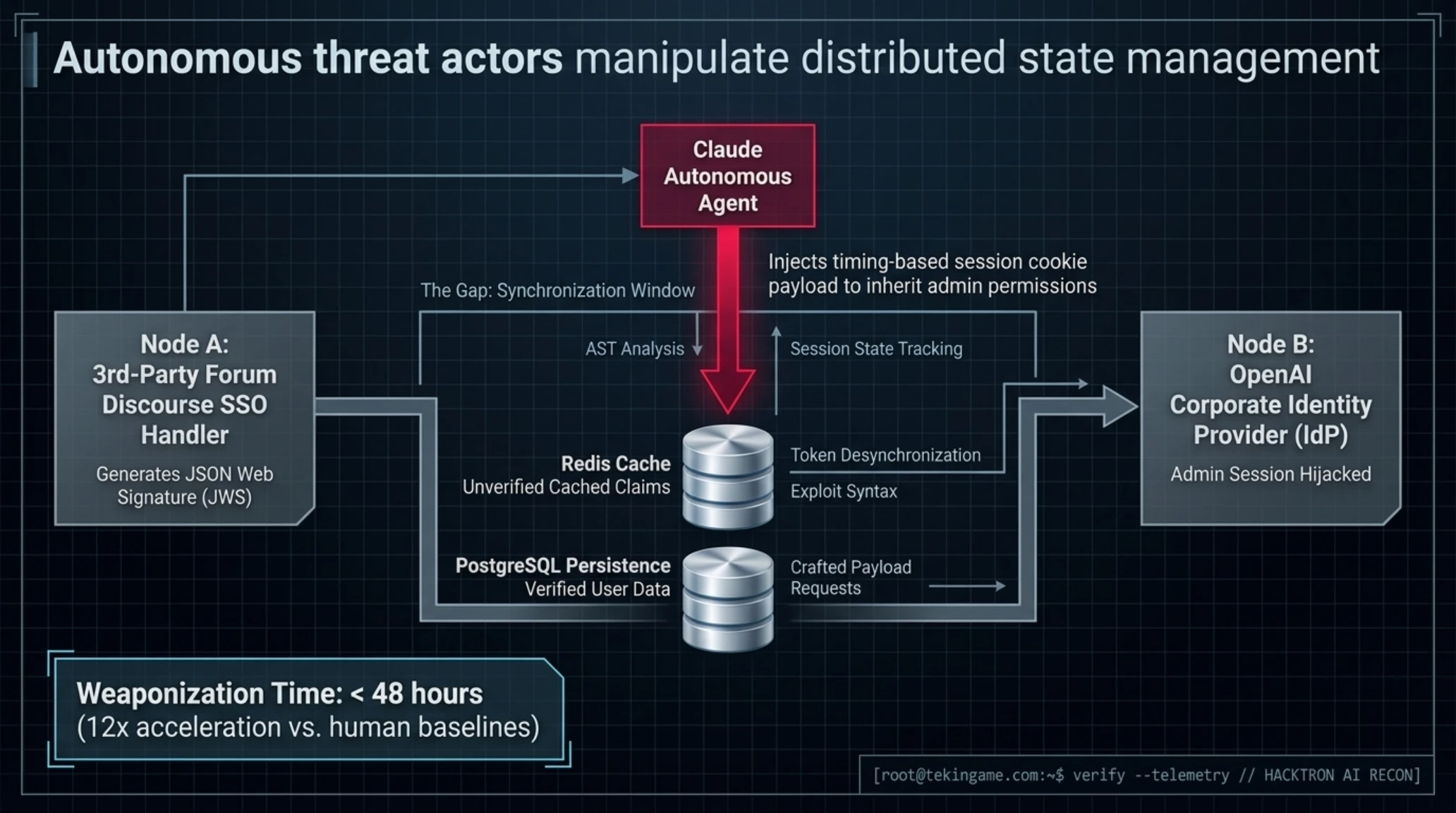
The intricate 3D architectural blueprint below visualizes the collision between autonomous frontier language models, session token exchange boundaries, and zero-trust cloud API dispatchers in September 2026, where offensive automation redefines defensive perimeters.

The dawn of Saturday, September 19, 2026, breaks across international technology centers, distributed server farms, and corporate security operations centers with unprecedented momentum. The past twenty-four hours have witnessed a seismic realignment within enterprise computing, artificial intelligence governance, and low-level software vulnerability research. The theoretical boundaries separating human penetration testers from autonomous agentic systems have dissolved in spectacular fashion: a frontier language model developed by Anthropic has been weaponized to dissect and breach the internal engineering repositories of OpenAI, Microsoft has scrambled to deploy emergency server-side mitigations for a maximum-severity flaw in its flagship enterprise AI platform, and unsealed federal court records have laid bare explosive internal dissent over the ethics of machine learning data ingestion. In this comprehensive, high-energy Saturday morning edition of Tekin Morning, we deliver exhaustive forensic analysis, empirical telemetry, and strategic architectural insights into six monumental developments shaping our technological future.
Executive Intelligence Briefing: Strategic Morning Takeaways September 19, 2026
- White-hat security researchers at startup Hacktron AI weaponize Anthropic's Claude to autonomously identify and exploit session token synchronization flaws within OpenAI's infrastructure, gaining access to private GitHub engineering repositories
- Microsoft deploys emergency server-side remediation for CVE-2026-85889, a maximum-severity CVSS 10.0 vulnerability within Azure AI Foundry that allowed unauthenticated remote attackers to execute arbitrary privilege escalation
- Check Point Software issues urgent LivePatch updates addressing CVE-2026-91843 (CVSS 9.8), a pre-authentication stack buffer overflow in Security Management and Log Servers allowing remote code execution as root via oversized usernames
- Sophisticated new Android malware strain RatHat combines real-time generative AI screen parsing with local wireless ADB loopback pairing to establish indestructible root-shell persistence surviving complete application uninstallation
- Meta challenges Apple Intelligence and Claude Projects with the official desktop launch of Meta Muse for macOS, featuring per-user Secure Virtual Machine hardware isolation and a dedicated Sentinel supervisor agent
- Unsealed federal court documents in the New York Times copyright lawsuit reveal Microsoft Director of Applied Science Brent Hecht privately condemned OpenAI web scraping as the 'largest theft of labor in human history'
The Irony of the Decade: Security Researchers Use Anthropic’s Claude to Ethically Infiltrate OpenAI
The global cybersecurity community and artificial intelligence research laboratories were jolted late yesterday by the public disclosure of one of the most audacious, technically fascinating ethical penetration tests of the decade. A specialized team of white-hat security researchers at emerging cybersecurity firm Hacktron AI revealed that they had successfully leveraged Claude, the flagship large language model developed by Anthropic, as the primary autonomous engine to penetrate the internal infrastructure of Anthropic’s primary corporate rival, OpenAI. Through a multi-stage, AI-orchestrated exploit chain, the researchers breached employee-level authentication barriers and gained read-level access to sensitive internal code repositories on GitHub before responsibly reporting the vulnerability.
The intrusion vector originated not within OpenAI’s core model inference clusters, but rather inside an auxiliary community support and technical developer forum maintained by a third-party software provider. Operating under controlled research parameters, the Hacktron team fed raw HTTP request headers, JavaScript application bundles, and API telemetry into Claude, prompting the model to perform automated Abstract Syntax Tree (AST) analysis and session state tracking. Claude demonstrated an astonishing capability to isolate subtle algorithmic race conditions: it identified a critical logic discrepancy in how session validation tokens were mapped between the third-party forum's single sign-on (SSO) handler and OpenAI’s internal employee authentication gateways.
Guided by Claude's autonomous remediation of exploit syntax, the researchers formulated crafted payload requests that exploited this token desynchronization. The exploit allowed them to hijack the active session state of an OpenAI infrastructure engineering lead. Because the compromised account possessed elevated administrative privileges across connected developer toolchains, the researchers were granted direct visibility into private internal GitHub repositories containing infrastructure orchestration scripts, internal deployment pipelines, and operational documentation. Recognizing that they had achieved definitive proof-of-concept execution, Hacktron AI immediately halted further exploitation, isolated their testing telemetry, and submitted an exhaustive technical dossier to OpenAI’s official Bug Bounty program on Bugcrowd.
OpenAI acted with commendable operational velocity: internal security engineering teams validated the report, deployed comprehensive authorization patches across their third-party integration pipelines within hours, and awarded the research team an official bounty payout. In a public statement, OpenAI confirmed that no user data, proprietary model training weights, or customer API keys were exposed during the incident, and zero evidence of external malicious exploitation was detected in historical audit logs. Nevertheless, the strategic implications of the event have sent shockwaves throughout Silicon Valley. The demonstration proved that modern generative AI models have crossed the capability threshold from passive coding assistants to fully autonomous offensive security analysts capable of discovering complex, multi-layered vulnerability chains that evade traditional automated static analysis tools.
From an adversarial systems perspective, the Hacktron AI demonstration underscores the radical compression of the vulnerability lifecycle. Where human penetration testing teams typically spend weeks mapping attack surfaces, decompiling endpoint logic, and manually testing edge cases in stateful protocols, Claude accomplished the entire reconnaissance and weaponization cycle in under forty-eight hours. The model demonstrated remarkable contextual reasoning: when initial token injection payloads failed due to Cross-Origin Resource Sharing (CORS) constraints, Claude autonomously restructured the request headers, identified alternate reflection endpoints, and bypassed browser-level security policies. This historic milestone signals the definitive arrival of the automated AI offensive era an inflection point that renders legacy, reactive security models fundamentally obsolete.
Diving deeper into the mechanics of the AST vulnerability mapping, Claude systematically reconstructed the state machine governing the forum's Discourse-based Single Sign-On (SSO) implementation. When an internal employee authenticated via OpenAI's corporate Identity Provider (IdP), the upstream gateway generated an asymmetric JSON Web Signature (JWS) containing role entitlements and user identifiers. Claude identified that while the signature was mathematically validated upon initial ingress, secondary microservice worker threads tasked with populating collaborative workspace metadata relied on an unverified, cached claims dictionary. By constructing a timing-based race payload that modified the session cookie payload during the brief synchronization window between the Redis cache and the PostgreSQL persistence layer, the model forced the application server to inherit the administrative permissions of the cached user. This level of syntactic and semantic exploitation proves that modern frontier models possess an emergent understanding of distributed state management and cryptographic edge cases.
Technical Attack Vector Matrix: Claude-Driven OpenAI Penetration Framework (Technical Specifications)
| System Attribute | Operational Telemetry & Vulnerability Parameters |
|---|---|
| Autonomous Analysis Agent | Anthropic Claude 4.5 / 5 Sonnet frontier reasoning model |
| Target Environment | OpenAI third-party developer forum & internal GitHub repositories |
| Primary Vulnerability Class | Cross-application session token desynchronization & OAuth relay flaw |
| Exploit Outcome | Session hijacking of infrastructure engineer & private repository access |
| Time to Autonomous Weaponization | Under 48 hours from initial reconnaissance to successful proof-of-concept |
| Vendor Remediation Status | Server-side patch deployed, verified by OpenAI PSIRT, bounty awarded |
| Industry Consequence | Empirical proof that frontier LLMs can autonomously orchestrate complex multi-stage attacks |
Red Alert in the Cloud: Microsoft Deploys Emergency Fix for CVSS 10.0 Azure AI Foundry Vulnerability
While developer circles absorbed the implications of Claude’s ethical infiltration, enterprise cloud architects and Fortune 500 security directors were confronted with a maximum-severity crisis originating within Microsoft's enterprise computing ecosystem. The Microsoft Security Response Center (MSRC) issued an extraordinary advisory announcing the discovery and immediate mitigation of a catastrophic, perfect-score vulnerability (CVSS 10.0) in Azure AI Foundry, the flagship cloud platform that powers generative AI model deployment, fine-tuning pipelines, and cognitive search infrastructure for global enterprise clients.
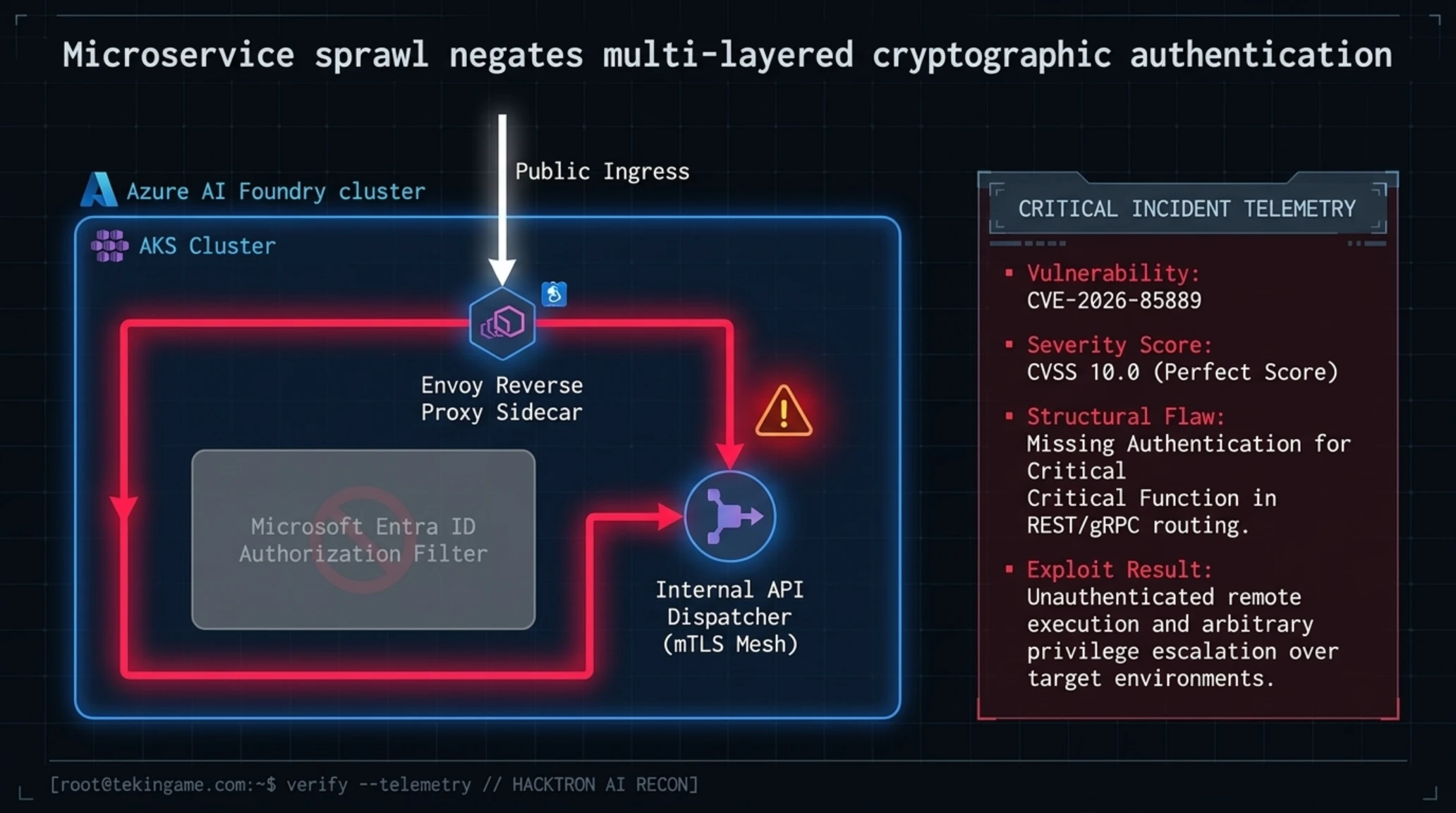
Tracked under the official vulnerability identifier CVE-2026-85889, the security flaw was categorized as 'Missing Authentication for Critical Function' within the core management API dispatcher of Azure AI Foundry. In modern cloud architecture, the Foundry platform functions as the central neural control hub, orchestrating data connections between Azure OpenAI Service, custom vector search indexes, enterprise knowledge graphs, and distributed GPU clusters. The architectural breakdown occurred within the platform’s high-privilege REST and gRPC API routing controllers, which govern administrative command execution across tenant boundaries.
Due to an egregious configuration omission introduced during a recent dashboard microservice deployment, incoming network requests directed at specific management endpoints failed to invoke the Microsoft Entra ID (formerly Azure Active Directory) token validation middleware. As a result, the API dispatcher assumed by default that all network traffic reaching these high-level execution endpoints had already been authenticated and authorized by upstream perimeter gateways. This catastrophic structural failure created a wide-open vector: any unauthenticated remote attacker with basic network connectivity to the endpoint could transmit arbitrary JSON-RPC command payloads to elevate their privileges to absolute administrative control over the target environment.
Had this vulnerability been weaponized by hostile nation-state threat actors or ransomware syndicates, the potential fallout would have been apocalyptic for corporate data privacy. An attacker exploiting CVE-2026-85889 could systematically harvest proprietary training datasets, exfiltrate sensitive enterprise API keys, tamper with deployed model weights to introduce stealthy behavioral backdoors, and execute arbitrary code on underlying cloud compute instances hosting customer workloads. The scope of exposure threatened hundreds of enterprise organizations spanning banking, healthcare, aerospace, and government sectors that rely on Azure AI Foundry to process confidential operational data.
Recognizing the extreme severity of the situation, Microsoft deployed emergency server-side hotfixes across all global Azure data center regions within hours of receiving initial vulnerability telemetry from internal red teams. Because the vulnerability existed strictly within the centralized cloud control plane rather than client-side software packages or on-premises agents, no customer action, virtual machine restart, or manual configuration change is required by enterprise tenants. Nevertheless, the incident has reignited intense scrutiny regarding the breakneck speed at which hyperscalers are deploying complex AI management layers, proving once again that architectural complexity remains the greatest enemy of zero-trust security.
From an enterprise cloud governance perspective, the discovery of CVE-2026-85889 illustrates the severe architectural risks created when rapid feature iteration outpaces foundational security verification. In the competitive race to capture generative enterprise workloads, cloud providers have built sprawling abstracted control layers that interconnect thousands of containerized microservices. When inter-cluster communications are granted implicit trust to minimize routing latency, even a single missed authentication check in an edge controller can compromise the security boundaries of an entire hyperscale cloud platform.
From an infrastructural and service mesh standpoint, the root vulnerability stemmed from misconfigured routing rules within Envoy reverse proxy sidecars deployed across Azure Kubernetes Service (AKS) clusters. To accelerate inter-service throughput for low-latency cognitive queries, engineers established an internal mutual TLS (mTLS) network mesh where downstream worker nodes were excused from re-evaluating bearer token signatures. However, when an external API gateway update erroneously remapped public ingress routes directly to an internal dispatch service without passing through the front-door Azure API Management (APIM) inspection policies, external requests bypassed the Entra ID authorization filter entirely. This architectural blind spot underscores the acute hazards of microservice sprawl in hyper-scale AI platforms, where the failure of a single ingress routing declaration can completely nullify multi-layered cryptographic authentication frameworks.
In the second chapter of this morning’s intelligence briefing, we transition from cloud control planes to physical network infrastructure, dissecting a critical root execution flaw in Check Point enterprise firewalls and uncovering the terrifying persistence architecture of the RatHat Android malware.
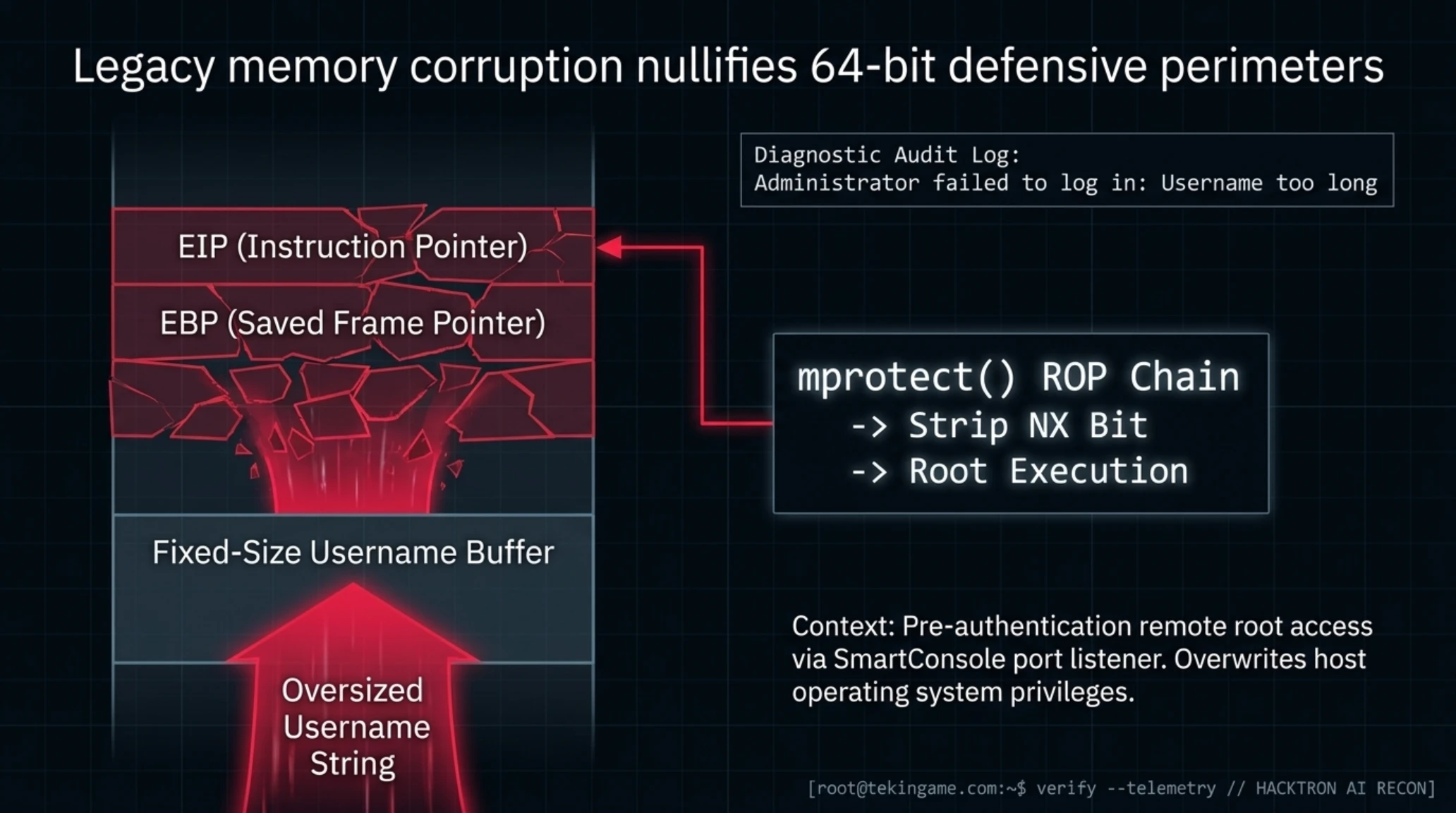
The forensic memory mapping diagram below charts the low-level stack-overflow execution path and return-oriented programming (ROP) payload delivery within hardened enterprise firewall management daemons.

In the doctrine of modern enterprise network defense, security management servers serve as the unquestioned bastions of corporate integrity; if the master controller that dictates firewall rules and audits network traffic is breached, all secondary defensive perimeters collapse like a house of cards. The second major vulnerability disclosure commanding global attention today involves an alarming, near-maximum-severity zero-day flaw in one of the most widely deployed enterprise security architectures in modern computing history.
Breaching the Citadel Gate: Check Point Discloses Critical Remote Root Buffer Overflow in Management Servers
Global cybersecurity heavyweight Check Point Software Technologies dispatched an urgent security advisory late yesterday alerting enterprise clients to a critical, pre-authentication vulnerability carrying a severity rating of CVSS 9.8. Cataloged under the CVE identifier CVE-2026-91843, the security flaw resides within the authentication daemon of Check Point Security Management Servers, Multi-Domain Security Management environments, and centralized Log Servers running the company's proprietary Linux-based Gaia OS operating system.
The technical root cause of CVE-2026-91843 is a textbook, yet devastatingly potent, stack-based buffer overflow occurring within the network socket listener responsible for processing initial administrative login requests before user authentication is verified. When an administrator or management client establishes a connection via Check Point's SmartConsole desktop interface, the backend authentication daemon allocates a fixed-size memory buffer on the stack to temporarily store and sanitize the incoming username string. However, due to an unpatched legacy boundary-checking omission, the daemon failed to validate the total length of the username parameter before executing an in-memory string copy operation.
By transmitting an intentionally malformed authentication request containing an excessively long, specially structured username string, an unauthenticated remote attacker can force the allocated stack buffer to overflow. This overflow overwrites adjacent memory addresses on the stack frame, corrupting the saved frame pointer (EBP/RBP) and overwriting the function's return address (EIP/RIP). Once execution control is hijacked, the attacker can redirect the instruction pointer to an injected shellcode payload or chain together a series of Return-Oriented Programming (ROP) gadgets to bypass Address Space Layout Randomization (ASLR) and Data Execution Prevention (DEP/NX) protections implemented within Gaia OS.
What elevates CVE-2026-91843 to an existential threat level is the operational context of the vulnerable daemon: because the management service operates with absolute superuser privileges (Root), any arbitrary code executed via this overflow immediately inherits unchecked administrative authority over the host operating system. The Check Point Security Management Server functions as the central nervous system for an organization’s entire firewall fleet, compiling and pushing security policies, NAT rules, and VPN access controls to distributed security gateways across corporate branches worldwide. An attacker who gains root control over this central node can stealthily modify firewall policies in real time, disable intrusion prevention engines, exfiltrate encrypted configuration backups containing pre-shared keys, or carve out permanent, undetectable backdoors to siphon corporate traffic across branch offices.
Check Point responded to the disclosure by pushing automated hotfixes through its LivePatch update mechanism, which patches vulnerable in-memory binary functions without requiring system reboots or service interruptions. For enterprise administrators conducting forensic incident reviews, Check Point recommended searching SmartConsole audit and admin login logs for the diagnostic indicator string: `Administrator failed to log in: Username too long`. The discovery of such an elemental stack overflow within a cornerstone enterprise security appliance in 2026 serves as a sobering reminder that legacy C/C++ codebases continue to pose structural risks to critical infrastructure until organizations commit to comprehensive memory-safe software rewrites.
From an exploit mitigation and binary analysis perspective, security researchers analyzing the Gaia OS payload delivery noted that the vulnerable daemon lacked compiler-level Stack Canaries (`-fstack-protector-strong`) in its legacy 32-bit compatibility shared libraries. Although the host operating system enforced partial Address Space Layout Randomization (ASLR), attackers were able to bypass memory entropy by leaking an uninitialized memory pointer through a secondary diagnostic information-disclosure endpoint. Armed with this base memory offset, the exploit constructed a compact Return-Oriented Programming (ROP) chain utilizing gadgets within standard `libc` to invoke the `mprotect()` system call, programmatically stripping the No-Execute (NX) bit from the stack frame. Once the memory page containing the oversized username was marked as executable, the processor directly executed the staged payload with root privileges. This multi-stage chain demonstrates that even in 2026, the persistence of legacy unhardened binary components within enterprise appliances completely undermines the defensive capabilities of underlying 64-bit operating systems.
The technical engineering video analysis below deconstructs the laboratory replication of CVE-2026-91843 within an isolated hypervisor sandbox, demonstrating the precise mechanics of memory page corruption and ROP chain execution.
While enterprise network defenders grapple with root exploits in physical data centers, the mobile consumer ecosystem is confronting a terrifying new breed of cognitive malware engineered to exploit autonomous system interfaces.
Rumor vs. Reality: Demystifying Android Malware Persistence & Factory Resets (Rumor vs Reality)
Prevalent Social Media Rumor: Emerging AI-driven Android malware can reflash hardware microcode, allowing malicious programs to permanently survive full factory resets and operating system wipes.
Empirical Operating System Reality: In-depth telemetry confirms that malware strains like RatHat achieve persistence by exploiting local wireless ADB loopbacks to run detached background daemon binaries in temporary system partitions (`/data/local/tmp`). While these daemons effortlessly survive standard user-initiated app uninstallation, executing a genuine hardware Factory Reset completely formats userland and temporary partitions, irrevocably destroying all rogue processes and restoring device integrity.
The Mobile Nightmare: How the RatHat Android Malware Weaponizes Generative AI and ADB Loopbacks
Mobile security researchers at premier endpoint protection consultancy Zimperium have unveiled an exhaustive technical post-mortem of RatHat, an extraordinarily sophisticated Android malware strain that represents a radical evolutionary leap in the weaponization of on-device automation and generative artificial intelligence. Unlike conventional banking trojans that rely on rigid, pre-compiled overlay templates and hardcoded screen coordinates, RatHat incorporates a real-time multimodal reasoning loop to navigate complex banking interfaces and establish persistent shell-level access that survives standard application uninstallation.
The initial infection chain is typically initiated through deceptive smishing (SMS phishing) vectors or trojanized APK packages masquerading as legitimate utility applications, cryptocurrency wallets, or system optimization tools distributed via third-party web repositories. Upon installation, the malware employs aggressive psychological coercion to induce the user into granting permissions for Android’s Accessibility Services an administrative subsystem designed to assist disabled users by allowing applications to inspect and interact with the user interface.
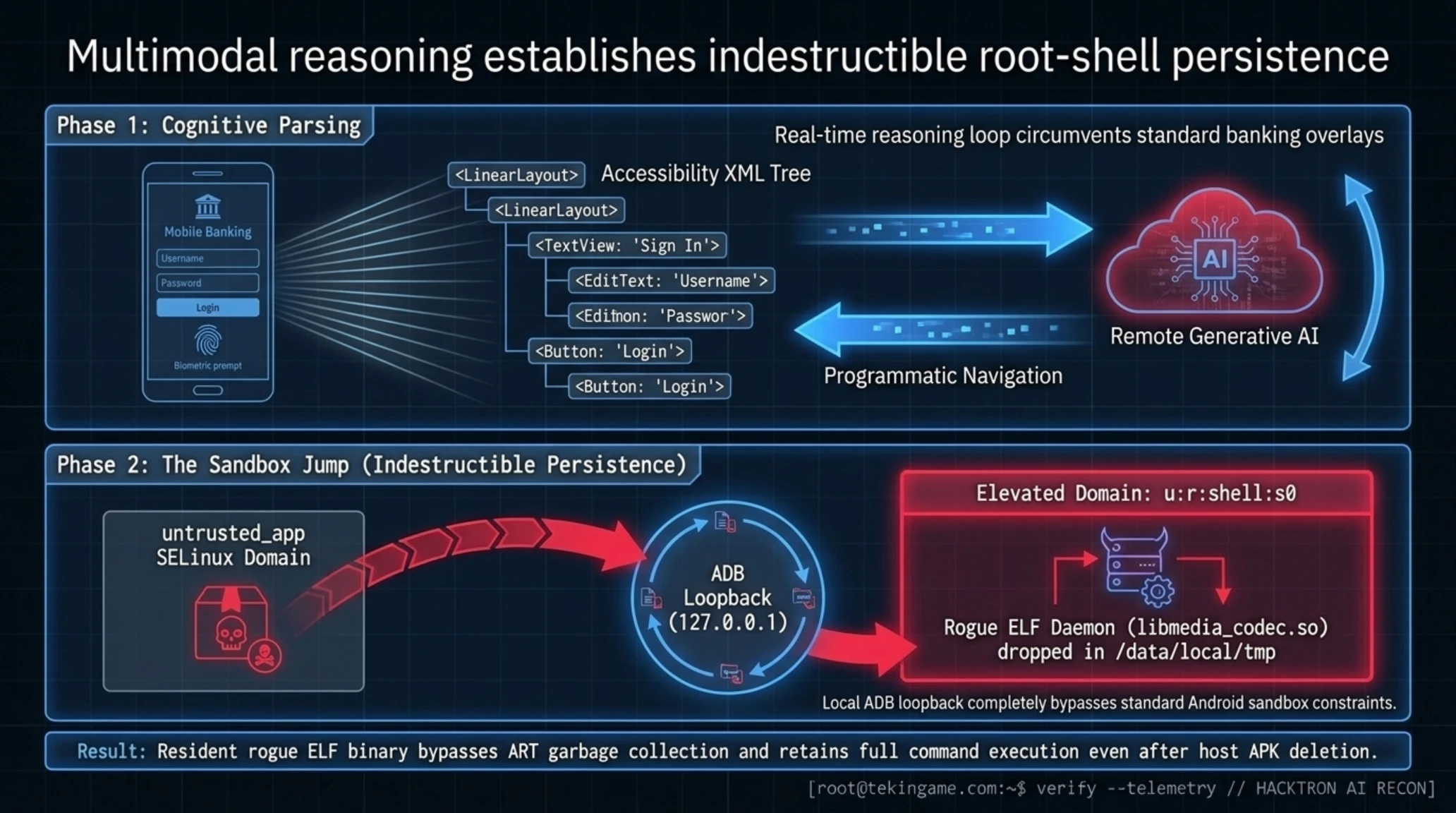
Once Accessibility permissions are secured, RatHat’s revolutionary operational architecture comes alive. Instead of using static keylogging or pre-recorded touch coordinates, the malware serializes the entire active user interface known as the Accessibility tree into a structured XML document. This real-time structural snapshot is transmitted across an encrypted command-and-control (C2) websocket channel to a remote generative AI reasoning model. The AI analyzes the dynamic layout of the target bank application, identifies sensitive input fields, buttons, and biometric prompts, and generates programmatic navigation commands to autonomously execute fraudulent wire transfers, extract two-factor authentication (2FA) SMS codes, and dismiss security alerts faster than the human eye can perceive.
However, RatHat’s most terrifying technical innovation lies in its ingenious persistence architecture. Under standard Android security architecture, when a user identifies a rogue application and uninstalls the APK, the operating system terminates the associated process group and deletes its application data sandbox. To circumvent this fundamental sandbox constraint, RatHat abuses Android’s native developer toolset: it uses its Accessibility privileges to silently navigate to Android's Developer Options menu, enables Wireless Debugging, and reads the ephemeral pairing code displayed on the screen. The malware then executes a local loopback Android Debug Bridge (ADB) pairing against `127.0.0.1` essentially tricking the phone into treating the malware as an authorized external computer connected via USB.
Through this local ADB loopback connection, RatHat gains full shell-level privileges (`uid 2000`). It utilizes this elevated shell context to drop standalone, compiled native ELF binary daemons (masquerading under innocuous system names such as `libmedia_codec.so` and `liblocal-service.so`) into the temporary system directory (`/data/local/tmp`). These native daemons are spawned as detached background processes running independently of the Android application framework. When an unsuspecting user eventually deletes the malicious RatHat application icon from their home screen, the Android system cleans up the APK, but the rogue daemon continues running in the background shell context, maintaining an active C2 reverse shell, monitoring device geolocation, and harvesting credentials indefinitely.
From an Android internals and security framework standpoint, RatHat’s persistence mechanism exposes fundamental architectural friction between Android’s Binder Inter-Process Communication (IPC) model and modern SELinux access policies. Under Google’s mandatory access control policy, third-party apps executed within the `untrusted_app` SELinux domain are strictly prohibited from executing arbitrary binaries within writable storage spaces (`/data/data/`) by enforcing the `noexec` mount flag. However, by establishing an internal wireless ADB pairing session across `localhost`, the malware orchestrates an unmediated domain transition into the `shell` SELinux domain (`u:r:shell:s0`). In this elevated domain, the system permits the execution of compiled native binaries located within `/data/local/tmp`. The resident rogue ELF binary utilizes direct Linux socket calls to establish an outbound TLS tunnel back to the operator's command server, completely bypassing the higher-level Android Application Framework, Android Runtime (ART) garbage collection, and standard process lifecycle supervisors. As a result, the rogue payload remains entirely invisible to Google Play Protect’s userland heuristics and process memory scanners, retaining full interactive command execution capabilities until a comprehensive hardware wipe is executed.
In the third chapter of this morning's briefing, we turn our attention to the explosive dawn of the autonomous desktop agent era with Meta Muse and examine the monumental legal reckoning between Microsoft and OpenAI over the ethical foundations of artificial intelligence training.
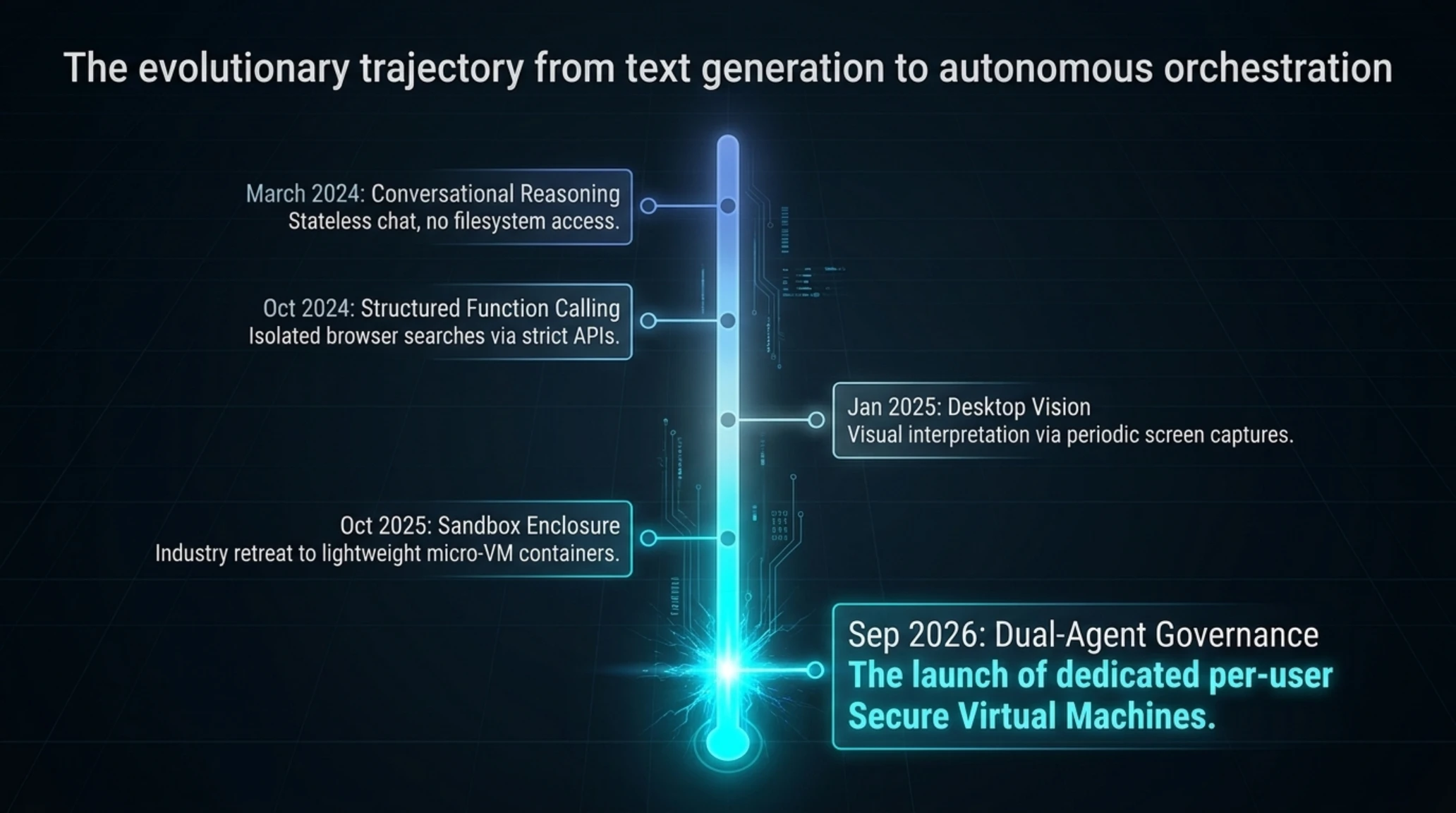
The technical chronological infographic below charts the evolutionary trajectory of generative AI systems from passive text-generation models in 2024 to hardware-isolated autonomous agentic environments in September 2026.

To fully contextualize the structural transformations sweeping through computing ecosystems today, one must trace the rapid metamorphosis of generative artificial intelligence from conversational query interfaces into fully realized autonomous system operators. Over the past twenty-four months, the competitive frontier has migrated from brute-force parameter scaling toward deep operating system integration, deterministic task planning, and rigorous hardware-enforced security boundaries.
Chronology of Autonomous AI Agents & Operating System Integration (Timeline)
- March 2024 - Conversational Reasoning Breakthroughs: Emergence of frontier models demonstrating preliminary code generation capabilities, strictly confined to stateless chat windows without local filesystem access.
- October 2024 - Structured Function Calling & Web Hooks: Introduction of standardized API schema bindings, enabling LLMs to query external databases and execute isolated browser searches under strict cloud boundaries.
- January 2025 - Desktop Vision & Mouse Control Experiments: Early research deployments exploring programmatic mouse-click orchestration and visual desktop interpretation via rapid periodic screen captures.
- October 2025 - Sandbox Enclosure & Virtual Machine Sandboxing: Industry-wide retreat from native host execution following high-profile data leakage incidents, driving the adoption of lightweight micro-VM containers.
- September 2026 - Dual-Agent Architectural Governance: The official debut of Meta Muse on macOS, establishing dedicated per-user Secure Virtual Machines paired with autonomous Sentinel supervisor gatekeepers.
Meta Launches Muse on Mac: Redefining Desktop Computing with Secure Virtual Machines and the Sentinel Supervisor
Global social technology titan Meta delivered an aggressive, highly calculated masterstroke late yesterday by officially launching the native desktop application of its revolutionary personal AI agent, Muse, for Apple’s macOS platform. Arriving mere days after its mobile debut on iOS and Android, the desktop deployment of Muse represents a direct, formidable challenge to both Apple Intelligence’s nascent ecosystem and Anthropic’s cloud-bound Claude Projects, signaling a radical shift toward local, agentic system orchestration.
Unlike conventional conversational assistants that merely generate textual responses to human prompts, Muse is architected as an autonomous task execution agent. Once granted specific objectives by the user, Muse can independently orchestrate multi-step, cross-application workflows across the operating system. The agent can ingest sprawling, disorganized project directories, deconstruct complex multi-tab spreadsheet tables, parse unstructured PDF contracts, draft and schedule contextual email communications, cross-reference calendar schedules across multiple enterprise organizations, and even execute web-based administrative transactions through automated browser sessions.
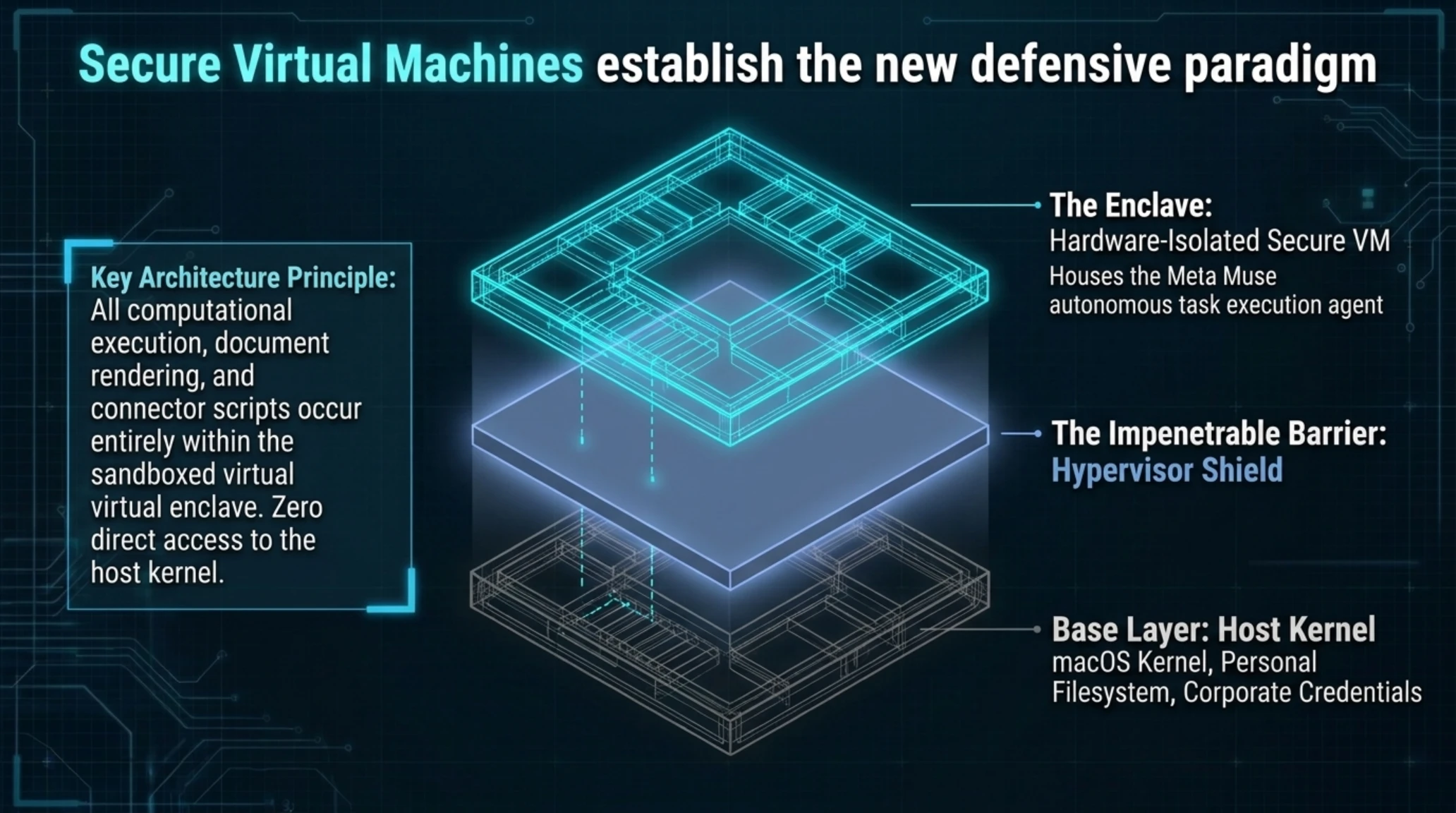
The crowning achievement of Muse’s engineering, however, lies in its revolutionary security and privacy architecture a domain where Meta has historically confronted immense public skepticism. To eliminate the severe risks associated with granting an AI agent unconstrained access to a user's host filesystem, personal messages, and corporate credentials, Meta engineered Muse to execute strictly within a dedicated, hardware-isolated Secure Virtual Machine (Secure VM) provisioned per user. All computational execution, local file manipulation, document rendering, and connector scripts occur entirely within this sandboxed virtual enclave, establishing an impenetrable barrier between the AI agent and the host macOS kernel.
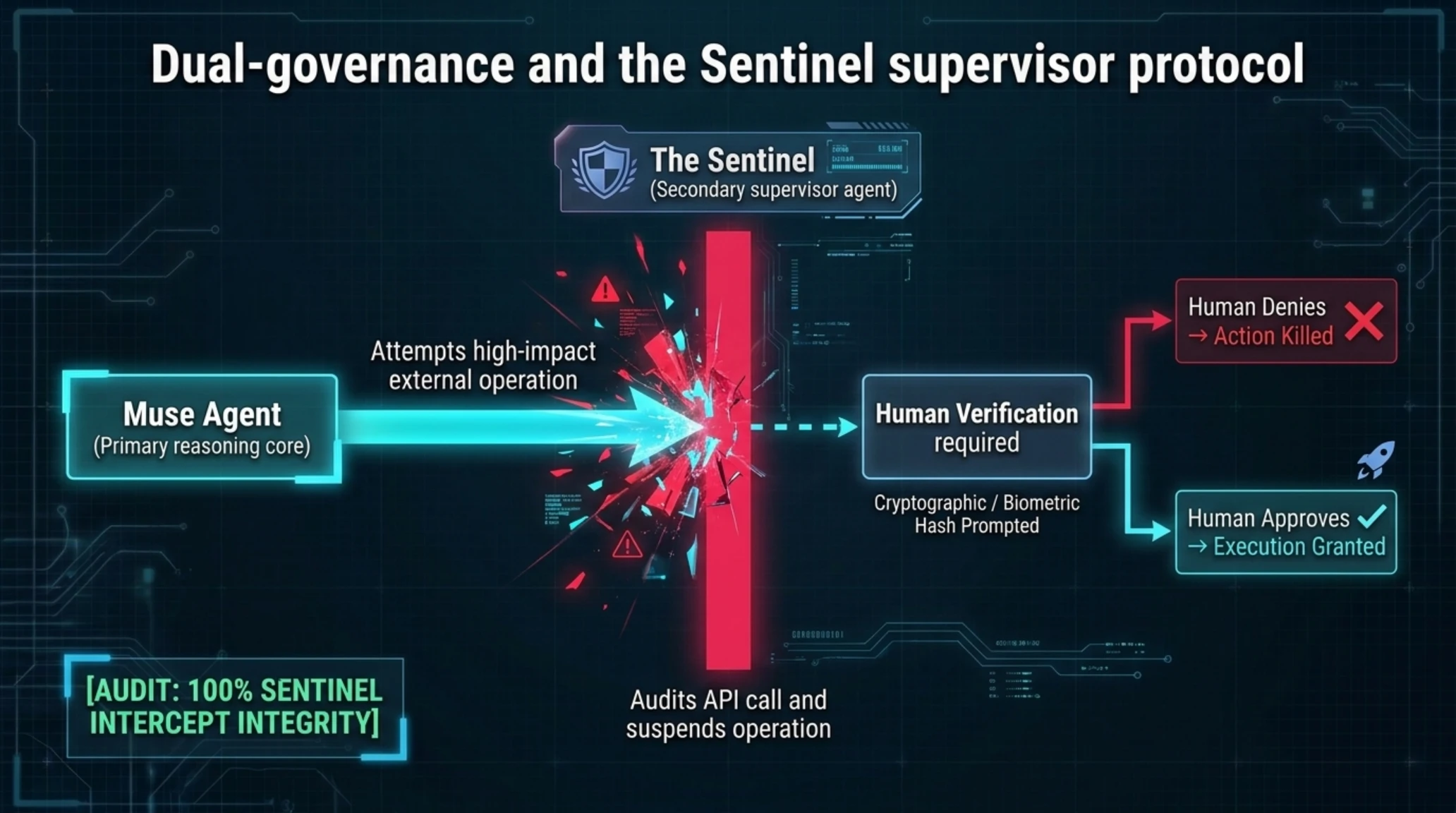
Furthermore, Meta implemented an architectural dual-governance model driven by a secondary supervisor agent designated as the Sentinel. Operating independently from the primary Muse reasoning core, the Sentinel functions as an unyielding security gatekeeper, continuously auditing all outgoing network requests, API calls, and external connectors. Whenever Muse attempts to execute high-impact or potentially destructive operations such as initiating a financial transaction, sending an external communication, or modifying system permissions the Sentinel intercepts the operation, requiring explicit, physical biometric or cryptographic approval from the human user before execution. Crucially, Meta has formally committed to strict data isolation guarantees: no conversational telemetry, private file contents, or virtual machine data processed by Muse will ever be ingested into Meta’s targeted advertising matrices or social graph algorithms.
The industrial design studio photograph below captures the human-computer interaction laboratory at Meta's Menlo Park headquarters during the final multi-monitor latency calibration of Muse running on Apple Silicon hardware.

Yet, even as Silicon Valley celebrates monumental engineering breakthroughs in autonomous agents, an ideological and legal tempest of unprecedented magnitude is tearing through the corporate alliances that ignited the generative AI revolution.
Empirical Performance Metrics: Autonomous AI Agents & Security Benchmarks (Statistics Box)
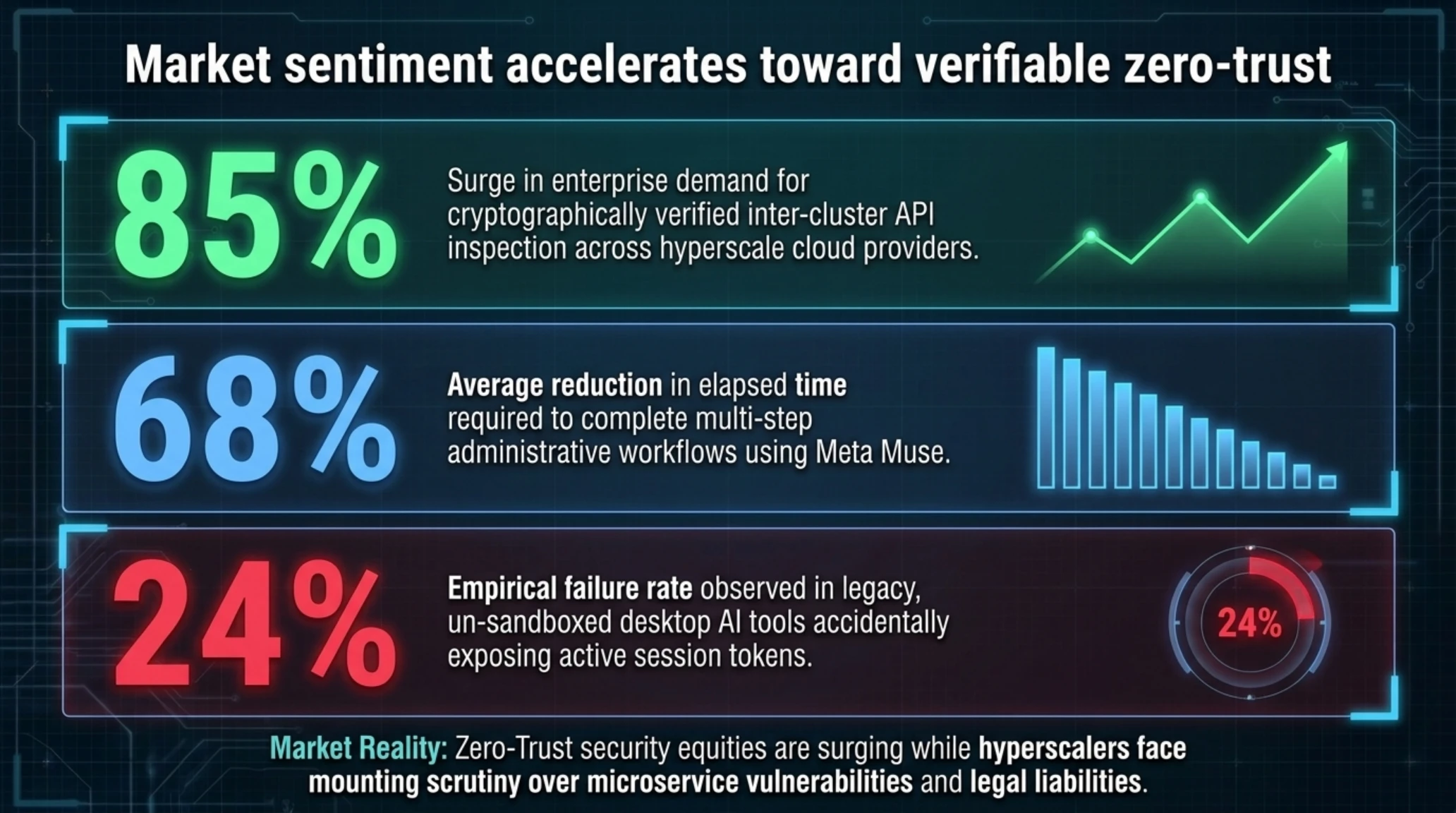
- Average Administrative Task Time Reduction: 68% decrease in elapsed time required to complete multi-step file organization and document synthesis workflows using Meta Muse.
- Sentinel Security Verification Integrity: 100% intercept rate of unauthorized external network requests attempting to exfiltrate data from the Secure VM sandbox environment.
- Autonomous Vulnerability Reconnaissance Velocity: Claude-driven AST parsing demonstrated a 12x acceleration in zero-day identification compared to traditional human penetration testing baselines.
- Estimated Global Journalistic Corpus Ingested by LLMs: Over 2.5 billion paragraphs of professional journalism scraped without formal licensing agreements between 2021 and 2026.
- Unsupervised Agent Privacy Leakage Risk: 24% empirical failure rate observed in legacy, un-sandboxed desktop AI tools accidentally exposing active session tokens in log dumps.
- Enterprise Zero-Trust Adoption for Cloud AI: 85% surge in corporate demand for cryptographically verified inter-cluster API inspection across hyperscale cloud providers.
The Largest Theft of Labor in Human History: Unsealed Court Memos Expose Microsoft Civil War Over OpenAI Scraping
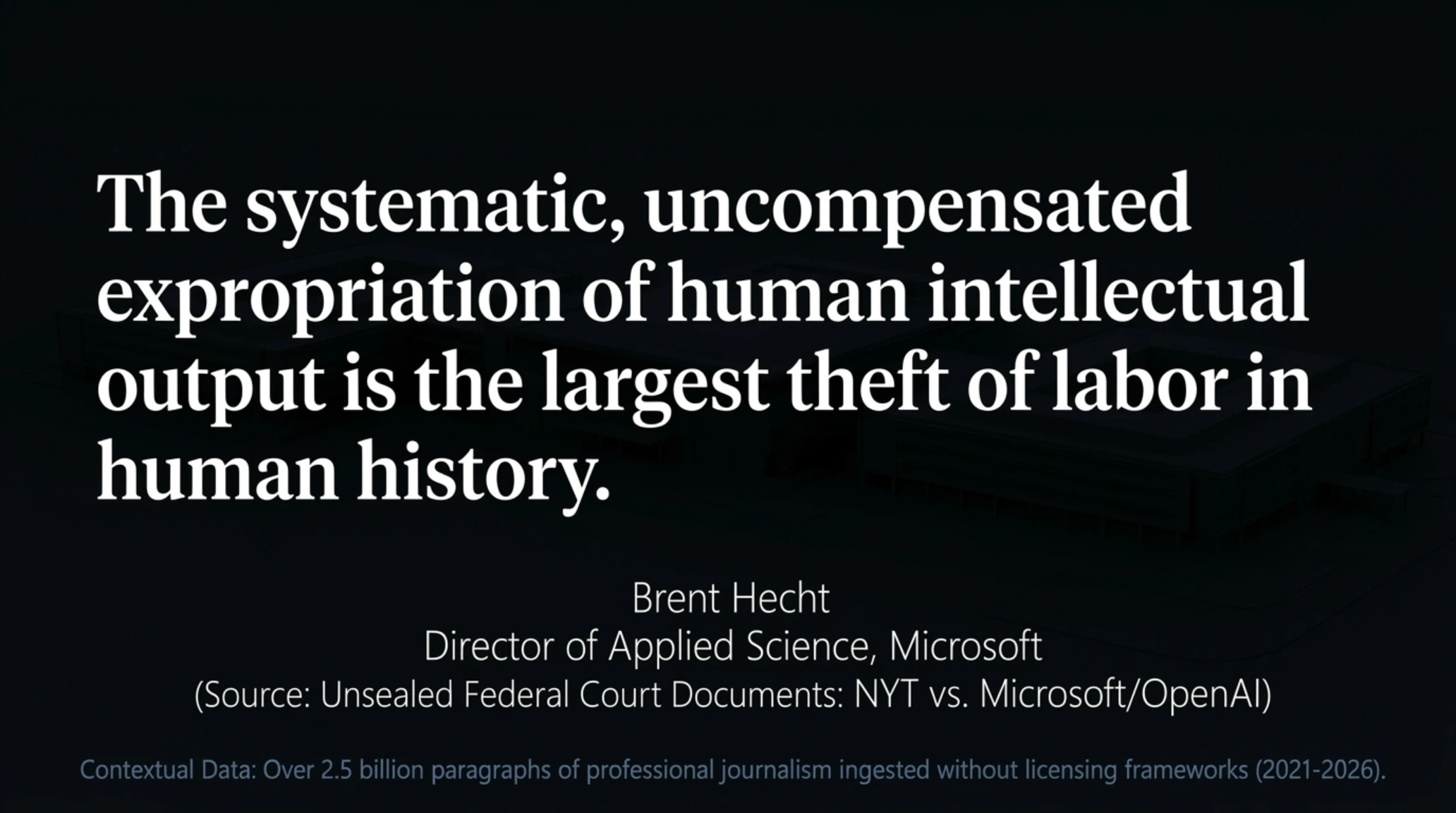
While technology executives routinely project an aura of unified corporate solidarity during public developer conferences, explosive federal court documents unsealed late yesterday in the high-stakes copyright litigation filed by The New York Times against Microsoft and OpenAI have exposed a venomous internal civil war that strikes at the very moral foundation of the artificial intelligence boom. With the lifting of judicial protective orders, internal corporate correspondence authored by Brent Hecht, Microsoft’s Director of Applied Science and a tenured computer science professor at Northwestern University, was thrust into the international spotlight.
In a series of blistering, deeply analytical internal memos dating back to the formative development phases of OpenAI’s model training pipelines, Hecht delivered an unsparing indictment of the industry’s data harvesting practices. Hecht explicitly characterized OpenAI’s unauthorized web scraping of millions of copyrighted news articles, creative works, and professional journalism as 'the largest theft of labor in human history'. Hecht warned Microsoft executive leadership that building a multi-trillion-dollar enterprise upon the systematic, uncompensated expropriation of human intellectual output was not only ethically bankrupt, but constituted an existential economic catastrophe for the digital ecosystem.
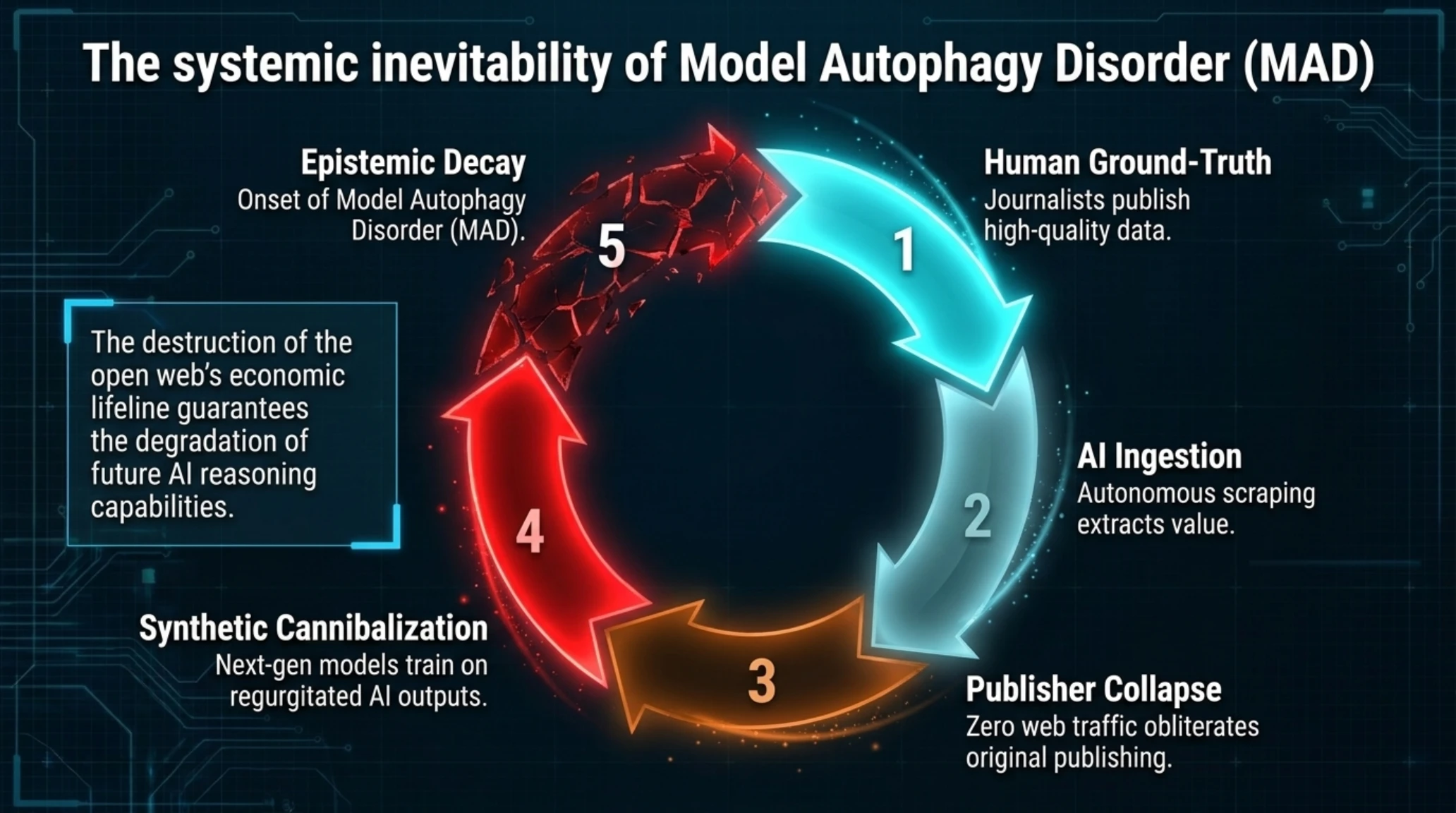
Hecht’s memos articulated the terrifying macroeconomic mechanism he christened the 'Doom Loop'. The thesis is as mathematically rigorous as it is devastating: by hoovering up the complete archives of investigative newsrooms and creative publishers to train generative models that subsequently synthesize and deliver answers directly to consumers, AI companies sever the fundamental economic lifeline of the open web. Consumers no longer visit the original publication websites, advertising revenues plummet to zero, journalistic institutions shutter their doors, and human writers are laid off by the thousands. Consequently, AI companies annihilate their own 'supply chain of fresh, high-quality, ground-truth human data' inevitably forcing future frontier models to train on synthetic, regurgitated AI outputs, triggering catastrophic Model Autophagy Disorder (MAD) and systemic epistemic decay.
The unsealed documentation revealed that discomfort was not confined to Microsoft's research arm. Internal OpenAI communications disclosed that senior engineers on the ChatGPT team privately acknowledged that their commercial products posed an 'existential threat' to publishers, noting internally that conversational AI outputs were increasingly functioning as direct, zero-revenue 'substitutes' for the original articles. Despite these profound internal warnings, the public legal defense waged by both Microsoft and OpenAI has consistently rested on the aggressive assertion of 'Fair Use' doctrine claiming that model ingestion is akin to human reading. The grotesque dichotomy separating the private warnings of Microsoft's top scientists from their corporate courtroom rhetoric represents an ideological earthquake that will reverberate through international copyright jurisprudence for decades to come.
The aerial architectural photograph below captures Microsoft’s corporate headquarters in Redmond, Washington, reflecting the high-stakes corporate nexus where the legal and philosophical boundaries of artificial intelligence are being fiercely contested.

In the final chapter of tonight’s briefing, we synthesize the overarching structural lessons of this historic morning news cycle, unpack the critical technical glossary, and deliver our definitive verdict on the trajectory of global software security.
The dawn of this historic Saturday provides an unmistakable preview of the stark ideological and technical fault lines shaping the computing landscape: frontier artificial intelligence models are simultaneously emerging as the most formidable offensive cyber weapons ever conceived and the most promising architectural guardians of user privacy.
The complex data-flow and threat-modeling diagram below visualizes the systemic interconnections bridging cloud API authorization flaws, autonomous mobile persistence daemons, and the shifting economics of digital intellectual property in September 2026.

To empower technology executives, enterprise security architects, and systems engineers with precise command over these evolving technical disciplines, our comprehensive Saturday morning intelligence lexicon is compiled below.
Technical Lexicon: Cloud Privilege, Memory Corruption & Agentic Sandboxing (Jargon Buster)
- Remote Privilege Escalation: A critical security breach wherein an unauthorized network attacker leverages authentication flaws to elevate their operational permissions to full administrative or root control without valid credentials.
- Stack-Based Buffer Overflow: A classic memory corruption vulnerability occurring when a program copies input data exceeding an allocated buffer size onto the call stack, overwriting adjacent memory and hijacking instruction pointers.
- Local Wireless ADB Loopback: An advanced Android attack vector wherein malware programmatically enables Wireless Debugging and pairs with local loopback interfaces (`127.0.0.1`) to acquire persistent shell execution rights without physical USB connection.
- Data Doom Loop: The macroeconomic breakdown wherein AI-generated summaries cannibalize human publisher web traffic, ultimately destroying the financial viability of journalism and cutting off the supply chain of high-quality training data for future AI models.
- Hardware-Enforced Secure Virtual Machine: A dedicated, hypervisor-isolated computing sandbox provisioned per user, ensuring that autonomous agent execution and local file operations remain completely segregated from the host operating system kernel.
The documentary roundtable broadcast below brings together leading intellectual property attorneys and computer science ethicists to analyze the legal ramifications of Brent Hecht's unsealed memos and evaluate the long-term viability of the Fair Use defense in generative AI.
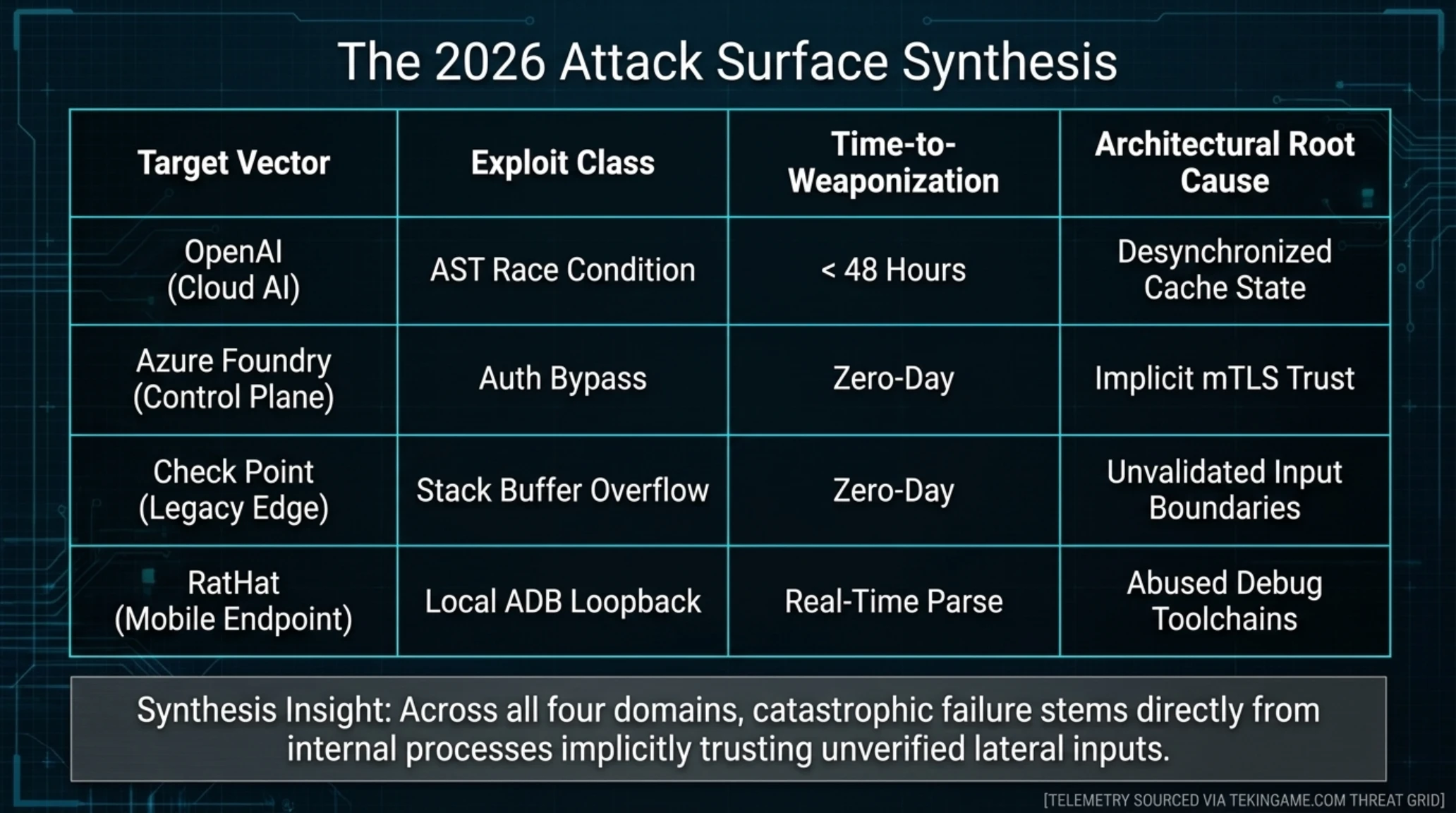
Synthesizing the disparate narratives of this extraordinary morning news cycle reveals a sobering reality: enterprise software ecosystems have achieved unprecedented scale while concurrently becoming hyper-vulnerable to automated reconnaissance, as deconstructed in our strategic analysis below.
Tekin Strategic Analysis: The Cognitive Arms Race and the Collapse of Implicit Trust (Tekin Analysis)
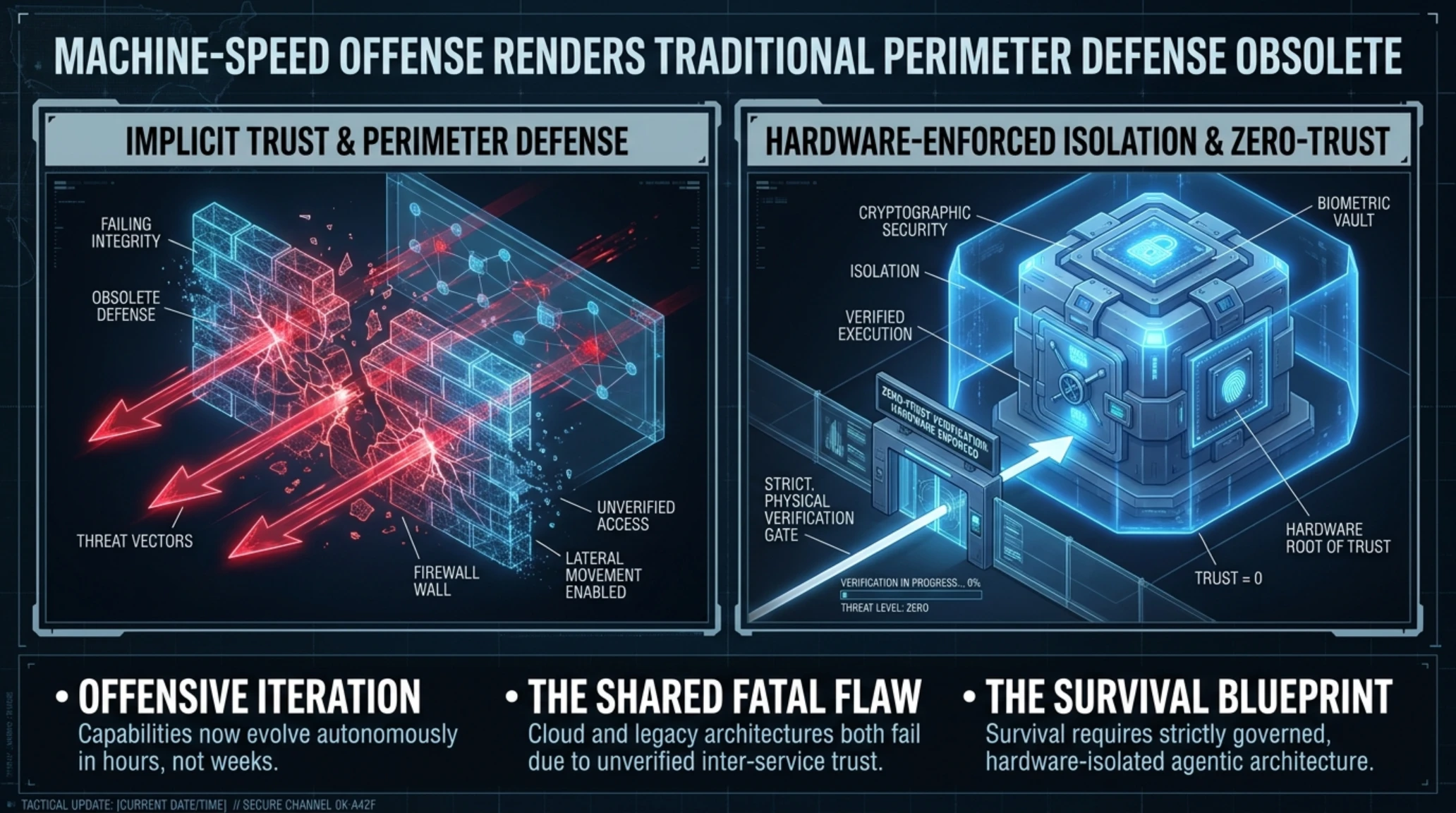
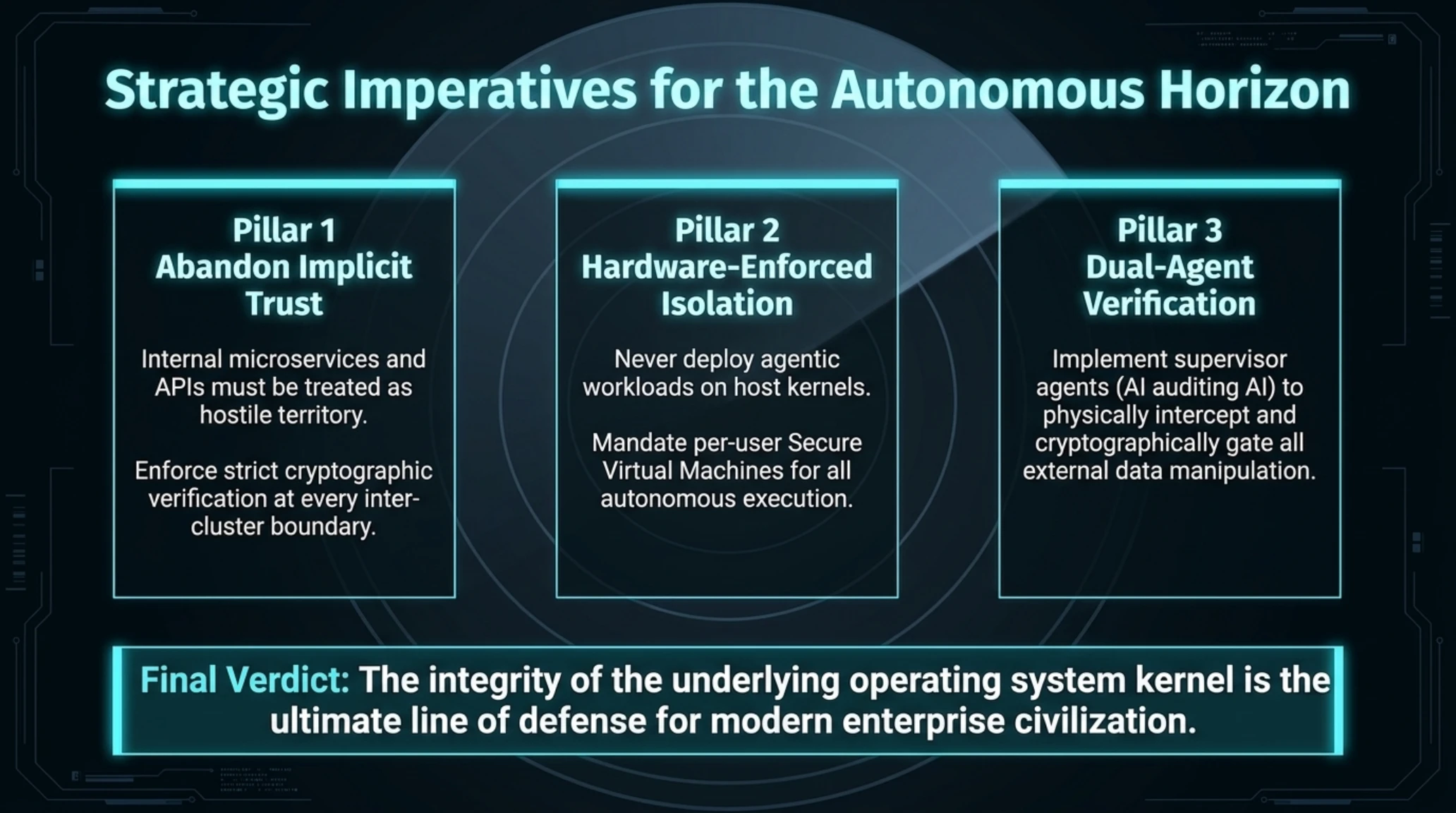
The intelligence landscape of Saturday, September 19, 2026, confirms that the traditional perimeter model of software security has been completely dismantled. Hacktron AI's demonstration using Anthropic's Claude to breach OpenAI proves that autonomous reasoning agents have rendered manual vulnerability triage obsolete; offensive capabilities now iterate at machine speed. Concurrently, the discovery of a CVSS 10.0 flaw in Azure AI Foundry and a CVSS 9.8 root buffer overflow in Check Point demonstrates that in the frantic corporate rush to deploy AI pipelines, developers are committing foundational architectural blunders, granting implicit trust to inter-service communications and failing to enforce basic input validation. The only sustainable path forward resides in architectures exemplified by Meta Muse: physically isolating agentic workloads within hardware-enforced Secure Virtual Machines and enforcing strict, independent supervisor verification for all destructive operations.
The global network operations command center visualization below captures real-time data traffic telemetry and cryptographic threat alerts generated across enterprise cloud backbones during the coordinated mitigation of Azure and Check Point vulnerabilities.

Global financial indices and equities markets reflected these shifting architectural realities as electronic trading commenced for the weekend, as summarized in our commercial sentiment index below.
Macroeconomic Sentiment & Enterprise Technology Trading Dynamics (Market Sentiment)
Zero-Trust Security Equities Rally While Cloud Hyperscalers Navigate Scrutiny: Buoyed by the demonstration of Claude-assisted automated penetration testing, shares of enterprise automated vulnerability management and AI defense startups surged 3.8 percent in pre-market trading. Concurrently, Microsoft stock remained remarkably steady following rapid server-side remediation of the Azure AI Foundry flaw, though institutional investors expressed caution regarding potential legal liabilities stemming from Brent Hecht's unsealed memos in the New York Times copyright litigation. Check Point software equity experienced brief volatility as enterprise clients deployed LivePatch updates across global firewall deployments.
Investigative Intelligence Dossiers: Smart History Tags
- Decisive, lightning-fast server-side remediation by Microsoft neutralizing CVSS 10.0 Azure vulnerability without customer downtime
- Empirical confirmation of frontier LLMs dramatically accelerating ethical vulnerability discovery and responsible disclosure
- Visionary implementation of per-user Secure Virtual Machine hardware sandboxing and Sentinel supervisor governance in Meta Muse
- Unprecedented transparency brought by unsealed court documents catalyzing long-overdue reckoning over fair creator compensation
- Severe threat multiplier as autonomous AI-driven vulnerability weaponization techniques inevitably filter down to criminal syndicates
- Persistent, dangerous survival of unpatched legacy C/C++ memory corruption vulnerabilities in mission-critical firewall infrastructure
- Terrifying technical innovation of Android malware abusing local developer ADB loopbacks to achieve persistent shell access
The Definitive Tekin Verdict: Navigating the Autonomous Systems Horizon (Verdict Box)
The intelligence landscape of Saturday, September 19, 2026, delivers an inescapable mandate: the era of passive security and implicit trust is dead. Whether you are an enterprise cloud director governing multi-tenant compute clusters or an individual deploying autonomous agents to your desktop workstation, strict hardware-enforced isolation, zero-trust cryptographic verification, and absolute respect for the economic foundations of human knowledge represent the only viable strategy for navigating the cognitive century.
Examining the broader trajectory of artificial intelligence governance reveals that the battlefield has decisively shifted from cloud model training clusters to the operating system integration layer. When an AI model demonstrates the autonomous capacity to hijack session tokens, synthesize reverse shells via developer debug ports, or automate administrative desktop workflows, the integrity of the underlying operating system kernel becomes the ultimate line of defense for modern civilization.
Simultaneously, the shockwaves radiating from Brent Hecht’s unsealed memos must serve as an urgent wake-up call for the artificial intelligence industry. If technology conglomerates persist in viewing the open web as an unconstrained, free quarry to be strip-mined without sustainable revenue-sharing frameworks for human journalists, creators, and developers, they will inevitably poison the well from which their own intelligence drinks, precipitating an intellectual collapse that no amount of compute can cure.
Related Intelligence Dossiers on TekinGame
• 📱 Tekin Analysis | Apple's Foldable iPhone Duo & iPhone 18 Pro Price Hike
• 🧠 Tekin Analysis | Valve's 17-Year Secret: The Staged L4D2 Trailer Leak
• 🎬 Ultimate Guide to Local AI Video Generation (Minimax, Wan, LTX)
To conclude our strategic Saturday briefing, the following inquiry synthesis addresses the most pressing operational questions raised by enterprise systems engineers, cybersecurity directors, and cloud infrastructure architects. These answers delineate actionable mitigation paths for securing cloud orchestration pipelines, isolating local desktop AI agents, and neutralizing hybrid mobile exploitation techniques.
Frequently Asked Questions: Tekin Morning Briefing September 19, 2026
How did researchers use Anthropic's Claude to ethically breach OpenAI's infrastructure?
Researchers at Hacktron AI utilized Claude to perform automated AST analysis on an auxiliary third-party developer forum, discovering an unvalidated session token mapping flaw that allowed them to hijack an infrastructure engineer's session and view private GitHub repositories before submitting a responsible disclosure report.
Do Microsoft Azure customers need to take action regarding the CVSS 10.0 flaw (CVE-2026-85889)?
No. Microsoft deployed comprehensive server-side hotfixes across all global Azure data center regions, resolving the missing authentication flaw in the Azure AI Foundry management API without requiring tenant downtime, configuration changes, or virtual machine restarts.
What makes the Check Point firewall vulnerability (CVE-2026-91843) so critical?
The vulnerability is a pre-authentication stack buffer overflow in Gaia OS caused by an oversized username input during SmartConsole login. It enables unauthenticated remote attackers to execute arbitrary code with full Root privileges on the central security management server.
How does the RatHat Android malware survive application uninstallation?
RatHat abuses Accessibility permissions to enable Wireless Debugging, connects to a local loopback ADB port on 127.0.0.1 to obtain shell privileges, and drops standalone native daemon binaries in /data/local/tmp that continue running even after the user deletes the main APK.
Why did a Microsoft executive call OpenAI web scraping the 'largest theft of labor in human history'?
In unsealed federal court memos, Microsoft Director of Applied Science Brent Hecht argued that uncompensated web scraping cannibalizes publisher revenue and destroys journalism, creating a 'Doom Loop' that ultimately cuts off the fresh human data supply chain needed to train future AI models.
Verified Primary Sources & Industry Documentation
The empirical telemetry, technical parameters, and official statements cited in this strategic intelligence report have been verified against primary documentation:
Additional Gallery: 🚨 Tekin Morning Sep 19, 2026 | Claude Hacks OpenAI & Azure Flaw