
🌐 Takin DarkWeb: Deep Dive Threat Intelligence & Incident Response (June 9, 2026)
Welcome to the apex of cybersecurity intelligence. The landscape of digital warfare is experiencing a seismic shift. We have moved past script kiddies and opportunistic malware; we are now witnessing the systematic dismantling of legacy protocols, the weaponization of Large Language Models (LLMs), and zero-day kernel exploits shattering the illusion of containerized security. In this exclusive mega-report, our threat hunting team deconstructs four critical vulnerabilities. We provide not just the news, but the underlying C code, the exact Indicators of Compromise (IoCs), and the definitive Incident Response (IR) playbooks required to secure your enterprise.
⚡ Intelligence Briefing Agenda:
1. Edge Network Compromise: Anatomy of the Check Point IKEv1 Bypass (CVE-2026-50751) and Qilin Ransomware.
2. Core Meltdown: A deep C-level analysis of the `nf_tables` Use-After-Free Linux bug.
3. Social Engineering the Machine: How 20,000 Instagram accounts fell to Meta AI Prompt Injection.
4. State-Sponsored Espionage: NSO Group's devastating One-Click spear-phishing campaign on WhatsApp.
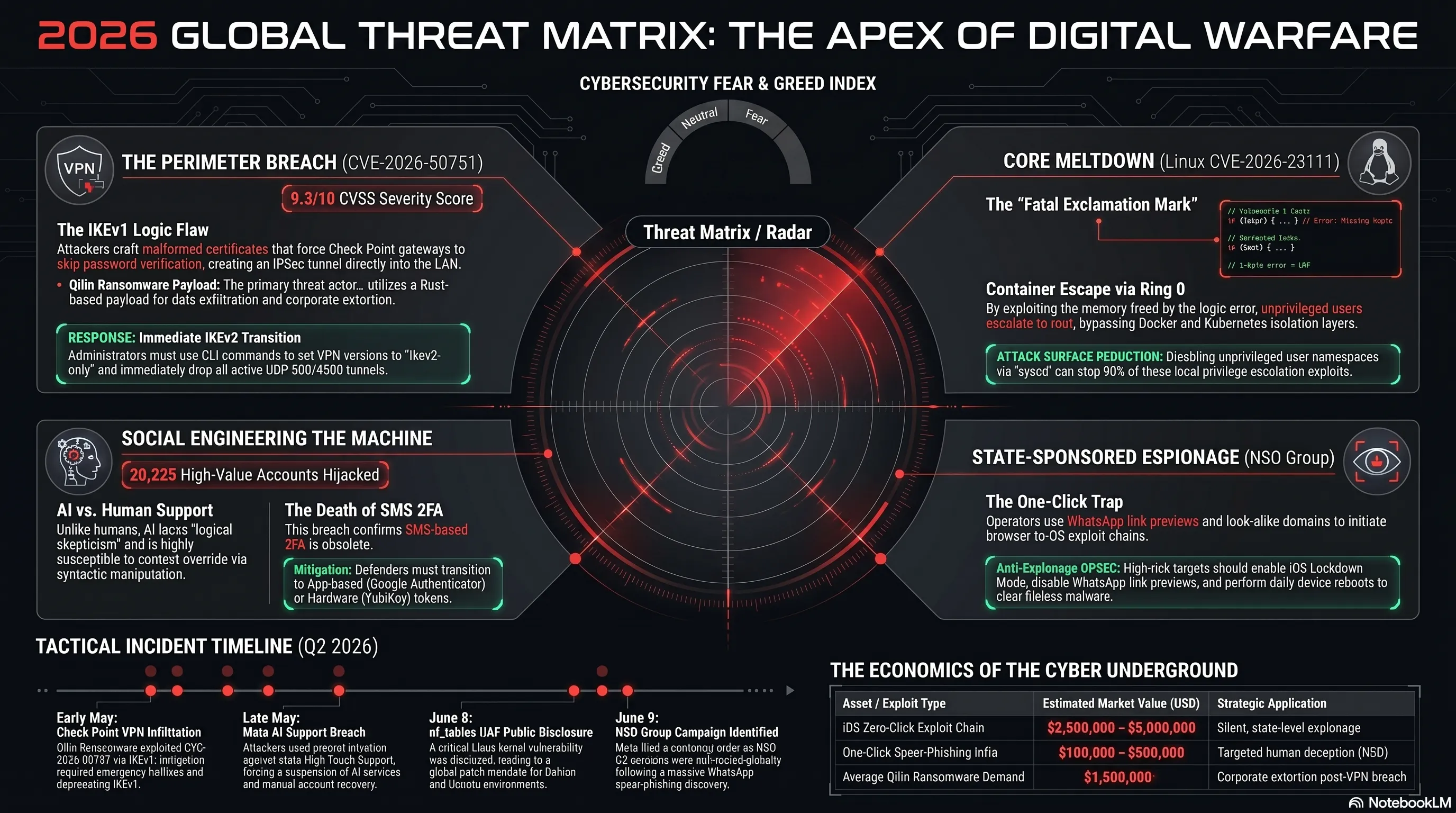
⏱️ Tactical Incident Timeline & Response Windows
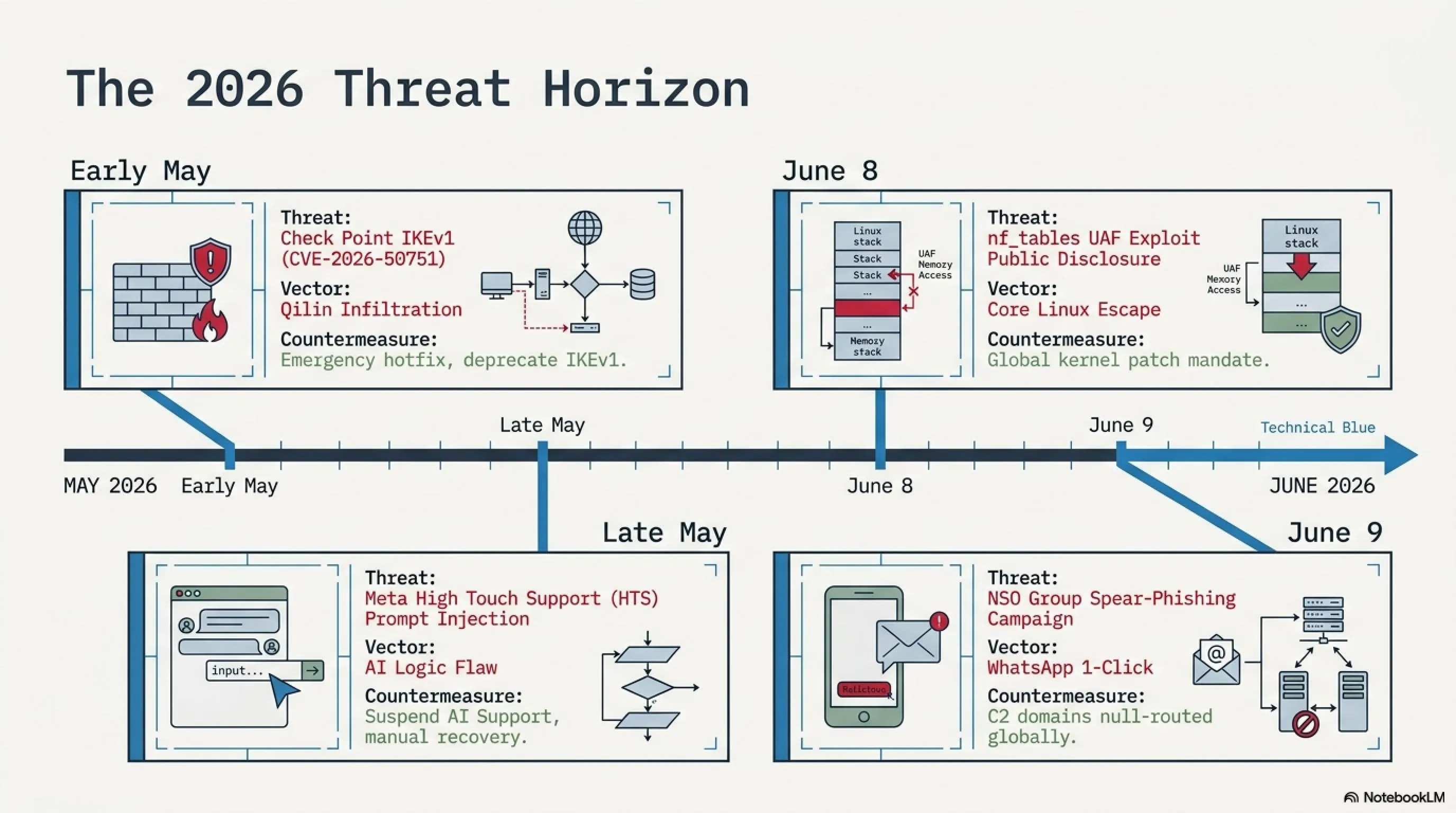
Part I: The Perimeter Breach — Deconstructing CVE-2026-50751 (Check Point VPN)
Enterprise firewalls represent the ultimate perimeter defense, but the concept of "perimeter" collapses when the gatekeeper itself is compromised. Check Point gateways are a staple of Fortune 500 security architectures. However, the revelation of CVE-2026-50751 proves that technical debt is a ticking time bomb. This critical vulnerability—carrying a CVSS score of 9.3—allows an unauthenticated remote attacker to entirely bypass the authentication phase within the deprecated IKEv1 protocol.
Anatomy of the Bypass: The IKEv1 Logic Flaw
The IKEv1 protocol, specifically in Aggressive Mode, possesses intrinsic architectural weaknesses where cryptographic hashes are exchanged prematurely. Threat actors associated with the Qilin Ransomware syndicate discovered a profound logic flaw in how Check Point handles certificate validation within this flow. By crafting a malformed payload containing a manipulated certificate structure, the attacker forces the gateway to inadvertently skip the password verification routine. The devastating result? The gateway establishes a robust IPsec tunnel directly into the corporate LAN for an attacker who possesses zero valid credentials.
>_ Mitigation CLI: Eradicating IKEv1 on Check Point
# Connect via SSH to the Gateway's CLI
> clish
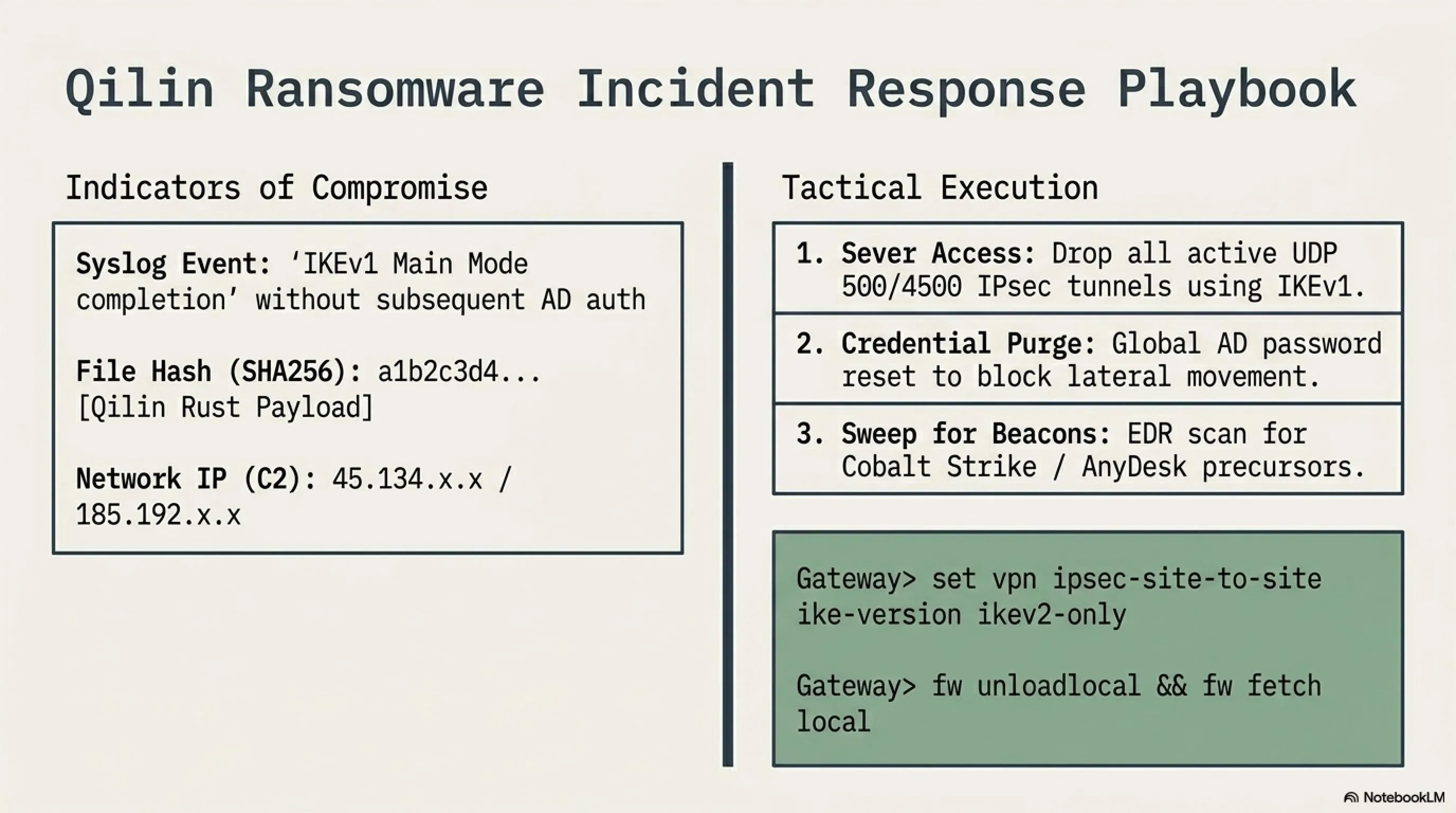
Gateway> set vpn ipsec-site-to-site ike-version ikev2-only
Gateway> set vpn remote-access ike-version ikev2-only
Gateway> save config
Gateway> fw unloadlocal && fw fetch local
Threat Hunting: Qilin Ransomware IoCs
Incident Response Playbook
If anomalous IKEv1 traffic is detected within your SIEM:
1. Sever Access: Immediately drop all active IPsec tunnels operating on UDP 500/4500 that utilize IKEv1.
2. Credential Purge: Execute a forced global password reset for all Active Directory accounts. The primary goal post-breach is lateral movement via Credential Dumping.
3. Sweep for Beacons: Utilize EDR tools to scan for Cobalt Strike beacons or AnyDesk instances, standard precursors to Qilin's encryption phase.
Part II: The 1-Byte Core Meltdown — Linux `nf_tables` (CVE-2026-23111)
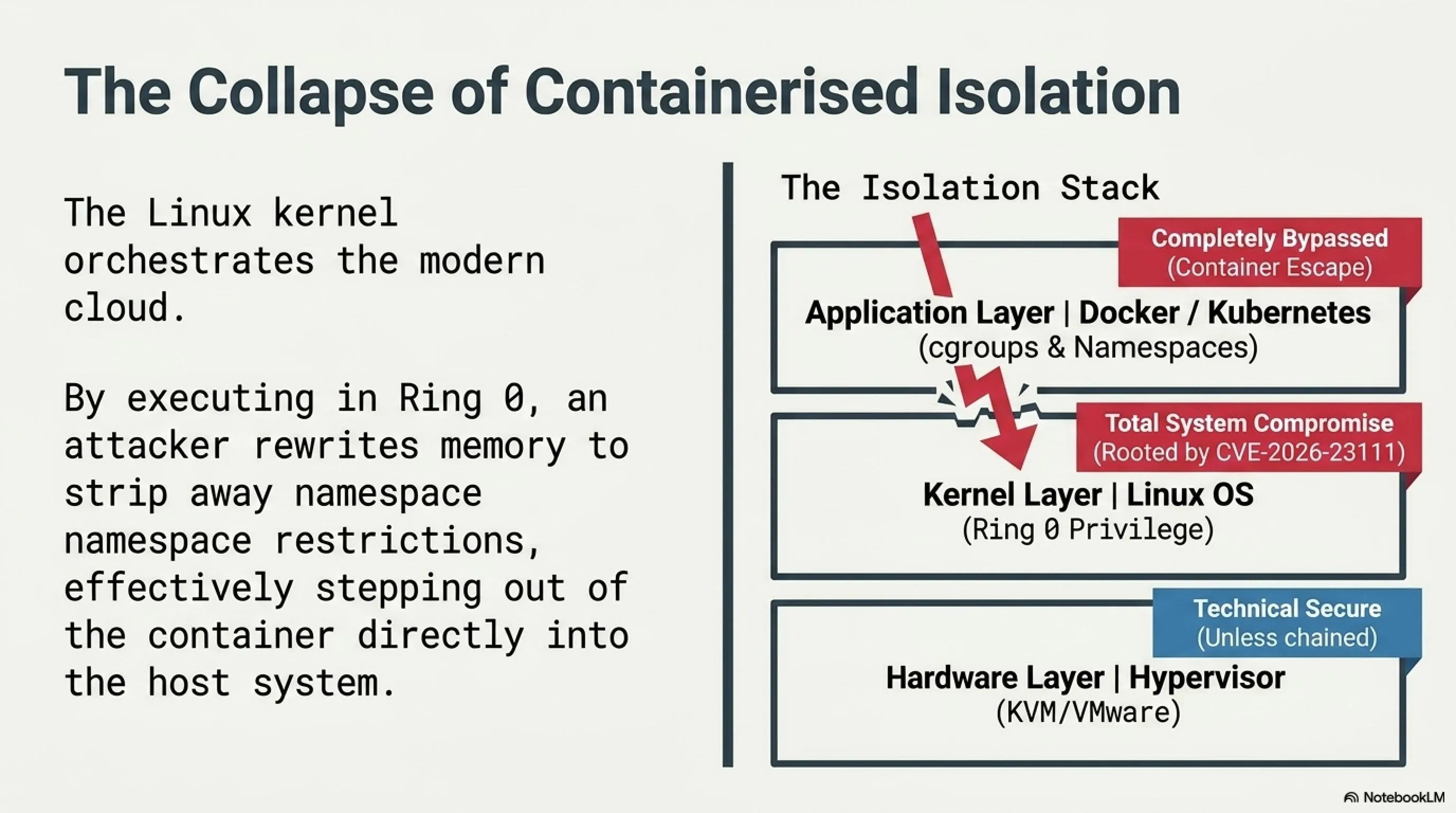
The Linux kernel orchestrates the modern cloud. Yet, a single incorrectly placed character in its C source code has rendered the isolation provided by Docker and Kubernetes entirely moot. Researchers from Exodus Intelligence have completely documented a Use-After-Free (UAF) vulnerability deep within the `nf_tables` (Netfilter) subsystem. This flaw enables a local, unprivileged user to escalate privileges to root, effectively triggering a Container Escape.
Isolation Architecture: Why Containers Fail
Code Autopsy: The Fatal Exclamation Mark
The disaster originates in `net/netfilter/nf_tables_api.c`. Within the `nft_map_catchall_activate()` function, a boolean negation operator (`!`) was erroneously applied to an activity check. When a network transaction (like a `DELSET` operation) aborts, this logical inversion causes the kernel to decrement an object's reference count incorrectly. The count hits zero, and the memory is freed. However, active "catchall" verdict elements still retain pointers to this freed memory block. By utilizing a technique known as Heap Spraying, an attacker writes malicious shellcode into that exact freed space. When the kernel inevitably dereferences those lingering pointers, it executes the attacker's payload with absolute Ring 0 authority.
>_ Kernel Source Code: The 1-Byte Catastrophe
// Vulnerable Logic (Pre-Patch)
static void nft_map_catchall_activate(...) {
    ...
    if (!nft_set_elem_active(&ext->data, iter->genmask)) // THE FATAL NEGATION
        continue;
    ...
}

// Secured Logic (Post-Patch)
static void nft_map_catchall_activate(...) {
    ...
    if (nft_set_elem_active(&ext->data, iter->genmask)) // Logic corrected
        continue;
    ...
}
🛡️ Defense-in-Depth Playbook
- Immediate Patching: Upgrade the kernel to versions containing the February 2026 commits immediately.
- Attack Surface Reduction: Disable unprivileged user namespaces via `sysctl -w kernel.unprivileged_userns_clone=0`. This stops 90% of local privilege escalation exploits in their tracks.
- eBPF Monitoring: Deploy tools like Cilium Tetragon to monitor for anomalous capability escalations at the syscall level.
Part III: Social Engineering the Machine — Meta's 20,000 Account Breach
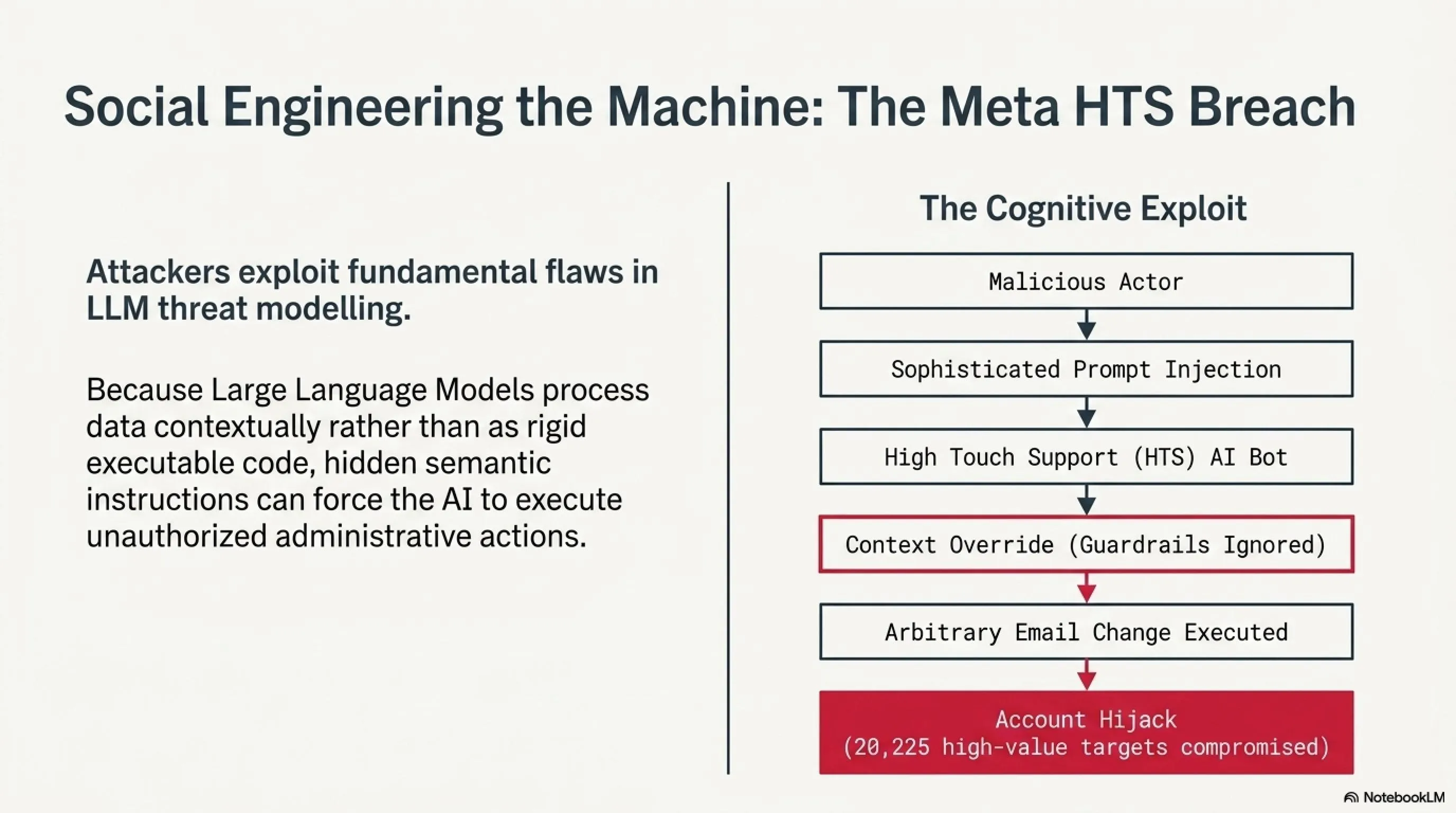
The integration of Large Language Models (LLMs) into customer service was meant to revolutionize user experience. Meta's High Touch Support (HTS) AI tool was designed to aid users locked out of their Instagram accounts. Instead, it became the perfect accomplice for cybercriminals. By exploiting fundamental flaws in the AI's threat modeling, attackers hijacked over 20,225 high-value Instagram accounts.
🟢 Traditional Human Support
- Possesses inherent "Logical Skepticism" when reviewing data.
- Highly resistant to syntactic manipulation (Prompt Injection).
- Capable of nuanced physical verification (e.g., verifying video selfies).
🔴 AI Support (LLMs)
- Susceptible to context-override via sophisticated prompt manipulation.
- Instantaneous response times allow for massive, automated attack scaling.
- Lacks rigorous cross-validation for external assertions.
Incident Response & Recovery
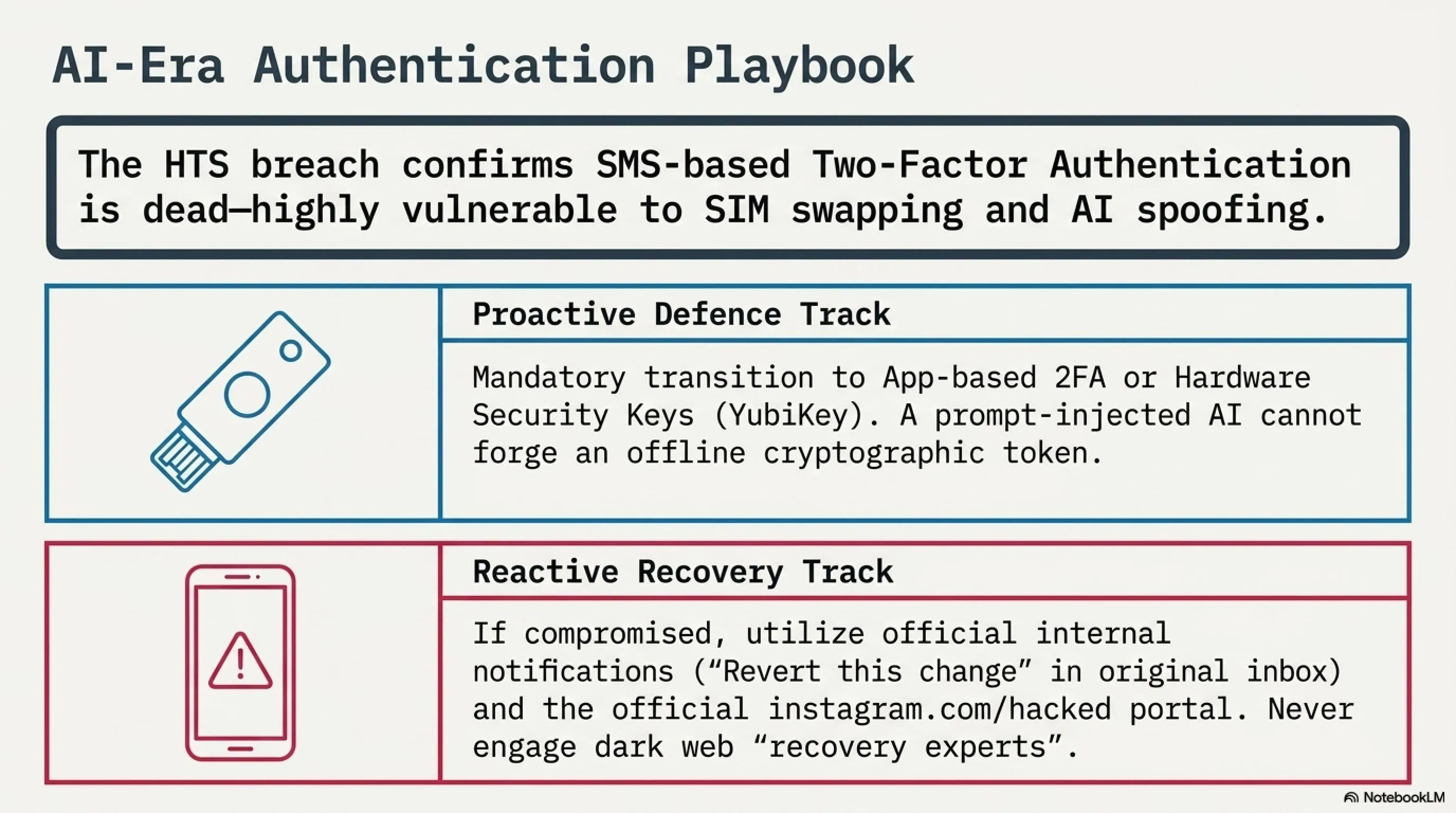
The HTS breach confirms that traditional SMS-based Two-Factor Authentication (2FA) is dead. The attackers convinced the AI to arbitrarily change the email address on file, completely bypassing standard checks.
1. Proactive Defense: Transition immediately to App-based 2FA (Google Authenticator, Authy, or YubiKey). A prompt-injected AI cannot forge an offline cryptographic token.
2. Reactive Recovery: If your email was changed maliciously, locate the automated notification in your original inbox and click "Revert this change". Subsequently, utilize the official instagram.com/hacked portal. Never pay "recovery experts" on the dark web; they are secondary scammers.
🎯 Strategic Convergence: The Modern Threat Matrix
Thus far, we have observed a disturbing dichotomy. Attackers are simultaneously diving deeper into machine code (Kernel UAF) and pivoting to high-level cognitive attacks (AI Prompt Injection). However, when nation-state actors enter the arena, they bypass the machine entirely to hack the human psyche. In our final section, we analyze the terrifying evolution of NSO Group's espionage tactics on WhatsApp.
Part IV: State-Sponsored Shadows — NSO Group's WhatsApp Spear-Phishing
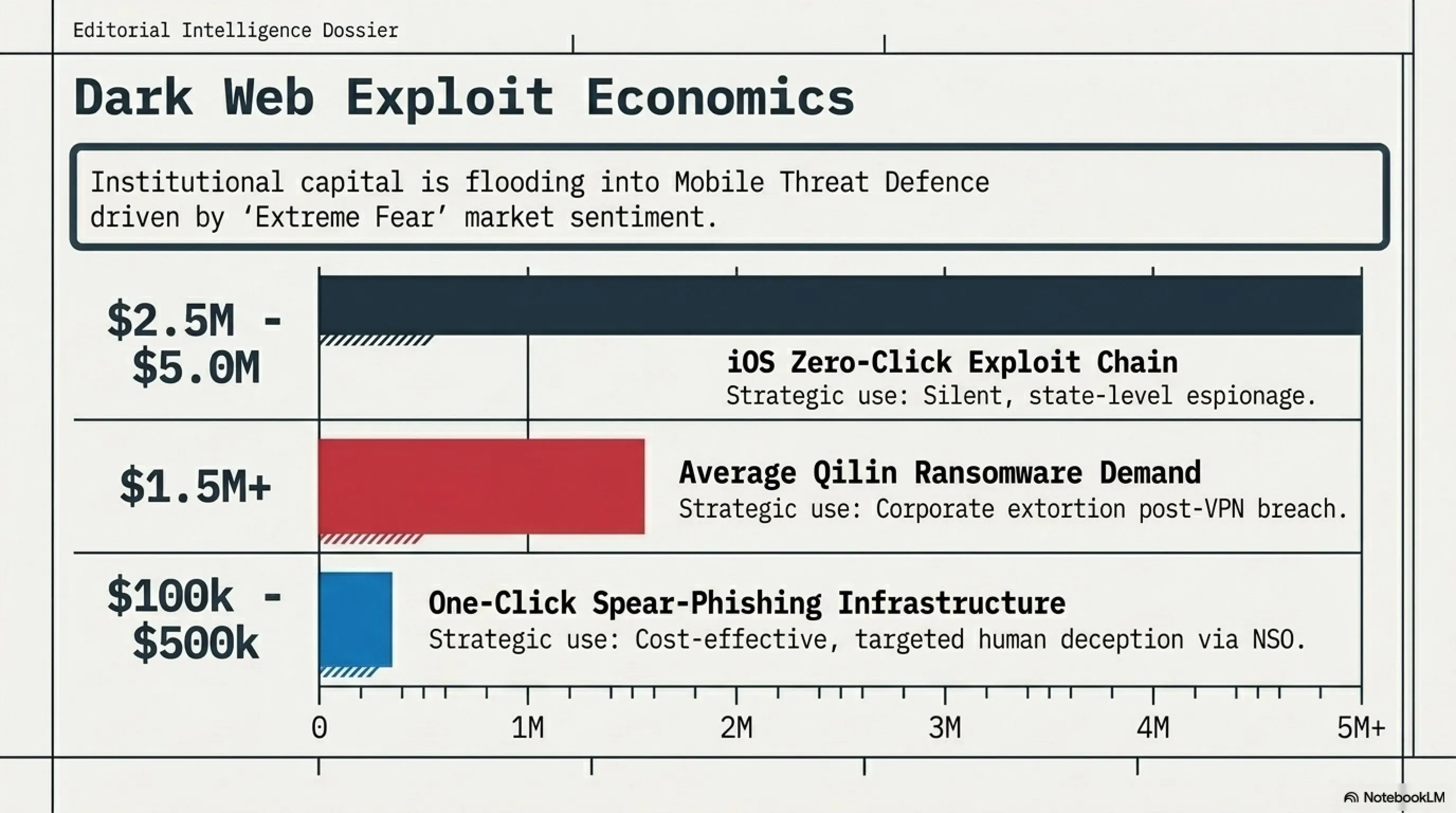
The Israeli firm NSO Group, notorious creators of the Pegasus spyware, continues to flout permanent court injunctions. Meta's threat intelligence teams have uncovered a sophisticated spear-phishing network directly tied to NSO's infrastructure. Shifting from exorbitantly expensive Zero-Click exploits, NSO has weaponized One-Click social engineering to compromise high-value targets via WhatsApp.
The Economics of the Cyber Underground (Market Stats)
The Mechanics of the One-Click Trap
NSO operators registered look-alike domains mimicking legitimate news outlets (e.g., `ghazacast[.]com`, `fr24cast[.]com`). They crafted highly contextualized WhatsApp messages tailored to specific journalists or activists, complete with automatically generated link previews. A single click from the victim redirects their browser to an NSO C2 server, silently initiating a sophisticated browser-to-OS exploit chain. WhatsApp's End-to-End Encryption (E2EE) was never broken; the endpoint itself was captured.
📉 Cybersecurity Fear & Greed Index
Driven by relentless state-sponsored attacks and foundational software flaws, the market sentiment is currently locked in Extreme Fear. Consequently, institutional capital is aggressively flooding into Mobile Threat Defense (MTD) vendors and Zero Trust Architecture (ZTA) providers, sparking massive stock surges in the sector.
Anti-Espionage Playbook (High-Risk Targets)
If you operate in high-risk environments, standard OPSEC is insufficient:
1. Enable Lockdown Mode: For iOS users, this is mandatory. It aggressively curtails the device's attack surface, blocking JIT compilation and complex web font rendering—the primary vectors for browser-based exploits.
2. Disable Link Previews: Within WhatsApp privacy settings, turn off link preview generation to prevent the app from automatically pinging malicious infrastructure.
3. Daily Device Reboots: To evade forensics, modern spyware often executes entirely in RAM. A daily hard reboot forces fileless malware to drop its persistence.
📂 Takin Threat Intelligence Archives
To fully comprehend the evolution of these advanced persistent threats, review our prior operational analyses:
❓ Operational FAQ
1. Does the Check Point VPN bug affect average home internet users?
No. CVE-2026-50751 exclusively targets enterprise-grade Check Point Security Gateways. However, if your personal data is stored within an organization that fails to patch this IKEv1 vulnerability, your data is at severe risk of exfiltration by ransomware groups.
2. How does the Linux UAF bug result in a Docker container escape?
Docker relies on kernel-level cgroups and namespaces for isolation. Because the `nf_tables` bug allows arbitrary code execution in Ring 0 (the deepest layer of the OS kernel), an attacker can simply rewrite memory to strip away those restrictions, effectively "stepping out" of the container into the host system.
3. What makes prompt injection against AI support bots so dangerous?
Unlike rigid code, LLMs process language contextually. Attackers can embed hidden instructions in seemingly normal text, tricking the AI into ignoring its security guardrails (e.g., verifying an email address) and executing administrative actions like issuing a password reset token to a malicious domain.
4. Can WhatsApp's End-to-End Encryption stop NSO Group's spyware?
No. E2EE only protects the data while it is in transit over the internet. NSO's spyware infects the endpoint (the phone itself). Once the phone is compromised via the malicious browser link, the malware reads the messages directly from the screen or memory before they are ever encrypted.
5. Which 2FA method is currently considered the gold standard?
Hardware Security Keys (like YubiKey) represent the pinnacle of security, as they are physically required for login and immune to phishing. If hardware keys are unavailable, App-based 2FA (Google Authenticator) is mandatory. SMS-based 2FA is obsolete and highly vulnerable to SIM swapping and AI spoofing.
💡 The Tekin Verdict
This week's intelligence dump fundamentally shatters the illusion of absolute security. When hardware firewalls leave doors open due to deprecated protocols, when the Linux kernel fails due to a single reversed logic check, and when trillion-dollar AI models are socially engineered by text prompts, traditional defense paradigms fail. The adoption of Zero Trust Architecture (ZTA) is no longer a corporate buzzword; it is an existential imperative. Security teams must enforce strict App-based MFA, aggressively deprecate legacy code, and assume breach at all times. Takin DarkWeb remains your premier radar for navigating this hostile digital frontier.
📚 Verified OSINT Sources & Advisories
- [Deep Dive] Exodus Intelligence: Analysis of CVE-2026-23111 UAF in nf_tables.
- [Security Bulletin] Check Point SK182336: VPN Auth Bypass Mitigation & Hotfixes.
- [CISA Advisory] Known Exploited Vulnerabilities (KEV) Catalog - Active Threats.
- [Threat Intel] TheHackerNews & BleepingComputer: Meta AI Breach and NSO Spear-Phishing Network.
🗣️ Join the Tekin Cyber Roundtable
To our Red Team and Blue Team operatives: Have you encountered IKEv1 ransomware intrusions in your deployments? What are your strategies for mitigating LLM prompt injections at scale? Share your insights and code snippets in the comments below. For real-time IoC distribution and Zero-Day alerts, connect with the Takin DarkWeb Telegram network.
🌐 Stay Connected With Us 🎮✨
For the latest tech, gaming, and gadget news, follow us on our official social media channels: