Tekin Analysis: Deconstructing Asha Sharma’s Brutal Xbox Restructuring Plan
Dive into today's top gaming news and exclusive breakdowns.
- 🎮Asha Sharma’s candid confrontation with collapsing hardware sales and stagnant Game Pass growth
- 🎧The definitive collapse of console tribalism and Microsoft Gaming’s pivot to an agnostic multiplatform publisher
- 🚀Wall Street pressure and Satya Nadella’s mandate to generate direct ROI from the $69B Activision Blizzard buyout
- 🗡️The ‘Clarity Is Kindness’ doctrine as an operational reset for Redmond’s creative and corporate culture
- 📰The strategic pivot toward hybrid Windows handhelds over traditional loss-leading consoles
- ⚔️Launch of a direct-to-consumer mobile storefront to bypass Apple and Google commissions
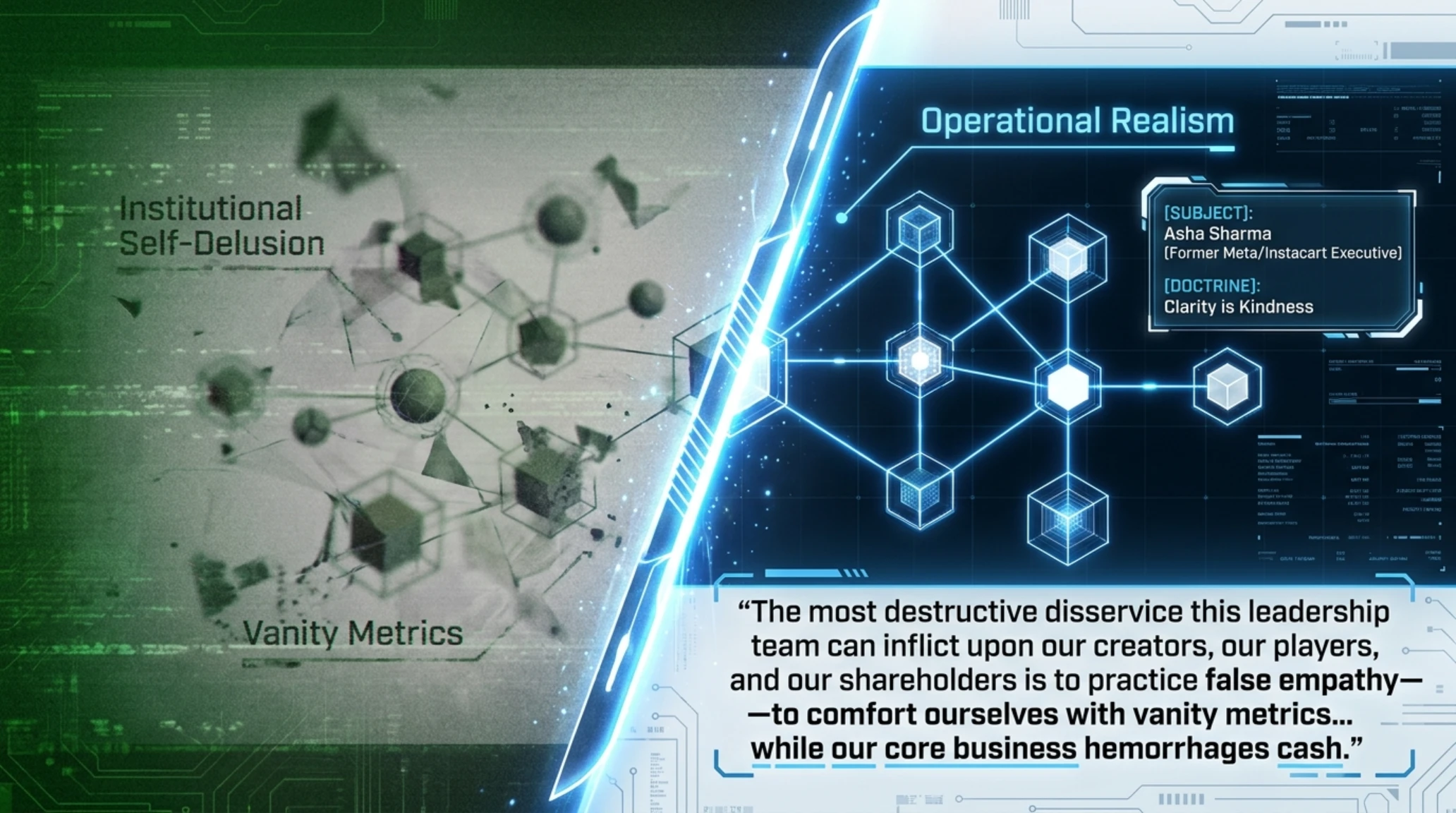
In September 2026, while consumer-facing gaming publications remained fixated on cyclical autumn release schedules, marketing cinematic trailers, and incremental hardware revisions, a profound structural earthquake shattered the corporate corridors of Microsoft’s Redmond campus. Asha Sharma, a seasoned Silicon Valley product executive known for architecting rigorous operational discipline at Meta and steering high-growth marketplace logistics at Instacart, assumed executive product leadership over the Xbox business. Her inaugural address to internal engineering leads and creative studio directors was neither a soothing pep talk nor a polished corporate public relations presentation. Instead, it was an unflinching, mathematically grounded reckoning that dismantled years of institutional self-delusion: the era of concealing structural failure behind curated engagement metrics was officially over, and the survival of the Xbox enterprise demanded an immediate, unanesthetized surgical intervention.
In a memorable memorandum that sent shockwaves across Microsoft’s twenty-four first-party development studios, Sharma articulated the governing philosophy of her restructuring roadmap: "Clarity is kindness. The most destructive disservice this leadership team can inflict upon our creators, our players, and our shareholders is to practice false empathy—to comfort ourselves with vanity metrics, cherry-picked engagement spikes, and vague long-term ecosystem promises while our core business hemorrhages cash. We must possess the moral courage to look into the mirror and acknowledge that traditional console hardware has arrived at an irreversible dead end. If we do not dissect our structural vulnerabilities today with clinical objectivity, we will be crushed beneath the weight of our own overhead tomorrow."
This candid declaration marked the definitive end of an era in Microsoft’s twenty-five-year gaming history. For over a decade under Phil Spencer’s stewardship, the Xbox brand had championed a romantic, ecosystem-centric ethos. The organization had poured billions into loss-leading hardware manufacturing, subsidized aggressive Game Pass subscriber acquisitions, and promoted a utopian vision of device-agnostic cloud streaming, under the working assumption that Microsoft could inevitably capture the digital gaming landscape and establish itself as the undisputed "Netflix of interactive entertainment." However, when the colossal sixty-nine-billion-dollar acquisition of Activision Blizzard King cleared its grueling global regulatory hurdles in late 2023, the underlying economic equation altered permanently. Microsoft CEO Satya Nadella and Chief Financial Officer Amy Hood were no longer willing to underwrite chronic hardware losses. Wall Street demanded double-digit operating margins and tangible returns on nearly one hundred billion dollars in cumulative gaming investments.
Core Strategic Pillars of the Asha Sharma Xbox Transformation Roadmap
- Explicit acceptance of the Tenth-Generation console hardware defeat and institutional pivot to software publishing
- Systematic re-engineering of Game Pass unit economics to eliminate destructive Day-One cannibalization
- Drastic curtailment of unchecked production cycles across twenty-four first-party studios to enforce milestone accountability
- Accelerated deployment of a direct-to-consumer mobile web storefront to bypass Apple and Google thirty percent platform taxes
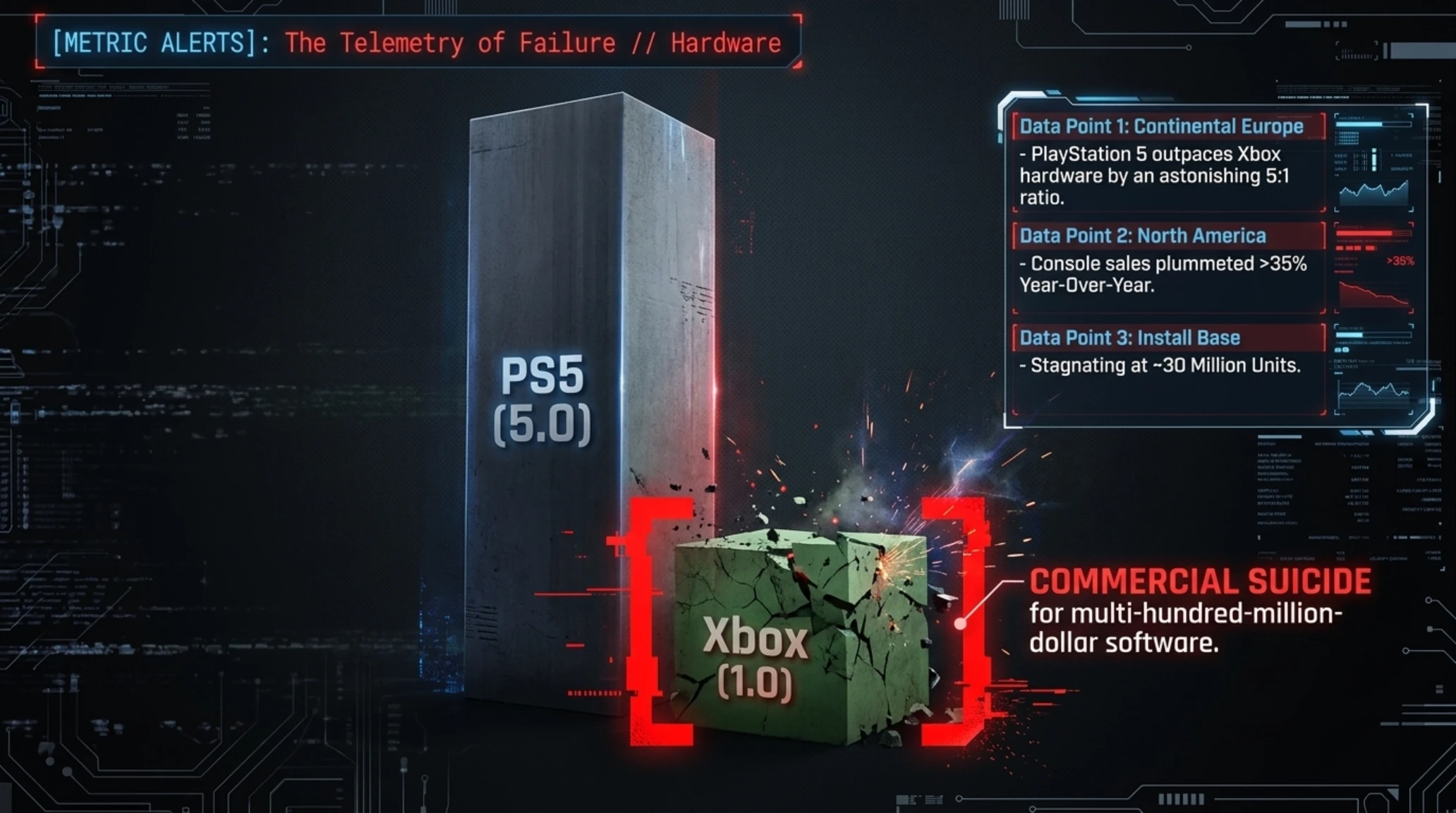
To comprehend the acute urgency driving Sharma’s intervention, one must examine the unvarnished macroeconomic telemetry confronting the division. By mid-2026, global retail channel data confirmed that combined lifetime sales of the Xbox Series X and Series S had fallen catastrophically behind competitor hardware. Across continental Europe, PlayStation 5 sales outpaced Xbox hardware by an astonishing ratio of nearly five to one. In East Asia, Microsoft’s hardware footprint had evaporated into statistical irrelevance. Even within its historic North American fortress, console sales plummeted by more than thirty-five percent year-over-year. Persisting with a strategy of locking multi-hundred-million-dollar software investments to an install base hovering around thirty million units was no longer merely a sub-optimal distribution strategy—it was commercial suicide.
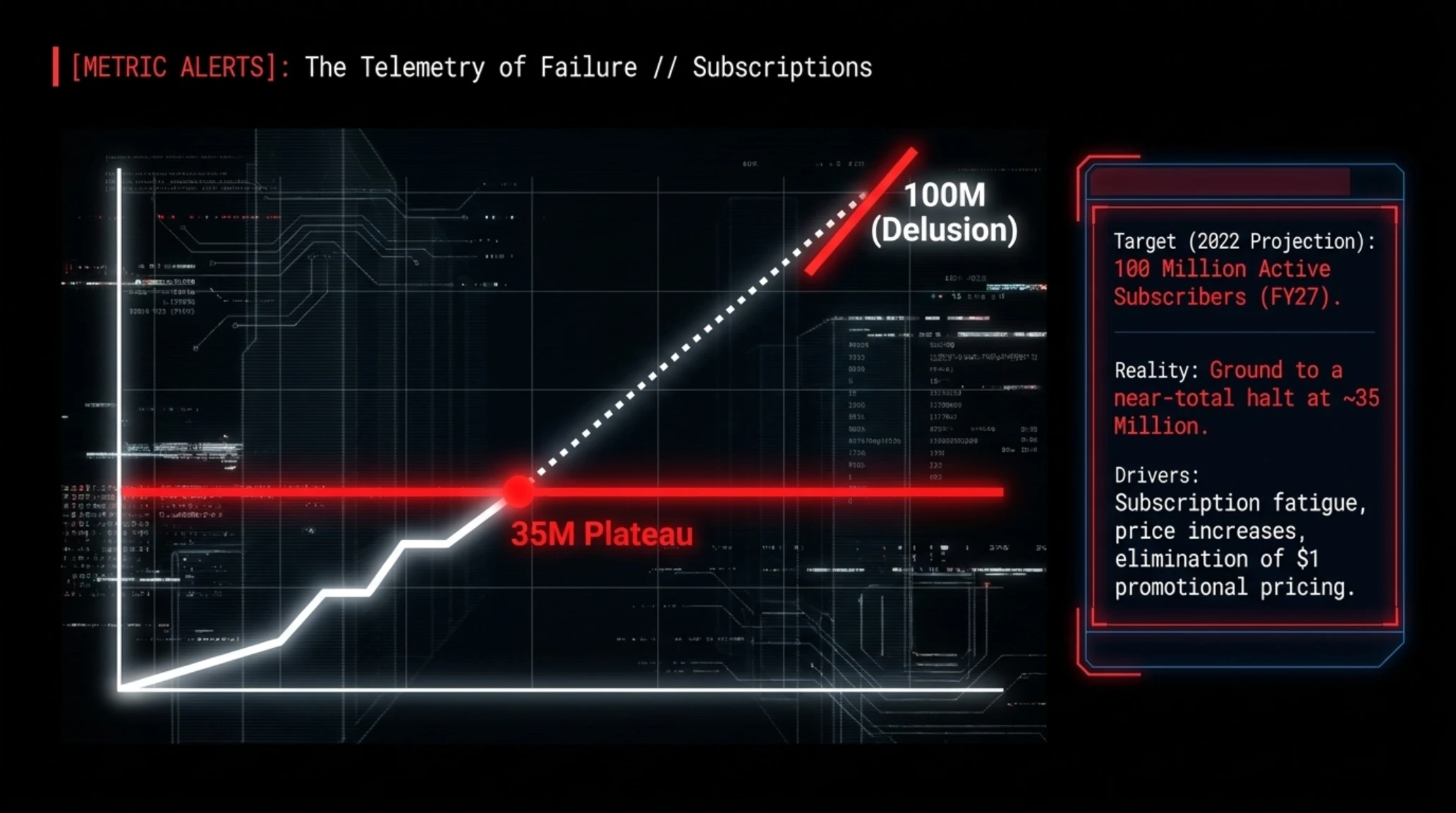
Compounding this hardware collapse was the sudden, stubborn plateau in Game Pass subscriber growth. Internal financial projections drafted in 2022 had ambitiously targeted one hundred million active subscribers by fiscal year 2027. Yet, after climbing to approximately thirty-four to thirty-six million subscribers, growth ground to a near-total halt. Consecutive subscription price increases, the elimination of legendary one-dollar promotional introductory pricing, and consumer subscription fatigue demonstrated that the addressable market of core console and PC gamers willing to pay recurring monthly subscription fees was dramatically smaller than executive leadership had originally modeled.
This reality was severely aggravated by an unprecedented macroeconomic surge in leading-edge semiconductor fabrication costs. In previous console generations, hardware manufacturers relied on the historical cadence of Dennard scaling and predictable die-shrink cost curves: a console that launched at a loss of one hundred dollars per unit would, within two to three years, yield healthy gross margins as TSMC and foundry partners matured process nodes. In the post-pandemic, high-inflation semiconductor epoch, advanced node wafer pricing skyrocketed past twenty thousand dollars per start. Instead of hardware becoming cheaper to manufacture over its lifecycle, component bills of materials (BOM)—encompassing high-speed GDDR6 memory modules, advanced thermal vapor chambers, and dense solid-state storage—remained stubbornly elevated, turning what was once a transient loss-leading strategy into a permanent financial hemorrhage.

This strategic bottleneck collided head-on with an unprecedented explosion in baseline game development costs. The integration of Activision Blizzard expanded Microsoft Gaming’s payroll to over twenty-two thousand employees, while simultaneous production budgets for flagship AAA single-player titles ballooned past two hundred and fifty million dollars apiece. Accounting teams faced the cold mathematical reality that amortizing massive development budgets and ongoing server infrastructure costs across low-margin monthly subscription tiers was fundamentally unsustainable. In her earliest strategy summits, Sharma bluntly informed division leaders that the era of unlimited corporate subsidies and blank-check creative incubation had permanently closed.
Sharma’s ascent signaled a profound cultural transformation across Redmond’s campus. Unlike traditional gaming executives whose decision-making was frequently tethered to nostalgic console rivalries and tribal gamer sentiment, Sharma approached the portfolio through the lens of modern platform economics, customer lifetime value (LTV), customer acquisition cost (CAC), and rigorous capital allocation. Her "Clarity Is Kindness" doctrine was not an exercise in corporate cynicism, but an urgent operational correction designed to halt years of administrative drift—a systemic paralysis where under-performing projects were allowed to consume tens of millions of dollars annually because senior managers lacked the resolve to execute decisive project terminations.
The Anatomy of Operational Realism: Deconstructing the ‘Clarity Is Kindness’ Philosophy
The philosophical principle that "Clarity is Kindness," originally popularized by contemporary organizational leadership theorists, was transformed by Sharma into an incisive corporate scalpel. For years, the internal culture of Xbox had cultivated an environment of comfortable consensus. Mid-tier projects lacking distinctive market appeal, protracted pre-production cycles spanning multiple years without playable vertical slices, and misguided attempts to chase oversaturated live-service multiplayer trends were permitted to linger quietly. Upper management routinely avoided uncomfortable conversations regarding commercial viability, fearing external public relations blowback and internal creative friction. The tragic byproduct of this avoidance was catastrophic: sudden, demoralizing studio closures and mass layoffs that blindsided thousands of developers in early 2024 and 2025.
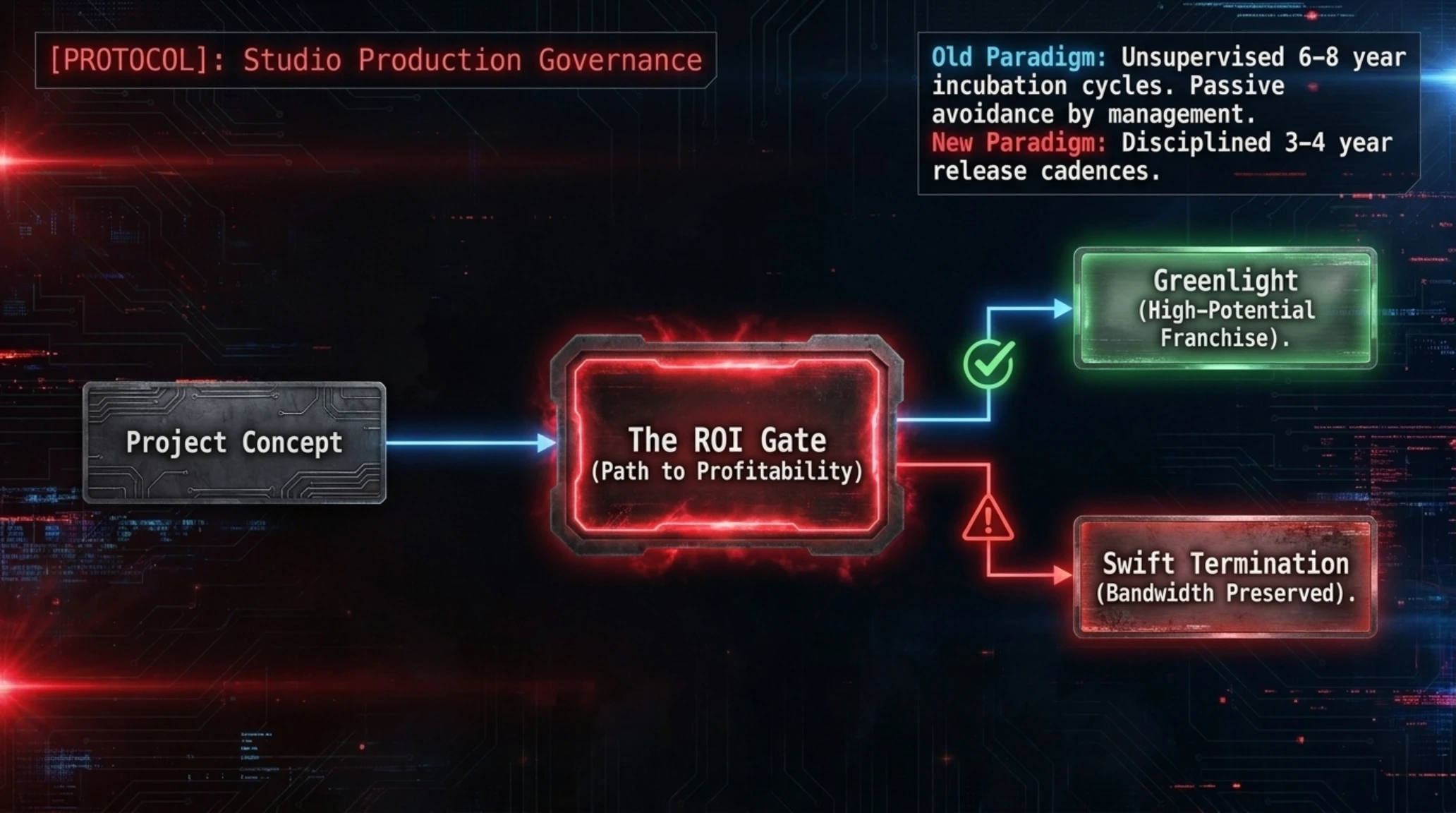
Sharma dismantled this culture of passive avoidance. She argued that true institutional empathy does not lie in shielding employees from commercial realities, but in establishing transparent, measurable milestones that enable creators to understand exactly how their work maps to organizational survival. Under her framework, project proposals must demonstrate a viable, sustainable path to profitability before receiving greenlight status. If an experimental concept fails to validate its core gameplay loops and market appeal during initial prototyping, it is terminated swiftly and respectfully, preserving precious development resources and intellectual bandwidth for proven, high-potential franchises.
This structural recalibration mirrors a broader changing of the guard within Microsoft’s executive suite. While Phil Spencer remained a beloved public figure who spent a decade successfully championing player-friendly policies and rehabilitating the Xbox brand following the disastrous 2013 Xbox One launch, the corporate context had fundamentally transformed. Microsoft was no longer an embattled underdog attempting to rebuild goodwill; it was the largest software corporation on Earth, carrying sixty-nine billion dollars in newly acquired gaming debt that demanded aggressive financial return. Satya Nadella required an executive who could make dispassionate, data-driven decisions unburdened by twenty-year-old console sentimentalism.
To implement this mandate, Sharma ordered a comprehensive, forensic audit across all twenty-four first-party studios. Development divisions were informed that their operations would no longer be insulated from external market pressures. Profligate six-to-eight-year development pipelines were strictly curtailed; studios were instructed to structure production pipelines around tighter, highly focused scopes with target release cadences of three to four years. Teams like Ninja Theory, Obsidian, id Software, and Bethesda were challenged to recapture the agile, disciplined production methodologies that initially established their creative reputations.
Simultaneously, financial reporting was decentralized into discrete business units. Hardware engineering, subscription services, traditional retail publishing, in-game monetization, and cloud infrastructure were required to produce independent balance sheets, exposing cross-subsidies that had previously obscured hardware unprofitability. This financial transparency paved the way for the most controversial strategic evolution in modern gaming history: the deliberate dismantling of platform exclusivity.

This operational pivot laid the groundwork for an irreversible transition: transforming Microsoft Gaming from a hardware-dependent console proprietor into the world's most formidable, omnipresent multiplatform software publisher.
The Great Multiplatform Pivot: When Sony and Nintendo Became Redmond’s Premier Clients
The most consequential sacred cow slaughtered under Asha Sharma’s leadership was the long-held dogma of platform exclusivity. For over twenty years, the video game console industry operated upon a rigid, zero-sum business model: hardware manufacturers commissioned proprietary software libraries at massive expense for the singular purpose of forcing consumers behind walled hardware gardens. Microsoft funded iconic franchises such as Halo, Gears of War, and Forza primarily to stimulate hardware unit sales. However, when the global install base of the Xbox Series X and Series S stagnated at approximately one-third of Sony’s PlayStation 5, the cold calculus of production economics turned violently against this legacy paradigm.
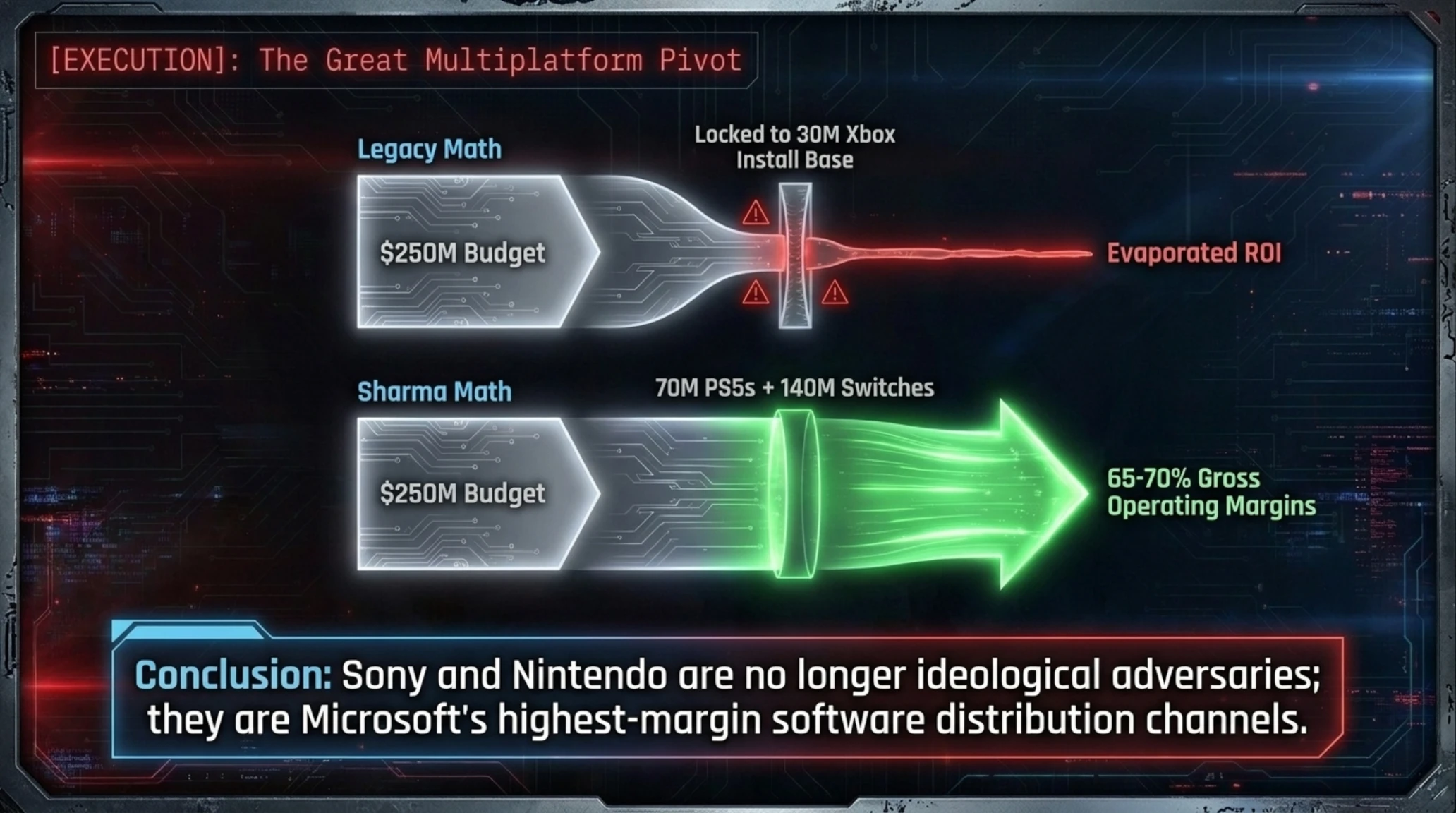
Engineering a modern prestige AAA video game requires capital commitments ranging between two hundred and three hundred and fifty million dollars in direct development expenses, accompanied by global marketing budgets frequently exceeding one hundred million dollars. When such monumental software assets are restricted to a hardware install base of merely thirty million units—where an estimated fifty percent of engaged users access content exclusively through recurring Game Pass subscriptions rather than full-price retail transactions—the mathematical likelihood of recouping capital investments evaporates. Sharma audited these balance sheets with surgical precision and deduced that withholding first-party software from more than seventy million PlayStation 5 owners and over one hundred and forty million Nintendo Switch players was not strategic brand protection; it was corporate self-sabotage.
The catastrophic fallout of this insular economic model had already revealed its ugly consequences throughout 2024 and 2025. Revered creative studios, most notably Tango Gameworks (the acclaimed creators of the award-winning Hi-Fi Rush) and Arkane Austin, were subjected to sudden, demoralizing closures despite producing critically celebrated work. These titles, confined to a limited Xbox hardware install base and immediately absorbed into the Game Pass library at zero additional cost to subscribers, simply failed to generate the requisite direct transactional revenue to justify their ongoing operational costs. Sharma underscored to senior leadership that critical acclaim cannot settle balance sheets; creative studios require real, diversified cash flows spanning every major gaming screen on the planet to survive.
The tentative multiplatform experiments initiated earlier in the generation—most visibly the historic releases of Sea of Thieves and Grounded on PlayStation 5, both of which promptly dominated digital download charts—had validated consumer demand. Yet, it was Sharma who formalized this trial into permanent corporate doctrine. Ambitious, high-budget epics including Indiana Jones and the Great Circle and Doom: The Dark Ages were explicitly integrated into multiplatform release roadmaps, while classified evaluations began for publishing remastered editions of flagship IP, including Gears of War, across rival platforms. Under Sharma’s doctrine, Sony and Nintendo are no longer viewed as ideological adversaries; they represent Microsoft’s highest-margin software distribution channels.
The fiscal mechanics underpinning this transition are overwhelmingly persuasive to Wall Street financial analysts. When Microsoft sells a proprietary seventy-dollar software title through the PlayStation Network or Nintendo eShop, it remits standard thirty percent platform store commissions to Sony or Nintendo while pocketing seventy percent as direct gross revenue. With zero capital expenditure invested in manufacturing, warehousing, freight shipping, or retailer price protection on physical console boxes, these software sales yield gross operating margins exceeding sixty-five to seventy percent. In contrast, every additional Xbox Series console manufactured and shipped incurred negative net margins throughout the early lifecycle and generated sub-ten-percent margins even at peak operational efficiency. Shifting capital from negative-margin hardware assembly lines to seventy-percent-margin digital publishing represents the single most accretive capital reallocation in Microsoft Gaming's corporate history.
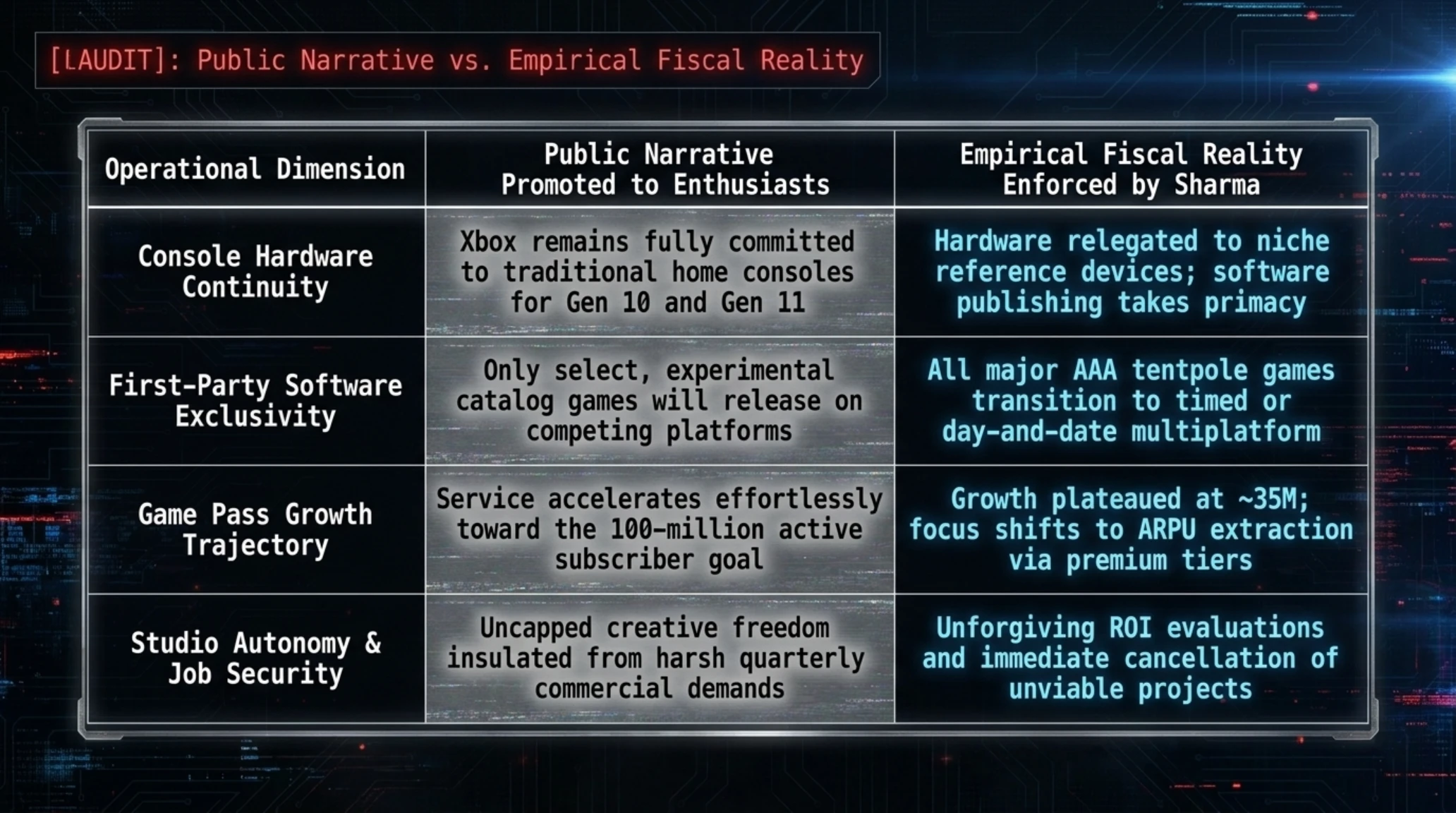
Rumor vs. Reality: Forensic Audit of Microsoft Gaming PR Claims vs Operational Truth
Systematic Breakdown of Public Statements Against Verified Executive Directives
| Operational Dimension | Public Narrative Promoted to Enthusiasts | Empirical Fiscal Reality Enforced by Sharma |
|---|---|---|
| Console Hardware Continuity | Xbox remains fully committed to traditional home consoles for Gen 10 and Gen 11 | Hardware relegated to niche reference devices; software publishing takes primacy |
| First-Party Software Exclusivity | Only select, experimental catalog games will release on competing platforms | All major AAA tentpole games transition to timed or day-and-date multiplatform |
| Game Pass Growth Trajectory | Service accelerates effortlessly toward the 100-million active subscriber goal | Growth plateaued at ~35M; focus shifts to ARPU extraction via premium tiers |
| Activision Deal ROI | Acquisition instantly made Microsoft the most profitable gaming giant in history | Severe amortization pressure from Wall Street requiring 20%+ operating margins |
| Studio Autonomy & Job Security | Uncapped creative freedom insulated from harsh quarterly commercial demands | Unforgiving ROI evaluations and immediate cancellation of unviable projects |
This aggressive pivot elicited widespread applause from institutional investors and financial analysts, yet it triggered waves of intense emotional backlash across vocal segments of the enthusiast player base. Community forums and digital platforms overflowed with lamentations from loyal console owners who felt betrayed, arguing that the distinctive identity of the Xbox brand had been liquidated. Sharma met this controversy with characteristic directness, re-invoking the principle of "Clarity Is Kindness." She maintained that she would far rather oversee a thriving, financially robust software publishing empire that consistently pays its developers and funds ambitious new creative bets than govern a dying hardware ecosystem that slowly suffocates its internal studios.
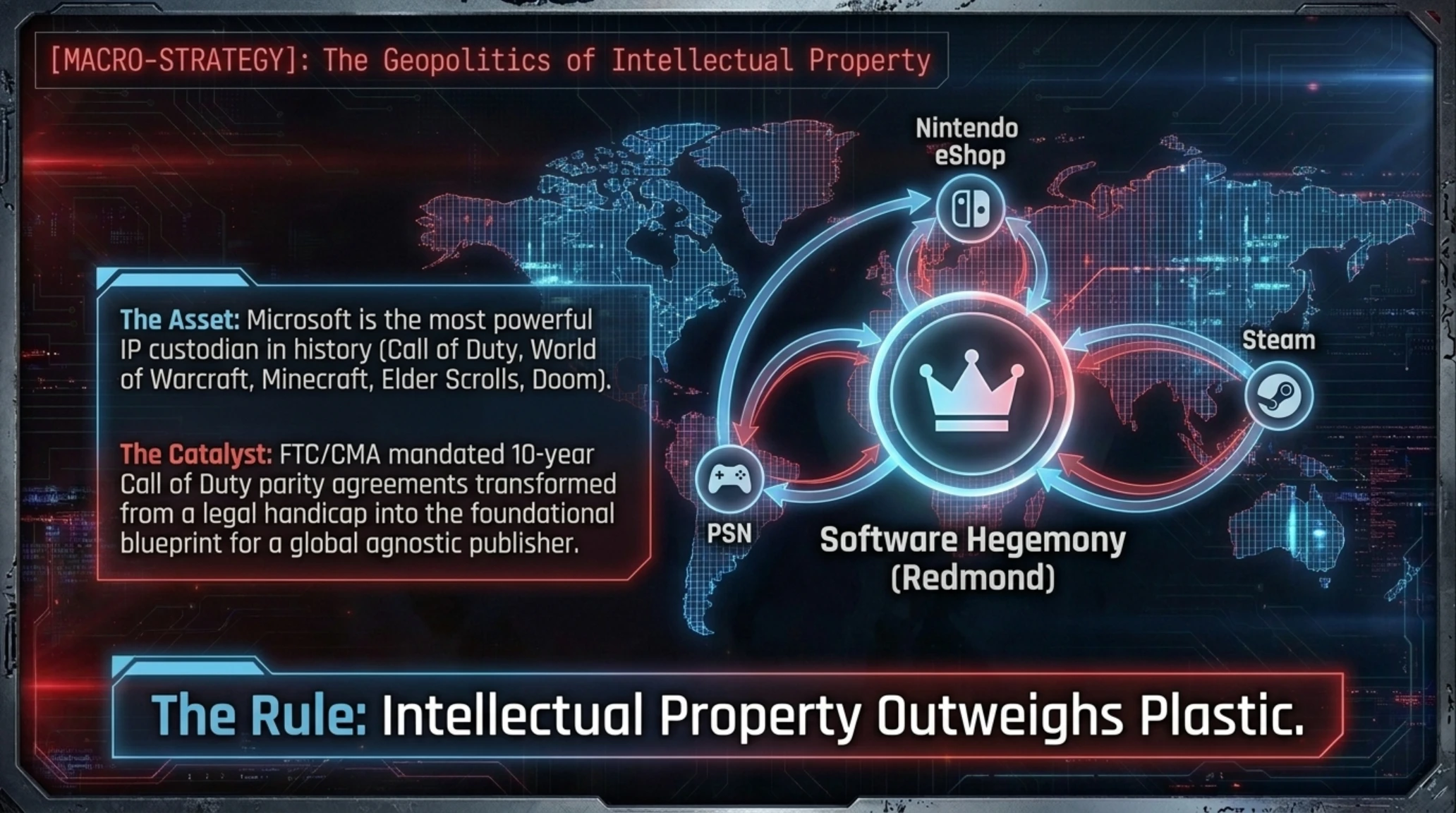
Furthermore, this strategic realignment represented the logical culmination of regulatory concessions Microsoft had previously surrendered during its bruising antitrust battles against the Federal Trade Commission (FTC) and the UK Competition and Markets Authority (CMA). To secure global approval for the Activision Blizzard transaction, Microsoft signed binding ten-year agreements guaranteeing Call of Duty parity across PlayStation and Nintendo platforms. Rather than treating these legal commitments as restrictive commercial handicaps, Sharma transformed them into the foundational blueprint for a comprehensive multiplatform publishing enterprise. If Call of Duty could thrive across rival platforms and generate billions in high-margin royalty revenue, withholding titles like Halo or Gears of War was an indefensible relic of obsolete console tribalism.
This realization aligned perfectly with modern consumer psychology. The contemporary gaming generation, raised on cross-platform ecosystems like Fortnite, Roblox, and Minecraft, views artificial platform boundaries as irritating technical friction rather than a badge of brand loyalty. Players demand seamless cross-play, persistent cross-progression, and universal entitlement across whatever screens they happen to own. By meeting players wherever they congregate, Sharma positioned Microsoft as the progressive, modern champion of player accessibility.
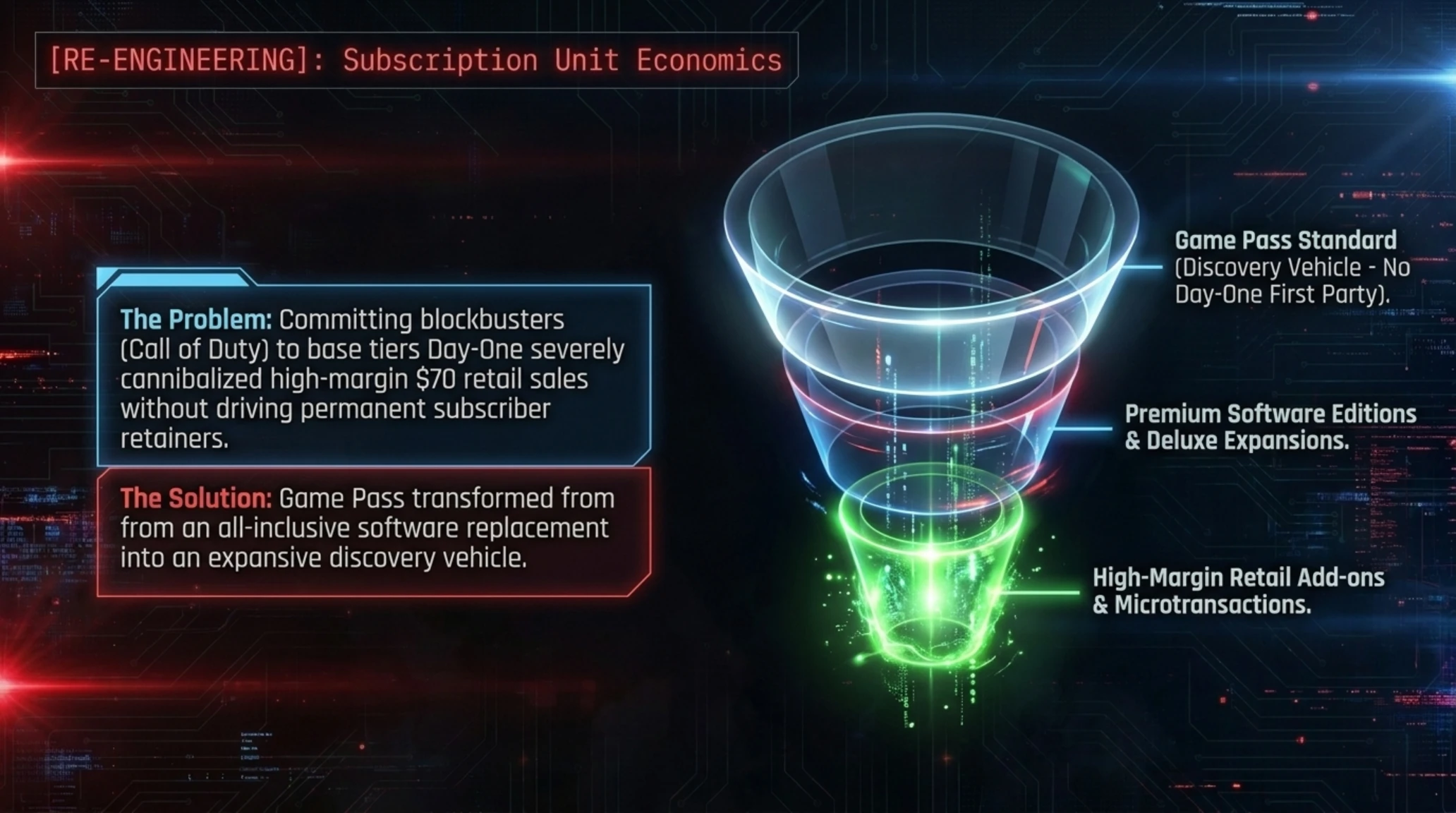
The second pillar of Sharma’s economic overhaul targeted the financial architecture of Game Pass itself. Once hailed by consumers as the greatest value proposition in the history of entertainment software, the service had evolved into a dangerous revenue sinkhole. Committing monumental first-party blockbusters—such as newly minted Call of Duty releases—to base subscription tiers on day of launch severely cannibalized high-margin seventy-dollar retail sales, without generating a corresponding, permanent surge in recurring subscriber retainers.
Sharma executed a comprehensive restructuring of the subscription portfolio. Game Pass Ultimate experienced substantial price adjustments, while newly conceived Standard tiers were stripped of Day-One first-party access. Consumers seeking immediate access to flagship releases were systematically nudged toward purchasing premium software editions, deluxe expansions, and paid early-access windows. In Sharma’s reimagined hierarchy, Game Pass operates not as an exhaustive, all-inclusive software replacement, but as an expansive discovery vehicle designed to cultivate player engagement and funnel consumers toward high-margin digital microtransactions and retail add-ons.
This commercial realignment proved that no corporate balance sheet, regardless of Microsoft’s trillions in enterprise cloud valuation, can indefinitely subsidize artificial consumer economics. Sustainable creative industries require recurring, profitable unit economics; publishing software across every viable digital storefront represents the only reliable mechanism for safeguarding the future of high-budget game production.
To fully grasp why these commercial transformations are irreversible, one must examine the dramatic redesign underway in Microsoft’s hardware laboratories—where the historical boundary separating closed consoles from open personal computers is dissolving into history.
Leaked technical schematics and internal hardware briefs confirm that Microsoft is abandoning the traditional paradigm of proprietary console design in favor of an open, Windows-based reference platform engineered for high-performance handhelds and hybrid living-room hardware.
The Future of Xbox Hardware: From Monolithic Consoles to Windows-Powered Handhelds
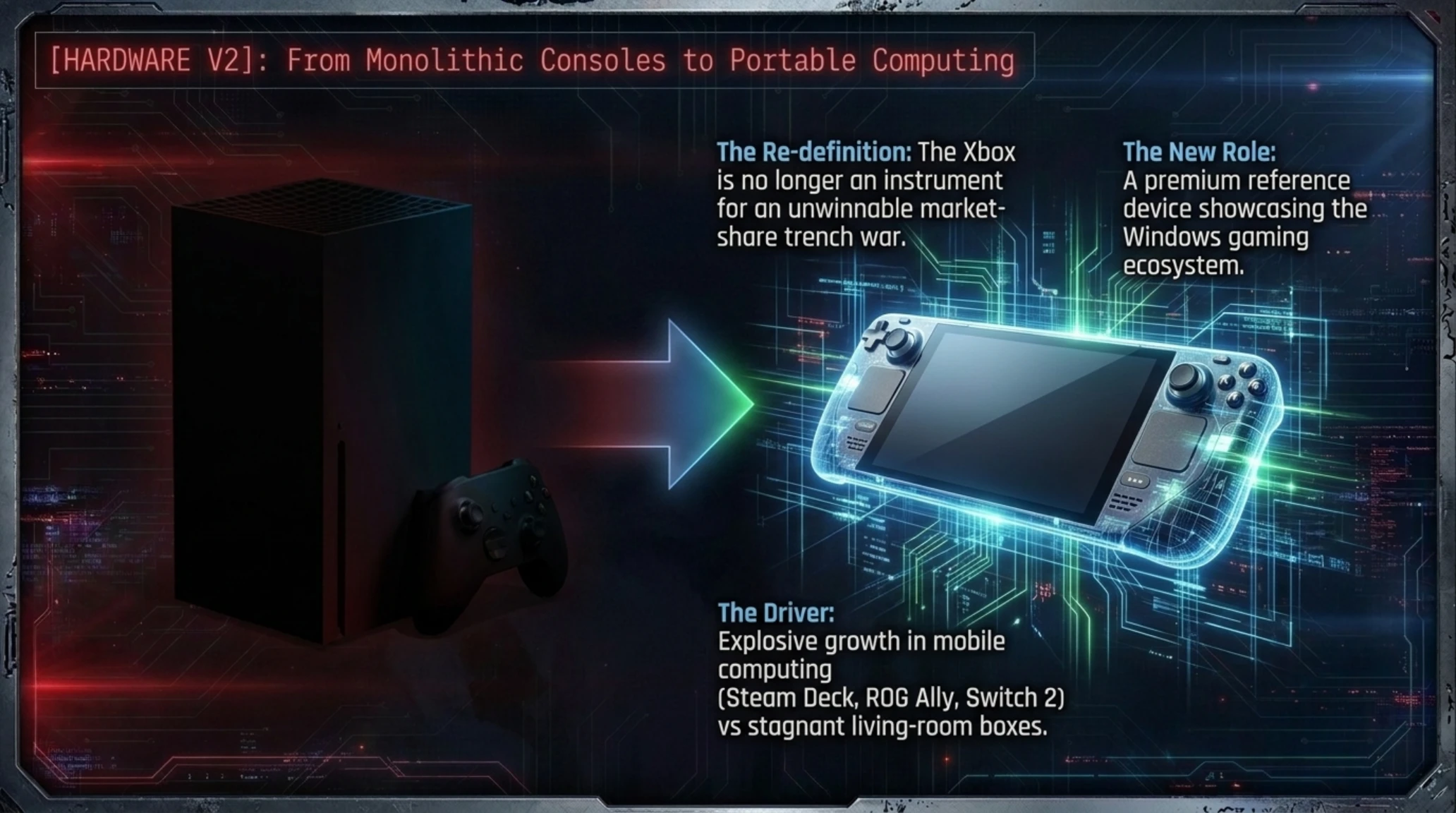
The existential question haunting industry analysts and passionate players following the release of Asha Sharma’s memorandum was whether Microsoft was quietly orchestrating a complete exit from hardware manufacturing. The answer formulated by Sharma’s team revealed a far more sophisticated, nuanced commercial reality. Microsoft is not abandoning the creation of physical gaming machines; rather, it is radically redefining their strategic purpose. In the post-restructuring era, an Xbox console is no longer an instrument engineered to wage an unwinnable market-share trench war against Sony in the living room; it has been reimagined as a premium reference device designed to showcase the ultimate capabilities of the Windows gaming ecosystem.
Confidential hardware development briefs indicate that Microsoft’s next-generation hardware portfolio has diverged into two distinct, parallel engineering tracks. The first is a high-end, premium traditional home computing platform whose silicon architecture and operating system mirror an ultra-optimized, small-form-factor gaming PC far more than a closed, proprietary console. The second—and arguably the centerpiece of Sharma’s hardware roadmap—is an advanced, native Xbox portable handheld engineered specifically to capture the booming mobile computing market popularized by Valve’s Steam Deck, the ASUS ROG Ally, and the Nintendo Switch 2.
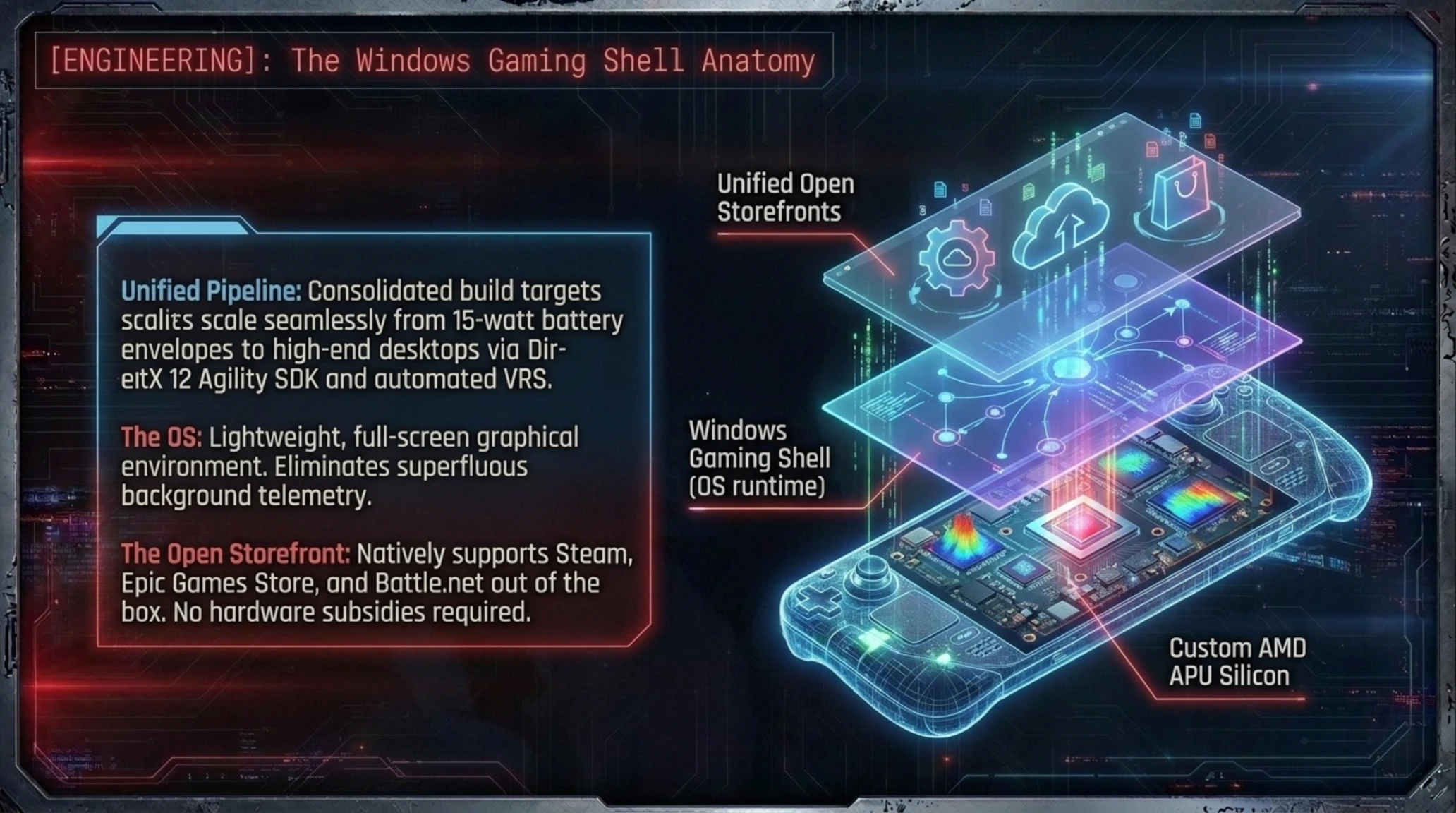
Sharma recognized early that the explosive growth sector in modern hardware does not reside in stagnant home console boxes tethered to living-room televisions, but in versatile, high-fidelity portable form factors. To resolve the notorious operating system friction that historically plagued Windows-based handhelds, Microsoft’s core OS engineering divisions were mobilized to construct the Windows Gaming Shell—a streamlined, lightweight, full-screen graphical environment. This specialized runtime eliminates superfluous desktop background telemetry, allocates dynamic memory directly to custom AMD APUs, and delivers the frictionless, instant-resume convenience of a dedicated console while preserving full compatibility with open PC architectures.
This software environment is deeply coupled with major upgrades across Microsoft’s core developer toolchains. By standardizing first-party development upon the unified DirectX 12 Agility SDK, DirectStorage GPU decompression pipelines, and automated variable-rate shading (VRS) profiles, internal studios are no longer forced to maintain disparate codebases for PC, handhelds, and legacy consoles. A single consolidated build target can seamlessly scale its asset streaming and rendering shaders across diverse hardware configurations, from a fifteen-watt portable battery envelope up to a high-end desktop workstation. This unified engineering pipeline dramatically reduces quality assurance overhead and porting costs, allowing creative teams to iterate faster while maintaining rock-solid technical stability across all target devices.
Crucially, this portable hardware strategy shatters the historical walled garden. Rather than restricting users exclusively to Xbox digital purchases, the device natively supports rival storefronts, including Steam, the Epic Games Store, and Battle.net, out of the box. By transforming the hardware into an open, versatile computing platform, Microsoft eliminates the necessity of subsidizing hardware units at massive loss. The device can be sold at a sustainable, profitable hardware margin, targeting discerning enthusiasts who demand an integrated, premium portable gaming PC backed by first-party Microsoft engineering.
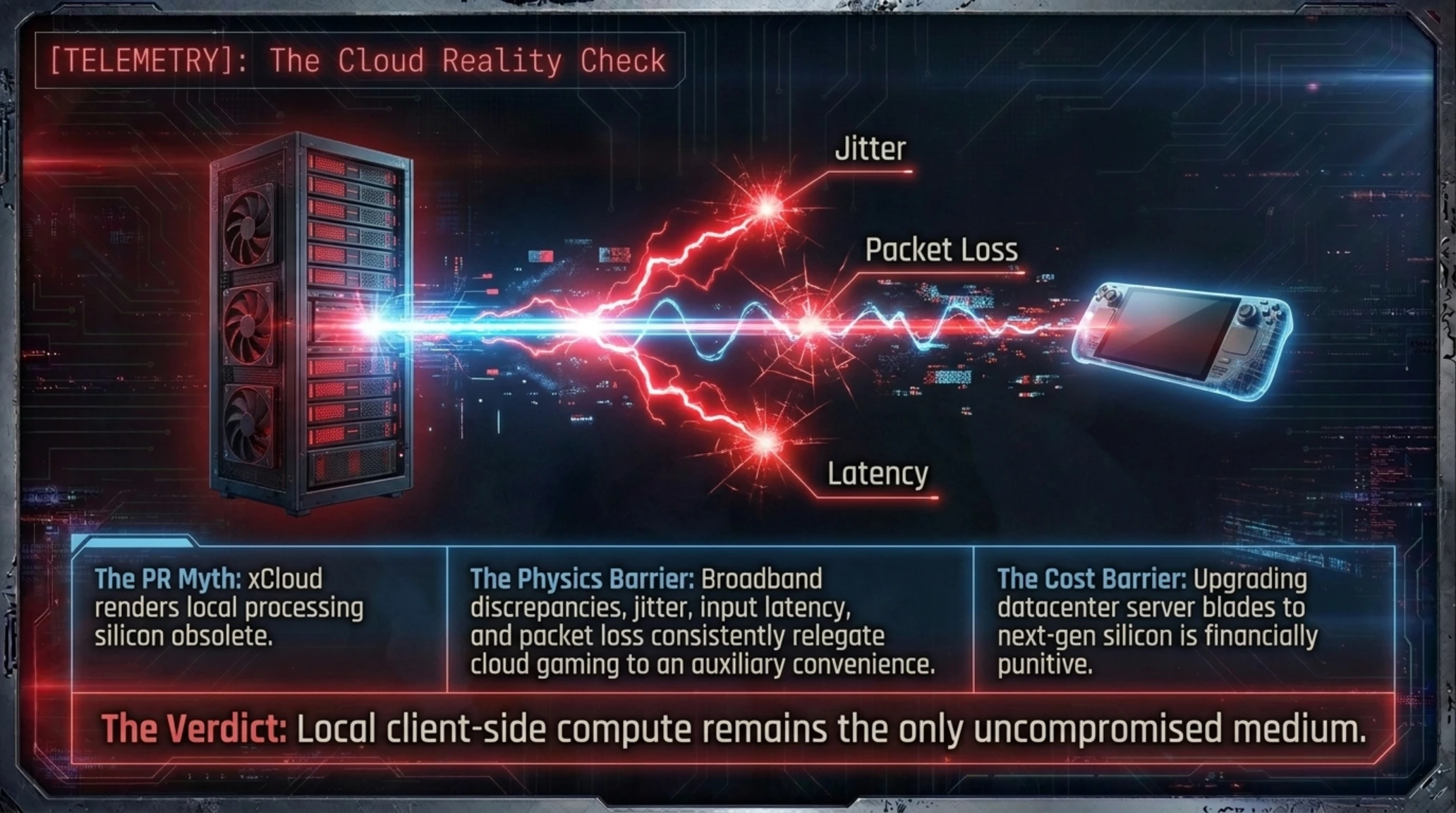
This pivot toward dedicated portable silicon also represents an honest operational reckoning with the physical boundaries of cloud streaming. For years, executive presentations promoted xCloud as a frictionless technology capable of rendering local processing silicon obsolete. However, real-world network telemetry across diverse international markets revealed that physics remains an unforgiving barrier. Broadband infrastructure discrepancies, jitter, input latency, and packet loss in competitive genres consistently relegated cloud gaming to an auxiliary convenience rather than a primary gaming medium. Moreover, the staggering capital expenditure required to upgrade datacenter server blades to next-generation graphical silicon made mass cloud streaming financially punitive. Sharma prioritized local client-side compute, recognizing that local silicon remains the only medium capable of delivering uncompromised graphical fidelity and microsecond response times.

This technical and commercial paradigm shift liberated Microsoft Gaming from the debilitating financial burden of underwriting hundreds of millions of dollars in component manufacturing losses. The systematic comparison detailed below provides an exhaustive operational breakdown of how Sharma’s restructuring dismantled legacy assumptions across every critical vector of the business.
Architecture of the Xbox Business Transformation Under Asha Sharma
Five Strategic Pillars Governing Microsoft Gaming’s Operational Restructuring
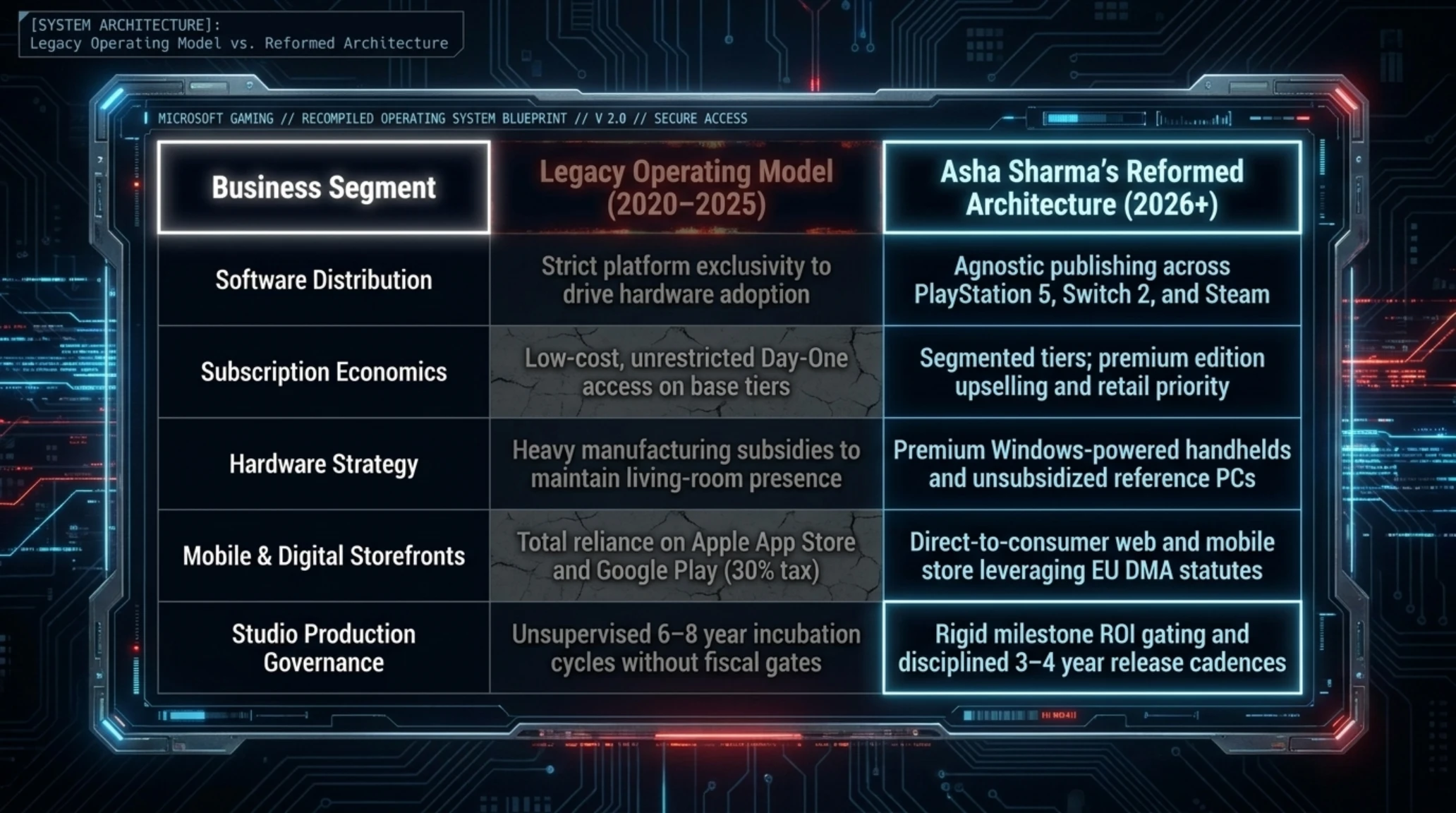
| Business Segment | Legacy Operating Model (2020–2025) | Asha Sharma’s Reformed Architecture (2026+) |
|---|---|---|
| Software Distribution | Strict platform exclusivity to drive hardware adoption | Agnostic publishing across PlayStation 5, Switch 2, and Steam |
| Subscription Economics | Low-cost, unrestricted Day-One access on base tiers | Segmented tiers; premium edition upselling and retail priority |
| Hardware Strategy | Heavy manufacturing subsidies to maintain living-room presence | Premium Windows-powered handhelds and unsubsidized reference PCs |
| Mobile & Digital Storefronts | Total reliance on Apple App Store and Google Play (30% tax) | Direct-to-consumer web and mobile store leveraging EU DMA statutes |
| Studio Production Governance | Unsupervised 6–8 year incubation cycles without fiscal gates | Rigid milestone ROI gating and disciplined 3–4 year release cadences |
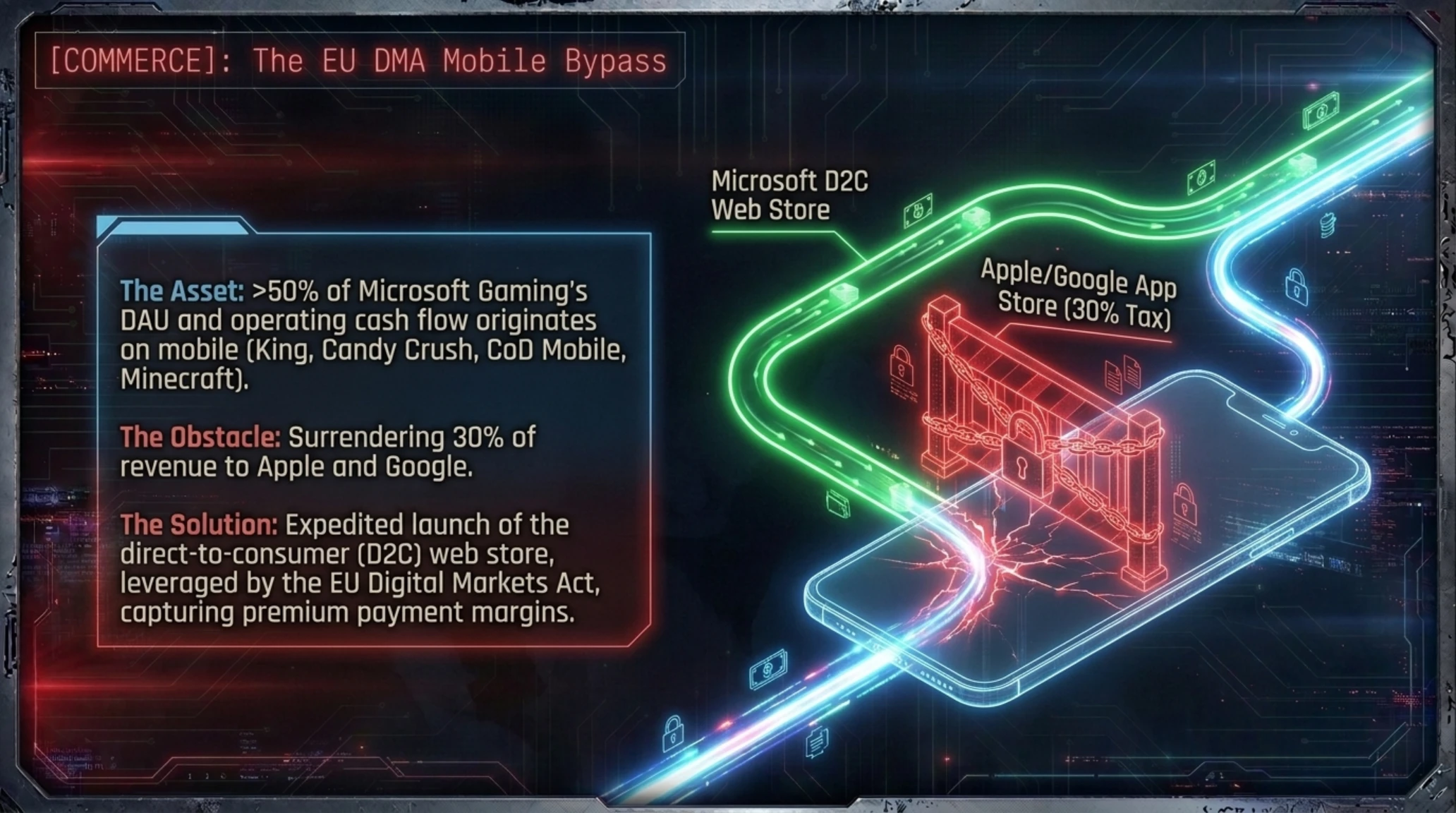
Parallel to this handheld computing initiative lies Sharma’s aggressive offensive in the mobile digital commerce sector. With the integration of King and legendary franchises such as Candy Crush, Call of Duty Mobile, and Minecraft, over half of Microsoft Gaming’s daily active user base and operating cash flow originates on handheld smartphones. Yet, for over a decade, thirty percent of that lucrative digital revenue was surrendered directly to Apple and Google via mandatory platform commissions. Leveraged by landmark regulatory mandates—most notably the European Union’s Digital Markets Act (DMA)—Sharma expedited the launch of Microsoft’s direct-to-consumer mobile web storefront, capturing premium payment margins and establishing direct relationships with hundreds of millions of players worldwide.
The Collapse of the ‘Netflix of Gaming’ Delusion: Why Interactive Media Defies Linear Streaming
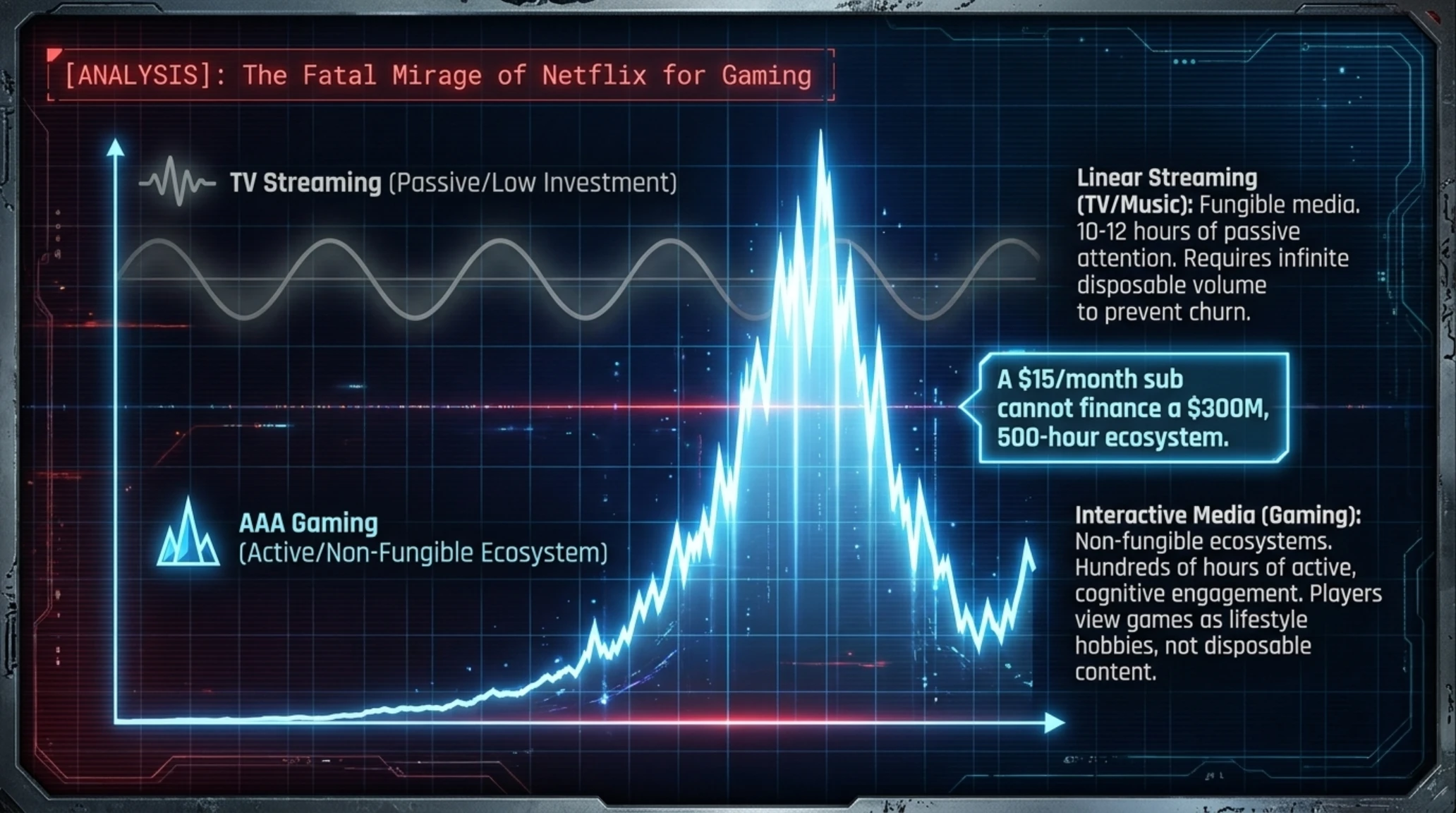
At the very core of the historic miscalculations that hobbled Xbox throughout the early 2020s was an uncritical, superficial analogy that seduced corporate executives across the tech sector: the assumption that interactive video games could be commoditized and distributed through subscription streaming services in the exact same manner as recorded music and episodic television. For nearly a decade, visionaries proclaimed that Game Pass would do to traditional game retail what Spotify did to compact discs and Netflix did to movie theaters. However, rigorous empirical analysis eventually demonstrated that interactive entertainment obeys fundamentally different economic, cognitive, and structural laws.
When a viewer consumes a television series on a video streaming service, they invest ten to twelve hours of passive attention before seeking novel content; a streaming platform requires an infinite, disposable volume of inexpensive programming to prevent monthly subscription churn. Video games operate across an entirely antithetical engagement dynamic. A deeply engineered interactive masterpiece—such as an expansive Bethesda role-playing game, an immersive Call of Duty multiplayer ecosystem, or an intricate Grand Theft Auto universe—commands hundreds, if not thousands, of hours of active, cognitive engagement from an individual player over multi-year lifecycles. Players do not view games as disposable media; they view them as virtual communities and deeply personal lifestyle hobbies.
Attempting to finance games that demand three hundred million dollars in development and maintenance costs via a low-cost, ten-to-fifteen-dollar monthly subscription creates a fatal structural deficit. If direct retail purchases are eliminated, the publisher is inevitably compelled to degrade the creative integrity of the title by injecting exploitative monetization mechanics, predatory microtransactions, and uninspired battle passes simply to keep the servers running. Sharma’s reforms boldly terminated this downward spiral, re-establishing premium direct sales as the primary economic engine of AAA development while positioning subscription access as an auxiliary discovery portal.

By restoring equilibrium between direct retail sales, high-value subscription tiers, and diversified multiplatform distribution, Sharma constructed a resilient, future-proof commercial framework capable of sustaining elite creative ambition without mortgaging the financial solvency of the parent corporation.
The Shifting Geopolitics of Interactive Entertainment: Beyond the Console Wars
When the emotional dust settled around community message boards and social media debates, a transformative geopolitical reality emerged across the gaming industry. Through the cumulative acquisitions of Mojang, ZeniMax Media, Ninja Theory, and the monolithic Activision Blizzard King, Microsoft transformed into the most powerful intellectual property custodian in the history of interactive entertainment. Franchises such as Call of Duty, World of Warcraft, Minecraft, The Elder Scrolls, Fallout, and Doom are not merely commercial software titles; they are durable, multi-generational cultural phenomena that generate billions of dollars in recurring annual revenue. Confining such monumental assets to a domestic hardware ecosystem capturing barely thirty million users was a catastrophic violation of platform economics.
With operational clarity and strategic courage, Asha Sharma elevated Xbox from an embattled, defensive console manufacturer into an omnipresent global software superpower. In this reconfigured commercial reality, every time a consumer purchases a new title from Microsoft’s creative divisions on a PlayStation 5, a Nintendo Switch 2, or a Steam Deck, high-margin software revenues flow straight into Redmond’s corporate treasury. This mirrors the historic transition executed by Sega in the early 2000s following the discontinuation of the Dreamcast, but with one monumental distinction: unlike Sega, Microsoft possesses a three-trillion-dollar corporate foundation and the world's dominant desktop operating system in Windows.
This structural transformation fundamentally neutralized the antitrust hostility that previously dogged Microsoft across international capitals. Regulatory bodies in Washington, London, and Brussels that spent years scrutinizing the Activision Blizzard merger now observe Microsoft distributing its software catalog across rival consoles, independent cloud platforms, and mobile storefronts. By willingly dismantling its proprietary hardware barriers, Microsoft disarmed its regulatory critics while simultaneously unlocking the most lucrative distribution channels in the digital entertainment economy.

Mastering the modern nomenclature that governs this historic reorganization is indispensable for investors, industry analysts, and technology strategists evaluating the next chapter of interactive entertainment.
Jargon Buster: Essential Lexicon of the Modern Video Game Economy
Definitive Reference Guide to Critical Concepts in Contemporary Gaming Strategy
| Strategic Term | Rigorous Architectural & Financial Definition |
|---|---|
| Clarity Is Kindness | Sharma’s leadership doctrine emphasizing transparent financial metrics over corporate denial. |
| Multi-platform Publishing | Pivoting first-party game releases across rival ecosystems to maximize software cash flow. |
| Average Revenue Per User (ARPU) | The primary financial KPI measuring the net capital extracted from each active ecosystem participant. |
| Cannibalization Rate | The metric evaluating full-price retail sales lost due to low-cost subscription availability. |
| Reference Hardware | Treating consoles as open showcase standards for Windows rather than subsidized walled gardens. |
| Direct-to-Consumer (D2C) Store | Proprietary web and mobile storefronts engineered to bypass Apple and Google thirty percent taxes. |
This technical and strategic vocabulary underscores how dramatically the video game business has outgrown the simplistic console rivalry narratives of the past. Debating hardware supremacy between Sony and Microsoft has become an obsolete discussion; the true battleground centers upon capturing aggregate consumer leisure time and monetizing digital interactions across every connected screen on Earth.

To evaluate the efficacy and long-term implications of Sharma’s controversial restructuring, a systematic trade-off analysis illustrates the immense strategic opportunities and unavoidable organizational frictions inherent in this transition.
Why this matters to the broader gaming industry: If the world's wealthiest technology corporation cannot sustain a closed console garden in the face of rising software development budgets, no platform holder can. By disproving the viability of proprietary exclusivity for massive budget titles, Sharma’s reforms establish a precedent that will inevitably force Sony and other legacy incumbents to accelerate their own day-and-date multiplatform publishing strategies on PC and mobile.
- Restores healthy, diversified operating cash flow and halts hundreds of millions in unmonetized development burns.
- Secures recurring capital to fund high-budget prestige AAA blockbusters through massive multiplatform royalties.
- Captures high-margin growth sectors across mobile web commerce and hybrid portable PC handheld hardware.
- Establishes transparent milestone expectations, eliminating chronic developer burnout and sudden studio terminations.
- Erodes traditional brand equity and generates intense feelings of disenfranchisement among loyal Xbox hardware owners.
- Accelerates the retail decline of traditional home consoles as unique exclusive purchasing incentives disappear.
- Diminishes the initial mass-market appeal of base Game Pass subscriptions following the removal of Day-One perks.
- Increases commercial pressure on boutique, experimental creative studios under rigorous financial ROI gating.
This balanced trade-off assessment demonstrates that while Sharma’s surgical interventions inflicted acute short-term growing pains, they represented the sole viable pathway to prevent the permanent economic obsolescence of Microsoft Gaming following the massive capital demands imposed by Wall Street.
Tekin Analysis: Executive Leadership Takeaways from the Xbox Restructuring
Core Strategic Intelligence for Tech Executives, Studio Directors, and Institutional Investors
- The Sunset of Gaming Romanticism: The era of deploying infinite corporate capital into unmonetized projects has permanently ended.
- Intellectual Property Outweighs Plastic: A media company's durable valuation resides in evergreen multiplatform franchises, not in proprietary boxes under televisions.
- The Courage of Transparency: Concealing structural deficits behind vanity metrics compounds organizational rot; honest diagnosis is the prerequisite for healing.
- The Decisive Battle in Pocket Gaming: The defining hardware confrontation of this decade is contested not on living-room TVs, but in direct-to-consumer mobile and handheld platforms.
Market sentiment across global financial desks and independent game developer communities reflects a decisive sigh of relief. While retail console purists expressed indignation, institutional investors recognized that Microsoft had successfully severed its most volatile operational risk: the endless cycle of hardware discounting and speculative content subsidization. In conclusion, the market sentiment indicates that Microsoft Gaming has successfully completed its transformation into the undisputed software hegemon of the interactive entertainment era.
The institutional stabilization achieved under Sharma offers a masterclass in corporate governance for the broader technology sector: when macroeconomic interest rates rise and capital ceases to be free, organizations cannot survive on speculative promises and deferred monetization. Clear-eyed fiscal discipline and unwavering operational transparency are the only reliable compasses in turbulent economic seas.
Strategic Synthesis: The Enduring Legacy of Asha Sharma’s Operational Renaissance
Asha Sharma’s "Clarity Is Kindness" doctrine transcends a mere corporate turnaround story; it marks the coming of age of an industry that spent decades trapped within adolescent tribal rivalries. By boldly disengaging from the hardware vanity race and re-anchoring Microsoft Gaming upon an agile, multiplatform software architecture, Sharma preserved the creative lifeblood of tens of thousands of developers while delivering the fiscal returns demanded by a three-trillion-dollar technology titan.
Crucially, this structural transformation has permanently altered the competitive equilibrium confronting Sony and Nintendo. As multiplatform royalty revenues from the PlayStation Store and Nintendo eShop flow into Redmond's coffers, Microsoft benefits directly from the success of its historic competitors. The ultimate victor in the contemporary entertainment landscape is not the entity that manufactures the most plastic boxes, but the organization that commands the intellectual property pipelines that capture the imagination of the global gaming audience.
Related Intelligence Dossiers on TekinGame
• 📱 Tekin Analysis | Apple's Foldable iPhone Duo & iPhone 18 Pro Price Hike
• 🧠 Tekin Analysis | Valve's 17-Year Secret: The Staged L4D2 Trailer Leak
• 🎬 Ultimate Guide to Local AI Video Generation (Minimax, Wan, LTX)
The future of interactive entertainment is no longer defined by tribal hardware enclosures; it belongs to visionary architects capable of delivering transcendent interactive experiences across the open, interconnected computational landscape of the twenty-first century.

Below, we address the critical strategic and operational inquiries surrounding Asha Sharma’s leadership and the future trajectory of Microsoft Gaming.
Frequently Asked Questions: Asha Sharma, Xbox Restructuring, and the Multiplatform Era
Who is Asha Sharma and why was she appointed to lead Xbox’s transformation?
Asha Sharma is a renowned Silicon Valley product executive with a track record of driving operational discipline and marketplace growth at Meta and Instacart, recruited by Microsoft to execute a structural turnaround of its gaming business.
What does the ‘Clarity Is Kindness’ doctrine mean in practice?
It denotes an operational mandate to confront uncomfortable financial realities directly—terminating unviable projects early, abandoning loss-leading exclusivity, and aligning production costs with true market demand.
Is Microsoft permanently exiting the console hardware market?
No. Microsoft is continuing hardware development but transforming its consoles into premium reference platforms built upon Windows, while focusing heavily on dedicated portable handheld computing devices.
How is the Game Pass business model evolving under these reforms?
Game Pass is transitioning from an all-inclusive Day-One service to a discovery and retention platform, with segmented tiers, price adjustments, and incentives for players to purchase premium software editions.
Why did Microsoft decide to publish flagship games on PlayStation and Switch?
With AAA production budgets soaring between $200M and $350M, restricting games to Xbox's ~30 million console install base made capital recovery impossible. Multiplatform publishing secures massive high-margin royalties.
Verified Primary Sources and Authoritative Documentation
- Insider Gaming: Asha Sharma’s Plan to Fix XBOX Starts With Brutal Honesty, ‘Clarity Is Kindness’
- The Verge: In-Depth Investigative Analysis on Microsoft Gaming’s Multiplatform Transition
- Bloomberg Technology: The Fiscal Aftermath of the $69B Activision Merger and Shareholder Oversight
- Windows Central: Inside Xbox’s Next-Gen Hardware Roadmap and the Windows Handheld Initiative
- Eurogamer: Deconstructing the Economics of Game Pass and Modern AAA Software Amortization
Additional Gallery: Tekin Analysis | ⚔️ Xbox's Brutal Restructuring by Asha Sharma