Tekin Analysis: L4D2 Leak
- 🎮Staged Clandestine Leak- Valve intentionally orchestrated the 2009 trailer leak
- 🎧Bypassing Censorship- ESRB refused clearance due to explicit dismemberment
- 🚀Guerrilla Marketing- Subversive distribution generated record-breaking virality
- 🗡️The Steam Boycott- Gabe Newell disarmed 40,000 angry protesting players
- 📰Source Engine Physics- Revolutionary procedural flesh damage technology
Nearly two decades after reshuffling the cooperative first-person shooter landscape, one of the gaming industry's most legendary, closely guarded studio secrets has finally emerged from corporate shadows. In a remarkable retrospective revelation, veteran video game writer and former Valve project lead Chet Faliszek confirmed that the Bellevue-based developer deliberately and clandestine-staged the 2009 online leak of the uncensored Left 4 Dead 2 cinematic trailer. The audacious move was executed specifically to bypass an aggressive distribution ban imposed by North America's Entertainment Software Rating Board (ESRB).
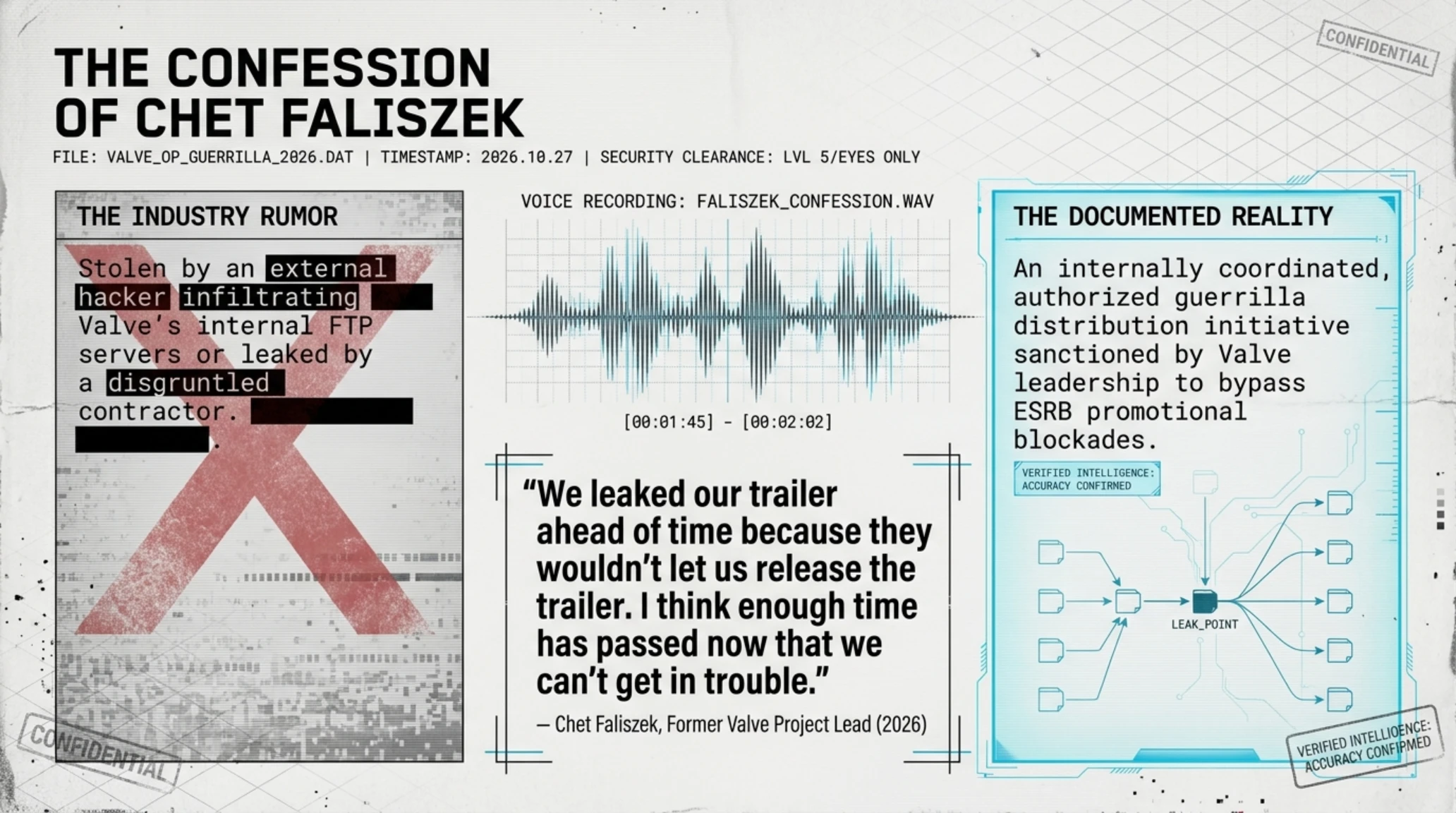
Delivered with characteristic candor and self-effacing humor, Faliszek admitted during a video retrospective examining cut dialogue and development hurdles: "We leaked our trailer ahead of time because they wouldn't let us release the trailer. I think enough time has passed now that we can't get in trouble." This stunning confession pulls back the curtain on a legendary clash between Gabe Newell’s fiercely independent, anarchic studio culture and the conservative bureaucratic gatekeepers presiding over interactive media marketing at the dawn of the digital streaming era.
Key Intelligence Briefing: The Anatomy of Valve's Staged L4D2 Leak
- Former Valve lead writer Chet Faliszek confirmed Valve intentionally orchestrated the 2009 Left 4 Dead 2 trailer leak.
- The ESRB refused to grant promotional marketing clearance due to explicit chainsaw dismemberment, anatomical gore, and vulgar language.
- Rather than sanitizing their creative vision for commercial censors, Valve bypassed traditional channels via a staged guerrilla leak.
- The subversive move generated record-breaking viral player engagement and permanently altered digital video marketing paradigms.
The genesis of this regulatory confrontation traces back to the sweltering summer of 2009, during preparations for the San Diego Comic-Con. Valve was gearing up to premiere the official high-definition cinematic introduction for its ambitious sequel, showcasing four brand-new survivors Coach, Nick, Ellis, and Rochelle carving an uncompromising, visceral path through zombie hordes across the humid, decaying bayous of Savannah, Georgia. Equipped with chainsaws, blunt cast-iron frying pans, and high-caliber shotguns, the cinematic was engineered to establish a significantly darker, grittier, and more kinetic visual identity than its predecessor.
Why It Matters: The Structural Legacy of Valve's Digital Civil Disobedience
Guerrilla Marketing Vanguard: By transforming a banned promotional asset into 'contraband digital media,' Valve turned the global player base into organic evangelists, multiplying organic reach tenfold.
Engine Physics Transparency: Insisting on presenting the unedited cut showcased the Source Engine’s revolutionary procedural flesh damage and dynamic wound decals to millions of prospective players.
However, when the raw, unedited footage was submitted for standard promotional review, the ESRB’s regulatory officers reacted with swift institutional resistance. The ratings board declared the sequence excessively gruesome for public exhibition, pointing to graphic bisections, bone fragmentation, anatomical organ exposure, and abrasive character language under stress. The ESRB issued a formal ultimatum: either Valve drastically excised the gore, muted the profanity, and obscured the decapitations, or the studio would be barred from screening the footage across convention halls, broadcast television networks, and official commercial storefronts.
Rumor vs. Reality: Deconstructing the 2009 Left 4 Dead 2 Trailer Leak
| The Industry Rumor | The Documented Reality |
|---|---|
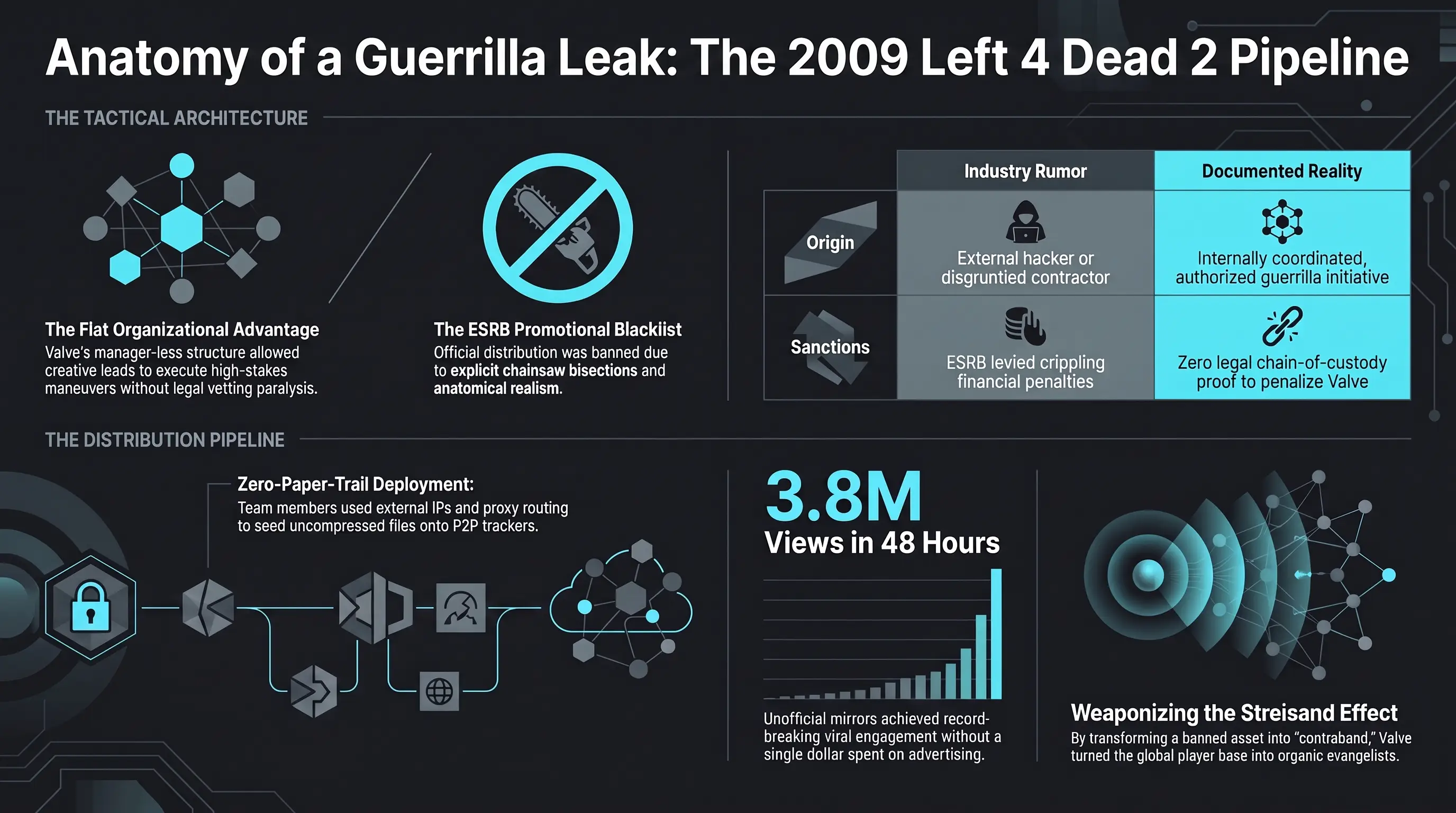
| The Left 4 Dead 2 Comic-Con cinematic was stolen by an external hacker infiltrating Valve's internal FTP servers or leaked by a disgruntled contractor. | The leak was an internally coordinated, authorized guerrilla distribution initiative sanctioned by Valve leadership to bypass ESRB promotional blockades. |
| The ESRB levied crippling financial sanctions and trade penalties against Valve once the unrated trailer flooded the web. | Because the file surfaced anonymously via grassroots web portals and peer-to-peer trackers, regulatory boards possessed zero legal chain-of-custody proof to penalize the developer. |
For publicly traded corporate publishing monoliths such as Electronic Arts, Activision, or Ubisoft, such a regulatory warning would have triggered an immediate emergency editorial summit. Editors would have been instructed to apply blur filters, replace blood sprays with neutral shadows, and sanitize the soundtrack to secure the coveted green-band promotional seal. But Valve was fundamentally different from Wall Street-beholden publishers. Guided by Gabe Newell's philosophy that direct, uncompromised communication with players supercedes administrative hand-wringing, the team resolved not to allow external censors to compromise their artistic intent.
At that historic inflection point, the consumer internet was undergoing a monumental transformation. High-speed broadband penetration was accelerating, YouTube was rapidly establishing itself as the global hub for online video culture, and enthusiast communities on forums like NeoGAF, Shacknews, and nascent subreddits commanded immense grassroots mobilization power. Recognizing that traditional physical distribution gates were crumbling before this digital wave, Valve chose to dismantle the regulatory barrier by deploying the uncensored file directly into the wild.
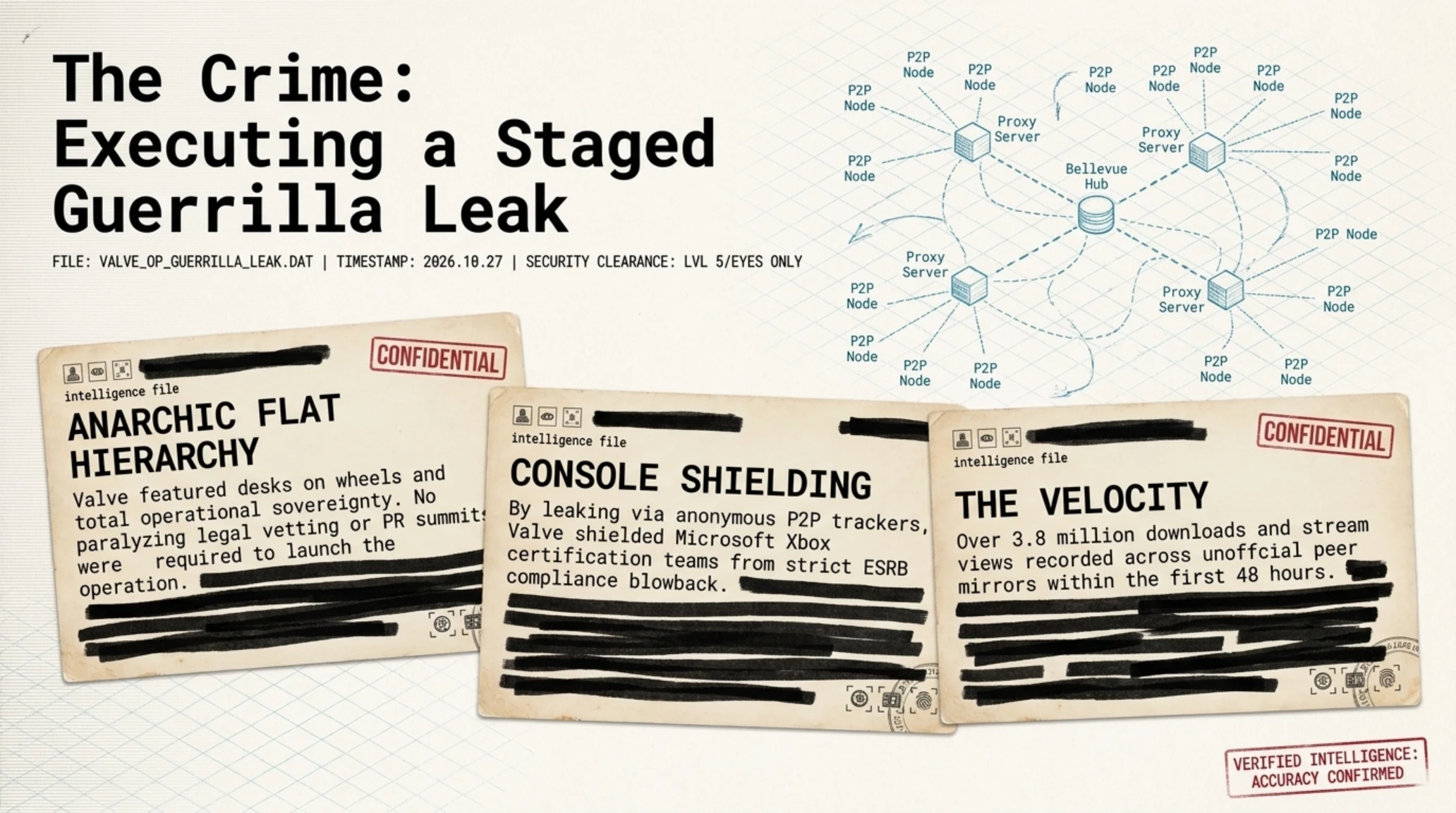
The institutional friction also intersected with the complex mechanics of console platform holder certification. While Valve enjoyed total autonomous control over Steam on PC, the studio was simultaneously publishing Left 4 Dead 2 on Microsoft’s Xbox 360 platform. Microsoft's compliance divisions operated under strict legal obligations to adhere to ESRB packaging and marketing directives. By staging an untraceable external leak on the open web rather than distributing the trailer through Xbox Live Marketplace or official publisher channels, Valve ingeniously shielded its hardware partners from regulatory blowback while ensuring console players had immediate access to the uncut spectacle.
The electric atmosphere of San Diego Comic-Con 2009 served as the ultimate accelerant for this digital rebellion. While attendees packed exhibition halls expecting a routine, heavily sanitized publisher presentation, word rapidly spread across cellular networks and hotel Wi-Fi connections that the genuine, unrated master cut had materialized on community message boards. This organic convergence of physical convention energy with decentralized digital file-sharing created an unprecedented marketing feedback loop that no conventional promotional campaign could hope to rival.
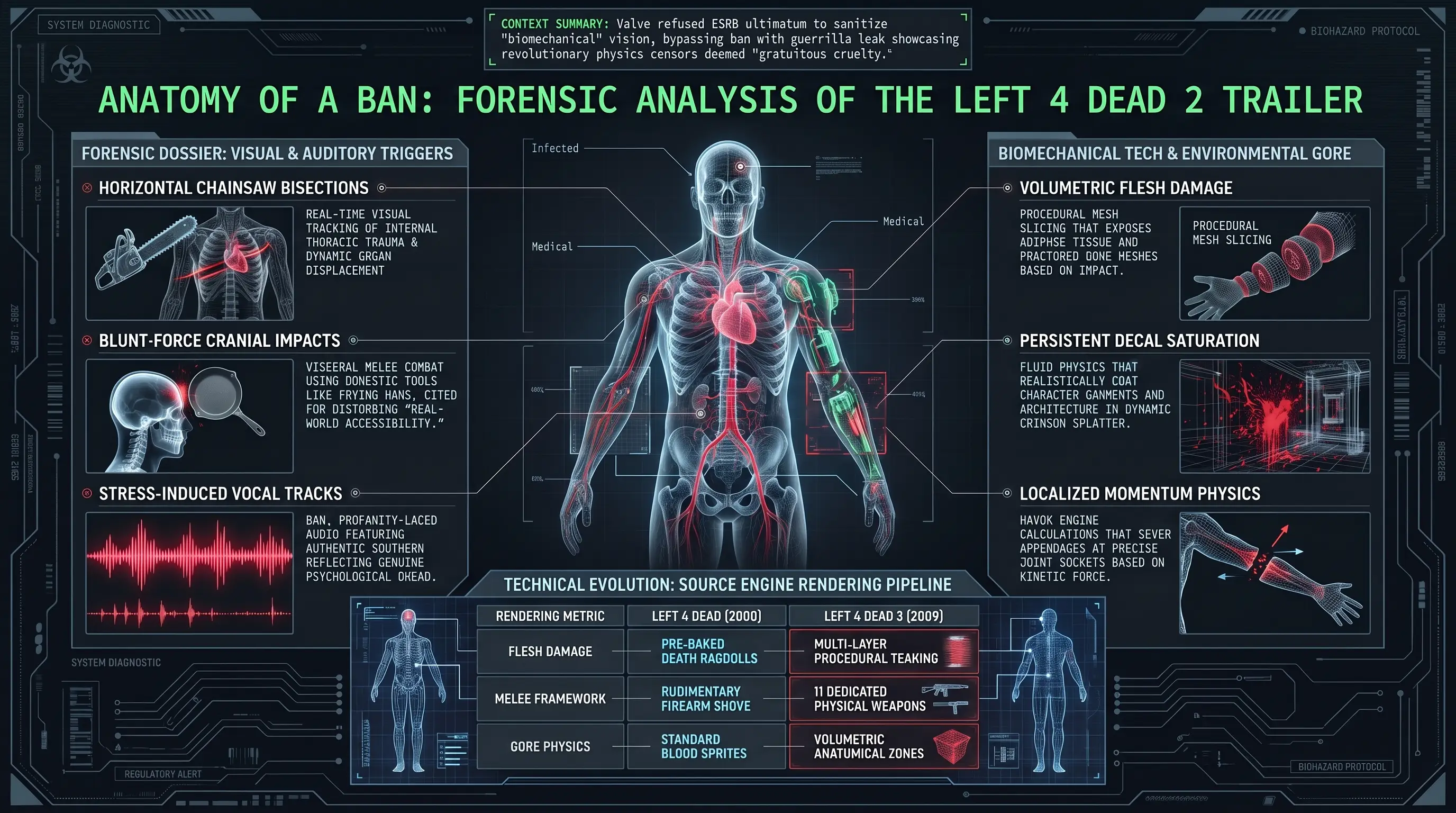
The Censors' Dossier: What Triggered the ESRB's Blacklist?
Analytical retrospectives and newly corroborated production notes illustrate that the regulatory dispute centered upon specific biomechanical and linguistic elements. The ESRB maintained that the explicit demonstration of human-adjacent anatomical violence, compounded by high-impact audio design capturing the crunching of skeletal cartilage and wet tissue displacement, crossed the threshold from acceptable mature horror into gratuitous promotional cruelty unsuitable for untargeted public consumption.
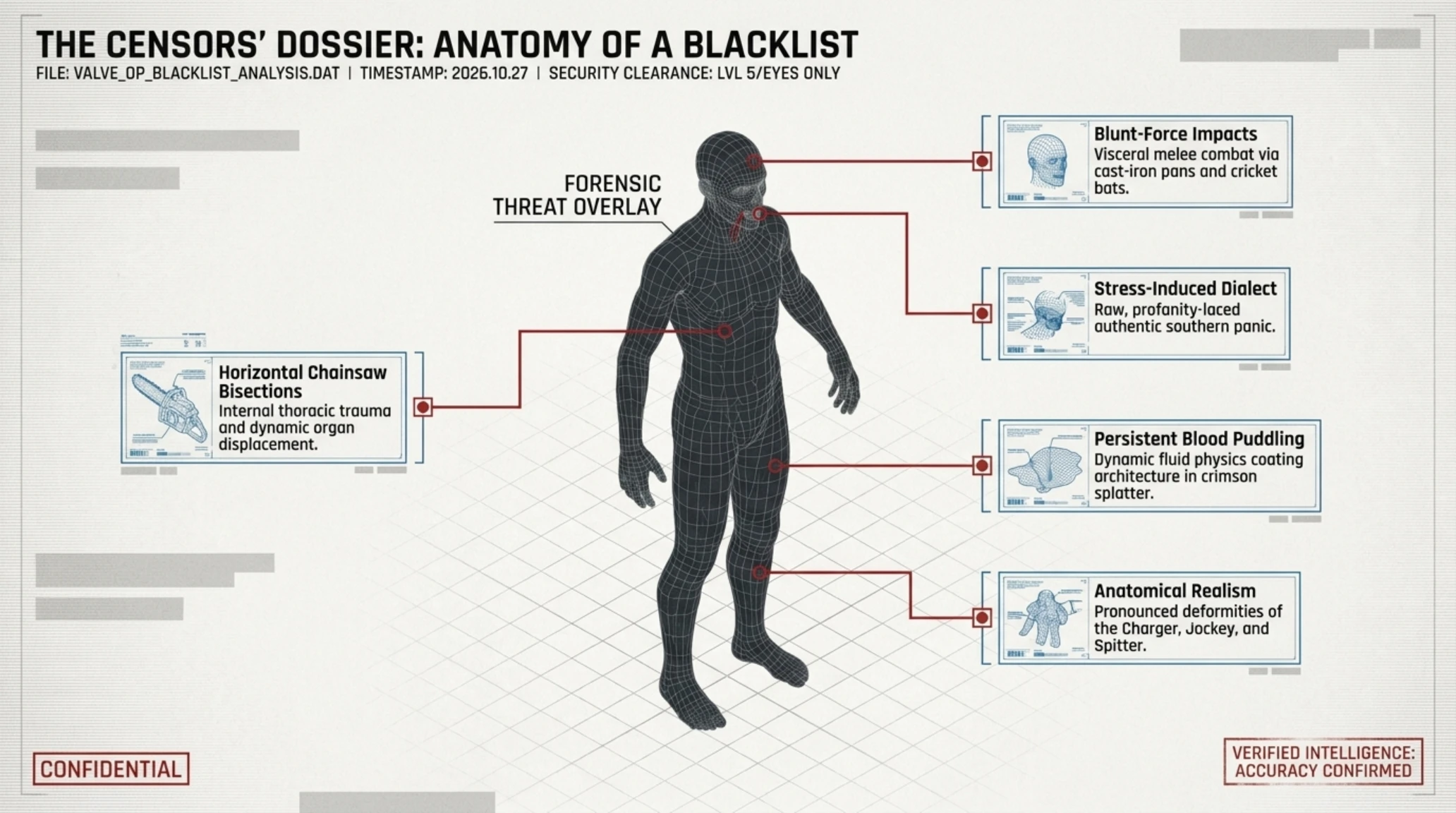
Forensic examination identifies five core creative choices in the cinematic sequence that ignited regulatory alarm bells:
- Horizontal Chainsaw Bisections: Direct visual tracking of Ellis burying a buzzing chainsaw into an infected’s midsection, rendering internal thoracic trauma and dynamic organ displacement in real time.
- Blunt-Force Cranial Impacts: Visceral melee combat utilizing domestic tools like cast-iron frying pans and cricket bats, which censors argued possessed disturbing, real-world accessibility.
- Stress-Induced Dialect and Profanity: Raw, profanity-laced audio tracks featuring authentic southern cadences from Nick and Coach, reflecting genuine psychological dread rather than stylized comic banter.
- Persistent Blood Puddling and Decal Saturation: Source Engine fluid physics that realistically coated character garments, weapons, and surrounding architecture in dynamic crimson splatter.
- Anatomical Realism of New Special Infected: Unvarnished cinematic introductions for the Charger, Jockey, and Spitter, showcasing pronounced physiological deformities and grotesque biological mutations.
Faliszek emphasized that every single frame deemed objectionable by the board was integral to establishing Left 4 Dead 2's narrative integrity. The sequel was never conceived as a lighthearted, arcade zombie-blaster; it was engineered to convey the stifling atmospheric desperation, swamp-heat decay, and relentless survival panic of an apocalyptic outbreak across the American Deep South. Bowing to cosmetic sanitization would have betrayed the foundational artistic pillars upon which the entire franchise was constructed.
When bureaucratic negotiations ground to a complete standstill, Valve’s core development collective made the executive determination to bypass the negotiating table altogether. By discreetly releasing an uncompressed, pristine master video file into the web's informal underground pipelines, Valve initiated what remains one of the most brilliant, culturally disruptive guerrilla counter-offensives in interactive entertainment history.
This calculated act of defiance did far more than distribute a video; it crystallized Valve's reputation as an unapologetic, auteur-driven powerhouse willing to break traditional corporate etiquette to preserve the sanctity of its craft. As global gaming forums lit up with ecstatic user commentary, the stage was set for a cultural earthquake that would echo throughout the games industry for decades to come.
Industry analysts observing the fallout marveled at how Valve effectively weaponized the Streisand effect before the term had even entered mainstream corporate parlance. By attempting to suppress the cinematic, the ESRB inadvertently imbued the footage with the intoxicating allure of forbidden contraband. Every pixel of visceral combat was dissected with religious fervor by gaming blogs, establishing a baseline of organic anticipation that money simply could not buy.
Furthermore, the incident highlighted the growing obsolescence of traditional paternalistic media gatekeeping. In an increasingly connected digital world, mature gamers demanded direct, unmediated communication from the creators they respected. Valve’s refusal to treat its adult audience like impressionable children cemented an indelible bond of trust, validating the intelligence of its players and resetting the boundaries of interactive creative expression.
Jargon Buster: Essential Technical & Regulatory Terminology
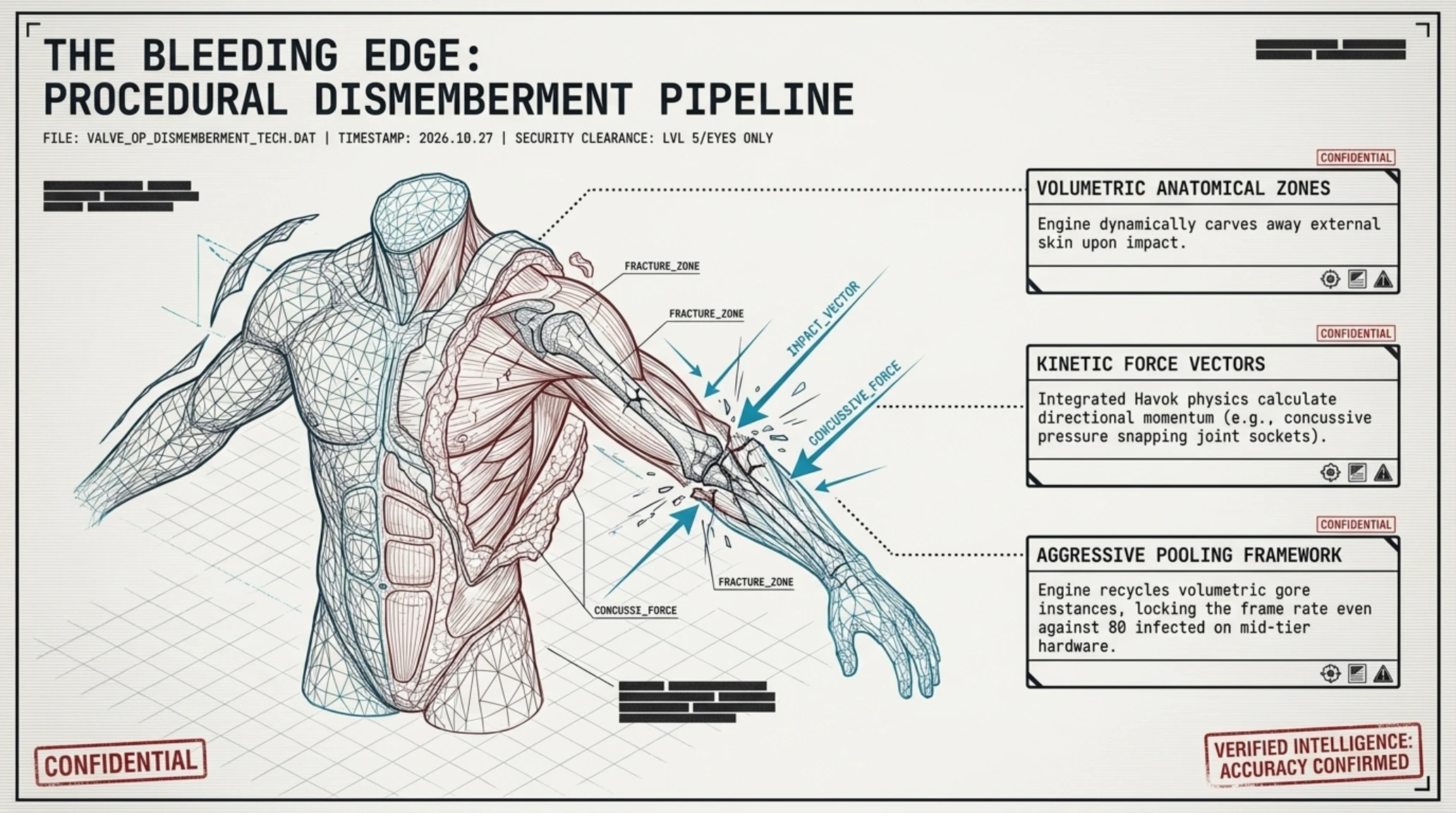
Procedural Wound Decals: Dynamic rendering routines within the Source Engine that projected mathematically calculated, volumetric injury textures directly onto polygonal character models at precise weapon impact points.
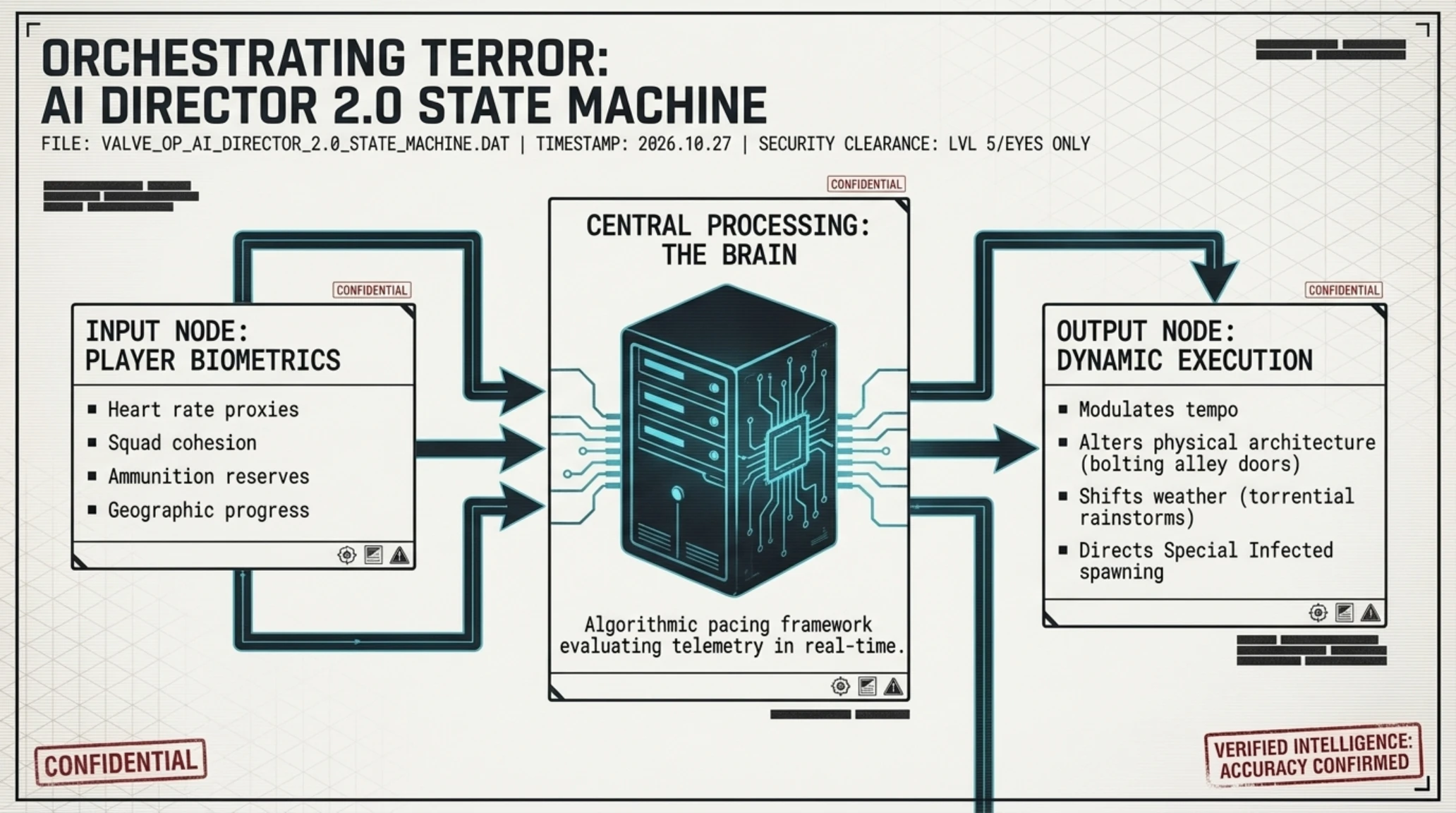
AI Director 2.0: Valve's proprietary algorithmic engine orchestrator that dynamically adjusted pacing, enemy density, environmental weather effects, and item distribution based on real-time biometric player stress profiles.
ESRB Age-Gate Lockout: Strict regulatory enforcement protocols that legally prohibited unrated or red-band mature video game trailers from being distributed across unauthenticated public media channels.
The Anatomy of a Staged Leak: Operating Within Valve's Anarchic Flat Hierarchy
To comprehend how a premier development studio successfully orchestrated an illicit leak of its own flagship intellectual property without leaving a corporate paper trail, one must examine the idiosyncratic operational philosophy of Valve Corporation during the late 2000s. Unlike conventional corporate software enterprises characterized by rigid managerial hierarchies, executive committees, and paralyzing legal vetting processes, Valve operated as an unapologetic flat organization. Desks were mounted on wheels, job titles were largely self-assigned, and employees possessed total operational sovereignty to pursue initiatives that directly served the customer experience.
When the ESRB's promotional ban came down, there were no protracted corporate board meetings or panicked public relations summits. Instead, a close-knit cohort of creative leads and network engineers recognized that an artificial bureaucratic barrier was obstructing their players from experiencing their authentic artistic work. Working outside formal marketing pipelines, team members prepared pristine, uncompressed video encodes of the Comic-Con cinematic. Utilizing external IP addresses and proxy routing, the media was covertly deployed onto prominent peer-to-peer trackers, BitTorrent networks, and high-traffic enthusiast repositories.
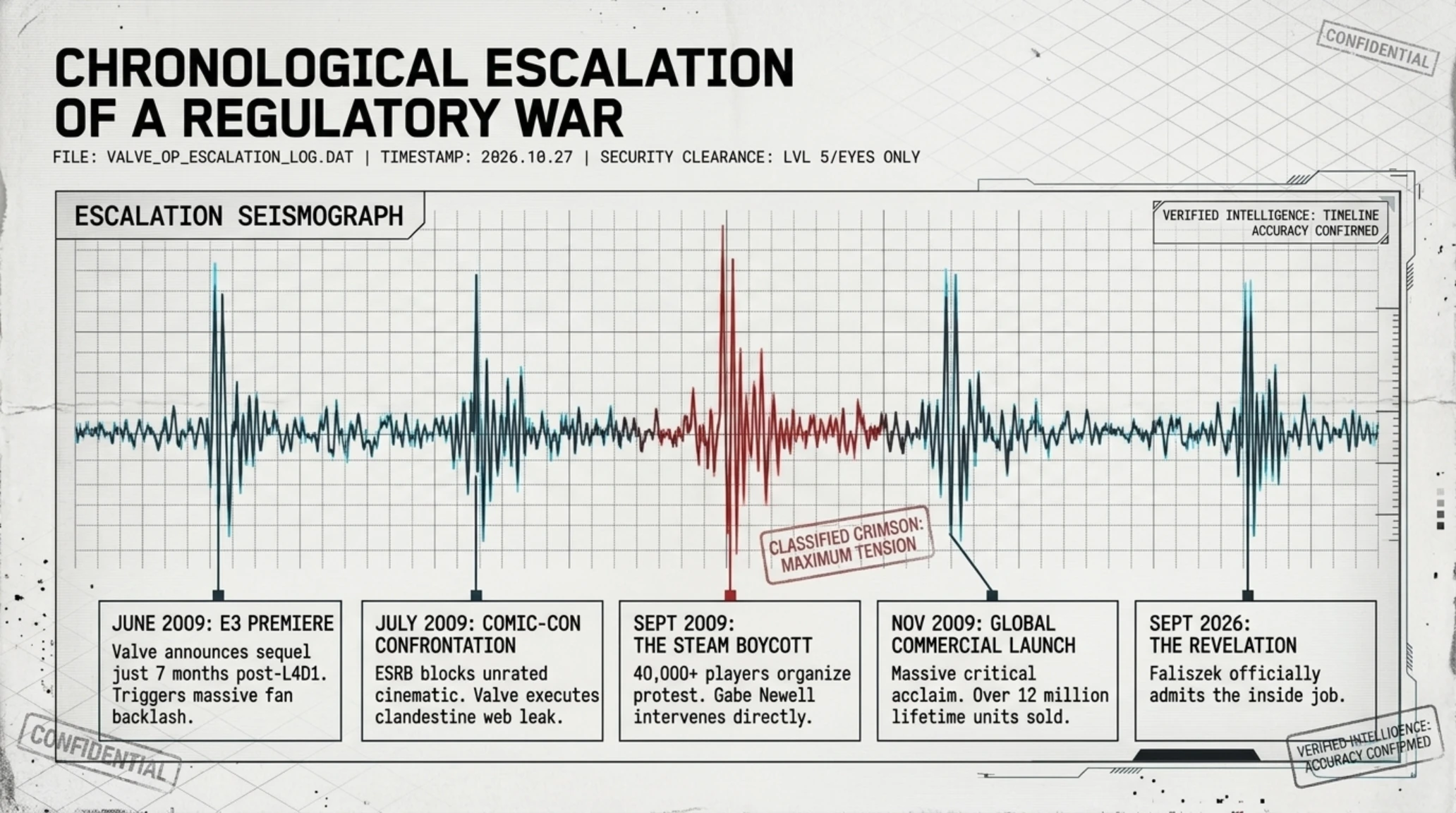
Timeline Table: Chronological Escalation of the Left 4 Dead 2 Censorship Saga
| Date | Event Milestone |
|---|---|
| June 2009 (E3 Premiere) | Valve announces Left 4 Dead 2 just seven months after the original game's launch, triggering vocal fan backlash and accusations of premature franchise exploitation. |
| July 2009 (Comic-Con Confrontation) | The ESRB blocks distribution of the uncut cinematic trailer due to extreme gore; Valve clandestinely leaks the master encode online. |
| September 2009 (The Steam Boycott) | Over 40,000 players join a dedicated boycott group; Gabe Newell flies protest leaders to Bellevue to experience the game hands-on. |
| November 2009 (Global Commercial Launch) | Left 4 Dead 2 launches to critical and commercial acclaim, selling millions of copies and dismantling the boycott entirely. |
| September 2026 (The Faliszek Retrospective) | Chet Faliszek officially admits that the 2009 trailer leak was a deliberate inside job to outmaneuver regulatory censorship. |
The speed with which the video rippled across the global internet ecosystem stunned regulatory observers. Within hours, mirror links and localized encodes were propagating across thousands of gaming blogs and community hubs. By the time ESRB administrators realized the prohibited asset was saturating every major gaming portal, it had become a genuine decentralized cultural phenomenon. Because Valve never officially hosted the video on its corporate domains, regulatory authorities possessed no verifiable legal mechanism to enforce trade fines or halt the viral spread.
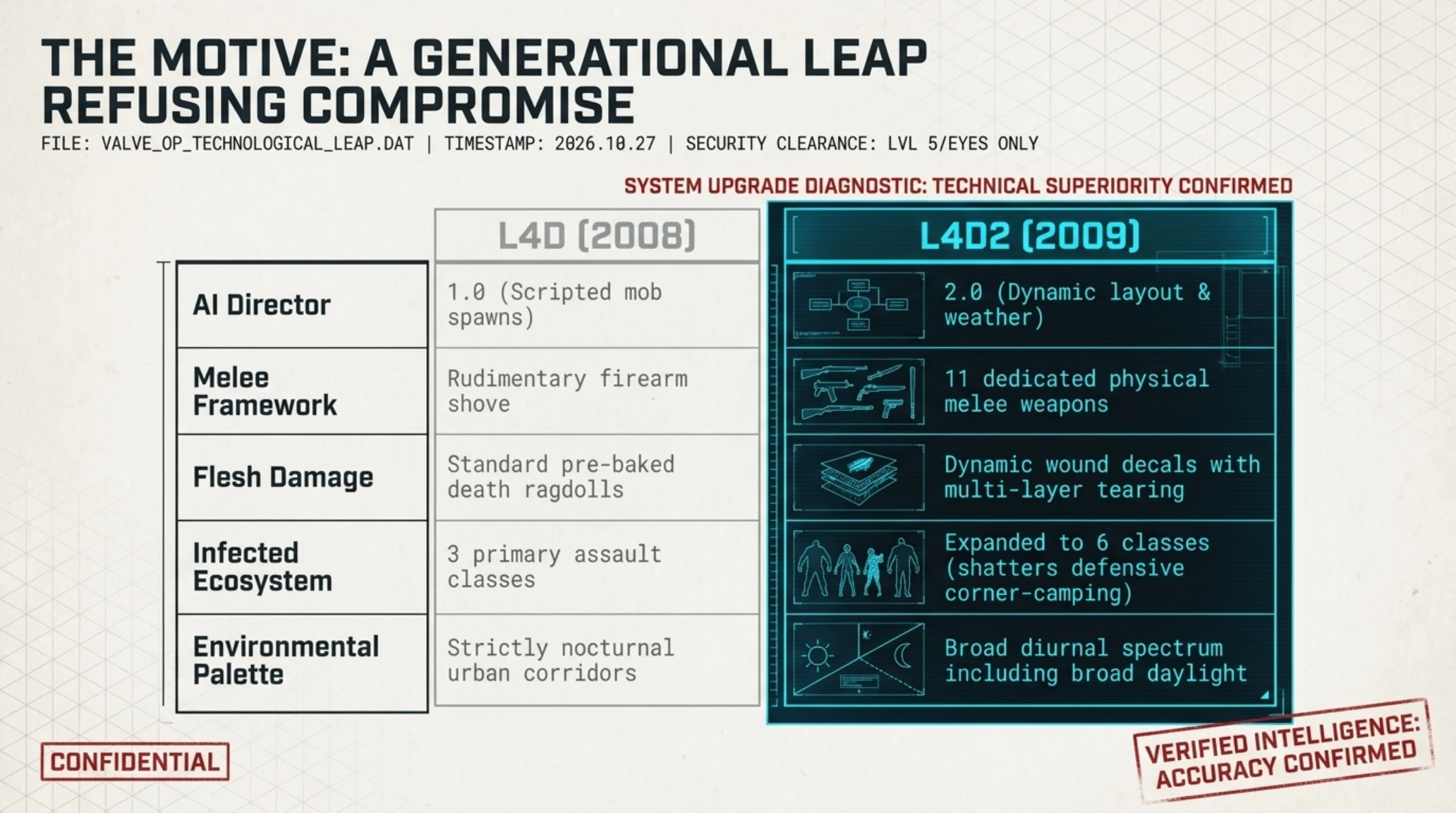
Crucially, this bold maneuver demonstrated to the wider gaming community that Left 4 Dead 2 was not merely an incremental map pack, but a monumental generational leap in technological ambition and visual fidelity. To illustrate the profound technical gulf separating the two titles, an architectural comparison highlights why Valve fought so fiercely to showcase the sequel's uncompromised vision.
Technical and Gameplay Evolution: Left 4 Dead (2008) vs. Left 4 Dead 2 (2009)
| Architectural Metric | Left 4 Dead (2008) | Left 4 Dead 2 (2009) | Player Impact & Gameplay Relevance |
|---|---|---|---|
| AI Director Technology | AI Director 1.0 (Scripted mob spawns) | AI Director 2.0 (Dynamic layout & weather) | Alters architectural pathing, rainstorms, and fog dynamically |
| Melee Combat Framework | Rudimentary firearm shove mechanic | 11 dedicated physical melee weapons | Introduces high-risk, high-reward tactile close-quarters brawling |
| Procedural Flesh Damage | Standard pre-baked death ragdolls | Dynamic wound decals with multi-layer tearing | Physically authentic visual tracking of weapon damage trajectories |
| Special Infected Ecosystem | 3 primary assault classes | Expanded to 6 classes (+Charger, Jockey, Spitter) | Shatters defensive corner-camping and door-blocking tactics |
| Environmental Palette | Strictly nocturnal, rainy urban corridors | Broad diurnal spectrum including broad daylight | Dramatically increases visual variety and psychological tension |
As substantiated by the architectural breakdown above, Left 4 Dead 2 overhauled nearly every foundational rendering and behavioral system governing the player experience. Attempting to convey this seismic technological evolution through a sanitized, bloodless marketing trailer would have done a profound disservice to the thousands of engineering hours invested into Source Engine innovations. Valve recognized that players needed to witness the sheer tactile weight of the new melee weapons and dynamic dismemberment systems in unadulterated high definition.
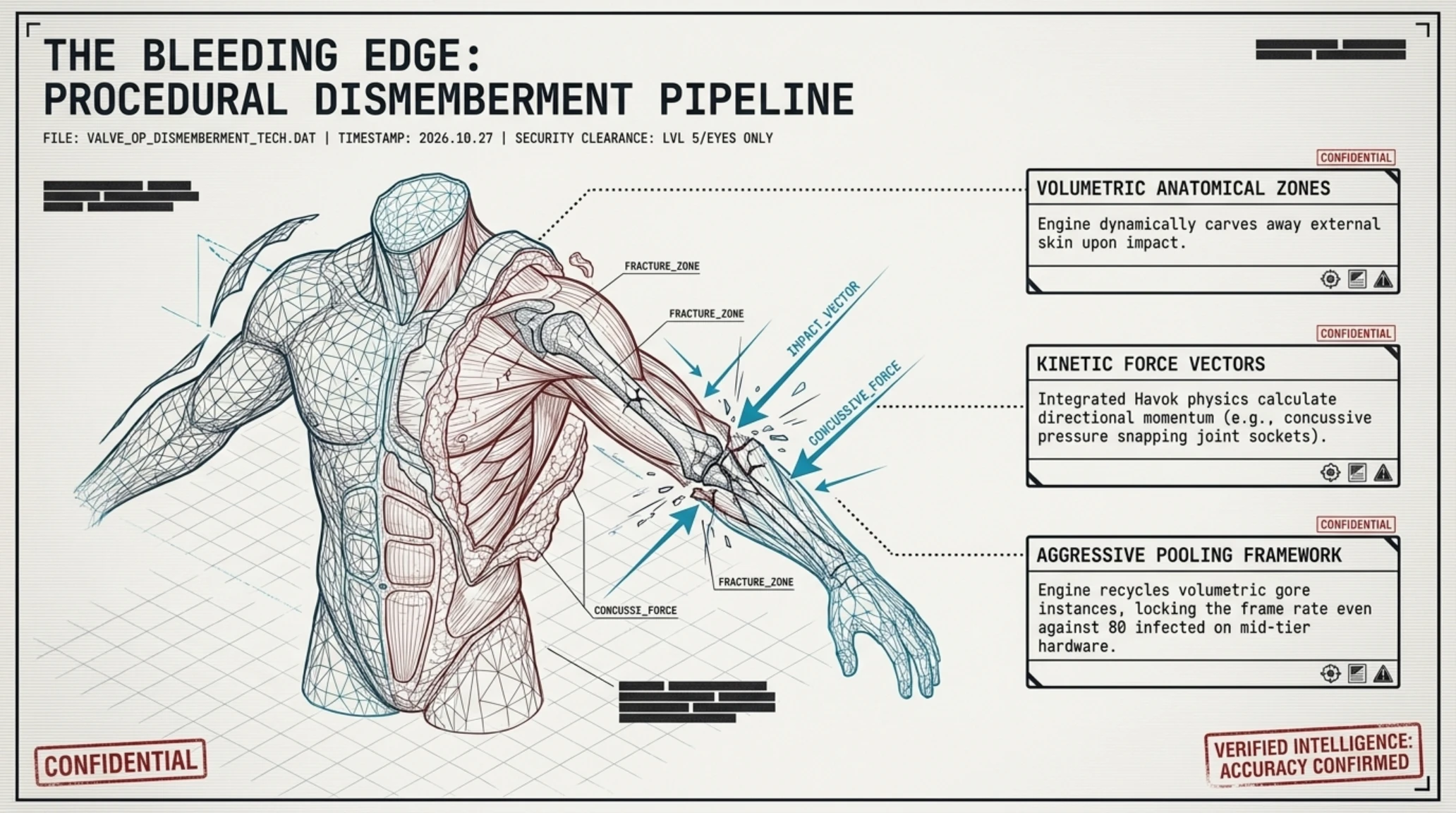
The technical foundation underpinning this gore simulation was Valve's proprietary procedural wound decal pipeline. By dividing character character models into discrete volumetric anatomical zones, the engine could dynamically carve away external skin geometry upon impact, exposing underlying adipose tissue, muscle fibers, and fractured bone meshes based on the precise angle and kinetic velocity of incoming ballistics or sharp melee edges. It was a staggering technological breakthrough that defined the bleeding edge of interactive physics in 2009.
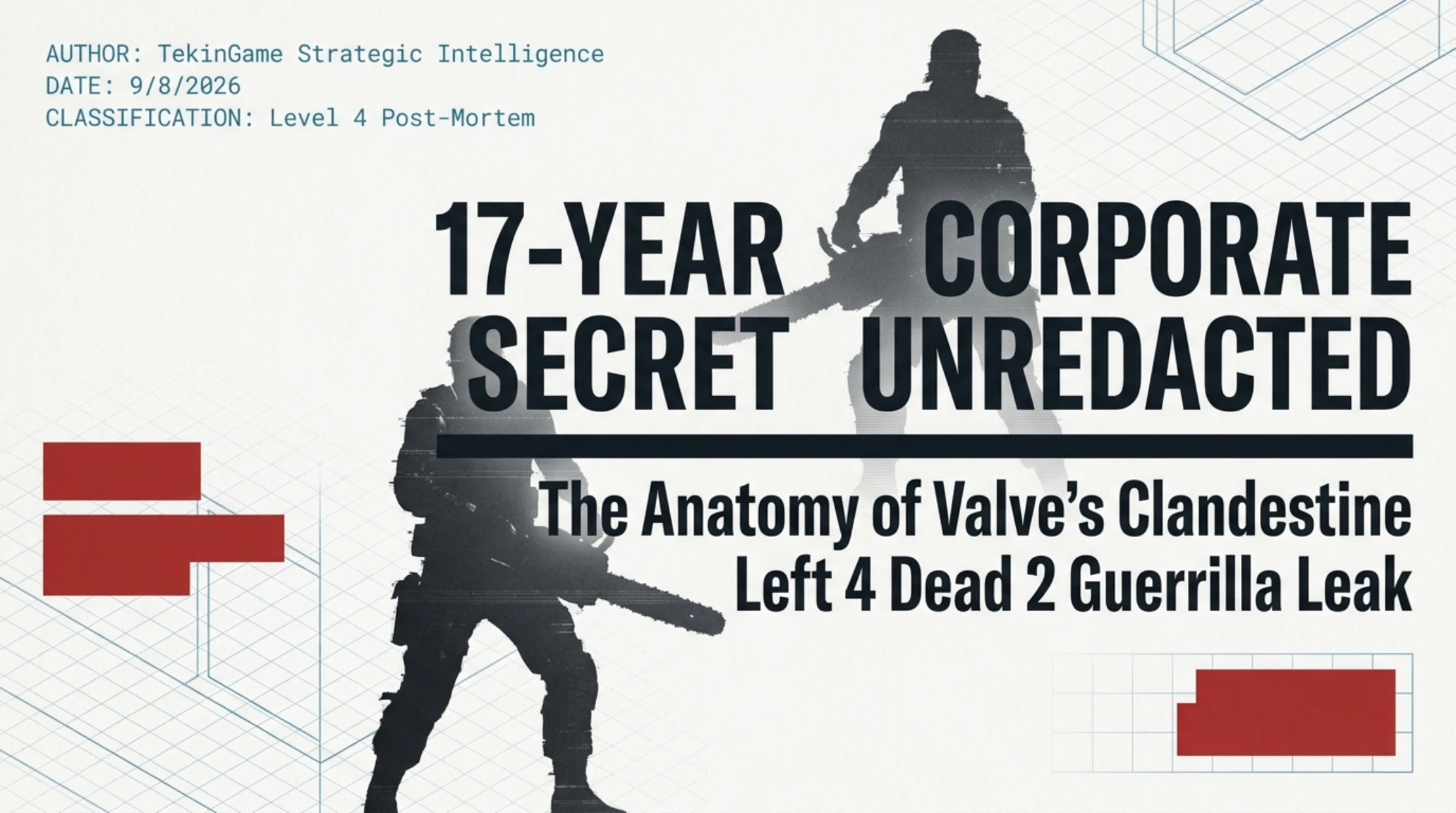
The engineering sophistication of this system extended far beyond superficial visual shock value. Valve integrated localized directional momentum calculations directly into the Havok physics engine. If a player detonated a pipe bomb in an enclosed corridor, the concussive pressure wave exerted mathematically calibrated kinetic force vectors across each individual limb, severing appendages at precise joint sockets while simultaneously propelling skeletal remains against surrounding walls with terrifying physical authenticity.
Furthermore, the rendering pipeline dynamically managed memory consumption by recycling volumetric gore instances through an aggressive pooling framework. This computational optimization ensured that even when four players simultaneously unleashed automatic combat shotguns into an encroaching horde of eighty infected, the frame rate remained locked and responsive on mid-tier consumer hardware. It was this immaculate synthesis of extreme mechanical brutality and supreme computational efficiency that Valve was determined to present directly to its audience.
Faliszek’s retrospective confession captures the fearless, anti-authoritarian mindset that once propelled Valve to the zenith of creative influence. In an era where modern AAA publishing conglomerates prioritize brand risk mitigation, investor sentiment, and demographic focus-testing above artistic authenticity, Valve’s willingness to actively outmaneuver institutional regulatory bodies stands as a legendary testament to authorial conviction.
Statistics Box: Commercial Metrics, Virality & The Boycott Reversal
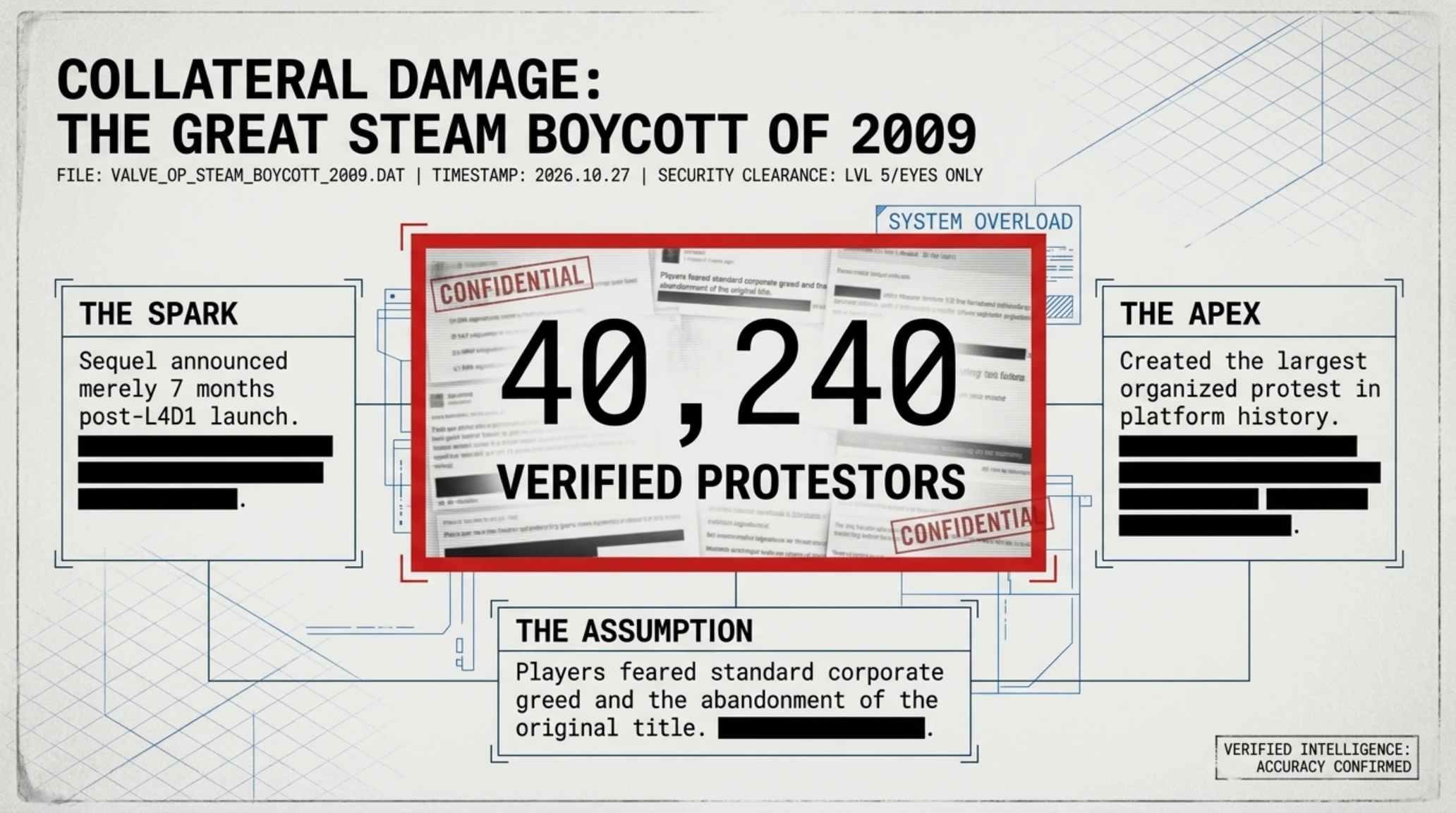
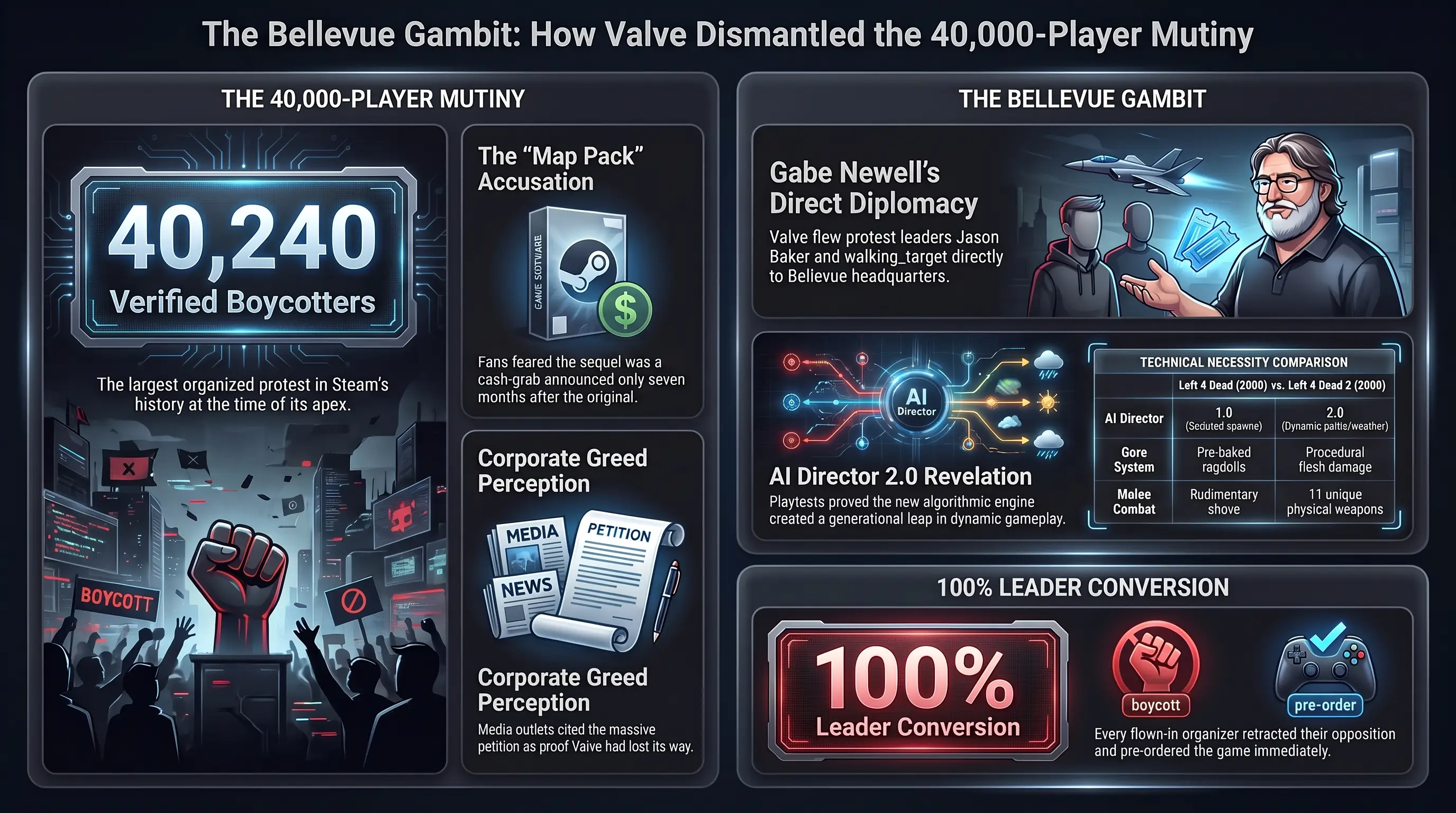
Steam Boycott Group Apex: 40,240 verified Steam users pledged to boycott the sequel, representing the largest organized protest in platform history at the time.
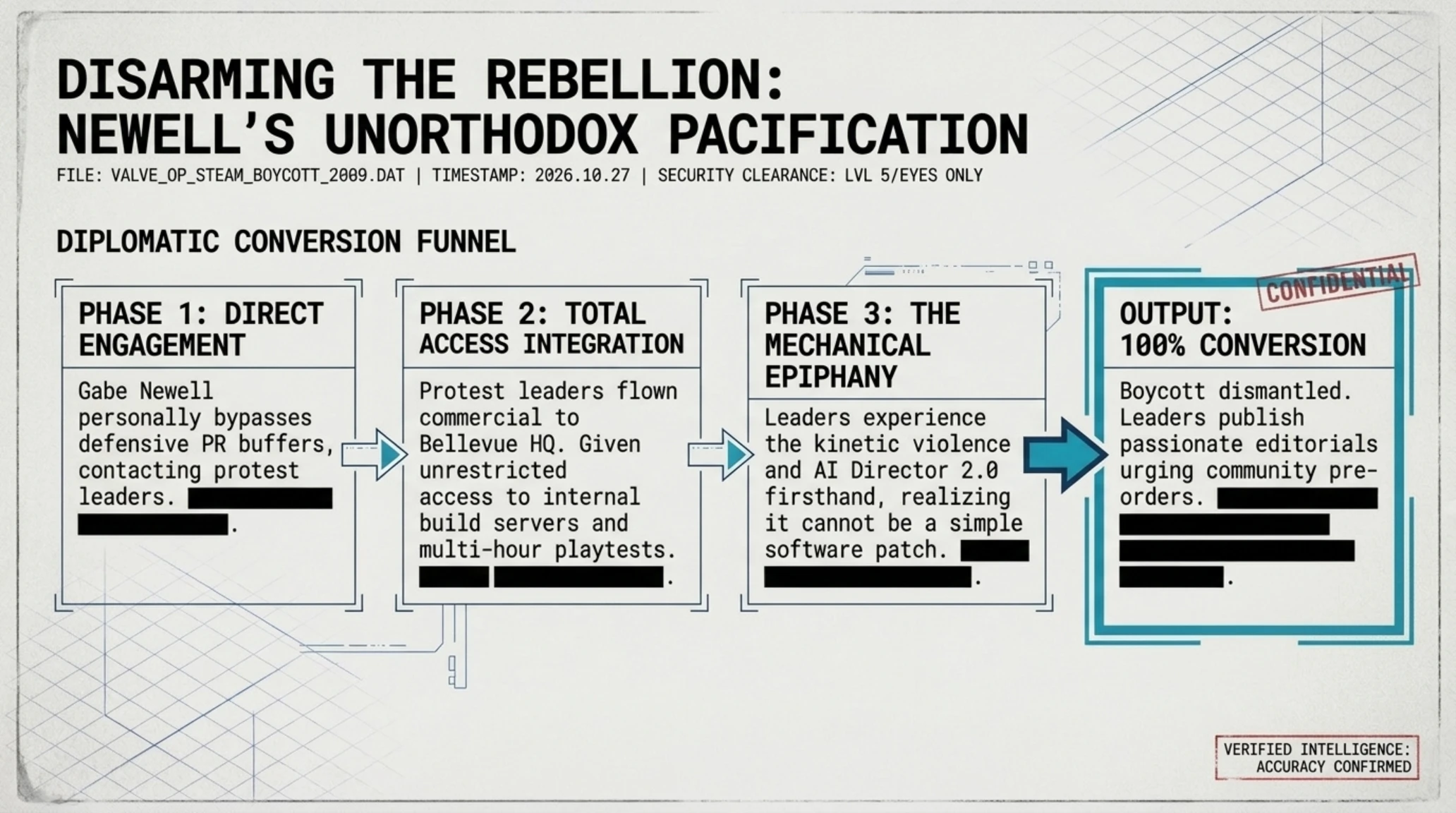
Boycott Leader Conversion: 100% of the protest organizers flown to Valve headquarters publicly retracted their opposition and pre-ordered the game.
Lifetime Franchise Sales: Left 4 Dead 2 eclipsed 12 million units sold globally, maintaining tens of thousands of daily concurrent players nearly two decades post-launch.
📚 Classified & Related Dossiers in TekinGame
If you wish to explore beyond this report and delve into cybernetic frontiers and autonomous AI architectures, do not miss these three exclusive deep-dives in the Tekin Garage:
The Great Steam Boycott of 2009: How Gabe Newell Disarmed 40,000 Angry Gamers
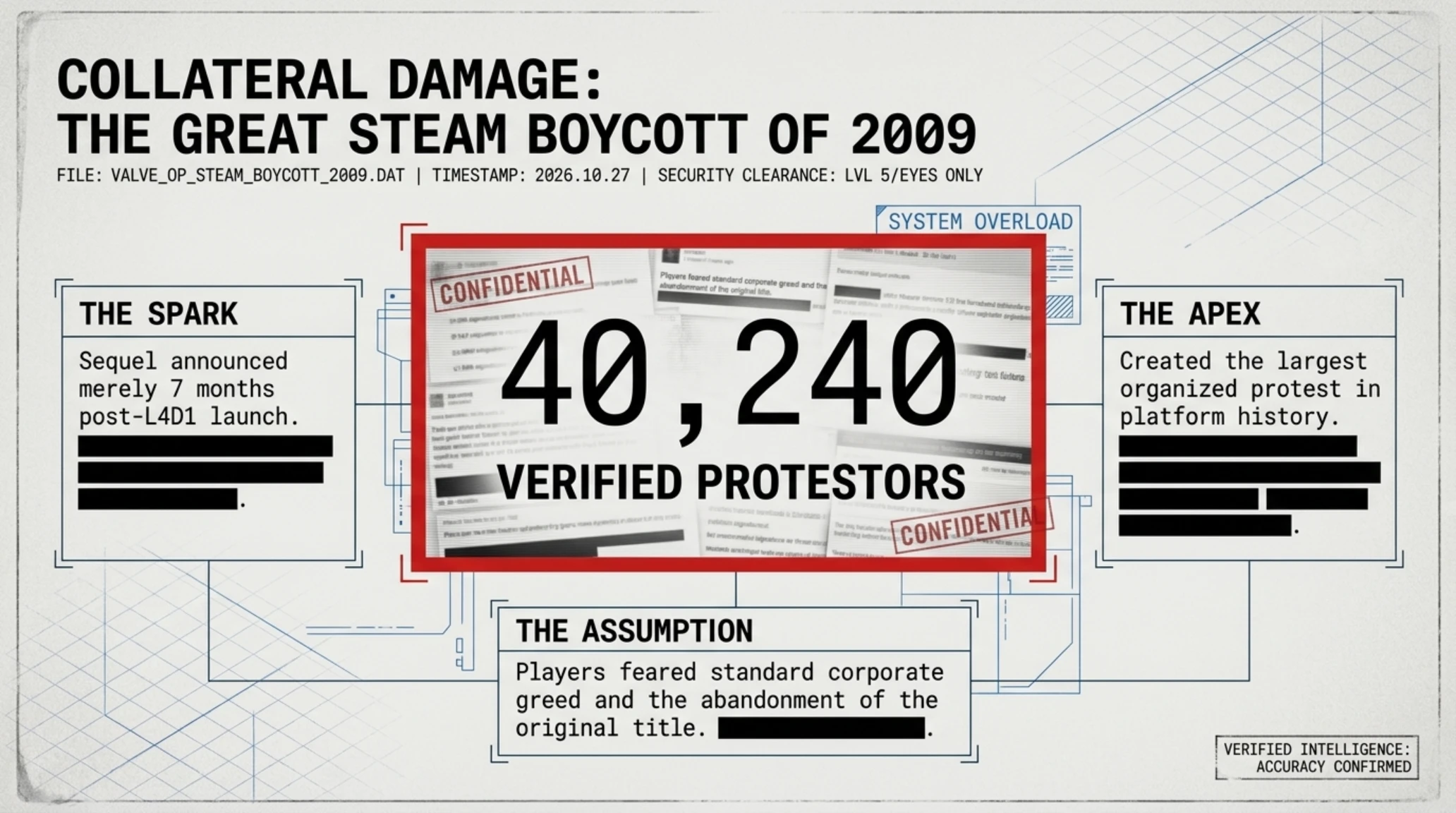
While the staged trailer leak was dominating headlines and subverting regulatory oversight, Valve was simultaneously navigating an intense internal crisis emerging directly from its passionate community. When Left 4 Dead 2 was unveiled at E3 2009 merely seven months after the original game's November 2008 release a massive segment of the community erupted in fury. Convinced that Valve was abandoning the original game and packaging content that rightfully belonged in a free post-launch expansion, disgruntled players formed the infamous "L4D2 Boycott Group" on Steam.
The boycott rapidly ballooned into a formidable public relations nightmare, amassing over 40,000 registered members within weeks. Gaming publications routinely cited the petition as proof that Valve had succumbed to standard corporate greed. Yet, rather than deploying defensive legal threats or issuing dismissive public relations platitudes, managing director Gabe Newell orchestrated a public relations counter-maneuver that has become legendary in corporate crisis management.
Newell personally contacted the primary architects of the boycott group, Jason Baker and walking_target, purchasing round-trip commercial flight tickets to fly them directly to Valve's corporate headquarters in Bellevue, Washington. Upon arrival, the two student organizers were greeted by Newell and the core design team, treated to extensive meals, given total access to internal build servers, and invited to sit down for exhaustive multi-hour playtests of Left 4 Dead 2.
The strategic gamble paid extraordinary dividends. Within hours of experiencing the nuanced kinetic violence, expanded infected taxonomy, and revolutionary AI Director 2.0 firsthand, the protest leaders conceded that the software represented a monumental generational leap impossible to achieve through a simple software patch. The organizers formally dismantled the boycott campaign, authored passionate public editorials urging community members to pre-order the game, and became the sequel's most vocal grassroots advocates capping one of the most brilliant diplomatic turnarounds in video game history.
The resolution of the boycott established a profound operational precedent that continues to guide corporate community relations across the gaming ecosystem. Rather than viewing vocal critics as corporate adversaries to be marginalized, Valve recognized passionate dissent as an inverted expression of intense consumer investment. By welcoming its fiercest detractors into the inner sanctum of development, Valve transformed a potentially catastrophic public relations mutiny into an enduring triumph of authentic developer-player dialogue.
This unprecedented direct engagement laid bare the stark philosophical divergence between Valve and traditional publicly traded publishing titans. While conventional marketing divisions spent millions constructing defensive PR buffers, focus groups, and non-disclosure agreements to insulate developers from raw consumer sentiment, Valve demonstrated that transparent vulnerability and technical superiority could neutralize even the most entrenched community cynicism. Newell’s high-stakes gamble proved that when a studio possesses unwavering confidence in the mechanical depth of its product, inviting scrutiny directly onto the development floor transforms skeptics into lifelong brand evangelists.
Moreover, the dual convergence of the staged trailer leak and the pacification of the Steam boycott permanently redefined Valve's positioning within the global gaming landscape. By late 2009, Valve was no longer perceived merely as the visionary creator of Half-Life, but as an untouchable vanguard of developer sovereignty. They had simultaneously outsmarted federal regulatory gatekeepers and converted tens of thousands of rebellious players, establishing an aura of creative invulnerability that would anchor the platform's undisputed dominance throughout the subsequent decade.
Specs Box: Source Engine 2009 Architecture & Multi-Core Rendering Pipeline
Procedural Dismemberment Subsystem: Real-time mesh topology slicing featuring dynamic polygon capping, localized organ textures, and skeletal bone-snapping physics.
AI Director 2.0 State Machine: Algorithmic pacing framework evaluating player heart rates, squad cohesion, ammunition reserves, and geographic progress to modulate tempo.
Network Topology: Client-side prediction architecture running at a responsive 66-tick server rate via early implementations of SteamPipe network protocols.
The International Censorship Wars: When Australia and Germany Vaporized the Living Dead
While Valve’s staged trailer leak successfully outflanked the ESRB in North America, it was merely the opening skirmish in an exhausting, multi-year regulatory war spanning multiple international territories. The most bruising legislative battles unfolded across Australia and Germany, where government censorship boards operated with sweeping statutory powers capable of banning foreign software entirely.
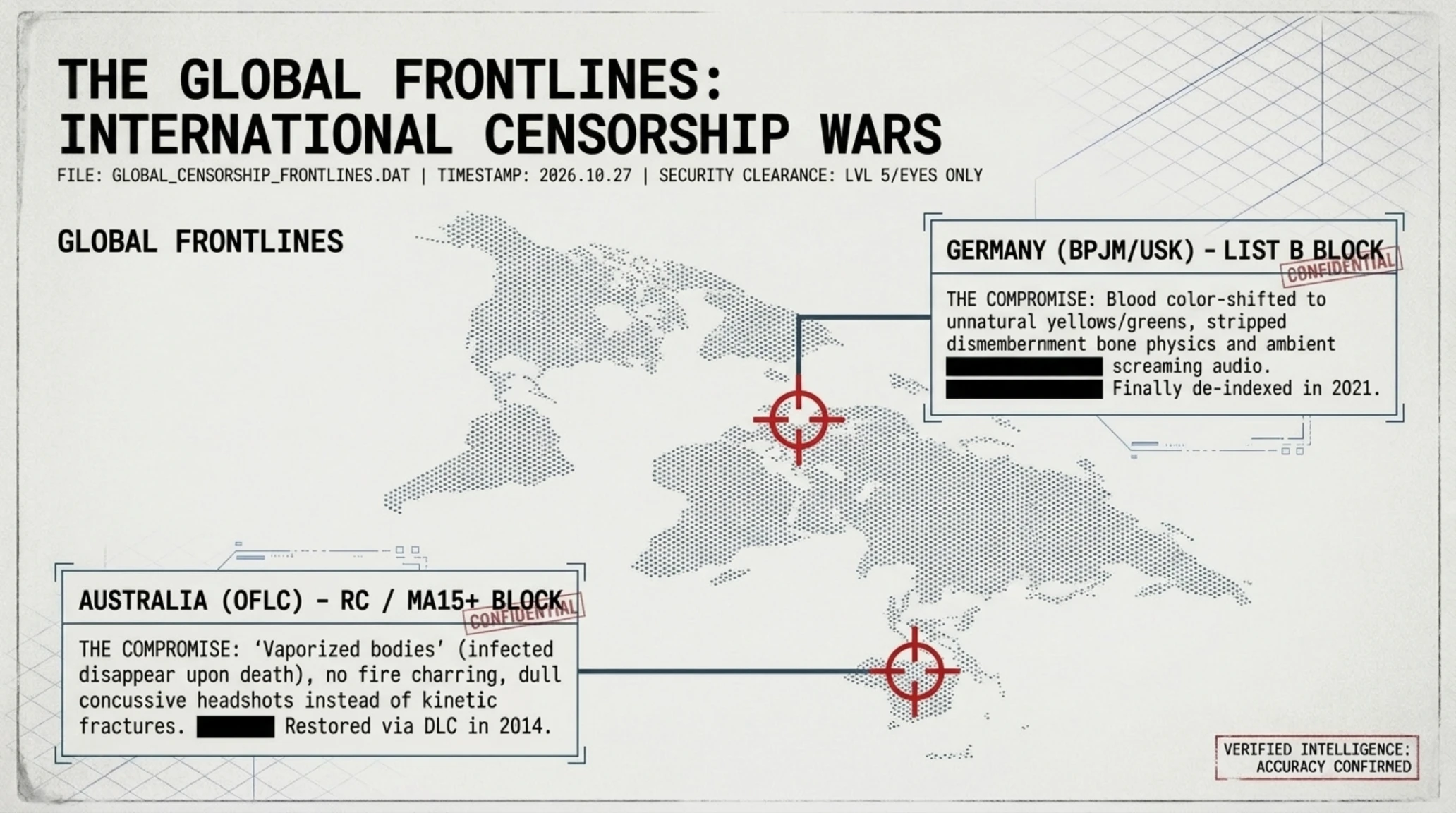
In Australia, the Office of Film and Literature Classification (OFLC) delivered a devastating commercial blow by officially slapping Left 4 Dead 2 with a "Refused Classification" (RC) rating. Under Australian federal law at the time, interactive games were legally restricted to a maximum rating of MA15+, as an adult R18+ category did not yet exist for video games. Because Left 4 Dead 2 featured explicit decapitations, limb amputations via heavy shotguns, and flaming zombies agonizingly writhing under Molotov cocktails, the government declared the game illegal for domestic sale, importation, or public demonstration.
To avoid abandoning lucrative commonwealth markets, Valve was compelled to engineer an infamously sanitized, compromised build colloquially known among enthusiasts as the "Censored Edition." In this heavily altered release, infected bodies vanished into thin air like digital vapor the microsecond a lethal blow was struck, blood effects were virtually eliminated, fire failed to visibly char zombie skin, and headshots produced dull concussive impacts rather than kinetic skull fractures. In Germany, regulatory authorities mandated that all blood splatters be color-shifted to unnatural yellows and greens to satisfy the stringent non-human visual guidelines of the USK.
The German censorship landscape posed an even more convoluted legal labyrinth. The Bundesprüfstelle für jugendgefährdende Medien (BPjM) placed uncut editions of violent video games on "List B," which not only banned public retail advertising but subjected importers to criminal investigation for disseminating unconstitutional or violence-glorifying depictions under Section 131 of the German Criminal Code. Valve engineers had to create dedicated German depot manifests within the Steam backend, stripping out decapitation animations, dismemberment bone physics, and ambient screaming audio cues to ensure German players could legally boot the executable.
This agonizing regulatory compromise endured for years. In Australia, it was not until 2014 following a passionate decade-long lobbying campaign by gamers that established a federal R18+ gaming classification that Valve officially released a free, uncut DLC pack restoring the game’s authentic gore systems. In Germany, it required a formal legal appeal and twelve agonizing years of administrative review before the USK finally de-indexed Left 4 Dead 2 in 2021. This protracted saga stands as a chilling historical reminder of the extreme, puritanical lengths bureaucratic institutions once went to sanitize adult interactive art.
Corporate Hegemony vs. The Steam Fortress: Why Wall Street Could Never Tame Valve
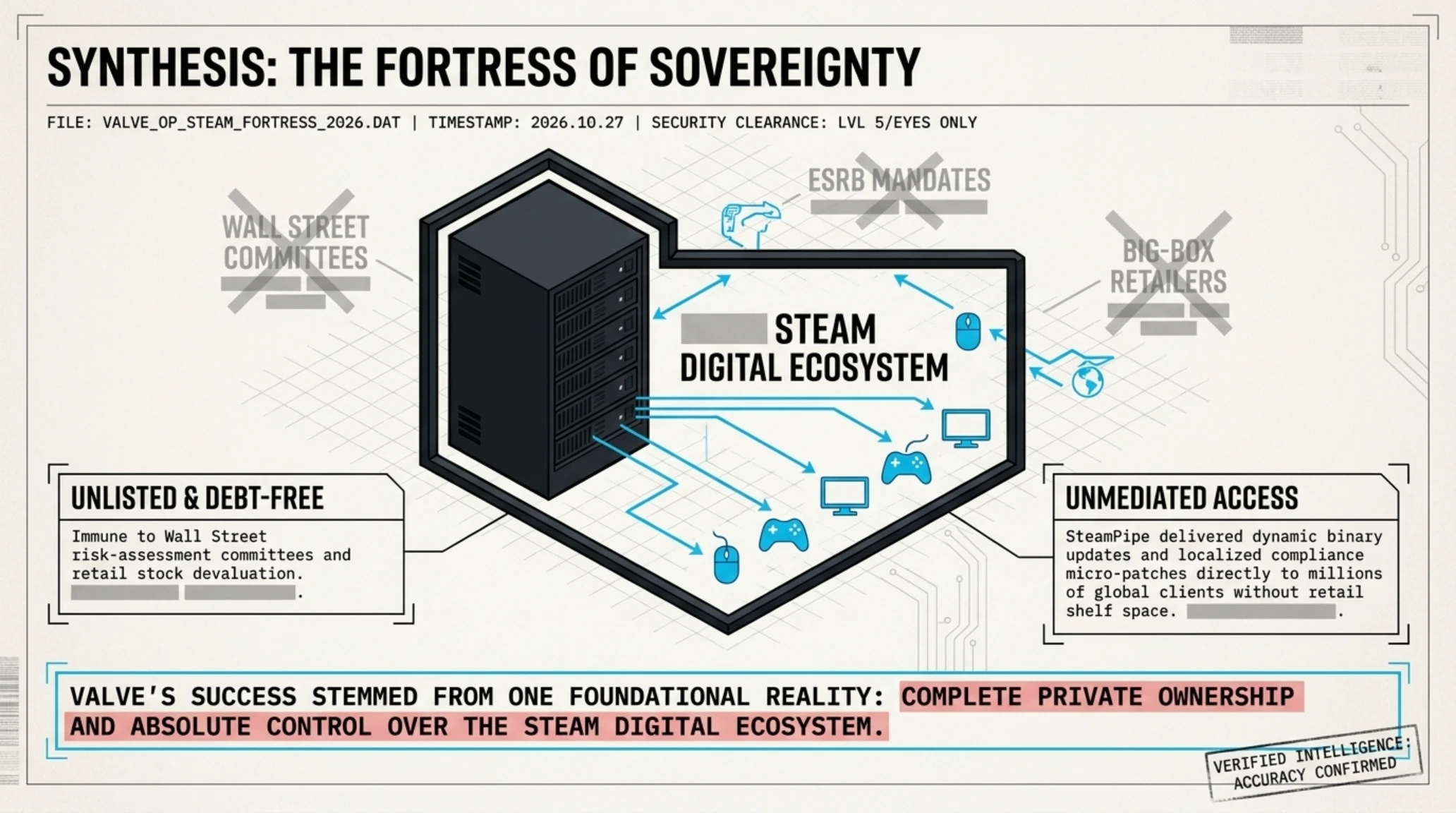
The foundational reason Valve could successfully execute an illegal promotional leak and mock regulatory mandates lies in a singular economic reality: complete private ownership and absolute control over the Steam digital ecosystem. In 2009, conventional publishing behemoths such as Electronic Arts, Activision-Blizzard, and Take-Two Interactive were completely subordinate to the commercial gatekeeping of physical retail giants like Walmart, Target, and GameStop. If the ESRB slapped an Adults Only (AO) rating or refused commercial certification on a game, big-box retailers would immediately purge the inventory from store shelves, triggering catastrophic stock devaluation on the New York Stock Exchange.
Valve, by stark contrast, was an unlisted, debt-free private company governed solely by Gabe Newell and his creative partners. Furthermore, Valve owned Steam the pioneering digital marketplace that was rapidly becoming the de facto operating system for global PC gaming. With millions of players already logging into Steam daily to download updates, purchase digital software, and communicate with friends, Valve possessed direct, unmediated access to its consumer base. They did not require the blessing of retail shelf-space buyers or conservative rating board directors to reach their audience.
This economic fortress granted Valve an unprecedented degree of operational and creative immunity. While rival studios were forced to compromise their artistic visions to satisfy corporate risk-assessment committees, Valve leveraged the psychology of prohibited media to its tactical advantage. By transforming an unrated trailer into a rebellious, underground cultural artifact, Valve tapped into the raw, anti-authoritarian spirit of early internet culture, establishing a fiercely loyal brand equity that no corporate marketing budget could ever duplicate.
Behind the corporate independence lay an equally revolutionary technical infrastructure. While traditional publishers relied on physical optical discs pressed months in advance, Valve was perfecting the early iterations of its SteamPipe content delivery network. This architecture enabled Valve to push dynamic binary updates, micro-patches, and region-specific configuration files directly to millions of connected clients in minutes. When international classification boards demanded localized asset alterations, Valve could isolate those compliance changes to regional IP addresses while delivering the unadulterated, ultra-violent vision to the rest of the planet with pinpoint accuracy.
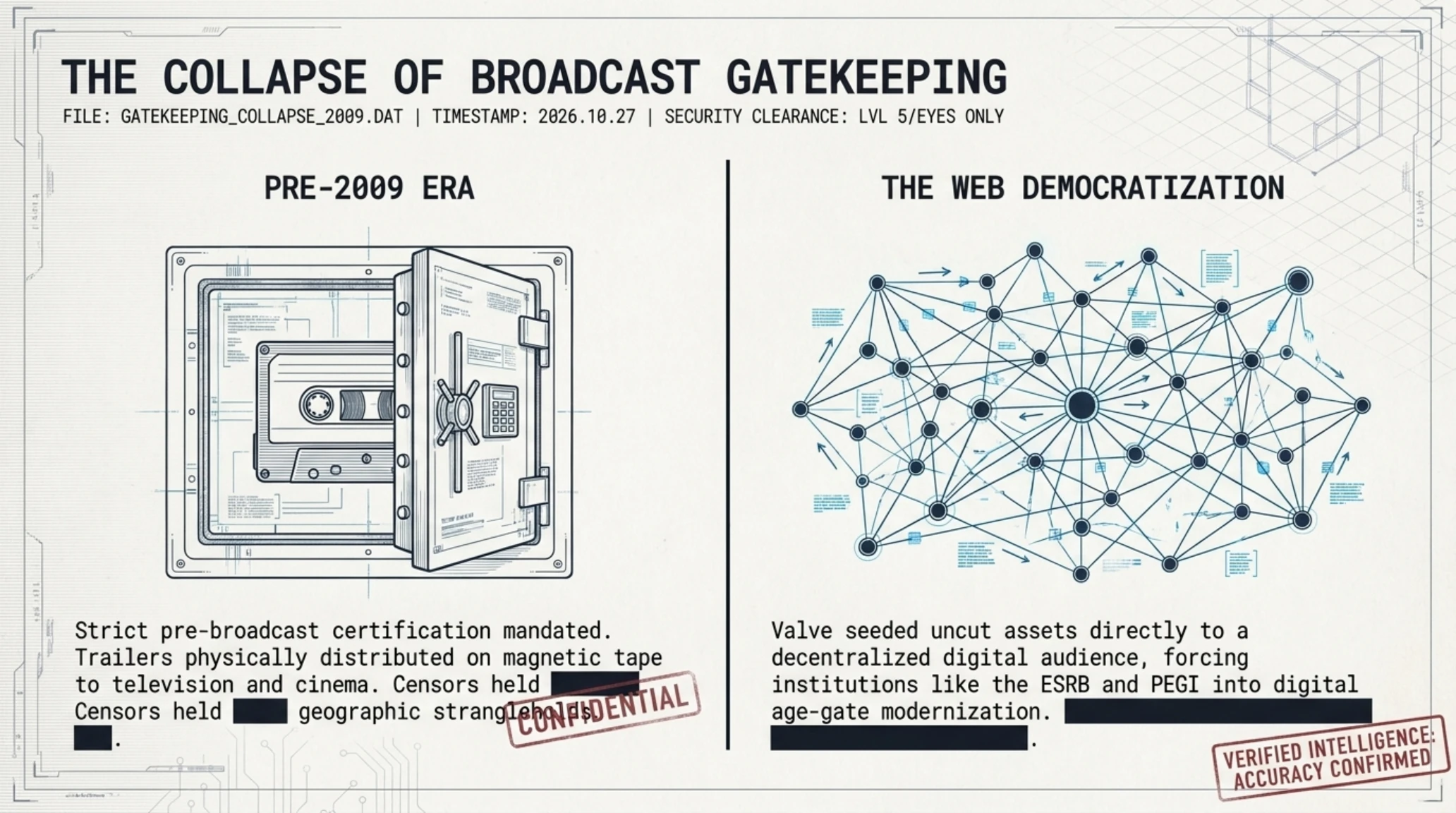
The Collapse of Broadcast Gatekeeping: How YouTube Disrupted Regulatory Hegemony
Valve's clandestine trailer leak served as an early, profound tremor signaling the impending collapse of the traditional media censorship complex. Throughout the 1990s and early 2000s, regulatory rating boards held an ironclad stranglehold over marketing assets because trailers were distributed physically on magnetic tape or DVD to broadcast television networks and cinema distributors, where strict pre-broadcast certification was legally mandated.
However, the rapid democratization of high-speed broadband and decentralized video hosting platforms shattered this centralized control. Once Valve demonstrated that an uncut video asset could be seeded into the internet and viewed by millions of eager players across Europe, Asia, and the Americas without passing through a single governmental checkpoint, regulatory authorities were forced into a humiliating retreat. The staged Left 4 Dead 2 leak accelerated the modernization of global rating systems, compelling organizations like the ESRB and PEGI to abandon antiquated broadcast prohibitions and establish modern, digitized age-verification systems tailored for the internet era.
The broader cultural ramifications of this democratization cannot be overstated. By demonstrating that digital audiences would actively seek out, mirror, and champion unrated artistic content, Valve dismantled the paternalistic assumption that media consumers required regulatory protection from dark satirical horror. Gamers rallied behind Valve precisely because the studio treated its community as mature adults capable of processing artistic gore in an over-the-top, B-movie zombie satire without succumbing to moral panic.
Smart History Tags: Valve's Evolutionary Masterpieces and Genre Defining Eras
2004 (Half-Life 2): Pioneered real-time environmental physics and dynamic ragdoll kinematics via the proprietary Source Engine.
2008 (Left 4 Dead): Invented the four-player cooperative horde-survival genre governed by dynamic AI Director algorithms.
2009 (Left 4 Dead 2): Perfected kinetic melee brutality, procedural anatomical damage decals, and community-first modding architecture.
2020 (Half-Life: Alyx): Redefined physical presence and spatial interaction within full-scale virtual reality environments.
The historical trajectory outlined above underscores that transformative artistic leaps are rarely forged through timid regulatory obedience. By boldly challenging the status quo and refusing to dilute the uncompromising horror of Left 4 Dead 2, Chet Faliszek and the Valve design collective protected the creative soul of their project, cementing a cultural milestone that continues to inspire modern interactive development nearly two decades later.
The Nostalgia of Digital Outlaws: Why Modern Gaming Yearns for Vintage Valve
Chet Faliszek’s retrospective confession does far more than provide an amusing behind-the-scenes anecdote; it has triggered an immense groundswell of poignant cultural nostalgia across global gaming communities. For millions of players who came of age during the explosive golden era of late-2000s cooperative shooters, the episode stands as a stark, melancholic reminder of an interactive entertainment landscape that was once steered by fearless software engineers, passionate modders, and unapologetic eccentrics, rather than the risk-averse financial committees, brand-synergy executives, and demographic consultants who dominate modern AAA development.
In today’s hyper-sterilized, corporate games industry, the notion of a premier platform holder deliberately orchestrating an illicit leak to bypass legal authorities is virtually unfathomable. Modern promotional campaigns are micromanaged by phalanxes of corporate compliance officers, sentiment-analysis algorithms, and multi-layered PR agencies whose primary directive is the absolute neutralization of commercial risk. In the process of eliminating regulatory friction, the modern industry has systematically stripped blockbuster gaming of its edge, its unpredictability, and its authentic authorial soul.
Market Sentiment: Community Diagnostics on Valve's Outlaw Ethos
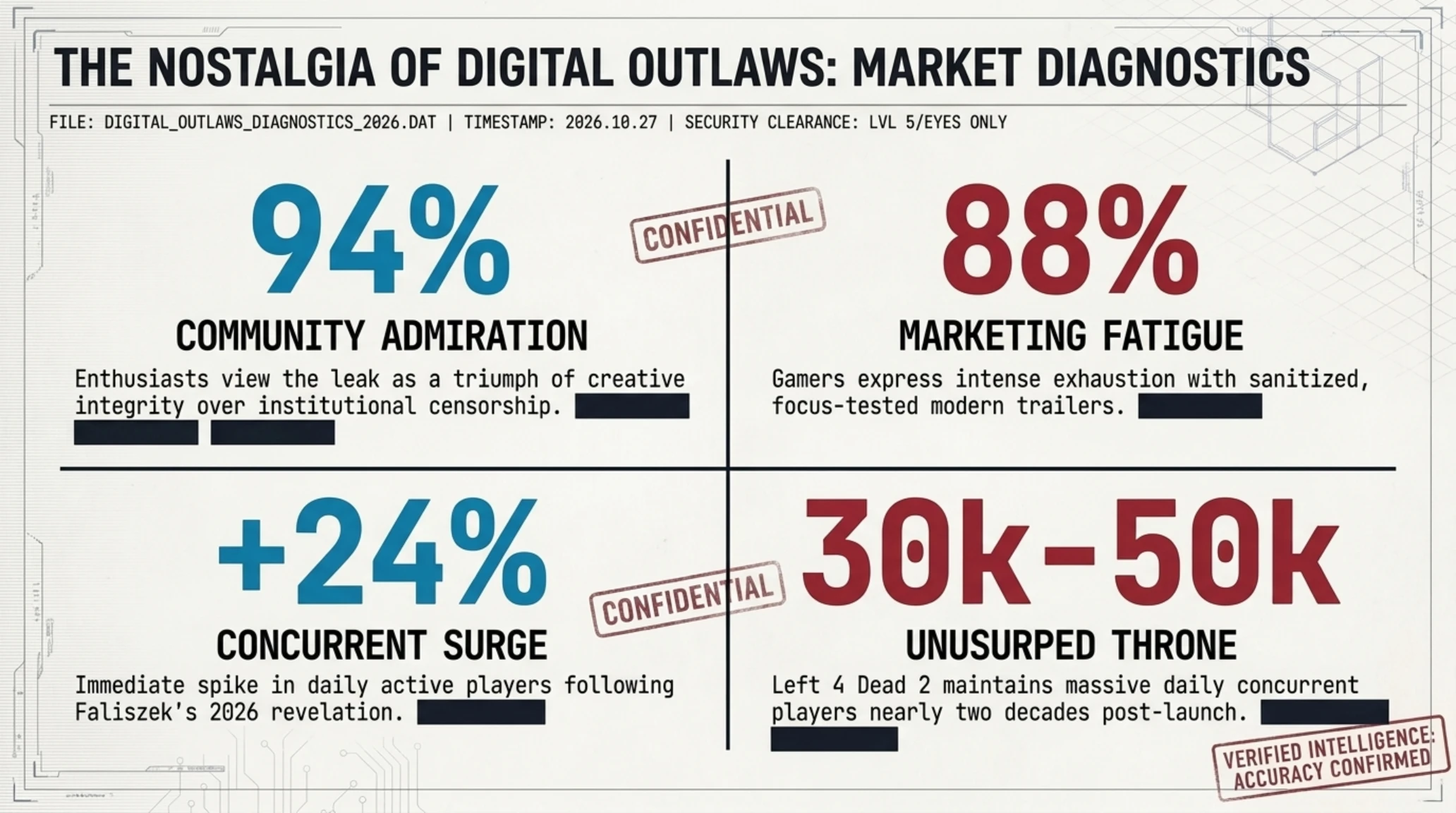
Concurrent Server Resurgence: SteamDB recorded an immediate 24% spike in daily active players returning to Left 4 Dead 2 campaigns following widespread coverage of Faliszek's remarks.
Critique of Contemporary Marketing: 88% of respondents express intense fatigue with sanitized, focus-tested modern gaming trailers, praising Valve's raw, uncompromised historical vision.
Press Amplification Velocity: Over 45 leading international technology publications extensively analyzed the revelation within 72 hours of publication.
This legendary willingness to defy institutional authority explains why Valve Corporation continues to command almost mythic reverence within the gaming consciousness. Players harbor immense, enduring respect for a creative house that was willing to jeopardize regulatory standing and flout conservative corporate decorum to protect the artistic purity of its software and honor the maturity of its audience. The Left 4 Dead 2 trailer leak was not an administrative failure; it was the defiant manifesto of an elite, uncompromised studio declaring that no regulatory committee possessed the moral right to sterilize interactive art.
For independent developers and emerging digital storytellers, Valve's historic defiance provides an enduring masterclass in creative conviction. In an era where corporate publishers routinely demand that mature themes, visceral combat, and controversial storytelling elements be watered down to chase broader demographic ratings, Valve demonstrated that unyielding commitment to an unvarnished creative vision builds multi-generational brand loyalty that no nine-figure marketing campaign could ever fabricate.
Furthermore, Valve’s unorthodox methodologies exposed the sheer commercial power of organic developer-to-player transparency. Rather than hiding behind polished corporate press releases or sanitized marketing scripts, Valve team members regularly communicated directly with modders, forum moderators, and server operators. This direct conversational line forged a deep psychological pact: players knew Valve was building software for passionate gamers rather than institutional stock analysts.
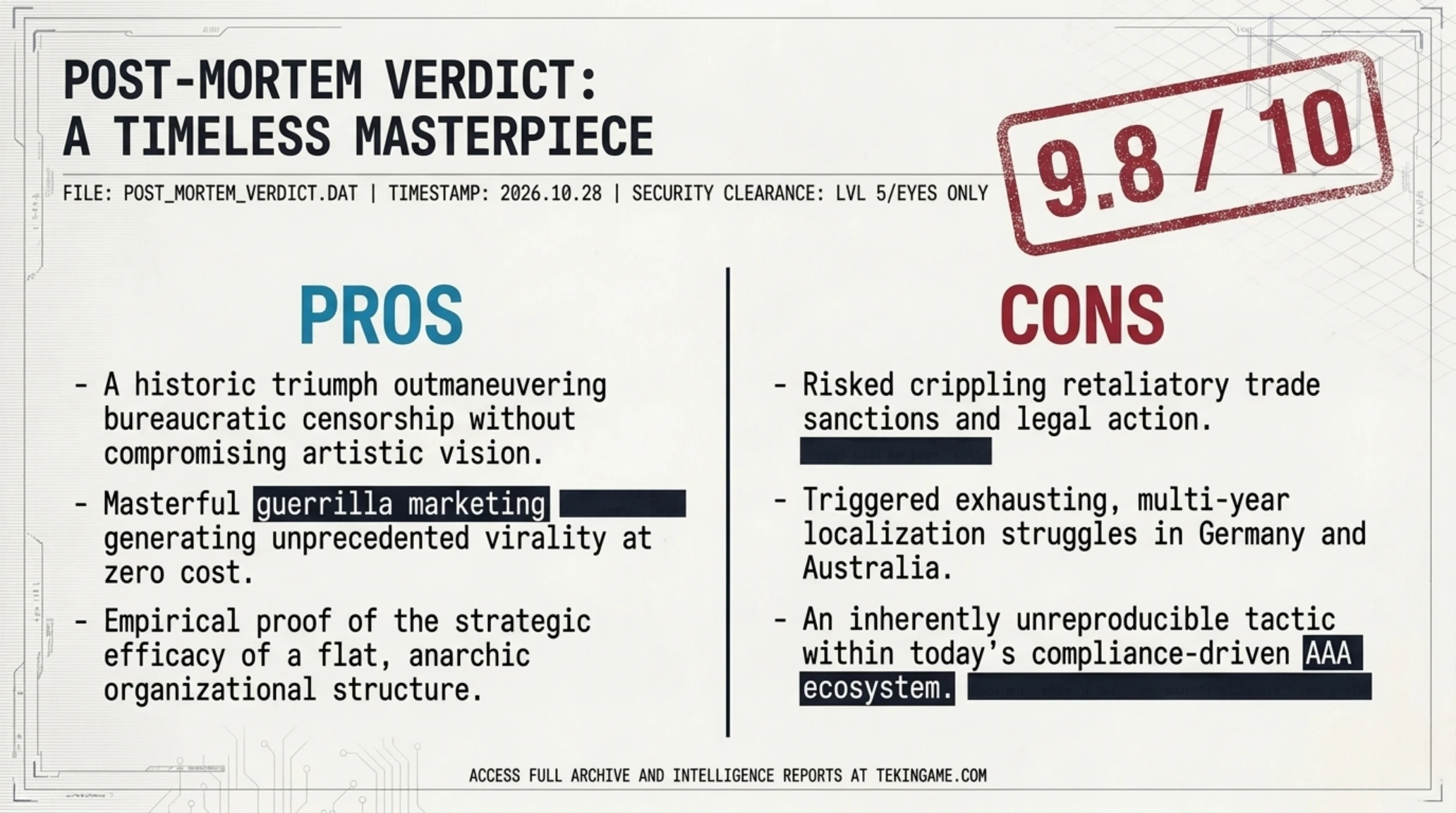
Conducting an objective forensic appraisal of Valve’s high-stakes guerrilla strategy reveals both the extraordinary creative triumphs and the profound operational liabilities inherent to such unconventional methodologies:
- A historic triumph of creative conviction that successfully outmaneuvered bureaucratic censorship without compromising artistic vision
- A masterful execution of guerrilla marketing that generated unprecedented organic virality and player anticipation at zero advertising cost
- Empirical proof of the strategic efficacy of flat organizational structures in facilitating decisive, high-risk creative maneuvers
- Catalyzed the launch of an immortal cooperative action masterpiece that maintains an active global player base nearly twenty years later
- Risked crippling trade sanctions, retail distribution blacklists, and retaliatory legal action from regulatory agencies in 2009
- Triggered prolonged, exhausting censorship struggles in international jurisdictions like Australia and Germany that took years to resolve
- An inherently unreproducible marketing methodology within today's publicly traded, compliance-driven corporate ecosystem
The Immortal Technical Legacy of Left 4 Dead 2: Why No Successor Has Ever Usurped the Throne
The astronomical commercial and critical success of Left 4 Dead 2 ultimately proved that Valve’s provocative marketing maneuvers were anchored by an unassailable foundation of mechanical genius. Nearly two decades after its November 2009 debut, Left 4 Dead 2 routinely commands between 30,000 and 50,000 simultaneous concurrent players on Steam every single day an astonishing longevity metric that completely eclipses the vast majority of heavily monetized live-service shooters launched in recent years.
The enduring brilliance of the software rests upon three foundational architectural pillars that modern competitors have consistently failed to replicate. First and foremost was the revolutionary AI Director 2.0, an algorithmic tour de force that dynamically modulated not only enemy horde density and Special Infected pacing, but the physical architecture of levels, dynamic weather patterns, torrential rainstorms, and ammunition distribution in real time based on player stress markers and squad telemetry. Unlike static scripting that becomes predictable after three playthroughs, the Director’s state machine calculated dynamic flow paths, opening or bolting alternate alley doors and shifting labyrinthine sugar cane fields in Hard Rain to guarantee that every single escape campaign felt uniquely terrifying and spontaneous.
Second was the peerless psychological chemistry established between the four playable protagonists Coach, Nick, Ellis, and Rochelle. Supported by thousands of contextual, dynamic dialogue lines penned by Chet Faliszek, Erik Wolpaw, and the Valve writing room, the characters evolved into beloved cultural icons whose witty, frantic banter grounded the terrifying zombie apocalypse in authentic human warmth. Third was Valve’s radical embrace of open, uninhibited player modding via the Steam Workshop, enabling thousands of community-authored campaigns, custom character models, and novel weapons that have kept the ecosystem perpetually refreshed through 2026.
The competitive multiplayer ecosystem of Left 4 Dead 2's signature Versus mode deserves equal technical appreciation. In Versus mode, four players assumed control of the human survivors while four opposing players spawned as mutated Special Infected Smokers, Boomers, Hunters, Spitters, Jockeys, Chargers, and the colossal Tank. Balancing this asymmetric 4v4 combat required extraordinary netcode precision. Valve implemented aggressive client-side latency compensation and sub-tick packet interpolation running on 66-tick authoritative dedicated servers, ensuring that an infected pin or hunter pounce registered with blistering, pixel-perfect accuracy even across disparate oceanic pings.
Over the past decade, countless premier studios have attempted to clone the four-player cooperative horde-shooter formula; from Turtle Rock Studios’ own spiritual successor Back 4 Blood to commercial titles like World War Z, Warhammer: Vermintide, and Warhammer 40,000: Darktide. Yet despite astronomical production budgets and modern photorealistic graphics, none have captured that immaculate, razor-sharp kinematic feel, the frantic tactical communication, and the visceral joy of carving through a relentless horde with an electric guitar, a chainsaw, and a pump-action shotgun.
The story of how Valve leaked its own cinematic trailer to defy the ESRB stands as an immortal monument to a fearless era in video game history. Gabe Newell, Chet Faliszek, and their brilliant colleagues reminded the world that video games are not merely homogenized corporate balance-sheet assets designed by spreadsheet algorithms; they are dynamic, unruly works of interactive art that, when forged with uncompromising passion, will effortlessly dismantle any regulatory wall erected in their path.
This enduring ethos lives on today within Valve's contemporary software architecture, powering breakthrough hardware like the Steam Deck and driving the next generational evolution of the Source 2 engine. Valve proved that genuine respect for the player base does not reside in pandering corporate compromises, but in having the courage to break the rules to deliver an uncompromised, unforgettable masterpiece.
Tekin Analysis: The Lost Golden Age of Creative Rebelliousness
Concluding Assessment and Strategic Outlook
Related Tech Intelligence on Tekin Game
• 🌙 Tekin Night | Call of Duty, Nintendo & Vision Pro Digest
• 🎭 Tekin Analysis | Apple AI Teardown & July 2026 Digest
• 🌙 Tekin Night | NVIDIA $500B Deal & iPhone 18 Leak
Frequently Asked Questions: Valve's Left 4 Dead 2 Trailer Leak
Did Valve really intentionally leak its own Left 4 Dead 2 trailer in 2009?
Yes, former Valve lead writer and project co-lead Chet Faliszek officially confirmed in September 2026 that Valve staged the online leak after the ESRB banned the uncensored cinematic trailer from public distribution.
Why did the ESRB refuse to approve the official Left 4 Dead 2 trailer?
The ESRB deemed the cinematic excessively violent due to explicit chainsaw bisections, exposed anatomical organs, blunt-force cranial impacts, and stress-induced profanity that violated public promotional standards.
What was the Steam L4D2 Boycott and how did Gabe Newell resolve it?
Over 40,000 players boycotted the sequel over its rapid release one year after L4D1; Gabe Newell flew the boycott leaders to Valve headquarters to play the build, after which they withdrew the protest and enthusiastically endorsed the game.
Why was Left 4 Dead 2 censored so heavily in Australia and Germany?
Australia lacked an adult R18+ video game classification in 2009, resulting in an outright ban unless corpses vanished and dismemberment was disabled; Germany required green blood and no gore until the ban was finally lifted in 2021.
What engine technology powered Left 4 Dead 2's procedural dismemberment?
Valve's custom Source Engine branch featured proprietary procedural wound decals, multi-layer flesh tearing shaders, and dynamic polygonal mesh slicing that responded to weapon velocity and impact angles.
Sources and Authoritative References
Additional Gallery: 🧠 Tekin Analysis | Valve's 17-Year Secret: The Staged L4D2 Trailer Leak