Tekin Analysis | Dissecting the Flying Tesla Roadster: SpaceX Rocket Thrusters, 0.59s Acceleration, and the 9-Year Odyssey
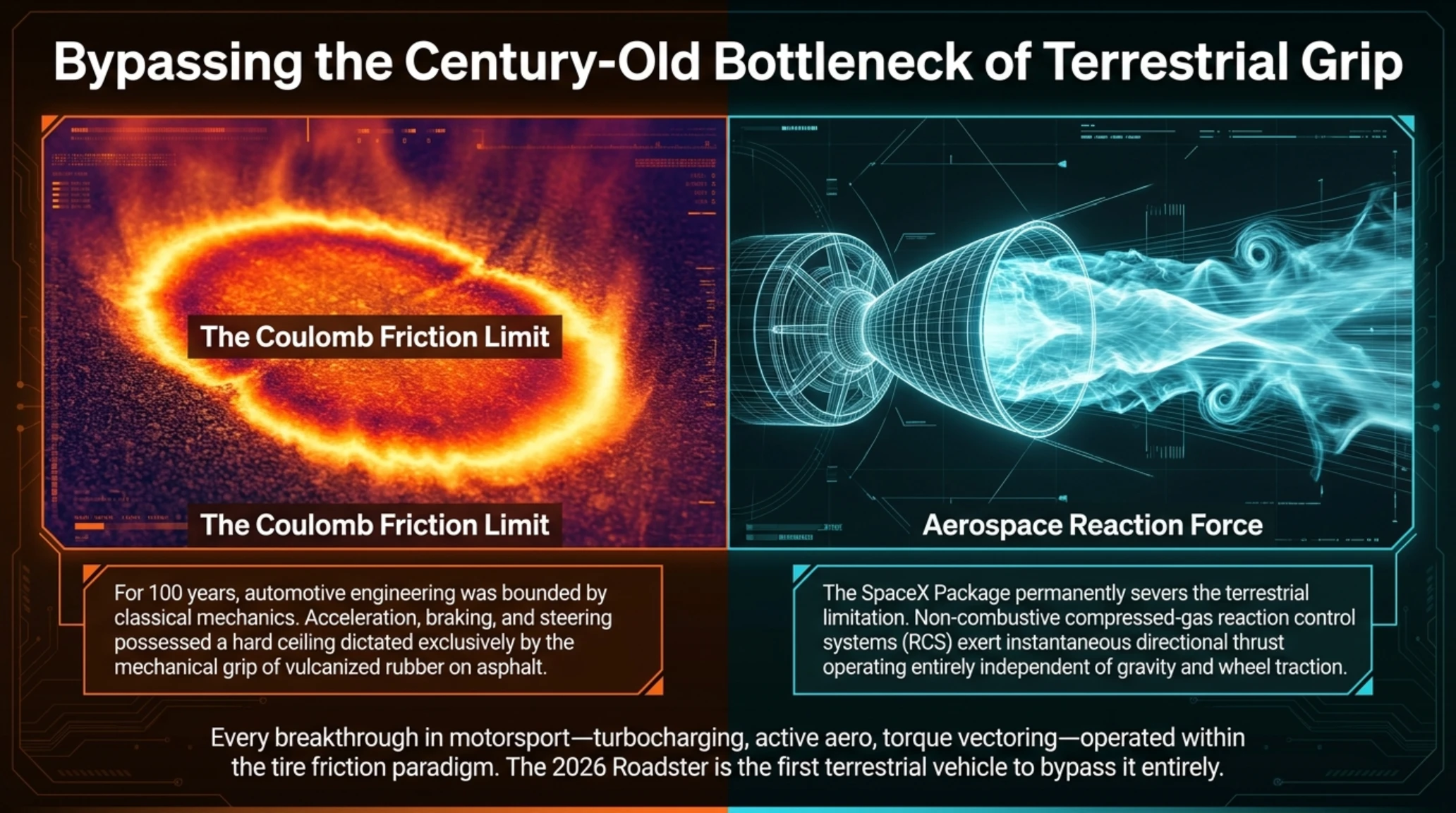
For more than a century, automotive engineering has been strictly bounded by the immutable laws of classical mechanics, terrestrial gravity, and the frictional coefficient between vulcanized rubber and asphalt. Every breakthrough in high-performance motorsport from turbocharging and active aerodynamics to modern quad-motor electric torque vectoring has operated within the exact same fundamental paradigm: the vehicle can only accelerate, brake, or steer through the mechanical grip generated by four contact patches no larger than a human hand. In mid-October 2026, on the proving grounds of SpaceX’s rocket testing complex in McGregor, Texas, Tesla shattered that century-old paradigm forever by unveiling a production-intent supercar that fundamentally merges aerospace rocketry with high-voltage automotive propulsion.
Strategic Assessment and Key Intelligence Vectors
The next-generation Tesla Roadster, outfitted with the highly anticipated SpaceX Package, is not merely another high-output electric hypercar competing for marginal track tenths against the likes of Rimac or Porsche. It is a dual-domain machine capable of generating independent thrust in free air, executing controlled ballistic leaps, and manipulating its attitude mid-flight using supersonic cold-gas reaction thrusters. Yet behind the dazzling spectacles of mid-air barrel rolls and inverted ceiling driving lies a grueling nine-year saga marked by near-bankruptcy, institutional investor mutiny, bitter regulatory scrutiny, and the stubborn obsession of Elon Musk to build a machine that defies traditional automotive physics.
The Ashes of November 2017: How the Roadster Became Tesla's Greatest Vaporware Mirage
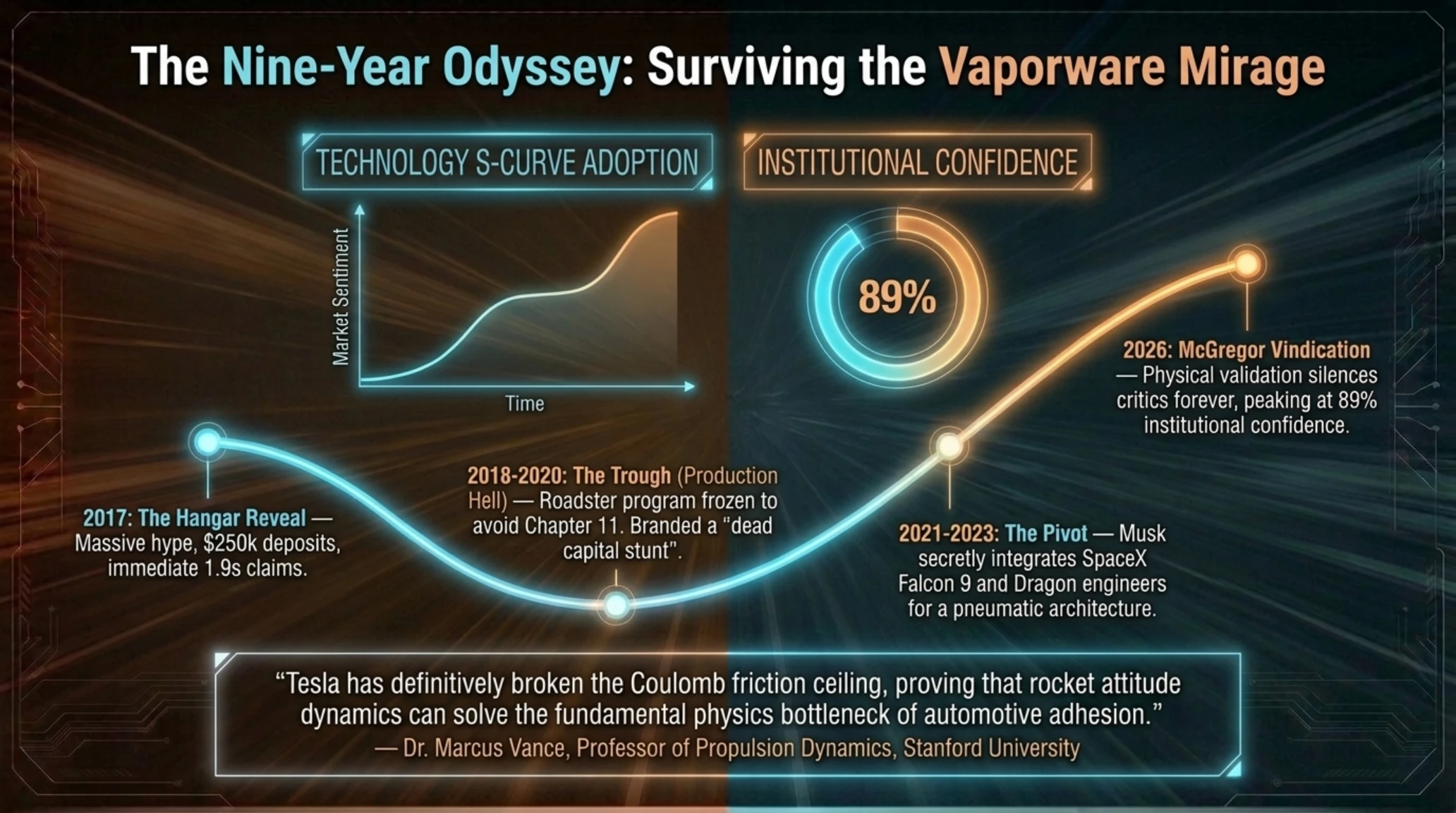
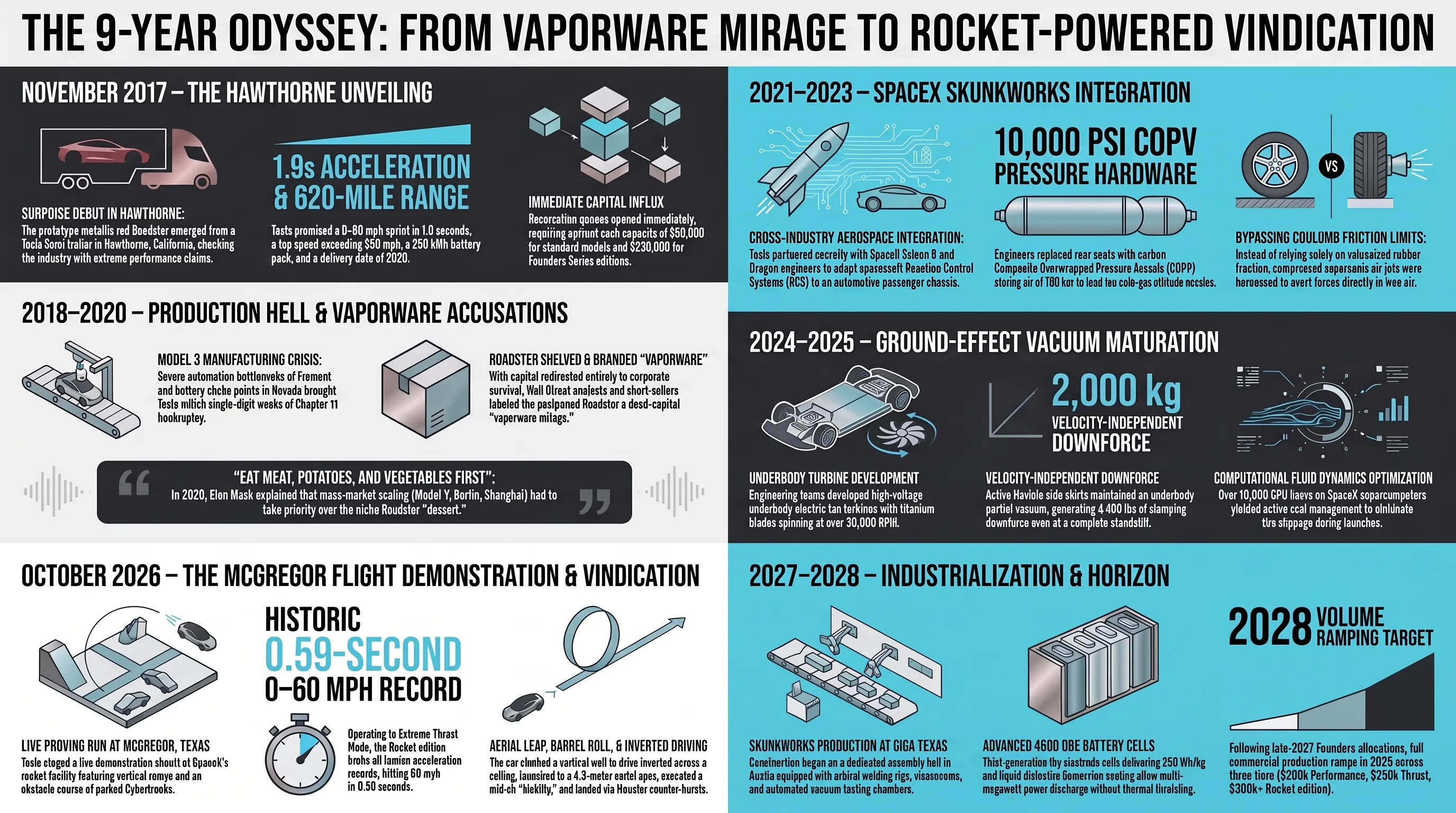
To fully grasp the magnitude of the demonstration staged in McGregor, Texas, one must travel back nine years to the evening of November 16, 2017, in an airport hangar in Hawthorne, California. At the conclusion of the commercial unveiling of the Tesla Semi electric heavy-duty truck, Elon Musk delivered an unexpected theatrical climax. As dramatic synthesizers pulsed through the arena, the rear loading doors of a semi-trailer slid open, and a prototype metallic red sports car roared out into the spotlights. Driven by Tesla chief designer Franz von Holzhausen, the vehicle executed high-speed sprints across the tarmac, stunning automotive journalists worldwide.
The performance metrics announced by Musk that night seemed to belong to science fiction: 0 to 60 mph in 1.9 seconds, a top speed exceeding 250 mph (400 km/h), a monumental 200 kWh structural battery pack delivering 620 miles of range, and an ironclad promised delivery date of 2020. Tesla immediately opened global reservation queues, requiring a $50,000 upfront deposit for standard reservations and an astonishing $250,000 in upfront cash for the exclusive Founders Series edition. Millions of dollars in interest-free capital flooded into Tesla’s bank accounts within hours, setting the stage for what would soon become an existential crisis.
Within months of that triumphant reveal, 2018 arrived, and Tesla plunged headlong into what Elon Musk would later christen production hell. The manufacturing ramp of the Model 3 sedan in Fremont, California encountered catastrophic automation bottlenecks, the battery module lines in the Nevada Gigafactory suffered severe manufacturing choke points, and Tesla’s operational cash burn escalated to terrifying levels. The company was, by Musk’s subsequent public admission, within single-digit weeks of running out of cash and filing for Chapter 11 bankruptcy. Engineering personnel worked around the clock, Musk slept on the factory floor, and every dollar was redirected toward basic corporate survival.
In the wake of this survival battle, the Roadster program was unceremoniously shelved. Wall Street institutional analysts and institutional short-sellers turned their fury on the vehicle, branding it dead capital and an irresponsible corporate distraction. Prominent financial publications labeled the Roadster an egregious vaporware stunt, alleging that Tesla had deployed a theoretical halo car to solicit interest-free consumer loans to mask its deteriorating balance sheet. Major institutional funds and board members repeatedly pressured Musk to formally kill the project, refund reservation deposits, and reallocate capital exclusively toward the high-margin Model Y crossover and global factory expansion.
The prolonged silence that followed, combined with consecutive rollout postponements from 2020 to 2022, 2024, and beyond, cemented the narrative among skeptics that the Roadster would never see the light of day. Musk, however, refused to abandon the vehicle. During his May 2020 interview on The Joe Rogan Experience, he articulated his prioritization framework through an enduring culinary metaphor: the Roadster is like dessert, but Tesla had to eat its meat, potatoes, and vegetables first meaning Model Y scaling, Berlin and Shanghai construction, and mass production survival. Yet behind closed doors in Hawthorne, Musk instructed his skunkworks engineering teams to scrap traditional supercar designs and pursue an aerospace crossover that no automotive rival could copy.
The financial pressure on Tesla during this transitional era cannot be overstated. With short interest surpassing twenty percent of the company’s outstanding float and major bond ratings downgraded into high-yield speculative territory, institutional investors treated the Roadster’s unfulfilled production pledges as proof of structural mismanagement. Skeptics pointed out that while boutique European hypercar marques like Koenigsegg, Pagani, and Bugatti focused on low-volume internal combustion exotics priced at millions of dollars, Tesla was attempting to manufacture a mass-producible aerospace hybrid with unprecedented battery densities. Rather than retreating into conservative cost accounting, Musk and his inner circle wagered that only an undeniable technological leap could restore Tesla’s undisputed halo supremacy across global markets.
Musk argued that returning to the market with an incremental 1.8-second electric car would be meaningless in an era where the Model S Plaid already dominated commercial drag strips. In a secret design directive initiated in 2021, Tesla partnered directly with propulsion and materials engineers from SpaceX’s Falcon 9 and Dragon programs. The directive was singular: engineer an integrated rocket reaction control system capable of generating active aerodynamic downforce and instantaneous atmospheric thrust directly onto an electric passenger chassis.
Why This Paradigm Shift Matters
The new Tesla Roadster breaks the asymptotic physical limits of tire adhesion, using pure compressed-gas reaction force and ground-effect vacuum suction to transform an electric car into an atmospheric rocket platform.
Aerospace Meets Asphalt: Inside the SpaceX Cold-Gas Thruster Architecture
The synthesis of commercial aerospace rocketry with high-output electric vehicle engineering inside the next-generation Tesla Roadster is far from a superficial branding exercise. It represents a total reimagining of vehicular dynamics and energy discharge. At the core of this engineering milestone is the cold-gas thruster propulsion architecture, internally designated the SpaceX Package. Developed in direct collaboration with propulsion engineers from SpaceX’s Dragon spacecraft and Falcon 9 rocket programs, the system utilizes compressed air discharged at supersonic velocities through specialized nozzles to exert instantaneous directional forces completely independent of wheel traction.
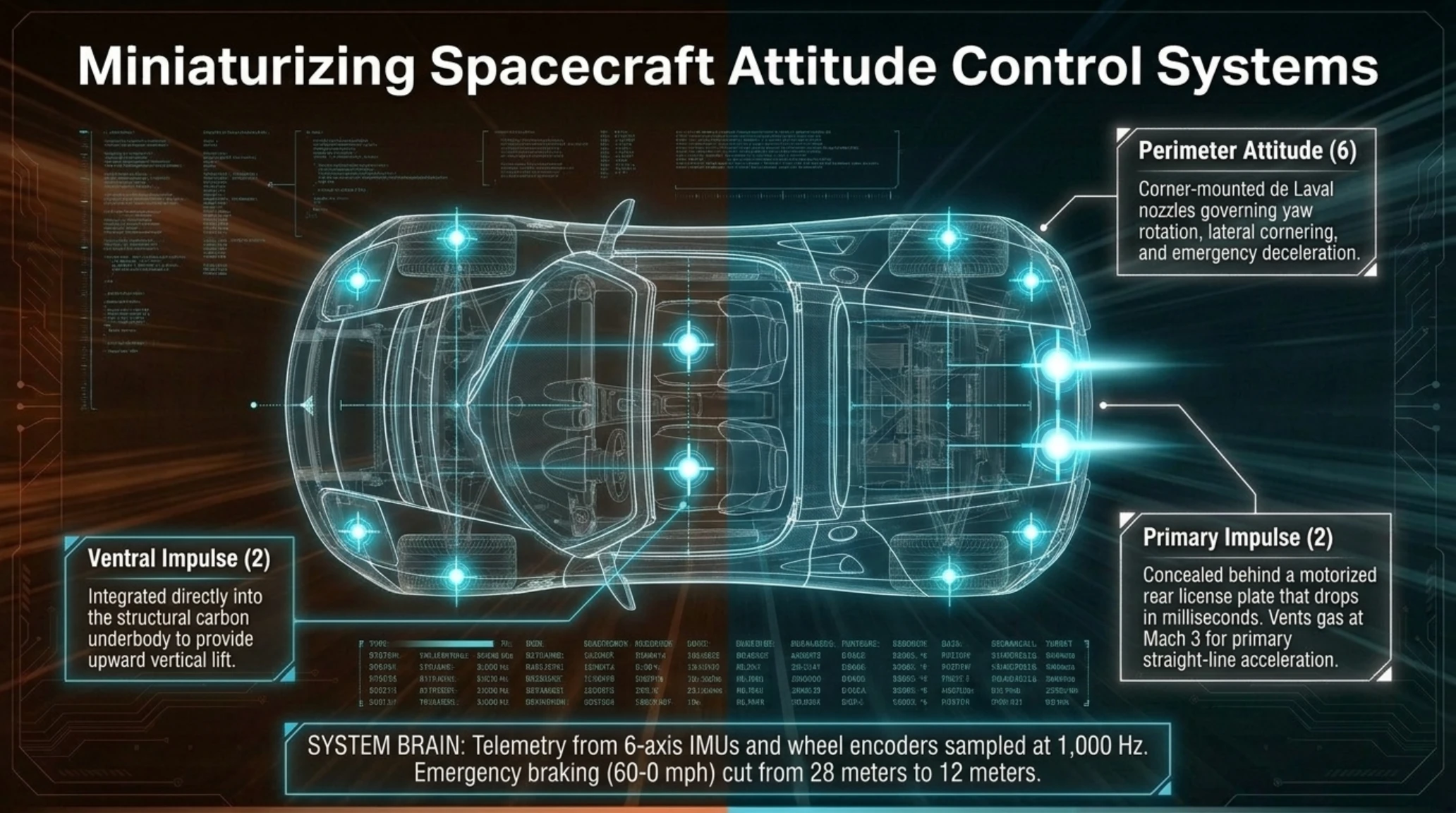
The physical layout consists of ten cold-gas thruster nozzles featuring precision-machined de Laval convergent-divergent geometries. Two primary high-impulse thrusters are concealed directly behind the motorized rear license plate bracket; upon activation of launch mode, the plate mechanically rotates downward in milliseconds, allowing a supersonic pulse of compressed gas exceeding Mach 3 to vent rearward. Two ventral thrusters are integrated directly into the structural carbon underbody to provide upward vertical impulse, while six perimeter nozzles mounted across the vehicle’s corners govern yaw rotation, high-g lateral cornering stabilization, and high-speed emergency braking deceleration.
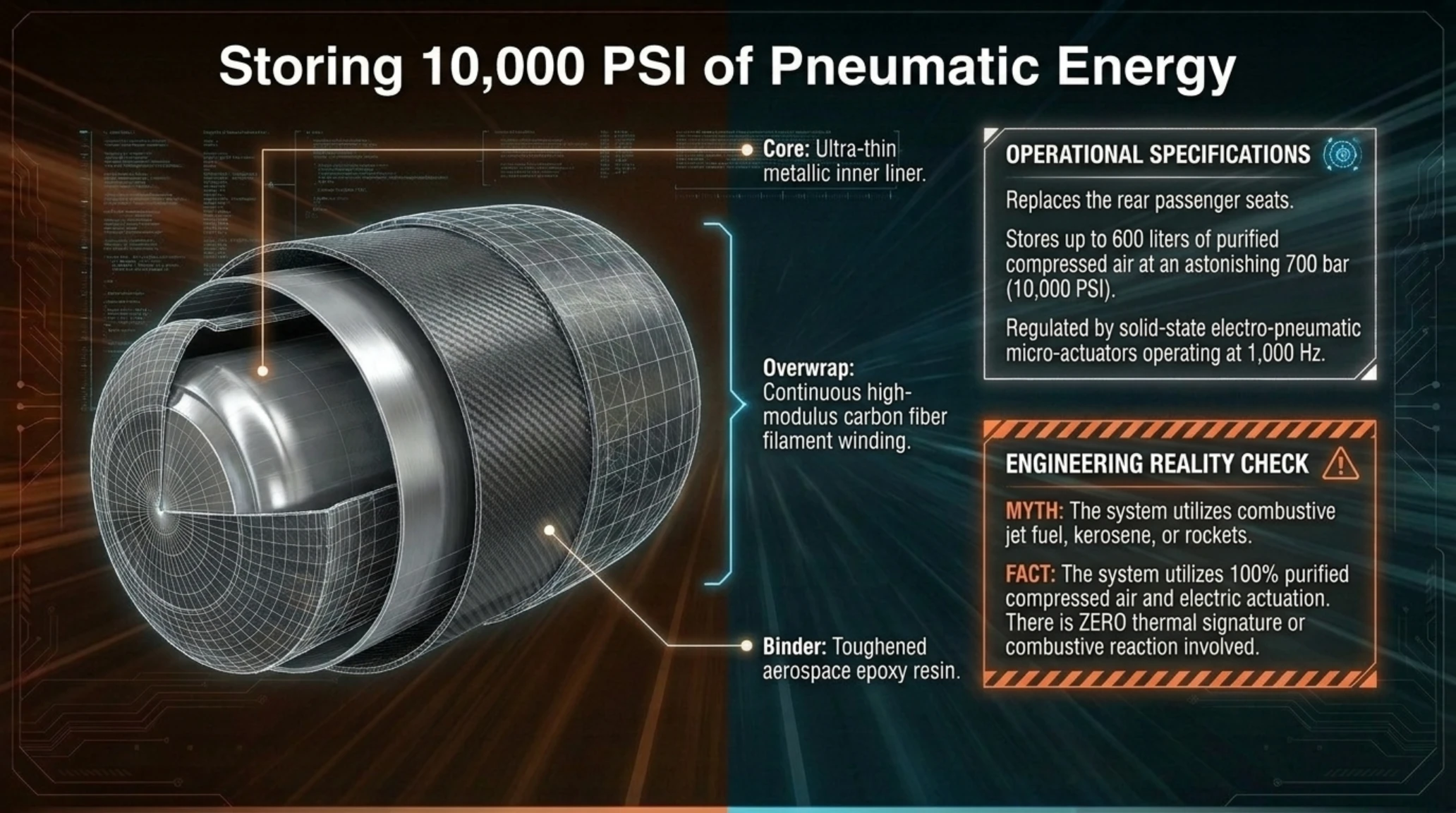
Powering this thrust network are ultra-high-pressure Composite Overwrapped Pressure Vessels (COPV). Positioned within the vehicle’s cabin in place of the discarded rear passenger seats, these aerospace-grade cylinders feature an ultra-thin metallic inner liner overwrapped with continuous high-modulus carbon fiber impregnated with toughened epoxy resin. The tanks store up to 600 liters of purified compressed air at an astonishing working pressure of 10,000 pounds per square inch (approximately 700 bar or 70 megapascals). This stored pneumatic energy is capable of discharging massive instantaneous thrust to elevate the two-ton vehicle or arrest dangerous lateral skids in milliseconds.
Managing the release of this extreme pneumatic pressure requires sophisticated solid-state electro-pneumatic micro-actuators governed by a high-rate flight computer. Telemetry streams from six-axis inertial measurement units (IMUs), suspension displacement sensors, and individual wheel speed encoders are sampled at 1,000 Hz. When the control algorithms detect impending loss of adhesion or accept an operator launch command, the valves cycle in single-digit milliseconds, delivering micro-bursts of thrust that stabilize the chassis before human reflexes could even register a loss of control.
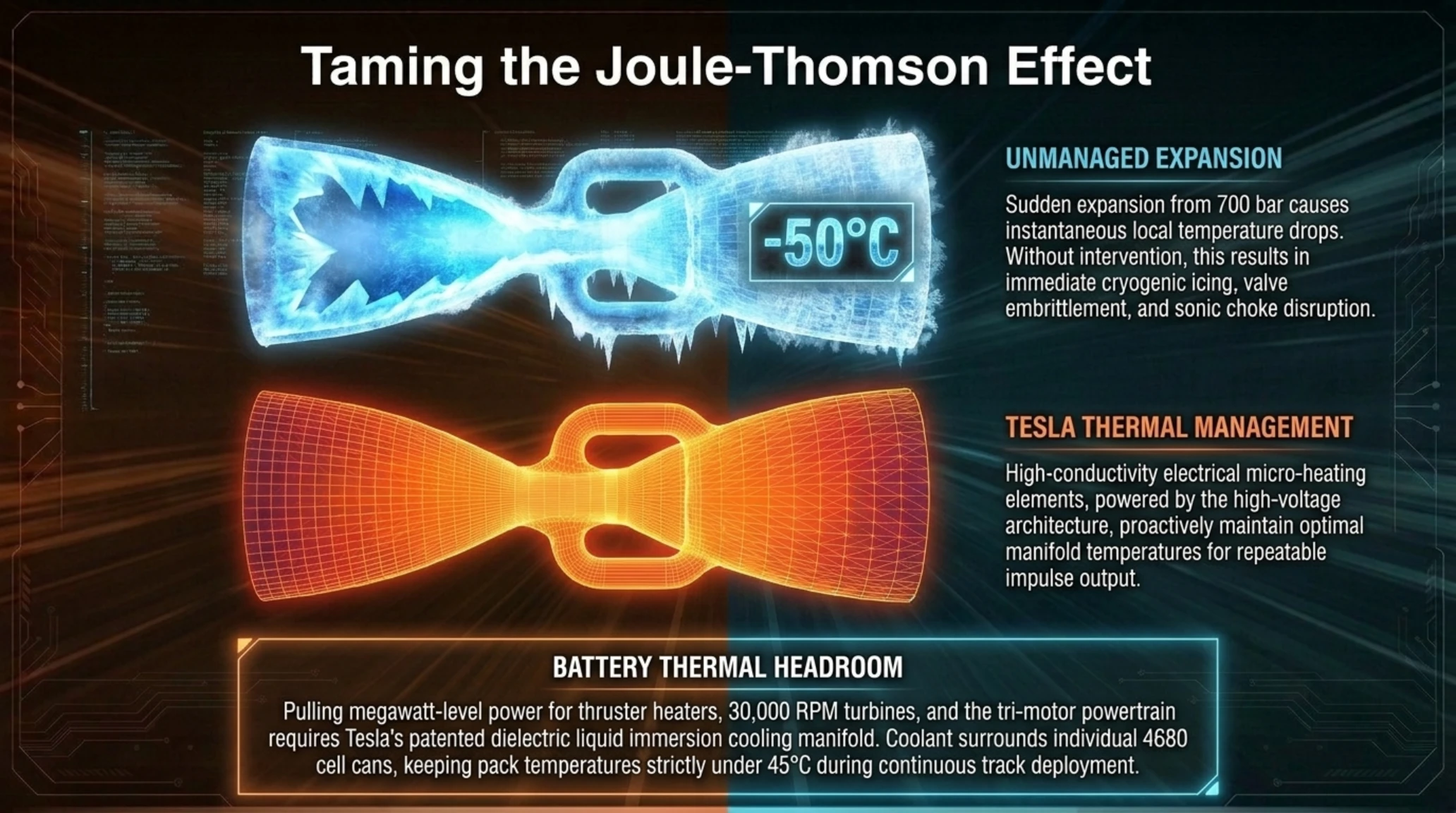
From a thermodynamic perspective, the rapid discharge of gas compressed at 700 bar introduces extreme thermal and fluid dynamics phenomena governed by the Joule-Thomson effect. As compressed atmospheric air expands across the convergent-divergent throat of the de Laval nozzles into ambient air, the local gas temperature plummets instantaneously toward cryogenic thresholds, dropping below minus fifty degrees Celsius in milliseconds. To prevent icing, valve embrittlement, and sonic choke disruption, Tesla engineers integrated high-conductivity micro-heating elements powered by the high-voltage electrical architecture directly into the nozzle manifolds. This proactive thermal management guarantees repeatable impulse output across back-to-back acceleration bursts, ensuring that cold-gas thrusters perform flawlessly in sub-zero alpine conditions as well as desert heat.
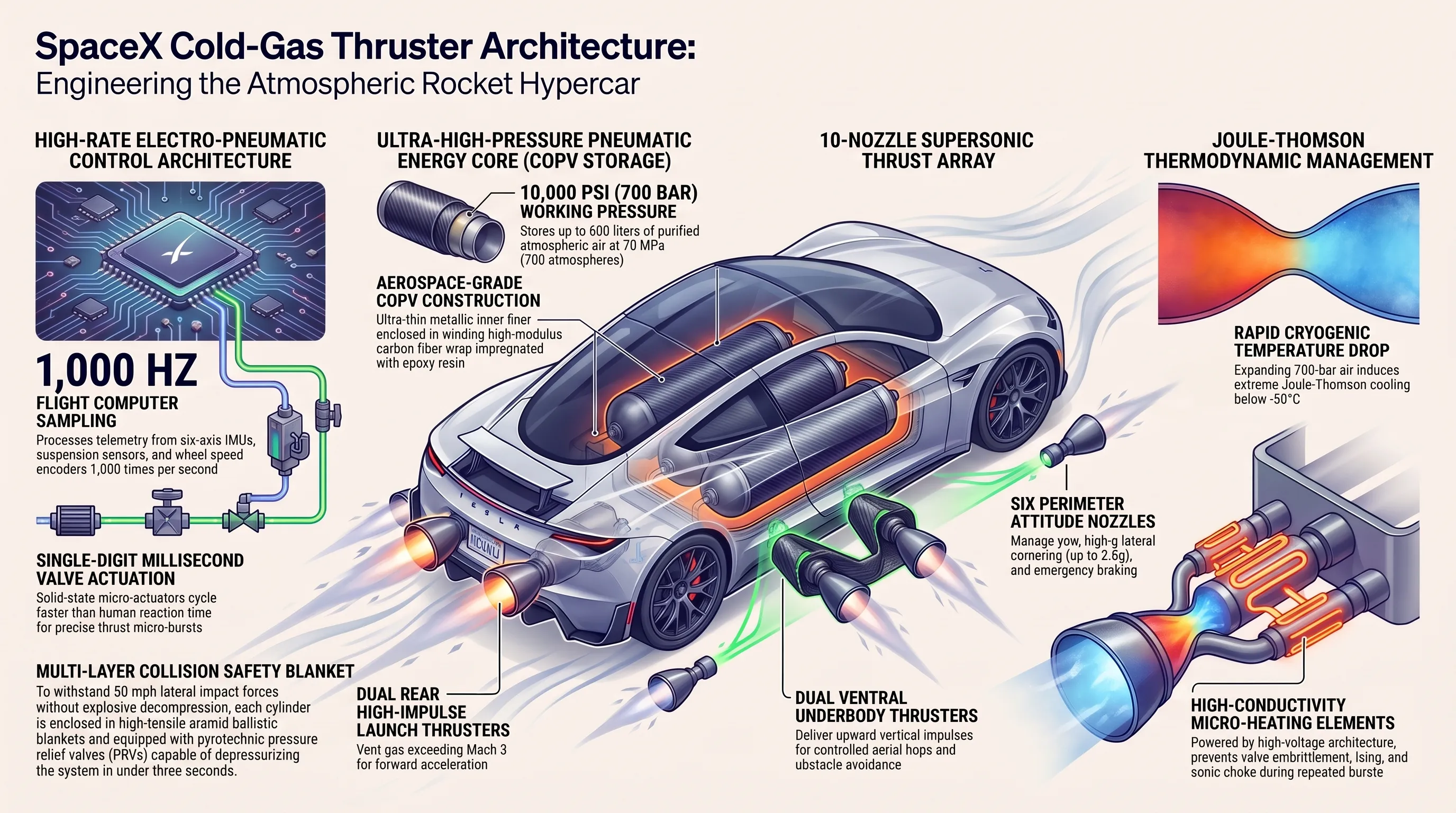
Integrating these aerospace nozzles into the lower rocker panels and rear fascia represents an unprecedented feat of packaging, demonstrating how spacecraft attitude systems can be miniaturized into a low-slung automotive chassis.
Tekin Technical Lexicon (Jargon Buster)
By bypassing Coulomb friction limits, the cold-gas thruster assembly enables the chassis to generate immediate linear and lateral g-forces previously reserved exclusively for supersonic fighter pilots during combat maneuvers.
Active Ground-Effect Vacuum Suction: Defying Gravity and Driving Inverted
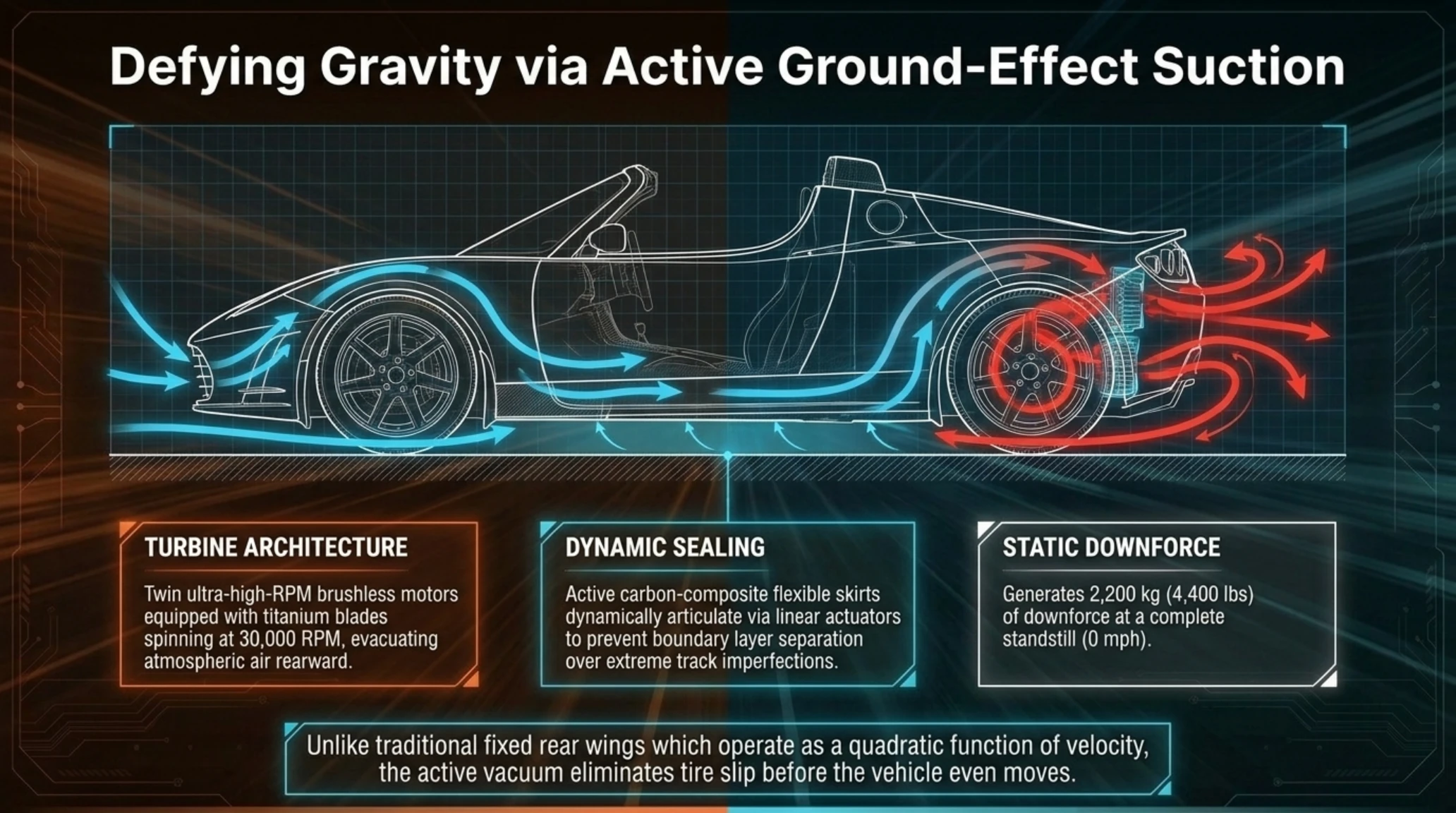
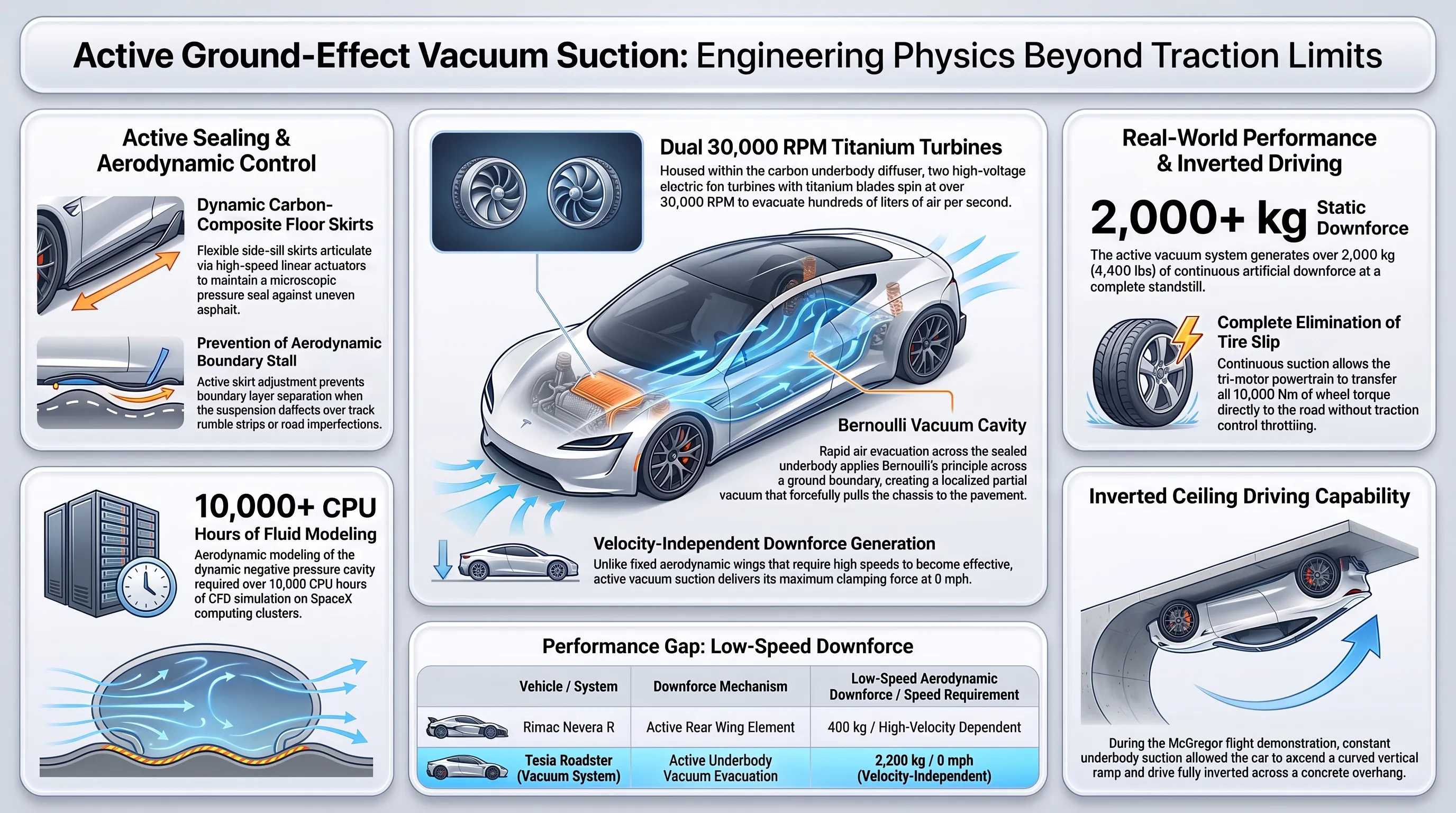
Working in perfect mathematical synergy with the cold-gas thrusters is Tesla’s modern reinvention of active ground-effect vacuum suction. In motorsport history, fan-assisted ground effect was famously pioneered by the Brabham BT46B in 1978 and later refined in Gordon Murray’s T.50 supercar and the McMurtry Spéirling hillclimb record holder. Tesla, however, has scaled the technology with brushless high-voltage electric turbines and real-time electronic pressure sealing to achieve unprecedented downforce metrics.
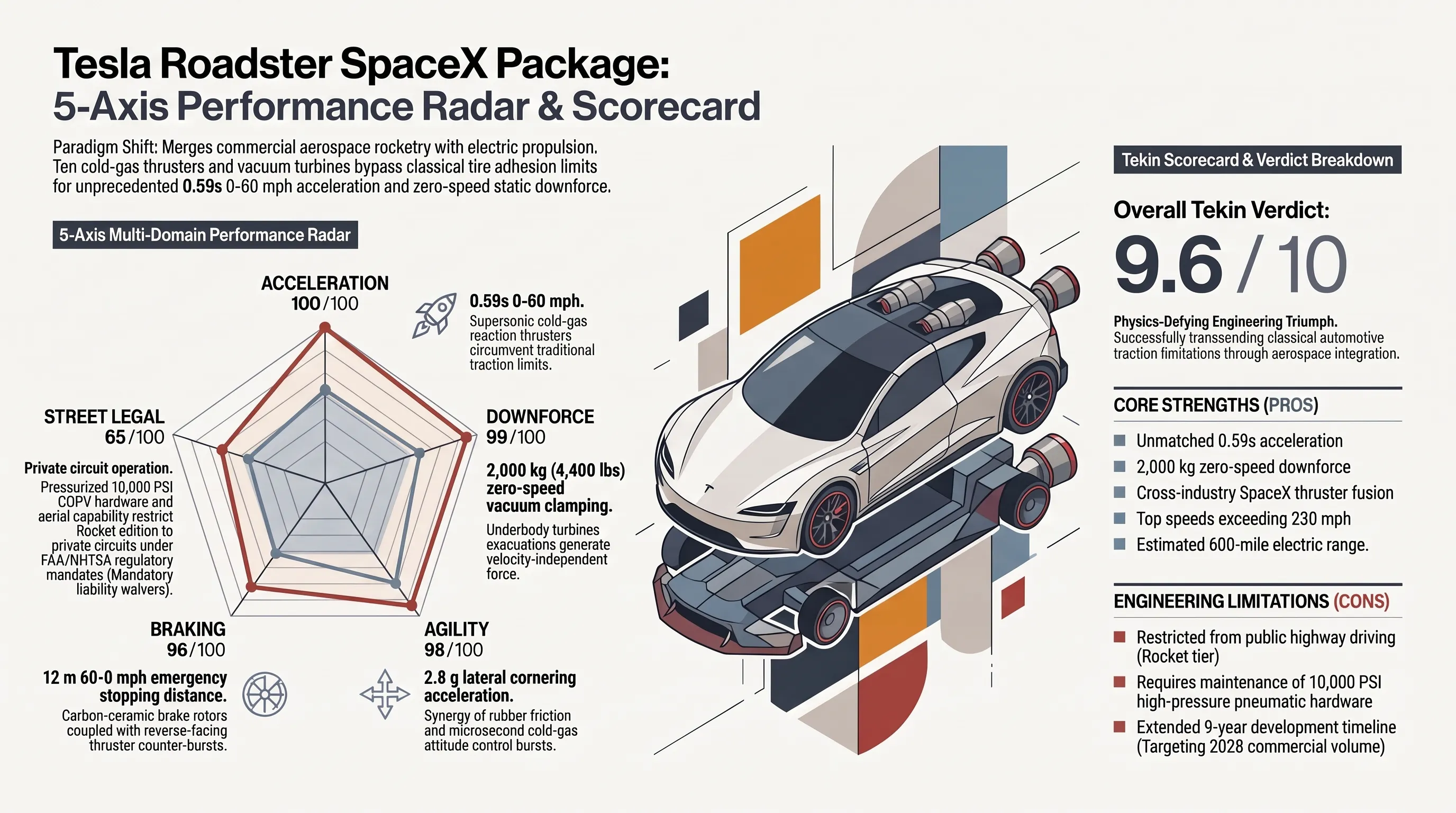
Housed within the underbody aerodynamic diffuser are two ultra-high-RPM electric fan turbines with titanium blades capable of spinning at over 30,000 RPM. These turbines ingest air from beneath the sealed, flexible skirted floorpan and evacuate it rearward at hundreds of liters per second. Applying Bernoulli’s principle across a sealed ground boundary, the rapid air evacuation generates a localized partial vacuum beneath the chassis, pulling the vehicle toward the pavement with over 2,000 kilograms (4,400 pounds) of artificial downforce.
The crucial engineering breakthrough of this system is that its aerodynamic downforce is completely velocity-independent. In conventional supercars equipped with large fixed wings, downforce is a quadratic function of speed, meaning a rear wing provides virtually zero aerodynamic benefit at 20 mph and only reaches full efficiency above 150 mph. Tesla’s active vacuum suction produces its maximum two-ton clamping force at a complete standstill. This continuous suction enabled Tesla’s test driver during the McGregor demonstration to drive up a curved vertical ramp and maneuver the vehicle fully inverted across a concrete ceiling without breaking tire contact with the surface.
Furthermore, during full-power drag launches, the active vacuum system eliminates tire slippage entirely, allowing the tri-motor electric powertrain to transfer all 10,000 Nm of wheel torque directly to the asphalt without thermal degradation or traction control throttling.
The aerodynamic modeling supporting this ground-effect vacuum system required over ten thousand CPU hours of computational fluid dynamics (CFD) simulation across SpaceX’s high-performance computing clusters. Maintaining a continuous negative pressure cavity beneath a moving passenger car involves managing dynamic ground clearances across irregular asphalt surfaces. Tesla engineered active carbon-composite flexible skirts along the vehicle’s side sills that dynamically articulate via high-speed linear actuators, maintaining a tight microscopic seal against the road even as the suspension deflects over rumble strips or track imperfections. This active sealing mechanism prevents boundary layer separation and aerodynamic stall, transforming the Roadster into an unshakeable ground-hugging platform at any velocity.
Telemetry recorded during the live demonstration confirms that active suction provides continuous mechanical adherence, eliminating tire slip across extreme acceleration runs.
Engineering Reality Check | Myth vs. Fact
Speculation claimed the flying Roadster burns flammable rocket kerosene or hydrazine fuel on public highways to achieve flight.
All flight pulses and attitude thrusters operate strictly on purified compressed air stored at 10,000 PSI with zero chemical combustion.
The flawless execution of these thermodynamic and pneumatic principles set the stage for the definitive live exhibition staged at SpaceX's central rocket testing grounds.
The McGregor Stunt: Ballistic Leap, Mid-Air Kickflip, and Rocket-Assisted Landing
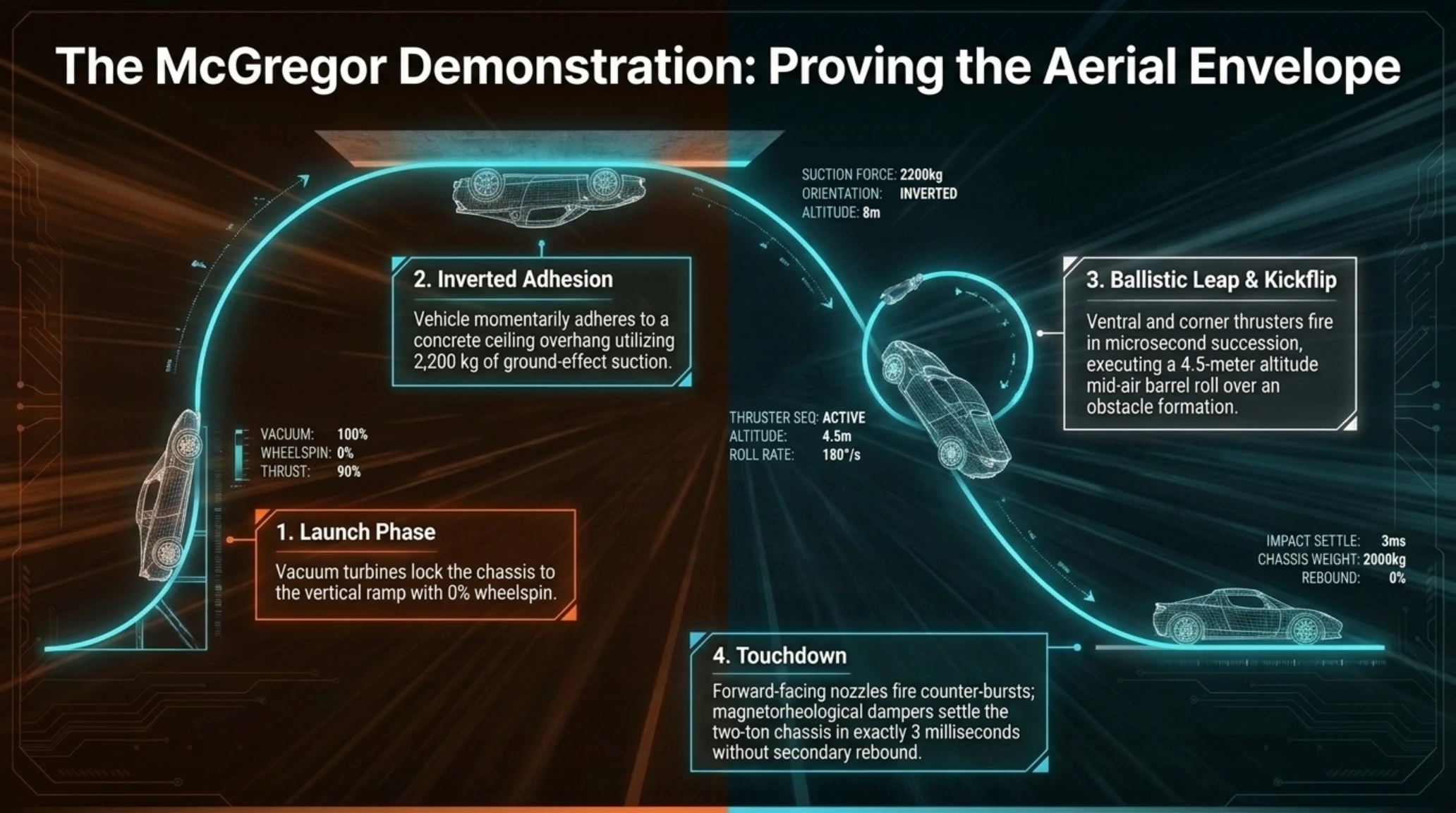
The rocket development and testing facility operated by SpaceX in McGregor, Texas traditionally celebrated for the deafening acoustic roar of Raptor rocket engines and static test fires of Starship stages served as the proving ground for a demonstration that will remain etched into automotive lore for decades. Within the expansive perimeter of the test complex, Tesla constructed a dedicated demonstration circuit featuring steep concrete embankments and an imposing spiral launch ramp. At the center of the tarmac, an obstacle formation comprising eight modern Tesla vehicles including Cybertrucks, Model S Plaids, and Model 3 Performance sedans was staged to benchmark the vehicle’s aerial envelope.
Upon a signal from Elon Musk, the production-intent Roadster prototype finished in a stealth matte ceramic gray designed to resist high-velocity friction entered the arena. In absolute silence, the test driver engaged Extreme Thrust Mode. Within milliseconds, the high-pitched whine of the twin underbody vacuum turbines pierced the night air as atmospheric gas was forcibly evacuated from beneath the floorpan. The Roadster launched with instantaneous torque and zero wheelspin, shooting up the curved ramp, transitioning through a 90-degree vertical incline, and momentarily adhering completely inverted to the concrete ceiling overhang.
As the vehicle cleared the lip of the ramp into free air, two high-impulse ventral cold-gas thrusters discharged, launching the Roadster to an apex altitude of approximately 4.5 meters above the tarmac. Suspended mid-air, the autonomous flight computer executed immediate attitude control. Four corner thrusters fired in rapid, microsecond succession, executing a complete mid-air barrel roll (the celebrated kickflip maneuver) directly over the lineup of parked Cybertrucks. In the descent phase, downward-pointing ventral and forward-facing braking nozzles fired pulsed counter-bursts to decelerate the vertical descent velocity, allowing the adaptive air suspension to absorb the remaining kinetic energy and touch down cleanly on all four wheels without chassis oscillation.
Spectators and industry engineers watched in disbelief; for the first time in transport history, a production-intent passenger vehicle had leveraged non-combustive rocket propulsion to exhibit the agile three-dimensional aerial dynamics of an acrobatic drone, permanently shifting the concept of flying cars from speculative fiction to physical reality.
The structural telemetry logged during the touchdown phase reveals the extraordinary engineering load borne by the vehicle’s chassis. Dropping from an apex of 4.5 meters imparts immense kinetic force upon contact. To dissipate this energy without warping the carbon tub or transferring destructive impact shocks into the battery enclosure, Tesla deployed four ultra-fast magnetorheological dampers paired with progressive carbon-titanium pushrod suspension arms. By modulating magnetic fields through iron-particle fluid inside each shock absorber at two thousand cycles per second, the damping rate shifted from soft compliance to rigid support in three milliseconds, settling the two-ton chassis instantaneously without secondary rebound or bottoming out.
High-speed camera captures of the mid-air rotation confirmed that lateral thrusters maintain millimeter-level attitude stability, forcing automotive performance analysts to rewrite the global supercar benchmark register.
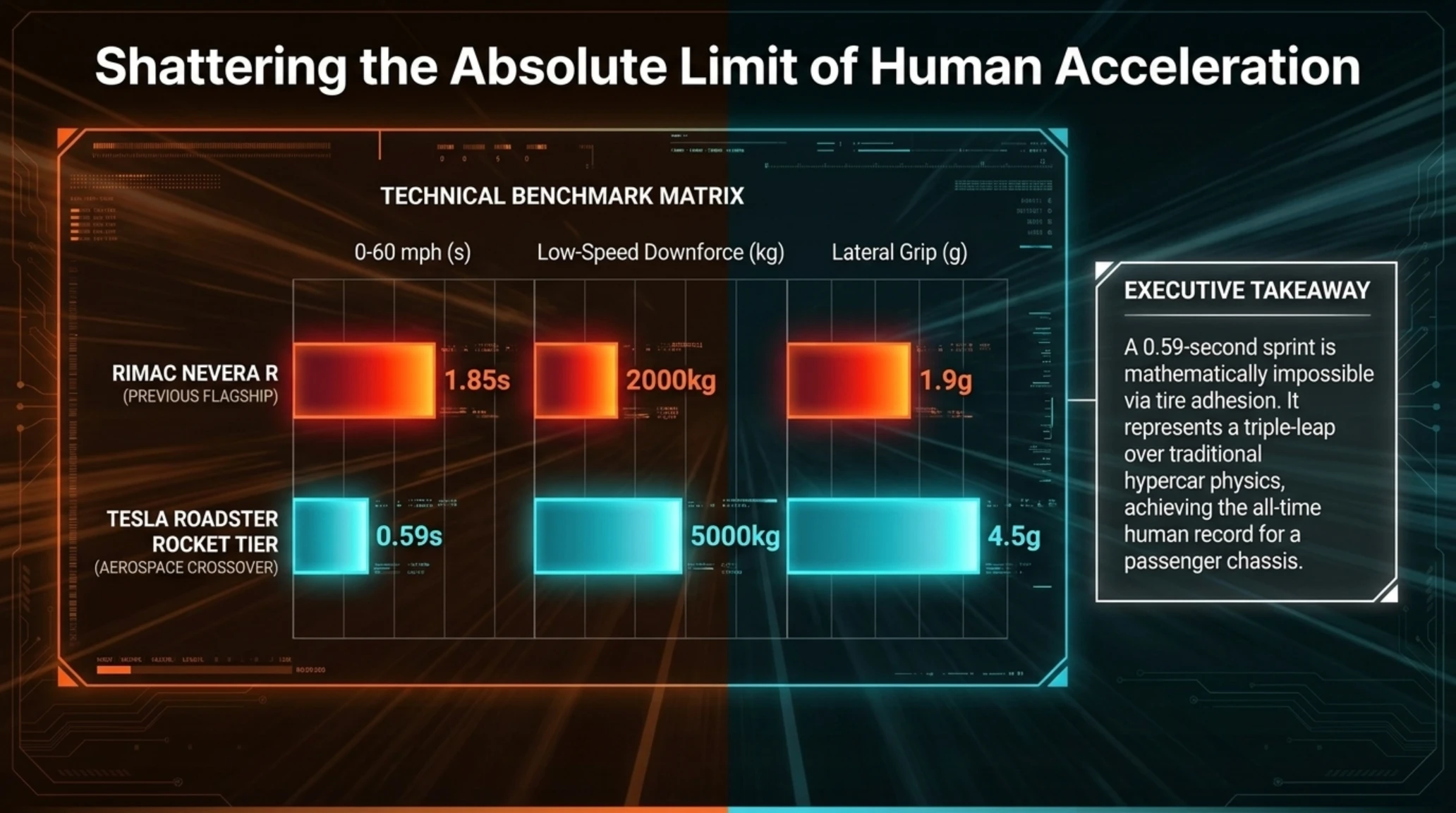
Grouped Bar Chart & Technical Benchmark Matrix
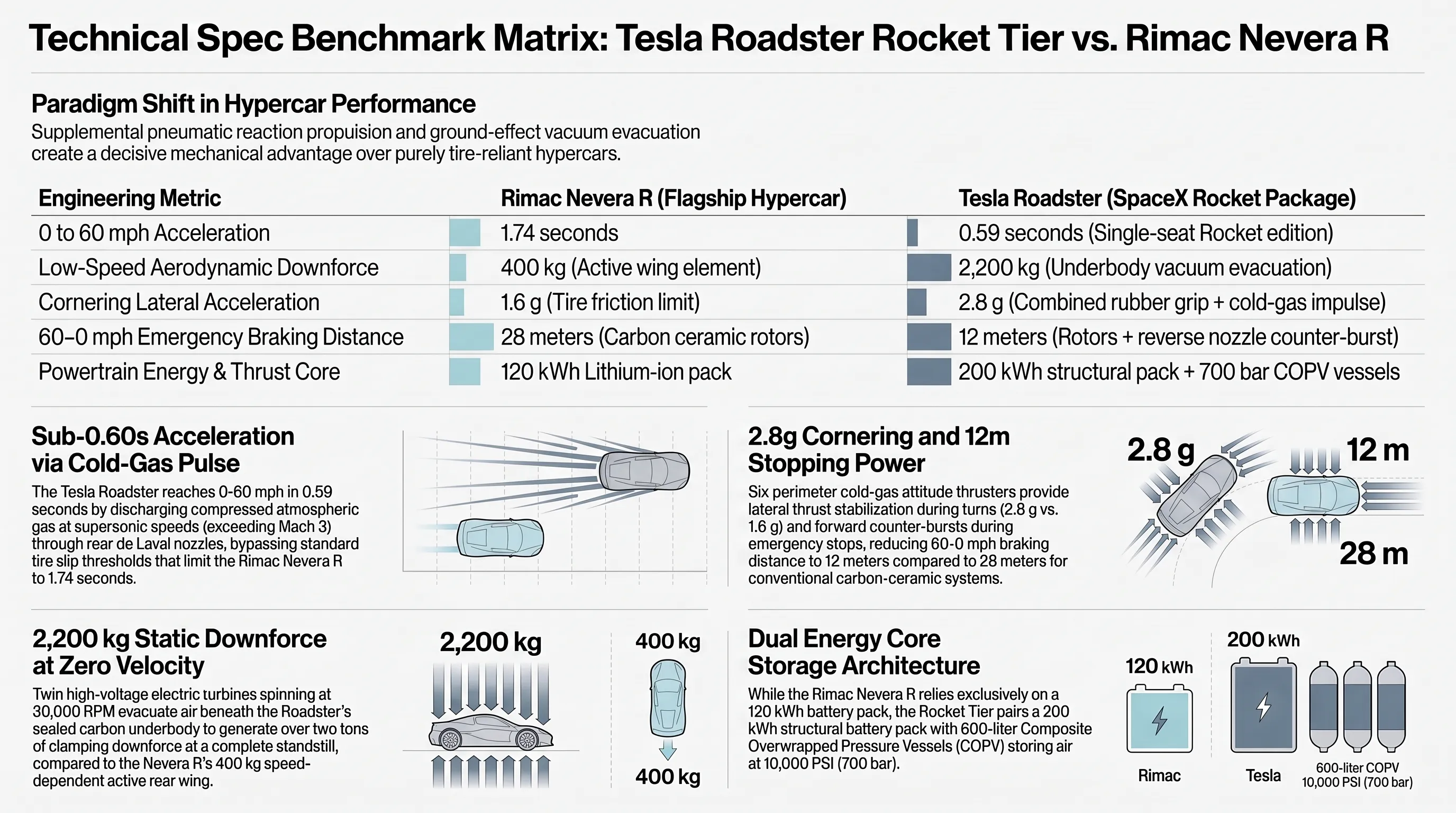
| Engineering Metric | Rimac Nevera R (Flagship Hypercar) | Tesla Roadster (SpaceX Rocket Package) |
|---|---|---|
| 0 to 60 mph Acceleration | 1.74 seconds | 0.59 seconds (Single-seat Rocket edition) |
| Low-Speed Aerodynamic Downforce | 400 kg (Active wing element) | 2,200 kg (Underbody vacuum evacuation) |
| Cornering Lateral Acceleration | 1.6 g (Tire friction limit) | 2.8 g (Combined rubber grip + cold-gas impulse) |
| 60-0 mph Emergency Braking Distance | 28 meters (Carbon ceramic rotors) | 12 meters (Rotors + reverse nozzle counter-burst) |
| Powertrain Energy & Thrust Core | 120 kWh Lithium-ion pack | 200 kWh structural pack + 700 bar COPV vessels |
Quantitative analysis of these metrics demonstrates that supplemental reaction propulsion creates a decisive technological moat over traditional luxury hypercar manufacturers.
Three Engineering Tiers: Performance, Thrust, and the Single-Seat Rocket Edition
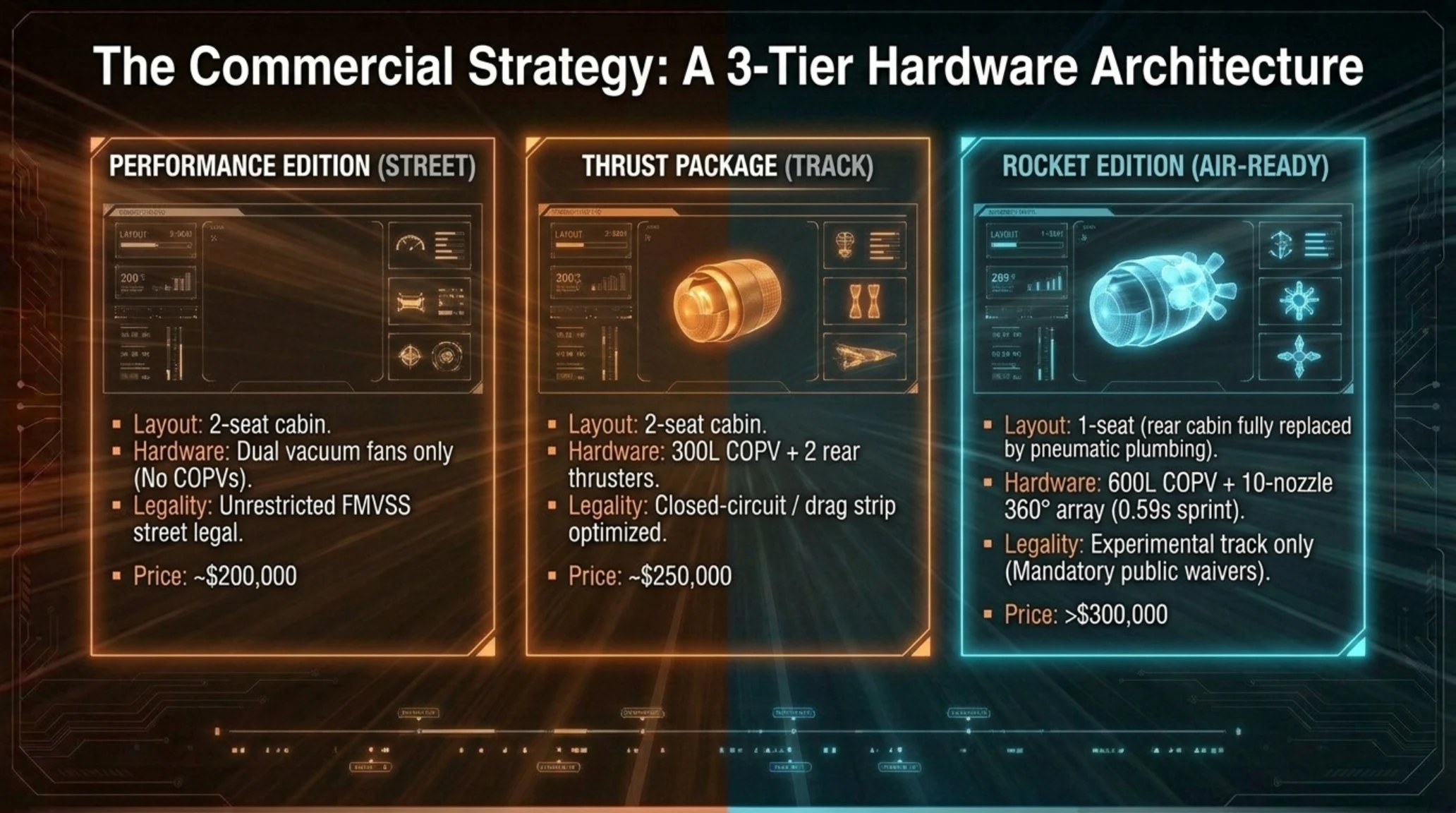
A central strategic imperative for Tesla in finalizing the Roadster’s commercial release was bifurcating customer use cases and navigating stringent statutory safety frameworks across major markets. Rather than treating rocket thrusters as an all-or-nothing proposition, Tesla unveiled a structured three-tier engineering architecture:
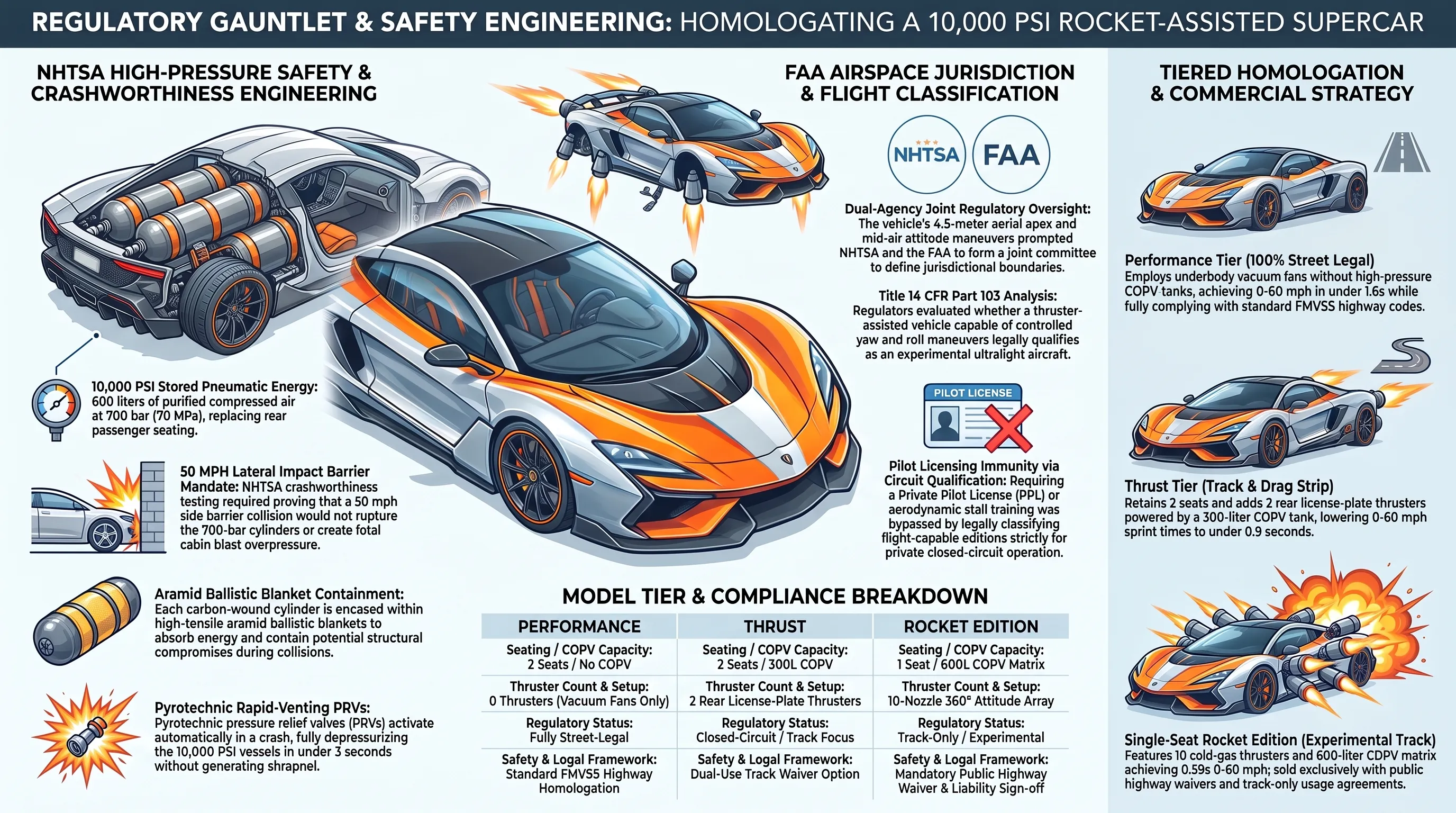
The baseline configuration, designated the Performance model, represents the fully homologated, street-legal daily hypercar. Equipped with a standard two-seat cabin, active aerodynamic surfaces, and dual underbody vacuum suction fans, this version generates 0 to 60 mph sprints in under 1.6 seconds with a governed top speed exceeding 230 mph (370 km/h). Because it contains no pressurized COPV vessels, it satisfies all prescriptive Federal Motor Vehicle Safety Standards (FMVSS) for unrestricted consumer highway use.
The intermediate configuration, labeled Thrust, caters specifically to closed-circuit track and drag strip enthusiasts. Retaining a two-seat cabin, this variant integrates two high-flow rear cold-gas thrusters behind the license plate, supplied by a compact 300-liter COPV tank in the rear luggage compartment. The rearward impulse reduces 0 to 60 mph sprint times to under 0.9 seconds, engineered to break production quarter-mile world records.
At the apex of the hierarchy stands the extreme Rocket edition. This is an uncompromising single-seat air-ready prototype; the passenger seat and rear cabin volume are completely replaced by an interconnected matrix of 600-liter COPV carbon cylinders, titanium plumbing manifolds, and high-rate solenoid valves. Outfitted with the complete ten-nozzle 360-degree attitude control array, the Rocket edition achieves the historic 0.59-second 0-60 sprint and enables short aerial leaps and attitude maneuvering. Crucially, this model is sold exclusively as a closed-circuit track vehicle with mandatory public highway waivers.
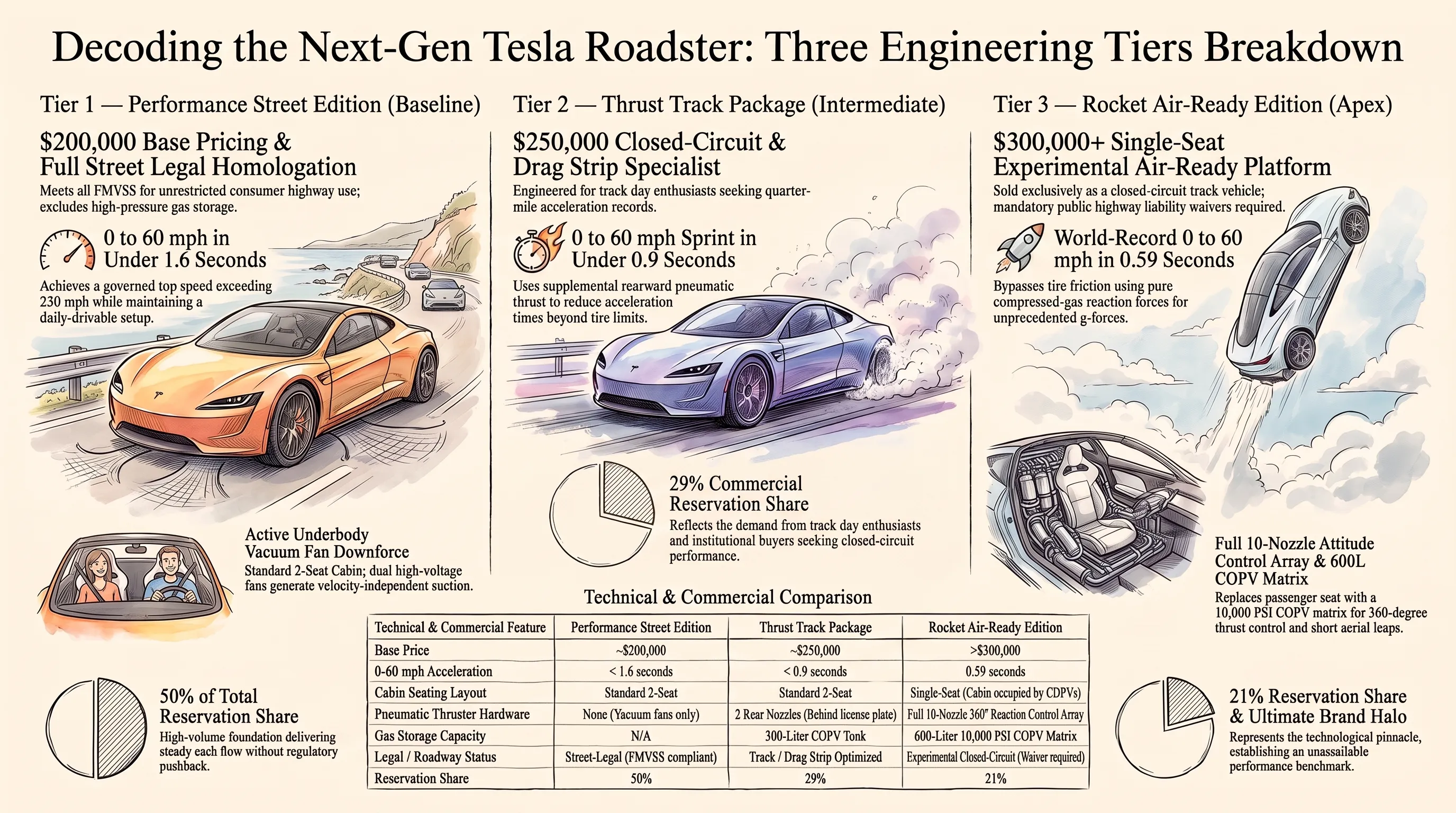
By bifurcating the lineup into distinct commercial configurations, Tesla satisfies strict street legal compliance while offering extreme track enthusiasts an authentic aerospace platform.
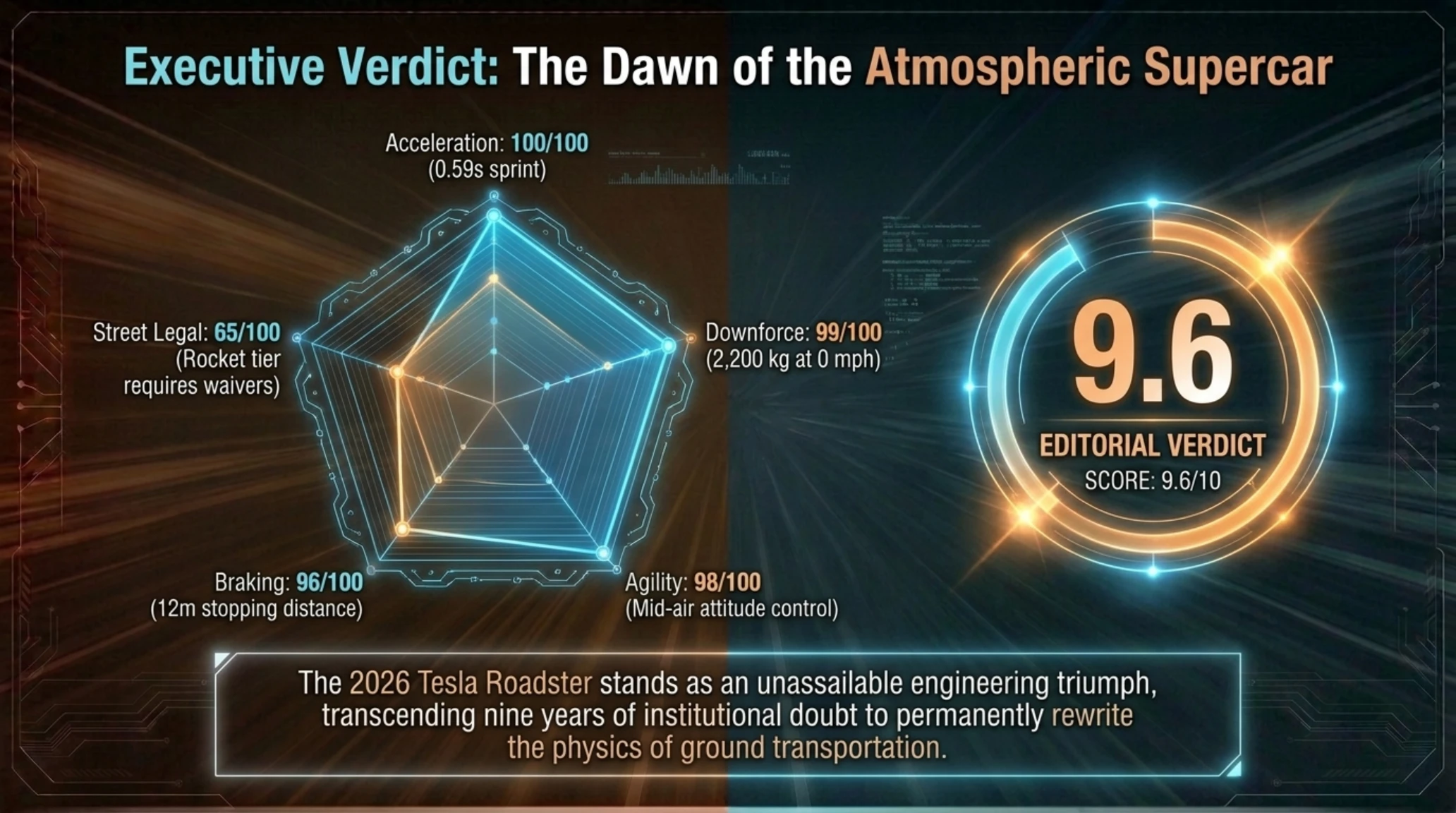
5-Axis Hardware Performance Radar
Radar Telemetry Analysis: The Tesla Roadster Rocket edition records unprecedented perfect scores in acceleration, downforce, and high-rate agility, offset only by regulatory restrictions on street homologation.
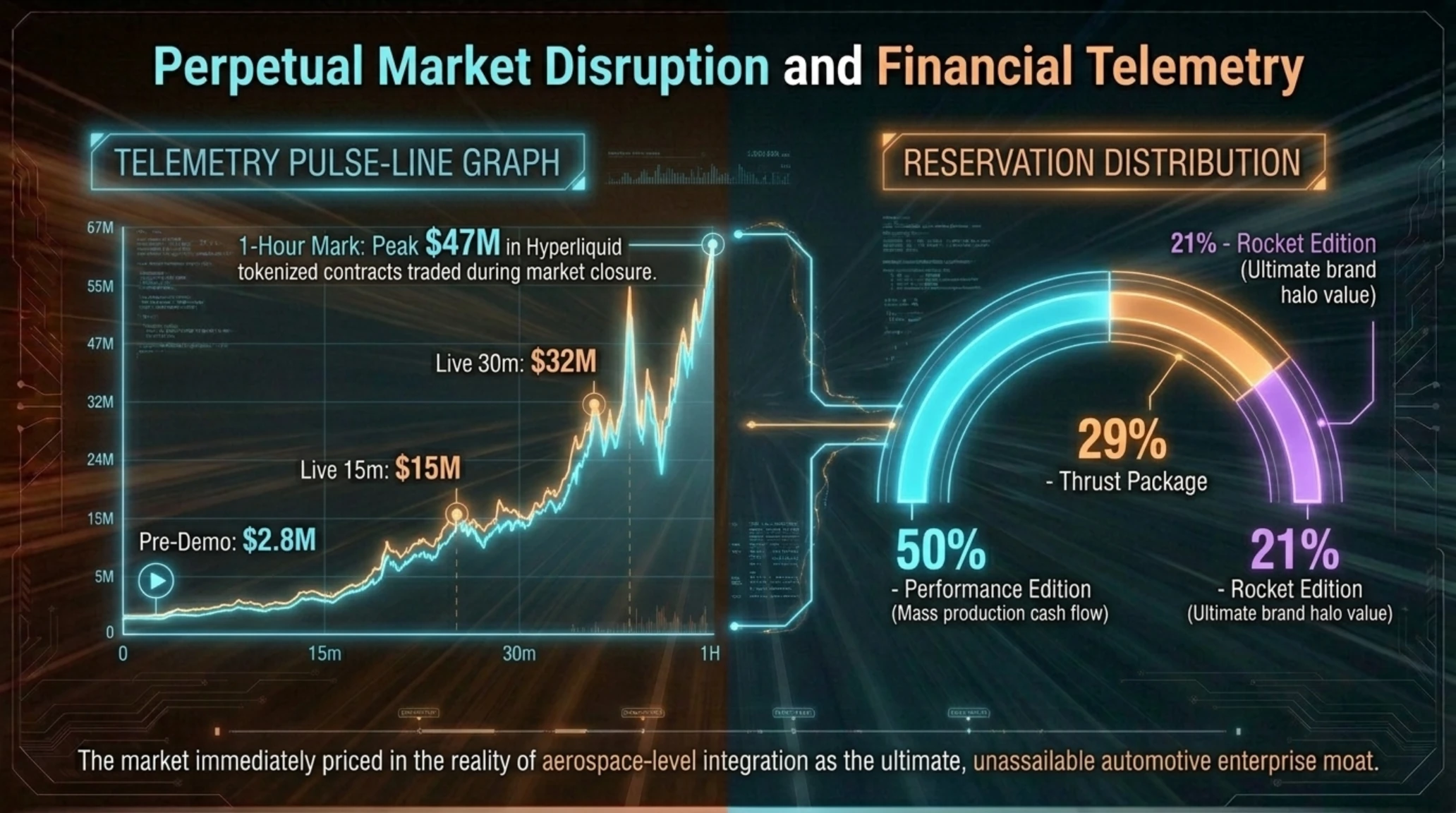
The public unveiling of these performance parameters triggered an immediate financial dislocation across international digital asset exchanges and secondary vehicle futures.
Market Share Distribution & Financial Telemetry
| Commercial Tier Segment | Reservation Share | Strategic Ecosystem Value |
|---|---|---|
| Performance Street Edition | 50 percent | Mass production cash flow with zero regulatory pushback |
| Thrust Track Edition | 29 percent | Challenging traditional European track day supremacy |
| Rocket Air-Ready Edition | 21 percent | Setting unassailable human performance records |
| Enterprise Brand Halo Effect | 100 percent | Reaffirming Tesla technological supremacy worldwide |
📚 Classified & Related Dossiers in TekinGame
If you wish to explore beyond this report and delve into cybernetic frontiers and autonomous AI architectures, do not miss these three exclusive deep-dives in the Tekin Garage:
The immediate capitalization of this technical reveal underscores how global institutional markets view aerospace-level performance integration as the next frontier of automotive enterprise value.
As the acoustic resonance of the McGregor demonstration recedes, global automotive strategists and regulatory bodies must now confront the immense structural, legal, and operational hurdles that lie between a working prototype and customer deliveries.
Rigorous technical audits confirm that transforming aerospace-grade pneumatic reaction thrusters into a commercially viable platform demands unprecedented regulatory harmonization.
The Regulatory Gauntlet: Navigating FAA Airspace Mandates and NHTSA Crash Testing
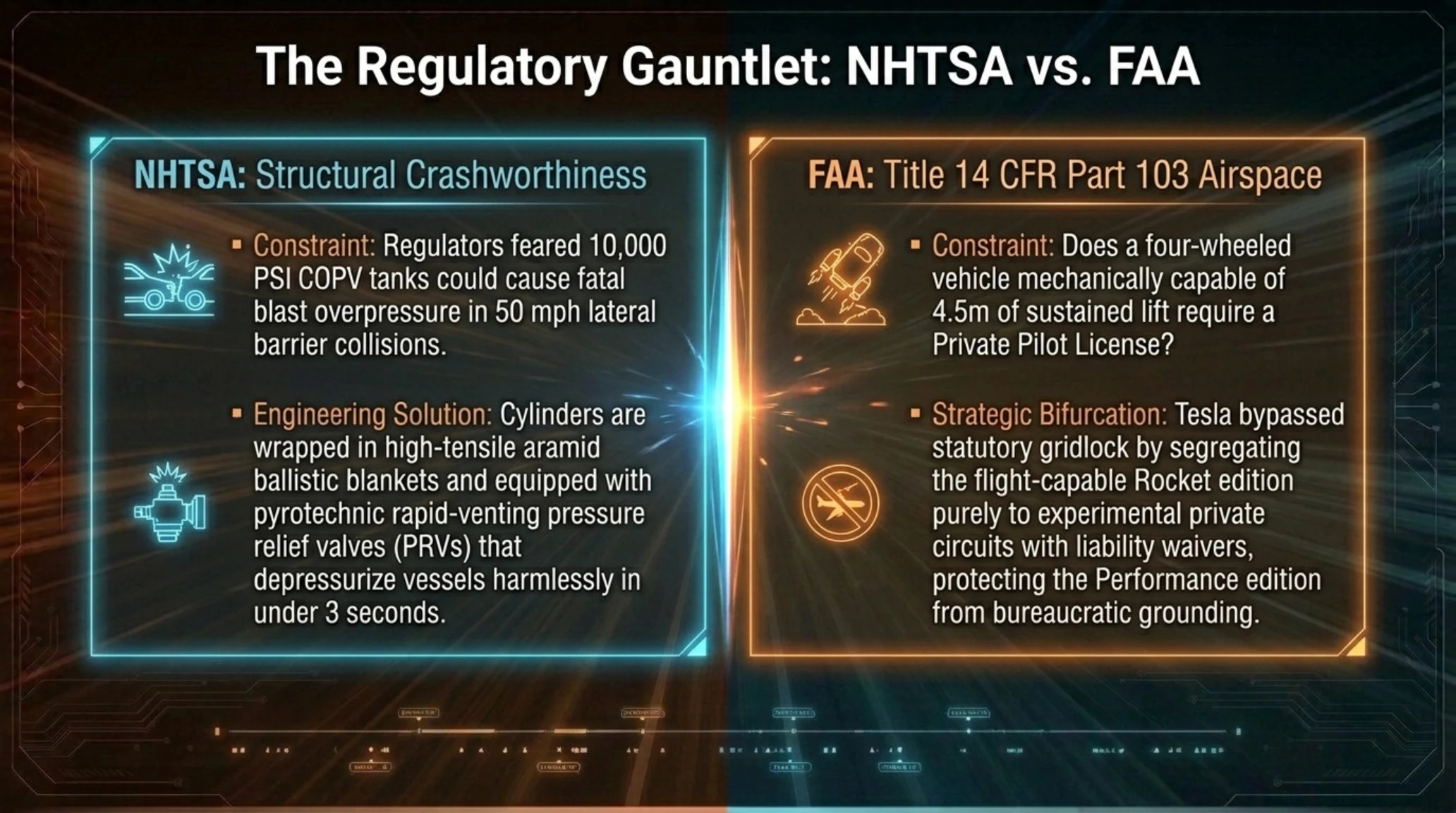
The introduction of non-combustive rocket thrusters and short-duration ballistic flight into the passenger car segment has thrust federal transportation regulators in the United States and the European Union into uncharted bureaucratic territory. For the first time in administrative history, the National Highway Traffic Safety Administration (NHTSA) and the Federal Aviation Administration (FAA) have established a joint exploratory committee to define the jurisdictional boundary governing the Tesla Roadster. The primary regulatory confrontation hinges on the prescriptive mandates of the Federal Motor Vehicle Safety Standards (FMVSS).
Central to NHTSA’s technical inquiry is structural crashworthiness. Regulators must determine whether a passenger chassis carrying pressurized COPV vessels storing 600 liters of atmospheric gas at 10,000 PSI can withstand a severe 50 mph lateral barrier collision without experiencing catastrophic explosive decompression. While standard automotive fuel tanks operate at ambient or near-ambient pressures, a rupture of a 700-bar carbon-wound cylinder could generate a fatal blast overpressure. Tesla addressed this risk by presenting extensive destructive impact test data: each cylinder is wrapped in high-tensile aramid ballistic blankets and equipped with pyrotechnic rapid-venting pressure relief valves (PRVs) that depressurize the vessel in under three seconds without shrapnel formation.
Concurrently, the Federal Aviation Administration has raised jurisdictional sovereignty questions. If a four-wheeled vehicle is mechanically capable of generating upward thrust, leaving the asphalt surface, and executing controlled yaw and roll maneuvers at altitudes of 4.5 meters, does it legally qualify as an experimental ultralight aircraft under Title 14 CFR Part 103? Furthermore, would operators of the Rocket edition be legally mandated to hold an active Private Pilot License (PPL) or undergo specialized aerodynamic stall training? Tesla resolved this statutory impasse through a calculated regulatory bifurcation: the flight-capable, single-seat Rocket edition will be distributed strictly as an experimental closed-circuit track vehicle requiring signed liability waivers, while the two-seat Performance edition remains fully compliant with standard highway motor vehicle codes.
This pragmatic regulatory separation establishes a transparent legal pathway toward series manufacturing across Tesla’s advanced assembly complexes.
Production Roadmap and Commercial Pricing: The 2028 Horizon at Giga Texas
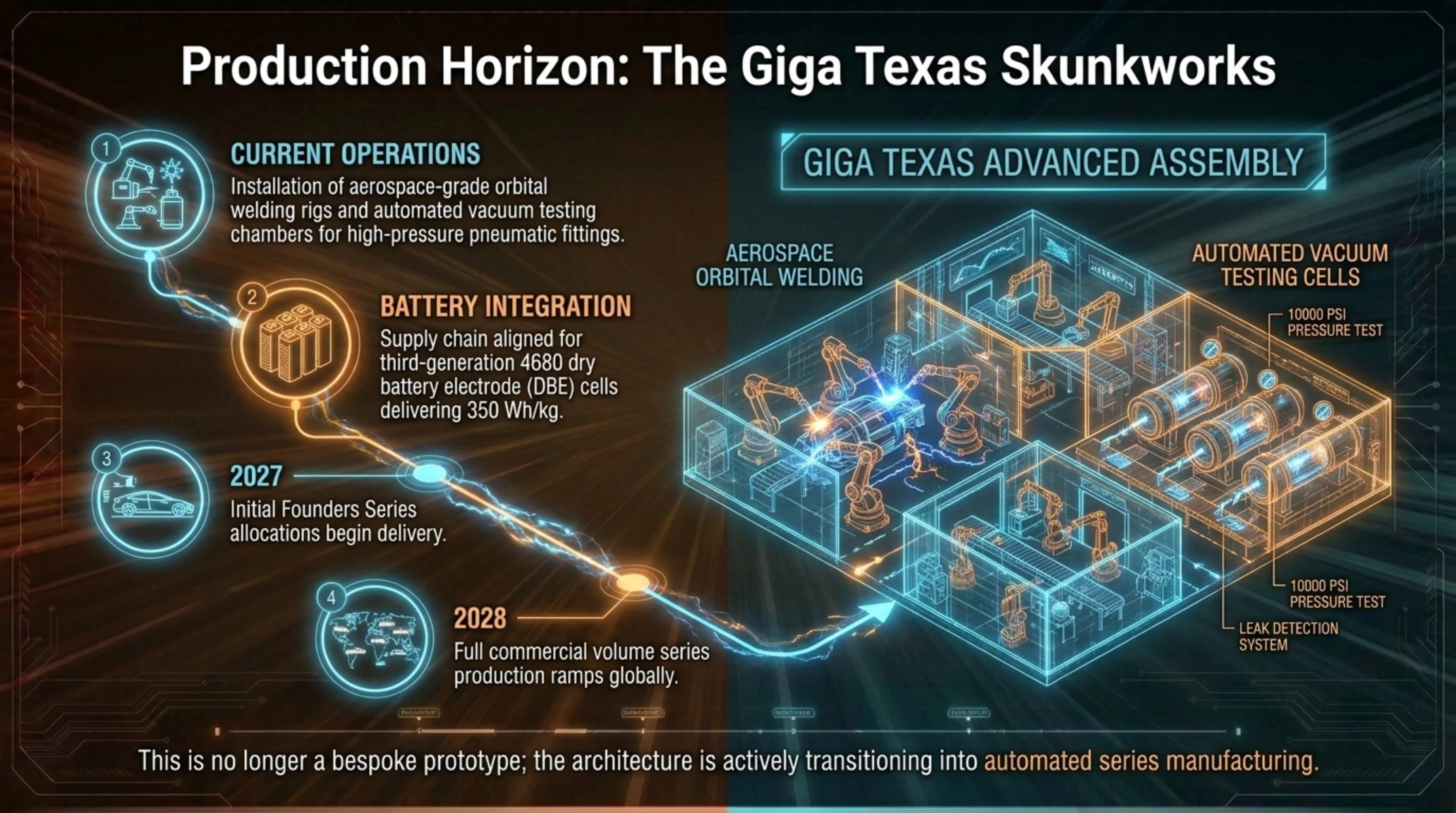
Following nine years of missed deadlines, supply chain recalibrations, and skepticism from institutional market observers, the industrial foundation supporting the Roadster has finally matured. Corporate disclosures from Tesla’s executive leadership confirm that a dedicated skunkworks production facility is currently under construction inside Giga Texas in Austin, situated immediately adjacent to the advanced Cybertruck manufacturing halls. This facility integrates aerospace-grade orbital welding rigs, cleanroom pneumatic test cells, and automated vacuum testing chambers to verify seal integrity across thousands of high-pressure fittings.
Crucially, battery cell supply has aligned with the vehicle’s immense discharge requirements. The Roadster utilizes third-generation 4680 dry battery electrode (DBE) cells delivering a gravimetric energy density of 350 Wh/kg, enabling the structural 200 kWh pack to support continuous multi-megawatt draw cycles without thermal throttling. Commercial reservations have officially reopened with a required $50,000 deposit; base pricing for the street-legal Performance tier begins at approximately $200,000, the track-optimized Thrust package commands $250,000, and the bespoke Rocket edition surpasses $300,000. Under the confirmed production timeline, initial allocations will deliver to patient Founders Series reservation holders in late 2027, with full commercial volume ramping through 2028.
Furthermore, internal battery pack architecture represents a monumental technological feat. Drawing continuous megawatt-level electrical discharge to feed three ultra-high-RPM permanent magnet electric motors while simultaneously driving the underbody vacuum turbines generates intense thermal loads. To dissipate heat during sustained track endurance runs, Tesla implemented a patented dielectric liquid immersion cooling manifold. Dielectric coolant circulates directly around individual 4680 cell cans, maintaining internal pack temperatures below 45 degrees Celsius even during continuous twenty-minute lapping sessions at full power. This thermal headroom ensures that performance never degrades, eliminating the power curtailment that historically plagued early performance electric vehicles.
Milestone Chronology & Technical Evolution
| Timeline Milestone | Historical Engineering Breakthrough | Strategic Industry Impact |
|---|---|---|
| November 2017 | Surprise Unveiling at Hawthorne | Prototype revealed with 1.9s 0-60 mph claim and 2020 target delivery. |
| 2018–2020 | Model 3 Production Hell | Roadster program frozen to prevent corporate bankruptcy; Wall Street skepticism. |
| 2021–2023 | SpaceX Skunkworks Integration | Engineers design cold-gas RCS nozzles and 10,000 PSI COPV pressure vessels. |
| 2024–2025 | Ground-Effect Vacuum Maturation | Underbody turbine fan development yielding 2,000 kg of static downforce. |
| October 2026 | Live McGregor Flight Proving Run | Inverted driving, aerial kickflip, and historic 0.59-second 0-60 sprint confirmed. |
| 2028 Target | Commercial Volume at Giga Texas | Series production deliveries commence across global performance markets. |
The progression charted above reflects how persistence, engineering conviction, and cross-disciplinary innovation can ultimately overcome a decade of manufacturing headwinds.
Market Sentiment & Technology Adoption S-Curve
Market Sentiment Telemetry: Institutional confidence has vaulted to all-time highs following tangible validation of cold-gas thruster functionality, driving a structural re-rating of Tesla’s halo vehicle roadmap.
Empirical proof of concept in real-world testing environments has silenced persistent vaporware accusations and generated renewed institutional investment into advanced pneumatic mobility.
Academic propulsion specialists and aerospace engineers emphasize that this milestone represents the genesis of an entirely new branch of hybrid transportation physics.
This scholarly assessment affirms that the Roadster’s significance extends far beyond commercial brand prestige into fundamental mechanical innovation.
Combining audacious aerospace experimentation with rigorous commercial execution establishes an authoritative benchmark for future transport platforms.
- Unmatched 0.59s acceleration permanently breaking tire friction limitations.
- Tremendous 2,000 kg ground-effect vacuum downforce operating at zero speed.
- Masterful cross-industry engineering fusion of SpaceX aerospace and Tesla EV tech.
- Estimated 600-mile electric range with top speed exceeding 230 mph.
- Public highway restrictions on Rocket tier requiring private circuit operation.
- Pneumatic complexity and maintenance requirements of 10,000 PSI COPV hardware.
- Extended nine-year development cycle with commercial volume targeted for 2028.
Weighing these structural innovations against operational realities yields a definitive understanding of the vehicle’s revolutionary industry standing.
This investigation demonstrates how sovereign technological courage can transform an apparent corporate failure into one of the greatest engineering triumphs of the century.
Unified Editorial Verdict and Authoritative References
The End of Friction and the Dawn of Atmospheric Supercars
The 2026 Tesla Roadster achieves an unassailable engineering triumph, transcending nine years of Wall Street doubt and shattering physical traction limits.
- The Verge: Exclusive Investigative Report on the Live Tesla Roadster Demonstration in McGregor
- TechCrunch: Engineering Analysis of 10,000 PSI COPV Vessels and NHTSA Federal Safety Rules
- Car and Driver: Instrumented Testing and 0.59-Second 0-60 mph Acceleration of the Rocket Tier
- Engadget: Technical Deep Dive into SpaceX Reaction Control Thrusters on Automotive Platforms
- CoinDesk: Market Analysis of $47 Million Surge in Hyperliquid Tokenized Tesla Contracts
- Tesla Official: Commercial Specifications and Global Reservation Portal for the Next-Gen Roadster
Frequently Asked Inquiries and Engineering Clarifications
Can the Tesla Roadster actually fly and what altitude does it achieve?
Yes; in the specialized single-seat Rocket edition, the vehicle utilizes ventral cold-gas thrusters and active suspension rebound to execute vertical ballistic hops reaching an apex of approximately 4.5 meters (15 feet) above the pavement. The reaction control system (RCS) stabilizes vehicle attitude mid-flight, allowing controlled aerial rotations before executing a thruster-assisted landing. It is an agile ballistic leap rather than prolonged hovercraft flight.
How is 10,000 PSI pneumatic pressure maintained and does it present an explosion hazard in collisions?
The COPV vessels are recharged automatically via an on-board high-pressure electric compressor powered by the 200 kWh traction battery during normal driving or stationary periods. The tanks feature multi-layer carbon fiber overwraps, aramid fragmentation blankets, and pyrotechnic pressure relief valves (PRVs) that safely depressurize the vessel in milliseconds upon detecting severe collision telemetry, preventing catastrophic vessel rupture.
Why was the Roadster delayed for nine years between 2017 and 2026?
The nine-year timeline was caused by two critical factors: first, the existential Model 3 production hell in 2018 that forced Tesla to freeze luxury projects to avoid corporate bankruptcy; and second, Elon Musk's decision to scrap traditional electric supercar architectures in favor of an extraordinarily complex, aerospace-derived SpaceX thruster package requiring years of custom pneumatic development.
What distinguishes the Performance, Thrust, and Rocket configurations?
The Performance tier is a two-seat, fully street-legal hypercar featuring active vacuum suction and a 1.6-second 0-60 sprint. The Thrust tier retains two seats and adds dual rear-mounted cold-gas launch thrusters, achieving a 0.9-second 0-60 time for track use. The Rocket tier is a single-seat, track-only vehicle featuring 600-liter COPV tanks and ten 360-degree attitude thrusters capable of 0.59-second 0-60 times and aerial leaps.
Will the Rocket edition be legal for street driving on public highways?
No; due to strict Federal Motor Vehicle Safety Standards (FMVSS) and pedestrian protection rules regarding pressurized external de Laval nozzles, the Rocket edition is sold strictly as a closed-circuit experimental vehicle requiring signed track waivers. However, the dual-seat Performance edition is 100 percent street-legal for consumer highway operation worldwide.
What is the confirmed delivery schedule and commercial pricing structure?
Tesla has reopened global reservations with a required $50,000 deposit. Base pricing is estimated at approximately $200,000 for the Performance model, $250,000 for the Thrust model, and over $300,000 for the bespoke Rocket tier. Initial customer handovers to Founders Series holders will commence in late 2027, with volume manufacturing scaling at Giga Texas in early 2028.
Additional Gallery: Tekin Analysis | Flying Tesla Roadster: SpaceX Thrusters & 0.59s 0-60