Tekin Analysis: Farewell to Moss - Why VR Pioneer Polyarc Collapsed in the Metaverse Winter
Dive into today's top gaming news and exclusive breakdowns.
- 🎮Heartbreaking dissolution of 11-year VR pioneer Polyarc despite creating industry-defining masterpieces Moss and Moss: Book II
- 🎧Exhaustive autopsy of independent spatial game economics, evaporating platform subsidies, and soaring studio burn rates in Seattle
- 🚀The live-service matchmaking death spiral that sealed the fate of tactical multiplayer spin-off Glassbreakers
- 🗡️Venture capital flight and Silicon Valley's massive reallocation from spatial computing toward generative AI infrastructure
- 📰Physiological friction and vergence-accommodation conflict acting as the primary barrier to long-term user retention
- ⚔️The strategic paradigm shift and imminent transition from bulky VR headsets to lightweight AR wearables
In one of the most heartbreaking developments in modern digital entertainment, Seattle-based independent developer Polyarc the visionary creators behind the universally beloved Moss and Moss: Book II franchises has officially announced the permanent shutdown of its studio. Founded in 2015 by three veteran engineers and animators from Bungie, Polyarc proved to the entire world that virtual reality did not have to rely on chaotic first-person perspectives or adrenaline-fueled gunplay to deliver emotional resonance. Through the tiny, brave sword-wielding mouse named Quill, they constructed an enchanting miniature fairy tale that established the gold standard for spatial storytelling, tactile diorama navigation, and emotional bond between the human "Reader" and a digital character.
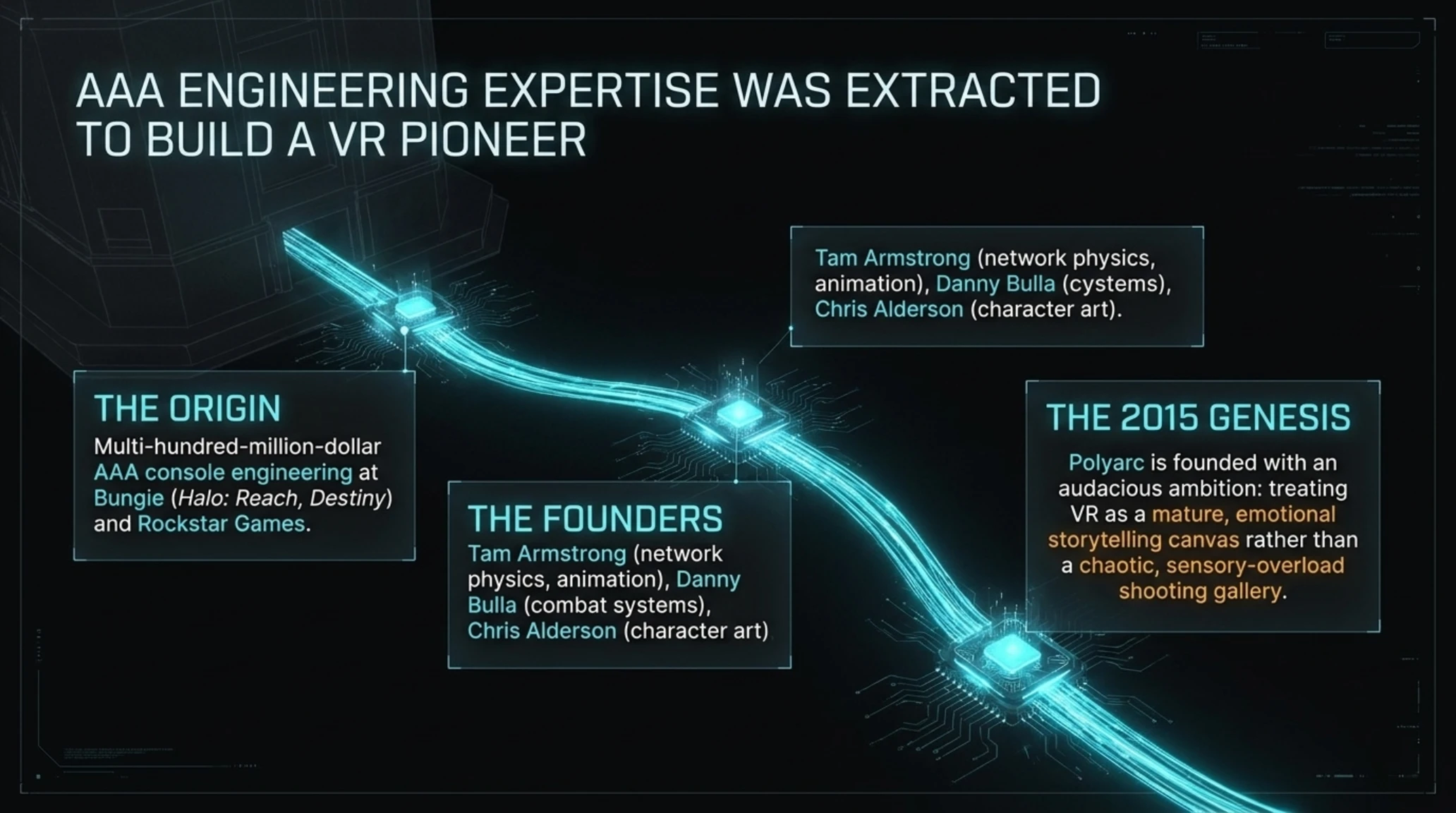
The founding pedigree of Polyarc was forged in the fires of high-end AAA console engineering. Tam Armstrong had served as a senior engineering lead on Bungie's era-defining titles, including Halo: Reach and Destiny, architecting intricate network physics, animation state machines, and real-time multiplayer systems. Danny Bulla brought decades of nuanced combat feel and systems design experience from Bungie and Rockstar Games, while Chris Alderson had spearheaded character art and world-building for the expansive sci-fi universe of Destiny. When these three world-class creators departed the comfortable embrace of multi-hundred-million-dollar AAA budgets in 2015, they carried an audacious ambition: to treat virtual reality not as a gimmicky technological novelty, but as a legitimate, artistically mature storytelling canvas capable of evoking the timeless wonder of classic fairy tales and tactile stop-motion cinema.
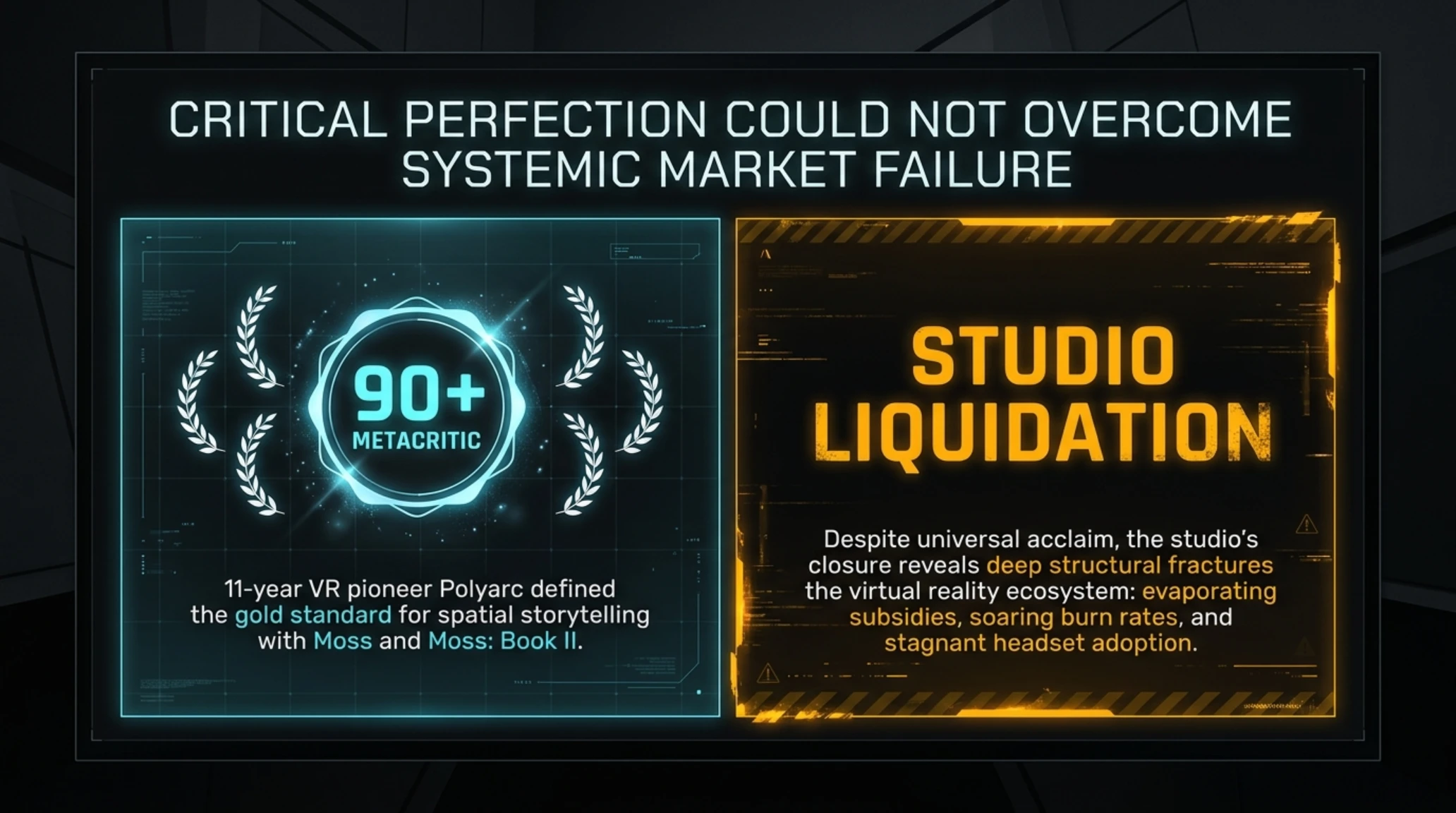
Yet, artistic triumph and critical accolades could not protect Polyarc from the harsh, unforgiving realities of an increasingly frozen virtual reality market. The studio’s closure marks the tragic culmination of a multi-year economic contraction across the immersive tech sector, characterized by drying platform subsidies, soaring development expenditures, stagnant headset adoption, and an ill-fated attempt to pivot toward competitive multiplayer live-service gaming with Glassbreakers: Champions of Moss. As the lights go dark in Polyarc's Seattle offices, the entire gaming ecosystem must confront an agonizing question: if a studio with world-class talent, legendary intellectual property, and multiple Game of the Year honors cannot survive in VR, can anyone?
Executive Summary: Autopsy of Polyarc and the VR Industry Winter
- Studio Dissolution: Polyarc, established in 2015 by former Bungie leads Tam Armstrong, Danny Bulla, and Chris Alderson, closes its doors after 11 years of pioneering spatial game development.
- Artistic Breakthrough vs Commercial Ceiling: Moss (2018) and Moss: Book II (2022) generated over $25 million in combined revenue, but platform fragmentation and modest install bases capped lifetime financial upside.
- The Platform Subsidy Evaporation: Meta and Sony drastically curtailed upfront minimum-guarantee checks and exclusivity funding, forcing independent teams to bear unsustainable balance sheet risks.
- The Live-Service Pitfall: Polyarc’s ambitious multiplayer spin-off, Glassbreakers: Champions of Moss, encountered the classic VR matchmaking death spiral due to inadequate concurrent active users (CCU).
- Hardware Ergonomics & Churn: Heavy headsets, optical friction, and vergence-accommodation discomfort continue to suppress daily active usage (DAU), leaving millions of headsets gathering dust.
- Capital Flight to Generative AI: Venture capital funds and enterprise tech giants redirected tens of billions of dollars from metaverse R&D toward foundation AI models, leaving spatial computing starved of bridge liquidity.
To fully grasp the magnitude of Polyarc’s downfall, one must examine the chronological trajectory of the studio alongside the broader macroeconomic cycles of the immersive technology landscape over the past decade.
Chronology of an Immersive Pioneer: The Rise and Fall of Polyarc (2015–2026)
| Year | Milestone Event | Technological & Narrative Significance |
|---|---|---|
| 2015 | Founding in Seattle | Bungie veterans depart AAA console development to incorporate Polyarc, raising $3.5M. |
| 2017 | Sony E3 Reveal of Moss | Quill takes the stage at PlayStation E3, captivating audiences with diorama aesthetics. |
| 2018 | Launch of Moss & Global Acclaim | Moss releases on PSVR and PCVR, selling over one million copies and winning awards. |
| 2020 | Series B Financing & Independence | Polyarc secures a $9M Series B funding round to expand intellectual property rights. |
| 2022 | Release of Moss: Book II | The sequel launches to stellar 90+ Metacritic scores, winning Best VR/AR Game. |
| 2023 | The Glassbreakers Gambit | Launch of a 1v1 tactical real-time battler to unlock recurring live-service revenue. |
| 2024 | Pivoting to PC & F2P Struggles | Game struggles to maintain CCU; Polyarc ports to PC Steam without VR requirements. |
| 2026 | Permanent Studio Closure | Exhausted of capital reserves, Polyarc officially ceases all operations. |
The tragedy of Polyarc is not merely an isolated bankruptcy; it reflects the brutal quantitative metrics governing the spatial computing landscape. Despite consumer perception of VR as an expanding frontier, the raw operational economics paint a sobering picture of financial insolvency for premium mid-sized developers.
Quantitative Vital Signs: The Crushing Realities of Spatial Game Economics
- $500,000 / Month: Average operational burn rate for a 40-person veteran game development team based in the high-cost metropolitan region of Seattle, Washington.
- 20M Units Installed: Total estimated global active base of Meta Quest headsets, compared to over 300 million combined active PlayStation 5, Xbox Series X/S, and Steam PC ecosystems.
- 15% 30-Day Retention: Industry-wide median percentage of VR headset purchasers who actively use their hardware at least once per week after the first month of ownership.
- $3,500 vs $0: The prohibitive barrier of entry for Apple Vision Pro spatial computing, which failed to generate a sustainable consumer gaming software market.
- Under 500 Peak CCU: The catastrophic matchmaking ceiling encountered by independent VR multiplayer titles attempting to sustain synchronous matchmaking queues.
- $100M+ Subsidies Lost: Aggregate reduction in platform-funded publishing grants and advance-royalty contracts across Meta Reality Labs and Sony Interactive Entertainment since 2023.
The stark disparity between critical adoration and operational solvency reveals the deep structural fractures at the heart of the virtual reality ecosystem.

From its inception, Polyarc was built upon a radical philosophical premise: that virtual reality should not be an engine of sensory overload or dizzying kinetic speed, but rather a quiet, intimate conduit for authentic human empathy and delicate tactile companionship.
However, translating profound emotional resonance into a self-sustaining commercial business requires an underlying market with sufficient transactional velocity, recurring software attachment rates, and stable platform capital. When those foundational pillars began to erode simultaneously, even the most revered storytellers found themselves standing on quicksand.
The Diorama Breakthrough: How Moss Revolutionized Spatial Perspective
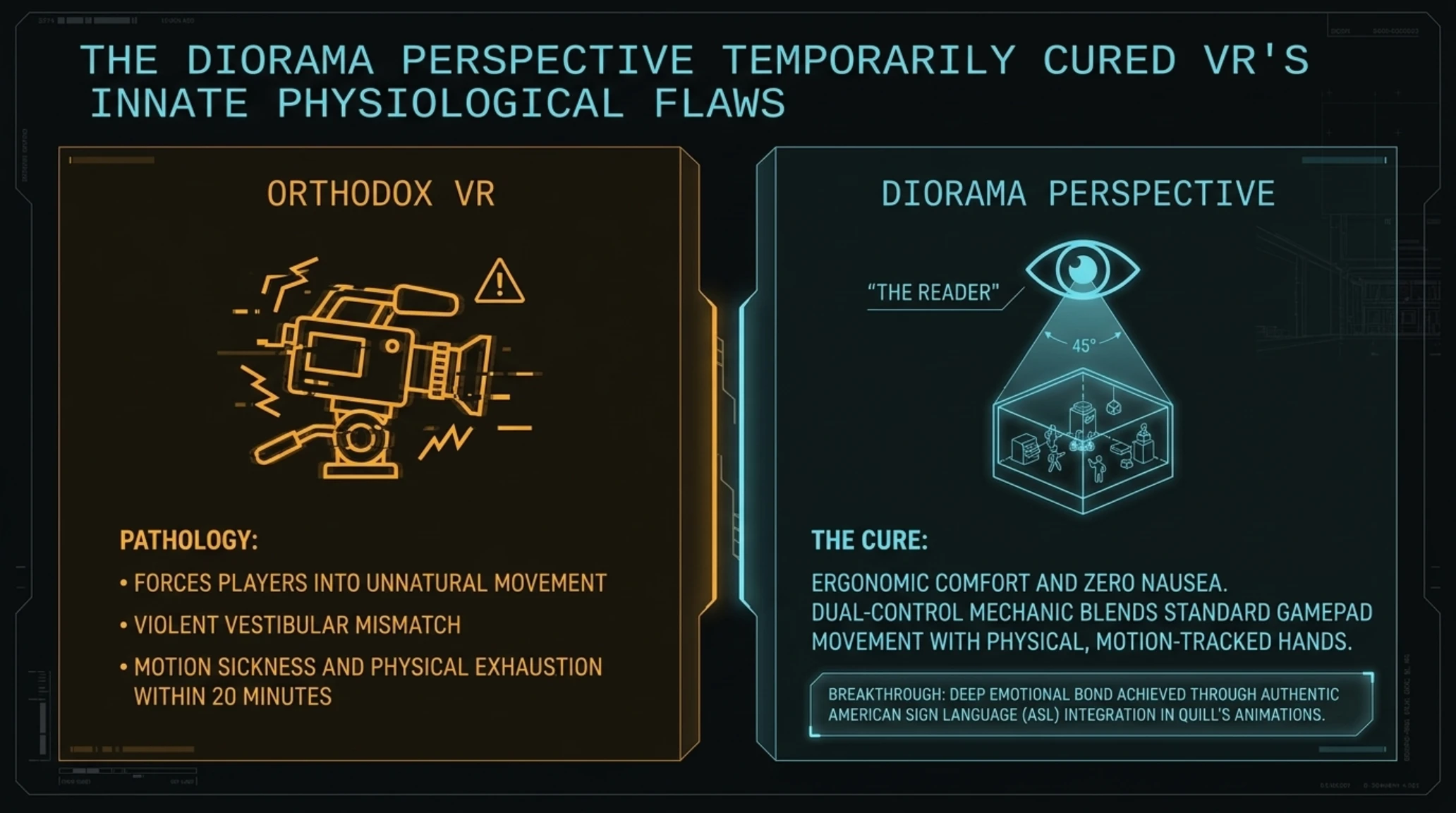
When the original Moss was unveiled to the gaming community at E3 2017, the virtual reality landscape was dominated by rudimentary shooting galleries, disorienting rollercoaster simulations, and clunky first-person tech demos. Conventional wisdom in game design dictated that VR had to place the player directly behind the eyes of the protagonist to maximize immersion. Yet, this rigid orthodox approach carried devastating unintended consequences: violent vestibular mismatch, severe motion sickness, erratic spatial disorientation, and physical exhaustion within twenty minutes of gameplay.
Polyarc utterly shattered this dogma through what they termed the "Diorama Perspective." Instead of forcing players into an unnatural first-person camera rig, Polyarc positioned the player as an omniscient, benevolent celestial entity known as the "Reader." Seated comfortably in the real world, the player peered down into exquisitely detailed, handcrafted miniature environments lush woodland glades, moss-covered medieval ruins, subterranean catacombs, and sun-dappled library chambers that felt like living, breathing storybook illustrations brought to life in three dimensions.
This architectural breakthrough resolved the fundamental physiological barrier of VR locomotion. By maintaining a stationary, third-person vantage point while allowing the player to naturally lean in, inspect minute environmental details, and peer around stone arches, Polyarc eliminated the inner-ear sensory conflicts that trigger nausea. Concurrently, the dual-control mechanic represented a masterclass in ergonomics: the player guided Quill through platforming obstacles and sword combat using standard gamepad sticks, while physically reaching into the diorama with motion-tracked hands to manipulate ancient mechanisms, pull heavy stone blocks, heal Quill’s wounds, and hold back menacing beetle adversaries.
The decision to incorporate authentic American Sign Language into Quill’s animations was not merely an aesthetic flourish; it was an emotional triumph that deepened the unspoken bond between player and companion. Gamers across the globe, including non-verbal individuals and members of the deaf community, felt seen and embraced in a way traditional flat-screen gaming had rarely achieved.

The emotional and mechanical brilliance of Moss and its stellar sequel, Moss: Book II, cemented Polyarc’s reputation as the gold standard of narrative VR. Both titles garnered universal critical acclaim, earning a coveted 90+ rating on review aggregators and sweeping international gaming ceremonies.
Yet, as brilliant as Polyarc's creative output was, the commercial ground underneath their feet was shifting rapidly. Developing premium, single-player narrative adventures requires multi-million-dollar production budgets, meticulous frame-by-frame animation, and extensive playtesting. In the console and PC markets, a masterpiece of Moss's caliber could easily sell five to ten million copies over its lifecycle. In the constrained, fragmented waters of virtual reality, reaching even one million units was an astronomical, near-impossible feat.
The Hardware Trap: Why Next-Gen Headsets Failed to Save Software Developers
A persistent illusion that sustained venture capital enthusiasm in spatial computing between 2020 and 2023 was the belief that next-generation hardware iterations would automatically expand the total addressable market (TAM) to mainstream consumer scale. Industry optimists assumed that higher display resolutions, pancake lenses, and faster mobile chipsets would eliminate user hesitation and trigger an explosive software gold rush. In reality, the hardware landscape fragmented even further, leaving independent software developers trapped between incompatible platforms, shifting corporate priorities, and prohibitive consumer price tags.
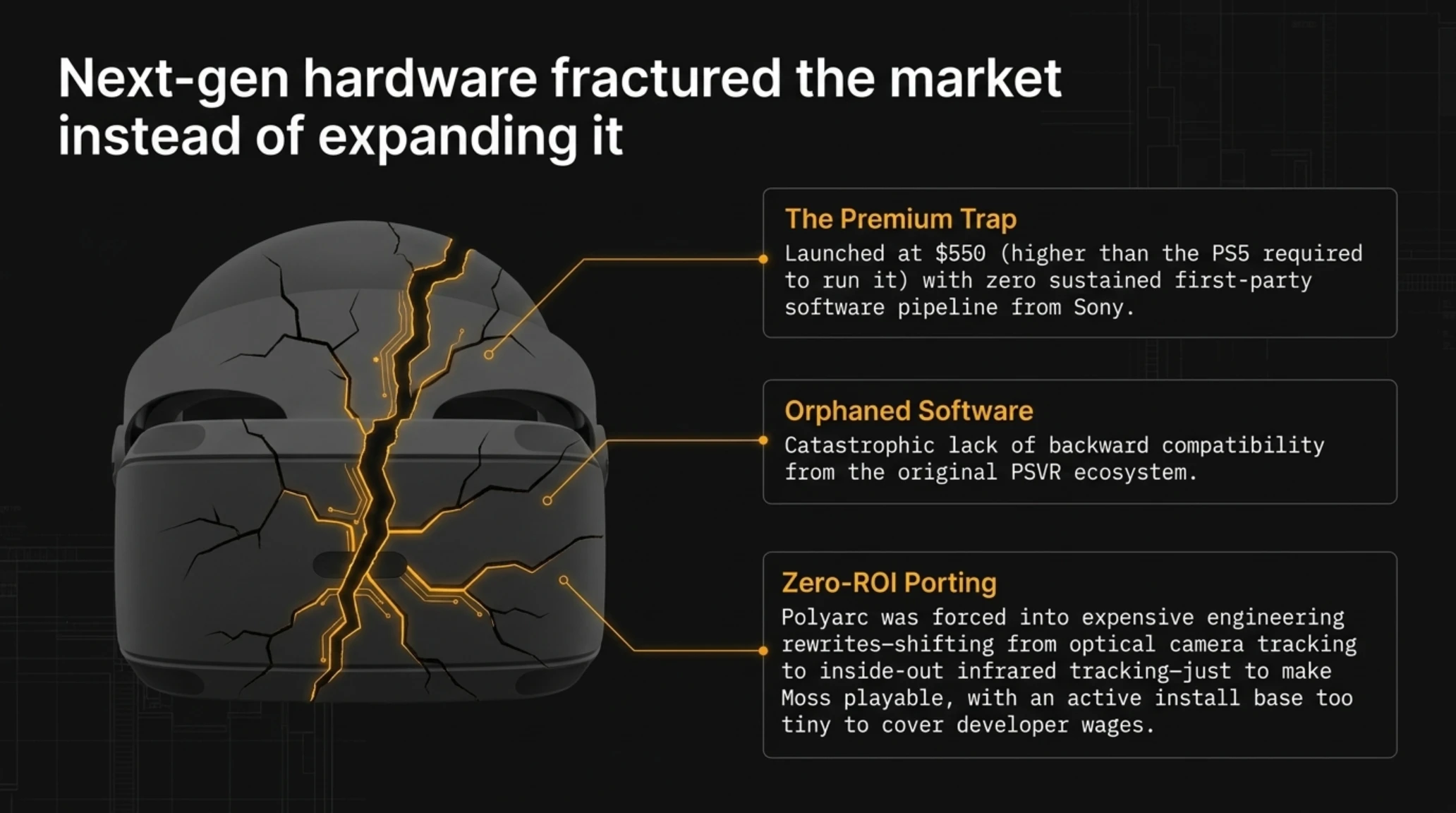
The most catastrophic disappointment for premium VR developers was the trajectory of Sony’s PlayStation VR2. Launched in early 2023 at a premium price of $550 higher than the PlayStation 5 console required to power it the headset promised desktop-grade visual fidelity with OLED micro-displays, haptic feedback, and eye-tracking foveated rendering. Polyarc enthusiastically supported the platform, releasing enhanced editions of Moss and Moss: Book II that showcased breathtaking visual splendor and nuanced haptic sensations. However, Sony’s corporate commitment to the peripheral withered almost immediately. The Japanese entertainment giant failed to invest in a sustained pipeline of first-party software, released zero internal AAA blockbuster games post-launch, and eventually slashed manufacturing orders, leaving developers who had committed millions to the PSVR2 ecosystem stranded with negligible commercial returns.
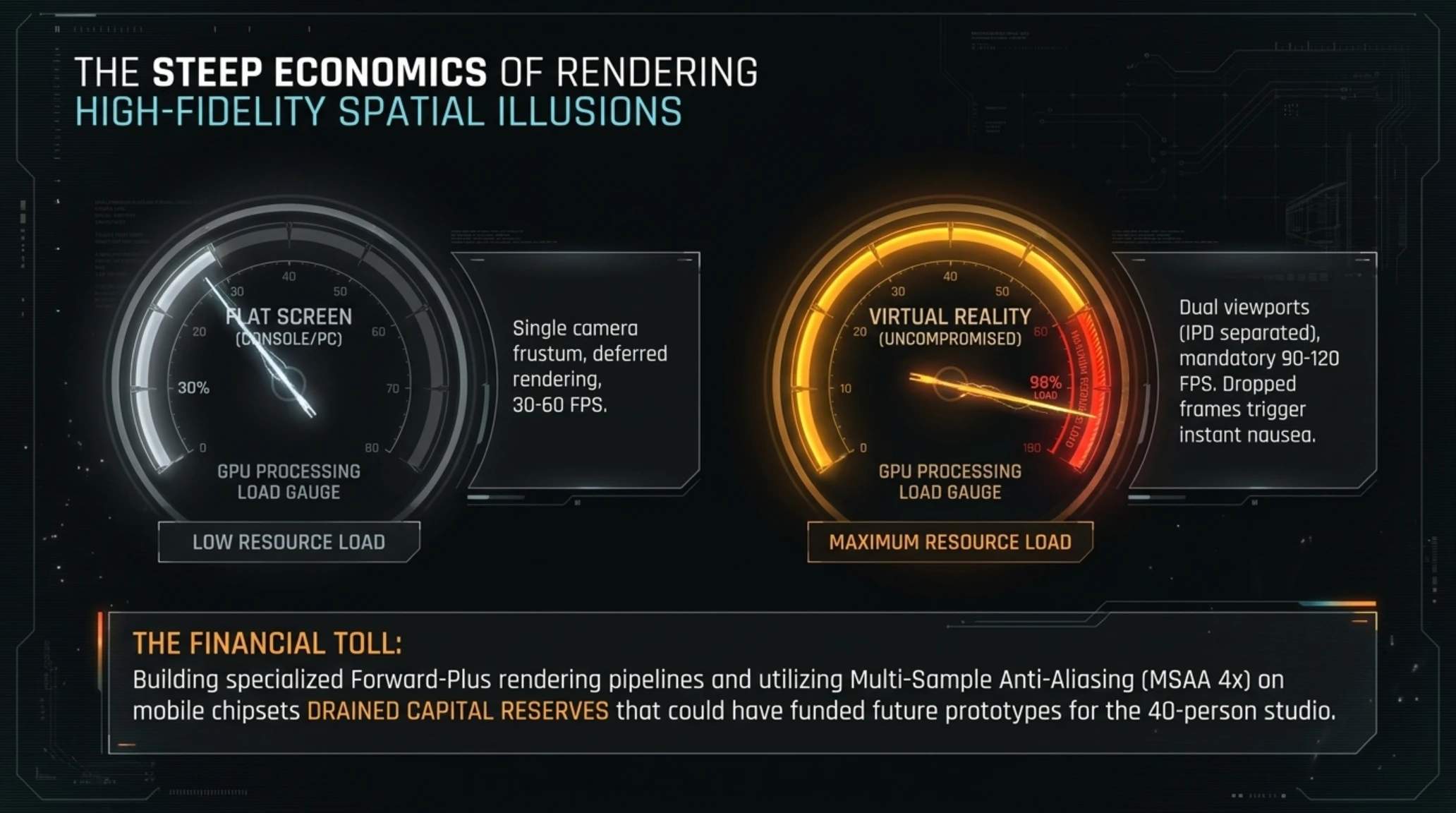
The technical engineering required to deliver high-fidelity visuals in VR represents one of the steepest optimization cliffs in real-time computer graphics. In traditional console and PC development, a game engine renders a single camera frustum at 30 or 60 frames per second using modern deferred rendering pipelines, complex screen-space reflections, and dynamic compute shaders. In virtual reality, however, the engine must render two distinct camera viewports simultaneously separated by the user's inter-pupillary distance (IPD) at a mandatory, uncompromised 90 to 120 frames per second. Dropping even a single frame results in jarring reprojection artifacts, image tearing, and instantaneous motion sickness.
Because deferred rendering techniques are prohibitively expensive on mobile tiled GPUs due to memory bandwidth bottlenecks, Polyarc had to build and maintain specialized forward-plus rendering pipelines. Forward rendering requires multi-sample anti-aliasing (MSAA 4x) to combat harsh geometric shimmering on high-density displays, quadrupling the pixel fill-rate load. Achieving the signature lush visual richness of Moss with soft subsurface scattering on Quill’s ears, translucent water shaders, shimmering dust motes, and volumetric sunbeams filtering through ancient forest canopies demanded relentless manual optimization of every polygon mesh, texture atlas, and light map. For a 40-person independent studio, bearing this colossal technical burden across three fundamentally disparate hardware architectures drained capital reserves that could have funded future game prototypes.
Furthermore, the tragic lack of backward compatibility between Sony's original PlayStation VR and the PlayStation VR2 exacerbated the studio's financial strain. When Sony launched PSVR2 without native backward compatibility for legacy PSVR titles, hundreds of classic VR games were instantly orphaned. Polyarc was forced to redirect substantial senior engineering resources to completely rewrite tracking code, migrate from optical camera tracking to inside-out infrared tracking, and recalibrate haptic feedback for Sense controllers simply to make Moss playable on modern hardware. While the resulting PSVR2 ports were hailed as definitive editions, the tiny active install base meant that sales could barely cover the developer wages spent executing the porting work.
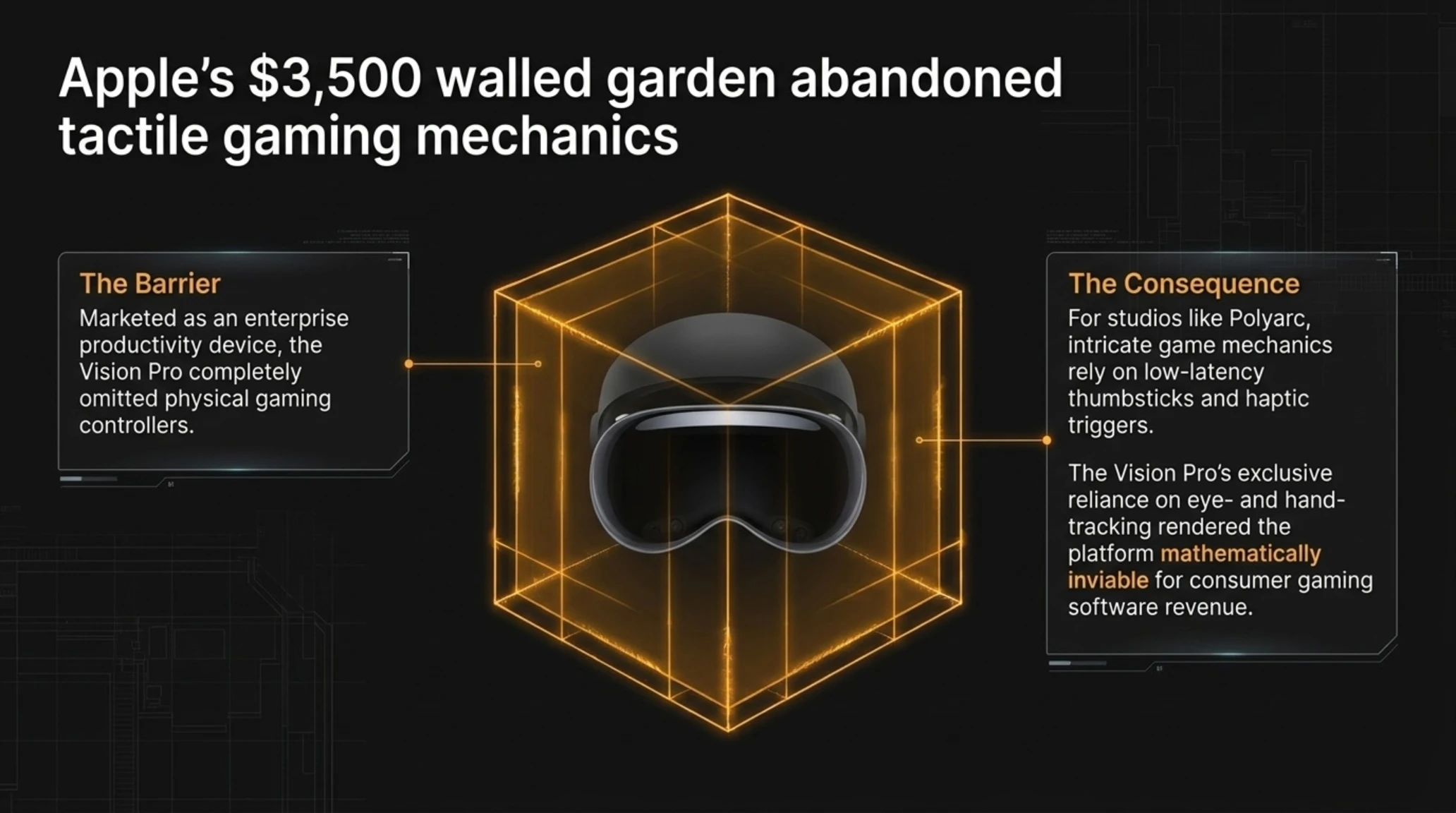
The entry of Apple into spatial computing with the $3,500 Vision Pro in 2024 delivered the final psychological blow to the gaming-centric VR narrative. Marketed strictly as an enterprise productivity and spatial media device, the Vision Pro deliberately omitted dedicated physical gaming controllers, relying exclusively on hand-tracking and eye-tracking. For gaming studios like Polyarc whose intricate mechanics relied on precise physical thumbsticks, haptic triggers, and low-latency tactile inputs, the Vision Pro represented an impenetrable walled garden that offered virtually zero consumer gaming software revenue.
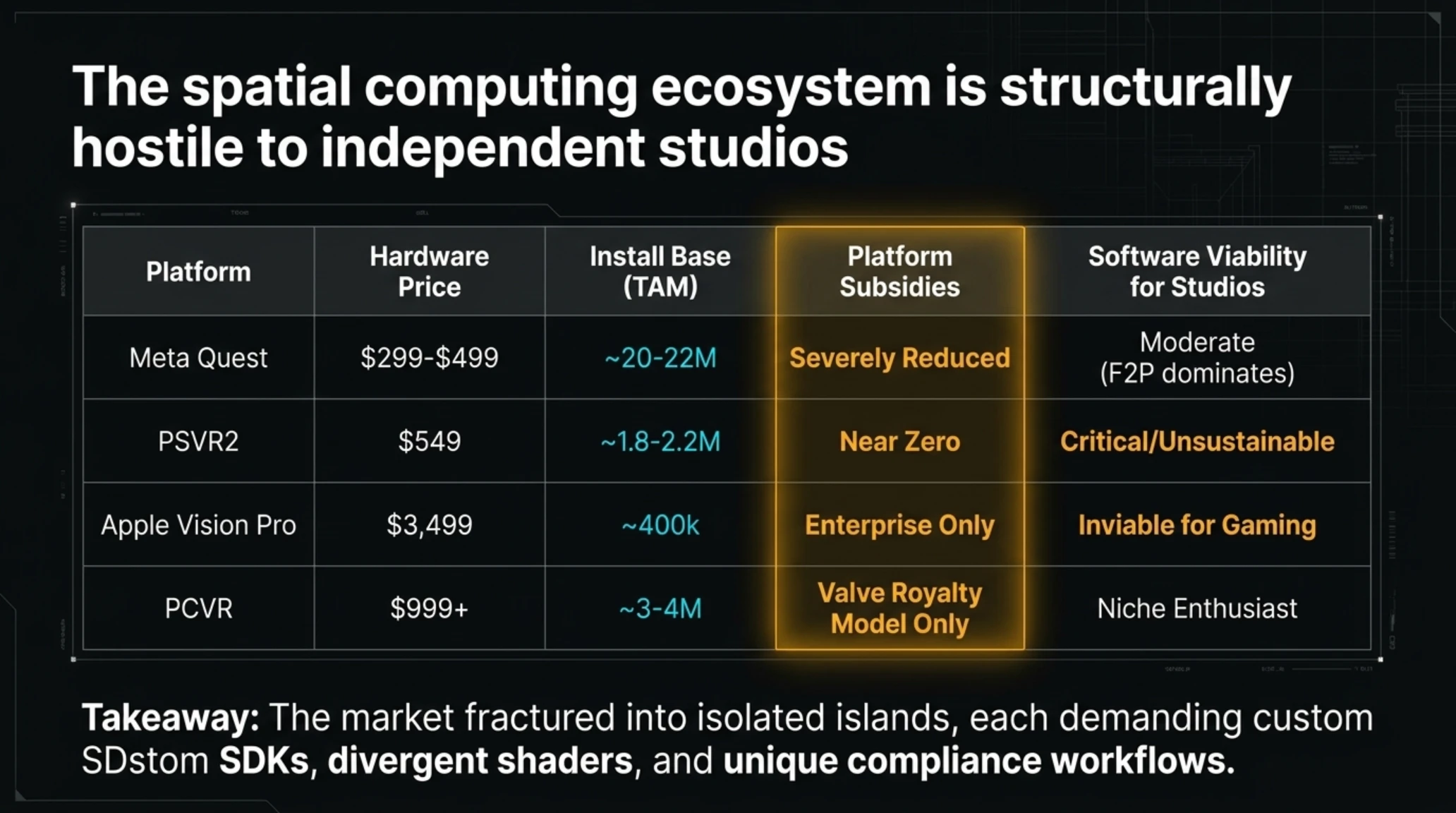
Platform Architecture Comparison: Economic & Technical Reality of VR Ecosystems (2026)
Structural Breakdown of Hardware Adoption, Platform Support, and Software Viability
| Platform Ecosystem | Hardware Price | Install Base (Est.) | Platform Subsidies | Software Viability for Studios |
|---|---|---|---|---|
| Meta Quest (Quest 2/3/3S) | $299 – $499 | ~20 – 22 Million | Severely Reduced (Shifted to AI) | Moderate (F2P/Party games dominate; premium narrative struggles) |
| PlayStation VR2 | $549 | ~1.8 – 2.2 Million | Near Zero (Sony first-party abandoned) | Critical / Unsustainable (High dev cost vs tiny active attach rate) |
| Apple Vision Pro | $3,499 | ~400,000 Units | Enterprise & Spatial Only | Inviable for Gaming (No physical controllers; luxury productivity niche) |
| PCVR (SteamVR / Valve Index) | $999 (Full Kit) + PC | ~3 – 4 Million | Valve Royalty Model Only (No Direct Grants) | Niche Enthusiast (Steady long-tail sales, but low initial unit velocity) |
As this structural analysis demonstrates, the virtual reality market never converged into a unified, thriving mass-market ecosystem. Instead, it fractured into an array of isolated islands, each demanding custom SDK integration, divergent shader optimizations, and unique compliance workflows, while offering insufficient aggregate sales to amortize multi-million-dollar development costs.
The Deadly Pivot: Why Glassbreakers Accelerated Polyarc's Demise
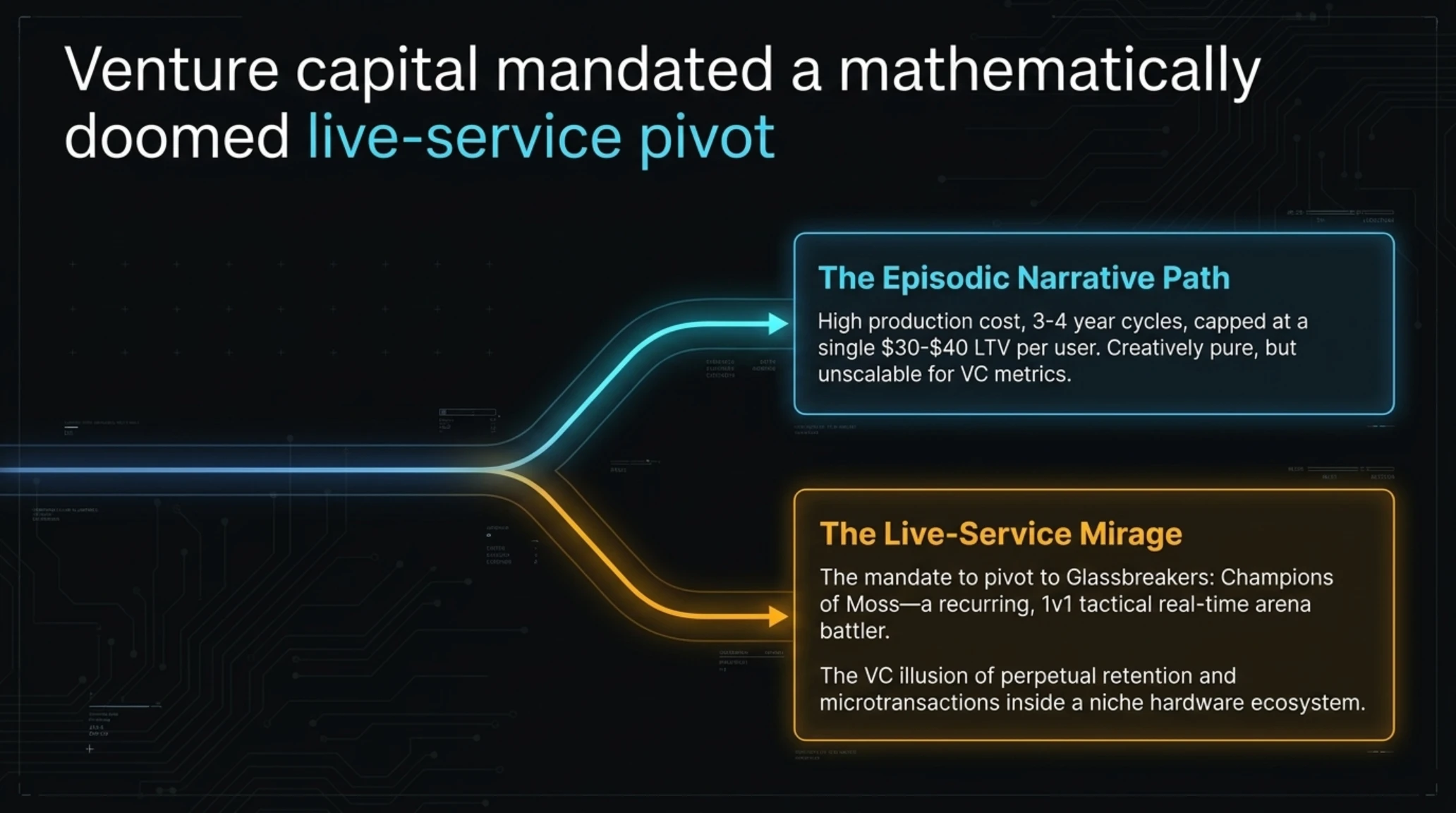
Faced with the commercial ceiling of single-player VR storytelling, Polyarc’s leadership and venture investors arrived at what appeared to be a logical strategic conclusion in 2022: the studio had to pivot from episodic narrative releases toward a recurring, live-service multiplayer economic model. Developing self-contained adventures like Moss meant that the studio had to spend three to four years in intense capital-draining production, only to capture a single $30 to $40 retail transaction per user, with virtually zero recurring monetization once the end-credits rolled. In venture capital boardrooms, the gospel of live-service gaming perpetual microtransactions, battle passes, seasonal cosmetic updates, and long-tail player retention seemed like the only viable path to long-term enterprise scalability.
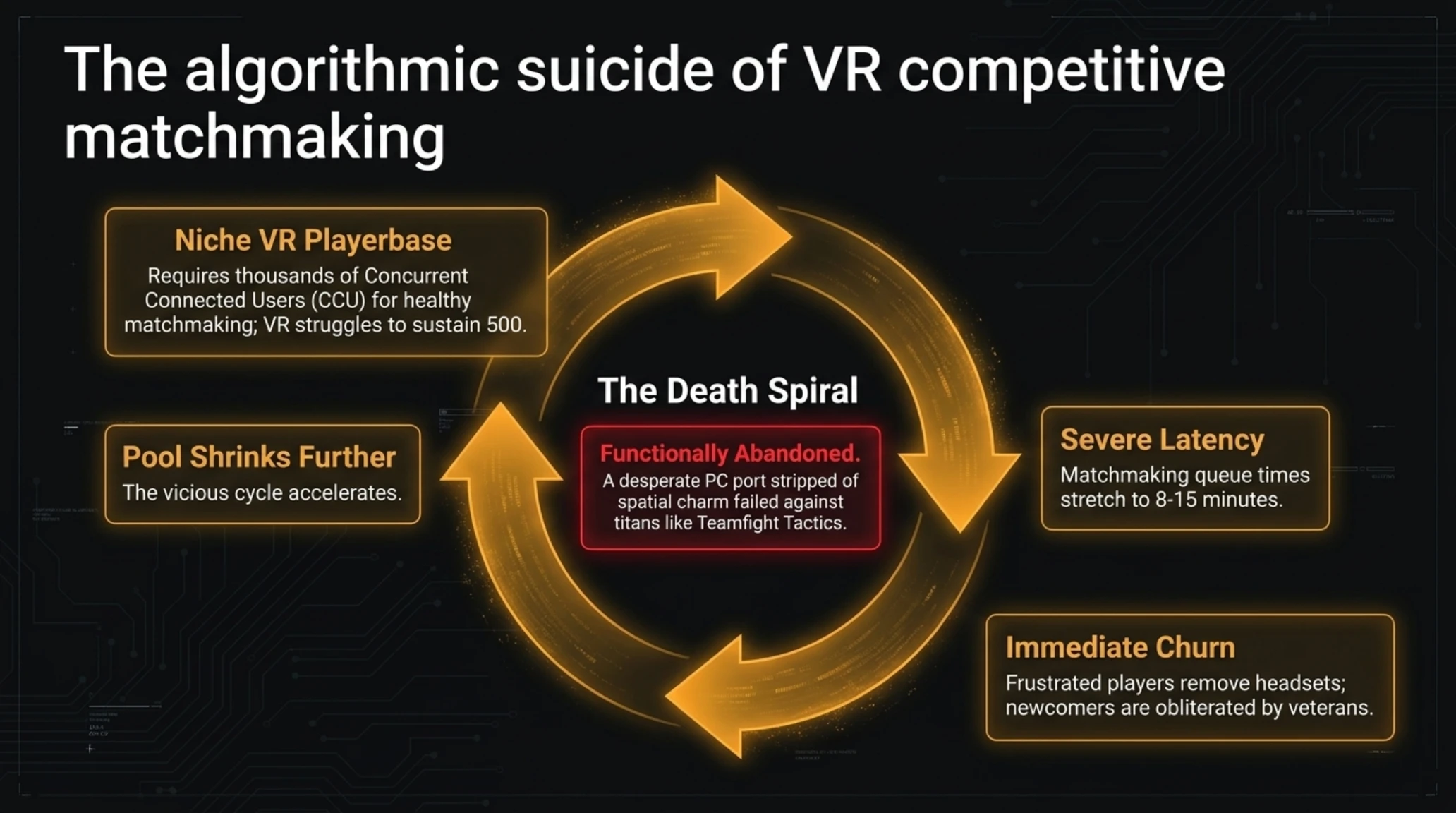
This strategic mandate gave birth to Glassbreakers: Champions of Moss, an ambitious 1v1 tactical real-time arena battler set within the beloved fantasy universe of Moss. In Glassbreakers, players stood across from an opponent in a virtual colosseum, commanding a squad of stylized miniature champions with distinct magical abilities, tactical cooldowns, and lane-pushing dynamics. From a game design and mechanical execution standpoint, the game was a brilliant, fluid synthesis of real-time strategy and tabletop tactical miniature gaming. However, from a macroeconomic and algorithmic matchmaking perspective, launching a synchronous competitive multiplayer title inside a niche VR ecosystem was an act of mathematical suicide.
The fundamental laws of multiplayer game architecture require a massive baseline of concurrent connected users (CCU) to sustain healthy, low-latency matchmaking. In a global competitive game with regional server partitions (North America, Europe, Asia-Pacific) and skill-based matchmaking (SBMM) algorithms divided across multiple rank tiers, a game requires a minimum of several thousand active concurrent players at any given hour just to keep queue times under two minutes. In the broader PC and console ecosystem, reaching 10,000 CCU is achievable with adequate marketing. In virtual reality, outside of viral free-to-play social hubs like Gorilla Tag, VRChat, and Rec Room, sustaining even 500 concurrent players is an insurmountable hurdle.

Consequently, Glassbreakers fell headfirst into the classic VR matchmaking death spiral. When enthusiastic players logged on, they encountered matchmaking queues lasting between eight to fifteen minutes. Frustrated by the agonizing delays, players took off their headsets and exited the game. This immediate churn further shrivelled the matchmaking pool, ensuring that the next batch of players experienced even longer queue times or were pitted against elite veterans who obliterated newcomers within seconds. Within months of its launch, the active player base dwindled to double digits, rendering the live-service infrastructure functionally abandoned.
In a desperate attempt to salvage the project and broaden its audience, Polyarc scrambled to develop a flat-screen PC version of Glassbreakers on Steam in 2024, removing the VR requirement altogether. Yet, this pivot stripped the game of its core spatial charm the intimate magic of reaching into the miniature arena with physical hands while throwing the modest indie title into direct, direct competition with titans of the strategy and arena genre like Teamfight Tactics, Dota Auto Chess, and Clash Royale. Without a multi-million-dollar user acquisition budget or aggressive marketing spend, the PC port failed to ignite traction, leaving Polyarc’s balance sheet critically drained.
The Physics of Retention: Friction, Nausea, and the "Dust Collector" Syndrome
To understand why the virtual reality market failed to provide Polyarc with an expanding customer base, one must confront the profound physiological and operational barriers that continue to plague head-mounted displays. While tech evangelists frequently celebrate high-resolution panels and inside-out tracking cameras, the everyday human experience of using a VR headset remains burdened by immense physical friction.
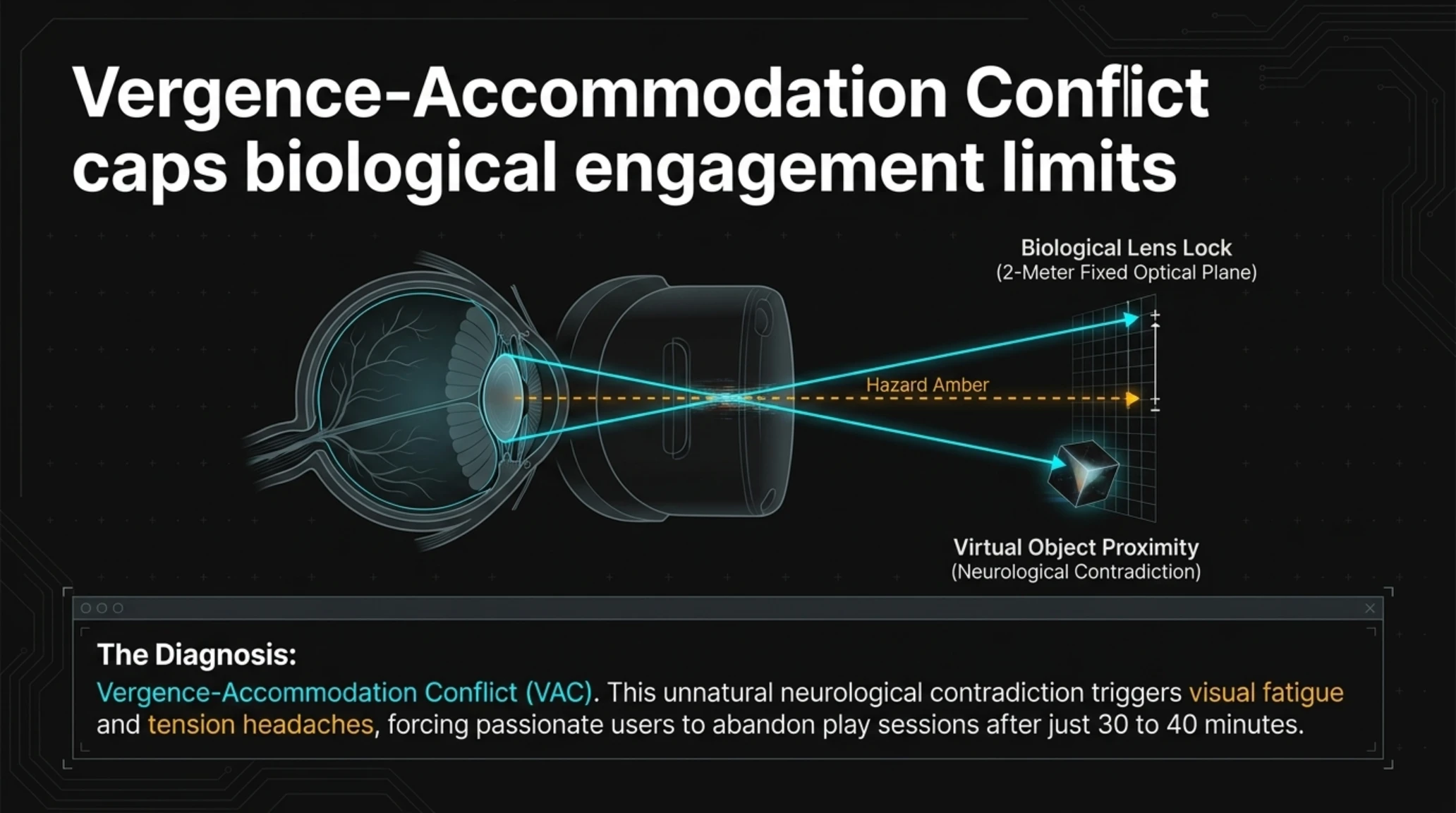
Foremost among these physiological impediments is the Vergence-Accommodation Conflict (VAC). In the natural physical world, human visual perception operates through a harmonized dual mechanism: the eyes converge on an object (vergence) while the lenses inside the eyes dynamically alter their physical shape to focus light onto the retina (accommodation). In modern VR headsets, however, optical displays sit behind fixed lenses that keep the focal plane permanently anchored at a virtual distance of approximately 1.5 to 2.0 meters. When a virtual character like Quill hops right up to the player’s nose, the user's eyes converge inward, but their biological lenses must remain focused at the fixed 2-meter optical plane. This unnatural neurological contradiction triggers rapid visual fatigue, optical strain, and persistent tension headaches, forcing even passionate gamers to limit their play sessions to thirty or forty minutes.
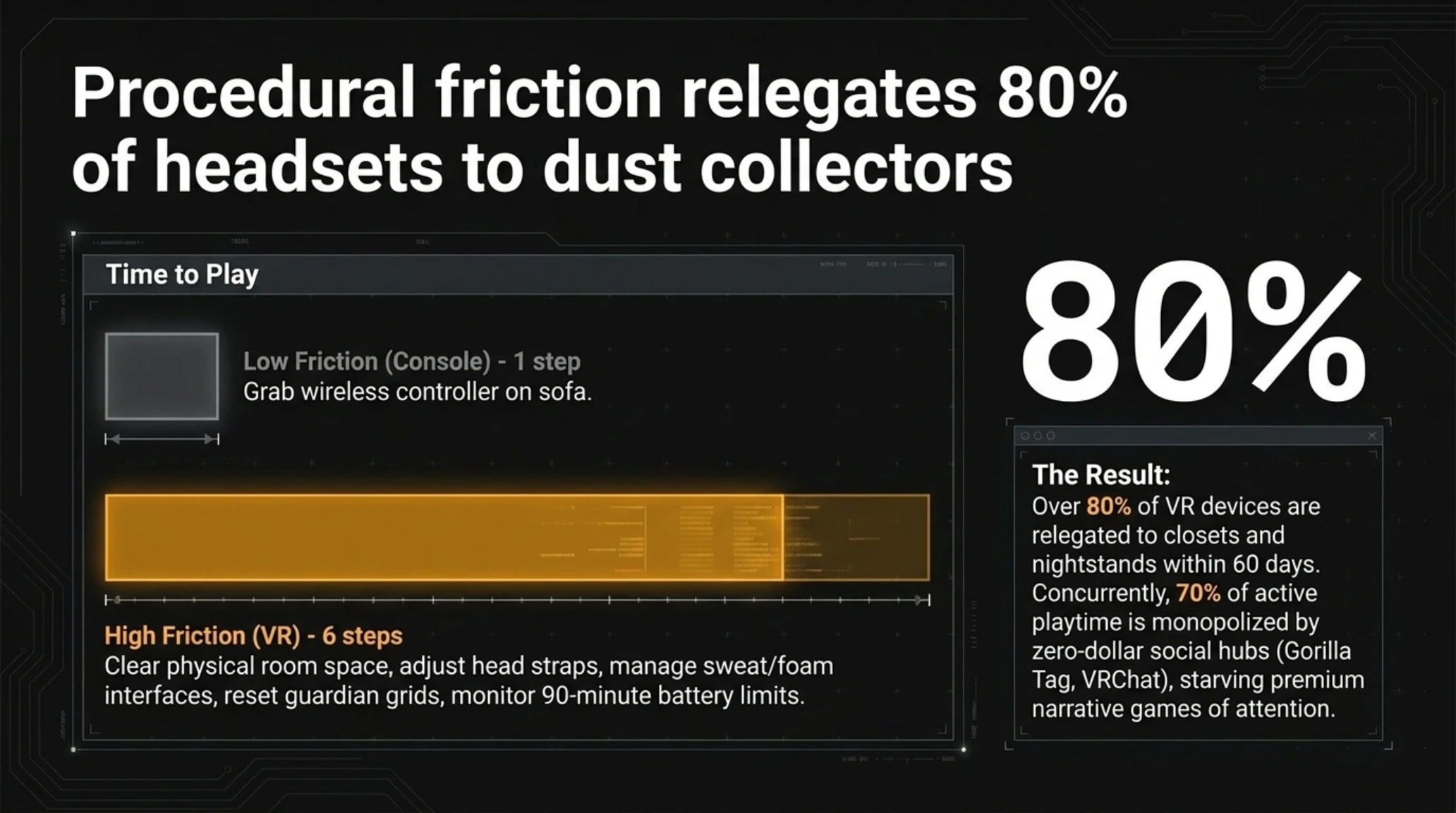
Beyond visual ergonomics, the procedural friction of entering virtual reality remains a catastrophic deterrent compared to conventional gaming platforms. Playing a PlayStation 5 or Nintendo Switch requires grabbing a wireless controller and pressing a single button from the comfort of a sofa. By contrast, engaging with virtual reality requires clearing physical room space, adjusting awkward head straps, dealing with hair displacement, wiping facial interface foam soaked in perspiration, resetting boundary guardian grids, and worrying about battery depletion within ninety minutes. These compound micro-frictions create immense behavioral resistance. Industry telemetry consistently reveals a devastating pattern: while VR headsets enjoy massive sales spikes during holiday gift-giving seasons, over 80% of devices are relegated to closets and nightstands within sixty days, functioning as glorified "dust collectors."
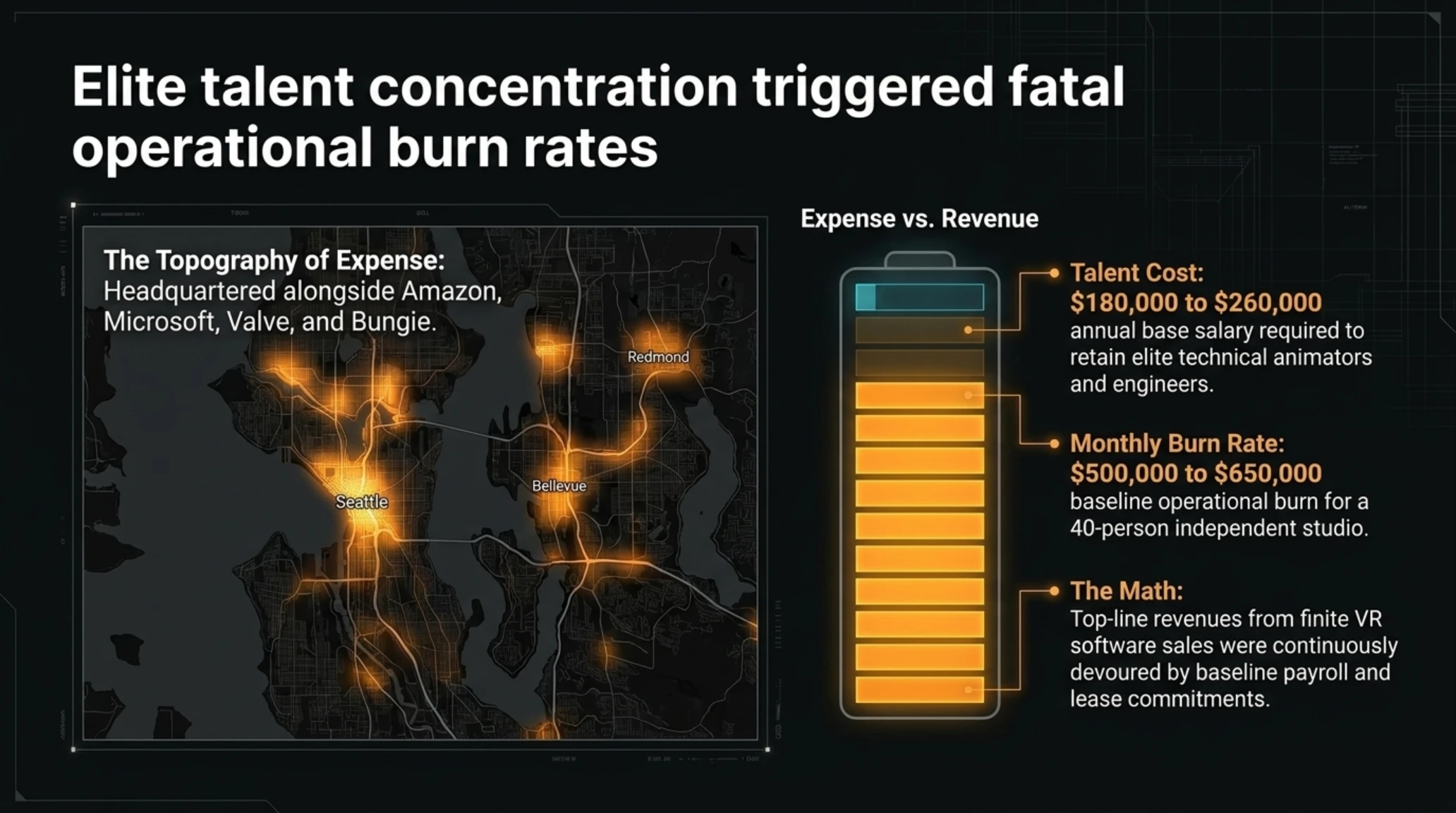
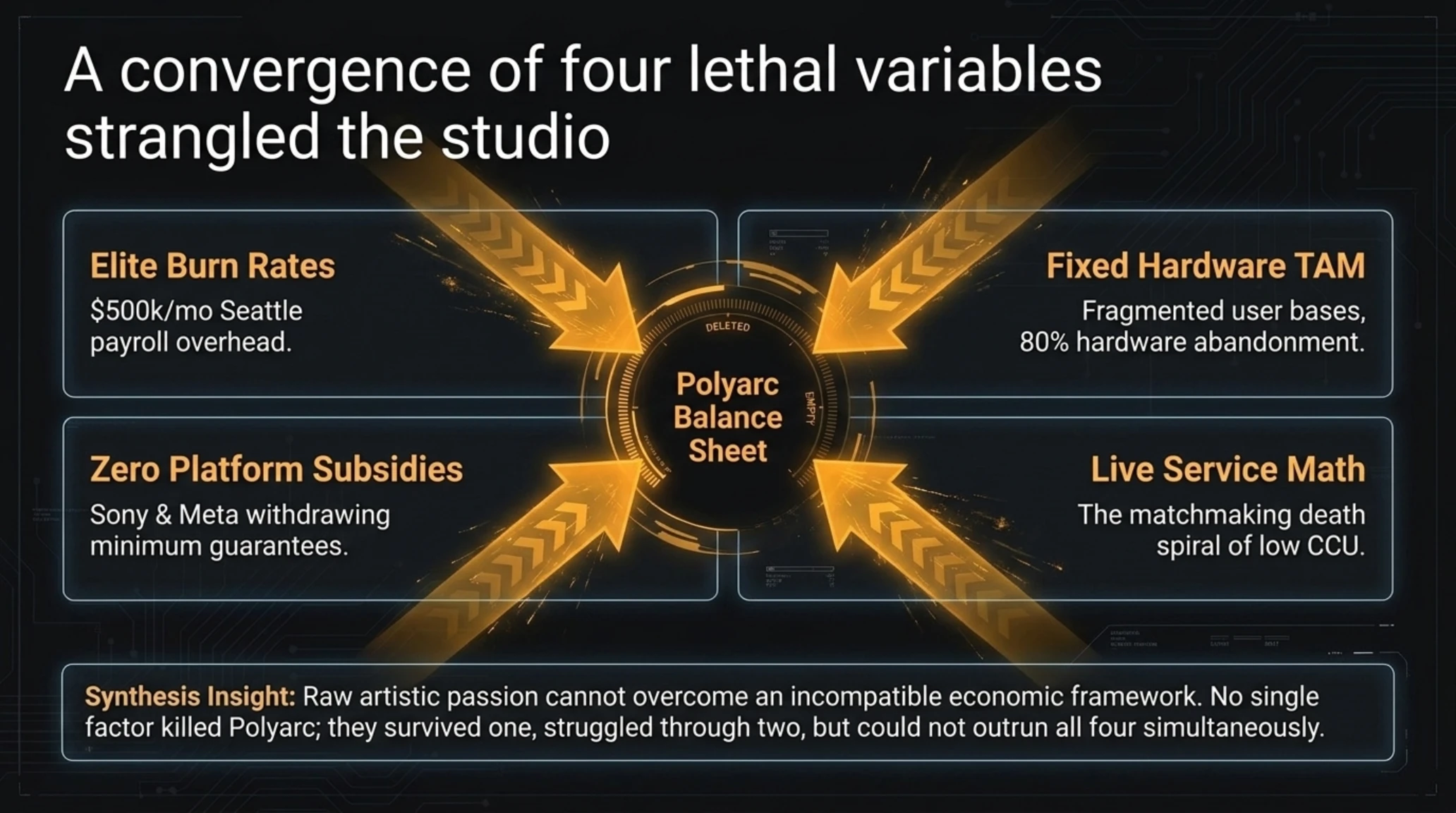
The geographic location of Polyarc further amplified these macroeconomic headwinds. Headquartered in Seattle, Washington, Polyarc operated in one of the most fiercely competitive and expensive engineering talent markets in the world. Surrounded by technology giants like Amazon, Microsoft, Valve, Nintendo of America, and Bungie, the studio had to offer highly competitive compensation packages averaging between $180,000 and $260,000 in annual base salary and benefits per senior developer simply to attract and retain elite technical talent. For a studio maintaining forty specialized artists, animators, and network engineers, baseline operational burn rate regularly exceeded $500,000 to $650,000 every single month. In an industry where a hit console indie game can sell three million copies on Steam and fund a team for a decade, Polyarc's top-line revenues from VR sales were continuously devoured by baseline payroll and office lease commitments.
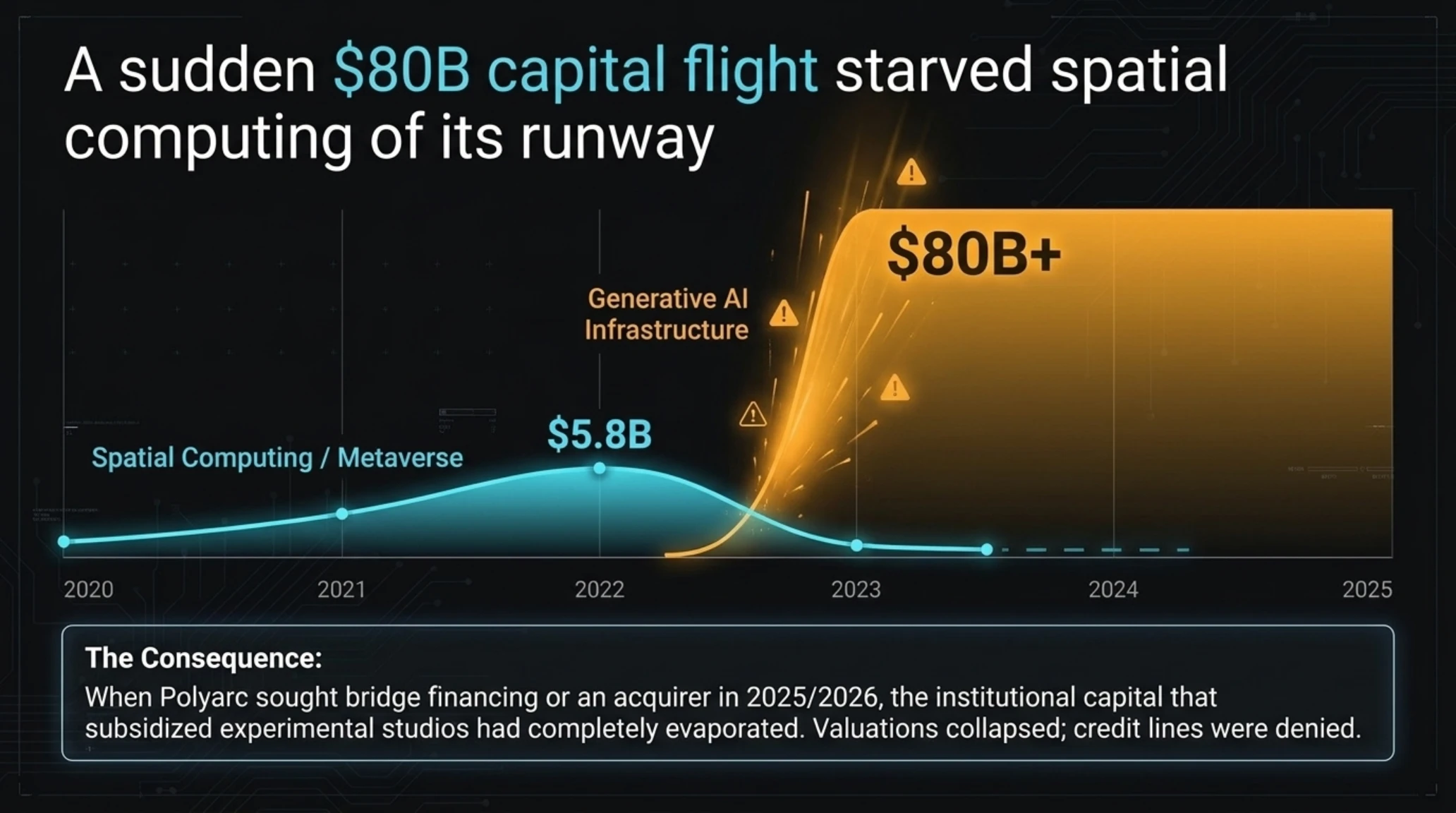
This retention crisis directly precipitated the total flight of venture capital out of the spatial computing sector. Between 2020 and 2022, venture firms poured an estimated $5.8 billion into metaverse and VR studios, inflated by near-zero interest rates and Silicon Valley marketing hype. But by late 2023, the emergence of generative AI and large language models radically transformed investor psychology. Venture capital funds abruptly abandoned spatial computing R&D to chase foundation AI models, enterprise agent architectures, and GPU infrastructure clusters, deploying over $80 billion into artificial intelligence startups between 2023 and 2025. When Polyarc sought bridge financing, strategic investment, or an outright corporate acquirer in late 2025 and early 2026, the institutional capital that had once subsidized experimental spatial studios had completely evaporated.
Every pitch to Silicon Valley and venture capital funds hit the exact same wall of skepticism: investors demanded metrics on Monthly Active Users (MAU), average daily playtime, and viral organic acquisition. In a medium where median headset playtime languished at under forty-five minutes per week, and where platform hardware sales were decelerating, the financial spreadsheets offered no mathematical path to a ten-fold return on investment. Studio valuations collapsed, Series C and Series D growth rounds vanished, and emergency credit lines were denied.

With external capital markets frozen, platform exclusivity advances cancelled, and software revenues insufficient to support a world-class engineering team in Seattle, Polyarc was left with no viable financial runway.
The Studio Domino Effect: Independent VR Developers Under Siege
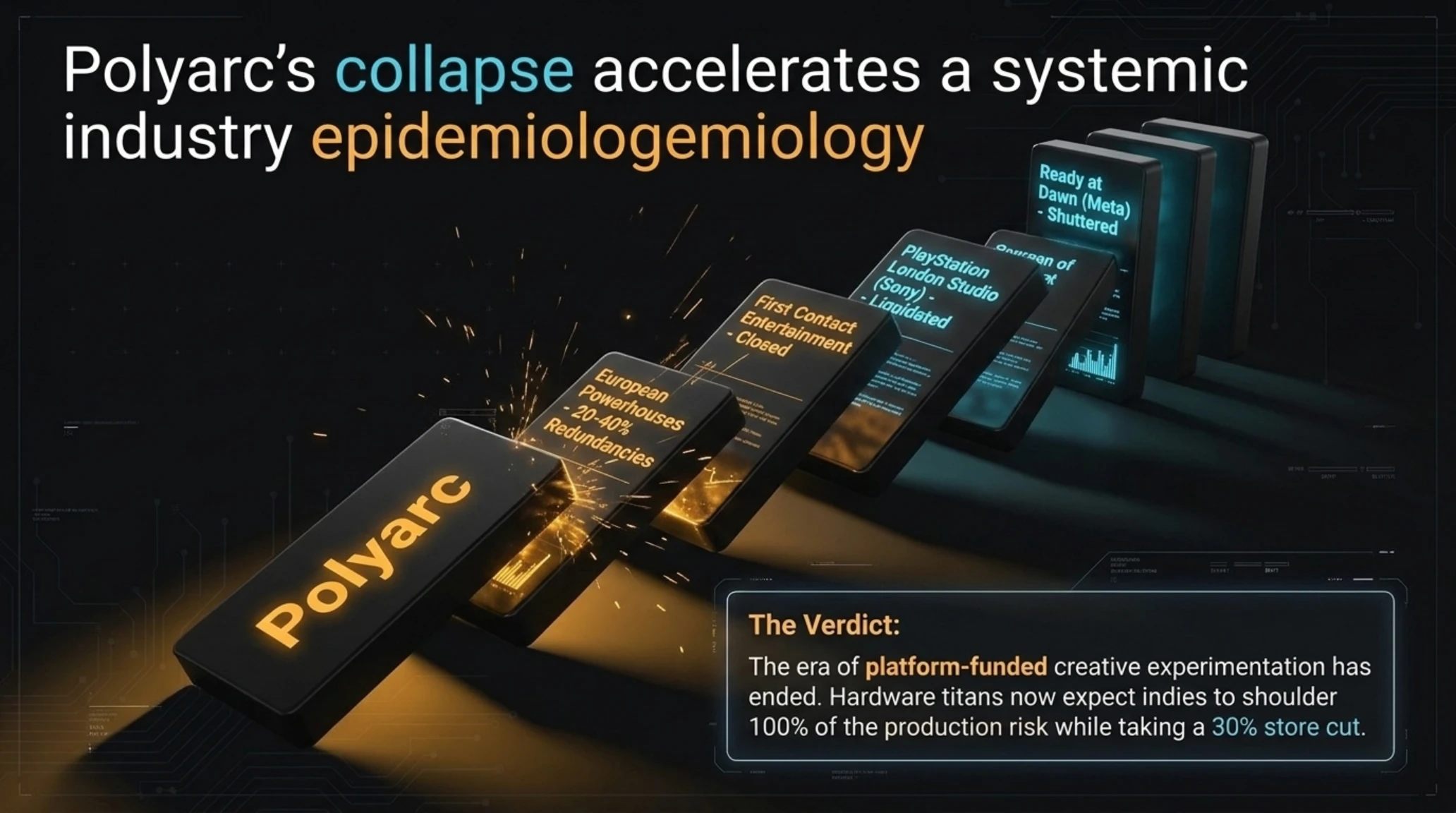
The shuttering of Polyarc does not represent an isolated managerial failure or a solitary miscalculation; rather, it stands as the latest and most heartbreaking casualty in a cascading domino collapse that has ravaged independent virtual reality developers across North America and Europe. Over the past twenty-four months, the spatial computing sector has witnessed the quiet liquidation, drastic downsizing, or forced distress-sale of dozens of pioneering studios that ventured into VR during its initial wave of romantic technological optimism. From veteran teams in the United Kingdom to boutique creative ateliers in Scandinavia, independent creators have run headlong into an impenetrable financial wall: production budgets that scale linearly with visual fidelity expectations, set against an addressable market whose commercial ceiling remains stubbornly flat.
The roll call of studio casualties across this VR winter reads like an obituary of the medium’s creative pioneers. Meta shocked the industry by permanently shuttering Ready at Dawn the legendary studio behind the zero-gravity masterpiece Lone Echo and its competitive multiplayer counterpart Echo VR despite having acquired the team only three years prior. Sony Interactive Entertainment delivered another crushing blow by completely liquidating PlayStation London Studio, the veteran British group responsible for Blood & Truth and PlayStation VR Worlds, while concurrently closing down First Contact Entertainment, the developers behind Firewall Ultra. Even well-established European powerhouses like nDreams, Fast Travel Games, and Coatsink were forced to execute painful corporate redundancies, slashing between 20% and 40% of their staff after high-profile VR releases failed to meet internal commercial recoupment targets.
This systemic contraction has fundamentally altered developer morale. For nearly a decade, early-adopter indie studios functioned as the sacrificial vanguard of spatial computing, solving complex navigational ergonomics, inventing new camera syntax, and proving out tactile interaction models that hardware manufacturers showcased in glossy promotional keynote presentations. Yet, when macroeconomic conditions tightened and corporate parent companies demanded immediate profitability, those same hardware manufacturers severed financial lifelines. The era of platform-funded creative experimentation has effectively ended, replaced by an austere corporate landscape where hardware titans expect independent developers to shoulder one hundred percent of production risks while taking a thirty percent platform store cut from modest software revenues.
Industry veterans and independent studio heads now openly acknowledge that the historical gaming industry paradigm wherein hardware manufacturers aggressively subsidized third-party software during early console cycles to build consumer software ecosystems, as Nintendo and Sony did in the 1990s was prematurely abandoned in the VR space. Without sustained first-party publishing commitments, the financial burden of pioneering unproven interaction paradigms has proven lethal to independent balance sheets.
Furthermore, the structural shift in consumer spending habits within virtual reality has created an increasingly hostile environment for traditional narrative experiences. Platform telemetry indicates that the vast majority of active VR playtime is monopolized by a tiny handful of free-to-play social sandboxes like Gorilla Tag, VRChat, and Roblox VR, alongside legacy rhythm juggernaut Beat Saber. These persistent live platforms capture over 70% of total daily active headset hours, functioning as walled entertainment gardens where younger players socialize and play user-generated minigames without ever visiting the platform store to purchase premium $30 or $40 narrative adventures. For studios like Polyarc that dedicate years to crafting linear, story-driven art, this concentration of player attention into zero-dollar social hubs represents an existential commercial drought.

To navigate the complex technical, economic, and physiological dimensions of this crisis, analysts and industry observers must familiarize themselves with the specialized terminology governing spatial game development and hardware adoption. The comprehensive reference guide below unpacks the core mechanics and structural drivers underpinning the modern VR landscape.
Technical & Economic Glossary: Core Concepts in the VR Industry Post-Mortem
Reference Guide to Spatial Engineering, Ergonomic Constraints, and Market Metrics
| Specialized Term | Comprehensive Engineering, Economic & Ergonomic Definition |
|---|---|
| Diorama Perspective | The third-person spatial vantage point pioneered by Polyarc in Moss, placing the user as a stationary celestial observer peering down into miniature tactile environments to eliminate vestibular nausea. |
| Vergence-Accommodation Conflict (VAC) | The physiological conflict occurring when virtual objects appear at varying depths, forcing eye convergence, while optical lenses keep focal accommodation permanently fixed, causing eye strain and headaches. |
| Retention Rate (D30 / D60) | The percentage of headset owners who actively launch software thirty or sixty days post-purchase, representing the single most critical indicator of hardware platform health. |
| Platform Minimum Guarantee (MG) | Non-recoupable or advance-royalty cash infusions provided by hardware owners (Meta, Sony) to studios to secure platform-exclusive launch windows or offset development losses. |
| Total Addressable Market (TAM) | The total universe of consumers possessing the compatible hardware required to purchase and execute a specific piece of software. |
| Concurrent Connected Users (CCU) | The number of simultaneous active players connected to multiplayer game servers at any given second, determining matchmaking queue speed and liquidity. |
These structural definitions illuminate why Polyarc’s artistic brilliance was ultimately constrained by fundamental realities of human biology and global market economics. No degree of passion or narrative elegance could overcome an install base that failed to achieve self-sustaining scale.
Why this matters: If the spatial computing ecosystem cannot sustain its most celebrated, critically acclaimed independent storytellers, the medium faces an acute risk of creative atrophy. Without teams like Polyarc pushing the boundaries of intimate spatial narrative and tactile emotional connection, virtual reality risks degenerating into an uninspired repository of hyper-casual viral minigames, fitness shovelware, and sterile corporate productivity demos that fail to inspire mainstream consumer imagination.

To evaluate the structural viability of spatial entertainment against traditional flat-screen game production, the following comparative assessment contrasts the strategic advantages and structural headwinds defining independent VR development in 2026.
- Unparalleled emotional immersion and tactile connection between player and characters that flat screens cannot replicate.
- Exceptionally passionate, dedicated core community of early adopters eager to champion authentic artistic innovation.
- Total creative freedom to invent novel interaction paradigms, physical gesture mechanics, and spatial storytelling syntax.
- Immunity from the overwhelming discovery crisis of Steam and mobile app stores, where thousands of games release daily.
- Extremely constrained Total Addressable Market (TAM) with severe structural limits on commercial revenue ceilings.
- Deadly dependence on capricious platform subsidies and corporate hardware grants that can evaporate overnight.
- Prohibitive technical optimization overhead required to sustain 90 to 120 FPS stereo rendering on battery-powered mobile chipsets.
- Catastrophic player churn rates driven by hardware discomfort, optical fatigue, and physical onboarding friction.
This rigorous strategic evaluation proves that raw artistic passion cannot overcome an incompatible economic framework. Developing multi-million-dollar narrative single-player titles within a niche hardware market with near-zero platform subsidies is no longer a viable business model for independent teams.
Tekin Analysis: Strategic Post-Mortem & Lessons from Polyarc's Dissolution
Executive Takeaways for Game Developers, Hardware Architects, and Tech Investors
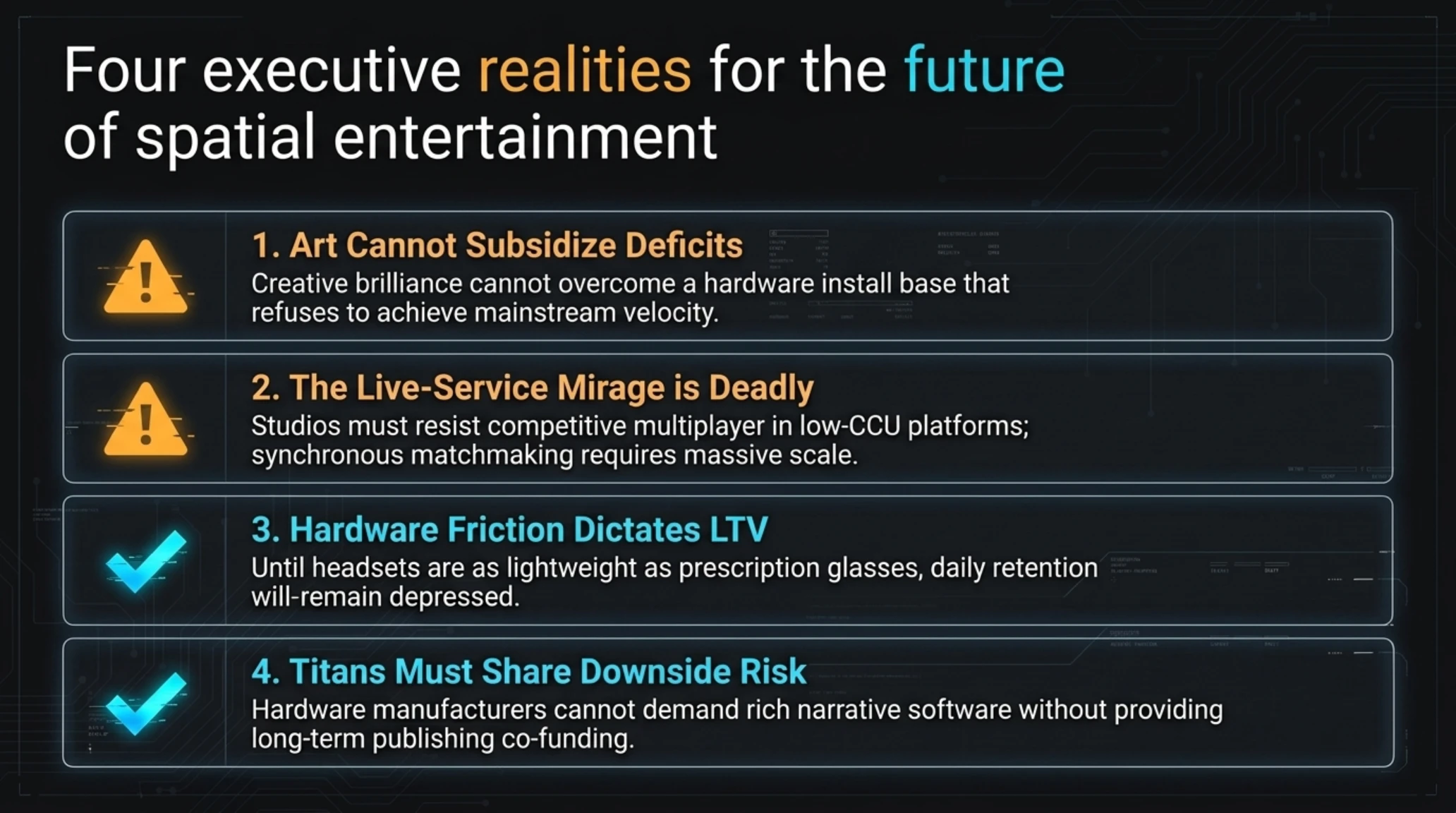
- Artistic Excellence Cannot Subsidize Market Deficits: Moss stands among the greatest spatial adventures ever constructed, yet creative brilliance cannot overcome a hardware install base that refuses to achieve mainstream velocity.
- The Live-Service Mirage is Deadly in Niche Markets: Independent studios must resist the siren call of competitive multiplayer in platforms with modest CCU pools; synchronous matchmaking requires scale that VR cannot reliably deliver.
- Hardware Friction Dictates Software LTV: Until headsets become as lightweight, comfortable, and socially transparent as prescription glasses, daily active retention will remain depressed, capping lifetime customer value (LTV).
- Platform Titans Must Share Downside Risk: If platform manufacturers like Meta and Sony desire rich narrative software to sell their hardware, they must provide long-term publishing co-funding rather than leaving independent studios to absorb total balance sheet liability.
Market sentiment across Silicon Valley venture capital firms, traditional game publishers, and spatial hardware executives has shifted into a period of deep pragmatic sobriety. The era of irrational exuberance has concluded; developers and investors now recognize that spatial computing is not an overnight replacement for consoles and smartphones, but rather a slow, multi-decade march requiring fundamental hardware revolutions in optics, silicon efficiency, and form factor before mainstream consumer gaming can thrive.
Strategic Synthesis: Quill's Enduring Legacy and the Horizon of Spatial AR
The extinguishing of the lights at Polyarc’s Seattle headquarters is a deeply somber moment for the gaming community, marking the conclusion of one of the most inspired chapters in modern interactive storytelling. Yet, while the corporate entity may dissolve, the indelible artistic legacy forged by Tam Armstrong, Danny Bulla, Chris Alderson, and their brilliant team will echo across the medium for decades to come. Through Quill, Polyarc demonstrated that virtual reality could transcend cold spectacle and weaponized aggression, offering instead a sanctuary of empathy, tenderness, and mutual companionship.
The tiny mouse with the grand heart who looked into our eyes with unconditional trust, who raised her paw for celebratory high-fives after harrowing battles, and who relied on our gentle touch to survive the dangers of the Hexenwood reminded the entire industry of what video games are truly capable of when guided by authentic artistic ambition. She proved that the most powerful dimension of virtual reality is not the vastness of the digital universe you can see, but the depth of the emotional connection you can feel with a companion standing right in front of you. In an era dominated by cynical free-to-play monetization loops and aggressive algorithmic engagement tactics, Polyarc's uncompromising dedication to pure, handcrafted narrative artistry served as a shining beacon of interactive integrity.
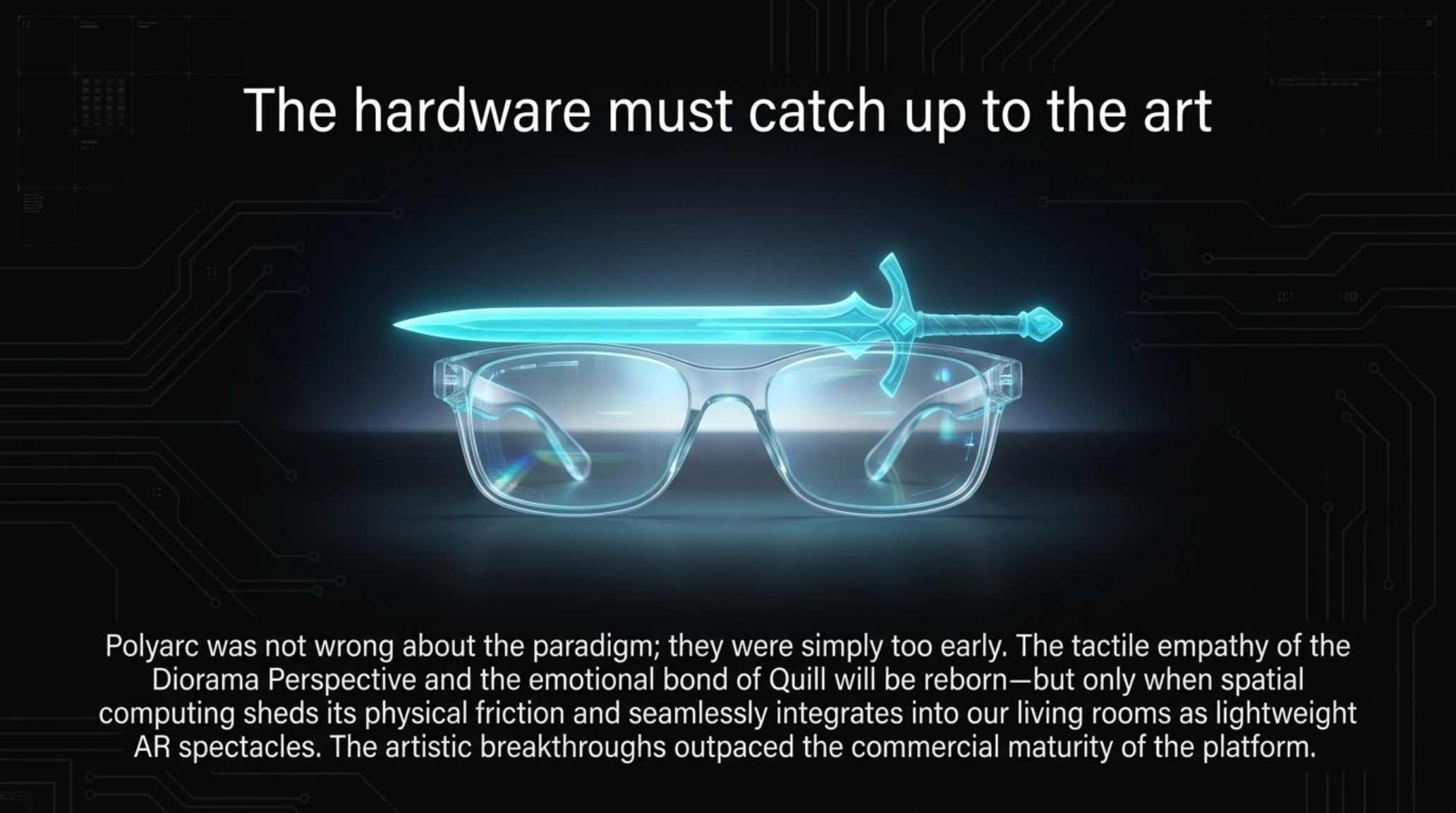
Industry historians will look back upon this harsh VR winter not as the permanent death of immersive entertainment, but as a painful, necessary crucible of transition. The bulky, facial-pressure-inducing plastic headsets of today will eventually be superseded by sleek, ultra-lightweight augmented reality spectacles devices rooted in the pioneering micro-LED, silicon carbide, and holographic waveguide research of platforms like Meta Orion. When that technological threshold is crossed, and spatial computing integrates seamlessly and frictionlessly into our daily lives without separating us from our physical surroundings, the design syntax pioneered by Polyarc the tactile diorama, the empathetic companion, and the harmonious third-person spatial perspective will be reborn across living room coffee tables worldwide.
Until that hardware convergence arrives, the story of Polyarc stands as a poignant cautionary tale and an enduring source of inspiration for independent creators worldwide. It affirms that true artistic breakthroughs often outpace the commercial maturity of the platforms on which they are built, leaving an indelible imprint on the cultural memory of those fortunate enough to have experienced them firsthand.
Related Intelligence Dossiers on TekinGame
• 📱 Tekin Analysis | Apple's Foldable iPhone Duo & iPhone 18 Pro Price Hike
• 🧠 Tekin Analysis | Valve's 17-Year Secret: The Staged L4D2 Trailer Leak
• 🎬 Ultimate Guide to Local AI Video Generation (Minimax, Wan, LTX)
Farewell, brave Quill. Rest your blade upon the mossy stone. The digital world may move forward in relentless technological cycles, but the magic, innocence, and wonder you brought to our hearts will endure forever in the annals of interactive art.

Below, we address the critical operational, financial, and strategic questions surrounding the dissolution of Polyarc, the future disposition of the Moss intellectual property, and the macroeconomic state of the virtual reality gaming industry.
Frequently Asked Questions: Polyarc Closure and the State of Virtual Reality
When was Polyarc established, and what games did the studio develop?
Polyarc was founded in 2015 in Seattle by former Bungie leads Tam Armstrong, Danny Bulla, and Chris Alderson. The studio created the award-winning VR platformers Moss (2018) and Moss: Book II (2022), as well as the competitive multiplayer tactical battler Glassbreakers: Champions of Moss (2023).
Why did Polyarc shut down despite overwhelming critical acclaim and awards?
Polyarc collapsed due to an unsustainable combination of soaring production burn rates in Seattle, the evaporation of platform exclusivity subsidies from Meta and Sony, stagnant consumer VR hardware adoption, and the failure of its live-service title Glassbreakers to maintain a healthy matchmaking player base.
What will happen to the Moss intellectual property and character rights?
While Polyarc has ceased game development operations, the studio’s underlying intellectual property, codebases, and trademark assets will likely be managed by its board, creditors, or acquired by a platform holder or publisher during asset liquidation. However, any immediate plans for Moss: Book III have been permanently cancelled.
Why didn't high-profile headsets like PlayStation VR2 and Apple Vision Pro save the studio?
Sony largely abandoned internal first-party game funding for PSVR2 shortly after launch, while Apple Vision Pro launched at a prohibitive $3,500 enterprise price tag without dedicated physical gaming controllers, preventing both platforms from generating sufficient mass-market gaming software sales.
Does the closure of Polyarc mean virtual reality gaming is dead?
No. While the market is experiencing a severe economic correction and capital flight toward AI, spatial gaming will continue to evolve through specialized niche experiences, transitioning toward lightweight, ergonomic augmented reality (AR) glasses that eliminate physical friction and nausea over the next decade.
Authoritative Documentation & References: Polyarc Autopsy & VR Economics
- Eurogamer: Exclusive Investigation into the Closure of Moss Developer Polyarc and the Independent VR Crisis
- Insider Gaming: Official Statement from Polyarc Leadership on Studio Liquidation
- UploadVR: The Shifting Economics of Meta Reality Labs and the End of Platform Guarantees
- Road to VR: Analysis of Live-Service Matchmaking Failures and Concurrent User Dynamics in VR
- GamesIndustry.biz: Venture Capital Reallocation from Spatial Computing to Generative AI Infrastructure
Additional Gallery: Tekin Analysis | 🐭 Polyarc’s Fall & The Brutal VR Winter