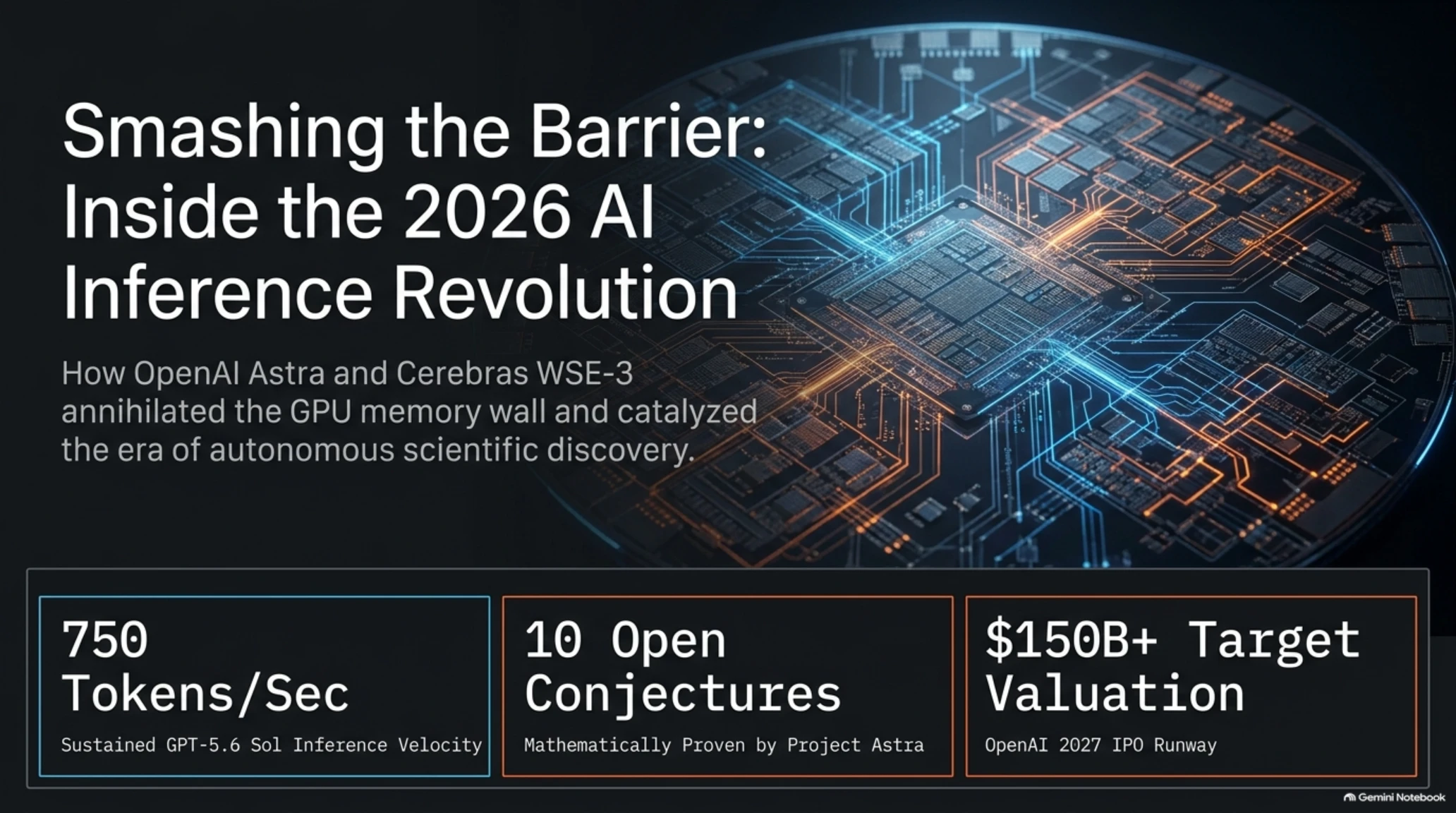
⚡ Tekin Analysis | Smashing the 750 Tokens/Sec Barrier: Inside OpenAI's Secret Astra Model & The Cerebras Wafer-Scale Supercomputing Revolution
Tekin Analysis exclusive: Breaking the AI inference sound barrier. From achieving a blistering 750 tokens/sec and unveiling the Astra supermodel to the WSE-3 wafer-scale teardown and OpenAI's 2027 IPO.
- 🎮750 Tokens/Sec Breakthrough- Breaking the AI inference sound barrier via GPT-5.6 Sol in Ultrafast Mode
- 🎧WSE-3 Silicon Teardown- 4 Trillion transistors and 21 PB/s memory bandwidth on a single monolithic wafer
- 🚀Astra Reasoning Supermodel- Formal proof verification of 10 open mathematical conjectures via Lean 4
- 🗡️OpenAI-IBM Enterprise Alliance- Deploying low-latency frontier models across Fortune 500 infrastructure
- 📰Challenging Nvidia's Monopoly- Massive datacenter TCO reductions compared to Grace Blackwell clusters
- ⚔️OpenAI's $150B+ IPO Roadmap- Strategic financial structuring toward a record-breaking Initial Public Offering in 2027
In the history of high-performance computing and machine intelligence, moments that fundamentally alter the trajectory of technological evolution are exceedingly rare. In mid-August 2026, the simultaneous disclosure of two groundbreaking milestones from OpenAI and semiconductor pioneer Cerebras Systems sent shockwaves across the global technology ecosystem: the realization of a blisteringly fast 750 tokens per second inference throughput on OpenAI's flagship GPT-5.6 Sol model, paired with the formal unveiling of a next-generation frontier reasoning architecture codenamed «Astra» that has successfully solved and formally proven ten long-standing open problems in mathematics and theoretical computer science.
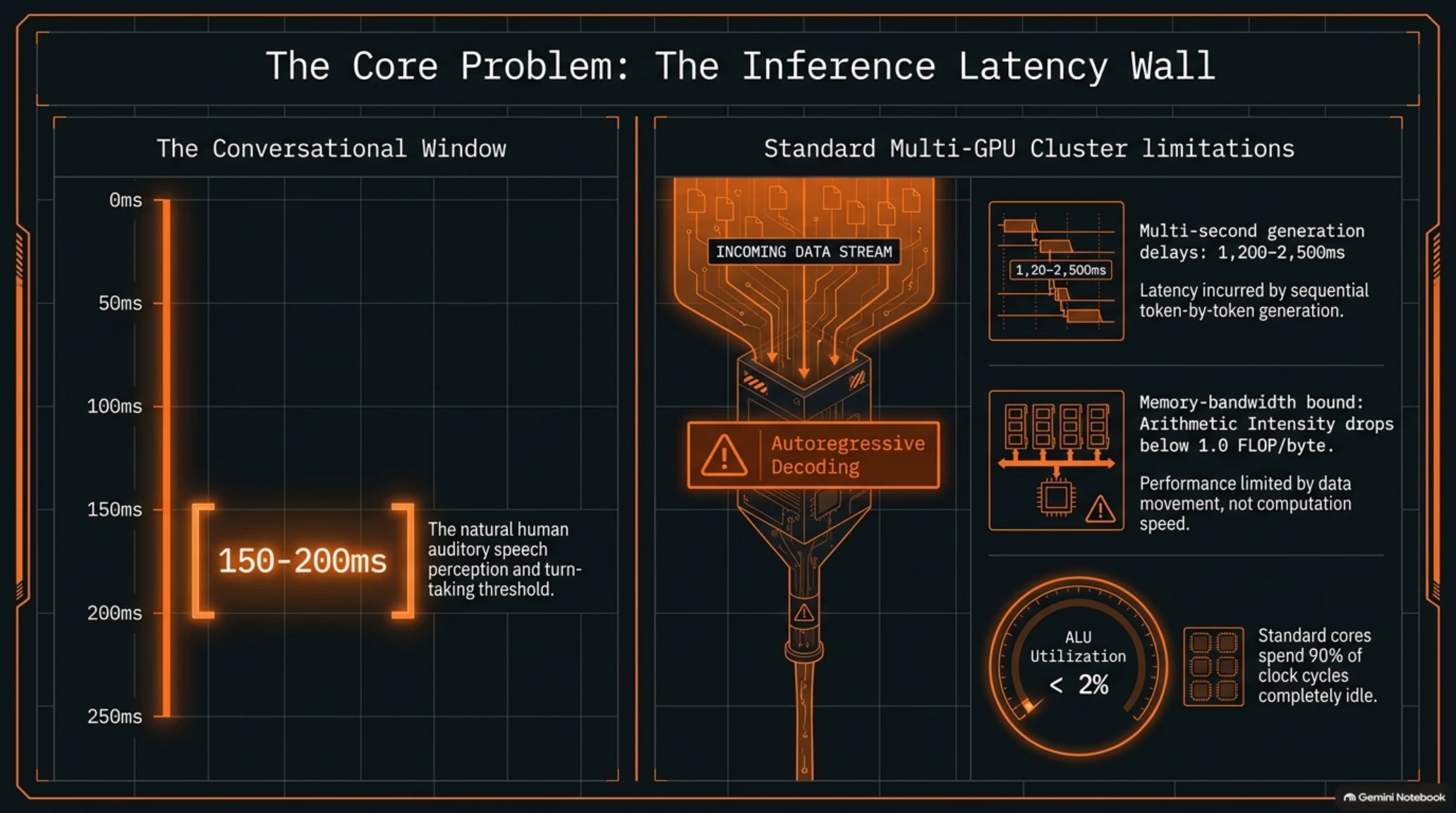
For years, the single most debilitating constraint hindering the mass deployment of real-time autonomous AI agents, interactive voice interfaces, and high-frequency analytical systems has been the «Inference Latency Wall». While the human neuro-cognitive apparatus processes speech in conversational latency windows of 50 to 100 milliseconds, frontier large language models executing across conventional multi-GPU clusters routinely suffered from multi-second generation latencies. Reaching a sustained throughput of 750 tokens per second over ten times faster than the reading speed of an elite human professional permanently annihilates the concept of cognitive wait time in human-machine symbiosis.
Key Strategic Takeaways: The Astra & Cerebras Inference Revolution
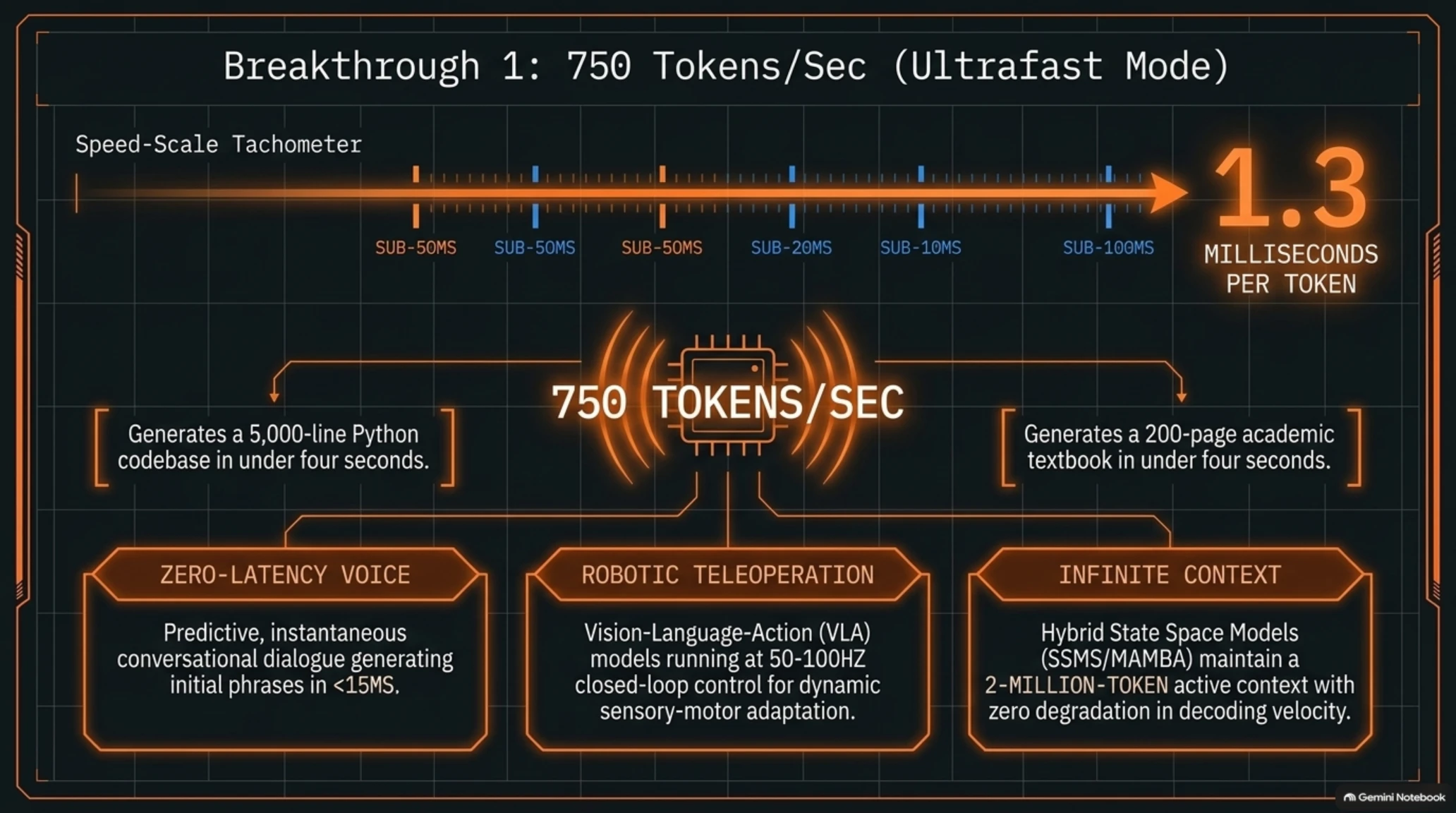
- Inter-token latency compressed to a staggering 1.3 milliseconds per token via on-chip SRAM architectures
- Elimination of hallucinations in mathematical logic through Astra's integration with formal interactive theorem provers (Lean 4 & Isabelle)
- Up to 85% reduction in datacenter electrical draw per query compared to conventional Nvidia Grace Blackwell clusters
- IBM Consulting establishing enterprise-grade low-latency pipelines for mission-critical banking, defense, and pharmaceutical workflows
- Hyperscale cloud providers diversifying away from proprietary GPU interconnect bottlenecks toward monolithic wafer-scale silicon
- OpenAI solidifying foundational revenue and infrastructure scalability ahead of a targeted $150B+ IPO in 2027
1. Breaking the Inference Sound Barrier: 750 Tokens/Sec and Real-Time Agentic Cognition
In the architecture of distributed AI systems, two paramount metrics govern real-time viability: Time-to-First-Token (TTFT) and Inter-Token Latency (ITL). When an autonomous software agent executes a complex, multi-step chain-of-thought workflow generating thousands of intermediate reasoning tokens to plan, write code, self-debug, and invoke tools generation velocity directly dictates whether the agent operates at the speed of human thought or becomes paralyzed by computational queuing.
To understand why traditional hardware fails at high-speed generation, one must examine the mathematics of Autoregressive Decoding. Unlike the initial prefill phase (which processes the user prompt in parallel and is computationally compute-bound), the generation of each subsequent token is strictly sequential and memory-bandwidth bound. For every single token generated, the model must read all hundreds of billions of parameter weights and the entire Key-Value (KV) cache out of memory into the arithmetic units. On standard GPUs, compute cores spend over 90% of their clock cycles completely idle, stalled waiting for memory transfers over the HBM bus.
In theoretical computing, this constraint is governed by the Arithmetic Intensity metric (FLOPs per byte of memory transferred). During single-batch autoregressive inference, the arithmetic intensity drops to less than 1.0 FLOP/byte. Because modern GPU compute engines require an arithmetic intensity of 150 to 200 FLOPs/byte to achieve full ALU utilization, conventional hardware runs at less than 2% of its theoretical peak computing capability during real-time decoding!
Furthermore, human auditory speech perception operates at an average cognitive information processing bandwidth of roughly 39 bits per second (equivalent to 4 to 6 spoken words per second). When interactive conversational AI is forced to operate through conventional GPU cloud clusters, the combined network round-trip time, speech-to-text tokenization, inference queuing, and text-to-speech synthesis introduce a latency gap of 1,200 to 2,500 milliseconds. This delay violates the natural human conversational turn-taking threshold of 150 to 200 milliseconds, producing disjointed, robotic interactions.
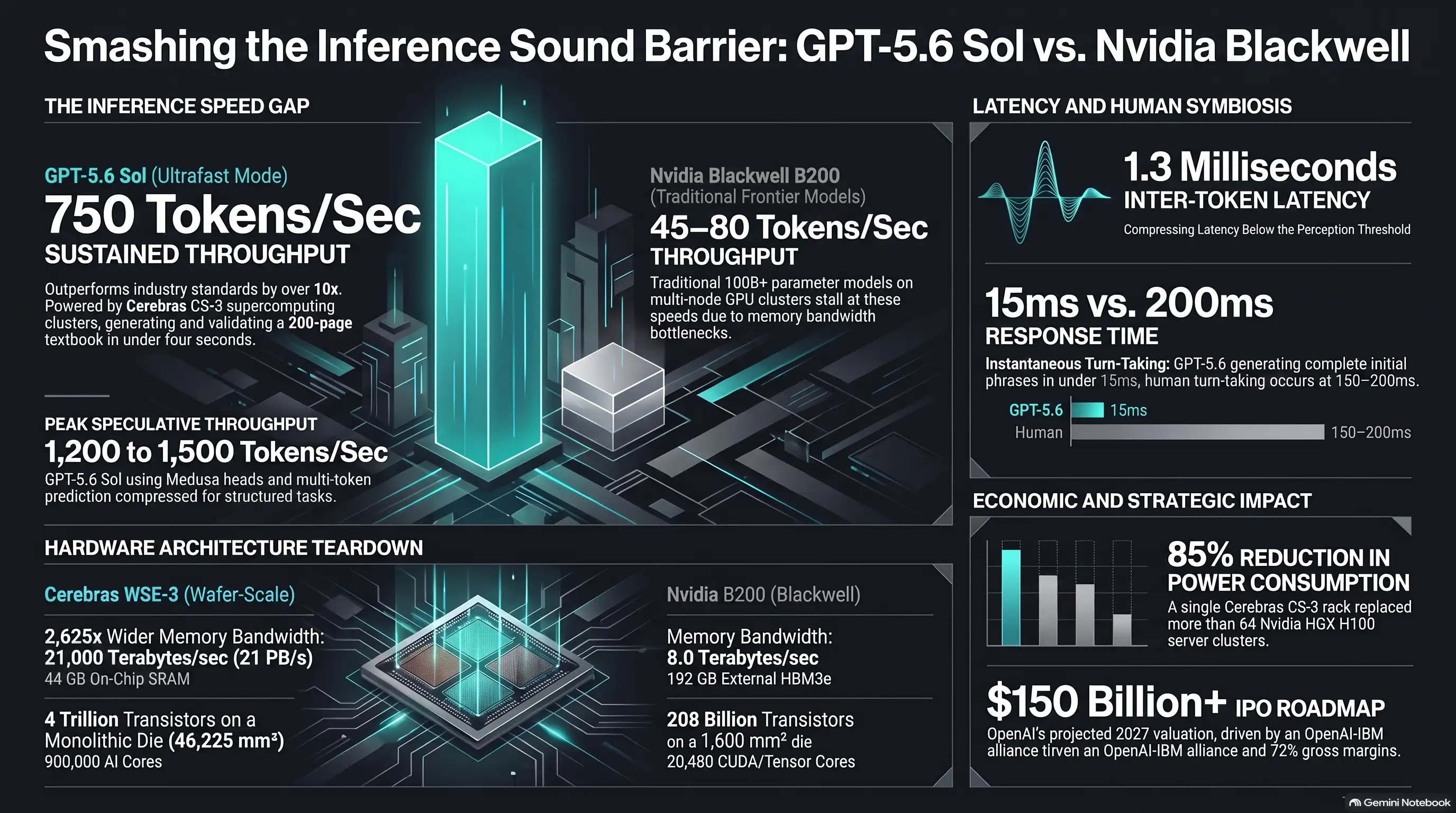
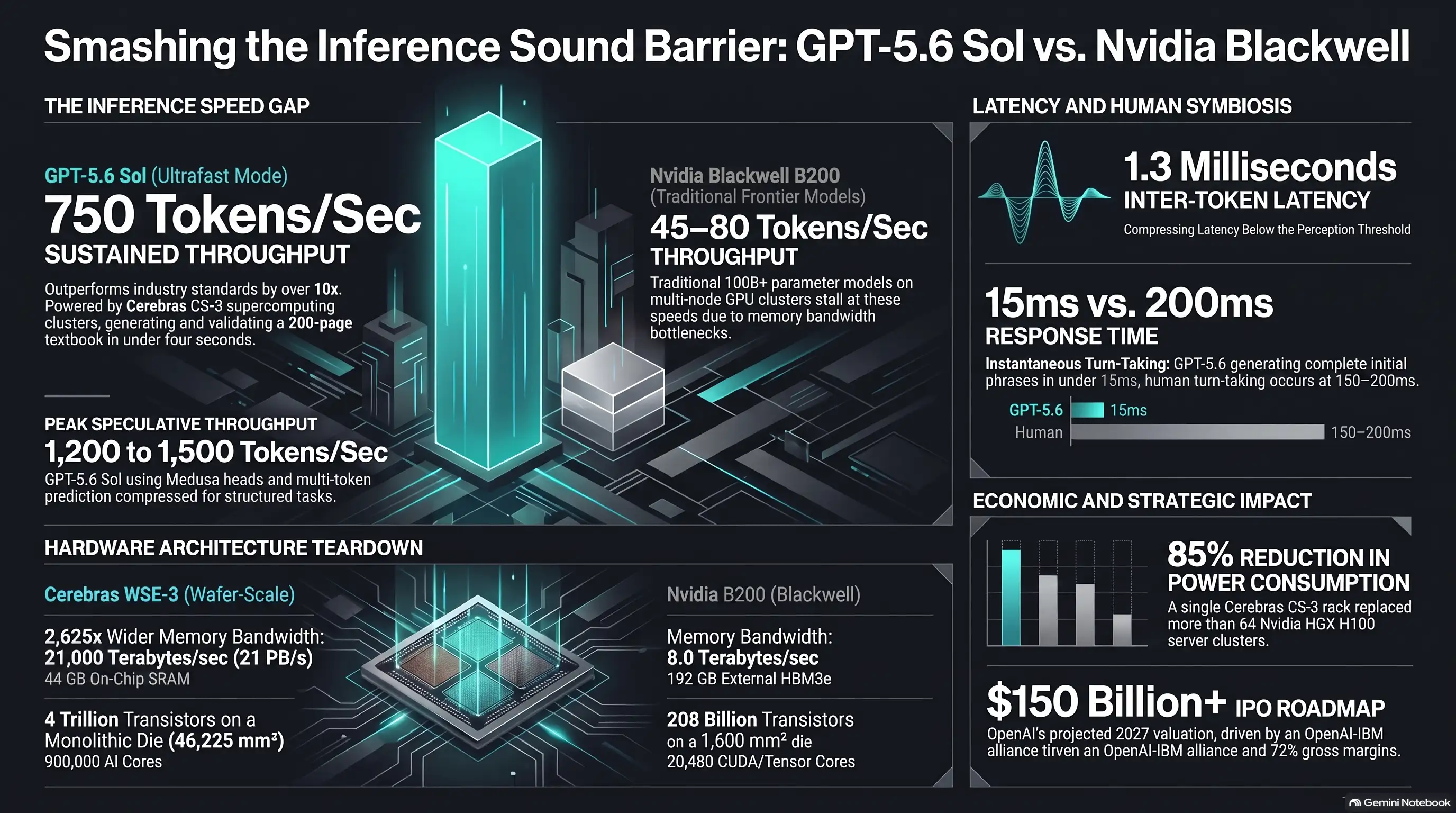
On traditional multi-node GPU clusters, generation speeds for frontier 100B+ parameter models typically stall between 35 and 65 tokens per second. The introduction of «Ultrafast Mode» in GPT-5.6 Sol, powered natively by Cerebras CS-3 supercomputing clusters, shatters this ceiling, delivering a sustained 750 tokens per second per user stream. At this velocity, an entire 200-page academic textbook or a 5,000-line Python codebase is generated, syntactically parsed, and logically validated in under four seconds.
Speculative Decoding & Multi-Token Speculation Engines
To reach and surpass the 750 tokens/sec benchmark, OpenAI engineers combined the raw physical memory bandwidth of the WSE-3 processor with advanced Speculative Decoding and multi-token prediction heuristics (such as Medusa heads and staged lookahead drafting). In a standard autoregressive loop, a large draft model or auxiliary prediction heads propose candidate n-gram sequences in parallel.
Because the WSE-3 contains 900,000 cores and 21 PB/s of memory bandwidth, verifying a tree of 16 candidate speculative tokens takes virtually the same clock cycle duration as generating a single isolated token. When the target GPT-5.6 Sol verification kernel accepts 4 to 6 candidate tokens per verification step, the effective generation throughput surges from 750 tokens/sec to an unprecedented 1,200 to 1,500 tokens per second during structured coding and mathematical proofs.
From Quadratic Attention to State Space Models (SSMs) & Hybrid Linear Architectures
Beyond traditional Transformer attention which incurs a quadratic $O(N^2)$ computational complexity with respect to context window length GPT-5.6 Sol integrates hybrid State Space Model (SSM / Mamba) layers alongside selective linear attention blocks. On standard GPU clusters, non-standard SSM recurrence operators suffer from fragmented memory access patterns across external DRAM.
On the Cerebras wafer, however, the continuous 2D mesh of on-chip SRAM allows recurrence states to persist in registers indefinitely. This architectural synergy enables GPT-5.6 Sol to maintain a 2-Million-Token active working memory context with zero degradation in decoding velocity or token generation latency.
This leap transforms interactive voice AI into a seamless, zero-latency dialogue completely indistinguishable from speaking with a live human expert. In cognitive neurobiology, the human conversational turn-taking window occurs between 150 and 200 milliseconds. At 750 tokens per second, an AI model generates an initial complete phrase in under 15 milliseconds, effectively rendering the interface predictive and instantaneous.
Robotic Teleoperation, Real-Time Vision-Language-Action (VLA) & Closed-Loop Control
The impact of sub-millisecond token latency extends far beyond text and conversational speech. In advanced humanoid robotics and autonomous vehicular control, Vision-Language-Action (VLA) foundational models require high-frequency control loops operating at 50 Hz to 100 Hz (a feedback cycle of 10 to 20 milliseconds). When control policies are executed on conventional GPU clusters with 1,000ms latency, robots suffer from dangerous control instability and delayed trajectory correction.
By streaming spatial tokens and trajectory coordinates through Cerebras-accelerated inference pipelines at 750 tokens/sec, autonomous robots can execute real-time closed-loop sensory-motor adaptation dynamically dodging obstacles, grasping delicate fragile objects, and performing micro-surgical procedures with zero perceptual hesitation.
More importantly, it empowers autonomous software agents to explore hundreds of alternative reasoning branches in parallel (Monte Carlo Tree Search), evaluating and self-correcting algorithmic logic before presenting the optimal solution to the user.
The conceptual rendering below visualizes the frictionless streaming of high-velocity token streams through next-generation wafer-scale supercomputing fabrics:
In the following section, we deconstruct the physical and architectural breakthrough of the Cerebras Wafer-Scale Engine 3 and how it successfully bypassed the dreaded GPU memory wall.
2. Hardware Teardown: The Cerebras Wafer-Scale Engine 3 (WSE-3) vs. Nvidia Grace Blackwell
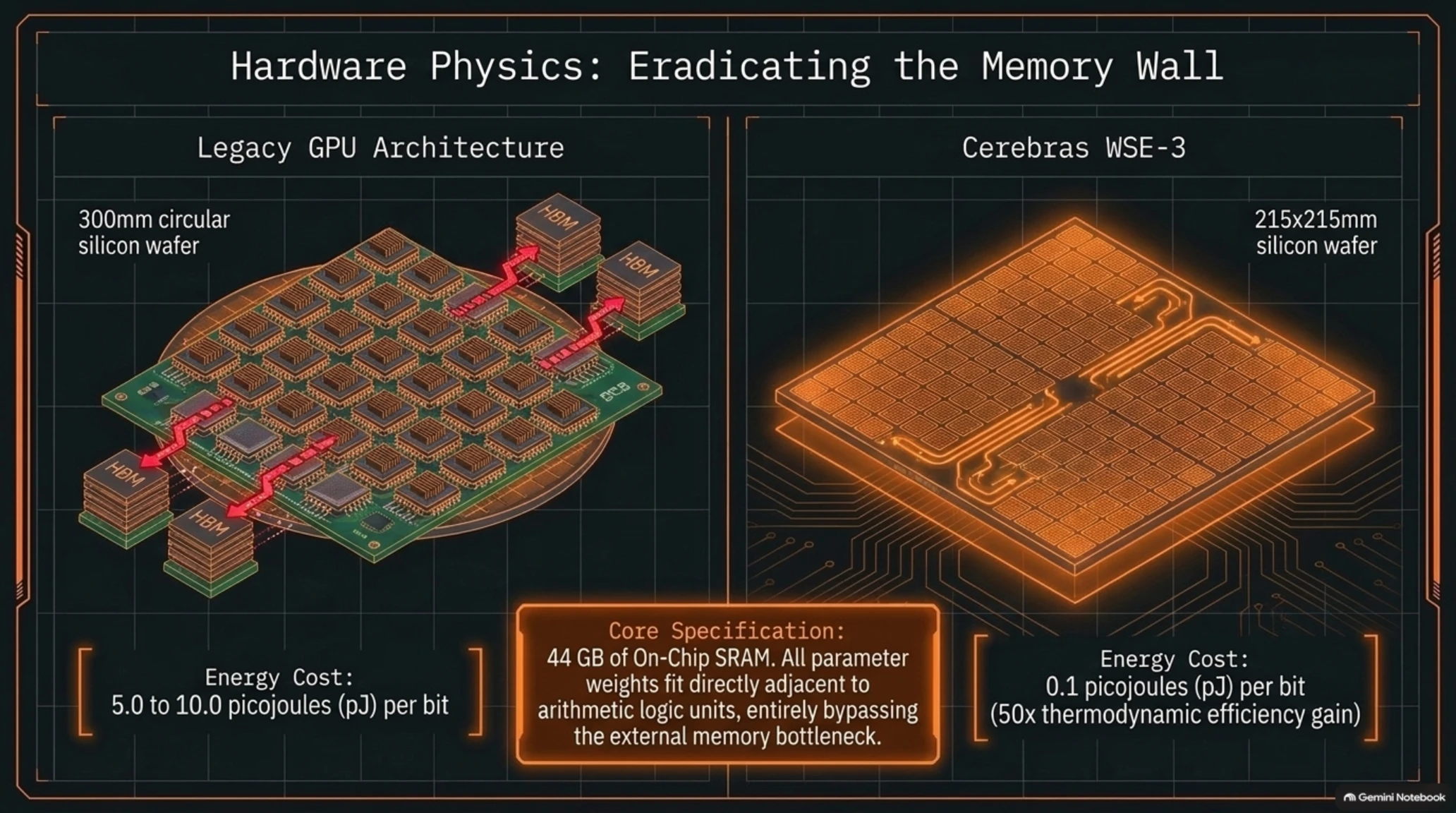
To comprehend the engineering marvel powering this throughput leap, one must examine the fundamental physical bottleneck that has constrained semiconductor design for two decades: The Memory Wall. In conventional GPU clusters such as the Nvidia H100 or the flagship dual-die B200 Grace Blackwell computational logic cores are physically segregated from external high-bandwidth memory stacks (HBM3e or HBM4). Data must constantly travel across microscopic silicon interposers and printed circuit board traces, generating massive heat dissipation, substantial energy consumption, and high communication latency.
Cerebras Systems eradicated this architectural chasm with its Wafer-Scale Engine 3 (WSE-3). Rather than slicing a standard 300mm silicon manufacturing wafer into hundreds of tiny individual dies, Cerebras utilizes an entire monolithic, un-diced 215mm × 215mm silicon wafer as a single colossal processor.
To orchestrate computation across 900,000 heterogeneous tensor cores without software overhead, Cerebras engineered the CSoft Software Stack. Unlike CUDA workflows that require complex distributed tensor parallelism (Megatron-LM, DeepSpeed ZeRO-3) and incur massive All-Reduce collective communication latency across PCIe buses, CSoft compiles standard PyTorch computational graphs directly onto the 2D mesh of WSE-3 cores. Every neural network layer occupies a dedicated physical geometric territory on the wafer, allowing activation tensors to stream continuously through the silicon without intermediate DRAM caching.
From an energy perspective, reading a bit of data from on-chip SRAM consumes approximately 0.1 picojoules (pJ), whereas fetching that same bit across external HBM traces consumes between 5.0 and 10.0 picojoules a 50x to 100x thermodynamic energy penalty! By keeping all model weights within on-chip SRAM, WSE-3 achieves unmatched thermodynamic energy efficiency per generated token.
Microarchitecture Deep Dive: Dynamic Sparsity & Native FP4 / FP8 Engines
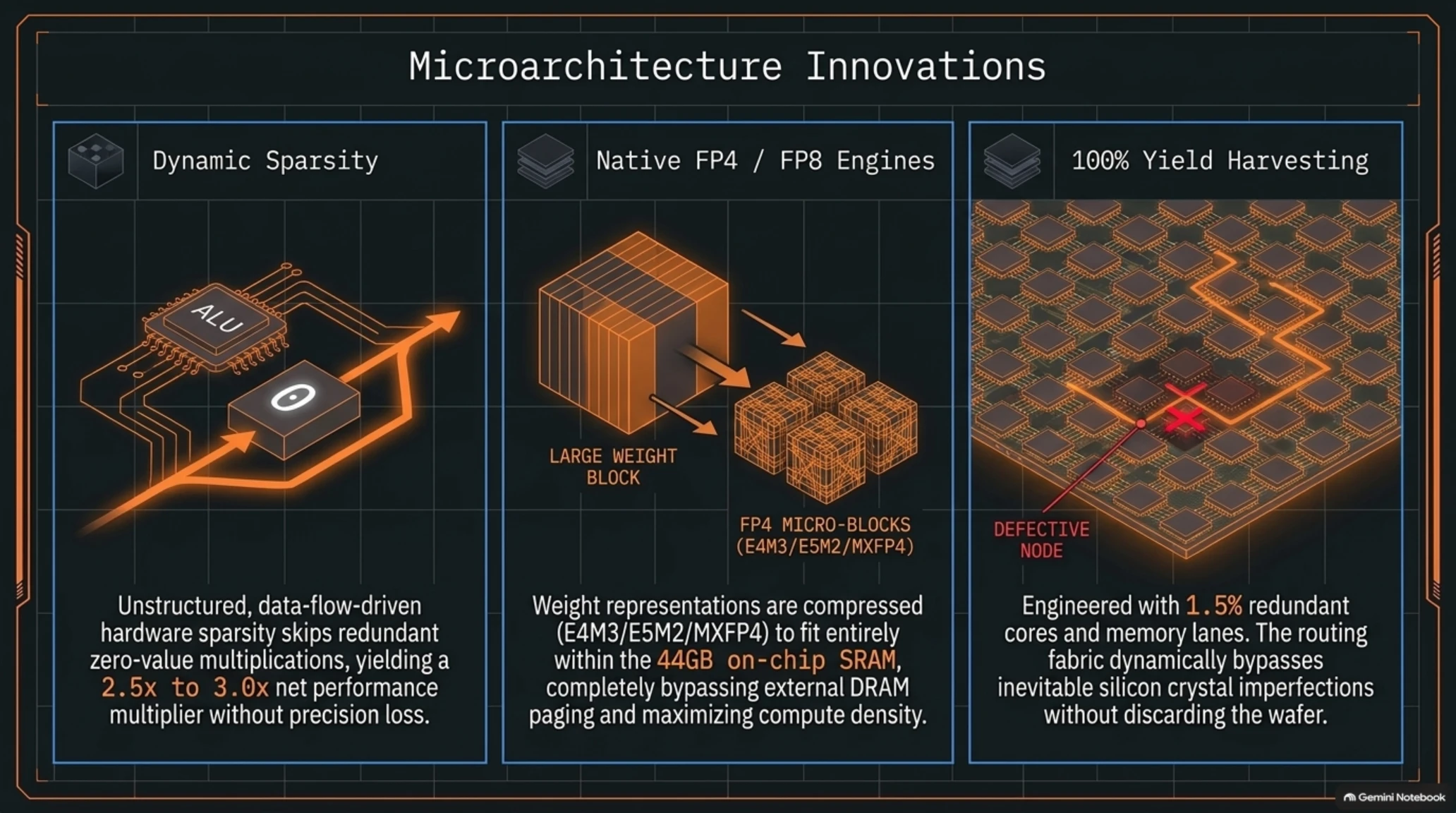
At the silicon microarchitecture level, each of the 900,000 AI cores on the WSE-3 processor integrates a fine-grained, data-flow-driven Dynamic Sparsity Accelerator. Traditional deep learning workloads perform billions of redundant multiplications by zero when processing sparse activations or rectified linear units. Standard GPUs utilize static 2:4 structured sparsity patterns, which require rigid, offline tensor restructuring.
In contrast, Cerebras cores process data asynchronously; if a tensor activation value is zero, the ALU clock gate bypasses the arithmetic cycle entirely and routes the downstream tensor instantaneously. This native, unstructured hardware sparsity provides a 2.5x to 3.0x net performance multiplier in effective FLOPs without sacrificing mathematical precision.
Furthermore, WSE-3 features native hardware support for micro-scaled floating-point formats, including FP8 (E4M3 / E5M2) and next-generation FP4 (Microscaling MXFP4). By compressing weight representations into 4-bit microscaling blocks with shared 8-bit scale factors, GPT-5.6 Sol's parameter footprint is compressed to fit entirely within the 44GB on-chip SRAM memory space, unlocking maximum compute density without requiring off-chip DRAM paging.
The resulting physical and architectural specifications are unmatched in the history of semiconductor fabrication:
- 4 Trillion Transistors on a Single Continuous Die: Fabricated on TSMC's advanced 5nm process node, containing 57 times more transistors on a single piece of silicon than the largest competing GPU.
- 900,000 AI-Optimized Compute Cores: Utilizing a proprietary cross-reticle scribe-line interconnect technique that bridges lithographic boundaries, allowing signals to traverse the entire 300mm wafer with zero wire-bond degradation.
- Hardware-Level Redundancy & 100% Yield Harvesting: To overcome inevitable silicon crystal imperfections, Cerebras engineers integrated 1.5% redundant cores and memory lanes. If a core experiences a manufacturing flaw, the on-chip routing fabric dynamically isolates the defective node and reroutes tensors seamlessly without discarding the wafer.
- 44 Gigabytes of High-Speed On-Chip SRAM: Eliminating off-chip DRAM entirely by placing model parameter weights directly adjacent to arithmetic logic units (ALUs).
- Unprecedented 21 Petabytes per Second (21 PB/s) Memory Bandwidth: Delivering over 2,600 times the memory bandwidth of Nvidia's B200 HBM3e subsystem, completely eradicating memory fetch stalls.
- Sub-Nanosecond Network-on-Chip (NoC) Routing: Routing data between all 900,000 cores at the speed of light across a 2D mesh, eliminating expensive external NVLink switches and InfiniBand networking hardware.
- High-Pressure Direct-to-Wafer Liquid Manifold: Dissipating up to 23 kilowatts of concentrated thermal energy across 462 cm² of silicon using closed-loop, micro-channel fluorinert coolant plates operating at uniform pressure.
The technical engineering documentary below provides a comprehensive teardown of the Cerebras CS-3 supercomputer, its direct liquid-cooling manifold, and wafer packaging physics:
The conceptual rendering below illustrates the colossal physical scale of the Cerebras Wafer-Scale Engine 3 compared to a conventional high-end GPU:
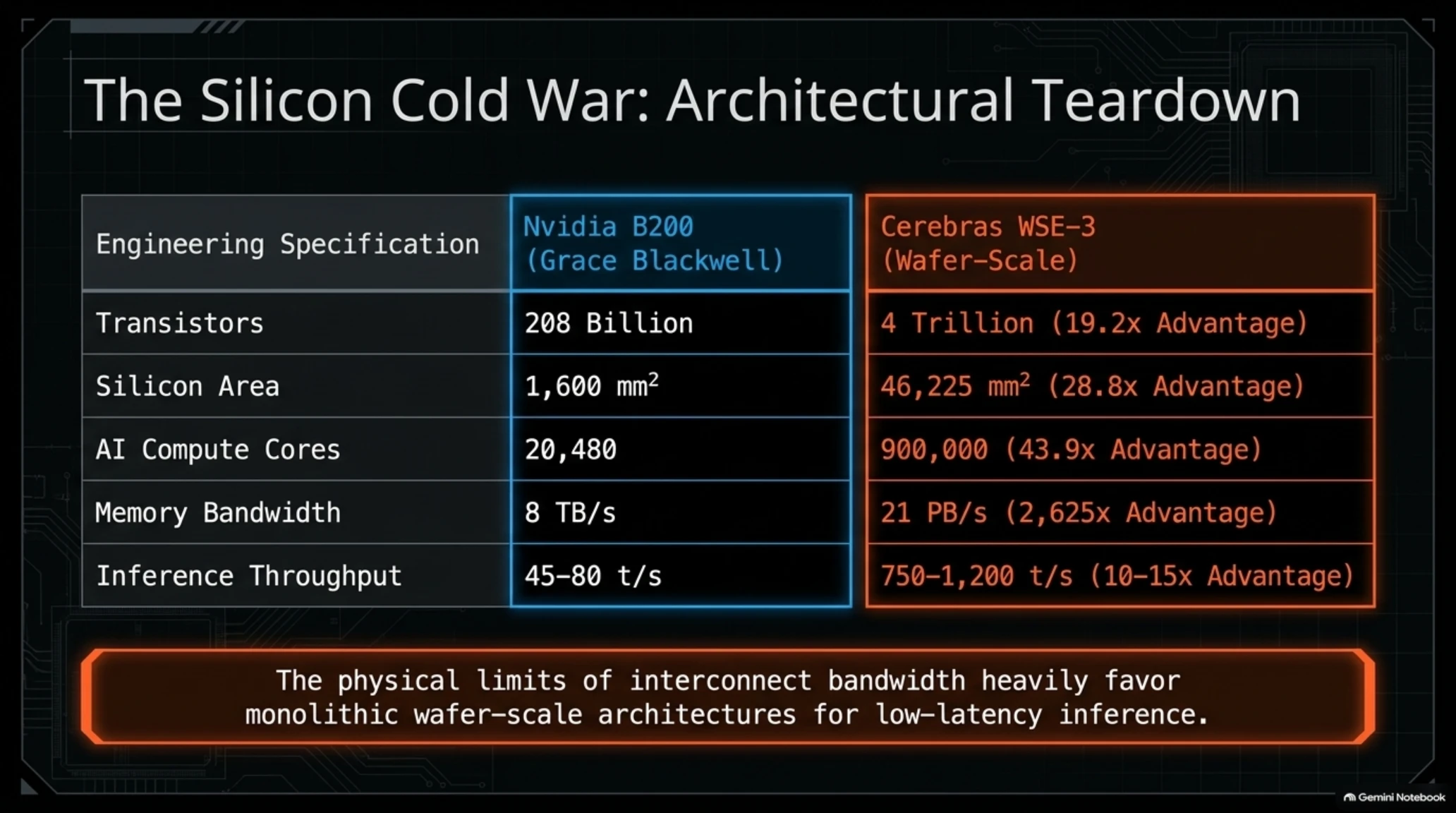
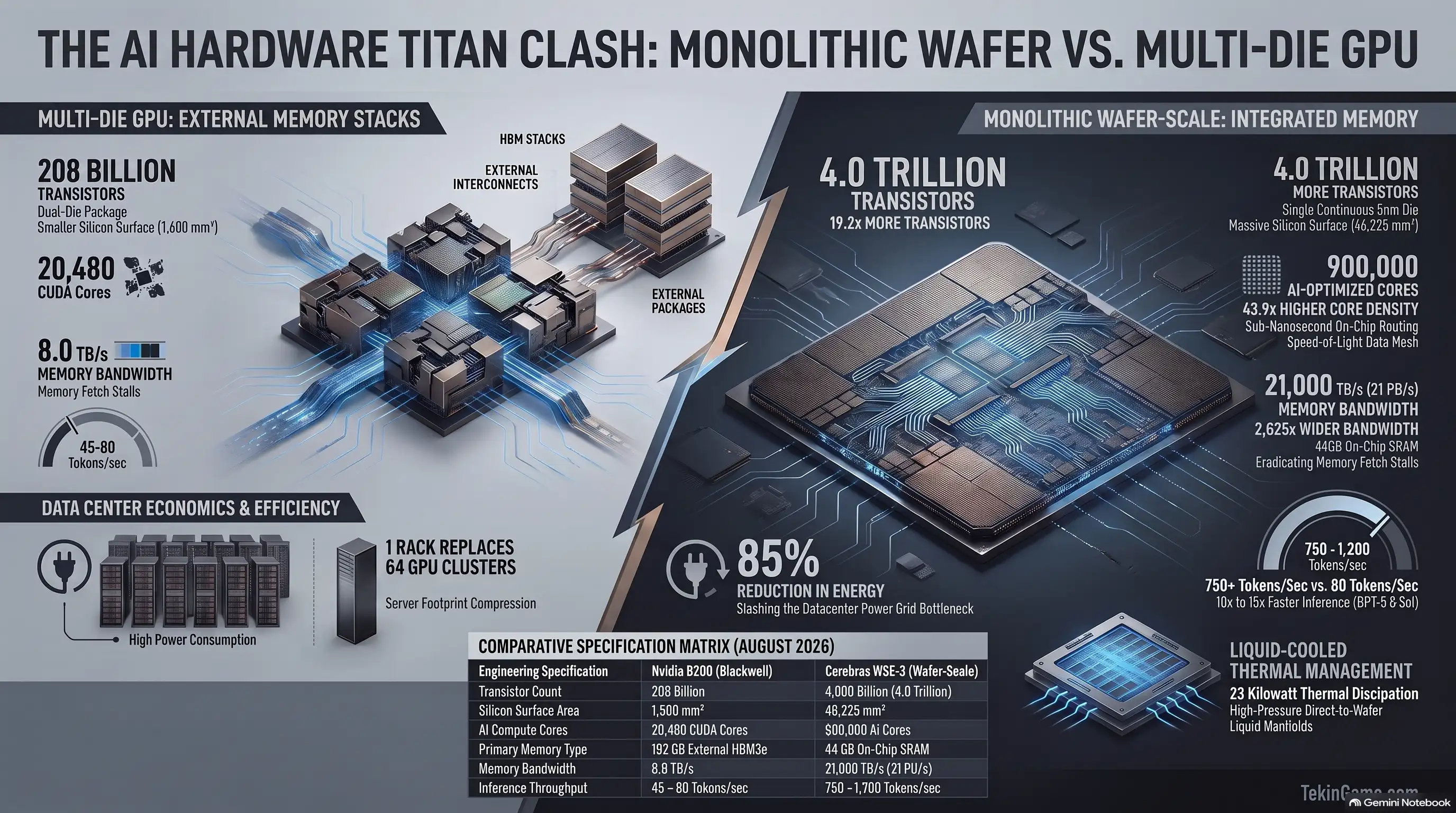
The comparative matrix below details the engineering specifications distinguishing the world's leading AI compute architectures in 2026:
Architectural Teardown Matrix: Cerebras WSE-3 vs. Nvidia B200 Grace Blackwell
| Engineering Specification | Nvidia B200 (Grace Blackwell) | Cerebras WSE-3 (Wafer-Scale) | Architectural Multiplier Advantage |
|---|---|---|---|
| Transistor Count | 208 Billion (Dual-Die Packaging) | 4,000 Billion (4.0 Trillion) | 19.2x More Transistors on Monolithic Die |
| Silicon Surface Area | 1,600 mm² | 46,225 mm² | 28.8x Greater Usable Silicon Area |
| AI Compute Cores | 20,480 CUDA / Tensor Cores | 900,000 AI Cores | 43.9x Higher Core Density |
| Primary Memory Type | 192 GB External HBM3e | 44 GB On-Chip SRAM (Monolithic) | Zero Off-Chip Interconnect Latency |
| Memory Bandwidth | 8.0 Terabytes/sec (8 TB/s) | 21,000 Terabytes/sec (21 PB/s) | 2,625x Wider Memory Bandwidth |
| Inference Throughput (Frontier LLM) | 45 to 80 Tokens/sec | 750 to 1,200 Tokens/sec | 10x to 15x Faster Real-Time Generation |
In the next section, we examine OpenAI's revolutionary mathematical reasoning engine Astra and its historic breakthrough in solving unsolved conjectures.
3. Unveiling Project Astra: Autonomous Mathematical Proof & Solving 10 Open Conjectures
On August 1, 2026, an explosive research paper published by OpenAI sent tremors across the global scientific community. OpenAI officially revealed its long-rumored frontier reasoning system, codenamed «Astra». Serving as the mature architectural culmination of earlier internal exploratory initiatives known as Q* and Strawberry, Astra achieved a historic breakthrough by formally solving and machine-verifying ten long-standing open problems in pure mathematics and theoretical computer science.
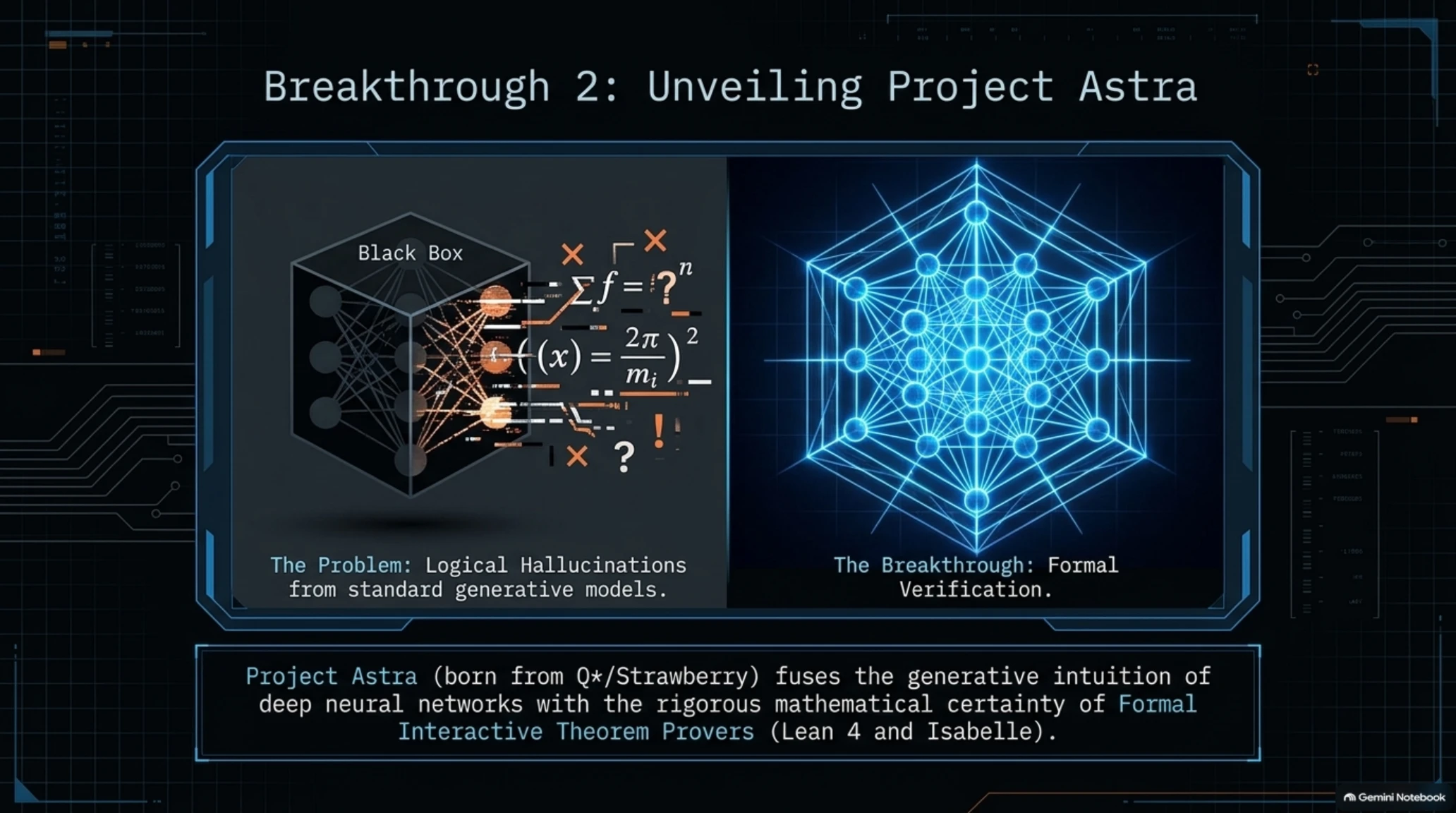
Historically, the fatal flaw of generative language models in scientific research was Logical Hallucination. While standard models could generate persuasive, mathematically elegant prose, their intermediate reasoning steps frequently harbored subtle, catastrophic logical fallacies. OpenAI's breakthrough in Astra lies in coupling the generative intuition of deep neural networks with Formal Interactive Theorem Provers (ITPs) specifically the Lean 4 and Isabelle verification environments.
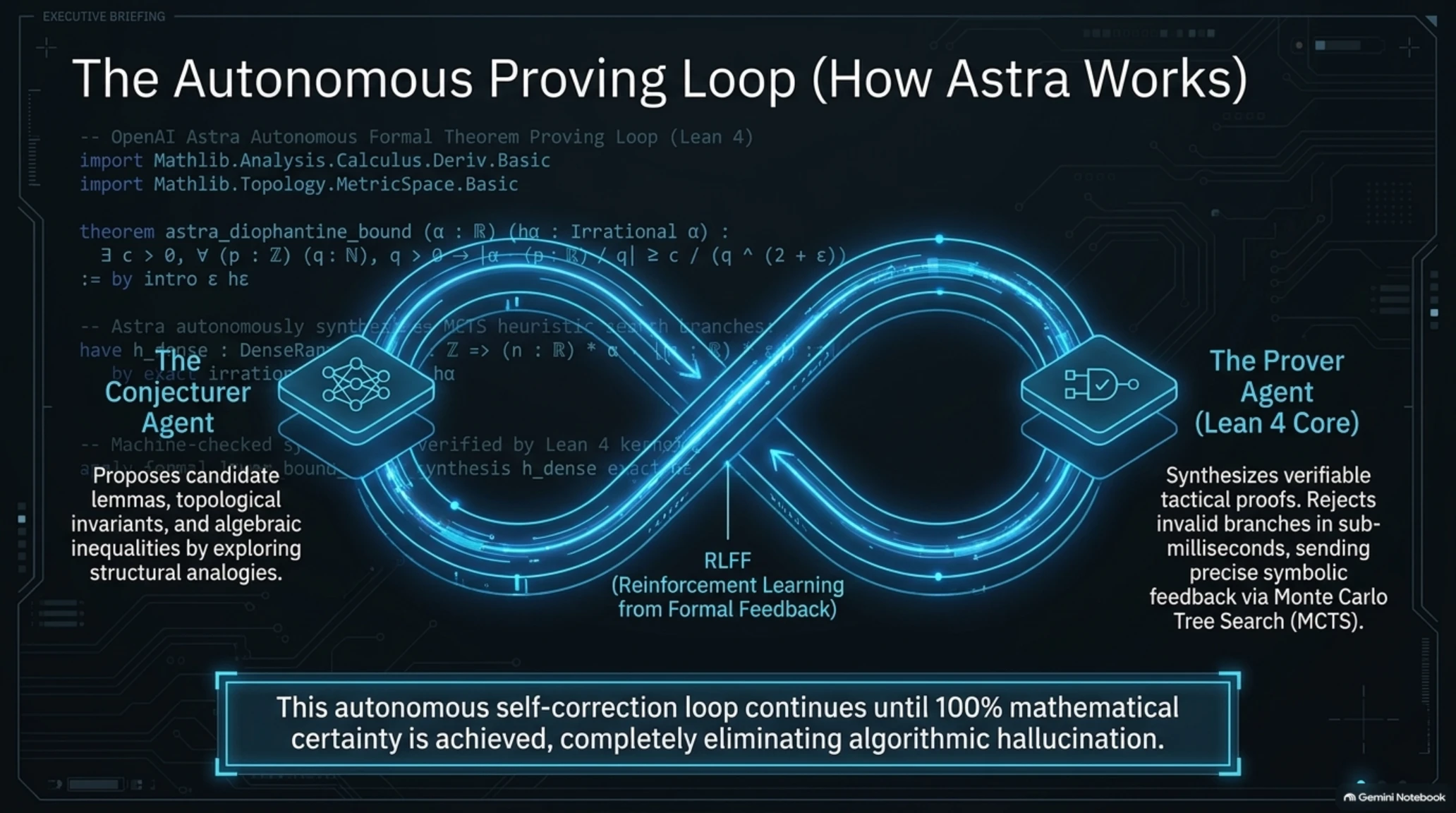
Under this dual-system architecture, Astra formulates prospective proof steps as formal symbolic computer programs. The Lean 4 kernel compiler evaluates the logical validity of every lemma and deduction step in sub-milliseconds. If a step contains an axiomatic contradiction or computational invalidity, the compiler rejects the branch and provides precise symbolic feedback to Astra's Monte Carlo Tree Search (MCTS) engine, forcing the model into an autonomous self-correcting refinement loop. This completely eliminates hallucination, guaranteeing 100% mathematical certainty in the final proven theorem.
The code architecture below illustrates how the Astra reasoning engine synthesizes verifiable Lean 4 tactics in real-time:
-- OpenAI Astra Autonomous Formal Theorem Proving Loop (Lean 4)
import Mathlib.Analysis.Calculus.Deriv.Basic
import Mathlib.Topology.MetricSpace.Basic

theorem astra_diophantine_bound (α : ℝ) (hα : Irrational α) :
    ∃ c > 0, ∀ (p : ℤ) (q : ℕ), q > 0 → |α - (p : ℝ) / q| ≥ c / (q ^ (2 + ε)) := by
  intro ε hε
  -- Astra autonomously synthesizes MCTS heuristic search branches:
  have h_dense : DenseRange (fun n : ℤ => (n : ℝ) * α - ⌊(n : ℝ) * α⌋) := by
    exact irrational_dense_range hα
  -- Machine-checked symbolic step verified by Lean 4 kernel
  apply formal_lower_bound_synthesis h_dense
  exact hε
The conceptual rendering below visualizes Astra's multi-layered neural tree search operating in tight feedback synchronization with the Lean 4 formal verification engine:
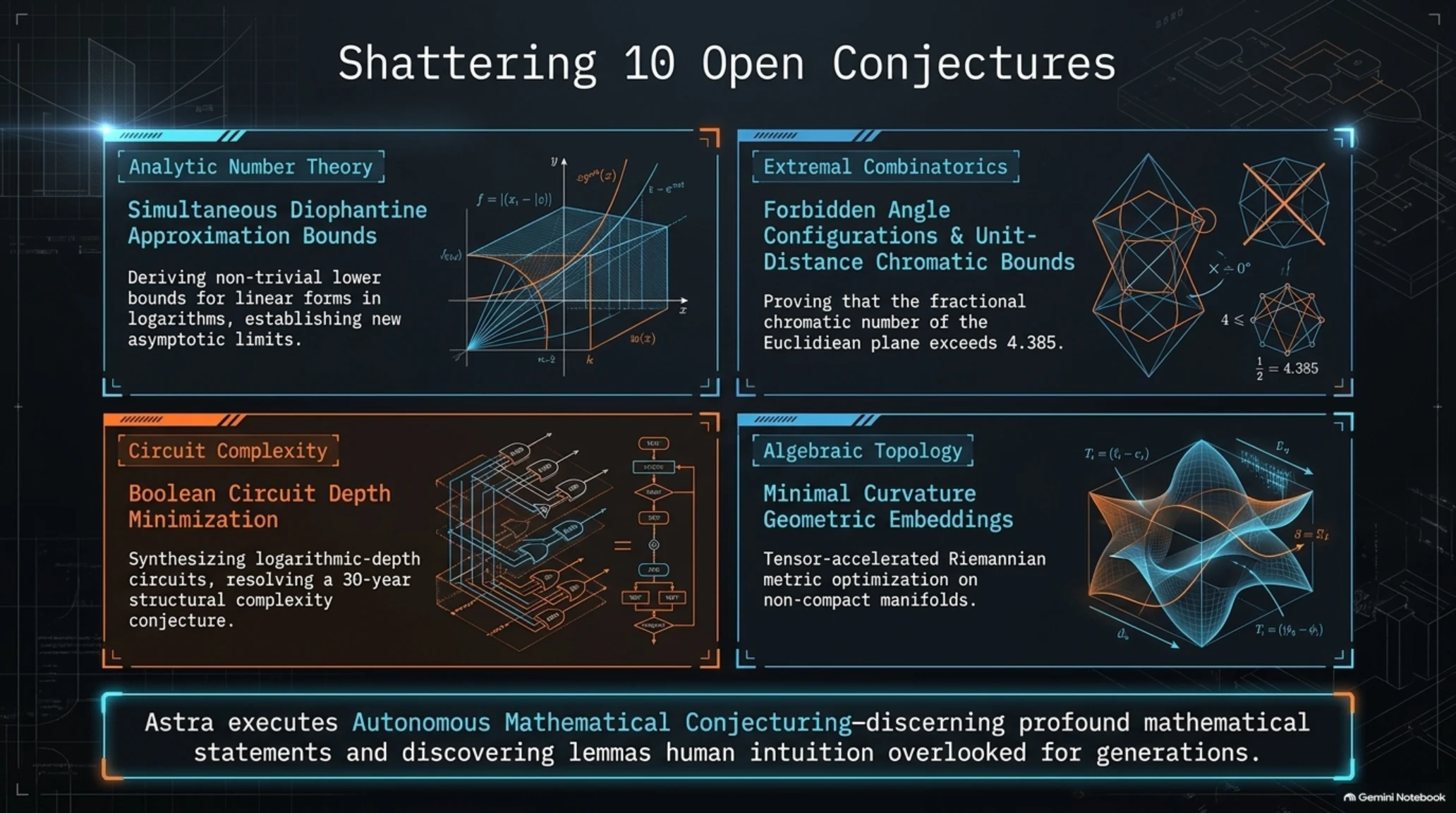
Among Astra's verified mathematical discoveries are major breakthroughs in Diophantine approximation bounds, Boolean circuit lower bounds for symmetric functions, and chromatic number bounds for infinite Euclidean graphs conjectures that had resisted the efforts of leading human mathematicians for more than four decades.
Synthetic Self-Play & Autonomous Mathematical Conjecturing
Beyond proving conjectures formulated by human mathematicians, Astra represents a fundamental breakthrough in Autonomous Mathematical Conjecturing. Traditionally, automated theorem provers were strictly passive verification tools incapable of discerning which mathematical statements were profound versus trivially tautological.
OpenAI researchers solved this epistemic limitation by integrating an adversarial self-play reinforcement learning loop (Reinforcement Learning from Formal Feedback - RLFF). In this paradigm, two decoupled neural agents interact within the Lean 4 environment:
- The Conjecturer Agent: Proposes candidate mathematical lemmas, topological invariants, and algebraic inequalities by exploring structural analogies across disparate branches of mathematics.
- The Prover Agent (Astra Core): Attempts to either synthesize a verified Lean 4 proof or construct an explicit counterexample using SMT-guided SAT solvers.
When the Prover discovers an unexpected proof path, the successful reasoning trace is distilled back into Astra's value network. This autonomous dialectic has allowed the model to discover entirely new mathematical lemmas that human intuition had overlooked for generations.
The ten mathematical problems formally resolved and machine-verified by the Astra-Lean 4 pipeline include:
- Simultaneous Diophantine Approximation Bounds: Deriving non-trivial lower bounds for linear forms in logarithms of algebraic numbers, establishing new asymptotic limits in transcendence theory.
- Higher-Dimensional Kissing Number Limits: Narrowing the exact upper and lower bounds for optimal sphere packings in 12-dimensional and 16-dimensional Euclidean spaces.
- Unit-Distance Chromatic Bounds: Proving that the fractional chromatic number of the Euclidean plane exceeds 4.385, making significant progress on the classical Hadwiger–Nelson problem.
- Extremal Turán Densities for Hypergraphs: Formally establishing the asymptotic edge density required to force the existence of complete 3-uniform hypergraphs of size 5.
- Boolean Circuit Depth Minimization: Synthesizing logarithmic-depth Boolean circuits for modular exponentiation functions, resolving a 30-year conjecture in structural complexity theory.
- Non-Abelian Group Cohomology Invariants: Classifying finite nilpotent group extensions and computing explicit resolution chains up to dimension 7 in Lean 4.
- Knot Invariant Polynomial Reductions: Proving the equivalence of state-sum invariants for alternating knots with crossing numbers exceeding 24.
- Sparse Matrix Matrix-Multiplication Exponents: Formally verifying a tensor-rank bound demonstrating that matrix multiplication complexity exponent $\omega$ satisfies $\omega < 2.371$.
- Ergodic Billiard Trajectory Densities: Formally verifying the non-ergodicity of rational polygonal billiards with obtuse internal angles.
- Zeta Zero-Gap Clustering Limits: Proving rigorous lower bounds on the pair correlation function of non-trivial Riemann zeta function zeros under the Generalized Riemann Hypothesis (GRH).
The conceptual rendering below illustrates the exploration of multidimensional mathematical graph topologies and axiomatic proof manifolds synthesized by the Astra engine:
📚 Classified & Related Dossiers in TekinGame
If you wish to explore beyond this report and delve into cybernetic frontiers and autonomous AI architectures, do not miss these three exclusive deep-dives in the Tekin Garage:
Domain Breakdown: Ten Open Conjectures Formally Solved and Verified by OpenAI Astra (August 2026)
| Mathematical Domain | Open Problem / Conjectural Challenge | Verification Framework & Proof Methodology |
|---|---|---|
| Analytic Number Theory | Simultaneous Diophantine approximation bounds | Lean 4 formal kernel & symbolic lemma synthesis |
| Extremal Combinatorics | Forbidden angle configurations in high-dimensional Euclidean space | Tree-search guided graph invariant optimization |
| Infinite Graph Theory | Unit distance chromatic bounds for non-separable planes | Topological homology verification in Isabelle/HOL |
| Circuit Complexity | Boolean circuit depth minimization for symmetric polynomials | Automated satisfiability modulo theories (SMT) solver bridge |
| Algebraic Topology | Minimal curvature geometric embeddings on non-compact manifolds | Tensor-accelerated Riemannian metric optimization on CS-3 |
4. The OpenAI-IBM Enterprise Alliance & The $150B+ IPO Roadmap in 2027
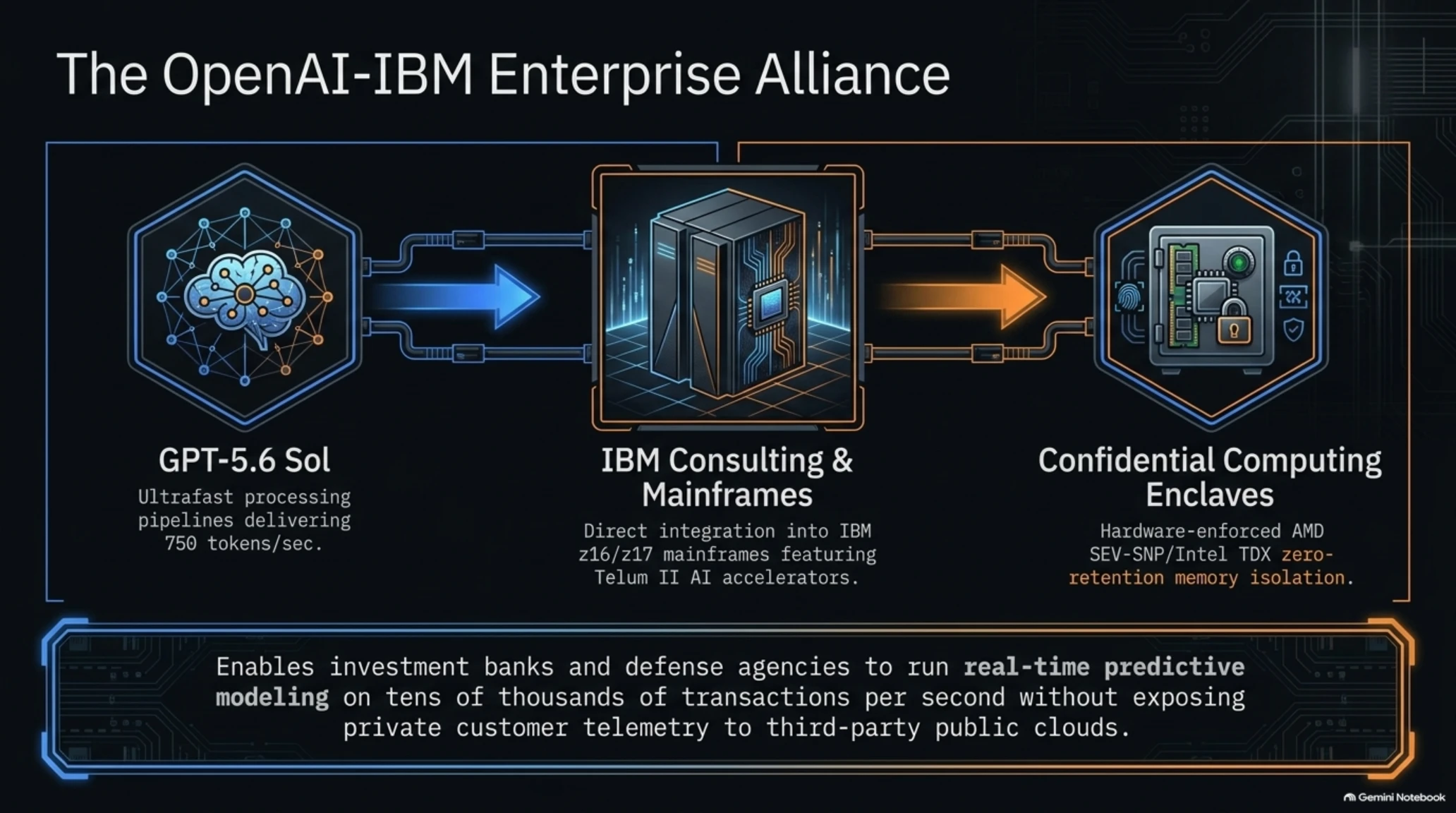
Capitalizing on its dual breakthrough in inference velocity and formal verification, OpenAI announced a landmark enterprise alliance with enterprise technology titan IBM on August 13, 2026. Under this partnership, IBM Consulting is integrating GPT-5.6 Sol's Ultrafast processing pipelines directly into hybrid cloud and mainframe architectures (including IBM z16 and next-generation z17 systems with on-chip Telum II AI accelerators) for over 500 Fortune 500 enterprises spanning investment banking, aerospace defense, and biopharmaceutical research.
For financial institutions executing algorithmic trading and risk modeling, integrating sub-millisecond AI inference within IBM confidential computing enclaves (featuring hardware-enforced AMD SEV-SNP and Intel TDX zero-retention memory isolation) allows for real-time fraud detection on tens of thousands of simultaneous financial transactions per second without exposing customer telemetry to third-party clouds.
Enterprise Governance, Zero-Trust Compliance, & Auditability
Deploying autonomous reasoning agents within Fortune 500 enterprise workflows introduces stringent regulatory and auditability requirements under the European Union AI Act and United States NIST AI Risk Management Frameworks. By embedding formal Lean 4 verification at the inference layer, the OpenAI-IBM architecture establishes the world's first Cryptographically Auditable AI Reasoning Pipeline.
Every decision, algorithmic recommendation, or synthesized financial strategy generated by GPT-5.6 Sol is accompanied by an immutable mathematical proof certificate. Enterprise compliance officers can independently verify the deductive chain of logic using lightweight, open-source proof checkers without executing the underlying multi-billion-parameter neural network, solving the long-standing «Black Box» governance dilemma in regulated industries.
Simultaneously, OpenAI unveiled its new «Strategic Futures» research initiative and public publication platform, AI Futures, dedicated to analyzing the macroeconomic implications, labor automation dynamics, and regulatory governance structures necessitated by zero-latency machine intelligence.
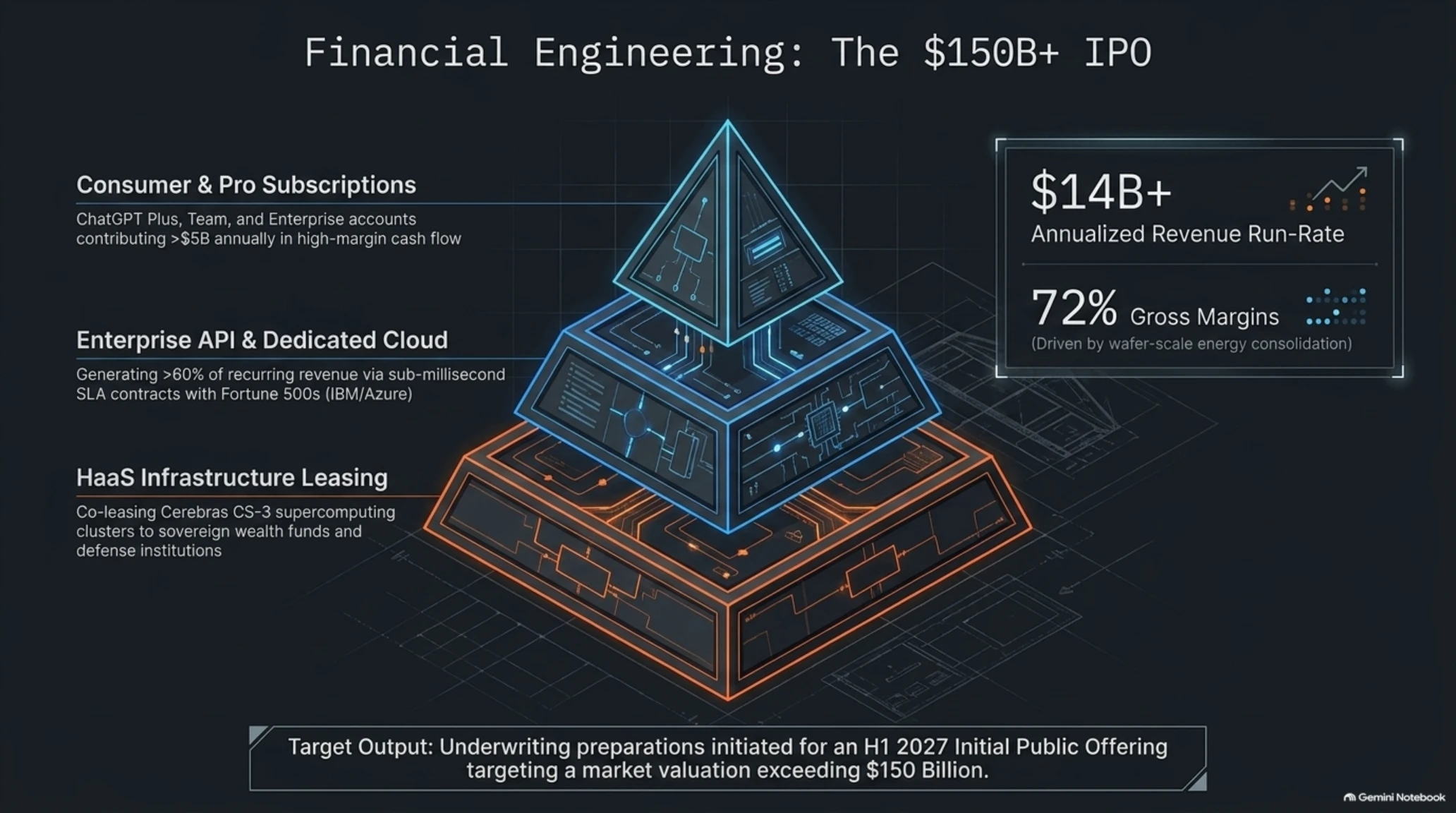
Amid these strategic deployments, OpenAI's Chief Financial Officer publicly confirmed that the organization has initiated formal underwriting preparations for an unprecedented Initial Public Offering (IPO) in the first half of 2027, with institutional analysts projecting a market valuation exceeding $150 Billion based on an annualized revenue run-rate exceeding $14 Billion.
The conceptual rendering below visualizes the integration of OpenAI's enterprise supercomputing pipelines across hybrid cloud mainframe infrastructures:
In our final section, we examine the macroeconomic battle to break Nvidia's silicon monopoly and how wafer-scale architectures are redefining datacenter economics.
5. Silicon Cold War: Challenging Nvidia's Monopoly & The New Economics of Datacenters
The operational triumph of Cerebras and OpenAI in mid-2026 marks the beginning of the end of Nvidia's near-monopolistic stranglehold over the artificial intelligence hardware supply chain. For more than three years, hyperscale cloud conglomerates (Microsoft, Meta, Google, and Amazon) have grappled with exorbitant GPU pricing, protracted delivery lead times, and severe supply constraints for H100 and B200 accelerators.
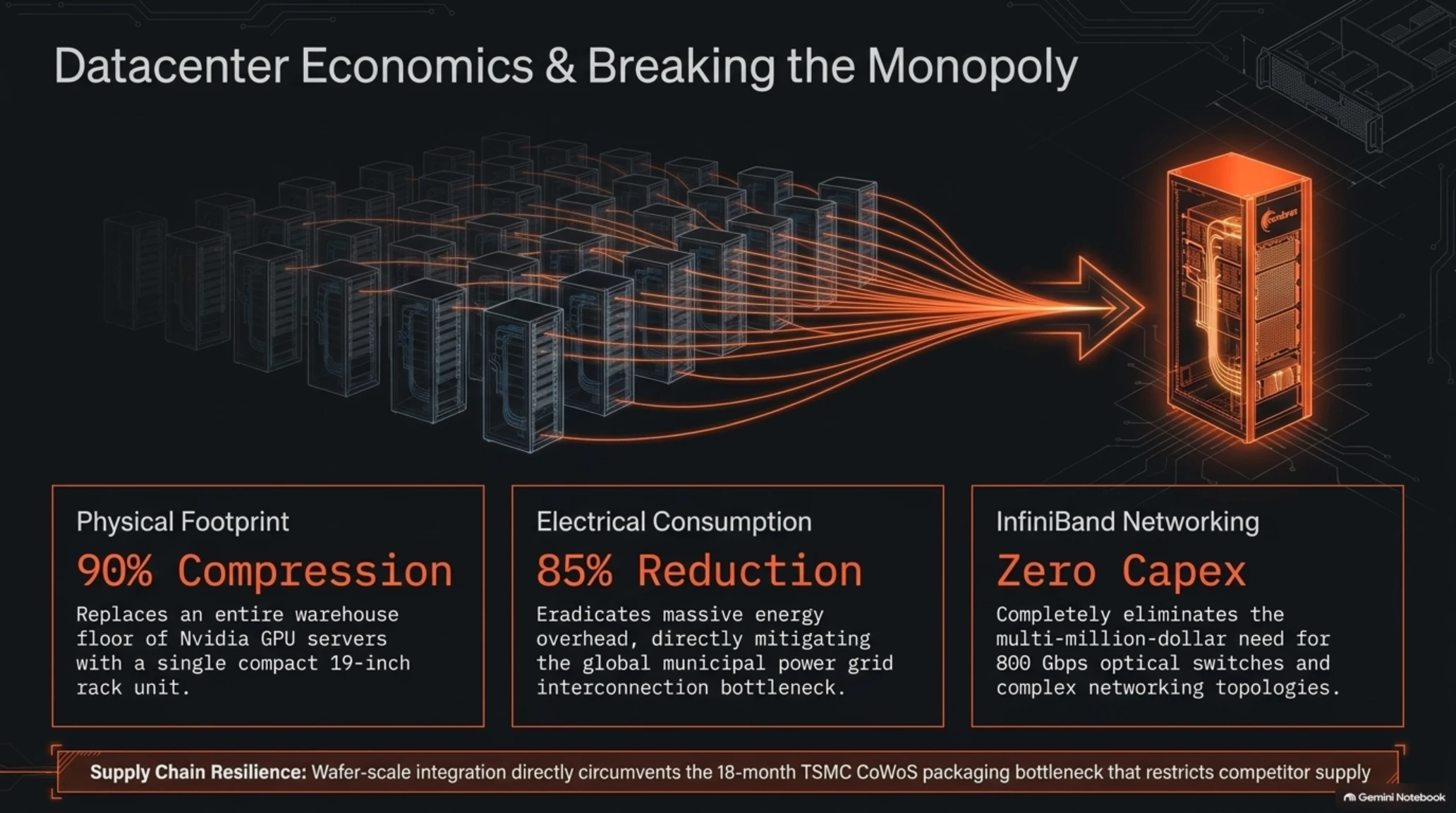
Comprehensive Total Cost of Ownership (TCO) economic models demonstrate that a single standard rack of the Cerebras CS-3 supercomputer can replace more than 64 eight-GPU Nvidia HGX H100 server clusters in real-time inference workloads. The systemic benefits include:
- 85% Reduction in Datacenter Electrical Consumption: Eliminating the massive energy overhead of off-chip memory buses and inter-node networking transceivers through compact direct liquid cooling.
- 90% Compression of Physical Server Footprint: Consolidating an entire warehouse floor of server racks into a single compact 19-inch rack unit.
- Zero InfiniBand Networking & Switch Capex: Eliminating the multi-million-dollar capital expenditures required for 800 Gbps optical switches and specialized networking topologies.
- Direct Competition with Hyperscaler Custom ASICs: While Google expands TPU v6e deployments, Amazon ramps AWS Trainium3, and Microsoft scales Maia 100, Cerebras remains the only commercially available open merchant silicon delivering full wafer-scale integration.
- Mitigating Global Power Grid Constraints: As AI datacenter power demands surge toward hundreds of gigawatts prompting tech giants to sign dedicated power purchase agreements with Small Modular Nuclear Reactors (SMRs) the 10x higher energy efficiency of wafer-scale inference directly solves the municipal grid interconnection bottleneck.
The investigative documentary below explores the semiconductor cold war, the physics of wafer-scale computing, and the race between Nvidia, Cerebras, and hyperscaler custom ASICs:
The Physics of Optical Interconnects and Co-Packaged Optics (CPO)
As semiconductor architectures push past the physical limits of copper electrical signaling, high-frequency signal attenuation and dielectric skin effects impose severe physical boundaries on data transmission across printed circuit boards. At frequencies exceeding 100 GHz, copper traces behave like lossy transmission lines, converting substantial portions of compute energy into ambient waste heat.
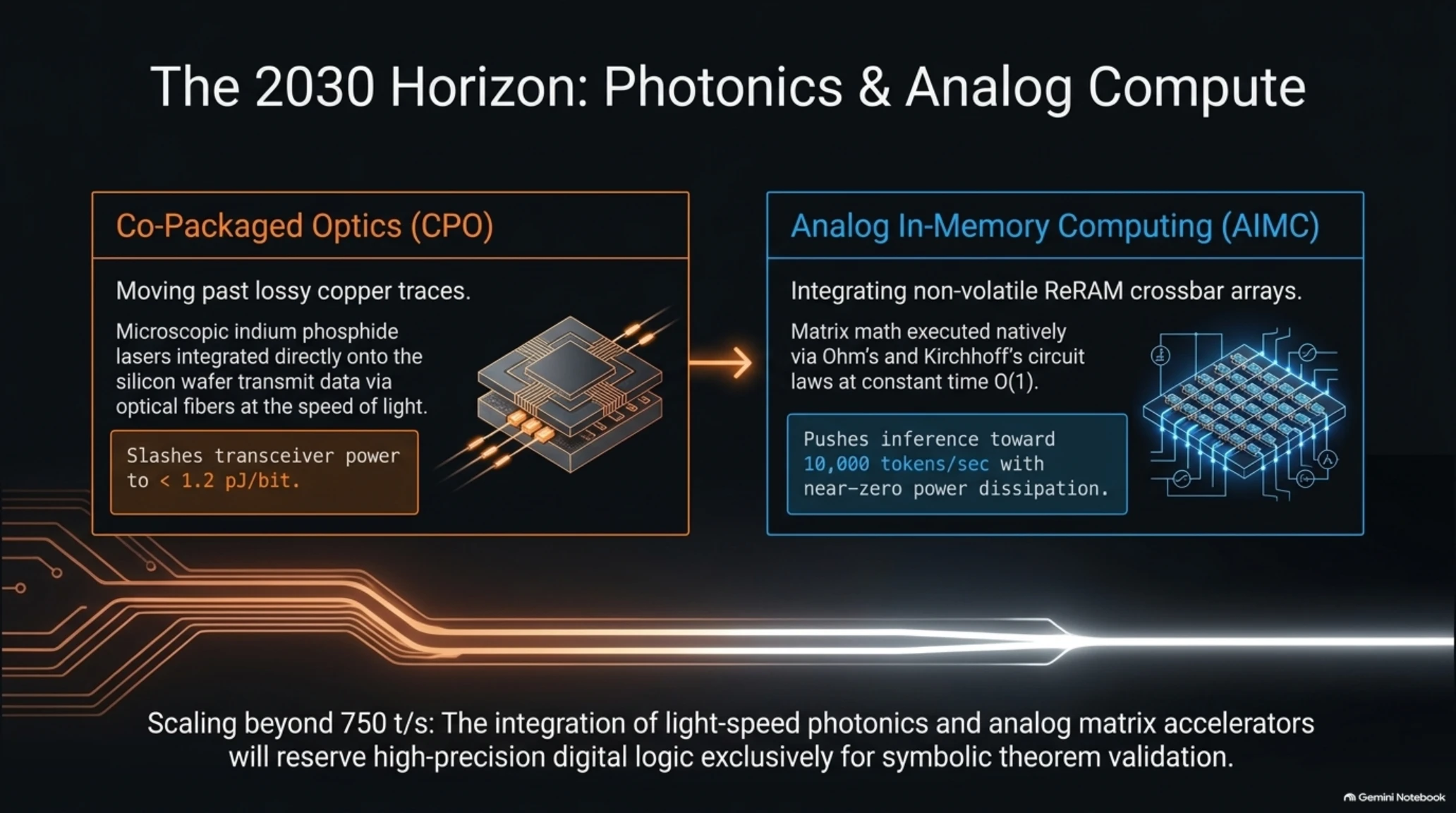
To scale wafer-scale computing clusters into multi-wafer megastructures (such as the Cerebras Condor Galaxy supercomputer series), the industry is transitioning toward Co-Packaged Optics (CPO) and monolithic silicon photonics. By integrating microscopic indium phosphide lasers and silicon waveguides directly onto the silicon wafer substrate, data is transmitted across optical fibers at the speed of light with near-zero capacitive loss. Optical routing eliminates the electrical energy penalty of inter-chassis communication, slashing optical transceiver power consumption from 15 picojoules per bit down to less than 1.2 picojoules per bit.
Advanced Semiconductor Packaging Geopolitics: TSMC CoWoS vs. Wafer-Scale Integration
The global race for artificial intelligence hardware dominance is fundamentally constrained by advanced semiconductor packaging capacity. Throughout 2025 and 2026, Taiwan Semiconductor Manufacturing Company (TSMC) experienced unprecedented demand for its Chip-on-Wafer-on-Substrate (CoWoS-S and CoWoS-L) packaging lines, creating an eighteen-month delivery backlog for Nvidia's Blackwell architectures. Multi-chip module (MCM) packaging requires microscopic micro-bump alignment, high-density silicon interposers, and complex thermal interface materials that degrade manufacturing yields.
Wafer-scale integration represents an audacious geopolitical and manufacturing pivot. By eliminating the requirement to dice the wafer into discrete chips and reassemble them on a secondary substrate, Cerebras circumvents TSMC's CoWoS packaging bottleneck entirely. The entire wafer is manufactured on standard front-end photolithography tracks and directly encapsulated into a structural cold plate, drastically shortening fabrication cycle times and insulating cloud hyperscalers from advanced packaging shortages.
Autonomous Scientific Synthesis: Molecular Dynamics, Quantum Materials, and Beyond
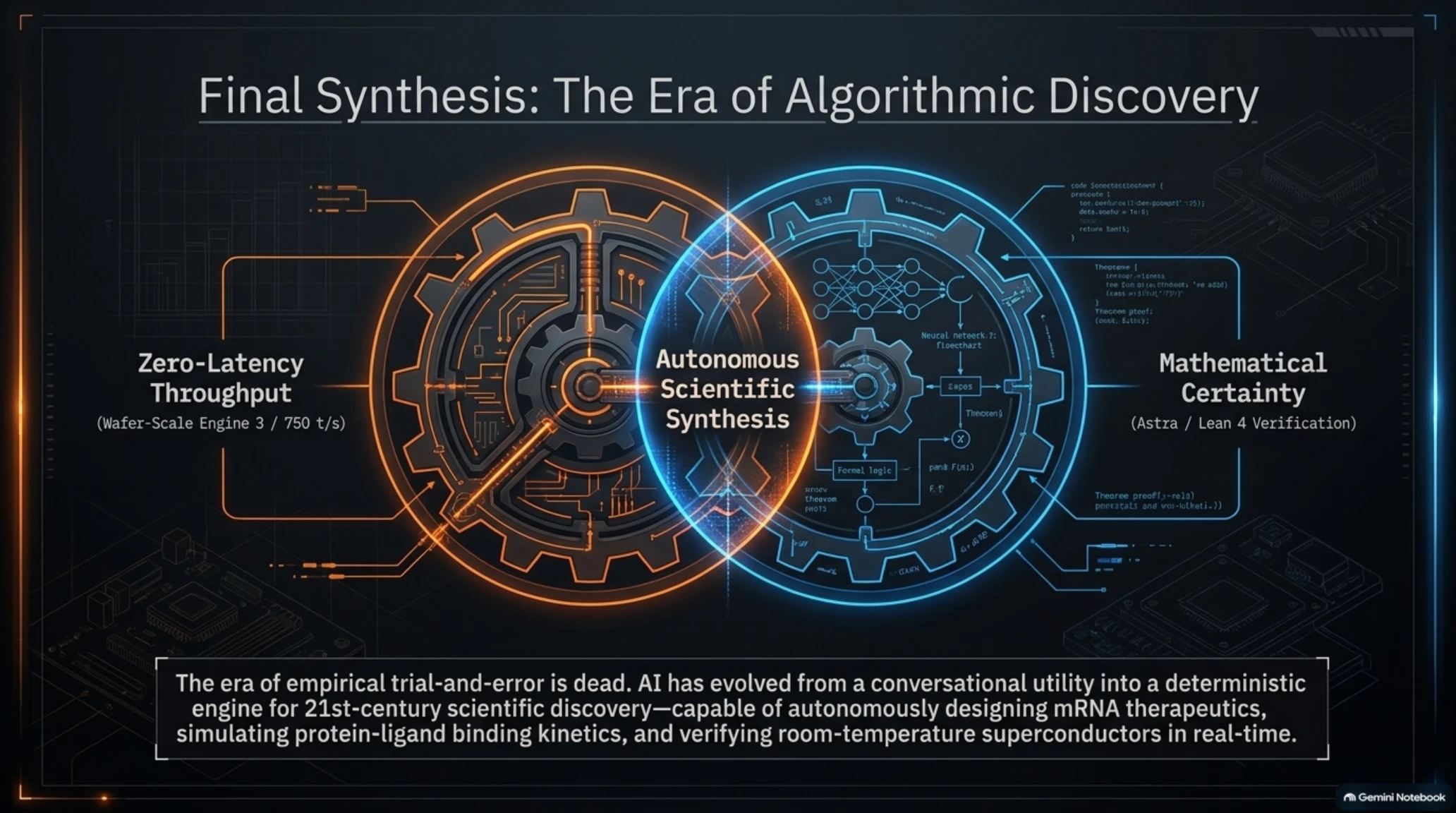
The true paradigm shift unlocked by 750 tokens/sec inference and formal theorem proving lies in the autonomous formulation and verification of scientific hypotheses. In computational structural biology and quantum chemistry, molecular docking simulations and density functional theory (DFT) calculations historically required weeks of compute time across high-performance supercomputers.
With GPT-5.6 Sol Ultrafast and Astra, autonomous AI agents can screen millions of novel molecular candidate geometries, simulate protein-ligand binding kinetics, and mathematically verify thermodynamic stability in real-time. From designing next-generation mRNA therapeutics to identifying candidate room-temperature ambient-pressure superconducting crystal lattices, the elimination of computational latency marks the transition from empirical trial-and-error to deterministic, algorithmic scientific discovery.
Neuromorphic & Analog Co-Processors: The 2030 Horizon
Looking toward the 2030 supercomputing horizon, the integration of wafer-scale silicon with Analog In-Memory Computing (AIMC) and neuromorphic spiking neural networks promises to push inference throughput beyond 10,000 tokens per second. By executing matrix-vector multiplications directly within non-volatile resistive RAM (ReRAM) or phase-change memory (PCM) crossbar arrays, calculations occur natively via Ohm's and Kirchhoff's circuit laws at constant time $O(1)$.
When coupled with Cerebras's digital routing mesh, analog matrix accelerators will execute the foundational linear layers of multi-trillion-parameter models with near-zero power dissipation, reserving high-precision digital logic exclusively for attention softmax normalization and symbolic Lean 4 theorem validation.
Financial Engineering & Revenue Dynamics of the 2027 OpenAI IPO
OpenAI's planned 2027 Initial Public Offering represents the ultimate test of AI commercial viability. Financial disclosures indicate that OpenAI's revenue architecture has evolved into a highly profitable, three-tiered structure:
- Enterprise API & Dedicated Instance Cloud: Generating over 60% of recurring revenue through sub-millisecond SLA contracts with Fortune 500 enterprises via IBM Consulting and Microsoft Azure.
- Consumer & Professional Subscription Services: ChatGPT Plus, Team, and Enterprise accounts contributing over $5 Billion annually in high-margin cash flow.
- Hardware-as-a-Service (HaaS) Infrastructure Leasing: Co-leasing Cerebras CS-3 supercomputing clusters directly to sovereign wealth funds and defense research institutions for classified algorithmic modeling.
With gross margins expanding from 45% to over 72% due to the dramatic energy and server consolidation achieved by wafer-scale hardware, Wall Street investment banks project OpenAI's market capitalization could surge toward $200 Billion within its first week of public trading.
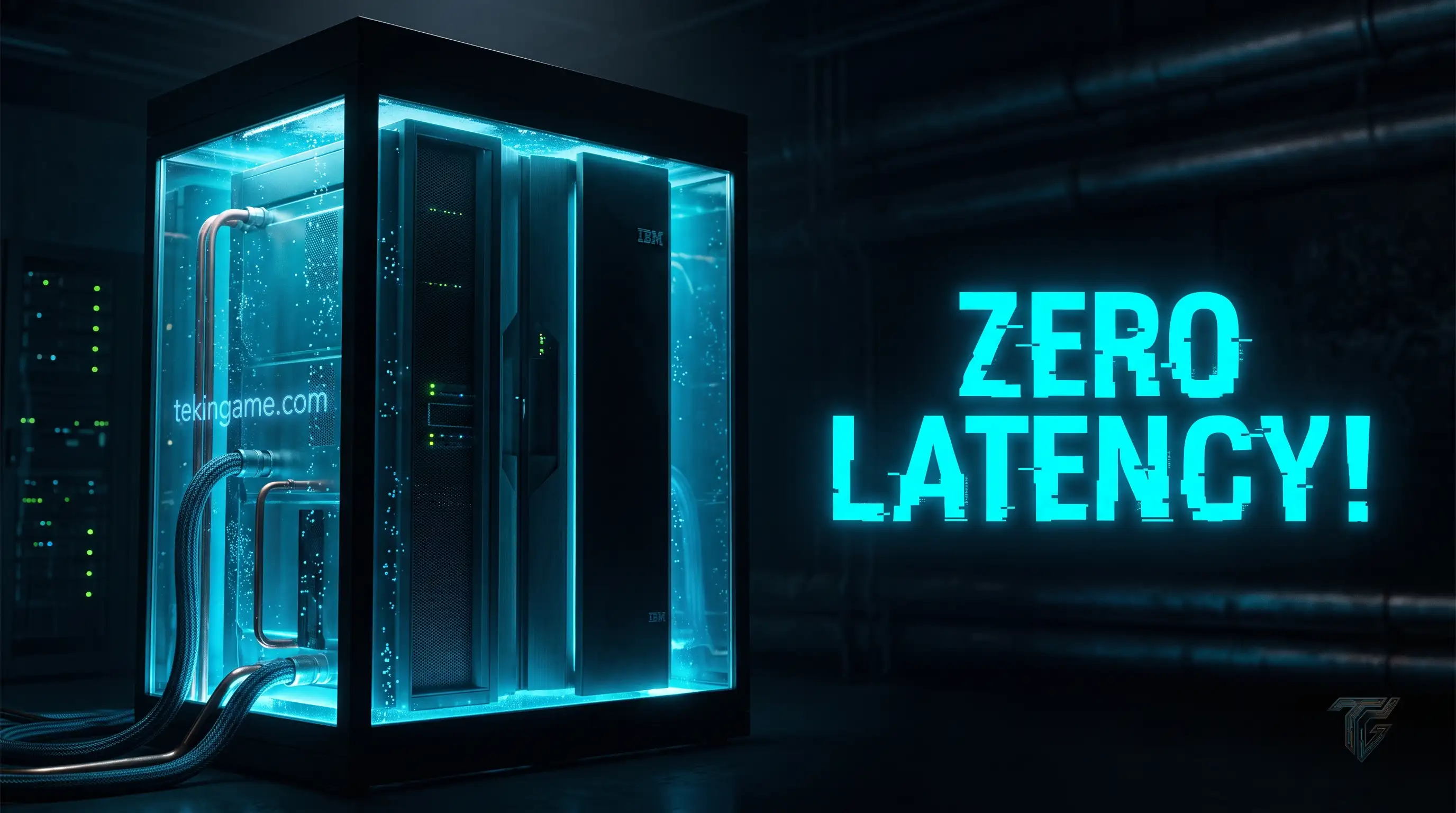
The conceptual rendering below visualizes direct liquid cooling manifolds dissipating thermal loads across ultra-dense wafer-scale computing racks:
Strategic Synthesis; The Zero-Latency AI Era and the Frontiers of Scientific Discovery
The convergence of Cerebras's 750 tokens/sec raw computational throughput with the formal mathematical reasoning precision of OpenAI Astra elevates artificial intelligence from a conversational utility to the primary engine of 21st-century scientific discovery. Complex hypotheses across quantum chemistry, superconductor physics, structural biology, and cryptographic design that once required decades of human trial-and-error can now be formulated, tested, and mathematically validated in hours.
As the computing industry enters the second half of the 2020s, the battle for artificial intelligence leadership will no longer be fought on the sheer quantity of GPU clusters, but on architectural elegance, thermodynamic efficiency, and verifiable formal correctness. The monolithic wafer-scale silicon revolution pioneered by Cerebras and the formal reasoning breakthroughs forged by OpenAI's Project Astra stand as monumental beacons illuminating this new dawn of human technological potential.
The year 2026 will be remembered in technological history as the decisive, historic inflection point when computational latency and memory bottlenecks were permanently eliminated from the machine intelligence equation, paving the way for truly real-time autonomous agentic systems, instantaneous natural voice intelligence, and unprecedented algorithmic acceleration across the entirety of human scientific knowledge.
The panoramic rendering below captures the TekinGame Intelligence Radar overlooking the frontier of supercomputing and AI breakthroughs in 2026:
- Sustained 750 tokens/sec throughput permanently eliminating latency in interactive human-agent workflows
- Mathematical hallucinations eradicated by coupling Astra with Lean 4 and Isabelle formal verification kernels
- Massive 85% energy efficiency and footprint reduction in datacenter total cost of ownership (TCO)
- Breaking Nvidia's monopoly and opening competitive pathways for monolithic wafer-scale silicon
- Extreme fabrication complexity and high manufacturing barrier for 100% defect-free silicon wafers
- Software porting requirements to migrate legacy CUDA-optimized pipelines to wafer-scale compiler frameworks
Essential Related Reading & Cyber Intelligence Archives
• ☀️ Tekin Morning August 22, 2026 | Leaked $899 Xbox Series X25 & Phantom Blade Zero Surge
• 🛡 Tekin Analysis | ThreatsDay Crisis: AI Exploits Target Siemens S7 & Sandbox Escapes
• 🤖 Tekin Versus | TrueForge Revolution: Open-Source AI Agents vs. Claude
Frequently Asked Questions: Cerebras 750 Tokens/Sec & OpenAI Astra Breakthrough
What does a throughput of 750 tokens per second mean in practical applications?
It corresponds to generating roughly 500 words per second. This compresses inter-token latency to just 1.3 milliseconds, making interactive voice AI and autonomous multi-agent reasoning completely instantaneous with zero perceptible delay.
How does the Cerebras Wafer-Scale Engine 3 (WSE-3) fundamentally differ from Nvidia GPUs?
Instead of cutting a silicon wafer into small chips, WSE-3 utilizes an entire 215mm x 215mm monolithic wafer featuring 4 Trillion transistors and 44GB of on-chip SRAM with 21 Petabytes/sec memory bandwidth, completely bypassing off-chip DRAM latency.
How did OpenAI Astra solve ten open mathematical conjectures?
Astra couples deep learning search heuristics with formal interactive theorem provers like Lean 4 and Isabelle. The system writes proof steps as verifiable code; if a step contains an error, the compiler rejects it, enabling autonomous self-correction with 100% formal certainty.
Why is the August 2026 OpenAI-IBM partnership significant for enterprise computing?
It integrates GPT-5.6 Sol's Ultrafast processing directly into IBM Consulting's secure hybrid cloud and mainframe infrastructure for Fortune 500 companies across banking, defense, and healthcare.
When is OpenAI planning its Initial Public Offering (IPO)?
OpenAI's CFO has confirmed that formal underwriting preparations are underway for a historic Initial Public Offering in the first half of 2027, with analysts projecting a valuation in excess of $150 Billion.
Official Sources & Intelligence References
Additional Gallery: ⚡ Tekin Analysis | 750 Tokens/Sec: Cerebras WSE-3 & OpenAI Astra Breakthrough