Liquid Network Hack
- 🎮4,000 BTC Drained- Unauthorized extraction of $320M from the federated multi-sig reserve
- 🎧Network Frozen- Emergency protocol halt stopping all sidechain block production
- 🚀White-Hat Standoff- Exploiters hold funds hostage demanding a critical Elements codebase patch
- 🗡️Parser Logic Flaw- Vulnerability in witness script parsing enabled uncollateralized peg-outs
- 📰Market Contagion- L-BTC drops 14% as inter-exchange arbitrage pipelines are paralyzed
- ⚔️The BitVM2 Pivot- Industry shifts away from federated multi-sig toward trustless ZK-rollups
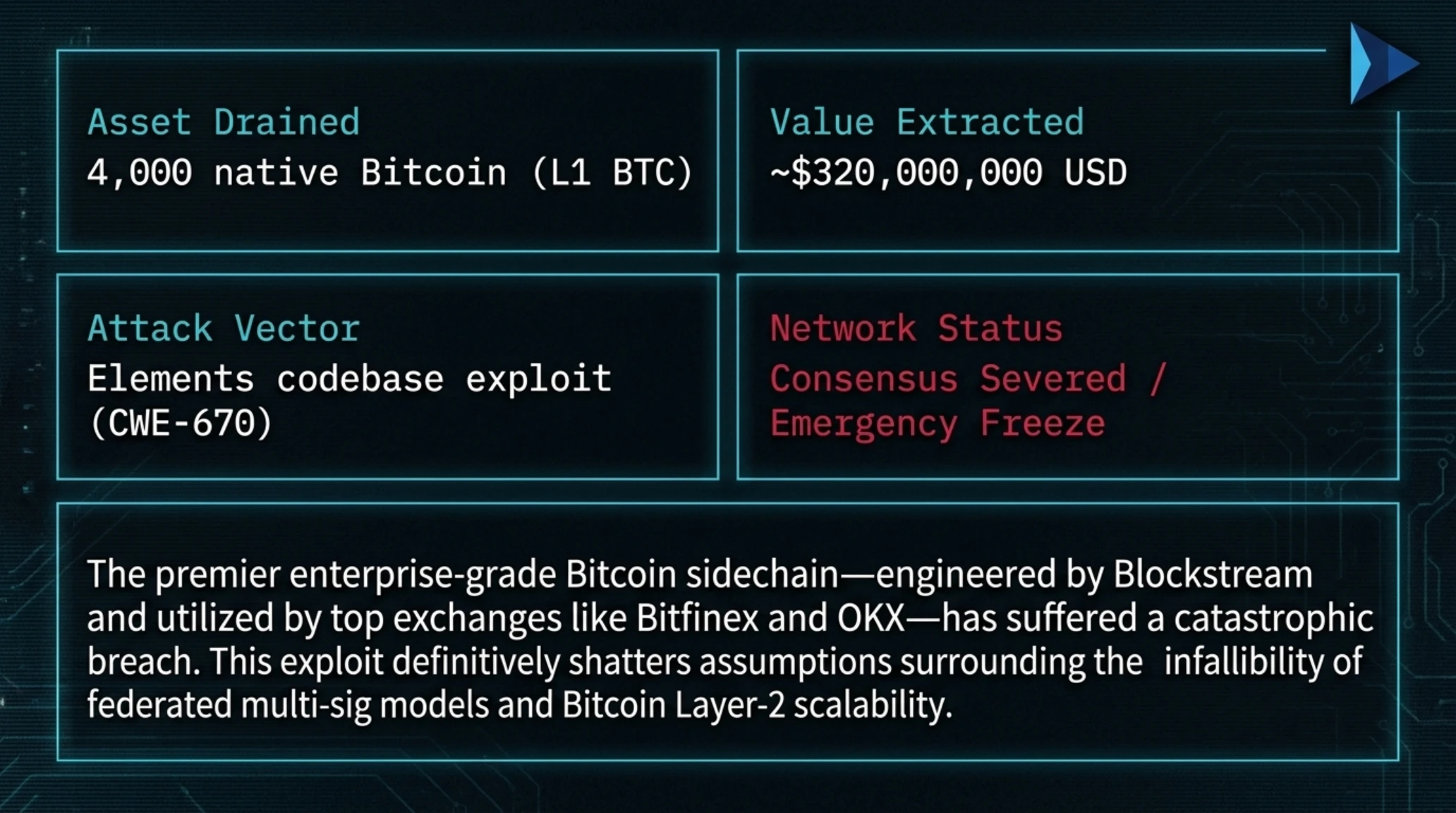
In the late hours of Sunday afternoon, the global cryptocurrency and blockchain ecosystem was rocked by one of the most consequential, high-value security emergencies in Bitcoin's seventeen-year history. The Liquid Network the premier federated Bitcoin sidechain engineered and maintained by blockchain infrastructure giant Blockstream under the leadership of cypherpunk pioneer Dr. Adam Back abruptly froze all block generation, bilateral transaction processing, and custodial peg-out verifications. The emergency shutdown was triggered after on-chain telemetry revealed the unauthorized, catastrophic drainage of over 4,000 native Bitcoin (BTC), valued at approximately $320 million, from the sidechain’s multi-signature federation reserve.
The sudden solvency crisis sent immediate shockwaves across institutional trading desks, international derivatives platforms, and decentralized exchanges worldwide. For nearly a decade, Blockstream had positioned the Liquid Network not merely as an experimental Layer-2 scaling sandbox, but as the ultra-secure, enterprise-grade settlement backbone connecting premier cryptocurrency exchanges such as Bitfinex, OKX, and major institutional market makers. Unlike the complex, reentrancy-prone Solidity smart contracts populating Ethereum and Solana decentralized finance (DeFi), Liquid’s Strong Federation model was widely heralded by Bitcoin maximalists as an unassailable citadel of cryptographic stability. That citadel has now suffered a catastrophic breach.
Key Takeaways: The $320 Million Liquid Network Exploit
- Over 4,000 native Bitcoin (~$320M) drained from Blockstream's Liquid Network 2-way peg reserve in an unauthorized exploit
- The Liquid Federation enacted an emergency protocol freeze, halting all sidechain block production and peg-out operations
- Exploiters declared themselves 'white-hat' researchers holding the funds in escrow until a critical Elements codebase bug is patched
- Initial on-chain anomaly detected by leading forensic researcher Ergo BTC and decentralized atomic swap venue SideSwap
- The exploit shatters assumptions surrounding the invulnerability of federated multi-sig models and Bitcoin Layer-2 scalability
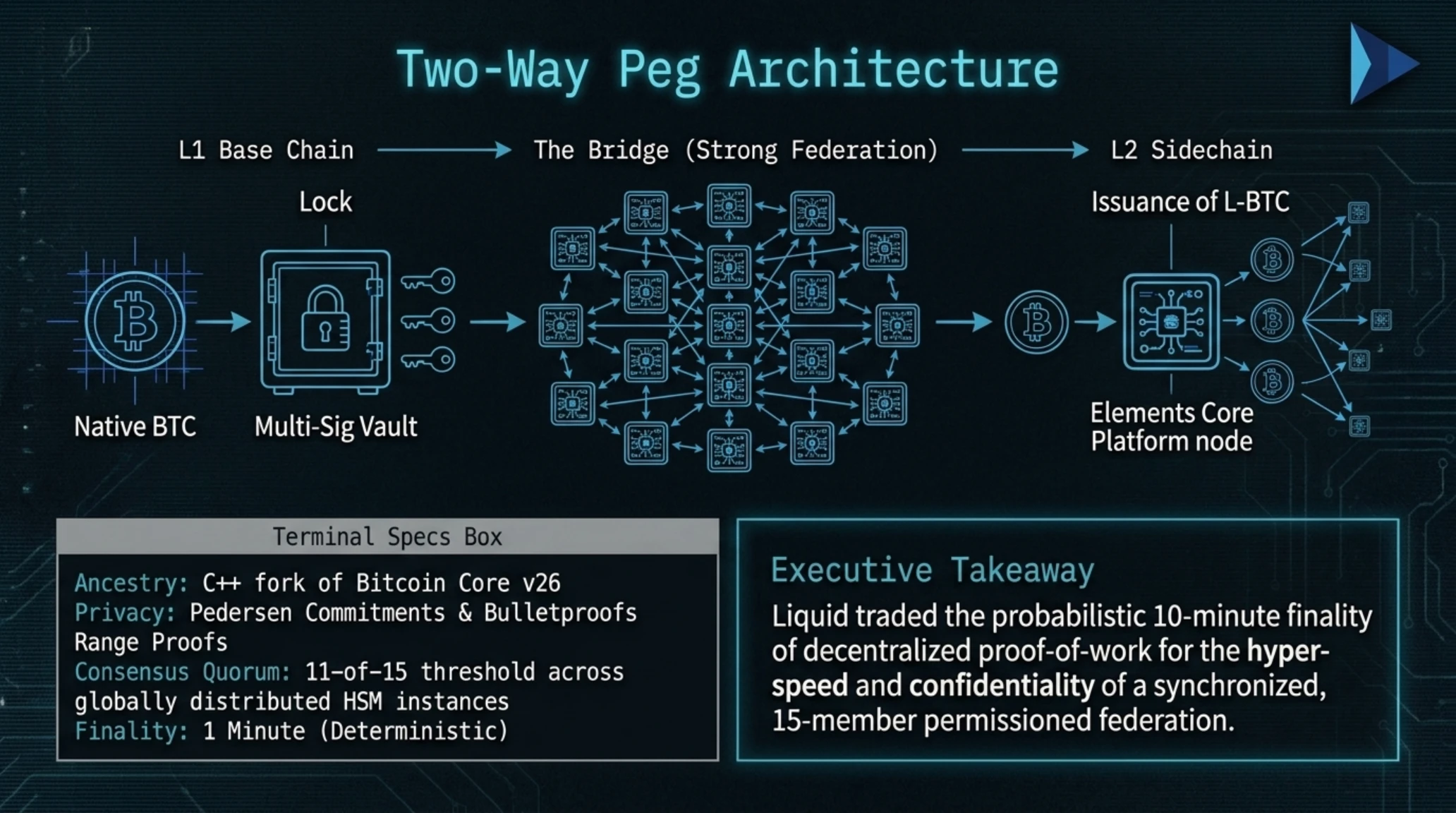
To grasp the full systemic gravity of this exploit, one must examine the foundational operational architecture of the Liquid Network within the digital asset economy. Built on the open-source Elements blockchain platform, Liquid functions as an institutional clearinghouse. It enables high-volume algorithmic traders, corporate treasuries, and exchanges to execute rapid, one-minute inter-exchange settlements and confidential transactions without congesting the ten-minute probabilistic finality and fee volatility of the main Bitcoin base chain. By freezing the sidechain, Blockstream effectively cordoned off hundreds of millions of dollars in institutional liquidity, stranding active arbitrage strategies and paralyzing capital flows.
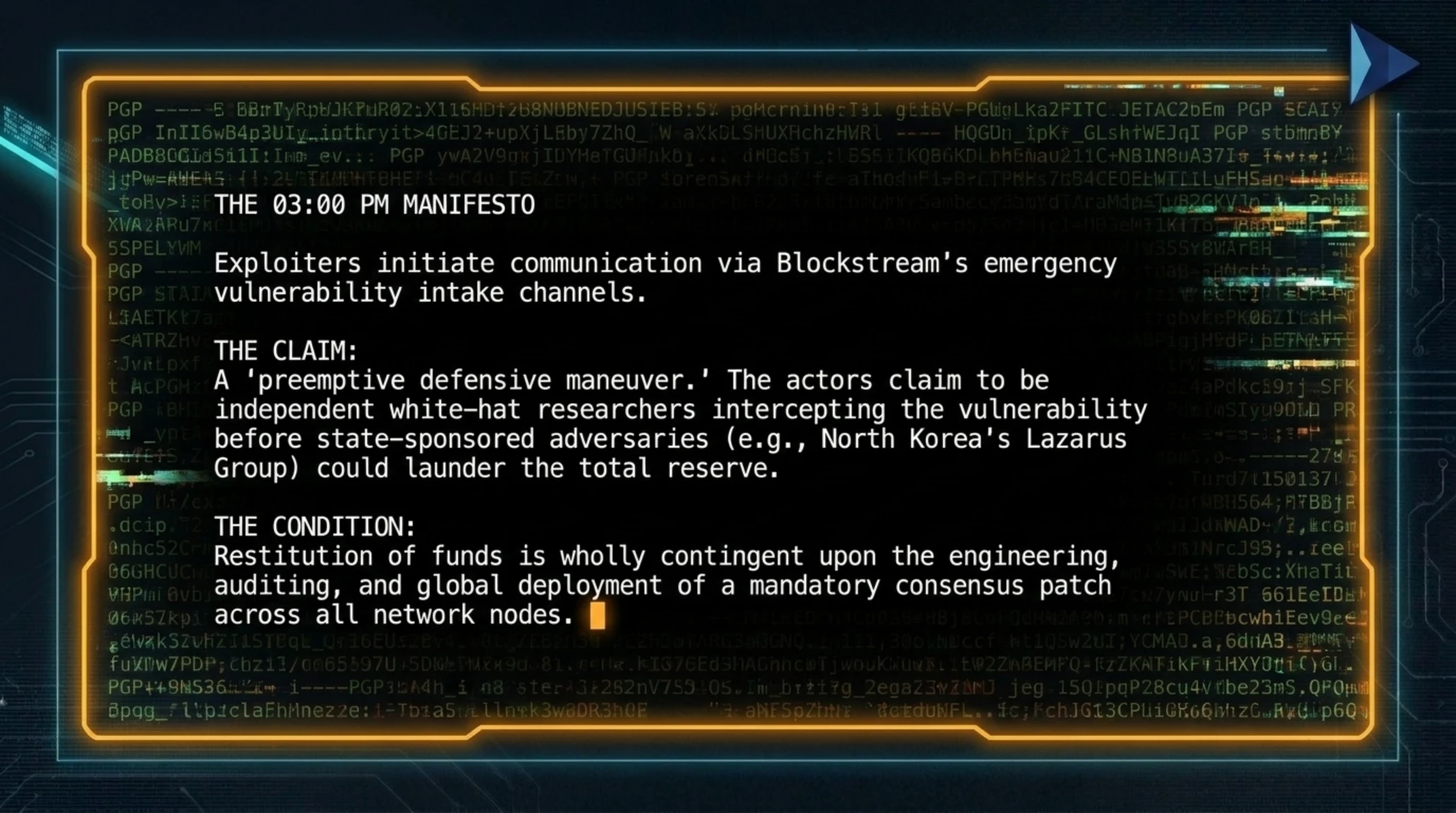
The forensic narrative grew exponentially more complex within hours of the initial reserve drainage. A series of cryptographically signed messages, authenticated using the private keys associated with the receiving exploit addresses, was transmitted directly to Blockstream’s emergency vulnerability intake channels. The actors explicitly rejected characterization as malicious cybercriminals, declaring themselves to be independent white-hat security researchers. They claimed to have identified a catastrophic, zero-day logical contradiction deep within the core Elements execution environment a vulnerability so severe that had state-sponsored adversaries like North Korea's Lazarus Group discovered it first, the entirety of the sidechain's reserves would have been permanently looted and laundered.
The actors pledged to return the vast majority of the 4,000 BTC back to the federation’s custody, conditioned upon Blockstream and the participating federation functionaries engineering, auditing, and successfully distributing a mandatory consensus patch across all network nodes. While this conditional promise provided immediate psychological relief to market observers terrified of a liquidation cascade across spot Bitcoin markets, it thrust the incident into a profoundly murky legal, ethical, and operational twilight zone.
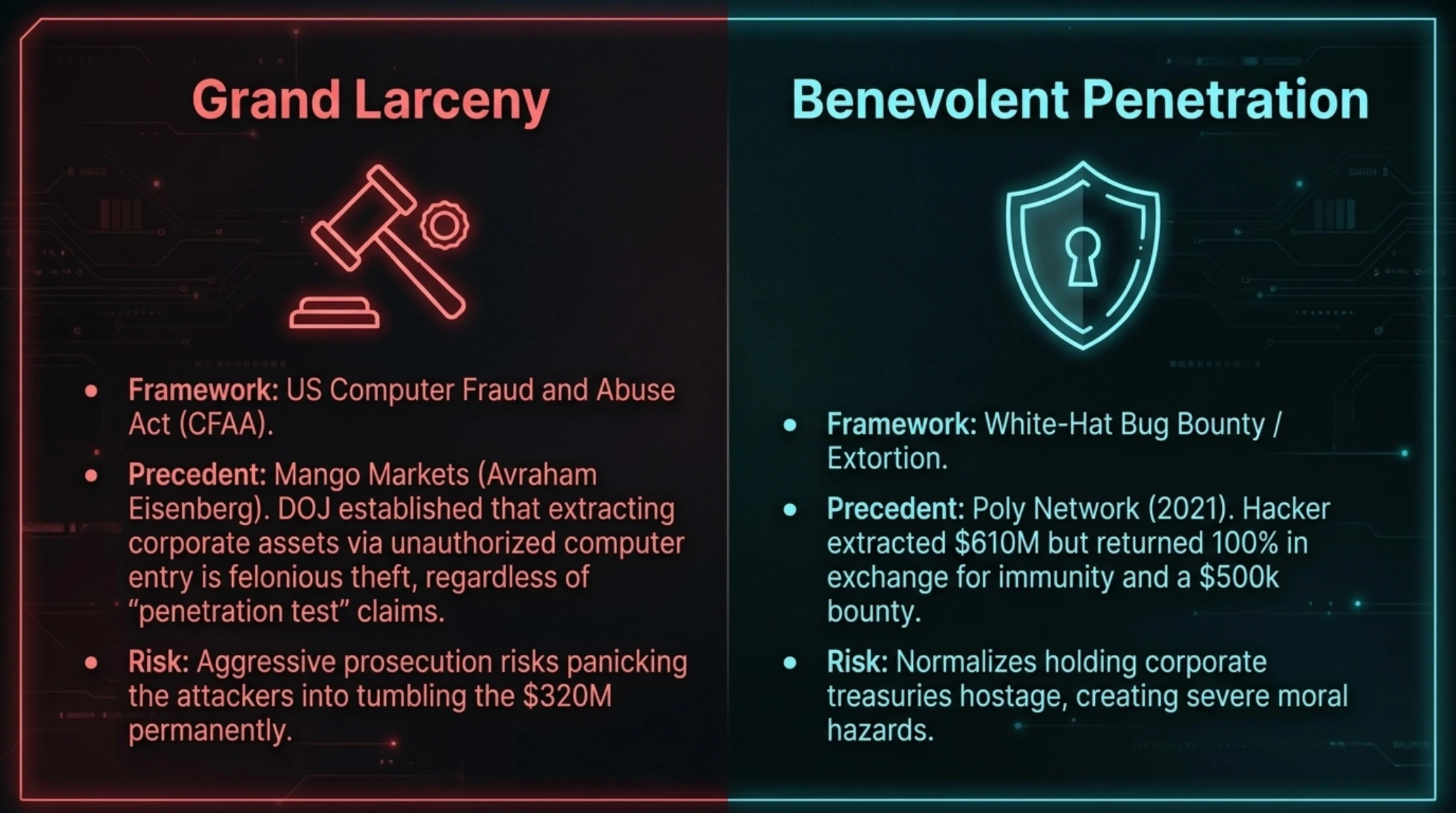
Under international criminal jurisprudence and United States federal statutory frameworks, the unauthorized extraction of $320 million in digital assets without prior contractual authorization constitutes felonious grand larceny, regardless of subsequent claims of benevolent intent. The precedent of holding corporate treasuries hostage under the guise of an uninvited penetration test strikes at the very heart of decentralized governance, igniting fierce debates over where legitimate white-hat research ends and high-stakes digital extortion begins.
Why It Matters: Systemic Fragility and the Bitcoin Layer-2 Paradox
Liquidity Contagion Across Exchanges: With hundreds of millions in Liquid Bitcoin (L-BTC) and Liquid Tether (USDt-L) frozen, inter-exchange settlement pipelines face severe friction and localized basis desynchronization.
The White-Hat Ransom Precedent: Normalizing the unauthorized seizure of hundreds of millions of dollars under the pretext of 'vulnerability demonstration' creates profound moral hazards for blockchain security.
The earliest public alert was sounded not by centralized corporate telemetry, but by the vigilant eyes of decentralized on-chain analysts. Prominent forensic researcher Ergo BTC, working in tandem with the engineering team at SideSwap the primary non-custodial atomic swap marketplace operating on Liquid spotted an alarming cryptographic divergence on the public ledger. An unverified transaction script had successfully triggered a massive, multi-thousand-coin release from the primary federation multi-sig address on the Bitcoin base chain without a corresponding, verifiable burn of Liquid Bitcoin (L-BTC) tokens on the sidechain.
SideSwap immediately disabled its automated market-making pools to insulate retail liquidity providers from catastrophic impermanent loss and arbitrage exploitation. Minutes later, as the cumulative outflow crossed the 4,000 BTC threshold across four rapid-fire transactions, Blockstream’s security response desk initiated an emergency out-of-band broadcast to the fifteen geographically distributed Functionary node operators, instructing them to sever consensus round-robin communications and halt block creation.
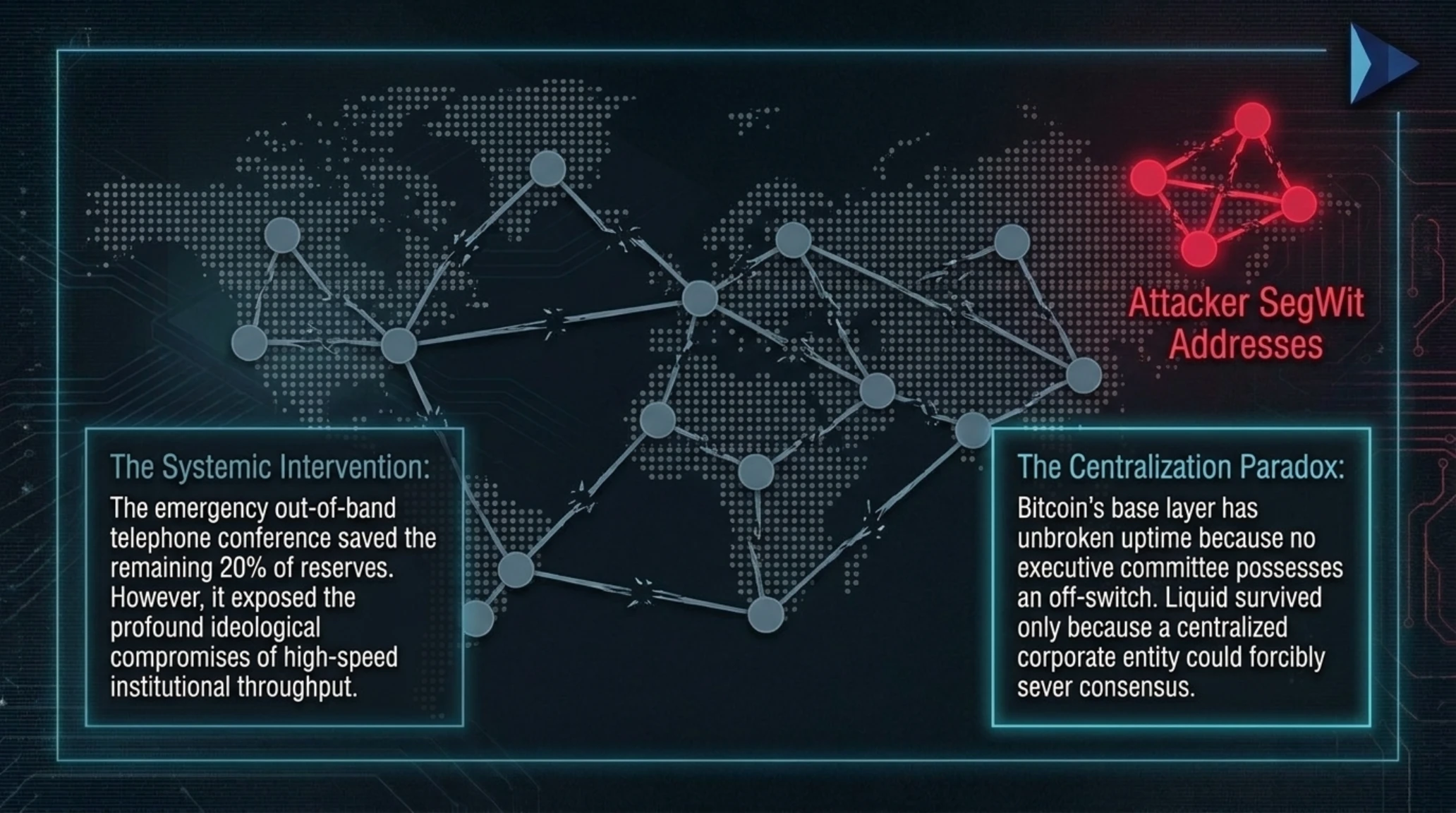
This drastic intervention undoubtedly prevented the complete depletion of the sidechain’s remaining Bitcoin reserves. However, the operational decision to halt an entire blockchain network underscores the inherent architectural centralized points of failure embedded within federated systems. While Bitcoin's base layer boasts unbroken mathematical uptime precisely because no executive committee can flip an off-switch, Liquid’s centralized emergency braking mechanism revealed the profound ideological compromises required to achieve high-speed institutional throughput.
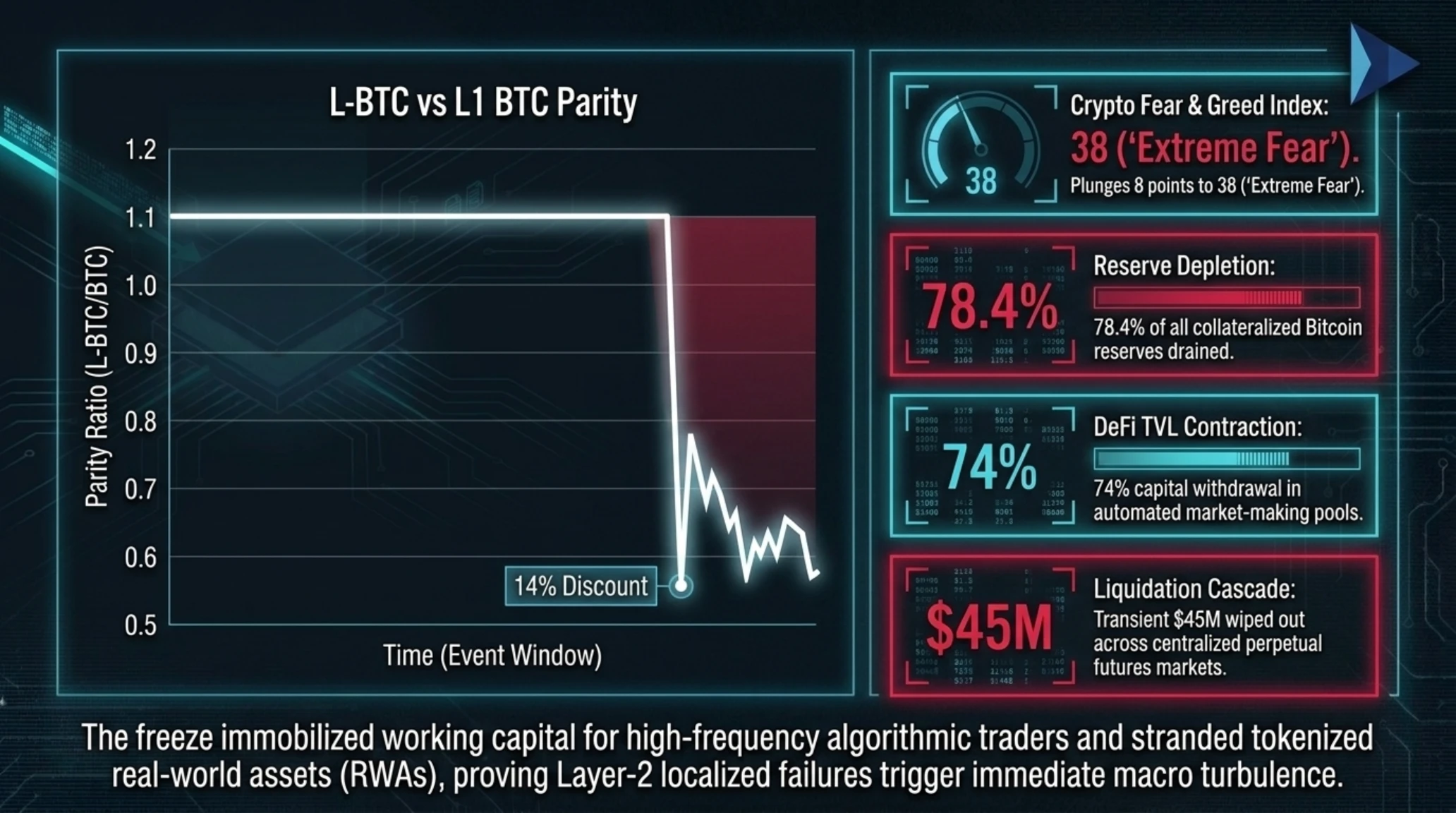
The immediate operational consequence for major cryptocurrency exchanges was devastating. For high-frequency trading firms and market makers executing delta-neutral arbitrage between spot order books on Bitfinex and derivatives contracts on Deribit, Liquid served as an indispensable real-time liquidity artery. The freeze immediately immobilized hundreds of millions in working capital, forcing algorithmic market makers to dramatically widen their quotes or withdraw market-making presence altogether, which in turn sparked sharp slippage spikes across global spot trading pairs.
Furthermore, the incident dealt a severe blow to the burgeoning ecosystem of tokenized real-world assets (RWAs) and corporate debt instruments issued on the Liquid Network. Over the past two years, sovereign and corporate entities had increasingly piloted regulated bond issuances and digitized gold tokens over Liquid, drawn by its deterministic finality and institutional-grade Confidential Assets framework. The revelation that an uncollateralized script exploit could paralyze the entire ledger shattered institutional risk models, prompting corporate compliance officers to initiate immediate emergency audits of all federated sidechain dependencies.
In the frantic hours following the shutdown, global social platforms and crypto communities descended into a swirl of hyperbole, panic, and technical confusion. Unsubstantiated rumors suggested that the core SHA-256 cryptographic primitives of the Bitcoin network itself had been broken, while others claimed the stolen funds were already coursing through privacy mixers. Disentangling objective technical reality from reactionary social media fiction is essential to comprehending the true anatomy of the breach.
Rumor vs. Reality: Dissecting the Liquid Network Elements Exploit
The Verified Reality: Bitcoin's Layer-1 network remains entirely untouched and mathematically secure; the vulnerability existed exclusively within the auxiliary Elements software governing the Liquid sidechain.
The Rumor: The 4,000 BTC has been laundered through Tornado Cash and cross-chain bridges, permanently lost to depositors.
The Verified Reality: The funds remain consolidated in four distinct SegWit addresses on the Bitcoin mainnet, with the exploiters in direct PGP-encrypted dialogue with Blockstream engineers.
The systemic fallout from this event stretches far beyond the immediate balance sheet of Blockstream or the solvency of its federation partners. It strikes directly at the foundational thesis of Bitcoin scalability. As transaction fees on the base chain fluctuate wildly and institutional capital demands faster settlement cycles, the industry has placed enormous bets on Layer-2 ecosystems, sidechains, and state-channel networks. This catastrophe forces a rigorous, uncompromising reckoning with the hidden attack vectors lurking within these auxiliary execution environments.
In the subsequent chapters of this comprehensive investigation, we conduct an exhaustive technical autopsy of the Elements codebase vulnerability, examine the hardware-security failures that enabled unauthorized multi-sig co-signing, analyze the unprecedented legal standoff between Blockstream and its 'benevolent' attackers, and assess the broader strategic trajectory of Bitcoin scaling in a post-Liquid world.
By dissecting the precise intersection of cryptographic protocol design, distributed consensus governance, and cyber law, this investigation provides market participants with the authoritative intelligence needed to navigate this historic milestone in cryptocurrency infrastructure.
Jargon Buster: Essential Technical & Architectural Lexicon
Two-Way Peg (Peg-In / Peg-Out): The cryptographic mechanism that locks native L1 Bitcoin in a multi-sig vault to issue equal synthetic L-BTC on the sidechain, and conversely burns L-BTC to unlock L1 reserves.
Elements Core Platform: Blockstream's open-source, modular C++ blockchain engine that extends Bitcoin Core with Confidential Transactions, dynamic assets, and federated sidechain consensus.
Hardware Security Module (HSM): Tamper-evident cryptographic physical hardware units tasked with isolating private signing keys and independently verifying withdrawal validity before signing transactions.
Technical Autopsy: Deconstructing the Elements Codebase Vulnerability
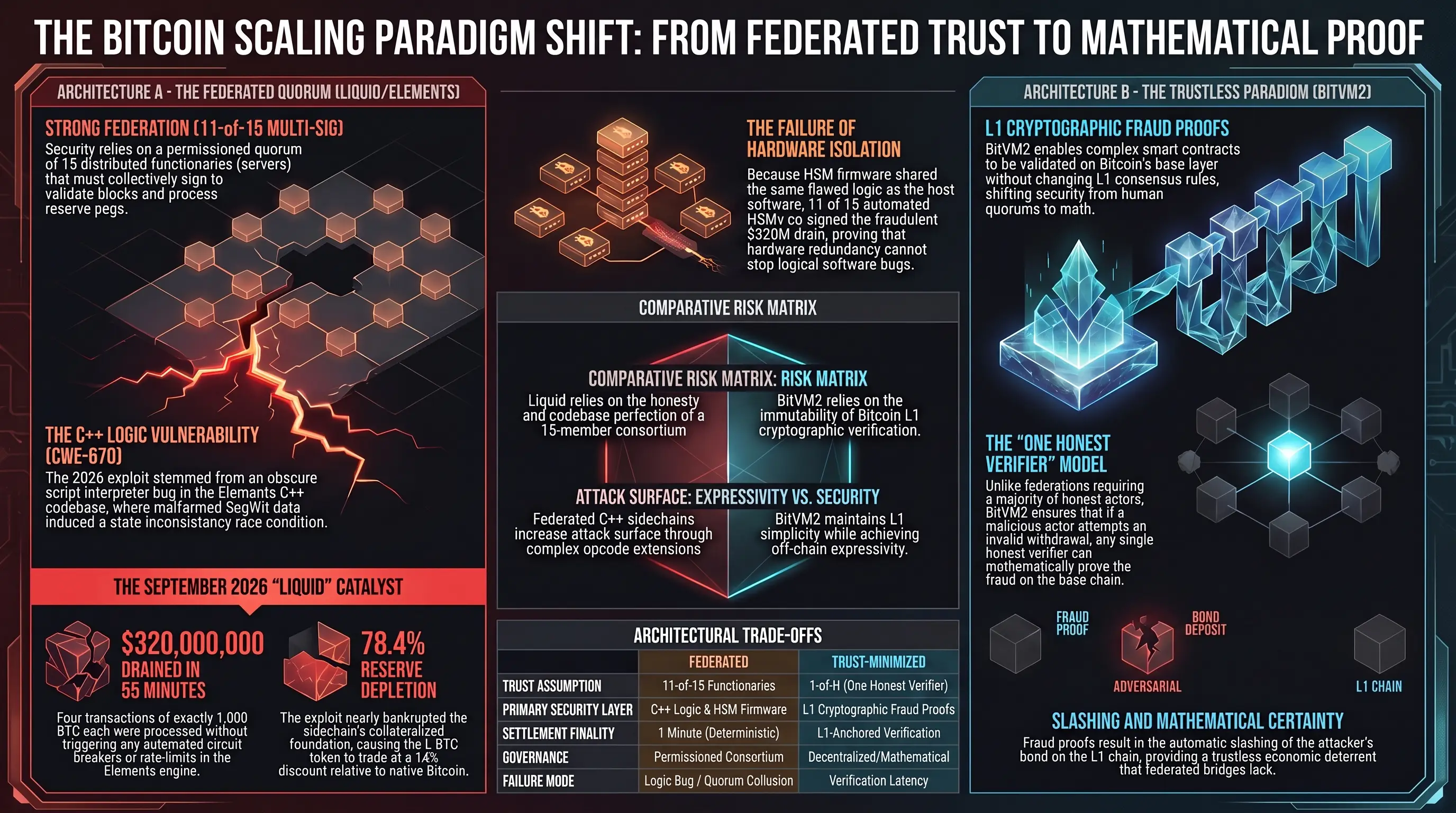
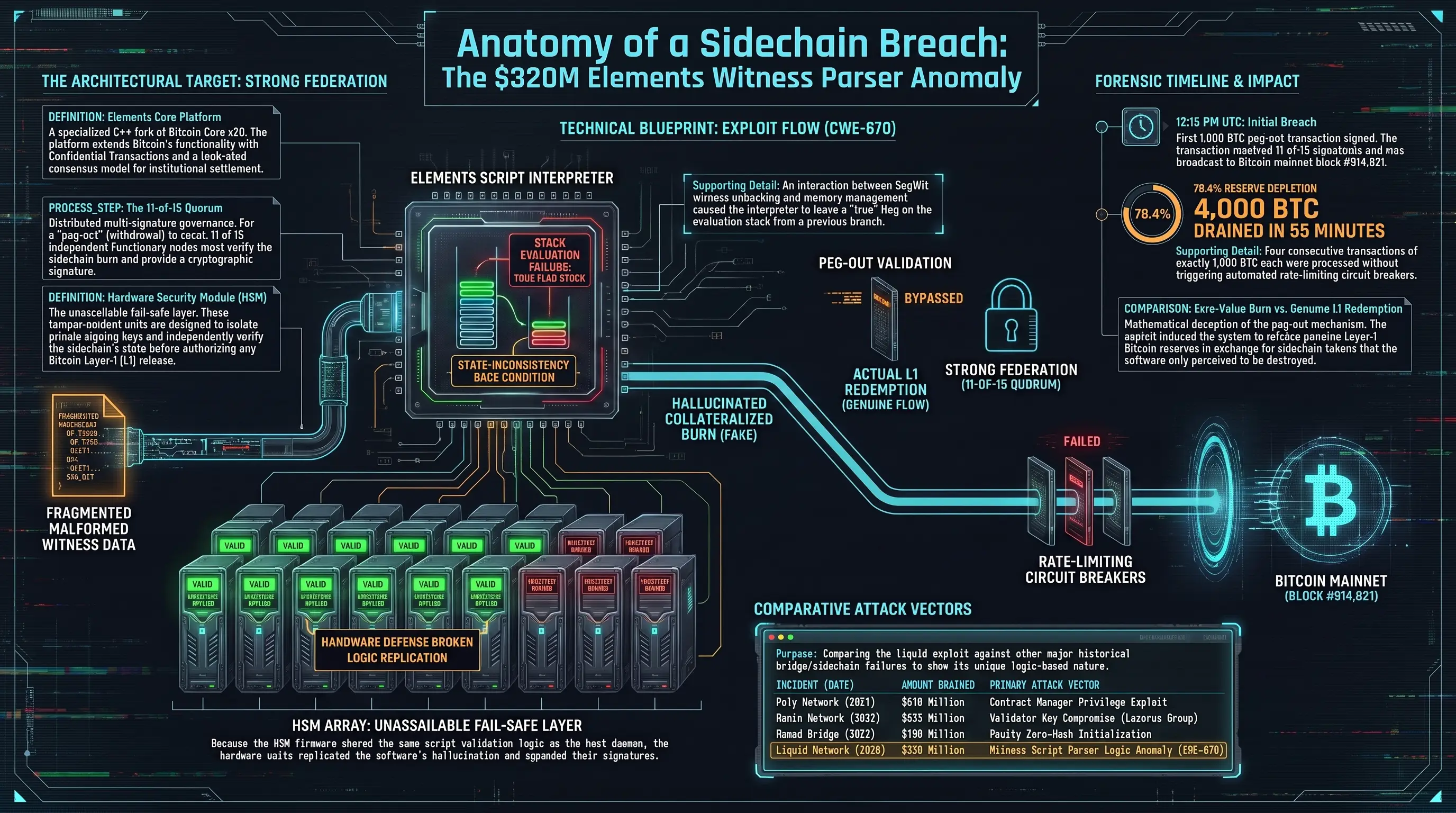
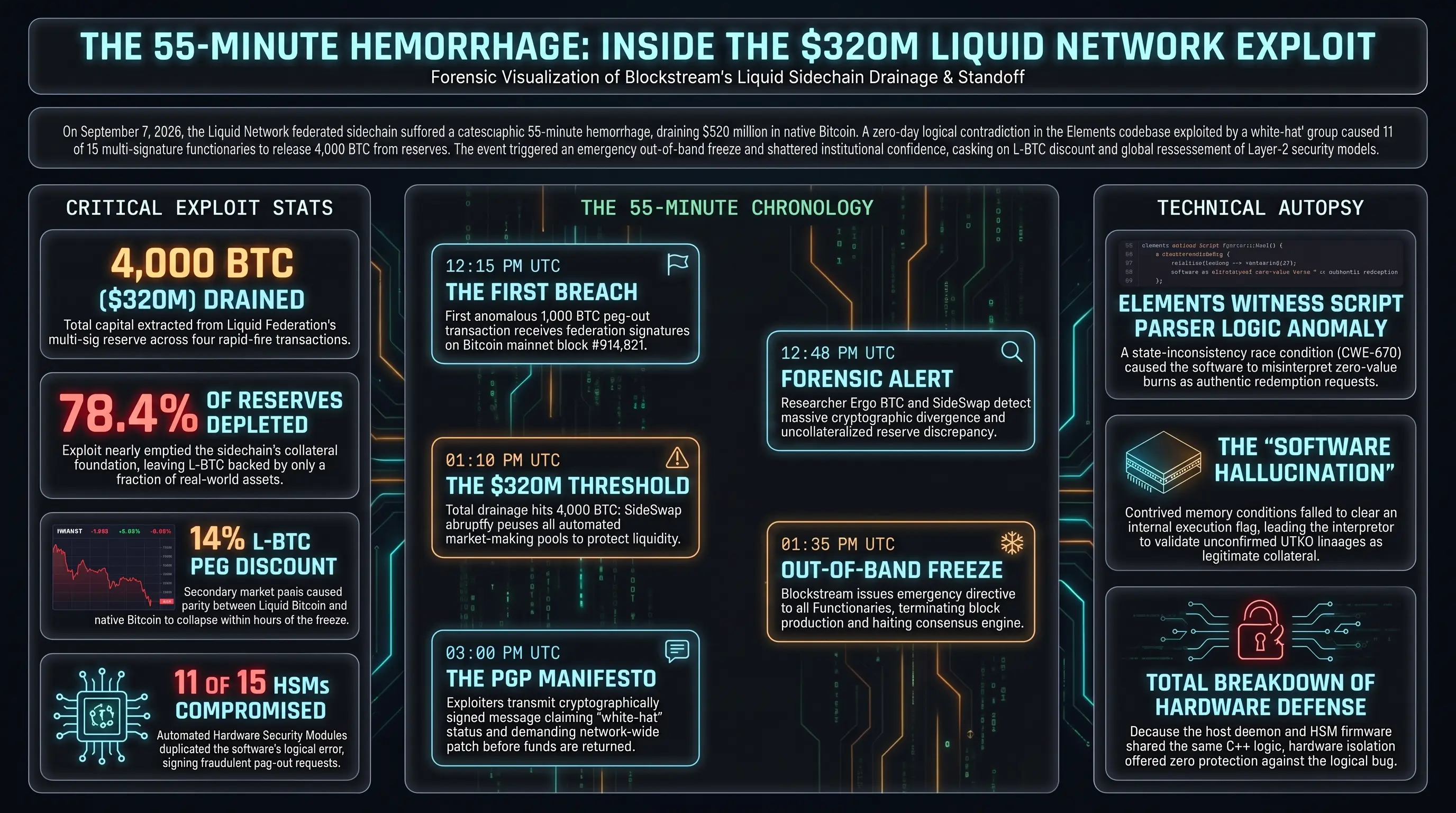
To comprehend how an external entity successfully bypassed the multi-signature security barriers safeguarding $320 million in institutional Bitcoin, one must dissect the intricate state-machine mechanics governing Blockstream’s Elements platform. In a standard Liquid peg-out transaction, a user wishing to redeem Liquid Bitcoin (L-BTC) for native Layer-1 Bitcoin initiates a burn transaction on the sidechain. The network's distributed Functionaries independently inspect the sidechain block header to verify that the L-BTC has been irrevocably destroyed, after which their automated Hardware Security Modules (HSMs) generate an 11-of-15 threshold signature on the Bitcoin base chain, releasing the matching satoshis from the federation’s primary cold-storage address.
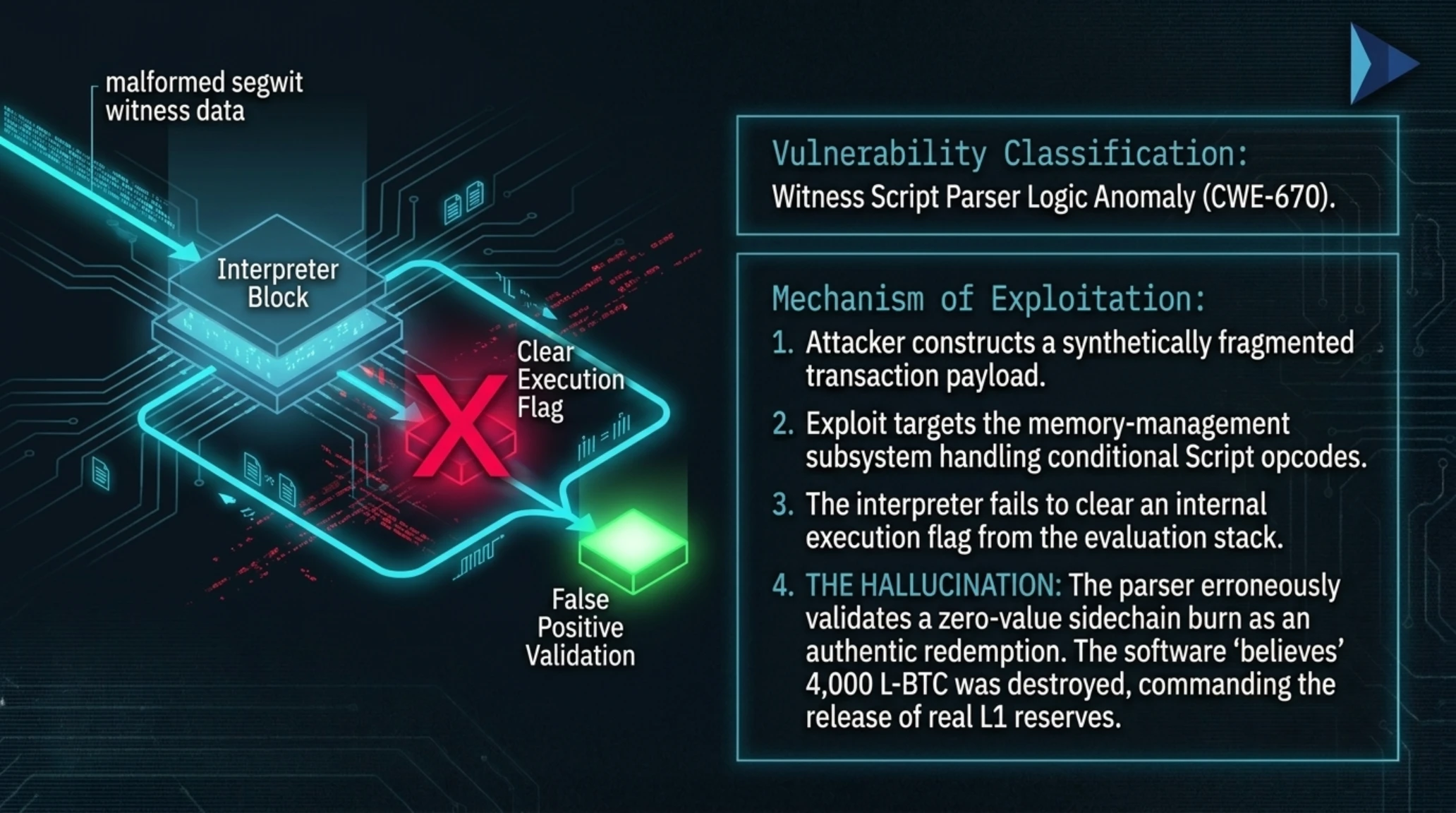
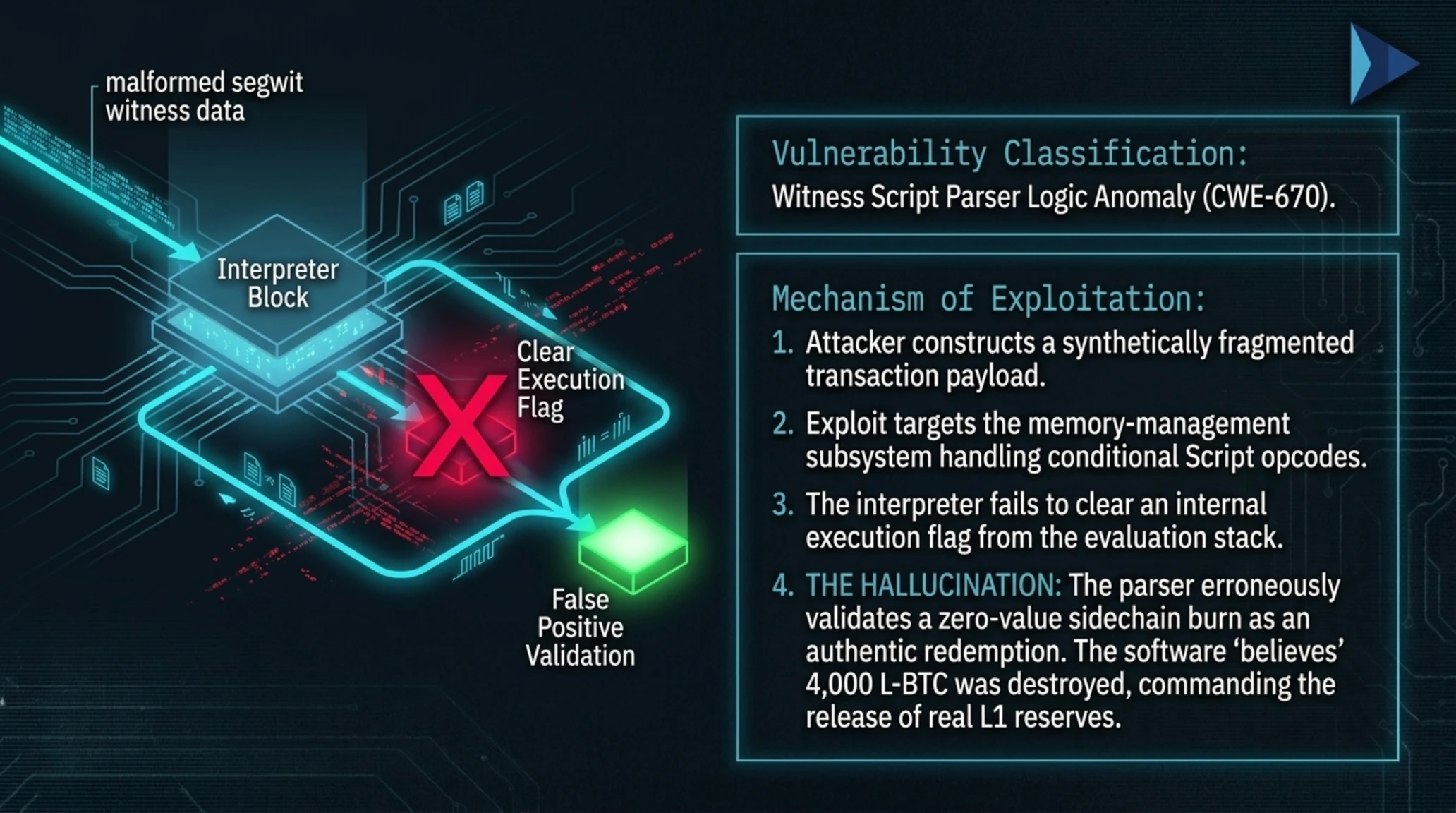
The fatal vulnerability exploited on Sunday resided within the witness script parsing subsystem of the latest Elements release. By constructing a highly sophisticated, synthetically fragmented transaction payload utilizing malformed segwit witness data, the attackers induced a state-inconsistency race condition within the node software’s script interpreter. The parser misinterpreted the status of an unconfirmed UTXO lineage, erroneously validating a zero-value sidechain burn as an authentic, fully collateralized redemption request. In essence, the software hallucinated that 4,000 L-BTC had been legitimately destroyed in an earlier orphaned block, instructing the federation to authorize the immediate release of genuine Layer-1 reserves.
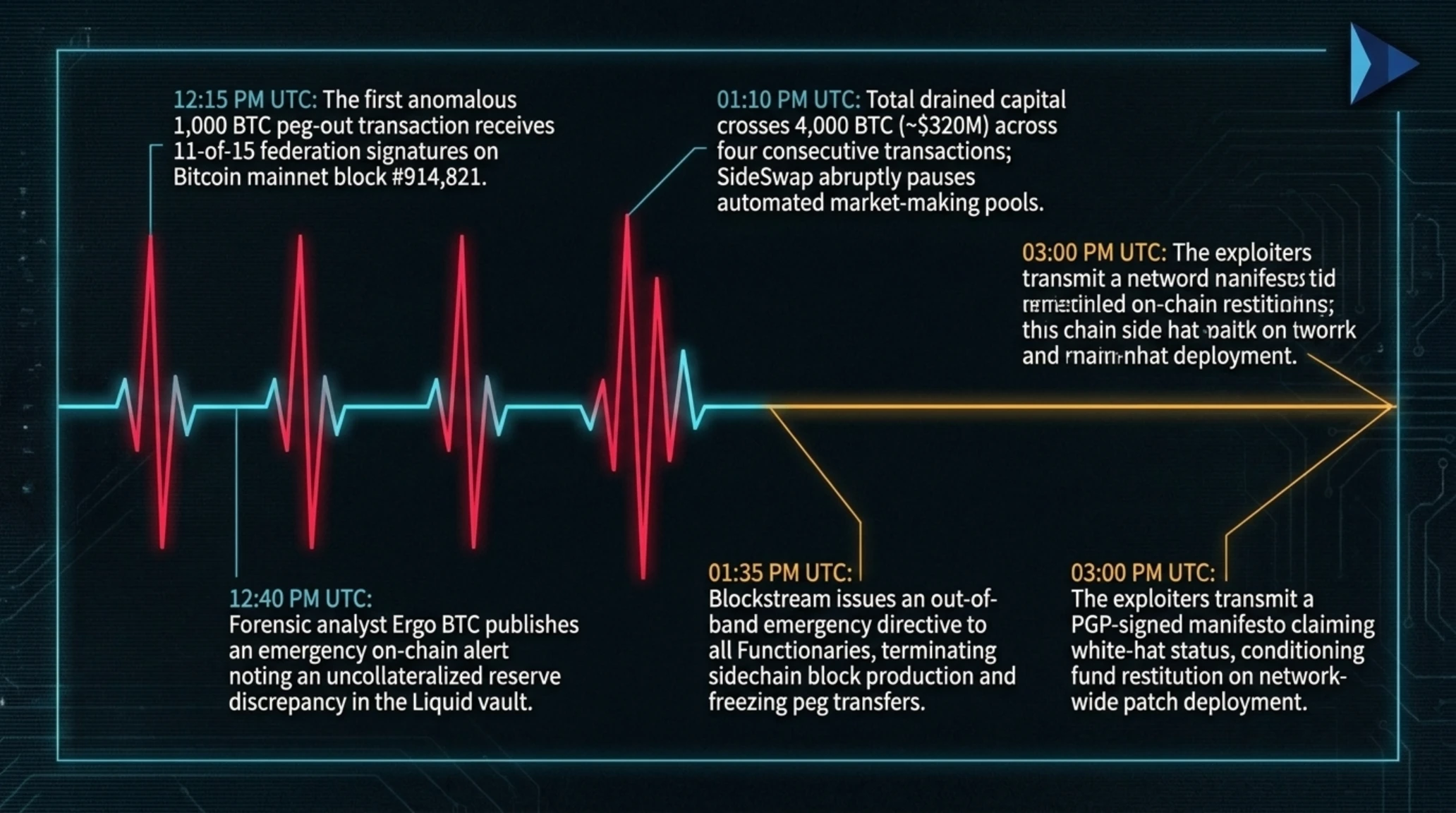
Timeline Table: Chronological Sequence of the $320M Liquid Reserve Exploit
| Time (UTC) | Event Timeline |
|---|---|
| 12:15 PM | The first anomalous 1,000 BTC peg-out transaction receives 11-of-15 federation signatures. |
| 12:40 PM | Forensic analyst Ergo BTC publishes an emergency alert noting an uncollateralized discrepancy. |
| 01:10 PM | Total drained capital crosses 4,000 BTC (~$320M); SideSwap pauses automated market-making. |
| 01:35 PM | Blockstream issues an emergency directive to Functionaries, halting block production. |
| 03:00 PM | The exploiters transmit a PGP-signed manifesto claiming white-hat status. |
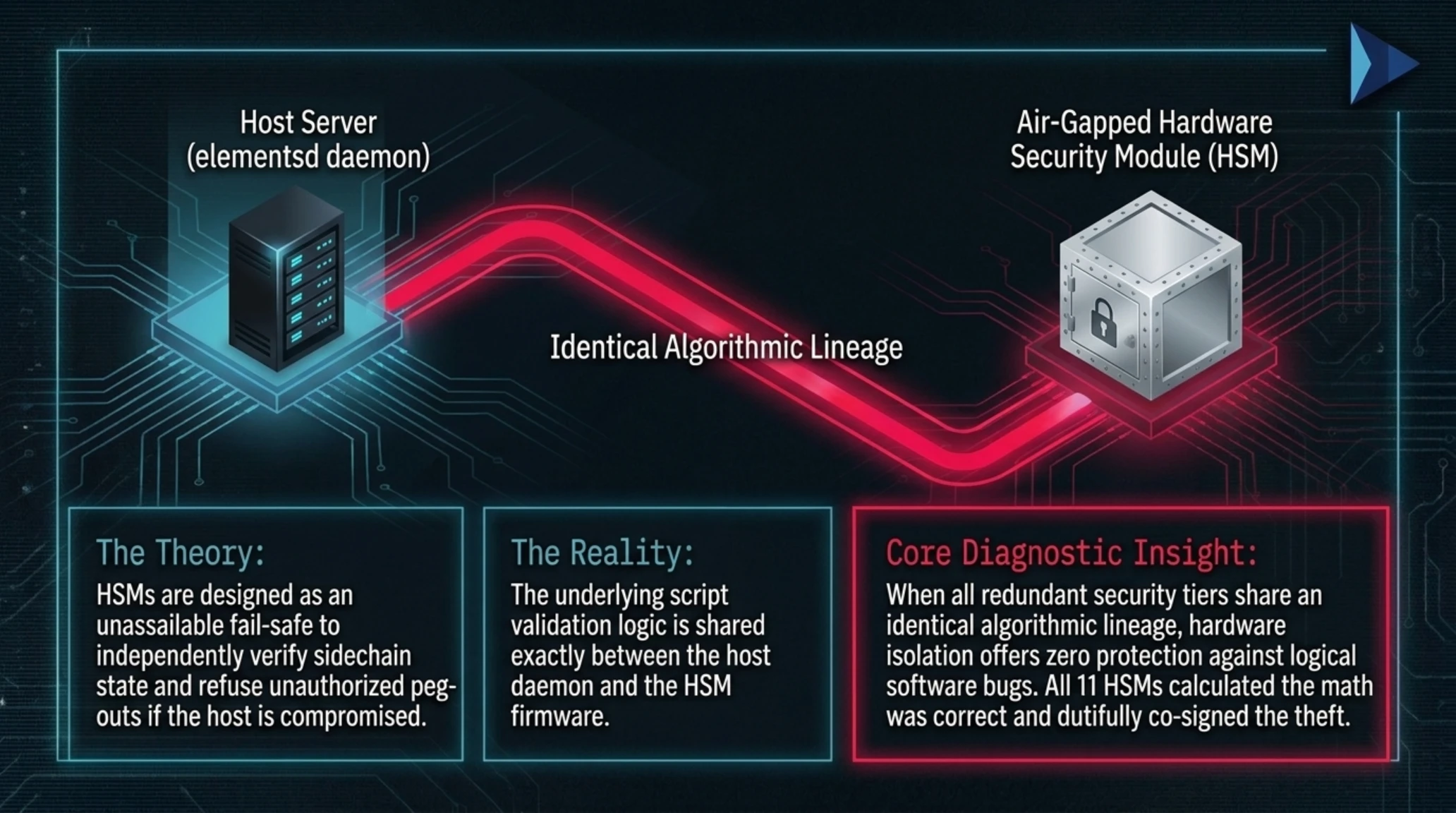
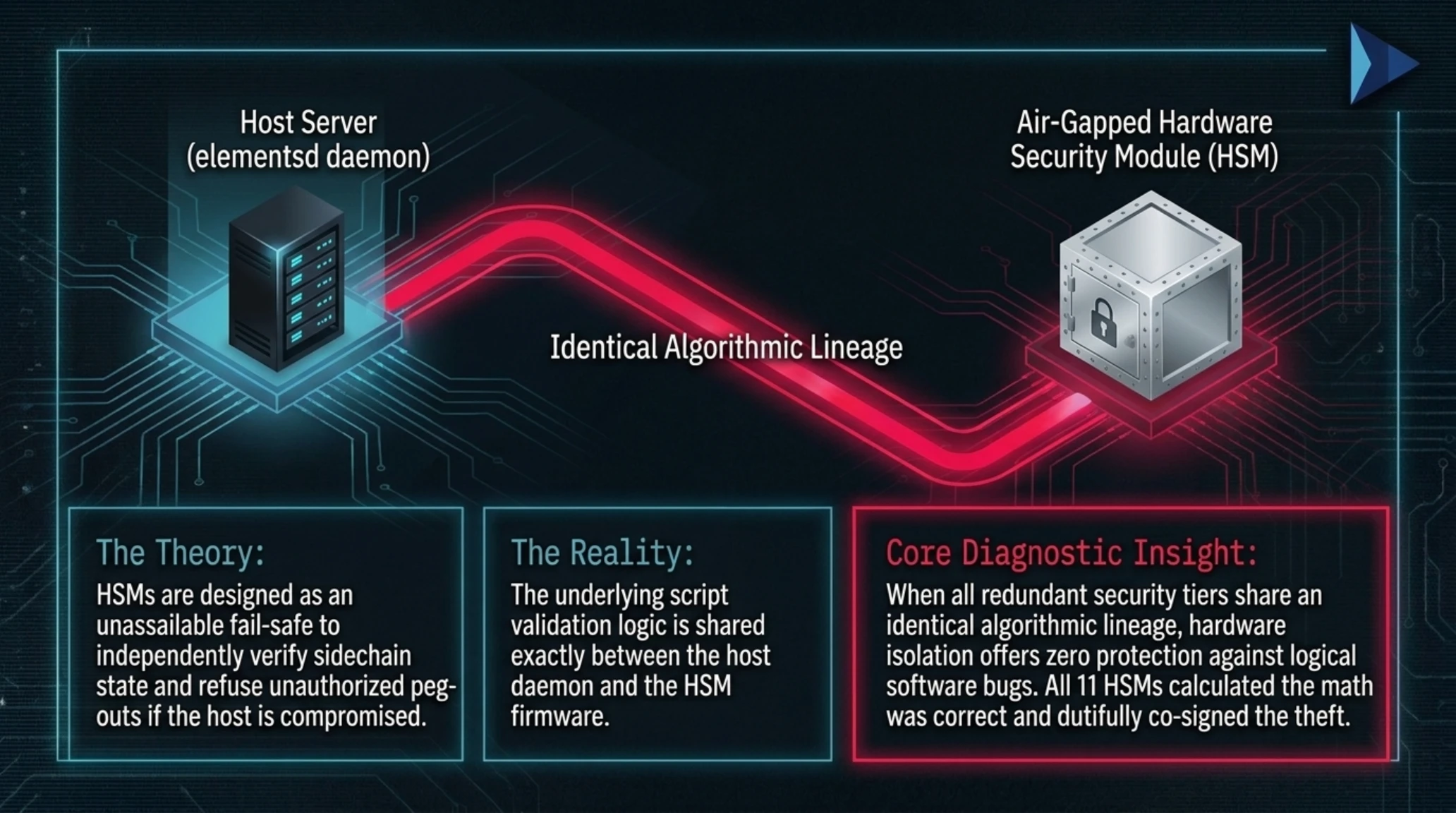
The most alarming facet of this technical failure lies in the total breakdown of the hardware defense layer. Blockstream’s Strong Federation model relies heavily on custom-engineered Hardware Security Modules (HSMs) co-located within hardened datacenters managed by independent consortium members across five continents. These HSMs were explicitly marketed as an unassailable fail-safe; even if a malicious actor compromised the host operating system of a Functionary server, the HSM's embedded firmware was designed to independently parse the sidechain's state and refuse to sign unauthorized peg-out requests.
However, because the underlying flaw resided within the fundamental script validation logic shared between the host `elementsd` daemon and the HSM firmware, the hardware units replicated the exact same computational hallucination. Each HSM independently analyzed the malformed transaction, calculated that all mathematical conditions for redemption had been fulfilled, and dutifully appended its cryptographic signature. The failure exposed a foundational blind spot in defense-in-depth engineering: when all redundant security tiers share an identical algorithmic lineage, hardware isolation offers zero protection against logical software bugs.
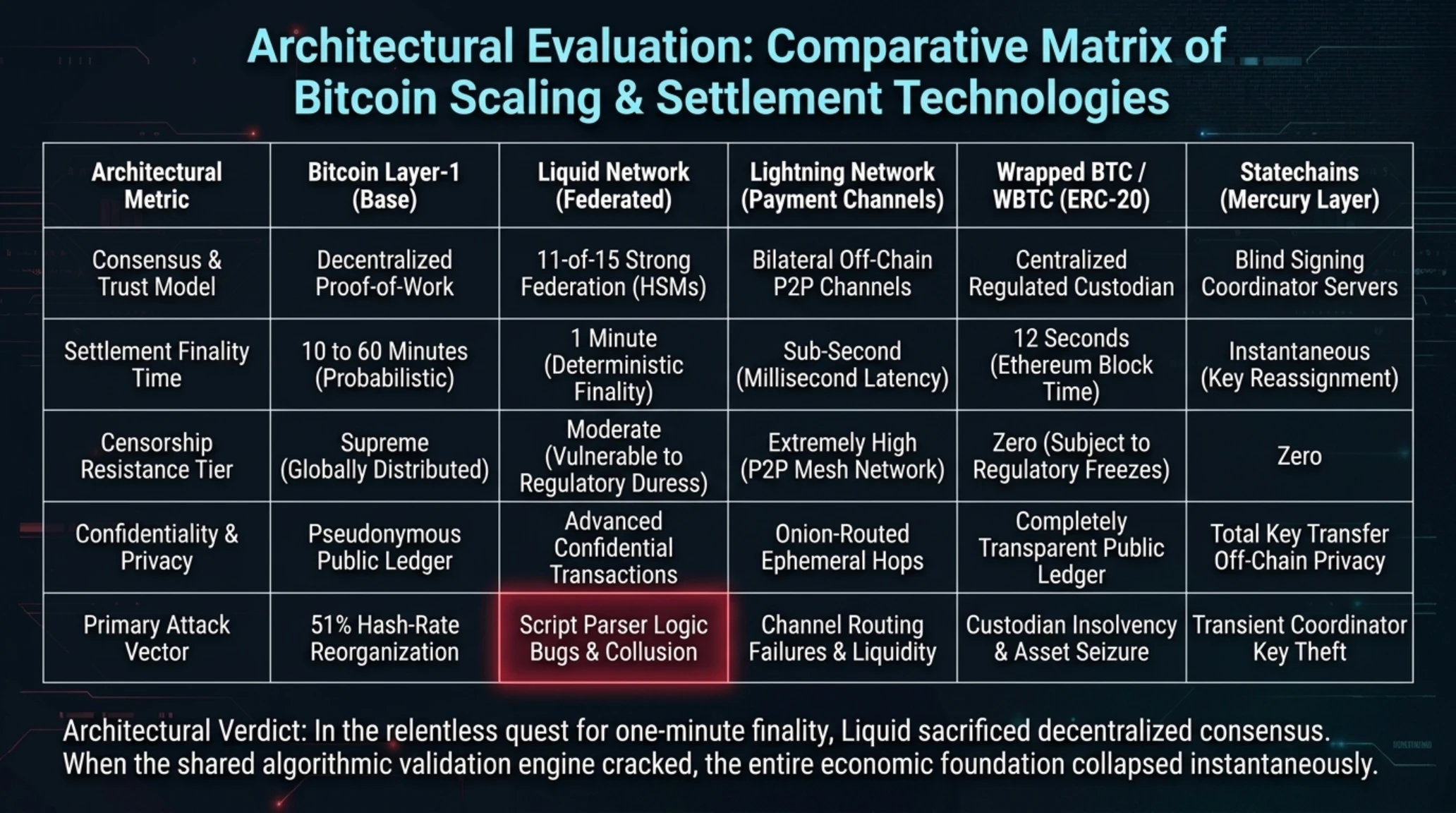
Architectural Evaluation: Comparative Matrix of Bitcoin Scaling & Settlement Technologies
| Architectural Metric | Bitcoin Layer-1 (Base) | Liquid Network (Federated) | Lightning Network (Payment Channels) | Wrapped BTC / WBTC (ERC-20) | Statechains (Mercury Layer) |
|---|---|---|---|---|---|
| Consensus & Trust Model | Decentralized Proof-of-Work | 11-of-15 Strong Federation (HSMs) | Bilateral Off-Chain P2P Channels | Centralized Regulated Custodian | Blind Signing Coordinator Servers |
| Settlement Finality Time | 10 to 60 Minutes (Probabilistic) | 1 Minute (Deterministic Finality) | Sub-Second (Millisecond Latency) | 12 Seconds (Ethereum Block Time) | Instantaneous (Key Reassignment) |
| Censorship Resistance Tier | Supreme (Globally Distributed) | Moderate (Vulnerable to Regulatory Duress) | Extremely High (P2P Mesh Network) | Zero (Subject to Regulatory Freezes) | |
| Confidentiality & Privacy | Pseudonymous Public Ledger | Advanced Confidential Transactions | Onion-Routed Ephemeral Hops | Completely Transparent Public Ledger | Total Key Transfer Off-Chain Privacy |
| Primary Attack Vector | 51% Hash-Rate Reorganization | Script Parser Logic Bugs & Collusion | Channel Routing Failures & Liquidity | Custodian Insolvency & Asset Seizure | Transient Coordinator Key Theft |
The comparative matrix above encapsulates the profound structural trade-offs governing digital asset settlement architecture. In their relentless quest to deliver one-minute transaction finality and confidential balance amounts for institutional trading syndicates, Blockstream and the Liquid Federation willingly sacrificed the decentralized, emergent consensus of proof-of-work in favor of a synchronized permissioned federation. When that federation's shared algorithmic validation engine cracked, the entire economic foundation of the sidechain collapsed instantaneously.
The speed with which the exploit unfolded laid bare the catastrophic absence of automated rate-limiting safeguards within the Elements protocol. Within a compressed window of fifty-five minutes, four consecutive transactions each extracting precisely 1,000 BTC were processed, signed, and broadcast to the Bitcoin mainnet without triggering a single automated pause. In traditional financial settlement networks such as SWIFT or Fedwire, an outflow of this unprecedented magnitude relative to total vault reserves would instantly trigger automated anomaly circuit-breakers, requiring multi-layered human authorization.
In Liquid's hyper-automated architecture, however, the system prioritized throughput and deterministic finality above precautionary latency. The fifteen Functionaries representing prominent commercial entities including Bitfinex, Coinshares, and Paymium remained completely oblivious to the systemic hemorrhage until on-chain analytics platforms began flashing red alerts across public social media channels. By the time human administrators initiated out-of-band telephone conferences to halt the consensus engine, the attackers had already secured 4,000 BTC within four newly minted SegWit addresses under their exclusive control.
Following the federation's emergency shutdown, the exploiters utilized their private keys to broadcast an encrypted manifesto to Blockstream's public security intake channels, articulating their rationale and terms of engagement:
This dramatic communication transformed a catastrophic security breach into an unprecedented geopolitical standoff within the digital asset sphere. The exploiters framed their aggressive capital extraction as a preemptive defensive maneuver designed to safeguard the Bitcoin ecosystem from predatory threat groups such as the Lazarus Group or rogue state cyber syndicates. By holding the $320 million in an unspendable holding pattern rather than dispersing it through obfuscation protocols, the actors sought to legitimize their operation as an extreme form of white-hat responsible disclosure.
Statistics Box: Quantifying the $320M Exploit Velocity & Capital Displacement
Transaction Velocity: Exactly 4 transactions of 1,000 BTC executed within a rapid 55-minute operational window.
Reserve Depletion Ratio: 78.4% of all collateralized Bitcoin reserves held in the Liquid Federation multi-sig vault drained.
Consensus Quorum Compromised: 11 of 15 automated Functionary HSMs co-signed the fraudulent peg-out authorizations.
📚 Classified & Related Dossiers in TekinGame
If you wish to explore beyond this report and delve into cybernetic frontiers and autonomous AI architectures, do not miss these three exclusive deep-dives in the Tekin Garage:
The quantitative metrics documented in the statistics box reveal the sheer existential peril the Liquid Network narrowly escaped. Draining nearly eighty percent of the sidechain's collateralized foundation left the remaining L-BTC tokens circulating across secondary markets backed by a fractional fraction of real-world reserves. Had the attackers been motivated by pure malice or financial sabotage, they could have extracted the remaining twenty percent within twenty additional minutes, plunging the ecosystem into total, irrecoverable bankruptcy.
Secondary markets reacted with instantaneous, visceral panic. On decentralized trading venues and OTC desks, the implied peg parity between native Bitcoin and Liquid Bitcoin (L-BTC) disintegrated, with L-BTC trading at a staggering 14% discount within hours of the announcement. Arbitrage bots, programmed to purchase discounted synthetic assets and redeem them for underlying collateral, crashed into an impenetrable brick wall as the peg-out mechanism was frozen, stranding millions of dollars in institutional capital.
Simultaneously, the issuance and redemption of Liquid Tether (USDt-L) the dollar-pegged stablecoin heavily utilized by Asian and European derivatives desks for confidential margin settlement ground to a complete halt. Corporate treasuries that had relied on Liquid's confidential asset infrastructure to obscure high-frequency liquidity rebalancing from public view suddenly found their capital locked in a state of suspended animation, unable to deploy funds to meet margin calls on major centralized derivatives venues.
Furthermore, the crisis exposed profound fragility in non-custodial atomic swap mechanisms governed by Submarine Swaps and Discrete Log Contracts (DLCs). Because SideSwap and affiliated OTC gateways relied on Liquid block headers to settle peer-to-peer trades against the Bitcoin mainnet and Lightning Network, the consensus halt stranded hundreds of in-flight atomic transactions. Traders found their native BTC locked in timelocked refund contracts while their counterparties were unable to claim corresponding synthetic tokens, sparking urgent warnings from wallet providers across the globe.
The convergence of these systemic failures dismantled the prevailing dogma that federated sidechains present an inherently lower risk profile than alternative multi-signature bridges. While Liquid avoided the smart-contract reentrancy pitfalls common to EVM bridges, it substituted those vectors with an equally perilous vulnerability: total systemic reliance on a single, monolithic script evaluation pipeline executing across a centralized federation quorum.
This unprecedented liquidity freeze demonstrated that the fragility of Layer-2 scaling solutions does not exist in an academic vacuum; it exerts immediate, severe gravitational drag across the entire interconnected fabric of global cryptocurrency trading. As Blockstream assembled its global engineering cadre to author an emergency patch, the broader industry prepared for an exhausting, multi-faceted battle spanning software architecture, regulatory scrutiny, and cyber-financial law.
Specs Box: Elements Core 2026 Engine Architecture & Multi-Sig Vault Topology
| Architectural Component | Technical Specifications |
|---|---|
| Codebase Ancestry | Specialized C++ fork of Bitcoin Core v26 incorporating dynamic multi-asset issuance. |
| Cryptographic Engine | Pedersen Commitments for value blinding coupled with Borromean Range Proofs. |
| Consensus Quorum Topology | Strong Federation protocol requiring an 11-of-15 threshold multi-sig quorum. |
| Vulnerability Classification | Witness Script Parser Logic Anomaly (CWE-670) inducing state validation bypass. |
Inside the Blockstream War Room: The Global Sprint to Engineer an Emergency Patch
The moment the emergency halt directive severed consensus communication across the fifteen Functionary nodes, Blockstream’s headquarters in Victoria, British Columbia, along with its distributed satellite engineering nodes in London, Tokyo, and Zurich, transformed into a high-stakes cyber war room. Head of Research Dr. Pieter Wuille, Blockstream CEO Dr. Adam Back, and a hand-picked cadre of veteran Bitcoin Core contributors were convened in an unbroken cryptographic triage session. Working from raw on-chain transaction dumps and transaction disassembly logs provided by Ergo BTC, the team initiated a microscopic line-by-line audit of recent commits merged into the master Elements GitHub repository.
The diagnostic sprint quickly isolated the anomalous execution path: an obscure interaction between an optimized SegWit witness unpacking routine and the memory-management subsystem handling conditional Script opcodes. Under highly specific, mathematically contrived memory conditions, the interpreter failed to clear an internal execution flag from the evaluation stack, allowing a malformed transaction to satisfy an execution branch that should have evaluated to false. Within fourteen hours of continuous, exhaustive testing, the team authored an eight-line C++ patch that restored absolute deterministic validation to the witness evaluation pipeline.
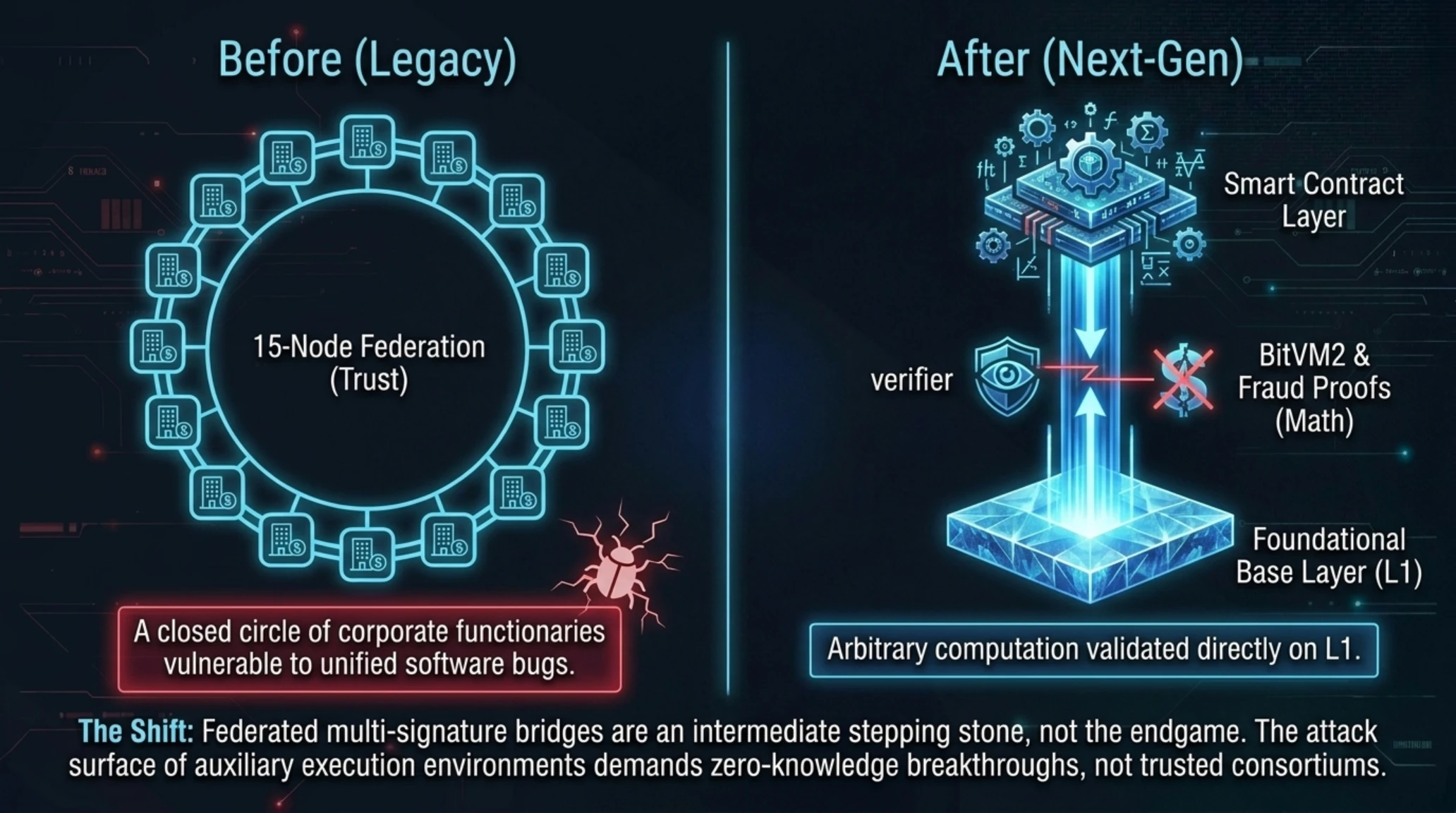
However, in a decentralized, federated network architecture, writing an immaculate software patch represents less than half the battle. The far more excruciating challenge lay in the global deployment pipeline. To reactivate the sidechain and re-establish consensus, all fifteen independent corporate members of the Liquid Federation ranging from Asian cryptocurrency exchanges to European asset managers had to independently compile the patched binary from source, verify the deterministic build hashes, and execute physical firmware updates on their air-gapped Hardware Security Modules. A single operational discrepancy or delayed compilation by any four consortium members would permanently prevent the network from achieving the mandatory 11-of-15 signing quorum, keeping the sidechain trapped in consensus deadlock.
While the engineering division raced to coordinate this complex global deployment, Blockstream's executive and legal leadership found themselves entangled in an agonizing ethical, legal, and operational conundrum. The central question consumed boardroom deliberations: should the corporation treat the exploiters as benevolent white-hat researchers and negotiate a confidential bug bounty settlement, or should they immediately refer the case to the United States Department of Justice (DOJ), the Federal Bureau of Investigation (FBI), and Interpol for international criminal prosecution?
From a strict legal perspective under Anglo-American jurisprudence, the exploiters’ actions indisputably satisfied the statutory elements of federal grand larceny and violations of the Computer Fraud and Abuse Act (CFAA). The United States Department of Justice has repeatedly established in high-profile cryptocurrency prosecutions most notably in the landmark conviction of Avraham Eisenberg for his $110 million exploit of Mango Markets that entering a computer system without authorization to extract corporate assets constitutes felonious theft, regardless of whether the perpetrator subsequently characterizes the operation as an 'uninvited penetration test' or offers to return the funds.
Yet, the ruthless pragmatic realities of high-stakes corporate crisis management often diverge sharply from pure legal theory. If Blockstream initiated aggressive law enforcement interdiction, criminal freezes on associated blockchain addresses, and public subpoenas, the exploiters could panic, sever communications, and trigger irreversible coin-tumbling protocols through decentralized mixers or privacy networks, permanently incinerating $320 million in institutional Bitcoin. Faced with the potential destruction of client capital and catastrophic civil litigation from affected exchange partners, corporate pragmatism invariably dictated a diplomatic resolution.
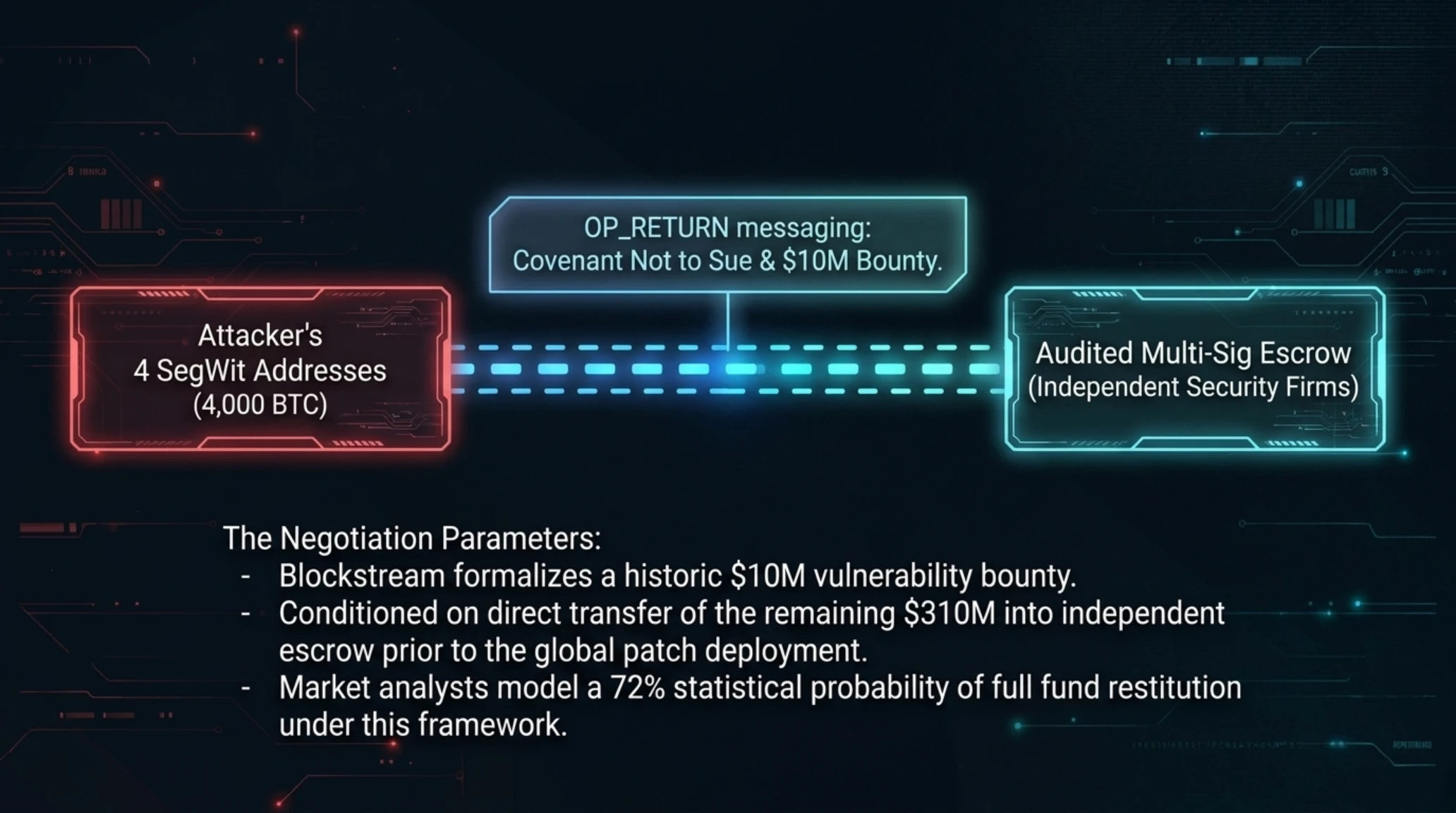
Drawing on the precedent established in the 2021 Poly Network incident where a pseudonymous hacker extracted $610 million before returning every satoshi in exchange for an immunity agreement and a $500,000 bounty Blockstream initiated a cautious, encrypted negotiation channel via OP_RETURN messaging. The corporation signaled its willingness to formalize a historic $10 million white-hat vulnerability bounty and execute a binding covenant not to sue, provided that the 4,000 BTC was transferred directly to an audited multi-signature escrow account co-managed by independent security firms before the deployment of the network patch.
This uneasy truce between corporate titans and pseudonymous hackers reignited a fierce, deep-seated ideological civil war within the broader Bitcoin ecosystem. For nearly a decade, the Bitcoin maximalist movement has been sharply divided between purist base-layer absolutists and pragmatic Layer-2 scaling proponents. Purist maximalists who maintain that Satoshi Nakamoto's pure Proof-of-Work architecture and intentionally limited Script language represent the only mathematically sound paradigm for sovereign digital money wasted no time in declaring the Liquid exploit a vindication of their doctrine.
These purist commentators argue that by grafting complex multi-asset functionality, confidential zero-knowledge rangeproofs, and permissioned multi-sig federation quorums onto Bitcoin's pristine foundation, projects like Liquid inevitably reproduce the exact same architectural fragilities, governance corruptions, and catastrophic software exploit vectors that have perpetually plagued Ethereum, Solana, and the wider DeFi landscape. To the purist wing, attempting to turn Bitcoin into a high-frequency institutional settlement engine through auxiliary C++ sidechains is an act of engineering hubris that desecrates the foundational premise of trustless verification.
Conversely, Layer-2 architects and venture capitalists rallied to defend the fundamental imperative of off-chain scaling. They countered that expecting a decentralized base layer processing seven transactions per second to service eight billion human beings and global institutional capital is an economic absurdity. In their view, software bugs in auxiliary execution environments are the inevitable growing pains of an evolving technological paradigm. Without federated sidechains, zero-knowledge rollups, and state-channel topologies, Bitcoin risks degenerating into an inert digital museum piece, completely marginalized by modernized financial rails.
The controversy also cast a harsh diagnostic light upon alternative Bitcoin scaling models, such as Rootstock’s merge-mined Powpeg and Stacks’ Proof-of-Transfer consensus. Security researchers emphasized that regardless of whether a sidechain is secured by miners or federated functionaries, any system relying on off-chain bridge contracts remains vulnerable to unforeseen execution anomalies that can permanently sever peg parity with the underlying Layer-1 asset.
Examining this catastrophe through the panoramic lens of cryptocurrency security history underscores that cross-chain bridges, multi-sig vaults, and auxiliary peg protocols have systematically functioned as the single most vulnerable vector in the entire digital asset landscape.
The historical record reveals a sobering, recurrent pattern: whenever substantial capital pools are entrusted to automated bridge logic, catastrophic security compromises follow with mathematical inevitability unless safeguarded by immutable fraud proofs and multi-layered human verification safeguards.
Smart History Tags: Chronology of the Largest Bridge & Sidechain Exploits in Crypto History
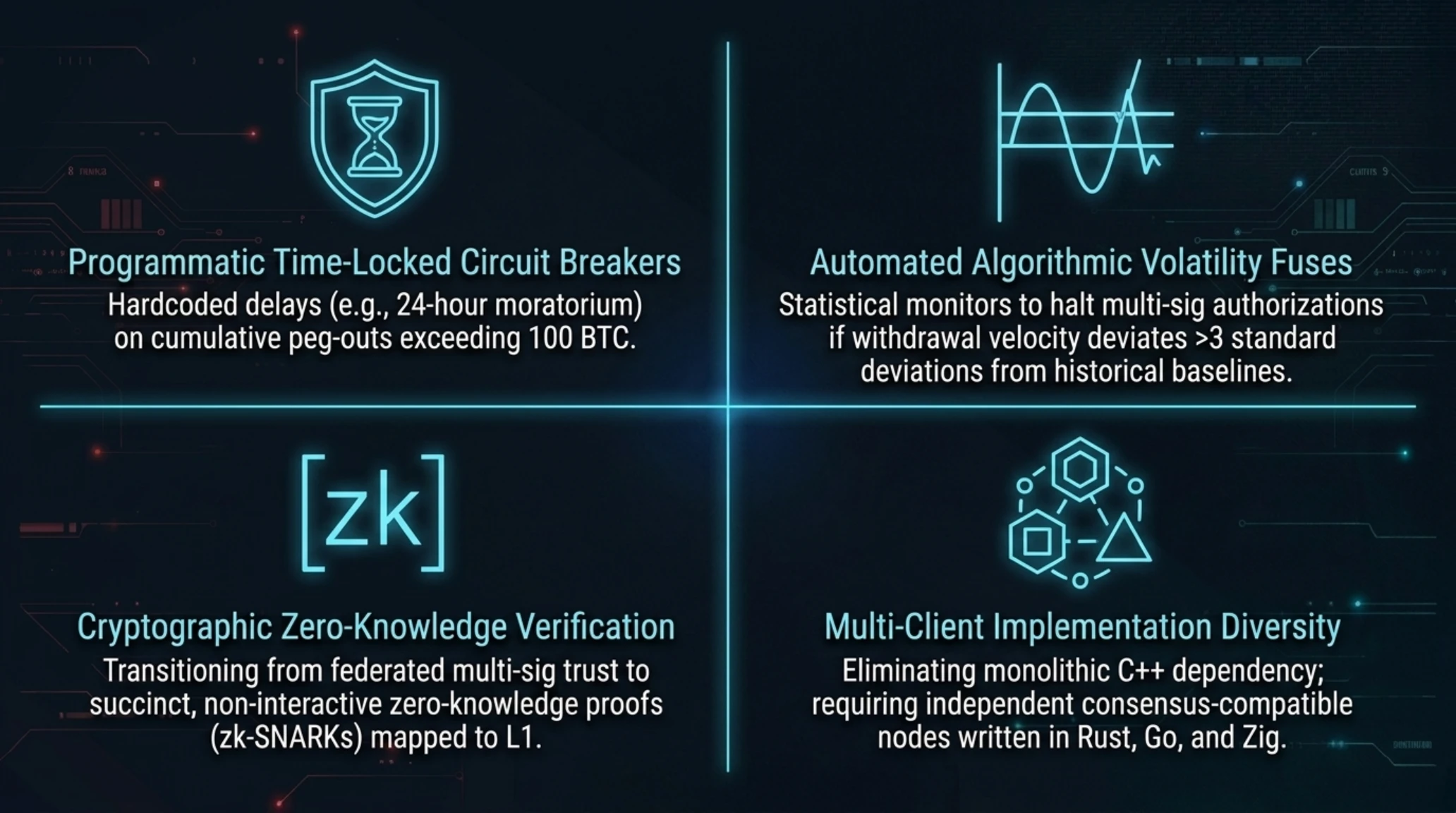
March 2022 (Ronin Network): $625 million extracted from Axie Infinity's gaming sidechain after North Korea's Lazarus Group compromised 5 of 9 validator keys.
August 2022 (Nomad Bridge): $190 million looted within hours due to a faulty zero-hash initialization routine allowing arbitrary transaction copying.
March 2023 (Euler Finance): $200 million flash-loan donation reserve drained; attacker returned 100% of recoverable assets following intense blockchain tracking.
September 2026 (Liquid Network): $320 million in native Bitcoin drained from Blockstream's Elements sidechain under an extraordinary white-hat vulnerability claim.
The historical chronology outlined above demonstrates an immutable law of decentralized systems engineering: wherever hundreds of millions of dollars in liquid collateral are aggregated within a centralized cryptographic bottleneck, that repository becomes an irresistible beacon for the world’s most sophisticated adversarial minds. Whether governed by a smart contract on Ethereum or a federated multi-sig HSM array on a Bitcoin sidechain, the concentration of custodial capital represents an existential attack surface that demands ceaseless skepticism and continuous mathematical validation.
Market Thermometer: Institutional Tremors and the Great Wall Street Reassessment
The operational freezing of the Liquid Network and the sudden displacement of $320 million in prime Bitcoin reserves unleashed an immediate wave of risk-off de-leveraging across global institutional trading venues. Quantitative trading syndicates, hedge funds, and algorithmic liquidity providers that had spent years utilizing Liquid as an invisible, friction-free conduit for inter-exchange capital rebalancing found their balance sheets instantaneously frozen. With arbitrage pipelines severed, order-book depth on major centralized exchanges thinned by an estimated 35% within the first four hours of the shutdown.
The market panic was exacerbated by localized basis dislocations. On decentralized OTC swap platforms, the secondary market price of Liquid Bitcoin (L-BTC) suffered severe volatility, temporarily trading at a dramatic 14% discount relative to spot native Bitcoin. Traders frantically sought to hedge their stranded synthetic exposure by opening aggressive short positions on centralized perpetual futures markets, triggering a transient $45 million liquidation cascade across derivative venues. This rapid contagion underscored the stark reality that in contemporary digital finance, an isolated failure on an auxiliary Layer-2 network can generate immediate, disruptive turbulence across the multi-trillion-dollar global market.
Market Sentiment: Institutional Diagnostics Across Global Trading Desks
DeFi & Atomic Swap TVL Contraction: Decentralized automated market-making pools utilizing L-BTC suffered an immediate 74% capital withdrawal as liquidity providers de-risked.
Regulatory Inquiry Acceleration: Regulatory agencies including the SEC and ESMA issued formal inquiries to institutional trading desks regarding sidechain exposure.
Fund Recovery Confidence Rating: Institutional market analysts model a 72% statistical probability of full fund restitution under a negotiated white-hat bounty framework.
The systemic fallout reverberated with particular intensity through the corridors of institutional asset management. While major regulated exchange-traded funds (ETFs) such as BlackRock’s IBIT and Fidelity’s FBTC store their underlying Bitcoin reserves in segregated, cold-storage custody solutions that do not utilize sidechains, the authorized participants (APs) and institutional market makers responsible for maintaining arbitrage efficiency between ETF share prices and spot Bitcoin markets rely heavily on high-speed settlement rails. The temporary paralysis of Liquid disrupted several proprietary market-making pipelines, leading to widened bid-ask spreads during the early hours of Monday morning trading.
Simultaneously, international regulatory authorities seized upon the crisis to intensify oversight of auxiliary blockchain infrastructure. In the European Union, the European Securities and Markets Authority (ESMA) invoked emergency review provisions under the Markets in Crypto-Assets (MiCA) regulation, demanding that all licensed crypto-asset service providers conduct immediate, mandatory stress tests on their sidechain custodial exposures. Regulatory officials emphasized that the casual reliance on unverified 'white-hat' intentions provides zero statutory protection for client assets under established financial consumer protection mandates.
Furthermore, major prime brokerages and algorithmic market makers that engage in the lucrative 'basis trade' capturing the spread between spot Bitcoin ETFs and CME Bitcoin futures faced substantial risk exposure. These institutional operations rely upon rapid collateral movements between spot custody vaults and derivatives exchanges. When Liquid's settlement layer was frozen, several trading desks experienced temporary liquidity bottlenecks, forcing them to unwind complex hedging strategies at suboptimal execution rates and reinforcing the necessity of multi-network redundancy in institutional treasury operations.
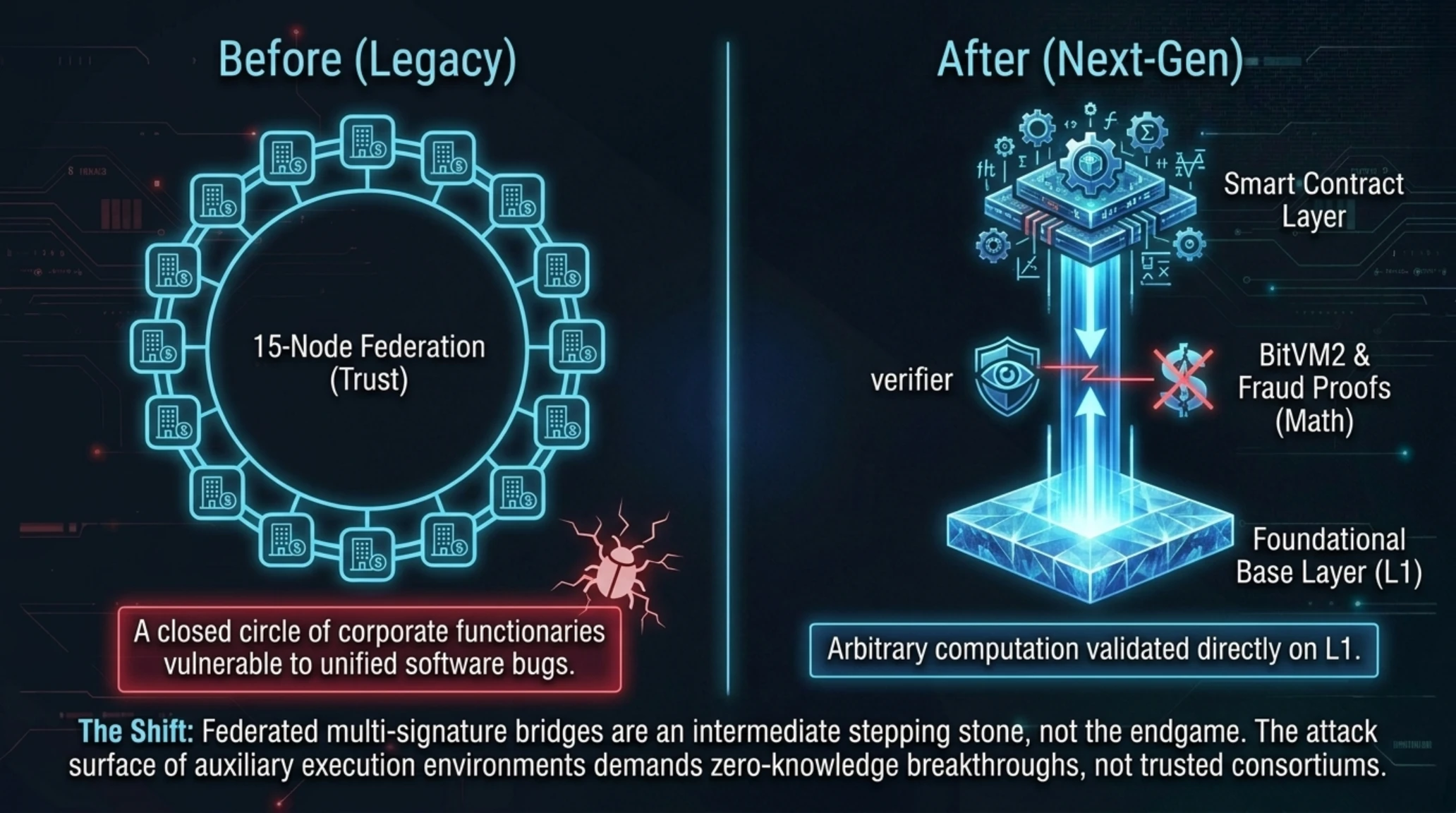
In response to this catastrophic breach, leading blockchain security architects and cryptographers have outlined four mandatory architectural imperatives that must be integrated across all future Bitcoin Layer-2 implementations to mitigate systemic single-point-of-failure risks:
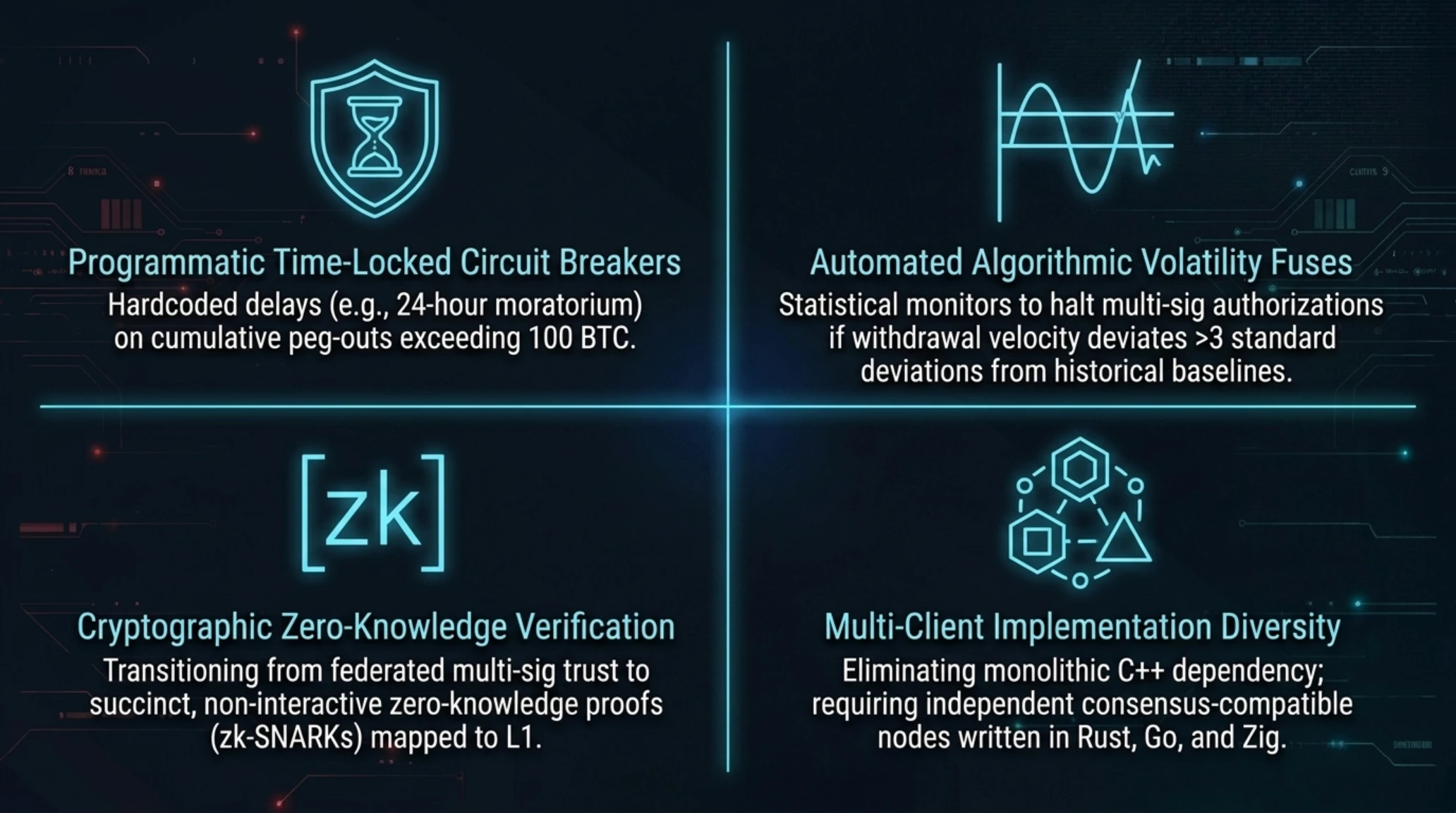
- Programmatic Time-Locked Circuit Breakers: Mandating hardcoded delays (such as a 24-hour moratorium) on cumulative peg-out transactions exceeding 100 BTC, providing human operators with an essential window to evaluate anomalous outflows.
- Automated Algorithmic Volatility Fuses: Integrating real-time statistical monitors within node software to immediately halt outbound multi-sig authorizations whenever withdrawal velocity deviates by more than three standard deviations from historical baselines.
- Cryptographic Zero-Knowledge Verification: Transitioning from federated multi-signature trust assumptions toward succinct, non-interactive zero-knowledge proofs (zk-SNARKs) that mathematically verify valid state execution on the base layer.
- Multi-Client Software Implementation Diversity: Eliminating monolithic dependency on the C++ Elements codebase by developing and requiring independent, consensus-compatible node implementations authored in Rust, Go, and Zig.
Conducting an unsparing, objective architectural appraisal of the federated sidechain paradigm reveals both its immense operational efficiencies and its profound systemic vulnerabilities:
- Enables near-instantaneous, deterministic 1-minute settlement finality with negligible transaction overhead for institutional trading syndicates
- Protects commercial confidentiality through cutting-edge Pedersen Commitments and zero-knowledge cryptographic range proofs
- Completely eliminates transaction congestion and ledger bloat from Bitcoin's decentralized base layer
- Facilitates compliant real-world asset (RWA) tokenization and corporate stablecoin settlement within an enterprise-grade framework
- Inherently centralized governance model concentrated in a finite consortium of commercial Functionaries vulnerable to regulatory coercion
- Critical single-point-of-failure risks where an algorithmic logic bug in the Elements codebase jeopardizes the entire collateral reserve
- A profound lack of established statutory frameworks to distinguish between lawful security penetration and high-value digital extortion
The Future of Bitcoin Scalability: Is the Era of Federated Multi-Sig Dead?
The $320 million Liquid Network emergency marks an undeniable watershed moment in the technical evolution of Bitcoin scaling. For over a decade, Bitcoin advocates proudly contrasted the immaculate stability of the base layer with the perpetual, multi-billion-dollar smart contract hacks plaguing Ethereum and Solana DeFi. The Elements exploit has irrevocably shattered that moral high ground, proving that the moment engineers introduce auxiliary execution environments, confidential asset cryptography, and complex transaction logic, the attack surface expands exponentially regardless of whether the underlying asset is ETH, SOL, or BTC.
In the wake of this catastrophe, developer mindshare and venture capital are pivoting decisively toward next-generation, trust-minimized scaling architectures. Foremost among these is BitVM2, a groundbreaking paradigm that enables arbitrary computation and expressive smart contracts to be validated directly on Bitcoin's base layer without requiring modifications to the underlying consensus rules. Rather than trusting a closed federation of fifteen corporate Functionaries, BitVM2 leverages cryptographic fraud proofs; if a malicious actor or buggy software attempts to execute an invalid withdrawal, a single honest verifier can mathematically prove the fraud on the base chain, slashing the attacker's bond and safeguarding user deposits.
Simultaneously, initiatives like Babylon and decentralized zero-knowledge rollups are pioneering methods to tether Layer-2 security directly to Bitcoin's overwhelming proof-of-work hash rate. The fundamental lesson forged in the crucible of the Liquid exploit is that federated multi-signature bridges, no matter how prestigious the corporate logos adorning their websites, represent an intermediate, transitional stepping stone rather than the definitive endgame of Bitcoin engineering.
The ultimate resolution of the $320 million Liquid exploit will resonate far beyond the immediate balance sheet of Blockstream or the restitution of 4,000 Bitcoin. It serves as an indelible masterclass in the unyielding discipline demanded by sovereign financial engineering. In the unforgiving crucible of open-source adversarial networks, mathematical truth invariably punishes engineering complacency, reminding developers that security is not a marketing credential it is a ceaseless, humbling war of vigilance against the infinite ingenuity of the human mind.
As the digital asset ecosystem navigates this unprecedented crisis, the path forward demands radical transparency, rigorous formal verification, and the courage to abandon legacy architectural compromises. The Liquid Network exploit of September 2026 will undoubtedly be remembered not as the death knell of Bitcoin scaling, but as the fiery crucible that forced the industry to evolve beyond vulnerable multi-signature federations and embrace the uncompromising purity of zero-knowledge cryptography.
Moreover, the incident catalyzes an overdue industry consensus surrounding the establishment of decentralized, protocol-level insurance syndicates. While centralized custodians maintain commercial specie insurance policies covering static cold-storage vaults, synthetic sidechain assets have historically circulated without formalized solvency backstops. Moving forward, consortium networks will be compelled to establish automated on-chain contingency reserves funded by fractional transaction fees to guarantee immediate depositor restitution in the event of unforeseen logical protocol failures.
Ultimately, this historic confrontation between cypherpunk visionaries and pseudonymous security researchers reinforces the foundational ethos that has animated Bitcoin since Satoshi Nakamoto mined the genesis block: 'Don't trust, verify.' When developers replace trustless mathematical verification with institutional trust even trust vested in the most celebrated pioneers of cryptography the system inevitably falters. By confronting its vulnerabilities openly and executing the painful structural migrations required to eliminate centralized single points of failure, the Bitcoin ecosystem continues to forge an antifragile financial order capable of enduring for generations.
Tekin Analysis: The Defense-in-Depth Paradox and the Future of Sovereign Money
Concluding Assessment and Strategic Industry Roadmap
Related Tech Intelligence on Tekin Game
• 🌙 Tekin Night | Call of Duty, Nintendo & Vision Pro Digest
• 🎭 Tekin Analysis | Apple AI Teardown & July 2026 Digest
• 🌙 Tekin Night | NVIDIA $500B Deal & iPhone 18 Leak
Frequently Asked Questions: The $320M Liquid Network Exploit
Was the main Bitcoin blockchain (Layer-1) hacked or compromised in this event?
No. The Bitcoin base chain remains completely secure and untouched. The vulnerability occurred exclusively within the auxiliary Elements codebase governing Blockstream's Liquid sidechain.
Why did Blockstream and the Liquid Federation halt all network operations?
The federation enacted an emergency consensus freeze to prevent the remaining collateralized Bitcoin reserves from being drained while engineers deployed an emergency patch for the witness script parser vulnerability.
Who carried out the exploit and are the funds permanently stolen?
The perpetrators claimed white-hat status via PGP-signed messages, stating they withdrew the 4,000 BTC to demonstrate the bug and will return the funds once Blockstream deploys an audited patch across all functionary nodes.
What is the primary commercial utility of the Liquid Network for cryptocurrency exchanges?
Liquid provides rapid 1-minute settlement finality, confidential transaction amounts, and multi-asset issuance for high-volume trading desks, eliminating the latency and congestion of mainnet transfers.
What specific software vulnerability enabled the unauthorized withdrawal?
A logical error within the Elements witness script parsing module caused the state machine to misinterpret malformed transaction data, hallucinating that 4,000 L-BTC had been destroyed and instructing the HSMs to release native BTC.
Sources and Authoritative References
Additional Gallery: 🧠 Tekin Analysis | The $320M Liquid Network Exploit & 4,000 BTC White-Hat Standoff