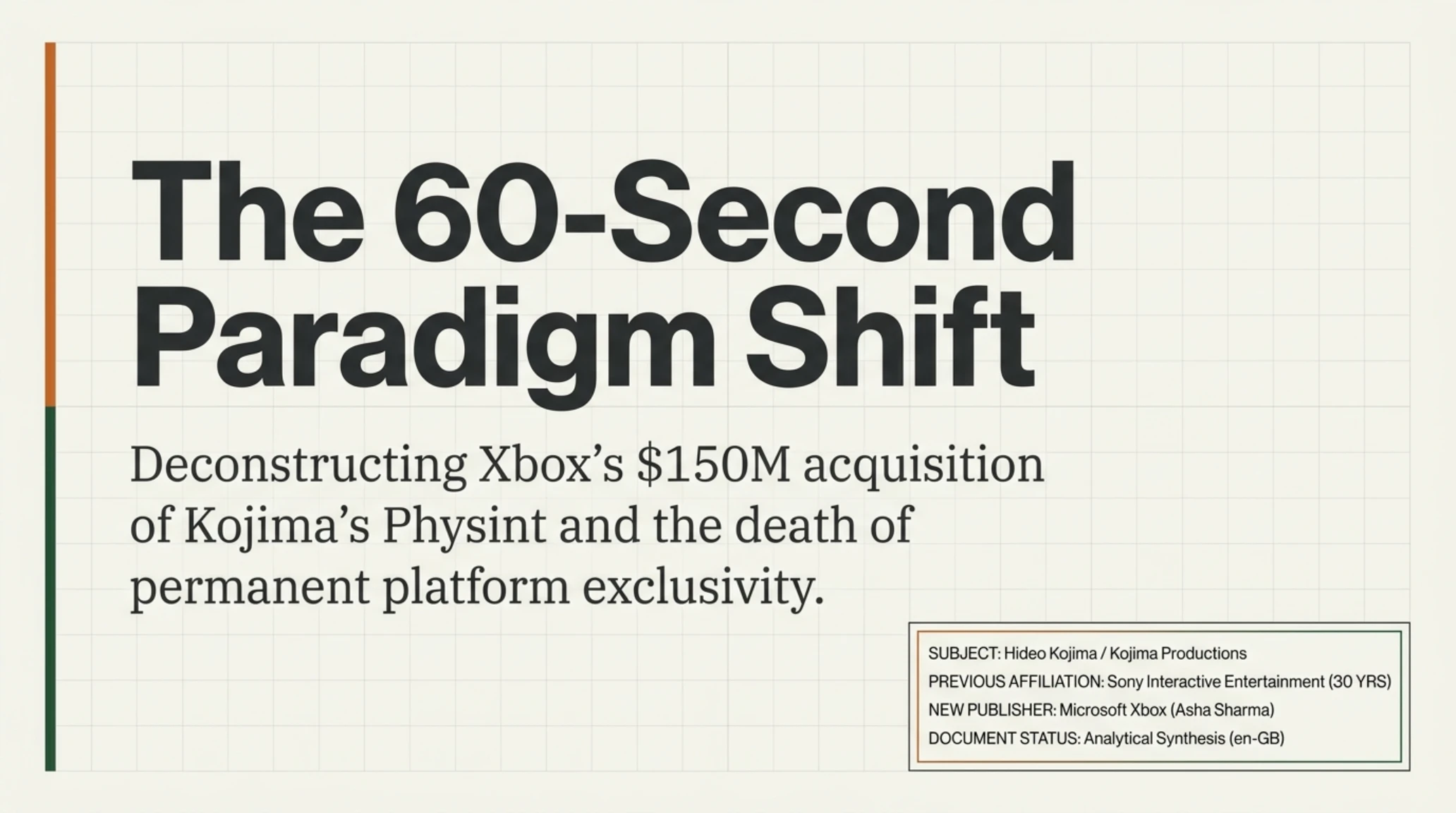
Kojima Exiled: Xbox's 60-Second Rescue
- 🎮Abrupt Cancellation- Sony informed Kojima in mid-June that Physint would be canceled
- 🎧Lightning Fast Deal- Xbox announced the deal exactly one minute later
- 🚀Three Decades Ended- Kojima leaves PlayStation after 30 years
- 🗡️Transmedia Expansion- The deal extends to film and TV projects
- 📰Power Shift- The end of permanent platform exclusivity
September 10, 2026: The Tweet That Shook the Industry
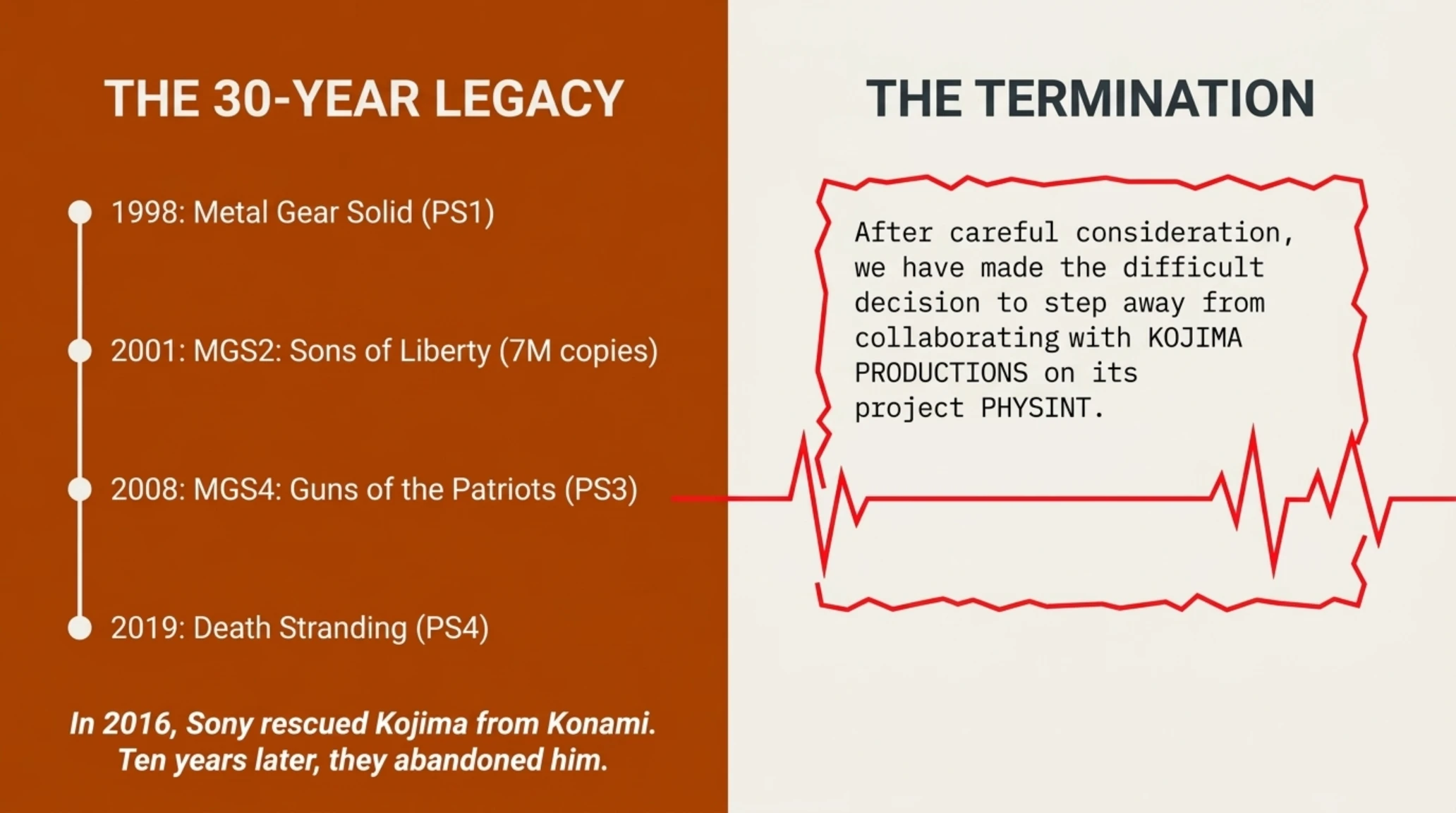
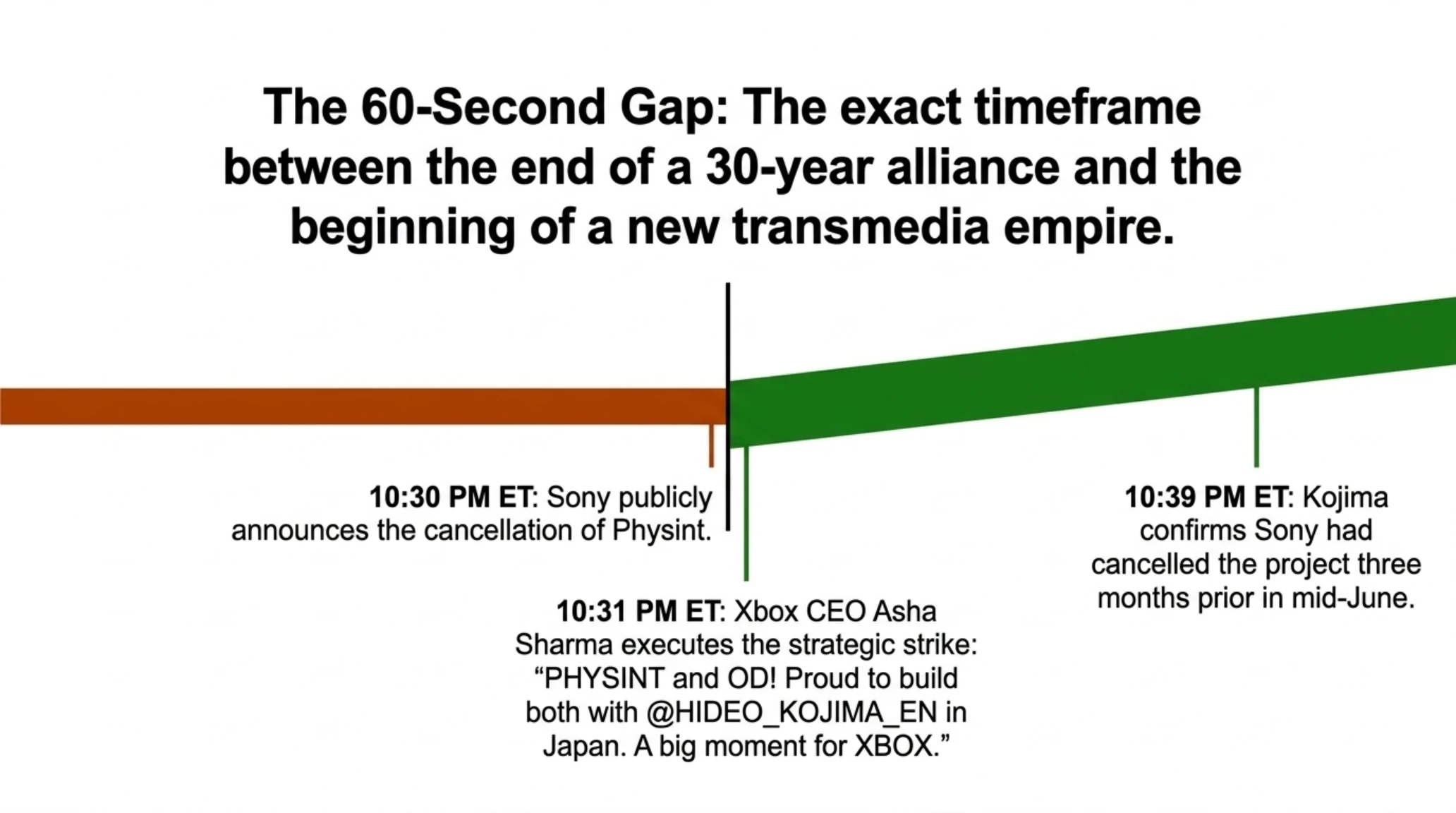
At 10:30 PM Eastern Time on September 10, 2026, the official PlayStation account posted what many are calling the most unexpected announcement of the year: "After careful consideration, we have made the difficult decision to step away from collaborating with KOJIMA PRODUCTIONS on its project PHYSINT."
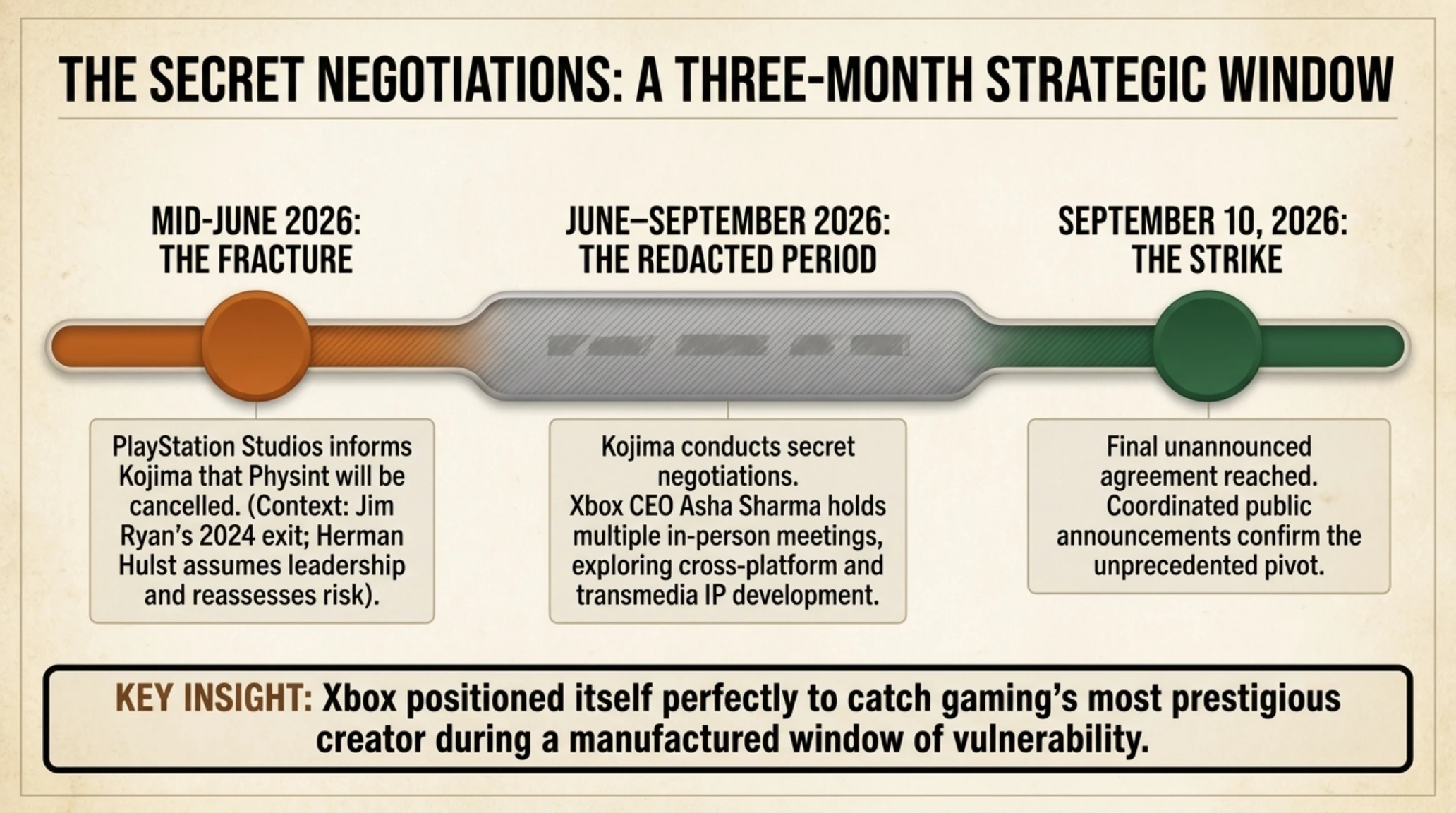
The diplomatic language masked a harsher reality. Just nine minutes later, Hideo Kojima himself revealed in a comprehensive statement that Sony had not merely "stepped away" they had canceled the project outright. According to Kojima, this decision was communicated to him in mid-June, a full three months before the public announcement.
At a Glance: 6 Major Impacts of Kojima's Xbox Move
- First time a legendary creator like Kojima switches platforms after 30 years of partnership.
- Demonstrates Microsoft's aggressive strategy to compete with Sony for top-tier talent.
- Signals the end of permanent platform loyalty in the gaming industry.
- Marks a monumental shift from exclusivity-driven business models to multi-platform flexibility.
- Establishes a precedent for other independent studios to leverage competing offers.
- Opens a strategic pathway for Xbox to penetrate the Japanese market through Kojima's influence.
To understand the magnitude of this rupture, we must rewind to January 2024, when Physint was unveiled at a PlayStation Showcase. The reveal featured Herman Hulst, head of PlayStation Studios, standing alongside Kojima on the Columbia Pictures studio lot. A drone camera dramatically pulled back to reveal the Hollywood setting as Hulst confidently declared: "We will fully support this project with the latest innovations Sony has to offer."
Less than two years later, that promise evaporated. The relationship that produced Metal Gear Solid, one of gaming's most influential franchises, and backed Death Stranding's ambitious vision, had fractured. The question everyone was asking: why?
Sixty Seconds Later: Xbox's Strategic Strike
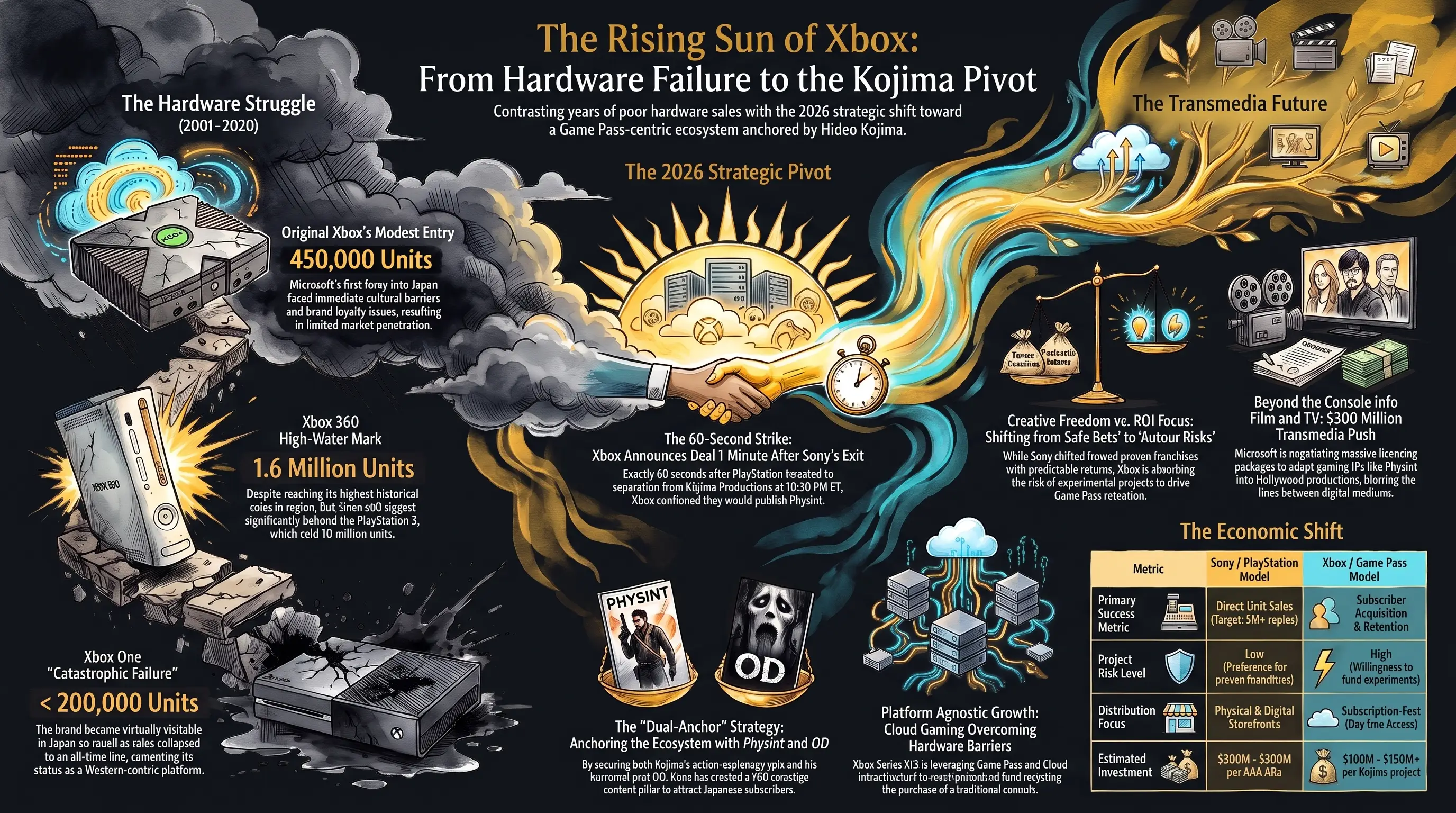
At 10:31 PM exactly one minute after PlayStation's tweet Asha Sharma, Xbox's newly appointed CEO who replaced Phil Spencer earlier in 2026, made her move: "PHYSINT and OD! Proud to build both with @HIDEO_KOJIMA_EN in Japan. A big moment for XBOX."
The speed of this response revealed what many suspected: negotiations had been underway for months. According to Variety's reporting, Sharma had held multiple in-person meetings with Kojima since taking over Xbox's leadership in early 2026. These discussions explored his creative plans and potential collaboration across platforms, including IP development for television and film.
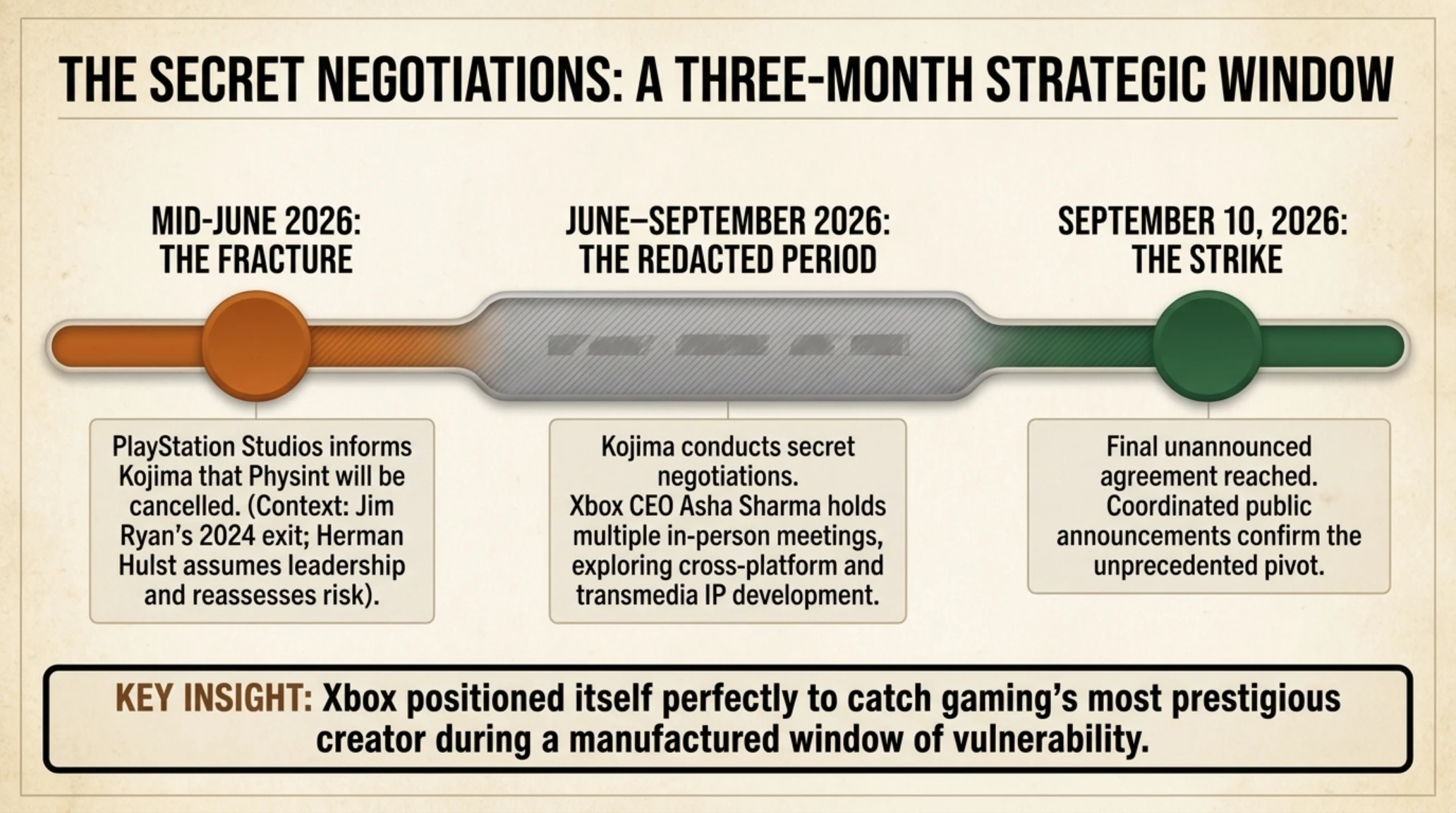
This wasn't an opportunistic grab. It was a calculated strategic play that had been carefully orchestrated during Kojima's three-month search for a new partner following Sony's cancellation notice in June. Microsoft had positioned itself perfectly to catch one of gaming's most prestigious creators at a vulnerable moment.
Timeline: Three Months of Silent War
| Time | Event |
|---|---|
| Mid-June 2026 | PlayStation Studios secretly informs Kojima that Physint will be canceled. |
| Jun - Sep 2026 | Kojima Productions searches for a new partner and conducts negotiations. |
| Early Sep 2026 | Final agreement reached with Xbox Game Studios. |
| Sep 10, 10:30 PM | PlayStation publicly announces the separation on X. |
| Sep 10, 10:31 PM | Xbox announces the publishing deal. |
| Sep 10, 10:39 PM | Kojima reveals Sony's actual cancellation details. |
Decoding Sony's Decision: Why Abandon Physint?
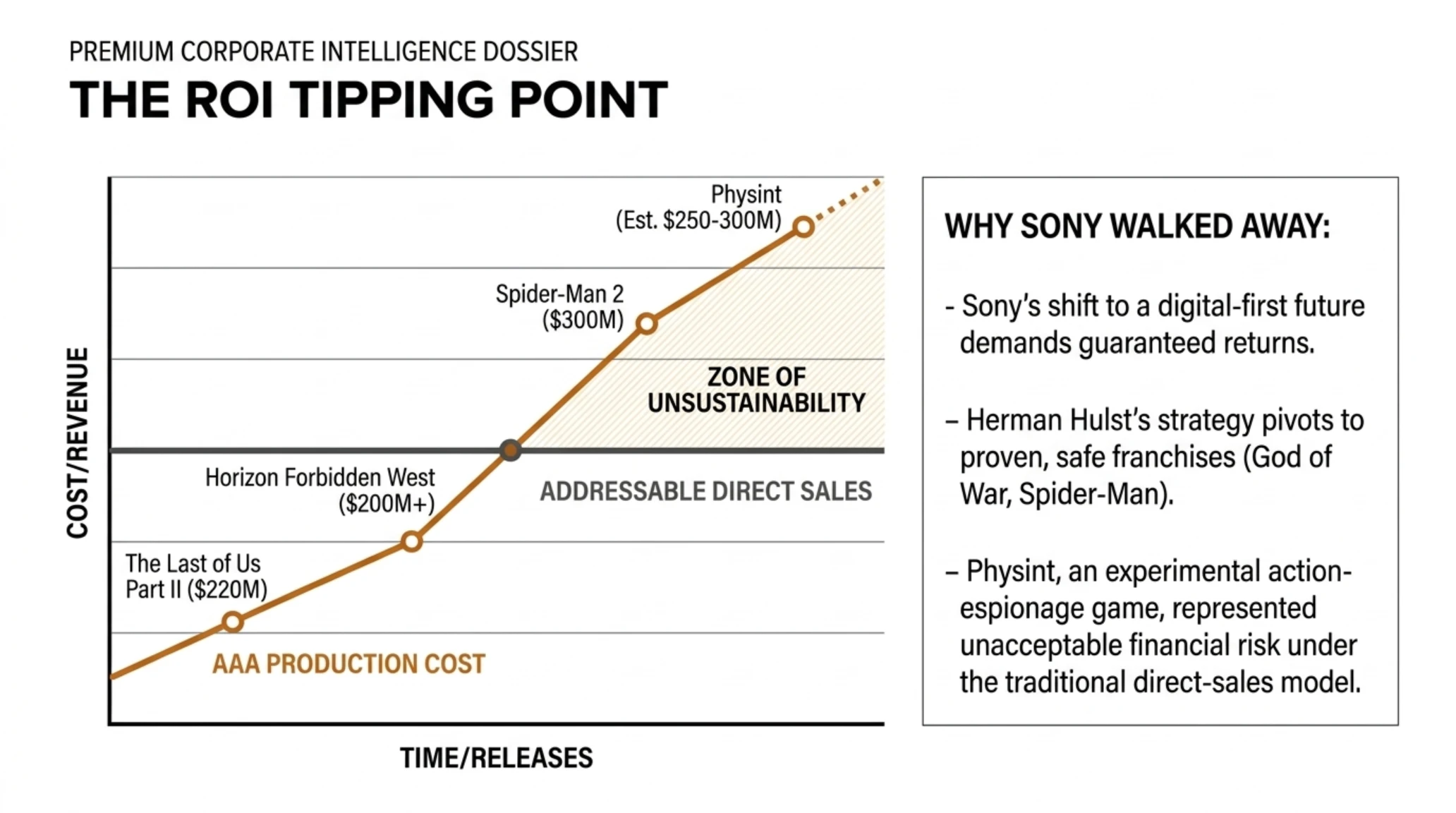
Sony has not provided an official explanation for the cancellation, but several factors likely contributed to this unprecedented decision. First, the context of Sony's controversial July 2026 announcement to cease physical disc production for new titles beginning in 2028. This sparked significant backlash and signals a fundamental strategic shift within the company toward a digital-first future.
Second, budget and risk management. Physint was announced as an ambitious AAA project that would "redefine the action-espionage genre." Kojima's track record includes lengthy, expensive development cycles. Death Stranding, while critically acclaimed, took years to develop and had a substantial budget. In the current market climate, with rising development costs and economic uncertainty, Sony may have balked at the financial commitment required.
Third, the exclusivity question. Kojima was already developing OD with Xbox, and Death Stranding 2 was confirmed for PC release following its PlayStation debut. Sony may have decided that investing heavily in a project without guaranteed platform exclusivity no longer aligned with their strategic priorities. The days of Sony bankrolling third-party exclusives without ironclad commitments may be ending.
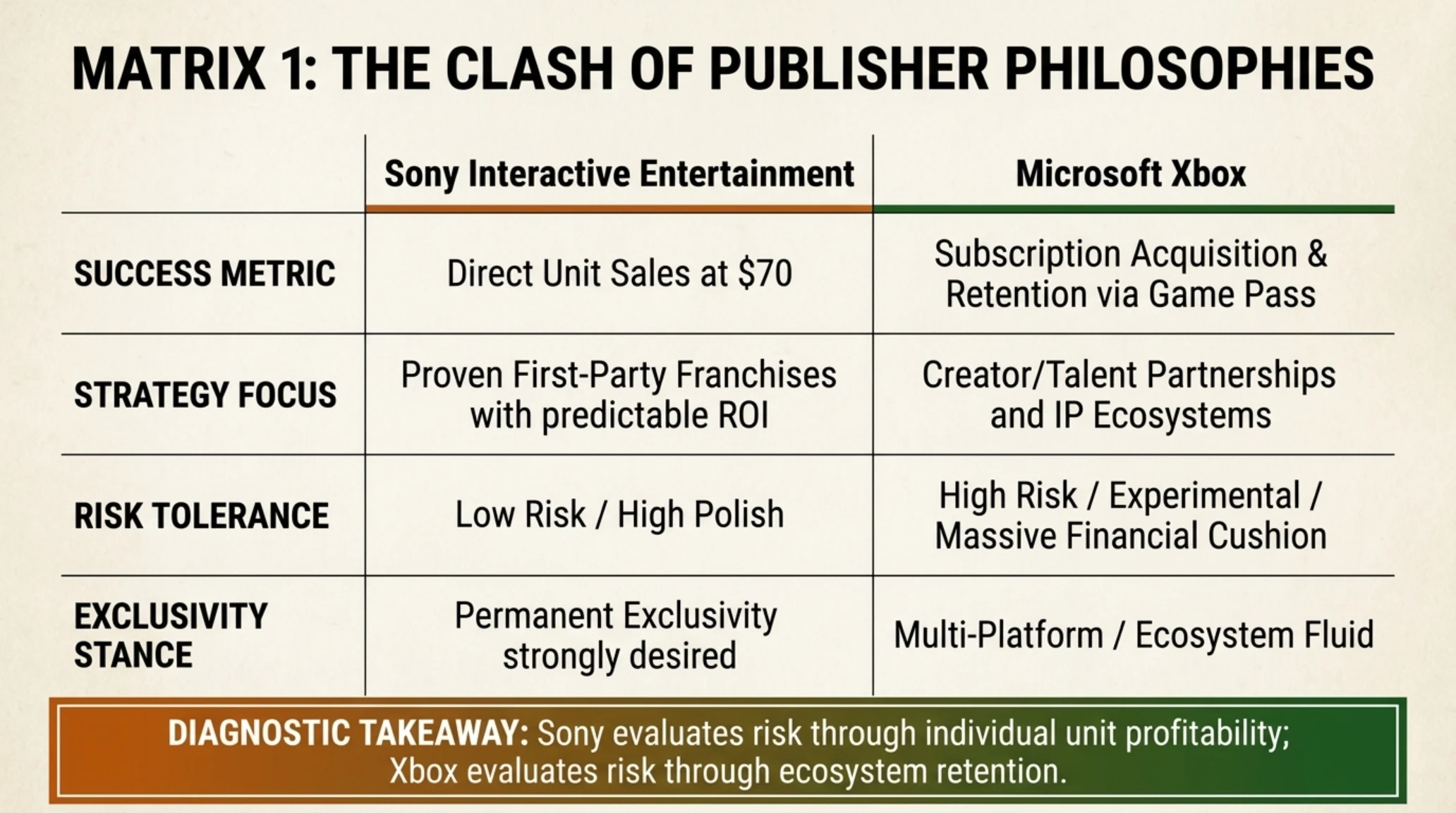
Industry analyst Daniel Ahmad noted: "Sony's first-party strategy has shifted toward proven franchises with predictable ROI. Experimental projects from independent studios, even prestigious ones like Kojima Productions, represent risk in an era where a single AAA failure can cost hundreds of millions."
Why This Matters
| Platform Shift | First time a legendary creator switches ecosystems after 30 years of partnership. |
| Aggressive Strategy | Demonstrates Microsoft's willingness to heavily invest in top-tier creative talent. |
| New Precedent | Signals the end of permanent platform loyalty for independent studios. |
| Power Balance | Shift from restrictive exclusivity to multi-platform flexibility for creators. |
Xbox's Vision: Beyond Gaming to Transmedia Empire
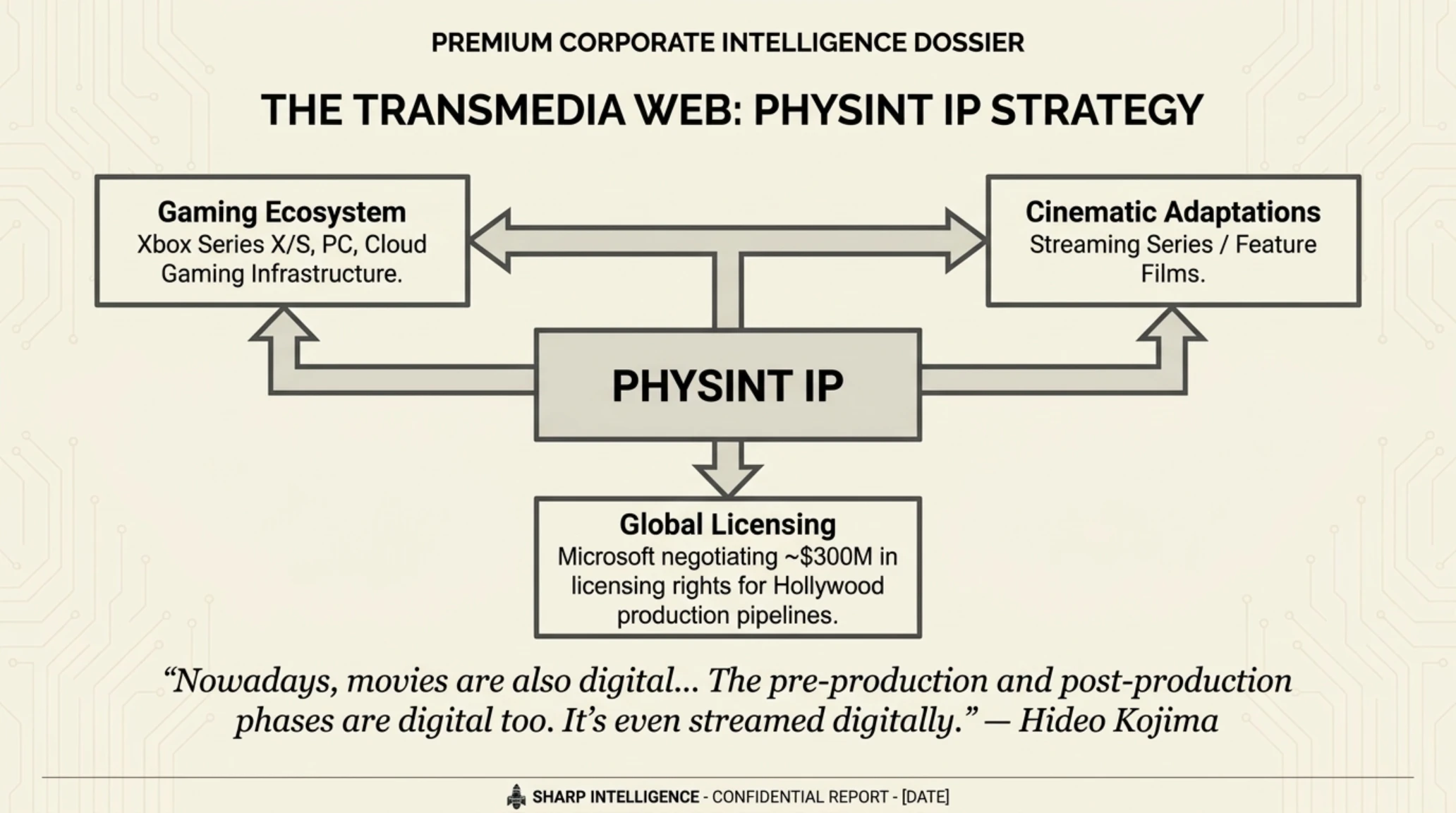
The partnership between Xbox and Kojima Productions extends far beyond a simple publishing deal for a single game. According to the official Xbox Wire announcement, the collaboration "will also extend beyond games, with XBOX and KOJIMA PRODUCTIONS collaborating across film and television to bring new stories to broader audiences."
This statement reveals Microsoft's broader transmedia ambitions transforming gaming IP into cinematic and television content. A recent Puck report revealed that Microsoft is negotiating licensing rights packages worth approximately $300 million to adapt franchises like The Elder Scrolls, Diablo, and others into Hollywood productions.
Kojima has long expressed deep interest in cinema, repeatedly stating his desire to blur the boundaries between gaming and filmmaking. In a 2024 Variety interview, he explained: "In the old days, movies and games were two different worlds. It was like analog versus digital. They didn't mix well, like oil and water. Nowadays, movies are also digital shot on digital cameras instead of film. The pre-production and post-production phases are digital too. It's even streamed digitally. There seems to be more understanding in the conversations I have with people in the filmmaking industry. That wasn't always the case."
He continued: "Now, there are movies that use Unreal Engine to create their backgrounds and environments. They also use performance capture like we do, so the technology is almost the same up to a certain point."
Death Stranding is currently being adapted into a film by A24, and with Xbox's involvement, Kojima will likely pursue additional transmedia projects. Physint itself could follow a dual-track development: first as a game, then as a streaming series or film similar to HBO's massively successful The Last of Us adaptation.
📚 Classified & Related Dossiers in TekinGame
If you wish to explore beyond this report and delve into cybernetic frontiers and autonomous AI architectures, do not miss these three exclusive deep-dives in the Tekin Garage:
The Japan Strategy: Xbox's Long Game in Asia
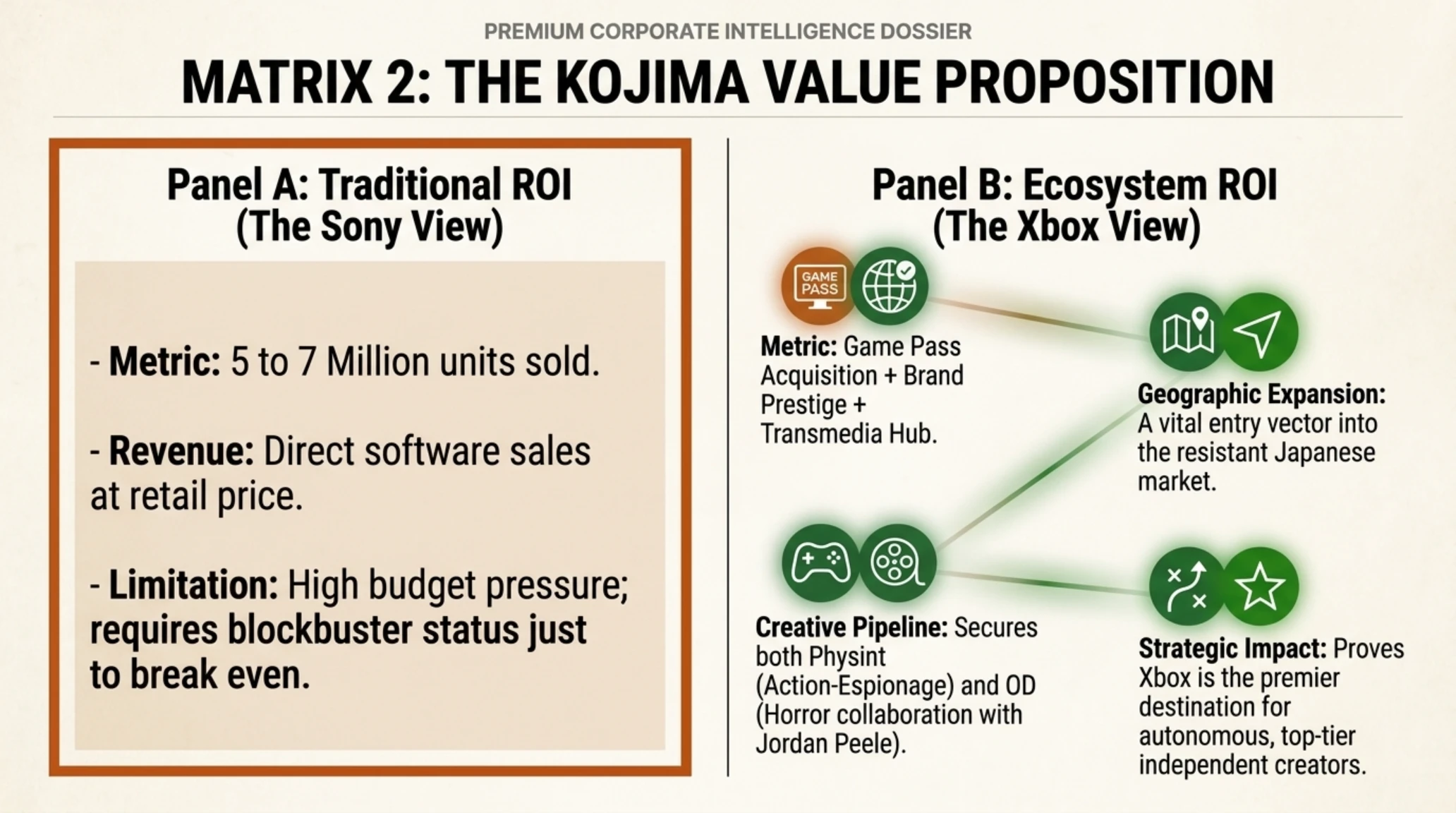
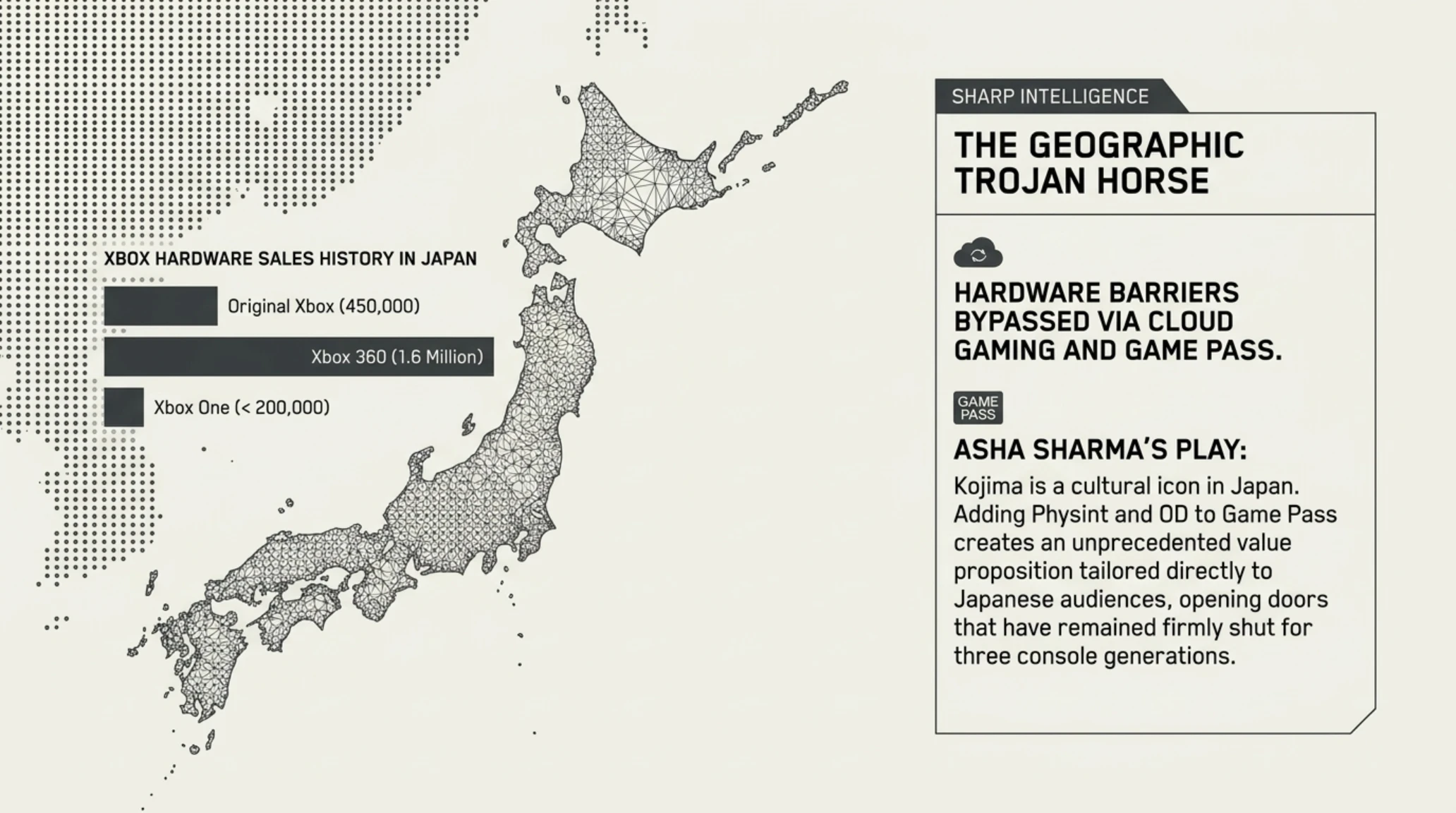
One of the most intriguing aspects of this partnership is Xbox's transparent attempt to penetrate the Japanese market. Historically, Xbox has struggled dramatically in Japan Nintendo and PlayStation have dominated for decades. But by signing one of Japan's most beloved creators, Asha Sharma is signaling that Xbox is serious about establishing a foothold in Asia.
Kojima is a cultural icon in Japan. He created the Metal Gear Solid series one of gaming history's most influential franchises and Death Stranding, which featured major Hollywood talent. Xbox's partnership with him could open doors throughout the Asian market that have remained firmly closed for two console generations.
Moreover, Xbox Game Pass has been quietly growing in Japan. If Physint and OD are added to the service, they could attract millions of Japanese subscribers. This is a long-term strategy: not just acquiring a single game, but building a content ecosystem with creators who resonate deeply with Japanese audiences.
The numbers tell a sobering story of Xbox's previous failures in Japan. The original Xbox sold just 450,000 units in the country. Xbox 360 improved to 1.6 million units (compared to PS3's 10 million). Xbox One collapsed to under 200,000 units a catastrophic failure.
But Xbox Series X/S, powered by Game Pass and cloud gaming infrastructure, is writing a different narrative. If Microsoft can attract legendary creators like Kojima, along with securing Japanese-developed games for Game Pass, they might finally succeed where three previous console generations failed.
Xbox in Japan: A History of Failure and New Hope
Microsoft's struggles in Japan have been well-documented. Cultural factors, brand loyalty, and game library differences have created nearly insurmountable barriers. Japanese gamers historically prefer portable systems (Nintendo dominance), JRPGs, and local franchises.
Xbox's Western-focused library, emphasis on shooters and Western RPGs, and lack of Japanese exclusive content created a perfect storm of irrelevance. The brand became almost invisible in Japanese retail.
However, Game Pass represents a potential breakthrough. Subscription models are increasingly popular in Japan, and cloud gaming removes hardware barrier. If Xbox can populate Game Pass with Japanese-developed titles from creators like Kojima, the value proposition fundamentally changes.
Community Reaction: A Divided Fanbase
The online reaction to this announcement was intensely polarized. PlayStation loyalists expressed feelings of betrayal comment sections flooded with variations of "How could Sony abandon Kojima?" Meanwhile, Xbox fans celebrated what they perceived as a major exclusive acquisition, though Kojima has not confirmed platform exclusivity.
The reality is more nuanced. Kojima has never stated that Physint will be Xbox-exclusive. He only confirmed that Xbox will publish the project. This suggests the game will likely appear on PC (consistent with all recent Xbox first-party titles) and potentially on PlayStation after a timed exclusivity window though no official confirmation exists.
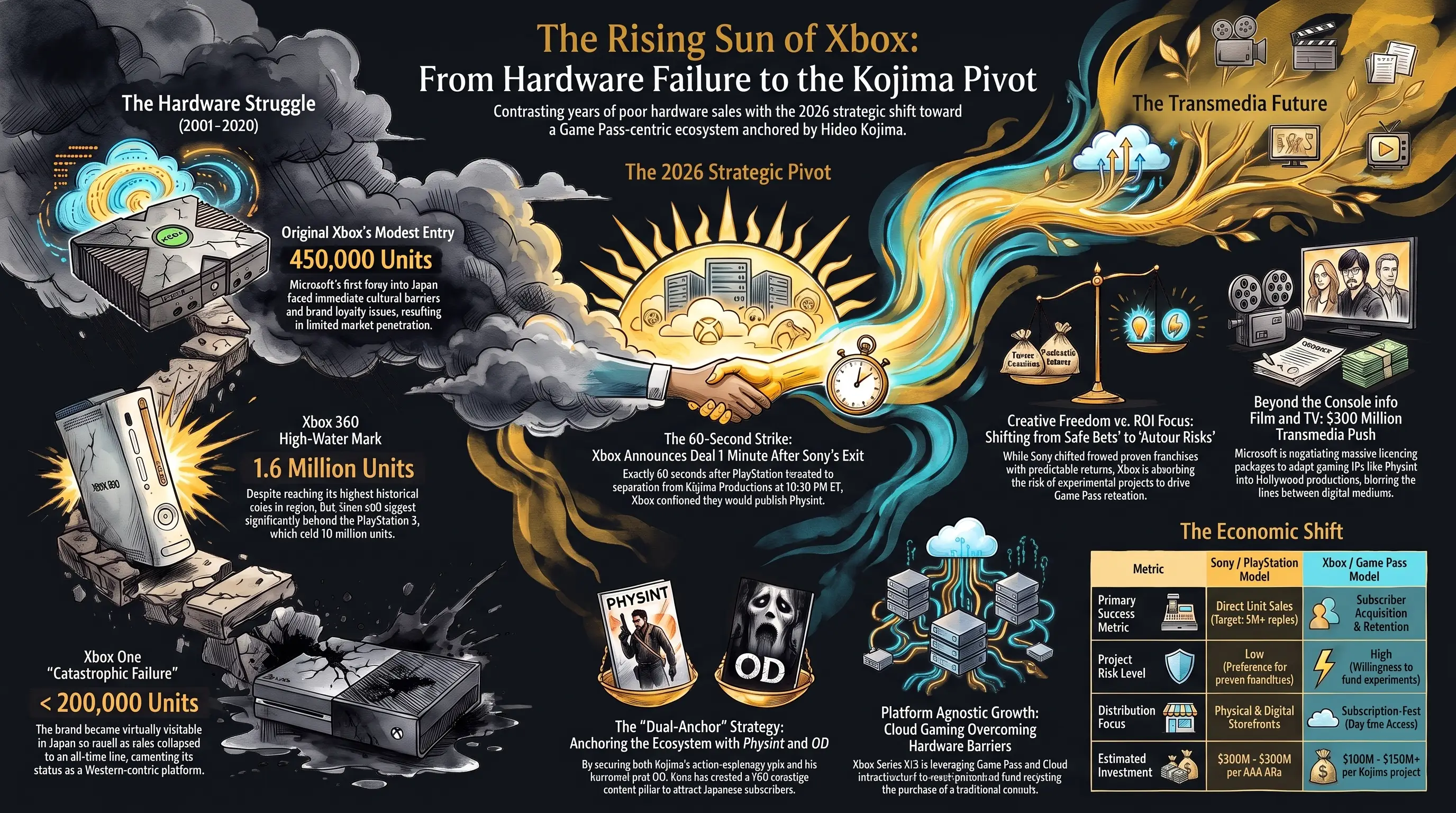
Some analysts believe Sony's decision reflects internal turmoil. Jim Ryan, the previous PlayStation CEO, resigned in 2024, with Herman Hulst assuming leadership. Management transitions often trigger strategic reassessments, and high-risk experimental projects like Physint may have become casualties of this shift.
Jeff Grubb, a prominent industry insider, commented: "This feels like PlayStation choosing safe bets over creative risks. God of War, Spider-Man, Horizon these are proven franchises with established audiences. Physint represented uncertainty, and in the current economic climate, Sony apparently can't stomach that."
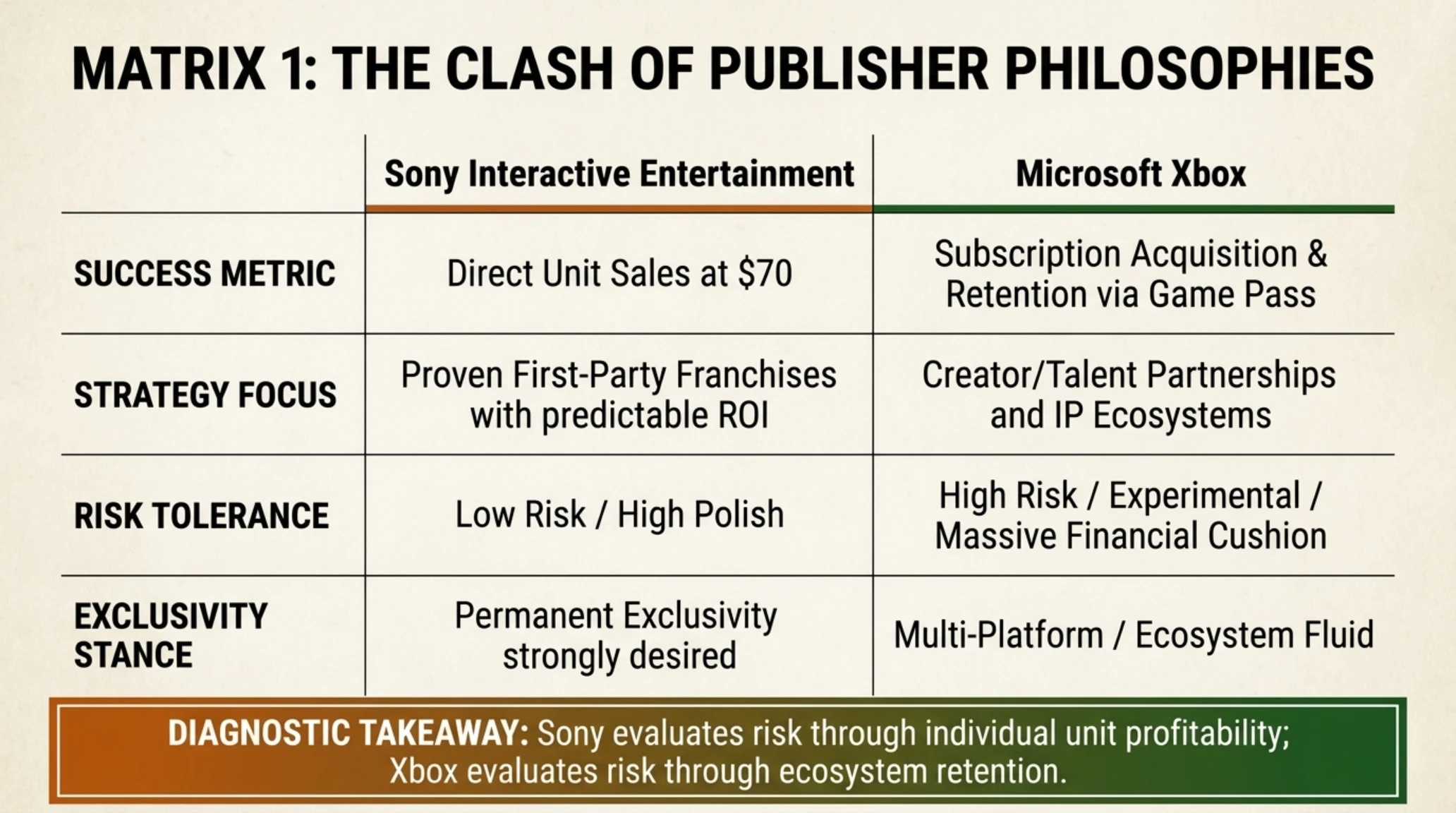
The contrast with Xbox's approach is striking. Microsoft's recent acquisitions Activision Blizzard for $69 billion, Bethesda for $7.5 billion demonstrate a willingness to absorb risk and invest heavily in content. Xbox Game Pass's subscription model provides a financial cushion that makes experimental projects more viable, since success is measured in subscriber acquisition and retention rather than direct game sales.
OD and Physint: Two Projects, One Shared Vision
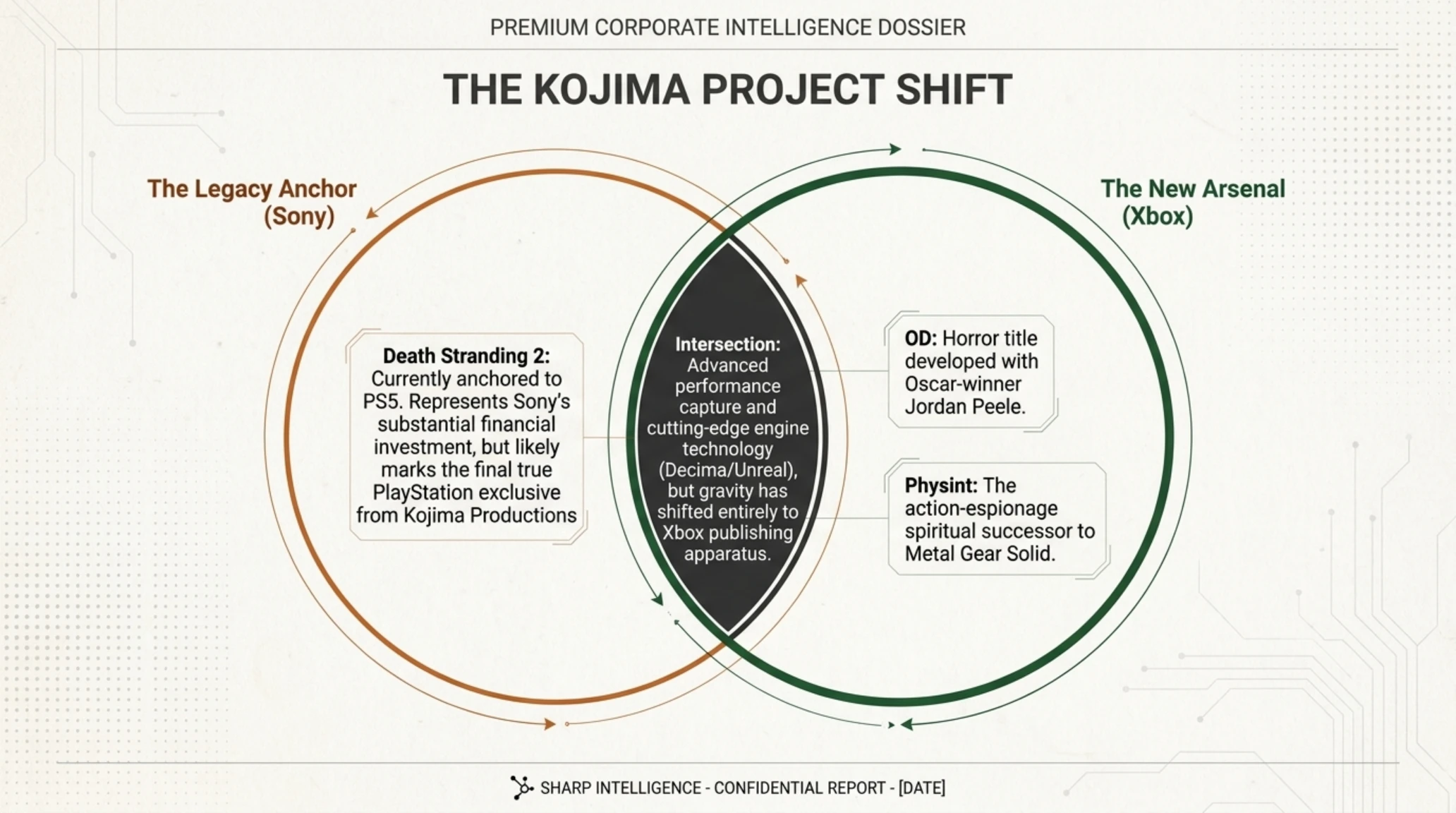
Kojima Productions now has two major projects underway with Xbox: OD and Physint. OD is a horror game developed in collaboration with Jordan Peele, the Oscar-winning director of Get Out and Nope. This project has been in development since 2023 but has no announced release date.
Physint, according to Kojima's description, is an "action-espionage" title a fusion of action gameplay and espionage narrative. Many view this project as the spiritual successor to Metal Gear Solid, since Kojima no longer controls that IP, which remains with Konami. During Physint's original reveal, Kojima stated: "I want to redefine the action-espionage genre."
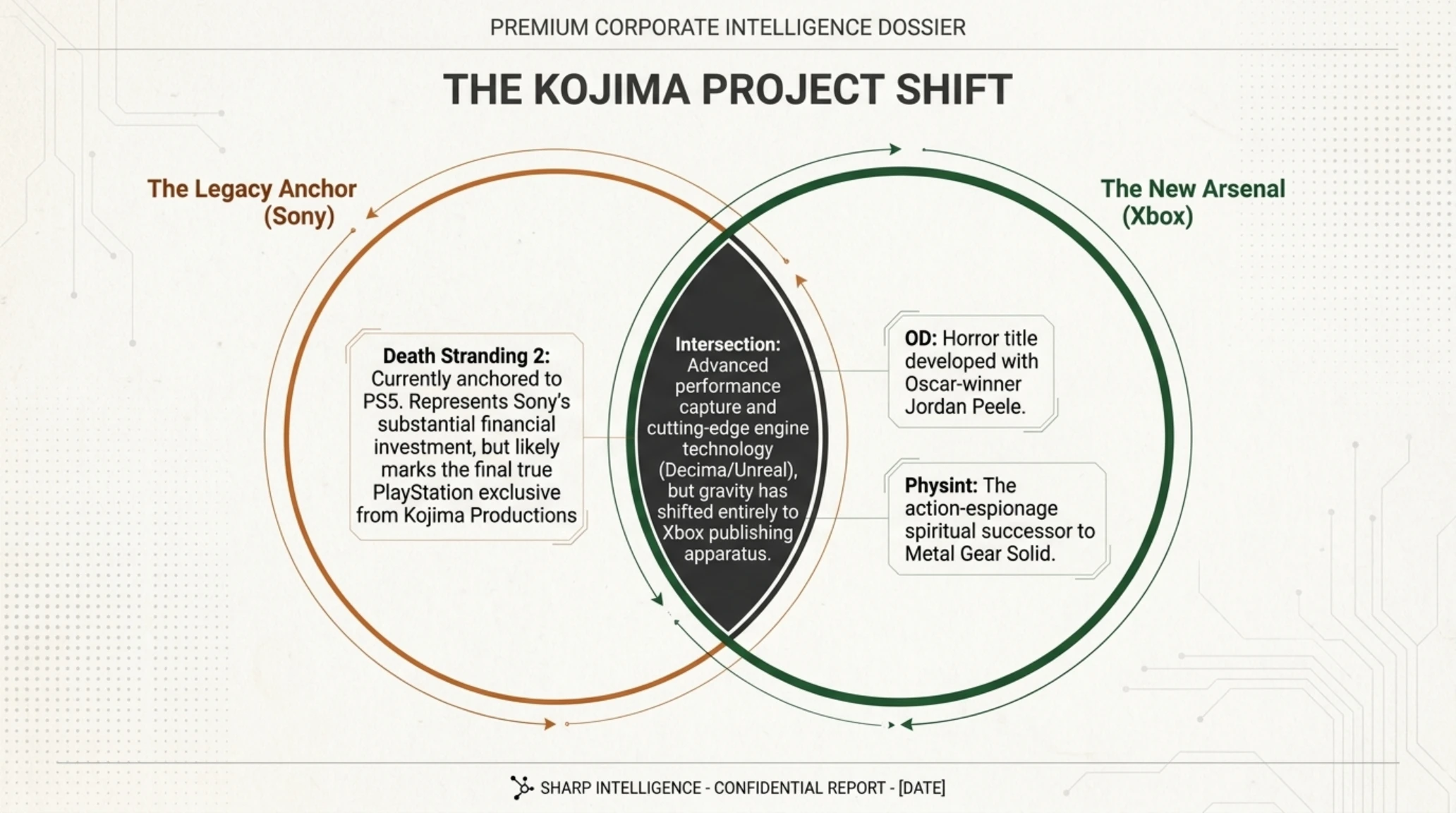
Both games will presumably leverage Microsoft's latest technologies. Xbox has invested heavily in cloud gaming infrastructure, ray tracing capabilities, and AI-driven content generation. Kojima has always embraced cutting-edge technology Death Stranding utilized the Decima Engine and featured advanced performance capture techniques.
An intriguing detail: in his statement, Kojima emphasized that this Xbox partnership extends "beyond OD." This phrasing suggests additional future projects may be planned. Could Kojima Productions eventually become a first-party Xbox studio? Might Microsoft acquire the studio outright? Nothing has been officially confirmed, but the possibility exists.
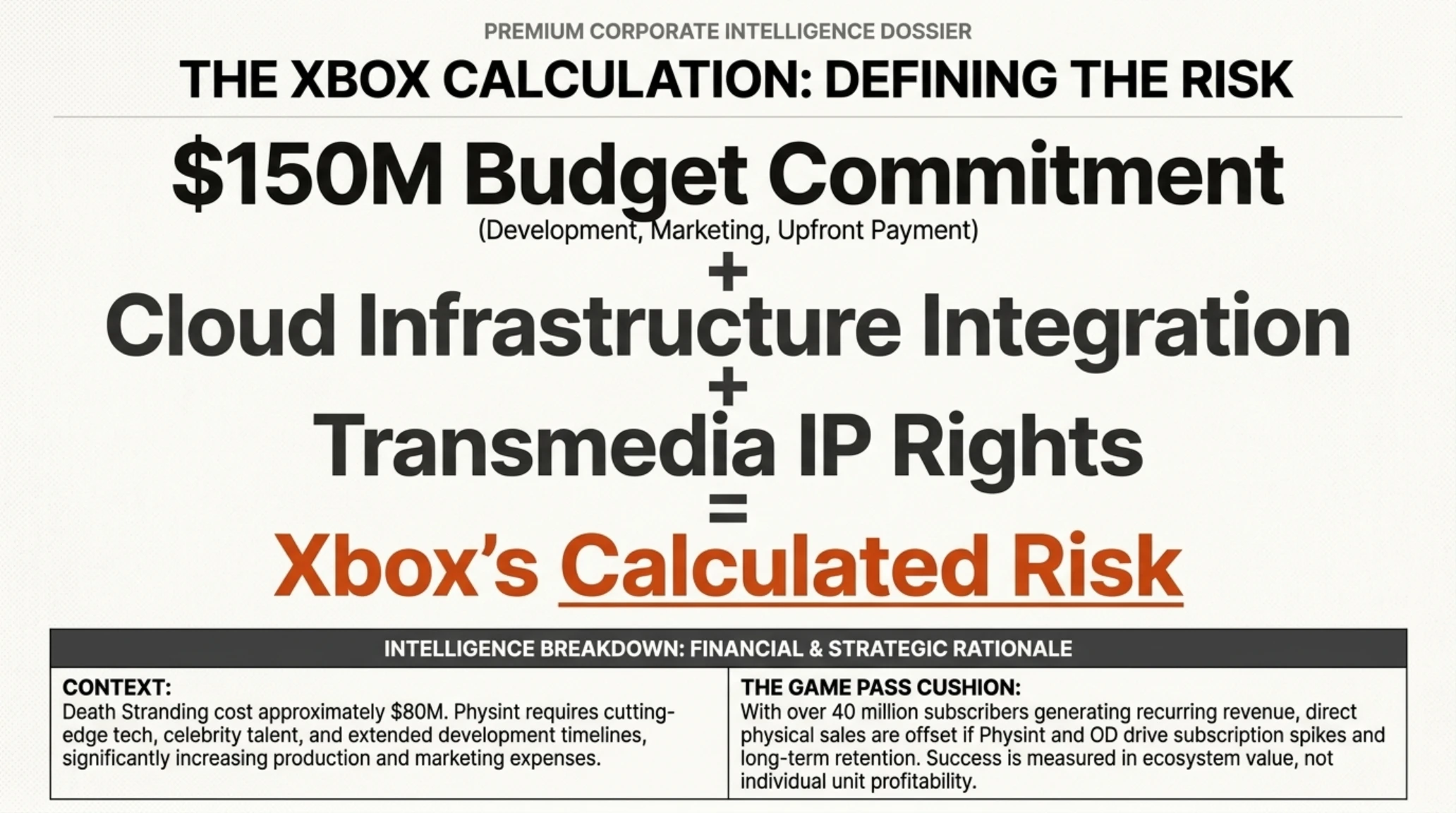
The financial implications are substantial. Industry estimates suggest Xbox has committed at least $100-150 million to Physint's development, marketing, and potentially an advance payment to Kojima Productions. For comparison, Death Stranding's budget was approximately $80 million. Physint will likely exceed this, given Kojima's stated ambition to redefine the genre, which typically requires cutting-edge technology, celebrity voice actors, and extended development cycles.
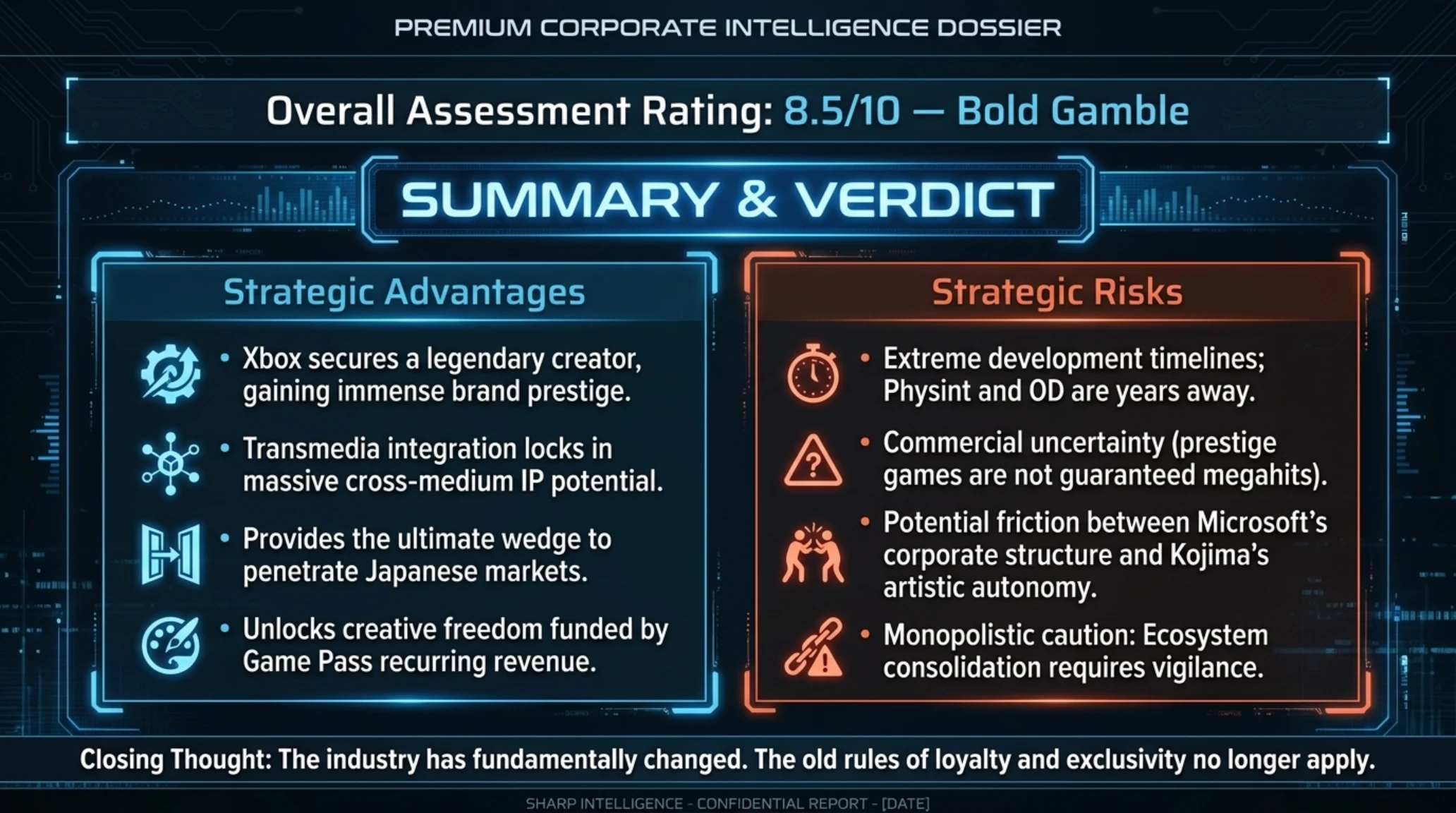
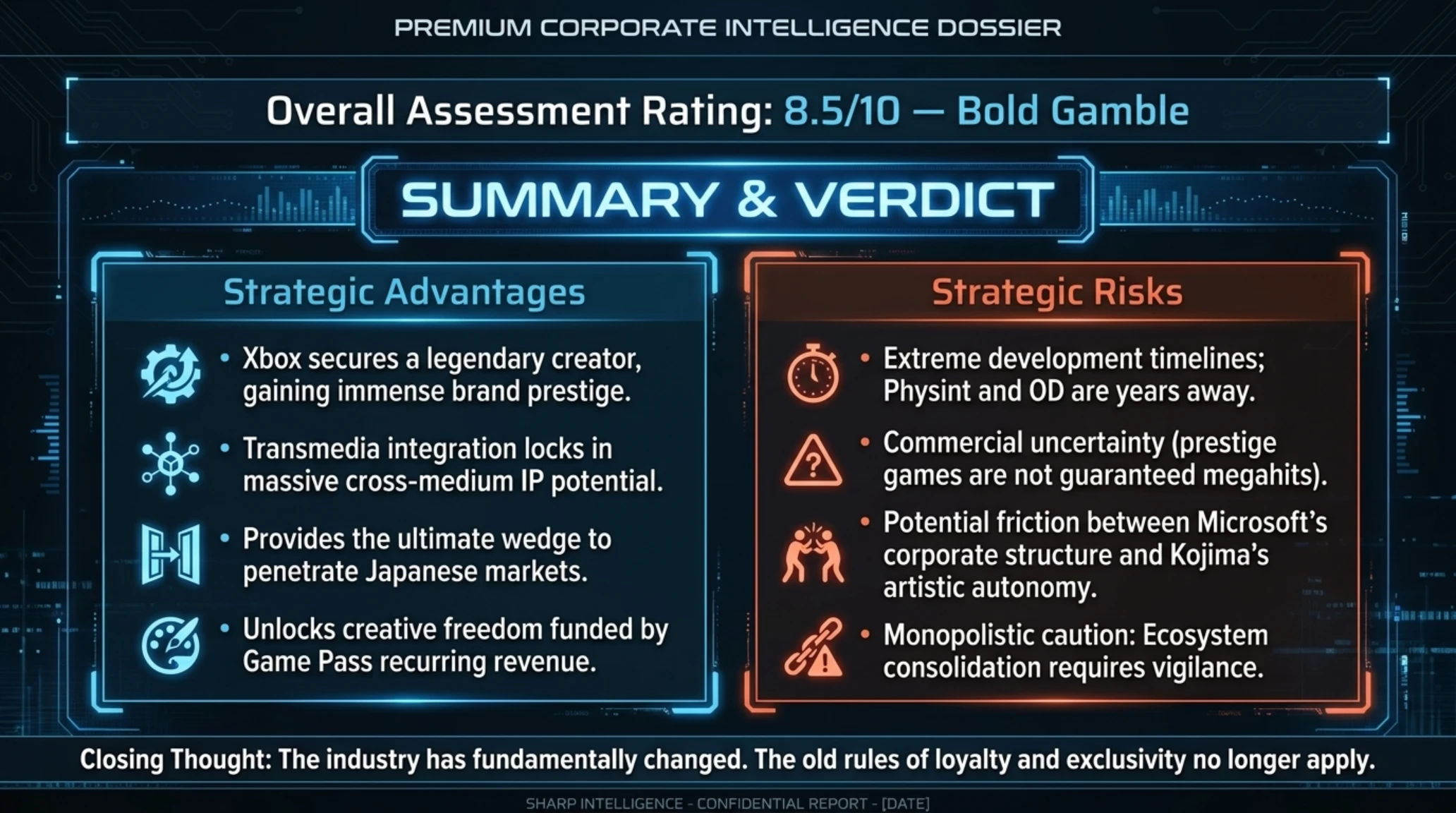
- Xbox secures one of gaming's most prestigious creators
- Kojima gains financial backing and creative freedom
- Transmedia expansion across games, film, and TV
- Strategic opportunity for Xbox to penetrate Asian markets
- PlayStation fans feel betrayed and may resist the Xbox ecosystem
- Physint and OD are potentially years away from launch
- Kojima's track record includes long development cycles
- Death Stranding had modest sales, posing a commercial risk
Comparing to Death Stranding: What's Different This Time?
Death Stranding was Kojima Productions' first game after the acrimonious split from Konami. Released in 2019 with Sony's full financial backing and marketing support, the game received critical acclaim (Metacritic score: 82) but commercial performance was mixed approximately 5 million copies sold in the first year, respectable for a new IP but not blockbuster territory.
Death Stranding 2 is currently in development as a PlayStation 5 project, indicating that Sony has not completely severed ties with Kojima. However, Physint's move to Xbox suggests Death Stranding 2 will likely be the final PlayStation-exclusive Kojima project.
The key difference lies in publisher philosophy. Microsoft typically grants more creative freedom to its studios. For example, Obsidian Entertainment (The Outer Worlds, Avowed) has publicly stated that after Microsoft's acquisition, they received autonomy to pursue any project without pressure for immediate commercial returns. Kojima may find similar creative latitude at Xbox.
Conversely, Sony has traditionally emphasized quality and polish. First-party Sony titles (The Last of Us, God of War, Spider-Man) consistently meet high production standards. Perhaps Sony felt Physint's vision wasn't aligning with their quality benchmarks, or the budget was spiraling beyond acceptable limits.
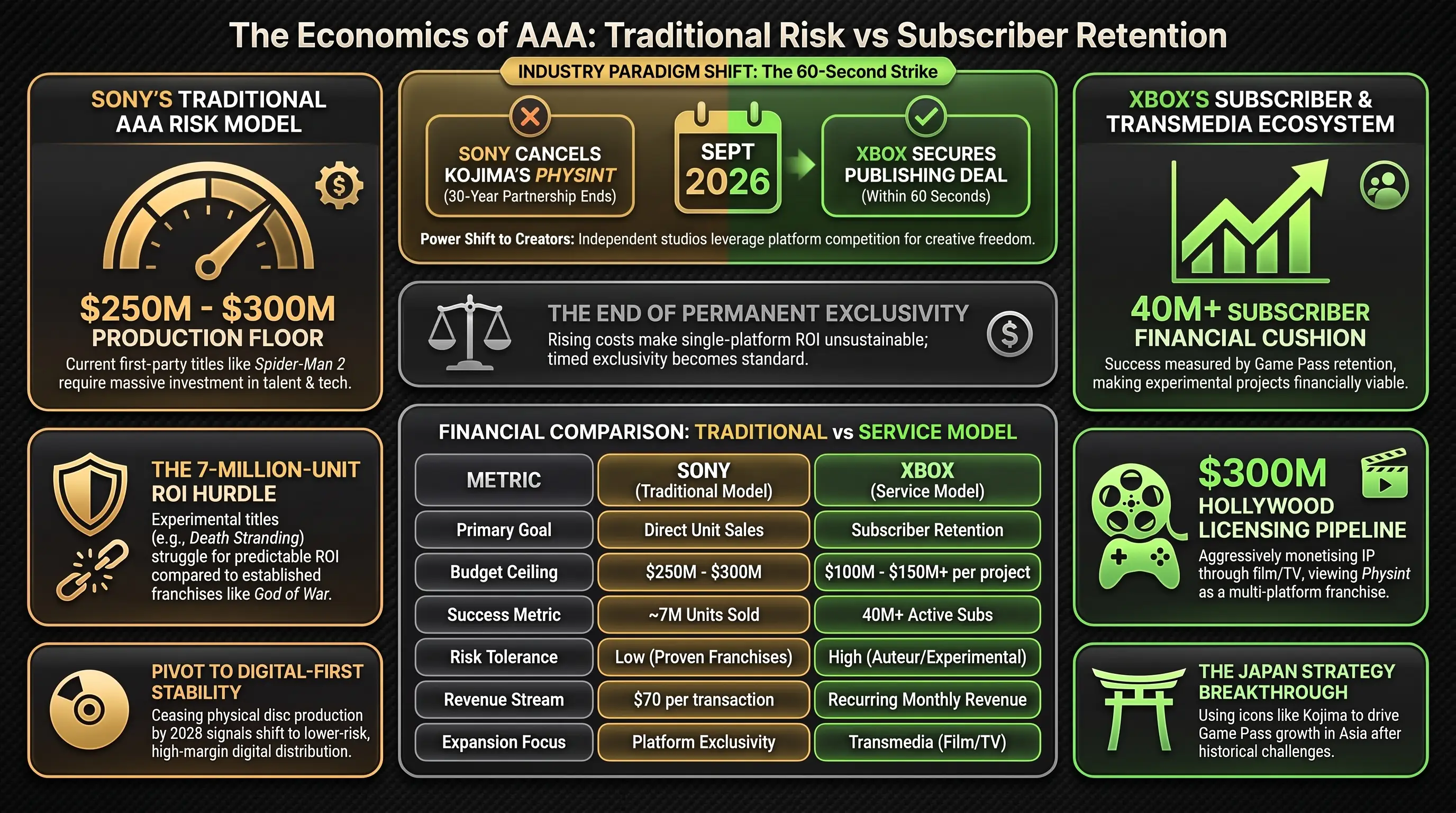
Another critical factor: Game Pass economics fundamentally change the success equation. Traditional game sales require millions of units moved at $60-70 per copy. Game Pass, however, measures success through subscriber acquisition and retention. A critically acclaimed game that sells modestly can still be valuable if it drives Game Pass subscriptions. This model makes experimental projects like Physint more financially viable for Microsoft than for Sony.
What Happens to Death Stranding 2?
An important question remains: Will Death Stranding 2 still be released? The answer appears to be yes. The project remains in active development for PS5, and Sony has made no indication of cancellation. However, the Physint split raises questions about whether Sony's relationship with Kojima will affect Death Stranding 2's development or post-launch support.
Sony likely wants to complete Death Stranding 2, given their substantial financial investment. However, it seems improbable that Sony will pursue additional projects with Kojima beyond this. Death Stranding 2 may well be the final true PlayStation exclusive from Kojima Productions.
Death Stranding: An Exclusive That Wasn't
Death Stranding launched in November 2019 as a PS4 exclusive. Just one year later, the PC version arrived. In 2022, the Director's Cut released for both PS5 and PC simultaneously.
This pattern reflects broader industry trends: platform exclusivity is increasingly temporary. Even Sony, traditionally protective of exclusives, now releases PC versions of first-party titles 1-2 years after console launch. Death Stranding 2 will almost certainly follow this pattern, arriving on PC shortly after its PS5 debut.
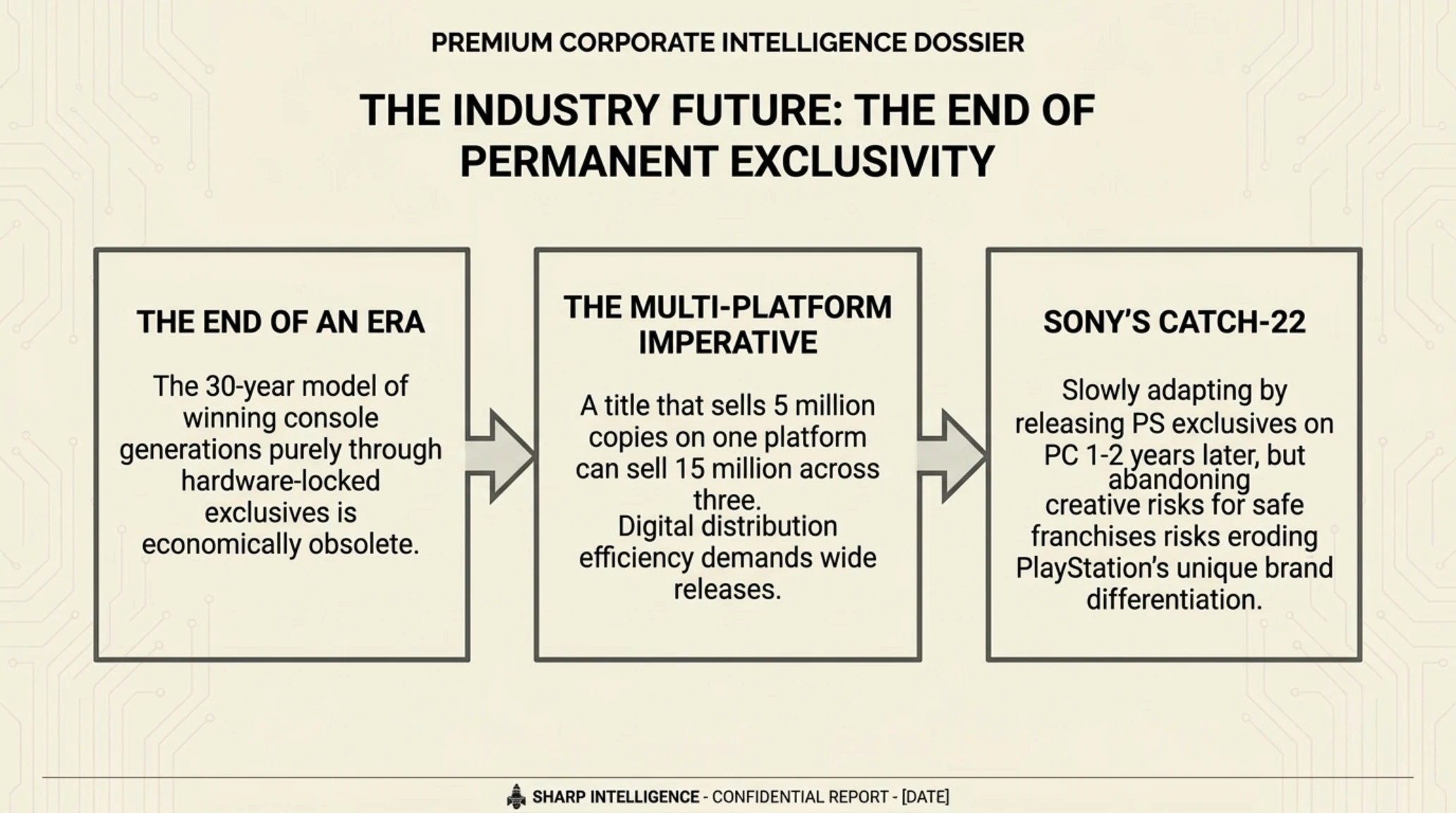
The era of permanent platform exclusivity has effectively ended. Economic realities rising development costs, smaller install bases per platform, and digital distribution efficiency make multi-platform releases essential for maximizing ROI.
Industry Implications: Will Other Creators Follow Kojima?
This deal could signal a paradigm shift for independent creators. If someone of Kojima's stature can leave Sony after 30 years and immediately secure a major deal with Xbox, why can't others? Studios like Remedy Entertainment (Alan Wake 2, Control) or Supergiant Games (Hades) may view this as an opportunity to renegotiate their own partnerships or explore competing offers.
Xbox's strategy has evolved from "acquire studios" to "partner with talent." The Activision Blizzard acquisition for $69 billion was the largest deal in gaming history, demonstrating Microsoft's commitment. But with the Kojima partnership, Xbox is showing that acquisition isn't always necessary collaboration can achieve similar strategic objectives at lower cost and risk.
Conversely, Sony appears to be pivoting toward a different strategy. The decision to eliminate physical discs from 2028 onward indicates a digital-first focus. Perhaps Sony concluded that experimental projects like Physint no longer align with this strategy, preferring instead to invest in proven franchises (God of War, Spider-Man, Horizon) with predictable commercial performance.
However, this conservative approach could make Sony vulnerable long-term. If all the major independent creators migrate to Xbox due to better financial terms or creative freedom, what will differentiate PlayStation beyond first-party exclusives? That may not be sufficient in an increasingly competitive market where Game Pass offers hundreds of titles for a monthly subscription.
Financial Analysis: How Much Did Xbox Pay?
No official figures have been disclosed, but industry analysts estimate Xbox has committed at least $100-150 million to Physint. This includes development budget, marketing expenses, and likely an upfront payment to Kojima Productions.
For comparison, Death Stranding reportedly cost approximately $80 million to develop. Physint will likely exceed this, given Kojima's stated ambition to "redefine the genre" typically requiring cutting-edge technology, celebrity talent (Death Stranding featured Norman Reedus, Mads Mikkelsen, and Léa Seydoux), and extended development timelines.
For Microsoft, this investment is strategically sound. Game Pass has over 40 million subscribers generating recurring revenue. If Physint and OD drive even a modest increase in subscriptions, the financial return justifies the investment. Even if physical sales are modest, the strategic value for Game Pass is substantial.
Additionally, Microsoft's transmedia ambitions add another revenue layer. If Physint spawns a successful film or series (similar to The Last of Us on HBO), the IP value multiplies exponentially. This holistic approach to IP monetization games, subscriptions, streaming adaptations, merchandise represents the future of entertainment economics.
The Bigger Picture: Platform Wars Enter a New Era
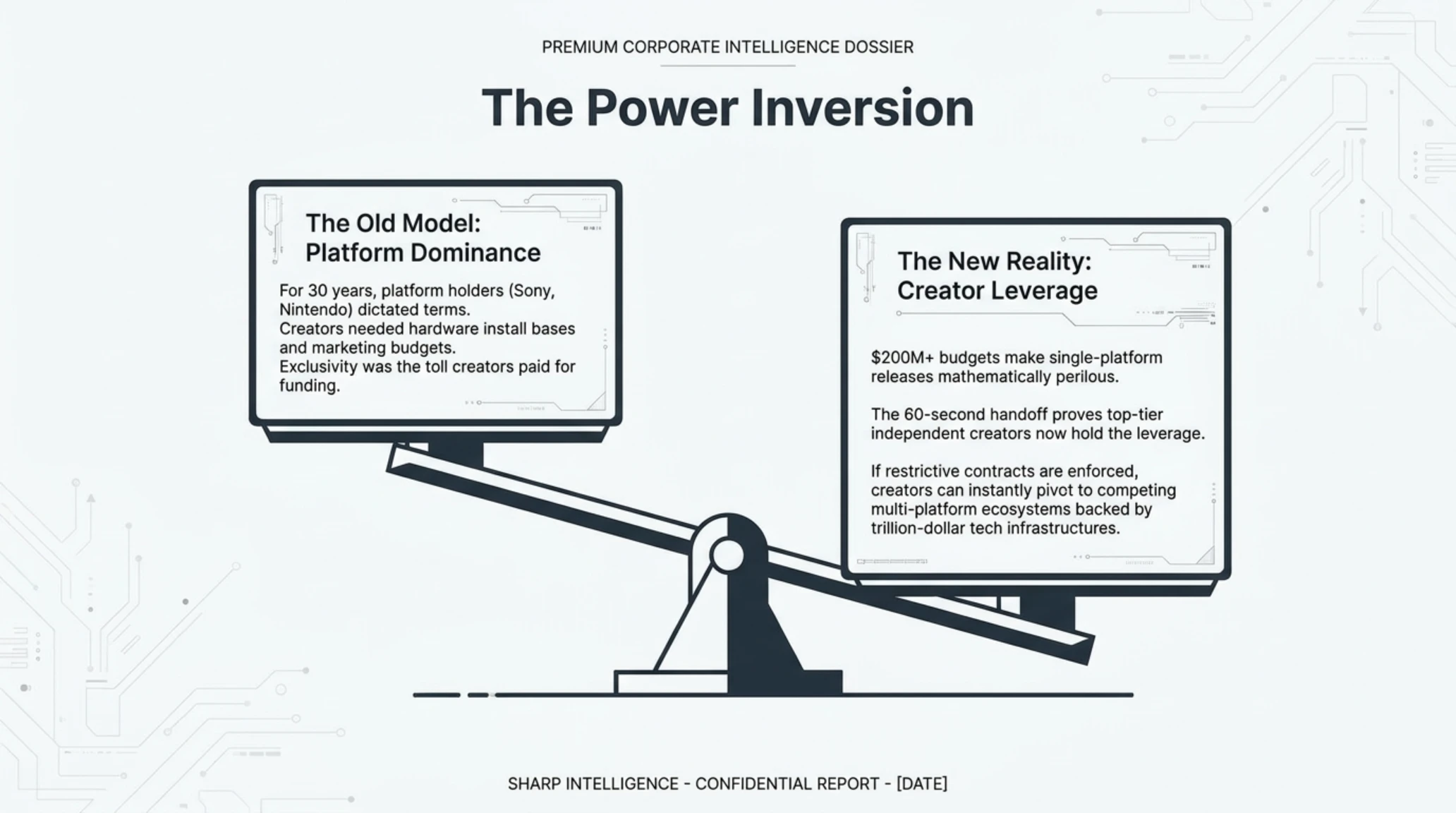
The Kojima-Xbox partnership represents more than a business deal it's a symbolic shift in industry power dynamics. For three decades, platform holders (Sony, Nintendo, Microsoft) competed primarily through exclusive content. Whoever had the best exclusives won console generations.
That model is crumbling. Rising development costs make traditional exclusivity deals financially unsustainable. A game that sells 5 million copies on a single platform can sell 15 million across three platforms. Publishers and creators increasingly resist exclusive arrangements unless the financial compensation is extraordinary.
Microsoft recognized this shift earlier than competitors. Game Pass's subscription model doesn't require traditional exclusive gatekeeping. If a game launches on Game Pass day one, subscribers gain access regardless of whether it's also available on PlayStation. The value proposition isn't exclusivity it's accessibility and value.
Sony, conversely, has clung to the exclusivity model longer, though even they are slowly adapting with PC releases of former exclusives. The Kojima situation may accelerate Sony's strategic evolution, forcing a recognition that permanent exclusivity is no longer economically viable in an era of $200 million development budgets and multi-year production cycles.
What This Means for Gamers
For players, this industry shift is overwhelmingly positive. Competition between platforms drives better games, lower prices, and more choices. If Physint releases on Xbox, PC, and eventually PlayStation, everyone wins. No one is forced to purchase a $500 console to access content.
The Game Pass model further benefits consumers. A $15-20 monthly subscription provides access to hundreds of games, including day-one releases of major titles. This represents exponentially better value than the traditional model of $70 per game.
However, there are concerns. If Xbox consolidates too much power through acquisitions and partnerships, they could eventually behave monopolistically raising prices, reducing quality, or imposing restrictive terms. Competition remains essential to prevent abuse of market dominance.
The Kojima partnership, therefore, should be viewed with cautious optimism. It's positive that creators have options and leverage. It's positive that Microsoft is investing in creative talent. But vigilance is necessary to ensure that today's competitive dynamics don't evolve into tomorrow's monopolistic control.
The History of Kojima-PlayStation Relations: From Metal Gear to Death Stranding
To fully understand this separation, we must revisit Kojima's 30-year history with PlayStation. It all began with Metal Gear Solid in 1998 for PS1 a game that defined the stealth-action standard and transformed Kojima into a living legend.
Metal Gear Solid 2: Sons of Liberty arrived in 2001 on PS2 and broke sales records. The game moved over 7 million copies, proving that Kojima could be both a critical darling and commercial success. MGS3: Snake Eater in 2004 repeated this achievement, becoming one of the finest PS2 titles.
MGS4: Guns of the Patriots launched in 2008 for PS3 as one of the biggest exclusives of the seventh console generation. This game was built with Sony's full budget and support, demonstrating PlayStation's willingness to invest millions in Kojima's vision.
MGS5: The Phantom Pain released in 2015, but this marked Kojima's final collaboration with Konami. His departure from Konami was bitter and controversial the company even removed his name from the game's cover. In this historic moment, Sony intervened.
Sony signed a contract with Kojima Productions in 2016 to develop Death Stranding. This project materialized with an unlimited budget, access to the Decima Engine (Guerrilla Games' proprietary tech), and comprehensive marketing support. The game launched in 2019 and, despite mixed opinions, was a success.
Now, in 2026, the same Sony that rescued Kojima from Konami has abandoned him. What changed?
The Economics of Game Development: Why AAA Budgets Became Unsustainable
One primary reason for Physint's cancellation is likely its budget. In recent years, the cost of producing AAA games has skyrocketed astronomically. The Last of Us Part II cost approximately $220 million. Horizon Forbidden West exceeded $200 million. Spider-Man 2 reached around $300 million.
These budgets encompass development, marketing, and distribution. Kojima is known for expensive projects he employs celebrity actors, cutting-edge technology, and extended development timelines. Sony likely estimated Physint could reach $250-300 million.
The question becomes: Is this investment worthwhile? Death Stranding sold approximately 5-7 million copies respectable but not blockbuster territory. If Physint achieves similar sales, Sony cannot generate positive ROI. Therefore, they decided to exit the project.
But Xbox holds a different perspective. They have Game Pass a subscription service that measures success through subscriber acquisition and retention, not direct game sales. Even if Physint only sells 3 million copies but attracts 2 million new Game Pass subscribers, it's profitable for Xbox.
This fundamental economic difference explains why Sony walked away while Xbox ran toward Kojima. Their business models evaluate risk and reward through completely different frameworks.
The Transmedia Future: Gaming Meets Hollywood
Another critical dimension of the Xbox-Kojima partnership is the transmedia opportunity. Microsoft is aggressively pursuing strategies to monetize gaming IP beyond games themselves. This includes film adaptations, television series, merchandise, and theme park attractions.
Kojima is uniquely positioned for transmedia success. His games are already cinematic Death Stranding featured Norman Reedus, Mads Mikkelsen, Léa Seydoux, and other major actors. The storytelling approach resembles prestige television more than traditional gaming narratives.
Xbox's statement explicitly mentioned collaboration "across film and television." This is not casual language it signals serious intent to develop Physint as a multimedia franchise from inception, potentially launching game and streaming series simultaneously (similar to Amazon's strategy with Fallout).
Sony attempted transmedia with mixed results. The Last of Us on HBO was a massive success, but other adaptations (Uncharted film, Ghost of Tsushima film) have struggled to reach production or achieve critical acclaim. Microsoft may view Kojima as the key to unlocking transmedia success where Sony fell short.
What PlayStation Fans Are Missing in This Narrative
While much discussion has focused on Sony's decision to cancel Physint, less attention has been paid to what PlayStation fans are losing. For three decades, Kojima's most groundbreaking work appeared first (and sometimes exclusively) on PlayStation platforms. This created a unique relationship between creator and audience.
PlayStation fans witnessed Solid Snake's evolution across five generations of hardware. They experienced the narrative risks Kojima took the infamous Raiden twist in MGS2, the breaking of the fourth wall in MGS, the unconventional gameplay of Death Stranding. These creative gambles were possible because Sony provided a protective environment for experimental storytelling.
Now, that relationship is severed. Future Kojima projects will debut on Xbox and PC, potentially reaching PlayStation only after timed exclusivity windows (if at all). This represents a cultural loss for PlayStation's brand identity, which has historically been associated with auteur-driven, creatively ambitious projects.
The question for Sony leadership is: Was Physint's cancellation worth this reputational cost? Even if the project was financially risky, the symbolic value of maintaining Kojima's loyalty might have justified the investment. First-party exclusives aren't just about sales they're about brand differentiation and cultural capital.
Conclusion: The End of an Era, The Beginning of Another
The Kojima-Physint saga is not merely an industry news item it's a watershed moment. For the first time, a legendary creator with 30 years of platform loyalty has switched sides (or been forced to switch). And Xbox was immediately ready to embrace him.
This episode demonstrates that no relationship in this industry is permanent. Even Sony, Kojima's partner for three decades, was willing to walk away. And Xbox, long unsuccessful in Japan, is now partnering with one of that country's most prestigious creators.
For gamers, this is encouraging. Platform competition means better games, lower prices, and more choices. If Physint releases across Xbox, PC, and potentially PlayStation, everyone benefits.
For Sony, however, this is a warning. If they continue abandoning creative projects in favor of safe franchises, more major creators may follow Kojima's path. And then PlayStation's differentiation will erode, leaving it vulnerable in an increasingly competitive market where Game Pass offers unmatched value and accessibility.
The next chapter in this story will be written over the coming years as Physint and OD progress through development. But one thing is certain: the industry has fundamentally changed, and the old rules no longer apply.
Related Intelligence Dossiers on TekinGame
• 📱 Tekin Analysis | Apple's Foldable iPhone Duo & iPhone 18 Pro Price Hike
• 🧠 Tekin Analysis | Valve's 17-Year Secret: The Staged L4D2 Trailer Leak
• 🎬 Ultimate Guide to Local AI Video Generation (Minimax, Wan, LTX)
Frequently Asked Questions
Will Physint be Xbox exclusive?
Not confirmed. Xbox is the publisher, but Kojima hasn't stated exclusivity. It will likely release on PC and potentially PlayStation after a timed exclusivity window.
What happens to Death Stranding 2?
Still in development for PS5 with no cancellation announced. It will likely be the final PlayStation-exclusive Kojima project.
Why did Sony cancel Physint?
No official reason provided. Likely factors include budget concerns, strategic shift toward digital-first model, and risk management in uncertain economic climate.
When will Physint release?
No date announced. Given typical Kojima development cycles, expect at least 3-4 years minimum.
Will Kojima Productions become a first-party Xbox studio?
Not currently. Kojima Productions remains independent, though it has a close partnership with Xbox for multiple projects.
How much did Microsoft pay for this deal?
Undisclosed, but analysts estimate $100-150 million commitment including development budget, marketing, and advance payment.
Sources and References
Additional Gallery: 🧠 Tekin Analysis | PlayStation Exiles Kojima & Xbox's 60-Second Rescue