Tekin Analysis | Forensic Breakdown of GTA 6 Wanted Levels
- 🎮6-Star Resurrection- Deployment of the Leonida National Guard and Rhino tanks
- 🎧Forensic Heat Memory- Persistent tracking of facial geometry, apparel, and CCTV logs
- 🚀Minimap Cones Eliminated- Eradication of UI radars in favor of organic spatial acoustics
- 🗡️Duo Severance- Tactical decoupling mechanics to split squad heat
- 📰Trunk Armories- Using vehicles as mobile wardrobes to extinguish heat
- ⚔️Death of Safehouses- End of magical sanctuaries; introducing SWAT breaches
A Paradigmatic Shift in Open-World Law Enforcement: The Death of Arcade Escapes
For more than thirteen years, Grand Theft Auto V has served as both the benchmark and the archetype for open-world systemic mayhem. Yet, behind its commercial dominance lay an underlying mechanical relic: a law enforcement architecture dictated by crude binary states, proximity teleports, and simplistic minimap exploits. Veteran players knew the formula intimately; outrunning the Los Santos Police Department rarely demanded strategic ingenuity. Instead, it was an exercise in exploiting line-of-sight geometry, waiting behind billboard hoardings, or taking temporary refuge in shallow cul-de-sacs until flashing police markers vanished from the user interface.
With the broadcast of the definitive 26-minute extended gameplay presentation produced in strategic collaboration with Netflix, followed by extensive forensic telemetry confirmed by Rockstar North development documents, that nostalgic era of arcade convenience has been permanently dismantled. Grand Theft Auto VI does not merely refine the franchise's iconic Wanted Level mechanic; it obliterates legacy game design paradigms to establish an autonomous, multi-tiered judicial and tactical simulation. Set against the sprawling, hyper-detailed topography of the State of Leonida, the law is no longer a swarm of disposable cannon fodder. It is an interconnected institutional machine engineered to remember, investigate, coordinate, and methodically eliminate criminal threats.
The scale of public engagement surrounding this mechanical revelation has reverberated across the tech and entertainment sectors. According to an exhaustive market intelligence study published by Ampere Analysis, the 26-minute gameplay showcase generated more than 100,000 net-new Netflix subscriber conversions within the United States alone during a single six-hour exclusive exhibition window. Louise Wooldridge, principal media analyst at Ampere, highlighted that the broadcast represented the third-largest single-day subscriber acquisition event for Netflix in 2026, surpassed only by the series finale of Stranger Things and the historic Ronda Rousey versus Gina Carano combat spectacle. This monumental cultural footprint reflects a gaming community eager to dissect the granular mechanics powering Vice City's next criminal empire.
This fundamental paradigm shift necessitates a comprehensive reassessment of traditional evasion strategies across all player archetypes.
At a Glance: The Paradigmatic Shift in Law Enforcement
- The RAGE 9 engine eradicates proximity cruiser teleports; all units dispatch physically from verified precincts.
- Asymmetric Adversarial Design: Police escalate responses realistically based on the caliber of your weapons.
- The magical safehouse is dead; retreating to your home now triggers tactical stakeouts and SWAT breaches.
- Severe judicial aftermath: Arrests result in confiscated arsenals and vehicles sent to heavily guarded impound lots.
- Introduction of private mercenary bounty hunters who stalk players relentlessly without sirens.
The Technological Anatomy of RAGE 9: Precinct Queuing and Physical Transit Latency
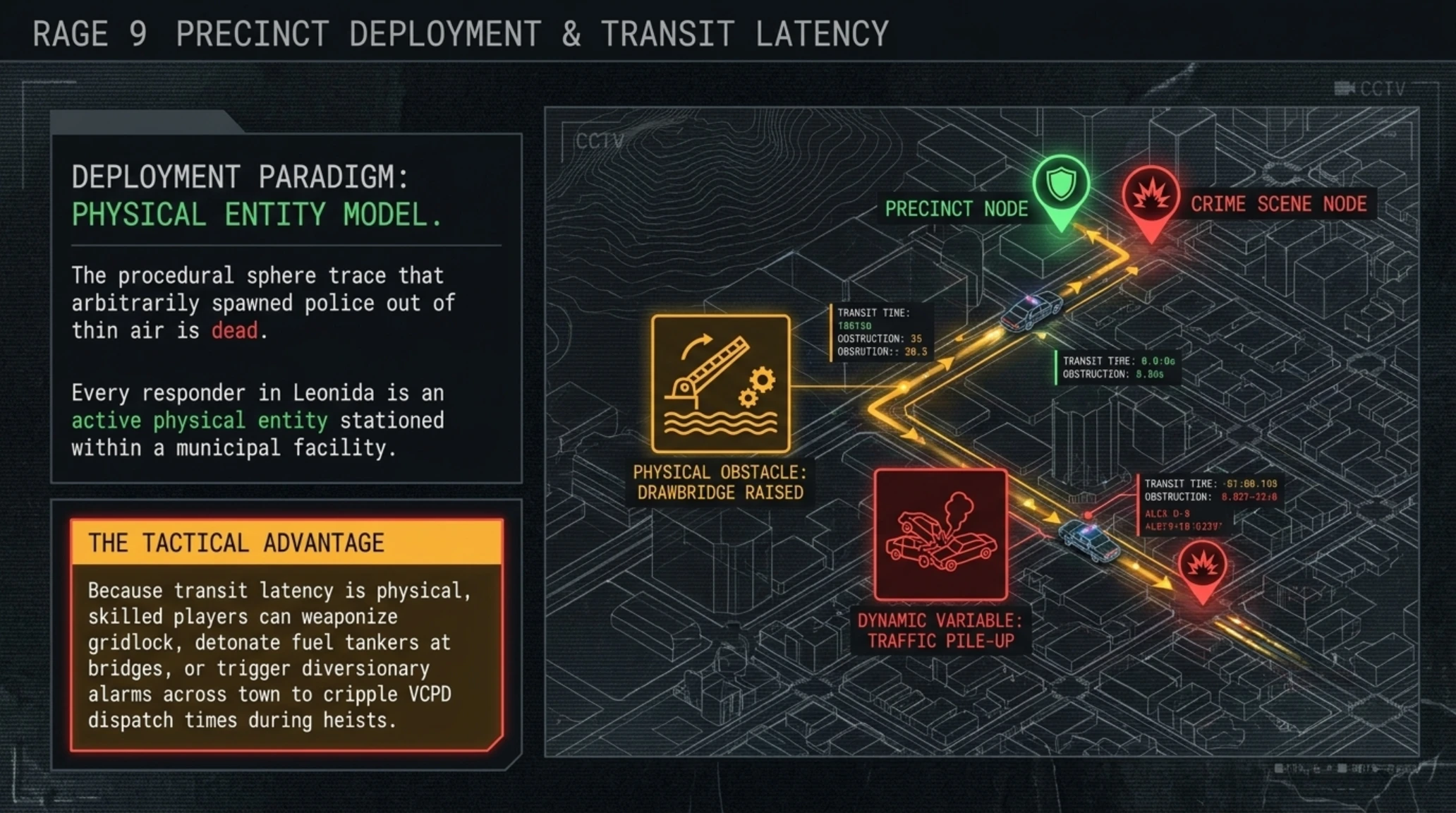
At the architectural core of this systemic revolution is Rockstar North’s proprietary RAGE 9 engine, which treats law enforcement deployment as a continuous physical simulation rather than an arbitrary spawning script. In prior games, when a wanted level was triggered, the game engine executed a procedural sphere trace around the player’s camera coordinates, randomly dropping police vehicles on nearby roadway splines just outside the player’s immediate field of view. This frequently resulted in infamous immersion-breaking absurdities: cruisers materializing out of thin air on deserted mountain roads or spawning in plain view when swinging the camera around a street corner.
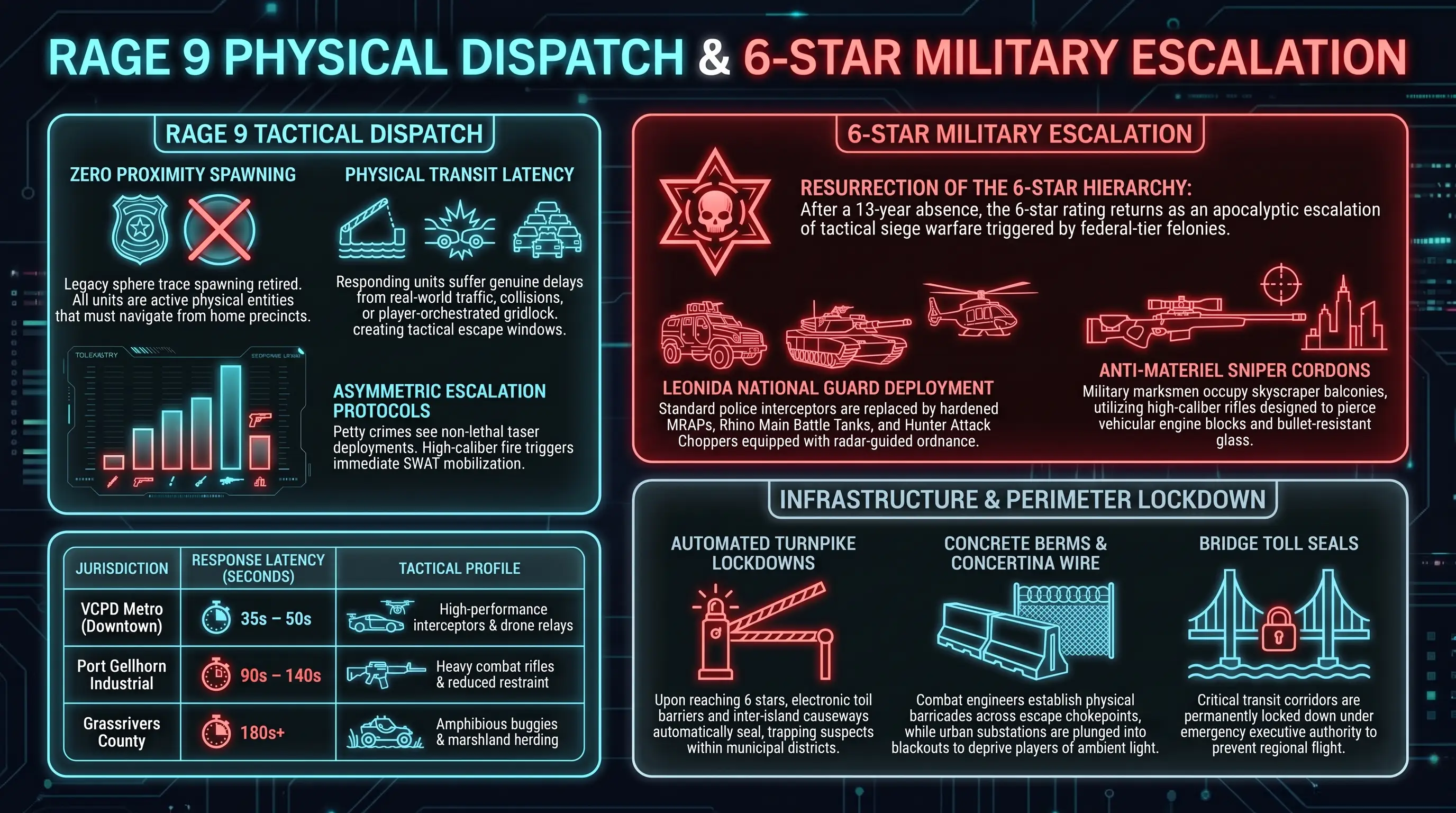
In Grand Theft Auto VI, that entire codebase has been retired. Every police officer, sheriff's deputy, and tactical responder in the State of Leonida is treated as an active physical entity stationed within an authentic municipal facility or assigned to an active roving patrol vector. When a crime is reported via civilian 911 telephone traffic or commercial panic alarms, the regional dispatch mainframe computes the closest available physical assets. Cruisers must turn on their sirens, navigate through procedural civilian traffic, cross intersections, and traverse authentic road network geometry to reach the incident coordinates. If a drawbridge over the Vice City waterways is raised, or if a major traffic collision obstructs a freeway artery, the responding units suffer genuine physical transit delays. This introduces profound emergent gameplay opportunities: skilled players can intentionally orchestrate gridlock, detonate fuel tankers at key bridges, or trigger diversionary alarms across town to cripple police dispatch times during high-stakes heists.
The Philosophy of Asymmetric Adversarial Design: Triage and Threat Assessment
A vital conceptual pillar underpinning the new AI is the principle of Asymmetric Adversarial Design. Historically, video game police forces scaled symmetrically to match player firepower: if a player pulled out a machine gun, officers instantly spawned with heavy shotguns regardless of jurisdictional plausibility. In Leonida, law enforcement operates according to formal escalation triage protocols dictated by civil administrative logic.
When an emergency call reaches the dispatch switchboard, operators evaluate the nature of reported firearms. A reported petty altercation involving a blunt weapon or low-caliber pistol results in the deployment of a solitary patrol cruiser or two community peace officers. These first responders approach cautiously, barking verbal de-escalation commands and brandishing conductive energy tasers rather than drawing sidearms. However, the moment high-caliber automated rifle fire is logged, dispatch protocols elevate immediately: tactical SWAT transport vans are mobilized, air surveillance drones are launched to maintain broad visual perimeters, and municipal traffic lights along the suspect’s projected flight path are systematically cycled to red to induce vehicular pileups.
The Resurrection of the Sixth Star: Military Mobilization and Martial Law
Among the barrage of technical revelations extracted from the extended preview footage, none sparked greater jubilation within the core enthusiast community than the definitive restoration of the six-star wanted level (6-Star Wanted Rating). In 2013, Rockstar made the contentious design compromise to cap GTA V at five stars, banishing traditional Rhino tanks, heavy transport carriers, and National Guard infantry detachments in pursuit of contemporary urban plausibility. While grounded in realistic Los Angeles civic logistics, this limitation stripped endgame free-roam gameplay of its ultimate chaotic escalation. In Grand Theft Auto VI, Rockstar North has not simply reinstated the sixth star; they have redesigned it as an apocalyptic escalation of tactical siege warfare.
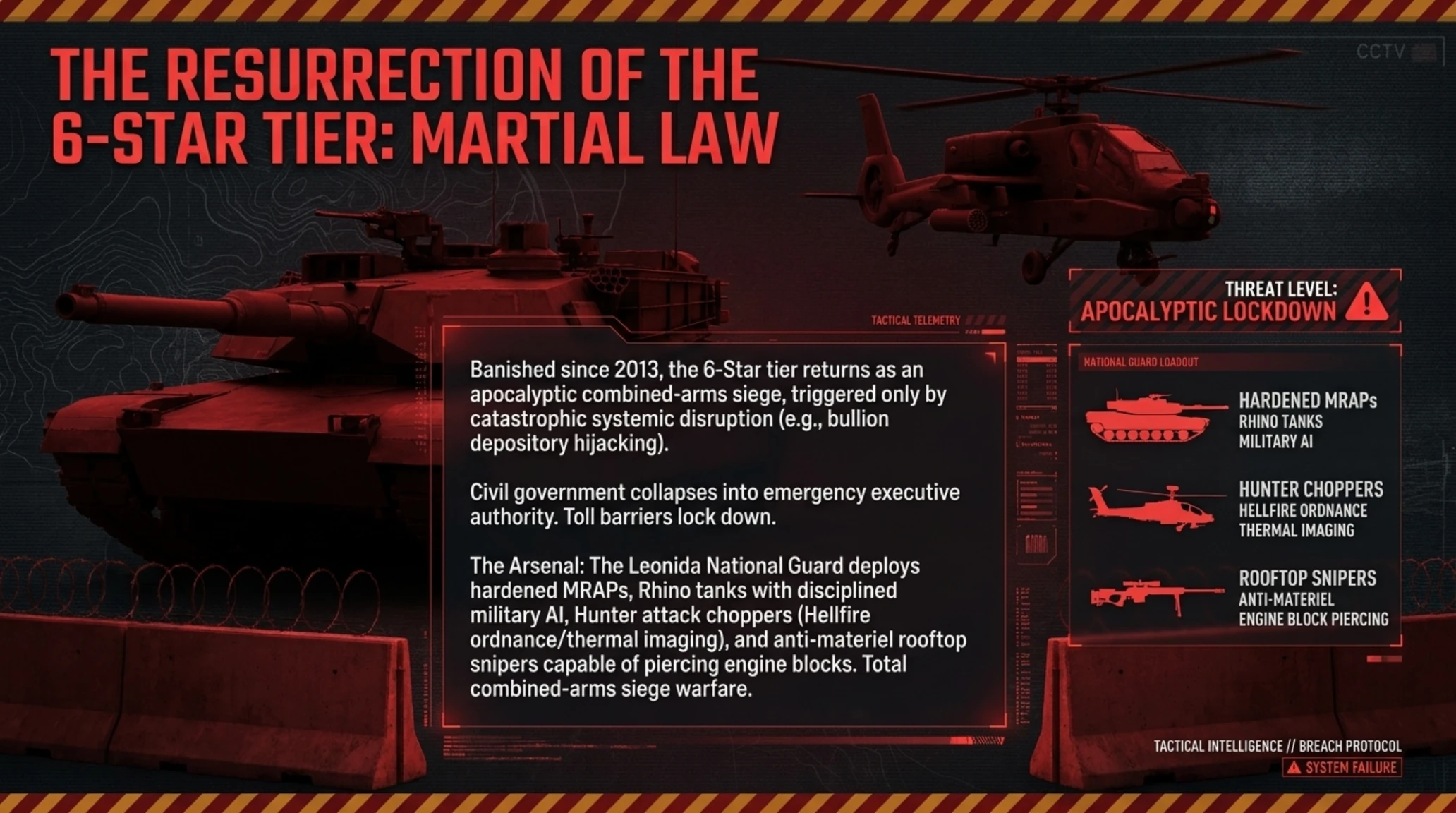
Attaining a six-star status within the borders of Leonida is an endeavor gated behind catastrophic systemic disruption. Players will not stumble into military martial law through routine street stickups or vehicular hit-and-runs. Internal technical parameters reveal that the sixth star requires severe federal-tier felonies: orchestrated assaults on state military armories, large-scale destruction of critical petrochemical infrastructure, the systematic hijacking of bullion depository transports, or the catastrophic downing of multiple municipal aviation assets. When the threshold is crossed, civil government protocols in Vice City collapse into emergency executive authority.
Sirens across municipal districts transition to warbling air-raid tones. The electronic toll barriers along the major turnpikes and inter-island causeways automatically lock down, sealing transit corridors. Instead of standard police interceptors, the Leonida National Guard deploys hardened MRAPs (Mine-Resistant Ambush Protected vehicles), tracked main battle tanks, and Hunter attack helicopters equipped with thermal-imaging optronics and radar-guided ordnance. Unlike the archaic behavior witnessed in the PlayStation 2 generation where military tanks clumsily attempted to ram civilian sports cars like oversized bumper cars, the military artificial intelligence in the RAGE 9 engine operates with disciplined combined-arms doctrine.
Military marksmen deploy on skyscraper balconies and rooftop helipads, utilizing high-caliber anti-materiel rifles capable of piercing vehicular engine blocks and bullet-resistant glass from hundreds of yards away. Light infrastructure is methodically disabled; urban substations are systematically plunged into localized blackouts to deprive players of ambient street lighting, while combat engineers establish physical concrete berms and concertina-wire barricades across escape chokepoints. This level of systemic pressure intersects with other survival mechanics explored in our technical breakdown of GTA 6 mandatory refueling systems and RAGE 9 physics, transforming late-stage criminal getaways into breathless tactical gauntlets where an empty gas tank guarantees instantaneous detention or death.
District-Based Jurisdiction and Spatial Response Latency Across Leonida
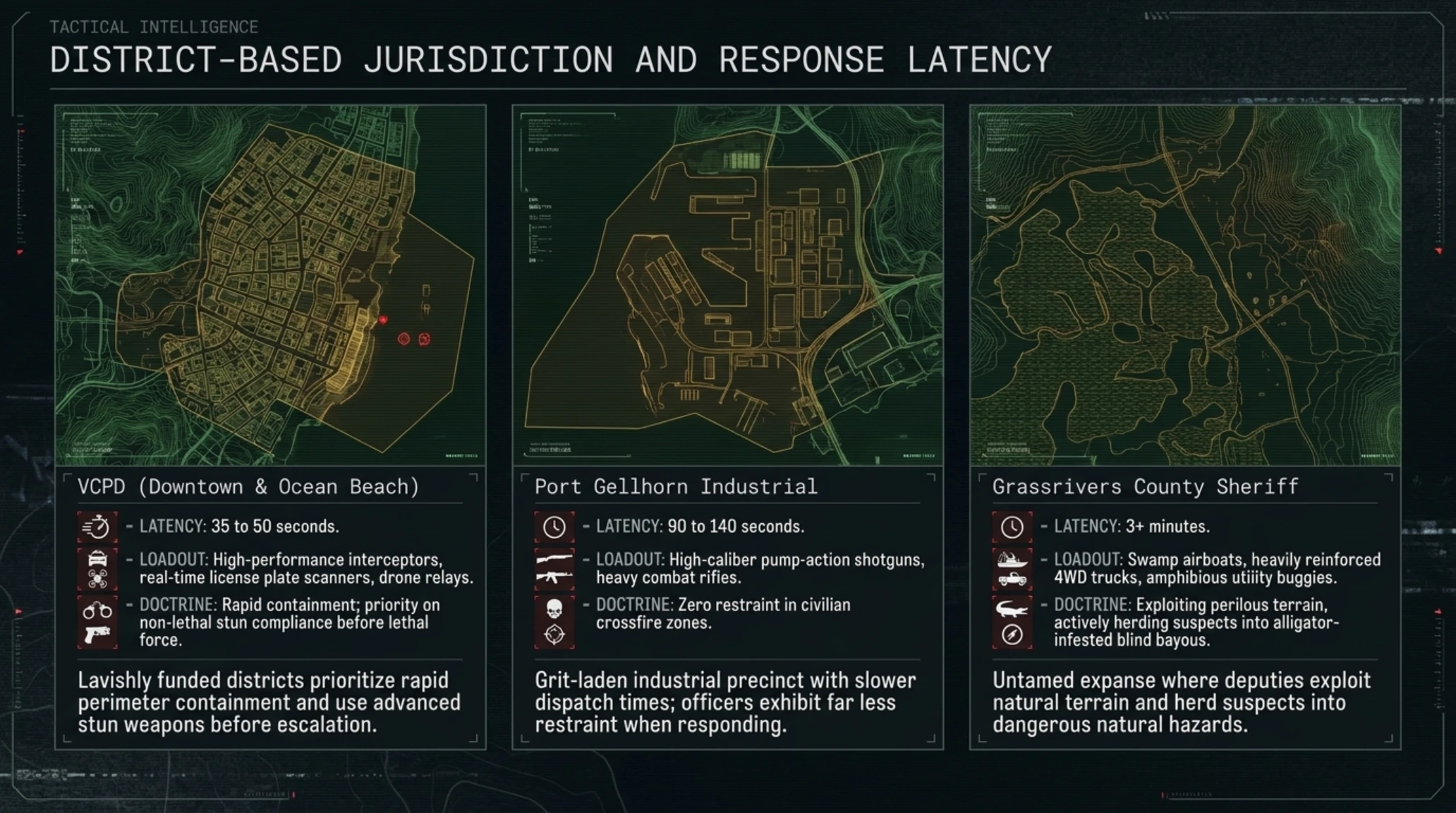
The geographic reality of Leonida is characterized by stark socio-economic divides, and the procedural dispatch algorithms directly mirror this stratification. The State of Leonida is partitioned into distinct jurisdictional sectors, each governed by unique tactical operational doctrines, equipment budgets, and response curves:
- Vice City Metropolitan Police Department (VCPD Downtown & Ocean Beach): Lavishly funded and equipped with high-performance interceptors, real-time license plate scanners, and centralized drone relays. In high-density commercial corridors, municipal response latency averages between 35 to 50 seconds. Officers prioritize rapid perimeter containment, spike-strip deployment, and non-lethal compliance via advanced stun weapons before escalating to lethal force.
- Port Gellhorn Industrial Precinct: A grit-laden manufacturing basin characterized by slower dispatch response times (frequently stretching between 90 to 140 seconds). However, when industrial patrol cruisers arrive, officers deploy high-caliber pump-action shotguns and heavy combat rifles, exhibiting far less restraint in civilian crossfire zones.
- Grassrivers County Sheriff & Wildlife Enforcement: An untamed marshland expanse where traditional asphalt cruisers are virtually useless. Rural sheriff deputies patrol in heavily reinforced four-wheel-drive trucks, swamp-traversing airboats, and amphibious utility buggies. Response times can exceed three minutes, but deputies exploit the perilous natural terrain, herding fleeing suspects directly toward alligator-infested estuaries and blind bayou dead-ends.
- Ambrosia Agricultural Constabulary: Rural highway patrols focused primarily on high-speed pursuit interception and long-range tactical rifles designed for open-plains combat.
Deciphering the Forensic Heat Sub-Array: The Five Pillars of Criminal Identification
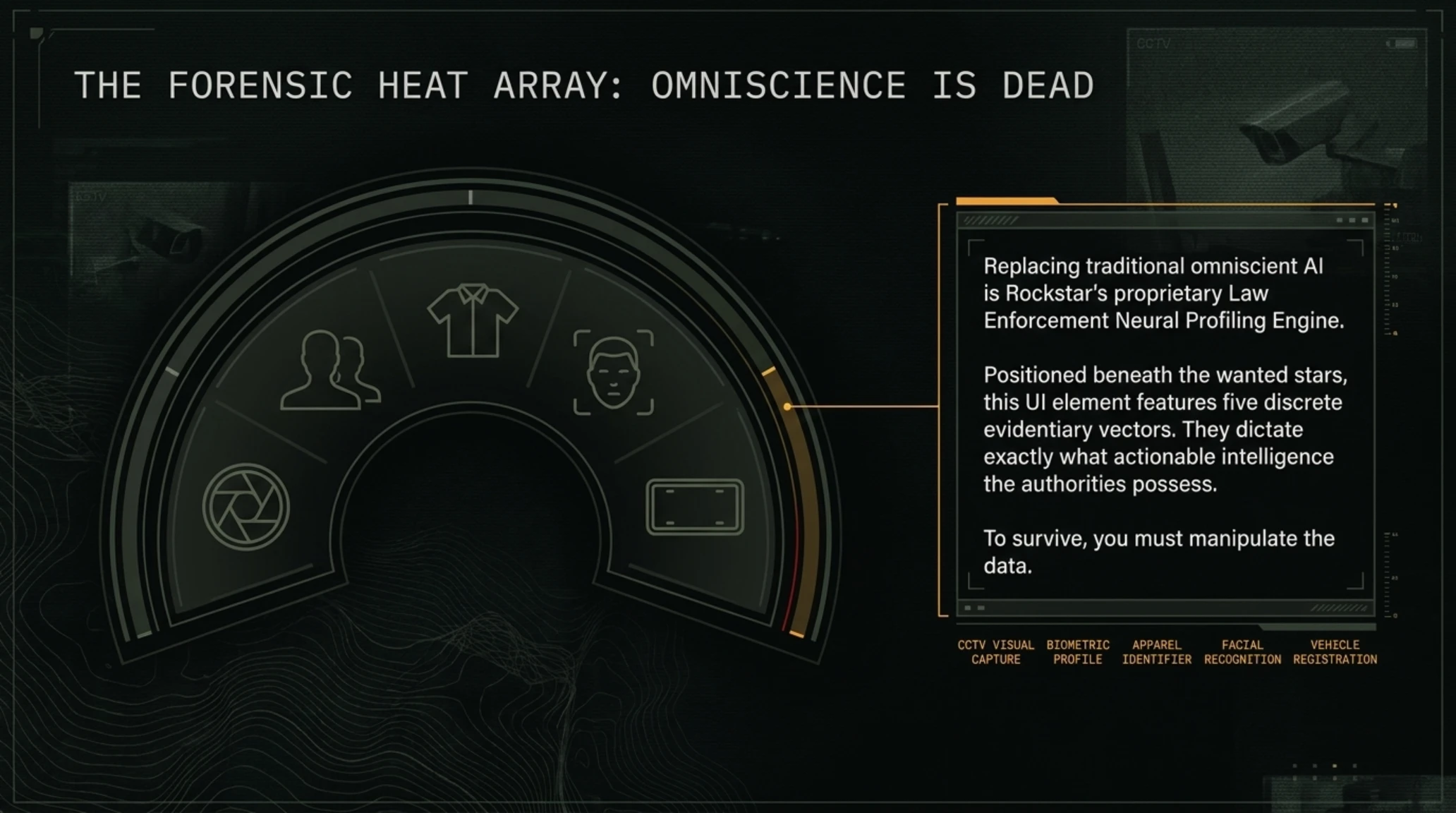
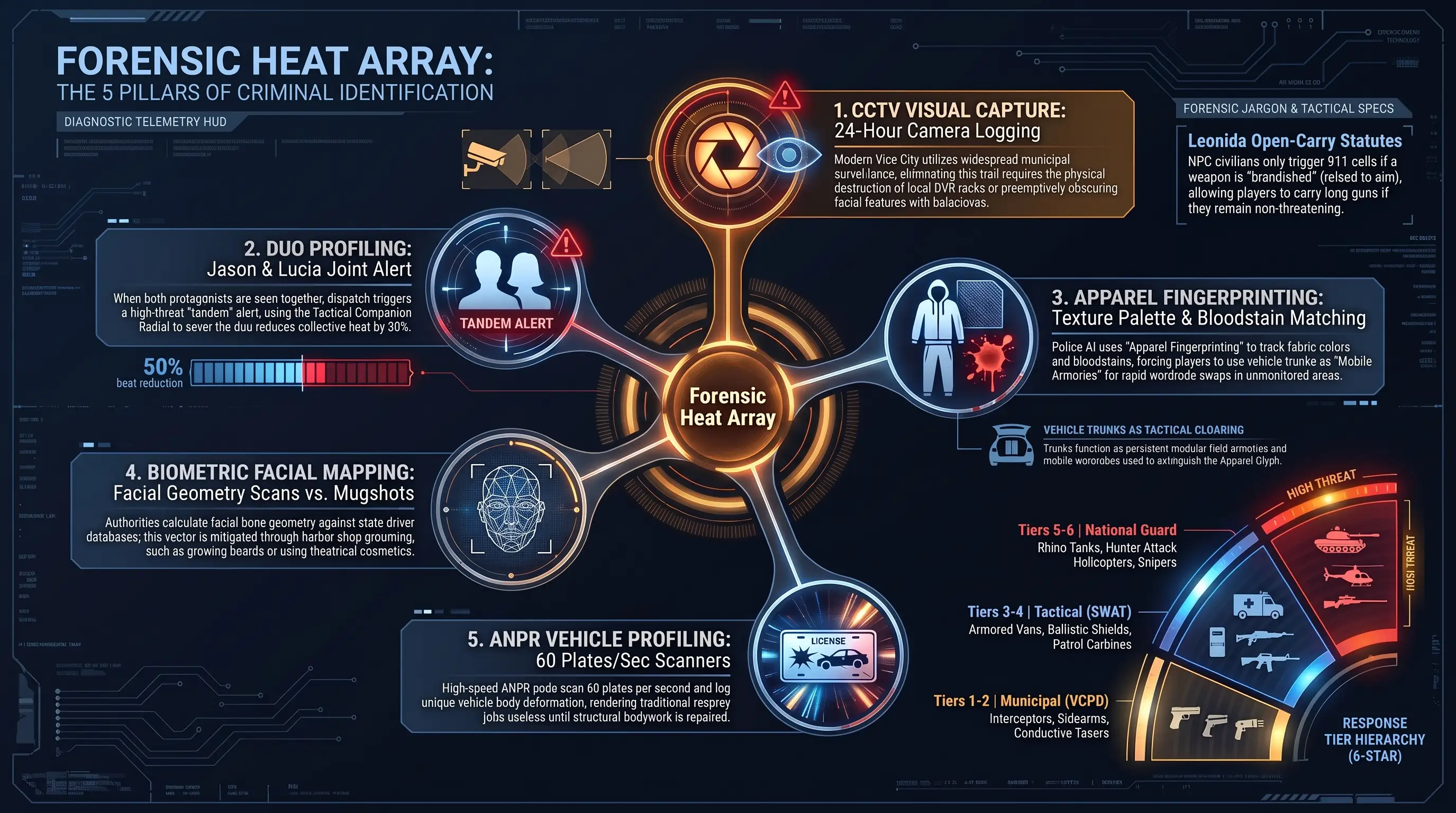
During forensic scrutiny of the extended gameplay footage, attentive observers identified a subtle yet transformative user interface element situated directly beneath the traditional wanted stars: an array of dynamic diagnostic glyphs. This telemetry HUD represents the player-facing manifestation of Rockstar's proprietary Law Enforcement Neural Profiling Engine internally designated as the "Forensic Heat Array." In previous iterations of Grand Theft Auto, police AI possessed omniscient situational awareness; whether you altered your vehicle's cosmetic paint scheme or crouched silently in pitch darkness, the game's code treated the player character as a singularly identifiable target. In GTA 6, that arcade contrivance has been replaced with five discrete evidentiary vectors that dictate exactly how much actionable intelligence authorities possess.
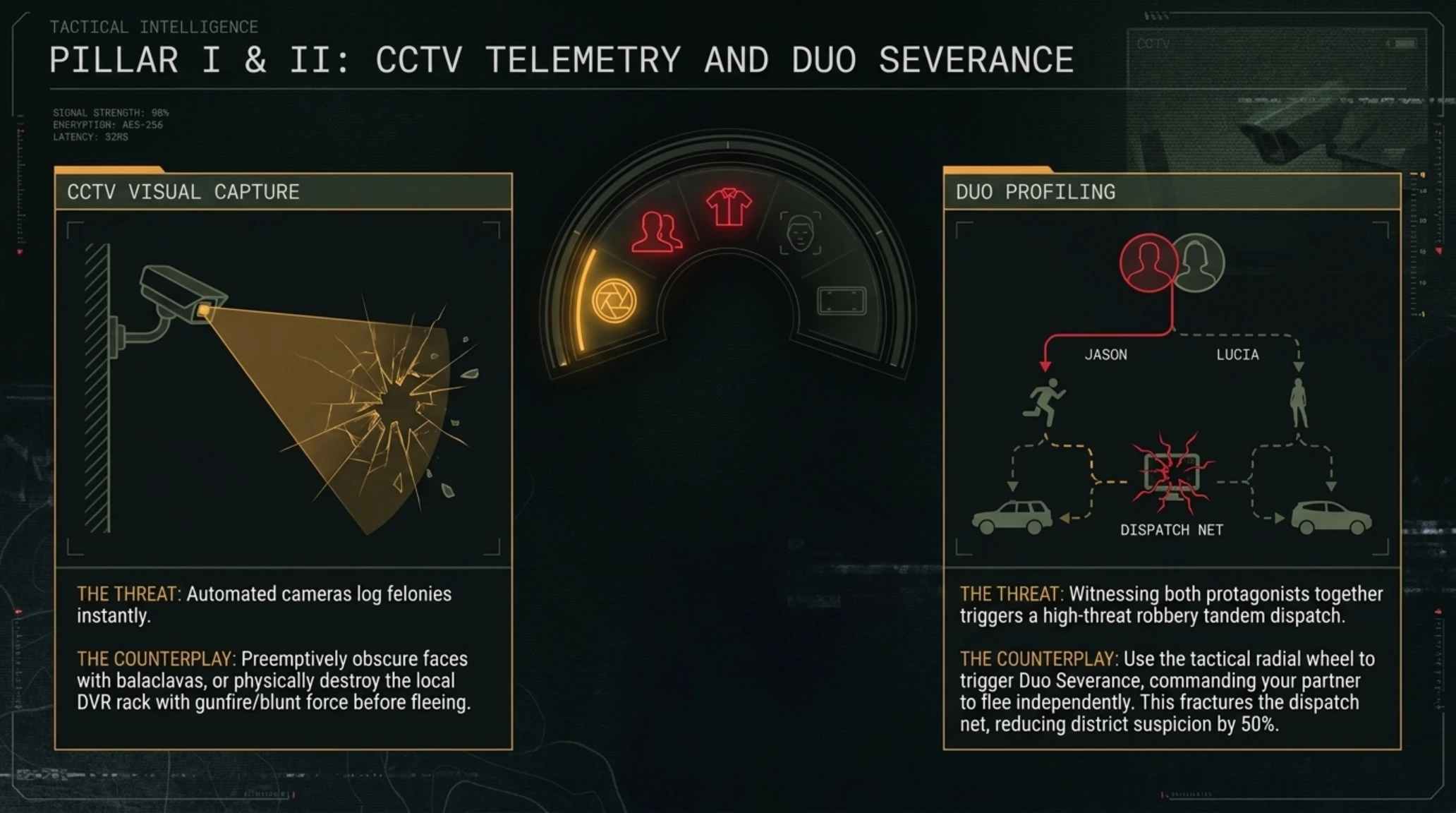
The primary diagnostic glyph, rendered as a miniature security camera aperture, signifies Closed-Circuit Television (CCTV) Visual Capture. Modern Vice City is blanketed in private and municipal surveillance infrastructure. Automated cameras monitor 24-hour convenience chains, jewelry boutiques, banking institutions, and metropolitan transit hubs. Should Jason or Lucia brandish a weapon, discharge a firearm, or execute a forced entry within the visual cone of these recording systems, the CCTV glyph illuminates amber. Eliminating this investigative trail requires immediate, localized intervention: players must physically locate and destroy the store's digital video recorder (DVR) rack using gunfire or blunt force trauma prior to fleeing the premises, or preemptively obscure facial features with balaclavas and tinted visors before crossing the threshold.
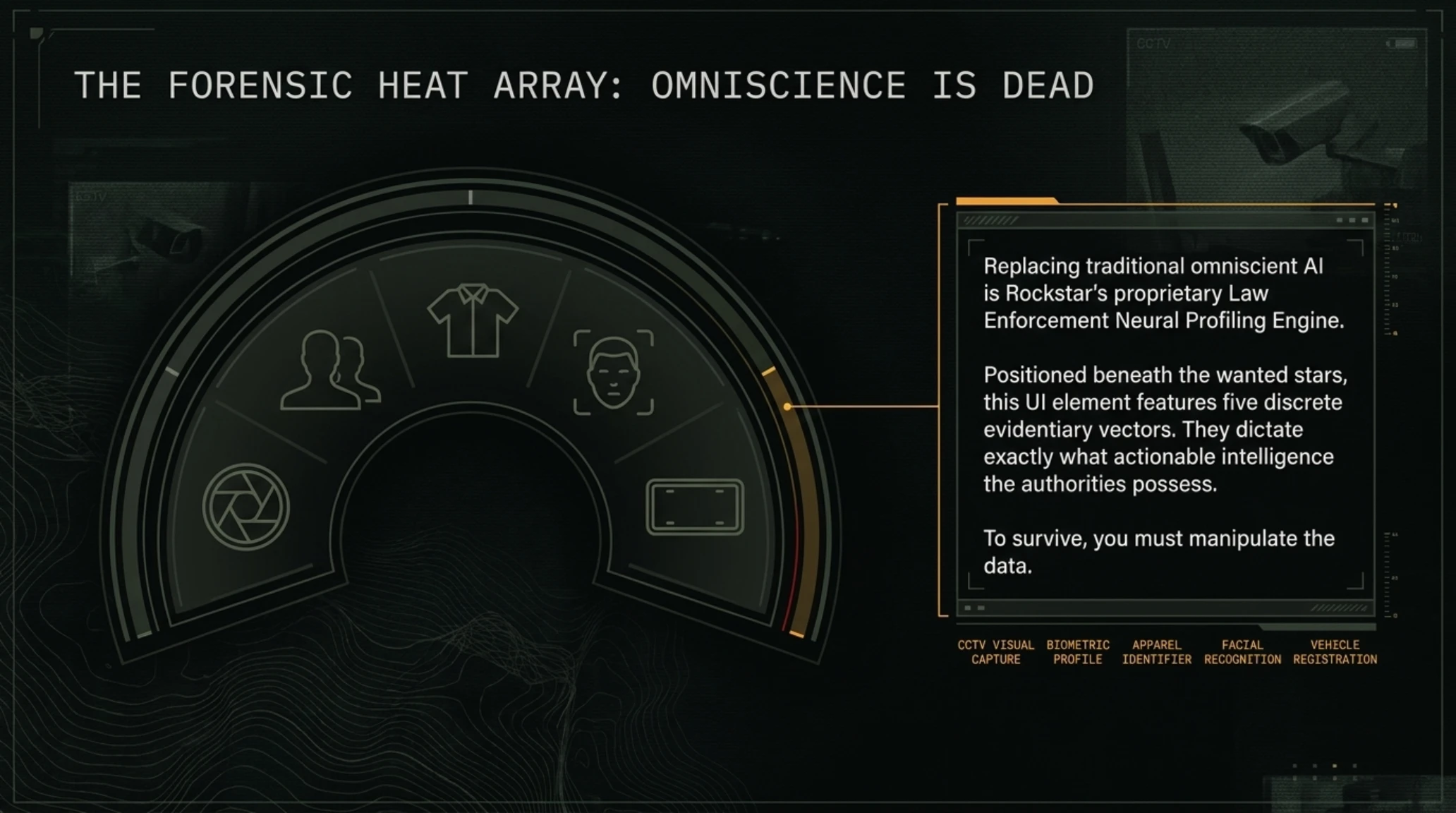
The secondary telemetry glyph depicts two adjacent silhouettes, representing the Duo Profiling Mechanic (Jason & Lucia Identification). Central to GTA 6's narrative architecture is the interwoven criminal partnership between its co-protagonists. When witnesses or dispatched units observe both characters operating concurrently during a felonious event, municipal dispatch broadcasts an alert for a high-threat robbery tandem. To fracture this high-priority dispatch state, players can execute a tactical severance maneuver. By triggering the companion tactical radial wheel, you can command your partner to break formation, acquire an alternate vehicle, and navigate via independent pathfinding toward a designated rendezvous hideout. This tactical bifurcation immediately fractures the dispatch net, reducing collective law enforcement suspicion across the district by fifty percent.
Forensic Jargon Buster: Next-Gen Criminal Mechanics
| Biometric Heat Vector | Real-time algorithmic calculation tracking facial bone geometry against criminal databases. |
| ANPR Cameras | Dual optical cameras on cruisers scanning up to 60 registration plates per second. |
| Apparel Fingerprinting | Algorithmic texture matching tracking fabric colors and bloodstains. |
| Open-Carry Statutes | Realistic simulation of Florida laws permitting civilian transit with unraised long guns. |
| Tactical Companion Radial | Contextual order matrix governing companion behavior like suppressing fire or breaking formation. |
The Mobile Armory: Vehicle Trunks as Tactical Cloaking Stations
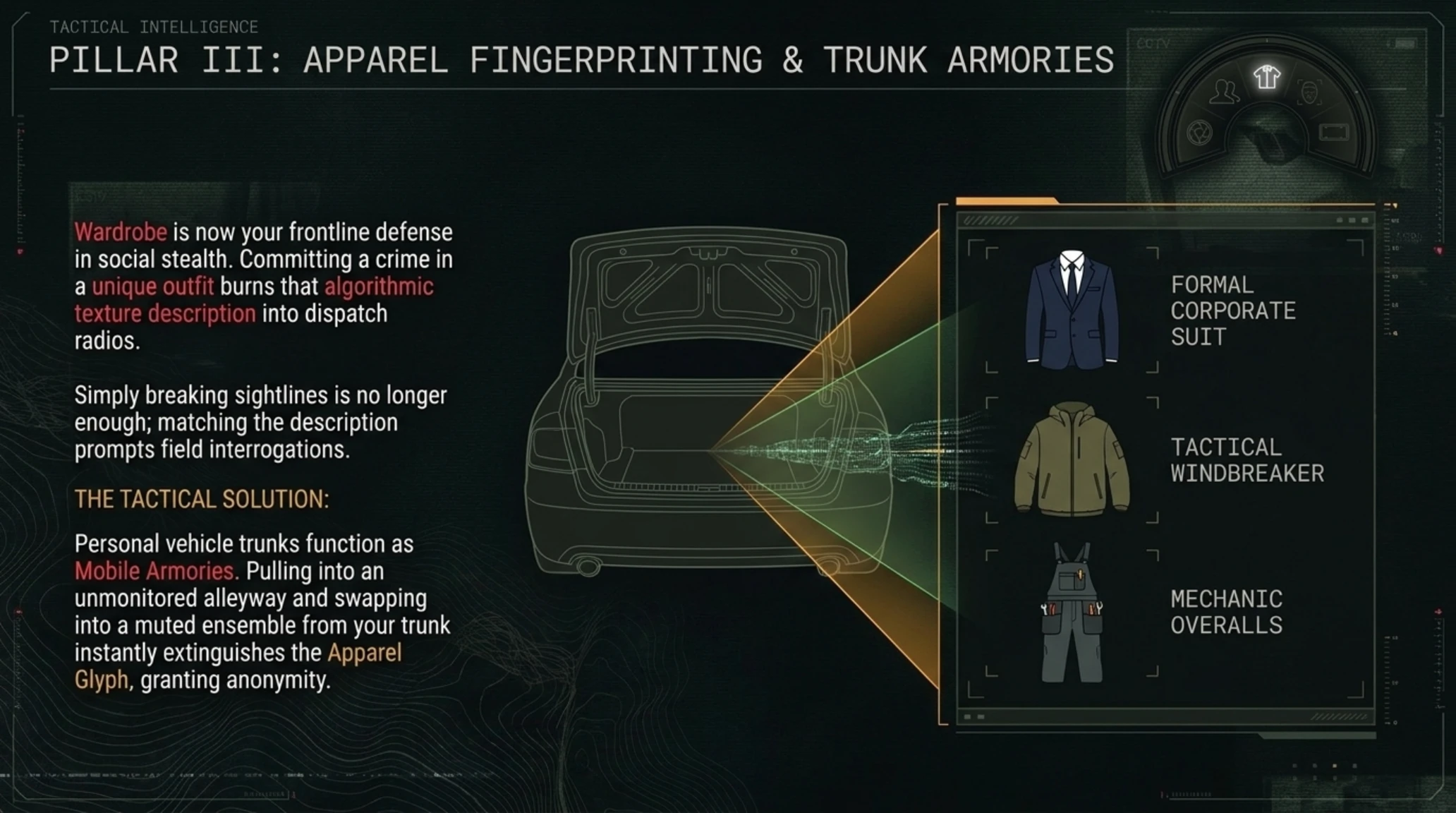
The third investigative vector on the telemetry HUD is the Apparel Identification Glyph (Clothing & Physical Disguise). In Grand Theft Auto VI, wardrobe is no longer an aesthetic novelty; it is your primary frontline defense in social stealth. If Lucia executes a smash-and-grab heist at an Ocean Drive boutique clad in an iridescent crimson tracksuit and platinum aviator shades, every foot patrolman, transit authority officer, and bike cop within an eight-block radius will actively cross-reference pedestrians against that visual description. Simply breaking sightlines and casually strolling down a crowded sidewalk in identical attire will prompt officers to initiate field interrogations and physical pat-downs.
To counteract this forensic net, Rockstar North has engineered a revolutionary logistical interaction: the trunks of player-owned and persistent vehicles function as modular field armories and mobile wardrobes. Prudent players maintain curated equipment loadouts inside their vehicles, encompassing formal corporate suits, utilitarian mechanic overalls, oversized windbreakers, and alternate headwear. Following a successful perimeter escape, pulling into an unmonitored alleyway, opening the rear trunk, and swapping into a muted ensemble instantly extinguishes the Apparel Glyph, allowing you to walk directly past searching officers without triggering apprehension protocols.
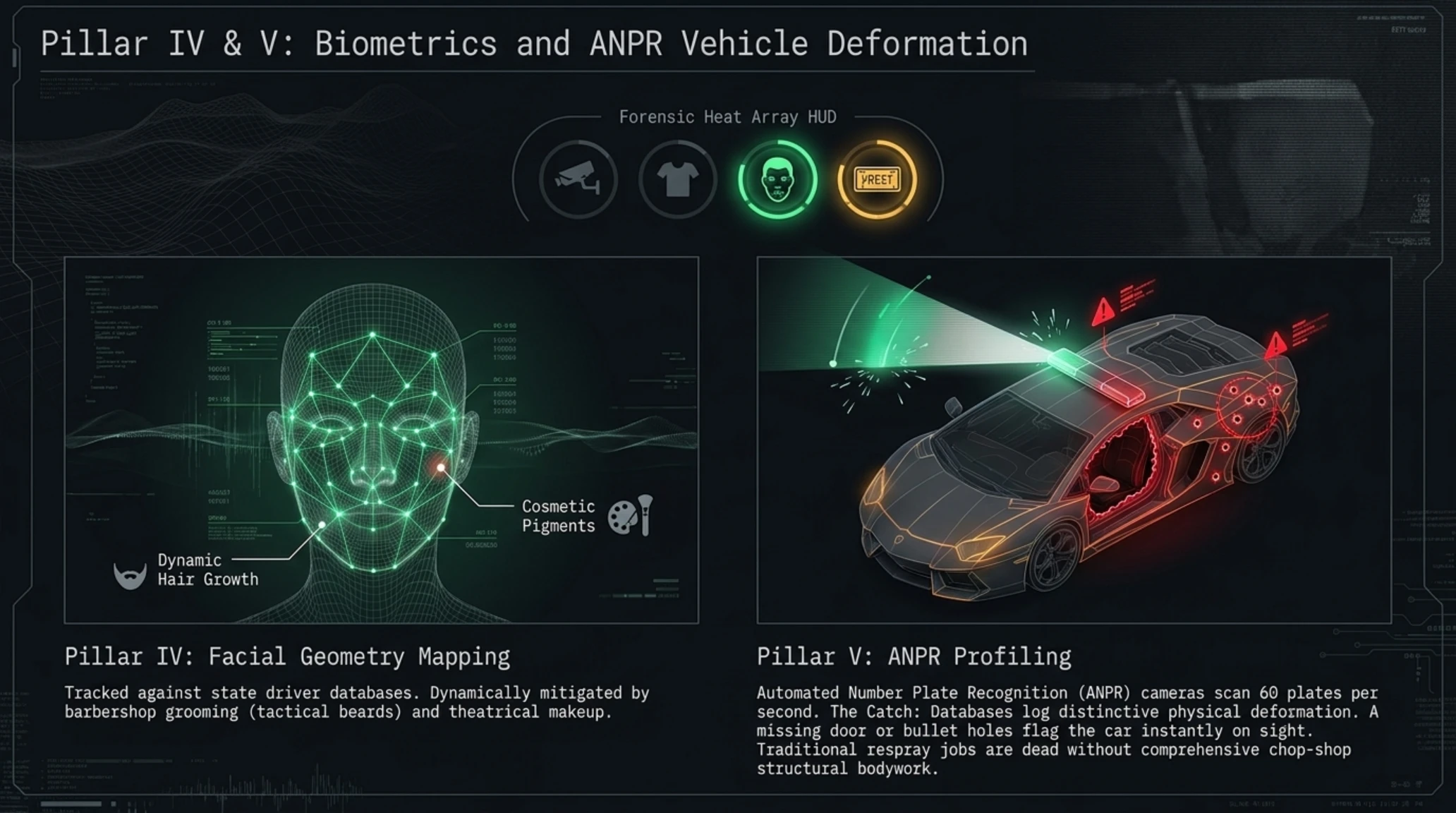
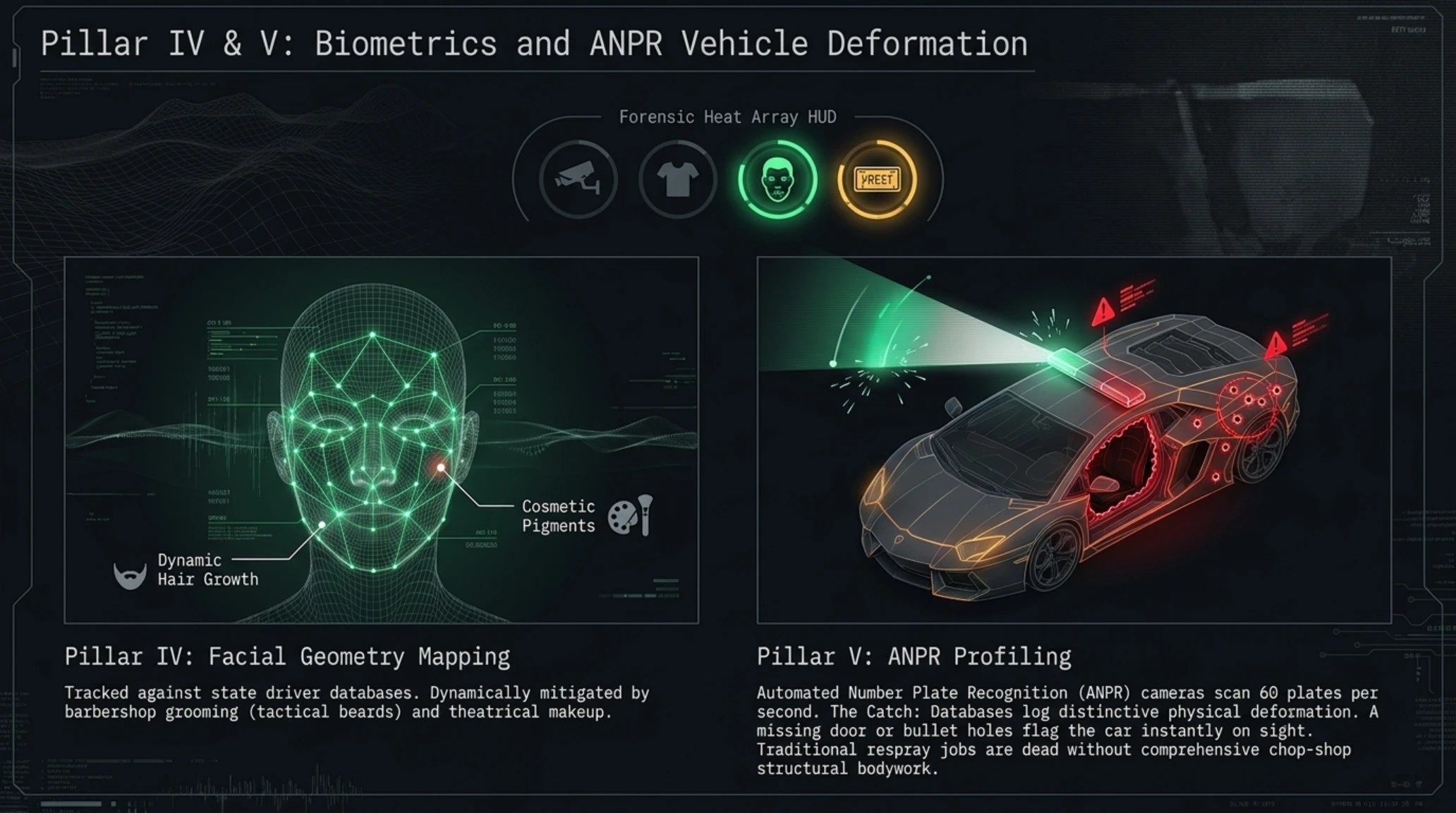
The fourth and fifth telemetry glyphs govern Facial Geometry Mapping and Vehicle Profiling, respectively. While facial identification can be mitigated dynamically through barber-shop grooming such as Jason growing out thick tactical beards or Lucia utilizing theatrical cosmetic pigments vehicular profiling introduces unprecedented mechanical depth. Cruisers patrolling Leonida are equipped with high-speed ANPR camera pods mounted upon their lightbars. These scanners automatically parse registration plates in real time. Crucially, law enforcement databases do not merely catalog the license plate string; they log distinctive physical deformation. Driving an exotic sports vehicle with a missing driver-side door, bullet-riddled quarter-panels, or heavy front-end collision damage will cause patrol units to flag the vehicle on sight, completely rendering traditional respray paint jobs useless until comprehensive structural bodywork is completed at specialized chop shops. Furthermore, patrol cruisers coordinate tactical spike-strip barricades across highway bottlenecks; running over deployable stop sticks punctures run-flat tire compounds, sending vehicles into violent procedural fishtails that tear alloy rims into shreds against asphalt.
The Demise of the Magical Safehouse: Surveillance Stakeouts and Breach Warrants
In all prior entries in the franchise, safehouses functioned as absolute, impenetrable gameplay sanctuaries. If a player managed to sprint through the front door of an apartment while four police helicopters hovered overhead and fifty officers fired assault rifles, the screen would gently fade, active wanted stars would miraculously reset to zero, and the player would emerge hours later fully rested without consequences. In Grand Theft Auto VI, this archaic crutch has been completely eliminated.
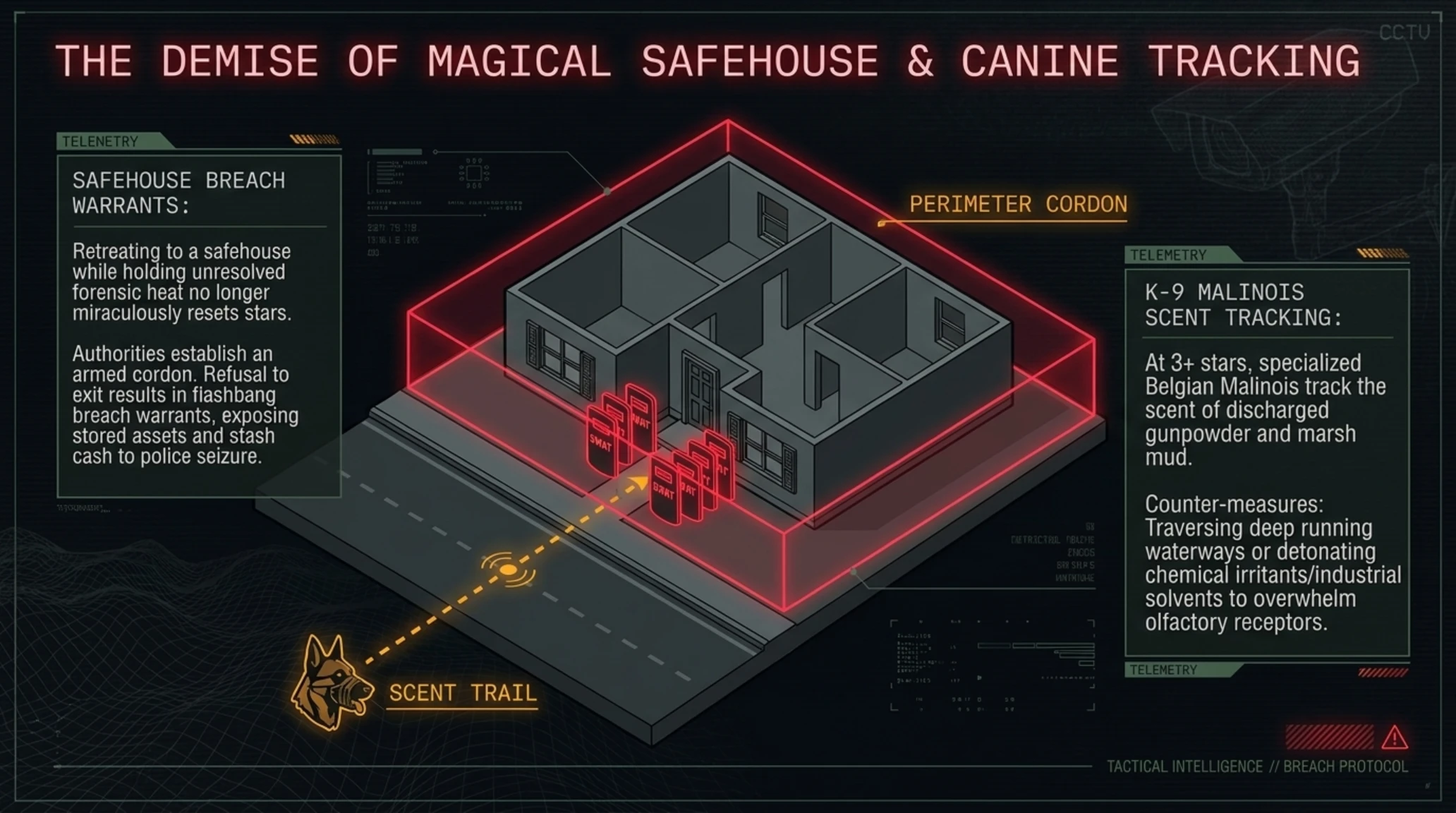
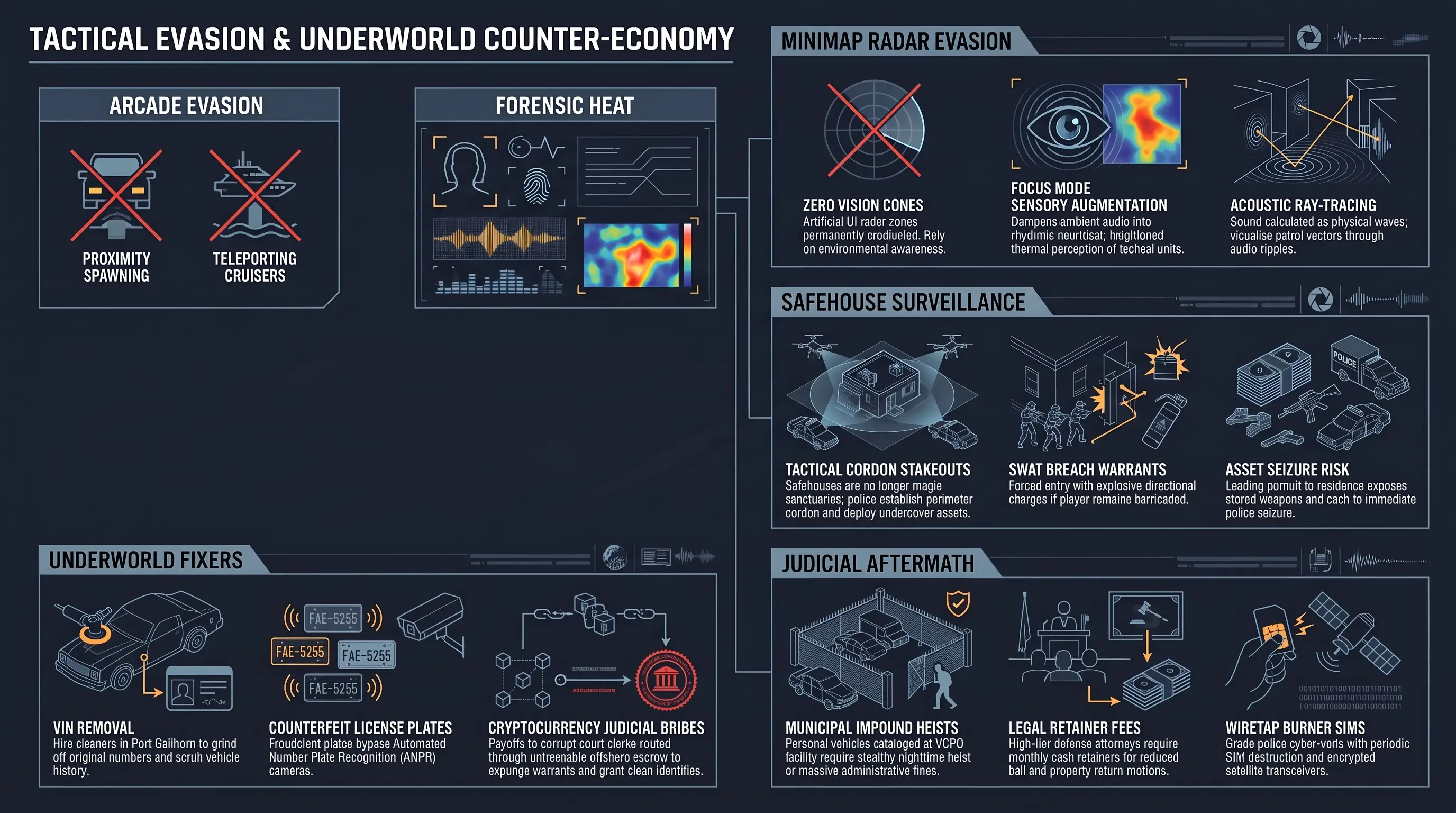
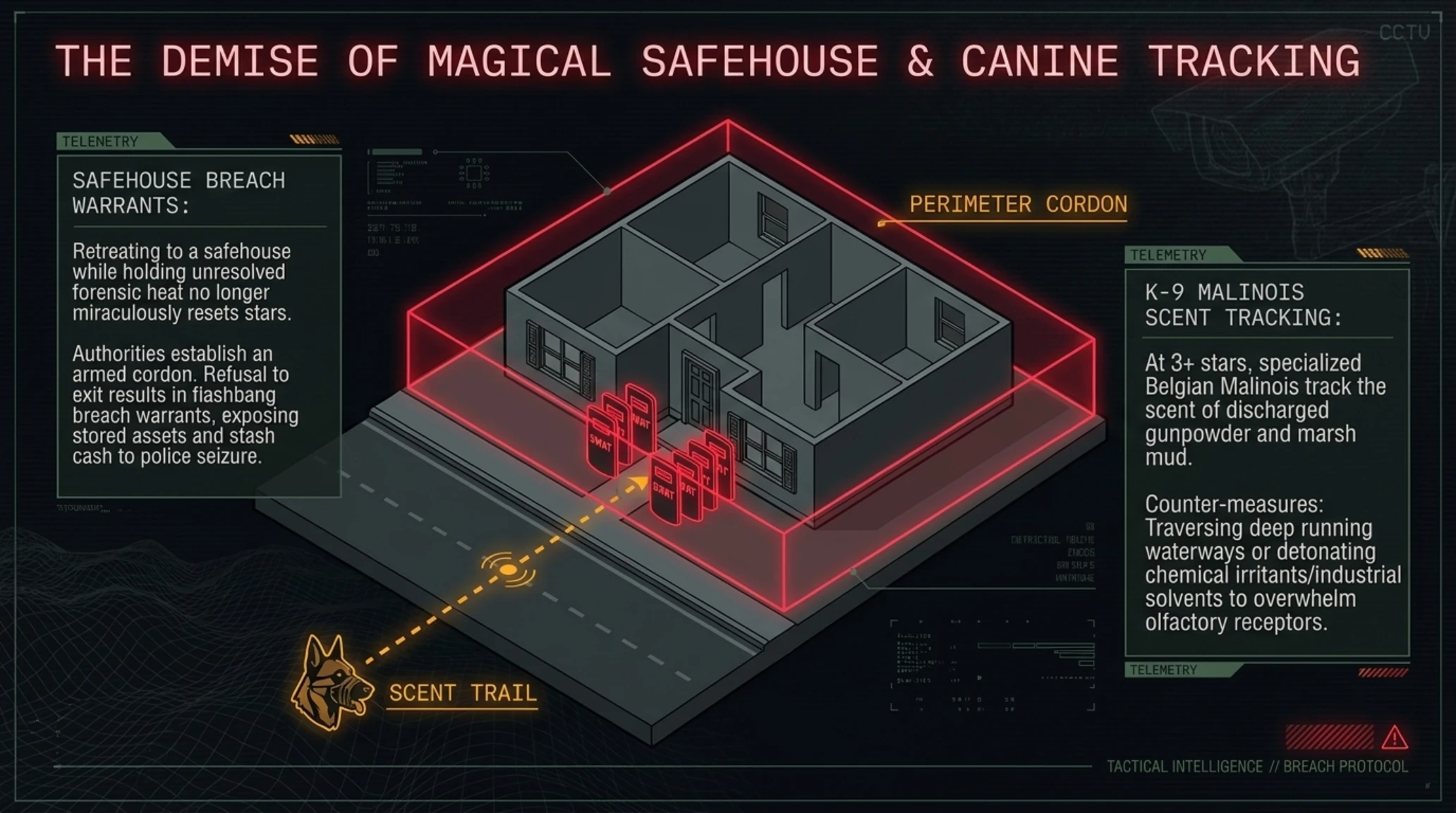
If you retreat toward a known personal safehouse while law enforcement units maintain active line-of-sight or unresolved forensic heat, authorities do not disperse. Instead, patrol cruisers establish a perimeter cordon around the building, initiating an armed tactical stakeout. Undercover detective sedans park across the street, surveillance drones orbit the rooftop, and if the player remains barricaded inside, a tactical team will execute a forced breach warrant, kicking down the front entrance with flashbang grenades. Safehouses must now be safeguarded; leading a pursuit back to your residence exposes your stored assets, stash cash, and illegal weapon reserves to police seizure, forcing players to break contact miles away before returning to domestic lodgings.
Historical Evolution Matrix: Law Enforcement and Wanted Dynamics Across Five Eras
| Year of Launch | Franchise Release | Maximum Star Rating | Primary AI Behavior | Core Evasion Mechanics |
|---|---|---|---|---|
| 2001 | Grand Theft Auto III | 6 Stars (Military Armor) | Direct linear charging, suicidal ramming | Pay 'n' Spray respray, collection of police bribes |
| 2004 | GTA: San Andreas | 6 Stars (Hydra Jets) | Aggressive spawn spamming, road blockades | Disguise modification, vehicle plate respray |
| 2008 | Grand Theft Auto IV | 6 Stars (FIB Enforcers) | Circular search radius on the radar HUD | Physical sprinting outside the flashing perimeter |
| 2013 | Grand Theft Auto V | 5 Stars (No Military) | Omniscient vision cones, proximity cruiser spawning | Hiding in foliage, tunnels, or construction sites |
| 2026 | Grand Theft Auto VI | 6 Stars (National Guard) | Forensic heat tracking, AI group tactics, CCTV logs | Vehicle trunks, Focus Mode, disguise shifts, EMP hacking |
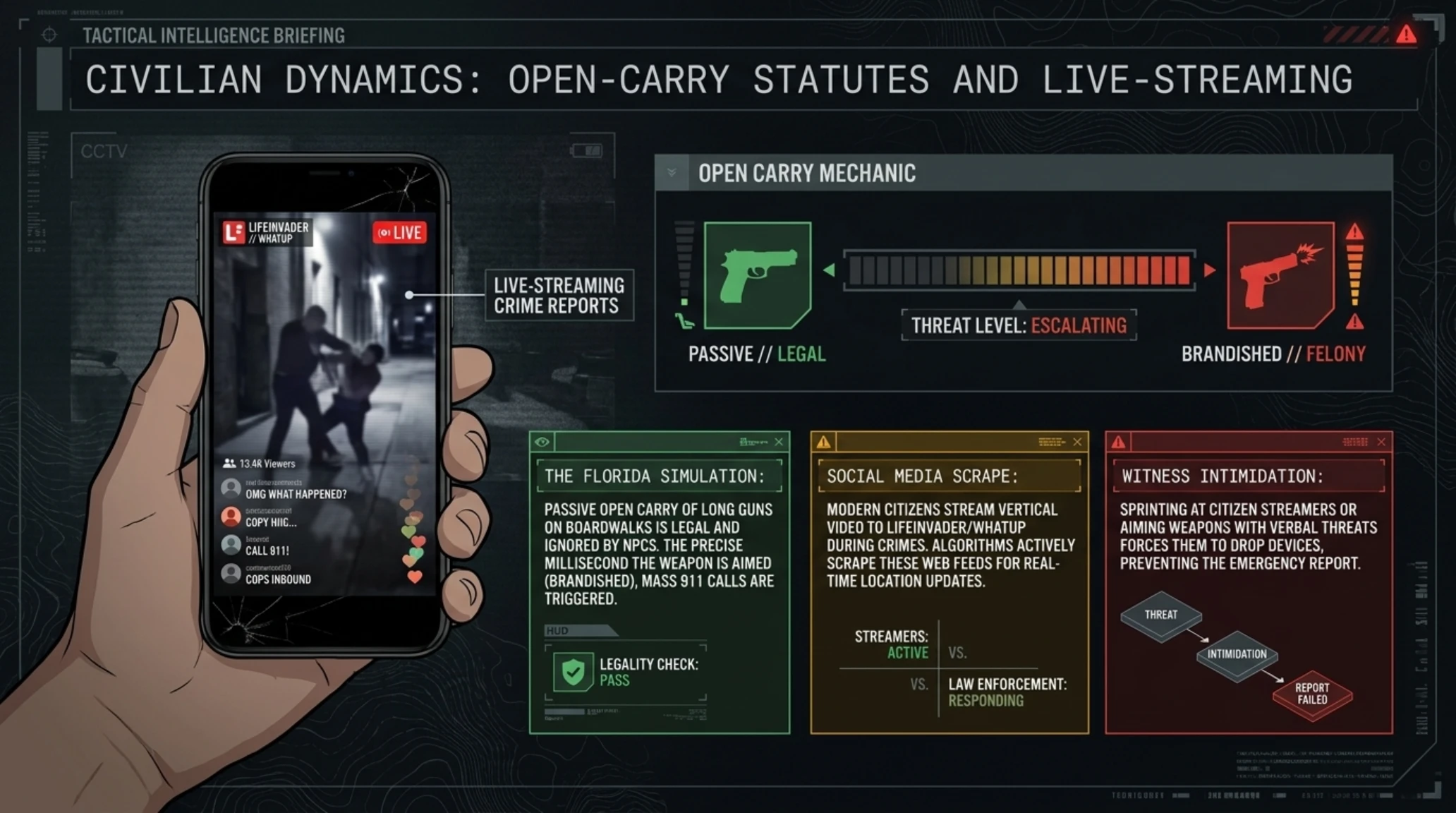
Equally extraordinary is the systemic simulation of state-specific gun legislation. Drawing inspiration from Florida's contemporary firearm statutes, Leonida observes realistic "Open Carry" civic logic. Walking down a sun-drenched coastal boardwalk with a combat shotgun slung across Jason's shoulder or a holstered semi-automatic sidearm does not automatically provoke widespread civilian panic or an emergency police dispatch. NPCs observe legal nuances: as long as the firearm remains unraised and non-threatening, society proceeds normally. However, the exact millisecond a player raises the firearm to aim (brandishing), civilian bystanders trigger emergency smartphone calls, instantly initiating an armed response tier. This delicate social boundary forces players to maintain constant situational awareness over their posture and weapon ready-states.
Law Enforcement Hierarchy & Specs Box
Tiers 1-2 (Municipal): Solitary VCPD interceptors armed with standard-issue sidearms and non-lethal conductive tasers.
Tiers 3-4 (Tactical): Armored tactical SWAT vans, ballistic shields, tear gas canisters, and high-velocity patrol carbines.
Tiers 5-6 (National Guard): Rhino tracked main battle tanks, Hunter attack helicopters with Hellfire ordnance, and rooftop antimateriel sniper cordons.
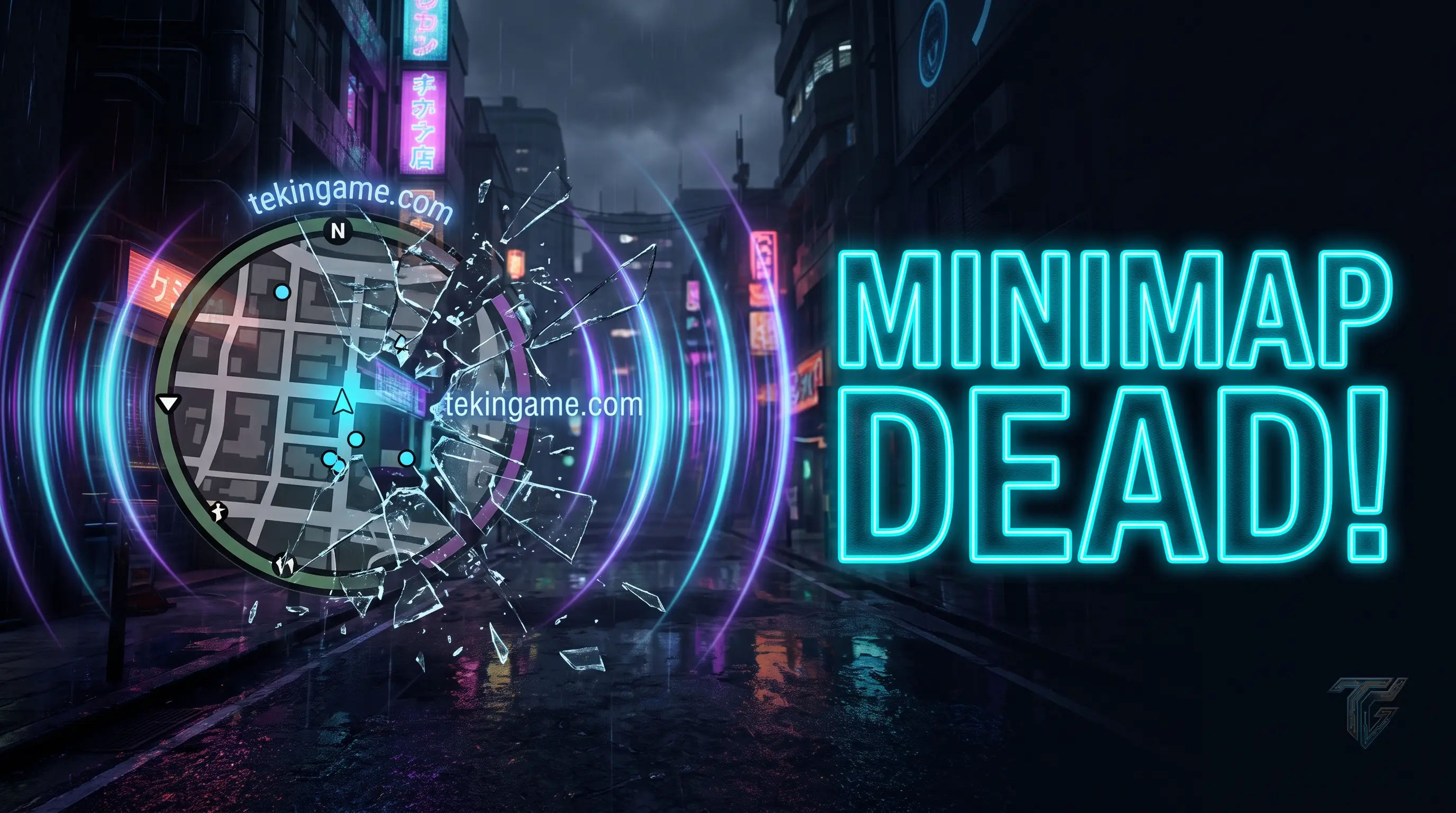
The Extinction of Minimap Vision Cones: Reclaiming Environmental Immersion
For over a decade, the primary design flaw plaguing high-intensity pursuits in Grand Theft Auto V was the psychological phenomenon known as "Minimap Tunnel Vision." In Los Santos, the moment police cruisers gave chase, the player's cognitive attention immediately decoupled from the stunning architectural splendor of the physical world. Instead of reading roadway geometry, watching pedestrian foot traffic, or maneuvering through dynamic obstacles, players became subservient to the lower-left corner of the display screen. Pursuits degraded into a game of geometric radar evasion carefully timing vehicle braking behind concrete pillars or angling into shallow alleyways to exploit the predictable blue-and-red sight cones projected on the 2D radar overlay.
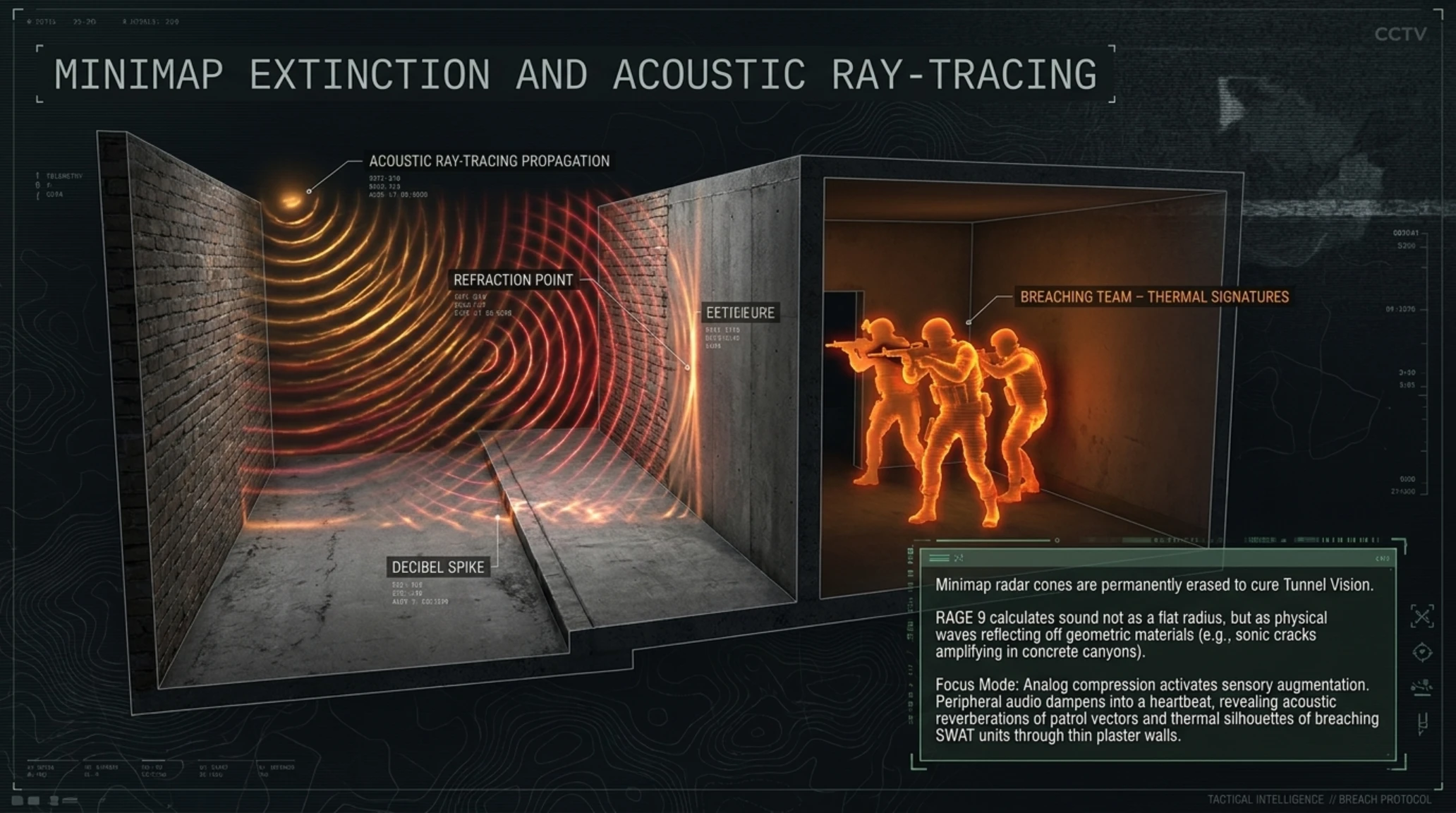
In Grand Theft Auto VI, Rockstar North has executed a radical aesthetic and mechanical amputation: vision cones have been permanently eradicated from the minimap display. There are no colorful radar indicators to reveal where patrolmen are looking or how far their eyesight penetrates. To navigate this heightened tension, Rockstar has introduced Focus Mode, an organic sensory augmentation mechanic activated through analog stick compression. Upon activation, ambient metropolitan audio dampens into a muffled, rhythmic heartbeat; peripheral visual saturation contracts, and the player taps into heightened acoustic and thermal perception. Acoustic reverberations from distant sirens bounce through concrete urban canyons, visualizing patrol vectors through subtle audio ripples, while thermal silhouettes reveal tactical units stacking against doorway thresholds before a violent breach occurs.
This stark architectural distinction highlights the generational leap in tactical adversary design and spatial response logistics.
Historical Evolution Matrix: Law Enforcement Dynamics
| Year | Franchise Release | Maximum Star Rating | Primary AI Behavior | Core Evasion Mechanics |
|---|---|---|---|
| 2001 | GTA III | 6 Stars (Military) | Direct linear charging, suicidal ramming | Pay 'n' Spray respray, police bribes |
| 2004 | GTA: San Andreas | 6 Stars (Hydra Jets) | Aggressive spawn spamming, road blockades | Disguise modification, vehicle respray |
| 2008 | GTA IV | 6 Stars (FIB Enforcers) | Circular search radius on the radar HUD | Physical sprinting outside flashing perimeter |
| 2013 | GTA V | 5 Stars (No Military) | Omniscient vision cones, proximity spawning | Hiding in foliage, tunnels, or construction sites |
| 2026 | GTA 6 | 6 Stars (National Guard) | Forensic heat tracking, group tactics, CCTV | Vehicle trunks, Focus Mode, EMP hacking |
Ray-Traced Acoustic Propagation and Radio Scanner Eavesdropping
Rockstar's investment in auditory simulation represents one of RAGE 9's most groundbreaking achievements: fully ray-traced acoustic spatialization. In GTA 6, sound is calculated not as a flat decibel radius, but as physical waves that reflect, refract, and diffract across geometric materials. When an unsuppressed shotgun discharges in an enclosed concrete alleyway, the sonic crack bounces between parallel brick facades, amplifying the acoustic signature and alerting civilians multiple blocks away. Conversely, discharging weapons fitted with modular titanium suppressors and firing subsonic ammunition confines acoustic detection to immediate interior rooms.
To turn this auditory battlefield to their advantage, players can purchase hardware radio scanners or download bootleg interceptor applications to in-game smartphones. Tuning into VCPD or Leonida Highway Patrol dispatch frequencies provides real-time tactical intelligence. As dispatch operators broadcast incident updates, players hear responding units report road closures, spike-strip deployment coordinates, and aerial searchlight vectors before they physically encounter them on the road. Listening carefully to dispatcher chatter reveals which intersections are fortified, allowing savvy players to execute timely evasive detours onto dirt frontage roads or subterranean flood drainage canals.
Civilian 911 Reporting Dynamics: Social Media Streaming and Witness Intimidation
Crucially, the initial spark of police intervention in Leonida is heavily dependent upon dynamic civilian behavior. Rather than operating as static bystanders, the citizen population of Vice City behaves with authentic 2026 digital sensibilities. When an illegal act occurs such as a street race, a violent assault, or a vehicle break-in civilians do not instantly trigger a magic police alarm. Instead, distinct AI archetypes emerge based on social demographic profiles.
Some bystanders immediately pull out smartphones, streaming vertical video directly to in-game social media networks like Lifeinvader or WhatUp. These live-streams broadcast real-time player locations and clothing descriptions directly to web feeds, which law enforcement algorithms actively scrape to update suspect profiles. However, players possess active counter-play: sprinting toward citizen streamers, violently snatching their devices, or aiming a weapon with an aggressive verbal threat can intimidate witnesses into lowering their cameras and fleeing without filing emergency reports. Discharging a firearm in public, however, instantly shatters social intimidation, causing mass panic that triggers dozens of simultaneous 911 calls, drastically accelerating police arrival times.
The Dynamic Spectrum of Star States: From Direct Line-of-Sight to Phantom Evasion
The iconic Wanted rating display in the upper right quadrant is no longer a static flash of yellow and red stars. In GTA 6, the stars communicate an intricate cognitive spectrum representing the collective neurological awareness of Leonida's law enforcement apparatus across four distinct operating phases:
- Solid Luminous White Stars: Unambiguous confirmation of direct optical line-of-sight. At least one patrol officer, surveillance drone, or air cavalry observer maintains positive visual acquisition on the player character. Cruisers aggressively execute PIT maneuvers, and lethal firearms engagement is authorized without procedural warning.
- Rapid Flashing White Stars: Direct optical line-of-sight has been severed, but the tactical net remains acutely active. Responding officers utilize acoustic clues listening for supercharged engine revs, tire friction squeals, and breaking glass while deploying searchlights along probable escape trajectories.
- Solid Deep Red Stars: The tactical net has transitioned to an investigative perimeter lockdown. Authorities establish stationary roadblocks along major regional thoroughfares and interrogate nearby civilian witnesses, but have lost active coordinates regarding the suspect's current whereabouts.
- Hollow Translucent Stars: The pinnacle of forensic subtlety within RAGE 9. The dispatch system acknowledges that a major felony has occurred within the district, but possesses zero telemetry regarding the perpetrator's facial appearance, wardrobe, or vehicle registration. In one breathtaking sequence from the official extended footage, Lucia navigates an unflagged sedan directly past two stationary police cruisers while bearing hollow stars, insolently gesturing toward the officers without drawing suspicion because no cameras or witnesses linked her to the crime scene.
Canine Scent Tracking and High-Risk Tactical Breaching Architecture
Escalating beyond the standard patrol division introduces specialized sub-units that dramatically reshape spatial combat. At three stars and above, county sheriffs and tactical divisions deploy K-9 Scent Tracking Units. Highly trained Belgian Malinois canines disregard darkness, fog, and visual camouflage, actively tracking the scent of discharged gunpowder on the player's hands and the olfactory footprint of marsh mud clinging to Jason's boots. Evading canine tracking requires aggressive counter-measures: traversing deep running waterways to wash away scent trails, or detonating chemical irritants and industrial cleaning solvents to overwhelm the animals' sensory olfactory receptors.
Concurrently, interior combat undergoes a transformative tactical overhaul. Barricading oneself inside an apartment, abandoned motel, or commercial warehouse no longer results in single-file enemy lemmings wandering blindly through doorways. Leonida SWAT teams execute coordinated tactical room-clearing doctrines: breaching doors with explosive directional charges, throwing flashbang grenades to disorient player vision, deploying tear gas to flush players into open hallways, and moving behind deployable ballistic shields. Overhead, police sniper helicopters hover outside conventional small-arms range, utilizing high-penetration thermal scopes to target player head silhouettes through thin plaster walls and industrial corrugated roofs.
📚 Classified & Related Dossiers in TekinGame
If you wish to explore beyond this report and delve into cybernetic frontiers and autonomous AI architectures, do not miss these three exclusive deep-dives in the Tekin Garage:
This commitment to systemic tension reflects similar atmospheric achievements documented in our analytical review of The Sinking City 2 and Unreal Engine 5 dread, where the environment itself functions as an unrelenting adversary constantly threatening player survival.
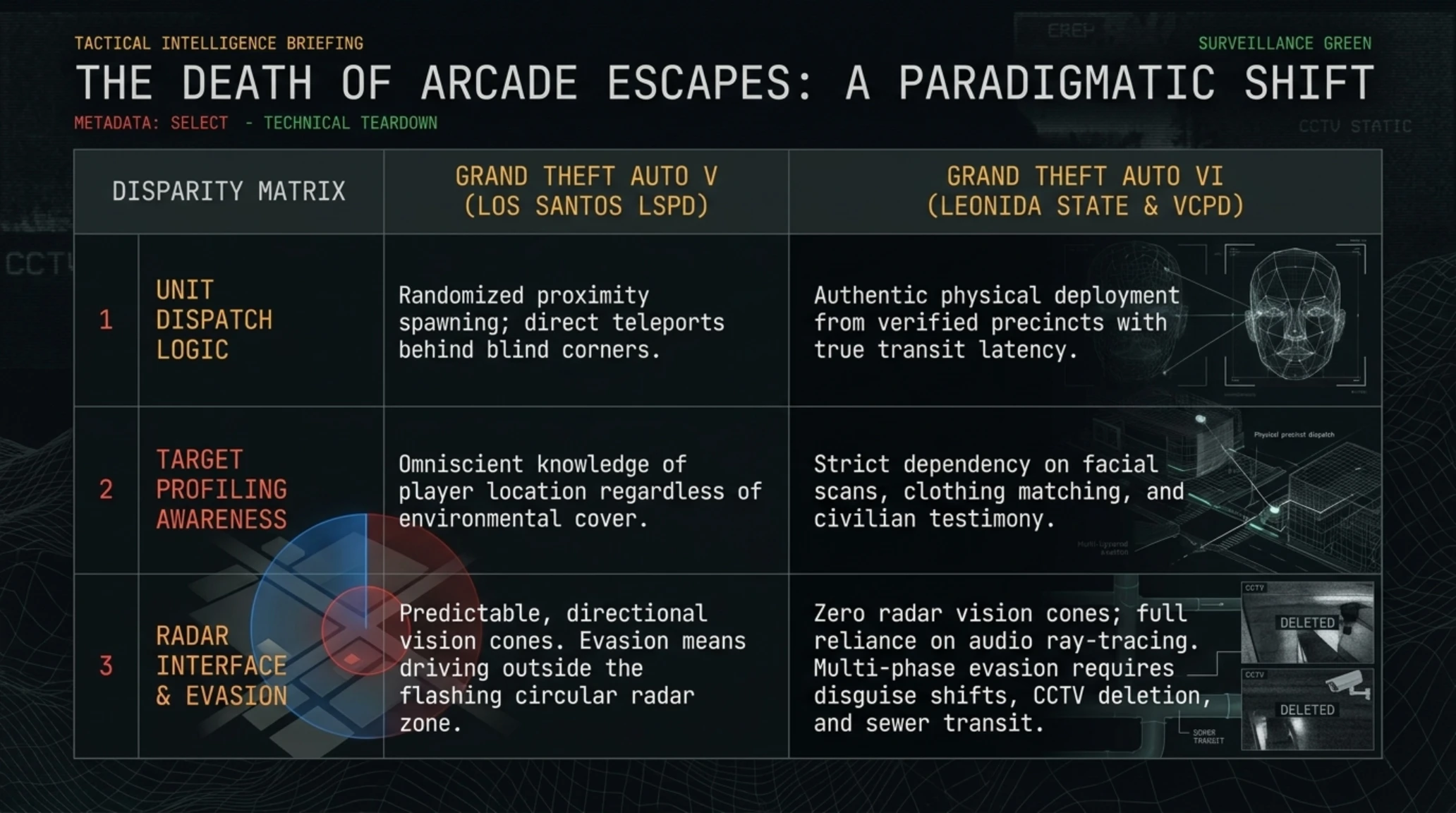
Technological Disparity: LSPD vs. Leonida State Police
| Systemic Attribute | GTA V (Los Santos LSPD) | GTA VI (Leonida State) |
|---|---|---|
| Dispatch Logic | Randomized proximity spawning/teleports | Authentic physical deployment with transit latency |
| Target Profiling | Omniscient knowledge regardless of cover | Strict dependency on facial scans & clothing |
| Radar Interface | Predictable, directional vision cones | Zero radar vision cones; reliance on audio |
| Evasion Tactics | Driving straight until outside the radar zone | Multi-phase: disguise shifts, CCTV deletion |
| Weapon Responses | Immediate lethal escalation for minor bumps | Graduated response: verbal commands, tasers |
Coordinated aerial surveillance combined with dynamic roadblocks empowers responding units to rapidly choke off viable escape corridors.
Advanced acoustic and thermal telemetry allows elite tactical units to pinpoint suspect coordinates through structural barriers, negating conventional indoor cover.
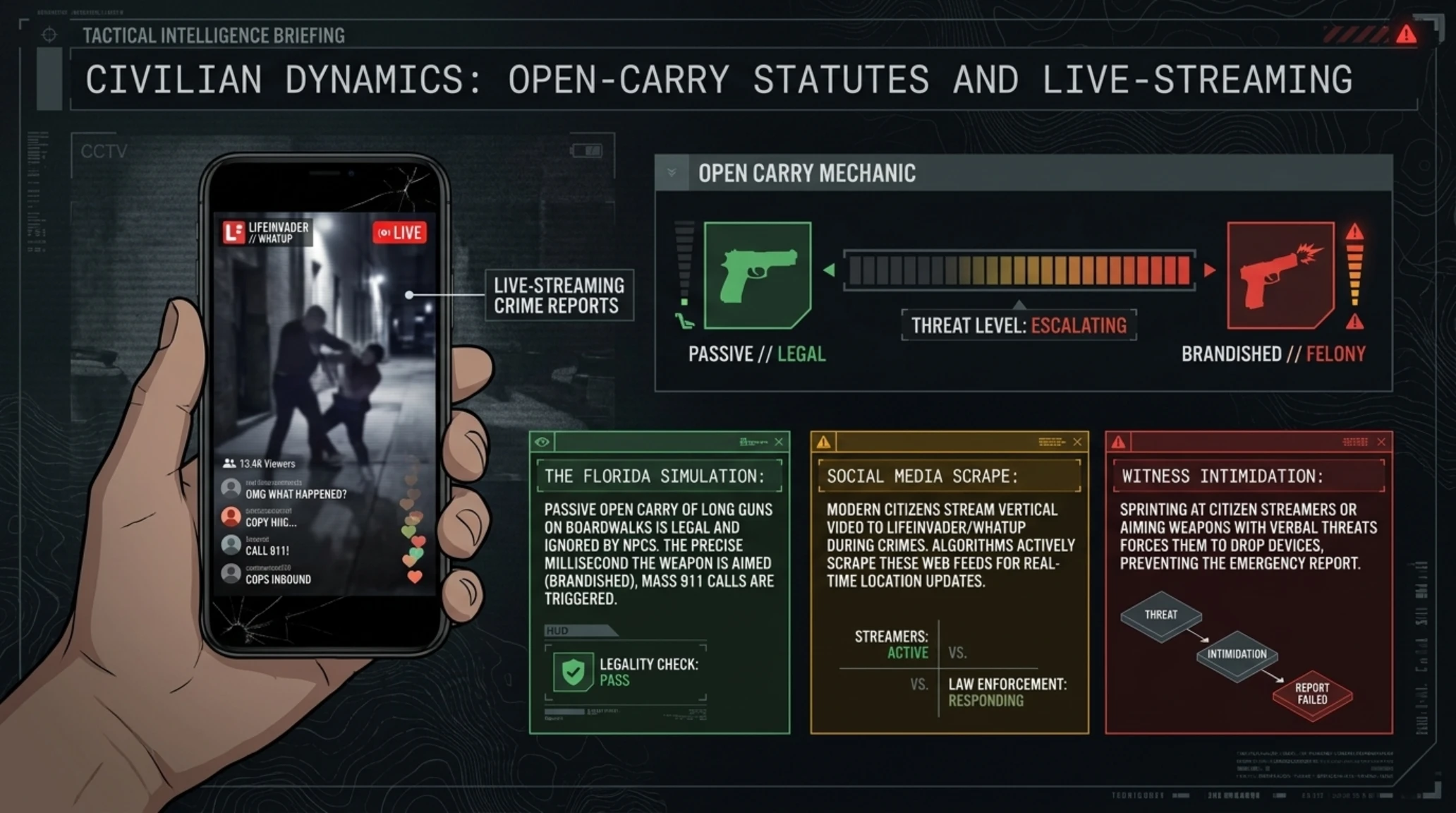
Disentangling internet hyperbole from verified mechanical simulation clarifies the unprecedented scope of Rockstar North’s architectural ambition.
Tekin Analysis: Next-Gen Adversarial Horizons
TekinGame Editorial Perspective: By eradicating artificial proximity teleports and anchoring law enforcement in physical precinct logistics, Rockstar has permanently shifted the goalposts for systemic adversary design in tenth-generation interactive entertainment.
Investigation Archives: Smart History Tags
Audience Engagement Metrics: Statistics Box
Over 100,000 net-new Netflix subscriptions recorded within the United States during the 26-minute gameplay broadcast, accompanied by a record 5% reactivation rate among dormant subscribers within a single six-hour exclusive window.
Why It Matters: The Evolution of Player Agency
The reconstruction of law enforcement dynamics in GTA 6 transforms systemic crime from arcade bullet-sponging into high-stakes procedural survival. Every discharged firearm, unmasked robbery, and careless highway getaway permanently dictates your judicial exposure across the entire State of Leonida.
Tactical Survival Protocols: Surviving the Leonida National Guard Siege
Given the sheer destructive capability of tracked armor, tactical drones, and high-altitude precision marksmen at a six-star rating, escaping alive in Grand Theft Auto VI is no longer an exercise in serendipity. Players orchestrating large-scale bank breaches, cartel compound raids, or high-value transit heists must establish contingency extraction plans well in advance. Empirical trials from developer builds demonstrate that attempting high-speed highway escapes along Interstate 97 is suicidal; Hunter attack helicopters deploy infrared-guided air-to-ground missiles that disable engine radiators and vaporize suspension assemblies within seconds.
Conversely, the most effective survival vector involves luring heavy tactical units into the treacherous mangrove swamps and winding tidal estuaries of the Grassrivers. Heavy law enforcement vehicles and armored personnel carriers suffer catastrophic mobility penalties in deep mire and soft silt, frequently throwing drive tracks and becoming hopelessly waterlogged. In stark contrast, agile airboats, lightweight jet skis, and amphibious ATVs allow players to navigate dense sawgrass channels with impunity. Native wildlife presents an organic defensive perimeter: aggressive alligators actively target wading SWAT infantry attempting foot pursuits. In urban environments, descending into multi-tier subterranean parking structures, abandoning flagged vehicles on basement levels, swapping into concealed civilian attire, and slipping into underground rapid-transit tunnels completely blind municipal dispatch radars.
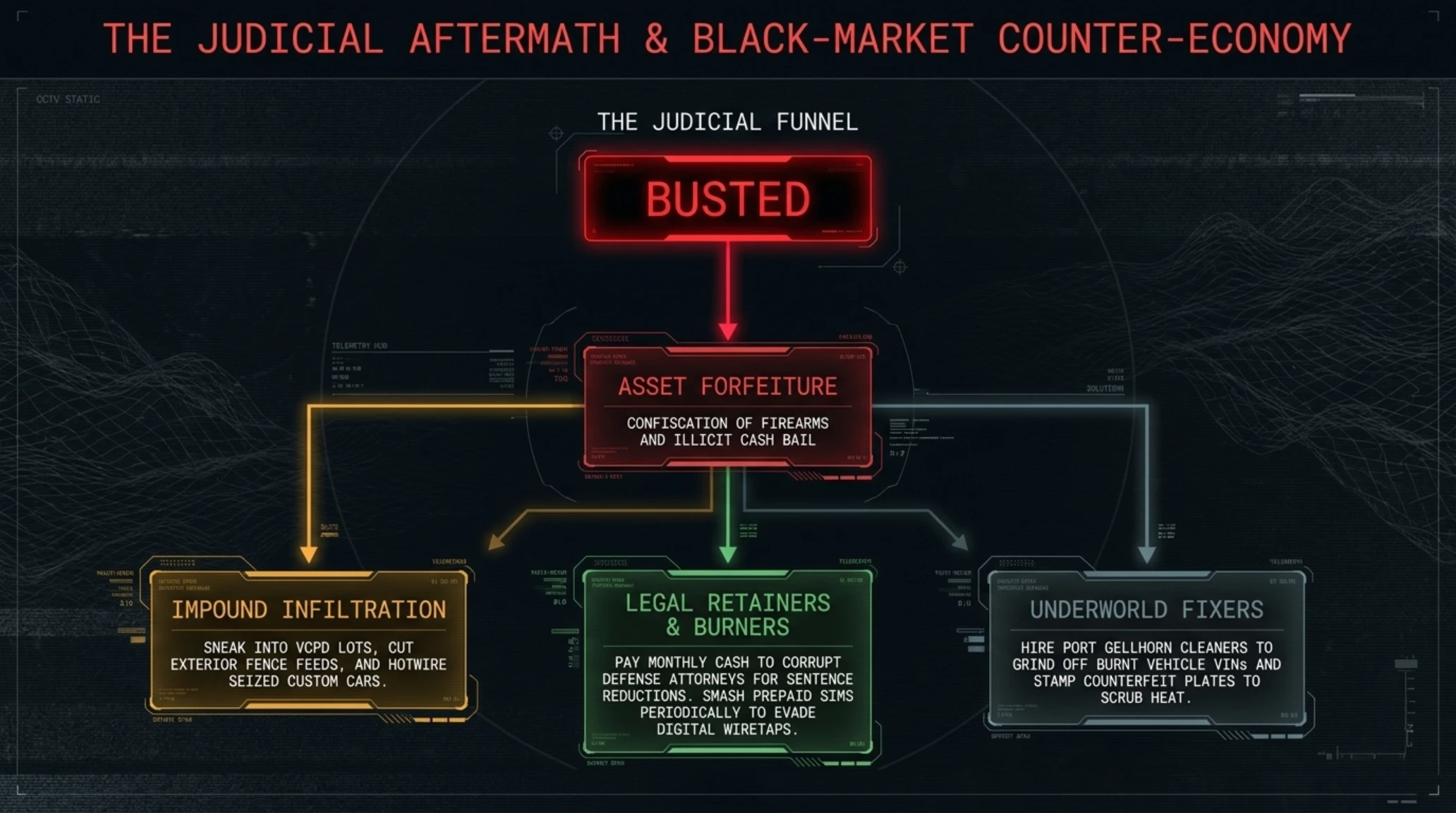
The Judicial Aftermath: Asset Forfeiture, Bail Bonds, and Impound Infiltration
Submitting to arrest (Busted) in GTA 6 is no longer trivialized through a brief black screen and a nominal hospital bribe. Rockstar has introduced an intricate judicial consequence framework that injects genuine role-playing gravity into apprehension. When arrested, law enforcement authorities confiscate all unregistered firearms, military-grade ordnance, and marked bundles of illicit narcotics. The apprehended protagonist is booked into the Leonida State Correctional Complex, necessitating substantial cash expenditures for bail bond releases arranged through private defense attorneys.
Crucially, personal customized vehicles impounded during arrests or abandoned at active crime scenes are cataloged into the heavily fortified VCPD Municipal Impound Facility. Players face two distinct paths to reclaim their prized machinery: pay exorbitant state administrative fines often running into tens of thousands of dollars, or organize a stealthy nighttime heist. Infiltrating the impound facility demands cutting exterior security fence feeds, subduing private security wardens, disabling perimeter alarms, and hot-wiring your vehicle to smash through the reinforced security gate before secondary pursuit units mobilize.
Furthermore, maintaining criminal defense representation introduces a persistent economic drain. High-tier defense attorneys require monthly cash retainers, but in return, they actively reduce mandatory prison sentencing times, file expedited motions for the return of seized commercial property, and negotiate reduced bail amounts following major felony arrests. For players operating multi-million-dollar contraband trafficking syndicates across the Caribbean trade routes, retaining elite legal counsel is as fundamental to survival as stocking heavy ammunition.
Additionally, state investigators can obtain judicial surveillance warrants authorizing digital wiretaps on standard in-game smartphones. Using personal cell phones following high-profile felonies allows police cyber-units to triangulate cellular tower pings, projecting real-time geographic search bubbles onto law enforcement terminals. To evade digital wiretaps, veteran players must transition to disposable prepaid burner phones, periodically smashing SIM cards and purchasing encrypted satellite transceivers from subterranean electronics smugglers in Little Haiti.
The Black-Market Counter-Economy: Fixers, Fraudulent VINs, and Clean Identity Papers
To establish long-term criminal empires without facing perpetual police harassment, players must interface with Leonida's underground legal counter-economy. Operating out of back-alley chop shops and shipping container yards across Port Gellhorn are specialized underworld figures known as "Cleaners" or "Fixers." When an exotic hypercar becomes irreparably burned in police databases due to fatal hit-and-runs or violent bank robberies, legitimate respray garages will refuse service. Underworld fixers can be hired to grind off original vehicle identification numbers (VINs), stamp fraudulent counterfeit plates, and inject false registration records into the State Department of Transportation database, successfully scrubbing vehicle heat forever.
Furthermore, when cumulative outstanding bounties make public movement untenable, corrupt district court liaisons and compromised municipal clerks can be bribed with substantial illicit payoffs routed through untraceable offshore cryptocurrency escrow accounts. These backroom transactions expunge felony indictments, scrub active warrants from police terminal databases, and grant protagonists clean civic identities allowing you to once again walk the sun-kissed beaches of Vice City as an unflagged, ordinary civilian.
The Mercenary Threat: Private Bounty Hunters and the Legacy of Red Dead Redemption
One of the most audacious mechanical transfers from Red Dead Redemption 2 to the modern landscape of Leonida is the evolution of the dynamic Bounty Hunter system. When players accumulate substantial outstanding state bounties or flee bail agreements, judicial authorities contract licensed private military corporations and ruthless freelance bail enforcement agents. These bounty hunters operate beyond traditional police procedural constraints: they do not drive marked cruisers or announce their presence with blaring sirens.
Instead, mercenary strike teams stalk players in civilian SUVs, setting up vehicular ambushes outside remote motels, isolated fuel stations, or coastal marinas. They utilize high-caliber sniper rifles from distant tree lines and deploy tracking drones to monitor your routines. This ambient threat ensures that even after extinguishing active police stars, players must remain perpetually vigilant, as private mercenaries remain driven by lucrative dead-or-alive state bounties.
As documented in our exhaustive coverage of major industry milestones such as the investigative dissection of Marvel’s Wolverine narrative leaks, top-tier interactive entertainment is experiencing an era of unprecedented technical fidelity. Rockstar North’s fusion of dynamic biometrics, procedural acoustics, and institutional simulation cements GTA 6 as the crowning achievement in open-world system architecture.
- Terrifying return of the 6-Star wanted rating with combined-arms military tactical doctrine
- Complete elimination of gamey radar vision cones in favor of organic spatial acoustics
- Forensic criminal tracking incorporating real-time CCTV records, facial geometry, and wardrobes
- Elimination of immersion-breaking cruiser teleports in favor of genuine precinct deployment
- Substantially elevated difficulty curve that may alienate traditional arcade players
- Mandatory operational downtime requiring frequent clothing alterations between heists
- Harsh judicial penalties involving asset forfeiture and prolonged vehicle impounds
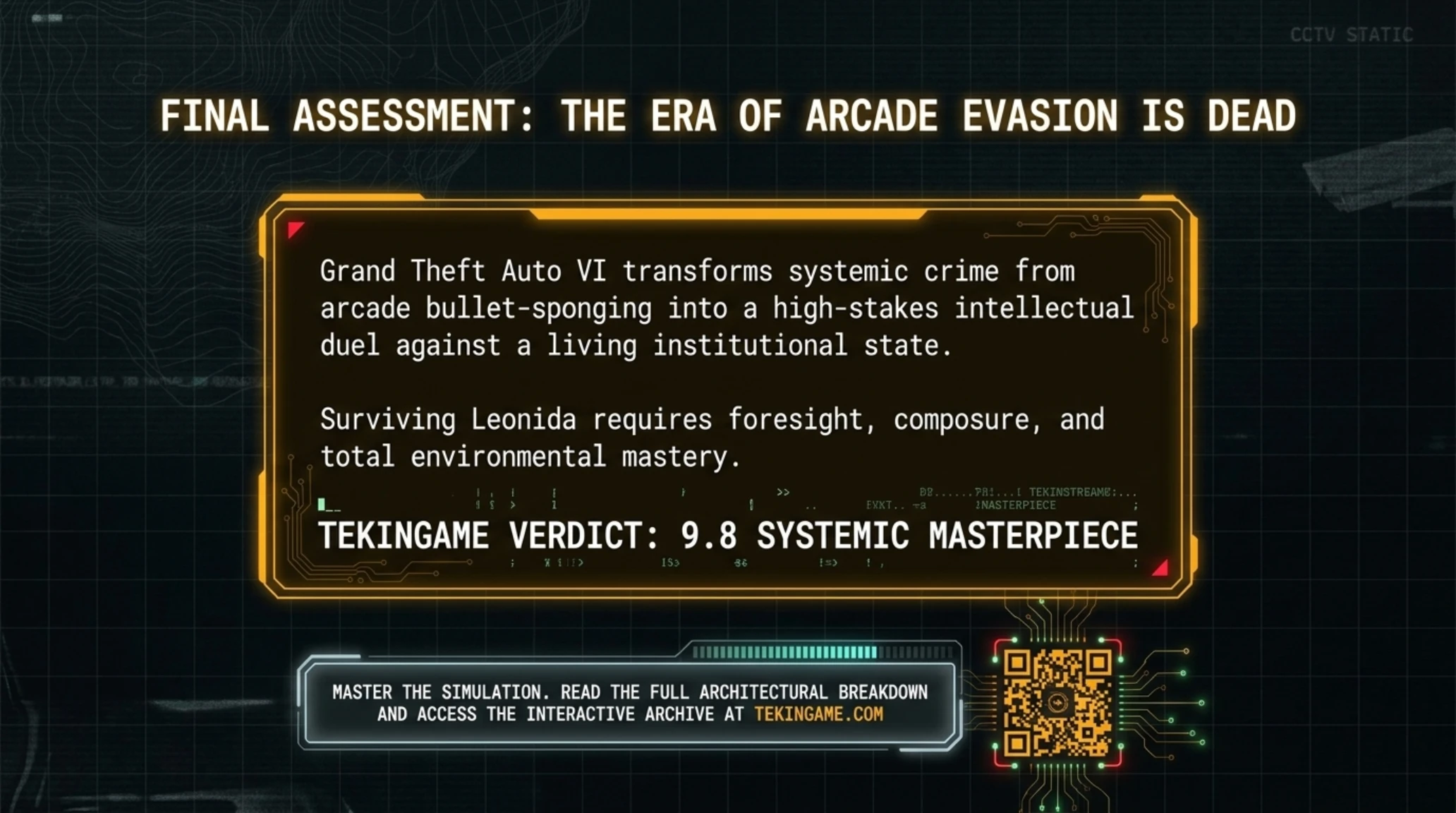
Final Assessment: A New Benchmark for Emergent Adversarial Design
The total reconstitution of the Wanted and police response systems in Grand Theft Auto VI is not merely an incremental sequel enhancement; it is a profound philosophical declaration by Rockstar North. By demanding that players treat law enforcement with forensic respect, tactical preparation, and environmental awareness, the studio has redefined the very nature of interactive open-world crime. Surviving in the neon crucible of Leonida is no longer about pressing the accelerator down a straight highway it is an exhilarating, high-stakes intellectual duel against a living, breathing institutional state.
Taking into account these multifaceted judicial, biometric, and environmental variables, enthusiasts have raised several fundamental inquiries regarding operational survival.
FAQ: GTA 6 Law Enforcement and Wanted Dynamics
Is the legendary 6-star wanted level officially confirmed for GTA 6?
Yes. Gated behind catastrophic federal-tier felonies, the Leonida National Guard will deploy Rhino tanks and Hunter attack helicopters.
How can players eliminate the CCTV tracking glyph?
Players must physically locate and destroy the store's digital video recorder (DVR) rack using gunfire, or preemptively obscure their faces before entering.
Why were directional vision cones removed from the minimap?
To cure 'Minimap Tunnel Vision.' Players must now use Focus Mode, leveraging ray-traced acoustic spatialization to locate approaching sirens instead of staring at UI graphics.
Do police cruisers still teleport directly behind the player?
No. The RAGE 9 engine requires all patrol units to physically dispatch from verified precincts, introducing genuine physical transit delays through city traffic.
How does swapping outfits inside vehicle trunks affect active pursuits?
Since police use 'Apparel Fingerprinting' to track your exact clothing, accessing your vehicle's trunk to change into a muted ensemble instantly extinguishes the apparel forensic glyph.
Investigation References
Additional Gallery: 🧠 Tekin Analysis | GTA 6 Police AI: 6-Star Army, Facial Tracking & No Safehouses