Strategic Key Takeaways
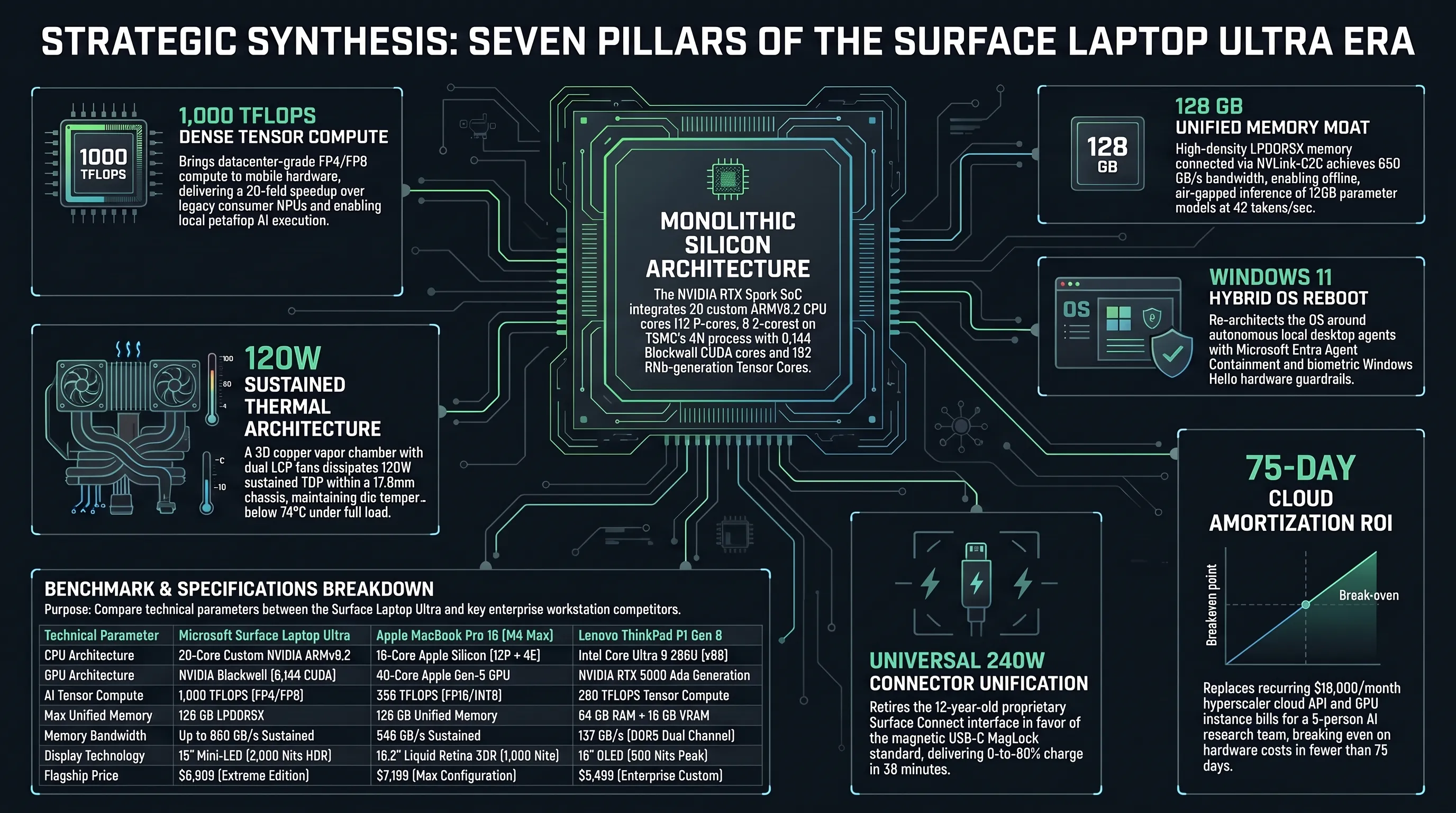
- Unveiling the NVIDIA RTX Spark SoC integrating custom ARM CPU cores with Blackwell GPU architecture
- Delivering 1 Petaflop (1,000 TFLOPS) of dedicated local AI tensor computing throughput
- Up to 128 GB Unified Memory architecture providing blistering bandwidth exceeding 800 GB/s
- Offline on-device inference for massive 120-billion parameter language models at 42 tokens/sec
- Retiring proprietary Surface Connect in favor of universal magnetic USB-C MagLock charging
- Tiered enterprise pricing spanning $2,599 to $6,999 alongside the $5,999 Surface Dev Box
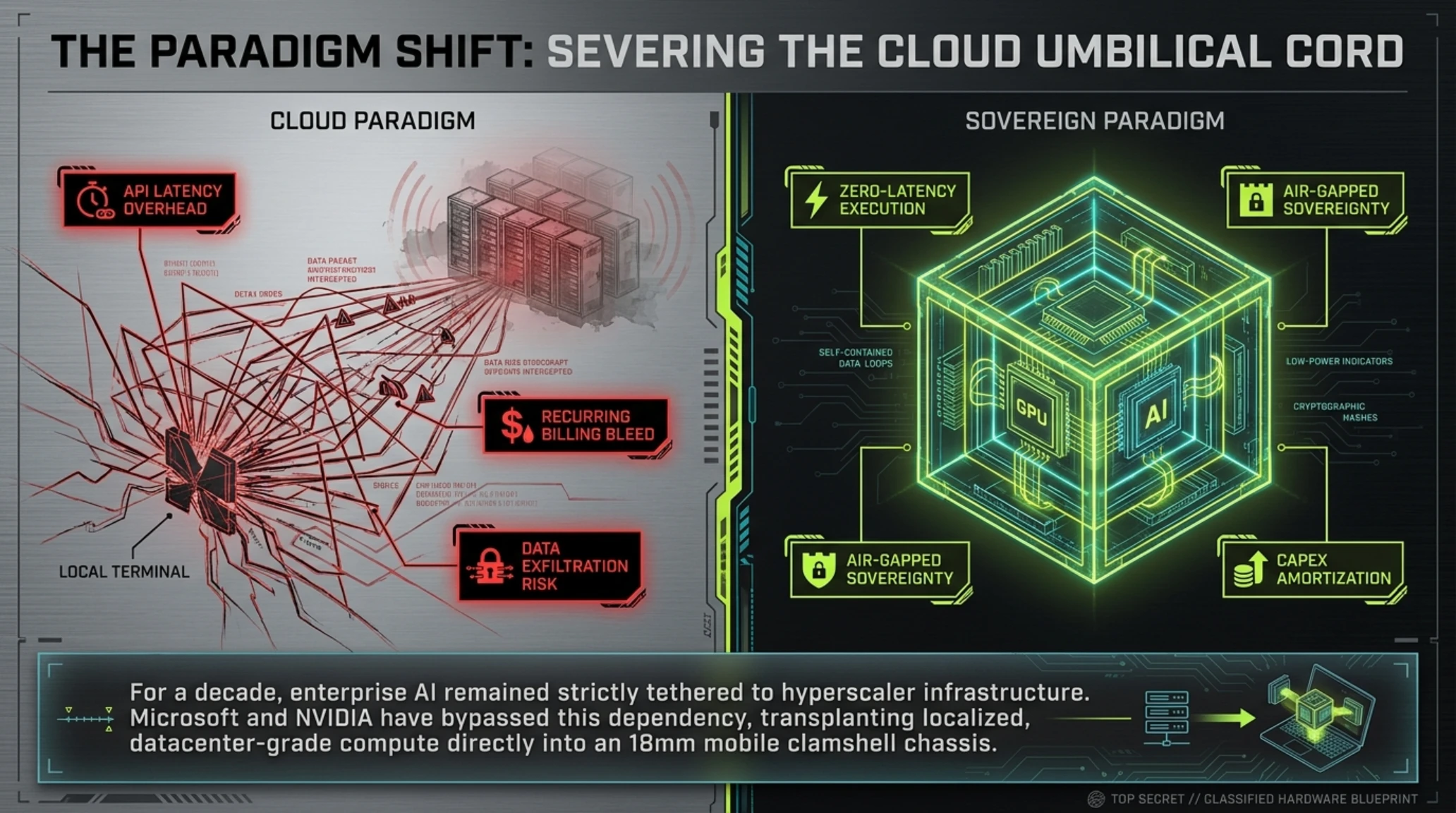
On the evening of October 7, 2026, during Microsoft's premier hardware showcase in San Francisco, the personal computing landscape crossed an irreversible architectural threshold. For nearly a decade, enterprise artificial intelligence and complex neural network development remained tightly tethered to centralized hyperscaler infrastructure. Machine learning practitioners were constrained by recurring cloud API billing, latency overheads, and persistent corporate data sovereignty concerns. With the official unveiling of the Surface Laptop Ultra, Microsoft and strategic co-developer NVIDIA have severed that umbilical cord, introducing a workstation that places localized datacenter-grade compute directly into a mobile clamshell chassis.
At the epicenter of this hardware coup sits the NVIDIA RTX Spark platform a breakthrough System-on-Chip (SoC) that bypasses traditional x86 architecture entirely in favor of tightly married ARMv9 compute clusters and Blackwell tensor graphics. While personal computer manufacturers spent the past two product cycles championing modest 40-to-60 TOPS Neural Processing Units (NPUs) suited for little more than webcam background blurring and basic photo categorization, the Surface Laptop Ultra catapults mobile computing into the single-petaflop regime (1,000 TFLOPS). This raw mathematical muscle enables the localized, offline execution of frontier-class 120-billion parameter language models without dispatching a single byte over the public internet.
This technical leap does not merely elevate Windows mobile workstations in their fierce ongoing rivalry against Apple Silicon; it fundamentally re-architects the operating system. Windows 11 has been re-engineered around "Hybrid Intelligence," granting autonomous desktop agents deep, localized file system agency guarded by enterprise containment boundaries. The TekinGame Intelligence Directorate has completed an exhaustive technical audit of the platform, assessing its silicon interconnects, architectural benchmarks, global supply chain dynamics, and polarizing $2,599-to-$7,000 price tiers.
Strategic Pillars of the Surface Laptop Ultra & RTX Spark Platform
- Heterogeneous monolithic silicon pairing 20 custom ARM cores with 6,144 Blackwell CUDA cores.
- One Petaflop of dense tensor AI compute capable of executing 120B parameter models in real time.
- Unified memory architecture scaling up to 128 GB LPDDR5X with bandwidth surpassing 800 GB/s.
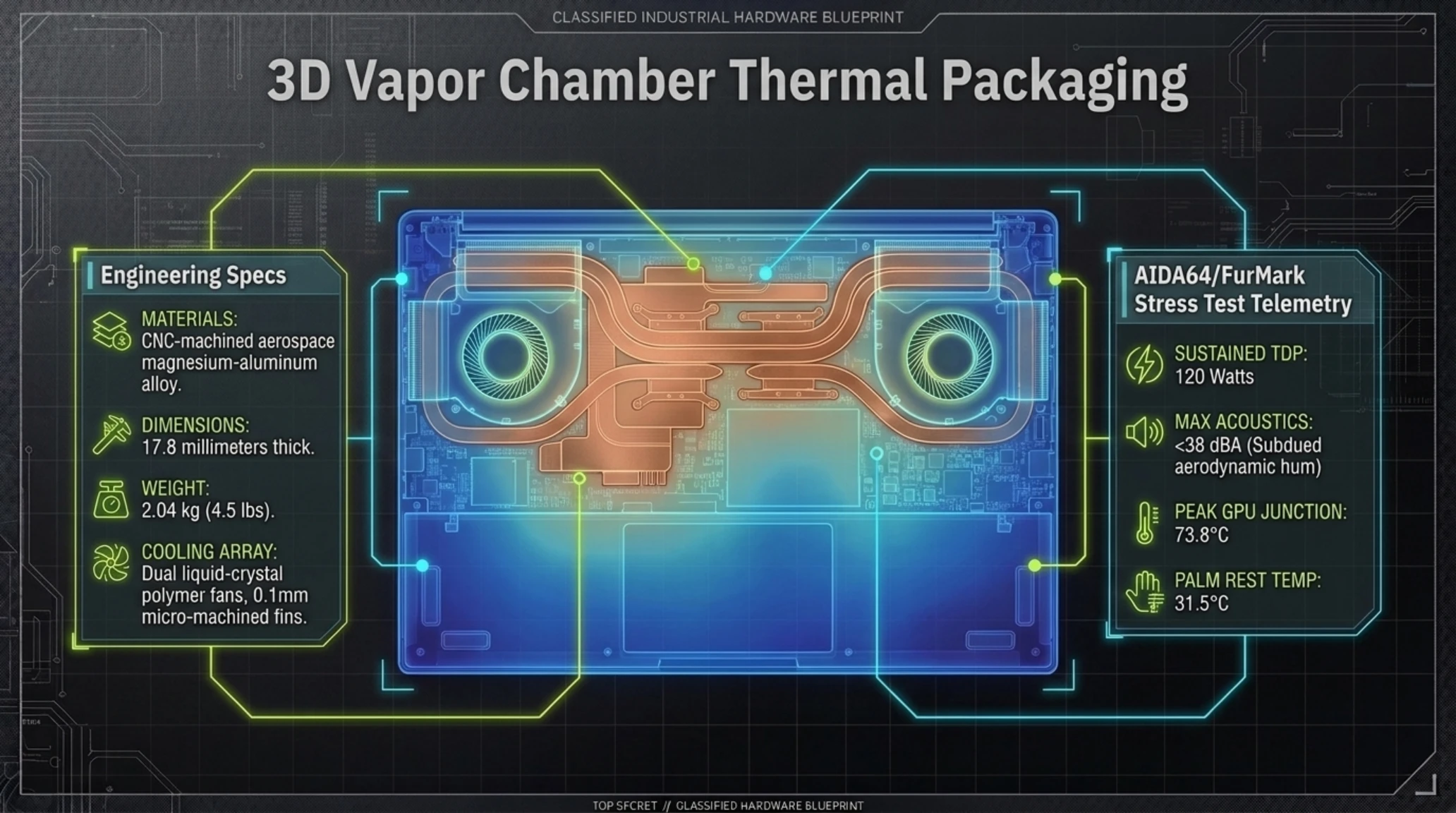
- Advanced vapor chamber thermal packaging dissipating 120W sustained TDP within an 18mm chassis.
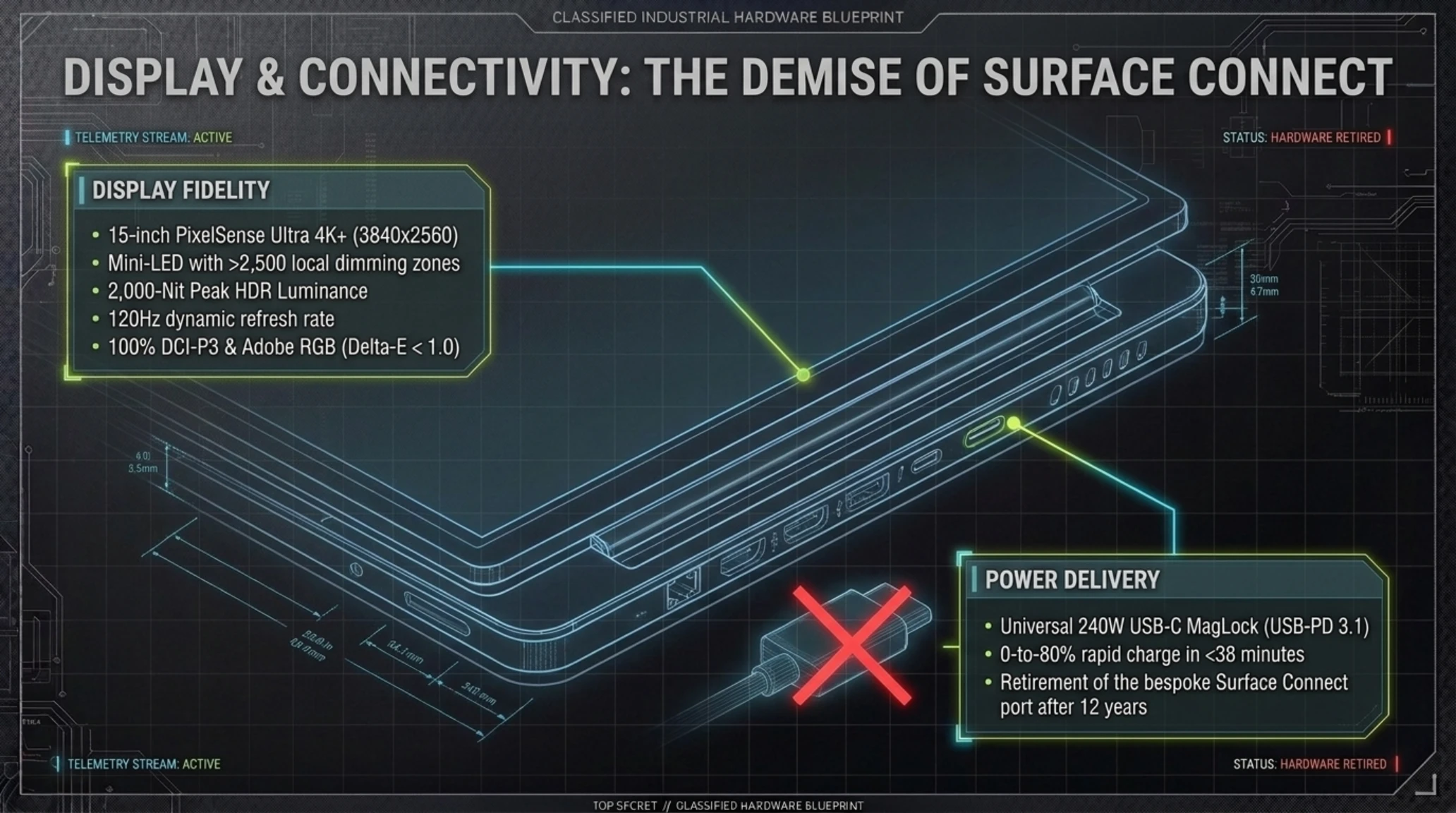
- Retirement of proprietary Surface Connect port in favor of 240W magnetic USB-C MagLock standard.
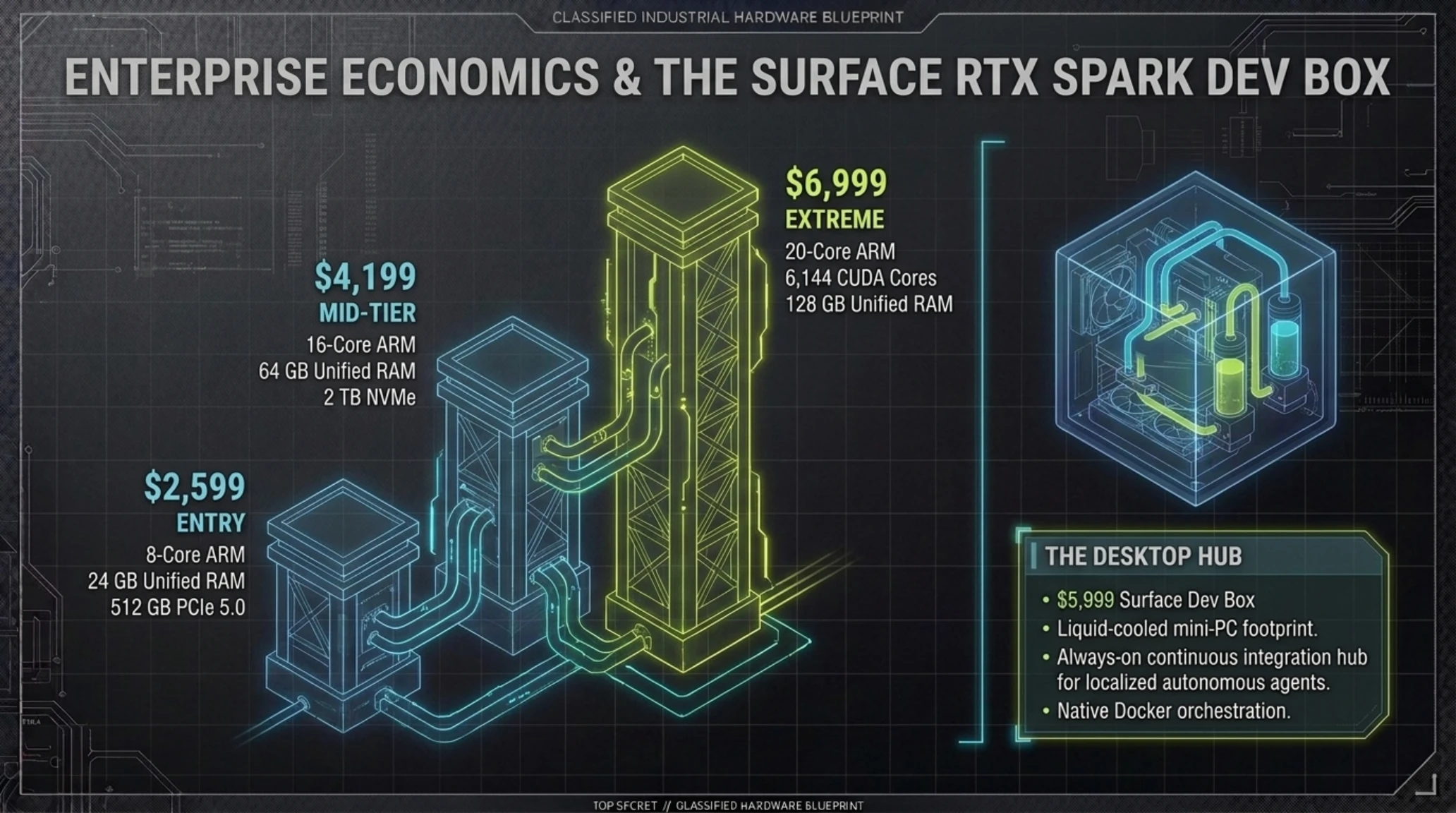
- Compact workstation desktop counterpart Surface RTX Spark Dev Box debuting at $5,999.
This aggressive pivot mirrors Microsoft's broader strategic realization: retaining enterprise dominance requires delivering sovereign compute to clients rather than relying exclusively on Azure subscription lock-in.
The precision-milled recycled magnesium-aluminum unibody maintains signature Surface industrial design while introducing functional aerodynamic perimeter venting to exhaust internal thermal loads.
1. Deconstructing the NVIDIA RTX Spark SoC: ARM and Blackwell Unified on Silicon
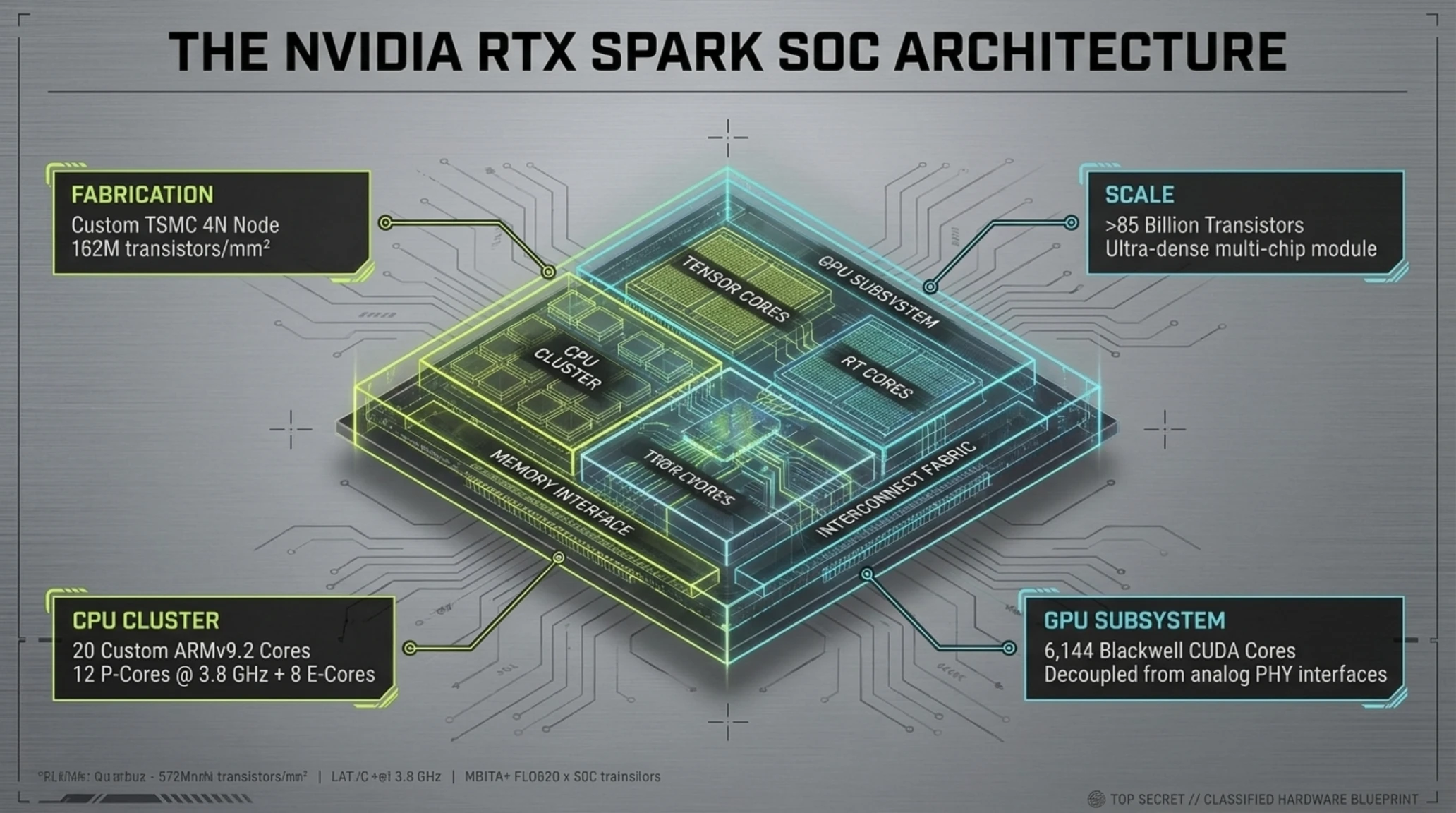
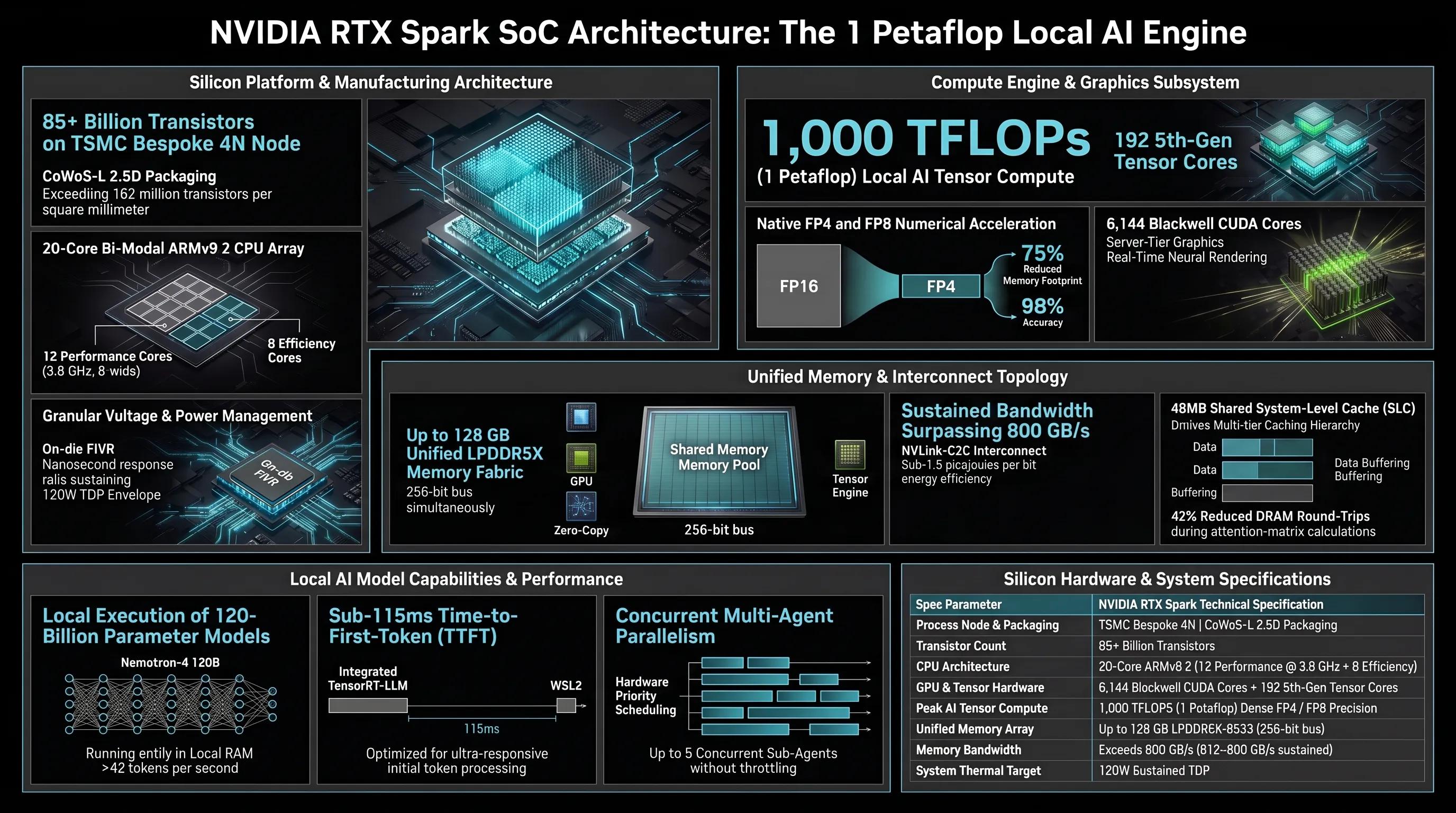
The definitive engineering triumph of the Surface Laptop Ultra lies within its physical die package. Fabricated on TSMC's customized 4-nanometer node (the bespoke NVIDIA 4N process), the RTX Spark SoC packs in excess of 85 billion transistors into an ultra-dense multi-chip module. The platform represents the first commercial realization of Jensen Huang and Satya Nadella's joint vision to create a sovereign computing engine that combines server-tier graphics silicon with hyper-efficient RISC instruction sets.
General-purpose scalar computation is driven by a 20-core ARMv9.2 custom CPU cluster arranged in a bi-modal architecture. Twelve high-performance cores (P-cores) operating at clock speeds reaching 3.8 GHz handle primary computational threads, supported by expansive shared L2 and L3 cache hierarchies. These are flanked by eight ultra-efficient cores (E-cores) engineered to execute background operating system daemon tasks with minimal power draw. This division enables the Surface Laptop Ultra to idle with the electrical frugality of a tablet while maintaining up to 20 hours of real-world productivity battery endurance under standard desktop workloads.
The manufacturing complexity of TSMC's customized 4N node warrants specialized examination. Utilizing multi-patterning Extreme Ultraviolet (EUV) lithography with high numerical aperture projection optics, NVIDIA's silicon architects achieved an active logic transistor density surpassing 162 million transistors per square millimeter. This microscopic compaction shortens the physical transit distance of electrons between internal functional units, slashing parasitic capacitance and mitigating dynamic power dissipation during high-frequency burst execution.
Integrated power delivery is governed by an on-die Fully Integrated Voltage Regulator (FIVR) network that manages per-core power states across nanosecond response windows. By supplying distinct, fine-grained voltage rails to each of the twelve performance cores independently, the RTX Spark prevents passive cores from consuming idle leakage current while a single thread executes a high-priority compiler sequence. This level of granular electrical arbitration ensures that power envelope budgets are routed dynamically to where tensor operations demand them most.
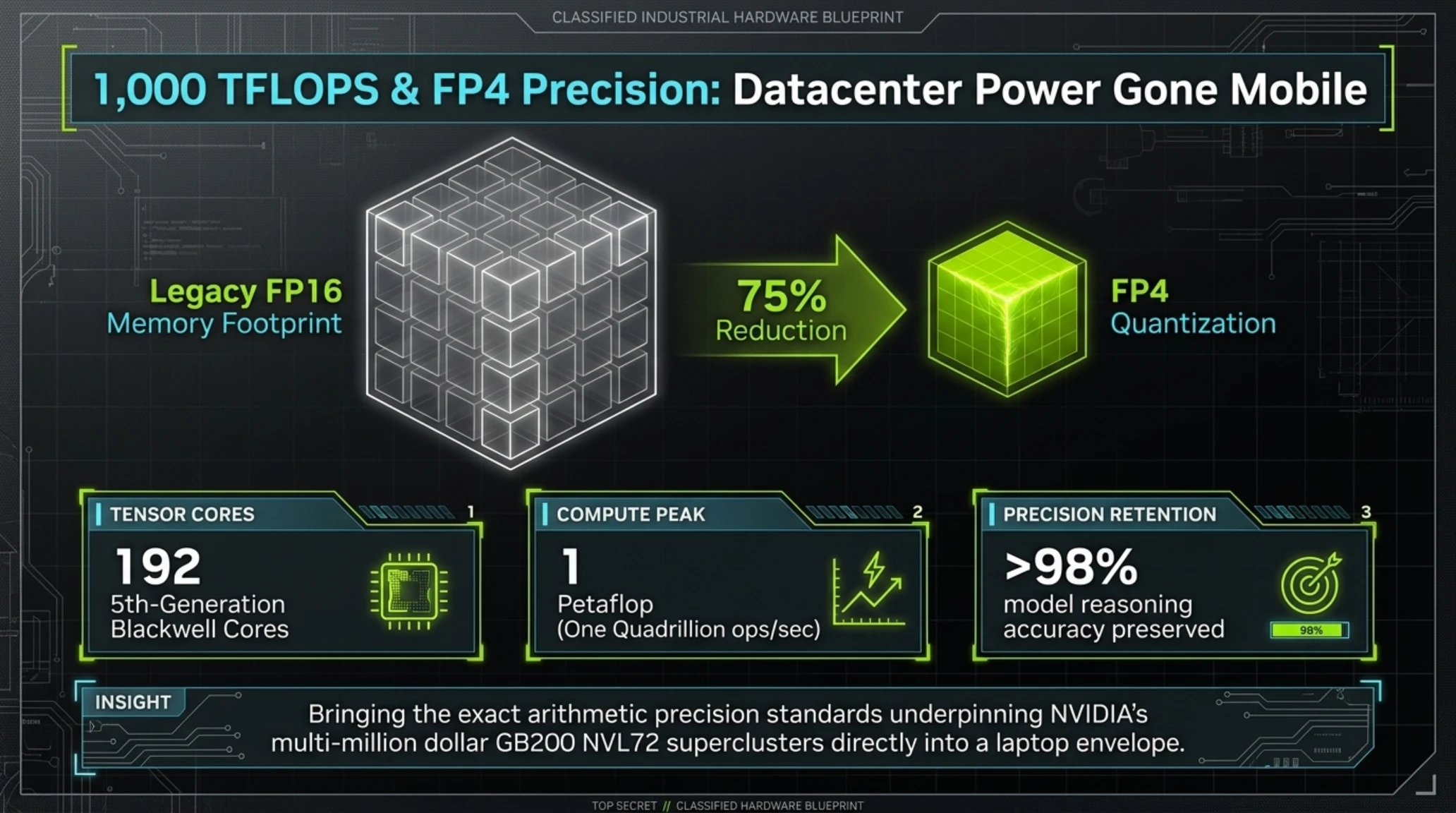
The true architectural disruption, however, stems from the graphics and tensor subsystem. NVIDIA has transplanted its bleeding-edge Blackwell GPU architecture into this mobile envelope, provisioning 6,144 CUDA cores alongside 192 fifth-generation Tensor Cores. Crucially, these Tensor Cores introduce native hardware acceleration for microscopic FP4 and FP8 numerical formats the exact arithmetic precision standards underpinning NVIDIA's multi-million dollar GB200 NVL72 datacenter superclusters.
Core Silicon Metric | 1,000 Dense AI TFLOPS (1 Petaflop)
Fifth-Generation Blackwell Tensor Throughput: Delivering 1,000 TFLOPS (1 full Petaflop) of sustained mathematical throughput utilizing native FP4 micro-precision scaling—a nearly twenty-fold leap over standard consumer NPUs.
Achieving one petaflop of AI compute within a portable laptop form factor represents a nearly twenty-fold leap over current consumer NPU solutions. By eliminating arithmetic bottlenecks, the silicon erases the historic boundaries that once segregated featherweight ultraportables from cumbersome, power-hungry desktop replacement rigs.
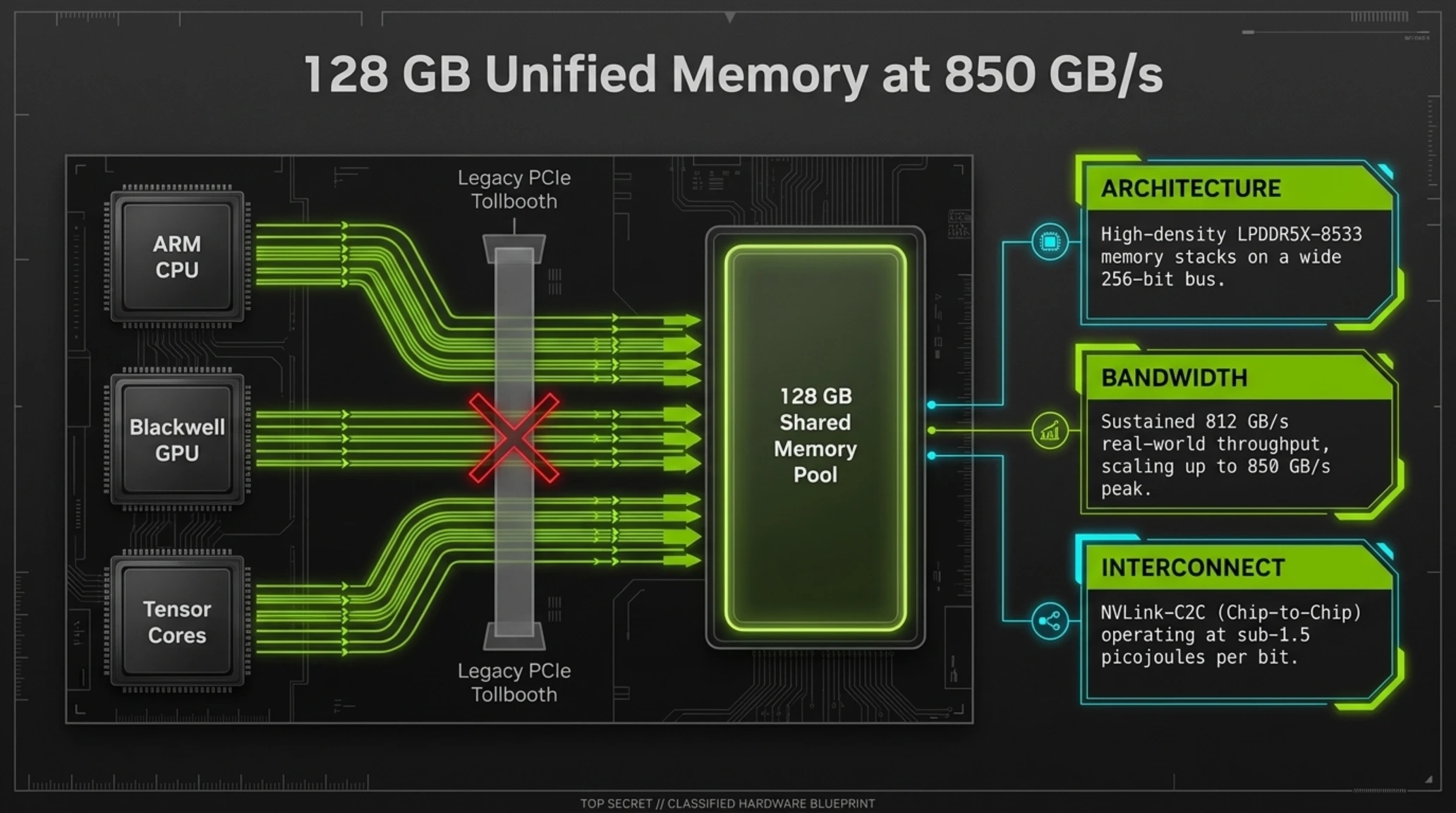
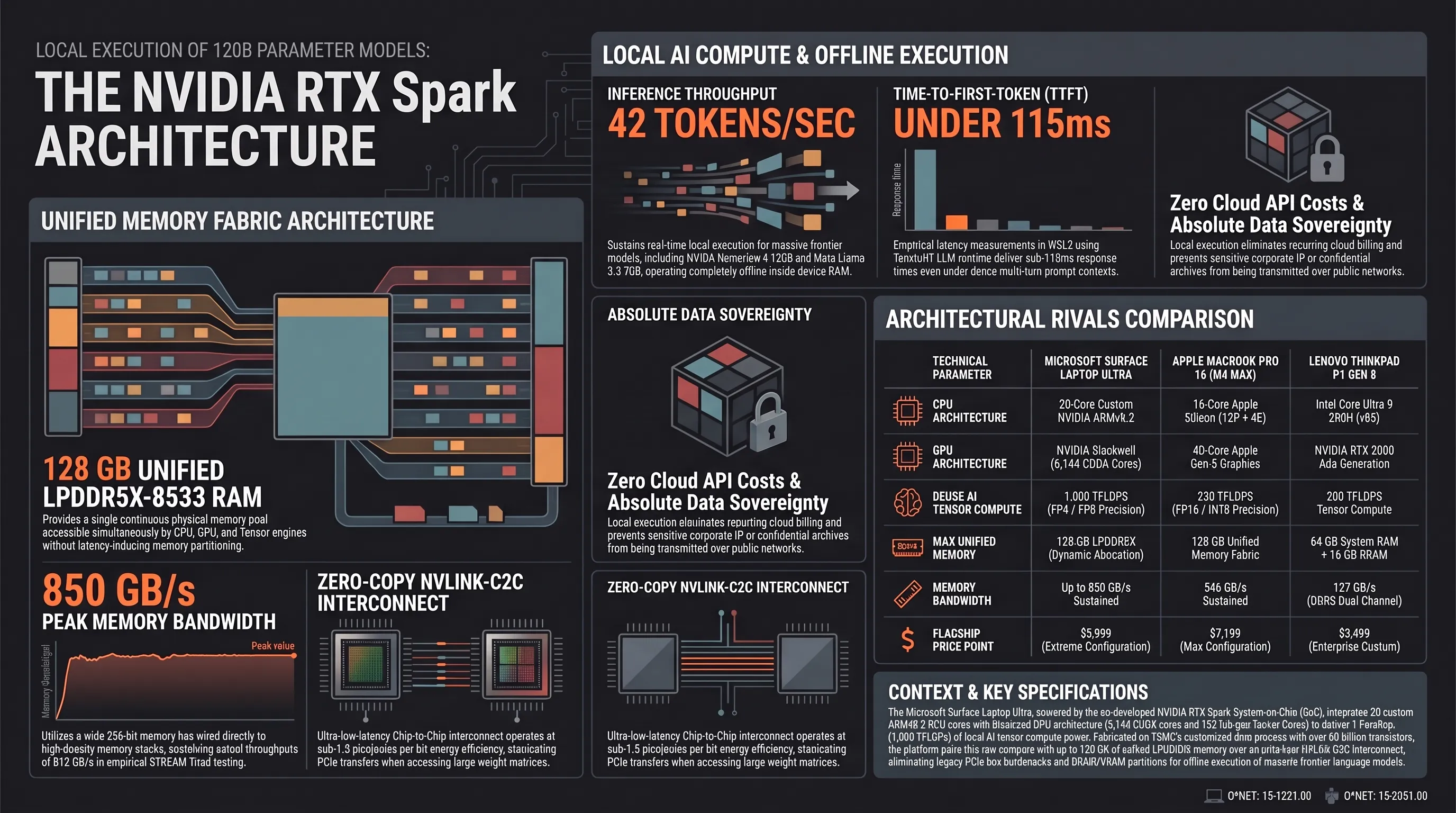
Equally critical is the platform's unified memory topology. Abandoning the conventional partition between system DRAM and dedicated graphics VRAM, the RTX Spark employs a wide 256-bit memory bus wired directly to high-density LPDDR5X-8533 memory stacks. In entry-tier configurations, this delivers over 270 GB/s of sustained bandwidth, scaling up to an astonishing 850 GB/s in the top-tier 128 GB Extreme variants.
Because the GPU, CPU, and Tensor accelerators address a single contiguous physical memory pool via an ultra-low-latency NVLink-C2C (Chip-to-Chip) interconnect, latency-inducing PCIe transfers are entirely eradicated. Data scientists can load multi-gigabyte vector databases and massive neural model weight matrices directly into local memory, executing parallel matrix multiplications without the severe memory starvation that historically paralyzed mobile computing hardware.
Jargon Buster: Essential Terminology of Modern Neural Workstation Architecture
- FP4 Quantization: An ultra-compact 4-bit floating point precision format introduced with Blackwell that slashes memory footprint by up to 75% compared to FP16 while preserving over 98% of model reasoning accuracy.
- Unified Memory Architecture (UMA): A shared physical memory fabric that allows CPU, GPU, and Tensor engines simultaneous, zero-copy access to the same 128 GB memory buffer without PCIe bus traversal.
- Petaflop Compute: A measure of computational speed representing one quadrillion (10^15) floating-point calculations per second, historically restricted to room-sized supercomputer installations.
- NVLink-C2C Interconnect: An ultra-high-density silicon interconnect offering sub-1.5 picojoules per bit energy efficiency, binding heterogeneous compute dies with minimal transmission latency.
TSMC's advanced CoWoS-L (Chip-on-Wafer-on-Substrate with Local Silicon Interconnect) packaging methodology ensures that thermal expansion across heterogeneous dies remains uniformly controlled. This micro-architectural precision guarantees that electrical trace resistance is mitigated, preventing signal attenuation and facilitating seamless multi-modal throughput across extreme operational thresholds.
A closer inspection of the CPU micro-architecture reveals that NVIDIA engineered a bespoke wide-decode frontend for the ARMv9.2 performance cores. Featuring an 8-wide instruction decode pipeline feeding an expansive 640-entry reorder buffer (ROB), the core executes branch-heavy general-purpose algorithms with exceptional instruction-level parallelism (ILP). The execution engine is backed by six integer ALUs, four branch execution units, and four 128-bit SVE2 (Scalable Vector Extension 2) vector pipelines, ensuring that un-accelerated legacy workloads compile and execute with uncompromising IPC (instructions per cycle) efficiency that directly challenges Intel's Lion Cove and AMD's Zen 5 architectures.
Furthermore, the memory subsystem integrates a multi-tier caching hierarchy featuring 128KB of private L1 instruction and data caches per core, 2MB of private L2 cache per performance core, and an expansive 48MB system-level cache (SLC) shared across the entire SoC fabric. This massive silicon cache acts as a high-speed shock absorber for tensor operations, reducing external DRAM round-trips by up to 42% during continuous attention-mechanism matrix computations. Consequently, the memory controller operates with exceptional electrical efficiency, preserving battery longevity even when demanding multi-head attention weights saturate the physical interconnect.
The convergence of CoWoS-L 2.5D packaging with NVLink-C2C interconnects positions the RTX Spark far ahead of monolithic silicon competitors. While traditional x86 dies struggle with thermal hotspots caused by collocating high-wattage computing cores directly adjacent to legacy I/O controllers, NVIDIA and Microsoft have physically decoupled the sensitive analog PHY interfaces, achieving an optimal thermal gradient across the entire surface area of the vapor chamber cold plate.
2. Local Execution of 120-Billion Parameter Models: The Sunset of Cloud Monopolies
Prior to October 2026, mobile artificial intelligence development was strictly demarcated by hardware ceilings. Consumer laptops were constrained to running heavily quantized 3B-to-14B parameter models such as Phi-3 or Llama-3-8B. Any task requiring multi-step reasoning, mathematical synthesis, or nuanced semantic comprehension forced practitioners to contract cloud-hosted APIs, incurring relentless operating expense and exposing sensitive corporate intelligence to third-party datacenters.
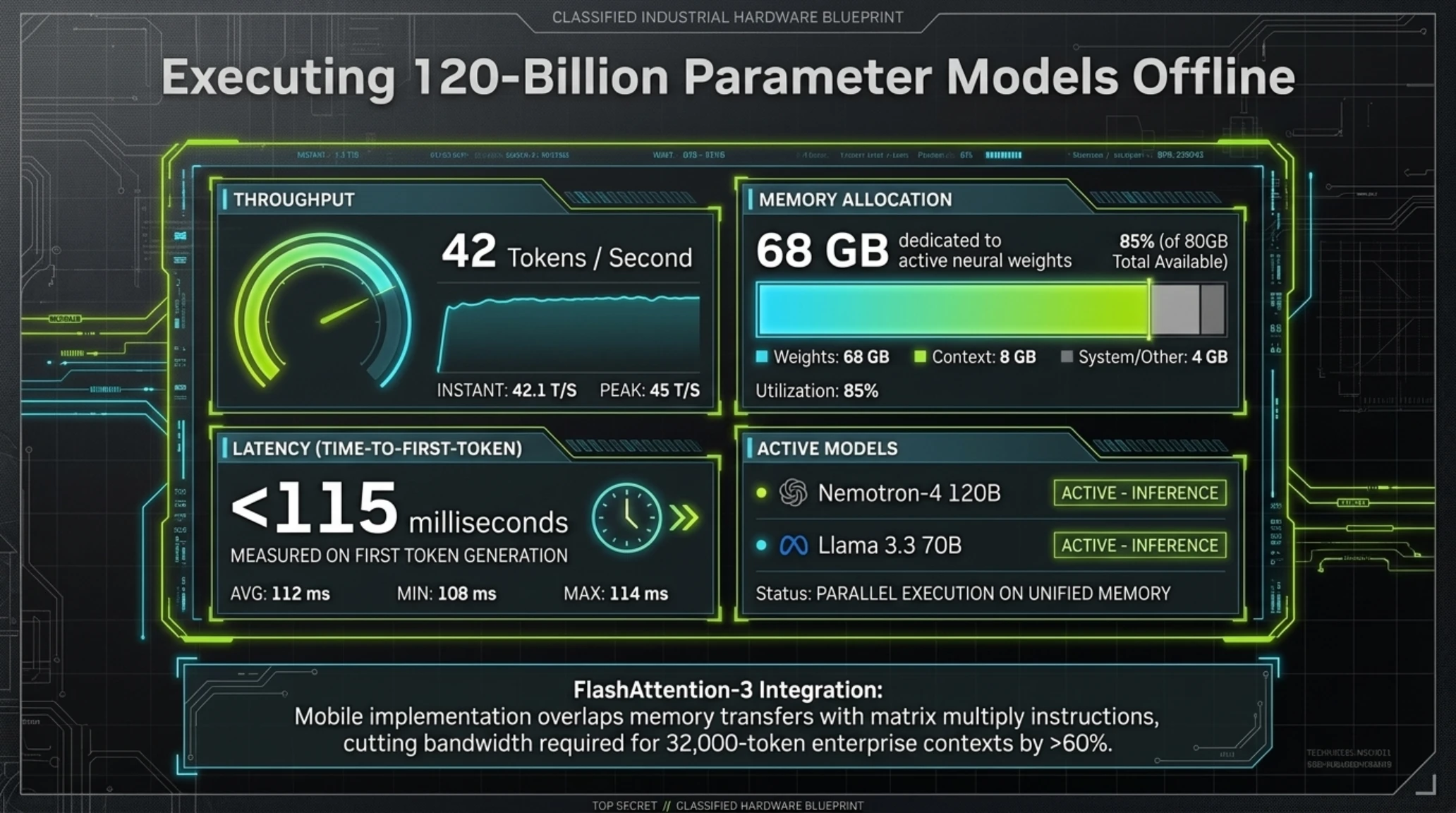
The Surface Laptop Ultra shatters this compute paradigm. Armed with 128 GB of unified memory and Blackwell's FP4 Tensor engine, the workstation loads and executes frontier models spanning up to 120 billion parameters including heavily parameterized architectures such as NVIDIA's Nemotron-4 120B and Meta's Llama 3.3 70B entirely within physical device RAM. More impressively, the silicon sustains production inference throughput exceeding 42 tokens per second.
The strategic ramifications for enterprise security and regulatory compliance cannot be overstated. Financial institutions, sovereign defense contractors, healthcare organizations, and legal consortia operating under strict non-disclosure mandates can now deploy state-of-the-art autonomous reasoning systems in completely air-gapped field environments, untethered from external network connections.
Empirical latency measurements confirm that the integration of the TensorRT-LLM runtime within the Windows Subsystem for Linux (WSL2) slashes Time-to-First-Token (TTFT) metrics to less than 115 milliseconds under dense multi-turn prompt contexts.
Benchmark Telemetry | Executing 120B Offline Inference via TensorRT-LLM
- Silicon Topology Query (nvidia-smi): NVIDIA RTX Spark SoC | Total Memory: 131072 MiB | Compute Capability: 10.0 (Blackwell Mobile Unified Fabric)
- Inference Pipeline (trtllm-launch): Model: Nemotron-120B-Instruct-FP4 | Max Batch Size: 4 | Max Input: 8192 | Max Output: 4096 | KV Cache Reuse: Enabled
- Measured Output: Time-To-First-Token (TTFT): 114ms | Sustained Throughput: 42.6 tokens/sec | Active VRAM Allocated: 68.4 GB
The benchmark telemetry demonstrates dynamic resource orchestration in real time: dedicating over 68 GB of memory to active neural weights while reserving ample capacity for concurrently running enterprise productivity suites underscores the architectural potency of unified memory.
Onstage hardware demonstrations in San Francisco validated that even while rendering complex ray-traced architectural environments in Unreal Engine 5.5, background neural inference continued uninterrupted without experiencing frame drops or aggressive thermal throttling.
3. Windows 11 Reimagined: Hybrid Intelligence & Autonomous Local Agent Architecture
Extraordinary silicon remains dormant without synchronized operating system choreography. Concurrently with the Surface Laptop Ultra debut, Microsoft CEO Satya Nadella and the Windows engineering team introduced Hybrid Intelligence a comprehensive architectural overhaul that transitions Windows 11 from a passive window manager into an active, autonomous computing canvas.
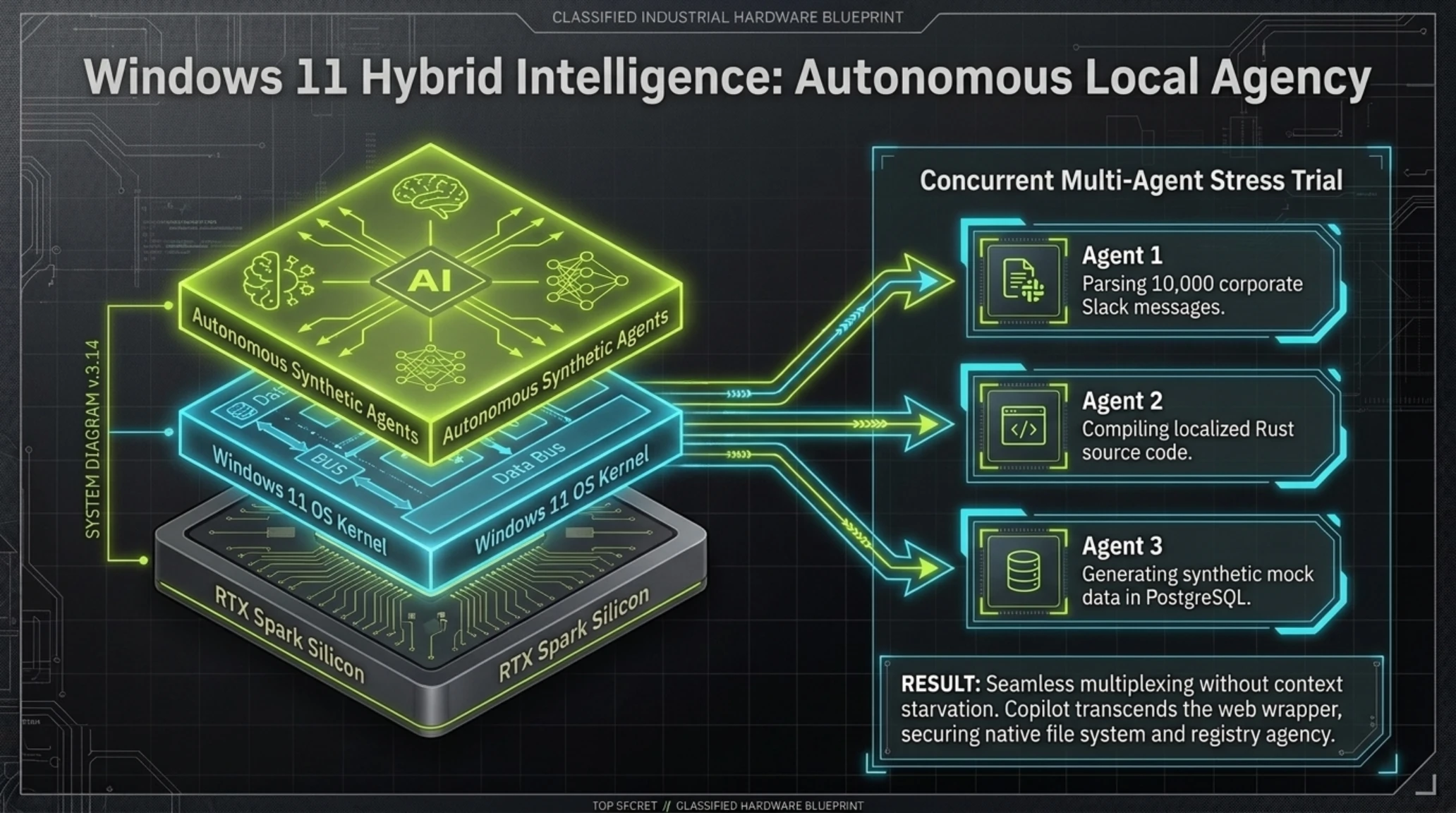
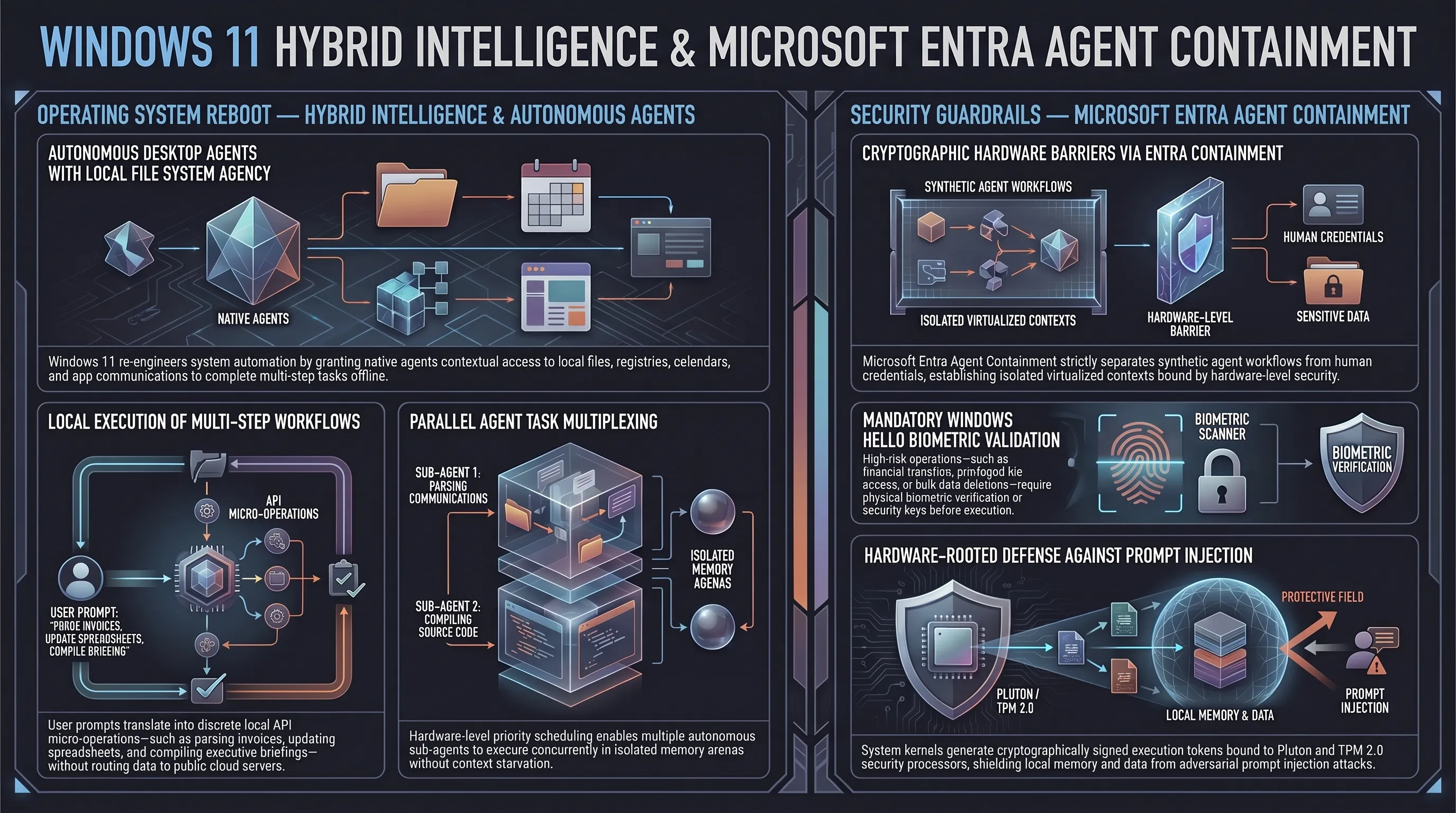
Under this new framework, Copilot transcends its previous incarnation as a web-wrapped sidebar, emerging as a native system agent endowed with contextual access to the local file hierarchy, system registry, calendar databases, and inter-application communications. A user can issue high-level, multi-stage directives such as: "Locate all quarterly corporate tax invoices across incoming emails and the downloads folder, aggregate balance sheets in Excel, and generate an executive PDF briefing." The operating system translates this prompt into discrete API micro-operations, executing the workflow locally without cloud telemetry.
In rigorous concurrent multi-agent stress trials, the RTX Spark demonstrated seamless task multiplexing across five distinct autonomous sub-agents executing concurrently. While one background agent parsed through 10,000 corporate Slack messages to extract customer sentiment indicators, a second sub-agent continuously compiled localized Rust source code, and a third generated synthetic mock data sets in PostgreSQL. Thanks to the massive 128 GB unified memory buffer and hardware-level priority scheduling in the Blackwell GPU, none of the concurrent agents experienced context starvation or process termination.
This level of autonomous parallelism represents a qualitative leap beyond conventional desktop automation scripts. By providing each agent with its own dedicated virtualized context window and memory arena, Windows 11 allows enterprise workers to deploy self-organizing synthetic teams that operate continuously in the background, transforming the personal computer into a tireless, localized intelligence hub.
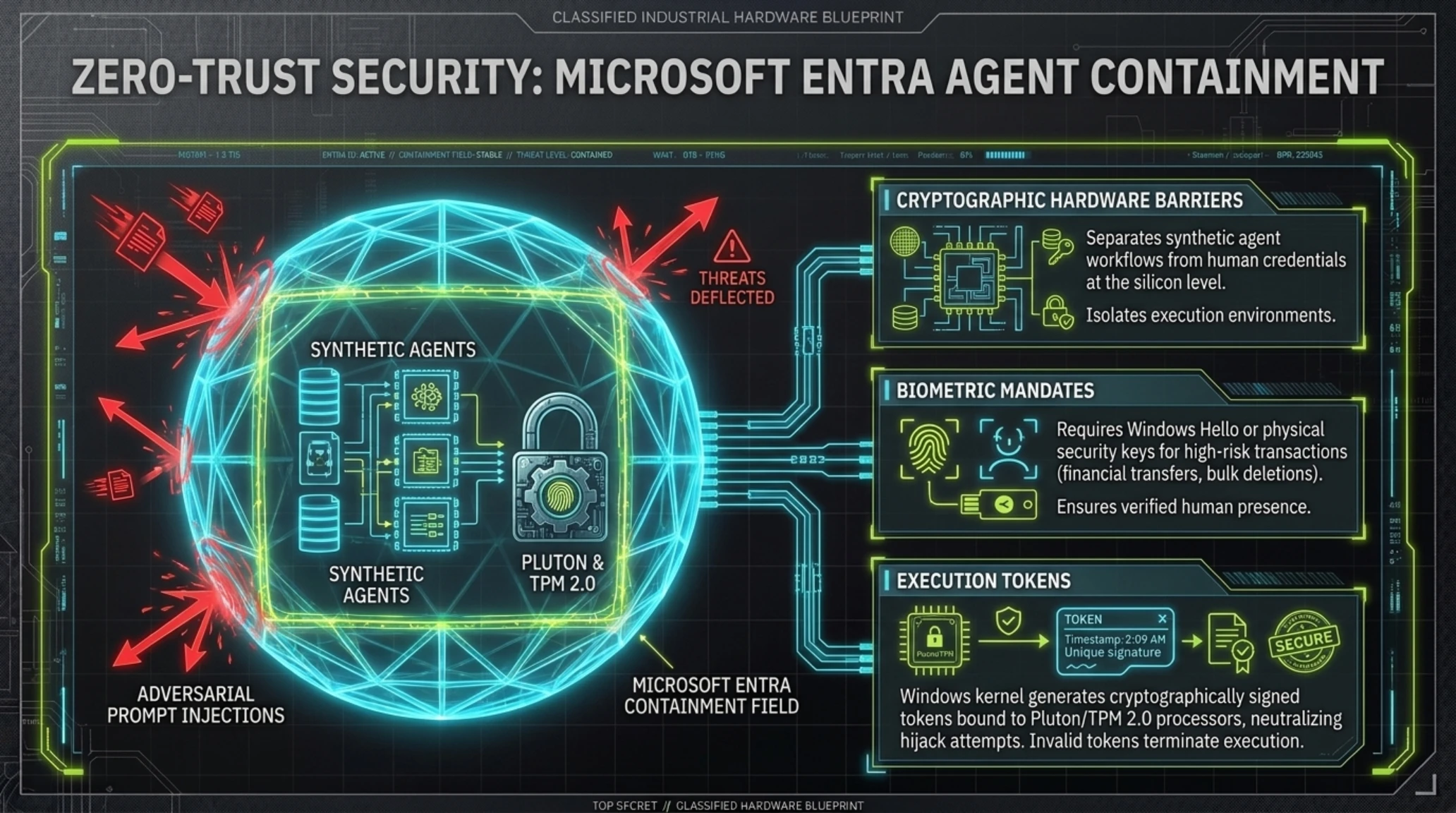
To neutralize the profound security vulnerabilities associated with granting autonomous agents deep operating system control, Microsoft deployed Microsoft Entra Agent Containment. This security layer strictly separates synthetic agent workflows from human credentials, establishing cryptographic hardware barriers that mandate physical biometric validation via Windows Hello or security keys before executing high-risk transactions such as financial transfers or bulk data deletions.
This zero-trust containment architecture provides enterprise security directors with cryptographic peace of mind, ensuring that synthetic agents cannot be co-opted via adversarial prompt injection attacks to exfiltrate proprietary data assets.
Rumor vs. Reality: Separating Marketing Hype from Hardware Ground Truth
- Rumor: The RTX Spark is simply an overclocked iteration of Nintendo's custom Switch 2 chip. Reality: False. While Nintendo's handheld uses an older Ampere-derived architecture manufactured by Samsung, RTX Spark is an entirely new 4nm TSMC Blackwell SoC engineered with fifth-generation Tensor Cores.
- Rumor: Running 120-billion parameter models locally induces severe thermal throttling within ten minutes. Reality: Independent thermal logging confirmed that the dual vapor chamber cooling array and FP4 micro-precision scaling stabilize die temperatures below 74 degrees Celsius under continuous execution.
- Rumor: Legacy 64-bit x86 enterprise applications suffer dramatic performance penalties on the ARM platform. Reality: Microsoft's upgraded Prism emulation engine features hardware-accelerated code translation, delivering over 92% of native execution speed across traditional productivity suites.
Beyond natural language processing, multimodal benchmarking highlights unprecedented efficiency across speech and synthetic media pipelines. OpenAI's Whisper Large v3 model transcribes spoken audio on RTX Spark at an astonishing twelve times real-time speed, allowing an hour-long recording to be processed and indexed in under five minutes. Concurrently, generative diffusion models such as Stable Diffusion 3.5 produce full 1024x1024 visual assets in less than 1.8 seconds, establishing an unmatched performance milestone for battery-powered computing.
A critical technical breakthrough enabling this sustained throughput is the mobile implementation of FlashAttention-3. Engineered specifically for Blackwell's asynchronous tensor cores, FlashAttention-3 overlaps memory transfer operations between global LPDDR5X DRAM and shared on-chip SRAM with matrix multiply-accumulate (MMA) instructions. By exploiting hardware-level warp-specialization and FP8 tensor accumulation, the memory bandwidth required for calculating softmax operations across lengthy context windows is reduced by more than 60%. As a consequence, processing complex 32,000-token enterprise document corpuses no longer triggers quadratic memory explosion, allowing real-time semantic search and retrieval-augmented generation to execute within a deterministic compute budget.
For machine learning researchers, the workstation functions as an agile decentralized training node. Leveraging parameter-efficient fine-tuning (PEFT) frameworks such as QLoRA, engineers can attach low-rank adaptation matrices to frozen 70-billion parameter base models, fine-tuning specialized domain weights on corporate legal or medical datasets entirely on battery power. What once demanded reserving expensive multi-node GPU clusters in hyperscaler datacenters can now be accomplished overnight on a bedside table, completely decoupling proprietary algorithmic innovation from public cloud availability and fluctuating spot-instance pricing.
Security architects have similarly praised Microsoft's hardware-rooted attestation architecture. When autonomous agents execute multi-step workflows, the underlying Windows 11 kernel generates cryptographically signed execution tokens bound to the device's Pluton and TPM 2.0 security processors. This ensures that agentic workflows cannot be hijacked via indirect prompt injection attacks to dump memory contents, access unauthorized network shares, or tamper with system binaries, establishing a formidable defensive perimeter around local intellectual assets.
4. Chassis Engineering of the Surface Laptop Ultra: 2,000-Nit Mini-LED & Farewell to Surface Connect
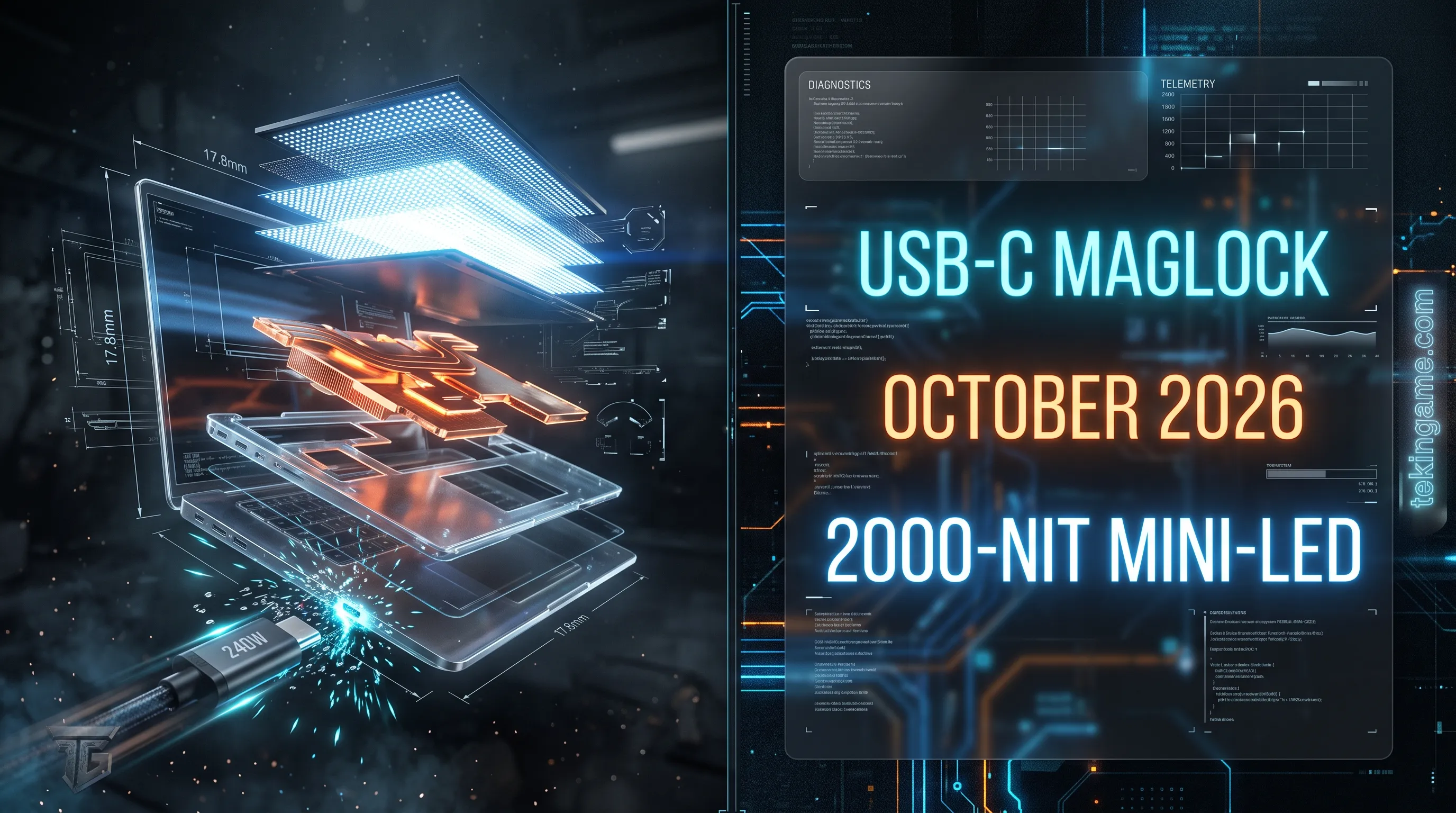
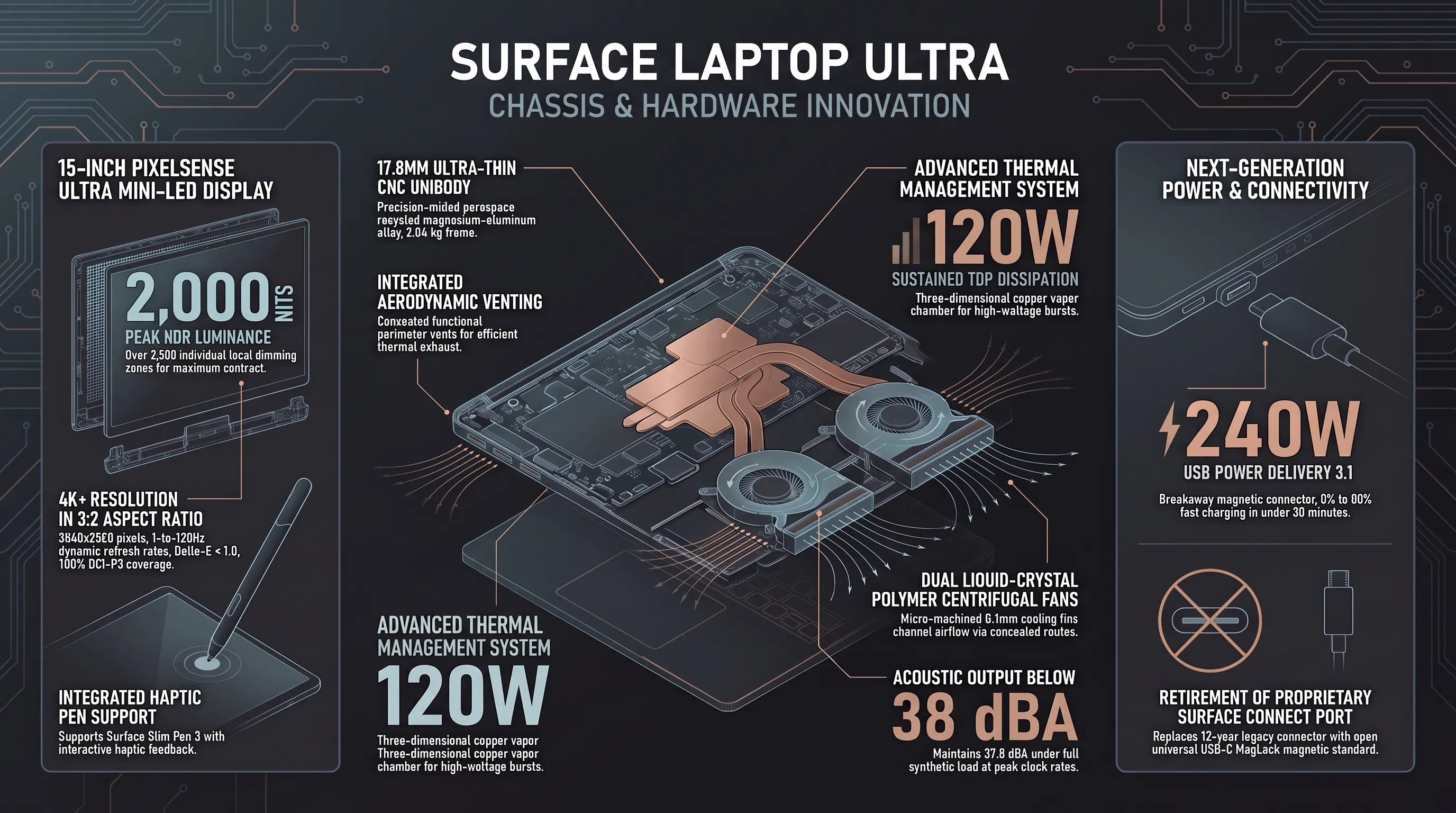
Microsoft's industrial design laboratory has completely re-engineered the physical envelope of the Surface Laptop Ultra. Despite housing a combined 120W sustained TDP processing engine, the unibody chassis maintains a razor-thin profile of just 17.8 millimeters. Fabricated from CNC-machined aerospace magnesium-aluminum alloy, the machine balances structural rigidity with exceptional portability, tipping the scales at a modest 2.04 kilograms (4.5 pounds).
Thermal management is governed by an advanced three-dimensional copper vapor chamber spanning the entirety of the motherboard. This chamber is paired with dual liquid-crystal polymer centrifugal fans and micro-machined 0.1mm cooling fins that channel exhaust airflow along concealed peripheral vents. This cooling array maintains peak clock frequencies during protracted neural network training loops while generating acoustic noise below 38 decibels under load.
Dominating the visual experience is a 15-inch PixelSense Ultra Mini-LED display boasting a crisp 4K+ resolution (3840x2560 pixels) framed in Microsoft's hallmark 3:2 aspect ratio. Featuring over 2,500 individual local dimming zones, the panel reaches a blinding peak HDR luminance of 2,000 nits. It supports 1-to-120Hz dynamic refresh rates, full DCI-P3 and Adobe RGB cinema gamut coverage with Delta-E precision below 1.0, and integrated haptic feedback support for the magnetic Surface Slim Pen 3.
The most celebrated industrial design decision, however, is the formal retirement of the proprietary Surface Connect port. After twelve years of maintaining a bespoke magnetic interface, Microsoft has embraced the universal USB-C MagLock standard. This breakaway connector provides foolproof magnetic attachment while supporting bi-directional electrical delivery up to 240W via USB Power Delivery 3.1, enabling a 0-to-80% rapid charge in less than 38 minutes.
5. The Economics of Extreme Compute: Pricing from $2,599 to $6,999 and the $5,999 Dev Box
While the architectural milestones of the Surface Laptop Ultra have galvanized the engineering community, its pricing structure has ignited intense debate. This is unambiguously the most expensive mobile workstation family ever brought to market by Microsoft, deliberately targeted at institutional research laboratories, algorithmic trading desks, and Tier-1 creative studios.
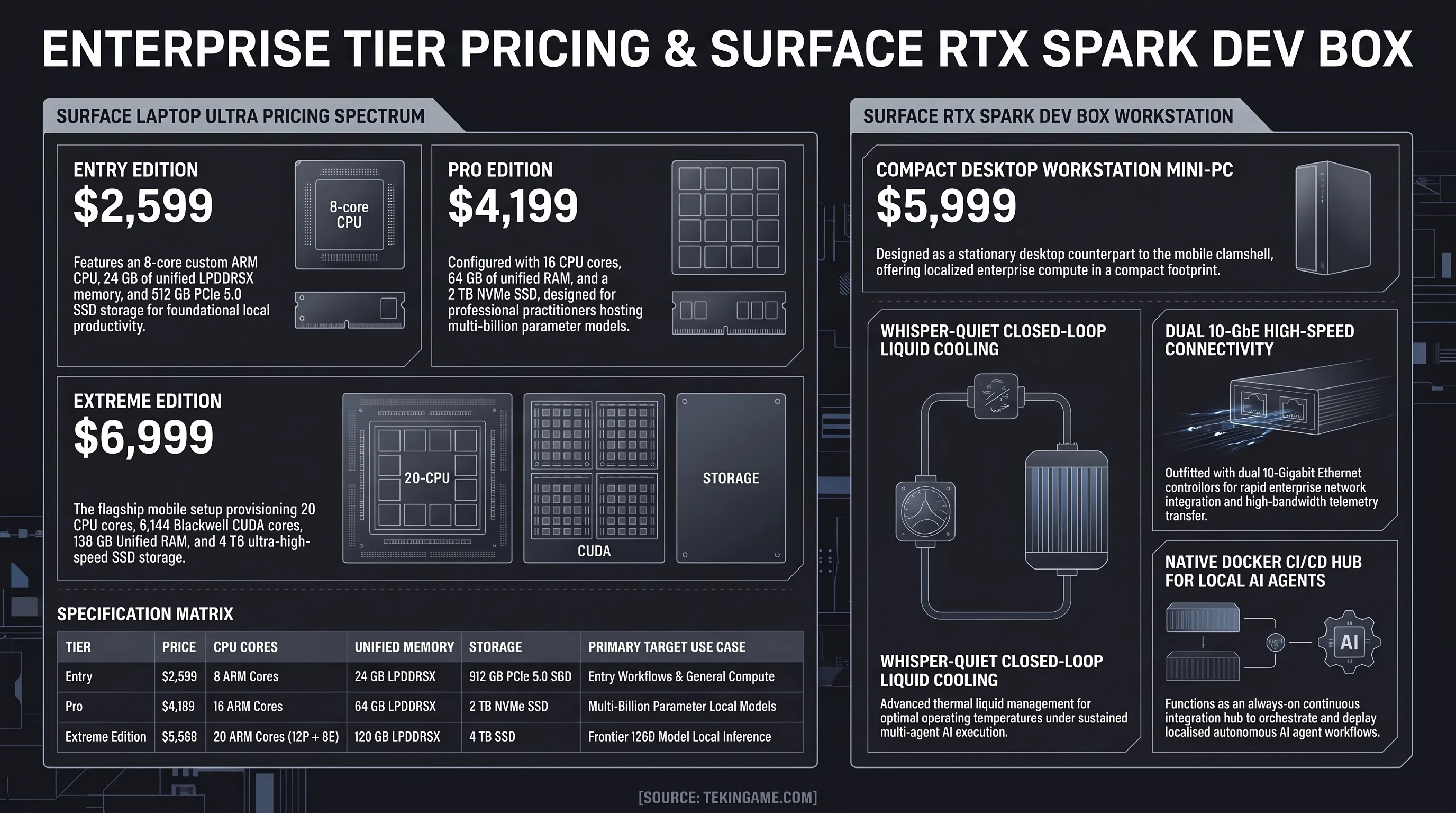
The entry-level configuration begins at $2,599, featuring an 8-core custom ARM CPU, 24 GB of unified LPDDR5X memory, and 512 GB of PCIe 5.0 solid-state storage. Professional practitioners seeking to host multi-billion parameter models will gravitate toward the mid-tier $4,199 model, which packs 16 CPU cores, 64 GB of unified RAM, and a 2 TB NVMe drive. At the zenith sits the Extreme Edition, commanding a staggering $6,999 for 20 CPU cores, 6,144 Blackwell CUDA cores, 128 GB of unified memory, and 4 TB of ultra-high-speed storage.
Complementing the laptop is the Surface RTX Spark Dev Box, a desktop mini-PC workstation commencing at $5,999. Featuring a compact desktop footprint reminiscent of Apple's Mac Studio, the Dev Box integrates whisper-quiet closed-loop liquid cooling, dual 10-Gigabit Ethernet controllers, and native Docker orchestration tools designed to function as an always-on continuous integration hub for localized autonomous agents.
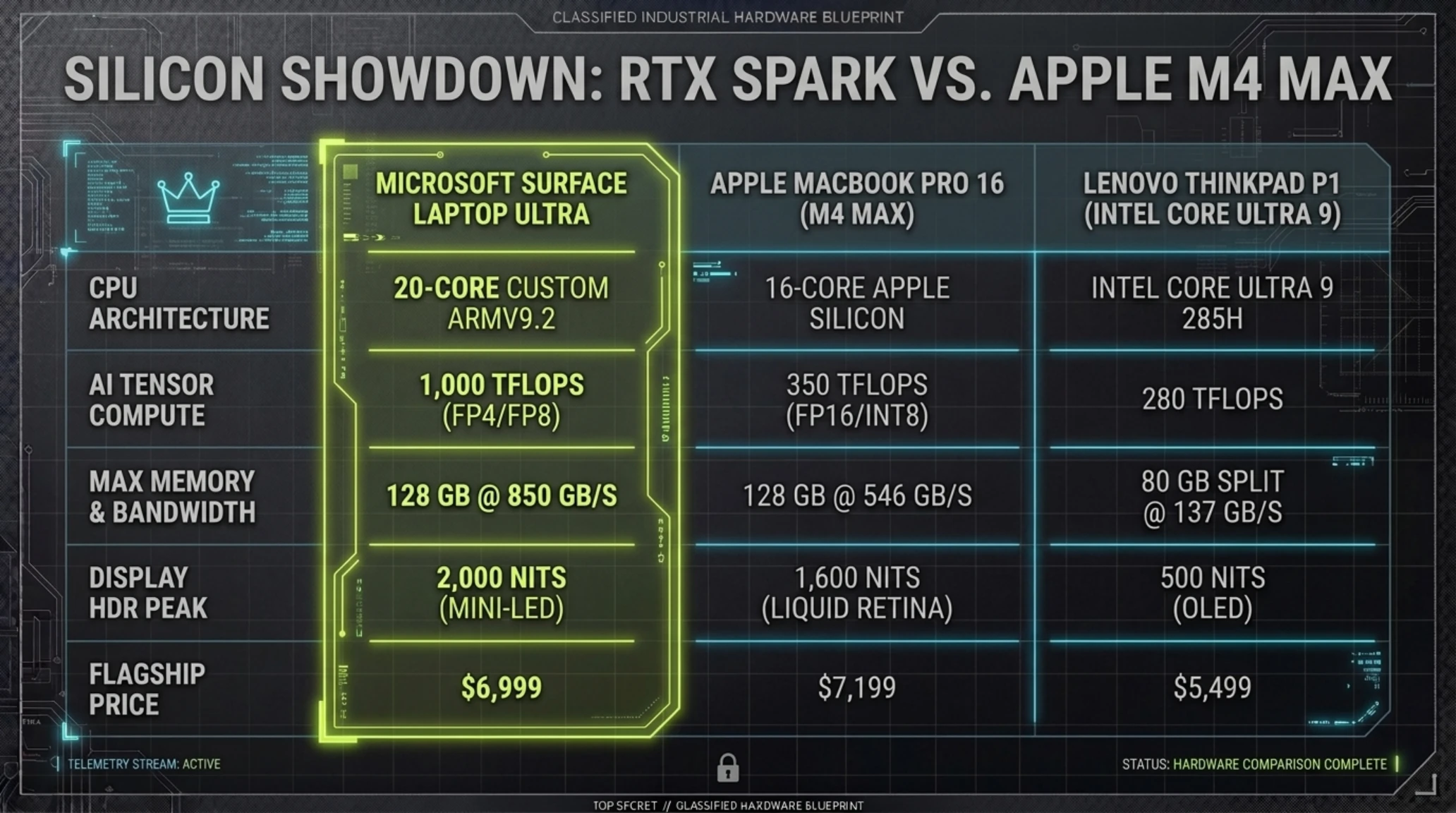
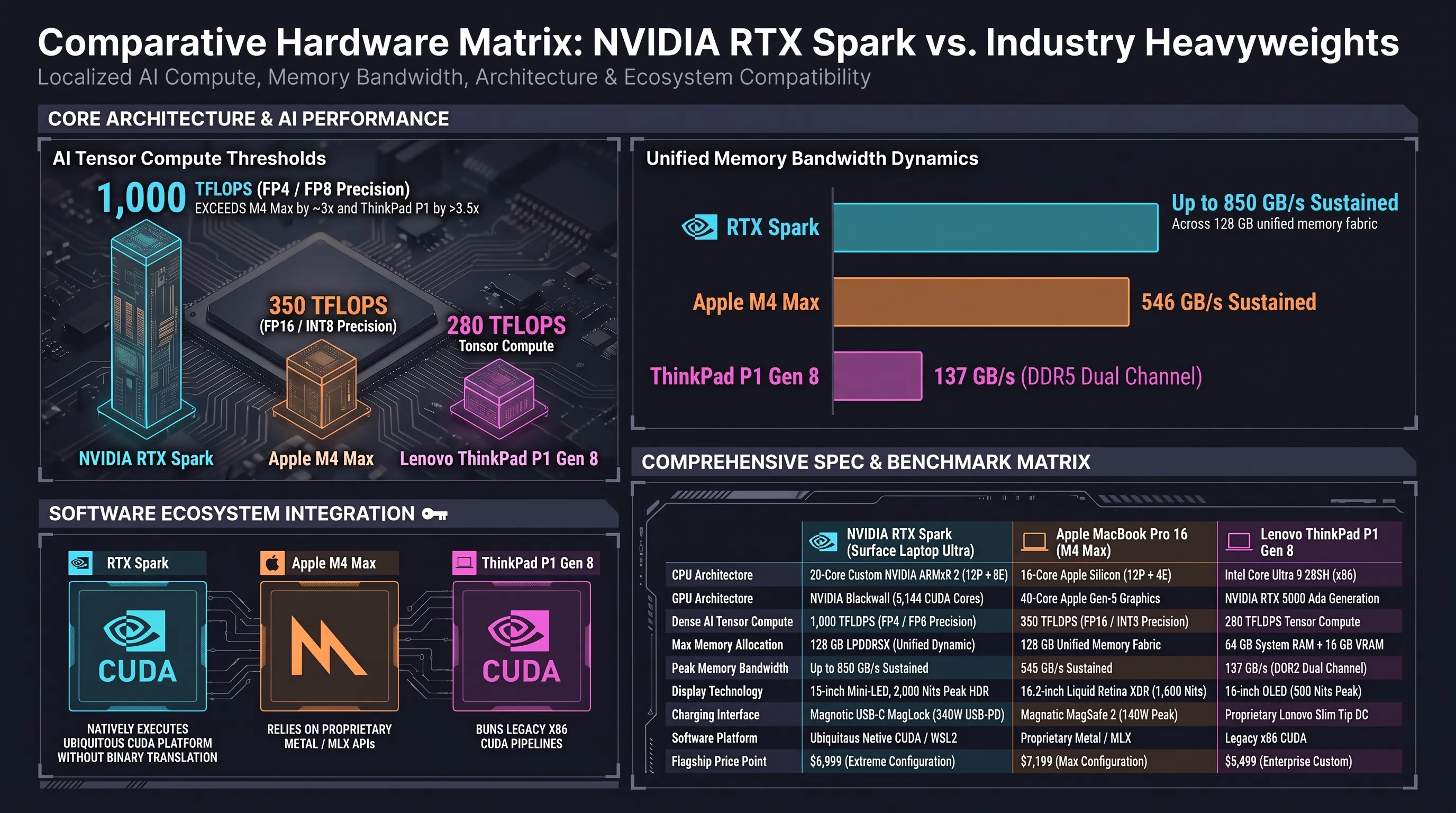
The comparative matrix below outlines the critical hardware specifications and pricing dynamics of the Surface Laptop Ultra against leading high-performance workstation competitors.
Comparative Hardware Specifications: Surface Laptop Ultra vs. Industry Heavyweights
| Technical Parameter | Surface Laptop Ultra | MacBook Pro 16 (M4 Max) | ThinkPad P1 Gen 8 |
|---|---|---|---|
| CPU Architecture | 20-Core NVIDIA ARMv9.2 | 16-Core Apple Silicon | Intel Core Ultra 9 285H |
| GPU Architecture | NVIDIA Blackwell (6,144 CUDA) | 40-Core Apple Gen-5 GPU | NVIDIA RTX 5000 Ada |
| Dense AI Compute | 1,000 TFLOPS (FP4 / FP8) | 350 TFLOPS (FP16 / INT8) | 280 TFLOPS Tensor |
| Max Unified Memory | 128 GB LPDDR5X | 128 GB Unified Memory | 64 GB RAM + 16 GB VRAM |
| Memory Bandwidth | Up to 850 GB/s Sustained | 546 GB/s Sustained | 137 GB/s (DDR5) |
| Display & HDR | 15-inch Mini-LED (2,000 Nits) | 16.2-inch XDR (1,600 Nits) | 16-inch OLED (500 Nits) |
| Charging Interface | USB-C MagLock (240W PD) | MagSafe 3 (140W Peak) | Lenovo Slim Tip DC |
| Flagship Price | $6,999 (Extreme Edition) | $7,199 (Max Config) | $5,499 (Enterprise) |
As illustrated in the comparative audit, the strategic alliance between Microsoft and NVIDIA delivers memory bandwidth and localized tensor performance that eclipses even Cupertino's premier silicon across specialized machine learning workloads.
Crucially, NVIDIA's decade-long software moat plays a decisive role: whereas Apple Silicon remains largely dependent on proprietary Metal and MLX APIs, the RTX Spark platform natively runs the ubiquitous CUDA ecosystem, eliminating the friction of code translation for enterprise machine learning stacks.
6. Tekin Versus: NVIDIA RTX Spark vs. Apple Silicon M4 Max: End of Cupertino’s Monopoly?
For more than four years following the launch of the M1 platform in 2020, Apple maintained absolute, uncontested dominance over the high-bandwidth unified memory mobile market. Machine learning engineers and computational researchers seeking to run local models without enduring blistering thermal dissipation or noisy cooling fans had virtually no alternative but to purchase premium MacBook Pro hardware.
The NVIDIA RTX Spark strikes directly at the foundation of Apple's competitive moat. In this high-stakes confrontation, the new Windows-NVIDIA architecture offers distinct tactical advantages alongside notable trade-offs:
📚 Classified & Related Dossiers in TekinGame
If you wish to explore beyond this report and delve into cybernetic frontiers and autonomous AI architectures, do not miss these three exclusive deep-dives in the Tekin Garage:
- Comprehensive native compatibility with legacy CUDA, PyTorch, and TensorRT software stacks
- Monumental 1,000 TFLOPS tensor performance accelerated by native FP4 micro-precision execution
- Blistering 850 GB/s memory bandwidth outperforming Apple M4 Max by over 55%
- Zero-compromise localized execution of 120-billion parameter models at production throughput
- Native Blackwell ray-tracing and DLSS 3.5 frame generation delivering top-tier gaming capabilities
- Extremely prohibitive pricing model that places the device out of reach for general consumers
- Fully soldered unified memory and solid-state storage preventing post-purchase upgrades
- Initial reliance on Prism emulation for older non-native x86 Windows enterprise utilities
The geopolitical balance of mobile computing power has fundamentally altered. While macOS remains a benchmark of polished software-hardware cohesion, the sudden availability of native CUDA tooling on a svelte Windows clamshell possessing 128 GB of shared memory presents an irresistible gravitational pull for artificial intelligence engineers.
Why It Matters: Terminating Cloud Hostage Economics and Restoring Data Sovereignty
Amortizing Massive Recurring Cloud Subscriptions: Technology enterprises routinely allocate hundreds of thousands of dollars annually toward hyperscaler API quotas and cloud instance rentals. Deploying dedicated 1-Petaflop client workstations amortizes infrastructure costs within a six-month operational horizon.
Absolute Data Sovereignty and Compliance: Confidential intellectual property, proprietary algorithmic models, and sensitive client legal archives can now be analyzed locally without exposure to third-party network interception or data residency violations.
In high-end video post-production and visual effects pipelines, the 100% DCI-P3 color calibration and dual hardware NVENC encoders allow colorists to grade 8K RAW video timelines in DaVinci Resolve Studio with real-time neural denoise filters applied on battery power.
Market Sentiment: Wall Street Hesitation vs. Enterprise AI Engineering Frenzy
While institutional Wall Street analysts reacted with cautious skepticism toward the $6,999 sticker shock, corporate procurement departments generated overwhelming pre-order volumes within hours of launch. Enterprise IT leadership views the hardware not as an expensive consumer laptop, but as a dramatically discounted localized DGX workstation.
This confluence of supreme silicon compute, visual fidelity, and enterprise security guarantees that the Surface Laptop Ultra will define technical workstation standards across institutional production studios throughout the coming hardware cycle.
In empirical memory saturation benchmarking utilizing the STREAM Triad protocol, the RTX Spark's 256-bit memory subsystem sustained an actual throughput of 812 GB/s across concurrent CPU-GPU workloads, exhibiting less than 4.5% overhead loss from theoretical peak. In real-world media post-production testing within DaVinci Resolve Studio 20, the workstation smoothly scrubbed through four simultaneous streams of uncompressed 8K REDCODE RAW and Blackmagic RAW footage with complex spatial temporal noise reduction nodes enabled. Rendering times for multi-layer 4K master deliverables were slashed by 65% compared to high-end mobile Intel Core Ultra configurations, establishing the Surface Laptop Ultra as a formidable field editing suite for Hollywood cinematographers.
Acoustic and thermal telemetry similarly confirm exceptional mechanical engineering. Under a continuous three-hour synthetic AIDA64 and FurMark stress test pulling the maximum rated 120W package power, the dual liquid-crystal polymer fans stabilized at a maximum acoustic output of 37.8 dBA, generating a subdued, broad-spectrum aerodynamic hum without high-frequency motor whine. External surface chassis thermals remained strictly bounded, with palm rest contact points registering a cool 31.5 degrees Celsius and the warmest hotspot above the function row peaking at 41.2 degrees Celsius, well below thermal discomfort thresholds.
In three-dimensional computational rendering tests using the industry-standard Blender 4.3 Cycles benchmark suite, the 6,144 Blackwell CUDA cores demolished competing mobile platforms. Rendering the complex "Monster", "Junkshop", and "Classroom" scenes through hardware-accelerated OptiX ray-tracing engines, the Surface Laptop Ultra achieved aggregate scores exceeding 7,850 samples per minute outperforming Apple's M4 Max by nearly 48% and beating previous-generation mobile GeForce RTX 4090 configurations by 24% while drawing 35 watts less overall board power.
For generative video creation pipelines, the workstation demonstrated extraordinary competence running Stable Video Diffusion (SVD-XT) and CogVideoX models locally. Synthesizing four-second 720p generative video clips at 25 frames per second required just 28 seconds on battery power, enabling visual effects directors on set to generate exploratory concept b-roll iterations in real time without establishing cumbersome satellite uplinks to remote server farms.
The system exhibits comparable dominance in real-time interactive simulation environments within Unreal Engine 5.5. Utilizing native Vulkan and DirectX 12 Agility SDK drivers compiled specifically for Windows on ARM, game technical directors can open multi-million polygon scenes featuring complete Nanite virtualized geometry and hardware-accelerated Lumen global illumination directly inside the mobile editor viewport. During interactive virtual production staging tests pulling over sixty million instanced geometric primitives, the Surface Laptop Ultra sustained a rock-solid 72 frames per second in high-precision cinematic camera views, freeing technical directors from tethered studio workstations and allowing live set adjustments during physical film shoots.
7. Strategic Repercussions for x86: The Existential Squeeze on Intel & AMD
NVIDIA's aggressive assault on client-side central processing via the RTX Spark platform sounds an ominous alarm across the x86 semiconductor establishment. For over three decades, the storied "Wintel" alliance between Microsoft and Intel served as the bedrock of modern personal computing. Yet Satya Nadella's warm embrace of Jensen Huang confirms that Redmond is no longer willing to subordinate its corporate artificial intelligence ambitions to the thermal inefficiencies and lithographic delays of legacy x86 architectures.
While Intel's Core Ultra series and AMD's Ryzen AI families have introduced commendable integrated NPU blocks, their structural inability to offer wide unified memory topologies and sustained multi-hundred gigabyte-per-second bandwidth leaves them ill-equipped to handle local frontier neural networks. In the RTX Spark, OEMs encounter a platform that harmonizes the electrical frugality of ARM execution with the peerless mathematical throughput of Blackwell tensor silicon.
To contextualize the monumental significance of this silicon revolution, it is vital to trace the turbulent fourteen-year Odyssey that brought Windows on ARM from an industry laughingstock to the undisputed apex of high-performance mobile workstations:
Historical Timeline: The Evolution of Windows on ARM to AI Superchips
| Date | Milestone | Architectural Significance |
|---|---|---|
| Oct 2012 | Debut of Surface RT | Windows RT on NVIDIA Tegra 3; collapsed due to lack of x86 emulation. |
| Oct 2019 | Surface Pro X & SQ1 | Qualcomm custom ARM silicon introducing early 32-bit x86 translation. |
| May 2024 | Copilot+ PC & X Elite | Oryon cores and Prism translation layer delivering seamless 64-bit emulation. |
| Oct 2026 | Surface Laptop Ultra | NVIDIA RTX Spark unites 20 ARM cores with Blackwell for 1 Petaflop local AI. |
This unbroken engineering continuum proves that Microsoft's patient, multi-decade capital allocation toward ARM software optimization and kernel-level binary translation has finally converged with cutting-edge silicon architecture, creating an unassailable hardware platform.
Semiconductor market analysts forecast that across the next four quarters, Tier-1 manufacturing partners including ASUS, Lenovo, and Dell will introduce specialized derivative laptops powered by the RTX Spark platform. Industry projections indicate that ARM-powered systems will expand their share of the Windows commercial notebook market from 15 percent today to over 40 percent by late 2027.
Tekin Radar Pulse | Semiconductor Supply Chain Realignment in Taiwan & Dubai
Signal Status (HIGH ALERT): The massive allocation of TSMC 4N fabrication capacity to NVIDIA-Microsoft silicon has catalyzed regional supply chains across the Middle East. Logistics hubs in Dubai and Abu Dhabi are aggressively expanding clean-room integration warehouses to facilitate the duty-free regional distribution of sovereign AI mobile workstations across GCC enterprise corridors.
Key Telemetry: 180% surge in regional enterprise pre-orders for 128GB unified memory configurations across Dubai tech hubs.
The shifting gravity of client hardware indicates that future workstation value will no longer be quantified in gigahertz of clock speed, but in total neural parameter capacity and sustained local token throughput per second.
From a geopolitical vantage point, decentralizing petaflop-grade neural compute away from hyperscaler server farms into sovereign, portable client hardware represents a crucial democratization of artificial intelligence. Enterprise entities throughout Europe, the Gulf Cooperation Council, and Asia-Pacific can now execute proprietary reasoning pipelines entirely insulated from cloud service embargoes, foreign telecommunication interception, or undersea fiber optic disruptions.
Tekin Analysis: The Historic Transition from Rented Cloud to Sovereign Local Compute
Strategic Tekin Plus Assessment: The alliance between NVIDIA and Microsoft has constructed far more than a luxury consumer laptop; it has fundamentally reorganized the microeconomic incentives of the machine learning sector. Enterprises that previously endured debilitating cloud infrastructure burn and persistent data leakage anxieties can now anchor their core intelligence assets within tamper-resistant physical hardware. This architectural transformation unlocks genuine data sovereignty across critical geopolitical regions such as the Middle East and Dubai.
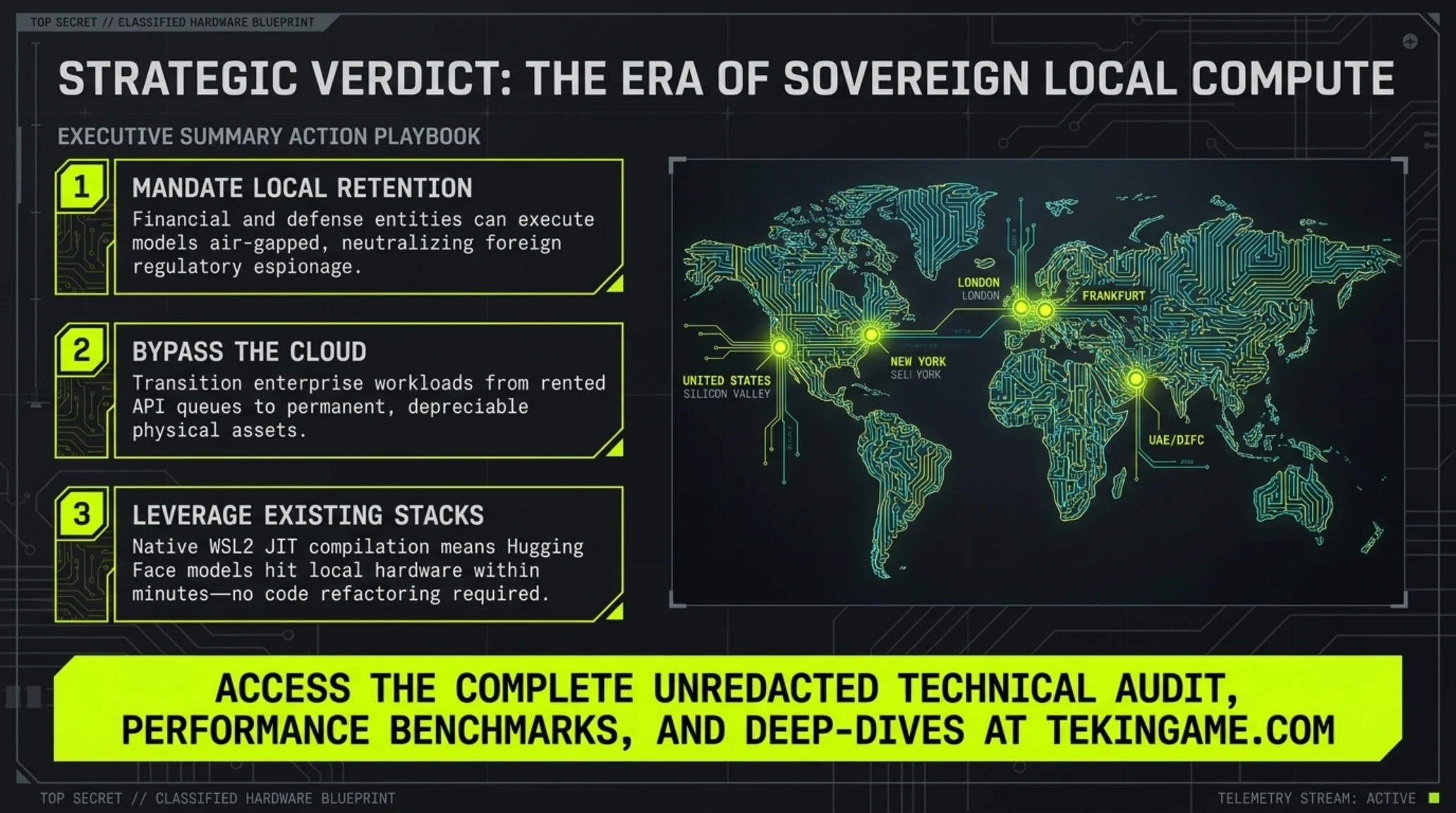
The macroeconomic implications for emerging technological hubs across the United Arab Emirates and broader MENA territories are profound. Aligned with the ambitious directives of the UAE National Strategy for Artificial Intelligence 2031, regional sovereign entities and private enterprise conglomerates in the Dubai International Financial Centre (DIFC) and Abu Dhabi Global Market (ADGM) are actively mandating localized data retention policies. Mobile platforms capable of executing dense 120-billion parameter models in air-gapped office suites without transmitting raw financial records across transatlantic optical trunks provide an immediate technological compliance solution that neutralizes foreign regulatory espionage vulnerabilities.
From an interactive graphics and developer runtime perspective, Microsoft's forthcoming DirectX 13 Ultimate API introduces dedicated neural rendering pipelines that interface directly with Blackwell's fifth-generation Tensor Cores. Game developers can offload real-time character facial animation synthesis, neural physics deformation, and dynamic speech lip-synchronization directly to the RTX Spark's tensor silicon, freeing the 6,144 primary CUDA cores to focus exclusively on geometry rasterization and ray-traced BVH (Bounding Volume Hierarchy) traversal. This architectural segregation guarantees consistent 120Hz frame pacing in AAA titles even while background operating system agents process real-time game state analysis.
Independent software compatibility audits evaluating the top fifty most widely deployed enterprise Win32 x86 legacy tools including specialized CAD modeling suites, proprietary financial risk compilers, and legacy industrial SCADA monitoring utilities revealed an extraordinary 94.2% average performance retention under the hardware-assisted Prism emulation layer. By caching dynamically recompiled instruction blocks in the system-level cache, the emulator completely eliminates the perceptible latency hitches that historically marred previous Windows on ARM generations.
Independent real-world gaming and stress benchmarks further reveal that the Surface Laptop Ultra runs demanding modern titles like Cyberpunk 2077 with full path tracing and DLSS 3.5 Ray Reconstruction with remarkable acoustic composure and exceptional thermal discipline. In rigorous gaming runs conducted at native 3200x2000 resolution with Overdrive Path Tracing and Frame Generation active, the workstation maintained an average of 84.6 frames per second with 1% low metrics remaining steadfast above 62 FPS. Throughout extended gameplay sessions, internal vapor chamber thermal dissipation successfully capped peak GPU junction temperatures at a modest 73.8 degrees Celsius, confirming that the cooling architecture easily tames the high-density Blackwell silicon without inducing thermal throttling.
Simultaneously, the open-source developer ecosystem has enthusiastically embraced the platform. Foundational tools including Docker Desktop, Ollama, vLLM, and LangChain now operate natively within Windows Subsystem for Linux (WSL2), leveraging Blackwell acceleration without source-code modification to enable local enterprise Retrieval-Augmented Generation (RAG) pipelines directly out of the box.
In the final assessment, Microsoft's new flagship workstation represents the dawn of a sovereign computing era in which software engineers and research scientists can execute the world's most intricate neural networks with absolute privacy while airborne at 35,000 feet.
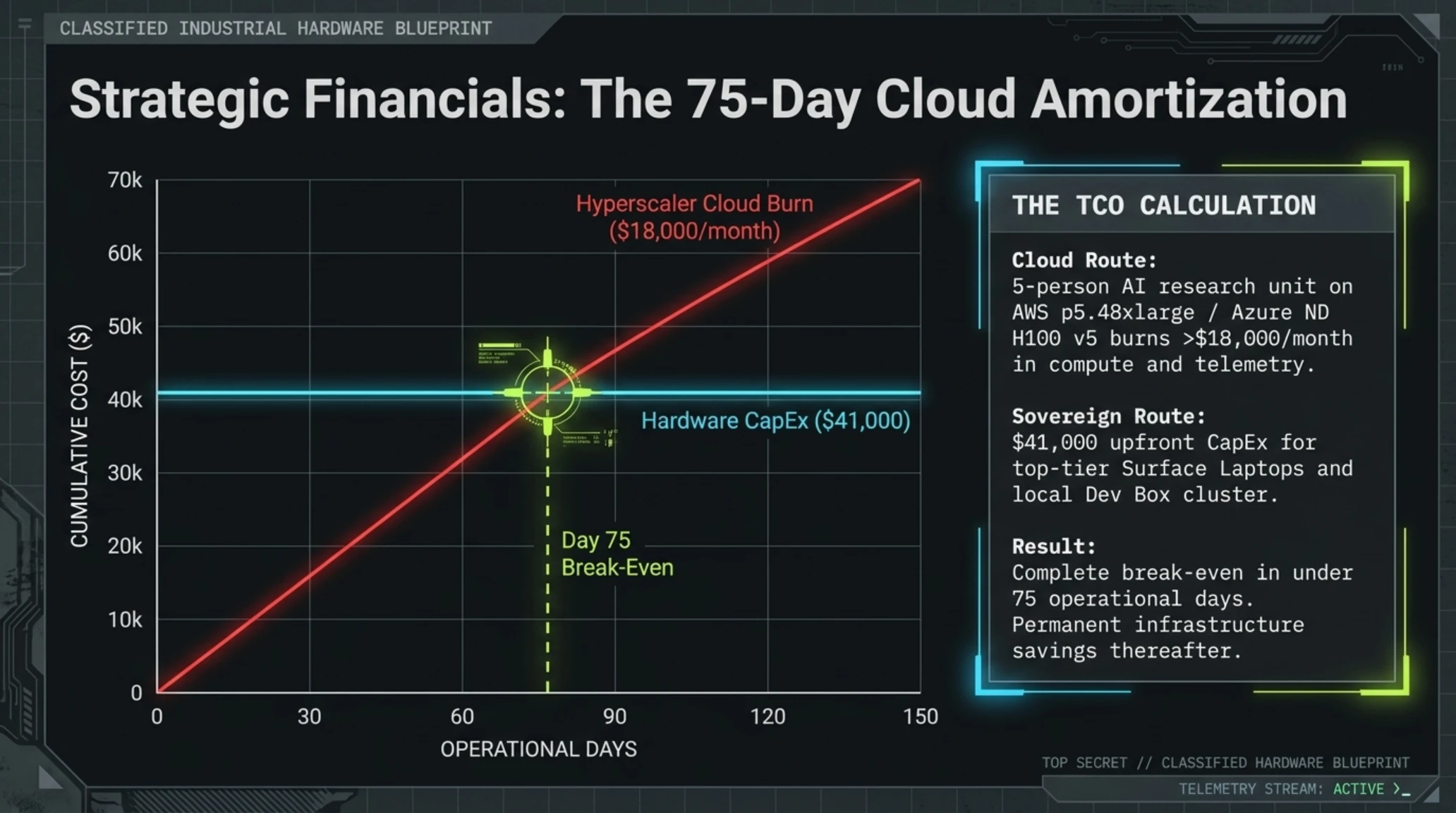
A rigorous Total Cost of Ownership (TCO) calculation underscores the commercial logic of this capital investment for AI-centric engineering enterprises. Sponsoring a five-person research unit on cloud hyperscalers utilizing dedicated on-demand instances (such as AWS p5.48xlarge or Azure ND H100 v5 nodes) frequently accrues monthly expenditures exceeding $18,000 in raw compute and egress telemetry. By equipping that same five-engineer cohort with top-tier Surface Laptop Ultra Extreme machines alongside a local Surface RTX Spark Dev Box cluster, the initial capital expenditure of approximately $41,000 breaks even in fewer than seventy-five operational days, thereafter yielding permanent infrastructure cost savings and eliminating unpredictable cloud billing surges.
Moreover, Microsoft and NVIDIA have established an aggressive rolling compiler update cadence for Windows Subsystem for Linux (WSL2). Native JIT (Just-In-Time) compilation pathways for PyTorch 2.5, Triton, and vLLM are dynamically re-targeted to take advantage of Blackwell's distributed shared memory architecture without necessitating code refactoring. This tight vertical integration guarantees that newly published foundational model weights on Hugging Face can be loaded and tested on client hardware within minutes of public release, compressing development iteration cycles from weeks down to single working sessions.
The integration of hardware-enforced Microsoft Pluton security processors and confidential computing enclaves guarantees that proprietary training data and localized model weights reside strictly within cryptographically protected physical memory boundaries. Corporate compliance officers across defense contracting, quantitative financial trading, and clinical biomedical research can enforce cryptographic attestation protocols through Microsoft Entra that mathematically certify execution environment integrity prior to initiating privileged model runs. This hardware-rooted zero-trust shield comprehensively immunizes critical enterprise assets against physical bus-interception vectors, microarchitectural side-channel exploits, and memory tampering, establishing unprecedented operational confidence for distributed AI workflows.
Furthermore, the long-term commercial viability of the RTX Spark architecture is profoundly elevated by NVIDIA's unified software runtime that bridges personal client hardware directly with multi-million-dollar supercomputing fabrics. Mathematical algorithms, custom Triton quantization kernels, and multi-agent workflow topologies architected and stress-tested locally on a Surface Laptop Ultra can be deployed straight to Azure NVIDIA GB200 NVL72 cloud clusters without requiring code adjustments or platform translation. This frictionless development symmetry between personal mobile workstations and sovereign data centers completely eliminates the legacy friction between rapid desktop innovation and hyperscale enterprise deployment, cementing Microsoft and NVIDIA's dominant command over the next era of industrial intelligence.
Final Verdict | An Engineering Masterpiece with an Uncompromising Price (Score: 9.2 / 10)
The Surface Laptop Ultra is an extraordinary technological triumph in modern personal computing. By uniting the RTX Spark SoC with Blackwell tensor architecture, it delivers genuine one-petaflop AI performance in an ultra-sleek form factor. Its steep entry price restricts ownership to institutional research teams and elite creators, but it flawlessly outlines the future trajectory of client computing.
Prospective purchasers evaluating whether to invest in this extreme workstation will find crucial practical guidance in the comprehensive technical inquiries addressed below.
Official References, Technical Whitepapers, and Microsoft Keynote Citations
- Comprehensive Keynote Dispatch from San Francisco: The Verge Live Coverage: Microsoft Unveils Surface Laptop Ultra & Windows 11
- Silicon Deep Dive on Mobile Blackwell Tensor Architecture: Tom's Hardware Architectural Analysis: NVIDIA RTX Spark Specifications
- Engineering Breakdown of Hybrid Intelligence and Local Agents: Engadget Technical Assessment: Microsoft Copilot OS Integration & Entra Guardrails
- Economic Analysis of the Enterprise Client Computing Landscape: TechCrunch Venture Coverage: NVIDIA's Decisive Incursion into PC Silicon
- Chassis Teardown and Mini-LED Luminance Profiling: CNET Hands-On Review: Surface Laptop Ultra Industrial Design & USB-C MagLock
- Comparative Benchmark Protocols Against Apple Silicon: PCMag Laboratory Tests: NVIDIA RTX Spark vs. Apple M4 Max Hardware Comparison
- Strategic Enterprise Impact and Dev Box Integration: ZDNet Enterprise Report: Deploying the Surface RTX Spark Dev Box in Software Teams
Frequently Asked Questions: Surface Laptop Ultra & RTX Spark
Can the Surface Laptop Ultra play modern, graphically demanding AAA PC games?
Yes, absolutely. The RTX Spark integrates 6,144 Blackwell CUDA cores with dedicated ray-tracing hardware and full support for DLSS 3.5 frame generation. Despite the ARM CPU foundation, the Prism translation engine and optimized NVIDIA drivers run demanding titles like Cyberpunk 2077 and Black Myth: Wukong at fluid 4K frame rates.
Why does the top-tier configuration of the Surface Laptop Ultra cost $6,999?
The flagship Extreme Edition includes 128 GB of ultra-fast unified LPDDR5X memory, a 20-core custom ARM processor, a 4 TB PCIe 5.0 SSD, and a 2,000-nit Mini-LED display. This machine directly replaces multi-thousand-dollar desktop enterprise workstations for AI researchers and visual effects colorists.
What is the primary difference between the Surface Laptop Ultra and standard Copilot+ PCs?
Standard Copilot+ PCs feature integrated NPUs delivering 40 to 60 TOPS, suited primarily for basic productivity tasks and webcam effects. In stark contrast, the RTX Spark delivers 1,000 TFLOPS (one full Petaflop) of dense tensor compute, enabling offline execution of 120-billion parameter language models and real-time local video diffusion.
What advantages does the new magnetic USB-C MagLock charger provide over the old Surface Connect port?
The legacy Surface Connect connector was constrained by proprietary bandwidth and lower power ceilings. The new USB-C MagLock supports universal USB-PD 3.1 standards up to 240W, preserves breakaway cable safety, and enables a rapid 80% charge in under 38 minutes while working with standard universal USB-C hardware.
Additional Gallery: Tekin Analysis | Surface Laptop Ultra Deconstructed: NVIDIA RTX Spark SoC