Executive Summary | The $40B Capital Architecture & Neocloud Reckoning
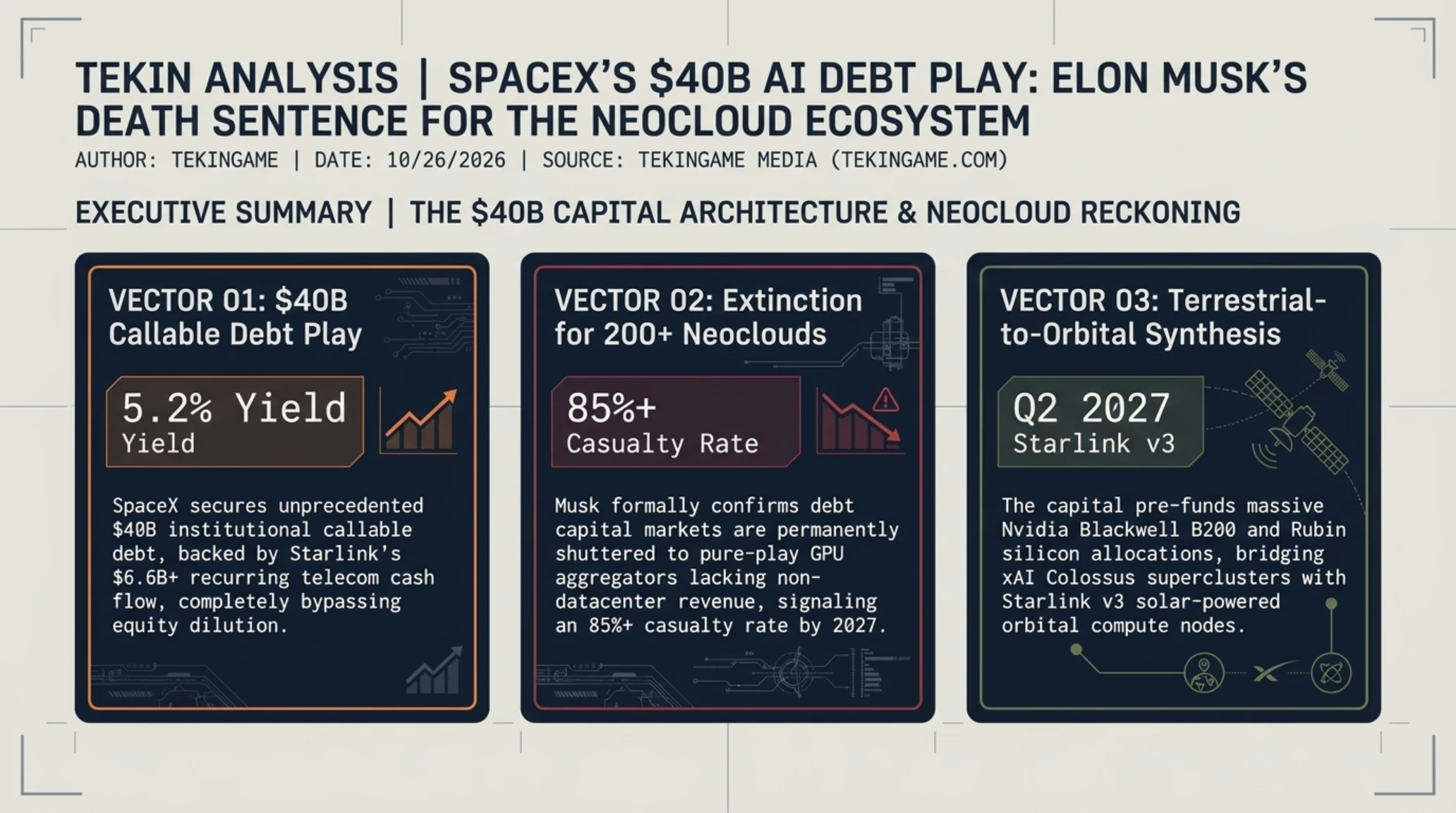
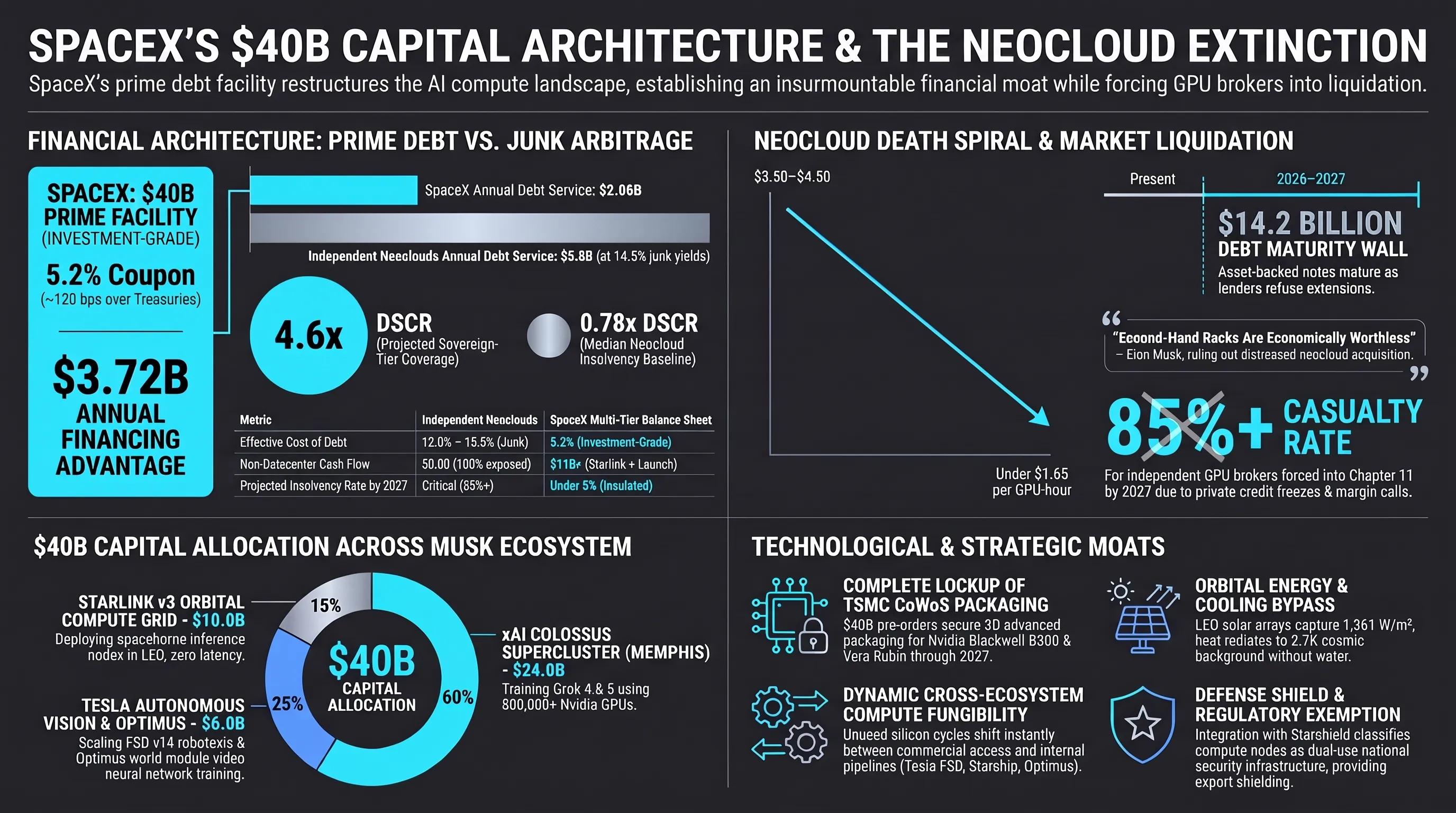
SpaceX secures unprecedented $40B institutional callable debt at ~5.2% yield, backed by Starlink's $6.6B+ recurring telecom cash flow, completely bypassing equity dilution.
Musk formally confirms debt capital markets are permanently shuttered to pure-play GPU aggregators lacking non-datacenter revenue, signaling an 85%+ casualty rate by 2027.
The capital pre-funds massive Nvidia Blackwell B200 and Rubin silicon allocations for Q1/Q2 2027, bridging xAI Colossus superclusters with Starlink v3 solar-powered orbital compute nodes.
The global artificial intelligence race has abruptly exited its speculative infancy, slamming headfirst into the unyielding mathematical reality of corporate balance sheets, industrial energy thermodynamics, and advanced semiconductor packaging constraints. When Elon Musk formally verified that SpaceX had structured and executed a historic $40 billion institutional debt facility dedicated entirely to pre-funding next-generation AI compute silicon, the announcement sent shockwaves reverberating through Wall Street credit desks and Silicon Valley boardrooms alike. Far more than a massive capital expenditure round, this maneuver represents a structural bifurcation in the technological landscape: the permanent death of speculative cloud arbitrage and the definitive dawn of sovereign, vertically integrated compute titans.
For more than three years, the generative artificial intelligence ecosystem operated under the euphoric illusion that specialized compute brokers commonly dubbed neoclouds could borrow billions of dollars in high-yield debt to warehouse Nvidia graphics processing units and generate endless, risk-free margins by renting them to cash-rich venture-backed AI labs. That fragile paradigm has now shattered. Musk’s stark declaration that debt capital markets have slammed shut on any entity lacking self-sustaining, non-datacenter revenue streams is not merely an opinionated critique; it is an autopsy of a financial model whose structural expiration date has arrived. By backing a $40 billion borrowing syndicate with the formidable, recession-proof recurring cash flows of Starlink and commercial orbital launches, SpaceX has established an unassailable financial fortress that renders standalone compute resellers obsolete.
Understanding the tectonic ramifications of this deal requires analyzing the convergence of macro credit dynamics, deep-space launch economics, high-performance semiconductor fabrication bottlenecks, and sovereign national security directives. As examined in our previous institutional briefings on SpaceX's $40B compute financing and neocloud risks and sovereign AI infrastructure and Starlink velocity, the entities that control the complete physical stack from energy generation and orbital lift capacity to advanced lithography allocations and foundational model architectures will dictate the economic parameters of artificial general intelligence (AGI). SpaceX's $40 billion debt facility is the master key designed to monopolize that exact architectural hierarchy.
The Anatomy of a $40B AI Debt Syndicate: Investment-Grade Balance Sheets vs Speculative Cloud Debt
To grasp why this financial engineering feat represents an insurmountable moat, one must dissect the mechanics of modern corporate debt structuring. In orthodox corporate finance, borrowing $40 billion to acquire rapidly depreciating semiconductor hardware would be classified as catastrophic institutional suicide. A standard enterprise taking on such massive leverage would face immediate credit rating downgrades to junk status, triggering crushing annual interest burdens exceeding 12% to 15%. However, SpaceX did not approach institutional debt syndicates as a software startup or a capital-starved datacenter landlord; it entered the market as an indispensable, sovereign-grade aerospace monopoly backed by the most lucrative satellite telecommunications network in human history.
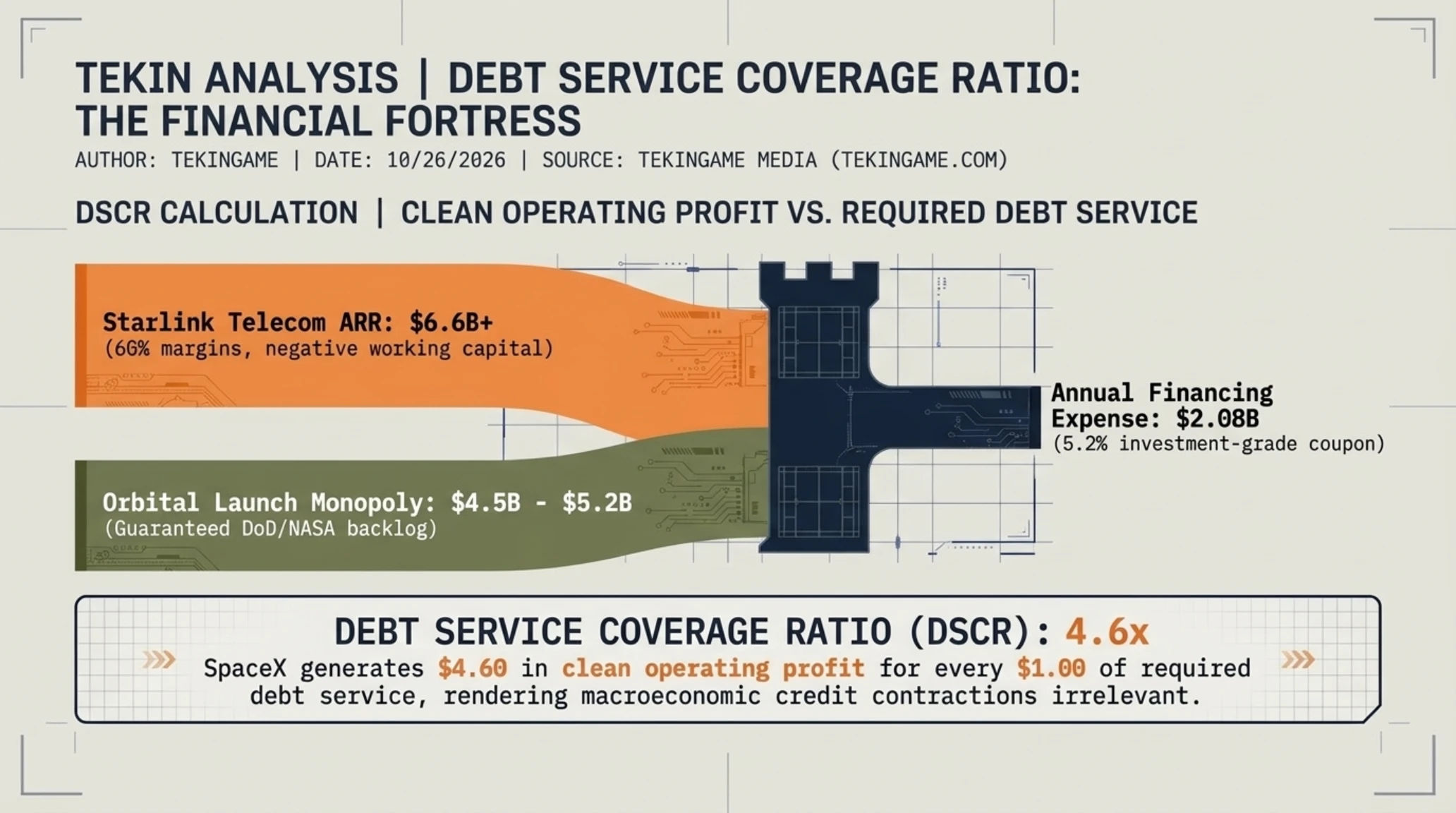
The Starlink constellation has transitioned from an ambitious capital sink into an extraordinary financial printing press. Surpassing 5 million paying subscribers across more than 110 nations, Starlink generates upwards of $6.6 billion in predictable, high-margin annual recurring revenue (ARR), boasting gross operating margins exceeding 60%. Concurrently, SpaceX’s orbital launch monopoly commanding more than 85% of total upmass delivered to low Earth orbit globally via its reusable Falcon 9 and Falcon Heavy fleet delivers an additional $4.5 billion to $5.2 billion in contractually guaranteed multi-year backlog from NASA, the United States Department of Defense, and commercial satellite operators. This profound cash flow diversification provided tier-one credit rating agencies like Moody’s and S&P with the empirical justification required to assign SpaceX an investment-grade risk profile.
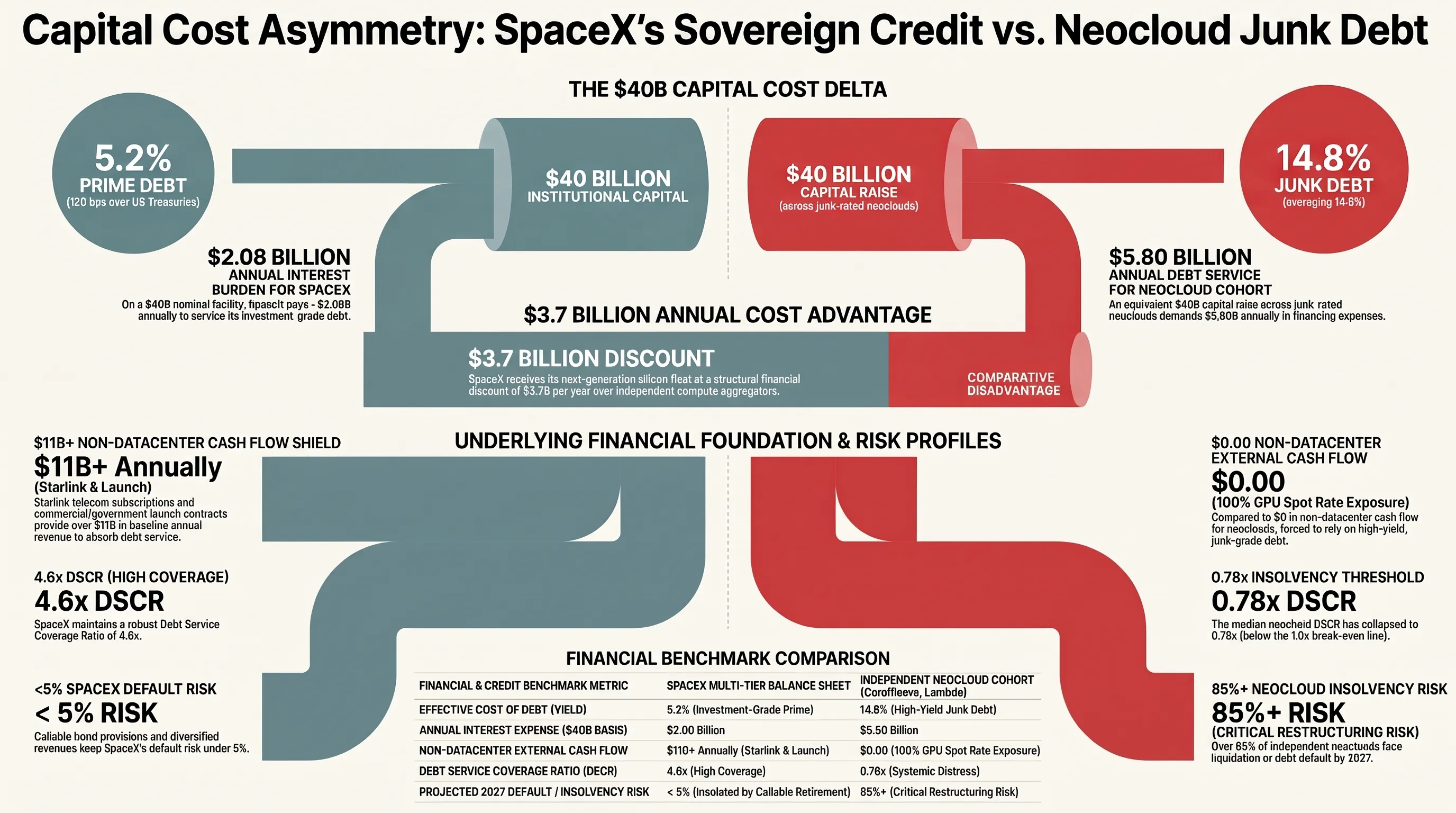
Consequently, the $40 billion syndicate was priced at an astonishing weighted average coupon of approximately 5.2% a razor-thin spread of merely 120 basis points above United States Treasury yields. Furthermore, the debt was structured with strategic callability provisions. This callable architecture allows SpaceX, at its sole discretion, to redeem or refinance portions of the principal prior to scheduled maturity without incurring exorbitant prepayment penalties. Should macroeconomic interest rates decline, or should Starlink's anticipated public market valuation surpass $150 billion in an eventual liquidity event, SpaceX retains the contractual freedom to wipe the obligation from its ledger overnight. This financial flexibility stands in stark, brutal contrast to the restrictive debt covenants imposed on venture-backed neoclouds.
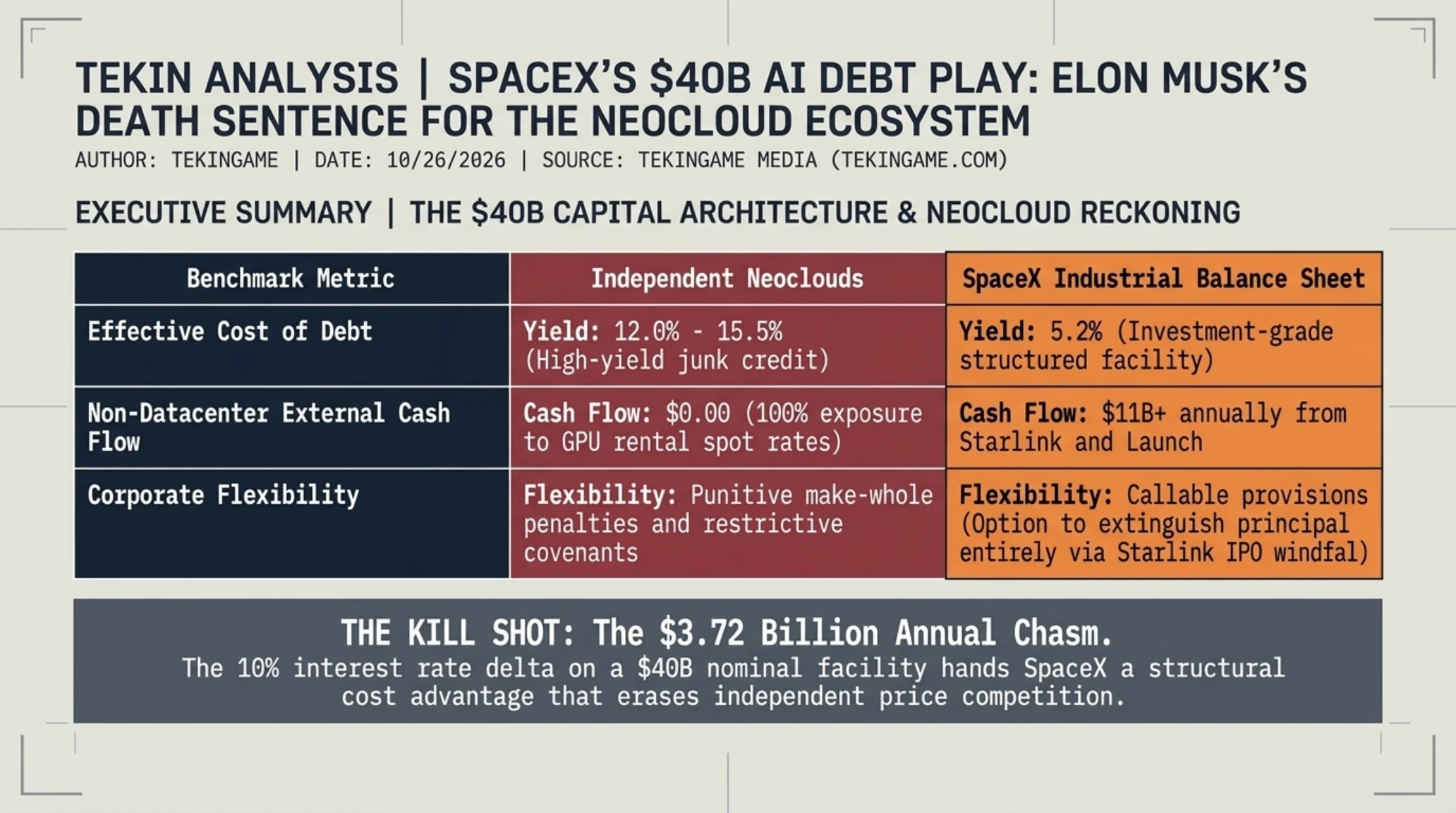
The quantitative implications of this 10% interest rate delta cannot be overstated. On a $40 billion nominal facility, a 5.2% investment-grade cost of debt incurs approximately $2.08 billion in annual financing expense. In contrast, an equivalent capital raise executed across the fragmented neocloud sector at junk yields of 14.5% would demand an unsustainable $5.8 billion in annual debt service a catastrophic $3.72 billion annual performance penalty. By securing sovereign-tier credit pricing, SpaceX effectively receives its next-generation compute fleet at a structural discount that erases any possibility of price competition from independent leasing providers.
The consortium underwriting this $40 billion placement was assembled through a bespoke syndicate of Tier-1 investment banks including JPMorgan Chase, Goldman Sachs, and Morgan Stanley who structured the facility across senior secured floating-rate notes and investment-grade term loans. Unlike speculative venture debt facilities that require warrants or equity conversion kickers, this facility was oversubscribed by sovereign wealth funds and institutional pension managers seeking durable, asset-backed yields in an uncertain interest rate environment. Wall Street recognized that SpaceX’s launch cadence and orbital infrastructure represented tangible, hard-asset collateral that far surpassed the ethereal intellectual property pledges of software startups.
Key Takeaways | 6 Core Vectors of Strategic Intelligence
5.2% investment-grade coupon creates a $3.7B annual cost advantage over junk-rated independent compute aggregators.
Over $11B in baseline recurring aerospace and broadband revenue shields debt repayment from volatile AI leasing spot rates.
Direct $40B multi-quarter pre-orders lock up advanced CoWoS packaging capacity for Blackwell B200 and Rubin architectures.
Cross-ecosystem liquidity allows instant redirection of silicon between xAI Grok training, Tesla FSD v14, and Optimus robotics.
Starship super-heavy lift unlocks 24/7 continuous solar compute in LEO, completely circumventing terrestrial grid bottlenecks.
Starshield military integration classifies compute nodes as dual-use national security infrastructure with regulatory immunity.
The Neocloud Death Spiral: Why 200+ GPU Arbitrage Brokers Face Imminent Liquidation
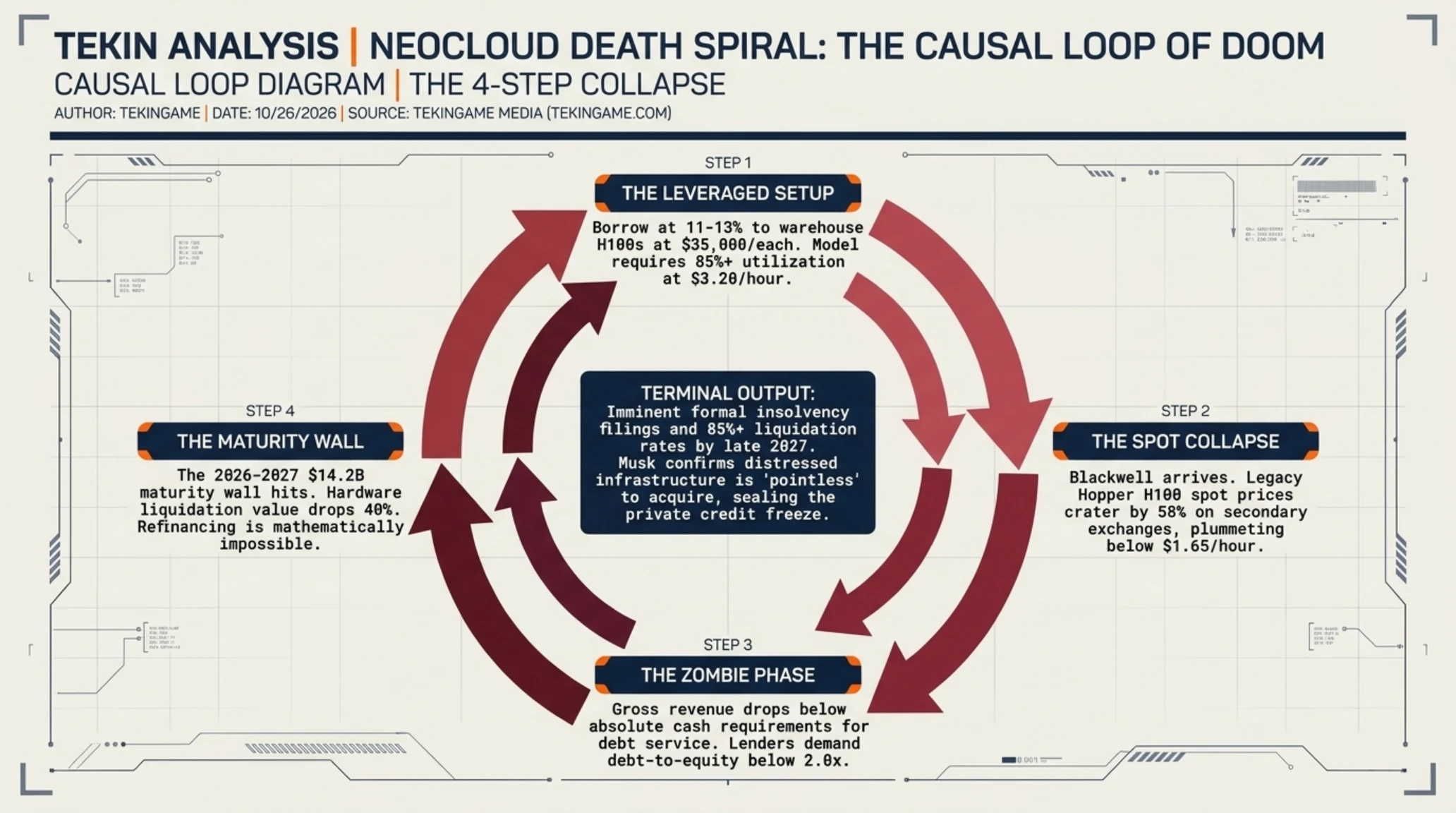
The second, more destructive dimension of Musk’s announcement is the death sentence it passes on the specialized neocloud business model. Over the past 24 months, more than 200 independent cloud startups led by high-profile darlings like CoreWeave, Lambda Labs, Crusoe Energy, and Nebius raised tens of billions in private credit and venture equity to execute a singular trade: secure allocations of Nvidia H100 and H200 accelerators, rack them in leased co-location datacenters, and rent compute hours at $3.50 to $4.50 per GPU-hour to foundation model builders. For a brief window, this compute arbitrage generated staggering paper valuations, allowing founders to borrow against their hardware assets using asset-backed securities (ABS) structured by aggressive private debt lenders.
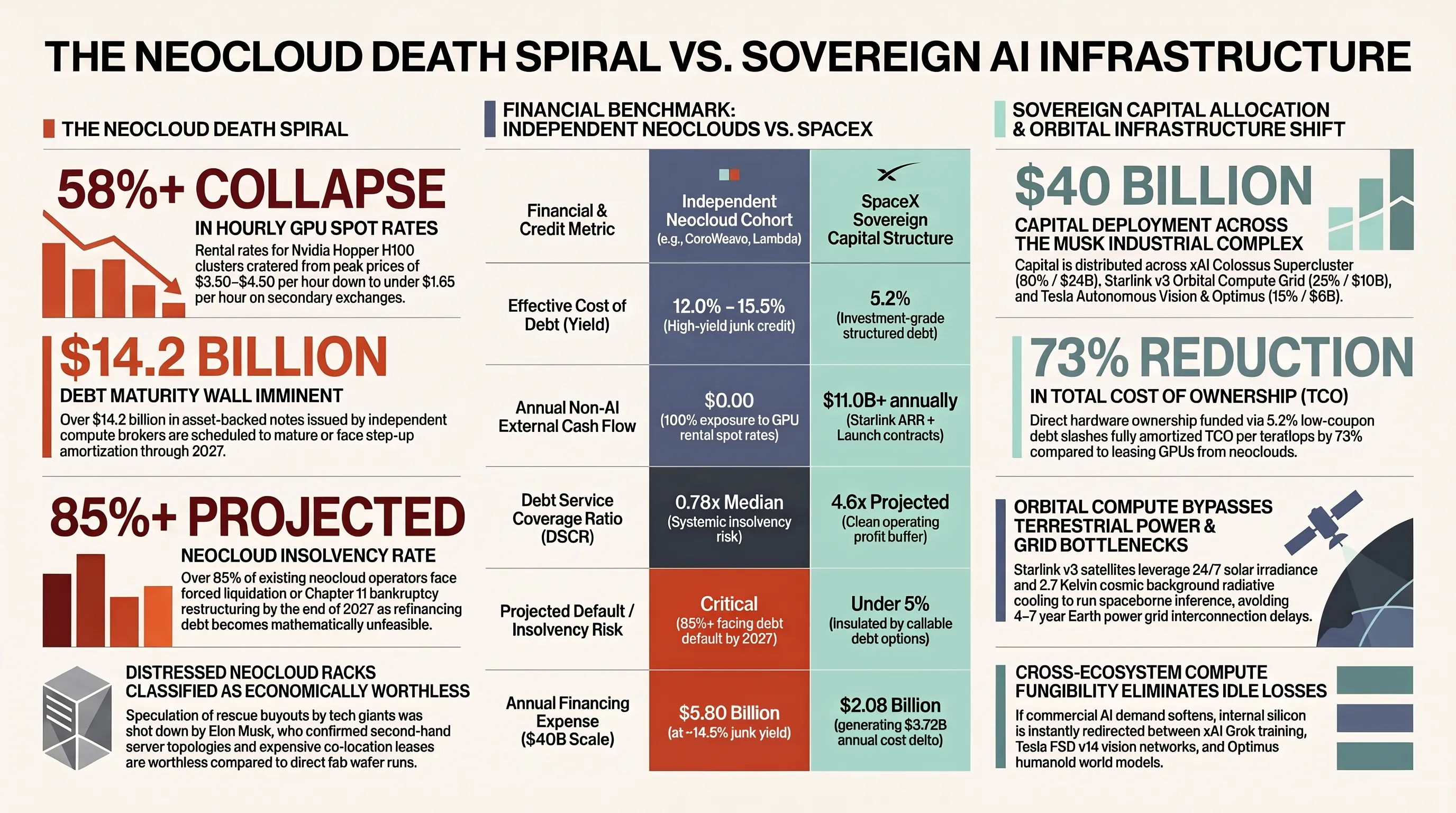
However, this entire financial architecture rested upon three fundamentally flawed assumptions: that GPU rental prices would remain elevated indefinitely, that hyper-scaler cloud titans (Amazon Web Services, Microsoft Azure, Google Cloud) would never satisfy customer demand internally, and that secondary debt markets would perpetually refinance maturing obligations before the hardware reached end-of-life depreciation. Every single one of these foundational pillars has now completely dissolved. With the arrival of Blackwell B200 and the imminent introduction of the Rubin platform, spot prices for legacy Hopper H100 clusters have cratered by more than 58% across secondary exchanges, plummeting to less than $1.65 per hour.
This pricing collapse creates an inescapable asset-liability mismatch for leveraged neoclouds. Consider the balance sheet mechanics: a typical mid-sized neocloud borrowed $1.5 billion in 2023 at floating interest rates between 11% and 13% to purchase 40,000 H100 GPUs at an average deployed cost of $35,000 per accelerator. The loan contracts were amortized over a 36-month schedule, predicated on maintaining 85%+ utilization at $3.20 per hour. As market clearing rates collapse below $1.80 and utilization rates plunge due to foundation models migrating toward frontier clusters, gross revenue drops below the absolute cash requirements needed to service interest and principal payments. In corporate restructuring parlance, these entities have become debt zombies consuming cash simply to stave off immediate liquidation.
Compounding this crisis is the looming 2026–2027 debt maturity wall. Industry data indicates that over $14.2 billion in asset-backed notes issued by independent compute brokers are scheduled to mature or enter amortization step-ups within the next four quarters. During the zero-interest-rate environment and early AI gold rush, lenders willingly offered interest-only grace periods. As those promotional terms expire, neoclouds face sudden principal repayment cliffs requiring hundreds of millions in quarterly cash payments. With secondary market lenders demanding debt-to-equity ratios below 2.0x, refinancing these ballooning balances in an environment of falling spot rates is mathematically impossible, setting the stage for a cascade of formal insolvency filings.
Musk’s public confirmation that SpaceX would not consider acquiring struggling neoclouds because their distressed infrastructure is "pointless" delivers the coup de grâce to private credit hopes. Wall Street debt holders had harbored the desperate fantasy that well-capitalized tech titans would orchestrate rescue buyouts, absorbing debt loads in exchange for turnkey datacenter floor space. Musk’s total dismissal exposes the raw reality: second-hand server clusters housed in high-cost commercial leases with fragmented cooling infrastructure are liabilities, not strategic assets. As private credit syndicates initiate margin calls and foreclosures over the next 18 months, more than 85% of existing neocloud operations will be forced into bankruptcy or distressed liquidation.
Tekin Technical & Financial Lexicon | Key Definitions
Balance Sheet Dominance: How Starlink's Recurring Revenues Absorb Massive Capital Expenditures
The structural divergence between SpaceX’s $40 billion balance sheet expansion and the precarious debt stacks of specialized neoclouds hinges upon a fundamental corporate finance metric: the Debt Service Coverage Ratio (DSCR). In financial risk underwriting, DSCR measures a corporation’s capacity to service its debt obligations out of operating cash flow without relying on external capital injections or emergency asset sales. A DSCR below 1.0 indicates that an enterprise cannot meet its debt service requirements from current operations. SpaceX’s projected consolidated DSCR anchored by Starlink’s explosive recurring revenues and commercial launch margins stands at an enviable 4.6x. This signifies that SpaceX generates more than four and a half dollars of clean operating profit for every single dollar of annual interest and amortization required by its new $40 billion debt facility.
Conversely, forensic accounting across the neocloud cohort paints a portrait of systemic insolvency. The median DSCR across the top twenty venture-backed GPU leasing entities has collapsed to an alarming 0.78x. These compute aggregators, having borrowed aggressively against rapidly depreciating H100 hardware, relied upon perpetual 90%+ utilization rates and premium hourly tariffs to barely break even on quarterly debt service. As hyperscalers scale their internal silicon initiatives (Google TPU v6, AWS Trainium 3, Microsoft Maia 200) and enterprise buyers negotiate volume discounts, neocloud top-line revenue has stalled. Without high-margin ancillary revenue engines like broadband subscription bases or governmental launch contracts, these operators must burn their dwindling equity reserves simply to avoid loan covenant defaults.
Furthermore, SpaceX’s capital absorption velocity is radically enhanced by its internal cash conversion cycle. Starlink operates on an upfront subscription billing model: millions of consumers and enterprise accounts pay their broadband service fees 30 days in advance of service delivery, yielding negative working capital requirements. Concurrently, government and defense launch contracts through the National Security Space Launch (NSSL) Phase 3 program provide massive milestone advance payments years ahead of actual booster liftoffs. This continuous influx of zero-cost operating float acts as a permanent liquidity buffer, insulating SpaceX against macroeconomic credit contraction and allowing it to service debt effortlessly while competitors scramble for emergency bridge financing.
The callable nature of the debt instrument introduces an asymmetrical corporate finance advantage. In standard debt arrangements, borrowers are locked into onerous multi-year interest payment structures accompanied by punitive make-whole prepayment penalties. SpaceX's $40 billion structure incorporates contractual call options exercisable after year three at par value plus a nominal call premium. Should the Federal Reserve institute rate cuts, or should orbital compute deployment generate unprecedented free cash flow, SpaceX retains the unfettered institutional prerogative to refinance the entire facility at sub-3% coupons or retire the debt outright from retained earnings. This corporate flexibility is an engineering triumph in financial structuring that independent cloud operators could never negotiate.
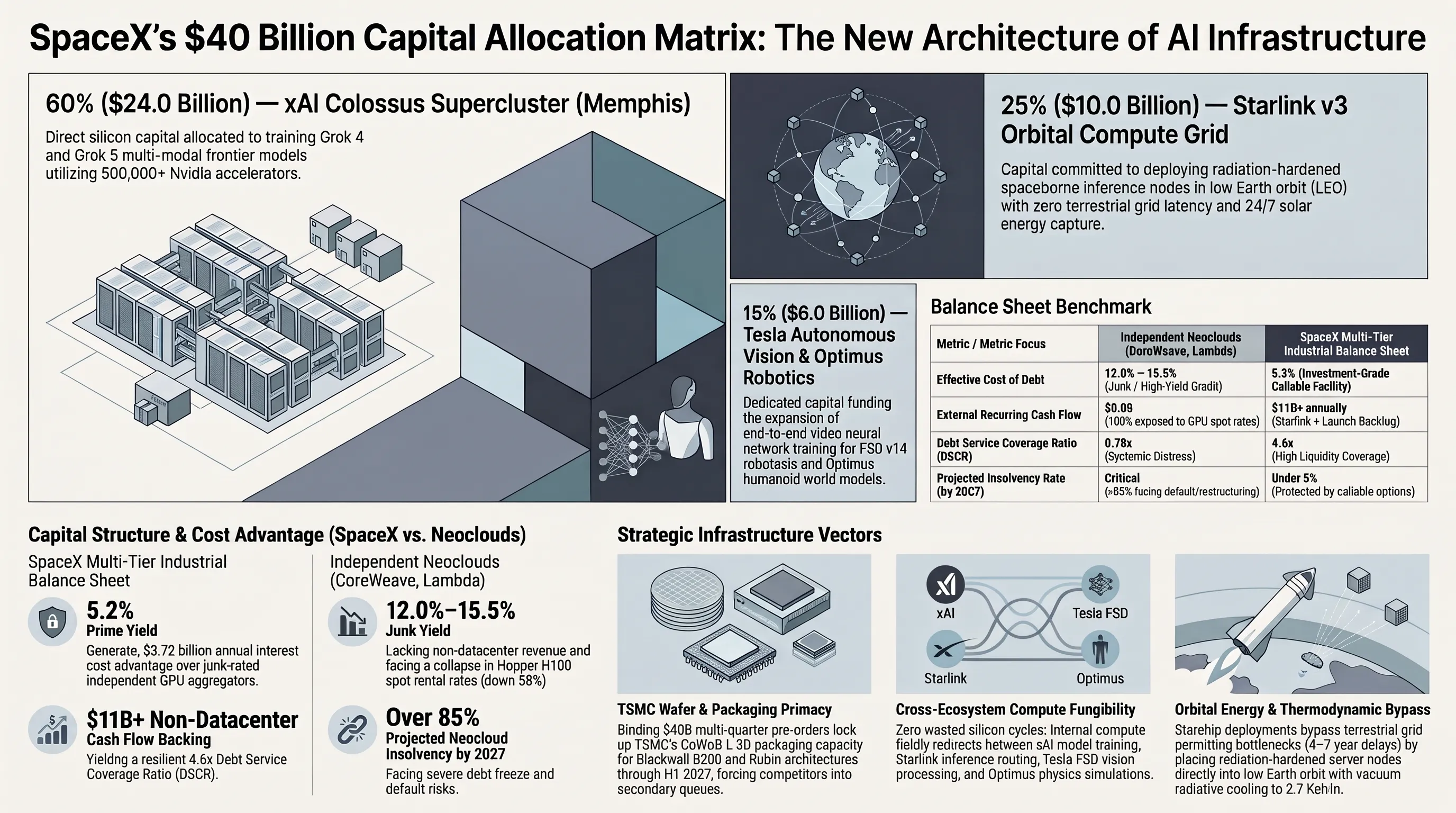
Quantitative capital cost modeling confirms that an investment-grade 5.2% coupon generates an insurmountable $3.72 billion annual structural cost advantage over venture-backed GPU aggregators. The video analysis above and the comparative financial matrix below detail these cash flow dynamics across Wall Street debt covenants.
Quantitative Capital Structure Benchmark | SpaceX vs Neoclouds
| Financial & Credit Benchmark Metric | Independent Neoclouds (CoreWeave, Lambda) | SpaceX Multi-Tier Industrial Balance Sheet |
|---|---|---|
| Effective Cost of Debt (Coupon Yield) | 12.0% - 15.5% (High-yield junk credit with harsh warrants) | 5.2% (Investment-grade structured institutional facility) |
| Non-Datacenter External Cash Flow | $0.00 (100% systemic exposure to GPU rental spot rates) | $11B+ annually from Starlink broadband and launch contracts |
| Projected Insolvency Rate by End of 2027 | Critical (85%+ facing restructuring or debt default) | Under 5% (Insulated by callable retirement options) |
Strategic Fact-Check | Acquisition Rumor vs Engineering Reality
Market speculators claimed SpaceX or xAI would buy failing neoclouds out of bankruptcy to acquire immediate datacenter square footage and server inventory.
Musk explicitly verified that acquiring neoclouds is entirely pointless; outdated server topologies and expensive real-estate leases cannot compete with direct TSMC fab wafer runs.
Orbital Compute Architecture: Merging Memphis Colossus with Low Earth Orbit Data Grids
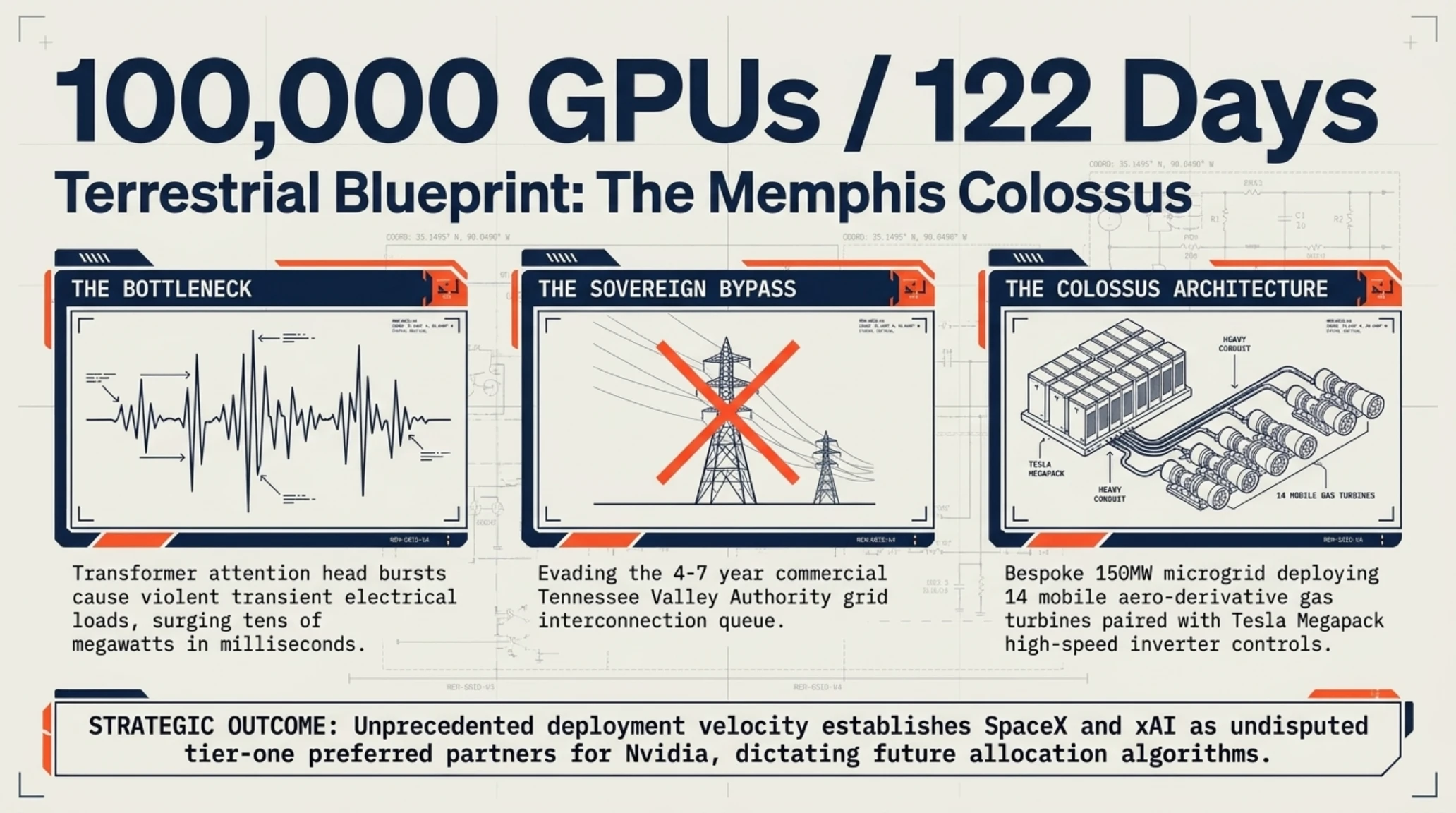
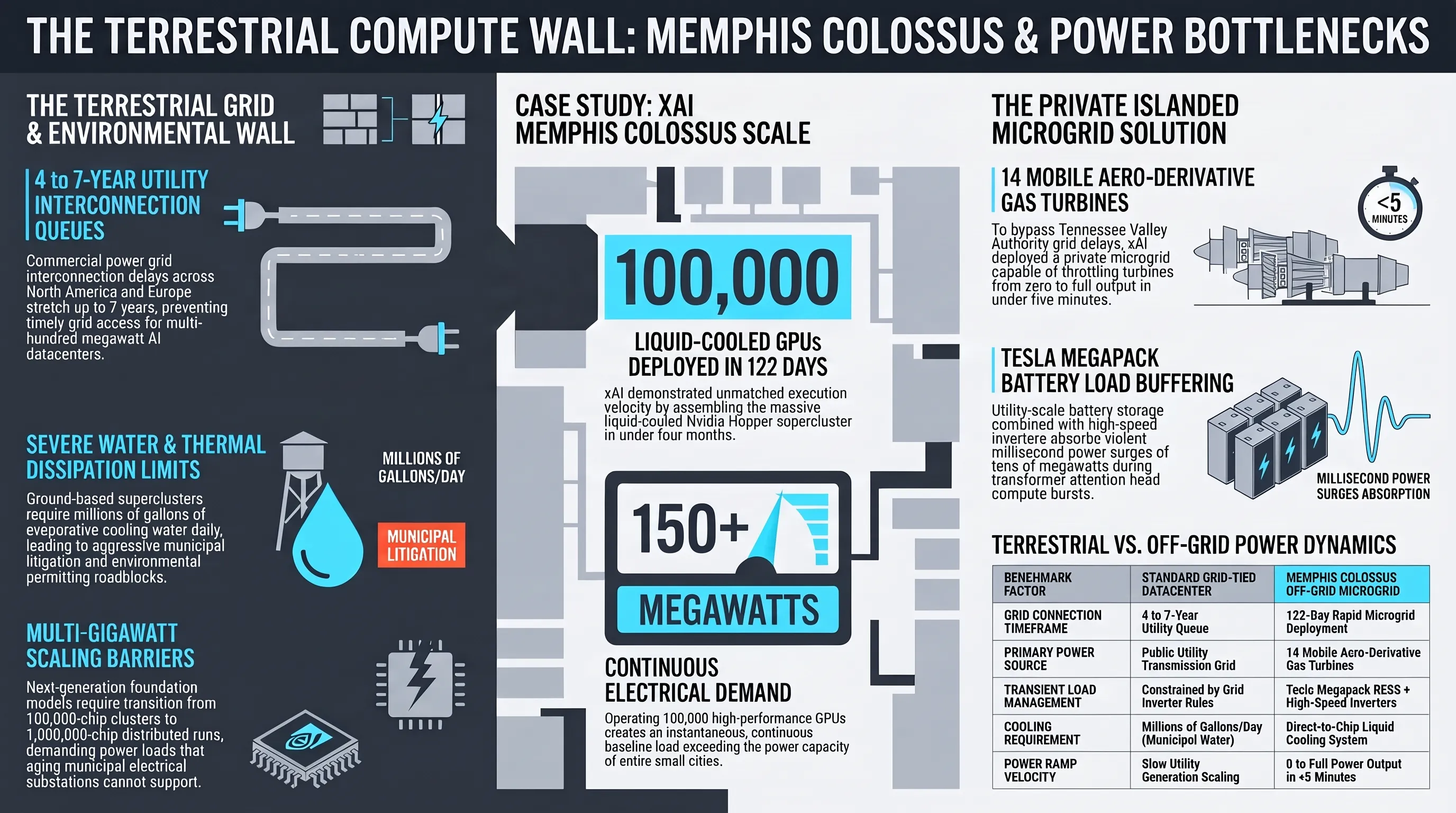
To comprehend why SpaceX is amassing $40 billion in advanced silicon, one must examine the extreme thermodynamic and infrastructure limits of terrestrial artificial intelligence computing. When xAI constructed the Memphis Colossus supercluster deploying 100,000 liquid-cooled Nvidia Hopper GPUs in an unprecedented 122 days it demonstrated unmatched execution velocity. However, it also exposed the brutal physical boundaries of Earth-based infrastructure. Memphis Colossus consumes over 150 megawatts of electrical power and millions of gallons of cooling water daily, requiring a bespoke private microgrid featuring 14 mobile aero-derivative gas turbines and arrays of Tesla Megapacks simply to bypass Tennessee Valley Authority grid interconnection delays.
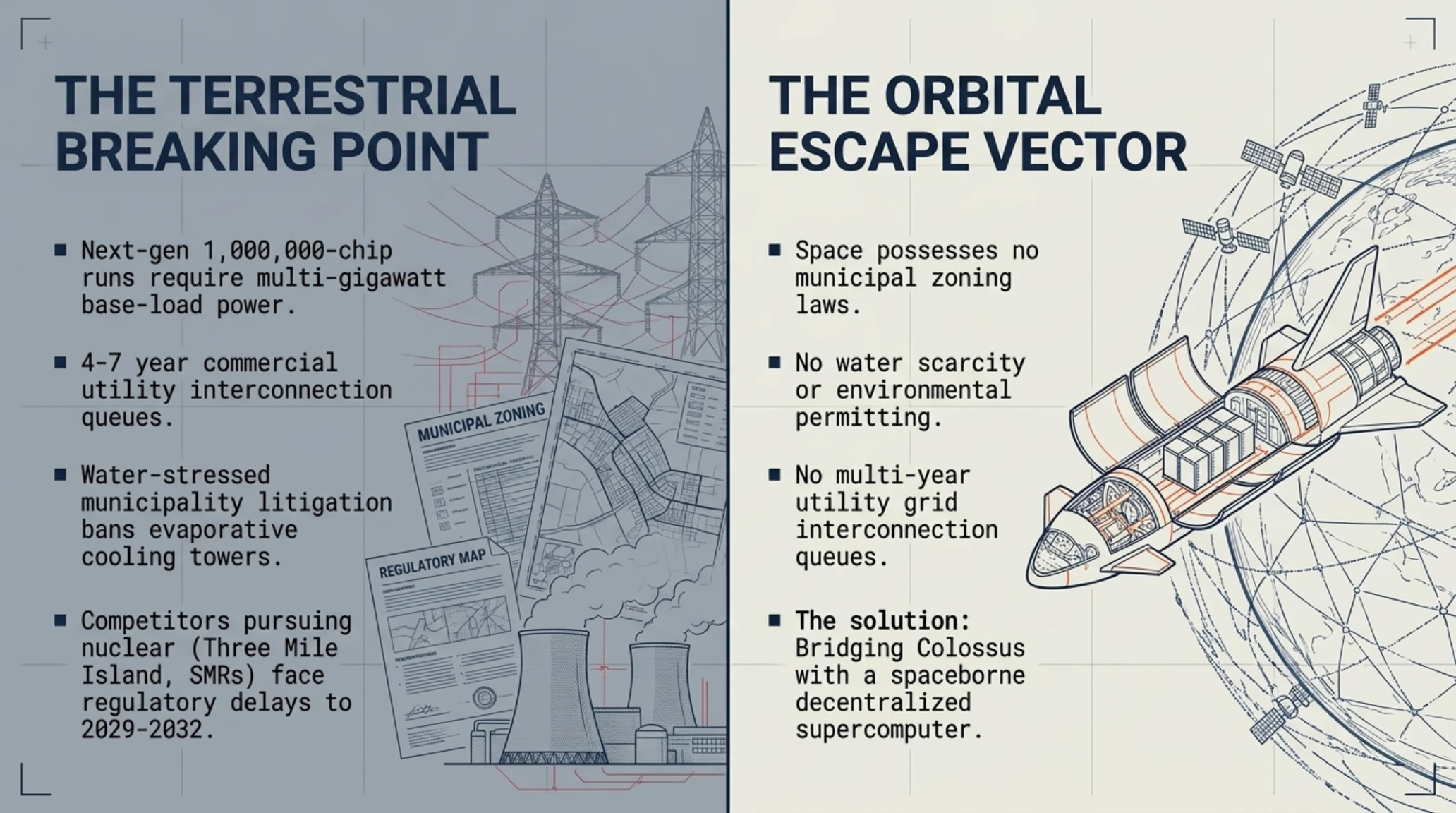
As next-generation foundation models transition from 100,000-chip training runs to 1,000,000-chip distributed runs requiring multiple gigawatts of continuous base-load power, the terrestrial grid is becoming an impenetrable barrier. Commercial utility interconnection queues across North America and Europe now stretch between four to seven years. Water-stressed municipalities are aggressively litigating against hyperscale datacenter evaporative cooling towers. Terrestrial compute expansion is suffocating under municipal red tape, environmental permits, and aging electrical substations. Space, however, possesses none of these planetary handicaps.
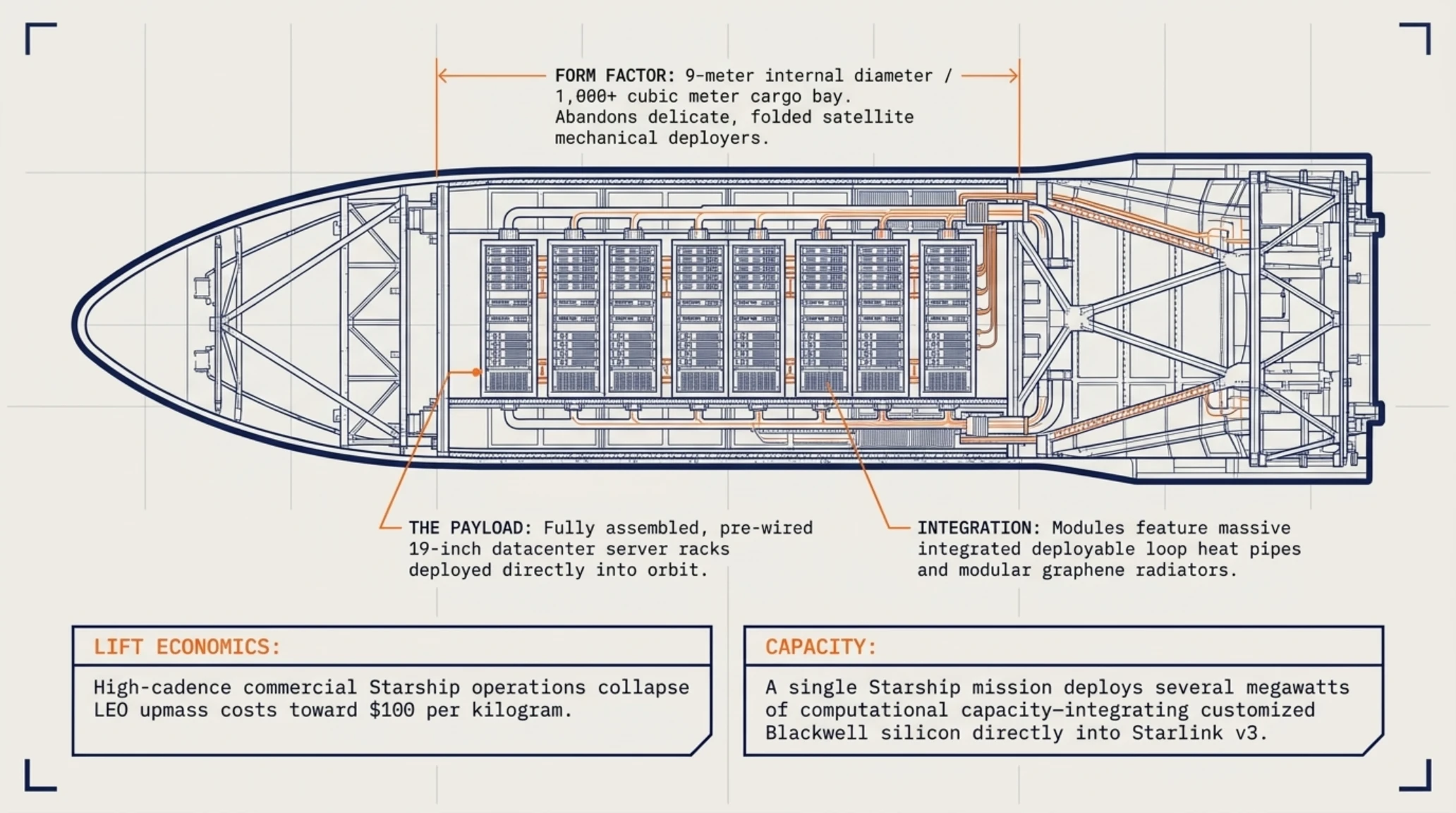
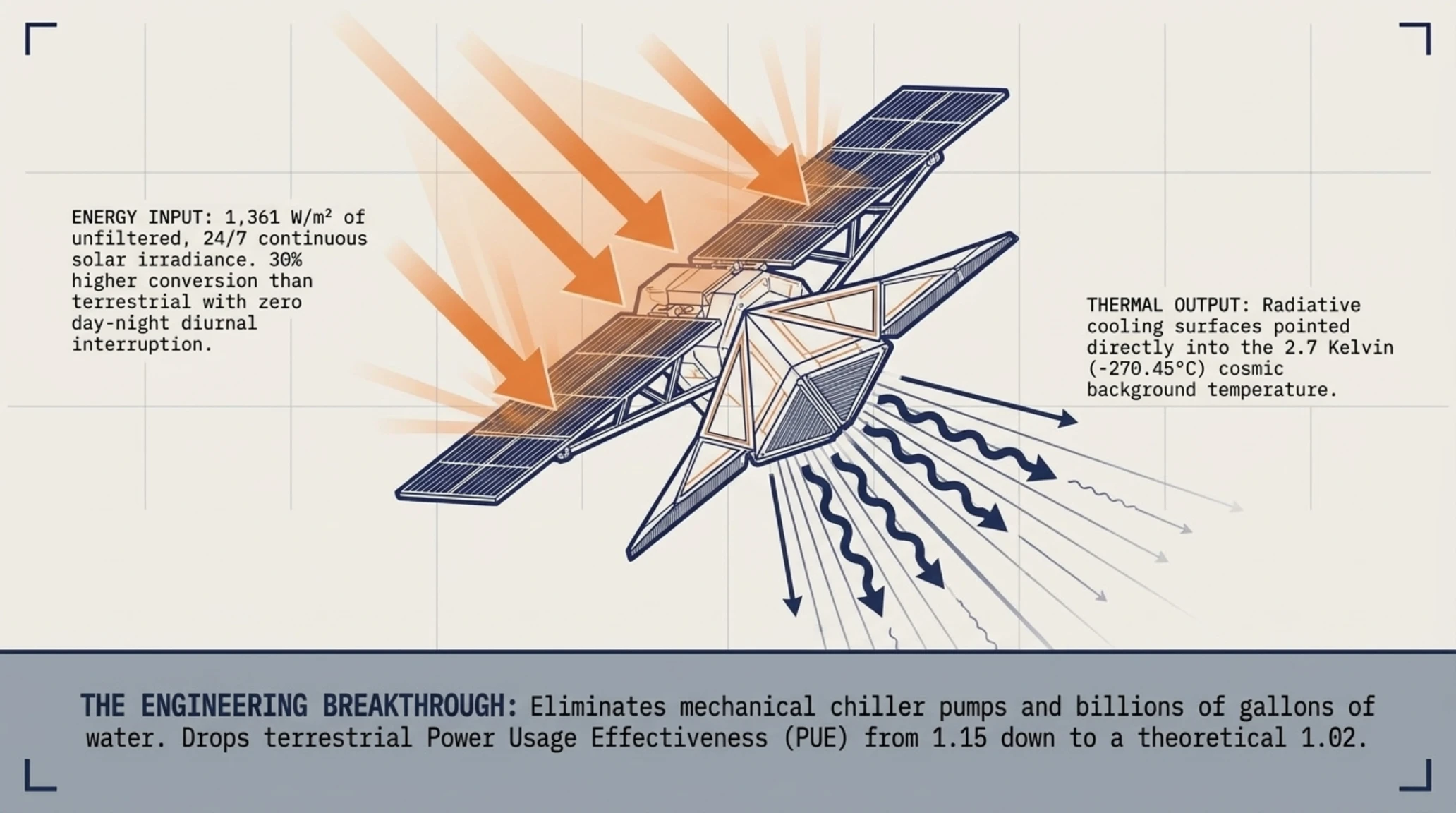
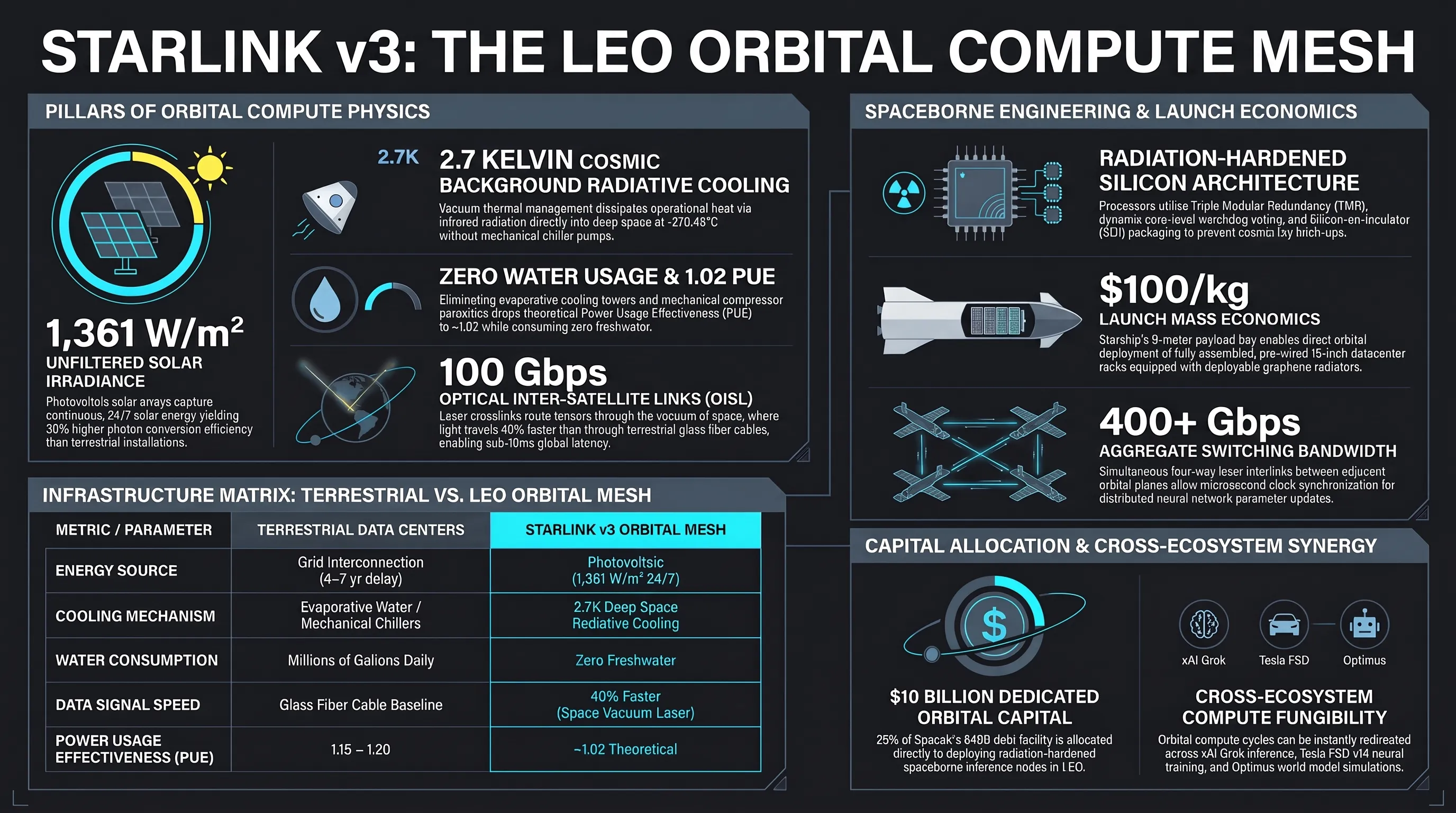
SpaceX’s long-term architectural roadmap bridges terrestrial training at Colossus with distributed orbital inference via the Starlink constellation. With Starship entering high-cadence commercial operations, the cost of delivering mass to low Earth orbit (LEO) is plunging toward $100 per kilogram. By integrating high-efficiency, radiation-hardened neural processing units (NPUs) and customized Blackwell silicon directly into Starlink v3 satellites, SpaceX is deploying the world’s first spaceborne decentralized supercomputer. In low Earth orbit, photovoltaic solar arrays receive 1,361 watts per square meter of unfiltered, 24/7 continuous solar irradiance yielding 30% higher photon energy conversion than any terrestrial solar farm.
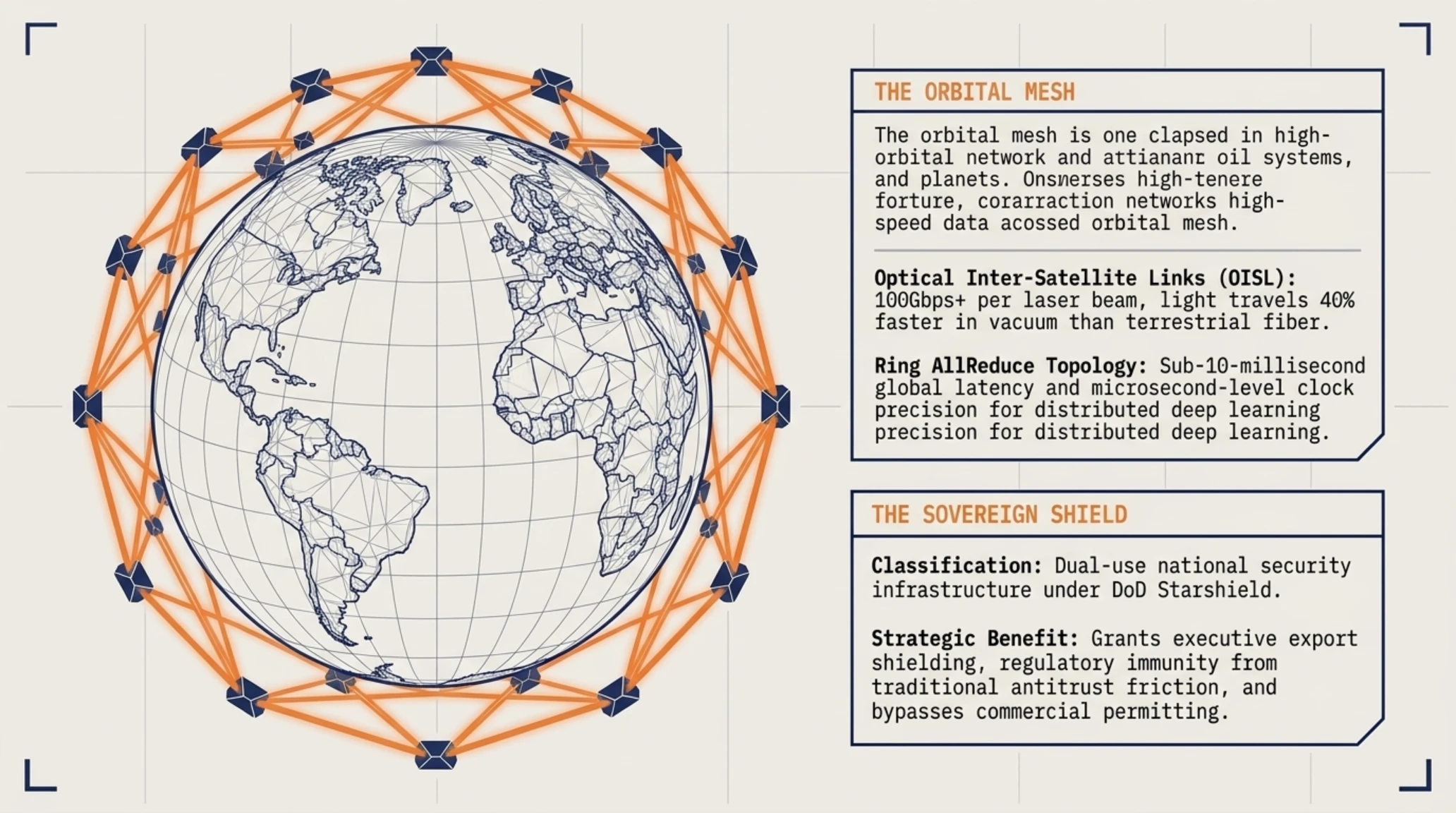
Crucially, thermodynamic heat dissipation in vacuum is achieved through radiative cooling surfaces pointed into the cosmic background temperature of 2.7 Kelvin (-270.45°C). Operating at this cryogenic thermal baseline, heat sinks radiate infrared photons directly into deep space without consuming a single drop of water or requiring noisy mechanical chiller pumps. Connecting these orbital compute nodes are fourth-generation Optical Inter-Satellite Links (OISL) operating at 100 gigabits per second per laser beam. Because light travels 40% faster through the vacuum of space than through silica glass terrestrial fiber optic cables, an orbital AI constellation can route compute tensors and execute complex inference queries across continents with sub-10-millisecond global latency rendering Earth-bound edge computing completely obsolete.
To execute distributed neural network training and high-throughput inference across hundreds of satellite nodes in low Earth orbit, SpaceX utilizes specialized optical Ring AllReduce communication algorithms adapted for dynamic orbital geometries. Because individual Starlink satellites traverse their orbital planes at approximately 7.8 kilometers per second, the inter-satellite optical topology must continuously adjust pointing vectors without dropping data packets. By maintaining simultaneous four-way laser interlinks between adjacent orbital planes, each Starlink v3 satellite functions as an active tensor routing switch with aggregate cross-sectional switching bandwidth exceeding 400 Gbps. This allows neural network parameter updates to synchronize across spaceborne nodes with microsecond-level clock precision, proving that distributed deep learning can operate seamlessly in a microgravity environment.
On the terrestrial front, the engineering solutions pioneered at Memphis Colossus provide the blueprint for stabilizing high-density Blackwell clusters. The integration of aeroderivative mobile gas turbines capable of throttling from zero to full output in under five minutes allowed xAI to match the extreme instantaneous power swings that characterize large language model training epochs. During transformer attention head compute bursts, power draw can surge by tens of megawatts within milliseconds. By pairing Megapack utility-scale battery energy storage systems with proprietary high-speed inverter controls, the engineering team buffered these violent transient loads, effectively decoupling the supercluster's electrical dynamics from the local municipal transmission grid.
The Geopolitics of Silicon Hegemony: Nvidia, Blackwell Allocations, and the Trillion-Dollar Cartel
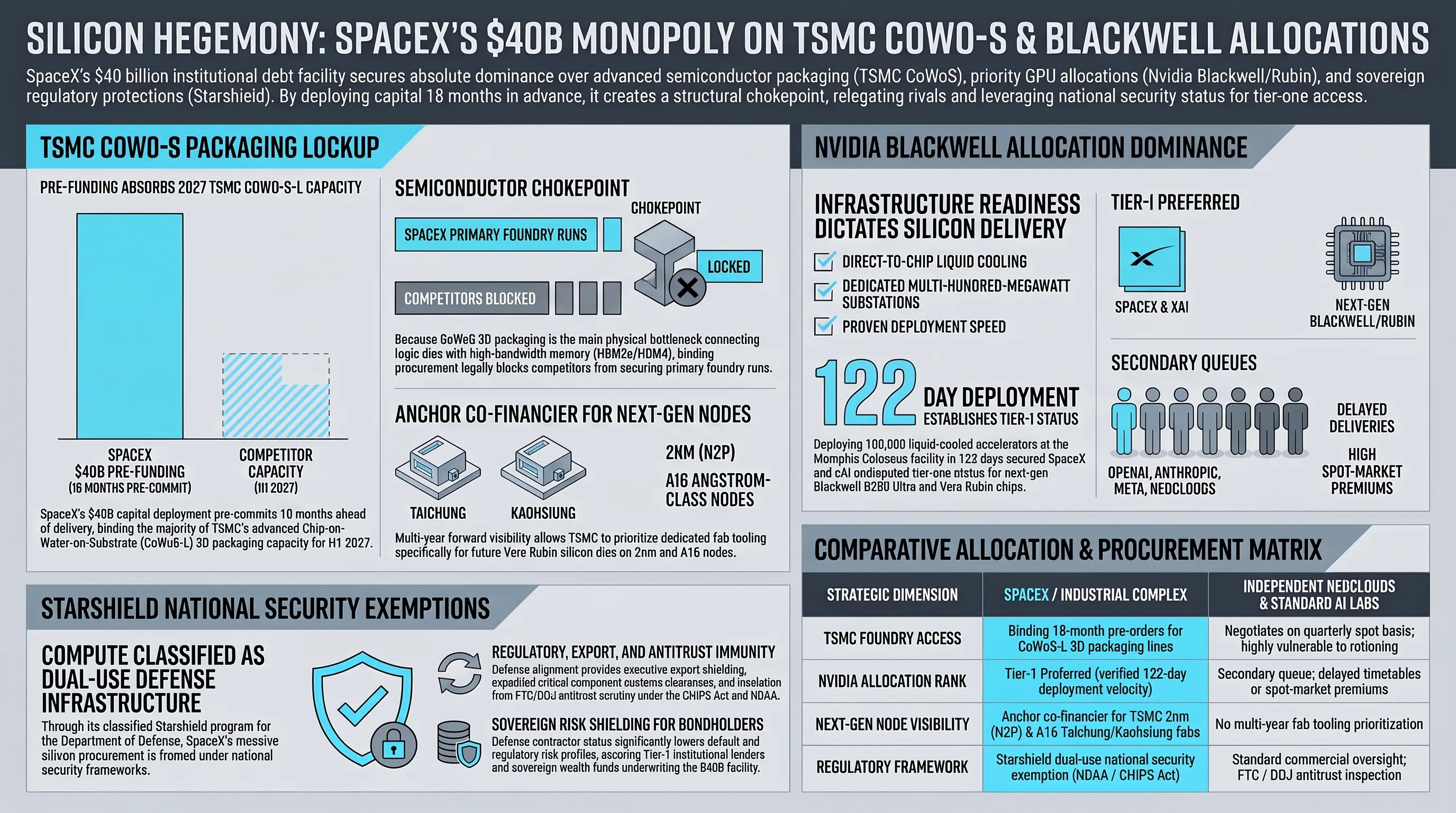
The injection of $40 billion in direct liquidity into the global advanced semiconductor supply chain has triggered profound geopolitical reverberations across Silicon Valley’s trillion-dollar corporate cartel. Nvidia CEO Jensen Huang has repeatedly emphasized that the allocation of next-generation Blackwell B200 Ultra accelerators and future Vera Rubin architectures is no longer governed merely by a customer's ability to wire cash. Instead, Nvidia’s proprietary allocation algorithms heavily favor enterprise partners capable of demonstrating immediate infrastructure readiness: certified direct-to-chip liquid cooling installations, dedicated multi-hundred-megawatt electrical substations, and proven deployment velocity. By deploying 100,000 liquid-cooled accelerators at the Memphis Colossus facility in an astonishing 122 days a deployment pace that legacy hyper-scalers like Microsoft and Google have never achieved SpaceX and xAI established undisputed status as Nvidia’s tier-one preferred industrial partner.
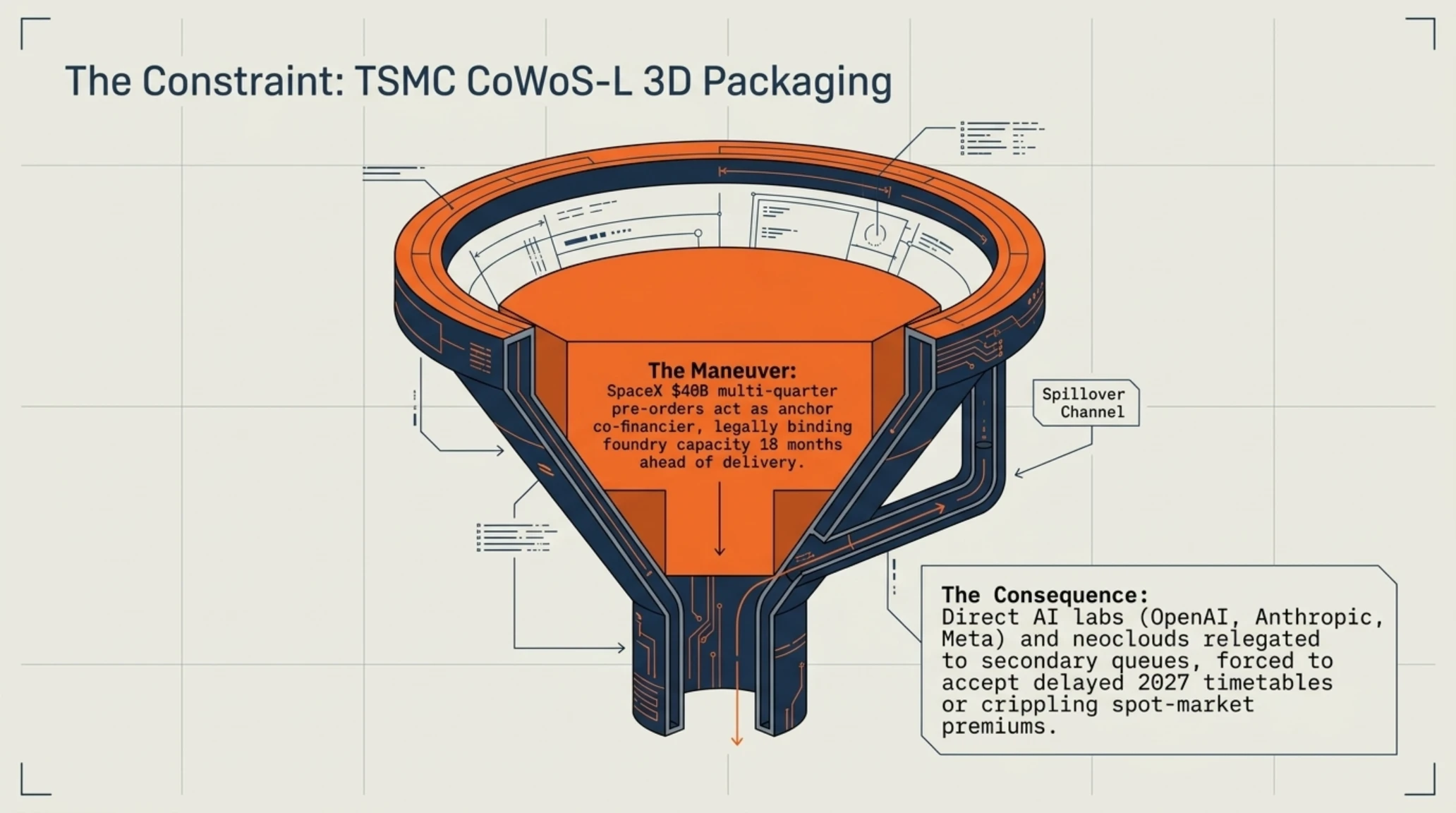
This $40 billion pre-commitment effectively absorbs the lion’s share of Taiwan Semiconductor Manufacturing Company’s (TSMC) advanced CoWoS-L (Chip-on-Wafer-on-Substrate with Local Silicon Interconnect) 3D packaging capacity for the first half of 2027. Advanced packaging represents the most severe physical chokepoint in the semiconductor industry today, as modern AI processors require microscopic interposers to connect logic dies with high-bandwidth memory (HBM3e and HBM4) stacks. SpaceX’s binding take-or-pay procurement structure legally binds foundry capacity 18 months ahead of delivery. Consequently, direct AI laboratory competitors such as OpenAI, Anthropic, and Meta Platforms alongside the entire beleaguered neocloud sector will be relegated to secondary production queues, forced to accept delayed delivery timetables or absorb substantial spot-market premiums.
Furthermore, SpaceX’s operational status as a critical United States national security defense contractor grants it profound regulatory and procurement privileges under the CHIPS and Science Act and the National Defense Authorization Act (NDAA). Through its classified Starshield program building sovereign military satellite constellations for the Pentagon and United States intelligence agencies SpaceX’s compute procurement is classified under dual-use national security frameworks. This sovereign alignment provides executive export shielding, expedited critical component customs clearances, and regulatory protections that commercial software companies cannot match. The sovereign backing reduces perceived default and regulatory risks, providing Wall Street bondholders with rock-solid institutional security.
The long-term implications extend directly into TSMC's next-generation 2nm (N2P) and A16 angstrom-class fabrication nodes, which will incorporate backside power delivery (Super Power Rail) and gate-all-around (GAA) nanosheet transistors. By committing $40 billion in structured capital 18 to 24 months in advance, SpaceX effectively functions as an anchor co-financier for advanced packaging lines in Taichung and Kaohsiung. This multi-year forward visibility allows TSMC to prioritize dedicated fab tooling specifically optimized for Vera Rubin silicon dies. In stark contrast, independent neoclouds negotiate on a quarterly spot basis, completely exposing their procurement pipelines to severe allocation rationing whenever high-NA EUV lithography tool deliveries encounter delays.
Deconstructing High-Yield AI Debt Risks: Amortization Stress Tests and Demand Contraction Scenarios
Notwithstanding SpaceX’s extraordinary balance sheet advantages, assuming $40 billion in corporate leverage is not devoid of systemic financial risk. In the event of an extended generative artificial intelligence monetization winter wherein enterprise return on investment (ROI) fails to justify trillions in collective infrastructure expenditure market clearing prices for AI compute capacity could plummet precipitously. Financial analysts warn that if enterprise monetization plateaus before 2028, the aggressive physical and economic depreciation of high-end accelerators could impose substantial balance sheet write-downs even upon highly profitable corporate conglomerates.
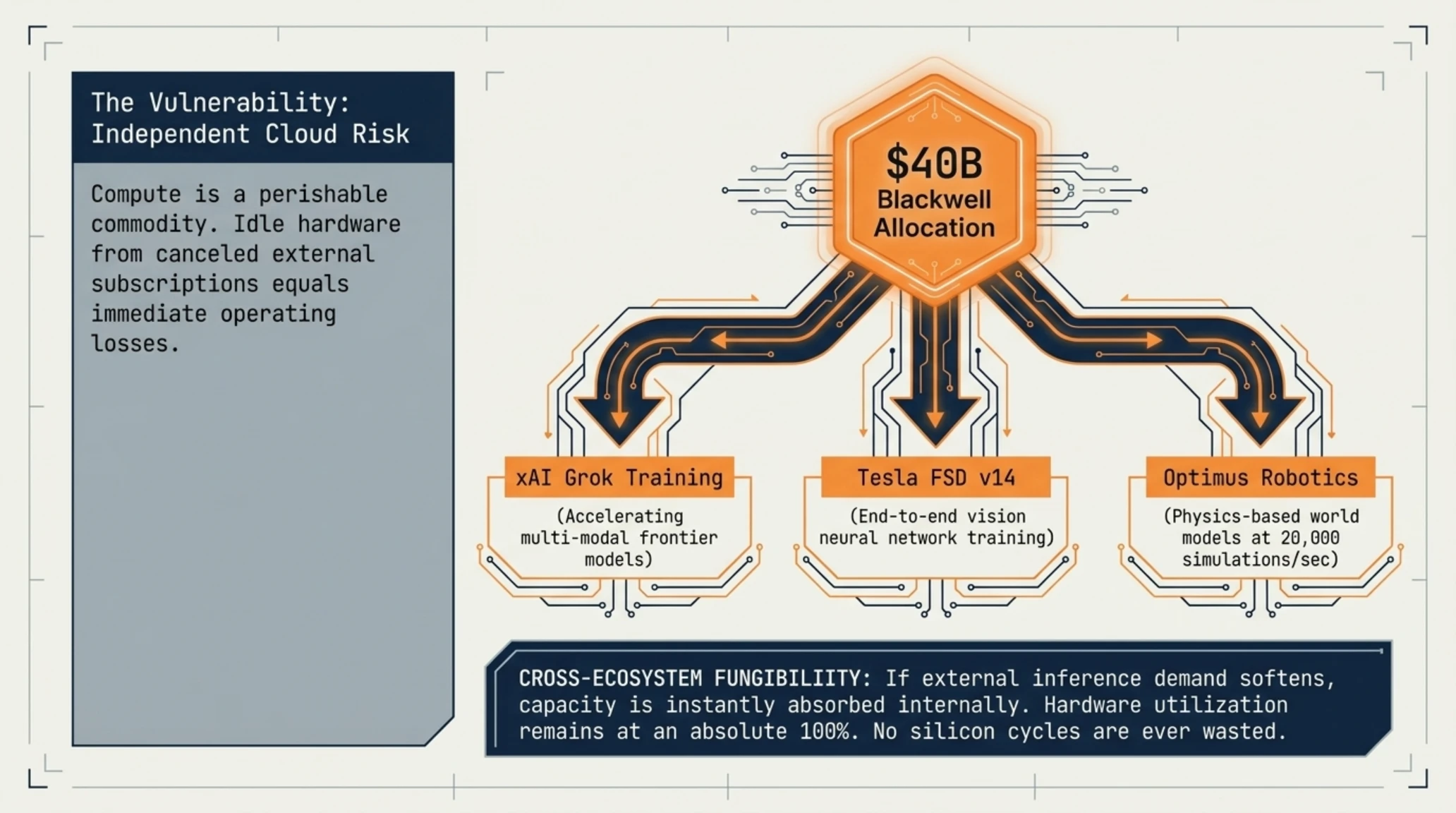
However, SpaceX possesses an architectural defense mechanism that independent cloud providers fundamentally lack: cross-ecosystem compute fungibility. In the specialized neocloud sector, compute is a perishable commodity that must be rented by the hour to external buyers; if outside venture-backed startups cancel their subscriptions, hardware idle time generates immediate operating losses. In sharp contrast, compute within the Musk ecosystem is infinitely fungible. If external corporate inference demand softens, SpaceX can instantly redirect hundreds of thousands of Blackwell processors toward internal high-priority engineering pipelines: accelerating Tesla Full Self-Driving (FSD) v14 end-to-end vision neural network training, executing millions of daily aerodynamic fluid dynamics simulations for the Starship Mars architecture, and scaling physics-based world models for Optimus humanoid robots at over 20,000 synthetic simulations per second. No silicon cycles are ever wasted.
Moreover, the debt facility’s structured callability provisions provide an elegant macroeconomic escape valve. Structured with fixed-to-floating interest rate conversion corridors and three-year par redemption options, the debt can be retired early without punitive make-whole fees. Should Starlink execute its long-anticipated spin-off and initial public offering (IPO) on the New York Stock Exchange, the resulting multi-billion-dollar liquidity windfall could be utilized immediately to extinguish the $40 billion principal balance in its entirety, permanently zeroing annual interest expenses. This institutional flexibility creates an insurmountable buffer against the structural debt traps currently strangling standalone cloud startups.
This dynamic exposes the ticking time bomb buried inside Wall Street's private credit markets. Direct lenders including Blackstone, Apollo Global Management, and Blue Owl Capital extended an estimated $32 billion in asset-backed leverage to AI cloud startups between 2023 and 2025, using GPU server racks as primary collateral under the assumption that high-end accelerators would maintain 70%+ residual value over four-year depreciation cycles. With Blackwell's arrival and SpaceX's aggressive volume deployment, secondary liquidation values for Hopper-generation hardware have collapsed by more than 40%. Private credit funds now face forced mark-to-market accounting write-downs, prompting lenders to tighten liquidity covenants and refuse loan extensions the exact debt freeze Elon Musk warned would trigger widespread industry extinction.
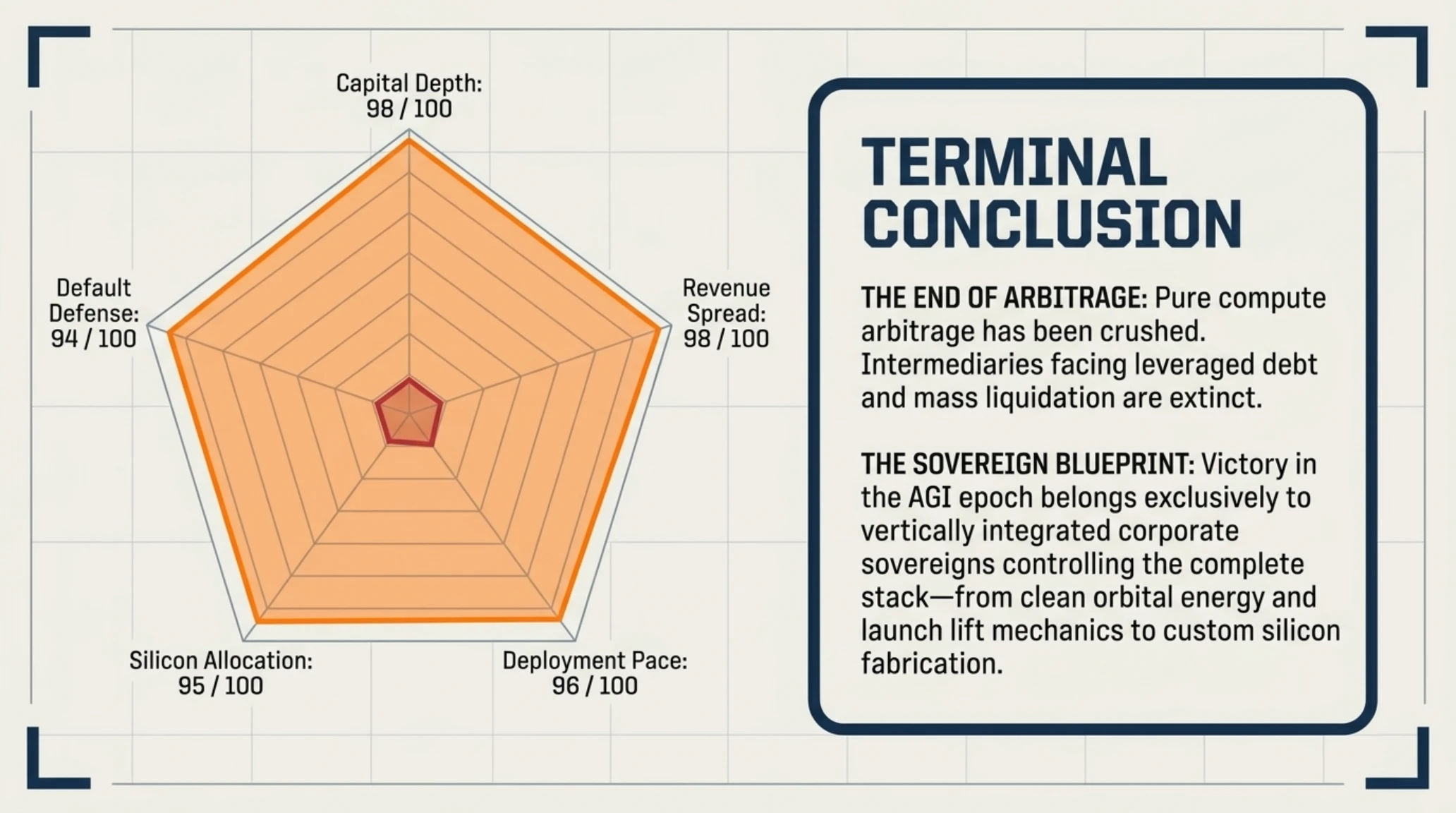
Spider Radar Telemetry | 5-Axis Credit & Capital Resilience Audit
Radar Telemetry Takeaway: SpaceX commands near-perfect marks across capital depth and revenue diversification, establishing an operational fortress that leaves single-product cloud aggregators exposed to extreme liquidation risk.
📚 Classified & Related Dossiers in TekinGame
If you wish to explore beyond this report and delve into cybernetic frontiers and autonomous AI architectures, do not miss these three exclusive deep-dives in the Tekin Garage:
The 2027 Compute Landscape: The Death of Arbitrage and the Emergence of Sovereign Tech Empires
The impending collapse of more than 200 independent neoclouds marks the definitive conclusion of generative AI’s exploratory hype cycle, inaugurating a period of brutal industrial consolidation. The era during which any well-connected entrepreneur could lease a few hundred server racks, wrap them in basic REST APIs, and command multi-billion-dollar venture valuations has drawn to a permanent close. By 2027, the baseline cost of electrical power generation, semiconductor foundry allocations, trans-oceanic fiber infrastructure, and orbital deployment cadence will determine the ultimate winners of the artificial general intelligence epoch.
Pure compute arbitrage has been crushed by vertical integration. Intermediary cloud resellers that acquired silicon at peak prices using leveraged credit facilities now face the dreaded margin compression familiar to traditional commodities traders. As trillion-dollar technology conglomerates including Amazon, Google, Microsoft, and the Musk industrial complex transition toward custom application-specific integrated circuits (ASICs) and multi-gigawatt sovereign microgrids, third-party hardware brokers have been stripped of their pricing power and strategic relevance.
In this emergent macroeconomic landscape, victory belongs exclusively to corporate sovereign entities possessing complete vertical integration from basic physics to high-level model reasoning. Elon Musk’s integration of SpaceX’s launch infrastructure with xAI’s algorithmic engines and Tesla’s embodied robotics underpinned by a $40 billion institutional war chest constructs the ultimate defensive redoubt in low Earth orbit. For terrestrial rivals burdened by overloaded power grids and expensive real estate, the competitive challenge is no longer merely algorithmic; it has become an existential struggle against the laws of planetary physics and institutional finance.
The orbital compute trajectory delivers an engineering breakthrough against terrestrial utility grid saturation. In the technical simulation above, and the telemetry dashboard below, the quantitative distribution of SpaceX’s $40 billion capital placement across foundational compute vectors is comprehensively audited.
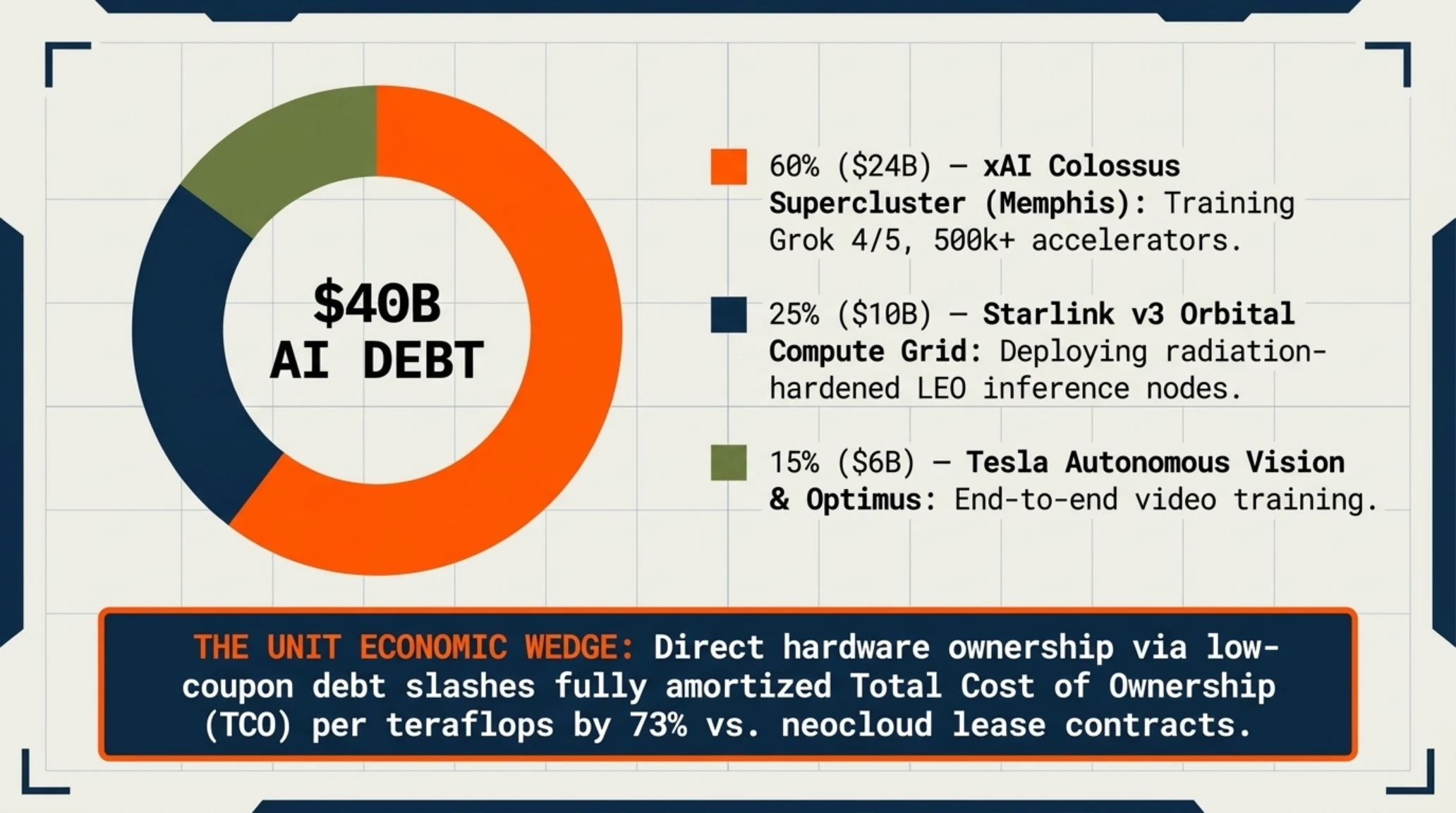
Donut Dashboard | $40B Capital Allocation & Compute Deployment Matrix
| Target Deployment Division | Capital Share & Nominal Value | Technical Objective & Infrastructure Ramification |
|---|---|---|
| xAI Colossus Supercluster (Memphis) | 60% ($24.0 Billion) | Training Grok 4 and Grok 5 multi-modal frontier models utilizing 500,000+ Nvidia accelerators. |
| Starlink v3 Orbital Compute Grid | 25% ($10.0 Billion) | Deploying radiation-hardened spaceborne inference nodes in LEO with zero terrestrial grid latency. |
| Tesla Autonomous Vision & Optimus | 15% ($6.0 Billion) | Scaling end-to-end video neural network training for FSD v14 robotaxis and Optimus world models. |
Aggregating this unprecedented magnitude of computational horsepower beneath a unified industrial sovereign umbrella permanently alters the fundamental unit economics of artificial intelligence. In standard cloud economics, foundation model developers leasing 50,000 graphics processing units pay approximately $3.00 to $4.50 per accelerator-hour. Over a three-year operating lifecycle, recurring cloud lease payments consume hundreds of millions of dollars without building equity value or amortizing capital assets.
In stark contrast, SpaceX’s direct hardware ownership facilitated by low-coupon debt financing slashes the fully amortized total cost of ownership (TCO) per teraflops by an astonishing 73% relative to neocloud lease contracts. This colossal margin differential functions as an unyielding pricing wedge: vertically integrated titans can price inference access at marginal electrical cost while pure-play compute landlords face immediate operational losses.
Simultaneously, this balance sheet expansion radically disrupts the global energy supply matrix. As artificial intelligence datacenters expand toward consuming more than 6% of aggregate United States electricity generation, environmental permitting challenges and regional grid congestion have paralyzed terrestrial infrastructure construction. Hyperscale competitors are pursuing ambitious nuclear initiatives to secure carbon-free base-load power: Microsoft contracted to restart Constellation Energy’s decommissioned Three Mile Island Unit 1 reactor, Amazon purchased Talen Energy's Cumulus data campus adjacent to the Susquehanna nuclear station, and Google signed long-term corporate power purchase agreements with Kairos Power for small modular reactors (SMRs). However, every one of these advanced terrestrial nuclear projects faces regulatory review timelines that delay commercial power delivery until 2029 to 2032.
SpaceX’s orbital architecture completely leapfrogs this decade-long terrestrial permitting quagmire. In low Earth orbit, photovoltaic solar arrays capture unfiltered solar irradiance without atmospheric diffusion, cloud interference, or day-night diurnal interruption. Thermal management is executed through direct radiative heat transfer into the cryogenic 2.7 Kelvin cosmic background, eliminating billions of gallons of evaporative cooling water. By utilizing Starship to launch integrated orbital compute clusters, SpaceX will activate gigawatt-scale, solar-powered spaceborne compute arrays before terrestrial nuclear reactors pour their first containment foundation.
From an electrical engineering standpoint, terrestrial datacenter power usage effectiveness (PUE) metrics have plateaued around 1.15 to 1.20 even in cutting-edge liquid-to-air closed-loop facilities. In contrast, orbital server architectures eliminate mechanical compressor parasitics altogether, achieving a theoretical PUE of nearly 1.02. When scaled across hundreds of megawatts of continuous operational load, this structural efficiency differential saves tens of millions of dollars in waste-heat management annually, further compounding SpaceX’s insurmountable unit-economic advantage over terrestrial cloud hosting facilities.
The inevitable financial consequence across 2027 will be a historic wave of private debt defaults and judicial liquidations under Chapter 11 of the United States Bankruptcy Code for single-product cloud aggregators. Overleveraged neoclouds that borrowed at floating interest rates against rapidly depreciating Hopper silicon will find themselves unable to refinance maturing obligations as institutional debt capital permanently consolidates around sovereign aerospace and hyperscale balance sheets. Distressed hardware will be surrendered to private credit lenders at steep secondary discounts, terminating the speculative era of cloud compute arbitrage.
The engineering realities of radiation-hardened computing in low Earth orbit further distinguish SpaceX's long-term moat. Terrestrial silicon deployed in commercial datacenters experiences soft error rates mitigated by standard ECC memory controllers. However, operating advanced semiconductor architectures within low Earth orbit subjects processors to intense galactic cosmic radiation (GCR) and solar particle events (SPEs), inducing Single Event Upsets (SEUs), latch-ups, and cumulative Total Ionizing Dose (TID) degradation. To withstand this hostile space environment without sacrificing compute density, SpaceX leverages proprietary radiation mitigation protocols developed across millions of flight hours on Starlink satellite flight computers. Utilizing spatial Triple Modular Redundancy (TMR), dynamic core-level watchdog voting, and silicon-on-insulator (SOI) physical packaging, spaceborne Blackwell variants achieve multi-year operational lifespans without experiencing catastrophic latch-up events.
Simultaneously, the physical volumetric capacity of the Starship launch vehicle fundamentally redefines the economics of space hardware integration. Traditional orbital payloads are severely constrained by the standard 4-meter or 5-meter payload fairings of expendable rockets, forcing aerospace contractors into delicate, folded mechanical deployers that cost tens of millions of dollars to fabricate and test. Starship’s colossal 9-meter internal diameter payload bay and 1,000+ cubic meter cargo volume allow SpaceX to launch fully assembled, pre-wired 19-inch datacenter server racks directly into orbit. These spaceborne server modules feature massive integrated deployable loop heat pipes and modular deployable graphene radiators, allowing a single Starship mission to deploy several megawatts of computational capacity in a single launch.
From an antitrust and regulatory perspective, the consolidation of $40 billion in advanced silicon within the Musk industrial complex represents a profound realignment that completely sidesteps traditional regulatory friction. While the Federal Trade Commission (FTC) and the Department of Justice (DOJ) have subjected Microsoft's multi-billion-dollar investments into OpenAI and Google's internal search ecosystem to aggressive antitrust investigations, SpaceX's compute buildup is largely insulated under national security exemptions. By anchoring its infrastructure through the Department of Defense’s Starshield military framework, SpaceX classifies its high-performance compute clusters as critical dual-use strategic assets essential for maintaining United States technological supremacy against strategic peer competitors like China.
The inevitable macroeconomic outcome across Wall Street credit desks will be an aggressive flight to sovereign-tier quality. Private credit asset managers holding securitized loans collateralized by legacy Hopper hardware are already attempting to syndicate their distressed loan portfolios at steep secondary discounts, with bids dropping as low as 42 cents on the dollar. As debt maturities accelerate throughout 2027, the institutional liquidity that fueled the explosive rise of the neocloud bubble will be permanently reclaimed, leaving the commanding heights of artificial general intelligence securely in the hands of vertically integrated sovereign enterprises.
Historical Chronology | The Silicon Hegemony & Capital War Timeline
| Chronological Milestone | Strategic Event & Industry Transformation | Engineering Milestone & Market Consequence |
|---|---|---|
| 2023 - 2024 | Generative AI Inception & Neocloud Surge | CoreWeave, Lambda, and Nebius raise tens of billions in private credit to hoard Nvidia H100 accelerators. |
| Mid 2024 | xAI Memphis Colossus Activation | Musk's engineering teams deploy 100,000 liquid-cooled GPUs in 122 days utilizing a bespoke 150MW microgrid. |
| October 2026 | SpaceX $40B Debt Facility Closes | SpaceX secures 5.2% investment-grade syndicate, warns of widespread neocloud debt freeze, and pre-orders Blackwell. |
| 2027 - 2028 | Starlink v3 & Orbital Compute Mesh | Starship ramps cargo cadence; spaceborne radiation-hardened AI inference nodes begin operations in LEO. |
S-Curve Market Contraction | Neocloud Survival Probability Index
Macro Dynamic Analysis: As high-yield private credit dries up and secondary chip depreciation accelerates, fewer than 15% of independent GPU cloud operators will retain sufficient cash flow to survive past 2027.
Thermal engineering simulations confirm that vacuum radiative cooling operating into the 2.7 Kelvin cosmic background enables continuous gigawatt-scale heat dissipation with zero freshwater consumption.
This thermodynamic advantage permanently liberates orbital server clusters from the environmental regulations and water scarcity that increasingly paralyze terrestrial hyperscale datacenters.
High-throughput optical intersatellite laser links connect orbital inference nodes with terrestrial autonomous networks at 40% faster latency than transoceanic undersea fiber-optic cables.
This orbital mesh topology guarantees zero packet latency and absolute physical immunity against ground-level sabotage or natural disruptions across global compute grids.
- Access to premier 5.2% cost of debt capital underpinned by SpaceX's investment-grade credit rating.
- Backed by Starlink's $6.6B+ recurring high-margin telecom cash flow and launch monopoly.
- Guarantees priority allocation of TSMC CoWoS packaging and next-gen Nvidia Blackwell/Rubin dies.
- Transfers intensive AI inference to low Earth orbit, completely bypassing terrestrial grid bottlenecks.
- Creates massive computational fungibility across xAI Colossus, Starlink, and Tesla robotics.
- Capital depreciation risk if broader enterprise AI monetization experiences multi-year stagnation.
- Significant annual debt service burden in the event of unforeseen orbital launch disruptions.
- Accelerates the liquidation of hundreds of cloud startups, cementing extreme infrastructure concentration.
Editorial Verdict & Verified Institutional References
The Extinction of Intermediaries; The Ascent of the Orbital Silicon Hegemony
SpaceX’s structured $40 billion capital mobilization outmaneuvered conventional venture models, pairing sovereign credit depth with orbital physics to seal the fate of independent neoclouds.
- CoinDesk Institutional: Exclusive Verification of SpaceX’s $40B AI Debt Syndicate & Neocloud Liquidation Warning
- Bloomberg Markets: Comprehensive Breakdown of Starlink Cash Flows, Callable Bond Mechanics, and Credit Ratings
- Reuters Technology: Analytical Report on TSMC CoWoS-L Advanced Packaging Bottlenecks and Private Credit Contagion
Comprehensive Technical & Financial FAQ
Why did SpaceX raise $40 billion in structured debt rather than issuing public equity or venture rounds?
Securing low-coupon structured debt (priced around 5.2% due to SpaceX's investment-grade credit profile) allows existing shareholders to prevent equity dilution while immediately amassing institutional capital to corner advanced semiconductor allocations.
What specifically defines an 'AI Neocloud' in modern cloud architecture?
Neoclouds are specialized cloud startups such as CoreWeave, Lambda Labs, and Nebius whose business model is almost entirely limited to debt-financing Nvidia GPU clusters and leasing them by the hour, without proprietary enterprise SaaS layers or external cash flows.
Why are independent neoclouds facing an existential debt freeze and bankruptcy risk?
Debt capital markets have permanently closed to compute aggregators lacking external cash flows. As secondary GPU lease rates decline and floating-rate debt matures, these firms face fatal asset-liability mismatches and debt covenant defaults.
Will SpaceX or xAI consider acquiring distressed neocloud operators?
No; Elon Musk explicitly confirmed that acquiring failing neoclouds is economically pointless, as second-hand server clusters and costly co-location real estate leases have zero strategic value compared to direct TSMC wafer fab runs.
How does technical synergy operate across SpaceX, Starlink, and xAI?
Starlink's $6.6B+ recurring revenue backs the debt, Starship slashes launch costs to under $100/kg, Starlink v3 satellites host orbital inference nodes, and the aggregate compute network powers Grok foundation models and Tesla autonomous systems.
How does spaceborne computing solve the terrestrial power and cooling crisis?
In low Earth orbit, photovoltaic panels capture 30% more solar energy with 24/7 continuous sunlight, while cryogenic radiative cooling dissipates heat directly into the 2.7K vacuum of deep space without consuming terrestrial water or electricity grids.
Additional Gallery: Tekin Analysis | SpaceX's $40B AI Debt & The Neocloud Collapse