The End of the PC Port Dream: Sony's Historic Pivot to Absolute Exclusivity
After several years of aggressively wooing the PC gaming demographic with high-fidelity ports of their most revered narrative masterpieces, the tide has definitively turned. The 2026 PlayStation Business Strategy report, recently filed with the U.S. Securities and Exchange Commission (SEC), delivers a stark and unequivocal message: the acronym "PC" has been entirely expunged from the release roadmap for their single-player, narrative-driven titles. This comprehensive Tekin Deep Dive meticulously analyzes the underlying corporate mechanics of this strategic pivot, the financial realities that shattered the PC porting model, and the formidable future trajectory of the PlayStation brand. The implications of this pivot ripple far beyond mere platform availability; they fundamentally restructure the economic foundation of high-budget game development.
Key Investigative Pillars:
1. A forensic analysis of the omissions within Sony's 2026 SEC financial filings.
2. The economic realities: Why the Single-Player PC porting strategy mathematically failed.
3. Hermen Hulst's new doctrine of "Platform Stickiness" and ecosystem fortification.
4. The Great Exception: Sony's contradictory, yet highly lucrative, Live-Service strategy.
5. The sweeping integration of Generative AI throughout first-party development lifecycles.
6. The historical context of console wars and how PlayStation 5 is positioning itself against Microsoft's Xbox division.
PlayStation is aggressively returning to its monopolistic roots. Join us as we explore precisely what this seismic shift means for your wallet, your future hardware purchasing decisions, and the overarching landscape of interactive entertainment.
Erasing a Keyword: The Hidden Message in the SEC Filings
Within the labyrinthine world of multi-billion dollar corporate strategy, the documents submitted to the Securities and Exchange Commission (SEC) are far more than mere bureaucratic red tape; they are the hyper-accurate compasses dictating future operational trajectories. Over the past several fiscal years, Sony Interactive Entertainment (SIE) consistently included a standard, reassuring clause in these reports: "Continuing efforts to roll out first-party titles to multiple platforms such as PC to expand our audience." However, in the meticulously drafted June 2026 report, this specific clause has been intentionally and surgically removed. This omission is not a typographical error; it is a calculated declaration of war.
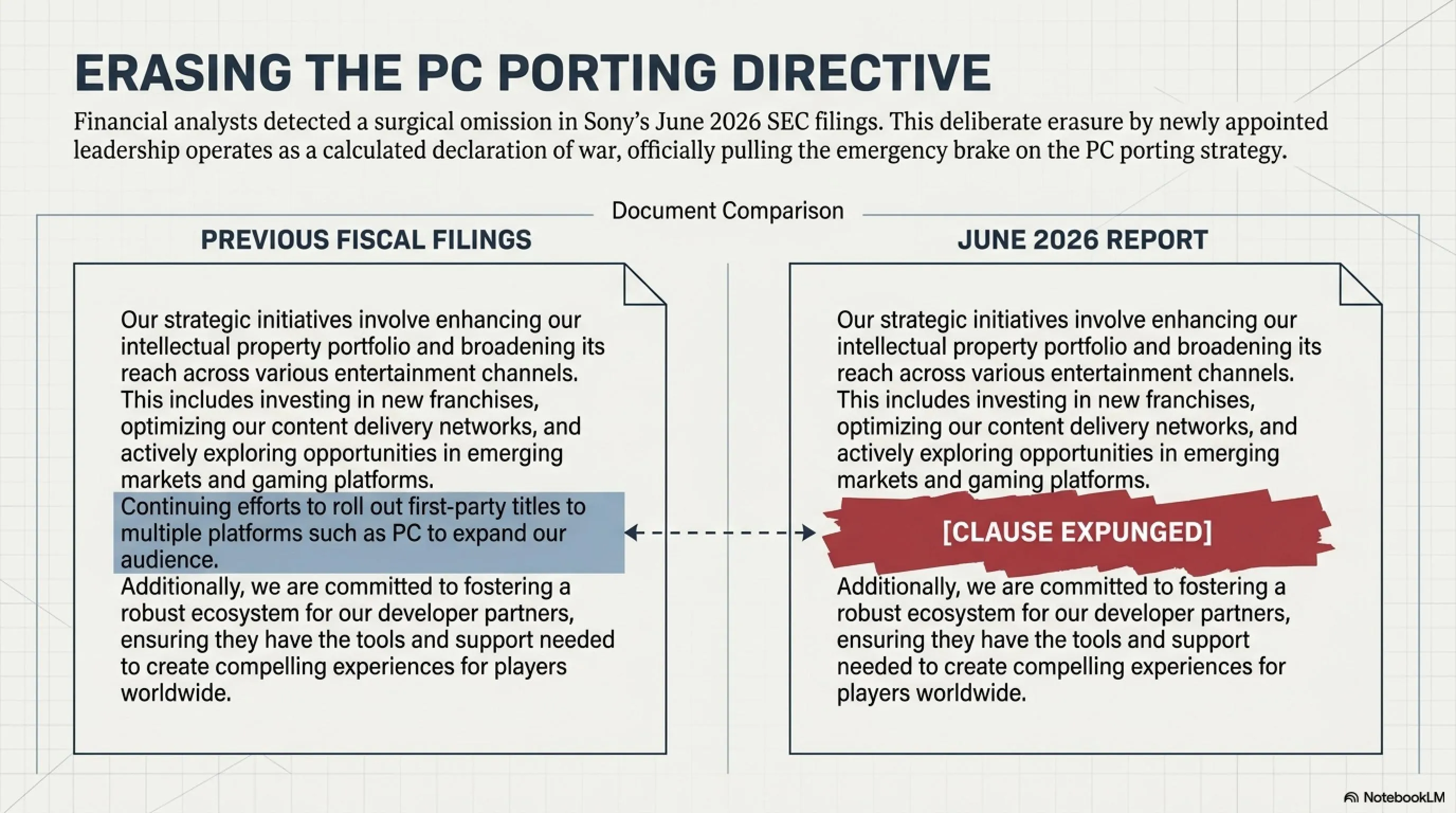
Financial analysts on Wall Street and leading media outlets such as IGN and Eurogamer immediately detected this critical shift in corporate nomenclature. The deliberate erasure of this text signals that the newly appointed PlayStation leadership duo—Hermen Hulst and Hideaki Nishino—have effectively pulled the emergency brake on the PC porting train. This abrupt reversal stands in stark contrast to the aggressive multi-platform policies championed by former CEO Jim Ryan, who viewed PC ports as a frictionless, highly lucrative secondary revenue stream. Under Ryan's tenure, the prevailing ideology was that PlayStation IP should transcend the physical console. The critical question remains: what catastrophic internal metrics catalyzed this massive strategic retreat?
Crunching the Numbers: The Failure of the Jim Ryan Doctrine
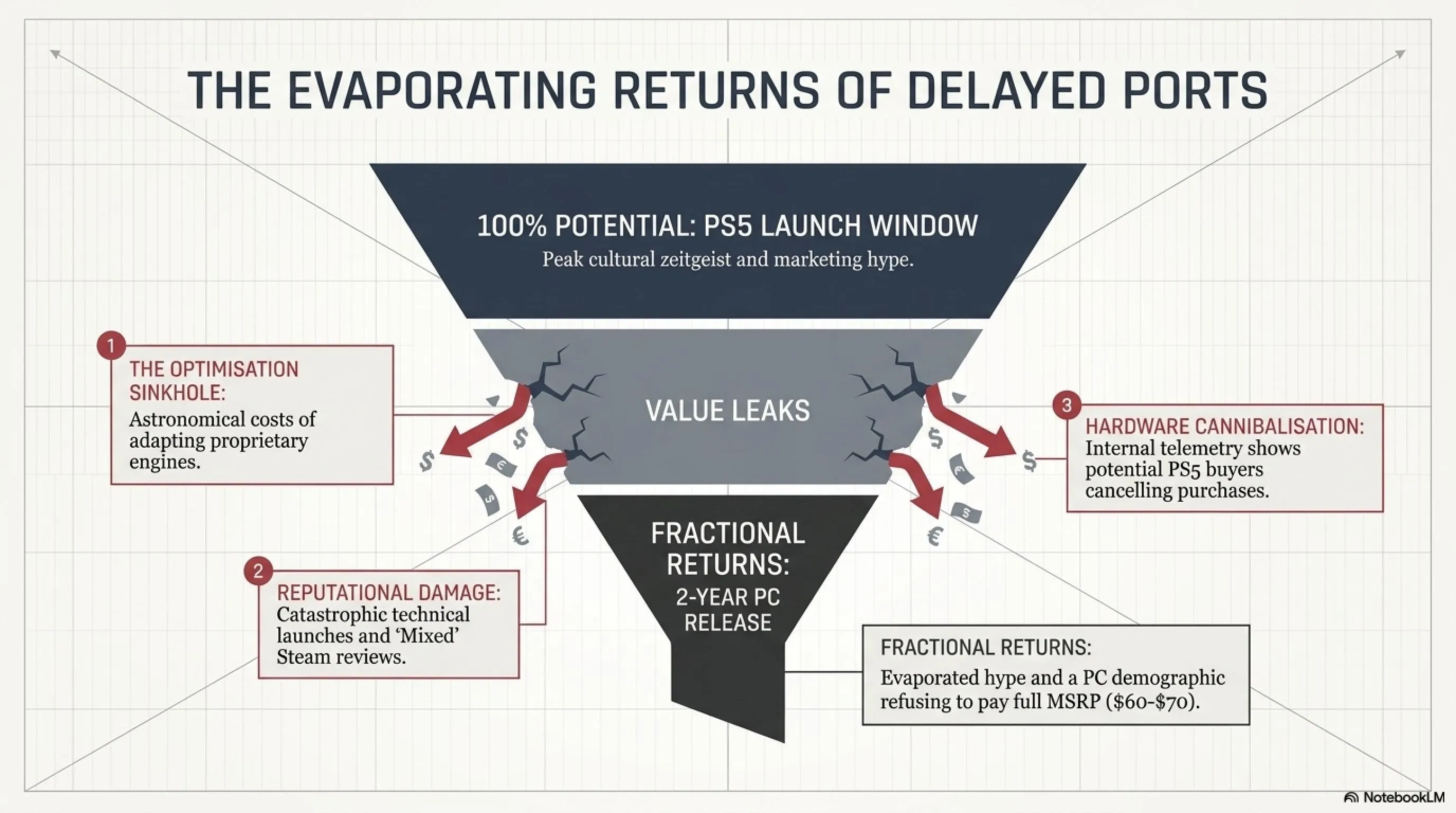
The harsh reality confronting Sony's accounting department is that, despite the runaway initial success of early ports like Horizon Zero Dawn and the 2018 God of War reboot on Steam, the subsequent waves of ports utterly failed to replicate that explosive financial momentum. The astronomical costs associated with porting and ruthlessly optimizing a proprietary engine for thousands of disparate PC hardware configurations, combined with the extreme reluctance of the PC demographic to purchase older titles at full MSRP ($60-$70), severely eroded the profit margins of this endeavor. The strategy, initially hailed as a masterstroke of revenue diversification, slowly transformed into a financial sinkhole.
- Plummeting Concurrent Players: The PC launch of The Last of Us Part 1 was marred by catastrophic technical optimization issues, resulting in "Mixed" reviews on Steam and drastically underperforming against internal sales projections. The reputational damage inflicted upon Naughty Dog's crown jewel was immense.
- The "Delayed Port" Fatigue: Titles like Horizon Forbidden West and Ghost of Tsushima Director's Cut, arriving on PC over two years after their PS5 debut, captured only a fraction of the original sales velocity because the cultural zeitgeist and marketing hype had entirely evaporated. PC gamers had simply moved on to newer, native PC titles.
- Severe Opportunity Cost: Every acquisition like Nixxes Software, whose sole mandate was porting aging titles, represented elite engineering talent diverted away from assisting primary studios in developing native, system-selling PS6 blockbusters.
- Cannibalization of Hardware Sales: Internal telemetry data revealed a terrifying trend: a significant percentage of potential PS5 buyers were delaying or outright canceling their console purchases upon learning that major exclusives would eventually arrive on PC. The porting strategy was actively sabotaging hardware adoption rates.
Tekin Deep Dive: The "System Seller" Trap and Platform Stickiness
There exists an unwritten, ironclad law within the console hardware industry: hardware (the physical console) is frequently sold at a loss during its early lifecycle, with the actual, sustained profitability derived entirely from software sales, proprietary accessories, and high-margin subscription services like PlayStation Plus. But what compels a consumer to invest $500 in a closed-ecosystem plastic box? The answer is singular: The System Seller. The narrative, cinematic masterpieces forged by studios like Naughty Dog, Santa Monica, Insomniac Games, and Guerrilla Games are the lifeblood of this equation. Without these exclusive titles, the PS5 is merely an underpowered PC.
When Sony broadcasted the pervasive signal to the global market that "Our greatest games will eventually come to PC, you just have to wait," they inadvertently cannibalized their greatest competitive advantage. Millions of prospective buyers bypassed the PlayStation 5 entirely, opting instead to upgrade their desktop GPU and simply wait out the exclusivity window. By entirely severing the pipeline of narrative titles to the PC platform, Sony is aggressively re-injecting vital, irreplaceable value into the "PlayStation Only" brand identity. This is the core principle of Hermen Hulst's new doctrine: "Platform Stickiness." The objective is to create an ecosystem so rich with exclusive, high-quality content that leaving it becomes unthinkable.
Sony's financial analysts mathematically concluded that a single $60 sale on Steam (subject to Valve's 30% revenue cut, reducing the net profit to a mere $42) is absolutely not worth the catastrophic loss of a potential ecosystem customer. A dedicated PlayStation user will purchase the console, a second DualSense controller, perhaps a Pulse 3D headset, subscribe to PS Plus Premium for seven years, and purchase dozens of third-party titles from the PlayStation Store (where Sony takes a 30% cut of every transaction). The lifetime value (LTV) of a console player dwarfs the transactional value of a PC port purchaser by a factor of ten. The Jim Ryan strategy focused on short-term revenue spikes at the perilous expense of long-term ecosystem health.
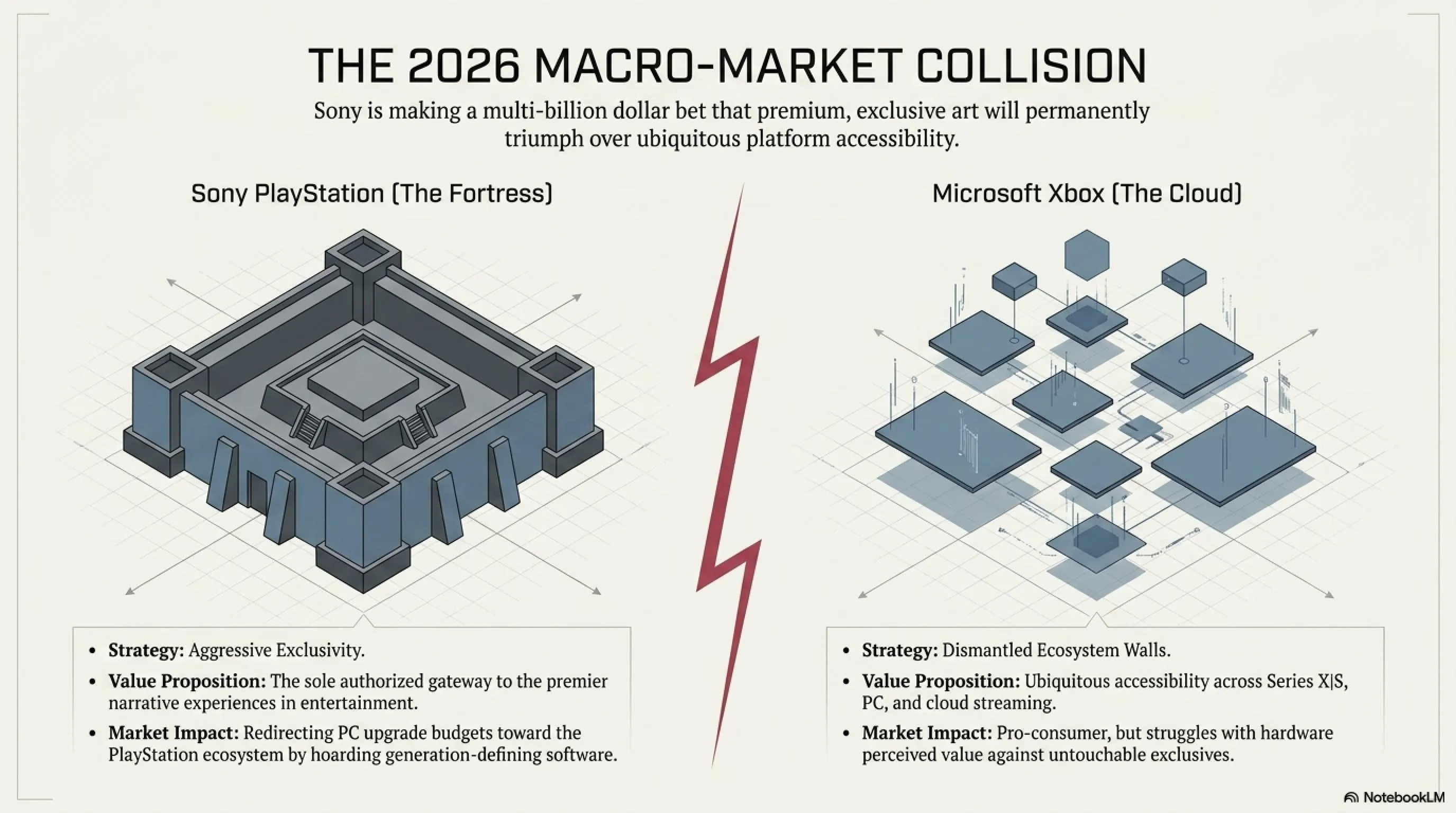
Furthermore, we must examine the broader historical context of the console wars. Microsoft's Xbox division has largely abandoned the concept of hardware exclusivity, choosing instead to publish their titles simultaneously on Xbox Series X|S, PC, and increasingly, rival platforms. By reverting to strict exclusivity, Sony is sharply differentiating the PlayStation brand. They are positioning the PS5 (and the upcoming PS6) not merely as a gaming device, but as the only authorized gateway to the premier narrative experiences in the entertainment industry. It is a bold, aggressive return to the uncompromising strategies that secured their dominance during the PS1 and PS2 eras.
The Silent Revolution: Generative AI Swallows PlayStation Studios
A critically important segment of Sony's 2026 business strategy report—one that was largely overshadowed by the ferocious online discourse regarding the termination of PC ports—is the corporation's monumental, systemic investment in Generative Artificial Intelligence (AI) and Machine Learning (ML). While Sony previously offered a glimpse into their AI ambitions via the introduction of PSSR (PlayStation Spectral Super Resolution) hardware-based image upscaling in the PS5 Pro, their current operational roadmap is exponentially more ambitious and structurally disruptive. The scale of this technological adoption cannot be overstated; it represents a fundamental rewiring of how interactive entertainment is conceptualized, engineered, and ultimately delivered to the consumer.
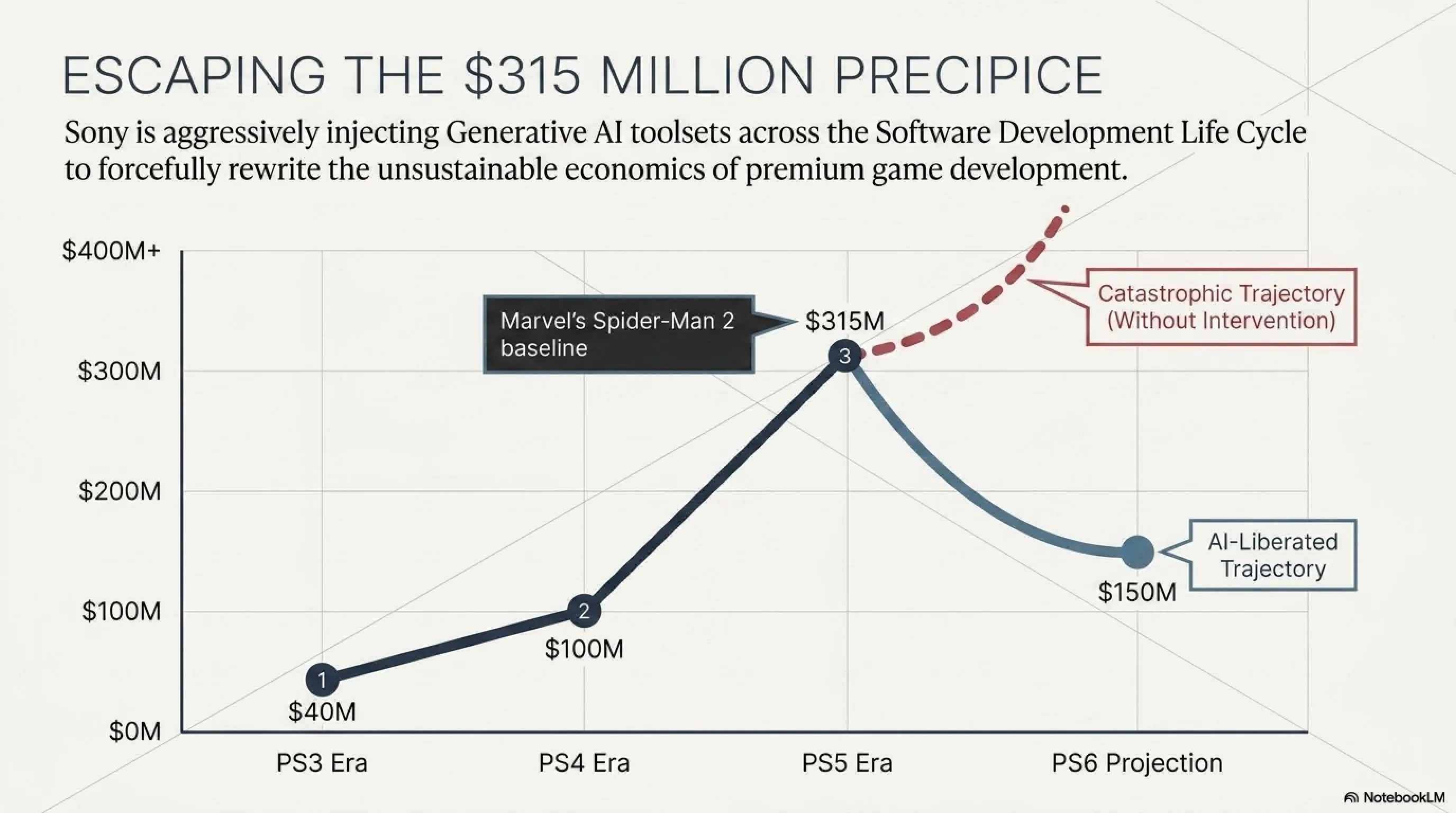
According to the detailed SEC filings, Sony is aggressively injecting Generative AI toolsets across every single stage of the Software Development Life Cycle (SDLC) within its sprawling network of first-party studios. The objective is not merely a pursuit of technological novelty; it is an absolute necessity for the survival of the AAA gaming business model. When the production budget for a title like Marvel's Spider-Man 2 eclipses the staggering $315 million mark, and the development timeline stretches to six or seven years, the current economic model becomes inherently unsustainable. Sony is utilizing AI to forcefully rewrite this equation. To grasp the severity of the situation, one must look at the historical trajectory of game development budgets: in the PlayStation 3 era, a flagship title might cost $40 million to produce. By the PS4 era, that figure had ballooned to $100 million. Today, in the PS5 ecosystem, the baseline entry for a premium, system-selling narrative experience routinely exceeds a quarter of a billion dollars. Without radical intervention, the industry was hurdling toward a catastrophic financial precipice.
The Triad of AI Integration in Sony's New Pipeline
Leaked internal documentation indicates that Sony's proprietary development engines (such as Guerrilla Games' highly lauded Decima Engine and Naughty Dog's proprietary internal toolsets) are actively integrating three incredibly powerful AI modules that are fundamentally altering the daily workflows of thousands of engineers and artists:
- Intelligent Procedural Content Generation (IPCG): Unlike rudimentary, older random-seed systems that simply scattered assets haphazardly across a terrain map, new AI algorithms can generate massive, geographically accurate open-world topographies. These systems understand geological erosion, biome blending, and natural ecosystem distribution. Furthermore, they can 3D model secondary props and synthesize baseline character animations in a matter of hours. This profound automation empowers human artists to cease wasting months hand-crafting individual trees, rocks, and background vehicles, allowing them to focus entirely on bespoke art direction, narrative integration, and flawless level design. The machine builds the canvas; the human paints the masterpiece.
- Smart Localization Pipelines & Dynamic Lip-Syncing: A massive portion of Sony's overhead stems from localizing dialogue into over 15 distinct languages to ensure global market penetration. Historically, this required booking hundreds of recording studios worldwide, hiring armies of voice actors, and manually adjusting character facial animations to match the phonetics of different languages. The new AI systems perform real-time translation, generate language-specific dynamic lip-syncing for 3D models utilizing neural radiance fields (NeRFs), and synthesize highly emotive vocal performances for secondary NPCs. This drastically reduces the dependency on hiring hundreds of international voice actors and shaves months off the localization schedule.
- Automated QA & Robotic Debugging (RL-QA): Quality Assurance has traditionally been a grueling, labor-intensive process involving hundreds of human testers throwing themselves against invisible walls for months. Now, Reinforcement Learning (RL) bots are deployed 24/7 in virtual server farms to autonomously navigate game environments millions of times per day. They actively hunt for out-of-bounds glitches, physics engine anomalies, collision errors, and memory leaks. In many instances, these sophisticated algorithms don't just find the bug; they proactively suggest the requisite code fixes via automated pull requests to the engineering team before human QA testers even log in.
Crucial Insight from Hideaki Nishino (President of Platform Experience):
"Our mandate is not to replace human creativity with a machine. Our objective is to construct an infrastructure where our studios can realize their most ambitious, unconstrained visions without being paralyzed by financial and temporal limitations. Artificial Intelligence is the ultimate liberator of the creative mind, allowing our directors to focus entirely on storytelling rather than the excruciating minutiae of digital asset management."
The Nixxes Paradox: Re-allocating the Porting Specialists
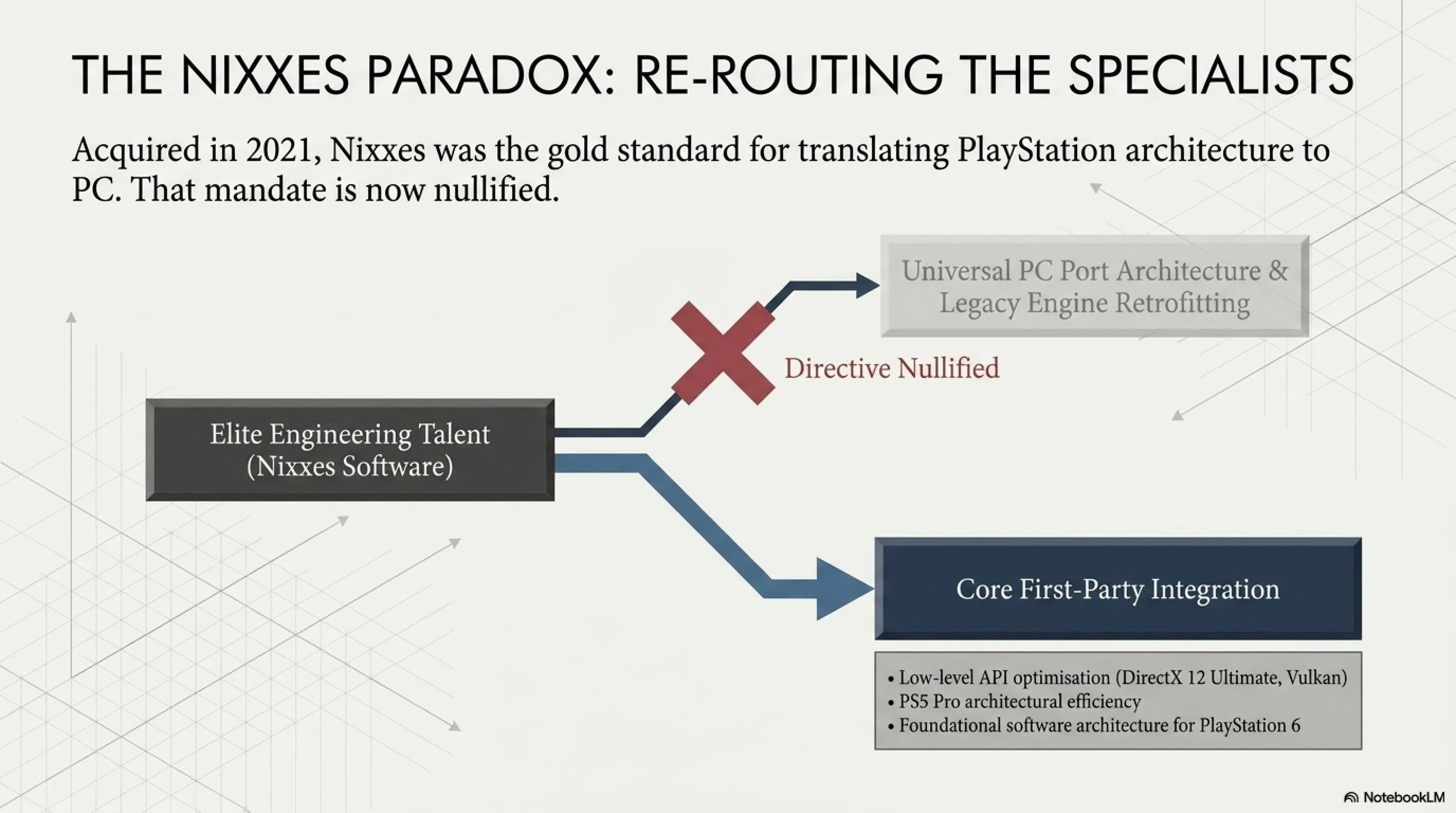
To fully comprehend the depth of this strategic pivot, one must examine the fate of Nixxes Software. Acquired by Sony in 2021, Nixxes was celebrated as the gold standard in PC porting architecture. Their sole mandate was to take complex PlayStation architecture and flawlessly translate it into the diverse, fragmented ecosystem of Windows PCs. For a brief period, they succeeded brilliantly, delivering highly optimized versions of Marvel's Spider-Man Remastered and Ratchet & Clank: Rift Apart.
However, the new 2026 strategy has fundamentally altered their operational directive. With the mandate for single-player PC ports effectively nullified, the elite engineering talent at Nixxes is no longer tasked with chasing the elusive goal of universal PC compatibility. Instead, these optimization wizards have been fully reintegrated into the core first-party development pipeline. Their profound understanding of low-level API optimization (such as DirectX 12 Ultimate and Vulkan) is now being laser-focused on maximizing the internal architectural efficiency of the PS5 Pro and laying the foundational software architecture for the inevitable PlayStation 6.
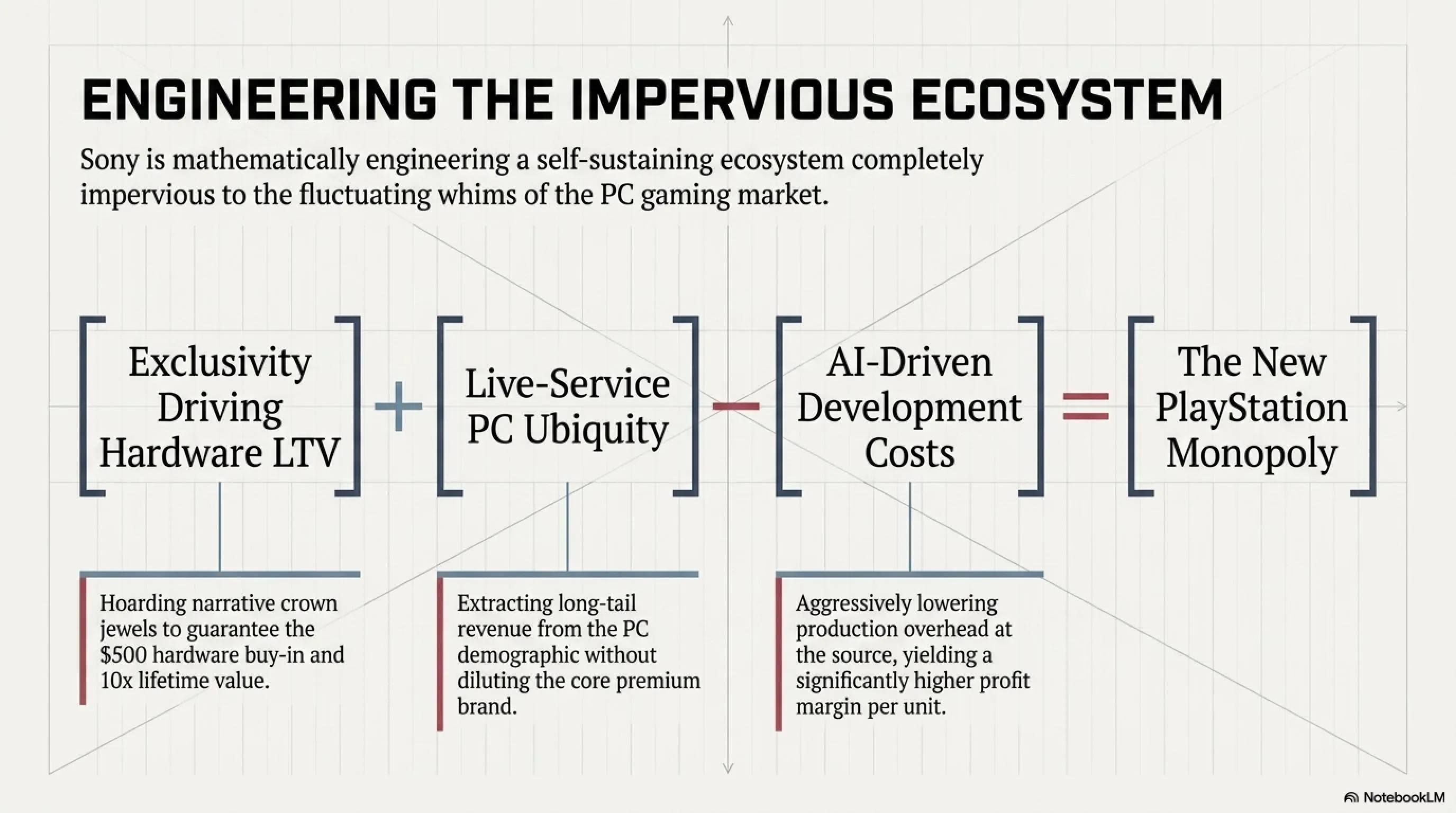
This massive operational pivot underscores Sony's core intent: to solidify its platform's status as the undisputed, premium destination for narrative experiences by simultaneously slashing production overhead and accelerating the release cadence of exclusive titles. Rather than relying on secondary sales on Steam to recoup bloated development costs, Sony has decided to aggressively lower the actual cost of production at the source. Consequently, every unit sold natively on the PS5 will yield a significantly higher profit margin, eliminating the financial need to port to PC entirely. The entire ecosystem becomes a self-sustaining, highly profitable walled garden, impervious to the fluctuating hardware whims of the PC gaming market.
The Great Exception: Why Live-Service Games Are Safe
Despite the aggressive slamming of the ecosystem doors concerning single-player narrative titles, there exists a massive, highly lucrative exception within this new strategic paradigm: online multiplayer and Live-Service titles. Sony has explicitly emphasized within their SEC report that the development and deployment of multiplayer experiences utilizing a "Day One" simultaneous release strategy across both PS5 and PC will continue unabated. But why adopt such a glaringly contradictory approach? The answer lies in the unforgiving, brutal mathematics of the modern multiplayer gaming economy.
The phenomenal, expectation-shattering success of Arrowhead's Helldivers 2 in recent years provided Sony's executive board with an irrefutable lesson. This specific title, launched simultaneously on Steam and PlayStation, utterly obliterated internal sales records for a Sony first-party game. The underlying logic is unassailable: online games require a massive, highly active Player Base (measured in millions of concurrent users) to survive their critical launch window. Artificially restricting a live-service game to a single hardware platform guarantees a slow, agonizing death via prolonged matchmaking queues, community stagnation, and an inevitable death spiral of player retention.
Contrasting Sony's Dual 2026 Strategy
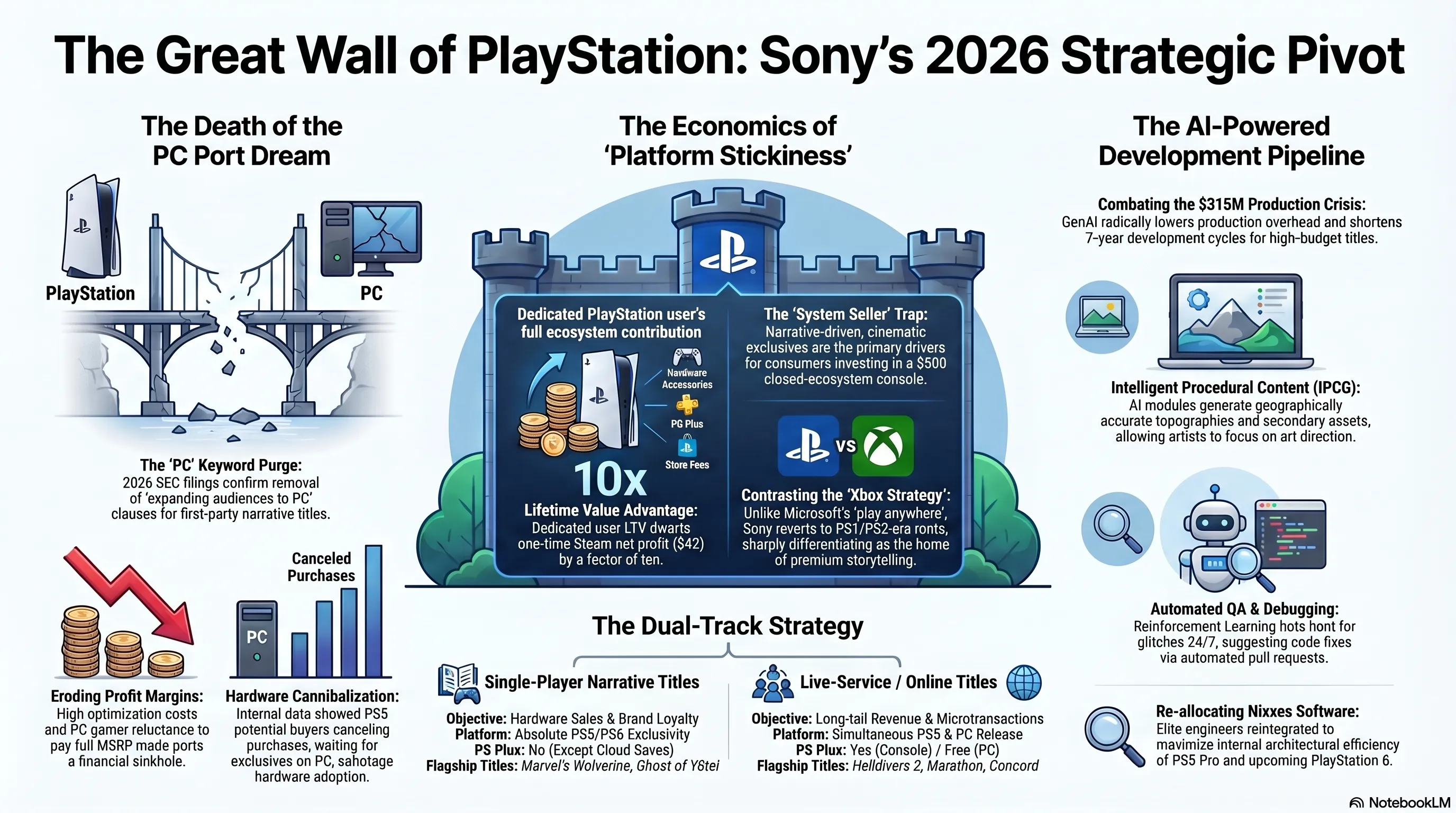
This dual-pronged strategy vividly illustrates that the new PlayStation leadership under Hermen Hulst has achieved a highly pragmatic equilibrium. They are not blinding themselves to the colossal revenue potential of the PC market within the online sector, fully acknowledging that constructing a decade-long project like Destiny without the PC demographic is economic suicide. Conversely, they flatly refuse to dilute the prestige and identity of the PlayStation brand by auctioning off their narrative crown jewels on a competing platform. In essence, Sony is actively building two distinct corporate entities beneath the PlayStation umbrella: one serving as a manufacturer of premium storytelling consoles, and the other acting as a massive third-party publisher for pervasive online ecosystems.
Final Verdict: A Triumphant Return to the Golden Age of Exclusives
Sony's 2026 Business Strategy report signifies a definitive, historical turning point in the modern era of PlayStation. The sweet, collective dream of seamlessly experiencing Sony's narrative masterpieces natively on personal computers has been effectively terminated, at least for the foreseeable future. Acknowledging the absolute necessity of preserving the inherent, unique value of their proprietary hardware, Sony has fortified the walls of its ecosystem, compelling gamers to enter their exclusive domain. This aggressive, monopolistic strategy, coupled with unprecedented investments in Generative AI to radically streamline game development, signals that PlayStation is rigorously preparing for a brutal, high-stakes hardware and software war in the generations to come (specifically the PS6). The decision to sever the PC pipeline for single-player titles is not an admission of defeat, but rather a profoundly confident assertion of their platform's intrinsic worth. Sony has fundamentally realized that to rule the gaming industry as an undisputed monarch, one must never loan their crown to competing platforms. The era of the true "Console Exclusive" has returned with a vengeance, and it fundamentally redefines the relationship between software developers and hardware manufacturers for the next decade.
Frequently Asked Questions (FAQ) - Clarifying Sony's New Policies
Will Sony pull existing PC ports from storefronts like Steam and Epic?
Absolutely not. Titles that have already been successfully ported to PC (such as God of War Ragnarok, Marvel's Spider-Man, and Returnal), or games currently bound by finalized, pre-existing publishing contracts, will remain fully available for purchase and continue to receive technical support. This new, highly restrictive policy applies strictly to future blockbuster franchises and unannounced narrative projects specifically designed to anchor the PlayStation 10th-generation ecosystem.
What is the exact status of Sony's multiplayer titles on PC?
As explicitly outlined in the financial report and detailed in the dual-strategy matrix above, live-service and purely online multiplayer games—such as upcoming projects from Bungie or spiritual successors to Helldivers—will resolutely continue to adhere to a simultaneous "Day One" release schedule across both PC and PlayStation consoles to maximize server populations and guarantee long-term revenue via microtransactions. The economics of multiplayer demand platform ubiquity.
Is there any possibility that single-player games will receive PC ports after a 5-year delay?
While absolutes are rare in corporate strategy, by formally removing the acronym "PC" from their legally binding, long-term strategic documentation, Sony has officially absolved itself of any commitment to port these titles. Consequently, the probability of delayed ports has plummeted drastically. Consumers should absolutely not factor the faint hope of a port into their multi-hundred-dollar hardware purchasing decisions. If you want to play a Naughty Dog game moving forward, you will need a PlayStation console.
How does this strategy affect third-party exclusivity deals?
Sony's renewed focus on hardware exclusivity will likely translate into far more aggressive third-party partnerships. Expect Sony to leverage the immense profitability of its walled garden to secure massive, permanent console exclusivity deals with studios like Square Enix (continuing the Final Fantasy legacy), Kojima Productions, and FromSoftware. By ensuring these massive third-party titles do not immediately arrive on PC or Xbox, Sony further incentivizes the purchase of PlayStation hardware.
The Macroeconomic Impact: Reshaping the Global Gaming Market
Sony's strategic retreat from the PC market is not occurring in a vacuum; it will have profound macroeconomic ramifications across the entire interactive entertainment sector. For PC hardware manufacturers—companies like Nvidia, AMD, and Intel—this represents a significant blow. The allure of upgrading a $1,200 GPU is heavily tied to the availability of generation-defining, graphically intensive blockbuster titles. If the most acclaimed narrative games in the world are permanently locked behind Sony's walled garden, a measurable segment of consumers may redirect their discretionary income away from PC upgrades and toward the PlayStation ecosystem.
Conversely, this strategy places immense, unprecedented pressure on Microsoft's Xbox division. Microsoft has spent the last decade painstakingly dismantling its own ecosystem walls, pushing the "Xbox Play Anywhere" initiative and launching titles simultaneously on Xbox consoles, PC, and cloud streaming platforms. While Microsoft's strategy is undeniably pro-consumer, Sony's aggressive return to exclusivity presents a stark contrast in perceived value. If a consumer has a limited budget and must choose a single piece of hardware, the console with the absolute monopoly on prestigious, untouchable narrative masterpieces—the PlayStation—becomes the infinitely more attractive investment. Sony is effectively betting that premium, exclusive art will always triumph over ubiquitous accessibility.
Sourced Documentation & Analytical References:
- Official Sony Interactive Entertainment Business Strategy Report (submitted to the U.S. SEC, June 2026).
- Editorial analysis and financial forensic breakdowns published by IGN, Bloomberg Technology, and Eurogamer regarding the omitted PC clauses.
- Transcripts from the PlayStation executive shareholder meeting featuring direct commentary from Hermen Hulst and Hideaki Nishino.
- Aggregated global sales data and concurrent player statistics for Sony first-party titles on Steam (sourced from SteamDB and internal telemetry leaks).
- Whitepapers on the economic integration of Generative AI in AAA game development published by the Interactive Software Federation of Europe (ISFE).
Open Dialogue: Assessing Sony's Aggressive Pivot
Does Sony's aggressive pivot away from PC ports and their blatant declaration of exclusivity convince you to invest in a PlayStation console to experience their narrative masterpieces? Or will you simply forgo experiencing these PlayStation exclusives altogether and remain dedicated to the open PC platform? Share your critical perspective, hardware loyalties, and market predictions with the Tekin editorial team and the global gaming community in the comments below.
🌐 Stay Connected With Us 🎮✨
For the latest tech, gaming, and gadget news, follow us on our official social media channels: