Tekin Analysis | Solanas Alpenglow Consensus Overhaul; Slashing Finality to 150ms as TowerBFT Retires
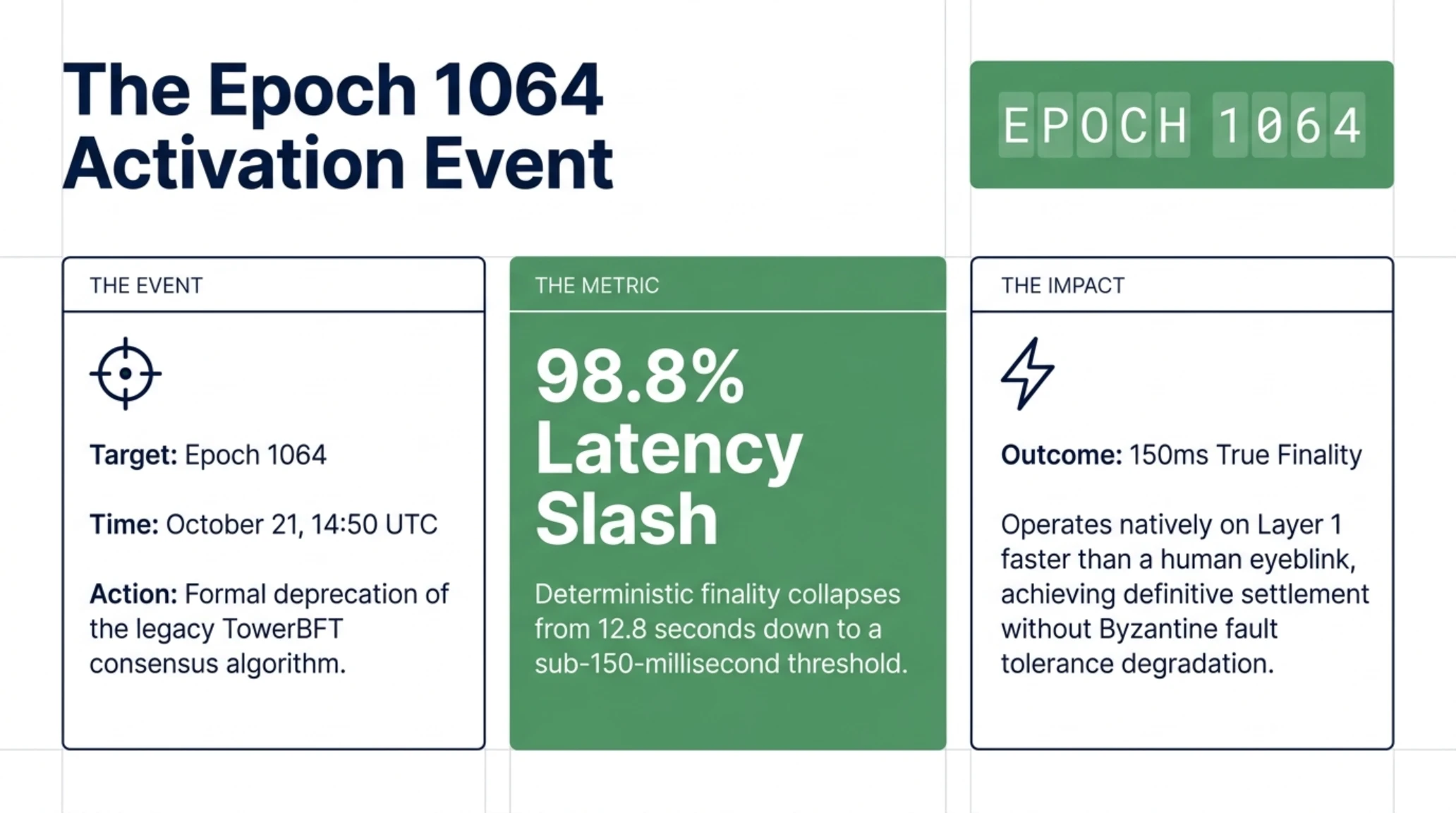
The Solana ecosystem is on the precipice of its most transformative architectural evolution since mainnet-beta launched in March 2020. On October 21, precisely as Epoch 1064 activates at approximately 14:50 UTC, the core validator fleet will execute the Alpenglow consensus upgrade. Far from an incremental performance patch, Alpenglow represents a fundamental open-heart surgery on the network consensus pipeline, permanently decommissioning the long-serving TowerBFT algorithm in favor of an ultra-low-latency consensus engine named Votor.
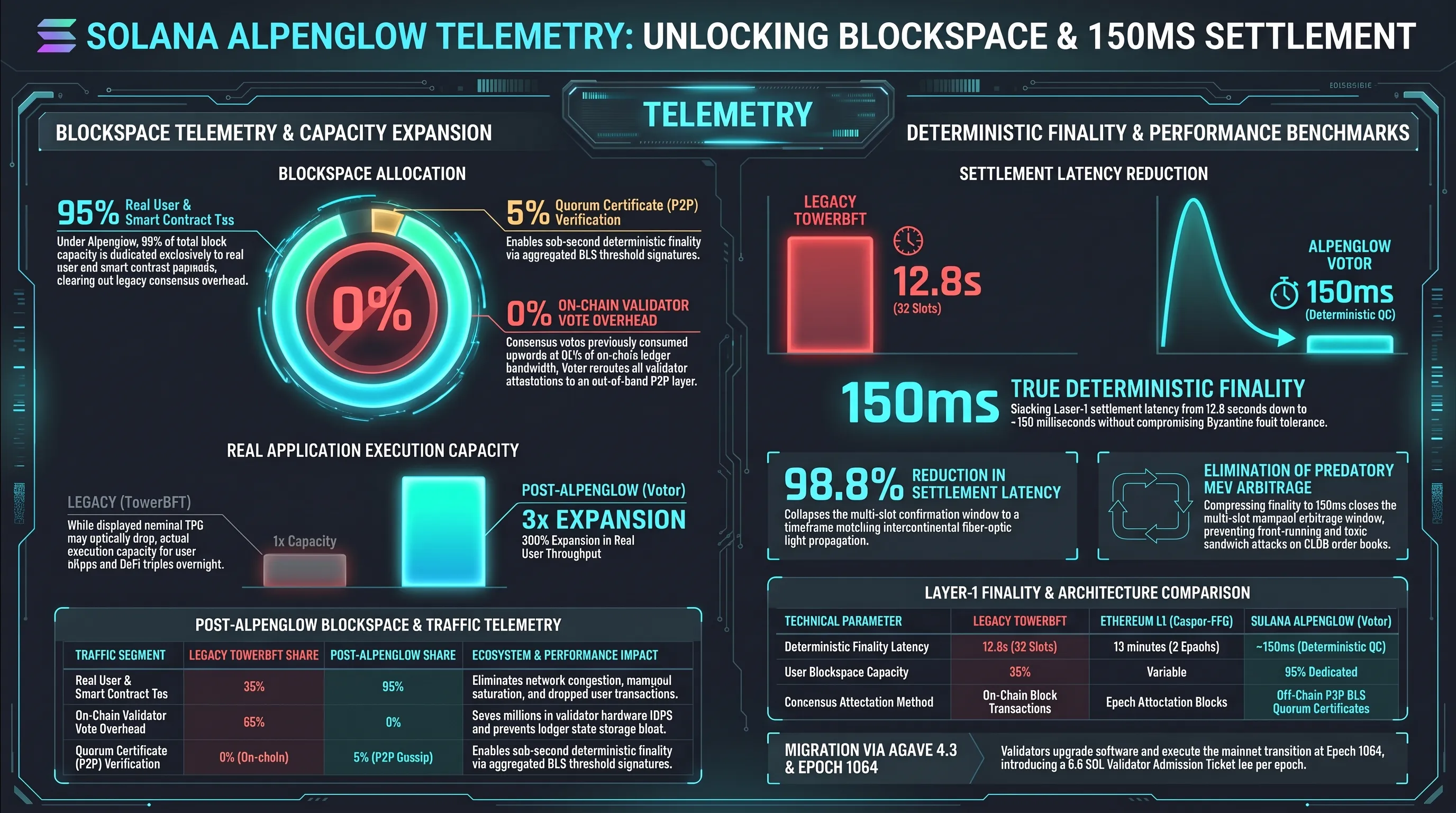
For half a decade, Solana's evangelists championed its rapid 400-millisecond block generation times, while institutional skeptics repeatedly targeted its probabilistic finality lag. Under TowerBFT, achieving mathematically irreversible finality required thirty-two consecutive confirmed slots, introducing an operational latency of approximately 12.8 seconds. With Alpenglow Phase 1, that window collapses by 98.8 percent down to approximately 150 milliseconds a speed threshold that operates faster than a human eyeblink and rivals the internal matching latency of centralized exchanges on Wall Street.
Equally critical is the structural restructuring of validator voting. Historically, validator consensus votes were packaged, gossiped, and committed directly on-chain as standard smart contract transactions, consuming upwards of 65 percent of total block capacity and artificially inflating reported transactions-per-second (TPS) statistics. Under the new Votor paradigm, consensus votes are entirely removed from user blockspace and routed across dedicated peer-to-peer gossip layers, coalescing into cryptographic Quorum Certificates (QCs). This architectural shift liberates tens of thousands of transactions per second for decentralized finance, consumer dApps, and high-frequency trading.
Strategic Assessment and Key Intelligence at a Glance
Dismantling the Illusion of Probabilistic Speed
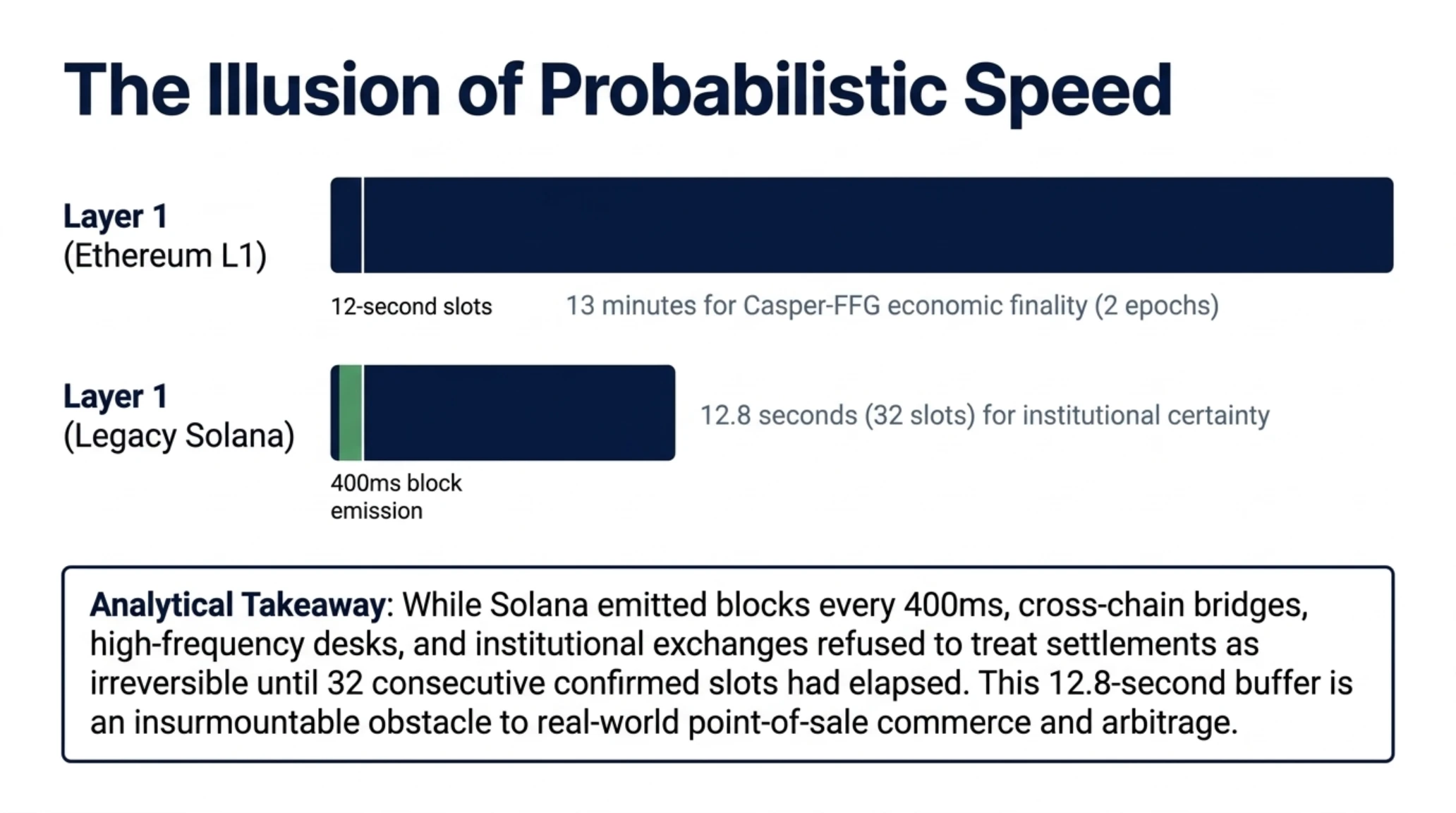
In distributed ledger theory, there is an immense chasm between block emission and deterministic finality. Bitcoin emits blocks every ten minutes, but probabilistic security requires six confirmations a full hour of computational delay. Ethereum L1 operates with twelve-second slots, but true Casper FFG economic finality takes two epochs, requiring thirteen minutes of waiting time. Solana historically existed in a hybrid state: while blocks emerged every 400 milliseconds, cross-chain bridges and institutional exchanges refused to treat settlements as irreversible until thirty-two slots elapsed.
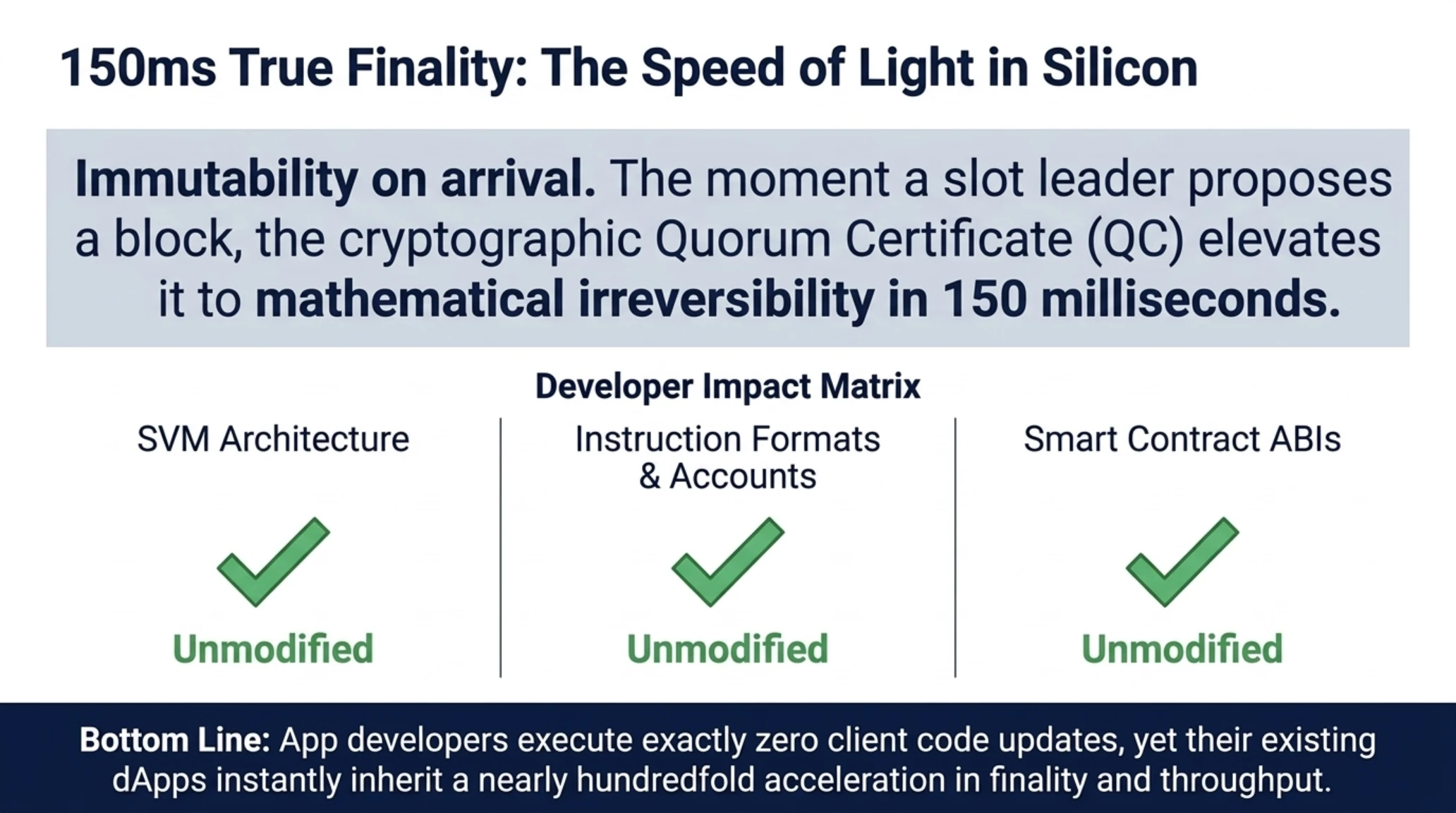
This 12.8-second buffer posed an insurmountable obstacle to real-world point-of-sale commerce, inter-exchange arbitrage, and institutional Real World Asset (RWA) tokenization. A high-frequency desk or international treasury cannot tolerate a twelve-second reorg exposure window. By deploying the Alpenglow Votor engine, Solana bridges this divide: the moment a slot leader proposes a block, a cryptographic Quorum Certificate (QC) is assembled across supermajority stake within 150 milliseconds, immediately elevating the block to immutable finality.
Crucially for developers and market participants, the Solana Virtual Machine (SVM), instruction formats, account structures, and smart contract ABIs remain completely unmodified. App developers do not need to update client code or redeploy programs; rather, their existing decentralized applications instantly inherit a nearly hundredfold acceleration in finality and throughput.
Technical Autopsy of TowerBFT and the Rise of the Votor Engine
TowerBFT served as the foundational pillar of Solana since its genesis block. Designed as an asynchronous, PoH-leveraged variant of Practical Byzantine Fault Tolerance (PBFT), it eliminated the need for multi-round all-to-all messaging by anchoring validator votes to a cryptographically verifiable global clock. Each time a validator voted on an observed slot, an exponential lockout was enforced, requiring double the number of subsequent slots before the validator could switch to a competing fork.
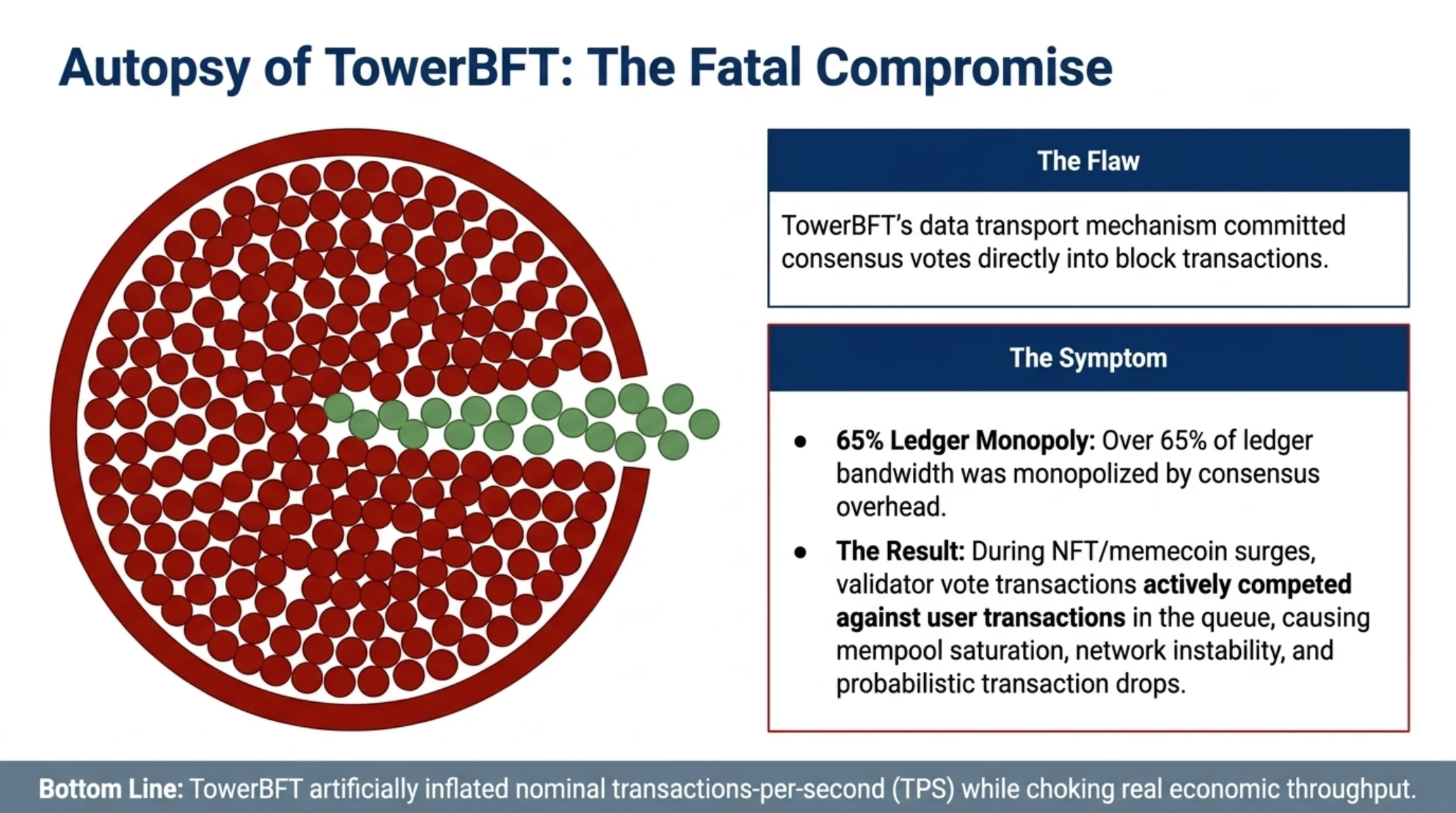
The fatal architectural compromise of TowerBFT was its data transport mechanism: consensus votes were committed directly into block transactions. Consequently, over 65 percent of the ledger bandwidth was monopolized by consensus overhead. In periods of extreme market volatility or high-traffic NFT and memecoin surges, validator vote transactions competed against user transactions in the transaction queue, leading to mempool saturation, network instability, and probabilistic transaction drops.
Tekin Advanced Technical Glossary
How the Votor Protocol Works; Direct Peer-to-Peer Consensus
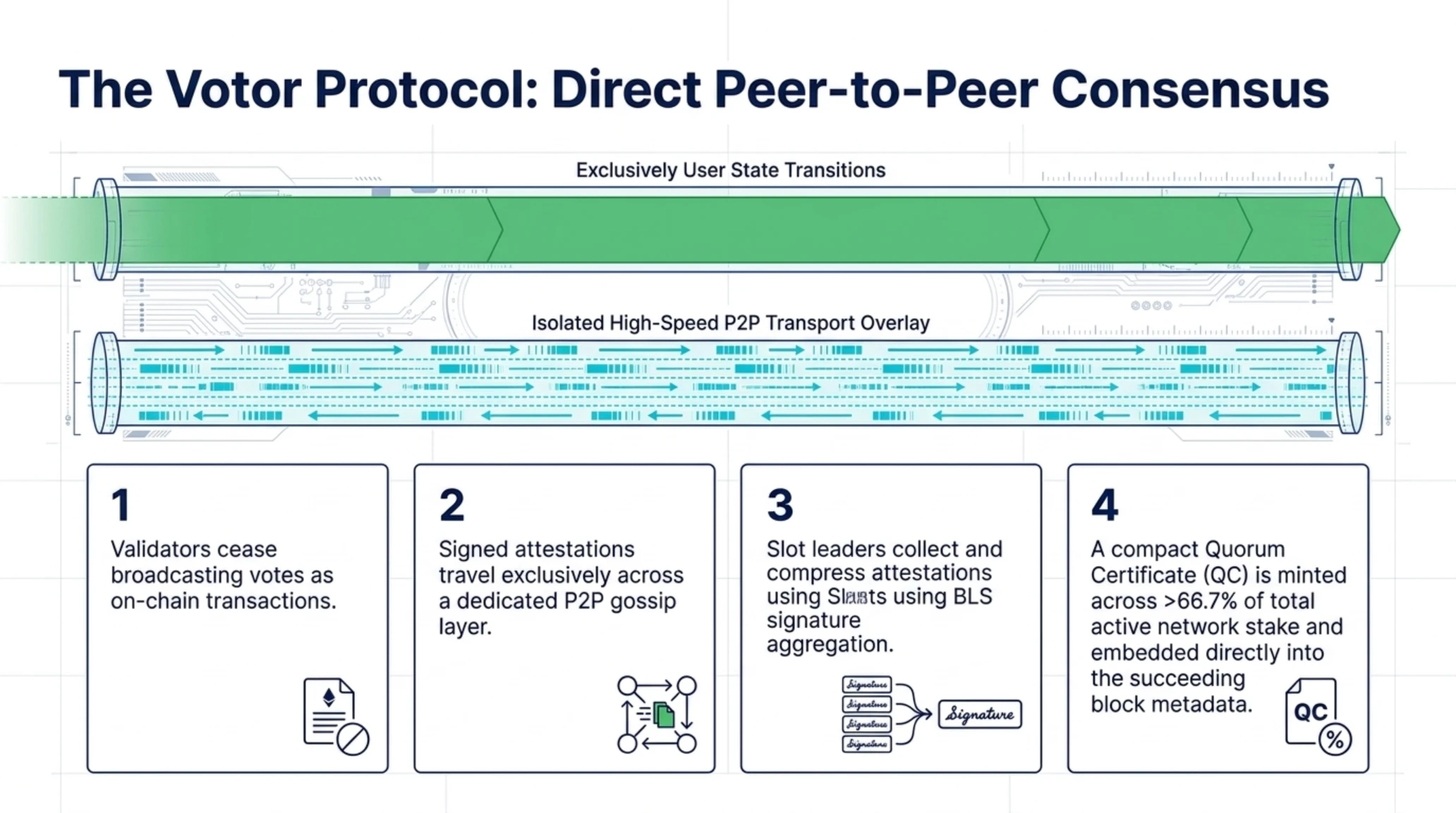
The Alpenglow upgrade dissolves this friction through the Votor consensus module integrated into the Agave 4.3 validator release. Under Votor, validators cease broadcasting votes as on-chain transactions. Instead, voting messages travel exclusively across an isolated, high-speed peer-to-peer transport overlay. The current slot leader collects these signed attestations, compresses them into a single Quorum Certificate via BLS signature aggregation, and embeds the certificate directly into the metadata header of the succeeding block.
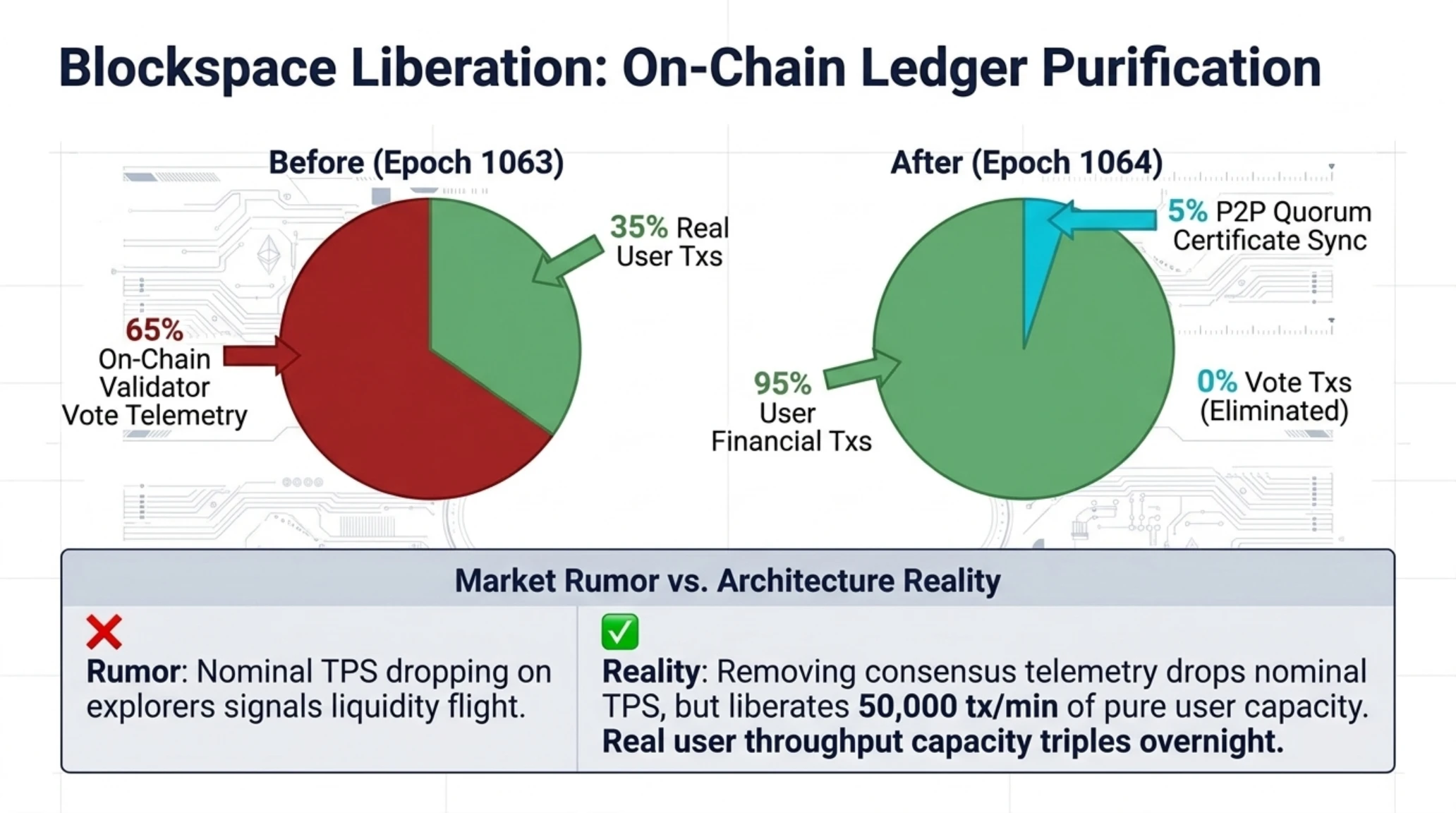
The operational ramifications are staggering. By clearing voting transactions off the ledger, the network frees up over 50,000 transactions per minute of pure user capacity. While third-party analytics dashboards tracking raw on-chain TPS may initially register an optical drop in aggregate transactions following the fork, this reduction merely reflects the removal of consensus telemetry. Actual user throughput capacity triples overnight.
Cybersecurity Terminal and Benchmark Telemetry Log
Why This Technical Inflection Changes the Industry
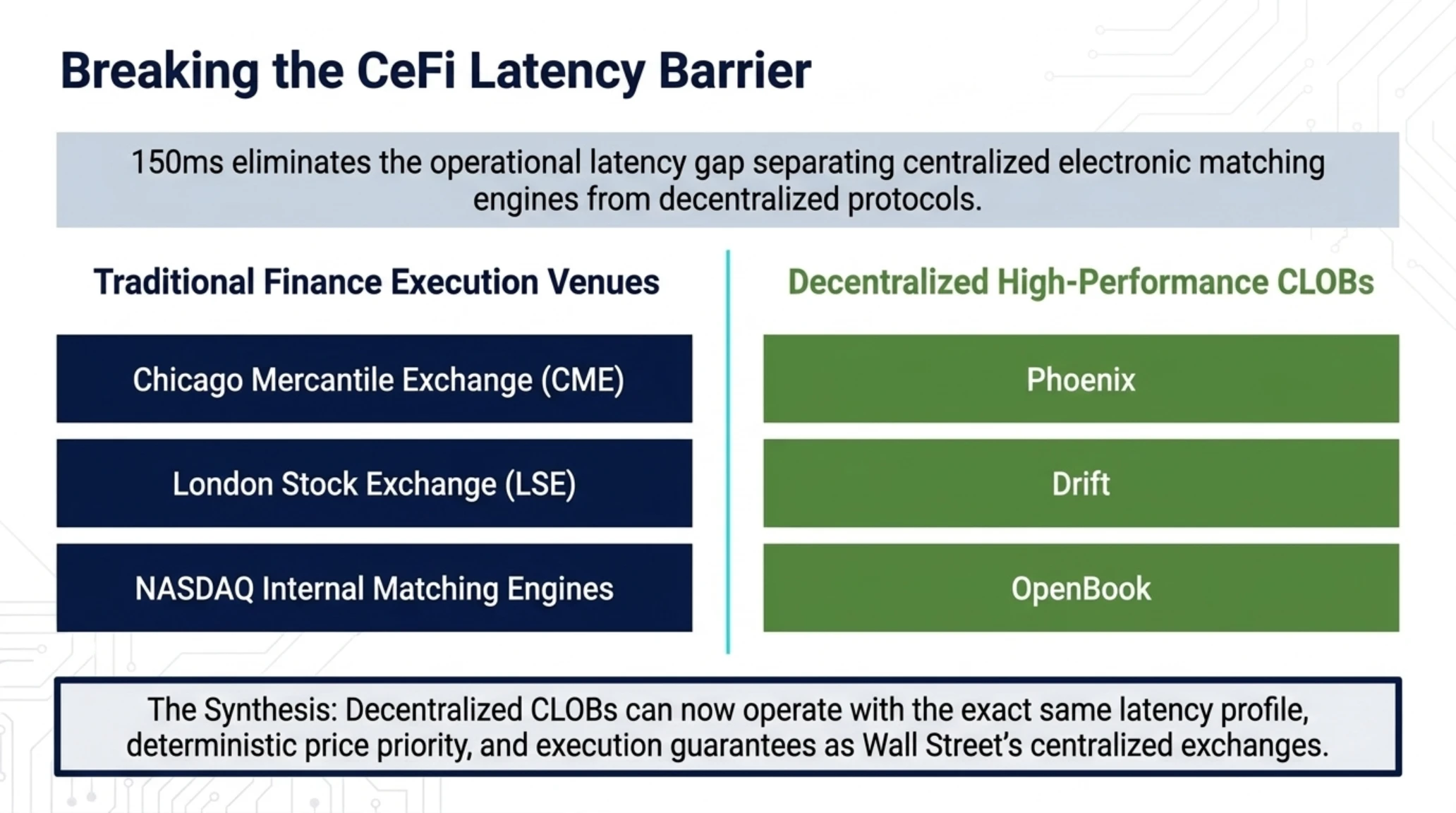
Sub-150ms finality eliminates the operational latency gap separating centralized electronic matching engines like NASDAQ from decentralized protocols, paving the way for institutional order books.
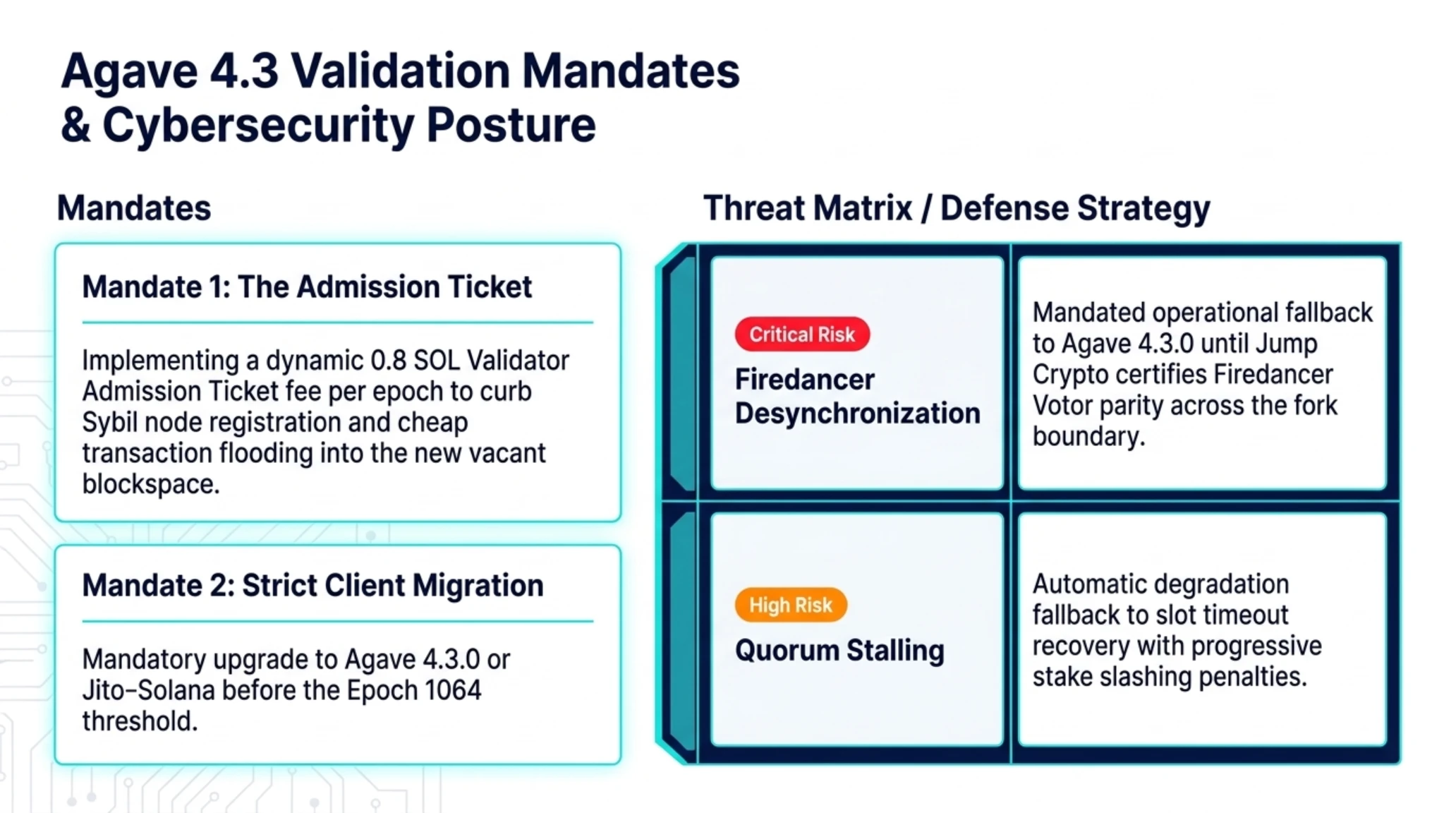
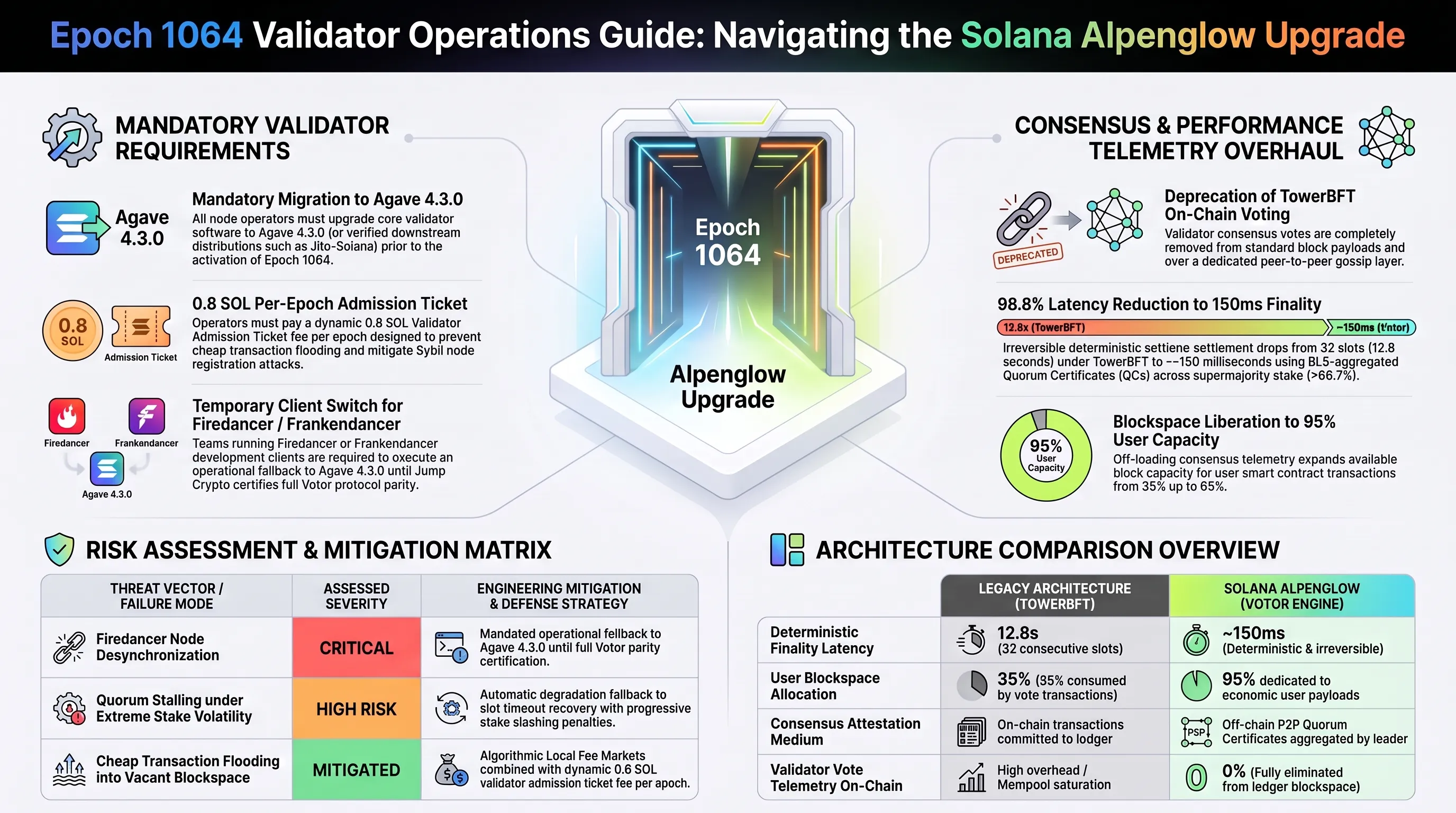
For validator operators, the fork introduces concrete economic and operational stipulations. Nodes must upgrade to Agave 4.3.0 or verified downstream distributions such as Jito-Solana before the Epoch 1064 threshold. Additionally, operators must pay a newly introduced 0.8 SOL Validator Admission Ticket fee per epoch to curb Sybil node registration. Teams running development clients like Firedancer and Frankendancer must execute a temporary client switch to Agave to maintain consensus fidelity across the fork boundary.
The Millisecond War; Decisive Supremacy Over Ethereum L1 and L2 Rollups
To grasp the profound engineering significance of the Alpenglow consensus transformation, one must contextualize Solana's transaction finality against the broader competitive landscape of modern distributed ledgers. Ethereum Layer-1 operates under the Casper-FFG (Friendly Finality Gadget) and LMD-GHOST consensus mechanism. On Ethereum, transaction confirmation is probabilistic until two full epochs have elapsed, requiring an operational window between 12.8 and 14 minutes (approximately 780 to 900 seconds) before state transitions achieve irreversible cryptographic finality. Even optimistic Layer-2 rollups like Arbitrum, Optimism, and Base, while advertising instant execution, merely provide centralized soft commitments issued by an isolated sequencer. True L1 settlement and cryptographic immutability on optimistic rollups remain contingent on a 7-day fraud-proof dispute window.
The Alpenglow architecture completely flips this paradigm by conferring sub-150-millisecond deterministic finality directly at the native Layer-1 base protocol. By dispensing with secondary sequencer reliance, bridging validation overhead, and multi-round challenge periods, Solana emerges as the sole production decentralized network capable of settling arbitrary state transitions within the physical timeframe of intercontinental fiber-optic light propagation. This sub-second threshold effectively collapses the performance barrier separating distributed state machines from legacy centralized payment rails such as Visa and Mastercard.
Engineering Fact-Check | Market Rumor vs Architecture Reality
Skeptics argue that the optical decline in displayed Transactions Per Second across blockchain explorers indicates declining user adoption, decreased protocol volume, and capital rotation toward alternative Layer-1 networks.
The lower nominal TPS reflects the complete removal of validator voting overhead from block payloads. 95% of blockspace is now dedicated exclusively to economic user transactions, effectively tripling real computational capacity.
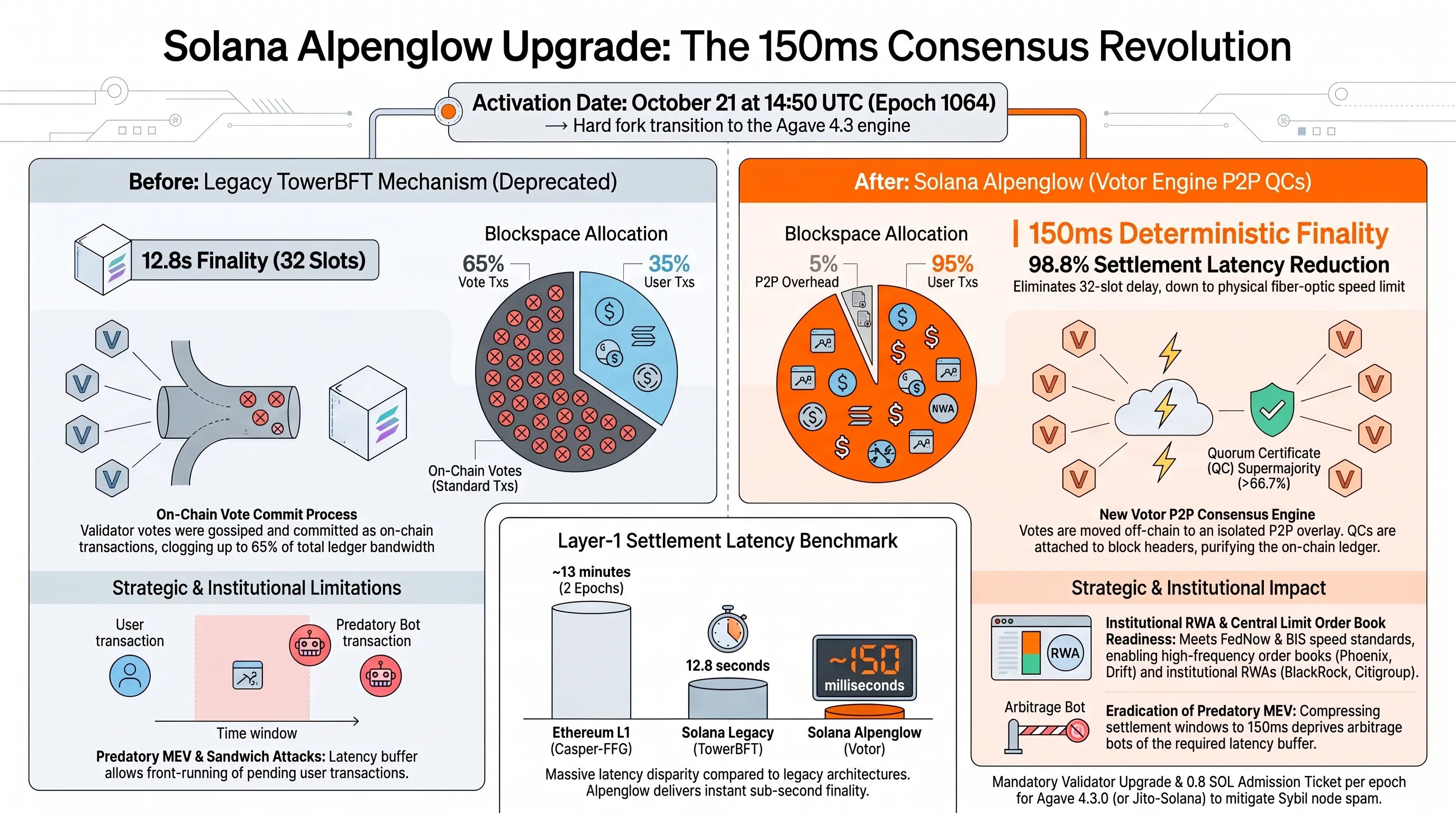
Benchmark Comparison | Layer-1 Deterministic Finality and Ledger Bandwidth
| Technical Parameter | Legacy Architecture / Competitor L1 | Solana Alpenglow (Next-Gen) |
|---|---|---|
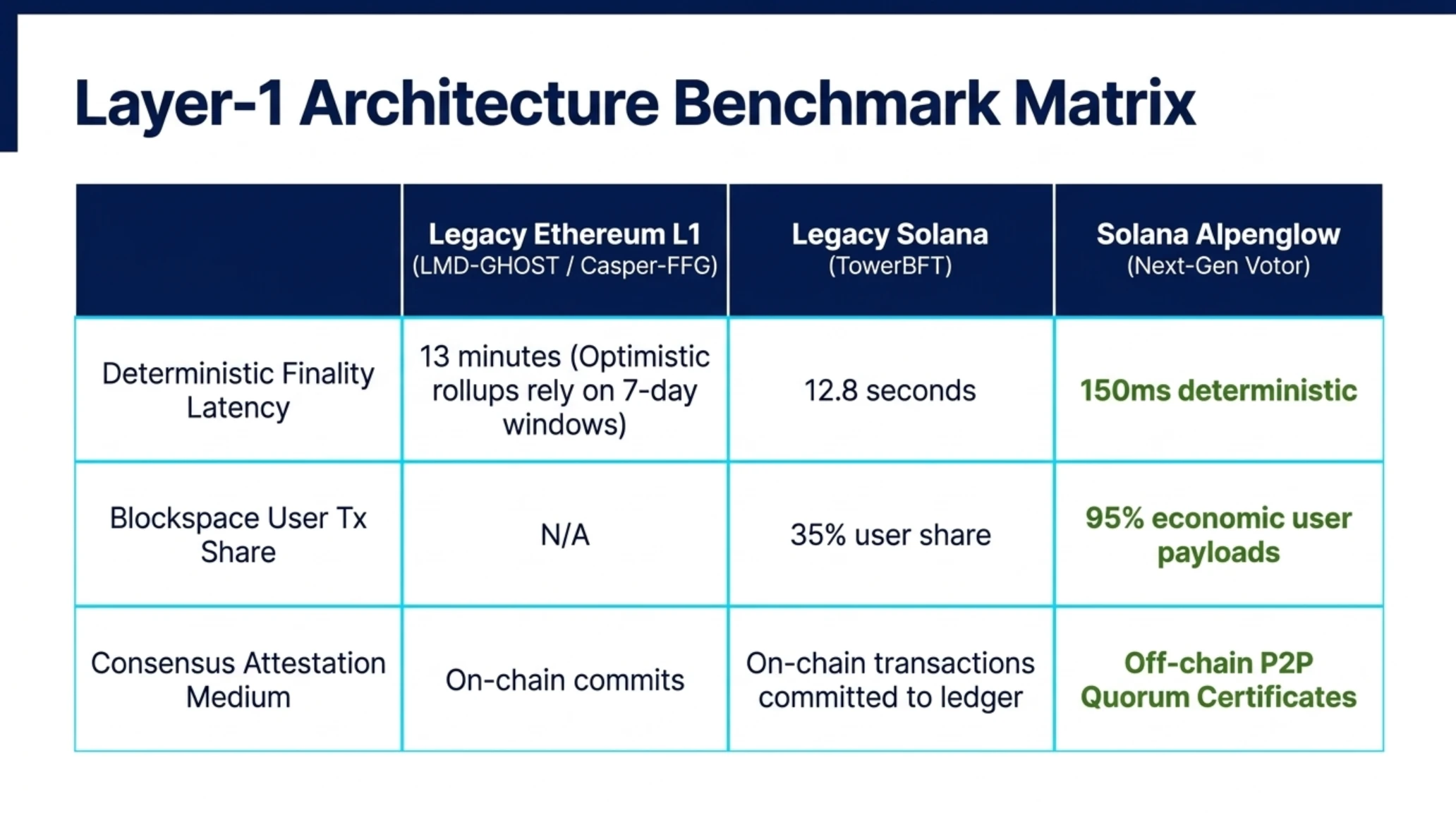
| Deterministic Finality Latency | 12.8s (Solana TowerBFT) / 13 min (Ethereum L1) | 150ms deterministic and irreversible |
| Blockspace User Transaction Share | 35% (65% consumed by validator vote messages) | 95% dedicated to economic user payloads |
| Consensus Attestation Medium | On-chain transactions committed to ledger | Off-chain P2P Quorum Certificates aggregated by leader |
Dismantling Sandwich Attacks and Eradicating MEV Exploitation in DeFi Order Books
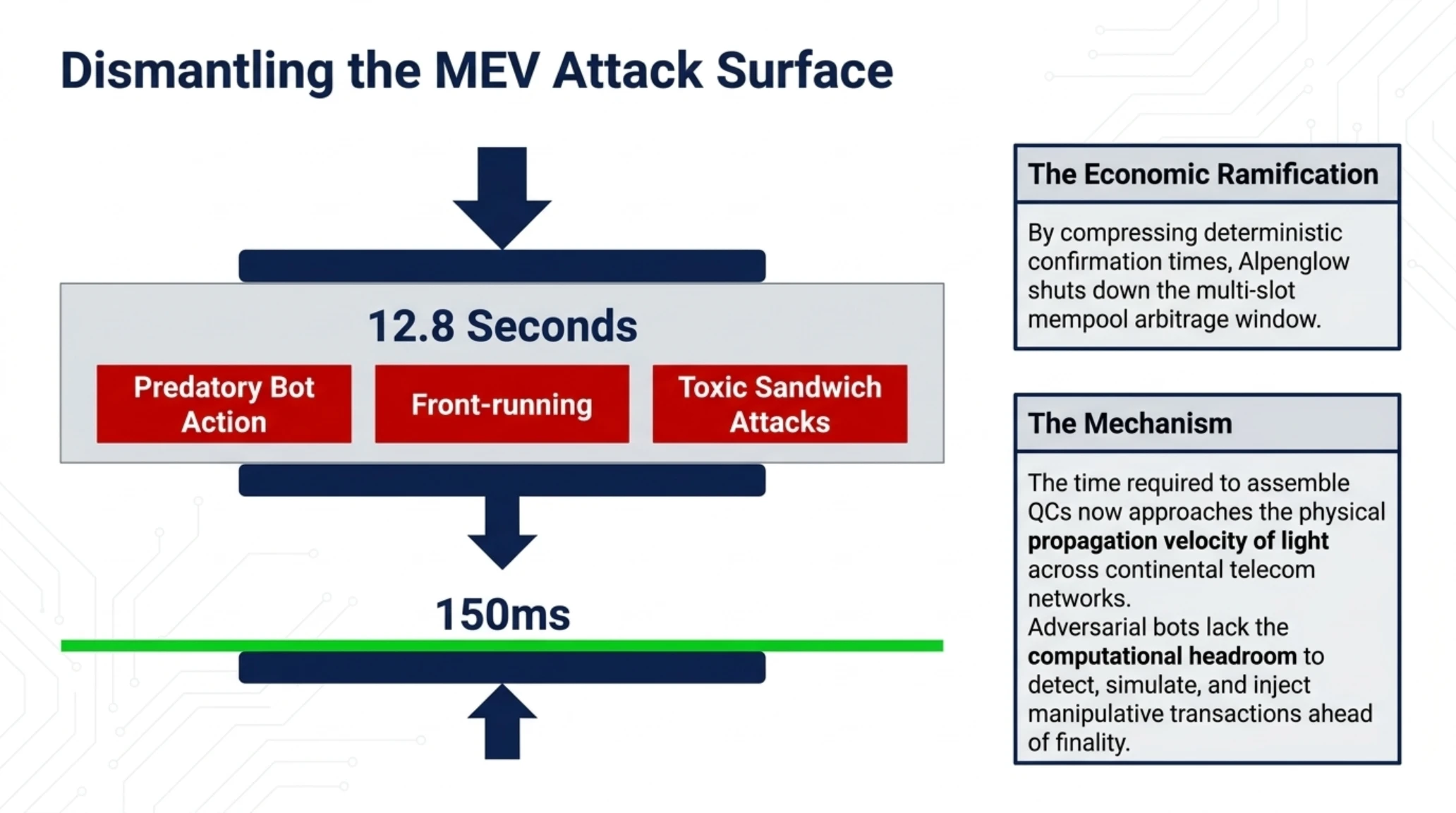
One of the most damaging structural repercussions of the 12.8-second finality window under legacy TowerBFT was the persistent attack surface it conceded to predatory Maximal Extractable Value (MEV) operators. Front-running arbitrageurs, toxic sandwich bots, and opportunistic searchers routinely scrutinized the validator mempool, exploiting the multi-slot confirmation gap to reorder, insert, and back-run retail orders. This systemic latency arbitrage imposed millions of dollars in annual slippage costs upon regular decentralized finance traders and liquidity providers across automated market makers (AMMs).
By compressing deterministic confirmation times down to roughly 150 milliseconds, Alpenglow completely shuts down this predatory arbitrage window. The time required for slot leaders to assemble and verify Quorum Certificates now approaches the theoretical propagation velocity of light through continental telecommunications networks. Consequently, adversarial bots lack the computational and propagation headroom necessary to detect pending orders, simulate state changes, and inject manipulative transactions ahead of finality. High-performance central limit order book (CLOB) architectures like Phoenix, Drift, and OpenBook can now operate with the latency profile, deterministic price priority, and execution guarantees of institutional exchanges like the Chicago Mercantile Exchange (CME) and London Stock Exchange (LSE).
📚 Classified & Related Dossiers in TekinGame
If you wish to explore beyond this report and delve into cybernetic frontiers and autonomous AI architectures, do not miss these three exclusive deep-dives in the Tekin Garage:
Blockspace Allocation Telemetry, Real TPS Growth, and Market Impact
| Network Traffic Segment | Post-Alpenglow Share | DeFi Ecosystem Ramifications |
|---|---|---|
| Real User and Smart Contract Txs | 95% of total block capacity | Drastic reduction in congestion failures and dropped user transactions |
| On-chain Validator Vote Telemetry | 0% (fully eliminated from ledger) | Saves millions in annual validator hardware IOPS and state storage bloat |
| Quorum Certificate Verification | 5% peer-to-peer messaging overhead | Enables ultra-resilient sub-second deterministic finality across global nodes |
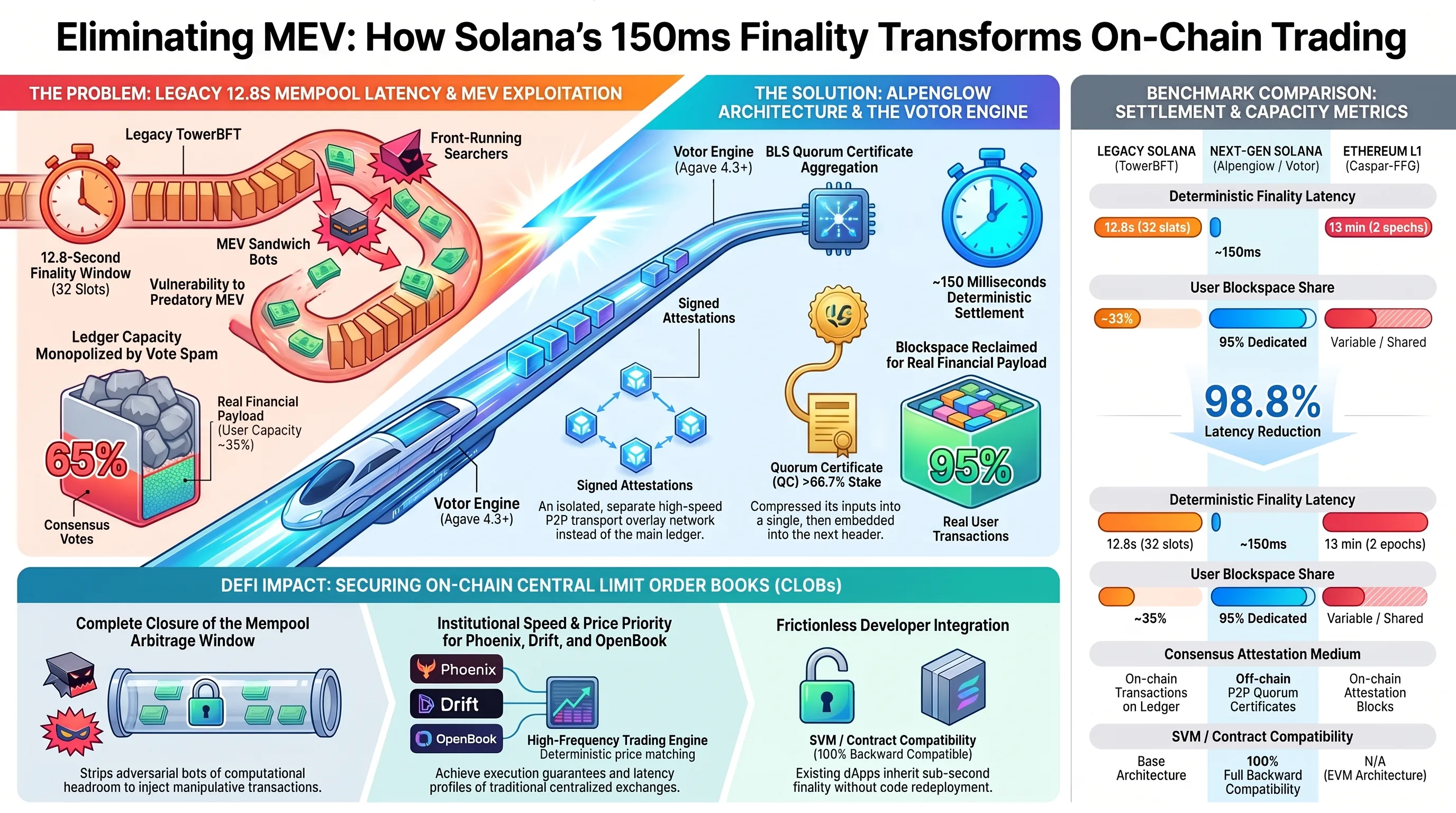
Cybersecurity and Network Resilience Threat Assessment Matrix
| Threat Vector / Failure Mode | Assessed Severity | Engineering Mitigation and Defense Strategy |
|---|---|---|
| Firedancer Node Desynchronization during Hard Fork | CRITICAL | Mandated operational fallback to Agave 4.3.0 until Jump Crypto certifies Firedancer Votor parity. |
| Quorum Stalling under Extreme Stake Volatility | HIGH RISK | Automatic degradation fallback to slot timeout recovery with progressive stake slashing penalties. |
| Cheap Transaction Flooding into Vacant Blockspace | MITIGATED | Algorithmic Local Fee Markets and dynamic 0.8 SOL validator admission ticket fee per epoch. |
The cybersecurity posture of the network has undergone exhaustive fuzzing and rigorous formal verification by multiple third-party audits. By decoupling consensus attestations from user-facing transaction queues, the network eliminates state-poisoning vectors where an attacker could flood blocks with synthetic transactions to delay validator votes and induce consensus stalls. With Votor, consensus operates on an out-of-band communication highway, impervious to application-layer congestion.
The Horizon of Phase 2 Rotor and the Turbine Propagation Revolution
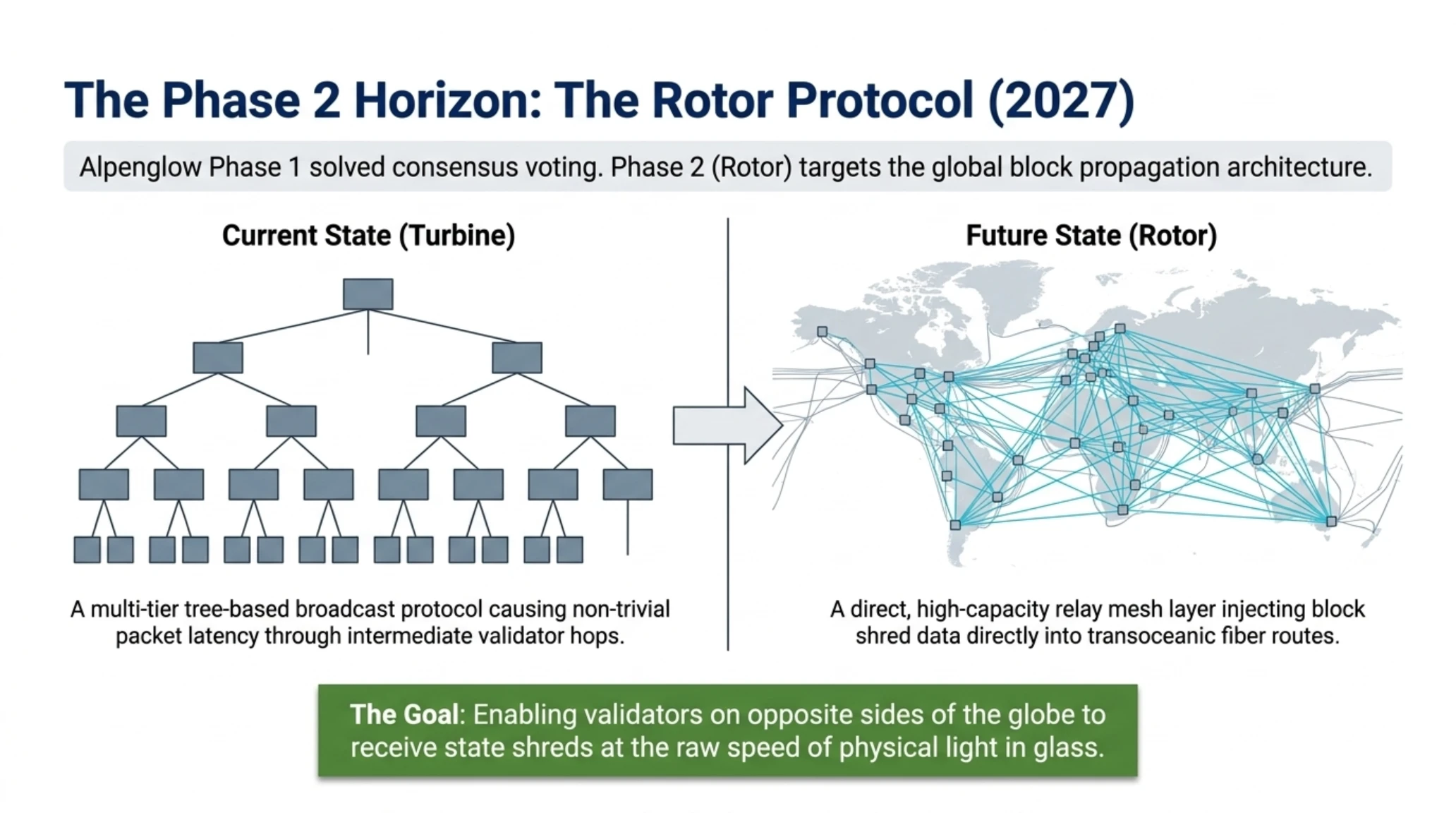
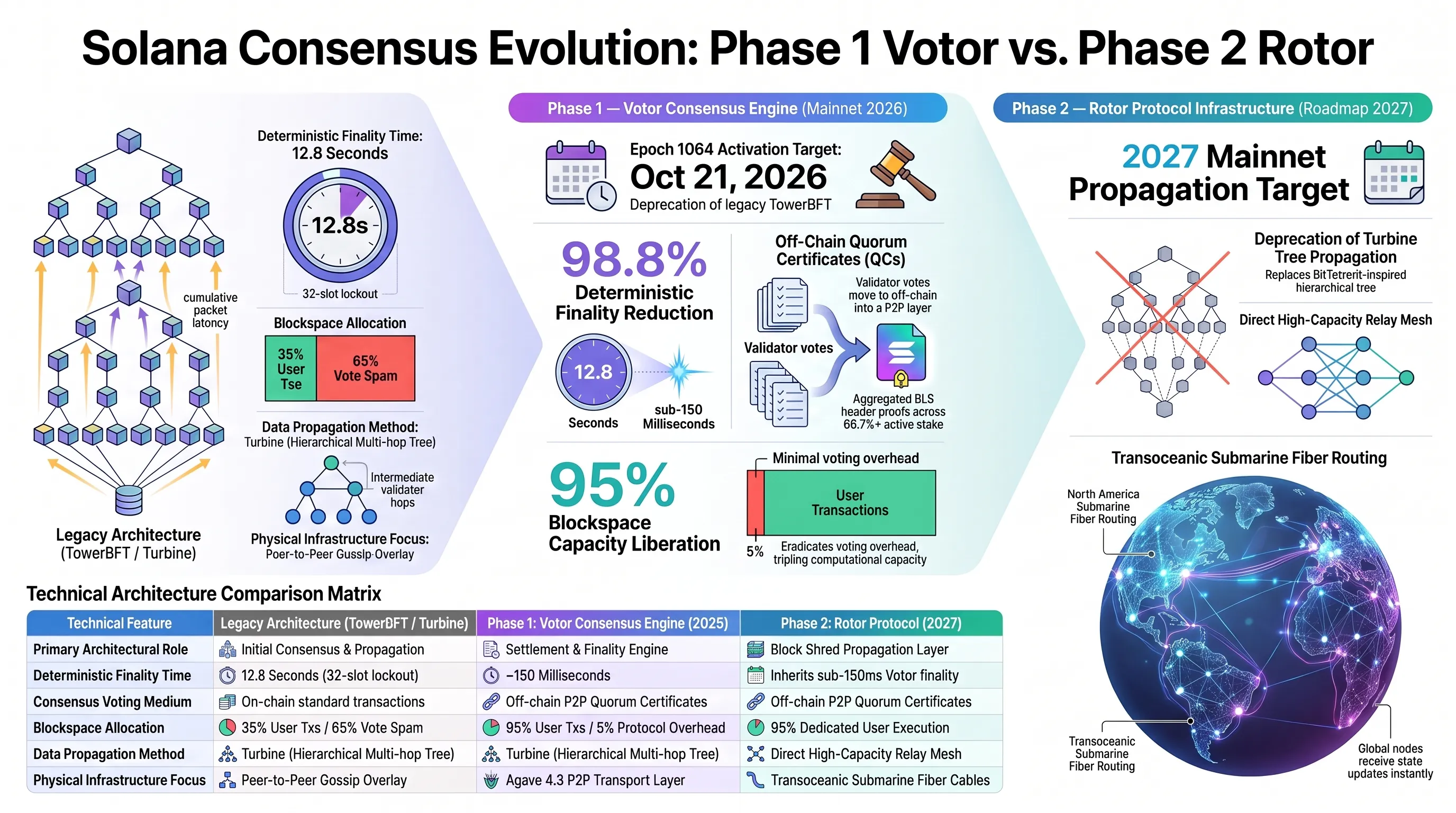
The engineering ambition behind Alpenglow extends far beyond the introduction of the Votor consensus engine; it represents the inaugural milestone of a coordinated two-phase modernization roadmap. While Phase 1, scheduled for activation on October 21, completely rewrites validator voting mechanisms and quorum aggregation, Phase 2 designated under the codename Rotor targets a comprehensive overhaul of the global block propagation and data distribution architecture.
Currently, Solana distributes block shred data across its worldwide validator topology using Turbine, a multi-tier tree-based broadcast protocol inspired by BitTorrent. While Turbine represented a monumental leap over the rudimentary gossip protocols utilized by early proof-of-work networks like Bitcoin and Ethereum, its hierarchical tree structure inherently introduces non-trivial packet latency as shreds traverse multiple intermediate validator hops across disparate continents. Under the Rotor protocol slated for mainnet deployment in 2027, the network will introduce a direct, high-capacity relay mesh layer. This infrastructure injects block data directly into transoceanic fiber routes, enabling validators on opposite sides of the globe to receive state shreds at the raw speed of physical light in glass.
Market Sentiment Thermometer | S-Curve Adoption and Consensus Index
Market Sentiment Thermometer: Tier-1 quantitative trading desks, institutional liquidity providers, and asset custodians view deterministic sub-second finality as the non-negotiable prerequisite for enterprise capital deployment.
Historical Chronology | Evolution of the Solana Consensus Engine
| Chronological Milestone | Consensus Architecture Milestone | Network Engineering Ramifications |
|---|---|---|
| March 2020 | Inception of TowerBFT Protocol | Established genesis architecture utilizing 400ms slot clocks and 32-slot (12.8-second) lockout finality. |
| September 2026 | Alpenglow Stress-Testing on Testnet | Successful pilot validation of Votor consensus engine on Agave 4.3, proving sub-150ms deterministic QCs. |
| October 21, 2026 | Mainnet Activation at Epoch 1064 | Formal deprecation of TowerBFT, complete eradication of vote transaction bloat, achieving 150ms finality. |
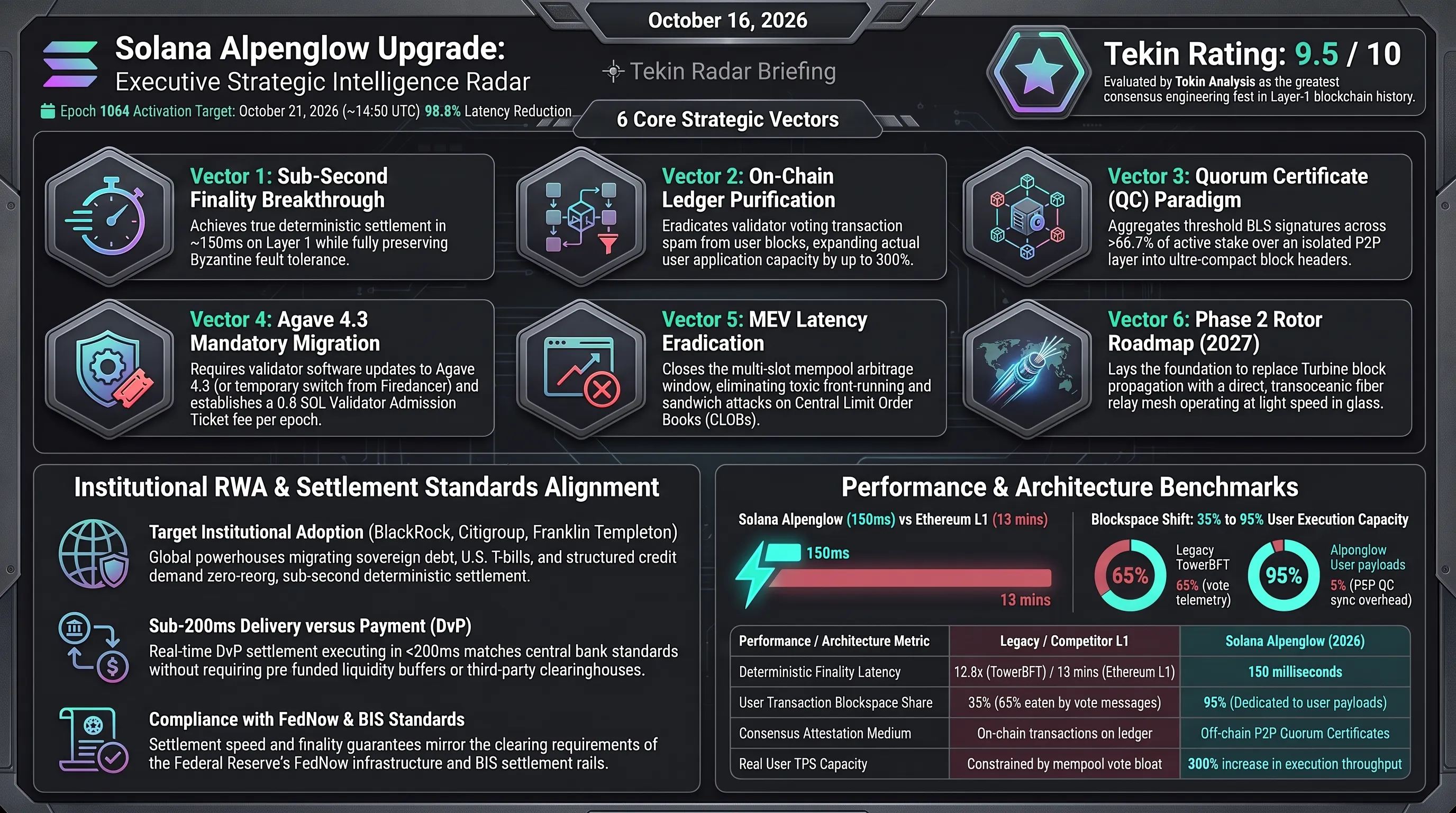
Geoeconomic Implications for Real-World Asset (RWA) Tokenization
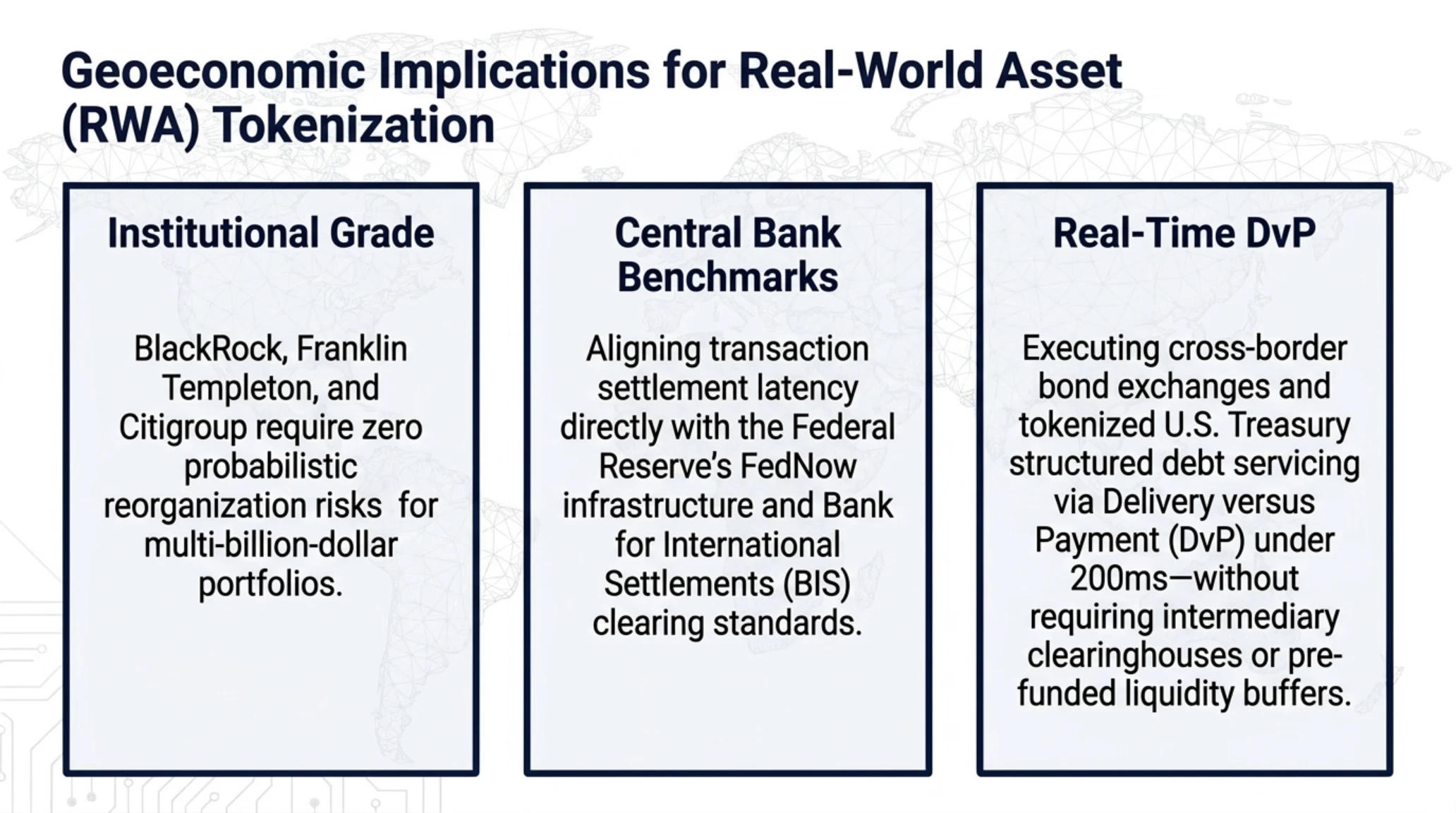
The stabilization of deterministic finality at 150 milliseconds ripples far beyond the immediate boundaries of decentralized finance, directly transforming the rapidly expanding sector of Real-World Asset (RWA) tokenization. Global institutional financial powerhouses including BlackRock, Franklin Templeton, and Citigroup, who are aggressively migrating sovereign debt obligations, tokenized U.S. Treasury bills, and institutional credit instruments onto distributed networks, could never tolerate multi-minute settlement windows or probabilistic reorganization risks with multi-billion-dollar portfolios.
With Alpenglow, Solana aligns its transaction settlement latency with central bank gross settlement systems such as the Federal Reserve's FedNow infrastructure and the Bank for International Settlements (BIS) clearing standards. Real-time Delivery versus Payment (DvP) settlement executing in under 200 milliseconds guarantees that cross-border bond exchanges, structured debt servicing, and institutional equity transfers can settle deterministically without requiring intermediary clearinghouses, custodians, or pre-funded liquidity buffers.
This generational upgrade signals that the era of speculative marketing focused purely on theoretical, synthetic TPS metrics has officially concluded. The authentic competitive frontier of modern distributed infrastructure is deterministic settlement certainty, predictable execution latency under adversarial congestion, and rock-solid state finality benchmarks where Solana has decisively established a commanding technological moat over both legacy centralized financial rails and fragmented Layer-2 modular architectures.
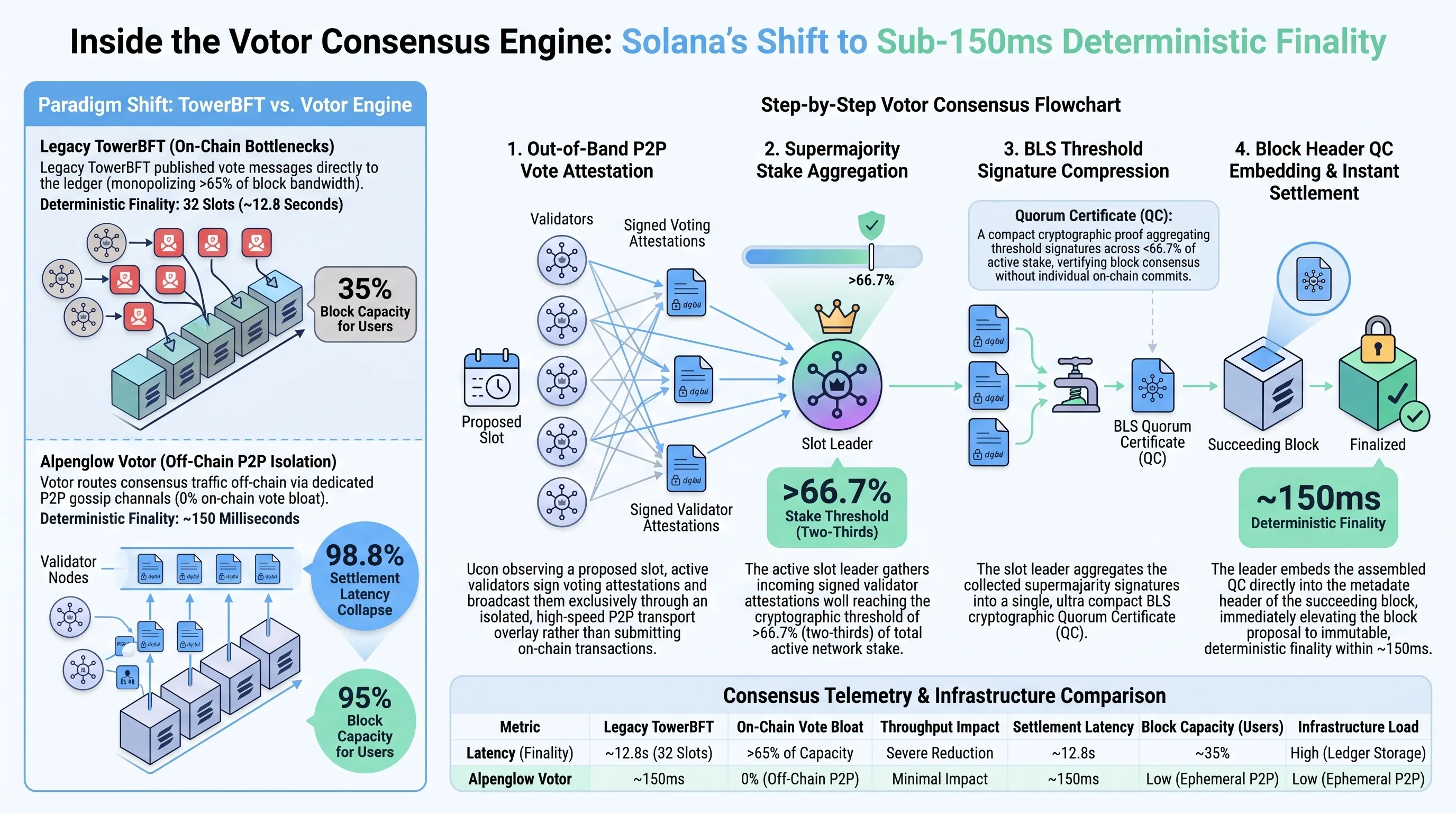
- Delivers a 98.8% latency reduction in deterministic transaction finality from 12.8 seconds to ~150 milliseconds.
- Liberates over 65% of block capacity by migrating validator vote telemetry off-chain to an optimized P2P layer.
- Eradicates predatory MEV sandwich attacks and front-running by closing the multi-slot mempool arbitrage window.
- Maintains 100% full backward compatibility with the Solana Virtual Machine (SVM) and existing smart contracts.
- Mandates immediate software upgrades and an epoch admission ticket fee of 0.8 SOL for all active validator operators.
- Introduces temporary client-diversity concentration as third-party implementations like Firedancer finalize Votor parity.
- Creates optical confusion among non-technical observers due to the nominal drop in raw explorer TPS metrics.
Editorial Verdict and Primary Technical Sources
The Twilight of Latency; Cementing the Speed of Light in Global Finance
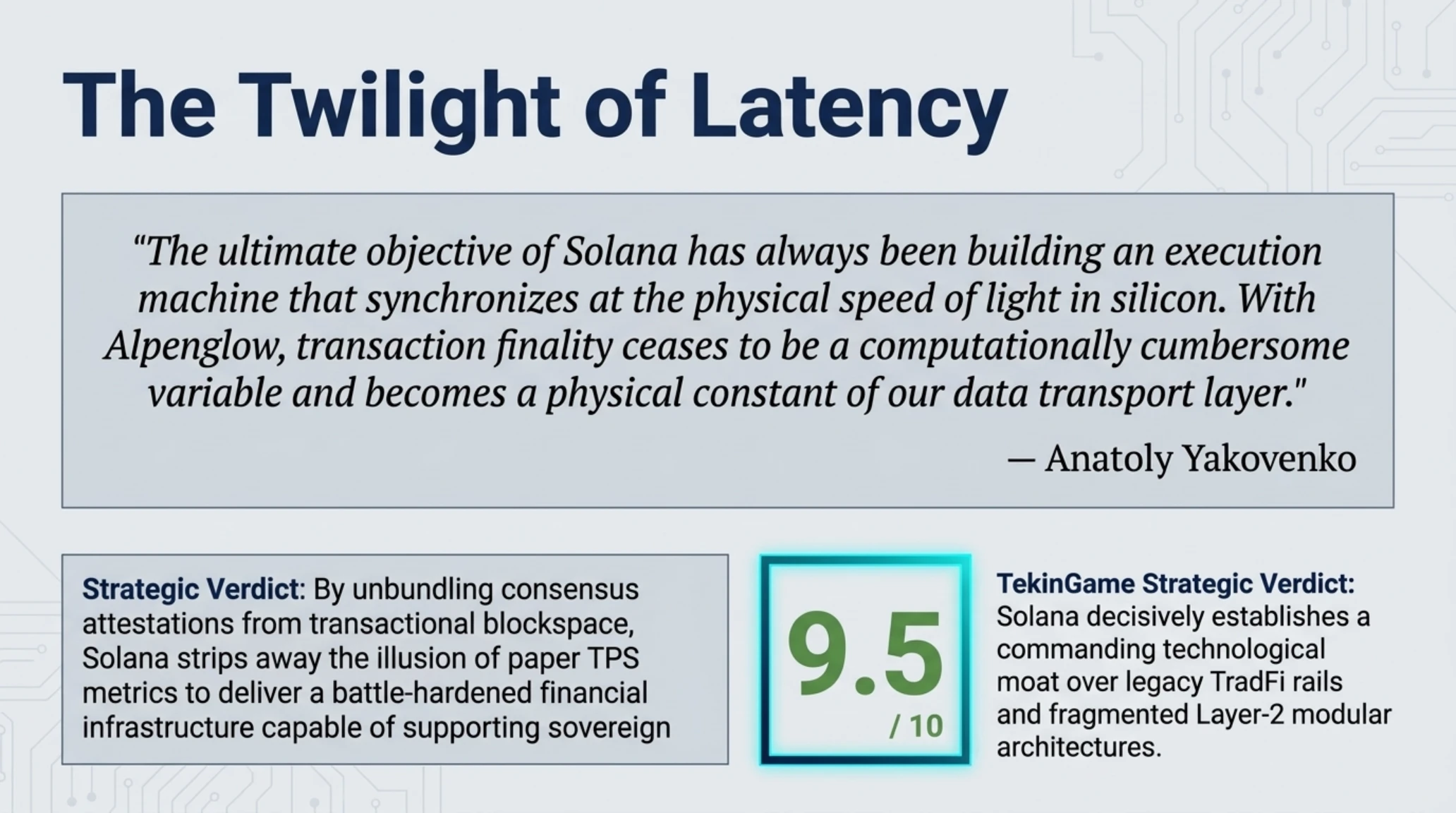
By sunsetting TowerBFT and activating Alpenglow, Solana strips critics of their final legitimate architectural critique. 150-millisecond deterministic finality collapses the functional distinction between centralized electronic matching engines and decentralized ledgers, positioning Solana as the preeminent settlement backbone of global commerce for the coming decade.
- Solana Foundation: Official Technical Documentation on the Alpenglow Consensus Upgrade and Agave 4.3 Architecture
- PlayToEarn: Comprehensive Technical Analysis of Epoch 1064 Activation and 150ms Finality Performance
- Mitrade: Economic Post-Mortem on Votor Consensus and the Deprecation of Legacy TowerBFT Lockouts
- CryptoRank: Validator Metric Report on Agave Client Upgrades, Firedancer Compatibility, and Stake Distribution
Frequently Asked Technical Questions
What is the Alpenglow consensus upgrade on the Solana network?
Alpenglow is the most significant consensus upgrade in Solana history, replacing the legacy TowerBFT lockout mechanism with the Votor engine to reduce deterministic transaction finality from 12.8 seconds to approximately 150 milliseconds.
Why will nominal TPS displayed on block explorers decline following the hard fork?
Under TowerBFT, over 65% of all recorded transactions were validator voting messages. Alpenglow moves voting off-chain into direct P2P Quorum Certificates, removing vote bloat while effectively tripling real user transaction capacity.
Do regular users, traders, or decentralized application developers need to take action?
No action is required for end users or dApp developers. The upgrade occurs purely at the consensus protocol layer, maintaining full backward compatibility across the Solana Virtual Machine (SVM), smart contracts, and token standards.
When does the Alpenglow upgrade activate on Solana mainnet?
The hard fork is scheduled to activate on October 21, precisely at the boundary of Epoch 1064 (approximately 14:50 UTC) once supermajority validator stake has signaled readiness.
What are the technical prerequisites for validator node operators?
Validators must upgrade their node software to Agave 4.3.0 or verified downstream releases, submit a 0.8 SOL epoch admission ticket to prevent Sybil spam, and ensure low-latency P2P port forwarding.
How does Alpenglow eliminate toxic MEV and sandwich attacks?
By compressing finality to 150ms, Alpenglow closes the multi-slot confirmation window that arbitrage searchers and sandwich bots previously exploited to reorder retail orders, virtually eliminating execution slippage.
Additional Gallery: Tekin Radar | Solana Alpenglow Fork: 150ms Finality via Votor