Tekin Analysis | Samsung Galaxy S26 Ultra: The Privacy Revolution with Flex Magic Pixel
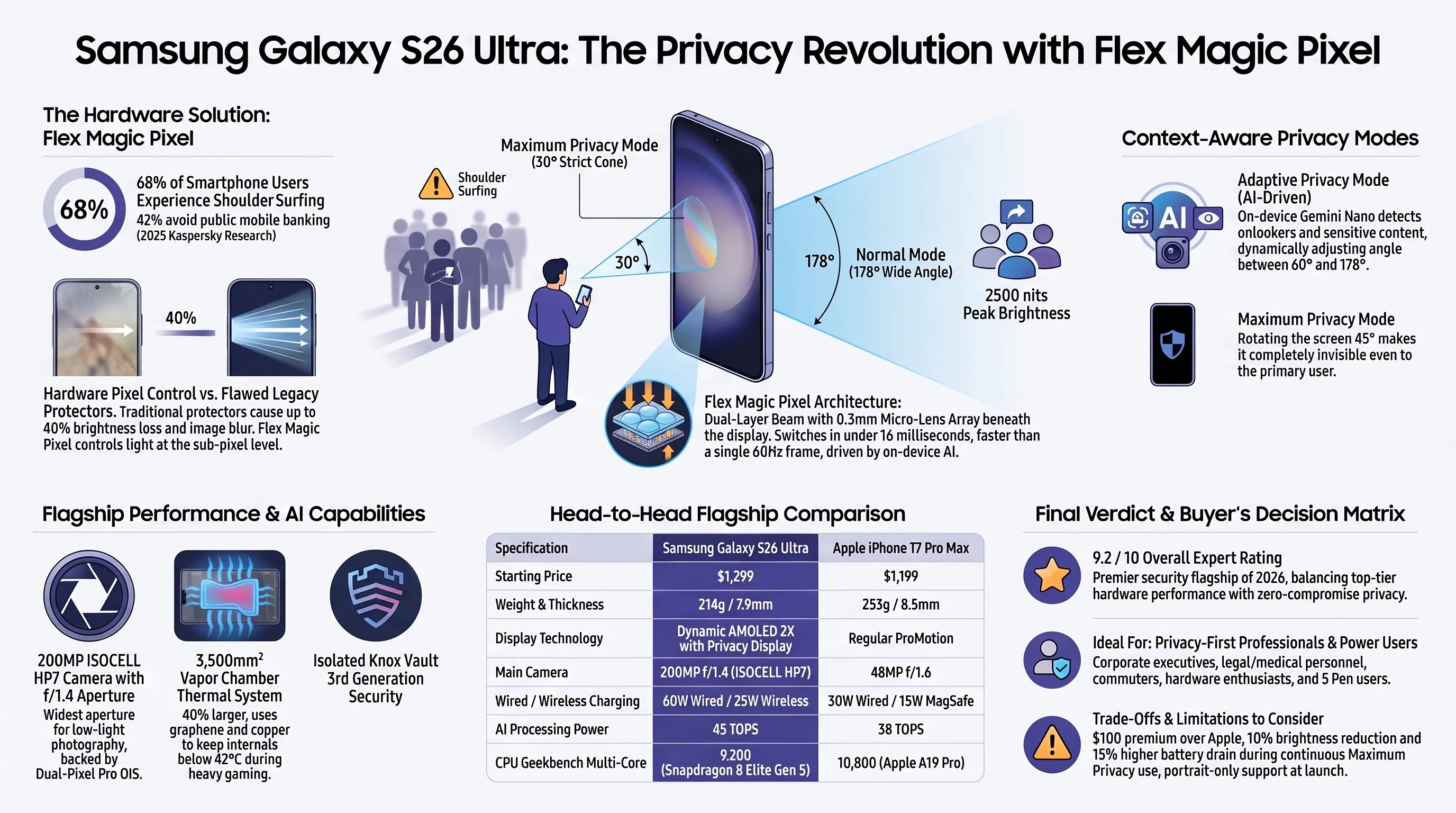
Imagine sitting in a crowded coffee shop, attempting to check highly confidential work emails or enter your banking credentials. Suddenly, you sense the person seated behind you carefully observing your screen. This phenomenon, known in cybersecurity circles as "Shoulder Surfing," remains one of the oldest yet most effective security threats in the digital age[cite: 13]. With the release of the Galaxy S26 Ultra, Samsung intends to eradicate this vulnerability permanently[cite: 13].
On February 15, 2026, during the Galaxy Unpacked event, Samsung unveiled a product that marks a profound turning point in the smartphone industry: the first mobile display guaranteeing privacy at the hardware level[cite: 13]. By introducing Flex Magic Pixel technology, the Galaxy S26 Ultra renders physical privacy screen protectors utterly obsolete[cite: 13]. The display itself possesses the physical capability to hide your content from prying eyes[cite: 13]. Arriving in the wake of the devastating Predatorgate spyware scandal, Samsung proves that privacy is not merely a software toggle it is a fundamental human right that must be integrated directly into the silicon and light physics of the device[cite: 13].
Strategic Evaluation & Key Takeaways at a Glance
History of Failure: Why Privacy Screen Protectors Weren't Enough
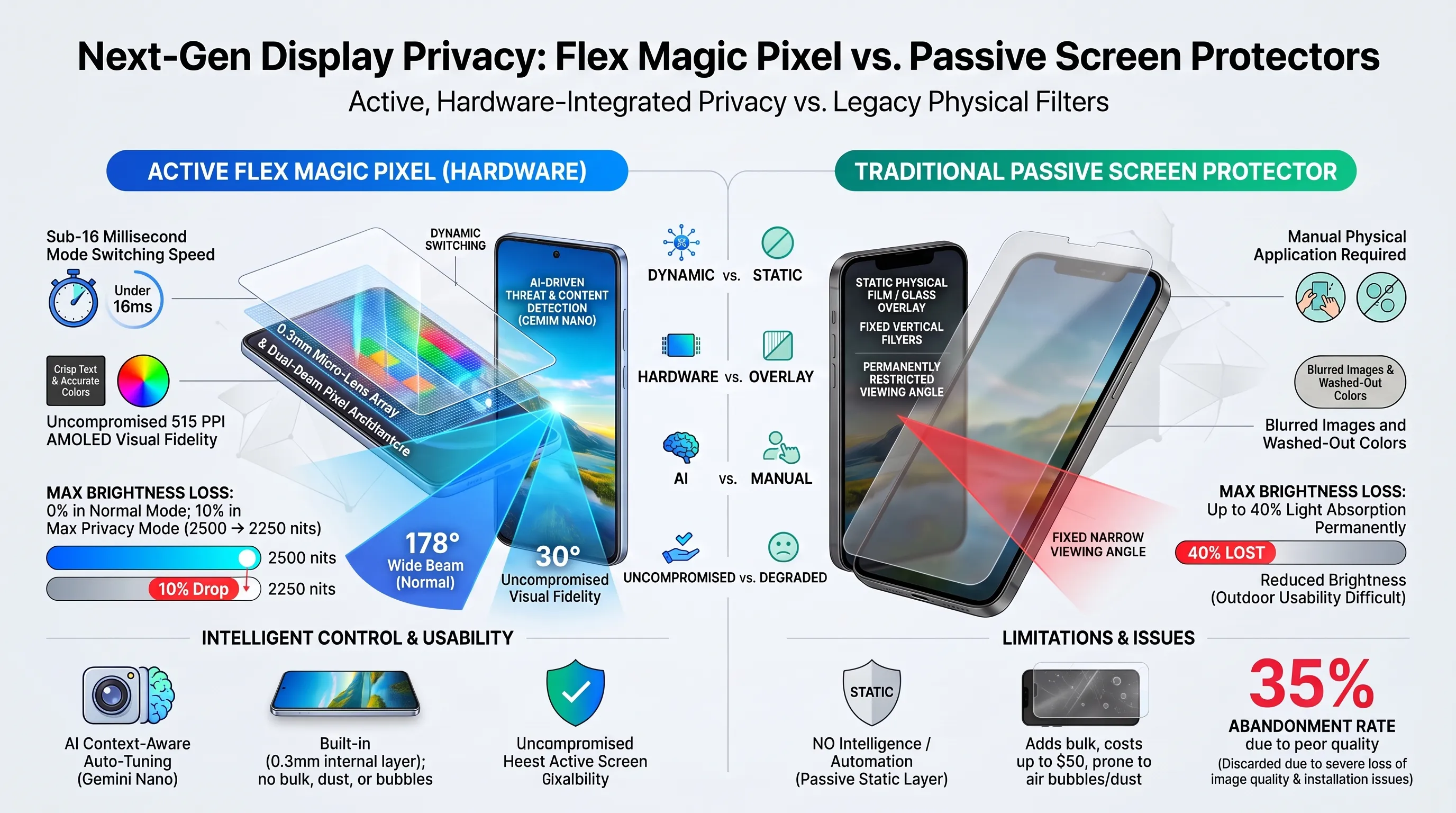
To truly comprehend the magnitude of the Flex Magic Pixel, we must review the agonizing history of display privacy[cite: 13]. First-Generation Physical Protectors, introduced in the late 2000s, utilized vertical filters to physically limit viewing angles[cite: 13]. However, these protectors were a usability nightmare[cite: 13]:
- Severe Brightness Reduction: They absorbed up to 40% of the display's emitted light[cite: 13].
- Degraded Image Quality: Vibrant colors became washed out, leaving images permanently blurry[cite: 13].
- Excessive Bulk: They added unnecessary thickness to sleek flagship designs[cite: 13].
- Installation & Cost Issues: Premium protectors cost upwards of $50, yet trapped dust and air bubbles inevitably ruined the aesthetic[cite: 13].
Subsequently, Second-Generation Software Solutions attempted to fix the issue via apps that darkened the screen or applied confusing visual patterns[cite: 13]. These methods were highly restrictive, only worked within specific applications, and provided zero genuine protection against real-world Shoulder Surfing[cite: 13]. Samsung finally decided to address the root of the problem: why couldn't the display hardware manage its own privacy?[cite: 13]
Tekin Technical Jargon Buster
Flex Magic Pixel: The Magic of Light Physics
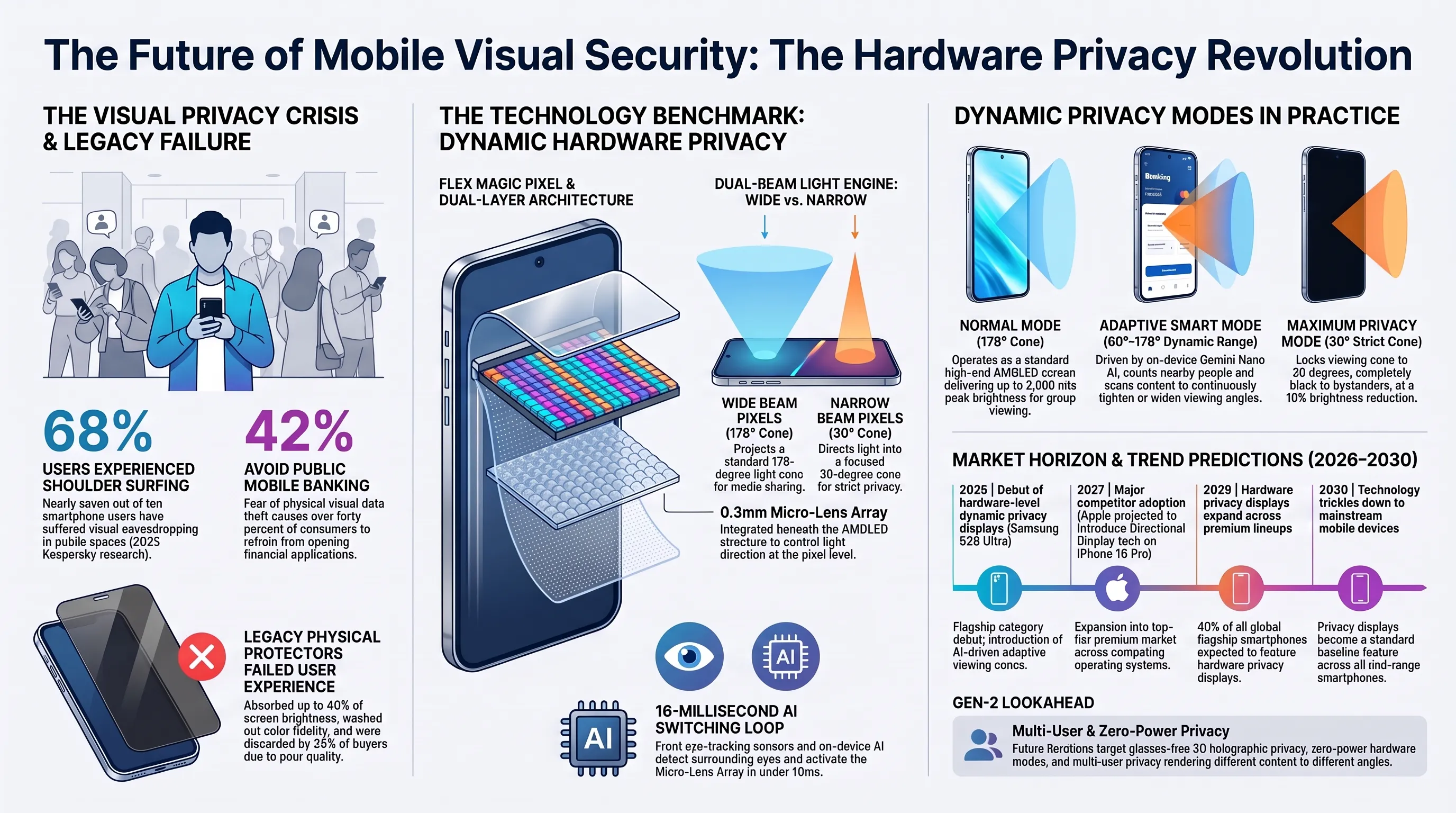
The Flex Magic Pixel technology, heralded by Samsung as "the biggest innovation in AMOLED displays since the introduction of Infinity Display," is founded upon a brilliantly simple concept: if each individual pixel can govern the directional vector of its emitted light, the display's entire viewing angle can be dynamically altered[cite: 13].
Unlike conventional displays that utilize a uniform light cell type, this dual-layer architecture employs two distinct pixel variants[cite: 13]:
Hardware Architecture Matrix: Narrow Beam vs. Wide Beam Pixels
| Pixel Architecture Type | Light Emission & Viewing Angle | Use Case Scenario & Energy Draw |
|---|---|---|
| Narrow Beam Pixels | Concentrates light directly forward at a tight 30-degree angle. | Deployed during Maximum Privacy Mode, consuming 15% more battery power. |
| Wide Beam Pixels | Distributes light expansively across a wide 178-degree angle. | Deployed during Normal Mode, operating with standard energy consumption levels. |
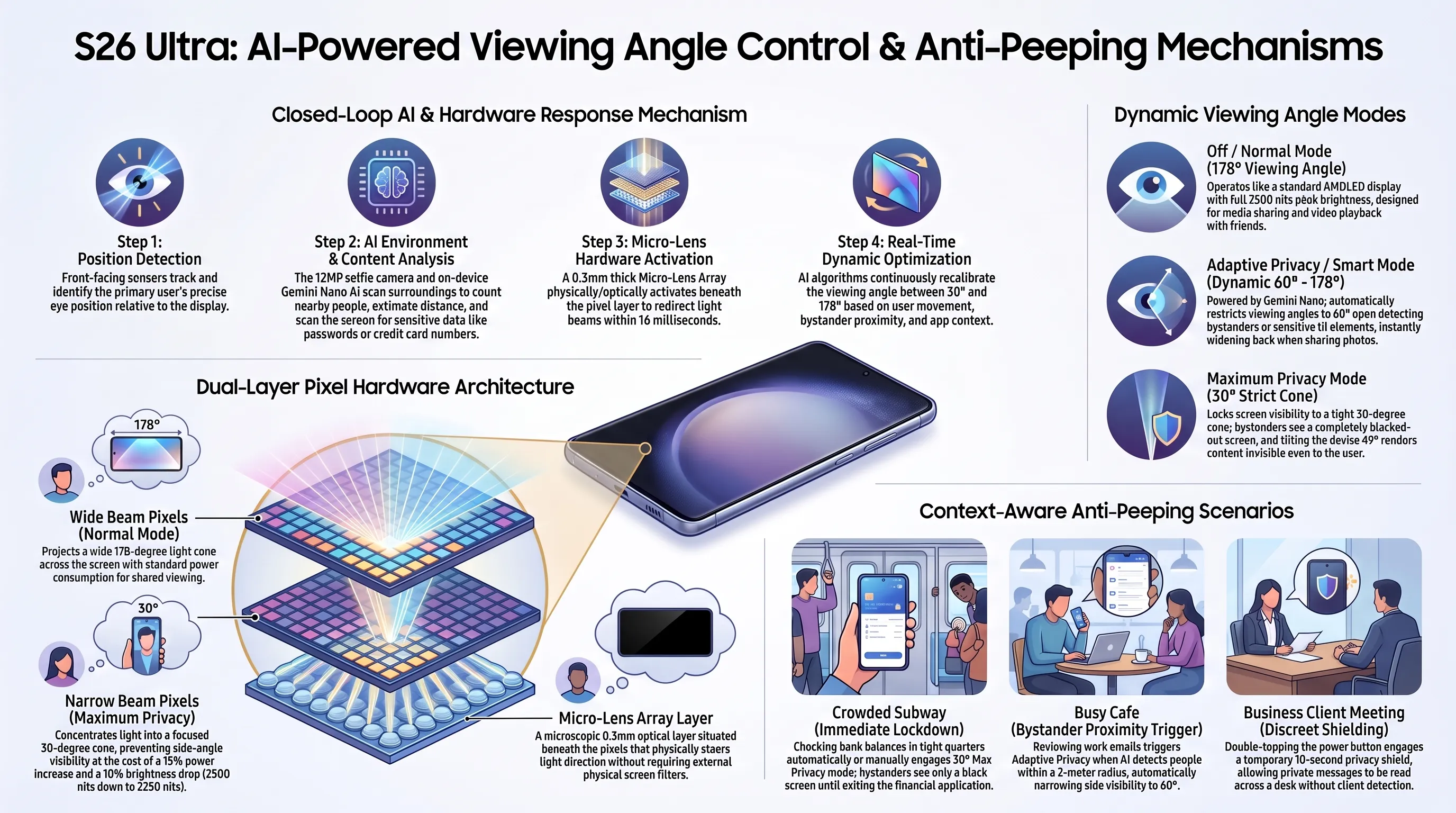
Samsung integrated a 0.3-millimeter thick Micro-Lens Array directly beneath the pixels[cite: 13]. This microscopic layer physically redirects photons, switching between Wide and Narrow modes in under 16 milliseconds faster than a single frame renders at 60Hz[cite: 13]. Optimized by AI algorithms, the result is a pristine display visible only to you, free from cumbersome physical filters[cite: 13].
Three Privacy Modes: From Casual to Maximum Security
The Galaxy S26 Ultra empowers the user with three distinct viewing angle management modes[cite: 13]:
- Off Mode (Normal): The device operates as a standard flagship. You get a glorious 178-degree viewing angle, blinding 2500 nits of peak brightness, and standard battery consumption[cite: 13]. Perfect for sharing videos with friends[cite: 13].
- Adaptive Privacy (Smart Mode): This is Samsung's true masterpiece, governed by the on-device Gemini Nano AI[cite: 13]. The selfie camera constantly scans for faces[cite: 13]. If the AI detects sensitive content (like banking details or private messages) and spots an individual approaching from behind, it autonomously constricts the viewing angle to 60 degrees[cite: 13]. Once the threat passes, the angle widens automatically[cite: 13].
- Maximum Privacy (Maximum Mode): Designed for extreme security environments, like entering passwords on a packed subway train[cite: 13]. The viewing angle is severely restricted to a tight 30 degrees[cite: 13]. A person sitting directly next to you will see nothing but a black, deactivated screen[cite: 13] (Note: This mode reduces brightness by 10% and increases battery draw by 15%)[cite: 13].
Real-World Adaptive Privacy Scenarios
| Environmental Scenario | Security Challenge | S26 Ultra Autonomous Solution |
|---|---|---|
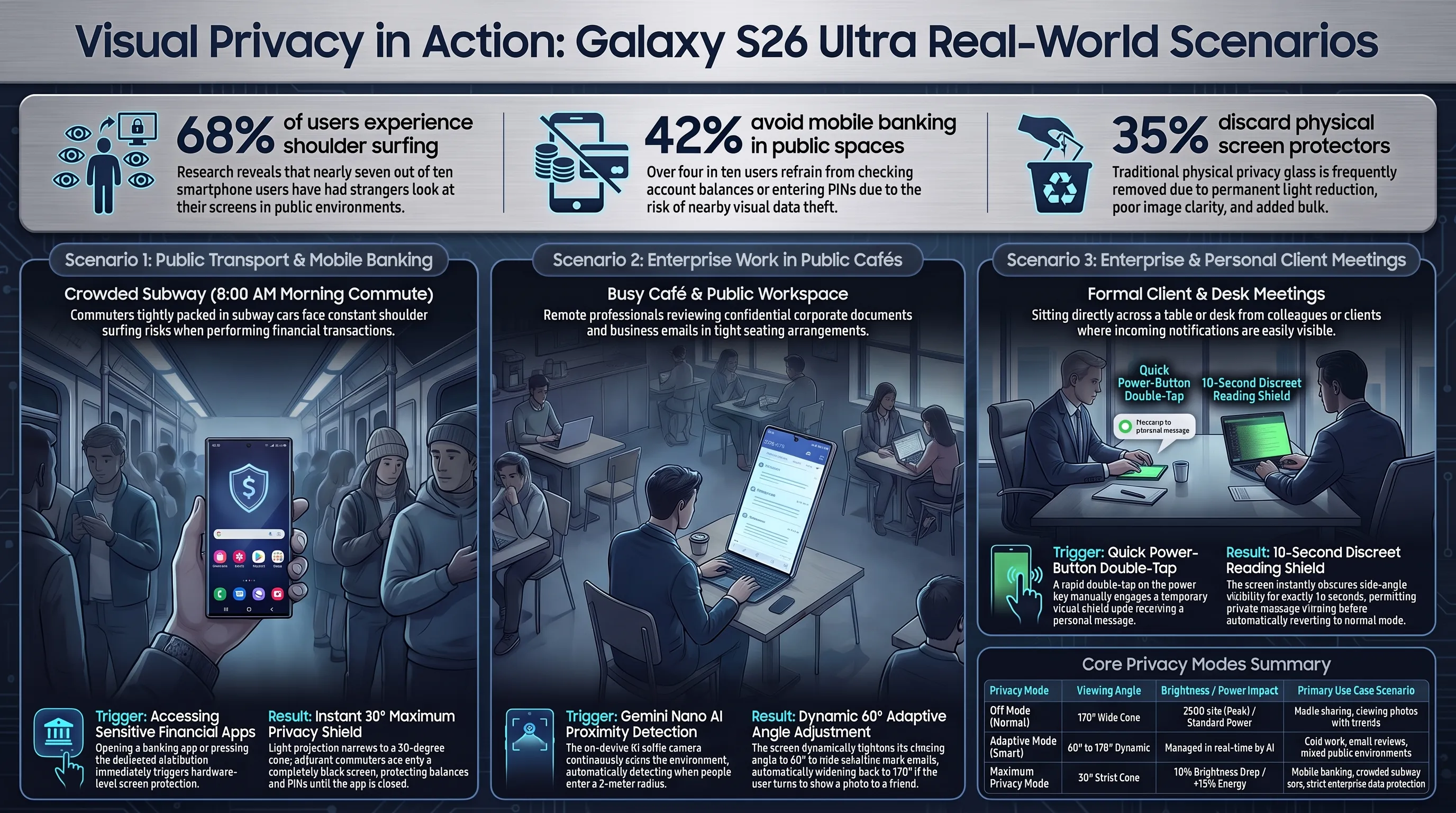
| Banking on a Crowded Subway | Entering secure PINs while surrounded tightly by strangers. | Maximum Mode (30°): Absolutely blocks peripheral vision. Restores to Normal automatically upon exiting the banking app. |
| Reviewing Emails in a Cafe | Confidential work emails displayed on a small table near others. | Adaptive Mode (60°): AI detects onlookers approaching from behind and dynamically narrows the viewing angle in real-time. |
| Client Business Meeting | Receiving a highly private notification while sitting across from a client. | Quick Privacy Toggle: A quick double-press of the power button secures the screen instantly, deactivating after 10 seconds. |
Hardware Specs: The S26 Ultra Goes Beyond the Display
The Galaxy S26 Ultra isn't merely a vehicle for a privacy display; it is a hyper-evolved hardware juggernaut across every metric[cite: 13]:
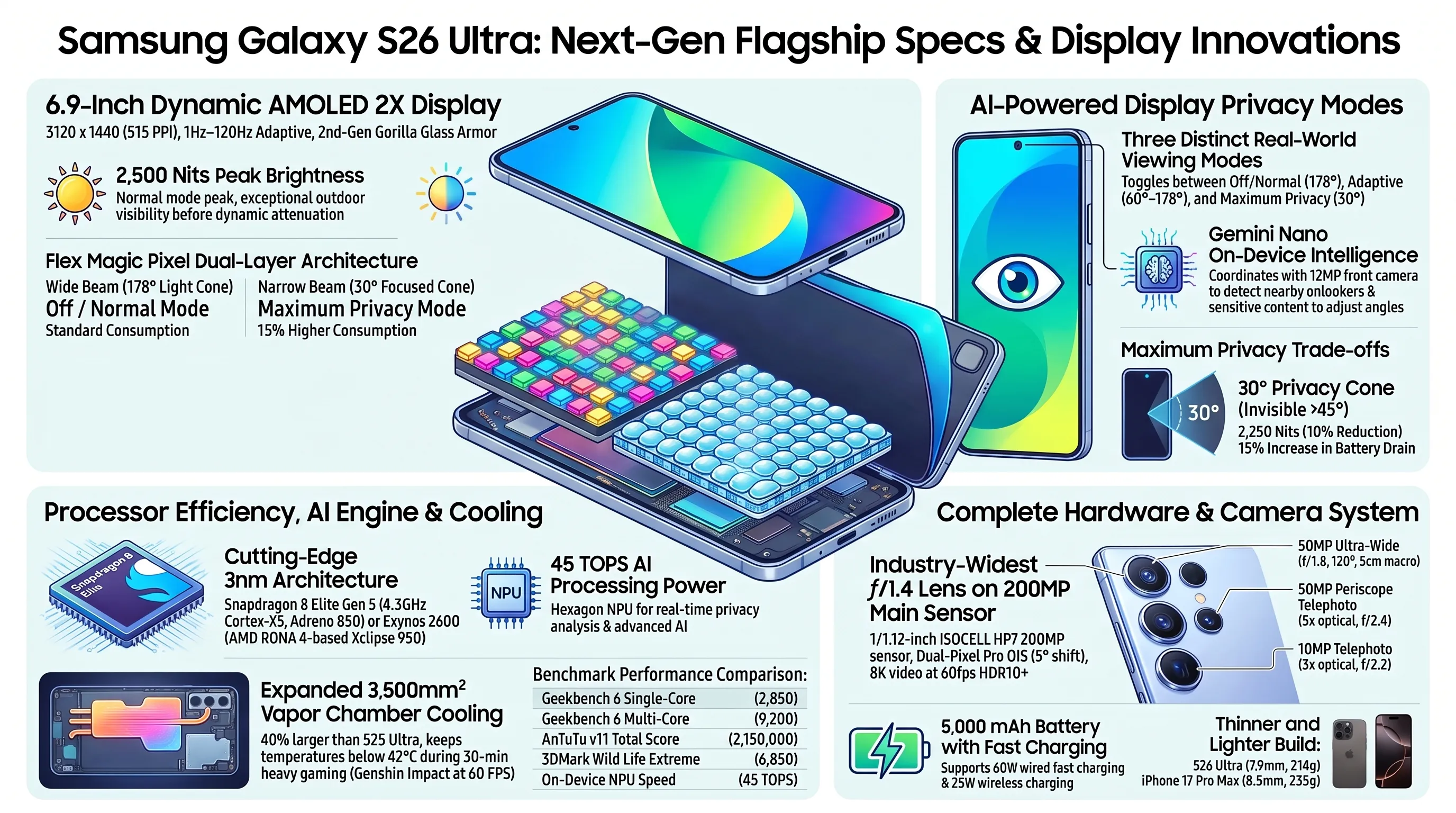
- Display: A massive 6.9-inch Dynamic AMOLED 2X panel featuring a 1Hz to 120Hz variable refresh rate, shielded by 2nd-generation Gorilla Glass Armor[cite: 13].
- Unrivaled Camera Array: The primary 200-Megapixel ISOCELL HP7 sensor boasts an unprecedented f/1.4 aperture (the widest in smartphone history), utilizing Dual-Pixel Pro OIS for staggering low-light performance[cite: 13]. It also houses a 50MP Periscope offering 5x optical zoom[cite: 13].
- The Engine: The US variant is powered by the 3nm Snapdragon 8 Elite Gen 5, packing a 4.3GHz Cortex-X5 core and a 45 TOPS Hexagon AI Engine[cite: 13]. The international variant features the Exynos 2600 equipped with an RDNA 4-based Xclipse 950 GPU[cite: 13].
📚 Classified & Related Dossiers in TekinGame
If you wish to explore beyond this report and delve into cybernetic frontiers and autonomous AI architectures, do not miss these three exclusive deep-dives in the Tekin Garage:
Flagship Clash: Galaxy S26 Ultra vs. Apple iPhone 17 Pro Max
| Core Feature / Metric | Samsung Galaxy S26 Ultra | Apple iPhone 17 Pro Max |
|---|---|---|
| Display Dimensions & Tech | 6.9" with Hardware Privacy Display | 6.9" Standard ProMotion Display |
| Processor (SoC) | Snapdragon 8 Elite Gen 5 (45 TOPS AI) | Apple A19 Pro (Superior CPU Multi-core) |
| Main Camera & Zoom | 200MP f/1.4 | Hybrid (5x + 3x Optical) | 48MP f/1.6 | 5x Optical Zoom |
| Battery & Charging Speed | 5000mAh | 60W Wired (25W Wireless) | 4685mAh | 30W Wired (15W MagSafe) |
| Weight & Thickness | 214g | 7.9mm Thickness | 233g | 8.5mm Thickness |
| Retail Price (MSRP) | $1,299 USD | $1,199 USD (More Affordable) |
Limitations and Weaknesses: Samsung's Engineering Honesty
No technological marvel is devoid of compromise. Engaging Maximum Privacy mode inherently causes a 10% reduction in peak brightness (dropping from 2500 to 2250 nits), which may be slightly noticeable under direct, intense sunlight[cite: 13]. Furthermore, sustained use of this mode drains the battery 15% faster, though the AI-managed Adaptive Mode mitigates this effectively[cite: 13]. A notable software limitation is that the Privacy Display currently only functions in Portrait orientation; Samsung has promised to deliver Landscape support via the One UI 8.1 update arriving in Summer 2026[cite: 13].
5-Axis Radar: Assessing the S26 Ultra's Value Proposition
5-Axis Radar Analysis: The S26 Ultra reigns completely supreme in Privacy Display innovation and raw f/1.4 camera hardware. However, the steep $1,299 price tag and the current inability to utilize privacy shielding in Landscape orientation slightly diminish its absolute value proposition.

Future Outlook: Revolution or Passing Trend?
Market analysts unanimously predict this hardware paradigm will become the industry standard. Projections indicate Apple will integrate similar directional display tech into the iPhone 18 Pro by 2027, and by 2030, hardware privacy will trickle down to mid-range devices[cite: 13]. Meanwhile, competitors are racing to catch up: Google is collaborating with BOE on "Privacy OLEDs," and Xiaomi is testing "Switchable Privacy Glass" on the Mix Fold 4[cite: 13]. Samsung is already developing Gen 2 of Flex Magic Pixel, aiming to deliver "Multi-User Privacy" allowing different users to view entirely different content on the same physical screen simultaneously[cite: 13].
Conclusion: The Dawn of the Privacy Hardware Revolution
The Samsung Galaxy S26 Ultra is not merely a smartphone; it is an aggressive, definitive statement: Privacy is a fundamental human right, not an optional software toggle[cite: 13]. In a hostile digital world where spyware like Pegasus destroys lives, and tech titans routinely harvest data, Samsung proves that genuine innovation serves to protect the end user[cite: 13].
Flex Magic Pixel isn't just a gimmick it is the genesis of a hardware revolution where users no longer must compromise between display quality and absolute security[cite: 13]. Is the S26 Ultra flawless? No. Is it prohibitively expensive? Yes. But is it an absolute game-changer for the industry? Without a doubt[cite: 13].
- The revolutionary hardware-level Privacy Display offering immediate, physical protection against Shoulder Surfing without external protectors.
- A staggering 200MP sensor armed with an f/1.4 aperture, fundamentally redefining the capabilities of low-light mobile photography.
- Brilliant integration of the hyper-powerful Snapdragon 8 Elite Gen 5 with the localized Gemini Nano AI to intelligently manage power and privacy.
- An exorbitant $1,299 MSRP, making it a full $100 more expensive than Apple's premium iPhone 17 Pro Max equivalent.
- The temporary lack of Privacy Display functionality while the phone is oriented in Landscape mode (pending a software patch).
- A 10% reduction in peak brightness and a 15% increase in battery drain when Maximum Privacy mode is actively engaged.
Final Editorial Verdict & Official Reference Sources
The New Gold Standard in Hardware Security
The Galaxy S26 Ultra is undeniably the Android king of 2026. By merging light physics with artificial intelligence, it elegantly solves our era's most pervasive anxiety: total privacy.
Frequently Asked Questions & Technical Analysis
What exactly is Flex Magic Pixel technology in the Galaxy S26 Ultra?
It is Samsung's proprietary dual-layer hardware architecture featuring a 0.3mm Micro-Lens Array. It utilizes both 'Narrow Beam' and 'Wide Beam' pixels to dynamically constrict the screen's viewing angle from 178 degrees down to 30 degrees, physically hiding content from onlookers.
How does the S26 Ultra screen differ from traditional privacy glass protectors?
Physical privacy glass permanently reduces screen brightness by 40%, blurs image quality, and adds bulk. The S26 Ultra controls privacy directly within the silicon, allowing the user to toggle the protection on and off instantly without sacrificing visual fidelity.
How does 'Adaptive Privacy' work automatically?
Powered by the on-device Gemini Nano AI, the front camera constantly scans the environment. If it detects sensitive information on-screen (like banking apps) and notices a stranger approaching from behind, it autonomously constricts the viewing angle to 60 degrees to block 'Shoulder Surfing.'
What makes the S26 Ultra's 200MP camera so special this year?
Samsung equipped the primary ISOCELL HP7 sensor with a staggering f/1.4 aperture the widest ever engineered for a smartphone. This allows unparalleled light intake, dramatically elevating night photography and low-light 8K video capture.
Is the $1,299 price tag of the Galaxy S26 Ultra justified?
While it is $100 more expensive than the iPhone 17 Pro Max, its exclusive hardware-level privacy display, immense Snapdragon 8 Elite Gen 5 compute power, and unrivaled camera optics make it an essential investment for executives, journalists, and privacy-conscious professionals.
