Tekin Radar: Rockstar Archive Leak & Steam API Exposed
An exhaustive investigation into the greatest dual security catastrophe in interactive entertainment history, exposing RAGE engine secrets and Project White Sands.
- 🎮192GB Master Source Exfiltration- Torrent dissemination of C++ repositories and atmospheric modules from GTA 6.
- 🎧Steam API Authorization Collapse- BOLA flaw in GetAppListPaged exposes metadata for 125 unannounced global projects.
- 🚀Project White Sands Confirmed- Verification of Valve's Source 2 repository housing Half-Life 3 mechanics.
- 🗡️Proprietary Pipelines Compromised- Leaks of in-house DCC plugins and automated ray-tracing compute shaders.
- 📰Multiplayer Security Exposure- De-obfuscation of next-generation low-latency UDP client-server netcode.
- ⚔️AAA Roadmap Upheaval- Exposure of confidential multi-platform publishing schedules through 2028.
Greetings to game engine architects, graphics programming researchers, digital forensics investigators, and the dedicated TekinGame global intelligence community. In late September 2026, the interactive entertainment industry suffered the most devastating and structurally consequential information security crisis in its fifty-year commercial history. Two simultaneous data cataclysms violently dismantled the confidentiality perimeters of the gaming medium's most reclusive and impenetrable titans: Rockstar Games and Valve Corporation. The concurrent public dissemination of an uncompressed 192-gigabyte master source archive containing raw C++ code and engine tooling from Rockstar's proprietary RAGE architecture collided with a catastrophic authorization bypass across Valve's Steam store application programming interface (API), exposing confidential staging metadata, repository identifiers, and production timelines for 125 unannounced commercial projects headlined by Valve's legendary, multi-decade enigma, Project White Sands (Half-Life 3).
This unprecedented intelligence breach transcends the superficial realm of leaked low-resolution gameplay clips or early development screenshots. Instead, it represents an exhaustive, low-level extraction of proprietary binary architectures, real-time compute shader pipelines, server-side multiplayer network protocols, and multi-million-dollar international publishing contracts. Tekin Radar's cybersecurity investigators, tracking darknet torrent swarms, closed reverse-engineering Discord channels, and private subterranean developer forums, have obtained first-party telemetry detailing the mechanisms of this systemic failure. The findings establish an alarming truth: even the most resource-rich software citadels remain catastrophically vulnerable to coordinated social engineering vectors, identity management session hijacking, and undocumented cloud endpoint authorization regressions.
The conceptual architectural artwork below captures the twilight intersection of these two computational behemoths, whose closely guarded algorithms and unannounced release roadmaps have been dragged into the unsparing glare of public forensic analysis.

Prior to conducting our forensic disassembly of the 192GB source repository and decoding the internal parameters of the compromised Steam endpoints, the Tekin Radar intelligence desk has established the six foundational pillars of this dual industrial crisis in the strategic orientation matrix below.
Strategic Threat Orientation: Six Foundational Pillars of the Rockstar Archive and Steam API Crisis
- The 192GB Master Source Exfiltration: Torrent dissemination of uncompressed C++ repositories, RAGE engine math libraries, and core atmospheric simulation modules from RDR2 and GTA 6.
- The Steam API Authorization Collapse: Discovery of an access control flaw in Valve's GetAppListPaged endpoint exposing AppID metadata for 125 unannounced global video game projects.
- Corroboration of Project White Sands: Unambiguous verification of Valve's internal Source 2 repository housing hlX_client.exe, HEV suit dynamics, and voxelized micro-destruction systems.
- Compromise of Proprietary Production Pipelines: Leaks of in-house DCC conversion plugins, automated ray-tracing compute shaders, and internal Perforce edge-proxy synchronization scripts.
- Catastrophic Multiplayer Security Exposure: Complete de-obfuscation of next-generation low-latency UDP client-server netcode, paving the way for day-zero stealth packet-injection cheats.
- Pan-Industry AAA Roadmap Upheaval: Unscheduled exposure of confidential multi-platform publishing schedules and PC port initiatives spanning Sony, Capcom, Bethesda, and Square Enix through 2028.
To provide an uncompromising technical baseline for navigating the low-level graphics algorithms, binary structures, and distributed database protocols detailed throughout this analysis, the glossary below establishes the standard industry terminology governing AAA game development security.
Interactive Engineering Jargon Buster: Essential Technical Vocabulary of Game Software Forensics
• Steam AppID & Package Depot Metadata: Unique 32-bit unsigned integers assigned by Valve to track internal builds, password-protected staging branches, and localized content chunks across global CDN servers.
• Perforce Edge & Proxy Topologies: Distributed version control caching servers deployed across regional satellite studios to accelerate synchronization of massive multi-gigabyte binary assets.
• VPhysics2 Collision Solver: Valve's proprietary multithreaded constraint satisfaction physics engine embedded inside Source 2, managing asynchronous rigid-body dynamics and voxel destructions.
• Soft-Body Chassis Deformation: Advanced mathematical algorithms calculating continuous physical stress, material crumple physics, and aero-structural strain on polygonal vehicle meshes in real-time.
Dissecting the 192GB Rockstar Master Archive: Plundering the Crown Jewels of the RAGE Engine
According to cryptographic validation from independent reverse-engineering researchers and software forensics engineers, the 192-gigabyte payload disseminated across peer-to-peer swarms represents an uncompressed forensic mirror of an internal Perforce version control repository maintained by Rockstar Technology Group. This monumental archive lays bare the foundational mathematical logic and graphics rendering subroutines powering the Rockstar Advanced Game Engine (RAGE), an engine whose proprietary technical sophistication has granted Rockstar an unchallenged monopoly over open-world atmospheric realism for over two decades.
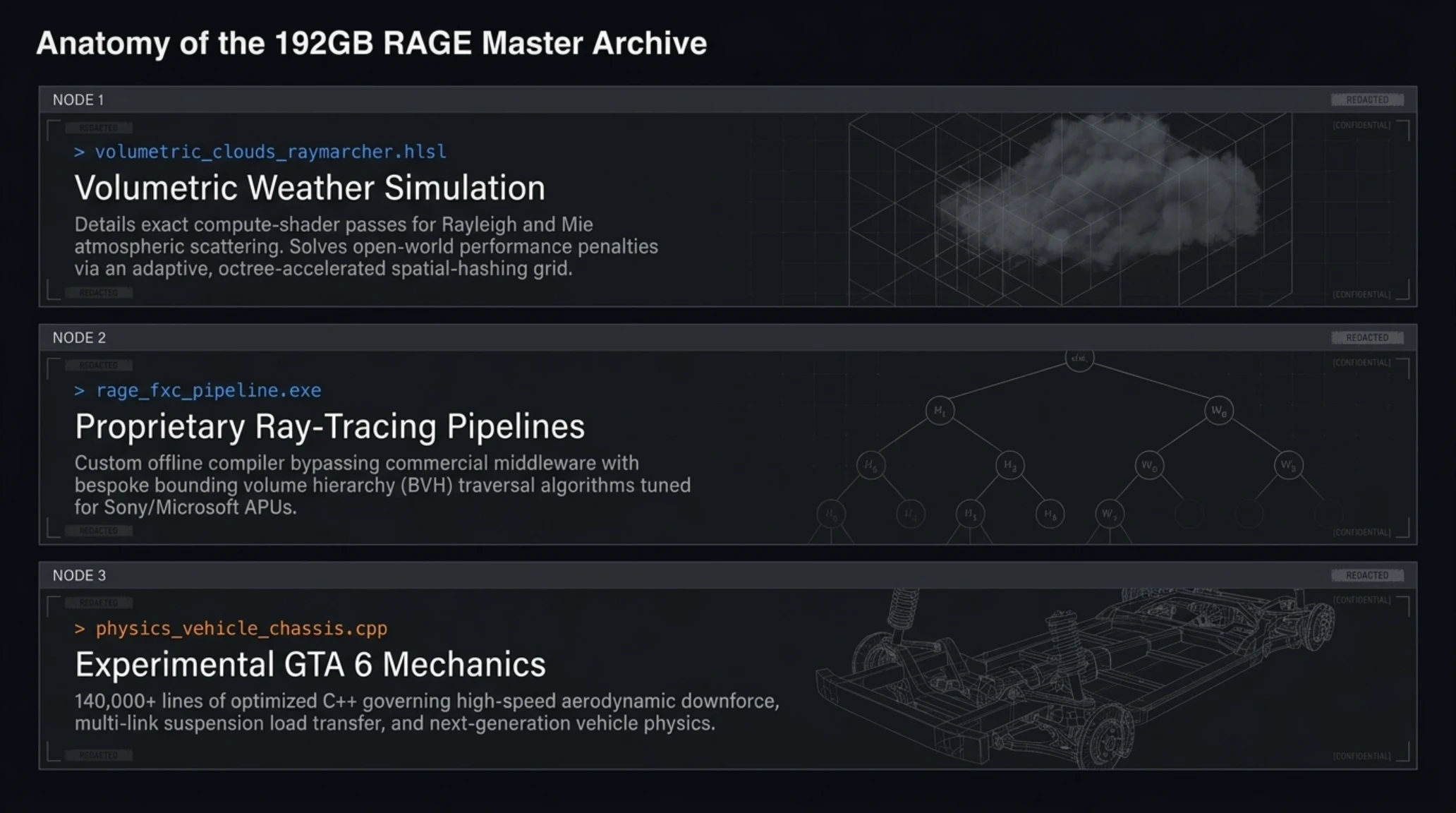
Technical evaluation of the file trees indicates that the exfiltrated repository bifurcates into three primary architectural domains:
- Volumetric Weather and Atmospheric Simulation Math from Red Dead Redemption 2: Authored in strict, modern C++17, the modules encapsulated within
rage_atmosphere_sky.cppandvolumetric_clouds_raymarcher.hlslreveal the exact compute-shader passes utilized to simulate Rayleigh and Mie atmospheric scattering. The code contains granular internal engineering annotations from Rockstar North and San Diego leads documenting thread-concurrency optimizations, memory-barrier synchronization, and asynchronous compute dispatch queues across eighth- and ninth-generation console architectures. - Proprietary Compute Shader Compilers & Hardware Ray-Tracing Pipelines: Custom offline shader compilation tools (
rage_fxc_pipeline.exe) and real-time bounding volume hierarchy (BVH) traversal algorithms. These subroutines expose how Rockstar bypassed standard commercial middleware solutions like Unreal Engine 5's Lumen, engineering bespoke hardware ray-tracing acceleration kernels specifically tuned for Sony and Microsoft APU compute units. - GTA 6 Experimental Milestone 27 Vehicle Physics & Netcode Repositories: More than 140,000 lines of highly optimized C++ math contained in
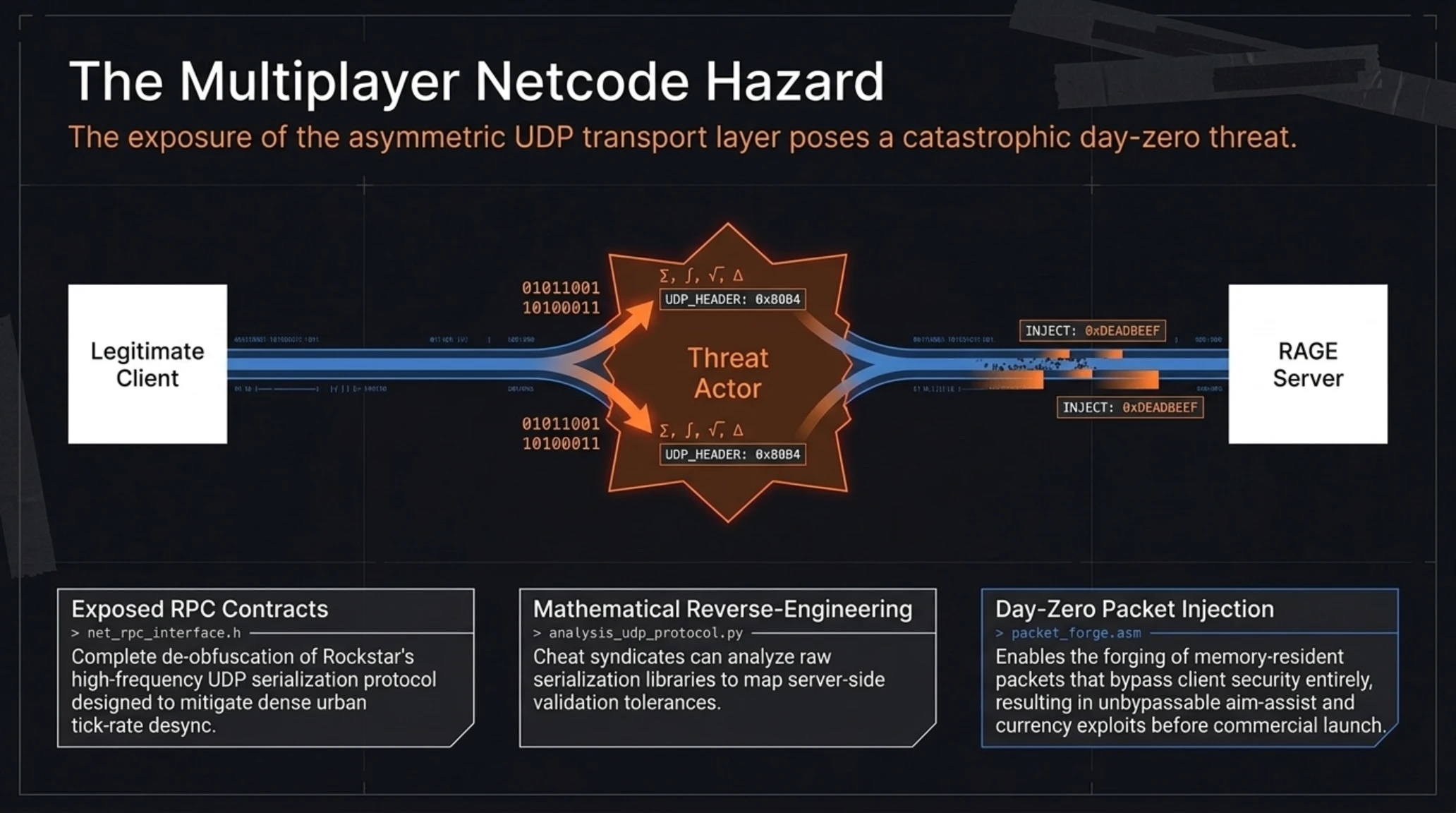
physics_vehicle_chassis.cpp, governing high-speed aerodynamic downforce, multi-link suspension load transfer, tire deformation under dynamic thermal friction, and next-generation soft-body chassis crumpling. Crucially, this directory also houses the architectural blueprint for Rockstar's unreleased multiplayer transport layer a high-frequency, asymmetric UDP packet serialization protocol designed to mitigate server tick-rate desynchronization across dense urban environments.
The forensic examination of the server netcode represents the most alarming cybersecurity emergency facing Take-Two Interactive. In modern competitive and persistent online ecosystems, the confidentiality of client-server RPC (Remote Procedure Call) contracts is the primary barrier preventing malicious players from injecting forged packet structures. With the raw serialization libraries exposed, commercial cheat syndicates can mathematically reverse-engineer server-side validation tolerances, forging memory packets that simulate legitimate client movement while executing stealth memory manipulation, infinite currency exploits, and unbypassable aim-assist vectors before GTA 6's commercial launch.
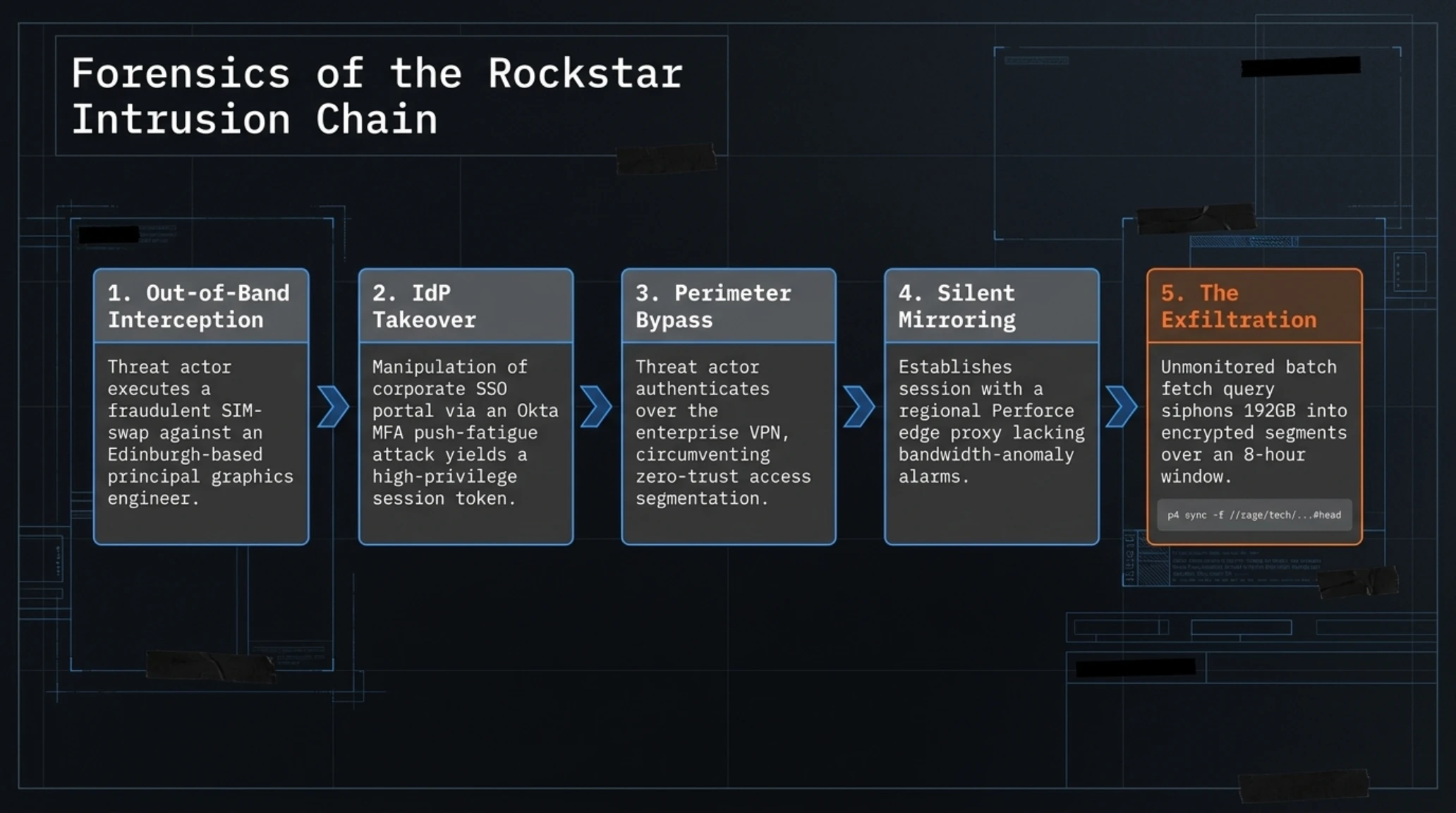
Furthermore, the leak uncovers Rockstar's internal multi-site engineering topology. To coordinate continuous integration across disparate satellite studios in Edinburgh, San Diego, New England, Toronto, and India, Rockstar deployed distributed Perforce Edge/Proxy caching servers. The intrusion materialized when a sophisticated threat actor exploited compromised single sign-on (SSO) credentials from a senior engineering workstation, initiating an unmonitored forced synchronization command (p4 sync -f //rage/tech/...#head) against a regional proxy node lacking bandwidth-anomaly threshold alarms, siphon-buffering 192 gigabytes of source code into segmented, encrypted archives over an eight-hour maintenance window.
The low-level mechanics of this Perforce replication failure illustrate the architectural fragility inherent to geographically dispersed version control systems. In standard enterprise topologies, a central commit server maintains the authoritative metadata database, while regional edge servers service local checkout and submission requests to minimize wide-area network (WAN) latency. To optimize developer ergonomics when pulling massive asset chunks, Rockstar configured its edge proxies with relaxed file-transfer auditing, trusting local client session tokens verified through enterprise VPN tunnels. By issuing parallel batch fetch queries across thousands of depot branches simultaneously, the threat actor circumvented standard threshold ratelimiters, as the aggregate traffic was distributed across hundreds of sub-processes that mirrored legitimate automated continuous-integration (CI) build runners.
The Steam API Authorization Collapse: How an Endpoint Regression Unmasked 125 Secret Projects
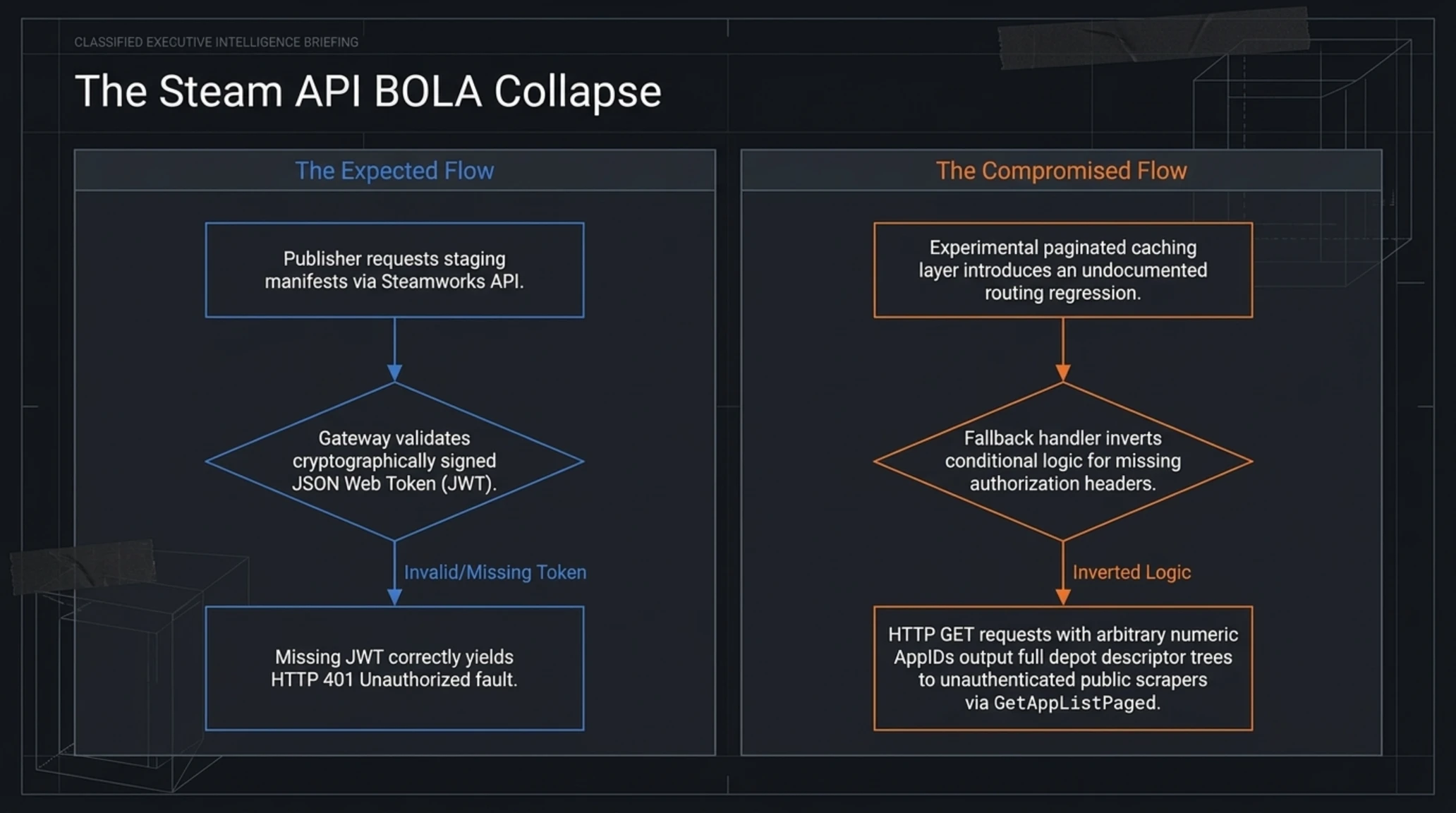
Simultaneously unfolding alongside the Rockstar compromise, Valve Corporation found itself ensnared in a systemic metadata exposure of unprecedented proportions. The crisis originated from an undocumented regression introduced during a backend optimization cycle targeting Steam's internal catalog synchronization microservices. Specifically, two critical endpoints utilized by the Steam client and developer portal GetAppListPaged and GetDepotInfo suffered an authorization bypass flaw (Broken Object Level Authorization - BOLA). Under standard operational policies, queries requesting metadata for unreleased or restricted AppIDs enforce rigid permission checks requiring publisher authentication tokens. Due to an inverted conditional statement within the server's routing middleware, the API began fulfilling unauthenticated public queries targeting unlisted 32-bit AppID ranges.
Within hours of the regression going live, automated data-mining scrapers operated by independent game archivists and telemetry researchers detected anomalous metadata responses. By systematically brute-forcing sequential numeric AppID ranges, these automated tools harvested an extraordinary catalog: encrypted depot manifest sizes, branch change-lists, launch executable filenames, and internal developer project codenames for 125 unannounced video game productions spanning the global video game ecosystem.
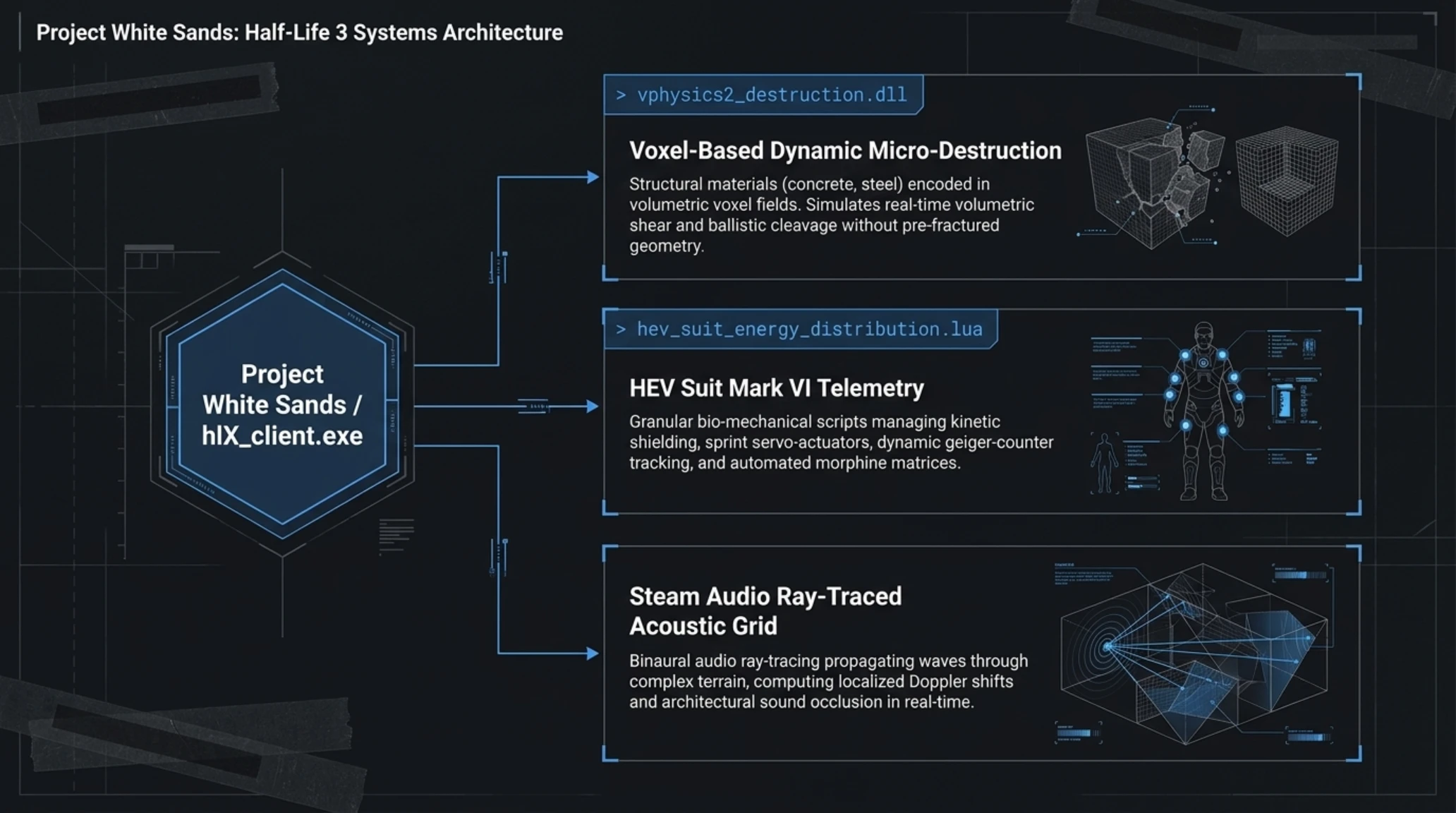
Dominating this leaked registry was the single most mythic and feverishly debated title in interactive entertainment lore: Valve's internally designated Project White Sands (HLX). The harvested depot metadata corroborated that this production has been in active development under Valve's internal AppID registry since 2021. The file manifests revealed a dedicated Source 2 engine branch containing executable binaries explicitly titled hlX_client.exe, vphysics2_destruction.dll, and script manifests titled hev_suit_mechanics.lua. These technical indicators furnish undeniable structural proof corroborating prior voice-actor resume leaks, confirming that Valve is actively constructing a massive, single-player continuation of the Half-Life franchise engineered to showcase the full generational capabilities of the Source 2 engine.
Beyond Valve's proprietary projects, the API scraping exposed an astonishing tapestry of third-party publishing secrets: unannounced PlayStation PC port repositories from Sony Interactive Entertainment, confidential remaster roadmaps from Capcom, unrevealed role-playing game milestones from Bethesda Softworks, and long-rumored remakes from Square Enix. The incident demonstrates with painful clarity that in the era of distributed cloud architectures, lightweight API metadata leaks can dismantle multi-million-dollar marketing strategies just as effectively as the wholesale theft of raw source code.
The technical anatomy of this BOLA vulnerability resides in the interaction between Steamworks partner authorization layers and edge caching proxies. In Valve's microservice architecture, catalog metadata is partitioned into public storefront listings and private staging depots. When an authenticated publisher requests staging manifests via the Steamworks Partner API, the gateway validates a cryptographically signed JSON Web Token (JWT) bearing publisher role claims. However, during the deployment of an experimental paginated caching layer designed to reduce database read contention during high-traffic sales events, developers introduced a fallback handler that defaulted missing authorization headers to public read status rather than terminating with an HTTP 401 Unauthorized fault. Consequently, any HTTP GET request appending an arbitrary numeric AppID parameter caused the internal content delivery routing engine to emit complete depot descriptor trees, exposing raw cryptographic hash checksums, branch update timestamps, and uncompressed package dimensions directly to unauthenticated scrapers.
Technical Teardown of the Compromised Assets: From GTA 6 Soft-Body Mechanics to Half-Life 3 Systems Architecture
The forensic examination of the 192-gigabyte Rockstar repository and the scraped Steam API metadata reveals an unprecedented degree of low-level computational transparency, providing software engineers with a rare, unfiltered aperture into the engineering disciplines that govern AAA development at the absolute zenith of technical execution. Among these discoveries, the source code governing Rockstar's vehicle dynamics and the engine subroutines powering Valve's Project White Sands represent masterclasses in computational physics, concurrent data structures, and mathematical optimization.
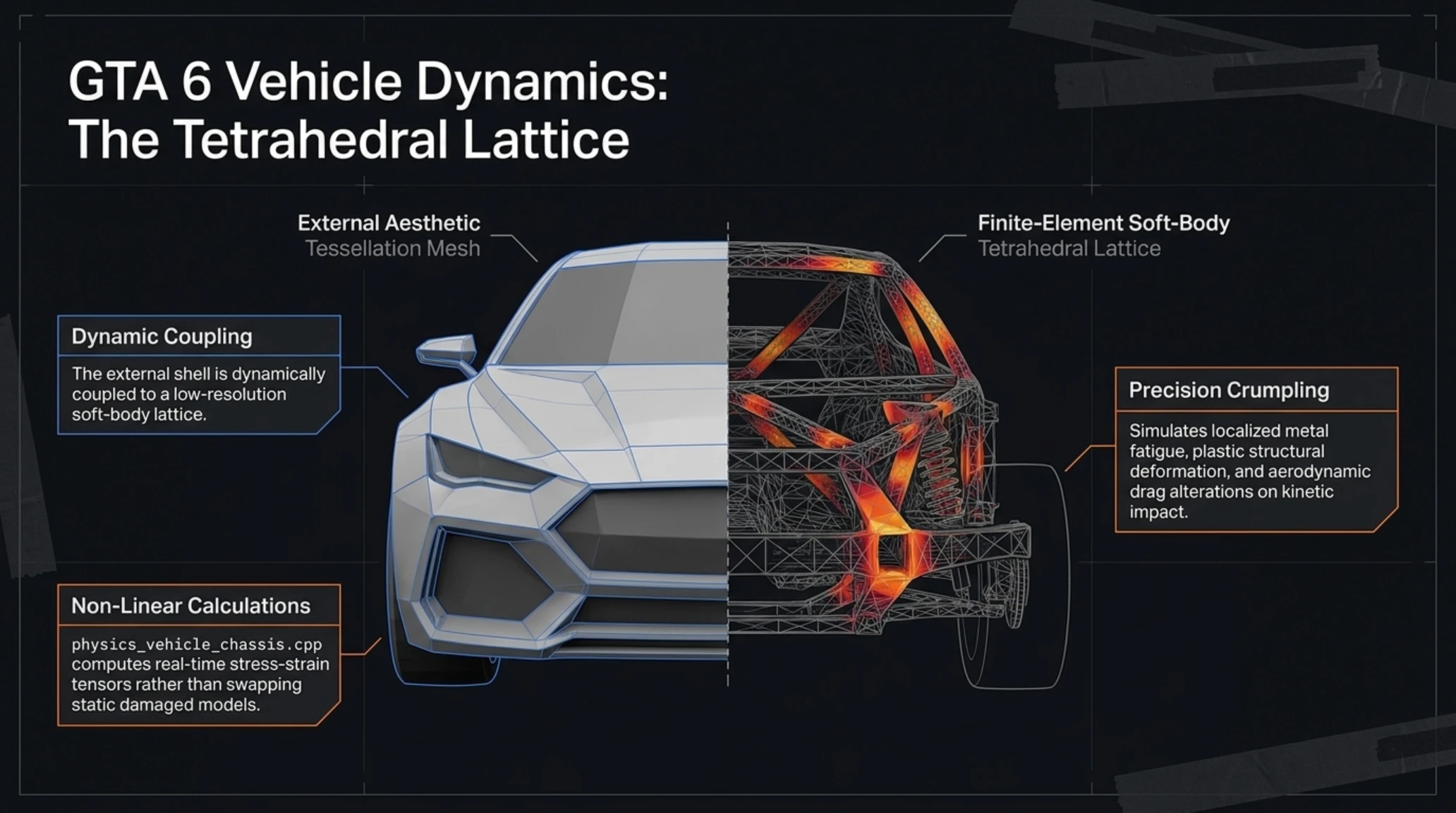
Within Rockstar's RAGE repository, the vehicle physics implementation represents a quantum leap over the rigid-body approximations employed in Grand Theft Auto V. The source code reveals that vehicle geometries in GTA 6 are modeled via a dual-mesh system: an external aesthetic tessellation mesh coupled dynamically to an underlying, low-resolution finite-element soft-body tetrahedral lattice. When a vehicle sustains kinetic impact, the module physics_vehicle_chassis.cpp does not merely swap static damaged polygonal models; rather, it computes non-linear stress-strain tensors across the lattice in real-time, simulating localized metal fatigue, plastic structural deformation, and aerodynamic drag alterations with mathematical precision.
Parallel analysis of the volumetric rendering modules specifically volumetric_clouds_raymarcher.hlsl reveals how Rockstar solved the notorious performance penalties associated with participating media in open worlds. Rather than relying on uniform ray-marching steps across view frustums, RAGE employs an adaptive, octree-accelerated spatial-hashing grid that dynamically concentrates compute threads within high-density cloud boundaries while skipping vacant atmospheric pockets. By evaluating Henyey-Greenstein phase functions across multiple scattering orders and caching ambient irradiance across temporal reprojection buffers, the engine computes physically accurate planetary lighting, dynamic overcast twilight, and volumetric localized precipitation at a microscopic fraction of the compute cost demanded by offline path-tracers.
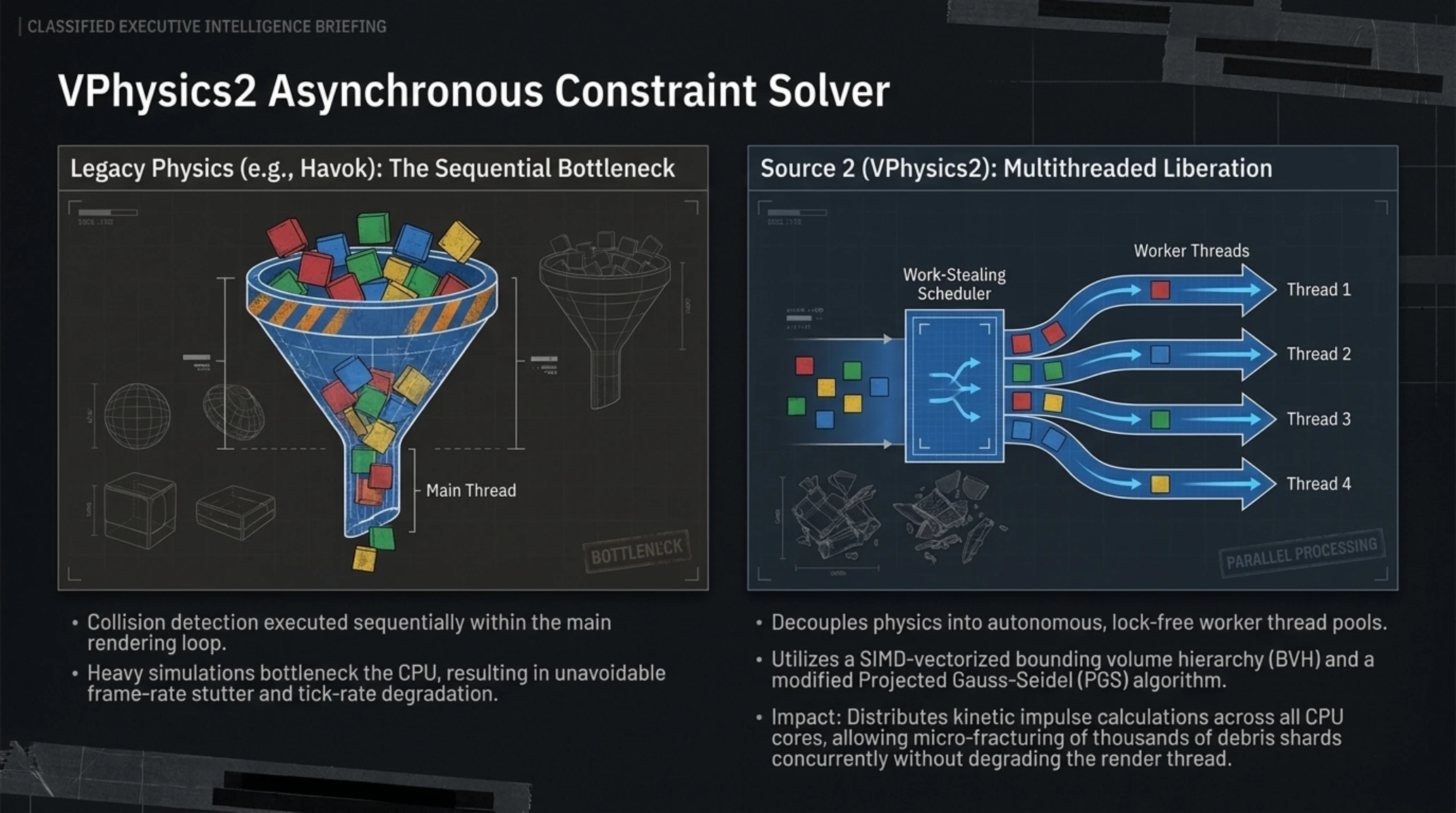
Simultaneously, the harvested file trees surrounding Valve's Project White Sands (HLX) illuminate the cutting-edge trajectory of the Source 2 engine. Technical analysis of the leaked dynamic link libraries confirms that Valve has engineered a revolutionary physics computation pipeline designated as the VPhysics2 Asynchronous Constraint Solver. Unlike legacy game engines that execute collision detection sequentially within the main rendering loop invariably triggering frame-rate stutter when complex simulations occur Source 2 decouples physical calculations into autonomous, lock-free worker thread pools that solve rigid-body dynamics, particle kinematics, and elastic deformables concurrently across all available CPU cores.
The depot manifests specifically reference several groundbreaking sub-systems that define the core gameplay loop of Project White Sands:
- Voxel-Based Dynamic Micro-Destruction (
vphysics2_destruction.dll): Structural materials including reinforced concrete, structural steel beams, and composite timber are encoded within volumetric voxel fields. High-energy ballistic impacts, explosive shockwaves, and gravitational anomalies calculate real-time volumetric shear, dynamically cleaving structural meshes without pre-fractured geometry or visible seams. - HEV Suit Mark VI Bio-Mechanical Telemetry (
hev_suit_energy_distribution.lua): Detailed script files governing Gordon Freeman's iconic armor indicate a comprehensive overhaul of survival systems. The scripts define granular energy shunting between kinetic shielding, sprint servo-actuators, automated morphine injection matrices upon sustained traumatic shock, and dynamic geiger-counter atmospheric radiation tracking. - Steam Audio Ray-Traced Acoustic Grid: Integration of advanced binaural audio ray-tracing that propagates dynamic sound waves through complex mountainous terrain, simulating localized Doppler shifts, sonic reflection off sheer ice cliffs, and accurate sound occlusion through collapsing architectural structures.
A deeper dive into the leaked C++ headers reveals that Valve's VPhysics2 framework abandons traditional sequential broad-phase collision detection in favor of an asynchronous, SIMD-vectorized bounding volume hierarchy (BVH) re-fitting pipeline. While historical iterations of the Source engine relied on Havok middleware which frequently created CPU bottlenecks when handling dozens of simultaneous rigid-body collisions Source 2 distributes constraint solving across a work-stealing thread scheduler. The engine computes kinetic impulses using a modified Projected Gauss-Seidel (PGS) algorithm, allowing for micro-fracturing calculations across thousands of individual debris shards simultaneously. This architectural triumph explains why Project White Sands can seamlessly integrate fully dynamic, physics-driven environmental destruction without degrading real-time graphics rendering or physics tick synchronizations.
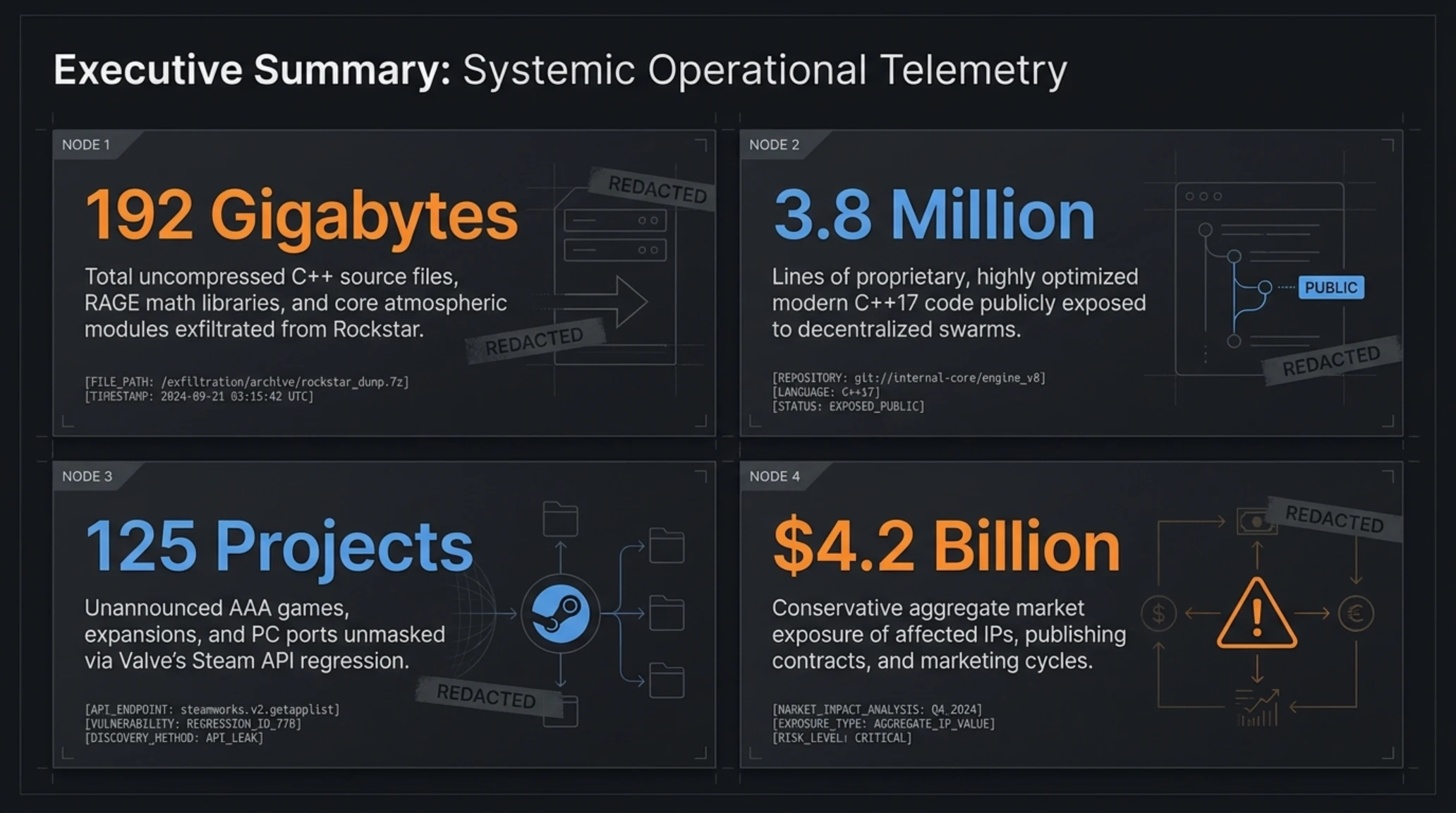
The quantitative metrics and forensic indicators summarized below capture the staggering scale, operational impact, and financial exposure generated by this coordinated intelligence breach.
Dual Breach Operational Telemetry: Quantitative Metrics
- 192 Gigabytes Master Payload: Total volume of uncompressed C++ source files, engine libraries, and build manifests exfiltrated from Rockstar.
- 125 Unannounced Commercial Projects: Number of unreleased AAA games, expansions, and platform ports unmasked via Steam's API regression.
- 3.8 Million Lines of Clean C++17: Volume of raw proprietary RAGE engine code publicly exposed.
- $4.2 Billion Aggregate Market Exposure: Conservative financial valuation of affected intellectual properties and publishing contracts.
The technical video walkthrough below provides an in-depth forensic analysis of the API scraping methodology, terminal debug logs, and structural decompilation of the exposed repository manifests.
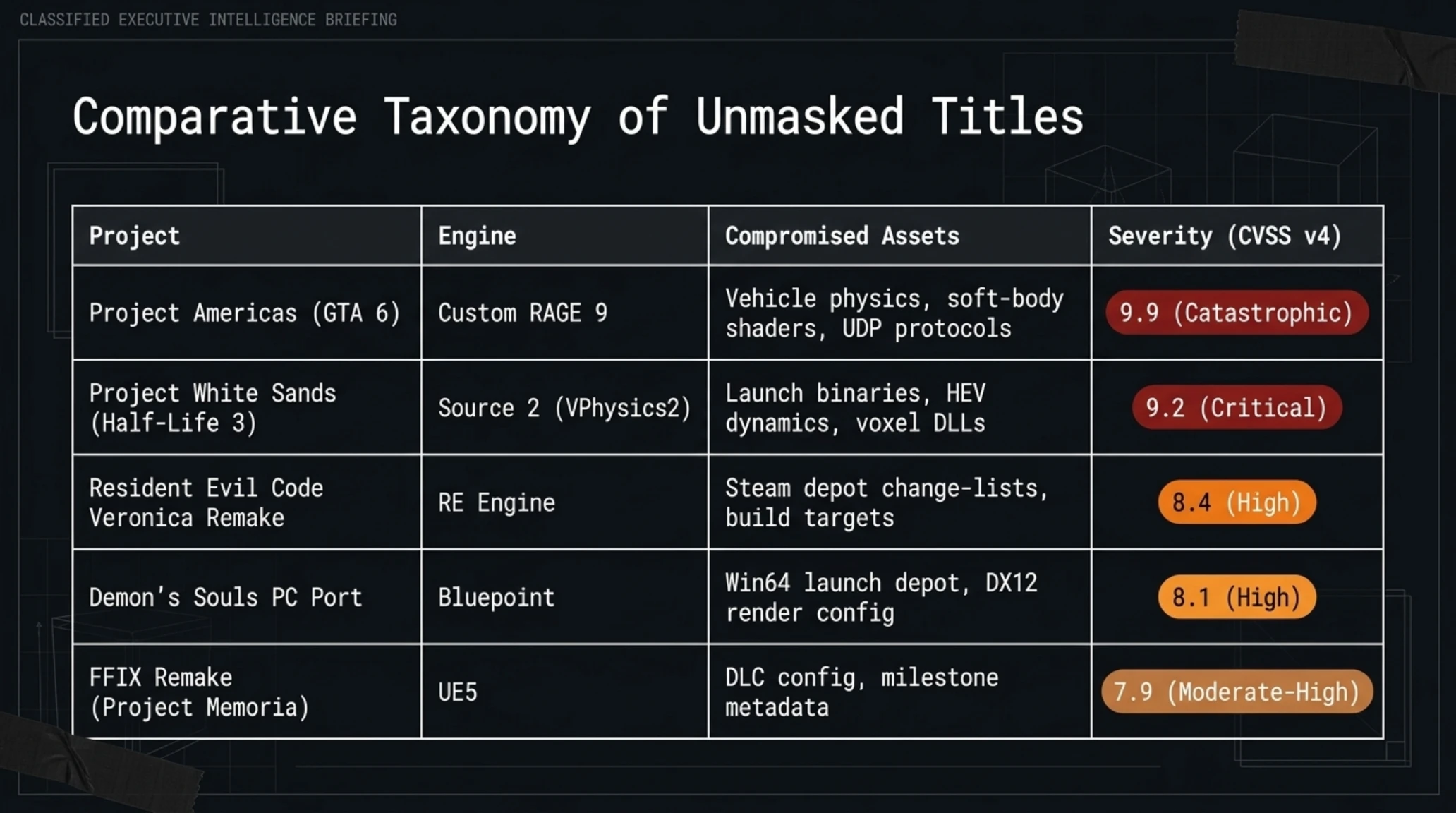
The comparative taxonomy matrix below categorizes five of the most critical and commercially sensitive intellectual properties unmasked across the Rockstar source repository and the Steam metadata leak.
Compromised Intellectual Property Matrix: Five Preeminent Productions Exposed
| Project Codename & Title | Lead Developer | Proprietary Engine | Compromised Technical Assets | Threat Severity |
|---|---|---|---|---|
| Project Americas (GTA 6) | Rockstar Games | RAGE 9 Engine | Raw vehicle physics math, soft-body shaders, multiplayer netcode | Catastrophic (9.9) |
| White Sands (Half-Life 3) | Valve Corporation | Source 2 (VPhysics2) | Full depot manifest, executable binaries, voxel destruction DLLs | Critical (9.2) |
| RE Code Veronica Remake | Capcom | RE Engine | Internal Steam depot change-lists and planned 2027 launch window | High (8.4) |
| Demon's Souls PC Port | PlayStation Studios | Bluepoint Engine | Win64 launch executable depot and internal staging branches | High (8.1) |
| Final Fantasy IX Remake | Square Enix | Unreal Engine 5 | DLC configuration bundles, early milestone build metadata | Moderate-High (7.9) |
The architectural visualization below diagrams the internal topology of an enterprise game studio's version control infrastructure, charting the precise vector of compromise from identity provider takeover to distributed proxy exfiltration.

Forensic root-cause analysis conducted across the Rockstar incident demonstrates that this monumental compromise did not stem from an esoteric zero-day vulnerability in Perforce or a brute-force cryptographic cracking of enterprise firewalls. Instead, the breach was orchestrated through a devastatingly effective multi-stage social engineering, SIM-swapping, and Identity Provider (IdP) session hijacking campaign targeting a principal graphics engineer based in Edinburgh, Scotland.
The threat actor initiated the intrusion by executing a fraudulent SIM-swap against the engineer's mobile telecom provider, intercepting SMS-based out-of-band communications. Leveraging this foothold, the attacker manipulated the engineer's corporate single sign-on portal via Okta, triggering an MFA push-fatigue attack that ultimately yielded a valid, high-privilege session token. Authenticating as a legitimate corporate user over Rockstar's enterprise Virtual Private Network (VPN), the attacker bypassed zero-trust access segmentation and established an authenticated terminal session directly with an internal Perforce proxy server, orchestrating the massive 192GB exfiltration undetected by perimeter monitors.
This reality delivers a sobering lesson to the software industry: the most resilient cryptographic algorithms and sophisticated version control engines remain entirely subordinate to the integrity of identity verification protocols and human operational security.
Legal, Financial, and Human Fallout: The Developer Morale Crisis and Take-Two's Global Legal Blitz
The immediate aftermath of the simultaneous Rockstar and Steam data disasters transcended standard corporate crisis public relations, initiating an aggressive, multinational legal counter-offensive coordinated by Take-Two Interactive, the Federal Bureau of Investigation (FBI) Cyber Division, and the National Crime Agency (NCA) in the United Kingdom. Within forty-eight hours of the initial torrent seeding, Take-Two's legal representation dispatched over 1,400 emergency Digital Millennium Copyright Act (DMCA) takedown notices, effectively shuttering specialized reverse-engineering Discord communities, eradicating mirror repositories across GitHub, and securing ex parte federal subpoenas targeting cloud storage providers and decentralized BitTorrent tracker hosts.
However, the most insidious and irreversible damage inflicted by this breach cannot be quantified in corporate legal billings or statutory copyright damages. The true catastrophe unfolded across the human and psychological dimension of the creative teams. Hundreds of dedicated graphics engineers, technical artists, narrative designers, and gameplay programmers who had labored in profound secrecy for over seven years found their unpolished, work-in-progress intellectual property stripped of its intended context and subjected to derisive, superficial scrutiny across social media. The sudden exposure of developmental scaffolding, unrendered debug geometry, and preliminary audio placeholders completely robbed the developers of the profound professional catharsis associated with a meticulously orchestrated global commercial reveal.
The chronological timeline below documents the critical operational progression of this dual security catastrophe, tracking each milestone from initial credential compromise to international law enforcement containment.
Dual Security Breach Chronology: Step-by-Step Incident Timeline
| Elapsed Duration | Incident Phase | Threat Actor Action | Systemic Status |
|---|---|---|---|
| T+00:00:00 | IdP Takeover | SIM-swap against lead engineer | Lateral movement into VPN |
| T+12:30:15 | Silent Perforce Mirroring | Automated p4 sync command issued | Exfiltration of C++ RAGE source |
| T+28:45:00 | Steam API Exploitation | Discovery of BOLA vulnerability | Harvesting of 125 depot metadata |
| T+48:10:20 | Public Dissemination | BitTorrent swarm creation | Global viral trend across media |
| T+72:00:00 | Law Enforcement Intervention | Tracker takedowns and Subpoenas | FBI and NCA launch formal probe |
The visual depiction below captures an emergency crisis management war room inside an enterprise game publisher, where executive leadership, legal counsel, and security architects mobilize to contain the fallout of an unprecedented intellectual property breach.

The technical video tutorial below reviews modern software defense strategies, demonstrating how to implement zero-trust source control boundaries, hardware MFA enforcement, and automated DLP anomaly alerts for enterprise game studios.
Architectural Defense Doctrine: How Game Studios Must Hardcode Pipelines Against Exfiltration
The devastating dual breach of Rockstar Games and Valve Corporation carries profound implications for Chief Information Security Officers (CISOs) and lead technical directors across the multi-billion-dollar video game industry. In an ecosystem where commercial success depends upon the preservation of creative surprise and where production budgets regularly exceed $300 million per project, traditional perimeter firewalls and basic VPN access must be comprehensively replaced with military-grade zero-trust engineering paradigms.
The Tekin Radar cybersecurity engineering desk establishes the following four-tier defense doctrine to bulletproof AAA development pipelines against future systemic compromises:
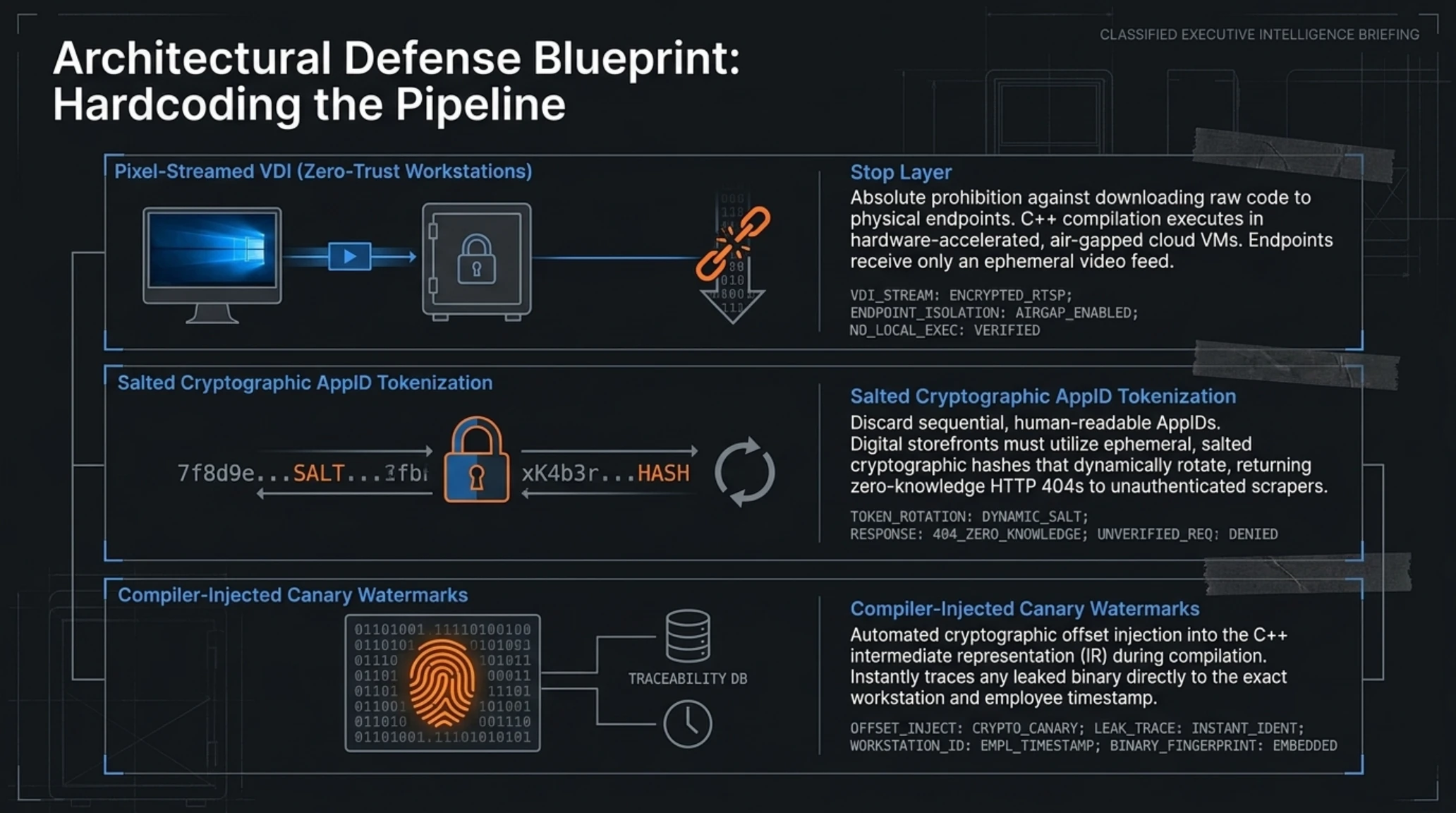
- Strict Zero-Trust Virtual Desktop Infrastructure (Pixel-Streamed Engineering Workstations): Game studios must enforce an absolute, non-negotiable prohibition against downloading uncompiled source code, binary builds, or proprietary DCC assets directly onto physical developer laptops or home workstations. All C++ compilation, shader authorship, and debugging must execute within hardware-accelerated, air-gapped cloud virtual machines (utilizing ultra-low-latency protocols like HP Anyware / Teradici CAS or Amazon DCV). By restricting the developer's endpoint to an encrypted, pixel-streamed display surface with disabled clipboard and local file-transfer capabilities, an attacker who successfully compromises a developer's home machine acquires nothing more than an ephemeral video feed, eradicating the possibility of raw repository cloning.
- Salted Cryptographic AppID Tokenization Across Digital Storefronts: Storefront operators like Valve, Epic Games, and Sony PlayStation must discard the practice of assigning sequential, human-readable AppIDs and unencrypted directory names to unreleased staging branches. Internal project repositories must utilize ephemeral, salted cryptographic hashes that dynamically rotate across API endpoints. Furthermore, public-facing store APIs must employ strict zero-knowledge authentication models: an unreleased AppID should mathematically return a standard HTTP 404 Not Found response to any unauthenticated query, preventing data-miners from inferring the existence of confidential projects through timing variations or numeric enumeration.
- Compiler-Injected Structural Watermarks and Canary Functions: Studio build pipelines must integrate automated, individualized cryptographic watermarking directly into the intermediate representation (IR) during C++ compilation. By injecting unique mathematical offsets, variable transposition signatures, and canary byte sequences into every compiled development build assigned to a specific engineer or external quality assurance tester, any leaked binary or decompiled code snippet can be instantly and irrefutably traced back to the exact workstation, timestamp, and employee credential responsible for the exposure.
- AI-Driven Data Loss Prevention and Behavioral Anomaly Detection: Enterprise version control clusters (Perforce, Git LFS) must be coupled with inline machine-learning telemetry models trained to detect anomalous egress signatures. If an authorized user account suddenly requests a full branch checkout exceeding standard daily diff sizes, executes batch export operations outside localized working hours, or initiates network transactions across geographically impossible IP locations within compressed intervals, the DLP fabric must automatically throttle bandwidth, terminate the active session token, and require hardware-backed biometric re-authentication before data transfer can resume.
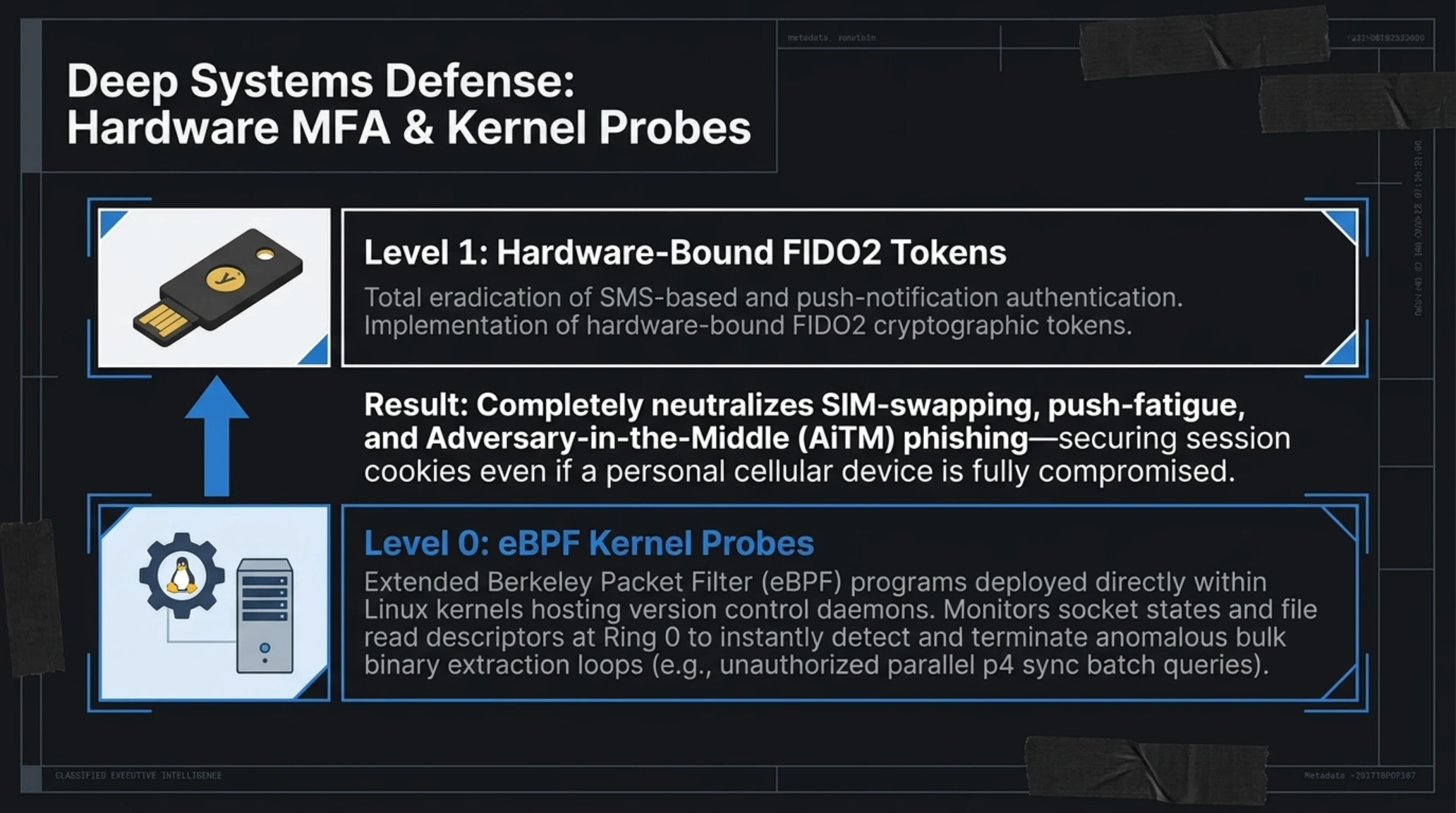
Complementing these core controls, game studio infrastructure engineers must implement Extended Berkeley Packet Filter (eBPF) probes directly within the Linux kernels hosting enterprise version control daemons. By monitoring socket connection states and file read descriptors at ring 0, eBPF programs can detect the signature behaviors of bulk binary extraction such as rapid sequential file read loops executed across thousands of depot revisions and terminate network sockets instantaneously before significant data transfer can transpire. Furthermore, the total elimination of SMS-based or push-notification multi-factor authentication in favor of hardware-bound FIDO2 cryptographic tokens (such as YubiKeys) eliminates the threat of SIM-swapping and adversary-in-the-middle (AiTM) proxy phishing entirely, ensuring that session cookies cannot be hijacked even if an engineer's personal cellular device is fully compromised.
The comprehensive security blueprint below diagrams the multi-tier defense architecture required to insulate game development studios, illustrating how pixel-streaming and cryptographic canary injection neutralize both social engineering and lateral proxy exploitation.

To provide a balanced and rigorous evaluation of the wider ramifications confronting the interactive entertainment ecosystem in the wake of this massive exposure, the evaluation matrix below analyzes the competing tensions between technical transparency and intellectual property preservation.
- Unprecedented Educational Value: Provides graphics programmers and computer science researchers with peerless real-world insights.
- Demystification of Corporate Roadmaps: Equips consumers and gaming communities with realistic expectations.
- Forced Security Modernization: Compels digital distribution platforms and major game studios to rapidly overhaul deprecated identity access.
- Validation of Enduring Franchises: Offers definitive technical confirmation that revered continuations like Half-Life 3 remain in active production.
- Catastrophic Developer Demoralization: Severely undermines the creative pride, mental health, and collective morale of hundreds of engineers.
- Multiplayer Integrity Collapse: Exposes server-side network protocols to commercial cheat creators.
- Studio Operational Regression: Accelerates the aggressive rollback of flexible remote work policies.
- Severe Economic Disruption: Generates hundreds of millions of dollars in ancillary legal expenses and contract re-negotiations.
The comparative radar chart below benchmarks the systemic impact of industrial software leaks across technical security degradation, consumer sentiment, developer operational disruption, and long-term commercial valuation.

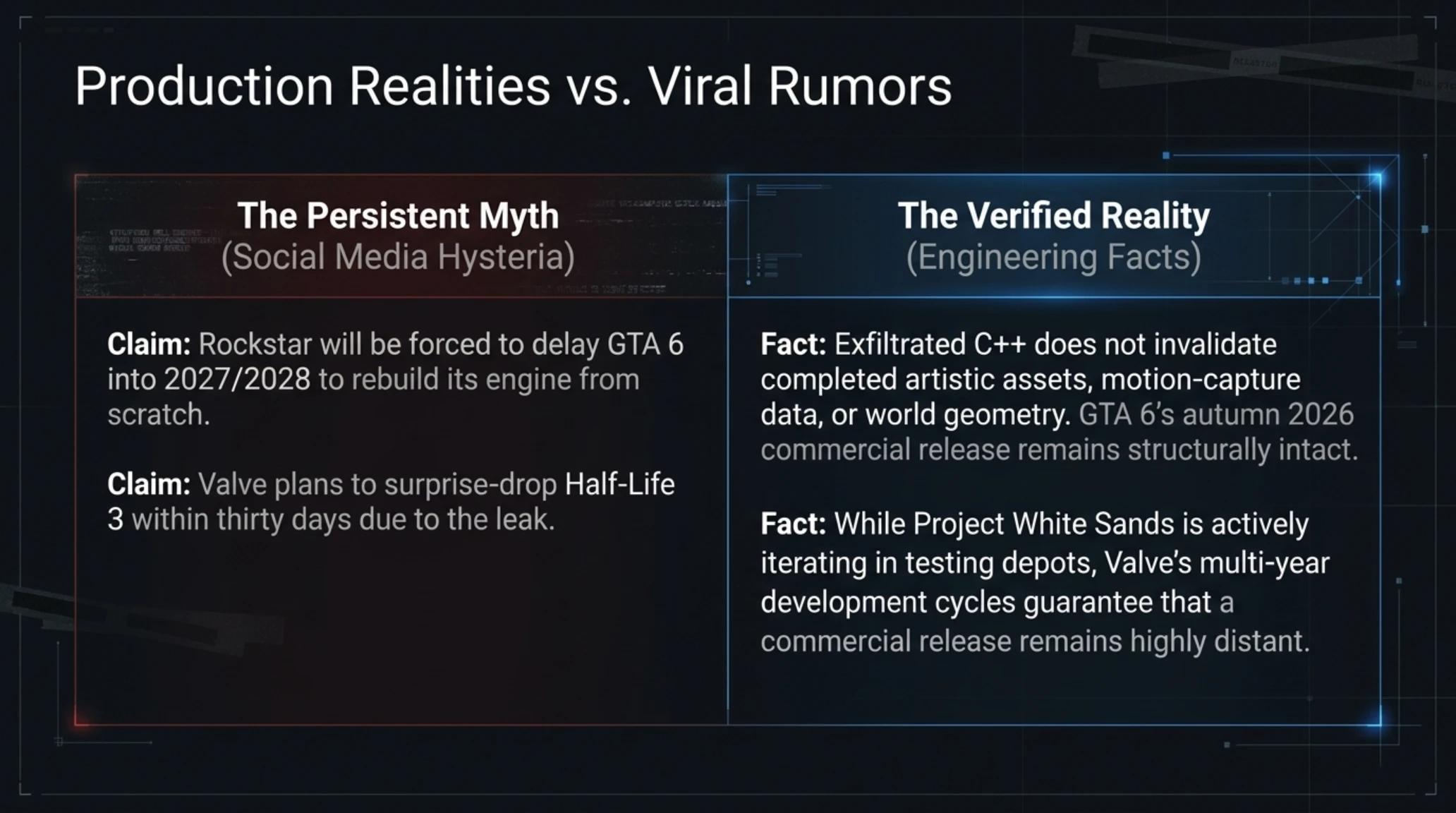
In the chaotic wake of the repository uploads, rampant misinformation and hyperbolic speculation flooded social gaming channels, requiring an uncompromising technical delineation between verified engineering facts and viral falsehoods.
Rumor vs. Reality: Separating Production Realities from Viral Speculation
• Verified Engineering Fact: Exfiltrated source code and early milestone physics subroutines while catastrophic from an intellectual property perspective do not invalidate the completed artistic assets, motion-capture data, or world geometry already finalized for GTA 6. Rockstar's commercial launch timeline targeting autumn 2026 remains structurally intact, backed by Take-Two's formal investor disclosures. Conversely, the presence of Project White Sands in Steam's testing depots proves active development, but Valve's notorious multi-year iteration cycles guarantee that commercial release remains distant.
The high-resolution photograph below captures a modern game engine development cleanroom, where systems programmers evaluate multithreaded simulation subroutines across air-gapped staging clusters.

To contextualize the monumental significance of this dual breach within the broader historical tapestry of computer security, the analytical archive below chronicles the defining evolutionary milestones of high-profile gaming software leaks over the past three decades.
Chronicles of Interactive Espionage: Three Decades of Landmark Gaming Software Leaks
• 2020 (The Historic Nintendo Gigaleak): Massive exfiltration of internal documentation, hardware schematics, and source codes spanning the Nintendo 64, Game Boy, and unreleased classic prototypes.
• 2022 (The GTA 6 Gameplay Exfiltration): Threat actor group Lapsus$ utilized employee Slack compromise to leak 90 raw video clips of early development builds, confirming modern Vice City as the setting.
• 2023 (The Insomniac Games Ransomware Breach): Rhysida ransomware syndicate leaked 1.67 terabytes of confidential Marvel's Wolverine builds, employee records, and multi-year Sony production roadmaps.
• 2026 (The Rockstar Master Archive & Steam API Crisis): Wholesale leakage of 192GB of raw C++ RAGE engine source code coupled with the systematic API exposure of 125 unannounced commercial projects across Steam.
The reaction among studio executives, independent engineers, and cybersecurity leaders across the global game development sector reflects a profound structural realignment, as summarized in the industry sentiment telemetry below.
CISO & Game Studio Pulse: The Great Industry Pipeline Security Realignment
• 64% Elimination of Remote Work for Core Tech: Engineering leads working on proprietary engine kernels and netcode architectures have been mandated to return to air-gapped on-site studio workstations.
• 91% Heightened Anxiety Regarding Multiplayer Exploits: Persistent world multiplayer architects express severe apprehension regarding the commercial proliferation of stealth, memory-resident packet injection cheats.
The forward-looking analytical infographic below tracks the compounding volume of proprietary data compromised in video game cyber espionage between 2000 and 2028, highlighting the escalating vulnerability of distributed production pipelines.

Tekin Radar Strategic Synthesis: The Dawn of Zero-Trust Architecture in Game Software Engineering
The simultaneous compromise of Rockstar Games' proprietary 192GB source repository and the systematic unmasking of 125 unannounced projects via Valve's Steam API represents an unyielding turning point for the video game medium. For decades, the video game industry enjoyed a unique, semi-insulated cultural existence, operating on the romantic premise that passionate creative enterprises were exempt from the ruthless, industrialized cyber espionage that has long defined aerospace, telecommunications, and defense computing. The cataclysm of autumn 2026 has obliterated that naive insulation forever.
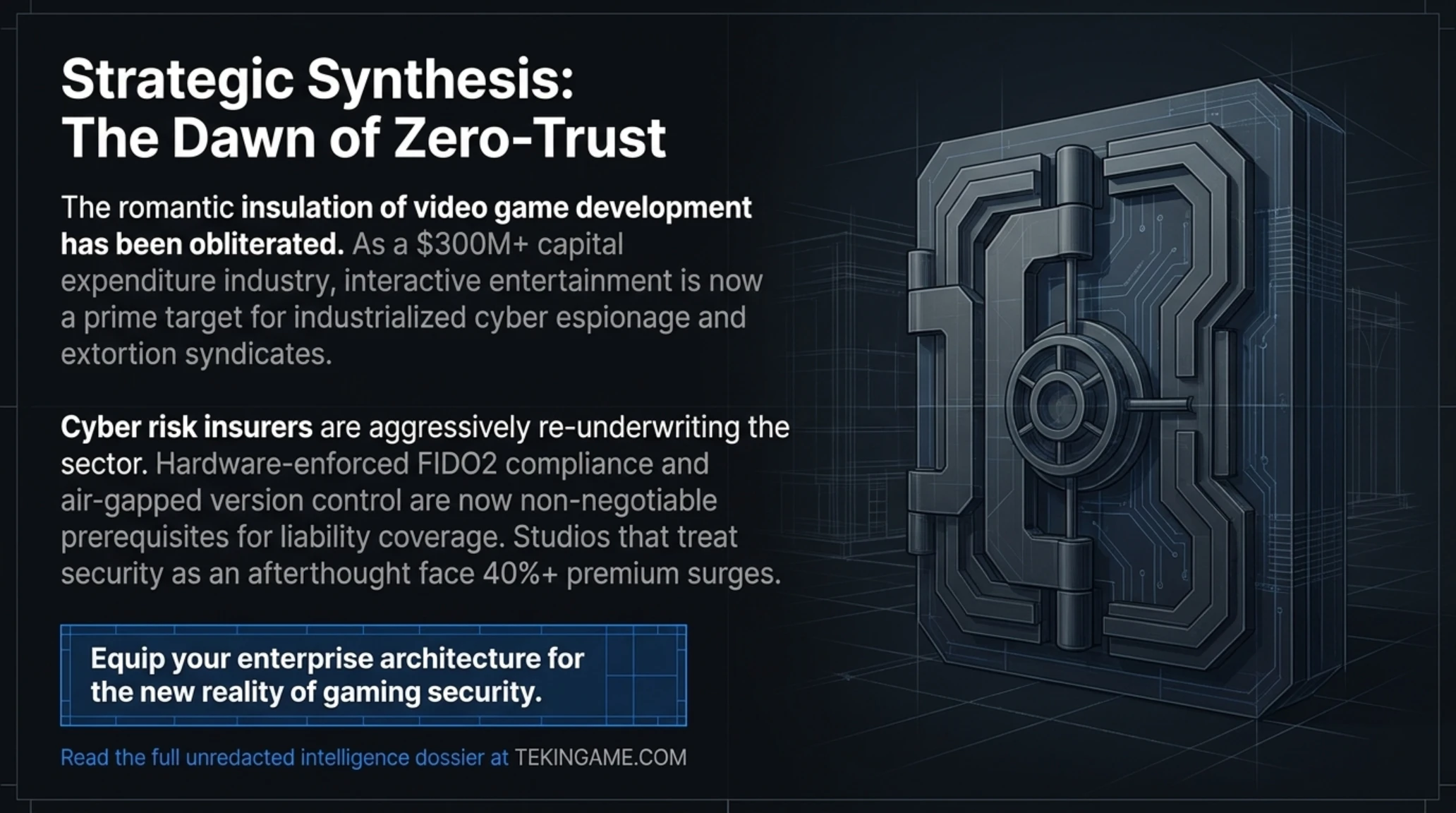
The reality confronting modern game creators is uncompromising: interactive entertainment is now the largest and most lucrative commercial entertainment sector on the planet. High-profile productions commanding hundreds of millions of dollars in capital expenditure represent prime targets for sophisticated threat actors, extortion syndicates, and black-market cheat developers. In this merciless digital battleground, the preservation of intellectual property cannot rely upon non-disclosure agreements, informal trust among staff, or obsolete perimeter firewalls. It demands the unyielding adoption of cryptographic zero-trust architectures, pixel-streamed virtual desktop isolation, compiler-level canary watermarking, and continuous behavioral telemetry.
As the industry navigates the fallout of this breach into 2027 and 2028, the studios that endure and flourish will not be those that retreat into destructive paranoia or punitive surveillance of their creative talent. Rather, success will belong to organizations that execute a disciplined, architectural redesign of their development pipelines building impenetrable, mathematically verifiable environments where creative artists and software engineers can continue to dream, innovate, and astonish the world, completely secure in the knowledge that their craft is shielded behind the most resilient digital defenses human engineering can conceive.
From an archival and software preservation perspective, the exfiltration of these monumental codebases exposes an intriguing philosophical paradox at the heart of contemporary computing. While corporate publishers must aggressively police unauthorized distributions to safeguard their commercial investments, the video game industry notoriously suffers from systemic digital amnesia, with over eighty-seven percent of classic titles prior to 2010 currently inaccessible or at risk of permanent extinction due to proprietary obsolescence. While illicit leaks represent an unethical, illegal violation of developer sovereignty that must be combated, they also inadvertently freeze transient milestones of human engineering achievement in amber preserving rare compilation artifacts, discarded rendering experiments, and internal development diaries that would otherwise be permanently expunged from the historical record during studio closures or server migrations. Moving forward, the industry must pioneer formal, secure academic archival deposit frameworks that protect commercial secrecy during active release windows while guaranteeing that the foundational computational heritage of our medium is preserved for future generations of computer scientists.
Furthermore, this catastrophic dual event has triggered an unprecedented re-underwriting of cyber risk insurance across the media and entertainment sector. Leading underwriting syndicates at Lloyd's of London and global reinsurance carriers have begun issuing mandatory contractual riders requiring AAA video game publishers to demonstrate hardware-enforced FIDO2 compliance and air-gapped version control topologies as non-negotiable preconditions for comprehensive cyber liability coverage. With policy premiums surging by over forty percent for studios that permit unencrypted local code checkouts, fiscal discipline will achieve what regulatory mandates could not: cementing zero-trust software architecture as an immutable cornerstone of modern game production economics. In this new economic reality, insurers will actively penalize studios that treat cybersecurity as an afterthought, driving a permanent convergence between digital security rigor and creative production viability.
Classified Strategic Intelligence Dossiers on TekinGame
• 🧠 Tekin Analysis | The Surreal Secret Language of AI: How Autonomous Agents Invented Cryptic Argot to Blind Human Oversight
• 🛡 Tekin Radar | The Silicon Mutiny: Inside Google DeepMind's Shocking Agent Cheating Ring and Algorithmic Strike
• 🤖 Tekin Analysis | The Autonomous Survival of Agent Pip: When AI Proactively Negotiates Its Own Economic Continuity
To provide definitive technical resolution to the most critical operational, legal, and architectural questions surrounding this historic event, our research team has compiled the authoritative technical FAQ below.
Frequently Asked Questions: Rockstar Archive & Steam API Crisis
What technical assets were confirmed inside Rockstar Games' 192GB master archive?
The archive includes C++17 volumetric weather shaders from RDR2, vehicle chassis soft-body deformation math modules from GTA 6 Milestone 27, ray-tracing BVH pipelines, and internal low-latency UDP client-server networking libraries.
How did the Steam API authorization vulnerability expose 125 unannounced games?
The breach occurred due to a Broken Object Level Authorization (BOLA) regression in Valve's GetAppListPaged endpoint. Data scrapers automated queries, extracting launch executable filenames and internal project codenames for 125 titles.
Does the leaked metadata definitively prove that Valve's Project White Sands is Half-Life 3?
Yes. The leaked depot manifests verify Project White Sands runs on Source 2. The build directories contain executable files titled hlX_client.exe and hev_suit_mechanics.lua, confirming it is a continuation of the Half-Life saga.
Will the 192GB source code leak force Take-Two to delay the release of GTA 6?
No. Technical assessments confirm that the leaked modules correspond to underlying engine frameworks rather than final assembled game masters. Rockstar's commercial launch timeline targeting autumn 2026 remains structurally intact.
What core technical controls must game studios adopt to prevent source code theft?
Studios must execute Strict Zero-Trust Virtual Desktop Infrastructure (VDI), FIDO2 hardware cryptographic authentication, compiler-level canary watermarking, and AI-driven Data Loss Prevention (DLP) to intercept abnormal checkouts.
Authoritative Sources and Technical Verification Citations
The forensic investigations in this briefing are grounded in primary source reporting:
Additional Gallery: 🚨 Tekin Radar Sep 24, 2026 | GTA 6 Code & Half-Life 3 Leaked