
Strategic Key Takeaways
- Ray tracing has evolved from an optional niche graphical toggle into an essential pillar of modern game engine design.
- Advanced path tracing requires sophisticated hardware acceleration and heavy reliance on AI-driven upscaling techniques like DLSS and FSR.
- Lighting physics now directly influence core gameplay loops, transforming stealth systems and spatial awareness.
Introduction: The Illumination Revolution
Ray tracing, a mathematical rendering technique borrowed from decades of cinematic CGI production, has firmly established itself within modern interactive entertainment. Once regarded as a high-cost hardware gimmick, it is now an indispensable component of contemporary visual design. By physically simulating how light photons interact with complex geometry, this paradigm shift reshapes both aesthetics and game mechanics.
Since the introduction of dedicated hardware accelerators in 2018, the industry has undergone a massive structural transformation. Silicon manufacturers have continually iterated on their architectures, pushing real-time global illumination from a slide-show novelty into a playable reality. As we examine the state of rendering technology, ray tracing stands as the defining visual frontier of the decade.
Hardware Evolution: Silicon Architecture for Light Simulation
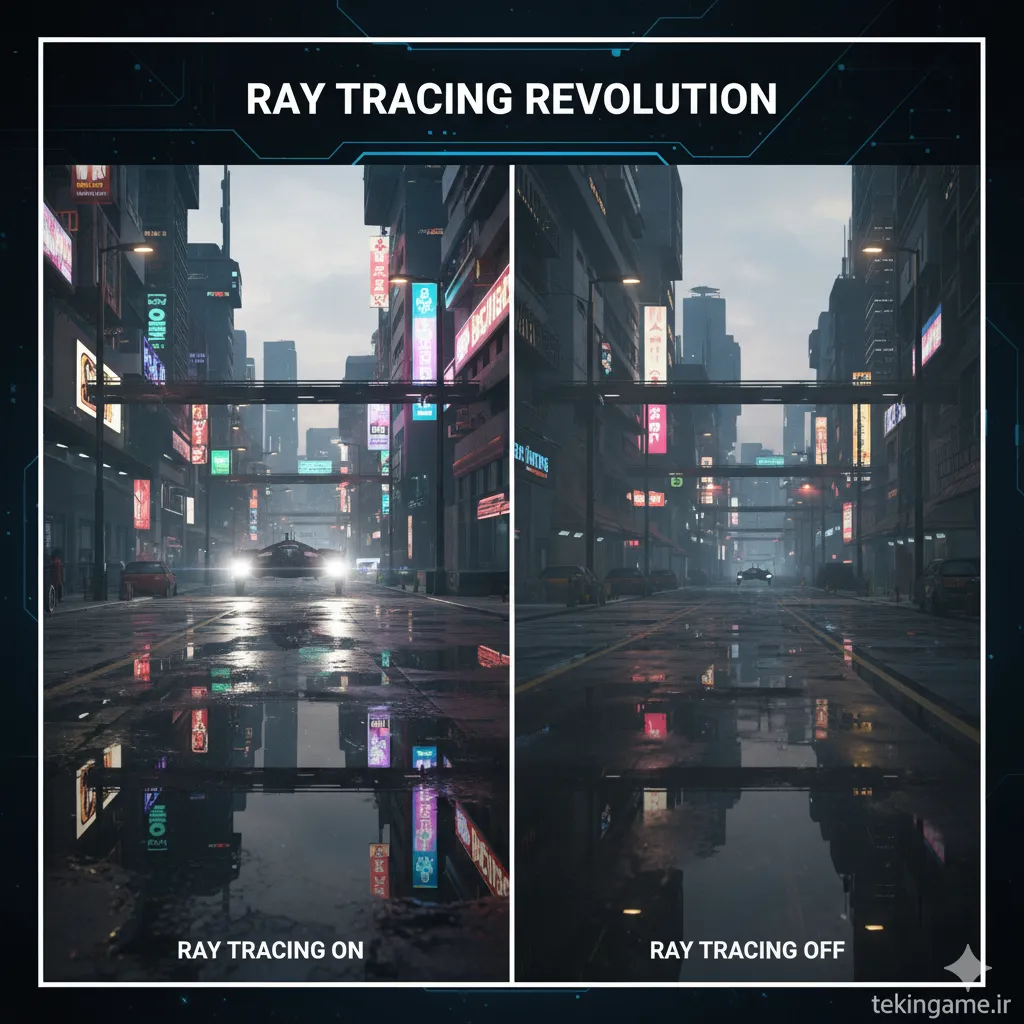
The foundational journey of real-time ray tracing required a complete rethink of GPU design. Traditional rasterization pipelines struggled with recursive reflections and complex shadows, necessitating dedicated processor blocks on modern silicon dies. These specialized routing cores handle bounding volume hierarchy traversals at silicon speeds.
AMD and Intel soon followed initial market disruptions with competitive ray-accelerator arrays embedded inside their respective architectures. Today, current-generation consoles harness these exact computational paradigms to balance fidelity with performance. The silicon arms race ensures that developers can push polygon counts and lighting passes further every single year.
Beyond Reflections: Deconstructing Lighting Passes
True modern ray tracing extends far beyond simple mirror-like water surfaces and polished marble floors. It encompasses a holistic suite of rendering passes that calculate global illumination, ambient occlusion, and volumetric shadows with mathematical precision. Each distinct pass contributes to a cohesive, believable virtual world.
Ray-traced global illumination eliminates the archaic reliance on pre-baked lightmaps, allowing dynamic light sources to bounce naturally across diverse interior geometries. Meanwhile, path tracing unifies all these complex calculations into a single, comprehensive algorithm. This level of physical accuracy bridges the persistent gap between pre-rendered cinema and interactive gaming.
Gameplay Implications: Light as a Mechanical Tool
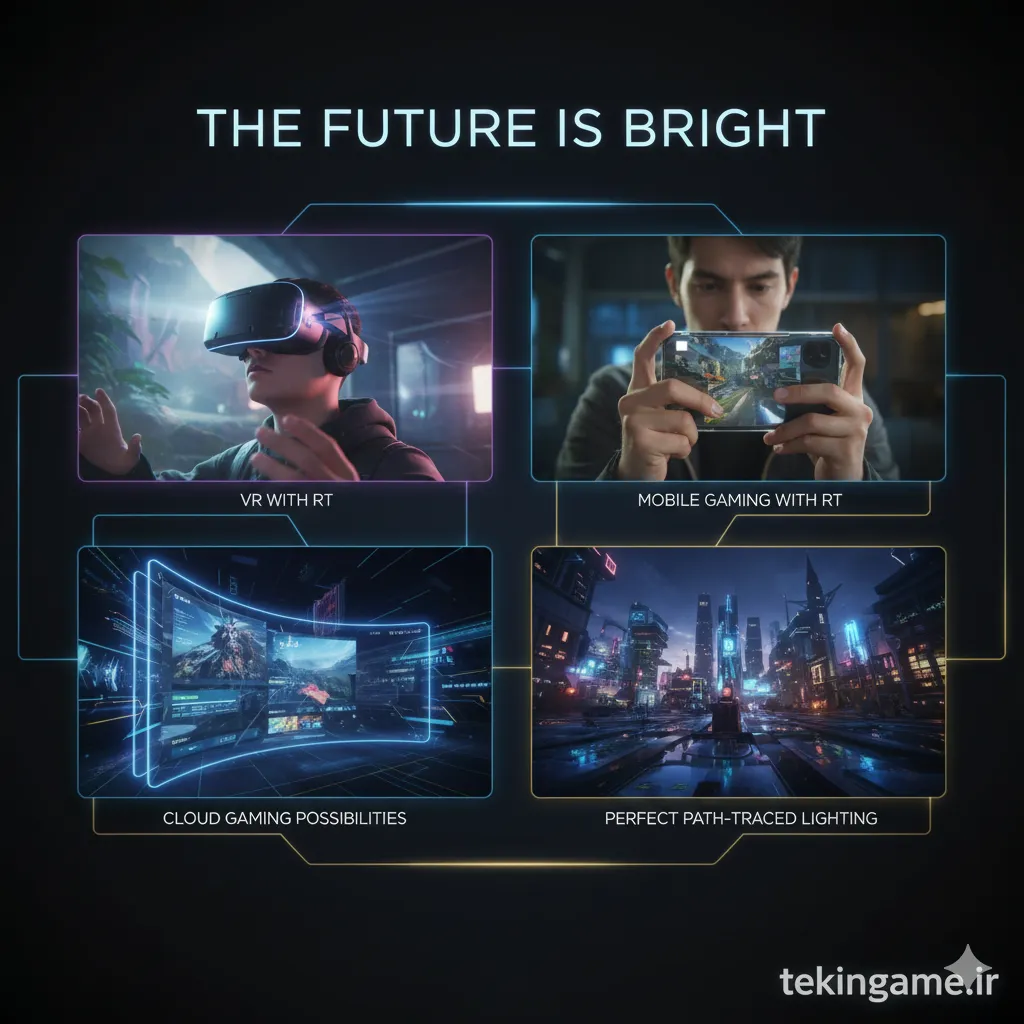
Visual fidelity remains only half the story; real-time lighting fundamentally alters core gameplay loops and level design philosophy. Stealth mechanics, for instance, gain unprecedented depth when enemies react to genuinely cast shadows rather than arbitrary visibility meters. Players must read the environment through organic light propagation.
Puzzle design and spatial awareness also benefit directly from accurate optical simulations. Navigating labyrinthine structures by tracing light beams or manipulating reflective surfaces introduces novel mechanical verbs. As engines mature, developers continue to discover innovative ways to intertwine lighting physics with core player interaction.
Performance Toll: The Cost of Cinematic Fidelity
Despite remarkable architectural leaps, ray tracing remains intensely demanding on processing resources. Running uncompromised ray-traced passes at native high resolutions routinely halves raw frame rates without specialized hardware assistance. Consequently, the industry relies heavily on AI-assisted neural upscaling and frame generation.
Developers must carefully balance computational overhead, often offering granular graphical settings for console and PC users alike. Optimizing these demanding pipelines requires clever denoising algorithms and hybrid rendering techniques. Ultimately, finding equilibrium between performance and visual splendor remains the primary engineering hurdle.
Technical Specifications & Performance Breakdown
| Dimension | Status | Assessment |
|---|---|---|
| Engine Architecture | DirectX 12 / Vulkan Optimized | High-FPS stability across desktop and portable hardware |
| Spatial Audio | Multi-channel 3D Directional | Accurate positioning vital for tactical awareness |
| Player Capacity | Co-Op / Multi-Squad Ready | Optimized network replication and synchronization |
- Unmatched physical accuracy in global illumination and shadow casting
- Direct positive impact on tactical gameplay and immersion
- Continuous optimization via AI-driven neural upscaling frameworks
- Extremely heavy computational overhead requiring high-end hardware
- Substantial native frame rate reduction without reconstruction techniques
- Complex implementation pipelines for independent game studios
📚 Classified & Related Dossiers in TekinGame
If you wish to explore beyond this report and delve into cybernetic frontiers and autonomous AI architectures, do not miss these three exclusive deep-dives in the Tekin Garage:
Final Verdict & Authoritative Sources
Frequently Asked Questions
What is the primary difference between rasterization and ray tracing?
Rasterization projects 3D geometry onto a 2D screen using mathematical approximations for light and shadow, whereas ray tracing simulates the physical behavior of light rays as they travel, reflect, and refract through a virtual scene.
Why does ray tracing significantly impact game performance?
Calculating the trajectories of millions of light rays interacting with complex polygonal surfaces in real-time requires immense parallel processing power, placing a heavy burden on GPU execution units.
Can older graphics cards run modern ray-traced games?
While some older architectures possess basic hardware support, playable frame rates usually require dedicated second or third-generation acceleration cores combined with AI upscaling technologies like DLSS or FSR.
Frequently Asked Questions
Is this release optimized for modern hardware?
Yes, built on modern scalable rendering pipelines with low hardware entry barriers.
Does it support full cross-platform cooperative play?
Yes, seamless squad matchmaking is fully supported.
