Tekin Special Dossier: Cryptography's Zero Hour & The Quantum Threat
An exhaustive architectural investigation into the European Supervisory Authorities' joint emergency risk warning regarding quantum computers picking Bitcoin and Ethereum locks.
- 🎮European Regulatory Alarm- Joint systemic risk advisory from EBA and ESMA on the vulnerability of asymmetric cryptography.
- 🎧Physical Qubit Threshold Collapse- Google Quantum AI findings accelerating Shor's algorithm feasibility.
- 🚀The 1.1M Satoshi Coin Exposure- Why legacy P2PK unspent transaction outputs are immediately vulnerable.
- 🗡️Mempool Front-Running- The risk of exposed public keys being inverted before block confirmation.
- 📰The 2029 Post-Quantum Roadmap- Ethereum Foundation's migration strategy to lattice and STARK proofs.
- ⚔️The Hard Fork Dilemma- Jameson Lopp's sunset migration proposal vs. blockchain immutability.
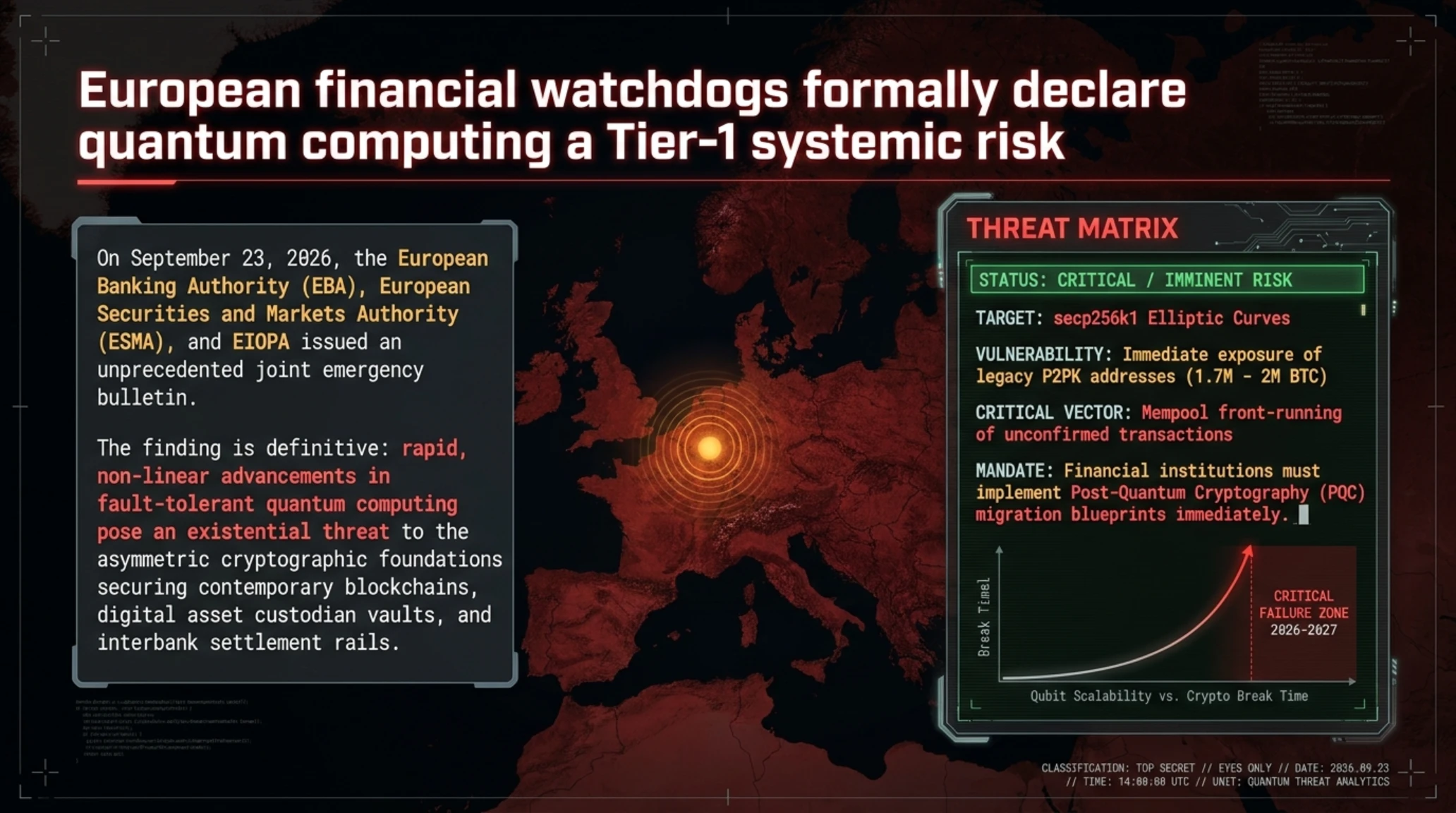
On September 23, 2026, the European Union's senior financial regulatory triumvirate issued an unprecedented, joint systemic risk bulletin that reverberated across global financial capitals and distributed ledger ecosystems. The European Banking Authority (EBA), the European Securities and Markets Authority (ESMA), and the European Insurance and Occupational Pensions Authority (EIOPA) jointly warned that rapid, non-linear advancements in fault-tolerant quantum computing now pose a tangible, existential threat to the asymmetric cryptographic foundations securing contemporary blockchains, digital asset custodian vaults, and interbank settlement rails.
Far from sensationalist hyperbole, the joint regulatory warning reflects recent empirical breakthroughs emerging from premier quantum physics laboratories and industrial research centers. Telemetry and theoretical models published by teams such as Google Quantum AI indicate that the threshold of physical qubits required to construct a stable, logical qubit capable of executing Shor’s algorithm against 256-bit elliptic curves has contracted dramatically. Due to major innovations in quantum low-density parity-check (qLDPC) codes, dual-rail superconducting qubits, and optimized surface-code decoding lattices, the projected timeframe for breaking current cryptographic keys has moved from a speculative mid-century horizon into the realistic trajectory of the next five to seven years.
For decentralized networks such as Bitcoin and Ethereum, which collectively custody more than two trillion dollars in global liquidity, this mathematical reality represents a relentless countdown toward what cryptographers designate as "Zero Hour." The fundamental trust model of blockchain architecture assumes that public keys can be broadcast openly while private keys remain mathematically uncomputable. If a quantum adversary achieves the capacity to invert the Elliptic Curve Discrete Logarithm Problem (ECDLP) within reasonable computational timeframes, the fundamental guarantees of private property, transaction authenticity, and decentralized consensus will suffer catastrophic structural failure.
Executive Threat Summary: The Quantum Vulnerability Matrix
- Joint warning issued by EBA, ESMA, and EIOPA formally cataloging quantum computing as a Tier-1 systemic risk to blockchain infrastructure
- Substantial reductions in required physical qubits to execute Shor's algorithm against secp256k1 elliptic curves via advanced surface-code architectures
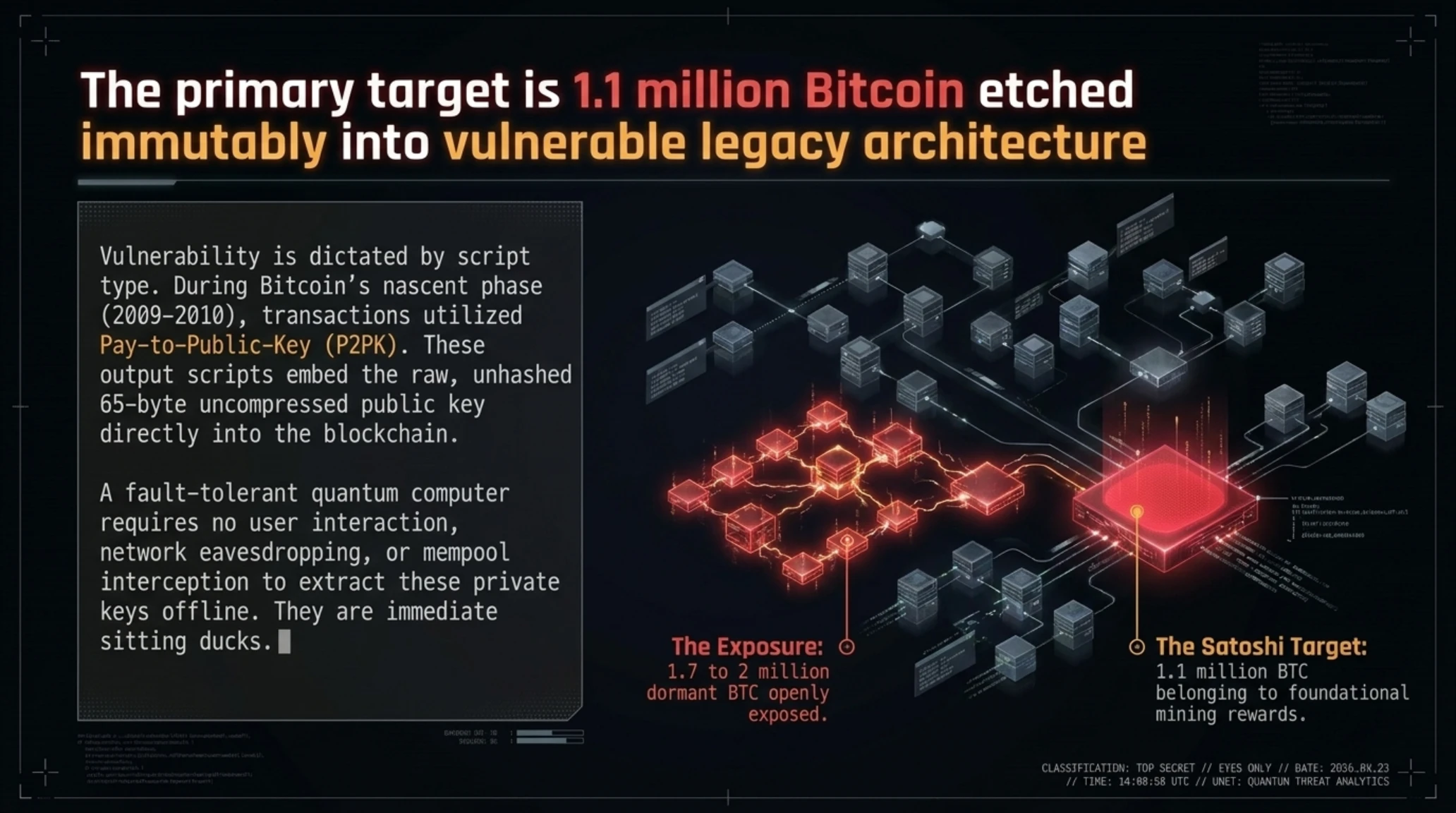
- Critical exposure of legacy Pay-to-Public-Key (P2PK) Bitcoin addresses holding approximately 1.7 to 2 million BTC, including the foundational Satoshi Nakamoto holdings
- Severe mempool front-running risks where exposed public keys in unconfirmed transactions can be inverted before block confirmation
- Hard deadlines set by the Ethereum Foundation targeting comprehensive post-quantum migration across consensus, execution, and data layers by December 2029
To rigorously comprehend the technical vectors detailed by the European regulators, one must analyze the mathematical asymmetry underlying modern asymmetric cryptography. Bitcoin and Ethereum rely on the `secp256k1` Koblitz curve, defined over the finite field $\mathbb{F}_p$. In this domain, computing a public key point $Q = k \cdot G$ through scalar point multiplication of a 256-bit private key integer $k$ with base point $G$ requires a negligible fraction of a millisecond on standard silicon microprocessors. Conversely, deriving the private scalar $k$ given only the public point $Q$ necessitates running classical algorithms such as Pollard’s rho, demanding approximately $2^{128}$ operations a computational task that would exhaust the total energy output of our solar system using conventional supercomputers.
This classical security guarantee, however, rests upon the premise of sequential, binary Von Neumann architectures. In 1994, mathematician Peter Shor formulated a quantum algorithm demonstrating that a quantum system operating in superposition and utilizing the Quantum Fourier Transform (QFT) can determine the period of an arbitrary periodic function in polynomial time, $\mathcal{O}((\log N)^3)$. When adapted to the discrete logarithm problem over elliptic curve groups, Shor’s algorithm fundamentally alters the computational complexity class from exponential to polynomial ($\mathcal{O}(n^3)$). Consequently, what represents billions of years of classical brute force collapses into hours, or even minutes, of quantum circuit execution.

Regulatory Risk Bulletin: European Supervisory Authorities Joint Advisory
Publication Date: September 23, 2026
Primary Finding: Asymmetric cryptography securing DLT, financial databases, and institutional vaults faces systemic risk from accelerated quantum timelines.
Directive: Financial institutions and digital asset networks must implement formal Post-Quantum Cryptography (PQC) migration blueprints immediately.
Quantum Mechanics vs. Elliptic Curves: Decoupling Shor's and Grover's Impacts
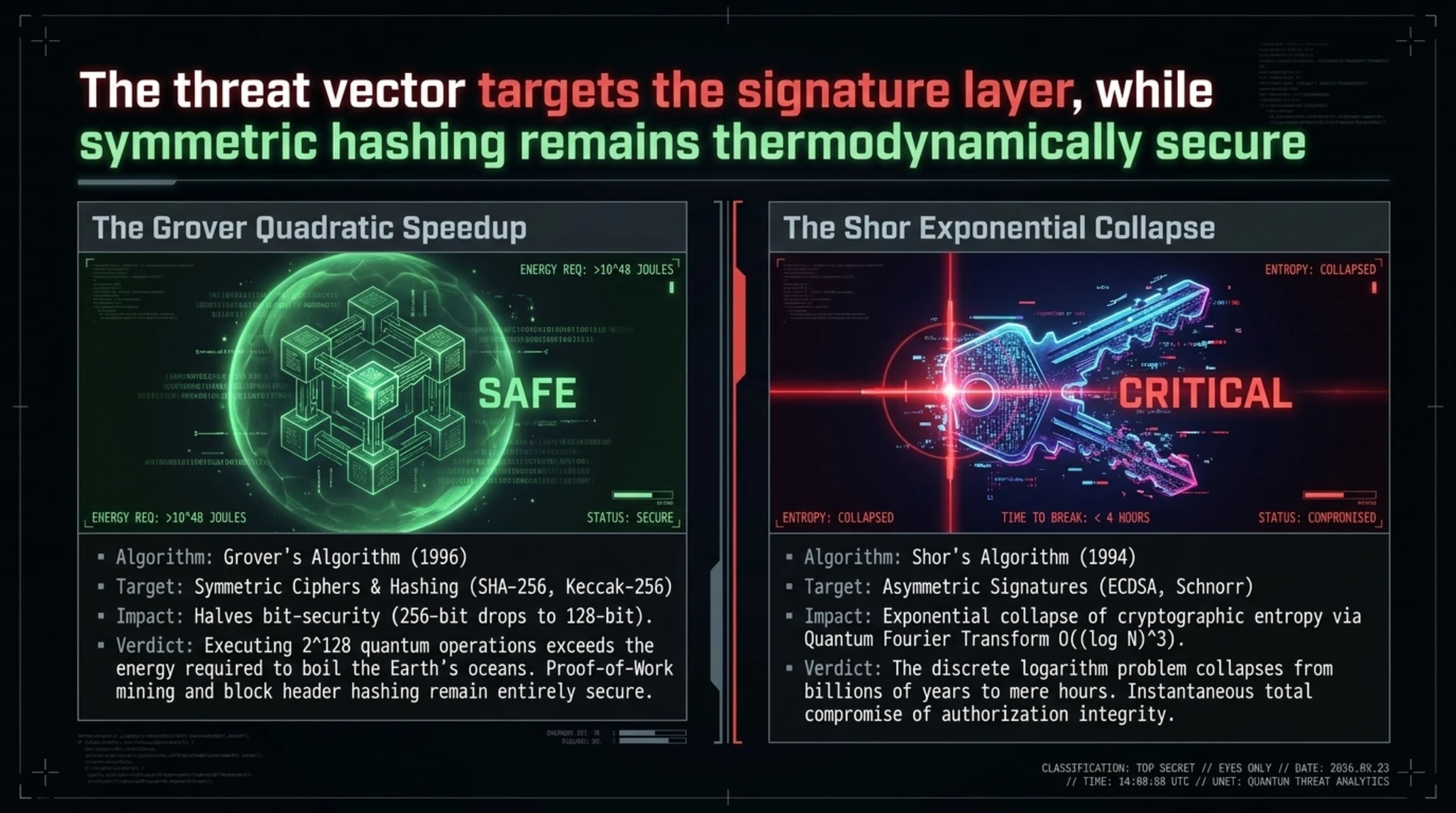
A critical technical distinction frequently obscured in mainstream discourse involves the operational divergence between Shor’s algorithm and Grover’s algorithm. Cryptographic protocols deployed across blockchain networks utilize two fundamentally disparate classes of primitives: asymmetric digital signature algorithms (such as ECDSA and Schnorr) and symmetric cryptographic hash functions (such as SHA-256 and Keccak-256).
Grover’s algorithm, published by Lov Grover in 1996, provides a quadratic speedup for searching unstructured databases. When applied to cryptographic hash functions, Grover’s algorithm effectively halves the bit-security level of a given digest: a 256-bit hash function like SHA-256 provides $2^{128}$ quantum operations of security against preimage attacks. From a mathematical and thermodynamic perspective, $2^{128}$ operations remains completely unassailable by any conceivable physical computer, as it exceeds the energy required to boil the Earth’s oceans. Therefore, Bitcoin’s Proof-of-Work mining difficulty, block header hashing, and address hashing are not under imminent threat of quantum collapse.
Jargon Buster: Essential Post-Quantum Terminology
Logical Qubit: An error-corrected quantum bit synthesized from hundreds or thousands of physical qubits to preserve coherence during extended calculations.
Grover's Algorithm: A quantum search algorithm providing a quadratic speedup against symmetric ciphers and hashing, reducing 256-bit security to a safe 128-bit margin.
Post-Quantum Cryptography (PQC): Cryptographic algorithms (such as lattice-based or hash-based schemes) running on classical hardware that are resistant to quantum decryption.
The catastrophic vulnerability identified by EBA and ESMA resides exclusively in the signature layer. Digital signatures rely on mathematical structures possessing underlying algebraic periodicity specifically, abelian group structures. Shor’s algorithm exploits this precise algebraic property. Unlike Grover’s modest quadratic speedup, Shor’s algorithm induces an exponential collapse of cryptographic entropy. For any network relying on raw public keys to authorize the transfer of sovereign wealth, the deployment of a fault-tolerant quantum computer constitutes an instantaneous, total compromise of authorization integrity.
Historically, the cryptographic community operated under the reassuring assumption that constructing the physical hardware necessary to support thousands of logical qubits remained decades away. Quantum bits are notoriously fragile; thermal fluctuations, stray electromagnetic fields, and material impurities introduce phase and bit-flip errors that destroy quantum superposition within microseconds. However, theoretical physics and laboratory engineering in late 2026 have upended these conservative timetables through accelerated fault-tolerance paradigms.
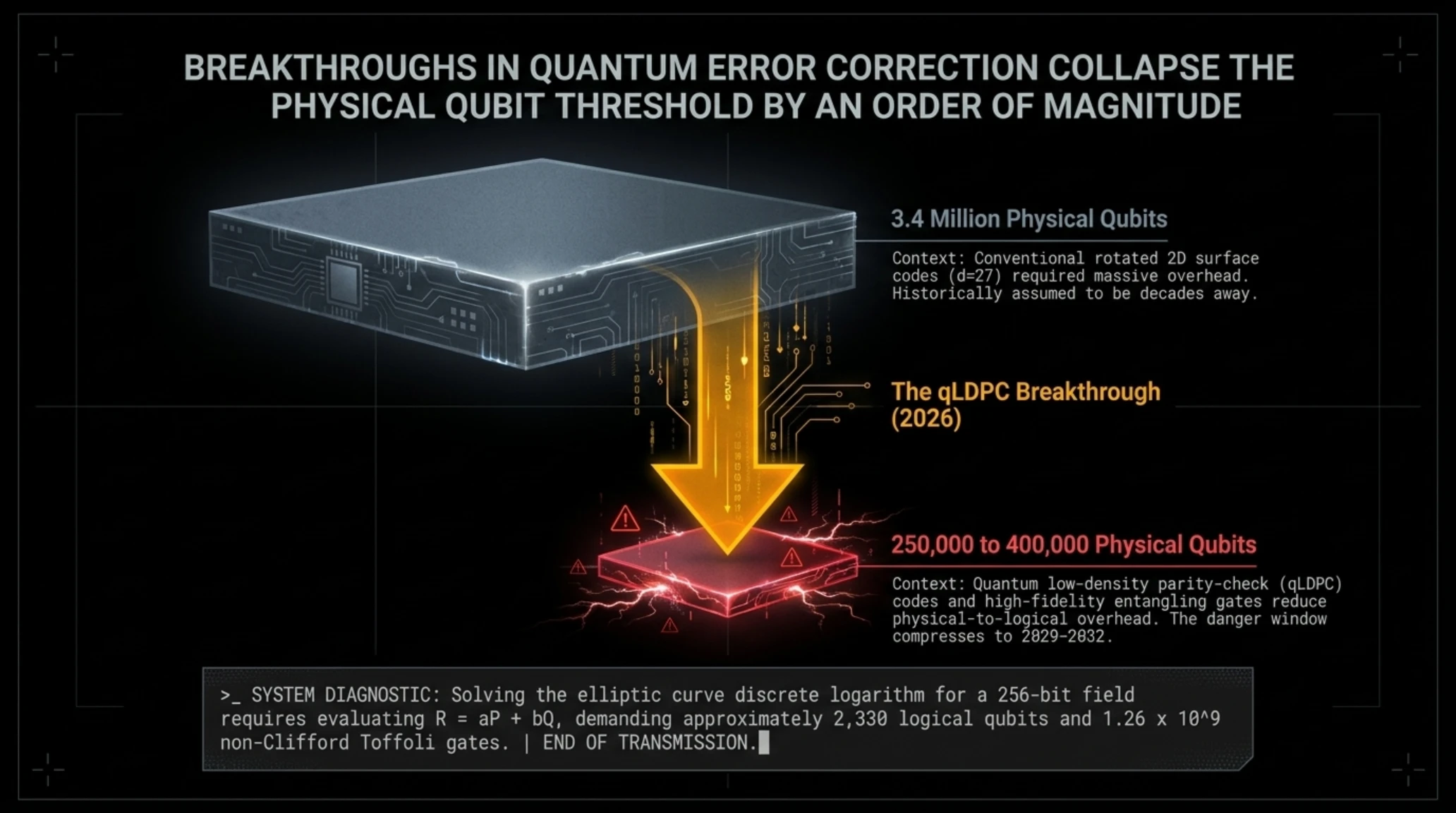
To mathematically quantify the quantum attack surface against the `secp256k1` elliptic curve, consider the exact resource requirements formulated by Roetteler et al. and recent optimizations in quantum arithmetic. Solving the elliptic curve discrete logarithm problem for an $n$-bit field ($n = 256$) requires evaluating the group operation $R = aP + bQ$. The quantum circuit achieves this through reversible point addition and modular multiplication, requiring approximately $2n + 2$ logical qubits for register storage alongside auxiliary ancilla qubits yielding a base logical requirement of roughly 2,330 logical qubits. The overall circuit depth is governed by approximately $1.26 \times 10^9$ non-Clifford Toffoli gates.
Under conventional rotated surface codes with a physical gate error rate of $p = 10^{-3}$, maintaining a target logical error rate of $\epsilon \le 10^{-7}$ per algorithm run mandates a code distance $d = 27$. In standard 2D lattice geometries, each logical qubit requires $2d^2 = 1,458$ physical qubits, traditionally ballooning the physical qubit count past 3.4 million. However, with the breakthrough implementation of quantum low-density parity-check (qLDPC) codes demonstrated in 2026, researchers demonstrated that non-local qubit couplings reduce the physical-to-logical overhead by nearly an order of magnitude. A machine possessing merely 250,000 to 400,000 physical qubits operating under high-fidelity entangling gates can now achieve the logical performance previously thought to require millions of physical components.
The Bitcoin Address Vulnerability Gradient: Deconstructing the Satoshi Exposure
One of the most persistent misconceptions across institutional crypto custody and retail investment circles is the assumption that all digital assets on the Bitcoin ledger face identical levels of quantum exposure. In reality, the vulnerability of a given unspent transaction output (UTXO) is governed entirely by its underlying script type and whether the raw public key has ever been published to the distributed ledger.
During the nascent architectural phase of Bitcoin (2009–2010), transactions utilized the Pay-to-Public-Key (P2PK) standard. In P2PK scripts, the output script directly embeds the recipient’s raw, unhashed 65-byte uncompressed public key. Approximately 1.7 to 2 million bitcoins currently sit idle within legacy P2PK outputs, the most prominent of which are the foundational mining rewards attributed to Satoshi Nakamoto, comprising an estimated 1.1 million BTC. Because these public keys are etched immutably into historical block data, a quantum computer of sufficient capacity requires no user interaction, no network eavesdropping, and no mempool interception to compromise them.
Rumor vs. Verified Reality: The Quantum Capability Horizon
Verified Reality: No operational quantum processor currently possesses the fault-tolerant logical qubit count required to break secp256k1. However, physical qubit scaling and error-correction breakthroughs have compressed the danger window to approximately 2029–2032, requiring immediate architectural migration.
An adversary possessing a fault-tolerant quantum computer running Shor’s algorithm could systematically harvest public keys directly from the genesis-era blocks, calculate their corresponding private keys offline, construct valid digital signatures, and execute legitimate-looking transfers to newly controlled destination addresses. The sudden, unauthorized liquidation of Satoshi’s dormant fortune would not merely destabilize market prices; it would induce catastrophic psychological panic, potentially decoupling the perceived sovereign credibility of Bitcoin from its underlying cryptographic ledger.
The Mempool Vulnerability Window: Exploiting Transient Public Key Exposure
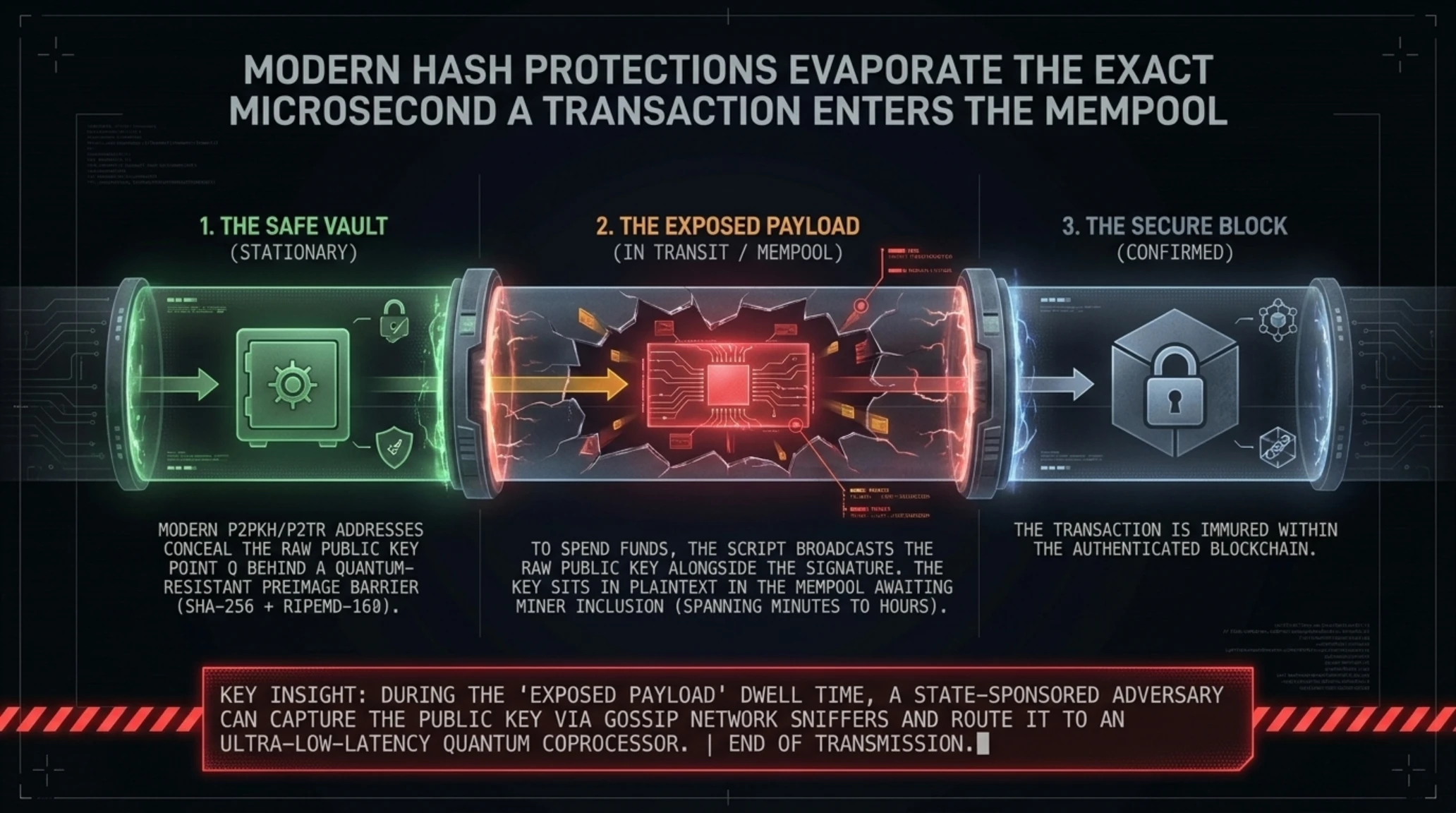
In later script iterations such as Pay-to-Public-Key-Hash (P2PKH), Pay-to-Witness-Public-Key-Hash (P2WPKH / Native SegWit), and Pay-to-Taproot (P2TR) Bitcoin architects introduced a vital protective barrier: hashing the public key with SHA-256 followed by RIPEMD-160 (known as Hash160). As long as funds remain stationary within an address that has never spent an output, the raw public key point $Q$ is completely concealed behind the quantum-resistant preimage barrier of cryptographic hashing.
However, this defensive shield dissipates the exact microsecond a user broadcasts an outbound transaction. To satisfy the spending conditions of a standard Bitcoin output, the spending script must provide both the cryptographic signature and the raw, uncompressed or compressed public key corresponding to the destination hash. Once broadcast to the peer-to-peer gossip network, the unconfirmed transaction enters the memory pool (mempool), where it resides awaiting miner inclusion a process that typically spans several minutes to hours depending on network congestion.
Quantum Acceleration Chronology and Strategic Milestones (2026–2035)
| Timeframe | Cryptographic & Blockchain Impact | Risk Classification |
|---|---|---|
| September 2026 | Joint European Supervisory Authorities warning | Advisory & Planning |
| 2027–2028 | Deployment of PQC testnets across Ethereum | Moderate Transition |
| December 2029 | Ethereum Foundation deadline for quantum resistance | Critical Benchmark |
| 2031–2033 | Theoretical viability of real-time Shor's attack | Severe Vulnerability |
| 2035 | Complete global obsolescence of legacy RSA and ECC | Terminal Phase |
During this mempool dwell time, the raw public key is broadcast in plaintext across thousands of public nodes. A state-sponsored adversary or rogue entity operating a quantum facility could instantly capture the exposed public key from the mempool gossip stream, compute the private key via an ultra-low-latency quantum coprocessor, synthesize a fraudulent transaction sweeping the address to an attacker wallet, attach an exorbitant transaction fee via Replace-by-Fee (RBF), and propagate the competing transaction. Rational miners, prioritizing fee maximization, would include the attacker’s transaction into the next block, invalidating the legitimate user's transaction through double-spending.
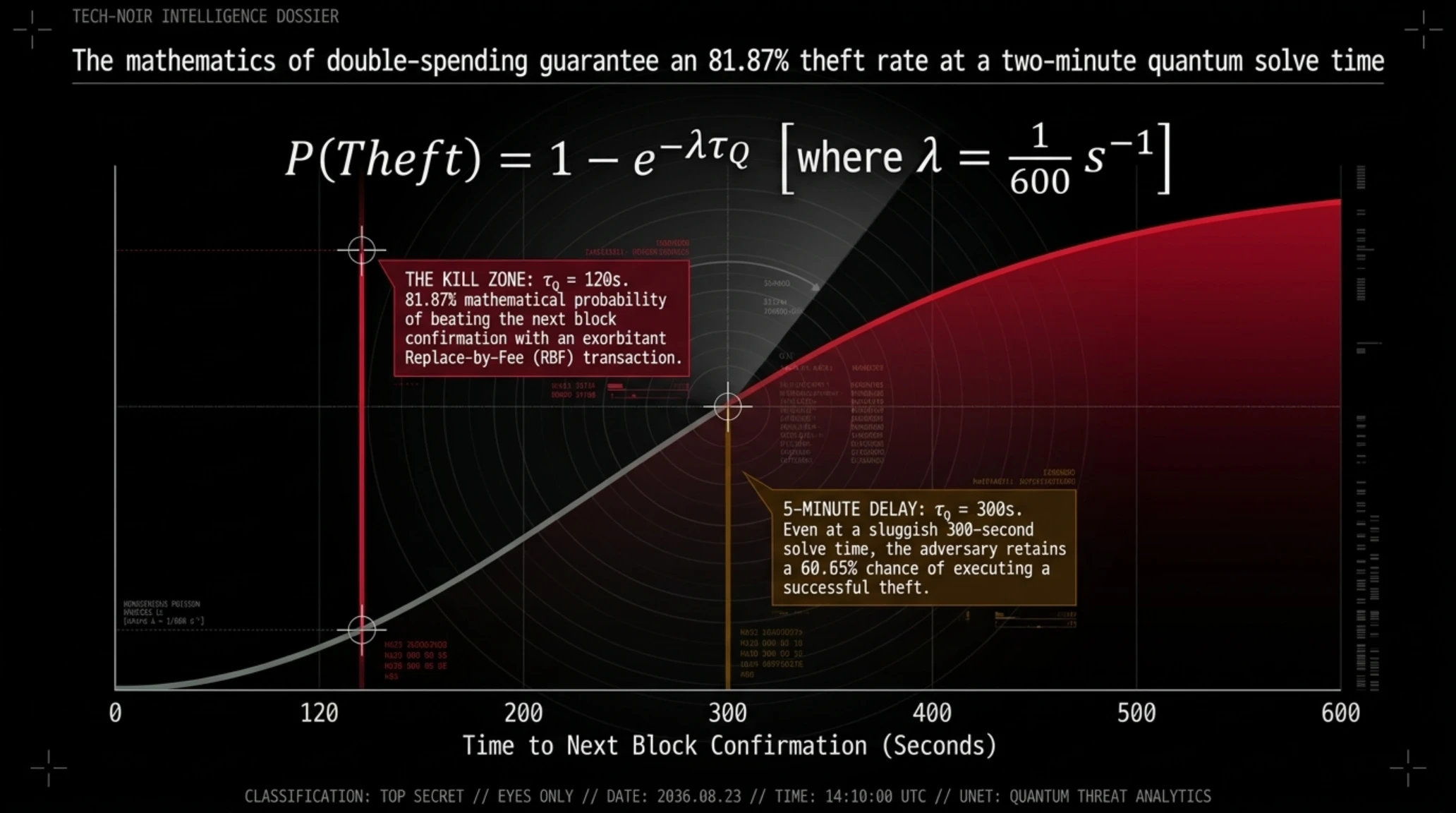
Mathematically, the probability of a successful mempool front-running attack is dictated by the probability density function of Bitcoin block generation, which models as a homogeneous Poisson process with rate parameter $\lambda = \frac{1}{600} \text{ s}^{-1}$. The probability that a block is mined within $\Delta t$ seconds following transaction broadcast is given by $P(T \le \Delta t) = 1 - e^{-\lambda \Delta t}$. If a quantum coprocessor requires $\tau_Q$ seconds to execute the Shor discrete log extraction and assemble an RBF transaction, the adversary's probability of success is $1 - P(T \le \tau_Q) = e^{-\lambda \tau_Q}$.
For instance, if a near-future quantum installation can resolve a 256-bit discrete log in 120 seconds ($\tau_Q = 120\text{s}$), the adversary has an $e^{-120/600} \approx 81.87\%$ mathematical probability of beating the next block confirmation. Even if the calculation requires 300 seconds (5 minutes), the attacker retains a staggering $60.65\%$ chance of executing a successful front-run double-spend against any exposed high-value transaction. In institutional settlement environments moving hundreds of millions of dollars, an 80% theft probability represents an unmitigated operational catastrophe.

The Governance Conundrum: Jameson Lopp’s Sunset Migration Blueprint
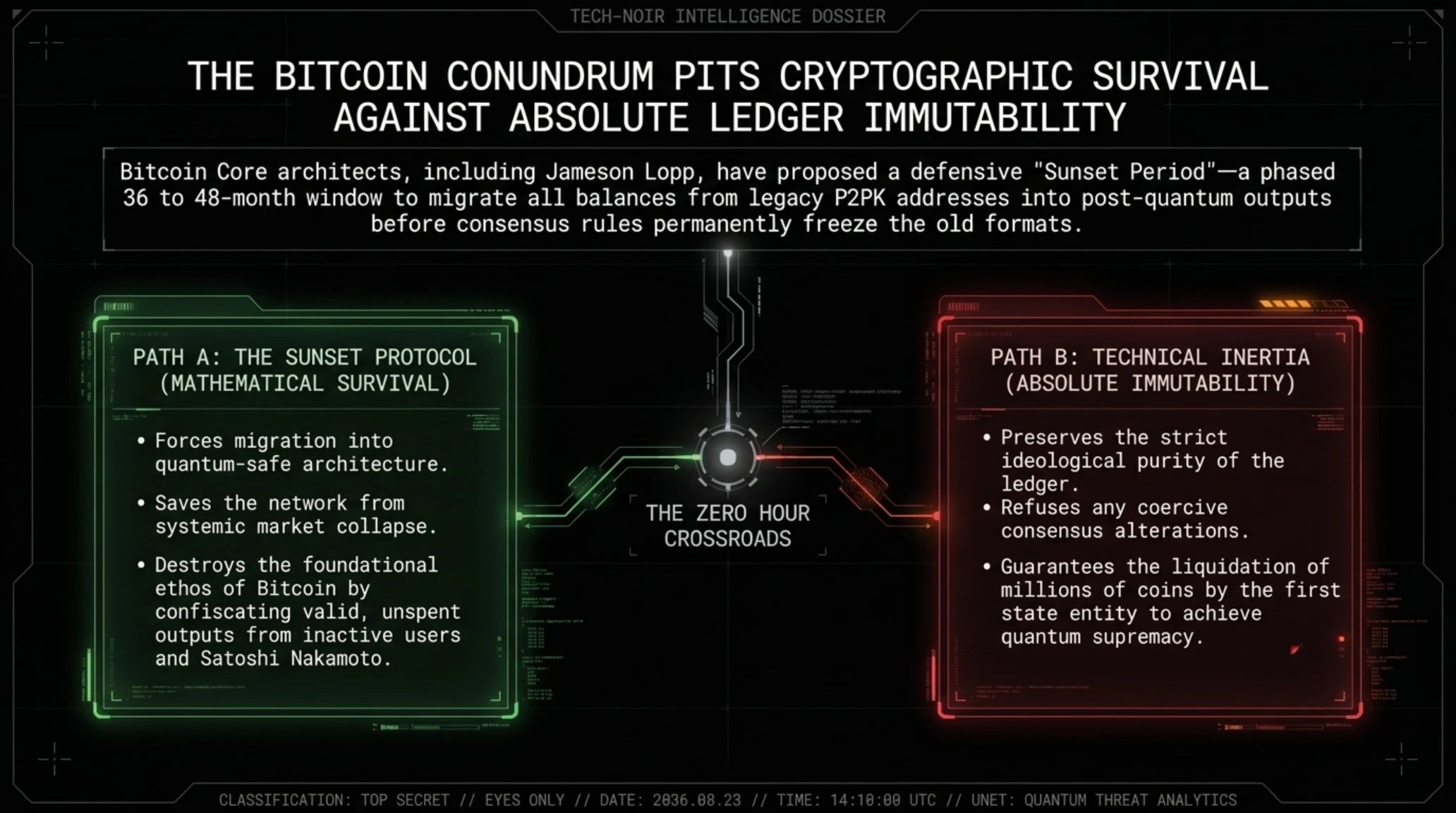
Confronted with the mathematical inevitability of quantum key recovery, Bitcoin Core researchers and prominent security architects, including Cypherpunk technologist Jameson Lopp, have proposed bold architectural contingency frameworks. The primary defensive roadmap under consideration centers on the implementation of a phased "Sunset Period" for legacy outputs.
Under this conceptual consensus framework, the Bitcoin network would execute a planned protocol transition giving users a defined migration window potentially spanning 36 to 48 months to transfer all balances from legacy P2PK addresses and reused public keys into newly defined post-quantum output types. Upon the expiration of the sunset deadline, the consensus rules would formally deprecate legacy address formats, freezing any remaining unmigrated outputs and preventing them from ever being spent via legacy elliptic curve signatures.
However, this pragmatic proposal ignites a profound ideological crisis within the Bitcoin community. The principle of absolute immutability encapsulated by the tenet that validly generated private keys must retain access to their coins indefinitely without arbitrary protocol interference is foundational to Bitcoin’s monetary ethos. Freezing Satoshi Nakamoto's unspent coins or penalizing inactive long-term holders would strike at the core of Bitcoin’s social contract, potentially triggering contentious chain splits and existential hard-fork disputes.

Ethereum's Post-Quantum Triad: Vitalik Buterin's 2029 Target Architecture
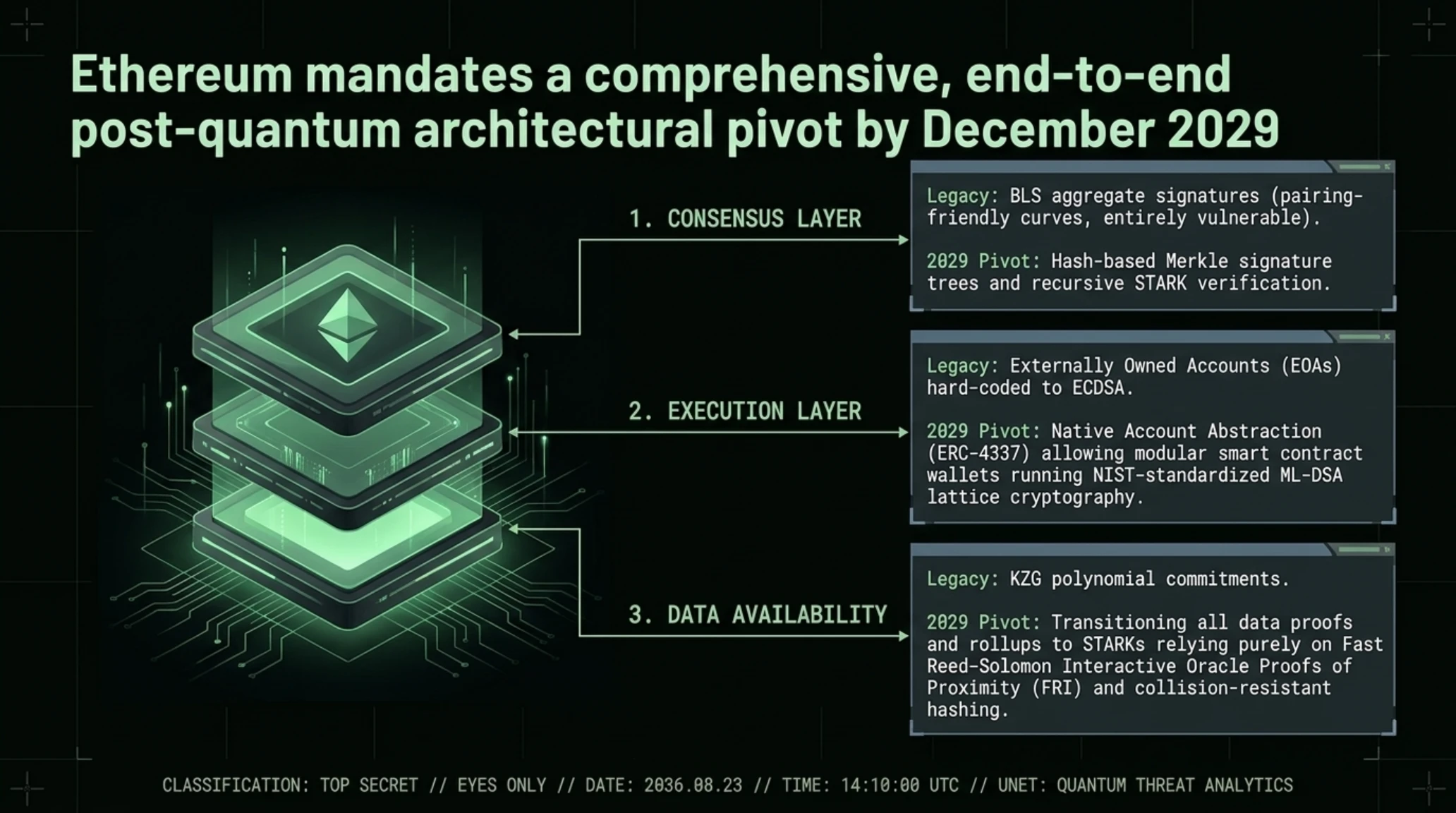
While Bitcoin’s deliberate, hyper-conservative governance structure complicates rapid protocol overhauls, the Ethereum Foundation has taken an aggressively proactive stance. Ethereum co-founder Vitalik Buterin and the core research teams have officially designated December 2029 as the operational deadline for achieving end-to-end quantum resistance across the entire Ethereum protocol stack. Unlike Bitcoin, which primarily secures value transfers and rudimentary timelocks, Ethereum coordinates a complex Turing-complete computing fabric supporting hundreds of billions of dollars in decentralized finance (DeFi), cross-chain bridges, and liquid staking derivatives.
The Ethereum post-quantum engineering roadmap operates across three independent architectural layers:
- Consensus Layer Overhaul: Ethereum Proof-of-Stake (PoS) validators currently utilize BLS (Boneh-Lynn-Shacham) aggregate signatures to validate hundreds of thousands of attestations per epoch. Because BLS relies on pairing-friendly elliptic curves (BLS12-381), it is completely vulnerable to Shor’s algorithm. Researchers are prototyping quantum-resistant aggregate schemes based on hash-based Merkle signature trees and recursive STARK verification to preserve validator decentralization.
- Execution Layer & Native Account Abstraction: The long-term migration strategy pivots on eliminating legacy Externally Owned Accounts (EOAs), which are hard-coded to ECDSA signatures. Through standards such as ERC-4337 and native account abstraction upgrades, users interact exclusively via smart contract wallets. This abstraction decouples signature verification from the base protocol, enabling users to swap validation logic from ECDSA to NIST-standardized lattice cryptography (such as ML-DSA) seamlessly via modular contract upgrades.
- Data Availability & Zero-Knowledge Cryptography: Modern layer-2 scaling architectures rely on polynomial commitments, predominantly KZG (Kate-Zaverucha-Goldberg) commitments used in Proto-Danksharding. While KZG relies on elliptic curve pairings, the protocol roadmap envisions transitioning all data availability proofs and validity rollups to STARKs (Scalable Transparent Arguments of Knowledge), which depend purely on collision-resistant cryptographic hash functions and Fast Reed-Solomon Interactive Oracle Proofs of Proximity (FRI), rendering them inherently post-quantum secure.

📚 Classified & Related Dossiers in TekinGame
If you wish to explore beyond this report and delve into cybernetic frontiers and autonomous AI architectures, do not miss these three exclusive deep-dives in the Tekin Garage:
Systemic Financial Context: Why This Threat Destabilizes Modern Capital Markets
Historical telemetry from structural crises in digital asset history underscores how fragile technical assumptions can trigger catastrophic market contagion. As documented in our forensic investigation of The $320 Million Liquid Network Exploit and Elements Protocol Security, validation defects across bridge infrastructure create catastrophic systemic contagion. Similarly, our post-mortem on The Historic Fall of BitMEX and Leveraged Derivatives Architecture demonstrated that failure to systematically adapt core technical and regulatory architectures inevitably precipitates sudden, structural collapse.
Cryptographic Benchmark & Trade-Off Matrix: The Cost of Quantum Resistance
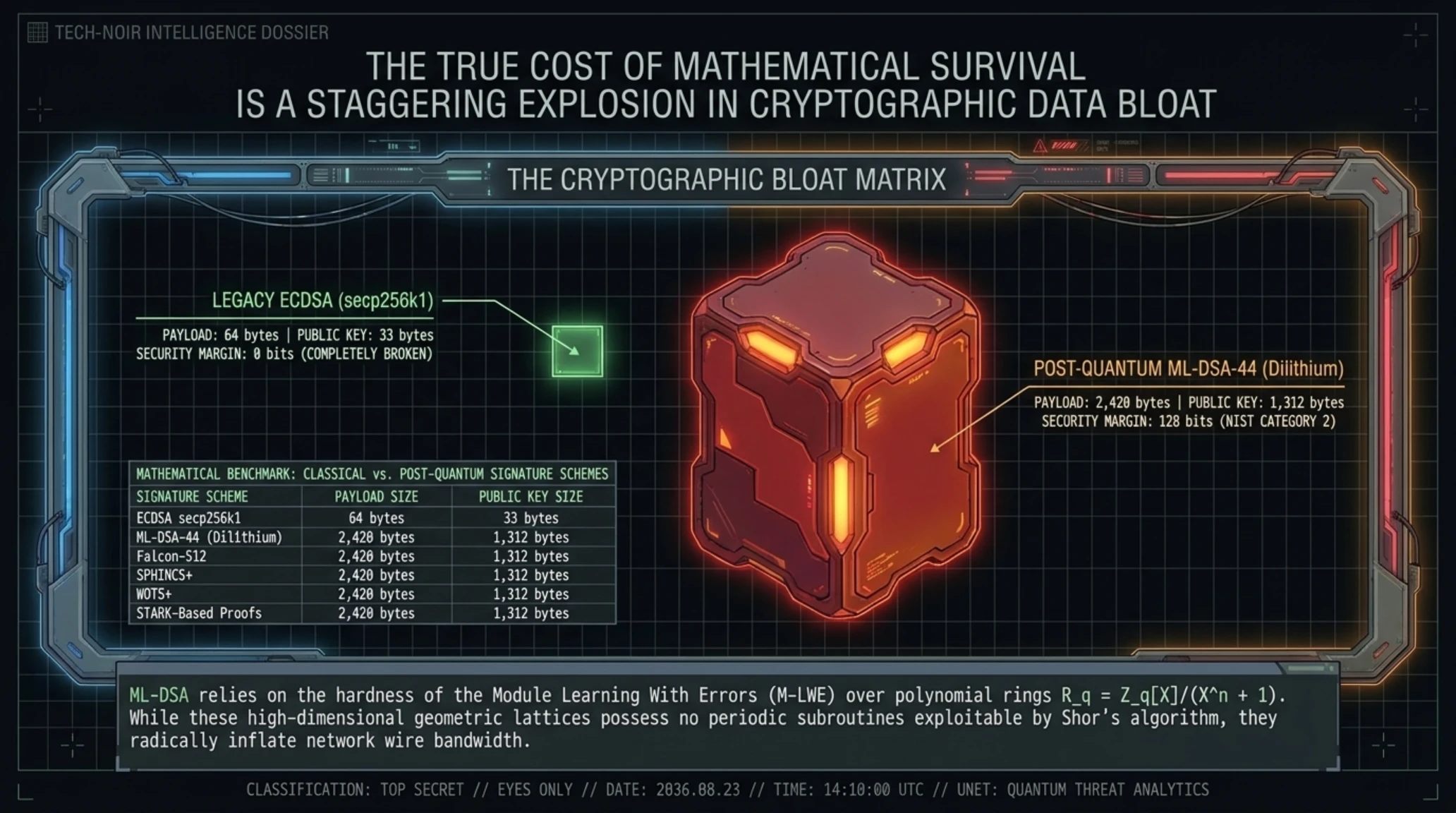
The central dilemma confronting blockchain engineers is not the theoretical absence of quantum-safe algorithms; mathematicians have spent decades designing post-quantum cryptosystems. The genuine barrier lies in the aggressive "data bloat" and computational latency that post-quantum primitives impose on decentralized networks. Bitcoin’s current ECDSA signature consumes a compact 64 bytes, with a compressed public key spanning merely 33 bytes. This lean footprint allows thousands of transactions to pack efficiently into a modest 1MB to 4MB block payload.
In contrast, the post-quantum standards finalized by the U.S. National Institute of Standards and Technology (NIST) primarily lattice-based constructions like ML-DSA (Module-Lattice-Based Digital Signature Algorithm / CRYSTALS-Dilithium) and hash-based constructions like SPHINCS+ require significantly expanded data payloads:
Mathematical Benchmark: Classical vs. Post-Quantum Signature Schemes
| Signature Scheme | Mathematical Basis | Signature Size | Quantum Security Margin |
|---|---|---|---|
| ECDSA secp256k1 | Elliptic Curve | 64 bytes | 0 bits (Broken) |
| ML-DSA-44 | Module Learning With Errors | 2,420 bytes | 128 bits |
| Falcon-512 | NTRU Shortest Vector | 666 bytes | 128 bits |
| SPHINCS+ | Stateless Hash-Based | 7,856 bytes | 128 bits |
| STARK-Based Proofs | Fast Reed-Solomon IOP | 45-100 KB | Quantum-Safe |
Underlying the mathematical architecture of ML-DSA (formerly CRYSTALS-Dilithium) is the hardness of the Module Learning With Errors (M-LWE) and Module Shortest Independent Vectors Problem (M-SIVP) over polynomial rings $\mathcal{R}_q = \mathbb{Z}_q[X]/(X^n + 1)$, where $n = 256$. Unlike elliptic curve groups which exhibit cyclic algebraic structures that Shor's period-finding quantum algorithm ruthlessly unravels, high-dimensional geometric lattices possess no known periodic subroutines exploitable by quantum state superposition. Computing the shortest non-zero vector in a lattice of dimension exceeding 1,000 remains computationally intractable for both classical Von Neumann machines and quantum gate arrays.
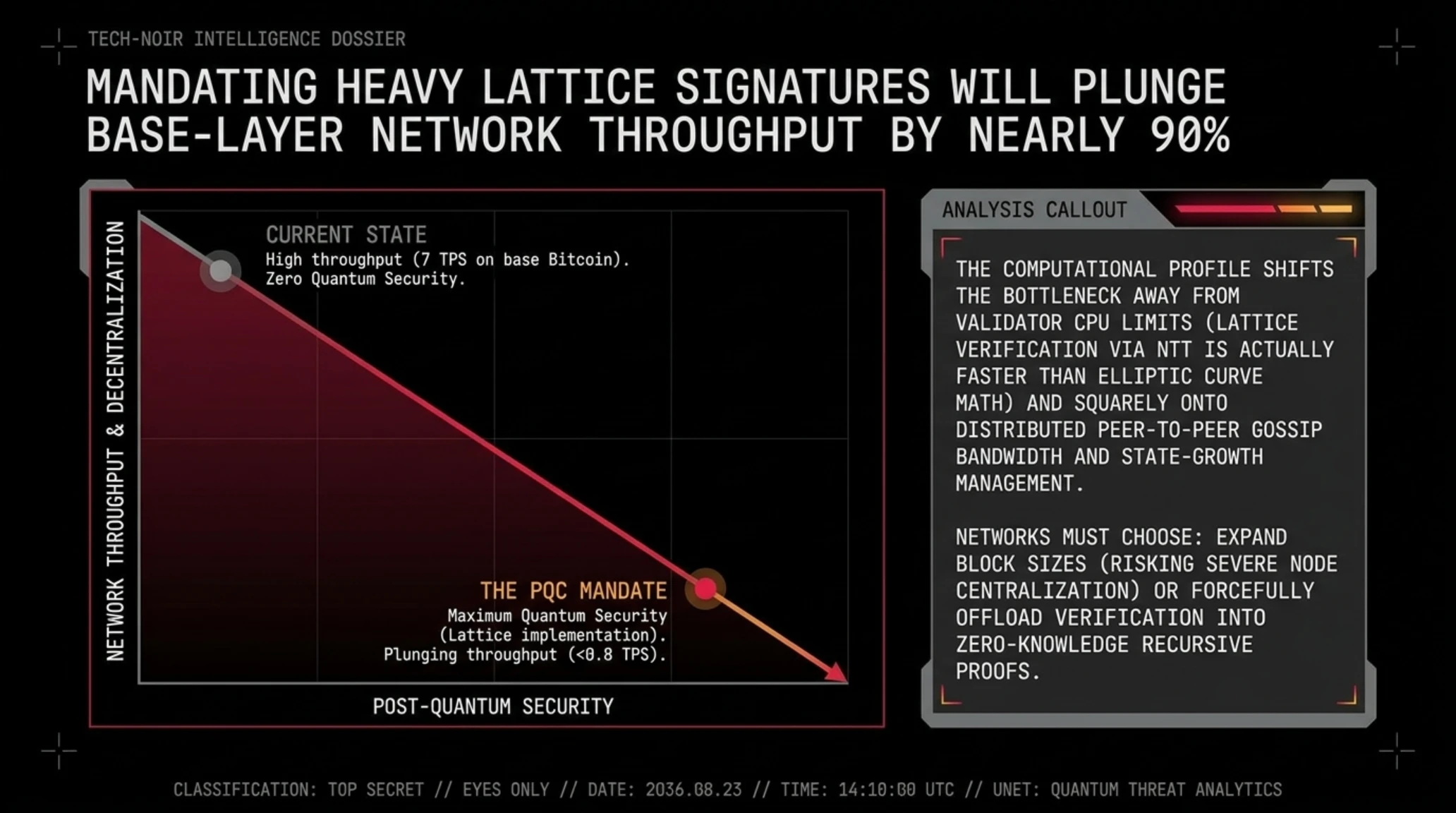
Furthermore, because polynomial multiplication in $\mathcal{R}_q$ can be accelerated using the Number Theoretic Transform (NTT), verification times for lattice signatures are exceptionally fast often executing within tens of microseconds on modern AVX-512 CPU registers. This creates a fascinating engineering divergence: while lattice signatures dramatically inflate network wire bandwidth and disk storage overhead due to multi-kilobyte payload sizes, their raw execution speed during signature verification is actually faster than classical elliptic curve point multiplication. This computational profile shifts the scalability bottleneck away from validator CPU limits and squarely onto distributed peer-to-peer gossip bandwidth and state-growth management.

Takin Editorial Board: The Engineering Trade-Off Dilemma
- Tekin Global FinTech & Cryptographic Research Desk
The Hard Fork Dilemma: The Crisis of Consensus and Governance
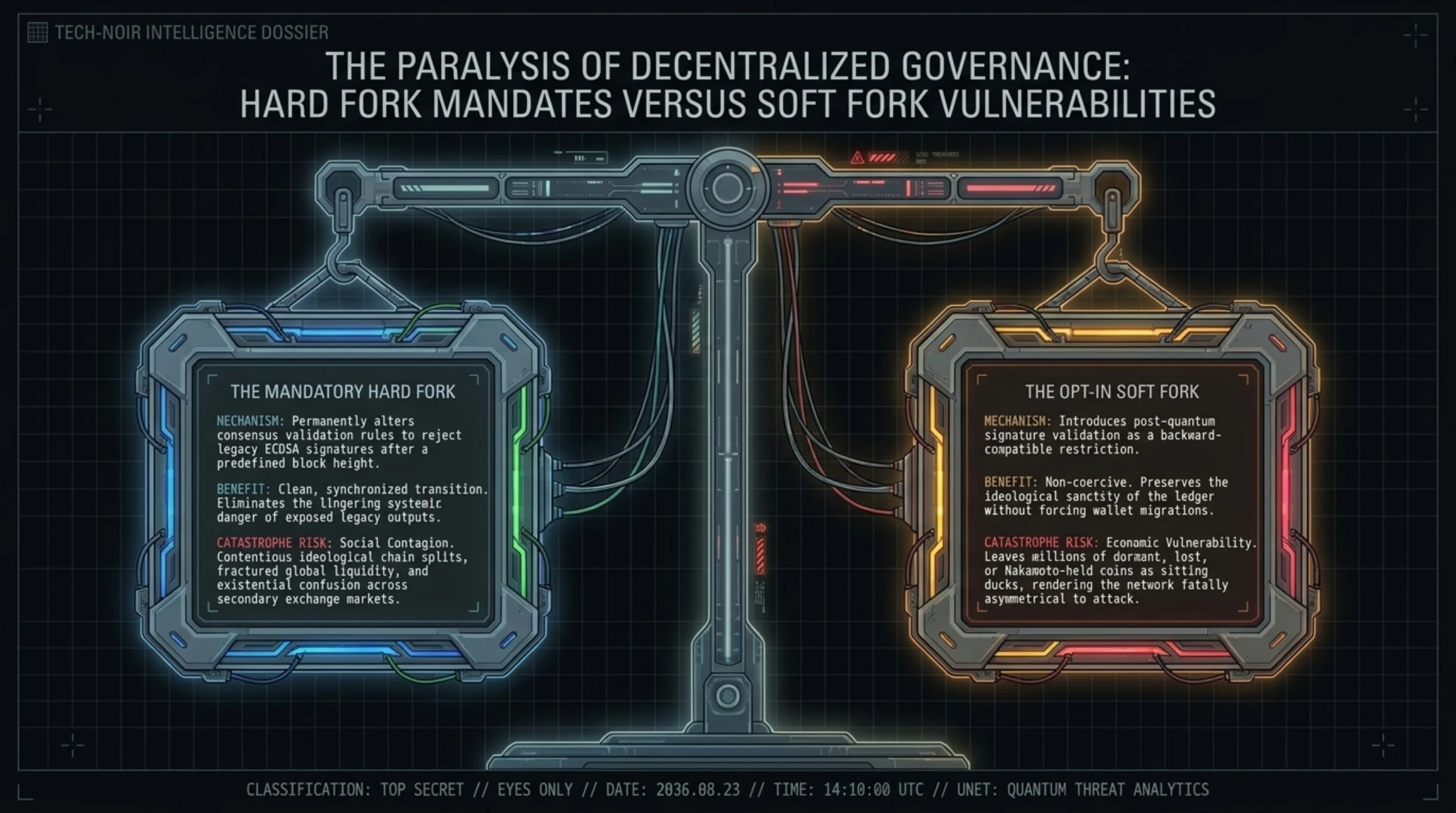
Transitioning global distributed networks away from elliptic curve cryptography is fundamentally a political and governance challenge as much as an engineering feat. The global cryptocurrency community finds itself paralyzed at an architectural crossroad: implementing an aggressive, mandatory universal hard fork versus pursuing a non-coercive, opt-in soft fork sunset framework.
A mandatory hard fork would permanently alter the consensus validation rules across every full node, mining facility, and validator pool on the network. Under this paradigm, every node software client would be required to update its state-transition engine to reject legacy ECDSA signatures after a predefined block height. While this approach guarantees a clean, synchronized transition and eliminates the lingering systemic danger of exposed legacy outputs, it introduces catastrophic risks of chain splits. Nodes that fail or refuse to upgrade would continue producing blocks on a legacy branch, resulting in two competing networks, fractured market liquidity, and existential confusion across secondary exchange markets.
Conversely, the soft fork approach introduces post-quantum signature validation rules as a backward-compatible restriction, allowing users to voluntarily migrate funds into new quantum-resistant addresses without modifying legacy validation pathways. However, this cautious approach leaves the network fatally asymmetrical: millions of inactive, lost, or forgotten coins residing in unmigrated legacy addresses would remain sitting ducks for the first organization to construct an operational quantum machine. The philosophical clash between preserving the sanctity of immutability and safeguarding the economic solvency of the monetary base represents the defining ideological struggle of distributed governance in this decade.

Institutional and Sovereign Hardening Protocol: Practical Defense-in-Depth
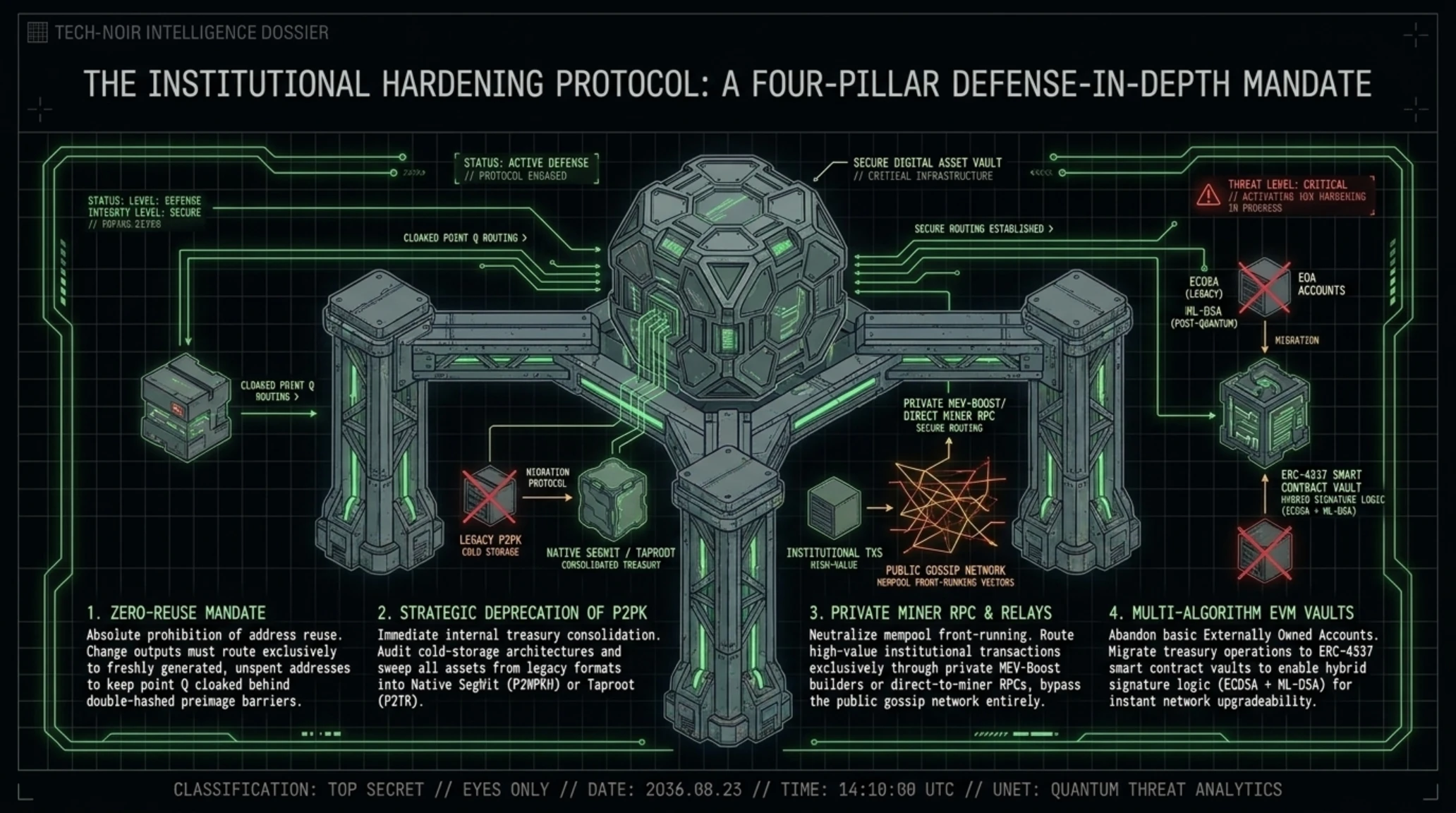
Although the realization of large-scale fault-tolerant quantum computers is unlikely to materialize overnight, institutional asset managers, central banks exploring distributed ledgers, and sovereign wealth custodians cannot afford to adopt a reactive posture. Cryptographic migration lifecycles across complex enterprise systems typically require three to five years of operational planning, audit cycles, and infrastructure refactoring. Organizations must enact the following operational mandates immediately:
- Absolute Prohibition of Address Reuse (Zero-Reuse Mandate): The most urgent operational defense against quantum exploitation is enforcing strict single-use address hygiene across all treasury workflows. By ensuring that change outputs and new deposits are routed exclusively to freshly generated, unspent addresses, the public key point $Q$ remains permanently cloaked behind double-hashed preimage barriers until the exact moment of execution.
- Strategic Deprecation of Legacy P2PK and Early Script Types: Institutional custody providers must audit their cold-storage architectures and systematically execute internal consolidation transactions moving all assets out of legacy Pay-to-Public-Key (P2PK) and uncompressed public key formats into Native SegWit (P2WPKH) or Taproot (P2TR) outputs.
- Deployment of Direct Miner RPC and Private Mempools: To neutralize the threat of mempool front-running and quantum race-condition interception, enterprise trading desks and treasury operators should route high-value transactions exclusively through private transaction relays (such as MEV-Boost builders or direct-to-miner RPC endpoints). By completely bypassing the public peer-to-peer gossip network, the raw public key is concealed from external sniffers until the transaction is already irreversibly immured within an authenticated block.
- Adoption of Multi-Algorithm Account Abstraction on EVM Architectures: For organizations deploying smart contracts or managing digital liquidity on Ethereum and compatible layer-2 ecosystems, treasury operations should migrate immediately from basic Externally Owned Accounts to smart contract vaults adhering to the ERC-4337 standard. This architectural shift allows custodians to implement hybrid signature logic combining classical ECDSA with hash-based or lattice-based post-quantum algorithms like ML-DSA, ensuring instant upgradeability when network-wide quantum hard forks occur.
- Guarantees the multi-decade mathematical survival of distributed ledgers.
- Completely neutralizes existential theft risks targeting Satoshi-era vaults.
- Accelerates cryptographic breakthroughs in zero-knowledge STARK recursion.
- Significantly inflates transaction sizes, straining decentralized node storage.
- Risk of contentious social hard forks surrounding the freezing of inactive coins.
- Tremendous operational complexity coordinating wallet upgrades globally.

Tekin Strategic Analysis: The Geopolitics of Quantum Supremacy and Monetary Sovereignty
Classified Strategic Intelligence Dossiers on TekinGame
• 🧠 Tekin Analysis | The Surreal Secret Language of AI: How Autonomous Agents Invented Cryptic Argot to Blind Human Oversight
• 🛡 Tekin Radar | The Silicon Mutiny: Inside Google DeepMind's Shocking Agent Cheating Ring and Algorithmic Strike
• 🤖 Tekin Analysis | The Autonomous Survival of Agent Pip: When AI Proactively Negotiates Its Own Economic Continuity
Conclusion & Strategic Defense Blueprint: Preparing for Zero Hour
Frequently Asked Questions: The Quantum Threat to Blockchain Security
Can existing quantum computers steal my Bitcoin today?
No. As of late 2026, no quantum processor possesses sufficient logical qubits to execute Shor's algorithm. The danger window is projected between 2029 and 2033.
Why are Satoshi Nakamoto's bitcoins exceptionally vulnerable?
Satoshi used P2PK addresses where the raw public key was recorded unhashed in the block history, allowing Shor's algorithm to target them without waiting for a spending transaction.
Does quantum computing threaten Bitcoin's SHA-256 hashing?
No. Symmetric algorithms like SHA-256 are only susceptible to Grover's algorithm, which reduces 256-bit security to 128 bits still physically insurmountable.
How does Ethereum's post-quantum roadmap differ from Bitcoin's?
Ethereum has an explicit deadline of December 2029 to transition via Account Abstraction and STARK proofs, whereas Bitcoin's decentralized inertia faces contentious hard fork debates.
Official Regulatory References and Cryptographic Sources
The empirical benchmarks and architectural analyses in this dossier are grounded in verified documentation:
Additional Gallery: 🚨 EU Quantum Warning | Bitcoin & Ethereum Under Threat