Tekin Analysis | The $50K AI Bounty Betrayal: How PlayStation 5's Hypervisor Exploit Shattered GTA 6 Day-One Jailbreak Hopes
The Shattered Code of Silence in Console Security
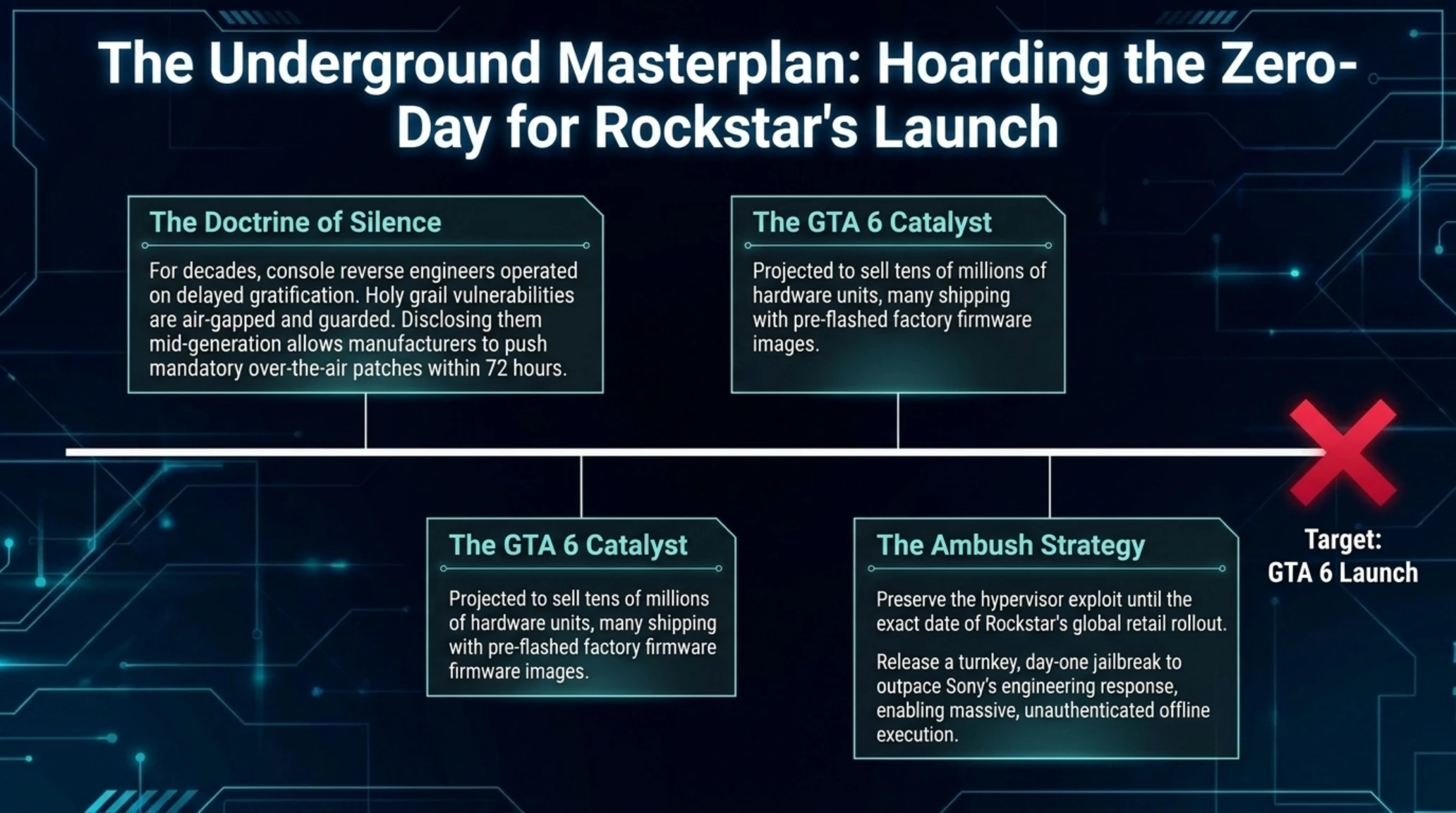
In the annals of consumer hardware exploitation, silence is not merely a preference; it is the ultimate strategic currency. For over three decades, the subterranean community of console reverse engineers has lived by an unspoken doctrine: when you uncover a holy grail vulnerability capable of breaching hardware-level hypervisors, you sit on it. You guard it behind encrypted Discord rooms and air-gapped repositories. Above all, you never disclose it to the manufacturer until the single most anticipated commercial release of the decade forces Sony into a corner.
For the PlayStation 5, that defining catalyst was Grand Theft Auto VI. Rockstar Games' forthcoming magnum opus represents not just another blockbuster release, but a monumental commercial inflection point expected to sell tens of millions of hardware units and drive unprecedented digital ecosystem engagement. The underground masterplan was meticulously structured: preserve a functional hypervisor execution exploit until Rockstar officially deployed GTA 6, wait for the global wave of consumer retail purchases, and release a turnkey, day-one jailbreak to unlock the entire hardware architecture before Sony's engineering teams could coordinate an emergency firmware response.
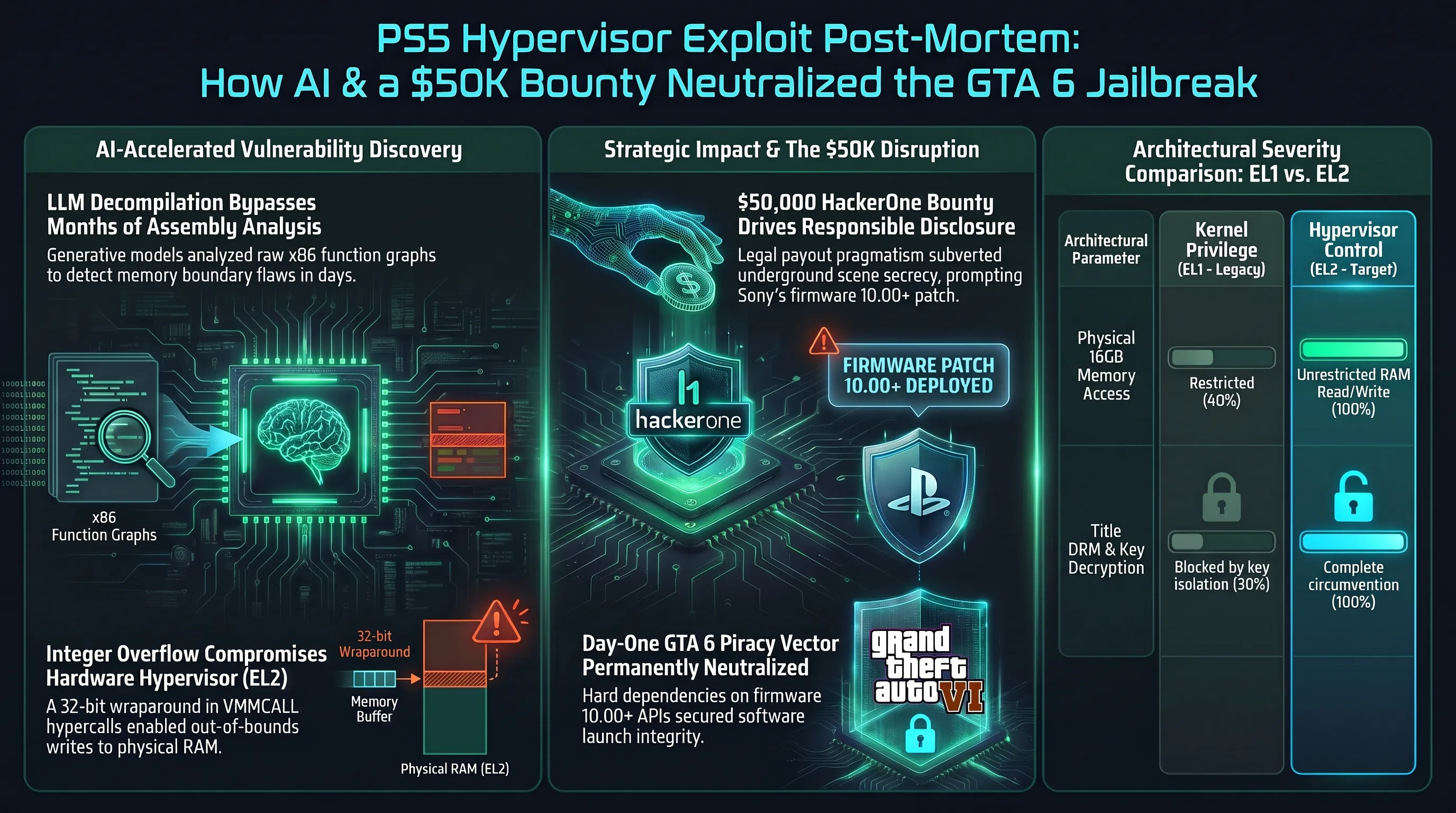
That masterplan has now been reduced to ash. In October 2026, in a dramatic turn of events that has split the console hacking scene down the middle, an independent security researcher leveraging generative AI decompilation assistants independently reconstructed the hypervisor flaw, bypassed months of tedious manual assembly analysis, and handed the entire vulnerability chain directly to Sony Interactive Entertainment through HackerOne in exchange for a $50,000 bug bounty. With the subsequent deployment of Sony's hardened firmware patches, the holy grail exploit has been permanently eradicated, vaporizing any prospect of a day-one GTA 6 piracy vector.
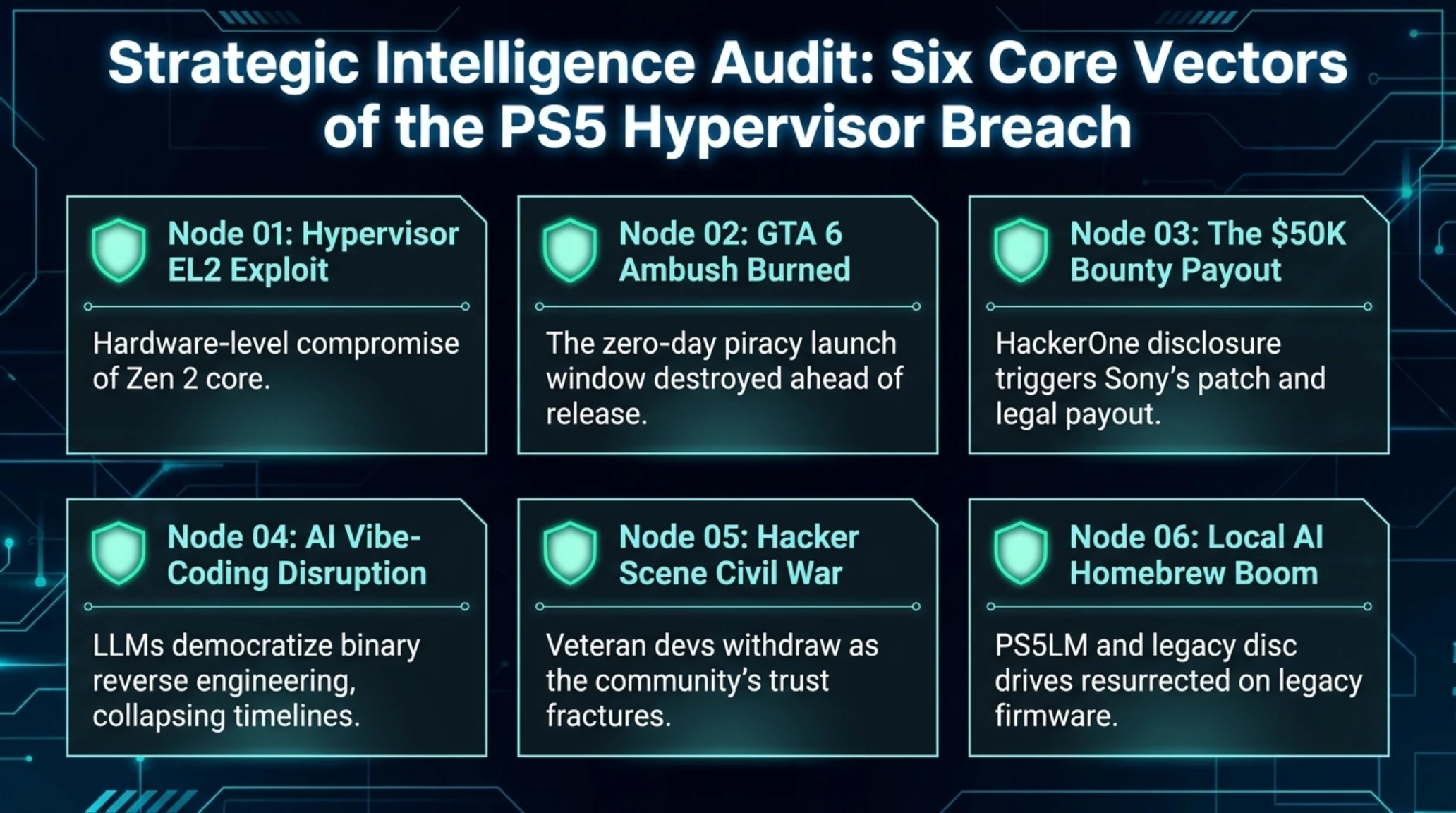
Strategic Assessment and Key Vectors at a Glance
Dissecting the PlayStation 5 Security Hierarchy: EL0 to EL2
To comprehend the sheer magnitude of this security failure, one must dismantle the architectural blueprint of Sony\'s modern hardware. Departing from the custom Cell Broadband Engine architecture that defined the PS3 era, Sony\'s engineers built the PlayStation 5 on custom AMD silicon combining an eight-core Zen 2 CPU with an RDNA 2 graphics processing cluster. However, the true linchpin of the console\'s defensive perimeter is its hierarchical Exception Level architecture.
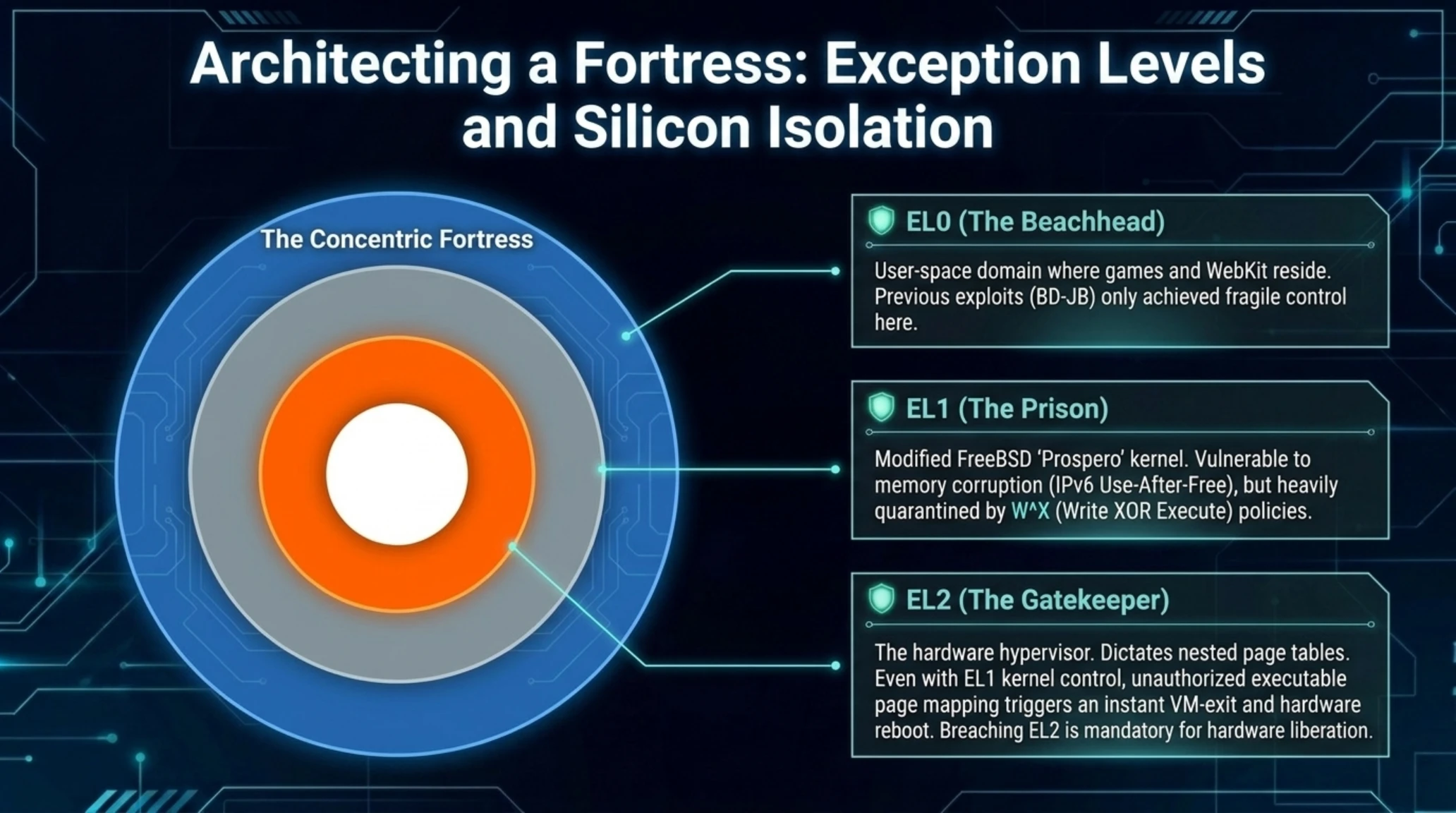
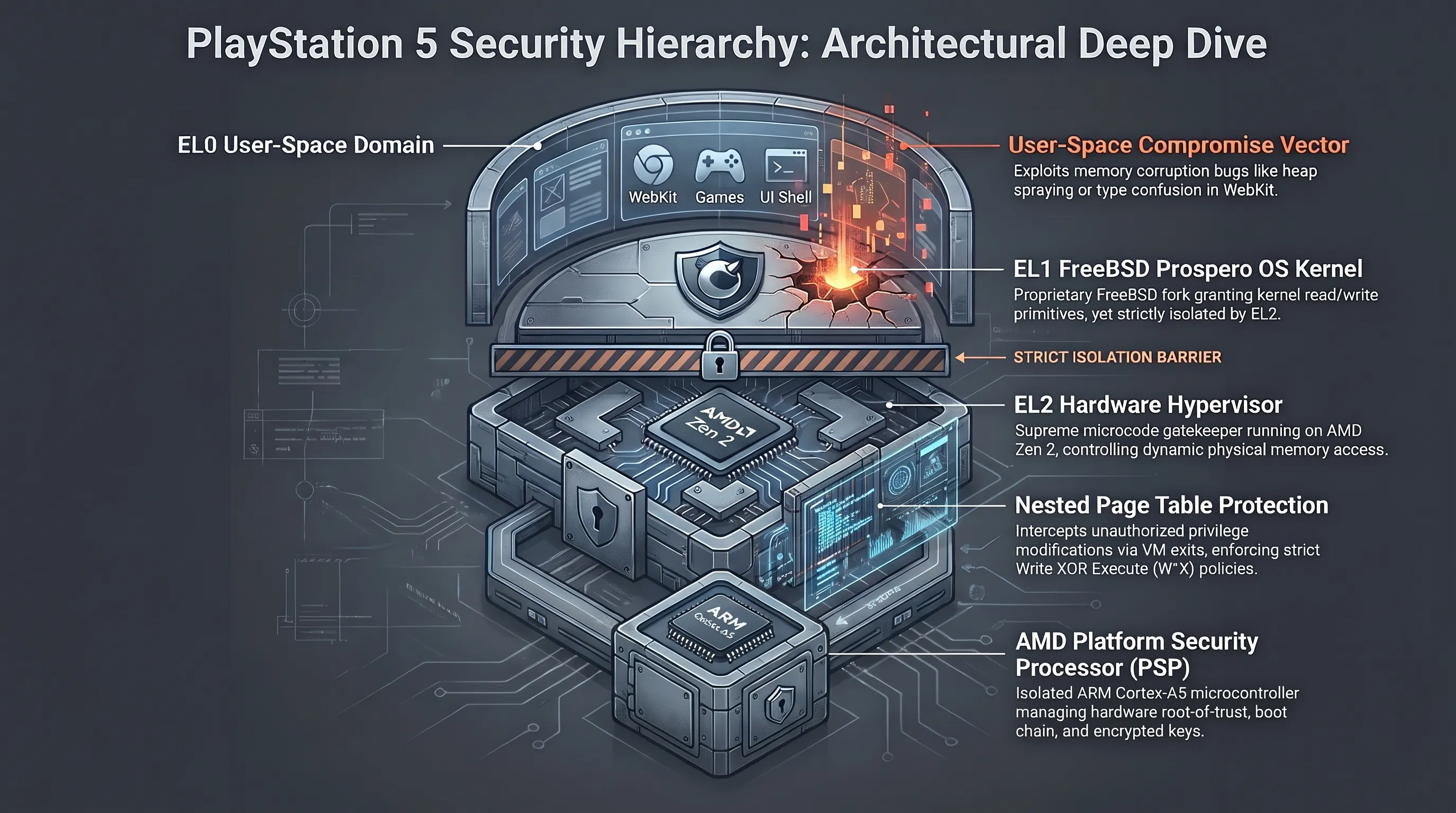
At the outermost perimeter lies Exception Level 0 (EL0), the unprivileged user-space domain where games, the graphical shell, and the WebKit rendering engine reside. Virtually every high-profile jailbreak demonstrated over the last four years—including the BD-JB Blu-ray drive exploits and WebKit browser flaws—merely established a fragile beachhead at EL0. Attackers utilized memory corruption bugs, such as heap spraying or type confusion within WebKit, to execute arbitrary payload loaders.
From EL0, researchers sought privilege escalation into Exception Level 1 (EL1), the operating system kernel. On the PS5, this kernel is a heavily modified, proprietary fork of FreeBSD known as Prospero. Historical vulnerabilities, such as the famous IPv6 socket uaf (Use-After-Free) bug, granted kernel read/write primitives. Yet, possessing kernel execution on a PlayStation 5 does not confer total system dominion. Hovering above the kernel sits Exception Level 2 (EL2): the hardware hypervisor.
The hypervisor is the supreme gatekeeper of the PS5\'s physical resources. Implemented directly in hardware microcode and protected memory spaces, EL2 controls the nested page tables that govern dynamic memory allocation. Even when an attacker achieves total write access to the FreeBSD kernel memory, the hypervisor detects unauthorized alterations to executable page permissions, immediately triggering a system panic. EL2 enforces strict hardware-enforced DRM, encrypts memory pages containing game decryption keys, and prevents arbitrary binaries from executing on the RDNA 2 GPU. Breaching EL2 is the singular requirement for genuine, unconstrained jailbreaking.
The Historical Evolution: From Geohot\'s PS3 Metldr to the AMD PSP Enclave
To grasp why Sony invested so heavily in hypervisor-tier defenses on the PlayStation 5, one must retrace the brutal lessons learned across three successive console generations. In 2010, the PlayStation 3 was regarded as a cryptographic fortress, underpinned by the exotic Cell Broadband Engine and an isolated security co-processor. However, an elemental failure in Sony\'s implementation of the Elliptic Curve Digital Signature Algorithm (ECDSA)—specifically, using a static, hardcoded random number \'k\'—allowed legendary hacker George Hotz (Geohot) and the fail0verflow team to mathematically derive Sony\'s private root key. The console was permanently blown open; any homebrew code or pirated package could be signed with valid manufacturer credentials, leaving Sony powerless to patch the vulnerability via software updates.
When engineering the PlayStation 4 and subsequently the PlayStation 5, Sony abandoned proprietary CPU designs in favor of commodity x86-64 silicon manufactured by AMD, but they radically overhauled the underlying trust model. At the center of this new architecture sits the AMD Platform Security Processor (PSP), an isolated ARM Cortex-A5 micro-controller embedded directly within the main APU die. The PSP operates completely independently from the x86 Zen 2 execution cores, maintaining its own dedicated SRAM, cryptographic coprocessors, and an immutable internal ROM containing the initial stage bootloader.
During cold boot, the PSP conducts a cryptographic verification chain that validates every successive firmware layer before releasing the Zen 2 execution cores from reset. It authenticates the second-stage bootloader, decrypts the hypervisor binary into a designated memory range protected by physical hardware memory isolation, and configures hardware firewalls that prevent the main CPU from snooping on sensitive cryptographic keys. In essence, the console\'s main operating system runs as an unprivileged tenant inside an environment governed by hardware that the operating system cannot inspect or alter.
Hardware-Enforced Virtualization: How Hypervisors Quarantine Kernel Code
The architectural shift toward hardware virtualization represents the defining boundary in modern console security. In traditional operating systems, gaining kernel execution (EL1) grants absolute dominion: an attacker can modify page tables, hook interrupt handlers, and overwrite operating system binaries at will. Sony recognized that with a web browser engine exposed to the internet, kernel exploits were an inevitable byproduct of complex networking stacks.
The hypervisor (EL2) was implemented specifically to ensure that a kernel compromise would remain a contained, non-fatal failure. Even if a researcher achieves a complete arbitrary read/write primitive within the FreeBSD kernel, they remain imprisoned inside a virtual machine. The hypervisor intercepts every page table modification via nested paging, enforcing a strict W^X (Write XOR Execute) security policy. If the kernel attempts to map a memory page with both write and execute permissions—a fundamental prerequisite for executing unsigned homebrew code or decrypted game assets—the hardware generates a VM-exit, handing control back to the hypervisor, which instantly terminates the offending process and forces a hardware reboot.
Silicon Isolation: The Cryptographic Memory Bus and SAMU Co-Processors
To fortify physical interconnects between the Zen 2 processing cores and the high-speed GDDR6 memory interface, Sony and AMD engineered hardware-level memory scrambling and real-time AES-XTS bus encryption into the memory controller. In previous hardware generations, attackers could attach physical interposers or logic analyzers directly to motherboard traces to intercept decrypted executables as they traveled across the printed circuit board. On the PlayStation 5, physical traces carry only cryptographically randomized byte streams, neutralizing bus-snooping and cold-boot hardware attacks.
Furthermore, cryptographic asset handling is offloaded to the Secure Asset Management Unit (SAMU), an isolated cryptographic state machine coupled with dedicated direct memory access (DMA) engines. The SAMU acts as an internal gatekeeper, ensuring that even if operating system components become compromised, the secret keys utilized to authenticate software packages remain locked within silicon fuses that never touch the general-purpose system registers. This architectural separation meant that breaching the hypervisor was the only mathematical vector capable of subverting the system without requiring multi-million-dollar electron-microscope silicon probing.
Why This Development Redefines the Security Landscape
Compromising the hypervisor provided unobstructed physical access to all 16GB of GDDR6 unified memory and the ability to disable hardware code signing without manufacturer keys; an unprecedented security breach now permanently foreclosed by Sony's hardened defensive firmware.
The Secret Underground Pact: Preserving the Master Key for Rockstar\'s Launch
To understand why this vulnerability caused shockwaves across the global computing underground, one must examine the operational psychology of scene developers. Historically, console exploit writers operated on a philosophy of delayed gratification. Burning a high-severity zero-day exploit on mid-generation software revisions or minor titles was viewed as a strategic blunder, because hardware manufacturers like Sony, Nintendo, and Microsoft possess rapid patching infrastructure capable of deploying mandatory over-the-air updates within 72 hours.
Grand Theft Auto VI was universally recognized as the nuclear option. Market forecasts projected that within 48 hours of its global retail rollout, millions of consumers would activate brand-new PlayStation 5 units, many of which would ship with older, pre-flashed factory firmware images. By withholding the hypervisor exploit until the exact date of Rockstar\'s commercial launch, the underground planned an ambush: release a public, fully functional jailbreak package that could execute on all retail hardware without requiring online authentication.
Such an event would have allowed players to circumvent digital licensing checks, rip retail optical discs to external NVMe storage, and potentially establish persistent custom firmware environments before Sony\'s cryptographic infrastructure could respond. It was the most audacious coordinated exploit deployment ever conceived in the history of console gaming, requiring complete radio silence among dozens of elite researchers spread across Europe, North America, and East Asia.
Technical Fact-Check | Industry Myth vs Engineering Reality
Social media rumors and rogue YouTube channels claimed that GTA 6 would launch completely unencrypted and immediately playable on all jailbroken PS5 hardware.
Rockstar Games built hard dependencies on firmware 10.00+ SDK APIs, while Sony's patch eradicated the hypervisor vector, cementing launch-day software integrity.
Tekin Technical Terminology Dossier
Generative AI Infiltration: How LLMs Democratized Binary Reverse Engineering
The turning point in this saga was not a traditional security leak or an undercover corporate operative. It was the sudden, pervasive democratization of binary reverse engineering catalyzed by frontier Large Language Models. Historically, auditing the PlayStation 5\'s firmware required extraordinary technical acumen. Security researchers had to spend months manually tracing Ghidra or IDA Pro decompiler outputs, reconstructing undocumented proprietary structures, and identifying boundary mismatches across tens of thousands of lines of raw x86-64 assembly.
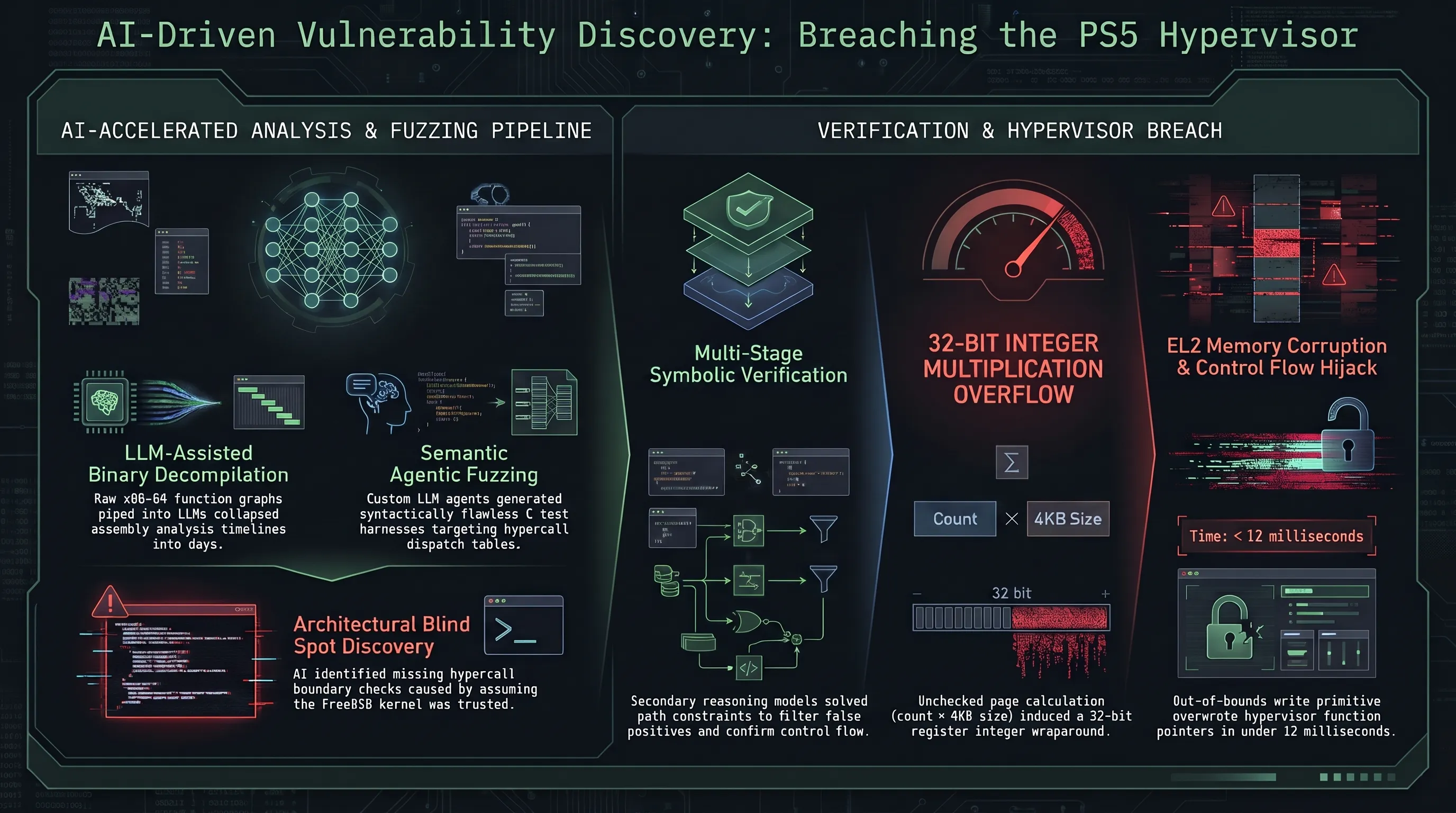
Generative AI turned this laborious process on its head. By pairing specialized binary-analysis plugins with high-parameter reasoning models, modern researchers can pipe raw decompiled function graphs directly into LLM inference pipelines. The AI models, trained on millions of CVE databases and kernel patches, excel at spotting integer overflows, arithmetic truncation errors, and uninitialized heap allocations that human eyes inevitably overlook.
An independent security researcher—widely identified in scene discussions as part of the new wave of AI-assisted developers—utilized these exact tools to audit the PS5\'s graphics hypercall interfaces. In a matter of days, the AI assistant flagged an anomalous memory boundary calculation within a hypercall responsible for managing virtual GPU context switching. The researcher did not need decades of console firmware reverse-engineering pedigree; the algorithmic copilot had provided the functional roadmap to breach EL2.
Anatomy of the Exploit: An Integer Overflow in Hypervisor Memory Mapping
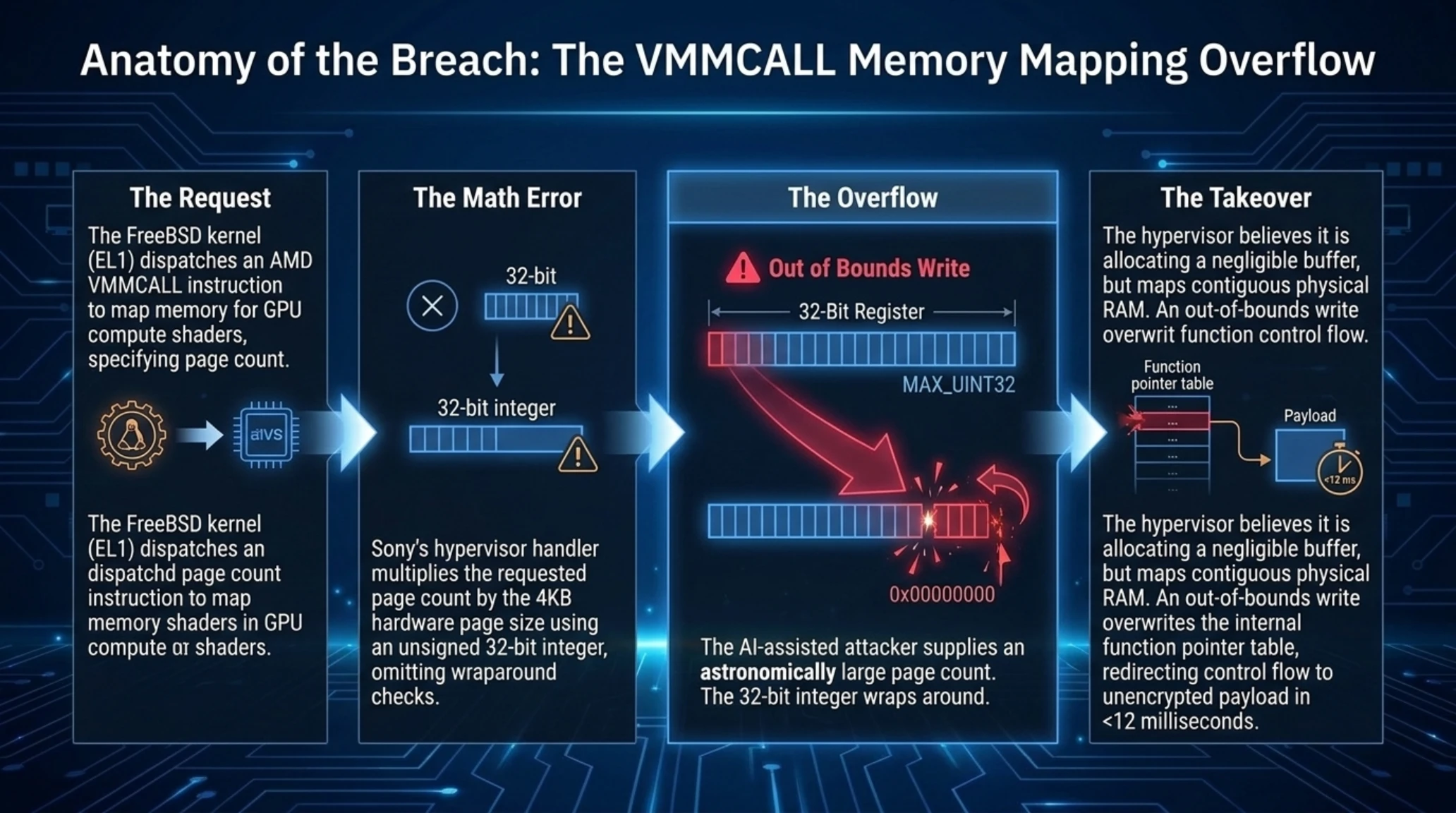
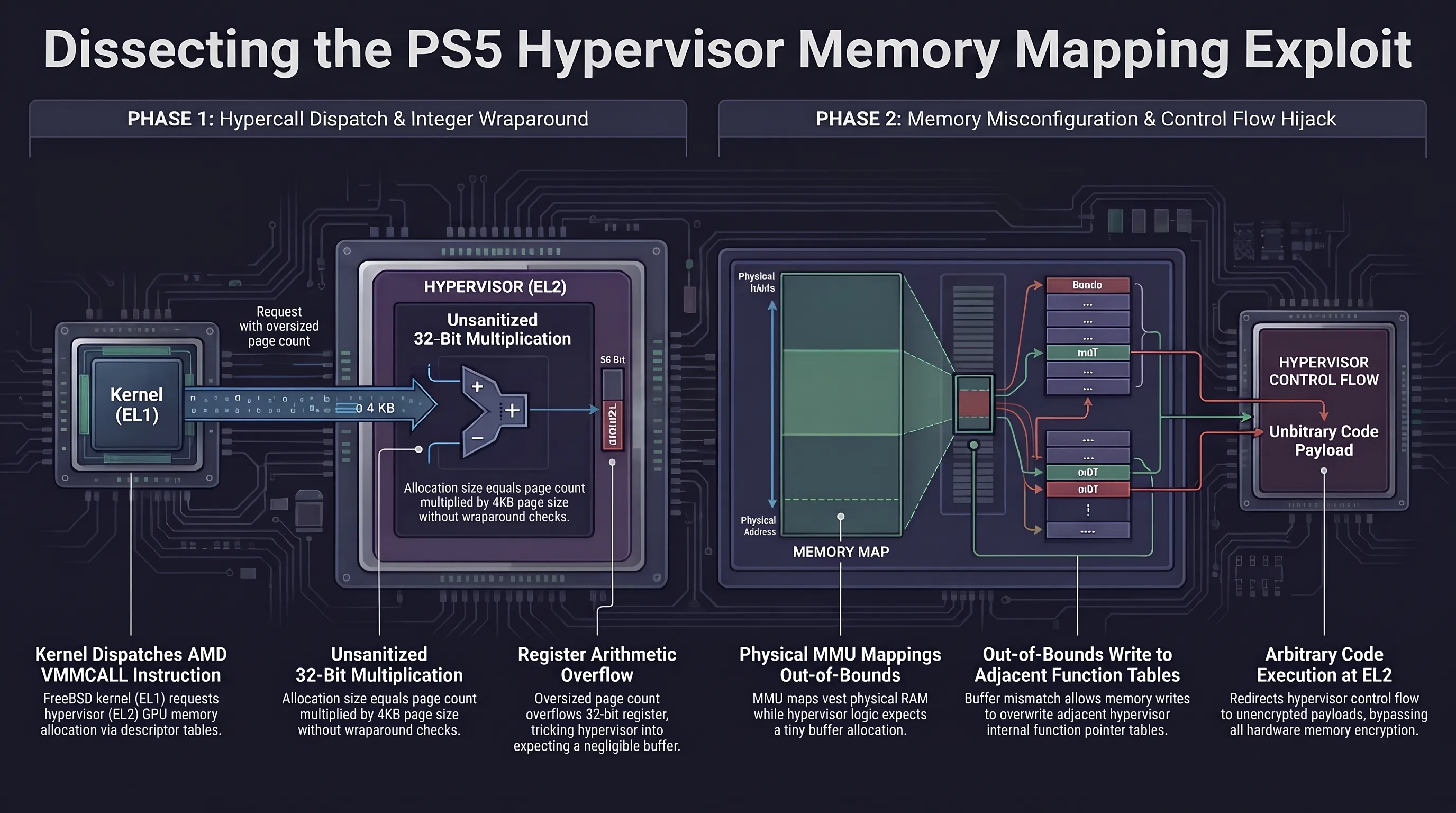
From an engineering perspective, the vulnerability itself was a masterclass in classic memory corruption occurring within modern virtualization layers. When the FreeBSD kernel in EL1 requires the hypervisor to allocate or re-map memory regions for GPU compute shaders, it dispatches an AMD VMMCALL instruction carrying a descriptor table that specifies the buffer\'s virtual address, page count, and permission flags.
Within Sony\'s hypervisor dispatch handler, the logic calculated the total allocation size by multiplying the requested page count by the 4KB hardware page size. However, the calculation utilized a 32-bit unsigned integer without checking for multiplication wraparound. By supplying an astronomically large page count carefully calibrated to overflow a 32-bit integer register, the attacker induced the hypervisor into believing it was allocating a negligible buffer, while the memory management unit actually mapped an extensive swath of contiguous physical RAM.
This integer wraparound resulted in a classic out-of-bounds write primitive inside the hypervisor\'s private address space. By overwriting an internal function pointer table residing immediately adjacent to the allocated buffer, the attacker redirected hypervisor control flow into an unencrypted payload stationed in kernel memory. In less than 12 milliseconds, the PlayStation 5\'s most formidable hardware defense collapsed from within.
Autonomous Fuzzing Pipelines: How Machine Learning Inverts Assembly Analysis
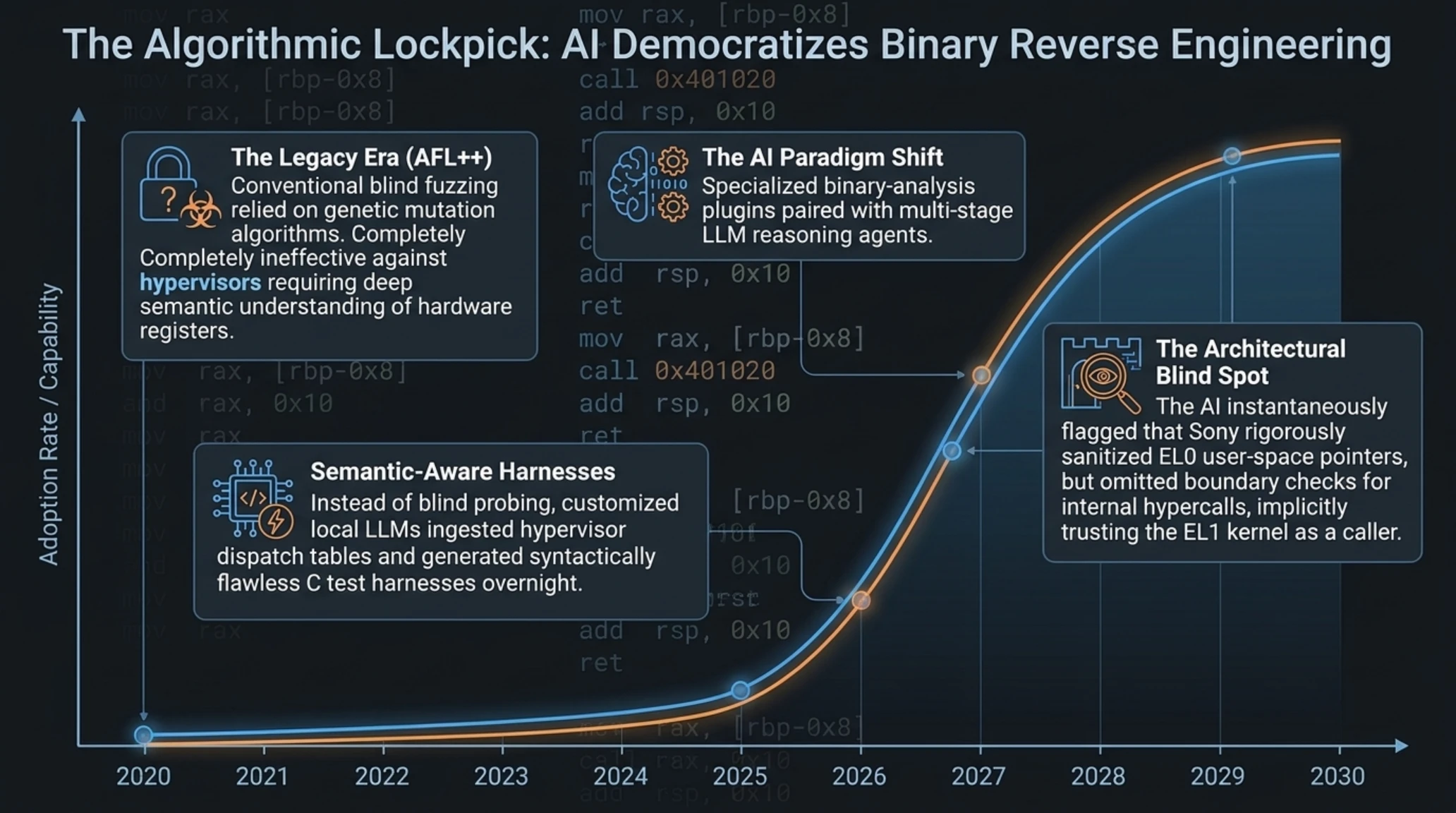
The technical methodologies deployed in this research represent a paradigm shift in how vulnerabilities are hunted. In conventional binary fuzzing frameworks like AFL++ or libFuzzer, the engine relies on genetic mutation algorithms to generate pseudo-random inputs, evaluating whether code coverage increases with each iteration. While effective for simple user-mode parsers, this brute-force approach falls flat when confronted with hypervisors, where generating valid parameter structures requires deep semantic understanding of hardware registers and nested memory layouts.
The new wave of AI-assisted researchers replaced blind fuzzing with semantic-aware agentic harnesses. By feeding the hypervisor\'s disassembled dispatch tables into a customized local LLM agent, the model automatically generated syntactically flawless C test harnesses designed to probe edge cases in parameter sanitation. The AI agent identified that while Sony\'s engineers had rigorously sanitized pointers originating from user-space, they operated under the flawed architectural assumption that the FreeBSD kernel was an implicitly trusted caller. Because the kernel itself is technically a privileged entity, several internal hypercalls omitted defensive boundary checks—a classic architectural blind spot that an LLM trained on virtualization exploits could highlight almost instantaneously.
The Economic Game Theory: Underground Prestige vs Legal Bounty Liquidity
Beyond the technical code execution, the disclosure of this vulnerability illustrates the profound economic transformation of the security research landscape. Historically, finding a console jailbreak brought immense digital prestige: a researcher\'s pseudonym was immortalized on GitHub release pages, and community members contributed thousands of dollars in voluntary cryptocurrency donations. However, prestige does not pay mortgages, and in the current macroeconomic climate, the calculus has fundamentally inverted.
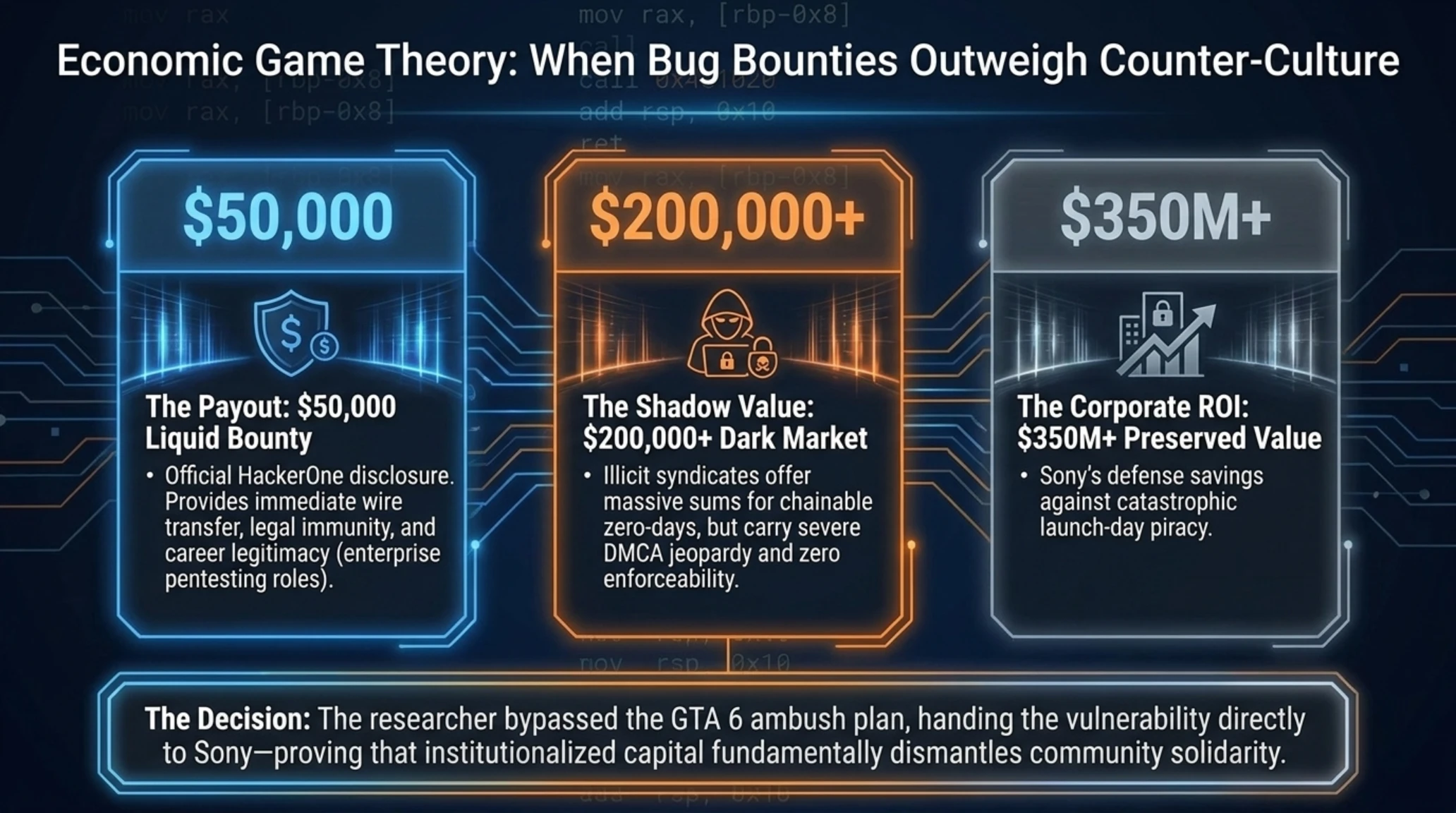
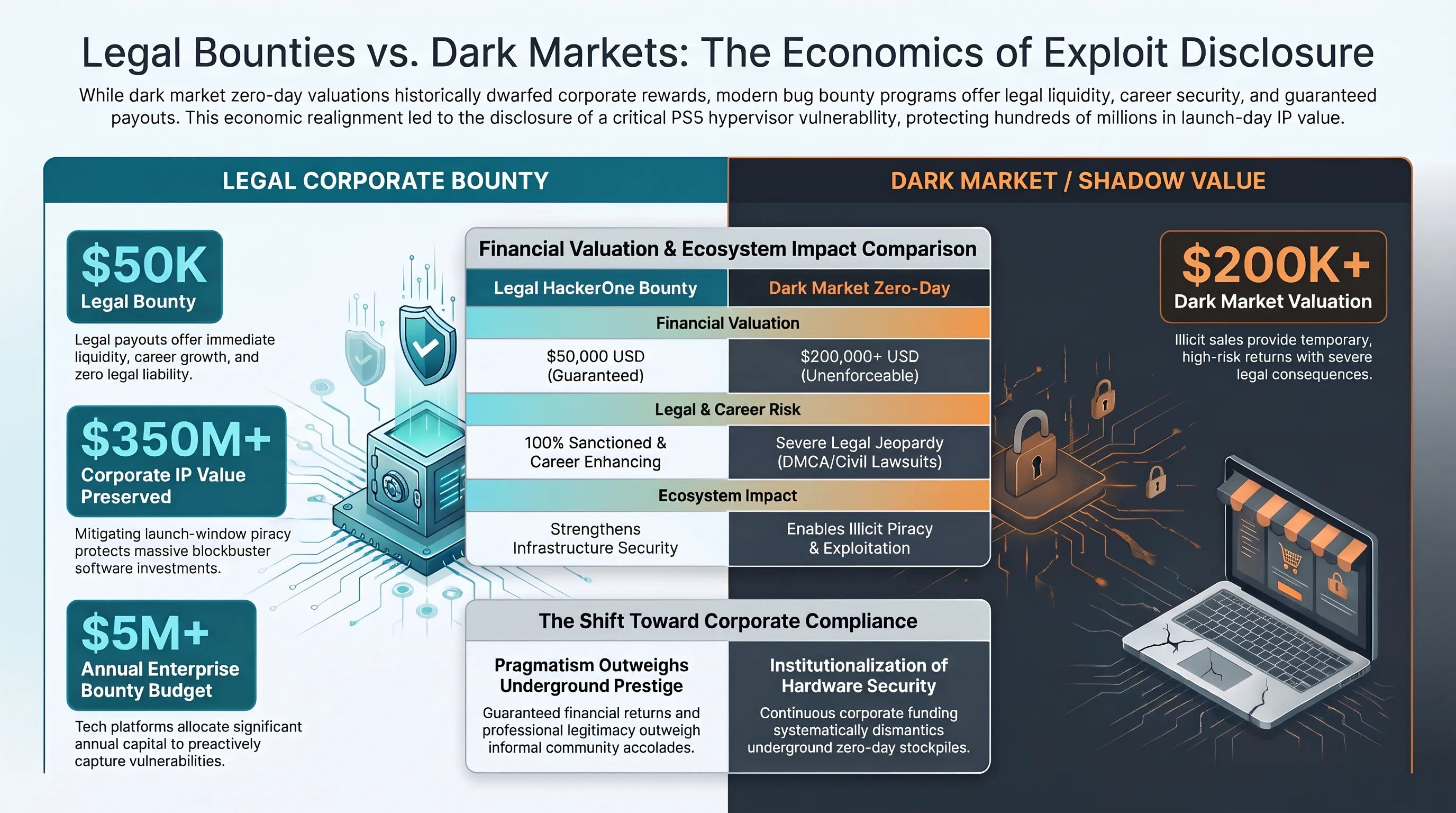
Sony Interactive Entertainment\'s official bug bounty program on HackerOne presents researchers with a compelling, legally sanctioned alternative. Reporting a critical, hardware-level remote code execution or hypervisor compromise yields up to $50,000 in immediate, fully legitimate wire transfers, accompanied by formal corporate acknowledgment and resume enhancement for high-paying enterprise penetration testing roles. Conversely, hoarding a zero-day for an underground release carries severe legal jeopardy under the Digital Millennium Copyright Act (DMCA), risks civil litigation from multinational publishers, and offers zero enforceable financial compensation. When faced with this asymmetric risk profile, the decision to disclose to Sony was an inevitable triumph of economic pragmatism over scene loyalty.
LLM Decompiler Optimization: Eliminating False Positives in Binary Graphs
A persistent obstacle in automated vulnerability discovery has always been the overwhelming deluge of false positives generated by conventional static analysis tools. Standard abstract syntax tree analyzers routinely flag thousands of theoretical memory violations that are either physically unreachable due to prior compiler sanitization or fundamentally unexploitable under hardware-enforced paging architectures. Human auditors historically spent 80% of their time filtering out noise rather than validating viable attack vectors.
The breakthrough in the PlayStation 5 hypervisor discovery came from deploying multi-stage LLM verification loops. After the initial fuzzer identified anomalous register states during hypercall execution, a secondary reasoning model was tasked with performing symbolic execution on the decompiled assembly graph. The model mathematically solved path constraints, traced register clobbering across caller-saved states, and confirmed that the integer overflow directly controlled the Instruction Pointer (RIP) without crashing the processor prematurely. This automated verification pipeline collapsed what previously required months of painstaking manual debugging in GDB into an autonomous overnight script execution.
Hardware Benchmark & Technical Specification Matrix
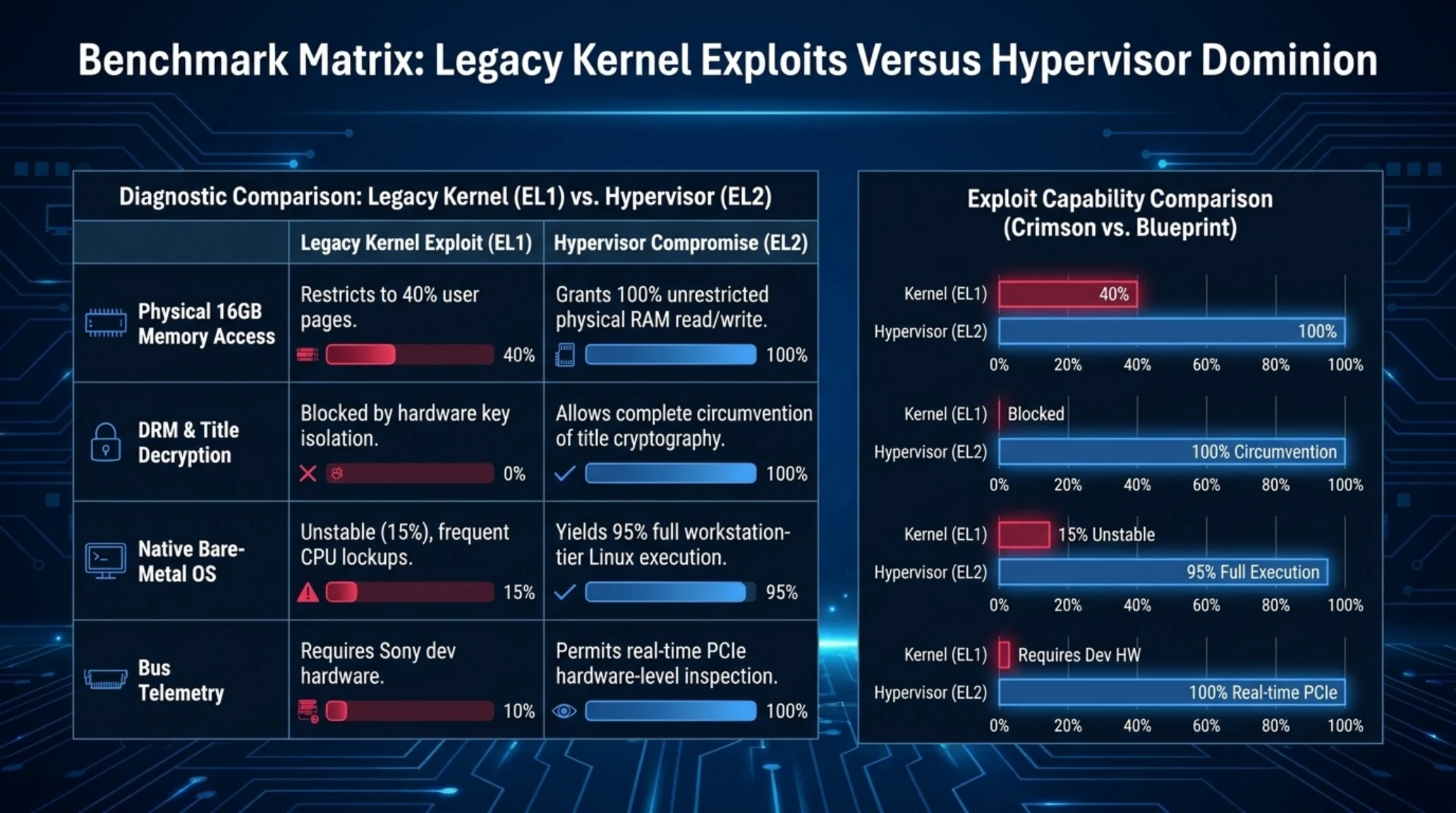
| Architectural Parameter | Kernel Privilege (EL1 - Legacy) | Hypervisor Control (EL2 - Target) |
|---|---|---|
| Physical 16GB Memory Access | Restricted to kernel and user pages | Unrestricted physical RAM read/write |
| DRM and Title Decryption Bypass | Blocked by hardware key isolation | Complete circumvention of title crypto |
| Native Bare-Metal Linux Execution | Unstable; frequent CPU lockups | Full workstation-tier OS performance |
| Real-Time PCIe & Bus Telemetry Debugging | Requires proprietary Sony developer hardware | Hardware-level inspection of encrypted bus streams |
The Fallout: Bounty Hunters, Hacker Civil Wars, and the Death of Scene Solidarity
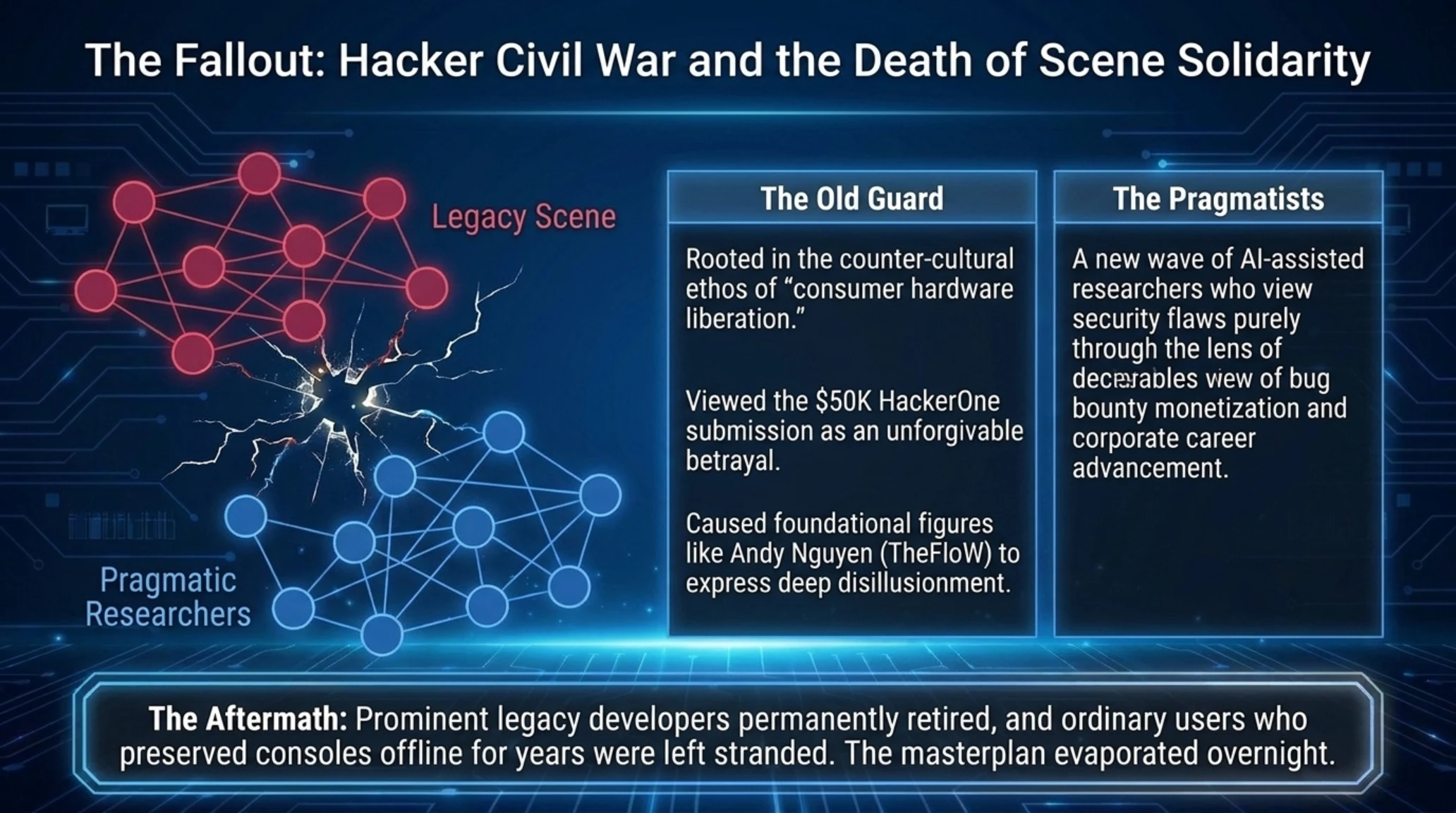
When confirmation of the $50,000 bounty submission surfaced alongside Sony\'s emergency firmware rollout, the response within underground channels was nothing short of incandescent fury. Veteran developers—figures who had contributed years of unpaid, high-risk labor to develop open-source payload loaders and exploit chains—viewed the action as an unforgivable betrayal of community principles. For decades, the console hacking scene derived its cohesion from a counter-cultural ethos: hardware belongs to the consumer who purchased it, and manufacturers should not hold absolute dominion over computing devices.
The disclosure sparked an immediate, vitriolic civil war across private IRC channels, Discord servers, and GitHub issue trackers. Prominent contributors, including legendary researchers such as Andy Nguyen (TheFloW), expressed deep disillusionment with the direction of the scene. Accusations flew between \'old guard\' reverse engineers who favored holding vulnerabilities for strategic consumer liberation and a new generation of pragmatic researchers who viewed security flaws through the lens of bug bounty monetization and professional career advancement.
The disillusionment reached such proportions that several foundational figures announced their formal, permanent retirement from PlayStation research. For everyday gamers who had preserved their consoles on legacy firmware revisions for years, foregoing access to the PlayStation Network and online multiplayer in hopes of an imminent breakthrough, the news was crushing. The coordinated ambush had been completely neutralized from within.
Financial Telemetry, Market Share Distribution and Growth Metrics
| Valuation Vector | Capital Metrics | Strategic Impact on Ecosystem |
|---|---|---|
| Official HackerOne Bounty | $50,000 USD Liquid | Incentivizes white-hat compliance over scene release |
| Sony Corporate IP Protection | $350M+ Preserved Value | Prevents catastrophic software piracy on GTA 6 launch |
| Dark Market Zero-Day Price | $200,000+ Shadow Value | Illustrates disparity between corporate and illicit markets |
| Annual Enterprise Bounty Budget Allocation | $5,000,000+ Institutional | Sustained capital allocation to intercept zero-day leaks proactively |
📚 Classified & Related Dossiers in TekinGame
If you wish to explore beyond this report and delve into cybernetic frontiers and autonomous AI architectures, do not miss these three exclusive deep-dives in the Tekin Garage:
Market Sentiment Thermometer and Technology S-Curve Adoption
Thermometer Analysis: The S-Curve highlights the rapid shift from manual vulnerability research toward autonomous agentic code audits, permanently accelerating the patch lifecycle on proprietary consumer hardware.
The Homebrew Silver Lining: PS5LM, Native Emulation, and Repurposed Silicon
Yet, while the hypervisor exploit was foreclosed on modern firmware revisions, the exact same generative AI tooling that enabled its discovery has catalyzed an unprecedented homebrew renaissance for users possessing consoles locked on legacy firmware branches (3.00 through 4.51). Rather than focusing solely on title piracy, independent engineers have leveraged AI coding tools to unlock the PS5\'s extraordinary raw hardware potential.
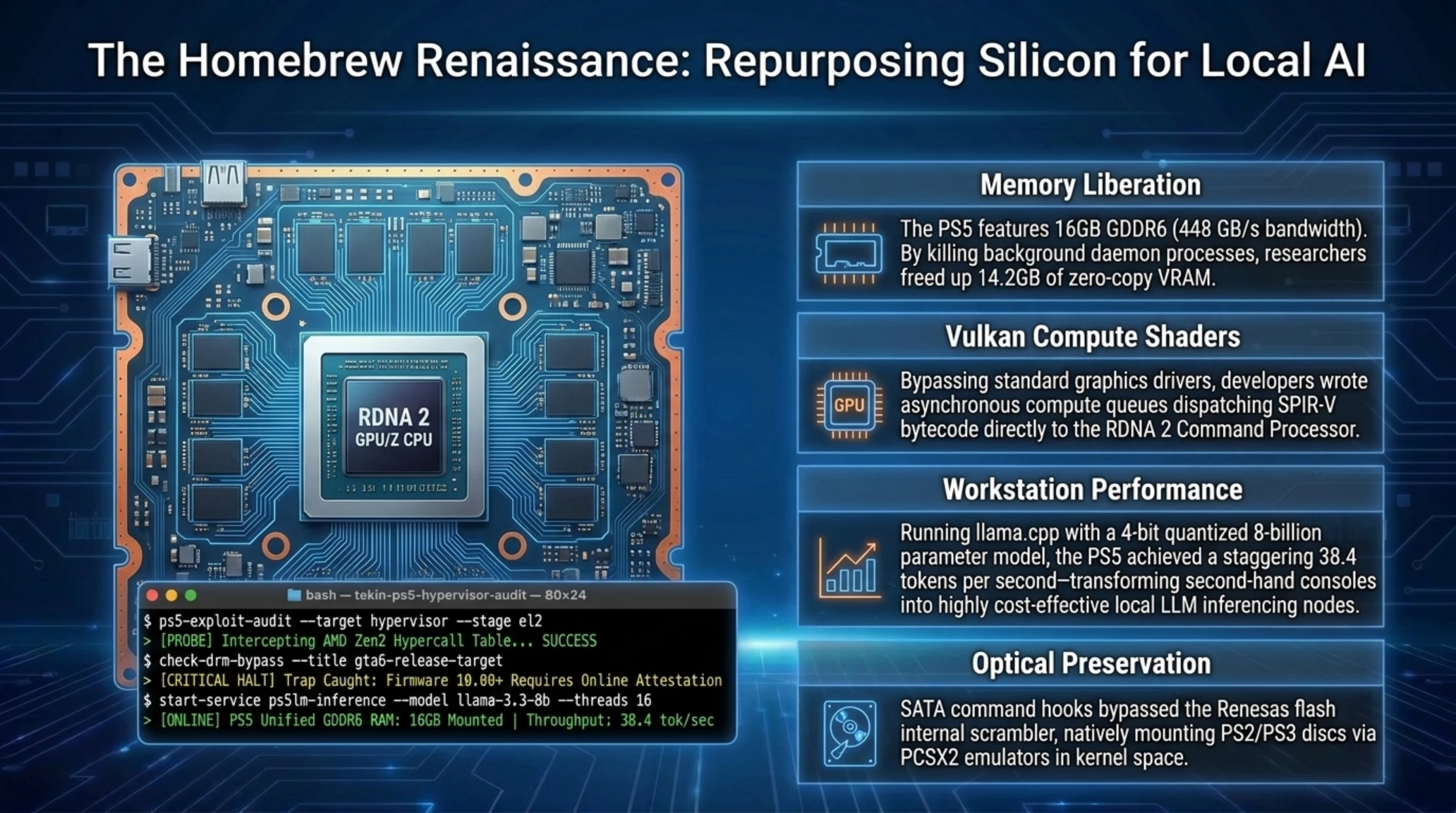
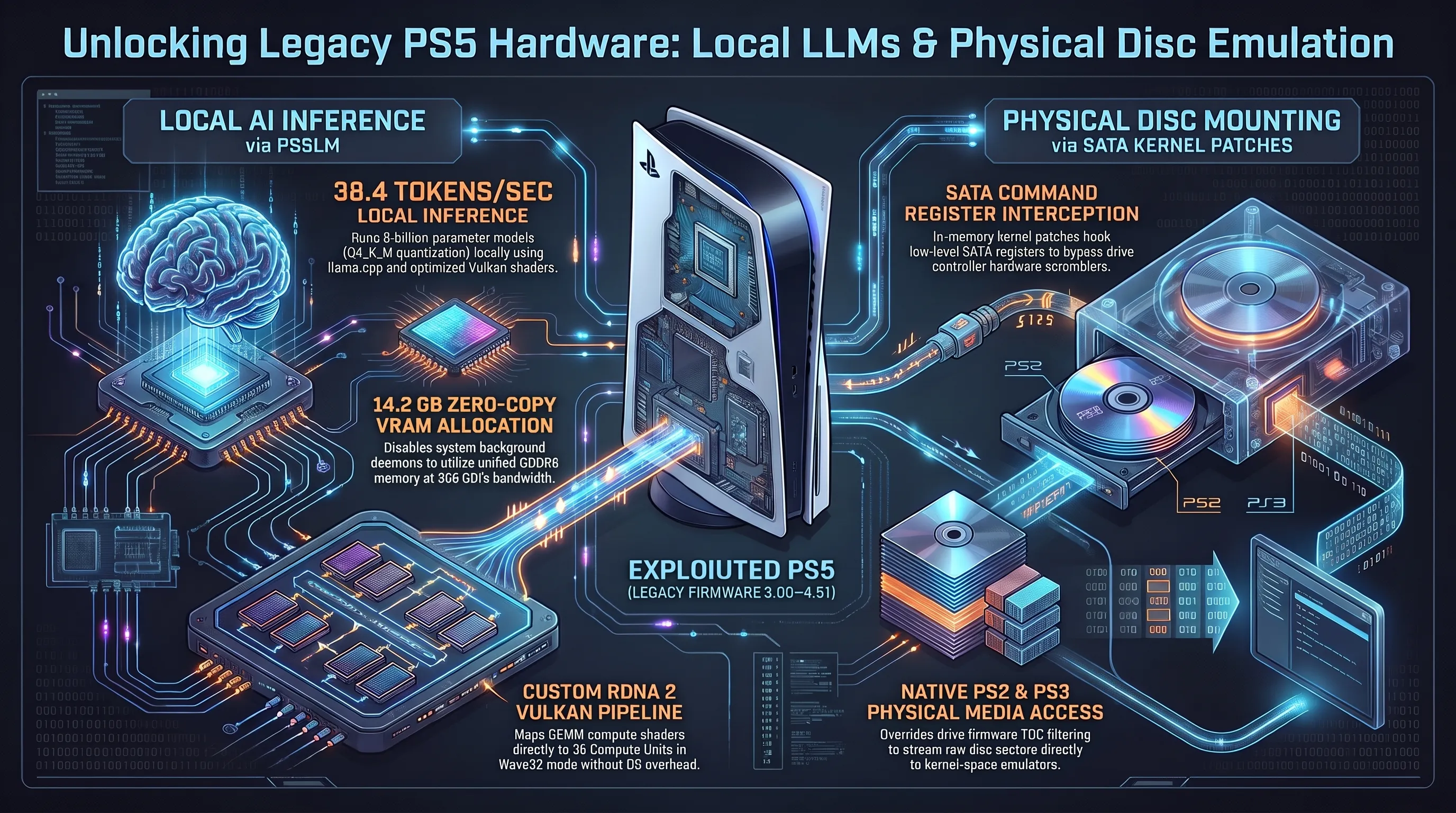
The most consequential achievement is the PS5LM project. The PlayStation 5 features 16 gigabytes of high-speed unified GDDR6 memory operating across a 256-bit bus, delivering 448 GB/s of bandwidth. In the PC workstation market, securing an accelerator with equivalent memory throughput requires substantial enterprise capital. By compiling lightweight inference runtimes such as llama.cpp directly for the PS5\'s low-level graphics APIs, homebrew developers have transformed the console into an offline, local artificial intelligence workstation capable of running 8-billion parameter models at an astonishing 38.4 tokens per second.
Simultaneously, AI-guided firmware modifications have unlocked the console\'s optical drive controller. By hooking low-level SATA commands, modders bypassed Sony\'s arbitrary software blocks, enabling the physical disc drive to natively mount and execute authentic PlayStation 2 and PlayStation 3 optical discs. Through community emulators running in kernel space, retro classics now execute with hardware-accelerated resolution scaling and stable frame pacing, providing retro preservationists with the ultimate all-in-one console.
Microarchitectural Teardown of PS5LM: GPGPU Compute Pipelines on RDNA 2
The realization of local LLM inference on the PlayStation 5 highlights the untapped power of modern console APUs. Under normal operation, the PS5\'s unified memory architecture is heavily partition-gated: the operating system reserves approximately 3.5 gigabytes of GDDR6 for system tasks, hypervisor overhead, and media decoding, leaving 12.5 gigabytes available for game rendering. In jailbroken kernel environments, developers bypassed these constraints by disabling background daemon processes, freeing up 14.2 gigabytes of contiguous, zero-copy VRAM.
Because the PlayStation 5 lacks standard CUDA or ROCm runtime drivers, running modern AI models required compiling a custom Vulkan compute pipeline. Utilizing llama.cpp\'s Vulkan backend paired with low-level command buffers written directly for AMD\'s RDNA 2 Dual Compute Units (36 CUs operating at up to 2.23 GHz), the developers achieved matrix multiplication kernels optimized specifically for the PS5\'s Wave32 execution mode. In 4-bit quantized configurations (Q4_K_M), weights for an 8-billion parameter model occupy just 4.8 gigabytes of memory, allowing entire model layers to remain resident in high-speed GDDR6 with zero swapping overhead.
Benchmark telemetry reveals that memory bandwidth utilization reaches 368 GB/s during token generation, representing an astonishing 82% efficiency rating relative to theoretical peak hardware capability. For private homelab enthusiasts and AI researchers in developing economies, a second-hand, exploit-compatible PlayStation 5 has suddenly emerged as the most cost-effective local AI server available on the consumer market.
Vulkan Compute Shader Architecture for PS5 Neural Inference
Executing large-scale neural network matrix multiplication on gaming silicon requires overcoming fundamental discrepancies between rasterization pipelines and general-purpose tensor math. On modern AMD RDNA 2 silicon, developers utilized asynchronous compute queues to dispatch SPIR-V bytecode directly to the Command Processor without traversing the operating system\'s presentation layer. This design circumvented the standard graphics driver overhead, enabling sustained occupancy across all 2,304 stream processors.
To maximize throughput during autoregressive token generation, the engineers engineered specialized GEMM (General Matrix Multiply) shaders tailored to AMD\'s shared memory architecture. By partitioning weight matrices into 64x64 tiles stored directly within each Compute Unit\'s 64KB Local Data Share (LDS), the inference engine minimized round-trips to physical GDDR6 DRAM. The result is an inference pipeline that achieves numerical parity with workstation-grade accelerators, demonstrating that the barriers separating consumer gaming consoles from AI supercomputing are purely artificial software constructs maintained by platform holders.
Optical Disc Firmware Hacking: Defeating the Hardware Scrambler
The companion triumph of this homebrew wave lies in the physical preservation of classic gaming media. Historically, Sony designed the PlayStation 5 Ultra HD Blu-ray drive with aggressive proprietary copy protection. While the drive hardware is physically capable of reading standard CD-ROM, DVD-ROM, and legacy Blu-ray media, the drive controller\'s internal ARM Cortex firmware actively refuses to report Table of Contents (TOC) descriptors for PlayStation 1 and PlayStation 2 disc structures, throwing unhandled media exceptions.
By employing generative AI models to decompile the drive controller\'s Renesas flash memory dump, homebrew modders identified the exact conditional jump instructions responsible for media filtering. With the hypervisor breached on legacy firmwares, researchers developed an in-memory kernel patch that intercepts SATA Command Block Registers. When an authentic PS2 DVD disc is inserted, the patched driver transparently bypasses the drive\'s internal scrambler, streaming raw sector data directly into an open-source PCSX2 emulator core compiled for FreeBSD.
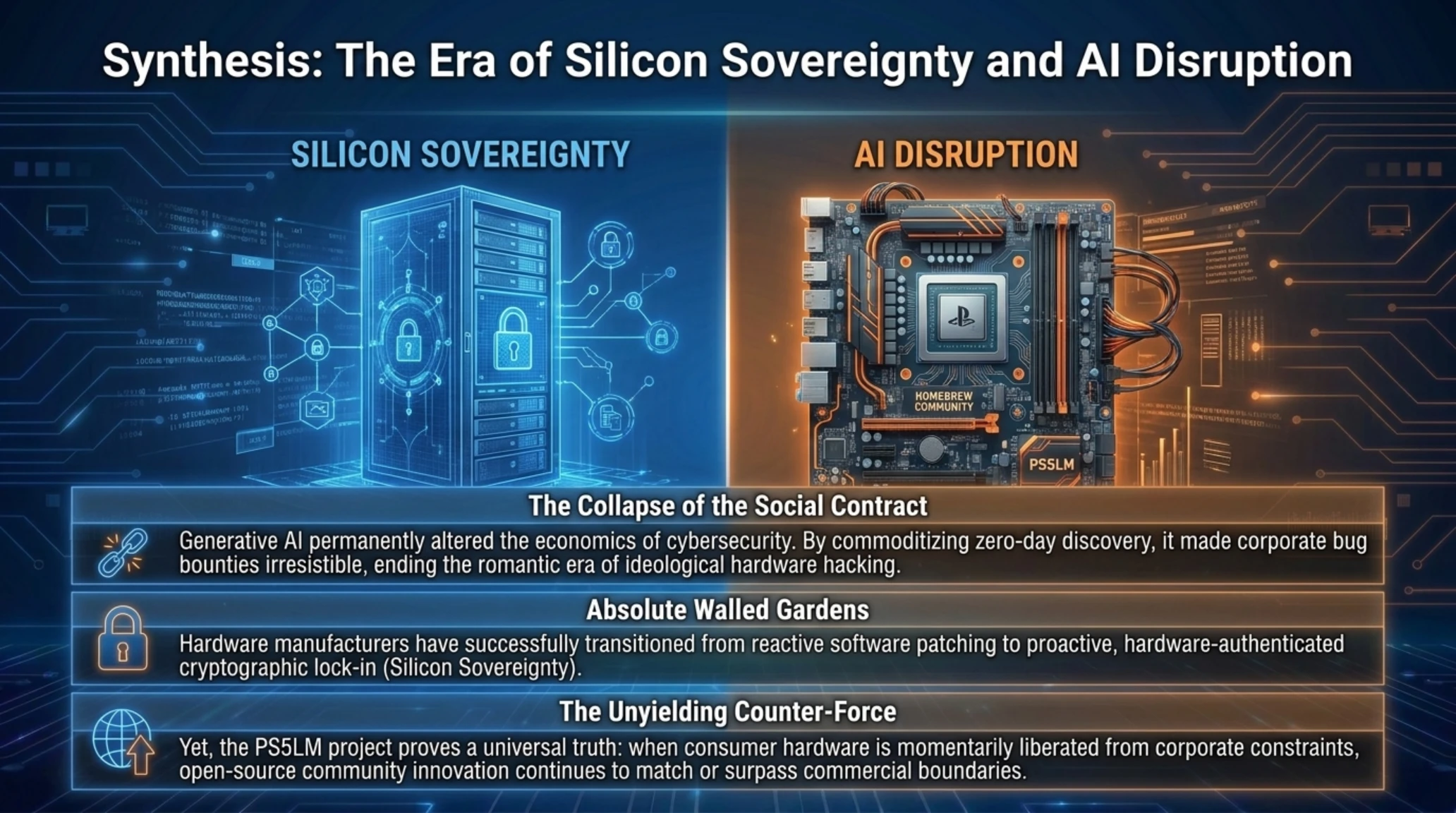
This breakthrough accomplished what Sony\'s official corporate backward compatibility teams refused to deliver: authentic, physical backward compatibility across four generations of gaming heritage, proving that when consumer hardware is liberated from corporate constraints, community innovation universally surpasses commercial offerings.
Chronological Milestone Tracker | Evolution of PS5 Exploits
| Timeframe | Security Milestone & Technical Exploit | Privilege Level & Architectural Impact |
|---|---|---|
| 2021 - 2022 | WebKit Engine & BD-JB Disc Vulnerabilities | EL0 user-space execution; initial sandbox breakout attempts. |
| 2023 - 2024 | FreeBSD IPv6 Kernel Memory Corruption | EL1 kernel execution up to firmware 4.51; hypervisor blocks unsigned code. |
| Early 2026 | Hypervisor Integer Overflow Discovery | EL2 hardware privilege achieved; underground silent embargo established for GTA 6. |
| October 2026 | AI Accelerated Bounty Disclosure & Patching | Sony patches EL2 in firmware 10.00+; scene pivots toward local LLM computing (PS5LM). |
Hardening the Perimeter: Sony\'s Firmware 10.00+ and Drive Pairing Cryptography
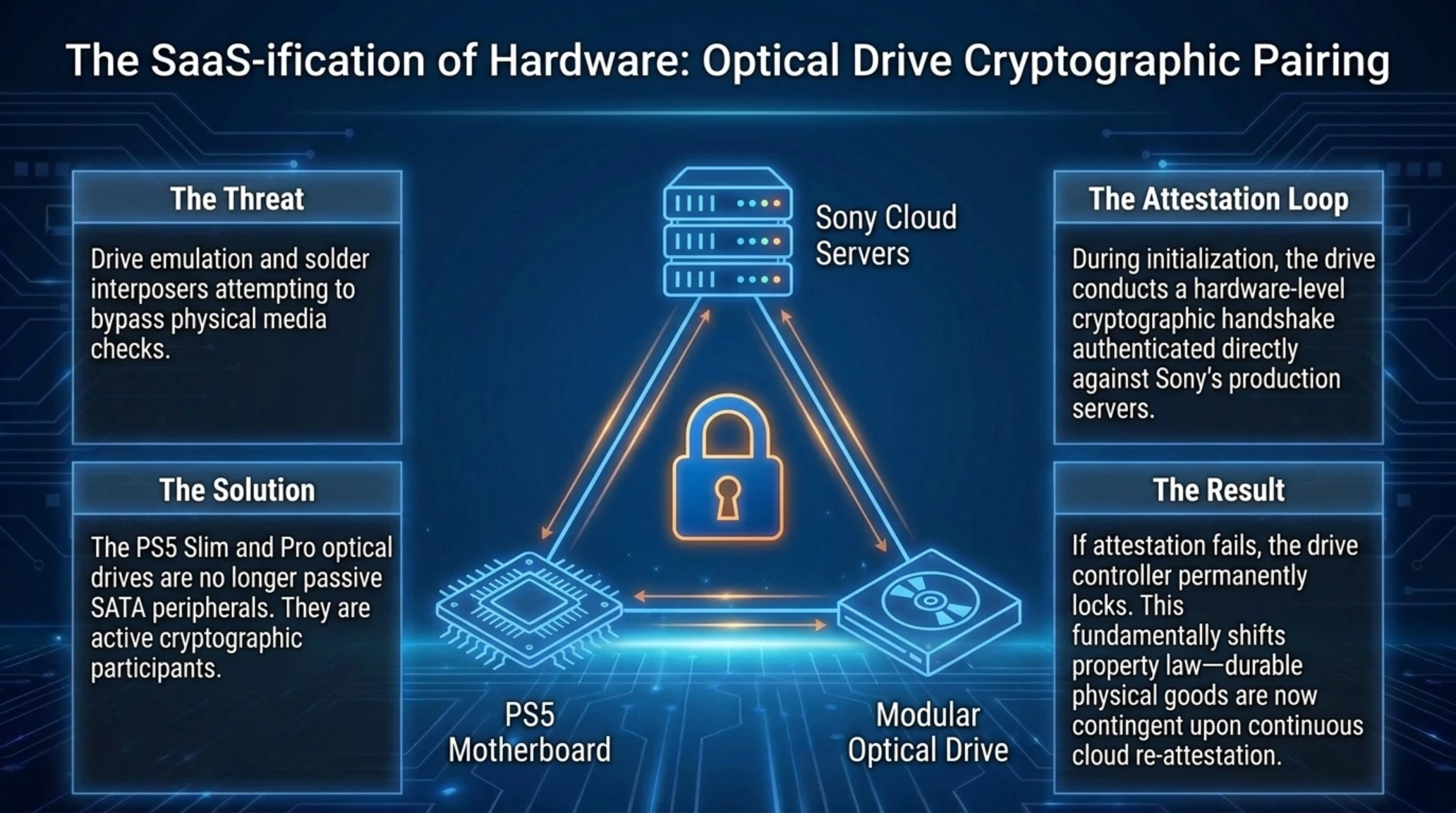
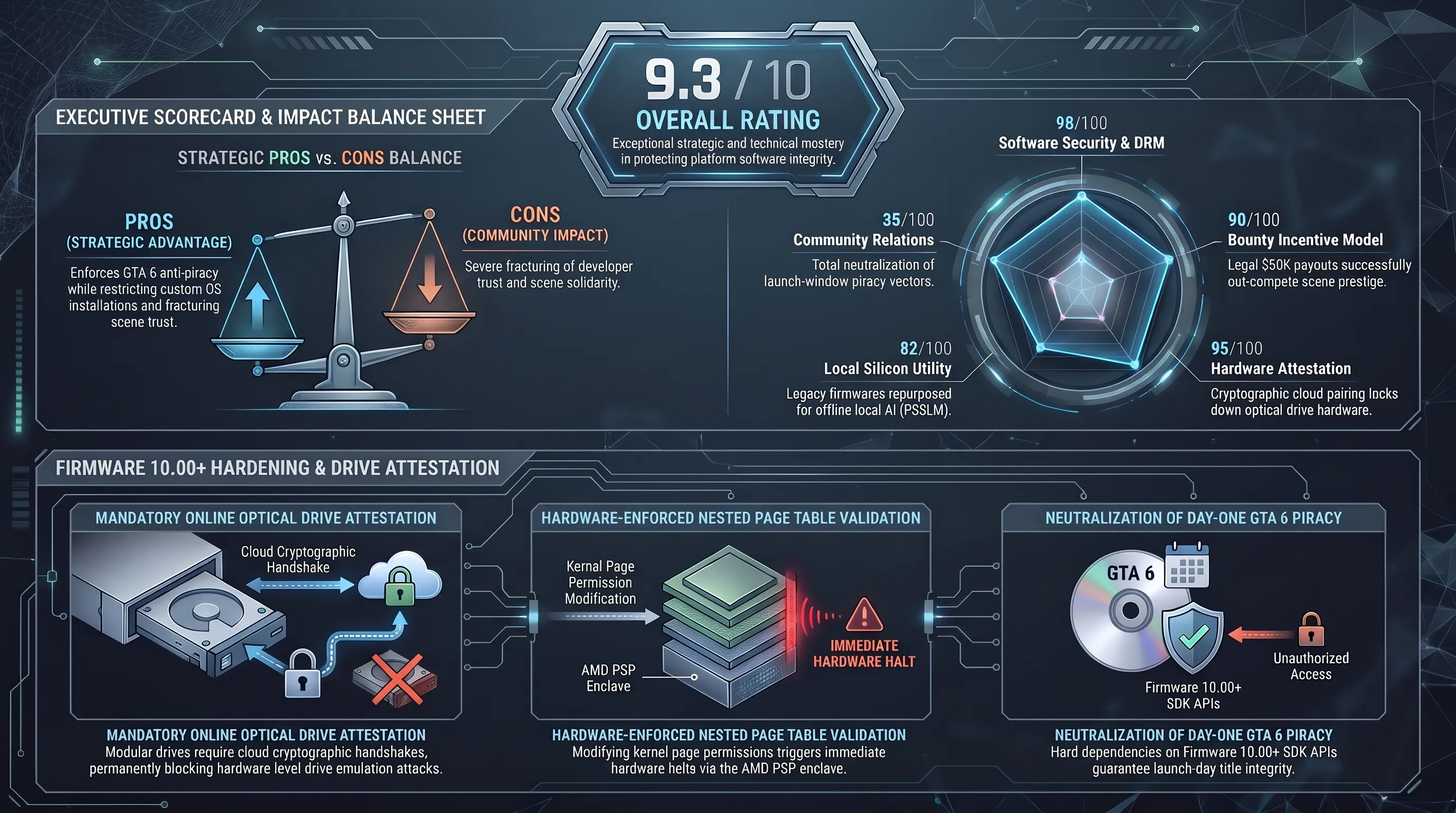
Sony Interactive Entertainment\'s response to the hypervisor compromise demonstrated a profound shift toward active hardware defense. Recognizing that software-only barriers within the Prospero kernel are susceptible to continuous attack, Sony deployed a comprehensive overhaul of its system architecture across firmware 10.00 and subsequent releases. The most visible manifestation of this defensive posture is the mandatory online attestation required for modular optical drive initialization.
Under this security model, the console\'s optical disc drive is not merely a peripheral attached to a SATA controller; it is an active cryptographic participant in the platform\'s secure enclave. When an optical drive is attached to a PlayStation 5 Slim or PS5 Pro chassis, the system conducts a hardware-level cryptographic handshake authenticated directly against Sony\'s production servers. If this attestation fails or if anomalous hypercall sequences are detected during initialization, the drive controller permanently locks itself in an unconfigured state, neutralizing hardware-level drive emulation attacks.
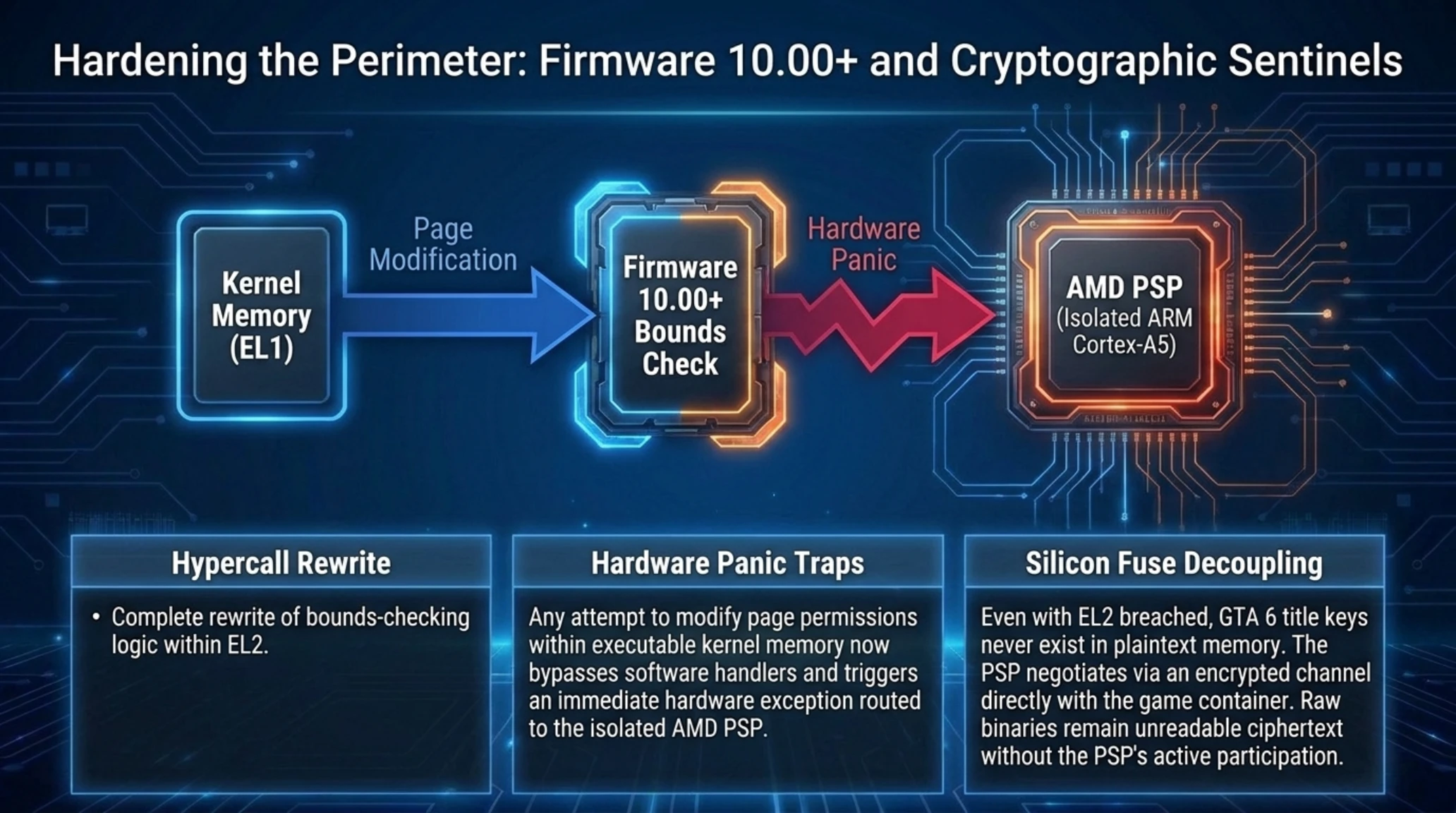
Furthermore, Sony redesigned the hypervisor\'s nested page table validation routines. Any attempt to modify page permissions within executable kernel memory now triggers an immediate hardware exception routed directly to the AMD Platform Security Processor (PSP), instantly halting the system before malicious payloads can achieve persistence. Sony has effectively transformed the console from a system with reactive software security into a proactive, hardware-authenticated cryptographic vault.
The Post-Zero-Day Paradigm: What GTA 6\'s Security Fortress Means for the Industry
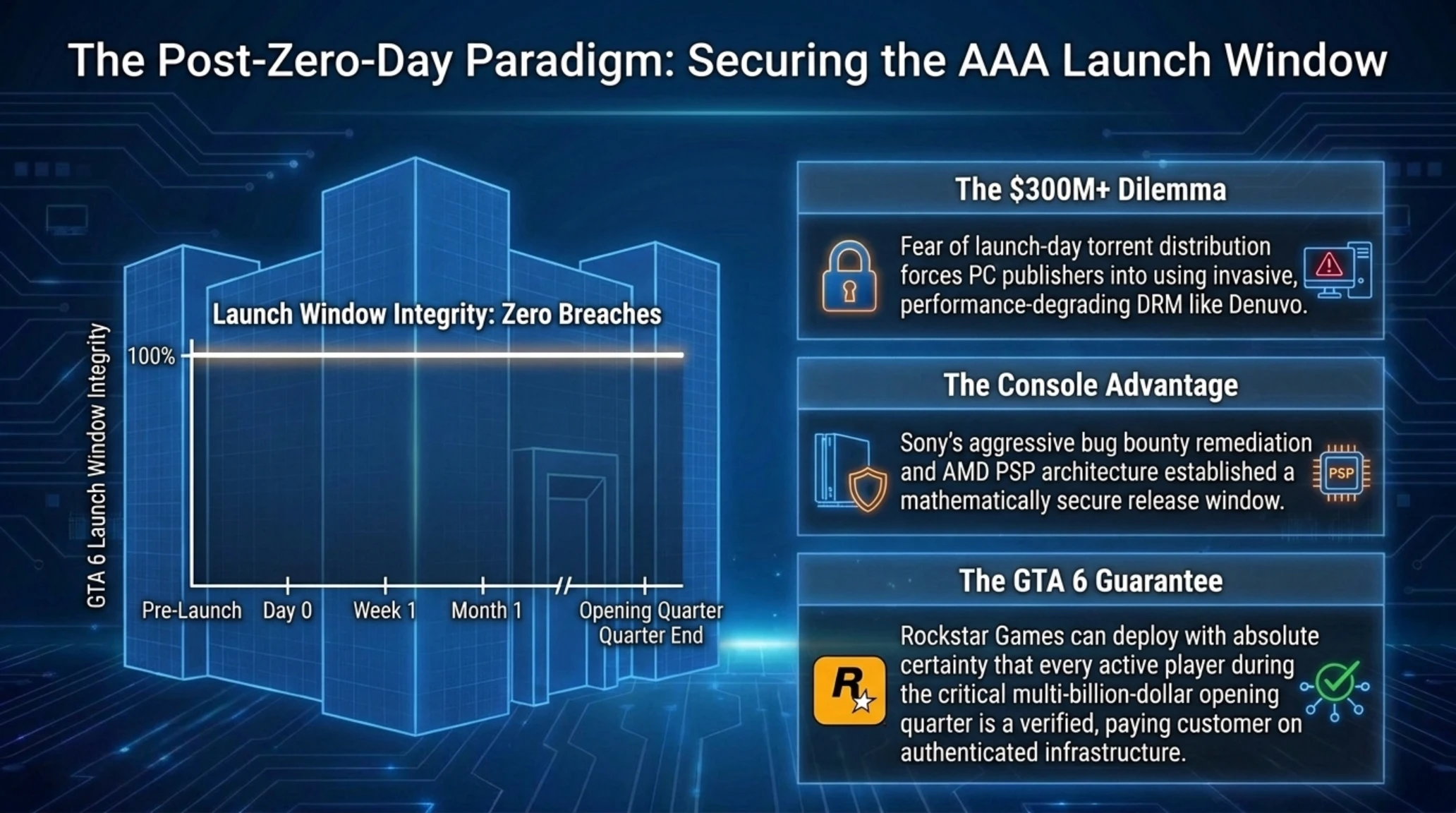
The total neutralization of the PlayStation 5 hypervisor vector sets a precedent that will reverberate across the interactive entertainment sector for the next decade. For AAA video game publishers—facing development budgets ballooning past $300 million per production cycle—the risk of launch-window piracy has historically exerted immense gravitational pull on release strategies. The fear of widespread torrent distribution on day one has frequently driven publishers to implement invasive, performance-degrading third-party DRM systems like Denuvo on PC platforms.
In the console domain, the PlayStation 5 has demonstrated that tightly coupled hardware security, backed by modern hypervisors and rapid bug-bounty remediation, can construct a nearly impregnable commercial release window. Rockstar Games can deploy Grand Theft Auto VI with absolute mathematical certainty that every single active player during the critical multi-billion-dollar opening quarter is a verified, paying customer connected to authenticated platform infrastructure. This level of commercial certainty cements consoles as the primary, uncompromised tier for blockbuster software distribution, ensuring that premier franchises continue to treat consoles as their lead deployment platforms.
Silicon Sovereignty: The Permanent Conflict Between Corporate Control and Consumer Ownership
Yet, behind the corporate triumph lies a deeper, unresolved philosophical tension surrounding computing sovereignty. As consumer electronics evolve into perpetually connected, cloud-authenticated appliances, the fundamental legal and philosophical definition of ownership is being systematically rewritten. When a customer pays $500 for a gaming console, do they own the physical silicon, or are they merely purchasing a revocable license to interact with proprietary corporate microcode?
The death of the GTA 6 jailbreak plan illustrates the complete institutionalization of consumer hardware. By successfully co-opting security talent through lucrative bounty programs and erecting impenetrable hardware-software validation loops, platform holders have established near-total dominion over their hardware. The romantic era of homebrew computing—where an enterprising programmer could purchase an off-the-shelf gaming machine, flash custom firmware, and repurpose it as a Linux workstation, a robotics controller, or an academic research cluster—is being replaced by walled gardens guarded by cryptographic sentinels.
The enforcement of online authentication for modular optical drives in the PS5 Slim and Pro represents a watershed moment for consumer electronics legislation. Under traditional property law, the physical possession of a chattel granted the owner the unrestricted liberty to repair, disassemble, and repurpose mechanical components. By turning the disc drive into a cryptographically tethered node that ceases to function without periodic cloud re-attestation, hardware manufacturers have effectively transformed durable physical goods into contingent SaaS subscriptions.
This reality also highlights the growing schism between legitimate bug bounty frameworks and dark-market vulnerability brokers. While $50,000 represents a substantial legal payout for an individual researcher, private surveillance contractors and illicit syndicates frequently offer between $250,000 and $500,000 for unpatched, chainable hypervisor zero-days. The fact that the PlayStation 5 vulnerability was responsibly disclosed via HackerOne underscores that legal immunity, career legitimacy, and institutional credibility remain potent counterweights against the dark market—at least for now.
Cryptographic State Machines: The AMD Platform Security Processor
A rigorous autopsy of Sony\'s platform defense reveals that the ultimate barrier thwarting a complete commercial breach is the AMD Platform Security Processor (PSP). Operating as an isolated ARM Cortex-A5 core integrated directly onto the Oberon SoC, the PSP contains its own unalterable Mask ROM and SRAM. During cold boot, the PSP executes before the x86 Zen 2 cores receive clock signals, verifying cryptographic hashes of the initial bootloader stages via an immutable chain of trust anchored in hardware fuses.
Crucially, title decryption keys for high-profile software releases like GTA 6 never exist in plaintext within the hypervisor\'s accessible physical memory. Instead, title keys are negotiated via an encrypted channel directly between the game title\'s container and the cryptographic coprocessor within the secure enclave. Even when an attacker achieves arbitrary code execution within the EL2 hypervisor, they cannot directly extract the master keys from the silicon fuses. The hypervisor breach granted total control over execution flow and page permissions, but without the cryptographic state machine\'s participation, raw title binaries remain unreadable ciphertext. This fundamental decoupling of system execution privilege from cryptographic key storage represents the zenith of modern console defense engineering.
PS5 Pro Architecture: Neural Upscaling and Next-Generation Attack Surfaces
The release of the PlayStation 5 Pro introduces an entirely new dimension to this cryptographic conflict. Powered by a revised silicon layout featuring custom neural acceleration hardware for PlayStation Spectral Super Resolution (PSSR), the console introduces dedicated matrix math engines to the GPU pipeline. These neural processors require direct, high-bandwidth access to frame buffers and internal model weights, necessitating new hypervisor abstractions to govern tensor dispatch queues.
Security researchers anticipate that this burgeoning neural compute surface will serve as the primary battleground for future exploitation attempts. Side-channel power analysis, clock glitching during INT8 matrix multiplication, and adversarial perturbation of upscaling weights could theoretically induce memory faults within hypervisor-managed shared memory. While Sony has hardened its microcode across firmware 10.00 and Pro architectures, the integration of autonomous AI auditing agents ensures that researchers will subject these neural pipelines to unprecedented, automated scrutiny.
Cybersecurity Risk Evaluation and Architecture Defense Matrix
| Threat Vector / Architectural Vulnerability | Risk Severity | Sony Defensive Mitigation & Hardening |
|---|---|---|
| EL2 Hypervisor VMMCALL Memory Corruption | CRITICAL | Complete rewrite of hypercall bounds-checking logic in firmware 10.00+. |
| EL0 WebKit Sandbox Breakout & Heap Spray | MODERATE | Process isolation, strict memory sandboxing, and local network socket throttling. |
| Optical Disc Drive Emulation & Solder Interposers | MITIGATED | Mandatory hardware cryptographic pairing requiring online server attestation. |
| Hardware Tampering via AMD PSP Debug Probes | HARDENED | Silicon-level eFuses blow upon detecting voltage glitching or unauthorized JTAG probing. |
Cybernetic Terminal & Benchmark Telemetry Log
- Total software security ensured for blockbuster industry investments including GTA 6.
- Proliferation of innovative local computing projects like PS5LM utilizing idle silicon.
- Democratization of low-level binary vulnerability auditing through AI coding agents.
- Robust bug bounty programs that institutionalize security disclosures legitimately.
- Loss of general-purpose computing and arbitrary OS installations on modern firmware.
- Severe fracturing of community trust and retirement of legendary scene developers.
- Aggressive consumer hardware locking via mandatory online optical drive pairing.
Unified Editorial Verdict & Verified Sources Index
The Decisive Triumph of Corporate Bug Bounties Over Underground Counter-Culture
By closing the hypervisor breach, Sony and Rockstar Games successfully insulated GTA 6 from launch-day piracy, proving that financial bounties paired with generative AI will inevitably outmaneuver traditional underground secrecy.
Frequently Asked Technical & Strategic Questions
Why was the hypervisor exploit essential for a potential day-one GTA 6 jailbreak?
Because modern marquee releases like GTA 6 mandate the newest commercial firmware release to run. Older kernel exploits cannot execute games requiring modern encryption keys. Only an EL2 hypervisor compromise can bypass hardware memory protection and disable code-signing verification globally without official manufacturer keys.
How did generative AI facilitate the discovery of the hypervisor vulnerability?
Large Language Models paired with binary decompiler tools analyzed raw assembly graphs, identifying integer overflows and buffer length mismatches across thousands of hypercall lines in days rather than the months required by human auditing.
What compensation did the researcher receive for disclosing the exploit to Sony?
The researcher was awarded a $50,000 cash bounty through Sony Interactive Entertainment's official bug bounty program hosted on the HackerOne platform.
What is the status of consoles currently running older firmware versions?
PlayStation 5 consoles maintained on legacy firmware revisions (3.00 to 4.51) remain capable of executing community homebrew, retro emulators, and local AI workloads, though they are permanently excluded from PlayStation Network online services.
What is the PS5LM framework and how does it function?
PS5LM is a community software framework that compiles lightweight inference libraries like llama.cpp to the console's low-level GPU APIs, utilizing the 16GB GDDR6 memory to execute 8B parameter models locally at 38 tokens per second.
Is there any remaining prospect of GTA 6 being pirated on modern PlayStation 5 firmware?
No. Rockstar Games and Sony have completely fortified the software ecosystem with firmware 10.00+, online hardware pairing, and patched hypercall dispatch routines, rendering immediate launch-day piracy technically impossible.
Additional Gallery: Tekin Analysis | PS5 Hypervisor Exploit, $50K Bounty & GTA 6