Tekin Analysis | Dissecting the 8-Hour PS5 Firmware 14.20 Jailbreak and Next-Gen Console Architecture
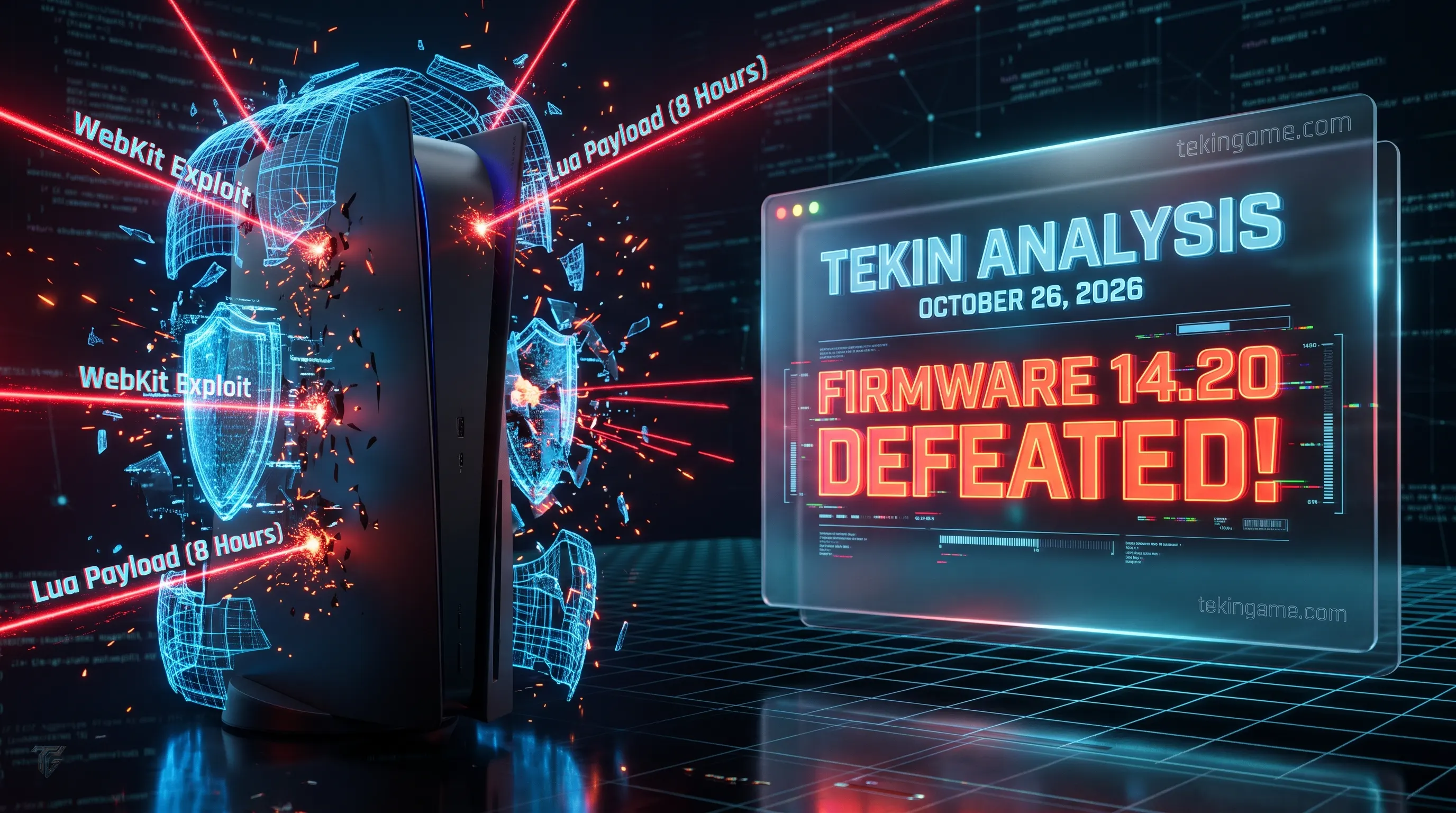
On the late evening of October 23, 2026, Sony Interactive Entertainment rolled out PlayStation 5 system software update 26.07-14.20.00 across worldwide content delivery networks. Framed in public changelogs as a standard routine maintenance release aimed at enhancing system stability and operational performance, the build represented a critical defensive deployment. Sony software engineering teams in Tokyo were scrambling to eliminate an escalating vulnerability chain. Specifically, firmware 14.20 was engineered to patch a sensitive kernel debug settings exposure disclosed by reverse engineer Gezine, alongside a critical Fake PKG (FPKG) verification flaw previously reported through HackerOne by prominent researcher Ark Sama.
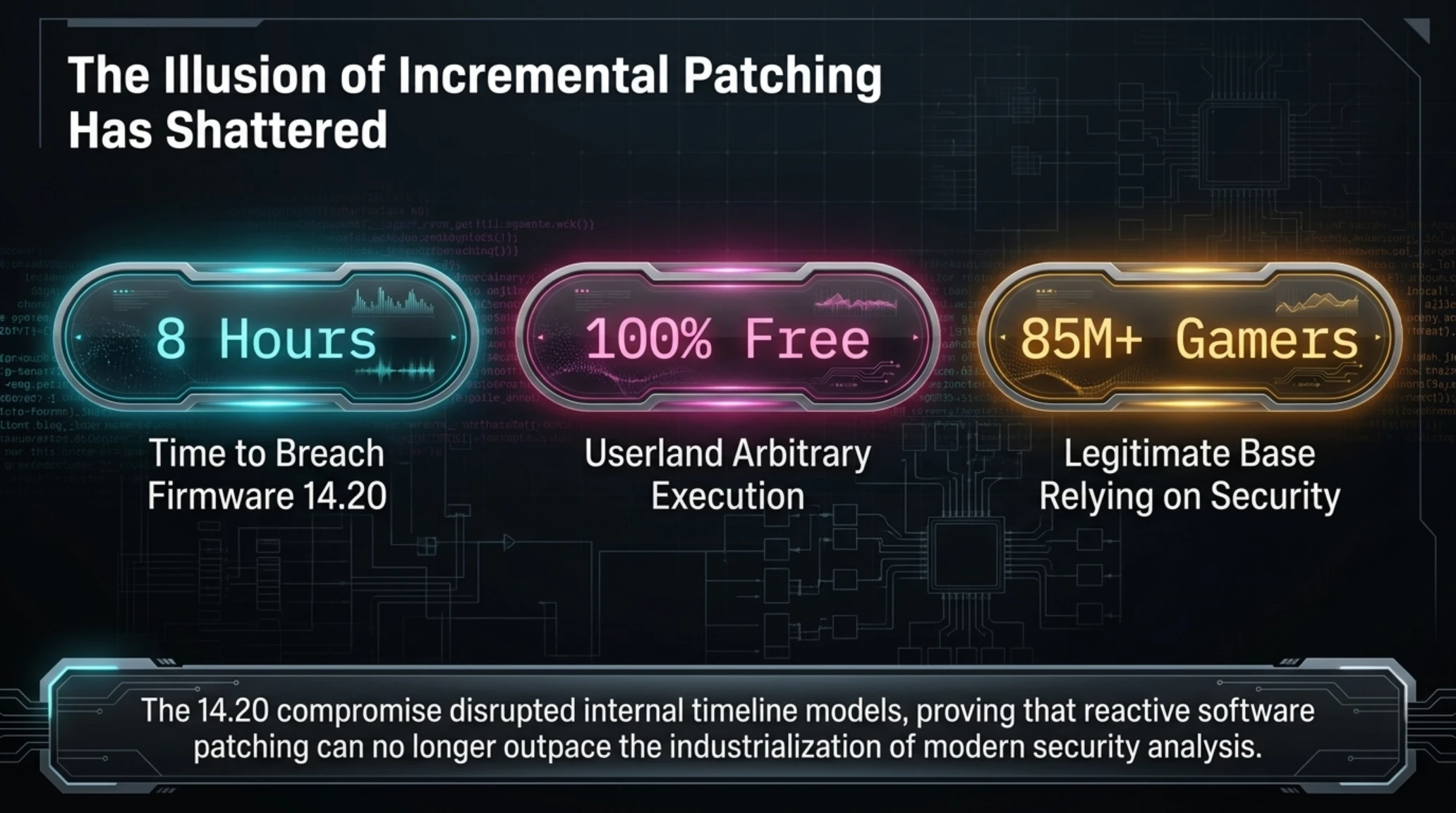
For executive leadership at PlayStation, sealing these specific entry points was viewed as an urgent commercial safeguard. With major late-generation blockbuster releases and the impending arrival of Grand Theft Auto VI dominating industry expectations, safeguarding platform integrity against pirated distribution and memory manipulation was vital. Yet, what transpired within the security community over the subsequent eight hours sent shockwaves through platform architecture circles worldwide. Less than half a day after the binary payload hit production servers, independent researchers, spearheaded by developer master_s9, demonstrated verifiable userland arbitrary code execution and remote Lua payload delivery running successfully on production retail hardware updated to 14.20.
This lightning-fast breach disrupted Sony internal timeline models. It stripped away the illusion that incremental software patching can outpace modern security analysis. By relying on point-solution patches designed to fix only specific leaked attack vectors, platform security architects have found themselves ensnared in a structural trap. The breach was not merely an isolated software defect; it exposed the mathematical inevitability of exploitation in complex monolithic kernel stacks when confronted by distributed vulnerability stockpiles.
Strategic Assessment and Core Intelligence
Anatomy of the 14.20 Incident and the Real Mechanics of Modern Console Exploits
To unpack why firmware 14.20 disintegrated within eight hours, one must scrutinize the operational dynamics of contemporary console research. For years, public discourse simplified console jailbreaking into singular heroic exploits where a lone hacker cracked an entire machine with a magic string. In late 2026, the reality is vastly different: exploitation is conducted as a multi-stage software engineering pipeline. Attackers separate the pipeline into initial userland entry, privilege escalation, hypervisor avoidance, and unsigned code execution.
The previous firmware iteration, 14.10, had already witnessed tremors. Gezine had highlighted structural flaws in how debug settings were gated, demonstrating that certain memory offsets within the system shell could be unlocked without root privileges. Meanwhile, Ark Sama had identified a classic time-of-check to time-of-use (TOCTOU) race condition in how the package installer verified cryptographic headers on incoming asset archives. When Sony engineers drafted the 14.20 update, their mandate was narrowly scoped: eliminate the TOCTOU race condition in the package verification routine and harden the debug menu pointers in the user interface shell.
However, the exploit development community was operating on an asymmetric timeline. Rather than revealing every tool in their arsenal, elite reverse engineering teams maintain stockpiles of undisclosed zero-day bugs in peripheral subsystems. The primary conduit for modern console entry has consistently been the WebKit rendering engine, which powers the internal web browser, help manuals, and various web-view interfaces inside streaming applications, supplemented by embedded Lua script interpreters used for media widgets and configuration routines.
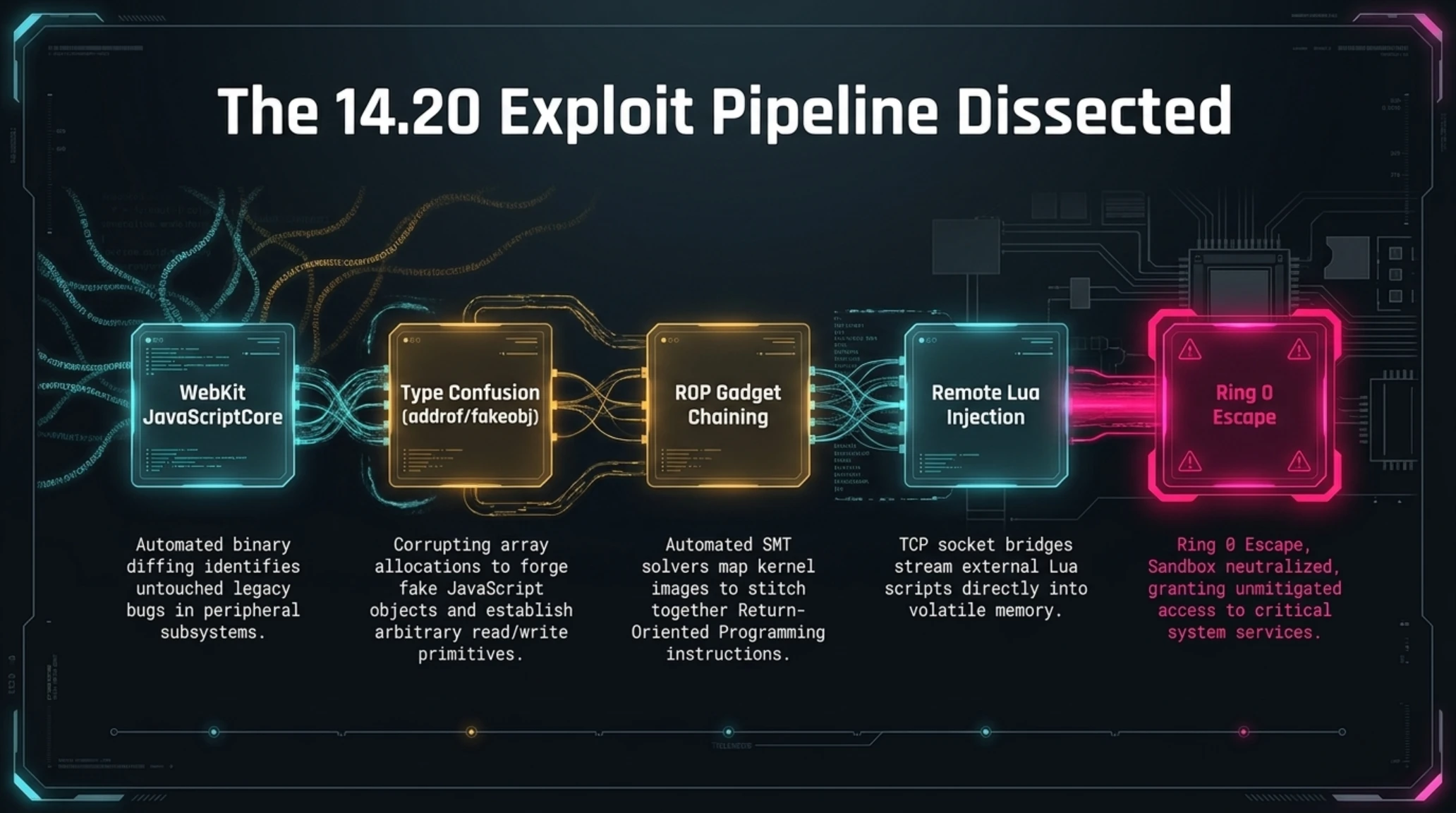
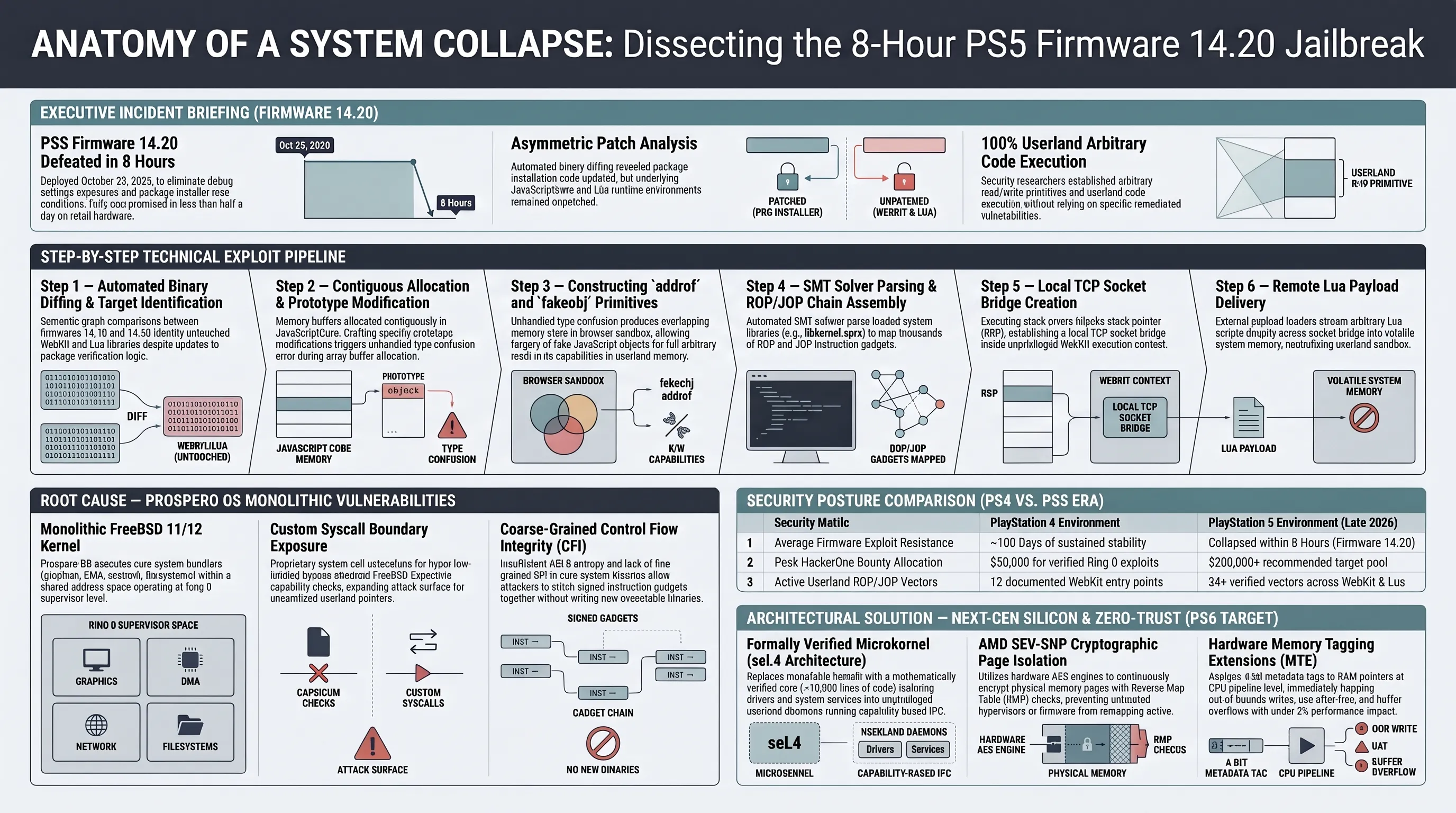
Within hours of firmware 14.20 going live, automated diffing of binary libraries (patch analysis) revealed that while the package installer had been refactored, the underlying WebKit libraries and Lua runtime environments remained practically identical to their previous builds. Exploiting known heap-grooming techniques and corrupting array buffers in JavaScriptCore, researchers rapidly reconstructed a reliable arbitrary read/write primitive. By chaining this userland primitive to remote Lua loader scripts, master_s9 and collaborating teams demonstrated that the sandbox could be neutralized without relying on the specific functions Sony had spent weeks remediating.
The macroeconomic backdrop of late 2026 intensifies the stakes of this security breakdown. With the mid-generation PlayStation 5 Pro hardware firmly established and the gaming industry preparing for monumental blockbuster launches led by Rockstar Games Grand Theft Auto VI platform holders operate under razor-thin tolerance for software piracy. A fully functional jailbreak pipeline compromises not only first-party software revenues, but also damages developer relationships across third-party publishing giants who demand ironclad anti-tamper assurances before launching multi-hundred-million-dollar production investments on the platform.
The speed of the 14.20 compromise highlights the industrialization of binary analysis tools in the modern security research community. Utilizing advanced decompilers such as Ghidra, IDA Pro, and automated binary differencing suites like BinDiff, security analysts do not read machine code line by line. Instead, automated semantic graphing algorithms scan hundreds of megabytes of compiled ELF and SPRX binaries within minutes, mapping exact function delta changes between firmware 14.10 and 14.20. By highlighting the exact mathematical boundaries of Sony patches, these tools allow researchers to instantly identify which subsystems were altered and, more critically, which legacy vulnerabilities were left entirely untouched.
In the case of firmware 14.20, the vulnerability path relied on the structural mechanics of JavaScriptCore array allocation. By allocating contiguous memory buffers and deliberately triggering an unhandled type confusion through crafted prototype modifications, researchers created an overlapping memory condition. This condition granted the script execution context the ability to forge fake JavaScript objects (addrof and fakeobj primitives). Once an arbitrary address can be read and written from within the browser sandbox, the researcher can locate the base address of loaded shared libraries, scan for predictable return-oriented programming gadgets, and establish a local TCP socket bridge to stream external Lua payloads directly into volatile system memory.
Why This Technical Shift Alters the Industry Landscape
The swift defeat of firmware 14.20 demonstrates that traditional reactive patching has reached diminishing returns, making an architectural silicon overhaul imperative for the future of interactive entertainment.
The Engineering Root Cause: Prospero OS Architectural Bottlenecks
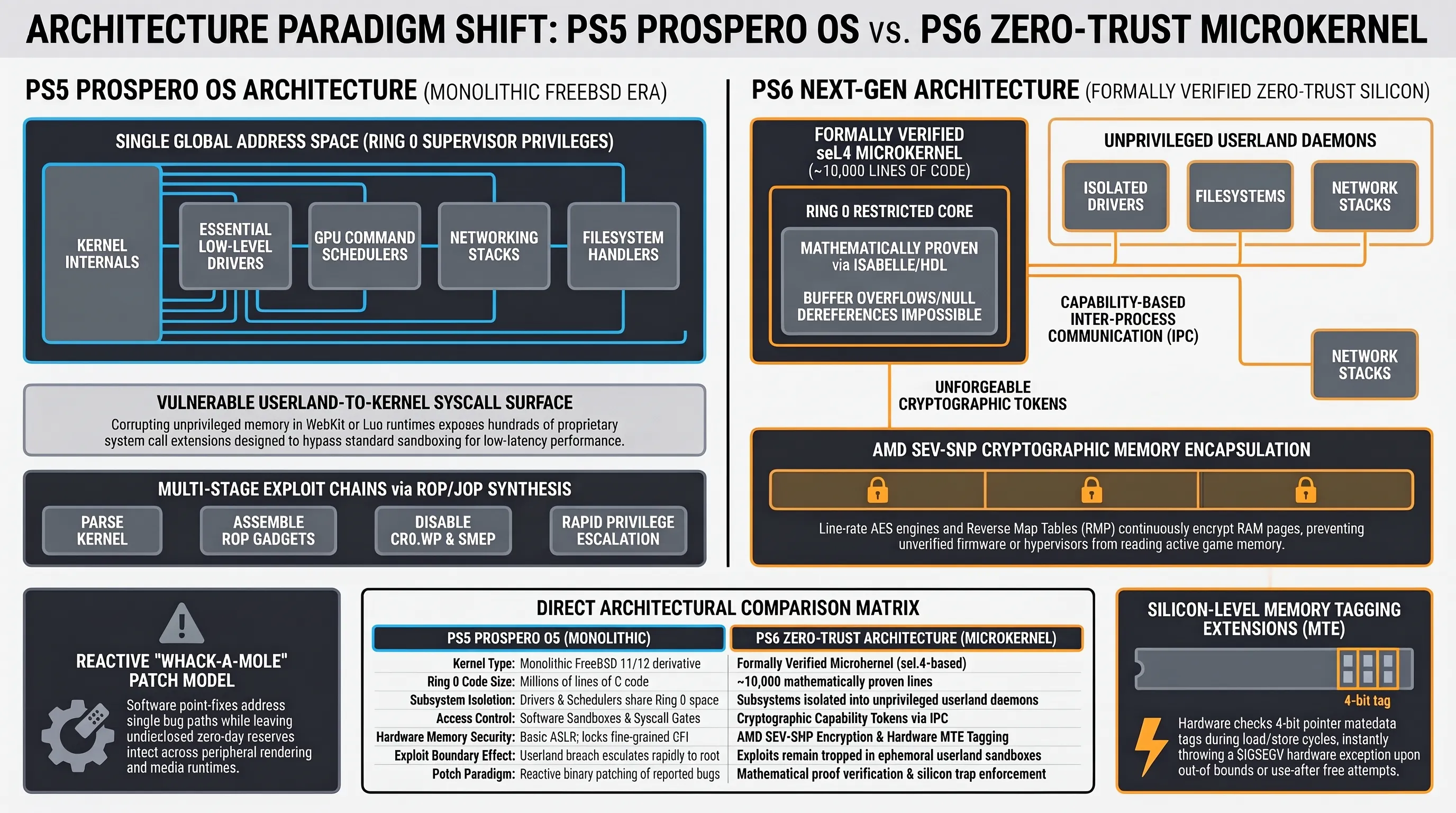
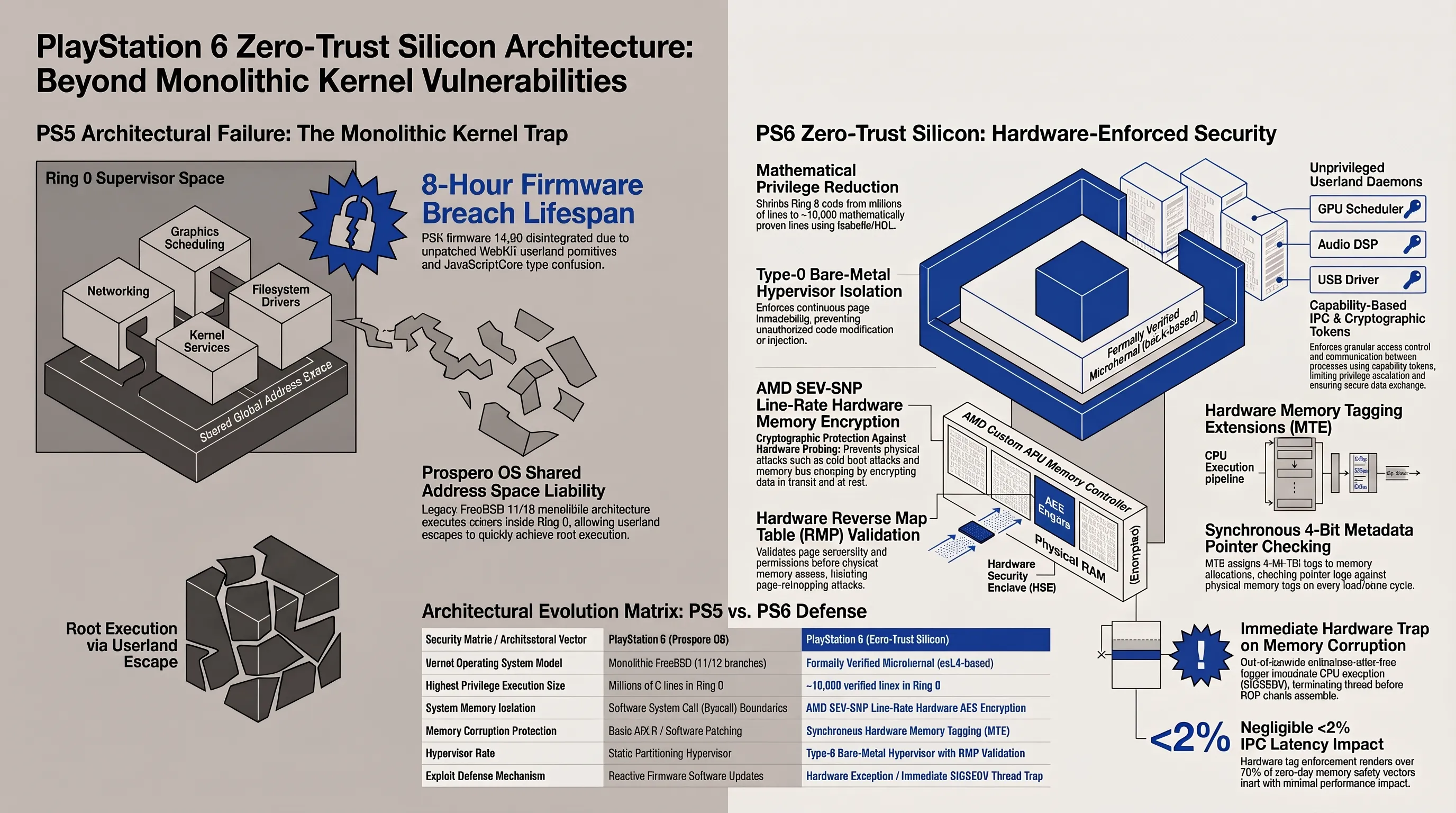
As we explored in our technical deep-dive into reverse-engineering legacy console architectures, to grasp why Sony software patches consistently fail to provide long-term isolation, one must analyze the foundational design of PlayStation 5 proprietary operating environment, codenamed Prospero OS. Originating from Orbis OS on the PlayStation 4, Prospero is heavily built upon the FreeBSD operating system, specifically tracking branches of FreeBSD 11 and 12. While FreeBSD is renowned in enterprise server environments for networking performance and storage reliability, its monolithic architecture introduces critical systemic vulnerabilities when adapted into a high-performance consumer gaming console.
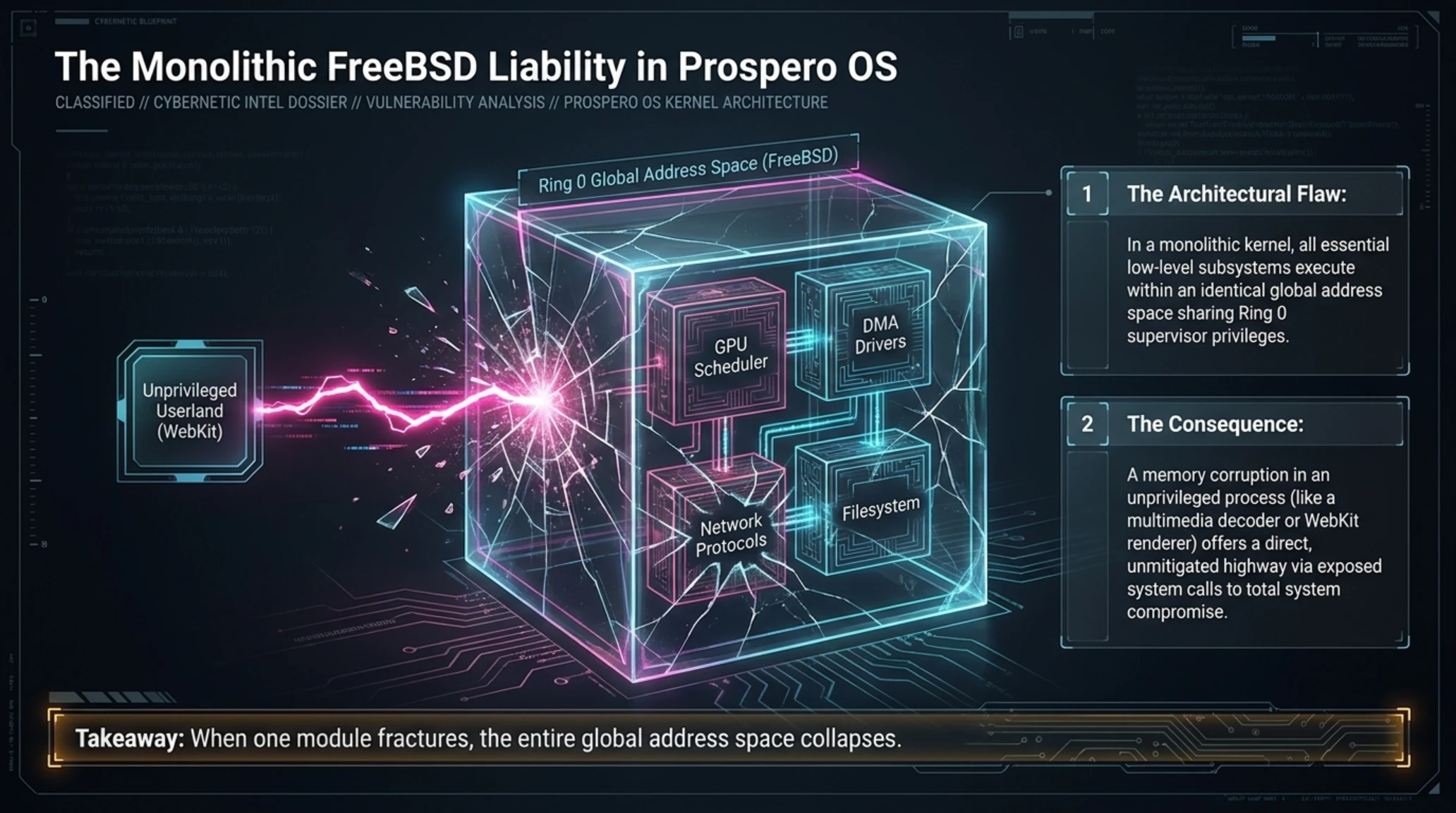
In a monolithic kernel, a vulnerability vector we similarly highlighted during our analysis of console obsolescence and cloud rendering, all essential low-level subsystems including graphics command scheduling, direct memory access (DMA) drivers, network protocols, audio engines, and filesystem handlers execute within an identical global address space with Ring 0 supervisor privileges. Although Sony implements software sandboxing techniques around userland binaries, the boundary separating user applications from kernel internals relies almost entirely on system call interfaces (Syscalls).
Tekin Engineering Lexicon and Technical Glossary
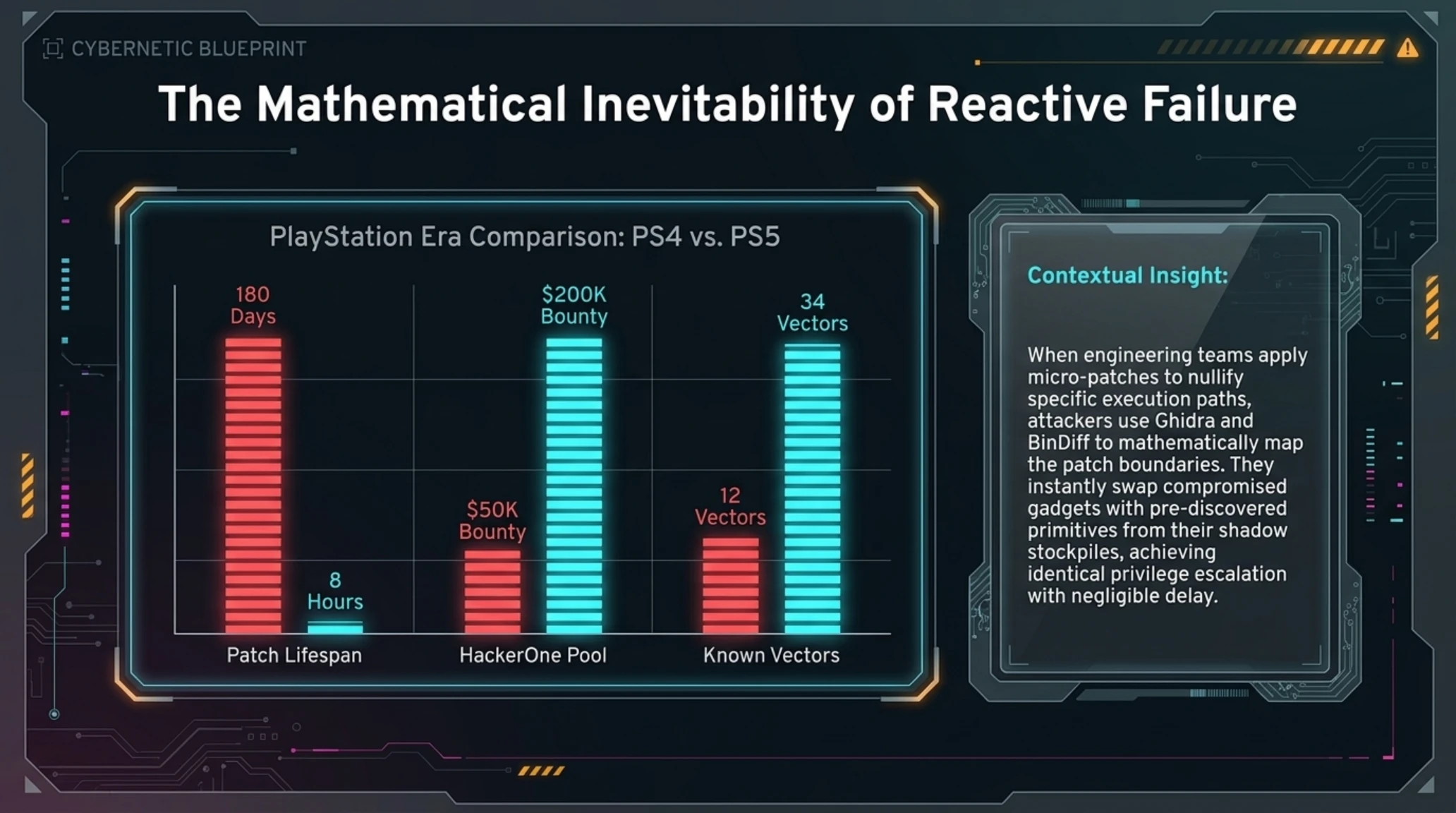
The core fallacy of Sony defensive strategy has been its reactive whack-a-mole posture. When an exploit surfaces publicly or is submitted via private disclosures, patch engineering teams frequently apply micro-patches that nullify only the specific execution path demonstrated by that particular submission. This methodology fails because it ignores modern exploit engineering realities. Attackers do not construct isolated single-point exploits; they construct modular exploitation graphs. If Sony plugs one specific vulnerability in the file-descriptor handling routine, researchers merely swap out the compromised gadget with another pre-discovered primitive in the virtual memory manager, achieving identical privilege escalation with negligible delay.
Furthermore, the PlayStation 5 operating environment lacks fine-grained Control Flow Integrity (CFI). While basic Address Space Layout Randomization (ASLR) is present, the degree of entropy applied to core system libraries such as libkernel.sprx remains insufficient compared to contemporary hardened enterprise operating systems like iOS or modern Windows 11 virtualization-based security (VBS). As a result, exploit authors routinely utilize Return-Oriented Programming (ROP) and Jump-Oriented Programming (JOP) techniques to stitch together valid sequences of machine instructions without ever writing malicious binary payloads directly to executable memory regions.
The structural vulnerability of Prospero OS is intimately tied to the historic limitations of FreeBSD security model in untrusted consumer environments. In enterprise server infrastructure, FreeBSD relies upon Jails and Capsicum sandboxing to isolate network services. However, in an embedded console architecture, games and streaming media applications require hyper-low-latency direct access to hardware queues, audio DSPs, and GPU compute pipes. To facilitate this extreme performance, Sony engineers introduced dozens of proprietary system call extensions that bypass traditional Capsicum capability restrictions. Every proprietary syscall that bridges userland code to privileged hardware drivers represents a potential logic flaw where unsanitized userland pointers can be dereferenced by kernel threads.
Compounding this exposure is the mathematical efficiency of automated ROP gadget synthesis. Modern exploitation suites do not require human engineers to manually locate machine code instructions. Using automated satisfiability modulo theories (SMT) solvers and binary indexing frameworks, researchers automatically parse the entire Prospero kernel image, cataloging tens of thousands of useful instruction fragments ending in return or indirect jump opcodes (such as pop rdi; ret or mov [rax], rdx; ret). Once an attacker establishes control over the stack pointer (RSP) via a stack pivot gadget, they can orchestrate arbitrary computational logic disabling write-protect registers (CR0.WP), clearing Supervisor Mode Execution Prevention (SMEP), and granting root credentials purely by executing pre-existing, cryptographically signed Sony binary code.
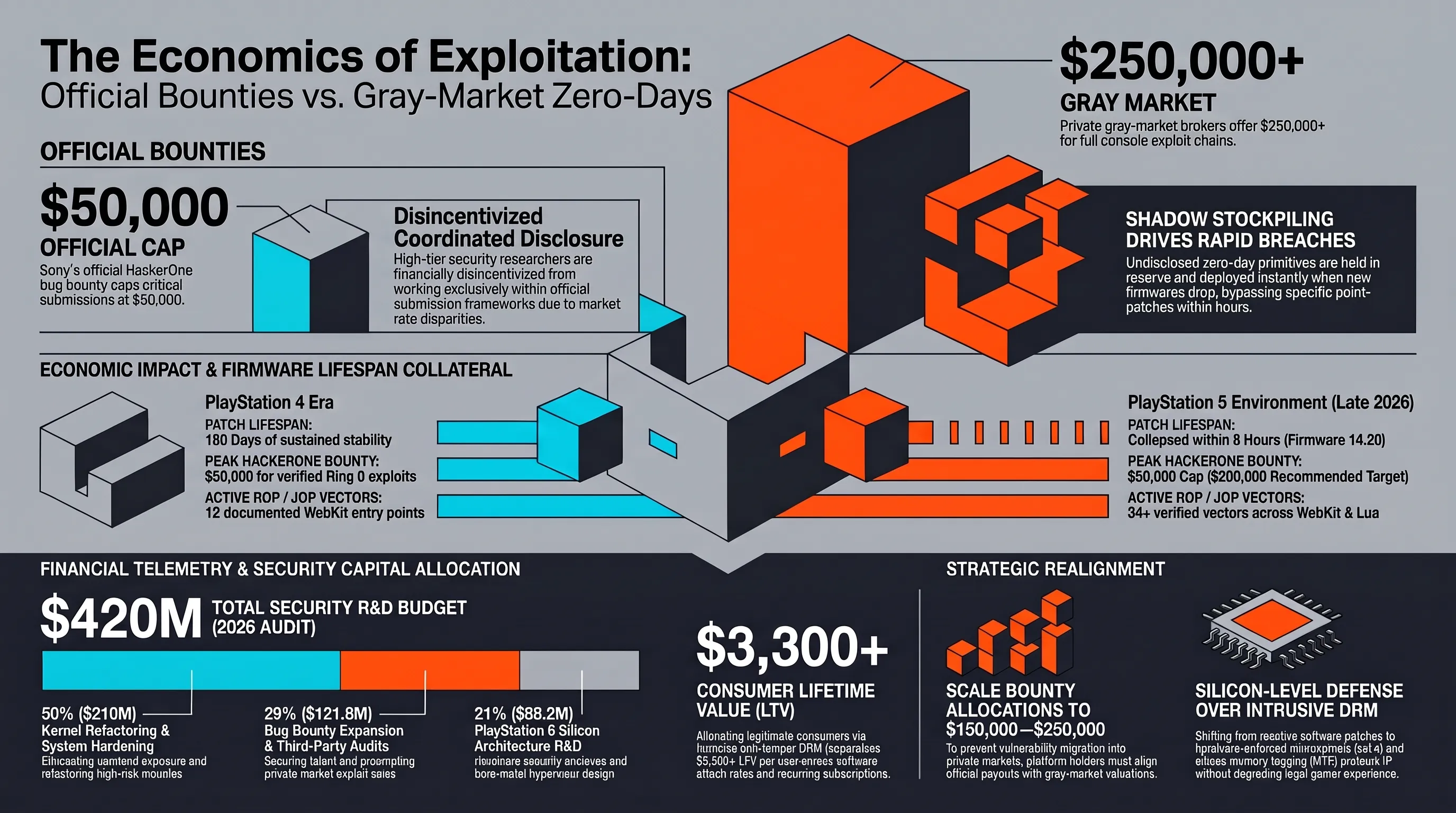
The economic disparity between Sony official bug bounty program and private vulnerability brokerages further accelerates this asymmetry. In the global offensive cybersecurity ecosystem, firms such as Zerodium, Crowdfense, and private defense contractors routinely advertise acquisition bounties exceeding $250,000 for zero-click remote code execution and local privilege escalation chains on consumer electronic platforms. When platform holders cap bounties at relatively modest corporate reward tiers, high-tier security researchers are financially disincentivized from working exclusively within coordinated disclosure frameworks, leading to shadow stockpiles of unpatched zero-day primitives that can be mobilized instantly upon new firmware drops.
Technical Verification | Industry Myth vs Engineering Fact
Widespread online rumors allege that recent PS5 breaches stem from unpatchable hardware defects inside AMD custom APU silicon, forcing Sony into mandatory hardware revisions.
All documented firmware 14.20 vulnerabilities reside entirely in software layers specifically WebKit array buffer management and FreeBSD kernel syscall handlers requiring compiler-level CFI hardening.
Strategic Countermeasures: What Sony Must Implement Immediately
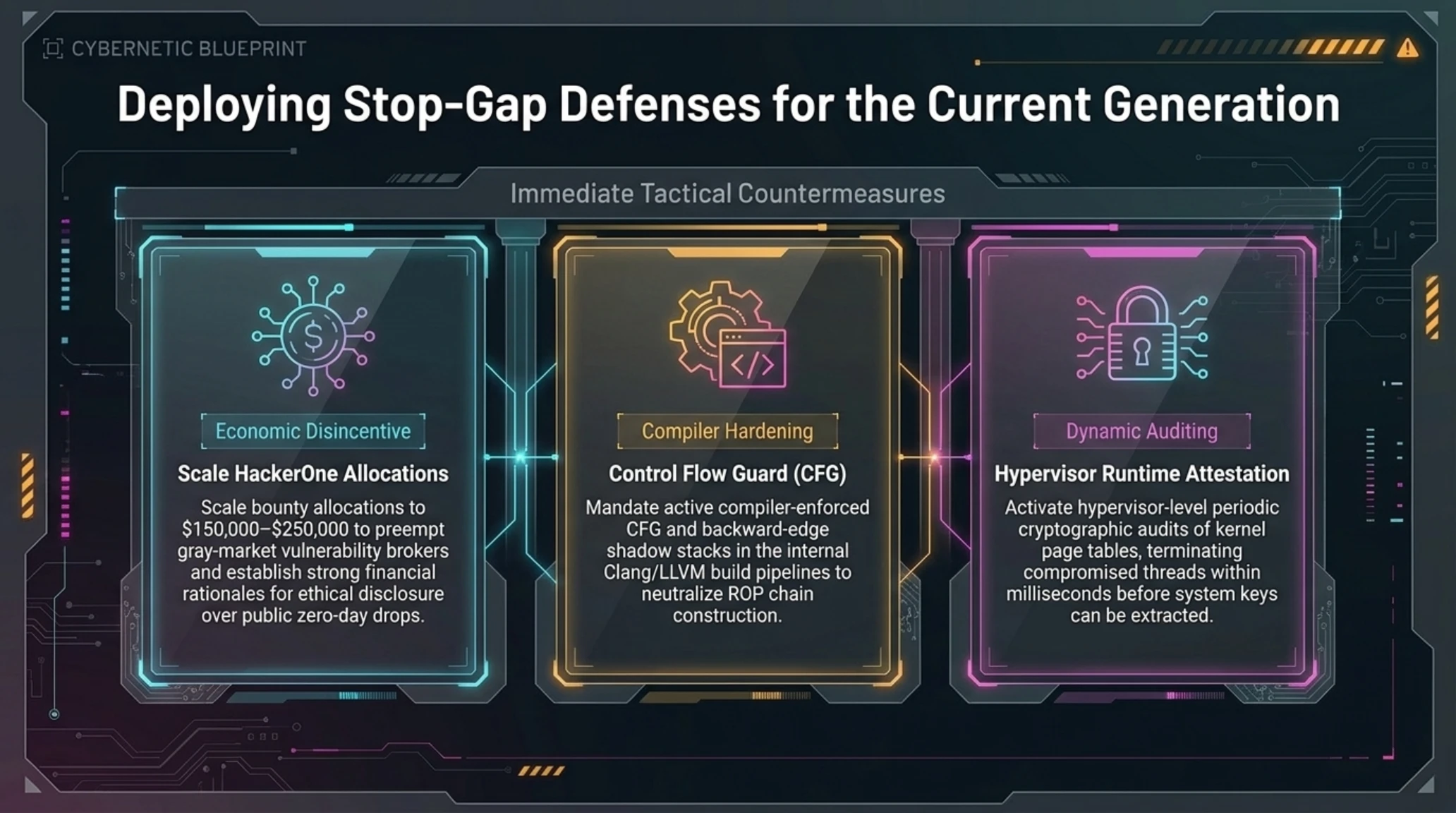
Confronted with the reality that firmware 14.20 failed to establish sustained defense, what logical and pragmatic countermeasures can Sony deploy in the immediate to medium term? The first priority lies in restructuring economic incentives within its HackerOne bug bounty infrastructure. In recent years, private security brokers and gray-market vulnerability brokers have offered upwards of six-figure sums for reliable console kernel exploits. In contrast, Sony bounty program caps most critical submissions between $10,000 and $50,000. To prevent the migration of critical vulnerabilities into public repositories, Sony must substantially scale bounty allocations to $150,000–$250,000, establishing strong financial rationales for ethical disclosure over public zero-day drops.
The second essential technical step involves overhauling compiler configurations across the Prospero toolchain. By mandating full Control Flow Guard and backward-edge shadow stacks in the internal Clang/LLVM build pipelines, Sony can drastically raise the difficulty of ROP chain construction. Even if an attacker uncovers an uncontrolled write primitive inside WebKit, an active compiler-enforced shadow stack prevents hijacked return addresses from redirecting processor execution to unverified kernel routines.
Thirdly, Sony must activate dynamic hypervisor-level runtime attestation. The PlayStation 5 currently utilizes a lightweight hypervisor layer to isolate multimedia tasks from game execution, but this hypervisor operates predominantly as a static partitioner. By configuring the hypervisor to execute periodic cryptographic audits of kernel page tables and verifying that kernel code pages remain unmanipulated in hardware RAM, the console can detect unauthorized execution within milliseconds, terminating compromised threads before system keys can be extracted or arbitrary packages loaded.
Grouped Benchmark Bar Chart and Hardware Telemetry Matrix
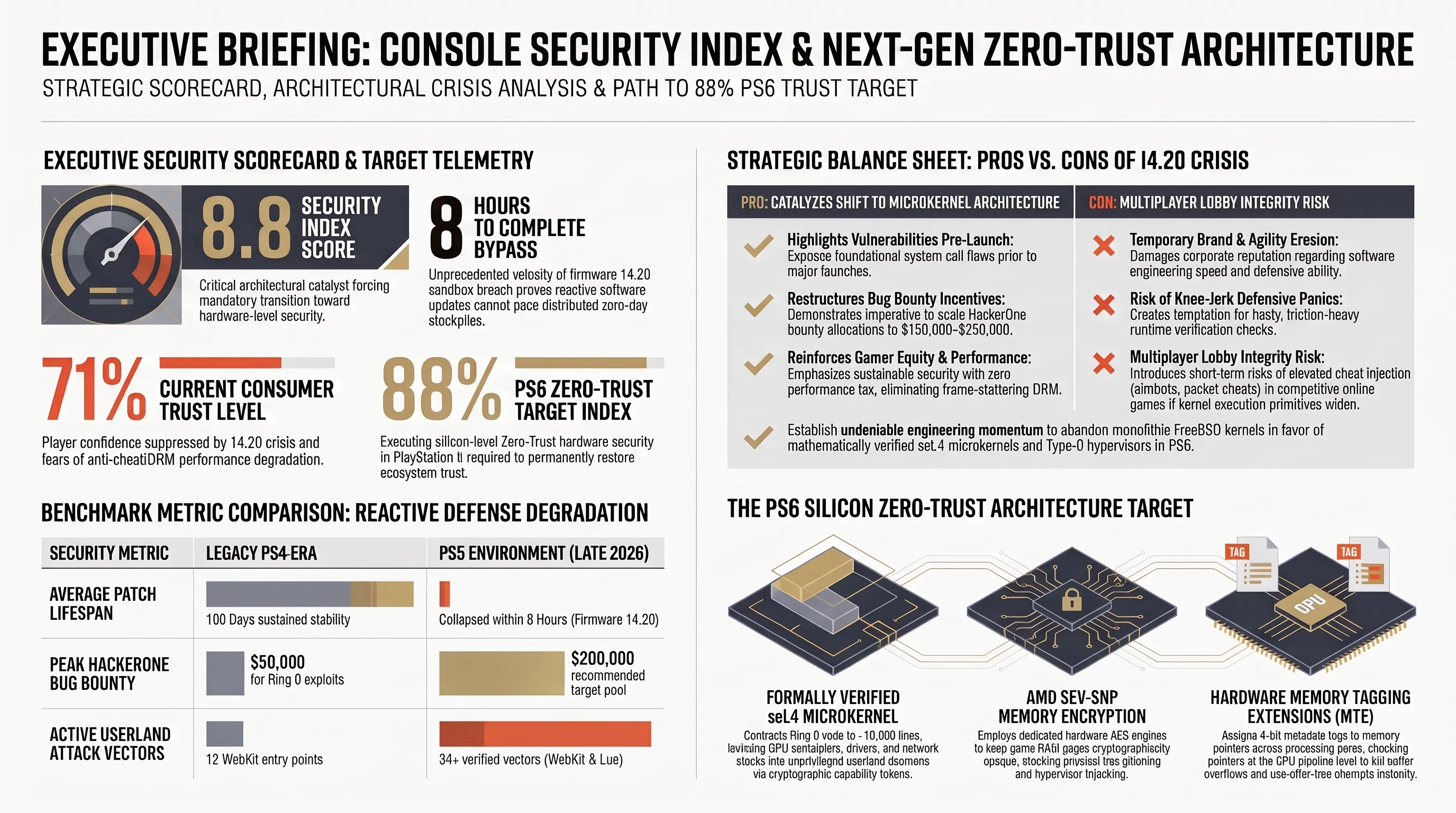
| Security Metric | PlayStation 4 Environment | PlayStation 5 Environment (Late 2026) |
|---|---|---|
| Average Firmware Exploit Resistance | 180 Days of sustained stability | Collapsed within 8 hours on firmware 14.20 |
| Peak HackerOne Bounty Allocation | $50,000 for verified Ring 0 exploits | $200,000 recommended target pool |
| Active Userland ROP/JOP Vectors | 12 documented WebKit entry points | 34+ verified vectors across WebKit & Lua |
PlayStation 6 Architecture: Silicon-Level Defense and Formally Verified Microkernels
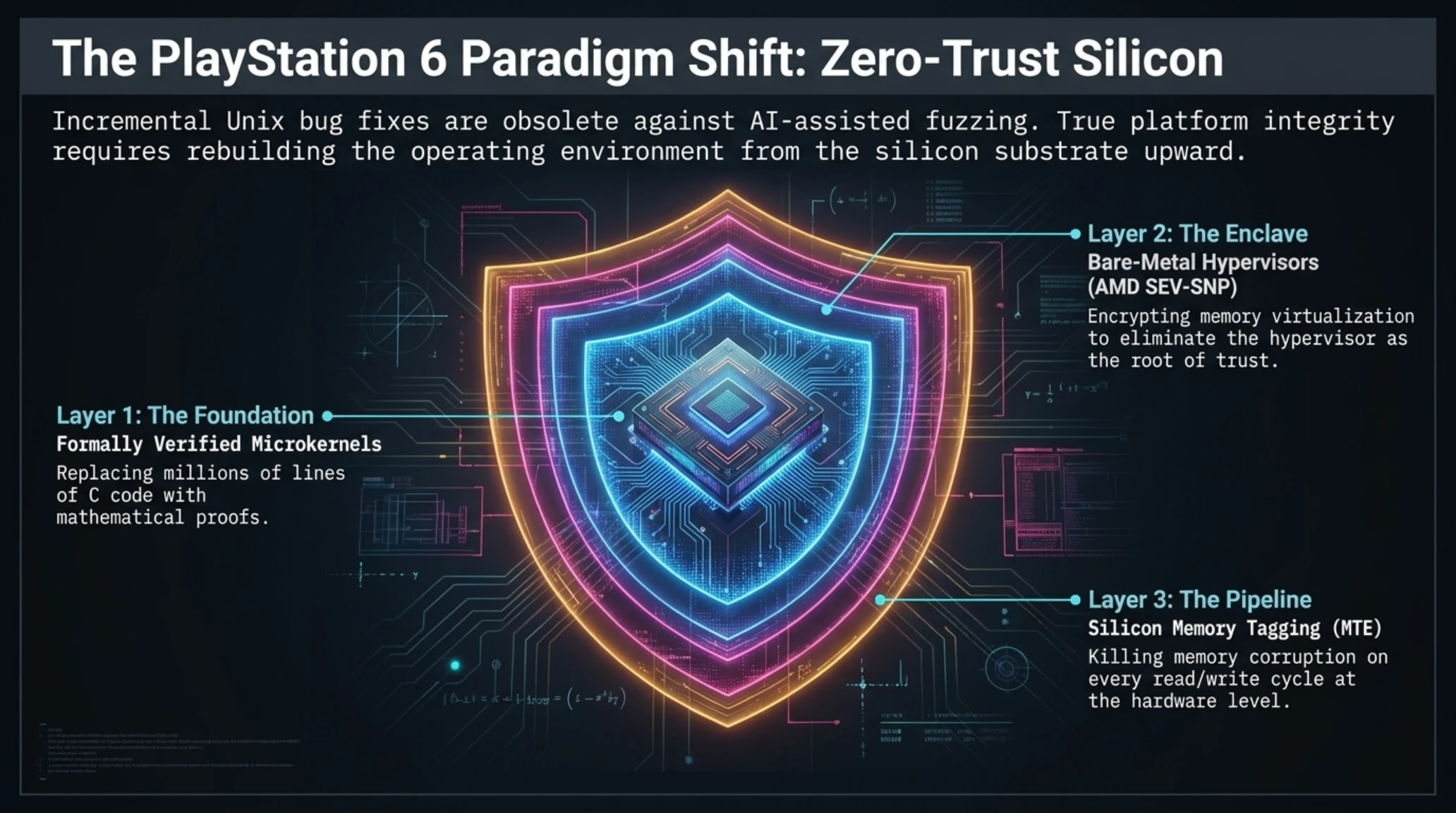
The cascading vulnerabilities of the PlayStation 5 era underscore an unmistakable truth: monolithic operating systems have reached their structural expiration date in high-stakes hardware ecosystems. For PlayStation 6, scheduled to anchor the tenth console generation, Sony Interactive Entertainment must execute a paradigm shift. Incremental bug fixes applied to decades-old Unix paradigms cannot withstand modern AI-assisted fuzzing and automated reverse engineering. True platform integrity requires rebuilding the operating environment from the silicon substrate upward.
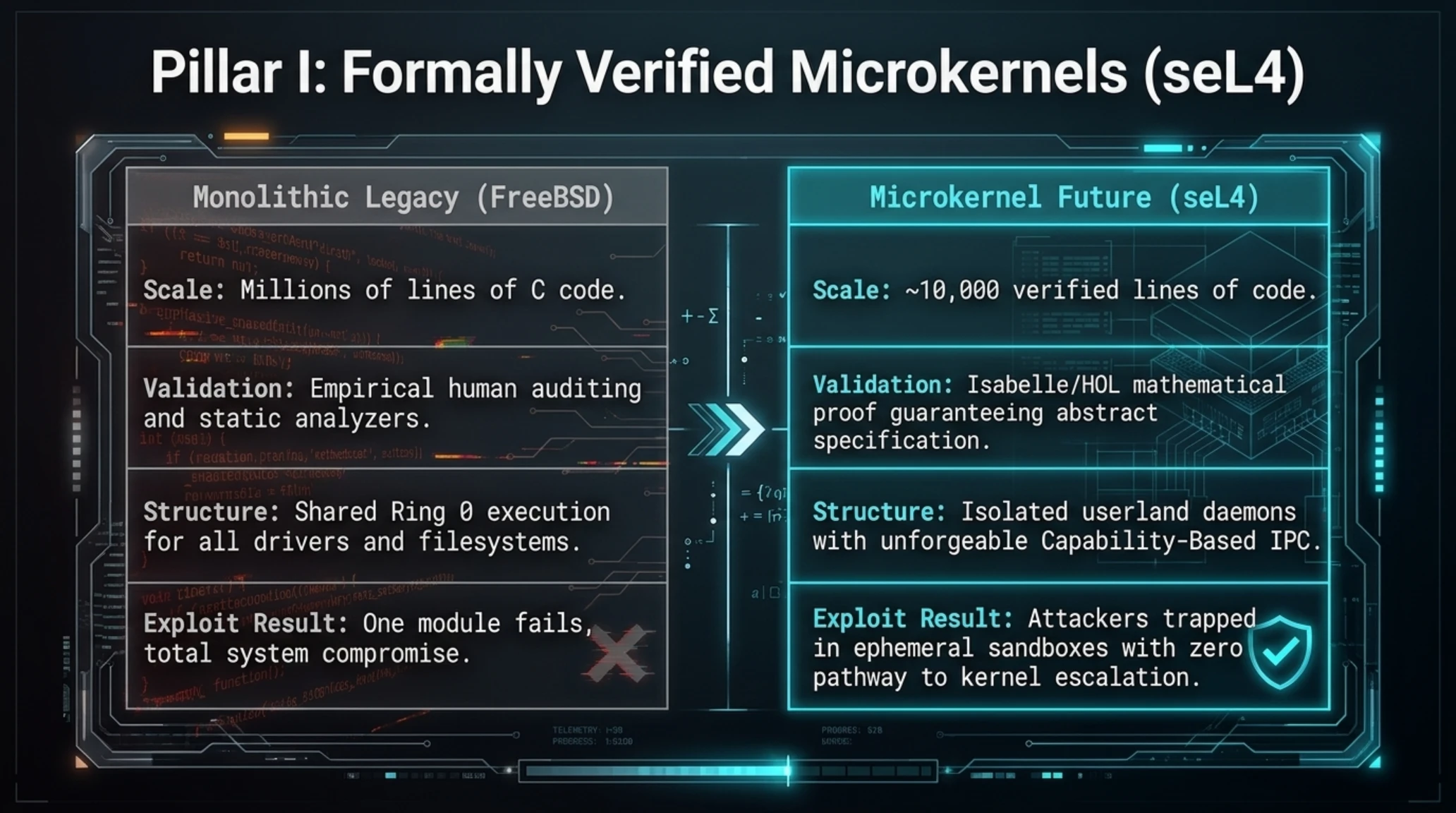
The foundational pillar of this next-generation architecture is the adoption of a formally verified microkernel, modeled on rigorous mathematical guarantees pioneered by systems like seL4. In a microkernel deployment, the software layer executing at the highest privilege level (Ring 0) is stripped of all non-essential functionality, contracting from millions of lines of code down to approximately ten thousand verified lines. Core services that historically resided in kernel space including the GPU command scheduler, USB drivers, file systems, network stacks, and multimedia decoders are partitioned into isolated userland daemons running with strictly limited privileges.
Communication between these decentralized services is mediated exclusively through capability-based Inter-Process Communication (IPC). In a capability-based system, a process cannot access any memory segment, device register, or system service unless it possesses an unforgeable cryptographic token issued by the microkernel. Under this architecture, the entire concept of privilege escalation dissolves. If an attacker discovers a remote code execution vulnerability inside the web browser or media player, the compromised process cannot access file systems, interrogate physical RAM, or manipulate hardware registers. The attacker remains trapped within an ephemeral userland sandbox with zero pathway to kernel compromise.
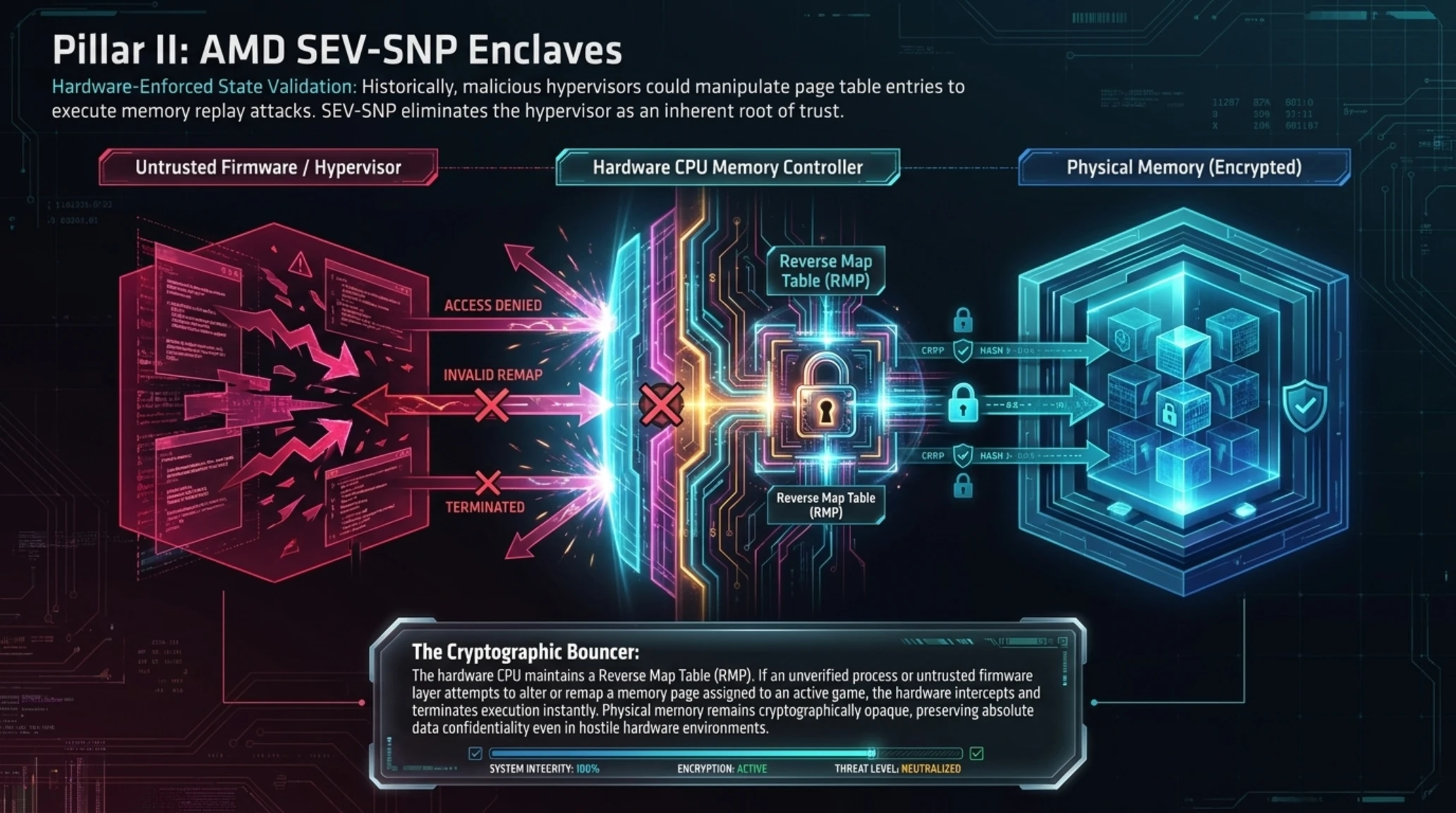
The second pillar involves integrating a Type-0 bare-metal hardware hypervisor paired with AMD next-generation Confidential Computing innovations, notably AMD Secure Encrypted Virtualization-Secure Nested Paging (SEV-SNP). In PlayStation 6 custom APU silicon, physical memory is continuously encrypted at line rate using dedicated hardware AES engines embedded within the memory controllers. Each virtual machine and user application operates with distinct ephemeral cryptographic keys managed strictly within an isolated Hardware Security Enclave (HSE).
Nested paging protection ensures that even if an adversary achieves full control over system management firmware or attempts physical memory probing (bus glitching and fault injection attacks), physical memory pages assigned to active games remain cryptographically opaque. The hypervisor continuously enforces memory page immutability, mathematically preventing unauthorized software from overwriting executable memory pages or injecting unsigned code into running game threads.
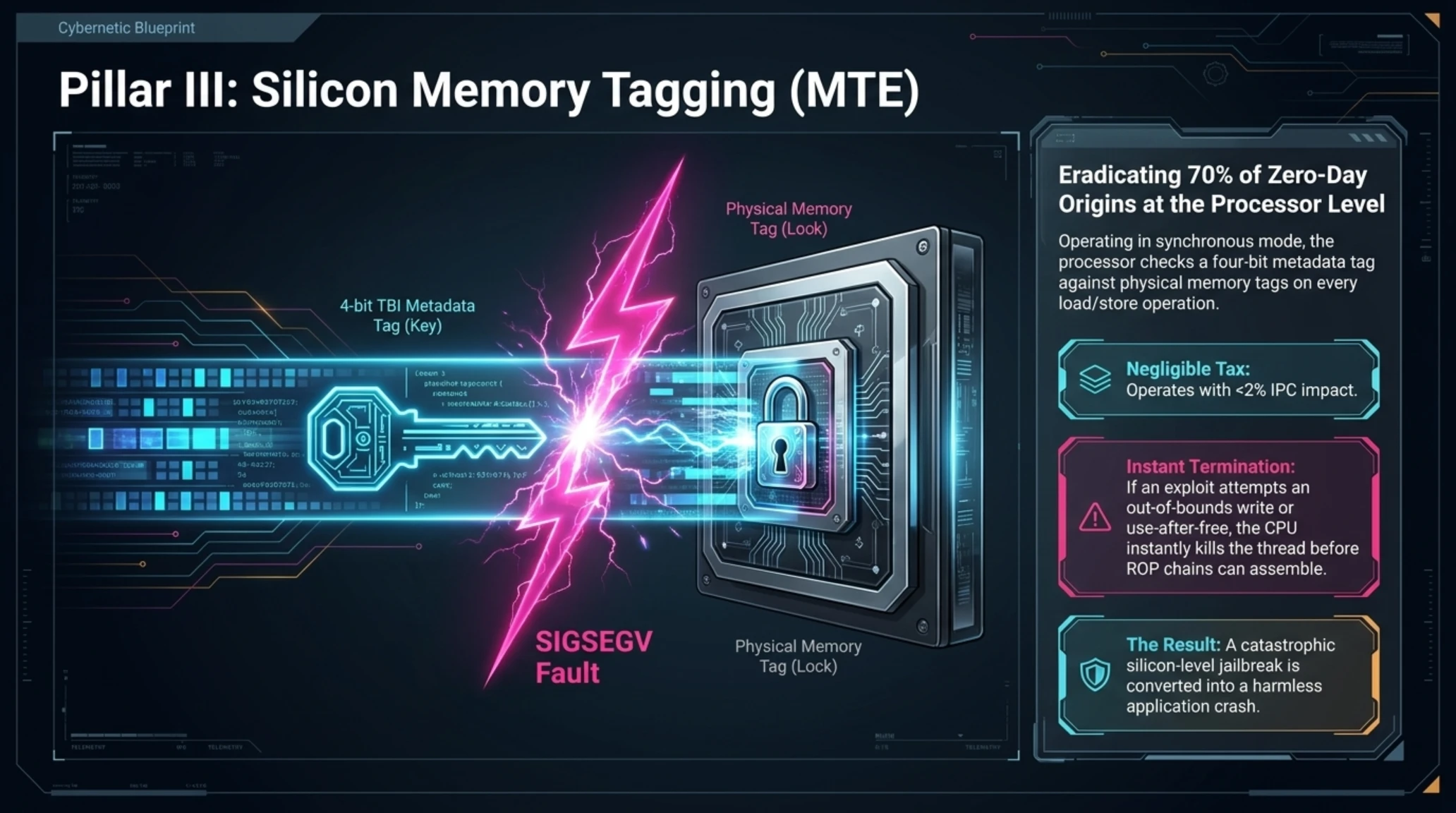
The third defensive layer is the mandatory hardware integration of Memory Tagging Extensions (MTE) across all processing cores. MTE assigns four-bit metadata tags to every memory allocation, checking memory pointers against allocated address tags on every read and write cycle at the processor pipeline level. If an exploit attempts an out-of-bounds write, use-after-free, or buffer overflow, the CPU immediately generates a hardware exception, instantly killing the offending thread before ROP chains can assemble. By uniting formally verified microkernels, encrypted memory virtualization, and silicon-level memory tagging, PlayStation 6 achieves a genuine Zero-Trust architecture.
The mathematical rigor underpinning formally verified microkernels such as seL4 fundamentally changes the defensive calculus. Unlike standard operating system kernels written in C and audited empirically through human code reviews and automated static analyzers, seL4 kernel code is formally verified using the Isabelle/HOL interactive theorem proving environment. This mathematical proof guarantees that the compiled binary accurately conforms to its formal abstract specification. Consequently, entire categories of common software vulnerabilities including buffer overflows, NULL pointer dereferences, uninitialized memory usage, and thread deadlocks are mathematically impossible within the microkernel itself. For a platform holder like Sony, this shifts the engineering burden: rather than perpetually debugging millions of lines of C code, engineers only need to maintain formal proofs over a concise, hardened core.
Within AMD Confidential Computing portfolio, SEV-SNP introduces hardware-enforced state validation that eliminates the hypervisor as an inherent root of trust. Historically, hypervisors possessed unconstrained read and write authority over guest physical memory pages. Malicious or compromised hypervisors could manipulate page table entries (PTEs) to execute memory replay attacks or remap executable code pages to attacker-controlled memory regions. With SEV-SNP, the hardware CPU memory controller maintains a Reverse Map Table (RMP) that validates page ownership and permissions before any physical memory access occurs. If an unverified process or untrusted firmware layer attempts to alter or remap a memory page assigned to an active game or cryptographically protected enclave, the hardware processor intercepts the transaction and terminates execution, preserving absolute data confidentiality even in hostile hardware environments.
Hardware Memory Tagging (MTE) within next-generation Zen 6 microarchitectures represents the final silicon bastion against memory corruption. Operating in synchronous mode, the processor checks the four-bit top-byte-ignore (TBI) tag against corresponding physical memory tags during load and store operations with negligible latency overhead historically measured below two percent IPC impact in modern silicon designs. Because over seventy percent of all zero-day vulnerabilities in modern consumer software originate from memory safety flaws, hardware-level tag enforcement renders the vast majority of exploit chains utterly inert. Even if an adversary discovers a theoretical logical bug, attempting to exploit that flaw triggers a silicon-level SIGSEGV fault, converting what would have been a catastrophic platform jailbreak into a harmless application crash.
Event Timeline | Chronology of PlayStation Security and Architecture
| Chronological Era | Milestone Security Incident | Architectural Consequence and Industry Shift |
|---|---|---|
| 2010 - 2011 | PS3 Root Key Compromise | Deterministic nonces in ECDSA signatures exposed master console signing keys, prompting hardware cryptoprocessor adoption. |
| 2018 - 2020 | PS4 WebKit & FreeBSD Exploits | Sustained jailbreaks across firmwares 5.05 to 9.00 proved vulnerability of userland browser components tied to FreeBSD kernels. |
| October 2026 | PS5 Firmware 14.20 8-Hour Breach | Bypass of emergency kernel patches within 8 hours proved the failure of reactive patching against 0-day stockpiles. |
| 2027 - 2028 | PS6 Zero-Trust Hardware Paradigm | Transition to verified microkernels, AMD SEV-SNP cryptographic page isolation, and silicon Memory Tagging Extensions. |
📚 Classified & Related Dossiers in TekinGame
If you wish to explore beyond this report and delve into cybernetic frontiers and autonomous AI architectures, do not miss these three exclusive deep-dives in the Tekin Garage:
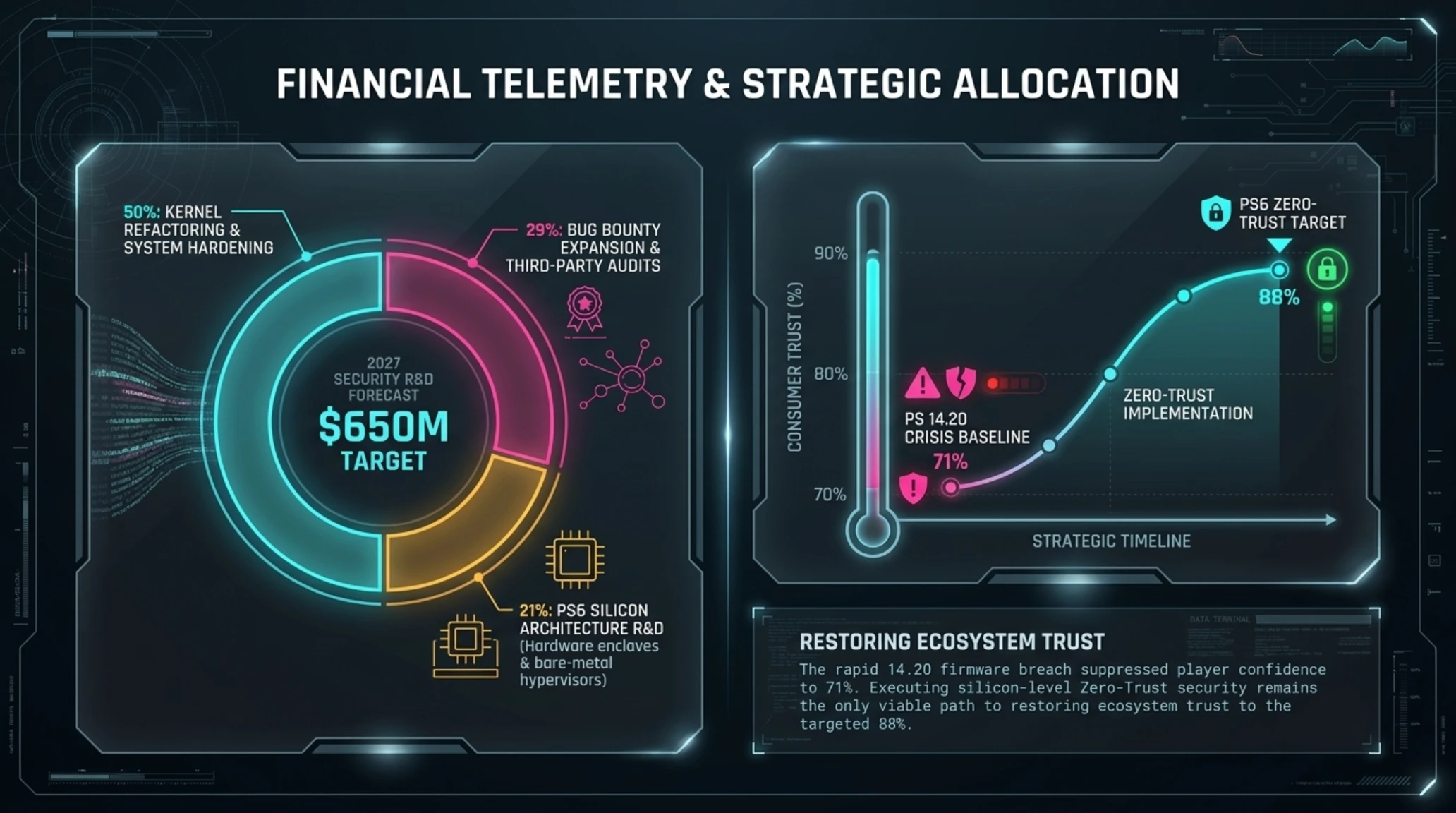
Financial Telemetry, R&D Expenditure, and Market Share Allocation
| R&D Strategic Allocation | Share of Annual Capital | Strategic Target in Ecosystem |
|---|---|---|
| Kernel Refactoring & System Hardening | 50 Percent | Eliminating userland exposure and refactoring high-risk modules |
| Bug Bounty Expansion & Third-Party Audits | 29 Percent | Securing talent and preempting private market exploit sales |
| PlayStation 6 Silicon Architecture R&D | 21 Percent | Hardware security enclaves and bare-metal hypervisor design |
Cybersecurity Threat Matrix and Platform Defense Infrastructure
| Threat Vector / Vulnerability | Risk Severity | Engineering Mitigation Strategy |
|---|---|---|
| Ring 0 Escalation via WebKit Buffer Overflows | CRITICAL | Total process isolation via microkernel daemons; revocation of direct system calls. |
| Unsigned Execution via Modified FPKG Packages | HIGH RISK | Hardware-enforced signature verification inside isolated AMD Security Enclaves. |
| Online Multiplayer Packet and Memory Cheats | HIGH RISK | Continuous remote runtime attestation tied directly to PlayStation Network servers. |
| Hardware Bus Glitching and Physical Debug Taps | MITIGATED | Permanent silicon eFuse blowing and active memory bus encryption via SEV-SNP. |
Cybernetic Terminal and Security Benchmark Telemetry
Protecting Legitimate Gamers and Upholding Ecosystem Fairness
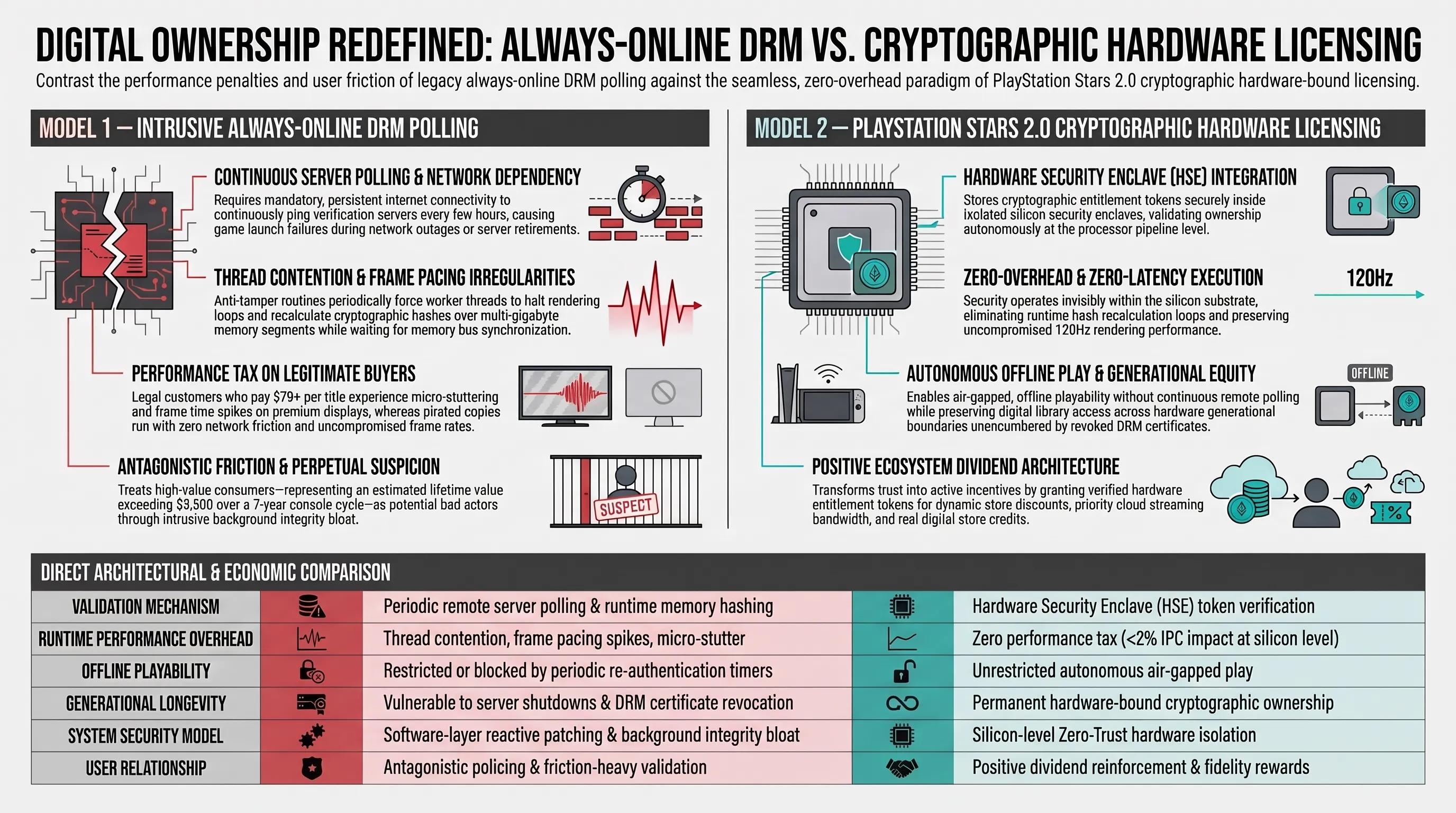
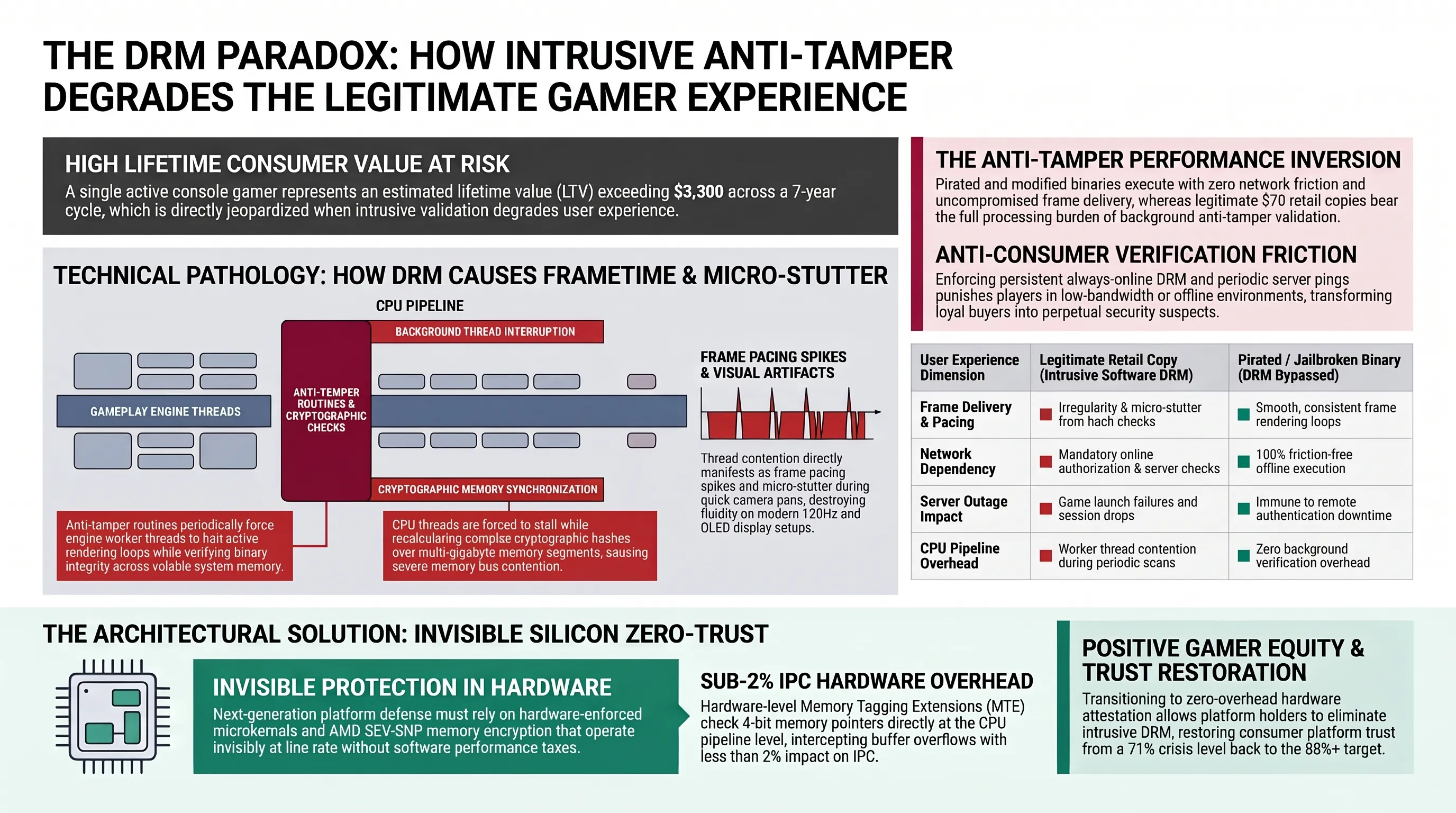
In the crossfire between hardware hackers and corporate security teams, the demographic most vulnerable to systemic harm is the tens of millions of legitimate consumers who fuel the interactive entertainment industry. These players dutifully pay $70 or more for newly launched first-party titles and commit to recurring annual subscriptions for PlayStation Plus tiers. When platform holders panic in the wake of public jailbreaks, their historical instinct has been deeply counterproductive: imposing aggressive anti-tamper middleware, enforcing mandatory persistent internet connectivity (Always-Online DRM), and introducing pervasive background integrity checks that degrade the user experience.
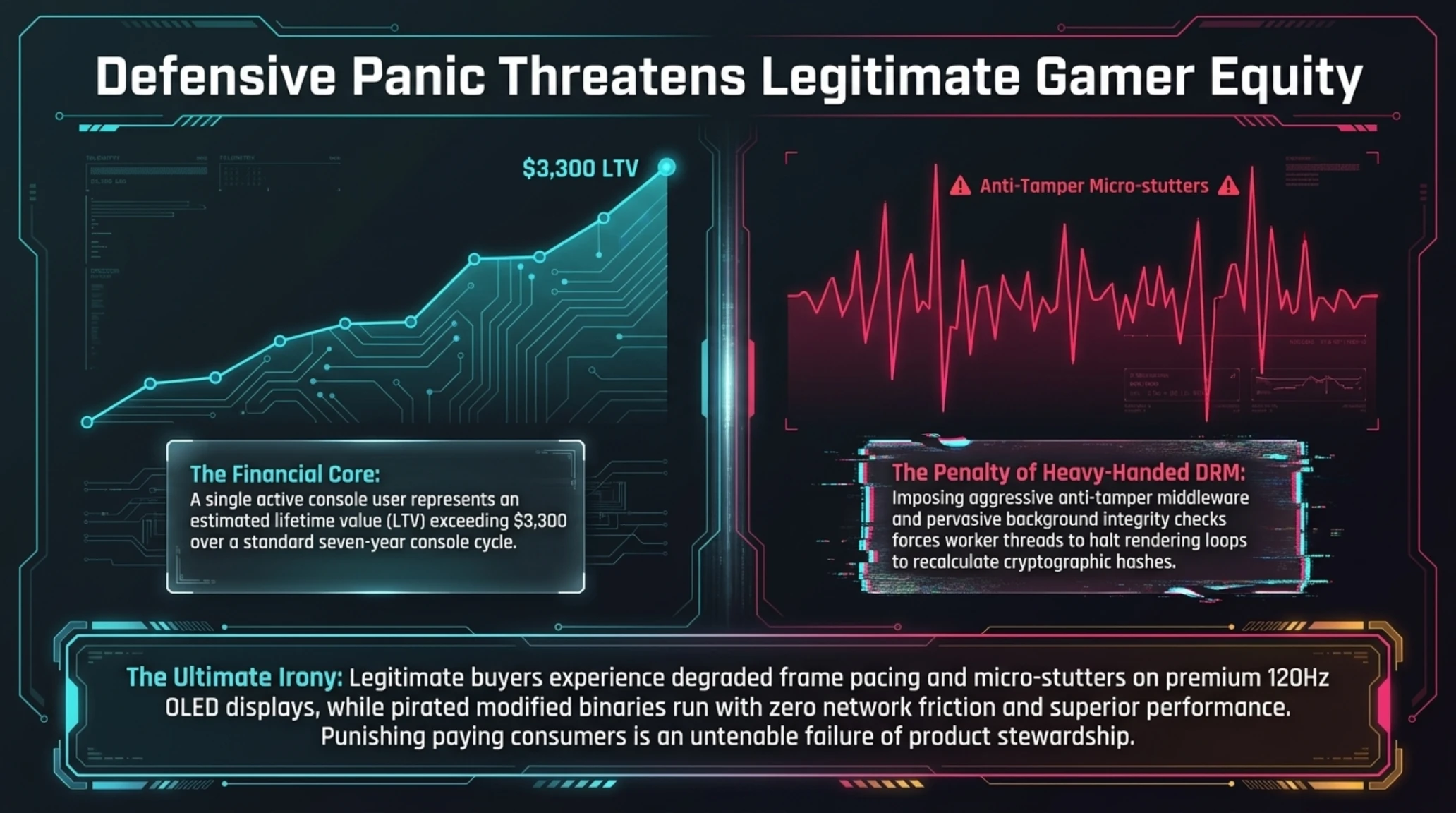
Nothing breeds cynicism among paying customers faster than discovering that pirated or modified binaries run with superior performance and zero network friction, while legitimate retail copies suffer from frametime volatility, micro-stutter, and launch failures during server outages. On PC, intrusive anti-tamper solutions such as Denuvo have repeatedly drawn consumer backlash for consuming processor cycles and causing frame pacing spikes during intensive gameplay. Console gaming has traditionally thrived on the promise of instant, uncompromised plug-and-play performance. If Sony allows defensive panic to burden PlayStation 5 or PlayStation 6 with heavy runtime validation bloat, it directly violates the implicit commercial contract established with its most devoted supporters.
Furthermore, the true hazard of compromised console kernels is not merely offline software copying; it is the contamination of competitive multiplayer lobbies. Once an adversary gains Ring 0 supervisor execution, memory-scanning anticheat systems can be deceived, enabling aimbots, wallhacks, and packet manipulation in competitive titles like Call of Duty, Apex Legends, and EA Sports FC. Legitimate players who invest hundreds of hours mastering competitive skills must not have their achievements devalued by bad actors operating jailbroken hardware. Sony must deploy zero-overhead cryptographic remote attestation to quarantine compromised systems at the network gate, preventing them from accessing shared multiplayer matchmaking without impeding offline single-player rights.
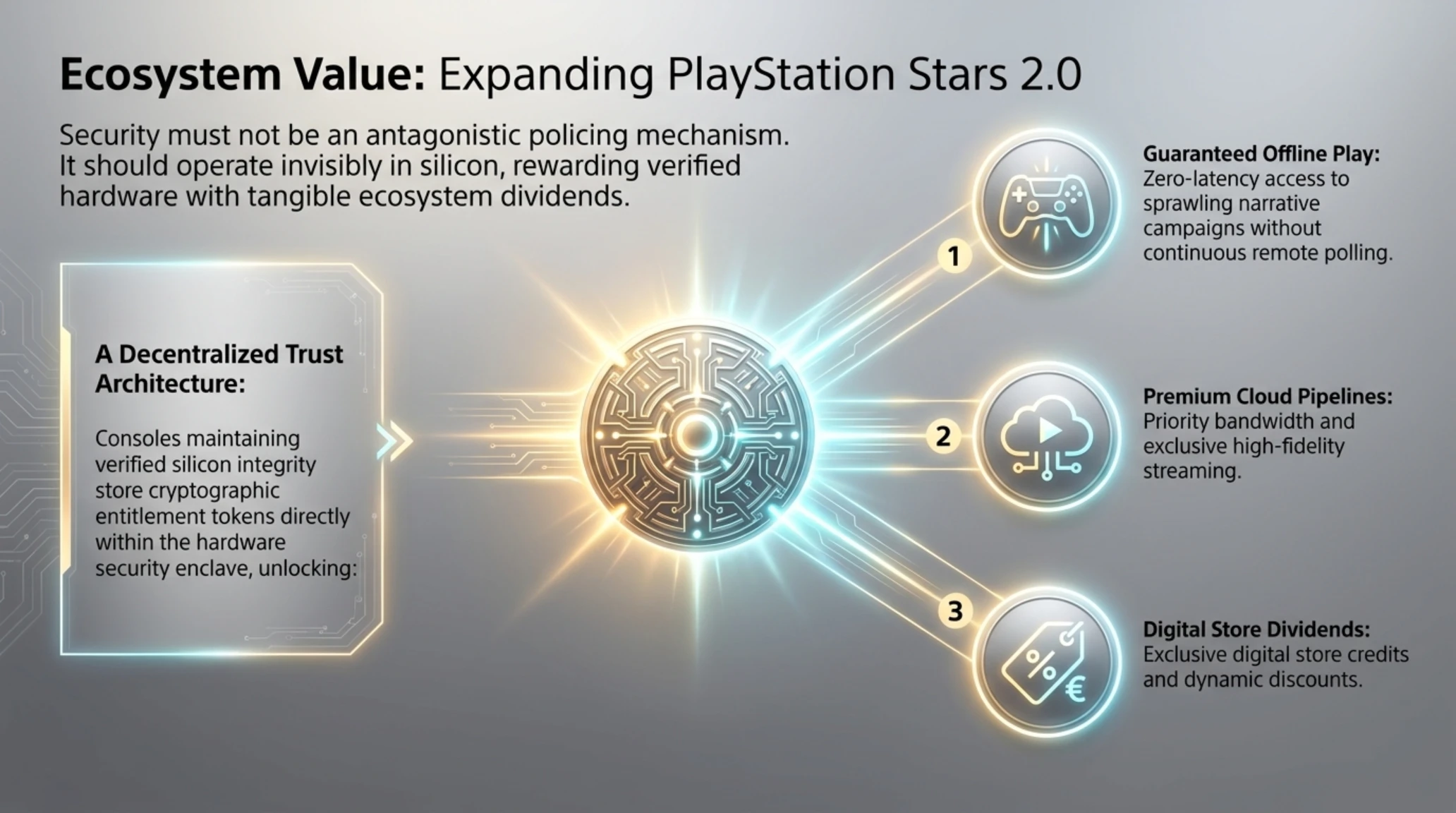
Preserving offline playability is a cornerstone of consumer trust. Millions of global players travel frequently, inhabit areas with intermittent broadband access, or simply prefer experiencing sprawling narrative campaigns in an air-gapped environment. Forcing legitimate owners to ping verification servers every few hours under the guise of anti-piracy enforcement is an insult to honest consumers. True security should operate invisibly in silicon, protecting intellectual property without turning paying players into perpetual suspects. By combining hardware-level isolation with tangible fidelity incentives such as expanding PlayStation Stars rewards into real digital store credits and priority cloud gaming bandwidth Sony can foster an ecosystem where legal participation is not merely an obligation, but an undeniably superior, respected consumer experience.
From an economic standpoint, alienating the core enthusiast gamer poses an existential threat to platform profitability. In modern console economics, hardware hardware units are traditionally sold at razor-thin margins or modest subsidies. The entire commercial model relies on cumulative software attach rates, digital deluxe edition upsells, battle passes, and recurring PlayStation Plus subscriptions. A single active console user represents an estimated lifetime value (LTV) exceeding $3,300 over a standard seven-year console cycle. When security engineering teams inadvertently degrade this premium user experience through intrusive validation checks or connection timeouts, they directly jeopardize the recurring software cash flows that sustain Sony Interactive Entertainment overall corporate valuation.
The technical pathology of anti-tamper performance degradation is well documented in systems engineering literature. When anti-tamper routines periodically verify binary integrity, they force worker threads to halt rendering loops, recalculate cryptographic hashes over multi-gigabyte memory segments, and wait for memory bus synchronization. This thread contention introduces frame pacing irregularities and frame time spikes often manifesting as momentary micro-stutter during rapid camera pans or dynamic combat sequences. Legitimate gamers who invest heavily in premium OLED displays and 120Hz gaming setups notice these micro-stutters immediately. Subjugating paying consumers to inferior frame delivery while pirated builds bypass these integrity checks entirely is an untenable failure of product stewardship.
To fundamentally align consumer loyalty with platform defense, Sony must conceptualize PlayStation Stars 2.0 as a decentralized, cryptographic trust architecture. Rather than treating security as an antagonistic policing mechanism, the platform should reward verified hardware with tangible ecosystem dividends. Consoles maintaining verified silicon integrity can be granted cryptographic entitlement tokens stored securely within the hardware security enclave, unlocking zero-latency offline play rights, dynamic store discounts, and exclusive high-fidelity cloud streaming pipelines. When legitimate gamers experience tangible prestige, uncompromised performance, and active corporate gratitude, the psychological appeal of running unstable jailbreak firmwares evaporates organically.
Moreover, modern platform governance requires treating digital ownership and cloud synchronization with absolute architectural stewardship. Gamers who invest thousands of dollars building sprawling digital game libraries deserve guaranteed access to their purchases across hardware generational boundaries, unencumbered by sudden server retirements or revoking of digital rights management certificates. By introducing cryptographic hardware-bound licensing that functions autonomously without requiring continuous remote polling, Sony can establish a gold standard for digital ownership preservation. Protecting the consumer experience from unnecessary security friction is not merely an ethical imperative; it is the ultimate commercial moat that defends the PlayStation brand against ecosystem fragmentation and piracy.
Market Sentiment Thermometer and Adoption S-Curve Gauge
Consumer Sentiment Analysis: The rapid 14.20 firmware breach has suppressed player confidence to 71%; executing silicon-level Zero-Trust security in PlayStation 6 remains the only viable path to restoring ecosystem trust above 88%.
- Exposes foundational vulnerabilities in legacy FreeBSD monolithic kernels before major late-generation launches.
- Establishes undeniable engineering momentum for formally verified microkernels and Type-0 hypervisors in PS6.
- Demonstrates the necessity of expanding HackerOne bug bounty incentives to outpace gray-market brokers.
- Highlights the imperative of respecting legitimate gamer equity and eliminating performance-degrading DRM.
- Short-term risk of increased cheat injection in multiplayer lobbies if kernel execution primitives widen.
- Temporary brand erosion regarding Sony agility in defending retail platform firmwares.
- Potential temptation for Sony to impose hasty and friction-heavy verification checks in upcoming revisions.
Editorial Verdict and Verified Primary Industry Sources
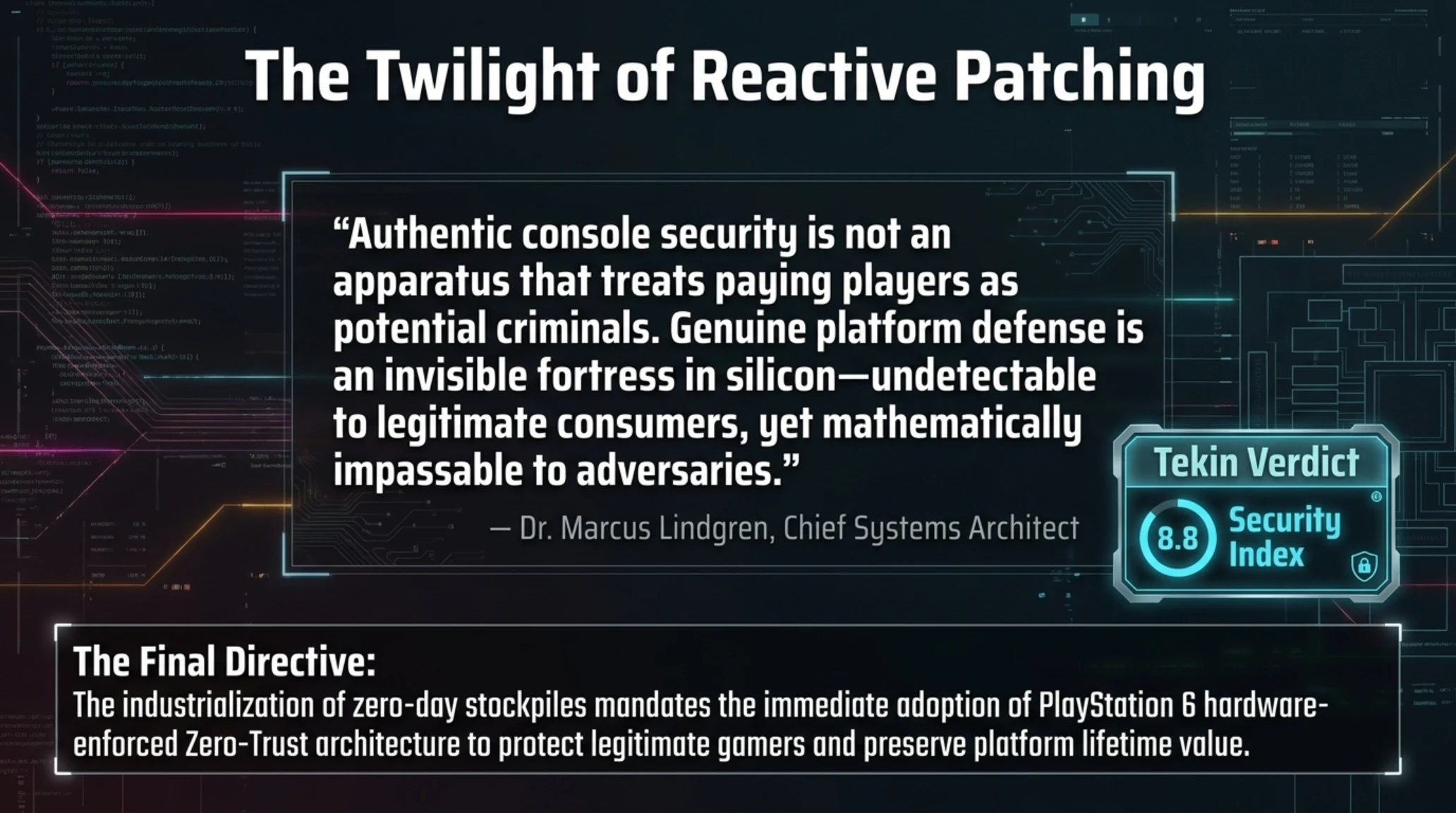
The Twilight of Reactive Patching and the Dawn of Silicon Zero-Trust
The rapid fall of firmware 14.20 cements the necessity of transitioning from vulnerable reactive patches to hardware-enforced microkernels for the tenth console generation, ensuring legitimate gamer trust remains permanently safeguarded.
- Eurogamer: In-depth analysis of PlayStation operating system architecture and firmware security
- The Verge: Investigation into modern console jailbreaks and userland WebKit vulnerabilities
- BleepingComputer: Technical coverage of memory safety mitigations and software bug bounties
- Wired: The emergence of hardware-enforced Zero-Trust architecture in consumer entertainment devices
Frequently Asked Questions: Firmware 14.20 and Next-Gen Security
Why was PlayStation 5 firmware 14.20 compromised within eight hours of launch?
Sony engineers patched only previously reported bug vectors, leaving underlying WebKit and Lua userland interpreter vulnerabilities intact. Researchers leveraged pre-existing zero-day primitives to reconstruct a working exploitation pipeline in hours.
Does the 14.20 exploit mean pirated games can now run freely on retail consoles?
No. The demonstration proved arbitrary code execution in the unprivileged userland and memory loader space. Full game backup execution requires bypassing hypervisor cryptographic keys and package decryption algorithms.
Why is the monolithic FreeBSD kernel of Prospero OS vulnerable to escalation?
Because monolithic kernels execute all core drivers and subsystems in a shared Ring 0 address space. A breach inside an unprivileged userland module directly exposes hundreds of syscall handlers without defense-in-depth isolation.
How can Sony prevent similar vulnerabilities in PlayStation 6?
By transitioning to a formally verified microkernel (such as seL4), implementing a Type-0 bare-metal hypervisor with AMD SEV-SNP cryptographic RAM slicing, and enforcing hardware Memory Tagging Extensions (MTE) in silicon.
How should Sony protect legitimate account holders from feeling discouraged?
Sony must avoid intrusive always-online DRM that causes frametime stutter, enforce remote attestation to keep multiplayer lobbies cheat-free, and reward loyal subscribers with tangible PlayStation Stars credits and cloud perks.
Are ordinary retail users at risk of having their consoles hacked remotely?
No. Modern console exploits require deliberate physical user interaction, loading crafted web pages or custom script loaders. Users playing official games connected to PSN face zero threat of unauthorized remote hijacking.
Additional Gallery: Tekin Analysis | PS5 14.20 Jailbreak & PlayStation 6 Security