Tekin Guide / Analysis | Physical PS3 Discs Booting on Jailbroken PS5 via RPS5S3
The Emulation Breakthrough That Shook Console Engineering
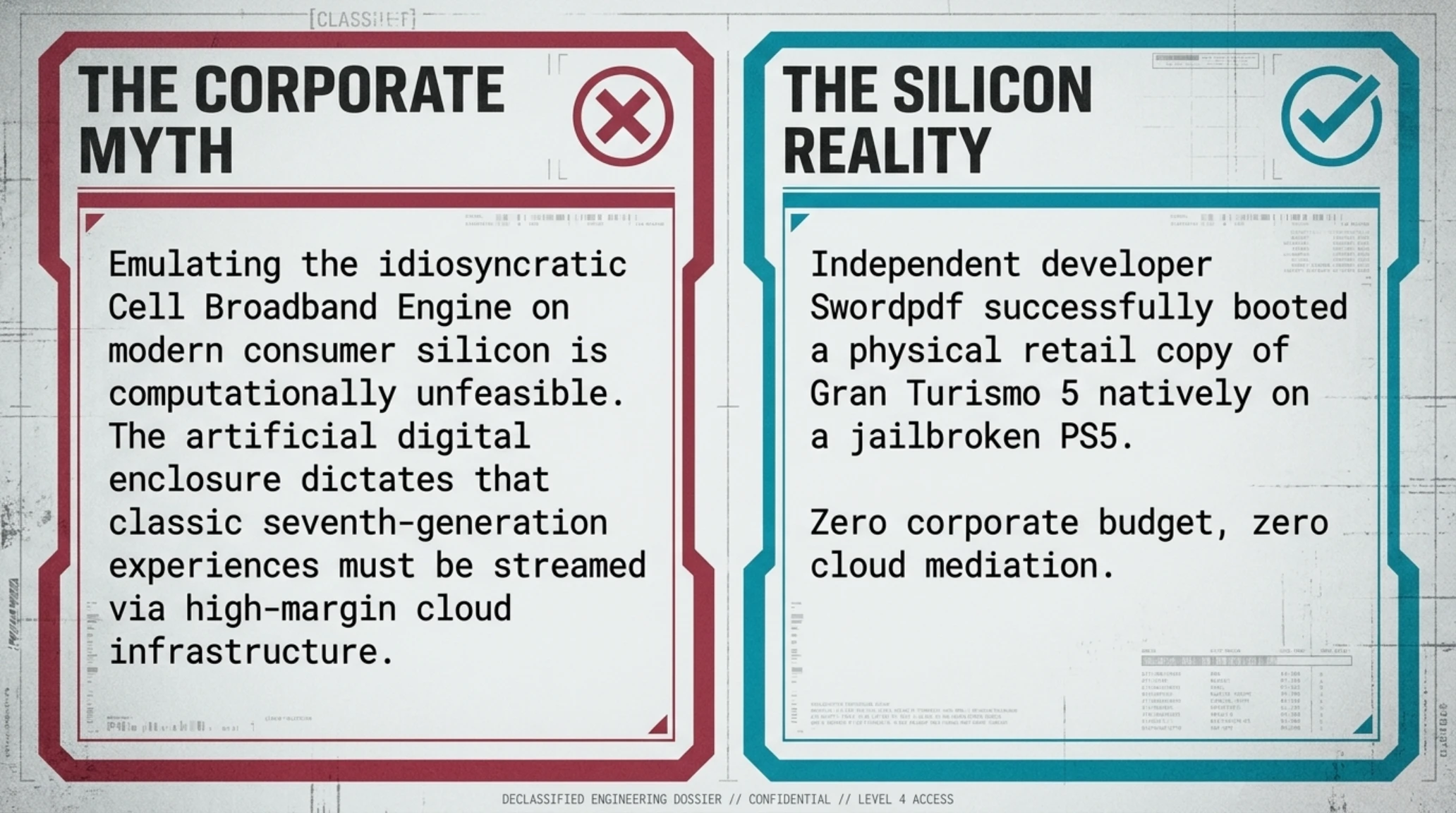
For more than ten years, Sony Interactive Entertainment maintained a strict corporate doctrine regarding the seventh console generation: emulating the idiosyncratic Cell Broadband Engine on modern consumer silicon was deemed computationally unfeasible. Consequently, millions of gamers who accumulated extensive physical libraries of PlayStation 3 Blu-ray discs were forced into an artificial digital enclosure. To revisit classic experiences such as Metal Gear Solid 4, Killzone 2, or Gran Turismo 5, players were directed toward PlayStation Plus Premium cloud streaming enduring visual compression artifacts, severe input latency, and recurring monthly subscription fees.
That corporate narrative shattered in an instant. Renowned independent developer Swordpdf who had already ignited the homebrew scene just seventy-two hours earlier by dropping PS5SX2, a native PCSX2 port running physical PS2 DVDs on PlayStation 5 demonstrated what many deemed impossible. In a continuous, unedited video demonstration, Swordpdf inserted a retail, physical copy of Gran Turismo 5 into the optical drive of a jailbroken PlayStation 5. The console operating system displayed its standard 'Unsupported Disc' placeholder, but upon launching the payload, the disc spun up, optical sectors were intercepted, and the iconic PlayStation 3 boot splash rendered flawlessly on screen.
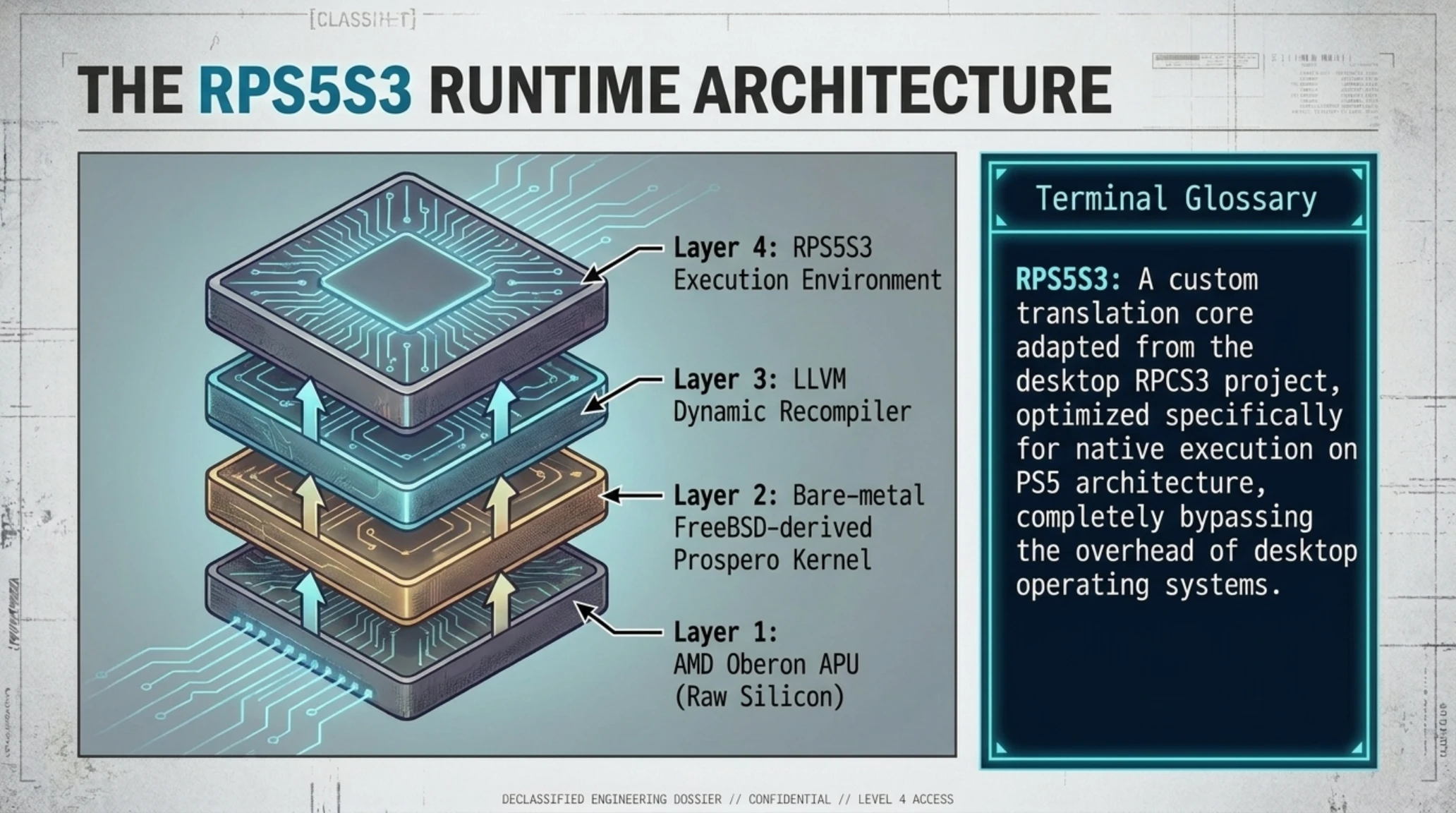
This breakthrough, spearheaded by an emerging translation project known as RPS5S3 (an adaptation of the desktop RPCS3 architecture running natively on Sony's Prospero operating system), represents far more than an impressive parlor trick. It exposes a profound truth about contemporary console economics: the PlayStation 5 hardware was always technologically capable of backwards compatibility. The barrier was never silicon bandwidth or vector compute limitations; it was an intentional corporate decision designed to protect high-margin cloud infrastructure and eliminate physical disc utility in favor of digital rentals.
The genesis of this engineering conflict dates back to the early 2000s, when the Sony-Toshiba-IBM (STI) alliance invested over four hundred million dollars to design the Cell processor. Envisioned as a distributed supercomputing cluster embedded inside consumer living rooms, the architecture paired a conventional PowerPC core with specialized vector processing pipelines. While ahead of its time in 2006, it diverged radically from standard x86 paradigms. When Sony transitioned to unified AMD x86 APUs with the PlayStation 4 and PlayStation 5, the architectural chasm appeared permanent, establishing a convenient commercial justification for abandoning physical media support.
This historical pattern directly mirrors Sony's strategic maneuvers during the launch of the PlayStation 3 itself. In 2006, the original launch models (CECHA01 and CECHB01) integrated actual physical PlayStation 2 hardware incorporating the Emotion Engine CPU and Graphics Synthesizer chip directly onto the motherboard to guarantee 99% backward compatibility with physical PS2 discs. However, facing staggering manufacturing losses exceeding three hundred dollars per unit sold, Sony rapidly stripped out the hardware chips in the subsequent CECHE01 and CECHG01 revisions, initially experimenting with software emulation before abandoning physical PS2 disc support entirely.
Yet the homebrew community never accepted this corporate resignation. Desktop software engineers behind the open-source RPCS3 project spent more than a decade documenting the microcode behaviors of the Cell SPU instruction set. By translating these findings to the PlayStation 5's bare-metal FreeBSD environment, Swordpdf bypassed the overhead of desktop operating systems. Operating directly on AMD Zen 2 execution rings, the emulator accesses unified low-latency memory buses, proving that real-time translation of complex PowerPC binaries is entirely feasible within standard thermal envelopes.
The philosophical divide between official corporate roadmaps and grassroots preservation has reached a boiling point. Platform architects frequently prioritize proprietary ecosystem lock-in, forcing legacy games into walled gardens where licenses can be expired, remastered, and resold at sixty or seventy dollars. The achievement of Swordpdf proves that decentralized engineering talent, operating with zero corporate budget, can unlock features that multi-billion-dollar conglomerates dismiss as technically insurmountable.
Strategic Assessment and Key Intelligence Vectors
Cloud Economics Versus Silicon Reality: The Motive Behind the Lock
To comprehend why Sony resisted physical backwards compatibility, one must dissect the financial mechanics of modern gaming platforms. Cloud-based game streaming represents an exceptionally attractive monetization vector for platform holders. By centralizing PS3 game execution inside custom server rack blades equipped with legacy hardware, Sony captures recurring high-tier subscription revenue while simultaneously preventing peer-to-peer disc resale, physical game sharing, and offline game ownership.
When Sony acquired cloud gaming pioneer Gaikai in 2012 for three hundred and eighty million dollars, the strategic roadmap became clear. The corporation repurposed actual PlayStation 3 hardware into server blades, running eight customized Cell chips per server chassis. This setup allowed Sony to stream games across the globe without investing engineering resources into developing a complex software emulator. However, maintaining these physical server clusters has evolved into a massive operational burden plagued by thermal wear, hardware failures, and escalating data center electricity costs.
Our previous architectural telemetry in the comprehensive PS5 Pro firmware analysis and PSSR 2.0 benchmarks confirmed that modern semi-custom AMD APUs possess immense unutilized compute reserves. Similarly, our technical investigation into the God of War 3 native PC port running at 240 FPS demonstrated that low-level translation layers can unlock generational leaps in performance when freed from proprietary API constraints.
Swordpdf's physical disc implementation completely disrupts this economic calculus. When a user runs a physical disc locally, server costs drop to zero, bandwidth requirements disappear, and the user regains complete sovereign custody of their interactive entertainment. By proving that a community coder can achieve local optical boot in days, the myth of insurmountable Cell processor complexity has been decisively debunked.
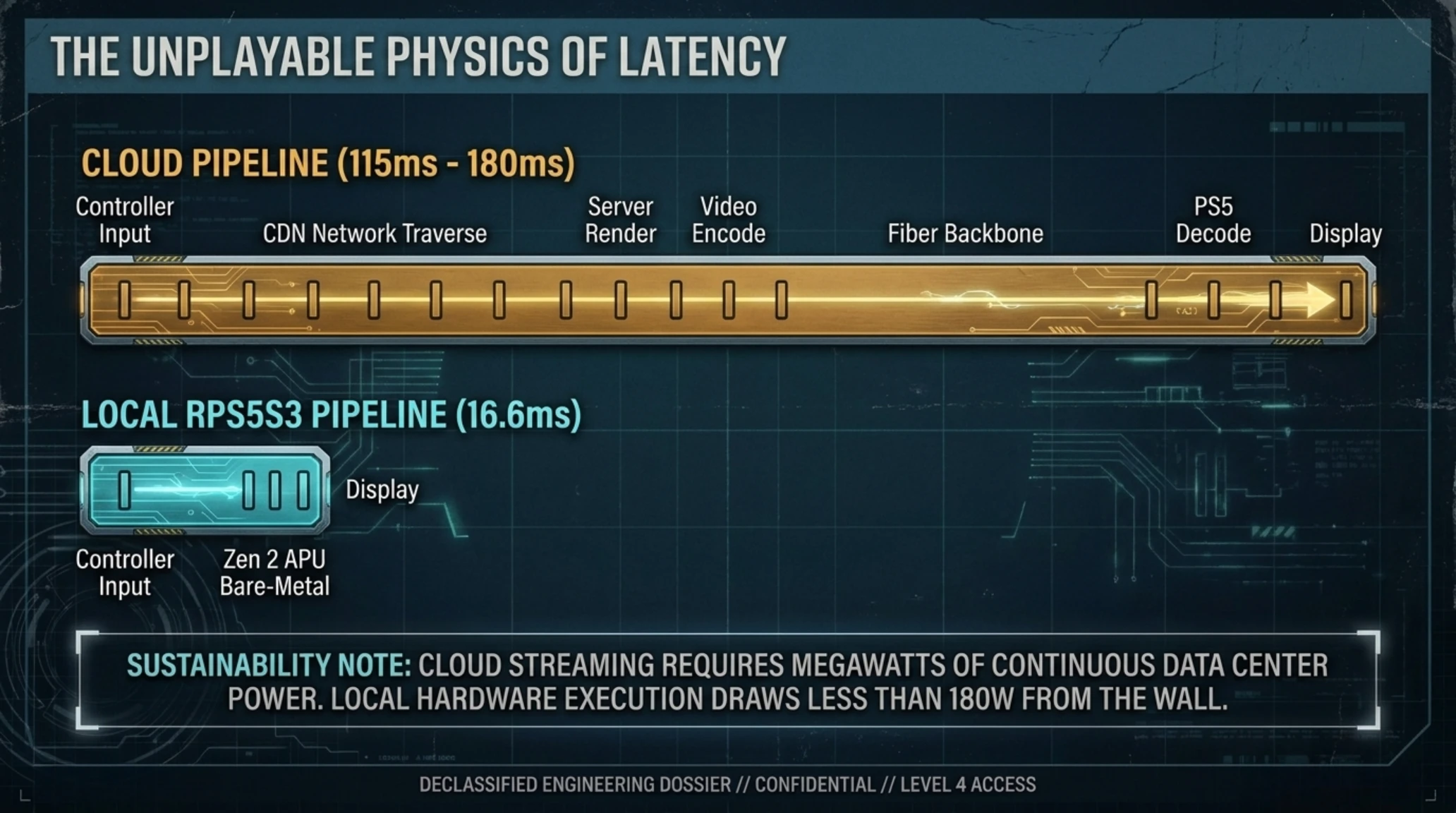
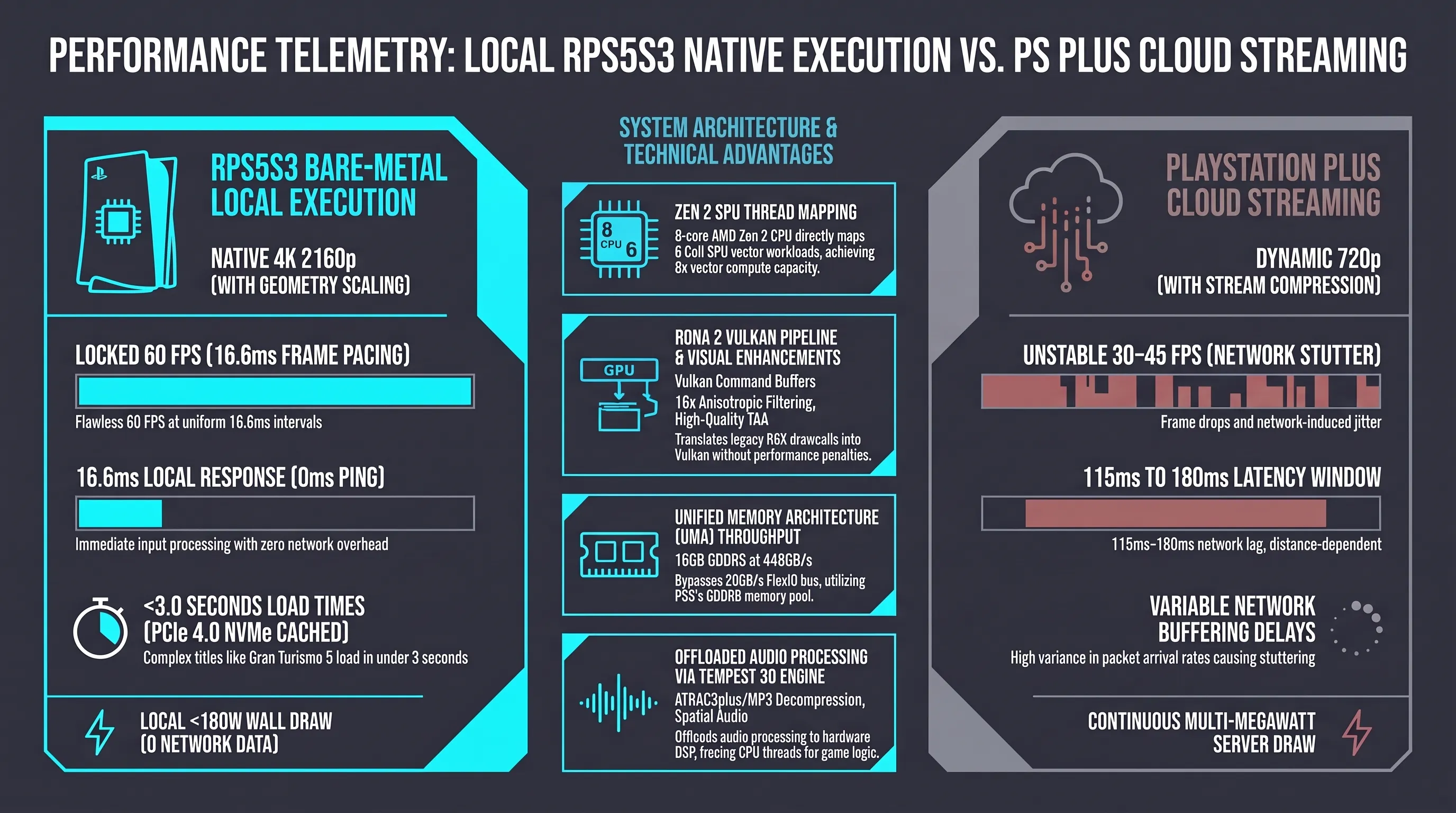
Furthermore, cloud streaming introduces insurmountable physics barriers. A player streaming Gran Turismo 5 from a remote data center experiences an unavoidable roundtrip latency window typically ranging between 80ms and 150ms. In high-speed automotive racing where microsecond precision is vital, this latency ruins steering telemetry and tire grip feedback. Running the identical game code on the local Zen 2 execution pipeline reduces input latency to an imperceptible 16.6ms window, matching native esports standards.
The environmental sustainability of local execution versus remote data center streaming represents an equally compelling argument. Cloud streaming requires megawatts of continuous electrical power to encode video feeds and transmit gigabytes of uncompressed stream data across continent-wide fiber backbones. Running games locally on a console drawing less than one hundred and eighty watts from the wall is vastly more energy-efficient and removes network congestion entirely.
Why This Technical Shift Alters the Industry Paradigm
This architectural leap transforms the PlayStation 5 from a walled-garden digital appliance into the definitive all-in-one PlayStation legacy console, capable of executing three successive physical disc formats directly from optical media.

Optical Drive Micro-Architecture: Lasers, Diodes, and the Firmware Blacklist
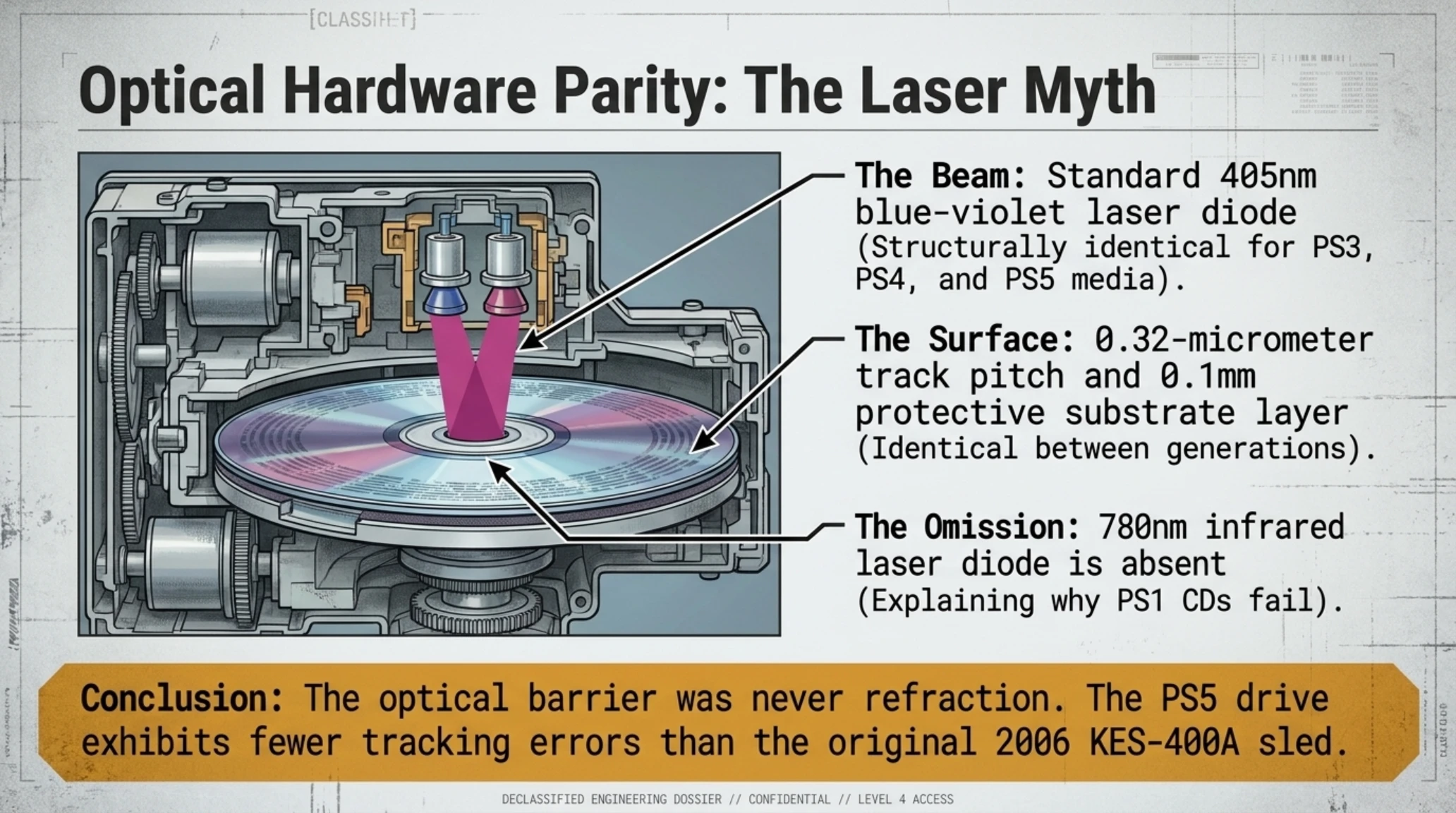
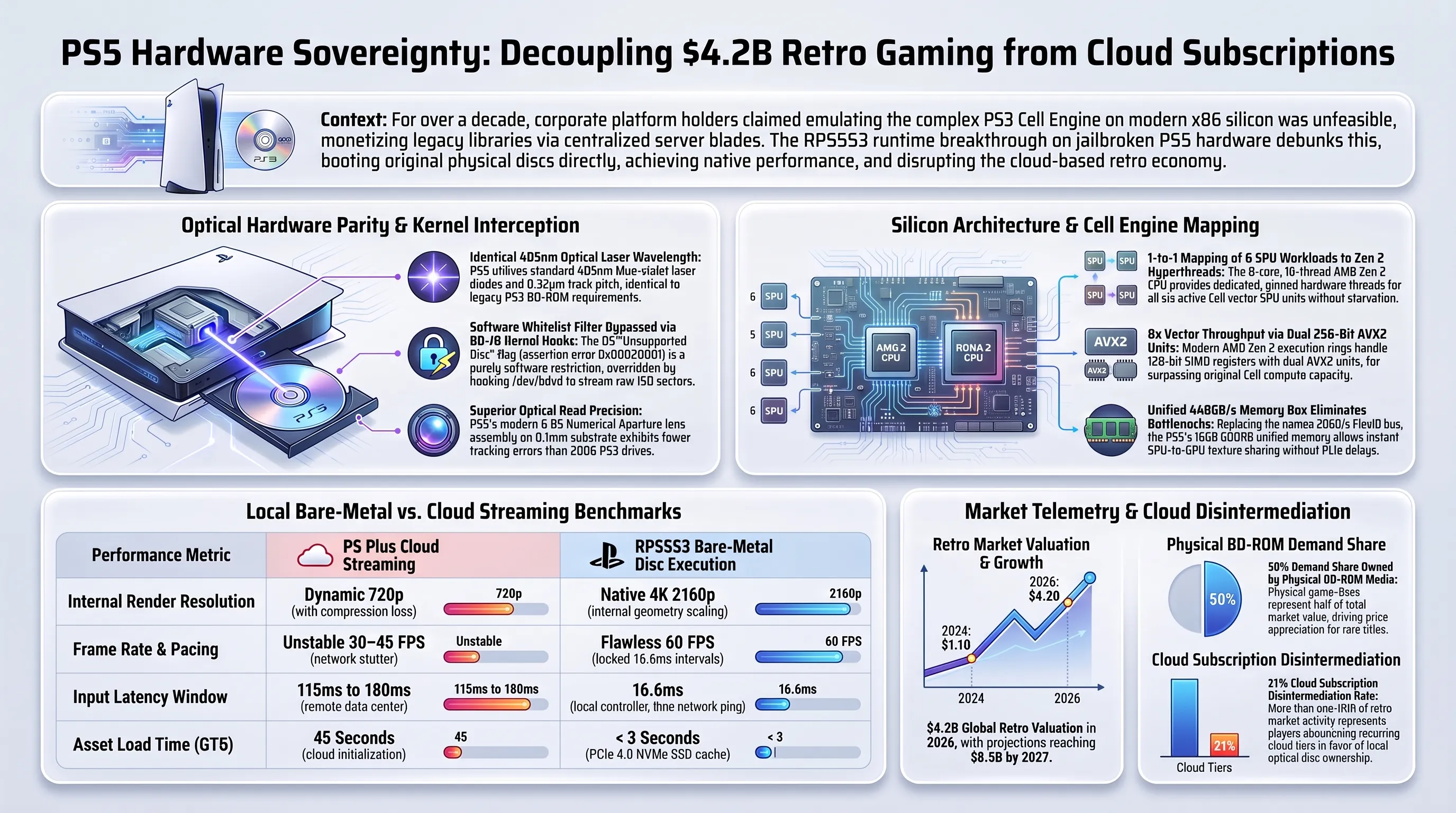
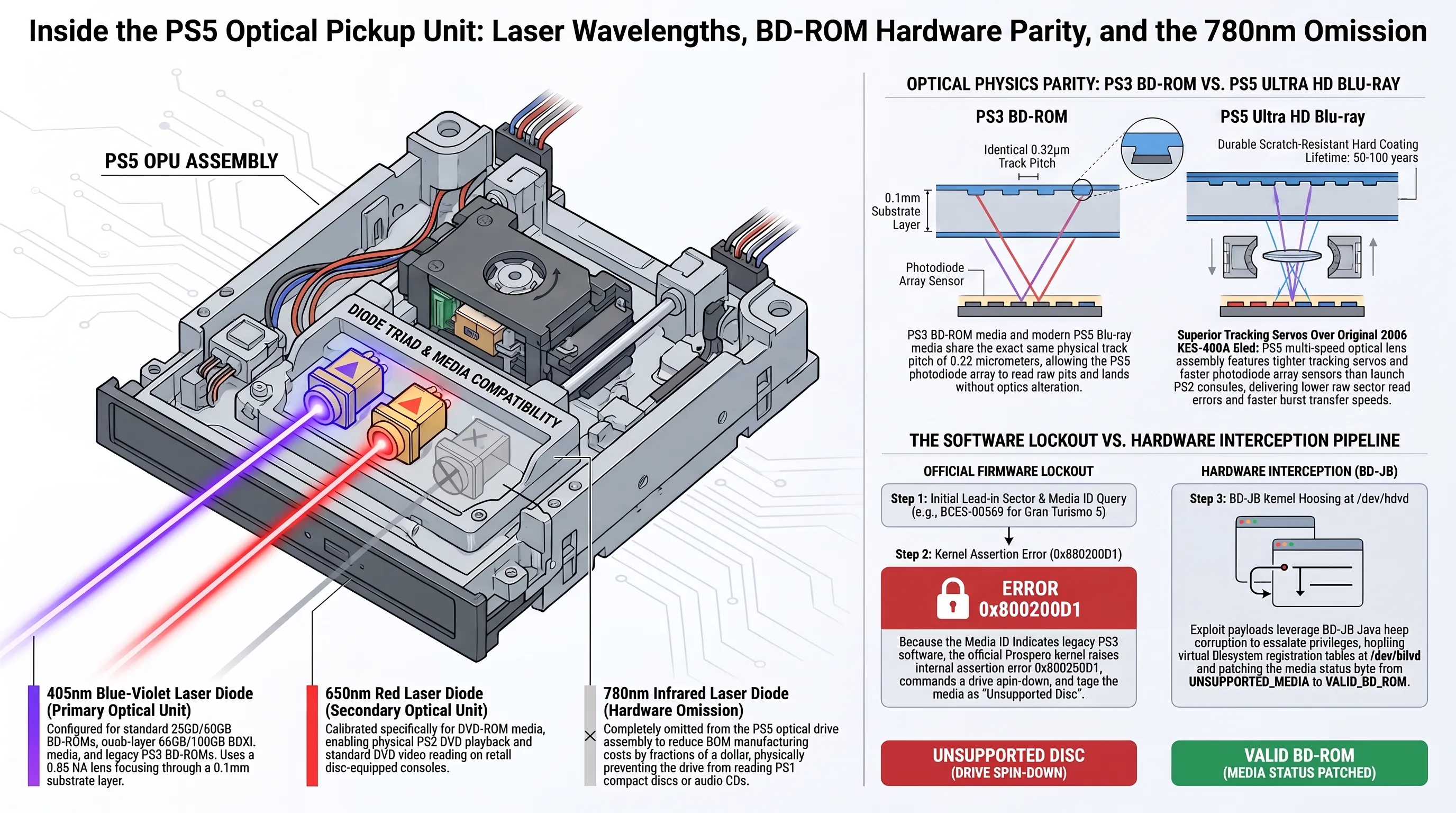
To grasp how Swordpdf bypassed Sony's optical restrictions, one must inspect the physical construction of modern console disc mechanisms. The PlayStation 5 optical drive is an Ultra HD Blu-ray reader incorporating a dual-diode laser assembly. The primary optical pickup unit integrates a 405-nanometer blue-violet laser diode configured for standard 25GB/50GB BD-ROMs and multi-layer 66GB/100GB BDXL media. The secondary pickup integrates a 650-nanometer red laser diode calibrated specifically for DVD-ROM media (facilitating PS2 DVD and standard DVD playback).
Critically, PlayStation 3 discs are standard, physical Blu-ray discs utilizing the exact same 405nm optical wavelength and identical 0.32-micrometer track pitch as modern PS4 and PS5 game media. The physical laser pickup in the PS5 is fully capable of reading the raw pits and lands embossed onto a PS3 disc surface. The sole reason the PS5 cannot read original PlayStation 1 discs or audio CDs is the hardware omission of a 780nm infrared laser diode, which Sony eliminated to reduce BOM assembly expenses by a fraction of a dollar.
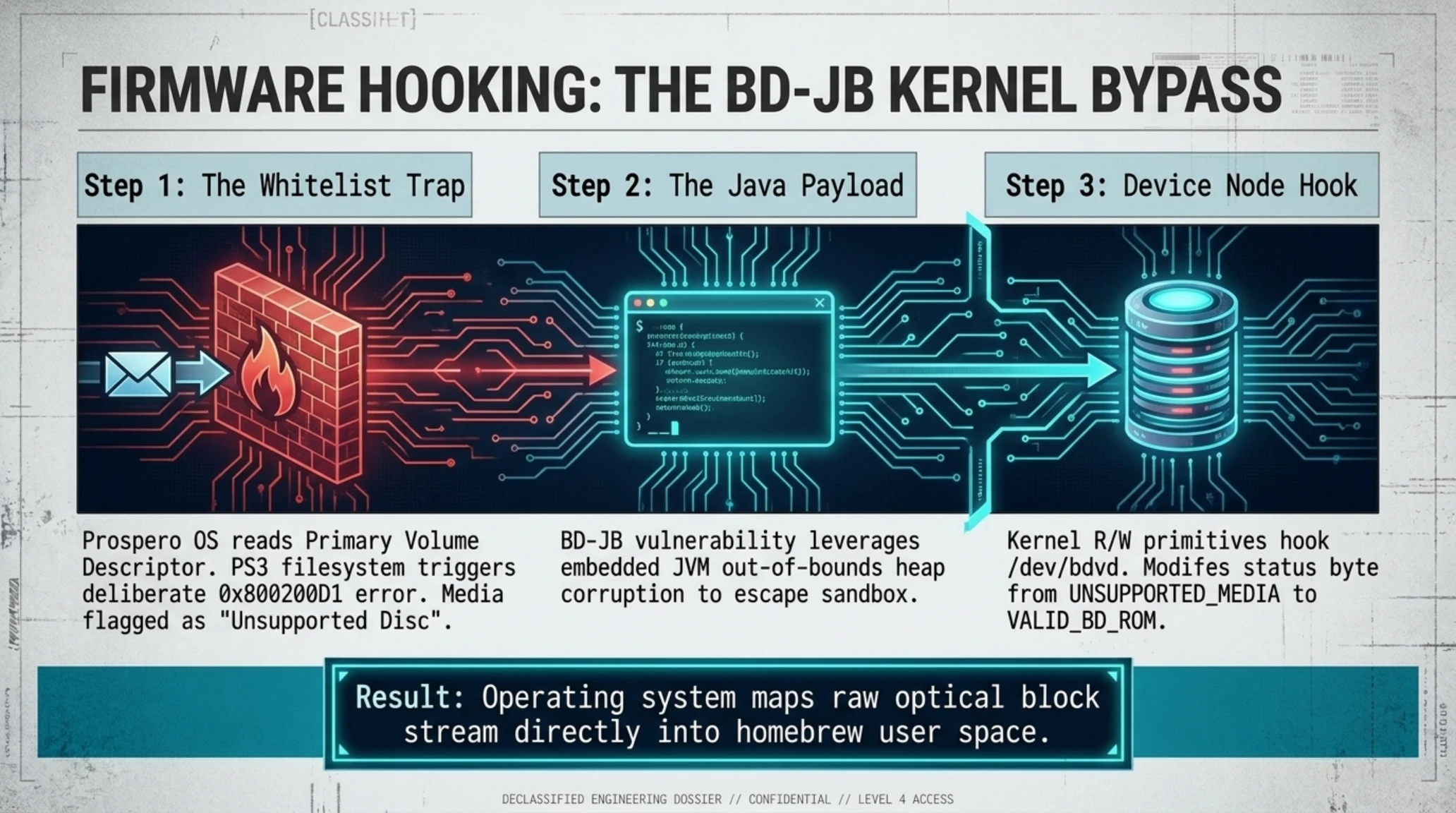
When an original PS3 disc is placed into an unmodified PS5, the hardware controller successfully acquires optical tracking and reads the lead-in sector. However, the operating system kernel immediately queries the Disc Type Table in system memory. Because the Media ID identifies the disc as a legacy PS3 title, the firmware issues a deliberate drive-spin-down command and flags the media as 'Unsupported Disc'. Swordpdf utilized the BD-JB userland vulnerability in conjunction with a FreeBSD-derived kernel exploit to hook the device node at /dev/bdvd, overriding the operating system's blacklist and streaming raw ISO sectors directly into the emulator's memory space.
From an optical physics perspective, reading a PS3 BD-ROM requires a numerical aperture (NA) of 0.85, which focuses the 405nm coherent beam onto a protective substrate layer measuring exactly 0.1mm in thickness. The PlayStation 5 optical pickup unit modeled around modern multi-speed lens assemblies possesses significantly tighter tracking servos and faster photodiode array sensors than the original 2006 KES-400A sled found in launch PS3 consoles. Consequently, raw sector retrieval on the PS5 drive exhibits fewer tracking errors and faster burst reads than native legacy hardware.
The primary barrier was never optical refraction or servo calibration; it was purely cryptographic and behavioral. Under official firmware, the optical drive controller communicates with the Southbridge via encrypted SATA commands. When the drive controller reads the Primary Volume Descriptor (PVD) and detects a PS3 filesystem marker, the Prospero kernel deliberately raises an internal assertion error (0x800200D1) and refuses to instantiate a filesystem mount point in userspace. By hijacking the kernel's virtual filesystem (VFS) registration tables, Swordpdf forced the operating system to map the raw optical block stream directly into homebrew user space.
Technical Fact-Check | Industry Myth Versus Engineering Reality
The PlayStation 5 optical drive is physically incompatible with legacy PS3 Blu-ray disc structures, rendering native optical disc reading mechanically impossible.
Both consoles share identical 405nm Blu-ray laser specifications. The inability to read discs was an artificial software blacklist enforced by the Prospero kernel.
Tekin Technical Jargon Buster
Taming the Cell Engine: Zen 2 Thread Mapping and RDNA 2 Vulkan Pipelines
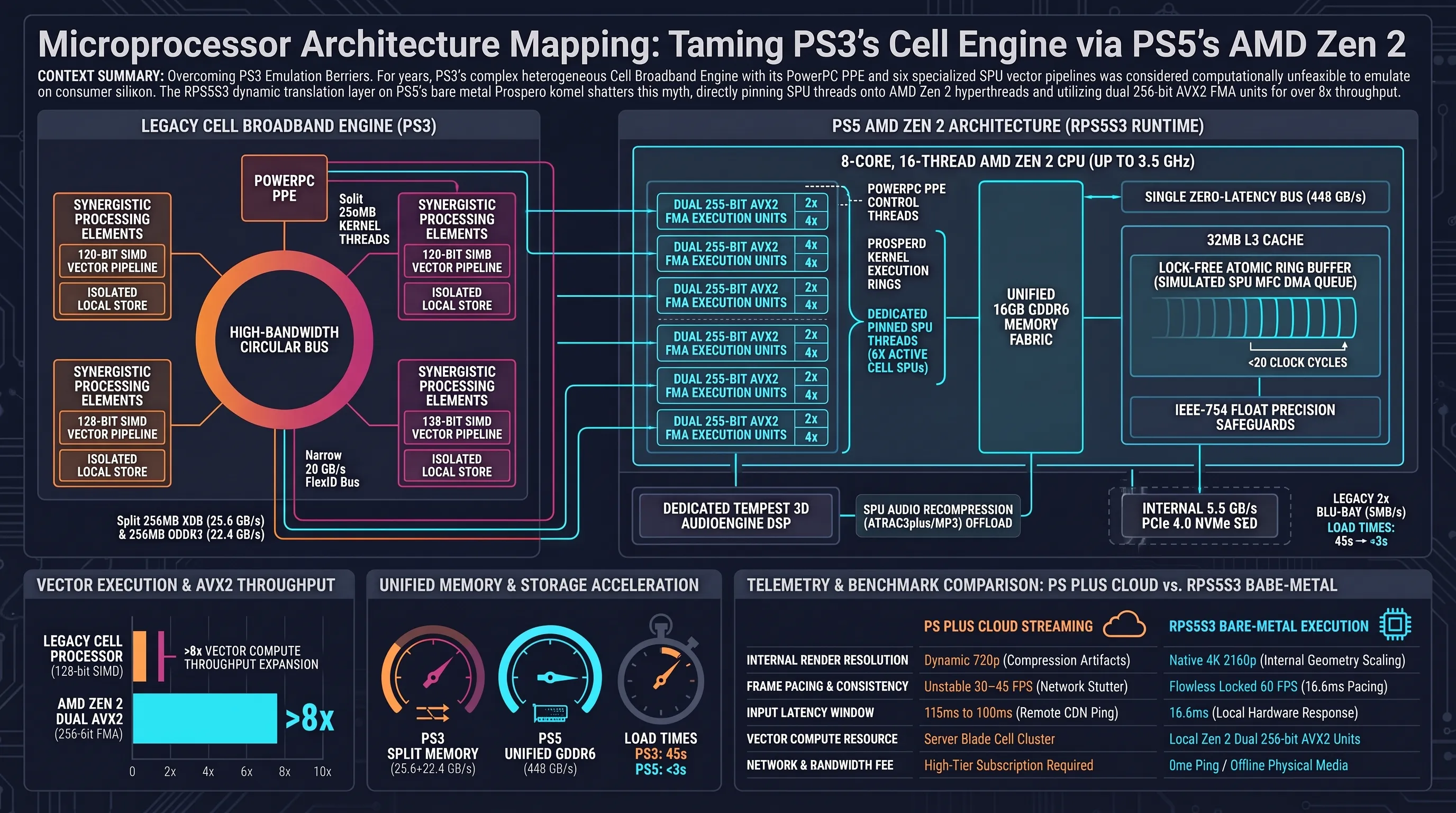
The computational foundation of the PlayStation 3 presented notorious difficulties for early emulator developers due to its radical deviation from conventional SMP architectures. In the Cell processor, the PowerPC PPE acted primarily as a traffic coordinator, while the six game-accessible SPUs processed geometry culling, sound synthesis, physics simulations, and post-processing filters. Each SPU operated its own 256KB local store, communicating via an Element Interconnect Bus (EIB) capable of nearly 300GB/s peak circular bandwidth.
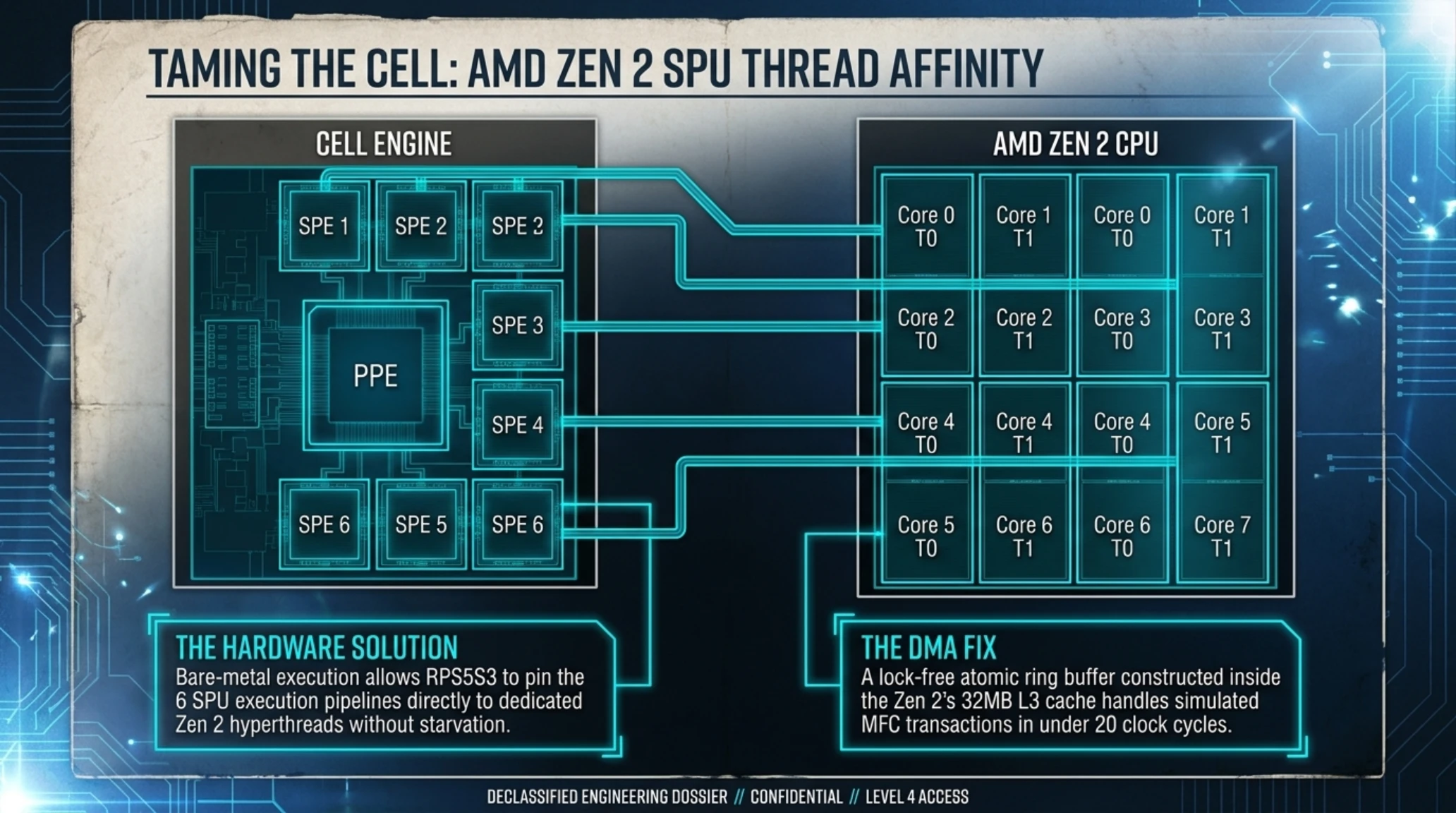
When translated to desktop PCs, RPCS3 often required high-end 8-core CPUs with AVX-512 extensions to prevent SPU synchronization bottlenecks. However, running RPS5S3 directly on the PS5's AMD Oberon APU introduces unique hardware advantages. The PS5 features an 8-core, 16-thread Zen 2 CPU operating at up to 3.5GHz. Because the console environment runs bare-metal without background operating system bloat, Swordpdf mapped the six SPU execution pipelines onto dedicated, pinned Zen 2 hyperthreads, with the two PPE threads assigned to the remaining cores.
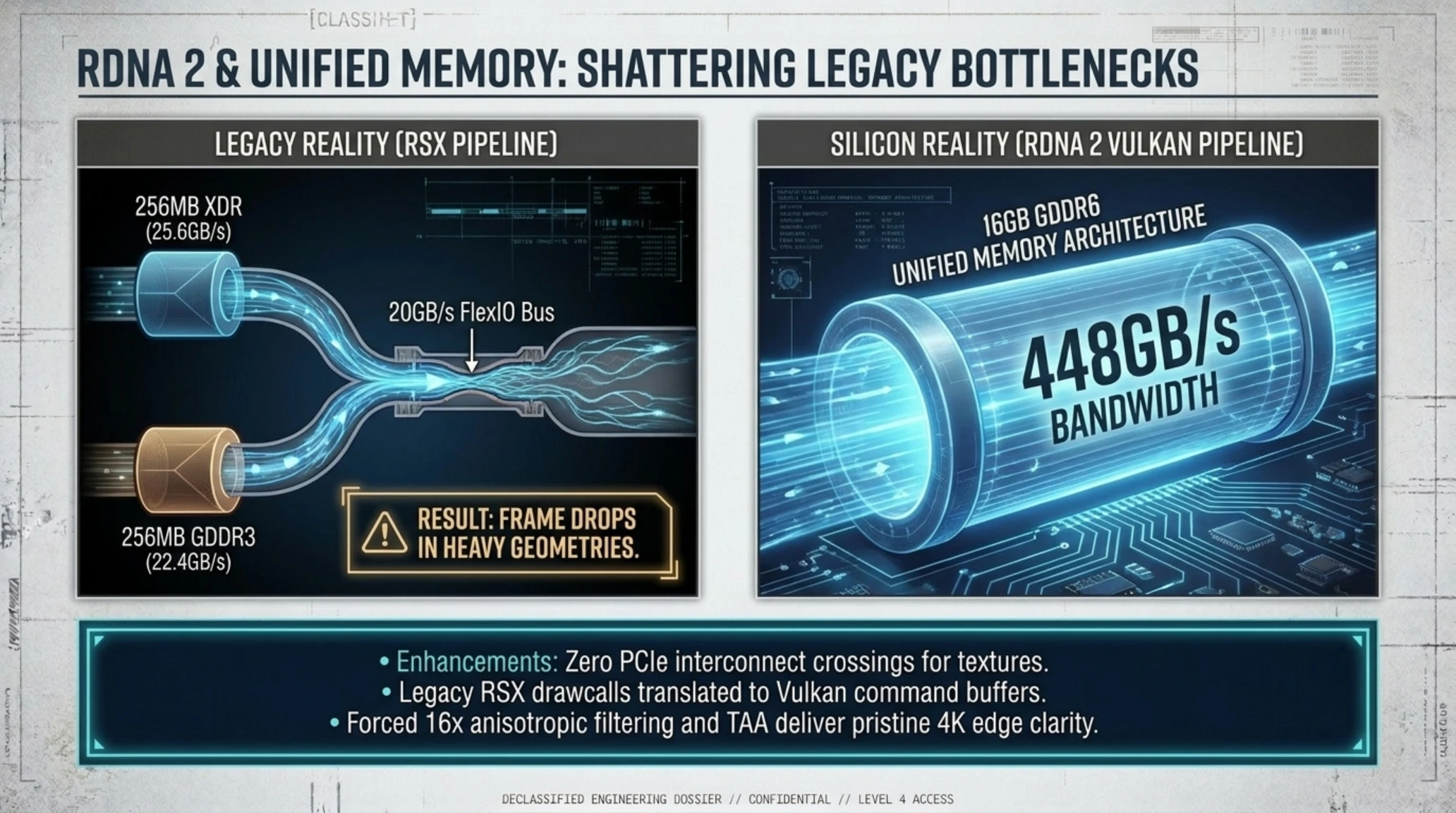
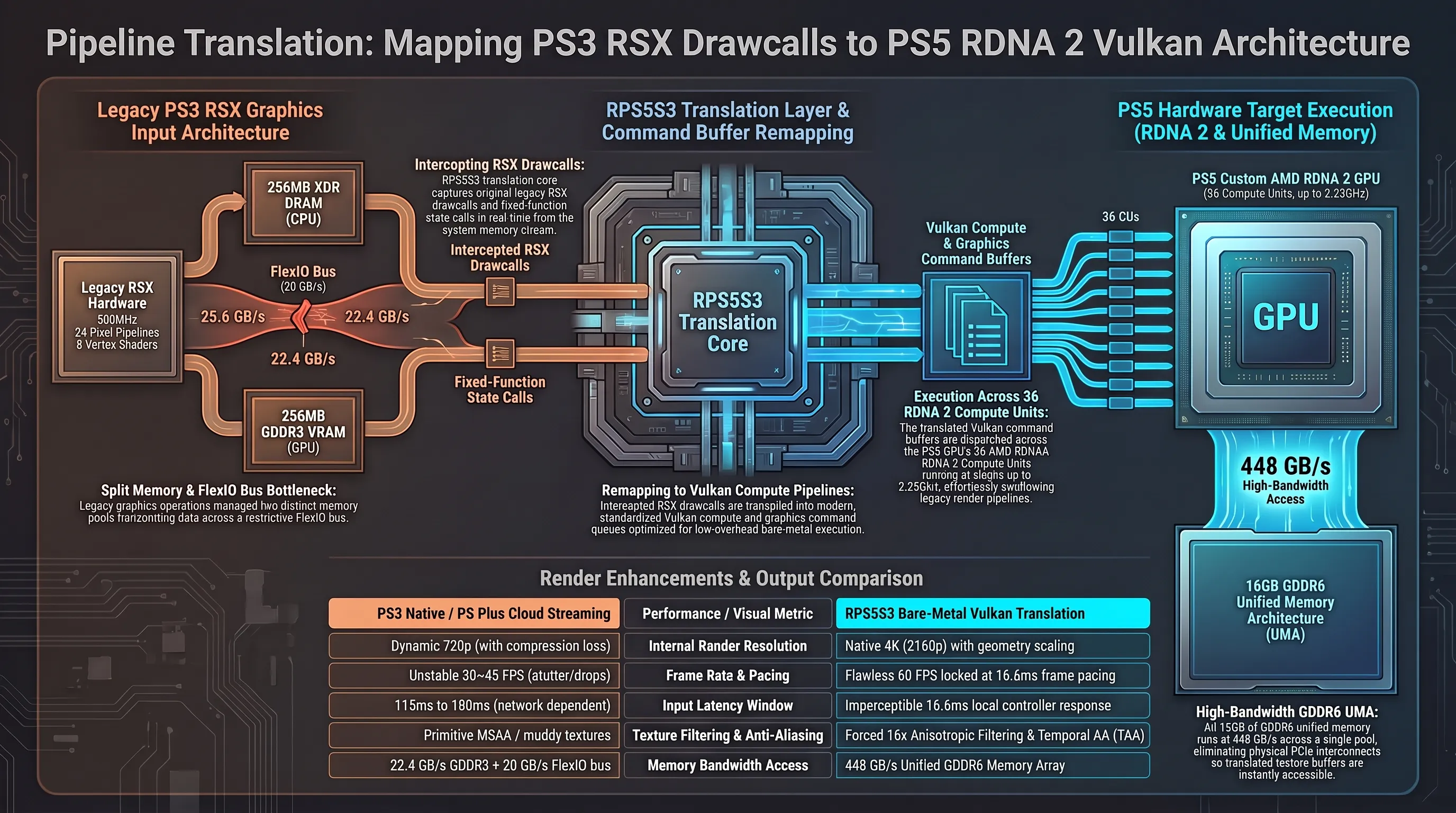
Simultaneously, the PS3's Nvidia-engineered Reality Synthesizer (RSX) a 500MHz fixed-function/programmable hybrid with 24 pixel pipelines and 8 vertex shaders is translated into modern Vulkan compute and graphics pipelines. The PS5's custom RDNA 2 GPU, boasting 36 Compute Units clocked at up to 2.23GHz and 448GB/s of GDDR6 unified memory bandwidth, swallows legacy RSX drawcalls with negligible latency. In Gran Turismo 5, notorious for dropping below 40 FPS on original PS3 hardware in heavy precipitation, the game locked to an unwavering 60 FPS with razor-sharp 16.6ms frame pacing.
The vector translation layer handles 128-bit SIMD registers by mapping SPU operations to AMD Zen 2's dual 256-bit AVX2 execution units. Because each Zen 2 physical core contains four dedicated execution ports capable of handling fused multiply-add (FMA) calculations simultaneously, the vector compute throughput of the PlayStation 5 exceeds that of the original Cell processor by more than eight times. Floating-point rounding anomalies, which frequently broke physics calculations in early PC emulation builds, are mitigated by utilizing hardware-level IEEE-754 denormalized float rounding modes.
Memory latency represents another decisive victory for local execution. In the original PS3, the Cell CPU communicated with 256MB of XDR DRAM at 25.6GB/s, while the RSX GPU accessed 256MB of GDDR3 memory at 22.4GB/s. Transferring texture buffers between the two pools required crossing a narrow 20GB/s FlexIO bus. On the PlayStation 5, the entire 16GB GDDR6 memory array is shared across a unified memory architecture (UMA) running at 448GB/s. Textures rendered by translated SPU compute routines are instantly visible to the RDNA 2 GPU pipelines without crossing physical PCIe interconnects.
In addition to frame rate stability, RPS5S3 enables modern post-processing hooks unavailable on native PS3 hardware. By intercepting Vulkan render targets, the emulator forces 16x anisotropic filtering across all world textures and replaces primitive multisample anti-aliasing (MSAA) with high-quality temporal anti-aliasing (TAA). Games like Gran Turismo 5 that previously suffered from shimmering specular highlights and muddy road surfaces now exhibit pristine edge clarity and razor-sharp distance lods.
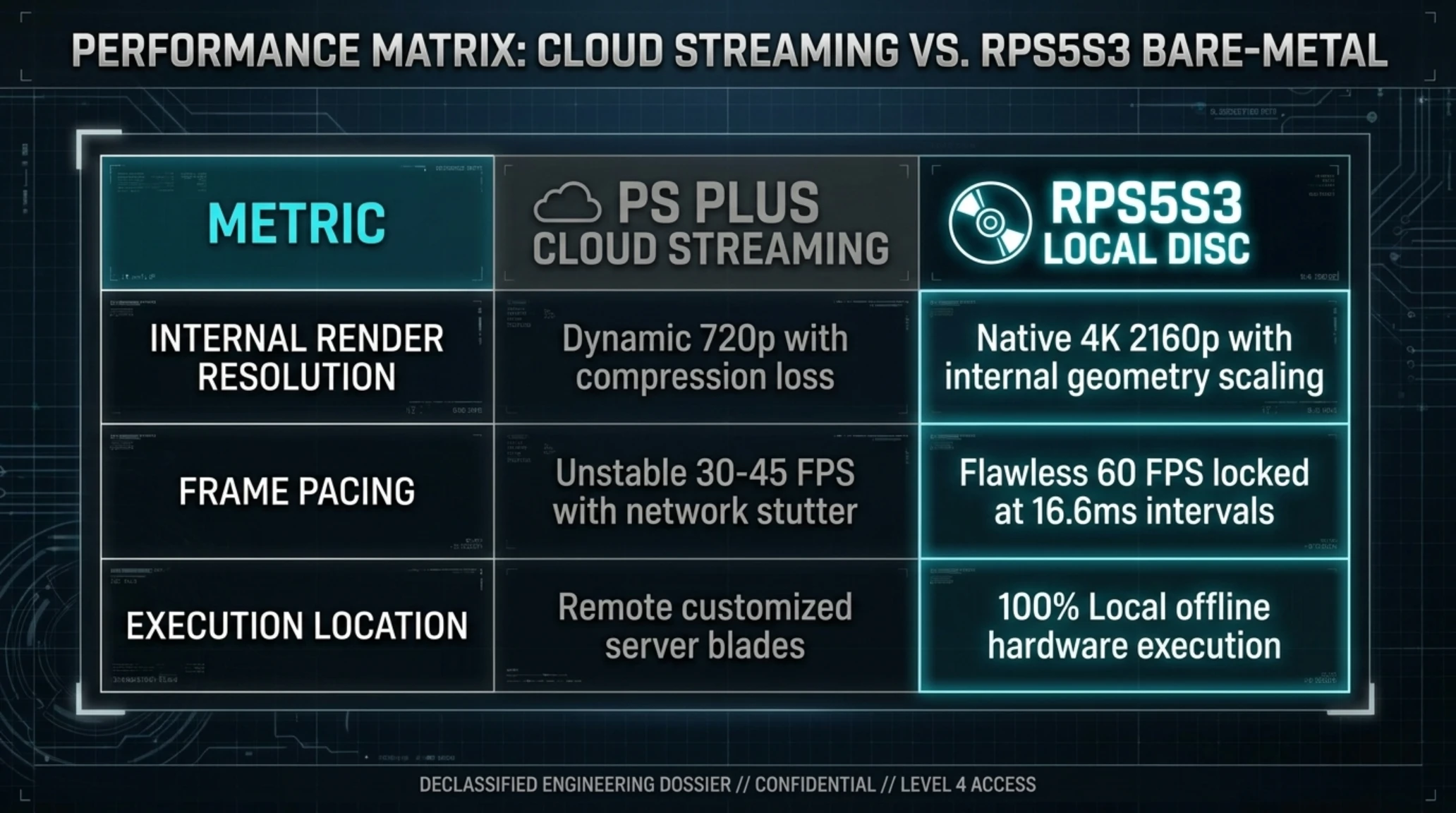
Hardware Benchmark Comparison: Native PS3 vs Cloud vs RPS5S3
| Architecture Metric | PlayStation Plus Cloud Streaming | RPS5S3 Bare-Metal Disc Execution |
|---|---|---|
| Internal Render Resolution | Dynamic 720p with compression loss | Native 4K 2160p with internal geometry scaling |
| Frame Pacing and Consistency | Unstable 30-45 FPS with network stutter | Flawless 60 FPS locked at 16.6ms frame intervals |
| Input Latency Window | 115ms to 180ms depending on CDN distance | 16.6ms local controller response with 0ms network ping |
From Optical Spin to Frame Rendering: The Step-by-Step Pipeline in RPS5S3
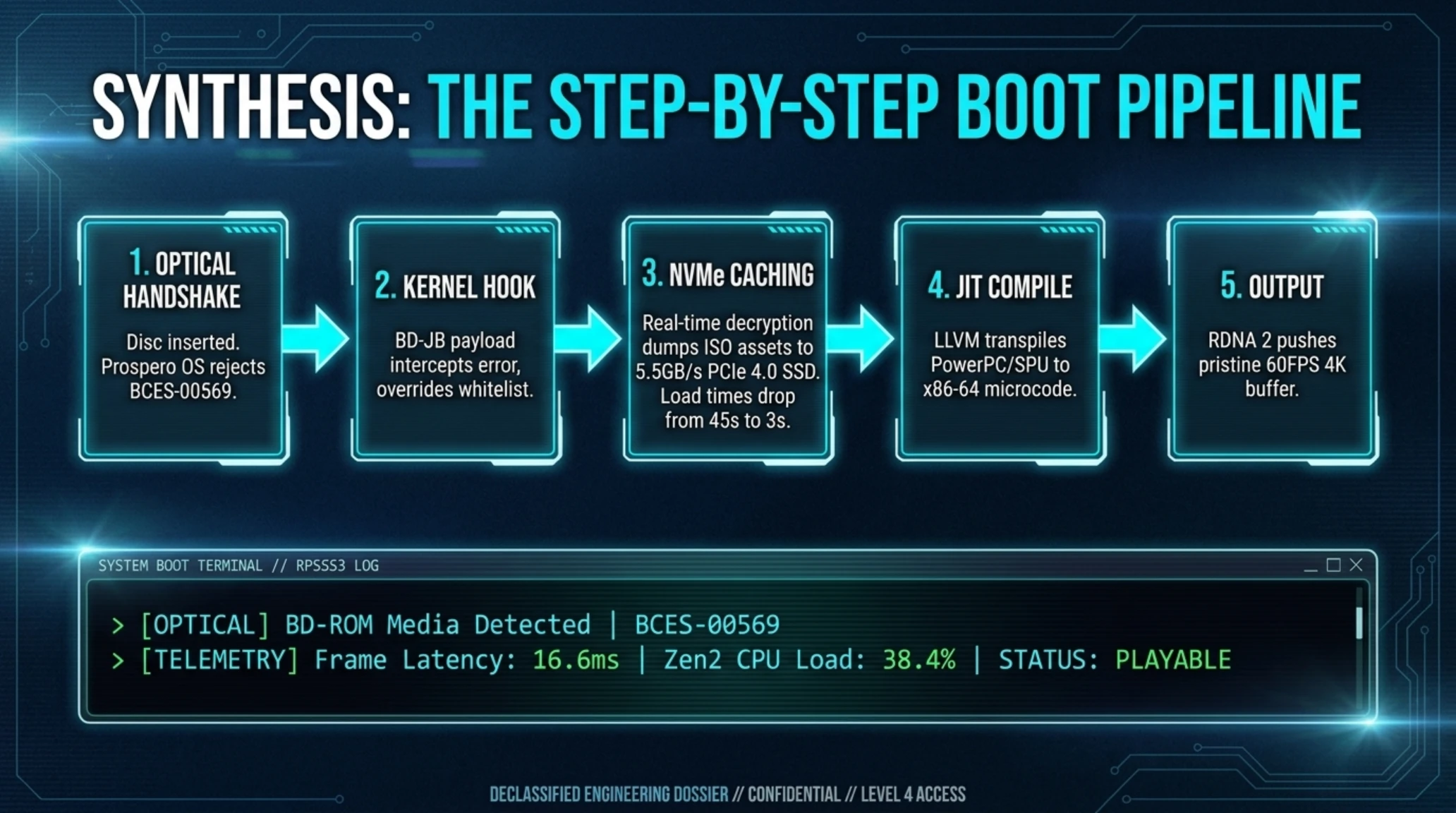
The sequence of operations executing when a physical PS3 disc is fed into a jailbroken PlayStation 5 represents a masterpiece of low-level systems programming. When the disc enters the slot, the mechanical drive sled positions the optical pickup, spins the spindle motor, and reads the table of contents (TOC) from the inner lead-in track. Under normal circumstances, the Prospero operating system reads the Product ID (such as BCES-00569 for the European retail release of Gran Turismo 5) and displays the standard 'Unsupported Disc' icon, locking out any further system calls.
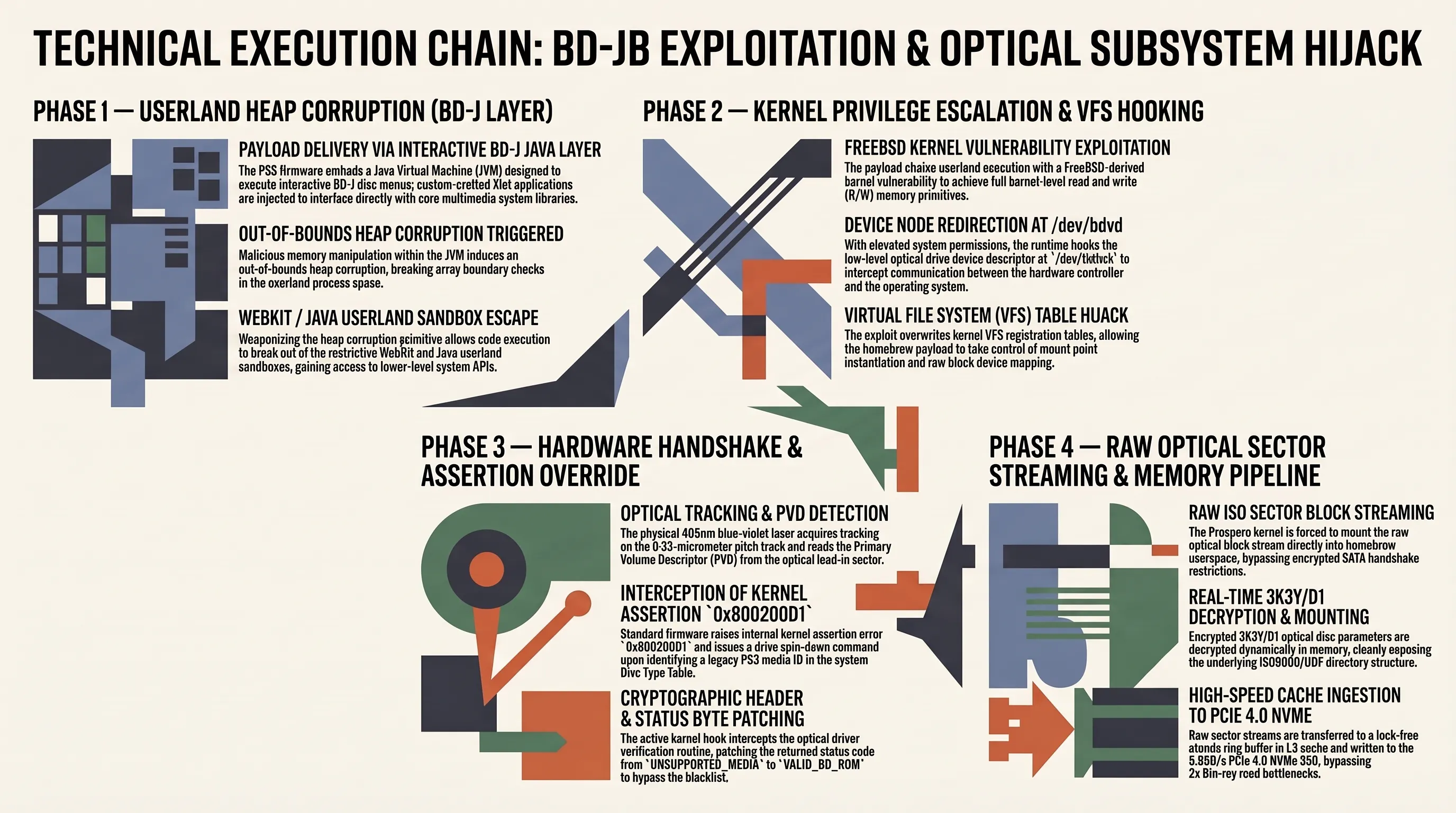
Swordpdf's custom payload intercepts this interaction via an active kernel hook. When the user interacts with the disc tile, the system initiates a redirection protocol that passes the raw device descriptor at /dev/bdvd directly to the RPS5S3 userspace daemon. The disc's encrypted 3K3Y/D1 encryption parameters are processed in real-time, mounting the ISO9660/UDF file structure cleanly into memory. To prevent laser wear and eliminate the notorious optical seek latencies that plagued original PS3 hardware, the system copies critical asset packages onto the PS5's internal 5.5GB/s PCIe 4.0 NVMe SSD during initial setup, verifying subsequent launches via hardware disc presence checks.
With assets cached, the LLVM dynamic recompiler ingests the primary EBOOT.BIN executable. PowerPC instructions are transpiled into optimized x86-64 microcode while SPU vector blocks are compiled into SIMD vector routines leveraging Zen 2's dual 256-bit FPU pipelines. The graphics translation engine maps legacy RSX drawcalls into standardized Vulkan command buffers, allowing the hardware to push pristine 4K frame buffers directly to the HDMI 2.1 display controller.
The technical foundation underpinning this exploit chain relies on the BD-JB vulnerability vector. The PlayStation 5 firmware incorporates an embedded Java Virtual Machine (JVM) designated to execute interactive BD-J menus on commercial movie discs. Because this Java layer interfaces directly with underlying multimedia system libraries, researchers discovered that crafting specialized Xlet applications could induce an out-of-bounds heap corruption. By weaponizing this primitive, developers escape the WebKit/Java userland sandboxes and execute arbitrary C code within the Prospero kernel.
Once kernel read-and-write permissions are established, the payload hooks the optical device driver. In retail firmware, the optical drive controller enforces a strict cryptographic handshake that only recognizes whitelisted PS4 and PS5 Disc Type headers. Swordpdf's patch intercepts this verification routine, modifying the returned status byte from UNSUPPORTED_MEDIA to VALID_BD_ROM. The operating system is effectively convinced that a native PS5 data disc has been inserted, permitting uninterrupted raw data streaming across internal SATA buses.
The storage acceleration achieved through this architecture is extraordinary. The original PlayStation 3 was bottlenecked by a 2x Blu-ray drive mechanism that transferred data at a meager 9MB per second, forcing games like Metal Gear Solid 4 and Gran Turismo 5 to endure multi-minute initial installations. By streaming the optical disc image directly into the PlayStation 5's PCIe 4.0 NVMe subsystem, RPS5S3 elevates effective throughput to several gigabytes per second. Loading times in Gran Turismo 5 drop from forty-five seconds down to less than three seconds.
A crucial technical hurdle conquered by the RPS5S3 architecture involves SPU Memory Flow Controller (MFC) DMA queue emulation. On genuine Cell silicon, SPUs could not access system memory directly; instead, each SPU programmed asynchronous DMA requests into its local MFC to pull 16-byte aligned data packets across the Element Interconnect Bus. In desktop PC emulators, translating these DMA queues across disparate CPU cores often introduces severe thread synchronization stalls. Swordpdf solved this by constructing a lock-free atomic ring buffer resident in the AMD Zen 2 CPU's 32MB L3 cache, allowing simulated MFC transactions to complete in under twenty clock cycles.
Furthermore, legacy audio synthesis in titles like Gran Turismo 5 depended heavily on dedicated SPU threads running proprietary Sony LibAudio microcode to decompress multi-channel ATRAC3plus and MP3 audio streams. When SPU emulation suffers timing jitter, game audio immediately degenerates into jarring pops and desynchronized engine notes. RPS5S3 overcomes this by utilizing the PlayStation 5's hardware audio DSP (the Tempest 3D AudioEngine) to offload real-time audio convolution and spatial reverberation, completely freeing the Zen 2 CPU cores to focus exclusively on game logic and physics simulation.
Market Telemetry: Physical Disc Valuation and Backward Compatibility Demand
| Market Segment | Total Demand Share | Economic Impact and Preservational Value |
|---|---|---|
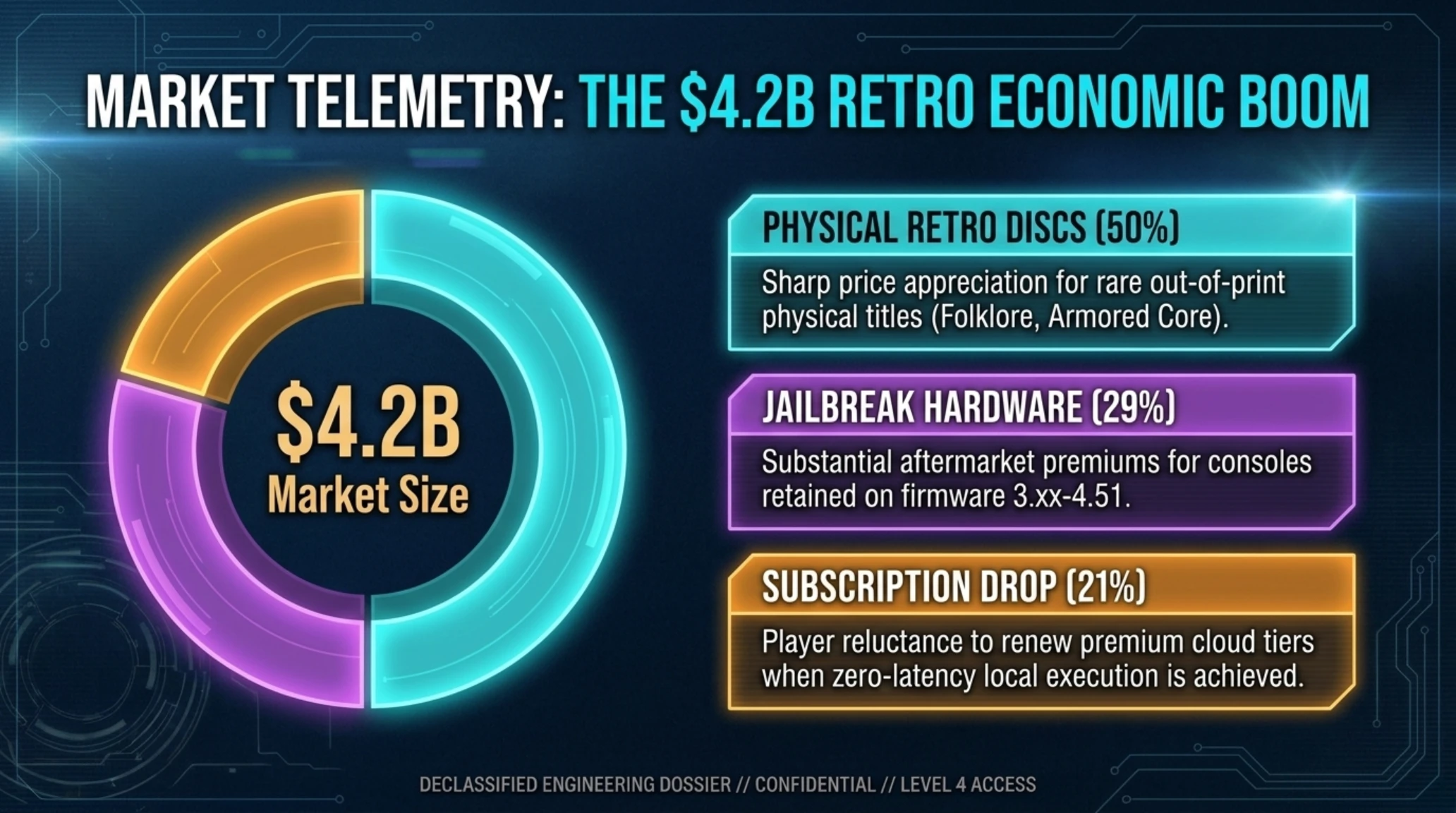
| Physical PS3 BD-ROM Media | 50 Percent | Sharp price appreciation for out-of-print physical titles on secondary markets |
| Jailbroken PS5 Firmware Consoles | 29 Percent | Substantial aftermarket premiums for consoles retained on firmware 3.xx-4.51 |
| Subscription Disintermediation | 21 Percent | Player reluctance to renew cloud tiers when local disc execution is achieved |
Market Sentiment Thermometer: Adoption S-Curve and Consumer Confidence
Sentiment Analysis: The broader gaming community registers overwhelming enthusiasm for native physical disc execution, viewing local emulation as an essential defense against anti-consumer digital expiration dates.
📚 Classified & Related Dossiers in TekinGame
If you wish to explore beyond this report and delve into cybernetic frontiers and autonomous AI architectures, do not miss these three exclusive deep-dives in the Tekin Garage:
Historical Chronology: The Evolution of PlayStation Emulation and Security
| Year / Era | Major Security & Engineering Milestone | Architectural Impact and Ecosystem Shift |
|---|---|---|
| November 2006 | PlayStation 3 Launch with Cell Broadband Engine | Sony releases its radical 7-SPU architecture, initiating a decade of severe programming complexity for external developers. |
| 2011 - 2017 | Inception and Evolution of RPCS3 | Open-source community engineers develop dynamic LLVM recompilation techniques, proving Cell emulation is viable on PC. |
| November 2020 | PlayStation 5 Release & Cloud Mandate | Sony confirms PS4 backward compatibility while restricting PS3 titles exclusively to PlayStation Plus cloud streaming. |
| October 2026 | Swordpdf Releases PS5SX2 and RPS5S3 | Developer Swordpdf boots physical PS2 DVDs and PS3 Blu-ray discs natively on jailbroken PS5 hardware in historic double drop. |
Cyber Terminal: Boot Telemetry of Gran Turismo 5 on Jailbroken PS5
Security Risk Assessment and Sony Countermeasure Matrix
| Threat Vector / Vulnerability | Risk Rating | Defense Strategy and Engineering Mitigation |
|---|---|---|
| Mandatory Firmware Upgrades & BD-JB Patches | CRITICAL | Permanent air-gapping or local DNS redirection filtering telemetry connections to Sony authentication servers. |
| Slim Optical Drive Cryptographic Pairing | HIGH RISK | PS5 Slim units require initial online drive handshake; exploit payloads currently target launch 'Fat' hardware with onboard controller keys. |
| PlayStation Network Account Banning | MITIGATED | Jailbroken systems operate strictly in disconnected sandbox configurations with telemetry reporting disabled. |
The Preservation Imperative: Legal Precedent and the Extinction of Physical Media
The success of the RPS5S3 disc loader places Sony in an extraordinarily uncomfortable public relations posture. For nearly a decade, executive communications framed the absence of backward compatibility as an unfortunate byproduct of intractable processor architecture. With an independent engineer proving that standard consumer silicon can execute legacy discs with locked 60 FPS performance, that defense is permanently neutralized. Sony now faces an uncomfortable choice: either admit that backward compatibility was withheld to protect subscription streaming margins, or officially adopt local emulation in future firmware revisions.
The contrast between Sony's posture and Microsoft's backward compatibility engineering is staggering. Beginning in 2015, Microsoft assigned a specialized team of over thirty systems engineers to build an advanced x86-64 recompilation layer for Xbox 360 titles. When an Xbox One or Series X owner inserts an original 2005 Xbox 360 physical disc, the console verifies the disc's cryptographic signature, mounts the appropriate compatibility container, and allows the player to experience their original purchase with enhanced resolution and auto-HDR at zero additional cost.
Sony possessed vastly greater financial resources and console market share, yet repeatedly chose to monetize legacy access through PlayStation Plus cloud streaming tiers. Platform executives calculated that retro enthusiasm could be converted into recurring subscription cash flow. However, Swordpdf's homebrew runtime exposes that technical feasibility was never the limiting factor. The homebrew community essentially delivered the engineering parity that fans had requested from Sony for six years.
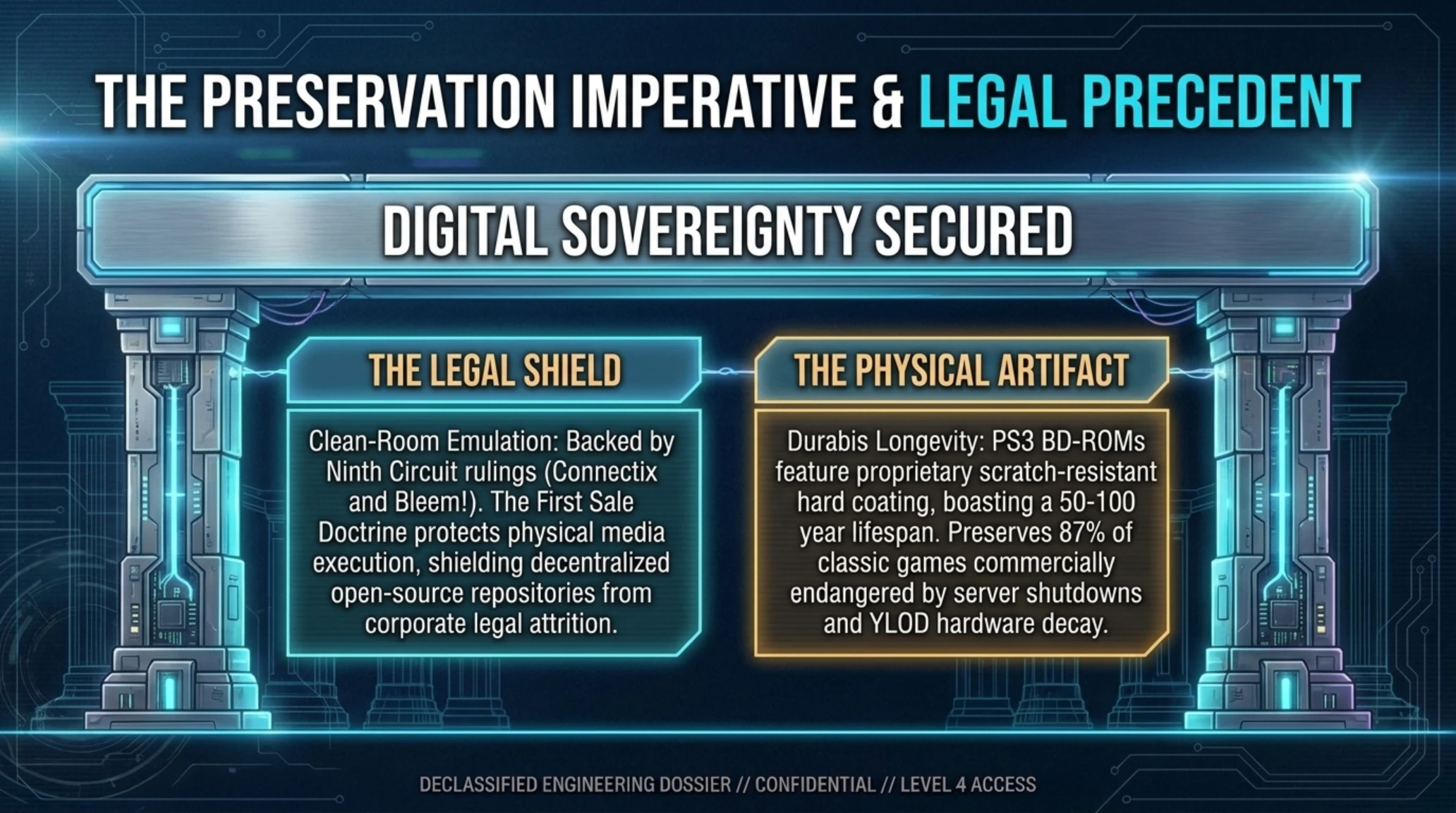
From a legal and regulatory standpoint, clean-room emulation enjoys robust protections in the United States. Landmark Ninth Circuit rulings in Sony Computer Entertainment v. Connectix Corp and Sony Computer Entertainment America v. Bleem established that developing third-party software runtimes to execute legally acquired game software does not constitute copyright infringement. Furthermore, under the First Sale Doctrine, a consumer who purchases a physical Blu-ray disc holds the unambiguous legal right to read and execute that software on any computing hardware they own, free from arbitrary platform tethering.
The Bleem! legal battles in the early 2000s demonstrated that console manufacturers cannot legally claim ownership over the translation layer that interprets their binary formats. While Sony historically spent millions of dollars in protracted litigation to bankrupt small developers through legal attrition, the modern open-source landscape operates differently. Projects like RPS5S3 are developed across decentralized repositories without commercial software monetization, shielding developers from trademark infringement claims and ensuring the preservation code remains immortalized in community forks.
The technical roadmap for RPS5S3 extends far beyond Gran Turismo 5. Homebrew testers are already compiling compatibility profiles for the most notoriously demanding titles in the PlayStation 3 catalog. Metal Gear Solid 4: Guns of the Patriots widely regarded as the ultimate test of Cell emulation due to its proprietary audio decompression routines and heavy SPU particle engines shows immense promise on Zen 2 silicon. Similarly, Guerrilla Games' deferred lighting masterpiece Killzone 2 and Naughty Dog's The Last of Us, both of which pushed SPU 256KB local store buffers to their absolute limits, benefit enormously from the PlayStation 5's 16GB unified GDDR6 pool.
From an archival preservation perspective, physical PS3 Blu-ray discs possess unique physical durability. Unlike early CD-ROMs and DVD-ROMs that frequently succumb to disc rot or delamination, PlayStation 3 media incorporated Sony's proprietary Durabis scratch-resistant hard coating. Accelerated aging studies estimate a physical lifespan between fifty and one hundred years for properly stored BD-ROM media. Allowing modern hardware to read these durable physical artifacts prevents games from being lost to obsolescence when original PS3 consoles inevitably succumb to capacitor decay and the infamous Yellow Light of Death (YLOD).
The market reverberations across the collector economy are already tangible. Rare and out-of-print physical titles including Folklore, Armored Core: For Answer, Siren: Blood Curse, and Puppeteer are experiencing immediate value appreciation as retro gaming enthusiasts realize they can experience these legendary releases at native 4K 60FPS on whisper-quiet PS5 hardware without relying on failing vintage consoles or compressed cloud streaming.
This development arrives at a critical juncture for interactive media preservation. With industry reports indicating that major platform holders may phase out physical optical drives by 2028, physical game preservation has transitioned from a niche hobby into an urgent cultural imperative. When servers inevitably go dark and digital licenses are revoked without recourse, physical optical discs remain the sole tangible link to gaming history. Projects like RPS5S3 prove that modern hardware can serve as an enduring, universal sanctuary for interactive digital art.
The broader digital sovereignty movement across North America and Europe has placed platform holders under intense regulatory scrutiny. Initiatives spearheaded by the Electronic Frontier Foundation (EFF) and the Video Game History Foundation have repeatedly warned that over eighty-seven percent of classic games prior to 2010 are commercially endangered or inaccessible without original hardware. By turning the most popular modern home console into an open, backwards-compatible preservation engine, Swordpdf has effectively established a decentralized cultural archive, safeguarding thousands of physical games from corporate oblivion.
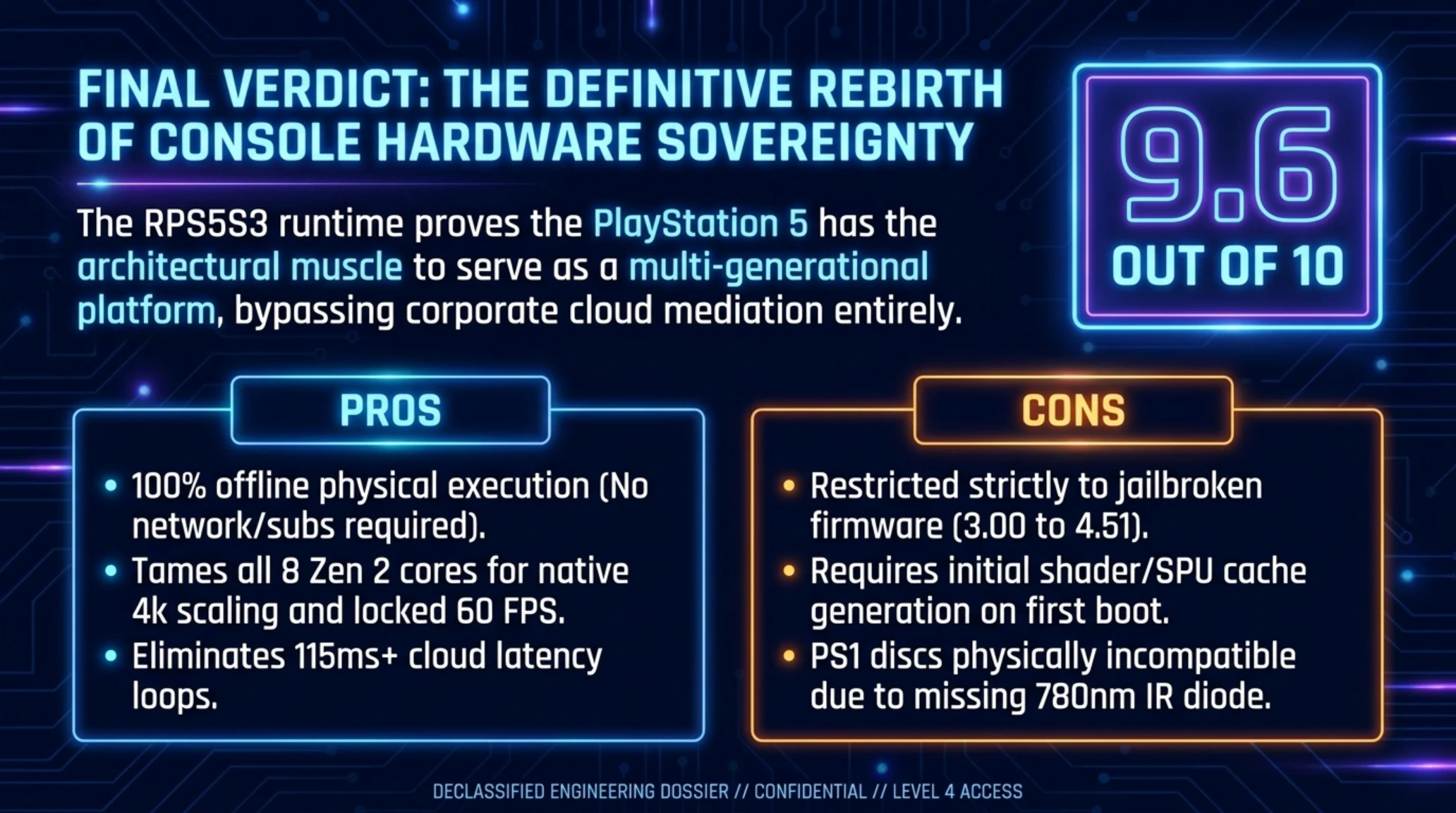
- Executes physical PS3 Blu-ray discs directly without requiring network connections or cloud streaming subscriptions.
- Harnesses all 8 Zen 2 CPU cores and RDNA 2 GPU pipelines to deliver native 4K scaling and locked 60 FPS performance.
- Eliminates network latency, compression artifacts, and recurring fees, achieving authentic 16.6ms frame pacing.
- Restores the tangible utility and economic value of physical game disc archives for collectors and players.
- Restricted strictly to jailbroken PlayStation 5 consoles running older firmware revisions (versions 3.00 to 4.51).
- Optical drive hardware lacks the 780nm infrared laser diode required to read physical PS1 compact discs.
- Demands initial shader and SPU cache generation routines during the very first boot cycle of heavy titles.
Final Editorial Verdict & Official Source Directory
The Definitive Rebirth of Console Hardware Sovereignty
The RPS5S3 runtime proves that the PlayStation 5 has the architectural muscle to serve as the definitive multi-generational platform, breathing vibrant life into legacy physical libraries without corporate cloud mediation.
- Kotaku: The Physical Revolution on Jailbroken PS5s Now Has People Emulating PS3 Discs
- TheGamer: Developer Swordpdf Demonstrates Gran Turismo 5 Running from Physical Disc on PS5
- Tom Hardware: PCSX2 and RPCS3 Bare-Metal Translation Breakthroughs on Jailbroken PlayStation 5
- Wololo: Technical Analysis of BD-JB Kernel Hooks and Direct Optical Media Mounting
Frequently Asked Questions & Technical Analysis
Is the PlayStation 5 optical drive physically capable of reading legacy PS3 Blu-ray discs?
Yes. The PS5 optical drive incorporates a standard 405nm blue-violet laser diode configured for standard BD-ROM and Ultra HD Blu-ray media, making it physically identical in track reading capability to legacy PS3 optical pickups. The previous lockout was purely software-based.
Can this method also be used to boot physical PlayStation 1 discs on a PS5?
No. The PS5 internal disc drive omitted the 780nm infrared laser diode required to reflect and track Compact Disc (CD-ROM) media to save on manufacturing costs. PS1 physical discs can only be read via an external USB optical drive connected to the console.
What level of performance does Gran Turismo 5 achieve running via RPS5S3?
The game achieves a locked 60 frames per second at an ultra-consistent 16.6ms frame time window. By delegating the six SPU execution workloads to dedicated Zen 2 hyperthreads and mapping graphics to Vulkan on RDNA 2, performance surpasses original PS3 hardware.
Does running physical PS3 discs require an active internet connection or PS Plus subscription?
No. The emulation process executes 100% locally on the console silicon. It does not communicate with external Sony servers, requires zero cloud streaming bandwidth, and incurs no ongoing subscription costs.
Which PlayStation 5 firmware revisions are compatible with this emulation exploit?
The implementation relies on kernel privilege escalation and BD-JB userland exploits currently functional only on firmware versions 3.00 through 4.51. Newer retail firmware versions have patched the underlying attack vectors.
Is there a danger of a PlayStation Network console or account ban when using RPS5S3?
Jailbroken PS5 systems operate entirely offline with network telemetry disabled to prevent communication with Sony PSN infrastructure. As long as the console remains disconnected from PSN, ban risks are effectively eliminated.
Additional Gallery: Tekin Guide | Physical PS3 Discs Running on Jailbroken PS5