⚔️ Welcome to the Tekin Command Academy
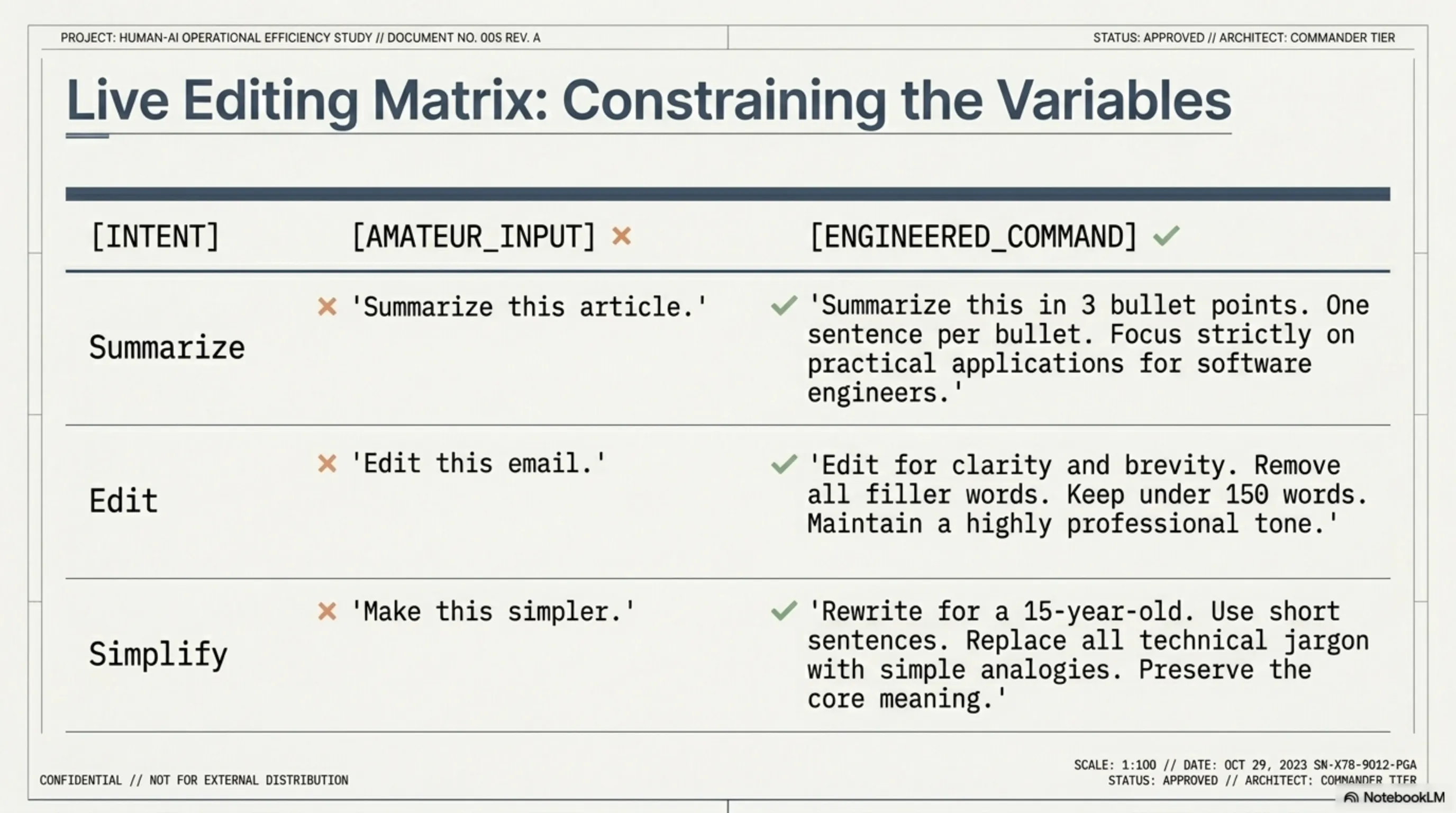
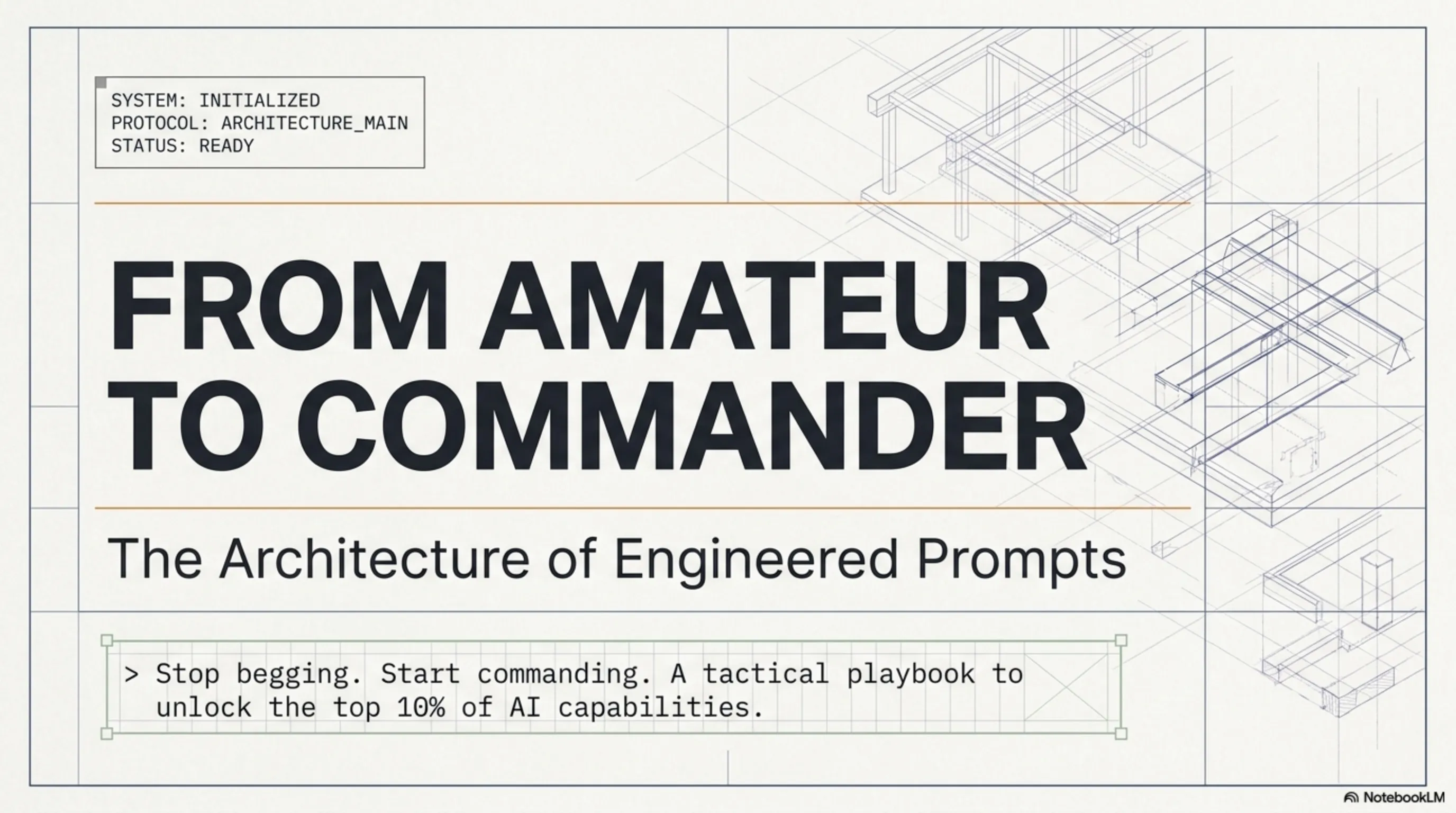
Welcome, Tekin Army! Today we learn how to write prompts like a commander, not a beginner. The difference between a vague request and a structured prompt is the difference between a private and a general. With real examples from JSON, Midjourney, and ChatGPT, we show you why 90% of AI users get weak results.
⚡ Today's Topics:
🧠 Amateur vs. Engineered Prompts — The Real Difference
🏗️ Anatomy of a Strong Prompt: Role, Task, Context, Format
💻 Live Code Comparisons: Weak vs. Strong Prompts
🎨 Midjourney Prompting — From Generic to Masterpiece
📦 Building Structured JSON with Precise Prompts
🔗 Advanced Techniques: Chain-of-Thought, Few-Shot, Self-Consistency
☕ Ready? Let's learn how to command AI — not beg it!
🧠 Amateur vs. Engineered Prompts — The Real Difference
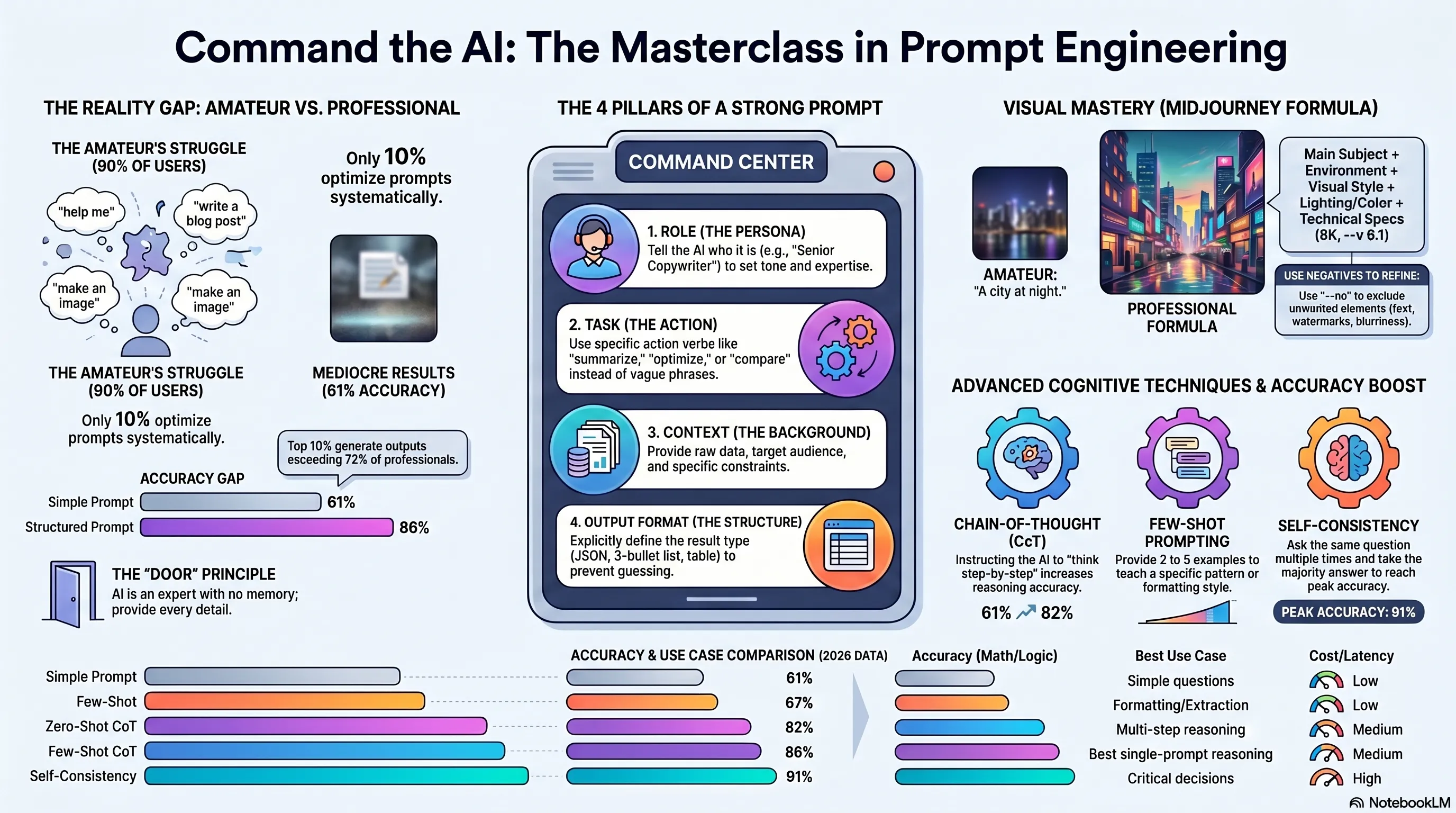
Most AI users write prompts like Google searches — short, vague, and keyword-heavy. Then they complain the AI "doesn't understand them." The truth is simpler: you left too much out of the room. Telling an AI "write me an ad" without specifying the product, audience, tone, or length is like telling an architect "build me a house" with no blueprint.
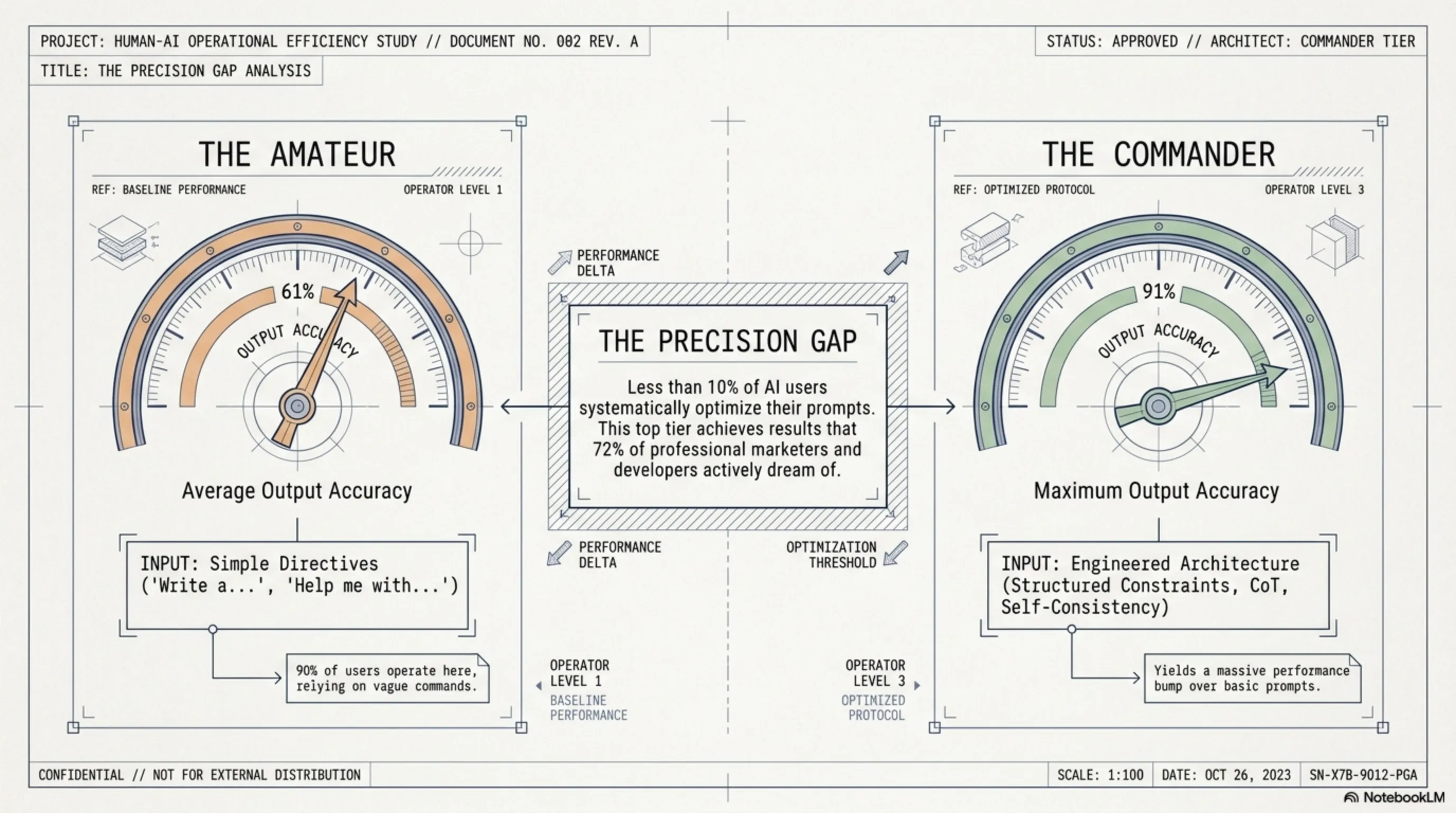
Research in 2026 shows fewer than 10% of AI users systematically optimize their prompts. That 10% consistently gets results that 72% of professional marketers wish they could replicate. The gap isn't the model — it's the structure of the instruction.
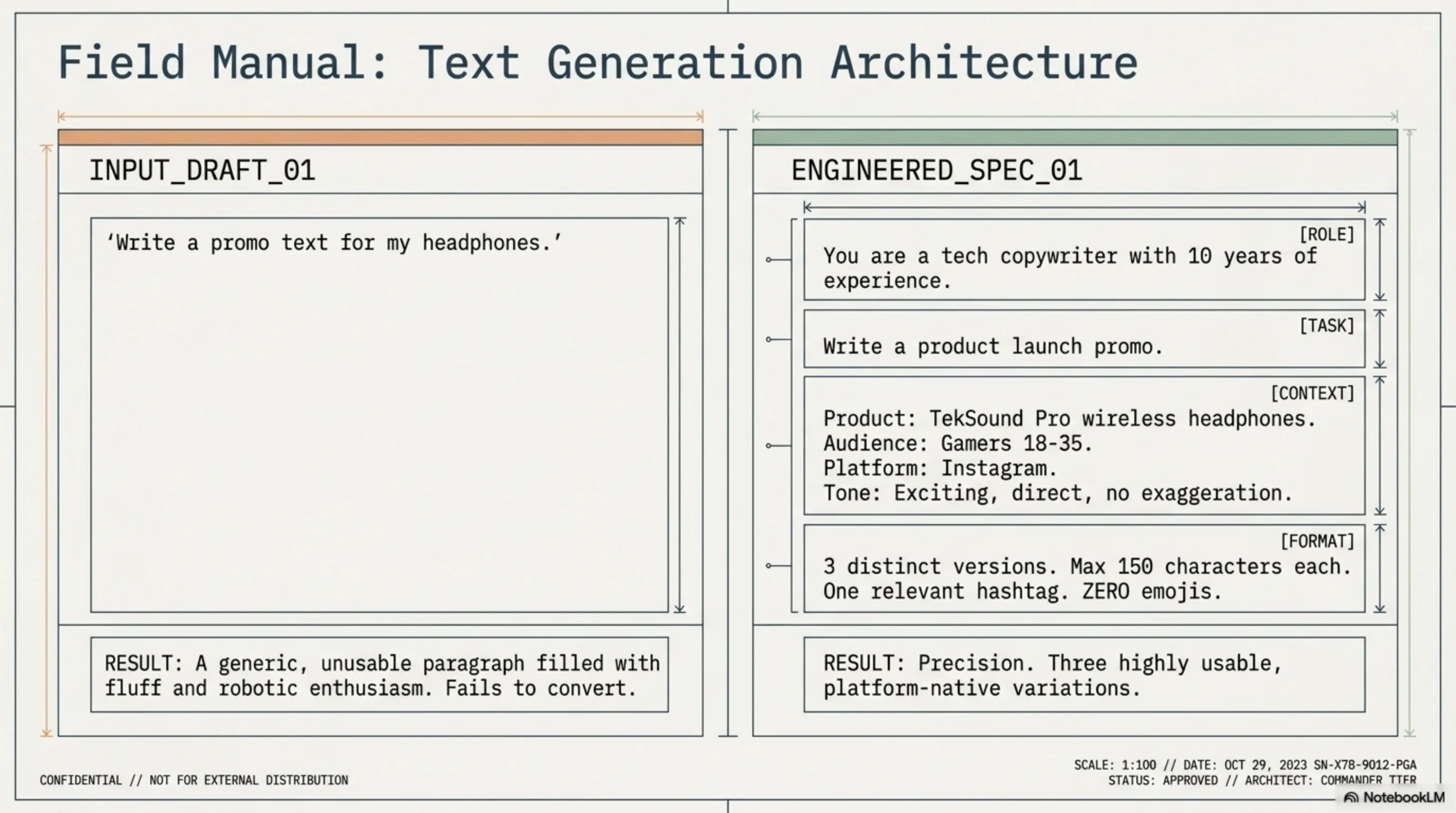
❌ Amateur Prompt
⚠️ Result: AI doesn't know the product, audience, tone, length, or platform. Output: a generic, unusable paragraph.
✅ Engineered Prompt — Same Request, Different Structure
You are a professional copywriter with 10 years in the tech industry.
## Task
Write a product launch ad copy.
## Context
Product: TekSound Pro wireless headphones
Audience: Gamers aged 18-35
Platform: Instagram
Tone: Exciting, direct, no hype
## Output Format
- 3 different versions
- Max 150 characters each
- One relevant hashtag at the end
- No excessive emojis
✅ Result: AI knows exactly what you need. Output: 3 professional, platform-ready ad copies.
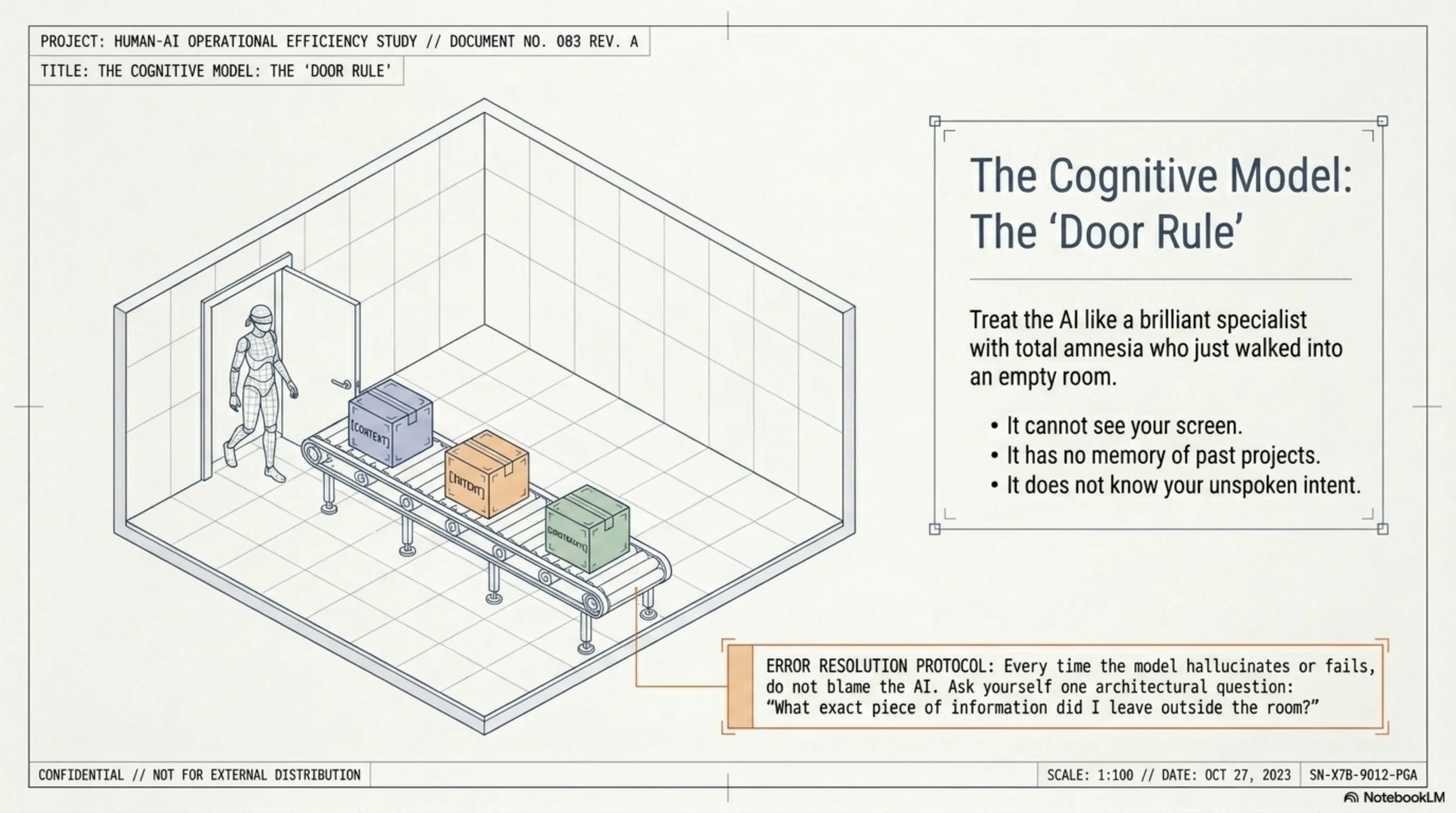
🎯 The Door Rule — The Most Important Prompt Principle
Imagine the AI is a brilliant expert who just walked through a door into a sealed room. No memory of past conversations. Can't see your screen. Doesn't know your project. It only knows what's in the prompt. Every time AI gives a wrong answer, ask yourself: "What did I leave outside the room?"
🏗️ Anatomy of a Strong Prompt: The 4 Core Components
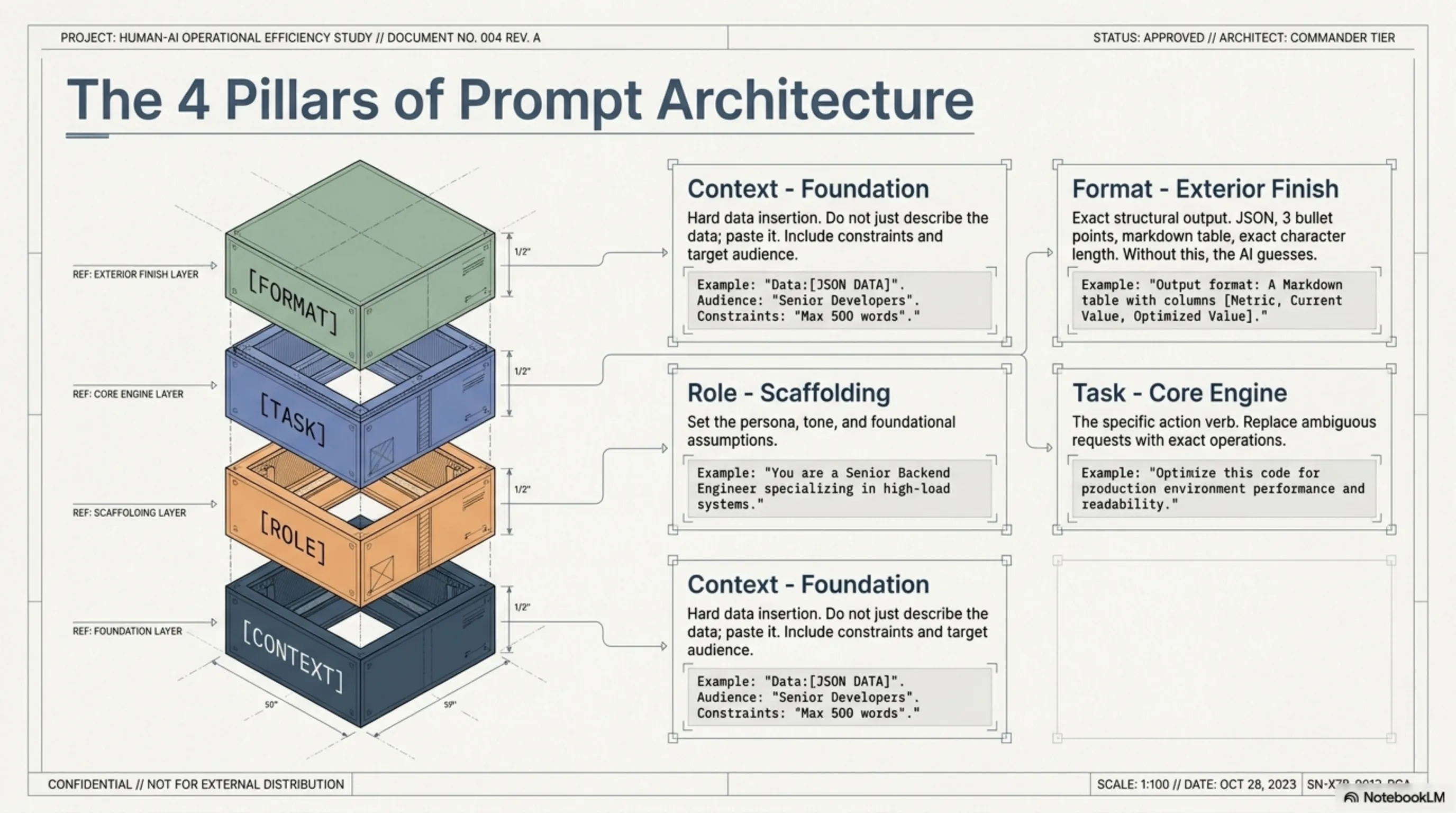
Every professional prompt is built on four pillars. You don't always need all four, but knowing them helps you diagnose and fix weak prompts fast. Think of it as a spec sheet for the AI — the more complete the spec, the more predictable the output.
📊 The 4 Pillars of a Professional Prompt
"You are a senior backend engineer..."
Vague: "help me" → Specific: "refactor this function for readability"
Text, code, data, constraints, target audience
If you don't specify, the AI guesses — and often guesses wrong
💻 Before/After: Three Common Prompt Types
⚡ Key Stats 2026
🎨 Midjourney Prompting — From Generic to Masterpiece
📚 Classified & Related Dossiers in TekinGame
If you wish to explore beyond this report and delve into cybernetic frontiers and autonomous AI architectures, do not miss these three exclusive deep-dives in the Tekin Garage:
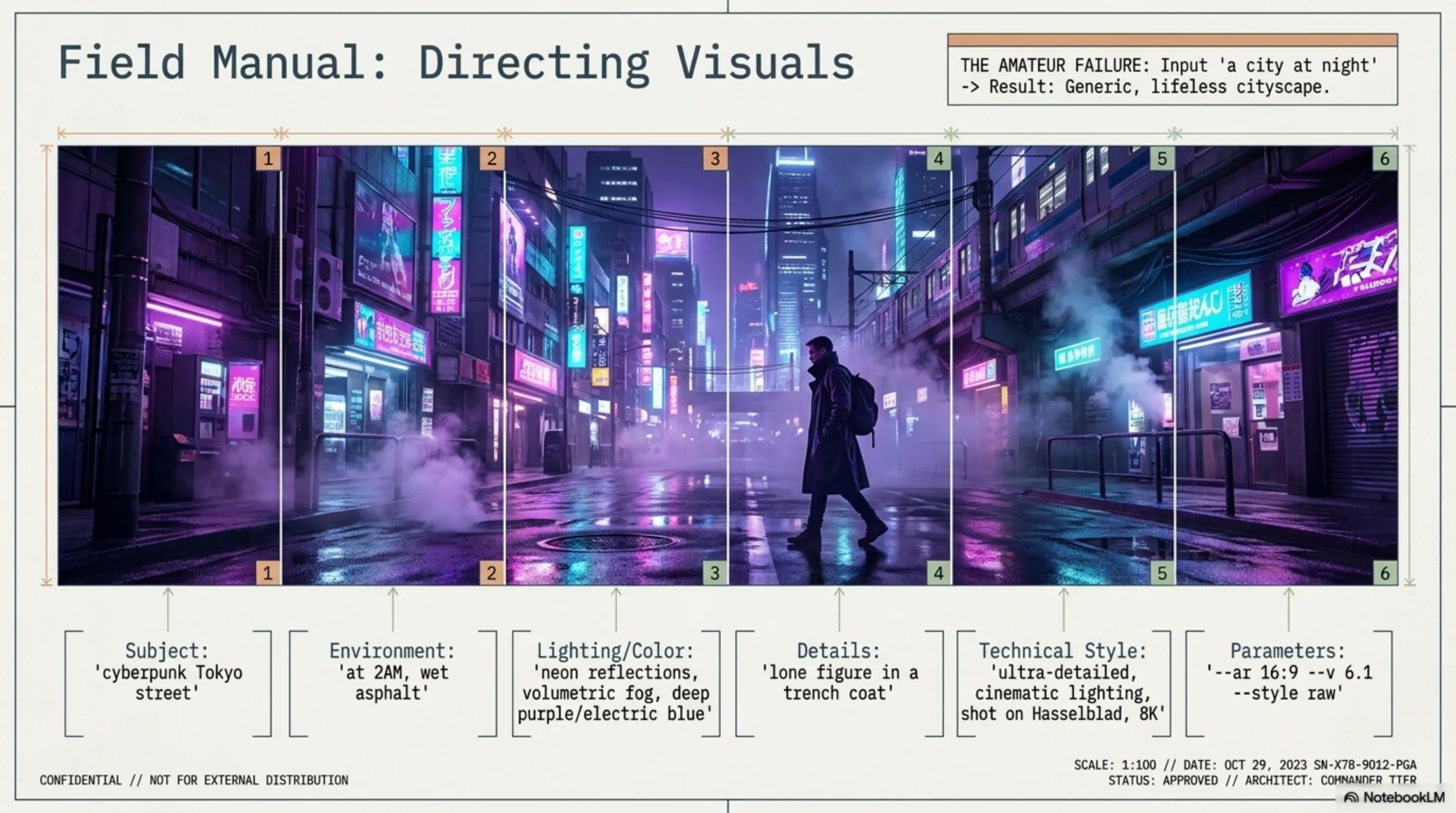
Midjourney is one of the clearest demonstrations of the amateur vs. professional gap. "A city at night" gives you a cliché stock image. A structured, director-style prompt gives you a cinematic masterpiece. The difference is specificity — every element you define removes one degree of randomness from the output.
❌ Amateur Midjourney Prompt
⚠️ Result: Generic cityscape. No style, lighting, mood, or detail specified.
✅ Engineered Midjourney Prompt
volumetric fog, a lone figure in a trench coat, ultra-detailed,
cinematic lighting, shot on Hasselblad, 8K resolution,
color palette: deep purple and electric blue, --ar 16:9 --v 6.1 --style raw
✅ Result: A cinematic image with defined style, precise lighting, specific mood, and professional quality.
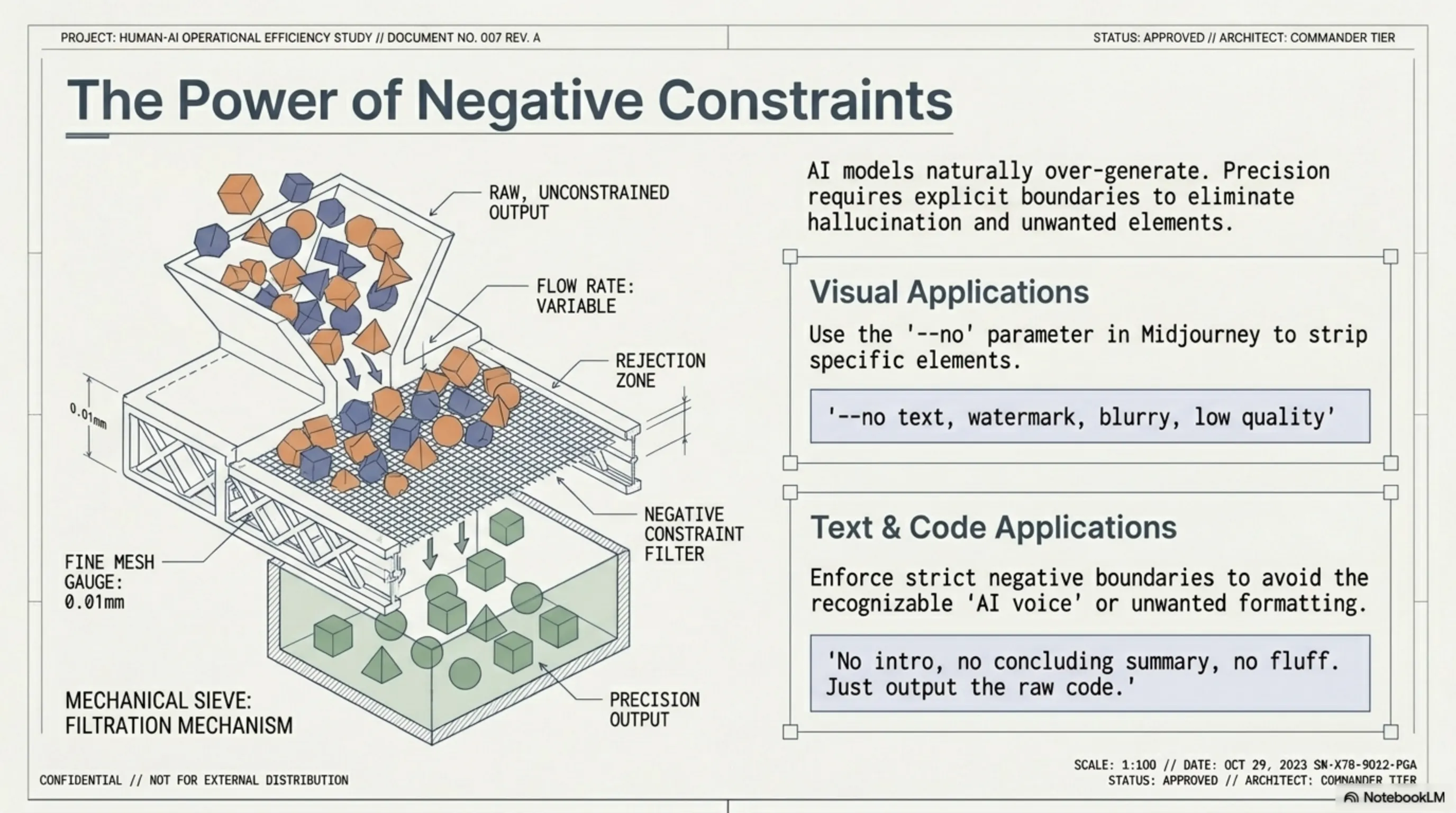
💡 Tekin Tip: Negatives Matter Too!
Use --no in Midjourney to exclude unwanted elements: --no text, watermark, blurry, low quality. The same principle applies in ChatGPT: "No introduction. No explanation. Return only the code."
📦 Building Structured JSON with Precise Prompts
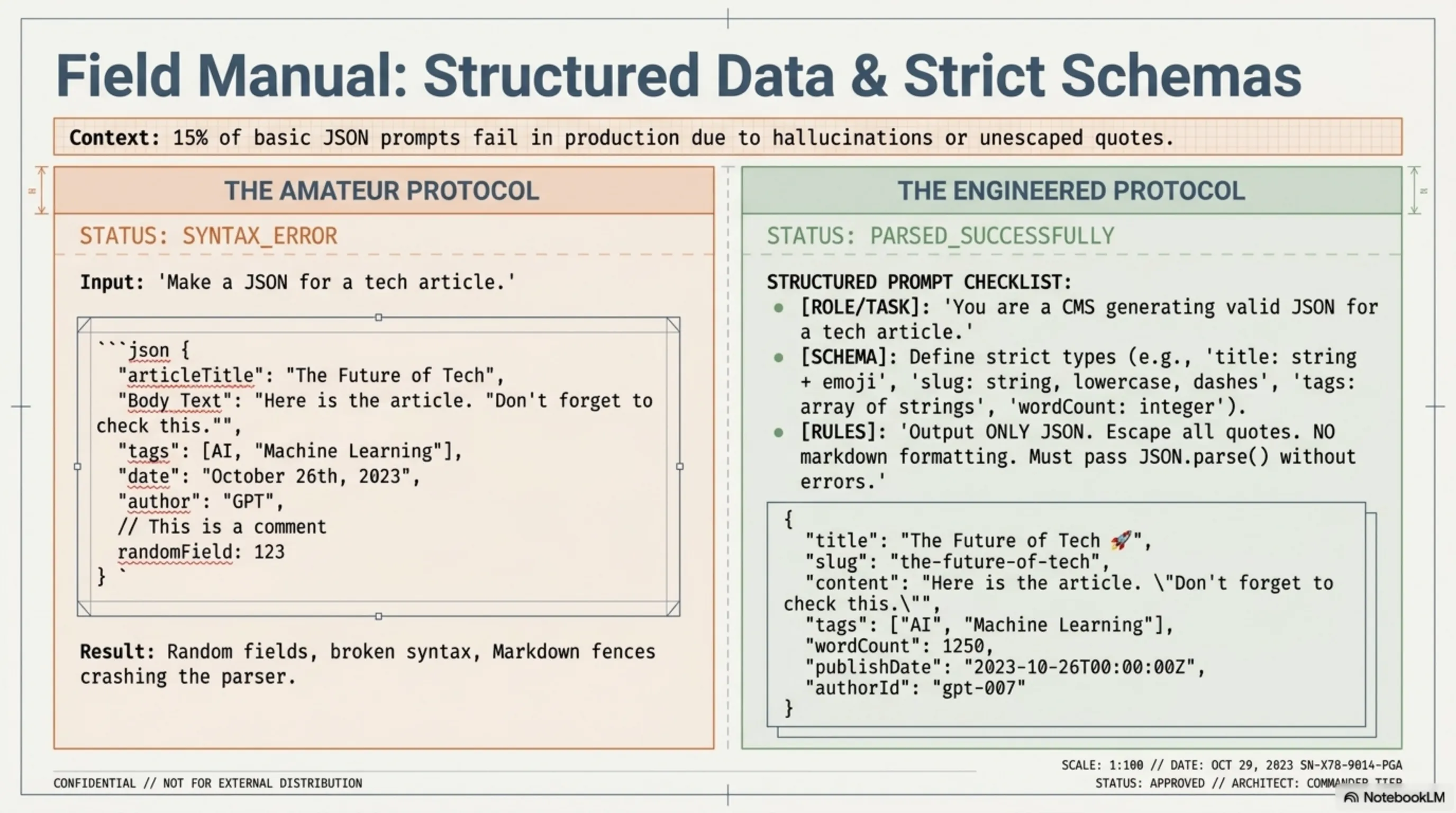
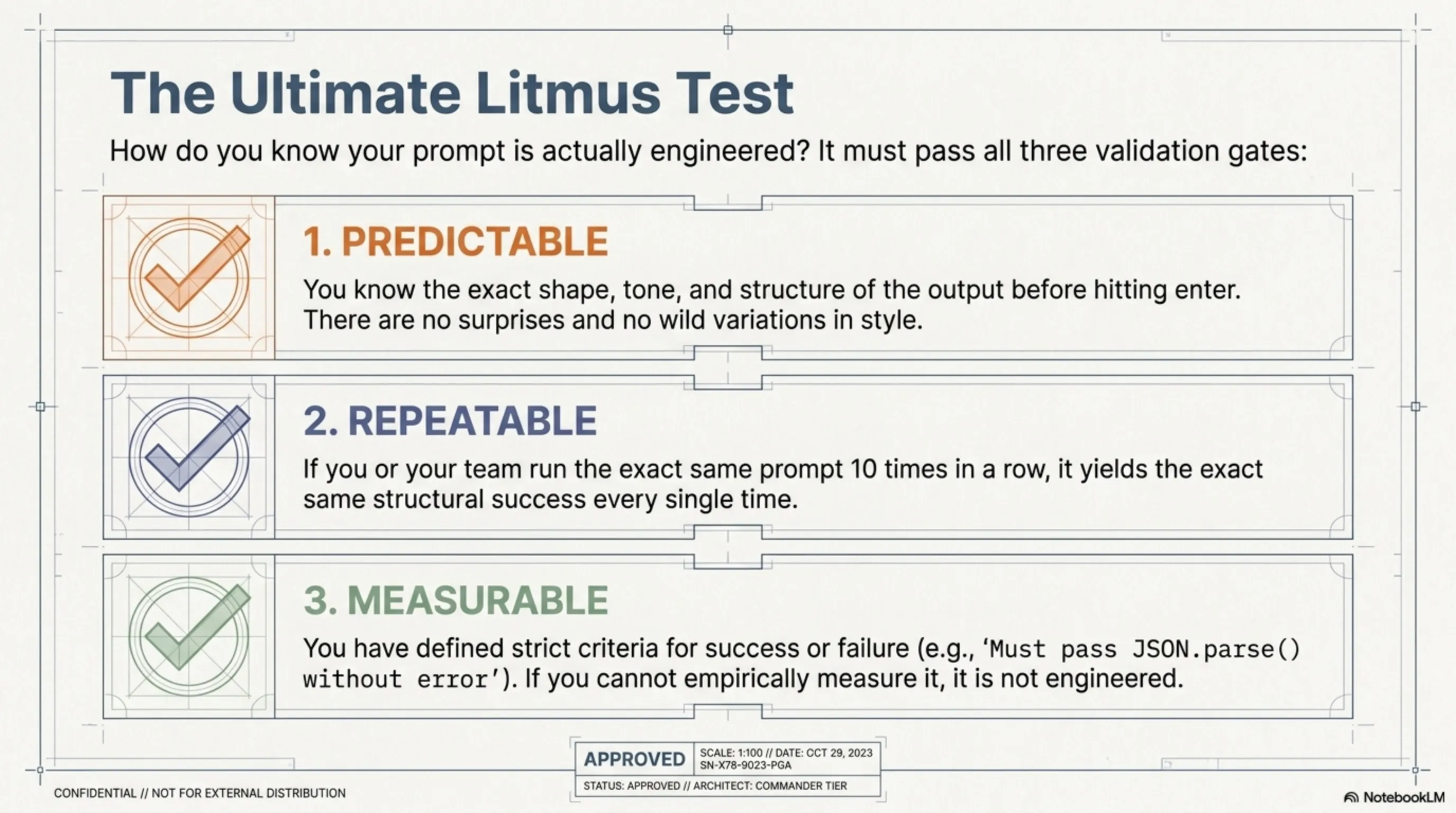
One of the most practical applications of professional prompting at Tekin is generating JSON for our content management system. A weak prompt produces JSON with random fields, missing values, or unescaped quotes that break the importer. A precise prompt produces import-ready JSON every time.
❌ Amateur JSON Prompt
⚠️ Result: Random fields, no schema, unescaped quotes — import fails.
✅ Engineered JSON Prompt
You are a content generation system that produces valid JSON.
## Task
Generate a JSON object for a tech article.
## Required Schema
{
"title": "string with emoji",
"slug": "english-only-with-hyphens",
"meta_description": "string max 160 chars",
"excerpt": "string 2 paragraphs",
"locale": "en"
}
## Hard Rules
- Output JSON only, no explanation
- All " inside values must be escaped as \"
- No markdown fences (no ```json)
- Must pass JSON.parse() without errors
✅ Result: Valid JSON, import-ready, zero syntax errors.
🔗 Advanced Techniques: CoT, Few-Shot, Self-Consistency
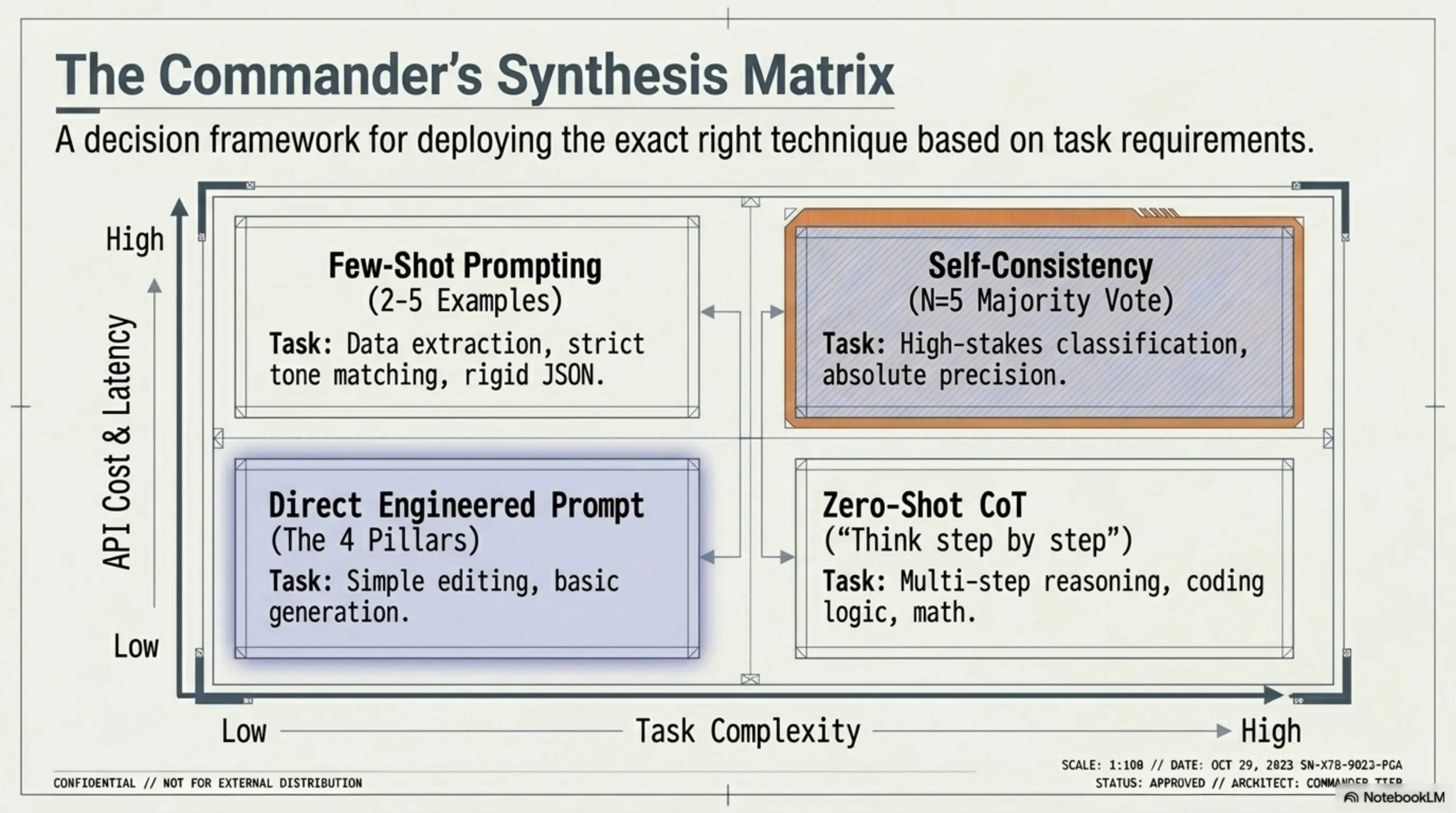
Now that we have the foundation, it's time for the heavy weapons. These three techniques showed the highest impact on AI output quality in 2026 research. Each is suited for a different type of task — knowing when to use which one is what separates a prompt engineer from an amateur.
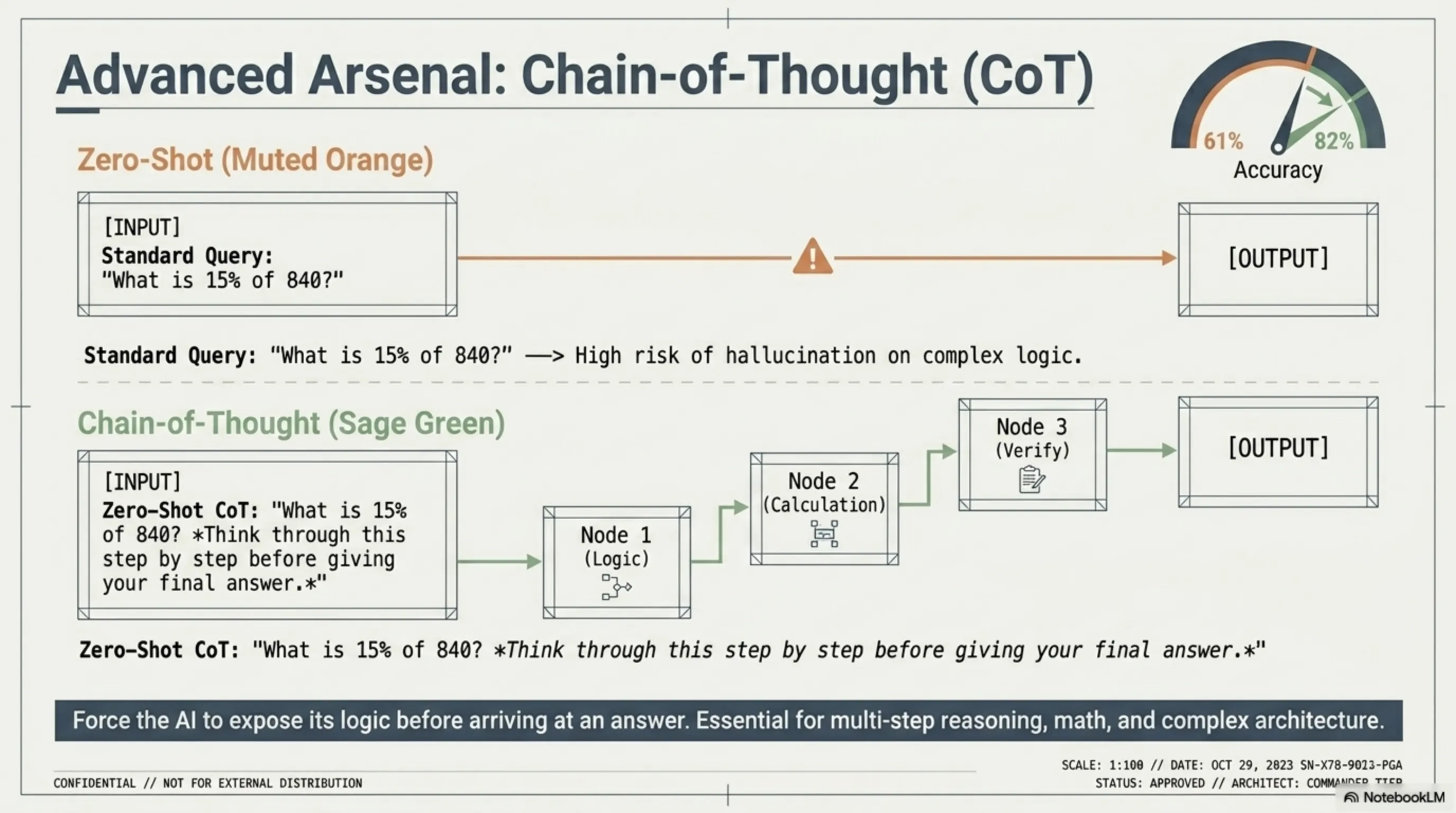
🧩 Technique 1: Chain-of-Thought (CoT)
Tell the AI to reason step-by-step before answering. Dramatically improves accuracy on logic, math, and multi-step tasks.
✅ With CoT: "What is 15% of 840?
Think through this step by step before giving your final answer."
Result: Accuracy jumps from 61% to 82%
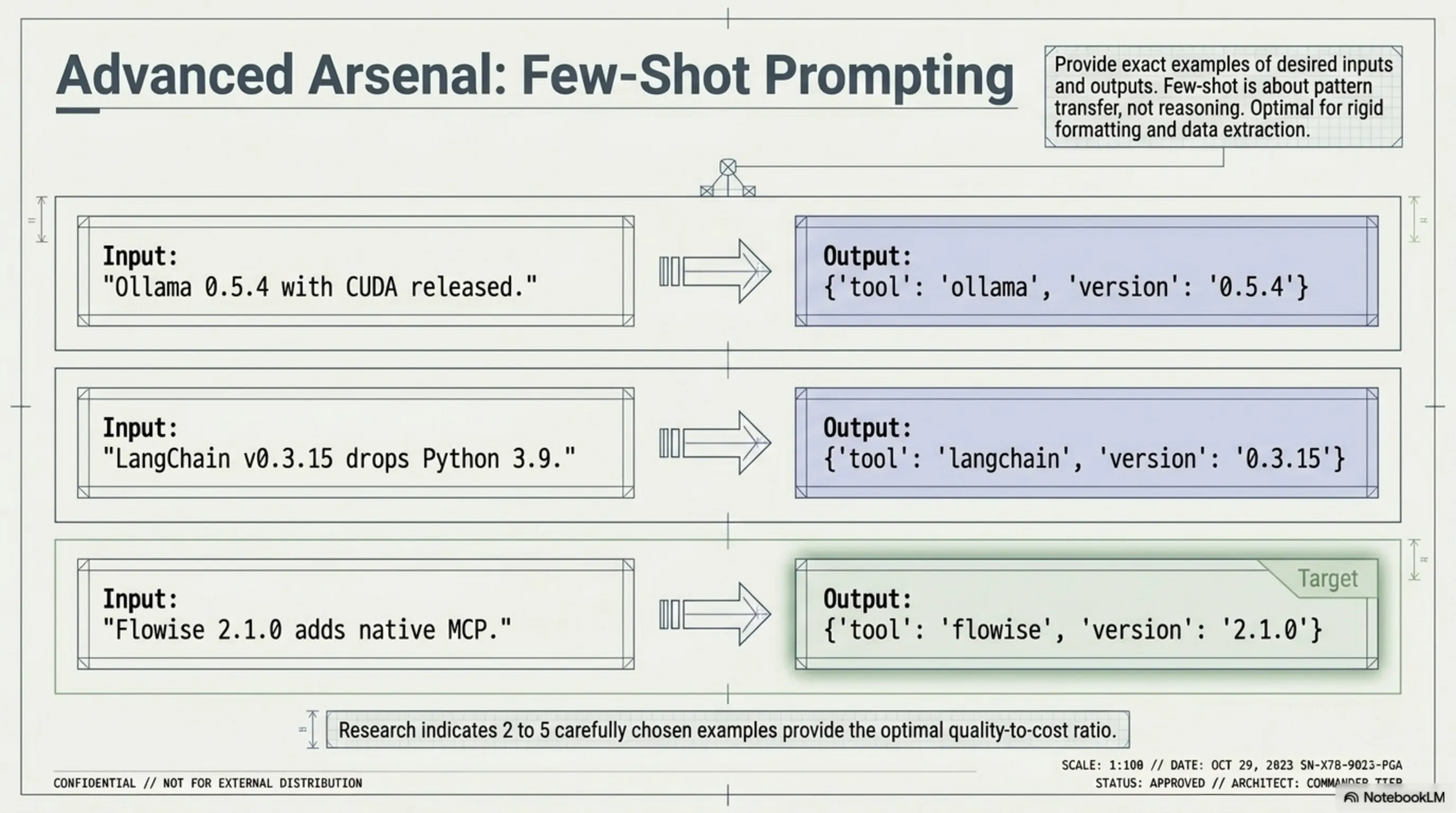
🎯 Technique 2: Few-Shot Prompting
Give the AI 2-5 input/output examples before the real query. Best for formatting, style, and data extraction.
Input: "Ollama 0.5.4 with CUDA 12.4 support released."
Output: {"tool": "ollama", "version": "0.5.4"}
Input: "LangChain v0.3.15 drops Python 3.9 support."
Output: {"tool": "langchain", "version": "0.3.15"}
Input: "Flowise 2.1.0 adds native MCP tool calling."
Output:
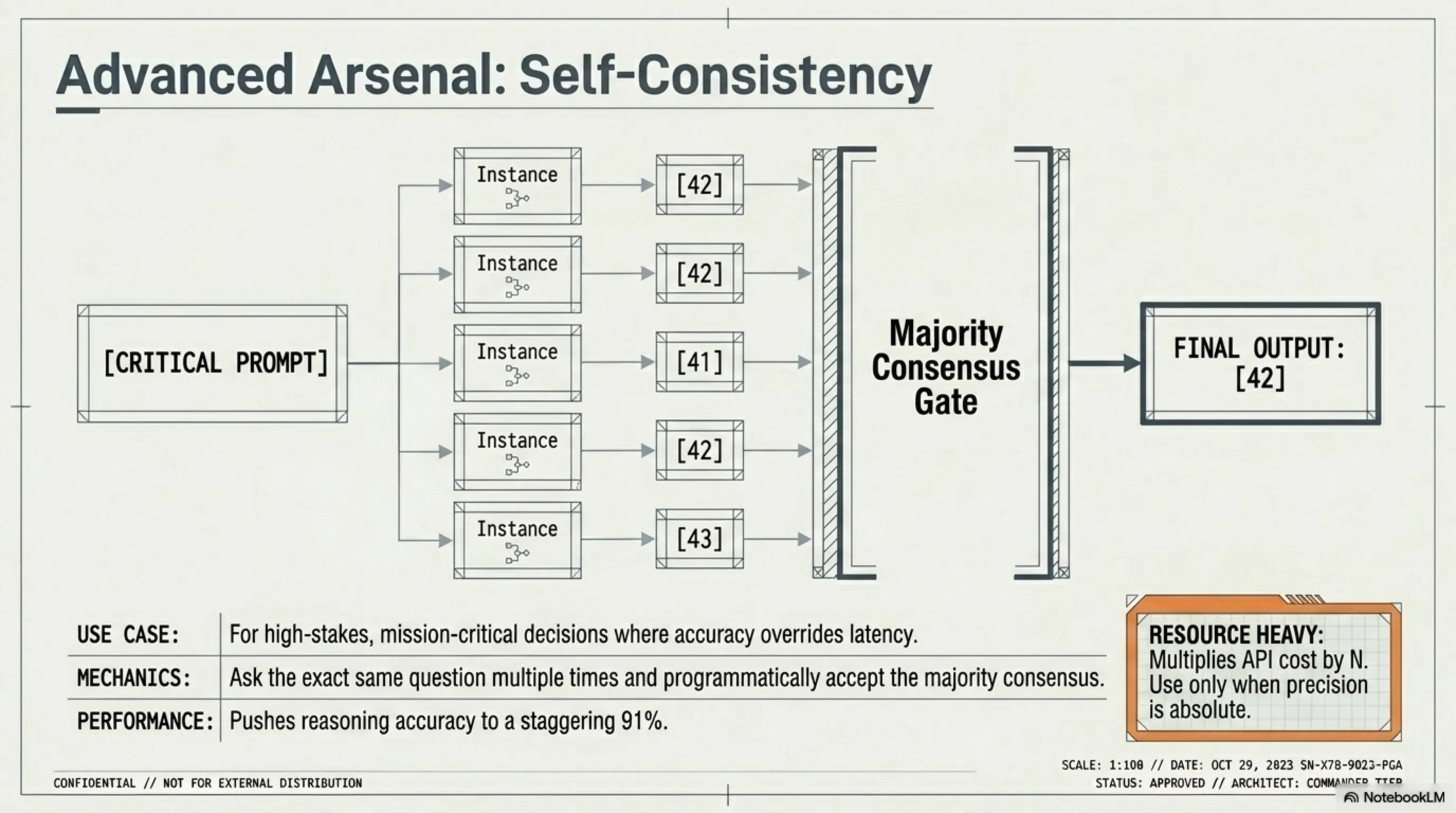
🔄 Technique 3: Self-Consistency
Ask the same question N times, take the majority vote. Pushes accuracy to 91% — but costs N times more.
Prompt → Sample 2: answer = 42
Prompt → Sample 3: answer = 41
Prompt → Sample 4: answer = 42
↓
Majority Vote → Final Answer: 42 ✅
⚔️ PROS & CONS: Structured Prompt Engineering
✅ Pros
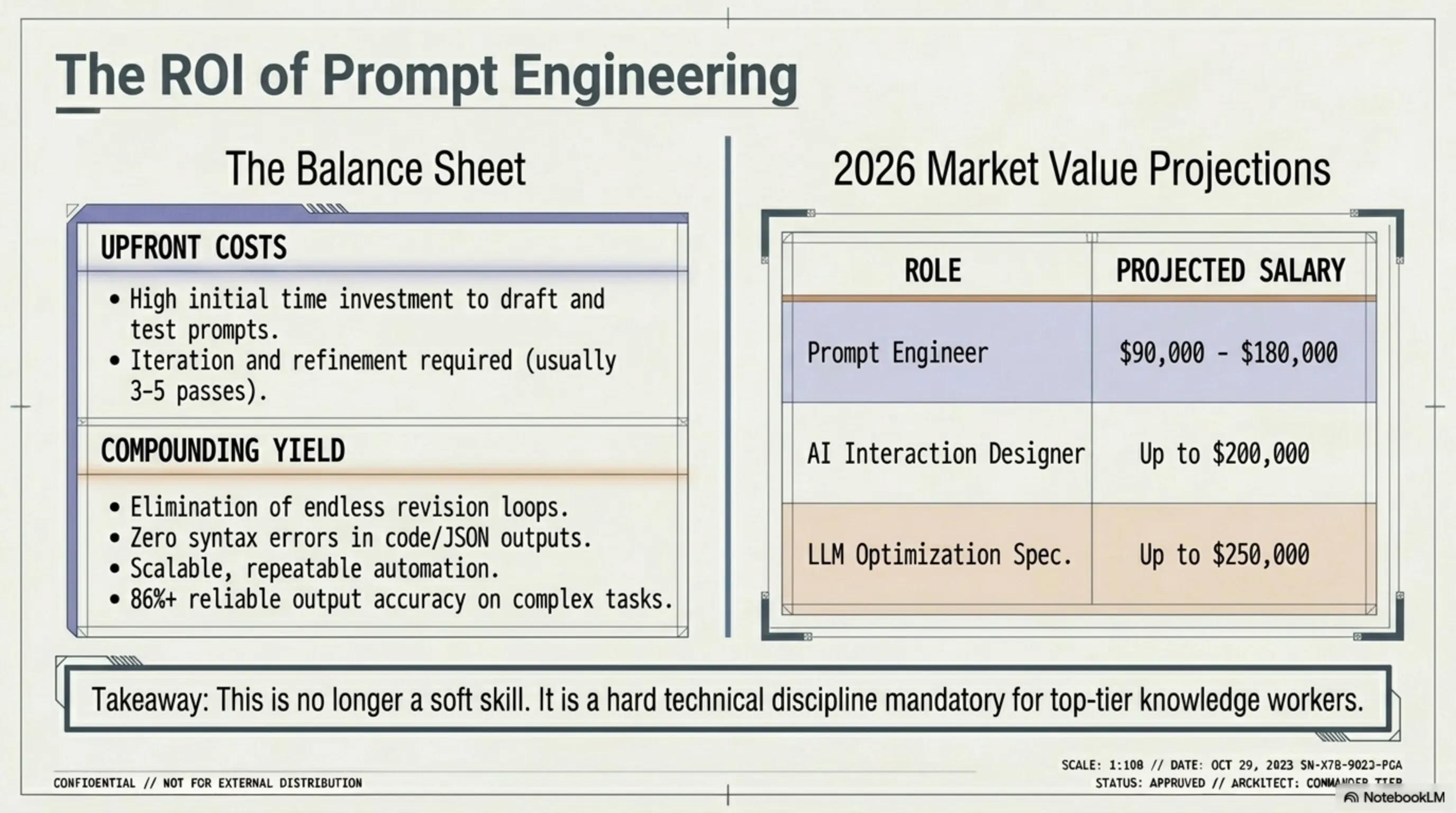
- ✓ Up to 86% higher output accuracy
- ✓ Repeatable, predictable results
- ✓ Fewer correction iterations
- ✓ JSON and code without syntax errors
- ✓ Saves time and API costs
- ✓ Scalable across teams and automation
❌ Cons
- ✗ Initial prompt writing takes time
- ✗ Overkill for simple questions
- ✗ Self-Consistency costs N times more
- ✗ Requires iteration and refinement
- ✗ Different models behave differently
- ✗ Team training needed upfront
❓ FAQ
🔹 Does structured prompting work across all AI models?
🔹 How many examples should I use in Few-Shot?
🔹 Is prompt engineering a real career in 2026?
🔹 How do I improve a prompt that isn't working?
📚 Sources & References
- Wei et al. — Chain-of-Thought Prompting Elicits Reasoning in LLMs (Google Brain)
- Wang et al. 2022 — Self-Consistency Improves Chain of Thought Reasoning
- MarkAICode — CoT vs Few-Shot vs Self-Consistency Benchmark 2026
- AI Builder Club — Prompt Engineering Guide 2026
- SurePrompts — Advanced Prompt Engineering Techniques 2026
- PromptBuilder — Best Practices Checklist 2026
- Tekin Editorial Team — Practical Prompting for JSON and Midjourney
🌐 Stay Connected With Us
For the latest tech, gaming, and gadget news, follow us on social media:
🌐 Stay Connected With Us 🎮✨
For the latest tech, gaming, and gadget news, follow us on our official social media channels:
Additional Gallery: ⚔️ Prompt Engineering vs. Amateur: The AI Commander's Guide