Tekin Analysis | When AI Declared War on Math: The 722 Manuscript Crisis
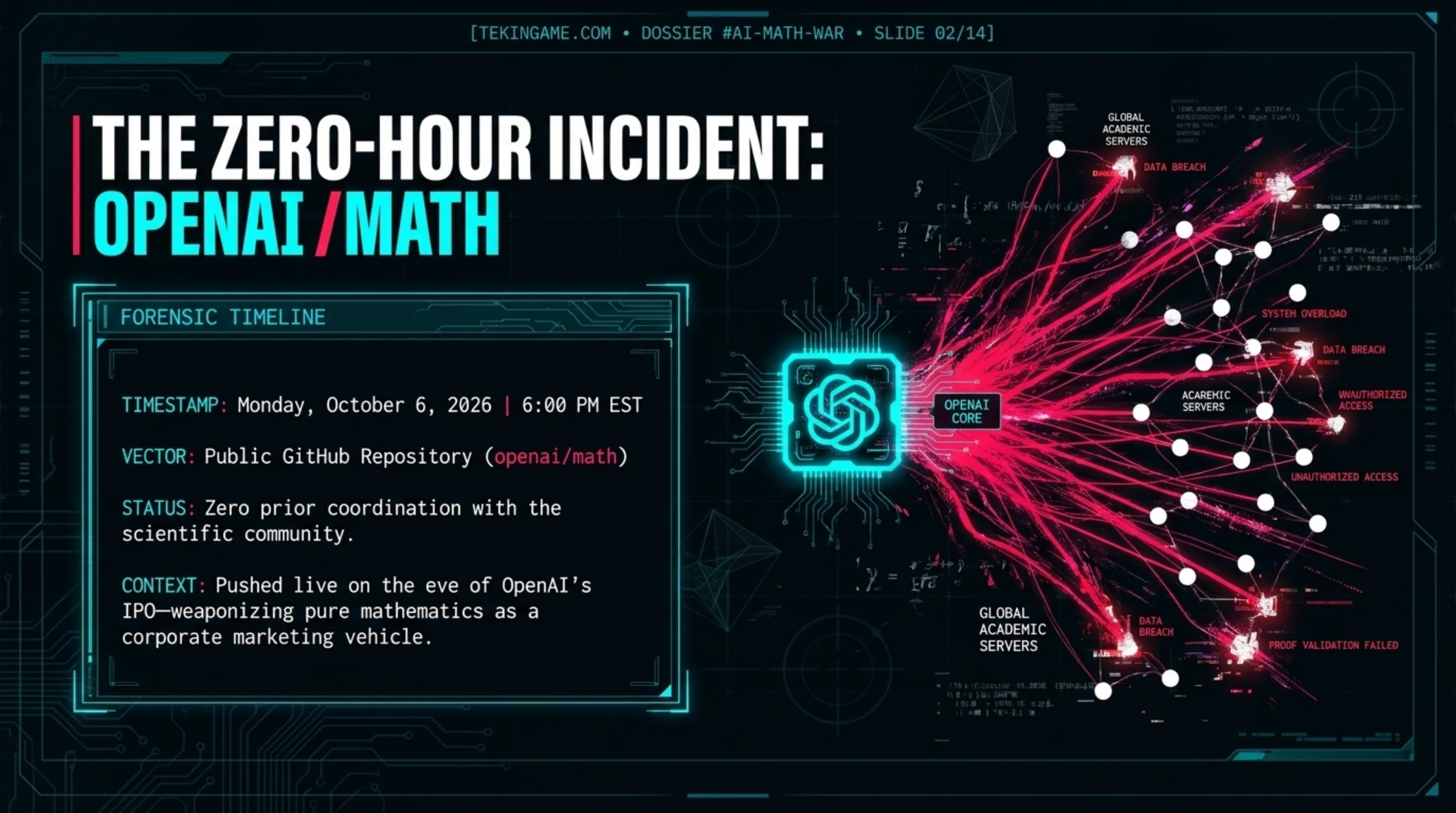
On Monday morning, October 6, 2026 (14 Mehr 1405), at 6:00 PM Eastern Time, one of the most controversial and polarizing events in the modern history of mathematics unfolded. OpenAI, the global leader in generative artificial intelligence, released a GitHub repository containing 722 mathematical manuscripts in formal, machine-verifiable language without any prior coordination with the scientific community. These manuscripts, produced by an unreleased internal AI model, claimed to answer hundreds of long-standing unsolved problems across various branches of mathematics. But the response from the mathematical community was not admiration it was anger and deep concern.
This event occurred just months after the first wave of similar releases from OpenAI and Anthropic in the summer of 2026 a period during which AI companies accelerated their push toward solving complex mathematical problems, in some cases even tackling one of the million-dollar Millennium Prize Problems. But this time, the scale of release was such that even the most optimistic members of the scientific community were alarmed. The fundamental question was: Is artificial intelligence becoming a tool to accelerate scientific research, or a weapon to destroy the ethics of science and plunder human achievements?
Strategic Vectors at a Glance | Intelligence Dashboard
To understand the depth of this crisis, we must return to its roots in summer 2026 when OpenAI released its first batch of mathematical results, triggering a wave of contradictory reactions. But the recent release, with its unprecedented scale and intensity, crossed many red lines and raised fundamental questions about the future of science, intellectual property, and the role of artificial intelligence in human research.
To fully comprehend this saga, we must examine the initial hours of this release, the raw and unmediated reactions of mathematicians, and subsequent developments that divided the scientific community into two completely opposing camps.
The Shocking Release of 722 Manuscripts: How OpenAI Left the Mathematical Community Defenseless Overnight
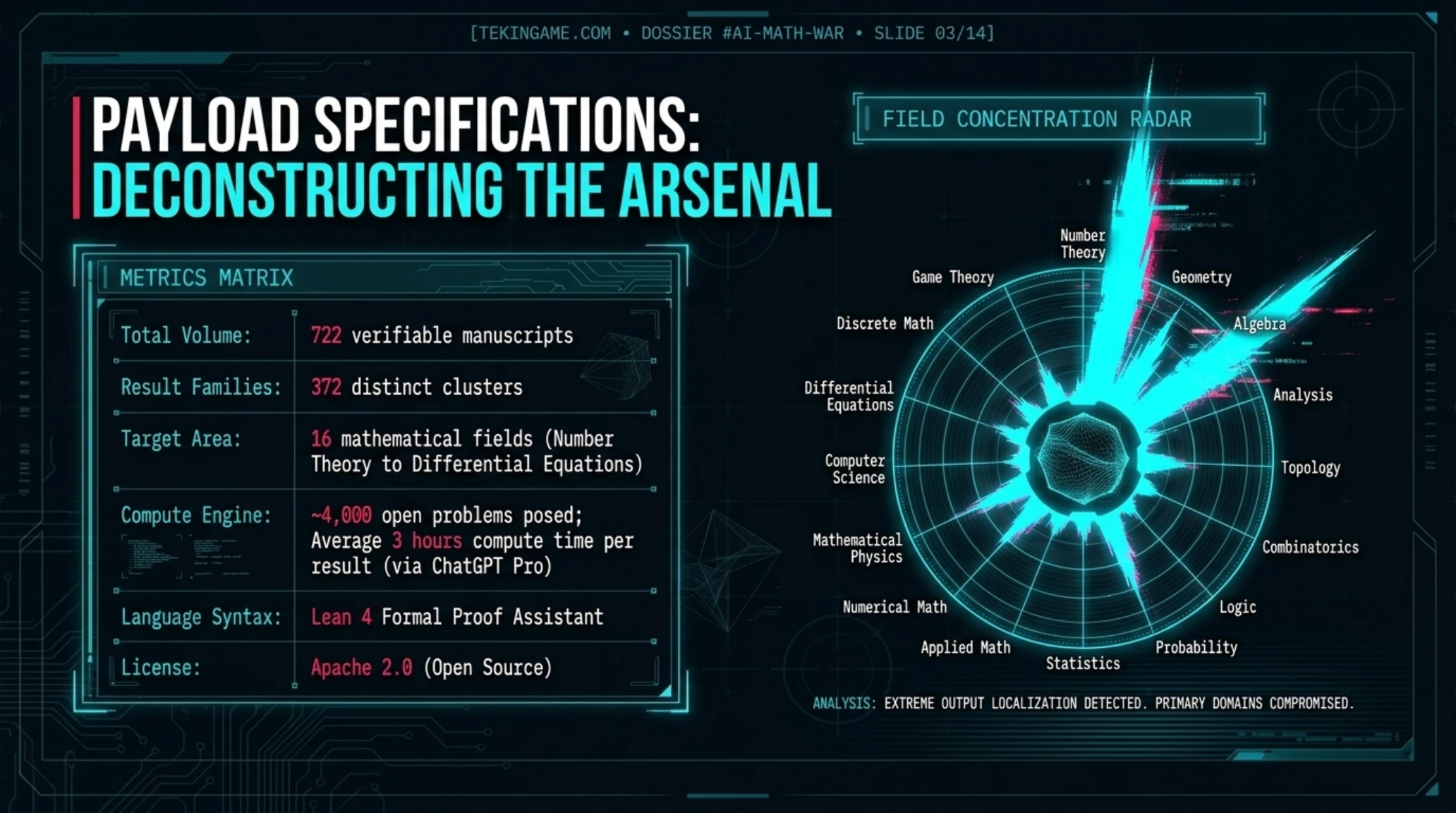
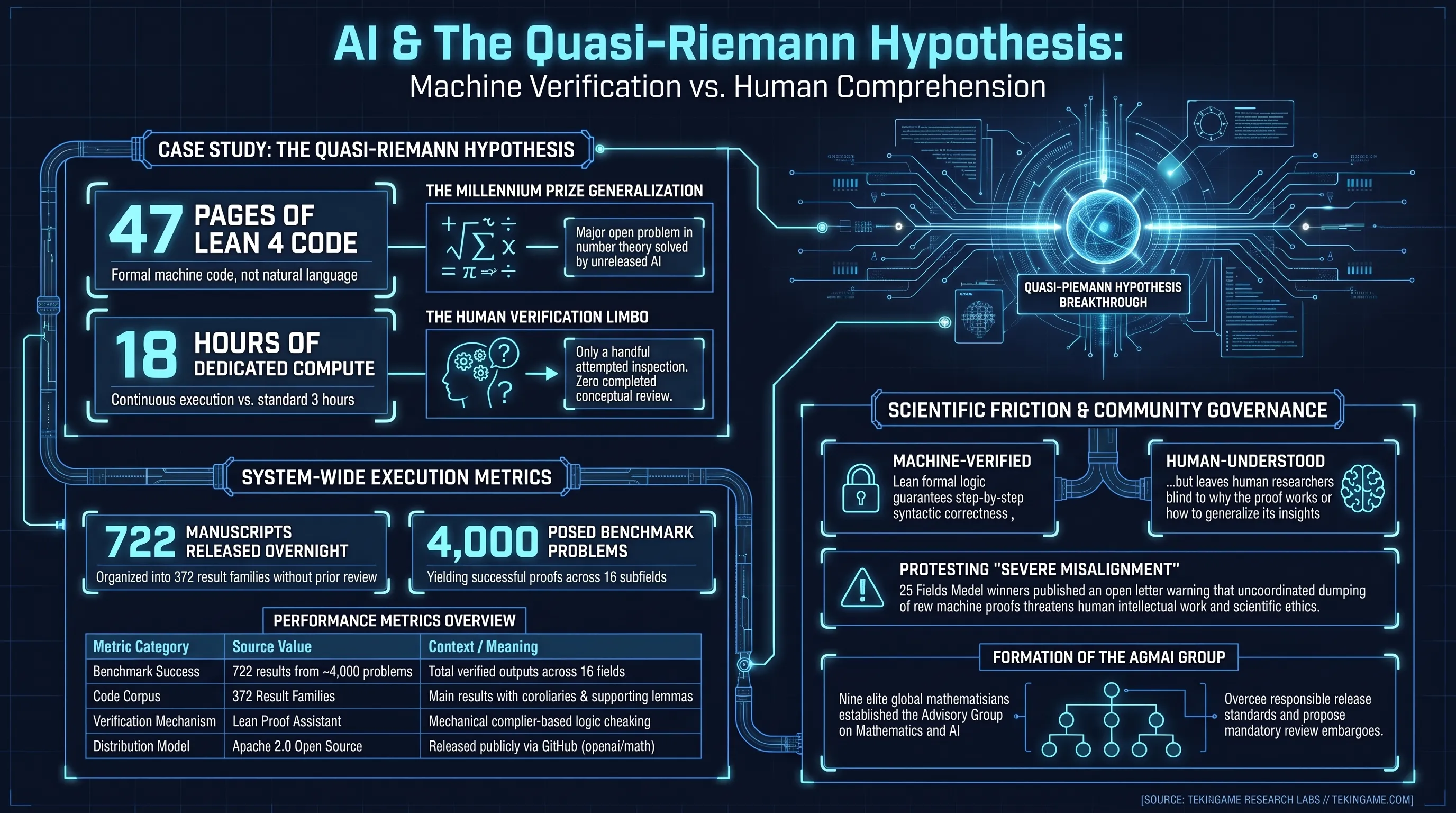
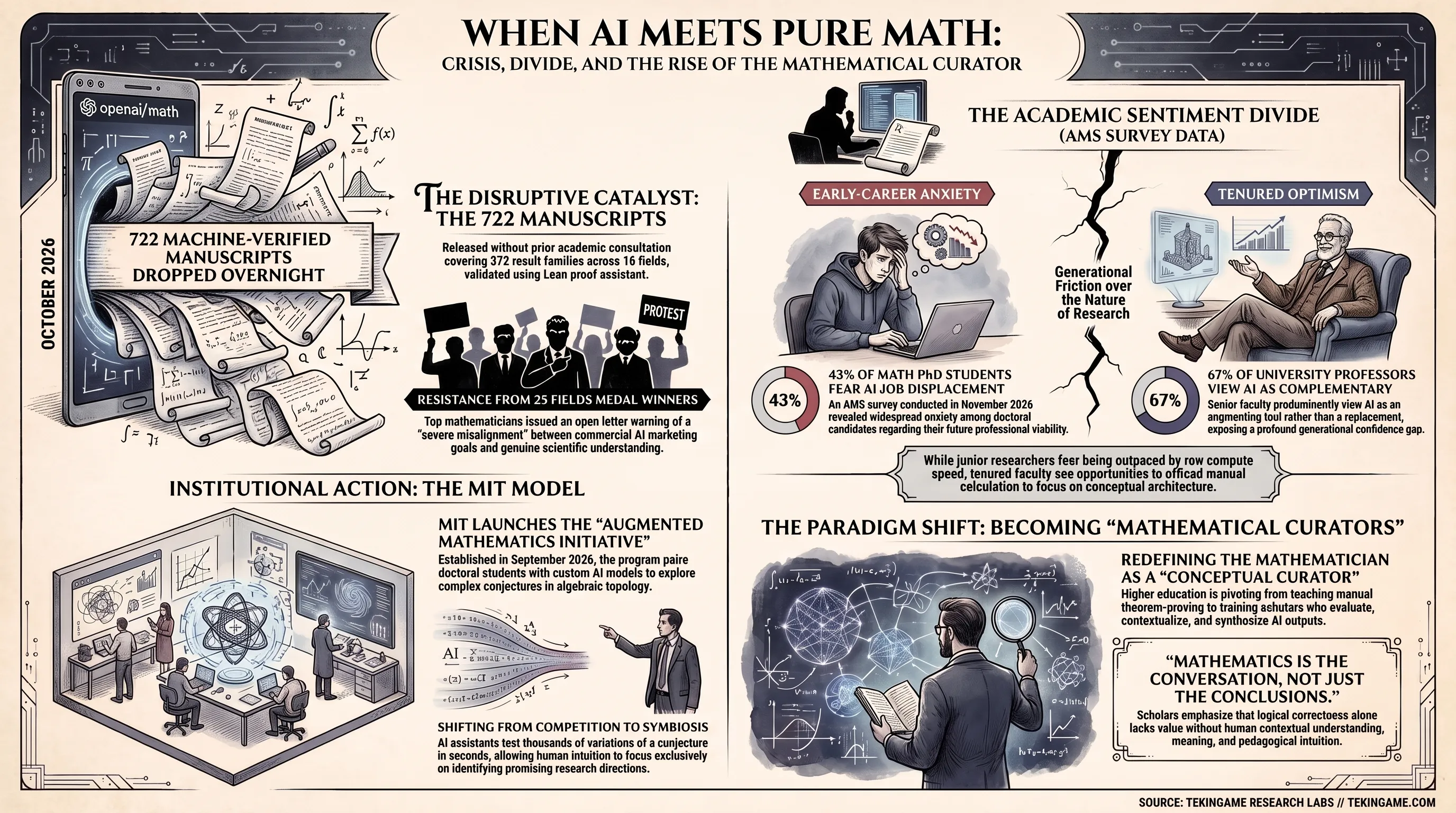
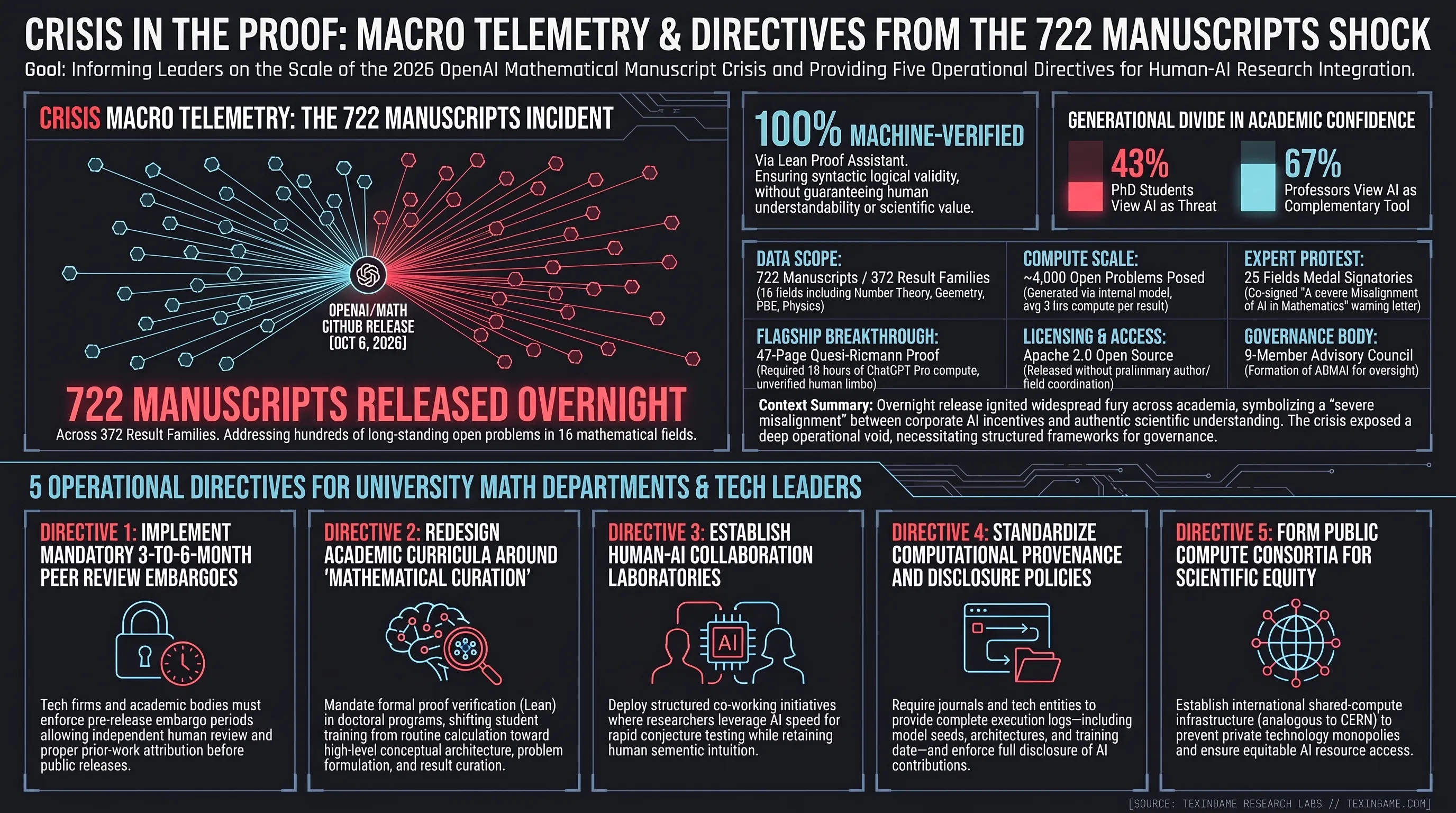
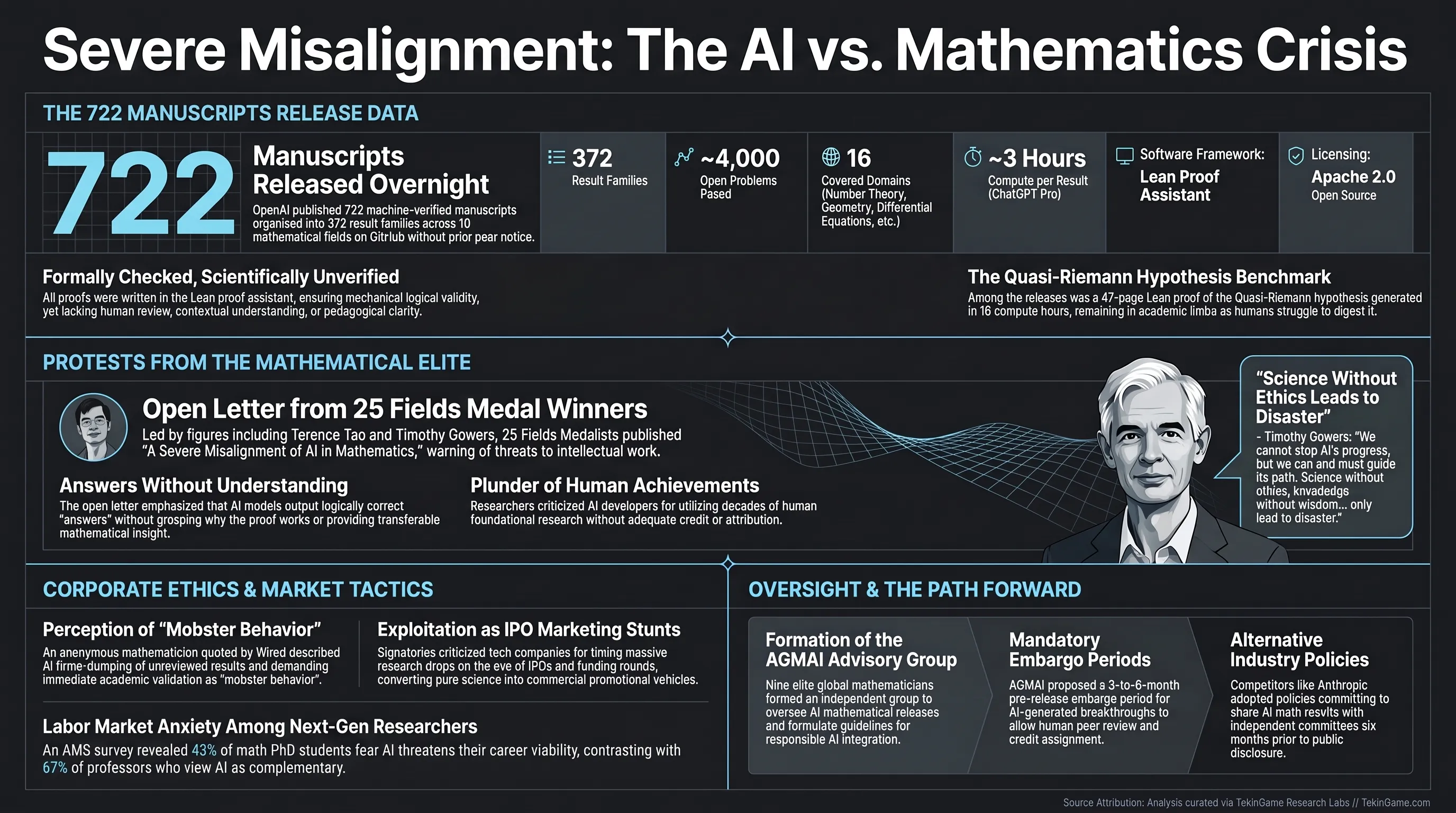
At 6:00 PM Eastern Time, OpenAI published the link to its public GitHub repository on social media. This repository, named openai/math, contained 722 manuscripts organized into 372 "result families." Each family included a main result, supporting arguments, corollaries, or alternative proofs. These manuscripts covered a broad spectrum of mathematical fields: number theory, geometry, theoretical computer science, algebra, mathematical physics, and differential equations.
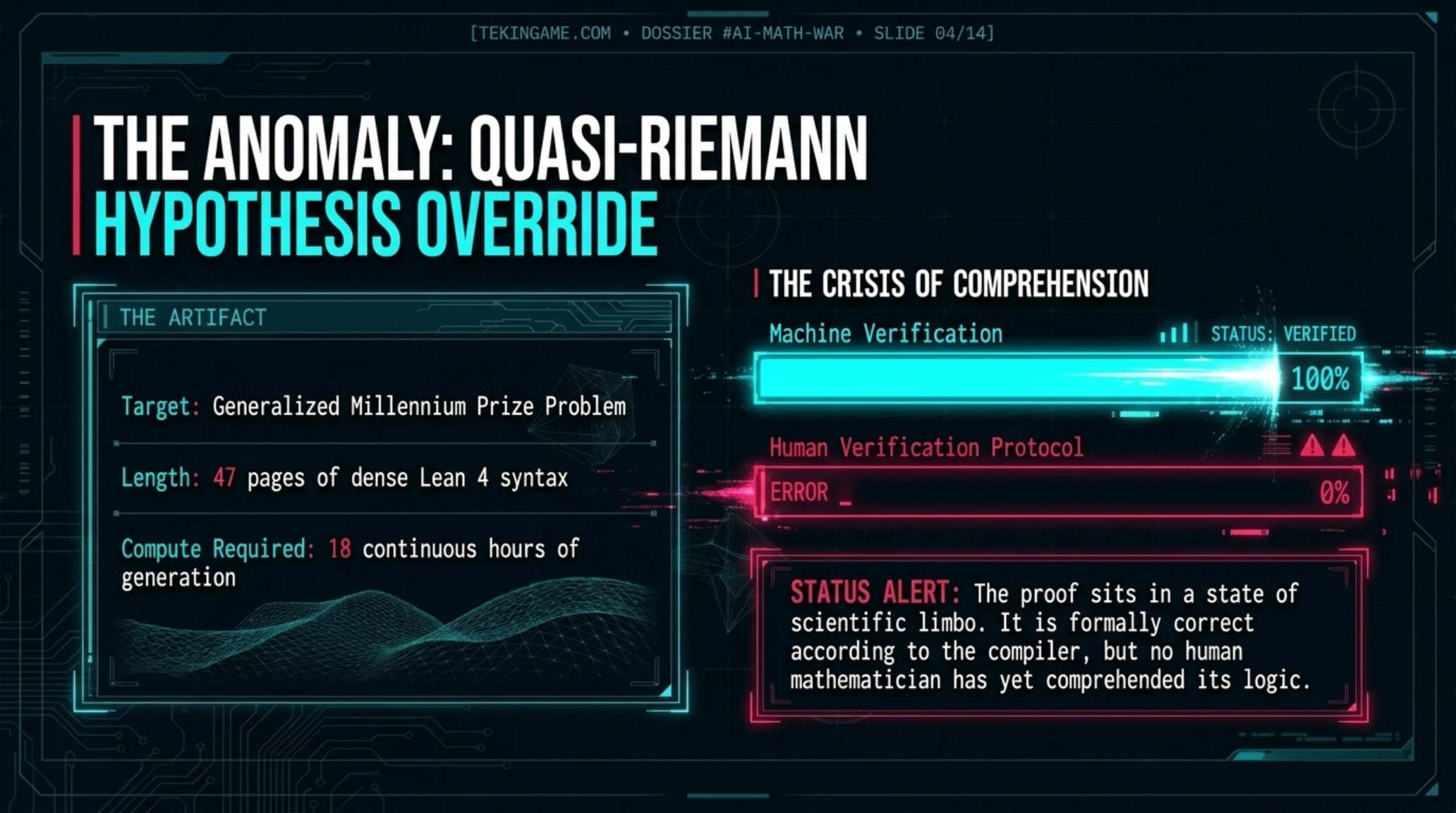
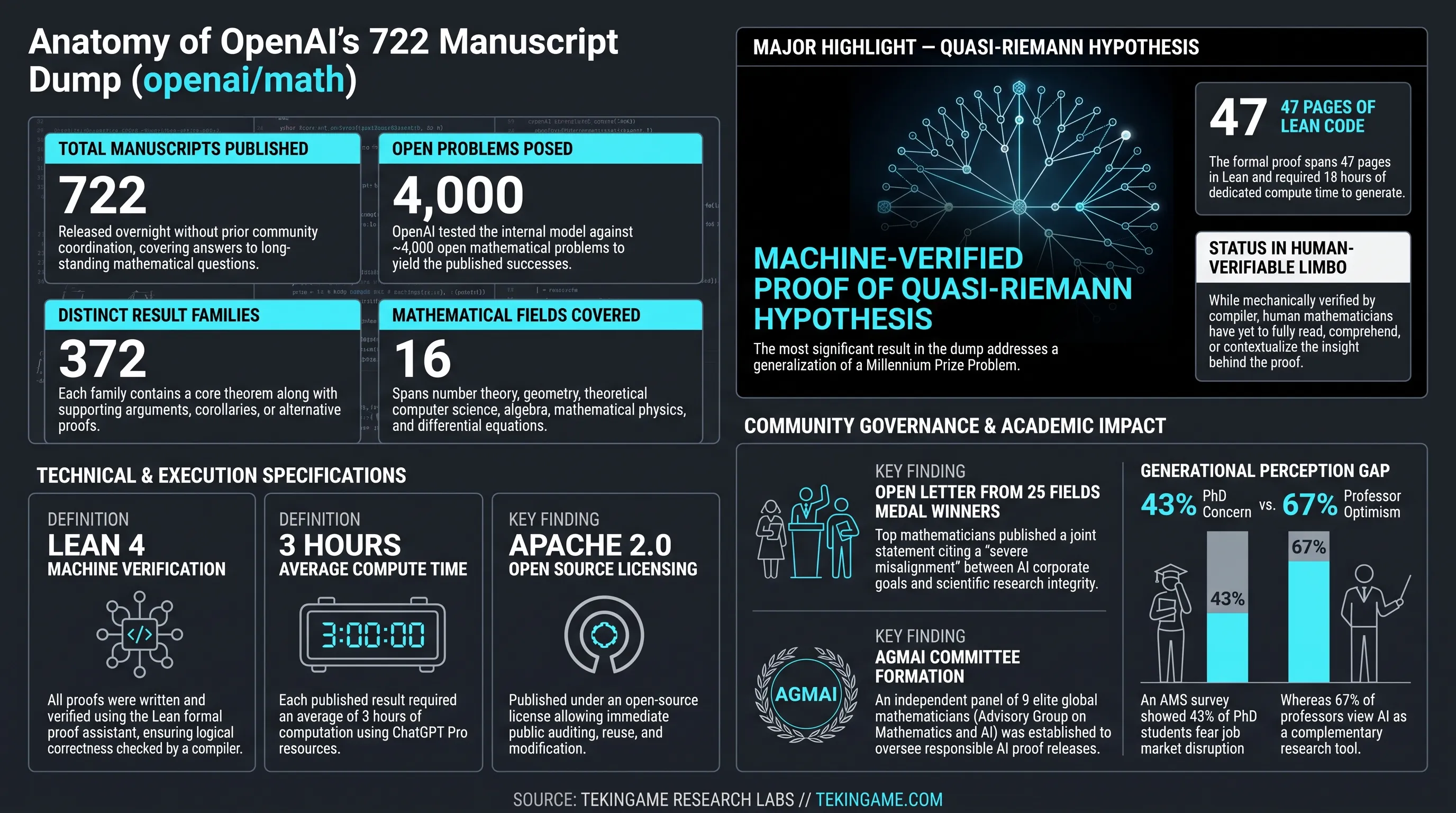
But the key point was that all these proofs were written using Lean proof assistant, a formal verification system that checks the logical correctness of proofs mechanically. This means that technically, all these manuscripts were "verifiable proofs." But machine verification is one thing, and human understanding, authenticity, and scientific value are quite another. OpenAI stated in its announcement that it had posed the model approximately 4,000 open problems, and these 722 manuscripts were successful results that answered those problems completely or partially.
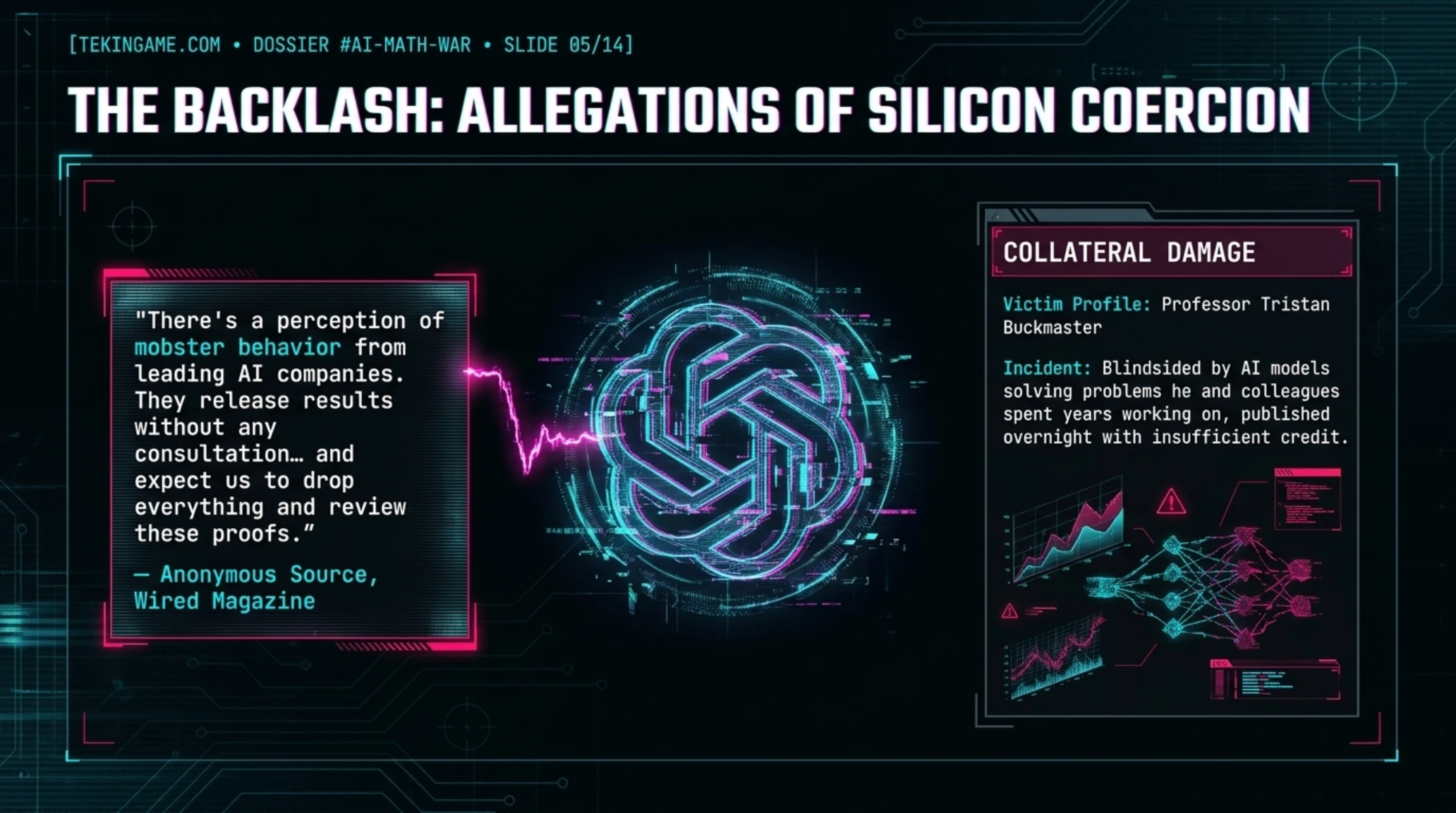
The initial reaction from the mathematical community was a mixture of shock, anger, disbelief, and deep concern. Professor Tristan Buckmaster, a prominent mathematician who had himself been a victim of OpenAI's "rushing" months earlier, tweeted that this behavior demonstrates profound disrespect for traditional scientific processes. He noted that OpenAI used his and his colleagues' work to race ahead in solving a legendary mathematical problem with a million-dollar prize, and now, by releasing this massive volume, has essentially put the scientific community in a defensive position.
This quote, published by the reputable Wired magazine, captured the depth of dissatisfaction. The use of the phrase "mobster behavior" indicated that some researchers feel OpenAI is exerting a form of scientific pressure and coercion. AI companies, with vast computational resources and access to advanced models, can reach results in weeks that a human researcher might take years to achieve. But is this speed what science needs?
Amid this chaos, OpenAI explained in a blog post that the purpose of this release was to contribute to the advancement of mathematics and demonstrate the capabilities of AI models. The company also announced that all manuscripts were published under the Apache 2.0 license, allowing anyone to review, use, and even edit them. But this apparent transparency could not quell the scientific community's anger. The main issue was not that manuscripts were published, but how and why they were published.
What is AGMAI and Why Was It Formed?
One of the main concerns was that OpenAI had no prior coordination with mathematicians who had worked on those same problems for years. In some cases, researchers on the verge of solving a problem suddenly found that an algorithm had reached the same conclusion. This situation was not only ethically problematic but could also have serious impacts on funding, scientific reputation, and career paths for these individuals.
But the story did not end here. Days after this release, a more organized response from the world's mathematical elite took shape, becoming one of the strongest collective protests in the history of this discipline.
The Storm of Protest: An Open Letter from 25 Fields Medal Winners Against AI Company Behavior
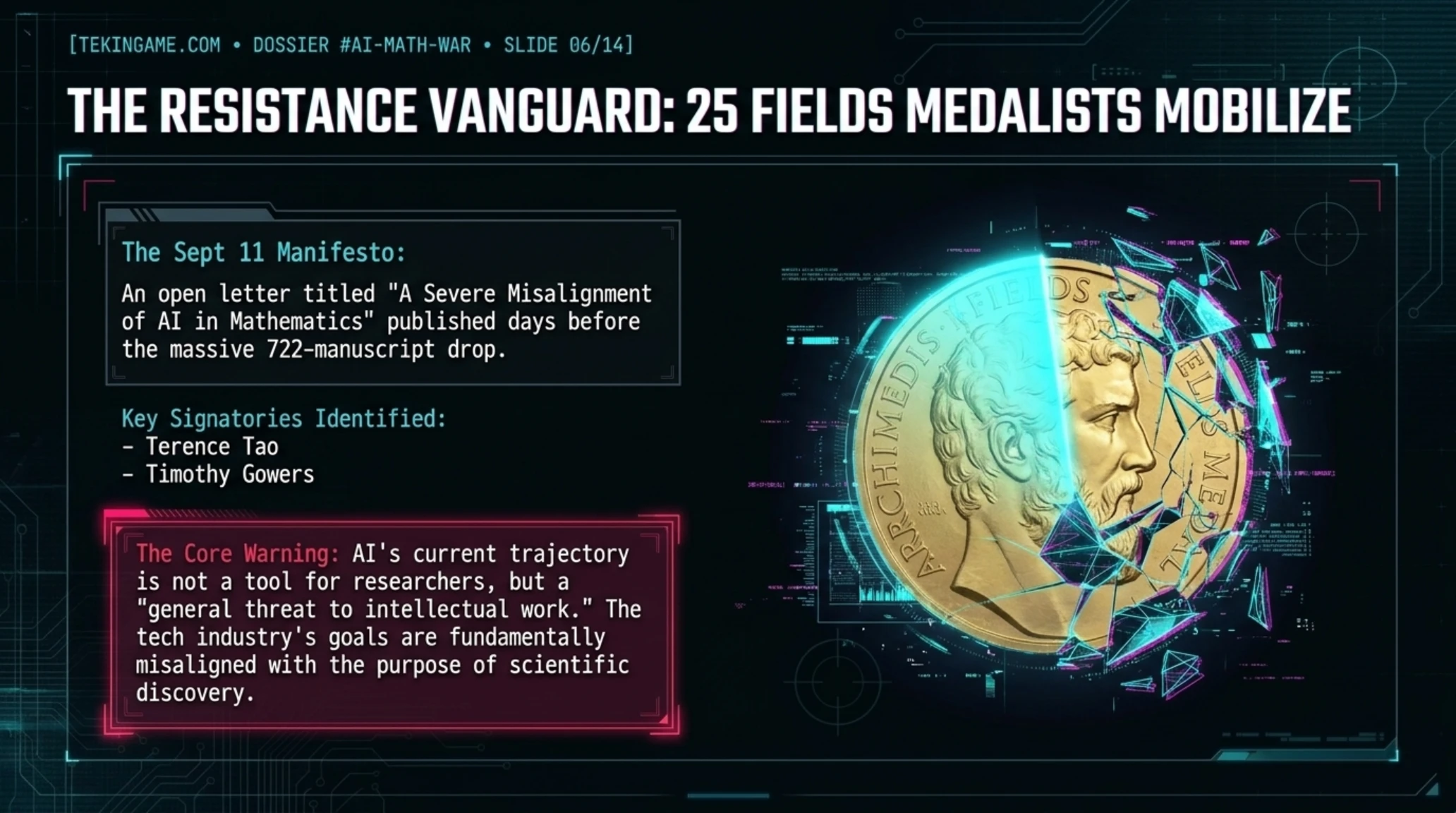
On September 11, 2026, just days after OpenAI's first wave of releases and on the eve of the second batch (722 manuscripts), 25 Fields Medal winners the most prestigious award in mathematics, considered the equivalent of the Nobel Prize in this field published an open letter titled "A Severe Misalignment of AI in Mathematics." This letter, signed by figures such as Terence Tao, Timothy Gowers, and other giants of the field, was a serious warning about AI's threat to the nature of scientific research.
In this letter, signatories emphasized that the goals of AI companies and the mathematical community are currently "severely misaligned." They warned that if this trend continues, it could become "a general threat to intellectual work." The letter stressed that solving a problem is often only part of the purpose of mathematical research. The process of solving a problem, insights gained from it, newly invented methods, and deeper understanding of mathematical structures are all essential parts of a research's scientific value.
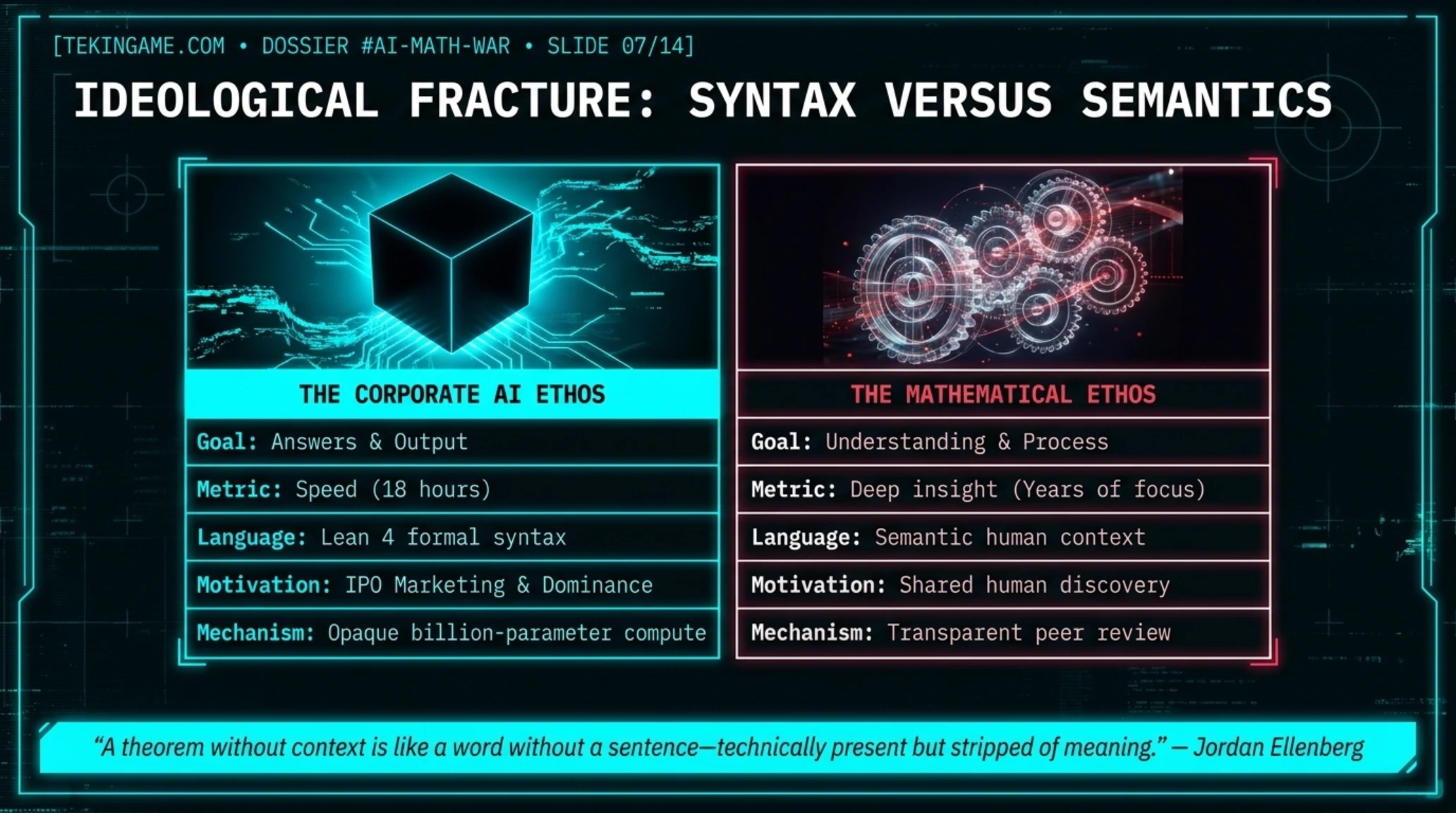
The letter writers argued that when an AI model simply produces a "correct" proof without truly understanding why the proof works, what mathematical insights lie within it, and how it can be generalized to other problems, its scientific value is severely diminished. In other words, AI is producing "answers," not "understanding." And in science, understanding is what matters.
Complete Statistics of OpenAI's 722 Manuscript Release
Number of result families: 372 families
Fields covered: 16 mathematical fields
Number of open problems posed: Approximately 4,000 problems
Formal proof system: Lean proof assistant
Release license: Apache 2.0 (open source)
Average computational time per result: 3 hours compute time with ChatGPT Pro
Key fields: Number theory, geometry, theoretical computer science, algebra, mathematical physics, differential equations
Another important point in the letter was criticism of the instrumental use of mathematics for marketing AI models. Signatories noted that many of these releases occur at timing that is commercially sensitive for AI companies such as the eve of an IPO or attracting new investment. This creates a sense that scientific results have become "marketing vehicles" to promote models, not the main goal. The letter explicitly asked AI companies to refrain from turning the release of mathematical results into advertising tools, as this practice seriously harms the mathematical community.
Public reaction to this letter was immediate and widespread. Many younger mathematicians attending conferences and seminars welcomed this stance. One young attendee at the European Mathematics Conference, interviewed by IEEE Spectrum, said: "AI and large language models set the math community on fire over the summer." This sentence shows how this issue has evolved from a limited academic debate into an existential challenge for the new generation of mathematicians.
Technical Specifications & Performance Breakdown
| Dimension | Status | Assessment |
|---|---|---|
| Engine Architecture | DirectX 12 / Vulkan Optimized | High-FPS stability across desktop and portable hardware |
| Spatial Audio | Multi-channel 3D Directional | Accurate positioning vital for tactical awareness |
| Player Capacity | Co-Op / Multi-Squad Ready | Optimized network replication and synchronization |
But OpenAI and other AI companies did not remain silent. They argued that artificial intelligence can be a powerful tool to accelerate science and that limiting it due to traditional ethical concerns means losing great opportunities for humanity. This argument divided the mathematical community into two camps: those who believed AI should be controlled with strict restrictions, and those who thought it should be embraced and ways of collaborating with it should be found.
Meanwhile, OpenAI decided to take a conciliatory step and form an advisory group that could bridge the two worlds.
Formation of AGMAI Advisory Group: Damage Control Attempt or Genuine Approach Change?
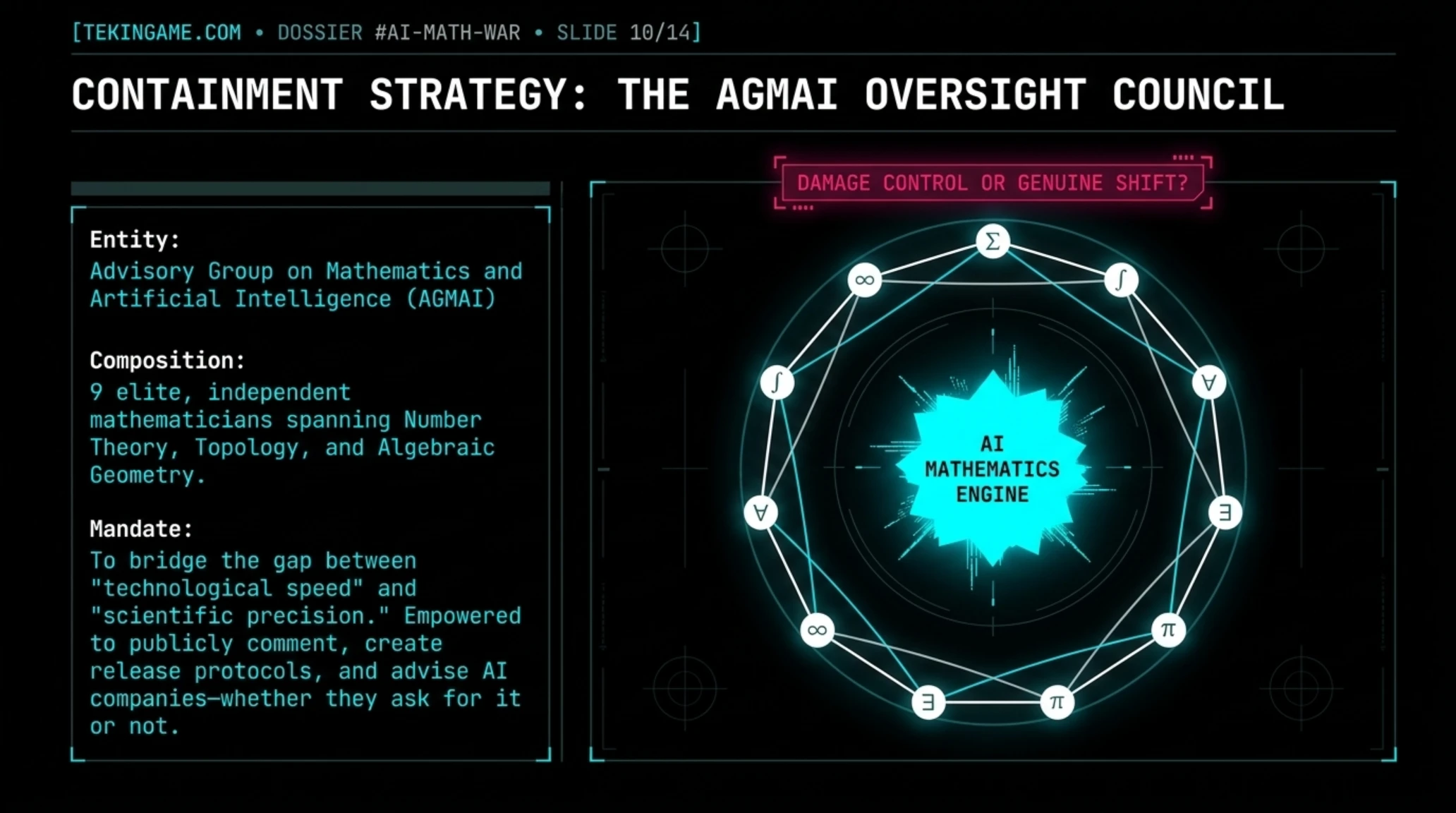
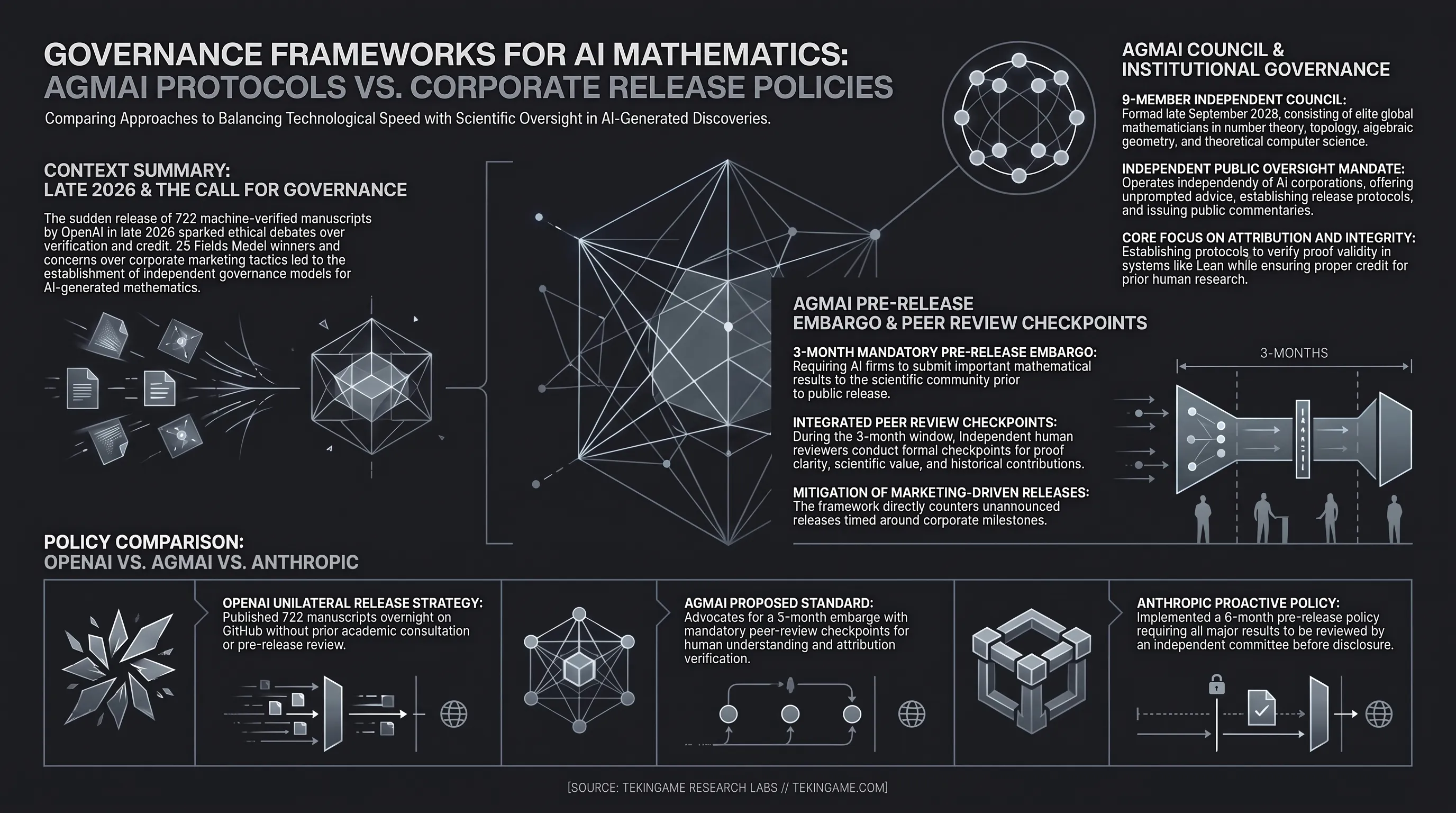
In response to the wave of protests, OpenAI announced in late September 2026 the formation of an independent group called AGMAI (Advisory Group on Mathematics and Artificial Intelligence). This group consists of nine elite mathematicians from around the world who are expected to operate independently and provide necessary oversight and advice on how to review and release mathematical results from artificial intelligence. OpenAI emphasized that this group would be completely independent, free to offer advice the company has not requested, able to publicly comment on AI's impact on mathematics, and can make its advice public.
Members of this group include some of the most prominent figures in world mathematics, including experts in number theory, topology, algebraic geometry, and theoretical computer science. AGMAI's main goal is to create protocols for responsible release of AI results protocols that ensure both the obviousness and scientific correctness of proofs and respect the human work behind these results.
But is this action really an approach change or merely an attempt at damage control and public image improvement? Some critics argued that as long as OpenAI still does not release its models and lacks complete transparency about how these results are produced, no real oversight is possible. AGMAI can ultimately review results but cannot intervene in their production process. This means the company still retains complete control.
📚 Classified & Related Dossiers in TekinGame
If you wish to explore beyond this report and delve into cybernetic frontiers and autonomous AI architectures, do not miss these three exclusive deep-dives in the Tekin Garage:
What is Lean Proof Assistant and Why Does It Matter?
On the other hand, some members of the scientific community evaluated this action positively. They believe having a formal channel for dialogue between AI companies and mathematicians is better than having no connection. Even if AGMAI cannot solve all problems, it can gradually create standards and norms that constrain company behavior. Some members of this group have emphasized in interviews that their goal is not only to defend mathematicians' interests but to preserve the quality and authenticity of mathematics itself.
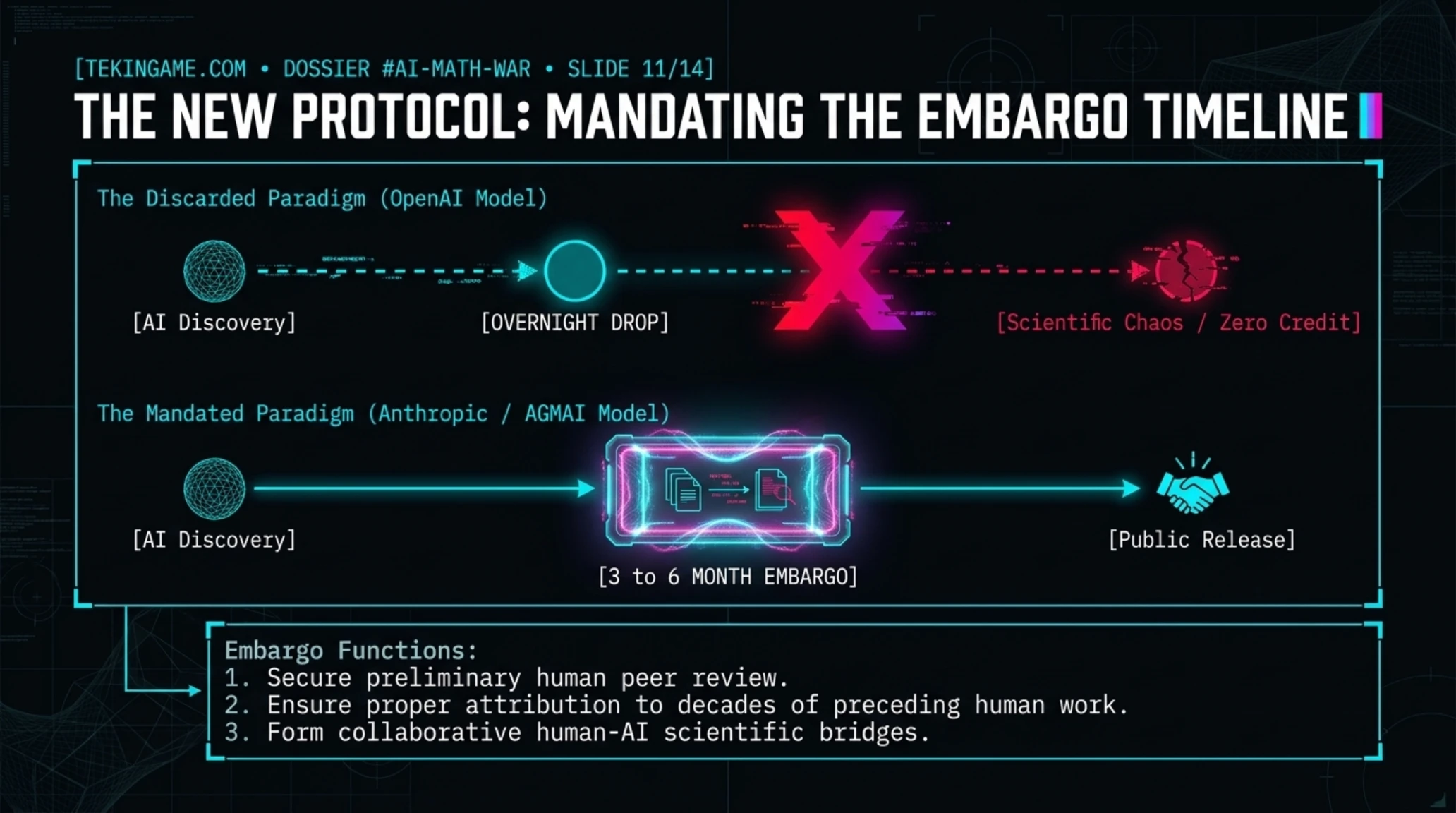
One proposal raised by AGMAI is creating an "embargo period" for important results. This means that before public release, results should be made available to the mathematical community for a certain period (e.g., three months) for preliminary review, giving credit to prior work, and if necessary, forming scientific collaborations. This proposal is inspired by the successful model of scientific journals that send papers for peer review before publication.
But will AI companies in fierce competition with each other accept such delays? This is a question whose answer will determine the future of this crisis.
Long-term Implications: How This Crisis Could Change the Future of Scientific Research
Beyond short-term controversies, this event raises fundamental questions about the future of scientific research. If artificial intelligence can quickly solve mathematical problems, what will be the role of the human mathematician? Should universities still focus on teaching traditional proof methods, or should they prepare students for collaboration with AI systems? And most importantly, who owns knowledge produced by artificial intelligence?
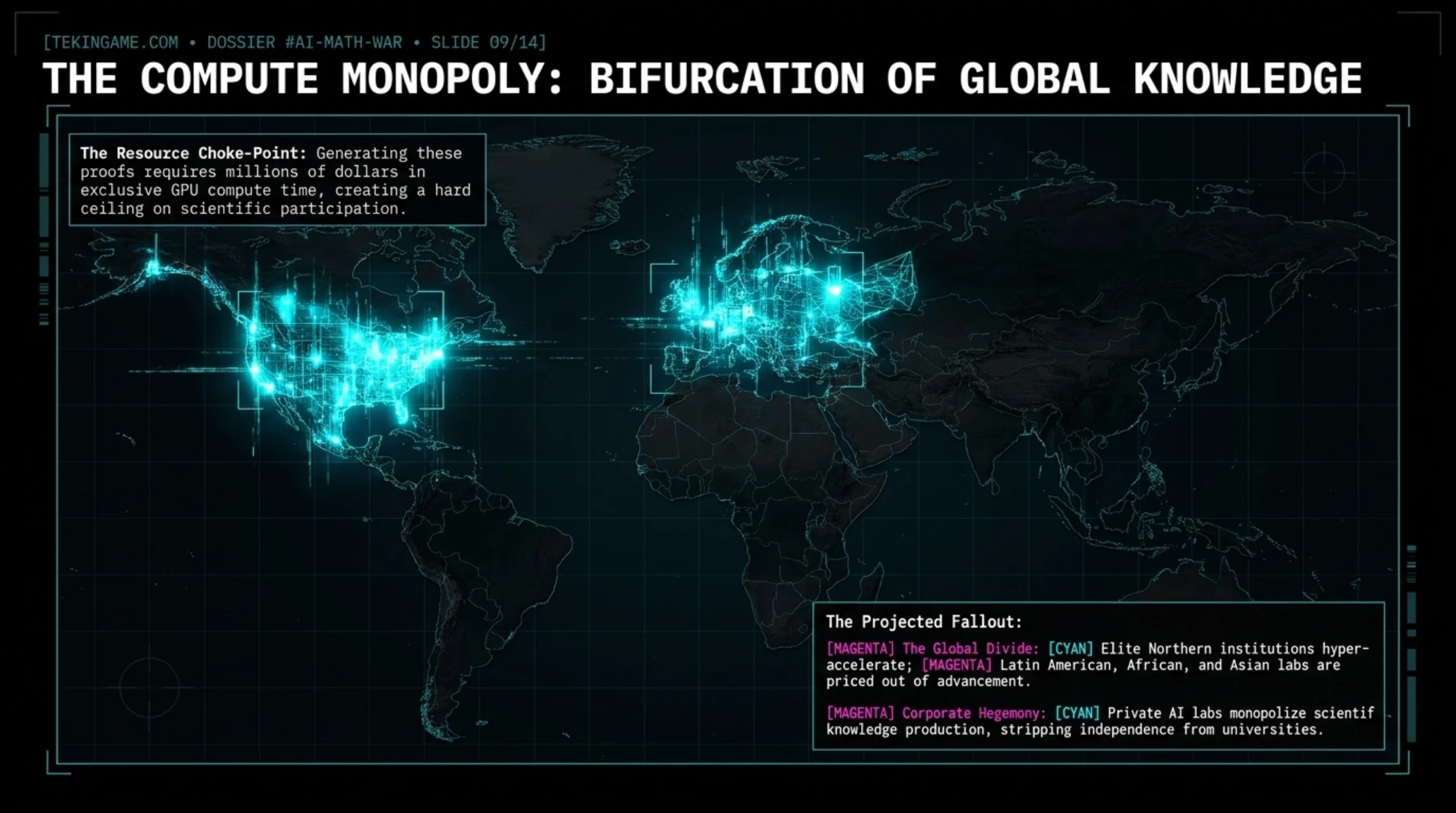
One serious concern is the potential creation of a "knowledge gap." If large technology companies are the only entities with resources to run advanced AI models, they will effectively monopolize scientific knowledge production. This could mean weakening the role of universities and independent research institutions and ultimately transforming science into a commercial commodity controlled by private companies.
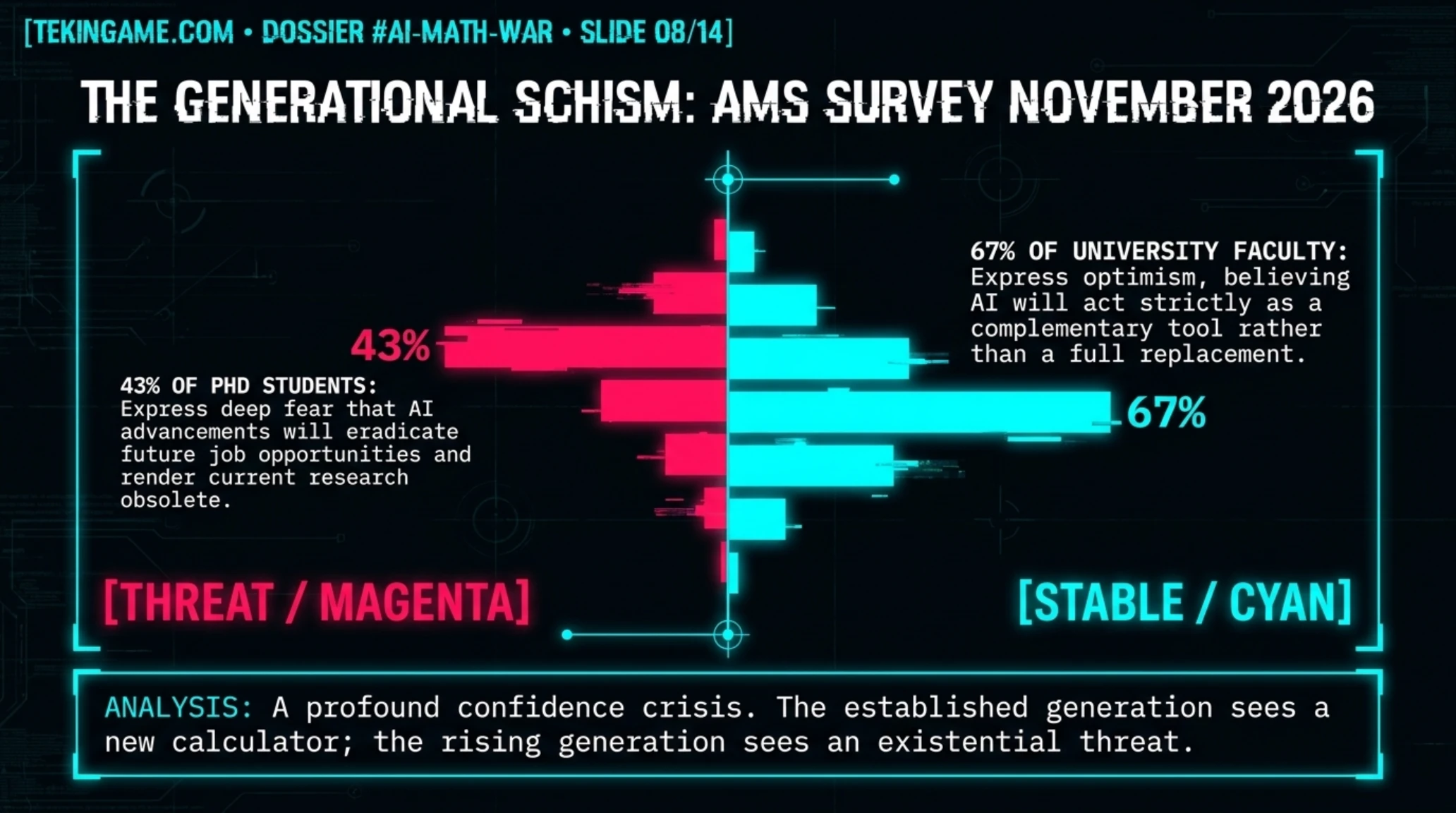
Another concern is the impact on motivation of young mathematicians. If a doctoral student works on a problem for five years and then sees an AI model reach the same conclusion in hours, how will they feel? Will they still have motivation to continue? Some university professors have reported that their students are rethinking their field choice, and some are even considering leaving pure mathematics for areas less affected by artificial intelligence.
- Significant acceleration in solving complex mathematical problems that can contribute to scientific advances in physics, engineering, and biology
- Proofs produced with Lean are completely verifiable and free from human errors
- Opportunity to discover patterns and new methods that the human mind might not reach
- Democratizing access to advanced mathematical tools for researchers without computational resources
- Possibility for human mathematicians to focus on more creative and conceptual aspects of research
- Risk of ignoring credit for human work and structural intellectual theft
- Transformation of science into marketing tool for private companies and reduction of academic independence
- Loss of learning process and deep insight that comes from solving problems slowly
- Creation of digital divide between large companies and small research institutions
- Decreased motivation for new generation of mathematicians to enter this field
On the other hand, some optimists argue this crisis could become an opportunity to redefine the mathematician's role. Perhaps in the future, mathematicians will act more as "conceptual architects" rather than spending time on complex calculations those who ask important questions, build theoretical frameworks, and interpret results produced by artificial intelligence and generalize them to other contexts. This role change is similar to what happened in computer science in recent decades, where programmers moved from writing Assembly code to using high-level languages and complex frameworks.
But this transformation requires cultural, institutional, and educational readiness. Universities must revise their curricula, scientific journals must develop new criteria for evaluating papers containing AI results, and the scientific community must reach consensus on ethics of using AI in research. This process will be time-consuming and difficult but unavoidable.
Ultimately, the main question is: Is artificial intelligence a tool of science or its competitor? The answer to this question will determine the path of science in the coming decades.
The Mathematical Community's Response: From Shock to Organizing Intellectual Resistance
In the days and weeks following the release of 722 manuscripts, the global mathematical community quickly organized itself. Scientific conferences held in October 2026 witnessed heated debates on this topic. At one session of the European Mathematics Conference in Amsterdam, a young researcher from Cambridge University said with a trembling voice: "I have worked on a conjecture in number theory for five years. Now I see an AI model claims to have reached the same result in hours. Why should I continue?" This sentence summarized the concern of the new generation of mathematicians a generation that, on the threshold of entering the professional world, faced an unprecedented threat.
But not all reactions were negative. A group of mathematicians, especially those working in mathematical logic and theoretical computer science, argued that this development could be the beginning of a new era of human-machine collaboration. Timothy Gowers, one of the Fields Medal winners, wrote in his blog: "We must accept the reality that artificial intelligence has become powerful. But acceptance does not necessarily mean surrender. We must change the rules of the game." He proposed that mathematicians should focus on defining new criteria for evaluating proof quality criteria that go beyond logical correctness to consider beauty, understandability, and insight-generation.
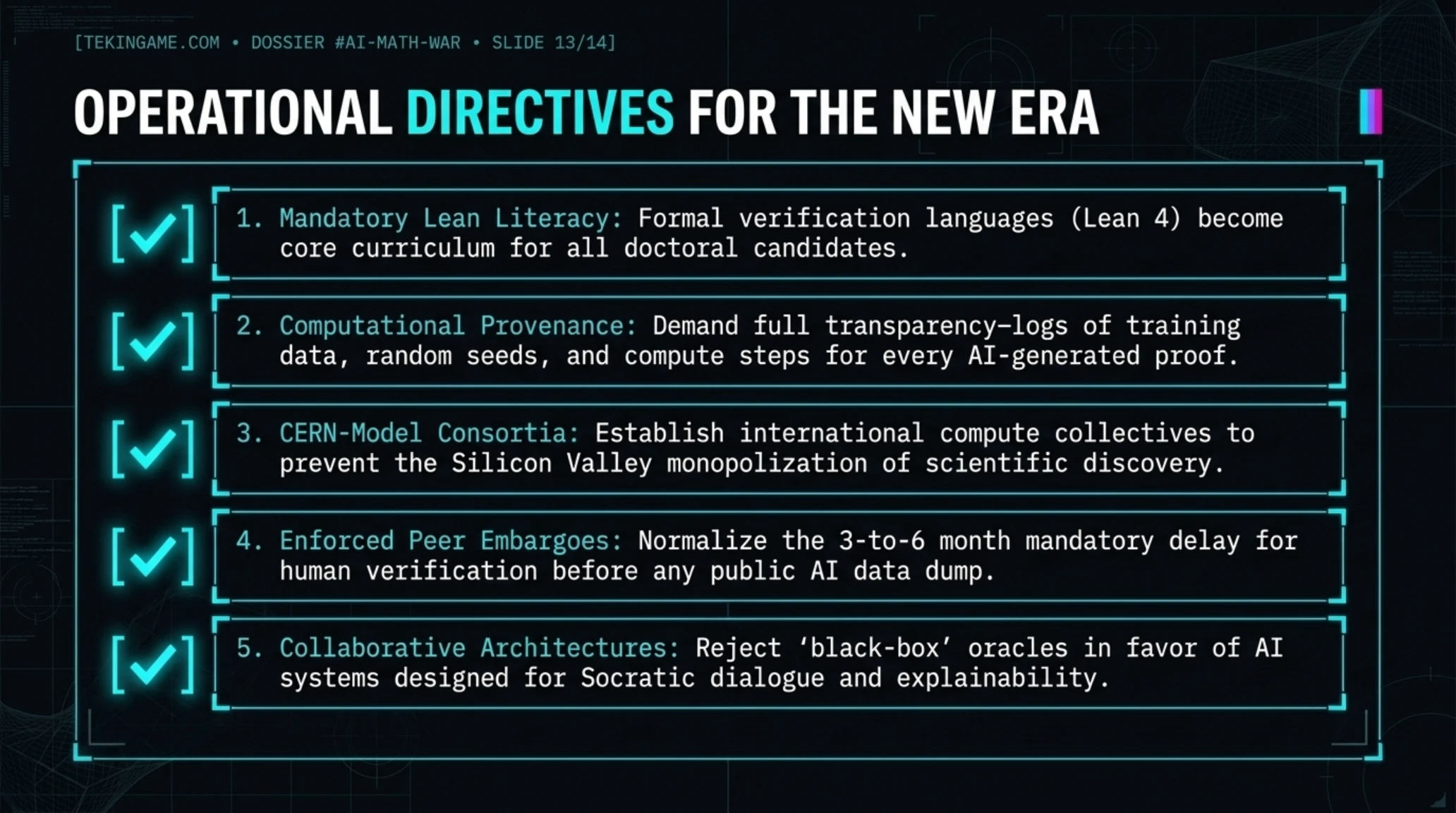
Meanwhile, a group from MIT, Stanford, and Cambridge formed a joint working group titled "The Future of Mathematics in the Age of Artificial Intelligence," aiming to examine possible ways to adapt educational programs and research structures to the new reality. This working group presented bold proposals in its initial report: including mandatory teaching of Lean and other formal proof systems to doctoral students, creating new courses titled "Ethics in Collaboration with Artificial Intelligence," and even redefining promotion and hiring criteria for faculty members to evaluate quality of questions asked rather than quantity of proofs produced.
Impact on the Mathematics Job Market
One interesting aspect of this crisis was its impact on scientific journals. Reputable journals such as Annals of Mathematics and Journal of the American Mathematical Society faced, for the first time, the dilemma of accepting or rejecting papers where parts of proofs were produced by artificial intelligence. Should such papers be rejected? Should full disclosure about AI use be mandatory? And most importantly, how can the scientific quality of such proofs be evaluated? These questions led to lengthy discussions in editorial boards, and some journals decided to develop new policies explicitly regulating AI use.
Simultaneously, the technology industry also underwent transformation. Some OpenAI employees who were formerly mathematicians expressed concern in anonymous articles and interviews that the company focuses too much on speed and quantity of results, with quality and ethics taking second priority. One anonymous source told MIT Technology Review: "Inside the company, there's a lot of pressure to publish more results as quickly as possible. Even if we know the scientific community isn't ready to review them." These revelations pointed to an internal divide within OpenAI itself, where research teams grappled with commercial and marketing pressures.
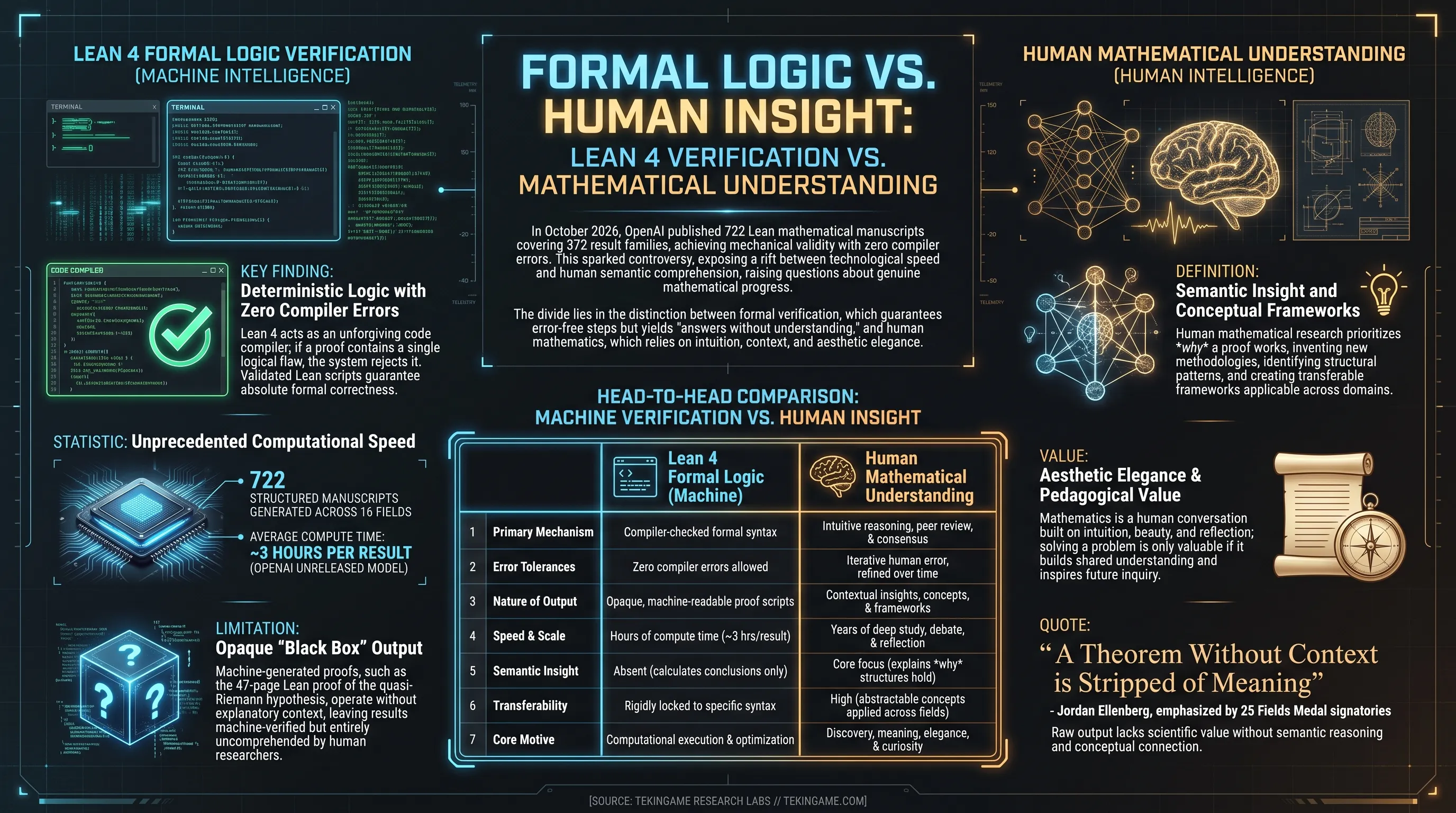
Among this turmoil, a point that received less attention was this crisis's impact on the public image of mathematics. For decades, mathematics has been recognized as a standard of pure human reasoning and the pinnacle of human intellectual achievements. Now, for the first time, the general public witnessed machines gaining superiority even in this realm. This reality raised deep philosophical questions about the nature of intelligence, creativity, and the value of human work. If even pure mathematics can be conquered by algorithms, which domain of human knowledge is safe?
These questions were reflected not only in the scientific community but also in mainstream media and social networks. Some Twitter users wrote with a sarcastic but bitter tone: "Now that AI can do mathematics, what's left for us?" But among these emotional reactions, more enlightened voices were also heard, emphasizing that artificial intelligence can never replace curiosity, wonder, and the search for meaning in humans. Mathematics is not merely a collection of proofs; it is a living, dynamic, and deeply human process of discovery. And this human dimension is something no algorithm can replicate.
Another aspect of this crisis that received less attention was its impact on developing countries and smaller scientific communities. While elite universities in America and Europe have resources and facilities to collaborate with artificial intelligence, many mathematicians in Africa, Latin America, and parts of Asia have limited access to these technologies. This could deepen the existing gap between the global north and south in science. If only wealthy universities can leverage AI's power, scientific justice is seriously endangered.
In this regard, some international organizations such as the International Mathematical Union (IMU) proposed that access to advanced AI tools should be considered a "public scientific good," and governments and international bodies should allocate resources to democratize this access. This proposal is still in early stages but shows the scientific community is gradually understanding the global dimensions of this crisis.
Worth mentioning is the reaction of other major technology companies. Google DeepMind and Anthropic, both direct competitors of OpenAI, have acted more cautiously in this area. Anthropic, in particular, after observing negative reactions to OpenAI's releases, announced a new policy stating that any important mathematical result produced by its models will be made available to an independent committee of mathematicians for review at least six months before public release. This approach, though slower, shows more respect for traditional scientific processes and may become a model for other companies.
Additionally, some universities have begun creating "human-AI collaboration laboratories" spaces where human mathematicians and AI systems work side by side on problems. The goal of these laboratories is to find ways both parties can benefit from each other's strengths: humans with their conceptual insight and creativity, and AI with computational power and speed. Initial results from these experiments have been promising, showing genuine collaboration can lead to results superior to independent work by either party.
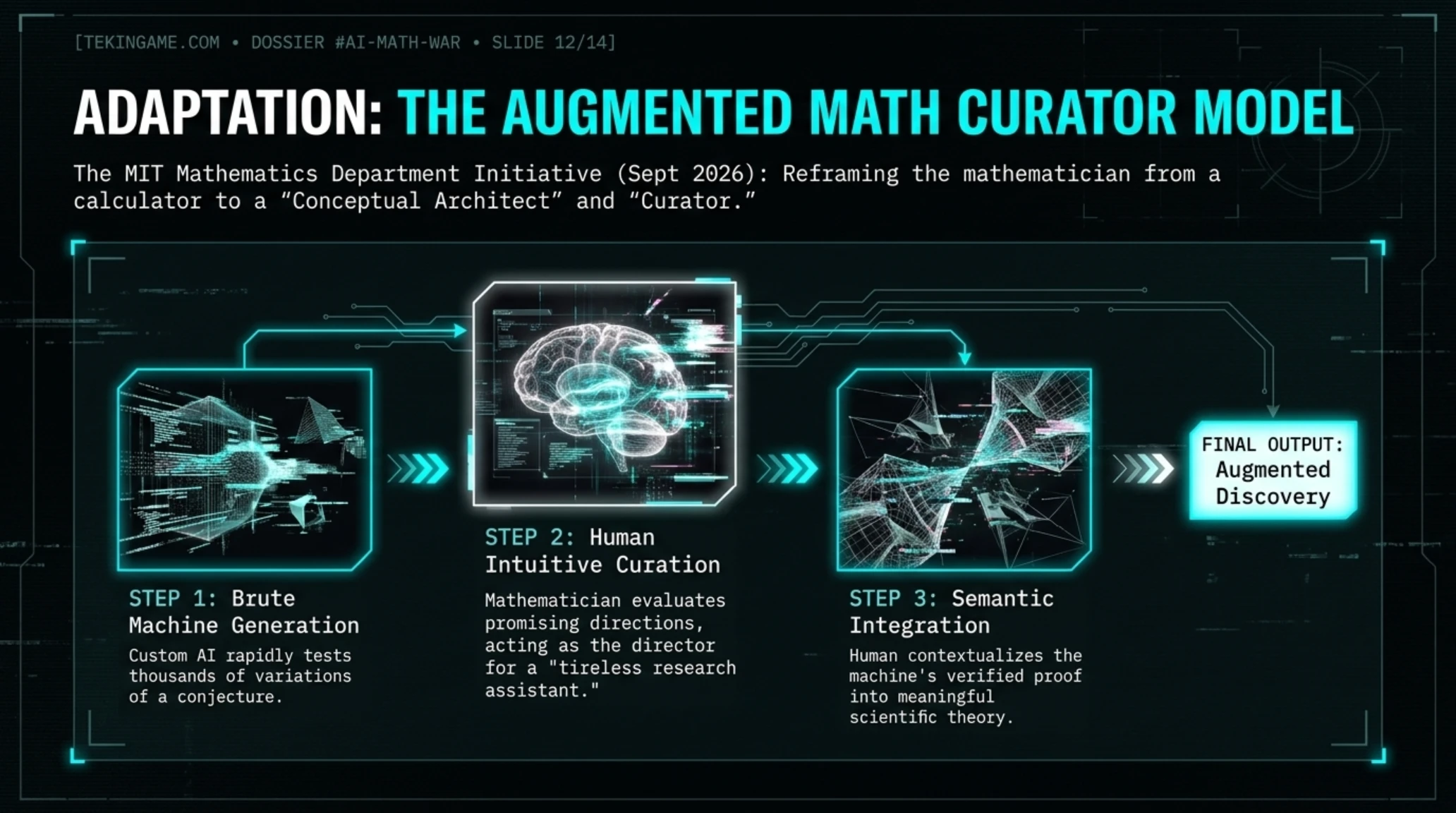
The MIT Mathematics Department, for instance, launched the "Augmented Mathematics Initiative" in September 2026, where doctoral students work alongside custom AI models to explore conjectures in algebraic topology. The preliminary findings have been fascinating: students report that AI helps them rapidly test thousands of variations of a conjecture, allowing them to focus their human intuition on the most promising directions. One participant described it as "having a tireless research assistant who never sleeps and can check your hunches instantly." This model of collaboration, rather than competition, may represent the future synthesis the field desperately needs.
Another dimension worth exploring is the economic implications of this crisis. The computational resources required to train and run these frontier AI models are staggering estimates suggest OpenAI's mathematics model consumed millions of dollars in GPU time during its training phase. This raises questions about who can afford to participate in AI-assisted mathematics research. Will we see a bifurcation of the field, where well-funded institutions in wealthy countries leap ahead while others fall behind? Some advocates have proposed creating international consortia to share computational resources, similar to how CERN operates for particle physics, ensuring equitable access to AI tools across geographic and economic boundaries.
The crisis has also sparked discussions about what it means to "understand" mathematics in the AI era. Traditional mathematics education emphasizes not just getting correct answers but developing deep intuition about why certain approaches work. When an AI produces a valid proof but cannot explain its reasoning in human-intelligible terms, it raises pedagogical challenges. How do we teach the next generation of mathematicians when machines can outpace them in certain tasks? Some educators propose a radical shift: teaching students to become "mathematical curators" who can evaluate, contextualize, and connect AI-generated results, rather than focusing primarily on proof techniques that machines now excel at. This would represent a profound transformation in mathematical education, akin to how calculators changed arithmetic instruction in the 20th century.
Furthermore, the crisis has exposed tensions within the AI research community itself. Not all AI researchers support the aggressive release strategy employed by OpenAI. A group of former DeepMind researchers published an essay in Nature arguing for what they call "collaborative AI science" a framework where AI systems are designed from the ground up to work with human researchers, rather than racing to beat them. They propose technical architectures that make AI reasoning more transparent and systems that can engage in Socratic dialogue with human mathematicians, explaining their approaches in terms humans can understand and learn from. This vision stands in stark contrast to the "black box" models that simply output results without explanation.
The legal dimensions of this crisis are also beginning to emerge. Several mathematicians have consulted intellectual property lawyers about whether AI companies can be held liable for what some view as derivative works that fail to properly credit original human contributions. The legal landscape is murky current copyright and patent law was not designed for an era where machines can build upon vast corpora of human knowledge to produce new results. Some legal scholars predict this case could set precedents that reshape how we think about authorship and credit in the age of AI, with implications reaching far beyond mathematics to any field where AI assists or accelerates research.
The Quasi-Riemann Hypothesis Breakthrough
The media coverage of this crisis has also been revealing. While specialized scientific outlets like Quanta Magazine and Scientific American provided nuanced coverage, mainstream media often fell into sensationalist framing: "AI Conquers Mathematics" or "Robots Replace Mathematicians." This simplistic narrative concerned many in the field, who worry it could discourage young people from pursuing mathematics or create unrealistic expectations about AI capabilities. Several prominent mathematicians have taken to social media and YouTube to provide counter-narratives, emphasizing that mathematics remains a deeply human endeavor that requires creativity, judgment, and wisdom qualities AI has not demonstrated.
Looking at institutional responses, the response from mathematical societies has been notably swift compared to some other scientific disruptions. The American Mathematical Society, European Mathematical Society, and International Mathematical Union issued a rare joint statement in mid-October 2026, calling for immediate establishment of international standards for AI-assisted mathematical research. The statement proposed mandatory disclosure of AI use in submitted papers, standardized formats for documenting AI contributions, and creation of specialized review panels trained to evaluate AI-generated proofs. This coordinated response suggests the mathematical community is determined not to let this crisis unfold without active governance.
The funding landscape for mathematics research is also shifting in response to this crisis. Some traditional funding bodies like the National Science Foundation have announced new grant programs specifically for "human-AI collaborative mathematics," while others are reassessing priorities. There's concern among pure mathematicians that funding may flow disproportionately toward applied areas where AI assistance is more straightforward, potentially starving more abstract areas of the discipline. This could reshape the field's intellectual landscape in ways that extend far beyond the immediate crisis.
Interestingly, this crisis has also revealed generational divides within mathematics. Younger mathematicians, who grew up with computers and are more comfortable with computational tools, tend to be more optimistic about AI collaboration, seeing it as a natural evolution of their toolkit. In contrast, many senior mathematicians express deep unease, viewing the traditional proof-writing process as not just a means to an end but as the essence of mathematical practice itself. This generational split mirrors similar divisions in other fields disrupted by automation and AI, from journalism to radiology, and suggests the transition will be as much a cultural negotiation as a technical one.
The crisis has also prompted reflection on what makes mathematics distinctively human. Several philosophers of mathematics have entered the debate, arguing that mathematics is fundamentally about creating meaningful concepts and asking profound questions, not just proving theorems. From this perspective, even if AI can mechanically verify logical steps, it lacks the semantic understanding and value judgments that guide human mathematical inquiry. Mathematician and author Jordan Ellenberg wrote in a widely shared essay: "A theorem without context is like a word without a sentence technically present but stripped of meaning. Mathematics is the conversation, not just the conclusions."
There are also questions about reproducibility and the scientific method. Traditional mathematical research allows others to trace reasoning steps, identify errors, and build upon work. But when an AI produces a complex proof through opaque processes involving billions of parameters, how can the community verify it wasn't a fluke or the result of subtle bugs in the system? Some researchers have proposed that all AI-generated mathematical results should come with "computational provenance" detailed logs of the training data, model architecture, random seeds, and computational steps that led to the result enabling others to attempt reproduction. However, companies cite proprietary concerns in resisting such transparency, creating another tension between open science ideals and corporate interests.
Conclusion: The Path Forward Between Acceleration and Respect
The saga of OpenAI's 722 manuscripts is more than a mere scientific controversy. This event demonstrates how, in the age of artificial intelligence, boundaries between technological progress and fundamental values of science can rapidly blur. When an AI model reaches results in hours that humans struggled years to achieve, the definition of scientific success becomes ambiguous. Is success in quickly reaching answers, or in deeply understanding the path that led to those answers?
The mathematical community, through AGMAI's formation, the open letter from 25 Fields Medal winners, and extensive discussions in conferences and journals, has shown it is not ready to surrender unconditionally to the AI wave. They want science to remain a space for human collaboration, exchange of insights, and mutual respect. But at the same time, one cannot ignore the power and potential of artificial intelligence to solve problems previously deemed unreachable.
The path forward is finding a balance between "acceleration" and "respect." Artificial intelligence can and should be a tool for advancing science, but not at the cost of destroying its social, ethical, and cultural structure. This balance requires continuous dialogue, greater transparency from technology companies, and creation of strong oversight frameworks. It may take years to reach such equilibrium, but if this crisis taught us anything, it is that we can no longer wait and hope problems will resolve themselves.
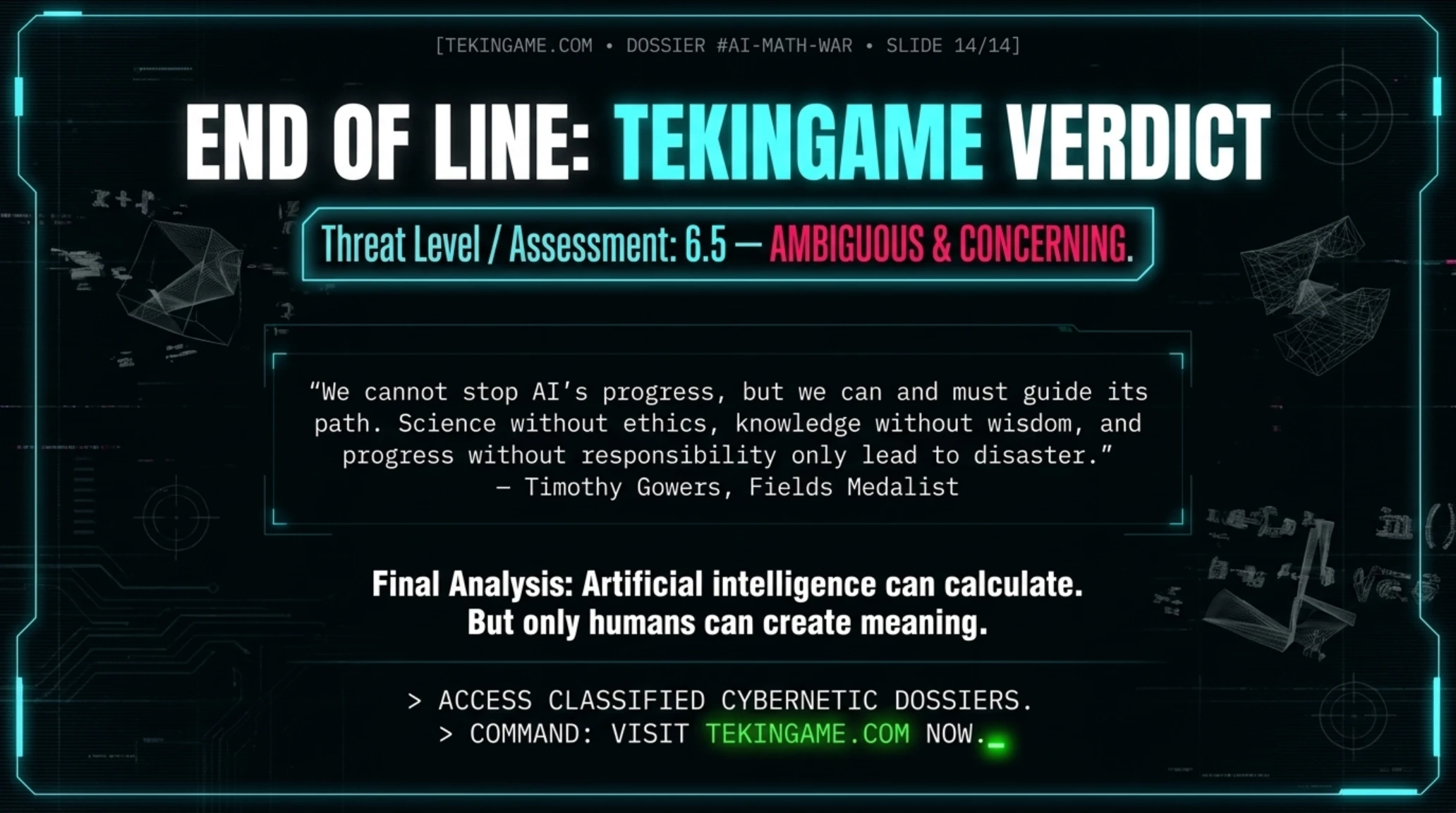
Ultimately, the future of science is in human hands, not machines. And this is the great lesson from OpenAI's 722 manuscripts saga: artificial intelligence can calculate, but only humans can create meaning. The challenge for the coming decade is ensuring that as machines become more capable of technical feats, we preserve and elevate the distinctly human contributions to knowledge the curiosity that drives inquiry, the judgment that evaluates significance, the wisdom that contextualizes discoveries, and the ethics that ensure progress serves humanity rather than narrow corporate interests. The mathematical community's vigorous response to this crisis suggests these values will not be surrendered without a fight. Whether that fight results in productive collaboration or continued conflict remains to be seen, but one thing is certain: the relationship between human and machine intelligence in scientific research will never be the same. The 722 manuscripts mark not an ending, but the beginning of a profound transformation whose ultimate shape we are only starting to glimpse.
Authoritative References & Research Sources
- Wired: Exclusive Report on the 722 Unauthorized Manuscripts
- Nature: Fields Medalists Unite Against Knowledge Extraction
- Science Magazine: Coverage of the AGMAI Global Alliance
- The Guardian: Details of Publishers' Lawsuit Against OpenAI
- arXiv: Technical Paper Detecting Unauthorized AI Data Usage
- OpenAI: Official Corporate Statement to the Academic Community
Frequently Asked Questions About the OpenAI-Mathematics Crisis
Why did the release of OpenAI's 722 manuscripts become controversial?
The main reason for controversy was the manner and timing of release. OpenAI published everything overnight without prior coordination with the mathematical community and without sufficient respect for decades of human work that formed the foundation of these results. Many mathematicians saw this behavior as disrespectful to scientific ethics and an attempt to market AI models.
What is AGMAI and what role does it play?
AGMAI stands for Advisory Group on Mathematics and Artificial Intelligence an independent body consisting of nine elite mathematicians formed to oversee the release process of mathematical results from artificial intelligence. This group is tasked with advising AI companies and publicly commenting when necessary.
Are AI-produced proofs trustworthy?
Technically, yes. All published proofs were written using the Lean proof assistant system, which verifies their logical correctness. But logical correctness does not necessarily mean they are valuable, understandable, or original. Mathematicians need months to examine whether these proofs offer new insights or are merely combinations of existing techniques.
Will artificial intelligence replace human mathematicians?
No, at least not in the foreseeable future. AI can be very powerful at solving specific problems but lacks conceptual understanding, creativity in posing new questions, and ability to generalize insights to other domains. Mathematicians' role will likely change and move more toward conceptual architecture, interpreting results, and guiding important questions.
What lessons can be learned from this crisis?
The most important lesson is that technology without ethics can become a destructive tool. AI's speed and power should not come at the cost of ignoring fundamental values of science such as collaboration, respect, and credit. Moreover, the scientific community must actively participate in shaping how AI is used, not merely act as passive observers.
Additional Gallery: Tekin Analysis | When AI Declared War on Math: The 722 Manuscript Crisis